`
IT Training for People with Disabilities- CRS Vietnam
Elizabeth Adam, Rosalie Messina, Cierra Parkinson
What is ICT4D?
•  The United Nations promotes ICT4D as a “powerful tool for
economic and social development around the
world” (“ICT4D”).
•  ICT focuses on working groups in Vietnam in order to
become more efficient in their development work.
•  ICT wants to share ideas, information, and experiences with
Vietnam to promote more development.
•  Vietnam is becoming a “seasoned ICT developer” (“Putting
knowledge to better use- Vietnam”).
•  Many Asian Countries are becoming more involved in ICT4D
because they need the promotion of digital development.
The “See, Judge, Act” Method
•  See: In Vietnam’s case, the United States has seen the hardships that
Vietnam has encountered over the years. They have used the “See,
Judge, Act” method by reflecting on Vietnam’s situation.
•  Judge: A number of assessments have been accomplished in order to
observe Vietnams’ ability to contribute to the global digital economy.
•  Judge: Several extensive interviews and analysis of available
documentation and data on government policy all played a part in
reflecting on Vietnam’s circumstances before making a decision.
•  Act: After a long process, the United States finally made a decision.
Their decision is to help this country by promoting different ways of
informational and communicational development.
•  Act: They use ICT4D for their decision by introducing new technology
and strategies for promotion in Vietnam. The United States also built
more collaboration between business and education within the country
by introducing internships, co-teaching classes, and by forming a
Marketing Event.
Catholic Social Teaching
•  A. CST: What it means
•  Affirms that human development cannot be reduced or separated into component parts
•  Personal wellbeing can only be achieved in the context of just and peaceful relationships and a thriving environment
•  Sustained growth that everyone has the right to enjoy
•  IHD promotes the good of every person and the whole person; it is cultural, economic, political, social and spiritual
•  B. CST Principles
•  1. Common good: Contributes to the thriving of the whole community, creating the conditions necessary for each person to
flourish
•  2. Solidarity: We are in constant relationship with humanity
•  a. If I can build relationships with those on the margins of my own community, I will be more able to build them with those
who I cannot see, outside of my community
•  b. If we are all equally created in the image and likeness of God, the check of whether I’m willing to match that idea, is if I go
to where that is most violated
•  3. Justice-Caritas: Rendering what is due to another
•  Justice also has implications for the way the larger social, economic, and political institutions of society are organized
•  a. Distributive justice: Proportionally allocating public goods & services
•  b. Giving the marginalized agency
•  c. Justice: Establishing the minimum conditions necessary for the flourishing of the community
Education & IT in Vietnam & Nairobi Education & IT in Haiti
•  Technology is being used effectively to improve the education system
in third world countries around the world, such as Haiti. In Grand
Guove, a sub-city in Haiti, the leaders from two middle schools have
received Nexus 7 tablet from Inveneo all synced up with educational
games and information, as well as tools for professional development.
•  The school leaders in several cities of Haiti are also being trained on
how to use the new technology tools to access information, acquire
knowledge and collaborate with educators in more developed countries
like the United States.
•  At the Be Like Brit orphanage in Port-au-Prince Haiti, iPads were
donated for educational purposes. All of the iPads are loaded with ABC
Mouse, a program that teaches the kids how to read through phonics,
and teaches lessons in math, social studies, art, music, etc.
•  UNICEF-Viet Nam estimates that
there are 1.2 million Vietnamese
children (out of the 30.5 million)
with a disability
•  The Ministry of Labor, Invalids
and Social Affairs
institutionalizes children with
disabilities, providing them with
segregated education
•  Overcrowded classes means
there are not enough educational
materials
•  According to the Ministry of
Labor, Invalids and Social Affairs,
1.3 million people with
disabilities are children between
the age of 5 and 18 (NCCD, 2010).
Physical disabilities, mental
disabilities and hearing
impairments are the three most
common groups
•  Discrimination, limited access to
health care and other public
services prevail
•  76.5% of children with disabilities
in project areas were enrolled in
school, only about 25%
nationwide
•  2007: CRS implemented IT
vocational training to 705
disabled students in Ho Chi Minh,
Hanoi & Danang, Vietnam
•  Less than 5% of young disabled
people in Nairobi are employed
and under 10% have had access
to education
•  Mainstream social protection
mechanisms fail to be inclusive
and accessible
•  CRS is using ICT to improve
education through a partnership
with Bridge International
Academies
•  Bridge international Academies
are all-inclusive academies that
develop their own scripted
curriculum that have matching
books and learning tools
•  Nairobi has declared to “Recall
that persons with disabilities
should enjoy and exercise on an
equal basis with others all human
rights recognized in international
and regional human rights
instruments”
•  IT vocational training through the
Nairobi Disabled Empowerment
Program (NADEP) for careers in
agriculture
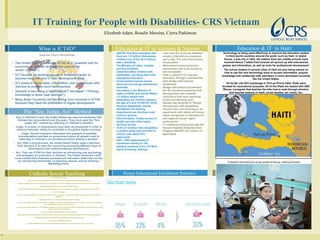
A disabled Vietnamese boy during vocational training, creating stoneware
Kenya Educational Enrollment Statistics

CRS Poster RM, EA, CP

  • 1.
    ` IT Training forPeople with Disabilities- CRS Vietnam Elizabeth Adam, Rosalie Messina, Cierra Parkinson What is ICT4D? •  The United Nations promotes ICT4D as a “powerful tool for economic and social development around the world” (“ICT4D”). •  ICT focuses on working groups in Vietnam in order to become more efficient in their development work. •  ICT wants to share ideas, information, and experiences with Vietnam to promote more development. •  Vietnam is becoming a “seasoned ICT developer” (“Putting knowledge to better use- Vietnam”). •  Many Asian Countries are becoming more involved in ICT4D because they need the promotion of digital development. The “See, Judge, Act” Method •  See: In Vietnam’s case, the United States has seen the hardships that Vietnam has encountered over the years. They have used the “See, Judge, Act” method by reflecting on Vietnam’s situation. •  Judge: A number of assessments have been accomplished in order to observe Vietnams’ ability to contribute to the global digital economy. •  Judge: Several extensive interviews and analysis of available documentation and data on government policy all played a part in reflecting on Vietnam’s circumstances before making a decision. •  Act: After a long process, the United States finally made a decision. Their decision is to help this country by promoting different ways of informational and communicational development. •  Act: They use ICT4D for their decision by introducing new technology and strategies for promotion in Vietnam. The United States also built more collaboration between business and education within the country by introducing internships, co-teaching classes, and by forming a Marketing Event. Catholic Social Teaching •  A. CST: What it means •  Affirms that human development cannot be reduced or separated into component parts •  Personal wellbeing can only be achieved in the context of just and peaceful relationships and a thriving environment •  Sustained growth that everyone has the right to enjoy •  IHD promotes the good of every person and the whole person; it is cultural, economic, political, social and spiritual •  B. CST Principles •  1. Common good: Contributes to the thriving of the whole community, creating the conditions necessary for each person to flourish •  2. Solidarity: We are in constant relationship with humanity •  a. If I can build relationships with those on the margins of my own community, I will be more able to build them with those who I cannot see, outside of my community •  b. If we are all equally created in the image and likeness of God, the check of whether I’m willing to match that idea, is if I go to where that is most violated •  3. Justice-Caritas: Rendering what is due to another •  Justice also has implications for the way the larger social, economic, and political institutions of society are organized •  a. Distributive justice: Proportionally allocating public goods & services •  b. Giving the marginalized agency •  c. Justice: Establishing the minimum conditions necessary for the flourishing of the community Education & IT in Vietnam & Nairobi Education & IT in Haiti •  Technology is being used effectively to improve the education system in third world countries around the world, such as Haiti. In Grand Guove, a sub-city in Haiti, the leaders from two middle schools have received Nexus 7 tablet from Inveneo all synced up with educational games and information, as well as tools for professional development. •  The school leaders in several cities of Haiti are also being trained on how to use the new technology tools to access information, acquire knowledge and collaborate with educators in more developed countries like the United States. •  At the Be Like Brit orphanage in Port-au-Prince Haiti, iPads were donated for educational purposes. All of the iPads are loaded with ABC Mouse, a program that teaches the kids how to read through phonics, and teaches lessons in math, social studies, art, music, etc. •  UNICEF-Viet Nam estimates that there are 1.2 million Vietnamese children (out of the 30.5 million) with a disability •  The Ministry of Labor, Invalids and Social Affairs institutionalizes children with disabilities, providing them with segregated education •  Overcrowded classes means there are not enough educational materials •  According to the Ministry of Labor, Invalids and Social Affairs, 1.3 million people with disabilities are children between the age of 5 and 18 (NCCD, 2010). Physical disabilities, mental disabilities and hearing impairments are the three most common groups •  Discrimination, limited access to health care and other public services prevail •  76.5% of children with disabilities in project areas were enrolled in school, only about 25% nationwide •  2007: CRS implemented IT vocational training to 705 disabled students in Ho Chi Minh, Hanoi & Danang, Vietnam •  Less than 5% of young disabled people in Nairobi are employed and under 10% have had access to education •  Mainstream social protection mechanisms fail to be inclusive and accessible •  CRS is using ICT to improve education through a partnership with Bridge International Academies •  Bridge international Academies are all-inclusive academies that develop their own scripted curriculum that have matching books and learning tools •  Nairobi has declared to “Recall that persons with disabilities should enjoy and exercise on an equal basis with others all human rights recognized in international and regional human rights instruments” •  IT vocational training through the Nairobi Disabled Empowerment Program (NADEP) for careers in agriculture A disabled Vietnamese boy during vocational training, creating stoneware Kenya Educational Enrollment Statistics