Visit https://ebookultra.com to download the full version and
explore more ebooks or textbooks
Crossing Design Boundaries 1st Edition Paul
Rodgers
_____ Click the link below to download _____
https://ebookultra.com/download/crossing-design-
boundaries-1st-edition-paul-rodgers/
Explore and download more ebooks or textbooks at ebookultra.com
Here are some recommended products that we believe you will be
interested in. You can click the link to download.
Hybrid Play Crossing Boundaries in Game Design Players
Identities and Play Spaces 1st Edition Adriana De Souza E
Silva
https://ebookultra.com/download/hybrid-play-crossing-boundaries-in-
game-design-players-identities-and-play-spaces-1st-edition-adriana-de-
souza-e-silva/
Conversations in Philosophy Crossing the Boundaries 1st
Edition F. Ochieng’-Odhiambo
https://ebookultra.com/download/conversations-in-philosophy-crossing-
the-boundaries-1st-edition-f-ochieng-odhiambo/
10th Conference on British and American Studies Crossing
Boundaries 1st Edition Marinela Burada
https://ebookultra.com/download/10th-conference-on-british-and-
american-studies-crossing-boundaries-1st-edition-marinela-burada/
Crossing Boundaries Tension and Transformation in
International Service Learning 1st Edition Robert G.
Bringle
https://ebookultra.com/download/crossing-boundaries-tension-and-
transformation-in-international-service-learning-1st-edition-robert-g-
bringle/
Uncovering the Constitution s Moral Design 1st Edition
Paul R. Dehart
https://ebookultra.com/download/uncovering-the-constitution-s-moral-
design-1st-edition-paul-r-dehart/
Language Curriculum Design Esl Applied Linguistics
Professional 1st Edition Paul Nation
https://ebookultra.com/download/language-curriculum-design-esl-
applied-linguistics-professional-1st-edition-paul-nation/
Crossing Paths Schubert Schumann and Brahms 1st Edition
John Daverio
https://ebookultra.com/download/crossing-paths-schubert-schumann-and-
brahms-1st-edition-john-daverio/
Integrated Biorefineries Design Analysis and Optimization
1st Edition Paul R. Stuart (Editor)
https://ebookultra.com/download/integrated-biorefineries-design-
analysis-and-optimization-1st-edition-paul-r-stuart-editor/
Crossing Disciplinary Boundaries in Studies of the Viking
Age The North Atlantic World Land and Sea as Cultural
Space AD 400 1900 Vol 4 English and Italian Edition Daniel
Savborg (Editor)
https://ebookultra.com/download/crossing-disciplinary-boundaries-in-
studies-of-the-viking-age-the-north-atlantic-world-land-and-sea-as-
cultural-space-ad-400-1900-vol-4-english-and-italian-edition-daniel-
savborg-editor/
Crossing Design Boundaries 1st Edition Paul Rodgers
Digital Instant Download
Author(s): Paul Rodgers, Libby Brodhurst, Duncan Hepburn
ISBN(s): 9780415391184, 0415391180
Edition: 1
File Details: PDF, 8.14 MB
Year: 2006
Language: english
CROSSING DESIGN BOUNDARIES
BALKEMA-Proceedings and Monographs in Engineering, Water and Earth Sciences
PROCEEDINGS OF THE 3RD
ENGINEERING & PRODUCT DESIGN EDUCATION
INTERNATIONAL CONFERENCE, EDINBURGH, UK, 15–16 SEPTEMBER, 2005
Crossing Design Boundaries
Paul Rodgers
School of Design and Media Arts, Napier University,
Edinburgh, UK
Libby Brodhurst
The Institution of Engineering Designers, Westbury, UK
Duncan Hepburn
School of Design and Media Arts, Napier University,
Edinburgh, UK
LONDON/LEIDEN/NEW
YORK/PHILADELPHIA/SINGAPORE
Cover photo credit (front and back cover): Euan Winton
Copyright © 2005 Taylor & Francis Group plc, London, UK
All rights reserved. No part of this publication or the information contained herein may be
reproduced, stored in a retrieval system, or transmitted in any form or by any means, electronic,
mechanical, by photocopying, recording or otherwise, without written prior permission from the
publisher.
Although all care is taken to ensure the integrity and quality of this publication and the information
herein, no responsibility is assumed by the publishers nor the author for any damage to property
or persons as a result of operation or use of this publication and/or the information contained
herein.
Published by: Taylor & Francis/Balkema P.O. Box 447, 2300 AK Leiden, The Netherlands e-
mail: Pub.NL@tandf.co.uk http://www.balkema.nl/, http://www.tandf.co.uk/,
http://www.crcpress.com/
This edition published in the Taylor & Francis e-Library, 2005.
“To purchase your own copy of this or any of Taylor & Francis or Routledge’s collection of
thousands of eBooks please go to http://www.ebookstore.tandf.co.uk/.”
ISBN 0-203-08853-0 Master e-book ISBN
ISBN 0 415 39118 0 (Print Edition)
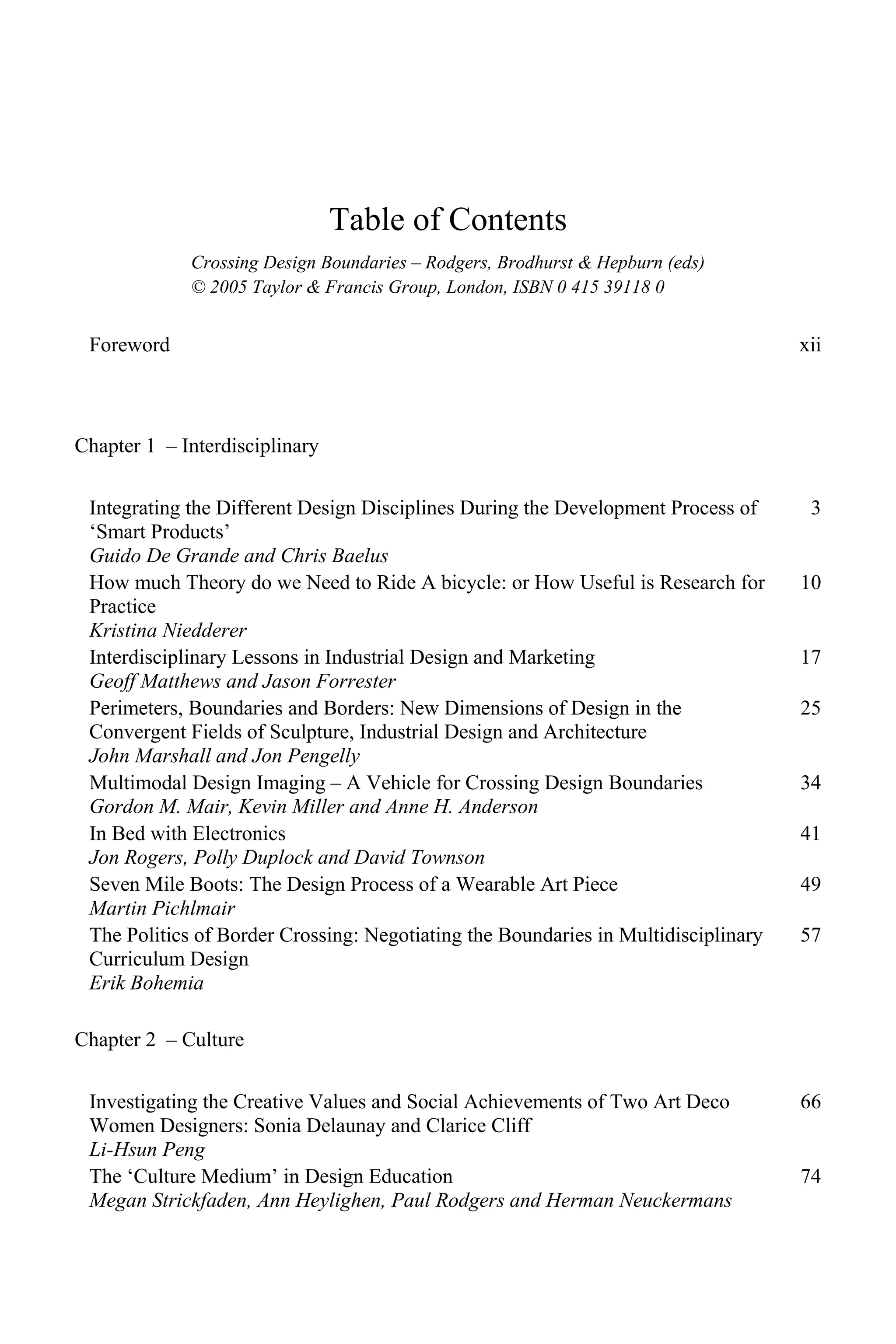
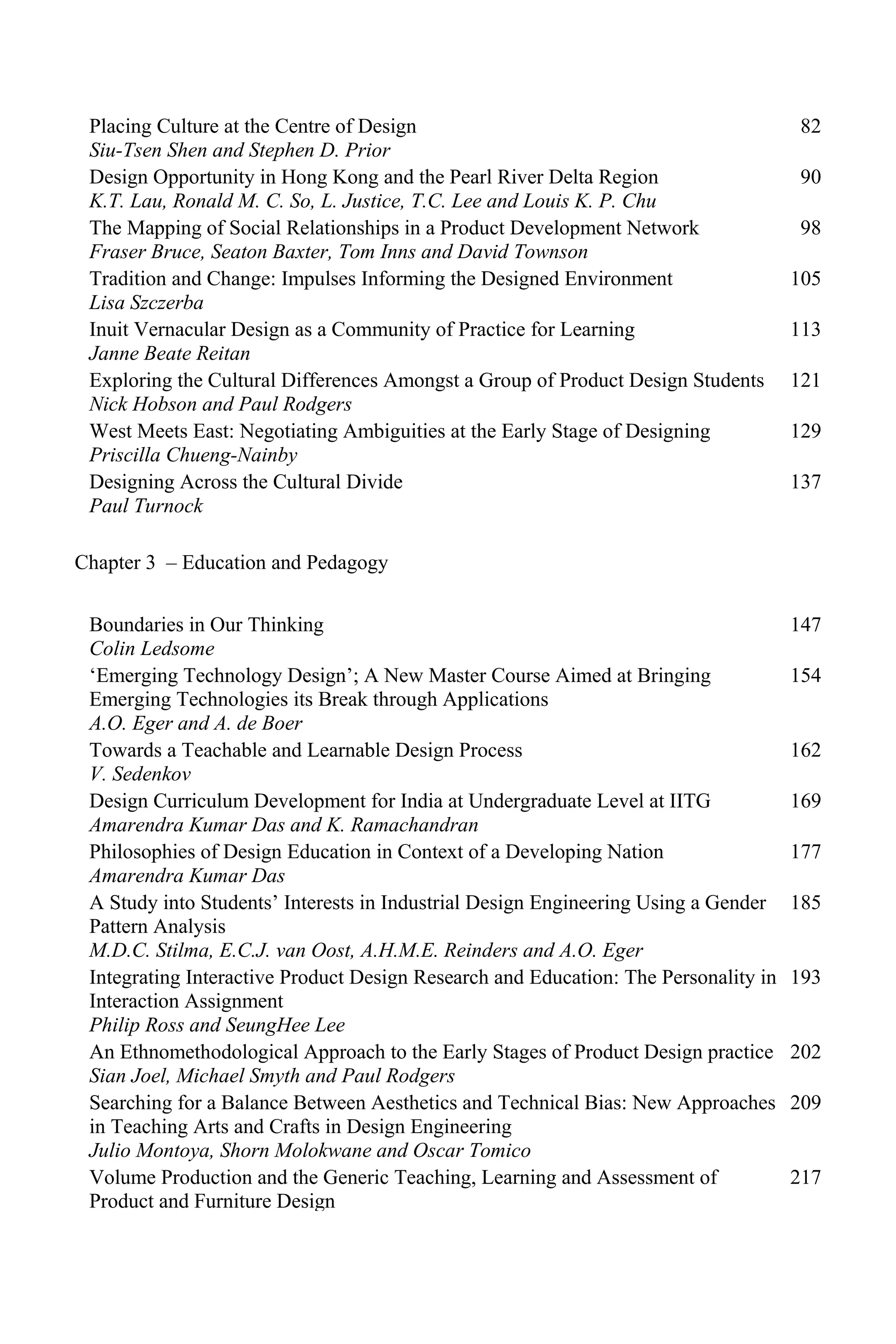
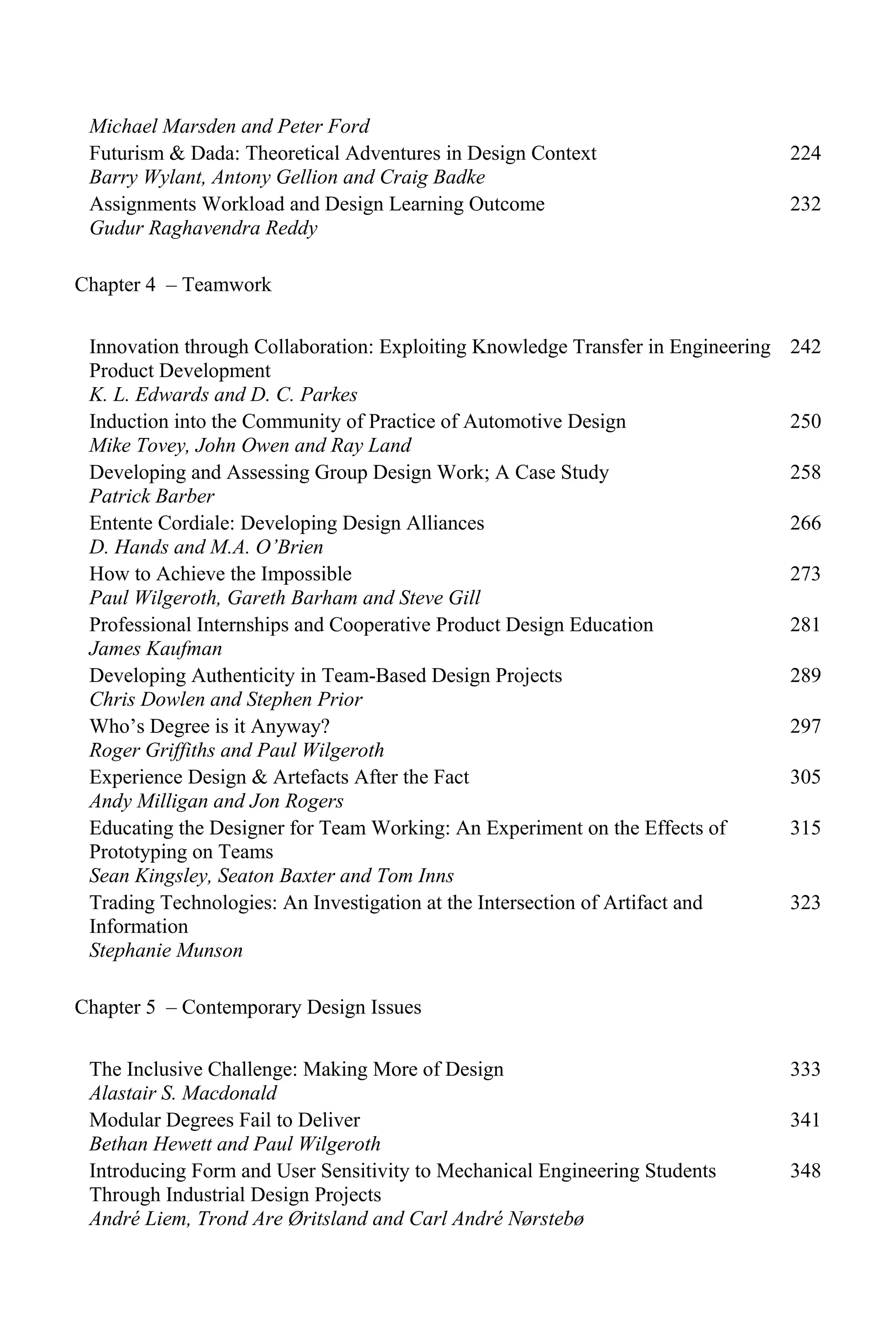
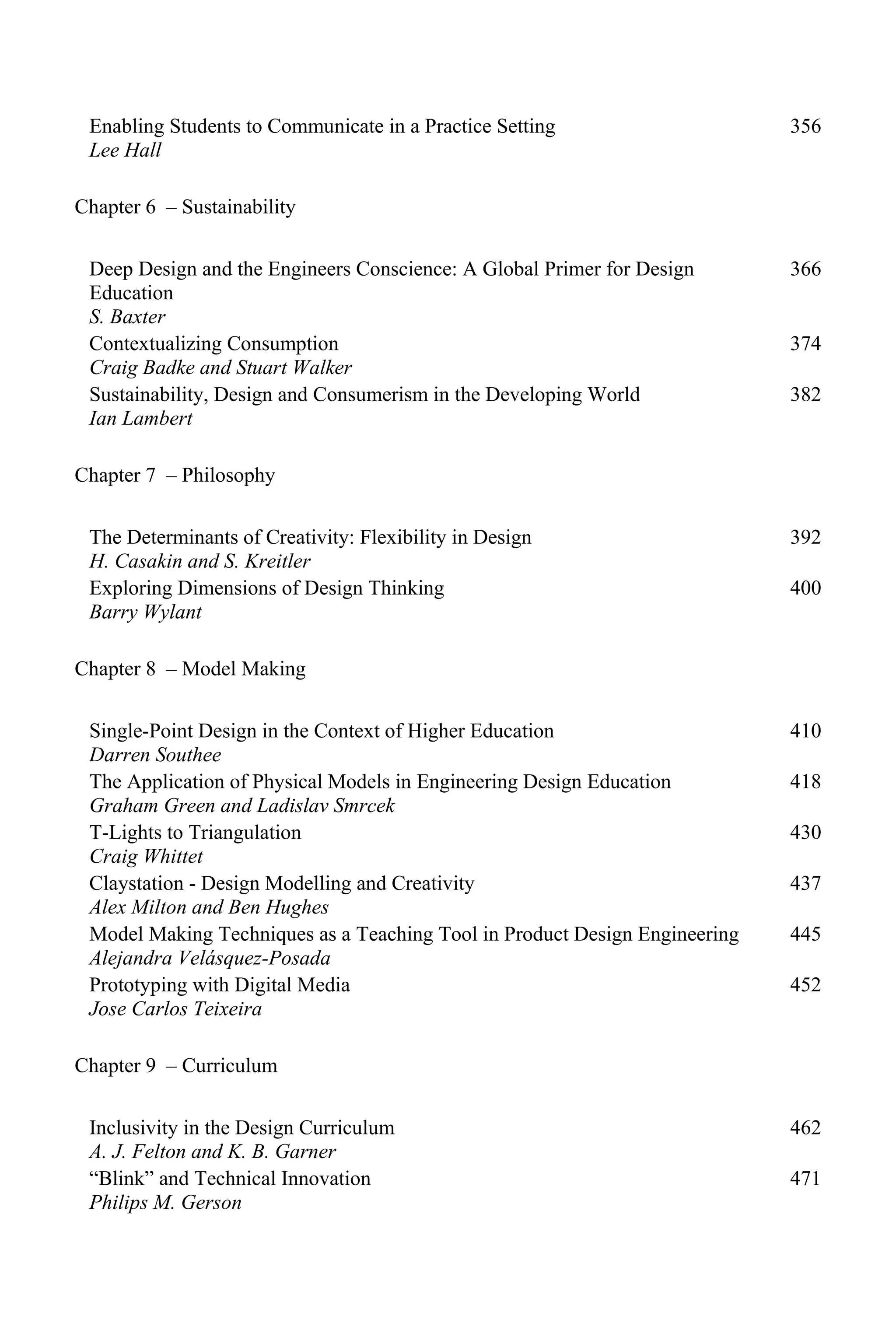
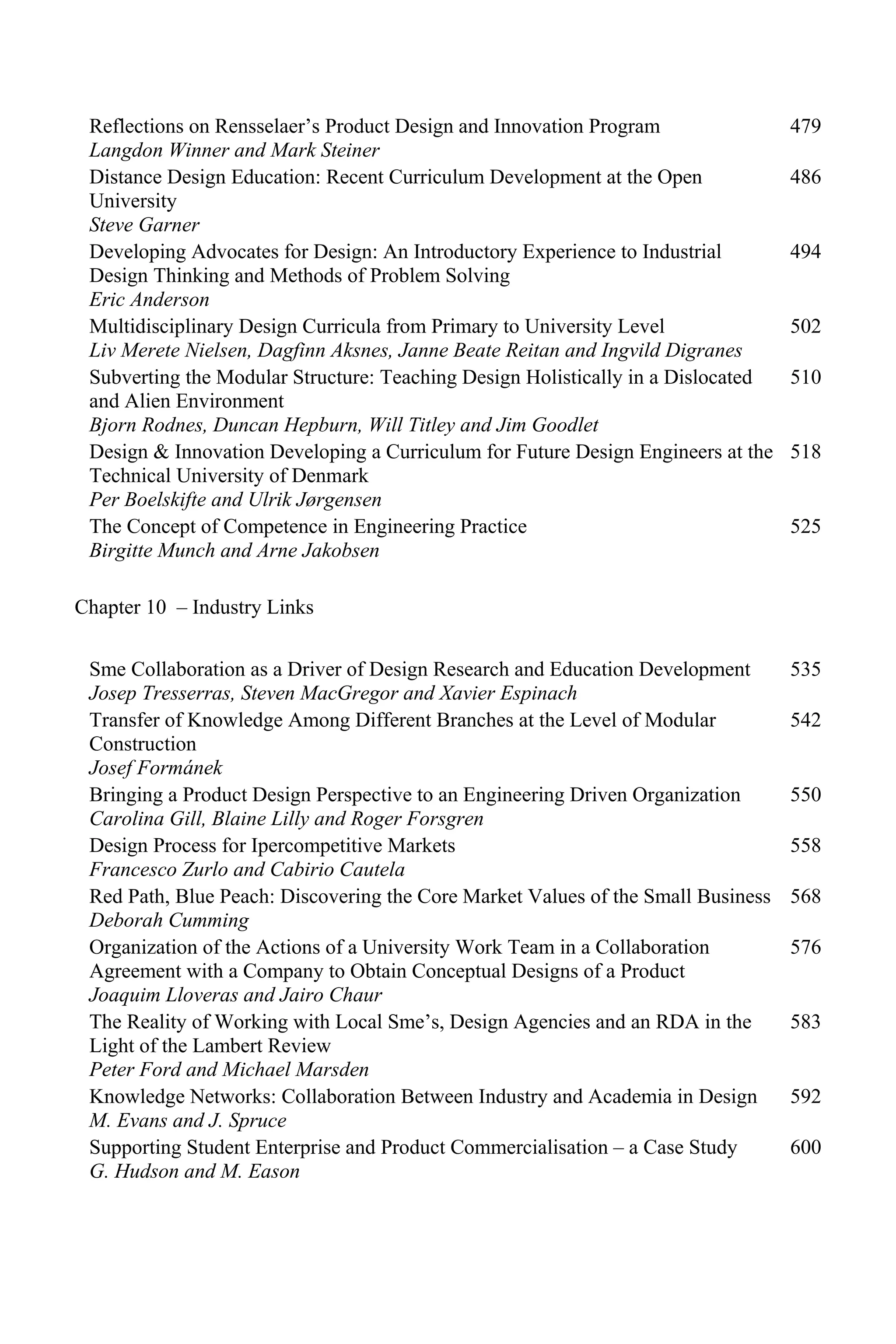
Table of Contents
Crossing Design Boundaries – Rodgers, Brodhurst & Hepburn (eds)
© 2005 Taylor & Francis Group, London, ISBN 0 415 39118 0
Foreword xii
Chapter 1 – Interdisciplinary
Integrating the Different Design Disciplines During the Development Process of
‘Smart Products’
Guido De Grande and Chris Baelus
3
How much Theory do we Need to Ride A bicycle: or How Useful is Research for
Practice
Kristina Niedderer
10
Interdisciplinary Lessons in Industrial Design and Marketing
Geoff Matthews and Jason Forrester
17
Perimeters, Boundaries and Borders: New Dimensions of Design in the
Convergent Fields of Sculpture, Industrial Design and Architecture
John Marshall and Jon Pengelly
25
Multimodal Design Imaging – A Vehicle for Crossing Design Boundaries
Gordon M. Mair, Kevin Miller and Anne H. Anderson
34
In Bed with Electronics
Jon Rogers, Polly Duplock and David Townson
41
Seven Mile Boots: The Design Process of a Wearable Art Piece
Martin Pichlmair
49
The Politics of Border Crossing: Negotiating the Boundaries in Multidisciplinary
Curriculum Design
Erik Bohemia
57
Chapter 2 – Culture
Investigating the Creative Values and Social Achievements of Two Art Deco
Women Designers: Sonia Delaunay and Clarice Cliff
Li-Hsun Peng
66
The ‘Culture Medium’ in Design Education
Megan Strickfaden, Ann Heylighen, Paul Rodgers and Herman Neuckermans
74
Placing Culture at the Centre of Design
Siu-Tsen Shen and Stephen D. Prior
82
Design Opportunity in Hong Kong and the Pearl River Delta Region
K.T. Lau, Ronald M. C. So, L. Justice, T.C. Lee and Louis K. P. Chu
90
The Mapping of Social Relationships in a Product Development Network
Fraser Bruce, Seaton Baxter, Tom Inns and David Townson
98
Tradition and Change: Impulses Informing the Designed Environment
Lisa Szczerba
105
Inuit Vernacular Design as a Community of Practice for Learning
Janne Beate Reitan
113
Exploring the Cultural Differences Amongst a Group of Product Design Students
Nick Hobson and Paul Rodgers
121
West Meets East: Negotiating Ambiguities at the Early Stage of Designing
Priscilla Chueng-Nainby
129
Designing Across the Cultural Divide
Paul Turnock
137
Chapter 3 – Education and Pedagogy
Boundaries in Our Thinking
Colin Ledsome
147
‘Emerging Technology Design’; A New Master Course Aimed at Bringing
Emerging Technologies its Break through Applications
A.O. Eger and A. de Boer
154
Towards a Teachable and Learnable Design Process
V. Sedenkov
162
Design Curriculum Development for India at Undergraduate Level at IITG
Amarendra Kumar Das and K. Ramachandran
169
Philosophies of Design Education in Context of a Developing Nation
Amarendra Kumar Das
177
A Study into Students’ Interests in Industrial Design Engineering Using a Gender
Pattern Analysis
M.D.C. Stilma, E.C.J. van Oost, A.H.M.E. Reinders and A.O. Eger
185
Integrating Interactive Product Design Research and Education: The Personality in
Interaction Assignment
Philip Ross and SeungHee Lee
193
An Ethnomethodological Approach to the Early Stages of Product Design practice
Sian Joel, Michael Smyth and Paul Rodgers
202
Searching for a Balance Between Aesthetics and Technical Bias: New Approaches
in Teaching Arts and Crafts in Design Engineering
Julio Montoya, Shorn Molokwane and Oscar Tomico
209
Volume Production and the Generic Teaching, Learning and Assessment of
Product and Furniture Design
217
Michael Marsden and Peter Ford
Futurism & Dada: Theoretical Adventures in Design Context
Barry Wylant, Antony Gellion and Craig Badke
224
Assignments Workload and Design Learning Outcome
Gudur Raghavendra Reddy
232
Chapter 4 – Teamwork
Innovation through Collaboration: Exploiting Knowledge Transfer in Engineering
Product Development
K. L. Edwards and D. C. Parkes
242
Induction into the Community of Practice of Automotive Design
Mike Tovey, John Owen and Ray Land
250
Developing and Assessing Group Design Work; A Case Study
Patrick Barber
258
Entente Cordiale: Developing Design Alliances
D. Hands and M.A. O’Brien
266
How to Achieve the Impossible
Paul Wilgeroth, Gareth Barham and Steve Gill
273
Professional Internships and Cooperative Product Design Education
James Kaufman
281
Developing Authenticity in Team-Based Design Projects
Chris Dowlen and Stephen Prior
289
Who’s Degree is it Anyway?
Roger Griffiths and Paul Wilgeroth
297
Experience Design & Artefacts After the Fact
Andy Milligan and Jon Rogers
305
Educating the Designer for Team Working: An Experiment on the Effects of
Prototyping on Teams
Sean Kingsley, Seaton Baxter and Tom Inns
315
Trading Technologies: An Investigation at the Intersection of Artifact and
Information
Stephanie Munson
323
Chapter 5 – Contemporary Design Issues
The Inclusive Challenge: Making More of Design
Alastair S. Macdonald
333
Modular Degrees Fail to Deliver
Bethan Hewett and Paul Wilgeroth
341
Introducing Form and User Sensitivity to Mechanical Engineering Students
Through Industrial Design Projects
André Liem, Trond Are Øritsland and Carl André Nørstebø
348
Enabling Students to Communicate in a Practice Setting
Lee Hall
356
Chapter 6 – Sustainability
Deep Design and the Engineers Conscience: A Global Primer for Design
Education
S. Baxter
366
Contextualizing Consumption
Craig Badke and Stuart Walker
374
Sustainability, Design and Consumerism in the Developing World
Ian Lambert
382
Chapter 7 – Philosophy
The Determinants of Creativity: Flexibility in Design
H. Casakin and S. Kreitler
392
Exploring Dimensions of Design Thinking
Barry Wylant
400
Chapter 8 – Model Making
Single-Point Design in the Context of Higher Education
Darren Southee
410
The Application of Physical Models in Engineering Design Education
Graham Green and Ladislav Smrcek
418
T-Lights to Triangulation
Craig Whittet
430
Claystation - Design Modelling and Creativity
Alex Milton and Ben Hughes
437
Model Making Techniques as a Teaching Tool in Product Design Engineering
Alejandra Velásquez-Posada
445
Prototyping with Digital Media
Jose Carlos Teixeira
452
Chapter 9 – Curriculum
Inclusivity in the Design Curriculum
A. J. Felton and K. B. Garner
462
“Blink” and Technical Innovation
Philips M. Gerson
471
Reflections on Rensselaer’s Product Design and Innovation Program
Langdon Winner and Mark Steiner
479
Distance Design Education: Recent Curriculum Development at the Open
University
Steve Garner
486
Developing Advocates for Design: An Introductory Experience to Industrial
Design Thinking and Methods of Problem Solving
Eric Anderson
494
Multidisciplinary Design Curricula from Primary to University Level
Liv Merete Nielsen, Dagfinn Aksnes, Janne Beate Reitan and Ingvild Digranes
502
Subverting the Modular Structure: Teaching Design Holistically in a Dislocated
and Alien Environment
Bjorn Rodnes, Duncan Hepburn, Will Titley and Jim Goodlet
510
Design & Innovation Developing a Curriculum for Future Design Engineers at the
Technical University of Denmark
Per Boelskifte and Ulrik Jørgensen
518
The Concept of Competence in Engineering Practice
Birgitte Munch and Arne Jakobsen
525
Chapter 10 – Industry Links
Sme Collaboration as a Driver of Design Research and Education Development
Josep Tresserras, Steven MacGregor and Xavier Espinach
535
Transfer of Knowledge Among Different Branches at the Level of Modular
Construction
Josef Formánek
542
Bringing a Product Design Perspective to an Engineering Driven Organization
Carolina Gill, Blaine Lilly and Roger Forsgren
550
Design Process for Ipercompetitive Markets
Francesco Zurlo and Cabirio Cautela
558
Red Path, Blue Peach: Discovering the Core Market Values of the Small Business
Deborah Cumming
568
Organization of the Actions of a University Work Team in a Collaboration
Agreement with a Company to Obtain Conceptual Designs of a Product
Joaquim Lloveras and Jairo Chaur
576
The Reality of Working with Local Sme’s, Design Agencies and an RDA in the
Light of the Lambert Review
Peter Ford and Michael Marsden
583
Knowledge Networks: Collaboration Between Industry and Academia in Design
M. Evans and J. Spruce
592
Supporting Student Enterprise and Product Commercialisation – a Case Study
G. Hudson and M. Eason
600
Collaboration Between Product Design Engineering at Glasgow School of Art and
the National Health Service Scotland
Dagfinn Aksnes, Anthea Dickson and Cathy Dowling
609
Dynamics of Collaboration with Industry in Industrial Design Education: the Case
of a Graduation Project Course
Fatma Korkut and Naz Evyapan
616
Design Support for SMES
M.A.C. Evatt
624
Connecting Technology to the Marketplace
Lesley Morris and Jacki Wielkopolska
632
Chapter 11 – Tools and CAD
A Hypermedia-based Learning Environment in Support of Learning and Teaching
in Electronic Product Design
Tom Page
641
Cad/Cam Integration in Combined Craft Courses: a Case Study
Richard Hooper
649
Designing Games to Teach Ethics
Peter Lloyd and Ibo van de Poel
658
Ithink-Uthink: An Industrial Design Tool to Encourage Integrated and User
Centred Design Thinking
K. Bull
666
A Visual Inclusive Design Tool for Bridging Eras, Technologies and Generations
Christopher S C Lim and Alastair S Macdonald
675
Ethnography’s Gift to Design
Meg Armstrong
683
Assessment Feedback Quality in Studio-Based Design Projects: Can Statement
Banks Help?
M. Sharp
691
Other Geometries_Objects_Spaces
Henriette Bier
699
Crafts Praxis as a Design Resource
Sarah Kettley
706
Supporting Reflection and Problem-Based Learning Through the use of Laulima
Hilary Grierson, Andrew Wodehouse, William Ion and Neal Juster
714
Chapter 12 – Communication
Ambiguous Representational Systems in Visualization Assessment
Carolina Gill
723
Combinatory Methods for Developing Student Interaction Design Projects
Marilyn Lennon, Liam Bannon and Luigina Ciolfi
731
Concept to Spatial – Bridging the Gap
Judith Hills
739
Evaluating Culture in Product Design by Integrating the Solo Taxonomy and the
Circuit of Culture
T. Katz, R. Mortezaei and R. Morris
745
Author index 753
Foreword
Crossing Design Boundaries – Rodgers, Brodhurst & Hepburn (eds)
© 2005 Taylor & Francis Group, London, ISBN 0 415 39118 0
The Engineering and Product Design Education Conference 2005 (E&PDE05) is the
seventh joint conference organised by the Design Engineering Special Interest Group
(DESIG) of the Design Society (formally under the auspices of SEED) and the Institution
of Engineering Designers (IED).
The joint Engineering and Product Design Education conference series began in 1999,
with an event on the “Continuum of Design Education” at the University of Strathclyde
in Glasgow. The event has continued on an annual basis with conferences at Derby
University, Bournemouth University, Technical University of Delft in the Netherlands
and the University of Sussex to name a few. Themes have always centred on the
importance and relevance of education in the fields of Product and Engineering Design,
with academics and industrialists travelling from all over the world to take part and share
ideas with each other.
E&PDE05 has been organised by the School of Design and Media Arts at Napier
University, Edinburgh in participation with the Design Education Special Interest Group
(DESIG) of the Design Society, and the Institution of Engineering Designers.
Initially, over 170 paper abstracts were received for E&PDE05 and a total of 92 papers
have been painstakingly reviewed and prepared for this book.
As a design researcher, a tutor, a practitioner, or perhaps a bit of all three I am sure
you will concur with the view that literally everything now depends on design. Its role as
a bridge between technology and art, ideas and ends, culture and commerce is now
fundamental. Because design can be a major player in shaping a world where a value-
enhanced user-perspective is developing, cross-functional, creative alliances must be
formed. Design thinking ought, therefore, to permeate the educational curricula.
Recent research in design issues today, with specific regard to design education1
,
highlights a number of strong characteristics:
• Design students should not attempt to develop deep expertise in any one field, but,
rather, take in information from many sources.
• Designing is no longer a localised activity.
• Designers need ever greater flexibility and networking skills.
• Designers must be comfortable working with others, and being skilled in managing the
dynamics of group activity as it is rare now for design projects to be completed by an
individual.
• Designing is increasingly about intellectual capital and less about delivering a trade or
craft ability.
1 The Bureau of European Design Associations, Design Issues in Europe Today, BEDA,
Barcelona, 2004, ISBN: 1-905061-04-8
• Designers must be skilled in creating the right environment to promote creative thinking
and design activity that develops vital intellectual capital.
• Designers must be able to trawl the vast seas of information and construct connections
and thus create new and worthwhile knowledge.
The aims of the conference, therefore, are to explore novel approaches in design
education within the wider context of product design and development. The theme
“Crossing Design Boundaries” reflects the organising team’s wish to incorporate many of
the disciplines associated with, and integral to, modern design pursuits. In this book you
will find, for example, the conjunction of anthropology and design, the psychology of
design products, soft computing and wearable products, new media and design and how
they can be best exploited within a product design and development arena.
Even though the act of design has been described as “wicked”2, 3
and designers might not
be in a position to save the world, the design of products, spaces, experiences, services
and systems can make it a more enjoyable, a more beautiful, and even a more interesting
place to live.
The blurring and crossing of design boundaries was represented well in the recent end
of year Design Degree Show at Napier University. In the Design Degree Show catalogue
you will find a number of well designed products, systems, spaces, services, and
experiences. Products, for example, which range from gardening equipment to
inexpensive lighting to hair care packaging to cuddly toys for capturing memorable
moments to clothing and accessories for sufferers of Seasonal Affective Disorder (SAD)
to interactive wallpaper. A number of systems were designed to alleviate some real world
issues such as a beer barrel handling device to eliminate manual handling injuries, and an
alcohol gel dispenser to minimise infection such as MRSA within hospitals.
In terms of designed spaces, our students have undertaken very ambitious projects
ranging from the radical reinterpretation of a Courthouse to the reconfiguration of a
Registrars’ Office. Two multi-level housing projects explore issues relating to Retirement
Homes and Apartments for First Time Buyers. Other projects included a Shopping Centre
with ‘Identity’, the submersion of a northeast icon to create a Diving School, and a City
Check-In for Edinburgh tourists. Two schemes considered diverse agendas in education,
a Construction School for Teenagers and an Institute for Dyslexia. Social issues were
explored in a ‘Timebank’ for Charities, a Clinic for Teenage Mothers, and a Community
Media Studio. A Retreat for Textile Designers and a White-goods Workshop completed
an impressive array of spatial design solutions.
Increasingly, designers are asked to consider the notion of services and experiences
and our students are no different in meeting this challenge head on. The dematerialisation
of products is gaining momentum in contemporary design and is best reflected in the
work of the Barcelona and Berlin-based designer Martí Guixé4
. Our final year design
2 Rittel, H. and M. Weber, M., “Dilemmas in a general theory of planning”, Policy Sciences, 4
(1973), pp. 155-169.
3 Buchanan, R., “Wicked problems in design thinking”, in: V. Margolin and R. Buchanan,
(Editors), The Idea of Design, MIT Press, Cambridge, MA (1995), pp. 3-20.
4 Guixé, M., Martí Guixé: 1:1, 010 Publishers, Rotterdam, (2002).
students, like Guixé, explored the potential of dematerialisation in a bespoke design
service for reclaimed objects, an urban memorial which permanently stores information
on generations of citizens that have passed away, a web-based service which encourages
individuals to add some selfless good deeds into their daily lives, a service for bereaved
cat owners which helps them to come to terms with their loss, and an immersive
experience for authentic dining.
As mentioned earlier, in the Bureau of European Design Association report, the
designers of today and tomorrow need to be able to take in information from many
sources, be flexible and comfortable working with others, be skilled in managing the
dynamics of group activity, be skilled in creating the right environment to promote
creative thinking and possess the ability to trawl vast seas of information and create new
and worthwhile knowledge. In short, they need to be able to “cross design boundaries”.
“Crossing Design Boundaries” includes a number of papers which describe
discussions about product design education and the cross-over into these established
fields, and a number of papers explore other specialist design areas such as interaction
design, jewellery design, furniture design, and exhibition design which have been
somewhat under represented at EPDE conferences in the past. The book comprises a
number of excellent papers which have been classified into the following categories:
• Interdisciplinarity
• The Culture of Design
• Design Education and Pedagogy
• Teamwork in Design
• Contemporary Design Issues
• Sustainability and Design
• Philosophy and Design
• Model Making in Design
• Curriculum Issues in Design Education
• Industry Links
• Tools and CAD in Design
• Communication in Design
As editor in chief of this book I would like to thank all the people who played a part in its
making. Special mention should go out to all the members of the organising committee
who were enormously rigorous and efficient in their reviews. They are, in no special
order, Erik Bohemia, Duncan Hepburn, Mike Tovey, Chris Dowlen, Bjorn Rodnes, Bill
Ion, Mike Evatt, Joaquim Lloveras, Chris McMahon, Peter Childs, Kevin Edwards,
Nigan Bayazit, and Peter Lloyd. The organisation of this conference has been made much
easier with the wonderful support of the team at the Institution of Engineering Designers.
They are Libby Brodhurst, Alison Parker, Nadine Pearce, and Anna Clarke. Lastly, the
Taylor and Francis team of Maartje Kuipers and Lukas Goosen et al have ensured a quick
and brilliantly produced book of which I am sure everyone will be proud. My apologies
to anyone I have inadvertently failed to mention.
Dr. Paul Rodgers
Reader in Design
Design and Media Arts, Napier University
Chapter One
INTERDISCIPLINARY
INTEGRATING THE DIFFERENT
DESIGN DISCIPLINES DURING THE
DEVELOPMENT PROCESS OF ‘SMART
PRODUCTS’
Guido De Grande*
Hoger Instituut voor Integrale productontwikkeling, Department of
Design Sciences, Belgium.
Chris Baelus*
Hoger Instituut voor Integrale productontwikkeling, Department of
Design Sciences, Belgium.
Crossing Design Boundaries – Rodgers, Brodhurst & Hepburn (eds)
© 2005 Taylor & Francis Group, London, ISBN 0 415 39118 0
ABSTRACT
The overall design of ‘smart’ products, based on electronics and on
advanced information and communication technologies is a mixture of
different design processes, dealing with technological, economical and
user aspects. This requires an integrated approach allowing the product
designer to manage the underlying design processes: electronic design,
software design, interaction design and product design.
This paper describes the methodology for this integrated approach as
used in a design project for master students. The project focuses on the
design of wearable electronic devices and includes the development of a
graphic user interface. A specific road map is used to guide the students
throughout the project. This road map is a set of techniques and tools to
achieve four objectives.
The first objective is to define feasible product ideas based on
technological opportunities and relevant user needs. Therefore a
technology or user driven approach is followed, based on trend mapping,
anthropological research and scenario writing.
The second objective is to support the inventive process by creating the
interface between the different design disciplines. This allows the product
designer to specify the necessary design brief for further specialised
developments such as PCB design and software development.
*Hoger Instituut voor Integrale productontwikkeling Department of Design
Sciences - Hogeschool Antwerpen Ambtmanstraat 1 2000 Antwerpen Belgium
Phone: +32 3 205 61 73
Email: c.baelus@ha.be or g.degrande@ha.be
Students translate the technical and user requirements into a data flow
diagram as a basis for the successive system design. This diagram defines
the information transfer within the system and the interaction with the
user. It is the basis for the interaction concept and the product architecture
describing the working principles and the required functional subsystems.
After that the student completes the project by executing the more
traditional GUI design (Graphic User Interface) and the product design
phases.
The third objective is to introduce interdisciplinary verification
techniques on a systematic basis. The student is trained in detecting the
critical aspects in the design proposals and in selecting the appropriate
method to evaluate the feasibility of the proposals. Usability testing,
ergonomic verification, virtual PCB prototyping, bread-boarding and 3D
printing is used for verification.
The fourth objective is to provide the student with adequate expertise
and tools to manage this complex multi-layered project. Using project
planning software students are able to manage the time critical issues of a
complete design project.
Keywords: integrated product development, smart products, interaction design
1 INTRODUCTION
In the higher Institute of Integrated Product Development in Antwerp a ‘user centered’
approach has been taken to educate product designers in developing innovative products
with sufficient added value for both the user and the company.
A specific methodology is followed to integrate all relevant disciplines during the
early stages of the design process [1].
All technological, economical and human related aspects having an impact on the
required added value, the product quality and the feasibility of the final result will have to
be addressed during the creative process. Students are trained to analyze the context,
generate innovative product ideas and use their design skills to develop these product
concepts. Moreover, they have to be able to manage the innovation process and control
all critical aspects by systematically performing interdisciplinary verifications.
This approach can be used for various types of products but becomes very relevant for
the development of the new generation ‘smart’ consumer products, using electronics and
advanced information and communication technologies. Because of the various
knowledge fields and design disciplines involved, the quality of the output can only be
guaranteed by managing all underlying design processes: interaction design, software
development, electronic design and product design. A specific roadmap and toolbox is
introduced during the I-ware project in order to deal with this complexity.
Crossing design boundaries 4
Other documents randomly have
different content
GLENGARRY’S REVENGE.
My legend has to do with that very Castle of Eilean Donan with which
yours has already made us so well acquainted. The time of the action was
about the early part of the seventeenth century, and the great actor in it was
a very celebrated MacDonell of Glengarry, whose name I have forgotten,
but who is said to have been remarkable for his gigantic figure and
Herculean strength. The Lord Kintail of that period was a great favourite
with the Court, so that he thereby rose to great power and influence, which
he very naturally employed, according to the laudable custom of those days,
in humbling his enemies. Amongst these, none bore him a larger share of
animosity than his hereditary foes, the MacDonells of Glengarry. It was not
in their nature tamely to submit to the dominion which Kintail was
permitted to exercise, with comparative impunity, over some of the other
clans. On the contrary, they were frequently disposed not only to resist
themselves, but they also very often found means to stir up others to
resistance, and in this way they sometimes furnished Kintail with specious
grounds for accusing them, when all apology for doing so might have been
otherwise wanting.
It happened that the chief of Glengarry was on one occasion engaged for
some days in a hunting expedition in that range of his own country which
surrounds the sea lake of Loch Hourn, already so often mentioned in the
last legend. The sun was setting on a mild and beautiful evening, and the
breeze was blowing softly from the sea, when, as Glengarry was returning
from the chase, attended by a small party of his followers, he espied a
couple of galleys standing in towards the very part of the shore where stood
the little group of black bothies, that at such times formed his temporary
place of encampment. Doubtful whether the approaching vessels might
contain friends or foes, he deemed it prudent to put himself and his people
into ambush behind some broken ground, where they might lie concealed
until they could patiently observe the progress and the motions of those
who came, and so judge as to the result.
“Knowest thou the rig of those craft, Alaister More?” demanded Glengarry
of his henchman, as they peered together over the black edge of a moss
bank, and scanned the approaching sails with earnest eyes. “Whence may
they come, thinkest thou?”
“I would not say but they may be Kintail’s men,” replied Alaister.
“Kintail’s men!” exclaimed Glengarry, “what would bring Kintail’s men
here at this time?”
“I’m not saying that I am just exactly right,” replied Alaister, “but I’m
thinking it looks like them.”
“Curses on them!” said Glengarry bitterly, “they are bold to venture hither
while I am here.”
“They are so, I’m thinking,” said Alaister; “but it may be that they have no
guess that Glengarry is here. But, troth, that Kintail holds his head so high
now-a-days, that I’m judging his men think themselves free to thrust in their
noses just where they like. He’s king of the north-west, as a man might
say.”
“Accursed be his dastard dominion!” said Glengarry, with bitterness of
expression; “and shame upon the slavish fools that yield their necks as
footstools to his pride. Is’t not galling to see it? Is’t not galling to see men
of wisdom and bravery, such a man as my staunch friend and ally,
MacLeod, for instance, yielding so ready an obedience to one whom all
should unite to oppose, overthrow, and crush as a common enemy.”
“That’s very true that you’re saying, Glengarry!” observed Alaister; “but
I’m thinking that they are not all just blessed with your spirit. If they had
been so, I’m judging that the MacCraws could not have been left as they
were without help but what they got from you.”
“By all that is good, it was our help alone that saved them,” cried Glengarry
in an animated tone. “Half of them would have been hanged on the gallows-
tree but for our interference. The MacKenzies had no reason to pride
themselves on the event of that day, nor had we any cause to boast of the
zeal of those whom we have been wont to reckon among our allies.”
“Troth, you’re not wrong there, Glengarry,” said Alaister. “So I’m judging
that we must even go on to trust to our own MacDonell swords in all time
coming; and we have reason to be thankful that their blades are not just
made of cabbage stalks.”
“Thank God, indeed, that they are made of better metal!” said Glengarry,
smiling proudly. “And small as this our party is, would, with all my heart,
that these were Kintail’s men, with Kintail himself at the head of them!”
“I should not be that sorry to see Kintail,” said Alaister.
“We should give him a hotter welcome than this cold coast might lead him
to look for,” said Glengarry.
“We’ll not be slow in giving him that same, I’m thinking,” said Alaister.
“Stay! dost thou not make out a banner yonder?” demanded Glengarry.
“I’m thinking I do see something like a banner,” replied Alaister.
“With this failing light we cannot hope even to guess at the bearing with
which it may be charged,” said Glengarry, straining his eyes, “but if that be
a banner, as I believe it to be, then is there certainly a chief there. Look to
your arms, MacDonells, and let us be prepared for what may happen!”
By degrees the galleys drew nearer and nearer; but as the night was falling
fast, their forms grew less and less distinct as their bulk swelled in the eyes
of the MacDonells, till at last they came looming towards the shore like two
dark opaque undefinable masses, which were suddenly reduced, by the
displacement of their sails, to about one-fourth part of the size they had
grown to. For a time they were rocked to and fro until their keels became
fixed in the sand by the receding tide. The dusky figures they contained
were then seen pouring out from them, and passing like shadowy spectres
across a gleam of light that was reflected on the wet sand from the upper
part of the sky; and they showed so formidably in numbers, as to render
some short council of war necessary before assaulting them with an inferior
force, not from any fear of defeat on the part of him who took this
precaution, but dictated by his prudence to prevent all risk of the escape of
those whom they were about to attack.
Whilst Glengarry was thus concerting his measures, the strangers were seen
moving a body towards the cluster huts, which stood at something less than
an hundred yards from the water side, and speedily disappeared within their
walls, and lights soon afterwards began to start up within them, as if they
were preparing to make themselves comfortable for the night. Glengarry
observed this, and in order that he might lull all apprehension of attack, he
resolved to give them full time to employ themselves in cookery, or in
whatever occupation they might find to be necessary.
The broken ground which concealed the MacDonells discharged a small
rill, that ran between the banks of mossy soil, in a diagonal line, and opened
on the sand at a point almost opposite to the spot where the two galleys
were lying. No sooner was the chief of Glengarry satisfied that the time was
come when the assault could be most opportunely made, than he led his
handful of men silently down between the hollow banks of the brook, so as
to get unperceived between the enemy and their vessels. So far everything
went well with them, but as they debouched from the mouth of the water-
course, the partial light that gleamed from the upper part of the sky glanced
unexpectedly on the blades of their naked claymores, and instantly a loud
bugle blast blew shrilly from on board the nearer of the two galleys.
“Dunvegan! Dunvegan!” cried a loud voice from the bothies, after the bugle
had ceased.
In an instant their little black heaps gave forth their living contents, some
armed, and others with blazing torches of moss-fir, plucked suddenly from
the great fires they had kindled.
“’Tis MacLeod!” said Glengarry in a peevish tone, that sufficiently betrayed
the disappointment he felt that his well-concerted scheme of attack was thus
rendered useless. “’Tis but MacLeod, then, after all!”
“Hoo!” said Alaister, “sure enough it’s MacLeod, and no one else. So we’ll
be supping, I’m thinking, and drinking together like friends, instead of
fighting like wild cats.”
“Would it had been otherwise!” said Glengarry, “much as I love MacLeod, I
would at this moment rather a thousand times have encountered the Lord of
Kintail. By the rood, but I was more i’ the humour for dealing in blows than
pledging in beakers! But since it could not be Kintail, I rejoice that it is
MacLeod, for as I could desire no better foe than the one, I can have no
worthier friend than the other.”
“Both good of their kind surely, I’m thinking,” said Alaister.
Nothing could exceed the joy and cordiality of the friends at thus meeting
so unexpectedly. The fattest buck of the chase was dragged towards a fire,
kindled for culinary purposes in one of the huts, steaks cut from its haunch
were added to the fare which MacLeod’s people were preparing, and after a
hasty and unceremonious meal, the two chiefs retired with some of those in
whom they reposed most confidence, into a separate bothy, where they
might have leisure for full converse over a cup of wine.
“To what happy accident am I to attribute our meeting thus in Knoidart?”
demanded Glengarry.
“If I had not chanced thus to meet you here,” said MacLeod, “I should have
gone on to Invergarry Castle, as I originally intended. But it is well that I
am saved so long a journey.”
“Nay, by all that is friendly, that is not well said of you, MacLeod,” said
Glengarry. “But I shall not be baulked of your visit. We shall break up
hence, and set forward thither before to-morrow’s dawn. If there be deer on
my hills, fish in my streams, steers in my pastures, or wine in my castle-
vaults, thou shalt be feasted like a prince as thou art.”
“That may not be,” said MacLeod, “for this is no time for you to devote to
friendship and feasting. Thou knowest not that the object of this voyage of
mine was no other than to warn thee of certain wicked plots that are about
to be brought to bear against thee.”
“What! some evil machinations of the accursed Kintail, I warrant me,” said
Glengarry.
“Thou hast guessed, and guessed rightly too,” replied MacLeod.
“Cowardly villain that he is!” cried Glengarry, “what has he done?”
“Thou knowest that he is in high favour at Court,” said MacLeod. “They
even talk now of his being made an earl. But be that as it may, he hath
somehow or other acquired the means of using the King’s ear. And foully
doth he misuse it, by pouring poison into it to further his own ambitious and
avaricious views, to the injury of the innocent.”
“’Tis like the cold-hearted knave,” said Glengarry. “But what, I pray thee,
hath he said of me?”
“I know not what he may have said of thee,” answered MacLeod, “but I
know that he must have sorely misreported thee, seeing that through certain
channels he hath persuaded his Majesty to arm him with letters of fire and
sword and outlawry against thee.”
“What said’st thou?” cried Glengarry, choking with his rising anger; “did I
hear thee aright? Letters of outlawry, and of fire and sword, put into the
hands of MacKenzie of Kintail, to be executed against me! Oh,
impossible!”
“What I tell thee is too true,” said MacLeod.
“The dastard dare not use them!” cried Glengarry, grinding his teeth from
the violence of his rage.
“Backed by the King, as he now is, he may dare do anything,” said
MacLeod.
“I defy him though he be backed by the King,” cried Glengarry in a fury;
“aye, and though both were backed by the black monarch of hell? God
forgive me for coupling the name of a sovereign whom I would fain love
and honour, if he would but let me, with those of MacKenzie of Kintail, and
that devil whom he delights to serve.”
“Moderate your passion, Glengarry,” said MacLeod, “and listen to me
quietly, until I put thee in possession of all that is brewing against thee.”
“I am calm,” said Glengarry.
“It is my duty as a friend of thine to tell thee, then,” said MacLeod, “that a
meeting is summoned for three days hence at the Castle of Eilean Donan of
all those whom Kintail chooses to call the King’s friends in these north-
western parts, who are called together for the ostensible purpose of giving
him counsel how best to put in force those letters against thee, which he
affects to be deeply grieved to have been charged with.”
“Hypocritical villain!” cried Glengarry.
“I am one of those friends of the King who are thus summoned,” said
MacLeod, “and my present object was to prove to thee, that although I may
be so ranked, I am not the less a friend of thine. I wished to make thee fully
aware of the whole state of matters before I go to Eilean Donan to swell, as
in regard to my own safety I must needs do, that majority which he looks
for to strengthen his hands against thee.”
“Thou hast proved thyself a friend indeed,” said Glengarry, after ruminating
a few seconds. “Thou hast proved thyself to be that old and steady friend of
mine which I always have believed, and ever will believe thee to be. And
now it is my turn to ask thee, whether thou hast ever found me in one
instance to fail thee?”
“Thou hast never failed me, Glengarry,” said MacLeod, “and I trust our
clans shall be ever linked together like one bundle of rods.”
“Aye!” said Glengarry, with a bitter laugh, “a bundle of rods which I trust
may one day be well employed in scourging this pitiful tyrant of the north-
west. I love thee too much to demand thine open aid at present. But haply
thou mayest well enough find some excuse for not going to this meeting
thou speakest of. An excuse, mark me, to be sent after the day is past. Thou
canst be grievously ill, or anything may serve as an apology, if an apology
should be required; for I have friends at Court, too, and I may yet find the
means so to bring things into proper joint, as to render apologies more
necessary from Kintail than from us. All that I ask of thee then is, that you
may not appear at this nefarious assemblage at Eilean Donan.”
“MacDonell,” replied MacLeod, “I know the risk I run, but I am ready to
incur any risk for so old a friend as thou art, especially in a case where the
securing aid in arms rather than in council is so evidently the object of
Kintail in calling us together. Say no more then; we shall weigh hence for
Dunvegan by to-morrow’s dawn, and be assured nothing shall drag me
thence to be marshalled against thee in any way.”
“Thank thee—thank thee!” said Glengarry, cordially shaking MacLeod by
the hand. “This is no more than I expected of thy generosity and good faith.
Thy kind and friendly information shall not be thrown away upon me. I
shall start for Invergarry Castle by to-morrow morning’s sunrise. But thou
shalt hear from me without fail. And if thy little finger be but brought into
jeopardy, thou shalt have my neck to answer for it.”
This important conversation between the two chiefs being now ended, they
gave themselves up to the enjoyment of that good fellowship and revelry
which arose between their two clans. Small was that portion of the time
subjected to the rule of night which was by them devoted to slumber, and
soon were they both astir each to pursue his separate way; and as the rising
sun was glancing on the arms of Glengarry and his people as they wound
inland over the muirland hills, they looked back towards Loch Hourn, and
beheld the galleys of MacLeod winging their way for Skye, under a
favouring land breeze, that seemed to have been begotten by the genial
beams of morning, which then poured a flood of brilliant light after them as
they flew over the trembling surface of the waters.
The tide was fully up around the little island which gives name to the Castle
of Eilean Donan, and the ferry-boat was moored on the landward side of the
strait, when the shades of night began to descend upon it, and upon the
whole of the surrounding scenery, on the evening of that day which was
fixed for the gathering that Lord Kintail had summoned.
“A plague take this MacLeod,” said the boatman in Gaelic to his assistant,
as they sat glued to their benches, listening with envy to the sounds of mirth
that came to their ears from within the castle walls. “A plague upon this
MacLeod, who keeps us waiting here in the cold when we might be
warming our toes at a blazing fire, and cherishing our noses with a goodly
flagon of ale!”
“A plague upon him, with all my heart,” echoed the other man. “Is it for
him alone that we are condemned to tarry here?”
“Aye, Donald,” said the master, “MacLeod is the only man awanting, it
seems; and, sure enough, I think there be plenty without him. Hast thou
ever before seen such an inpouring of eagles’ wings into the Castle of
Eilean Donan? There is surely something a-brewing.”
“Whatever may be brewing, Master Duncan, we seem to have but little
hope of drinking of it,” said the man, laughing heartily at his own joke.
“Faith, Master Donald, they may be brewing some browst which neither
you nor I would be very eager to drink,” replied the master; “I would rather
be turning up a creaming cup of the castle ale than have aught to do with
any such liquor. But hold, heard ye not the tread of men? Come, loose the
rope, and to your oars. That will be MacLeod at last. Who comes there?”
cried he, as he dimly perceived a small party of men approaching the spot
where the boat lay.
“MacLeod!” cried a voice in reply, and immediately a tall and bulky figure,
completely enveloped in an ample plaid, advanced, and after having given
some secret directions to his followers, to which the impatient boatmen
neither cared nor tried to listen, he stepped solemnly and silently alone into
the boat, and was speedily rowed across.
The hall of Eilean Donan was that night crowded beyond all former
precedent. The feast was already over, and Lord Kintail was then presiding
over the long board, where flowing goblets were circulating among the
numerous guests, who were all his friends or allies, or who at least feared to
declare themselves to be otherwise. But fully aware of the uncertain
materials of which this great assemblage was composed, the chief of the
MacKenzies had most prudently intermingled the stoutest and bravest
individuals of his own clan among these strangers; and, as was customary in
these rude times, each man sat with his drawn dirk sticking upright in the
board before him, ready for immediate use, in case of its services being
required; and this precaution was the more naturally adopted upon the
present occasion, because every one at that table was jealous and doubtful
of those sitting to right and left of him.
On a sudden the door of the hall was thrown open, and a huge man strode
slowly and erectly into the middle of it. He was muffled up in a large dark
plaid, of some nameless tartan; and it was so folded over the under part of
his face as completely to conceal it; whilst the upper part of his features was
shrouded by the extreme breadth of the bonnet he wore. His appearance
produced a sudden lull in the loud talk that was then arising from every
mouth, the din of which had been making the vaulted roof to ring again.
The name of “MacLeod” ran in whispers around, and Lord Kintail himself
having for a moment taken up the notion that had at first so generally seized
the company, he signed to his seneschal to usher the stranger towards the
upper end of the table where he himself sat, and where a vacant chair on his
right hand had been left for the chief of Dunvegan.
The stranger obeyed the invitation, indeed; but he sat not down. He stood
erect and motionless for a moment, with all eyes fixed upon him.
“MacLeod!” said the Lord Kintail, half rising to acknowledge his presence
by a bow, “thou art late. We tarried for thee till our stomachs overmatched
our courtesy. But stay, am I right? art thou MacLeod or not? Come, if thou
art MacLeod, why standest thou with thy face concealed? Unfold thyself
and be seated; for there are none but friends here.”
“I am not MacLeod!” said the stranger, speaking distinctly and deliberately,
but in a hollow tone from within the folds of his plaid.
“Who art thou, then, in God’s name?” demanded Kintail, with some degree
of confusion of manner.
“I am an outlawed MacDonell,” replied the stranger.
“A MacDonell!” cried Kintail, with manifest agitation. “What wouldst thou
under this roof?”
“I am come to throw myself on thy good faith, Lord Kintail, with the hope
that thou mayest be the means of procuring a reversal of the hard sentence
which hath been so unjustly passed upon me and my clan.”
“I must first know more of thee,” said Kintail. “I can give no promise until I
know who thou art.”
“I said I was a MacDonell,” replied the other.
“That is a wide name,” said Kintail. “Heaven knows that for the peace of
the earth it holds too many that bear that name.”
“That may be as men may think,” said the stranger, with greater quickness
of articulation.
“What MacDonell art thou, then?” demanded Kintail. “Pray, unmuffle thy
face.”
“One MacDonell is like another,” said the stranger carelessly.
“That answer will not serve me,” said Kintail. “I must see thy face. And
methinks it is a bad sign of thee, that thou shouldst be ashamed to show it.”
“Ashamed!” said the stranger, with emphasis—and then, as if commanding
himself,—“In times of feud like these,” added he, after a pause, “thou canst
not ask me to uncover my face before so promiscuous a company as this,
where, for aught I know, I may have some sworn and deadly personal
enemies, who may seek to do me wrong. But give me thy solemn pledge,
Lord Kintail, that I shall suffer no skaith, and then thou shalt see my face.”
“I swear to thee before this goodly assemblage,” said Kintail, “that whoever
thou mayest be, or whatever enemies of thine may be amongst us, thou shalt
be skaith-less. Nay, more; for thy brave bearing thou shalt have free
assoilzieing from outlawry and all other penalties, be thou whom thou
mayest, with one exception alone.”
“Whom dost thou except?” demanded the stranger, eagerly advancing his
body, but without unveiling his face.
“Glengarry himself,” said Lord Kintail.
“By all that is good, Glengarry may well be a proud man by being so
distinguished,” said the stranger, with great energy both of voice and of
action. And then, after a short pause, he made one bold step forward, and
throwing wide his plaid, and standing openly confessed before them all, he
exclaimed in a voice like thunder,—“I am Glengarry!”
There was one moment of fearful silence, during which all eyes were turned
upon the chief of the MacDonells with the fixed stare of people who were
utterly confounded. Then was every dirk plucked from the board by the
right hand of its owner, and the clash which was thus made among the
beakers and flagons was terrific; and the savage looks which each man
darted upon his neighbour, in his apprehension of treachery, where each
almost fancied that the saving of his own life might depend on the quick
dispatching of him who sat next to him, presented a spectacle which might
have frozen the blood of the stoutest heart that witnessed it. But ere a stroke
was struck, or a single man could leave his place, Glengarry sprang on
Kintail with the swiftness of a falcon on its quarry; and ere he could arm
himself, he seized his victim with the vice-like gripe of his left hand, and
pinned him motionless into his chair, whilst the dirk which he had
concealed under his plaid now gleamed in his right hand, with its point
within an inch of the MacKenzie’s throat.
“Strike away, gentlemen,” said Glengarry calmly; “but if that be your game,
I have the first cock!”
The MacKenzies had all risen, it is true. Nay, some of them had even
moved a step forward in defence of their chief. But they marked the
gigantic figure of Glengarry; and seeing that the iron strength he possessed
gave him as much power over Lord Kintail as an ordinary man has over a
mere child, and that any movement on their part must instantly seal his
doom, each man of them stepped back and paused, and an awful and
motionless silence once more reigned for some moments throughout the
hall.
“Let any man but stir a finger!” said Glengarry in a calm, slow, yet
tremendous voice, “and the fountain of Lord Kintail’s life’s-blood shall
spout forth, till it replenish the goblet of him who sits in the lowest seat at
this board! Let not a finger be stirred, and Kintail shall be skaithless.”
“What wouldest thou with me, MacDonell?” demanded Kintail, with half-
choked utterance, that gave sufficient evidence of the rudeness of that gripe
by which his throat was held.
“Thou hast gotten letters of outlawry and of fire and sword against me and
against my clan,” said Glengarry.
“I have,” said Kintail. “They were sent me because of thy rescue of certain
men of the MacCraws, declared rebels to the King.”
“I ask not how or whence thou hadst them,” said Glengarry. “But I would
have them instantly produced.”
“How shall I produce them, when thou wilt not suffer me nor any one to
move?” said Kintail.
“Let thy chaplain there—that unarmed man of peace—let him produce
them,” said Glengarry.
“Go then, good Colin,” said Kintail to the chaplain, “go to yonder cabinet,
thou knowest where they lie. Bring them hither.”
“This is well!” said Glengarry, clutching the parchments with his armed
hand from the trembling ecclesiastic, and thrusting them hastily into his
bosom. “So far this is well. Now sit thee down, reverend sir, and forthwith
write out a letter from thy lord to the King, fully clearing me and mine in
the eyes of his Majesty from all blame, and setting forth in true colours my
own loyalty and that of my brave clan. Most cruelly have we been belied,
for before these gentlemen I do here swear that, as God shall be my judge,
he hath nowhere more faithful subjects.”
“Use thy pen as he dictates,” said Kintail, “for if he speaks thus, I will
freely own he hath been wronged in the false rumours which have been
conveyed to me, and through me to his Majesty.”
“’Tis honest at least in thee to say so much, Lord Kintail,” said Glengarry,
“and since thou dost grant me this, thine amanuensis here may as well write
me out a short deed pledging thee to the restitution of those lands of mine
which were taken from me, by the King’s order, on former false statements
of delinquency. And be expeditious, dost thou hear, lest thy good lord here
may suffer too long from the inconvenience of this awkward posture in
which thou art thyself detaining him by thy slow and inexpert clerkship.”
“Write as thou art bid, and as expeditiously as may be,” said Kintail,
sincerely coinciding with Glengarry’s last recommendation. Accordingly,
the papers were made out exactly as he desired, signed by Kintail, and then
placed in the capacious bosom of the MacDonell chief.
“All this is so far well,” said Glengarry. “Now swear me solemnly that I
shall be permitted to return home without molestation, and that thou wilt
faithfully, and truly, and honestly observe all these thine engagements.”
“I swear!” said Kintail, “I solemnly swear that thou shalt pass hence and
return into thine own country, without a hair of thy head being hurt; and I
shall truly and faithfully observe everything I have promised, whether in
writing or otherwise.”
“Then,” said Glengarry, quietly relinquishing his grasp, sheathing his dirk,
and coolly seating himself at the board as if nothing had happened; “then let
us have one friendly cup ere we part,—I would pledge to thy health and to
thy rooftree, my Lord Kintail!” and, saying so, he filled a large goblet of
wine and drained it to the bottom, turning it up when he had finished, to
show that he had done fair justice to the toast.
“Glengarry!” said Kintail, “thou shalt not find me behind thee in courtesy.
Thine to be sure hath been in certain respects somewhat of the roughest to-
night, and I must own,” continued he, chafing his throat, “that a cup of wine
never could come to me more desirably than at this moment, so I now drink
to thee as a friend, for enemies though we have ever been, thy gallant
courage has won my full applause.”
“And I repeat the pledge, and in the same friendly guise, Kintail,” said
Glengarry taking him by the hand, and squeezing it till this demonstration
of his new-born friendship became almost as inconvenient to the chief of
the MacKenzies, as the effects of his ancient enmity had so lately been.
“And now I must bid you all God-speed in a parting draught,—Slainte!”
“One cup more, Glengarry, to Deoch-an-dorrus!” said Kintail.
“With all my heart,” said Glengarry, and this last pledge was a deep one.
Again he squeezed Kintail’s hand, till he made the tears come into his eyes.
“Be assured,” said he, “thy letter to the King is in safe hands, my Lord
Kintail, for I shall see it delivered myself.”
“Lights and an escort there for Glengarry!” cried Lord Kintail; and the bold
chief of the MacDonells, bowing courteously around him to all that were
assembled in the hall, left them full of wonder at his hardihood, whilst he
was marshalled with all due ceremonial and honour to the boat, and ferried
across to his impatient people. He found that his little knot of MacDonells,
with Alaister More at their head, had been kept so long in a state of anxiety,
and they had begun to doubt and to fear so much for his safety, that they
were on the very eve of resolving to endeavour to break into the castle, that
they might ascertain what had befallen him, or to die in the attempt.
“My horse, Alaister!” cried Glengarry, as soon as his foot had touched the
shore; and throwing himself into the saddle, he let no grass grow at his
heels till he reached the capital, and was presented at Court, where he
speedily re-established himself in the good opinion of his sovereign.
LONG YARNS.
Clifford (yawning).—Now, Mr. Macpherson, your story comes next, and if
it is but of brevity as reasonable as that which we have now heard,—aw!—
aw—I think,—aw-ah-ah-aw!—that in justice to you, we are bound to hear it
ere we go to bed—a—aw-aw.
Dominie.—I cannot positively say what my story might measure out to in
the hands of ane able story-teller. Some clever chield like Homer, or Virgil,
or Sir Walter Scott, for example, any one of whom could spin you a thread
as if they were working it off by the hundred ells, with that machine once
vurra much used by the Highland wives, called the muckle wheel. But, plain
man as I am, you can never expeck me to tell anything but the bare facks.
Yet I must not let you yemagine, gentlemen, that there is any fack at all in
the foolish fairy story I am now going to tell you.
Clifford.—Why, Mr. Macpherson,—aw—aw—ha! if I have any of my logic
left in me at all, I think I can prove that de facto you have no story to tell.
As thus:—
You tell nothing but facks.
In your story there is no fack.
Therefore you have nothing to tell.
Quod erat demonstrandum. Ergo, as a corollary, I think we had better—aw
—aw—a—go to bed.
Grant.—Very ingeniously made out, Clifford. But we know from
experience, that logic and common sense are not always equal to the same
thing, and therefore they are not always equal to one another. So, to cut the
argument short, I now move that Mr. Macpherson do forthwith begin his
story.
Author.—I second the motion.
Clifford.—Well, I shall—aw, aw—light another cigar, and if he does not
finish in the smoking of it, I for one shall bowl off to bed.
Grant.—Come then, Mr. Macpherson, pray take the start of him.
THE LEGEND OF THE BUILDING OF
BALLINDALLOCH.
As you go down the avenue leading from the bridge to the present house of
Ballindalloch, gentlemen, you cross a small rivulet that rushes headlong
with a cheerful sound from the wooded banks rising on your right hand, the
which, after finding its way under the road through what is commonly
called a cundy bridge, throws itself over the rocks directly into the pellucid
stream of the Aven, that accompanies you on your left. If you should chance
to go down that way, and if you should be tempted to trace that little rill
upwards through the wild shrubbery, and among the tangled roots of the
venerable oaks and other trees which shoot up everywhere in fantastic
shapes from its sides, and by throwing their outstretched arms across its bed
here and there, produce a pleasing contrast of checkered light and shade,
you will find many a nook amid its mazes which a fanciful yemagination
might set apart as a haunt befitting those frisking creatures of the poet’s
brain, Oberon and Titania, and where the sly tricks and pawky gambols of
Puck and the fairy folk might well be played. I think, indeed, that I could
almost venture to assert, that no one truly filled with what may be termed
the romance of poetry, could well pass a few hours’ vigil in the thick
retirement of that lovely and sequestered grove, with the full moon piercing
through the openings in the canopy of foliage, and shining directly down
the little ravine where that musical rill flows, its beams converting the
rushing waters into silver, and the dewdrops of every leaf, flower, or blade
of grass, on its banks, into diamonds, without looking to come pop upon
some tiny fairy palace, or to be charmed by some witching sight or sound,
that, for the time at least, may make him forget that he is a mortal. This
opinion I venture to pronounce on the mere internal yevidence afforded by
the spot itself, as well as by the recollections of my own feelings when I
chanced to wander up the place under similar circumstances, with this
simple addition, to be sure, that I had been at a wedding that night, and had
consequently a small drop of toddy in my head. But be that as it may, the
vulgar supposition that it is inhabited by supernatural beings is borne out by
the corroborative testimony of very ancient tradition. From time
immemorial it has been called the Castle Stripe, and the origin of this name
is linked with some old foundations which are still to be seen on the summit
of the bank above, the legendary history of which I am now going to tell
you.
It is believed that several centuries have passed away since the Laird of
Ballindalloch proposed to build himself a castle or peel-tower for his more
secure abode in times when the prevalence of private feuds required
strength of position and solidity of structure; and having, doubtless, first
and foremost sat down, like a sensible man, to count the probable cost of
his contemplated edifice, he next, with yespecial prudence, set about
considering where he should find the best site to yerect it on; and after a
careful examination of his domains, he at last fixed on the vurra spot now
occupied by those old foundations I spake of. This place possessed many
advantages in his eyes, for, whilst it was itself overlooked by nothing, it not
only commanded a pleasant prospect over all the haughs and low grounds
of his own property, but it also enjoyed a view of the whole of the lands of
Tullochcarron, lying on the opposite side of the Aven; and between that
river and the Spey, above their point of junction, and this the good man
considered a thing of very great importance at a time when that property
was in the hands of another laird, with whom, if there was not then a
quarrel, yet nobody could say how soon a quarrel might arise.
This very weighty matter of consideration being thus settled in his own
mind, he began his operations with vigour. Numerous bodies of masons and
labourers were applied to the work. In a few days the foundations were dug
and laid, and several courses of the masonry appeared above ground, and
the undertaking seemed to be going on in the most prosperous manner, and
perfectly to the laird’s satisfaction.
But what was the astonishment of the workmen one morning, when, on
returning by sunrise to their labour, they discovered that the whole of the
newly built walls had disappeared, aye, down to the vurra level of the
ground! The poor fellows, as you may guess, were terrified beyond
measure. Fain would they have altogether desisted from a work over which,
it was perfectly plain, that if some powerful enemy had not the control,
some strange and mysterious fatality must certainly hang. But in those days
lairds were not men to whom masons, or simple delvers of the ground,
could dare to say nay. He of whom I am now telling you was determined to
have his own way, and to proceed in spite of what had occurred, and in
defiance of what might occur; and having sent round and summoned a great
many more workmen in addition to those already employed, he set them to
the work with redoubled vigilance, and ere the sun of another day went
down, he had raised the walls very nearly to the height which they had
reached the previous evening before their most unaccountable
disappearance.
But no sooner had the light of a new morning dawned, than it was
discovered that the whole work had again disappeared down to the level of
the ground. The people were frightened out of their senses. They hardly
dared to go near the spot. But the terrors which the very name of the laird
carried with it, swallowed up all their other terrors, as the serpent into
which the rod of Moses was converted swallowed up all those that sprang
from the rods of the magicians of Egypt; and as the laird only became so
much the more obstinate from all these mysterious thwartings which he met
with, the poor people were obliged to tremble in secret, and immediately to
obey his will. The whole country was scoured, and the number of workmen
was again very much increased, so that what by cuffing and what by
coaxing (means which I find it vurra beneficial to employ by turns to
stimulate my own scholars to their tasks), nearly double the usual quantum
of work was done before night. But, alas! the next morning’s dawn proved
that the building of this peel-tower of Ballindalloch continued to be like
unto the endless weaving of the web of Penelope, for each succeeding
morning saw the work of the previous day annihilated by means which no
human being could possibly divine.
“What can be the meaning of all this?” said the laird to Ian Grant, his
faithful henchman, vexed out of all patience as he was at last by this most
provoking and perplexing affair. “Who can be the author of all this
mischief?”
“Troth I cannot say, sir,” replied Ian. “The loons at the work think that it is
some spite taken up against us by the good people.”1
“Good people!” cried the laird in a rage. “What mean you by good people?
More likely fiends, I wot.”
“For the love of the Virgin use better terms, Ballindalloch,” replied Ian.
“Who knows what ears may be listening to us unseen.”
“If I did not know thee to be as brave a fellow as ever handled a
broadsword, I would say shame on thee, Ian, for a coward!” cried the laird.
“Hark, ye! I would not wilfully anger the good people more than thou
wouldst do. But I cannot help thinking that some bad people, some of my
unfriends, some secret enemies of mine, of mortal mould, must have,
somehow or other, contrived by devilish arts to do me all these ill turns.”
“It will be easy to find that out, sir,” said Ian, “we have only to plant a good
guard all night on the works.”
“That was exactly what I was thinking of, Ian,” said the laird, “and I was a
fool not to have thought of it before. Set the masons to their task again,
then, without delay, and see that they be not idle, and take care to have a
night-watch ready to mount over the work the moment the sun goes to bed.
I’ll warrant me we shall find out the scoundrels, or if we do not, we shall at
least have the satisfaction of putting a stop to their devilish amusement.”
None of Ballindalloch’s people, however brave, were very much enamoured
of any such duty, however honourable it might have been considered. But
his orders were too imperative to be disobeyed, and so some dozen or twain
of stout handlers of the old broad-bladed Scottish spear were planted as
sentinels to patrol around the walls during the night. These gallant fellows
took care to carry with them some cordials to keep their spirits up, and by a
liberal use of them, the first two or three dreary hours of darkness passed
off with tolerable tranquillity and comfort, and as time wore on, and their
courage waxed stronger and stronger, they began to be of the laird’s
opinion, that however wonderful previous yevents had appeared to be, there
had in reality been nothing supernatural in them; and, moreover, whatever
might be the nature of the enemy, they were by no means disposed to
venture to molest the brave defenders of the new walls.
Full of these convictions, their contempt of all earthly foes increased, as
their dread of unearthly enemies subsided; and as there was an ancient and
wide-spreading oak-tree growing within about forty or fifty paces of the
walls, they thought that they might as well retire beneath the shelter of its
shade, as some protection from the descending damps. This they were the
more readily induced to do, seeing that from thence they could quite easily
observe the approach of any suspicious people who might appear. Nay, they
even judged that the cowardly enemy who might otherwise have been
scared by observing so stout an armed band about the walls, might now be
encouraged to show themselves by their temporary concealment.
“Come away now, Duncan man,” said one of these heroes to a comrade,
after they had drawn themselves together into a jovial knot, close to the
huge trunk of the oak. “Come away, man, with your flask. I’m wondering
much whether the juice that is in its body be of the same mettlesome
browst, as that which came with so heart-stirring a smack out of the vitals
of Tom’s leathern bottle.”
“Rest its departed spirit, Charley! it was real comfortable and courage-
giving stuff,” said another.
“By Saint Peter, but that’s no worse!” said Charley, tasting it and smacking
his lips, “Hah! it went to my very heart’s core. Such liquor as this would
make a man face the devil.”
“Fie! let us not talk of such a person,” said Tom. “I hope it is enow, if its
potency amounteth even so high, as to make us do our duty against men like
ourselves.”
“Men like ourselves!” cried Charley. “I trow such like as ourselves are not
to be furnished from the banks of either Aven or Spey, aye, or from those of
any other river or stream that I wot of. Give me another tug of thy most
virtuous flask there, Duncan. Hah! I say again that the power of clergy and
holy water is nothing to this. It would stir a man up to lay the very devil
himself. What sayest thou and thy red nose, old Archy Dhu?”
“I say that I think thou art speaking somewhat unadvisedly,” replied Archy,
stretching out his hand at the same time, and taking the flask from Charley
as he was about to apply it to his lips for the third time in succession.
“Stay thy hand, man. Methinks it is my turn to drink.”
“Silence!” said one who had command over them. “Can ye not moderate
your voices, and speak more under breath? Your gabbling will spoil all.”
“Master Donald Bane hath good reason with him, gentlemen,” said
Archibald Dhu, in a subdued tone. “For my part, I shall be silent;” and well
might he say so, seeing that at that moment he turned aside to hold long and
sweet converse with the flask.
“I tell ye, we must be quiet as mice,” said Master Donald. “Even our half-
whispers might be heard by any one stealing towards the walls, amidst the
unbroken stillness of this night.”
The night was indeed still as the grave. Not a leaf was stirring. Even the
drowsy hum of the beetle was hushed, and no sound reached their ears but
the tinkling music of the tiny rill that ran through the little runnel near them,
in its way towards the ravine in the bank, and the soft murmur of the stream
of the Aven, coming muffled through the foliage from below; when, on a
sudden, a mighty rush of wind was heard to arise from the distant top of
Ben Rinnes, which terribly grew in strength as it came rapidly sweeping
directly towards them. So awfully terrific was the howl of this whirlwind,
that the very hairs of the heads of even the boldest of these hardy spearmen
stood stiff and erect, as if they would have lifted up their iron skull-caps.
Every fibre of their bodies quivered, so that the very links of their shirts of
mail jingled together, and Aves and Paternosters came not only from the
mouths of such brave boasters as Charley, but they were uttered right glibly
by many a bold bearded lip to which, I warrant me, they had been long
strangers. On came the furious blast. The sturdy oak under which they had
taken shelter, beat every man of them to the ground by the mere bending of
its bole and the writhing of its boughs and branches. Wild shrieks were
heard in the air amid the yelling of the tempest, and a quick discharge of
repeated plunges in the Aven below announced to them that some heavy
materials had been thrown into it. Again, the whirlwind swept
instantaneously onwards; and as it was dying away among the mountains to
the north of the Spey, an unearthly laugh, loud as thunder, was heard over
their heads.
No sooner had this appalling peal of laughter ceased, than all was again
calm and still as death. The great oak under which the discomfited men of
the watch lay, heaped one on another, immediately recovered its natural
position. But fear had fallen so heavily on these bruised and prostrate men-
at-arms, that they dared not even to lift their bodies to the upright position;
but creeping together around the root of the tree, they lay quivering and
shaking with dread, their teeth chattering together in their heads like
handfuls of chucky stones, till the sun arose to put some little courage into
them with his cheering rays. Then it was that they discovered, to their
horror and dismay, that the whole work done by the masons during the
preceding day at the new building had been as completely razed and
obliterated as it had ever been upon any of the previous nights. You may
believe, gentlemen, that it required some courage to inform their stern
master of the result of their night’s watch; and with one consent they
resolved that Ian Grant, the laird’s henchman, should be first informed; and
he was earnestly besought to be their vehicle of communication.
“Psha!” cried the laird impatiently, when the news reached him. “I cannot
believe a word of this, Ian. The careless caitiffs have trumped up this story
as an apology for their own negligence in keeping a loose watch. I’ll have
every mother’s babe of them hanged. A howling tempest and an elrich
laugh, saidst thou? Ha! ha! ha! Well indeed might these wicked unfriends of
mine, who have so outwitted these lazy rascals, laugh till their sides ached,
at the continued success of their own mischief. I’ll warrant it has been some
of Tullochcarron’s people; and if my fellows had been worth the salt that
they devour at my expense, assuredly we might have had the culprits
swinging on the gallows-tree by this time. So our men may e’en swing there
in their stead.”
“If Tullochcarron’s people have done these pranks, they must be bolder and
cleverer men than I take them for,” said Ian calmly. “But before we set
these poor fellows of ours a-dancing upon nothing, with the gallows-tree for
their partner, methinks we may as well take a peep into the stream of the
Aven, where the wonderful clearness of the water will show a pebble at the
depth of twenty feet. Certain it is that there came a strange and furious blast
over these valleys last night; and there may be no harm in just looking into
the Aven, to see if any of the stones of the work be lying at the bottom.”
“There can be no harm in that,” said the laird, “so let us go there directly.”
They went accordingly; and to the great surprise of both master and man,
they saw distinctly that the bed of the river was covered over with the new
hammer-dressed stones; and yet, on examining the high banks above, and
the trees and bushes that grew on them, not a trace appeared to indicate that
human exertions had been employed to transport them downwards thither
from the site of the new building. The laird and his attendant were filled
with wonder. Yet still he was not satisfied that his conjectures had been
altogether wrong.
“If it has been Tullochcarron’s people,” said he doubtingly, “they must have
enlisted the devil himself as their ally. But let them have whom they may to
aid them, I am resolved I shall unravel this mystery, cost what it will. I’ll
watch this night in person.”
“I doubt it will be but a tempting of powers against which mortal man can
do but little,” said Ian. “But come what come may, I’ll watch with thee,
Ballindalloch.”
“Then haste thee, Ian, and set the workmen to their labour again with all
their might,” said the laird, “and let the masons raise the building as high as
they possibly can from the ground before night; and thou and I shall see
whether we shall not keep the stones from flying off through the air like a
flight of swallows.”
The anxious laird remained all day at the work himself; and as you know,
gentlemen, that the master’s eye maketh the horse fat, so hath it also a
strange power of giving double progress to all matters of labour that it
looketh upon. The result was, that when the masons left off in the evening,
the building was found to have risen higher than it had ever done before.
When night came, the same watch was again set about the walls; for the
laird wished for an opportunity of personally convicting the men of
culpable carelessness and neglect of duty. To make all sure, he and his
henchman took post on the embryo peel-tower itself.
The air was still, and the sky clear and beautiful, as upon the previous night,
and, armed with their lances, Ballindalloch and his man Ian walked their
rounds with alert steps, throwing their eyes sharply around them in all
directions, anxiously bent on detecting anything that might appear like the
semblance of treachery. The earlier hours, however, passed without
disturbance; and the confidence of the laird and Ian increased, just as that of
the men of the guard diminished when the hour began to approach at which
the entertainments of the previous night had commenced. As this hour drew
near, their stolen applications to their cordial flasks became more frequent;
but sup after sup went down, and so far from their courage being thereby
stirred up, they seemed to be just so much the more fear-stricken every drop
they swallowed. They moved about like a parcel of timid hares, with their
ears pricked up ready to drink in the first note of intimation of the expected
danger. A bull feeding in the broad pastures stretching between them and
the base of Ben Rinnes bellowed at a distance.
“Holy Mother, there it comes!” cried Charley. In an instant that hero and all
the other heroes fled like roe-deer, utterly regardless of the volley of threats
and imprecations which the enraged laird discharged after them like a
hailstorm as they retreated, their ears being rendered deaf to them by the
terror which bewildered their brains, and in the twinkling of an eye not a
man of them was to be seen.
“Cowards!” exclaimed the laird, after they were all gone. “To run away at
the roaring of a bull! The braying of an ass would have done as much. Of
such stuff, I warrant me, was that whirlwind of last night composed, of
which they made out so terrible a story.”
“What could make the fellows so feared?” said Ian. “I have seen them stand
firm in many a hard fought and bloody field. Strange that they should run at
the routing of a bull.”
“And so the villains have left you and me alone, to meet whatever number
of arms of flesh may be pleased to come against us! Well, be it so, Ian; I
flinch not. I am resolved to find out this mystery, come what may of it. Ian,
you have stood by me singly ere now, and I trust you will stand by me
again; for I am determined that nothing mortal shall move me hence till
morning dawns.”
“Whatever you do, Ballindalloch,” replied his faithful henchman, “it shall
never be said that Ian Grant abandoned his master. I will”——
“Jesu Maria! what sound is that?” exclaimed the laird, suddenly interrupting
him, and starting into an attitude of awe and dread.
And no marvel that he did so; for the wail of the rising whirlwind now came
rushing upon them from the distant summit of Ben Rinnes. In an instant its
roar was as if a tempestuous ocean had been rolling its gigantic billows over
the mountain top; and on it swept so rapidly as to give them no further time
for colloquy. A lurid glare of light shot across the sky from south to north.
Shrieks,—fearful shrieks,—shrieks such as the mountain itself might have
uttered, had it been an animated being, mingled with the blast. It was
already upon them, and in one moment both master and man were whirled
off through the air and over the bank, where they were tossed, one over the
other, confounded and bruised, into the thickest part of a large and wide-
spreading holly bush; and whilst they stuck there, jammed in among the
boughs, and altogether unable to extricate themselves, they heard the huge
granite stones, which had been that day employed in the work, whizzing
through the air over their heads, as if they had been projected from one of
those engines which that warlike people, the ancient Romans, called a
balista or catapult; and ever and anon they heard them plunged into the river
below, with a repetition of deep hollow sounds, resembling the discharge of
great guns. The tempest swept off towards the north, as it had done on the
previous night; and a laugh, that was like the laugh of a voice of thunder,
seemed to them to re-echo from the distant hills, and made the very blood
freeze in their veins. But what still more appalled them, this tremendous
laugh was followed by a yet more tremendous voice, as if the mountain had
spoken. It filled the whole of the double valley of the Aven and the Spey,
and it repeated three times successively this whimsical command, “Build in
the Cow-haugh!—Build in the Cow-haugh!—Build in the Cow-haugh!”
and again all nature returned to its former state of stillness and of silence.
“Saint Mary help me!” cried Ian from his position, high up in the holly
bush, where he hung doubled up over the fork of two boughs, with his head
and his heels hanging down together like an old worsted stocking. “Saint
Mary help me! where am I? and where is the laird?”
“Holy St. Peter!” cried the laird, from some few feet below him, “I rejoice
to hear thy voice, Ian. Verily, I thought that the hurricane which these
hellish—no—I mean these good people raised, had swept all mortals but
myself from the face of this earth.”
“I praise the Virgin that thou art still to the fore, Ballindalloch,” said Ian.
“In what sort of plight art thou, I pray thee?”
“In very sorry plight, truly,” said the laird, “sorely bruised and tightly and
painfully jammed into the cleft of the tree, with my nose and my toes more
closely associated together than they have ever been before, since my first
entrance into this weary world. Canst thou not aid me, Ian?”
“Would that I could aid thee, Ballindalloch,” said Ian mournfully; “but thou
must e’en take the will for the deed. I am hanging here over a bough, like a
piece of sheep’s tripe, without an atom of fushon2 in me, and confined,
moreover, by as many cross-branches as would cage in a blackbird. I fear
there is no hope for us till daylight.”
And in good sooth there they stuck maundering in a maze of speculation for
the rest of the night.
When the morning sun had again restored sufficient courage to the men of
the watch, curiosity led them to return to ascertain how things stood about
1
2
the site of the building which they had so precipitately abandoned. They
were horrorstruck to observe, that in addition to the utter obliteration of the
whole of the previous day’s work, the laird himself, and his henchman Ian
Grant, had disappeared. At first they most naturally supposed that they had
both been swept away at once with the walls of the new building on which
they stood, and that they could never hope to see them again, more than
they could expect to see the stones of the walls that had been so
miraculously whirled away. But piteous groans were heard arising from the
bank below them; and on searching further, Ballindalloch and his man Ian
were discovered and released from their painful bastile. The poor men-at-
arms who had formed the watch were mightily pleased to observe that the
laird’s temper was most surprisingly cooled by his night’s repose in the
holly bush. I need not tell you that he spoke no more of hanging them. You
will naturally yemagine, too, that he no longer persevered in pressing the
erection of the ill-starred keep-tower on the proud spot he had chosen for it,
but that he implicitly followed the dread and mysterious order he had
received to “Build in the Cow-haugh!”
He did, in fact, soon afterwards commence building the present Castle of
Ballindalloch in that beautiful haugh which stretched between the Aven and
the Spey, below their junction, which then went by the name of the Cow-
haugh; and the building was allowed to proceed to its conclusion without
the smallest interruption.
Such is the legend I promised you, gentlemen, and however absurd it may
be, I look upon it as curious; for it no doubt covers some real piece of more
rational history regarding the cause of the abandonment of those old
foundations, which has now degenerated into this wild but poetical fable.
Good people, the propitiatory name usually given by the superstitious peasants to the
fairies. ↑
Strength. ↑
Welcome to our website – the ideal destination for book lovers and
knowledge seekers. With a mission to inspire endlessly, we offer a
vast collection of books, ranging from classic literary works to
specialized publications, self-development books, and children's
literature. Each book is a new journey of discovery, expanding
knowledge and enriching the soul of the reade
Our website is not just a platform for buying books, but a bridge
connecting readers to the timeless values of culture and wisdom. With
an elegant, user-friendly interface and an intelligent search system,
we are committed to providing a quick and convenient shopping
experience. Additionally, our special promotions and home delivery
services ensure that you save time and fully enjoy the joy of reading.
Let us accompany you on the journey of exploring knowledge and
personal growth!
ebookultra.com


Crossing Design Boundaries 1st Edition Paul Rodgers

  • 1.
    Visit https://ebookultra.com todownload the full version and explore more ebooks or textbooks Crossing Design Boundaries 1st Edition Paul Rodgers _____ Click the link below to download _____ https://ebookultra.com/download/crossing-design- boundaries-1st-edition-paul-rodgers/ Explore and download more ebooks or textbooks at ebookultra.com
  • 2.
    Here are somerecommended products that we believe you will be interested in. You can click the link to download. Hybrid Play Crossing Boundaries in Game Design Players Identities and Play Spaces 1st Edition Adriana De Souza E Silva https://ebookultra.com/download/hybrid-play-crossing-boundaries-in- game-design-players-identities-and-play-spaces-1st-edition-adriana-de- souza-e-silva/ Conversations in Philosophy Crossing the Boundaries 1st Edition F. Ochieng’-Odhiambo https://ebookultra.com/download/conversations-in-philosophy-crossing- the-boundaries-1st-edition-f-ochieng-odhiambo/ 10th Conference on British and American Studies Crossing Boundaries 1st Edition Marinela Burada https://ebookultra.com/download/10th-conference-on-british-and- american-studies-crossing-boundaries-1st-edition-marinela-burada/ Crossing Boundaries Tension and Transformation in International Service Learning 1st Edition Robert G. Bringle https://ebookultra.com/download/crossing-boundaries-tension-and- transformation-in-international-service-learning-1st-edition-robert-g- bringle/
  • 3.
    Uncovering the Constitutions Moral Design 1st Edition Paul R. Dehart https://ebookultra.com/download/uncovering-the-constitution-s-moral- design-1st-edition-paul-r-dehart/ Language Curriculum Design Esl Applied Linguistics Professional 1st Edition Paul Nation https://ebookultra.com/download/language-curriculum-design-esl- applied-linguistics-professional-1st-edition-paul-nation/ Crossing Paths Schubert Schumann and Brahms 1st Edition John Daverio https://ebookultra.com/download/crossing-paths-schubert-schumann-and- brahms-1st-edition-john-daverio/ Integrated Biorefineries Design Analysis and Optimization 1st Edition Paul R. Stuart (Editor) https://ebookultra.com/download/integrated-biorefineries-design- analysis-and-optimization-1st-edition-paul-r-stuart-editor/ Crossing Disciplinary Boundaries in Studies of the Viking Age The North Atlantic World Land and Sea as Cultural Space AD 400 1900 Vol 4 English and Italian Edition Daniel Savborg (Editor) https://ebookultra.com/download/crossing-disciplinary-boundaries-in- studies-of-the-viking-age-the-north-atlantic-world-land-and-sea-as- cultural-space-ad-400-1900-vol-4-english-and-italian-edition-daniel- savborg-editor/
  • 5.
    Crossing Design Boundaries1st Edition Paul Rodgers Digital Instant Download Author(s): Paul Rodgers, Libby Brodhurst, Duncan Hepburn ISBN(s): 9780415391184, 0415391180 Edition: 1 File Details: PDF, 8.14 MB Year: 2006 Language: english
  • 7.
  • 8.
    BALKEMA-Proceedings and Monographsin Engineering, Water and Earth Sciences PROCEEDINGS OF THE 3RD ENGINEERING & PRODUCT DESIGN EDUCATION INTERNATIONAL CONFERENCE, EDINBURGH, UK, 15–16 SEPTEMBER, 2005
  • 9.
    Crossing Design Boundaries PaulRodgers School of Design and Media Arts, Napier University, Edinburgh, UK Libby Brodhurst The Institution of Engineering Designers, Westbury, UK Duncan Hepburn School of Design and Media Arts, Napier University, Edinburgh, UK LONDON/LEIDEN/NEW YORK/PHILADELPHIA/SINGAPORE
  • 10.
    Cover photo credit(front and back cover): Euan Winton Copyright © 2005 Taylor & Francis Group plc, London, UK All rights reserved. No part of this publication or the information contained herein may be reproduced, stored in a retrieval system, or transmitted in any form or by any means, electronic, mechanical, by photocopying, recording or otherwise, without written prior permission from the publisher. Although all care is taken to ensure the integrity and quality of this publication and the information herein, no responsibility is assumed by the publishers nor the author for any damage to property or persons as a result of operation or use of this publication and/or the information contained herein. Published by: Taylor & Francis/Balkema P.O. Box 447, 2300 AK Leiden, The Netherlands e- mail: Pub.NL@tandf.co.uk http://www.balkema.nl/, http://www.tandf.co.uk/, http://www.crcpress.com/ This edition published in the Taylor & Francis e-Library, 2005. “To purchase your own copy of this or any of Taylor & Francis or Routledge’s collection of thousands of eBooks please go to http://www.ebookstore.tandf.co.uk/.” ISBN 0-203-08853-0 Master e-book ISBN ISBN 0 415 39118 0 (Print Edition)
  • 11.
    Table of Contents CrossingDesign Boundaries – Rodgers, Brodhurst & Hepburn (eds) © 2005 Taylor & Francis Group, London, ISBN 0 415 39118 0 Foreword xii Chapter 1 – Interdisciplinary Integrating the Different Design Disciplines During the Development Process of ‘Smart Products’ Guido De Grande and Chris Baelus 3 How much Theory do we Need to Ride A bicycle: or How Useful is Research for Practice Kristina Niedderer 10 Interdisciplinary Lessons in Industrial Design and Marketing Geoff Matthews and Jason Forrester 17 Perimeters, Boundaries and Borders: New Dimensions of Design in the Convergent Fields of Sculpture, Industrial Design and Architecture John Marshall and Jon Pengelly 25 Multimodal Design Imaging – A Vehicle for Crossing Design Boundaries Gordon M. Mair, Kevin Miller and Anne H. Anderson 34 In Bed with Electronics Jon Rogers, Polly Duplock and David Townson 41 Seven Mile Boots: The Design Process of a Wearable Art Piece Martin Pichlmair 49 The Politics of Border Crossing: Negotiating the Boundaries in Multidisciplinary Curriculum Design Erik Bohemia 57 Chapter 2 – Culture Investigating the Creative Values and Social Achievements of Two Art Deco Women Designers: Sonia Delaunay and Clarice Cliff Li-Hsun Peng 66 The ‘Culture Medium’ in Design Education Megan Strickfaden, Ann Heylighen, Paul Rodgers and Herman Neuckermans 74
  • 12.
    Placing Culture atthe Centre of Design Siu-Tsen Shen and Stephen D. Prior 82 Design Opportunity in Hong Kong and the Pearl River Delta Region K.T. Lau, Ronald M. C. So, L. Justice, T.C. Lee and Louis K. P. Chu 90 The Mapping of Social Relationships in a Product Development Network Fraser Bruce, Seaton Baxter, Tom Inns and David Townson 98 Tradition and Change: Impulses Informing the Designed Environment Lisa Szczerba 105 Inuit Vernacular Design as a Community of Practice for Learning Janne Beate Reitan 113 Exploring the Cultural Differences Amongst a Group of Product Design Students Nick Hobson and Paul Rodgers 121 West Meets East: Negotiating Ambiguities at the Early Stage of Designing Priscilla Chueng-Nainby 129 Designing Across the Cultural Divide Paul Turnock 137 Chapter 3 – Education and Pedagogy Boundaries in Our Thinking Colin Ledsome 147 ‘Emerging Technology Design’; A New Master Course Aimed at Bringing Emerging Technologies its Break through Applications A.O. Eger and A. de Boer 154 Towards a Teachable and Learnable Design Process V. Sedenkov 162 Design Curriculum Development for India at Undergraduate Level at IITG Amarendra Kumar Das and K. Ramachandran 169 Philosophies of Design Education in Context of a Developing Nation Amarendra Kumar Das 177 A Study into Students’ Interests in Industrial Design Engineering Using a Gender Pattern Analysis M.D.C. Stilma, E.C.J. van Oost, A.H.M.E. Reinders and A.O. Eger 185 Integrating Interactive Product Design Research and Education: The Personality in Interaction Assignment Philip Ross and SeungHee Lee 193 An Ethnomethodological Approach to the Early Stages of Product Design practice Sian Joel, Michael Smyth and Paul Rodgers 202 Searching for a Balance Between Aesthetics and Technical Bias: New Approaches in Teaching Arts and Crafts in Design Engineering Julio Montoya, Shorn Molokwane and Oscar Tomico 209 Volume Production and the Generic Teaching, Learning and Assessment of Product and Furniture Design 217
  • 13.
    Michael Marsden andPeter Ford Futurism & Dada: Theoretical Adventures in Design Context Barry Wylant, Antony Gellion and Craig Badke 224 Assignments Workload and Design Learning Outcome Gudur Raghavendra Reddy 232 Chapter 4 – Teamwork Innovation through Collaboration: Exploiting Knowledge Transfer in Engineering Product Development K. L. Edwards and D. C. Parkes 242 Induction into the Community of Practice of Automotive Design Mike Tovey, John Owen and Ray Land 250 Developing and Assessing Group Design Work; A Case Study Patrick Barber 258 Entente Cordiale: Developing Design Alliances D. Hands and M.A. O’Brien 266 How to Achieve the Impossible Paul Wilgeroth, Gareth Barham and Steve Gill 273 Professional Internships and Cooperative Product Design Education James Kaufman 281 Developing Authenticity in Team-Based Design Projects Chris Dowlen and Stephen Prior 289 Who’s Degree is it Anyway? Roger Griffiths and Paul Wilgeroth 297 Experience Design & Artefacts After the Fact Andy Milligan and Jon Rogers 305 Educating the Designer for Team Working: An Experiment on the Effects of Prototyping on Teams Sean Kingsley, Seaton Baxter and Tom Inns 315 Trading Technologies: An Investigation at the Intersection of Artifact and Information Stephanie Munson 323 Chapter 5 – Contemporary Design Issues The Inclusive Challenge: Making More of Design Alastair S. Macdonald 333 Modular Degrees Fail to Deliver Bethan Hewett and Paul Wilgeroth 341 Introducing Form and User Sensitivity to Mechanical Engineering Students Through Industrial Design Projects André Liem, Trond Are Øritsland and Carl André Nørstebø 348
  • 14.
    Enabling Students toCommunicate in a Practice Setting Lee Hall 356 Chapter 6 – Sustainability Deep Design and the Engineers Conscience: A Global Primer for Design Education S. Baxter 366 Contextualizing Consumption Craig Badke and Stuart Walker 374 Sustainability, Design and Consumerism in the Developing World Ian Lambert 382 Chapter 7 – Philosophy The Determinants of Creativity: Flexibility in Design H. Casakin and S. Kreitler 392 Exploring Dimensions of Design Thinking Barry Wylant 400 Chapter 8 – Model Making Single-Point Design in the Context of Higher Education Darren Southee 410 The Application of Physical Models in Engineering Design Education Graham Green and Ladislav Smrcek 418 T-Lights to Triangulation Craig Whittet 430 Claystation - Design Modelling and Creativity Alex Milton and Ben Hughes 437 Model Making Techniques as a Teaching Tool in Product Design Engineering Alejandra Velásquez-Posada 445 Prototyping with Digital Media Jose Carlos Teixeira 452 Chapter 9 – Curriculum Inclusivity in the Design Curriculum A. J. Felton and K. B. Garner 462 “Blink” and Technical Innovation Philips M. Gerson 471
  • 15.
    Reflections on Rensselaer’sProduct Design and Innovation Program Langdon Winner and Mark Steiner 479 Distance Design Education: Recent Curriculum Development at the Open University Steve Garner 486 Developing Advocates for Design: An Introductory Experience to Industrial Design Thinking and Methods of Problem Solving Eric Anderson 494 Multidisciplinary Design Curricula from Primary to University Level Liv Merete Nielsen, Dagfinn Aksnes, Janne Beate Reitan and Ingvild Digranes 502 Subverting the Modular Structure: Teaching Design Holistically in a Dislocated and Alien Environment Bjorn Rodnes, Duncan Hepburn, Will Titley and Jim Goodlet 510 Design & Innovation Developing a Curriculum for Future Design Engineers at the Technical University of Denmark Per Boelskifte and Ulrik Jørgensen 518 The Concept of Competence in Engineering Practice Birgitte Munch and Arne Jakobsen 525 Chapter 10 – Industry Links Sme Collaboration as a Driver of Design Research and Education Development Josep Tresserras, Steven MacGregor and Xavier Espinach 535 Transfer of Knowledge Among Different Branches at the Level of Modular Construction Josef Formánek 542 Bringing a Product Design Perspective to an Engineering Driven Organization Carolina Gill, Blaine Lilly and Roger Forsgren 550 Design Process for Ipercompetitive Markets Francesco Zurlo and Cabirio Cautela 558 Red Path, Blue Peach: Discovering the Core Market Values of the Small Business Deborah Cumming 568 Organization of the Actions of a University Work Team in a Collaboration Agreement with a Company to Obtain Conceptual Designs of a Product Joaquim Lloveras and Jairo Chaur 576 The Reality of Working with Local Sme’s, Design Agencies and an RDA in the Light of the Lambert Review Peter Ford and Michael Marsden 583 Knowledge Networks: Collaboration Between Industry and Academia in Design M. Evans and J. Spruce 592 Supporting Student Enterprise and Product Commercialisation – a Case Study G. Hudson and M. Eason 600
  • 16.
    Collaboration Between ProductDesign Engineering at Glasgow School of Art and the National Health Service Scotland Dagfinn Aksnes, Anthea Dickson and Cathy Dowling 609 Dynamics of Collaboration with Industry in Industrial Design Education: the Case of a Graduation Project Course Fatma Korkut and Naz Evyapan 616 Design Support for SMES M.A.C. Evatt 624 Connecting Technology to the Marketplace Lesley Morris and Jacki Wielkopolska 632 Chapter 11 – Tools and CAD A Hypermedia-based Learning Environment in Support of Learning and Teaching in Electronic Product Design Tom Page 641 Cad/Cam Integration in Combined Craft Courses: a Case Study Richard Hooper 649 Designing Games to Teach Ethics Peter Lloyd and Ibo van de Poel 658 Ithink-Uthink: An Industrial Design Tool to Encourage Integrated and User Centred Design Thinking K. Bull 666 A Visual Inclusive Design Tool for Bridging Eras, Technologies and Generations Christopher S C Lim and Alastair S Macdonald 675 Ethnography’s Gift to Design Meg Armstrong 683 Assessment Feedback Quality in Studio-Based Design Projects: Can Statement Banks Help? M. Sharp 691 Other Geometries_Objects_Spaces Henriette Bier 699 Crafts Praxis as a Design Resource Sarah Kettley 706 Supporting Reflection and Problem-Based Learning Through the use of Laulima Hilary Grierson, Andrew Wodehouse, William Ion and Neal Juster 714 Chapter 12 – Communication Ambiguous Representational Systems in Visualization Assessment Carolina Gill 723 Combinatory Methods for Developing Student Interaction Design Projects Marilyn Lennon, Liam Bannon and Luigina Ciolfi 731
  • 17.
    Concept to Spatial– Bridging the Gap Judith Hills 739 Evaluating Culture in Product Design by Integrating the Solo Taxonomy and the Circuit of Culture T. Katz, R. Mortezaei and R. Morris 745 Author index 753
  • 18.
    Foreword Crossing Design Boundaries– Rodgers, Brodhurst & Hepburn (eds) © 2005 Taylor & Francis Group, London, ISBN 0 415 39118 0 The Engineering and Product Design Education Conference 2005 (E&PDE05) is the seventh joint conference organised by the Design Engineering Special Interest Group (DESIG) of the Design Society (formally under the auspices of SEED) and the Institution of Engineering Designers (IED). The joint Engineering and Product Design Education conference series began in 1999, with an event on the “Continuum of Design Education” at the University of Strathclyde in Glasgow. The event has continued on an annual basis with conferences at Derby University, Bournemouth University, Technical University of Delft in the Netherlands and the University of Sussex to name a few. Themes have always centred on the importance and relevance of education in the fields of Product and Engineering Design, with academics and industrialists travelling from all over the world to take part and share ideas with each other. E&PDE05 has been organised by the School of Design and Media Arts at Napier University, Edinburgh in participation with the Design Education Special Interest Group (DESIG) of the Design Society, and the Institution of Engineering Designers. Initially, over 170 paper abstracts were received for E&PDE05 and a total of 92 papers have been painstakingly reviewed and prepared for this book. As a design researcher, a tutor, a practitioner, or perhaps a bit of all three I am sure you will concur with the view that literally everything now depends on design. Its role as a bridge between technology and art, ideas and ends, culture and commerce is now fundamental. Because design can be a major player in shaping a world where a value- enhanced user-perspective is developing, cross-functional, creative alliances must be formed. Design thinking ought, therefore, to permeate the educational curricula. Recent research in design issues today, with specific regard to design education1 , highlights a number of strong characteristics: • Design students should not attempt to develop deep expertise in any one field, but, rather, take in information from many sources. • Designing is no longer a localised activity. • Designers need ever greater flexibility and networking skills. • Designers must be comfortable working with others, and being skilled in managing the dynamics of group activity as it is rare now for design projects to be completed by an individual. • Designing is increasingly about intellectual capital and less about delivering a trade or craft ability. 1 The Bureau of European Design Associations, Design Issues in Europe Today, BEDA, Barcelona, 2004, ISBN: 1-905061-04-8
  • 19.
    • Designers mustbe skilled in creating the right environment to promote creative thinking and design activity that develops vital intellectual capital. • Designers must be able to trawl the vast seas of information and construct connections and thus create new and worthwhile knowledge. The aims of the conference, therefore, are to explore novel approaches in design education within the wider context of product design and development. The theme “Crossing Design Boundaries” reflects the organising team’s wish to incorporate many of the disciplines associated with, and integral to, modern design pursuits. In this book you will find, for example, the conjunction of anthropology and design, the psychology of design products, soft computing and wearable products, new media and design and how they can be best exploited within a product design and development arena. Even though the act of design has been described as “wicked”2, 3 and designers might not be in a position to save the world, the design of products, spaces, experiences, services and systems can make it a more enjoyable, a more beautiful, and even a more interesting place to live. The blurring and crossing of design boundaries was represented well in the recent end of year Design Degree Show at Napier University. In the Design Degree Show catalogue you will find a number of well designed products, systems, spaces, services, and experiences. Products, for example, which range from gardening equipment to inexpensive lighting to hair care packaging to cuddly toys for capturing memorable moments to clothing and accessories for sufferers of Seasonal Affective Disorder (SAD) to interactive wallpaper. A number of systems were designed to alleviate some real world issues such as a beer barrel handling device to eliminate manual handling injuries, and an alcohol gel dispenser to minimise infection such as MRSA within hospitals. In terms of designed spaces, our students have undertaken very ambitious projects ranging from the radical reinterpretation of a Courthouse to the reconfiguration of a Registrars’ Office. Two multi-level housing projects explore issues relating to Retirement Homes and Apartments for First Time Buyers. Other projects included a Shopping Centre with ‘Identity’, the submersion of a northeast icon to create a Diving School, and a City Check-In for Edinburgh tourists. Two schemes considered diverse agendas in education, a Construction School for Teenagers and an Institute for Dyslexia. Social issues were explored in a ‘Timebank’ for Charities, a Clinic for Teenage Mothers, and a Community Media Studio. A Retreat for Textile Designers and a White-goods Workshop completed an impressive array of spatial design solutions. Increasingly, designers are asked to consider the notion of services and experiences and our students are no different in meeting this challenge head on. The dematerialisation of products is gaining momentum in contemporary design and is best reflected in the work of the Barcelona and Berlin-based designer Martí Guixé4 . Our final year design 2 Rittel, H. and M. Weber, M., “Dilemmas in a general theory of planning”, Policy Sciences, 4 (1973), pp. 155-169. 3 Buchanan, R., “Wicked problems in design thinking”, in: V. Margolin and R. Buchanan, (Editors), The Idea of Design, MIT Press, Cambridge, MA (1995), pp. 3-20. 4 Guixé, M., Martí Guixé: 1:1, 010 Publishers, Rotterdam, (2002).
  • 20.
    students, like Guixé,explored the potential of dematerialisation in a bespoke design service for reclaimed objects, an urban memorial which permanently stores information on generations of citizens that have passed away, a web-based service which encourages individuals to add some selfless good deeds into their daily lives, a service for bereaved cat owners which helps them to come to terms with their loss, and an immersive experience for authentic dining. As mentioned earlier, in the Bureau of European Design Association report, the designers of today and tomorrow need to be able to take in information from many sources, be flexible and comfortable working with others, be skilled in managing the dynamics of group activity, be skilled in creating the right environment to promote creative thinking and possess the ability to trawl vast seas of information and create new and worthwhile knowledge. In short, they need to be able to “cross design boundaries”. “Crossing Design Boundaries” includes a number of papers which describe discussions about product design education and the cross-over into these established fields, and a number of papers explore other specialist design areas such as interaction design, jewellery design, furniture design, and exhibition design which have been somewhat under represented at EPDE conferences in the past. The book comprises a number of excellent papers which have been classified into the following categories: • Interdisciplinarity • The Culture of Design • Design Education and Pedagogy • Teamwork in Design • Contemporary Design Issues • Sustainability and Design • Philosophy and Design • Model Making in Design • Curriculum Issues in Design Education • Industry Links • Tools and CAD in Design • Communication in Design As editor in chief of this book I would like to thank all the people who played a part in its making. Special mention should go out to all the members of the organising committee who were enormously rigorous and efficient in their reviews. They are, in no special order, Erik Bohemia, Duncan Hepburn, Mike Tovey, Chris Dowlen, Bjorn Rodnes, Bill Ion, Mike Evatt, Joaquim Lloveras, Chris McMahon, Peter Childs, Kevin Edwards, Nigan Bayazit, and Peter Lloyd. The organisation of this conference has been made much easier with the wonderful support of the team at the Institution of Engineering Designers. They are Libby Brodhurst, Alison Parker, Nadine Pearce, and Anna Clarke. Lastly, the Taylor and Francis team of Maartje Kuipers and Lukas Goosen et al have ensured a quick and brilliantly produced book of which I am sure everyone will be proud. My apologies to anyone I have inadvertently failed to mention. Dr. Paul Rodgers Reader in Design Design and Media Arts, Napier University
  • 22.
  • 24.
    INTEGRATING THE DIFFERENT DESIGNDISCIPLINES DURING THE DEVELOPMENT PROCESS OF ‘SMART PRODUCTS’ Guido De Grande* Hoger Instituut voor Integrale productontwikkeling, Department of Design Sciences, Belgium. Chris Baelus* Hoger Instituut voor Integrale productontwikkeling, Department of Design Sciences, Belgium. Crossing Design Boundaries – Rodgers, Brodhurst & Hepburn (eds) © 2005 Taylor & Francis Group, London, ISBN 0 415 39118 0 ABSTRACT The overall design of ‘smart’ products, based on electronics and on advanced information and communication technologies is a mixture of different design processes, dealing with technological, economical and user aspects. This requires an integrated approach allowing the product designer to manage the underlying design processes: electronic design, software design, interaction design and product design. This paper describes the methodology for this integrated approach as used in a design project for master students. The project focuses on the design of wearable electronic devices and includes the development of a graphic user interface. A specific road map is used to guide the students throughout the project. This road map is a set of techniques and tools to achieve four objectives. The first objective is to define feasible product ideas based on technological opportunities and relevant user needs. Therefore a technology or user driven approach is followed, based on trend mapping, anthropological research and scenario writing. The second objective is to support the inventive process by creating the interface between the different design disciplines. This allows the product designer to specify the necessary design brief for further specialised developments such as PCB design and software development. *Hoger Instituut voor Integrale productontwikkeling Department of Design Sciences - Hogeschool Antwerpen Ambtmanstraat 1 2000 Antwerpen Belgium Phone: +32 3 205 61 73 Email: c.baelus@ha.be or g.degrande@ha.be
  • 25.
    Students translate thetechnical and user requirements into a data flow diagram as a basis for the successive system design. This diagram defines the information transfer within the system and the interaction with the user. It is the basis for the interaction concept and the product architecture describing the working principles and the required functional subsystems. After that the student completes the project by executing the more traditional GUI design (Graphic User Interface) and the product design phases. The third objective is to introduce interdisciplinary verification techniques on a systematic basis. The student is trained in detecting the critical aspects in the design proposals and in selecting the appropriate method to evaluate the feasibility of the proposals. Usability testing, ergonomic verification, virtual PCB prototyping, bread-boarding and 3D printing is used for verification. The fourth objective is to provide the student with adequate expertise and tools to manage this complex multi-layered project. Using project planning software students are able to manage the time critical issues of a complete design project. Keywords: integrated product development, smart products, interaction design 1 INTRODUCTION In the higher Institute of Integrated Product Development in Antwerp a ‘user centered’ approach has been taken to educate product designers in developing innovative products with sufficient added value for both the user and the company. A specific methodology is followed to integrate all relevant disciplines during the early stages of the design process [1]. All technological, economical and human related aspects having an impact on the required added value, the product quality and the feasibility of the final result will have to be addressed during the creative process. Students are trained to analyze the context, generate innovative product ideas and use their design skills to develop these product concepts. Moreover, they have to be able to manage the innovation process and control all critical aspects by systematically performing interdisciplinary verifications. This approach can be used for various types of products but becomes very relevant for the development of the new generation ‘smart’ consumer products, using electronics and advanced information and communication technologies. Because of the various knowledge fields and design disciplines involved, the quality of the output can only be guaranteed by managing all underlying design processes: interaction design, software development, electronic design and product design. A specific roadmap and toolbox is introduced during the I-ware project in order to deal with this complexity. Crossing design boundaries 4
  • 26.
    Other documents randomlyhave different content
  • 28.
    GLENGARRY’S REVENGE. My legendhas to do with that very Castle of Eilean Donan with which yours has already made us so well acquainted. The time of the action was about the early part of the seventeenth century, and the great actor in it was a very celebrated MacDonell of Glengarry, whose name I have forgotten, but who is said to have been remarkable for his gigantic figure and Herculean strength. The Lord Kintail of that period was a great favourite with the Court, so that he thereby rose to great power and influence, which he very naturally employed, according to the laudable custom of those days, in humbling his enemies. Amongst these, none bore him a larger share of animosity than his hereditary foes, the MacDonells of Glengarry. It was not in their nature tamely to submit to the dominion which Kintail was permitted to exercise, with comparative impunity, over some of the other clans. On the contrary, they were frequently disposed not only to resist themselves, but they also very often found means to stir up others to resistance, and in this way they sometimes furnished Kintail with specious grounds for accusing them, when all apology for doing so might have been otherwise wanting. It happened that the chief of Glengarry was on one occasion engaged for some days in a hunting expedition in that range of his own country which surrounds the sea lake of Loch Hourn, already so often mentioned in the last legend. The sun was setting on a mild and beautiful evening, and the breeze was blowing softly from the sea, when, as Glengarry was returning from the chase, attended by a small party of his followers, he espied a couple of galleys standing in towards the very part of the shore where stood the little group of black bothies, that at such times formed his temporary place of encampment. Doubtful whether the approaching vessels might contain friends or foes, he deemed it prudent to put himself and his people into ambush behind some broken ground, where they might lie concealed until they could patiently observe the progress and the motions of those who came, and so judge as to the result.
  • 29.
    “Knowest thou therig of those craft, Alaister More?” demanded Glengarry of his henchman, as they peered together over the black edge of a moss bank, and scanned the approaching sails with earnest eyes. “Whence may they come, thinkest thou?” “I would not say but they may be Kintail’s men,” replied Alaister. “Kintail’s men!” exclaimed Glengarry, “what would bring Kintail’s men here at this time?” “I’m not saying that I am just exactly right,” replied Alaister, “but I’m thinking it looks like them.” “Curses on them!” said Glengarry bitterly, “they are bold to venture hither while I am here.” “They are so, I’m thinking,” said Alaister; “but it may be that they have no guess that Glengarry is here. But, troth, that Kintail holds his head so high now-a-days, that I’m judging his men think themselves free to thrust in their noses just where they like. He’s king of the north-west, as a man might say.” “Accursed be his dastard dominion!” said Glengarry, with bitterness of expression; “and shame upon the slavish fools that yield their necks as footstools to his pride. Is’t not galling to see it? Is’t not galling to see men of wisdom and bravery, such a man as my staunch friend and ally, MacLeod, for instance, yielding so ready an obedience to one whom all should unite to oppose, overthrow, and crush as a common enemy.” “That’s very true that you’re saying, Glengarry!” observed Alaister; “but I’m thinking that they are not all just blessed with your spirit. If they had been so, I’m judging that the MacCraws could not have been left as they were without help but what they got from you.” “By all that is good, it was our help alone that saved them,” cried Glengarry in an animated tone. “Half of them would have been hanged on the gallows- tree but for our interference. The MacKenzies had no reason to pride
  • 30.
    themselves on theevent of that day, nor had we any cause to boast of the zeal of those whom we have been wont to reckon among our allies.” “Troth, you’re not wrong there, Glengarry,” said Alaister. “So I’m judging that we must even go on to trust to our own MacDonell swords in all time coming; and we have reason to be thankful that their blades are not just made of cabbage stalks.” “Thank God, indeed, that they are made of better metal!” said Glengarry, smiling proudly. “And small as this our party is, would, with all my heart, that these were Kintail’s men, with Kintail himself at the head of them!” “I should not be that sorry to see Kintail,” said Alaister. “We should give him a hotter welcome than this cold coast might lead him to look for,” said Glengarry. “We’ll not be slow in giving him that same, I’m thinking,” said Alaister. “Stay! dost thou not make out a banner yonder?” demanded Glengarry. “I’m thinking I do see something like a banner,” replied Alaister. “With this failing light we cannot hope even to guess at the bearing with which it may be charged,” said Glengarry, straining his eyes, “but if that be a banner, as I believe it to be, then is there certainly a chief there. Look to your arms, MacDonells, and let us be prepared for what may happen!” By degrees the galleys drew nearer and nearer; but as the night was falling fast, their forms grew less and less distinct as their bulk swelled in the eyes of the MacDonells, till at last they came looming towards the shore like two dark opaque undefinable masses, which were suddenly reduced, by the displacement of their sails, to about one-fourth part of the size they had grown to. For a time they were rocked to and fro until their keels became fixed in the sand by the receding tide. The dusky figures they contained were then seen pouring out from them, and passing like shadowy spectres across a gleam of light that was reflected on the wet sand from the upper
  • 31.
    part of thesky; and they showed so formidably in numbers, as to render some short council of war necessary before assaulting them with an inferior force, not from any fear of defeat on the part of him who took this precaution, but dictated by his prudence to prevent all risk of the escape of those whom they were about to attack. Whilst Glengarry was thus concerting his measures, the strangers were seen moving a body towards the cluster huts, which stood at something less than an hundred yards from the water side, and speedily disappeared within their walls, and lights soon afterwards began to start up within them, as if they were preparing to make themselves comfortable for the night. Glengarry observed this, and in order that he might lull all apprehension of attack, he resolved to give them full time to employ themselves in cookery, or in whatever occupation they might find to be necessary. The broken ground which concealed the MacDonells discharged a small rill, that ran between the banks of mossy soil, in a diagonal line, and opened on the sand at a point almost opposite to the spot where the two galleys were lying. No sooner was the chief of Glengarry satisfied that the time was come when the assault could be most opportunely made, than he led his handful of men silently down between the hollow banks of the brook, so as to get unperceived between the enemy and their vessels. So far everything went well with them, but as they debouched from the mouth of the water- course, the partial light that gleamed from the upper part of the sky glanced unexpectedly on the blades of their naked claymores, and instantly a loud bugle blast blew shrilly from on board the nearer of the two galleys. “Dunvegan! Dunvegan!” cried a loud voice from the bothies, after the bugle had ceased. In an instant their little black heaps gave forth their living contents, some armed, and others with blazing torches of moss-fir, plucked suddenly from the great fires they had kindled. “’Tis MacLeod!” said Glengarry in a peevish tone, that sufficiently betrayed the disappointment he felt that his well-concerted scheme of attack was thus
  • 32.
    rendered useless. “’Tisbut MacLeod, then, after all!” “Hoo!” said Alaister, “sure enough it’s MacLeod, and no one else. So we’ll be supping, I’m thinking, and drinking together like friends, instead of fighting like wild cats.” “Would it had been otherwise!” said Glengarry, “much as I love MacLeod, I would at this moment rather a thousand times have encountered the Lord of Kintail. By the rood, but I was more i’ the humour for dealing in blows than pledging in beakers! But since it could not be Kintail, I rejoice that it is MacLeod, for as I could desire no better foe than the one, I can have no worthier friend than the other.” “Both good of their kind surely, I’m thinking,” said Alaister. Nothing could exceed the joy and cordiality of the friends at thus meeting so unexpectedly. The fattest buck of the chase was dragged towards a fire, kindled for culinary purposes in one of the huts, steaks cut from its haunch were added to the fare which MacLeod’s people were preparing, and after a hasty and unceremonious meal, the two chiefs retired with some of those in whom they reposed most confidence, into a separate bothy, where they might have leisure for full converse over a cup of wine. “To what happy accident am I to attribute our meeting thus in Knoidart?” demanded Glengarry. “If I had not chanced thus to meet you here,” said MacLeod, “I should have gone on to Invergarry Castle, as I originally intended. But it is well that I am saved so long a journey.” “Nay, by all that is friendly, that is not well said of you, MacLeod,” said Glengarry. “But I shall not be baulked of your visit. We shall break up hence, and set forward thither before to-morrow’s dawn. If there be deer on my hills, fish in my streams, steers in my pastures, or wine in my castle- vaults, thou shalt be feasted like a prince as thou art.”
  • 33.
    “That may notbe,” said MacLeod, “for this is no time for you to devote to friendship and feasting. Thou knowest not that the object of this voyage of mine was no other than to warn thee of certain wicked plots that are about to be brought to bear against thee.” “What! some evil machinations of the accursed Kintail, I warrant me,” said Glengarry. “Thou hast guessed, and guessed rightly too,” replied MacLeod. “Cowardly villain that he is!” cried Glengarry, “what has he done?” “Thou knowest that he is in high favour at Court,” said MacLeod. “They even talk now of his being made an earl. But be that as it may, he hath somehow or other acquired the means of using the King’s ear. And foully doth he misuse it, by pouring poison into it to further his own ambitious and avaricious views, to the injury of the innocent.” “’Tis like the cold-hearted knave,” said Glengarry. “But what, I pray thee, hath he said of me?” “I know not what he may have said of thee,” answered MacLeod, “but I know that he must have sorely misreported thee, seeing that through certain channels he hath persuaded his Majesty to arm him with letters of fire and sword and outlawry against thee.” “What said’st thou?” cried Glengarry, choking with his rising anger; “did I hear thee aright? Letters of outlawry, and of fire and sword, put into the hands of MacKenzie of Kintail, to be executed against me! Oh, impossible!” “What I tell thee is too true,” said MacLeod. “The dastard dare not use them!” cried Glengarry, grinding his teeth from the violence of his rage.
  • 34.
    “Backed by theKing, as he now is, he may dare do anything,” said MacLeod. “I defy him though he be backed by the King,” cried Glengarry in a fury; “aye, and though both were backed by the black monarch of hell? God forgive me for coupling the name of a sovereign whom I would fain love and honour, if he would but let me, with those of MacKenzie of Kintail, and that devil whom he delights to serve.” “Moderate your passion, Glengarry,” said MacLeod, “and listen to me quietly, until I put thee in possession of all that is brewing against thee.” “I am calm,” said Glengarry. “It is my duty as a friend of thine to tell thee, then,” said MacLeod, “that a meeting is summoned for three days hence at the Castle of Eilean Donan of all those whom Kintail chooses to call the King’s friends in these north- western parts, who are called together for the ostensible purpose of giving him counsel how best to put in force those letters against thee, which he affects to be deeply grieved to have been charged with.” “Hypocritical villain!” cried Glengarry. “I am one of those friends of the King who are thus summoned,” said MacLeod, “and my present object was to prove to thee, that although I may be so ranked, I am not the less a friend of thine. I wished to make thee fully aware of the whole state of matters before I go to Eilean Donan to swell, as in regard to my own safety I must needs do, that majority which he looks for to strengthen his hands against thee.” “Thou hast proved thyself a friend indeed,” said Glengarry, after ruminating a few seconds. “Thou hast proved thyself to be that old and steady friend of mine which I always have believed, and ever will believe thee to be. And now it is my turn to ask thee, whether thou hast ever found me in one instance to fail thee?”
  • 35.
    “Thou hast neverfailed me, Glengarry,” said MacLeod, “and I trust our clans shall be ever linked together like one bundle of rods.” “Aye!” said Glengarry, with a bitter laugh, “a bundle of rods which I trust may one day be well employed in scourging this pitiful tyrant of the north- west. I love thee too much to demand thine open aid at present. But haply thou mayest well enough find some excuse for not going to this meeting thou speakest of. An excuse, mark me, to be sent after the day is past. Thou canst be grievously ill, or anything may serve as an apology, if an apology should be required; for I have friends at Court, too, and I may yet find the means so to bring things into proper joint, as to render apologies more necessary from Kintail than from us. All that I ask of thee then is, that you may not appear at this nefarious assemblage at Eilean Donan.” “MacDonell,” replied MacLeod, “I know the risk I run, but I am ready to incur any risk for so old a friend as thou art, especially in a case where the securing aid in arms rather than in council is so evidently the object of Kintail in calling us together. Say no more then; we shall weigh hence for Dunvegan by to-morrow’s dawn, and be assured nothing shall drag me thence to be marshalled against thee in any way.” “Thank thee—thank thee!” said Glengarry, cordially shaking MacLeod by the hand. “This is no more than I expected of thy generosity and good faith. Thy kind and friendly information shall not be thrown away upon me. I shall start for Invergarry Castle by to-morrow morning’s sunrise. But thou shalt hear from me without fail. And if thy little finger be but brought into jeopardy, thou shalt have my neck to answer for it.” This important conversation between the two chiefs being now ended, they gave themselves up to the enjoyment of that good fellowship and revelry which arose between their two clans. Small was that portion of the time subjected to the rule of night which was by them devoted to slumber, and soon were they both astir each to pursue his separate way; and as the rising sun was glancing on the arms of Glengarry and his people as they wound inland over the muirland hills, they looked back towards Loch Hourn, and beheld the galleys of MacLeod winging their way for Skye, under a
  • 36.
    favouring land breeze,that seemed to have been begotten by the genial beams of morning, which then poured a flood of brilliant light after them as they flew over the trembling surface of the waters. The tide was fully up around the little island which gives name to the Castle of Eilean Donan, and the ferry-boat was moored on the landward side of the strait, when the shades of night began to descend upon it, and upon the whole of the surrounding scenery, on the evening of that day which was fixed for the gathering that Lord Kintail had summoned. “A plague take this MacLeod,” said the boatman in Gaelic to his assistant, as they sat glued to their benches, listening with envy to the sounds of mirth that came to their ears from within the castle walls. “A plague upon this MacLeod, who keeps us waiting here in the cold when we might be warming our toes at a blazing fire, and cherishing our noses with a goodly flagon of ale!” “A plague upon him, with all my heart,” echoed the other man. “Is it for him alone that we are condemned to tarry here?” “Aye, Donald,” said the master, “MacLeod is the only man awanting, it seems; and, sure enough, I think there be plenty without him. Hast thou ever before seen such an inpouring of eagles’ wings into the Castle of Eilean Donan? There is surely something a-brewing.” “Whatever may be brewing, Master Duncan, we seem to have but little hope of drinking of it,” said the man, laughing heartily at his own joke. “Faith, Master Donald, they may be brewing some browst which neither you nor I would be very eager to drink,” replied the master; “I would rather be turning up a creaming cup of the castle ale than have aught to do with any such liquor. But hold, heard ye not the tread of men? Come, loose the rope, and to your oars. That will be MacLeod at last. Who comes there?” cried he, as he dimly perceived a small party of men approaching the spot where the boat lay.
  • 37.
    “MacLeod!” cried avoice in reply, and immediately a tall and bulky figure, completely enveloped in an ample plaid, advanced, and after having given some secret directions to his followers, to which the impatient boatmen neither cared nor tried to listen, he stepped solemnly and silently alone into the boat, and was speedily rowed across. The hall of Eilean Donan was that night crowded beyond all former precedent. The feast was already over, and Lord Kintail was then presiding over the long board, where flowing goblets were circulating among the numerous guests, who were all his friends or allies, or who at least feared to declare themselves to be otherwise. But fully aware of the uncertain materials of which this great assemblage was composed, the chief of the MacKenzies had most prudently intermingled the stoutest and bravest individuals of his own clan among these strangers; and, as was customary in these rude times, each man sat with his drawn dirk sticking upright in the board before him, ready for immediate use, in case of its services being required; and this precaution was the more naturally adopted upon the present occasion, because every one at that table was jealous and doubtful of those sitting to right and left of him. On a sudden the door of the hall was thrown open, and a huge man strode slowly and erectly into the middle of it. He was muffled up in a large dark plaid, of some nameless tartan; and it was so folded over the under part of his face as completely to conceal it; whilst the upper part of his features was shrouded by the extreme breadth of the bonnet he wore. His appearance produced a sudden lull in the loud talk that was then arising from every mouth, the din of which had been making the vaulted roof to ring again. The name of “MacLeod” ran in whispers around, and Lord Kintail himself having for a moment taken up the notion that had at first so generally seized the company, he signed to his seneschal to usher the stranger towards the upper end of the table where he himself sat, and where a vacant chair on his right hand had been left for the chief of Dunvegan. The stranger obeyed the invitation, indeed; but he sat not down. He stood erect and motionless for a moment, with all eyes fixed upon him.
  • 38.
    “MacLeod!” said theLord Kintail, half rising to acknowledge his presence by a bow, “thou art late. We tarried for thee till our stomachs overmatched our courtesy. But stay, am I right? art thou MacLeod or not? Come, if thou art MacLeod, why standest thou with thy face concealed? Unfold thyself and be seated; for there are none but friends here.” “I am not MacLeod!” said the stranger, speaking distinctly and deliberately, but in a hollow tone from within the folds of his plaid. “Who art thou, then, in God’s name?” demanded Kintail, with some degree of confusion of manner. “I am an outlawed MacDonell,” replied the stranger. “A MacDonell!” cried Kintail, with manifest agitation. “What wouldst thou under this roof?” “I am come to throw myself on thy good faith, Lord Kintail, with the hope that thou mayest be the means of procuring a reversal of the hard sentence which hath been so unjustly passed upon me and my clan.” “I must first know more of thee,” said Kintail. “I can give no promise until I know who thou art.” “I said I was a MacDonell,” replied the other. “That is a wide name,” said Kintail. “Heaven knows that for the peace of the earth it holds too many that bear that name.” “That may be as men may think,” said the stranger, with greater quickness of articulation. “What MacDonell art thou, then?” demanded Kintail. “Pray, unmuffle thy face.” “One MacDonell is like another,” said the stranger carelessly.
  • 39.
    “That answer willnot serve me,” said Kintail. “I must see thy face. And methinks it is a bad sign of thee, that thou shouldst be ashamed to show it.” “Ashamed!” said the stranger, with emphasis—and then, as if commanding himself,—“In times of feud like these,” added he, after a pause, “thou canst not ask me to uncover my face before so promiscuous a company as this, where, for aught I know, I may have some sworn and deadly personal enemies, who may seek to do me wrong. But give me thy solemn pledge, Lord Kintail, that I shall suffer no skaith, and then thou shalt see my face.” “I swear to thee before this goodly assemblage,” said Kintail, “that whoever thou mayest be, or whatever enemies of thine may be amongst us, thou shalt be skaith-less. Nay, more; for thy brave bearing thou shalt have free assoilzieing from outlawry and all other penalties, be thou whom thou mayest, with one exception alone.” “Whom dost thou except?” demanded the stranger, eagerly advancing his body, but without unveiling his face. “Glengarry himself,” said Lord Kintail. “By all that is good, Glengarry may well be a proud man by being so distinguished,” said the stranger, with great energy both of voice and of action. And then, after a short pause, he made one bold step forward, and throwing wide his plaid, and standing openly confessed before them all, he exclaimed in a voice like thunder,—“I am Glengarry!” There was one moment of fearful silence, during which all eyes were turned upon the chief of the MacDonells with the fixed stare of people who were utterly confounded. Then was every dirk plucked from the board by the right hand of its owner, and the clash which was thus made among the beakers and flagons was terrific; and the savage looks which each man darted upon his neighbour, in his apprehension of treachery, where each almost fancied that the saving of his own life might depend on the quick dispatching of him who sat next to him, presented a spectacle which might have frozen the blood of the stoutest heart that witnessed it. But ere a stroke was struck, or a single man could leave his place, Glengarry sprang on
  • 40.
    Kintail with theswiftness of a falcon on its quarry; and ere he could arm himself, he seized his victim with the vice-like gripe of his left hand, and pinned him motionless into his chair, whilst the dirk which he had concealed under his plaid now gleamed in his right hand, with its point within an inch of the MacKenzie’s throat. “Strike away, gentlemen,” said Glengarry calmly; “but if that be your game, I have the first cock!” The MacKenzies had all risen, it is true. Nay, some of them had even moved a step forward in defence of their chief. But they marked the gigantic figure of Glengarry; and seeing that the iron strength he possessed gave him as much power over Lord Kintail as an ordinary man has over a mere child, and that any movement on their part must instantly seal his doom, each man of them stepped back and paused, and an awful and motionless silence once more reigned for some moments throughout the hall. “Let any man but stir a finger!” said Glengarry in a calm, slow, yet tremendous voice, “and the fountain of Lord Kintail’s life’s-blood shall spout forth, till it replenish the goblet of him who sits in the lowest seat at this board! Let not a finger be stirred, and Kintail shall be skaithless.” “What wouldest thou with me, MacDonell?” demanded Kintail, with half- choked utterance, that gave sufficient evidence of the rudeness of that gripe by which his throat was held. “Thou hast gotten letters of outlawry and of fire and sword against me and against my clan,” said Glengarry. “I have,” said Kintail. “They were sent me because of thy rescue of certain men of the MacCraws, declared rebels to the King.” “I ask not how or whence thou hadst them,” said Glengarry. “But I would have them instantly produced.”
  • 41.
    “How shall Iproduce them, when thou wilt not suffer me nor any one to move?” said Kintail. “Let thy chaplain there—that unarmed man of peace—let him produce them,” said Glengarry. “Go then, good Colin,” said Kintail to the chaplain, “go to yonder cabinet, thou knowest where they lie. Bring them hither.” “This is well!” said Glengarry, clutching the parchments with his armed hand from the trembling ecclesiastic, and thrusting them hastily into his bosom. “So far this is well. Now sit thee down, reverend sir, and forthwith write out a letter from thy lord to the King, fully clearing me and mine in the eyes of his Majesty from all blame, and setting forth in true colours my own loyalty and that of my brave clan. Most cruelly have we been belied, for before these gentlemen I do here swear that, as God shall be my judge, he hath nowhere more faithful subjects.” “Use thy pen as he dictates,” said Kintail, “for if he speaks thus, I will freely own he hath been wronged in the false rumours which have been conveyed to me, and through me to his Majesty.” “’Tis honest at least in thee to say so much, Lord Kintail,” said Glengarry, “and since thou dost grant me this, thine amanuensis here may as well write me out a short deed pledging thee to the restitution of those lands of mine which were taken from me, by the King’s order, on former false statements of delinquency. And be expeditious, dost thou hear, lest thy good lord here may suffer too long from the inconvenience of this awkward posture in which thou art thyself detaining him by thy slow and inexpert clerkship.” “Write as thou art bid, and as expeditiously as may be,” said Kintail, sincerely coinciding with Glengarry’s last recommendation. Accordingly, the papers were made out exactly as he desired, signed by Kintail, and then placed in the capacious bosom of the MacDonell chief. “All this is so far well,” said Glengarry. “Now swear me solemnly that I shall be permitted to return home without molestation, and that thou wilt
  • 42.
    faithfully, and truly,and honestly observe all these thine engagements.” “I swear!” said Kintail, “I solemnly swear that thou shalt pass hence and return into thine own country, without a hair of thy head being hurt; and I shall truly and faithfully observe everything I have promised, whether in writing or otherwise.” “Then,” said Glengarry, quietly relinquishing his grasp, sheathing his dirk, and coolly seating himself at the board as if nothing had happened; “then let us have one friendly cup ere we part,—I would pledge to thy health and to thy rooftree, my Lord Kintail!” and, saying so, he filled a large goblet of wine and drained it to the bottom, turning it up when he had finished, to show that he had done fair justice to the toast. “Glengarry!” said Kintail, “thou shalt not find me behind thee in courtesy. Thine to be sure hath been in certain respects somewhat of the roughest to- night, and I must own,” continued he, chafing his throat, “that a cup of wine never could come to me more desirably than at this moment, so I now drink to thee as a friend, for enemies though we have ever been, thy gallant courage has won my full applause.” “And I repeat the pledge, and in the same friendly guise, Kintail,” said Glengarry taking him by the hand, and squeezing it till this demonstration of his new-born friendship became almost as inconvenient to the chief of the MacKenzies, as the effects of his ancient enmity had so lately been. “And now I must bid you all God-speed in a parting draught,—Slainte!” “One cup more, Glengarry, to Deoch-an-dorrus!” said Kintail. “With all my heart,” said Glengarry, and this last pledge was a deep one. Again he squeezed Kintail’s hand, till he made the tears come into his eyes. “Be assured,” said he, “thy letter to the King is in safe hands, my Lord Kintail, for I shall see it delivered myself.” “Lights and an escort there for Glengarry!” cried Lord Kintail; and the bold chief of the MacDonells, bowing courteously around him to all that were assembled in the hall, left them full of wonder at his hardihood, whilst he
  • 43.
    was marshalled withall due ceremonial and honour to the boat, and ferried across to his impatient people. He found that his little knot of MacDonells, with Alaister More at their head, had been kept so long in a state of anxiety, and they had begun to doubt and to fear so much for his safety, that they were on the very eve of resolving to endeavour to break into the castle, that they might ascertain what had befallen him, or to die in the attempt. “My horse, Alaister!” cried Glengarry, as soon as his foot had touched the shore; and throwing himself into the saddle, he let no grass grow at his heels till he reached the capital, and was presented at Court, where he speedily re-established himself in the good opinion of his sovereign.
  • 45.
    LONG YARNS. Clifford (yawning).—Now,Mr. Macpherson, your story comes next, and if it is but of brevity as reasonable as that which we have now heard,—aw!— aw—I think,—aw-ah-ah-aw!—that in justice to you, we are bound to hear it ere we go to bed—a—aw-aw. Dominie.—I cannot positively say what my story might measure out to in the hands of ane able story-teller. Some clever chield like Homer, or Virgil, or Sir Walter Scott, for example, any one of whom could spin you a thread as if they were working it off by the hundred ells, with that machine once vurra much used by the Highland wives, called the muckle wheel. But, plain man as I am, you can never expeck me to tell anything but the bare facks. Yet I must not let you yemagine, gentlemen, that there is any fack at all in the foolish fairy story I am now going to tell you. Clifford.—Why, Mr. Macpherson,—aw—aw—ha! if I have any of my logic left in me at all, I think I can prove that de facto you have no story to tell. As thus:— You tell nothing but facks. In your story there is no fack. Therefore you have nothing to tell. Quod erat demonstrandum. Ergo, as a corollary, I think we had better—aw —aw—a—go to bed. Grant.—Very ingeniously made out, Clifford. But we know from experience, that logic and common sense are not always equal to the same thing, and therefore they are not always equal to one another. So, to cut the argument short, I now move that Mr. Macpherson do forthwith begin his story.
  • 46.
    Author.—I second themotion. Clifford.—Well, I shall—aw, aw—light another cigar, and if he does not finish in the smoking of it, I for one shall bowl off to bed. Grant.—Come then, Mr. Macpherson, pray take the start of him.
  • 48.
    THE LEGEND OFTHE BUILDING OF BALLINDALLOCH. As you go down the avenue leading from the bridge to the present house of Ballindalloch, gentlemen, you cross a small rivulet that rushes headlong with a cheerful sound from the wooded banks rising on your right hand, the which, after finding its way under the road through what is commonly called a cundy bridge, throws itself over the rocks directly into the pellucid stream of the Aven, that accompanies you on your left. If you should chance to go down that way, and if you should be tempted to trace that little rill upwards through the wild shrubbery, and among the tangled roots of the venerable oaks and other trees which shoot up everywhere in fantastic shapes from its sides, and by throwing their outstretched arms across its bed here and there, produce a pleasing contrast of checkered light and shade, you will find many a nook amid its mazes which a fanciful yemagination might set apart as a haunt befitting those frisking creatures of the poet’s brain, Oberon and Titania, and where the sly tricks and pawky gambols of Puck and the fairy folk might well be played. I think, indeed, that I could almost venture to assert, that no one truly filled with what may be termed the romance of poetry, could well pass a few hours’ vigil in the thick retirement of that lovely and sequestered grove, with the full moon piercing through the openings in the canopy of foliage, and shining directly down the little ravine where that musical rill flows, its beams converting the rushing waters into silver, and the dewdrops of every leaf, flower, or blade of grass, on its banks, into diamonds, without looking to come pop upon some tiny fairy palace, or to be charmed by some witching sight or sound, that, for the time at least, may make him forget that he is a mortal. This opinion I venture to pronounce on the mere internal yevidence afforded by the spot itself, as well as by the recollections of my own feelings when I chanced to wander up the place under similar circumstances, with this simple addition, to be sure, that I had been at a wedding that night, and had consequently a small drop of toddy in my head. But be that as it may, the
  • 49.
    vulgar supposition thatit is inhabited by supernatural beings is borne out by the corroborative testimony of very ancient tradition. From time immemorial it has been called the Castle Stripe, and the origin of this name is linked with some old foundations which are still to be seen on the summit of the bank above, the legendary history of which I am now going to tell you. It is believed that several centuries have passed away since the Laird of Ballindalloch proposed to build himself a castle or peel-tower for his more secure abode in times when the prevalence of private feuds required strength of position and solidity of structure; and having, doubtless, first and foremost sat down, like a sensible man, to count the probable cost of his contemplated edifice, he next, with yespecial prudence, set about considering where he should find the best site to yerect it on; and after a careful examination of his domains, he at last fixed on the vurra spot now occupied by those old foundations I spake of. This place possessed many advantages in his eyes, for, whilst it was itself overlooked by nothing, it not only commanded a pleasant prospect over all the haughs and low grounds of his own property, but it also enjoyed a view of the whole of the lands of Tullochcarron, lying on the opposite side of the Aven; and between that river and the Spey, above their point of junction, and this the good man considered a thing of very great importance at a time when that property was in the hands of another laird, with whom, if there was not then a quarrel, yet nobody could say how soon a quarrel might arise. This very weighty matter of consideration being thus settled in his own mind, he began his operations with vigour. Numerous bodies of masons and labourers were applied to the work. In a few days the foundations were dug and laid, and several courses of the masonry appeared above ground, and the undertaking seemed to be going on in the most prosperous manner, and perfectly to the laird’s satisfaction. But what was the astonishment of the workmen one morning, when, on returning by sunrise to their labour, they discovered that the whole of the newly built walls had disappeared, aye, down to the vurra level of the ground! The poor fellows, as you may guess, were terrified beyond
  • 50.
    measure. Fain wouldthey have altogether desisted from a work over which, it was perfectly plain, that if some powerful enemy had not the control, some strange and mysterious fatality must certainly hang. But in those days lairds were not men to whom masons, or simple delvers of the ground, could dare to say nay. He of whom I am now telling you was determined to have his own way, and to proceed in spite of what had occurred, and in defiance of what might occur; and having sent round and summoned a great many more workmen in addition to those already employed, he set them to the work with redoubled vigilance, and ere the sun of another day went down, he had raised the walls very nearly to the height which they had reached the previous evening before their most unaccountable disappearance. But no sooner had the light of a new morning dawned, than it was discovered that the whole work had again disappeared down to the level of the ground. The people were frightened out of their senses. They hardly dared to go near the spot. But the terrors which the very name of the laird carried with it, swallowed up all their other terrors, as the serpent into which the rod of Moses was converted swallowed up all those that sprang from the rods of the magicians of Egypt; and as the laird only became so much the more obstinate from all these mysterious thwartings which he met with, the poor people were obliged to tremble in secret, and immediately to obey his will. The whole country was scoured, and the number of workmen was again very much increased, so that what by cuffing and what by coaxing (means which I find it vurra beneficial to employ by turns to stimulate my own scholars to their tasks), nearly double the usual quantum of work was done before night. But, alas! the next morning’s dawn proved that the building of this peel-tower of Ballindalloch continued to be like unto the endless weaving of the web of Penelope, for each succeeding morning saw the work of the previous day annihilated by means which no human being could possibly divine. “What can be the meaning of all this?” said the laird to Ian Grant, his faithful henchman, vexed out of all patience as he was at last by this most provoking and perplexing affair. “Who can be the author of all this mischief?”
  • 51.
    “Troth I cannotsay, sir,” replied Ian. “The loons at the work think that it is some spite taken up against us by the good people.”1 “Good people!” cried the laird in a rage. “What mean you by good people? More likely fiends, I wot.” “For the love of the Virgin use better terms, Ballindalloch,” replied Ian. “Who knows what ears may be listening to us unseen.” “If I did not know thee to be as brave a fellow as ever handled a broadsword, I would say shame on thee, Ian, for a coward!” cried the laird. “Hark, ye! I would not wilfully anger the good people more than thou wouldst do. But I cannot help thinking that some bad people, some of my unfriends, some secret enemies of mine, of mortal mould, must have, somehow or other, contrived by devilish arts to do me all these ill turns.” “It will be easy to find that out, sir,” said Ian, “we have only to plant a good guard all night on the works.” “That was exactly what I was thinking of, Ian,” said the laird, “and I was a fool not to have thought of it before. Set the masons to their task again, then, without delay, and see that they be not idle, and take care to have a night-watch ready to mount over the work the moment the sun goes to bed. I’ll warrant me we shall find out the scoundrels, or if we do not, we shall at least have the satisfaction of putting a stop to their devilish amusement.” None of Ballindalloch’s people, however brave, were very much enamoured of any such duty, however honourable it might have been considered. But his orders were too imperative to be disobeyed, and so some dozen or twain of stout handlers of the old broad-bladed Scottish spear were planted as sentinels to patrol around the walls during the night. These gallant fellows took care to carry with them some cordials to keep their spirits up, and by a liberal use of them, the first two or three dreary hours of darkness passed off with tolerable tranquillity and comfort, and as time wore on, and their courage waxed stronger and stronger, they began to be of the laird’s opinion, that however wonderful previous yevents had appeared to be, there
  • 52.
    had in realitybeen nothing supernatural in them; and, moreover, whatever might be the nature of the enemy, they were by no means disposed to venture to molest the brave defenders of the new walls. Full of these convictions, their contempt of all earthly foes increased, as their dread of unearthly enemies subsided; and as there was an ancient and wide-spreading oak-tree growing within about forty or fifty paces of the walls, they thought that they might as well retire beneath the shelter of its shade, as some protection from the descending damps. This they were the more readily induced to do, seeing that from thence they could quite easily observe the approach of any suspicious people who might appear. Nay, they even judged that the cowardly enemy who might otherwise have been scared by observing so stout an armed band about the walls, might now be encouraged to show themselves by their temporary concealment. “Come away now, Duncan man,” said one of these heroes to a comrade, after they had drawn themselves together into a jovial knot, close to the huge trunk of the oak. “Come away, man, with your flask. I’m wondering much whether the juice that is in its body be of the same mettlesome browst, as that which came with so heart-stirring a smack out of the vitals of Tom’s leathern bottle.” “Rest its departed spirit, Charley! it was real comfortable and courage- giving stuff,” said another. “By Saint Peter, but that’s no worse!” said Charley, tasting it and smacking his lips, “Hah! it went to my very heart’s core. Such liquor as this would make a man face the devil.” “Fie! let us not talk of such a person,” said Tom. “I hope it is enow, if its potency amounteth even so high, as to make us do our duty against men like ourselves.” “Men like ourselves!” cried Charley. “I trow such like as ourselves are not to be furnished from the banks of either Aven or Spey, aye, or from those of any other river or stream that I wot of. Give me another tug of thy most virtuous flask there, Duncan. Hah! I say again that the power of clergy and
  • 53.
    holy water isnothing to this. It would stir a man up to lay the very devil himself. What sayest thou and thy red nose, old Archy Dhu?” “I say that I think thou art speaking somewhat unadvisedly,” replied Archy, stretching out his hand at the same time, and taking the flask from Charley as he was about to apply it to his lips for the third time in succession. “Stay thy hand, man. Methinks it is my turn to drink.” “Silence!” said one who had command over them. “Can ye not moderate your voices, and speak more under breath? Your gabbling will spoil all.” “Master Donald Bane hath good reason with him, gentlemen,” said Archibald Dhu, in a subdued tone. “For my part, I shall be silent;” and well might he say so, seeing that at that moment he turned aside to hold long and sweet converse with the flask. “I tell ye, we must be quiet as mice,” said Master Donald. “Even our half- whispers might be heard by any one stealing towards the walls, amidst the unbroken stillness of this night.” The night was indeed still as the grave. Not a leaf was stirring. Even the drowsy hum of the beetle was hushed, and no sound reached their ears but the tinkling music of the tiny rill that ran through the little runnel near them, in its way towards the ravine in the bank, and the soft murmur of the stream of the Aven, coming muffled through the foliage from below; when, on a sudden, a mighty rush of wind was heard to arise from the distant top of Ben Rinnes, which terribly grew in strength as it came rapidly sweeping directly towards them. So awfully terrific was the howl of this whirlwind, that the very hairs of the heads of even the boldest of these hardy spearmen stood stiff and erect, as if they would have lifted up their iron skull-caps. Every fibre of their bodies quivered, so that the very links of their shirts of mail jingled together, and Aves and Paternosters came not only from the mouths of such brave boasters as Charley, but they were uttered right glibly by many a bold bearded lip to which, I warrant me, they had been long strangers. On came the furious blast. The sturdy oak under which they had taken shelter, beat every man of them to the ground by the mere bending of
  • 54.
    its bole andthe writhing of its boughs and branches. Wild shrieks were heard in the air amid the yelling of the tempest, and a quick discharge of repeated plunges in the Aven below announced to them that some heavy materials had been thrown into it. Again, the whirlwind swept instantaneously onwards; and as it was dying away among the mountains to the north of the Spey, an unearthly laugh, loud as thunder, was heard over their heads. No sooner had this appalling peal of laughter ceased, than all was again calm and still as death. The great oak under which the discomfited men of the watch lay, heaped one on another, immediately recovered its natural position. But fear had fallen so heavily on these bruised and prostrate men- at-arms, that they dared not even to lift their bodies to the upright position; but creeping together around the root of the tree, they lay quivering and shaking with dread, their teeth chattering together in their heads like handfuls of chucky stones, till the sun arose to put some little courage into them with his cheering rays. Then it was that they discovered, to their horror and dismay, that the whole work done by the masons during the preceding day at the new building had been as completely razed and obliterated as it had ever been upon any of the previous nights. You may believe, gentlemen, that it required some courage to inform their stern master of the result of their night’s watch; and with one consent they resolved that Ian Grant, the laird’s henchman, should be first informed; and he was earnestly besought to be their vehicle of communication. “Psha!” cried the laird impatiently, when the news reached him. “I cannot believe a word of this, Ian. The careless caitiffs have trumped up this story as an apology for their own negligence in keeping a loose watch. I’ll have every mother’s babe of them hanged. A howling tempest and an elrich laugh, saidst thou? Ha! ha! ha! Well indeed might these wicked unfriends of mine, who have so outwitted these lazy rascals, laugh till their sides ached, at the continued success of their own mischief. I’ll warrant it has been some of Tullochcarron’s people; and if my fellows had been worth the salt that they devour at my expense, assuredly we might have had the culprits swinging on the gallows-tree by this time. So our men may e’en swing there in their stead.”
  • 55.
    “If Tullochcarron’s peoplehave done these pranks, they must be bolder and cleverer men than I take them for,” said Ian calmly. “But before we set these poor fellows of ours a-dancing upon nothing, with the gallows-tree for their partner, methinks we may as well take a peep into the stream of the Aven, where the wonderful clearness of the water will show a pebble at the depth of twenty feet. Certain it is that there came a strange and furious blast over these valleys last night; and there may be no harm in just looking into the Aven, to see if any of the stones of the work be lying at the bottom.” “There can be no harm in that,” said the laird, “so let us go there directly.” They went accordingly; and to the great surprise of both master and man, they saw distinctly that the bed of the river was covered over with the new hammer-dressed stones; and yet, on examining the high banks above, and the trees and bushes that grew on them, not a trace appeared to indicate that human exertions had been employed to transport them downwards thither from the site of the new building. The laird and his attendant were filled with wonder. Yet still he was not satisfied that his conjectures had been altogether wrong. “If it has been Tullochcarron’s people,” said he doubtingly, “they must have enlisted the devil himself as their ally. But let them have whom they may to aid them, I am resolved I shall unravel this mystery, cost what it will. I’ll watch this night in person.” “I doubt it will be but a tempting of powers against which mortal man can do but little,” said Ian. “But come what come may, I’ll watch with thee, Ballindalloch.” “Then haste thee, Ian, and set the workmen to their labour again with all their might,” said the laird, “and let the masons raise the building as high as they possibly can from the ground before night; and thou and I shall see whether we shall not keep the stones from flying off through the air like a flight of swallows.” The anxious laird remained all day at the work himself; and as you know, gentlemen, that the master’s eye maketh the horse fat, so hath it also a
  • 56.
    strange power ofgiving double progress to all matters of labour that it looketh upon. The result was, that when the masons left off in the evening, the building was found to have risen higher than it had ever done before. When night came, the same watch was again set about the walls; for the laird wished for an opportunity of personally convicting the men of culpable carelessness and neglect of duty. To make all sure, he and his henchman took post on the embryo peel-tower itself. The air was still, and the sky clear and beautiful, as upon the previous night, and, armed with their lances, Ballindalloch and his man Ian walked their rounds with alert steps, throwing their eyes sharply around them in all directions, anxiously bent on detecting anything that might appear like the semblance of treachery. The earlier hours, however, passed without disturbance; and the confidence of the laird and Ian increased, just as that of the men of the guard diminished when the hour began to approach at which the entertainments of the previous night had commenced. As this hour drew near, their stolen applications to their cordial flasks became more frequent; but sup after sup went down, and so far from their courage being thereby stirred up, they seemed to be just so much the more fear-stricken every drop they swallowed. They moved about like a parcel of timid hares, with their ears pricked up ready to drink in the first note of intimation of the expected danger. A bull feeding in the broad pastures stretching between them and the base of Ben Rinnes bellowed at a distance. “Holy Mother, there it comes!” cried Charley. In an instant that hero and all the other heroes fled like roe-deer, utterly regardless of the volley of threats and imprecations which the enraged laird discharged after them like a hailstorm as they retreated, their ears being rendered deaf to them by the terror which bewildered their brains, and in the twinkling of an eye not a man of them was to be seen. “Cowards!” exclaimed the laird, after they were all gone. “To run away at the roaring of a bull! The braying of an ass would have done as much. Of such stuff, I warrant me, was that whirlwind of last night composed, of which they made out so terrible a story.”
  • 57.
    “What could makethe fellows so feared?” said Ian. “I have seen them stand firm in many a hard fought and bloody field. Strange that they should run at the routing of a bull.” “And so the villains have left you and me alone, to meet whatever number of arms of flesh may be pleased to come against us! Well, be it so, Ian; I flinch not. I am resolved to find out this mystery, come what may of it. Ian, you have stood by me singly ere now, and I trust you will stand by me again; for I am determined that nothing mortal shall move me hence till morning dawns.” “Whatever you do, Ballindalloch,” replied his faithful henchman, “it shall never be said that Ian Grant abandoned his master. I will”—— “Jesu Maria! what sound is that?” exclaimed the laird, suddenly interrupting him, and starting into an attitude of awe and dread. And no marvel that he did so; for the wail of the rising whirlwind now came rushing upon them from the distant summit of Ben Rinnes. In an instant its roar was as if a tempestuous ocean had been rolling its gigantic billows over the mountain top; and on it swept so rapidly as to give them no further time for colloquy. A lurid glare of light shot across the sky from south to north. Shrieks,—fearful shrieks,—shrieks such as the mountain itself might have uttered, had it been an animated being, mingled with the blast. It was already upon them, and in one moment both master and man were whirled off through the air and over the bank, where they were tossed, one over the other, confounded and bruised, into the thickest part of a large and wide- spreading holly bush; and whilst they stuck there, jammed in among the boughs, and altogether unable to extricate themselves, they heard the huge granite stones, which had been that day employed in the work, whizzing through the air over their heads, as if they had been projected from one of those engines which that warlike people, the ancient Romans, called a balista or catapult; and ever and anon they heard them plunged into the river below, with a repetition of deep hollow sounds, resembling the discharge of great guns. The tempest swept off towards the north, as it had done on the previous night; and a laugh, that was like the laugh of a voice of thunder,
  • 58.
    seemed to themto re-echo from the distant hills, and made the very blood freeze in their veins. But what still more appalled them, this tremendous laugh was followed by a yet more tremendous voice, as if the mountain had spoken. It filled the whole of the double valley of the Aven and the Spey, and it repeated three times successively this whimsical command, “Build in the Cow-haugh!—Build in the Cow-haugh!—Build in the Cow-haugh!” and again all nature returned to its former state of stillness and of silence. “Saint Mary help me!” cried Ian from his position, high up in the holly bush, where he hung doubled up over the fork of two boughs, with his head and his heels hanging down together like an old worsted stocking. “Saint Mary help me! where am I? and where is the laird?” “Holy St. Peter!” cried the laird, from some few feet below him, “I rejoice to hear thy voice, Ian. Verily, I thought that the hurricane which these hellish—no—I mean these good people raised, had swept all mortals but myself from the face of this earth.” “I praise the Virgin that thou art still to the fore, Ballindalloch,” said Ian. “In what sort of plight art thou, I pray thee?” “In very sorry plight, truly,” said the laird, “sorely bruised and tightly and painfully jammed into the cleft of the tree, with my nose and my toes more closely associated together than they have ever been before, since my first entrance into this weary world. Canst thou not aid me, Ian?” “Would that I could aid thee, Ballindalloch,” said Ian mournfully; “but thou must e’en take the will for the deed. I am hanging here over a bough, like a piece of sheep’s tripe, without an atom of fushon2 in me, and confined, moreover, by as many cross-branches as would cage in a blackbird. I fear there is no hope for us till daylight.” And in good sooth there they stuck maundering in a maze of speculation for the rest of the night. When the morning sun had again restored sufficient courage to the men of the watch, curiosity led them to return to ascertain how things stood about
  • 59.
    1 2 the site ofthe building which they had so precipitately abandoned. They were horrorstruck to observe, that in addition to the utter obliteration of the whole of the previous day’s work, the laird himself, and his henchman Ian Grant, had disappeared. At first they most naturally supposed that they had both been swept away at once with the walls of the new building on which they stood, and that they could never hope to see them again, more than they could expect to see the stones of the walls that had been so miraculously whirled away. But piteous groans were heard arising from the bank below them; and on searching further, Ballindalloch and his man Ian were discovered and released from their painful bastile. The poor men-at- arms who had formed the watch were mightily pleased to observe that the laird’s temper was most surprisingly cooled by his night’s repose in the holly bush. I need not tell you that he spoke no more of hanging them. You will naturally yemagine, too, that he no longer persevered in pressing the erection of the ill-starred keep-tower on the proud spot he had chosen for it, but that he implicitly followed the dread and mysterious order he had received to “Build in the Cow-haugh!” He did, in fact, soon afterwards commence building the present Castle of Ballindalloch in that beautiful haugh which stretched between the Aven and the Spey, below their junction, which then went by the name of the Cow- haugh; and the building was allowed to proceed to its conclusion without the smallest interruption. Such is the legend I promised you, gentlemen, and however absurd it may be, I look upon it as curious; for it no doubt covers some real piece of more rational history regarding the cause of the abandonment of those old foundations, which has now degenerated into this wild but poetical fable. Good people, the propitiatory name usually given by the superstitious peasants to the fairies. ↑ Strength. ↑
  • 60.
    Welcome to ourwebsite – the ideal destination for book lovers and knowledge seekers. With a mission to inspire endlessly, we offer a vast collection of books, ranging from classic literary works to specialized publications, self-development books, and children's literature. Each book is a new journey of discovery, expanding knowledge and enriching the soul of the reade Our website is not just a platform for buying books, but a bridge connecting readers to the timeless values of culture and wisdom. With an elegant, user-friendly interface and an intelligent search system, we are committed to providing a quick and convenient shopping experience. Additionally, our special promotions and home delivery services ensure that you save time and fully enjoy the joy of reading. Let us accompany you on the journey of exploring knowledge and personal growth! ebookultra.com