GI Workshop February 22, 2008
          Ada Kong
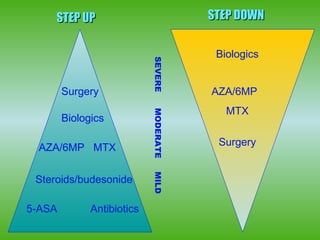
STEP UP                           STEP DOWN


                                        Biologics


                            SEVERE
        Surgery                        AZA/6MP
                                          MTX


                            MODERATE
        Biologics

                                        Surgery
  AZA/6MP MTX               MILD


 Steroids/budesonide

5-ASA         Antibiotics
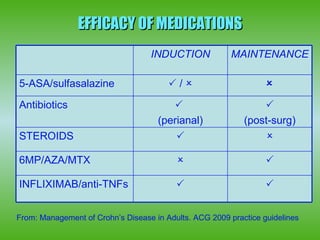
EFFICACY OF MEDICATIONS
                                   INDUCTION             MAINTENANCE

5-ASA/sulfasalazine                     /                       

Antibiotics                                                    
                                     (perianal)             (post-surg)
STEROIDS                                                        

6MP/AZA/MTX                                                      

INFLIXIMAB/anti-TNFs                                             


From: Management of Crohn’s Disease in Adults. ACG 2009 practice guidelines
NATURAL HISTORY OF CROHN’S
                •       Progressive, chronic disease.
   Luminal
inflammation    •       Majority of patients present with
                       inflammatory disease at diagnosis.
                •       Approx. 80% will require surgery in
                       lifetime.1
 Stricturing/   •      More than 50% treated with steroids
  fistulizing          will become steroid-dependent.2
complications
                •      Step-down therapy may alter course
                       of disease, ↓use of steroids,
                       ↓hospitalizations & surgery.

   Surgery
                    1. Inflamm Bowel Dis 2002;8(4):244-250.
                    2. Gastroenterology 1993;105:1716-1723.
ALTERING THE COURSE OF CROHN’S
                     ⇓ NEED          MUCOSAL   LESS
                       FOR           HEALING SURGERIE
                    STEROID                      S
STEROIDS                 S
                        N/A                NO           NO


6MP/AZA                 YES               YES           NO


MTX                     YES               YES           NO


INFLIXIMA               YES               YES           YES
B
Adapted from Aliment. Pharmacol.Ther. 2007;25(1):3-12
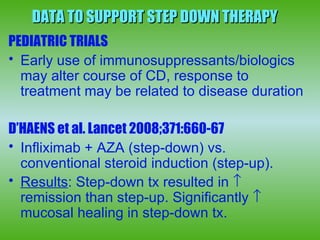
DATA TO SUPPORT STEP DOWN THERAPY
PEDIATRIC TRIALS
• Early use of immunosuppressants/biologics
  may alter course of CD, response to
  treatment may be related to disease duration

D’HAENS et al. Lancet 2008;371:660-67
• Infliximab + AZA (step-down) vs.
  conventional steroid induction (step-up).
• Results: Step-down tx resulted in ↑
  remission than step-up. Significantly ↑
  mucosal healing in step-down tx.
SONIC TRIAL (Study of Biologic &
 Immunomodulator Naïve Patients in Crohn’s)
    Sandborn, W et al. SONIC trial. ACG 2008. Latebreaking abstract


Infliximab + AZA:
        56.8% response rate, 43.9% mucosal healing
• Infliximab + placebo:
        44.4% response rate, 30.1% mucosal healing
• AZA + placebo:
        30.6% response rate, 16.5% mucosal healing
Safety data similar for all groups

COMMIT TRIAL (trial completed, results not published)
INF+MTX vs. INF alone to induce & maintain remission
SAFETY OF BIOLOGICS
• Hypersensitivity reactions, CHF, malignancy.
∀ ↑risk for infections (FDA warning): TB, invasive
  fungal infections, pneumonia.
• Lymphoma/non-Hodgins. Hepatosplenic T-cell
  lymphoma in adolescents & young CD patients
  associated with infliximab & immunomodulator use
  (FDA warning).
• Progressive multifocal leukoencephalopathy
  (PML): associated with natalizumab.
• TREAT registry: infliximab not associated with ↑
  mortality, risk of lymphoma slightly elevated.
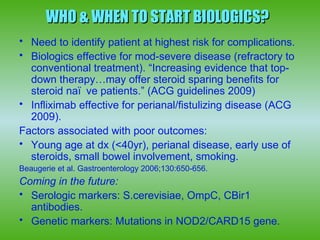
WHO & WHEN TO START BIOLOGICS?
• Need to identify patient at highest risk for complications.
• Biologics effective for mod-severe disease (refractory to
  conventional treatment). “Increasing evidence that top-
  down therapy…may offer steroid sparing benefits for
  steroid naï ve patients.” (ACG guidelines 2009)
• Infliximab effective for perianal/fistulizing disease (ACG
  2009).
Factors associated with poor outcomes:
• Young age at dx (<40yr), perianal disease, early use of
  steroids, small bowel involvement, smoking.
Beaugerie et al. Gastroenterology 2006;130:650-656.
Coming in the future:
• Serologic markers: S.cerevisiae, OmpC, CBir1
  antibodies.
• Genetic markers: Mutations in NOD2/CARD15 gene.
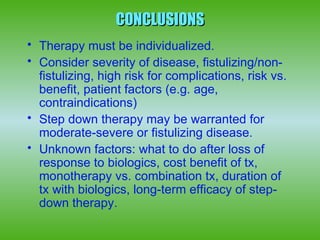
CONCLUSIONS
• Therapy must be individualized.
• Consider severity of disease, fistulizing/non-
  fistulizing, high risk for complications, risk vs.
  benefit, patient factors (e.g. age,
  contraindications)
• Step down therapy may be warranted for
  moderate-severe or fistulizing disease.
• Unknown factors: what to do after loss of
  response to biologics, cost benefit of tx,
  monotherapy vs. combination tx, duration of
  tx with biologics, long-term efficacy of step-
  down therapy.

Crohn\'s: Step Up or Step Down Therapy?

  • 1.
    GI Workshop February22, 2008 Ada Kong
  • 2.
    STEP UP STEP DOWN Biologics SEVERE Surgery AZA/6MP MTX MODERATE Biologics Surgery AZA/6MP MTX MILD Steroids/budesonide 5-ASA Antibiotics
  • 3.
    EFFICACY OF MEDICATIONS INDUCTION MAINTENANCE 5-ASA/sulfasalazine /  Antibiotics   (perianal) (post-surg) STEROIDS   6MP/AZA/MTX   INFLIXIMAB/anti-TNFs   From: Management of Crohn’s Disease in Adults. ACG 2009 practice guidelines
  • 4.
    NATURAL HISTORY OFCROHN’S • Progressive, chronic disease. Luminal inflammation • Majority of patients present with inflammatory disease at diagnosis. • Approx. 80% will require surgery in lifetime.1 Stricturing/ • More than 50% treated with steroids fistulizing will become steroid-dependent.2 complications • Step-down therapy may alter course of disease, ↓use of steroids, ↓hospitalizations & surgery. Surgery 1. Inflamm Bowel Dis 2002;8(4):244-250. 2. Gastroenterology 1993;105:1716-1723.
  • 5.
    ALTERING THE COURSEOF CROHN’S ⇓ NEED MUCOSAL LESS FOR HEALING SURGERIE STEROID S STEROIDS S N/A NO NO 6MP/AZA YES YES NO MTX YES YES NO INFLIXIMA YES YES YES B Adapted from Aliment. Pharmacol.Ther. 2007;25(1):3-12
  • 6.
    DATA TO SUPPORTSTEP DOWN THERAPY PEDIATRIC TRIALS • Early use of immunosuppressants/biologics may alter course of CD, response to treatment may be related to disease duration D’HAENS et al. Lancet 2008;371:660-67 • Infliximab + AZA (step-down) vs. conventional steroid induction (step-up). • Results: Step-down tx resulted in ↑ remission than step-up. Significantly ↑ mucosal healing in step-down tx.
  • 7.
    SONIC TRIAL (Studyof Biologic & Immunomodulator Naïve Patients in Crohn’s) Sandborn, W et al. SONIC trial. ACG 2008. Latebreaking abstract Infliximab + AZA: 56.8% response rate, 43.9% mucosal healing • Infliximab + placebo: 44.4% response rate, 30.1% mucosal healing • AZA + placebo: 30.6% response rate, 16.5% mucosal healing Safety data similar for all groups COMMIT TRIAL (trial completed, results not published) INF+MTX vs. INF alone to induce & maintain remission
  • 8.
    SAFETY OF BIOLOGICS •Hypersensitivity reactions, CHF, malignancy. ∀ ↑risk for infections (FDA warning): TB, invasive fungal infections, pneumonia. • Lymphoma/non-Hodgins. Hepatosplenic T-cell lymphoma in adolescents & young CD patients associated with infliximab & immunomodulator use (FDA warning). • Progressive multifocal leukoencephalopathy (PML): associated with natalizumab. • TREAT registry: infliximab not associated with ↑ mortality, risk of lymphoma slightly elevated.
  • 9.
    WHO & WHENTO START BIOLOGICS? • Need to identify patient at highest risk for complications. • Biologics effective for mod-severe disease (refractory to conventional treatment). “Increasing evidence that top- down therapy…may offer steroid sparing benefits for steroid naï ve patients.” (ACG guidelines 2009) • Infliximab effective for perianal/fistulizing disease (ACG 2009). Factors associated with poor outcomes: • Young age at dx (<40yr), perianal disease, early use of steroids, small bowel involvement, smoking. Beaugerie et al. Gastroenterology 2006;130:650-656. Coming in the future: • Serologic markers: S.cerevisiae, OmpC, CBir1 antibodies. • Genetic markers: Mutations in NOD2/CARD15 gene.
  • 10.
    CONCLUSIONS • Therapy mustbe individualized. • Consider severity of disease, fistulizing/non- fistulizing, high risk for complications, risk vs. benefit, patient factors (e.g. age, contraindications) • Step down therapy may be warranted for moderate-severe or fistulizing disease. • Unknown factors: what to do after loss of response to biologics, cost benefit of tx, monotherapy vs. combination tx, duration of tx with biologics, long-term efficacy of step- down therapy.