Customer Relationship
Management (CRM)
Strategies, Technologies & Best Practices for
Modern Business
What is CRM?
• • Customer Relationship Management combines strategies, practices, and
technologies
• • Manages and analyzes interactions with current and potential customers
• • Centralizes customer data across all touchpoints (website, email, phone, social
media)
• • Aims to improve customer satisfaction, drive sales growth, and increase
retention
• • Provides a 360-degree view of customer interactions and history
• • Enables data-driven decision making for sales, marketing, and service teams
CRM Core Components
• • Contact Management: Organizes customer information and interaction history
• • Sales Management: Tracks leads, opportunities, and sales pipeline
• • Marketing Automation: Manages campaigns and customer segmentation
• • Customer Support: Handles tickets, issues, and service requests
• • Analytics & Reporting: Provides insights and performance metrics
• • Integration Capabilities: Connects with other business systems
• • Mobile Access: Enables on-the-go customer management
TYPES OF CRM SYSTEMS
Operational CRM
• • Focuses on automating customer-facing business processes
• • Marketing Automation: Targeted campaigns, email sequences, lead nurturing
• • Sales Force Automation: Lead tracking, pipeline management, forecasting
• • Customer Service Automation: Ticket management, self-service portals
• • Streamlines day-to-day operations and customer interactions
• • Improves efficiency and reduces manual tasks
• • Best for: Companies wanting to automate sales, marketing, and service
processes
Analytical CRM
• • Uses data analysis to understand customer behavior and trends
• • Data Mining: Extracts valuable insights from customer data
• • Customer Segmentation: Groups customers based on behavior and preferences
• • Predictive Analytics: Forecasts customer needs and buying patterns
• • Performance Analysis: Measures effectiveness of campaigns and strategies
• • Provides insights for strategic decision-making
• • Best for: Data-driven companies focused on customer analytics and insights
Collaborative CRM
• • Enhances communication and information sharing across departments
• • Interaction Management: Tracks touchpoints across multiple channels
• • Channel Management: Optimizes communication channels for each customer
• • Document Management: Centralizes customer-related documents
• • Breaks down silos between sales, marketing, and support teams
• • Ensures consistent customer experience across all touchpoints
• • Best for: Large organizations with multiple departments serving customers
KEY BENEFITS OF CRM
Enhanced Customer Experience
• • 360-degree customer view with complete interaction history
• • Personalized service and targeted communications
• • Faster response times and issue resolution
• • Consistent experience across all channels and touchpoints
• • Proactive customer support through predictive insights
• • Improved customer satisfaction and loyalty
• • Higher customer retention rates and lifetime value
Business Advantages
• • Increased sales through better lead management and conversion
• • Improved productivity with automation of routine tasks
• • Enhanced marketing effectiveness through customer segmentation
• • Better forecasting and sales pipeline visibility
• • Reduced operational costs and improved efficiency
• • Data-driven insights for strategic decision making
• • Scalable growth with streamlined processes
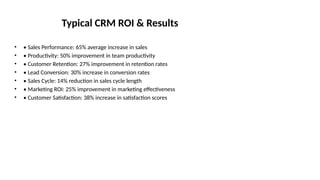
Typical CRM ROI & Results
• • Sales Performance: 65% average increase in sales
• • Productivity: 50% improvement in team productivity
• • Customer Retention: 27% improvement in retention rates
• • Lead Conversion: 30% increase in conversion rates
• • Sales Cycle: 14% reduction in sales cycle length
• • Marketing ROI: 25% improvement in marketing effectiveness
• • Customer Satisfaction: 38% increase in satisfaction scores
CRM IMPLEMENTATION BEST
PRACTICES
8-Step Implementation Process
• 1. Discovery & Assessment: Analyze current processes and define objectives
• 2. Platform Selection: Choose the right CRM based on business needs
• 3. Project Planning: Allocate resources and create implementation timeline
• 4. Data Migration: Clean and transfer existing customer data
• 5. Customization: Configure CRM to match business workflows
• 6. Integration: Connect with existing systems and tools
• 7. Testing & Training: Thoroughly test system and train users
• 8. Go-Live & Support: Launch system with ongoing monitoring and support
Critical Success Factors
• • Executive leadership support and commitment
• • Clear objectives and success metrics defined upfront
• • Adequate resource allocation (time, budget, personnel)
• • User adoption strategies and comprehensive training
• • Data quality and standardization before migration
• • Phased rollout approach to minimize disruption
• • Continuous monitoring and process improvement
• • Change management to address user resistance
TOP CRM SOFTWARE SOLUTIONS
Leading CRM Platforms (2025)
• • Salesforce: Market leader, highly customizable, enterprise-focused
• • HubSpot: User-friendly, excellent free tier, marketing automation
• • Zoho CRM: Affordable, comprehensive features, good for SMBs
• • Microsoft Dynamics 365: Integrated with Office, enterprise features
• • Pipedrive: Pipeline-focused, intuitive interface, sales-centric
• • Insightly: Project management integration, good analytics
• • Oracle NetSuite: All-in-one ERP/CRM solution for large enterprises
CRM Selection Criteria
• • Business size and complexity requirements
• • Budget considerations (initial cost + ongoing expenses)
• • Integration capabilities with existing systems
• • Customization and scalability options
• • User experience and ease of adoption
• • Mobile accessibility and offline capabilities
• • Vendor support quality and training resources
• • Security features and compliance capabilities
FUTURE OF CRM: AI &
AUTOMATION
Artificial Intelligence in CRM
• • Predictive Analytics: Forecast customer behavior and sales outcomes
• • AI-Powered Lead Scoring: Automatically prioritize high-potential prospects
• • Intelligent Chatbots: 24/7 customer support with natural language processing
• • Personalization at Scale: Tailored content and recommendations
• • Automated Data Entry: Reduce manual work through smart data capture
• • Sales Forecasting: AI-driven revenue predictions and trend analysis
• • Market Growth: AI in CRM expected to reach $13.4B by 2025
CRM Automation Trends 2025
• • Hyper-Personalization: Individual customer experiences at scale
• • Omnichannel Integration: Seamless experience across all touchpoints
• • Voice-Activated CRM: Hands-free data entry and retrieval
• • Real-Time Analytics: Instant insights and decision support
• • Automated Workflows: Complex business processes without human intervention
• • Mobile-First Design: CRM optimized for smartphone usage
• • 80%+ companies expected to adopt AI-powered CRM by 2025
REAL-WORLD SUCCESS STORIES
CRM Success Stories
• • Coca-Cola: Uses Salesforce & SAP for global customer management
• - Billions of daily transactions managed efficiently
• - Enhanced collaboration across country divisions
• • Amazon: Customer-obsessed approach with AI-driven personalization
• - 1-Click shopping and personalized recommendations
• - Focus on operational excellence and long-term thinking
• • BMW: Premium customer experience through CRM strategy
• - Treats customers fairly across entire supplier program
• - Focus on quality and customer satisfaction drives loyalty
Additional Case Studies
• • McDonald's: PowerCenter CRM for managing huge customer volumes
• - Efficient contact management across 30,000+ restaurants
• - Enhanced marketing campaigns and customer analytics
• • British Airways: TCRM BA for comprehensive customer management
• - Campaign management and loyalty program optimization
• - Seamless travel experience for 40 million passengers annually
• • Tesco: Among first to adopt RightNow CRM (Oracle)
• - Omnichannel communication across phone, chat, and email
• - Customer-focused culture driving business success
CRM BEST PRACTICES FOR SUCCESS
Data Quality Best Practices
• • Establish standardized data entry conventions and formats
• • Implement data validation rules to prevent errors
• • Regular data cleaning and duplicate removal processes
• • Integrate multiple data sources for comprehensive customer view
• • Create clear naming conventions and tagging systems
• • Backup data regularly and ensure security compliance
• • Train staff on proper data entry and management procedures
Driving User Adoption
• • Provide comprehensive training before and after implementation
• • Create user-friendly workflows that match business processes
• • Implement gamification and incentive programs
• • Gather user feedback and make continuous improvements
• • Ensure leadership demonstrates commitment and usage
• • Offer ongoing support and advanced training sessions
• • Monitor usage metrics and address adoption barriers quickly
CRM Optimization Strategies
• • Regular performance monitoring and KPI tracking
• • Customer feedback integration and analysis
• • Process refinement based on user experience
• • Technology updates and feature utilization
• • Cross-departmental collaboration enhancement
• • Advanced reporting and dashboard customization
• • Scalability planning for business growth
YOUR CRM JOURNEY STARTS HERE
Next Steps for CRM Implementation
• 1. Assess Current State: Evaluate existing processes and pain points
• 2. Define Objectives: Set clear goals and success metrics
• 3. Research Solutions: Compare CRM platforms based on your needs
• 4. Plan Budget: Consider initial costs, training, and ongoing expenses
• 5. Build Team: Assign project manager and implementation team
• 6. Create Timeline: Develop realistic implementation schedule
• 7. Start Small: Consider pilot program with key users first
• 8. Plan for Growth: Ensure chosen solution can scale with business
Key Takeaways
• • CRM is essential for building lasting customer relationships
• • Choose the right type: Operational, Analytical, or Collaborative
• • Implementation success depends on planning, training, and adoption
• • AI and automation are transforming CRM capabilities
• • Data quality and user adoption are critical success factors
• • ROI is measurable: improved sales, productivity, and satisfaction
• • Start with clear objectives and scale gradually for best results
Thank You
Questions & Discussion

CRM(Customer Relationship Managmnet) Presentation

  • 1.
    Customer Relationship Management (CRM) Strategies,Technologies & Best Practices for Modern Business
  • 2.
    What is CRM? •• Customer Relationship Management combines strategies, practices, and technologies • • Manages and analyzes interactions with current and potential customers • • Centralizes customer data across all touchpoints (website, email, phone, social media) • • Aims to improve customer satisfaction, drive sales growth, and increase retention • • Provides a 360-degree view of customer interactions and history • • Enables data-driven decision making for sales, marketing, and service teams
  • 3.
    CRM Core Components •• Contact Management: Organizes customer information and interaction history • • Sales Management: Tracks leads, opportunities, and sales pipeline • • Marketing Automation: Manages campaigns and customer segmentation • • Customer Support: Handles tickets, issues, and service requests • • Analytics & Reporting: Provides insights and performance metrics • • Integration Capabilities: Connects with other business systems • • Mobile Access: Enables on-the-go customer management
  • 4.
    TYPES OF CRMSYSTEMS
  • 5.
    Operational CRM • •Focuses on automating customer-facing business processes • • Marketing Automation: Targeted campaigns, email sequences, lead nurturing • • Sales Force Automation: Lead tracking, pipeline management, forecasting • • Customer Service Automation: Ticket management, self-service portals • • Streamlines day-to-day operations and customer interactions • • Improves efficiency and reduces manual tasks • • Best for: Companies wanting to automate sales, marketing, and service processes
  • 6.
    Analytical CRM • •Uses data analysis to understand customer behavior and trends • • Data Mining: Extracts valuable insights from customer data • • Customer Segmentation: Groups customers based on behavior and preferences • • Predictive Analytics: Forecasts customer needs and buying patterns • • Performance Analysis: Measures effectiveness of campaigns and strategies • • Provides insights for strategic decision-making • • Best for: Data-driven companies focused on customer analytics and insights
  • 7.
    Collaborative CRM • •Enhances communication and information sharing across departments • • Interaction Management: Tracks touchpoints across multiple channels • • Channel Management: Optimizes communication channels for each customer • • Document Management: Centralizes customer-related documents • • Breaks down silos between sales, marketing, and support teams • • Ensures consistent customer experience across all touchpoints • • Best for: Large organizations with multiple departments serving customers
  • 8.
  • 9.
    Enhanced Customer Experience •• 360-degree customer view with complete interaction history • • Personalized service and targeted communications • • Faster response times and issue resolution • • Consistent experience across all channels and touchpoints • • Proactive customer support through predictive insights • • Improved customer satisfaction and loyalty • • Higher customer retention rates and lifetime value
  • 10.
    Business Advantages • •Increased sales through better lead management and conversion • • Improved productivity with automation of routine tasks • • Enhanced marketing effectiveness through customer segmentation • • Better forecasting and sales pipeline visibility • • Reduced operational costs and improved efficiency • • Data-driven insights for strategic decision making • • Scalable growth with streamlined processes
  • 11.
    Typical CRM ROI& Results • • Sales Performance: 65% average increase in sales • • Productivity: 50% improvement in team productivity • • Customer Retention: 27% improvement in retention rates • • Lead Conversion: 30% increase in conversion rates • • Sales Cycle: 14% reduction in sales cycle length • • Marketing ROI: 25% improvement in marketing effectiveness • • Customer Satisfaction: 38% increase in satisfaction scores
  • 12.
  • 13.
    8-Step Implementation Process •1. Discovery & Assessment: Analyze current processes and define objectives • 2. Platform Selection: Choose the right CRM based on business needs • 3. Project Planning: Allocate resources and create implementation timeline • 4. Data Migration: Clean and transfer existing customer data • 5. Customization: Configure CRM to match business workflows • 6. Integration: Connect with existing systems and tools • 7. Testing & Training: Thoroughly test system and train users • 8. Go-Live & Support: Launch system with ongoing monitoring and support
  • 14.
    Critical Success Factors •• Executive leadership support and commitment • • Clear objectives and success metrics defined upfront • • Adequate resource allocation (time, budget, personnel) • • User adoption strategies and comprehensive training • • Data quality and standardization before migration • • Phased rollout approach to minimize disruption • • Continuous monitoring and process improvement • • Change management to address user resistance
  • 15.
  • 16.
    Leading CRM Platforms(2025) • • Salesforce: Market leader, highly customizable, enterprise-focused • • HubSpot: User-friendly, excellent free tier, marketing automation • • Zoho CRM: Affordable, comprehensive features, good for SMBs • • Microsoft Dynamics 365: Integrated with Office, enterprise features • • Pipedrive: Pipeline-focused, intuitive interface, sales-centric • • Insightly: Project management integration, good analytics • • Oracle NetSuite: All-in-one ERP/CRM solution for large enterprises
  • 17.
    CRM Selection Criteria •• Business size and complexity requirements • • Budget considerations (initial cost + ongoing expenses) • • Integration capabilities with existing systems • • Customization and scalability options • • User experience and ease of adoption • • Mobile accessibility and offline capabilities • • Vendor support quality and training resources • • Security features and compliance capabilities
  • 18.
    FUTURE OF CRM:AI & AUTOMATION
  • 19.
    Artificial Intelligence inCRM • • Predictive Analytics: Forecast customer behavior and sales outcomes • • AI-Powered Lead Scoring: Automatically prioritize high-potential prospects • • Intelligent Chatbots: 24/7 customer support with natural language processing • • Personalization at Scale: Tailored content and recommendations • • Automated Data Entry: Reduce manual work through smart data capture • • Sales Forecasting: AI-driven revenue predictions and trend analysis • • Market Growth: AI in CRM expected to reach $13.4B by 2025
  • 20.
    CRM Automation Trends2025 • • Hyper-Personalization: Individual customer experiences at scale • • Omnichannel Integration: Seamless experience across all touchpoints • • Voice-Activated CRM: Hands-free data entry and retrieval • • Real-Time Analytics: Instant insights and decision support • • Automated Workflows: Complex business processes without human intervention • • Mobile-First Design: CRM optimized for smartphone usage • • 80%+ companies expected to adopt AI-powered CRM by 2025
  • 21.
  • 22.
    CRM Success Stories •• Coca-Cola: Uses Salesforce & SAP for global customer management • - Billions of daily transactions managed efficiently • - Enhanced collaboration across country divisions • • Amazon: Customer-obsessed approach with AI-driven personalization • - 1-Click shopping and personalized recommendations • - Focus on operational excellence and long-term thinking • • BMW: Premium customer experience through CRM strategy • - Treats customers fairly across entire supplier program • - Focus on quality and customer satisfaction drives loyalty
  • 23.
    Additional Case Studies •• McDonald's: PowerCenter CRM for managing huge customer volumes • - Efficient contact management across 30,000+ restaurants • - Enhanced marketing campaigns and customer analytics • • British Airways: TCRM BA for comprehensive customer management • - Campaign management and loyalty program optimization • - Seamless travel experience for 40 million passengers annually • • Tesco: Among first to adopt RightNow CRM (Oracle) • - Omnichannel communication across phone, chat, and email • - Customer-focused culture driving business success
  • 24.
    CRM BEST PRACTICESFOR SUCCESS
  • 25.
    Data Quality BestPractices • • Establish standardized data entry conventions and formats • • Implement data validation rules to prevent errors • • Regular data cleaning and duplicate removal processes • • Integrate multiple data sources for comprehensive customer view • • Create clear naming conventions and tagging systems • • Backup data regularly and ensure security compliance • • Train staff on proper data entry and management procedures
  • 26.
    Driving User Adoption •• Provide comprehensive training before and after implementation • • Create user-friendly workflows that match business processes • • Implement gamification and incentive programs • • Gather user feedback and make continuous improvements • • Ensure leadership demonstrates commitment and usage • • Offer ongoing support and advanced training sessions • • Monitor usage metrics and address adoption barriers quickly
  • 27.
    CRM Optimization Strategies •• Regular performance monitoring and KPI tracking • • Customer feedback integration and analysis • • Process refinement based on user experience • • Technology updates and feature utilization • • Cross-departmental collaboration enhancement • • Advanced reporting and dashboard customization • • Scalability planning for business growth
  • 28.
    YOUR CRM JOURNEYSTARTS HERE
  • 29.
    Next Steps forCRM Implementation • 1. Assess Current State: Evaluate existing processes and pain points • 2. Define Objectives: Set clear goals and success metrics • 3. Research Solutions: Compare CRM platforms based on your needs • 4. Plan Budget: Consider initial costs, training, and ongoing expenses • 5. Build Team: Assign project manager and implementation team • 6. Create Timeline: Develop realistic implementation schedule • 7. Start Small: Consider pilot program with key users first • 8. Plan for Growth: Ensure chosen solution can scale with business
  • 30.
    Key Takeaways • •CRM is essential for building lasting customer relationships • • Choose the right type: Operational, Analytical, or Collaborative • • Implementation success depends on planning, training, and adoption • • AI and automation are transforming CRM capabilities • • Data quality and user adoption are critical success factors • • ROI is measurable: improved sales, productivity, and satisfaction • • Start with clear objectives and scale gradually for best results
  • 31.