Criticality Analysis
Slide 1
http://www.fmea-fmeca-com
Criticality – Mil-Std-1629 Approach
 CRITICALITY is a measure of the frequency of
occurrence of an effect.
– May be based on qualitative judgement or
– May be based on failure rate data (most common)
Criticality Analysis
Slide 2
http://www.fmea-fmeca-com
Criticality Analysis
 Qualitative analysis:
– Used when specific part or item failure rates are not
available.
 Quantitative analysis:
– Used when sufficient failure rate data is available to
calculate criticality numbers.
Criticality Analysis
Slide 3
http://www.fmea-fmeca-com
Qualitative Approach
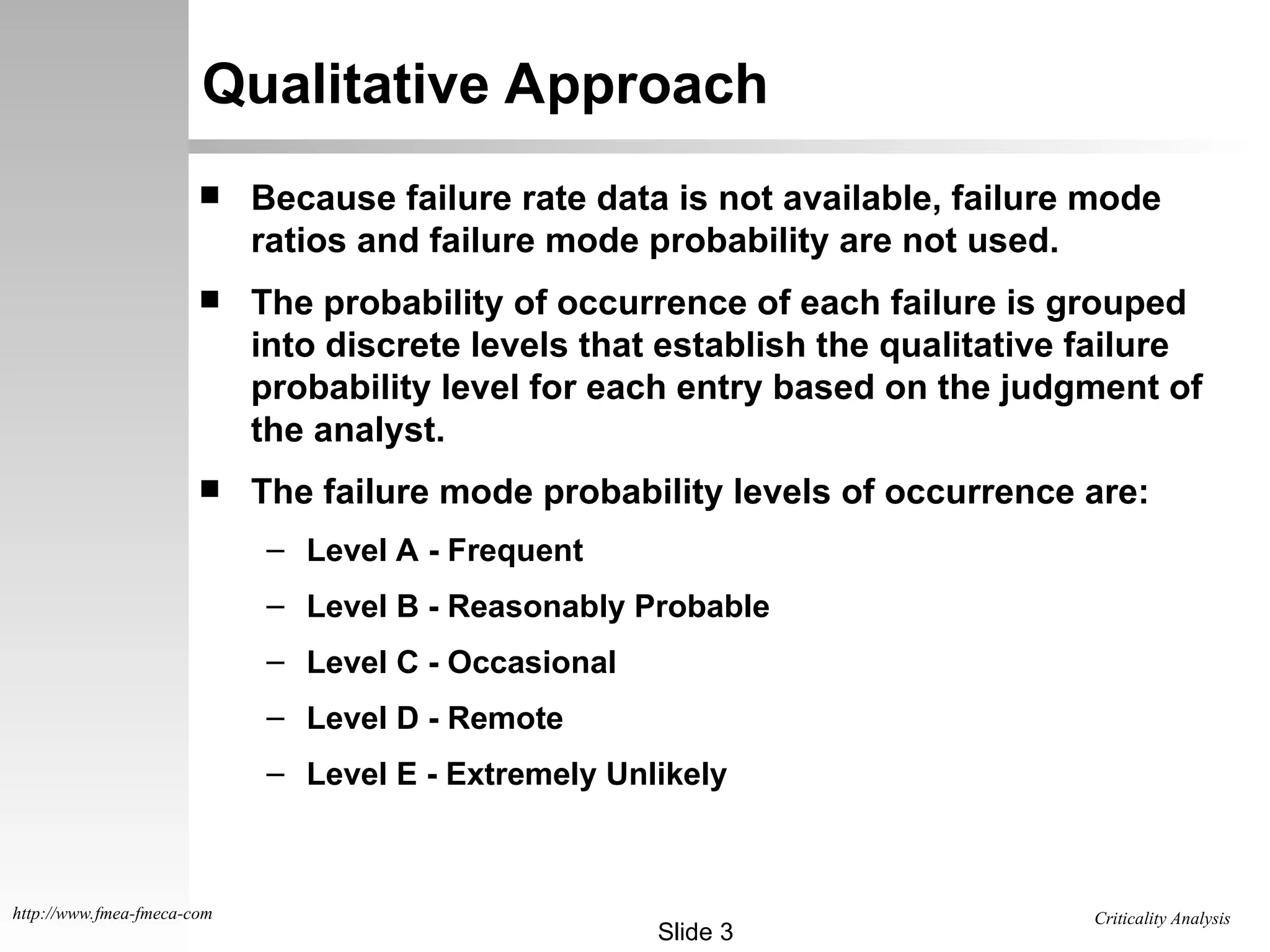
 Because failure rate data is not available, failure mode
ratios and failure mode probability are not used.
 The probability of occurrence of each failure is grouped
into discrete levels that establish the qualitative failure
probability level for each entry based on the judgment of
the analyst.
 The failure mode probability levels of occurrence are:
– Level A - Frequent
– Level B - Reasonably Probable
– Level C - Occasional
– Level D - Remote
– Level E - Extremely Unlikely
Criticality Analysis
Slide 4
http://www.fmea-fmeca-com
Quantitative Approach
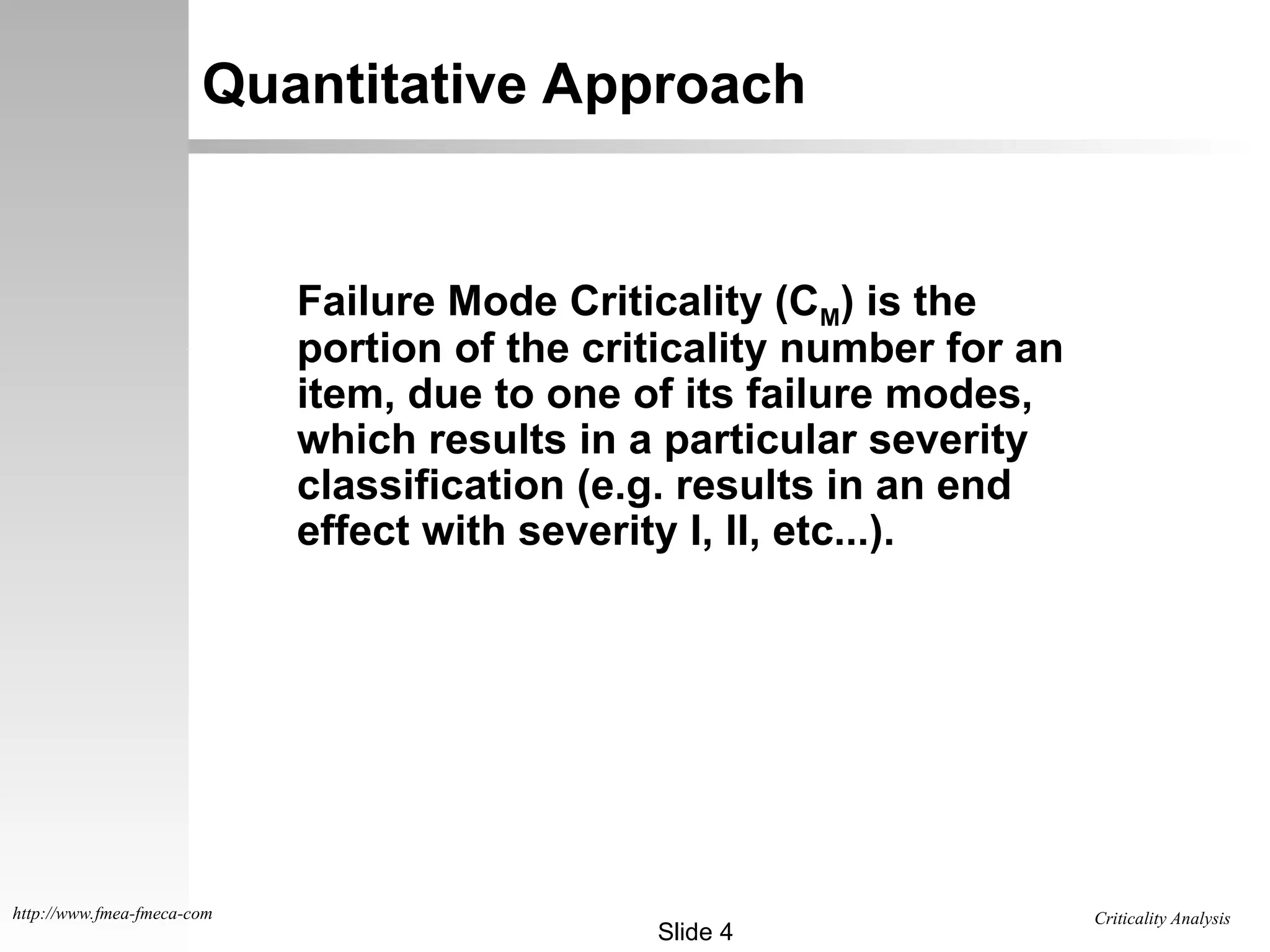
Failure Mode Criticality (CM) is the
portion of the criticality number for an
item, due to one of its failure modes,
which results in a particular severity
classification (e.g. results in an end
effect with severity I, II, etc...).
Criticality Analysis
Slide 5
http://www.fmea-fmeca-com
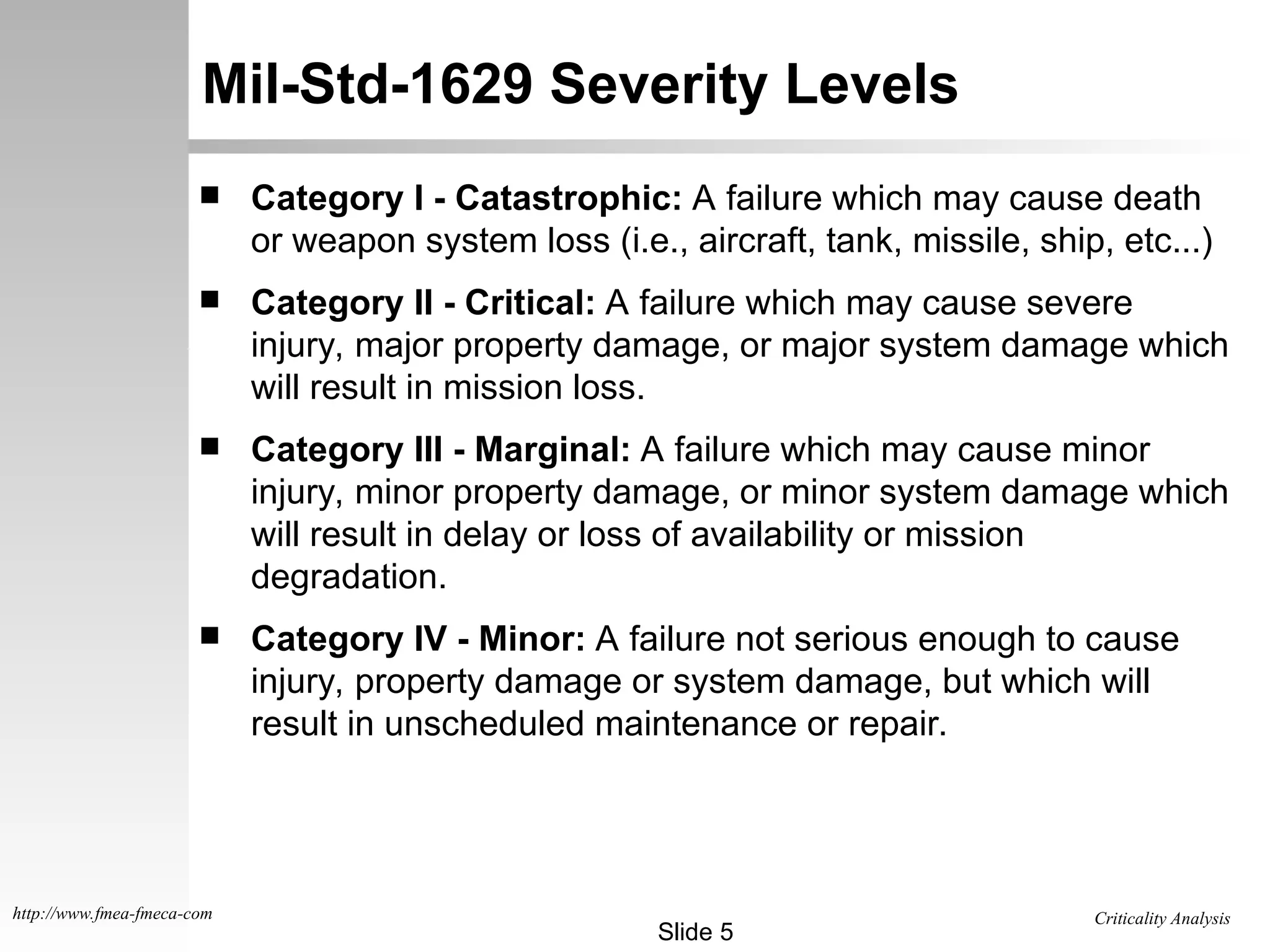
Mil-Std-1629 Severity Levels
 Category I - Catastrophic: A failure which may cause death
or weapon system loss (i.e., aircraft, tank, missile, ship, etc...)
 Category II - Critical: A failure which may cause severe
injury, major property damage, or major system damage which
will result in mission loss.
 Category III - Marginal: A failure which may cause minor
injury, minor property damage, or minor system damage which
will result in delay or loss of availability or mission
degradation.
 Category IV - Minor: A failure not serious enough to cause
injury, property damage or system damage, but which will
result in unscheduled maintenance or repair.
Criticality Analysis
Slide 6
http://www.fmea-fmeca-com
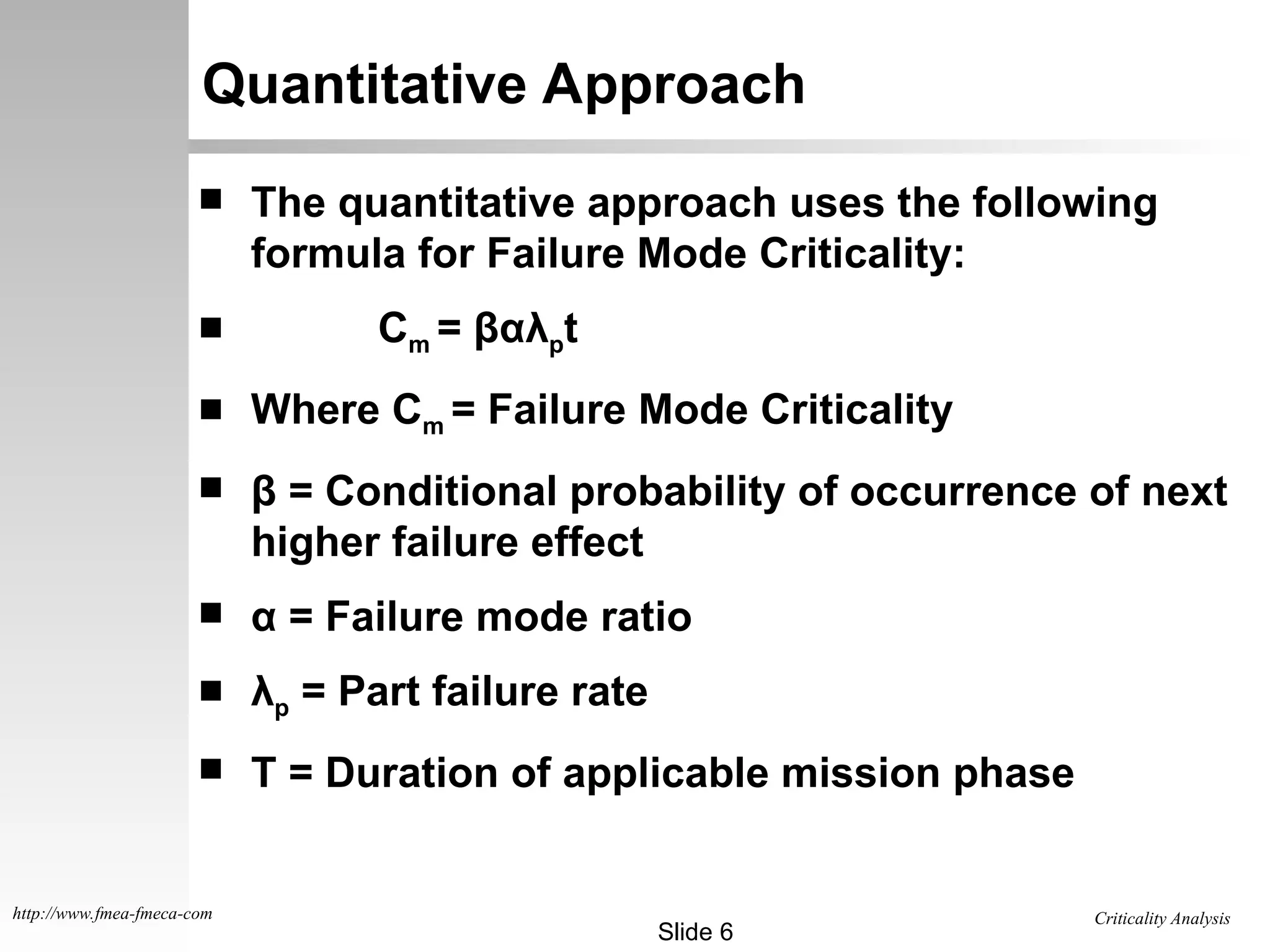
Quantitative Approach
 The quantitative approach uses the following
formula for Failure Mode Criticality:
 Cm = βαλpt
 Where Cm = Failure Mode Criticality
 β = Conditional probability of occurrence of next
higher failure effect
 α = Failure mode ratio
 λp = Part failure rate
 T = Duration of applicable mission phase
Criticality Analysis
Slide 7
http://www.fmea-fmeca-com
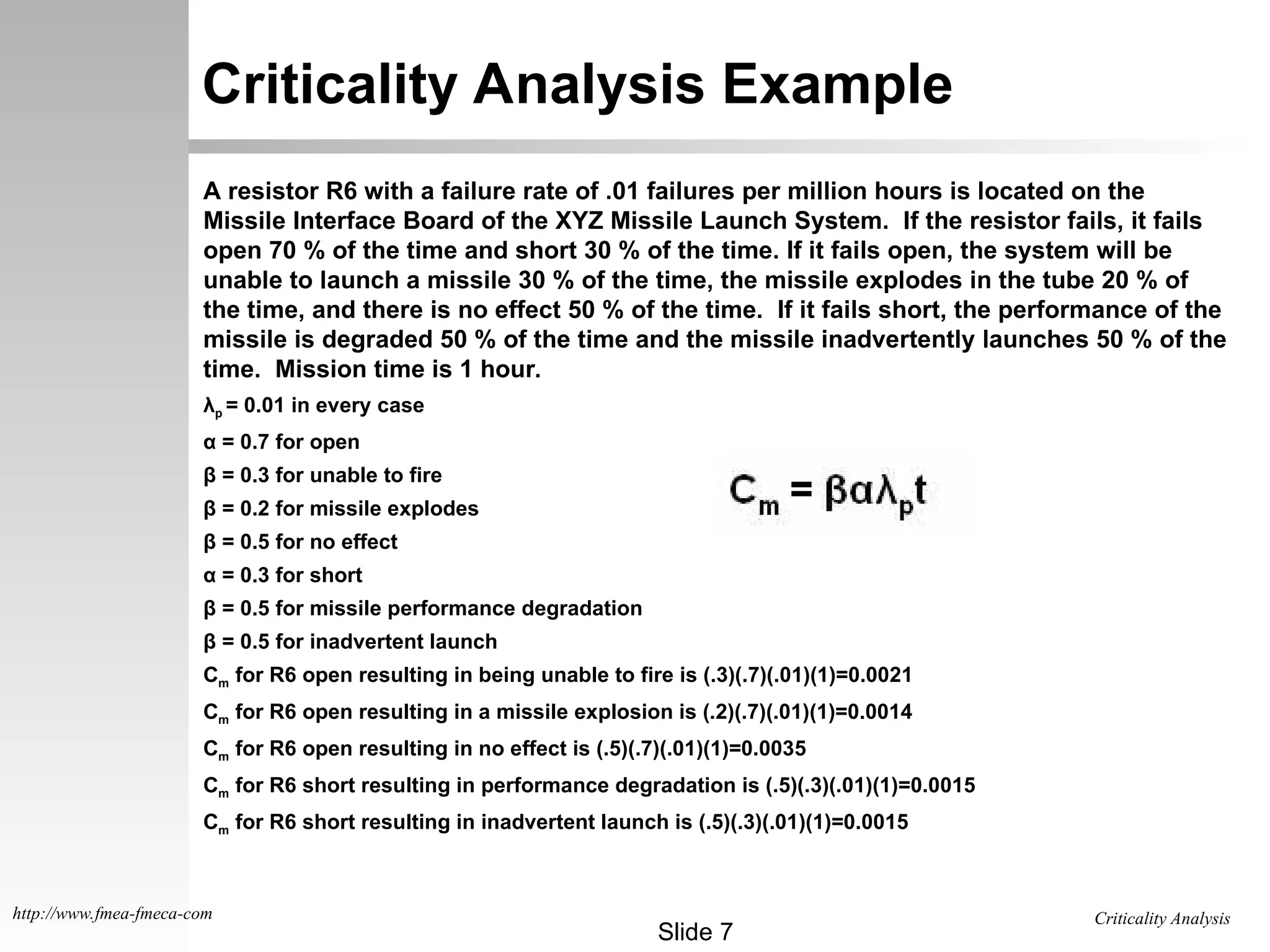
Criticality Analysis Example
A resistor R6 with a failure rate of .01 failures per million hours is located on the
Missile Interface Board of the XYZ Missile Launch System. If the resistor fails, it fails
open 70 % of the time and short 30 % of the time. If it fails open, the system will be
unable to launch a missile 30 % of the time, the missile explodes in the tube 20 % of
the time, and there is no effect 50 % of the time. If it fails short, the performance of the
missile is degraded 50 % of the time and the missile inadvertently launches 50 % of the
time. Mission time is 1 hour.
λp = 0.01 in every case
α = 0.7 for open
β = 0.3 for unable to fire
β = 0.2 for missile explodes
β = 0.5 for no effect
α = 0.3 for short
β = 0.5 for missile performance degradation
β = 0.5 for inadvertent launch
Cm for R6 open resulting in being unable to fire is (.3)(.7)(.01)(1)=0.0021
Cm for R6 open resulting in a missile explosion is (.2)(.7)(.01)(1)=0.0014
Cm for R6 open resulting in no effect is (.5)(.7)(.01)(1)=0.0035
Cm for R6 short resulting in performance degradation is (.5)(.3)(.01)(1)=0.0015
Cm for R6 short resulting in inadvertent launch is (.5)(.3)(.01)(1)=0.0015
Criticality Analysis
Slide 8
http://www.fmea-fmeca-com
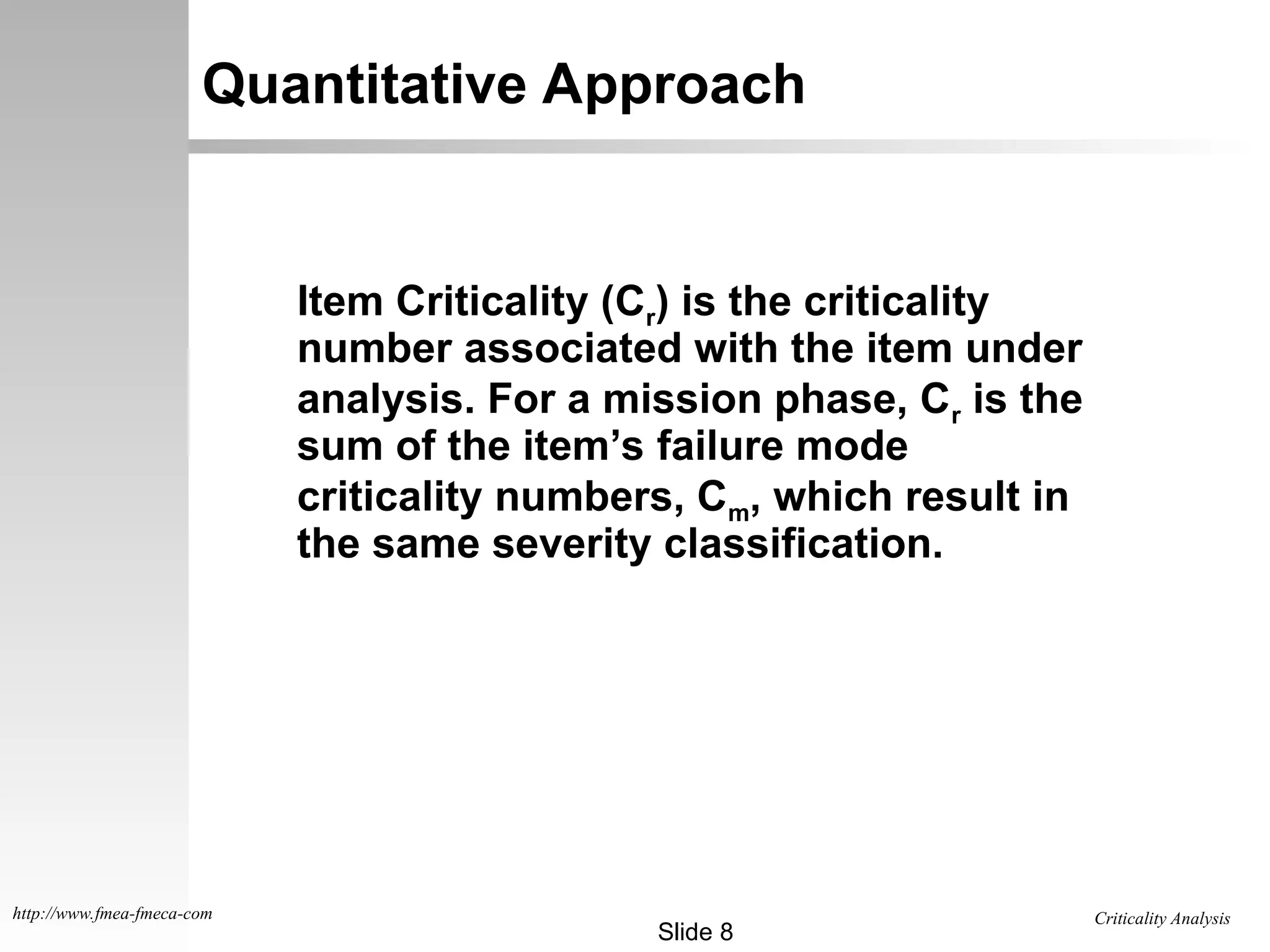
Quantitative Approach
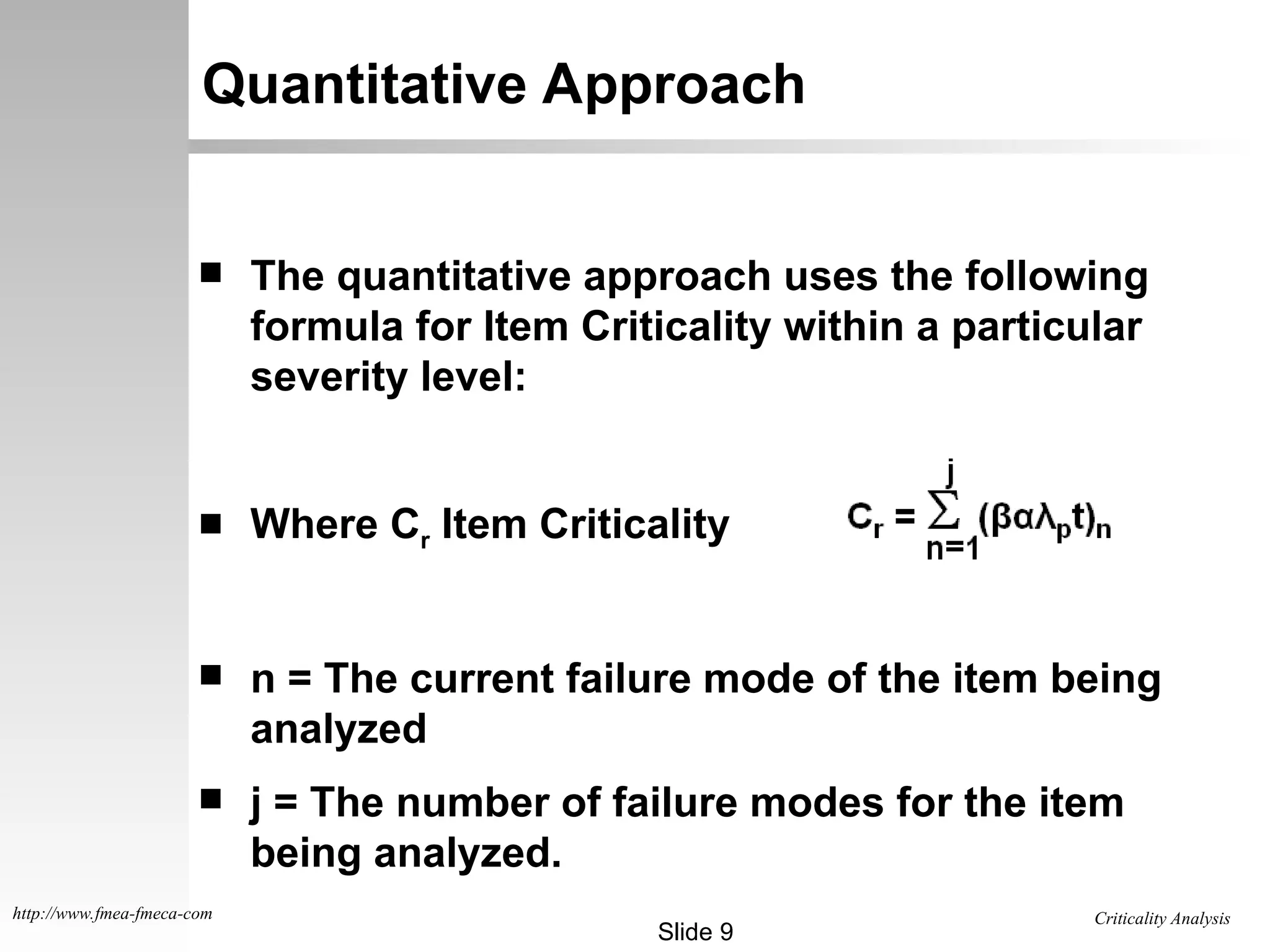
Item Criticality (Cr) is the criticality
number associated with the item under
analysis. For a mission phase, Cr is the
sum of the item’s failure mode
criticality numbers, Cm, which result in
the same severity classification.
Criticality Analysis
Slide 9
http://www.fmea-fmeca-com
Quantitative Approach
 The quantitative approach uses the following
formula for Item Criticality within a particular
severity level:
 Where Cr Item Criticality
 n = The current failure mode of the item being
analyzed
 j = The number of failure modes for the item
being analyzed.
Criticality Analysis
Slide 10
http://www.fmea-fmeca-com
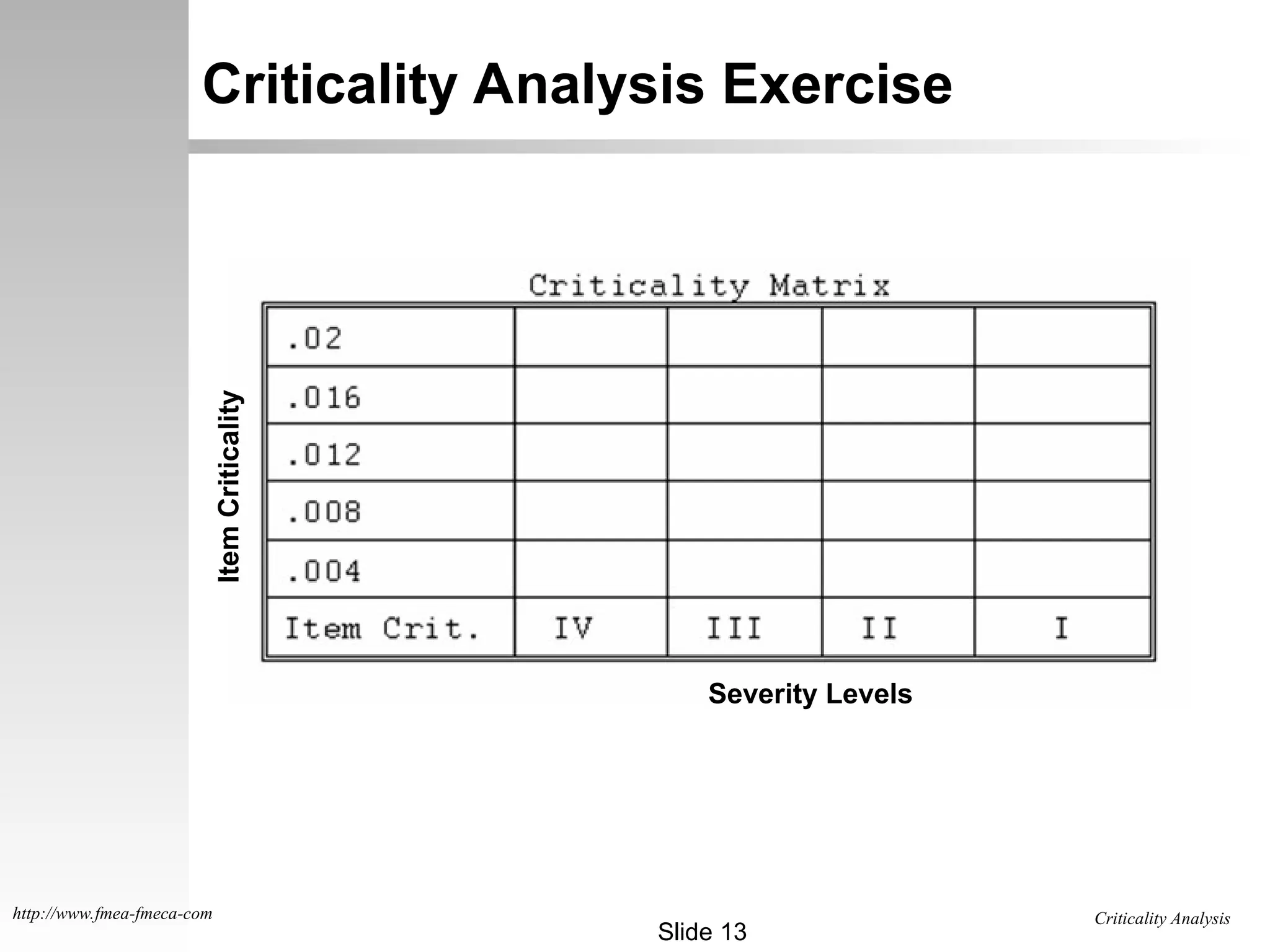
Criticality Analysis Exercise
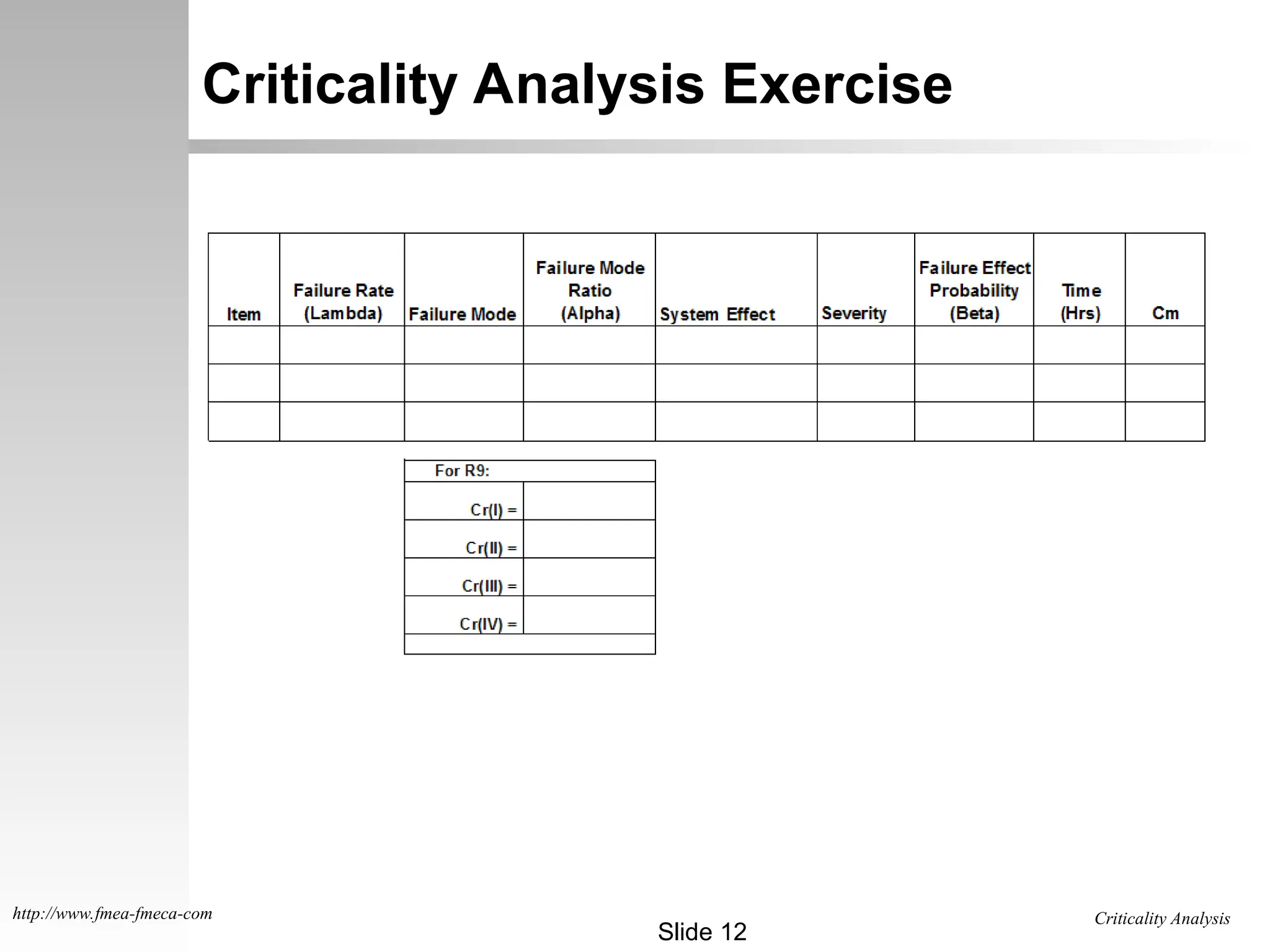
Criticality Analysis:
Determine failure mode criticality values
and item criticality values for the R9
resistor, and create an item criticality
matrix.
Criticality Analysis
Slide 11
http://www.fmea-fmeca-com
Criticality Analysis Exercise
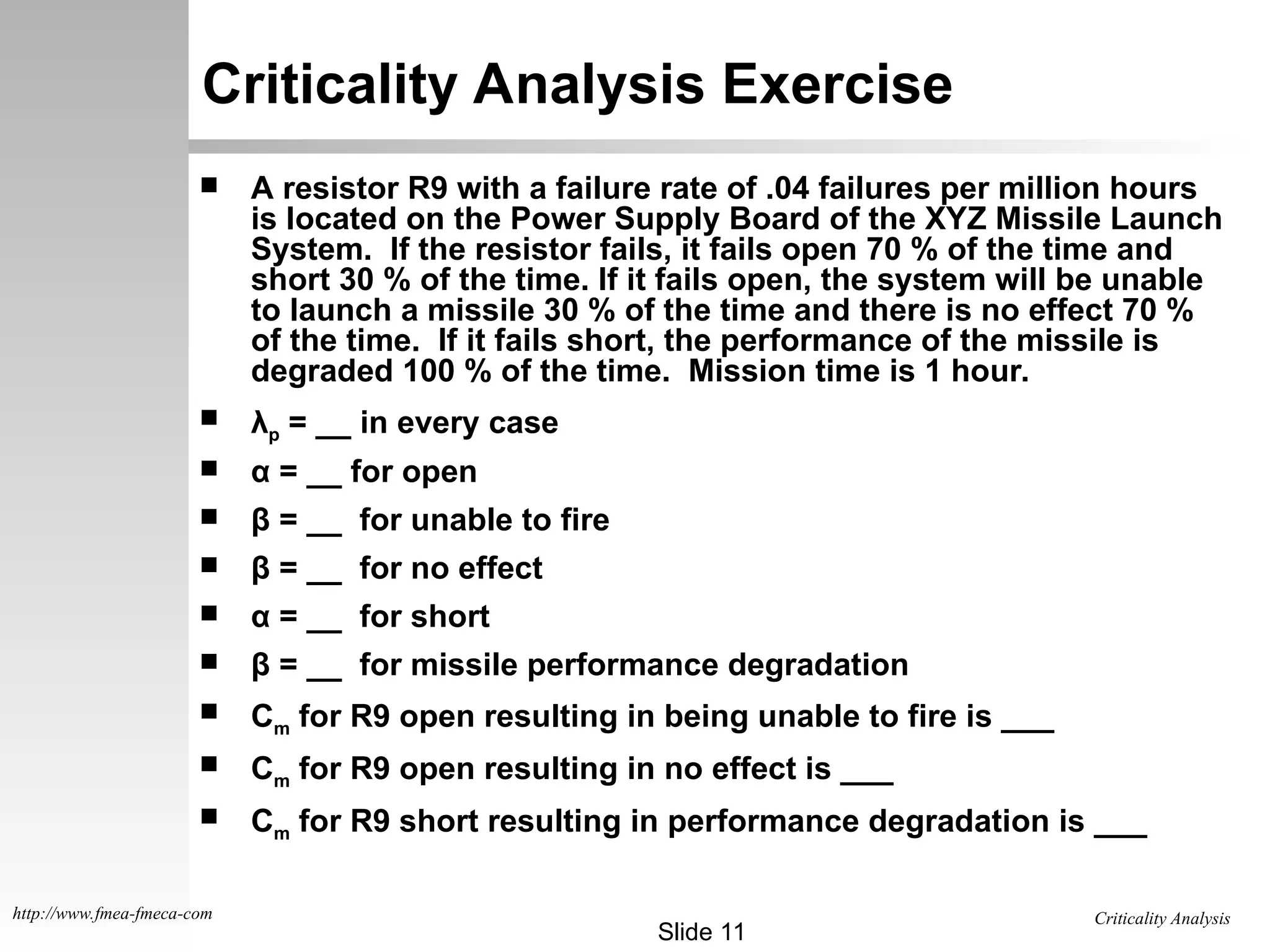
 A resistor R9 with a failure rate of .04 failures per million hours
is located on the Power Supply Board of the XYZ Missile Launch
System. If the resistor fails, it fails open 70 % of the time and
short 30 % of the time. If it fails open, the system will be unable
to launch a missile 30 % of the time and there is no effect 70 %
of the time. If it fails short, the performance of the missile is
degraded 100 % of the time. Mission time is 1 hour.
 λp = __ in every case
 α = __ for open
 β = __ for unable to fire
 β = __ for no effect
 α = __ for short
 β = __ for missile performance degradation
 Cm for R9 open resulting in being unable to fire is ___
 Cm for R9 open resulting in no effect is ___
 Cm for R9 short resulting in performance degradation is ___
Criticality Analysis
Slide 12
http://www.fmea-fmeca-com
Criticality Analysis Exercise
Criticality Analysis
Slide 13
http://www.fmea-fmeca-com
Criticality Analysis Exercise
Item
Criticality
Severity Levels
Criticality Analysis
Slide 14
http://www.fmea-fmeca-com
Criticality Analysis - Answers
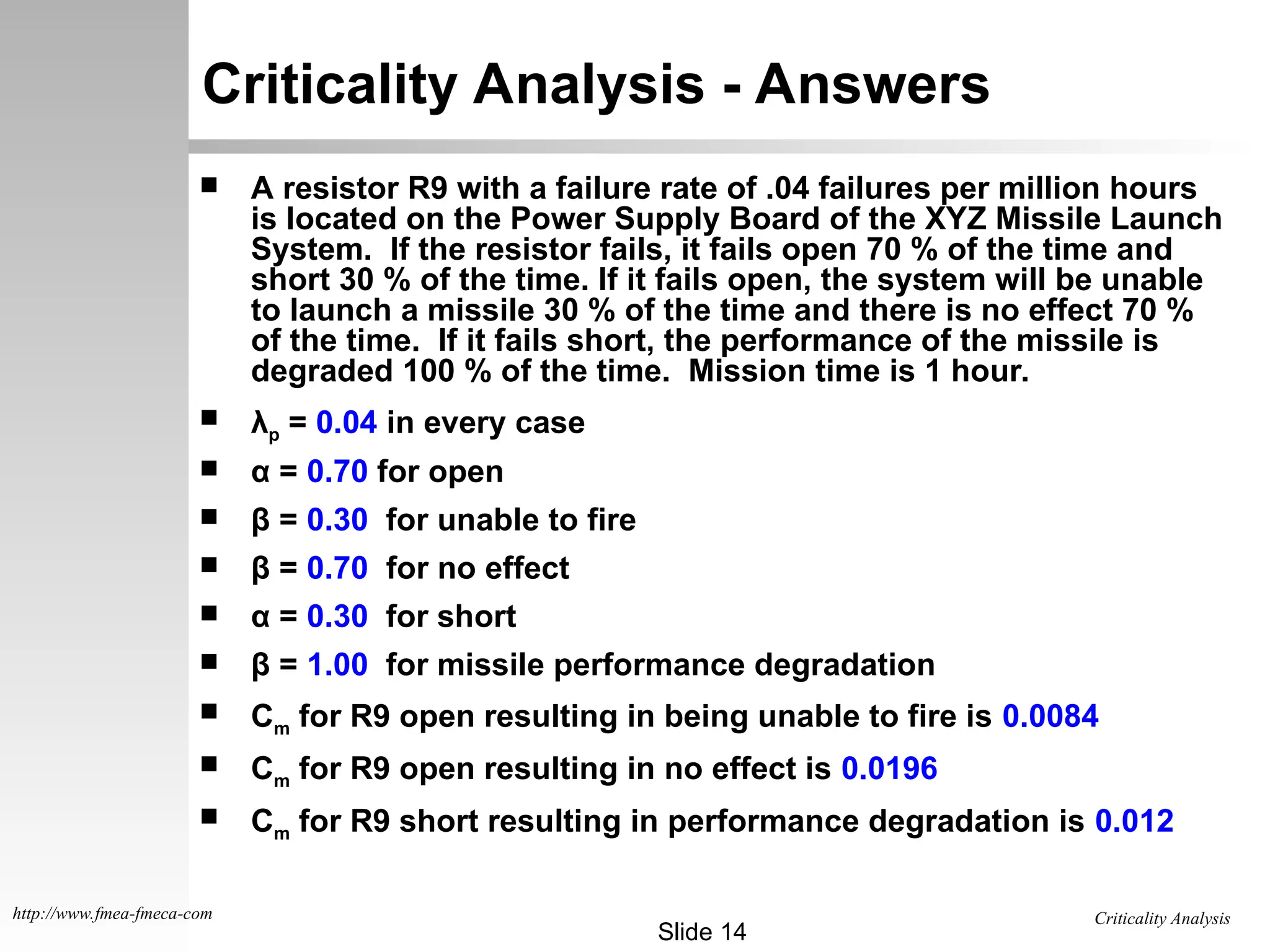
 A resistor R9 with a failure rate of .04 failures per million hours
is located on the Power Supply Board of the XYZ Missile Launch
System. If the resistor fails, it fails open 70 % of the time and
short 30 % of the time. If it fails open, the system will be unable
to launch a missile 30 % of the time and there is no effect 70 %
of the time. If it fails short, the performance of the missile is
degraded 100 % of the time. Mission time is 1 hour.
 λp = 0.04 in every case
 α = 0.70 for open
 β = 0.30 for unable to fire
 β = 0.70 for no effect
 α = 0.30 for short
 β = 1.00 for missile performance degradation
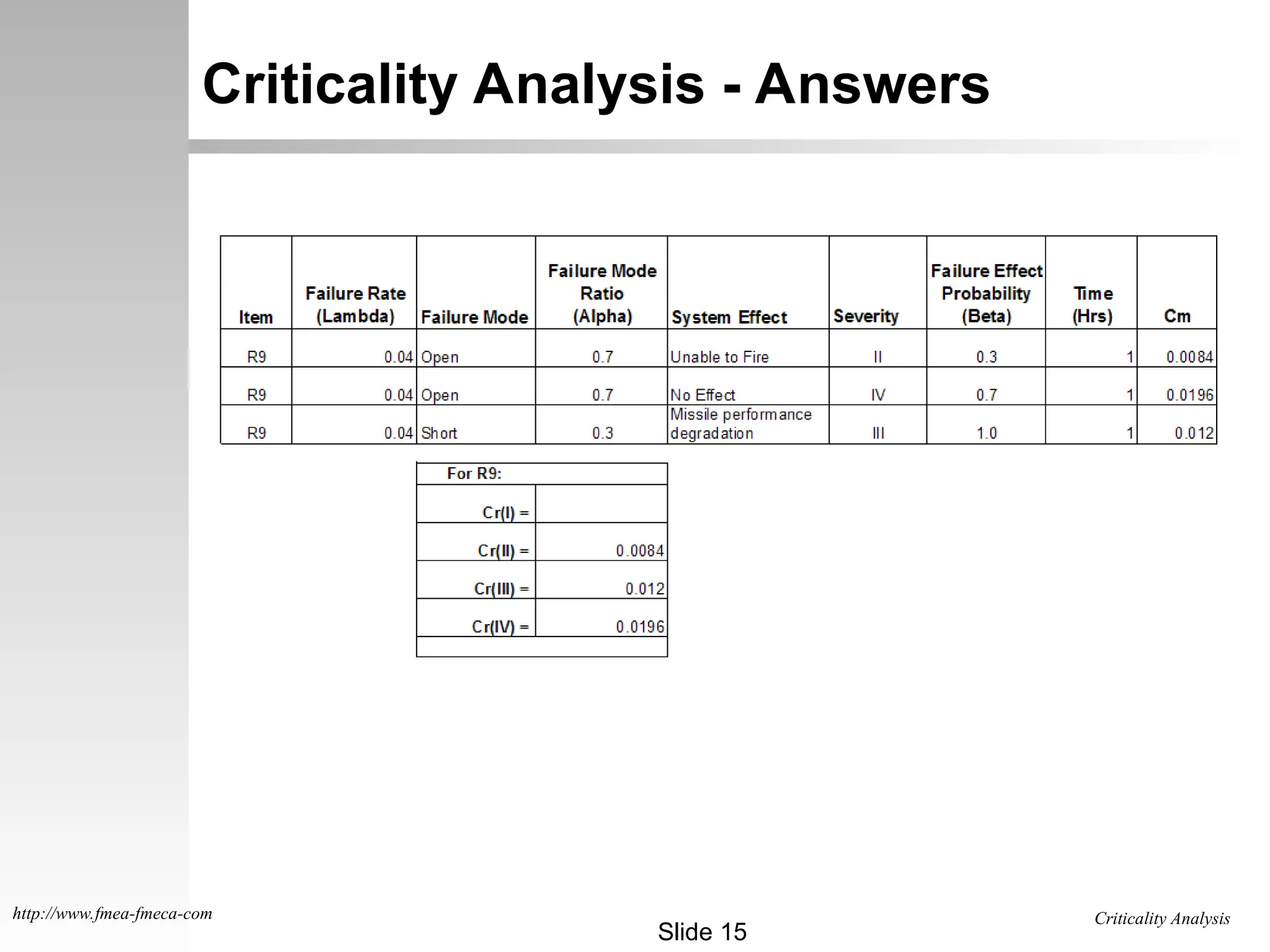
 Cm for R9 open resulting in being unable to fire is 0.0084
 Cm for R9 open resulting in no effect is 0.0196
 Cm for R9 short resulting in performance degradation is 0.012
Criticality Analysis
Slide 15
http://www.fmea-fmeca-com
Criticality Analysis - Answers
Criticality Analysis
Slide 16
http://www.fmea-fmeca-com
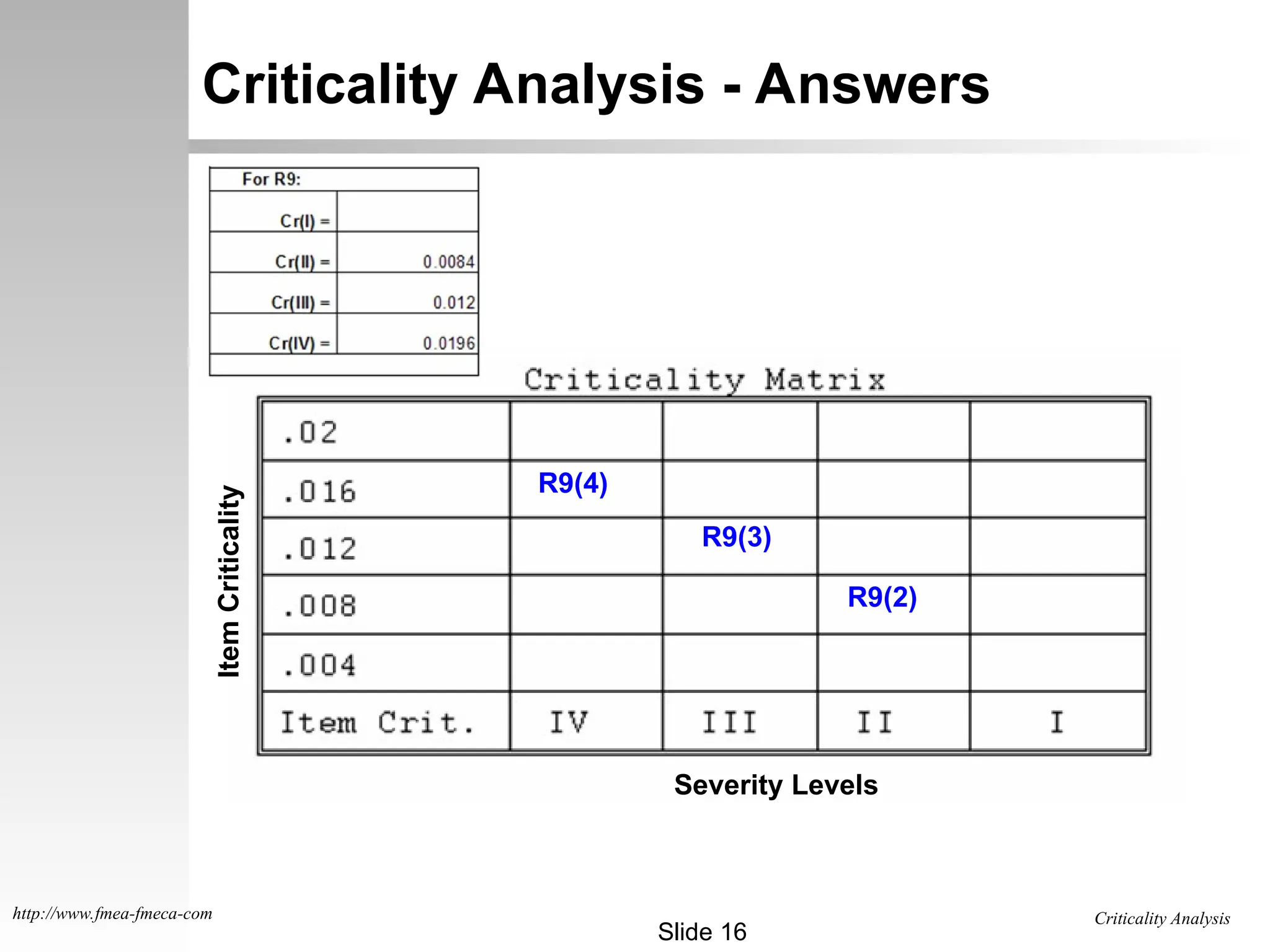
Criticality Analysis - Answers
R9(2)
R9(4)
R9(3)
Item
Criticality
Severity Levels

criticality-analysis-milstd1629-approach.ppt

  • 1.
    Criticality Analysis Slide 1 http://www.fmea-fmeca-com Criticality– Mil-Std-1629 Approach  CRITICALITY is a measure of the frequency of occurrence of an effect. – May be based on qualitative judgement or – May be based on failure rate data (most common)
  • 2.
    Criticality Analysis Slide 2 http://www.fmea-fmeca-com CriticalityAnalysis  Qualitative analysis: – Used when specific part or item failure rates are not available.  Quantitative analysis: – Used when sufficient failure rate data is available to calculate criticality numbers.
  • 3.
    Criticality Analysis Slide 3 http://www.fmea-fmeca-com QualitativeApproach  Because failure rate data is not available, failure mode ratios and failure mode probability are not used.  The probability of occurrence of each failure is grouped into discrete levels that establish the qualitative failure probability level for each entry based on the judgment of the analyst.  The failure mode probability levels of occurrence are: – Level A - Frequent – Level B - Reasonably Probable – Level C - Occasional – Level D - Remote – Level E - Extremely Unlikely
  • 4.
    Criticality Analysis Slide 4 http://www.fmea-fmeca-com QuantitativeApproach Failure Mode Criticality (CM) is the portion of the criticality number for an item, due to one of its failure modes, which results in a particular severity classification (e.g. results in an end effect with severity I, II, etc...).
  • 5.
    Criticality Analysis Slide 5 http://www.fmea-fmeca-com Mil-Std-1629Severity Levels  Category I - Catastrophic: A failure which may cause death or weapon system loss (i.e., aircraft, tank, missile, ship, etc...)  Category II - Critical: A failure which may cause severe injury, major property damage, or major system damage which will result in mission loss.  Category III - Marginal: A failure which may cause minor injury, minor property damage, or minor system damage which will result in delay or loss of availability or mission degradation.  Category IV - Minor: A failure not serious enough to cause injury, property damage or system damage, but which will result in unscheduled maintenance or repair.
  • 6.
    Criticality Analysis Slide 6 http://www.fmea-fmeca-com QuantitativeApproach  The quantitative approach uses the following formula for Failure Mode Criticality:  Cm = βαλpt  Where Cm = Failure Mode Criticality  β = Conditional probability of occurrence of next higher failure effect  α = Failure mode ratio  λp = Part failure rate  T = Duration of applicable mission phase
  • 7.
    Criticality Analysis Slide 7 http://www.fmea-fmeca-com CriticalityAnalysis Example A resistor R6 with a failure rate of .01 failures per million hours is located on the Missile Interface Board of the XYZ Missile Launch System. If the resistor fails, it fails open 70 % of the time and short 30 % of the time. If it fails open, the system will be unable to launch a missile 30 % of the time, the missile explodes in the tube 20 % of the time, and there is no effect 50 % of the time. If it fails short, the performance of the missile is degraded 50 % of the time and the missile inadvertently launches 50 % of the time. Mission time is 1 hour. λp = 0.01 in every case α = 0.7 for open β = 0.3 for unable to fire β = 0.2 for missile explodes β = 0.5 for no effect α = 0.3 for short β = 0.5 for missile performance degradation β = 0.5 for inadvertent launch Cm for R6 open resulting in being unable to fire is (.3)(.7)(.01)(1)=0.0021 Cm for R6 open resulting in a missile explosion is (.2)(.7)(.01)(1)=0.0014 Cm for R6 open resulting in no effect is (.5)(.7)(.01)(1)=0.0035 Cm for R6 short resulting in performance degradation is (.5)(.3)(.01)(1)=0.0015 Cm for R6 short resulting in inadvertent launch is (.5)(.3)(.01)(1)=0.0015
  • 8.
    Criticality Analysis Slide 8 http://www.fmea-fmeca-com QuantitativeApproach Item Criticality (Cr) is the criticality number associated with the item under analysis. For a mission phase, Cr is the sum of the item’s failure mode criticality numbers, Cm, which result in the same severity classification.
  • 9.
    Criticality Analysis Slide 9 http://www.fmea-fmeca-com QuantitativeApproach  The quantitative approach uses the following formula for Item Criticality within a particular severity level:  Where Cr Item Criticality  n = The current failure mode of the item being analyzed  j = The number of failure modes for the item being analyzed.
  • 10.
    Criticality Analysis Slide 10 http://www.fmea-fmeca-com CriticalityAnalysis Exercise Criticality Analysis: Determine failure mode criticality values and item criticality values for the R9 resistor, and create an item criticality matrix.
  • 11.
    Criticality Analysis Slide 11 http://www.fmea-fmeca-com CriticalityAnalysis Exercise  A resistor R9 with a failure rate of .04 failures per million hours is located on the Power Supply Board of the XYZ Missile Launch System. If the resistor fails, it fails open 70 % of the time and short 30 % of the time. If it fails open, the system will be unable to launch a missile 30 % of the time and there is no effect 70 % of the time. If it fails short, the performance of the missile is degraded 100 % of the time. Mission time is 1 hour.  λp = __ in every case  α = __ for open  β = __ for unable to fire  β = __ for no effect  α = __ for short  β = __ for missile performance degradation  Cm for R9 open resulting in being unable to fire is ___  Cm for R9 open resulting in no effect is ___  Cm for R9 short resulting in performance degradation is ___
  • 12.
  • 13.
    Criticality Analysis Slide 13 http://www.fmea-fmeca-com CriticalityAnalysis Exercise Item Criticality Severity Levels
  • 14.
    Criticality Analysis Slide 14 http://www.fmea-fmeca-com CriticalityAnalysis - Answers  A resistor R9 with a failure rate of .04 failures per million hours is located on the Power Supply Board of the XYZ Missile Launch System. If the resistor fails, it fails open 70 % of the time and short 30 % of the time. If it fails open, the system will be unable to launch a missile 30 % of the time and there is no effect 70 % of the time. If it fails short, the performance of the missile is degraded 100 % of the time. Mission time is 1 hour.  λp = 0.04 in every case  α = 0.70 for open  β = 0.30 for unable to fire  β = 0.70 for no effect  α = 0.30 for short  β = 1.00 for missile performance degradation  Cm for R9 open resulting in being unable to fire is 0.0084  Cm for R9 open resulting in no effect is 0.0196  Cm for R9 short resulting in performance degradation is 0.012
  • 15.
  • 16.
    Criticality Analysis Slide 16 http://www.fmea-fmeca-com CriticalityAnalysis - Answers R9(2) R9(4) R9(3) Item Criticality Severity Levels