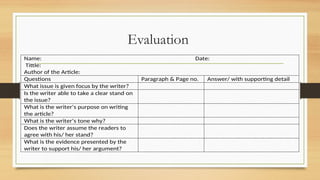
Reading and thinking strategies are cognitive tools that enhance comprehension by transforming reading from a passive activity into an active, analytical process. These techniques involve interacting with text through previewing, questioning, visualizing, and summarizing to deepen understanding, foster critical thinking, and improve retention across various text types.
Key reading and thinking strategies are categorized by the stage of the reading process:
Pre-Reading (Preparing to Read):
Activating Prior Knowledge: Connecting the text to personal experiences or prior knowledge.
Previewing/Surveying: Examining titles, headings, and images to predict content.
Setting a Purpose: Defining why the text is being read.
While-Reading (Active Engagement):
Monitoring/Clarifying: Checking comprehension and using "fix-up" strategies (e.g., re-reading) when meaning is lost.
Annotating/Underlining: Actively marking text for main ideas and keywords.
Making Inferences: Reading "between the lines" to understand implicit information.
Visualizing: Creating mental images of the text.
Think-Aloud: Modeling thought processes out loud to analyze complex parts.
Post-Reading (Reflecting and Analyzing):
Summarizing: Condensing the main points in one’s own words.
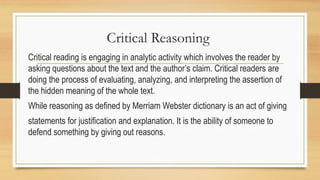
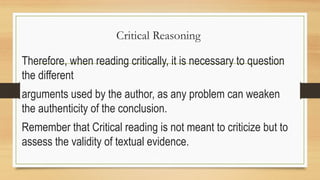
Questioning: Asking about the text's purpose, reliability, or bias.
Retelling: Re-telling the story or information to check comprehension.
Graphic Organizers: Using tools like Venn diagrams or story maps to structure information.
These strategies are crucial for analyzing text, identifying patterns (like cause and effect, or comparison and contrast), and improving overall literacy skills. Speech acts are actions performed through language, categorized mainly into three types: Locutionary (the literal utterance), Illocutionary (the intended purpose like requesting, promising, or warning), and Perlocutionary (the actual effect on the listener, such as persuading or convincing). Philosophers like Austin and Searle further classified illocutionary acts into five categories: Assertives, Directives, Commissives, Expressives, and Declarations, detailing their function in communication.
The Three Main Types of Speech Acts
Locutionary Act: The physical act of saying something, including the words and their literal meaning (e.g., "It's cold in here").
Illocutionary Act: The speaker's intention or purpose in uttering those words (e.g., wanting someone to close the window).
Perlocutionary Act: The actual effect or consequence the utterance has on the listener (e.g., the listener gets up and closes the window).
Searle's Five Categories of Illocutionary Acts
These categories describe the function or force of an utterance:
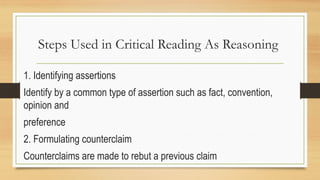
Assertives (Representatives): Committing the speaker to the truth of the expressed proposition (e.g., stating, claiming, describing).
Directives: Trying to get the hearer to do something (e.g., ordering, requesting, asking).
Commissives: Committing the speaker to some future course of action (e.g., promisi