Project Deliverable 3 (10%) – Group Work
Semester : Spring Year : 2024
Course Title : Professional Work Values in Islam
Course Code : BUS240
Instructor(s) : Rania Hafez
Submission Date :
Critical Commentary:
Social Work Ethics
Prepared by
ID
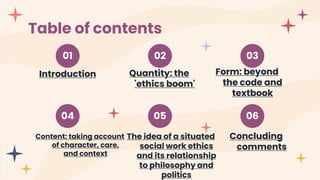
Table of contents
Introduction
01 02 03
Quantity: the
'ethics boom'
Form: beyond
the code and
textbook
Content: taking account
of character, care,
and context
04
The idea of a situated
social work ethics
and its relationship
to philosophy and
politics
05
Concluding
comments
06
Introduction
● Social work ethics is an emerging subject area within the professional
discipline of social work.
● It focuses on the norms of right action, good qualities of character,
and values relating to the nature of the good life that are aspired to,
espoused, and enacted by social workers in the context of their work.
● The field of social work ethics is expanding due to several factors,
including the continuing professionalization of social work, the
establishment of new and longer higher education programmes in
many countries across the world, and the global trends that are
creating 'applied ethics' as a topical subject area.
Quantity: the
'ethics boom'
Indicators of the growth of interest in social work
ethics include the introduction of new specialist
journals, the development of new and revised
textbooks on social work ethics, and the
increased frequency of specific modules on social
work ethics being taught on professional
qualifying programmes.
The proliferation of new and revised codes of
ethics/professional conduct, alongside other
ethical guidance and discussion documents
produced by professional associations and
regulatory bodies, further demonstrates the
growth of social work ethics.
Form: beyond the code
and textbook
• Traditionally, professional ethics has been
associated with codes of ethics and textbooks
designed for use on professional education
programmes.
• However, the construction of social work
ethics is being challenged and broadened,
not only by scholarly academic articles, but
also by empirical studies of social workers'
perceptions, attitudes, and actions.
• This shift towards a more embedded and
situated approach to ethics in professional life
is evident in the growing body of literature on
social work ethics that goes beyond codes
and textbooks.
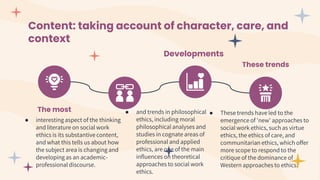
Content: taking account of character, care, and
context
The most
● interesting aspect of the thinking
and literature on social work
ethics is its substantive content,
and what this tells us about how
the subject area is changing and
developing as an academic-
professional discourse.
● and trends in philosophical
ethics, including moral
philosophical analyses and
studies in cognate areas of
professional and applied
ethics, are one of the main
influences on theoretical
approaches to social work
ethics.
Developments
These trends
● These trends have led to the
emergence of 'new' approaches to
social work ethics, such as virtue
ethics, the ethics of care, and
communitarian ethics, which offer
more scope to respond to the
critique of the dominance of
Western approaches to ethics.
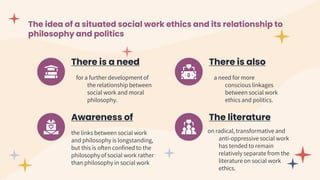
The idea of a situated social work ethics and its relationship to
philosophy and politics
There is a need
for a further development of
the relationship between
social work and moral
philosophy.
There is also
a need for more
conscious linkages
between social work
ethics and politics.
Awareness of
the links between social work
and philosophy is longstanding,
but this is often confined to the
philosophy of social work rather
than philosophy in social work
The literature
on radical, transformative and
anti-oppressive social work
has tended to remain
relatively separate from the
literature on social work
ethics.
Concluding comments
Social work ethics
Social work ethics is at an interesting
stage in its development.
Other areas of professional and
applied ethics, particularly
medical, bio- and health care
ethics, are much more well
developed, so provide interesting
sources of ideas and lessons for
social work ethics in its
developmental trajectory.
Social work ethics
has the potential to benefit from more
serious engagement with moral,
political, and religious philosophy.
There is also the potential to link some of
the sociological ethnographic and
discourse analytic studies of everyday
social work practice with the large
body of moral philosophical work on
personal integrity.
Further exploration
This presentation has provided a brief overview of the
evolving field of social work ethics.
To delve deeper into this subject, consider exploring the
following resources:
Academic journals: Journal of Social Work Ethics,
International Journal of Social Work, Social Work &
Christianity
Textbooks: Social Work Ethics (Banks), Ethics in Social
Work (Reamer), The Routledge Handbook of Social
Work Ethics (Trevithick)
Professional association websites: National Association
of Social Workers (NASW), International Federation
of Social Workers (IFSW)
Conclusion
This presentation has highlighted the
growing importance and evolving
nature of social work ethics. By
understanding the trends in
philosophical influences, the emergence
of new approaches, and the need for
deeper connections with political and
social realities, we can contribute to a
more robust and nuanced
understanding of ethical considerations
in social work practice.
Image representing social work ethics, such
as a handshake between a social worker and
a client, or a symbol of justice
Credits: This presentation template was created
by Slidesgo, including icons by Flaticon,
infographics & images by Freepik.
Thanks!
References
● Antle, B. and Regehr, C. (2003) ‘Beyond individual rights and freedoms: Metaethics in social work
research’, Social Work, 48(1), pp. 135-44.
● Aotearoa New Zealand Association of Social Workers (2008) Code of Ethics, Dunedin, ANZASW.
● Appiah, K. A. (2007) Cosmopolitanism: Ethics in a World of Strangers, London,.Penguin. Banks, S.
(1997) Etica y valores en el trabajo social, Barcelona/Buenos Aires, Ediciones Paidos Iberica. Banks,
S. (1999) Etica e valori nel servizio sociale: Dilemmi morali e operatiri riflessivi nel welfare mix,
Trento, Italy, Erickson.

Critical Commentary Social Work Ethics.pptx

  • 1.
    Project Deliverable 3(10%) – Group Work Semester : Spring Year : 2024 Course Title : Professional Work Values in Islam Course Code : BUS240 Instructor(s) : Rania Hafez Submission Date : Critical Commentary: Social Work Ethics Prepared by ID
  • 2.
    Table of contents Introduction 0102 03 Quantity: the 'ethics boom' Form: beyond the code and textbook Content: taking account of character, care, and context 04 The idea of a situated social work ethics and its relationship to philosophy and politics 05 Concluding comments 06
  • 3.
    Introduction ● Social workethics is an emerging subject area within the professional discipline of social work. ● It focuses on the norms of right action, good qualities of character, and values relating to the nature of the good life that are aspired to, espoused, and enacted by social workers in the context of their work. ● The field of social work ethics is expanding due to several factors, including the continuing professionalization of social work, the establishment of new and longer higher education programmes in many countries across the world, and the global trends that are creating 'applied ethics' as a topical subject area.
  • 4.
    Quantity: the 'ethics boom' Indicatorsof the growth of interest in social work ethics include the introduction of new specialist journals, the development of new and revised textbooks on social work ethics, and the increased frequency of specific modules on social work ethics being taught on professional qualifying programmes. The proliferation of new and revised codes of ethics/professional conduct, alongside other ethical guidance and discussion documents produced by professional associations and regulatory bodies, further demonstrates the growth of social work ethics.
  • 5.
    Form: beyond thecode and textbook • Traditionally, professional ethics has been associated with codes of ethics and textbooks designed for use on professional education programmes. • However, the construction of social work ethics is being challenged and broadened, not only by scholarly academic articles, but also by empirical studies of social workers' perceptions, attitudes, and actions. • This shift towards a more embedded and situated approach to ethics in professional life is evident in the growing body of literature on social work ethics that goes beyond codes and textbooks.
  • 6.
    Content: taking accountof character, care, and context The most ● interesting aspect of the thinking and literature on social work ethics is its substantive content, and what this tells us about how the subject area is changing and developing as an academic- professional discourse. ● and trends in philosophical ethics, including moral philosophical analyses and studies in cognate areas of professional and applied ethics, are one of the main influences on theoretical approaches to social work ethics. Developments These trends ● These trends have led to the emergence of 'new' approaches to social work ethics, such as virtue ethics, the ethics of care, and communitarian ethics, which offer more scope to respond to the critique of the dominance of Western approaches to ethics.
  • 7.
    The idea ofa situated social work ethics and its relationship to philosophy and politics There is a need for a further development of the relationship between social work and moral philosophy. There is also a need for more conscious linkages between social work ethics and politics. Awareness of the links between social work and philosophy is longstanding, but this is often confined to the philosophy of social work rather than philosophy in social work The literature on radical, transformative and anti-oppressive social work has tended to remain relatively separate from the literature on social work ethics.
  • 8.
    Concluding comments Social workethics Social work ethics is at an interesting stage in its development. Other areas of professional and applied ethics, particularly medical, bio- and health care ethics, are much more well developed, so provide interesting sources of ideas and lessons for social work ethics in its developmental trajectory. Social work ethics has the potential to benefit from more serious engagement with moral, political, and religious philosophy. There is also the potential to link some of the sociological ethnographic and discourse analytic studies of everyday social work practice with the large body of moral philosophical work on personal integrity.
  • 9.
    Further exploration This presentationhas provided a brief overview of the evolving field of social work ethics. To delve deeper into this subject, consider exploring the following resources: Academic journals: Journal of Social Work Ethics, International Journal of Social Work, Social Work & Christianity Textbooks: Social Work Ethics (Banks), Ethics in Social Work (Reamer), The Routledge Handbook of Social Work Ethics (Trevithick) Professional association websites: National Association of Social Workers (NASW), International Federation of Social Workers (IFSW)
  • 10.
    Conclusion This presentation hashighlighted the growing importance and evolving nature of social work ethics. By understanding the trends in philosophical influences, the emergence of new approaches, and the need for deeper connections with political and social realities, we can contribute to a more robust and nuanced understanding of ethical considerations in social work practice.
  • 11.
    Image representing socialwork ethics, such as a handshake between a social worker and a client, or a symbol of justice
  • 12.
    Credits: This presentationtemplate was created by Slidesgo, including icons by Flaticon, infographics & images by Freepik. Thanks!
  • 13.
    References ● Antle, B.and Regehr, C. (2003) ‘Beyond individual rights and freedoms: Metaethics in social work research’, Social Work, 48(1), pp. 135-44. ● Aotearoa New Zealand Association of Social Workers (2008) Code of Ethics, Dunedin, ANZASW. ● Appiah, K. A. (2007) Cosmopolitanism: Ethics in a World of Strangers, London,.Penguin. Banks, S. (1997) Etica y valores en el trabajo social, Barcelona/Buenos Aires, Ediciones Paidos Iberica. Banks, S. (1999) Etica e valori nel servizio sociale: Dilemmi morali e operatiri riflessivi nel welfare mix, Trento, Italy, Erickson.