w w w . i n f o s e c t r a i n . c o m
W W W . I N F O S E C T R A I N . C O M
w w w . i n f o s e c t r a i n . c o m
CRISC Introduction
Certified in Risk and Information System Control (CRISC) certification training program at Infosec Train is developed for
those professionals who identify and manage the enterprise risks by implementing information system controls. The
training will help you understand the impacts of IT risks and gain technical expertise in implementing proper information
security controls to confront the challenges posed by these risks.
CRISC is the most current and rigorous assessment available to evaluate IT professionals’ risk management proficiency
and other employees within an enterprise or financial institute.
Those who earn CRISC help enterprises understand business risks and have the technical knowledge to implement
appropriate IS controls.
w w w . i n f o s e c t r a i n . c o m
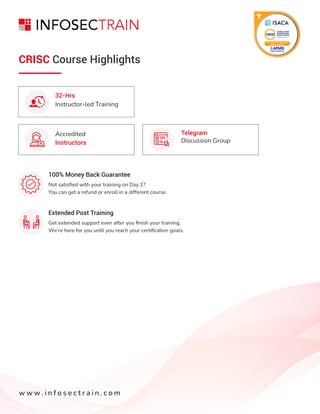
CRISC Course Highlights
100% Money Back Guarantee
Extended Post Training
Not satisfied with your training on Day 1?
You can get a refund or enroll in a different course.
Get extended support even after you finish your training.
We’re here for you until you reach your certification goals.
32-Hrs
Instructor-led Training
Accredited
Instructors
Telegram
Discussion Group
w w w . i n f o s e c t r a i n . c o m
Who Should Attend
CEOs/CFOs
CIOs/CISOs
Audit Partners/Heads
Security Managers/
Directors/Consultants
Chief Audit
Executives
Chief Compliance/
Privacy/Risk Officers
CISM Exam Information
Certification Certified in Risk and Information Systems Control
Exam Duration 4 Hours
Number of Questions 150
Exam Pattern Multiple Choice
Passing Marks 450 out of 800
Languages
English, French, German, Hebrew, Italian, Japanese,
Korean, Spanish, Turkish, Chinese
w w w . i n f o s e c t r a i n . c o m
Happy Learners Across the World
w w w . i n f o s e c t r a i n . c o m
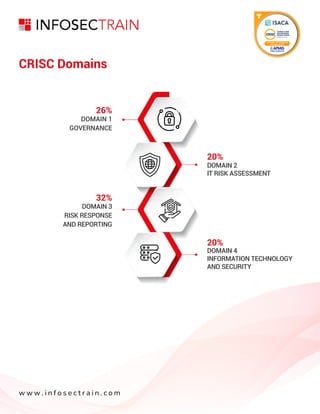
DOMAIN 1
GOVERNANCE
26%
DOMAIN 2
IT RISK ASSESSMENT
20%
DOMAIN 4
INFORMATION TECHNOLOGY
AND SECURITY
20%
CRISC Domains
32%
DOMAIN 3
RISK RESPONSE
AND REPORTING
w w w . i n f o s e c t r a i n . c o m
26% DOMAIN 1
GOVERNANCE
A—ORGANIZATIONAL GOVERNANCE
B—RISK GOVERNANCE
The governance domain interrogates your knowledge of information about an organization’s business and IT
environments, organizational strategy, goals and objectives, and examines potential or realized impacts of IT risk to
the organization’s business objectives and operations, including Enterprise Risk Management and Risk Management
Framework.
• Organizational Strategy, Goals, and Objectives
• Organizational Structure, Roles and Responsibilities
• Organizational Culture
• Policies and Standards
• Business Processes
• Organizational Assets
• Enterprise Risk Management and Risk Management Framework
• Three Lines of Defense
• Risk Profile
• Risk Appetite and Risk Tolerance
• Legal, Regulatory and Contractual Requirements
• Professional Ethics of Risk Management
w w w . i n f o s e c t r a i n . c o m
20% DOMAIN 2
IT RISK ASSESSMENT
A—IT RISK IDENTIFICATION
B—IT RISK ANALYSIS AND EVALUATION
This domain will certify your knowledge of threats and vulnerabilities to the organization’s people, processes and
technology as well as the likelihood and impact of threats, vulnerabilities and risk scenarios.
• Risk Events (e.g., contributing conditions, loss result)
• Threat Modelling and Threat Landscape
• Vulnerability and Control Deficiency Analysis (e.g., root cause analysis)
• Risk Scenario Development
• Risk Assessment Concepts, Standards and Frameworks
• Risk Register
• Risk Analysis Methodologies
• Business Impact Analysis
• Inherent and Residual Risk
w w w . i n f o s e c t r a i n . c o m
32% DOMAIN 3
RISK RESPONSE AND REPORTING
A—RISK RESPONSE
B—CONTROL DESIGN AND IMPLEMENTATION
C—RISK MONITORING AND REPORTING
This domain deals with the development and management of risk treatment plans among key stakeholders, the
evaluation of existing controls and improving effectiveness for IT risk mitigation, and the assessment of relevant risk and
control information to applicable stakeholders.
• Risk Treatment / Risk Response Options
• Risk and Control Ownership
• Third-Party Risk Management
• Issue, Finding and Exception Management
• Management of Emerging Risk
• Control Types, Standards and Frameworks
• Control Design, Selection and Analysis
• Control Implementation
• Control Testing and Effectiveness Evaluation
• Risk Treatment Plans
• Data Collection, Aggregation, Analysis and Validation
• Risk and Control Monitoring Techniques
• Risk and Control Reporting Techniques (heatmap, scorecards, dashboards)
• Key Performance Indicators
• Key Risk Indicators (KRIs)
• Key Control Indicators (KCIs)
w w w . i n f o s e c t r a i n . c o m
INFORMATION TECHNOLOGY AND SECURITY
22% DOMAIN 4
A—INFORMATION TECHNOLOGY PRINCIPLES
B—INFORMATION SECURITY PRINCIPLES
In this domain we interrogate the alignment of business practices with Risk Management and Information Security
frameworks and standards, as well as the development of a risk-aware culture and implementation of security
awareness training.
• Enterprise Architecture
• IT Operations Management (e.g., change management, IT assets, problems, incidents)
• Project Management
• Disaster Recovery Management (DRM)
• Data Lifecycle Management
• System Development Life Cycle (SDLC)
• Emerging Technologies
• Information Security Concepts, Frameworks and Standards
• Information Security Awareness Training
• Business Continuity Management
• Data Privacy and Data Protection Principles
w w w . i n f o s e c t r a i n . c o m
www.infosectrain.com I sales@infosectrain.com

CRISC Certification Course Content.pdf

  • 1.
    w w w. i n f o s e c t r a i n . c o m W W W . I N F O S E C T R A I N . C O M
  • 2.
    w w w. i n f o s e c t r a i n . c o m CRISC Introduction Certified in Risk and Information System Control (CRISC) certification training program at Infosec Train is developed for those professionals who identify and manage the enterprise risks by implementing information system controls. The training will help you understand the impacts of IT risks and gain technical expertise in implementing proper information security controls to confront the challenges posed by these risks. CRISC is the most current and rigorous assessment available to evaluate IT professionals’ risk management proficiency and other employees within an enterprise or financial institute. Those who earn CRISC help enterprises understand business risks and have the technical knowledge to implement appropriate IS controls.
  • 3.
    w w w. i n f o s e c t r a i n . c o m CRISC Course Highlights 100% Money Back Guarantee Extended Post Training Not satisfied with your training on Day 1? You can get a refund or enroll in a different course. Get extended support even after you finish your training. We’re here for you until you reach your certification goals. 32-Hrs Instructor-led Training Accredited Instructors Telegram Discussion Group
  • 4.
    w w w. i n f o s e c t r a i n . c o m Who Should Attend CEOs/CFOs CIOs/CISOs Audit Partners/Heads Security Managers/ Directors/Consultants Chief Audit Executives Chief Compliance/ Privacy/Risk Officers CISM Exam Information Certification Certified in Risk and Information Systems Control Exam Duration 4 Hours Number of Questions 150 Exam Pattern Multiple Choice Passing Marks 450 out of 800 Languages English, French, German, Hebrew, Italian, Japanese, Korean, Spanish, Turkish, Chinese
  • 5.
    w w w. i n f o s e c t r a i n . c o m Happy Learners Across the World w w w . i n f o s e c t r a i n . c o m
  • 6.
    w w w. i n f o s e c t r a i n . c o m DOMAIN 1 GOVERNANCE 26% DOMAIN 2 IT RISK ASSESSMENT 20% DOMAIN 4 INFORMATION TECHNOLOGY AND SECURITY 20% CRISC Domains 32% DOMAIN 3 RISK RESPONSE AND REPORTING
  • 7.
    w w w. i n f o s e c t r a i n . c o m 26% DOMAIN 1 GOVERNANCE A—ORGANIZATIONAL GOVERNANCE B—RISK GOVERNANCE The governance domain interrogates your knowledge of information about an organization’s business and IT environments, organizational strategy, goals and objectives, and examines potential or realized impacts of IT risk to the organization’s business objectives and operations, including Enterprise Risk Management and Risk Management Framework. • Organizational Strategy, Goals, and Objectives • Organizational Structure, Roles and Responsibilities • Organizational Culture • Policies and Standards • Business Processes • Organizational Assets • Enterprise Risk Management and Risk Management Framework • Three Lines of Defense • Risk Profile • Risk Appetite and Risk Tolerance • Legal, Regulatory and Contractual Requirements • Professional Ethics of Risk Management
  • 8.
    w w w. i n f o s e c t r a i n . c o m 20% DOMAIN 2 IT RISK ASSESSMENT A—IT RISK IDENTIFICATION B—IT RISK ANALYSIS AND EVALUATION This domain will certify your knowledge of threats and vulnerabilities to the organization’s people, processes and technology as well as the likelihood and impact of threats, vulnerabilities and risk scenarios. • Risk Events (e.g., contributing conditions, loss result) • Threat Modelling and Threat Landscape • Vulnerability and Control Deficiency Analysis (e.g., root cause analysis) • Risk Scenario Development • Risk Assessment Concepts, Standards and Frameworks • Risk Register • Risk Analysis Methodologies • Business Impact Analysis • Inherent and Residual Risk
  • 9.
    w w w. i n f o s e c t r a i n . c o m 32% DOMAIN 3 RISK RESPONSE AND REPORTING A—RISK RESPONSE B—CONTROL DESIGN AND IMPLEMENTATION C—RISK MONITORING AND REPORTING This domain deals with the development and management of risk treatment plans among key stakeholders, the evaluation of existing controls and improving effectiveness for IT risk mitigation, and the assessment of relevant risk and control information to applicable stakeholders. • Risk Treatment / Risk Response Options • Risk and Control Ownership • Third-Party Risk Management • Issue, Finding and Exception Management • Management of Emerging Risk • Control Types, Standards and Frameworks • Control Design, Selection and Analysis • Control Implementation • Control Testing and Effectiveness Evaluation • Risk Treatment Plans • Data Collection, Aggregation, Analysis and Validation • Risk and Control Monitoring Techniques • Risk and Control Reporting Techniques (heatmap, scorecards, dashboards) • Key Performance Indicators • Key Risk Indicators (KRIs) • Key Control Indicators (KCIs)
  • 10.
    w w w. i n f o s e c t r a i n . c o m INFORMATION TECHNOLOGY AND SECURITY 22% DOMAIN 4 A—INFORMATION TECHNOLOGY PRINCIPLES B—INFORMATION SECURITY PRINCIPLES In this domain we interrogate the alignment of business practices with Risk Management and Information Security frameworks and standards, as well as the development of a risk-aware culture and implementation of security awareness training. • Enterprise Architecture • IT Operations Management (e.g., change management, IT assets, problems, incidents) • Project Management • Disaster Recovery Management (DRM) • Data Lifecycle Management • System Development Life Cycle (SDLC) • Emerging Technologies • Information Security Concepts, Frameworks and Standards • Information Security Awareness Training • Business Continuity Management • Data Privacy and Data Protection Principles
  • 11.
    w w w. i n f o s e c t r a i n . c o m www.infosectrain.com I sales@infosectrain.com