www.infosectrain.com
CISM
Certified Information Security Manager
Training & Certification
www.infosectrain.com
CISM Introduction
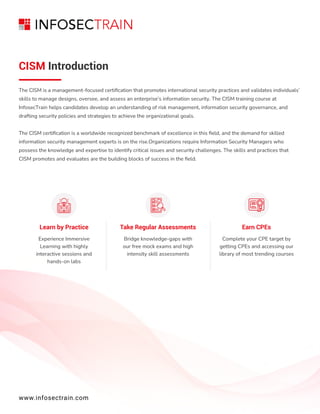
Learn by Practice Take Regular Assessments Earn CPEs
The CISM is a management-focused certification that promotes international security practices and validates individuals’
skills to manage designs, oversee, and assess an enterprise’s information security. The CISM training course at
InfosecTrain helps candidates develop an understanding of risk management, information security governance, and
drafting security policies and strategies to achieve the organizational goals.
The CISM certification is a worldwide recognized benchmark of excellence in this field, and the demand for skilled
information security management experts is on the rise.Organizations require Information Security Managers who
possess the knowledge and expertise to identify critical issues and security challenges. The skills and practices that
CISM promotes and evaluates are the building blocks of success in the field.
Experience Immersive
Learning with highly
interactive sessions and
hands-on labs
Bridge knowledge-gaps with
our free mock exams and high
intensity skill assessments
Complete your CPE target by
getting CPEs and accessing our
library of most trending courses
www.infosectrain.com
CISM Course Highlights
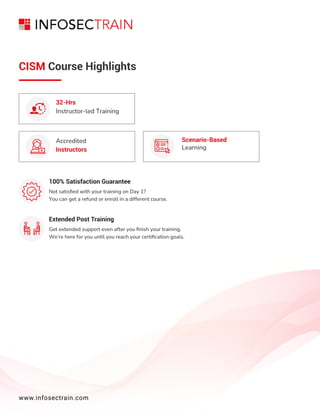
32-Hrs
Instructor-led Training
Accredited
Instructors
Scenario-Based
Learning
100% Satisfaction Guarantee
Extended Post Training
Not satisfied with your training on Day 1?
You can get a refund or enroll in a different course.
Get extended support even after you finish your training.
We’re here for you until you reach your certification goals.
www.infosectrain.com
Who Should Attend
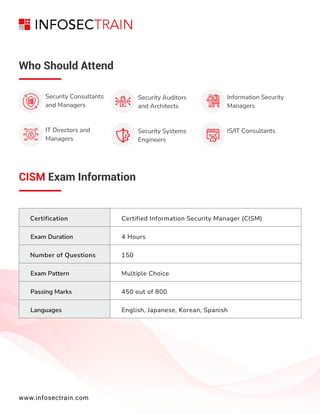
Security Consultants
and Managers
IT Directors and
Managers
Security Auditors
and Architects
Security Systems
Engineers
Information Security
Managers
IS/IT Consultants
CISM Exam Information
Certification Certified Information Security Manager (CISM)
Exam Duration 4 Hours
Number of Questions 150
Exam Pattern Multiple Choice
Passing Marks 450 out of 800
Languages English, Japanese, Korean, Spanish
www.infosectrain.com
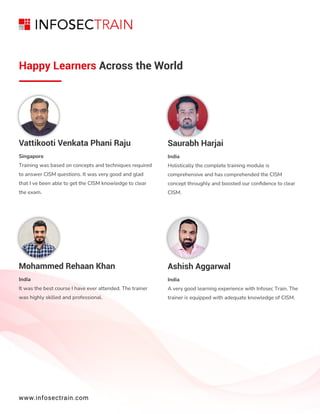
Happy Learners Across the World
Singapore
Training was based on concepts and techniques required
to answer CISM questions. It was very good and glad
that I ve been able to get the CISM knowledge to clear
the exam.
India
It was the best course I have ever attended. The trainer
was highly skilled and professional.
India
Holistically the complete training module is
comprehensive and has comprehended the CISM
concept throughly and boosted our confidence to clear
CISM.
India
A very good learning experience with Infosec Train. The
trainer is equipped with adequate knowledge of CISM.
Vattikooti Venkata Phani Raju
Mohammed Rehaan Khan
Saurabh Harjai
Ashish Aggarwal
www.infosectrain.com
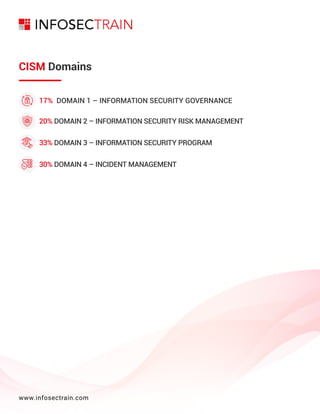
CISM Domains
17% DOMAIN 1 – INFORMATION SECURITY GOVERNANCE
30% DOMAIN 4 – INCIDENT MANAGEMENT
20% DOMAIN 2 – INFORMATION SECURITY RISK MANAGEMENT
33% DOMAIN 3 – INFORMATION SECURITY PROGRAM
www.infosectrain.com
17% DOMAIN 1 INFORMATION SECURITY GOVERNANCE
A–ENTERPRISE GOVERNANCE
A–INFORMATION SECURITY RISK ASSESSMENT
B–INFORMATION SECURITY STRATEGY
B–INFORMATION SECURITY RISK RESPONSE
This domain will provide you with a thorough insight into the culture, regulations and structure involved in enterprise
governance, as well as enabling you to analyze, plan and develop information security strategies. Together, this will
affirm high-level credibility in information security governance to stakeholders.
This domain empowers you to analyze and identify potential information security risks, threats and vulnerabilities as well
as giving you all the information about identifying and countering information security risks you will require to perform at
management level.
• Organizational Culture
• Legal, Regulatory and Contractual Requirements
• Organizational Structures, Roles and Responsibilities
• Emerging Risk and Threat Landscape
• Vulnerability and Control Deficiency Analysis
• Risk Assessment and Analysis
• Information Security Strategy Development
• Information Governance Frameworks and Standards
• Strategic Planning (e.g., Budgets, Resources, Business Case)
• Risk Treatment / Risk Response Options
• Risk and Control Ownership
• Risk Monitoring and Reporting
20% DOMAIN 2 INFORMATION SECURITY RISK MANAGEMENT
www.infosectrain.com
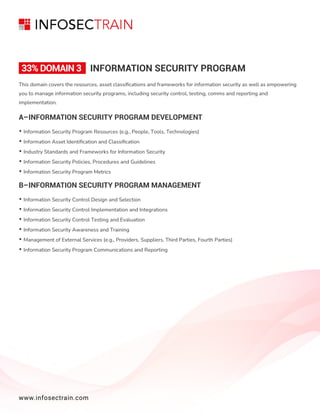
A–INFORMATION SECURITY PROGRAM DEVELOPMENT
B–INFORMATION SECURITY PROGRAM MANAGEMENT
This domain covers the resources, asset classifications and frameworks for information security as well as empowering
you to manage information security programs, including security control, testing, comms and reporting and
implementation.
• Information Security Program Resources (e.g., People, Tools, Technologies)
• Information Asset Identification and Classification
• Industry Standards and Frameworks for Information Security
• Information Security Policies, Procedures and Guidelines
• Information Security Program Metrics
• Information Security Control Design and Selection
• Information Security Control Implementation and Integrations
• Information Security Control Testing and Evaluation
• Information Security Awareness and Training
• Management of External Services (e.g., Providers, Suppliers, Third Parties, Fourth Parties)
• Information Security Program Communications and Reporting
33% DOMAIN 3 INFORMATION SECURITY PROGRAM
www.infosectrain.com
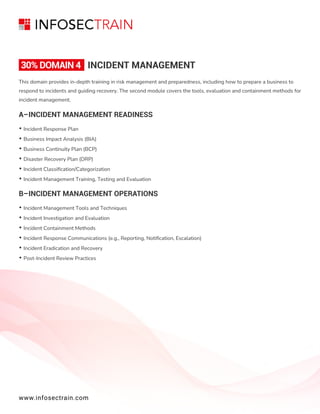
A–INCIDENT MANAGEMENT READINESS
B–INCIDENT MANAGEMENT OPERATIONS
This domain provides in-depth training in risk management and preparedness, including how to prepare a business to
respond to incidents and guiding recovery. The second module covers the tools, evaluation and containment methods for
incident management.
• Incident Response Plan
• Business Impact Analysis (BIA)
• Business Continuity Plan (BCP)
• Disaster Recovery Plan (DRP)
• Incident Classification/Categorization
• Incident Management Training, Testing and Evaluation
• Incident Management Tools and Techniques
• Incident Investigation and Evaluation
• Incident Containment Methods
• Incident Response Communications (e.g., Reporting, Notification, Escalation)
• Incident Eradication and Recovery
• Post-Incident Review Practices
30% DOMAIN 4 INCIDENT MANAGEMENT
www.infosectrain.com
www.infosectrain.com I sales@infosectrain.com

CISM Certification Course Content .pdf

  • 1.
    www.infosectrain.com CISM Certified Information SecurityManager Training & Certification www.infosectrain.com
  • 2.
    www.infosectrain.com CISM Introduction Learn byPractice Take Regular Assessments Earn CPEs The CISM is a management-focused certification that promotes international security practices and validates individuals’ skills to manage designs, oversee, and assess an enterprise’s information security. The CISM training course at InfosecTrain helps candidates develop an understanding of risk management, information security governance, and drafting security policies and strategies to achieve the organizational goals. The CISM certification is a worldwide recognized benchmark of excellence in this field, and the demand for skilled information security management experts is on the rise.Organizations require Information Security Managers who possess the knowledge and expertise to identify critical issues and security challenges. The skills and practices that CISM promotes and evaluates are the building blocks of success in the field. Experience Immersive Learning with highly interactive sessions and hands-on labs Bridge knowledge-gaps with our free mock exams and high intensity skill assessments Complete your CPE target by getting CPEs and accessing our library of most trending courses
  • 3.
    www.infosectrain.com CISM Course Highlights 32-Hrs Instructor-ledTraining Accredited Instructors Scenario-Based Learning 100% Satisfaction Guarantee Extended Post Training Not satisfied with your training on Day 1? You can get a refund or enroll in a different course. Get extended support even after you finish your training. We’re here for you until you reach your certification goals.
  • 4.
    www.infosectrain.com Who Should Attend SecurityConsultants and Managers IT Directors and Managers Security Auditors and Architects Security Systems Engineers Information Security Managers IS/IT Consultants CISM Exam Information Certification Certified Information Security Manager (CISM) Exam Duration 4 Hours Number of Questions 150 Exam Pattern Multiple Choice Passing Marks 450 out of 800 Languages English, Japanese, Korean, Spanish
  • 5.
    www.infosectrain.com Happy Learners Acrossthe World Singapore Training was based on concepts and techniques required to answer CISM questions. It was very good and glad that I ve been able to get the CISM knowledge to clear the exam. India It was the best course I have ever attended. The trainer was highly skilled and professional. India Holistically the complete training module is comprehensive and has comprehended the CISM concept throughly and boosted our confidence to clear CISM. India A very good learning experience with Infosec Train. The trainer is equipped with adequate knowledge of CISM. Vattikooti Venkata Phani Raju Mohammed Rehaan Khan Saurabh Harjai Ashish Aggarwal
  • 6.
    www.infosectrain.com CISM Domains 17% DOMAIN1 – INFORMATION SECURITY GOVERNANCE 30% DOMAIN 4 – INCIDENT MANAGEMENT 20% DOMAIN 2 – INFORMATION SECURITY RISK MANAGEMENT 33% DOMAIN 3 – INFORMATION SECURITY PROGRAM
  • 7.
    www.infosectrain.com 17% DOMAIN 1INFORMATION SECURITY GOVERNANCE A–ENTERPRISE GOVERNANCE A–INFORMATION SECURITY RISK ASSESSMENT B–INFORMATION SECURITY STRATEGY B–INFORMATION SECURITY RISK RESPONSE This domain will provide you with a thorough insight into the culture, regulations and structure involved in enterprise governance, as well as enabling you to analyze, plan and develop information security strategies. Together, this will affirm high-level credibility in information security governance to stakeholders. This domain empowers you to analyze and identify potential information security risks, threats and vulnerabilities as well as giving you all the information about identifying and countering information security risks you will require to perform at management level. • Organizational Culture • Legal, Regulatory and Contractual Requirements • Organizational Structures, Roles and Responsibilities • Emerging Risk and Threat Landscape • Vulnerability and Control Deficiency Analysis • Risk Assessment and Analysis • Information Security Strategy Development • Information Governance Frameworks and Standards • Strategic Planning (e.g., Budgets, Resources, Business Case) • Risk Treatment / Risk Response Options • Risk and Control Ownership • Risk Monitoring and Reporting 20% DOMAIN 2 INFORMATION SECURITY RISK MANAGEMENT
  • 8.
    www.infosectrain.com A–INFORMATION SECURITY PROGRAMDEVELOPMENT B–INFORMATION SECURITY PROGRAM MANAGEMENT This domain covers the resources, asset classifications and frameworks for information security as well as empowering you to manage information security programs, including security control, testing, comms and reporting and implementation. • Information Security Program Resources (e.g., People, Tools, Technologies) • Information Asset Identification and Classification • Industry Standards and Frameworks for Information Security • Information Security Policies, Procedures and Guidelines • Information Security Program Metrics • Information Security Control Design and Selection • Information Security Control Implementation and Integrations • Information Security Control Testing and Evaluation • Information Security Awareness and Training • Management of External Services (e.g., Providers, Suppliers, Third Parties, Fourth Parties) • Information Security Program Communications and Reporting 33% DOMAIN 3 INFORMATION SECURITY PROGRAM
  • 9.
    www.infosectrain.com A–INCIDENT MANAGEMENT READINESS B–INCIDENTMANAGEMENT OPERATIONS This domain provides in-depth training in risk management and preparedness, including how to prepare a business to respond to incidents and guiding recovery. The second module covers the tools, evaluation and containment methods for incident management. • Incident Response Plan • Business Impact Analysis (BIA) • Business Continuity Plan (BCP) • Disaster Recovery Plan (DRP) • Incident Classification/Categorization • Incident Management Training, Testing and Evaluation • Incident Management Tools and Techniques • Incident Investigation and Evaluation • Incident Containment Methods • Incident Response Communications (e.g., Reporting, Notification, Escalation) • Incident Eradication and Recovery • Post-Incident Review Practices 30% DOMAIN 4 INCIDENT MANAGEMENT
  • 10.