MWENGE CATHOLIC UNIVERSITY
CRIMINAL LAW
LWB-I
@NTAMTI CHARLES
LL.B,LLM-ICJ& HR, MED-ODL, B.A-ECONOMICS, MSC ECONOMICS,
adv. Diploma in accountancy
Definition of law
 Law is a body of rules made by the state or upper class
so as to regulate social behaviors of the inferior class
and imposing punishments incase of any disobedience.
a) every law is made by the state article 4 of the
constitution it provides that the laws are normally
made by the parliament meaning the legislature
b) Law is a binding instrument, I means that laws are
bounded to the inferior class it means that once the
law has been made everybody is bound to obey law
usually takes a form of a command
c) Law imposes sanctions meaning punishment
whenever it is disobeyed
Introduction(cont..)
Law contains prescriptions and directions for
purposes of maintaining a particular order in a
particular community. The study of law is the
study of sociology, of economics, study of
history in other words law transcends and cuts
across different discipline meaning that la is the
way of life which also means that Law is life
itself because it gives directions on how to live
in different ways, example not to steal or kill.
Law is there to maintain peace and tranquility,
harmony and provide a minimum standard of
behavior as opposed to anarchy. Examples
directions in roads such as road signs and other
road rules
Types of Laws
This depends on the capacity;
every law has two capacities
Private Laws
Public Laws
Definition(cont..)
PRIVATE CAPACITY OR INDIVIDUAL
 There are relations between individual in
their private capacity. Example there is a
man called husband and a woman who is
called a wife. Those laws are called civil
laws are laws that regulate relationships
between individuals in the community in
their private capacity. They may be called
civil laws or private laws
Introduction(…)
 PUBLIC LAWS:
on the other hand an individual has a public
character he is a member of a community and this
big community in the policy of law is the state, and
the state exists to moderate relationships between
individuals in their public capacity it is their to
maintain a minimum level of behavior , it is there to
ensure that there is no anarchy in the community.
The public character of an individual is reflected
with his relationship with the state.
Public Laws
 All laws are made by the state, these public
laws are mainly prescriptive and contains
prohibitions or directions and relates to
commissions and omissions, it relates to the
does and to the don’ts. This means that a
state will require a particular behavior form
this individual. The basic law in this category is
the constitution, it is the law which contains
the social contract between the state and the
individuals.
Meaning of Criminal Law
 Criminal law or the law of crimes is the law which
enacts prohibitions on certain conduct by an
individual or which demands from an individual a
particular conduct at the threat of punishment, it is
not moral doesn’t contain morality.
Therefore, we can say criminal law is the punitive
branch of the law it is a law which is intended to
maintain a particular level of conduct between
members of a community at the threat of
punishment. The first penal code as we know it today
was the code of The Hammurabi’s code (KING OF
BABILON) it relayed more on morality then on. Penal
code is the secular code of punishment. There is
moral codes and secular codes.
Types of Criminal Law
 There are two types of criminal law,
the major type of criminal law is the
penal code, it is the basic law of
crime, the penal code of tz cap 16
was established on the 28th of
September 1945 our legal system
came in to be on the 22nd of July
1920, it established the high court
Types of criminal laws
 But because the magistrate council had the
power to magistrate law several penal codes
were enacted on 1945. The law of Tanzania was
declared it was what we called codification, this
means is the creature of the industrial revolution.
There is one English philosopher who was known
as Jeremy Bentham he advocated that law has to
apply to everybody in the community and it had
to be certain so to be certain it also had to be
written, that was the beginning of the concept of
written law.
The title to the penal code says that the penal
code was an act to establish the code of criminal
law in Tanganyika.
Categories of Laws
Public law:
These re laws that normally regulate the
relationship between the citizens and the state , in
public law the citizens are required to obey the
demands of the state a good example of public law
is the constitution, also the penal code chap.16
Civil laws:
are laws regulating the relationship among the
members of the society it imposes obligations
between the citizens in the society example we
have the law of contract Act,
Meaning of criminal law..
 It falls under the category of
public law it can simply be
defined as the law of crime and
punishment, meaning that it is
the law which declares crimes
and prescribes punishment for
each of them, it tells you what is
a crime and it also tells you the
punishment of the crime.
Meaning of a crime..
 A crime: means doing something which
has been prohibited by the law, it also
means not doing what is required by the
law we can therefore define criminal law
as the law which contains prohibitions
and obligations which if not complied
with will result to the punishment of an
individual example killing, stealing,
robbery , sexual intercourse with a lady
without her consent .
Dimension of criminal law
 There are 2 dimensions of criminal
law which are obligation and
prohibition meaning the “DO” and
the DO NOT”. Once you do
something that is prohibited you do
a commission on the other hand if
you do not do what you are required
to do in terms of obligations it
requires to an omission
Purpose of criminal law..
 Criminal law is actually intended to regulate
the behavior of all members of the society by
imposing a minimum standard of behavior
there is a minimum standard of behavior
which everybody must aby and therefore
although a human being is a moral free agent
he is bound to live within the limit that has
been established by the law that means you
are a free agent you can do what ever you
want to do but there are limitations and
restrictions which are imposed by the laws it is
important to avoid “chaos”.
Purpose of criminal law
2. Retribution (Just punishment)
3.Deterrence
4.Incapacitation (Protection of the
community)
5.Rehabilitation
6.Restoration
Source of criminal law
1. The constitution:
The constitution of the united republic of Tanzania
of 1977 as amended several times, this is the
mother law of the land or basic, all laws must
obtain their validity from the constitution and any
law which does not involve the constitution shall be
declared to the null and hold this is provided under
article 64(5) it says that every law must confirm
with the constitution, This means that such law
shall not be valid because it is contradicting the
constitution. This includes criminal law all our
criminal laws are supposed to obtain their validity
from the constitution,
Two school of thought..
 there are people who say that the
constitution is not a source of criminal law
and the reason is that the constitution does
not create any offence you do not found a
single offence which has been declared by the
constitution it means that within the
constitutions there is no offence which has
been declared, the constitution does not
impose any punishment
Two school of thought(cont..)
There are people who say that you will find no
crime or punishment in the constitution it remains
to be a source of criminal law because within the
constitution there are fundamental principals that
are intended to regulate the administration of
criminal justice it means that in the course of
administering criminal justice we must be careful to
apply the principals which have been stated under
the constitution, this means that the
administration with criminal justice goes hand in
hand .
principals provided by the constitution for
regulating the administration of criminal justice;
under article 13(6) paragraph b
How criminal laws go together with the
constitution..
 presumption of innocence: this states that
everybody is innocent until proven guilty, this
means that there should never be a criminal law
which will treat a person as guilty while his No
law, No crime Article 13(6) paragraph c,
According to this a person should not be
punished for a nonexistent offence meaning that
in order for you to punish somebody, the
offence should first of all be existing in the law.
 where the law does not provide for an offence
nobody has the right to be punished, therefore
every offence must be provided or created by
the law. Adultery is not declared to be a crime
under the law but a sin against law
Sources(cont..)
2. Precedent or case law or judge made laws :
These are principals that have been made by the judges
of the high court and justices of appeal and they are
normally binding an applicable to subordinate courts
when they are treating a case of similar instant and the
same circumstance, this means that the principals
created by the high court and court of appeal are
normally binding to all the subordinate courts, when a
subordinate court is handling a case which has similar
material facts to a case which was handled by the high
court the subordinate court is supposed to adopt the
decision made by the high court and apply it in its own
cases. Example the decisions of the court pf appeal are
binding the high court and all other lower courts.
Sources(cont..)
3. Statutes
Penal Code; cap 16. this is the major source of the
criminal law in other words it is the main criminal law and
actually through out this course we shall be dealing with
the penal code because it is the statues of general
application meaning that it is applicable in the whole
Tanzania main land, all our criminal laws have been
enacted in the penal code, it provides for crimes and it
also provides for punishment for those crimes.
• Why do we call it a code, this is because it assembles a
number of principals or laws in a single instrument
codification means putting down law in to writing this
is a terminology which was created in the 19th century
by a philosopher known Jeremy Benthom, codification
is very important because of the following?
SOURCE OF CRIMINAL LAW IN
TANZANIA
4. Common law
includes principals and rues that have
originated from England and which were
imported in Tanzania through the reception date
of 22nd July 1920 which allowed the application
of laws, principals and case laws that were
enforced in England up to or before but not later
then 22ND July,1920. In article 17 sub(2) known
as reception laws
SOURCES OF LAW IN TANZANIA
5. Doctrine of Equity
In here they found out that common law was rigid and they
could not get justice in the common law courts by applying the
common law principals so they decided to approach the king for
remedy because the king was considered to be the fountain of
justice, the king would solve those cases not by using common
law but by using principals of fairness. As more and more people
approached the king, the King was overburdened by the disputes
and decided to establish a court under him known as a Chance
court which was supervised by the chancellor.
The court so established was also using principals of fairness,
which were later on consolidated and formed a body of law
known as doctrine of equity, some of which were , no right
without remedy, no one should benefit from his own wrongs, he
who comes to equity must come with clean hands.
SOURCES OF CRIMINAL LAW IN
TANZANIA
6. Statutes of General Application
These are statutes that were enforced in
England up to the reception date which were
imported in to Tanganyika and into other
colonies that were under Britain. These laws
were applied in the situations where there were
no local law example, the marine insurance Act
of 1905, the Uganda law of contracts of 1865 etc
7. Pre-existing laws
in article 24 of the Tanganyika order in council 1924,
Islamic law and customary laws were allowed to
apply in Tanganyika however for them to be
enforceable they were supposed not to be
repugnant to justice.
these laws were only applicable to personal matters
or issues like marriages, divorces, subsection or
inheritances etc. they are not applicable in criminal
case or in constitutional cases. Those roles are
found in the form of statutes or in government
notices example The Islamic restatement Act etc.
RULE AGAINST DOUBLE JEOPARDY
These rules have been provided under the
interpretation of laws Act 1 page 70 and
71,according to this rule a person is not
supposed to be punished twice for a single act.
Do not subject somebody into a double
punishment for a single act. This is when a
person has committed a single action but that
action amounts to two different crimes under
two different laws. you should punish him under
one 1 law but not 2. Also been provided in
section 3(2) of the penal code if you do that you
will violating article 13(6) paragraph (d)
APPLICABILITY OF THE PENAL CODE
Section 6 provides categorical answers under this
section of the penal code we are looking at the
application of the penal code in 3 different dimensions.
The penal code is only applicable in Tanzania main
land, meaning that you can not apply the penal code in
Zanzibar, it is applicable only in Tanzania main land, the
application of the penal code has been legally
restricted only to Tanzania main land, in Zanzibar they
have their own Penal Decree that is cap.5 in the laws of
Zanzibar, therefore it is very restricted to all who are
under the soil to Tanzania main land whether you are a
citizen or a non citizen if you are in Tanzania the penal
code will be applicable to you.
APPLICABILITY OF THE PENAL CODE
The penal code shall be applicable against any
person who commits a crime in an ocean moving
vessel or an air craft which has been registered
under Tanzania, if there is any aircraft registered
in `Tanzania it is committed that it is a part of our
territory so the penal code will punish you.
It shall also be applicable against all Tanzanians
citizens who breach our penal code abroad,
people who commit crimes abroad you will be
punished under the Tanzanian courts.
CHAPTER 2
RULES OF DEFENCE IN CRIMINAL
LIABILITY IN TANZANIA
RULES(Cont..)
Generally, everyone must be responsible for his
actions meaning that when you commit a crime
you must be punished for the crime that you
have committed, everyone must take
responsibility for his actions, however there are
certain situations where a person may not be
punished for a wrongful act, this is where the
person has a defense in criminal law therefore we
have defenses which can exonerate the person
out of liability.
 There is a general rule under section 8 of the
penal code it states that ignorance of the law is
not a defense
DEFENCES FOR CRIMINAL LIABILITY
1. IGNORANCE OF A LAW IS NOT A DEFENCE
this is a general rule on criminal liability, it is actually
the foundation f criminal justice that a person is not
allowed to plead ignorance of the law so as to escape
punishment. You cant say that you did not know the
law and therefore you should not be punished for your
actions, lack of knowledge of the law is not an excuse
therefore section 8 of the penal code prevents a
person from escaping liability by simply saying that he
did not know the law, this is what we call the
presumption of knowledge that everybody is assumed
to be aware of the law the principal I that whenever
the law has been published everybody is assumed to
be aware of it although the reality is not true many
people don’t know
DEFENCE(Cont..)
The purpose of this principal is to avoid dishonesty in the
administration of criminal justice because even if somebody new
the law he will never accept that he knew it every accused
person will tell us that he did not know the law and if we accept
such excuse we shall never convict somebody for a crime and
therefore this is necessary to act as a positive elimination of a
defense because without that principal the administration of
criminal justice will be difficult this was discussed in the case of
BILBIE V. LUMLEY case of 1802 this case is the foundation of the
rule that ignorance of the law is not a defense it was decided by
Lord Ellen Borough. In this case Lord Ellen Borough said “every
man must be taken to be cognizant of the law” otherwise there
is no knowing the extent to which the excuse of ignorance might
be carried it will be argued in almost every case.
IGNORANCE OF LAW(Cont..)
Therefore he said that we should apply a general
assumption that everybody knows the law because if we
don’t do that everyone will say that they don’t know the
law, therefore this principal is the foundation of criminal
justice that everybody knows the law, it was also
discussed in the case of Maulid V. Republic1970 HCD
346, where apart from the founding that the appellant
did not know the law, I am inclined to view that these
offenses are absolute and no mensrea is required even
so, there is no such a presumption that every body is
presumed to know the law. In fact, I very much doubt if
such a presumption would hold good or even those who
administer the law.
IGNORANCE OF LAW(Cont..)
 The principal is that ignorance of the law is
not an excuse of which a magistrate will
appreciate. If you read section 8 carefully you
will discover that there is a slight exception
that “unless knowledge of the law by the
offender is expressly declared to be an
element of the offense” ignorance of the law
can be a defense only where knowledge of the
law is declared to be an element of a
particular offense court held as follows
IGNORANCE OF LAW(Cont…)
 It means that if there is an offense which
requires you to have knowledge of it before being
liable ignorance of that law can be a defense
meaning ignorance of the law can be a defense
only where knowledge of the law is an ingredient
of the offense meaning that you shall not be
punished of that offense unless it is proved that
you knew about it. In Tanzania we don not have
any offense under the penal code which requires
knowledge as an ingredient, therefore these
provision under section 8 provides possibility of
having a defense of ignorance of law in the future
but today there is no such offence
PARTIES TO CRIME
A crime may be committed by one or more
persons. When two or more persons have engaged
in a crime there arises a question as to how much
should each one be liable for the particular crime.
This would require to investigate the extent of
participation in the particular crime where an
offence is committed by more than one offender or
where several offenders perform different roles in
the execution of a common deed. The position in
England is different from that in Tanzania. For the
purpose of clarity the laws of the two countries will
be discussed, albeit briefly, separately.
PARTIES TO CRIME
(a) Parties to crime in Britain
Common law classifies parties to crime in four
groups;
(i) Principal in the first degree.
(ii) Principal in the second degree (often called
an "aider' and abetor').
(Iii) An accessory before the fact and
(iv) An accessory after the fact.
PARTIES TO CRIME(Cont..)
 A principal in the first degree is the actual
offender i.e. the man in whose guilty mind lay
the latest blamable cause of the criminal act.
Sometimes he may be the person by whom
this act itself was done but at other times the
crime may have been committed by the hand
of an unsuspecting agent. For example A tells
B, a child under 8 years, to bring him money
belonging to C. B does so
 A is a principal in the first degree. There may
of course, be more than one principal in the
first degree. You have to note that whoever
actually commits or takes part in the actual
commission of a crime, is a principal in the
first degree, whether he is on the spot when
the crime is committed or not; and if a crime
is committed partly in one place and partly in
the other, every one who commits any part of
it at any place is a principal in the first degree
ACCESSORY BEFORE THE FACT
 Another party to a crime is an accessory
before the fact.
-is a person who directly or indirectly counsels,
procures or commands any person to commit
any crime which is committed in consequence of
such counselling, procuring or commandment.
There are few major elements to make a person
an accessory before the fact
ACCESSORY BEFORE THE FACTS
a) that he must have known the particular deed
contemplated
b) that he approved of it..
c) that his approval was expressed in some form which
operated to encourage the principal to perform the deed
and
d) that those first three elements came into existence
before the time when the offence was being committed.
However, the fact that, crime has been committed in a
manner different from the mode which the accessory had
advised will not excuse him from liability for it. For
example if A hires B to poison C, but B instead kills C by
shooting him, A is nonetheless liable as accessory before
the fact to Cs murder. However, when a totally different
crime is committed then he is not liable.
ACCESSORY BEFORE THE FACTS
Yet where the principal in the first degree, who
has been instigated, makes some mistakes in
performance of then-common aim, this mistake
will not excuse the accessory before the fact
unless it will also excuse the principal e.g. in the
example above B mistakenly, kill's Cs brother
instead of C. In this case A is liable
PARITES TO CRIME IN COMMON LAW
 Another party to crime in common law is .an
accessory after the fact.
This is a person who, knowing that a crime has been
committed, subsequently shelters or assists the culprit in
order to enable him to elude justice. The offence cover
also parties who rescue a person from being arrested,
persons who, having culprits in custody for committing
crimes, intentionally and voluntarily suffers him to escape
or opposes his apprehension. Active assistance to the
criminal is therefore necessary. There is one exception to
this rule i.e. where a married woman receives comforts or
relieves her husband knowing him to have committed a
felony.
PARTIES TO CRIME IN TANZANIA
 Principal offenders;
The law in Tanzania (EA) is not the same as that in
England. The penal code of Tanzania does not adopt
the classification made in English law. The Tanzania
Penal Code recognizes only two main parties to the
offence i.e. the principal offenders (under section
22 of the code) and accessories after the fact
(under section 287 of the same code). The
definition of principal offenders is found in section
22 of the Penal Code and includes
PARTIES TO CRIME IN TANZANIA
a) every person who actually does the act or makes
the omission which constitutes the offence
b) every person who does or omits to do any act
for the purpose of enabling or aiding another
persons to commit the offence.
c) every person who aids or abets another person
in committing the offence.
d) any person who counsels or procures any other
person to commit the offence
PARTIES TO CRIME IN TANZANIA
Therefore those categories in English law, of
accessory before the fact and persons
committing, procuring, aiding or abetting in
offences are principal offenders under the Penal
Code. The same position is true in Kenya In the
Kenyan case of Kamau v/R (1965) EA 501, 504
(CA) it was said:-
The law of Kenya, like that of Tanganyika (citing Sits v. R (1957)
EA 308 (CA) does not use the expression accessory before the
fact but by section 20 of the Penal Code section 22 of
Tanganyika Penal Code makes every person who councels or
procures or aids or abets the commission of the offence a
principal offender"
PARTIES TO CRIME IN TANZANIA
Section 24 of the Pens! Code clarifies further the
circumstances under which counselling is
punishable. The said section provide:-
When a person counsels another to commit an offence and the
offence- is actually committed after such counselling by the
person to whom it is given, it is immaterial whether the offence
actually committed is the same as the counselled or a different
one, or whether the offence is committed in the way counselled
or in different way, provided in either case that the facts
constituting the offence actually committed were a probable
consequence of carrying out the counselling. In either case did
the person who gave the counselling is deemed to have
counselled the other person to commit the offence actually
cornmitted by him."
CHAPTER THREE
HOMICIDE, MURDER AND
MANSLAUGHTER
HOMICIDE
Homicide simply means the killing of any human
being by another human being. The term includes
both lawful killings and unlawful killings. Unlawful
Homicide covers:
a) intentional killing - (Murder);
b) Unlawful killing (not intentional). (Infanticide,
manslaughter);
c) Reckless driving resulting in death
HOMICIDES
There are numerous examples of lawful killings
(Homicides). Lawful Homicide would include the
following examples:
1. An Executioner lawfully executing a death sentence
passed by a competent court;
2. Where a Police Officer employs a reasonable force
which results in death while effecting an arrest; and
3. Where a person is accidentally killed, for example
where soccer player is accidentally killed by a stray ball
during a football match.
Let us now discuss some of the Offences regarded
to be Offences Against the Person. We will first
discuss Homicidal Offences:
MURDER
Classical definition of the offence
"murder" is provided for by-section
196 of the Penal Code. This section
provides that,
“Any person who of malice
aforethought causes the death of
another person by an unlawful act
or omission is guilty of murder
MURDER(cont..)
Definition of Murder has the following key
ingredients which you must always be borne In
mind:
a) Of malice aforethought
b) Causation of death
c) By an unlawful act or by an unlawful
omission.
DEFN. OF MURDER(cont..)
The presence of these ingredients is
essential to establish the offence of
murder. When faced with a question
whether any death is murder or not
murder you must always show that the
three ingredients shown above are
present. Let us look more closely at
each of the three Ingredients (a) (b)
and (c).
MALICE AFORETHOUGHT..
The phrase of malice aforethought' in section 196 of the
Penal Code emphasizes the fact that the crime of murder
is established if the prosecution shows that act of Killing
was accompanied with mental element of intention
technically known as "malice aforethought.
 In Criminal Law, Intention simply means the purpose or
design of doing an act forbidden by the law. It Is one of
the basic principles of Criminal Law that a crime is not
committed if the mind of the person doing the act in
question is innocent (unless of course a provision is
framed In such a way as to dispense away with this
"intent" requirement). For the Crime of Murder, this
guilty mind ("mens rea") is known as "malice
MALICE AFORE-THOUGHT
The requisite guilty mind (i.e.. "mens rea" or "malice aforethought) of
murder is regarded to have existed for the purposes of the Offence of
Murder if conditions provided for by section 200 of the Penal Code are
satisfied. Section 200 of the Penal Code provides:
Malice aforethought shall be deemed to be established by evidence
proving any one or more of the following circumstances:
a) An Intention to cause the death of. or to do grievous harm to any
person, whether such person Is the person actually killed or not;
b) Knowledge that the act or omission causing death will probably
cause the death of or grievous harm to some person, whether such
person is the person actually killed or not. although such knowledge
is accompanied by indifference whether death or grievous bodily
harm is caused or not, or by a wish that it may not be caused.
c) an intent to commit an offence
d) an intention by the act or omission to facilitate the flight or escape
from custody of any person who has committed or attempted to
commit an offence.
MALICE AFORETHOUGHT..
Malice aforethought shall be deemed to be established
by evidence proving any of the elements mentioned to
section 200 of the PENAL CODE;
a) "that the accused person, when doing an act
complained of had either the Intention to cause death
or had the Intention to do grievous harm to any
person. It does not matter that the intention was not
directed to the person who was actually killed"
(section 200(a) of Tanzania penal code, R.E 2022
The last sentence In section 200 (a) providing :It does
matter that the intention was not directed to the person
who was actually killed.
MALICE(Cont..)
For example;
Juma has formed an intention to kill or cause grievous harm to John. Juma
carries out his intention. All dies instead. Here the intent against John is
transferred to All and the accused person Juma will be held liable.
Read the case of Rex V. CHIKOKONYA [1938] 3.R. 122 illustrates further the
application of transferred intent:
In this case the accused person went to in-laws with the intention of killing
his wife by poisoning, drinking, water In a pot. He wanted to kill his wife
because she would no longer allow him to have sexual intercourse with
her. Unfortunately another visitor, one Makachi died after drinking the
water which had been poisoned and having also had some meat which
had been cooked with poisoned water. Accused was found guilty of
murder despite the fact that he did not intend to kill the deceased but his
wife.
MALICE(cont..)
In the case of (1) TOMASI ENYAJU S/o Eguruto, (2) Elasu
s/o EJURU VS. R.. VOL. 12 EJLCA 42,
 An Intention to kill or cause grievous harm (I.e. 'malice
aforethought') was inferred from the Infliction of a fatal
injury by the accused persons. In this case, during a
tribal dance the first accused gave the deceased a
violent poke on the head with the sharper end of his
heavy dancing stick. This pierced the skull and caused
the brain of the deceased to protrude. Almost
immediately, while the deceased was on the ground
but still alive, the second accused beat the deceased
violently on the other side of the head fracturing the
skull. Each injury was sufficient to cause death.
– The accused persons were both convicted of
murder. They appealed. The Court of appeal of
Eastern Africa had to decide whether there was
"malice aforethought" (i.e. intention to kill or
cause grievous harm). The Court of Appeal
dismissed the appeal saying, every person who
"inflicts on a living person an inevitably fatal injury
with the intention to kill or to cause grievous harm
is guilty of murder."
MALICE AFORETHOUGHT(cont..)
Malice aforethought is rarely proved by direct
evidence. It can be inferred from the circumstances
viewed as a whole. The nature of the weapon used
and the manner in which the blow is inflicted are
factors to be considered when seeking to establish
Malice aforethought. By using a lethal weapon the
accused may be presumed to have formed either an
intention to Mil or cause grievous ham, This was
authoritatively stated by Justice Mnzavas, as he
then was in the case of Republic ¥. Mohamed Mite
I1974J.LRT n 36:'
• m this particular case, of course, there was no threat of death, as we see
the case, and if, as the result of the accused's assault on this deceased
woman she had deliberately jumped down a steep precipice, we would
not necessarily have held him responsible for that act. But unlawfully
assaulted as she was, she was entitled to run away In order to escape. If a
person Is running away under an apprehension of violence It Is not an
Unreasonable consequence that person might fall down and If, In the
course of failing down, that person becomes injured, that is the guilty act
of the person who caused her to run away.
• That is the manner in which as I see It, he law must be applied. If this
woman had fallen down and become Injured men the accused then the
accused would have been guilty of an assault, even if the accused had not
directly touched her body. It follows that if she died as a result of that fall
the somewhat unlikely consequence of her running away and falling. But
the law is clear, that if a person assaults another unlawfully and death
results from the assault, then the person who commits the assault is guilty
of homicide. The result Is that we find the accused guilty of culpable
homicide
In the ordinary way if a deceased person met his death in
this manner we would consider it almost technical
offence and the punishment would be very light, but
every case has to be considered on the circumstances of"
that particular case. And in this case we have fovnd. as a
fact, that the accused after the woman was lying on the
ground dance i on her body, and there Is no question that
he Intended to do her grievous bodily harm and he
intended that harm, as I previous pointed out without any
legal justification. This is not, therefore, a case which we
can regard as merely a technical assault and the accused
must be comparatively severely punished. He will be
Imprisoned with hard labour for two years."
• So if X threatens Y with a gun, Y runs and as a result
knocked down by a speeding car, X will be regarded to
have caused the death within section 203(c) of the
Penal Code.
• “Section 203(d), if by any act or omission he hastens
the death of a person suffering under any diseases or
injury which apart from such act or omission would
have caused death”.
• This paragraph(d) of section 203 envisages a situation
where a person hastens the death of an already injured
person or one who is already dying of any disease or
injury
For example;
X Knocks Y on the head draining Y‟s brain through
the wound Inflicted. It is the fact that X will die
shortly. But if Z comes and knocks Y again on the
head, fracturing the already fragile skull and Y dies,
Z will be deemed to have caused the death of Y
even though his act is not the safe cause of Y‟s
death.
Read the case of R.V. EGURUTO ft EJURU 12 EACA
42.]
S.203(e)-If his act or omission would not have
caused death unless, it had been accompanied by
an act or omission of the person killed or of other
person"
Section 203(e) of the Penal Code can be applied
where for example X sets fire to a hut with the
intention of causing either death or grievous
harm to its occupants one of the occupants
returns into the burning hut and is overwhelmed
by fire:
Time of death;
Allied to the question of the person who caused the
death is equally an Important question of the time
connecting the unlawful act or omission and death.
The law in Tanzania as provided for by section 205
of the PENAL CODE is that no one can be held liable
for death of another if that death occurs after one
year and a day following the act or omission of the
accused person.
A person therefore is not deemed to have killed
another if the death of that person does not
take place within a year and a day of the cause
of death. In computing a year and a day for the
purposes of this provision, the day on which the
last unlawful act contributing to the cause of
death was done is included. When the cause of
death is an omission to perform a duty, the day
omission began is Included in computing the
one year and a day.
BY UNLAWFUL ACT
The word "by an unlawful act" is deliberately used in
section 196 of the Penal Code to underscore
unlawfulness as an important element of the Crime of
Murder. By an unlawful act'' is "actus reus" of the
Offence of Murder* The phrase "By an Unlawful Act'
means that a person may have the required "means
rea" for either murder or manslaughter, but escapes
liability for murder or manslaughter, if the killing was
lawful (for .example where an executioner executes a
death sentence).
 The act causing death must be unlawful act of the
accused. The acts causing death here may include the
act of shooting to kill, poisoning, beating etc.
1. where the lawful sentence of a competent court Is
being executed in a lawful manner by a person whose
duty It is to carry out the sentence:
2. where an officer of justice is forcibly resisted in the
lawful execution of a duty to arrest, detain, seize
property or make a search as part of criminal or civil
process, provided that he uses no more force than is
reasonably necessary to protect himself and execute
his duty:
3. where a person is preventing the commission of a
crime provided that he uses no more force than is
reasonably necessary;
4. where a person accidentally kills another In
circumstances where some harm Is foreseen, for
example the harm Is not unlawful because the
a) victim was being operated on lawfully; Or
b) the harm was Inflicted during the course of
argument by voluntarily laying the game the
victim consented to, and by law was able to
consent to, the infliction of that kind of harm.
• It is essential to show that an accused person
killed or took part in the killing of the
deceased and, that the accused person had no
lawful reason to kill. Lawful killings are all
those killings
• that are justified by the law. An obvious
example is where an executioner executes a
person sentenced to death by a competent
court.
PREY UNLAWFUL OMISSION"
• Causing death by an unlawful omission is, yet
another example of 'actus reus' of Crime® of
Murder and manslaughter. There are some
instances where the law confers duties on certain
person© for the purposes of preservation of life
and health of other human being
Sections 206 to 210 of the Penal Code provides the instances of
the Penal Code imposing on certain persons active duty to act In
order to preserve life and health of others. Where an accused
person is obliged by any of the sections 206-210 of the Penal
Code to perform some active duty and he or she intentionally
omits to perform such legal duty with intent to kill then he is
guilty of murder. This is causing of death by an UNLAWFUL
OMISSION envisaged by section 196 of the Penal Code.
Unlawful omissions causing injury to life or health include:
a) neglect to supply the necessaries of lite to persons under
one's charge who, because pf old age or infancy,
unsoundness of mind, detention etc., are unable to
provide for themselves thereby creating duty situation,
(section 206 of the PENAL CODE) A person in charge of an
infant, for example, is under a legal obligation to provide
the necessaries of life to the infant. A person detaining
another person, is also obliged to provide the person
under his detention the necessaries of life (read also
sections 207, 208, of the PENAL CODE)
We have been discussing the ingredients which add up to
constitute an offence of Murder. These ingredients must
be understood both in their respective scopes and their
respective practical application.
• You must always remember to establish all the
necessary ingredients constituting the Offence of
Murder. These are:
i. Casing death of malice aforethought
ii. by an unlawful act or by unlawful omission
iii. death taking place within one year and a day of the
commission or omission.
MANSLAUGHTER
Manslaughter is yet another Homicidal Offence
created by the Penal Code. Lord Justice Widgery
in R.V. LIPMAN [1970] 1 152 at p. 159 has
correctly stated that:
“Manslaughter remains a most difficult offence to
define because It arises in so many different ways
and, as the mental element (if any required to
establish it varies so widely, any general reference to
MEANS REA is apt to mislead”
MANSLAUGHTER
You must always bear Lord Justice Widgery's
statement in mind wherever you discuss the
offence of Manslaughter. It Is a very difficult
offence to define. Mental elements required to
establish Manslaughter varies very widely. Penal
Code provides for manslaughter in Section 195:
"S. 195. Any person who by an unlawful act or omission
causes the death of another person is guilty of an offence
termed "manslaughter*. An unlawful omission is an
omission amounting to culpable negligence to discharge a
duty tending to the preservation of life or health, whether
such omission is or is not accompanied by an intention to
cause death or bodily harm".
MANSLAUGHTER(cont..)
Section 198 of the Penal Code provides for
punishment for manslaughter
section. 198. Any person who committed the
offence of manslaughter is liable to
imprisonment for life".
MANSLAUGHTER
• A section 195 and 198 of the PENAL summarizes the
offence of Manslaughter to be:
i. an unlawful act or omission causing the death of
another person,
ii. unlawful omission being an omission amounting to
culpable negligence to discharge a duty tending to
the preservation of life or health; [refer to these
duties in Chapter XX of the Penal Code.
MANSLAUGHTER
iii. It does not matter whether the mentioned
omission lacks the intention to cause death,
i.e. it does not matter that the mother .
iv. who denied an infant the necessaries of life
did not Intend to cause the death of the
infant. For example the mother could have
been just negligent enough to forget her
infant.
It is important to emphasize that a
successful defence of provocation can
reduce the offence of Murder to
Manslaughter where the accused person
does the act which causes death in the
heat of passion caused by sudden
provocation and before there is time for his
passion to cool
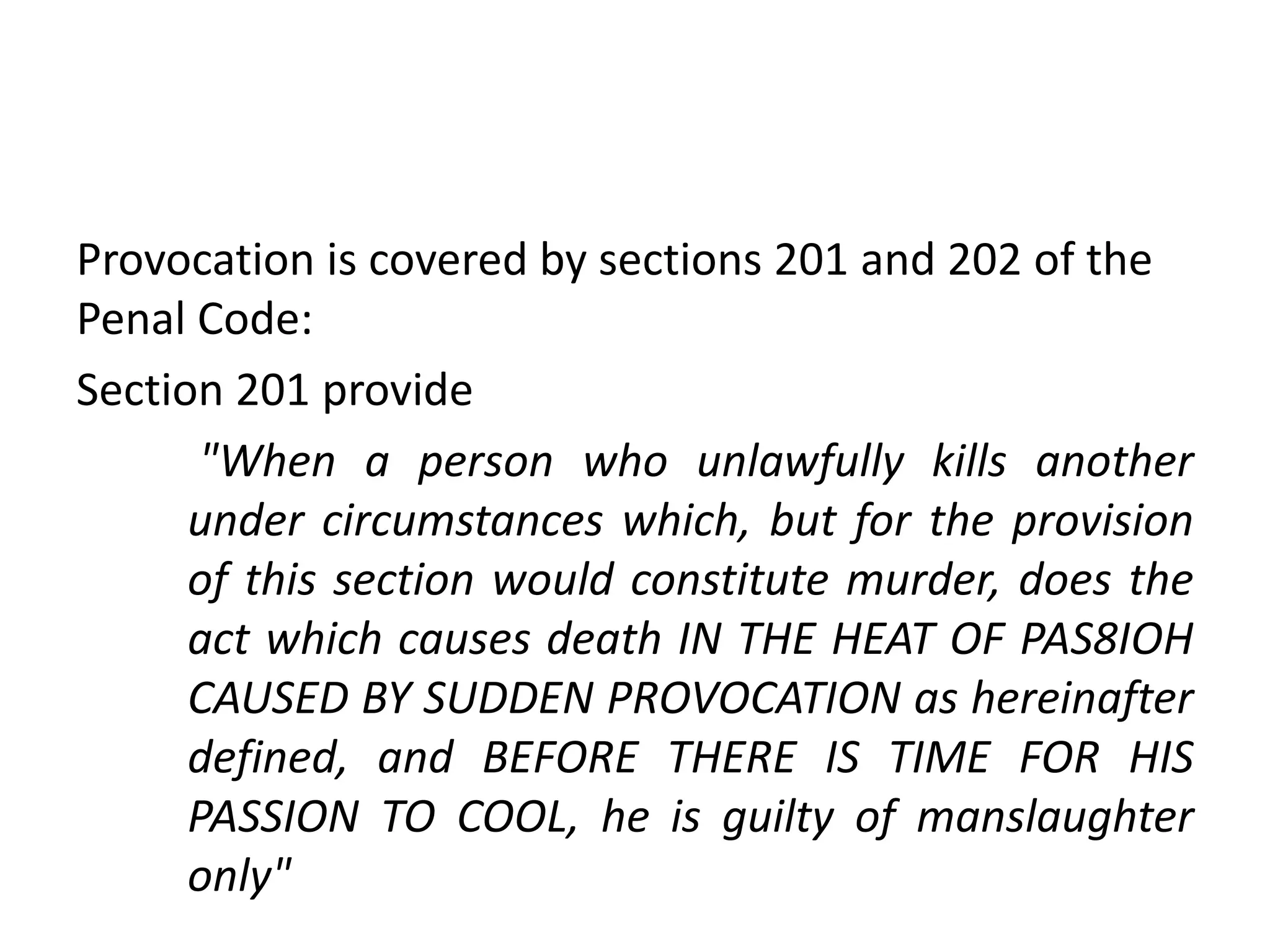
Provocation is covered by sections 201 and 202 of the
Penal Code:
Section 201 provide
"When a person who unlawfully kills another
under circumstances which, but for the provision
of this section would constitute murder, does the
act which causes death IN THE HEAT OF PAS8IOH
CAUSED BY SUDDEN PROVOCATION as hereinafter
defined, and BEFORE THERE IS TIME FOR HIS
PASSION TO COOL, he is guilty of manslaughter
only"
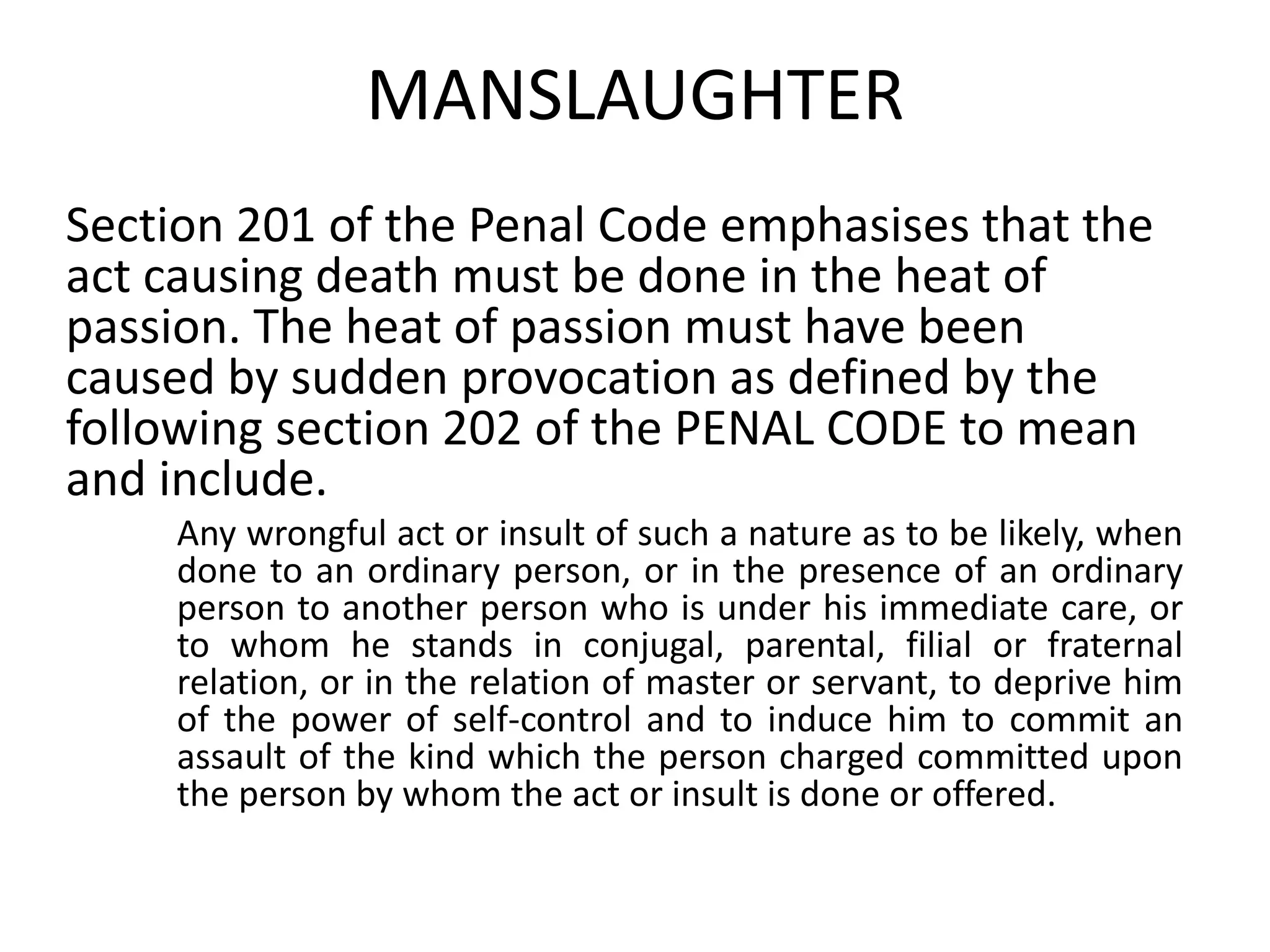
MANSLAUGHTER
Section 201 of the Penal Code emphasises that the
act causing death must be done in the heat of
passion. The heat of passion must have been
caused by sudden provocation as defined by the
following section 202 of the PENAL CODE to mean
and include.
Any wrongful act or insult of such a nature as to be likely, when
done to an ordinary person, or in the presence of an ordinary
person to another person who is under his immediate care, or
to whom he stands in conjugal, parental, filial or fraternal
relation, or in the relation of master or servant, to deprive him
of the power of self-control and to induce him to commit an
assault of the kind which the person charged committed upon
the person by whom the act or insult is done or offered.
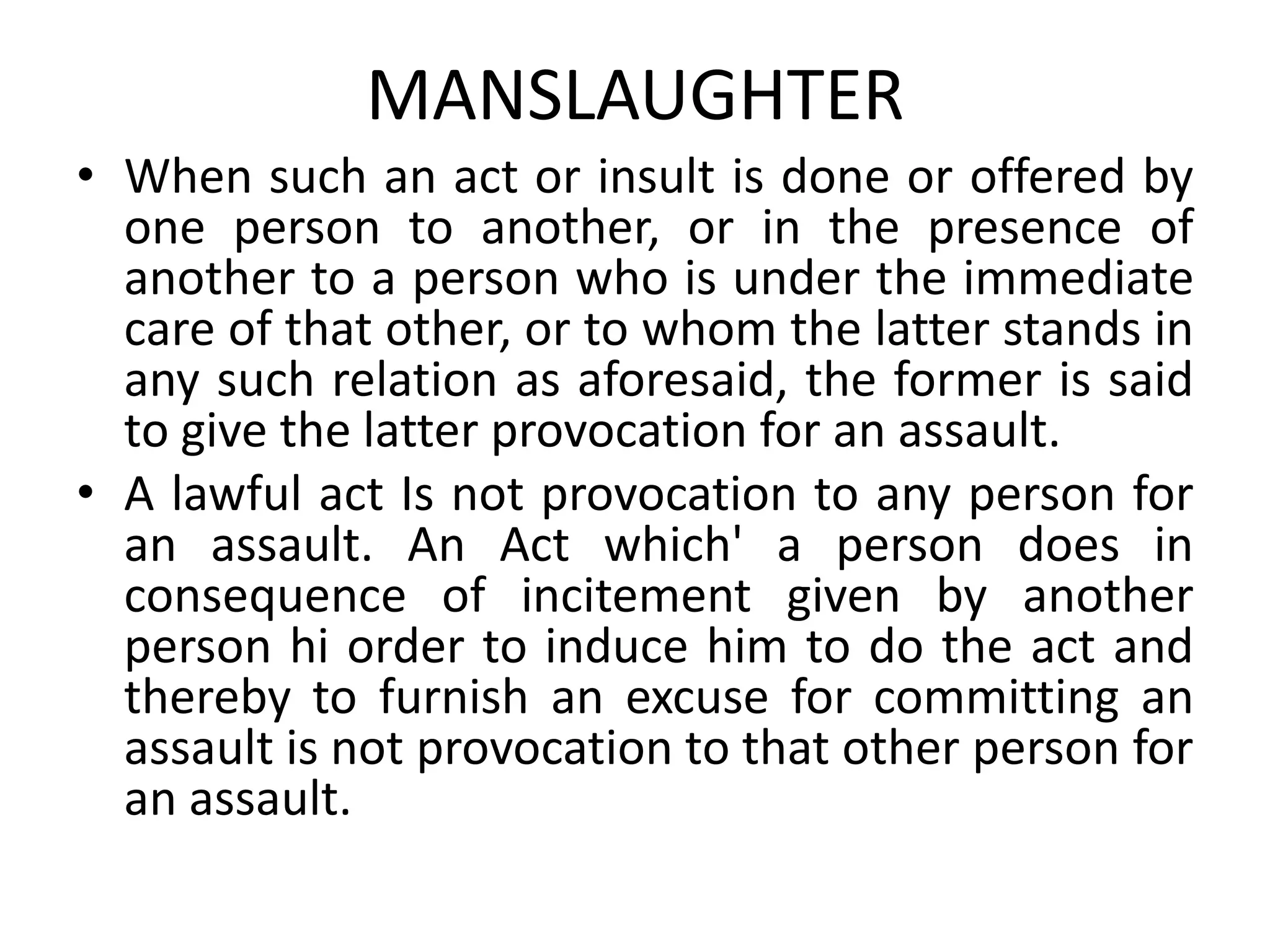
MANSLAUGHTER
• When such an act or insult is done or offered by
one person to another, or in the presence of
another to a person who is under the immediate
care of that other, or to whom the latter stands in
any such relation as aforesaid, the former is said
to give the latter provocation for an assault.
• A lawful act Is not provocation to any person for
an assault. An Act which' a person does in
consequence of incitement given by another
person hi order to induce him to do the act and
thereby to furnish an excuse for committing an
assault is not provocation to that other person for
an assault.
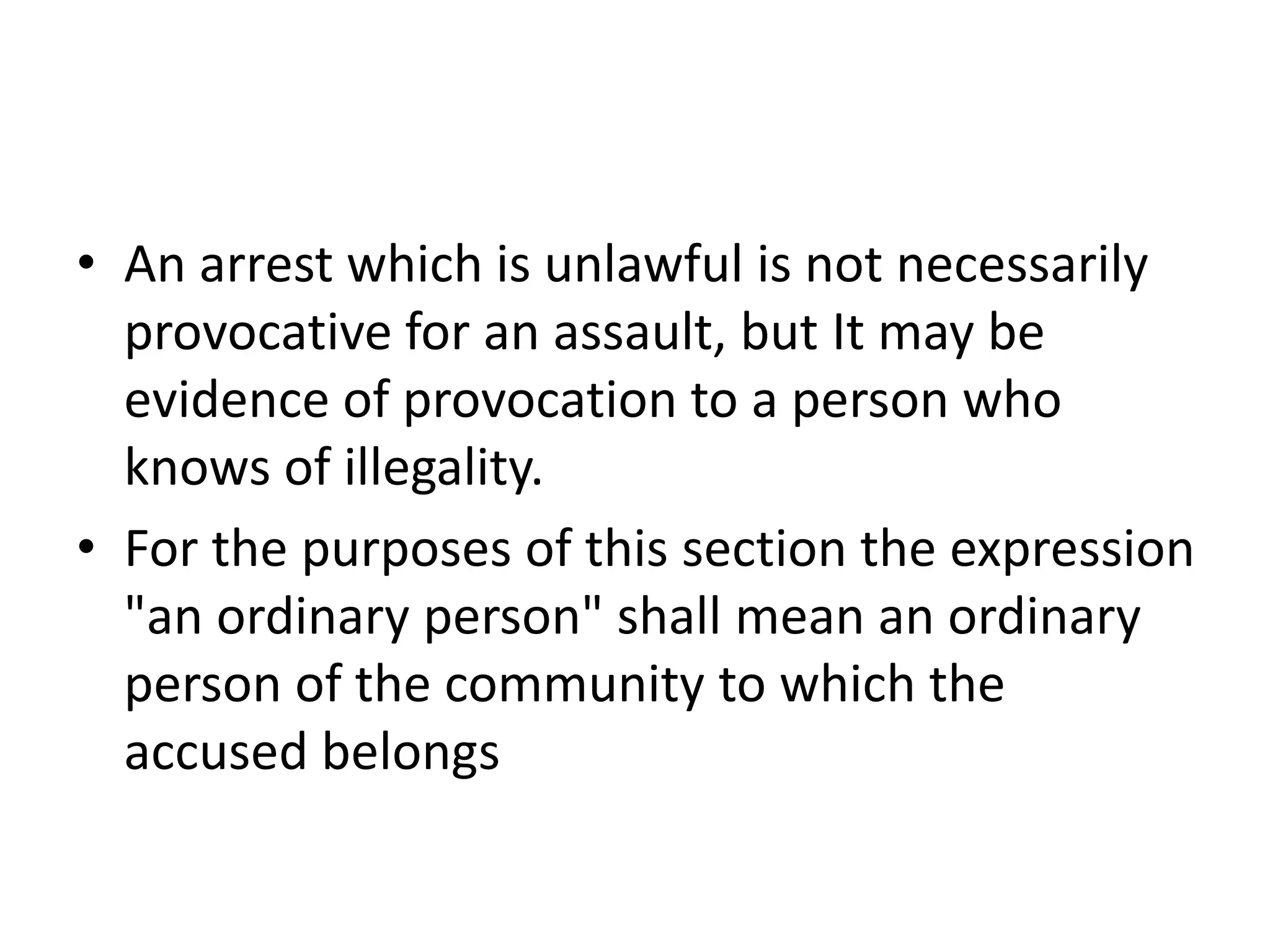
• An arrest which is unlawful is not necessarily
provocative for an assault, but It may be
evidence of provocation to a person who
knows of illegality.
• For the purposes of this section the expression
"an ordinary person" shall mean an ordinary
person of the community to which the
accused belongs
Section 201 of the PENAL CODE therefore
provides for circumstances in which provocation
may be a defence to a charge of murder,
reducing even an intentional killing to fee
manslaughters
Where the accused lost his power of self-control
in the heat of passion and there was no time for
passion to cool
Let us now see the practical application of the
defence of provocation. In the case of KAJUNA s/o
MBAKE, V. R. (1945} • MCA 104, the Eastern Africa
Court of Appeal had to decide whether belief in
witchcraft could be a possible element of
provocation:
JUDGMENT (delivered by SIR JOSEPH SHERIDAN, CJ.) The
accused was convicted of the murder of his father Mbake and
sentenced to death. He has-appealed to this Court. There is no
doubt whatever that he deliberately killed his .father, having set
out on a long journey for the purpose of doing so. The
conviction in our opinion was correct. In favour of the accused
the learned trial' Judge stated
Quotation:
In my opinion in this case the accused had an honest, though no doubt
mistaken, belief at the time he killed his father that he letter was at that
moment killing his child by supernatural means as surely as if he had seen
him in the act of using a lethal weapon. The East African Court of Appeal
has never, so far ads I know, decided this point, though it arises in one
form or another in many cases in this Territory, the inhabitants of which
over large areas are soaked in witchcraft and imbued with a firm belief in
evil spirits. No doubt if the point is put up on appeal it will be decided. It
would seem to turn on whether the accused's belief in his father's
malevolent invocation of evil spirits in order to injure the child was not
only honest but reasonable, taking into account the fact that he is
primitive African. That is a difficult question bordering on metaphysics,
which I do not propose to discuss here. I shall merely make a finding that
such a belief is not reasonable and leave it to the court of Appeal to upset
my decision if I am wrong. I would add on the general question of
provocation that, apart from any provocation which might be found to be
constitute by the father's course of conduct to which I have referred, the
accused received ne immediate provocation of any kind from his father
before he stabbed him to death on the night in question.
In the case of Rex Fablano and others, 8 E.A.C.A. 96, the
Question of belief in witchcraft as a defence was fully discussed.
At page 101 we expressed the following view: "We think that if
the facts proved establish that the victim was performing in the
actual presence of the accused some act which the accused did
genuinely believe, and which an ordinary person of the
community to which the accused belongs would genuinely
believe to be an act of witchcraft against him or another person
under his immediate care (which act would be a criminal offence
under the criminal Law (Witchcraft) Ordinance of Uganda and
similar legislation in the other East African territories) he might
be angered to such a extent as to be deprived of the power of
self-control and Induced to assault the person doing the act of
witchcraft And if this be the case a defence of grave and sudden
provocation Is open to him.
INFANTICIDE
The Offence of Infanticide is created by section 199
of the PENAL CODE. Section 199 provides that:
Where a women by any willful act or omission causes the death
of her child, being a child under the age of twelve month®, but
at the time of the act or omission the balance of her mind was
disturbed by reason of her not having fully recovered from the
effect of giving birth to the child or by reason of the effect of
lactation consequent upon the birth of the child, then,
notwithstanding that the circumstances were such that but for
this section the offence would have amounted to murder, she
shall be guilty of an offence known as infanticide."
INFANTICIDE
The woman in question will be punished as If she had been guilty of
the offence of manslaughter of the child.
Section 199 of the Penal Code Indicates that the killing' of a child by its
mother is murder but the offence is reduced to manslaughter If It is
established:
i. that the deceased child was under the age of twelve months:
ii. that the child death was due to an act or omission on the port of
Its mother; and
iii. that at the time of the fatal act or omission on the mother's part,
the mother was mentally disturbed due to the effect; (a) of her
having birth to the child: or
(b) Of lactation consequent upon the child of the child.
with section 204 of the Penal Code. Section 199
describes the killing of a child of under the age
of twelve months by its mother. Section 204
goes a step further and describes when a child
envisaged by Section 199 or any provision
becomes a person capable of being killed:
A child becomes a person capable of being killed
when it has completely proceeded in a living
state from the body of the mother.
• If a child is still-born and hence proceeds from its
mother's body whilst dead, that child will not be
regarded to be capable of being killed. Section
204 of the Penal Code provides that:
• "A child becomes capable of being killed when It
has completely proceeded in a living state from
the body of its mother, whether it has breathed
or not and whether it has an independent
circulation or not, and whether the navel-string is
severed or not."
In the case of R.V. ESTHER KUMBOKA [1967J HCD n 447,
the accused was charged with an offence of infanticide contrary to
section 199 of the Penal Code. The child's body had been burled for 10
days. Decomposition had begun when body was examined by a doctor. A
green cloth had been tightly bed about Us neck, and Its lungs were
expanded. It was not possible to establish whether the child was born
alive or dead. At the accused person's trial, she stated that she had at Brat
thought that the child was alive.
and that she had buried It only when she discovered it was dead. Chief
Justice Georges (as he then was) held that considering that she may well
have been in a general state of confusion, and in the absence of direct
medical evidence supporting either account, (i.e. whether the child, was
born alive or not} It was not safe to convict her Infanticide. Georges found
her guilty of Concealing the Birth of a Child (contravening Season 218 of
the Penal Code) and imposed on her suspended sentence of 12 months in
prison.
In R V. EVELYKE MATHIAS [1868] HCD n 446
The accused was charged with Infanticide c/s 199 of the Penal
Code In that allegedly she win-fully threw her new-born child
into the latrine of her father's house, while the balance of her
mind was disturbed. Apparently no one knew of the birth of the
child, who was only discovered in the latrine when <t was heard
crying. The accused's parents, with whom she lived, denied any
knowledge of her pregnancy or of any child-birth. Medical
evidence however showed that the accused, when examined
shortly after the discovery of the child, had recently delivered a
child and the placenta and membranes were still in her body
The court Held:
1. "Having in mind the views expressed In YOWANA NAMATAJA v. R (1953) 20 EACA
204 the prosecution had to prove that the accused had caused the child's death
by a willful act which, but for the balance of her mind being disturbed would
have been murder.“
2. "The prosecutors has to prove that the accused had not simply abandoned the
child but had Intended to cause Its death by throwing it into the latrine. An
investigation should have been mounted to discover where the child had been
born or at least to disprove that the birth had taken place involuntarily in the
latrine and the child had passed into the pit being mistakenly thought to be
faces. The father had destroyed the latrine and reliance could not be placed on
witnesses' recollection of the size of the hole or whether there was any blood
etc. in or within vicinity of latrine".
3. "Altogether the evidence for the prosecution rested upon evidence which did
not rule out certainly that the accused could not have been caught at the latrine
for the purpose of passing faces and involuntarily gave birth to her child. On this
point the medical evidence was strong in her favour that she could well have
thought it necessary to relieve herself in the ordinary way, being unaware that
her hour was nigh. It is said to be a common experience in
THEFT
This Offence Is provided for by sections 257-275
of the Penal Cade, The facts amounting to Theft
as outlined by the prosecuting side must
disclose all the ingredients of Theft. To establish
an Offence of Theft, the prosecution side is
required to ensure that ail statutory ingredients
making up the Offence of Theft are present.
These ingredients can be deduced from the
statutory definition of Theft.
THEFT
• Section 258(1) of the Penal Code defines the
Offence of Theft and in the process furnishes
all important ingredients of this Offence.
• Section 258(1) provides that:
"A person who fraudulently and without claim of right
takes anything capable of being stolen, or fraudulently
converts to the use of any person other than the general
or special owner thereof anything capable of being stolen,
is said to steal that thing.
THEFT
Section 258( 1) has two specific definitions of the
Offence Theft,
(a) The first definition could be deduced In this way:
(i) A person who fraudulently and
(ii) Without claim of right
(iii) takes
(iv) anything capable of being stolen
is said to steal the thing.
b) The second definition extracted from section
258(1) of the Penal Code provides that;
(i) A person who fraudulently and
(ii) Without claim of right
(iii) Convert to the use of any person other than
the general or Special Owner
Thereof
(iv) Anything capable of being stolen.
It is a fundamental rule c statute interpretation that
effect must be given every word used in a Statute.
Words used in Section 258(1) of the Penal Code
were not used in vain. Effect must be given each
and every word used in the section defining Theft.
You have noted that section 258(1) of the Penal
Code bas two types of definitions of the Offence
Theft.
The prosecution must always fit its facts or
allegations within either of the two definitions.
THEFT
Based on the definition section, we have simplified
the two definitions of Theft for you in this way:
Definition I:
1. A person who fraudulently
2. Without Claim-of Right
3. Takes
4. Anything Capable of being stolen
Is said to steal the thing
THEFT
Let us now look at each of these four ingredients
constituting the Offence of Theft.
Things capable of being stolen
This is one of the key elements which constitute the Offence
of Theft. The Item stolen must be one which Criminal Law
regards as being capable of being stolen. If It is an Item which
is not "capable of being stolen," then an offence of Theft
cannot be said to have been committed.
You must be asking yourself what are these things that are
regarded by Criminal Law to be capable of being stolen.
Section 257 of the Penal Code comes to your rescue. This
provision describes the "things capable of being stolen."
THEFT(DEFN)
Paragraph one to section 257 provides:
"Every inanimate thing whatever which is the property of
any person and which is movable, is capable of befog
stolen."
This paragraph reminds you that in order (o amount to
stealing, the thing taken must be capable of being stolen,
that is, It must have the qualities mentioned In Section
257:
THEFT(DEFN)
Paragraph one to section 257 provides:
"Every inanimate thing whatever which is the
property of any person and which is movable, is
capable of befog stolen."
This paragraph reminds you that in order (o
amount to stealing, the thing taken must be
capable of being stolen, that is, It must have the
qualities mentioned In Section 257:
THEFT(cont.…)
i. Must be inanimate thing - i.e. Note
alive, especially the way humans
and Animals are - e.g. a chair is an
inanimate object.
ii. Must be a property of somebody
iii. Must be movable:
THEFT
Ownership of the thing stolen is very important.
A thing which has no owner cannot: be stolen.
Thus, if you pick up a book which has been
discarded OR thrown away by a bookstore, it has
no owner and you will c.o." be regarded as
"taking something which is capable of being
stolen."
You must always remember that the subject
matter of Theft must be somebody else's
property. You will later learn that when framing a
charge for Theft, you will always include the
words "belonging to" to signifying the importance
of ownership
THEFT
The word "owner" must be appreciated with
caution. The word is not restricted to the real
(legal) owner only. You can steal your neighbour's
bicycle from his friend who did not own it but
only borrowed it. In this case you will be regarded
to have stolen from this friend of your neighbour.
The words "belonging to" therefore will imply
either "legal owner" or "special owner." Legal
owner implying real owner and Special owner
implying interim owner or possessor. It is quite
possible for a legal owner to steal from a special
owner
Theft(cont..)
E.g. Juma lends his bicycle to John. John parks this bicycle near
a shop. Juma comes quietly and takes the bicycle and hides it.
Juma later asks John to pay him for the lost bicycle
-In the foregoing example, Juma as a legal owner
will be charged with an offence of Theft. The
principle that a legal owner can steal also from a
special owner was discussed in an English case of
ROSE v. MATT (1951J1 E.B 810 where It was held
that owner of goods who entrusts them to another
person in such. Circumstances that the latter has a
special property in them, is guilty of larceny (theft]
if he fraudulently takes them away again.
Movability of Things Capable of being stolen
A thing to be stolen must be movable. You will
note that the general rule drawn from, definition
of theft is to the effect that immovable things like
land, water and houses cannot be stolen. There
are exceptions to this general rule that
immovable things; like land aid houses cannot be
stolen.
The second paragraph to Section 257 of the Penal
Code envisage the exceptions to the foregoing
general rule in a situation where fixtures Of an
item which otherwise cannot be moved, are
made movable for purpose, of stealing
CAPABLE OF BEING STOLEN(Cont..)
The paragraph reads
"Every Inanimate thing Which is
the property of any person and
This is capable of being made
movable is being capable of being
stolen as soon as it becomes
movable Although it is made
movable in order to steal it”.
THINGS CAPABLE OF BEING
STOLEN(cont…)
The main components of above second paragraph
to Section 257 of the Penal Code are;
i. Every inanimate things (like water, land, House,
which strictly speaking Cannot be moved.
ii. Which is the property of any person[emphasizes
ownership)
iii. And which is capable of being made movable
(Inanimate things, are Somehow made to move)
iv. Becomes capable of being stolen as soon as it
becomes movable
THINGS CAPABLE OF BEING
STOLEN(cont…)
 This paragraph would, cover situations like when a person
removes s door or window or roofs from a house in order to
steal it. A door, window or roof is otherwise immovable
because it is fixed to the house. But a thief makes them
movable for the sole purpose of stealing it, for instance by
physically removing a door and carrying It away for the
purposes of stealing it.
 It is instructive to note that the Second Paragraph to Section
257 of the Penal Code also covers situations where other
intangible things like water, air and electricity are made
movable for the purposes of stealing. The general rule is that
intangible things are not capable of being stolen. This general
rule has exceptions as provided for in the second paragraph to
Section 257. It is possible to make water (intangible thing)
movable for the purpose of stealing,!!. This was illustrated in
one important case of R. vs. KDESARIO [1969] E.A 267:
THINGS CAPABLE OF BEING
STOLEN(cont…)
...where the accused person (Ndesario)
was charged with theft contrary to Section
265 of the Penal Code and Malicious
Damage to Property contrary' to Section
362 (!) of the Penal Code. Ndesario was
alleged to have stolen [water) from a
furrow on the first count, and to have
willfully damaged the furrow on the
second count.
THINGS CAPABLE OF BEING
STOLEN(cont…)
Material facts of this case was to the effect that the
accused person (Ndesario) had an agreement with the
complainant thereunder he (the accused person) was
allowed, to draw water from a furrow which crossed the
complainant's land. According to this agreement the
accused person was only allowed to extract water
between hours 6 am and 9 am. The accused was
arraigned of having stolen water and breaking the furrow
at night. Justice Piatt, as he then was. Held that so long as
a fluid such as water could be sufficiently appropriated to
the user, it could be stolen and the accused had no right
to extract water at any other than stipulated time. Justice
Piatt held that the accused person was therefore taking a
movable object not belonging to him.
THINGS CAPABLE OF BEING STOLEN
Like water, electricity is also intangible. Like water,
electricity can also be stolen. In the case of
electricity, the same principle of appropriation
applies. Electricity is not a tangible thing for the
purposes of stealing. But the Penal Cade clearly
provides for a possibility of stealing electricity in
section 283 of the Penal Code which provides:
Any person who fraudulently abstracts or diverts to his own
use or to tries use of any other person any mechanical,
illuminating or electrical power derived from any machine,
apparatus or substance, the property of another person, is
guilty of an. offence....”
THEFT
Section 283 of the Penal Code envisages a
possibility of someone a person:
I. Fraudulently
II. Abstracting or diverting, to his own use or to
the use of another Person
III. Any mechanical, illuminating or electrical power
derived from any machine, apparatus or
substance
IV. the said, machine, apparatus or substance being
the property of another person.
THEFT
Examples fitting Into Section 283 of the Penal Code
include:
a) Juma secretly and fraudulently diverts to his family's
use electric power derived from TANESCO's substation
at Manzese; or where
b) Juma secretly and fraudulently connects to his house
electric power generated from his nighbour's
generator: or where
c) Juma has had his electricity disconnected by TANESCO
for non-payment of bills. Juma reconnect the power
secretly at night arid disconnects during the day
THEFT
Read all the paragraphs making up Section 257 of
the Penal! Code, You will note that the Third,
Fourth, Fifth, and sixth paragraphs- to- Section 257
envisage situations where domesticated animals-
like cattle, sheep, goats, dogs and tamed wild
animals [like lions to cages} being moved away for
the purposes of stealing. Third paragraph to Section
257 for example provides that:
Every tame animal, whether teme by nature or wild by
nature and tamed, which is the property of any person
is capable of being stolen.
 The seventh paragraph to Section 257 emphasizes the fact
that wild animals born and living free of captivity in
their natural environment are not capable of being
stolen. But their carcasses (dead bodies} are capable
of being stolen. The paragraph reads;
"Wild animals In the enjoyment of their natural
liberty arc not capable of being stolen, but their
dead bodies are capable of being stolen
The last paragraph to Section 257 is a general
provision, it emphasizes that everything produced by or
forming part of the body of an animal capable of being
stolen is else capable of feeing stolen. The items
envisaged by this paragraph are many and may include
bides and skins, manure and milk, of a cow which are
capable of being' stolen
Must the thing stolen have arty value?
In our every day understanding of Theft, we always
assume that thieves steal valuable things. Others also
assume that if the object stolen was valueless, then
an Offence of Theft: is not committed
You will note that there is no direct provision in the
Penal Code to answer the question whether the
thing stolen must have any value. Fraudulent taking
is the key word. One may confidently state that the
taking of the thing which the taker thought was
valueless was motivated by fraudulence, the taker of
the valueless thing, will still be liable for Theft.
Several decided cases have discussed the question of
the value of the Thing taken.
One such case is a Ugandan case of KYEWAWULA VS. UGANDA (1974)
E.A. 293.
in this case the accused person (Kyewawula} was employed by the
Uganda Currency Board and her work schedule entailed counting of
old currency notes which were to be destroyed later. She was
convicted of stealing some of the old notes which were described in
the charge sheet as "cash," Kyewawula appealed to the High Court of
Uganda. Justice Nyamuchoncho-, as he then was, held that the old
notes were no longer money and could not be stolen. Justice
Nyamuchoncho was quoted to have said this in his judgment:
The evidence adduced to prow that the stolen bank notes had some
value did not prove any value of any single note at all. It did not relate
to those stolen bank notes whose value had already been redeemed.
To form a subject of Larceny the things stolen must; have some value.
Only economic value is taken into account” [emphasis is mine]
Fraudulent Taking / Conversion of the Thing
Section 208(1} of the Penal Code emphasizes that the
taking or conversion -"something capable of being
stolen must be done fraudulently
Fraudulent Taking / Conversion of the
Thing
Section 2 58(2) of the Penal Code identifies various types of takings or
conversions which if proved, will be deemed to be done fraudulently.
Fraudulence is regarded to be present "if he or she takes or converts
with any of the following intents:
a) An intent permanently to deprive the general or special owner of
the thing of it
b) An intent to use the thing re a pledge or security;
c) An intent to part with it on. m condition as to its return which, the
parson taking or converting it may be unable to perform;
d) An Intent to deal with it in such manner that it cannot be returned
in the condition in which it was at the time of the taking or
conversion:
e) in the case of money, an Intent to use it at the will of the person
who takes or convert it. Although he may Intend afterwards to
repay the amount to owner
THANK YOU

CRIMINAL-PROCEDURE- AND- LEGAL -LAW-SLIDEs

  • 1.
    MWENGE CATHOLIC UNIVERSITY CRIMINALLAW LWB-I @NTAMTI CHARLES LL.B,LLM-ICJ& HR, MED-ODL, B.A-ECONOMICS, MSC ECONOMICS, adv. Diploma in accountancy
  • 2.
    Definition of law Law is a body of rules made by the state or upper class so as to regulate social behaviors of the inferior class and imposing punishments incase of any disobedience. a) every law is made by the state article 4 of the constitution it provides that the laws are normally made by the parliament meaning the legislature b) Law is a binding instrument, I means that laws are bounded to the inferior class it means that once the law has been made everybody is bound to obey law usually takes a form of a command c) Law imposes sanctions meaning punishment whenever it is disobeyed
  • 3.
    Introduction(cont..) Law contains prescriptionsand directions for purposes of maintaining a particular order in a particular community. The study of law is the study of sociology, of economics, study of history in other words law transcends and cuts across different discipline meaning that la is the way of life which also means that Law is life itself because it gives directions on how to live in different ways, example not to steal or kill. Law is there to maintain peace and tranquility, harmony and provide a minimum standard of behavior as opposed to anarchy. Examples directions in roads such as road signs and other road rules
  • 4.
    Types of Laws Thisdepends on the capacity; every law has two capacities Private Laws Public Laws
  • 5.
    Definition(cont..) PRIVATE CAPACITY ORINDIVIDUAL  There are relations between individual in their private capacity. Example there is a man called husband and a woman who is called a wife. Those laws are called civil laws are laws that regulate relationships between individuals in the community in their private capacity. They may be called civil laws or private laws
  • 6.
    Introduction(…)  PUBLIC LAWS: onthe other hand an individual has a public character he is a member of a community and this big community in the policy of law is the state, and the state exists to moderate relationships between individuals in their public capacity it is their to maintain a minimum level of behavior , it is there to ensure that there is no anarchy in the community. The public character of an individual is reflected with his relationship with the state.
  • 7.
    Public Laws  Alllaws are made by the state, these public laws are mainly prescriptive and contains prohibitions or directions and relates to commissions and omissions, it relates to the does and to the don’ts. This means that a state will require a particular behavior form this individual. The basic law in this category is the constitution, it is the law which contains the social contract between the state and the individuals.
  • 8.
    Meaning of CriminalLaw  Criminal law or the law of crimes is the law which enacts prohibitions on certain conduct by an individual or which demands from an individual a particular conduct at the threat of punishment, it is not moral doesn’t contain morality. Therefore, we can say criminal law is the punitive branch of the law it is a law which is intended to maintain a particular level of conduct between members of a community at the threat of punishment. The first penal code as we know it today was the code of The Hammurabi’s code (KING OF BABILON) it relayed more on morality then on. Penal code is the secular code of punishment. There is moral codes and secular codes.
  • 9.
    Types of CriminalLaw  There are two types of criminal law, the major type of criminal law is the penal code, it is the basic law of crime, the penal code of tz cap 16 was established on the 28th of September 1945 our legal system came in to be on the 22nd of July 1920, it established the high court
  • 10.
    Types of criminallaws  But because the magistrate council had the power to magistrate law several penal codes were enacted on 1945. The law of Tanzania was declared it was what we called codification, this means is the creature of the industrial revolution. There is one English philosopher who was known as Jeremy Bentham he advocated that law has to apply to everybody in the community and it had to be certain so to be certain it also had to be written, that was the beginning of the concept of written law. The title to the penal code says that the penal code was an act to establish the code of criminal law in Tanganyika.
  • 11.
    Categories of Laws Publiclaw: These re laws that normally regulate the relationship between the citizens and the state , in public law the citizens are required to obey the demands of the state a good example of public law is the constitution, also the penal code chap.16 Civil laws: are laws regulating the relationship among the members of the society it imposes obligations between the citizens in the society example we have the law of contract Act,
  • 12.
    Meaning of criminallaw..  It falls under the category of public law it can simply be defined as the law of crime and punishment, meaning that it is the law which declares crimes and prescribes punishment for each of them, it tells you what is a crime and it also tells you the punishment of the crime.
  • 13.
    Meaning of acrime..  A crime: means doing something which has been prohibited by the law, it also means not doing what is required by the law we can therefore define criminal law as the law which contains prohibitions and obligations which if not complied with will result to the punishment of an individual example killing, stealing, robbery , sexual intercourse with a lady without her consent .
  • 14.
    Dimension of criminallaw  There are 2 dimensions of criminal law which are obligation and prohibition meaning the “DO” and the DO NOT”. Once you do something that is prohibited you do a commission on the other hand if you do not do what you are required to do in terms of obligations it requires to an omission
  • 15.
    Purpose of criminallaw..  Criminal law is actually intended to regulate the behavior of all members of the society by imposing a minimum standard of behavior there is a minimum standard of behavior which everybody must aby and therefore although a human being is a moral free agent he is bound to live within the limit that has been established by the law that means you are a free agent you can do what ever you want to do but there are limitations and restrictions which are imposed by the laws it is important to avoid “chaos”.
  • 16.
    Purpose of criminallaw 2. Retribution (Just punishment) 3.Deterrence 4.Incapacitation (Protection of the community) 5.Rehabilitation 6.Restoration
  • 17.
    Source of criminallaw 1. The constitution: The constitution of the united republic of Tanzania of 1977 as amended several times, this is the mother law of the land or basic, all laws must obtain their validity from the constitution and any law which does not involve the constitution shall be declared to the null and hold this is provided under article 64(5) it says that every law must confirm with the constitution, This means that such law shall not be valid because it is contradicting the constitution. This includes criminal law all our criminal laws are supposed to obtain their validity from the constitution,
  • 18.
    Two school ofthought..  there are people who say that the constitution is not a source of criminal law and the reason is that the constitution does not create any offence you do not found a single offence which has been declared by the constitution it means that within the constitutions there is no offence which has been declared, the constitution does not impose any punishment
  • 19.
    Two school ofthought(cont..) There are people who say that you will find no crime or punishment in the constitution it remains to be a source of criminal law because within the constitution there are fundamental principals that are intended to regulate the administration of criminal justice it means that in the course of administering criminal justice we must be careful to apply the principals which have been stated under the constitution, this means that the administration with criminal justice goes hand in hand . principals provided by the constitution for regulating the administration of criminal justice; under article 13(6) paragraph b
  • 20.
    How criminal lawsgo together with the constitution..  presumption of innocence: this states that everybody is innocent until proven guilty, this means that there should never be a criminal law which will treat a person as guilty while his No law, No crime Article 13(6) paragraph c, According to this a person should not be punished for a nonexistent offence meaning that in order for you to punish somebody, the offence should first of all be existing in the law.  where the law does not provide for an offence nobody has the right to be punished, therefore every offence must be provided or created by the law. Adultery is not declared to be a crime under the law but a sin against law
  • 21.
    Sources(cont..) 2. Precedent orcase law or judge made laws : These are principals that have been made by the judges of the high court and justices of appeal and they are normally binding an applicable to subordinate courts when they are treating a case of similar instant and the same circumstance, this means that the principals created by the high court and court of appeal are normally binding to all the subordinate courts, when a subordinate court is handling a case which has similar material facts to a case which was handled by the high court the subordinate court is supposed to adopt the decision made by the high court and apply it in its own cases. Example the decisions of the court pf appeal are binding the high court and all other lower courts.
  • 22.
    Sources(cont..) 3. Statutes Penal Code;cap 16. this is the major source of the criminal law in other words it is the main criminal law and actually through out this course we shall be dealing with the penal code because it is the statues of general application meaning that it is applicable in the whole Tanzania main land, all our criminal laws have been enacted in the penal code, it provides for crimes and it also provides for punishment for those crimes. • Why do we call it a code, this is because it assembles a number of principals or laws in a single instrument codification means putting down law in to writing this is a terminology which was created in the 19th century by a philosopher known Jeremy Benthom, codification is very important because of the following?
  • 23.
    SOURCE OF CRIMINALLAW IN TANZANIA 4. Common law includes principals and rues that have originated from England and which were imported in Tanzania through the reception date of 22nd July 1920 which allowed the application of laws, principals and case laws that were enforced in England up to or before but not later then 22ND July,1920. In article 17 sub(2) known as reception laws
  • 24.
    SOURCES OF LAWIN TANZANIA 5. Doctrine of Equity In here they found out that common law was rigid and they could not get justice in the common law courts by applying the common law principals so they decided to approach the king for remedy because the king was considered to be the fountain of justice, the king would solve those cases not by using common law but by using principals of fairness. As more and more people approached the king, the King was overburdened by the disputes and decided to establish a court under him known as a Chance court which was supervised by the chancellor. The court so established was also using principals of fairness, which were later on consolidated and formed a body of law known as doctrine of equity, some of which were , no right without remedy, no one should benefit from his own wrongs, he who comes to equity must come with clean hands.
  • 25.
    SOURCES OF CRIMINALLAW IN TANZANIA 6. Statutes of General Application These are statutes that were enforced in England up to the reception date which were imported in to Tanganyika and into other colonies that were under Britain. These laws were applied in the situations where there were no local law example, the marine insurance Act of 1905, the Uganda law of contracts of 1865 etc
  • 26.
    7. Pre-existing laws inarticle 24 of the Tanganyika order in council 1924, Islamic law and customary laws were allowed to apply in Tanganyika however for them to be enforceable they were supposed not to be repugnant to justice. these laws were only applicable to personal matters or issues like marriages, divorces, subsection or inheritances etc. they are not applicable in criminal case or in constitutional cases. Those roles are found in the form of statutes or in government notices example The Islamic restatement Act etc.
  • 27.
    RULE AGAINST DOUBLEJEOPARDY These rules have been provided under the interpretation of laws Act 1 page 70 and 71,according to this rule a person is not supposed to be punished twice for a single act. Do not subject somebody into a double punishment for a single act. This is when a person has committed a single action but that action amounts to two different crimes under two different laws. you should punish him under one 1 law but not 2. Also been provided in section 3(2) of the penal code if you do that you will violating article 13(6) paragraph (d)
  • 28.
    APPLICABILITY OF THEPENAL CODE Section 6 provides categorical answers under this section of the penal code we are looking at the application of the penal code in 3 different dimensions. The penal code is only applicable in Tanzania main land, meaning that you can not apply the penal code in Zanzibar, it is applicable only in Tanzania main land, the application of the penal code has been legally restricted only to Tanzania main land, in Zanzibar they have their own Penal Decree that is cap.5 in the laws of Zanzibar, therefore it is very restricted to all who are under the soil to Tanzania main land whether you are a citizen or a non citizen if you are in Tanzania the penal code will be applicable to you.
  • 29.
    APPLICABILITY OF THEPENAL CODE The penal code shall be applicable against any person who commits a crime in an ocean moving vessel or an air craft which has been registered under Tanzania, if there is any aircraft registered in `Tanzania it is committed that it is a part of our territory so the penal code will punish you. It shall also be applicable against all Tanzanians citizens who breach our penal code abroad, people who commit crimes abroad you will be punished under the Tanzanian courts.
  • 30.
    CHAPTER 2 RULES OFDEFENCE IN CRIMINAL LIABILITY IN TANZANIA
  • 31.
    RULES(Cont..) Generally, everyone mustbe responsible for his actions meaning that when you commit a crime you must be punished for the crime that you have committed, everyone must take responsibility for his actions, however there are certain situations where a person may not be punished for a wrongful act, this is where the person has a defense in criminal law therefore we have defenses which can exonerate the person out of liability.  There is a general rule under section 8 of the penal code it states that ignorance of the law is not a defense
  • 32.
    DEFENCES FOR CRIMINALLIABILITY 1. IGNORANCE OF A LAW IS NOT A DEFENCE this is a general rule on criminal liability, it is actually the foundation f criminal justice that a person is not allowed to plead ignorance of the law so as to escape punishment. You cant say that you did not know the law and therefore you should not be punished for your actions, lack of knowledge of the law is not an excuse therefore section 8 of the penal code prevents a person from escaping liability by simply saying that he did not know the law, this is what we call the presumption of knowledge that everybody is assumed to be aware of the law the principal I that whenever the law has been published everybody is assumed to be aware of it although the reality is not true many people don’t know
  • 33.
    DEFENCE(Cont..) The purpose ofthis principal is to avoid dishonesty in the administration of criminal justice because even if somebody new the law he will never accept that he knew it every accused person will tell us that he did not know the law and if we accept such excuse we shall never convict somebody for a crime and therefore this is necessary to act as a positive elimination of a defense because without that principal the administration of criminal justice will be difficult this was discussed in the case of BILBIE V. LUMLEY case of 1802 this case is the foundation of the rule that ignorance of the law is not a defense it was decided by Lord Ellen Borough. In this case Lord Ellen Borough said “every man must be taken to be cognizant of the law” otherwise there is no knowing the extent to which the excuse of ignorance might be carried it will be argued in almost every case.
  • 34.
    IGNORANCE OF LAW(Cont..) Thereforehe said that we should apply a general assumption that everybody knows the law because if we don’t do that everyone will say that they don’t know the law, therefore this principal is the foundation of criminal justice that everybody knows the law, it was also discussed in the case of Maulid V. Republic1970 HCD 346, where apart from the founding that the appellant did not know the law, I am inclined to view that these offenses are absolute and no mensrea is required even so, there is no such a presumption that every body is presumed to know the law. In fact, I very much doubt if such a presumption would hold good or even those who administer the law.
  • 35.
    IGNORANCE OF LAW(Cont..) The principal is that ignorance of the law is not an excuse of which a magistrate will appreciate. If you read section 8 carefully you will discover that there is a slight exception that “unless knowledge of the law by the offender is expressly declared to be an element of the offense” ignorance of the law can be a defense only where knowledge of the law is declared to be an element of a particular offense court held as follows
  • 36.
    IGNORANCE OF LAW(Cont…) It means that if there is an offense which requires you to have knowledge of it before being liable ignorance of that law can be a defense meaning ignorance of the law can be a defense only where knowledge of the law is an ingredient of the offense meaning that you shall not be punished of that offense unless it is proved that you knew about it. In Tanzania we don not have any offense under the penal code which requires knowledge as an ingredient, therefore these provision under section 8 provides possibility of having a defense of ignorance of law in the future but today there is no such offence
  • 37.
    PARTIES TO CRIME Acrime may be committed by one or more persons. When two or more persons have engaged in a crime there arises a question as to how much should each one be liable for the particular crime. This would require to investigate the extent of participation in the particular crime where an offence is committed by more than one offender or where several offenders perform different roles in the execution of a common deed. The position in England is different from that in Tanzania. For the purpose of clarity the laws of the two countries will be discussed, albeit briefly, separately.
  • 38.
    PARTIES TO CRIME (a)Parties to crime in Britain Common law classifies parties to crime in four groups; (i) Principal in the first degree. (ii) Principal in the second degree (often called an "aider' and abetor'). (Iii) An accessory before the fact and (iv) An accessory after the fact.
  • 39.
    PARTIES TO CRIME(Cont..) A principal in the first degree is the actual offender i.e. the man in whose guilty mind lay the latest blamable cause of the criminal act. Sometimes he may be the person by whom this act itself was done but at other times the crime may have been committed by the hand of an unsuspecting agent. For example A tells B, a child under 8 years, to bring him money belonging to C. B does so
  • 40.
     A isa principal in the first degree. There may of course, be more than one principal in the first degree. You have to note that whoever actually commits or takes part in the actual commission of a crime, is a principal in the first degree, whether he is on the spot when the crime is committed or not; and if a crime is committed partly in one place and partly in the other, every one who commits any part of it at any place is a principal in the first degree
  • 41.
    ACCESSORY BEFORE THEFACT  Another party to a crime is an accessory before the fact. -is a person who directly or indirectly counsels, procures or commands any person to commit any crime which is committed in consequence of such counselling, procuring or commandment. There are few major elements to make a person an accessory before the fact
  • 42.
    ACCESSORY BEFORE THEFACTS a) that he must have known the particular deed contemplated b) that he approved of it.. c) that his approval was expressed in some form which operated to encourage the principal to perform the deed and d) that those first three elements came into existence before the time when the offence was being committed. However, the fact that, crime has been committed in a manner different from the mode which the accessory had advised will not excuse him from liability for it. For example if A hires B to poison C, but B instead kills C by shooting him, A is nonetheless liable as accessory before the fact to Cs murder. However, when a totally different crime is committed then he is not liable.
  • 43.
    ACCESSORY BEFORE THEFACTS Yet where the principal in the first degree, who has been instigated, makes some mistakes in performance of then-common aim, this mistake will not excuse the accessory before the fact unless it will also excuse the principal e.g. in the example above B mistakenly, kill's Cs brother instead of C. In this case A is liable
  • 44.
    PARITES TO CRIMEIN COMMON LAW  Another party to crime in common law is .an accessory after the fact. This is a person who, knowing that a crime has been committed, subsequently shelters or assists the culprit in order to enable him to elude justice. The offence cover also parties who rescue a person from being arrested, persons who, having culprits in custody for committing crimes, intentionally and voluntarily suffers him to escape or opposes his apprehension. Active assistance to the criminal is therefore necessary. There is one exception to this rule i.e. where a married woman receives comforts or relieves her husband knowing him to have committed a felony.
  • 45.
    PARTIES TO CRIMEIN TANZANIA  Principal offenders; The law in Tanzania (EA) is not the same as that in England. The penal code of Tanzania does not adopt the classification made in English law. The Tanzania Penal Code recognizes only two main parties to the offence i.e. the principal offenders (under section 22 of the code) and accessories after the fact (under section 287 of the same code). The definition of principal offenders is found in section 22 of the Penal Code and includes
  • 46.
    PARTIES TO CRIMEIN TANZANIA a) every person who actually does the act or makes the omission which constitutes the offence b) every person who does or omits to do any act for the purpose of enabling or aiding another persons to commit the offence. c) every person who aids or abets another person in committing the offence. d) any person who counsels or procures any other person to commit the offence
  • 47.
    PARTIES TO CRIMEIN TANZANIA Therefore those categories in English law, of accessory before the fact and persons committing, procuring, aiding or abetting in offences are principal offenders under the Penal Code. The same position is true in Kenya In the Kenyan case of Kamau v/R (1965) EA 501, 504 (CA) it was said:- The law of Kenya, like that of Tanganyika (citing Sits v. R (1957) EA 308 (CA) does not use the expression accessory before the fact but by section 20 of the Penal Code section 22 of Tanganyika Penal Code makes every person who councels or procures or aids or abets the commission of the offence a principal offender"
  • 48.
    PARTIES TO CRIMEIN TANZANIA Section 24 of the Pens! Code clarifies further the circumstances under which counselling is punishable. The said section provide:- When a person counsels another to commit an offence and the offence- is actually committed after such counselling by the person to whom it is given, it is immaterial whether the offence actually committed is the same as the counselled or a different one, or whether the offence is committed in the way counselled or in different way, provided in either case that the facts constituting the offence actually committed were a probable consequence of carrying out the counselling. In either case did the person who gave the counselling is deemed to have counselled the other person to commit the offence actually cornmitted by him."
  • 49.
  • 50.
    HOMICIDE Homicide simply meansthe killing of any human being by another human being. The term includes both lawful killings and unlawful killings. Unlawful Homicide covers: a) intentional killing - (Murder); b) Unlawful killing (not intentional). (Infanticide, manslaughter); c) Reckless driving resulting in death
  • 51.
    HOMICIDES There are numerousexamples of lawful killings (Homicides). Lawful Homicide would include the following examples: 1. An Executioner lawfully executing a death sentence passed by a competent court; 2. Where a Police Officer employs a reasonable force which results in death while effecting an arrest; and 3. Where a person is accidentally killed, for example where soccer player is accidentally killed by a stray ball during a football match. Let us now discuss some of the Offences regarded to be Offences Against the Person. We will first discuss Homicidal Offences:
  • 52.
    MURDER Classical definition ofthe offence "murder" is provided for by-section 196 of the Penal Code. This section provides that, “Any person who of malice aforethought causes the death of another person by an unlawful act or omission is guilty of murder
  • 53.
    MURDER(cont..) Definition of Murderhas the following key ingredients which you must always be borne In mind: a) Of malice aforethought b) Causation of death c) By an unlawful act or by an unlawful omission.
  • 54.
    DEFN. OF MURDER(cont..) Thepresence of these ingredients is essential to establish the offence of murder. When faced with a question whether any death is murder or not murder you must always show that the three ingredients shown above are present. Let us look more closely at each of the three Ingredients (a) (b) and (c).
  • 55.
    MALICE AFORETHOUGHT.. The phraseof malice aforethought' in section 196 of the Penal Code emphasizes the fact that the crime of murder is established if the prosecution shows that act of Killing was accompanied with mental element of intention technically known as "malice aforethought.  In Criminal Law, Intention simply means the purpose or design of doing an act forbidden by the law. It Is one of the basic principles of Criminal Law that a crime is not committed if the mind of the person doing the act in question is innocent (unless of course a provision is framed In such a way as to dispense away with this "intent" requirement). For the Crime of Murder, this guilty mind ("mens rea") is known as "malice
  • 56.
    MALICE AFORE-THOUGHT The requisiteguilty mind (i.e.. "mens rea" or "malice aforethought) of murder is regarded to have existed for the purposes of the Offence of Murder if conditions provided for by section 200 of the Penal Code are satisfied. Section 200 of the Penal Code provides: Malice aforethought shall be deemed to be established by evidence proving any one or more of the following circumstances: a) An Intention to cause the death of. or to do grievous harm to any person, whether such person Is the person actually killed or not; b) Knowledge that the act or omission causing death will probably cause the death of or grievous harm to some person, whether such person is the person actually killed or not. although such knowledge is accompanied by indifference whether death or grievous bodily harm is caused or not, or by a wish that it may not be caused. c) an intent to commit an offence d) an intention by the act or omission to facilitate the flight or escape from custody of any person who has committed or attempted to commit an offence.
  • 57.
    MALICE AFORETHOUGHT.. Malice aforethoughtshall be deemed to be established by evidence proving any of the elements mentioned to section 200 of the PENAL CODE; a) "that the accused person, when doing an act complained of had either the Intention to cause death or had the Intention to do grievous harm to any person. It does not matter that the intention was not directed to the person who was actually killed" (section 200(a) of Tanzania penal code, R.E 2022 The last sentence In section 200 (a) providing :It does matter that the intention was not directed to the person who was actually killed.
  • 58.
    MALICE(Cont..) For example; Juma hasformed an intention to kill or cause grievous harm to John. Juma carries out his intention. All dies instead. Here the intent against John is transferred to All and the accused person Juma will be held liable. Read the case of Rex V. CHIKOKONYA [1938] 3.R. 122 illustrates further the application of transferred intent: In this case the accused person went to in-laws with the intention of killing his wife by poisoning, drinking, water In a pot. He wanted to kill his wife because she would no longer allow him to have sexual intercourse with her. Unfortunately another visitor, one Makachi died after drinking the water which had been poisoned and having also had some meat which had been cooked with poisoned water. Accused was found guilty of murder despite the fact that he did not intend to kill the deceased but his wife.
  • 59.
    MALICE(cont..) In the caseof (1) TOMASI ENYAJU S/o Eguruto, (2) Elasu s/o EJURU VS. R.. VOL. 12 EJLCA 42,  An Intention to kill or cause grievous harm (I.e. 'malice aforethought') was inferred from the Infliction of a fatal injury by the accused persons. In this case, during a tribal dance the first accused gave the deceased a violent poke on the head with the sharper end of his heavy dancing stick. This pierced the skull and caused the brain of the deceased to protrude. Almost immediately, while the deceased was on the ground but still alive, the second accused beat the deceased violently on the other side of the head fracturing the skull. Each injury was sufficient to cause death.
  • 60.
    – The accusedpersons were both convicted of murder. They appealed. The Court of appeal of Eastern Africa had to decide whether there was "malice aforethought" (i.e. intention to kill or cause grievous harm). The Court of Appeal dismissed the appeal saying, every person who "inflicts on a living person an inevitably fatal injury with the intention to kill or to cause grievous harm is guilty of murder."
  • 61.
    MALICE AFORETHOUGHT(cont..) Malice aforethoughtis rarely proved by direct evidence. It can be inferred from the circumstances viewed as a whole. The nature of the weapon used and the manner in which the blow is inflicted are factors to be considered when seeking to establish Malice aforethought. By using a lethal weapon the accused may be presumed to have formed either an intention to Mil or cause grievous ham, This was authoritatively stated by Justice Mnzavas, as he then was in the case of Republic ¥. Mohamed Mite I1974J.LRT n 36:'
  • 62.
    • m thisparticular case, of course, there was no threat of death, as we see the case, and if, as the result of the accused's assault on this deceased woman she had deliberately jumped down a steep precipice, we would not necessarily have held him responsible for that act. But unlawfully assaulted as she was, she was entitled to run away In order to escape. If a person Is running away under an apprehension of violence It Is not an Unreasonable consequence that person might fall down and If, In the course of failing down, that person becomes injured, that is the guilty act of the person who caused her to run away. • That is the manner in which as I see It, he law must be applied. If this woman had fallen down and become Injured men the accused then the accused would have been guilty of an assault, even if the accused had not directly touched her body. It follows that if she died as a result of that fall the somewhat unlikely consequence of her running away and falling. But the law is clear, that if a person assaults another unlawfully and death results from the assault, then the person who commits the assault is guilty of homicide. The result Is that we find the accused guilty of culpable homicide
  • 63.
    In the ordinaryway if a deceased person met his death in this manner we would consider it almost technical offence and the punishment would be very light, but every case has to be considered on the circumstances of" that particular case. And in this case we have fovnd. as a fact, that the accused after the woman was lying on the ground dance i on her body, and there Is no question that he Intended to do her grievous bodily harm and he intended that harm, as I previous pointed out without any legal justification. This is not, therefore, a case which we can regard as merely a technical assault and the accused must be comparatively severely punished. He will be Imprisoned with hard labour for two years."
  • 64.
    • So ifX threatens Y with a gun, Y runs and as a result knocked down by a speeding car, X will be regarded to have caused the death within section 203(c) of the Penal Code. • “Section 203(d), if by any act or omission he hastens the death of a person suffering under any diseases or injury which apart from such act or omission would have caused death”. • This paragraph(d) of section 203 envisages a situation where a person hastens the death of an already injured person or one who is already dying of any disease or injury
  • 65.
    For example; X KnocksY on the head draining Y‟s brain through the wound Inflicted. It is the fact that X will die shortly. But if Z comes and knocks Y again on the head, fracturing the already fragile skull and Y dies, Z will be deemed to have caused the death of Y even though his act is not the safe cause of Y‟s death. Read the case of R.V. EGURUTO ft EJURU 12 EACA 42.]
  • 66.
    S.203(e)-If his actor omission would not have caused death unless, it had been accompanied by an act or omission of the person killed or of other person" Section 203(e) of the Penal Code can be applied where for example X sets fire to a hut with the intention of causing either death or grievous harm to its occupants one of the occupants returns into the burning hut and is overwhelmed by fire:
  • 67.
    Time of death; Alliedto the question of the person who caused the death is equally an Important question of the time connecting the unlawful act or omission and death. The law in Tanzania as provided for by section 205 of the PENAL CODE is that no one can be held liable for death of another if that death occurs after one year and a day following the act or omission of the accused person.
  • 68.
    A person thereforeis not deemed to have killed another if the death of that person does not take place within a year and a day of the cause of death. In computing a year and a day for the purposes of this provision, the day on which the last unlawful act contributing to the cause of death was done is included. When the cause of death is an omission to perform a duty, the day omission began is Included in computing the one year and a day.
  • 69.
    BY UNLAWFUL ACT Theword "by an unlawful act" is deliberately used in section 196 of the Penal Code to underscore unlawfulness as an important element of the Crime of Murder. By an unlawful act'' is "actus reus" of the Offence of Murder* The phrase "By an Unlawful Act' means that a person may have the required "means rea" for either murder or manslaughter, but escapes liability for murder or manslaughter, if the killing was lawful (for .example where an executioner executes a death sentence).  The act causing death must be unlawful act of the accused. The acts causing death here may include the act of shooting to kill, poisoning, beating etc.
  • 70.
    1. where thelawful sentence of a competent court Is being executed in a lawful manner by a person whose duty It is to carry out the sentence: 2. where an officer of justice is forcibly resisted in the lawful execution of a duty to arrest, detain, seize property or make a search as part of criminal or civil process, provided that he uses no more force than is reasonably necessary to protect himself and execute his duty: 3. where a person is preventing the commission of a crime provided that he uses no more force than is reasonably necessary;
  • 71.
    4. where aperson accidentally kills another In circumstances where some harm Is foreseen, for example the harm Is not unlawful because the a) victim was being operated on lawfully; Or b) the harm was Inflicted during the course of argument by voluntarily laying the game the victim consented to, and by law was able to consent to, the infliction of that kind of harm.
  • 72.
    • It isessential to show that an accused person killed or took part in the killing of the deceased and, that the accused person had no lawful reason to kill. Lawful killings are all those killings • that are justified by the law. An obvious example is where an executioner executes a person sentenced to death by a competent court.
  • 73.
    PREY UNLAWFUL OMISSION" •Causing death by an unlawful omission is, yet another example of 'actus reus' of Crime® of Murder and manslaughter. There are some instances where the law confers duties on certain person© for the purposes of preservation of life and health of other human being Sections 206 to 210 of the Penal Code provides the instances of the Penal Code imposing on certain persons active duty to act In order to preserve life and health of others. Where an accused person is obliged by any of the sections 206-210 of the Penal Code to perform some active duty and he or she intentionally omits to perform such legal duty with intent to kill then he is guilty of murder. This is causing of death by an UNLAWFUL
  • 74.
    OMISSION envisaged bysection 196 of the Penal Code. Unlawful omissions causing injury to life or health include: a) neglect to supply the necessaries of lite to persons under one's charge who, because pf old age or infancy, unsoundness of mind, detention etc., are unable to provide for themselves thereby creating duty situation, (section 206 of the PENAL CODE) A person in charge of an infant, for example, is under a legal obligation to provide the necessaries of life to the infant. A person detaining another person, is also obliged to provide the person under his detention the necessaries of life (read also sections 207, 208, of the PENAL CODE)
  • 75.
    We have beendiscussing the ingredients which add up to constitute an offence of Murder. These ingredients must be understood both in their respective scopes and their respective practical application. • You must always remember to establish all the necessary ingredients constituting the Offence of Murder. These are: i. Casing death of malice aforethought ii. by an unlawful act or by unlawful omission iii. death taking place within one year and a day of the commission or omission.
  • 78.
    MANSLAUGHTER Manslaughter is yetanother Homicidal Offence created by the Penal Code. Lord Justice Widgery in R.V. LIPMAN [1970] 1 152 at p. 159 has correctly stated that: “Manslaughter remains a most difficult offence to define because It arises in so many different ways and, as the mental element (if any required to establish it varies so widely, any general reference to MEANS REA is apt to mislead”
  • 79.
    MANSLAUGHTER You must alwaysbear Lord Justice Widgery's statement in mind wherever you discuss the offence of Manslaughter. It Is a very difficult offence to define. Mental elements required to establish Manslaughter varies very widely. Penal Code provides for manslaughter in Section 195:
  • 80.
    "S. 195. Anyperson who by an unlawful act or omission causes the death of another person is guilty of an offence termed "manslaughter*. An unlawful omission is an omission amounting to culpable negligence to discharge a duty tending to the preservation of life or health, whether such omission is or is not accompanied by an intention to cause death or bodily harm".
  • 81.
    MANSLAUGHTER(cont..) Section 198 ofthe Penal Code provides for punishment for manslaughter section. 198. Any person who committed the offence of manslaughter is liable to imprisonment for life".
  • 82.
    MANSLAUGHTER • A section195 and 198 of the PENAL summarizes the offence of Manslaughter to be: i. an unlawful act or omission causing the death of another person, ii. unlawful omission being an omission amounting to culpable negligence to discharge a duty tending to the preservation of life or health; [refer to these duties in Chapter XX of the Penal Code.
  • 83.
    MANSLAUGHTER iii. It doesnot matter whether the mentioned omission lacks the intention to cause death, i.e. it does not matter that the mother . iv. who denied an infant the necessaries of life did not Intend to cause the death of the infant. For example the mother could have been just negligent enough to forget her infant.
  • 84.
    It is importantto emphasize that a successful defence of provocation can reduce the offence of Murder to Manslaughter where the accused person does the act which causes death in the heat of passion caused by sudden provocation and before there is time for his passion to cool
  • 85.
    Provocation is coveredby sections 201 and 202 of the Penal Code: Section 201 provide "When a person who unlawfully kills another under circumstances which, but for the provision of this section would constitute murder, does the act which causes death IN THE HEAT OF PAS8IOH CAUSED BY SUDDEN PROVOCATION as hereinafter defined, and BEFORE THERE IS TIME FOR HIS PASSION TO COOL, he is guilty of manslaughter only"
  • 86.
    MANSLAUGHTER Section 201 ofthe Penal Code emphasises that the act causing death must be done in the heat of passion. The heat of passion must have been caused by sudden provocation as defined by the following section 202 of the PENAL CODE to mean and include. Any wrongful act or insult of such a nature as to be likely, when done to an ordinary person, or in the presence of an ordinary person to another person who is under his immediate care, or to whom he stands in conjugal, parental, filial or fraternal relation, or in the relation of master or servant, to deprive him of the power of self-control and to induce him to commit an assault of the kind which the person charged committed upon the person by whom the act or insult is done or offered.
  • 87.
    MANSLAUGHTER • When suchan act or insult is done or offered by one person to another, or in the presence of another to a person who is under the immediate care of that other, or to whom the latter stands in any such relation as aforesaid, the former is said to give the latter provocation for an assault. • A lawful act Is not provocation to any person for an assault. An Act which' a person does in consequence of incitement given by another person hi order to induce him to do the act and thereby to furnish an excuse for committing an assault is not provocation to that other person for an assault.
  • 88.
    • An arrestwhich is unlawful is not necessarily provocative for an assault, but It may be evidence of provocation to a person who knows of illegality. • For the purposes of this section the expression "an ordinary person" shall mean an ordinary person of the community to which the accused belongs
  • 89.
    Section 201 ofthe PENAL CODE therefore provides for circumstances in which provocation may be a defence to a charge of murder, reducing even an intentional killing to fee manslaughters Where the accused lost his power of self-control in the heat of passion and there was no time for passion to cool
  • 90.
    Let us nowsee the practical application of the defence of provocation. In the case of KAJUNA s/o MBAKE, V. R. (1945} • MCA 104, the Eastern Africa Court of Appeal had to decide whether belief in witchcraft could be a possible element of provocation: JUDGMENT (delivered by SIR JOSEPH SHERIDAN, CJ.) The accused was convicted of the murder of his father Mbake and sentenced to death. He has-appealed to this Court. There is no doubt whatever that he deliberately killed his .father, having set out on a long journey for the purpose of doing so. The conviction in our opinion was correct. In favour of the accused the learned trial' Judge stated
  • 91.
    Quotation: In my opinionin this case the accused had an honest, though no doubt mistaken, belief at the time he killed his father that he letter was at that moment killing his child by supernatural means as surely as if he had seen him in the act of using a lethal weapon. The East African Court of Appeal has never, so far ads I know, decided this point, though it arises in one form or another in many cases in this Territory, the inhabitants of which over large areas are soaked in witchcraft and imbued with a firm belief in evil spirits. No doubt if the point is put up on appeal it will be decided. It would seem to turn on whether the accused's belief in his father's malevolent invocation of evil spirits in order to injure the child was not only honest but reasonable, taking into account the fact that he is primitive African. That is a difficult question bordering on metaphysics, which I do not propose to discuss here. I shall merely make a finding that such a belief is not reasonable and leave it to the court of Appeal to upset my decision if I am wrong. I would add on the general question of provocation that, apart from any provocation which might be found to be constitute by the father's course of conduct to which I have referred, the accused received ne immediate provocation of any kind from his father before he stabbed him to death on the night in question.
  • 92.
    In the caseof Rex Fablano and others, 8 E.A.C.A. 96, the Question of belief in witchcraft as a defence was fully discussed. At page 101 we expressed the following view: "We think that if the facts proved establish that the victim was performing in the actual presence of the accused some act which the accused did genuinely believe, and which an ordinary person of the community to which the accused belongs would genuinely believe to be an act of witchcraft against him or another person under his immediate care (which act would be a criminal offence under the criminal Law (Witchcraft) Ordinance of Uganda and similar legislation in the other East African territories) he might be angered to such a extent as to be deprived of the power of self-control and Induced to assault the person doing the act of witchcraft And if this be the case a defence of grave and sudden provocation Is open to him.
  • 93.
    INFANTICIDE The Offence ofInfanticide is created by section 199 of the PENAL CODE. Section 199 provides that: Where a women by any willful act or omission causes the death of her child, being a child under the age of twelve month®, but at the time of the act or omission the balance of her mind was disturbed by reason of her not having fully recovered from the effect of giving birth to the child or by reason of the effect of lactation consequent upon the birth of the child, then, notwithstanding that the circumstances were such that but for this section the offence would have amounted to murder, she shall be guilty of an offence known as infanticide."
  • 94.
    INFANTICIDE The woman inquestion will be punished as If she had been guilty of the offence of manslaughter of the child. Section 199 of the Penal Code Indicates that the killing' of a child by its mother is murder but the offence is reduced to manslaughter If It is established: i. that the deceased child was under the age of twelve months: ii. that the child death was due to an act or omission on the port of Its mother; and iii. that at the time of the fatal act or omission on the mother's part, the mother was mentally disturbed due to the effect; (a) of her having birth to the child: or (b) Of lactation consequent upon the child of the child.
  • 95.
    with section 204of the Penal Code. Section 199 describes the killing of a child of under the age of twelve months by its mother. Section 204 goes a step further and describes when a child envisaged by Section 199 or any provision becomes a person capable of being killed: A child becomes a person capable of being killed when it has completely proceeded in a living state from the body of the mother.
  • 96.
    • If achild is still-born and hence proceeds from its mother's body whilst dead, that child will not be regarded to be capable of being killed. Section 204 of the Penal Code provides that: • "A child becomes capable of being killed when It has completely proceeded in a living state from the body of its mother, whether it has breathed or not and whether it has an independent circulation or not, and whether the navel-string is severed or not."
  • 97.
    In the caseof R.V. ESTHER KUMBOKA [1967J HCD n 447, the accused was charged with an offence of infanticide contrary to section 199 of the Penal Code. The child's body had been burled for 10 days. Decomposition had begun when body was examined by a doctor. A green cloth had been tightly bed about Us neck, and Its lungs were expanded. It was not possible to establish whether the child was born alive or dead. At the accused person's trial, she stated that she had at Brat thought that the child was alive. and that she had buried It only when she discovered it was dead. Chief Justice Georges (as he then was) held that considering that she may well have been in a general state of confusion, and in the absence of direct medical evidence supporting either account, (i.e. whether the child, was born alive or not} It was not safe to convict her Infanticide. Georges found her guilty of Concealing the Birth of a Child (contravening Season 218 of the Penal Code) and imposed on her suspended sentence of 12 months in prison.
  • 98.
    In R V.EVELYKE MATHIAS [1868] HCD n 446 The accused was charged with Infanticide c/s 199 of the Penal Code In that allegedly she win-fully threw her new-born child into the latrine of her father's house, while the balance of her mind was disturbed. Apparently no one knew of the birth of the child, who was only discovered in the latrine when <t was heard crying. The accused's parents, with whom she lived, denied any knowledge of her pregnancy or of any child-birth. Medical evidence however showed that the accused, when examined shortly after the discovery of the child, had recently delivered a child and the placenta and membranes were still in her body
  • 99.
    The court Held: 1."Having in mind the views expressed In YOWANA NAMATAJA v. R (1953) 20 EACA 204 the prosecution had to prove that the accused had caused the child's death by a willful act which, but for the balance of her mind being disturbed would have been murder.“ 2. "The prosecutors has to prove that the accused had not simply abandoned the child but had Intended to cause Its death by throwing it into the latrine. An investigation should have been mounted to discover where the child had been born or at least to disprove that the birth had taken place involuntarily in the latrine and the child had passed into the pit being mistakenly thought to be faces. The father had destroyed the latrine and reliance could not be placed on witnesses' recollection of the size of the hole or whether there was any blood etc. in or within vicinity of latrine". 3. "Altogether the evidence for the prosecution rested upon evidence which did not rule out certainly that the accused could not have been caught at the latrine for the purpose of passing faces and involuntarily gave birth to her child. On this point the medical evidence was strong in her favour that she could well have thought it necessary to relieve herself in the ordinary way, being unaware that her hour was nigh. It is said to be a common experience in
  • 100.
    THEFT This Offence Isprovided for by sections 257-275 of the Penal Cade, The facts amounting to Theft as outlined by the prosecuting side must disclose all the ingredients of Theft. To establish an Offence of Theft, the prosecution side is required to ensure that ail statutory ingredients making up the Offence of Theft are present. These ingredients can be deduced from the statutory definition of Theft.
  • 101.
    THEFT • Section 258(1)of the Penal Code defines the Offence of Theft and in the process furnishes all important ingredients of this Offence. • Section 258(1) provides that: "A person who fraudulently and without claim of right takes anything capable of being stolen, or fraudulently converts to the use of any person other than the general or special owner thereof anything capable of being stolen, is said to steal that thing.
  • 102.
    THEFT Section 258( 1)has two specific definitions of the Offence Theft, (a) The first definition could be deduced In this way: (i) A person who fraudulently and (ii) Without claim of right (iii) takes (iv) anything capable of being stolen is said to steal the thing.
  • 103.
    b) The seconddefinition extracted from section 258(1) of the Penal Code provides that; (i) A person who fraudulently and (ii) Without claim of right (iii) Convert to the use of any person other than the general or Special Owner Thereof (iv) Anything capable of being stolen.
  • 104.
    It is afundamental rule c statute interpretation that effect must be given every word used in a Statute. Words used in Section 258(1) of the Penal Code were not used in vain. Effect must be given each and every word used in the section defining Theft. You have noted that section 258(1) of the Penal Code bas two types of definitions of the Offence Theft. The prosecution must always fit its facts or allegations within either of the two definitions.
  • 105.
    THEFT Based on thedefinition section, we have simplified the two definitions of Theft for you in this way: Definition I: 1. A person who fraudulently 2. Without Claim-of Right 3. Takes 4. Anything Capable of being stolen Is said to steal the thing
  • 106.
    THEFT Let us nowlook at each of these four ingredients constituting the Offence of Theft. Things capable of being stolen This is one of the key elements which constitute the Offence of Theft. The Item stolen must be one which Criminal Law regards as being capable of being stolen. If It is an Item which is not "capable of being stolen," then an offence of Theft cannot be said to have been committed. You must be asking yourself what are these things that are regarded by Criminal Law to be capable of being stolen. Section 257 of the Penal Code comes to your rescue. This provision describes the "things capable of being stolen."
  • 107.
    THEFT(DEFN) Paragraph one tosection 257 provides: "Every inanimate thing whatever which is the property of any person and which is movable, is capable of befog stolen." This paragraph reminds you that in order (o amount to stealing, the thing taken must be capable of being stolen, that is, It must have the qualities mentioned In Section 257:
  • 108.
    THEFT(DEFN) Paragraph one tosection 257 provides: "Every inanimate thing whatever which is the property of any person and which is movable, is capable of befog stolen." This paragraph reminds you that in order (o amount to stealing, the thing taken must be capable of being stolen, that is, It must have the qualities mentioned In Section 257:
  • 109.
    THEFT(cont.…) i. Must beinanimate thing - i.e. Note alive, especially the way humans and Animals are - e.g. a chair is an inanimate object. ii. Must be a property of somebody iii. Must be movable:
  • 110.
    THEFT Ownership of thething stolen is very important. A thing which has no owner cannot: be stolen. Thus, if you pick up a book which has been discarded OR thrown away by a bookstore, it has no owner and you will c.o." be regarded as "taking something which is capable of being stolen." You must always remember that the subject matter of Theft must be somebody else's property. You will later learn that when framing a charge for Theft, you will always include the words "belonging to" to signifying the importance of ownership
  • 111.
    THEFT The word "owner"must be appreciated with caution. The word is not restricted to the real (legal) owner only. You can steal your neighbour's bicycle from his friend who did not own it but only borrowed it. In this case you will be regarded to have stolen from this friend of your neighbour. The words "belonging to" therefore will imply either "legal owner" or "special owner." Legal owner implying real owner and Special owner implying interim owner or possessor. It is quite possible for a legal owner to steal from a special owner
  • 112.
    Theft(cont..) E.g. Juma lendshis bicycle to John. John parks this bicycle near a shop. Juma comes quietly and takes the bicycle and hides it. Juma later asks John to pay him for the lost bicycle -In the foregoing example, Juma as a legal owner will be charged with an offence of Theft. The principle that a legal owner can steal also from a special owner was discussed in an English case of ROSE v. MATT (1951J1 E.B 810 where It was held that owner of goods who entrusts them to another person in such. Circumstances that the latter has a special property in them, is guilty of larceny (theft] if he fraudulently takes them away again.
  • 113.
    Movability of ThingsCapable of being stolen A thing to be stolen must be movable. You will note that the general rule drawn from, definition of theft is to the effect that immovable things like land, water and houses cannot be stolen. There are exceptions to this general rule that immovable things; like land aid houses cannot be stolen. The second paragraph to Section 257 of the Penal Code envisage the exceptions to the foregoing general rule in a situation where fixtures Of an item which otherwise cannot be moved, are made movable for purpose, of stealing
  • 114.
    CAPABLE OF BEINGSTOLEN(Cont..) The paragraph reads "Every Inanimate thing Which is the property of any person and This is capable of being made movable is being capable of being stolen as soon as it becomes movable Although it is made movable in order to steal it”.
  • 115.
    THINGS CAPABLE OFBEING STOLEN(cont…) The main components of above second paragraph to Section 257 of the Penal Code are; i. Every inanimate things (like water, land, House, which strictly speaking Cannot be moved. ii. Which is the property of any person[emphasizes ownership) iii. And which is capable of being made movable (Inanimate things, are Somehow made to move) iv. Becomes capable of being stolen as soon as it becomes movable
  • 116.
    THINGS CAPABLE OFBEING STOLEN(cont…)  This paragraph would, cover situations like when a person removes s door or window or roofs from a house in order to steal it. A door, window or roof is otherwise immovable because it is fixed to the house. But a thief makes them movable for the sole purpose of stealing it, for instance by physically removing a door and carrying It away for the purposes of stealing it.  It is instructive to note that the Second Paragraph to Section 257 of the Penal Code also covers situations where other intangible things like water, air and electricity are made movable for the purposes of stealing. The general rule is that intangible things are not capable of being stolen. This general rule has exceptions as provided for in the second paragraph to Section 257. It is possible to make water (intangible thing) movable for the purpose of stealing,!!. This was illustrated in one important case of R. vs. KDESARIO [1969] E.A 267:
  • 117.
    THINGS CAPABLE OFBEING STOLEN(cont…) ...where the accused person (Ndesario) was charged with theft contrary to Section 265 of the Penal Code and Malicious Damage to Property contrary' to Section 362 (!) of the Penal Code. Ndesario was alleged to have stolen [water) from a furrow on the first count, and to have willfully damaged the furrow on the second count.
  • 118.
    THINGS CAPABLE OFBEING STOLEN(cont…) Material facts of this case was to the effect that the accused person (Ndesario) had an agreement with the complainant thereunder he (the accused person) was allowed, to draw water from a furrow which crossed the complainant's land. According to this agreement the accused person was only allowed to extract water between hours 6 am and 9 am. The accused was arraigned of having stolen water and breaking the furrow at night. Justice Piatt, as he then was. Held that so long as a fluid such as water could be sufficiently appropriated to the user, it could be stolen and the accused had no right to extract water at any other than stipulated time. Justice Piatt held that the accused person was therefore taking a movable object not belonging to him.
  • 119.
    THINGS CAPABLE OFBEING STOLEN Like water, electricity is also intangible. Like water, electricity can also be stolen. In the case of electricity, the same principle of appropriation applies. Electricity is not a tangible thing for the purposes of stealing. But the Penal Cade clearly provides for a possibility of stealing electricity in section 283 of the Penal Code which provides: Any person who fraudulently abstracts or diverts to his own use or to tries use of any other person any mechanical, illuminating or electrical power derived from any machine, apparatus or substance, the property of another person, is guilty of an. offence....”
  • 120.
    THEFT Section 283 ofthe Penal Code envisages a possibility of someone a person: I. Fraudulently II. Abstracting or diverting, to his own use or to the use of another Person III. Any mechanical, illuminating or electrical power derived from any machine, apparatus or substance IV. the said, machine, apparatus or substance being the property of another person.
  • 121.
    THEFT Examples fitting IntoSection 283 of the Penal Code include: a) Juma secretly and fraudulently diverts to his family's use electric power derived from TANESCO's substation at Manzese; or where b) Juma secretly and fraudulently connects to his house electric power generated from his nighbour's generator: or where c) Juma has had his electricity disconnected by TANESCO for non-payment of bills. Juma reconnect the power secretly at night arid disconnects during the day
  • 122.
    THEFT Read all theparagraphs making up Section 257 of the Penal! Code, You will note that the Third, Fourth, Fifth, and sixth paragraphs- to- Section 257 envisage situations where domesticated animals- like cattle, sheep, goats, dogs and tamed wild animals [like lions to cages} being moved away for the purposes of stealing. Third paragraph to Section 257 for example provides that: Every tame animal, whether teme by nature or wild by nature and tamed, which is the property of any person is capable of being stolen.
  • 123.
     The seventhparagraph to Section 257 emphasizes the fact that wild animals born and living free of captivity in their natural environment are not capable of being stolen. But their carcasses (dead bodies} are capable of being stolen. The paragraph reads; "Wild animals In the enjoyment of their natural liberty arc not capable of being stolen, but their dead bodies are capable of being stolen The last paragraph to Section 257 is a general provision, it emphasizes that everything produced by or forming part of the body of an animal capable of being stolen is else capable of feeing stolen. The items envisaged by this paragraph are many and may include bides and skins, manure and milk, of a cow which are capable of being' stolen
  • 124.
    Must the thingstolen have arty value? In our every day understanding of Theft, we always assume that thieves steal valuable things. Others also assume that if the object stolen was valueless, then an Offence of Theft: is not committed You will note that there is no direct provision in the Penal Code to answer the question whether the thing stolen must have any value. Fraudulent taking is the key word. One may confidently state that the taking of the thing which the taker thought was valueless was motivated by fraudulence, the taker of the valueless thing, will still be liable for Theft. Several decided cases have discussed the question of the value of the Thing taken.
  • 125.
    One such caseis a Ugandan case of KYEWAWULA VS. UGANDA (1974) E.A. 293. in this case the accused person (Kyewawula} was employed by the Uganda Currency Board and her work schedule entailed counting of old currency notes which were to be destroyed later. She was convicted of stealing some of the old notes which were described in the charge sheet as "cash," Kyewawula appealed to the High Court of Uganda. Justice Nyamuchoncho-, as he then was, held that the old notes were no longer money and could not be stolen. Justice Nyamuchoncho was quoted to have said this in his judgment: The evidence adduced to prow that the stolen bank notes had some value did not prove any value of any single note at all. It did not relate to those stolen bank notes whose value had already been redeemed. To form a subject of Larceny the things stolen must; have some value. Only economic value is taken into account” [emphasis is mine]
  • 126.
    Fraudulent Taking /Conversion of the Thing Section 208(1} of the Penal Code emphasizes that the taking or conversion -"something capable of being stolen must be done fraudulently
  • 127.
    Fraudulent Taking /Conversion of the Thing Section 2 58(2) of the Penal Code identifies various types of takings or conversions which if proved, will be deemed to be done fraudulently. Fraudulence is regarded to be present "if he or she takes or converts with any of the following intents: a) An intent permanently to deprive the general or special owner of the thing of it b) An intent to use the thing re a pledge or security; c) An intent to part with it on. m condition as to its return which, the parson taking or converting it may be unable to perform; d) An Intent to deal with it in such manner that it cannot be returned in the condition in which it was at the time of the taking or conversion: e) in the case of money, an Intent to use it at the will of the person who takes or convert it. Although he may Intend afterwards to repay the amount to owner
  • 128.