CCCRRRIIIMMMIIINNNAAALLL
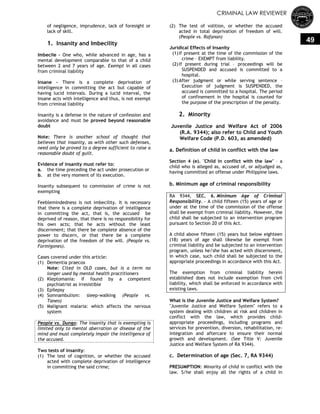
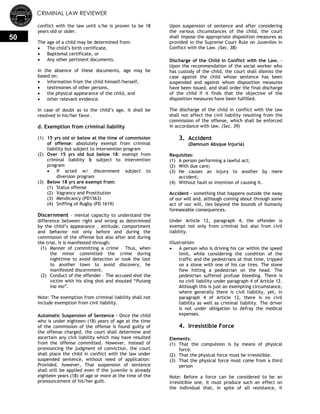
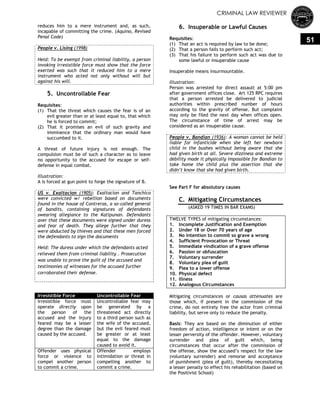
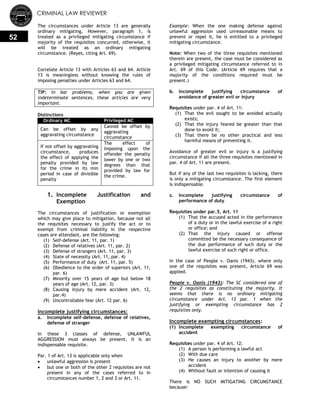
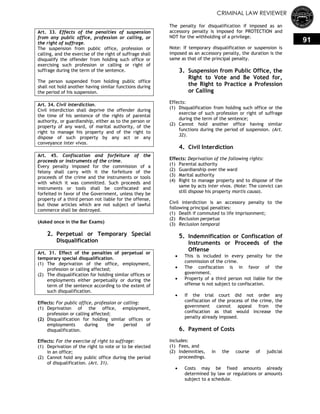
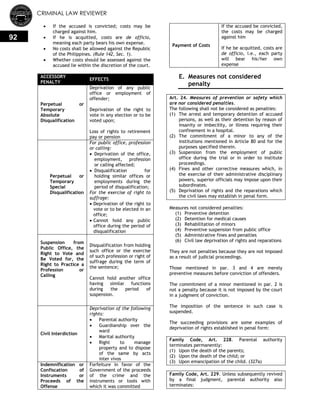
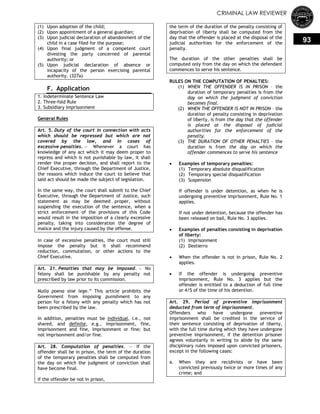
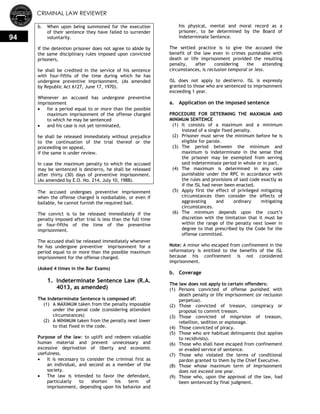
BAR REVIEWER
UP LAW2012
Criminal Law 1
Criminal Law 2
LAWDean Danilo L. Concepcion
Dean, UP College of Law
Prof. Concepcion L. Jardeleza
Associate Dean, UP College of Law
Prof. Ma. Gisella D. Reyes
Secretary, UP College of Law
Prof. Florin T. Hilbay
Faculty Adviser, UP Law Bar Operations
Commission 2012
Ramon Carlo F. Marcaida
Commissioner
Eleanor Balaquiao
Mark Xavier Oyales
Academics Committee Heads
Camille Umali
Charmaine Sto. Domingo
Criminal Law Subject Heads
Graciello Timothy Reyes
Layout
UP LAW BAR OPERATIONS COMMISSION
CRIMINAL LAW REVIEWER
2
CCCRRRIIIMMMIIINNNAAALLL
BAR REVIEWER
UP LAW2012
BAR OPERATIONS COMMISSION 2012
EXECUTIVE COMMITTEE
Ramon Carlo Marcaida |Commissioner
Raymond Velasco • Mara Kriska Chen |Deputy Commissioners
Barbie Kaye Perez |Secretary
Carmen Cecilia Veneracion |Treasurer
Hazel Angeline Abenoja|Auditor
COMMITTEE HEADS
Eleanor Balaquiao • Mark Xavier Oyales | Acads
Monique Morales • Katleya Kate Belderol • Kathleen Mae
Tuason (D) • Rachel Miranda (D) |Special Lectures
Patricia Madarang • Marinella Felizmenio |Secretariat
Victoria Caranay |Publicity and Promotions
Loraine Saguinsin • Ma. Luz Baldueza |Marketing
Benjamin Joseph Geronimo • Jose Lacas |Logistics
Angelo Bernard Ngo • Annalee Toda|HR
Anne Janelle Yu • Alyssa Carmelli Castillo |Merchandise
Graciello Timothy Reyes |Layout
Charmaine Sto. Domingo • Katrina Maniquis |Mock Bar
Krizel Malabanan • Karren de Chavez |Bar Candidates’ Welfare
Karina Kirstie Paola Ayco • Ma. Ara Garcia |Events
OPERATIONS HEADS
Charles Icasiano • Katrina Rivera |Hotel Operations
Marijo Alcala • Marian Salanguit |Day-Operations
Jauhari Azis |Night-Operations
Vivienne Villanueva • Charlaine Latorre |Food
Kris Francisco Rimban • Elvin Salindo |Transpo
Paula Plaza |Linkages
LAWCRIMINAL LAW TEAM 2012
Faculty Editor | Prof. Jay Batongbacal
Subject Heads | Camille Umali •
Charmaine Sto. Domingo
LAYOUT TEAM 2012
Layout Artists | Alyanna Apacible • Noel
Luciano • RM Meneses • Jenin Velasquez •
Mara Villegas • Naomi Quimpo • Leslie
Octaviano • Yas Refran • Cris Bernardino
Layout Head| Graciello Timothy Reyes
UP LAW BAR OPERATIONS COMMISSION
CCCRRRIIIMMMIIINNNAAALLL
LAW
2012 UP Law Bar Reviewer
Copyright and all other relevant rights over this
material are owned jointly by the University of the
Philippines College of Law and the Student Editorial
Team.
The ownership of the work belongs to the University of
the Philippines College of Law. No part of this book
shall be reproduced or distributed without the consent
of the University of the Philippines College of Law.
All Rights reserved.
UP LAW BAR OPERATIONS COMMISSION
CRIMINAL LAW REVIEWER
4 Criminal Law 1
CHAPTER I. FUNDAMENTAL PRINCIPLES
OF CRIMINAL LAW ..........................14
A. Definition of Criminal Law ........ 14
1. Difference between Mala in Se and
Mala Prohibita.......................... 14
B. Scope of Application and
Characteristics of the Philippine Criminal
Law 16
0. Generality ........................ 16
1. Territoriality ..................... 17
2. Prospectivity ..................... 19
3. Legality (nullum crimen nulla
poena sine lege) ....................... 20
4. Strict Construction of Penal Laws
Against State: The ―Doctrine of Pro
Reo‖ ..................................... 20
C. Constitutional limitations on the
power of Congress to enact penal laws in
the Bill of Rights.......................... 20
1. Equal protection ................. 20
2. Due process....................... 20
3. Non-imposition of cruel and
unusual punishment or excessive fines
20
4. Bill of attainder .................. 20
5. Ex post facto law ................ 20
CHAPTER II. FELONIES .....................22
A. Preliminary matters ................ 22
1. Differentiating Felonies, Offense,
Misdemeanor and Crime .............. 22
1. Felonies: How Committed......... 22
2. How is Criminal Liability
Incurred?................................ 22
3. Discussion of Article 5........... 23
4. Wrongful Act Different from that
Intended ................................ 23
5. Omission .......................... 25
B. Classifications of Felonies......... 25
1. According to the Manner of Their
Commission............................. 26
2. According to the Stages of Their
Execution ............................... 26
3. According to Their Gravity ..... 26
4. As to Count ....................... 27
5. As to Nature ...................... 27
C. Elements of Criminal Liability .... 27
1. Elements of Felonies ............ 27
Intentional Felonies ................... 27
D. Impossible Crimes .................. 31
E. Stages of Execution................. 32
F. Conspiracy and Proposal ........... 36
G. Multiple Offenders.................. 39
1. Recidivism......................... 40
2. Habituality (Reiteracion) ....... 40
3. Quasi-Recidivism ................. 40
4. Habitual Delinquency............ 40
H. Complex Crimes and Special
Complex Crimes........................... 40
1. Complex Crimes.................. 41
2. Special Complex/Composite
crimes ................................... 42
3. Continued and Continuing Crimes
(Delito Continuado) ................... 42
CHAPTER III. CIRCUMSTANCES WHICH
AFFECT CRIMINAL LIABILITY ..............44
A. Justifying Circumstances .......... 44
1. Self Defense ...................... 44
2. Defense of Relatives............. 46
3. Defense of Strangers ............ 46
4. Avoidance of a Greater Evil .... 46
5. Fulfillment of Duty or Lawful
Exercise of Right or office............ 47
6. Obedience to an order issued for
some lawful purpose .................. 47
B. Exempting Circumstances ......... 48
1. Insanity and Imbecility .......... 49
2. Minority............................ 49
3. Accident........................... 50
4. Irresistible Force................. 50
5. Uncontrollable Fear ............. 51
6. Insuperable or Lawful Causes .. 51
C. Mitigating Circumstances .......... 51
1. Incomplete Justification and
Exemption .............................. 52
2. Under 18 Or Over 70 Years Of Age
53
3. No Intention to Commit So Grave
A Wrong (Praeter Intentionem)...... 53
4. Sufficient Provocation or Threat
54
5. Immediate Vindication of A Grave
Offense.................................. 54
6. Passion or obfuscation (Arrebato
y Obsecacion) .......................... 55
7. Voluntary Surrender ............. 56
8. Plea Of Guilt...................... 57
9. Plea to a Lesser Offense ........ 57
10. Physical Defects............... 57
11. Illness........................... 57
CCCRRRIIIMMMIIINNNAAALLL
LAW12. Analogous Mitigating
Circumstances.......................... 58
D. Aggravating Circumstances........ 58
1. Generic............................ 59
1. Taking Advantage of Public Office
59
2. In Contempt of or With Insult
to Public Authorities ............... 59
3. With Insult or Lack of Regard
Due to Offended Party by Reason of
Rank, Age or Sex.................... 60
4. Abuse of Confidence and
Obvious Ungratefulness............ 61
5. Crime in Palace or in Presence
of the Chief Executive ............. 62
6. Nighttime (Nocturnidad);
Uninhabited Place (Despoblado);
With a Band (Cuadrilla)............ 62
7. On Occasion of a Calamity .. 63
8. Aid of Armed Men or Means to
Ensure Impunity (Auxilio de Gente
Armada).............................. 63
9. Recidivism (Reincidencia) ... 64
10. Reiteracion/Habituality... 65
11. Prize, Reward or Promise. 66
12. lInundation, Fire, Poison.. 66
13. Evident Premeditation
(Premeditacion Conocida)......... 66
14. Craft (Astucia), Fraud
(Fraude) or Disguise (Disfraz)..... 67
15. Superior Strength or Means
to Weaken Defense................. 68
16. Treachery (Alevosia) ...... 69
17. Ignominy .................... 70
18. Unlawful Entry ............. 71
19. Breaking Wall, Floor, Roof 71
20. With Aid of Persons Under
15; By Motor Vehicle ............... 71
21. Cruelty ...................... 71
E. Alternative Circumstances ........ 75
1. Relationship ...................... 75
2. Intoxication....................... 76
3. Degree of Instruction/ Education
76
F. Absolutory Causes .................. 76
1. Instigation ........................ 76
2. Pardon ............................. 77
3. Other Absolutory Causes........ 77
4. Acts Not Covered By Law And In
Case Of Excessive Punishment ....... 77
CHAPTER IV.PERSONS CRIMINALLY
LIABLE/DEGREE OF PARTICIPATION .....78
A. PrincipalsError! Bookmark not
defined.
1. By Direct Participation .......... 78
2. By Inducement ................... 79
3. By Indispensable Cooperation.. 79
B. Accomplices ......................... 79
C. Accessories........................... 80
CHAPTER V. PENALTIES....................83
A. General Principles .................. 83
1. Purposes........................... 84
2. Classification ..................... 84
3. Duration and Effect.............. 84
B. Penalties which may be imposed . 84
1. Scale of Principal Penalties .... 84
2. Scale of Accessory Penalties ... 85
C. Specific Principal And Accessory
Penalties ................................... 86
1. Afflictive penalties .............. 86
1. Reclusion Perpetua .............. 86
2. Reclusion Temporal........... 87
3. Prision mayor .................. 87
1. Correctional penalties........... 87
1. Prision Correccional ............. 87
2. Arresto Mayor.................. 87
3. Light penalties ................... 89
1. Arresto Menor .................... 89
2. Public Censure................. 89
4. Penalties common to afflictive,
correctional, and light penalties .... 89
1. Fine ................................ 89
2. Bond to Keep the Peace ........ 89
D. Accessory penalties................. 90
1. Perpetual or Temporary Absolute
Disqualification ........................ 90
2. Perpetual or Temporary
Special Disqualification ............ 91
CRIMINAL LAW REVIEWER
6
3. Suspension from Public Office,
the Right to Vote and Be Voted for,
the Right to Practice a Profession or
Calling................................... 91
4. Civil Interdiction.............. 91
5. Indemnification or Confiscation
of Instruments or Proceeds of the
Offense............................... 91
6. Payment of Costs ............. 91
Perpetual or Temporary Special
Disqualification ........................... 92
E. Measures not considered penalty 92
F. Application .......................... 93
1. Indeterminate Sentence Law
(R.A. 4013, as amended) ............. 94
2. The Three-fold rule ............. 96
3. Subsidiary imprisonment........ 97
G. Special rules for certain situations
104
1. Complex Crimes.................104
2. Crimes Different from That
Intended ...............................105
3. Where the Offender Is Below 18
Years ...................................106
H. Execution and Service ............107
1. Probation Law (P.D. 968, as
amended) ..............................108
CHAPTER VI. MODIFICATION AND
EXTINCTION OF CRIMINAL LIABILITY .. 113
A. Prescription of crimes (Art. 90) .113
B. Prescription of penalties (Art. 92)
114
C. Pardon by the offended party ...115
D. Pardon by the Chief Executive...115
E. Amnesty.............................115
Criminal Law 2
Title I. Crimes against National Security
and the Law of Nations.................. 155
A. Crimes against Security...........155
1. Article 114 – Treason...........155
2. Article 115 - Conspiracy and
Proposal to Commit Treason........156
3. Article 116 - Misprision of
Treason.................................156
4. Article 117 – Espionage.........157
B. Crimes against the Law of Nations
157
1. Article 118 - Inciting to War or
Giving Motives for Reprisals .........157
2. Article 119 - Violation of
Neutrality ..............................157
3. Article 120 - Correspondence
with Hostile Country .................157
4. Article 121 - Flight to Enemy's
Country.................................157
5. Article 122 - Piracy in General
and Mutiny on the High Seas or in
Philippine Waters .....................157
6. Article 123 - Qualified Piracy.158
Title II. Crimes against Fundamental Laws
of the State ................................ 158
1. Article 124 - Arbitrary Detention
158
2. Article 125 - Delay in the Delivery
of Detained Persons to the Proper
Judicial Authorities...................159
3. Article 126 - Delaying Release 159
4. Article 127 – Expulsion .........160
5. Article 128 - Violation of Domicile
160
6. Article 129 - Search Warrants
Maliciously Obtained, and Abuse in the
Service of Those Legally Obtained .160
7. Article 130 - Searching Domicile
without Witnesses ....................161
8. Article 131 - Prohibition,
Interruption and Dissolution of
Peaceful Meetings ....................161
9. Article 132 - Interruption of
Religious Worship .....................161
10. Article 133 - Offending the
Religious Feelings.....................162
Title III. Crimes against Public Order . 162
A. Chapter I – Rebellion, Coup d‘etat,
Sedition and Disloyalty..................162
1. Article 134 - Rebellion
/Insurrection ..........................162
2. Article 134-A - Coup d‘ État...163
3. Article 135 - Penalty for
Rebellion, Insurrection or Coup d‘ État
163
CCCRRRIIIMMMIIINNNAAALLL
LAW4. Article 136 - Conspiracy and
Proposal to Commit Coup d‘ État,
Rebellion or Insurrection ............164
5. Article 137 - Disloyalty of Public
Officers or Employees................164
6. Article 138 - Inciting to Rebellion
or Insurrection ........................164
7. Article 139 - Sedition...........164
8. Article 140 - Persons Liable for
Sedition ................................165
9. Article 141 - Conspiracy to
Commit Sedition ......................165
10. Article 142 – Inciting to
Sedition ................................165
B. Chapter II - Crimes against Popular
Representation...........................166
1. Article 143 - Acts Tending to
Prevent the Meeting of the Congress
of the Philippines and Similar Bodies
166
2. Article 144 - Disturbance of
Proceedings............................166
3. Article 145 - Violation of
Parliamentary Immunity.............166
C. Chapter III – Illegal Assemblies and
Associations ..............................166
1. Article 146 - Illegal Assemblies
166
2. Article 147 - Illegal Associations
167
D. Chapter IV - Assault upon and
Resistance and Disobedience to, Persons
in Authority and Their Agents .........167
1. Article 148 - Direct Assault....167
2. Article 152 - Persons in Authority
and Agents of Persons in Authority 168
3. Article 149 - Indirect Assault..168
4. Article 150 - Disobedience to
Summons Issued by Congress, Its
Committees or Subcommittees, by the
Constitutional Commissions, Its
Committees, Subcommittees or
Divisions................................168
5. Article 151 - Resistance and
Disobedience to a Person in Authority
or the Agents of Such Persons ......168
E. Chapter V - Public Disorders .....169
1. Article 153 - Tumults and Other
Disturbances of Public Order........169
2. Article 154 - Unlawful Use of
Means of Publication and Unlawful
Utterances .............................169
3. Article 155 - Alarms and Scandals
169
4. Article 156 - Delivering Persons
from Jail ...............................170
F. Chapter VI - Evasion of Service of
Sentence ..................................170
1. Article 157 - Evasion of Service of
Sentence ...............................170
2. Article 158 - Evasion of Service of
Sentence on the Occasion of
Disorders, Conflagrations,
Earthquakes, or Other Calamities ..171
3. Article 159 - Other Cases of
Evasion of Service of Sentence .....171
G. Chapter VII - Commission of Another
Crime during Service of Penalty Imposed
for Another Previous Offense ..........171
1. Article 160 - Quasi Recidivism 171
H. Title IV. Crimes against Public
Interest....................................171
1. Acts of Counterfeitin ...........172
1. Article 161 - Counterfeiting the
Great Seal of the Government of the
Philippine Islands, Forging the
Signature or Stamp of the Chief
Executive...............................172
2. Article 162 - Using Forged
Signature or Counterfeit Seal or
Stamp................................172
3. Article 163 - Making and
Importing and Uttering False Coins
172
4. Article 164 - Mutilation of
Coins.................................173
5. Article 165 - Selling of False or
Mutilated Coin, Without Connivance
173
CRIMINAL LAW REVIEWER
8
6. Article 166 - Forging Treasury
or Bank Notes or Other Documents
Payable to Bearer; Importing and
Uttering Such False or Forged Notes
and Documents.....................173
7. Article 167 - Counterfeiting,
Importing, and Uttering Instruments
Not Payable to Bearer ............174
2. Acts of Forgery..................174
1. Article 168 - Illegal Possession
and Use of False Treasury or Bank
Notes and Other Instruments of Credit
174
2. Article 169 - How Forgery is
Committed.............................174
3. Acts of Falsification ............174
1. Article 170 - Falsification of
Legislative Documents ...............174
2. Article 171 - Falsification by
Public Officer, Employee or Notary
or Ecclesiastical Minister .........175
3. Article 172 - Falsification by
Private Individual and Use of
Falsified Documents...............177
4. Article 173 - Falsification of
Wireless, Cable, Telegraph and
Telephone Messages, and Use of
Said Falsified Messages ...........178
5. Article 174 - False Medical
Certificates, False Certificates of
Merits or Service, etc. ............178
6. Article 175 - Using False
Certificates.........................178
7. Article 176 - Manufacturing and
Possession of Instruments or
Implements for Falsification .....179
4. OTHER FALSITIES................179
1. Article 177 - Usurpation of
Authority or Official Functions .....179
2. Article 178 - Using Fictitious
and Concealing True Name.......179
3. Article 179 - Illegal Use of
Uniforms and Insignia .............179
4. Article 180 - False Testimony
Against a Defendant...............180
5. Article 181 - False Testimony
Favorable to the Defendant......180
6. Article 182 - False Testimony
in Civil Cases .......................180
7. Article 183 - False Testimony
in Other Cases and Perjury in
Solemn Affirmation ................180
8. Article 184 - Offering False
Testimony in Evidence ............181
9. Article 185 - Machinations in
Public Auctions.....................181
10. Article 186 – Monopolies and
Combinations in Restraint of Trade
181
11. Article 187 – Importation and
Disposition of Falsely Marked
Articles or Merchandise Made of
Gold, Silver, or other Precious
Metals or their Alloys..............182
Title V. Crimes Relative to Opium and
Other Prohibited Drugs .................. 182
A. Acts Punished:......................182
B. Penalties for Unlawful Acts: .....182
C. Definition of Important Terms ...183
D. Other Important Points ...........183
Title VI. Crimes against Public Morals 184
CHAPTER I: Gambling and Betting.....184
A. Chapter I - Gambling and Betting
184
1. Article 195 - What Acts Are
Punishable in Gambling ..............184
2. Article 196 - Importation, Sale
and Possession of Lottery Tickets or
Advertisements........................185
3. Article 197 – Betting in Sports
contents................................185
4. Article 198 - Illegal Betting on
Horse Race.............................185
5. Article 199 (as amended by PD
449) 186
B. Chapter II. Offenses against
Decency and Good Customs ............186
0.........................................186
1. Article 200 - Grave Scandal ...186
2. Article 201 - Immoral Doctrines,
Obscene Publications and Exhibitions
and Indecent Shows ..................186
3. Article 202 - Vagrancy and
Prostitution ............................187
Title VII. Crimes Committed by Public
Officers ..................................... 188
CCCRRRIIIMMMIIINNNAAALLL
LAWA. Chapter I: Preliminary Provisions189
B. Chapter II: Malfeasance and
Misfeasance in Office ...................189
1. Article 204 - Knowingly Rendering
Unjust Judgment .....................189
2. Article 205 - Judgment Rendered
Through Negligence ..................189
3. Article 206 - Unjust Interlocutory
Order ...................................190
4. Article 207 - Malicious Delay in
the Administration of Justice.......190
5. Article 208 - Prosecution of
Offenses; Negligence and Tolerance
190
6. Article 209 – Betrayal of Trust by
an Attorney or a Solicitor – Revelation
of Secrets..............................190
7. Article 210 - Direct Bribery....191
8. Article 211 - Indirect Bribery .191
9. Article 211-A - Qualified Bribery
192
10. Article 212 - Corruption of
Public Officials........................192
C. Chapter III: Frauds and Illegal
Exactions and Transactions ............192
1. Article 213 - Fraud against the
Public Treasury and Similar Offenses
192
2. Article 214 - Other Frauds.....193
3. Article 215 - Prohibited
Transactions...........................193
4. Article 216 - Possession of
Prohibited Interest by a Public Officer
194
D. Chapter IV: Malversation of Public
Funds or Property .......................194
1. Article 217 - Malversation of
Public Funds or Property -
Presumption of Malversation........194
2. Article 218 - Failure of
Accountable Officer to Render
Accounts ...............................195
3. Article 219 - Failure of a
Responsible Public Officer to Render
Accounts Before Leaving the Country
195
4. Article 220 - Illegal Use of Public
Funds or Property.....................195
5. Article 221 - Failure to Make
Delivery of Public Funds or Property
196
6. Article 222 - Officers Included in
the Preceding Provisions.............196
E. Chapter V: Infidelity of Public
Officers....................................196
1. Article 223 - Conniving With or
Consenting to Evasion ................196
2. Article 224 - Evasion through
Negligence .............................196
3. Article 225 - Escape of Prisoner
under the Custody of a Person Not a
Public Officer..........................196
4. Article 226 - Removal,
Concealment, or Destruction of
Documents .............................197
5. Article 227 - Officer Breaking
Seal 197
6. Article 228 - Opening of Closed
Documents .............................197
7. Article 229 - Revelation of
Secrets by an Officer.................197
8. Article 230 - Public Officers
Revealing Secrets of Private
Individuals .............................198
F. Chapter VI: Other Offenses or
Irregularities by Public Officers .......198
1. Article 231 - Open Disobedience
198
2. Article 232 - Disobedience to the
Order of Superior Officer When Said
Order Was Suspended by Inferior
Officer..................................198
3. Article 233 - Refusal of Assistance
198
4. Article 234 - Refusal to Discharge
Elective Office ........................198
5. Article 235 - Maltreatment of
Prisoners ...............................199
6. Article 236 - Anticipation of
Duties of a Public Officer............199
7. Article 237 - Prolonging
Performance of Duties and Powers.199
CRIMINAL LAW REVIEWER
10
8. Article 238 - Abandonment of
Office or Position .....................199
9. Article 239 - Usurpation of
Legislative Powers....................199
10. Article 240 - Usurpation of
Executive Functions..................200
11. Article 241 - Usurpation of
Judicial Functions ....................200
12. Article 242 - Disobeying
Request for Disqualification ........200
13. Article 243 - Orders or Request
by Executive Officer to Any Judicial
Authority...............................200
14. Article 244 - Unlawful
Appointments .........................200
15. Article 245 - Abuses against
Chastity ................................200
Title VIII. Crimes against Persons...... 201
A. Chapter I: Destruction of Life....201
1. Article 246 - Parricide .........201
2. Article 247 - Death or Physical
Injuries Under Exceptional
Circumstances.........................202
3. Article 248 - Murder............202
4. Article 249 - Homicide .........203
5. Article 250 - Penalty for
Frustrated Parricide, Murder or
Homicide...............................204
6. Article 251 - Death Caused in
Tumultuous Affray....................204
7. Article 252 - Physical Injuries
Caused in Tumultuous Affray .......204
8. Article 253 - Giving Assistance to
Suicide .................................204
9. Article 254 - Discharge of
Firearms ...............................204
10. Article 255 - Infanticide ....205
11. Article 256 - Intentional
Abortion................................205
12. Article 257 - Unintentional
Abortion................................205
13. Article 258 - Abortion
Practiced by the Woman Herself or by
Parents.................................206
14. Article 259 - Abortion by a
Physician or Midwife and Dispensing of
Abortives...............................206
15. Article 260 - Responsibility of
Participants in a Duel ................206
16. Article 261 - Challenging to a
Duel 206
B. Chapter II: Physical Injuries ......207
1. Article 262 - Mutilation ........207
2. Article 263 - Serious Physical
Injuries .................................207
3. Article 264 - Administering
Injurious Substances or Beverages .207
4. Article 265 - Less Serious Physical
Injuries .................................208
5. Article 266 - Slight Physical
Injuries and Maltreatment...........208
6. Article 266-A - Rape (amended by
RA 8353)................................208
Title IX. Crimes against Personal Liberty
and Security ............................... 212
A. Chapter I: Crimes against Liberty
212
1. Article 267 - Kidnapping and
Serious Illegal Detention.............212
2. Article 268 - Slight Illegal
Detention ..............................214
3. Article 269 - Unlawful Arrest..214
4. Article 270 - Kidnapping and
Failure to Return a Minor............214
5. Article 271 - Inducing a Minor to
Abandon His Home....................215
6. Article 272 - Slavery............215
7. Article 273 - Exploitation of Child
Labor ...................................215
8. Article 274 - Services Rendered
Under Compulsion in Payment of Debt
215
B. Chapter II: Crimes against Security
216
1. Article 275 - Abandonment of
Persons in Danger and Abandonment
of Own Victim .........................216
2. Article 276 - Abandoning a Minor
216
3. Article 277 - Abandonment of
Minor by Person Entrusted With
Custody; Indifference of Parents ...216
4. Article 278 - Exploitation of
Minors ..................................216
5. Article 280 - Qualified Trespass to
Dwelling................................217
6. Article 281 - Other Forms of
Trespass ................................218
7. Article 282 - Grave Threats....218
8. Article 283 - Light Threats.....218
9. Article 284 - Bond for Good
Behavior................................219
CCCRRRIIIMMMIIINNNAAALLL
LAW10. Article 285 – Other Light
Threats.................................219
11. Article 286 - Grave Coercions
219
12. Article 287 - Light Coercions
219
13. Article 288 - Other Similar
Coercions ..............................220
14. Article 289 - Formation,
Maintenance, and Prohibition of
Combination of Capital or Labor
through Violence or Threats ........220
C. Chapter III: Discovery and
Revelation of Secrets ...................220
1. Article 290 - Discovering Secrets
through Seizure of Correspondence220
2. Article 291 - Revealing Secrets
with Abuse of Office .................221
3. Article 292 - Revelation of
Industrial Secrets .....................221
Title X. Crimes against Property....... 222
A. Chapter I: Robbery in General...222
1. Article 293 - Who Are Guilty of
Robbery ................................222
2. Article 294 - With Violence or
Intimidation of Persons ..............223
3. Article 295 - Robbery with
Physical Injuries, in an Uninhabited
Place and by a Band..................223
4. Article 296 - Definition of a Band
and Penalty Incurred by the Members
Thereof.................................224
5. Article 297 - Attempted and
Frustrated Robbery with Homicide 224
6. Article 298 - Execution of Deeds
through Violence or Intimidation...224
7. Article 299 - Robbery in an
Inhabited House or Public Building or
Edifice Devoted to Worship .........224
8. Article 300 – Robbery in an
Uninhabited Place and by a Band ..226
9. Article 302 - In an Uninhabited
Place or Private Building ............226
10. Article 303 - Robbery of
Cereals, Fruits or Firewood in an
Inhabited Place or Private Building 226
11. Article 304 - Possession of
Picklock or Similar Tools.............226
12. Article 305 - Defines False Keys
226
B. Chapter 2: Brigandage (Articles 306-
307) 226
1. Article 306 - Who Are Brigands226
2. Article 307 - Aiding and Abetting
a Band of Brigands....................227
C. Chapter 3: Theft ...................227
1. Article 308 - Who Are Liable for
Theft....................................227
2. Article 309 - Penalties..........228
3. Article 310 - Qualified Theft ..228
4. Article 311 - Theft of the
Property of the National Library and
National Museum......................230
D. Chapter 4: Usurpation.............230
1. Article 312 - Occupation of Real
Property or Usurpation of Real Rights
in Property.............................230
2. Article 313 - Altering Boundaries
or Landmarks ..........................230
E. Chapter 5: Culpable Insolvency..230
1. Article 314 - Fraudulent
Insolvency..............................230
F. Chapter 6: Swindling and Other
Deceits ....................................230
1. Article 315 - Estafa .............230
a. With Unfaithfulness or Abuse of
Confidence (315 par. 1(a) (b) (c))..231
b. Estafa by Means of False Pretenses
or Fraudulent Acts (315 par. 2(a) (b)
(c) (d) (e); BP22):.....................233
c. Through Other Fraudulent Means
(315 Par 3 (a) (b) (c)) ................235
2. Article 316 - Other Forms of
Swindling and Deceits ................236
3. Article 317 - Swindling of a Minor
237
4. Article 318 - Other Deceits ....237
G. Chapter 7: Chattel Mortgage.....237
CRIMINAL LAW REVIEWER
12
1. Article 319 - Removal, Sale, or
Pledge of Mortgaged Property ......237
H. Chapter 8: Arson and Other Crimes
Involving Destruction....................238
I. Chapter 9: Malicious Mischief....239
1. Article 327 - Who Are Responsible
239
2. Article 328 - Special Cases of
Malicious Mischief ....................239
3. Article 329 - Other Mischiefs..239
4. Article 330 - Damage and
Obstruction to Means of
Communication .......................239
5. Article 331 – Destroying or
Damaging Statues, Public Monuments
or Paintings............................239
J. Chapter 10: Exemption from
Criminal Liability ........................239
1. Article 332 - Exemption from
Criminal Liability in Crimes Against
Property................................239
Title XI. Crimes against Chastity....... 242
1. Article 333 - Adultery ..........242
2. Article 334 - Concubinage .....242
3. Article 335 – Rape ..............243
4. Article 336 - Acts of
Lasciviousness.........................243
5. Article 337 - Qualified Seduction
244
6. Article 338 - Simple Seduction245
7. Article 339 - Acts of
Lasciviousness with the Consent of the
Offended Party........................245
8. Article 340 - Corruption of Minors
246
9. Article 341 - White Slave Trade
246
10. Article 342 - Forcible
Abduction..............................246
11. Article 343 - Consented
Abduction..............................247
12. Article 344 - Prosecution of
Private Offenses ......................248
13. Article 345: Civil Liability ..249
14. Article 346 – Liability of
ascendants, guardians, teachers and
other persons entrusted with the
custody of the offended party ......249
Title XII. Crimes against the Civil Status
of Persons .................................. 250
1. Article 349 - Bigamy ............251
2. Article 350 - Marriage Contracted
against Provisions of Laws ...........251
3. Article 351 - Premature Marriage
251
4. Article 352 - Performance of
Illegal Marriage Ceremony...........251
Title XIII. Crimes against Honor ........ 253
A. Chapter I: Libel ....................253
1. Article 353 - Definition of Libel
253
2. Article 354 - Requirement for
Publicity................................254
3. Article 355 - Libel by Writing or
Similar Means..........................254
4. Article 356 - Threatening to
Publish and Offer to Prevent Such
Publication for a Compensation ....254
5. Article 357 - Prohibited
Publication of Acts Referred to in the
Course of Official Proceedings (Gag
Law)255
6. Article 358 - Slander............255
7. Article 359 - Slander by Deed .255
8. Article 360 - Persons Responsible
for Libel ................................255
9. Article 361 - Proof of Truth ...256
10. Article 362 - Libelous Remarks
256
B. Chapter II: Incriminatory
Machinations..............................256
1. Article 363 - Incriminating
innocent person.......................256
2. Article 364 - Intriguing against
Honor ...................................256
Title XIV. Quasi-Offenses................ 259
1. Article 365 - Imprudence and
Negligence .............................259
CRIMINAL LAW REVIEWER
13
CCCRRRIIIMMMIIINNNAAALLL
LAW
BAR OPERATIONS COMMISSION 2012
EXECUTIVE COMMITTEE
Ramon Carlo Marcaida |Commissioner
Raymond Velasco •Mara KriskaChen |Deputy Commissioners
Barbie Kaye Perez |Secretary
Carmen Cecilia Veneracion |Treasurer
Hazel Angeline Abenoja|Auditor
COMMITTEE HEADS
Eleanor Balaquiao • Mark Xavier Oyales | Acads
Monique Morales • Katleya Kate Belderol • Kathleen Mae Tuason (D) • Rachel
Miranda (D) |Special Lectures
Patricia Madarang • Marinella Felizmenio |Secretariat
Victoria Caranay |Publicity and Promotions
Loraine Saguinsin • Ma. Luz Baldueza |Marketing
Benjamin Joseph Geronimo • Jose Lacas |Logistics
Angelo Bernard Ngo • Annalee Toda|HR
Anne Janelle Yu • Alyssa Carmelli Castillo |Merchandise
Graciello Timothy Reyes |Layout
Charmaine Sto. Domingo • Katrina Maniquis |Mock Bar
Krizel Malabanan •Karren de Chavez |Bar Candidates’ Welfare
Karina Kirstie Paola Ayco • Ma. Ara Garcia |Events
OPERATIONS HEADS
Charles Icasiano • Katrina Rivera |Hotel Operations
Marijo Alcala • Marian Salanguit |Day-Operations
Jauhari Azis |Night-Operations
Vivienne Villanueva • Charlaine Latorre |Food
Kris Francisco Rimban • Elvin Salindo |Transpo
Paula Plaza |Linkages
Criminal Law 1
UP LAW BAR OPERATIONS COMMISSION
BAR REVIEWER
UP LAW2012
CRIMINAL LAW TEAM 2012
Faculty Editor | Prof. Jay
Batongbacal
Subject Heads | Camille
Umali • Charmaine Sto.
Domingo
LAYOUT TEAM 2012
Layout Artists | Alyanna
Apacible • Noel Luciano • RM
Meneses • Jenin Velasquez •
Mara Villegas • Naomi
Quimpo • Leslie Octaviano •
Yas Refran • Cris Bernardino
Layout Head| Graciello
Timothy Reyes
Criminal Law 1
CRIMINAL LAW
Criminal Law 1
Criminal Law 2
I. Fundamental Principles of Criminal
Law
II. Felonies
III. Circumstances which affect
criminal liability
IV. Persons criminally liable/Degree of
participation
V. Penalties
VI. Modification and extinction of
criminal
REVISED PENAL CODE/SPECIAL
LAWS, PRESIDENTIAL DECREES,
AND EXECUTIVE ORDERS
A. Book 1 (Articles 1-99, RPC,
excluding provisions on civil
liability), including related Special
Laws
CHAPTER I. FUNDAMENTAL
PRINCIPLES OF CRIMINAL LAW
A. DEFINITION OF CRIMINAL LAW
B. SCOPE OF APPLICATION AND
CHARACTERISTICS
C. CONSTITUTIONAL LIMITATIONS
A. Definition of Criminal Law
Criminal law is that branch of public substantive law
which defines crimes, treats of their nature, and
provides for their punishment.
1. Difference between Mala in Se and
Mala Prohibita (ASKED TWICE IN BAR
EXAMS)
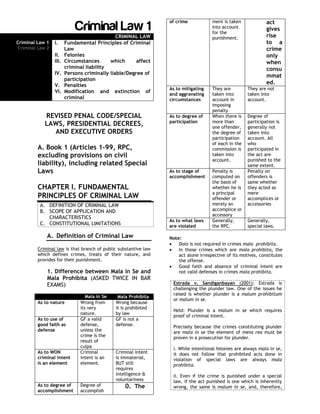
Mala in Se Mala Prohibita
As to nature Wrong from
its very
nature.
Wrong because
it is prohibited
by law
As to use of
good faith as
defense
GF a valid
defense,
unless the
crime is the
result of
culpa
GF is not a
defense.
As to WON
criminal intent
is an element
Criminal
intent is an
element.
Criminal intent
is immaterial,
BUT still
requires
intelligence &
voluntariness
As to degree of
accomplishment
Degree of
accomplish
0. The
of crime ment is taken
into account
for the
punishment.
act
gives
rise
to a
crime
only
when
consu
mmat
ed.
As to mitigating
and aggravating
circumstances
They are
taken into
account in
imposing
penalty
They are not
taken into
account.
As to degree of
participation
When there is
more than
one offender,
the degree of
participation
of each in the
commission is
taken into
account.
Degree of
participation is
generally not
taken into
account. All
who
participated in
the act are
punished to the
same extent.
As to stage of
accomplishment
Penalty is
computed on
the basis of
whether he is
a principal
offender or
merely an
accomplice or
accessory
Penalty on
offenders is
same whether
they acted as
mere
accomplices or
accessories
As to what laws
are violated
Generally,
the RPC.
Generally,
special laws.
Note:
 Dolo is not required in crimes mala prohibita.
 In those crimes which are mala prohibita, the
act alone irrespective of its motives, constitutes
the offense.
 Good faith and absence of criminal intent are
not valid defenses in crimes mala prohibita.
Estrada v. Sandiganbayan (2001): Estrada is
challenging the plunder law. One of the issues he
raised is whether plunder is a malum prohibitum
or malum in se.
Held: Plunder is a malum in se which requires
proof of criminal intent.
Precisely because the crimes constituting plunder
are mala in se the element of mens rea must be
proven in a prosecution for plunder.
i. While intentional felonies are always mala in se,
it does not follow that prohibited acts done in
violation of special laws are always mala
prohibita.
ii. Even if the crime is punished under a special
law, if the act punished is one which is inherently
wrong, the same is malum in se, and, therefore,
CRIMINAL LAW REVIEWER
15
good faith and the lack of criminal intent are valid
defenses; unless it is the product of criminal
negligence or culpa.
Likewise when the special laws require that the
punished act be committed knowingly and
willfully, criminal intent is required to be proved
before criminal liability may arise.
Note: Where malice is a factor, good faith is a
defense.
CRIMINAL LAW VS. CRIMINAL PROCEDURE
Criminal Law Criminal Procedure
It is substantive. It is remedial.
Prospective in
application.
Exception: If it is
favorable to the
accused.
Exception To The
Exception:
1.When the accused is a
habitual delinquent.
(Art. 22)
2.Where the new law
expressly made
inapplicable to
pending actions or
existing causes of
actions. (Tavera v.
Valdez)
Retroactive in
application.
Statutory; it is passed by
the Legislature.
May be promulgated by
the Legislature (e.g.
jurisdiction of courts) or
the Judiciary (e.g. Rules
of Court)
STATE AUTHORITY TO PUNISH CRIME (ASKED ONCE
IN BAR EXAMS)
Art. II, Sec. 5 (1987 Constitution) Declaration of
Principles and State Policies. The maintenance of
peace and order, the protection of life, liberty and
property, and promotion of the general welfare are
essential for the enjoyment by all the people of the
blessings of democracy.
SOURCES OF CRIMINAL LAW
a. The Revised Penal Code (Act No. 3815) -
Created pursuant to Administrative Order
No. 94; enacted January 1, 1932; based on
the Spanish Penal Code, US Penal Code, and
Phil. Supreme Court decisions.
b. Special penal laws and penal Presidential
Decrees issued during Martial Law.
PENAL LEGISLATION
a. Schools of Thought (ASKED ONCE IN BAR
EXAMS) (PUCE)
(1) Utilitarian Theory
Primary purpose: Protection of society from actual or
potential wrongdoers.
(2) Classical Theory
Primary purpose: Retribution.
Basis of criminal liability: Human free will.
Endeavored to establish a mechanical and direct
proportion between crime and penalty; there is
scant regard to human element.
(3) Positivist Theory
Primary purpose: Reformation; prevention/ correction.
Basis of criminal liability: The sum of the social,
natural and economic phenomena to which the actor
is exposed.
(4) Eclectic/Mixed
Combines both positivist and classical thinking.
Crimes that are economic and social by nature
should be dealt with in a positivist manner; thus,
the law is more compassionate.
Heinous crimes should be dealt with in a classical
manner; thus, capital punishment.
Note: The Revised Penal Code today follows the
mixed or eclectic philosophy. For example:
 Intoxication of the offender is considered to
mitigate his criminal liability, unless it is
intentional or habitual;
 Age of the offender is considered;
 A woman who killed her child to conceal her
dishonor has in her favor a mitigating
circumstance.
RELATION OF RPC TO SPECIAL LAWS: SUPPLETORY
APPLICATION OF RPC
Art. 10, RPC. Offenses not subject to the provisions
of this Code. – Offenses which are or in the future
may be punishable under special laws are not
subject to the provisions of this Code. This Code
shall be supplementary to such laws, unless the
latter should specially provide the contrary.
General Rule: RPC provisions supplement the
provisions of special laws.
Exceptions:
(1) Where the special law provides otherwise
(Art.10)
(2) When the provisions of the Code are impossible
of application, either by express provision or by
necessary implication, as in those instances
where the provisions in question are peculiar to
the Code. (Regalado, Criminal Law Prospectus)
Ladonga v People (2005):
Spouses Ladonga were convicted by the RTC for
CRIMINAL LAW REVIEWER
16
violation of B.P. Blg. 22 (3 counts). The husband
applied for probation while the wife appealed
arguing that the RTC erred in finding her
criminally liable for conspiring with her husband
as the principle of conspiracy is inapplicable to
B.P. Blg. 22 which is a special law.
Held:
1. B.P. Blg. 22 does not expressly prescribe the
suppletory application of the provisions of
the RPC.
2. Thus, in the absence of contrary provision in
B.P. Blg. 22, the general provisions of the
RPC which, by their nature, are necessarily
applicable, may be applied suppletorily.
3. The court cited the case of Yu vs. People,
where the provisions on subsidiary
imprisonment under Art. 39 of the RPC to
B.P. Blg. 22 was applied suppletorily.
People vs. Rodriguez (1960):
It was held that a violation of a special law can
never absorb a crime punishable under the
Revised Penal Code, because violations of the
Revised Penal Code are more serious than a
violation of a special law.
But a crime in the Revised Penal Code can absorb
a crime punishable by a special law if it is a
necessary ingredient of the felony defined in the
Code.
People vs. Martinada:
The crime of cattle-rustling is not malum
prohibitum but a modification of the crime of
theft of large cattle.
So Presidential Decree No. 533, punishing cattle-
rustling, is not a special law, but a law amending
provisions of the RPC (Arts. 309 and 310).
It can absorb the crime of murder. If in the
course of cattle rustling, murder was committed,
the offender cannot be prosecuted for murder.
Note: Murder would be a qualifying circumstance in
the crime of qualified cattle rustling.1
B. Scope of Application and
Characteristics of the
Philippine Criminal Law
1. GENERALITY (WHO?)
2. TERRITORIALITY (WHERE?)
3. PROSPECTIVITY (WHEN?)
Criminal law has three (3) characteristics: General,
Territorial, and Prospective.
1
Sec. 8, P.D. No. 533
1. Generality
General Rule:
Art. 14, NCC. The penal law of the country is
binding on all persons who live or sojourn in
Philippine territory, subject to the principles of
public international law and to treaty stipulations.
Limitations:
Art. 2, RPC. ―Except as provided in the treaties or
laws of preferential application xxx‖
a. Treaty Stipulations
Examples:
 Bases Agreement entered into by the
Philippines and the US on Mar. 14, 1947 and
expired on Sept. 16, 1991.
 Visiting Forces Agreement (VFA)2
signed on
Feb. 10, 1998.
Article V
Criminal Jurisdiction
1. Subject to the provisions of this article:
(a) Philippine authorities shall have jurisdiction
over United States personnel with respect to
offenses committed within the Philippines and
punishable under the law of the Philippines.
(b) United States military authorities shall have the
right to exercise within the Philippines all criminal
and disciplinary jurisdiction conferred on them by
the military law of the United States over United
States personnel in the Philippines.
2. (a) Philippine authorities exercise exclusive
jurisdiction over United States personnel with
respect to offenses, including offenses relating to
the security of the Philippines, punishable under
the laws of the Philippines, but not under the laws
of the United States.
(b) United States authorities exercise exclusive
jurisdiction over United States personnel with
respect to offenses, including offenses relating to
the security of the United States, punishable under
the laws of the United States, but not under the
laws of the Philippines.
(c) For the purposes of this paragraph and
paragraph 3 of this article, an offense relating to
security means:
(1) treason;
(2) sabotage, espionage or violation of any law
relating to national defense.
3. In cases where the right to exercise jurisdiction
is concurrent, the following rules shall apply:
2
Take note of Art. V, which defines criminal jurisdiction over
United States military and civilian personnel temporarily in
the Philippines in connection with activities approved by the
Philippine Government.
CRIMINAL LAW REVIEWER
17
(a) Philippine authorities shall have the primary
right to exercise jurisdiction over all offenses
committed by United States personnel, except in
cases provided for in paragraphs l (b), 2 (b), and 3
(b) of this Article.
(b) United States military authorities shall have the
primary right to exercise jurisdiction over United
States personnel subject to the military law of the
United States in relation to:
(1) offenses solely against the property or security
of the United States or offenses solely against the
property or person of United States personnel; and
(2) offenses arising out of any act or omission done
in performance of official duty.
(c) The authorities of either government may
request the authorities of the other government to
waive their primary right to exercise jurisdiction in
a particular case.
(d) Recognizing the responsibility of the United
States military authorities to maintain good order
and discipline among their forces, Philippine
authorities will, upon request by the United States,
waive their primary right to exercise jurisdiction
except in cases of particular importance to the
Philippines. If the Government of the Philippines
determines that the case is of particular
importance, it shall communicate such
determination to the United States authorities
within twenty (20) days after the Philippine
authorities receive the United States request.
(e) When the United States military commander
determines that an offense charged by authorities
of the Philippines against United States personnel
arises out of an act or omission done in the
performance of official duty, the commander will
issue a certificate setting forth such determination.
This certificate will be transmitted to the
appropriate authorities of the Philippines and will
constitute sufficient proof of performance of
official duty for the purposes of paragraph 3(b)(2)
of this article. In those cases where the
Government of the Philippines believes the
circumstances of the case require a review of the
duty certificate, United States military authorities
and Philippine authorities shall consult
immediately. Philippine authorities at the highest
levels may also present any information bearing on
its validity. United States military authorities shall
take full account of the Philippine position. Where
appropriate, United States military authorities will
take disciplinary or other action against offenders
in official duty cases, and notify the Government of
the Philippines of the actions taken.
(f) If the government having the primary right does
not exercise jurisdiction, it shall notify the
authorities of the other government as soon as
possible.
(g) The authorities of the Philippines and the
United States shall notify each other of the
disposition of all cases in which both the
authorities of the Philippines and the United States
have the right to exercise jurisdiction.
b. Laws of Preferential Application
Examples:
 Members of Congress are not liable for libel or
slander for any speech in Congress or in any
committee thereof. (Sec. 11, Art. VI, 1987
Constitution)
 Any ambassador or public minister of any
foreign State, authorized and received as such
by the President, or any domestic or domestic
servant of any such ambassador or minister are
exempt from arrest and imprisonment and
whose properties are exempt from distraint,
seizure and attachment.3
(R.A. No. 75)
 Warship Rule – A warship of another country,
even though docked in the Philippines, is
considered an extension of the territory of its
respective country. This also applies to
embassies.
c. Principles of Public International Law
Art. 14, NCC. ―xxx subject to the principles of
public international law and to treaty stipulations.‖
The following persons are exempt from the
provisions of the RPC:
(1) Sovereigns and other heads of state
(2) Ambassadors, ministers, plenipotentiary,
minister resident and charges d‘ affaires.
(Article 31, Vienna Convention on Diplomatic
Relations)
Note: Consuls and consular officers are NOT
exempt from local prosecution. (See Article 41,
Vienna Convention on Consular Relations)
Public vessels of a friendly foreign power are not
subject to local jurisdiction.
Note: Generality has NO reference to territoriality.
2. Territoriality
GENERAL RULE: Penal laws of the country have
force and effect only within its territory.
 It cannot penalize crimes committed outside its
territory.
 The territory of the country is not limited to the
land where its sovereignty resides but includes
also its maritime and interior waters as well as
its atmosphere. (Art. 2, RPC)
3
R.A. No. 75 penalizes acts which would impair the proper
observance by the Republic and inhabitants of the
Philippines of the immunities, rights, and privileges of duly
accredited foreign diplomatic representatives in the
Philippines
CRIMINAL LAW REVIEWER
18
(1) Terrestrial jurisdiction is the jurisdiction
exercised over land.
(2) Fluvial jurisdiction is the jurisdiction exercised
over maritime and interior waters.
(3) Aerial jurisdiction is the jurisdiction exercised
over the atmosphere.
EXCEPTIONS
(1) Extraterritorial crimes, which are punishable
even if committed outside the Philippine
territory (Art. 2, RPC) (ASKED 4 TIMES IN BAR
EXAMS)
Art. 2 embraces two scopes of applications:
General rule - Intraterritorial refers to the
application of the RPC within the Philippine territory
(land, air and water).
Exception - Extraterritorial4
refers to the application
of the Revised Penal Code outside the Philippine
territory.
(a) Par. 1: Crimes committed aboard
Philippine ship or airship:
The RPC is applied to Philippine vessels5
if the
crime is committed while the ship is treading:
i. Philippine waters (intraterritorial), or
ii. The high seas i.e. waters NOT under the
jurisdiction of any State (extraterritorial)
Two rules as to jurisdiction over crimes
committed aboard merchant vessels while in the
territorial waters of another country (i.e. a
foreign vessel treading Philippine waters OR
Philippine vessels treading foreign waters):
i. FRENCH RULE: It is the flag or
nationality of the vessel which
determines jurisdiction UNLESS the
crime violates the peace and order of
the host country.
ii. ENGLISH RULE: the location or situs of
the crime determines jurisdiction
UNLESS the crime merely relates to
internal management of the vessel.
The Philippines adheres to the ENGLISH RULE.
However, these rules are NOT applicable if the
vessel is on the high seas when the crime was
committed. In these cases, the laws of the
nationality of the ship will always apply.
When the crime is committed in a war vessel of
a foreign country, the nationality of the vessel
will always determine jurisdiction because war
vessels are part of the sovereignty of the
country to whose naval force they belong.
International Theories on Aerial Jurisdiction
4
R.A. 9327 (The Human Security Act) contains provisions
for extraterritorial application.
5
The country of registry determines the nationality of the
vessel, NOT ITS OWNERSHIP. A Filipino-owned vessel
registered in China must fly the Chinese flag.
i. Free Zone Theory
The atmosphere over the country is
free and not subject to the jurisdiction
of the subjacent state, except for the
protection of its national security and
public order.
ii. Relative Theory
The subjacent state exercises
jurisdiction over the atmosphere only
to the extent that it can effectively
exercise control thereof.
iii. Absolute Theory
The subjacent state has complete
jurisdiction over the atmosphere above
it subject only to the innocent passage
by aircraft of a foreign country.
Under this theory, if the crime is
committed in an aircraft, no matter
how high, as long as it can be
established that it is within the
Philippine atmosphere, Philippine
criminal law6
will govern.
Note: The Philippines adopts this theory.
(b) Par. 2: Forging/Counterfeiting and Coins
or Currency Notes in the Philippines
i. Forgery is committed abroad, and
ii. It refers only to Philippine coin,
currency note, obligations and
securities.
(c) Par. 3: Should introduce into the country
the above-mentioned obligations and
securities.
i. The reason for this provision is that the
introduction of forged or counterfeited
obligations and securities into the
Philippines is as dangerous as the forging
or counterfeiting of the same, to the
economical interest of the country.
(d) Par. 4: When public officers or employees
commit an offense in the exercise of their
functions.
Crime committed pertains to the exercise of the
public official’s functions:
The crimes which may be committed are:
i. Direct bribery (A.210)
ii. Qualified Bribery (A. 211-A)
iii. Indirect bribery (A.211)
iv. Corruption (A.212)
v. Frauds against the public treasury
(A.213)
vi. Possession of prohibited interest (A.216)
vii. Malversation of public funds or property
(A. 217)
viii. Failure to render accounts (A.218)
6
See Anti-Hijacking Law, (Other part of the reviewer)
CRIMINAL LAW REVIEWER
19
ix. Illegal use of public funds or property
(A.220)
x. Failure to make delivery of public funds
or property (A.221)
xi. Falsification by a public officer or
employee committed with abuse of his
official position (A.171)
xii. Those having to do with the discharge of
their duties in a foreign country.
The functions contemplated are those, which are,
under the law:
i. to be performed by the public officer;
ii. in the foreign service of the Phil.
government;
iii. in a foreign country.
(e) Par. 5: Commit any of the crimes against
national security and the law of nations,
(Title One, Book 2, RPC)
Crimes against national security:
i. Treason (A.114)
ii. Conspiracy and proposal to commit
treason (A.115)
iii. Misprision of treason (A.116)
iv. Espionage (A.117)
Crimes against the law of nations:
i. Inciting to war or giving motives for
reprisals (A.118)
ii. Violation of neutrality (A.119)
iii. Correspondence with hostile country
(A.120)
iv. Flight to enemy‘s country (A.121)
v. Piracy in general and mutiny on the high
seas or in Philippine waters (A.122)
Note:
Crimes against public order (e.g., rebellion, coup
d‘etat, sedition) committed abroad is under the
jurisdiction of the host country.
Terrorism is now classified as a crime against
national security and the law of nations. (See R.A.
9372, otherwise known as Human Security Act of
2007).
3. Prospectivity
GENERAL RULE: Acts or omissions will only be
subject to a penal law if they are committed AFTER
a penal law has taken effect.
Conversely, acts or omissions which have been
committed before the effectivity of a penal law
could not be penalized by such penal law.
EXCEPTION:
Art. 22 RPC. Penal laws shall have a retroactive
effect, insofar as they favor the person guilty of a
felony who is not a habitual criminal, as this term is
defined in Rule 5 of Article 62 of this Code, although
at the time of the publication of such laws a final
sentence has been pronounced and the convict is
serving the same.
Art. 62(5) RPC. xxx For the purpose of this article, a
person shall be deemed to be a habitual delinquent,
if within a period of 10 years from the date of his
release or last conviction of the crimes of serious or
less serious physical injuries, robo(robbery),
hurto(theft), estafa, or falsification, he is found
guilty of any crimes a third time or oftener.
EXCEPTION TO THE EXCEPTION:
(1) The new law is expressly made inapplicable to
pending actions or existing cause of actions; or
(2) The offender is a habitual criminal.
Effects of repeal of penal law
(1) If the repeal makes the penalty lighter in the
new law,
(a) The new law shall be applied,
(b) EXCEPT when the offender is a habitual
delinquent or when the new law is made
not applicable to pending action or existing
causes of action.
(2) If the new law imposes a heavier penalty
(a) Law in force at the time of the commission
of the offense shall be applied.
(3) If the new law totally repeals the existing law so
that the act which was penalized under the old
law is no longer punishable,
(a) The crime is obliterated.
(b) Pending cases are dismissed.
(c) Unserved penalties imposed are remitted.
(4) Rule of prospectivity also applies to judicial
decisions,7
administrative rulings and circulars.
Co vs. CA, (1993): In this case, Circular No. 4 of
the Ministry of Justice, dated December, 15,
1981, provided that ―where the check is issued as
part of an arrangement to guarantee or secure
the payment of an obligation, whether pre-
existing or not, the drawer is not criminally liable
for either estafa or violation of B.P. 22.‖
Subsequently, the administrative interpretation was
reversed in Circular No. 12, issued on August 8,
1984, such that the claim that the check was issued
as a guarantee or part of an arrangement to secure
an obligation or to facilitate collection, is no longer
a valid defense for the prosecution under B.P. 22.
Hence, it was ruled that under the new circular, a
check issued merely to guarantee the performance
of an obligation is covered by B.P. 22 [Que vs.
People].
However, consistent with the principle of
prospectivity, the new doctrine should not apply to
parties who had relied on the old Circular and acted
on the faith thereof. No retrospective effect.
7
Art. 8, Civil Code
CRIMINAL LAW REVIEWER
20
Rationale for the prospectivity rule: the
punishability of an act must be reasonably known for
the guidance of society [citing Peo v. Jabinal].
[NOTE: The SC outline does not include the next
two characteristics.]
4. Legality (nullum crimen nulla
poena sine lege)
Art. 21. No felony shall be punishable by any penalty
not prescribed by law prior to its commission.
There is no crime when there is no law punishing the
same.
Limitation:
Not every law punishing an act or omission may be
valid as a criminal law. If the law punishing an act is
ambiguous, it is null and void.
5. Strict Construction of Penal Laws
Against State: The ―Doctrine of
Pro Reo‖
Pro reo doctrine: Whenever a penal law is to be
construed or applied and the law admits of two
interpretations - one lenient to the offender and one
strict to the offender, that interpretation which is
lenient or favorable to the offender will be adopted.
Basis: The fundamental rule that all doubts shall be
construed in favor of the accused and presumption
of innocence of the accused.
Art. III, Sec. 14(2), 1987 Const. In all criminal
prosecutions, the accused shall be presumed
innocent until the contrary is proved.
Note: This is peculiar only to criminal law.
EQUIPOISE RULE:
When the evidence of the prosecution and the
defense are equally balanced, the scale should be
tilted in favor of the accused in obedience to the
constitutional presumption of innocence.8
C. Constitutional limitations on
the power of Congress to enact
penal laws in the Bill of Rights
(i) Equal protection
(ii) Due process
(iii)Non-imposition of cruel and unusual
punishment or excessive fines
(iv) Bill of attainder
(v) Ex post facto law
8
Ursua v. CA (1996); Corpuz v. People (1991)
1. Equal protection
Article III, Section 1, 1987 Const. No person shall
be deprived of life, liberty, or property without due
process of law, nor shall any person be denied the
equal protection of the laws.
2. Due process
Art. III, Sec. 14 (1), 1987 Const. No person shall be
held to answer for a criminal offense without due
process of law.
 Must be general in application.
3. Non-imposition of cruel and
unusual punishment or excessive
fines
Art III, Sec. 19, 1987 Const. Excessive fines shall
not be imposed, nor cruel, degrading or inhuman
punishment inflicted. Neither shall death penalty be
imposed, unless, for compelling reasons involving
heinous crimes, the Congress hereafter provides for
it. Any death penalty already imposed shall be
reduced to reclusion perpetua.
a. Act Prohibiting the Imposition of
Death Penalty in the Philippines (R.A.
9346)
Republic Act 9346
An Act Prohibiting the Imposition of the Death
Penalty.
Repealed the law imposing lethal injection (R.A.
8177) and the law imposing the death penalty (R.A.
7659) (Sec. 1).
This Act also imposes the punishment of reclusion
perpetua for offenses under any act using the
nomenclature of the RPC (Sec. 2 (a)) and the
punishment of life imprisonment for offenses under
any act which does not use the nomenclature of the
RPC (Sec. 2(b))
4. Bill of attainder
Art III, Sec. 22, 1987 Const. No ex post facto law or
bill of attainder shall be enacted.
Bill of attainder - a legislative act that inflicts
punishment without trial, its essence being the
substitution of legislative fiat for a judicial
determination of guilt.
5. Ex post facto law
Art III, Sec. 22, 1987 Const. No ex post facto law or
bill of attainder shall be enacted.
Ex post facto law is one which:
(1)Makes criminal an act done before the passage
of the law and which was innocent when done,
and punishes such an act.
(2) Aggravates a crime, or makes it greater than it
was, when committed;
CRIMINAL LAW REVIEWER
21
(3)Changes the punishment and inflicts a greater
punishment than the law annexed to the crime
when committed;
(4)Alters the legal rules of evidence, and
authorizes conviction upon less or different
testimony than the law required at the time of
the commission of the offense;
(5)Assumes to regulate civil rights and remedies
only, in effect imposes penalty or deprivation
of a right for something which when done was
lawful; and
(6)Deprives a person accused of a crime some
lawful protection to which he has become
entitled, such as the protection of a former
conviction or acquittal, or a proclamation of
amnesty. (Reyes, The Revised Penal Code
citing In re: Kay Villegas Kami, Inc.)
Other constitutional limitations
 Must not provide imprisonment for non-payment
of debts or poll tax. [1987 Const. Art. III, Sec. 19
(1)]
 Must not restrict other constitutional freedoms,
e.g. due process, religion, free speech, and
assembly.
Basic Maxims in Criminal Law
a. Actus Non Facit Reum, Nisi Mens Sit Rea
―The act cannot be criminal where the mind is not
criminal.‖
U.S. vs. Catolico (18 Phil. 504, 508)
Facts: Accused was a justice of the peace who
rendered decisions for damages based on breach
of contract. The defendants failed to pay the
bonds required on time, so upon petition of the
plaintiffs, the accursed dismissed the appeals and
ordered the sums attached and delivered to
plaintiffs in satisfaction of the judgment. Accused
was prosecuted for malversation.
Held: The general rule is that, if it is proved that
the accused committed the criminal act charged,
it will be presumed that the act was done with
criminal intention. However, it must be borne in
mind that the act from which such presumption
springs must be a criminal act. In this case, the
act of the accused was not unlawful. Everything
he did was done in good faith under the belief
that he was acting judiciously and correctly. The
act of a person does not make him a criminal,
unless his mind be criminal.
b. Actus Me Invito Factus Non Est Meus Actus
―An act done by me against my will is not my act.‖
c. El Que Es Causa De La Causa Es Causa Del Mal
Causado
―He who is the cause of the cause is the cause of the
evil caused.‖
 This is the rationale in par. 1 of Art. 4 which
enunciates the doctrine of proximate cause.
He who commits an intentional felony is responsible
for all the consequences which may naturally and
logically result therefrom, whether foreseen or
intended or not.
CRIMINAL LAW REVIEWER
22
CHAPTER II. FELONIES
A. PRELIMINARY MATTERS
B. CLASSIFICATION OF FELONIES
C. ELEMENTS OF CRIMINAL LIABILITY
D. IMPOSSIBLE CRIME
E. STAGES OF EXECUTION
F. CONSPIRACY AND PROPOSAL
G MULTIPLE OFFENDERS
H. COMPLEX CRIME AND SPECIAL COMPLEX
CRIMES
A. Preliminary matters
1. Differentiating Felonies, Offense,
Misdemeanor and Crime
Felony: refers only to violations of the Revised Penal
Code.
 A crime punishable under a special law is not
referred to as a felony. ―Crime‖ or ―offense‖
are the proper terms. (ASKED 3 TIMES IN BAR
EXAMS)
Importance: There are certain provisions in the
Revised Penal Code where the term ―felony‖ is used,
which means that the provision is not extended to
crimes under special laws.
Example:
Art. 160. Quasi-Recidivism: ―A person who shall
commit a felony after having been convicted by final
judgment, before beginning to serve sentence or
while serving the same, shall be punished under the
maximum period of the penalty.‖
Note that the word ―felony‖ is used.
Offense: A crime punished under a special law is
called a statutory offense.
Misdemeanor: A minor infraction of the law, such as
a violation of an ordinance.
Crime: Whether the wrongdoing is punished under
the Revised Penal Code or under a special law, the
generic word ―crime‖ can be used.
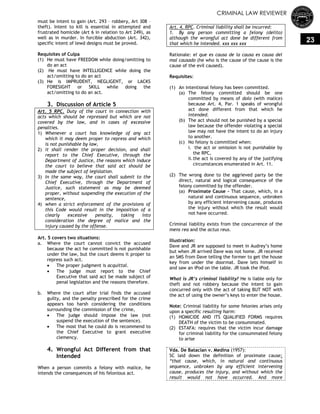
1. Felonies: How Committed
Art. 3. Definitions (RPC) — Acts and omissions
punishable by law are felonies (delitos).
Felonies are committed not only by means of deceit
(dolo) but also by means of fault (culpa).
There is deceit when the act is performed with
deliberate intent; and there is fault when the
wrongful act results from imprudence, negligence,
lack of foresight, or lack of skill.
Intentional Felony v. Culpable Felony
Intentional Culpable
Act is malicious. Not malicious.
With deliberate intent. Injury caused is
unintentional, being just
an incident of another act
performed without
malice.
Has intention to cause
an injury.
Wrongful act results from
imprudence, negligence,
lack of foresight, or lack
of skill.
2. How is Criminal Liability Incurred?
Art. 3 describes the manner of incurring criminal
liability under the Revised Penal Code.
 Intentional felony v. Culpable Felony. – It means
performing or failing to do an act, when either
is punished by law, by means of deceit (with
dolo) or fault (with culpa)
 It is important to note that if the criminal
liability arises from an omission, such as
misprision of treason or abandonment of
helpless persons, there must be a law requiring
the performance of such act.
 In Par. 1 of Art. 4, the law uses the word
―felony,‖ that whoever commits a felony incurs
criminal liability.
 Par. 2 of Art. 4 makes a person liable even if the
accomplishment of his crime is inherently
impossible.
 Art. 6 also provides for liability for the
incomplete elements of a crime.
 There are certain felonies committed by
conspiring in or proposing the commission of
certain acts, the principle behind this can be
found in Art. 8.
 Plural crimes on the other hand are discussed
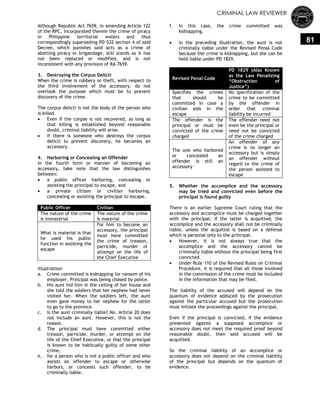
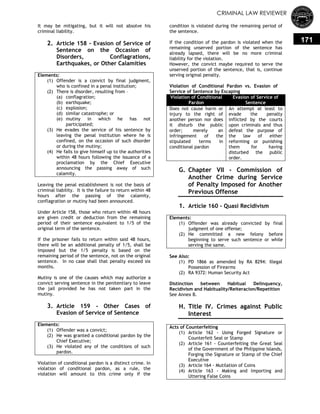
under Art. 48.
Requisites of Dolo or Malice
(1) He must have FREEDOM while doing an act or
omitting to do an act.
(2) He must have INTELLIGENCE while
doing/omitting an act.
(3) He must have INTENT while doing/omitting the
act.
(a) Intent which is a mental process
presupposes the exercise of freedom and
the use of intelligence.
(b) If an act is proven to be unlawful, then
intent will be presumed prima facie. (U.S.
v. Apostol)
(c) An honest mistake of fact destroys the
presumption of criminal intent which arises
from the commission of a felonious act.
(People v. Oanis)
General v. Specific Intent
In some particular felonies, proof of specific intent is
required. In certain crimes against property, there
CRIMINAL LAW REVIEWER
23
must be intent to gain (Art. 293 – robbery, Art 308 –
theft). Intent to kill is essential in attempted and
frustrated homicide (Art 6 in relation to Art 249), as
well as in murder. In forcible abduction (Art. 342),
specific intent of lewd designs must be proved.
Requisites of Culpa
(1) He must have FREEDOM while doing/omitting to
do an act
(2) He must have INTELLIGENCE while doing the
act/omitting to do an act
(3) He is IMPRUDENT, NEGLIGENT, or LACKS
FORESIGHT or SKILL while doing the
act/omitting to do an act.
3. Discussion of Article 5
Art. 5 RPC. Duty of the court in connection with
acts which should be repressed but which are not
covered by the law, and in cases of excessive
penalties.
1) Whenever a court has knowledge of any act
which it may deem proper to repress and which
is not punishable by law,
2) it shall render the proper decision, and shall
report to the Chief Executive, through the
Department of Justice, the reasons which induce
the court to believe that said act should be
made the subject of legislation.
3) In the same way, the court shall submit to the
Chief Executive, through the Department of
Justice, such statement as may be deemed
proper, without suspending the execution of the
sentence,
4) when a strict enforcement of the provisions of
this Code would result in the imposition of a
clearly excessive penalty, taking into
consideration the degree of malice and the
injury caused by the offense.
Art. 5 covers two situations:
a. Where the court cannot convict the accused
because the act he committed is not punishable
under the law, but the court deems it proper to
repress such act.
 The proper judgment is acquittal.
 The judge must report to the Chief
Executive that said act be made subject of
penal legislation and the reasons therefore.
b. Where the court after trial finds the accused
guilty, and the penalty prescribed for the crime
appears too harsh considering the conditions
surrounding the commission of the crime,
 The judge should impose the law (not
suspend the execution of the sentence).
 The most that he could do is recommend to
the Chief Executive to grant executive
clemency.
4. Wrongful Act Different from that
Intended
When a person commits a felony with malice, he
intends the consequences of his felonious act.
Art. 4. RPC. Criminal liability shall be incurred:
1. By any person committing a felony (delito)
although the wrongful act done be different from
that which he intended. xxx xxx xxx
Rationale: el que es causa de la causa es causa del
mal causado (he who is the cause of the cause is the
cause of the evil caused).
Requisites:
(1) An intentional felony has been committed.
(a) The felony committed should be one
committed by means of dolo (with malice)
because Art. 4, Par. 1 speaks of wrongful
act done different from that which he
intended.
(b) The act should not be punished by a special
law because the offender violating a special
law may not have the intent to do an injury
to another.
(c) No felony is committed when:
i. the act or omission is not punishable by
the RPC,
ii.the act is covered by any of the justifying
circumstances enumerated in Art. 11.
(2) The wrong done to the aggrieved party be the
direct, natural and logical consequence of the
felony committed by the offender.
(a) Proximate Cause - That cause, which, in a
natural and continuous sequence, unbroken
by any efficient intervening cause, produces
the injury without which the result would
not have occurred.
Criminal liability exists from the concurrence of the
mens rea and the actus reus.
Illustration:
Dave and JR are supposed to meet in Audrey‘s home
but when JR arrived Dave was not home. JR received
an SMS from Dave telling the former to get the house
key from under the doormat. Dave lets himself in
and saw an iPod on the table. JR took the iPod.
What is JR’s criminal liability? He is liable only for
theft and not robbery because the intent to gain
concurred only with the act of taking BUT NOT with
the act of using the owner‘s keys to enter the house.
Note: Criminal liability for some felonies arises only
upon a specific resulting harm:
(1) HOMICIDE AND ITS QUALIFIED FORMS requires
DEATH of the victim to be consummated.
(2) ESTAFA: requires that the victim incur damage
for criminal liability for the consummated felony
to arise
Vda. De Bataclan v. Medina (1957):
SC laid down the definition of proximate cause:
―that cause, which, in natural and continuous
sequence, unbroken by any efficient intervening
cause, produces the injury, and without which the
result would not have occurred. And more
CRIMINAL LAW REVIEWER
24
comprehensively, 'the proximate legal cause is that
acting first and producing the injury, either
immediately or by setting other events in motion, all
constituting a natural and continuous chain of
events, each having a close causal connection with
its immediate predecessor, the final event in the
chain immediately effecting the injury as a natural
and probable result of the cause which first acted,
under such circumstances that the person
responsible for the first event should, as an ordinary
prudent and intelligent person, have reasonable
ground to expect at the moment of his act or default
that an injury to some person might probably result
therefrom.‖
GENERAL RULE: The offender is CRIMINALLY LIABLE
for ALL the natural and logical consequences of his
felonious act, although not intended, if the felonious
act is the proximate cause of the resulting harm.
Thus, the person is still criminally liable although
the wrongful act done be different from that which
he intended in the following cases:
(1) Error in personae - mistake in the identity of
the victim; injuring one person mistaken for
another (Art. 49 – penalty for lesser crime in its
maximum period)
(a) At least two subjects
(b) A has intent to kill B, but kills C
(c) Under Art. 3, if A hits C, he should have no
criminal liability. But because of Art. 4, his
act is a felony.
(2) Aberratio ictus - mistake in the blow; when
offender intending to do an injury to one person
actually inflicts it on another (Art. 48 on
complex crimes – penalty for graver offense in
its maximum period)
(a) There is only one subject.
(b) The intended subject is a different subject,
but the felony is still the same.
(3) Praeter intentionem - injurious result is greater
than that intended (Art. 13 – mitigating
circumstance)
(a) If A‘s act constitutes sufficient means to
carry out the graver felony, he cannot claim
praeter intentionem.
Proximate Cause v. Immediate Cause v. Remote
Cause
Illustrations:
A, B, C, D, and E were driving their vehicles along
Ortigas Ave. A‘s car was ahead, followed by those of
B, C, D, and E.
When A‘s car reached the intersection of EDSA and
Ortigas Avenue, the traffic light turned red so A
immediately stepped on his brakes, followed by B,
C, and D.
However, E was using his cellphone and therefore
was not aware that the traffic light had turned to
red, so he bumped the car of D, then D hit the car of
C, then C hit the car of B, then, finally, B hit the car
of A.
In this case, the immediate cause of the damage to
the car of A is the car of B, but that is not the
proximate cause.
The proximate cause is the negligence of E (using
his cellphone while driving) because it sets into
motion the collision of all the cars.
US v. Valdez (1921):
The deceased is a member of the crew of a vessel.
Accused is in charge of the crew members engaged
in the loading of cargo in the vessel.
Because the offended party was slow in his work, the
accused shouted at him. The offended party replied
that they would be better if he would not insult
them.
The accused resented this, and rising in rage, he
moved towards the victim, with a big knife in hand
threatening to kill him.
The victim believing himself to be in immediate peril
threw himself into the water. The victim died of
drowning. The accused was prosecuted for homicide.
His contention that his liability should be only for
grave threats since he did not even stab the victim,
that the victim died of drowning, and this can be
considered as a supervening cause.
Held:
The deceased, in throwing himself into the river,
acted solely in obedience to the instinct of self-
preservation, and was in no sense legally responsible
for his own death. As to him, it was but the exercise
of a choice between two evils, and any reasonable
person under the same circumstance might have
done the same.
This case illustrates that proximate cause does not
require that the offender needs to actually touch the
body of the offended party.
It is enough that the offender generated in the mind
of the offended party an immediate sense of danger
that made him place his life at risk. In this case, the
accused must, therefore, be considered the author
of the death of the victim.
Urbano v. IAC (1988):
A and B had a quarrel and A started to hack B with a
bolo. B was wounded at the back.
Upon intervention, the two settled their differences.
A agreed to shoulder all the expenses for the
treatment of the wound of B, and to pay him also
whatever loss of income B may have suffered.
B, on the other hand, signed a statement of his
forgiveness towards A and on that condition, he
withdrew the complaint that he filed against A.
CRIMINAL LAW REVIEWER
25
After so many weeks of treatment in a clinic, the
doctor pronounced that the wound was already
healed. Thereafter, B went back to his farm.
A month later, B came home and was chilling. Before
midnight, he died out of tetanus poisoning.
The heirs of B filed a case of homicide against A.
Held:
The Supreme Court held that A is not liable. A, if at
all, is only liable for the physical injuries inflicted
upon B.
The Court took into account the incubation period of
tetanus toxic. Medical evidence was presented, that
tetanus toxic is good only for two weeks. If, indeed,
the victim had incurred tetanus poisoning out of the
wound inflicted by A, he would not have lasted for
around a month (22 days).
What brought about the tetanus to infect his body
was his work in the farm using his bare hands.
The rule is that the death of the victim must be
the direct, natural, and logical consequence of the
wounds inflicted upon him by the accused. However,
the act of B working in his farm where the soil is
filthy, using his own hands, is an efficient
supervening cause which relieves A of any liability
for the death of B.
There is a likelihood that the wound was but
the remote cause and its subsequent infection, for
failure to take necessary precautions, with tetanus
may have been the proximate cause of Javier's death
with which the petitioner had nothing to do.
The felony committed is not the proximate cause
of the resulting injury when:
(1)There is an active force that intervened
between the felony committed and the
resulting injury, and the active force is a
distinct act or fact absolutely foreign from the
felonious act of the accused; or
(2)The resulting injury is due to the intentional act
of the victim.
The following are not efficient intervening cause:
(1)The weak or diseased physical condition of the
victim, as when one is suffering from
tuberculosis or heart disease. (People v.
Illustre).
(2)The nervousness or temperament of the victim,
as when a person dies in consequence of an
internal hemorrhage brought on by moving
about against the doctor‘s orders, because of
his nervous condition due to the wound
inflicted on the accused. (People v. Almonte).
(3)Causes which are inherent in the victim, such
(a) the victim not knowing to swim and (b) the
victim being addicted to tuba drinking. (People
v. Buhay and People v. Valdez).
(4)Neglect of the victim or third person, such as
the refusal by the injured party of medical
attendance or surgical operation, or the failure
of the doctor to give anti-tetanus injection to
the injured person. (U.S. v. Marasigan).
(5)Erroneous or unskillful medical or surgical
treatment, as when the assault took place in
anu outlaying barrio where proper modern
surgical service was not available. (People v.
Moldes).
5. Omission
It is inaction, the failure to perform a positive duty
which a person is bound to do.
There must be a law requiring the doing or
performing of an act.
Punishable omissions in the RPC:
(1) Art. 116: Misprision of treason.
(2) Art. 137: Disloyalty of public officers or
employees.
(3) Art. 208: Negligence and tolerance in
prosecution of offenses.
(4) Art. 223: Conniving with or consenting to
evasion.
(5) Art. 275: Abandonment of person in danger and
abandonment of one‘s own victim.
(6) Art. 276: Abandoning a minor.
B. Classifications of Felonies
FELONIES ARE CLASSIFIED AS FOLLOWS:
1. According to the manner of their commission
2. According to the stages of their execution
(ASKED 9 TIMES IN BAR EXAMS)
3. According to their gravity
OTHER CLASSIFICATIONS:
4. As to count
5. As to nature
This question was asked in the bar examination: How
do you classify felonies and how are felonies
defined?
 TIP: What the examiner had in mind was Articles
3, 6 and 9. Do not write the classification of
felonies under Book 2 of the Revised Penal
Code.
 The question does not require the candidate to
classify but also to define.
 The purpose of classifying penalties is to bring
about a proportionate penalty and equitable
punishment.
 The penalties are graduated according to their
degree of severity.
◦ The stages (Art. 6) may not apply to all
kinds of felonies.
◦ There are felonies which do not admit of
division.
CRIMINAL LAW REVIEWER
26 1. According to the Manner of Their
Commission
Under Art. 3, they are classified as:
a. Intentional felonies or those committed with
deliberate intent; and
b. Culpable felonies or those resulting from
negligence, reckless imprudence, lack of
foresight or lack of skill.
2. According to the Stages of Their
Execution
Under Art. 6, they are classified as:
a. Attempted
b. Frustrated
c. Consummated
Note: The classification of stages of a felony in
Article 6 are true only to crimes under the Revised
Penal Code. It does NOT apply to crimes punished
under special laws.
However, even certain crimes which are punished
under the Revised Penal Code do not admit of these
stages.
Related to this, classification of felonies as to:
a. Formal Crimes: Crimes which are consummated
in one instance.
Example: ILLEGAL EXACTION under Art. 213
 Mere demanding of an amount different
from what the law authorizes him to collect
will already consummate a crime, whether
the taxpayer pays the amount being
demanded or not.
b. Material Felonies: crimes that have various
stages of execution
c. Felonies by omission: Crimes which have no
attempted stage.
d. Crimes which have NO FRUSTRATED STAGE:
the essence of the crime is the act itself.
Example: in rape, the slightest penetration
already consummates the crime; the same is
true for arson where the slightest burning
already renders the crime complete.
Valenzuela vs. People (2007):
No crime of frustrated theft.
Facts: A grocery boy was caught trying to abscond a
box of Tide Ultrabar laundry soap from the Super
Sale Club. The guards apprehended him at the store
parking lot while trying to board a taxi. He claimed
the theft was merely frustrated for he was not able
to dispose of the goods.
Held: The Revised Penal Code provisions on theft
have not been designed in such fashion as to
accommodate the Adiao, Dino and Empelis rulings.
Again, there is no language in Article 308 that
expressly or impliedly allows that the ―free
disposition of the items stolen‖ is in any way
determinative of whether the crime of theft has
been produced. We thus conclude that under the
Revised Penal Code, there is no crime of frustrated
theft.
3. According to Their Gravity
Under Art. 9, felonies are classified as:
a. Grave felonies or those to which the law
attaches
(1) the capital punishment or
(2) penalties which in any of their periods are
afflictive;
(a) Reclusion perpetua
(b) Reclusion temporal
(c) Perpetual or Absolute DQ
(d) Perpetual or Temporary Special DQ
(e) Prision mayor
(f) Fine more than P6,000
b. Less grave felonies or those to which the law
punishes
(1) with penalties which in their maximum
period is correctional;
(a) Prision correccional
(b) Arresto mayor
(c) Suspension
(d) Destierro
(e) Fines equal to or more than P200
c. Light felonies or those infractions of law for the
commission of which
(1) the penalty is arresto menor, or a fine not
exceeding P200, or both. (ASKED 4 TIMES IN
BAR EXAMS)
Why is it necessary to determine whether the crime
is grave, less grave or light?
(1) To determine
 whether these felonies can be
complexed or not;
 the prescription of the crime and
 the prescription of the penalty.
(2) In other words, these are felonies classified
according to their gravity, stages and the
penalty attached to them.
Take note that when the Revised Penal Code speaks
of grave and less grave felonies, the definition
makes a reference specifically to Art. 25 of the
Revised Penal Code.
Do not omit the phrase ―In accordance with Art. 25‖
because there is also a classification of penalties
under Art. 26 that was not applied.
This classification of felony according to gravity is
important with respect to the question of
prescription of crimes.
(3) Ex. If the penalty is a fine and exactly
P200.00, it is only considered a light felony
under Art. 9. If the fine is imposed as an
alternative penalty or as a single penalty, the
fine of P200.00 is considered a correctional
penalty under Art. 26, hence a less grave
penalty.
CRIMINAL LAW REVIEWER
27
If the penalty is exactly P200.00, apply Art. 26
(with respect to prescription of penalties). It is
considered as a correctional penalty and it
prescribes in 10 years. If the offender is
apprehended at any time within ten years, he
can be made to suffer the fine.
4. As to Count
Plurality of crimes may be in the form of:
a. Compound Crime,
b. Complex crime; and
c. Composite crime.
5. As to Nature
(ASKED 4 TIMES IN BAR EXAMS)
a. Mala in se
b. Mala prohibita
Art. 10. Offenses not subject to the provisions of
this Code. - Offenses which are or in the future may
be punishable under special laws are not subject to
the provisions of this Code. This Code shall be
supplementary to such laws, unless the latter should
specially provide the contrary.
NOTE: Please refer to p. [1] for the table comparing
mala in se and mala prohibita
C. Elements of Criminal Liability
1. Elements of Felonies
a. There must be an act or omission
ACTUS REUS/PHYSICAL ACT to be considered as a
felony, there must be an act or omission;
 Act: Any kind of body movement which tends to
produce some effect in the external world;
includes possession.
 Omission: The failure to perform a positive duty
which one is bound to do under the law.
It is important that there is a law requiring the
performance of an act; if there is no positive duty,
there is no liability.
Examples: Failure to render assistance,9
failure to
issue receipt or non-disclosure of knowledge of
conspiracy against the government.10
Mens rea: "A guilty mind, a guilty or wrongful
purpose or criminal intent."11
Sometimes referred to in common parlance as the
gravamen of the offense (bullseye of the crime), or
criminal or deliberate intent.
9
Art. 275. Abandonment of person in danger and
abandonment of one's own victim.
10
Art. 116. Misprision of treason.
11
Black's Law Dictionary, 5th ed., p. 889
For an act to be punishable, there must be a
CONCURRENCE BETWEEN THE ACT and the INTENT.
b. That the act or omission must be
punishable by the RPC;
c. That the act is performed or the
omission incurred by means of dolo or
culpa.
Dolo is DELIBERATE INTENT otherwise referred to as
criminal intent, and must be coupled with freedom
of action and intelligence on the part of the
offender as to the act done by him.
Liability even in the absence of criminal intent
There are two exceptions to the requirement of
criminal intent:
(a) Felonies committed by CULPA. (infra)
(b) Offenses MALA PROHIBITA. (infra)
Intentional Felonies
The act or omission is performed or incurred with
deliberate intent (with malice) to cause an injury to
another.
Requisites
i. Freedom
Voluntariness on the part of the person who commits
the act or omission.
If there is lack of freedom, the offender is exempt
from liability (i.e., presence of irresistible force or
uncontrollable fear)
ii. Intelligence
Capacity to know and understand the consequences
of one‘s act.
This power is necessary to determine the morality of
human acts, the lack of which leads to non-existence
of a crime.
If there is lack of intelligence, the offender is
exempt from liability. (i.e., offender is an imbecile,
insane or under 15 years of age)
iii. Criminal intent
The purpose to use a particular means to effect a
result.
The intent to commit an act with malice, being
purely a mental state, is presumed (but only if the
act committed is unlawful). Such presumption arises
from the proof of commission of an unlawful act.
However, in some crimes, intent cannot be
presumed being an integral element thereof; so it
has to be proven.
Example: In frustrated homicide, specific intent to
kill is not presumed but must be proven, otherwise it
is merely physical injuries.
CRIMINAL LAW REVIEWER
28 Recuerdo v. People (2006):
 General criminal intent is an element of all
crimes but malice is properly applied only to
deliberate acts done on purpose and with
design.
 Evil intent must unite with an unlawful act for
there to be a felony. A deliberate and unlawful
act gives rise to a presumption of malice by
intent.
 On the other hand, specific intent is a definite
and actual purpose to accomplish some
particular thing.
The general criminal intent is presumed from the
criminal act and in the absence of any general intent
is relied upon as a defense, such absence must be
proved by the accused.
Generally, a specific intent is not presumed. Its
existence, as a matter of fact, must be proved by
the State just as any other essential element.
This may be shown, however, by the nature of the
act, the circumstances under which it was
committed, the means employed and the motive of
the accused
Note: If any of the elements is absent, there is no
dolo. If there is no dolo, there could be no
intentional felony.12
Categories of Intent
General Criminal Intent Specific Criminal Intent
The intention to do
something wrong.
The intention to commit
a definite act.
Presumed from the
mere doing of a wrong
act.
Existence is not
presumed.
The burden is upon the
wrong doer to prove
that he acted without
such criminal intent.
Since the specific intent
is an element of the
crime, the burden is
upon the prosecution to
establish its existence.
Illustration:
Ernie, without any provocation, stabbed Bert.
The very act of stabbing is the quantum of proof
needed to establish the fact that Ernie intended to
do something wrong. This is the GENERAL CRIMINAL
INTENT.
However, Ernie can be liable for more than one
crime; thus, prosecution must establish Ernie‘s
SPECIFIC INTENT in order to determine whether he
planned to kill Bert or merely to inflict a whole lot
of pain.
Ernie can overturn the presumption of general
criminal intent by proving that he was justified
(infra), entitled to any exempting circumstances
12
Visbal vs. Buban (2003)
(due to lack of discernment) or there was a mistake
of fact (infra).
If he is successful, then the presumption that he
intended to do something wrong is overcome along
with the need to determine specific intent.
However, the result of Ernie‘s act will now
determine his liability. Was his act justified that he
incurs no liability? Is he entitled to any exemption?
Or is his liability only mitigated?
DISTINCTION Between Intent, Discernment and
Motive (ASKED 4 TIMES IN BAR EXAMS)
INTENT DISCERNMENT MOTIVE
Determination
to do a
certain thing,
an aim or
purpose of
the mind.
The mental
capacity to tell
right from
wrong.
It is the moving
power which
impels one to
do an act (ex.
vengeance).
Establish the
nature and
extent of
culpability in
intentional
felonies.
Integral to the
element of
intelligence,
NOT intent.
Generally, it is
not an essential
element of a
crime, hence, it
need not be
proved for
purposes of
conviction
(except in
certain cases
enumerated
below)
When Motive Becomes Material in Determining
Criminal Liability (ASKED ONCE IN BAR EXAMS)
i. When the act brings about variant crimes (e.g.
kidnapping v. robbery13
)
ii. When there is doubt as to the identity of the
assailant.
iii. When there is the need to ascertain the truth
between two antagonistic versions of the crime.
iv. When the identification of the accused proceeds
from an unreliable source and the testimony is
inconclusive and not free from doubt.
v. When there are no eyewitnesses to the crime,
and when suspicion is likely to fall upon a
number of persons.
vi. When the evidence on the commission of the
crime is purely circumstantial.
 Lack of motive can aid in achieving
acquittal of the accused, especially where
there is doubt as to the identity of the
accused.14
Illustration:
Ernie came home and found his wife in a pleasant
conversation with Bert, former suitor. Thereupon, he
went to the kitchen, opened a drawer and pulled out
a knife. He then stabbed Bert.
The moving force is jealousy.
13
People v. Puno (1993)
14
People vs Hassan, 1988
CRIMINAL LAW REVIEWER
29
The intent is presumed from the resort to the knife,
so that means he desires to kill Bert, the former
suitor.
Ernie‘s deliberate choice of something as lethal as
the knife shows the presence of intelligence because
it is his very awareness of the danger which
prompted his choice. This only means that he knew
what is right from wrong and deliberately chose to
do what is wrong.
Note: Discernment does not indicate the presence of
intent, merely intelligence.15
Thus, discernment is
necessary whether the crime is dolo or culpa.
People v. Delos Santos (2003):
Delos Santos stabs Flores with a kitchen knife hitting
him on the different parts of his body, inflicting
upon him mortal wounds which directly caused his
death.
He then argues that since the prosecution witnesses
testified that there was no altercation between him
and Flores, it follows that no motive to kill can be
attributed to him.
Held:
The court held that the argument of Delos Santos is
inconsequential.
Proof of motive is not indispensable for a conviction,
particularly where the accused is positively
identified by an eyewitness and his participation is
adequately established.
In People vs. Galano, the court ruled that in the
crime of murder, motive is not an element of the
offense, it becomes material only when the evidence
is circumstantial or inconclusive and there is some
doubt on whether the accused had committed it.
In this case, the court finds that no such doubt
exists, as witnesses De Leon and Tablate positively
identified Delos Santos.
(1) Mistake of Fact (ignorantia facti excusat)
(ASKED ONCE IN BAR EXAMS)
It is a reasonable misapprehension of fact on the
part of the person causing injury to another. Such
person is NOT criminally liable as he acted without
criminal intent.
Under this principle, what is involved is the lack of
intent on the part of the accused. Therefore, the
defense of mistake of fact is an untenable defense
in culpable felonies, where there is no intent to
consider.
An honest mistake of fact destroys the presumption
of criminal intent which arises upon the commission
of a felonious act.
15
People v. Cordova 1993
Requisites:
(a) That the act done would have been lawful had
the facts been as the accused believed them to
be;
(b) That the intention of the accused in performing
the act should be lawful;
(c) That the mistake must be without fault or
carelessness on the part of the accused. When
the accused is negligent, mistake of fact is not a
defense.16
US v. Ah Chong (1910):
A cook who stabs his roommate in the dark, honestly
mistaking the latter to be a robber responsible for a
series of break-ins in the area, and after crying out
sufficient warnings and believing himself to be under
attack, cannot be held criminally liable for
homicide.
1) Would the stabbing be lawful if the facts were
really what the houseboy believed? Yes. If it was
really the robber and not the roommate then
the houseboy was justified.
2) Was the houseboy‘s intention lawful? Yes. He
was acting out of self-preservation.
3) Was the houseboy without fault or negligence?
Yes. His deliberate intent to defend himself
with the knife can be determined by the fact
that he cried out sufficient warnings prior to the
act.
Stabbing the victim whom the accused believed to
be an intruder showed a mistake of fact on his part
which led him to take the facts as they appear to
him and was pressed to take immediate action.
However, mistake of fact is NOT availing in People
v. Oanis (74 Phil. 257), because the police officers
were at fault when they shot the escaped convict
who was sleeping, without first ascertaining his
identity. (It is only when the fugitive is determined
to fight the officers of law trying to catch him that
killing the former would be justified)
(2) Culpa (CONSTRUCTIVE INTENT)
Although there is no intentional felony, there could
be culpable felony.
The act or omission is not malicious; the injury
caused being simply the incident of another act
performed without malice.
The element of criminal intent is replaced by
negligence, imprudence, lack of foresight or lack of
skill.
Is culpa merely a mode of committing a crime or a
crime in itself?
(a) AS A MODE
16
People v. Oanis, 1988
CRIMINAL LAW REVIEWER
30
Under Art. 3, it is clear that culpa is just a modality
by which a felony may be committed.
People vs. Faller (1939):
It was stated indirectly that criminal negligence or
culpa is just a mode of incurring criminal liability.
In this case, the accused was charged with malicious
mischief.
Malicious mischief is an intentional negligence under
Article 327. Thus, there is no malicious mischief
through simple negligence or reckless imprudence
because it requires deliberateness.
The Supreme Court pointed out that although the
allegation in the information charged the accused
with an intentional felony, yet the words feloniously
and unlawfully, which are standard languages in an
information, covers not only dolo but also culpa
because culpa is just a mode of committing a felony.
(b) AS A CRIME
In Art. 365, criminal negligence is an omission which
the article specifically penalizes.
The concept of criminal negligence is the
inexcusable lack of precaution on the part of the
person performing or failing to perform an act.
Art. 365 creates a distinction between imprudence
and negligence; simple or reckless, one might think
that criminal negligence is the one being punished.
Requisites:
(a) Freedom
(b) Intelligence
(c) Negligence, reckless imprudence, lack of
foresight or lack of skill;
People v. Buan (1968):
The accused was driving a passenger bus. Allegedly
because of his recklessness, the bus collided with a
jeep injuring the passengers of the latter.
A case was filed against the accused for slight
physical injuries through reckless imprudence for
which he was tried and acquitted.
Prior to his acquittal, a case for serious physical
injuries and damage to property through reckless
imprudence was filed.
Accused claimed that he was placed in twice in
jeopardy.
Held:
The second case must be dismissed.
 Once convicted or acquitted of a specific act of
reckless imprudence, the accused may not be
prosecuted again for the same act.
 For the essence of the quasi-offense under Art.
365 of the RPC lies in the execution of an
imprudent act which would be punishable as a
felony.
 The law penalizes the negligent act and not the
result.
 The gravity of the consequences is only taken
into account to determine the penalty. It does
not qualify the substance of the offense.
 As the careless act is single, whether the
injurious result should affect one person or
several persons, the offense remains one and
the same, and cannot be split into different
crimes and prosecutions.
Negligence - Indicates deficiency of perception,
failure to pay proper attention, and to use diligence
in foreseeing the injury or damage impending to be
caused. Usually involves lack of foresight.
Imprudence - Indicates deficiency of action, failure
to take the necessary precaution to avoid injury to
person or damage to property. Usually involves lack
of skill.
Reason for punishing acts of negligence or
imprudence: A man must use his common sense and
exercise due reflection in all his acts; it is his duty to
be cautious, careful and prudent.
DOCTRINES CONCERNING CULPABLE CRIMES
(a) Emergency Rule
 A person who is confronted with a sudden
emergency may be left no time for thought so
he must make a speedy decision based largely
upon impulse or instinct.
Importance: cannot be held to the same conduct as
one who has had an opportunity to reflect, even
though it later appears that he made the wrong
decision.
(b) Doctrine Of ―Last Clear Chance‖
The contributory negligence of the party injured will
NOT defeat the action if it be shown that the
accused might, by the exercise of reasonable care
and prudence, have avoided the consequences of the
negligence of the injured party.
But: The doctrine is not applicable in criminal cases:
Anuran v. Buno (1966):
 The principle about the "last clear chance"
ORAct of Dolo Act of Culpa
INTENTIONAL CRIMINAL
NEGLIGENCE
(ART 365)
FELONIES
OR
Act of Dolo Act of Culpa
FELONY
CRIMINAL LAW REVIEWER
31
would call for application in a suit between the
owners and drivers of the two colliding vehicles.
 It does not arise where a passenger demands
responsibility from the carrier to enforce its
contractual obligation. For it would be
inequitable to exempt the negligent driver of
the jeepney and its owners on the ground that
the other driver was likewise guilty of
negligence.
 Last Clear Chance is a defense by the defendant
in a damage suit against liability by transferring
it to the plaintiff.
 These dynamics cannot be replicated in a
criminal case because:
i. the liability is penal in nature and thus
cannot be transferred within the same case
It is not a case between two parties involved in an
incident but rather between an individual and the
State.
(c) Rule Of Negative Ingredient
This is related to the doctrine of proximate cause
and applicable when certain causes leading to the
result are not identifiable.
This rule states that:
i. The prosecution must first identify what
the accused failed to do.
ii. Once this is done, the burden of evidence
shifts to the accused.
iii. The accused must show that the failure did
not set in motion the chain of events
leading to the injury.17
D. Impossible Crimes
Purpose of punishing impossible crimes: To suppress
criminal propensity or criminal tendencies.
Objectively, the offender has not committed a
felony, but subjectively, he is a criminal.
Requisites:
(1) That the act performed would be an offense
against persons or property.
(2) That the act was done with evil intent.
 The offender intends to commit a
felony against persons or against
property, and the act performed would
have been an offense against persons or
property.
 It must be shown that the actor
performed the act with the intent to do
an injury to another.
 However, it should not be actually
performed, for otherwise, he would be
liable for that felony.
(3) That its accomplishment is inherently
impossible, or that the means employed is
either inadequate or ineffectual.
17
Carillo vs People, 1994
Inherent impossibility: The act intended by the
offender is by its nature one of impossible
accomplishment.
There must be either (1) legal impossibility or (2)
physical impossibility of accomplishing the intended
act.
Legal impossibility: The intended acts, even if
completed, would not amount to a crime. Legal
impossibility would apply to those circumstances
where:
a. the motive, desire and expectation is to
perform an act in violation of the law;
b. there is intention to perform the physical
act;
c. there is a performance of the intended
physical act; and
d. the consequence resulting from the
intended act does not amount to a crime.
(Intod v. CA)
Physical or factual impossibility: Extraneous
circumstances unknown to the actor or beyond his
control prevent the consummation of the intended
crime.
Note: In the Philippines, impossibility of
accomplishing the criminal intent is not merely
a defense but an act penalized by itself.
(4) That the act performed should not constitute a
violation of another provision of the RPC.
Illustration:
The victim was tortured to death. He was later shot
in the back to make it appear that he was killed
while trying to escape. The accused is not a
principal to an impossible crime but an accessory to
the killing committed by the principal (People v.
Saladino).
Note: Since the offender in an impossible crime has
already performed the acts for the execution of the
same, there could be no attempted impossible
crime. There is no frustrated impossible crime
either, because the acts performed by the offender
are considered as constituting a consummated
offense.
Felonies against persons:
(a) Parricide (Art. 246)
(b) Murder (Art. 248)
(c) Homicide (Art. 249)
(d) Infanticide (Art. 255)
(e) Abortion (Arts. 256, 257, 258 and 259)
(f) Duel (Arts. 260 and 261)
(g) Physical injuries (Arts. 262, 263, 264, 265 and
266)
(h) Rape (Art. 266- A)
Felonies against property:
(a) Robbery (Arts. 294, 297, 298, 299, 300, 302 and
303)
(b) Brigandage (Arts. 306 and 307)
CRIMINAL LAW REVIEWER
32
(c) Theft (Arts. 308, 310 and 311)
(d) Usurpation (Arts. 312 and 313)
(e) Culpable Insolvency (Art. 314)
(f) Swindling and other deceits (Art. 315, 316, 317
and 318)
(g) Chattel Mortgage (Art. 319)
(h) Arson and other crimes involving destruction
(Arts. 320, 321, 322, 323, 324, 325 and 326)
(i) Malicious mischief (Arts. 327, 328, 329, 330 and
331)
Modified concept of impossible crime
Intod v. CA (1992):
 In this case, four culprits, all armed with
firearms and with intent to kill, went to the
intended victim‘s house and after having
pinpointed the latter‘s bedroom, all four fired
at and riddled the said room with bullets,
thinking that the intended victim was already
there as it was about 10:00 in the evening.
 It so happened that the intended victim did not
come home that evening and so was not in her
bedroom at that time.
 Eventually the culprits were prosecuted and
convicted by the trial court for attempted
murder.
 CA affirmed the judgment but the SC modified
the same and held the petitioner liable only for
the so-called impossible crime.
 As a result, petitioner-accused was sentenced to
imprisonment of only six months of arresto
mayor for the felonious act he committed with
intent to kill: this despite the destruction done
to the intended victim‘s house.
E. Stages of Execution
Classification Under Art. 6
a. Consummated Felony
When all the elements necessary for its execution
and accomplishment are present; the felony is
produced.
b. Frustrated Felony
When the offender performs all the acts of execution
which would produce the felony as a consequence
but which, nevertheless, do not produce it by reason
of causes independent of the will of the perpetrator.
c. Attempted Felony
When the offender commences the commission of a
felony directly by overt acts, and does not perform
all the acts of execution which should produce the
felony by reason of some cause or accident other
than his own spontaneous desistance.
Development of a Crime
ELEMENTS OF CRIMINAL
LIABILITY
IMPOSSIBLE CRIME
ATTEMPTED FRUSTRATED CONSUMMATED
Actus Reus
Lacking due to:
i. inherent
impossibility
ii. employment of
inadequate means
Intervention other
than own desistance;
some but not all acts
of execution
 
Mens Rea    
Concurrence    
Result    
Causation    
a. Overt act
A commission of the felony is deemed commenced
when the following are present:
(1) There are external acts.
(2) Such external acts have a direct connection with
the crime intended to be committed.
Overt act: Some physical activity or deed (but not
necessarily physical, depending on the nature of the
felony) indicating the intention to commit a
particular crime, more than a mere planning or
preparation, which if carried to its complete
termination following its natural course, without
being frustrated by external obstacles nor by the
voluntary desistance of the perpetrator, will
logically and necessarily ripen into a concrete
offense.
Rait v. People (2008):
The Court found that the petitioner‘s acts of
successfully removing victim‘s clothing and inserting
his finger to the victim‘s vagina were overt or
external acts in the crime of rape.
The acts were clearly the first or some subsequent
step in a direct movement towards the commission
of the offense after the preparations are made. Had
it not been for the victim‘s strong physical
resistance, petitioner‘s next step would, logically,
be having carnal knowledge of the victim.
b. Development of a crime
(1) Internal acts
Intent, ideas and plans; generally not punishable.
The intention and act must concur.
Illustration: Ernie plans to kill Bert
(2) External acts
CRIMINAL LAW REVIEWER
33
(a) Preparatory Acts
 Acts tending toward the crime.
 Ordinarily not punished except when considered
by law as independent crimes (i.e. Art. 304 –
possession of picklocks)
 Proposal and conspiracy to commit a felony are
not punishable except when the law provides for
their punishment in certain felonies.
 These acts do not yet constitute even the first
stage of the acts of execution.
 Intent not yet disclosed.
Illustration: Ernie goes to the kitchen to get a knife.
(b) Acts of Execution
 Usually overt acts with a logical relation to a
particular concrete offense.
 Punishable under the RPC.
Illustration: Ernie stabs Bert
Indeterminate offense
It is one where the purpose of the offender in
performing an act is not certain. Its nature in
relation to its objective is ambiguous. The intention
of the accused must be viewed from the nature of
the acts executed by him, and not from his
admission.
Attempted and Frustrated Felonies
The difference between the attempted stage and
the frustrated stage lies in: whether the offender
has performed all the acts of execution for the
accomplishment of a felony.
Attempted Felony Frustrated Felony
Acts Performed
Overt acts of execution are started
BUT
Not all acts of execution are present
All acts of execution are finished
BUT
Crime sought to be committed is not
achieved
Why
Due to reasons other than the
spontaneous desistance of the
perpetrator
Due to intervening causes independent of
the will of the perpetrator
Position in the Timeline
Offender still in subjective phase
because he still has control of his
acts, including their natural cause.
Offender is already in the objective
phase because all acts of execution are
already present and the cause of its non-
accomplishment is other than the
offender‘s will
a. Attempted Stage
Elements:
(1) The offender commences the commission of the
felony directly by overt acts;
(2) He does not perform all the acts of execution
which should produce the felony;
(3) The non-performance of all acts of execution
was due to cause or accident other than his own
spontaneous desistance.
Marks the commencement of the subjective phase:
Subjective phase - That portion of the acts
constituting a crime, starting from the point where
the offender begins the commission of the crime to
that point where he still has control over his acts
including their (act‘s) natural course
If between those two points, the offender is stopped
by reason of any cause outside of his own voluntary
desistance, the subjective phase has not been
passed and it is merely an attempt.
Illustration: The subjective phase for Ernie was from
the moment he swung his arm to stab Bert up until
he finished his stroke. This is the interim where he
still has control of his actions.
Desistance – is an absolutory cause which negates
criminal liability because the law encourages a
person to desist from committing a crime.
But, it does not negate all criminal liability, if the
desistance was made when acts done by him already
resulted in a felony,
The offender will still be criminally liable for the
felony brought about by his act.
What is negated is only the attempted stage, but
there may be other felonies arising from his act.
Note: Desistance is true only in the attempted stage
of the felony.
If the felony is already in its frustrated stage,
desistance will NOT negate criminal liability.
Illustration: Supposing Ernie (because he thought
killing Bert was too easy a revenge) desisted mid-
stroke. However, Bert felt the movement and
turned. He was so shocked that he suddenly backed
away and tripped over his own feet. As Bert went
down, his left eye caught the sharp corner of a table
causing a puncture on his eyeball rendering him
completely blind on the left side.
 Ernie would not be liable for attempted
murder because of his desistance (regardless
of his reason for doing so)
 His liability would now be for serious physical
injuries because his act of raising the knife was
the proximate cause for Bert losing an eye.
CRIMINAL LAW REVIEWER
34
In the attempted stage, the definition uses the word
“directly.‖
The word ―directly‖ emphasizes the requirement
that the attempted felony is that which is directly
linked to the overt act performed by the offender,
not the felony he has in his mind.
People v. Lamahang (1935):
The accused was arrested while he was detaching
some of the wood panels of a store. He was already
able to detach two panels.
Held: In criminal law, since the act of removing the
panel indicates only at most the intention to enter,
he can only be prosecuted for trespass. There is
nothing in the record to justify a concrete finding
that his final objective, once he succeeded in
entering the store, was to rob, to cause physical
injury to the inmates, or to commit any other
offense. The removal of the paneling is just an
attempt to trespass, not an attempt to rob. Although
Lamahang was charged with attempted robbery, the
Supreme Court held that he is only liable for
attempted trespass because that is the crime that
can be directly linked to his act of removing the
wood panel.
There are some acts which are ingredients of a
certain crime, but which are, by themselves, already
criminal offenses.
People v. Campuhan (2000):
The mother of the 4-year-old victim caught the
houseboy Campuhan in the act of almost raping her
daughter.
The hymen of the victim was still intact. However,
since it was decided in People v. Orita that entry
into labia is considered rape even without rupture
and full penetration of the hymen, a question arises
whether what transpired was attempted or
consummated rape.
Held:
 There was only attempted rape.
 Mere touching of external genitalia by the penis
is already rape.
 Touching should be understood as inherently
part of entry of penis penetration and not mere
touching, in the ordinary sense, of the
pudendum.
 Requires entry into the labia, even if there be
no rupture of the hymen or laceration of the
vagina, to warrant a conviction for
consummated rape.
 Where entry into the labia has not been
established, the crime amounts to an attempted
rape.
 The prosecution did not prove that Campuhan‘s
penis was able to penetrate victim‘s vagina
because the kneeling position of the accused
obstructed the mother‘s view of the alleged
sexual contact. The testimony of the victim
herself claimed that penis grazed but did not
penetrate her organ.
 There was only a shelling of the castle but no
bombardment of the drawbridge yet.
b. Frustrated Stage
Elements
(1) The offender performs all the acts of execution;
(2) All the acts performed would produce the felony
as a consequence;
(3) But the felony is not produced;
(4) By reason of causes independent of the will of
the perpetrator.
The end of the subjective phase and the beginning of
the objective phase.
Objective phase – the result of the acts of
execution, that is, the accomplishment of the crime.
If the subjective and objective phases have been
passed there is a consummated felony.
People v. Listerio (2000):
Brothers Jeonito and Marlon were walking when they
met a group composed of men who blocked their
path and attacked them with lead pipes and bladed
weapons. One stabbed Jeonito from behind.
Jeonito‘s brother, Marlon, was hit on the head.
Held:
1) The SC held that the crime is a frustrated felony
not an attempted offense considering that after
being stabbed and clubbed twice in the head as
a result of which he lost consciousness and fell.
Marlon's attackers apparently thought he was
already dead and fled.
2) A crime cannot be held to be attempted unless
the offender, after beginning the commission of
the crime by overt acts, is prevented, against
his will, by some outside cause from performing
all of the acts which should produce the crime.
3) In other words, to be an attempted crime, the
purpose of the offender must be thwarted by a
foreign force or agency which intervenes and
compels him to stop prior to the moment when
he has performed all of the acts which should
produce the crime as a consequence, which acts
it is his intention to perform.
4) If he has performed all the acts which should
result in the consummation of the crime and
voluntarily desists from proceeding further, it
cannot be an attempt.
Crimes which do not admit of frustrated stage
(a) Rape
 The essence of the crime is carnal
knowledge.
 No matter what the offender may do to
accomplish a penetration, if there was no
penetration yet, it cannot be said that the
offender has performed all the acts of
execution.
CRIMINAL LAW REVIEWER
35
We can only say that the offender in rape
has performed all the acts of execution
when he has effected a penetration.
 Once there is penetration, no matter how
slight it is, the offense is consummated.
People v. Orita (1990):
For this reason, rape admits only of the attempted
and consummated stages, no frustrated stage. (see
the previously cited case of People v. Campuhan for
the most recent doctrine on penetration).
(b) Arson
 One cannot say that the offender, in the
crime of arson, has already performed all
the acts of execution which could produce
the destruction of the premises through the
use of fire, unless a part of the premises
has begun to burn.
 The crime of arson is therefore
consummated even if only a portion of the
wall or any part of the house is burned. The
consummation of the crime of arson does
not depend upon the extent of the damage
caused. (People v. Hernandez)
(c) Bribery and Corruption of Public Officers
 The manner of committing the crime
requires the meeting of the minds between
the giver and the receiver.
 If there is a meeting of the minds, there is
consummated bribery or consummated
corruption.
 If there is none, it is only attempted.
(d) Adultery
 This requires the sexual contact between
two participants.
 If that link is present, the crime is
consummated;
(e) Physical Injuries
 Under the Revised Penal Code, the crime of
physical injuries is penalized on the basis of
the gravity of the injuries.
 There is no simple crime of physical
injuries. There is the need to categorize
because there are specific articles that
apply whether the physical injuries are
serious, less serious or slight.
 Thus, one could not punish the attempted
or frustrated stage because one does not
know what degree of physical injury was
committed unless it is consummated.
Illustration:
When Bert lost his left eye, Ernie‘s liability was
automatically for serious physical injuries. He would
have no liability if the eye was intact.
If the eye suffered damage due to the impact, the
crime would not be frustrated nor attempted
physical injuries because the RPC still considers this
as a consummated physical injury, its gravity
depending on the duration that it took for the
damage to heal.
(f) Theft
 Once there is unlawful taking, theft is
consummated.
 Either the thing was taken or not.
 Disposition of the stolen goods is not an
element of theft under the RPC.
Rule of thumb: Felonies that do not require any
result do not have a frustrated stage.
Factors in Determining the Stage of Execution of a
Felony
a. The manner of committing the crime;
b. The elements of the crime; and
c. The nature of the crime itself.
These three factors are helpful in trying to pinpoint
whether the crime is still in its attempted,
frustrated or consummated stage.
a. The Manner of Committing the Crime
(1) Formal Crimes - consummated in one
instant, no attempt.
(a) Ex. Slander and false testimony
(b) There can be no attempt, because
between the thought and the deed,
there is no chain of acts that can be
severed.
(2) Crimes consummated by mere attempt or
proposal by overt act.
(a) Ex. Flight to enemy‘s country (Art. 121)
and corruption of minors (Art. 340)
(3) Felony by omission
(a) There can be no attempted stage when
the felony is by omission, because the
offender does not execute acts, he
omits to perform an act which the law
requires him to do.
(4) Crimes requiring the intervention of two
persons to commit them are consummated
by mere agreement.
(a) In bribery, the manner of committing
the crime requires the meeting of the
minds between the giver and the
receiver.
(b) When the giver delivers the money to
the supposed receiver, but there is no
meeting of the minds, the only act
done by the giver is an attempt.
(5) Material Crimes – have three stages of
execution
Thus, in determining the stage of some
crimes, the manner of execution becomes
pivotal in determining the end of the
subjective phase, i.e. once the offender
performs the act in the manner provided for
in the law, HE IS ALREADY DEEMED TO HAVE
PERFORMED EVERY ACT FOR ITS EXECUTION.
CRIMINAL LAW REVIEWER
36
b. The Elements of the Crime
(1) Along with the manner of execution, there are
crimes wherein the existence of certain
elements becomes the factor in determining its
consummation.
(2) In the crime of estafa, the element of damage
is essential before the crime could be
consummated. If there is no damage, even if the
offender succeeded in carting away the personal
property involved, estafa cannot be considered
as consummated.
(3) On the other hand, if it were a crime of theft,
damage or intent to cause damage is not an
element of theft.
(4) What is necessary only is intent to gain, not
even gain is important.
(5) In the crime of abduction, the crucial element
is the taking away of the woman with lewd
designs.
c. The Nature of the Crime Itself
In defining of the frustrated stage of crimes involving
the taking of human life (parricide, homicide, and
murder), it is indispensable that the victim be
mortally wounded.
Hence, the general rule is that there must be a fatal
injury inflicted, because it is only then that death
will follow.
F. Conspiracy and Proposal
Conspiracy – exists when two or more persons come
to an agreement concerning the commission of a
felony and decide to commit it. (Article 8, RPC).
Requisites of conspiracy:
(1) Two or more persons come to an agreement.
 Agreement presupposes meeting of the
minds of two or more persons
(2) The agreement pertains to a commission of a
felony.
 Agreement to effect what has been
conceived and determined.
(3) The execution of the felony was decided upon.
Note: There must be participation in the criminal
resolution because simple knowledge thereof by a
person may only make him liable as an accomplice.
GENERAL RULE: Conspiracy and proposal to commit
a felony are not punishable.
EXCEPTION: They are punishable only in the cases in
which the law specially provides a penalty therefore.
Conspiracy to commit -
(1) Treason (Art. 115)
(2) Rebellion (Art. 136)
(3) Insurrection (Art. 136)
(4) Coup d’état, (Art. 136)
(5) Sedition (Art. 141)
(6) Monopolies and combinations in restraint of
trade, espionage (Art. 186)
(7) Illegal association (Art. 147)
(8) Highway Robbery (P.D. 532)
(9) Espionage (Sec. 3, C.A. 616)
(10) Selected acts under the Dangerous Drugs Acts
(11) Arson
(12) Terrorism (R.A. 9372)
Proposal to commit –
(1)Treason (Art. 115)
(2)Coup d’ etat (Art. 136)
(3)Rebellion (Art. 136)
(4)Inducement not to answer summons, appear or
be sworn in Congress, etc. (Art. 150)
Rationale: Conspiracy and proposal to commit a
crime are only preparatory acts and the law regards
them as innocent or at least permissible except in
rare and exceptional cases.
Conspiracy as a felony, distinguished from
conspiracy as a manner of incurring criminal
liability:
 As a felony, conspirators do not need to actually
commit treason, rebellion, insurrection, etc., it
being sufficient that two or more persons agree
and decide to commit it.
 As a manner of incurring criminal liability, if
they commit treason, rebellion, etc., they will
be held liable for it, and the conspiracy which
they had before committing the crime is only a
manner of incurring criminal liability, not a
separate offense.
In conspiracy, the act of one is the act of all.
GENERAL RULE: When the conspiracy is established,
all who participated therein, irrespective of the
quantity or quality of his participation is liable
equally, whether conspiracy is pre-planned or
instantaneous.
EXCEPTION: Unless one or some of the conspirators
committed some other crime which is not part of the
conspiracy.
EXCEPTION TO THE EXCEPTION: When the act
constitutes a ―single indivisible offense.‖
Proposal to commit a felony - when the person who
has decided to commit a felony proposes its
execution to some other person or persons. (Art. 8,
RPC)
Examples: Proposal to commit treason (Art. 115)
and proposal to commit coup d‘état, rebellion or
insurrection (Art. 136).
Requisites:
(1) That a person has decided to commit a felony;
and
(2) That he proposes its execution to some other
person or persons.
CRIMINAL LAW REVIEWER
37
There is no criminal proposal when:
(1) The person who proposes is not determined to
commit the felony;
(2) There is no decided, concrete and formal
proposal;
(3) It is not the execution of a felony that is
proposed.
Note: It is not necessary that the person to whom
the proposal is made agrees to commit treason or
rebellion.
People v. Laurio (1991): It must be established by
positive and conclusive evidence, not by
conjectures or speculations.
People v. Bello (2004): Conspiracy is predominantly
a state of mind as it involves the meeting of the
minds and intent of the malefactors. Consequently,
direct proof is not essential to establish it.
People v. Comadre (2004):
 To establish conspiracy, evidence of actual
cooperation rather than mere cognizance or
approval of an illegal act is required.
 Conspiracy is never presumed; it must be shown
to exist as clearly and convincingly as the
commission of the crime itself.
 Mere presence of a person at the scene of the
crime does not make him a conspirator for
conspiracy transcends companionship.
People v. Cenahonon (2007):
While it is mandatory to prove conspiracy by
competent evidence, direct proof is not essential to
show it – it may be deduced from the mode, method,
and manner by which the offense was perpetrated,
or inferred from the acts of the accused themselves
when such acts point to a joint purpose and design,
concerted action and community of interest.
The accused herein were shown to have clearly
acted towards a common goal.
People v. Talaogan (2008):
Direct proof is not required, as conspiracy may be
proved by circumstantial evidence. It may be
established through the collective acts of the
accused before, during and after the commission
of a felony that all the accused aimed at the same
object, one performing one part and the other
performing another for the attainment of the same
objective; and that their acts, though apparently
independent, were in fact concerted and
cooperative, indicating closeness of personal
association, concerted action and concurrence of
sentiments.
People v. Pangilinan (2003):
Doctrine of Implied Conspiracy (ASKED 1 TIME IN
BAR EXAMS) – Conspiracy need not be direct but may
be inferred from the conduct of the parties, their
joint purpose, community of interest and in the
mode and manner of commission of the offense.
Legal effects of implied conspiracy are:
 Not all those present at the crime scene will be
considered conspirators;
 Only those who participated in the criminal acts
during the commission of the crime will be
considered co-conspirators;
 Mere acquiescence to or approval of the
commission of the crime, without any act of
criminal participation, shall not render one
criminally liable as co-conspirator.
 In the absence of any previous plan or
agreement to commit a crime, the criminal
responsibility arising from different acts
directed against one and the same person is
individual and not collective, and that each of
the participants is liable only for his own acts.
(People v. Bagano)
A conspiracy is possible even when participants are
not known to each other. When several persons who
do not know each other simultaneously attack the
victim, the act of one is the act of all, regardless of
the degree of injury inflicted by any one of them.
Everyone will be liable for the consequences.
One who desisted is not criminally liable. As pointed
out earlier, desistance is true only in the attempted
stage. Before this stage, there is only a preparatory
stage. Conspiracy is only in the preparatory stage.
Illustration: A thought of having her husband killed
because the latter was maltreating her. She hired
some persons to kill him. The goons got hold of her
husband and started mauling him. The wife took pity
and shouted for them to stop but the goons
continued. The wife ran away. The wife was
prosecuted for parricide. But the Supreme Court said
that there was desistance, so she is not criminally
liable.
Do not search for an agreement among participants.
If they acted simultaneously to bring about their
common intention, conspiracy exists. And when
conspiracy exists, do not consider the degree of
participation of each conspiracy because the act of
one is the act of all. As a general rule, they have
equal responsibility.
Illustration:
A, B and C have been courting the same lady for
several years. On several occasions, they even
visited the lady on intervening hours. Because of
this, A, B and C became hostile with one another.
One day, D invited the young lady to go out with him
and she accepted the invitation. Eventually, the
young lady agreed to marry D.
When A, B and C learned about this, they all stood
up to leave the house of the young lady feeling
disappointed. When A looked back at the young lady
with D, he saw D laughing menacingly. At that
CRIMINAL LAW REVIEWER
38
instance, A stabbed D. C and B followed. In this
case, it was held that conspiracy was present.
In some exceptional situations, having community of
design with the principal does not prevent a
malefactor from being regarded as an accomplice if
his role in the perpetration of the homicide or
murder was, relatively speaking, of a minor
character. (People v. Nierra)
Illustration:
There was a planned robbery, and the taxi driver
was present during the planning.
The taxi driver agreed for the use of his cab but
said, ―I will bring you there, and after committing
the robbery I will return later.‖ The taxi driver
brought the conspirators where the robbery would
be committed. After the robbery was finished, he
took the conspirators back to his taxi and brought
them away.
It was held that the taxi driver was liable only as an
accomplice. His cooperation was not really
indispensable. The robbers could have engaged
another taxi. The taxi driver did not really stay
during the commission of the robbery. At most, what
he only extended was his cooperation.
Siton v. CA, (1991):
The idea of a conspiracy is incompatible with the
idea of a free-for-all. It is not enough that the attack
be joint and simultaneous; it is necessary that the
assailants be animated by one and the same
purpose. A conspiracy must be shown to exist as
clearly and convincingly as the crime itself.
There is no definite opponent or definite intent as
when a basketball crowd beats a referee to death.
Distinctions between the liability of a conspirator
and that of a member of a band where the crime
committed is robbery which is attended by other
crimes.
(1) A conspirator is liable only for such other crimes
which could be foreseen and which are the
natural and logical consequences of the
conspiracy. Thus, if the conspiracy is only to rob
the victim, rape is not a foreseeable
consequence. (People v. Castillo)
(2) A member of a band in a robbery cuadrilla, on
the other hand, is liable for all assaults,
inclusive of rape and homicide, where he was
present when these crimes were being
committed but he did not attempt to prevent
the same. (Art. 296 (2), RPC).
(3) If both conspiracy to rob and cuadrilla are
present, both rules may apply, in this manner:
(a) If a homicide was committed, the lookout is
liable therefore under the conspiracy theory; (b)
if a rape was committed and the lookout was
present but did not try to prevent it, he will be
liable under the cuadrilla rule; and (c) if the
lookout was not present when the homicide was
committed, he will not be liable for the rape
but he will still be liable for the homicide under
the conspiracy theory.
CRIMINAL LAW REVIEWER
39
2 Concepts of
Conspiracy
Stage
How
incurred
Legal requirements Illustration
AS A FELONY
IN ITSELF
Preparatory
acts
Mere
agreement
 The RPC must specifically punish the
act of conspiring (and proposing)
 The act MUST NOT BE
ACCOMPLISHED, else the conspiracy
is obliterated and the ACT ITSELF IS
PUNISHED.
 QUANTUM OF PROOF: Conspiracy
as a crime must be established
beyond reasonable doubt
A, B, C and D came to an
agreement to commit
rebellion. Their agreement
was to ring about the
rebellion on a certain
date.
Even if none of them has
performed the act of
rebellion, there is already
criminal liability arising
from the conspiracy to
commit the rebellion.
But if anyone of them has
committed the overt act of
rebellion, the crime of all
is no longer conspiracy but
rebellion itself.
This subsists even though
the other co-conspirators
do not know that one of
them had already done the
act of rebellion.
AS A
BASIS FOR
LIABILITY
Executory
acts
Commis-
sion of
overt act
 Participants acted in concert or
simultaneously or IN ANY WAY which
is indicative of a meeting of the
minds towards a common criminal
goal or criminal objective.
 The act of meeting together is not
necessary as long as a common
objective can be discerned from the
overt acts.
 THE ACT MUST BE ACCOMPLISHED, if
there is only conspiracy or proposal,
THERE IS NO CRIME TO BE PUNISHED.
 QUANTUM OF PROOF: Reasonably
inferred from the acts of the
offenders when such acts disclose or
show a common pursuit of the
criminal objective. (People v. Pinto)
Three persons plan to rob
a bank. For as long as the
conspirators merely
entered the bank there is
no crime yet. But when
one of them draws a gun
and disarms the security
guard, all of them shall be
held liable, unless a co-
conspirator was absent
from the scene of the
crime or he showed up,
but he tried to prevent the
commission of the crime.
G. Multiple Offenders
Recidivism/Reincindencia;
Art. 14 (9)
Habituality/Reiteracion/
Repetition; Art. 14 (10)
Quasi-Recidivism;
Art. 160
Habitual
Delinquency;
Art. 62 (5)
Crimes
committed
Sufficient that the
offender have been
previously convicted by
final judgment for another
crime embraced in the
same title of the Code on
the date of his trial
Necessary that the
offender shall have served
out his sentence for the
first offense
Before serving or
while serving
sentence, the
offender commits
a felony (NOT a
crime)
Specified:
1. less serious or
serious physical
injuries
2. robbery
3. theft
4. estafa
5. falsification
Period of
time the
crimes are
committed
No period of time
Before serving or
while serving
sentence
Within 10 years
from his last
release or
conviction
Number of
crimes
committed
The second conviction for
an offense embraced in
the same title of RPC
The previous and
subsequent offenses must
NOT be embraced in the
Offender commits
a felony
Guilty the third
time or oftener
CRIMINAL LAW REVIEWER
40
same title of the RPC
Their
effects
If not offset by any
mitigating circumstance,
increase the penalty only
to the maximum
Not always an aggravating
circumstance
Imposes the
maximum of the
penalty for the
new offense, and
cannot be offset
by any mitigating
circumstance
An additional
penalty shall be
imposed
1. Recidivism
Basis: the greater perversity of the offender, as shown
by his inclination to commit crimes
A recidivist is one who, at the time of his trial for one
crime, shall have been previously convicted by final
judgment of another crime embraced in the same title
of the Revised Penal Code. (People v. Lagarto, 1991)
Requisites
(1) Offender is on trial for an offense
(2) He was previously convicted by final judgment of
another crime
(3) Both the first and second offenses are embraced
in the same title of the RPC
(4) Offender is convicted of the new offense
Note: What is controlling is the time of trial, not the
time of commission of the crime. (Reyes, Revised
Penal Code)
2. Habituality (Reiteracion)
Basis: same as recidivism
Requisites
(1) Accused is on trial for an offense
(2) He previously served sentence
a. for another offense to which the law
attaches an equal or greater penalty, OR
b. for two or more crimes to which it attaches
lighter penalty than that for the new offense
(3) He is convicted of the new offense
3. Quasi-Recidivism
Art. 160. Commission of another crime during
service of penalty imposed for another offense;
Penalty. — Besides the provisions of Rule 5 of
Article 62, any person who shall commit a felony
after having been convicted by final judgment,
before beginning to serve such sentence, or while
serving the same, shall be punished by the maximum
period of the penalty prescribed by law for the new
felony.
4. Habitual Delinquency
Art. 62, last par. For the purpose of this article, a
person shall be deemed to be habitual delinquent, if
within a period of ten years from the date of his
release or last conviction of the crimes of serious or
less serious physical injuries, robo, hurto estafa or
falsification, he is found guilty of any of said crimes
a third time or oftener.
Requisites
(1) Offender had been convicted of any of the crimes
of serious or less serious physical injuries, robbery,
theft, estafa, or falsification
(2) After that conviction or after serving his sentence,
he again committed, and, within 10 years from his
release or first conviction, he was again convicted
of any of the said crimes for the second time
(3) After his conviction of, or after serving sentence
for, the second offense, he again committed, and,
within 10 years from his last release or last
conviction, he was again convicted of any of said
offenses, the third time or oftener
Purpose of the law in imposing additional penalty
To render more effective social defense and the
reformation of habitual delinquents (REYES, quoting
People v. Abuyen)
See also: Aggravating circumstances
H. Complex Crimes and Special
Complex Crimes
Plurality of Crimes (Concursu de delitos)
(1) Consists of the successive execution
(2) by the same individual
(3) of different criminal acts
(4) for any of which no conviction has yet been
declared.
Philosophy behind plural crimes
Through the concept of plural crimes, several crimes
are treated as one. The purpose of this is to allow
leniency towards the offender, who, instead of being
made to suffer distinct penalties for every resulting
crime is made to suffer one penalty only, although it
is the penalty for the most serious one and is
imposed in its maximum period.
Note: If by complexing the crime, the penalty
would turn out to be higher, do not complex
anymore.
PLURALITY OF
CRIMES
RECIDIVISM
There is no conviction
for any of the crimes
committed.
There must be conviction
by final judgment of the
first or prior offense.
A Complex crime is not just a matter of penalty, but
of substance under the Revised Penal Code.
Kinds of Plurality of Crimes
a. Real or Material Plurality
CRIMINAL LAW REVIEWER
41
(1) There are different crimes in law as well as
in the conscience of the offender.
(2) In such cases, the offender shall be
punished for each and every offense that he
committed.
Illustration:
A stabbed B. Then, A also stabbed C. There are two
crimes committed.
b. Formal or Ideal Plurality
(1) There is but one criminal liability in this
kind of plurality.
(2) Divided into 3 groups:
(a) Complex Crimes - When the offender
commits either of the complex crimes
defined in Art. 48 of the Code.
(b) Special Complex Crimes - When the
law specifically fixes a single penalty
for 2 or more offenses committed.
(c) Continuing and Continued Crimes - A
single crime consisting of a series of
acts but all arising from one criminal
resolution.
1. Complex Crimes
(ASKED 5 TIMES IN BAR EXAMS)
Art. 48. Penalty for complex crimes.
When a single act constitutes two or more grave or
less grave felonies, or when an offense is a
necessary means for committing the other, the
penalty for the most serious crime shall be
imposed, the same to be applied in its maximum
period.
Art. 48 requires the commission of at least 2 crimes.
But the two or more GRAVE or LESS GRAVE felonies
must be
(1) the result of a single act, or
(2) an offense must be a necessary means for
committing the other.
Nature of complex crimes
Although two or more crimes are actually
committed, they constitute only one crime, in the
eyes of the law; and in the conscience of the
offender.
Even in the case where an offense is a necessary
means for committing the other, the evil intent of
the offender is only one. Hence, there is only one
penalty imposed for the commission of a complex
crime.
Two kinds of complex crimes
(ASKED 4 TIMES IN BAR EXAMS)
a. Compound Crime (Delito Compuesto)
A single act results in two or more grave or less
grave felonies.
Requisites:
(1) That only a single act is performed by the
offender
Single Act Several Acts
Throwing a hand
grenade
Submachine gun – because of
the number of bullets released
A single bullet
killing two person
Firing of the revolver twice in
succession
(2) That the single acts produces:
i. 2 or more grave felonies, or
ii. 1 or more grave and 1 or more less grave
felonies, or
iii. 2 or more less grave felonies
Light felonies produced by the same act should be
treated and punished as separate offenses or may be
absorbed by the grave felony.
Illustration:
When the crime is committed by force or violence,
slight physical injuries are absorbed.
So that when an offender performed more than one
act, although similar, if they result in separate
crimes,
i. there is no complex crime at all,
ii. instead, the offender shall be prosecuted for
as many crimes as are committed under
separate information.
Compound crimes under Art. 48 is also applicable to
crimes through negligence. Thus, a municipal mayor
who accidentally discharged his revolver, killing a
girl and injuring a boy was found guilty of complex
crime of homicide with less serious physical injuries
through reckless imprudence. (People v. Castro)
Example of a compound crime:
The victim was killed while discharging his duty as
barangay captain to protect life and property and
enforce law and order in his barrio.
The crime is a complex crime of homicide with
assault upon a person in authority.
When in obedience to an order several accused
simultaneously shot many persons, without evidence
how many each killed, there is only a single offense,
there being a single criminal impulse.
b. Complex Crime Proper (Delito Complejo)
An offense is a necessary means for committing the
other.
In complex crime, when the offender executes
various acts, he must have a single purpose.
But: When there are several acts performed, the
assumption is that each act is impelled by a distinct
Monteverde vs. People (2002): No complex crime
when:
1. Two or more crimes are committed, but not by a
single act;
2. Committing one crime is not a necessary means
for committing the other (or others)
CRIMINAL LAW REVIEWER
42
criminal impulse, hence each will have a separate
penalty.
Requisites:
(1) That at least two offenses are committed
(2) That one or some of the offenses must be
necessary to commit the other
(3) That both or all the offenses must be
punished under the same statute.
Note: The phrase ―necessary means‖ does not mean
―indispensable means‖
People vs. Comadre (2004):
The single act by appellant of detonating a hand
grenade may quantitatively constitute a cluster of
several separate and distinct offenses, yet these
component criminal offenses should be considered
only as a single crime in law on which a single
penalty is imposed because the offender was
impelled by a ―single criminal impulse‖ which shows
his lesser degree of perversity.
No complex crime proper:
(a) Subsequent acts of intercourse, after forcible
abduction with rape, are separate acts of rape.
(b) Not complex crime when trespass to dwelling is
a direct means to commit a grave offense.
(c) No complex crime, when one offense is
committed to conceal the other.
(d) When the offender already had in his possession
the funds which he misappropriated, the
subsequent falsification of a public or official
document involving said offense is a separate
offense.
(e) No complex crime where one of the offenses is
penalized by a special law.
(f) There is no complex crime of rebellion with
murder, arson, robbery, or other common
crimes (People v. Hernandez; Enrile v. Salazar).
(g) In case of continuous crimes.
(h) When the other crime is an indispensable
element of the other offense.
General rules in complexing crimes:
(a) When two crimes produced by a single act are
respectively within the exclusive jurisdiction of
two courts of different jurisdiction, the court of
higher jurisdiction shall try the complex
crime.
(b) The penalty for complex crime is the penalty
for the most serious crime, the same to be
applied in its maximum period.
(c) When two felonies constituting a complex crime
are punishable by imprisonment and fine,
respectively, only the penalty of imprisonment
should be imposed.
(d) Art. 48 applies only to cases where the Code
does not provide a definite specific penalty for a
complex crime.
(e) One information should be filed when a complex
crime is committed.
(f) When a complex crime is charged and one
offense is not proven, the accused can be
convicted of the other.
(g) Art. 48 also applies in cases when out of a single
act of negligence or imprudence, two or more
grave or less grave felonies resulted, but only
the first part is applicable, i.e. compound
crime. The second part of Art. 48 does not
apply, referring to the complex crime proper
because this applies or refers only to a
deliberate commission of one offense to commit
another offense.
2. Special Complex/Composite crimes
The substance is made up of more than one crime
but which in the eyes of the law is only
(1) a single indivisible offense.
(2) all those acts done in pursuance of the crime
agreed upon are acts which constitute a
single crime.
Special Complex Crimes
(1) Robbery with Homicide (Art. 294 (1))
(2) Robbery with Rape (Art. 294 (2))
(3) Robbery with Arson
(4) Kidnapping with serious physical injuries (Art.
267 (3))
(5) Kidnapping with rape
(6) Rape with Homicide (Art. 335)
(7) Arson with homicide
When crimes involved cannot be legally
complexed, viz:
(1) Malicious obtention or abusive service of
search warrant (Art. 129) with perjury;
(2) Bribery (Art. 210) with infidelity in the
custody of prisoners;
(3) Maltreatment of prisoners (Art. 235) with
serious physical injuries;
(4) Usurpation of real rights (Art. 312) with
serious physical injuries; and
(5) Abandonment of persons in danger (Art. 275)
and crimes against minors (Art. 276 to 278)
with any other felony.
3. Continued and Continuing Crimes
(Delito Continuado)
Continued crime (continuous or continuing) - A
single crime, consisting of a series of acts but all
arising from one criminal resolution.
Cuello Calon explains the delito continuado in this
way: When the actor , there being unity of purpose
and of right violated, commits diverse acts, each one
of which, although of a delictual character, merely
constitutes a partial execution of a single particular
delict, such delictual acts is called delito
continuado. Example: One who on several occasions
steals wheat deposited in a granary. Each
abstraction constitutes theft, but instead of
imposing on the culprit different penalties for each
theft committed, he is punished for only one ―hurto
continuado‖ for the total sum or value abstracted.
Continuing offense - A continuous, unlawful act or
series of acts set on foot by a single impulse and
operated by an unintermittent force, however long a
time it may occupy.
CRIMINAL LAW REVIEWER
43
Although there is a series of acts, there is only one
crime committed. Hence, only one penalty shall be
imposed.
Real or material
plurality
Continued Crime
There is a series of acts performed by the offender.
Each act performed
constitutes a separate
crime because each act
is generated by a
criminal impulse
The different acts
constitute only one
crime because all of the
acts performed arise
from one criminal
resolution.
People v. De Leon (1926): a thief who took from a
yard of a house two game roosters belonging to two
different persons was ruled to have committed only
one crime of theft, because there is a unity of
thought in the criminal purpose of the offender. The
accused was animated by a single criminal impulse.
A continued crime is not a complex crime.
 The offender here does not perform a single act,
but a series of acts, and one offense is not a
necessary means for continuing the other.
 Hence, the penalty is not to be imposed in its
maximum period.
A continued crime is different from a transitory
crime (moving crime.) in criminal procedure for
purposes of determining venue.
When a transitory crime is committed, the criminal
action may be instituted and tried in the court of the
municipality, city or province wherein any of the
essential ingredients thereof took place.
(ASKED TWICE IN BAR EXAMS)
While Article 48 speaks of a complex crime where a
single act constitutes two or more grave or less
grave offenses, those cases involving a series of acts
resulting to two or more grave and less grave
felonies, were considered by the Supreme Court as a
complex crime when it is shown that the act is the
product of one single criminal impulse.
TIP: If confronted with a problem, the Supreme
Court has extended this class of complex crime to
those cases when the offender performed not a
single act but a series of acts as long as it is the
product of a single criminal impulse
People v. Garcia (1980):
 The accused were convicts who were members
of a certain gang and they conspired to kill the
other gang.
 Some of the accused killed their victims in one
place within the same penitentiary, some killed
the others in another place within the same
penitentiary.
 The Supreme Court ruled that all accused should
be punished under one information because they
acted in conspiracy.
 The act of one is the act of all.
 Because there were several victims killed and
some were mortally wounded, the accused
should be held for the complex crime of
multiple homicide with multiple frustrated
homicide.
 There is a complex crime not only when there is
a single act but a series of acts.
 It is correct that when the offender acted in
conspiracy, this crime is considered as one and
prosecuted under one information.
Although in this case, the offenders did not only kill
one person but killed different persons, the Supreme
Court considered this as complex.
Whenever the Supreme Court concludes that the
criminals should be punished only once, because
they acted in conspiracy or under the same criminal
impulse:
 it is necessary to embody these crimes under
one single information.
 It is necessary to consider them as complex
crimes even if the essence of the crime does not
fit the definition of Art 48, because there is no
other provision in the RPC.
Applying the concept of the ―continued crime‖,
the following cases have been treated as
constituting one crime only:
i. People v. Tumlos, (1939): The theft of 13 cows
belonging to two different persons committed
by the accused at the same place and period of
time;
ii. People v. Jaranilla, (1974): The theft of six
roosters belonging to two different owners from
the same coop and at the same period of time;
iii. People v. Sabbun, (1964): The illegal charging of
fees for service rendered by a lawyer every time
he collected veteran‘s benefits on behalf of a
client who agreed that attorney‘s fees shall be
paid out of such benefits. The collections of
legal fees were impelled by the same motive,
that of collecting fees for services rendered,
and all acts of collection were made under the
same criminal impulse.
The Supreme Court declined to apply the concept
in the following cases:
i. People v. Dichupa, (1961): Two estafa cases,
one which was committed during the period
from January 19 to December, 1955 and the
other from January 1956 to July 1956. Said acts
were committed on two different occasions;
ii. People v. CIV: Several malversations committed
in May, June and July 1936 and falsifications to
conceal said offenses committed in August and
October, 1936. The malversations and
falsifications were not the result of one
resolution to embezzle and falsity;
In the THEFT cases:
The trend is to follow the single larceny doctrine:
i. taking of several things,
ii. whether belonging to the same or different
owners,
CRIMINAL LAW REVIEWER
44
iii. at the same time and place, constitutes one
larceny only.
Abandoned is the doctrine that the government has
the discretion to prosecute the accused for one
offense or for as many distinct offenses as there are
victims.
Note: The concept of delito continuado has been
applied to crimes under special laws since in Art. 10,
the RPC shall be supplementary to special laws,
unless the latter provides the contrary.
CHAPTER III. CIRCUMSTANCES WHICH AFFECT CRIMINAL LIABILITY
A. JUSTIFYING CIRCUMSTANCES
B. EXEMPTING CIRCUMSTANCES
C. MITIGATING CIRCUMSTANCES
D. AGGRAVATING CIRCUMSTANCES
E. ALTERNATIVE CIRCUMSTANCES
F. ABSOLUTORY CAUSE
JUSTIFYING EXEMPTING MITIGATING AGGRAVATING ALTERNATIVE
NO WRONG THERE IS A WRONG THERE IS A FELONY THERE IS A FELONY THERE IS A FELONY
No criminal
liability
No criminal
liability
Decreased criminal
liability
Increased criminal
liability
Increased or decreased
liability
No civil liability
Except:
 state of necessity
With civil liability
Except:
accident;
insuperable cause
With civil liability With civil liability With civil liability
Imputability – is the quality by which an act may be
ascribed to a person as it author or owner. It implies
that the act committed has been freely and
consciously done and may, therefore, be put down
to th doer as his very own
Responsibility – is the obligation of suffering the
consequences of crime. It is the obligation of taking
the penal and civil consequences of the crime.
Imputability distinguished from responsibility –
while imputability implies that a deed may be
imputed to a person, responsibility implies that the
person must take the consequences of such a deed.
Guilt – is an element of responsibility, for a man
cannot be made to answer for the consequences of a
crime unless he is guilty. (Reyes, Revised Penal
Code)
A. Justifying Circumstances
(ASKED 30 TIMES IN BAR EXAMS)
FIVE TYPES of justifying circumstances:
1. Self defense
2. Defense of relatives
3. Defense of strangers
4. Avoidance of a greater evil
5. Fulfillment of duty
6. Obedience to an order issued for some
lawful purpose
Justifying Circumstances – those where the act of a
person is said to be in accordance with law, so that
such person is deemed not to have transgressed the
law and is free from both criminal and civil liability.
There is no civil liability except in par. 4, Art. 11,
where the civil liability is borne by the persons
benefited by the act.
An affirmative defense, hence, the burden of
evidence rests on the accused who must prove the
circumstance by clear and convincing evidence.
There is NO crime committed, the act being
justified. Thus, such persons cannot be considered
criminals.
Basis: Lack of criminal intent
1. Self Defense
Includes not only the defense of the person or body
of the one assaulted but also that of his rights, the
enjoyment of which is protected by law. It includes:
a. The right to honor. Hence, a slap on the face is
considered as unlawful aggression since the face
represents a person and his dignity. (Rugas vs,
People)
b. The defense of property rights can be invoked if
there is an attack upon the property although it
is not coupled with an attack upon the person of
the owner of the premises. All the elements for
justification must however be present. (People
v. Narvaez)
Elements:
a. Unlawful aggression
(1) Equivalent to an actual physical assault; OR
threatened assault of an immediate and
imminent kind which is offensive and
positively strong, showing the wrongful
intent to cause harm.
(2) The aggression must constitute a violation
of the law. When the aggression ceased to
exist, there is no longer a necessity to
defend one‘s self. EXCEPT: when the
CRIMINAL LAW REVIEWER
45
aggressor retreats to obtain a more
advantageous position to ensure the success
of the initial attack, unlawful aggression is
deemed to continue.
(3) Must come from the person attacked by the
accused.
(4) Unlawful aggression must also be a
continuing circumstance or must have been
existing at the time the defense is made.
Once the unlawful aggression is found to
have ceased, the one making the defense of
a stranger would likewise cease to have any
justification for killing, or even just
wounding, the former aggressor. [People vs.
Dijan (2002)]
Note: No unlawful aggression when there was an
agreement to fight and the challenge to fight
was accepted. BUT aggression which is ahead of
an agreed time or place is unlawful aggression.
b. Reasonable necessity of means employed to
prevent or repel it.
Test of reasonableness
The means employed depends upon:
(1) nature and quality of the weapon used by
the aggressor
(2) aggressor‘s physical condition, character,
size, and other circumstances
(3) and those of the person defending himself
(4) the place and occasion of the assault.
c. Lack of sufficient provocation on part of
defender
(1) In case there was a provocation on the part
of the person attacked, the attack should
not immediately precede the provocation
for defense to be valid.
(2) Never confuse unlawful aggression with
provocation.
(3) Mere provocation is not enough. It must be
real and imminent. Unlawful aggression is
an indispensable requisite.
(4) If there is unlawful aggression but one of
the other requisites is lacking, it is
considered an incomplete self-defense
which mitigates liability.
(5) Self-defense includes the defense of one‘s
rights, that is, those rights the enjoyment
of which is protected by law.
(6) Retaliation is different from an act of self-
defense.
Marzonia v. People (2006): Held: As the Court
previously held, mortally wounding an assailant with
a penknife is not a reasonably necessary means to
repel fist blows.
a. Defense of Honor:
People v. Dela Cruz (1935): Accused was found
guilty of homicide for stabbing and killing Rivera.
Prosecution claimed that Dela Cruz and Rivera had a
relationship and that the accused was madly in love
with the deceased and was extremely jealous of
another woman with whom Rivera also had a
relationship. Dela Cruz claimed, on the other hand,
that on her way home one evening, Rivera followed
her, embraced and kissed her and touched her
private parts. She didn‘t know that it was Rivera and
that she was unable to resist the strength of Rivera
so she got a knife from her pocket and stabbed him
in defense of her honor.
Held: She is justified in using the pocketknife in
repelling what she believed to be an attack upon her
honor. It was a dark night and she could not have
identified Rivera. There being no other means of
self-defense.
People v. Juarigue (1946): Amado (deceased) has
been courting the accused Avelina in vain. On the
day of the crime, Avelina and Amado were in
Church. Amado sat beside Avelina and placed his
hand on her thigh. Thereafter, Avelina took out her
knife and stabbed Amado in the neck, causing the
death of Amado.
Held: Although the defense of one‘s honor exempts
one from criminal liability, it must be proved that
there is actual danger of being raped. In this case, 1)
the church was well-lit, 2) there were several people
in the church, including the father of the accused
and other town officials. In light of these
circumstances, accused could not have possibly been
raped. The means employed in defense of her honor
was evidently excessive.
b. Defense of Property:
People vs. Apolinar: This can only be invoked as
justifying circumstance if
(1) Life and limb of the person making the defense
is also the subject of unlawful aggression
(2) Life cannot be equal to property.
People v. Narvaez (1983): Narvaez was taking his
rest inside his house when he heard that the wall of
his house was being chiseled. He saw that Fleischer
and Rubia, were fencing the land of the father of the
deceased Fleischer. He asked the group to stop but
they refused. The accused got mad so he got his
shotgun and shot Fleischer. Rubia ran towards the
jeep and knowing there is a gun on the jeep, the
accused fired at Rubia as well. Narvaez claimed he
acted in defense of his person and rights.
Held: There was aggression by the deceased not on
the person of the accused but on his property rights
when Fleischer angrily ordered the continuance of
the fencing. The third element of self-defense is also
present because there was no sufficient provocation
on the part of Narvaez since he was sleeping when
the deceased where fencing.
However, the second element was lacking. Shooting
the victims from the window of his house is
disproportionate to the physical aggression by the
CRIMINAL LAW REVIEWER
46
victims. Thus, there is incomplete self-defense.
2. Defense of Relatives
Elements:
(1) Unlawful aggression
Unlawful aggression may not exist as a matter of
fact, it can be made to depend upon the honest
belief of the one making the defense. Reason: The
law acknowledges the possibility that a relative, by
virtue of blood, will instinctively come to the aid of
their relatives.
(2) Reasonable necessity of means employed to
prevent or repel it
(3) In case person attacked provoked attacker
defender must have no part therein
Reason: Although the provocation prejudices the
person who gave it, its effects do not reach the
defender who took no part therein, because the
latter was prompted by some noble or generous
sentiment in protecting and saving a relative
Relatives entitled to defense:
i. Spouse
ii. Ascendants
iii. Descendants
iv. legitimate, natural or adopted Brothers/Sisters
v. Relatives by affinity in the same degree
vi. Relatives by consanguinity w/in the 4th civil
degree
Illustration:
The sons of A honestly believe that their father was
the victim of an unlawful aggression when in fact it
was their father who attacked B. If they killed B
under such circumstances, they are justified.
Balunueco v. CA (2003):
Held: Of the three (3) requisites of defense of
relatives, unlawful aggression is a condition sine qua
non, for without it any defense is not possible or
justified. In order to consider that an unlawful
aggression was actually committed, it is necessary
that an attack or material aggression, an offensive
act positively determining the intent of the
aggressor to cause an injury shall have been made;a
mere threatening or intimidating attitude is not
sufficient to justify the commission of an act which
is punishable per se, and allow a claim of exemption
from liability on the ground that it was committed in
self-defense or defense of a relative.
3. Defense of Strangers
Elements:
(1) Unlawful aggression;
(2) Reasonable necessity of the means employed
to prevent or repel it;
(3) The person defending be not induced by
revenge, resentment or other evil motive.
Note: If the person being defended is a second
cousin, it will be defense of stranger.
Basis: What one may do in his defense, another may
do for him. The ordinary man would not stand idly
by and see his companion killed without attempting
to save his life
4. Avoidance of a Greater Evil
Requisites:
(1) Evil sought to be avoided actually exists
(2) Injury feared be greater than that done to
avoid it
(3) There is no other practical & less harmful
means of preventing it
The evil or injury sought to be avoided must not
have been produced by the one invoking the
justifying circumstances.
GENERAL RULE: No civil liability in justifying
circumstances because there is no crime.
EXCEPTION: There is CIVIL LIABILITY under this
paragraph. Persons benefited shall be liable in
proportion to the benefit which they have received.
Illustration:
A drove his car beyond the speed limit so much so
that when he reached the curve, his vehicle skidded
towards a ravine. He swerved his car towards a
house, destroying it and killing the occupant therein.
A cannot be justified because the state of necessity
was brought about by his own felonious act.
Ty v. People (2004): Ty's mother and sister were
confined at the Manila Doctors' Hospital. Ty signed
the "Acknowledgment of Responsibility for Payment"
in the Contract of Admission. The total hospital bills
of the two patients amounted to P1,075,592.95. Ty
executed a promissory note wherein she assumed
payment of the obligation in installments. To assure
payment of the obligation, she drew 7 postdated
checks against Metrobank payable to the hospital
which were all dishonored by the drawee bank due
to insufficiency of funds. As defense, Ty claimed
that she issued the checks because of ―an
uncontrollable fear of a greater injury.‖ She
averred that she was forced to issue the checks to
obtain release for her mother who was being
inhumanely treated by the hospital. She alleged
that her mother has contemplated suicide if she
would not be discharged from the hospital. Ty was
found guilty by the lower courts of 7 counts of
violation of BP22.
Held: The court sustained the findings of the lower
courts. The evil sought to be avoided is merely
expected or anticipated. So the defense of an
uncontrollable fear of a greater injury‖ is not
applicable. Ty could have taken advantage of an
available option to avoid committing a crime. By her
own admission, she had the choice to give jewelry or
CRIMINAL LAW REVIEWER
47
other forms of security instead of postdated checks
to secure her obligation.
Moreover, for the defense of state of necessity to
be availing, the greater injury feared should not
have been brought about by the negligence or
imprudence, more so, the willful inaction of the
actor. In this case, the issuance of the bounced
checks was brought about by Ty's own failure to pay
her mother's hospital bills.
5. Fulfillment of Duty or Lawful
Exercise of Right or office
Requisites:
(1) Offender acted in performance of duty or
lawful exercise of a rig ht/office
(2) The resulting felony is the unavoidable
consequence of the due fulfillment of the duty
or the lawful exercise of the right or office.
Note: If the first condition is present, but the second
is not because the offender acted with culpa, the
offender will be entitled to a privileged mitigating
circumstance. The penalty would be reduced by one
or two degrees.
People v. Ulep (2000): Accused-appellant and the
other police officers involved originally set out to
restore peace and order at Mundog Subdivision
where the victim was then running amuck. The
victim threatened the safety of the police officers
despite accused-appellant's previous warning shot
and verbal admonition to the victim to lay down his
weapon.
Held: As a police officer, it is to be expected that
accused-appellant would stand his ground. Up to
that point, his decision to respond with a barrage of
gunfire to halt the victim's further advance was
justified under the circumstances. A police officer is
not required to afford the victim the opportunity to
fight back. Neither is he expected – when hard
pressed and in the heat of such an encounter at
close quarters – to pause for a long moment and
reflect coolly at his peril, or to wait after each blow
to determine the effects thereof. But he cannot be
exonerated from overdoing his duty when he fatally
shot the victim in the head, even after the latter
slumped to the ground due to multiple gunshot
wounds sustained while charging at the police
officers. Sound discretion and restraint dictated
that a veteran policeman should have ceased firing
at the victim the moment he saw the latter fall to
the ground. The victim at that point no longer posed
a threat. Shooting him in the head was obviously
unnecessary.
The law does not clothe police officers with
authority to arbitrarily judge the necessity to kill- it
must be stressed that their judgment and discretion
as police officers in the performance of their duties
must be exercised neither capriciously nor
oppressively, but within reasonable limits.
Mamagun vs. People (2007): A policeman in pursuit
of a snatcher accidentally shot one of the
bystanders who was actually helping him chase the
snatcher.
Held: To be sure, acts in the fulfillment of a duty,
without more, do not completely justify the
petitioner’s firing the fetal gunshot at the victim.
True, petitioner, as one of the policemen
responding to a reported robbery then in progress,
was performing his duty as a police officer as well
as when he was trying to effect the arrest of the
suspected robber and in the process, fatally shoot
said suspect, albeit the wrong man. However, in
the absence of the equally necessary justifying
circumstance that the injury of offense committed
be the necessary consequence if the due
performance of such duty, there can only be
incomplete justification, a privilege mitigating
circumstance under Art. 13 and 69 of the RPC. There
can be no quibbling that there was no rational
necessity for the killing of Contreras. Petitioner
could have first fired a warning shot before pulling
the trigger against Contreras who was one of the
residents chasing the suspected robber.
People v. Delima (1922): Napilon escaped from the
jail where he was serving sentence. Some days
afterwards the policeman, Delima, who was looking
for him found him in the house of Alegria, armed
with a pointed piece of bamboo in the shape of a
lance. Delima demanded the surrender of the
weapon but Napilon refused. Delima fired his
revolver to impose his authority but the bullet did
not hit him. The criminal ran away and Delima went
after him and fired again his revolver this time
hitting and killing him.
Held: The killing was done in the performance of a
duty. The deceased was under the obligation to
surrender and had no right, after evading service of
his sentence, to commit assault and disobedience
with a weapon in his hand, which compelled the
policeman to resort to such extreme means, which,
although it proved to be fatal, was justified by the
circumstance.
6. Obedience to an order issued for
some lawful purpose
Requisites:
(1) Order must have been issued by a superior
(2) The order is for some lawful purpose
(3) The means used to carry it out must be lawful
Note: A subordinate is not liable for carrying out an
illegal order of his superior if he is not aware of the
illegality of the order and he is not negligent.
People v. Oanis (1943): Although an officer in
making a lawful arrest is justified in using such
force as is reasonably necessary to secure and detain
the offender, overcome his resistance, prevent his
CRIMINAL LAW REVIEWER
48
escape, recapture him if he escapes, and protect
himself from bodily harm, yet he is never justified
in using unnecessary force or in treating him with
wanton violence or in resorting to dangerous means
when the arrest could be effected otherwise.
People v. Beronilla (1955):
Held: Where the accused acted upon orders of
superior officers that the, as military subordinates,
could not question, and obeyed in good faith,
without being aware of their illegality, without any
fault or negligence on their part, the act is not
accompanied by criminal intent. A crime is not
committed if the mind of the person performing the
act be innocent.
Justifying vs. Exempting Circumstance
JUSTIFYING
CIRCUMSTANCE
EXEMPTING
CIRCUMSTANCE
It affects the act, not
the actor.
It affects the actor, not
the act.
The act is considered to
have been done within
the bounds of law;
hence, legitimate and
lawful in the eyes of the
law.
The act complained of is
actually wrongful, but
the actor is not liable.
Since the act is
considered lawful, there
is no liability.
Since the act
complained of is
actually wrong, there is
a crime but since the
actor acted without
voluntariness, there is
no dolo or culpa.
There is no criminal or
civil liability.
There is a crime,
although there is no
criminal, so there is
civil liability (Except:
Art. 12, par. 4 and 7
where there is no civil
liability.
Anti-Violence against Women and Their
Children Act of 2004 (R.A. 9262)
 Battered Woman Syndrome- refers to a
scientifically defined pattern of
psychological and behavioral symptoms
found in women living in battering
relationships as a result of cumulative
abuse.
 Battered Woman Syndrome as a Defense.
– Victim-survivors who are found by the
courts to be suffering from battered woman
syndrome do not incur any criminal and civil
liability notwithstanding the absence of any
of the elements for justifying circumstances
of self-defense under the Revised Penal
Code.
In the determination of the state of mind of
the woman who was suffering from battered
woman syndrome at the time of the
commission of the crime, the courts shall be
assisted by expert psychiatrists/
psychologists [SECTION 26, RA 9262]
In People Vs. Genosa, the Court ruled that the
battered woman syndrome is characterized by a
―CYCLE OF VIOLENCE‖, which is made up of three
phases.
i. First Phase: Tension Building Phase
(1) Where minor battering occurs, it could be a
verbal or slight physical abuse or another form
of hostile behavior.
(2) The woman tries to pacify the batterer through
a show of kind, nurturing behavior, or by simply
staying out of the way.
(3) But this proves to be unsuccessful as it only
gives the batterer the notion that he has the
right to abuse her.
ii. Second Phase: Acute Battering Incident
(1) Characterized by brutality, destructiveness, and
sometimes death.
(2) The battered woman has no control; only the
batterer can stop the violence.
(3) The battered woman realizes that she cannot
reason with him and resistance would only
worsen her condition.
iii. Third Phase: Tranquil Period
(1) Characterized by guilt on the part of the
batterer and forgiveness on the part of the
woman.
(2) The batterer may show a tender and nurturing
behavior towards his partner and the woman
also tries to convince herself that the battery
will never happen again and that her partner
will change for the better.
Four Characteristics of the Syndrome:
(1) The woman believes that the violence was her
fault;
(2) She has an inability to place the responsibility
for the violence elsewhere;
(3) She fears for her life and/or her children‘s life
(4) She has an irrational belief that the abuser is
omnipresent and omniscient.
B. Exempting Circumstances
(ASKED 14 TIMES IN BAR EXAMS)
SIX TYPES of exempting circumstances:
1. Imbecility/Insanity
2. Minority
3. Accident
4. Compulsion of irresistible force
5. Impulse of uncontrollable fear
6. Insuperable or lawful cause
IMPORTANT POINTS:
The reason for the exemption lies in the
involuntariness or lack of knowledge of the act:
(1) one or some of the ingredients of criminal
liability such as criminal intent, intelligence, or
freedom of action on the part of the offender is
missing
(2) In case it is a culpable felony, there is absence
of freedom of action or intelligence, or absence
CRIMINAL LAW REVIEWER
49
of negligence, imprudence, lack of foresight or
lack of skill.
1. Insanity and Imbecility
Imbecile - One who, while advanced in age, has a
mental development comparable to that of a child
between 2 and 7 years of age. Exempt in all cases
from criminal liability
Insane - There is a complete deprivation of
intelligence in committing the act but capable of
having lucid intervals. During a lucid interval, the
insane acts with intelligence and thus, is not exempt
from criminal liability
Insanity is a defense in the nature of confession and
avoidance and must be proved beyond reasonable
doubt
Note: There is another school of thought that
believes that insanity, as with other such defenses,
need only be proved to a degree sufficient to raise a
reasonable doubt of guilt.
Evidence of insanity must refer to:
a. the time preceding the act under prosecution or
b. at the very moment of its execution.
Insanity subsequent to commission of crime is not
exempting
Feeblemindedness is not imbecility. It is necessary
that there is a complete deprivation of intelligence
in committing the act, that is, the accused be
deprived of reason, that there is no responsibility for
his own acts; that he acts without the least
discernment; that there be complete absence of the
power to discern, or that there be a complete
deprivation of the freedom of the will. (People vs.
Formigones).
Cases covered under this article:
(1) Dementia praecox
Note: Cited in OLD cases, but is a term no
longer used by mental health practitioners
(2) Kleptomania: if found by a competent
psychiatrist as irresistible
(3) Epilepsy
(4) Somnambulism: sleep-walking (People vs.
Taneo)
(5) Malignant malaria: which affects the nervous
system
People vs. Dungo: The insanity that is exempting is
limited only to mental aberration or disease of the
mind and must completely impair the intelligence of
the accused.
Two tests of insanity:
(1) The test of cognition, or whether the accused
acted with complete deprivation of intelligence
in committing the said crime;
(2) The test of volition, or whether the accused
acted in total deprivation of freedom of will.
(People vs. Rafanan)
Juridical Effects of Insanity
(1)If present at the time of the commission of the
crime – EXEMPT from liability.
(2)If present during trial – proceedings will be
SUSPENDED and accused is committed to a
hospital.
(3)After judgment or while serving sentence –
Execution of judgment is SUSPENDED, the
accused is committed to a hospital. The period
of confinement in the hospital is counted for
the purpose of the prescription of the penalty.
2. Minority
Juvenile Justice and Welfare Act of 2006
(R.A. 9344); also refer to Child and Youth
Welfare Code (P.D. 603, as amended)
a. Definition of child in conflict with the law
Section 4 (e). "Child in conflict with the law" – a
child who is alleged as, accused of, or adjudged as,
having committed an offense under Philippine laws.
b. Minimum age of criminal responsibility
RA 9344, SEC. 6. Minimum Age of Criminal
Responsibility. - A child fifteen (15) years of age or
under at the time of the commission of the offense
shall be exempt from criminal liability. However, the
child shall be subjected to an intervention program
pursuant to Section 20 of this Act.
A child above fifteen (15) years but below eighteen
(18) years of age shall likewise be exempt from
criminal liability and be subjected to an intervention
program, unless he/she has acted with discernment,
in which case, such child shall be subjected to the
appropriate proceedings in accordance with this Act.
The exemption from criminal liability herein
established does not include exemption from civil
liability, which shall be enforced in accordance with
existing laws.
What is the Juvenile Justice and Welfare System?
"Juvenile Justice and Welfare System" refers to a
system dealing with children at risk and children in
conflict with the law, which provides child-
appropriate proceedings, including programs and
services for prevention, diversion, rehabilitation, re-
integration and aftercare to ensure their normal
growth and development. (See Title V: Juvenile
Justice and Welfare System of RA 9344).
c. Determination of age (Sec. 7, RA 9344)
PRESUMPTION: Minority of child in conflict with the
law. S/he shall enjoy all the rights of a child in
CRIMINAL LAW REVIEWER
50
conflict with the law until s/he is proven to be 18
years old or older.
The age of a child may be determined from:
 The child‘s birth certificate,
 Baptismal certificate, or
 Any other pertinent documents.
In the absence of these documents, age may be
based on:
 information from the child himself/herself,
 testimonies of other persons,
 the physical appearance of the child, and
 other relevant evidence.
In case of doubt as to the child‘s age, it shall be
resolved in his/her favor.
d. Exemption from criminal liability
(1) 15 yrs old or below at the time of commission
of offense: absolutely exempt from criminal
liability but subject to intervention program
(2) Over 15 yrs old but below 18: exempt from
criminal liability & subject to intervention
program
 If acted w/ discernment subject to
diversion program
(3) Below 18 yrs are exempt from:
(1) Status offense
(2) Vagrancy and Prostitution
(3) Mendicancy (PD1563)
(4) Sniffing of Rugby (PD 1619)
Discernment – mental capacity to understand the
difference between right and wrong as determined
by the child‘s appearance , attitude, comportment
and behavior not only before and during the
commission of the offense but also after and during
the trial. It is manifested through:
(1) Manner of committing a crime – Thus, when
the minor committed the crime during
nighttime to avoid detection or took the loot
to another town to avoid discovery, he
manifested discernment.
(2) Conduct of the offender – The accused shot the
victim with his sling shot and shouted ―Putang
ina mo‖.
Note: The exemption from criminal liability shall not
include exemption from civil liability.
Automatic Suspension of Sentence – Once the child
who is under eighteen (18) years of age at the time
of the commission of the offense is found guilty of
the offense charged, the court shall determine and
ascertain any civil liability which may have resulted
from the offense committed. However, instead of
pronouncing the judgment of conviction, the court
shall place the child in conflict with the law under
suspended sentence, without need of application:
Provided, however, That suspension of sentence
shall still be applied even if the juvenile is already
eighteen years (18) of age or more at the time of the
pronouncement of his/her guilt.
Upon suspension of sentence and after considering
the various chcumstances of the child, the court
shall impose the appropriate disposition measures as
provided in the Supreme Court Rule on Juveniles in
Conflict with the Law. (Sec. 38)
Discharge of the Child in Conflict with the Law. -
Upon the recommendation of the social worker who
has custody of the child, the court shall dismiss the
case against the child whose sentence has been
suspended and against whom disposition measures
have been issued, and shall order the final discharge
of the child if it finds that the objective of the
disposition measures have been fulfilled.
The discharge of the child in conflict with the law
shall not affect the civil liability resulting from the
commission of the offense, which shall be enforced
in accordance with law. (Sec. 39)
3. Accident
(Damnum Absque Injuria)
Requisites:
(1) A person performing a lawful act;
(2) With due care;
(3) He causes an injury to another by mere
accident;
(4) Without fault or intention of causing it.
Accident - something that happens outside the sway
of our will and, although coming about through some
act of our will, lies beyond the bounds of humanly
foreseeable consequences.
Under Article 12, paragraph 4, the offender is
exempt not only from criminal but also from civil
liability.
Illustration:
 A person who is driving his car within the speed
limit, while considering the condition of the
traffic and the pedestrians at that time, tripped
on a stone with one of his car tires. The stone
flew hitting a pedestrian on the head. The
pedestrian suffered profuse bleeding. There is
no civil liability under paragraph 4 of Article 12.
Although this is just an exempting circumstance,
where generally there is civil liability, yet, in
paragraph 4 of Article 12, there is no civil
liability as well as criminal liability. The driver
is not under obligation to defray the medical
expenses.
4. Irresistible Force
Elements:
(1) That the compulsion is by means of physical
force.
(2) That the physical force must be irresistible.
(3) That the physical force must come from a third
person
Note: Before a force can be considered to be an
irresistible one, it must produce such an effect on
the individual that, in spite of all resistance, it
CRIMINAL LAW REVIEWER
51
reduces him to a mere instrument and, as such,
incapable of committing the crime. (Aquino, Revised
Penal Code)
People v. Lising (1998)
Held: To be exempt from criminal liability, a person
invoking irresistible force must show that the force
exerted was such that it reduced him to a mere
instrument who acted not only without will but
against his will.
5. Uncontrollable Fear
Requisites:
(1) That the threat which causes the fear is of an
evil greater than or at least equal to, that which
he is forced to commit;
(2) That it promises an evil of such gravity and
imminence that the ordinary man would have
succumbed to it.
A threat of future injury is not enough. The
compulsion must be of such a character as to leave
no opportunity to the accused for escape or self-
defense in equal combat.
Illustration:
A is forced at gun point to forge the signature of B.
US v. Exaltacion (1905): Exaltacion and Tanchico
were convicted w/ rebellion based on documents
found in the house of Contreras, a so-called general
of bandits, containing signatures of defendants
swearing allegiance to the Katipunan. Defendants
aver that these documents were signed under duress
and fear of death. They allege further that they
were abducted by thieves and that these men forced
the defendants to sign the documents
Held: The duress under which the defendants acted
relieved them from criminal liability . Prosecution
was unable to prove the guilt of the accused and
testimonies of witnesses for the accused further
corroborated their defense.
Irresistible Force Uncontrollable Fear
Irresistible force must
operate directly upon
the person of the
accused and the injury
feared may be a lesser
degree than the damage
caused by the accused.
Uncontrollable fear may
be generated by a
threatened act directly
to a third person such as
the wife of the accused,
but the evil feared must
be greater or at least
equal to the damage
caused to avoid it.
Offender uses physical
force or violence to
compel another person
to commit a crime.
Offender employs
intimidation or threat in
compelling another to
commit a crime.
6. Insuperable or Lawful Causes
Requisites:
(1) That an act is required by law to be done;
(2) That a person fails to perform such act;
(3) That his failure to perform such act was due to
some lawful or insuperable cause
Insuperable means insurmountable.
Illustration:
Person was arrested for direct assault at 5:00 pm
after government offices close. Art 125 RPC requires
that a person arrested be delivered to judicial
authorities within prescribed number of hours
according to the gravity of offense. But complaint
may only be filed the next day when offices open.
The circumstance of time of arrest may be
considered as an insuperable cause.
People v. Bandian (1936): A woman cannot be held
liable for infanticide when she left her newborn
child in the bushes without being aware that she
had given birth at all. Severe dizziness and extreme
debility made it physically impossible for Bandian to
take home the child plus the assertion that she
didn’t know that she had given birth.
See Part F for absolutory causes
C. Mitigating Circumstances
(ASKED 19 TIMES IN BAR EXAMS)
TWELVE TYPES of mitigating circumstances:
1. Incomplete Justification and Exemption
2. Under 18 or Over 70 years of age
3. No intention to commit so grave a wrong
4. Sufficient Provocation or Threat
5. Immediate vindication of a grave offense
6. Passion or obfuscation
7. Voluntary surrender
8. Voluntary plea of guilt
9. Plea to a lower offense
10. Physical defect
11. Illness
12. Analogous Circumstances
Mitigating circumstances or causas attenuates are
those which, if present in the commission of the
crime, do not entirely free the actor from criminal
liability, but serve only to reduce the penalty.
Basis: They are based on the diminution of either
freedom of action, intelligence or intent or on the
lesser perversity of the offender. However, voluntary
surrender and plea of guilt which, being
circumstances that occur after the commission of
the offense, show the accused‘s respect for the law
(voluntary surrender) and remorse and acceptance
of punishment (plea of guilt), thereby necessitating
a lesser penalty to effect his rehabilitation (based on
the Positivist School)
CRIMINAL LAW REVIEWER
52
The circumstances under Article 13 are generally
ordinary mitigating. However, paragraph 1, is
treated as a privileged mitigating circumstance if
majority of the requisites concurred, otherwise, it
will be treated as an ordinary mitigating
circumstance. (Reyes, citing Art. 69).
Correlate Article 13 with Articles 63 and 64. Article
13 is meaningless without knowing the rules of
imposing penalties under Articles 63 and 64.
TIP: In bar problems, when you are given
indeterminate sentences, these articles are very
important.
Distinctions
Ordinary MC Privileged MC
Can be offset by any
aggravating circumstance
Cannot be offset by
aggravating
circumstance
If not offset by aggravating
circumstance, produces
the effect of applying the
penalty provided by law
for the crime in its min
period in case of divisible
penalty
The effect of
imposing upon the
offender the penalty
lower by one or two
degrees than that
provided by law for
the crime.
1. Incomplete Justification and
Exemption
The circumstances of justification or exemption
which may give place to mitigation, because not all
the requisites necessary to justify the act or to
exempt from criminal liability in the respective
cases are attendant, are the following:
(1) Self-defense (Art. 11, par. 1)
(2) Defense of relatives (Art. 11, par. 2)
(3) Defense of strangers (Art. 11, par. 3)
(4) State of necessity (Art. 11, par. 4)
(5) Performance of duty (Art. 11, par. 5)
(6) Obedience to the order of superiors (Art. 11,
par. 6)
(7) Minority over 15 years of age but below 18
years of age (Art. 12, par. 3)
(8) Causing injury by mere accident (Art. 12,
par.4)
(9) Uncontrollable fear (Art. 12 par. 6)
Incomplete justifying circumstances:
a. Incomplete self-defense, defense of relatives,
defense of stranger
In these 3 classes of defense, UNLAWFUL
AGGRESSION must always be present. It is an
indispensable requisite.
Par. 1 of Art. 13 is applicable only when
 unlawful aggression is present
 but one or both of the other 2 requisites are not
present in any of the cases referred to in
circumstances number 1, 2 and 3 or Art. 11.
Example: When the one making defense against
unlawful aggression used unreasonable means to
prevent or repel it, he is entitled to a privileged
mitigating circumstance.
Note: When two of the three requisites mentioned
therein are present, the case must be considered as
a privileged mitigating circumstance referred to in
Art. 69 of this Code. (Article 69 requires that a
majority of the conditions required must be
present.)
b. Incomplete justifying circumstance of
avoidance of greater evil or injury
Requisites under par. 4 of Art. 11:
(1) That the evil sought to be avoided actually
exists;
(2) That the injury feared be greater than that
done to avoid it;
(3) That there be no other practical and less
harmful means of preventing it.
Avoidance of greater evil or injury is a justifying
circumstance if all the three requisites mentioned in
par. 4 of Art. 11 are present.
But if any of the last two requisites is lacking, there
is only a mitigating circumstance. The first element
is indispensable.
c. Incomplete justifying circumstance of
performance of duty
Requisites under par.5, Art. 11
(1) That the accused acted in the performance
of a duty or in the lawful exercise of a right
or office; and
(2) That the injury caused or offense
committed be the necessary consequence of
the due performance of such duty or the
lawful exercise of such right or office.
In the case of People v. Oanis (1943), where only
one of the requisites was present, Article 69 was
applied.
People v. Oanis (1943): The SC considered one of
the 2 requisites as constituting the majority. It
seems that there is no ordinary mitigating
circumstance under Art. 13 par. 1 when the
justifying or exempting circumstance has 2
requisites only.
Incomplete exempting circumstances:
(1) Incomplete exempting circumstance of
accident
Requisites under par. 4 of Art. 12:
(1) A person is performing a lawful act
(2) With due care
(3) He causes an injury to another by mere
accident
(4) Without fault or intention of causing it
There is NO SUCH MITIGATING CIRCUMSTANCE
because:
CRIMINAL LAW REVIEWER
53
 If the 2nd
requisite and 1st
part of the 4th
requisite are absent, the case will fall under
Art. 365 which punishes reckless
imprudence.
 If the 1st
requisite and 2nd
part of the 4th
requisite are absent, it will be an
intentional felony (Art. 4, par. 1).
(2) Incomplete exempting circumstance of
uncontrollable fear.
Requisites under par. 6 of Art. 12:
(1) That the threat which caused the fear was
of an evil greater than, or at least equal to,
that which he was required to commit;
(2) That it promised an evil of such gravity and
imminence that an ordinary person would
have succumbed to it.
Note: If only one of these requisites is present, there
is only a mitigating circumstance.
2. Under 18 Or Over 70 Years Of Age
a. In lowering the penalty:
Based on age of the offender at the time of the
commission of the crime not the age when sentence
is imposed
b. In suspension of the sentence:
Based on age of the offender (under 18) at the time
the sentence is to be promulgated (See Art. 80,
RPC)
c. Par. 2 contemplates the ff:
(1) An offender over 9 but under 15 of age who
acted with discernment.
(2) An offender fifteen or over but under 18
years of age.
(3) An offender over 70 years old
Legal effects of various ages of offenders:
1. 15 and below - Exempting
2. Above 15 but under 18 years of age, also an
exempting circumstance, unless he acted with
discernment (Art. 12, par. 3 as amended by RA
9344).
3. Minor delinquent under 18 years of age, the
sentence may be suspended. (Art. 192, PD No.
603 as amended by PD 1179)
4. 18 years or over, full criminal responsibility.
5. 70 years or over – mitigating, no imposition of
death penalty; if already imposed. Execution of
death penalty is suspended and commuted.
Determination of Age – The child in conflict with
the law shall enjoy the presumption of minority.
He/She shall enjoy all the rights of a child in conflict
with the law until he/she is proven to be eighteen
(18) years old or older. The age of a child may be
determined from the child's birth certificate,
baptismal certificate or any other pertinent
documents. In the absence of these documents, age
may be based on information from the child
himself/herself, testimonies of other persons, the
physical appearance of the child and other relevant
evidence. In case of doubt as to the age of the child,
it shall be resolved in his/her favor.
Any person contesting the age of the child in conflict
with the law prior to the filing of the information in
any appropriate court may file a case in a summary
proceeding for the determination of age before the
Family Court which shall decide the case within
twenty-four (24) hours from receipt of the
appropriate pleadings of all interested parties.
If a case has been fiied against the child in conflict
with the law and is pending in the appropriate court,
the person shall file a motion to determine the age
of the child in the same court where the case is
pending. Pending hearing on the said motion,
proceedings on the main case shall be suspended.
In all proceedings, law enforcement officers,
prosecutors, judges and other government officials
concerned shall exert all efforts at determining the
age of the child in conflict with the law. (Sec. 7, RA
9344).
Basis: Diminution of intelligence
3. No Intention to Commit So Grave A
Wrong (Praeter Intentionem)
 There must be a notable disproportion between
the means employed by the offender and the
resulting harm.
 The intention, as an internal act, is judged
o not only by the proportion of the means
employed by him to the evil produced by his
act,
o but also by the fact that the blow was or
was not aimed at a vital part of the body;
o this includes: the weapon used, the injury
inflicted and his attitude of the mind when
the accused attacked the deceased.
 The lack of intention to commit so grave a
wrong can also be inferred from the subsequent
acts of the accused immediately after
committing the offense, such as when the
accused helped his victim to secure medical
treatment.
 This circumstance does not apply when the
crime results from criminal negligence or culpa.
 Only applicable to offense resulting in death,
physical injuries, or material harm (including
property damage). It is not applicable to
defamation or slander.
 This mitigating circumstance is not applicable
when the offender employed brute force.
 Lack of intent to commit so grave a wrong is not
appreciated where the offense committed is
characterized by treachery.
 When the victim does not die as a result of the
assault in cases of crimes against persons, the
absence of the intent to kill reduces the felony
to mere physical injuries, but it does not
CRIMINAL LAW REVIEWER
54
constitute a mitigating circumstance under Art.
13(3).
People v. Calleto (2002):
Held: The lack of "intent" to commit a wrong so
grave is an internal state. It is weighed based on the
weapon used, the part of the body injured, the
injury inflicted and the manner it is inflicted. The
fact that the accused used a 9-inch hunting knife in
attacking the victim from behind, without giving
him an opportunity to defend himself, clearly shows
that he intended to do what he actually did, and he
must be held responsible therefor, without the
benefit of this mitigating circumstance.
People v. Ural (1974):
Held: The intention, as an internal act, is judged
not only by the proportion of the means employed
by him to the evil produced by his act, but also by
the fact that the blow was or was not aimed at a
vital part of the body. Thus, it may be deduced
from the proven facts that the accused had no
intent to kill the victim, his design being only to
maltreat him, such that when he realized the
fearful consequences of his felonious act, he
allowed the victim to secure medical treatment
at the municipal dispensary.
4. Sufficient Provocation or Threat
Elements:
(1) That the provocation must be sufficient
(2) That it must originate from the offended party
(3) That the provocation must be immediate to
the act, i.e., to the commission of the crime
by the person who is provoked
Provocation - Any unjust or improper conduct or act
of the offended part capable of exciting, inciting, or
irritating anyone.
Provocation in order to be mitigating must be
SUFFICIENT and IMMEDIATELY preceding the act.
(People v. Pagal)
 ―Sufficient‖ means adequate to excite a
person to commit a wrong and must
accordingly be proportionate to its gravity.
(People v. Nabora).
 Sufficiency depends upon:
a. the act constituting provocation
b. the social standing of the person
provoked
c. the place and time when the
provocation is made.
 Between the provocation by the offended
party and the commission of the crime,
there should not be any interval in time.
Reason: When there is an interval of time
between the provocation and the
commission of the crime, the perpetrator
has time to regain his reason.
Sufficient provocation as
a requisite of incomplete
self-defense
Provocation as a
mitigating circumstance
It pertains to its absence It pertains to its
on the part of the person
defending himself.
(People v. CA, G.R. No.
103613, 2001)
presence on the part of
the offended party.
TIP: The common set-up given in a bar problem is
that of provocation given by somebody against whom
the person provoked cannot retaliate; thus the
person provoked retaliated on a younger brother or
on the father. Although in fact, there is sufficient
provocation, it is not mitigating because the one
who gave the provocation is not the one against
whom the crime was committed.
You have to look at two criteria:
a. If from the element of time,
(1) there is a material lapse of time stated in
the problem and
(2) there is nothing stated in the problem that
the effect of the threat of provocation had
prolonged and affected the offender at the
time he committed the crime
(3) then you use the criterion based on the
time element.
b. If there is that time element and at the same
time,
(1) facts are given indicating that at the time
the offender committed the crime, he is
still suffering from outrage of the threat or
provocation done to him
(2) then he will still get the benefit of this
mitigating circumstance.
Romera v. People (2004: Provocation and passion
or obfuscation are not 2 separate mitigating
circumstances. It is well-settled that if these 2
circumstances are based on the same facts, they
should be treated together as one mitigating
circumstance. It is clear that both circumstances
arose from the same set of facts. Hence, they
should not be treated as two separate mitigating
circumstances.
5. Immediate Vindication of A Grave
Offense
Elements:
(1) That there be a grave offense done to the one
committing the felony, his spouse, ascendants,
descendants, legitimate, natural or adopted
brothers or sisters, or relatives by affinity
within the same degree.
(2) That the felony is committed in vindication of
such grave offense. A lapse of time is allowed
between the vindication and the doing of the
grave offense.
(3) The vindication need not be done by the
person upon whom the grave offense was
committed
Note: Lapse of time is allowed. The word
―immediate‖ used in the English text is not the
correct translation. The Spanish text uses
―proxima.‖ Although the grave offense (slapping of
the accused in front of many persons hours before
CRIMINAL LAW REVIEWER
55
the killing), which engendered the perturbation of
mind, was not so immediate, it was held that the
influence thereof, by reason of its gravity, lasted
until the moment the crime was committed. (People
v. Parana).
The question whether or not a certain personal
offense is grave must be decided by the court,
having in mind
a. the social standing of the person,
b. the place and
c. the time when the insult was made.
Vindication of a grave offense and passion or
obfuscation cannot be counted separately and
independently.
People v. Torpio (2004: The mitigating
circumstance of sufficient provocation cannot be
considered apart from the circumstance of
vindication of a grave offense. These two
circumstances arose from one and the same
incident, i.e., the attack on the appellant by
Anthony, so that they should be considered as only
one mitigating circumstance.
Provocation Vindication
It is made directly only
to the person
committing the felony.
The grave offense may
be committed against
the offender‘s relatives
mentioned by law.
The offense need not be
a grave offense.
The offended party must
have done a grave
offense to the offender
or his relatives.
The provocation or
threat must immediately
precede the act.
The grave offense may
be proximate, which
admits of an interval of
time between the grave
offense done by the
offended party and the
commission of the crime
by the accused.
It is a mere spite against
the one giving the
provocation or threat.
It concerns the honor of
the person.
6. Passion or obfuscation (Arrebato y
Obsecacion)
Elements:
(1) The accused acted upon an impulse
(2) The impulse must be so powerful that it
naturally produces passion or obfuscation in
him.
Requisites:
(1)That there be an act, both unlawful and
sufficient to produce such condition of mind;
and
(2)That said act which produced the obfuscation
was not far removed from the commission of
the crime by a considerable length of time,
during which the perpetrator might recover his
normal equanimity. (People v. Alanguilang)
Note: Passion or obfuscation must arise from lawful
sentiments.
Passion or obfuscation not applicable when:
a. The act committed in a spirit of LAWLESSNESS.
b. The act is committed in a spirit of REVENGE.
The mitigating circumstance of obfuscation arising
from jealousy cannot be invoked in favor of the
accused whose relationship with the woman was
illegitimate.
Also, the act must be sufficient to produce such a
condition of mind. If the cause of loss of self-control
is trivial and slight, obfuscation is not mitigating.
Moreover, the defense must prove that the act
which produced the passion or obfuscation took
place at a time not far removed from the
commission of the crime. (People v. Gervacio, 1968)
Passion and obfuscation may lawfully arise from
causes existing only in the honest belief of the
offender.
US v. De la Cruz (1912): De la Cruz, in the heat of
passion, killed the deceased who was his querida
(lover) upon discovering her in the act of carnal
communication with a mutual acquaintance. He
claims that he is entitled to the mitigating
circumstance of passion or obfuscation and that the
doctrine in Hicks is inapplicable.
Held: US v. Hicks is not applicable to the case. In
Hicks, the cause of the alleged passion and
obfuscation of the aggressor was the convict's
vexation, disappointment and deliberate anger
engendered by the refusal of the woman to continue
to live in illicit relations with him, which she had a
perfect reason to do. In this case, the impulse upon
which the defendant acted was the sudden
revelation that his paramour was untrue to him and
his discovery of her in flagrante in the arms of
another. This was a sufficient impulse in the
ordinary and natural course of things to produce
the passion and obfuscation which the law declares
to be one of the mitigating circumstances to be
taken into the consideration of the court.
Passion and Obfuscation cannot co-exist with:
(1) Vindication of grave offense
 Exception: When there are other facts
closely connected. Thus, where the
deceased, had eloped with the daughter of
the accused, and later when the deceased
saw the accused coming, the deceased ran
upstairs, there are 2 facts which are
closely connected, namely: (1) elopement,
which is a grave offense for the family of
old customs, and (2) refusal to deal with
him, a stimulus strong enough to produce
CRIMINAL LAW REVIEWER
56
passion. The court in People v. Diokno
(G.R. No. L-45100), considered both
mitigating circumstances in favor of the
accused.
(2) Treachery (People v. Wong)
Passion/Obfuscation v. Irresistible Force (Reyes,
Revised Penal Code)
Passion/Obfuscation Irresistible force
Mitigating Circumstance Exempting circumstance
Cannot give rise to
physical force because it
does not involves
physical force.
Physical force is a
condition sine qua non.
Passion/obfuscation
comes from the offender
himself.
Irresistible force comes
from a third person.
Must arise from lawful
sentiments to be
mitigating.
Irresistible force is
unlawful.
Passion/Obfuscation v. Provocation (Reyes, Revised
Penal Code)
Passion/Obfuscation Provocation
Passion/obfuscation is
produced by an impulse
which may be caused by
provocation.
Provocation comes from
the injured party.
The offense which
engenders the
perturbation of mind
need not be immediate.
It is only required that
the influence thereof
lasts until the moment
the crime is committed.
Must immediately
precede the commission
of the crime.
In both, the effect of the loss of reason and self-
control on the part of the offender.
7. Voluntary Surrender
Requisites:
(1) That the offender had not been actually
arrested
(2) That the offender surrendered himself to a
person in authority or to the latter‘s agent
(3) That the surrender was voluntary.
Two Mitigating Circumstances Under This
Paragraph:
(1) Voluntary surrender to a person in authority or
his agents;
(2) Voluntary confession of guilt before the court
prior to the presentation of evidence for the
prosecution.
Whether or not a warrant of arrest had been issued
is immaterial and irrelevant.
Criterion is whether or not
a. the offender had gone into hiding
b. and the law enforcers do not know of his
whereabouts.
Note: For voluntary surrender to be appreciated, the
surrender must be spontaneous, made in such a
manner that it shows the interest of the accused to
surrender unconditionally to the authorities, either
because (1) he acknowledges his guilt or (2) wishes
to save them the trouble and expenses that would
be necessarily incurred in his search and capture.
(Andrada v. People). If none of these two reasons
impelled the accused to surrender, the surrender is
not spontaneous and therefore not voluntary.
(People v. Laurel).
 The accused must actually surrender his own
person to the authorities, admitting complicity
of the crime. Merely requesting a policeman to
accompany the accused to the police
headquarters is not voluntary surrender.
(People v. Flores)
Effect of Arrest
General Rule: Not mitigating when defendant was in
fact arrested. (People v. Conwi)
Exceptions:
(1) But where a person, after committing the
offense and having opportunity to escape,
voluntarily waited for the agents of the
authorities and voluntarily gave up, he is
entitled to the benefit of the circumstance,
even if he was placed under arrest by a
policeman then and there. (People v. Parana)
(2) Where the arrest of the offender was after his
voluntary surrender or after his doing an act
amounting to a voluntary surrender to the agent
of a person in authority. (People v. Babiera;
People v. Parana)
Person in Authority and his Agent
Person in authority – is one directly vested with
jurisdiction, that is, a public officer who has the
power to govern and execute the laws whether as an
individual or as a member of some court or
governmental corporation, board or commission. A
barrio captain and a barangay chairman are also
persons in authority. (Art. 152, RPC, as amended by
PD No. 299).
Agent of a person in authority – is a person, who,
by direct provision of law, or by election or by
competent authority, is charged with the
maintenance of public order and the protection and
security of life and property and any person who
comes to the aid of persons in authority. (Art. 152,
as amended by RA 1978).
Time of Surrender
The RPC does not distinguish among the various
moments when the surrender may occur. (Reyes,
Revised Penal Code). The fact that a warrant of
arrest had already been issued is no bar to the
consideration of that circumstance because the law
does not require that the surrender be prior the
arrest. (People v. Yecla and Cahilig). What is
important is that the surrender be spontaneous.
CRIMINAL LAW REVIEWER
57
8. Plea Of Guilt
Requisites:
(1) That the offender spontaneously confessed his
guilt.
(2) That the confession of guilt was made in open
court, that is, before the competent court that
is to try the case; and
 The extrajudicial confession made by the
accused is not voluntary confession
because it was made outside the court.
(People v. Pardo)
(3) That the confession of guilt was made prior to
the presentation of evidence for the
prosecution.
 The change of plea should be made at the
first opportunity when his arraignment was
first set.
 A conditional plea of guilty is not mitigating.
 Plea of guilt on appeal is not mitigating.
 Withdrawal of plea of not guilty before
presentation of evidence by prosecution is
still mitigating. All that the law requires is
voluntary plea of guilty prior to the
presentation of the evidence by the
prosecution.
 A plea of guilty on an amended information
will be considered as an attenuating
circumstance if no evidence was presented
in connection with the charges made
therein. (People v. Ortiz)
9. Plea to a Lesser Offense
Rule 116, sec. 2, ROC:
At arraignment, the accused, with the consent of
the offended party and prosecutor, may be allowed
by the trial court to plead guilty to a lesser offense
which is necessarily included in the offense charged.
After arraignment but before trial, the accused may
still be allowed to plead guilty to said lesser offense
after withdrawing his plea of not guilty. No
amendment of the complaint or information is
necessary.
People v. Dawaton (2002): Information for murder
was filed against Dawaton. When first arraigned he
pleaded not guilty, but during the pre-trial he
offered to plead guilty to the lesser offense of
homicide but was rejected by the prosecution. The
trial court sentenced him to death. He avers that he
is entitled to the mitigating circumstance of plea of
guilty.
Held: While the accused offered to plead guilty to
the lesser offense of homicide, he was charged with
murder for which he had already entered a plea of
not guilty. We have ruled that an offer to enter a
plea of guilty to a lesser offense cannot be
considered as an attenuating circumstance under
the provisions of Art. 13 of RPC because to be
voluntary the plea of guilty must be to the offense
charged.
Also, Sec. 2, Rule 116, of the Revised Rules of
Criminal Procedure requires the consent of the
offended party and the prosecutor before an
accused may be allowed to plead guilty to a lesser
offense necessarily included in the offense charged.
The prosecution rejected the offer of the accused.
10. Physical Defects
This paragraph does not distinguish between
educated and uneducated deaf-mute or blind
persons.
Physical defect referred to in this paragraph is such
as being armless, cripple, or a stutterer, whereby his
means to act, defend himself or communicate with
his fellow beings are limited.
The physical defect that a person may have must
have a relation to the commission of the crime.
Where the offender is deaf and dumb, personal
property was entrusted to him and he
misappropriated the same. The crime committed
was estafa. The fact that he was deaf and dumb is
not mitigating since that does not bear any relation
to the crime committed.
If a person is deaf and dumb and he has been
slandered, he cannot talk so what he did was he got
a piece of wood and struck the fellow on the head.
The crime committed was physical injuries. The
Supreme Court held that being a deaf and dumb is
mitigating because the only way is to use his force
because he cannot strike back in any other way.
11. Illness
Elements:
(1) That the illness of the offender must diminish
the exercise of his will-power
(2) That such illness should not deprive the
offender of consciousness of his acts.
When the offender completely lost the exercise of
will-power, it may be an exempting circumstance.
It is said that this paragraph refers only to diseases
of pathological state that trouble the conscience or
will.
A mother who, under the influence of a puerperal
fever, killed her child the day following her delivery.
People v. Javier (1999): Javier was married to the
deceased for 41 years. He killed the deceased and
then stabbed himself in the abdomen. Javier was
found guilty of parricide. In his appeal, he claims
that he killed his wife because he was suffering
from insomnia for a month and at the time of the
killing, his mind went totally blank and he did not
know what he was doing. He also claims that he was
insane then.
CRIMINAL LAW REVIEWER
58
Held: No sufficient evidence or medical finding was
offered to support his claim. The court also took
note of the fact that the defense, during the trial,
never alleged the mitigating circumstance of illness.
The alleged mitigating circumstance was a mere
afterthought to lessen the criminal liability of the
accused.
12. Analogous Mitigating
Circumstances
Any other circumstance of similar nature and
analogous to the nine mitigating circumstances
enumerated in art. 513 may be mitigating.
(1) The act of the offender of leading the law
enforcers to the place where he buried the
instrument of the crime has been considered as
equivalent to voluntary surrender.
(2) Stealing by a person who is driven to do so out
of extreme poverty is considered as analogous
to incomplete state of necessity.
Canta v. People: Canta stole a cow but alleges that
he mistook the cow for his missing cow. He made a
calf suckle the cow he found and when it did, Canta
thought that the cow he found was really his.
However, he falsified a document describing the
said cow’s cowlicks and markings. After getting
caught, he surrendered the cow to the custody of
the authorities in the municipal hall.
Held: Canta’s act of voluntarily taking the cow to
the municipal hall to place it in the custody of
authorities (to save them the time and effort of
having to recover the cow) was an analogous
circumstance to voluntary surrender.
(3) Over 60 years old with failing sight, similar to
over 70 years of age mentioned in par. 2.
(People v. Reantillo).
(4) Voluntary restitution of stolen goods similar to
voluntary surrender (People v. Luntao).
(5) Impulse of jealous feelings, similar to passion
and obfuscation. (People v. Libria).
(6) Extreme poverty and necessity, similar to
incomplete justification based on state of
necessity. (People v. Macbul).
(7) Testifying for the prosecution, without previous
discharge, analogous to a plea of guilty. (People
v. Narvasca).
D. Aggravating Circumstances
(ASKED 24 TIMES IN BAR EXAMS)
Those circumstances which raise the penalty for a
crime in its maximum period provided by law
applicable to that crime or change the nature of the
crime.
Note: The list in this Article is EXCLUSIVE – there are
no analogous aggravating circumstances.
The aggravating circumstances must be established
with moral certainty, with the same degree of proof
required to establish the crime itself.
According to the Revised Rules of Criminal
Procedure, BOTH generic and qualifying aggravating
circumstances must be alleged in the Information in
order to be considered by the Court in imposing the
sentence. (Rule 110, Sec. 9)
Basis
1. the motivating power behind the act
2. the place where the act was committed
3. the means and ways used
4. the time
5. the personal circumstance of the offender
and/or of the victim
Kinds
1. GENERIC – Those that can generally apply to all
crimes. Nos. 1, 2, 3 (dwelling), 4, 5, 6, 9, 10,
14, 18, 19, and 20 except ―by means of motor
vehicles‖. A generic aggravating circumstance
may be offset by a generic mitigating
circumstance.
2. SPECIFIC – Those that apply only to particular
crimes. Nos. 3 (except dwelling), 15, 16, 17 and
21.
3. QUALIFYING –Those that change the nature of
the crime. Art. 248 enumerates the qualifying
AC which qualify the killing of person to murder.
If two or more possible qualifying circumstances
were alleged and proven, only one would qualify
the offense and the others would be generic
aggravating. (ASKED TWICE BAR EXAMS)
4. INHERENT – Those that must accompany the
commission of the crime and is therefore not
considered in increasing the penalty to be
imposed such as evident premeditation in theft,
robbery, estafa, adultery and concubinage.
5. SPECIAL – Those which arise under special
conditions to increase the penalty of the offense
and cannot be offset by mitigating
circumstances such as:
a. quasi-recidivism (Art. 160)
b. complex crimes (Art. 48)
c. error in personae (Art. 49)
d. taking advantage of public position and
membership in an organized/syndicated
crime group (Art. 62)
Generic aggravating
circumstances
Qualifying aggravating
circumstances
The effect of a generic
AC, not offset by any
mitigating
circumstance, is to
increase the penalty
which should be
imposed upon the
accused to the
MAXIMUM PERIOD.
The effect of a qualifying
AC is not only to give the
crime its proper and
exclusive name but also
to place the author
thereof in such a situation
as to deserve no other
penalty than that
specially prescribed by
law for said crime.
It is not an ingredient
of the crime. It only
affects the penalty to
be imposed but the
The circumstance affects
the nature of the crime
itself such that the
offender shall be liable
CRIMINAL LAW REVIEWER
59
crime remains the same for a more serious crime.
The circumstance is
actually an ingredient of
the crime
The circumstance can
be offset by an ordinary
mitigating circumstance
Being an ingredient of the
crime, it cannot be offset
by any mitigating
circumstance
Aggravating circumstances which do not have the
effect of increasing the penalty:
(1) Aggravating circumstances which in themselves
constitute a crime especially punishable by law.
(2) Aggravating circumstances which are included
by the law in defining a crime and prescribing
the penalty therefore shall not be taken into
account for the purpose of increasing the
penalty. (Art. 62, par. 1).
(3) The same rule shall apply with respect to any
aggravating circumstance inherent in the crime
to such a degree that it must of necessity
accompany the commission thereof. (Art. 62,
par. 2).
Aggravating circumstances which are personal to
the offenders.
Aggravating circumstances which arise:
(1) from moral attributes of the offender;
(2) from his private relations with the offended
party; or
(3) from any personal cause, shall only serve to
aggravate the liability of the principals,
accomplices, accessories as to whom such
circumstances are attendant. (Art. 62, par. 3).
Aggravating circumstances which depend for their
application upon the knowledge of offenders.
The circumstances which consist (1) in the material
execution of the act, or (2) in the means employed
to accomplish it, shall serve to aggravate the
liability of those persons only who had knowledge of
them at the time of the execution of the act or their
cooperation therein. (Art. 62, par. 4).
1. Generic
TWENTY-ONE aggravating circumstances under Art.
14:
1. Taking Advantage of Public Office
2. In Contempt Of Or With Insult To Public
Authorities
3. With Insult Or Lack Of Regard Due To
Offended Party By Reason Of Rank, Age Or Sex
4. Abuse Of Confidence And Obvious
Ungratefulness
5. Crime In Palace Or In Presence Of The Chief
Executive
6. Nighttime; Uninhabited Place; With A Band
7. On Occasion Of A Calamity
8. Aid Of Armed Men Or Means To Ensure
Impunity
9. Recidivism
10. Reiteration or Habituality
11. Price, Reward Or Promise
12. Inundation, Fire, Poison
13. Evident Premeditation
14. Craft, Fraud Or Disguise
15. Superior Strength Or Means To Weaken
Defense
16. Treachery
17. Ignominy
18. Unlawful Entry
19. Breaking Wall, Floor, Roof
20. With Aid Of Persons Under 15 By Motor
Vehicle
21. Cruelty
1. Taking Advantage of Public Office
Par. 1 – ―that advantage be taken by the offender of
his public position‖
This is applicable only if the offender is a public
officer.
The public officer must:
(1) Use the influence, prestige or ascendancy which
his office gives him
(2) As means by which he realizes his purpose.
The essence of the matter is presented in the
inquiry, ―did the accused abuse his office in order to
commit the crime?‖(U.S. v. Rodriguez)
When a public officer
(1) commits a common crime independent of his
official functions and
(2) does acts that are not connected with the duties
of his office,
(3) he should be punished as a private individual
without this aggravating circumstance.
Even if defendant did not abuse his office, if it is
proven that he has failed in his duties as such public
officer, this circumstance would warrant the
aggravation of his penalty. Thus, the fact that the
vice-mayor of a town joined a band of brigands
made his liability greater. (U.S. v. Cagayan).
The circumstance cannot be taken into consideration
in offenses where taking advantage of official
position is made by law an integral element of the
crime such as in malversation (Art. 217) or
falsification of public documents under Art. 171.
Taking advantage of public position is also inherent
in the following cases:
(1) Accessories under Art. 19, par. 3 (harboring,
concealing or assisting in the escape of the
principal of the crime); and
(2) Title VII of Book Two of the RPC (Crimes
committed by public officers).
2. In Contempt of or With Insult to
Public Authorities
CRIMINAL LAW REVIEWER
60
Par. 2 – ―that the crime be committed in contempt
of or with insult to the public authorities‖.
Requisites:
(1) That the public authority is engaged in the
exercise of his functions.
(2) That he who is thus engaged in the exercise of
his functions is not the person against whom the
crime is committed.
(3) The offender knows him to be a public
authority.
(4) His presence has not prevented the offender
from committing the criminal act.
Public Authority / Person in Authority – is a person
directly vested with jurisdiction, that is, a public
officer who has the power to govern and execute the
laws. The councilor, mayor, governor, barangay
captain, barangay chairman etc. are persons in
authority. (Art. 152, as amended by P.D. 1232)
 A school teacher, town municipal health officer,
agent of the BIR, chief of police, etc. are now
considered a person in authority.
Par. 2 is not applicable if committed in the
presence of an agent only such as a police officer.
Agent - A subordinate public officer charged with
the maintenance of public order and the protection
and security of life and property, such as barrio
policemen, councilmen, and any person who comes
to the aid of persons in authority. (Art. 152, as
amended by BP 873).
Knowledge that a public authority is present is
essential. Lack of such knowledge indicates lack of
intention to insult public authority.
If crime is committed against the public authority
while in the performance of his duty, the offender
commits direct assault without this aggravating
circumstance.
People v. Rodil (1981): There is the aggravating
circumstance that the crime was committed in
contempt of or with insult to public authorities
when the chief of police was present when the
incident occurred. The chief of police should be
considered a public authority because he is vested
with authority to maintain peace and order over the
entire municipality.
3. With Insult or Lack of Regard Due
to Offended Party by Reason of
Rank, Age or Sex
Par. 3 – ―That the act be committed with insult or in
disregard of the respect due the offended party on
account of his rank, age, or sex, or that is be
committed in the dwelling of the offended party, if
the latter has not given provocation.‖
 Four circumstances are enumerated in this
paragraph, which can be considered singly or
together.
 If all the 4 circumstances are present, they
have the weight of one aggravating
circumstance only.
 There must be evidence that in the commission
of the crime, the accused deliberately
intended to offend or insult the sex or age of
the offended party. (People v. Mangsat)
 Disregard of rank, age or sex may be taken into
account only in crimes against persons or
honor. (People v. Pugal; People vs. Ga)
a. RANK OF THE OFFENDED PARTY
Designation or title used to fix the relative position
of the offended party in reference to others.
There must be a difference in the social condition of
the offender and the offended party.
b. AGE OF THE OFFENDED PARTY
May refer to old age or tender age of the victim.
c. SEX OF THE OFFENDED PARTY
This refers to the female sex, not to the male sex.
The aggravating circumstance is NOT to be
considered in the following cases:
(1) When the offender acted with passion and
obfuscation. (People v. Ibanez)
(2) When there exists a relationship between the
offended party and the offender. (People v.
Valencia)
(3) When the condition of being a woman is
indispensable in the commission of the crime.
Thus, in rape, abduction, or seduction, sex is
not aggravating. (People v. Lopez)
d. DWELLING (Morada)
Building or structure, exclusively used for rest and
comfort. Thus, in the case of People v. Magnaye, a
―combination of a house and a store‖, or a market
stall where the victim slept is not a dwelling.
 This is considered an AC because in certain
cases, there is an abuse of confidence which
the offended party reposed in the offender by
opening the door to him.
 Dwelling need not be owned by the offended
party.
 It is enough that he used the place for his
peace of mind, rest, comfort and privacy.
 Dwelling should not be understood in the
concept of a domicile: A person has more than
one dwelling. So, if a man has so many wives
and he gave them places of their own, each
one is his own dwelling. If he is killed there,
dwelling will be aggravating, provided that he
also stays there once in a while.
 If a crime of adultery was committed. Dwelling
was considered aggravating on the part of the
paramour. However, if the paramour was also
residing in the same dwelling, it will not be
aggravating.
 The offended party must not give provocation.
(People v. Ambis).
 When a crime is committed in the dwelling of
the offended party and the latter has not given
CRIMINAL LAW REVIEWER
61
provocation, dwelling may be appreciated as
an aggravating circumstance. Provocation in
the aggravating circumstance of dwelling must
be:
(a) given by the offended party
(b) sufficient, and
(c) immediate to the commission of the
crime. (People v. Rios, 2000)
 It is not necessary that the accused should
have actually entered the dwelling of the
victim to commit the offense: it is enough that
the victim was attacked inside his own house,
although the assailant may have devised means
to perpetrate the assault. (People v. Ompaid,
1969)
 Dwelling includes dependencies, the foot of
the staircase and the enclosure under the
house. (U.S. v. Tapan)
Illustration:
Husband and wife quarrelled. Husband inflicted
physical violence upon a wife. The wife left the
conjugal home and went to the house of her sister
bringing her personal belongings with her. The sister
accommodated the wife in her home. The husband
went to the house of the sister-in-law and tried to
persuade the wife to return to the conjugal home
but the wife refused since she was more at peace in
her sister‘s home than in their conjugal abode. Due
to the wife‘s refusal the husband pulled out a knife
and stabbed the wife to death.
It was held that dwelling was aggravating although it
is not owned by the victim since she is considered a
member of the family who owns the dwelling and
that place is where she enjoyed privacy, peace of
mind and comfort.
People vs. Taoan: Teachers, professors, supervisors
of public and duly recognized private schools,
colleges and universities, as well as lawyers are
persons in authority for purposes of direct assault
and simple resistance, but not for purposes of
aggravating circumstances in paragraph 2, Article
14.
People v. Taño (2000):
Held: Dwelling cannot be appreciated as an
aggravating circumstance in this case because the
rape was committed in the ground floor of a two-
story structure, the lower floor being used as a
video rental store and not as a private place of
abode or residence.
People v. Arizobal (2000):
Generally, dwelling is considered inherent in the
crimes which can only be committed in the abode of
the victim, such as trespass to dwelling and robbery
in an inhabited place. However, in robbery with
homicide the authors thereof can commit the
heinous crime without transgressing the sanctity of
the victim's domicile. In the case at bar, the robbers
demonstrated an impudent disregard of the
inviolability of the victims' abode when they forced
their way in, looted their houses, intimidated and
coerced their inhabitants into submission, disabled
Laurencio and Jimmy by tying their hands before
dragging them out of the house to be killed.
Dwelling is not aggravating in the following cases:
(1) When both offender and offended party are
occupants of the same house (U.S. v.
Rodriguez), and this is true even if offender is a
servant of the house. (People v. Caliso)
(2) When the robbery is committed by the use of
force things, dwelling is not aggravating because
it is inherent. (U.S. v. Cas). But dwelling is
aggravating in robbery with violence or
intimidation of persons because this class or
robbery can be committed without the necessity
of trespassing the sanctity of the offended
party‘s house. (People v. Cabato)
(3) In the crime of trespass to dwelling, it is
inherent or included by law in defining the
crime.
(4) When the owner of the dwelling gave sufficient
and immediate provocation. (Art. 14 par. 3)
4. Abuse of Confidence and Obvious
Ungratefulness
Par. 4 – ―That the act be committed with abuse of
confidence or obvious ungratefulness‖.
Par. 4 provides two aggravating circumstances. If
present in the same case, they must be
independently appreciated.
a. ABUSE OF CONFIDENCE (Abuso de confianza)
(1) That the offended party had trusted the
offender.
(2) That the offender abused such trust by
committing a crime against the offended
party.
(3) That the abuse of confidence facilitated the
commission of the crime.
 The confidence between the offender and
the offended party must be immediate and
personal.
 It is inherent in malversation (Art. 217),
qualified theft (Art. 310), estafa by
conversion or misappropriation (Art. 315)
and qualified seduction. (Art. 337).
b. OBVIOUS UNGRATEFULNESS
(1) That the offended party had trusted the
offender;
(2) That the offender abused such trust by
committing a crime against the offended
party;
(3) That the act be committed with obvious
ungratefulness.
The ungratefulness must be obvious: (1) manifest
and (2) clear.
In a case where the offender is a servant, the
offended party is one of the members of the family.
The servant poisoned the child. It was held that
CRIMINAL LAW REVIEWER
62
abuse of confidence is aggravating. This is only true,
however, if the servant was still in the service of the
family when he did the killing. If he was driven by
the master out of the house for some time and he
came back to poison the child, abuse of confidence
will no longer be aggravating. The reason is because
that confidence has already been terminated when
the offender was driven out of the house.
People v. Arrojado (2001): Arrojado is the first
cousin of the victim, Mary Ann and lived with her
and her father. Arrojado helped care for the
victim’s father for which he was paid a P1,000
monthly salary. Arrojado killed Mary Ann by
stabbing her with a knife. Thereafter he claimed
that the latter committed suicide.
Held: The aggravating circumstance of abuse of
confidence is present in this case. For this
aggravating circumstance to exist, it is essential to
show that the confidence between the parties must
be immediate and personal such as would give the
accused some advantage or make it easier for him to
commit the criminal act. The confidence must be a
means of facilitating the commission of the crime,
the culprit taking advantage of the offended party's
belief that the former would not abuse said
confidence.
5. Crime in Palace or in Presence of
the Chief Executive
Par. 5 – ―That the crime be committed in the palace
of the Chief Executive or in his presence, or where
public authorities are engaged in the discharge of
their duties, or in a place dedicated to religious
worship.‖
If it is the Malacañang palace or a church it is
aggravating regardless of whether State or official or
religious functions are being held.
 The President need not be in the palace.
 His presence alone in any place where the crime
is committed is enough to constitute the AC.
 It also applies even if he is not engaged in the
discharge of his duties in the place where the
crime was committed.
Note: Offender must have the intention to commit a
crime when he entered the place. (People v.
Jaurigue)
 Cemeteries are not places dedicated for
religious worship.
Par. 2
Contempt or insult to
public authorities
Par. 5
Where public
authorities are engaged
in the discharge of
their duties.
Public authorities are engaged in the performance
of their duties.
Public duty is performed
in their office
Public duty is performed
outside of their office
The offended party may The public authority
or may not be the public
authority
should not be the
offended party
 As regards the place where the public
authorities are engaged in the discharge of
their duties, there must be some
performance of public functions.
6. Nighttime (Nocturnidad);
Uninhabited Place (Despoblado);
With a Band (Cuadrilla)
Par. 6 ―That the crime be committed in the night
time, or in an uninhabited place, or by a band,
whenever such circumstances may facilitate the
commission of the offense.
Whenever more than three armed malefactors shall
have acted together in the commission of an
offense, it shall be deemed to have been committed
by a band.‖
These 3 circumstances may be considered
separately:
(1) when their elements are distinctly perceived
and
(2) can subsist independently,
(3) revealing a greater degree of perversity.
Requisites:
(1) When it facilitated the commission of the crime;
or
(2) When especially sought for by the offender to
insure the commission of the crime or for the
purpose of impunity; or
(3) When the offender took advantage thereof for
the purpose of impunity.
a. NIGHTTIME (Nocturnidad)
The commission of the crime must begin and be
accomplished in the nighttime (after sunset and
before sunrise).
 Nighttime by and of itself is not an aggravating
circumstance.
 The offense must be actually committed in the
darkness of the night.
 When the place is illuminated by light,
nighttime is not aggravating.
 Nighttime need not be specifically sought for
when:
(1) the offender purposely took advantage of
nighttime; or
(2) it facilitated the commission of the offense.
b. UNINHABITED PLACE (Desplobado)
It is determined not by the distance of the nearest
house to the scene of the crime but whether or not
in the place of the commission of the offense, there
was a reasonable possibility of the victim receiving
some help.
 Solitude must be sought to better attain the
criminal purpose. (People v. Aguinaldo)
 The offenders must choose the place as an
aid either (1) to an easy and uninterrupted
CRIMINAL LAW REVIEWER
63
accomplishment of their criminal designs,
or (2) to insure concealment of the offense,
that he might thereby be better secured
against detection and punishment. (U.S. v.
Vitug).
c. BAND (Cuadrilla)
There should
(1) Be at least be four persons
(2) At least 4 of them should be armed
(3) and are principals by direct participation.
 This aggravating circumstance is absorbed
in the circumstance of abuse of superior
strength.
 This is inherent in brigandage.
 The armed men must have acted together
in the commission of the crime.
Illustration:
A is on board a banca, not so far away. B and C also
are on board their respective bancas. Suddenly, D
showed up from underwater and stabbed B. Is there
an aggravating circumstance of uninhabited place
here?
Yes, considering the fact that A and C before being
able to give assistance still have to jump into the
water and swim towards B and the time it would
take them to do that, the chances of B receiving
some help was very little, despite the fact that there
were other persons not so far from the scene.
People v. Librando (2000): Edwin, his daughter
Aileen, and a relative, Fernando, were traversing a
hilly portion of a trail on their way home when they
met Raelito Librando, Larry and Eddie. Edwin was
carrying a torch at that time as it was already dark.
Raelito inquired from Edwin the whereabouts of
Fernando and without any warning hit Edwin with a
piece of wood. Eddie followed suit and delivered
another blow to Edwin. Edwin ran but he was chased
by Raelito. Thereafter, the three men took turns
hitting Edwin with pieces of wood until the latter
fell and died. The trial court considered nighttime
and uninhabited place as just one aggravating
circumstance.
Held: The court did not err in considering nighttime
and uninhabited place as just one aggravating
circumstance. The court cited the case of People vs.
Santos where it has been held that if the
aggravating circumstances of nighttime, uninhabited
place or band concur in the commission of the
crime, all will constitute one aggravating
circumstance only as a general rule although they
can be considered separately if their elements are
distinctly perceived and can subsist independently,
revealing a greater degree of perversity.
People v. Bermas (1999): By and of itself, nighttime
is not an aggravating circumstance; it becomes so
only when:
1) it is specially sought by the offender; or
2) it was taken advantage of by him; or
3) it facilitates the commission of the crime by
insuring the offender‘s immunity from capture.
In this case, other than the time of the occurrence
of the felony, nothing else suggests that it was
consciously resorted to by Bermas. In fact, the crime
was well illuminated by two pressure gas lamps.
Also, if treachery is also present in the commission
of the crime, nighttime is absorbed in treachery and
can not be appreciated as a generic aggravating
circumstance.
7. On Occasion of a Calamity
Par. 7. ―That the crime be committed on the
occasion of a conflagration, shipwreck, earthquake,
epidemic or other calamity or misfortune.‖
The rationale for this AC is the debased form of
criminality of one who, in the midst of a great
calamity, instead of lending aid to the afflicted,
adds to their suffering by taking advantage of their
misfortune and despoiling them.
 The offender must take advantage of the
calamity or misfortune.
 ―OR OTHER CALAMITY OR MISFORTUNE‖ – refers
to other conditions of distress similar to
―conflagration, shipwreck, earthquake or
epidemic.‖
8. Aid of Armed Men or Means to
Ensure Impunity (Auxilio de Gente
Armada)
Par. 7 ―That the crime be committed on the
occasion of a conflagration, shipwreck, earthquake,
epidemic or other calamity or misfortune‖
Requisites:
(1) That the armed men or persons took indirectly
part in the commission of the crime,
(2) That the accused availed himself of their aid or
relied upon them when the crime was
committed.
Not applicable -
 When both the attacking party and the party
attacked were equally armed.
 When the accused as well as those who
cooperated with him in the commission of the
crime acted under the same plan and for the
same purpose.
 Casual presence, or when the offender did not
avail himself of their aid nor knowingly count
upon their assistance in the commission of the
crime.
Par. 6
By a band
Par. 8
With aid of armed men
Requires more than 3
armed malefactors
At least two armed men
Requires that more than
three armed
malefactors shall have
This circumstance is
present even if one of
the offenders merely
CRIMINAL LAW REVIEWER
64
acted together in the
commission of an
offense
relied on their aid, for
actual aid is not
necessary
Band members are all
principals
Armed men are mere
accomplices
People v. Licop: Aid of armed men includes ―armed
women‖.
Note: ―Aid of armed men‖ is absorbed by
―employment of a band‖.
9. Recidivism (Reincidencia)
Par. 8 ―That the crime be committed with the aid of
armed men or persons who insure or afford
impunity.‖
Requisites:
(1) That the offender is on trial for an offense;
(2) That he was previously convicted by final
judgment of another crime;
(3) That both the first and the second offenses are
embraced in the same title of the Code;
(4) That the offender is convicted of the new
offense.
Different forms of repetition or habituality of
offender
a. Recidivism under Article 14 (9)—The offender
at the time of his trial for one crime shall have
been previously convicted by final judgment of
another embraced in the same title of the
Revised Penal Code.
b. Repetition or reiteracion under Article 14
(9)—The offender has been previously punished
for an offense to which the law attaches an
equal or greater penalty or for two or more
crimes to which it attaches a lighter penalty.
c. Habitual delinquency under Article 62 (5)—The
offender within a period of 10 years from the
date of his release or last conviction of the
crimes of serious or less serious physical
injuries, robo, hurto, estafa or falsification, is
found guilty of any of the said crimes a third
time or another.
d. Quasi-recidivism under Article 160—Any person
who shall ` a felony after having been convicted
by final judgment before beginning to serve
such sentence or while serving such sentence
shall be punished by the maximum period
prescribed by law for the new felony
In recidivism, the crimes committed should be
felonies. There is no recidivism if the crime
committed is a violation of a special law.
What is controlling is the time of the trial, not the
time of the commission of the offense (i.e. there
was already a conviction by final judgment at the
time of the trial for the second crime).
 What is required is previous conviction at the
time of the trial.
 The best evidence of a prior conviction is a
certified copy of the original judgment of
conviction, and such evidence is always
admissible and conclusive unless the accused
himself denies his identity with the person
convicted at the former trial. (Aquino, Revised
Penal Code)
 At the time of the trial means from the
arraignment until after sentence is announced
by the judge in open court.
Recidivism does not prescribe. No matter how long
ago the offender was convicted, if he is subsequently
convicted of a crime embraced in the same title of
the Revised Penal Code, it is taken into account as
aggravating in imposing the penalty.
Pardon does not erase recidivism, even if it is
absolute because it only excuses the service of the
penalty, not the conviction. However, if a person
was granted an amnesty, and thereafter he is
convicted of another crime of the same class as the
former crimes, his former conviction would not be
aggravating. According to Art. 89, amnesty
extinguishes not only the penalty but also its effects.
If the offender has
 already served his sentence and
 he was extended an absolute pardon,
o the pardon shall erase the conviction
including recidivism because there is no
more penalty
o so the pardon shall be understood as
referring to the conviction or the effects of
the crime.
Illustration:
In 1980, A committed robbery.
While the case was being tried, he committed theft
in 1983.
He was also found guilty and was convicted of theft
also in 1983.
The conviction became final because he did not
appeal anymore and the trial for the earlier crime of
robbery ended in 1984 for which he was also
convicted. He also did not appeal this decision.
Is the accused a recidivist? NO.
The subsequent conviction must refer to a felony
committed later in order to constitute recidivism.
The reason for this is at the time the first crime was
committed, there was no other crime of which he
was convicted so he cannot be regarded as a
repeater.
People vs. Molina (2000): To prove recidivism, it is
necessary to allege the same in the information
and to attach thereto certified copies of the
sentences rendered against the accused.
Nonetheless, the trial court may still give such AC
credence if the accused does not object to the
presentation.
People v. Dacillo (2004):
In order to appreciate recidivism as an aggravating
circumstance, it is necessary to allege it in the
information and to attach certified true copies of
CRIMINAL LAW REVIEWER
65
the sentences previously meted out to the accused,
in accordance with Rule 110, Section 8 of the
Revised Rules of Criminal Procedure.
10. Reiteracion/Habituality
Par. 10 ―That the offender has been previously
punished by an offense to which the law attaches an
equal or greater penalty or for two or more crimes
to which it attaches a lighter penalty.‖
Requisites:
(1) That the accused is on trial for an offense;
(2) That he previously served sentence for another
offense to which the law attaches:
(a) an equal or
(b) greater penalty, or
(c) for 2 or more crimes to which it attaches
lighter penalty than that for the new
offense; and
(3) That he is convicted of the new offense.
In Reiteracion or Habituality, it is essential that the
offender be previously punished; that is, he has
served sentence.
Par. 10 speaks of
 penalty attached to the offense,
 not the penalty actually imposed
Par. 9 Recidivism Par. 10 Reiteracion
It is enough that a final
judgment has been
rendered in the first
offense.
It is necessary that the
offender shall have
served out his sentence
for the first offense.
Requires that the
offenses be included in
the same title of the
Code
The previous and
subsequent offenses
must not be embraced
in the same title of the
Code
Always to be taken into
consideration in fixing
the penalty to be
imposed upon the
accused
Not always an
aggravating
circumstance
Rationale is the proven
tendency to commit a
similar offense
Rationale is the proven
resistance to
rehabilitation
Art. 14, Par. 9
Recidivism
Art. 62 par. 5 Habitual
Delinquency
Two convictions are
enough
At least three
convictions are required
The crimes are not
specified; it is enough
that they may be
embraced under the
same title of the
Revised Penal Code
The crimes are limited
and specified to:
a. serious physical
injuries,
b. Less serious
physical injuries,
c. robbery,
d. theft,
e. estafa or swindling
and
f. falsification
There is no time limit
between the first
conviction and the
subsequent conviction.
Recidivism is
imprescriptible.
There is a time limit of
not more than 10 years
between every
conviction computed
from the first conviction
or release from
punishment thereof to
conviction computed
from the second
conviction or release
therefrom to the third
conviction and so on
It is a generic
aggravating
circumstance which can
be offset by an ordinary
mitigating
circumstance.
If not offset, it would
only increase the
penalty prescribed by
law for the crime
committed to its
maximum period
Habitual delinquency is
a special aggravating
circumstance, hence it
cannot be offset by any
mitigating
circumstance.
Aside from the penalty
prescribed by law for
the crime committed,
an additional penalty
shall be imposed
depending upon
whether it is already
the third conviction, the
fourth, the fifth and so
on
Since reiteracion provides that the accused has duly
served the sentence for previous conviction/s, or is
legally considered to have done so,
 quasi-recidivism cannot at the same time
constitute reiteracion, hence the latter cannot
apply to a quasi-recidivist.
If the same set of facts constitutes recidivism and
reiteracion,
 the liability of the accused should be
aggravated by recidivism which can be easily
proven.
People v. Cajara (2000): Accused Cajara raped 16-
year old Marita in front of his common-law wife who
is the half-sister of the victim and his two small
children. The trial court convicted him as charged
and sentenced him to death.
Held: The records show that the crime was
aggravated by reiteracion under Art. 14, par. 10, of
The Revised Penal Code, the accused having been
convicted of frustrated murder in 1975 and of
homicide, frustrated homicide, trespass to dwelling,
illegal possession of firearms and murder sometime
in 1989 where his sentences were later commuted to
imprisonment for 23 years and a fine of P200,000.00.
He was granted conditional pardon by the President
of the Philippines on 8 November 1991. Reiteracion
or habituality under Art. 14, par. 10, herein cited,
is present when the accused has been previously
punished for an offense to which the law attaches
an equal or greater penalty than that attached by
law to the second offense or for two or more
CRIMINAL LAW REVIEWER
66
offenses to which it attaches a lighter penalty. As
already discussed, herein accused can be convicted
only of simple rape and the imposable penalty
therefor is reclusion perpetua. Where the law
prescribes a single indivisible penalty, it shall be
applied regardless of the mitigating or aggravating
circumstances attendant to the crime, such as in the
instant case.
11. Prize, Reward or Promise
Par. 11 ―That the crime be committed in
consideration of a price, reward, or promise.‖
When this AC is present, there must be 2 or more
principals:
a. the one who gives or offers the price or
promise; and
b. the one who accepts it.
 Both of whom are principals to the former,
because he directly induces the latter to
commit the crime, and the latter because
he commits it.
 When this AC is present, it affects not only
the person who received the price or
reward, but also the person who gave it.
 The evidence must show that one of the
accused used money or valuable
consideration for the purpose of inducing
another to perform the deed. (U.S. v.
Gamao).
 If without previous promise it was given
voluntarily after a crime was committed as
an expression of his appreciation for the
sympathy and aid shown by the other
accused, it should not be taken into
consideration for the purpose of increasing
the penalty.
The price, reward or promise:
 Need not consist of or refer to material things;
or
 That the same were actually delivered,
o it being sufficient that the offer made by
the principal by inducement was accepted
by the principal by direct participation
before the commission of the offense.
12. lInundation, Fire, Poison
Par. 12 – ―That the crime be committed by means of
inundation, fire, poison, explosion, stranding of a
vessel or international damage thereto, derailment
of a locomotive, or by the use of any other artifice
involving great waste and ruin.‖
 Unless used by the offender as a means to
accomplish a criminal purpose, any of the
circumstances in paragraph 12 cannot be
considered to increase the penalty or to
change the nature of the offense.
 When another AC already qualifies the crime,
any of these AC‘s shall be considered as
generic aggravating circumstance only.
 Fire is not aggravating in the crime of arson.
 Whenever a killing is done with the use of
fire, as when you kill someone, you burn
down his house while the latter is inside, this
is murder.
There is no such crime as murder with arson or arson
with homicide. The crime is only murder.
If the intent is to destroy property - the crime is
arson even if someone dies as a consequence.
If the intent is to kill - there is murder even if the
house is burned in the process.
Illustration:
A and B were arguing about something. One
argument led to another until A struck B to death
with a bolo. A did not know that C, the son of B was
also in their house and who was peeping through the
door and saw what A did. Afraid that A might kill him
too, he hid somewhere in the house. A then dragged
B‘s body and poured gasoline on it and burned the
house altogether. As a consequence, C was burned
and eventually died too.
As far as the killing of B is concerned, it is homicide
since it is noted that they were arguing. It could not
be murder. As far as the killing of C is concerned, it
is arson since he intended to burn the house only.
13. Evident Premeditation
(Premeditacion Conocida)
Par. 12 ―That the act be committed with evident
premeditation.‖
Requisites:
(1) The time when the offender determined to
commit the crime;
(2) An act manifestly indicating that the culprit has
clung to his determination; and
(3) A sufficient lapse of time between the
determination and execution, to allow him to
reflect upon the consequences of his act and to
allow is conscience to overcome the resolution
of his will.
Evident premeditation implies
 a deliberate planning of the act
 before executing it.
The essence of premeditation
 an opportunity to coolly and serenely think and
deliberate
o on the meaning and
o consequences of what he planned to do,
 an interval long enough for his conscience and
better judgment to overcome his evil desire and
scheme. (People v. Durante)
 The premeditation must be based upon external
facts, and must be evident, not merely
suspected indicating deliberate planning.
CRIMINAL LAW REVIEWER
67
 The date and time when the offender
determined to commit the crime is essential,
because the lapse of time for the purpose of the
third requisite is computed from that date and
time.
 After the offenders had determined to clung
commit the crime, there must be a manifest
indication that they clung to their
determination.
 Where conspiracy is directly established, with
proof of the attendant deliberation and
selection of the method, time and means of
executing the crime, the existence of evident
premeditation can be taken for granted. (U.S. v.
Cornejo)
 Evident premeditation is inherent in robbery,
adultery, estafa, and falsification. However, it
may be aggravating in robbery with homicide if
the premeditation included the killing of the
victim. (People v. Valeriano)
 In order that premeditation may exist, it is not
necessary that the accused premeditated the
killing of a particular individual. If the offender
premeditated on the killing of any person
(general attack), it is proper to consider against
the offender the aggravating circumstance of
evident premeditation, because whoever is
killed by him is contemplated in the
premeditation. (US v. Manalinde, 1909)
Illustrations:
1. A and B fought on Monday. A told B that
someday he will kill B. On Friday, A killed B.
2. C and D fought on Monday but since C already
suffered so many blows, he told D, ―This week
shall not pass, I will kill you.‖ On Friday, C
killed D.
Is there evident premeditation in both cases? None in
both cases.
What condition is missing to bring about evident
premeditation? Evidence to show that between
Monday and Friday, the offender clung to his
determination to kill the victim, acts indicative of
his having clung to his determination to kill B.
3. A and B had a quarrel. A boxed B. A told B, ―I
will kill you this week.‖ A bought firearms. On
Friday, he waited for B but killed C instead.
Was there evident premeditation?
There is aberratio ictus. So, qualify.
Insofar as B is concerned, the crime is attempted
murder because there is evident premeditation.
However, that murder cannot be considered for C.
Insofar as C is concerned, the crime is homicide
because there was no evident premeditation.
People v. Salpigao: Evident premeditation is
presumed to exist when conspiracy is directly
established. When conspiracy is merely implied,
evident premeditation cannot be presumed, the
latter must be proved just like any other fact.
People v. Mondijar (2002):
Held: There was no evident premeditation. For the
circumstance of evident premeditation to be
appreciated, the prosecution must present clear and
positive evidence of the planning and preparation
undertaken by the offender prior to the commission
of the crime. Settled is the rule that evident
premeditation, like any other circumstance that
qualifies a killing to murder, must be established
beyond reasonable doubt as conclusively and
indubitably as the killing itself. In the present case,
no evidence was presented by the prosecution as to
when and how appellant planned and prepared for
the killing of the victim. There is no showing of any
notorious act evidencing a determination to commit
the crime which could prove appellant's criminal
intent.
People v. Biso (2003): Dario, a black belt in karate,
entered an eatery, seated himself beside Teresita
and made sexual advances to her in the presence of
her brother, Eduardo. Eduardo contacted his cousin,
Biso, an ex-convict and a known toughie in the area,
and related to him what Dario had done to Teresita.
Eduardo and Pio, and 2 others decided to confront
Dario. They positioned themselves in the alley near
the house of Dario. When Dario arrived on board a
taxicab, the four assaulted Dario. Eduardo held, with
his right hand, the wrist of Dario and covered the
mouth of Dario with his left hand. The 2 others held
Dario's right hand and hair. Pio then stabbed Dario
near the breast with a fan knife. Eduardo stabbed
Dario and fled with his three companions from the
scene.
Held: There was no evident premeditation. The
prosecution failed to prove that the four intended to
kill Dario and if they did intend to kill him, the
prosecution failed to prove how the malefactors
intended to consummate the crime. Except for the
fact that the appellant and his three companions
waited in an alley for Dario to return to his house,
the prosecution failed to prove any overt acts on the
part of the appellant and his cohorts showing that
that they had clung to any plan to kill the victim.
14. Craft (Astucia), Fraud (Fraude)
or Disguise (Disfraz)
Par. 14 ―That the craft, fraud or disguise be
employed.‖
Involves intellectual trickery and cunning on the part
of the accused.
It is employed as a scheme in the execution of the
crime.
FRAUD
 Insidious words or machinations used
o to induce the victim
o to act in a manner
CRIMINAL LAW REVIEWER
68
 which would enable the offender to carry out
his design.
CRAFT
 Craft and fraud may be
o absorbed in treachery if they have been
deliberately adopted as the means,
methods or forms for the treacherous
strategy, or
o they may co-exist independently where
they are adopted for a different purpose in
the commission of the crime.
Fraud Craft
When there is a DIRECT
INDUCEMENT by
insidious words or
machinations
The act of the accused
was done in order NOT
TO AROUSE SUSPICION
DISGUISE
 Resorting to any device to conceal identity.
 The test of disguise is
o whether the device or contrivance resorted
to by the offender
o was intended to or did make identification
more difficult, such as the use of a mask,
false hair or beard.
 But if in spite of the use of handkerchief to
cover their faces, the culprits were recognized
by the victim, disguise is not considered
aggravating.
People v. San Pedro: Where the accused pretended
to hire the driver in order to get his vehicle, it was
held that there was craft directed to the theft of the
vehicle, separate from the means subsequently used
to treacherously kill the defenseless driver.
People v. Masilang: There was also craft where
after hitching a ride, the accused requested the
driver to take them to a place to visit somebody,
when in fact they had already planned to kill the
driver.
People v. Labuguen (2000): Craft involves
intellectual trickery and cunning on the part of the
offender. When there is a direct inducement by
insidious words or machinations, fraud is present. By
saying that he would accompany the victim to see
the cows which the latter intended to buy, appellant
was able to lure the victim to go with him.
15. Superior Strength or Means to
Weaken Defense
To TAKE ADVANTAGE of superior strength means
 to use purposely excessive force
 out of proportion to the means of defense
available to the person attacked.
Superiority may arise from
 aggressor‘s sex, build, weapon or number
 as compared to that of the victim (e.g. accused
attacked an unarmed girl with a knife; 3 men
stabbed to death the female victim).
No advantage of superior strength when
 one who attacks is overcome with passion and
obfuscation or
 when quarrel arose unexpectedly and the fatal
blow was struck while victim and accused were
struggling.
Versus by a band:
 In the circumstance of abuse of superior
strength, what is taken into account is
o not the number of aggressors nor the fact
that they are armed
o but their relative physical might vis-à-vis
the offended party
Means Employed to Weaken Defense
 This circumstance is applicable only
o to crimes against persons and
o sometimes against person and property,
such as robbery with physical injuries or
homicide.
The means used must not totally eliminate possible
defense of the victim,
 otherwise it will fall under treachery
People v. Carpio: There must be evidence of
notorious inequality of forces between the offender
and the offended party in their age, size and
strength, and that the offender took advantage of
such superior strength in the commission of the
crime. The mere fact that there were two persons
who attacked the victim does not per se constitute
abuse of superior strength.
People v. Lobrigas (2002): The crime committed
was murder qualified by the aggravating
circumstance of abuse of superior strength. To
appreciate abuse of superior strength, there must be
a deliberate intent on the part of the malefactors to
take advantage of their greater number. They must
have notoriously selected and made use of superior
strength in the commission of the crime. To take
advantage of superior strength is to use excessive
force that is out of proportion to the means for self-
defense available to the person attacked; thus, the
prosecution must clearly show the offenders'
deliberate intent to do so.
People v. Barcelon (2002):
Held: Abuse of superior strength was present in the
commission of the crime. The court cited the case
of People vs. Ocumen, where an attack by a man
with a deadly weapon upon an unarmed woman
constitutes the circumstance of abuse of that
superiority which his sex and the weapon used in the
act afforded him, and from which the woman was
unable to defend herself.
The disparity in age between the assailant and the
victim, aged 29 and 69, respectively, indicates
physical superiority on appellant's part over the
deceased. It did not matter that appellant was "dark"
with a "slim body build" or "medyo mataba." What
mattered was that the malefactor was male and
armed with a lethal weapon that he used to slay the
victim.
CRIMINAL LAW REVIEWER
69
People v. Sansaet (2002):
Held: Mere superiority in number, even assuming it
to be a fact, would not necessarily indicate the
attendance of abuse of superior strength. The
prosecution should still prove that the assailants
purposely used excessive force out of proportion to
the means of defense available to the persons
attacked.
Finally, to appreciate the qualifying circumstance of
abuse of superior strength, what should be
considered is whether the aggressors took advantage
of their combined strength in order to consummate
the offense. To take advantage of superior strength
means to purposely use excessive force out of
proportion to the means available to the person
attacked to defend himself.
People v. Ventura (2004): Ventura armed with a
.38 Caliber Home-made Revolver and Flores armed
with a bladed weapon, entered the house of the
Bocatejas by cutting a hole in the kitchen door.
Ventura announced a hold-up and hit Jaime on the
head and asked for the keys. Jaime called out for
help and tried to wrestle the gun away from
Ventura. Flores then stabbed Jaime 3 times. Flores
also stabbed Jaime‘s wife Aileen who had been
awakened. Aileen tried to defend herself with an
electric cord to no avail. Aileen died on the hospital
on the same day.
Held: By deliberately employing a deadly weapon
against Aileen, Flores took advantage of the
superiority which his strength, sex and weapon gave
him over his unarmed victim. The fact that Aileen
attempted to fend off the attack on her and her
husband by throwing nearby objects, such as an
electric cord, at appellant Flores does not
automatically negate the possibility that the latter
was able to take advantage of his superior strength.
16. Treachery (Alevosia)
Par. 16 – ―That the act be committed with treachery
(alevosia)
There is treachery when the offender commits any
of the crimes against the person, employing means,
methods, or forms in the execution thereof which
tend directly and specially to insure its execution,
without risk to himself arising from the defense
which the offended party might make.‖
Requisites:
(1) The employment of means of execution that
gave the person attacked no opportunity to
defens himself or retaliate; and
(2) That the offender consciously adopted the
particular means, method or form of attack
employed by him.
Employment of means, methods and form in the
commission of the crime:
 which tend directly and specially to
 ensure its execution
 without risk to himself arising from the defense
which the offended party might make.
The essence of treachery is that by virtue of the
means, method or form employed by the offender,
the offended party was not able to put up any
defense.
 If the offended party was able to put up a
defense, even only a token one, there is no
treachery.
 Instead, some other aggravating circumstance
may be present but it is no longer treachery.
Rules Regarding Treachery
(1) Applicable only to crimes against persons.
(2) Means, methods or forms need not insure
accomplishment or consummation of the crime.
 The treacherous character of the means
employed in the aggression does not depend
upon the result thereof but upon the means
itself. Thus, frustrated murder could be
aggravated by treachery.
(3) The mode of attack must be consciously
adopted.
 The accused must make some preparation to
kill the deceased in such manner as to insure
the execution of the crime or to make it
impossible or hard for the person attacked to
defend himself or retaliate. (People v.
Tumaob)
 It must be a result of meditation, calculation
or reflection. (U.S. v. Balagtas)
(4) Treachery cannot be presumed. The suddenness
of the attack does not, of itself, suffice to
support a finding of alevosia, even if the
purpose was to kill, so long as the decision was
made all of a sudden and the victim‘s helpless
position was accidental. (People v. Lubreo). It
must be proved by clear and convincing
evidence. (People v. Santos).
Attacks show intention to eliminate risk:
 Victim asleep
 Victim half-awake or just awakened
 Victim grappling or being held.
 Attacked from behind
Additional rules:
 When the aggression is CONTINUOUS, treachery
must be present in the BEGINNING of the
assault.
 When the assault WAS NOT CONTINUOUS, in that
there was an interruption, it is sufficient that
treachery was present AT THE MOMENT THE
FATAL BLOW WAS GIVEN.
Illustration:
A and B have been quarreling for some time. One
day, A approached B and befriended him. B
accepted. A proposed that to celebrate their
renewed friendship, they were going to drink. B was
having too much to drink. A was just waiting for him
to get intoxicated and after which, he stabbed B.
CRIMINAL LAW REVIEWER
70
A pretended to befriend B, just to intoxicate the
latter. Intoxication is the means deliberately
employed by the offender to weaken the defense of
the other party.
If this was the very means employed, the
circumstance may be treachery and not abuse of
superior strength or means to weaken the defense
People vs. Ilagan: Suddenness of the attack does
not by itself constitute treachery in the absence of
evidence that the manner of attack was consciously
adopted by the offender to render the victim
defenseless.
People v. Malejana: Treachery may still be
appreciated even when the victim was forewarned of
danger to his person. What is decisive is that the
execution of the attack made it impossible for the
victim to defend himself or to retaliate. Thus, even
a frontal attack could be treacherous when
unexpected and on an unarmed victim who would be
in no position to repel the attack or avoid it.
Treachery cannot co-exist with passion and
obfuscation.
People v. Rendaje (2000):
Treachery qualified the killing to murder.
To constitute treachery, two conditions must concur:
(1) the employment of means, methods or manner of
execution that would ensure the offender's safety
from any defense or retaliatory act on the part of
the offended party; and (2) the offender's deliberate
or conscious choice of the means, method or manner
of execution.
No one has positively testified on how Lennie was
killed but the victim‘s body shows the manner in
which she was attacked by her assailant. It
eloquently speaks for itself. The injuries established
the manner in which the killing was cruelly carried
out with little or no risk to the assailant. The
number of stab wounds, most of which were
inflicted at the back of the child — unarmed and
alone — shows the deliberateness, the suddenness
and the unexpectedness of the attack, which thus
deprived her of the opportunity to run or fight back.
People v. Dumadag (2004): Prudente with his
friends including Meliston agreed to meet at a
swimming pool to celebrate the feast of St. John. On
their way home, there was heavy downpour so they
decided to take a shelter at a store where 2 men, 1
of whom is Dumadag are having some drinks.
Dumadag offered Prudente a drink of Tanduay but
the latter refused then left. Dumadag followed
Prudente and stabbed the victim on his breast with a
knife which resulted to his death.
Held: As a general rule, a sudden attack by the
assailant, whether frontally or from behind, is
treachery if such mode of attack was deliberately
adopted by him with the purpose of depriving the
victim of a chance to either fight or retreat. The
rule does not apply if the attack was not
preconceived but merely triggered by infuriation of
the appellant on an act made by the victim. In the
present case, it is apparent that the attack was not
preconceived. It was triggered by the appellant's
anger because of the victim's refusal to have a drink
with the appellant and his companions.
Treachery absorbs:
(1) Abuse of superior strength (U.S. v. Estopia)
(2) Use of means to weaken the defense (People v.
Siatong)
(3) Aid of armed men (People v. Ferrera)
(4) Nighttime (People v. Kintuan)
(5) Craft (People v. Malig)
(6) By a band (People v. Ampo-an)
17. Ignominy
Par. 17 ―That means be employed or circumstances
brought about which add ignominy to the natural
effects of the act.‖
 It is a circumstance pertaining to the moral
order, which adds disgrace to the material
injury caused by the crime.
 The means employed or the circumstances
brought about must tend to make the effects
of the crime MORE HUMILIATING or TO PUT
THE OFFENDED PARTY TO SHAME.
 Applicable to crimes against chastity, rape,
less serious physical injuries, light or grave
coercion and murder.
 Raping a woman from behind is ignominous
because that is not the normal form of
intercourse, it is something which offends the
morals of the offended woman. This is how
animals do it.
People v. Torrefiel (1947): The novelty of the
manner in which the accused raped the victim by
winding cogon grass around his genitals augmented
the wrong done by increasing its pain and adding
ignominy thereto.
People v. Alfanta (1999): There was ignominy
because the accused not only used missionary
position but also ―the same position as dogs do.‖ He
also inserted his finger inside her. Although the ―dog
position‖ is not novel and often been used by
couples, there is ignominy if the sexual act is
performed not by consenting parties.
People v. Cachola (2004): For ignominy to be
appreciated, it is required that the offense be
committed in a manner that tends to make its effect
more humiliating, thus adding to the victim's moral
suffering. Where the victim was already dead when
his body or a part thereof was dismembered,
ignominy cannot be taken against the accused. In
this case, the information states that Victorino's
sexual organ was severed after he was shot and
there is no allegation that it was done to add
ignominy to the natural effects of the act. We
cannot, therefore, consider ignominy as an
CRIMINAL LAW REVIEWER
71
aggravating circumstance.
People v. Bumidang (2000): The aggravating
circumstance of ignominy shall be taken into
account if means are employed or circumstances
brought about which add ignominy to the natural
effects of the offense; or if the crime was
committed in a manner that tends to make its
effects more humiliating to the victim, that is, add
to her moral suffering. It was established that
Baliwang used the flashlight and examined the
genital of Gloria before he ravished her. He
committed his bestial deed in the presence of
Gloria's old father. These facts clearly show that
Baliwang deliberately wanted to further humiliate
Gloria, thereby aggravating and compounding her
moral sufferings. Ignominy was appreciated in a case
where a woman was raped in the presence of her
betrothed, or of her husband, or was made to
exhibit to the rapists her complete nakedness before
they raped her.
18. Unlawful Entry
Par. 18 – ―That the crime be committed after an
unlawful entry.
There is an unlawful entry when an entrance of a
crime a wall, roof, floor, door, or window be
broken.‖
 There is unlawful entry when an entrance is
effected by a way not intended for the
purpose.
 Unlawful entry must be a means to effect
entrance and not for escape.
 There is no unlawful entry when the door is
broken and thereafter the accused made an
entry thru the broken door. The breaking of
the door is covered by paragraph 19.
Unlawful entry is inherent in the crime of trespass to
dwelling and robbery with force upon things but
aggravating in the crime of robbery with violence
against or intimidation of persons.
19. Breaking Wall, Floor, Roof
Par. 19 – ―as a means to the commission of the
crime, a wall, roof, floor, door or window be
broken‖.
 To be considered as an AC, breaking the door
must be utilized as a means to the commission
of the crime.
 It is only aggravating in cases where the
offender resorted to any of said means TO
ENTER the house.
 If the wall, etc. is broken in order to get out of
the place, it is not aggravating.
 Because of the phrase ―as a means to the
commission of a crime‖, it is not necessary
that the offender should have entered the
building. What aggravates the liability of the
offender is the breaking of a part of the
building as a means to the commission of the
crime.
20. With Aid of Persons Under 15;
By Motor Vehicle
Par. 20 – ―That the crime be committed with the aid
of persons under fifteen years of age or by means of
motor vehicles, motorized watercraft, airships, or
other similar means‖
a. With the aid of persons under 15 years of age
 To repress, so far as possible, the frequent
practice resorted to by professional
criminals of availing themselves of minors
taking advantage of their lack of criminal
responsibility (remember that minors are
given leniency when they commit a crime)
b. By means of a motor vehicle
To counteract the great facilities found by
modern criminals in said means to commit crime
and flee and abscond once the same is
committed.
This circumstance is aggravating only when used
in the commission of the offense.
 If motor vehicles are used only in the
escape of the offender, it is not
aggravating. It must have been used to
facilitate the commission of the crime to
be aggravating.
―Or other similar means‖ – the expression
should be understood as referring to
 MOTORIZED vehicles or
 other efficient means of transportation
similar to automobile or airplane.
21. Cruelty
Requisites:
(1) That the injury caused be deliberately increased
by causing other wrong;
(2) That the other wrong be unnecessary for the
execution of the purpose of the offender.
For it to exist, it must be shown that the accused
enjoyed and delighted in making his victim suffer.
If the victim was already dead when the acts of
mutilation were being performed,
 this would also qualify the killing to murder
due to outraging of his corpse.
Ignominy Cruelty
shocks the moral
conscience of man
physical
refers to the moral
effect of a crime and it
pertains to the moral
order, whether or not
refers to the physical
suffering of the victim
so he has to be alive
CRIMINAL LAW REVIEWER
72
the victim is dead or
alive
People v. Catian (2002): Catian repeatedly struck
Willy with a "chako" on the head, causing Willy to
fall on his knees. Calunod seconded by striking the
victim with a piece of wood on the face. When Willy
finally collapsed, Sumalpong picked him up, carried
him over his shoulder, and carried Willy to a place
where they burned Willy. The latter‘s skeletal
remains were discovered by a child who was
pasturing his cow near a peanut plantation.
Held: The circumstance of cruelty may not be
considered as there is no showing that the victim
was burned while he was still alive. For cruelty to
exist, there must be proof showing that the accused
delighted in making their victim suffer slowly and
gradually, causing him unnecessary physical and
moral pain in the consummation of the criminal act.
No proof was presented that would show that
accused-appellants deliberately and wantonly
augmented the suffering of their victim.
People v. Guerrero (2002): Appellant first severed
the victim's head before his penis was cut-off. This
being the sequence of events, cruelty has to be
ruled out for it connotes an act of deliberately and
sadistically augmenting the wrong by causing
another wrong not necessary for its commission, or
inhumanely increasing the victim's suffering. As
testified to by Dr. Sanglay, and reflected in her
medical certificate, Ernesto in fact died as a result
of his head being severed. No cruelty is to be
appreciated where the act constituting the alleged
cruelty in the killing was perpetrated when the
victim was already dead.
1. Qualifying
a. Decree Codifying the Laws on
llegal/Unlawful Possession etc. of Firearms,
Ammunition or Explosives (P.D. 1866, as
amended by R.A. 8294)
b. The Comprehensive Dangerous Drugs Act of
2002 (R.A.9165)
1. Decree Codifying the Laws on
Illegal/Unlawful Possession,
Manufacture, Dealing in,
Acquisition or Disposition, of
Firearms, Ammunition or
Explosives (P.D. 1866, as amended
by R.A. 8294) as an aggravating
circumstance
(Asked once in the Bar during 1979-1982, twice
during 2000-2006)
Acts punished
1. Unlawful manufacture, sale, acquisition,
disposition or possession of firearms or
ammunition or instruments used or intended to
be used in the manufacture of firearms or
ammunition…
 Provided, That no other crime is committed.
a. If homicide or murder is committed with
the use of an unlicensed firearm, such use
of an unlicensed firearm shall be considered
as an aggravating circumstance.
b. If the violation of this section is in
furtherance of or incident to, or in
connection with the crime of rebellion or
insurrection, sedition, or attempted coup
d'etat, such violation shall be absorbed as
an element of the crime of rebellion, or
insurrection, sedition, or attempted coup
d'etat.
2. Unlawful manufacture, sale, acquisition,
disposition or possession of explosives.
a. When a person commits any of the crimes
defined in the Revised Penal Code or
special laws
 with the use of the aforementioned
explosives, detonation agents or incendiary
devices, which results in the death of any
person or persons,
 the use of such explosives, detonation
agents or incendiary devices shall be
considered as an aggravating circumstance.
3. Tampering of firearm's serial number.
4. Repacking or altering the composition of
lawfully manufactured explosives.
People vs. De Gracia (1994):
Ownership is not an essential element of illegal
possession of firearms and ammunition.
What the law requires is merely possession which
includes not only actual physical possession but
also constructive possession.
Palaganas vs. Court of Appeals (2006):
With the passage of Republic Act. No. 8294 on 6
June 1997, the use of an unlicensed firearm in
murder homicide is now considered as a SPECIAL
aggravating circumstance and not a generic
aggravating circumstance.
Note:
Under 2012 Supreme Court Syllabus, acts punishable
under PD 1866, as amended by RA 8294, are under
the subtopic qualifying aggravating circumstances
but tagged as AGGRAVATING only.
People vs. Ladjaalam (2000):
If an unlicensed firearm is used in the commission of
any crime, there can be no separate offense of
simple illegal possession of firearms.
Hence, if the ―other crime‖ is murder or homicide,
illegal possession of firearms becomes merely an
aggravating circumstance, not a separate offense.
Since direct assault with multiple attempted
homicide was committed in this case, appellant can
no longer be held liable for illegal possession of
CRIMINAL LAW REVIEWER
73
firearms.
2. Comprehensive Dangerous Drugs
Act of 2002 (RA 9165)
i. As a qualifying aggravating circumstance
Section 25. Qualifying Aggravating Circumstances in
the Commission of a Crime by an Offender Under
the Influence of Dangerous Drugs. – Notwithstanding
the provisions of any law to the contrary, a positive
finding for the use of dangerous drugs shall be a
qualifying aggravating circumstance in the
commission of a crime by an offender, and the
application of the penalty provided for in the
Revised Penal Code shall be applicable.
ii. Immunity from prosecution and punishment,
coverage
Sec. 33. Immunity from Prosecution and
Punishment. – Notwithstanding the provisions of
Section 17, Rule 119 of the Revised Rules of Criminal
Procedure and the provisions of Republic Act No.
6981 or the Witness Protection, Security and Benefit
Act of 1991, any person who has violated Sections 7,
11, 12, 14, 15, and 19, Article II of this Act, who
voluntarily gives information about any violation of
Sections 4, 5, 6, 8, 10, 13, and 16, Article II of this
Act as well as any violation of the offenses
mentioned if committed by a drug syndicate, or any
information leading to the whereabouts, identities
and arrest of all or any of the members thereof; and
who willingly testifies against such persons as
described above, shall be exempted from
prosecution or punishment for the offense with
reference to which his/her information of testimony
were given, and may plead or prove the giving of
such information and testimony in bar of such
prosecution: Provided, That the following conditions
concur:
(1) The information and testimony are necessary for
the conviction of the persons described above;
(2) Such information and testimony are not yet in
the possession of the State;
(3) Such information and testimony can be
corroborated on its material points;
(4) the informant or witness has not been previously
convicted of a crime involving moral turpitude,
except when there is no other direct evidence
available for the State other than the information
and testimony of said informant or witness; and
(5) The informant or witness shall strictly and
faithfully comply without delay, any condition or
undertaking, reduced into writing, lawfully imposed
by the State as further consideration for the grant of
immunity from prosecution and punishment.
Provided, further, That this immunity may be
enjoyed by such informant or witness who does not
appear to be most guilty for the offense with
reference to which his/her information or testimony
were given: Provided, finally, That there is no direct
evidence available for the State except for the
information and testimony of the said informant or
witness.
Sec. 34. Termination of the Grant of Immunity. –
The immunity granted to the informant or witness,
as prescribed in Section 33 of this Act, shall not
attach should it turn out subsequently that the
information and/or testimony is false, malicious or
made only for the purpose of harassing, molesting or
in any way prejudicing the persons described in the
preceding Section against whom such information or
testimony is directed against. In such case, the
informant or witness shall be subject to prosecution
and the enjoyment of all rights and benefits
previously accorded him under this Act or any other
law, decree or order shall be deemed terminated.
In case an informant or witness under this Act fails
or refuses to testify without just cause, and when
lawfully obliged to do so, or should he/she violate
any condition accompanying such immunity as
provided above, his/her immunity shall be removed
and he/she shall likewise be subject to contempt
and/or criminal prosecution, as the case may be,
and the enjoyment of all rights and benefits
previously accorded him under this Act or in any
other law, decree or order shall be deemed
terminated.
In case the informant or witness referred to under
this Act falls under the applicability of this Section
hereof, such individual cannot avail of the provisions
under Article VIII of this Act.
iii. Minor offenders
Sec. 66. Suspension of Sentence of a First-Time
Minor Offender. – An accused who is over fifteen
(15) years of age at the time of the commission of
the offense mentioned in Section 11 of this Act, but
not more than eighteen (18) years of age at the time
when judgment should have been promulgated after
having been found guilty of said offense, may be
given the benefits of a suspended sentence, subject
to the following conditions:
(a) He/she has not been previously convicted of
violating any provision of this Act, or of the
Dangerous Drugs Act of 1972, as amended; or of
the Revised Penal Code; or of any special penal
laws;
(b) He/she has not been previously committed to a
Center or to the care of a DOH-accredited
physician; and
(c) The Board favorably recommends that his/her
sentence be suspended.
CRIMINAL LAW REVIEWER
74
While under suspended sentence, he/she shall be
under the supervision and rehabilitative surveillance
of the Board, under such conditions that the court
may impose for a period ranging from six (6) months
to eighteen (18) months.
Upon recommendation of the Board, the court may
commit the accused under suspended sentence to a
Center, or to the care of a DOH-accredited physician
for at least six (6) months, with after-care and
follow-up program for not more than eighteen (18)
months.
In the case of minors under fifteen (15) years of age
at the time of the commission of any offense
penalized under this Act, Article 192 of Presidential
Decree No. 603, otherwise known as the Child and
Youth Welfare Code, as amended by Presidential
Decree No. 1179 shall apply, without prejudice to
the application of the provisions of this Section.
Sec. 67. Discharge After Compliance with
Conditions of Suspended Sentence of a First-Time
Minor Offender. – If the accused first time minor
offender under suspended sentence complies with
the applicable rules and regulations of the Board,
including confinement in a Center, the court, upon a
favorable recommendation of the Board for the final
discharge of the accused, shall discharge the
accused and dismiss all proceedings.
Upon the dismissal of the proceedings against the
accused, the court shall enter an order to expunge
all official records, other than the confidential
record to be retained by the DOJ relating to the
case. Such an order, which shall be kept
confidential, shall restore the accused to his/her
status prior to the case. He/she shall not be held
thereafter to be guilty of perjury or of concealment
or misrepresentation by reason of his/her failure to
acknowledge the case or recite any fact related
thereto in response to any inquiry made of him for
any purpose.
Sec. 68. Privilege of Suspended Sentence to be
Availed of Only Once by a First-Time Minor
Offender. – The privilege of suspended sentence
shall be availed of only once by an accused drug
dependent who is a first-time offender over fifteen
(15) years of age at the time of the commission of
the violation of Section 15 of this Act but not more
than eighteen (18) years of age at the time when
judgment should have been promulgated.
Sec. 69. Promulgation of Sentence for First-Time
Minor Offender. – If the accused first-time minor
offender violates any of the conditions of his/her
suspended sentence, the applicable rules and
regulations of the Board exercising supervision and
rehabilitative surveillance over him, including the
rules and regulations of the Center should
confinement be required, the court shall pronounce
judgment of conviction and he/she shall serve
sentence as any other convicted person.
Sec. 70. Probation or Community Service for a
First-Time Minor Offender in Lieu of
Imprisonment. – Upon promulgation of the
sentence, the court may, in its discretion, place the
accused under probation, even if the sentence
provided under this Act is higher than that provided
under existing law on probation, or impose
community service in lieu of imprisonment. In case
of probation, the supervision and rehabilitative
surveillance shall be undertaken by the Board
through the DOH in coordination with the Board of
Pardons and Parole and the Probation
Administration. Upon compliance with the conditions
of the probation, the Board shall submit a written
report to the court recommending termination of
probation and a final discharge of the probationer,
whereupon the court shall issue such an order.
The community service shall be complied with under
conditions, time and place as may be determined by
the court in its discretion and upon the
recommendation of the Board and shall apply only to
violators of Section 15 of this Act. The completion of
the community service shall be under the supervision
and rehabilitative surveillance of the Board during
the period required by the court. Thereafter, the
Board shall render a report on the manner of
compliance of said community service. The court in
its discretion may require extension of the
community service or order a final discharge.
In both cases, the judicial records shall be covered
by the provisions of Sections 60 and 64 of this Act.
If the sentence promulgated by the court requires
imprisonment, the period spent in the Center by the
accused during the suspended sentence period shall
be deducted from the sentence to be served.
Section 71. Records to be kept by the Department
of Justice. – The DOJ shall keep a confidential
record of the proceedings on suspension of sentence
and shall not be used for any purpose other than to
determine whether or not a person accused under
this Act is a first-time minor offender.
iv. Application/Non application of RPC
provisions (Sec. 98, R.A. No. 9165) provisions
(sec. 98) cf. Art. 10, RPC
Section 98, RA 9165. Limited Applicability of the
Revised Penal Code. – Notwithstanding any law, rule
or regulation to the contrary, the provisions of the
Revised Penal Code (Act No. 3814), as amended,
shall not apply to the provisions of this Act, except
in the case of minor offenders. Where the offender
is a minor, the penalty for acts punishable by life
imprisonment to death provided herein shall be
reclusion perpetua to death.
Art. 10, RPC. Offenses not subject to the provisions
of this Code. — Offenses which are or in the future
may be punishable under special laws are not
subject to the provisions of this Code. This Code
shall be supplementary to such laws, unless the
CRIMINAL LAW REVIEWER
75
latter should specially provide the contrary.
OTHER AGGRAVATING CIRCUMSTANCE
Organized or Syndicated Crime Group (Art. 62, RPC)
Organized or syndicated crime group:
a. A group of two or more persons
b. collaborating, confederating or mutually helping
one another
c. for the purpose of gain in the commission of a
crime.
Special aggravating circumstance
The maximum penalty shall be imposed
 if the offense was committed by any person
 who belongs to an organized or syndicated crime
group.
E. Alternative Circumstances
(ASKED TWICE IN BAR EXAMS)
THREE TYPES of alternative circumstances:
1. Relationship
2. Intoxication
3. Degree of education/instruction
IMPORTANT POINT:
Circumstances which must be taken in consideration
as aggravating or mitigating according to the nature
and effects of the crime
1. Relationship
(BRADSS)
i. Spouse
ii. Ascendant
iii. Descendant
iv. Brother
v. Sister
vi. Relative by Affinity
a. Where relationship is exempting
In the case of an accessory who is related to the
principal within the relationship prescribed in Article
20;
Also in Article 247, a spouse does not incur criminal
liability for a crime of less serious physical injuries
or serious physical injuries if this was inflicted after
having surprised the offended spouse or paramour
or mistress committing actual sexual intercourse.
Those commonly given in Article 332 when the
crime of theft, malicious mischief and swindling or
estafa.
b. Where relationship is aggravating
In CRIMES AGAINST PERSONS in cases where
 the offended party is a relative of a higher
degree than the offender (grandson kills
grandfather), or
 when the offender and the offended party are
relatives of the same level, as killing a brother,
a brother-in-law, a half-brother or adopted
brother.
When CRIME AGAINST PERSONS is any of the
SERIOUS PHYSICAL INJURIES (Art. 263), even if the
offended party is a descendant of the offender,
relationship is AGGRAVATING.
 But the serious physical injuries must not be
inflicted by a parent upon his child by excessive
chastisement.
When the crime is LESS SERIOUS PHYSICAL INJURIES
OR SLIGHT PHYSICAL INJURIES
 if the offended party is a relative of a higher
degree than the offender
When crime against persons is HOMICIDE OR
MURDER,
 relationship is aggravating even if the victim of
the crime is a relative of lower degree.
In CRIMES AGAINST CHASTITY,
 relationship is always aggravating
In the CRIME OF QUALIFIED SEDUCTION,
 the offended woman must be a virgin and less
than 18 years old.
 But if the offender is a brother of the offended
woman or an ascendant of the offended woman,
o regardless of whether the woman is of bad
reputation,
o even if the woman is 60 years old or more,
 crime is qualified seduction. In such a case,
relationship is qualifying.
c. Where relationship is mitigating
When the CRIME IS LESS SERIOUS PHYSICAL
INJURIES OR SLIGHT PHYSICAL INJURIES
 if the offended party is a relative of a higher
degree than the offender
When crime against persons is HOMICIDE OR
MURDER,
 relationship is aggravating even if the victim of
the crime is a relative of lower degree.
In CRIMES AGAINST CHASTITY,
 relationship is always aggravating
In the CRIME OF QUALIFIED SEDUCTION,
 the offended woman must be a virgin and less
than 18 years old.
 But if the offender is a brother of the offended
woman or an ascendant of the offended woman,
o regardless of whether the woman is of bad
reputation,
o even if the woman is 60 years old or more,
 crime is qualified seduction. In such a case,
relationship is qualifying.
When the CRIME IS LESS SERIOUS
People v. Atop (1998): 11-year-old Regina lives with
CRIMINAL LAW REVIEWER
76
her grandmother. Atop is the common-law husband
of her grandmother. Atop was found guilty of 4
counts of rape which was committed in 1993 (2x),
1994 and 1995. The lower court took into account
the Aggravating Circumstance of relationship.
Held: The law cannot be stretched to include
persons attached by common-law relations. In this
case, there is no blood relationship or legal bond
that links Atop to his victim.
People v. Marcos (2001):
In order that the alternative circumstance of
relationship may be taken into consideration in the
imposition of the proper penalty, the offended party
must either be the (a) spouse, (b) ascendant, (c)
descendant, (d) legitimate, natural or adopted
brother or sister, or (e) relative by affinity in the
same degree, of the offender.. The rule is that
relationship is aggravating in crimes against persons
as when the offender and the offended party are
relatives of the same level, such as killing a brother.
2. Intoxication
It is only the circumstance of intoxication which
a. if not mitigating,
b. is automatically aggravating.
a. When mitigating
(1) There must be an indication that
(a) because of the alcoholic intake of the
offender,
(b) he is suffering from diminished self-
control.
(c) It is not the quantity of alcoholic drink.
(d) Rather it is the effect of the alcohol
upon the offender which shall be the
basis of the mitigating circumstance.
(2) That offender is
(a) not a habitual drinker and
(b) did not take alcoholic drink with the
intention to reinforce his resolve to
commit crime
b. When Aggravating:
(1) If intoxication is habitual
(2) If it is intentional to embolden offender to
commit crime
People v. Camano (1982):
Intoxication is mitigating if accidental, not habitual
nor intentional, i.e., not subsequent to the plan to
commit the crime. It is aggravating if habitual or
intentional. To be mitigating, it must be indubitably
proved. A habitual drunkard is one given to
intoxication by excessive use of intoxicating drinks.
The habit should be actual and confirmed. It is
unnecessary that it be a matter of daily occurrence.
Intoxication lessens the individual resistance to evil
thought and undermines will-power making its victim
a potential evil doer. In this case, the intoxication of
the appellant not being habitual and considering
that the said appellant was in a state of intoxication
at the time of the commission of the felony, the
alternative circumstance of intoxication should be
considered mitigating.
3. Degree of Instruction/ Education
Refers to the lack of sufficient intelligence of and
knowledge of the full significance of one‘s act
Being illiterate does not mitigate liability if crime
committed is one which one inherently understands
as wrong (e.g. parricide)
To be considered mitigating, degree of instruction
must have some reasonable connection to the
offense.
F. Absolutory Causes
There are FOUR TYPES of absolutory circumstances:
1. INSTIGATION
2. PARDON
3. OTHER ABSOLUTORY CAUSES
4. ACTS NOT COVERED BY LAW AND IN CASE OF
EXCESSIVE PUNISHMENT (ART. 5)
IMPORTANT POINTS:
Acts not covered by law and in case of excessive
punishment (art. 5)
Absolutory causes are those where the act
committed is a crime but for reasons of public policy
and sentiment there is no penalty imposed.
1. Instigation
Entrapment Instigation
Ways and means are
resorted to for the
purpose of trapping and
capturing the
lawbreaker in the
execution of his criminal
plan
The instigator
practically induces the
would-be accused into
the commission of the
offense and himself
becomes a co-principal.
The means originate
from the mind of the
criminal.
The law enforcer
conceives the
commission of the crime
and suggests to the
accused who carries it
into execution.
A person has planned or
is about to commit a
crime and ways and
means are resorted to
by a public officer to
trap and catch the
criminal.
A public officer or a
private detective
induces an innocent
person to commit a
crime and would arrest
him upon or after the
commission of the crime
by the latter.
Not a bar to the
prosecution and
conviction of the
lawbreaker.
The accused must be
acquitted because the
offender simply acts as
a tool of the law
enforcers
EXAMPLE OF ENTRAPMENT:
A, a government anti-narcotics agent, acted as a
poseur buyer of shabu and negotiated with B, a
suspected drug pusher who is unaware that A is a
police officer. A then paid B in marked money and
CRIMINAL LAW REVIEWER
77
the latter handed over a sachet of shabu. Upon
signal, the cops closed in on B
EXAMPLE OF INSTIGATION:
A, leader of an anti-narcotics team, approached and
persuaded B to act as a buyer of shabu and transact
with C, a suspected pusher. B was given marked
money to pay C for a sachet of shabu. After the sale
was consummated, the cops closed in and arrested
both B and C.
People v. Pacis (2002): Yap, an NBI agent, received
information that a Pacis was offering to sell ½ kg of
"shabu." A buy-bust operation was approved. The
informant introduced Yap to Pacis as an interested
buyer. They negotiated the sale of ½ kg of shabu.
Pacis handed to Yap a paper bag with the markings
"Yellow Cab". While examining it, Pacis asked for the
payment. Yap gave the "boodle money" to Pacis.
Upon Pacis's receipt of the payment, the officers
identified themselves as NBI agents and arrested
him.
Held: The operation that led to the arrest of
appellant was an entrapment, not instigation. In
entrapment, ways and means are resorted to for the
purpose of trapping and capturing lawbreakers in the
execution of their criminal plan. In instigation,
instigators practically induce the would-be
defendant into the commission of the offense and
become co-principals themselves. Entrapment is
sanctioned by law as a legitimate method of
apprehending criminal elements engaged in the sale
and distribution of illegal drugs.
US v. Phelps (1910): Phelps was charged and found
guilty for violating the Opium Law (Act No. 1761).
Phelps was induced by Smith, an employee of the
Bureau of Internal Revenue, into procuring opium,
providing for a venue and making arrangements for
the two of them to smoke opium.
Held: Smith not only suggested the commission of
the crime but also expressed his desire to commit
the offense in paying the amount required for the
arrangements. Such acts done by employees of
government in encouraging or inducing persons to
commit a crime in order to prosecute them are most
reprehensible.
This is an instance of instigation where Smith, the
instigator (who is either a public officer or a private
detective) practically induces the would-be accused
into the commission of the offense.
People v. Lua Chu and Uy Se Tieng (1931)
Held: Entrapment is not a case where an innocent
person is induced to commit a crime merely to
prosecute him, but it simply a trap set to catch a
criminal.
Entrapment - Entrapping persons into crime for the
purpose of instituting criminal prosecutions. It is a
scheme or technique ensuring the apprehension of
the criminals by being in the actual crime scene.
The law officers shall not be guilty to the crime if
they have done the following:
a. He does not induce a person to commit a crime
for personal gain or is not involved in the
planning of the crime.
b. Does take the necessary steps to seize the
instrument of the crime and to arrest the
offenders before he obtained the profits in
mind.
Instigation - The involvement of a law officer in the
crime itself in the following manner:
a. He induces a person to commit a crime for
personal gain.
b. Doesn‘t take the necessary steps to seize the
instrument of the crime & to arrest the
offenders before he obtained the profits in
mind.
c. He obtained the profits in mind even through
afterwards does take the necessary steps seize
the instrument of the crime and to arrest the
offenders.
2. Pardon
General rule: Pardon does not extinguish criminal
action (Art 23).
Exception: Pardon by marriage between the accused
and the offended party in cases of SEDUCTION,
ABDUCTION, RAPE AND ACTS OF LASCIVIOUSNESS (Art
344).
3. Other Absolutory Causes
a. Spontaneous desistance
b. Light felonies not consummated
c. Accessories in light felonies
d. Accessories exempt under Article 20
e. Trespass to dwelling to prevent serious
harm to self
f. exemption from criminal liability in crimes
against property
g. Under Article 332, exemptions from
criminal liability for cases of theft,
swindling and malicious mischief. There
would only be civil liability.
h. Death under exceptional circumstances
(Art. 247)
i. Under Article 219, discovering secrets
through seizure of correspondence of the
ward by their guardian is not penalized.
j. Ways on how criminal liability is
extinguished under Art 89.
4. Acts Not Covered By Law And In
Case Of Excessive Punishment
Article 5 covers two situations:
CRIMINAL LAW REVIEWER
78
a. The court cannot convict the accused because
the acts do not constitute a crime. The proper
judgment is acquittal, but the court is
mandated to report to the Chief Executive that
said act be made subject of penal legislation
and why.
b. Where the court finds the penalty prescribed for
the crime too harsh considering the conditions
surrounding the commission of the crime, the
judge should impose the law the judge should
impose the law. The most that he could do is
recommend to the Chief Executive to grant
executive clemency.
People v. Veneracion (1995):
Held: The law plainly and unequivocally provides
that ―when by reason or on the occasion of rape, a
homicide is committed, the penalty shall be death.
Courts are not concerned with wisdom, efficacy or
morality of law. The discomfort faced by those
forced by law to impose death penalty is an ancient
one, but it is a matter upon which judges have no
choice. The Rules of Court mandates that after an
adjudication of guilt, the judges should impose the
proper penalty and civil liability provided for by the
law on the accused.
EXTENUATING CIRCUMSTANCES
Circumstances which mitigate the criminal liability
of the offender but not found in Article 13
Illustration:
A kleptomaniac is criminally liable. But he would be
given the benefit of a mitigating circumstance
analogous to paragraph 9 of Article 13, that of
suffering from an illness which diminishes the
exercise of his will poser without, however,
depriving him of the consciousness of his act. An
unwed mother killed her child in order to conceal a
dishonor. The concealment of dishonor is an
extenuating circumstance insofar as the unwed
mother or the maternal grandparents are concerned,
but not insofar as the father of the child is
concerned. Mother killing her new born child to
conceal her dishonor, penalty is lowered by two
degrees. Since there is a material lowering of the
penalty or mitigating the penalty, this is an
extenuating circumstance.
CHAPTER IV. PERSONS
CRIMINALLY LIABLE/DEGREE OF
PARTICIPATION
Including
A. DECREE PENALIZING OBSTRUCTION OF
APPREHENSION AND PROSECUTION OF CRIMINAL
OFFENDERS (P.D. 1829)
Under the Revised Penal Code, when more than one
person participated in the commission of the crime,
the law looks into their participation because in
punishing offenders, the Revised Penal Code
classifies them as:
A. PRINCIPAL
B. ACCOMPLICE
C. ACCESSORY
This classification is true only under the RPC and is
not applied under special laws, because the
penalties under the latter are never graduated.
Do not use the term ―principal‖ when the crime
committed is a violation of special law (use the term
―offender/s, culprit/s, accused)
As to the liability of the participants in the grave,
less grave or light felony:
 When the felony is grave, or less grave, all
participants are criminally liable.
 But when the felony is only light, only the
principal and the accomplice are liable. The
accessory is not.
 Therefore, it is only when the light felony is
against persons or property that criminal
liability attaches to the principal or accomplice,
even though the felony is only attempted or
frustrated, but accessories are not liable for
light felonies.
A. Principal
1. By Direct Participation
2. By Inducement
3. By Indispensable Cooperation
1. By Direct Participation
Those who are liable:
 materially execute the crime;
 appear at the scene of the crime;
 perform acts necessary in the commission of the
offense.
Why one who does not appear at the scene of the
crime is not liable:
 his non-appearance is deemed desistance which
is favored and encouraged.
 conspiracy is generally not a crime unless the
law specifically provides a penalty therefore.
 there is no basis for criminal liability because
there is no criminal participation.
CRIMINAL LAW REVIEWER
79
2. By Inducement
Inducement must be strong enough that the person
induced could not resist.
 This is tantamount to an irresistible force
compelling the person induced to carry out the
crime.
 Ill-advised language is not enough unless he who
made such remark or advice is a co-conspirator
in the crime committed.
When does a principal by induction become liable:
 The principal by induction becomes liable only
when the principal by direct participation
committed the act induced.
What are the effects of acquittal of principal by
direct participation upon the liability of principal by
inducement:
 Conspiracy is negated by the acquittal of co-
defendant.
Illustrations:
a. While in the course of a quarrel, a person
shouted to A, ―Kill him! Kill him!‖ A killed the
other person. Is the person who shouted
criminally liable? Is that inducement? No. The
shouting must be an irresistible force for the
one shouting to be liable.
b. There was a quarrel between two families. One
of the sons of family A came out with a shotgun.
His mother then shouted, ―Shoot!‖ He shot and
killed someone. Is the mother liable? No.
People v. Valderrama (1993):
Ernesto shouted to his younger brother Oscar,
―Birahin mo na, birahin mo na!‖ Oscar stabbed the
victim.
It was held that there was no conspiracy.
Joint or simultaneous action per se is not indicia of
conspiracy without showing of common design. Oscar has
no rancor with the victim for him to kill the latter.
Considering that Ernesto had great moral ascendancy and
influence over Oscar, being much older (35 years old)
than the latter, who was 18 years old, and it was Ernesto
who provided his allowance, clothing as well as food and
shelter,
Ernesto is principal by inducement.
People v. Agapinay (1990):
The one who uttered ―kill him, we will bury him‖
while the felonious aggression was taking place
cannot be held liable as principal by inducement.
Utterance was said in the excitement of the hour,
not a command to be obeyed.
People v. Madall (1990):
The son was mauled.
The family was not in good terms with their
neighbors.
The father challenged everybody and when the
neighbors approached, he went home to get a rifle.
The shouts of his wife ―here comes another, shoot
him‖ cannot make the wife a principal by
inducement.
It is not the determining cause of the crime in the
absence of proof that the words had great influence
over the husband.
Neither is the wife‘s act of beaming the victim with
a flashlight indispensable to the killing. She assisted
her husband in taking good aim, but such assistance
merely facilitated the felonious act of shooting.
Considering that it was not so dark and the husband
could have accomplished the deed without his wife‘s
help, and considering further that doubts must be
resolved in favor of the accused, the liability of the
wife is only that of an accomplice.
3. By Indispensable Cooperation
The focus is not just on participation but on the
importance of participation in committing the crime.
The basis is the importance of the cooperation to
the consummation of the crime.
 If the crime could hardly be committed without
such cooperation, then such cooperator would
be a principal.
 If the cooperation merely facilitated or
hastened the consummation of the crime, the
cooperator is merely an accomplice.
In case of doubt, favor the lesser penalty or liability.
Apply the doctrine of pro reo.
B. Accomplices
When is one regarded as an accomplice
 Determine if there is a conspiracy.
 If there is, as a general rule, the criminal
liability of all will be the same, because the act
of one is the act of all.
What are the other traits of an accomplice
 does not have previous agreement or
understanding; or
 is not in conspiracy with the principal by direct
participation.
Conspirator Accomplice
They know of and join
in the criminal design
They know and agree
with the criminal
design
Conspirators know the
criminal intention
because they
themselves have
Accomplices come to
know about it after the
principals have reached
the decision and only
CRIMINAL LAW REVIEWER
80
decided upon such
course of action
then do they agree to
cooperate in its
execution
Conspirators decide
that a crime should be
committed
Accomplices merely
assent to the plan and
cooperate in its
accomplishment
Conspirators are the
authors of a crime
Accomplices are merely
instruments who
perform acts not
essential to the
perpetration of the
offense.
Requisites
 That there be community of design; that is,
knowing the criminal design of the principal by
direct participation, he concurs with the latter
in his purpose;
 That he cooperates in the execution of the
offense by previous or simultaneous acts, with
the intention of supplying material or moral aid
in the execution of the crime in an efficacious
way; and
 That there be a relation between the acts done
by the principal and those attributed to the
person charged as accomplice.
Principal by
Cooperation
Accomplice
Cooperation is
indispensable to the
commission of the act
Cooperation is not
indispensable to the
commission of the act
C. Accessories
1. When accessories are not
criminally liable:
1. When the felony committed is a light felony
2. When the accessory is related to the principal as
i. spouse
ii. ascendant, or descendant, or
iii. brother or sister whether legitimate, or
natural or adopted or
iv. where the accessory is a relative by affinity
within the same degree,
 unless the accessory himself profited
from the effects or proceeds of the
crime or assisted the offender to profit
therefrom.
2. When one cannot be an accessory:
 he does not know the commission of the crime
 he participated in the crime as a principal or an
accomplice
3. When an accessory is exempt from
criminal liability:
(ASKED 4 TIMES IN THE BAR EXAMS)
When the principal is his:
 spouse,
 ascendant
 descendant
 legitimate, natural or adopted brother, sister or
relative by affinity within the same degree.
Note: Even if only two of the principals guilty of
murder are the brothers of the accessory and the
others are not related to him, such accessory is
exempt from criminal liability.
4. When an accessory is NOT exempt
from criminal liability even if the
principal is related to him:
 If such accessory
o profited from the effects of the crime, or
o assisted the offender to profit by the
effects of the crime
5. Other instances when one
becomes an accessory:
1. accessory as a fence
2. acquiring the effects of piracy or brigandage
3. destroying the corpus delicti
4. harboring or concealing an offender
5. whether the accomplice and the accessory may
be tried and convicted even before the principal
is found guilty
1. Accessory as a fence:
Presidential Decree No. 1612 (Anti-Fencing Law)
One who knowingly profits or assists the principal to
profit by the effects of robbery or theft (i.e. a
fence) is not just an accessory to the crime, but
principally liable for fencing
The penalty is higher than that of a mere accessory
to the crime of robbery or theft.
Mere possession of any article of value which has
been the subject of robbery or theft brings about the
presumption of ―fencing‖.
PD 1612 has, therefore, modified Art. 19 of the RPC.
2. Acquiring the effects of piracy or brigandage:
Presidential Decree 532 (Anti-piracy and Highway
Robbery law of 1974)
If the crime was piracy or brigandage under PD 532,
said act constitutes the crime of abetting piracy or
abetting brigandage as the case may be, although
the penalty is that of an accomplice, not just an
accessory, to the piracy or the brigandage.
Section 4 of PD 532 provides that any person who
knowingly and in any manner acquires or receives
property taken by such pirates or brigands or in any
manner derives benefit therefrom, shall be
considered as an accomplice of the principal
offenders in accordance with the Rules prescribed by
the Revised Penal Code.
It shall be presumed that any person who does any
acts provided in this section has performed them
knowingly, unless the contrary is proven.
CRIMINAL LAW REVIEWER
81
Although Republic Act 7659, in amending Article 122
of the RPC, incorporated therein the crime of piracy
in Philippine territorial waters and thus
correspondingly superseding PD 532 section 4 of said
Decree, which punishes said acts as a crime of
abetting piracy or brigandage, still stands as it has
not been replaced or modified, and is not
inconsistent with any provision of RA 7659.
3. Destroying the Corpus Delicti
When the crime is robbery or theft, with respect to
the third involvement of the accessory, do not
overlook the purpose which must be to prevent
discovery of the crime.
The corpus delicti is not the body of the person who
is killed.
 Even if the corpse is not recovered, as long as
that killing is established beyond reasonable
doubt, criminal liability will arise.
 If there is someone who destroys the corpus
delicti to prevent discovery, he becomes an
accessory.
4. Harboring or Concealing an Offender
In the fourth form or manner of becoming an
accessory, take note that the law distinguishes
between:
 a public officer harboring, concealing or
assisting the principal to escape, and
 a private citizen or civilian harboring,
concealing or assisting the principal to escape.
Public Officer Civilian
The nature of the crime
is immaterial
The nature of the crime
is material
What is material is that
he used his public
function in assisting the
escape
For him to become an
accessory, the principal
must have committed
the crime of treason,
parricide, murder or
attempt on the life of
the Chief Executive
Illustration:
a. Crime committed is kidnapping for ransom of his
employer. Principal was being chased by police.
b. His aunt hid him in the ceiling of her house and
she told the soldiers that her nephew had never
visited her. When the soldiers left, the aunt
even gave money to her nephew for the latter
to go to the province.
c. Is the aunt criminally liable? No. Article 20 does
not include an aunt. However, this is not the
reason.
d. The principal must have committed either
treason, parricide, murder, or attempt on the
life of the Chief Executive, or that the principal
is known to be habitually guilty of some other
crime,
e. for a person who is not a public officer and who
assists an offender to escape or otherwise
harbors, or conceals such offender, to be
criminally liable.
f. In this case, the crime committed was
kidnapping.
 In the preceding illustration, the aunt is not
criminally liable under the Revised Penal Code
because the crime is kidnapping, but she can be
held liable under PD 1829.
Revised Penal Code
PD 1829 (Also Known
as the Law Penalizing
―Obstruction of
Justice‖)
Specifies the crimes
that should be
committed in case a
civilian aids in the
escape
No specification of the
crime to be committed
by the offender in
order that criminal
liability be incurred
The offender is the
principal or must be
convicted of the crime
charged
The offender need not
even be the principal or
need not be convicted
of the crime charged
The one who harbored
or concealed an
offender is still an
accessory
An offender of any
crime is no longer an
accessory but is simply
an offender without
regard to the crime of
the person assisted to
escape
5. Whether the accomplice and the accessory
may be tried and convicted even before the
principal is found guilty
There is an earlier Supreme Court ruling that the
accessory and accomplice must be charged together
with the principal; if the latter is acquitted, the
accomplice and the accessory shall not be criminally
liable, unless the acquittal is based on a defense
which is personal only to the principal.
 However, it is not always true that the
accomplice and the accessory cannot be
criminally liable without the principal being first
convicted.
 Under Rule 110 of the Revised Rules on Criminal
Procedure, it is required that all those involved
in the commission of the crime must be included
in the information that may be filed.
The liability of the accused will depend on the
quantum of evidence adduced by the prosecution
against the particular accused but the prosecution
must initiate the proceedings against the principal.
Even if the principal is convicted, if the evidence
presented against a supposed accomplice or
accessory does not meet the required proof beyond
reasonable doubt, then said accused will be
acquitted.
So the criminal liability of an accomplice or
accessory does not depend on the criminal liability
of the principal but depends on the quantum of
evidence.
CRIMINAL LAW REVIEWER
82
But if the evidence shows that the act done does not
constitute a crime and the principal is acquitted,
then the supposed accomplice and accessory should
also be acquitted.
If there is no crime, then there is no criminal
liability, whether principal, accomplice or accessory.
Taer v. CA (1990):
Accused received from his co-accused two stolen
male carabaos. Conspiracy was not proven. Taer was
held liable as an accessory in the crime of cattle-
rustling under PD 533. Taer should have been liable
as principal for violation of the Anti-Fencing Law
since cattle-rustling is a form of theft or robbery of
large cattle, except that he was not charged with
fencing.
Enrile v. Amin (1990): A person charged with
rebellion should not be separately charged under PD
1829. The theory of absorption must not confine
itself to common crimes but also to offenses
punished under special laws which are perpetrated
in furtherance of the political offense.
Decree Penalizing Obstruction of
Apprehension and Prosecution of
Criminal Offenders (P.D. 1829)
What is imposed:
 Prision correccional in its maximum period, or
 Fine ranging from PhP 1,000 – 6,000, or
 Both
Upon any person who knowingly or willfully
obstructs, impedes, frustrates or delays the
apprehension of suspects and the investigation and
prosecution of criminal cases through the acts
enumerated in Sec. 1
i. Punishable acts (Sec. 1)
a) Preventing witnesses from testifying in any
criminal proceeding or from reporting the
commission of any offense or the identity of any
offender/s by means of bribery,
misrepresentation, deceit, intimidation, force or
threats;
b) Altering, destroying, suppressing or concealing
any paper, record, document, or object with
intent to impair its veracity, authenticity,
legibility, availability, or admissibility as
evidence in any investigation of or official
proceedings in criminal cases, or to be used in
the investigation of, or official proceedings in,
criminal cases;
c) Harboring or concealing, or facilitating the
escape of, any persons he knows, or has
reasonable ground to believe or suspect, has
committed any offense under existing penal
laws in order to prevent his arrest, prosecution
and conviction;
d) Publicly using a fictitious name for the purpose
of concealing a crime, evading prosecution or
the execution of a judgment, or concealing his
true name and other personal circumstances for
the same purpose or purposes;
e) Delaying the prosecution of criminal cases by
obstructing the service of process or court
orders or disturbing proceedings in the fiscals‘
offices, in Tanodbayan, or in the courts;
f) Making, presenting or using any record,
document, paper or object with knowledge of
its falsity and with intent to affect the course or
outcome of the investigation of, or official
proceedings in criminal cases;
g) Soliciting, accepting, or agreeing to accept any
benefit in consideration of abstaining from,
discontinuing, or impeding the prosecution of a
criminal offender;
h) Threatening directly or indirectly another with
the infliction of any wrong upon his person,
honor or property or that of any immediate
member or members of his family in order to
prevent such person from appearing in the
investigation of, or official proceedings in,
criminal cases, or imposing a condition, whether
lawful or unlawful, in order to prevent a person
from appearing in the investigation of, or in
official proceedings in criminal cases;
i) Giving a false or fabricated information to
mislead or prevent the law enforcement
agencies from apprehending the offender or
from protecting the life or property of the
victim; or fabricating information from the data
gathered in confidence by investigating
authorities for purposes of background
information and not for publication and
publishing or disseminating the same to mislead
the investigator or the court.
ii. Compare with Article 20, RPC (accessories
exempt from criminal liability)
Art. 20. Accessories who are exempt from criminal
liability – The penalties prescribed for accessories
shall not be imposed upon those who are such with
respect to their spouses, ascendants, descendants,
legitimate, natural, and adopted brothers and
sisters, or relatives by affinity within the same
degrees, with the single exception of accessories
falling within the provisions of paragraph 1 of the
next preceding article.
Ground for exemption under Art. 20
Based on ties of blood and the preservation of the
cleanliness of one‘s name, which compels one to
conceal crimes committed by relatives so near as
those mentioned.
Accessory is not exempt from criminal liability even
if the principal is related to him if he
a) profited by the effects of the crime, or
b) assisted the offender to profit by the effect of
the crime.
The punishable acts in PD 1829, compared to RPC
Art. 20, are prompted by a detestable greed, not by
affection.
CRIMINAL LAW REVIEWER
83
CHAPTER V. PENALTIES
A. GENERAL PRINCIPLES
B. PENALTIES WHICH MAY BE IMPOSED
C. SPECIFIC PRINCIPAL AND ACCESSORY
PENALTIES
D. ACCESSORY PENALTIES
E. MEASURES NOT CONSIDERED PENALTY
F. APPLICATION AND COMPUTATION OF
PENALTIES
G. SPECIAL RULES FOR CERTAIN SITUATIONS
H. EXECUTION AND SERVICE OF PENALTIES.
PENALTY is the suffering that is inflicted by the
State for the transgression of a law.
Different Juridical Conditions of Penalty:
1. Must be PRODUCTIVE OF SUFFERING, without
affecting the integrity of the human personality.
2. Must be COMMENSURATE to the offense –
different crimes must be punished with
different penalties.
3. Must be PERSONAL – no one should be punished
for the crime of another.
4. Must be LEGAL – it is the consequence of a
judgment according to law.
5. Must be CERTAIN – no one may escape its
effects.
6. Must be EQUAL for all.
7. Must be CORRECTIONAL.
Theories justifying penalty:
1. PREVENTION – to suppress danger to the State
2. SELF-DEFENSE – to protect the society from the
threat and wrong inflicted by the criminal.
3. REFORMATION – to correct and reform the
offender.
4. EXEMPLARITY – to serve as an example to deter
others from committing crimes.
5. JUSTICE – for retributive justice, a vindication of
absolute right and moral law violated by the
criminal.
A. General Principles
Art. 21. Penalties that may be imposed. — No
felony shall be punishable by any penalty not
prescribed by law prior to its commission.
This article prohibits the Government from punishing
any person for any felony with any penalty which has
not been prescribed by the law.
It has no application to any of the provisions of the
RPC for the reason that for every felony defined in
the Code, a penalty has been prescribed.
REASON: An act or omission cannot be punished by
the State if at the time it was committed there was
no law prohibiting it, because a law cannot be
rationally obeyed unless it is first shown, and a man
cannot be expected to obey an order that has not
been given.
Act Prohibiting the Imposition of Death
Penalty in the Philippines (R.A. 9346)
RA 9346 or ―An Act Prohibiting the Imposition of
Death Penalty in the Philippines‖
Expressly repealed RA 8177 or ―Act Designating
Death by Lethal Injection‖ and RA 7659 or ―Death
Penalty Law‖
RA 9346 repealed all the other laws imposing death
penalty.
 Section 2 states that: ―In lieu of the death
penalty, the following shall be imposed:
a. the penalty of reclusion perpetua, when the
law violated makes use of the nomenclature
of the penalties of the Revised Penal Code;
or
b. the penalty of life imprisonment, when the
law violated does not make use of the
nomenclature of the penalties of the
Revised Penal Code.‖
People v. Bon (2006): Yet in truth, there is no
material difference between ―imposition‖ and
―application,‖ for both terms embody the operation
in law of the death penalty.
Since Article 71 denominates ―death‖ as an element
in the graduated scale of penalties, there is no
question that the operation of Article 71 involves the
actual application of the death penalty as a means
of determining the extent which a person‘s liberty is
to be deprived.
Since Rep. Act No. 9346 unequivocally bars the
application of the death penalty, as well as expressly
repeals all such statutory provisions requiring the
application of the death penalty, such effect
necessarily extends to its relevance to the graduated
scale of penalties under Article 71.
The court cannot find basis to conclude that Rep.
Act No. 9346 intended to retain the operative
effects of the death penalty in the graduation of the
other penalties in our penal laws.
Munoz cannot enjoin us to adopt such conclusion.
Rep. Act No. 9346 is not swaddled in the same
restraints appreciated by Muñoz on Section 19(1),
Article III.
The very Congress empowered by the Constitution to
reinstate the imposition of the death penalty once
thought it best to do so, through Rep. Act No. 7650.
Within the same realm of constitutional discretion,
Congress has reversed itself.
It must be asserted that today, the legal status of
the suppression of the death penalty in the
Philippines has never been more secure than at any
time in our political history as a nation.
CRIMINAL LAW REVIEWER
84
1. Purposes
Purpose of penalty under the RPC:
1. RETRIBUTION OR EXPIATION – the penalty is
commensurate with the gravity of the offense.
It permits society to exact proportionate
revenge, and the offender to atone for his
wrongs.
2. CORRECTION OR REFORMATION – as shown by
the rules which regulate the execution of the
penalties consisting in deprivation of liberty.
3. SOCIAL DEFENSE – shown by its inflexible
severity to recidivist and habitual delinquents.
2. Classification
1. Major Classification
(Asked 3 times in the Bar Exams)
a. PRINCIPAL PENALTIES – those expressly imposed
by the court in the judgment of conviction.
b. ACCESSORY PENALTIES – those that are deemed
included in the imposition of the principal
penalties.
c. SUBSIDIARY PENALTIES – those imposed in lieu
of principal penalties, i.e., imprisonment in
case of inability to pay the fine.
Note: Public censure is a penalty,
 Thus, it is not proper in acquittal.
 However, the Court in acquitting the accused
may criticize his acts or conduct.
Penalties that are either principal or accessory:
 Perpetual or temporary absolute
disqualification,
 Perpetual or temporary special disqualification,
and
 Suspension
o May be principal or accessory penalties,
because they are formed in the 2 general
classes. (Asked 3 times in the Bar Exams)
2. Other Classifications of Penalties
a. According to their divisibility:
(1) Divisible
(a) those that have fixed duration
(b) divisible into three periods.
(2) Indivisible
(a) those which have no fixed duration:
(b) Death
(c) Reclusion perpetua
(d) Perpetual absolute or special
disqualification
(e) Public censure
b. According to subject-matter
(1) Corporal (death)
(2) Deprivation of freedom (reclusion, prision,
arresto)
(3) Restriction of freedom (destierro)
(4) Deprivation of rights (disqualification and
suspension)
(5) Pecuniary (fine)
c. According to their gravity
(1) Capital
(2) Afflictive
(3) Correctional
(4) Light
3. Duration and Effect
Art. 22. Retroactive effect of penal laws. — Penal
Laws shall have a retroactive effect insofar as they
favor the persons guilty of a felony, who is not a
habitual criminal, as this term is defined in Rule 5 of
Article 62 of this Code, although at the time of the
publication of such laws a final sentence has been
pronounced and the convict is serving the same.
This article states that Penal Laws shall only have
retroactive effect if it favors persons guilty of
felonies, who are not considered habitual criminals
as defined in Article 62.
Art. 23. Effect of pardon by the offended party.
— A pardon of the offended party does not
extinguish criminal action except as provided in
Article 344 of this Code; but civil liability with
regard to the interest of the injured party is
extinguished by his express waiver.
This article states the extent of a pardon made by
the offended party. Under this article, a pardon does
not extinguish the criminal liability of an offender
except for cases under Article 344 (Prosecution of
the crimes of adultery, concubinage, seduction,
abduction, rape and acts of lasciviousness).
But the civil liability with regard to the interest of
the injured party is extinguished.
Art. 25. Penalties which may be imposed.
The penalties which may be imposed according to
this Code, and their different classes, are those
included in the following:
B. Penalties which may be
imposed
1. Scale of Principal Penalties
a. Capital punishment: (D)
(1) Death.
b. Afflictive penalties: (RP, RT, PAD, TAD, PSD,
TSD, PM)
(1) Reclusion perpetua,
(2) Reclusion temporal,
(3) Perpetual or temporary absolute
disqualification,
(4) Perpetual or temporary special
disqualification,
(5) Prision mayor.
c. Correctional penalties: (PC, AM, S, Des)
(1) Prision correccional,
(2) Arresto mayor,
(3) Suspension,
CRIMINAL LAW REVIEWER
85
(4) Destierro.
d. Light penalties: (Am, Pc)
(1) Arresto menor,
(2) Public censure.
e. Penalties common to the three preceding
classes: (F, Bond)
(1) Fine, and
(2) Bond to keep the peace.
2. Scale of Accessory Penalties
(PAD, TAD, PSD, TSD, S, CI, I, F,
Pay)
a. Perpetual or temporary absolute
disqualification,
b. Perpetual or temporary special disqualification,
c. Suspension from public office, the right to vote
and be voted for, the profession or calling.
d. Civil interdiction,
e. Indemnification,
f. Forfeiture or confiscation of instruments and
proceeds of the offense,
g. Payment of costs
LIFE IMPRISONMENT RECLUSION PERPETUA
Imposed for serious
offenses penalized by
special laws
Prescribed under the
RPC
Does not carry with it
accessory penalties
Carries with it accessory
penalties
Does not appear to have
any definite extent or
duration
Entails imprisonment for
at least 30 years after
which the convict
becomes eligible for
pardon although the
maximum period shall in
no case exceed 40 years
The following table also contains DISQUALIFICATION
as an afflictive penalty, because its different forms
can also be imposed as a principal although it is
primarily categorized as an accessory penalty.
PENALTY DURATION EFFECTS ACCESSORIES
Death
(REPEALED)
Indivisible
Death, when not
executed due to pardon
or commutation
(REPEALED)
(1) PAD
(2) Civil interdiction 30
yrs from sentence
Reclusion perpetua
20 years & 1 day
to 40 years
(Indivisible)
(1) PAD
(2) Civil interdiction for
life
Perpetual absolute
disqualification (PAD)
For life
(1) Deprivation of public
office, even if by election
(2) Deprivation of right to vote
& be voted for
(3) Disqualification from public
office held
(4) Loss of retirement rights
Perpetual special
disqualification (PSD)
For life
(1) Deprivation of office,
employment, profession, or
calling affected
(2) Disqualification from
similar offices or
employments
Reclusion temporal
12 years & 1 day
to 20 years
(1) PAD
(2) Civil interdiction for
duration of sentence
Prision mayor
6 years & 1 day
to 12 years
(1) TAD
(2) PSD of suffrage
Temporary absolute
disqualification
(TAD)
6 years & 1 day
to 12 years
(1) Deprivation of public
office, even if by election
(2) Deprivation of right to vote
& be voted for during
sentence
(3) Disqualification from public
office held during sentence
(4) Loss of retirement rights
Temporary special
disqualification
(TSD)
6 years & 1 day
to 12 years
(1) Deprivation of office,
employment, profession, or
calling affected
(2) Disqualification from
CRIMINAL LAW REVIEWER
86
PENALTY DURATION EFFECTS ACCESSORIES
similar offices or
employments
C. Specific Principal And
Accessory Penalties
1. Afflictive penalties
Art. 27.
a. Reclusion perpetua.
Any person sentenced to any of the perpetual
penalties shall be pardoned after undergoing the
penalty for thirty years, unless such person by
reason of his conduct or some other serious cause
shall be considered by the Chief Executive as
unworthy of pardon.
b. Reclusion temporal.
The penalty of reclusion temporal shall be from
twelve years and one day to twenty years.
c. Prision mayor and temporary disqualification.
The duration of the penalties of prision mayor and
temporary disqualification shall be from six years
and one day to twelve years, except when the
penalty of disqualification is imposed as an accessory
penalty, in which case its duration shall be that of
the principal penalty.
Art. 41. Reclusion perpetua and reclusion
temporal; Their accessory penalties:
The penalties of reclusion perpetua and reclusion
temporal shall carry with them that of civil
interdiction for life or during the period of the
sentence as the case may be, and that of perpetual
absolute disqualification which the offender shall
suffer even though pardoned as to the principal
penalty, unless the same shall have been expressly
remitted in the pardon.
Art. 42. Prision mayor; Its accessory penalties:
The penalty of prision mayor, shall carry with it that
of temporary absolute disqualification and that of
perpetual special disqualification from the right of
suffrage which the offender shall suffer although
pardoned as to the principal penalty, unless the
same shall have been expressly remitted in the
pardon.
1. Reclusion Perpetua
Duration: 20 years and 1 day to 40 years
Accessory Penalties:
(1) Civil interdiction for life or during the period of
the sentence as the case may be.
(2) Perpetual Absolute Disqualification which the
offender shall suffer even though pardoned as to
the principal penalty, unless the same shall have
been expressly remitted in the pardon.
People v. Gatward (1997):
Held:
As amended by RA 7659, the penalty of reclusion
perpetua is now accorded a defined duration ranging
from 20 years and 1 day to 40 years.
The Court held that in spite of the amendment
putting the duration of RP, it should remain as an
indivisible penalty since there was never intent on
the part of Congress to reclassify it into a divisible
penalty.
The maximum duration of reclusion perpetua is not
and has never been 30 years which is merely the
number of years which the convict must serve in
order to be eligible for pardon or for the application
of the 3-fold rule (infra).
People v. Ramirez (2001):
The SC disagrees with the trial court in sentencing
appellant "to suffer imprisonment of forty (40) years
reclusion perpetua."
There was no justification or need for the trial court
to specify the length of imprisonment, because
reclusion perpetua is an indivisible penalty.
The significance of this fundamental principle was
laid down by the Court in People v. Diquit. "Since
reclusion perpetua is an indivisible penalty, it has no
minimum, medium or maximum periods.
It is imposed in its entirety regardless of any
mitigating or aggravating circumstances that may
have attended the commission of the crime. (Art.
63, Revised Penal Code)
Reclusion Perpetua is imprisonment for life but the
person sentenced to suffer it shall be pardoned after
undergoing the penalty for thirty (30) years, unless
by reason of his conduct or some other serious
cause, he shall be considered by the Chief Executive
as unworthy of pardon (Art. 27, Revised Penal
Code)."
Distinguished from Life Imprisonment
(ASKED 5 TIMES IN THE BAR EXAMS)
People v. Ballabare (1996):
The trial court erred in imposing the penalty of life
imprisonment for violation of PD 1866.
The crime of illegal possession of firearm in its
aggravated form is punished by the penalty of death.
Since the offense was committed on Sep. 16, 1990,
at a time when the imposition of the death penalty
was prohibited, the penalty next lower in degree
CRIMINAL LAW REVIEWER
87
which is reclusion perpetua should be imposed.
This is not equivalent to life imprisonment.
While life imprisonment may appear to be the
English translation of reclusion perpetua, in reality,
it goes deeper than that.
2. Reclusion Temporal
Duration: 12 years and 1 day to 20 years
Accessory Penalties:
(1) Civil interdiction for life or during the period of
the sentence as the case may be.
(2) Perpetual Absolute Disqualification which the
offender shall suffer even though pardoned as to
the principal penalty, unless the same shall have
been expressly remitted in the pardon.
3. Prision mayor
Duration: 6 years and 1 day to 12 years
Accessory Penalties:
(1) Temporary Absolute Disqualification
(2) Perpetual Special Disqualification from the right
to suffrage which the offender shall suffer
although pardoned as to the principal penalty
unless the same shall have been expressly
remitted in the pardon.
1. Correctional penalties
Art. 27 (4). Prision correccional, suspension, and
destierro.
1) The duration of the penalties of prision
correccional, suspension and destierro
2) shall be from six months and one day to six
years,
3) except when suspension is imposed as an
accessory penalty,
4) in which case, its duration shall be that of the
principal penalty.
Arresto mayor.
The duration of the penalty of arresto mayor shall be
from one month and one day to six months.
Art. 39. Subsidiary penalty.
If the convict has no property with which to meet
the fine mentioned in the paragraph 3 of the next
preceding article, he shall be subject to a subsidiary
personal liability at the rate of one day for each
eight pesos, subject to the following rules:
1) If the principal penalty imposed be prision
correccional or arresto and fine,
 he shall remain under confinement until his fine
referred to in the preceding paragraph is
satisfied,
 but his subsidiary imprisonment shall not exceed
one-third of the term of the sentence,
 and in no case shall it continue for more than
one year, and no fraction or part of a day shall
be counted against the prisoner.
2) When the principal penalty imposed be only a
fine,
 the subsidiary imprisonment shall not exceed six
months,
 if the culprit shall have been prosecuted for a
grave or less grave felony, and shall not exceed
fifteen days, if for a light felony.
3) When the principal imposed is higher than
prision correccional,
 no subsidiary imprisonment shall be imposed
upon the culprit.
4) If the principal penalty imposed is not to be
executed by confinement in a penal institution,
 but such penalty is of fixed duration,
 the convict, during the period of time
established in the preceding rules,
 shall continue to suffer the same deprivations as
those of which the principal penalty consists.
5) The subsidiary personal liability which the
convict may have suffered by reason of his
insolvency shall not relieve him,
 from the fine in case his financial circumstances
should improve. (As amended by RA 5465, April
21, 1969).
(Asked 2 times in the Bar Exams)
Art. 43. Prision correccional; Its accessory
penalties.
The penalty of prision correccional shall carry with it
that of suspension from public office, from the right
to follow a profession or calling, and that of
perpetual special disqualification from the right of
suffrage, if the duration of said imprisonment shall
exceed eighteen months.
The offender shall suffer the disqualification
provided in the article although pardoned as to the
principal penalty, unless the same shall have been
expressly remitted in the pardon.
Art. 44. Arresto; Its accessory penalties.
The penalty of arresto shall carry with it that of
suspension of the right to hold office and the right of
suffrage during the term of the sentence.
1. Prision Correccional
Duration: 6 months and 1 day to 6 years
Accessory Penalties:
(1) Suspension from public office
(2) Suspension from the right to follow a profession
or calling
(3) Perpetual Special Disqualification for the right
of suffrage, if the duration of the imprisonment
shall exceed 18 months
2. Arresto Mayor
Duration: 1 month and 1 day to 6 months
Accessory Penalties:
CRIMINAL LAW REVIEWER
88
(1) Suspension of right to hold office (2) Suspension of the right of suffrage during the
term of the sentence.
PENALTY DURATION EFFECTS ACCESSORIES
Prision
correccional
6 months & 1 day
to 6 years
(1) Suspension from public office
(2) Suspension from profession or
calling
(3) PSD of suffrage, if the
duration of imprisonment
exceeds 18 mos.
Suspension
6 months & 1 day
to 6 years
(1) Public office
(2) Profession or calling
(3) Suffrage
Destierro
6 months & 1 day
to 6 years
Prohibition to enter w/in 25-
250 km radius from the
designated place
Arresto mayor
1 month & 1 day
to 6 months
(1) Suspension of right to hold
office
(2) Suspension of the right of
suffrage
CRIMINAL LAW REVIEWER
89
3. Light penalties
Art. 27 (6). Arresto menor.
The duration of the penalty of arresto menor shall
be from one day to thirty days.
Art. 39. Subsidiary penalty. If the convict has no
property with which to meet the fine mentioned in
the paragraph 3 of the next preceding article, he
shall be subject to a subsidiary personal liability at
the rate of one day for each eight pesos, subject to
the following rules:
6) If the principal penalty imposed be prision
correccional or arresto and fine,
 he shall remain under confinement until his fine
referred to in the preceding paragraph is
satisfied,
 but his subsidiary imprisonment shall not exceed
one-third of the term of the sentence,
 and in no case shall it continue for more than
one year, and no fraction or part of a day shall
be counted against the prisoner.
7) When the principal penalty imposed be only a
fine,
 the subsidiary imprisonment shall not exceed six
months,
 if the culprit shall have been prosecuted for a
grave or less grave felony, and shall not exceed
fifteen days, if for a light felony.
8) When the principal imposed is higher than
prision correccional,
 no subsidiary imprisonment shall be imposed
upon the culprit.
9) If the principal penalty imposed is not to be
executed by confinement in a penal institution,
 but such penalty is of fixed duration,
 the convict, during the period of time
established in the preceding rules,
 shall continue to suffer the same deprivations as
those of which the principal penalty consists.
10) The subsidiary personal liability which the
convict may have suffered by reason of his
insolvency shall not relieve him,
 from the fine in case his financial circumstances
should improve. (As amended by RA 5465, April
21, 1969).
Art. 44. Arresto; Its accessory penalties.
The penalty of arresto shall carry with it that of
suspension of the right too hold office and the right
of suffrage during the term of the sentence.
1. Arresto Menor
Duration: 1 day to 30 days
Accessory Penalties:
(1) Suspension of right to hold office
(2) Suspension of the right of suffrage during the
term of the sentence.
2. Public Censure
Censure, being a penalty is not proper in acquittal.
4. Penalties common to afflictive,
correctional, and light penalties
1. Fine
Art. 26. When afflictive, correctional, or light
penalty.
1) A fine, whether imposed as a single or as an
alternative penalty,
2) shall be considered an afflictive penalty, if it
exceeds 6,000 pesos;
3) a correctional penalty, if it does not exceed
6,000 pesos but is not less than 200 pesos;
4) and a light penalty if it less than 200 pesos.
This article merely classifies fine and has nothing to
do with the definition of light felony.
Fine is:
 Afflictive –more thanP6,000
 Correctional – P200 to P6,000
 Light Penalty – less than P200
Art. 66. Imposition of fines. — In imposing fines the
courts may fix any amount within the limits
established by law; in fixing the amount in each case
attention shall be given, not only to the mitigating
and aggravating circumstances, but more
particularly to the wealth or means of the culprit.
The court can fix any amount of the fine within the
limits established by law.
The court must consider:
 The mitigating and aggravating circumstances;
and
 More particularly, the wealth or means of the
culprit.
When the law does not fix the minimum of the
fine,
 the determination of the amount of the fine to
be imposed upon the culprit
 is left to the sound discretion of the court,
 provided it shall not exceed the maximum
authorized by law.
Fines are not divided into 3 equal portions.
2. Bond to Keep the Peace
Art. 35. Effects of bond to keep the peace. —
It shall be the duty of any person sentenced to give
bond to keep the peace,
to present two sufficient sureties who shall
undertake that such person will not commit the
offense sought to be prevented,
CRIMINAL LAW REVIEWER
90
and that in case such offense be committed they will
pay the amount determined by the court in the
judgment, or otherwise to deposit such amount in
the office of the clerk of the court to guarantee said
undertaking.
The court shall determine, according to its
discretion, the period of duration of the bond.
Should the person sentenced fail to give the bond as
required
he shall be detained for a period which shall in no
case exceed six months, is he shall have been
prosecuted for a grave or less grave felony, and shall
not exceed thirty days, if for a light felony.
2 WAYS OF GIVING BOND:
a. The offender must present
 2 sufficient sureties who shall undertake
that
o the offender will not commit the
offense sought to be prevented,
o and that in case such offense be
committed
 they will pay the amount
determined by the court;
b. The offender must
 deposit such amount with the clerk of court
to guarantee said undertaking;
The court shall determine the period of
duration of the bond.
The offender may be detained, if he cannot
give the bond,
 for a period not to exceed 6 months if
prosecuted for grave or less grave felony,
or
 for a period not to exceed 30 days, if for a
light felony.
Bond to keep the peace is different from bail
bond which is posted for the provisional release
of a person arrested for or accused of a crime.
PENALTY DURATION ACCESSORIES
Arresto
menor
1 day to 30
days
Suspension of right
to hold office and
right of suffrage
Public
censure
(Penalties Common to All Three Types)
PENALTY DURATION ACCESSORIES
Fine
Bond to keep
the peace
As determined
by the court
D. Accessory penalties
1. Perpetual or temporary absolute
disqualification,
2. Perpetual or temporary special
disqualification,
3. Suspension from public office, the right to
vote and be voted for, the profession or
calling.
4. Civil interdiction,
5. Indemnification/ Forfeiture or confiscation of
instruments and proceeds of the offense,
6. Payment of costs.
1. Perpetual or Temporary Absolute
Disqualification
Art. 30. Effects of the penalties of perpetual or
temporary absolute disqualification. —
1) The deprivation of the public offices and
employments which the offender may have held
even if conferred by popular election.
2) The deprivation of the right to vote in any
election for any popular office or to be elected
to such office.
3) The disqualification for the offices or public
employments and for the exercise of any of the
rights mentioned.
 In case of temporary disqualification, such
disqualification as is comprised in paragraphs 2
and 3 of this article shall last during the term of
the sentence.
4) The loss of all rights to retirement pay or other
pension for any office formerly held.
Effects:
(1) Deprivation of any public office or employment
of offender;
(2) Deprivation of the right to vote in any election
or to be voted upon;
(3) Loss of rights to retirement pay or pension
Note: Perpetual absolute disqualification is effective
during the lifetime of the convict and even after the
service of the sentence. Temporary absolute
disqualification lasts during the term of the sentence
except (1) deprivation of the public office or
employment; and (2) loss of all rights to retirement
pay or other pension for any office formerly held.
(See Art. 30, par. 3).
Art. 32. Effect of the penalties of perpetual or
temporary special disqualification for the
exercise of the right of suffrage.
(1) The perpetual or temporary special
disqualification for the exercise of the right of
suffrage
(2) shall deprive the offender perpetually or during
the term of the sentence, according to the
nature of said penalty,
(3) of the right to vote in any popular election for
any public office or to be elected to such office.
(4) Moreover, the offender shall not be permitted
to hold any public office during the period of his
disqualification.
CRIMINAL LAW REVIEWER
91
Art. 33. Effects of the penalties of suspension
from any public office, profession or calling, or
the right of suffrage.
The suspension from public office, profession or
calling, and the exercise of the right of suffrage shall
disqualify the offender from holding such office or
exercising such profession or calling or right of
suffrage during the term of the sentence.
The person suspended from holding public office
shall not hold another having similar functions during
the period of his suspension.
Art. 34. Civil interdiction.
Civil interdiction shall deprive the offender during
the time of his sentence of the rights of parental
authority, or guardianship, either as to the person or
property of any ward, of marital authority, of the
right to manage his property and of the right to
dispose of such property by any act or any
conveyance inter vivos.
Art. 45. Confiscation and forfeiture of the
proceeds or instruments of the crime.
Every penalty imposed for the commission of a
felony shall carry with it the forfeiture of the
proceeds of the crime and the instruments or tools
with which it was committed. Such proceeds and
instruments or tools shall be confiscated and
forfeited in favor of the Government, unless they be
property of a third person not liable for the offense,
but those articles which are not subject of lawful
commerce shall be destroyed.
(Asked once in the Bar Exams)
2. Perpetual or Temporary Special
Disqualification
Art. 31. Effect of the penalties of perpetual or
temporary special disqualification.
(1) The deprivation of the office, employment,
profession or calling affected;
(2) The disqualification for holding similar offices or
employments either perpetually or during the
term of the sentence according to the extent of
such disqualification.
Effects: For public office, profession or calling:
(1) Deprivation of the office, employment,
profession or calling affected;
(2) Disqualification for holding similar offices or
employments during the period of
disqualification.
Effects: For the exercise of right to suffrage:
(1) Deprivation of the right to vote or to be elected
in an office;
(2) Cannot hold any public office during the period
of disqualification. (Art. 31).
The penalty for disqualification if imposed as an
accessory penalty is imposed for PROTECTION and
NOT for the withholding of a privilege.
Note: If temporary disqualification or suspension is
imposed as an accessory penalty, the duration is the
same as that of the principal penalty.
3. Suspension from Public Office, the
Right to Vote and Be Voted for,
the Right to Practice a Profession
or Calling
Effects:
(1) Disqualification from holding such office or the
exercise of such profession or right of suffrage
during the term of the sentence;
(2) Cannot hold another office having similar
functions during the period of suspension. (Art.
32).
4. Civil Interdiction
Effects: Deprivation of the following rights:
(1) Parental authority
(2) Guardianship over the ward
(3) Marital authority
(4) Right to manage property and to dispose of the
same by acts inter vivos. (Note: The convict can
still dispose his property mortis causa).
Civil interdiction is an accessory penalty to the
following principal penalties:
(1) Death if commuted to life imprisonment;
(2) Reclusion perpetua
(3) Reclusion temporal
5. Indemnification or Confiscation of
Instruments or Proceeds of the
Offense
 This is included in every penalty for the
commission of the crime.
 The confiscation is in favor of the
government.
 Property of a third person not liable for the
offense is not subject to confiscation.
 If the trial court did not order any
confiscation of the process of the crime, the
government cannot appeal from the
confiscation as that would increase the
penalty already imposed.
6. Payment of Costs
Includes:
(1) Fees, and
(2) Indemnities, in the course of judicial
proceedings.
 Costs may be fixed amounts already
determined by law or regulations or amounts
subject to a schedule.
CRIMINAL LAW REVIEWER
92
 If the accused is convicted; costs may be
charged against him.
 If he is acquitted, costs are de officio,
meaning each party bears his own expense.
 No costs shall be allowed against the Republic
of the Philippines. (Rule 142, Sec. 1).
 Whether costs should be assessed against the
accused lie within the discretion of the court.
ACCESSORY
PENALTY
EFFECTS
Perpetual or
Temporary
Absolute
Disqualification
Deprivation of any public
office or employment of
offender;
Deprivation of the right to
vote in any election or to be
voted upon;
Loss of rights to retirement
pay or pension
Perpetual or
Temporary
Special
Disqualification
For public office, profession
or calling:
 Deprivation of the office,
employment, profession
or calling affected;
 Disqualification for
holding similar offices or
employments during the
period of disqualification;
For the exercise of right to
suffrage:
 Deprivation of the right to
vote or to be elected in an
office;
 Cannot hold any public
office during the period of
disqualification
Suspension from
Public Office, the
Right to Vote and
Be Voted for, the
Right to Practice a
Profession or
Calling
Disqualification from holding
such office or the exercise
of such profession or right of
suffrage during the term of
the sentence;
Cannot hold another office
having similar functions
during the period of
suspension.
Civil Interdiction
Deprivation of the following
rights:
 Parental authority
 Guardianship over the
ward
 Marital authority
 Right to manage
property and to dispose
of the same by acts
inter vivos
Indemnification or
Confiscation of
Instruments or
Proceeds of the
Offense
Forfeiture in favor of the
Government of the proceeds
of the crime and the
instruments or tools with
which it was committed
Payment of Costs
If the accused be convicted,
the costs may be charged
against him
If he be acquitted, costs are
de officio, i.e., each party
will bear his/her own
expense
E. Measures not considered
penalty
Art. 24. Measures of prevention or safety which
are nor considered penalties.
The following shall not be considered as penalties:
(1) The arrest and temporary detention of accused
persons, as well as their detention by reason of
insanity or imbecility, or illness requiring their
confinement in a hospital.
(2) The commitment of a minor to any of the
institutions mentioned in Article 80 and for the
purposes specified therein.
(3) Suspension from the employment of public
office during the trial or in order to institute
proceedings.
(4) Fines and other corrective measures which, in
the exercise of their administrative disciplinary
powers, superior officials may impose upon their
subordinates.
(5) Deprivation of rights and the reparations which
the civil laws may establish in penal form.
Measures not considered penalties:
(1) Preventive detention
(2) Detention for medical causes
(3) Rehabilitation of minors
(4) Preventive suspension from public office
(5) Administrative fines and penalties
(6) Civil law deprivation of rights and reparations
They are not penalties because they are not imposed
as a result of judicial proceedings.
Those mentioned in par. 3 and 4 are merely
preventive measures before conviction of offenders.
The commitment of a minor mentioned in par. 2 is
not a penalty because it is not imposed by the court
in a judgment of conviction.
The imposition of the sentence in such case is
suspended.
The succeeding provisions are some examples of
deprivation of rights established in penal form:
Family Code, Art. 228. Parental authority
terminates permanently:
(1) Upon the death of the parents;
(2) Upon the death of the child; or
(3) Upon emancipation of the child. (327a)
Family Code, Art. 229. Unless subsequently revived
by a final judgment, parental authority also
terminates:
CRIMINAL LAW REVIEWER
93
(1) Upon adoption of the child;
(2) Upon appointment of a general guardian;
(3) Upon judicial declaration of abandonment of the
child in a case filed for the purpose;
(4) Upon final judgment of a competent court
divesting the party concerned of parental
authority; or
(5) Upon judicial declaration of absence or
incapacity of the person exercising parental
authority. (327a)
F. Application
1. Indeterminate Sentence Law
2. Three-fold Rule
3. Subsidiary Imprisonment
General Rules
Art. 5. Duty of the court in connection with acts
which should be repressed but which are not
covered by the law, and in cases of
excessive penalties. — Whenever a court has
knowledge of any act which it may deem proper to
repress and which is not punishable by law, it shall
render the proper decision, and shall report to the
Chief Executive, through the Department of Justice,
the reasons which induce the court to believe that
said act should be made the subject of legislation.
In the same way, the court shall submit to the Chief
Executive, through the Department of Justice, such
statement as may be deemed proper, without
suspending the execution of the sentence, when a
strict enforcement of the provisions of this Code
would result in the imposition of a clearly excessive
penalty, taking into consideration the degree of
malice and the injury caused by the offense.
In case of excessive penalties, the court must still
impose the penalty but it shall recommend
reduction, commutation, or other actions to the
Chief Executive.
Art. 21. Penalties that may be imposed. — No
felony shall be punishable by any penalty not
prescribed by law prior to its commission.
Nulla poena sine lege.‖ This article prohibits the
Government from imposing punishment to any
person for a felony with any penalty which has not
been prescribed by the law.
In addition, penalties must be individual, i.e., not
shared, and definite, e.g., imprisonment, fine,
imprisonment and fine, imprisonment or fine; but
not imprisonment and/or fine.
Art. 28. Computation of penalties. — If the
offender shall be in prison, the term of the duration
of the temporary penalties shall be computed from
the day on which the judgment of conviction shall
have become final.
If the offender be not in prison,
the term of the duration of the penalty consisting of
deprivation of liberty shall be computed from the
day that the offender is placed at the disposal of the
judicial authorities for the enforcement of the
penalty.
The duration of the other penalties shall be
computed only from the day on which the defendant
commences to serve his sentence.
RULES ON THE COMPUTATION OF PENALTIES:
(1) WHEN THE OFFENDER IS IN PRISON – the
duration of temporary penalties is from the
day on which the judgment of conviction
becomes final.
(2) WHEN THE OFFENDER IS NOT IN PRISON – the
duration of penalty consisting in deprivation
of liberty, is from the day that the offender
is placed at the disposal of judicial
authorities for the enforcement of the
penalty.
(3) THE DURATION OF OTHER PENALTIES – the
duration is from the day on which the
offender commences to serve his sentence
 Examples of temporary penalties:
(1) Temporary absolute disqualification
(2) Temporary special disqualification
(3) Suspension
If offender is under detention, as when he is
undergoing preventive imprisonment, Rule No. 1
applies.
If not under detention, because the offender has
been released on bail, Rule No. 3 applies.
 Examples of penalties consisting in deprivation
of liberty:
(1) Imprisonment
(2) Destierro
 When the offender is not in prison, Rule No. 2
applies.
 If the offender is undergoing preventive
imprisonment, Rule No. 3 applies but the
offender is entitled to a deduction of full time
or 4/5 of the time of his detention.
Art. 29. Period of preventive imprisonment
deducted from term of imprisonment.
Offenders who have undergone preventive
imprisonment shall be credited in the service of
their sentence consisting of deprivation of liberty,
with the full time during which they have undergone
preventive imprisonment, if the detention prisoner
agrees voluntarily in writing to abide by the same
disciplinary rules imposed upon convicted prisoners,
except in the following cases:
a. When they are recidivists or have been
convicted previously twice or more times of any
crime; and
CRIMINAL LAW REVIEWER
94
b. When upon being summoned for the execution
of their sentence they have failed to surrender
voluntarily.
If the detention prisoner does not agree to abide by
the same disciplinary rules imposed upon convicted
prisoners,
he shall be credited in the service of his sentence
with four-fifths of the time during which he has
undergone preventive imprisonment. (As amended
by Republic Act 6127, June 17, 1970).
Whenever an accused has undergone preventive
imprisonment
 for a period equal to or more than the possible
maximum imprisonment of the offense charged
to which he may be sentenced
 and his case is not yet terminated,
he shall be released immediately without prejudice
to the continuation of the trial thereof or the
proceeding on appeal,
if the same is under review.
In case the maximum penalty to which the accused
may be sentenced is destierro, he shall be released
after thirty (30) days of preventive imprisonment.
(As amended by E.O. No. 214, July 10, 1988).
The accused undergoes preventive imprisonment
when the offense charged is nonbailable, or even if
bailable, he cannot furnish the required bail.
The convict is to be released immediately if the
penalty imposed after trial is less than the full time
or four-fifths of the time of the preventive
imprisonment.
The accused shall be released immediately whenever
he has undergone preventive imprisonment for a
period equal to or more than the possible maximum
imprisonment for the offense charged.
(Asked 4 times in the Bar Exams)
1. Indeterminate Sentence Law (R.A.
4013, as amended)
The Indeterminate Sentence is composed of:
(1) A MAXIMUM taken from the penalty imposable
under the penal code (considering attendant
circumstances)
(2) A MINIMUM taken from the penalty next lower
to that fixed in the code.
Purpose of the law: to uplift and redeem valuable
human material and prevent unnecessary and
excessive deprivation of liberty and economic
usefulness.
 It is necessary to consider the criminal first as
an individual, and second as a member of the
society.
 The law is intended to favor the defendant,
particularly to shorten his term of
imprisonment, depending upon his behavior and
his physical, mental and moral record as a
prisoner, to be determined by the Board of
Indeterminate Sentence.
The settled practice is to give the accused the
benefit of the law even in crimes punishable with
death or life imprisonment provided the resulting
penalty, after considering the attending
circumstances, is reclusion temporal or less.
ISL does not apply to destierro. ISL is expressly
granted to those who are sentenced to imprisonment
exceeding 1 year.
a. Application on the imposed sentence
PROCEDURE FOR DETERMING THE MAXIMUM AND
MINIMUM SENTENCE
(1) It consists of a maximum and a minimum
instead of a single fixed penalty.
(2) Prisoner must serve the minimum before he is
eligible for parole.
(3) The period between the minimum and
maximum is indeterminate in the sense that
the prisoner may be exempted from serving
said indeterminate period in whole or in part.
(4) The maximum is determined in any case
punishable under the RPC in accordance with
the rules and provisions of said code exactly as
if the ISL had never been enacted.
(5) Apply first the effect of privileged mitigating
circumstances then consider the effects of
aggravating and ordinary mitigating
circumstances.
(6) The minimum depends upon the court‘s
discretion with the limitation that it must be
within the range of the penalty next lower in
degree to that prescribed by the Code for the
offense committed.
Note: A minor who escaped from confinement in the
reformatory is entitled to the benefits of the ISL
because his confinement is not considered
imprisonment.
b. Coverage
The law does not apply to certain offenders:
(1) Persons convicted of offense punished with
death penalty or life imprisonment (or reclusion
perpetua).
(2) Those convicted of treason, conspiracy or
proposal to commit treason.
(3) Those convicted of misprision of treason,
rebellion, sedition or espionage.
(4) Those convicted of piracy.
(5) Those who are habitual delinquents (but applies
to recidivists).
(6) Those who shall have escaped from confinement
or evaded service of sentence.
(7) Those who violated the terms of conditional
pardon granted to them by the Chief Executive.
(8) Those whose maximum term of imprisonment
does not exceed one year.
(9) Those who, upon the approval of the law, had
been sentenced by final judgment.
CRIMINAL LAW REVIEWER
95
(10) Those sentenced to the penalty of destierro or
suspension.
Art. 64. Rules for the application of penalties
which contain three periods.
In cases in which the penalties prescribed by law
contain three periods, whether it be a single
divisible penalty or composed of three different
penalties, each one of which forms a period in
accordance with the provisions of Articles 76 and 77,
the court shall observe for the application of the
penalty the following rules, according to whether
there are or are not mitigating or aggravating
circumstances:
a) When there are neither aggravating nor
mitigating circumstances, they shall impose the
penalty prescribed by law in its medium period.
a) When only a mitigating circumstance is present
in the commission of the act, they shall impose
the penalty in its minimum period.
b) When an aggravating circumstance is present in
the commission of the act, they shall impose the
penalty in its maximum period.
c) When both mitigating and aggravating
circumstances are present, the court shall
reasonably offset those of one class against the
other according to their relative weight.
d) When there are two or more mitigating
circumstances and no aggravating circumstances
are present, the court shall:
i) impose the penalty next lower to that
prescribed by law,
ii) in the period that it may deem applicable,
iii) according to the number and nature of such
circumstances.
e) Whatever may be the number and nature of the
aggravating circumstances, the courts shall not
impose a greater penalty than that prescribed
by law, in its maximum period.
f) Within the limits of each period, the court shall
determine the extent of the penalty according
to the number and nature of the aggravating
and mitigating circumstances and the greater
and lesser extent of the evil produced by the
crime.
De la Cruz v. CA (1996):
In as much as the amount of P715k is P693k more
than the abovementioned benchmark of P22k, then
adding one year for each additional P10k,
the maximum period of 6 years, 8 months and 21
days to 8 years of prision mayor minimum would be
increased by 69 years, as computed by the trial
court.
But the law categorically declares that the maximum
penalty then shall not exceed 20 years of reclusion
temporal.
Under the ISL, the minimum term of the
indeterminate penalt should be within the range of
the penalty next lower in degree to that prescribed
b the Code for the offense committed, which is
prision correccional.
People v. Saley (supra):
Under the Indeterminate Sentence Law,
a) the maximum term of the penalty shall be "that
which, in view of the attending circumstances,
could be properly imposed" under the Revised
Penal Code,
b) and the minimum shall be "within the range of
the penalty next lower to that prescribed" for
the offense.
The penalty next lower should be based on the
penalty prescribed by the Code for the offense,
without first considering any modifying circumstance
attendant to the commission of the crime.
The determination of the minimum penalty is left by
law to the sound discretion of the court and it can
be anywhere within the range of the penalty next
lower without any reference to the periods into
which it might be subdivided.
The modifying circumstances are considered only
in the imposition of the maximum term of the
indeterminate sentence.
The fact that the amounts involved in the instant
case exceed P22,000.00 should not be considered in
the initial determination of the indeterminate
penalty;
instead, the matter should be so taken as analogous
to modifying circumstances in the imposition of
the maximum term of the full indeterminate
sentence.
This interpretation of the law accords with the rule
that penal laws should be construed in favor of the
accused. Since the penalty prescribed by law for the
estafa charge against accused-appellant is prision
correccional maximum to prision mayor minimum,
the penalty next lower would then be prision
correccional minimum to medium. Thus, the
minimum term of the indeterminate sentence should
be anywhere within six (6) months and one (1) day to
four (4) years and two (2) months.
People v. Campuhan (supra):
The penalty for attempted rape is two (2) degrees
lower than the imposable penalty of death for the
offense charged, which is statutory rape of a minor
below seven (7) years.
Two (2) degrees lower is reclusion temporal, the
range of which is twelve (12) years and one (1) day
to twenty (20) years.
Applying the Indeterminate Sentence Law, and in
the absence of any mitigating or aggravating
circumstance,
the maximum of the penalty to be imposed upon the
accused shall be taken from the medium period of
CRIMINAL LAW REVIEWER
96
reclusion temporal, the range of which is fourteen
(14) years, eight (8) months and (1) day to seventeen
(17) years and four (4) months,
while the minimum shall be taken from the penalty
next lower in degree, which is prision mayor, the
range of which is from six (6) years and one (1) day
to twelve (12) years, in any of its periods.
(ASKED 15 TIMES IN THE BAR EXAMS)
c. Conditions of parole
Section 6: Duty of the prisoner released
under this Code: Report personally to such
government officials or other parole officers
appointed by the Board for a period of surveillance
equivalent to the remaining portion of the maximum
sentence imposed upon him or until final release by
the Board. If it is shown that he is a law-abiding
citizen and did not violate any laws of the country,
the Board may issue a final certificate of release
which will entitle him to final release and discharge.
Section 8: Violations of the conditions of the
parole: If he/she violates any of the conditions of
the parole, the Board may issue his warrant of
arrest. If captured/arrested, he shall serve the
remaining unexpired portion of the maximum
sentence for which he was originally committed
unless a new parole was granted.
2. The Three-fold rule
Art. 70. Successive service of sentence.
When the culprit has to serve two or more penalties,
he shall serve them simultaneously if the nature of
the penalties will so permit otherwise, the following
rules shall be observed:
In the imposition of the penalties, the order of their
respective severity shall be followed so that they
may be executed successively
or as nearly as may be possible, should a pardon
have been granted as to the penalty or penalties
first imposed, or should they have been served out.
For the purpose of applying the provisions of the
next preceding paragraph
the respective severity of the penalties shall be
determined in accordance with the following scale:
(1) Death,
(2) Reclusion perpetua,
(3) Reclusion temporal,
(4) Prision mayor,
(5) Prision correccional,
(6) Arresto mayor,
(7) Arresto menor,
(8) Destierro,
(9) Perpetual absolute disqualification,
(10) Temporal absolute disqualification.
(11) Suspension from public office, the right to vote
and be voted for, the right to follow a
profession or calling, and
(12) Public censure
Notwithstanding the provisions of the rule next
preceding, the maximum duration of the convict's
sentence shall not be more than three-fold the
length of time corresponding to the most severe of
the penalties imposed upon him.
No other penalty to which he may be liable shall be
inflicted after the sum total of those imposed equals
the same maximum period.
Such maximum period shall in no case exceed forty
years.
In applying the provisions of this rule the duration of
perpetual penalties shall be computed at thirty
years. (As amended).
Outline of the provisions of this Article:
(1) When the culprit has to serve 2 or more
penalties, he shall serve them simultaneously
if the nature of the penalties will so permit.
(2) Otherwise, the order of their respective
severity shall be followed.
The respective severity of the penalties is as
follows:
(1) Death (repealed)
(2) Reclusion perpetua
(3) Reclusion temporal
(4) Prision mayor
(5) Prision correccional
(6) Arresto mayor
(7) Arresto menor
(8) Destierro
(9) Perpetual absolute disqualification
(10) Temporary absolute disqualification
(11) Suspension from public office, the right to
vote, and be voted for, the right to follow
profession or calling, and
(12) Public censure
The penalties which can be simultaneously served
are:
(1) Perpetual absolute disqualification
(2) Perpetual special disqualification
(3) Temporary absolute disqualification
(4) Temporary special disqualification
(5) Suspension
(6) Destierro
(7) Public Censure
(8) Fine and Bond to keep the peace
(9) Civil interdiction
(10) Confiscation and payment of costs
 The above penalties, except destierro, can be
served simultaneously with imprisonment.
 Penalties consisting in deprivation of liberty
cannot be served simultaneously by reason of
the nature of such penalties.
Three-fold Rule:
CRIMINAL LAW REVIEWER
97
The maximum duration of the convict‘s sentence
shall not be more than three times the length of
time corresponding to the most severe of the
penalties imposed upon him.
The phrase ―the most severe of the penalties‖
includes equal penalties.
The three-fold rule applies only when the convict
has to serve at least four sentences.
All the penalties, even if by different courts at
different times, cannot exceed three-fold the most
severe.
The Rules of Court specifically provide that any
information must not charge more than one offense.
Necessarily, the various offense punished with
different penalties must be charged under different
informations which may be filed in the same court or
in different courts, at the same time or at different
times.
Subsidiary imprisonment forms part of the penalty.
Indemnity is a penalty.
Court must impose all the penalties for all the
crimes of which the accused is found guilty,
but in the service of the same, they shall not exceed
three times the most severe and shall not exceed 40
years.
Mejorada v. Sandiganbayan (1987):
The petitioner was convicted of violating Section
3(E) of RA No. 3019 aka the Anti-Graft and Corrupt
Practices Act.
One of the issues raised by the petitioner concerns
the penalty imposed by the Sandiganbayan which
totals 56 years and 8 days of imprisonment.
He impugns this as contrary to the three-fold rule
and insists that the duration of the aggregate
penalties should not exceed 40 years.
Held:
Petitioner is mistaken in his application of the 3-fold
rule as set forth in Art. 70 of the RPC.
This article is to be taken into account not in the
imposition of the penalty but in connection with
the service of the sentence imposed.
Art. 70 speaks of ―service‖ of sentence, ―duration‖
of penalty and penalty ―to be inflicted‖.
Nowhere in the article is anything mentioned about
the ―imposition of penalty‖.
It merely provides that the prisoner cannot be made
to serve more than three times the most severe of
these penalties the maximum which is 40 years.
(Asked once in the Bar Exams)
Where the Penalty Is Not Composed of 3 Periods
Art. 65. Rule in cases in which the penalty is not
composed of three periods.
In cases in which the penalty prescribed by law is
not composed of three periods,
the courts shall apply the rules contained in the
foregoing articles,
dividing into three equal portions of time included in
the penalty prescribed, and forming one period of
each of the three portions.
Meaning of the Rule
a. Compute and determine first the 3 periods of
the entire penalty.
b. The time included in the penalty prescribed
should be divided into 3 equal portions, after
subtracting the minimum (eliminate the 1 day)
from the maximum of the penalty.
c. The minimum of the minimum period should be
the minimum of the given penalty (including the
1 day).
d. The quotient should be added to the minimum
prescribed (eliminate the 1 day) and the total
will represent the maximum of the minimum
period.
 Take the maximum of the minimum period,
add 1 day and make it the minimum of the
medium period; then add the quotient to
the minimum (eliminate the 1 day) of the
medium period and the total will represent
the maximum of the medium period.
 Take the maximum of the medium period,
add 1 day and make it the minimum of the
maximum period; then add the quotient to
the minimum (eliminate the 1 day) of the
maximum period and the total will
represent the maximum of the maximum
period.
3. Subsidiary imprisonment
Art. 38. Pecuniary liabilities; Order of payment. — In
case the property of the offender should not be
sufficient for the payment of all his pecuniary
liabilities, the same shall be met in the following
order:
1. The reparation of the damage caused.
2. Indemnification of consequential damages.
3. The fine.
4. The cost of the proceedings.
Art. 39. Subsidiary penalty.
If the convict has no property with which to meet
the fine mentioned in the paragraph 3 of the next
preceding article, he shall be subject to a subsidiary
CRIMINAL LAW REVIEWER
98
personal liability at the rate of one day for each
eight pesos, subject to the following rules:
1) If the principal penalty imposed be prision
correccional or arresto and fine,
 he shall remain under confinement until his fine
referred to in the preceding paragraph is
satisfied,
 but his subsidiary imprisonment shall not exceed
one-third of the term of the sentence,
 and in no case shall it continue for more than
one year, and no fraction or part of a day shall
be counted against the prisoner.
2) When the principal penalty imposed be only a
fine,
 the subsidiary imprisonment shall not exceed six
months,
 if the culprit shall have been prosecuted for a
grave or less grave felony, and shall not exceed
fifteen days, if for a light felony.
3) When the principal imposed is higher than
prision correccional,
 no subsidiary imprisonment shall be imposed
upon the culprit.
4) If the principal penalty imposed is not to be
executed by confinement in a penal institution,
 but such penalty is of fixed duration,
 the convict, during the period of time
established in the preceding rules,
 shall continue to suffer the same deprivations as
those of which the principal penalty consists.
5) The subsidiary personal liability which the
convict may have suffered by reason of his
insolvency shall not relieve him,
 from the fine in case his financial circumstances
should improve. (As amended by RA 5465, April
21, 1969).
Subsidiary penalty – it is personal liability to be
suffered by the convict who has no property with
which to meet the fine at the rate of one day for
each P8, subject to the rules provided for in Articles
39.
 An accused cannot be made to undergo
subsidiary imprisonment in case of
insolvency to pay the fine imposed upon
him when the subsidiary imprisonment is
not imposed in the judgment of conviction.
(Ramos v. Gonong)
 A convict who has property not exempt
from execution sufficient enough to meet
the fine cannot choose to serve the
subsidiary penalty.
 Subsidiary imprisonment is not an
accessory penalty.
Rules as to subsidiary imprisonment:
(1) If the penalty imposed is prision correcccional
or arresto and fine – subsidiary imprisonment
not to exceed 1/3 of the term of the
sentence, and in no case to continue for more
than 1 year. Fraction or part of the day not
counted.
(2) When the penalty imposed is fine only –
subsidiary imprisonment, not to exceed 6
months, if the culprit is prosecuted for grave
or less grave felony, and not to exceed 15
days, if prosecuted for light felony.
(3) When the penalty imposed is higher than
prision correccional – no subsidiary
imprisonment.
(4) If the penalty imposed is not to be executed
by confinement, but of fixed duration –
subsidiary penalty shall consist in the same
deprivations as those of the principal penalty,
under the same rules as in Nos. 1, 2 and 3
above.
(5) In case the financial circumstances of the
convict should improve, he shall pay the fine,
notwithstanding the fact that the convict
suffered subsidiary penalty thereof.
No subsidiary penalty in the following cases:
(1) When the penalty imposed is higher than
prision correccional. (Art. 39 par.
(2) For failure to pay the reparation of the
damage caused, indemnification of the
consequential damages, and the costs of the
proceedings.
(3) When the penalty imposed is fine and a
penalty not to be executed by confinement in
a penal institution and which has no fixed
duration.
Art. 46. Penalty to be imposed upon principals in
general. — The penalty prescribed by law for the
commission of a felony shall be imposed upon the
principals in the commission of such felony.
Whenever the law prescribes a penalty for a felony is
general terms, it shall be understood as applicable
to the consummated felony.
GENERAL RULE: The penalty prescribed by law in
general terms shall be imposed:
 Upon the principals
 For consummated felony
EXCEPTION: The exception is when the penalty to
be imposed upon the principal in frustrated or
attempted felony is fixed by law.
Whenever it is believed that the penalty lower by
one or two degrees corresponding to said acts of
execution is not in proportion to the wrong done,
the law fixes a distinct penalty for the principal in
frustrated or attempted felony.
There are two ways to graduate penalties:
1. By Degrees, which is affected by the following
factors:
a. Stage of Execution (consummated,
frustrated, or attempted)
b. Extent of Participation (principal,
accomplice, or accessory)
c. Privileged mitigating circumstances
d. Qualifying circumstances
CRIMINAL LAW REVIEWER
99
e. Indeterminate Sentence Law (minimum,
which is within the range of the penalty 1°
lower than the penalty prescribed by the
RPC)
2. By Periods (for divisible penalties, i.e.,
penalties with minimum, medium, and
maximum periods), which is affected by the
attendant ordinary mitigating/aggravating
circumstances
Principals, Accomplices and Accessories in
Consummated, Frustrated and Attempted
Felonies.
Art. 46. Penalty to be imposed upon principals in
general.
The penalty prescribed by law for the commission of
a felony shall be imposed upon the principals in the
commission of such felony.
Whenever the law prescribes a penalty for a felony is
general terms, it shall be understood as applicable
to the consummated felony.
Art. 50. Penalty to be imposed upon principals of
a frustrated crime.
The penalty next lower in degree than that
prescribed by law for the consummated felony shall
be imposed upon the principal in a frustrated felony.
Art. 51. Penalty to be imposed upon principals of
attempted crimes.
A penalty lower by two degrees than that prescribed
by law for the consummated felony shall be imposed
upon the principals in an attempt to commit a
felony.
Art. 52. Penalty to be imposed upon accomplices
in consummated crime.
The penalty next lower in degree than that
prescribed by law for the consummated shall be
imposed upon the accomplices in the commission of
a consummated felony.
Art. 53. Penalty to be imposed upon accessories
to the commission of a consummated felony.
The penalty lower by two degrees than that
prescribed by law for the consummated felony shall
be imposed upon the accessories to the commission
of a consummated felony.
Art. 54. Penalty to imposed upon accomplices in a
frustrated crime.
The penalty next lower in degree than prescribed by
law for the frustrated felony shall be imposed upon
the accomplices in the commission of a frustrated
felony.
Art. 55. Penalty to be imposed upon accessories
of a frustrated crime.
The penalty lower by two degrees than that
prescribed by law for the frustrated felony shall be
imposed upon the accessories to the commission of a
frustrated felony.
Art. 56. Penalty to be imposed upon accomplices
in an attempted crime.
The penalty next lower in degree than that
prescribed by law for an attempt to commit a felony
shall be imposed upon the accomplices in an attempt
to commit the felony.
Art. 57. Penalty to be imposed upon accessories
of an attempted crime.
The penalty lower by two degrees than that
prescribed by law for the attempted felony shall be
imposed upon the accessories to the attempt to
commit a felony.
DIAGRAM OF THE APPLICATION
OF ARTS. 50-57:
CONSUMMATED
FRUSTRATED
ATTEMPTED
PRINCIPALS 0 1°
2°
ACCOMPLICES 1°
2°
3°
ACCESSORIES 2°
3°
4°
―0‖ represents the penalty prescribed by law in
defining a crime, which is to be imposed on the
PRINCIPAL in a CONSUMMATED OFFENSE, in
accordance with the provisions of Art. 46.
The other figures represent the degrees to which the
penalty must be lowered, to meet the different
situations anticipated by law.
EXCEPTIONS: Arts. 50 to 57 shall not apply to cases
where the law expressly prescribes the penalty for
frustrated or attempted felony, or to be imposed
upon accomplices or accessories. (Art. 60).
Art. 60. Exception to the rules established in
Articles 50 to 57.
The provisions contained in Articles 50 to 57,
inclusive, of this Code shall not be applicable to
cases in which the law expressly prescribes the
penalty provided for a frustrated or attempted
felony, or to be imposed upon accomplices or
accessories.
A DEGREE is one entire penalty, one whole penalty
or one unit of the penalties enumerated in the
graduated scales provided for in Art. 71.
Each of the penalties of reclusion perpetua,
reclusion temporal, prision mayor, etc., enumerated
in the graduated scales of Art. 71 is a degree.
CRIMINAL LAW REVIEWER
100
When there is a mitigating or aggravating
circumstance, the penalty is lowered or increased by
PERIOD only,
EXCEPT when the penalty is divisible and there are
two or more mitigating and without aggravating
circumstances, in which case the penalty is lowered
by degree.
A PERIOD is one of the three equal portions called
the minimum, medium and maximum of a divisible
penalty.
GENERAL RULE: An accomplice is punished by a
penalty one degree lower than the penalty imposed
upon the principal.
EXCEPTIONS:
 The ascendants, guardians, curators, teachers
and any person who, by abuse of authority or
confidential relationship, shall cooperate as
accomplices in the crimes of rape, acts of
lasciviousness, seduction, corruption of minors,
white slate trade or abduction. (Art. 346)
 One who furnished the place for the
perpetration of the crime of slight illegal
detention. (Art. 268)
GENERAL RULE: An accessory is punished by a
penalty two degrees lower than the penalty imposed
upon the principal.
EXCEPTIONS:
 When accessory is punished as principal –
knowingly concealing certain evil practices is
ordinarily an act of the accessory, but in Art.
142, such act is punished as the act of the
principal.
 When accessories are punished with a penalty
one degree lower:
o Knowingly using counterfeited seal or
forged signature or stamp of the President
(Art. 162).
o Illegal possession and use of a false treasury
or bank note (Art. 168).
o Using falsified document (Art. 173 par.3)
o Using falsified dispatch (Art. 173 par. 2)
Art. 61. Rules for graduating penalties.
For the purpose of graduating the penalties which,
according to the provisions of Articles 50 to 57,
inclusive, of this Code, are to be imposed upon
persons guilty as principals of any frustrated or
attempted felony, or as accomplices or accessories,
the following rules shall be observed:
1) When the penalty prescribed for the felony is
single and indivisible, the penalty next lower in
degrees shall be that immediately following that
indivisible penalty in the respective graduated
scale prescribed in Article 71 of this Code.
2) When the penalty prescribed for the crime is
composed of two indivisible penalties, or of one
or more divisible penalties to be impose to their
full extent, the penalty next lower in degree
shall be that immediately following the lesser of
the penalties prescribed in the respective
graduated scale.
3) When the penalty prescribed for the crime is
composed of one or two indivisible penalties and
the maximum period of another divisible
penalty, the penalty next lower in degree shall
be composed of the medium and minimum
periods of the proper divisible penalty and the
maximum periods of the proper divisible penalty
and the maximum period of that immediately
following in said respective graduated scale.
4) When the penalty prescribed for the crime is
composed of several periods, corresponding to
different divisible penalties, the penalty next
lower in degree shall be composed of the period
immediately following the minimum prescribed
and of the two next following, which shall be
taken from the penalty prescribed, if possible;
otherwise from the penalty immediately
following in the above mentioned respective
graduated scale.
5) When the law prescribes a penalty for a crime in
some manner not especially provided for in the
four preceding rules, the courts, proceeding by
analogy, shall impose corresponding penalties
upon those guilty as principals of the frustrated
felony, or of attempt to commit the same, and
upon accomplices and accessories.
This article provides for the rules to be observed in
lowering the penalty by one or two degrees:
 For the principal in frustrated felony  one
degree lower;
 For the principal in attempted felony  two
degrees lower;
 For the accomplice in consummated felony 
one degree lower; and
 For the accessory in consummated felony  two
degrees lower.
The rules provided for in Art. 61 should also apply in
determining the MINIMUM of the indeterminate
penalty under the Indeterminate Sentence Law.
The MINIMUM of the indeterminate penalty is within
the range of the penalty next lower than that
prescribed by the RPC for the offense.
Those rules also apply in lowering the penalty by one
or two degrees by reason of the presence of
privileged mitigating circumstance (Arts. 68 and 69),
or when the penalty is divisible and there are two or
more mitigating circumstances (generic) and no
aggravating circumstance (Art. 64).
The lower penalty shall be taken from the graduated
scale in Art. 71.
The INDIVISIBLE PENALTIES are:
(1) death
(2) reclusion perpetua
(3) public censure
The DIVISIBLE PENALTIES are:
(1) reclusion temporal
CRIMINAL LAW REVIEWER
101
(2) prision mayor
(3) prision correccional
(4) arresto mayor
(5) destierro
(6) arresto menor
The divisible penalties are divided into three
periods: MINIMUM, MEDIUM AND THE MAXIMUM
FIRST RULE: When the penalty is single and
indivisible.
 Ex. reclusion perpetua
 The penalty immediately following it is reclusion
temporal.
 Thus, reclusion temporal is the penalty next
lower in degree.
SECOND RULE (a): When the penalty is composed of
two indivisible penalties
 Ex. reclusion perpetua to death
 The penalty immediately following the lesser of
the penalties, which is reclusion perpetua, is
reclusion temporal.
SECOND RULE (b): When the penalty is composed of
one or more divisible penalties to be imposed to
their full extent
 Ex. prision correccional to prision mayor
 The penalty immediately following the lesser of
the penalties of prision correccional to prision
mayor is arresto mayor.
THIRD RULE (a): When the penalty is composed of
two indivisible penalties and the maximum period of
a divisible penalty
 Ex. reclusion temporal in its MAXIMUM period to
death
 The MEDIUM and MINIMUM period of the divisible
penalty and the MAXIMUM of that immediately
following penalty is the penalty next lower in
degree.
Death
Penalty for the
principal in
consummated murder
Reclusion
Perpetua
Reclusion
Temporal
Maximum
Medium Penalty for
accomplice; or for
principal in frustrated
murder
Minimum
Prision
Mayor
Maximum
Medium
Minimum
THIRD RULE (b): When the penalty is composed of
one indivisible penalty and the maximum period of a
divisible penalty.
 Ex. Reclusion temporal in its MAXIMUM period to
Reclusion perpetua
 The same rule shall be observed in lowering the
penalty by one or two degrees.
FOURTH RULE: When the penalty is composed of
several periods.
 Ex. Prision Mayor in its MEDIUM period to
Reclusion temporal in its MINIMUM period.
 This rule contemplates a penalty composed of at
least 3 periods.
 The several periods must correspond to
different divisible penalties.
Reclusion
temporal
Maximum
Medium
Minimum Penalty for the
principal in the
consummated felony
Prision
Mayor
Maximum
Medium
Minimum Penalty for the
accomplice; or
principal in frustrated
felony
Prision
Correccional
Maximum
Medium
Minimum
FIFTH RULE (a): When the penalty has two periods
 Ex. Prision correccional in its MINIMUM and
MEDIUM periods
Prision
correccional
Maximum
Medium The penalty
prescribed for the
felony
Minimum
Arresto
Mayor
Maximum
The penalty next
lower
Medium
Minimum
FIFTH RULE (b): When the penalty has one period.
 Ex. Prision Mayor in its MAXIMUM period
 If the penalty is any one of the three periods of
a divisible penalty, the penalty next lower in
degree shall be that period next following the
given penalty.
 The penalty immediately inferior is prision
mayor in its MEDIUM period.
SIMPLIFIED RULES:
The rules prescribed in pars. 4 and 5 of Art. 61 may
be simplified as follows:
(1) If the penalty prescribed by the Code consists in
3 periods, corresponding to different divisible
penalties, the penalty next lower in degree is
the penalty consisting in the 3 periods down in
the scale.
(2) If the penalty prescribed by the Code consists in
2 periods, the penalty next lower in degree is
the penalty consisting in 2 periods down in the
scale.
(3) If the penalty prescribed by the Code consists in
only 1 period, the penalty next lower in degree
is the next period down in the scale.
Effects of Mitigating and Aggravating
Circumstances
Art. 62. Effect of the attendance of mitigating or
aggravating circumstances and of habitual
delinquency.
CRIMINAL LAW REVIEWER
102
Mitigating or aggravating circumstances and habitual
delinquency shall be taken into account for the
purpose of diminishing or increasing the penalty in
conformity with the following rules:
(1) Aggravating circumstances which in themselves
constitute a crime specially punishable by law or
which are included by the law in defining a
crime and prescribing the penalty therefor shall
not be taken into account for the purpose of
increasing the penalty.
(2) The same rule shall apply with respect to any
aggravating circumstance inherent in the crime
to such a degree that it must of necessity
accompany the commission thereof.
(3) Aggravating or mitigating circumstances which
arise from the moral attributes of the offender,
or from his private relations with the offended
party, or from any other personal cause, shall
only serve to aggravate or mitigate the liability
of the principals, accomplices and accessories as
to whom such circumstances are attendant.
(4) The circumstances which consist in the material
execution of the act, or in the means employed
to accomplish it, shall serve to aggravate or
mitigate the liability of those persons only who
had knowledge of them at the time of the
execution of the act or their cooperation
therein.
(5) Habitual delinquency shall have the following
effects:
a. Upon a third conviction the culprit shall be
sentenced to the penalty provided by law
for the last crime of which he be found
guilty and to the additional penalty of
prision correccional in its medium and
maximum periods;
b. Upon a fourth conviction, the culprit shall
be sentenced to the penalty provided for
the last crime of which he be found guilty
and to the additional penalty of prision
mayor in its minimum and medium periods;
and
c. Upon a fifth or additional conviction, the
culprit shall be sentenced to the penalty
provided for the last crime of which he be
found guilty and to the additional penalty
of prision mayor in its maximum period to
reclusion temporal in its minimum period
(6) Notwithstanding the provisions of this article,
the total of the two penalties to be imposed
upon the offender, in conformity herewith, shall
in no case exceed 30 years.
(7) For the purpose of this article, a person shall be
deemed to be habitual delinquent, is within a
period of ten years from the date of his release
or last conviction of the crimes of serious or less
serious physical injuries, robo, hurto, estafa or
falsification, he is found guilty of any of said
crimes a third time or oftener.
What are the effects of the attendance of
mitigating or aggravating circumstances?
1) Aggravating circumstances which are not
considered for the purpose of increasing the
penalty:
a. Those that constitute a separate crime
punishable by law.
b. Those that are inherent in the crime
committed:
i. Included by law in defining the crime
ii. Inherent in the crime but of necessity
they accompany the commission
thereof
2) Aggravating or mitigating circumstances that
serve to aggravate or mitigate the liability of
the offender to whom such are attendant. Those
arising from:
 Moral attributes of the offender
 His private relations with the offended
party
 Any other personal cause
3) Aggravating or mitigating circumstances that
affect the offenders only who had knowledge of
them at the time of the execution of the act or
their cooperation therein.
What are the legal effects of habitual delinquency?
 Third conviction. The culprit is sentenced to
the penalty for the crime committed and to the
additional penalty of prision correccional in its
medium and maximum period.
 Fourth conviction. The penalty is that provided
by law for the last crime and the additional
penalty of prision mayor in its minimum and
medium periods.
 Fifth or additional conviction. The penalty is
that provided by law for the last crime and the
additional penalty of prision mayor in its
maximum period to reclusion temporal in its
minimum period.
Note:
 In no case shall the total of the 2 penalties
imposed upon the offender exceed 30 years.
 The law does not apply to crimes described in
Art. 155.
 The imposition of the additional penalty on
habitual delinquents are CONSTITUTIONAL
because such law is neither an EX POST FACTO
LAW nor an additional punishment for future
crimes.
 It is simply a punishment on future crimes on
account of the criminal propensities of the
accused.
 The imposition of such additional penalties is
mandatory and is not discretionary.
 Habitual delinquency applies at any stage of the
execution because subjectively, the offender
reveals the same degree of depravity or
perversity as the one who commits a
consummated crime.
 It applies to all participants because it reveals
persistence in them of the inclination to
wrongdoing and of the perversity of character
that led them to commit the previous crime.
Cases where attending aggravating or mitigating
circumstances are not considered in the
imposition of penalties
1) Penalty that is single and indivisible
2) Felonies through negligence
3) When the penalty is a fine
4) When the penalty is prescribed by a special law.
CRIMINAL LAW REVIEWER
103
(Asked 3 times in the Bar Exams)
Art. 63. Rules for the application of indivisible
penalties.
1) In all cases in which the law prescribes a single
indivisible penalty,
2) it shall be applied by the courts regardless of
any mitigating or aggravating circumstances that
may have attended the commission of the deed.
3) In all cases in which the law prescribes a penalty
composed of two indivisible penalties,
4) the following rules shall be observed in the
application thereof:
a. When in the commission of the deed there
is present only one aggravating
circumstance, the greater penalty shall be
applied.
b. When there are neither mitigating nor
aggravating circumstances and there is no
aggravating circumstance, the lesser
penalty shall be applied.
c. When the commission of the act is
attended by some mitigating circumstances
and there is no aggravating circumstance,
the lesser penalty shall be applied.
d. When both mitigating and aggravating
circumstances attended the commission of
the act, the court shall reasonably allow
them to offset one another in consideration
of their number and importance, for the
purpose of applying the penalty in
accordance with the preceding rules,
according to the result of such
compensation.
Rules for the application of indivisible penalties:
a. Penalty is single and indivisible
i. The penalty shall be applied regardless of
the presence of mitigating or aggravating
circumstances.
ii. Ex. reclusion perpetua or death
b. Penalty is composed of 2 indivisible penalties:
1. One aggravating circumstance present:
HIGHER penalty
2. No mitigating circumstances present:
LESSER penalty
3. Some mitigating circumstances present and
no aggravating: LESSER penalty
4. Mitigating and aggravating circumstances
offset each other
 Basis of penalty: number and
importance.
(Asked 2 times in the Bar Exams)
People v. Formigones (1950):
Held:
The penalty applicable for parricide under Art. 246
of the RPC is composed only of 2 indivisible
penalties, reclusion perpetua to death. Although the
commission of the act is attended by some
mitigating circumstance without any aggravating
circumstance to offset them, Art. 63 of the RPC
should be applied. The said article provides that
when the commission of the act is attended by some
mitigating circumstance and there is no aggravating
circumstance, the lesser penalty shall be applied.
Art. 64. Rules for the application of penalties
which contain three periods.
1) In cases in which the penalties prescribed by law
contain three periods,
2) whether it be a single divisible penalty or
composed of three different penalties,
3) each one of which forms a period in accordance
with the provisions of Articles 76 and 77,
4) the court shall observe for the application of the
penalty the following rules, according to
whether there are or are not mitigating or
aggravating circumstances:
i. When there are neither aggravating nor
mitigating circumstances, they shall impose
the penalty prescribed by law in its
medium period.
ii. When only a mitigating circumstances is
present in the commission of the act, they
shall impose the penalty in its minimum
period.
iii. When an aggravating circumstance is
present in the commission of the act, they
shall impose the penalty in its maximum
period.
iv. When both mitigating and aggravating
circumstances are present, the court shall
reasonably offset those of one class against
the other according to their relative
weight.
v. When there are two or more mitigating
circumstances and no aggravating
circumstances are present, the court shall
impose the penalty next lower to that
prescribed by law, in the period that it may
deem applicable, according to the number
and nature of such circumstances.
vi. Whatever may be the number and nature
of the aggravating circumstances, the
courts shall not impose a greater penalty
than that prescribed by law, in its
maximum period.
vii. Within the limits of each period, the court
shall determine the extent of the penalty
according to the number and nature of the
aggravating and mitigating circumstances
and the greater and lesser extent of the
evil produced by the crime.
Rules for the application of DIVISIBLE PENALTIES
1) No aggravating and No mitigating: MEDIUM
PERIOD
2) One mitigating: MINIMUM PERIOD
3) One aggravating: (but regardless of the number
of aggravating circumstances, the courts cannot
exceed the penalty provided by law in its
maximum period): MAXIMUM PERIOD
4) Mitigating and aggravating circumstances
present:
 to offset each other according to relative
weight
5) 2 or more mitigating and no aggravating:
CRIMINAL LAW REVIEWER
104
 one degree lower (has the effect of a
privileged mitigating circumstance)
NOTE: Art. 64 does not apply to:
1) indivisible penalties
2) penalties prescribed by special laws
3) fines
4) crimes committed by negligence
(Asked 3 times in the Bar Exams)
Art. 67. Penalty to be imposed when not all the
requisites of exemption of the fourth
circumstance of Article 12 are present.
When all the conditions required in circumstances
Number 4 of Article 12 of this Code to exempt from
criminal liability are not present,
the penalty of arresto mayor in its maximum period
to prision correccional in its minimum period shall be
imposed upon the culprit if he shall have been guilty
of a grave felony,
and arresto mayor in its minimum and medium
periods, if of a less grave felony.
Penalty to be imposed if the requisites of accident
(Art. 12 par 4) are not all present:
a) GRAVE FELONY: arresto mayor maximum period
to prision correccional minimum period
b) LESS GRAVE FELONY: arresto mayor minimum
period and medium period
Art. 69. Penalty to be imposed when the crime
committed is not wholly excusable.
A penalty lower by one or two degrees than that
prescribed by law shall be imposed if the deed is not
wholly excusable by reason of the lack of some of
the conditions required to justify the same or to
exempt from criminal liability in the several cases
mentioned in Article 11 and 12, provided that the
majority of such conditions be present. The courts
shall impose the penalty in the period which may be
deemed proper, in view of the number and nature of
the conditions of exemption present or lacking.
Penalty to be imposed when the crime committed
is not wholly excusable:
 One or two degrees lower
 if the majority of the conditions for justification
or exemption in the cases provided in Arts. 11
and 12 are present.
People v. Lacanilao (1988):
Held:
Incomplete fulfillment of duty is a privileged
mitigating circumstance which not only cannot be
offset by aggravating circumstances but also reduces
the penalty by one or two degrees than that
prescribed b law. The governing provision is Art. 69
of the RPC.
G. Special rules for certain
situations
1. Complex Crimes
Art. 48. Penalty for complex crimes. — When a
single act constitutes two or more grave or less
grave felonies, or when an offense is a necessary
means for committing the other, the penalty for the
most serious crime shall be imposed, the same to be
applied in its maximum period.
The rule for complex crimes is to impose the penalty
for the most serious offense in its MAXIMUM period.
Monteverde v. People (2002):
Monteverde was purportedly charged with the
complex crime of estafa through falsification of a
commercial document for allegedly falsifying the
document she had submitted to show that the money
donated by PAGCOR was used and spent for lighting
materials for her barangay.
Held:
Under Article 48 of the Revised Penal Code, a
complex crime refers to:
1) the commission of at least two grave or less
grave felonies that must both (or all) be the
result of a single act, or
2) one offense must be a necessary means for
committing the other (or others).
Using the above guidelines, the acts cannot
constitute a complex crime.
Specifically, the alleged actions showing falsification
of a public and/or a commercial document were not
necessary to commit estafa.
Neither were the two crimes the result of a single
act.
People v. Gonzalez (Supra):
Both of the families of Andres and that of Gonzalez
were on their way to the exit of the Loyola Memorial
Park.
Gonzales was driving with his grandson and 3
housemaids, while Andres was driving with his
pregnant wife, Feliber, his 2yr old son, Kenneth, his
nephew Kevin and his sister-in-law.
At an intersection, their two vehicles almost
collided. Gonzales continued driving while Andres
tailed Gonzales‘ vehicle and cut him off when he
found the opportunity to do so, then got out of his
vehicle and knocked on the appellant's car window.
Heated exchange of remarks followed. On his way
back to his vehicle, he met Gonzales son, Dino.
Andres had a shouting match this time with Dino.
Gonzales then alighted from his car and fired a
single shot at the last window on the left side of
Andres' vehicle at an angle away from Andres.
The single bullet fired hit Kenneth, Kevin and Feliber
CRIMINAL LAW REVIEWER
105
which caused the latter‘s death.
Held:
The rules on the imposition of penalties for complex
crimes under Art. 48 of the Revised Penal Code are
not applicable in this case.
Art. 48 applies if a single act constitutes two or
more grave and less grave felonies or when an
offense is a necessary means of committing another;
in such a case, the penalty for the most serious
offense shall be imposed in its maximum period.
Considering that the offenses committed by the act
of the appellant of firing a single shot are: one
count of homicide, a grave felony, and two counts of
slight physical injuries, a light felony, the rules on
the imposition of penalties for complex crimes,
which requires two or more grave and/or less grave
felonies, will not apply.
People v. Comadre (2004):
Robert Agbanlog, Wabe, Bullanday, Camat and
The underlying philosophy of complex crimes in the
Revised Penal Code, which follows the pro reo
principle, is intended to favor the accused by
imposing a single penalty irrespective of the crimes
committed.
The rationale being, that the accused who commits
two crimes with single criminal impulse
demonstrates lesser perversity than when the crimes
are committed by different acts and several criminal
resolutions.
The single act by appellant of detonating a hand
grenade may quantitatively constitute a cluster of
several separate and distinct offenses, yet these
component criminal offenses should be considered
only as a single crime in law on which a single
penalty is imposed because the offender was
impelled by a ―single criminal impulse‖ which shows
his lesser degree of perversity.
People v. Delos Santos (2001):
Held:
Considering that the incident was not a product of a
malicious intent but rather the result of a single act
of reckless driving,
Glenn should be held guilty of the complex crime of
reckless imprudence resulting in multiple homicide
with serious physical injuries and less serious
physical injuries.
The slight physical injuries caused by Glenn to the
ten other victims through reckless imprudence,
would, had they been intentional, have constituted
light felonies.
Being light felonies, which are not covered by Article
48, they should be treated and punished as separate
offenses.
Separate informations should have, therefore, been
filed.
People v. Velasquez (2000):
Velasquez, poked a toy gun and forced Karen to go
with her at his grandmother‘s house.
Out of fear and not knowing that the gun that
Velasquez was holding is a mere toy, Karen went
with Velasquez.
Velasquez then raped Karen twice.
The trial court convicted Velasquez of two counts of
rape.
Held:
Considering that Velasquez forcibly abducted Karen
and then raped her twice, he should be convicted of
the complex crime of forcible abduction with rape
and simple rape.
The penalty for complex crimes is the penalty for
the most serious crime which shall be imposed in its
maximum period.
Rape is the more serious of the two crimes and is
punishable with reclusion perpetua under Article
266-A of the Revised Penal Code and since reclusion
perpetua is a single indivisible penalty, it shall be
imposed as it is.
The subsequent rape committed by Velasquez can no
longer be considered as a separate complex crime of
forcible abduction with rape but only as a separate
act of rape punishable by reclusion perpetua.
2. Crimes Different from That
Intended
Art. 49. Penalty to be imposed upon the
principals when the crime committed is different
from that intended. — In cases in which the felony
committed is different from that which the offender
intended to commit, the following rules shall be
observed:
1. If the penalty prescribed for the felony committed
be higher than that corresponding to the offense
which the accused intended to commit, the penalty
corresponding to the latter shall be imposed in its
maximum period.
2. If the penalty prescribed for the felony committed
be lower than that corresponding to the one which
the accused intended to commit, the penalty for the
former shall be imposed in its maximum period.
3. The rule established by the next preceding
paragraph shall not be applicable if the acts
committed by the guilty person shall also constitute
an attempt or frustration of another crime, if the
CRIMINAL LAW REVIEWER
106
law prescribes a higher penalty for either of the
latter offenses, in which case the penalty provided
for the attempted or the frustrated crime shall be
imposed in its maximum period.
Either the crime committed be more grave than the
crime intended or the crime intended be more grave
than the crime committed, the penalty to be
imposed should be the penalty for the lesser felony
in its MAXIMUM period.
Except: if the lesser felony constitutes an attempt or
frustration of another felony.
Example: If the crime intended was homicide, but
the crime committed was parricide, the penalty to
be imposed is the penalty for homicide in its
MAXIMUM period.
Impossible Crimes
Art. 59. Penalty to be imposed in case of failure
to commit the crime because the means employed
or the aims sought are impossible. — When the
person intending to commit an offense has already
performed the acts for the execution of the same
but nevertheless the crime was not produced by
reason of the fact that the act intended was by its
nature one of impossible accomplishment or because
the means employed by such person are essentially
inadequate to produce the result desired by him, the
court, having in mind the social danger and the
degree of criminality shown by the offender, shall
impose upon him the penalty of arresto mayor or a
fine from 200 to 500 pesos.
Depending upon the social danger and the degree of
criminality shown by the offender, the penalty for
impossible crimes is arresto mayor or fine of P200-
P500.
Plural Crimes (supra)
Additional Penalty for Certain Accessories
Art. 58. Additional penalty to be imposed upon
certain accessories.
Those accessories falling within the terms of
paragraphs 3 of Article 19 of this Code
who should act with abuse of their public functions,
shall suffer the additional penalty of
 absolute perpetual disqualification if the
principal offender shall be guilty of a grave
felony, and that
 of absolute temporary disqualification if he shall
be guilty of a less grave felony.
Absolute perpetual disqualification if the principal
offender is guilty of a grave felony.
Absolute temporary disqualification if the principal
offender is guilty of a less grave felony.
3. Where the Offender Is Below 18
Years
Art. 68. Penalty to be imposed upon a person
under eighteen years of age.
When the offender is a minor under eighteen years
and his case is one coming under the provisions of
the paragraphs next to the last of Article 80 of this
Code,
the following rules shall be observed:
1) Upon a person under fifteen but over nine years
of age, who is not exempted from liability by
reason of the court having declared that he
acted with discernment, a discretionary penalty
shall be imposed, but always lower by two
degrees at least than that prescribed by law for
the crime which he committed.
2) Upon a person over fifteen and under eighteen
years of age the penalty next lower than that
prescribed by law shall be imposed, but always
in the proper period.
PD No. 603. ART. 192. Suspension of Sentence and
Commitment of Youthful Offender.
(1) If after hearing the evidence in the proper
proceedings, the court should find that the
youthful offender has committed the acts
charged against him
(2) the court shall determine the imposable
penalty, including any civil liability chargeable
against him.
(3) However, instead of pronouncing judgment of
conviction, the court shall suspend all further
proceedings and shall commit such minor to the
custody or care of the Department of Social
Welfare, or to any training institution
(4) until he shall have reached twenty-one years of
age or, for a shorter period as the court may
deem proper,
(5) after considering the reports and
recommendations of the Department of Social
Welfare or the agency or responsible individual
under whose care he has been committed.
The youthful offender shall be subject to visitation
and supervision
by a representative of the Department of Social
Welfare or any duly licensed agency or such other
officer as the court may designate subject to such
conditions as it may prescribe.
Art. 68 applies to such minor if his application for
suspension of sentence is disapproved or if while in
the reformatory institution he becomes incorrigible
in which case he shall be returned to the court for
the imposition of the proper penalty.
9 to 15 years only with discernment: at least 2
degrees lower.
15 to 18 years old: penalty next lower
CRIMINAL LAW REVIEWER
107
Except if the act is attended by two or more
mitigating and no aggravating circumstance, the
penalty being divisible, a minor over 15 but under 18
years old may still get a penalty two degrees lower.
Art. 68 provides for two of the PRIVILEGED
MITIGATING CIRCUMSTANCES
(Asked once in the Bar Exams)
H. Execution and Service
Execution of Penalties
Art. 78. When and how a penalty is to be
executed.
No penalty shall be executed except by virtue of a
final judgment.
A penalty shall not be executed in any other form
than that prescribed by law, nor with any other
circumstances or incidents than those expressly
authorized thereby.
In addition to the provisions of the law, the special
regulations prescribed for the government of the
institutions in which the penalties are to be suffered
shall be observed with regard to
 the character of the work to be performed,
 the time of its performance, and other incidents
connected therewith,
 the relations of the convicts among themselves
and other persons,
 the relief which they may receive, and
 their diet.
The regulations shall make provision for the
separation of the sexes in different institutions, or at
least into different departments and also for the
correction and reform of the convicts.
The judgment must be final before it can be
executed, because the accused may still appeal
within 15 days from its promulgation.
But if the defendant has expressly waived in writing
his right to appeal, the judgment becomes final and
executory.
See Rules and regulations to implement RA No. 8177
under Capital Punishment.
Art. 86. Reclusion perpetua, reclusion temporal,
prision mayor, prision correccional and arresto
mayor.
The penalties of reclusion perpetua, reclusion
temporal, prision mayor, prision correccional and
arresto mayor, shall be executed and served in the
places and penal establishments provided by the
Administrative Code in force or which may be
provided by law in the future.
Art. 87. Destierro.
Any person sentenced to destierro shall not be
permitted to enter the place or places designated in
the sentence,
nor within the radius therein specified,
which shall be not more than 250 and not less than
25 kilometers from the place designated.
Convict shall not be permitted to enter the place
designated in the sentence nor within the radius
specified,
 which shall not more than 250 and not less than
25 km from the place designated.
If the convict enters the prohibited area, he commits
evasion of sentence.
Destierro is imposed:
 When the death or serious physical injuries is
caused or are inflicted under exceptional
circumstances (art. 247);
 When a person fails to give bond for good
behavior (art. 284);
 As a penalty for the concubine in the crime of
concubinage (Art. 334);
 When after lowering the penalty by degrees,
destierro is the proper penalty.
Art. 88. Arresto menor.
The penalty of arresto menor shall be served in the
municipal jail, or in the house of the defendant
himself under the surveillance of an officer of the
law,
when the court so provides in its decision, taking
into consideration the health of the offender and
other reasons which may seem satisfactory to it.
Service of the penalty of arresto menor:
 In the municipal jail
 In the house of the offender, but under the
surveillance of an officer of the law For health
or other good reasons as determined by the
court.
In the Matter of the petition for Habeas Corpus of
Pete Lagran (2001):
The accused was convicted of 3 counts of violating
BP22 and was sentenced to imprisonment of 1 year
for each count.
He was detained on Feb. 24, 1999.
On Mar. 19, 2001, he filed a petition for habeas
corpus claiming he completed the service of his
sentence.
Citing Art. 70, RPC, he claimed that he shall serve
the penalties simultaneously.
Thus, there is no more legal basis for his detention.
Held:
Art. 70 allows simultaneous service of two or more
penalties only if the nature of the penalties so
permit.
CRIMINAL LAW REVIEWER
108
In the case at bar, the petitioner was sentenced to
suffer one year imprisonment for every count of the
offense committed.
The nature of the sentence does not allow petitioner
to serve all the terms simultaneously.
The rule of successive service of sentence must be
applied.
(Asked once in the Bar Exams)
1. Probation Law (P.D. 968, as
amended)
a. Definition of terms (Sec. 3)
Probation – a disposition under which a defendant,
after conviction and sentence, is released subject to
conditions imposed by the court and to the
supervision of a probation officer.
Probationer – a person placed on probation
Probation officer – one who investigates for the
court a referral for probation or supervises a
probationer or both.
b.Purpose (Sec. 2)
1. Promote the correction and rehabilitation of an
offender by providing him with individualized
treatment
2. Provide an opportunity for the reformation of a
penitent offender which might be less probable
if he were to serve a prison sentence
3. Prevent the commission of offenses
c. Grant of probation, manner and conditions
Grant of probation (Sec. 4)
Subject to the provisions of this Decree, the trial
court may, after it shall have convicted and
sentenced a defendant and upon application by said
defendant within the period for perfecting an
appeal, suspend the execution of the sentence and
place the defendant on probation for such period
and upon such terms and conditions as it may deem
best: Provided, That no application for probation
shall be entertained or granted if the defendant has
perfected the appeal from the judgment of
conviction.
Probation may be granted whether the sentence
imposes a term of imprisonment or a fine only. An
application for probation shall be filed with the trial
court. The filing of the application shall be deemed
a waiver of the right to appeal.
An order granting or denying probation shall not be
appealable.
The provisions of Sec. 4 of PD 968, as above
amended, shall not apply to those who have already
filed their respective applications for probation at
the time of the effectivity of this Decree.
Llamado v. CA (1989):
In its present form, Section 4 of the Probation Law
establishes a much narrower period during which an
application for probation may be filed with the trial
court: ―after the trial curt shall have convicted and
sentenced a defendant and – within the period for
perfecting an appeal‖.
The provision expressly prohibits the grant of an
application for probation if the defendant has
perfected an appeal from the judgment of
conviction.
Petitioner‘s right to apply for probation was lost
when he perfected his appeal from the judgment of
the trial court.
The trial court lost jurisdiction already over the
case.
Salgado v. CA (1990):
There is no question that the decision convicting
Salgado of the crime of serious physical injuries had
become final and executory because the filing by
respondent of an application for probation is
deemed a waiver of his right to appeal.
The grant of probation does not extinguish the civil
liability of the offender.
The order of probation with one of the conditions
providing for the manner of payment of the civil
liability during the period of probation did not
increase or decrease the civil liability adjudged.
The conditions listed under Sec. 10 of the Probation
law are not exclusive.
Courts are allowed to impose practically any term it
chooses, the only limitation being that it does not
jeopardize the constitutional rights of the accused.
Office of the Court Administrator v. Librado
(1996):
Held:
While indeed the purpose of the Probation Law is to
save valuable human material,
it must not be forgotten that unlike pardon
probation does not obliterate the crime of which the
person under probation has been convicted.
The image of the judiciary is tarnished by conduct
involving moral turpitude.
The reform and rehabilitation of the probationer
cannot justify his retention in the government
service.
CRIMINAL LAW REVIEWER
109
Conditions of probation (Sec. 10)
Sec. 10. Conditions of Probation – Every probation
order issued by the court shall contain conditions
requiring that the probationer shall:
a) Present himself to the probation officer
designated to undertake his supervision at such
place as may be specified in the order within 72
hours from receipt of the order;
b) Report to the probation officer at least once a
month at such time and place as specified by
said officer.
The court may also require the probationer to:
a) Cooperate with a program of supervision;
b) Meet his family responsibilities;
c) Devote himself to a specific employment and
not to change said employment without the
prior written approval of the probation officer;
d) Undergo medical, psychological or psychiatric
examination and treatment and enter and
remain in a specified institution, when required
for that purpose;
e) Pursue a prescribed secular study or vocational
training;
f) Attend or reside in a facility established for
instruction, recreation or residence of persons
on probation;
g) Refrain from visiting houses of ill-repute;
h) Abstain from drinking intoxicating beverages to
excess;
i) Permit the probation officer or an authorized
social worker to visit his home and place of
work;
j) Reside at premises approved by it and not to
change his residence without its prior written
approval; or
k) Satisfy any other condition related to the
rehabilitation of the defendant and not unduly
restrictive of his liberty or incompatible with his
freedom of conscience.
d. Criteria of placing an offender on
probation (Sec. 8)
1. All information relative to the –
a. character,
b. antecedents,
c. environment,
d. mental, and
e. physical
condition of the offender
2. Available institutional and community resources.
e. Disqualified offenders
Probation under PD No. 968, as amended, is
intended for offenders who are 18 years of age and
above, and who are not otherwise disqualified by
law.
Offenders who are disqualified are those:
a) Sentenced to serve a maximum term of
imprisonment of more than six years;
b) Convicted of subversion or any offense against
the security of the State, or the Public Order;
c) Who have previously been convicted by final
judgment of an offense punished by
imprisonment of not less than one month and
one day and/or a fine of not more than Two
Hundred Pesos;
d) Who have been once on probation under the
provisions of this Decree; and
e) Who are already serving sentence at the time
the substantive provisions of PD 968 became
applicable pursuant to Sec. 33 hereof
(Effectivity clause: PD 968‘s substantive
provisions took effect on 3 January 1978)
f. Period of probation (Sec. 14)
Sec. 14.
a. The period of probation of a defendant
sentenced to a term of imprisonment of not
more than one year shall not exceed 2 years,
and in all other cases, said period shall not
exceed 6 years.
b. When the sentence imposes a fine only and the
offender is made to serve subsidiary
imprisonment in case of insolvency, the period
of probation shall not be less than nor be more
than twice the total number of days of
subsidiary imprisonment as computed at the rate
established in Art. 39 of the RPC, as amended.
Question: When is the period for filing of
probation?
Answer: Filing period is within the period for
perfecting an appeal.
Question: Where do you file your probation
application?
Answer: Trial Court
Question: Does the law allow the simultaneous
filing of probation and appeal?
Answer: No. It‘s either you file for probation or you
file for appeal. Only one choice, if you choose one
then you are barred from using the other.
Question: When shall probation be denied?
Answer: Probation shall be denied when:
1. the offender is in need of correctional
treatment that can be provided most effectively
by his commitment to an institution.
2. there is undue risk that during the probation,
the offender will commit another crime.
3. probation will deprecate the seriousness of the
offense committed.
Question: What if the offender violates the
conditions of his probation?
Answer: S/He shall serve the penalty imposed for the
offense under which s/he was placed on probation.
Question: How long may a convict be placed on
probation?
Answer:
CRIMINAL LAW REVIEWER
110
1. if the convict is sentence to imprisonment of not
more than one year, probation shall not exceed
two years
2. if s/he sentenced to more than one year,
probation shall not exceed six years.
3. if the sentence is only a fine (offender in this
case is made to suffer subsidiary imprisonment),
probation Shall be not less than nor more than
twice the total days of subsidiary
imprisonment.
Question: Does the probation law apply to Drug
Traffickers and Pushers?
Answer: NO
Section 24 of RA 9165 (The Comprehensive
Dangerous Drugs Act) states that:
Section 24. Non-Applicability of the Probation
Law for Drug Traffickers and Pushers. – Any person
convicted for drug trafficking or pushing under this
Act, regardless of the penalty imposed by the Court,
cannot avail of the privilege granted by the
Probation Law or Presidential Decree No. 968, as
amended.
Lagrosa vs. People (2003): A person who appeals his
conviction for purposes of reducing the penalty to
that which is within the probationable limit may still
apply for probation.
(ASKED 16 TIMES IN THE BAR EXAMS)
g. Arrest of probationer (Sec. 15)
Sec. 15. Arrest of probationer; subsequent
dispositions. – At any time during probation, the
court may issue a warrant for the arrest of a
probationer for any serious violation of the
conditions of probation. The probationer, once
arrested and detained, shall immediately be brought
before the court for a hearing of the violation
charged. The defendant may be admitted to bail
pending such hearing. In such case, the provisions
regarding release on bail of persons charged with a
crime shall be applicable to probationers arrested
under this provision.
In the hearing, which shall be summary in nature,
the probationer shall have the right to be informed
of the violation charged and to adduce evidence in
his favor. The court shall not be bound by the
technical rules of evidence but may inform itself of
all the facts which are material and relevant to
ascertain the veracity of the charge. The State shall
be represented by a prosecuting officer in any
contested hearing. If the violation is established, the
court may revoke or continue his probation and
modify the conditions thereof. If revoked, the court
shall order the probationer to serve the sentence
originally imposed. An order revoking the grant of
probation or modifying the terms and conditions
thereof shall not be appealable.
Suspension in case of Insanity or Minority
Insanity
Art. 79. Suspension of the execution and service
of the penalties in case of insanity.
When a convict shall become insane or an imbecile
after final sentence has been pronounced,
the execution of said sentence shall be suspended
only with regard to the personal penalty, the
provisions of the second paragraph of circumstance
number 1 of Article 12 being observed in the
corresponding cases.
If at any time the convict shall recover his reason,
his sentence shall be executed, unless the penalty
shall have prescribed in accordance with the
provisions of this Code.
The respective provisions of this section shall also be
observed if the insanity or imbecility occurs while
the convict is serving his sentence.
Only execution of personal penalty is suspended:
civil liability may be executed even in case of
insanity of convict.
An accused may become insane:
1) at the time of commission of the crime
 exempt from criminal liability
2) at the time of the trial
 court shall suspend hearings and order his
confinement in a hospital until he recovers
his reason
3) at the time of final judgment or while serving
sentence
execution suspended with regard to the personal
penalty only
Minority
Please refer to succeeding subsection on RA 9344
and PD 603
h. Termination of probation; exception
i. The Comprehensive Dangerous Drugs Act of
2002 (R.A. 9165)
Sec. 16. Termination of probation – After the
period of probation and upon consideration of the
report and recommendation of the probation officer,
the court may order the final discharge of the
probationer upon finding that he has fulfilled the
terms and conditions of his probation and thereupon,
the case is deemed terminated.
The final discharge of the probationer shall operate
to restore to him all civil rights lost or suspended as
a result of his conviction and to fully discharge his
liability for any fine imposed as to the offense for
which probation was granted.
The probationer and the probation officer shall each
be furnished with a copy of such order.
The expiration of the probation period alone does
not automatically terminate probation. Probation is
not coterminous with its period. There must first be
CRIMINAL LAW REVIEWER
111
issued by the court, an order of final discharge based
on the report and recommendation of the probation
officer. Only from such issuance can the case of the
probationer be deemed terminated. (Bala v.
Martinez, supra)
EXCEPTION
The Comprehensive Dangerous Drugs Act of 2002
(R.A. 9165)
RA 9165, Sec. 24. Non-applicability of the
Probation Law for drug traffickers and pushers –
Any person convicted for drug trafficking or pushing
under this Act, regardless of the penalty imposed by
the Court, cannot avail of the privilege granted by
the Probation Law or PD 968, as amended.
ii. Juvenile Justice and Welfare Act of 2006 (R.A.
9344); also refer to Child and Youth Welfare Code
(P.D. 603, as amended)
(a) Definition of child in conflict with
the law (Sec. 4, RA 9344)
Child in conflict with the law – a child who is
alleged as, accused of, or adjudged as, having
committed an offense under Philippine laws
Child – a person under 18 years
(b) Exemption from criminal liability
1. Child 15 years of age or under at the time of the
commission of the offense = EXEMPT from
criminal liability
 However, the child shall be subjected to an
intervention program (per Sec. 20 of RA
9344)
2. Child above 15 years but below 18 years of age
(15 ≤ Age of child at time of commission of
offense ≤ 18) = EXEMPT from criminal liability
and subjected to intervention program
 UNLESS the child acted with discernment, in
which case, such child shall be subjected to
the appropriate proceedings in accordance
with RA 9344
Exemption from criminal liability herein established
does not include exemption from civil liability,
which shall be enforced in accordance with existing
laws. (Sec. 6, RA 9344)
RA 9344 compared to PD 603
1. Minimum age of criminal responsibility
PD 603
Sec. 189. EXEMPT from criminal liability:
 Child 9 years of age or under at time of
commission of offense
 9 ≤ Age of child at time of commission of offense
≤ 15 (UNLESS s/he acted with discernment
RA 9344
Child under 15 years of age shall be exempt from
criminal liability, regardless of whether or not s/he
acted with discernment
2. Discernment
PD 603 (Secs. 189 & 192)
Child over 9 years and under 15 years of age who
acted w/ discernment – court shall determine
imposable penalty, including any civil liability
chargeable against him.
However, instead of pronouncing judgment of
conviction, the court, upon application of the
youthful offender and if it finds that the best
interest of the public as well as that of the offender
will be served thereby, may suspend all further
proceedings and shall commit such minor to the
custody or care of the DSWD or to any training
institution operated by the government, or duly
licensed agencies or any other responsible person,
until he shall have reached 21 years of age or, for a
shorter period as the court may deem proper.
RA 9344
Child above 15 years but below 18 years of age who
acted with discernment shall be subjected to the
appropriate proceedings in accordance with the Act.
3. Suspension of sentence
PD 603 (Sec. 193)
No automatic suspension of sentence.
 The youthful offender should apply for a
suspended sentence and it is discretionary on
the court to approve the application. The order
of the court denying an application for
suspension of sentence shall not be appealable.
RA 9344
Suspension of sentence is automatic
(c) Juvenile justice and welfare system
RA 9344, Sec. 4(m). ―Juvenile Justice and Welfare
System‖ refers to a system dealing with children at
risk and children in conflict with the law, which
provides child-appropriate proceedings, including
programs and services for prevention, diversion,
rehabilitation, re-integration and aftercare to ensure
their normal growth and development.
NOTE: Please refer to Title V of RA 9344 for the
pertinent provisions. (Sections on:
1. Initial contact with the child
2. Diversion
3. Prosecution
4. Court proceedings
5. Confidentiality of records and proceedings)
Diversion
RA 9344, Sec. 4(j). ―Diversion‖ refers to an
alternative, child-appropriate process of determining
the responsibility and treatment of a child in conflict
with the law on the basis of his/her social, cultural,
economic, psychological, or educational background
without resulting to formal court proceedings.
CRIMINAL LAW REVIEWER
112
―Diversion Program‖ refers to the program that the
child in conflict with the law is required to undergo
after he/she is found responsible for an offense
without resorting to formal court proceedings.
Intervention program
SEC. 18. Development of a Comprehensive
Juvenile Intervention Program. - A Comprehensive
juvenile intervention program covering at least a 3-
year period shall be instituted in LGUs from the
barangay to the provincial level.
The LGUs shall set aside an amount necessary to
implement their respective juvenile intervention
programs in their annual budget.
The LGUs, in coordination with the LCPC, shall call
on all sectors concerned, particularly the child-
focused institutions, NGOs, people's organizations,
educational institutions and government agencies
involved in delinquency prevention to participate in
the planning process and implementation of juvenile
intervention programs. Such programs shall be
implemented consistent with the national program
formulated and designed by the JJWC. The
implementation of the comprehensive juvenile
intervention program shall be reviewed and assessed
annually by the LGUs in coordination with the LCPC.
Results of the assessment shall be submitted by the
provincial and city governments to the JJWC not
later than March 30 of every year.
SEC. 19. Community-based Programs on Juvenile
Justice and Welfare. - Community-based programs
on juvenile justice and welfare shall be instituted by
the LGUs through the LCPC, school, youth
organizations and other concerned agencies. The
LGUs shall provide community-based services which
respond to the special needs, problems, interests
and concerns of children and which offer appropriate
counseling and guidance to them and their families.
These programs shall consist of three levels:
(a) Primary intervention includes general measures
to promote social justice and equal opportunity,
which tackle perceived root causes of offending;
(b) Secondary intervention includes measures to
assist children at risk; and
(c) Tertiary intervention includes measures to avoid
unnecessary contact with the formal justice
system and other measures to prevent re-
offending.
System of diversion (Sec. 23, RA 9344)
SEC. 23. System of Diversion. - Children in conflict
with the law shall undergo diversion programs
without undergoing court proceedings subject to the
conditions herein provided:
(a) Where the imposable penalty for the crime
committee is not more than six (6) years
imprisonment, the law enforcement officer or
Punong Barangay with the assistance of the local
social welfare and development officer or other
members of the LCPC shall conduct mediation,
family conferencing and conciliation and, where
appropriate, adopt indigenous modes of conflict
resolution in accordance with the best interest of
the child with a view to accomplishing the objectives
of restorative justice and the formulation of a
diversion program. The child and his/her family shall
be present in these activities.
(b) In victimless crimes where the imposable penalty
is not more than six (6) years imprisonment, the
local social welfare and development officer shall
meet with the child and his/her parents or guardians
for the development of the appropriate diversion
and rehabilitation program, in coordination with the
BCPC;
(c) Where the imposable penalty for the crime
committed exceeds six (6) years imprisonment,
diversion measures may be resorted to only by the
court.
Distinguished from Preventive Imprisonment
Art. 29. Period of preventive imprisonment
deducted from term of imprisonment.
Offenders who have undergone preventive
imprisonment shall be credited in the service of
their sentence consisting of deprivation of liberty,
with the full time during which they have undergone
preventive imprisonment, if the detention prisoner
agrees voluntarily in writing to abide by the same
disciplinary rules imposed upon convicted prisoners,
except in the following cases:
a. When they are recidivists or have been convicted
previously twice or more times of any crime; and
b. When upon being summoned for the execution of
their sentence they have failed to surrender
voluntarily.
If the detention prisoner does not agree to abide by
the same disciplinary rules imposed upon convicted
prisoners, he shall be credited in the service of his
sentence with four-fifths of the time during which he
has undergone preventive imprisonment. (As
amended by Republic Act 6127, June 17, 1970).
Whenever an accused has undergone preventive
imprisonment
 for a period equal to or more than the possible
maximum imprisonment of the offense charged
to which he may be sentenced
 and his case is not yet terminated,
he shall be released immediately without prejudice
to the continuation of the trial thereof or the
proceeding on appeal,
if the same is under review.
In case the maximum penalty to which the accused
may be sentenced is destierro, he shall be released
after thirty (30) days of preventive imprisonment.
(As amended by E.O. No. 214, July 10, 1988).
The accused undergoes preventive imprisonment
when the offense charged is nonbailable, or even if
bailable, he cannot furnish the required bail.
CRIMINAL LAW REVIEWER
113
The convict is to be released immediately if the
penalty imposed after trial is less than the full time
or four-fifths of the time of the preventive
imprisonment.
The accused shall be released immediately whenever
he has undergone preventive imprisonment for a
period equal to or more than the possible maximum
imprisonment for the offense charged.
CHAPTER VI. MODIFICATION AND
EXTINCTION OF CRIMINAL
LIABILITY
(ASKED 7 TIMES IN THE BAR EXAMS)
This section enumerates and explains the ways in
which criminal liability is extinguished. ONLY
PRESCRIPTION OF CRIMES, PRESCRIPTION OF
PENALTIES, PARDON BY OFFENDED PARTY,
PARDON BY THE CHIEF EXECUTIVE AND AMNESTY
SHALL BE DISCUSSED IN DETAIL, FOLLOWING THE SC
OUTLINE.
Two kinds of extinguishment of criminal liability:
A. TOTAL EXTINGUISHMENT
1. By prescription of crime
2. By prescription of penalty
3. By the death of the convict
4. By Service of sentence
5. By Amnesty
6. By Absolute Pardon
7. By the marriage of the offended woman and the
offender in the crimes of rape, abduction,
seduction and acts of lasciviousness. (Art. 344)
B. PARTIAL EXTINGUISHMENT
1. By Conditional Pardon
2. By Commutation of sentence
3. For good conduct, allowances which the culprit
may earn while he is serving sentence
4. By Parole
5. By Probation
Important: The Supreme Court ruled that re-election
to public office is not one of the grounds by which
criminal liability is extinguished. This is only true in
administrative cases but not in criminal cases.
A. Prescription of crimes (Art. 90)
(ASKED 4 TIMES IN THE BAR EXAMS)
Definition: The forfeiture or loss of the right of the
State to prosecute the offender, after the lapse of a
certain period of time.
General Rule: Prescription of the crime begins on
the day the crime was committed.
Exception: The crime was concealed, not public, in
which case, the prescription thereof would only
commence from the time the offended party or the
government learns of the commission of the crime.
Difference between Prescription of Crime and
Prescription of the Penalty
Prescription of crime
Prescription of the
penalty
Forfeiture of the State
to prosecute after a
lapse of a certain time
Forfeiture to execute
the final sentence after
the lapse of a certain
CRIMINAL LAW REVIEWER
114
time
Question: What happens when the last day of the
prescriptive period falls on a Sunday or legal holiday?
Answer: The information can no longer be filed on
the next day as the crime has already prescribed.
Prescriptive Periods of Crimes
(ASKED 4 TIMES IN THE BAR EXAMS)
1) Crimes punishable by death,
reclusion perpetua or reclusion
temporal
20 years
2) Afflictive penalties 15 years
3) Correctional penalties
Note: Those punishable by
arresto mayor
Note: When the penalty fixed
law is a compound one
10 years
5 years
The highest
penalty
shall be
made a
basis
4) Libel 1 year
5) Oral defamation and slander
by deed
6 months
6) Simple slander 2 months
7) Grave slander 6 months
8) Light offenses 2 months
9) Crimes punishable by fines
a) Fine is afflictive
b) Fine is correctional
c) Fine is light
Note: Subsidiary penalty
for nonpayment not
considered in determining
the period
Note: When fine is an
alternative penalty
higher than the other
penalty which is by
imprisonment,
prescription of the crime
is based on the fine.
15 years
10 years
2 months
Prescriptive periods under special laws and
municipal ordinances (Act 3763, amending Act
3326)
Offenses punished only by fine or
imprisonment for not more than one
month or both
1 year
Imprisonment for more than one
month, but less than two years
4 years
Imprisonment for two years but less
than six years
8 years
Imprisonment for six years or more 12 years
Offenses under Internal Revenue Law 5 years
Violations of municipal ordinances 2 months
Violations of the regulations or
conditions of certificate of
convenience by the Public Service
Commission
2 months
*Not applicable where the special law provides for
its own prescriptive period
Computation of Prescription of Offenses (Art. 91)
1) Commences to run from the day on which the
crime is discovered by the offended party, the
authorities or their agents.
2) Interrupted by the filing of complaint or
information
3) It shall commence to run again when such
proceedings terminate without the accused
being convicted or acquitted, or unjustifiably
stopped for any reason not imputable to the
accused.
Note: Termination must be FINAL as to
amount to a jeopardy that would bar a
subsequent prosecution.
4) The term of prescription shall not run when the
offender is absent from the Philippine
archipelago.
5) For continuing crimes, prescriptive period
cannot begin to run because the crime does not
end.
B. Prescription of penalties (Art.
92)
(ASKED 4 TIMES IN THE BAR EXAMS)
Definition: The loss or forfeiture of the right of the
government to execute the final sentence after the
lapse of a certain period of time.
Prescriptive Periods of Penalties
Death and reclusion perpetua 20 years
Other afflictive penalties 15 years
Correctional penalties
Note: If arresto mayor
10 years
5 years
Light penalties 1 year
Computation of Prescription of Penalties (Art. 93)
Elements:
1. Penalty is imposed by final judgment
2. Convict evaded service of sentence by escaping
during the term of his sentence
3. The convict who has escaped from prison has
not given himself up, or been captured, or gone
to a foreign country with which we have no
extradition treaty, or committed another crime
4. The penalty has prescribed because of the lapse
of time from the date of the evasion of service
of the sentence by the convict.
Period commences to run from the date when he
culprit evaded18
the service of sentence
When interrupted:
 Convict gives himself up
 Is captured
 Goes to a foreign country with which we
have no extradition treaty
18
"Escape" in legal parlance and for purposes of Articles 93
and 157 of the RPC means unlawful departure of prisoner
from the limits of his custody. Clearly, one who has not been
committed to prison cannot be said to have escaped
therefrom (Del Castillo v. Torrecampo (2002).
CRIMINAL LAW REVIEWER
115
 Commits any crime before the expiration of
the period of prescription
Question: What happens in cases where our
government has extradition treaty with another
country but the crime is not included in the treaty?
Answer: It would interrupt the running of the
prescriptive period.
Question: What is the effect of the acceptance of
the convict of a conditional pardon?
Answer: It would interrupt the acceptance of the
prescriptive period.
Question: What happens if the culprit is captured
but he evades again the service of his sentence?
Answer: The period of prescription that ran during
the evasion is not forfeited. The period of
prescription that has run in his favor should be taken
into account.
NOTE: THE RPC PROVISIONS ON CIVIL LIABILITY IS
NOT INCLUDED IN THE SC OUTLINE.
C. Pardon by the offended party
Art. 23. Effect of pardon by the offended party.
— A pardon of the offended party does not
extinguish criminal action except as provided in
Article 344 of this Code; but civil liability with
regard to the interest of the injured party is
extinguished by his express waiver.
This article states the extent of a pardon made by
the offended party. Under this article, a pardon does
not extinguish the criminal liability of an offender
except for cases under Article 344 (Prosecution of
the crimes of adultery, concubinage, seduction,
abduction, rape and acts of lasciviousness).
But the civil liability with regard to the interest of
the injured party is extinguished.
D. Pardon by the Chief Executive
Absolute Pardon
An act of grace, proceeding from the power
entrusted with the execution of the laws.
Exempts the individual from the penalty of the crime
he has committed.
Conditional Pardon
If delivered and accepted, it is a contract between
the executive and the convict tat the former will
release the latter upon compliance with the
condition. One usual condition is ―not again violate
any of the penal laws of the country‖.
Effects of Pardon of the President
Art. 36. Pardon; its effects. – A pardon shall not
work the restoration of the right to hold public
office, or the right of suffrage, unless such rights be
expressly restored by the terms of the pardon.
A pardon shall in no case exempt the culprit
from the payment of civil indemnity imposed upon
him by the sentence.
Effects:
(1) A pardon shall not restore the right to hold
public office or the right of suffrage.
Exception: When any or both such rights is or
are expressly restored by the terms of the
pardon.
(2) It shall not exempt the culprit from the payment
of the civil indemnity. The pardon cannot make
an exception to this rule.
Limitations upon the exercise of pardoning power
(1) That the power can be exercised only after
conviction.
a. Thus in applying for pardon, the
convict must not appeal the
judgment of conviction or the
appeal must be abandoned.
(2) That such power does not extend to cases of
impeachment. (Cristobal v. Labrador).
Pardon by the Chief
Executive
Pardon by the offended
party
Extinguishes the criminal
liability of the offender.
Does not extinguish
criminal liability.
Although it may
constitute a bar to the
prosecution of the: (1)
crimes of seduction,
abduction and acts of
lasciviousness by the
valid marriage of the
offended party and the
offender; and (2) in
adultery and
concubinage, by the
express or implied
pardon by the offended
spouse.
Cannot include civil
liabilities which the
offender must pay.
The offended party can
waive the civil liability
which the offender must
pay.
Conditional or Absolute Cannot be conditional
Granted only after the
conviction.
Pardon should be given
before the institution of
criminal prosecution.
E. Amnesty
An act of the sovereign power granting oblivion or
general pardon for a past offense.
Monsanto v Factoran (1989):
1. Absolute pardon does not ipso facto entitle the
convict to reinstatement to the public office
forfeited by reason of his conviction.
2. Although pardon restores his eligibility for
appointment to that office, the pardoned convict
must reapply for a new appointment.
CRIMINAL LAW REVIEWER
116
Rarely exercised in favor of a single individual;
usually extended in behalf of certain classes of
persons who are subject trial but have not yet been
convicted.
Erases not only the conviction but the crime itself.
Difference between Amnesty and Absolute Pardon
AMNESTY ABSOLUTE PARDON
Blanket pardon to
classes of persons, guilty
of political offenses
Includes any crime and is
exercised individually
May still be exercised
before trial or
investigation
The person is already
convicted
Looks backward- it is as
if he has committed no
offense
Looks forward- he is
relieved from the
consequences of the
offense, but rights not
restored unless explicitly
provided by the terms of
the pardon
Both do not extinguish civil liability
Public act which the
court shall take judicial
notice of
Private act of the
President and must be
pleaded and proved by
the person pardoned
Valid only when there is
final judgment
Valid if given either
before or after final
judgment
The effects of amnesty as well as absolute pardon
are not the same. Amnesty erases not only the
conviction but also the crime itself.
If an offender was convicted for rebellion and he
qualified for amnesty, and so he was given an
amnesty, then years later he rebelled again and
convicted, is he a recidivist?
No. Because the amnesty granted to him erased not
only the conviction but also the effects of the
conviction itself.
Suppose, instead of amnesty, what was given was
absolute pardon, then years later, the offended was
again captured and charged for rebellion, he was
convicted, is he a recidivist?
Yes. Pardon, although absolute does not erase the
effects of conviction. Pardon only excuses the
convict from serving the
sentence. There is an exception to this and that is
when the pardon was granted when the convict had
already served the sentence such that there is no
more service of sentence to be executed then the
pardon shall be understood as intended to erase the
effects of the conviction.
So if the convict has already served the sentence and
in spite of that he was given a pardon that pardon
will cover the effects of the crime and therefore, if
he will be subsequently convicted for a felony
embracing the same title as that crime, he cannot
be considered a recidivist, because the pardon wipes
out the effects of the crime.
But if he was serving sentence when he was
pardoned, that pardon will not wipe out the effects
of the crime, unless the language of the pardon
absolutely relieve the offender of all the effects
thereof. Considering that recidivism does not
prescribe, no matter how long ago was the first
conviction, he shall still be a recidivist.
CRIMINAL LAW REVIEWER
117
Republic Act No. 9344
AN ACT ESTABLISHING A COMPREHENSIVE
JUVENILE JUSTICE AND WELFARE SYSTEM,
CREATING THE JUVENILE JUSTICE AND WELFARE
COUNCIL UNDER THE DEPARTMENT OF JUSTICE,
APPROPRIATING FUNDS THEREFOR AND FOR
OTHER PURPOSES
Be it enacted by the Senate and House of
Representatives of the Philippines in Congress
assembled:
TITLE I
GOVERNING PRINCIPLES
CHAPTER 1
TITLE, POLICY AND DEFINITION OF TERMS
Section 1. Short Title and Scope. - This Act shall be
known as the "Juvenile Justice and Welfare Act of
2006." It shall cover the different stages involving
children at risk and children in conflict with the law
from prevention to rehabilitation and reintegration.
SEC. 2. Declaration of State Policy. - The following
State policies shall be observed at all times:
(a) The State recognizes the vital role of
children and youth in nation building and
shall promote and protect their physical,
moral, spiritual, intellectual and social
well-being. It shall inculcate in the youth
patriotism and nationalism, and encourage
their involvement in public and civic affairs.
(b) The State shall protect the best
interests of the child through measures that
will ensure the observance of international
standards of child protection, especially
those to which the Philippines is a party.
Proceedings before any authority shall be
conducted in the best interest of the child
and in a manner which allows the child to
participate and to express himself/herself
freely. The participation of children in the
program and policy formulation and
implementation related to juvenile justice
and welfare shall be ensured by the
concerned government agency.
(c) The State likewise recognizes the right
of children to assistance, including proper
care and nutrition, and special protection
from all forms of neglect, abuse, cruelty
and exploitation, and other conditions
prejudicial to their development.
(d) Pursuant to Article 40 of the United
Nations Convention on the Rights of the
Child, the State recognizes the right of
every child alleged as, accused of,
adjudged, or recognized as having infringed
the penal law to be treated in a manner
consistent with the promotion of the child's
sense of dignity and worth, taking into
account the child's age and desirability of
promoting his/her reintegration. Whenever
appropriate and desirable, the State shall
adopt measures for dealing with such
children without resorting to judicial
proceedings, providing that human rights
and legal safeguards are fully respected. It
shall ensure that children are dealt with in
a manner appropriate to their well-being by
providing for, among others, a variety of
disposition measures such as care, guidance
and supervision orders, counseling,
probation, foster care, education and
vocational training programs and other
alternatives to institutional care.
(e) The administration of the juvenile
justice and welfare system shall take into
consideration the cultural and religious
perspectives of the Filipino people,
particularly the indigenous peoples and the
Muslims, consistent with the protection of
the rights of children belonging to these
communities.
(f) The State shall apply the principles of
restorative justice in all its laws, policies
and programs applicable to children in
conflict with the law.
SEC. 3. Liberal Construction of this Act. - In case
of doubt, the interpretation of any of the provisions
of this Act, including its implementing rules and
regulations (IRRs), shall be construed liberally in
favor of the child in conflict with the law.
SEC. 4. Definition of Terms. - The following terms
as used in this Act shall be defined as follows:
(a) "Bail" refers to the security given for the
release of the person in custody of the law,
furnished by him/her or a bondsman, to
guarantee his/her appearance before any
court. Bail may be given in the form of
corporate security, property bond, cash
deposit, or recognizance.
(b) "Best Interest of the Child" refers to the
totality of the circumstances and conditions
which are most congenial to the survival,
protection and feelings of security of the
child and most encouraging to the child's
physical, psychological and emotional
development. It also means the least
detrimental available alternative for
safeguarding the growth and development
of the child.
(e) "Child" refers to a person under the age
of eighteen (18) years.
(d) "Child at Risk" refers to a child who is
vulnerable to and at the risk of committing
criminal offenses because of personal,
family and social circumstances, such as,
but not limited to, the following:
(1) being abused by any person
through sexual, physical,
psychological, mental, economic or
any other means and the parents
or guardian refuse, are unwilling,
or unable to provide protection for
the child;
CRIMINAL LAW REVIEWER
118
(2) being exploited including
sexually or economically;
(3) being abandoned or neglected,
and after diligent search and
inquiry, the parent or guardian
cannot be found;
(4) coming from a dysfunctional or
broken family or without a parent
or guardian;
(5) being out of school;
(6) being a streetchild;
(7) being a member of a gang;
(8) living in a community with a
high level of criminality or drug
abuse; and
(9) living in situations of armed
conflict.
(e) "Child in Conflict with the Law" refers to
a child who is alleged as, accused of, or
adjudged as, having committed an offense
under Philippine laws.
(f) "Community-based Programs" refers to
the programs provided in a community
setting developed for purposes of
intervention and diversion, as well as
rehabilitation of the child in conflict with
the law, for reintegration into his/her
family and/or community.
(g) "Court" refers to a family court or, in
places where there are no family courts,
any regional trial court.
(h) "Deprivation of Liberty" refers to any
form of detention or imprisonment, or to
the placement of a child in conflict with the
law in a public or private custodial setting,
from which the child in conflict with the
law is not permitted to leave at will by
order of any judicial or administrative
authority.
(i) "Diversion" refers to an alternative,
child-appropriate process of determining
the responsibility and treatment of a child
in conflict with the law on the basis of
his/her social, cultural, economic,
psychological or educational background
without resorting to formal court
proceedings.
(j) "Diversion Program" refers to the
program that the child in conflict with the
law is required to undergo after he/she is
found responsible for an offense without
resorting to formal court proceedings.
(k) "Initial Contact With-the Child" refers to
the apprehension or taking into custody of a
child in conflict with the law by law
enforcement officers or private citizens. It
includes the time when the child alleged to
be in conflict with the law receives a
subpoena under Section 3(b) of Rule 112 of
the Revised Rules of Criminal Procedure or
summons under Section 6(a) or Section 9(b)
of the same Rule in cases that do not
require preliminary investigation or where
there is no necessity to place the child
alleged to be in conflict with the law under
immediate custody.
(I) "Intervention" refers to a series of
activities which are designed to address
issues that caused the child to commit an
offense. It may take the form of an
individualized treatment program which
may include counseling, skills training,
education, and other activities that will
enhance his/her psychological, emotional
and psycho-social well-being.
(m) "Juvenile Justice and Welfare System"
refers to a system dealing with children at
risk and children in conflict with the law,
which provides child-appropriate
proceedings, including programs and
services for prevention, diversion,
rehabilitation, re-integration and aftercare
to ensure their normal growth and
development.
(n) "Law Enforcement Officer" refers to the
person in authority or his/her agent as
defined in Article 152 of the Revised Penal
Code, including a barangay tanod.
(0) "Offense" refers to any act or omission
whether punishable under special laws or
the Revised Penal Code, as amended.
(p) "Recognizance" refers to an undertaking
in lieu of a bond assumed by a parent or
custodian who shall be responsible for the
appearance in court of the child in conflict
with the law, when required.
(q) "Restorative Justice" refers to a
principle which requires a process of
resolving conflicts with the maximum
involvement of the victim, the offender and
the community. It seeks to obtain
reparation for the victim; reconciliation of
the offender, the offended and the
community; and reassurance to the
offender that he/she can be reintegrated
into society. It also enhances public safety
by activating the offender, the victim and
the community in prevention strategies.
(r) "Status Offenses" refers to offenses
which discriminate only against a child,
while an adult does not suffer any penalty
for committing similar acts. These shall
include curfew violations; truancy, parental
disobedience and the like.
(s) "Youth Detention Home" refers to a 24-
hour child-caring institution managed by
accredited local government units (LGUs)
and licensed and/or accredited
nongovernment organizations (NGOs)
providing short-term residential care for
children in conflict with the law who are
awaiting court disposition of their cases or
transfer to other agencies or jurisdiction.
(t) "Youth Rehabilitation Center" refers to a
24-hour residential care facility managed by
the Department of Social Welfare and
Development (DSWD), LGUs, licensed
and/or accredited NGOs monitored by the
DSWD, which provides care, treatment and
rehabilitation services for children in
conflict with the law. Rehabilitation
services are provided under the guidance of
a trained staff where residents are cared
CRIMINAL LAW REVIEWER
119
for under a structured therapeutic
environment with the end view of
reintegrating them into their families and
communities as socially functioning
individuals. Physical mobility of residents of
said centers may be restricted pending
court disposition of the charges against
them.
(u) "Victimless Crimes" refers to offenses
where there is no private offended party.
CHAPTER 2
PRINCIPLES IN THE ADMINISTRATION OF JUVENILE
JUSTICE AND WELFARE
SEC. 5. Rights of the Child in Conflict with the
Law. - Every child in conflict with the law shall have
the following rights, including but not limited to:
(a) the right not to be subjected to torture
or other cruel, inhuman or degrading
treatment or punishment;
(b) the right not to be imposed a sentence
of capital punishment or life imprisonment,
without the possibility of release;
(c) the right not to be deprived, unlawfully
or arbitrarily, of his/her liberty; detention
or imprisonment being a disposition of last
resort, and which shall be for the shortest
appropriate period of time;
(d) the right to be treated with humanity
and respect, for the inherent dignity of the
person, and in a manner which takes into
account the needs of a person of his/her
age. In particular, a child deprived of
liberty shall be separated from adult
offenders at all times. No child shall be
detained together with adult offenders.
He/She shall be conveyed separately to or
from court. He/She shall await hearing of
his/her own case in a separate holding
area. A child in conflict with the law shall
have the right to maintain contact with
his/her family through correspondence and
visits, save in exceptional circumstances;
(e) the right to prompt access to legal and
other appropriate assistance, as well as the
right to challenge the legality of the
deprivation of his/her liberty before a court
or other competent, independent and
impartial authority, and to a prompt
decision on such action;
(f) the right to bail and recognizance, in
appropriate cases;
(g) the right to testify as a witness in
hid/her own behalf under the rule on
examination of a child witness;
(h) the right to have his/her privacy
respected fully at all stages of the
proceedings;
(i) the right to diversion if he/she is
qualified and voluntarily avails of the same;
(j) the right to be imposed a judgment in
proportion to the gravity of the offense
where his/her best interest, the rights of
the victim and the needs of society are all
taken into consideration by the court, under
the principle of restorative justice;
(k) the right to have restrictions on his/her
personal liberty limited to the minimum,
and where discretion is given by law to the
judge to determine whether to impose fine
or imprisonment, the imposition of fine
being preferred as the more appropriate
penalty;
(I) in general, the right to automatic
suspension of sentence;
(m) the right to probation as an alternative
to imprisonment, if qualified under the
Probation Law;
(n) the right to be free from liability for
perjury, concealment or misrepresentation;
and
(o) other rights as provided for under
existing laws, rules and regulations.
The State further adopts the provisions of the United
Nations Standard Minimum Rules for the
Administration of Juvenile Justice or "Beijing Rules",
United Nations Guidelines for the Prevention of
Juvenile Delinquency or the "Riyadh Guidelines", and
the United Nations Rules for the Protection of
Juveniles Deprived of Liberty.
SEC. 6. Minimum Age of Criminal Responsibility. -
A child fifteen (15) years of age or under at the time
of the commission of the offense shall be exempt
from criminal liability. However, the child shall be
subjected to an intervention program pursuant to
Section 20 of this Act.
A child above fifteen (15) years but below eighteen
(18) years of age shall likewise be exempt from
criminal liability and be subjected to an intervention
program, unless he/she has acted with discernment,
in which case, such child shall be subjected to the
appropriate proceedings in accordance with this Act.
The exemption from criminal liability herein
established does not include exemption from civil
liability, which shall be enforced in accordance with
existing laws.
SEC. 7. Determination ofAge. - The child in conflict
with the law shall enjoy the presumption of
minority. He/She shall enjoy all the rights of a child
in conflict with the law until he/she is proven to be
eighteen (18) years old or older. The age of a child
may be determined from the child's birth certificate,
baptismal certificate or any other pertinent
documents. In the absence of these documents, age
may be based on information from the child
himself/herself, testimonies of other persons, the
physical appearance of the child and other relevant
evidence. In case of doubt as to the age of the child,
it shall be resolved in his/her favor.
Any person contesting the age of the child in conflict
with the law prior to the filing of the information in
any appropriate court may file a case in a summary
proceeding for the determination of age before the
Family Court which shall decide the case within
twenty-four (24) hours from receipt of the
appropriate pleadings of all interested parties.
CRIMINAL LAW REVIEWER
120
If a case has been fiied against the child in conflict
with the law and is pending in the appropriate court,
the person shall file a motion to determine the age
of the child in the same court where the case is
pending. Pending hearing on the said motion,
proceedings on the main case shall be suspended.
In all proceedings, law enforcement officers,
prosecutors, judges and other government officials
concerned shall exert all efforts at determining the
age of the child in conflict with the law.
TITLE II
STRUCTURES IN THE ADMINISTRATION OF JUVENILE
JUSTICE AND WELFARE
SEC. 8. Juvenile Justice and Welfare Council
(JJWC). - A Juvenile Justice and Welfare Council
(JJWC) is hereby created and attached to the
Department of Justice and placed under its
administrative supervision. The JJWC shall be
chaired by an undersecretary of the Department of
Social Welfare and Development. It shall ensure the
effective implementation of this Act and
coordination among the following agencies:
(a) Council for the Welfare of Children
(CWC);
(b) Department of Education (DepEd);
(c) Department of the Interior and Local
Government (DILG);
(d) Public Attorney's Office (PAO);
(e) Bureau of Corrections (BUCOR);
(f) Parole and Probation Administration
(PPA)
(g) National Bureau of Investigation (NBI);
(h) Philippine National Police (PNP);.
(i) Bureau of Jail Management and Penology
(BJMP);
(i) Commission on Human Rights (CHR);
(k) Technical Education and Skills
Development Authority (TESDA);
(l) National Youth Commission (NYC); and
(m) Other institutions focused on juvenile
justice and intervention programs.
The JJWC shall be composed of representatives,
whose ranks shall not be lower than director, to be
designated by the concerned heads of the following
departments or agencies:
(a) Department of Justice (DOJ);
(b) Department of Social Welfare and
Development (DSWD);
(c) Council for the Welfare of Children
(CWC)
(d) Department of Education (DepEd);
(e) Department of the Interior and Local
Government (DILG)
(f) Commission on Human Rights (CHR);
(g) National Youth Commission (NYC); and
(h) Two (2) representatives from NGOs, one
to be designated by the Secretary of Justice
and the other to be designated by the
Secretary of Social Welfare and
Development.
The JJWC shall convene within fifteen (15) days
from the effectivity of this Act. The Secretary of
Justice and the Secretary of Social Welfare and
Development shall determine the organizational
structure and staffing pattern of the JJWC.
The JJWC shall coordinate with the Office of the
Court Administrator and the Philippine Judicial
Academy to ensure the realization of its mandate
and the proper discharge of its duties and functions,
as herein provided.
SEC. 9. Duties and Functions of the JJWC. - The
JJWC shall have the following duties and functions:
(a) To oversee the implementation of this
Act;
(b) To advise the President on all matters
and policies relating to juvenile justice and
welfare;
(c) To assist the concerned agencies in the
review and redrafting of existing
policies/regulations or in the formulation of
new ones in line with the provisions of this
Act;
(d) To periodically develop a comprehensive
3 to 5-year national juvenile intervention
program, with the participation of
government agencies concerned, NGOs and
youth organizations;
(e) To coordinate the implementation of
the juvenile intervention programs and
activities by national government agencies
and other activities which may have an
important bearing on the success of the
entire national juvenile intervention
program. All programs relating to juvenile
justice and welfare shall be adopted in
consultation with the JJWC;
(f) To formulate and recommend policies
and strategies in consultation with children
for the prevention of juvenile delinquency
and the administration of justice, as well as
for the treatment and rehabilitation of the
children in conflict with the law;
(g) To collect relevant information and
conduct continuing research and support
evaluations and studies on all matters
relating to juvenile justice and welfare,
such as but not limited to:
(1) the performance and results
achieved by juvenile intervention
programs and by activities of the
local government units and other
government agencies;
(2) the periodic trends, problems
and causes of juvenile delinquency
and crimes; and
(3) the particular needs of children
in conflict with the law in custody.
The data gathered shall be used by the
JJWC in the improvement of the
administration of juvenile justice and
welfare system.
The JJWC shall set up a mechanism to
ensure that children are involved in
research and policy development.
(h) Through duly designated persons and
with the assistance of the agencies provided
in the preceding section, to conduct regular
inspections in detention and rehabilitation
CRIMINAL LAW REVIEWER
121
facilities and to undertake spot inspections
on their own initiative in order to check
compliance with the standards provided
herein and to make the necessary
recommendations to appropriate agencies;
(i) To initiate and coordinate the conduct of
trainings for the personnel of the agencies
involved in the administration of the
juvenile justice and welfare system and the
juvenile intervention program;
(j) To submit an annual report to the
President on the implementation of this
Act; and
(k) To perform such other functions as may
be necessary to implement the provisions of
this Act.
SEC. 10. Policies and Procedures on Juvenile
Justice and Welfare. - All government agencies
enumerated in Section 8 shall, with the assistance of
the JJWC and within one (1) year from the
effectivity of this Act, draft policies and procedures
consistent with the standards set in the law. These
policies and procedures shall be modified
accordingly in consultation with the JJWC upon the
completion of the national juvenile intervention
program as provided under Section 9 (d).
SEC. 11. Child Rights Center (CRC). - The existing
Child Rights Center of the Commission on Human
Rights shall ensure that the status, rights and
interests of children are upheld in accordance with
the Constitution and international instruments on
human rights. The CHR shall strengthen the
monitoring of government compliance of all treaty
obligations, including the timely and regular
submission of reports before the treaty bodies, as
well as the implementation and dissemination of
recommendations and conclusions by government
agencies as well as NGOs and civil society.
TITLE III
PREVENTION OF JUVENILE DELINQUENCY
CHAPTER 1
THE ROLE OF THE DIFFERENT SECTORS
SEC. 12. The Family. - The family shall be
responsible for the primary nurturing and rearing of
children which is critical in delinquency prevention.
As far as practicable and in accordance with the
procedures of this Act, a child in conflict with the
law shall be maintained in his/her family.
SEC. 13. The Educational System. - Educational
institutions shall work together with families,
community organizations and agencies in the
prevention of juvenile delinquency and in the
rehabilitation and reintegration of child in conflict
with the law. Schools shall provide adequate,
necessary and individualized educational schemes
for children manifesting difficult behavior and
children in conflict with the law. In cases where
children in conflict with the law are taken into
custody or detained in rehabilitation centers, they
should be provided the opportunity to continue
learning under an alternative learning system with
basic literacy program or non- formal education
accreditation equivalency system.
SEC. 14. The Role of the Mass Media. - The mass
media shall play an active role in the promotion of
child rights, and delinquency prevention by relaying
consistent messages through a balanced approach.
Media practitioners shall, therefore, have the duty
to maintain the highest critical and professional
standards in reporting and covering cases of children
in conflict with the law. In all publicity concerning
children, the best interest of the child should be the
primordial and paramount concern. Any undue,
inappropriate and sensationalized publicity of any
case involving a child in conflict with the law is
hereby declared a violation of the child's rights.
SEC. 15. Establishment and Strengthening of Local
Councils for the Protection of Children. - Local
Councils for the Protection of Children (LCPC) shall
be established in all levels of local government, and
where they have already been established, they shall
be strengthened within one (1) year from the
effectivity of this Act. Membership in the LCPC shall
be chosen from among the responsible members of
the community, including a representative from the
youth sector, as well as representatives from
government and private agencies concerned with the
welfare of children.
The local council shall serve as the primary agency
to coordinate with and assist the LGU concerned for
the adoption of a comprehensive plan on
delinquency prevention, and to oversee its proper
implementation.
One percent (1%) of the internal revenue allotment
of barangays, municipalities and cities shall be
allocated for the strengthening and implementation
of the programs of the LCPC: Provided, That the
disbursement of the fund shall be made by the LGU
concerned.
SEC. 16. Appointment of Local Social Welfare and
Development Officer. - All LGUs shall appoint a duly
licensed social worker as its local social welfare and
development officer tasked to assist children in
conflict with the law.
SEC. 17. The Sangguniang Kabataan. - The
Sangguniang Kabataan (SK) shall coordinate with the
LCPC in the formulation and implementation of
juvenile intervention and diversion programs in the
community.
CHAPTER 2
COMPREHENSIVE JUVENILE INTERVENTION
PROGRAM
SEC. 18. Development of a Comprehensive
Juvenile Intervention Program. - A Comprehensive
juvenile intervention program covering at least a 3-
year period shall be instituted in LGUs from the
barangay to the provincial level.
CRIMINAL LAW REVIEWER
122
The LGUs shall set aside an amount necessary to
implement their respective juvenile intervention
programs in their annual budget.
The LGUs, in coordination with the LCPC, shall call
on all sectors concerned, particularly the child-
focused institutions, NGOs, people's organizations,
educational institutions and government agencies
involved in delinquency prevention to participate in
the planning process and implementation of juvenile
intervention programs. Such programs shall be
implemented consistent with the national program
formulated and designed by the JJWC. The
implementation of the comprehensive juvenile
intervention program shall be reviewed and assessed
annually by the LGUs in coordination with the LCPC.
Results of the assessment shall be submitted by the
provincial and city governments to the JJWC not
later than March 30 of every year.
SEC. 19. Community-based Programs on Juvenile
Justice and Welfare. - Community-based programs
on juvenile justice and welfare shall be instituted by
the LGUs through the LCPC, school, youth
organizations and other concerned agencies. The
LGUs shall provide community-based services which
respond to the special needs, problems, interests
and concerns of children and which offer appropriate
counseling and guidance to them and their families.
These programs shall consist of three levels:
(a) Primary intervention includes general
measures to promote social justice and
equal opportunity, which tackle perceived
root causes of offending;
(b) Secondary intervention includes
measures to assist children at risk; and
(c) Tertiary intervention includes measures
to avoid unnecessary contact with the
formal justice system and other measures
to prevent re-offending.
TITLE IV
TREATMENT OF CHILDREN BELOW THE AGE OF
CRIMINAL RESPONSIBILITY
SEC. 20. Children Below the Age of Criminal
Responsibility. - If it has been determined that the
child taken into custody is fifteen (15) years old or
below, the authority which will have an initial
contact with the child has the duty to immediately
release the child to the custody of his/her parents or
guardian, or in the absence thereof, the child's
nearest relative. Said authority shall give notice to
the local social welfare and development officer who
will determine the appropriate programs in
consultation with the child and to the person having
custody over the child. If the parents, guardians or
nearest relatives cannot be located, or if they refuse
to take custody, the child may be released to any of
the following: a duly registered nongovernmental or
religious organization; a barangay official or a
member of the Barangay Council for the Protection
of Children (BCPC); a local social welfare and
development officer; or when and where
appropriate, the DSWD. If the child referred to
herein has been found by the Local Social Welfare
and Development Office to be abandoned, neglected
or abused by his parents, or in the event that the
parents will not comply with the prevention
program, the proper petition for involuntary
commitment shall be filed by the DSWD or the Local
Social Welfare and Development Office pursuant to
Presidential Decree No. 603, otherwise ,known as
"The Child and Youth Welfare Code".
TITLE V
JUVENILE JUSTICE AND WELFARE SYSTEM
CHAPTER I
INITIAL CONTACT WITH THE CHILD
SEC. 21. Procedure for Taking the Child into
Custody. - From the moment a child is taken into
custody, the law enforcement officer shall:
(a) Explain to the child in simple language
and in a dialect that he/she can understand
why he/she is being placed under custody
and the offense that he/she allegedly
committed;
(b) Inform the child of the reason for such
custody and advise the child of his/her
constitutional rights in a language or dialect
understood by him/her;
(e) Properly identify himself/herself and
present proper identification to the child;
(d) Refrain from using vulgar or profane
words and from sexually harassing or
abusing, or making sexual advances on the
child in conflict with the law;
(e) Avoid displaying or using any firearm,
weapon, handcuffs or other instruments of
force or restraint, unless absolutely
necessary and only after all other methods
of control have been exhausted and have
failed;
(f) Refrain from subjecting the child in
conflict with the law to greater restraint
than is necessary for his/her apprehension;
(g) Avoid violence or unnecessary force;
(h) Determine the age of the child pursuant
to Section 7 of this Act;
(i) Immediately but not later than eight (8)
hours after apprehension, turn over custody
of the child to the Social Welfare and
Development Office or other accredited
NGOs, and notify the child's apprehension.
The social welfare and development officer
shall explain to the child and the child's
parents/guardians the consequences of the
child's act with a view towards counseling
and rehabilitation, diversion from the
criminal justice system, and reparation, if
appropriate;
(j) Take the child immediately to the
proper medical and health officer for a
thorough physical and mental examination.
The examination results shall be kept
confidential unless otherwise ordered by
the Family Court. Whenever the medical
treatment is required, steps shall be
immediately undertaken to provide the
same;
(k) Ensure that should detention of the child
in conflict with the law be necessary, the
child shall be secured in quarters separate
CRIMINAL LAW REVIEWER
123
from that of the opposite sex and adult
offenders;
(l) Record the following in the initial
investigation:
1. Whether handcuffs or other
instruments of restraint were used,
and if so, the reason for such;
2. That the parents or guardian of
a child, the DSWD, and the PA0
have been informed of the
apprehension and the details
thereof; and
3. The exhaustion of measures to
determine the age of a child and
the precise details of the physical
and medical examination or the
failure to submit a child to such
examination; and
(m) Ensure that all statements signed by the
child during investigation shall be witnessed
by the child's parents or guardian, social
worker, or legal counsel in attendance who
shall affix his/her signature to the said
statement.
A child in conflict with the law shall only be
searched by a law enforcement officer of the same
gender and shall not be locked up in a detention
cell.
SEC. 22. Duties During Initial Investigation. - The
law enforcement officer shall, in his/her
investigation, determine where the case involving
the child in conflict with the law should be referred.
The taking of the statement of the child shall be
conducted in the presence of the following: (1)
child's counsel of choice or in the absence thereof, a
lawyer from the Public Attorney's Office; (2) the
child's parents, guardian, or nearest relative, as the
case may be; and (3) the local social welfare and
development officer. In the absence of the child's
parents, guardian, or nearest relative, and the local
social welfare and development officer, the
investigation shall be conducted in the presence of a
representative of an NGO, religious group, or
member of the BCPC.
After the initial investigation, the local social worker
conducting the same may do either of the following:
(a) Proceed in accordance with Section 20 if
the child is fifteen (15) years or below or
above fifteen (15) but below eighteen (18)
years old, who acted without discernment;
and
(b) If the child is above fifteen (15) years
old but below eighteen (18) and who acted
with discernment, proceed to diversion
under the following chapter.
CHAPTER 2
DIVERSION
SEC. 23. System of Diversion. - Children in conflict
with the law shall undergo diversion programs
without undergoing court proceedings subject to the
conditions herein provided:
(a) Where the imposable penalty for the
crime committee is not more than six (6)
years imprisonment, the law enforcement
officer or Punong Barangay with the
assistance of the local social welfare and
development officer or other members of
the LCPC shall conduct mediation, family
conferencing and conciliation and, where
appropriate, adopt indigenous modes of
conflict resolution in accordance with the
best interest of the child with a view to
accomplishing the objectives of restorative
justice and the formulation of a diversion
program. The child and his/her family shall
be present in these activities.
(b) In victimless crimes where the
imposable penalty is not more than six (6)
years imprisonment, the local social welfare
and development officer shall meet with
the child and his/her parents or guardians
for the development of the appropriate
diversion and rehabilitation program, in
coordination with the BCPC;
(c) Where the imposable penalty for the
crime committed exceeds six (6) years
imprisonment, diversion measures may be
resorted to only by the court.
SEC. 24. Stages Where Diversion May be
Conducted. - Diversion may be conducted at the
Katarungang Pambarangay, the police investigation
or the inquest or preliminary investigation stage and
at all 1evels and phases of the proceedings including
judicial level.
SEC. 25. Conferencing, Mediation and
Conciliation. - A child in conflict with law may
undergo conferencing, mediation or conciliation
outside the criminal justice system or prior to his
entry into said system. A contract of diversion may
be entered into during such conferencing, mediation
or conciliation proceedings.
SEC. 26. Contract of Diversion. - If during the
conferencing, mediation or conciliation, the child
voluntarily admits the commission of the act, a
diversion program shall be developed when
appropriate and desirable as determined under
Section 30. Such admission shall not be used against
the child in any subsequent judicial, quasi-judicial or
administrative proceedings. The diversion program
shall be effective and binding if accepted by the
parties concerned. The acceptance shall be in
writing and signed by the parties concerned and the
appropriate authorities. The local social welfare and
development officer shall supervise the
implementation of the diversion program. The
diversion proceedings shall be completed within
forty-five (45) days. The period of prescription of
the offense shall be suspended until the completion
of the diversion proceedings but not to exceed forty-
five (45) days.
The child shall present himself/herself to the
competent authorities that imposed the diversion
CRIMINAL LAW REVIEWER
124
program at least once a month for reporting and
evaluation of the effectiveness of the program.
Failure to comply with the terms and conditions of
the contract of diversion, as certified by the local
social welfare and development officer, shall give
the offended party the option to institute the
appropriate legal action.
The period of prescription of the offense shall be
suspended during the effectivity of the diversion
program, but not exceeding a period of two (2)
years.
SEC. 27. Duty of the Punong Barangay When There
is No Diversion. - If the offense does not fall under
Section 23(a) and (b), or if the child, his/her parents
or guardian does not consent to a diversion, the
Punong Barangay handling the case shall, within
three (3) days from determination of the absence of
jurisdiction over the case or termination of the
diversion proceedings, as the case may be, forward
the records of the case of the child to the law
enforcement officer, prosecutor or the appropriate
court, as the case may be. Upon the issuance of the
corresponding document, certifying to the fact that
no agreement has been reached by the parties, the
case shall be filed according to the regular process.
SEC. 28. Duty of the Law Enforcement Officer
When There is No Diversion. - If the offense does
not fall under Section 23(a) and (b), or if the child,
his/her parents or guardian does not consent to a
diversion, the Women and Children Protection Desk
of the PNP, or other law enforcement officer
handling the case of the child under custody, to the
prosecutor or judge concerned for the conduct of
inquest and/or preliminary investigation to
determine whether or not the child should remain
under custody and correspondingly charged in court.
The document transmitting said records shall display
the word "CHILD" in bold letters.
SEC. 29. Factors in Determining Diversion
Program. - In determining whether diversion is
appropriate and desirable, the following factors shall
be taken into consideration:
(a) The nature and circumstances of the
offense charged;
(b) The frequency and the severity of the
act;
(c) The circumstances of the child (e.g.
age, maturity, intelligence, etc.);
(d) The influence of the family and
environment on the growth of the child;
(e) The reparation of injury to the victim;
(f) The weight of the evidence against the
child;
(g) The safety of the community; and
(h) The best interest of the child.
SEC. 30. Formulation of the Diversion Program. -
In formulating a diversion program, the individual
characteristics and the peculiar circumstances of the
child in conflict with the law shall be used to
formulate an individualized treatment.
The following factors shall be considered in
formulating a diversion program for the child:
(a) The child's feelings of remorse for the
offense he/she committed;
(b) The parents' or legal guardians' ability to
guide and supervise the child;
(c) The victim's view about the propriety of
the measures to be imposed; and
(d) The availability of community-based
programs for rehabilitation and
reintegration of the child.
SEC. 31. Kinds of Diversion Programs. - The
diversion program shall include adequate socio-
cultural and psychological responses and services for
the child. At the different stages where diversion
may be resorted to, the following diversion programs
may be agreed upon, such as, but not limited to:
(a) At the level of the Punong Barangay:
(1) Restitution of property;
(2) Reparation of the damage
caused;
(3) Indemnification for
consequential damages;
(4) Written or oral apology;
(5) Care, guidance and supervision
orders;
(6) Counseling for the child in
conflict with the law and the
child's family;
(7)Attendance in trainings,
seminars and lectures on:
(i) anger management
skills;
(ii) problem solving
and/or conflict resolution
skills;
(iii) values formation; and
(iv) other skills which will
aid the child in dealing
with situations which can
lead to repetition of the
offense;
(8) Participation in available
community-based programs,
including community service; or
(9) Participation in education,
vocation and life skills programs.
(b) At the level of the law enforcement
officer and the prosecutor:
(1) Diversion programs specified
under paragraphs (a)(1) to (a)(9)
herein; and
(2) Confiscation and forfeiture of
the proceeds or instruments of the
crime;
(c) At the level of the appropriate court:
(1) Diversion programs specified
under paragraphs(a)and (b) above;
(2) Written or oral reprimand or
citation;
(3) Fine:
(4) Payment of the cost of the
proceedings; or
(5) Institutional care and custody.
CHAPTER 3
PROSECUTION
CRIMINAL LAW REVIEWER
125
SEC. 32. Duty of the Prosecutor's Office. - There
shall be a specially trained prosecutor to conduct
inquest, preliminary investigation and prosecution of
cases involving a child in conflict with the law. If
there is an allegation of torture or ill-treatment of a
child in conflict with the law during arrest or
detention, it shall be the duty of the prosecutor to
investigate the same.
SEC. 33. Preliminary Investigation and Filing of
Information. - The prosecutor shall conduct a
preliminary investigation in the following instances:
(a) when the child in conflict with the law does not
qualify for diversion: (b) when the child, his/her
parents or guardian does not agree to diversion as
specified in Sections 27 and 28; and (c) when
considering the assessment and recommendation of
the social worker, the prosecutor determines that
diversion is not appropriate for the child in conflict
with the law.
Upon serving the subpoena and the affidavit of
complaint, the prosecutor shall notify the Public
Attorney's Office of such service, as well as the
personal information, and place of detention of the
child in conflict with the law.
Upon determination of probable cause by the
prosecutor, the information against the child shall
be filed before the Family Court within forty-five
(45) days from the start of the preliminary
investigation.
CHAPTER 4
COURT PROCEEDINGS
SEC. 34. Bail. - For purposes of recommending the
amount of bail, the privileged mitigating
circumstance of minority shall be considered.
SEC. 35. Release on Recognizance. - Where a child
is detained, the court shall order:
(a) the release of the minor on
recognizance to his/her parents and other
suitable person;
(b) the release of the child in conflict with
the law on bail; or
(c) the transfer of the minor to a youth
detention home/youth rehabilitation
center.
The court shall not order the detention of a child in
a jail pending trial or hearing of his/her case.
SEC. 36. Detention of the Child Pending Trial. -
Children detained pending trial may be released on
bail or recognizance as provided for under Sections
34 and 35 under this Act. In all other cases and
whenever possible, detention pending trial may be
replaced by alternative measures, such as close
supervision, intensive care or placement with a
family or in an educational setting or home.
Institutionalization or detention of the child pending
trial shall be used only as a measure of last resort
and for the shortest possible period of time.
Whenever detention is necessary, a child will always
be detained in youth detention homes established by
local governments, pursuant to Section 8 of the
Family Courts Act, in the city or municipality where
the child resides.
In the absence of a youth detention home, the child
in conflict with the law may be committed to the
care of the DSWD or a local rehabilitation center
recognized by the government in the province, city
or municipality within the jurisdiction of the court.
The center or agency concerned shall be responsible
for the child's appearance in court whenever
required.
SEC. 37. Diversion Measures. - Where the maximum
penalty imposed by law for the offense with which
the child in conflict with the law is charged is
imprisonment of not more than twelve (12) years,
regardless of the fine or fine alone regardless of the
amount, and before arraignment of the child in
conflict with the law, the court shall determine
whether or not diversion is appropriate.
SEC. 38. Automatic Suspension of Sentence. - Once
the child who is under eighteen (18) years of age at
the time of the commission of the offense is found
guilty of the offense charged, the court shall
determine and ascertain any civil liability which may
have resulted from the offense committed.
However, instead of pronouncing the judgment of
conviction, the court shall place the child in conflict
with the law under suspended sentence, without
need of application: Provided, however, That
suspension of sentence shall still be applied even if
the juvenile is already eighteen years (18) of age or
more at the time of the pronouncement of his/her
guilt.
Upon suspension of sentence and after considering
the various chcumstances of the child, the court
shall impose the appropriate disposition measures as
provided in the Supreme Court Rule on Juveniles in
Conflict with the Law.
SEC. 39. Discharge of the Child in Conflict with
the Law. - Upon the recommendation of the social
worker who has custody of the child, the court shall
dismiss the case against the child whose sentence
has been suspended and against whom disposition
measures have been issued, and shall order the final
discharge of the child if it finds that the objective of
the disposition measures have been fulfilled.
The discharge of the child in conflict with the law
shall not affect the civil liability resulting from the
commission of the offense, which shall be enforced
in accordance with law.
SEC. 40. Return of the Child in Conflict with the
Law to Court. - If the court finds that the objective
of the disposition measures imposed upon the child
in conflict with the law have not been fulfilled, or if
the child in conflict with the law has willfully failed
to comply with the conditions of his/her disposition
or rehabilitation program, the child in conflict with
the law shall be brought before the court for
execution of judgment.
If said child in conflict with the law has reached
eighteen (18) years of age while under suspended
sentence, the court shall determine whether to
discharge the child in accordance with this Act, to
CRIMINAL LAW REVIEWER
126
order execution of sentence, or to extend the
suspended sentence for a certain specified period or
until the child reaches the maximum age of twenty-
one (21) years.
SEC. 41. Credit in Service of Sentence. - The child
in conflict with the law shall be credited in the
services of his/her sentence with the full time spent
in actual commitment and detention under this Act.
SEC. 42. Probation as an Alternative to
Imprisonment. - The court may, after it shall have
convicted and sentenced a child in conflict with the
law, and upon application at any time, place the
child on probation in lieu of service of his/her
sentence taking into account the best interest of the
child. For this purpose, Section 4 of Presidential
Decree No. 968, otherwise known as the "Probation
Law of 1976", is hereby amended accordingly.
CHAPTER 5
CONFIDENTIALITY OF RECORDS AND PROCEEDINGS
SEC. 43. Confedentiality of Records and
Proceedings. - All records and proceedings involving
children in conflict with the law from initial contact
until final disposition of the case shall be considered
privileged and confidential. The public shall be
excluded during the proceedings and the records
shall not be disclosed directly or indirectly to anyone
by any of the parties or the participants in the
proceedings for any purpose whatsoever, except to
determine if the child in conflict with the law may
have his/hes sentence suspended or if he/she may
be granted probation under the Probation Law, or to
enforce the civil liability imposed in the criminal
action.
The component authorities shall undertake all
measures to protect this confidentiality of
proceedings, including non-disclosure of records to
the media, maintaining a separate police blotter for
cases involving children in conflict with the law and
adopting a system of coding to conceal material
information which will lead to the child's identity.
Records of a child in conflict with the law shall not
be used in subsequent proceedings for cases
involving the same offender as an adult, except
when beneficial for the offender and upon his/her
written consent.
A person who has been in conflict with the law as a
child shall not be held under any provision of law, to
be guilty of perjury or of concealment or
misrepresentation by reason of his/her failure to
acknowledge the case or recite any fact related
thereto in response to any inquiry made to him/her
for any purpose.
TITLE VI
REHABILITATION AND REINTEGRATION
SEC. 44. Objective of Rehabilitation and
Reintegration. - The objective of rehabilitation and
reintegration of children in conflict with the law is
to provide them with interventions, approaches and
strategies that will enable them to improve their
social functioning with the end goal of reintegration
to their families and as productive members of their
communities.
SEC. 45. Court Order Required. - No child shall be
received in any rehabilitation or training facility
without a valid order issued by the court after a
hearing for the purpose. The details of this order
shall be immediately entered in a register
exclusively for children in conflict with the law. No
child shall be admitted in any facility where there is
no such register.
SEC. 46, Separate Facilities from Adults. - In all
rehabilitation or training facilities, it shall be
mandatory that children shall be separated from
adults unless they are members of the same family.
Under no other circumstance shall a child in conflict
with the law be placed in the same confinement as
adults.
The rehabilitation, training or confinement area of
children in conflict with the law shall provide a
home environment where children in conflict with
the law can be provided with quality counseling and
treatment.
SEC. 47. Female Children. - Female children in
conflict with the law placed in an institution shall be
given special attention as to their personal needs
and problems. They shall be handled by female
doctors, correction officers and social workers, and
shall be accommodated separately from male
children in conflict with the law.
SEC. 48. Gender-Sensitivity Training. - No
personnel of rehabilitation and training facilities
shall handle children in conflict with the law without
having undergone gender sensitivity training.
SEC. 49. Establishment of Youth Detention
Homes. - The LGUs shall set aside an amount to
build youth detention homes as mandated by the
Family Courts Act. Youth detention homes may also
be established by private and NGOs licensed and
accredited by the DSWD, in consultation with the
JJWC.
SEC. 50. Care and Maintenance of the Child in
Conflict with the Law. - The expenses for the care
and maintenance of a child in conflict with the law
under institutional care shall be borne by his/her
parents or those persons liable to support him/her:
Provided, That in case his/her parents or those
persons liable to support him/her cannot pay all or
part of said expenses, the municipality where the
offense was committed shall pay one-third (1/3) of
said expenses or part thereof; the province to which
the municipality belongs shall pay one-third (1/3)
and the remaining one-third (1/3) shall be borne by
the national government. Chartered cities shall pay
two-thirds (2/3) of said expenses; and in case a
chartered city cannot pay said expenses, part of the
internal revenue allotments applicable to the unpaid
portion shall be withheld and applied to the
settlement of said obligations: Provided, further,
That in the event that the child in conflict with the
law is not a resident of the municipality/city where
the offense was committed, the court, upon its
determination, may require the city/municipality
where the child in conflict with the law resides to
shoulder the cost.
CRIMINAL LAW REVIEWER
127
All city and provincial governments must exert effort
for the immediate establishment of local detention
homes for children in conflict with the law.
SEC. 51. Confinement of Convicted Children in
Agricultural Camps and other Training Facilities.
- A child
in conflict with the law may, after conviction and
upon order of the court, be made to serve his/her
sentence, in lieu of confinement in a regular penal
institution, in an agricultural camp and other
training facilities that may be established,
maintained, supervised and controlled by the
BUCOR, in coordination with the DSWD.
SEC. 52. Rehabilitation of Children in Conflict
with the Law. - Children in conflict with the law,
whose sentences are suspended may, upon order of
the court, undergo any or a combination of
disposition measures best suited to the rehabilitation
and welfare of the child as provided in the Supreme
Court Rule on Juveniles in Conflict with the Law.
If the community-based rehabilitation is availed of
by a child in conflict with the law, he/she shall be
released to parents, guardians, relatives or any
other responsible person in the community. Under
the supervision and guidance of the local social
welfare and development officer, and in
coordination with his/her parents/guardian, the
child in conflict with the law shall participate in
community-based programs, which shall include, but
not limited to:
(1) Competency and life skills development;
(2) Socio-cultural and recreational
activities;
(3) Community volunteer projects;
(4) Leadership training;
(5) Social services;
(6) Homelife services;
(7) Health services; .
(8) Spiritual enrichment; and
(9) Community and family welfare services.
In accordance therewith, the family of the child in
conflict with the law shall endeavor to actively
participate in the community-based rehabilitation.
Based on the progress of the youth in the
community, a final report will be forwarded by the
local social welfare and development officer to the
court for final disposition of the case.
If the community-based programs are provided as
diversion measures under Chapter II, Title V, the
programs enumerated above shall be made available
to the child in conflict with the law.
SEC. 53. Youth Rehabilitation Center. - The youth
rehabilitation center shall provide 24-hour group
care, treatment and rehabilitation services under
the guidance of a trained staff where residents are
cared for under a structured therapeutic
environment with the end view of reintegrating
them in their families and communities as socially
functioning individuals. A quarterly report shall be
submitted by the center to the proper court on the
progress of the children in conflict with the law.
Based on the progress of the youth in the center, a
final report will be forwarded to the court for final
disposition of the case. The DSWD shall establish
youth rehabilitation centers in each region of the
country.
SEC. 54. Objectives of Community Based
Programs. - The objectives of community-based
programs are as follows:
(a) Prevent disruption in the education or
means of livelihood of the child in conflict
with the law in case he/she is studying,
working or attending vocational learning
institutions;
(b) Prevent separation of the child in
conflict with the law from his/her
parents/guardians to maintain the support
system fostered by their relationship and to
create greater awareness of their mutual
and reciprocal responsibilities;
(c) Facilitate the rehabilitation and
mainstreaming of the child in conflict with
the law and encourage community support
and involvement; and
(d) Minimize the stigma that attaches to the
child in conflict with the law by preventing
jail detention.
SEC. 55. Criteria of Community-Based Programs. -
Every LGU shall establish community-based programs
that will focus on the rehabilitation and
reintegration of the child. All programs shall meet
the criteria to be established by the JJWC which
shall take into account the purpose of the program,
the need for the consent of the child and his/her
parents or legal guardians, and the participation of
the child-centered agencies whether public or
private.
SEC. 56. After-Care Support Services for Children
in Conflict with the Law. - Children in conflict with
the law whose cases have been dismissed by the
proper court because of good behavior as per
recommendation of the DSWD social worker and/or
any accredited NGO youth rehabilitation center shall
be provided after-care services by the local social
welfare and development officer for a period of at
least six (6) months. The service includes counseling
and other community-based services designed to
facilitate social reintegration, prevent re-offending
and make the children productive members of the
community.
TITLE VII
GENERAL PROVISIONS
CHAPTER 1
EXEMPTING PROVISIONS
SEC. 57. Status Offenees. - Any conduct not
considered an offense or not penalized if committed
by an adult shall not be considered an offense and
shall not be punished if committed by a child.
SEC. 58. Offenses Not Applicable to Children. -
Persons below eighteen (18) years of age shall be
exempt from prosecution for the crime of vagrancy
and prostitution under Section 202 of the Revised
CRIMINAL LAW REVIEWER
128
Penal Code, of mendicancy under Presidential
Decree No. 1563, and sniffing of rugby under
Presidential Decree No. 1619, such prosecution being
inconsistent with the United Nations Convention on
the Rights of the Child: Provided, That said persons
shall undergo appropriate counseling and treatment
program.
SEC. 59. Exemption from the Application of Death
Penalty. - The provisions of the Revised Penal Code,
as amended, Republic Act No. 9165, otherwise
known as the Comprehensive Dangerous Drugs Act of
2002, and other special laws notwithstanding, no
death penalty shall be imposed upon children in
conflict with the law.
CHAPTER 2
PROHIBITED ACTS
SEC. 60. Prohibition Against Labeling and
Shaming. - In the conduct of the proceedings
beginning from the initial contact with the child, the
competent authorities must refrain from branding or
labeling children as young criminals, juvenile
delinquents, prostitutes or attaching to them in any
manner any other derogatory names. Likewise, no
discriminatory remarks and practices shall be
allowed particularly with respect to the child's class
or ethnic origin.
SEC. 61. Other Prohibited Acts. - The following and
any other similar acts shall be considered prejudicial
and detrimental to the psychological, emotional,
social, spiritual, moral and physical health and well-
being of the child in conflict with the law and
therefore, prohibited:
(a) Employment of threats of whatever kind
and nature;
(b) Employment of abusive, coercive and
punitive measures such as cursing, beating,
stripping, and solitary confinement;
(c) Employment of degrading, inhuman end
cruel forms of punishment such as shaving
the heads, pouring irritating, corrosive or
harmful substances over the body of the
child in conflict with the law, or forcing
him/her to walk around the community
wearing signs which embarrass, humiliate,
and degrade his/her personality and
dignity; and
(d) Compelling the child to perform
involuntary servitude in any and all forms
under any and all instances.
CHAPTER 3
PENAL PROVISION
SEC. 62. Violation of the Provisions of this Act or
Rules or Regulations in General. - Any person who
violates any provision of this Act or any rule or
regulation promulgated in accordance thereof shall,
upon conviction for each act or omission, be
punished by a fine of not less than Twenty thousand
pesos (P20,000.00) but not more than Fifty thousand
pesos (P50,000.00) or suffer imprisonment of not less
than eight (8) years but not more than ten (10)
years, or both such fine and imprisonment at the
discretion of the court, unless a higher penalty is
provided for in the Revised Penal Code or special
laws. If the offender is a public officer or employee,
he/she shall, in addition to such fine and/or
imprisonment, be held administratively liable and
shall suffer the penalty of perpetual absolute
disqualification.
CHAPTER 4
APPROPRIATION PROVISION
SEC. 63. Appropriations. - The amount necessary to
carry out the initial implementation of this Act shall
be charged to the Office of the President.
Thereafter, such sums as may be necessary for the
continued implementation of this Act shall be
included in the succeeding General Appropriations
Act.
An initial amount of Fifty million pesos
(P50,000,000.00) for the purpose of setting up the
JJWC shall be taken from the proceeds of the
Philippine Charity Sweepstakes Office.
TITLE VIII
TRANSITORY PROVISIONS
SEC. 64. Children in Conflict with the Law Fifteen
(15) Years Old and Below. - Upon effectivity of this
Act, cases of children fifteen (15) years old and
below at the time of the commission of the crime
shall immediately be dismissed and the child shall be
referred to the appropriate local social welfare and
development officer. Such officer, upon thorough
assessment of the child, shall determine whether to
release the child to the custody of his/her parents,
or refer the child to prevention programs as provided
under this Act. Those with suspended sentences and
undergoing rehabilitation at the youth rehabilitation
center shall likewise be released, unless it is
contrary to the best interest of the child.
SEC. 65. Children Detained Pending Dial. - If the
child is detained pending trial, the Family Court
shall also determine whether or not continued
detention is necessary and, if not, determine
appropriate alternatives for detention.
If detention is necessary and he/she is detained with
adults, the court shall immediately order the
transfer of the child to a youth detention home.
SEC. 66. Inventory of "Locked-up" and Detained
Children in Conflict with the Law. - The PNP, the
BJMP and the BUCOR are hereby directed to submit
to the JJWC, within ninety (90) days from the
effectivity of this Act, an inventory of all children in
conflict with the law under their custody.
SEC. 67. Children Who Reach the Age of Eighteen
(18) Years Pending Diversion and Court
Proceedings. - If a child reaches the age of eighteen
(18) years pending diversion and court proceedings,
the appropriate diversion authority in consultation
with the local social welfare and development
officer or the Family Court in consultation with the
Social Services and Counseling Division (SSCD) of the
Supreme Court, as the case may be, shall determine
the appropriate disposition. In case the appropriate
CRIMINAL LAW REVIEWER
129
court executes the judgment of conviction, and
unless the child in conflict the law has already
availed of probation under Presidential Decree No.
603 or other similar laws, the child may apply for
probation if qualified under the provisions of the
Probation Law.
SEC. 68. Children Who Have Been Convicted and
are Serving Sentence. - Persons who have been
convicted and are serving sentence at the time of
the effectivity of this Act, and who were below the
age of eighteen (18) years at the time the
commission of the offense for which they were
convicted and are serving sentence, shall likewise
benefit from the retroactive application of this Act.
They shall be entitled to appropriate dispositions
provided under this Act and their sentences shall be
adjusted accordingly. They shall be immediately
released if they are so qualified under this Act or
other applicable law.
TITLE IX
FINAL PROVISIONS
SEC. 69. Rule Making Power. - The JJWC shall issue
the IRRs for the implementation of the provisions of
this act within ninety (90) days from the effectivity
thereof.
SEC. 70. Separability Clause. - If, for any reason,
any section or provision of this Act is declared
unconstitutional or invalid by the Supreme Court,
the other sections or provisions hereof not dfected
by such declaration shall remain in force and effect.
SEC. 71. Repealing Clause. - All existing laws,
orders, decrees, rules and regulations or parts
thereof inconsistent with the provisions of this Act
are hereby repealed or modified accordingly.
SEC. 72. Effectivity. - This Act shall take effect
after fifteen (15) days from its publication in at least
two (2) national newspapers of general circulation.
REPUBLIC ACT NO. 9165
June 7, 2002
AN ACT INSTITUTING THE COMPREHENSIVE
DANGEROUS DRUGS ACT OF 2002, REPEALING
REPUBLIC ACT NO. 6425, OTHERWISE KNOWN AS
THE DANGEROUS DRUGS ACT OF 1972, AS
AMENDED, PROVIDING FUNDS THEREFOR, AND FOR
OTHER PURPOSES
Be it enacted by the Senate and House of
Representatives of the Philippines in Congress
Section 1. Short Title. – This Act shall be known and
cited as the "Comprehensive Dangerous Drugs Act of
2002".
Section 2. Declaration of Policy. – It is the policy of
the State to safeguard the integrity of its territory
and the well-being of its citizenry particularly the
youth, from the harmful effects of dangerous drugs
on their physical and mental well-being, and to
defend the same against acts or omissions
detrimental to their development and preservation.
In view of the foregoing, the State needs to enhance
further the efficacy of the law against dangerous
drugs, it being one of today's more serious social ills.
Toward this end, the government shall pursue an
intensive and unrelenting campaign against the
trafficking and use of dangerous drugs and other
similar substances through an integrated system of
planning, implementation and enforcement of anti-
drug abuse policies, programs, and projects. The
government shall however aim to achieve a balance
in the national drug control program so that people
with legitimate medical needs are not prevented
from being treated with adequate amounts of
appropriate medications, which include the use of
dangerous drugs.
It is further declared the policy of the State to
provide effective mechanisms or measures to re-
integrate into society individuals who have fallen
victims to drug abuse or dangerous drug dependence
through sustainable programs of treatment and
rehabilitation.
ARTICLE I
Definition of terms
Section 3. Definitions. As used in this Act, the
following terms shall mean:
(a) Administer. – Any act of introducing any
dangerous drug into the body of any person, with or
without his/her knowledge, by injection, inhalation,
ingestion or other means, or of committing any act
of indispensable assistance to a person in
administering a dangerous drug to himself/herself
unless administered by a duly licensed practitioner
for purposes of medication.
(b) Board. - Refers to the Dangerous Drugs Board
under Section 77, Article IX of this Act.
(c) Centers. - Any of the treatment and
rehabilitation centers for drug dependents referred
to in Section 34, Article VIII of this Act.
CRIMINAL LAW REVIEWER
130
(d) Chemical Diversion. – The sale, distribution,
supply or transport of legitimately imported, in-
transit, manufactured or procured controlled
precursors and essential chemicals, in diluted,
mixtures or in concentrated form, to any person or
entity engaged in the manufacture of any dangerous
drug, and shall include packaging, repackaging,
labeling, relabeling or concealment of such
transaction through fraud, destruction of
documents, fraudulent use of permits,
misdeclaration, use of front companies or mail
fraud.
(e) Clandestine Laboratory. – Any facility used for
the illegal manufacture of any dangerous drug
and/or controlled precursor and essential chemical.
(f) Confirmatory Test. – An analytical test using a
device, tool or equipment with a different chemical
or physical principle that is more specific which will
validate and confirm the result of the screening test.
(g) Controlled Delivery. – The investigative technique
of allowing an unlawful or suspect consignment of
any dangerous drug and/or controlled precursor and
essential chemical, equipment or paraphernalia, or
property believed to be derived directly or indirectly
from any offense, to pass into, through or out of the
country under the supervision of an authorized
officer, with a view to gathering evidence to identify
any person involved in any dangerous drugs related
offense, or to facilitate prosecution of that offense.
(h) Controlled Precursors and Essential Chemicals. –
Include those listed in Tables I and II of the 1988 UN
Convention Against Illicit Traffic in Narcotic Drugs
and Psychotropic Substances as enumerated in the
attached annex, which is an integral part of this Act.
(i) Cultivate or Culture. – Any act of knowingly
planting, growing, raising, or permitting the
planting, growing or raising of any plant which is the
source of a dangerous drug.
(j) Dangerous Drugs. – Include those listed in the
Schedules annexed to the 1961 Single Convention on
Narcotic Drugs, as amended by the 1972 Protocol,
and in the Schedules annexed to the 1971 Single
Convention on Psychotropic Substances as
enumerated in the attached annex which is an
integral part of this Act.
(k) Deliver. – Any act of knowingly passing a
dangerous drug to another, personally or otherwise,
and by any means, with or without consideration.
(l) Den, Dive or Resort. – A place where any
dangerous drug and/or controlled precursor and
essential chemical is administered, delivered, stored
for illegal purposes, distributed, sold or used in any
form.
(m) Dispense. – Any act of giving away, selling or
distributing medicine or any dangerous drug with or
without the use of prescription.
(n) Drug Dependence. – As based on the World
Health Organization definition, it is a cluster of
physiological, behavioral and cognitive phenomena
of variable intensity, in which the use of
psychoactive drug takes on a high priority thereby
involving, among others, a strong desire or a sense
of compulsion to take the substance and the
difficulties in controlling substance-taking behavior
in terms of its onset, termination, or levels of use.
(o) Drug Syndicate. – Any organized group of two (2)
or more persons forming or joining together with the
intention of committing any offense prescribed
under this Act.
(p) Employee of Den, Dive or Resort. – The
caretaker, helper, watchman, lookout, and other
persons working in the den, dive or resort, employed
by the maintainer, owner and/or operator where any
dangerous drug and/or controlled precursor and
essential chemical is administered, delivered,
distributed, sold or used, with or without
compensation, in connection with the operation
thereof.
(q) Financier. – Any person who pays for, raises or
supplies money for, or underwrites any of the illegal
activities prescribed under this Act.
(r) Illegal Trafficking. – The illegal cultivation,
culture, delivery, administration, dispensation,
manufacture, sale, trading, transportation,
distribution, importation, exportation and possession
of any dangerous drug and/or controlled precursor
and essential chemical.
(s) Instrument. – Any thing that is used in or
intended to be used in any manner in the
commission of illegal drug trafficking or related
offenses.
(t) Laboratory Equipment. – The paraphernalia,
apparatus, materials or appliances when used,
intended for use or designed for use in the
manufacture of any dangerous drug and/or
controlled precursor and essential chemical, such as
reaction vessel, preparative/purifying equipment,
fermentors, separatory funnel, flask, heating
mantle, gas generator, or their substitute.
(u) Manufacture. – The production, preparation,
compounding or processing of any dangerous drug
and/or controlled precursor and essential chemical,
either directly or indirectly or by extraction from
substances of natural origin, or independently by
means of chemical synthesis or by a combination of
extraction and chemical synthesis, and shall include
any packaging or repackaging of such substances,
design or configuration of its form, or labeling or
relabeling of its container; except that such terms
do not include the preparation, compounding,
packaging or labeling of a drug or other substances
by a duly authorized practitioner as an incident to
his/her administration or dispensation of such drug
or substance in the course of his/her professional
practice including research, teaching and chemical
analysis of dangerous drugs or such substances that
are not intended for sale or for any other purpose.
(v) Cannabis or commonly known as "Marijuana" or
"Indian Hemp" or by its any other name. – Embraces
every kind, class, genus, or specie of the plant
Cannabis sativa L. including, but not limited to,
Cannabis americana, hashish, bhang, guaza, churrus
and ganjab, and embraces every kind, class and
character of marijuana, whether dried or fresh and
flowering, flowering or fruiting tops, or any part or
portion of the plant and seeds thereof, and all its
geographic varieties, whether as a reefer, resin,
extract, tincture or in any form whatsoever.
(w) Methylenedioxymethamphetamine (MDMA) or
commonly known as "Ecstasy", or by its any other
name. – Refers to the drug having such chemical
composition, including any of its isomers or
derivatives in any form.
CRIMINAL LAW REVIEWER
131
(x) Methamphetamine Hydrochloride or commonly
known as "Shabu", "Ice", "Meth", or by its any other
name. – Refers to the drug having such chemical
composition, including any of its isomers or
derivatives in any form.
(y) Opium. – Refers to the coagulated juice of the
opium poppy (Papaver somniferum L.) and embraces
every kind, class and character of opium, whether
crude or prepared; the ashes or refuse of the same;
narcotic preparations thereof or therefrom;
morphine or any alkaloid of opium; preparations in
which opium, morphine or any alkaloid of opium
enters as an ingredient; opium poppy; opium poppy
straw; and leaves or wrappings of opium leaves,
whether prepared for use or not.
(z) Opium Poppy. – Refers to any part of the plant of
the species Papaver somniferum L., Papaver
setigerum DC, Papaver orientale, Papaver
bracteatum and Papaver rhoeas, which includes the
seeds, straws, branches, leaves or any part thereof,
or substances derived therefrom, even for floral,
decorative and culinary purposes.
(aa) PDEA. – Refers to the Philippine Drug
Enforcement Agency under Section 82, Article IX of
this Act.
(bb) Person. – Any entity, natural or juridical,
including among others, a corporation, partnership,
trust or estate, joint stock company, association,
syndicate, joint venture or other unincorporated
organization or group capable of acquiring rights or
entering into obligations.
(cc) Planting of Evidence. – The willful act by any
person of maliciously and surreptitiously inserting,
placing, adding or attaching directly or indirectly,
through any overt or covert act, whatever quantity
of any dangerous drug and/or controlled precursor
and essential chemical in the person, house, effects
or in the immediate vicinity of an innocent individual
for the purpose of implicating, incriminating or
imputing the commission of any violation of this Act.
(dd) Practitioner. – Any person who is a licensed
physician, dentist, chemist, medical technologist,
nurse, midwife, veterinarian or pharmacist in the
Philippines.
(ee) Protector/Coddler. – Any person who knowingly
and willfully consents to the unlawful acts provided
for in this Act and uses his/her influence, power or
position in shielding, harboring, screening or
facilitating the escape of any person he/she knows,
or has reasonable grounds to believe on or suspects,
has violated the provisions of this Act in order to
prevent the arrest, prosecution and conviction of the
violator.
(ff) Pusher. – Any person who sells, trades,
administers, dispenses, delivers or gives away to
another, on any terms whatsoever, or distributes,
dispatches in transit or transports dangerous drugs or
who acts as a broker in any of such transactions, in
violation of this Act.
(gg) School. – Any educational institution, private or
public, undertaking educational operation for
pupils/students pursuing certain studies at defined
levels, receiving instructions from teachers, usually
located in a building or a group of buildings in a
particular physical or cyber site.
(hh) Screening Test. – A rapid test performed to
establish potential/presumptive positive result.
(ii) Sell. – Any act of giving away any dangerous drug
and/or controlled precursor and essential chemical
whether for money or any other consideration.
(jj) Trading. – Transactions involving the illegal
trafficking of dangerous drugs and/or controlled
precursors and essential chemicals using electronic
devices such as, but not limited to, text messages,
email, mobile or landlines, two-way radios, internet,
instant messengers and chat rooms or acting as a
broker in any of such transactions whether for
money or any other consideration in violation of this
Act.
(kk) Use. – Any act of injecting, intravenously or
intramuscularly, of consuming, either by chewing,
smoking, sniffing, eating, swallowing, drinking or
otherwise introducing into the physiological system
of the body, and of the dangerous drugs.
ARTICLE II
Unlawful Acts and Penalties
Section 4. Importation of Dangerous Drugs and/or
Controlled Precursors and Essential Chemicals.- .The
penalty of life imprisonment to death and a ranging
from Five hundred thousand pesos (P500,000.00) to
Ten million pesos (P10,000,000.00) shall be imposed
upon any person, who, unless authorized by law,
shall import or bring into the Philippines any
dangerous drug, regardless of the quantity and
purity involved, including any and all species of
opium poppy or any part thereof or substances
derived therefrom even for floral, decorative and
culinary purposes.
The penalty of imprisonment ranging from twelve
(12) years and one (1) day to twenty (20) years and a
fine ranging from One hundred thousand pesos
(P100,000.00) to Five hundred thousand pesos
(P500,000.00) shall be imposed upon any person,
who, unless authorized by law, shall import any
controlled precursor and essential chemical.
The maximum penalty provided for under this
Section shall be imposed upon any person, who,
unless authorized under this Act, shall import or
bring into the Philippines any dangerous drug and/or
controlled precursor and essential chemical through
the use of a diplomatic passport, diplomatic
facilities or any other means involving his/her
official status intended to facilitate the unlawful
entry of the same. In addition, the diplomatic
passport shall be confiscated and canceled.
The maximum penalty provided for under this
Section shall be imposed upon any person, who
organizes, manages or acts as a "financier" of any of
the illegal activities prescribed in this Section.
The penalty of twelve (12) years and one (1) day to
twenty (20) years of imprisonment and a fine ranging
from One hundred thousand pesos (P100,000.00) to
Five hundred thousand pesos (P500,000.00) shall be
imposed upon any person, who acts as a
"protector/coddler" of any violator of the provisions
under this Section.
CRIMINAL LAW REVIEWER
132
Section 5. Sale, Trading, Administration,
Dispensation, Delivery, Distribution and
Transportation of Dangerous Drugs and/or
Controlled Precursors and Essential Chemicals. - The
penalty of life imprisonment to death and a fine
ranging from Five hundred thousand pesos
(P500,000.00) to Ten million pesos (P10,000,000.00)
shall be imposed upon any person, who, unless
authorized by law, shall sell, trade, administer,
dispense, deliver, give away to another, distribute
dispatch in transit or transport any dangerous drug,
including any and all species of opium poppy
regardless of the quantity and purity involved, or
shall act as a broker in any of such transactions.
The penalty of imprisonment ranging from twelve
(12) years and one (1) day to twenty (20) years and a
fine ranging from One hundred thousand pesos
(P100,000.00) to Five hundred thousand pesos
(P500,000.00) shall be imposed upon any person,
who, unless authorized by law, shall sell, trade,
administer, dispense, deliver, give away to another,
distribute, dispatch in transit or transport any
controlled precursor and essential chemical, or shall
act as a broker in such transactions.
If the sale, trading, administration, dispensation,
delivery, distribution or transportation of any
dangerous drug and/or controlled precursor and
essential chemical transpires within one hundred
(100) meters from the school, the maximum penalty
shall be imposed in every case.
For drug pushers who use minors or mentally
incapacitated individuals as runners, couriers and
messengers, or in any other capacity directly
connected to the dangerous drugs and/or controlled
precursors and essential chemical trade, the
maximum penalty shall be imposed in every case.
If the victim of the offense is a minor or a mentally
incapacitated individual, or should a dangerous drug
and/or a controlled precursor and essential chemical
involved in any offense herein provided be the
proximate cause of death of a victim thereof, the
maximum penalty provided for under this Section
shall be imposed.
The maximum penalty provided for under this
Section shall be imposed upon any person who
organizes, manages or acts as a "financier" of any of
the illegal activities prescribed in this Section.
The penalty of twelve (12) years and one (1) day to
twenty (20) years of imprisonment and a fine ranging
from One hundred thousand pesos (P100,000.00) to
Five hundred thousand pesos (P500,000.00) shall be
imposed upon any person, who acts as a
"protector/coddler" of any violator of the provisions
under this Section.
Section 6. Maintenance of a Den, Dive or Resort. -
The penalty of life imprisonment to death and a fine
ranging from Five hundred thousand pesos
(P500,000.00) to Ten million pesos (P10,000,000.00)
shall be imposed upon any person or group of
persons who shall maintain a den, dive or resort
where any dangerous drug is used or sold in any
form.
The penalty of imprisonment ranging from twelve
(12) years and one (1) day to twenty (20) years and a
fine ranging from One hundred thousand pesos
(P100,000.00) to Five hundred thousand pesos
(P500,000.00) shall be imposed upon any person or
group of persons who shall maintain a den, dive, or
resort where any controlled precursor and essential
chemical is used or sold in any form.
The maximum penalty provided for under this
Section shall be imposed in every case where any
dangerous drug is administered, delivered or sold to
a minor who is allowed to use the same in such a
place.
Should any dangerous drug be the proximate cause
of the death of a person using the same in such den,
dive or resort, the penalty of death and a fine
ranging from One million (P1,000,000.00) to Fifteen
million pesos (P500,000.00) shall be imposed on the
maintainer, owner and/or operator.
If such den, dive or resort is owned by a third
person, the same shall be confiscated and escheated
in favor of the government: Provided, That the
criminal complaint shall specifically allege that such
place is intentionally used in the furtherance of the
crime: Provided, further, That the prosecution shall
prove such intent on the part of the owner to use
the property for such purpose: Provided, finally,
That the owner shall be included as an accused in
the criminal complaint.
The maximum penalty provided for under this
Section shall be imposed upon any person who
organizes, manages or acts as a "financier" of any of
the illegal activities prescribed in this Section.
The penalty twelve (12) years and one (1) day to
twenty (20) years of imprisonment and a fine ranging
from One hundred thousand pesos (P100,000.00) to
Five hundred thousand pesos (P500,000.00) shall be
imposed upon any person, who acts as a
"protector/coddler" of any violator of the provisions
under this Section.
Section 7. Employees and Visitors of a Den, Dive or
Resort. - The penalty of imprisonment ranging from
twelve (12) years and one (1) day to twenty (20)
years and a fine ranging from One hundred thousand
pesos (P100,000.00) to Five hundred thousand pesos
(P500,000.00) shall be imposed upon:
(a) Any employee of a den, dive or resort,
who is aware of the nature of the place as
such; and
(b) Any person who, not being included in
the provisions of the next preceding,
paragraph, is aware of the nature of the
place as such and shall knowingly visit the
same
Section 8. Manufacture of Dangerous Drugs and/or
Controlled Precursors and Essential Chemicals. - The
penalty of life imprisonment to death and a fine
ranging Five hundred thousand pesos (P500,000.00)
to Ten million pesos (P10,000,000.00) shall be
imposed upon any person, who, unless authorized by
law, shall engage in the manufacture of any
dangerous drug.
The penalty of imprisonment ranging from twelve
(12) years and one (1) day to twenty (20) years and a
fine ranging from One hundred thousand pesos
(P100,000.00) to Five hundred thousand pesos
(P500,000.00) shall be imposed upon any person,
who, unless authorized by law, shall manufacture
any controlled precursor and essential chemical.
CRIMINAL LAW REVIEWER
133
The presence of any controlled precursor and
essential chemical or laboratory equipment in the
clandestine laboratory is a prima facie proof of
manufacture of any dangerous drug. It shall be
considered an aggravating circumstance if the
clandestine laboratory is undertaken or established
under the following circumstances:
(a) Any phase of the manufacturing process
was conducted in the presence or with the
help of minor/s:
(b) Any phase or manufacturing process was
established or undertaken within one
hundred (100) meters of a residential,
business, church or school premises;
(c) Any clandestine laboratory was secured
or protected with booby traps;
(d) Any clandestine laboratory was
concealed with legitimate business
operations; or
(e) Any employment of a practitioner,
chemical engineer, public official or
foreigner.
The maximum penalty provided for under this
Section shall be imposed upon any person, who
organizes, manages or acts as a "financier" of any of
the illegal activities prescribed in this Section.
The penalty of twelve (12) years and one (1) day to
twenty (20) years of imprisonment and a fine ranging
from One hundred thousand pesos (P100,000.00) to
Five hundred thousand pesos (P500,000.00) shall be
imposed upon any person, who acts as a
"protector/coddler" of any violator of the provisions
under this Section.
Section 9. Illegal Chemical Diversion of Controlled
Precursors and Essential Chemicals. - The penalty of
imprisonment ranging from twelve (12) years and
one (1) day to twenty (20) years and a fine ranging
from One hundred thousand pesos (P100,000.00) to
Five hundred thousand pesos (P500,000.00) shall be
imposed upon any person, who, unless authorized by
law, shall illegally divert any controlled precursor
and essential chemical.
Section 10. Manufacture or Delivery of Equipment,
Instrument, Apparatus, and Other Paraphernalia for
Dangerous Drugs and/or Controlled Precursors and
Essential Chemicals. - The penalty of imprisonment
ranging from twelve (12) years and one (1) day to
twenty (20) years and a fine ranging from One
hundred thousand pesos (P100,000.00) to Five
hundred thousand pesos (P500,000.00) shall be
imposed upon any person who shall deliver, possess
with intent to deliver, or manufacture with intent to
deliver equipment, instrument, apparatus and other
paraphernalia for dangerous drugs, knowing, or
under circumstances where one reasonably should
know, that it will be used to plant, propagate,
cultivate, grow, harvest, manufacture, compound,
convert, produce, process, prepare, test, analyze,
pack, repack, store, contain or conceal any
dangerous drug and/or controlled precursor and
essential chemical in violation of this Act.
The penalty of imprisonment ranging from six (6)
months and one (1) day to four (4) years and a fine
ranging from Ten thousand pesos (P10,000.00) to
Fifty thousand pesos (P50,000.00) shall be imposed if
it will be used to inject, ingest, inhale or otherwise
introduce into the human body a dangerous drug in
violation of this Act.
The maximum penalty provided for under this
Section shall be imposed upon any person, who uses
a minor or a mentally incapacitated individual to
deliver such equipment, instrument, apparatus and
other paraphernalia for dangerous drugs.
Section 11. Possession of Dangerous Drugs. - The
penalty of life imprisonment to death and a fine
ranging from Five hundred thousand pesos
(P500,000.00) to Ten million pesos (P10,000,000.00)
shall be imposed upon any person, who, unless
authorized by law, shall possess any dangerous drug
in the following quantities, regardless of the degree
of purity thereof:
(1) 10 grams or more of opium;
(2) 10 grams or more of morphine;
(3) 10 grams or more of heroin;
(4) 10 grams or more of cocaine or cocaine
hydrochloride;
(5) 50 grams or more of methamphetamine
hydrochloride or "shabu";
(6) 10 grams or more of marijuana resin or
marijuana resin oil;
(7) 500 grams or more of marijuana; and
(8) 10 grams or more of other dangerous
drugs such as, but not limited to,
methylenedioxymethamphetamine (MDA) or
"ecstasy", paramethoxyamphetamine (PMA),
trimethoxyamphetamine (TMA), lysergic
acid diethylamine (LSD), gamma
hydroxyamphetamine (GHB), and those
similarly designed or newly introduced
drugs and their derivatives, without having
any therapeutic value or if the quantity
possessed is far beyond therapeutic
requirements, as determined and
promulgated by the Board in accordance to
Section 93, Article XI of this Act.
Otherwise, if the quantity involved is less than the
foregoing quantities, the penalties shall be
graduated as follows:
(1) Life imprisonment and a fine ranging
from Four hundred thousand pesos
(P400,000.00) to Five hundred thousand
pesos (P500,000.00), if the quantity of
methamphetamine hydrochloride or "shabu"
is ten (10) grams or more but less than fifty
(50) grams;
(2) Imprisonment of twenty (20) years and
one (1) day to life imprisonment and a fine
ranging from Four hundred thousand pesos
(P400,000.00) to Five hundred thousand
pesos (P500,000.00), if the quantities of
dangerous drugs are five (5) grams or more
but less than ten (10) grams of opium,
morphine, heroin, cocaine or cocaine
hydrochloride, marijuana resin or marijuana
resin oil, methamphetamine hydrochloride
or "shabu", or other dangerous drugs such
as, but not limited to, MDMA or "ecstasy",
CRIMINAL LAW REVIEWER
134
PMA, TMA, LSD, GHB, and those similarly
designed or newly introduced drugs and
their derivatives, without having any
therapeutic value or if the quantity
possessed is far beyond therapeutic
requirements; or three hundred (300) grams
or more but less than five (hundred) 500)
grams of marijuana; and
(3) Imprisonment of twelve (12) years and
one (1) day to twenty (20) years and a fine
ranging from Three hundred thousand pesos
(P300,000.00) to Four hundred thousand
pesos (P400,000.00), if the quantities of
dangerous drugs are less than five (5) grams
of opium, morphine, heroin, cocaine or
cocaine hydrochloride, marijuana resin or
marijuana resin oil, methamphetamine
hydrochloride or "shabu", or other
dangerous drugs such as, but not limited to,
MDMA or "ecstasy", PMA, TMA, LSD, GHB,
and those similarly designed or newly
introduced drugs and their derivatives,
without having any therapeutic value or if
the quantity possessed is far beyond
therapeutic requirements; or less than
three hundred (300) grams of marijuana.
Section 12. Possession of Equipment, Instrument,
Apparatus and Other Paraphernalia for Dangerous
Drugs. - The penalty of imprisonment ranging from
six (6) months and one (1) day to four (4) years and a
fine ranging from Ten thousand pesos (P10,000.00)
to Fifty thousand pesos (P50,000.00) shall be
imposed upon any person, who, unless authorized by
law, shall possess or have under his/her control any
equipment, instrument, apparatus and other
paraphernalia fit or intended for smoking,
consuming, administering, injecting, ingesting, or
introducing any dangerous drug into the body:
Provided, That in the case of medical practitioners
and various professionals who are required to carry
such equipment, instrument, apparatus and other
paraphernalia in the practice of their profession, the
Board shall prescribe the necessary implementing
guidelines thereof.
The possession of such equipment, instrument,
apparatus and other paraphernalia fit or intended
for any of the purposes enumerated in the preceding
paragraph shall be prima facie evidence that the
possessor has smoked, consumed, administered to
himself/herself, injected, ingested or used a
dangerous drug and shall be presumed to have
violated Section 15 of this Act.
Section 13. Possession of Dangerous Drugs During
Parties, Social Gatherings or Meetings. – Any person
found possessing any dangerous drug during a party,
or at a social gathering or meeting, or in the
proximate company of at least two (2) persons, shall
suffer the maximum penalties provided for in
Section 11 of this Act, regardless of the quantity and
purity of such dangerous drugs.
Section 14. Possession of Equipment, Instrument,
Apparatus and Other Paraphernalia for Dangerous
Drugs During Parties, Social Gatherings or Meetings.
- The maximum penalty provided for in Section 12 of
this Act shall be imposed upon any person, who shall
possess or have under his/her control any
equipment, instrument, apparatus and other
paraphernalia fit or intended for smoking,
consuming, administering, injecting, ingesting, or
introducing any dangerous drug into the body, during
parties, social gatherings or meetings, or in the
proximate company of at least two (2) persons.
Section 15. Use of Dangerous Drugs. – A person
apprehended or arrested, who is found to be positive
for use of any dangerous drug, after a confirmatory
test, shall be imposed a penalty of a minimum of six
(6) months rehabilitation in a government center for
the first offense, subject to the provisions of Article
VIII of this Act. If apprehended using any dangerous
drug for the second time, he/she shall suffer the
penalty of imprisonment ranging from six (6) years
and one (1) day to twelve (12) years and a fine
ranging from Fifty thousand pesos (P50,000.00) to
Two hundred thousand pesos (P200,000.00):
Provided, That this Section shall not be applicable
where the person tested is also found to have in
his/her possession such quantity of any dangerous
drug provided for under Section 11 of this Act, in
which case the provisions stated therein shall apply.
Section 16. Cultivation or Culture of Plants
Classified as Dangerous Drugs or are Sources
Thereof. - The penalty of life imprisonment to death
and a fine ranging from Five hundred thousand pesos
(P500,000.00) to Ten million pesos (P10,000,000.00)
shall be imposed upon any person, who shall plant,
cultivate or culture marijuana, opium poppy or any
other plant regardless of quantity, which is or may
hereafter be classified as a dangerous drug or as a
source from which any dangerous drug may be
manufactured or derived: Provided, That in the case
of medical laboratories and medical research centers
which cultivate or culture marijuana, opium poppy
and other plants, or materials of such dangerous
drugs for medical experiments and research
purposes, or for the creation of new types of
medicine, the Board shall prescribe the necessary
implementing guidelines for the proper cultivation,
culture, handling, experimentation and disposal of
such plants and materials.
The land or portions thereof and/or greenhouses on
which any of said plants is cultivated or cultured
shall be confiscated and escheated in favor of the
State, unless the owner thereof can prove lack of
knowledge of such cultivation or culture despite the
exercise of due diligence on his/her part. If the land
involved is part of the public domain, the maximum
penalty provided for under this Section shall be
imposed upon the offender.
The maximum penalty provided for under this
Section shall be imposed upon any person, who
organizes, manages or acts as a "financier" of any of
the illegal activities prescribed in this Section.
The penalty of twelve (12) years and one (1) day to
twenty (20) years of imprisonment and a fine ranging
from One hundred thousand pesos (P100,000.00) to
Five hundred thousand pesos (P500,000.00) shall be
imposed upon any person, who acts as a
"protector/coddler" of any violator of the provisions
under this Section.
CRIMINAL LAW REVIEWER
135
Section 17. Maintenance and Keeping of Original
Records of Transactions on Dangerous Drugs and/or
Controlled Precursors and Essential Chemicals. - The
penalty of imprisonment ranging from one (1) year
and one (1) day to six (6) years and a fine ranging
from Ten thousand pesos (P10,000.00) to Fifty
thousand pesos (P50,000.00) shall be imposed upon
any practitioner, manufacturer, wholesaler,
importer, distributor, dealer or retailer who violates
or fails to comply with the maintenance and keeping
of the original records of transactions on any
dangerous drug and/or controlled precursor and
essential chemical in accordance with Section 40 of
this Act.
An additional penalty shall be imposed through the
revocation of the license to practice his/her
profession, in case of a practitioner, or of the
business, in case of a manufacturer, seller,
importer, distributor, dealer or retailer.
Section 18. Unnecessary Prescription of Dangerous
Drugs. – The penalty of imprisonment ranging from
twelve (12) years and one (1) day to twenty (20)
years and a fine ranging from One hundred thousand
pesos (P100,000.00) to Five hundred thousand pesos
(P500,000.00) and the additional penalty of the
revocation of his/her license to practice shall be
imposed upon the practitioner, who shall prescribe
any dangerous drug to any person whose physical or
physiological condition does not require the use or in
the dosage prescribed therein, as determined by the
Board in consultation with recognized competent
experts who are authorized representatives of
professional organizations of practitioners,
particularly those who are involved in the care of
persons with severe pain.
Section 19. Unlawful Prescription of Dangerous
Drugs. – The penalty of life imprisonment to death
and a fine ranging from Five hundred thousand pesos
(P500,000.00) to Ten million pesos (P10,000,000.00)
shall be imposed upon any person, who, unless
authorized by law, shall make or issue a prescription
or any other writing purporting to be a prescription
for any dangerous drug.
Section 20. Confiscation and Forfeiture of the
Proceeds or Instruments of the Unlawful Act,
Including the Properties or Proceeds Derived from
the Illegal Trafficking of Dangerous Drugs and/or
Precursors and Essential Chemicals. – Every penalty
imposed for the unlawful importation, sale, trading,
administration, dispensation, delivery, distribution,
transportation or manufacture of any dangerous drug
and/or controlled precursor and essential chemical,
the cultivation or culture of plants which are sources
of dangerous drugs, and the possession of any
equipment, instrument, apparatus and other
paraphernalia for dangerous drugs including other
laboratory equipment, shall carry with it the
confiscation and forfeiture, in favor of the
government, of all the proceeds and properties
derived from the unlawful act, including, but not
limited to, money and other assets obtained
thereby, and the instruments or tools with which the
particular unlawful act was committed, unless they
are the property of a third person not liable for the
unlawful act, but those which are not of lawful
commerce shall be ordered destroyed without delay
pursuant to the provisions of Section 21 of this Act.
After conviction in the Regional Trial Court in the
appropriate criminal case filed, the Court shall
immediately schedule a hearing for the confiscation
and forfeiture of all the proceeds of the offense and
all the assets and properties of the accused either
owned or held by him or in the name of some other
persons if the same shall be found to be manifestly
out of proportion to his/her lawful income:
Provided, however, That if the forfeited property is
a vehicle, the same shall be auctioned off not later
than five (5) days upon order of confiscation or
forfeiture.
During the pendency of the case in the Regional Trial
Court, no property, or income derived therefrom,
which may be confiscated and forfeited, shall be
disposed, alienated or transferred and the same
shall be in custodia legis and no bond shall be
admitted for the release of the same.
The proceeds of any sale or disposition of any
property confiscated or forfeited under this Section
shall be used to pay all proper expenses incurred in
the proceedings for the confiscation, forfeiture,
custody and maintenance of the property pending
disposition, as well as expenses for publication and
court costs. The proceeds in excess of the above
expenses shall accrue to the Board to be used in its
campaign against illegal drugs.
Section 21. Custody and Disposition of Confiscated,
Seized, and/or Surrendered Dangerous Drugs, Plant
Sources of Dangerous Drugs, Controlled Precursors
and Essential Chemicals, Instruments/Paraphernalia
and/or Laboratory Equipment. – The PDEA shall take
charge and have custody of all dangerous drugs,
plant sources of dangerous drugs, controlled
precursors and essential chemicals, as well as
instruments/paraphernalia and/or laboratory
equipment so confiscated, seized and/or
surrendered, for proper disposition in the following
manner:
(1) The apprehending team having initial
custody and control of the drugs shall,
immediately after seizure and confiscation,
physically inventory and photograph the
same in the presence of the accused or the
person/s from whom such items were
confiscated and/or seized, or his/her
representative or counsel, a representative
from the media and the Department of
Justice (DOJ), and any elected public
official who shall be required to sign the
copies of the inventory and be given a copy
thereof;
(2) Within twenty-four (24) hours upon
confiscation/seizure of dangerous drugs,
plant sources of dangerous drugs, controlled
precursors and essential chemicals, as well
as instruments/paraphernalia and/or
laboratory equipment, the same shall be
CRIMINAL LAW REVIEWER
136
submitted to the PDEA Forensic Laboratory
for a qualitative and quantitative
examination;
(3) A certification of the forensic laboratory
examination results, which shall be done
under oath by the forensic laboratory
examiner, shall be issued within twenty-
four (24) hours after the receipt of the
subject item/s: Provided, That when the
volume of the dangerous drugs, plant
sources of dangerous drugs, and controlled
precursors and essential chemicals does not
allow the completion of testing within the
time frame, a partial laboratory
examination report shall be provisionally
issued stating therein the quantities of
dangerous drugs still to be examined by the
forensic laboratory: Provided, however,
That a final certification shall be issued on
the completed forensic laboratory
examination on the same within the next
twenty-four (24) hours;
(4) After the filing of the criminal case, the
Court shall, within seventy-two (72) hours,
conduct an ocular inspection of the
confiscated, seized and/or surrendered
dangerous drugs, plant sources of dangerous
drugs, and controlled precursors and
essential chemicals, including the
instruments/paraphernalia and/or
laboratory equipment, and through the
PDEA shall within twenty-four (24) hours
thereafter proceed with the destruction or
burning of the same, in the presence of the
accused or the person/s from whom such
items were confiscated and/or seized, or
his/her representative or counsel, a
representative from the media and the DOJ,
civil society groups and any elected public
official. The Board shall draw up the
guidelines on the manner of proper
disposition and destruction of such item/s
which shall be borne by the offender:
Provided, That those item/s of lawful
commerce, as determined by the Board,
shall be donated, used or recycled for
legitimate purposes: Provided, further,
That a representative sample, duly weighed
and recorded is retained;
(5) The Board shall then issue a sworn
certification as to the fact of destruction or
burning of the subject item/s which,
together with the representative sample/s
in the custody of the PDEA, shall be
submitted to the court having jurisdiction
over the case. In all instances, the
representative sample/s shall be kept to a
minimum quantity as determined by the
Board;
(6) The alleged offender or his/her
representative or counsel shall be allowed
to personally observe all of the above
proceedings and his/her presence shall not
constitute an admission of guilt. In case the
said offender or accused refuses or fails to
appoint a representative after due notice in
writing to the accused or his/her counsel
within seventy-two (72) hours before the
actual burning or destruction of the
evidence in question, the Secretary of
Justice shall appoint a member of the
public attorney's office to represent the
former;
(7) After the promulgation and judgment in
the criminal case wherein the
representative sample/s was presented as
evidence in court, the trial prosecutor shall
inform the Board of the final termination of
the case and, in turn, shall request the
court for leave to turn over the said
representative sample/s to the PDEA for
proper disposition and destruction within
twenty-four (24) hours from receipt of the
same; and
(8) Transitory Provision: a) Within twenty-
four (24) hours from the effectivity of this
Act, dangerous drugs defined herein which
are presently in possession of law
enforcement agencies shall, with leave of
court, be burned or destroyed, in the
presence of representatives of the Court,
DOJ, Department of Health (DOH) and the
accused/and or his/her counsel, and, b)
Pending the organization of the PDEA, the
custody, disposition, and burning or
destruction of seized/surrendered
dangerous drugs provided under this Section
shall be implemented by the DOH.
Section 22. Grant of Compensation, Reward and
Award. – The Board shall recommend to the
concerned government agency the grant of
compensation, reward and award to any person
providing information and to law enforcers
participating in the operation, which results in the
successful confiscation, seizure or surrender of
dangerous drugs, plant sources of dangerous drugs,
and controlled precursors and essential chemicals.
Section 23. Plea-Bargaining Provision. – Any person
charged under any provision of this Act regardless of
the imposable penalty shall not be allowed to avail
of the provision on plea-bargaining.
Section 24. Non-Applicability of the Probation Law
for Drug Traffickers and Pushers. – Any person
convicted for drug trafficking or pushing under this
Act, regardless of the penalty imposed by the Court,
cannot avail of the privilege granted by the
Probation Law or Presidential Decree No. 968, as
amended.
Section 25. Qualifying Aggravating Circumstances in
the Commission of a Crime by an Offender Under
the Influence of Dangerous Drugs. – Notwithstanding
the provisions of any law to the contrary, a positive
finding for the use of dangerous drugs shall be a
qualifying aggravating circumstance in the
commission of a crime by an offender, and the
application of the penalty provided for in the
Revised Penal Code shall be applicable.
Section 26. Attempt or Conspiracy. – Any attempt or
conspiracy to commit the following unlawful acts
CRIMINAL LAW REVIEWER
137
shall be penalized by the same penalty prescribed
for the commission of the same as provided under
this Act:
(a) Importation of any dangerous drug
and/or controlled precursor and essential
chemical;
(b) Sale, trading, administration,
dispensation, delivery, distribution and
transportation of any dangerous drug
and/or controlled precursor and essential
chemical;
(c) Maintenance of a den, dive or resort
where any dangerous drug is used in any
form;
(d) Manufacture of any dangerous drug
and/or controlled precursor and essential
chemical; and
(e) Cultivation or culture of plants which
are sources of dangerous drugs.
Section 27. Criminal Liability of a Public Officer or
Employee for Misappropriation, Misapplication or
Failure to Account for the Confiscated, Seized
and/or Surrendered Dangerous Drugs, Plant Sources
of Dangerous Drugs, Controlled Precursors and
Essential Chemicals, Instruments/Paraphernalia
and/or Laboratory Equipment Including the Proceeds
or Properties Obtained from the Unlawful Act
Committed. – The penalty of life imprisonment to
death and a fine ranging from Five hundred thousand
pesos (P500,000.00) to Ten million pesos
(P10,000,000.00), in addition to absolute perpetual
disqualification from any public office, shall be
imposed upon any public officer or employee who
misappropriates, misapplies or fails to account for
confiscated, seized or surrendered dangerous drugs,
plant sources of dangerous drugs, controlled
precursors and essential chemicals,
instruments/paraphernalia and/or laboratory
equipment including the proceeds or properties
obtained from the unlawful acts as provided for in
this Act.
Any elective local or national official found to have
benefited from the proceeds of the trafficking of
dangerous drugs as prescribed in this Act, or have
received any financial or material contributions or
donations from natural or juridical persons found
guilty of trafficking dangerous drugs as prescribed in
this Act, shall be removed from office and
perpetually disqualified from holding any elective or
appointive positions in the government, its divisions,
subdivisions, and intermediaries, including
government-owned or –controlled corporations.
Section 28. Criminal Liability of Government
Officials and Employees. – The maximum penalties
of the unlawful acts provided for in this Act shall be
imposed, in addition to absolute perpetual
disqualification from any public office, if those
found guilty of such unlawful acts are government
officials and employees.
Section 29. Criminal Liability for Planting of
Evidence. – Any person who is found guilty of
"planting" any dangerous drug and/or controlled
precursor and essential chemical, regardless of
quantity and purity, shall suffer the penalty of
death.
Section 30. Criminal Liability of Officers of
Partnerships, Corporations, Associations or Other
Juridical Entities. – In case any violation of this Act
is committed by a partnership, corporation,
association or any juridical entity, the partner,
president, director, manager, trustee, estate
administrator, or officer who consents to or
knowingly tolerates such violation shall be held
criminally liable as a co-principal.
The penalty provided for the offense under this Act
shall be imposed upon the partner, president,
director, manager, trustee, estate administrator, or
officer who knowingly authorizes, tolerates or
consents to the use of a vehicle, vessel, aircraft,
equipment or other facility, as an instrument in the
importation, sale, trading, administration,
dispensation, delivery, distribution, transportation
or manufacture of dangerous drugs, or chemical
diversion, if such vehicle, vessel, aircraft,
equipment or other instrument is owned by or under
the control or supervision of the partnership,
corporation, association or juridical entity to which
they are affiliated.
Section 31. Additional Penalty if Offender is an
Alien. – In addition to the penalties prescribed in the
unlawful act committed, any alien who violates such
provisions of this Act shall, after service of sentence,
be deported immediately without further
proceedings, unless the penalty is death.
Section 32. Liability to a Person Violating Any
Regulation Issued by the Board. – The penalty of
imprisonment ranging from six (6) months and one
(1) day to four (4) years and a fine ranging from Ten
thousand pesos (P10,000.00) to Fifty thousand pesos
(P50,000.00) shall be imposed upon any person found
violating any regulation duly issued by the Board
pursuant to this Act, in addition to the
administrative sanctions imposed by the Board.
Section 33. Immunity from Prosecution and
Punishment. – Notwithstanding the provisions of
Section 17, Rule 119 of the Revised Rules of Criminal
Procedure and the provisions of Republic Act No.
6981 or the Witness Protection, Security and Benefit
Act of 1991, any person who has violated Sections 7,
11, 12, 14, 15, and 19, Article II of this Act, who
voluntarily gives information about any violation of
Sections 4, 5, 6, 8, 10, 13, and 16, Article II of this
Act as well as any violation of the offenses
mentioned if committed by a drug syndicate, or any
information leading to the whereabouts, identities
and arrest of all or any of the members thereof; and
who willingly testifies against such persons as
described above, shall be exempted from
prosecution or punishment for the offense with
reference to which his/her information of testimony
were given, and may plead or prove the giving of
such information and testimony in bar of such
CRIMINAL LAW REVIEWER
138
prosecution: Provided, That the following conditions
concur:
(1) The information and testimony are
necessary for the conviction of the persons
described above;
(2) Such information and testimony are not
yet in the possession of the State;
(3) Such information and testimony can be
corroborated on its material points;
(4) the informant or witness has not been
previously convicted of a crime involving
moral turpitude, except when there is no
other direct evidence available for the
State other than the information and
testimony of said informant or witness; and
(5) The informant or witness shall strictly
and faithfully comply without delay, any
condition or undertaking, reduced into
writing, lawfully imposed by the State as
further consideration for the grant of
immunity from prosecution and punishment.
Provided, further, That this immunity may be
enjoyed by such informant or witness who does not
appear to be most guilty for the offense with
reference to which his/her information or testimony
were given: Provided, finally, That there is no direct
evidence available for the State except for the
information and testimony of the said informant or
witness.
Section 34. Termination of the Grant of Immunity. –
The immunity granted to the informant or witness,
as prescribed in Section 33 of this Act, shall not
attach should it turn out subsequently that the
information and/or testimony is false, malicious or
made only for the purpose of harassing, molesting or
in any way prejudicing the persons described in the
preceding Section against whom such information or
testimony is directed against. In such case, the
informant or witness shall be subject to prosecution
and the enjoyment of all rights and benefits
previously accorded him under this Act or any other
law, decree or order shall be deemed terminated.
In case an informant or witness under this Act fails
or refuses to testify without just cause, and when
lawfully obliged to do so, or should he/she violate
any condition accompanying such immunity as
provided above, his/her immunity shall be removed
and he/she shall likewise be subject to contempt
and/or criminal prosecution, as the case may be,
and the enjoyment of all rights and benefits
previously accorded him under this Act or in any
other law, decree or order shall be deemed
terminated.
In case the informant or witness referred to under
this Act falls under the applicability of this Section
hereof, such individual cannot avail of the provisions
under Article VIII of this Act.
Section 35. Accessory Penalties. – A person
convicted under this Act shall be disqualified to
exercise his/her civil rights such as but not limited
to, the rights of parental authority or guardianship,
either as to the person or property of any ward, the
rights to dispose of such property by any act or any
conveyance inter vivos, and political rights such as
but not limited to, the right to vote and be voted
for. Such rights shall also be suspended during the
pendency of an appeal from such conviction.
ARTICLE III
Dangerous Drugs Test and Record Requirements
Section 36. Authorized Drug Testing. – Authorized
drug testing shall be done by any government
forensic laboratories or by any of the drug testing
laboratories accredited and monitored by the DOH to
safeguard the quality of test results. The DOH shall
take steps in setting the price of the drug test with
DOH accredited drug testing centers to further
reduce the cost of such drug test. The drug testing
shall employ, among others, two (2) testing
methods, the screening test which will determine
the positive result as well as the type of the drug
used and the confirmatory test which will confirm a
positive screening test. Drug test certificates issued
by accredited drug testing centers shall be valid for
a one-year period from the date of issue which may
be used for other purposes. The following shall be
subjected to undergo drug testing:
(a) Applicants for driver's license. – No
driver's license shall be issued or renewed
to any person unless he/she presents a
certification that he/she has undergone a
mandatory drug test and indicating thereon
that he/she is free from the use of
dangerous drugs;
(b) Applicants for firearm's license and for
permit to carry firearms outside of
residence. – All applicants for firearm's
license and permit to carry firearms outside
of residence shall undergo a mandatory
drug test to ensure that they are free from
the use of dangerous drugs: Provided, That
all persons who by the nature of their
profession carry firearms shall undergo drug
testing;
(c) Students of secondary and tertiary
schools. – Students of secondary and
tertiary schools shall, pursuant to the
related rules and regulations as contained
in the school's student handbook and with
notice to the parents, undergo a random
drug testing: Provided, That all drug testing
expenses whether in public or private
schools under this Section will be borne by
the government;
(d) Officers and employees of public and
private offices. – Officers and employees of
public and private offices, whether
domestic or overseas, shall be subjected to
undergo a random drug test as contained in
the company's work rules and regulations,
which shall be borne by the employer, for
purposes of reducing the risk in the
workplace. Any officer or employee found
positive for use of dangerous drugs shall be
dealt with administratively which shall be a
ground for suspension or termination,
subject to the provisions of Article 282 of
the Labor Code and pertinent provisions of
the Civil Service Law;
(e) Officers and members of the military,
police and other law enforcement agencies.
CRIMINAL LAW REVIEWER
139
– Officers and members of the military,
police and other law enforcement agencies
shall undergo an annual mandatory drug
test;
(f) All persons charged before the
prosecutor's office with a criminal offense
having an imposable penalty of
imprisonment of not less than six (6) years
and one (1) day shall have to undergo a
mandatory drug test; and
(g) All candidates for public office whether
appointed or elected both in the national or
local government shall undergo a mandatory
drug test.
In addition to the above stated penalties in
this Section, those found to be positive for
dangerous drugs use shall be subject to the
provisions of Section 15 of this Act.
Section 37. Issuance of False or Fraudulent Drug
Test Results. – Any person authorized, licensed or
accredited under this Act and its implementing rules
to conduct drug examination or test, who issues
false or fraudulent drug test results knowingly,
willfully or through gross negligence, shall suffer the
penalty of imprisonment ranging from six (6) years
and one (1) day to twelve (12) years and a fine
ranging from One hundred thousand pesos
(P100,000.00) to Five hundred thousand pesos
(P500,000.00).
An additional penalty shall be imposed through the
revocation of the license to practice his/her
profession in case of a practitioner, and the closure
of the drug testing center.
Section 38. Laboratory Examination or Test on
Apprehended/Arrested Offenders. – Subject to
Section 15 of this Act, any person apprehended or
arrested for violating the provisions of this Act shall
be subjected to screening laboratory examination or
test within twenty-four (24) hours, if the
apprehending or arresting officer has reasonable
ground to believe that the person apprehended or
arrested, on account of physical signs or symptoms
or other visible or outward manifestation, is under
the influence of dangerous drugs. If found to be
positive, the results of the screening laboratory
examination or test shall be challenged within
fifteen (15) days after receipt of the result through a
confirmatory test conducted in any accredited
analytical laboratory equipment with a gas
chromatograph/mass spectrometry equipment or
some such modern and accepted method, if
confirmed the same shall be prima facie evidence
that such person has used dangerous drugs, which is
without prejudice for the prosecution for other
violations of the provisions of this Act: Provided,
That a positive screening laboratory test must be
confirmed for it to be valid in a court of law.
Section 39. Accreditation of Drug Testing Centers
and Physicians. – The DOH shall be tasked to license
and accredit drug testing centers in each province
and city in order to assure their capacity,
competence, integrity and stability to conduct the
laboratory examinations and tests provided in this
Article, and appoint such technical and other
personnel as may be necessary for the effective
implementation of this provision. The DOH shall also
accredit physicians who shall conduct the drug
dependency examination of a drug dependent as
well as the after-care and follow-up program for the
said drug dependent. There shall be a control
regulations, licensing and accreditation division
under the supervision of the DOH for this purpose.
For this purpose, the DOH shall establish, operate
and maintain drug testing centers in government
hospitals, which must be provided at least with basic
technologically advanced equipment and materials,
in order to conduct the laboratory examination and
tests herein provided, and appoint such qualified
and duly trained technical and other personnel as
may be necessary for the effective implementation
of this provision.
Section 40. Records Required for Transactions on
Dangerous Drug and Precursors and Essential
Chemicals. –
a) Every pharmacist dealing in dangerous
drugs and/or controlled precursors and
essential chemicals shall maintain and keep
an original record of sales, purchases,
acquisitions and deliveries of dangerous
drugs, indicating therein the following
information:
(1) License number and address of
the pharmacist;
(2) Name, address and license of
the manufacturer, importer or
wholesaler from whom the
dangerous drugs have been
purchased;
(3) Quantity and name of the
dangerous drugs purchased or
acquired;
(4) Date of acquisition or purchase;
(5) Name, address and community
tax certificate number of the
buyer;
(6) Serial number of the
prescription and the name of the
physician, dentist, veterinarian or
practitioner issuing the same;
(7) Quantity and name of the
dangerous drugs sold or delivered;
and
(8) Date of sale or delivery.
A certified true copy of such record
covering a period of six (6) months, duly
signed by the pharmacist or the owner of
the drugstore, pharmacy or chemical
establishment, shall be forwarded to the
Board within fifteen (15) days following the
last day of June and December of each
year, with a copy thereof furnished the city
or municipal health officer concerned.
(b) A physician, dentist, veterinarian or
practitioner authorized to prescribe any
dangerous drug shall issue the prescription
therefor in one (1) original and two (2)
CRIMINAL LAW REVIEWER
140
duplicate copies. The original, after the
prescription has been filled, shall be
retained by the pharmacist for a period of
one (1) year from the date of sale or
delivery of such drug. One (1) copy shall be
retained by the buyer or by the person to
whom the drug is delivered until such drug
is consumed, while the second copy shall be
retained by the person issuing the
prescription.
For purposes of this Act, all prescriptions
issued by physicians, dentists, veterinarians
or practitioners shall be written on forms
exclusively issued by and obtainable from
the DOH. Such forms shall be made of a
special kind of paper and shall be
distributed in such quantities and contain
such information and other data as the DOH
may, by rules and regulations, require. Such
forms shall only be issued by the DOH
through its authorized employees to
licensed physicians, dentists, veterinarians
and practitioners in such quantities as the
Board may authorize. In emergency cases,
however, as the Board may specify in the
public interest, a prescription need not be
accomplished on such forms. The
prescribing physician, dentist, veterinarian
or practitioner shall, within three (3) days
after issuing such prescription, inform the
DOH of the same in writing. No prescription
once served by the drugstore or pharmacy
be reused nor any prescription once issued
be refilled.
(c) All manufacturers, wholesalers,
distributors, importers, dealers and
retailers of dangerous drugs and/or
controlled precursors and essential
chemicals shall keep a record of all
inventories, sales, purchases, acquisitions
and deliveries of the same as well as the
names, addresses and licenses of the
persons from whom such items were
purchased or acquired or to whom such
items were sold or delivered, the name and
quantity of the same and the date of the
transactions. Such records may be
subjected anytime for review by the Board.
ARTICLE IV
Participation of the Family, Students, Teachers
and School Authorities in the Enforcement of this
Act
Section 41. Involvement of the Family. – The family
being the basic unit of the Filipino society shall be
primarily responsible for the education and
awareness of the members of the family on the ill
effects of dangerous drugs and close monitoring of
family members who may be susceptible to drug
abuse.
Section 42. Student Councils and Campus
Organizations. – All elementary, secondary and
tertiary schools' student councils and campus
organizations shall include in their activities a
program for the prevention of and deterrence in the
use of dangerous drugs, and referral for treatment
and rehabilitation of students for drug dependence.
Section 43. School Curricula. – Instruction on drug
abuse prevention and control shall be integrated in
the elementary, secondary and tertiary curricula of
all public and private schools, whether general,
technical, vocational or agro-industrial as well as in
non-formal, informal and indigenous learning
systems. Such instructions shall include:
(1) Adverse effects of the abuse and misuse
of dangerous drugs on the person, the
family, the school and the community;
(2) Preventive measures against drug abuse;
(3) Health, socio-cultural, psychological,
legal and economic dimensions and
implications of the drug problem;
(4) Steps to take when intervention on
behalf of a drug dependent is needed, as
well as the services available for the
treatment and rehabilitation of drug
dependents; and
(5) Misconceptions about the use of
dangerous drugs such as, but not limited to,
the importance and safety of dangerous
drugs for medical and therapeutic use as
well as the differentiation between medical
patients and drug dependents in order to
avoid confusion and accidental
stigmatization in the consciousness of the
students.
Section 44. Heads, Supervisors, and Teachers of
Schools. – For the purpose of enforcing the provisions
of Article II of this Act, all school heads, supervisors
and teachers shall be deemed persons in authority
and, as such, are hereby empowered to apprehend,
arrest or cause the apprehension or arrest of any
person who shall violate any of the said provisions,
pursuant to Section 5, Rule 113 of the Rules of
Court. They shall be deemed persons in authority if
they are in the school or within its immediate
vicinity, or even beyond such immediate vicinity if
they are in attendance at any school or class
function in their official capacity as school heads,
supervisors, and teachers.
Any teacher or school employee, who discovers or
finds that any person in the school or within its
immediate vicinity is liable for violating any of said
provisions, shall have the duty to report the same to
the school head or immediate superior who shall, in
turn, report the matter to the proper authorities.
Failure to do so in either case, within a reasonable
period from the time of discovery of the violation
shall, after due hearing, constitute sufficient cause
for disciplinary action by the school authorities.
Section 45. Publication and Distribution of
Materials on Dangerous Drugs. – With the assistance
of the Board, the Secretary of the Department of
Education (DepEd), the Chairman of the Commission
on Higher Education (CHED) and the Director-
General of the Technical Education and Skills
Development Authority (TESDA) shall cause the
development, publication and distribution of
information and support educational materials on
CRIMINAL LAW REVIEWER
141
dangerous drugs to the students, the faculty, the
parents, and the community.
Section 46. Special Drug Education Center. – With
the assistance of the Board, the Department of the
Interior and Local Government (DILG), the National
Youth Commission (NYC), and the Department of
Social Welfare and Development (DSWD) shall
establish in each of its provincial office a special
education drug center for out-of-school youth and
street children. Such Center which shall be headed
by the Provincial Social. Welfare Development
Officer shall sponsor drug prevention programs and
activities and information campaigns with the end in
view of educating the out-of-school youth and street
children regarding the pernicious effects of drug
abuse. The programs initiated by the Center shall
likewise be adopted in all public and private
orphanage and existing special centers for street
children.
ARTICLE V
Promotion of a National Drug-Free Workplace
Program With the Participation of Private and
Labor Sectors and the Department of Labor and
Employment
Section 47. Drug-Free Workplace. – It is deemed a
policy of the State to promote drug-free workplaces
using a tripartite approach. With the assistance of
the Board, the Department of Labor and Employment
(DOLE) shall develop, promote and implement a
national drug abuse prevention program in the
workplace to be adopted by private companies with
ten (10) or more employees. Such program shall
include the mandatory drafting and adoption of
company policies against drug use in the workplace
in close consultation and coordination with the
DOLE, labor and employer organizations, human
resource development managers and other such
private sector organizations.
Section 48. Guidelines for the National Drug-Free
Workplace Program. – The Board and the DOLE shall
formulate the necessary guidelines for the
implementation of the national drug-free workplace
program. The amount necessary for the
implementation of which shall be included in the
annual General Appropriations Act.
ARTICLE VI
Participation of the Private and Labor Sectors in
the Enforcement of this Act
Section 49. Labor Organizations and the Private
Sector. – All labor unions, federations, associations,
or organizations in cooperation with the respective
private sector partners shall include in their
collective bargaining or any similar agreements,
joint continuing programs and information
campaigns for the laborers similar to the programs
provided under Section 47 of this Act with the end in
view of achieving a drug free workplace.
Section 50. Government Assistance. – The labor
sector and the respective partners may, in pursuit of
the programs mentioned in the preceding Section,
secure the technical assistance, such as but not
limited to, seminars and information dissemination
campaigns of the appropriate government and law
enforcement agencies.
ARTICLE VII
Participation of Local Government Units
Section 51. Local Government Units' Assistance. –
Local government units shall appropriate a
substantial portion of their respective annual
budgets to assist in or enhance the enforcement of
this Act giving priority to preventive or educational
programs and the rehabilitation or treatment of drug
dependents.
Section 52. Abatement of Drug Related Public
Nuisances. – Any place or premises which have been
used on two or more occasions as the site of the
unlawful sale or delivery of dangerous drugs may be
declared to be a public nuisance, and such nuisance
may be abated, pursuant to the following
procedures:
(1) Any city or municipality may, by
ordinance, create an administrative board
to hear complaints regarding the nuisances;
(2) any employee, officer, or resident of the
city or municipality may bring a complaint
before the Board after giving not less than
three (3) days written notice of such
complaint to the owner of the place or
premises at his/her last known address; and
(3) After hearing in which the Board may
consider any evidence, including evidence
of the general reputation of the place or
premises, and at which the owner of the
premises shall have an opportunity to
present evidence in his/her defense, the
Board may declare the place or premises to
be a public nuisance.
Section 53. Effect of Board Declaration. – If the
Board declares a place or premises to be a public
nuisance, it may declare an order immediately
prohibiting the conduct, operation, or maintenance
of any business or activity on the premises which is
conducive to such nuisance.
An order entered under this Section shall expire
after one (1) year or at such earlier time as stated in
the order. The Board may bring a complaint seeking
a permanent injunction against any nuisance
described under this Section.
This Article does not restrict the right of any person
to proceed under the Civil Code against any public
nuisance.
ARTICLE VIII
Program for Treatment and Rehabilitation of Drug
Dependents
Section 54. Voluntary Submission of a Drug
Dependent to Confinement, Treatment and
Rehabilitation. – A drug dependent or any person
who violates Section 15 of this Act may, by
himself/herself or through his/her parent, spouse,
CRIMINAL LAW REVIEWER
142
guardian or relative within the fourth degree of
consanguinity or affinity, apply to the Board or its
duly recognized representative, for treatment and
rehabilitation of the drug dependency. Upon such
application, the Board shall bring forth the matter to
the Court which shall order that the applicant be
examined for drug dependency. If the examination
by a DOH-accredited physician results in the issuance
of a certification that the applicant is a drug
dependent, he/she shall be ordered by the Court to
undergo treatment and rehabilitation in a Center
designated by the Board for a period of not less than
six (6) months: Provided, That a drug dependent
may be placed under the care of a DOH-accredited
physician where there is no Center near or
accessible to the residence of the drug dependent or
where said drug dependent is below eighteen (18)
years of age and is a first-time offender and non-
confinement in a Center will not pose a serious
danger to his/her family or the community.
Confinement in a Center for treatment and
rehabilitation shall not exceed one (1) year, after
which time the Court, as well as the Board, shall be
apprised by the head of the treatment and
rehabilitation center of the status of said drug
dependent and determine whether further
confinement will be for the welfare of the drug
dependent and his/her family or the community.
Section 55. Exemption from the Criminal Liability
Under the Voluntary Submission Program. A drug
dependent under the voluntary submission program,
who is finally discharged from confinement, shall be
exempt from the criminal liability under Section 15
of this act subject to the following conditions:
(1) He/she has complied with the rules and
regulations of the center, the applicable
rules and regulations of the Board, including
the after-care and follow-up program for at
least eighteen (18) months following
temporary discharge from confinement in
the Center or, in the case of a dependent
placed under the care of the DOH-
accredited physician, the after-care
program and follow-up schedule formulated
by the DSWD and approved by the Board:
Provided, That capability-building of local
government social workers shall be
undertaken by the DSWD;
(2) He/she has never been charged or
convicted of any offense punishable under
this Act, the Dangerous Drugs Act of 1972 or
Republic Act No. 6425, as amended; the
Revised Penal Code, as amended; or any
special penal laws;
(3) He/she has no record of escape from a
Center: Provided, That had he/she escaped,
he/she surrendered by himself/herself or
through his/her parent, spouse, guardian or
relative within the fourth degree of
consanguinity or affinity, within one (1)
week from the date of the said escape; and
(4) He/she poses no serious danger to
himself/herself, his/her family or the
community by his/her exemption from
criminal liability.
Section 56. Temporary Release From the Center;
After-Care and Follow-Up Treatment Under the
Voluntary Submission Program. – Upon certification
of the Center that the drug dependent within the
voluntary submission program may be temporarily
released, the Court shall order his/her release on
condition that said drug dependent shall report to
the DOH for after-care and follow-up treatment,
including urine testing, for a period not exceeding
eighteen (18) months under such terms and
conditions that the Court may impose.
If during the period of after-care and follow-up, the
drug dependent is certified to be rehabilitated,
he/she may be discharged by the Court, subject to
the provisions of Section 55 of this Act, without
prejudice to the outcome of any pending case filed
in court.
However, should the DOH find that during the initial
after-care and follow-up program of eighteen (18)
months, the drug dependent requires further
treatment and rehabilitation in the Center, he/she
shall be recommitted to the Center for confinement.
Thereafter, he/she may again be certified for
temporary release and ordered released for another
after-care and follow-up program pursuant to this
Section.
Section 57. Probation and Community Service Under
the Voluntary Submission Program. – A drug
dependent who is discharged as rehabilitated by the
DOH-accredited Center through the voluntary
submission program, but does not qualify for
exemption from criminal liability under Section 55 of
this Act, may be charged under the provisions of this
Act, but shall be placed on probation and undergo a
community service in lieu of imprisonment and/or
fine in the discretion of the court, without prejudice
to the outcome of any pending case filed in court.
Such drug dependent shall undergo community
service as part of his/her after-care and follow-up
program, which may be done in coordination with
nongovernmental civil organizations accredited by
the DSWD, with the recommendation of the Board.
Section 58. Filing of Charges Against a Drug
Dependent Who is Not Rehabilitated Under the
Voluntary Submission Program. – A drug dependent,
who is not rehabilitated after the second
commitment to the Center under the voluntary
submission program, shall, upon recommendation of
the Board, be charged for violation of Section 15 of
this Act and prosecuted like any other offender. If
convicted, he/she shall be credited for the period of
confinement and rehabilitation in the Center in the
service of his/her sentence.
Section 59. Escape and Recommitment for
Confinement and Rehabilitation Under the
Voluntary Submission Program. – Should a drug
dependent under the voluntary submission program
escape from the Center, he/she may submit
himself/herself for recommitment within one (1)
week therefrom, or his/her parent, spouse, guardian
or relative within the fourth degree of consanguinity
or affinity may, within said period, surrender him for
recommitment, in which case the corresponding
order shall be issued by the Board.
CRIMINAL LAW REVIEWER
143
Should the escapee fail to submit himself/herself or
be surrendered after one (1) week, the Board shall
apply to the court for a recommitment order upon
proof of previous commitment or his/her voluntary
submission by the Board, the court may issue an
order for recommitment within one (1) week.
If, subsequent to a recommitment, the dependent
once again escapes from confinement, he/she shall
be charged for violation of Section 15 of this Act and
he subjected under section 61 of this Act, either
upon order of the Board or upon order of the court,
as the case may be.
Section 60. Confidentiality of Records Under the
Voluntary Submission Program. – Judicial and
medical records of drug dependents under the
voluntary submission program shall be confidential
and shall not be used against him for any purpose,
except to determine how many times, by
himself/herself or through his/her parent, spouse,
guardian or relative within the fourth degree of
consanguinity or affinity, he/she voluntarily
submitted himself/herself for confinement,
treatment and rehabilitation or has been committed
to a Center under this program.
Section 61. Compulsory Confinement of a Drug
Dependent Who Refuses to Apply Under the
Voluntary Submission Program. – Notwithstanding
any law, rule and regulation to the contrary, any
person determined and found to be dependent on
dangerous drugs shall, upon petition by the Board or
any of its authorized representative, be confined for
treatment and rehabilitation in any Center duly
designated or accredited for the purpose.
A petition for the confinement of a person alleged to
be dependent on dangerous drugs to a Center may
be filed by any person authorized by the Board with
the Regional Trial Court of the province or city
where such person is found.
After the petition is filed, the court, by an order,
shall immediately fix a date for the hearing, and a
copy of such order shall be served on the person
alleged to be dependent on dangerous drugs, and to
the one having charge of him.
If after such hearing and the facts so warrant, the
court shall order the drug dependent to be examined
by two (2) physicians accredited by the Board. If
both physicians conclude that the respondent is not
a drug dependent, the court shall order his/her
discharge. If either physician finds him to be a
dependent, the court shall conduct a hearing and
consider all relevant evidence which may be offered.
If the court finds him a drug dependent, it shall issue
an order for his/her commitment to a treatment and
rehabilitation center under the supervision of the
DOH. In any event, the order of discharge or order of
confinement or commitment shall be issued not later
than fifteen (15) days from the filing of the
appropriate petition.
Section 62. Compulsory Submission of a Drug
Dependent Charged with an Offense to Treatment
and Rehabilitation. – If a person charged with an
offense where the imposable penalty is
imprisonment of less than six (6) years and one (1)
day, and is found by the prosecutor or by the court,
at any stage of the proceedings, to be a drug
dependent, the prosecutor or the court as the case
may be, shall suspend all further proceedings and
transmit copies of the record of the case to the
Board.
In the event he Board determines, after medical
examination, that public interest requires that such
drug dependent be committed to a center for
treatment and rehabilitation, it shall file a petition
for his/her commitment with the regional trial court
of the province or city where he/she is being
investigated or tried: Provided, That where a
criminal case is pending in court, such petition shall
be filed in the said court. The court shall take
judicial notice of the prior proceedings in the case
and shall proceed to hear the petition. If the court
finds him to be a drug dependent, it shall order
his/her commitment to a Center for treatment and
rehabilitation. The head of said Center shall submit
to the court every four (4) months, or as often as the
court may require, a written report on the progress
of the treatment. If the dependent is rehabilitated,
as certified by the center and the Board, he/she
shall be returned to the court, which committed
him, for his/her discharge therefrom.
Thereafter, his/her prosecution for any offense
punishable by law shall be instituted or shall
continue, as the case may be. In case of conviction,
the judgment shall, if the accused is certified by the
treatment and rehabilitation center to have
maintained good behavior, indicate that he/she shall
be given full credit for the period he/she was
confined in the Center: Provided, however, That
when the offense is for violation of Section 15 of this
Act and the accused is not a recidivist, the penalty
thereof shall be deemed to have been served in the
Center upon his/her release therefrom after
certification by the Center and the Board that
he/she is rehabilitated.
Section 63. Prescription of the Offense Charged
Against a Drug Dependent Under the Compulsory
Submission Program. – The period of prescription of
the offense charged against a drug dependent under
the compulsory submission program shall not run
during the time that the drug dependent is under
confinement in a Center or otherwise under the
treatment and rehabilitation program approved by
the Board.
Upon certification of the Center that he/she may
temporarily be discharged from the said Center, the
court shall order his/her release on condition that
he/she shall report to the Board through the DOH for
after-care and follow-up treatment for a period not
exceeding eighteen (18) months under such terms
and conditions as may be imposed by the Board.
If at anytime during the after-care and follow-up
period, the Board certifies to his/her complete
rehabilitation, the court shall order his/her final
discharge from confinement and order for the
immediate resumption of the trial of the case for
which he/she is originally charged. Should the Board
through the DOH find at anytime during the after-
CRIMINAL LAW REVIEWER
144
care and follow-up period that he/she requires
further treatment and rehabilitation, it shall report
to the court, which shall order his/her
recommitment to the Center.
Should the drug dependent, having been committed
to a Center upon petition by the Board escape
therefrom, he/she may resubmit himself/herself for
confinement within one (1) week from the date of
his/her escape; or his/her parent, spouse, guardian
or relative within the fourth degree of consanguinity
or affinity may, within the same period, surrender
him for recommitment. If, however, the drug
dependent does not resubmit himself/herself for
confinement or he/she is not surrendered for
recommitment, the Board may apply with the court
for the issuance of the recommitment order. Upon
proof of previous commitment, the court shall issue
an order for recommitment. If, subsequent to such
recommitment, he/she should escape again, he/she
shall no longer be exempt from criminal liability for
use of any dangerous drug.
A drug dependent committed under this particular
Section who is finally discharged from confinement
shall be exempt from criminal liability under Section
15 of this Act, without prejudice to the outcome of
any pending case filed in court. On the other hand, a
drug dependent who is not rehabilitated after a
second commitment to the Center shall, upon
conviction by the appropriate court, suffer the same
penalties provided for under Section 15 of this Act
again without prejudice to the outcome of any
pending case filed in court.
Section 64. Confidentiality of Records Under the
Compulsory Submission Program. – The records of a
drug dependent who was rehabilitated and
discharged from the Center under the compulsory
submission program, or who was charged for
violation of Section 15 of this Act, shall be covered
by Section 60 of this Act. However, the records of a
drug dependent who was not rehabilitated, or who
escaped but did not surrender himself/herself within
the prescribed period, shall be forwarded to the
court and their use shall be determined by the court,
taking into consideration public interest and the
welfare of the drug dependent.
Section 65. Duty of the Prosecutor in the
Proceedings. – It shall be the duty of the provincial
or the city prosecutor or their assistants or state
prosecutors to prepare the appropriate petition in all
proceedings arising from this Act.
Section 66. Suspension of Sentence of a First-Time
Minor Offender. – An accused who is over fifteen
(15) years of age at the time of the commission of
the offense mentioned in Section 11 of this Act, but
not more than eighteen (18) years of age at the time
when judgment should have been promulgated after
having been found guilty of said offense, may be
given the benefits of a suspended sentence, subject
to the following conditions:
(a) He/she has not been previously
convicted of violating any provision of this
Act, or of the Dangerous Drugs Act of 1972,
as amended; or of the Revised Penal Code;
or of any special penal laws;
(b) He/she has not been previously
committed to a Center or to the care of a
DOH-accredited physician; and
(c) The Board favorably recommends that
his/her sentence be suspended.
While under suspended sentence, he/she shall be
under the supervision and rehabilitative surveillance
of the Board, under such conditions that the court
may impose for a period ranging from six (6) months
to eighteen (18) months.
Upon recommendation of the Board, the court may
commit the accused under suspended sentence to a
Center, or to the care of a DOH-accredited physician
for at least six (6) months, with after-care and
follow-up program for not more than eighteen (18)
months.
In the case of minors under fifteen (15) years of age
at the time of the commission of any offense
penalized under this Act, Article 192 of Presidential
Decree No. 603, otherwise known as the Child and
Youth Welfare Code, as amended by Presidential
Decree No. 1179 shall apply, without prejudice to
the application of the provisions of this Section.
Section 67. Discharge After Compliance with
Conditions of Suspended Sentence of a First-Time
Minor Offender. – If the accused first time minor
offender under suspended sentence complies with
the applicable rules and regulations of the Board,
including confinement in a Center, the court, upon a
favorable recommendation of the Board for the final
discharge of the accused, shall discharge the
accused and dismiss all proceedings.
Upon the dismissal of the proceedings against the
accused, the court shall enter an order to expunge
all official records, other than the confidential
record to be retained by the DOJ relating to the
case. Such an order, which shall be kept
confidential, shall restore the accused to his/her
status prior to the case. He/she shall not be held
thereafter to be guilty of perjury or of concealment
or misrepresentation by reason of his/her failure to
acknowledge the case or recite any fact related
thereto in response to any inquiry made of him for
any purpose.
Section 68. Privilege of Suspended Sentence to be
Availed of Only Once by a First-Time Minor
Offender. – The privilege of suspended sentence
shall be availed of only once by an accused drug
dependent who is a first-time offender over fifteen
(15) years of age at the time of the commission of
the violation of Section 15 of this Act but not more
than eighteen (18) years of age at the time when
judgment should have been promulgated.
Section 69. Promulgation of Sentence for First-Time
Minor Offender. – If the accused first-time minor
offender violates any of the conditions of his/her
suspended sentence, the applicable rules and
regulations of the Board exercising supervision and
rehabilitative surveillance over him, including the
rules and regulations of the Center should
confinement be required, the court shall pronounce
judgment of conviction and he/she shall serve
sentence as any other convicted person.
CRIMINAL LAW REVIEWER
145
Section 70. Probation or Community Service for a
First-Time Minor Offender in Lieu of Imprisonment.
– Upon promulgation of the sentence, the court may,
in its discretion, place the accused under probation,
even if the sentence provided under this Act is
higher than that provided under existing law on
probation, or impose community service in lieu of
imprisonment. In case of probation, the supervision
and rehabilitative surveillance shall be undertaken
by the Board through the DOH in coordination with
the Board of Pardons and Parole and the Probation
Administration. Upon compliance with the conditions
of the probation, the Board shall submit a written
report to the court recommending termination of
probation and a final discharge of the probationer,
whereupon the court shall issue such an order.
The community service shall be complied with under
conditions, time and place as may be determined by
the court in its discretion and upon the
recommendation of the Board and shall apply only to
violators of Section 15 of this Act. The completion of
the community service shall be under the supervision
and rehabilitative surveillance of the Board during
the period required by the court. Thereafter, the
Board shall render a report on the manner of
compliance of said community service. The court in
its discretion may require extension of the
community service or order a final discharge.
In both cases, the judicial records shall be covered
by the provisions of Sections 60 and 64 of this Act.
If the sentence promulgated by the court requires
imprisonment, the period spent in the Center by the
accused during the suspended sentence period shall
be deducted from the sentence to be served.
Section 71. Records to be kept by the Department
of Justice. – The DOJ shall keep a confidential
record of the proceedings on suspension of sentence
and shall not be used for any purpose other than to
determine whether or not a person accused under
this Act is a first-time minor offender.
Section 72. Liability of a Person Who Violates the
Confidentiality of Records. – The penalty of
imprisonment ranging from six (6) months and one
(1) day to six (6) years and a fine ranging from One
thousand pesos (P1,000.00) to Six thousand pesos
(P6,000.00), shall be imposed upon any person who,
having official custody of or access to the
confidential records of any drug dependent under
voluntary submission programs, or anyone who,
having gained possession of said records, whether
lawfully or not, reveals their content to any person
other than those charged with the prosecution of the
offenses under this Act and its implementation. The
maximum penalty shall be imposed, in addition to
absolute perpetual disqualification from any public
office, when the offender is a government official or
employee. Should the records be used for unlawful
purposes, such as blackmail of the drug dependent
or the members of his/her family, the penalty
imposed for the crime of violation of confidentiality
shall be in addition to whatever crime he/she may
be convicted of.
Section 73. Liability of a Parent, Spouse or
Guardian Who Refuses to Cooperate with the Board
or any Concerned Agency. – Any parent, spouse or
guardian who, without valid reason, refuses to
cooperate with the Board or any concerned agency
in the treatment and rehabilitation of a drug
dependent who is a minor, or in any manner,
prevents or delays the after-care, follow-up or other
programs for the welfare of the accused drug
dependent, whether under voluntary submission
program or compulsory submission program, may be
cited for contempt by the court.
Section 74. Cost-Sharing in the Treatment and
Rehabilitation of a Drug Dependent. – The parent,
spouse, guardian or any relative within the fourth
degree of consanguinity of any person who is
confined under the voluntary submission program or
compulsory submission program shall be charged a
certain percentage of the cost of his/her treatment
and rehabilitation, the guidelines of which shall be
formulated by the DSWD taking into consideration
the economic status of the family of the person
confined. The guidelines therein formulated shall be
implemented by a social worker of the local
government unit.
Section 75. Treatment and Rehabilitation Centers. –
The existing treatment and rehabilitation centers for
drug dependents operated and maintained by the
NBI and the PNP shall be operated, maintained and
managed by the DOH in coordination with other
concerned agencies. For the purpose of enlarging the
network of centers, the Board through the DOH shall
encourage, promote or whenever feasible, assist or
support in the establishment, operations and
maintenance of private centers which shall be
eligible to receive grants, donations or subsidy from
either government or private sources. It shall also
support the establishment of government-operated
regional treatment and rehabilitation centers
depending upon the availability of funds. The
national government, through its appropriate
agencies shall give priority funding for the increase
of subsidy to existing government drug rehabilitation
centers, and shall establish at least one (1) drug
rehabilitation center in each province, depending on
the availability of funds.
Section 76. The Duties and Responsibilities of the
Department of health (DOH) Under this Act. – The
DOH shall:
(1) Oversee the monitor the integration,
coordination and supervision of all drug
rehabilitation, intervention, after-care and
follow-up programs, projects and activities
as well as the establishment, operations,
maintenance and management of privately-
owned drug treatment rehabilitation
centers and drug testing networks and
laboratories throughout the country in
coordination with the DSWD and other
agencies;
(2) License, accredit, establish and
maintain drug test network and laboratory,
CRIMINAL LAW REVIEWER
146
initiate, conduct and support scientific
research on drugs and drug control;
(3) Encourage, assist and accredit private
centers, promulgate rules and regulations
setting minimum standards for their
accreditation to assure their competence,
integrity and stability;
(4) Prescribe and promulgate rules and
regulations governing the establishment of
such Centers as it may deem necessary
after conducting a feasibility study thereof;
(5) The DOH shall, without prejudice to the
criminal prosecution of those found guilty
of violating this Act, order the closure of a
Center for treatment and rehabilitation of
drug dependency when, after investigation
it is found guilty of violating the provisions
of this Act or regulations issued by the
Board; and
(6) Charge reasonable fees for drug
dependency examinations, other medical
and legal services provided to the public,
which shall accrue to the Board. All income
derived from these sources shall be part of
the funds constituted as special funds for
the implementation of this Act under
Section 87.
ARTICLE IX
Dangerous Drugs Board and Philippine Drug
Enforcement Agency
Section 77. The Dangerous Drugs Board. – The Board
shall be the policy-making and strategy-formulating
body in the planning and formulation of policies and
programs on drug prevention and control. It shall
develop and adopt a comprehensive, integrated,
unified and balanced national drug abuse prevention
and control strategy. It shall be under the Office of
the President.
Section 78. Composition of the Board. – The Board
shall be composed of seventeen (17) members
wherein three (3) of which are permanent members,
the other twelve (12) members shall be in an ex
officio capacity and the two (2) shall be regular
members.
The three (3) permanent members, who shall possess
at least seven-year training and experience in the
field of dangerous drugs and in any of the following
fields: in law, medicine, criminology, psychology or
social work, shall be appointed by the President of
the Philippines. The President shall designate a
Chairman, who shall have the rank of a secretary
from among the three (3) permanent members who
shall serve for six (6) years. Of the two (2) other
members, who shall both have the rank of
undersecretary, one (1) shall serve for four (4) years
and the other for two (2) years. Thereafter, the
persons appointed to succeed such members shall
hold office for a term of six (6) years and until their
successors shall have been duly appointed and
qualified.
The other twelve (12) members who shall be ex
officio members of the Board are the following:
(1) Secretary of the Department of Justice
or his/her representative;
(2) Secretary of the Department of Health
or his/her representative;
(3) Secretary of the Department of National
Defense or his/her representative;
(4) Secretary of the Department of Finance
or his/her representative;
(5) Secretary of the Department of Labor
and Employment or his/her representative;
(6) Secretary of the Department of the
Interior and Local Government or his/her
representative;
(7) Secretary of the Department of Social
Welfare and Development or his/her
representative;
(8) Secretary of the Department of Foreign
Affairs or his/her representative;
(9) Secretary of the Department of
Education or his/her representative;
(10) Chairman of the Commission on Higher
Education or his/her representative;
(11) Chairman of the National Youth
Commission;
(12) Director General of the Philippine Drug
Enforcement Agency.
Cabinet secretaries who are members of the Board
may designate their duly authorized and permanent
representatives whose ranks shall in no case be
lower than undersecretary.
The two (2) regular members shall be as follows:
(a) The president of the Integrated Bar of
the Philippines; and
(b) The chairman or president of a non-
government organization involved in
dangerous drug campaign to be appointed
by the President of the Philippines.
The Director of the NBI and the Chief of the PNP
shall be the permanent consultants of the Board,
and shall attend all the meetings of the Board.
All members of the Board as well as its permanent
consultants shall receive a per diem for every
meeting actually attended subject to the pertinent
budgetary laws, rules and regulations on
compensation, honoraria and allowances: Provided,
That where the representative of an ex officio
member or of the permanent consultant of the Board
attends a meeting in behalf of the latter, such
representative shall be entitled to receive the per
diem.
Section 79. Meetings of the Board. – The Board shall
meet once a week or as often as necessary at the
discretion of the Chairman or at the call of any four
(4) other members. The presence of nine (9)
members shall constitute a quorum.
Section 80. Secretariat of the Board. – The Board
shall recommend to the President of the Philippines
the appointment of an Executive Director, with the
rank of an undersecretary, who shall be the
Secretary of the Board and administrative officer of
its secretariat, and shall perform such other duties
that may be assigned to him/her. He/she must
possess adequate knowledge, training and
experience in the field of dangerous drugs, and in
any of the following fields: law enforcement, law,
medicine, criminology, psychology or social work.
CRIMINAL LAW REVIEWER
147
Two deputies executive director, for administration
and operations, with the ranks of assistant
secretary, shall be appointed by the President upon
recommendation of the Board. They shall possess the
same qualifications as those of the executive
director. They shall receive a salary corresponding to
their position as prescribed by the Salary
Standardization Law as a Career Service Officer.
The existing secretariat of the Board shall be under
the administrative control and supervision of the
Executive Director. It shall be composed of the
following divisions, namely: Policy Studies, Research
and Statistics; Preventive Education, Training and
Information; Legal Affairs; and the Administrative
and Financial Management.
Section 81. Powers and Duties of the Board. – The
Board shall:
(a) Formulate, develop and establish a
comprehensive, integrated, unified and
balanced national drug use prevention and
control strategy;
(b) Promulgate such rules and regulations as
may be necessary to carry out the purposes
of this Act, including the manner of
safekeeping, disposition, burning or
condemnation of any dangerous drug and/or
controlled precursor and essential chemical
under its charge and custody, and prescribe
administrative remedies or sanctions for the
violations of such rules and regulations;
(c) Conduct policy studies, program
monitoring and evaluations and other
researches on drug prevention, control and
enforcement;
(d) Initiate, conduct and support scientific,
clinical, social, psychological, physical and
biological researches on dangerous drugs
and dangerous drugs prevention and control
measures;
(e) Develop an educational program and
information drive on the hazards and
prevention of illegal use of any dangerous
drug and/or controlled precursor and
essential chemical based on factual data,
and disseminate the same to the general
public, for which purpose the Board shall
endeavor to make the general public aware
of the hazards of any dangerous drugs
and/or controlled precursor and essential
chemical by providing among others,
literature, films, displays or advertisements
and by coordinating with all institutions of
learning as well as with all national and
local enforcement agencies in planning and
conducting its educational campaign
programs to be implemented by the
appropriate government agencies;
(f) Conduct continuing seminars for, and
consultations with, and provide information
materials to judges and prosecutors in
coordination with the Office of the Court
Administrator, in the case of judges, and
the DOJ, in the case of prosecutors, which
aim to provide them with the current
developments and programs of the Board
pertinent to its campaign against dangerous
drugs and its scientific researches on
dangerous drugs, its prevention and control
measures;
(g) Design special trainings in order to
provide law enforcement officers, members
of the judiciary, and prosecutors, school
authorities and personnel of centers with
knowledge and know-how in dangerous
drugs and/or controlled precursors and
essential chemicals control in coordination
with the Supreme Court to meet the
objectives of the national drug control
programs;
(h) Design and develop, in consultation and
coordination with the DOH, DSWD and other
agencies involved in drugs control,
treatment and rehabilitation, both public
and private, a national treatment and
rehabilitation program for drug dependents
including a standard aftercare and
community service program for recovering
drug dependents;
(i) Design and develop, jointly with the
DOLE and in consultation with labor and
employer groups as well as nongovernment
organizations a drug abuse prevention
program in the workplace that would
include a provision for employee assistance
programs for emotionally-stressed
employees;
(j) Initiate and authorize closure
proceedings against non-accredited and/or
substandard rehabilitation centers based on
verified reports of human rights violations,
subhuman conditions, inadequate medical
training and assistance and excessive fees
for implementation by the PDEA;
(k) Prescribe and promulgate rules and
regulations governing the establishment of
such centers, networks and laboratories as
deemed necessary after conducting a
feasibility study in coordination with the
DOH and other government agencies;
(l) Receive, gather, collect and evaluate all
information on the importation,
exportation, production, manufacture, sale,
stocks, seizures of and the estimated need
for any dangerous drug and/or controlled
precursor and essential chemical, for which
purpose the Board may require from any
official, instrumentality or agency of the
government or any private person or
enterprise dealing in, or engaged in
activities having to do with any dangerous
drug and/or controlled precursors and
essential chemicals such data or
information as it may need to implement
this Act;
(m) Gather and prepare detailed statistics
on the importation, exportation,
manufacture, stocks, seizures of and
estimates need for any dangerous drug
and/or controlled precursors and essential
chemicals and such other statistical data on
CRIMINAL LAW REVIEWER
148
said drugs as may be periodically required
by the United Nations Narcotics Drug
Commission, the World Health Organization
and other international organizations in
consonance with the country's international
commitments;
(n) Develop and maintain international
networking coordination with international
drug control agencies and organizations,
and implement the provisions of
international conventions and agreements
thereon which have been adopted and
approved by the Congress of the
Philippines;
(o) Require all government and private
hospitals, clinics, doctors, dentists and
other practitioners to submit a report to it,
in coordination with the PDEA, about all
dangerous drugs and/or controlled
precursors and essential chemicals-related
cases to which they have attended for
statistics and research purposes;
(p) Receive in trust legacies, gifts and
donations of real and personal properties of
all kinds, to administer and dispose the
same when necessary for the benefit of
government and private rehabilitation
centers subject to limitations, directions
and instructions from the donors, if any;
(q) Issue guidelines as to the approval or
disapproval of applications for voluntary
treatment, rehabilitation or confinement,
wherein it shall issue the necessary
guidelines, rules and regulations pertaining
to the application and its enforcement;
(r) Formulate guidelines, in coordination
with other government agencies, the
importation, distribution, production,
manufacture, compounding, prescription,
dispensing and sale of, and other lawful
acts in connection with any dangerous drug,
controlled precursors and essential
chemicals and other similar or analogous
substances of such kind and in such quantity
as it may deem necessary according to the
medical and research needs or
requirements of the country including diet
pills containing ephedrine and other
addictive chemicals and determine the
quantity and/or quality of dangerous drugs
and controlled precursors and essential
chemicals to be imported, manufactured
and held in stock at any given time by
authorized importer, manufacturer or
distributor of such drugs;
(s) Develop the utilization of a controlled
delivery scheme in addressing the
transshipment of dangerous drugs into and
out of the country to neutralize
transnational crime syndicates involved in
illegal trafficking of any dangerous drugs
and/or controlled precursors and essential
chemicals;
(t) Recommend the revocation of the
professional license of any practitioner who
is an owner, co-owner, lessee, or in the
employ of the drug establishment, or
manager of a partnership, corporation,
association, or any juridical entity owning
and/or controlling such drug establishment,
and who knowingly participates in, or
consents to, tolerates, or abets the
commission of the act of violations as
indicated in the preceding paragraph, all
without prejudice to the criminal
prosecution of the person responsible for
the said violation;
(u) Appoint such technical, administrative
and other personnel as may be necessary
for the effective implementation of this
Act, subject to the Civil Service Law and its
rules and regulations;
(v) Establish a regular and continuing
consultation with concerned government
agencies and medical professional
organizations to determine if balance exists
in policies, procedures, rules and
regulations on dangerous drugs and to
provide recommendations on how the
lawful use of dangerous drugs can be
improved and facilitated; and
(w) Submit an annual and periodic reports
to the President, the Congress of the
Philippines and the Senate and House of
Representatives committees concerned as
may be required from time to time, and
perform such other functions as may be
authorized or required under existing laws
and as directed by the President
himself/herself or as recommended by the
congressional committees concerned.
Section 82. Creation of the Philippine Drug
Enforcement Agency (PDEA). – To carry out the
provisions of this Act, the PDEA, which serves as the
implementing arm of the Board, and shall be
responsible for the efficient and effective law
enforcement of all the provisions on any dangerous
drug and/or controlled precursor and essential
chemical as provided in this Act.
The PDEA shall be headed by a Director General with
the rank of Undersecretary, who shall be responsible
for the general administration and management of
the Agency. The Director General of the PDEA shall
be appointed by the President of the Philippines and
shall perform such other duties that may be assigned
to him/her. He/she must possess adequate
knowledge, training and experience in the field of
dangerous drugs, and in any of the following fields:
law enforcement, law, medicine, criminology,
psychology or social work.
The Director General of the PDEA shall be assisted in
the performance of his/her duties and
responsibilities by two (2) deputies director general
with the rank of Assistant Secretary; one for
Operations and the other one for Administration.
The two (2) deputies director general shall likewise
be appointed by the President of the Philippines
upon recommendation of the Board. The two (2)
deputies director general shall possess the same
qualifications as those of the Director General of the
PDEA. The Director General and the two (2) deputies
director general shall receive the compensation and
salaries as prescribed by law.
CRIMINAL LAW REVIEWER
149
Section 83. Organization of the PDEA. – The present
Secretariat of the National Drug Law Enforcement
and Prevention Coordinating Center as created by
Executive Order No. 61 shall be accordingly modified
and absorbed by the PDEA.
The Director General of the PDEA shall be
responsible for the necessary changes in the
organizational set-up which shall be submitted to
the Board for approval.
For purposes of carrying out its duties and powers as
provided for in the succeeding Section of this Act,
the PDEA shall have the following Services, namely:
Intelligence and Investigation; International
Cooperation and Foreign Affairs; Preventive
Education and Community Involvement; Plans and
Operations; Compliance; Legal and Prosecution;
Administrative and Human Resource; Financial
Management; Logistics Management; and Internal
Affairs.
The PDEA shall establish and maintain regional
offices in the different regions of the country which
shall be responsible for the implementation of this
Act and the policies, programs, and projects of said
agency in their respective regions.
Section 84. Powers and Duties of the PDEA. – The
PDEA shall:
(a) Implement or cause the efficient and
effective implementation of the national
drug control strategy formulated by the
Board thereby carrying out a national drug
campaign program which shall include drug
law enforcement, control and prevention
campaign with the assistance of concerned
government agencies;
(b) Undertake the enforcement of the
provisions of Article II of this Act relative to
the unlawful acts and penalties involving
any dangerous drug and/or controlled
precursor and essential chemical and
investigate all violators and other matters
involved in the commission of any crime
relative to the use, abuse or trafficking of
any dangerous drug and/or controlled
precursor and essential chemical as
provided for in this Act and the provisions
of Presidential Decree No. 1619;
(c) Administer oath, issue subpoena and
subpoena duces tecum relative to the
conduct of investigation involving the
violations of this Act;
(d) Arrest and apprehend as well as search
all violators and seize or confiscate, the
effects or proceeds of the crimes as
provided by law and take custody thereof,
for this purpose the prosecutors and
enforcement agents are authorized to
possess firearms, in accordance with
existing laws;
(e) Take charge and have custody of all
dangerous drugs and/or controlled
precursors and essential chemicals seized,
confiscated or surrendered to any national,
provincial or local law enforcement agency,
if no longer needed for purposes of
evidence in court;
(f) Establish forensic laboratories in each
PNP office in every province and city in
order to facilitate action on seize or
confiscated drugs, thereby hastening its
destruction without delay;
(g) Recommend to the DOJ the forfeiture of
properties and other assets of persons
and/or corporations found to be violating
the provisions of this Act and in accordance
with the pertinent provisions of the Anti-
Money-Laundering Act of 2001;
(h) Prepare for prosecution or cause the
filing of appropriate criminal and civil cases
for violation of all laws on dangerous drugs,
controlled precursors and essential
chemicals, and other similar controlled
substances, and assist, support and
coordinate with other government agencies
for the proper and effective prosecution of
the same;
(i) Monitor and if warranted by
circumstances, in coordination with the
Philippine Postal Office and the Bureau of
Customs, inspect all air cargo packages,
parcels and mails in the central post office,
which appear from the package and address
itself to be a possible importation of
dangerous drugs and/or controlled
precursors and essential chemicals, through
on-line or cyber shops via the internet or
cyberspace;
(j) Conduct eradication programs to destroy
wild or illegal growth of plants from which
dangerous drugs may be extracted;
(k) Initiate and undertake the formation of
a nationwide organization which shall
coordinate and supervise all activities
against drug abuse in every province, city,
municipality and barangay with the active
and direct participation of all such local
government units and nongovernmental
organizations, including the citizenry,
subject to the provisions of previously
formulated programs of action against
dangerous drugs;
(l) Establish and maintain a national drug
intelligence system in cooperation with law
enforcement agencies, other government
agencies/offices and local government units
that will assist in its apprehension of big-
time drug lords;
(m) Establish and maintain close
coordination, cooperation and linkages with
international drug control and
administration agencies and organizations,
and implement the applicable provisions of
international conventions and agreements
related to dangerous drugs to which the
Philippines is a signatory;
(n) Create and maintain an efficient special
enforcement unit to conduct an
investigation, file charges and transmit
evidence to the proper court, wherein
members of the said unit shall possess
suitable and adequate firearms for their
CRIMINAL LAW REVIEWER
150
protection in connection with the
performance of their duties: Provided, That
no previous special permit for such
possession shall be required;
(o) Require all government and private
hospitals, clinics, doctors, dentists and
other practitioners to submit a report to it,
in coordination with the Board, about all
dangerous drugs and/or controlled
precursors and essential chemicals which
they have attended to for data and
information purposes;
(p) Coordinate with the Board for the
facilitation of the issuance of necessary
guidelines, rules and regulations for the
proper implementation of this Act;
(q) Initiate and undertake a national
campaign for drug prevention and drug
control programs, where it may enlist the
assistance of any department, bureau,
office, agency or instrumentality of the
government, including government-owned
and or –controlled corporations, in the anti-
illegal drugs drive, which may include the
use of their respective personnel, facilities,
and resources for a more resolute detection
and investigation of drug-related crimes and
prosecution of the drug traffickers; and
(r) Submit an annual and periodic reports to
the Board as may be required from time to
time, and perform such other functions as
may be authorized or required under
existing laws and as directed by the
President himself/herself or as
recommended by the congressional
committees concerned.
Section 85. The PDEA Academy. – Upon the approval
of the Board, the PDEA Academy shall be established
either in Baguio or Tagaytay City, and in such other
places as may be necessary. The PDEA Academy shall
be responsible in the recruitment and training of all
PDEA agents and personnel. The Board shall provide
for the qualifications and requirements of its recruits
who must be at least twenty-one (21) years old, of
proven integrity and honesty and a Baccalaureate
degree holder.
The graduates of the Academy shall later comprise
the operating units of the PDEA after the
termination of the transition period of five (5) years
during which all the intelligence network and
standard operating procedures of the PDEA has been
set up and operationalized.
The Academy shall be headed by a Superintendent,
with the rank of Director. He/she shall be appointed
by the PDEA Director General.
Section 86. Transfer, Absorption, and Integration of
All Operating Units on Illegal Drugs into the PDEA
and Transitory Provisions. – The Narcotics Group of
the PNP, the Narcotics Division of the NBI and the
Customs Narcotics Interdiction Unit are hereby
abolished; however they shall continue with the
performance of their task as detail service with the
PDEA, subject to screening, until such time that the
organizational structure of the Agency is fully
operational and the number of graduates of the
PDEA Academy is sufficient to do the task
themselves: Provided, That such personnel who are
affected shall have the option of either being
integrated into the PDEA or remain with their
original mother agencies and shall, thereafter, be
immediately reassigned to other units therein by the
head of such agencies. Such personnel who are
transferred, absorbed and integrated in the PDEA
shall be extended appointments to positions similar
in rank, salary, and other emoluments and privileges
granted to their respective positions in their original
mother agencies.
The transfer, absorption and integration of the
different offices and units provided for in this
Section shall take effect within eighteen (18) months
from the effectivity of this Act: Provided, That
personnel absorbed and on detail service shall be
given until five (5) years to finally decide to join the
PDEA.
Nothing in this Act shall mean a diminution of the
investigative powers of the NBI and the PNP on all
other crimes as provided for in their respective
organic laws: Provided, however, That when the
investigation being conducted by the NBI, PNP or any
ad hoc anti-drug task force is found to be a violation
of any of the provisions of this Act, the PDEA shall be
the lead agency. The NBI, PNP or any of the task
force shall immediately transfer the same to the
PDEA: Provided, further, That the NBI, PNP and the
Bureau of Customs shall maintain close coordination
with the PDEA on all drug related matters.
ARTICLE X
Appropriations, Management of Funds and Annual
Report
Section 87. Appropriations. – The amount necessary
for the operation of the Board and the PDEA shall be
charged against the current year's appropriations of
the Board, the National Drug Law Enforcement and
Prevention Coordinating Center, the Narcotics Group
of the PNP, the Narcotics Division of the NBI and
other drug abuse units of the different law
enforcement agencies integrated into the PDEA in
order to carry out the provisions of this Act.
Thereafter, such sums as may be necessary for the
continued implementation of this Act shall be
included in the annual General Appropriations Act.
All receipts derived from fines, fees and other
income authorized and imposed in this Act, including
ten percent (10%) of all unclaimed and forfeited
sweepstakes and lotto prizes but not less than
twelve million pesos (P12,000,000.00) per year from
the Philippine Charity Sweepstakes Office (PCSO),
are hereby constituted as a special account in the
general fund for the implementation of this Act:
Provided, That no amount shall be disbursed to
cover the operating expenses of the Board and other
concerned agencies: Provided, further, That at least
fifty percent (50%) of all the funds shall be reserved
for assistance to government-owned and/or
operated rehabilitation centers.
The fines shall be remitted to the Board by the court
imposing such fines within thirty (30) days from the
finality of its decisions or orders. The unclaimed and
forfeited prizes shall be turned over to the Board by
the PCSO within thirty (30) days after these are
collected and declared forfeited.
A portion of the funds generated by the Philippine
Amusement and Gaming Corporation (PAGCOR) in
the amount of Five million pesos (P5,000,000.00) a
CRIMINAL LAW REVIEWER
151
month shall be set aside for the purpose of
establishing adequate drug rehabilitation centers in
the country and also for the maintenance and
operations of such centers: Provided, That the said
amount shall be taken from the fifty percent (50%)
share of the National Government in the income of
PAGCOR: Provided, further, That the said amount
shall automatically be remitted by PAGCOR to the
Board. The amount shall, in turn, be disbursed by
the Dangerous Drugs Board, subject to the rules and
regulations of the Commission on Audit (COA).
The fund may be augmented by grants, donations,
and endowment from various sources, domestic or
foreign, for purposes related to their functions,
subject to the existing guidelines set by the
government.
Section 88. Management of Funds Under this Act;
Annual Report by the Board and the PDEA. – The
Board shall manage the funds as it may deem proper
for the attainment of the objectives of this Act. In
addition to the periodic reports as may be required
under this Act, the Chairman of the Board shall
submit to the President of the Philippines and to the
presiding officers of both houses of Congress, within
fifteen (15) days from the opening of the regular
session, an annual report on the dangerous drugs
situation in the country which shall include detailed
account of the programs and projects undertaken,
statistics on crimes related to dangerous drugs,
expenses incurred pursuant to the provisions of this
Act, recommended remedial legislation, if needed,
and such other relevant facts as it may deem proper
to cite.
Section 89. Auditing the Accounts and Expenses of
the Board and the PDEA. – All accounts and expenses
of the Board and the PDEA shall be audited by the
COA or its duly authorized representative.
ARTICLE XI
Jurisdiction Over Dangerous Drugs Cases
Section 90. Jurisdiction. – The Supreme Court shall
designate special courts from among the existing
Regional Trial Courts in each judicial region to
exclusively try and hear cases involving violations of
this Act. The number of courts designated in each
judicial region shall be based on the population and
the number of cases pending in their respective
jurisdiction.
The DOJ shall designate special prosecutors to
exclusively handle cases involving violations of this
Act.
The preliminary investigation of cases filed under
this Act shall be terminated within a period of thirty
(30) days from the date of their filing.
When the preliminary investigation is conducted by a
public prosecutor and a probable cause is
established, the corresponding information shall be
filed in court within twenty-four (24) hours from the
termination of the investigation. If the preliminary
investigation is conducted by a judge and a probable
cause is found to exist, the corresponding
information shall be filed by the proper prosecutor
within forty-eight (48) hours from the date of
receipt of the records of the case.
Trial of the case under this Section shall be finished
by the court not later than sixty (60) days from the
date of the filing of the information. Decision on said
cases shall be rendered within a period of fifteen
(15) days from the date of submission of the case for
resolution.
Section 91. Responsibility and Liability of Law
Enforcement Agencies and other Government
Officials and Employees in Testifying as Prosecution
Witnesses in Dangerous Drugs Cases. – Any member
of law enforcement agencies or any other
government official and employee who, after due
notice, fails or refuses intentionally or negligently,
to appear as a witness for the prosecution in any
proceedings, involving violations of this Act, without
any valid reason, shall be punished with
imprisonment of not less than twelve (12) years and
one (1) day to twenty (20) years and a fine of not
less than Five hundred thousand pesos
(P500,000.00), in addition to the administrative
liability he/she may be meted out by his/her
immediate superior and/or appropriate body.
The immediate superior of the member of the law
enforcement agency or any other government
employee mentioned in the preceding paragraph
shall be penalized with imprisonment of not less
than two (2) months and one (1) day but not more
than six (6) years and a fine of not less than Ten
thousand pesos (P10,000.00) but not more than Fifty
thousand pesos (P50,000.00) and in addition,
perpetual absolute disqualification from public
office if despite due notice to them and to the
witness concerned, the former does not exert
reasonable effort to present the latter to the court.
The member of the law enforcement agency or any
other government employee mentioned in the
preceding paragraphs shall not be transferred or re-
assigned to any other government office located in
another territorial jurisdiction during the pendency
of the case in court. However, the concerned
member of the law enforcement agency or
government employee may be transferred or re-
assigned for compelling reasons: Provided, That
his/her immediate superior shall notify the court
where the case is pending of the order to transfer or
re-assign, within twenty-four (24) hours from its
approval; Provided, further, That his/her immediate
superior shall be penalized with imprisonment of not
less than two (2) months and one (1) day but not
more than six (6) years and a fine of not less than
Ten thousand pesos (P10,000.00) but not more than
Fifty thousand pesos (P50,000.00) and in addition,
perpetual absolute disqualification from public
office, should he/she fail to notify the court of such
order to transfer or re-assign.
Prosecution and punishment under this Section shall
be without prejudice to any liability for violation of
any existing law.
Section 92. Delay and Bungling in the Prosecution of
Drug Cases. – Any government officer or employee
tasked with the prosecution of drug-related cases
under this act, who, through patent laxity,
inexcusable neglect, unreasonable delay or
deliberately causes the unsuccessful prosecution
and/or dismissal of the said drug cases, shall suffer
the penalty of imprisonment ranging from twelve
(12) years and one (1) day to twenty (20) years
CRIMINAL LAW REVIEWER
152
without prejudice to his/her prosecution under the
pertinent provisions of the Revised Penal Code.
Section 93. Reclassification, Addition or Removal of
Any Drug from the List of Dangerous Drugs. – The
Board shall have the power to reclassify, add to or
remove from the list of dangerous drugs.
Proceedings to reclassify, add, or remove a drug or
other substance may be initiated by the PDEA, the
DOH, or by petition from any interested party,
including the manufacturer of a drug, a medical
society or association, a pharmacy association, a
public interest group concerned with drug abuse, a
national or local government agency, or an
individual citizen. When a petition is received by the
Board, it shall immediately begin its own
investigation of the drug. The PDEA also may begin
an investigation of a drug at any time based upon
the information received from law enforcement
laboratories, national and local law enforcement and
regulatory agencies, or other sources of information.
The Board after notice and hearing shall consider the
following factors with respect to each substance
proposed to be reclassified, added or removed from
control:
(a) Its actual or relative potential for abuse;
(b) Scientific evidence of its
pharmacological effect if known;
(c) The state of current scientific
knowledge regarding the drug or other
substance;
(d) Its history and current pattern of abuse;
(e) The scope, duration, and significance of
abuse;
(f) Risk to public health; and
(g) Whether the substance is an immediate
precursor of a substance already controlled
under this Act.
The Board shall also take into accord the obligations
and commitments to international treaties,
conventions and agreements to which the Philippines
is a signatory.
The Dangerous Drugs Board shall give notice to the
general public of the public hearing of the
reclassification, addition to or removal from the list
of any drug by publishing such notice in any
newspaper of general circulation once a week for
two (2) weeks.
The effect of such reclassification, addition or
removal shall be as follows:
(a) In case a dangerous drug is reclassified
as precursors and essential chemicals, the
penalties for the violations of this Act
involving the two latter categories of drugs
shall, in case of conviction, be imposed in
all pending criminal prosecutions;
(b) In case a precursors and essential
chemicals is reclassified as dangerous drug,
the penalties for violations of the Act
involving precursors and essential chemicals
shall, in case of conviction, be imposed in
all pending criminal prosecutions;
(c) In case of the addition of a new drug to
the list of dangerous drugs and precursors
and essential chemicals, no criminal
liability involving the same under this Act
shall arise until after the lapse of fifteen
(15) days from the last publication of such
notice;
(d) In case of removal of a drug from the
list of dangerous drugs and precursors and
essential chemicals, all persons convicted
and/or detained for the use and/or
possession of such a drug shall be
automatically released and all pending
criminal prosecution involving such a drug
under this Act shall forthwith be dismissed;
and
(e) The Board shall, within five (5) days
from the date of its promulgation submit to
Congress a detailed reclassification,
addition, or removal of any drug from the
list of dangerous drugs.
ARTICLE XII
Implementing Rules and Regulations
Section 94. Implementing Rules and Regulations. –
The present Board in consultation with the DOH,
DILG, DOJ, DepEd, DSWD, DOLE, PNP, NBI, PAGCOR
and the PCSO and all other concerned government
agencies shall promulgate within sixty (60) days the
Implementing Rules and Regulations that shall be
necessary to implement the provisions of this Act.
ARTICLE XIII
Final Provisions
Section 95. Congressional Oversight Committee. –
There is hereby created a Congressional Oversight
Committee composed of seven (7) Members from the
Senate and seven (7) Members from the House of
Representatives. The Members from the Senate shall
be appointed by the Senate President based on the
proportional representation of the parties or
coalitions therein with at least two (2) Senators
representing the Minority. The Members from the
House of Representatives shall be appointed by the
Speaker, also based on proportional representation
of the parties or coalitions therein with at least two
(2) Members representing the Minority.
The Committee shall be headed by the respective
Chairpersons of the Senate Committee on Public
Order and Illegal Drugs and the House of
Representatives Committee on Dangerous Drugs.
Section 96. Powers and Functions of the Oversight
Committee. – The Oversight Committee on
Dangerous Drugs shall, in aid of legislation, perform
the following functions, among others:
(a) To set the guidelines and overall
framework to monitor and ensure the
proper implementation of this Act;
(b) To ensure transparency and require the
submission of reports from government
agencies concerned on the conduct of
programs, projects and policies relating to
the implementation of this act;
(c) To approve the budget for the programs
of the Oversight Committee on Dangerous
Drugs and all disbursements therefrom,
including compensation of all personnel;
(d) To submit periodic reports to the
President of the Philippines and Congress on
the implementation of the provisions of this
Act;
(e) To determine inherent weaknesses in
the law and recommend the necessary
CRIMINAL LAW REVIEWER
153
remedial legislation or executive measures;
and
(f) To perform such other duties, functions
and responsibilities as may be necessary to
effectively attain the objectives of this Act.
Section 97. Adoption of Committee Rules and
Regulations, and Funding. – The Oversight
Committee on Dangerous Drugs shall adopt its
internal rules of procedure, conduct hearings and
receive testimonies, reports, and technical advice,
invite or summon by subpoena ad testificandum any
public official, private citizen, or any other person
to testify before it, or require any person by
subpoena duces tecum documents or other materials
as it may require consistent with the provisions of
this Act.
The Oversight Committee on Dangerous Drugs shall
be assisted by a secretariat to be composed by
personnel who may be seconded from the Senate
and the House of Representatives and may retain
consultants.
To carry out the powers and functions of the
Oversight Committee on Dangerous Drugs, the initial
sum of Twenty-five million pesos (P25,000,000.00)
shall be charged against the current appropriations
of the Senate. Thereafter, such amount necessary
for its continued operations shall be included in the
annual General Appropriations Act.
The Oversight Committee on Dangerous Drugs shall
exist for a period of ten (10) years from the
effectivity of this Act and may be extended by a
joint concurrent resolution.
Section 98. Limited Applicability of the Revised
Penal Code. – Notwithstanding any law, rule or
regulation to the contrary, the provisions of the
Revised Penal Code (Act No. 3814), as amended,
shall not apply to the provisions of this Act, except
in the case of minor offenders. Where the offender
is a minor, the penalty for acts punishable by life
imprisonment to death provided herein shall be
reclusion perpetua to death.
Section 99. Separability Clause. – If for any reason
any section or provision of this Act, or any portion
thereof, or the application of such section, provision
or portion thereof to any person, group or
circumstance is declared invalid or unconstitutional,
the remainder of this Act shall not be affected by
such declaration and shall remain in force and
effect.
Section 100. Repealing Clause. – Republic Act No.
6425, as amended, is hereby repealed and all other
laws, administrative orders, rules and regulations, or
parts thereof inconsistent with the provisions of this
Act, are hereby repealed or modified accordingly.
Section 101. Amending Clause. – Republic Act No.
7659 is hereby amended accordingly.
Section 102. Effectivity. – This Act shall take effect
fifteen (15) days upon its publication in at least two
(2) national newspapers of general circulation.
CRIMINAL LAW REVIEWER
154


CCCRRRIIIMMMIIINNNAAALLL
LAW
BAR OPERATIONS COMMISSION 2012
EXECUTIVE COMMITTEE
Ramon Carlo Marcaida |Commissioner
Raymond Velasco •Mara KriskaChen |Deputy Commissioners
Barbie Kaye Perez |Secretary
Carmen Cecilia Veneracion |Treasurer
Hazel Angeline Abenoja|Auditor
COMMITTEE HEADS
Eleanor Balaquiao • Mark Xavier Oyales | Acads
Monique Morales • Katleya Kate Belderol • Kathleen Mae Tuason (D) • Rachel
Miranda (D) |Special Lectures
Patricia Madarang • Marinella Felizmenio |Secretariat
Victoria Caranay |Publicity and Promotions
Loraine Saguinsin • Ma. Luz Baldueza |Marketing
Benjamin Joseph Geronimo • Jose Lacas |Logistics
Angelo Bernard Ngo • Annalee Toda|HR
Anne Janelle Yu • Alyssa Carmelli Castillo |Merchandise
Graciello Timothy Reyes |Layout
Charmaine Sto. Domingo • Katrina Maniquis |Mock Bar
Krizel Malabanan •Karren de Chavez |Bar Candidates’ Welfare
Karina Kirstie Paola Ayco • Ma. Ara Garcia |Events
OPERATIONS HEADS
Charles Icasiano • Katrina Rivera |Hotel Operations
Marijo Alcala • Marian Salanguit |Day-Operations
Jauhari Azis |Night-Operations
Vivienne Villanueva • Charlaine Latorre |Food
Kris Francisco Rimban • Elvin Salindo |Transpo
Paula Plaza |Linkages
Criminal Law 2
UP LAW BAR OPERATIONS COMMISSION
BAR REVIEWER
UP LAW2012
CRIMINAL LAW TEAM 2012
Faculty Editor | Prof. Jay
Batongbacal
Subject Heads | Camille
Umali • Charmaine Sto.
Domingo
LAYOUT TEAM 2012
Layout Artists | Alyanna
Apacible • Noel Luciano • RM
Meneses • Jenin Velasquez •
Mara Villegas • Naomi
Quimpo • Leslie Octaviano •
Yas Refran • Cris Bernardino
Layout Head| Graciello
Timothy Reyes
CRIMINAL LAW REVIEWER
155Criminal Law 2
CRIMINAL LAW
Criminal Law 1
Criminal Law 2
I. Crimes against National
Security
II. Crimes against Fundamental
Laws of the State
III. Crimes against Public Order
IV. Crimes against Public Interest
V. Crimes relative to Opium and
other Prohibited Drugs
VI. Crimes against Public Morals
VII. Crimes committed by Public
Officers
VIII. Crimes against Persons
IX. Crimes against Personal Liberty
and Security
X. Crimes against Property
XI. Crimes against Chastity
XII. Crimes against Civil Status
XIII. Crimes against Honor
XIV. Criminal Negligence
Title I. Crimes against National
Security and the Law of Nations
CRIMES AGAINST SECURITY:
(1) Art. 114: Treason
(2) Art. 115: Conspiracy and Proposal to
Commit Treason
(3) Art. 116: Misprision of Treason
(4) Art. 117: Espionage
CRIMES AGAINST THE LAW OF NATIONS
(1) Art. 118: Inciting to War or Giving Motives
for Reprisals
(2) Art. 119: Violation of Neutrality
(3) Art. 120: Correspondence with Hostile
Country
(4) Art. 121: Flight to Enemy‘s Country
(5) Art. 122: Piracy in General and Mutiny on
the High Seas or in Philippine Waters
(6) Art. 123: Qualified Piracy
Remember:
The crimes under this title can be prosecuted even if
the criminal act or acts were committed outside the
Philippine territorial jurisdiction.
This is one of the instances where the RPC may be
given extra-territorial application under Article 2 (5)
thereof. However, prosecution can proceed only if
the offender is:
(1) within Philippine territory, OR
(2) brought to the Philippines pursuant to an
extradition treaty.
Crimes against national security can be tried only
in the Philippines, as there is a need to bring the
offender here before he can be made to suffer the
consequences of the law.
In the case of crimes against the law of nations,
the offender can be prosecuted whenever he may
be found because the crimes are regarded as
committed against humanity in general.
The acts against national security may be
committed abroad and still be punishable under
our law.
General rule: Almost all of these are crimes
committed in times of war.
Exceptions: The following can be committed in
times of peace:
(1) Espionage (Art 117) – This is also covered by
Commonwealth Act No. 616 which punishes
conspiracy to commit espionage.
(2) Inciting to War or Giving Motives for
Reprisals (Art 118) – This can be committed
even if the Philippines is not a participant.
(3) Violation of Neutrality (Art. 119) – The
Philippines is not a party to an on-going
war.
A. Crimes against Security
1. Article 114 – Treason
MODE 1: Levying War
Elements:
(1) The offender is a Filipino or resident alien
(2) There is a war in which the Philippines is
involved
(3) The offender levies war against the
government
MODE 2: Adherence to the Enemies
Elements:
(1) The offender is a Filipino or resident alien
(2) There is a war in which the Philippines is
involved
(3) That the offender adheres to the enemies,
giving them aid or comfort
Requirements of ―levying war‖
(1) Actual assembling of men;
(2) To execute a treasonable design by force;
(3) Intent is to deliver the country in whole or
in part to the enemy; and
(4) Collaboration with foreign enemy or some
foreign sovereign
Two ways of proving treason
(1) Testimony of at least two witnesses to the
same overt act; or
(2) Confession of accused in open court.
(3) Circumstances surrounding the act
Jurisprudence:
What acts constitute treason?
CRIMINAL LAW REVIEWER
156
To be treasonous, the extent of aid and comfort
given to the enemies must be to render assistance to
them as enemies and not as individuals, in the
furtherance of the enemies’ hostile designs.
Intent of disloyalty is a vital ingredient in the crime
of treason, which in the absence of admission may
be gathered from the nature and circumstances of
each particular case. [People vs. Perez]
Testimony required to convict a person for treason
The mere fact of having joined a Makapili
organization is evidence of both adherence to the
enemy and giving him aid and comfort.
At the same time, being a Makapili is in itself
constitutive of an overt act.
The crime of treason was committed if he placed
himself at the enemy's call to fight side by side with
him when the opportune time came even though an
opportunity never presented itself.
However, membership as a Makapili, as an overt act,
must be established by the deposition of two
witnesses.
Adherence need not be proven by two witness
testimonies – may be inferred from one witness, or
from the nature of the act itself or other
circumstances [People vs. Adriano]
Treason cannot be complexed; testimony required
to convict a person for treason
Treason requires concurrence between adherence to
the enemy & giving aid & comfort. Giving aid &
comfort requires some kind of action, deed or
physical activity usually punishable by law as
opposed to a mental operation.
If an act is charged as an element of treason, that
act cannot be the subject of a separate punishment
or used to increase the penalty of treason
Separate prosecution for murder or physical injuries
may be pursued if they are unrelated to treasonous
intent. The government should elect to prosecute
the accused specifically for those crimes instead of
relying on them as elements of treason.
Testimonies of the witnesses should refer to the
same overt act. [People vs. Prieto]
Inherent acts in treason shall not be appreciated
as aggravating
The crime of treason is of such a nature that it may
be committed by one single act, by a series of acts,
or by several series thereof, not only in a single
time, but in different times, it being a continuous
crime.
The presence of the aggravating circumstances of
treachery, the aid of armed persons to insure or
afford impunity, and deliberately augmenting the
crimes by causing other wrongs not necessary in the
commission thereof are inherent in the crime of
treason and thus shall not be appreciated as
aggravating circumstances. [People vs Victoria]
NOTE: There can be no treason through negligence.
[Cramer v. US]
2. Article 115 - Conspiracy and
Proposal to Commit Treason
Elements of conspiracy to commit treason:
(1) There is a war in which the Philippines is
involved
(2) At least two persons come to an agreement
to –
(a) Levy war against the government; or
(b) Adhere to the enemies, giving them
aid or comfort
(3) That person proposes its execution to other
persons
(4) They decide to commit it
Elements of proposal to commit treason
(1) There is a war in which the Philippines is
involved
(2) At least one person decides to –
(a) Levy war against the government; or
(b) Adhere to the enemies, giving them aid
or comfort
3. Article 116 - Misprision of Treason
(asked once during 1994-96)
Elements:
(1) Offender owes allegiance to the
government, and is not a foreigner
(2) He has knowledge of conspiracy to commit
treason against the government
(3) He conceals or does not disclose and make
known the same as soon as possible to the
governor or fiscal of the province in which
he resides, or the mayor or fiscal of the city
in which he resides
Remember:
Misprision of treason is a crime that may be
committed only by citizens of the Philippines.
The essence of the crime is that there are persons
who conspire to commit treason and the offender
knew this and failed to make the necessary report to
the government within the earliest possible time.
What is required is to report it as soon as possible.
The criminal liability arises if the accused learned of
the treasonous activity while still at the
conspiratorial stage because if he learned of the
treason when it had already erupted into an overt
act, then the implication is that the government is
already aware of it.
Any person in authority having the equivalent
jurisdiction (of a mayor, fiscal or governor), like a
provincial commander, will already negate criminal
liability.
CRIMINAL LAW REVIEWER
157
Blood relationship is always subservient to national
security.
Article 2019
does not apply in this case because
persons found liable for this crime are not
considered accessories, but as principals.
Under the Revised Penal Code, there is no crime of
misprision of rebellion.
4. Article 117 – Espionage
MODE 1: By a private individual
Elements:
(1) That the offender enters a warship, fort, or
naval or military establishment or
reservation
(2) That he has no authority therefor
(3) That his purpose is to obtain information,
plans, photographs or other data of a
confidential nature relative to the defense
of the Philippines
MODE 2: By a public officer
Elements:
(1) That the offender is a public officer
(2) That he has in his possession the articles,
data or information of a confidential nature
relative to the defense of the Philippines,
by reason of the public office he holds
(3) That he discloses their contents to a
representative of a foreign nation
B. Crimes against the Law of
Nations
1. Article 118 - Inciting to War or
Giving Motives for Reprisals
Elements:
(1) Offender performs unlawful or unauthorized
acts
(2) The acts provoke or give occasion for
(a) A war involving or liable to involve the
Philippines; or
(b) Exposure of Filipino citizens to reprisals
on their persons or property
2. Article 119 - Violation of
Neutrality
Elements
(1) There is a war in which the Philippines is
19
Art. 20. Accessories who are exempt from criminal
liability. — The penalties prescribed for accessories shall
not be imposed upon those who are such with respect to
their spouses, ascendants, descendants, legitimate,
natural, and adopted brothers and sisters, or relatives by
affinity within the same degrees, with the single exception
of accessories falling within the provisions of paragraph 1
of the next preceding article.
not involved
(2) There is a regulation issued by a competent
authority to enforce neutrality
(3) Offender violates the regulation
Neutrality – takes no part in a contest of arms going
on between other countries
3. Article 120 - Correspondence with
Hostile Country
Elements:
(1) It is in time of war in which the Philippines
is involved
(2) Offender makes correspondence with an
enemy country or territory occupied by
enemy troops
(3) The correspondence is either –
(a) Prohibited by the government
(b) Carried on in ciphers or conventional
signs; or
(c) Containing notice or information which
might be useful to the enemy
Correspondence – communication by means of
letters which pass between those who have friendly
or business relations
4. Article 121 - Flight to Enemy's
Country
Elements:
(1) There is a war in which the Philippines is
involved
(2) Offender must be owing allegiance to the
government
(3) Offender attempts to flee or go to enemy
country
(4) Going to the enemy country is prohibited by
competent authority
5. Article 122 - Piracy in General and
Mutiny on the High Seas or in
Philippine Waters
Elements:
(1) The vessel is on the high seas or Philippine
waters
(2) Offenders are neither members of its
complement nor passengers of the vessel
(3) Offenders either –
(a) Attack or seize that vessel; or
(b) Seize the whole or part of its cargo, its
equipment or personal belongings of its
complement or passengers
(4) There is intent to gain
Acts Punished in Piracy:
(1) Attacking or seizing a vessel on the high
seas or in Philippine waters
(2) Seizing the whole or part of its cargo,
complement or passengers while the vessel
is on the high seas or in Philippine waters
CRIMINAL LAW REVIEWER
158
Abetting Piracy
In Section 4 of Presidential Decree No. 532, the act
of aiding pirates or abetting piracy is penalized as a
crime distinct from piracy.
Said section penalizes any person who knowingly and
in any manner aids or protects pirates, such as giving
them information about the movement of the police
or other peace officers of the government, or
acquires or receives property taken by such pirates,
or in any manner derives any benefit therefrom; or
who directly or indirectly abets the commission of
piracy.
Also, it is expressly provided in the same section
that the offender shall be considered as an
accomplice of the principal offenders and punished
in accordance with the Revised Penal Code.
This provision of PD No. 532 with respect to piracy in
Philippine waters has not been incorporated into the
RPC. Neither may it be considered repealed by RA
7659 since there is nothing in the amendatory law
which is inconsistent with said section.
Apparently, there is still the crime of abetting piracy
in Philippine waters under PD No. 532.
6. Article 123 - Qualified Piracy
(Asked twice 1983-90; once 2000-06)
Elements:
(1) The vessel is on the high seas or Philippine
waters
(2) Offenders may or may not be members of
its complement, or passengers of the vessel
(3) Offenders either –
(a) Attack or seize the vessel; or
(b) Seize the whole or part of its cargo, its
equipment, or personal belongings of
its crew or passengers
(4) The preceding were committed under any
of the following circumstances:
(a) Whenever they have seized a vessel by
boarding or firing upon the same;
(b) Whenever the pirates have abandoned
their victims without means of saving
themselves; or
(c) Whenever the crime is accompanied by
murder, homicide, physical injuries or
rape
If any of the circumstances in Article 123 is present,
piracy is qualified.
Murder, rape, homicide, physical injuries are mere
circumstances qualifying piracy and cannot be
punished as separate crimes, nor can they be
complexed with piracy.
Although Article 123 refers to qualified piracy, there
is also the crime of qualified mutiny. Mutiny is
qualified under the following circumstances:
(1) When the offenders abandoned the victims
without means of saving themselves; or
(2) When the mutiny is accompanied by rape,
murder, homicide, or physical injuries
Note: The first circumstance which qualifies piracy
does not apply to mutiny.
See also:
(1) PD 532: Anti-Piracy and Anti-Highway
Robbery
(2) RA 6235: Anti-Hijacking Law
(3) RA 9372: Human Security Act of 2007
Title II. Crimes against
Fundamental Laws of the State
(1) Art. 124: Arbitrary Detention
(2) Art. 125: Delay in the Delivery Of Detained
Persons to the Proper Judicial Authorities
(3) Art. 126: Delaying Release
(4) Art. 127: Expulsion
(5) Art. 128: Violation of Domicile
(6) Art.129: Search Warrants Maliciously Obtained
and Abuse in the Service of those Legally
Obtained
(7) Art. 130: Searching Domicile Without Witnesses
(8) Art. 131: Prohibition, Interruption and
Dissolution of Peaceful Meetings
(9) Art. 132: Interruption of Religious Worship
(10) Art. 133: Offending the Religious Feelings
Crimes under this title are those that violate certain
provisions of the Bill of Rights.
All offenses under this title can only be committed
by public officers except offending the religious
feelings under Article 133.
The primary offender in ARTICLES 124-132 is a public
officer acting under supposed exercise of official
functions, albeit illegally.
A private person may be liable under these articles
ONLY WHEN he:
(1) Conspires with a public officer; OR
(2) He becomes an accomplice or accessory to
said crimes
ARTICLE 133 can be committed by EITHER a public
officer OR a private person.
1. Article 124 - Arbitrary Detention
(asked twice 1975-82; once 1991-93; once 2000-06)
Elements:
(1) That the offender is a public officer or
employee
(2) That he detains a person
(3) That the detention is without a legal ground
The Crime of Arbitrary Detention assumes several
forms:
(1) Detaining a person without legal grounds
(Article 124);
CRIMINAL LAW REVIEWER
159
(2) Having arrested the offended party for legal
grounds but without warrant of arrest, and
the public officer does not deliver the
arrested person to the proper judicial
authority within the period of 12, 18, or 36
hours, as the case may be (Article 125); or
(3) Delaying release by competent authority
with the same period mentioned in number
2 (Article 126).
A public officer is deemed such when he is acting
within the bounds of his official authority or
function.
A police officer who employs force in excess of what
is necessary is acting outside the bounds of his duties
and is considered acting in his private capacity.
[Boado, Comprehensive Reviewer in Criminal Law]
Note: In the crime of arbitrary detention, although
the offender is a public officer, not any public
officer can commit this crime. Only those public
officers whose official duties carry with it the
authority to make an arrest and detain persons can
be guilty of this crime.
In a case decided by the Supreme Court a Barangay
Chairman who unlawfully detains another was held
to be guilty of the crime of arbitrary detention. This
is because he is a person in authority vested with
jurisdiction to maintain peace and order within his
barangay. [Milo v. Salanga (1987)]
There must be an actual restraint of liberty of the
offended party.
The crime committed is only grave or light threats if
the offended party may still go to the place where
he wants to go, even though there have been
warnings.
If the offender falsely imputes a crime against a
person to be able to arrest him and appear not
determined to file a charge against him, the crime is
arbitrary detention through unlawful arrest.
[Boado, Comprehensive Reviewer in Criminal Law]
A case where a DENR team was invited to Mayor
Astorga‘s house from 530pm to 230am for dinner and
drinks, does not fall under Arbitrary Detention.
Absent any physical restraint, an element of the said
crime is fear. No record on evidence showed that
the mayor instilled fear into the minds of the DENR
team while they were in the Mayor‘s house. [Astorga
v. People (2004)]
Difference between Arbitrary Detention, Illegal
Detention and Unlawful Arrest
See Annex A.
2. Article 125 - Delay in the Delivery
of Detained Persons to the Proper
Judicial Authorities
Elements:
(1) Offender is a public officer or employee
(2) He detains a person for some legal ground
(3) He fails to deliver such person to the proper
judicial authorities within –
(a) 12 hours for light penalties
(b) 18 hours for correctional penalties
(c) 36 hours for afflictive or capital
penalties
This is applicable ONLY WHEN the arrest is without a
warrant.
At the beginning, the detention is legal since it is in
the pursuance of a lawful arrest. Detention becomes
arbitrary when the:
(1) Applicable period lapses
(2) Without the arresting officer filing a formal
charge with the proper court.
The periods stated are counted only when the
prosecutor‘s office is ready to receive the complaint
or information. Nighttime is NOT included in the
period.
Jurisprudence:
―Delivery‖ means the filing of correct information
with the proper court (or constructive delivery --
turning over the person arrested to the jurisdiction
of the court).
Purpose is to determine whether the offense is
bailable or not. (Upon delivery, judge or court
acquires jurisdiction to issue an order of release or
of commitment of prisoner.) [Sayo v. Chief of Police
(1948)]
The elements of custodial investigation are:
(1) The suspect is deprived of liberty in any
significant manner;
(2) The interrogation is initiated by law
enforcement authorities;
(3) The interrogation is inculpatory in
character. [People v. Tan (1998)]
Where the invitation comes from a powerful group
composed predominantly of ranking military officers
and the designated interrogation site is a military
camp, the same can be easily taken NOT as a strictly
voluntary invitation.
It is an authoritative command that one can only
defy at one’s peril. [Sanchez v. Demetriou (1993)]
3. Article 126 - Delaying Release
Elements:
(1) Offender is a public officer or employee
(2) There is a:
(a) Judicial or executive order for the
release of a prisoner or detention
prisoner, OR
(b) A proceeding upon a petition for the
liberation of such person
(3) Offender without good reason delays –
(a) The service of the notice of such order
CRIMINAL LAW REVIEWER
160
to the prisoner
(b) The performance of such judicial or
executive order for the release of the
prisoner; OR
(c) The proceedings upon a petition for the
release of such person
4. Article 127 – Expulsion
Elements:
(1) Offender is a public officer or employee
(2) He either –
(a) Expels any person from the Philippines;
OR
(b) Compels a person to change residence
(3) Offender is not authorized to do so by law
The city mayor of Manila committed the crime of
expulsion when he ordered certain prostitutes to be
transferred to Davao WITHOUT observing due process
since they have not been charged with any crime.
[Villavicencio v. Lukban (1919)]
The right to return to one‘s country is not among the
rights specifically guaranteed in the Bill of Rights,
which treats only of the Liberty of Abode and the
right to travel.
However, it is a well-settled view that the right to
return may be considered as a generally accepted
principle of international law and, under the
Constitution, forms part of the law of the land.
However, it is distinct and separate from the right to
travel.
The constitutional guarantees invoked by the
Marcoses are neither absolute nor inflexible for the
exercise of such freedoms has limits and must adjust
to the concerns which involve the public interest.
[Marcos v. Manglapus (1989)]
5. Article 128 - Violation of Domicile
Acts punished:
(1) Entering any dwelling against the will of the
owner thereof
(2) Searching papers or other effects found
therein without the previous consent of
such owner, OR
(3) Refusing to leave the premises, after having
surreptitiously entered said dwelling and
after having been required to leave the
same
Elements COMMON to the three acts:
(1) Offender is a public officer or employee
(2) He is not authorized by judicial order –
(a) To enter the dwelling;
(b) To make a search therein for papers or
other effects; or
(c) He refuses to leave, after having
surreptitiously entered such dwelling
and been required to leave the same
Qualifying circumstances:
(1) Night time
(2) Papers or effects not constituting evidence
of a crime are not returned immediately
after the search made by the offender
RULE 113 OF THE REVISED RULES OF COURT: a public
officer, who breaks into the premises, incurs no
liability WHEN a person to be arrested enters said
premises and closes it thereafter, provided that the
officer first gives a notice of arrest.
The public officer should have first given notice of
an arrest.
According to People vs. Doria (1999) and People vs.
Elamparo (2000), the following are the accepted
exceptions to the warrant requirement:
(1) Search incidental to an arrest;
(2) Search of moving vehicles;
(3) Evidence in plain view;
(4) Stop and frisk;
(5) Customs searches; AND
(6) Consented warrantless search.
[M]ere suspicion or a hunch will not validate a "stop
and frisk."
A genuine reason must exist, in light of the police
officer's experience and surrounding conditions, to
warrant the belief that the person detained has
weapons concealed about him.
Finally, a "stop-and-frisk" serves a two-fold interest:
(1) The general interest of effective crime
prevention and detection, which underlies
the recognition that a police officer may,
under appropriate circumstances and in an
appropriate manner, approach a person for
purposes of investigating possible criminal
behavior even without probable cause; and
(2) The more pressing interest of safety and
self-preservation which permit the police
officer to take steps to assure himself that
the person with whom he deals is not armed
with a deadly weapon that could
unexpectedly and fatally be used against
the police officer. [Malacat v. CA (1997)]
―Against the will‖ means that the offender ignored
the prohibition of the owner which may be express
or implied as when the door is closed even though
not locked. [Boado, Comprehensive Reviewer in
Criminal Law]
6. Article 129 - Search Warrants
Maliciously Obtained, and Abuse in
the Service of Those Legally
Obtained
Elements of procuring a search warrant without
just cause:
(1) Offender is a public officer or employee
(2) He procures a search warrant
(3) There is no just cause
Elements of exceeding authority or using
unnecessary severity in executing a search
CRIMINAL LAW REVIEWER
161
warrant legally procured:
(1) Offender is a public officer or employee
(2) He has legally procured a search warrant
(3) He exceeds his authority or uses
unnecessary severity in executing the same
7. Article 130 - Searching Domicile
without Witnesses
Elements:
(1) Offender is a public officer or employee
(2) He is armed with search warrant legally
procured
(3) He searches the domicile, papers or other
belongings of any person
(4) The owner, or any members of his family,
or two witnesses residing in the same
locality are not present
RULE 116: SEARCH AND SEIZURE
A search warrant is an order in writing -
(1) Signed by a judge
(2) Directed to a peace officer, commanding
him to search for personal property
described therein and bring it before the
court
Requisites for issuing a search warrant:
(1) Probable cause, in connection with one
specific offense, to be determined
personally by the judge AFTER examination
under oath or affirmation of the
complainant and the witness he may
produce
(2) Particular description of:
(a) Place to be searched; AND
(b) Things to be seized which may be
anywhere in the Philippines
An officer may break open any outer or inner door or
window of a house or any part of a house or anything
therein WHEN these circumstances concur:
(1) He is refused admittance to the place of
directed search;
(2) His purpose is to execute the warrant to
liberate himself or any person lawfully
aiding him when unlawfully detained
therein; and
(3) He has given notice of his purpose and
authority.
The warrant must direct that it be served in the
daytime. HOWEVER, it can be served at any time of
the day or night WHEN the affidavit asserts that the
property is on the person or in the place ordered to
be searched.
A search warrant shall be valid for ten (10) days
from its date. Thereafter, it shall be void.
The officer seizing the property under the warrant
must give a detailed receipt for the same to the
lawful occupant of the premises in whose presence
the search and seizure were made.
In the absence of such occupant, the officer must:
(1) leave a receipt in the place in which he
found the seized property;
(2) In the presence of at least two witnesses of
sufficient age and discretion residing in the
same locality.
8. Article 131 - Prohibition,
Interruption and Dissolution of
Peaceful Meetings
Elements:
(1) Offender is a public officer or employee
(2) He performs any of the following acts:
(a) Prohibiting or interrupting, without
legal ground, the holding of a peaceful
meeting, or by dissolving the same
(b) Hindering any person from joining any
lawful association, or from attending
any of its meetings
(c) Prohibiting or hindering any person
from addressing, either alone or
together with others, any petition to
the authorities for the correction of
abuses or redress of grievances
The government has a right to require a permit
before any gathering can be made. HOWEVER, the
government only has regulatory, NOT PROHIBITORY,
powers with regard to such requirement.
The permit should state the day, time, and place of
the gathering.
If the permit is denied arbitrarily, OR the officer
dictates the place where the meeting is to be held,
this article is VIOLATED.
If in the course of the assembly, which started out
peacefully, the participants committed illegal acts
like oral defamation or inciting to sedition, a public
officer or law enforcer can stop or dissolve the
meeting.
Two criteria to determine whether this article would
be violated:
(1) Dangerous tendency rule – applied during
times of national unrest such as to prevent
coup d‘etat.
(2) Clear and present danger rule – applied
during times of peace. Stricter rule.
9. Article 132 - Interruption of
Religious Worship
Elements:
(1) Offender is a public officer or employee
(2) Religious ceremonies or manifestations of
any religion are about to take place or are
going on
(3) Offender prevents or disturbs the same
CRIMINAL LAW REVIEWER
162
10. Article 133 - Offending the
Religious Feelings
Elements:
(1) Acts complained of were performed in a
place devoted to religious worship, OR
during the celebration of any religious
ceremony
(2) The acts must be notoriously offensive to
the feelings of the faithful
Jurisprudence:
A Catholic priest complained against a group that
passed by the churchyard as they were holding the
funeral rites of a Church of Christ member.
An act is NOTORIOUSLY OFFENSIVE to the religious
feelings when a person:
(1) Ridicules or makes light of anything
constituting religious dogma
(2) Works or scoffs at anything devoted to
religious ceremonies
(3) Plays with or damages or destroys any
object of veneration of the faithful
WON an act is offensive to the religious feelings, is a
question of fact which must be adjudged only
according to the feelings of the Catholics and not
those of other faithful ones. [People v. Baes (1939)]
Laurel Dissent: The determination should NOT be
made to depend upon a more or less broad or narrow
conception of any given religion. Facts and
circumstances should be viewed through an unbiased
judicial criterion. (Note: This later became the
majority decision in People v. Tengson)
The crime is only UNJUST VEXATION when the act is
NOT directed at the religious belief itself and there
is no intention of causing so serious a disturbance as
to interrupt a religious ceremony. [People v. Nanoy]
See also:
(1) RA 9372 : Human Security Act
(2) RA 9745: Anti-Torture Act
Title III. Crimes against Public
Order
(1) Article 134 - Rebellion/Insurrection
(2) Article 134-A - Coup d‘ État
(3) Article 135 - Penalty for Rebellion,
Insurrection or Coup d‘ État
(4) Article 136 - Conspiracy and Proposal to
Commit Coup d‘ État, Rebellion or
Insurrection
(5) Article 137 - Disloyalty of Public Officers or
Employees
(6) Article 138 - Inciting to Rebellion or
Insurrection
(7) Article 139 – Sedition
(8) Article 141 - Conspiracy to Commit Sedition
(9) Article 142 – Inciting to Sedition
(10) Article 140 - Persons Liable for Sedition
(11) Article 143 - Acts Tending to Prevent the
Meeting of the Congress of the Philippines
and Similar Bodies
(12) Article 144 - Disturbance of Proceedings
(13) Article 145 - Violation of Parliamentary
Immunity
(14) Article 146 - Illegal Assemblies
(15) Article 147 - Illegal Associations
(16) Article 148 - Direct Assault
(17) Article 149 - Indirect Assault
(18) Article 150 - Disobedience to Summons
Issued by Congress, Its Committees or
Subcommittees, by the Constitutional
Commissions, Its Committees,
Subcommittees or Divisions
(19) Article 153 - Tumults and Other
Disturbances of Public Order
(20) Article 151 - Resistance and Disobedience
to a Person in Authority or the Agents of
Such Persons
(21) Article 154 - Unlawful Use of Means of
Publication and Unlawful Utterances
(22) Article 156 - Delivering Persons from Jail
(23) Article 155 - Alarms and Scandals
(24) Article 157 - Evasion of Service of Sentence
(25) Article 159 - Other Cases of Evasion of
Service of Sentence
(26) Article 158 - Evasion of Service of Sentence
on the Occasion of Disorders,
Conflagrations, Earthquakes, or Other
Calamities
(27) Article 160 - Quasi Recidivism
A. Chapter I – Rebellion, Coup
d’etat, Sedition and Disloyalty
1. Article 134 - Rebellion
/Insurrection
Elements:
CRIMINAL LAW REVIEWER
163
(1) There is a public uprising and taking arms
against the government;
(2) The purpose of the uprising or movement is:
(a) To remove from the allegiance to the
government or its laws the Philippine
territory or any part thereof, or any
body of land, naval, or other armed
forces; or
(b) To deprive the Chief Executive or
Congress, wholly or partially, of any of
their powers or prerogatives.
Rebellion vs. Insurrection
The object of rebellion is to completely overthrow
and supplant the existing government. On the other
hand, insurrection is a movement seeking to effect
some change of minor importance, or to prevent the
exercise of governmental authority with respect to
particular matters or subjects [Reyes]
Rule on Complexing of Rebellion: Rebellion cannot
be complexed with, but absorbs other crimes
committed in furtherance of rebellion. There is no
complex crime of rebellion with murder and other
common crimes.
Jurisprudence:
The doctrine laid down in People v. Hernandez
remains good law. This prohibits the complexing of
rebellion with any other offense committed in the
occasion thereof, either as a means to its
commission or as an unintended effect of an activity
that constitutes rebellion. [Enrile v Salazar (1990)]
All crimes, whether punishable under special or
general law, which are mere components or
ingredients, or committed in furtherance thereof,
become absorbed in the crime of rebellion and
cannot be isolated and charged as separate crimes
themselves. [Ponce Enrile v Amin (1990)]
Both motive and overt acts are essential components
of the crime of rebellion. If the political motive of a
supposedly rebellious act cannot be sufficiently
proven, the accused should be convicted of the
common crime (e.g. murder) and not of rebellion.
Rebellion is not covered by Art. 2 on extraterritorial
jurisdiction. [People v. Lovedioro (1995)]
Rebellion vs. Treason
Rebellion Treason
The levying of war
against the government
during peace time for
any purpose mentioned
in Art. 134
The levying of war
against the government
would constitute
treason when performed
to aid the enemy; it
would also constitute
adherence to the enemy,
giving him aid and
comfort
Always involves taking
up arms against the
government.
Mere adherence to the
enemy giving him aid
and comfort
NOTE: No crime of misprision of rebellion.
Rebellion vs. Subversion
Rebellion Subversion
Crime against pubic
order
Crime against national
security
There must be public
uprising to overthrow
the government
Being officers and
ranking members of
subversive groups
constitute subversion
NOTE: There is no longer a crime of subversion by
virtue of RA 7636, which repealed RA 1700.
Rebellion vs. Sedition
Rebellion Sedition
There must be taking up
of arms against the
government.
It is sufficient that the
public uprising be
tumultuous.
The purpose is always
political.
The purpose may be
political or social.
NOTE : When any of the objectives of rebellion is
pursued but there is no public uprising in the legal
sense, the crime is direct assault of the first form.
2. Article 134-A - Coup d’ État
(asked twice 1991-93 ; four times 1997-06)
Elements:
(1) Offender is a person or persons belonging to
the military or police or holding any public
office or employment;
(2) It is committed by means of a swift attack
accompanied by violence, intimidation,
threat, strategy or stealth;
(3) The attack is directed against the duly
constituted authorities of the Republic of
the Philippines, or any military camp or
installation, communication networks,
public utilities or other facilities needed for
the exercise and continued possession of
power;
(4) The purpose of the attack is to seize or
diminish state power.
Persons who may commit coup d‘etat:
(1) It may be committed singly or collectively
(2) Requires as a principal offender a member
of the AFP, PNP, or a public officer with or
without civilian support
3. Article 135 - Penalty for
Rebellion, Insurrection or Coup d’
État
Persons liable for rebellion, insurrection or coup
d'etat
(1) The leaders:
(a) Any person who promotes, maintains or
heads a rebellion or insurrection; or
(b) Any person who leads, directs or
commands others to undertake a coup
d'etat;
CRIMINAL LAW REVIEWER
164
(2) The participants:
(a) Any person who participates or
executes the commands of others in
rebellion or insurrection;
(b) Any person in the government service
who participates or executes directions
or commands of others in undertaking a
coup d‘etat;
(c) Any person not in the government
service who participates, supports,
finances, abets or aids in undertaking a
coup d'etat.
If under the command of unknown leaders, any
person who directed the others, spoke for them,
signed receipts and other documents issued in their
name on behalf of the rebels shall be deemed a
leader.
Note: Mere silence or omission is not punishable.
4. Article 136 - Conspiracy and
Proposal to Commit Coup d’ État,
Rebellion or Insurrection
Mode 1: Conspiracy to commit coup d’état,
rebellion or insurrection
Elements:
(1) Two or more persons come to an agreement
to swiftly attack or to rise publicly and take
arms against the Government for any of the
purposes of rebellion or insurrection;
(2) They decide to commit it.
Mode 2: Proposal to commit coup d’état,
rebellion or insurrection
Elements:
(1) A person has decided to swiftly attack or to
rise publicly and take arms against the
Government for any of the purposes of
rebellion or insurrection;
(2) Such person proposes its execution to some
other person or persons.
Conspiracy vs. Proposal
Conspiracy—when two or more persons come to an
agreement to rise publicly and take arms against
government for any of the purposes of rebellion and
decide to commit it.
Proposal—when the person who has decided to rise
publicly and take arms against the government for
any of the purposes of rebellion proposes its
execution to some other person or persons.
5. Article 137 - Disloyalty of Public
Officers or Employees
Elements:
(1) Offender is a public officer or employee;
(2) Offender commits any of the following acts:
(a) Failing to resist a rebellion by all the
means in their power;
(b) Continuing to discharge the duties of
their offices under the control of the
rebels
(c) Accepting appointment to office under
them.
The crime presupposes rebellion committed by other
persons. Offender must not be in conspiracy with the
rebels. Effect of conspiracy: Public officer is himself
guilty of rebellion.
6. Article 138 - Inciting to Rebellion
or Insurrection
Elements:
(1) Offender does not take arms or is not in
open hostility against the government;
(2) He incites others to the execution of any of
the acts of rebellion;
(3) The inciting is done by means of speeches,
proclamations, writings, emblems, banners
or other representations tending to the
same end.
NOTE: There is no crime of inciting to treason.
Inciting to Rebellion vs. Proposal to Commit
Rebellion
Proposal to Commit
Rebellion
Inciting to Rebellion
The offender induces another to commit rebellion.
Rebellion should not be actually committed by the
persons to whom it is proposed or who are incited.
[Otherwise, they become principals by inducement
in the crime of rebellion.]
The person who proposes
has decided to commit
rebellion.
There is no need that
the offender has decided
to commit rebellion.
The person who proposes
the execution of the
crime uses secret means.
The act of inciting is
done publicly.
7. Article 139 - Sedition
(asked once)
Elements:
(1) Offenders rise publicly and tumultuously;
(2) Offenders employ force, intimidation, or
other means outside of legal methods;
(3) Purpose is to attain any of the following
objects:
(a) To prevent the promulgation or
execution of any law or the holding of
any popular election;
(b) To prevent the national government or
any provincial or municipal government
or any public officer from exercising its
or his functions, or prevent the
execution of an administrative order;
(c) To inflict any act of hate or revenge
upon the person or property of any
public officer or employee;
(d) To commit, for any political or social
end, any act of hate or revenge against
private persons or any social classes;
(e) To despoil for any political or social
CRIMINAL LAW REVIEWER
165
end, any person, municipality or
province, or the national government
of all its property or any part thereof.
Tumultuous: If caused by more than three persons
who are armed or provided with the means of
violence. (Art. 163)
The purpose of this crime is not the overthrowing of
the government but the violation of public peace.
Under R.A. 8294, sedition absorbs the use of
unlicensed firearm as an element thereof; hence, it
is not an aggravating circumstance, and the offender
can no longer be prosecuted for illegal possession of
firearm. (Boado, Comprehensive Reviewer in
Criminal Law).
Sedition vs. Coup d’etat
Sedition Coup d’etat
There is no distinction as
to who may commit; a
private individual may
commit the offense
Offender belongs to
the military or police
or holding any public
office or employment
Primary purpose is to
disturb public peace
To seize or to diminish
state power
Sedition vs. Treason
Sedition Treason
It is the raising of
commotions or
disturbances in the
State.
It is the violation by a
subject of his allegiance
to his sovereign.
A friction between the Philippine constabulary and
the Manila police escalated and resulted in the
deaths of 6 policemen and 2 civilians and in the
serious injuries of 3 civilians.
The Court held that unlike the crime of rebellion,
common crimes committed in the occasion of
sedition are to be appreciated as separate crimes.
[People v Cabrera (1922)]
8. Article 140 - Persons Liable for
Sedition
(1) The leader of the sedition;
(2) Other person participating in the sedition.
9. Article 141 - Conspiracy to
Commit Sedition
Elements:
(1) Two or more persons come to an agreement
and a decision to rise publicly and
tumultuously to attain any of the objects of
sedition;
(2) They decide to commit it.
NOTE: There is no proposal to commit sedition.
10. Article 142 – Inciting to
Sedition
Mode 1. Inciting others to the accomplishment of
any of the acts which constitute sedition
by means of speeches, proclamations,
writings, emblems, etc.
Elements:
(1) Offender does not take direct part in the
crime of sedition;
(2) He incites others to the accomplishment of
any of the acts which constitute sedition by
means of speeches, proclamations, writings,
emblems, cartoons, banners, or other
representations tending towards the same
end.
Mode 2. Uttering seditious words or speeches
which tend to disturb the public peace;
Mode 3. Writing, publishing, or circulating
scurrilous libels against the
government or any of the duly
constituted authorities thereof, which
tend to disturb the public peace.
Elements:
(1) Offender does not take part in the crime of
sedition.
(2) He uttered words or speeches and writing,
publishing or circulating scurrilous libels
and that
(a) Tend to disturb or obstruct any lawful
officer in conducting the functions of
his office;
(b) Tend to instigate others to cabal and
meet together for unlawful purposes;
(c) Suggest or incite rebellious conspiracies
or riots; OR
(d) Lead or tend to stir up the people
against the lawful authorities or to
disturb the peace of the community,
the safety and order of the government
Considering that the objective of sedition is to
express protest against the government and in the
process creating hate against public officers, any act
that will generate hatred against the government or
a public officer concerned or a social class may
amount to Inciting to Sedition.
Article 142 is, therefore, quite broad.
Constitutional Tests relative to seditious words:
Clear and Present Danger, and Dangerous Tendency
The manifest, unmistakable tendency of the
dramatic play, in view of the time, place, and
manner of its presentation, was to inculcate a spirit
of hatred and enmity against the American people
and the Government of the US in the Philippines. [US
v Tolentino (1906)]
CRIMINAL LAW REVIEWER
166
B. Chapter II - Crimes against
Popular Representation
1. Article 143 - Acts Tending to
Prevent the Meeting of the
Congress of the Philippines and
Similar Bodies
Elements:
(1) There is a projected or actual meeting of
Congress or any of its committees or
subcommittees, constitutional committees
or divisions thereof, or of any provincial
board or city or municipal council or board;
(2) Offender, who may be any person, prevents
such meetings by force or fraud.
2. Article 144 - Disturbance of
Proceedings
Elements:
(1) There is a meeting of Congress or any of its
committees or subcommittees,
constitutional commissions or committees
or divisions thereof, or of any provincial
board or city or municipal council or board;
(2) Offender does any of the following acts:
(a) He disturbs any of such meetings;
(b) He behaves while in the presence of
any such bodies in such a manner as to
interrupt its proceedings or to impair
the respect due it.
Complaint may be filed by a member of the
legislative body. One who disturbs may also be
punished for contempt by Congress.
3. Article 145 - Violation of
Parliamentary Immunity
Mode 1: Using force, intimidation, threats, or
frauds to prevent any member of
Congress from attending the
meetings of Congress or of any of its
committees or subcommittees,
constitutional commissions or
committees or divisions thereof, or
from expressing his opinion or
casting his vote;
Elements:
(1) Offender uses force, intimidation, threats
or fraud;
(2) The purpose of the offender is to prevent
any member of Congress from:
(a) Attending the meetings of the Congress
or of any of its committees or
constitutional commissions;
(b) Expressing his opinion; OR
(c) Casting his vote.
Note: Offender in mode 1 is any person
Mode 2: Arresting or searching any member
thereof while Congress is in regular or
special session, except in case such
member has committed a crime
punishable under the Code by a
penalty higher than prision mayor.
Elements:
(1) Offender is a public officer of employee;
(2) He arrests or searches any member of
Congress;
(3) Congress, at the time of arrest or search, is
in regular or special session;
(4) The member arrested or searched has not
committed a crime punishable under the
Code by a penalty higher than prision
mayor.
Parliamentary immunity does not protect members
of Congress from responsibility in accordance with
the disciplinary rules of Congress itself.
1987 Constitution: Members of Congress cannot be
arrested for offenses punishable by a penalty less
than prision mayor (6 yrs and 1 day to 12 yrs), while
Congress is in session. They can be prosecuted after
Congress adjourns.
C. Chapter III – Illegal Assemblies
and Associations
1. Article 146 - Illegal Assemblies
(asked once 1983-86) (See RA 8294)
Mode 1: Any meeting attended by armed persons
for the purpose of committing any of
the crimes punishable under the Code;
Elements:
(1) There is a meeting, a gathering or group of
persons, whether in a fixed place or
moving;
(2) The meeting is attended by armed persons;
(3) The purpose of the meeting is to commit
any of the crimes punishable under the
Code.
Mode 2: Any meeting in which the audience,
whether armed or not, is incited to the
commission of the crime of treason,
rebellion or insurrection, sedition, or
assault upon person in authority or his
agents.
Elements:
(1) There is a meeting, a gathering or group of
persons, whether in a fixed place or
moving;
(2) The audience, whether armed or not, is
incited to the commission of the crime of
treason, rebellion or insurrection, sedition
or direct assault.
Persons liable for illegal assembly:
(1) The organizer or leaders of the meeting;
CRIMINAL LAW REVIEWER
167
(2) Persons merely present at the meeting, who
must have a common intent to commit the
felony of illegal assembly.
Presumptions if a person carried an unlicensed
firearm:
(1) The purpose of the meeting insofar as he is
concerned is to commit acts punishable
under the RPC
(2) He is considered a leader or organizer of
the meeting.
NOTE: Not all persons present at the meeting of the
first form of illegal assembly must be armed.
2. Article 147 - Illegal Associations
(1) Associations totally or partially organized
for the purpose of committing any of the
crimes punishable under the Code;
(2) Associations totally or partially organized
for some purpose contrary to public morals.
Persons liable for illegal associations:
(1) Founders, directors and president of the
association;
(2) Mere members of the association.
Public Morals: matters which affect the interest of
society and public convenience, not limited to good
customs
Illegal Assemblies vs. Illegal Associations
Illegal Assembly Illegal Association
There must be an actual
meeting or assembly
Actual meeting not
necessary
What is punished are the
meeting and the
attendance therein
What is punished is the
act of forming or
organizing the
association
Persons liable:
(1) Organizers or
leaders of the
meeting
(2) Persons present at
the meeting
Persons liable:
(1) Founders,
directors,
president
(2) The members
See also: BP 880 - Public Assembly Act of 1985
D. Chapter IV - Assault upon and
Resistance and Disobedience
to, Persons in Authority and
Their Agents
1. Article 148 - Direct Assault
(asked twice 1975-79; once 1987-89; once 2000-06)
Mode 1. Without public uprising, by employing
force or intimidation for the
attainment of any of the purposes
enumerated in defining the crimes of
rebellion and sedition;
Elements:
(1) Offender employs force or intimidation;
(2) The aim of the offender is to attain any of
the purposes of the crime of rebellion or
any of the objects of the crime of sedition;
(3) There is no public uprising.
Mode 2. Without public uprising, by attacking,
by employing force or by seriously
intimidating or by seriously resisting
any person in authority or any of his
agents, while engaged in the
performance of official duties, or on
occasion of such performance.
Elements:
(1) Offender makes an attack, employs force,
makes a serious intimidation, or makes a
serious resistance;
(2) The person assaulted is a person in
authority or his agent;
(3) At the time of the assault, the person in
authority or his agent is engaged in the
actual performance of official duties, OR
that he is assaulted by reason of the past
performance of official duties;
(4) Offender knows that the one he is
assaulting is a person in authority or his
agent in the exercise of his duties.
(5) There is no public uprising.
The first form of direct assault is tantamount to
rebellion or sedition, except that there is no pubic
uprising.
Classifications of direct assault: simple and
qualified.
Assault is qualified when:
(1) There is a weapon employed in the attack
(2) The offender is a public officer
(3) The offender lays hands on a public
authority
When the assault results in the killing of that agent
or of a person in authority, the offense committed is
complex crime of direct assault with murder or
homicide. The only time when it is not complexed is
when material consequence is a light felony, that is,
slight physical injury. Direct assault absorbs the
lighter felony.
The force employed need not be serious when the
offended party is a person in authority;
Intimidation or resistance must be serious whether
the offended party is a person in authority OR an
agent of a person in authority
If the public officer is not a person in authority, the
assault on him is an aggravating circumstance in Art.
14, no. 3 (rank). (Boado, Comprehensive Reviewer in
Criminal Law).
CRIMINAL LAW REVIEWER
168
There must be however an intent to disregard the
victim’s rank.
Gabutero was acting in the performance of his duties
[as he was trying to pacify Dollantes who was
causing trouble] as barangay captain when he was
stabbed to death. Thus, the crime committed was
murder with assault upon a person in authority.
[People v. Dollantes (1987)]
2. Article 152 - Persons in Authority
and Agents of Persons in Authority
Public
Officer
(Art. 207)
Persons in
Authority
(Art. 152)
Agents of a
Person in
Authority
(Art. 152)
Any person
who takes part
in the
performance
of public
functions in
the
government.
Any person
directly vested
with
jurisdiction,
whether as an
individual or as
a member of
some court or
governmental
corporation,
board or
commission.
Any person
who, by direct
provision of law
or by election
or by
appointment by
competent
authority, is
charged with
the
maintenance of
public order
and the
protection and
security of life
and property.
 Teachers, lawyers and heads of schools
recognized by government are persons in
authority only for purposes of Art. 152 in
relation to Arts. 148 and 151, and in connection
with their duties.
 A person in authority includes a barangay
chairman and members of the Lupong
Tagapagkasundo as provided under the Local
Government Code. [Boado]
3. Article 149 - Indirect Assault
Elements:
(1) A person in authority or his agent is the
victim of any of the forms of direct assault
defined in Article 148;
(2) A person comes to the aid of such authority
or his agent;
(3) Offender makes use of force or intimidation
upon such person coming to the aid of the
authority or his agent.
 Indirect assault can only be committed when a
direct assault is also committed.
 Art. 152 clothes any person who comes to the
aid of a person in authority with the fiction of
an agent of a person in authority.
 Any assault on him on the occasion of his aiding
a person in authority or his agent is indirect
assault.
4. Article 150 - Disobedience to
Summons Issued by Congress, Its
Committees or Subcommittees, by
the Constitutional Commissions,
Its Committees, Subcommittees or
Divisions
Mode 1. By refusing, without legal excuse, to
obey summons of Congress, its special
or standing committees and
subcommittees, the Constitutional
Commissions and its committees,
subcommittees or divisions, or by any
commission or committee chairman or
member authorized to summon
witnesses;
Mode 2. By refusing to be sworn or placed under
affirmation while being before such
legislative or constitutional body or
official;
Mode 3. By refusing to answer any legal inquiry
or to produce any books, papers,
documents, or records in his
possession, when required by them to
do so in the exercise of their functions;
Mode 4. By restraining another from attending
as a witness in such legislative or
constitutional body;
Mode 5. By inducing disobedience to a summons
or refusal to be sworn by any such body
or official.
 The testimony of a person summoned must be
upon matters into which the legislature has
jurisdiction to inquire.
5. Article 151 - Resistance and
Disobedience to a Person in
Authority or the Agents of Such
Persons
(asked once 1979-82; twice 2000-06)
Mode 1: Resistance and serious disobedience
Elements:
(1) A person in authority or his agent is
engaged in the performance of official duty
or gives a lawful order to the offender;
(2) Offender resists or seriously disobeys such
person in authority or his agent;
(3) The act of the offender is not included in
the provision of Articles 148, 149 and 150.
Mode 2: Simple disobedience
Elements:
(1) An agent of a person in authority is engaged
in the performance of official duty or gives
a lawful order to the offender;
CRIMINAL LAW REVIEWER
169
(2) Offender disobeys such agent of a person in
authority;
(3) Such disobedience is not of a serious
nature.
 The accused must have knowledge that the
person giving the order is a peace officer.
Serious Disobedience vs. Direct Assault
Serious Disobedience Direct Assault
Person in authority or his
agent must be in actual
performance of his
duties
The person in authority
or his agent must be
engaged in the
performance of official
duties or that he is
assaulted by reason
thereof
Committed only by
resisting or seriously
disobeying a person in
authority or his agent
Committed in four ways
(see Art. 148, Mode 2
above)
Use of force is not so
serious
There is force employed
E. Chapter V - Public Disorders
1. Article 153 - Tumults and Other
Disturbances of Public Order
Mode 1: Causing any serious disturbance in a
public place, office or establishment;
Mode 2: Interrupting or disturbing
performances, functions or gatherings,
or peaceful meetings, if the act is not
included in Arts. 131 and 132;
Mode 3: Making any outcry tending to incite
rebellion or sedition in any meeting,
association or public place;
Mode 4: Displaying placards or emblems which
provoke a disturbance of public order
in such place;
Mode 5: Burying with pomp the body of a
person who has been legally executed.
 Serious disturbance must be planned or
intended. This article applies if the disturbance
is not caused by a public officer; or, if it is
committed by a public officer, he is a
participant therein.
 Definition of ―outcry‖: to shout subversive or
provocative words tending to stir up the people
to obtain by means of force or violence any of
the objects of rebellion or sedition.
 If done unconsciously or without intent to incite
the listeners to rise to sedition or rebellion, this
article applies.
 If done with intent to commit rebellion or
sedition: The crime is inciting to rebellion or
sedition.
 Definition of ―tumultuous‖: If caused by more
than 3 persons who are armed or provided with
the means of violence
 Definition of ―burying with pomp the body of
a person‖: ostentatious display of a burial
2. Article 154 - Unlawful Use of
Means of Publication and Unlawful
Utterances
Mode 1. Publishing or causing to be published,
by means of printing, lithography or
any other means of publication, as
news any false news which may
endanger the public order, or cause
damage to the interest or credit of
the State.
Mode 2. Encouraging disobedience to the law
or to the constituted authorities or
praising, justifying or extolling any
act punished by law, by the same
means or by words, utterances or
speeches;
Mode 3: Maliciously publishing or causing to
be published any official document or
resolution without proper authority,
or before they have been published
officially
Mode 4: Printing, publishing or distributing
(or causing the same) books,
pamphlets, periodicals, or leaflets
which do not bear the real printer’s
name, or which are classified as
anonymous.
To be liable, the offender must know that the news
is false.
Actual public disorder or actual damage to the credit
of the State is not necessary.
3. Article 155 - Alarms and Scandals
Mode 1: Discharging any firearm, rocket,
firecracker, or other explosive within
any town or public place, calculated
to cause (which produces) alarm or
danger;
Mode 2: Instigating or taking an active part in
any charivari or other disorderly
meeting offensive to another or
prejudicial to public tranquility;
Mode 3: Disturbing the public peace while
wandering about at night or while
CRIMINAL LAW REVIEWER
170
engaged in any other nocturnal
amusements;
Mode 4: Causing any disturbances or scandal
in public places while intoxicated or
otherwise, provided Art. 153 is not
applicable.
The crime alarms and scandal is only one crime.
Scandal here does not refer to moral scandal; that
one is grave scandal in Article 200.
The essence of the crime is disturbance of public
tranquility and public peace.
Any kind of disturbance of public order where the
circumstance at the time renders the act offensive
to the tranquility prevailing, the crime is committed.
Definition of charivari: includes a medley of
discordant voices, a mock serenade of discordant
noises made on kettles, tin, horns, etc. designed to
annoy or insult
NOTE: ―Calculated to cause‖ should be ―which
produces‖ alarm and danger according to the correct
translation of the RPC. Hence, the result, and not
the intent, that counts. (Reyes)
4. Article 156 - Delivering Persons
from Jail
(asked once 1987-89; once 2000-06)
Elements:
(1) There is a person confined in a jail or penal
establishment;
(2) Offender removes therefrom such person,
or helps the escape of such person.
In relation to infidelity in the custody of prisoners,
correlate the crime of delivering person from jail
with infidelity in the custody of prisoners punished
under Arts. 223, 224 and 225 of the Revised Penal
Code.
In both acts, the offender may be a public officer or
a private citizen.
Crime under Art. 156 is committed by a public
officer when he is not the custodian of the prisoner
at the time the prisoner was made to escape.
If the public officer has the custody of the prisoner
when such prisoner escaped he is liable under Art.
223 for Infidelity in the custody of a prisoner.
If the prisoner who escapes is only a detention
prisoner, he does not incur liability from escaping if
he does not know of the plan to remove him from
jail.
But if such prisoner knows of the plot to remove him
from jail and cooperates therein by escaping, he
himself becomes liable for delivering prisoners from
jail as a principal by indispensable cooperation.
If three persons are involved – a stranger, the
custodian and the prisoner – three crimes are
committed:
(1) Infidelity in the custody of prisoners [public
officer-custodian];
(2) Delivery of the prisoner from jail [stranger];
and
(3) Evasion of service of sentence [prisoner].
Cledera, as the governor, is the jailer of the
Province. Esmeralda is the Assistant Provincial
Warden. As public officials who have the custody or
charge of the prisoner, they cannot be prosecuted
under Art. 156.
Art 223 would have applied; however, there is no
sufficient evidence to warrant their prosecution for
infidelity in the custody of prisoner. It is necessary
that the public officer had consented to, or connived
in, the escape of the prisoner under his custody or
charge. [Alberto v. Dela Cruz (1980)]
F. Chapter VI - Evasion of Service
of Sentence
1. Article 157 - Evasion of Service of
Sentence
(asked once 1975-79; once 1987-90)
Elements:
(1) Offender is a convict by final judgment;
(2) He is serving sentence which consists in the
deprivation of liberty;
(3) He evades service of his sentence by
escaping during the term of his
imprisonment.
Qualifying circumstances as to penalty imposed if
such evasion or escape takes place:
- By means of unlawful entry (this should be
―by scaling‖ - Reyes);
- By breaking doors, windows, gates, walls,
roofs or floors;
- By using picklock, false keys, disguise,
deceit, violence or intimidation; or
- Through connivance with other convicts or
employees of the penal institution.
Evasion of service of sentence has three forms:
(1) By simply leaving or escaping from the
penal establishment under Article 157;
(2) Failure to return within 48 hours after
having left the penal establishment because
of a calamity, conflagration or mutiny and
such calamity, conflagration or mutiny has
been announced as already passed under
Article 158;
(3) Violating the condition of conditional
pardon under Article 159.
In leaving or escaping from jail or prison, that the
prisoner immediately returned is immaterial.
CRIMINAL LAW REVIEWER
171
It may be mitigating, but it will not absolve his
criminal liability.
2. Article 158 - Evasion of Service of
Sentence on the Occasion of
Disorders, Conflagrations,
Earthquakes, or Other Calamities
Elements:
(1) Offender is a convict by final judgment,
who is confined in a penal institution;
(2) There is disorder, resulting from –
(a) conflagration;
(b) earthquake;
(c) explosion;
(d) similar catastrophe; or
(e) mutiny in which he has not
participated;
(3) He evades the service of his sentence by
leaving the penal institution where he is
confined, on the occasion of such disorder
or during the mutiny;
(4) He fails to give himself up to the authorities
within 48 hours following the issuance of a
proclamation by the Chief Executive
announcing the passing away of such
calamity.
Leaving the penal establishment is not the basis of
criminal liability. It is the failure to return within 48
hours after the passing of the calamity,
conflagration or mutiny had been announced.
Under Article 158, those who return within 48 hours
are given credit or deduction from the remaining
period of their sentence equivalent to 1/5 of the
original term of the sentence.
If the prisoner fails to return within said 48 hours,
there will be an additional penalty of 1/5, shall be
imposed but the 1/5 penalty is based on the
remaining period of the sentence, not on the original
sentence. In no case shall that penalty exceed six
months.
Mutiny is one of the causes which may authorize a
convict serving sentence in the penitentiary to leave
the jail provided he has not taken part in the
mutiny.
3. Article 159 - Other Cases of
Evasion of Service of Sentence
Elements:
(1) Offender was a convict;
(2) He was granted a conditional pardon by the
Chief Executive;
(3) He violated any of the conditions of such
pardon.
Violation of conditional pardon is a distinct crime. In
violation of conditional pardon, as a rule, the
violation will amount to this crime only if the
condition is violated during the remaining period of
the sentence.
If the condition of the pardon is violated when the
remaining unserved portion of the sentence has
already lapsed, there will be no more criminal
liability for the violation.
However, the convict maybe required to serve the
unserved portion of the sentence, that is, continue
serving original penalty.
Violation of Conditional Pardon vs. Evasion of
Service of Sentence by Escaping
Violation of Conditional
Pardon
Evasion of Service of
Sentence
Does not cause harm or
injury to the right of
another person nor does
it disturb the public
order; merely an
infringement of the
stipulated terms in
conditional pardon
An attempt at least to
evade the penalty
inflicted by the courts
upon criminals and thus
defeat the purpose of
the law of either
reforming or punishing
them for having
disturbed the public
order.
G. Chapter VII - Commission of
Another Crime during Service
of Penalty Imposed for Another
Previous Offense
1. Article 160 - Quasi Recidivism
Elements:
(1) Offender was already convicted by final
judgment of one offense;
(2) He committed a new felony before
beginning to serve such sentence or while
serving the same.
See Also:
(1) PD 1866 as amended by RA 8294: Illegal
Possession of Firearms
(2) RA 9372: Human Security Act
Distinction between Habitual Delinquency,
Recidivism and Habituality/Reiteracion/Repetition
See Annex B.
H. Title IV. Crimes against Public
Interest
Acts of Counterfeiting
(1) Article 162 - Using Forged Signature or
Counterfeit Seal or Stamp
(2) Article 161 - Counterfeiting the Great Seal
of the Government of the Philippine Islands,
Forging the Signature or Stamp of the Chief
Executive
(3) Article 164 - Mutilation of Coins
(4) Article 163 - Making and Importing and
Uttering False Coins
CRIMINAL LAW REVIEWER
172
(5) Article 165 - Selling of False or Mutilated
Coin, Without Connivance
(6) Article 167 - Counterfeiting, Importing, and
Uttering Instruments Not Payable to Bearer
(7) Article 166 - Forging Treasury or Bank Notes
or Other Documents Payable to Bearer;
Importing and Uttering Such False or Forged
Notes and Documents
Acts of Forgery
(1) Article 168 - Illegal Possession and Use of
False Treasury or Bank Notes and Other
Instruments of Credit
(2) Article 169 - How Forgery is Committed
Acts of Falsification
(1) Article 170 - Falsification of Legislative
Documents
(2) Article 171 - Falsification by Public Officer,
Employee or Notary or Ecclesiastical
Minister
(3) Article 172 - Falsification by Private
Individual and Use of Falsified Documents
(4) Article 173 - Falsification of Wireless,
Cable, Telegraph and Telephone Messages,
and Use of Said Falsified Messages
(5) Article 175 - Using False Certificates
(6) Article 174 - False Medical Certificates,
False Certificates of Merits or Service, etc.
(7) Article 176 - Manufacturing and Possession
of Instruments or Implements for
Falsification
Other Falsities
(1) Article 177 - Usurpation of Authority or
Official Functions
(2) Article 179 - Illegal Use of Uniforms and
Insignia
(3) Article 178 - Using Fictitious and Concealing
True Name
(4) Article 180 - False Testimony Against a
Defendant
(5) Article 181 - False Testimony Favorable to
the Defendant
(6) Article 182 - False Testimony in Civil Cases
(7) Article 184 - Offering False Testimony in
Evidence
(8) Article 183 - False Testimony in Other Cases
and Perjury in Solemn Affirmation
(9) Article 185 - Machinations in Public Auctions
(10) Article 186 – Monopolies and Combinations
in Restraint of Trade
(11) Article 187 – Importation and Disposition of
Falsely Marked Articles or Merchandise
Made of Gold, Silver, or other Precious
Metals or their Alloys
The crimes in this title are in the nature of fraud or
falsity to the public. Deceit perpetrated upon the
public is the act being punished.
1. Acts of Counterfeitin
1. Article 161 - Counterfeiting the
Great Seal of the Government of
the Philippine Islands, Forging the
Signature or Stamp of the Chief
Executive
Acts punished: Forging the
(1) Great Seal of the Government of the
Philippines;
(2) Signature of the President;
(3) Stamp of the President.
When the signature of the president is forged, the
crime committed is covered by this provision and not
falsification of public document.
Intent to use is necessary. Actual use, however, is
not required, as long as the forger intended to use
it.
2. Article 162 - Using Forged
Signature or Counterfeit Seal or
Stamp
Elements:
(1) The great Seal of the Republic was
counterfeited OR the Signature or stamp of
the Chief Executive was forged by another
person;
(2) Offender Knew of the counterfeiting or
forgery;
(3) He Used the counterfeit seal or forged
signature or stamp.
Remember:
Offender under this article should not be the forger.
The participation of the offender is in effect that of
an accessory.
Although the general rule is that he should be
punished by a penalty of two degrees lower, under
Art. 162 he is punished by a penalty only one degree
lower.
3. Article 163 - Making and Importing
and Uttering False Coins
Elements:
(1) There be False or counterfeited coins;
(2) Offender either Made, imported or uttered
such coins;
(3) In case of uttering such false or
counterfeited coins, he Connived with the
counterfeiters or importers.
Remember:
To utter is to pass counterfeited coins. It includes
delivery or the act of giving them away.
To import fake coins means to bring them into port.
The importation is complete before entry at the
Customs House [US vs. Lyman]
Kinds of coins the counterfeiting of which is
punished
A. Silver coins of the Philippines or coins of the
Central Bank of the Philippines;
CRIMINAL LAW REVIEWER
173
B. Coins of the minor coinage of the Philippines or
of the Central Bank of the Philippines;
C. Coin of the currency of a foreign country.
The counterfeiting of foreign currency is punishable,
regardless of whether or not it is still in official
circulation. The reason behind this is not only the
harm that it may cause to the public in case it goes
into circulation again, but also the possibility that
the counterfeiter may later apply his trade to the
making of coins in actual circulation. [People vs.
Kong Leon]
4. Article 164 - Mutilation of Coins
Acts punished
(1) Mutilating coins of the legal currency, with
the further requirement that there be
intent to damage or to defraud another;
(2) Importing or uttering such mutilated coins,
with the further requirement that there
must be connivance with the mutilator or
importer in case of uttering.
The first acts of falsification or falsity include:
(1) Counterfeiting
(2) Forgery
(3) Falsification
In so far as coins in circulation are concerned, there
are two crimes that may be committed:
(1) Counterfeiting coins
(2) Mutilation of coins
Requisites of Mutilation under the RPC:
(1) Coin mutilated is of legal tender;
(2) Offender gains from the precious metal dust
abstracted from the coin;
(3) It has to be a coin.
―Mutilation‖ means to take off part of the metal
either by filling it or substituting it for another metal
of inferior quality.
Since the coins before were made of silver and/or
other precious metal, shaving the metal from the
coins became a practice. Hence, the coin‘s intrinsic
value is diminished.
This is the only article that requires that the
mutilated coin be legal tender.
Foreign coins are covered in this article.
There is no requirement of expertise involved here.
Deliberate intent arises only when the offender
collects the precious metal dust from the mutilated
coin.
If the offender does not collect such dust, intent to
mutilate is absent, but PD 247 will apply.
See Special Law: PD 247 (Defacement, Mutilation,
Tearing, Burning or Destroying Central Bank Notes
and Coins)
5. Article 165 - Selling of False or
Mutilated Coin, Without
Connivance
Mode 1: Possession of coin, counterfeited or
mutilated by another person, with
intent to utter the same, knowing that
it is false or mutilated;
Elements:
(1) Possession;
(2) With Intent to utter; and
(3) Knowledge.
Mode 2: Actually uttering such false or mutilated
coin, knowing the same to be false or mutilated.
Elements:
(1) Actually uttering; and
(2) Knowledge.
Possession prohibited in this article is not only actual
and physical possession, but also that of a
constructive one, or the subjection of the thing to
one‘s control. The possessor should not be the
counterfeiter, mutilator, or importer of the coins.
As long as the offender has knowledge that the coin
is false or mutilated, there is no need for him to
connive with the counterfeiter or mutilator.
6. Article 166 - Forging Treasury or
Bank Notes or Other Documents
Payable to Bearer; Importing and
Uttering Such False or Forged
Notes and Documents
Acts punished
(1) Forging or falsification of treasury or bank
notes or other documents payable to
bearer;
(2) Importation of such false or forged
obligations or notes;
(3) Uttering of such false or forged obligations
or notes in connivance with the forgers or
importers.
―Forging‖: By giving any treasury or bank note, or
any instrument payable to bearer, or to order the
appearance of a true and genuine document.
―Falsification‖: By erasing, substituting,
counterfeiting or altering by any means, the figures,
letters, words, or signs contained therein.
The instrument is payable to bearer:
(1) When expressed to be so payable
(2) When payable to a person named therein or
bearer
CRIMINAL LAW REVIEWER
174
(3) When payable to the order of a fictitious or
non-existing person, and such fact was
known to the person making it so payable
(4) When the name of the payee does not
purport to be the name of any person
(5) When the only or last endorsement is an
endorsement in blank.
Reason for this is that the forging tends to bring such
documents into discredit and the offense produces a
lack of confidence on the part of the holders of said
documents to the prejudice of society and of the
State.
7. Article 167 - Counterfeiting,
Importing, and Uttering
Instruments Not Payable to Bearer
Elements:
(1) There is an Instrument payable to order or
other document of credit not payable to
bearer;
(2) Offender either Forged, imported or
uttered such instrument;
(3) In case of uttering, he Connived with the
forger or importer.
This covers instruments or other documents of credit
issued by a foreign government or bank.
Forgery of currency is punished so as to maintain
integrity of the currency and thus insure the credit
standing of the government.
2. Acts of Forgery
0.
1. Article 168 - Illegal Possession and
Use of False Treasury or Bank
Notes and Other Instruments of
Credit
Elements:
(1) Any treasury or bank note or certificate or
other obligation and security:
(a) Payable to bearer, or any instrument
payable to order or other document of
credit not payable to bearer is
(b) Forged or falsified by another person;
(2) Offender Knows that any of those
instruments is forged or falsified;
(3) He either –
(a) Uses any of such forged or falsified
instruments; or
(b) Possesses with intent to use any of such
forged or falsified instruments
The rule is that if a person had in his possession a
falsified document and he made use of it, taking
advantage of it and profiting thereby, the
presumption is that he is the material author of the
falsification.
Intent to use is sufficient to consummate the crime
when the offender is in possession of false or
falsified notes or obligations. [People vs.
Sendaydiego, (1978)]
2. Article 169 - How Forgery is
Committed
(1) By Giving to a treasury or bank note or any
instrument payable to bearer or to order
mentioned therein, the appearance of a
true and genuine document;
(2) By Erasing, substituting, counterfeiting, or
altering by any means the figures, letters,
words, or sign contained therein.
Forgery includes falsification and counterfeiting.
For possession of false treasury or bank note to
constitute a criminal offense, it must be with intent
to use.
The essence of forgery is giving a document the
appearance of a true and genuine document.
Not any alteration of a letter, number, figure or
design would amount to forgery. At most, it would
only be frustrated forgery.
Forgery can be committed through the use of
genuine paper bills that have been withdrawn from
circulation, by giving them the appearance of some
other true and genuine document. [People vs.
Galano]
3. Acts of Falsification
0.
1. Article 170 - Falsification of
Legislative Documents
Elements:
(1) There is a Bill, resolution or ordinance
enacted or approved or pending approval by
either House of the Legislature or any
provincial board or municipal council;
(2) Offender Alters the same;
(3) He has No proper authority therefor;
(4) The alteration has Changed the meaning of
the documents.
The writing must be:
(1) complete in itself; and
(2) capable of extinguishing an obligation or
creating rights; or
(3) capable of becoming evidence of the facts
stated therein.
Five classes of falsification:
(1) Falsification of legislative documents;
(2) Falsification of a document by a public
officer, employee or notary public;
(3) Falsification of a public or official, or
commercial documents by a private
individual;
(4) Falsification of a private document by any
person;
CRIMINAL LAW REVIEWER
175
(5) Falsification of wireless, telegraph and
telephone messages.
Distinction between falsification and forgery:
FALSIFICATION FORGERY
Commission of any of the
8 acts mentioned in Art
171 on legislative (only
alteration), public or
official commercial, or
private documents, or
wireless, or telegraph
messages.
Refers to the
falsification and
counterfeiting of
treasury or bank notes,
or any instruments
payable, or to order
Crimes under Forgeries.
2. Article 171 - Falsification by
Public Officer, Employee or Notary
or Ecclesiastical Minister
(asked 8 times)
Elements:
(1) Offender is a Public officer, employee, or
notary public;
(2) He Takes advantage of his official position;
(3) He falsifies a document by committing any
of the following acts:
(a) Counterfeiting or imitating any
handwriting, signature or rubric;
(b) Causing it to appear that persons have
participated in any act or proceeding
when they did not in fact so
participate;
(c) Attributing to persons who have
participated in an act or proceeding
statements other than those in fact
made by them;
(d) Making untruthful statements in a
narration of facts;
(e) Altering true dates;
(f) Making any alteration or intercalation
in a genuine document which changes
its meaning;
(g) Issuing in an authenticated form:
(i) A document purporting to be a
copy of an original document
(ii) When no such original exists, or
(iii) Including in such a copy a
statement contrary to, or different
from, that of the genuine original;
(h) Intercalating any instrument or note
relative to the issuance thereof in a
protocol, registry, or official book.
1st
Element: Persons Liable under this Article
Under this article, only a public officer, employee or
notary public, or ecclesiastical minister can be the
offender.
The ecclesiastical minister is liable with respect to
any record or document that its falsification may
affect the civil status of persons.
2nd
Element: Offender Take Advantage of his
Official Position
Offender takes advantage of his official position in
falsifying a document when:
(1) He has the duty to make or prepare, or
intervene in the preparation of the
document; or
(2) He has the official custody of the document
he falsifies.
3rd
Element: Offender Falsifies a Document
A document is any written statement by which a
right or status is established or an obligation is
extinguished.
PAR1 PAR2 PAR3 PAR4
May be a
genuine
(later
falsified)
or an
entirely
fabricated
document
May be a
genuine
(later
falsified)
or an
entirely
fabricated
document
May be a
genuine
(later
falsified)
or an
entirely
fabricated
document
May be a
genuine
(later
falsified)
or an
entirely
fabricated
document
PAR5 PAR6 PAR7 PAR8
May be a
genuine
(later
falsified)
or an
entirely
fabricated
document
There must
be a
genuine
document
There must
be a
genuine
document
There must
be a
genuine
document
PAR 1: Counterfeiting or imitating any handwriting,
signature or rubric.
2 ways of committing falsification under this
paragraph:
(1) Counterfeiting, which is imitating any
handwriting, signature or rubric
(a) There should be an intent to imitate, or
an attempt to imitate
(b) Two signatures, the genuine and the
forged, should bear some resemblance.
(2) Feigning, which is simulating a signature,
handwriting or rubric out of one which does
not actually exist.
PAR 2: Causing it to appear that persons have
participated in any act or proceeding when they
did not in fact so participate.
Two Requisites:
(1) Offender caused it to appear in a document
that a person/s participated in an act or
proceeding.
(2) Such person/s did not in fact participate.
PAR 3: Attributing to persons who have
participated in an act or proceeding statements
other than those in fact made by them
Three Requisites:
(1) Person/s participated in an act or
proceeding
(2) Such person/s made statements in that act
or proceeding
CRIMINAL LAW REVIEWER
176
(3) Offender, in making a document, attributed
to such person/s statements other than
those they in fact made.
PAR 4: Making untruthful statements in a narration
of facts
Four Requisites:
(1) Offender makes in a document statements
in a narration of facts
(2) He has a legal obligation to disclose truth of
facts
(3) Facts narrated are absolutely false
(4) Perversion of truth in the narration was
made with the wrongful intent of injuring a
third person.
There must be narration of facts, not conclusion of
law. There should be a legal obligation to disclose
the truth. [Beradio vs. CA]
The person making the narration of facts must be
aware of the falsity of facts narrated by him. The
narration of facts must be absolutely false. If there
is some colorable truth in such statements, crime of
falsification is not deemed to have been committed.
The existence of a wrongful intent to injure a third
person is immaterial in falsification of a public
document. [Siquian vs. People]
There can be falsification by omission. An assistant
bookkeeper is guilty of falsification by intentionally
not putting a record in his personal account of chits
and destroyed them so he could avoid paying the
same. [People vs. Dizon]
PAR 5: Altering true dates
(1) The date must be essential
(2) The alteration of the date must affect the
veracity of the documents or the effects
thereof (such as dates of birth, marriage, or
death).
PAR 6: Making any alteration or intercalation in a
genuine document which changes its meaning
Four Requisites:
(1) There be an alteration (change) or
intercalation (insertion) on a document.
(2) It was made on a genuine document.
(3) Alteration or intercalation has changed the
meaning of the document.
(4) Change made the document speak
something false.
Change or insertion must affect the integrity or
effects of the document. Furthermore, the
alteration should make the document speak
something false. Otherwise, it would merely be a
correction.
PAR 7: Issuing in an authenticated form a document
purporting to be a copy of an original document
when no such original exists, or including in such a
copy a statement contrary to, or different from,
that of the genuine original
Falsification in this paragraph cannot be committed
by a private individual, or by a notary public, or by a
public officer, who does not take advantage of his
official position.
This is because authentication of a document can
only be made by the custodian or the one who
prepared and retained a copy of the original.
(1) Purporting to be a copy of the original when
no such original exists.
(2) Including a copy a statement contrary to, or
different from, that of the genuine original.
A private person who cooperates with a public
officer in the falsification of a public document is
guilty of the crime and incurs the same liability and
penalty.
There are four kinds of documents:
(1) Public document in the execution of which,
a person in authority or notary public has
taken part;
(a) A document created, executed or
issued
(b) By a public official
(c) In response to the exigencies of the
public service,
(d) Or in execution of w/c public official
intervened.
(2) Official document in the execution of which
a public official takes part;
(a) A document issued by a public official
in the exercise of the functions of his
office. It falls within the larger class
called public documents.
(b) A document required by a bureau to be
filled by its officers for purposes of
record and information is a public
document.
(3) Commercial document or any document
recognized by the Code of Commerce or any
commercial law; and
(4) A deed or instrument executed by a private
person without the intervention of a notary
public or other persons legally authorized. -
Private document in the execution of which
only private individuals take part.
The element of damage is not necessary because it
is the interest of the community which is intended to
be guaranteed.
The character of the offender and his faithfulness to
his duty is mainly taken into consideration.
Public and Private writings under the
Rules of Court:
The following are public documents:
(1) Written official acts, or records, of the
official acts of the sovereign authority,
official bodies and tribunals, and public
officers
(2) Documents acknowledged before a notary
public except last will and testaments
(3) Public records kept in the Philippines, of
private documents required by law to be
entered therein.
CRIMINAL LAW REVIEWER
177
All other writings are private.
After an investigation, a group of public officers
were caught and convicted of falsifying cash
vouchers.
On appeal the SC held that cash vouchers are NOT
commercial documents because they are not
documents used by merchants or businessmen to
promote or facilitate credit transactions nor they are
defined and regulated by the Code of Commerce or
other commercial law.
Rather, they are private documents which have been
defined as:
(1) Deeds or instruments executed by a private
person
(2) Without the intervention of a pubic notary
or of other person legally authorize,
(3) By which some disposition or agreement is
proved, evidenced or set forth. [People v.
Batulanon (2007)]
3. Article 172 - Falsification by
Private Individual and Use of
Falsified Documents
(asked 6 times)
Mode 1: Falsification of public, official or
commercial document by a private
individual;
Elements:
(1) Offender is a Private individual OR Public
officer or employee who did not take
advantage of his official position;
(2) He committed any act of Falsification (Art.
171);
(3) The falsification was committed in a public,
official, or commercial Document or letter
of exchange.
Mode 2: Falsification of private document by any
person;
Elements:
(1) Offender committed any of the acts of
Falsification except Article 171(7), that is,
(a) Issuing in an authenticated form a
document purporting to be a copy of an
original document when no such
original exists, or
(b) Including in such a copy a statement
contrary to, or different from, that of
the genuine original;
(2) Falsification was committed in any Private
document;
(3) Falsification causes Damage to a third party
or at least the falsification was committed
with intent to cause such damage.
Mode 3: Use of falsified document.
Elements in introducing in a judicial proceeding
(1) Offender Knew that the document was
falsified by another person;
(2) The False document is in Articles 171 or 172
(1 or 2);
(3) He Introduced said document in evidence in
any judicial proceeding.
Elements in use in any other transaction –
(1) Offender Knew that a document was
falsified by another person;
(2) The False document is embraced in Articles
171 or 172 (1 or 2);
(3) He Used such document;
(4) The use caused Damage to another or at
least used with intent to cause damage.
In the falsification of public or official documents, it
is not necessary that there be present the idea of
gain or the intent to cause damage. This is because
the principal thing punished is the violation of public
faith and destruction of the truth as therein
solemnly proclaimed.
The existence of a wrongful intent to injure a third
person is not necessary when the falsified document
is a public document. [Siquian vs People]
NOTE: This statement applies as well to commercial
documents, because as to this kind of document, a
credit is sought to be protected. [Reyes]
Since damage is not an element of falsification of a
public document, it could be complexed with estafa
as a necessary means to commit the latter.
There is no crime of falsification of private
document through negligence or imprudence.
If the document is intended by law to be part of the
public or official record, the falsification, although it
was private at the time of falsification, it is
regarded as falsification of a public or official
document.
Falsification through imprudence implies lack of such
intent, thus there is no crime of falsification of a
private document through negligence or
imprudence.
The possessor of a falsified document is presumed to
be the author of the falsification. [People vs.
Manansala]
The presumption also holds if the use was so closely
connected in time with the falsification and the user
had the capacity of falsifying the document. [People
vs. Sendaydiego]
There is no crime of estafa through falsification of a
private document. Both crimes, separately, require
the element of damage, which each of the two
should have its own.
CRIMINAL LAW REVIEWER
178
The fraudulent gain obtained through deceit should
not be the very same damage caused by the
falsification of the private document.
In this case, the petitioners are charged under
Article 171, paragraphs 2 and 7 of the RPC.
Petitioners Regidor and Zapatos, as Mayor, and
Member and Temporary Presiding Officer of the
Sangguniang Panglungsod, respectively, made it
appear that private complainants, among others,
participated in the Sangguniang Panglungsod
sessions when they did not in fact so participate, and
issued, in authenticated forms, the assailed
resolutions purporting to be copies of original
documents when no such originals exist.
SC held that all the elements of the offense
punishable under Article 171, paragraphs 2 and 7 of
the RPC are present in this case.
Furthermore, it is a fundamental principle in the law
on public officers that administrative liability is
separate from and independent of criminal liability.
A simple act or omission can give rise to criminal,
civil or administrative liability, each independently
of the others. This is known as the ―threefold
liability rule.‖
Thus, absolution from a criminal charge is not a bar
to an administrative prosecution, and vice-versa.
In this criminal prosecution, the dismissal of the
administrative cases against the petitioners will not
necessarily result in the dismissal of the criminal
complaints filed against them. [Regidor v. People of
the Phils & Sandiganbayan (2009)]
4. Article 173 - Falsification of
Wireless, Cable, Telegraph and
Telephone Messages, and Use of
Said Falsified Messages
Mode 1: Uttering fictitious wireless, telegraph or
telephone message;
Elements:
(1) Offender is an officer or employee of the
government or an officer or employee of a
private corporation, engaged in the service
of sending or receiving wireless, cable or
telephone message;
(2) He utters fictitious wireless, cable,
telegraph or telephone message.
Mode 2: Falsifying wireless, telegraph or
telephone message;
Elements:
(1) Offender is an officer or employee of the
government or an officer or employee of a
private corporation, engaged in the service
of sending or receiving wireless, cable or
telephone message;
(2) He falsifies wireless, cable, telegraph or
telephone message.
Mode 3: Using such falsified message.
Elements:
(1) Offender knew that wireless, cable,
telegraph, or telephone message
(a) Was falsified by an officer or employee
of the government or an officer or
employee of a private corporation,
(b) Engaged in the service of sending or
receiving wireless, cable or telephone
message;
(2) He used such falsified dispatch;
(3) The use resulted in the prejudice of a third
party or at least there was intent to cause
such prejudice.
5. Article 174 - False Medical
Certificates, False Certificates of
Merits or Service, etc.
Persons liable
(1) Physician or surgeon who, in connection
with the practice of his profession, issues a
false certificate (it must refer to the illness
or injury of a person);
Note: The crime here is false medical certificate by
a physician.
(2) Public officer who issues a false certificate
of merit of service, good conduct or similar
circumstances;
Note: The crime here is false certificate of merit or
service by a public officer.
(3) Private person who falsifies a certificate
falling within the classes mentioned in the
two preceding subdivisions.
Note: The crime here is false medical certificate by
a private individual or false certificate of merit or
service by a private individual.
See Special Law: RA 4200: Anti-wiretapping Law
6. Article 175 - Using False
Certificates
Elements:
(1) The following Issues a false certificate:
(a) Physician or surgeon, in connection
with the practice of his profession,
issues a false Medical certificate;
(b) Public officer issues a false certificate
of Merit of service, good conduct or
similar circumstances;
(c) Private Person falsifies a certificate
falling within the 2 preceding
subdivisions.
(2) Offender Knows that the certificate was
false;
(3) He Uses the same.
CRIMINAL LAW REVIEWER
179
7. Article 176 - Manufacturing and
Possession of Instruments or
Implements for Falsification
Acts punished:
(1) Making or introducing into the Philippines
any stamps, dies, marks, or other
instruments or implements for
counterfeiting or falsification;
(2) Possession with intent to use the
instruments or implements for
counterfeiting or falsification made in or
introduced into the Philippines by another
person.
As in Art. 165, the possession contemplated here is
constructive possession. The implements confiscated
need not form a complete set.
4. OTHER FALSITIES
0.
1. Article 177 - Usurpation of
Authority or Official Functions
Mode 1: Usurpation of authority. (no connection
with the office represented)
The mere act of knowingly and falsely representing
oneself to be an officer is sufficient. It is not
necessary that he perform an act pertaining to a
public officer.
Elements:
(1) Offender knowingly and falsely Represents
himself;
(2) As an Officer, agent or representative of
any department or agency of the Philippine
government or of any foreign government.
Mode 2: Usurpation of official functions. (excess of
authority)
In usurpation of official functions, it is essential that
the offender should have performed an act
pertaining to a person in authority or public officer,
in addition to other requirements.
Elements
(1) Offender Performs any act;
(2) Pertaining to any person in authority or
public officer of the Philippine government
or any foreign government, or any agency
thereof;
(3) Under Pretense of official position;
(4) Without being lawfully entitled to do so.
The offender should have:
(1) Represented himself to be an officer, agent
or representative of any agency of the
government.
(2) Performed an act pertaining to a person in
authority or public officer.
2. Article 178 - Using Fictitious and
Concealing True Name
Mode 1: Using fictitious name
Elements:
(1) Offender uses a name other than his real
name;
(2) He uses the fictitious name publicly;
(3) Purpose of use is to conceal a crime, to
evade the execution of a judgment or to
cause damage [to public interest – Reyes].
Mode 2: Concealing true name
Elements:
(1) Offender conceals his true name and other
personal circumstances;
(2) Purpose is only to conceal his identity.
Fictitious Name Concealing True Name
Element of Publicity Publicity not necessary
Purpose is to conceal a
crime, evade execution
of judgment, cause
damage)
Merely to conceal
identity.
If the purpose is for causing damage, it must be
damage to public interest.
If it is damage to private interest, the crime will be
estafa under Art 315 2(a).
See Special Law: Commonwealth Act No. 142
(Regulating the Use of Aliases)
3. Article 179 - Illegal Use of
Uniforms and Insignia
Elements:
(1) Offender makes Use of insignia, uniforms or
dress;
(2) The insignia, uniforms or dress pertains to
an Office not held by such person or a class
of persons of which he is not a member;
(3) Said insignia, uniform or dress is Used
publicly and improperly.
Remember:
Exact imitation of a uniform or dress is unnecessary;
a colorable resemblance calculated to deceive the
common run of people is sufficient.
RA 75 also punishes using the use of uniform,
decoration or regalia of a foreign state by people not
entitled to do so.
RA 493 punishes wearing an insignia, badge, or
emblem of rank of the members of the AFP or
constabulary.
CRIMINAL LAW REVIEWER
180
4. Article 180 - False Testimony
Against a Defendant
Elements:
(1) There is a Criminal proceeding;
(2) Offender Testifies falsely under oath
against the defendant therein;
(3) Offender who gives false testimony Knows
that it is false.
(4) Defendant against whom the false
testimony is given is either acquitted or
convicted in a Final judgment.
The witness who gave the false testimony is liable
even if his testimony was not considered by the
court.
―False Testimony‖: Committed by a person who,
being under oath and required to testify as to the
truth of a certain matter at a hearing before a
competent authority, shall deny the truth or say
something contrary to it.
False testimony is punished because of its tendency
to prejudice defendant.
Three forms of false testimony:
(1) False testimony in criminal cases under
Article 180 and 181;
(2) False testimony in civil case under Article
182;
(3) False testimony in other cases under Article
183.
Articles 180 – 184 punish the acts of making false
testimonies since because such acts seriously expose
society to miscarriage of justice.
5. Article 181 - False Testimony
Favorable to the Defendant
Elements:
(1) A person Gives false testimony;
(2) In Favor of the defendant;
(3) 3. In a Criminal case.
The testimony need not in fact be beneficial to the
defendant. It is not necessary that the testimony
should directly influence the decision of acquittal, it
being sufficient that it was given with the intent to
favor the accused.
Conviction or acquittal of defendant in the principal
case is not necessary.
Rectification made spontaneously after realizing the
mistake is not false testimony.
Penalty for false testimony against the accused is
based on the sentence imposed or if accused is
acquitted; that for testimony favorable to the
accused is based on the imposable penalty. The
rationale for the difference is the measure of the
wrong occasioned by the injustice in each case, i.e.
the undeserved sentence and the imposable penalty
avoided, respectively.
6. Article 182 - False Testimony in
Civil Cases
Elements:
(1) Testimony Given in a civil case;
(2) Testimony Relates to the issues presented
in said case;
(3) Testimony is False;
(4) Offender Knows that testimony is false;
(5) Testimony is Malicious
(6) And given with an intent to affect the issues
presented in said case.
Art. 182 does not apply in special proceedings. These
are covered by 183 under ―other cases‖.
Pending the determination of the falsity of the
subject testimonies in the civil cased, the criminal
action for false testimony must perforce be
suspended.
7. Article 183 - False Testimony in
Other Cases and Perjury in Solemn
Affirmation
Acts Punished
(1) By falsely Testifying under oath;
(2) By Making a false affidavit.
Note: The false testimony should not be in a judicial
proceeding. [Diaz vs. People]
Elements of perjury:
(1) Offender Makes a statement under oath or
executes an affidavit upon a material
matter;
(2) The statement or affidavit is made Before a
competent officer, authorized to receive
and administer oaths;
(3) Offender makes a Willful and deliberate
assertion of a falsehood in the statement or
affidavit;
(4) The sworn statement or affidavit containing
the falsity is Required by law, that is, it is
made for a legal purpose.
The statement should be outside the coverage of art
180-181.
―Oath‖: Any form of attestation by which a person
signifies that he is bound by conscience to perform
an act faithfully and truthfully.
―Affidavit‖: Sworn statement in writing; declaration
in writing, made upon oath before an authorized
magistrate or officer.
There could be no perjury through negligence or
imprudence. This is because of the requirement that
the assertion of a falsehood be made willfully and
deliberately. Hence, good faith or lack of malice is a
defense in perjury.
CRIMINAL LAW REVIEWER
181
It is not necessary that there be a law requiring the
statement to be made under oath, as long as it is
made for a legal purpose.
Perjury is a crime other than false testimony in
criminal cases or false testimony in civil cases, which
are perversions of truth in judicial proceedings.
Perjury is an offense which covers false oaths other
than those taken in the course of judicial
proceedings. [US vs. Estrada]
―Material‖ ―Relevant‖ ―Pertinent‖
Directed to
prove a fact in
issue
Tends in any
reasonable
degree to
establish
probability or
improbability of
a fact in issue
Concerns
collateral
matters which
make more or
less probable
the proposition
at issue
8. Article 184 - Offering False
Testimony in Evidence
Elements:
(1) Offender Offers in evidence a false witness
or testimony;
(2) He Knows that the witness or the testimony
was false;
(3) The offer is made in any Judicial OR Official
proceeding.
Offer of evidence begins at the moment a witness is
called to the stand and interrogated by counsel. The
witness must testify.
9. Article 185 - Machinations in
Public Auctions
Mode 1: Soliciting any gift or promise as a
consideration for refraining from taking part in
any public auction;
Elements:
(1) There is a Public auction;
(2) Offender Solicits any gift or a promise from
any of the bidders;
(3) Such gift or promise is the Consideration for
his refraining from taking part in that public
auction;
(4) Offender has the Intent to cause the
reduction of the price of the thing
auctioned.
Mode 2: Attempting to cause bidders to stay away
from an auction by threats, gifts, promises or any
other artifice.
Elements:
(1) There is a Public auction;
(2) Offender Attempts to cause the bidders to
stay away from that public auction;
(3) It is Done by threats, gifts, promises or any
other artifice;
(4) Offender had the Intent to cause the
reduction of the price of the thing
auctioned.
The crime is consummated by:
(1) Mere solicitation of gift or promise as
consideration for not bidding, or
(2) By mere attempt to cause prospective
bidders to stay away from an auction.
10. Article 186 – Monopolies and
Combinations in Restraint of Trade
Mode 1: Combination to prevent free competition
in the market
Elements:
(1) Entering into any contract or agreement;
OR taking part in any conspiracy or
combination in the form of a trust or
otherwise;
(2) In restraint of trade or commerce or to
prevent by artificial means free competition
in the market
Mode 2: Monopoly to restrain free competition in
the market
Elements:
(1) Monopolizing any merchandise or object of
trade or commerce; OR
(2) Combining with any other person or persons
to monopolize said merchandise or object in
order to alter the prices thereof by
spreading false rumors or making use of any
other artifice to restrain free competition
in the market
Mode 3: Manufacturer, producer, or processor or
importer combining, conspiring or
agreeing with any person to make
transactions prejudicial to lawful
commerce or to increase the market
price of merchandise
Elements:
(1) Person liable: (1) manufacturer, (2)
producer, (3) processor, or (4) importer of
any merchandise or object of commerce
(2) Crime committed by: (1) combining, (2)
conspiring, or (3) agreeing with any person
(3) Purpose: (1) to make transactions
prejudicial to lawful commerce, or (2) to
increase the market price of any
merchandise or object of commerce
manufactured, produced, processed,
assembled, or imported into the Philippines
Theory of the law: Competition, not combination,
should be the law of trade
Mere conspiracy of combination is punished.
If the offense affects any food substance or other
article of prime necessity, it is sufficient that initial
steps are taken.
CRIMINAL LAW REVIEWER
182
When offense is committed by a corporation or
association, the president and directors or managers
are liable.
11. Article 187 – Importation and
Disposition of Falsely Marked
Articles or Merchandise Made of
Gold, Silver, or other Precious
Metals or their Alloys
Elements:
(1) Offender imports, sells or disposes of any of
those articles or merchandise (i.e. gold,
silver, other precious metals or their alloys)
(2) The stamps, brands, or marks of those
articles of merchandise fail to indicate the
actual fineness or quality of said metals or
alloys
(3) Offender knows that the stamps, brands, or
marks fail to indicate the actual fineness or
quality of the metals or alloys
Selling the misbranded articles is not necessary.
Art. 187 does not apply to manufacturer of
misbranded articles – he would be liable for estafa
under Art. 315(2)(b).
See Also:
(1) RA 9184: New Public Bidding Law
(2) CA 142: Anti-Alias Law
Title V. Crimes Relative to
Opium and Other Prohibited
Drugs
A. Acts Punished
B. Penalties for Unlawful Acts:
C. Definition of Important Terms:
D. Other Important Points
NOTE: Art 190-194 were repealed by RA 6425, known
as the ―Dangerous Drug Act of 1972.‖ RA No. 9165,
known as the ―Comprehensive Dangerous Drug Act of
2002‖ in turn repealed RA No. 6425.
A. Acts Punished:
(1) Importation of Dangerous Drugs and/or
Controlled Precursors and Essential
Chemical (Sec. 4)
(2) Sale, Trading, Administration, Dispensation,
Delivery, Distribution and Transportation of
Dangerous Drugs and/or Controlled
Precursors and Essential Chemicals (Sec. 5)
(3) Maintenance of a Den, Dive or Resort. (Sec.
6)
(4) Employees and Visitors of a Den, Dive or
Resort (Sec. 7)
(5) Manufacture of Dangerous Drugs and/or
Controlled Precursors and Essential
Chemicals (Sec. 8)
(6) Illegal Chemical Diversion of Controlled
Precursors and Essential Chemicals. (Sec. 9)
(7) Manufacture or Delivery of Equipment,
Instrument, Apparatus, and Other
Paraphernalia for Dangerous Drugs and/or
Controlled Precursors and Essential
Chemicals. (Sec. 10)
(8) Possession of Dangerous Drugs (Sec. 11)
(9) Possession of Equipment, Instrument,
Apparatus and Other Paraphernalia for
Dangerous Drugs (Sec. 12)
(10) Possession of Dangerous Drugs During
Parties, Social Gatherings or Meetings (Sec.
13)
(11) Possession of Equipment, Instrument,
Apparatus and Other Paraphernalia for
Dangerous Drugs During Parties, Social
Gatherings or Meetings (Sec. 14)
(12) Use of Dangerous Drugs (Sec. 15)
(13) Cultivation or Culture of Plants Classified as
Dangerous Drugs or are Sources Thereof.
(Sec. 16)
(14) Maintenance and Keeping of Original
Records of Transactions on Dangerous Drugs
and/or Controlled Precursors and Essential
Chemicals (Sec. 17)
(15) Unnecessary Prescription of Dangerous
Drugs (Sec. 18)
(16) Unlawful Prescription of Dangerous Drugs
(Sec. 19)
B. Penalties for Unlawful Acts:
(1) The penalty of life imprisonment to death
and a fine ranging from Five hundred
thousand pesos (P500,000.00) to Ten million
pesos (P10,000,000.00) - Those acts which
include or involve any dangerous drugs
(Sections 4, 5, 6, 8, 11, 16 and 19)
(2) The penalty of twelve (12) years and one
(1) day to twenty (20) years of
imprisonment and a fine ranging from One
hundred thousand pesos (P100,000.00) to
Five hundred thousand pesos (P500,000.00)
(a) Those acts which involve any controlled
precursor and essential chemical
(Sections 4, 5, 6, 8, 9 and 10)
(b) Anyone who acts as a
"protector/coddler" of any violator of
the provisions under sections 4, 5, 6, 8
and 16
(c) Sections 7, 10, 16, 17.
(3) The maximum penalty provided for under
sections 4, 5, 6, 8 and 16 shall be imposed
upon any person, who organizes, manages
or acts as a "financier" of any of the illegal
activities prescribed in those sections.
(4) Any person charged under any provision of
this Act regardless of the imposable penalty
shall not be allowed to avail of the
provision on plea-bargaining. Section 23,
Article II, RA 9165
Any person convicted for drug trafficking or pushing
under this Act, regardless of the penalty imposed by
the Court, cannot avail of the privilege granted by
CRIMINAL LAW REVIEWER
183
the Probation Law or Presidential Decree No. 968, as
amended. [Section 24, Article II, RA 9165]
Notwithstanding the provisions of any law to the
contrary, a positive finding for the use of dangerous
drugs shall be a qualifying aggravating circumstance
in the commission of a crime by an offender, and the
application of the penalty provided for in the
Revised Penal Code shall be applicable. [Section 25,
Article II, RA 9165]
The maximum penalties of the unlawful acts
provided for in this Act shall be imposed, in addition
to absolute perpetual disqualification from any
public office, if those found guilty of such unlawful
acts are government officials and employees.
[Section 28, Article II, RA 9165]
Any person who is found guilty of "planting" any
dangerous drug and/or controlled precursor and
essential chemical, regardless of quantity and
purity, shall suffer the penalty of death. [Section 29,
Article II, RA 9165]
In case any violation of this Act is committed by a
partnership, corporation, association or any juridical
entity, the partner, president, director, manager,
trustee, estate administrator, or officer who
consents to or knowingly tolerates such violation
shall be held criminally liable as a co-principal.
[Section 30, Article II, RA 9165]
In addition to the penalties prescribed in the
unlawful act committed, any alien who violates such
provisions of this Act shall, after service of sentence,
be deported immediately without further
proceedings, unless the penalty is death. [Section
31, Article II, RA 9165]
Accessory Penalties: A person convicted under this
Act shall be disqualified to exercise his/her civil
rights such as but not limited to:
(1) the rights of parental authority or
guardianship, either as to the person or
property of any ward
(2) the rights to dispose of such property by
any act or any conveyance inter vivos,
(3) and political rights such as but not limited
to,
(4) the right to vote and be voted for.
(5) Such rights shall also be suspended during
the pendency of an appeal from such
conviction. [Section 35, Article II, RA 9165]
32 possession of marijuana is absorbed in the sale
thereof, except where the seller is further
apprehended in possession of another quantity of the
prohibited drugs not covered by or included in the
sale and which are probably intended for some
future dealings or use by the seller. [People v.
Lacerna]
Art. 36 (f), concerning mandatory drug testing for all
persons charged with crimes is declared
unconstitutional because it violates the right against
self-incrimination.
Art 36 (g), concerning mandatory drug testing for
candidates for public office is also unconstitutional.
[SJS v. Dangerous Drugs Board]
C. Definition of Important Terms
Dangerous drugs: include those listed
(1) in the Schedules annexed to the 1961 Single
Convention on Narcotic Drugs, as amended
by the 1972 Protocol, and
(2) in the Schedules annexed to the 1971 Single
Convention on Psychotropic Substances as
enumerated in the attached annex which is
an integral part of this Act. [Section 3 (j),
RA 9165]
Chemical Diversion: The sale, distribution, supply or
transport of legitimately imported, in-transit,
manufactured or procured controlled precursors and
essential chemicals, in diluted, mixtures, or in
concentrated form, to any person or entity engaged
in the manufactured of any dangerous drugs, and
shall include packaging, labelling, or concealment of
such transaction.
Controlled Precursors and Essential Chemicals:
Include those listed in Tables I and II of the 188 UN
Convention Against Illicit traffic in Narcotics Drugs
and Psychotropic Substances.
D. Other Important Points
May a drug dependent who is found guilty of the
use of dangerous drugs voluntarily submit himself
for treatment and rehabilitation? Yes. The drug
dependent may, by himself/herself or through
his/her parent, spouse, guardian or relative within
the fourth degree of consanguinity or affinity, apply
to the Board or its duly recognized representative,
for treatment and rehabilitation of the drug
dependency.
Upon such application, the Board shall bring forth
the matter to the Court which shall order that the
applicant be examined for drug dependency (Section
54, Article VIII, RA 9165).
Is there also compulsory confinement? Yes.
Notwithstanding any law, rule and regulation to the
contrary, any person determined and found to be
dependent on dangerous drugs shall, upon petition
by the Board or any of its authorized representative,
be confined for treatment and rehabilitation in any
Center duly designated or accredited for the
purpose.
A petition for the confinement of a person alleged to
be dependent on dangerous drugs to a Center may
be filed by any person authorized by the Board with
the Regional Trial Court of the province or city
CRIMINAL LAW REVIEWER
184
where such person is found. (Section 61, Article VIII,
RA 9165).
How long will the drug dependent be confined for
treatment and rehabilitation? Confinement in a
Center for treatment and rehabilitation shall not
exceed one (1) year, after which time the Court, as
well as the Board, shall be apprised by the head of
the treatment and rehabilitation center of the status
of said drug dependent and determine whether
further confinement will be for the welfare of the
drug dependent and his/her family or the community
(Section 54, Article VIII, RA 9165).
How will a drug dependent who is under the
voluntary submission program and is finally
discharged from confinement in the Center be
exempt from criminal liability?
(1) He/she has complied with the rules and
regulations of the center, the applicable
rules and regulations of the Board, including
the after-care and follow-up program for at
least eighteen (18) months following
temporary discharge from confinement in
the Center
(2) He/she has never been charged or
convicted of any offense punishable under
this Act, the Dangerous Drugs Act of 1972 or
Republic Act No. 6425, as amended; the
Revised Penal Code, as amended; or any
special penal laws
(3) He/she has no record of escape from a
Center
(4) He/she poses no serious danger to
himself/herself, his/her family or the
community by his/her exemption from
criminal liability (Section 55, Article VIII,
RA 916)
What are the functions of the Dangerous Drugs
Board?
(1) Be the policy-making and strategy-
formulating body in the planning and
formulation of policies and programs on
drug prevention and control.
(2) Develop and adopt a comprehensive,
integrated, unified and balanced national
drug abuse prevention and control strategy.
(3) Be under the Office of the President.
(Section 77, Article IX, RA 9165)
What is the PDEA? The PDEA is the Philippine Drug
Enforcement Agency. It serves as the implementing
arm of the Dangerous Drugs Board. It shall be
responsible for the efficient and effective law
enforcement of all the provisions on any dangerous
drug and/or controlled precursor and essential
chemical as provided in this Act. (Section 82, Article
IX, RA 916)
Title VI. Crimes against Public
Morals
CHAPTER I: Gambling and Betting
(1) Gambling (Art 195)
(2) Importation, sale and possession of lottery
tickets or advertisements (Art 196)
(3) Betting in sports contests (Art 197)
(4) Illegal betting on horse races (Art 198)
(5) Illegal cockfighting (Art 199)
CHAPTER II: Offenses against Decency and Good
Customs
(1) Grave Scandal (Art 200)
(2) Immoral doctrines, obscene publications
and exhibitions (Art 201)
(3) Vagrancy and prostitution (Art 202)
A. Chapter I - Gambling and
Betting
0.
1. Article 195 - What Acts Are
Punishable in Gambling
Acts punished:
(1) Taking part directly or indirectly in –
(a) any game of monte, jueteng, or any
other form of lottery, policy, banking,
or percentage game, dog races, or any
other game or scheme the results of
which depend wholly or chiefly upon
chance or hazard; or wherein wagers
consisting of money, articles of value,
or representative of value are made; or
(b) the exploitation or use of any other
mechanical invention or contrivance to
determine by chance the loser or
winner of money or any object or
representative of value;
(2) Knowingly permitting any form of gambling
to be carried on in any place owned or
controlled by the offender;
(3) Being maintainer, conductor, or banker in a
game of jueteng or similar game;
(4) Knowingly and without lawful purpose
possessing lottery list, paper, or other
matter containing letters, figures, signs or
symbol which pertain to or are in any
manner used in the game of jueteng or any
similar game.
The provisions of Art 195-199, PD 483 and 449 are
repealed insofar as they are inconsistent with PD
1602, which provides for stiffer penalties for violation
of Gambling Laws.
Gambling: any game of chance or scheme, whether
upon chance or skill, wherein wagers consisting of
money, articles or value or representative or value
are at stake or made.
CRIMINAL LAW REVIEWER
185
Spectators are not liable in gambling, because they
do not take part directly or indirectly.
Before, the Revised Penal Code considered the skill
of the player in classifying whether a game is
gambling or not. But under the new gambling law,
the skill of the players is immaterial.
Even sports contents like boxing, would be gambling
insofar as those who are betting therein are
concerned.
Lottery
Definition: It is a scheme for the distribution of
prizes by chance among persons who have paid or
agreed to pay, a valuable consideration for the
chance to obtain a prize.
Elements:
(1) Consideration
(2) Chance
(3) Prize or some advantage or inequality in
amount or value which is in the nature of a
prize
There is no lottery when the person gets the full
value for his money.
Illustration: A package of cigarette sold at P0.30
each includes a coupon which may allow the buyer
to win a gold watch. This is not lottery. Winning the
watch is only a bonus.
Criteria to determine if lottery is already
gambling:
(1) If the public is made to pay not only for the
merchandise that he is buying, but also for
the chance to win a prize out of the lottery.
(2) Public is made to pay a higher price.
(3) If the merchandise is not saleable because
of its inferior quality, so that the public
actually does not buy them, but with the
lottery the public starts patronizing such
merchandise.
(4) In effect, the public is paying for the lottery
and not for the merchandise, and therefore
the lottery is a gambling game.
(5) Public is not made to pay a higher price.
The maintainer or conductor in a gambling game is
likewise punished.
Maintainer: A person who sets up and furnishes the
means with which to carry on the gambling game or
scheme.
Conductor: A person who manages or carries on the
gambling game or scheme.
To be prosecuted for possessing a jueteng list, proof
that the game took place or is about to take place is
not necessary.
2. Article 196 - Importation, Sale and
Possession of Lottery Tickets or
Advertisements
Acts punished:
(1) Importing into the Philippines from any
foreign place or port any lottery ticket or
advertisement; or
(2) Selling or distributing the same in
connivance with the importer;
(3) Possessing, knowingly and with intent to use
them, lottery tickets or advertisements; or
(4) Selling or distributing the same without
connivance with the importer of the same.
[Reyes]
The possession of any lottery ticket or advertisement
is prima facie evidence of intent to sell, distribute or
use the same in the Philippines.
3. Article 197 – Betting in Sports
contents
This article (Art. 197) has been repealed by
Presidential Decree No. 483 (Betting, Game-fixing or
Point-shaving and Machinations in Sport Contests)
Sec 2. Betting, game-fixing, point-shaving or game
machination unlawful. – Game-fixing, point-shaving,
game machination, as defined in the preceding
section, in connection with the games of basketball,
volleyball, softball, baseball; chess, boxing bouts,
jai-alia, sipa, pelota and all other sports contests,
games or races; as well as betting therein except as
may be authorized by law, is hereby declared
unlawful.
Betting: betting money or any object or article of
value or representative of value upon the result of
any game, races and other sport contests.
Game-fixing: any arrangement, combinations,
scheme or agreement by which the result of any
game, races or sport contests shall be predicated
and/or known other than on the basis of the honest
playing skill or ability of the players or participants.
Point-shaving: any such arrangement, combination,
scheme or agreement by which the skill of ability of
any player or participant in a game, races or sports
contests to make points or scores shall be limited
deliberately in order to influence the result thereof
in favor one or the other team, player or participant
therein.
Game machinations: any other fraudulent, deceitful,
unfair or dishonest means, methods, manner or
practice employed for the purpose of influencing the
result of any game, races or sports contest.
4. Article 198 - Illegal Betting on
Horse Race
CRIMINAL LAW REVIEWER
186
Acts punished:
(1) Betting on horse races during periods not
allowed by law;
(2) Maintaining or employing a totalizer or
other device or scheme for betting on races
or realizing profit therefrom during the
periods not allowed by law. [Reyes]
Totalizer: a machine for registering and indicating
the number and nature of bets made on horse races.
Maintaining or employing a totalizer aggravates the
liability of offenders.
When horse races are not allowed:
(1) July 4 (Republic Act No. 137);
(2) December 30 (Republic Act No. 229);
(3) Any registration or voting days (Republic
Act No. 180, Revised Election Code); and
(4) Holy Thursday and Good Friday (Republic
Act No. 946).
Any race held on the same day and at the same
place shall be held punishable as a separate offense.
5. Article 199 (as amended by PD
449)
Acts Punished:
(1) Any person who, directly or indirectly,
participates in cockfights by betting money
or other valuable things in a day other than
those permitted by law.
(2) Any person, who, directly or indirectly,
organizes cockfights at which bets are
made in a day other than those permitted
by law.
(3) Any person, directly or indirectly,
participates in cockfights, by betting
money or other valuable things at a place
other than a licensed cockpit.
(4) Any person, who, directly or indirectly,
organizes cockfights at which bets are
made at a place other than a licensed
cockpit.
(5) Owner, manager, or lessee of the cockpit
who shall permit gambling of any kind on
the premises of the cockpit or place of
cockfighting during cockfights.
Cockfighting allowed on the following dates:
(1) Sundays
(2) Legal holidays
(3) During local fiestas for not more than three
days
(4) During provincial, municipal, city,
industrial, agricultural fairs, carnivals, or
exposition not more than three days
Cockfighting not allowed on:
(1) Rizal Day (December 30)
(2) Independence Day (June 12)
(3) National Heroes Day (November 30)
(4) Holy Thursday
(5) Good Friday
(6) Election or Referendum Day
(7) Registration days for referendums and
elections
Only municipal and city mayors are allowed to issue
licenses for such.
This decree does not punish a person attending as a
spectator in a cockfight. To be liable, he must
participate as a bettor.
B. Chapter II. Offenses against
Decency and Good Customs
0.
1. Article 200 - Grave Scandal
Elements:
(1) Offender performs an act or acts;
(2) Such act or acts be highly scandalous as
offending against decency or good customs;
(3) The highly scandalous conduct is not
expressly falling within any other article of
this Code; and
(4) The act or acts complained of be committed
in a public place or within the public
knowledge or view. (Reyes)
Decency: means proprietary of conduct; proper
observance of the requirements of modesty, good
taste, etc.
Customs: established usage, social conventions
carried on by tradition and enforced by social
disapproval of any violation thereof.
Grave Scandal: consists of acts which are offensive
to decency and good customs which, having
committed publicly, have given rise to public scandal
to persons who have accidentally witnessed the
same.
The acts must be performed in a public place or
within the public knowledge or view. If it is
committed in a private place, the crime of grave
scandal is not committed.
In conducts involving lasciviousness, it is grave
scandal only where there is mutual consent. (Boado,
Comprehensive Reviewer in Criminal Law)
Any act which is notoriously offensive to decency
may bring about criminal liability for the crime of
grave scandal, Provided such act does not constitute
some other crime under the Revised Penal Code.
Grave scandal is a crime of last resort.
2. Article 201 - Immoral Doctrines,
Obscene Publications and
Exhibitions and Indecent Shows
Acts punished (as amended by PD No. 960, 969)
(1) Those who shall publicly expound or
proclaim doctrines openly contrary to public
morals;
CRIMINAL LAW REVIEWER
187
(2) The authors of obscene literature,
published with their knowledge in any form,
(3) The editors publishing such literature;
(4) The owners/operators of the establishment
selling the same;
(5) Those who, in theaters, fairs,
cinematographs, or any other place, exhibit
indecent or immoral plays, scenes, acts, or
shows,
it being understood that the obscene literature or
indecent or immoral plays, scenes, acts or shows,
whether live or in film, which are proscribed by
virtue hereof, shall include those which:
(a) glorify criminals or condone
crimes;
(b) serve no other purpose but to
satisfy the market for violence,
lust or pornography;
(c) offend any race, or religion;
(d) tend to abet traffic in and use of
prohibited drugs; and
(e) are contrary to law, public order,
morals, good customs, established
policies, lawful orders, decrees
and edicts
(6) Those who shall sell, give away or exhibit
films, prints, engravings, sculpture or
literature which are offensive to morals.
MORALS: imply conformity with the generally
accepted standards of goodness or rightness in
conduct or character, sometimes, specifically, to
sexual conduct.
Offense in any of the forms mentioned in the article
is committed only when there is publicity
The test of obscenity:
(1) The test is objective.
(2) It is more on the effect upon the viewer and
not alone on the conduct of the performer.
(3) If the material has the tendency to deprave
and corrupt the mind of the viewer then the
same is obscene and where such obscenity
is made publicly, criminal liability arises.
(4) As long as the pornographic matter or
exhibition is made privately, there is no
crime committed under the Revised Penal
Code because what is protected is the
morality of the public in general.
Jurisprudence:
Postcards of Philippine inhabitants in native attire
were not obscene because the aggregate judgment
of the community, and the moral sense of the
people were not shocked by those pictures. They
were not offensive to chastity but merely depicted
persons as they actually lived. [People v Kottinger
(1923)]
The reaction of the public during the performance of
a dance by one who had nothing to cover herself
with, except nylon patches over her breasts and too
abbreviated pair of nylon panties to interrupt her
stark nakedness should be made the gauge in the
determination of whether the dance or exhibition
was indecent or immoral. [People v Aparici (1955)]
An actual exhibition of the sexual act can have no
redeeming feature—no room for art. Therefore, it is
a clear and unmitigated obscenity. [People v Padan
(1957)]
3. Article 202 - Vagrancy and
Prostitution
Persons Liable:
(1) Any person having no apparent means of
subsistence, who has the physical ability to
work and who neglects to apply himself or
herself to some lawful calling;
(2) Any person found loitering about public or
semi-public buildings or places or trampling
or wandering about the country or the
streets without visible means of support;
(3) Any idle or dissolute person who lodges in
houses of ill fame; ruffians or pimps and
those who habitually associate with
prostitutes;
(4) Any person who, not being included in the
provisions of other articles of this Code,
shall be found loitering in any inhabited or
uninhabited place belonging to another
without any lawful or justifiable purpose;
and
(5) Prostitutes
Prostitutes: women who, for money or profit
habitually indulge in sexual intercourse or lascivious
conduct
Dissolute: lax, unrestrained, immoral
Ruffian: brutal, violent, lawless persons
Pimp: One who provides gratification for the lust of
others
Even millionaires or one who has more than enough
for his livelihood can commit vagrancy by habitually
associating with prostitutes, pimps, ruffians, or by
habitually lodging in houses of ill-repute. The
purpose of the law is not simply to punish a person
because he has no means of livelihood; it is to
prevent further criminality.
Any person found wandering in an estate belonging
to another whether public or private without any
lawful purpose also commits vagrancy, unless his
acts constitutes some other crime in the Revised
Penal Code.
The term prostitution is applicable to a woman who
for profit or money habitually engages in sexual or
lascivious conduct.
A man, if he engages in the same conduct – sex for
money – is not a prostitute, but a vagrant.
CRIMINAL LAW REVIEWER
188
In law, the mere indulging in lascivious conduct
habitually because of money or gain would amount
to prostitution, even if there is no sexual
intercourse. Virginity is not a defense.
Habituality is the controlling factor; it has to be
more than one time.
There cannot be prostitution by conspiracy. One who
conspires with a woman in the prostitution business
like pimps, taxi drivers or solicitors of clients are
guilty of the crime under Article 341 for white
slavery.
See Special Law: PD 1563 (Mendicancy Law of 1978)
Under the Mendicancy Law of 1978 (PD 1563),
(1) one who has no visible and legal means of
support, or lawful employment
(2) and who is physically able to work but
neglects to apply himself to some lawful
calling
(3) and instead uses begging as a means of
living,
(4) is a mendicant.
Any person who abets mendicancy by giving alms
directly to mendicants, exploited infants and minors
on public roads, sidewalks, parks and bridges shall
be punished by a fine.
See Special Law: RA 9208 (Anti-Trafficking in Persons
Act)
Note Sec. 17: Persons trafficked (including
prostitutes) are exempt from criminal liability.
Note also: Under RA 9208, persons who hire
trafficked persons are criminally liable. Not so in Art
202 RPC.
Title VII. Crimes Committed by
Public Officers
Chapter 1: Preliminary Provisions
(1) Article 203 - Who Are Public Officers
Chapter 2: Malfeasance and Misfeasance in Office
(1) Article 204 - Knowingly Rendering Unjust
Judgment
(2) Article 205 - Judgment Rendered Through
Negligence
(3) Article 206 - Unjust Interlocutory Order
(4) Article 207 - Malicious Delay in the
Administration of Justice
(5) Article 208 - Prosecution of Offenses;
Negligence and Tolerance
(6) Article 209 - Betrayal of Trust by an
Attorney or a Solicitor - Revelation of
Secrets
(7) Article 210 - Direct Bribery
(8) Article 211 - Indirect Bribery
(9) Article 211-A - Qualified Bribery
(10) Article 212 - Corruption of Public Officials
(11) Article 214 - Other Frauds
Chapter 3: Frauds and Illegal Exactions and
Transactions
(1) Article 213 - Fraud against the Public
Treasury and Similar Offenses
(2) Article 215 - Prohibited Transactions
(3) Article 216 - Possession of Prohibited
Interest by a Public Officer
Chapter 4: Malversation of Public Funds and
Properties
(1) Article 217 - Malversation of Public Funds or
Property - Presumption of Malversation
(2) Article 218 - Failure of Accountable Officer
to Render Accounts
(3) Article 219 - Failure of a Responsible Public
Officer to Render Accounts Before Leaving
the Country
(4) Article 220 - Illegal Use of Public Funds or
Property
(5) Article 221 - Failure to Make Delivery of
Public Funds or Property
(6) Article 222 - Officers Included in the
Preceding Provisions
Chapter 5: Infidelity of Public Officers
(1) Article 223 - Conniving With or Consenting
to Evasion
(2) Article 224 - Evasion through Negligence
(3) Article 225 - Escape of Prisoner under the
Custody of a Person Not a Public Officer
(4) Article 226 - Removal, Concealment, or
Destruction of Documents
(5) Article 227 - Officer Breaking Seal
(6) Article 228 - Opening of Closed Documents
(7) Article 229 - Revelation of Secrets by an
Officer
(8) Article 230 - Public Officers Revealing
Secrets of Private Individuals
Chapter 6: Other Offenses and Irregularities by
CRIMINAL LAW REVIEWER
189
Public Officers
(1) Article 231 - Open Disobedience
(2) Article 232 - Disobedience to the Order of
Superior Officer When Said Order Was
Suspended by Inferior Officer
(3) Article 233 - Refusal of Assistance
(4) Article 234 - Refusal to Discharge Elective
Office
(5) Article 235 - Maltreatment of Prisoners
(6) Article 236 - Anticipation of Duties of a
Public Officer
(7) Article 237 - Prolonging Performance of
Duties and Powers
(8) Article 238 - Abandonment of Office or
Position
(9) Article 239 - Usurpation of Legislative
Powers
(10) Article 240 - Usurpation of Executive
Functions
(11) Article 241 - Usurpation of Judicial
Functions
(12) Article 242 - Disobeying Request for
Disqualification
(13) Article 243 - Orders or Request by Executive
Officer to Any Judicial Authority
(14) Article 244 - Unlawful Appointments
(15) Article 245 - Abuses against Chastity
Remember:
This is one of the instances where the Revised Penal
Code may be given extra-territorial application
under Article 2 (5) thereof.
Crimes under this title can be committed by public
officers or a non-public officer, when the latter
become a conspirator with a public officer, or an
accomplice, or accessory to the crime. The public
officer has to be the principal.
A. Chapter I: Preliminary
Provisions
4.
5. Article 203 - Who Are Public
Officers
Requisites:
(1) Taking part in the performance of public
functions in the government;
(2) Performing in said government or in any of
its branches public duties as an employee,
agent or subordinate official, or any rank or
class;
(3) His authority to take part in the
performance of public functions or to
perform public duties must be –
(a) By direct provision of the law;
(b) By popular election; or
(c) By appointment by competent
authority.
The term ―public officers‖ embraces every public
servant from the highest to lowest.
Officers and employees of government owned and
controlled corporations included but not those of a
sequestered corporation.
The better rule is that GOCCs created by law are
covered while GOCCs registered with the SEC
(including sequestered companies) are not.
[Macalino v. Sandiganbayan]
The more recent case of People v. Sandiganbayan
held that, based on RA 8249, presidents, directors,
trustees, and managers of all GOCCs, regardless of
type, are subject to the jurisdiction of the
Sandiganbayan when they are involved in graft and
corruption.
B. Chapter II: Malfeasance and
Misfeasance in Office
Malfeasance
(see Arts 210 and
211)
Doing of an act which a
public officer should not
have done
Misfeasance (see
Arts 204 to 207)
Improper doing of an act
which a person might
lawfully do
Nonfeasance (see Art
208)
Failure of an agent to
perform his undertaking for
the principal
0.
1. Article 204 - Knowingly Rendering
Unjust Judgment
Elements:
(1) Offender is a judge;
(2) He renders a judgment in a case submitted
to him for decision;
(3) Judgment is unjust;
(4) The judge knows that his judgment is
unjust.
Defense: Mere error in good faith.
There must be positive evidence imputing an unjust
judgment; presumption will not suffice.
The offense refers only to a judgment of an
individual judge in his court, and not to the
judgment rendered in a collegial court by the
members thereof [In Re: Wenceslao Laureta (1987)]
Before a criminal action against a judge for violation
of Articles 204 and 205 can be entertained, there
must be a trial or authoritative judicial declaration
that his decision or order is really unjust which may
result from either an action of certiorari or
prohibition in a higher court. [De Vera v. Pelayo
(2000)]
2. Article 205 - Judgment Rendered
Through Negligence
Elements:
CRIMINAL LAW REVIEWER
190
(1) Offender is a judge;
(2) He renders a judgment in a case submitted
to him for decision;
(3) The judgment is manifestly unjust;
(4) It is due to his inexcusable negligence or
ignorance.
A manifestly unjust judgment is one which is so
manifestly contrary to law that even a person having
basic knowledge of the law cannot doubt the
injustice.
The Supreme Court held that a judgment is said to
be unjust when it is contrary to the standards of
conduct prescribed by law.
The test to determine whether an order or judgment
is unjust may be inferred from the circumstances
that it is contrary to law or is not supported by
evidence. [Louis Vuitton SA v. Judge Villanueva]
3. Article 206 - Unjust Interlocutory
Order
Elements:
(1) Offender is a judge;
(2) He performs any of the following acts:
(a) Knowingly rendering an unjust
interlocutory order or decree; or
(b) Rendering a manifestly unjust
interlocutory order or decree through
inexcusable negligence or ignorance.
If the order leaves something to be done in the trial
court with respect to the merits of the case, it is
interlocutory. If it does not, it is final.
The unjust interlocutory order must have been
issued by the judge with deliberate intent to cause
damage to the party concerned.
4. Article 207 - Malicious Delay in
the Administration of Justice
Elements:
(1) Offender is a judge;
(2) There is a proceeding in his court;
(3) He delays in the administration of justice;
(4) The delay is malicious, that is, with
deliberate intent to inflict damage on
either party in the case.
Malice must be proven. Malice is present where the
delay is sought to favor one party to the prejudice of
the other.
5. Article 208 - Prosecution of
Offenses; Negligence and
Tolerance
Mode 1. Maliciously refraining from instituting
prosecution against violators of the law;
Mode 2. Maliciously tolerating the commission of
offenses.
Elements:
(1) Offender is a public officer or officer of the
law who has a duty to cause the prosecution
of, or to prosecute, offenses;
(2) There is a dereliction of the duties of his
office, that is, knowing the commission of
the crime, he does not cause the
prosecution of the criminal, or knowing that
a crime is about to be committed, he
tolerates its commission;
(3) Offender acts with malice and deliberate
intent to favor the violator of the law.
This crime can only be committed by a public officer
whose official duty is to prosecute offenders. Ex.
Chief of police, barrio captain and fiscal.
The crime committed by the law violator must be
proved first. [US v. Mendoza]
Also known as prevaricacion.
6. Article 209 – Betrayal of Trust by
an Attorney or a Solicitor –
Revelation of Secrets
Elements:
(1) Causing damage to his client, either—
(a) By any malicious breach of professional
duty;
(b) By inexcusable negligence or ignorance.
(2) Revealing any of the secrets of his client
learned by him in his professional capacity
(damage is not necessary);
(3) Undertaking the defense of the opposing
party in the same case, without the consent
of his first client,
(a) after having undertaken the defense of
said first client, or
(b) after having received confidential
information from said client.
When the attorney acts with malicious abuse of his
employment or inexcusable negligence or ignorance,
there must be damage to his client.
Communications made with prospective clients to a
lawyer with a view to engaging his professional
services are already privileged even though the
client-lawyer relationship did not eventually
materialize.
The confidential matters or information must be
confided to the lawyer in the latter‘s professional
capacity.
Mere malicious breach without damage is not a
violation of Article 209; at most he will be liable
administratively as a lawyer, e.g., suspension or
disbarment under the Code of Professional
Responsibility.
Modes of Commission:
CRIMINAL LAW REVIEWER
191
(1) Maliciously causing damage to his client
through a breach of his professional duty.
Note: The breach of professional duty must
be malicious. If it is just incidental, it
would not give rise to criminal liability,
although it may be the subject of
administrative discipline;
(2) Through gross ignorance, causing damage to
the client;
(3) Inexcusable negligence;
(4) Revelation of secrets learned in his
professional capacity;
(5) Undertaking the defense of the opposite
party in a case without the consent of the
first client whose defense has already been
undertaken.
The Supreme Court held that not all information
received by counsel from client is classified as
privileged.
A distinction must be made between confidential
communications relating to past crimes already
committed, and future crimes intended to be
committed by the client. [People v. Sandiganbayan]
7. Article 210 - Direct Bribery
(asked 6 times)
Mode 1. Agreeing to perform, or performing,
in consideration of any offer,
promise, gift or present; an act
constituting a crime, in connection
with the performance of his official
duties;
Mode 2. Accepting a gift in consideration of
the execution of an act which does
not constitute a crime, in connection
with the performance of his official
duty;
Mode 3. Agreeing to refrain, or by refraining,
from doing something which is his
official duty to do, in consideration
of gift or promise.
Elements:
(1) Offender is a public officer within the scope
of Article 203;
(2) Offender accepts an offer or a promise or
receives a gift or present by himself or
through another;
(3) Such offer or promise be accepted, or gift
or present received by the public officer –
(a) With a view to committing some crime;
or
(b) In consideration of the execution of an
act which does not constitute a crime,
but the act must be unjust; or
(c) To refrain from doing something which
it is his official duty to do.
(4) The act which offender agrees to perform
or which he executes be connected with the
performance of his official duties.
The crime of bribery has no frustrated stage. If one
party does not concur, then there is no agreement
and not all the acts necessary to commit the crime
were present.
Temporary performance of public functions is
sufficient to constitute a person a public officer.
Bribery exists when the gift is:
(1) voluntarily offered by a private person;
(2) solicited by the public officer and
voluntarily delivered by the private person;
(3) solicited by the public officer but the
private person delivers it out of fear of the
consequences should the public officer
perform his functions (here the crime by
the giver does not fall under corruption of
public officials due to the involuntariness of
the act).
In the FIRST MODE of bribery, actual receipt of the
gift is not necessary.
An accepted offer or promise of a gift is sufficient.
However, if the offer is not accepted, only the
person offering the gift is liable for attempted
corruption of a public officer.
In the SECOND MODE of bribery, the gift must be
accepted by the public officer.
The GIFT must have a value or capable of pecuniary
estimation. It could be in the form of money,
property or services. It cannot consist of a mere
offer or promise of a gift.
If the act required of the public officer amounts to a
crime and he commits it, he shall be liable for the
penalty corresponding to the crime.
The THIRD MODE of bribery and prevaricacion (art
208) are similar offenses, both consisting of omission
of an act required to be performed.
In direct bribery however, a gift or promise is given
in consideration of the omission. This is not
necessary in prevaricacion.
Direct bribery does not absorb Art. 208 (dereliction
of duty). See Qualified Bribery (211-A)
Police Sergeant Malfrosque asked and accepted
money in exchange for the recovery of the reported
stolen gas tanks to the owners.
This made him liable under the 2nd mode of Art 210
since in the act of returning the gas tanks to the
owners does not constitute a crime; he demanded
money and said act was in connection with the
performance of his duty as a policeman. [People v.
Malfrosque (2004)]
8. Article 211 - Indirect Bribery
(asked twice)
CRIMINAL LAW REVIEWER
192
Elements:
(1) Offender is a public officer;
(2) He accepts gifts;
(3) The gifts are offered to him by reason of his
office.
The principal distinction between direct and
indirect bribery is that in the former, the officer
agrees to perform or refrain from doing an act in
consideration of the gift or promise.
In the latter case, it is not necessary that the officer
do any act. It is sufficient that he accepts the gift
offered by reason of his office.
If after receiving the gift, the officer does any act in
favor of the giver which is unfair to the others, the
crime continues to be indirect bribery.
Precisely the evil of indirect bribery is in its
tendency to produce future, unspecified, and
unwarranted favors from the official.
This is always in the consummated stage. There is
no attempted much less frustrated stage in indirect
bribery.
There must be clear intention on the part of the
public officer:
(1) to take the gift offered and
(2) consider the property as his own for that
moment.
Mere physical receipt unaccompanied by any other
sign, circumstance or act to show such acceptance is
not sufficient to convict the officer.
Public officers receiving gifts and private persons
giving gifts on any occasion, including Christmas are
liable under PD 46.
9. Article 211-A - Qualified Bribery
Elements:
(1) Offender is a public officer entrusted with
law enforcement;
(2) He refrains from arresting or prosecuting an
offender who has committed a crime
punishable by reclusion perpetua and/or
death;
(3) Offender refrains from arresting or
prosecuting in consideration of any offer,
promise, gift, or present.
The crime of qualified bribery may be committed
only by public officers ―entrusted with enforcement‖
(those whose official duties authorize them to arrest
or prosecute offenders).
The penalty is qualified if the public officer is the
one who asks or demands such present.
If the penalty imposed is lower than reclusion
perpetua and/or death had the offender been
arrested or the crime prosecuted, the crime is direct
bribery.
The dereliction of the duty punished under Article
208 of the Revised Penal Code is absorbed in
Qualified Bribery.
Dacumas v. Sandiganbayan expanded the meaning of
―official duties‖. It included those which may be in
one‘s capacity to perform by reason of his office.
10. Article 212 - Corruption of
Public Officials
(asked 4 times)
Elements:
(1) Offender makes offers or promises or gives
gifts or presents to a public officer;
(2) The offers or promises are made or the gifts
or presents given to a public officer, under
circumstances that will make the public
officer liable for direct bribery or indirect
bribery.
The offender is the giver of the gift or the offeror of
the promise.
The act may or may not be accomplished.
The following are the SPECIAL LAWS related to the
prosecution and punishment of GRAFT and
CORRUPTION:
(1) PD No. 749
(2) RA 3019 (Anti-Graft and Corrupt Practices
Act)
(3) RA 7080 (Anti-Plunder Act)
(4) RA 1379 (FORFEITURE OF ILL-GOTTEN WEALTH)
(5) PD NO. 46
(6) RA 6713: Code of Conduct and Ethical
Standards for Public Officials and Employees
C. Chapter III: Frauds and Illegal
Exactions and Transactions
0.
1. Article 213 - Fraud against the
Public Treasury and Similar
Offenses
(asked twice)
Mode 1 Entering into an agreement with any
interested party or speculator or
making use of any other scheme, to
defraud the government, in dealing
with any person with regard to
furnishing supplies, the making of
contracts, or the adjustment or
settlement of accounts relating to
public property or funds;
Mode 2 Demanding, directly or indirectly, the
payment of sums different from or
larger than those authorized by law,
in collection of taxes, licenses, fees,
and other imposts;
CRIMINAL LAW REVIEWER
193
Mode 3 Failing voluntarily to issue a receipt,
as provided by law, for any sum of
money collected by him officially, in
the collection of taxes, licenses, fees
and other imposts;
Mode 4 Collecting or receiving, directly or
indirectly, by way of payment or
otherwise, things or objects of a
nature different from that provided
by law, in the collection of taxes,
licenses, fees and other imposts.
Elements of Fraud against Public Treasury (par.1):
(1) That the offender is a public officer
(2) That he should have taken advantage of his
public office, that is, he intervened in the
transaction in his official capacity
(3) That he entered into an agreement with any
interested party or speculator or made use
of any other scheme with regard to:
(a) Furnishing supplies
(b) The making of contracts
(c) The adjustment or settlement of
accounts relating to public property or
funds
Consummated by merely entering into agreement
with any interested party or speculator or by merely
making use of other scheme to defraud the
government.
It is not necessary that the Government is actually
defrauded by the reason of the transaction
Elements of Illegal Exactions (par.2.):
(1) That the offender is a public officer
entrusted with the collection of taxes,
licenses, fees and other imports;
(2) He is guilty of the following acts or
omissions:
(a) Demanding directly or indirectly, the
payment of sums of different from or
larger than those authorized by law;
(b) Failing voluntarily to issue a receipt as
provided by law, for ay sum of money
collected by him officially; or
(c) Collecting or receiving, directly or
indirectly, by way of payment or
otherwise, things or object of a nature
different from that provided by law
This can only be committed principally by a public
officer whose official duty is to collect taxes, license
fees, import duties and other dues payable to the
government.
Mere demand of a larger or different amount is
sufficient to consummate the crime. The essence is
the improper collection (damage to government is
not required).
The act of receiving payment due the government
without issuing a receipt will give rise to illegal
exaction even though a provisional receipt has been
issued. What the law requires is a receipt in the
form prescribed by law, which means official
receipt.
If sums are received without demanding the same, a
felony under this article is not committed.
However, if the sum is given as a sort of gift or
gratification, the crime is indirect bribery.
When there is deceit in demanding a greater fee
than those prescribed by law, the crime committed
is estafa and not illegal exaction.
Illegal exaction may be complexed with malversation
if illegal exaction was committed as a necessary
means to commit malversation.
Officers and employees of the BIR or Customs are
not covered by the article. The NIRC or the Revised
Administrative Code is the applicable law.
2. Article 214 - Other Frauds
Elements:
(1) Offender is a public officer;
(2) He takes advantage of his official position;
(3) He commits any of the frauds or deceits
enumerated in Article 315 to 318 (estafa,
other forms of swindling, swindling a
minor, other deceits).
Additional penalty of temporary special
disqualification in its maximum period to perpetual
special disqualification, apart from the penalties
imposed in Arts 315-318.
3. Article 215 - Prohibited
Transactions
Elements:
(1) Offender is an appointive public officer;
(2) He becomes interested, directly or
indirectly, in any transaction of exchange or
speculation;
(3) The transaction takes place within the
territory subject to his jurisdiction;
(4) He becomes interested in the transaction
during his incumbency.
Examples of transactions of exchange or speculation
are: buying and selling stocks, commodities, land etc
wherein one hopes to take advantage of an expected
rise or fall in price
Purchasing of stocks or shares in a company is simple
investment and not a violation of the article.
However, regularly buying securities for resale is
speculation.
The offender may also be held liable under RA 3019
Sec 3(i). (infra)
CRIMINAL LAW REVIEWER
194
4. Article 216 - Possession of
Prohibited Interest by a Public
Officer
Persons liable:
(1) Public officer who, directly or indirectly,
became interested in any contract or
business in which it was his official duty to
intervene;
(2) Experts, arbitrators, and private
accountants who, in like manner, took part
in any contract or transaction connected
with the estate or property in the appraisal,
distribution or adjudication of which they
had acted;
(3) Guardians and executors with respect to the
property belonging to their wards or the
estate.
Fraud is not necessary. Intervention must be by
virtue of the public office held.
The basis here is the possibility that fraud may be
committed or that the officer may place his own
interest above that of the government or party he
represents.
D. Chapter IV: Malversation of
Public Funds or Property
0.
1. Article 217 - Malversation of
Public Funds or Property -
Presumption of Malversation
(asked 14 times)
Mode 1. Appropriating public funds or property;
Mode 2. Taking or misappropriating the same;
Mode 3. Consenting, or through abandonment or
negligence, permitting any other
person to take such public funds or
property; and
Mode 4. Being otherwise guilty of the
misappropriation or malversation of
such funds or property.
Elements common to all modes:
(1) Offender is a public officer;
(2) He had the custody or control of funds or
property by reason of the duties of his
office;
(3) Those funds or property were public funds
or property for which he was accountable;
(4) He appropriated, took, misappropriated or
consented or, through abandonment or
negligence, permitted another person to
take them.
Malversation is also called embezzlement.
The public officer must have official custody or the
duty to collect or receive funds due the government,
or the obligation to account for them.
It is not necessary that the offender profited for as
long as the accountable officer was remiss in his
duty of safekeeping public funds or property. He is
liable for malversation if such funds were lost or
otherwise misappropriated by another.
It can be committed either with malice or through
negligence or imprudence. This is one crime in the
Revised Penal Code where the penalty is the same
whether committed with dolo or through culpa.
The nature of the duties of the public officer, not
the name of the office, is controlling. The funds or
property must be received in an official capacity.
Otherwise, the crime committed is estafa.
If the public officer is not accountable for the funds
or property but someone else is, the crime
committed is theft or qualified theft if there is an
abuse of confidence.
Returning the malversed funds is not exempting, it is
only mitigating.
A person whose negligence made possible the
commission of malversation by another can be held
liable as a principal by indispensable cooperation
Demand as well as damage to the government are
not necessary elements
A private person may also commit malversation
under the following situations:
(1) Conspiracy with a public officer in
committing malversation;
(2) When he has become an accomplice or
accessory to a public officer who commits
malversation;
(3) When the private person is made the
custodian in whatever capacity of public
funds or property, whether belonging to
national or local government, and he
misappropriates the same;
(4) When he is constituted as the depositary or
administrator of funds or property seized or
attached by public authority even though
said funds or property belong to a private
individual.
Technical malversation (Art. 220) (infra) is not
included in the crime of malversation.
Presumption of misappropriation: When a demand
is made upon an accountable officer and he cannot
produce the fund or property involved, there is a
prima facie presumption that he had converted the
same to his own use. There must be indubitable
proof that thing unaccounted for exists.
Audit should be made to determine if there was
shortage. Audit must be complete and trustworthy.
If there is doubt, presumption does not arise.
CRIMINAL LAW REVIEWER
195
The accused incurred shortage (P1.74) mainly
because the auditor disallowed certain cash
advances the accused granted to employees. But on
the same date that the audit was made, he partly
reimbursed the amount and paid it in full three days
later.
The Supreme Court considered the circumstances as
negative of criminal intent. The cash advances were
made in good faith and out of good will to co-
employees which was a practice tolerated in the
office. There was no negligence, malice, nor intent
to defraud. [Quizo v. Sandiganbayan]
Malversation (Art. 217) Estafa with Abuse of
Confidence (Art. 315)
Funds or property usually
public
Funds/property are
always private
Offender is usually a public
officer who is accountable
for the public
funds/property
Offender is a private
individual or even a
public officer who is
not accountable for
public funds/property
Crime is committed by
appropriating, taking, or
misappropriating/consenting
or through abandonment or
negligence, permitting any
other person to take the
public funds/property
Crime is committed
by misappropriating,
converting, or
denying having
received money,
goods or other
personal property
No element of damage. There is damage.
Demand not necessary. There is a need for
prior demand.
A routine government audit was conducted in Wa-
Acon‘s office and it was discovered that the sacks of
rice entrusted to him for safekeeping were missing.
Art 217 no longer requires proof by the State that
the accused actually appropriated, took, or
misappropriated public funds or property; instead, a
presumption, though disputable and rebuttable, was
installed upon demand by any duly authorized
officer, the failure of a public officer to have duly
forthcoming any public funds or property which said
officer is accountable for should be prima facie
evidence that he had put such missing funds or
properties to personal use. [People v. Wa-Acon
(2006)]
2. Article 218 - Failure of
Accountable Officer to Render
Accounts
Elements:
(1) Offender is public officer, whether in the
service or separated therefrom by
resignation or any other cause;
(2) He is an accountable officer for public funds
or property;
(3) He is required by law or regulation to
render account to the Commission on Audit,
or to a provincial auditor;
(4) He fails to do so for a period of two months
after such accounts should be rendered.
Demand for accounting is not necessary. It is also not
essential that there be misappropriation because if
present, the crime would be malversation.
3. Article 219 - Failure of a
Responsible Public Officer to
Render Accounts Before Leaving
the Country
Elements:
(1) Offender is a public officer;
(2) He is an accountable officer for public funds
or property;
(3) He unlawfully leaves or attempts to leave
the Philippine Islands without securing a
certificate from the Commission on Audit
showing that his accounts have been finally
settled.
The purpose of the law is to discourage responsible
or accountable officers from leaving without first
liquidating their accountability. It is not necessary
that they really misappropriated public funds.
4. Article 220 - Illegal Use of Public
Funds or Property
Elements:
(1) Offender is a public officer;
(2) There are public funds or property under his
administration;
(3) Such fund or property were appropriated by
law or ordinance;
(4) He applies such public fund or property to
any public use other than for which it was
appropriated for.
Illegal use of public funds or property is also known
as technical malversation. The term technical
malversation is used because in this crime, the fund
or property involved is already appropriated or
earmarked for a certain public purpose.
Regardless of damage or embarrassment to the
public service.
Malversation vs. Technical Malversation
Malversation (Art. 217) Technical malversation
(Art. 220)
The offender
misappropriates public
funds or property for his
own personal use, or
allows any other person
to take such funds or
property for the latter‘s
own personal use.
The public officer
applies the public funds
or property under his
administration to
another public use
different from that for
which the public fund
was appropriated by law
CRIMINAL LAW REVIEWER
196
or ordinance.
5. Article 221 - Failure to Make
Delivery of Public Funds or
Property
Mode 1. Failing to make payment by a public
officer who is under obligation to make
such payment from government funds
in his possession;
Mode 2. Refusing to make delivery by a public
officer who has been ordered by
competent authority to deliver any
property in his custody or under his
administration.
Elements:
(1) Public officer has government funds in his
possession;
(2) He is under obligation to either:
(a) make payment from such funds;
(b) to deliver any property in his custody or
under his administration
(3) He maliciously fails to make the payment or
refuses to make delivery.
(4) He maliciously fails to make the payment.
6. Article 222 - Officers Included in
the Preceding Provisions
(1) Private individual who, in any capacity,
have charge of any national, provincial or
municipal funds, revenue, or property
(2) Administrator or depositary of funds or
property that has been attached, seized or
deposited by public authority, even if
owned by a private individual.
Sheriffs and receivers fall under the term
―administrator.‖ A judicial administrator in charge
of settling the estate of the deceased is not covered
by the article.
E. Chapter V: Infidelity of Public
Officers
0.
1. Article 223 - Conniving With or
Consenting to Evasion
Elements:
(1) Offender is a public officer;
(2) He had in his custody or charge a prisoner,
either detention prisoner or prisoner by
final judgment;
(3) Such prisoner escaped from his custody;
(4) He was in connivance with the prisoner in
the latter‘s escape. (―shall consent to the
escape‖)
Classes of prisoners involved
(1) Those who have been sentenced by final
judgment to any penalty;
(2) Detention prisoners who are temporarily
held in custody for any crime or violation of
law or municipal ordinance.
This includes allowing prisoners to sleep and eat in
the officer‘s house or utilizes the prisoner‘s services
for domestic chores.
The release of a detention prisoner who could not be
delivered to judicial authorities within the time
fixed by law is not infidelity in the custody of a
prisoner.
2. Article 224 - Evasion through
Negligence
(asked 5 times)
Elements:
(1) Offender is a public officer;
(2) He is charged with the conveyance or
custody of a prisoner or prisoner by final
judgment;
(3) Such prisoner escapes through negligence.
This covers only positive carelessness and definite
laxity which amounts to deliberate non-performance
of duties.
The fact that the public officer recaptured the
prisoner who had escaped from his custody does not
afford complete exculpation.
The liability of an escaping prisoner:
(1) If he is a prisoner by final judgment, he is
liable for evasion of service (Art. 157)
(2) If he is a detention prisoner, he does not
incur criminal liability (unless cooperating
with the offender).
3. Article 225 - Escape of Prisoner
under the Custody of a Person Not
a Public Officer
Elements:
(1) Offender is a private person;
(2) The conveyance or custody of a prisoner or
person under arrest is confided to him;
(3) The prisoner or person under arrest
escapes;
(4) Offender consents to the escape, or that
the escape takes place through his
negligence.
If the offender who aided or consented to the
prisoner‘s escaping from confinement, whether the
prisoner is a convict or a detention prisoner, is not
the custodian, the crime is delivering prisoners from
jail under Article 156.
CRIMINAL LAW REVIEWER
197
The party who is not the custodian but who
conspired with the custodian in allowing the prisoner
to escape does not commit infidelity in the custody
of the prisoner.
Art. 225 not applicable if a private person was the
one who made the arrest and he consented to the
escape of the person he arrested.
Policeman Rodillas escorted detained prisoner Sacris
to the court. After the court adjourned he let her
eat lunch with her family, permitted her to go to the
ladies washroom unescorted and after her escape,
did not report it immediately to his superiors,
instead he went around looking for her.
SC held that he is guilty of the crime in Art 224 for
being negligent in the performance of his duties
which made the escape of Sacris possible. [People v.
Rodillas]
4. Article 226 - Removal,
Concealment, or Destruction of
Documents
Elements:
(1) Offender is a public officer;
(2) He abstracts, destroys or conceals a
document or papers;
(3) Said document or papers should have been
entrusted to such public officer by reason of
his office;
(4) Damage, whether serious or not, to a third
party or to the public interest has been
caused.
Can only be committed by the public officer who is
made the custodian of the document in his official
capacity.
If the officer was placed in possession of the
document but it is not his duty to be the custodian
thereof, this crime is not committed.
The document must be complete and one by which a
right could be established or an obligation could be
extinguished.
If the writings are mere forms, there is no crime.
Damage to public interest is necessary. However,
material damage is not necessary.
Removal is consummated upon taking or secreting
away of the document from its usual place. It is
immaterial whether or not the illicit purpose of the
offender has been accomplished.
This could cover failure on the part of the post
office to forward the letters to their destination.
Damage in this article may consist in mere alarm to
the public or in the alienation of its confidence in
any branch of the government service.
5. Article 227 - Officer Breaking Seal
Elements:
(1) Offender is a public officer;
(2) He is charged with the custody of papers or
property;
(3) These papers or property are sealed by
proper authority;
(4) He breaks the seal or permits them to be
broken.
In "breaking of seal", the word "breaking" should not
be given a literal meaning. Even if actually, the seal
was not broken, because the custodian managed to
open the parcel without breaking the seal.
The element of damage is not required.
6. Article 228 - Opening of Closed
Documents
Elements:
(1) Offender is a public officer;
(2) Any closed papers, documents, or objects
are entrusted to his custody;
(3) He opens or permits to be opened said
closed papers, documents or objects;
(4) He does not have proper authority.
The act should not fall under 227. Damage also not
necessary
7. Article 229 - Revelation of Secrets
by an Officer
Mode 1. Revealing any secrets known to the
offending public officer by reason of
his official capacity;
Elements:
(1) Offender is a public officer;
(2) He knows of a secret by reason of his
official capacity;
(3) He reveals such secret without authority or
justifiable reasons;
(4) Damage, great or small, is caused to the
public interest.
Mode 2. Wrongfully delivering papers or
copies of papers of which he may
have charge and which should not be
published.
Elements:
(1) Offender is a public officer;
(2) He has charge of papers;
(3) Those papers should not be published;
(4) He delivers those papers or copies thereof
to a third person;
(5) The delivery is wrongful;
(6) Damage is caused to public interest.
CRIMINAL LAW REVIEWER
198
Espionage is not contemplated in this article since
revelation of secrets of the State to a belligerent
nation is already defined in Art 117 and CA 616.
Secrets must affect public interest. Secrets of
private persons are not included.
―Charge‖: means custody or control. If he is merely
entrusted with the papers and not with the custody
thereof, he is not liable under this article.
If the papers contain secrets which should not be
published, and the public officer having charge
thereof removes and delivers them wrongfully to a
third person, the crime is revelation of secrets.
On the other hand, if the papers do not contain
secrets, their removal for an illicit purpose is
infidelity in the custody of documents.
Damage is essential to the act committed.
Revelation Of Secrets
By An Officer (Art. 229)
Removal, Concealment
or Destruction of
Documents (Art. 226)
The papers contain
secrets and therefore
should not be published,
and the public officer
having charge thereof
removes and delivers
them wrongfully to a
third person.
The papers do not
contain secrets but their
removal is for an illicit
purpose.
8. Article 230 - Public Officers
Revealing Secrets of Private
Individuals
Elements:
(1) Offender is a public officer;
(2) He knows of the secrets of a private
individual by reason of his office;
(3) He reveals such secrets without authority or
justifiable reason.
Revelation to one person is sufficient.
When the offender is a public attorney or a solicitor,
the act of revealing the secret should not be covered
by Art 209.
Damage to private individual is not necessary.
The reason for this provision is to uphold faith and
trust in public service.
F. Chapter VI: Other Offenses or
Irregularities by Public Officers
0.
1. Article 231 - Open Disobedience
Elements:
(1) Officer is a judicial or executive officer;
(2) There is a judgment, decision or order of a
superior authority;
(3) Such judgment, decision or order was made
within the scope of the jurisdiction of the
superior authority and issued with all the
legal formalities;
(4) He, without any legal justification, openly
refuses to execute the said judgment,
decision or order, which he is duty bound to
obey.
2. Article 232 - Disobedience to the
Order of Superior Officer When
Said Order Was Suspended by
Inferior Officer
Elements:
(1) Offender is a public officer;
(2) An order is issued by his superior for
execution;
(3) He has for any reason suspended the
execution of such order;
(4) His superior disapproves the suspension of
the execution of the order;
(5) Offender disobeys his superior despite the
disapproval of the suspension.
This does not apply if the order of the superior is
illegal.
3. Article 233 - Refusal of Assistance
Elements:
(1) Offender is a public officer;
(2) A competent authority demands from the
offender that he lend his cooperation
towards the administration of justice or
other public service;
(3) Offender maliciously fails to do so.
The request must come from one public officer to
another. If he receives consideration therefore,
bribery is committed.
But mere demand will fall under the prohibition
under the provision of Republic Act No. 3019 (Anti-
Graft and Corrupt Practices Act).
Applies whether or not serious damage to the public
interest was committed.
4. Article 234 - Refusal to Discharge
Elective Office
Elements:
(1) Offender is elected by popular election to a
public office;
(2) He refuses to be sworn in or to discharge
the duties of said office;
(3) There is no legal motive for such refusal to
be sworn in or to discharge the duties of
said office.
Once an individual is elected to an office by the will
of the people, discharge of duties becomes a matter
of duty, not only a right. This only applies for
elective, not appointive officers.
CRIMINAL LAW REVIEWER
199
5. Article 235 - Maltreatment of
Prisoners
Elements:
(1) Offender is a public officer or employee;
(2) He has under his charge a prisoner or
detention prisoner;
(3) He maltreats such prisoner in either of the
following manners:
(a) By overdoing himself in the correction
or handling of a prisoner or detention
prisoner under his charge either
i. By the imposition of punishment
not authorized by the regulations;
ii. By inflicting such punishments
(those authorized) in a cruel and
humiliating manner;
(b) By maltreating such prisoners to extort
a confession or to obtain some
information from the prisoner.
This is committed only by such public officer charged
with direct custody of the prisoner.
Offender may also be held liable for physical injuries
or damage caused.
If the public officer is not the custodian of the
prisoner, and he manhandles the latter, the crime is
physical injuries.
The offended party can either be a convict by final
judgment or a detention prisoner. To be considered
a detention prisoner, the person arrested must be
placed in jail even for just a short while.
The maltreatment does not really require physical
injuries. Any kind of punishment not authorized or
although authorized if executed in excess of the
prescribed degree.
If the maltreatment was done in order to extort
confession, the penalty is qualified to the next
higher degree.
See: Human Security Act of 2007 (R.A. 9372)
6. Article 236 - Anticipation of Duties
of a Public Officer
Elements:
(1) Offender is entitled to hold a public office
or employment, either by election or
appointment;
(2) The law requires that he should first be
sworn in and/or should first give a bond;
(3) He assumes the performance of the duties
and powers of such office;
(4) He has not taken his oath of office and/or
given the bond required by law.
7. Article 237 - Prolonging
Performance of Duties and Powers
Elements:
(1) Offender is holding a public office;
(2) The period provided by law, regulations or
special provision for holding such office, has
already expired;
(3) He continues to exercise the duties and
powers of such office.
The offenders here can be those suspended,
separated, declared over-aged, or dismissed.
8. Article 238 - Abandonment of
Office or Position
Elements:
(1) Offender is a public officer;
(2) He formally resigns from his position;
(3) His resignation has not yet been accepted;
(4) He abandons his office to the detriment of
the public service.
For the resignation to be formal, it has to be in
written form.
The offense is qualified when the purpose of the
abandonment is to evade the discharge of duties of
preventing, prosecuting, punishing any of the crimes
falling within Title One and Chapter One of Title
Three of book two of the RPC.
Abandonment of Office
or Position
(Art. 238)
Dereliction of Duty
(Art. 208)
Committed by any public
officer
Committed only by
public officers who have
the duty to institute
prosecution for the
punishment of violations
of the law
There is actual
abandonment through
resignation to evade the
discharge of duties.
Public officer does not
abandon his office but
merely fails to prosecute
a violation of the law.
9. Article 239 - Usurpation of
Legislative Powers
Elements:
(1) Offender is an executive or judicial officer;
(2) That he:
(a) makes general rules or regulations
beyond the scope of his authority; or
(b) attempts to repeal a law; or
(c) suspends the execution thereof.
Arts 239-241 punish interference by public officers of
the executive or judiciary with the functions of
another department of government to keep them
within legitimate confines of their respective
jurisdictions.
CRIMINAL LAW REVIEWER
200
Legislative officers are not liable for usurpation of
powers.
10. Article 240 - Usurpation of
Executive Functions
Elements:
(1) Offender is a judge;
(2) That he:
(a) assumes a power pertaining to the
executive authorities, or
(b) obstructs the executive authorities in
the lawful exercise of their powers.
11. Article 241 - Usurpation of
Judicial Functions
Elements:
(1) Offender is an officer of the executive
branch of the government;
(2) That he:
(a) assumes judicial powers, or
(b) obstructs the execution of any order or
decision rendered by any judge within
his jurisdiction.
12. Article 242 - Disobeying
Request for Disqualification
Elements:
(1) Offender is a public officer;
(2) A proceeding is pending before such public
officer;
(3) There is a question brought before the
proper authority regarding his jurisdiction,
which is not yet decided;
(4) He has been lawfully required to refrain
from continuing the proceeding;
(5) He continues the proceeding.
The disobedient officer is liable even if the
jurisdictional question is resolved in his favor.
13. Article 243 - Orders or Request
by Executive Officer to Any
Judicial Authority
Elements:
(1) Offender is an executive officer;
(2) He addresses any order or suggestion to any
judicial authority;
(3) The order or suggestion relates to any case
or business coming within the exclusive
jurisdiction of the courts of justice.
The purpose is to maintain the independence of the
judiciary from executive dictations.
14. Article 244 - Unlawful
Appointments
Elements:
(1) Offender is a public officer;
(2) He nominates or appoints a person to a
public office;
(3) Such person lacks the legal qualifications
therefore;
(4) Offender knows that his nominee or
appointee lacks the qualification at the
time he made the nomination or
appointment.
This can also be covered by RA 3019.
Recommending, knowing that the person
recommended is not qualified is not a crime.
There must be a law providing for the qualifications
of a person to be nominated or appointed to a public
office.
15. Article 245 - Abuses against
Chastity
Mode 1. Soliciting or making immoral or
indecent advances to a woman
interested in matters pending before
the offending officer for decision, or
with respect to which he is required to
submit a report to or consult with a
superior officer;
Mode 2. Soliciting or making immoral or
indecent advances to a woman under
the offender’s custody;
Mode 3. Soliciting or making immoral or
indecent advances to the wife,
daughter, sister or relative within the
same degree by affinity of any person
in the custody of the offending warden
or officer.
Elements:
(1) Offender is a public officer;
(2) He solicits or makes immoral or indecent
advances to a woman;
(3) Such woman is –
(a) interested in matters pending before
the offender for decision, or with
respect to which he is required to
submit a report to or consult with a
superior officer; or
(b) under the custody of the offender who
is a warden or other public officer
directly charged with the care and
custody of prisoners or persons under
arrest; or
(c) the wife, daughter, sister or relative
within the same degree by affinity of
the person in the custody of the
offender.
The crime is consummated by mere proposal.
The mother of the person in the custody of the
public officer is not included but the offender may
be prosecuted under the Section 28 of RA 3019 (Anti-
Graft and Corrupt Practices Act).
CRIMINAL LAW REVIEWER
201
If the offender were not the custodian, then crime
would fall under Republic Act No. 3019 (The Anti-
Graft and Corrupt Practices Act).
Solicit: means to propose earnestly and persistently
something unchaste and immoral to a woman. The
advances must be immoral or indecent.
Proof of solicitation is not necessary when there is
sexual intercourse.
Abuse against chastity is not absorbed in rape
because the basis of penalizing the acts is different
from each other
See also:
(1) RA 3019: Anti-Graft and Corrupt Practices
(2) RA 7080: Anti-Plunder Act
(3) RA 9372: Human Security Act
Title VIII. Crimes against Persons
Chapter I: Destruction of Life
(1) Article 246 – Parricide
(2) Article 247 - Death or Physical Injuries
Under Exceptional Circumstances
(3) Article 248 – Murder
(4) Article 249 – Homicide
(5) Article 250 - Penalty for Frustrated
Parricide, Murder or Homicide
(6) Article 251 - Death Caused in Tumultuous
Affray
(7) Article 252 - Physical Injuries Caused in
Tumultuous Affray
(8) Article 253 - Giving Assistance to Suicide
(9) Article 254 - Discharge of Firearms
(10) Article 255 – Infanticide
(11) Article 256 - Intentional Abortion
(12) Article 257 - Unintentional Abortion
(13) Article 258 - Abortion Practiced by the
Woman Herself or by Parents
(14) Article 259 - Abortion by a Physician or
Midwife and Dispensing of Abortives
(15) Article 260 - Responsibility of Participants
in a Duel
(16) Article 261 - Challenging to a Duel
Chapter II: Physical Injuries
(1) Article 262 – Mutilation
(2) Article 263 - Serious Physical Injuries
(3) Article 264 - Administering Injurious
Substances or Beverages
(4) Article 265 - Less Serious Physical Injuries
(5) Article 266 - Slight Physical Injuries and
Maltreatment
(6) Article 266-A - Rape (amended by RA 8353)
About this Title: The essence of crimes involves the
taking of human life, destruction of the fetus, or
inflicting injuries.
A. Chapter I: Destruction of Life
0.
1. Article 246 - Parricide
(asked 10 times)
Elements:
(1) Person is killed;
(2) Deceased is killed by the accused;
(3) Deceased is the
(a) legitimate/illegitimate father
(b) legitimate/illegitimate mother
(c) legitimate/illegitimate child
* should not be less than 3 days old,
otherwise crime is infanticide
(d) other legitimate ascendant
(e) other legitimate descendant
(F) legitimate spouse
Essential element: relationship of offender with the
victim; except for spouses, only relatives by blood
and in direct line. Hence, adopted are not included.
[Reyes]
CRIMINAL LAW REVIEWER
202
Supreme Court ruled that Muslim husbands with
several wives can be convicted of parricide only in
case the first wife is killed.
Parricide when the penalty shall not be reclusion
perpetua to death:
(1) Reckless or simple imprudence (Art. 365)
(2) Parricide by mistake (Art. 49)
(3) Parricide under exceptional circumstances
(Art. 247)
A stranger who cooperates and takes part in the
commission of the crime of parricide, is not guilty of
parricide but only homicide or murder, as the case
may be.
The key element in parricide is the relationship of
the offender with the victim. Ergo, the fact of the
relationship should be alleged in the information.
[People vs. Dalag]
2. Article 247 - Death or Physical
Injuries Under Exceptional
Circumstances
(asked 8 times)
Elements:
(1) A legally married person, or a parent,
surprises his spouse or his daughter, the
latter under 18 years of age and living with
him in the act of sexual intercourse with
another person;
(2) He or she kills any or both of them, or
inflicts upon any or both of them any
serious physical injury in the act or
immediately thereafter;
(3) He has not promoted or facilitated the
prostitution of his wife or daughter, or that
she has not consented to the infidelity of
the other spouse.
―Living with parent(s)‖ is understood to be in their
own dwelling.
If done in a motel, article does not apply.
―Surprise‖ means ―to come upon suddenly and
unexpectedly.‖
Immediately thereafter: there is no set time as
jurisprudence has held 1 hour or even 4 hours as
―immediately thereafter‖. However, the act done
must be a direct result of the outrage of the
cuckolded spouse, and a continuous act from the
moment of the surprising.
Article does not apply: If the surprising took place
before any actual sexual intercourse could be done.
Destierro for killer spouse is not so much a penalty
as it is meant to protect him from acts of reprisal by
relatives of dead spouse. This is because law regards
the act done in 247 as a lawful action.
No criminal liability when less serious or slight
physical injuries are inflicted.
Evidence of the victim‘s promiscuity is
inconsequential to the killing. The offender must
prove that he actually surprised his wife and [her
paramour] in flagrante delicto, and that he killed
the man during or immediately thereafter. [People
v. Puedan]
The killing must be the direct result of the outrage
suffered by the cuckolded husband.
Although about one hour had passed between the
time the accused discovered his wife having sexual
intercourse with the victim and the time the latter
was actually killed, it was held that Article 247 was
applicable, as the shooting was a continuation of the
pursuit of the victim by the accused.
Inflicting death under exceptional circumstances is
not murder.
Two other persons suffered physical injuries as they
were caught in the crossfire when the accused shot
the victim. A complex crime of double frustrated
murder was not committed as the accused did not
have the intent to kill the two victims. Here, the
accused did not commit murder when he fired at the
paramour of his wife. No aberratio ictus because he
was acting lawfully. [People v. Abarca]
3. Article 248 - Murder
(asked 20 times)
Elements:
(1) Person was killed;
(2) Accused killed him;
(3) Killing attended by any of the following
qualifying circumstances – (EPIC2
SW2
AT)
(a) with treachery, taking advantage of
superior strength, with the aid of
armed men, or employing means to
weaken the defense, or of means or
persons to insure or afford impunity;
(b) in consideration of a price, reward or
promise;
(c) by means of inundation, fire, poison,
explosion, shipwreck, stranding of a
vessel, derailment or assault upon a
railroad, fall of an airship, by means of
motor vehicles, or with the use of any
other means involving great waste and
ruin;
(d) on occasion of any of the calamities
enumerated in the preceding
paragraph, or of an earthquake,
eruption of a volcano, destructive
cyclone, epidemic, or any other public
calamity;
(e) with evident premeditation;
(f) with cruelty, by deliberately and
inhumanly augmenting the suffering of
the victim, or outraging or scoffing at
his person or corpse.
(4) The killing is not parricide or infanticide.
CRIMINAL LAW REVIEWER
203
One attendant qualifying circumstance is enough. If
there are more than one alleged in the information
for murder, only one will qualify the killing to
murder and the other circumstances will be taken as
generic aggravating circumstance.
Any of the qualifying circumstances enumerated in
Art. 248 must be alleged in the information. When
the other circumstances are absorbed or included in
one qualifying circumstance, they cannot be
considered as generic aggravating.
When the victim is already dead, intent to kill
becomes irrelevant. It is important only if the victim
did not die to determine if the felony is physical
injury or attempted or frustrated homicide.
TREACHERY
The essence of treachery is that the offended party
was denied the chance to defend himself because of
the means, methods, deliberately adopted by the
offender and were not merely incidental to the
killing.
Killing of a child of tender age is murder qualified by
treachery.
Abuse of superior strength is inherent in and
comprehended by the circumstance of treachery or
forms part of treachery.
FIRE
When a person is killed by fire, the primordial
criminal intent of the offender is considered.
If the primordial criminal intent of the offender is to
kill and fire was only used as a means to do so, the
crime is only murder.
If the primordial criminal intent of the offender is to
destroy property with the use of pyrotechnics and
incidentally, somebody within the premises is killed,
the crime is arson with homicide, a single indivisible
crime penalized under Article 326, which is death as
a consequence of arson.
Intent to kill must be present for the use of fire to
be appreciated as a qualifying circumstance.
Intending to make fun of a mentally-disabled person,
Pugay poured gasoline on the latter while Samson
set him on fire. The victim died.
There was no animosity between the two accused
and the victim such that it cannot be said that they
resort to fire to kill him. It was merely a part of
their fun making but because their acts were
felonious, they are criminally liable. [People v.
Pugay and Samson]
POISON
Treachery and evident premeditation are inherent in
murder by poison only if the offender has the intent
to kill the victim by use of poison.
EVIDENT PREMEDITATION
Act of the offender manifestly indicating that he
clung to his determination to kill his victim.
Evident premeditation is absorbed in price, reward
or promise, if without the premeditation the
inductor would not have induced the other to
commit the act but not as regards the one induced.
Pariseo Tayag was shot dead by several policemen in
the course of their pursuit to get his fan knife.
Although it has not been shown which of the
policemen fired the fatal shot each should be held
guilty of murder since they are in conspiracy to
effect the death of the victim. [People v.
Buensuceso (1984)]
CRUELTY
Under Article 14, the generic aggravating
circumstance of cruelty requires that the victim be
alive, when the cruel wounds were inflicted and,
therefore, there must be evidence to that effect.
Yet, in murder, aside from cruelty, any act that
would amount to scoffing or decrying the corpse of
the victim will qualify the killing to murder.
4. Article 249 - Homicide
(asked 16 times)
Elements:
(1) Person was killed;
(2) Offender killed him without any justifying
circumstances;
(3) Offender had the intention to kill, which is
presumed;
(4) Killing was not attended by any of the
qualifying circumstances of murder, or by
that of parricide or infanticide
Use of unlicensed firearm is an aggravating
circumstance in homicide.
In attempted or frustrated homicide, there is intent
to kill. In physical injuries, there is none. However,
if as a result of the physical injuries inflicted, the
victim died, the crime will be homicide because the
law presumes intent to kill and punishes the result,
and not the intent of the act. The accused will,
however, be entitled to the mitigating circumstance
of lack of intent to commit so grave a wrong.
Physical injuries sufficient to cause death are one of
the essential elements of frustrated homicide.
In accidental homicide wherein death of a person is
brought about by a lawful act performed with proper
care and skill and without homicidal intent, there is
no liability.
There is no offense of frustrated homicide through
imprudence.
CRIMINAL LAW REVIEWER
204
Accused pharmacist prepared the medicine on
prescription but erroneously used a highly poisonous
substance. When taken by the patient, the latter
nearly died. Accused is guilty only of reckless
imprudence resulting in serious physical injuries.
The element of intent to kill in frustrated homicide
is incompatible with negligence or imprudence.
[People v. Castillo]
5. Article 250 - Penalty for
Frustrated Parricide, Murder or
Homicide
Courts may impose a penalty:
(1) 2 degrees lower for frustrated parricide,
murder, or homicide
(2) 3 degrees lower for attempted parricide,
murder, or homicide.
6. Article 251 - Death Caused in
Tumultuous Affray
Elements:
(1) There are several persons;
(2) They do not compose groups organized for
the common purpose of assaulting and
attacking each other reciprocally;
(3) These several persons quarreled and
assaulted one another in a confused and
tumultuous manner;
(4) Someone was killed in the course of the
affray;
(5) It cannot be ascertained who actually killed
the deceased;
(6) The person or persons who inflicted serious
physical injuries or who used violence can
be identified.
Tumultuous affray is a commotion in a confused
manner to an extent that it would not be possible to
identify who the killer is if death results, or who
inflicted the serious physical injury, but the person
or persons who used violence are known.
If there is conspiracy, this crime is not committed.
The crime would be murder or homicide.
If nobody could still be traced to have employed
violence upon the victim, nobody will answer.
The crimes committed might be disturbance of
public order, or if participants are armed, it could
be tumultuous disturbance, or if property was
destroyed, it could be malicious mischief.
7. Article 252 - Physical Injuries
Caused in Tumultuous Affray
Elements:
(1) There is a tumultuous affray;
(2) A participant or some participants thereof
suffered serious physical injuries or physical
injuries of a less serious nature only;
(3) The person responsible thereof cannot be
identified;
(4) All those who appear to have used violence
upon the person of the offended party are
known.
Physical injury should be serious or less serious.
No crime of physical injuries resulting from a
tumultuous affray if the physical injury is only slight.
Slight physical injury is considered as inherent in a
tumultuous affray.
8. Article 253 - Giving Assistance to
Suicide
Mode 1: Assisting another to commit suicide,
whether the suicide is consummated
or not;
Mode 2: Lending his assistance to another to
commit suicide to the extent of doing
the killing himself.
Giving assistance to suicide means giving means
(arms, poison, etc.) or whatever manner of positive
and direct cooperation (intellectual aid, suggestions
regarding the mode of committing suicide, etc.).
If the person does the killing himself, the penalty is
similar to that of homicide, which is reclusion
temporal.
There can be no qualifying circumstance because the
determination to die must come from the victim.
The person attempting suicide is not liable. Reason:
He should be pitied, not punished.
This does not contemplate euthanasia or mercy
killing where the crime is murder. (if without
consent; with consent, covered by Article 253).
Euthanasia is not lending assistance to suicide. In
euthanasia, the victim is not in a position to commit
suicide.
A doctor who resorts to euthanasia of his patient
may be liable for murder. But if the patient himself
asks to be killed by his doctor, this Article applies.
9. Article 254 - Discharge of Firearms
Elements:
(1) Offender discharges a firearm against
or at another person.
(2) Offender has no intention to kill that
person.
No crime if firearm is not discharged. It is essential
for prosecution to prove that the discharge of
firearm was directed precisely against the offended
party.
CRIMINAL LAW REVIEWER
205
If there is intention to kill, it may be classified as
attempted parricide, murder, or homicide.
No presumed intent to kill if the distance is 200
meters.
There is a special complex crime of illegal discharge
of firearm with serious or less serious physical
injuries.
10. Article 255 - Infanticide
Elements:
(1) A child was killed by the accused;
(2) The deceased child was less than 3
days old.
If the offender is the parent and the victim is less
than three days old, the crime is infanticide and not
parricide.
The fact that the killing was done to conceal her
dishonor will not mitigate the criminal liability
anymore because concealment of dishonor in killing
the child is not mitigating in parricide.
Only the mother and maternal grandparents of the
child are entitled to the mitigating circumstance of
concealing the dishonor. Concealment of dishonor is
not an element of infanticide. It merely lowers the
penalty.
A stranger who cooperates in the perpetration of
infanticide committed by the mother or grandparent
on the mother‘s side, is liable for infanticide, but he
must suffer the penalty prescribed for murder.
If the child is abandoned without any intent to kill
and death results as a consequence, the crime
committed is not infanticide but abandonment under
Article 276.
11. Article 256 - Intentional
Abortion
Elements:
(1) There is a pregnant woman;
(2) Violence is exerted, or drugs or beverages
administered, or that the accused otherwise
acts upon such pregnant woman;
(3) As a result of the use of violence or drugs or
beverages upon her, or any other act of the
accused, the fetus dies, either in the womb
or after having been expelled therefrom;
(4) The abortion is intended.
Ways of committing intentional abortion
(1) Using any violence upon the person of the
pregnant woman;
(2) Acting, but without using violence, without
the consent of the woman. (By
administering drugs or beverages upon such
pregnant woman without her consent.)
(3) Acting (by administering drugs or
beverages), with the consent of the
pregnant woman.
ABORTION vs. INFANTICIDE
ABORTION INFANTICIDE
Fetus could not sustain
independent life. No
legal viability.
Fetus could sustain an
independent life after
separation from the
mother‘s womb.
If the mother as a consequence of abortion suffers
death or physical injuries, you have a complex crime
of murder or physical injuries and abortion.
In intentional abortion, the offender must know of
the pregnancy because the particular criminal intent
is to cause an abortion.
If the woman turns out not to be pregnant and
someone performs an abortion upon her, he is liable
for an impossible crime if the woman suffers no
physical injury.
If she dies or suffers injuries, the crime will be
homicide, serious physical injuries, etc.
Frustrated abortion is committed if the fetus that is
expelled is viable and, therefore, not dead as
abortion did not result despite the employment of
adequate and sufficient means to make the pregnant
woman abort.
12. Article 257 - Unintentional
Abortion
(asked 3 times)
Elements:
(1) There is a pregnant woman;
(2) Violence is used upon such pregnant woman
without intending an abortion;
(3) The violence is intentionally exerted;
(4) Result of violence – fetus dies, either in the
womb or expelled therefrom
Unintentional abortion requires physical violence
inflicted deliberately and voluntarily by a third
person upon the pregnant woman, without intention
to cause the abortion.
If the pregnant woman aborted because of
intimidation, the crime committed is not
unintentional abortion because there is no violence;
the crime committed is light threats.
If the pregnant woman was killed by violence by her
husband, the crime committed is the complex crime
of parricide with unlawful abortion.
Unintentional abortion may be committed through
negligence as it is enough that the use of violence be
voluntary.
If the act of violence is not felonious, that is, act of
self-defense, and there is no knowledge of the
woman‘s pregnancy, there is no liability.
CRIMINAL LAW REVIEWER
206 Jose is declared guilty of the crime of unintentional
abortion through reckless imprudence for having
bumped a calesa which resulted in a pregnant
woman bumping her abdomen against the wall of the
calesa and eventually led to an abortion. [People v.
Jose]
Mere boxing of the stomach taken together with the
immediate strangling of the victim in a fight, is not
sufficient proof to show an intent to cause abortion.
The accused must have merely intended to kill the
victim but not necessarily to cause abortion.
The accused is liable for complex crime of parricide
with unintentional abortion for it was merely
incidental to the killing. [People v. Salufrania
(1988)]
For the crime of abortion, even unintentional, to be
held committed, the accused must have known of
the pregnancy. [People v. Carnaso]
13. Article 258 - Abortion
Practiced by the Woman Herself
or by Parents
Elements:
(1) There is a pregnant woman who has
suffered an abortion;
(2) Abortion is intended;
(3) Abortion is caused by –
(a) The pregnant woman herself;
(b) Any other person, with her consent; or
(c) Any of her parents, with her consent
for the purpose of concealing her
dishonour.
If the purpose of abortion is to conceal dishonor,
mitigation applies only to pregnant woman and not
to parents of pregnant woman, unlike in infanticide.
If the purpose of parents is not to conceal dishonor,
the crime is intentional abortion.
14. Article 259 - Abortion by a
Physician or Midwife and
Dispensing of Abortives
Elements:
(1) There is a pregnant woman who has
suffered an abortion;
(2) The abortion is intended;
(3) Offender, who must be a physician or
midwife, caused or assisted in causing the
abortion;
(4) Said physician or midwife took advantage of
his or her scientific knowledge or skill.
If the abortion is produced by a physician to save the
life of the mother, there is no liability.
Article punishes a pharmacist who merely dispenses
with an abortive without the proper prescription of a
physician.
If pharmacist knew that the abortive would be use
for abortion, her would be liable as an accomplice in
the crime of abortion.
15. Article 260 - Responsibility of
Participants in a Duel
Mode 1: Killing one’s adversary in a duel;
Mode 2: Inflicting upon such adversary physical
injuries;
Mode 3: Making a combat although no physical
injuries have been inflicted.
Persons liable
(1) The person who killed or inflicted physical
injuries upon his adversary, or both
combatants in any other case, as principals.
(2) The seconds, as accomplices.
Duel is a formal or regular combat previously
consented to by two parties in the presence of two
or more seconds of lawful age on each side, who
make the selection of arms and fix all the other
conditions of the fight to settle some antecedent
quarrel.
There is no such crime nowadays because people hit
each other even without entering into any pre-
conceived agreement. This is an obsolete provision.
If these are not the conditions of the fight, it is not a
duel in the sense contemplated in the Revised Penal
Code.
It will be a quarrel and anyone who killed the other
will be liable for homicide or murder, as the case
may be.
16. Article 261 - Challenging to a
Duel
Mode 1. Challenging another to a duel;
Mode 2. Inciting another to give or accept a
challenge to a duel;
Mode 3. Scoffing at or decrying another publicly
for having refused to accept a
challenge to fight a duel.
Persons Responsible under Art. 261:
(1) Challenger
(2) Instigators
If one challenges another to a duel by shouting
―Come down, Olympia, let us measure your prowess.
We will see whose intestines will come out. You are
a coward if you do not come down‖, the crime of
challenging to a duel is not committed.
CRIMINAL LAW REVIEWER
207
What is committed is the crime of light threats
under Article 285, paragraph 1 of the Revised Penal
Code. [People v. Tacomoy]
B. Chapter II: Physical Injuries
0.
1. Article 262 - Mutilation
Mode 1. Intentionally mutilating another by
depriving him, either totally or
partially, of some essential organ for
reproduction; (Mutilation)
Elements:
(1) There be a castration, that is, mutilation of
organs necessary for generation, such as the
penis or ovarium;
(2) The mutilation is caused purposely and
deliberately
Mode 2. Intentionally making other mutilation,
that is, by lopping or clipping off any
part of the body of the offended
party, other than the essential organ
for reproduction, to deprive him of
that part of his body. (Mayhem)
Intent to mutilate must be established. If there is
no intent, the crime is only serious physical injury.
CASTRATION - intentionally mutilating another by
depriving him, either totally or partially, of some
essential organ for reproduction
MAYHEM - intentionally making other mutilation
other than some essential organ for reproduction
and to deprive him of that part of the body
2. Article 263 - Serious Physical
Injuries
(asked 6 times)
Modes of Commission:
(1) By wounding;
(2) By beating;
(3) By assaulting; or
(4) By administering injurious substance. (Art.
264)
Levels of Penalty: When the injured person, in
consequence of the physical injuries inflicted—
(1) becomes insane, imbecilic, impotent or
blind
(2) loses the use of speech or the power to
hear or to smell, or loses an eye, a hand,
afoot, an arm, or a leg;
(3) loses the use of any such member;
(4) becomes incapacitated for the work in
which he was theretofore habitually
engaged, in consequence of the physical
injuries inflicted;
(5) becomes deformed; or
(6) loses any other member of his body;
(7) loses the use thereof; or
(8) becomes ill or incapacitated for the
performance of the work in which he was
habitually engaged for more than 90 days in
consequence of the physical injuries
inflicted;
(9) becomes ill or incapacitated for labor for
more than 30 days (but must not be more
than 90 days), as a result of the physical
injuries inflicted.
3. Article 264 - Administering
Injurious Substances or Beverages
Elements:
(1) Offender inflicted upon another any serious
physical injury;
(2) It was done by knowingly administering to
him any injurious substance or beverages or
by taking advantage of his weakness of
mind or credulity;
(3) He had no intent to kill.
Physical Injuries vs. Attempted or Frustrated
homicide
Physical Injuries Attempted or
Frustrated homicide
The offender inflicts
physical injuries.
Attempted homicide may
be committed, even if
no physical injuries are
inflicted.
Offender has no intent
to kill the offended party
The offender has an
intent to kill the
offended party.
The reason why there is no attempted or frustrated
crime of physical injuries is because this felony is
defined by the gravity of the injury. It is a crime of
result. As long as there is no injury, there can be no
attempted or frustrated stage thereof.
Classification of physical injuries:
(1) Between less serious physical injuries and
serious physical injuries, you do not
consider the period of medical treatment.
You only consider the period when the
offended party is rendered incapacitated
for labor.
(2) When the injury created a deformity upon
the offended party, you disregard the
healing duration or the period of medical
treatment involved. At once, it is
considered serious physical injuries.
(3) Deformity requires the concurrence of the
following conditions:
(a) The injury must produce ugliness;
(b) It must be visible;
(c) The ugliness will not disappear through
natural healing process.
Illustration:
CRIMINAL LAW REVIEWER
208
(1) Loss of molar tooth – This is not deformity
as it is not visible.
(2) Loss of permanent front tooth – This is
deformity as it is visible and permanent.
(3) Loss of milk front tooth – This is not
deformity as it is visible but will be
naturally replaced.
Serious physical injuries is punished with higher
penalties in the following cases:
(1) If it is committed against any of the persons
referred to in the crime of parricide under
Article 246;
(2) If any of the circumstances qualifying
murder attended its commission.
See Special Law: RA 8049 (The Anti-Hazing Law)
See Special Law: RA 9745 (The Anti-Torture Law)
4. Article 265 - Less Serious Physical
Injuries
Elements:
(1) Offended party is incapacitated for labor
for 10 days or more (but not more than 30
days), or needs medical attendance for the
same period of time;
(2) The physical injuries must not be those
described in the preceding articles.
Qualified as to penalty
(1) A fine not exceeding P 500.00, in addition
to arresto mayor, when
(a) There is a manifest intent to insult or
offend the injured person; or
(b) There are circumstances adding
ignominy to the offense.
(2) A higher penalty is imposed when the victim
is either –
(a) The offender‘s parents, ascendants,
guardians, curators or teachers; or
(b) Persons of rank or person in authority,
provided the crime is not direct
assault.
5. Article 266 - Slight Physical
Injuries and Maltreatment
Mode 1. Physical injuries incapacitated the
offended party for labor from 1-9
days, OR required medical
attendance during the same
period;
Mode 2. Physical injuries which did not
prevent the offended party from
engaging in his habitual work or
which did not require medical
attendance;
Mode 3. Ill-treatment of another by deed
without causing any injury.
This involves even ill-treatment where there is no
sign of injury requiring medical treatment.
Slapping the offended party is a form of ill-
treatment which is a form of slight physical injuries.
But if the slapping is done to cast dishonor upon the
person slapped, or to humiliate or embarrass the
offended party out of a quarrel or anger, the crime
is slander by deed.
Between slight physical injuries and less serious
physical injuries, not only the healing duration of
the injury will be considered but also the medical
attendance required to treat the injury.
So the healing duration may be one to nine days, but
if the medical treatment continues beyond nine
days, the physical injuries would already qualify as
less serious physical injuries.
The medical treatment may have lasted for nine
days, but if the offended party is still incapacitated
for labor beyond nine days, the physical injuries are
already considered less serious physical injuries.
Where there is no evidence of actual injury, it is
only slight physical injuries.
In the absence of proof as to the period of the
offended party‘s incapacity for labor or of the
required medical attendance, the crime committed
is slight physical injuries.
See Special Law: RA 7610 (Special Protection of
Children Against Child Abuse, Exploitation and
Discrimination Act)
6. Article 266-A - Rape (amended by
RA 8353)
(asked: 10x)
Mode 1: Rape through sexual intercourse
without consent of the woman:
(Traditional Rape)
Elements:
(1) Offender is a man;
(2) Offender had carnal knowledge of a woman;
(3) Such act is accomplished under any of the
following circumstances:
(a) By using force, threat or intimidation;
(b) When the woman is deprived of reason
or is otherwise unconscious;
(c) By means of fraudulent machination or
grave abuse of authority;
(d) When the woman is under 12 years of
age (Statutory Rape) or is demented.
Mode 2: Rape Through Sexual Assault
Elements:
(1) Offender commits an act of sexual assault;
(2) The act of sexual assault is committed by
any of the following means:
(a) By inserting his penis into another
person's mouth or anal orifice; or
(b) By inserting any instrument or object
into the genital or anal orifice of
CRIMINAL LAW REVIEWER
209
another person;
(3) The act of sexual assault is accomplished
under any of the following circumstances:
(a) By using force or intimidation; or
(b) When the woman is deprived of reason
or otherwise unconscious; or
(c) By means of fraudulent machination or
grave abuse of authority; or
(d) When the woman is under 12 years of
age or demented.
Classification of rape
(1) Traditional Rape
 Offended party is always a woman
 Offender is always a man.
(2) Sexual assault
 Rape can now be committed by a man
or a woman, that is, if a woman or a
man uses an instrument on anal orifice
of male, she or he can be liable for
rape.
 Inserting a finger inside the genital of a
woman is rape through sexual assault
within the context of ‗object‘.
Penalties
Traditional Rape Sexual Assault
In general: Reclusion
perpetua
In general: Prision
mayor
A. Committed:
1) with the use of a deadly weapon; or
2) by 2 or more persons
Reclusion perpetua to
death
Prision mayor to
reclusion temporal
B. Victim becomes insane by reason or on the
occasion of rape
Reclusion perpetua to
death
Reclusion temporal
C. Rape is attempted & homicide is committed by
reason or on the occasion thereof
Reclusion perpetua to
death
Reclusion temporal to
reclusion perpetua
D. Rape is consummated & homicide is committed
by reason or on the occasion thereof (a special
complex crime)
Death Reclusion perpetua
E. Committed with any of the ff. aggravating
circumstances:
(1) On the VICTIM:
(a) victim is under 18 yrs. old, & the
offender is a parent, ascendant, step-
parent, guardian, relative by
consanguinity or affinity w/in the 3rd
civil degree, or the common law spouse
of the parent of the victim
(b) victim is under the custody of the
police / military authorities / law
enforcement agency
(c) victim is a religious and such legitimate
vocation is known by the offender
before or at the time of rape
(d) victim is a child below 7 yrs. old
(e) victim suffered permanent or physical
mutilation or disability by reason or on
the occasion of rape
(2) On the OFFENDER:
(a) Offender is afflicted with a sexually
transmissible disease & the virus /
disease is transmitted to the victim
(b) Offender is a member of the AFP / PNP
/ any law enforcement agency / penal
institution, & took advantage of his
position
(c) Offender knew of the pregnancy of the
offended party at the time of the
commission of rape
(d) Offender knew of the mental disability,
emotional disorder, & / or physical
handicap of the offended party at the
time of the commission of rape
(3) On 3RD
PERSONS: Rape is committed in full
view of the of the spouse, parent, any of
the children, or other relatives w/in the 3rd
civil degree of consanguinity
Old Anti-Rape Law vs. RA 8353
Old Anti-Rape Law RA 8353
Crime against chastity Crime against persons
May be committed by a
man against a woman
only
Under the 2nd
type,
sexual assault may be
committed by ANY
PERSON against ANY
PERSON
PRIVATE CRIME –
Complaint must be filed
by the woman or her
parents, grandparents or
guardian if the woman
was a minor or
incapacitated
May be prosecuted even
if the woman does not
file a complaint
Marriage of the victim
w/ one of the offenders
benefits not only the
principal but also the
accomplices and
accessories
Marriage extinguishes
the penal action only as
to the principal (the
person who married the
victim), and cannot be
extended to co-
principals in case of
MULTIPLE RAPE
Marital rape NOT Marital rape recognized
CRIMINAL LAW REVIEWER
210
recognized
Complete penetration is NOT necessary. The
slightest penetration—contact with the labia—will
consummate the rape.
Rape must have specific intent or lewd design.
A soldier raped a 19-year old student by poking a
knife on her neck. Only a portion of his penis
entered her vagina because the victim kept on
struggling until she was able to escape. The accused
was convicted of frustrated rape.
There is NO crime of FRUSTRATED RAPE because in
rape, from the moment the offender has carnal
knowledge of the victim, he actually attains his
purpose, all the essential elements of the offense
have been accomplished. [People v. Orita]
The accused had his pants down and was on top of
the 4-year old child when the child‘s mother arrived.
Medical findings showed no signs of genital injury
and the victim‘s hymen was intact.
For rape to be consummated, a slight brush or
scrape of the penis on the external layer of the
vagina will not suffice. Mere touching of the external
layer of the vagina without the intent to enter the
same cannot be construed as slight penetration.
Accused is only liable for ATTEMPTED RAPE.
Conviction does not require a medico-legal finding of
any penetration on the part of the woman.
Force employed against the victim of the rape need
not be of such character as could be resisted. When
the offender has an ascendancy or influence over the
girl, it is not necessary that she put up a determined
resistance. A rape victim does not have the burden
of proving resistance.
Rape by means of fraudulent machinations and grave
abuse of authority absorbs the crime of qualified and
simple seduction.
Statutory rape is consummated when the victim is
below 12 yrs. old. Victim‘s consent is immaterial.
Offender‘s knowledge of the victim‘s age is
immaterial in statutory rape.
Carnal knowledge of a child below 12 yrs. old even if
she is engaged in prostitution is still considered
statutory rape. [People v. Campuhan]
A 16-year old mental retardate, who has the
intellectual capacity of a 9, was repeatedly raped by
the accused.
The accused was found guilty of raping a woman
deprived of reason or otherwise unconscious, and
was also held liable for rape under the provision that
pertains to a victim under 12 notwithstanding the
victim‘s actual age.
Age requirement was subsequently amended to refer
also to mental age.
Incestuous rape refers to rape committed by an
ascendant of the offended woman. [People v.
Atento]
Gallo was found guilty of the crime of qualified rape
with the penalty of death.
The information filed against him does not allege his
relationship with the victim, his daughter, thus, it
CANNOT be considered as a qualifying circumstance.
Special qualifying circumstances have to be alleged
in the information for it to be appreciated.
The case was reopened and the judgment is
modified from death to reclusion perpetua. [People
v. Gallo]
A 14-year old was raped by her brother-in-law. To
effectively prosecute the accused for the crime of
rape committed by a relative by affinity w/in the 3rd
civil degree, it must be established that:
(1) the accused is legally married to the
victim‘s sister; and
(2) the victim and the accused‘s wife are full or
half-blood siblings.
Since relationship qualifies the crime of rape, there
must be clearer proof of relationship and in this
case, it was not adequately substantiated. [People v.
Berana]
Evidence which may be accepted in the
prosecution of rape:
(1) Any physical overt act manifesting
resistance against the act of rape in any
degree from the offended party; or
(2) Where the offended party is so situated as
to render him/her incapable of giving his
consent
Rape shield rule: Character of the offended woman
is immaterial in rape.
An accused may be convicted of rape on the sole
testimony of the offended woman.
When several persons conspired to rape a single
victim, each shall be liable for the rape committed
personally by him, as well as those committed by the
others.
An accused may be considered a principal by direct
participation, by inducement, or by indispensable
cooperation. This is true in a charge of rape against
a woman, provided, a man is charged together with
her.
Effect of Pardon
(1) Subsequent valid marriage between the
offender and the offended party shall
CRIMINAL LAW REVIEWER
211
extinguish the criminal action or the
penalty imposed.
(2) When the legal husband is the offender, the
subsequent forgiveness by the wife as the
offended party shall extinguish the criminal
action or the penalty, provided that their
marriage is NOT VOID ab initio.
Jurisprudence on TITLE EIGHT:
Frustrated Homicide
By invoking self-defense, accused, in fact, admitted
that he inflicted injuries on the victim. The burden
of proving with clear and convincing evidence the
justifying circumstances to exculpate him from
criminal liability was thereby shifted to him. [De
Leon v. People (2007)]
Homicide
Direct evidence of the crime is not the only matrix
wherefrom a trial court may draw its conclusion and
finding of guilt. The rules of evidence allow a trial
court to rely on circumstantial evidence to support
its conclusion of guilt.
Circumstantial evidence is that evidence which
proves a fact or series of facts from which the facts
in issue may be established by inference. At times,
resort to circumstantial evidence is imperative since
to insist on direct testimony would, in many cases,
result in setting felons free and deny proper
protection to the community.
All the circumstances must be consistent with one
another, consistent with the hypothesis that the
accused is guilty, and at the same time inconsistent
with the hypothesis that he is innocent.
Thus, conviction based on circumstantial evidence
can be upheld, provided that the circumstances
proven constitute an unbroken chain which leads to
one fair and reasonable conclusion that points to the
accused, to the exclusion of all others, as the guilty
person. [Salvador v. People (2008)]
Murder
Murder is committed by any person who, not falling
within the provisions of Article 246 of the Revised
Penal Code (RPC), kills another, if the killing is
committed with treachery.
The essence of treachery is the sudden and
unexpected attack by an aggressor on an
unsuspecting victim, depriving the latter of any real
chance to defend himself and thereby ensuring its
commission without risk to himself.
The killing occurred at around two o‘clock in the
morning, an hour when generally people are asleep
and the victim was shot at the back. [People v.
Bohol (2008)]
Qualified Rape
There is qualified rape when the facts alleged in the
Information and the facts proven in court establish
the qualifying circumstances of minority and
relationship. [People v. Abellano (2007)]
A stepfather, who exercises moral and physical
ascendancy over his stepdaughter, need not make
any threat against her because the latter is cowed
into submission when gripped with the fear of
refusing the advances of a person she customarily
obeys.
Rape may, likewise, be committed in a room
adjacent to where the victim's family is sleeping, or
even in a room shared with other people. There is no
rule that rape can only be committed in seclusion.
[People v. Glivano (2008)]
Rape
Physical resistance need not be established in rape
when intimidation is exercised upon the victim who
submits against her will to the rapist‘s lust because
of fear for her life or personal safety.
The force, violence or intimidation in rape is a
relative term, depending not only on the age, size,
and strength of the parties but also on their
relationship with each other. Because of the victim‘s
youthfulness, coupled with the fact that the
assailant is her stepfather, it was easy for her to
believe that appellant would make good his threat to
kill her should she resist. [People v. Tuazon (2007)]
Rape
An information is valid as long as it distinctly states
the elements of the offense and the acts or
omissions constitutive thereof.
The precise time or date of the commission of an
offense need not be alleged in the complaint or
information, unless it is an essential element of the
crime charged. In rape, it is not.
The gravamen of rape is carnal knowledge of a
woman through force and intimidation. In fact, the
precise time when the rape takes place has no
substantial bearing on its commission. As such, the
date or time need not be stated with absolute
accuracy. It is sufficient that the complaint or
information states that the crime has been
committed at any time as near as possible to the
date of its actual commission. [People v. Domingo
(2007)]
Rape BY a Minor
The accused at the time of the commission of the
offense was only 13 years old and it occurred prior
to RA 9344 or the Juvenile Justice and Welfare Act
of 2006.
The subsequently enacted law should be construed
to retroact in favor of the accused. While the latter
is now 25 years old as of this decision, he is still
exculpated from criminal liability.
CRIMINAL LAW REVIEWER
212
However, RA 9344 does not relieve the minor of civil
liability arising from the offense. [Ortega v. People
(2008)]
See Also:
(1) RA 9262: Anti-Violence against Women and
their Children
(2) RA 9775: Anti-Child Pornography Law
(3) RA 8049: Anti-Hazing Law
(4) RA 7610: Special Protection of Children
Against Child Abuse
(5) RA 9344: Juvenile Justice and Welfare act
(6) PD 603: Child and Youth Welfare Code
(7) RA 9372: Human Security Act
Title IX. Crimes against Personal
Liberty and Security
Chapter I: Crimes against Liberty
(1) Article 267 - Kidnapping and Serious Illegal
Detention
(2) Article 268 - Slight Illegal Detention
(3) Article 269 - Unlawful Arrest
(4) Article 270 - Kidnapping and Failure to
Return a Minor
(5) Article 271 - Inducing a Minor to Abandon
His Home
(6) Article 272 – Slavery
(7) Article 273 - Exploitation of Child Labor
(8) Article 274 - Services Rendered Under
Compulsion in Payment of Debt
Chapter II: Crimes against Security
(1) Article 275 - Abandonment of Persons in
Danger and Abandonment of Own Victim
(2) Article 276 - Abandoning a Minor
(3) Article 277 - Abandonment of Minor by
Person Entrusted With Custody; Indifference
of Parents
(4) Article 278 - Exploitation of Minors
(5) Article 280 - Qualified Trespass to Dwelling
(6) Article 281 - Other Forms of Trespass
(7) Article 282 - Grave Threats
(8) Article 283 - Light Threats
(9) Article 284 - Bond for Good Behavior
(10) Article 285 - Other Light Threats
(11) Article 286 - Grave Coercions
(12) Article 287 - Light Coercions
(13) Article 288 - Other Similar Coercions
(14) Article 289 - Formation, Maintenance, and
Prohibition of Combination of Capital or
Labor through Violence or Threats
Chapter III: Discovery and Revelation of Secrets
(1) Article 290 - Discovering Secrets through
Seizure of Correspondence
(2) Article 291 - Revealing Secrets with Abuse
of Office
(3) Article 292 - Revelation of Industrial Secrets
A. Chapter I: Crimes against
Liberty
0.
1. Article 267 - Kidnapping and
Serious Illegal Detention
(asked 7 times)
Elements: (PICK)
(1) Offender is a private individual;
(2) He kidnaps or detains another, or in any
other manner deprives the latter of his
liberty;
(3) The act of detention or kidnapping must be
illegal;
(4) In the commission of the offense, any of the
following circumstances is present:
(a) The kidnapping lasts for more than 3
days;
CRIMINAL LAW REVIEWER
213
(b) it is committed simulating public
authority;
(c) Any serious physical injuries are
inflicted upon the person kidnapped or
detained or threats to kill him are
made; or
(d) The person kidnapped or detained is a
minor, female, or a public officer.
Qualifying Circumstances: (r2
kt)
(1) Purpose is to extort ransom.
(2) When the victim is killed or dies as a
consequence of the detention.
(3) When the victim is raped.
(4) When victim is subjected to torture or
dehumanizing acts.
The offenders here are private individuals or public
officers acting in their private capacity. If they are
public officers, they are covered by the crimes under
Title 2.
When a public officer conspires with a private person
in the commission of any of the crimes under Title
IX, the crime is also one committed under this title
and not under Title II.
The purpose is immaterial when any of the
circumstances in the first paragraph of Art. 267 is
present.
Essential element: deprivation of liberty.
Definition of ransom: It is the money, price or
consideration paid or demanded for redemption of a
captured person or persons, a payment that releases
a person from captivity.
When the kidnapping was done to extort ransom, it
is not necessary that one or any of circumstances
enumerated be present.
Actual demand for ransom not necessary, as long as
it can be proven that the kidnapping was done for
the purpose of extorting money.
Essential: There be actual confinement or
restriction of the person of the offended party. It is
not necessary that the victim be placed in an
enclosure, as long as he is deprived, in any manner,
of his liberty.
When detention is illegal: It is not ordered by
competent authority nor permitted by law.
Special complex crime of Kidnapping with Murder:
When the victim dies or is killed as a consequence of
the detention, which is covered by the last
paragraph of Art. 267 as amended.
Forcible abduction: If a woman is transported from
one place to another by virtue of restraining her of
her liberty, and that act is coupled with lewd
designs.
Serious illegal detention: If a woman is transported
just to restrain her of her liberty. There is no lewd
design or lewd intent.
Grave coercion: If a woman is carried away just to
break her will, to compel her to agree to the
demand or request by the offender.
Illegal Detention Arbitrary Detention
Committed by a private
individual who
unlawfully deprives a
person of his liberty
Committed by public
officer or employee who
detains a person without
legal ground
Crime against personal
liberty
Crime against the
fundamental laws of the
State
Where the evident purpose of taking the victim was
to kill him, and from the acts of the accused it
cannot be inferred that the latter‘s purpose was to
actually detain or deprive the victim of his liberty,
the subsequent killing of the victim did not
constitute the crime of kidnapping. The demand for
ransom did not convert the crime into kidnapping,
since no deprivation of liberty was involved. [People
v Padica (1993)]
The essence of kidnapping is the actual deprivation
of the victim‘s liberty coupled with the intent of the
accused to effect it. [People v Luartes (1999)]
The duration of the detention even if only for a few
hours does not alter the nature of the crime
committed. [People v Pavillare (2000)]
Physical detention is not necessary. It is enough that
the victim is under the complete control of the
perpetrators as in this case when the Japanese
victim had to rely on his abductors for survival after
he was tricked into believing that the police was
after him.
It was also held in this case that keeping a person as
collateral for payment of an obligation is kidnapping.
[People v. Tomio]
The elements of kidnapping for ransom under Article
267 of the Revised Penal Code (RPC), as amended by
Republic Act (R.A.) 7659 warranting the imposition
of the death penalty, are as follows:
(1) intent on the part of the accused to deprive
the victim of his liberty;
(2) actual deprivation of the victim of his
liberty; and
(3) motive of the accused, which is extorting
ransom for the release of the victim.
Neither actual demand for nor payment of ransom is
necessary for the consummation of the felony. It is
sufficient that the deprivation of liberty was for
extorting ransom even if none of the four
circumstances mentioned in Article 267 were present
in its perpetration. [People v. Cenahonon (2007)]
CRIMINAL LAW REVIEWER
214
Article 267 has been modified by Republic Act No.
7659 (AN ACT TO IMPOSE THE DEATH PENALTY ON
CERTAIN HEINOUS CRIMES, AMENDING FOR THAT
PURPOSE THE REVISED PENAL LAWS, AS AMENDED,
OTHER SPECIAL PENAL LAWS, AND FOR OTHER
PURPOSES) in the following respects:
(1) Illegal detention becomes serious when it
shall have lasted for more than three days,
instead of five days as originally provided;
(2) In paragraph 4, if the person kidnapped or
detained was a minor and the offender was
anyone of the parents, the latter has been
expressly excluded from the provision. The
liability of the parent is provided for in the
last paragraph of Article 271;
(3) A paragraph was added to Article 267,
which states: When the victim is killed or
dies as a consequence of the detention or is
raped, or is subjected to torture, or
dehumanizing acts, the maximum penalty
shall be imposed.
(4) The amendment introduced in our criminal
statutes the concept of "special complex
crime" of kidnapping with murder or
homicide.
(5) It eliminated the distinction drawn by the
courts between those cases where the
killing of the kidnapped victim was
purposely sought by the accused, and those
where the killing of the victim was not
deliberately resorted to but was merely an
afterthought.
2. Article 268 - Slight Illegal
Detention
Elements: (PrIKO)
(1) Offender is a private individual;
(2) He kidnaps or detains another, or in any
other manner deprives him of his liberty.
(3) The act of kidnapping or detention is
illegal;
(4) The crime is committed without the
attendance of any of the circumstances
enumerated in Article 267.
This felony is committed if any of the five
circumstances in the commission of kidnapping or
detention enumerated in Article 267 is not present.
The penalty is lowered if:
(1) The offended party is voluntarily released
within three days from the start of illegal
detention;
(2) Without attaining the purpose;
(3) Before the institution of the criminal
action.
The prevailing rule now is Asistio v. Judge, which
provides that voluntary release will only mitigate
criminal liability if crime was slight illegal detention.
If serious, it has no effect.
The liability of one who furnishes the place where
the offended party is being held captive is that of a
principal and not of an accomplice.
3. Article 269 - Unlawful Arrest
Elements: (ADU)
(1) Offender arrests or detains another person;
(2) The purpose of the offender is to deliver
him to the proper authorities;
(3) The arrest or detention is not authorized by
law or there is no reasonable ground
therefor. (unauthorized)
This felony consists in making an arrest or detention
without legal or reasonable ground for the purpose
of delivering the offended party to the proper
authorities.
Generally, this crime is committed by incriminating
innocent persons by the offender‘s planting evidence
to justify the arrest – a complex crime results, that
is, unlawful arrest through incriminatory
machinations under Article 363.
If the arrest is made without a warrant and under
circumstances not allowing a warrantless arrest, the
crime would be unlawful arrest.
If the person arrested is not delivered to the
authorities, the private individual making the arrest
incurs criminal liability for illegal detention under
Article 267 or 268.
If the offender is a public officer, the crime is
arbitrary detention under Article 124.
If the detention or arrest is for a legal ground, but
the public officer delays delivery of the person
arrested to the proper judicial authorities, then
Article 125 will apply.
Note: This felony may also be committed by public
officers.
Unlawful Arrest vs. Delay in the Delivery of
Detained Persons
DELAY IN THE
DELIVERY OF DETAINED
PERSONS (Art. 125)
UNLAWFUL ARREST
(Art. 269)
Detention is for some
legal ground.
Detention is not
authorized by law.
Crime is committed by
failing to deliver such
person to the proper
judicial authority within
a certain period.
Committed by making an
arrest not authorized by
law
4. Article 270 - Kidnapping and
Failure to Return a Minor
(asked twice)
Elements: (EF)
(1) Offender is entrusted with the custody of a
minor person (whether over or under seven
years but less than 18 years of age)
(2) He deliberately fails to restore the said
minor to his parents or guardians
CRIMINAL LAW REVIEWER
215
If any of the foregoing elements is absent, the
kidnapping of the minor will then fall under Article
267.
The essential element which qualifies the crime of
kidnapping a minor under Art. 270 is that the
offender is entrusted with the custody of the minor.
If the accused is any of the parents, Article 267 does
not apply; Articles 270 and 271 apply.
If the taking is with the consent of the parents, the
crime in Article 270 is committed.
The deliberate failure to return a minor under one‘s
custody constitutes deprivation of liberty.
Kidnapping and failure to return a minor is
necessarily included in kidnapping and serious illegal
detention of a minor under Article 267(4). [People v.
Generosa]
Where a minor child was taken by the accused
without the knowledge and consent of his parents,
the crime is kidnapping and serious illegal detention
under Article 267, not kidnapping and failure to
return a minor under Article 270. [People v.
Mendoza]
5. Article 271 - Inducing a Minor to
Abandon His Home
(asked twice)
Elements: (LI)
(1) A minor (whether over or under seven years
of age) is living in the home of his parents
or guardians or the person entrusted with
his custody;
(2) Offender induces said minor to abandon
such home.
Inducement must be (a) actual, and (b) committed
with criminal intent
The minor should not leave his home of his own free
will.
What constitutes the crime is the act of inducing a
minor to abandon his home of his guardian, and it is
not necessary that the minor actually abandons the
home.
Father or mother may commit the crimes in Art. 170
and 171 where they are living separately and the
custody of the minor children is given to one of
them.
6. Article 272 - Slavery
(asked once)
Elements: (PE)
(1) Offender purchases, sells, kidnaps or
detains a human being;
(2) The purpose of the offender is to enslave
such human being.
This is committed if anyone shall purchase, kidnap,
or detain a human being for the purpose of enslaving
him.
The penalty is increased if the purpose of the
offender is to assign the offended party to some
immoral traffic.
If the purpose of the kidnapping or detention is to
enslave the offended party, slavery is committed.
The crime is slavery if the offender is not engaged in
the business of prostitution. If he is, the crime is
white slave trade under Article 341.
The employment or custody of a minor with the
consent of the parent or guardian, although against
the child‘s own will, cannot be considered
involuntary servitude.
But where is proven that the defendant was obliged
to render service in plaintiff‘s house as a servant
without remuneration whatever and to remain there
so long as she has not paid her debt, there is slavery.
See Special Law: RA 9208 (Anti-Trafficking of Person
Act of 2003)
7. Article 273 - Exploitation of Child
Labor
(asked once)
Elements: (RARage)
(1) Offender retains a minor in his services;
(2) It is against the will of the minor;
(3) It is under the pretext of reimbursing
himself of a debt incurred by an ascendant,
guardian or person entrusted with the
custody of such minor.
The existence of indebtedness constitutes no legal
justification for holding a person and depriving him
of his freedom to live where he wills.
8. Article 274 - Services Rendered
Under Compulsion in Payment of
Debt
(asked once)
Elements: (CAP)
(1) Offender compels a debtor to work for him,
either as a household servant or farm
laborer;
(2) It is against the debtor‘s will;
(3) The purpose is to require or enforce the
payment of a debt.
See Special Law: RA 9231 (Anti-Child Labor Act of
2003)
CRIMINAL LAW REVIEWER
216
B. Chapter II: Crimes against
Security
0.
1. Article 275 - Abandonment of
Persons in Danger and
Abandonment of Own Victim
(asked once)
MODE 1: Failing to render assistance to any
person whom the offender finds in an
uninhabited place, wounded or in
danger of dying when he can render
such assistance without detriment to
himself, unless such omission shall
constitute a more serious offense.
Elements: (UWOF)
(1) The place is not inhabited;
(2) Accused found there a person wounded or
in danger of dying;
(3) Accused can render assistance without
detriment to himself;
(4) Accused fails to render assistance.
MODE 2: Failing to help or render assistance
to another whom the offender has
accidentally wounded or injured; (FA)
MODE 3: By failing to deliver a child, under
seven years of age, whom the
offender has found abandoned, to
the authorities or to his family, or by
failing to deliver him to a safe place.
(SAD)
Does not apply: When a person intentionally wounds
another and leaves him in an uninhabited place.
Immaterial: That the offender did not know that the
child is under seven years.
2. Article 276 - Abandoning a Minor
Elements: (SCAN)
(1) Offender has the custody of a child;
(2) The child is under seven years of age;
(3) He abandons such child;
(4) He has no intent to kill the child when the
latter is abandoned.
Circumstances qualifying the offense:
(1) When the death of the minor resulted from
such abandonment; or
(2) If the life of the minor was in danger
because of the abandonment.
The purpose in abandoning the minor under his
custody is to avoid the obligation of taking care of
said minor.
Intent to kill cannot be presumed from the death of
the child.
The ruling that the intent to kill is presumed from
the death of the victim of the crime is applicable
only to crimes against persons, and not to crimes
against security, particularly the crime of
abandoning a minor under Art. 276.
3. Article 277 - Abandonment of
Minor by Person Entrusted With
Custody; Indifference of Parents
MODE 1: Delivering a minor to a public
institution or other persons without
the consent of the one who entrusted
such minor to the care of the
offender or, in the absence of that
one, without the consent of the
proper authorities;
Elements:
(1) Offender has charge of the rearing or
education of a minor;
(2) He delivers said minor to a public institution
or other persons;
(3) The one who entrusted such child to the
offender has not consented to such act; or
if the one who entrusted such child to the
offender is absent, the proper authorities
have not consented to it.
MODE 2. Neglecting his (offender’s) children
by not giving them the education
which their station in life requires
and financial condition permits.
Elements:
(1) Offender is a parent;
(2) He neglects his children by not giving them
education;
(3) His station in life requires such education
and his financial condition permits it.
ABANDONMENT OF
MINOR BY PERSONS
ENTRUSTED WITH
CUSTODY
(ART. 277)
ABANDONMENT OF
MINOR
(ART. 276)
The custody of the
offender is specific, that
is, the custody for the
rearing or education of
the minor
The custody of the
offender is stated in
general
Minor is under 18 yrs. of
age
Minor is under 7 years of
age
Minor is delivered to a
public institution or
other person
Minor is abandoned in
such a way as to deprive
him of the care and
protection that his
tender years need
4. Article 278 - Exploitation of
Minors
CRIMINAL LAW REVIEWER
217
Mode 1. Causing any boy or girl under 16
years of age to perform any
dangerous feat of balancing, physical
strength or contortion, the offender
being any person;
Mode 2. Employing children under 16 years of
age who are not the children or
descendants of the offender in
exhibitions of acrobat, gymnast,
rope-walker, diver, or wild-animal
tamer, the offender being an
acrobat, etc., or circus manager or
engaged in a similar calling;
Mode 3. Employing any descendant under 12
years of age in dangerous exhibitions
enumerated in the next preceding
paragraph, the offender being
engaged in any of the said callings;
Mode 4. Delivering a child under 16 years of age
gratuitously to any person following
any of the callings enumerated in
paragraph 2, or to any habitual
vagrant or beggar, the offender
being an ascendant, guardian,
teacher or person entrusted in any
capacity with the care of such child;
Mode 5. Inducing any child under 16 years of
age to abandon the home of its
ascendants, guardians, curators or
teachers to follow any person
engaged in any of the callings
mentioned in paragraph 2 or to
accompany any habitual vagrant or
beggar, the offender being any
person.
Circumstance qualifying the offense:
(1) If the delivery of the child to any person
following any of the calling of acrobat,
gymnast, rope-walker, diver, wild-animal
tamer or circus manager or to any habitual
vagrant or beggar is made in consideration
of any price, compensation or promise, the
penalty is higher.
(2) The offender is engaged in a kind of
business that would place the life or limb of
the minor in danger, even though working
for him is not against the will of the minor.
Nature of the Business: this involves circuses which
generally attract children so they themselves may
enjoy working there unaware of the danger to their
own lives and limbs.
Age: Must be below 16 years. Article 278 has no
application if minor is 16 years old and above, but
the exploitation will be dealt with by RA 7610.
If the employer is an ascendant, the crime is not
committed, unless the minor is less than 12 years
old.
If the minor so employed would suffer some injuries
as a result of a violation of Article 278, Article 279
provides that there would be additional criminal
liability for the resulting felony.
5. Article 280 - Qualified Trespass to
Dwelling
(asked 5 times)
Elements (PrEA)
(1) Offender is a private person;
(2) He enters the dwelling of another;
(3) Such entrance is against the latter‘s will.
DWELLING: This is the place that a person inhabits.
It includes the dependencies which have interior
communication with the house.
It is not necessary that it be the permanent dwelling
of the person; hence, a person‘s room in a hotel may
be considered a dwelling.
It also includes a room where one resides as a
boarder.
If the purpose in entering the dwelling is not shown,
trespass is committed.
If the purpose is shown, it may be absorbed in the
crime as in robbery with force upon things, the
trespass yielding to the more serious crime.
If the purpose is not shown and while inside the
dwelling he was found by the occupants, one whom
he subsequently injured if there was a struggle, the
crime committed will be trespass to dwelling and
frustrated homicide or physical injuries, or if there
was no injury, unjust vexation.
If the entry is made by a way not intended for entry
that is presumed to be against the will of the
occupant (example, entry through a window).
It is not necessary that there be a breaking.
―Against the will‖: This means that the entrance is,
either expressly or impliedly, prohibited or the
prohibition is presumed.
Fraudulent entrance may constitute trespass. The
prohibition to enter may be made at any time and
not necessarily at the time of the entrance.
To prove that an entry is against the will of the
occupant, it is not necessary that the entry should
be preceded by an express prohibition, provided that
the opposition of the occupant is clearly established
by the circumstances under which the entry is made,
such as the existence of enmity or strained relations
between the accused and the occupant.
CRIMINAL LAW REVIEWER
218
Offender is public officer: crime is violation of
domicile.
No overt act of the crime intended to be committed:
Crime is trespass to dwelling.
Examples of trespass by means of violence:
(1) Pushing the door violently and maltreating
the occupants after entering.
(2) Cutting of a ribbon or string with which the
door latch of a closed room was fastened.
The cutting of the fastenings of the door
was an act of violence.
(3) Wounding by means of a bolo, the owner of
the house immediately after entrance
Examples of trespass by means of intimidation:
(1) Firing a revolver in the air by persons
attempting to force their way into a house.
(2) The flourishing of a bolo against inmates of
the house upon gaining an entrance
6. Article 281 - Other Forms of
Trespass
Elements:
(1) Offender enters the closed premises or the
fenced estate of another;
(2) The entrance is made while either of them
is uninhabited;
(3) The prohibition to enter is manifest;
(4) The trespasser has not secured the
permission of the owner or the caretaker
thereof.
Premises: signifies distinct and definite locality. It
may mean a room, shop, building or definite area,
but in either case, locality is fixed.
Qualified Trespass vs. Other Forms of Trespass
QUALIFIED TRESPASS TO
DWELLING
(ART. 280)
OTHER FORMS OF
TRESPASS
(ART. 281)
Offender is a private
person
The offender is any
person
Offender enters a
dwelling
Offender enters closed
premises or fenced
estate
Place entered is
inhabited
Place entered is
uninhabited
Act constituting the
crime is entering the
dwelling against the will
of the owner
It is the entering the
closed premises or the
fenced estate without
securing the permission
of the owner or
caretaker thereof
Prohibition to enter is
express or implied
Prohibition to enter must
be manifest
7. Article 282 - Grave Threats
Mode 1. Threatening another with the
infliction upon his person, honor or
property or that of this family of any
wrong amounting to a crime and
demanding money or imposing any
other condition, even though not
unlawful, and the offender attained
his purpose;
Elements:
(1) That the offender threatens another person
with the infliction upon the latter‘s person,
honor or property, or upon that of the
latter‘s family, of any wrong.
(2) That such wrong amounts to a crime.
(3) That there is a demand for money or that
any other condition is imposed, even though
not unlawful.
(4) That the offender attains his purpose.
Mode 2. Making such threat without the
offender attaining his purpose;
Mode 3. Threatening another with the
infliction upon his person, honor or
property or that of his family of any
wrong amounting to a crime, the
threat not being subject to a
condition.
Elements:
(1) That the offender threatens another person
with the infliction upon the latter‘s person,
honor or property, or upon that of the
latter‘s family, of any wrong.
(2) That such wrong amounts to a crime.
(3) That the threat is not subject to a
condition.
Qualifying Circumstance: If threat was made
(1) in writing OR
(2) through a middleman.
It is essential that there be intimidation.
It is not necessary that the offended party was
present at the time the threats were made. It is
sufficient that the threats came to his knowledge.
When consummated: As soon as the threats came to
the knowledge of the offended party.
8. Article 283 - Light Threats
Elements:
(1) Offender makes a threat to commit a
wrong;
(2) The wrong does not constitute a crime;
(3) There is a demand for money or that other
condition is imposed, even though not
unlawful;
(4) Offender has attained his purpose or, that
he has not attained his purpose.
The harm threatened must not be in the nature of
crime and there is a demand for money or any other
condition is imposed, even though lawful.
CRIMINAL LAW REVIEWER
219
Blackmailing may be punished under this article.
9. Article 284 - Bond for Good
Behavior
(asked 3 times)
When a person is required to give bail bond:
(1) When he threatens another under the
circumstances mentioned in Art. 282.
(2) When he threatens another under the
circumstances mentioned in Art. 283.
10. Article 285 – Other Light
Threats
Mode 1. Threatening another with a weapon,
or by drawing such weapon in a
quarrel, unless it be in lawful self-
defense;
Mode 2. Orally threatening another, in the
heat of anger, with some harm
constituting a crime, without
persisting in the idea involved in his
threat;
Mode 3. Orally threatening to do another any
harm not constituting a felony.
Under the first type, the subsequent acts of the
offender must show that he did not persist in the
idea involved in the threat.
Threats which are ordinarily grave threats, if made
in the heat of anger, may be other light threats.
If the threats are directed to a person who is absent
and uttered in a temporary fit of anger, the offense
is only other light threats.
11. Article 286 - Grave Coercions
(asked 8 times)
Mode 1. Preventing another, by means of
violence, threats or intimidation,
from doing something not prohibited
by law;
Mode 2. Compelling another, by means of
violence, threats or intimidation, to
do something against his will,
whether it be right or wrong.
Elements:
(1) A person prevented another from doing
something not prohibited by law, or that he
compelled him to do something against his
will; be it right or wrong;
(2) The prevention or compulsion be effected
by violence, threats or intimidation; and
(3) The person that restrained the will and
liberty of another had not the authority of
law or the right to do so, or in other words,
that the restraint shall not be made under
authority of law or in the exercise of any
lawful right.
Purpose of the Law: To enforce the principle that
no person may take the law into his hands, and that
our government is one of law, not of men.
Arises only if the act which the offender prevented
another to do is not prohibited by law or ordinance.
If a person prohibits another to do an act because
the act is a crime, even though some sort of violence
or intimidation is employed, it would not give rise to
grave coercion. It may only give rise to threat or
physical injuries, if some injuries are inflicted.
In case of grave coercion where the offended party
is being compelled to do something against his will,
whether it be wrong or not, the crime of grave
coercion is committed if violence or intimidation is
employed in order to compel him to do the act.
A public officer who shall prevent by means of
violence or threats the ceremonies or manifestations
of any religion is guilty of interruption of religious
worship (Art. 132).
Any person who, by force, prevents the meeting of a
legislative body is liable under Art. 143.
Any person who shall use force or intimidation to
prevent any member of Congress from attending the
meetings thereof, expressing his opinions, or casting
his vote is liable under Art. 145.
The crime is not grave coercion when the violence is
employed to seize anything belonging to the debtor
of the offender. It is light coercion under Art. 287.
The owner of a thing has no right to prohibit the
interference of another with the same, if the
interference is necessary to avert an imminent
danger and the threatened damage, compared to the
damage arising to the owner from the interference,
is much greater. (Art. 432, Civil Code)
Neither the crime of threats nor coercion is
committed although the accused, a branch manager
of a bank made the complainant sign a withdrawal
slip for the amount needed to pay the spurious dollar
check she had encashed, and also made her execute
an affidavit regarding the return of the amount
against her better sense and judgment. The
complainant may have acted reluctantly and with
hesitation, but still, it was voluntary. [Lee v. CA]
12. Article 287 - Light Coercions
Elements:
(1) Offender must be a creditor;
(2) He seizes anything belonging to his debtor:
(3) The seizure of the thing be accomplished by
means of violence or a display of material
force producing intimidation;
(4) The purpose of the offender is to apply the
CRIMINAL LAW REVIEWER
220
same to the payment of the debt.
Deals with light coercions wherein violence is
employed by the offender who is a creditor in seizing
anything belonging to his debtor for the purpose of
applying the same to the payment of the debt.
Unjust Vexation: Any act committed without
violence, but which unjustifiably annoys or vexes an
innocent person amounts to light coercion. It should
include any human conduct which, although not
productive of some physical or material harm would,
however, unjustifiably annoy or vex an innocent
person.
Unjust Vexation is distinguished from grave coercion
by the absence of violence.
13. Article 288 - Other Similar
Coercions
Mode 1. Forcing or compelling, directly or
indirectly, or knowingly permitting
the forcing or compelling of the
laborer or employee of the offender
to purchase merchandise of
commodities of any kind from him;
Elements:
(1) Offender is any person, agent or officer of
any association or corporation;
(2) He or such firm or corporation has
employed laborers or employees;
(3) He forces or compels, directly or indirectly,
or knowingly permits to be forced or
compelled, any of his or its laborers or
employees to purchase merchandise or
commodities of any kind from him or from
said firm or corporation.
Mode 2. Paying the wages due his laborer or
employee by means of tokens or
object other than the legal tender
currency of the Philippines, unless
expressly requested by such laborer
or employee.
Elements:
(1) Offender pays the wages due a laborer or
employee employed by him by means of
tokens or object;
(2) Those tokens or objects are other than the
legal tender currency of the Philippines;
(3) Such employee or laborer does not
expressly request that he be paid by means
of tokens or objects.
General rule: wages shall be paid in legal tender
and the use of tokens, promissory notes, vouchers,
coupons or any other forms alleged to represent
legal tender is absolutely prohibited even when
expressly requested by the employee. (Section 1,
Rule VIII, Book III, Omnibus Rules Implementing the
Labor Code)
No employer shall limit or otherwise interfere with
the freedom of any employee to dispose of his
wages. He shall not in any manner force, compel,
oblige his employees to purchase merchandise,
commodities or other property from the employer or
from any other person. (Art. 112, Labor Code.)
14. Article 289 - Formation,
Maintenance, and Prohibition of
Combination of Capital or Labor
through Violence or Threats
Elements:
(1) Offender employs violence or threats, in
such a degree as to compel or force the
laborers or employers in the free and legal
exercise of their industry or work;
(2) The purpose is to organize, maintain or
prevent coalitions of capital or labor, strike
of laborers or lockout of employers.
Repealed by the Labor Code.
C. Chapter III: Discovery and
Revelation of Secrets
0.
1. Article 290 - Discovering Secrets
through Seizure of
Correspondence
Elements:
(1) Offender is a private individual or even a
public officer not in the exercise of his
official function;
(2) He seizes the papers or letters of another;
(3) The purpose is to discover the secrets of
such another person;
(4) Offender is informed of the contents of the
papers or letters seized.
This is a crime against the security of one‘s papers
and effects. The purpose must be to discover its
effects. The act violates the privacy of
communication.
According to Dean Ortega, it is not necessary that
the offender should actually discover the contents of
the letter. Reyes, citing People v. Singh, CA, 40 OG,
Suppl. 5, 35, believes otherwise.
The last paragraph of Article 290 expressly makes
the provision of the first and second paragraph
thereof inapplicable to parents, guardians, or
persons entrusted with the custody of minors placed
under their care or custody, and to the spouses with
respect to the papers or letters of either of them.
The teachers or other persons entrusted with the
care and education of minors are included in the
exceptions.
Distinction from estafa, damage to property, and
unjust vexation:
CRIMINAL LAW REVIEWER
221
(1) If the act had been executed with intent of
gain, it would be estafa;
(2) If, on the other hand, the purpose was not
to defraud, but only to cause damage to
another‘s, it would merit the qualification
of damage to property;
(3) If the intention was merely to cause
vexation preventing another to do
something which the law does not prohibit
or compel him to execute what he does not
want, the act should be considered as
unjust vexation.
Relevant Special Penal Law: RA 4200 (ANTI WIRE
TAPPING ACT)
2. Article 291 - Revealing Secrets
with Abuse of Office
Elements:
(1) Offender is a manager, employee or
servant;
(2) He learns the secrets of his principal or
master in such capacity;
(3) He reveals such secrets.
An employee, manager, or servant who came to
know of the secret of his master or principal in such
capacity and reveals the same shall also be liable
regardless of whether or not the principal or master
suffered damages.
Essence of this crime is that the offender learned of
the secret in the course of his employment.
He is enjoying a confidential relation with the
employer or master so he should respect the privacy
of matters personal to the latter.
If the matter pertains to the business of the
employer or master, damage is necessary and the
agent, employee or servant shall always be liable.
Reason: no one has a right to the personal privacy of
another.
3. Article 292 - Revelation of
Industrial Secrets
Elements:
(1) Offender is a person in charge, employee or
workman of a manufacturing or industrial
establishment;
(2) The manufacturing or industrial
establishment has a secret of the industry
which the offender has learned;
(3) Offender reveals such secrets;
(4) Prejudice is caused to the owner.
Secrets must relate to manufacturing processes.
The act constituting the crime is revealing the secret
of the industry which the offender has learned.
The revelation of the secret might be made after the
employee or workman had ceased to be connected
with the establishment.
Prejudice is an element of the offense.
See also:
(1) RA 4200: Anti-Wiretapping Act
(2) RA 9372: Human Security Act
(3) RA 9208: Anti-Trafficking in Persons Act
CRIMINAL LAW REVIEWER
222
Title X. Crimes against Property
Chapter I: Robbery in General
(1) Article 293 - Who Are Guilty of Robbery
(2) Article 294 - With Violence or Intimidation
of Persons
(3) Article 295 - Robbery with Physical Injuries,
in an Uninhabited Place and by a Band
(4) Article 296 - Definition of a Band and
Penalty Incurred by the Members Thereof
(5) Article 297 - Attempted and Frustrated
Robbery with Homicide
(6) Article 298 - Execution of Deeds through
Violence or Intimidation
(7) Article 299 - Robbery in an Inhabited House
or Public Building or Edifice Devoted to
Worship
(8) Article 300 - Robbery in an Uninhabited
Place and by a Band
(9) Article 302 - In an Uninhabited Place or
Private Building
(10) Article 303 - Robbery of Cereals, Fruits or
Firewood in an Inhabited Place or Private
Building
(11) Article 304 - Possession of Picklock or
Similar Tools
(12) Article 305 - Defines False Keys
Chapter 2: Brigandage
(1) Article 306 - Who Are Brigands
(2) Article 307 - Aiding and Abetting a Band of
Brigands
Chapter 3: Theft
(1) Article 308 - Who Are Liable for Theft
(2) Article 309 – Penalties
(3) Article 310 - Qualified Theft
(4) Article 311 - Theft of the Property of the
National Library and National Museum
Chapter 4: Usurpation
(1) Article 312 - Occupation of Real Property or
Usurpation of Real Rights in Property
(2) Article 313 - Altering Boundaries or
Landmarks
Chapter 5: Culpable Insolvency
(1) Article 314 - Fraudulent Insolvency
Chapter 6: Swindling
(1) Article 315 – Estafa
(2) Article 316 - Other Forms of Swindling
(3) Article 317 - Swindling of a Minor
(4) Article 318 - Other Deceits
Chapter 7: Chattel mortgage
(1) Article 319 - Removal, Sale, or Pledge of
Mortgaged Property
Chapter 8: Arson and other Crimes involving
Destruction
Chapter 9: Malicious mischief
(1) Article 327 - Who Are Responsible
(2) Article 328 - Special Cases of Malicious
Mischief
(3) Article 329 - Other Mischiefs
(4) Article 330 - Damage and Obstruction to
Means of Communication
(5) Article 331 - Destroying or Damaging
Statues, Public Monuments or Paintings
Chapter 10: Exemption from Criminal Liability
(1) Article 332 - Exemption from Criminal
Liability in Crimes Against Property
A. Chapter I: Robbery in General
0.
1. Article 293 - Who Are Guilty of
Robbery
(asked 3 times)
Elements of Robbery in General: (PAUI, V/I/F)
(1) Personal property
(2) Belonging to another
(3) There be Unlawful taking
(4) With Intent to gain
(5) Violence against or intimidation of any
person OR force upon anything
The property taken must be personal, if real
property/right is usurped the crime is usurpation
(Art. 312).
Prohibitive articles may be the subject of robbery,
e.g., opium
From the moment the offender gains possession of
the object, even without the chance to dispose of
the same, the unlawful taking is complete.
―Taking‖: depriving the offended party of possession
of the thing taken with the character of
permanency.
Intent to gain is presumed from the unlawful taking.
It cannot be established by direct evidence, except
in case of confession.
It is not necessary that violence or intimidation is
present from the beginning. The violence or
intimidation at any time before asportation is
complete, the taking of property is qualified to
robbery.
VIOLENCE AGAINST OR
INTIMIDATION OF
PERSON
USE OF FORCE UPON
THINGS
The taking is always
robbery.
VALUE OF THE PROPERTY
TAKEN IS IMMATERIAL.
The taking is robbery
only if force is used to:
(1) enter the building
(2) break doors,
wardrobes, chests,
or any other kind of
locked or sealed
furniture or
receptacle inside
the building; OR
(3) force them open
outside after taking
the same from the
CRIMINAL LAW REVIEWER
223
VIOLENCE AGAINST OR
INTIMIDATION OF
PERSON
USE OF FORCE UPON
THINGS
building (Art. 299 &
302)
The penalty depends on:
(1) the result of the
violence used
(homicide,
rape,
intentional
mutilation,
serious physical
injuries, less
serious or slight
physical injuries
resulted) and
(2) the existence of
intimidation
only
If committed in an
inhabited house, public
building, or edifice
devoted to religious
worship, the penalty is
based on:
(1) the value of the
thing taken and
(2) whether or not the
offenders carry
arms;
2. Article 294 - With Violence or
Intimidation of Persons
(asked 7 times)
Acts punished under:
(1) When by reason or on occasion of the
robbery, Homicide is committed. (Robbery
with Homicide)
(2) When the robbery is accompanied by Rape
or Intentional Mutilation or Arson.
(Robbery with Rape, Robbery with
Intentional Mutilation, Robbery with Arson)
(3) When by reason or on occasion of such
robbery, any of the Physical Injuries
resulting in insanity, imbecility, impotency,
or blindness is inflicted.
(4) When by reason or on occasion of robbery,
any of the Physical Injuries resulting in the
loss of the use of speech or the power to
hear or to smell, or the loss of an eye, a
hand, a foot, an arm or a leg or the loss of
the use of any such member, or incapacity
for the work in which the injured person is
theretofore habitually engaged is inflicted.
(5) If the Violence or Intimidation employed in
the commission of the robbery is carried to
a degree clearly Unnecessary for the
commission of the crime.
(6) When in the course of its execution, the
offender shall have inflicted upon any
person not responsible for the commission
of the robbery any of the Physical Injuries
in consequence of which the person injured
becomes deformed or loses any other
member of his body or loses the use
thereof or becomes ill or incapacitated for
the performance of the work in which he is
habitually engaged for labor for more than
30 days
(7) If the violence employed by the offender
does not cause any of the serious physical
injuries defined in Art. 263, or if the
offender employs intimidation only.
The crime defined in this article is a special complex
crime.
―On the occasion‖ and ―by reason‖ mean that
homicide or serious physical injuries must be
committed in the course or because of the robbery.
The violence must be against the person, not upon
the thing taken. It must be present before the taking
of personal property is complete.
―Homicide‖ is used in its generic sense, as to include
parricide and murder. Hence, there is no robbery
with murder. The crime is still robbery with
homicide even if, in the course of the robbery, the
person killed was another robber or a bystander.
Even if the rape was committed in another place, it
is still robbery with rape. When the taking of
personal property of a woman is an independent act
following defendant‘s failure to consummate the
rape, there are two distinct crimes committed:
attempted rape and theft. Additional rape
committed on the same occasion of robbery will not
increase the penalty.
Absence of intent to gain will make the taking of
personal property grave coercion if there is violence
used (Art. 286).
If both violence/intimidation of persons (294) and
force upon things (299/302) co-exist, it will be
considered as violation of Art 294 because it is more
serious than in Art 299/302.
BUT when robbery is under Art 294 par 4 & 5 the
penalty is lower than in Art 299 so the complex
crime should be imputed for the higher penalty to be
imposed without sacrificing the principle that
robbery w/ violence against persons is more severe
than that w/ force upon things. [Napolis v. CA
(1972)]
When the taking of the victim‘s gun was to prevent
the victim from retaliating, then the crimes
committed are theft and homicide not robbery with
homicide. [People v. Millian (2000)]
3. Article 295 - Robbery with
Physical Injuries, in an
Uninhabited Place and by a Band
Robbery with violence against or intimidation or
persons is qualified when it is committed:
(1) In an Uninhabited place, or
(2) By a Band, or
(3) By Attacking a moving train, street car,
motor vehicle, or airship, or
(4) By Entering the passengers‘ compartments
in a train, or in any manner taking the
passengers thereof by surprise in the
respective conveyances, or
CRIMINAL LAW REVIEWER
224
(5) On a Street, road, highway, or alley, AND
the intimidation is made with the use of
firearms, the offender shall be punished by
the maximum periods of the proper
penalties in Art. 294.
It cannot be offset by a generic mitigating
circumstance.
The intimidation with the use of firearm qualifies
only robbery on a street, road, highway, or alley.
4. Article 296 - Definition of a Band
and Penalty Incurred by the
Members Thereof
(asked once)
Outline of Art. 296:
When at least 4 armed malefactors take part in the
commission of a robbery, it is deemed committed by
a band.
When any of the arms used in the commission of
robbery is not licensed, penalty upon all the
malefactors shall be the maximum of the
corresponding penalty provided by law, without
prejudice to the criminal liability for illegal
possession of such firearms.
Any member of a band who was present at the
commission of a robbery by the band, shall be
punished as principal of any of the assaults
committed by the band, unless it be shown that he
attempted to prevent the crime.
Requisites for Liability for the acts of the other
members:
(1) Member of the band.
(2) Present at the commission of the robbery.
(3) Other members committed an assault.
(4) He did not attempt to prevent assault.
Conspiracy is presumed when robbery is by band.
There is no crime as ―robbery with homicide in
band‖.
Band is only ordinary aggravating circumstance in
robbery w/ homicide
In order that special aggravating circumstance of
unlicensed firearm be appreciated, it is condition
sine qua non that offense charged be robbery by a
band under Art 295.
Pursuant to Art 295, circumstance of a band is
qualifying only in robbery under par 3, 4 & 5 of Art
294.
Hence, Art. 295 does not apply to robbery with
homicide, or robbery with rape, or robbery with
serious physical injuries under par. 1 of Art. 263.
Special aggravating circumstance of unlicensed
firearm is inapplicable to robbery w/ homicide, or
robbery with rape, or robbery with physical injuries,
committed by a band. [People v. Apduhan]
5. Article 297 - Attempted and
Frustrated Robbery with Homicide
(asked 4 times)
―Homicide‖ includes multiple homicides, murder,
parricide, or even infanticide.
The penalty is the same, whether robbery is
attempted or frustrated.
Robbery with homicide and attempted or frustrated
robbery with homicide are special complex crimes,
not governed by Art. 48, but by the special
provisions of Arts. 294 & 297, respectively.
There is only one crime of attempted robbery with
homicide even if slight physical injuries were
inflicted on other persons on the occasion or by
reason of the robbery.
6. Article 298 - Execution of Deeds
through Violence or Intimidation
(asked twice)
Elements:
(1) Offender has Intent to defraud another
(2) Offender Compels him to sign, execute, or
deliver any public instrument or document
(3) Compulsion is by means of Violence or
Intimidation.
If the violence resulted in the death of the person to
be defrauded, crime is robbery with homicide and
shall be penalized under Art 294 par. 1.
Art. 298 applies to private or commercial document,
but it does not apply if document is void.
When the offended party is under obligation to sign,
execute or deliver the document under the law, it is
not robbery but coercion.
BY FORCE UPON THINGS
Robbery by the use of force upon things is
committed only when either:
(1) Offender entered a House or Building by any
of the means specified in Art. 299 or Art.
302, or
(2) Even if there was no entrance by any of
those means, he broke a wardrobe, chest,
or any other kind of locked or closed or
sealed furniture or receptacle in the house
or building, or he took it away to be broken
or forced open outside.
7. Article 299 - Robbery in an
Inhabited House or Public Building
or Edifice Devoted to Worship
(asked thrice)
Elements of robbery with force upon things under
CRIMINAL LAW REVIEWER
225
SUBDIVISION (A):
(1) Offender entered
(a) Inhabited House
(b) Public Building
(c) Edifice devoted to Religious Worship
(2) Entrance was effected by any of the
following means:
(a) Through an opening Not intended for
entrance or egress;
(b) By Breaking any wall, roof, or floor, or
door or window;
(c) By using False keys, picklocks or similar
tools; or
(d) By using any Fictitious name or
pretending the exercise of public
authority.
(3) That once inside the building, the offender
Took personal property belonging to
another with intent to gain.
There must be evidence that accused entered the
dwelling house or building by any of the means
enumerated in subdivision (a). In entering the
building, there must be the intent to take personal
property.
―Inhabited house‖: any shelter, ship, or vessel
constituting the dwelling of one or more persons
even though the inhabitants thereof are temporarily
absent when the robbery is committed.
―Public building‖: every building owned by the
Government or belonging to a private person but
used or rented by the Government, although
temporarily unoccupied by the same.
Any of the four means described in subdivision (a)
must be resorted to enter a house or building, not to
get out otherwise it is only theft. The whole body of
the culprit must be inside the building to constitute
entering.
Illustration: If the culprit had entered the house
through an open door, and the owner, not knowing
that the culprit was inside, closed and locked the
door from the outside and left, and the culprit, after
taking personal property in the house, went out
through the window, it is only theft, not robbery.
―Breaking‖: means entering the building. The force
used in this means must be actual, as distinguished
from that in the other means which is only
constructive force.
―False keys‖: genuine keys stolen from the owner or
any keys other than those intended for use in the
lock forcibly opened by the offender. The genuine
key must be stolen, not taken by force or with
intimidation, from the owner.
If false key is used to open wardrobe or locked
receptacle or drawer or inside door it is only theft
Elements of robbery with force upon things under
SUBDIVISION (B) of Art. 299:
(1) Offender is inside a dwelling house, public
building, or edifice devoted to religious
worship, regardless of the circumstances
under which he entered it.
(2) Offender takes personal property belonging
to another, with intent to gain, under any
of the following circumstances.
(a) Breaking of doors, wardrobes, chests,
or any other kind of locked or sealed
furniture or receptacle; or
(b) Taking such furniture or objects away
to be broken or forced open outside the
place of the robbery.
Entrance into the building by any of the means
mentioned in subdivision (a) is not required in
robbery under subdivision (b)
The term ―door‖ in par. 1, subdivision (b) of Art.
299, refers only to ―doors, lids or opening sheets‖ of
furniture or other portable receptacles—not to inside
doors of house or building.
Breaking the keyhole of the door of a wardrobe,
which is locked, is breaking a locked furniture.
It is theft, if the locked or sealed receptacle is not
forced open in the building where it is kept or taken
from to be broken outside.
The penalty depends on the value of property taken
and on whether or not offender carries arm. Arms
carried must not be used to intimidate. Liability for
carrying arms is extended to all those who
participated in the robbery, including those without
arms.
The provision punishes more severely the robbery in
a house used as a dwelling than that committed in
an uninhabited place, because of the possibility that
the inhabitants in the former might suffer bodily
harm during the robbery.
Article 301 - What is an Uninhabited House, Public
Building Dedicated to Religious Worship and Their
Dependencies: Even if the occupant was absent
during the robbery, the place is still inhabited if the
place was ordinarily inhabited and intended as a
dwelling.
―Dependencies‖: all interior courts, corrals,
warehouses, granaries or inclosed places contiguous
to the building or edifice, having an interior
entrance connected therewith, and which form part
of the whole (Art. 301, par. 2).
Requisites:
(1) Contiguous to the building;
(2) Interior entrance connected therewith;
(3) Form part of the whole.
Orchards and lands used for cultivation or production
are not included in the term ―dependencies‖ (Art.
301, par. 3).
CRIMINAL LAW REVIEWER
226
8. Article 300 – Robbery in an
Uninhabited Place and by a Band
Robbery in an inhabited house, public building or
edifice to religious worship is qualified when
committed by a band and located in an uninhabited
place.
See discussion on Art. 296 for definition of ―band.‖
To qualify Robbery w/
force upon things (Art
299)
To qualify Robbery w/
violence against or
intimidation
It must be committed in
uninhabited place AND
by a band (Art 300)
It must be committed in
an uninhabited place OR
by a band (Art. 295)
9. Article 302 - In an Uninhabited
Place or Private Building
Elements:
(1) Offender entered an Uninhabited place or a
building which was not a dwelling house,
not a public building, or not an edifice
devoted to religious worship.
(2) That any of the following circumstances was
present:
(a) Entrance was effected through an
opening Not intended for entrance or
egress;
(b) A Wall, roof, floor, or outside door or
window was broken
(c) Entrance was effected through the use
of False keys, picklocks or other similar
tools;
(d) A Door, wardrobe, chest, or any sealed
or closed furniture or receptacle was
broken; or
(e) A Closed or sealed receptacle was
removed, even if the same be broken
open elsewhere.
(3) With intent to gain, the offender took
therefrom personal property belonging to
another.
―Building‖: includes any kind of structure used for
storage or safekeeping of personal property, such as
(a) freight car ad (b) warehouse.
Entrance through an opening not intended for
entrance or egress is not necessary, if there is
breaking of wardrobe, chest, or sealed or closed
furniture or receptacle, or removal thereof to be
broken open elsewhere.
Breaking padlock is use of force upon things.
Use of fictitious name or pretending the exercise of
public authorities is not covered under this article.
A receptacle is a container, which must be ―closed‖
or ―sealed‖.
Penalty is based only on value of property taken.
Robbery in a store
Punishable under
Art. 299
Punishable under
Art. 302
If the store is used as a
dwelling, the robbery
committed therein
would be considered as
committed in an
inhabited house (People
v Suarez)
If the store is located on
the ground floor of the
house belonging to the
owner, having an interior
entrance connected
therewith, it is a
dependency of an
inhabited house and the
robbery committed
therein (US v Tapan).
If the store was not
actually occupied at the
time of the robbery and
was not used as a
dwelling, since the
owner lived in a separate
house, the robbery
committed therein
(People v Silvestre)
10. Article 303 - Robbery of
Cereals, Fruits or Firewood in an
Inhabited Place or Private Building
The penalty is one degree lower only when robbery
is committed by use of force upon things, without
intimidation or violence against a person.
Cereals are seedlings which are the immediate
product of the soil. The palay must be kept by the
owner as ―seedling‖ or taken for that purpose by the
robbers.
11. Article 304 - Possession of
Picklock or Similar Tools
Elements:
(1) Offender has in his possession Picklocks or
similar tools;
(2) Such picklock or similar tools are especially
Adopted to the commission of robbery;
(3) Offender does Not have lawful cause for
such possession.
12. Article 305 - Defines False
Keys
TO INCLUDE THE FOLLOWING:
(1) Tools mentioned in Article 304;
(2) Genuine keys Stolen from the owner;
(3) Any key other than those intended by the
owner for Use in the lock forcibly opened by
the offender.
B. Chapter 2: Brigandage (Articles
306-307)
0.
1. Article 306 - Who Are Brigands
Elements of Brigandage:
CRIMINAL LAW REVIEWER
227
(1) There be at least 4 armed persons
(2) They Formed a band of robbers
(3) The Purpose is any of the following:
(a) To commit Robbery in the highway; or
(b) To Kidnap for the purpose of extortion
or to obtain ransom; or
(c) To Attain by means of force and
violence any other purpose.
Presumption of law as to brigandage: all are
presumed highway robbers or brigands, if any of
them carries unlicensed firearm.
The arms carried may be any deadly weapon.
The main object of the law is to prevent the
formation of band of robbers.
The term ―highway‖ includes city streets.
The following must be proved:
(1) Organization of more than 3 armed persons
forming a band of robbers
(2) Purpose of the band is any of those
enumerated in Art. 306.
(3) That they went upon the highway or roamed
upon the country for that purpose.
(4) That the accused is a member of such band.
BRIGANDAGE ROBBERY IN BAND
Purpose (1) Commit
robbery in a
highway
(2) Kidnap to
extort or get
ransom
(3) Any other
purpose to be
achieved by
means of
force or
violence
Commit robbery,
and not necessarily
in a highway
Proof Mere formation of
a band for any of
the above purposes
is sufficient. There
is no requirement
that the brigands
consummate the
crime.
It is necessary to
prove that the
band actually
committed the
robbery.
Conspiracy to
commit robbery is
not punishable.
2. Article 307 - Aiding and Abetting a
Band of Brigands
Elements:
(1) There is a Band of brigands
(2) Offender Knows the band to be of brigands
(3) Offender Does any of the following acts:
(a) He in any manner Aids, abets or
protects such band of brigands; or
(b) He gives them Information of the
movements of the police or other
peace officers; or
(4) He Acquires or receives the property taken
by such brigands.
It is presumed that the person performing any of the
acts provided in this article has performed them
knowingly, unless the contrary is proven.
Any person who aids or protects highway robbers or
abets the commission of highway robbery or
brigandage shall be considered as an accomplice.
See Special Law: PD 532 Anti-Piracy And Anti-
Highway Robbery
It is necessary to prove that the intention and
purpose of the accused was to commit robbery
indiscriminately and such robbery is committed on
any Philippine Highway. [People v. Pulusan (1998)]
C. Chapter 3: Theft
0.
1. Article 308 - Who Are Liable for
Theft
(asked 13 times)
Elements of Theft:
(1) Taking of personal property
(2) That Belongs to another
(3) With Intent to gain.
(4) Without the Consent of the owner.
(5) Accomplished Without the use of violence
against or intimidation of persons or force
upon things.
Theft: committed by any person who, with intent to
gain but without violence against or intimidation of
persons nor force upon things, shall take personal
property of another without the latter‘s consent.
Persons liable for theft:
(1) Those who,
(a) with intent to gain,
(b) without violence against or intimidation
of persons nor force upon things,
(c) take,
(d) personal property,
(e) of another,
(f) without the latter‘s consent.
(2) Those who,
(a) having found lost property,
(b) fail to deliver the same to the local
authorities or to its owner.
(3) Those who,
(a) after having maliciously damaged the
property of another,
(b) remove or make use of the fruits or
object of the damage caused by them.
(4) Those who,
(a) enter an inclosed estate or field where
(b) trespass is forbidden or which belongs
to another and, without the consent of
its owner,
CRIMINAL LAW REVIEWER
228
(c) hunt or fish upon the same or gather
fruits, cereals, or other forest or farm
products.
The theft is consummated & taking completed once
the culprit is able to place the thing taken under his
control, and in such a situation that he could dispose
of it at once.
In accordance with the definition in Art 308, there is
no frustrated theft. The offender has either
complete control of the property (consummated) or
without (attempted). Intent to gain is presumed
from the unlawful taking of personal property
belonging to another. [Valenzuela v. People (2007)]
If a person takes property of another, believing it to
be his own, presumption of intent to gain is
rebutted. Hence, he is not guilty of theft.
If one takes personal property openly and avowedly
under claim of title made in good faith, he is not
guilty of theft even though claim of ownership is
later found to be untenable.
If possession was only material or physical, the crime
is THEFT. If possession was juridical, crime is
ESTAFA.
Selling share of a partner or co-owner is not theft.
Actual or real gain is not necessary in theft.
The consent contemplated in this article refers to
consent freely given, and not mere lack of
opposition by owner of the property taken.
It is not robbery when violence is for a reason
entirely foreign to the fact of taking.
Gulinao shot Dr. Chua and left. Then he went back &
took Dr. Chua‘s diamond ring. The crime was Theft
and not robbery. Circumstances show that the taking
was merely an afterthought. Violence used in killing
Dr. Chua had no bearing on the taking of the ring.
[People v. Gulinao, (1989)]
Properties were taken after accused has already
carried out his primary criminal intent of killing the
victim. Considering that the victim was already
heavily wounded when his properties were taken,
there was no need to employ violence against or
intimidation against his person. Hence, accused can
only be held guilty of the separate offense of theft.
[People vs Basao (1999)]
One in possession of part of recently stolen property
is presumed to be thief of all.
―Lost property‖: embraces loss by stealing or by
act of he owner or by a person other than the
owner, or through some casual occurrence.
It is necessary to prove the following in order to
establish theft by failure to deliver or return lost
property:
(1) Time of the seizure of the thing
(2) It was a lost property belonging to another;
and
(3) That the accused having had the
opportunity to return or deliver the lost
property to its owner or to the local
authorities, refrained from doing so.
The law does not require knowledge of the owner of
the property.
Elements of hunting, fishing or gathering fruits,
etc., in enclosed estate:
(1) That there is an enclosed estate or a field,
where trespass is forbidden or which
belongs to another
(2) Offender enters the same
(3) Offender hunts or fishes upon the same or
gathers fruits, cereals or other forest or
farm products in the estate or field; and
(4) That the hunting or fishing or gathering of
products is without the consent of the
owner.
2. Article 309 - Penalties
The basis of the penalty in theft is
(1) the value of the thing stolen, or
(2) the value and nature of the property taken,
or
(3) the circumstances that impelled the culprit
to commit the crime.
If there is no evidence of the value of the property
stolen, the court should impose the minimum
penalty corresponding to theft involving the value of
P5.00. The court may also take judicial notice of its
value in the proper cases.
3. Article 310 - Qualified Theft
(asked 10 times)
Theft is qualified if:
(1) Committed by a Domestic servant
(2) Committed with Grave abuse of confidence
(3) The property stolen is
(a) motor vehicle,
(b) mail matter, or
(c) large cattle
The property stolen consists of coconuts taken
from the premises of a:
(1) plantation
(2) The property stolen is fish taken from a
fishpond or fishery
(3) The property is taken on the occasion of
fire, earthquake, typhoon, volcanic
eruption, or any other calamity, vehicular
accident or civil disturbance.
The penalty for qualified theft is 2 degrees higher.
CRIMINAL LAW REVIEWER
229
Theft by domestic servant is always qualified.
There‘s no need to prove grave abuse of discretion.
The abuse of confidence must be grave. There must
be allegation in the information and proof of a
relation, by reason of dependence, guardianship or
vigilance, between the accused and the offended
party that has created a high degree of confidence
between them, which the accused abused.
Theft of any material, spare part, product or article
by employees and laborers is heavily punished under
PD 133.
―Motor vehicle‖: all vehicles propelled by power,
other than muscular power. Theft of motor vehicle
may now fall under the anti-carnapping law.
When the purpose of taking the car is to destroy by
burning it, the crime is arson.
If a private individual took a letter containing postal
money order it is qualified theft. If it was the
postmaster, to whom the letter was delivered, the
crime would be infidelity in the custody of
documents.
Regarding the theft of coconuts and fish, what
matters is not the execution, but the location where
it is taken. It should be in the plantation or in the
fishpond.
RA 6539: ANTI-CARNAPPING law
Carnapping: taking, with intent to gain, of motor
vehicle belonging to another without the latter‘s
consent or by means of violence against or
intimidation of persons, or by force upon things (Izon
v. People, 1981)
Motor Vehicle: any vehicle which is motorized using
the streets which are public, not exclusively for
private use (Boado, Comprehensive Reviewer in
Criminal Law)
PD 533 ANTI-CATTLE RUSTLING LAW
Cattle rustling: taking away by means, methods or
schemes, without the consent of the owner/raiser,
of any large cattle whether or not for profit, or
whether committed with or without violence against
or intimidation of person or force upon things. It
includes killing of large cattle, taking its meat or
hide without the consent of owner/raiser.
Large cattle: include cow, carabao, horse, mule,
ass, other domesticated member of bovine family. A
goat is not included because it is not large (Boado,
Comprehensive Reviewer in Criminal Law)
Presumption: Every person in possession of large
cattle shall upon demand by competent authorities
exhibit required documents. Failure to do so is prima
facie evidence that large cattle in possession are
fruits of crime of cattle rustling
Killing of owner is absorbed in cattle rustling (Boado,
Comprehensive Reviewer in Criminal Law)
Considering that the gravamen of the crime is the
taking or killing of large cattle or taking its meat or
hide without the consent of the owner or raiser,
conviction for the same need only be supported by
the fact of taking without the cattle owner‘s
consent. There is a disputable presumption that a
person found in possession of a thing taken in the
doing of a recent wrongful act is the taker and the
doer of the whole act. [Ernesto Pil-ey vs. People
(2007)]
PD 704: ILLEGAL FISHING
Prima facie presumption of illegal fishing when:
(1) Explosive, obnoxious or poisonous substance
or equipment or device for electric fishing
are found in the fishing boat or in the
possession of fisherman; or
(2) When fish caught with the use of
explosives, obnoxious or poisonous
substances or by electricity are found in a
fishing boat
PD 1612: Anti-Fencing Law
Fencing:
(1) the act of any person who,
(2) with intent to gain for himself or for
another,
(3) shall buy, receive, keep, acquire, conceal,
sell, or dispose of, or shall buy and sell or in
any other manner deal in
(4) any article, item, object, or anything of
value
(5) which he knows, or should be known to him,
(6) to have been derived from the proceeds of
the crime of robbery or theft.
Elements:
(1) Robbery or theft has been committed.
(2) The accused, who is not a principal or
accomplice in the crime of robbery or theft,
buys, receives, possesses, keeps, acquires,
conceals, sells or disposes, or buys and
sells, or in any manner deals in any article,
item, object, or anything of value, which
has been derived from the proceeds of the
said crime.
(3) The accused knows or should have known
that the said article, item, object or
anything of value has been derived from the
proceeds of the crime of robbery or theft.
(4) There is, on the part of the accused, intent
to gain for himself or another.
Mere possession of any good, article, item, object,
or anything of value which has been the subject of
robbery or thievery shall be prima facie evidence of
fencing. [People v. Dizon-Pamintuan]
Robbery/theft and fencing are separate and distinct
offenses.
CRIMINAL LAW REVIEWER
230
4. Article 311 - Theft of the Property
of the National Library and
National Museum
Theft of property of the National Museum and
National Library has a fixed penalty regardless of its
value. But if it was with grave abuse of confidence,
the penalty for qualified theft shall be imposed.
D. Chapter 4: Usurpation
0.
1. Article 312 - Occupation of Real
Property or Usurpation of Real
Rights in Property
(asked twice)
Acts punishable under Art. 312:
(1) Taking possession of any real property
belonging to another by means of violence
against or intimidation of persons
(2) Usurping any real rights in property
belonging to another by means of violence
against or intimidation of persons.
Elements:
(1) Offender takes possession of any real
property OR usurps any real rights in
property
(2) Real property or real rights belong to
another
(3) Violence against or intimidation of persons
is used by the offender in occupying real
property or usurping real rights in property.
(4) There is intent to gain.
If no violence or intimidation only civil liability
exists. Violence or intimidation must be the means
used in occupying real property or in usurping real
rights.
Art. 312 does not apply when the violence or
intimidation took place subsequent to the entry into
the property.
Art. 312 does not apply to a case of open defiance of
the writ of execution issued in the forcible entry
case.
Criminal action for usurpation of real property is not
a bar to civil action for forcible entry.
Usurpation Theft or Robbery
Act Occupation or
Usurpation
Taking or
asportation
What is
Taken
Real property or
Real Right
Personal property
Intent To Gain To Gain
RA 947 punishes entering or occupying public
agricultural land including lands granted to private
individuals.
2. Article 313 - Altering Boundaries
or Landmarks
Elements:
(1) That there be boundary marks or
monuments of towns, provinces, or estates,
or any other marks intended to designate
the boundaries of the same.
(2) That the offender alters said boundary
marks.
Provision does not require intent to gain.
The word ―alter‖ may include:
(1) destruction of stone monument
(2) taking it to another place
(3) removing a fence
E. Chapter 5: Culpable Insolvency
0.
1. Article 314 - Fraudulent
Insolvency
Elements:
(1) That the offender is a debtor; that is, he
has obligations due and payable
(2) That he absconds with his property
(3) That there be prejudice to his creditors
Actual prejudice, not intention alone, is required.
Even if the debtor disposes of his property, unless it
is shown that it has actually prejudiced his creditor,
conviction will not lie.
Fraudulent concealment of property is not sufficient
if the debtor has some property with which to satisfy
his obligation.
―Abscond‖: does not require that the debtor should
depart and physically conceal his property. Real
property could be the subject matter of Art. 314.
The person prejudiced must be creditor of the
offender.
Art 314 Insolvency law
No need for insolvency
proceedings.
No need to be adjudged
bankrupt or insolvent.
Crime should be
committed after the
institution of insolvency
proceedings
F. Chapter 6: Swindling and Other
Deceits
0.
1. Article 315 - Estafa
(asked 28 times)
Elements of Estafa in General:
(1) That the accused defrauded another
CRIMINAL LAW REVIEWER
231
(a) by abuse of confidence; or
(b) by means of deceit; and
(2) That damage or prejudice capable of
pecuniary estimation is caused to the
offended party or third person.
(3) Through—
(a) With unfaithfulness or abuse of
confidence (315 par. 1(a) (b) (c))
(b) Estafa by means of fraudulent acts (315
Par. 2(A) (B) (C)(D) (E) ; BP22):
(c) Through other fraudulent means (315
par 3(a) (b) (c) )
a. With Unfaithfulness or Abuse of
Confidence (315 par. 1(a) (b) (c))
Par 1(a): Altering substance, quantity or quality of
object subject of obligation to deliver
Elements:
(1) Offender has an Onerous obligation to
deliver something of value.
(2) That he Alters its substance, quantity, or
quality
(3) That Damage or prejudice is caused to
another
Deceit is NOT an essential element of estafa with
abuse of confidence.
Damage or prejudice must be capable of estimation,
because it is the basis of the penalty.
Delivery of anything of value must be ―by virtue of
an onerous obligation to do so‖.
When the fraud committed consists in the
adulteration or mixing of some extraneous substance
in an article of food so as to lower its quantity, it
may be a violation of the Pure Food Law.
It‘s not estafa if the thing delivered is not
acceptable to the complainant when there is no
agreement as to its quality.
Estafa may arise even if thing delivered is not
subject of lawful commerce, such as opium.
Par.1(b): Misappropriation and Conversion
Elements:
(1) That Money, goods, or other personal
property be received by the offender in trust,
or in commission, or for administration, or
under any other obligation involving the duty
to make delivery of, or to return, the same;
(2) There be Misappropriation or conversion of
such money or property by the offender, or
denial on his part of such receipt;
(3) That such misappropriation or conversion or
denial is to the Prejudice of another; and
(4) That there is a demand made by the offended
party to the offender
The 4th element is not necessary when there is
evidence of misappropriation of goods by the
defendant.
Check is included in the word ―money‖.
Money, goods or other personal property must be
received by the offender under certain kinds of
transaction transferring juridical possession to him.
The offender acquires both physical possession and
juridical possession when the thing received by the
offender from the offended party
(1) in trust, or
(2) on commission, or
(3) for administration,
―Juridical possession‖: means a possession which
gives the transferee a right over the thing which he
may invoke even as against the owner.
When the delivery of a chattel does not transfer
juridical possession/title, it is presumed that the
possession/title of the thing remain w/ owner.
Failure to turn over to the bank the proceeds of sale
of goods covered by trust receipts is estafa.
The phrase ―or under any obligation involving the
duty to make delivery of, or to return the same‖,
includes quasi-contracts and certain contracts of
bailment. The obligation to return the thing must be
contractual but without transferring to accused
ownership of the thing.
When ownership is transferred to recipient, his
failure to return it results in civil liability only.
Applicable Civil Code provisions:
(1) Art. 1477. The ownership of the thing sold
shall be transferred to the vendee upon
actual or constructive delivery thereof.
(2) Art. 1482. Whenever earnest money is given
in a contract of sale, it shall be considered
as part of the price and as proof of the
perfection of the contract.
In estafa with abuse of confidence under par. (b),
subdivision 1 of Art. 315, the thing received must be
returned if there is an obligation to return it.
If no obligation to return there is only civil liability.
No estafa when:
(1) Transaction sale fails. There is no estafa if
the accused refused to return the advance
payment.
(2) The money or personal property received by
accused is not to be used for a particular
purpose or to be returned.
(3) Thing received under a contract of sale on
credit
Payment by students to the school for the value of
materials broken is not mere deposit.
CRIMINAL LAW REVIEWER
232
Novation of contract of agency to one of sale, or to
one of loan, relieves defendant from incipient
criminal liability under the first contract.
He exerted all efforts to retrieve dump truck, albeit
belatedly and to no avail. His ineptitude should not
be confused with criminal intent. Criminal intent is
required for the conviction of Estafa. Earnest effort
to comply with obligation is a defense against
estafa. [Manahan vs CA (1996)]
3 Ways Of Committing Estafa With Abuse Of
Confidence Under Art. 315 Par. (B):
(1) Misappropriating the thing received.
(2) Converting the thing received.
(3) Denying that the thing was received.
―Misappropriating‖: means to own, to take
something for one's own benefit.
―Converting‖: Using or disposing of another‘s
property as if it were one‘s own.
―Conversion‖: presupposes that the thing has been
devoted to a purpose or use different from that
agreed upon.
The fact that an agent sold the thing received on
commission for a lower price than the one fixed,
does not constitute estafa (US v Torres).
The law does not distinguish between temporary and
permanent misappropriations.
No estafa under Art. 315 par (b) when there is
neither misappropriation nor conversion.
Right of agent to deduct commission from amounts
(1) If agent is authorized to retain his
commission out of the amounts he
collected, there is no estafa.
(2) Otherwise he is guilty of estafa, because his
right to commission does not make the
agent a co-owner of money
3rd element of estafa with abuse of confidence is
that the conversion, or denial by offender resulted
in the prejudice of the offended party.
―To the prejudice of another‖: not necessarily of the
owner of the property.
General rule: Partners are not liable for estafa of
money or property received for the partnership
when the business commenced and profits accrued.
Failure of partner to account for partnership funds
may give rise to civil obligation only, not estafa.
Exception: when a partner misappropriates the
share of another partner in the profits, the act
constitutes estafa.
A co-owner is not liable for estafa, but he is liable if,
after the termination of the co-ownership, he
misappropriates the thing which has become the
exclusive property of the other.
Estafa with abuse of
confidence
Theft
With juridical possession
of thing misappropriated
Only with physical /
material possession of
thing misappropriated
Offender receives the
thing from the victim
Offender takes the thing
But when the money or property had been received
by a partner for specific purpose and he
misappropriated it, there is estafa.
Under the 4th element of estafa with abuse of
confidence demand may be required.
In estafa by means of deceit, demand is not needed,
because the offender obtains the thing wrongfully
from the start. In estafa with abuse of confidence,
the offender receives the thing under a lawful
transaction.
Demand is not required by law, but it may be
necessary, because failure to account upon demand
is circumstantial evidence of misappropriation.
Presumption arises only when the explanation of the
accused is absolutely devoid of merit.
The mere failure to return the thing received for
safekeeping or under any other obligation w/ the
duty to return the same or deliver the value thereof
to the owner could only give rise to a civil action and
does not constitute the crime of estafa.
There is no estafa through negligence.
The gravity of the crime of estafa is based on the
amount not returned before the institution of the
criminal action.
Test to distinguish theft from estafa: In theft, upon
the delivery of the thing to the offender, the owner
expects a return of the thing to him.
General rule: When the owner does not expect the
immediate return of the thing he delivered to the
accused, the misappropriation of the same is estafa.
Exception: When the offender received the thing
from the offended party, with the obligation to
deliver it to a third person and, instead of doing so,
misappropriated it to the prejudice of the owner,
the crime committed is qualified theft.
Sale of thing received to be pledged for owner is
theft, when the intent to appropriate existed at the
time it was received.
Estafa with abuse of
confidence
Malversation
Entrusted with funds or property
Both are continuing offenses
Funds or property are
always private
Funds or property
usually public
CRIMINAL LAW REVIEWER
233
Offender is a private
individual or public
officer not accountable
for public funds or
property
Offender is a public
officer accountable for
public funds or property
Committed by
misappropriating,
converting or denying
having received money,
other personal property
Committed by
misappropriating, or
thru abandonment or
negligence, letting other
person to take the
public funds or property
There is no estafa
through negligence.
There can be
malversation through
abandonment or
negligence.
When in prosecution for malversation the public
officer is acquitted, the private individual in
conspiracy w/ him may be held liable for estafa,
depending on the nature of the funds.
Misappropriation of firearms received by a police
(1) ESTAFA: if it is not involved in the
commission of a crime
(2) MALVERSATION: if it is involved in the
commission of a crime.
Par.1(c): Taking advantage of signature in blank
Elements:
(1) Paper with the signature of the offended
party be in Blank.
(2) Offended party should have Delivered it to
the offender.
(3) That above the signature of the offended
party a Document is written by the offender
without authority to do so.
(4) That the document so written Creates a
liability of, or causes damage to, the
offended party or any third person.
b. Estafa by Means of False
Pretenses or Fraudulent Acts (315
par. 2(a) (b) (c) (d) (e); BP22):
Elements of estafa by means of deceit:
(1) There must be a False pretense, fraudulent
act or fraudulent means.
(2) That such false pretense, fraudulent act or
fraudulent means must be made or
executed Prior to or Simultaneously with
the commission of the fraud.
(3) Offended party must have Relied on the
false pretense, fraudulent act, or
fraudulent means, that is, he was induced
to part with his money or property because
of the false pretense, fraudulent act, or
fraudulent means.
(4) As a result thereof, the offended party
Suffered damage.
The acts must be fraudulent. Acts must be founded
on, deceit, trick, or cheat, and such must be made
prior to or simultaneously with the commission of
the fraud.
In false pretenses the deceit consists in the use of
deceitful words, in fraudulent acts the deceit
consists principally in deceitful acts. The fraudulent
acts must be performed prior to or simultaneously
with the commission of the fraud.
The offender must be able to obtain something from
the offended party because of the fraudulent acts.
Knowledge of criminal intent of the principal is
essential to be convicted as an accomplice in Estafa
through falsification of commercial document. There
must be knowing assistance in the execution of the
offense. [Abejuela vs People (1991)]
In the case where a tenant-landowner relationship
exists between the parties, the jurisdiction for the
prosecution of the crime Estafa is not divested from
the RTC; though the matter before us apparently
presents an agrarian dispute, the RTC cannot shirk
from its duty to adjudicate on the merits a criminal
case initially filed before it, based on the law and
evidence presented, in order to determine whether
an accused is guilty beyond reasonable doubt of the
crime charged.
In a tenant-landowner relationship, it was incumbent
upon the tenant to hold in trust and, eventually,
account for the share in the harvest appertaining to
the landowner, failing which the tenant could be
held liable for misappropriation.
As correctly pointed out by the respondents, share
tenancy has been outlawed for being contrary to
public policy as early as 1963, with the passage of
R.A. 3844. What prevails today, under R.A. 6657, is
agricultural leasehold tenancy relationship, and all
instances of share tenancy have been automatically
converted into leasehold tenancy. In such a
relationship, the tenant‘s obligation is simply to pay
rentals, not to deliver the landowner‘s share.
Given this dispensation, the petitioner‘s allegation
that the respondents misappropriated the
landowner‘s share of the harvest – as contained in
the information – is untenable. Accordingly, the
respondents cannot be held liable under Article 315,
paragraph 4, No. 1(b) of the Revised Penal Code.
[People v. Vanzuela (2008)]
It is well established in jurisprudence that a person
may be convicted of both illegal recruitment and
estafa. The reason, therefore, is not hard to discern:
illegal recruitment is malum prohibitum, while
estafa is malum in se.
In the first, the criminal intent of the accused is not
necessary for conviction. In the second, such intent
is imperative. Petitioner‘s claim that she did not
CRIMINAL LAW REVIEWER
234
represent herself as a licensed recruiter, but that
she merely tried to help the complainants secure a
tourist visa could not make her less guilty of illegal
recruitment, it being enough that she gave the
impression of having had the authority to recruit
workers for deployment abroad; consequently she is
also held liable for the violation of Estafa under
Article 315(2)(a). [Lapasaran v. People (2009)]
Par 2(a): Using fictitious name or false pretenses at
power, influence… or other similar
deceits
Ways of committing the offense:
(1) By using fictitious name;
(2) By falsely pretending to possess:
(a) power,
(b) influence,
(c) qualifications,
(d) property,
(e) credit,
(f) agency,
(g) business or imaginary transactions;
(3) By means of other similar deceits.
For estafa under Art. 315 par. 2(a), it is
indispensable that the false statement or fraudulent
representation of the accused,
(1) be made prior to, or, at least
simultaneously with,
(2) the delivery of the thing by the
complainant.
It is essential that such false statement or fraudulent
representation constitutes the cause or only motive
which induced the complainant to part with the
thing. If there be no such prior or simultaneous false
statement or fraudulent representation, any
subsequent act of the accused, however fraudulent
and suspicious it may appear, cannot serve as a basis
for prosecution for the class of estafa.
A creditor who deceived his debtor is liable for
estafa.
In estafa by means of deceit under Art. 315 2(a),
there must be evidence that the pretense of the
accused is false. Without such proof, criminal intent
to deceive cannot be inferred. Fraud must be proved
with clear and positive evidence.
Where commission salesman took back the machines
from prospective customers and misappropriated
them, it is theft, not estafa.
Estafa through false pretenses made in writing is
only a simple crime of estafa, not a complex crime
of estafa through falsification.
Manipulation of scale is punished under the Revised
Administrative Code
Par 2(b): by altering the quality, fineness or weight
of anything pertaining to art or business
Par. 2(c): by pretending to have bribed any
government employee
Person would ask money from another for the
alleged purpose of bribing a government employee
but just pocketed the money.
Par 2(d): By postdating a check or issuing a bouncing
check
Elements:
(1) Offender Postdated a check, or issued a
check in payment of an obligation;
(2) Such postdating or issuing a check was done
when the offender had No funds in the
bank, or his funds deposited therein were
not sufficient to cover the amount of the
check.
The check must be genuine, and not falsified.
The check must be postdated or for an obligation
contracted at the time of the issuance and delivery
of the check and not for pre-existing obligation.
Exception:
(1) When postdated checks are issued and
intended by the parties only as promissory
notes
(2) When the check is issued by a guarantor
The accused must be able to obtain something from
the offended party by means of the check he issues
and delivers.
The mere fact that the drawer had insufficient or no
funds in the bank to cover the check at the time he
postdated or issued a check, is sufficient to make
him liable for estafa.
RA 488520
deleted the phrase ―the offender knowing
at the time he had no funds in the bank‖:
(1) the failure of the drawer to deposit the
amount needed to cover his check
(2) within 3 days from receipt of notice of
dishonor of check for lack or insufficiency
of funds
20
AN ACT TO AMEND SECTION TWO, PARAGRAPH (d),
ARTICLE THREE HUNDRED FIFTEEN OF ACT NUMBERED
THIRTY-EIGHT HUNDRED AND FIFTEEN, AS AMENDED,
OTHERWISE KNOWN AS THE REVISED PENAL CODE. (re:
issuance of checks.)
Section 1. Section Two, Paragraph (d), Article Three
hundred fifteen of Act Numbered Thirty-eight hundred and
fifteen is hereby amended to read as follows:
"Sec. 2. By means of any of the following false pretenses or
fraudulent acts executed prior to or simultaneously with
the commission of the fraud:
"(d) By postdating a check, or issuing a check in payment of
an obligation when the offender had no funds in the bank,
or his funds deposited therein were not sufficient to cover
the amount of the check. The failure of the drawer of the
check to deposit the amount necessary to cover his check
within three (3) days from receipt of notice from the bank
and/or the payee or holder that said check has been
dishonored for lack or insufficiency of funds shall be prima
facie evidence of deceit constituting false pretense or
fraudulent act."
Section 2. This Act shall take effect upon its approval.
Approved: June 17, 1967
CRIMINAL LAW REVIEWER
235
(3) shall be prima facie evidence of deceit
constituting false pretense or fraudulent
act.
Good faith is a defense in a charge of estafa by
postdating or issuing a check. One who got hold of a
check issued by another, knowing that the drawer
had no sufficient funds in the bank, and used the
same in the purchase of goods, is guilty of estafa.
[People v. Isleta]
PD 81821
applies only to estafa under par 2(d) of Art.
315, and does not apply to other forms of estafa.
[People v Villaraza, 81 SCRA 95]
Hence, the penalty prescribed in PD 818, not the
penalty provided for in Art. 315, should be imposed
when the estafa committed is covered by par 2(d) of
Art. 315.
Estafa by issuing a bad check is a continuing crime.
See Special Law: BP 22 (Anti-Bouncing Checks Law)
c. Through Other Fraudulent
Means (315 Par 3 (a) (b) (c))
Par 3 (a): By inducing another, through deceit, to
sign any document
Elements:
(1) Offender Induced the offended party to sign
a document.
(2) That deceit be Employed to make him sign
the document.
(3) Offended party Personally signed the
document.
(4) That Prejudice be caused.
Offender must induce the offended party to sign the
document. If offended party is willing from the start
21
AMENDING ARTICLE 315 OF THE REVISED PENAL CODE
BY INCREASING THE PENALTIES FOR ESTAFA COMMITTED
BY MEANS OF BOUNCING CHECKS
Section 1. Any person who shall defraud another by means
of false pretenses or fraudulent acts as defined in
paragraph 2(d) of Article 315 of the Revised Penal Code, as
amended by Republic Act No. 4885, shall be punished by:
1st. The penalty of reclusion temporal if the amount of the
fraud is over 12,000 pesos but not exceed 22,000 pesos,
and if such amount exceeds the latter sum, the penalty
provided in this paragraph shall be imposed in its maximum
period, adding one year for each additional 10,000 pesos
but the total penalty which may be imposed shall in no
case exceed thirty years. In such cases, and in connection
with the accessory penalties which may be imposed under
the Revised Penal Code, the penalty shall be termed
reclusion perpetua;
2nd. The penalty of prision mayor in its maximum period, if
the amount of the fraud is over 6,000 pesos but does not
exceed 12,000 pesos;
3rd. The penalty of prision mayor in its medium period, if
such amount is over 200 pesos but does not exceed 6,000
pesos; and,
4th. By prision mayor in its maximum period, if such
amount does not exceed 200 pesos.
Section 2. This decree shall take effect immediately.
to sign the document, because the contents are
different from those which the offended told the
accused to state in the document, the crime is
falsification.
There can be no conviction for estafa in the absence
of proof that defendant made statements tending to
mislead complainant.
Par.3 (b): By resorting to some fraudulent
practice to ensure success in a
gambling game
Par.3 (c): By removing, concealing or destroying
any court record, office files,
document or any other papers
Elements:
(1) That there be court Record, office files,
documents or any other papers.
(2) That the offender Removed, concealed or
destroyed any of them.
(3) That the offender had Intent to defraud
another.
If there is no malicious intent to defraud, the
destruction of court record is malicious mischief.
Elements of deceit and abuse of confidence may co-
exist.
If there is neither deceit nor abuse of confidence,
it‘s not estafa, even if there is damage. There is only
civil liability.
Deceit through
Fraudulent Means
Infidelity in Custody of
Documents
Offender is a private
person OR a public
person not entrusted w/
documents
Offender is a public
person entrusted with
the documents
There is intent to
defraud
Intent to defraud is not
required
Double jeopardy does not apply because RPC is a
distinct crime from BP 22. Deceit and damage are
essential elements of RPC, which are not required in
BP 22. [Nierras vs Dacuycuy (1990)]
The element of damage or prejudice capable of
pecuniary estimation may consist in:
(1) The offended party being deprived of his
money or property, as result of the fraud;
(2) Disturbance in property right; or
(3) Temporary prejudice
Payment subsequent to the commission of estafa
does not extinguish criminal liability or reduce the
penalty.
The crime of estafa is not obliterated by acceptance
of promissory note.
A private person who procures a loan by means of
deceit through a falsified public document of
CRIMINAL LAW REVIEWER
236
mortgage, but paid loan within the period agreed
upon, is not guilty of estafa but only falsification of
a public document.
Accused cannot be convicted of estafa with abuse of
confidence if charged w/ estafa by means of deceit
2. Article 316 - Other Forms of
Swindling and Deceits
Par 1. By conveying, selling, encumbering, or
mortgaging any real property, pretending to be the
owner of the same
Elements:
(1) That the thing be Immovable, such as a
parcel of land or a building.
(2) Offender who is not the owner of said
property should Represent that he is the
owner thereof.
(3) Offender should have Executed an act of
ownership (selling, encumbering or
mortgaging the real property).
(4) Act be made to Prejudice of the owner or a
third person.
The thing disposed of must be real property. If it‘s
chattel, crime is Estafa.
There must be existing real property.
Even if the deceit is practiced against the second
purchaser but damage is incurred by the first
purchaser, there is violation of par.1 of Art. 316.
Since the penalty is based on the ―value of the
damage‖ there must be actual damage caused.
Par. 2. By disposing of real property as free from
encumbrance, although such encumbrance be not
recorded
Elements:
(1) That the thing disposed of be Real property.
(2) Offender Knew that the real property was
encumbered, whether the encumbrance is
recorded or not.
(3) There must be Express representation by
the offender that the real property is free
from encumbrance.
(4) Act of disposing of the real property be
made to the Damage of another.
Act constituting the offense is disposing of the real
property representing that it is free from
encumbrance.
―Dispose‖: includes encumbering or mortgaging.
―Encumbrance‖: includes every right or interest in
the land which exists in favor of third persons.
The offended party would not have granted the loan
had he known that the property was already
encumbered. When the loan had already been
granted when defendant offered the property as
security for the loan, Art. 316 par. 2 is not
applicable.
Usurious loan with equitable mortgage is not an
encumbrance on the property.
If 3rd element not established, there is no crime.
There must be damage caused. It is not necessary
that act prejudice the owner of the land.
The omitted phrase ―as free from encumbrance‖ in
par 2 of Art. 316 is the basis of the ruling that
silence as to such encumbrance does not involve a
crime.
Par. 3. By wrongfully taking by the owner of his
personal property from its lawful possessor
Elements:
(1) Offender is the Owner of personal property.
(2) Said property is in the Lawful possession of
another.
(3) Offender wrongfully takes it from its lawful
possessor.
(4) Prejudice is thereby caused to the lawful
possessor or third person.
Offender must wrongfully take the personal property
from the lawful possessor. Wrongfully take does not
include the use of violence, intimidation.
If the thing is taken by means of violence, without
intent to gain, it is not estafa, but grave coercion.
If the owner took the personal property from its
lawful possessor without the latter‘s knowledge and
later charged him with the value of the property,
the crime is theft. If there is intent to charge the
bailee with its value, the crime is robbery. [US v
Albao]
Par. 4. By executing any fictitious contract to the
prejudice of another
Illustration: A person who simulates a
conveyance of his property to another, to defraud
his creditors. If the conveyance is real and not
simulated, the crime is fraudulent insolvency.
Par. 5. By accepting any compensation for services
not rendered or for labor not performed
Elements:
(1) Accepting a compensation given to accused
for service not rendered
(2) Malicious failure to return the compensation
wrongfully received (fraud)
There must be fraud. Otherwise, it will only be
solutio indebiti, with civil obligation to return the
wrong payment.
If the money in payment of a debt was delivered to a
wrong person, Art. 316 par 5 is not applicable.
CRIMINAL LAW REVIEWER
237
In case the person who received it later refused or
failed to return it to the owner of the money, Art.
315 subdivision 1(b) is applicable.
Par. 6. By selling, mortgaging or encumbering real
property or properties with which the offender
guaranteed the fulfilment of his obligation as surety
Elements:
(1) Offender is a Surety in a bond given in a
criminal or civil action.
(2) He Guaranteed the fulfillment of such
obligation with his real property or
properties.
(3) He Sells, mortgages, or, in any other
manner encumbers said real property.
(4) That such sale, mortgage, or encumbrance
is
(a) Without express authority from the
court, or
(b) Made Before the cancellation of his
bond, or
(c) Before being relieved from the
obligation contracted by him.
There must be damage caused under Art. 316.
3. Article 317 - Swindling of a Minor
Elements:
(1) That the offender Takes advantage of the
inexperience or emotions or feelings of a
minor.
(2) That he induces such minor
(a) to Assume an obligation, or
(b) to Give release, or
(c) to Execute a transfer of any property
right.
(3) That the consideration is
(a) some Loan of money,
(b) Credit, or
(c) Other Personal property.
(4) That the transaction is to the Detriment of
such minor.
Real property is not included because only money,
credit and personal property are enumerated, and
because a minor cannot convey real property
without judicial authority.
4. Article 318 - Other Deceits
Other deceits are:
(1) By Defrauding or damaging another by any
other deceit not mentioned in the
preceding articles.
(2) By Interpreting dreams, by making
forecasts, by telling fortunes, or by taking
advantage of the credulity of the public in
any other manner, for profit or gain.
Any other kind of conceivable deceit may fall under
this article. As in other cases of estafa, damage to
the offended party is required.
The deceits in this article include false pretenses
and fraudulent acts.
Chattel Mortgage
The object of the Chattel Mortgage Law is to give
the necessary sanction to the statute, so that
mortgage debtors may be deterred from violating
its provisions and mortgage creditors may be
protected against loss of inconvenience from
wrongful removal or sale of mortgaged property.
G. Chapter 7: Chattel Mortgage
0.
1. Article 319 - Removal, Sale, or
Pledge of Mortgaged Property
Acts punishable under Art. 319:
(1) By knowingly removing any personal
property mortgaged under the Chattel
Mortgage Law to any province or city other
than the one in which it was located at the
time of execution of the mortgage, without
the written consent of the mortgagee or his
executors, administrators or assigns.
(2) By selling or pledging personal property
already pledged, or any part thereof, under
the terms of the Chattel Mortgage Law,
without the consent of the mortgagee
written on the back of the mortgage and
noted on the record thereof in the office of
the register of deeds of the province where
such property is located.
Chattel mortgage must be valid and subsisting.
If chattel mortgage does not contain an affidavit of
good faith and is not registered, it is void and cannot
be prosecuted under Art 319
Elements of knowingly removing mortgaged
personal property:
(1) Personal property is mortgaged under the
Chatter Mortgage Law.
(2) Offender knows that such property is so
mortgaged.
(3) He removes such mortgaged personal
property to any province or city other than
the one in which it was located at the time
of the execution of the mortgage.
(4) That the removal is permanent.
(5) That there is no written consent of the
mortgagee or his executors, administrators
or assigns to such removal.
A person other than the mortgagor who removed the
property to another province, knowing it to be
mortgaged, may be liable. The removal of the
mortgaged personal property must be coupled with
intent to defraud.
No felonious intent if transfer of personal property is
due to change of residence.
CRIMINAL LAW REVIEWER
238
If the mortgagee opted to file for collection, not
foreclosure, abandoning the mortgage as basis for
relief, the removal of property to another province
is not a violation of Art 319 par1.
In estafa, the property involved is real property. In
sale of mortgaged property, it is personal property.
Elements of selling or pledging personal property
already pledged:
(1) That personal property is already pledged
under the terms of the Chattel Mortgage
Law.
(2) That the offender, who is the mortgagor of
such property, sells or pledges the same or
any part thereof.
(3) That there is no consent of the mortgagee
written on the back of the mortgage and
noted on the record thereof in the office of
the register of deeds.
The consent of the mortgagee must be
(1) in writing,
(2) on the back of the mortgage, and
(3) noted on the record thereof in the office of
the register of deeds.
Damage is NOT essential.
Chattel mortgage may give rise to estafa by means
of deceit.
Art 319 Art 316 Estafa
In both there is selling of a mortgaged property.
Personal property Property involved is real
property(Art. 316 par 2)
Committed by the mere
failure to obtain
consent of the
mortgagee in writing,
even if offender should
inform the purchaser
that the thing sold is
mortgaged
Committed by selling
real property mortgaged
as free, even though the
vendor may have
obtained the consent of
the mortgagee in writing.
Purpose: to protect the
mortgagee
Purpose: to protect the
purchaser (1st or 2nd
)
H. Chapter 8: Arson and Other
Crimes Involving Destruction
Kinds of Arson:
(1) Arson (PD 1613, Sec. 1)
(2) Destructive arson (Art. 320, as amended by
RA 7659)
(3) Other cases of arson (Sec. 3, PD 1613)
Attempted, Frustrated, and Consummated Arson
Attempted arson: A person, intending to burn a
wooden structure, collects some rags, soaks them in
gasoline and places them beside the wooden wall of
the building. When he about to light a match to set
fire to the rags, he is discovered by another who
chases him away. In attempted arson, it is not
necessary that there be a fire.
Frustrated arson: If that person is able to light or
set fire to the rags, but the fire was put out before
any part of the building was burned.
Consummated arson: If before the fire was put out,
it had burned a part of the building.
If the property burned is an inhabited house or
dwelling, it is not required that the house be
occupied by one or more persons and the offender
knew it when the house was burned.
No complex crime of arson with homicide. If by
reason of or on the occasion of arson death results,
the penalty of reclusion perpetua to death shall be
imposed. Homicide is absorbed.
Any of 7 circumstances in Sec. 6 of PD 1613 is
sufficient to establish fact of arson if unexplained.
PD 1613, §1. DESTRUCTIVE ARSON
(asked 20 times)
SEC. 2. Destructive Arson—The penalty of Reclusion
Temporal in its maximum period to Reclusion
Perpetua shall be imposed if the property burned is
any of the following:
(1) Any ammunition factory and other
establishment where explosives,
inflammable or combustible materials are
stored.
(2) Any archive, museum, whether public or
private, or any edifice devoted to culture,
education or social services.
(3) Any church or place of worship or other
building where people usually assemble.
(4) Any train, airplane or any aircraft, vessel or
watercraft, or conveyance for
transportation of persons or property.
(5) Any building where evidence is kept for use
in any legislative, judicial, or administrative
or other official proceeding.
(6) Any hospital, hotel, dormitory, lodging
house, housing tenement, shopping center,
public or private market, theater or movie
house or any similar place or building.
(7) Any building, whether used as a dwelling or
not, situated in a populated or congested
area.
SEC. 3. Other Cases of Arson—The penalty of
Reclusion Temporal to Reclusion Perpetua shall be
imposed if the property burned is any of the
following:
(1) Any building used as offices of the
government or any of its agencies
(2) Any inhabited house or dwelling
(3) Any industrial establishment, shipyard, oil
well or mine shaft, platform or tunnel
(4) Any plantation, farm, pasture land, growing
crop, grain field, orchard, bamboo grove or
forest;
(5) Any rice mill, sugar mill, cane mill or mill
central
(6) Any railway or bus station, airport, wharf or
warehouse
CRIMINAL LAW REVIEWER
239
I. Chapter 9: Malicious Mischief
MALICIOUS MISCHIEF: It is the willful causing of
damage to another‘s property for the sake of causing
damage because of hate, revenge or other evil
motive.
0.
1. Article 327 - Who Are Responsible
Elements of malicious mischief:
(1) Offender deliberately caused damage to the
property of another.
(2) Such act does not constitute arson or other
crimes involving destruction
(3) Act of damaging another‘s property be
committed merely for the sake of damaging
it.
If there is no malice in causing damage, the
obligation to pay for the damages is only civil (Art.
2176)
Damage means not only loss but also diminution of
what is a man‘s own. Thus, damage to another‘s
house includes defacing it. [People v Asido]
2. Article 328 - Special Cases of
Malicious Mischief
Special cases of malicious mischief: (qualified
malicious mischief)
(1) causing damage to obstruct the
performance of public functions
(2) using any poisonous or corrosive substance
(3) Spreading infection or contagion among
cattle
(4) causing damage to property of the National
Museum or National Library, or to any
archive or registry, waterworks, road,
promenade, or any other thing used in
common by the public.
3. Article 329 - Other Mischiefs
Other mischiefs not included in Art. 328 are
punished based on value of the damage caused.
If the amount involved cannot be estimated, the
penalty of arresto menor of fine not exceeding P200
is fixed by law.
When several persons scattered coconut remnants
which contained human excrement on the stairs and
floor of the municipal building, including its interior,
the crime committed is malicious mischief under Art.
329. [People v Dumlao]
4. Article 330 - Damage and
Obstruction to Means of
Communication
Committed by damaging any railway, telegraph, or
telephone lines. If the damage shall result in any
derailment of cars, collision, or other accident, a
higher penalty shall be imposed. (Qualifying
Circumstance)
Telegraph/phone lines must pertain to railways.
Q: What is the crime when, as a result of the
damage caused to railway, certain passengers of the
train are killed?
A: It depends. Art. 330 says ―without prejudice to
the criminal liability of the offender for other
consequences of his criminal act.‖
If there is no intent to kill, the crime is ―damages to
means to means of communication‖ with homicide
because of the first paragraph of Art. 4 and Art. 48.
If there is intent to kill, and damaging the railways
was the means to accomplish the criminal purpose,
the crime is murder
5. Article 331 – Destroying or
Damaging Statues, Public
Monuments or Paintings
The penalty is lower if the thing destroyed is a
public painting, rather than a public monument.
J. Chapter 10: Exemption from
Criminal Liability
0.
1. Article 332 - Exemption from
Criminal Liability in Crimes
Against Property
Crimes involved in the exemption:
(1) Theft
(2) Swindling (estafa)
(3) Malicious mischief
If the crime is robbery, exemption does not lie.
Persons exempt from criminal liability:
(1) Spouses, ascendants and descendants, or
relatives by affinity in the same line.
(2) The widowed spouse with respect to the
property which belonged to the deceased
spouse before the same passed into the
possession of another.
(3) Brothers and sisters and brothers-in-law and
sisters-in-law, if living together.
The law recognizes the presumed co-ownership of
the property between the offender and the offended
party. There is no criminal, but only civil liability.
Art. 332 does not apply to a stranger who
participates in the commission of the crime.
CRIMINAL LAW REVIEWER
240
Stepfather and stepmother are included as
ascendants by affinity. [People v Alvarez; People v
Adame]
Guevarra: An adopted or natural child should also be
considered as included in the term ―descendants‖
and a concubine or paramour within the term
―spouses‖.
Art. 332 also applies to common-law spouses. [Art.
144, CC; People v Constantino]
Jurisprudence on Title Ten:
THEFT
The fact that beans (subject of the crime were sacks
of beans) were scattered on the floor inside and in
front of the stall of petitioner and in the parking lot
does not necessarily lead to the conclusion that
petitioner is the perpetrator of the crime.
This cannot be equated with the principle of law
that a person in possession or control of stolen goods
is presumed to be the author of the larceny. Absent
proof of any stolen property in the possession of a
person, as in the case at bar, no presumption of guilt
can arise. The place was a market and presumably,
petitioner was not the only vendor of beans.
Where the proven facts and circumstances are
capable of two or more explanations, one of which is
consistent with innocence and the other with guilt,
the evidence does not fulfill the test of moral
certainty and is not sufficient to convict the
accused. [Aoas v. People (2008)]
DESTRUCTIVE ARSON
It is clear that the place of the commission of the
crime was a residential and commercial building
located in an urban and populated area. This
qualifying circumstance places the offense squarely
within the ambit of Section 2(7) of P.D. 1613, and
converts it to ―destructive arson.
It was also established that the subject building was
insured against fire for an amount substantially more
than its market value, a fact that has given rise to
the unrebutted prima facie evidence of arson, as
provided in Section 6 of P.D. 1613. [Amora v. People
(2008)]
ROBBERY WITH HOMICIDE
Does not include taking the gun to shoot its previous
holder. The Court disagrees with the Court of
Appeals that appellant committed the crime of
robbery with homicide. There is nothing in the
records that would show that the principal purpose
of appellant was to rob the victim of his shotgun
(Serial No. 9600942).
It must be emphasized that when the victim and
appellant met and had a heated argument, the
absence of the intent to rob on the part of the
appellant was apparent. Appellant was not trying to
rob the victim. Appellant‘s act of taking the shotgun
was not for the purpose of robbing the victim, but to
protect himself from the victim.
No one would in one‘s right mind just leave a
firearm lying around after being in a heated
argument with another person.
Having failed to establish that appellant‘s original
criminal design was robbery, appellant could only be
convicted of the separate crimes of either murder or
homicide, as the case may be, and theft. [People vs.
Lara]
QUALIFIED THEFT (Abuse of Confidence)
Mere circumstance that petitioners were employees
of Western does not suffice to create the relation of
confidence and intimacy that the law requires.
The element of grave abuse of confidence requires
that there be a relation of independence,
guardianship or vigilance between the petitioners
and Western.
Petitioners were not tasked to collect or receive
payments. They had no hand in the safekeeping,
preparation and issuance of invoices. They merely
assisted customers in making a purchase and in
demonstrating the merchandise to prospective
buyers. While they had access to the merchandise,
they had no access to the cashier‘s booth or to the
cash payments subject of the offense. [Astudillo vs.
People (2006)]
THEFT (Corpus Delicti)
The Petitioner contends that he cannot be held
liable for the charges on the ground that he was not
caught in possession of the missing funds. This is
clutching at straws. To be caught in possession of
the stolen property is not an element of the corpus
delicti in theft.
Corpus delicti means the ―body or substance of the
crime, and, in its primary sense, refers to the fact
that the crime has been actually committed.‖
In theft, corpus delicti has two elements, namely:
(1) that the property was lost by the owner,
and
(2) that it was lost by felonious taking.
In the case before us, these two elements were
established. The amounts involved were lost by WUP
because petitioner took them without authority to
do so. [Gan vs. People (2007)]
THEFT; Attempted or Consummated only
The Revised Penal Code provisions on theft have not
been designed in such fashion as to accommodate
the Adiao, Dino and Empelis rulings. Again, there is
no language in Article 308 that expressly or impliedly
allows that the ―free disposition of the items stolen‖
is in any way determinative of whether the crime of
theft has been produced. We thus conclude that
under the Revised Penal Code, there is no crime of
frustrated theft. [Valenzuela vs. People (2007)]
ROBBERY WITH HOMICIDE; (Absorption Theory
applied)
CRIMINAL LAW REVIEWER
241
Attempted homicide or attempted murder
committed during or on the occasion of the robbery,
as in this case, is absorbed in the crime of Robbery
with Homicide which is a special complex crime that
remains fundamentally the same regardless of the
number of homicides or injuries committed in
connection with the robbery. [People v. Cabbab, Jr.
(2007)]
ESTAFA; Essence of Misappropriation
The words ―convert‖ and ―misappropriate‖ connote
an act of using or disposing of another‘s property as
if it were one‘s own or devoting it to a purpose or
use different from that agreed upon. To
misappropriate for one‘s own use includes not only
conversion to one‘s personal advantage but also
every attempt to dispose of the property of another
without any right. [Tan vs. People]
ESTAFA (Sale of jewelry; Failure to return)
In an agency for the sale of jewelries, as in the
present case, it is the agent‘s duty to return the
jewelry upon demand of the owner and failure to do
so is evidence of conversion of the property by the
agent. In other words, the demand for the return of
the thing delivered in trust and the failure of the
accused to account for it are circumstantial
evidence of misappropriation. However, this
presumption is rebuttable. If the accused is able to
satisfactorily explain his failure to produce the thing
delivered in trust or to account for the money, he
may not be held liable for estafa. [People v.
Manantan]
Additional Notes
THEFT
 Presumption of thievery -- possession of
stolen goods [People vs. Dela Cruz (2000)]
 No frustrated theft; Either attempted or
consummated only [Valenzuela vs. People
(2007)]
QUALIFIED THEFT
Related Laws
(1) Anti-Carnapping Act of 1972 (RA 6539);
(2) Anti-Cattle Rustling Law of 1974 (PD 533);
(3) Heavier Penalties for Thefts by Employees
and Laborers (PD 133);
(4) Anti-Electricity Pilferage Act (RA 7832);
(5) Some LGUs have anti-Cable Television Theft
Ordinances.
(6) Theft of Forestry Products (PD 330);
(7) Theft of Minerals/Ores (PD 581);
Cases:
 Theft by bank teller considered Qualified
Theft [Roque vs. People (2004)]
 Grave abuse of confidence, requirements
[Astudillo vs. People (2006)]
 Carnapping vs. Qualified Theft [People vs.
Bustinera (2004)]
ESTAFA
 ―Conversion‖/‖Misappropriation‖,
explained [Lee vs. People (2005)]
 Estafa may coincide with Illegal recruitment
[People vs. Hernandez (2002)]
 ―Deceit‖/‖False Pretense‖, explained
[Pablo vs. People (2004)]
 SYNDICATED ESTAFA/Economic Sabotage
(Presidential Decree No. 1689)—Ponzi
scheme; Pyramid Scams
Case:
 Soliciting funds from and eventually
defrauding the general public constitutes
syndicated estafa amounting to economic
sabotage [People vs. Balasa (1998)]
BOUNCING CHECKS LAW
 Modes of committing violations of BP 22;
 Presumptions/Evidentiary Rules
Cases:
 Rule of Preference in BP 22 violations:
Court may impose imprisonment or a fine
[Bernardo vs. People (2007)]
 Only a full payment of the face value of the
second check at the time of its presentment
or during the five-day grace period could
exonerate one from criminal
liability. [Macalalag vs. People (2006)]
See Also:
(1) PD 1612: Anti-Fencing Law
(2) BP 22: Bouncing Check Law
(3) RA 6539: Anti-Carnapping Act
(4) RA 9372: Human Security Act
(5) PD 1613: Anti-Arson Law
CRIMINAL LAW REVIEWER
242
Title XI. Crimes against Chastity
(1) Art. 333: Adultery
(2) Art. 334: Concubinage
(3) Art. 336: Acts of Lasciviousness
(4) Art. 337: Qualified Seduction
(5) Art. 338: Simple Seduction
(6) Art. 339: Acts of Lasciviousness with the
consent of the offended party
(7) Art. 340: Corruption of minors
(8) Art. 341: White Slave Trade
(9) Art. 342: Forcible Abduction
(10) Art. 343: Consented Abduction
(11) Art. 344: Prosecution of the crimes of
Adultery
(12) Art. 345: Civil Liability
(13) Art. 346: Liability of Ascendants, guardians,
teachers, or other persons entrusted with
custody of the offended
0.
1. Article 333 - Adultery
(asked twice)
Elements:
(1) that the woman is married;
(2) that she has sexual intercourse with a man
not her husband;
(3) that as regards the man with whom she has
sexual intercourse: he must know her to be
married.
LEGENDS:
H – husband; W – wife; M - marriage
Offenders: Married woman and/or the man who has
carnal knowledge of her, knowing her to be married,
even if the M be subsequently declared void. It is not
necessary that there be a valid M (i.e. void ab initio)
Essence of adultery: violation of the marital vow
Gist of the crime: the danger of introducing spurious
heirs into the family, where the rights of the real
heirs may be impaired and a man may be charged
with the maintenance of a family not his own. (US v.
Mata)
The offended party must be legally married to the
offender at the time of the filing of the complaint.
Each sexual intercourse constitutes a crime of
adultery.
Abandonment without justification is not exempting,
but only mitigating. Both defendants are entitled to
this mitigating circumstance.
Acquittal of one of the defendants does not operate
as a cause of acquittal of the other.
Under the law, there is no accomplice in adultery.
Direct proof of carnal knowledge is not necessary.
Circumstantial evidence is sufficient. (i.e. love
letters signed by the paramour, photos showing
intimate relations, testimony of witnesses)
Pardon by the H does not exempt the adulterous W
and her paramour from criminal liability for
adulterous acts committed subsequent to such
pardon, because the pardon refers to previous and
not to subsequent adulterous acts
Effect of Pardon - applies to Concubinage as well:
(1) The pardon must come before the
institution of the criminal prosecution; and
(2) Both the offenders must be pardoned by
the offended party. Act of sexual
intercourse subsequent to adulterous
conduct is considered as an implied pardon.
(3) Pardon of the offenders by the offended
party is a bar to prosecution for adultery or
concubinage.
(4) Delay in the filing of complaint, if
satisfactorily explained, does not indicate
pardon.
Effect of consent: The husband, knowing that his
wife, after serving sentence for adultery, resumed
living with her co-defendant, did nothing to
interfere with their relations or to assert his rights as
husband. The second charge of adultery should be
dismissed because of consent. [People v. Sensano
and Ramos]
Agreement to separate may be used as evidence to
show consent by the husband to the infidelity of his
wife.
Effect of death of paramour: Offending wife may
still be prosecuted. The requirement that both
offenders should be included in the complaint is
absolute only when the two offenders are alive.
Effect of death of offended party: The proceedings
may continue. Art. 353 seeks to protect the honor
and reputation not only of the living but of dead
persons as well.
2. Article 334 - Concubinage
(asked 5 times)
Elements:
(1) That the man must be married;
(2) That he committed any of the following
acts:
(a) keeping a mistress in the conjugal
dwelling;
(b) Having sexual intercourse under
scandalous circumstance with a woman
not his wife;
(c) Cohabiting with her in any other place;
(3) That as regards the woman, she must know
him to be married.
LEGENDS: H – husband; W – wife; M - marriage
Offenders: married man and the woman who knows
him to be married.
CRIMINAL LAW REVIEWER
243
The woman only becomes liable only if she knew him
to be married prior to the commission of the crime.
In the 3rd
way committing the crime, mere
cohabitation is sufficient; Proof of scandalous
circumstances not necessary. [People v. Pitoc, et.
al.]
A married man is not liable for concubinage for mere
sexual relations with a woman not his wife. A man
would only be guilty of concubinage if he appeared
to be guilty of any of the acts punished in Art. 334.
A married man who is not liable for adultery because
he did not know that the woman was married, may
be held liable for concubinage. If the woman knew
that the man was married, she may be held liable
for concubinage as well.
Mistress – a woman taken by the accused to live with
him in the conjugal dwelling as his
mistress/concubine. [People v. Bacon and People v.
Hilao]
Keeping a mistress in the conjugal dwelling – no
positive proof of sexual intercourse is necessary
Conjugal Dwelling – the home of the H and the W
even if the wife appears to be temporarily absent
on any account.
The dwelling of the spouses was constructed from
the proceeds of the sale of their conjugal properties.
The fact that W never had a chance to reside therein
and that H used it with his mistress instead, does not
detract from its nature. [People v. Cordova (1959)]
Cohabit – to dwell together as H and W for a period
of time (i.e. A week, a month, year or longer)
Scandalous circumstances – Scandal consists in any
reprehensible word or deed that offends public
conscience, redounds to the detriment of the
feelings of honest persons, and gives occasion to the
neighbors‘ spiritual damage or ruin. [People v.
Santos]
It is only when the mistress is kept elsewhere
(outside the conjugal dwelling) that ―scandalous
circumstances‖ become an element of the crime.
[US v. Macabagbag]
Qualifying expression: Sexual act which may be
proved by circumstantial evidence
Scandal produced by the concubinage of H:
(1) H and mistress live in the same room of a
house
(2) They appear together in public,
(3) Perform acts in sight of the community
which give rise to criticism and general
protest among the neighbors.
When spies are employed for the purpose of
watching the conduct of the accused and it
appearing that none of the people living in the
vicinity has observed any suspicious conduct, there is
no evidence of scandalous circumstances. [US v.
Campos Rueda]
Reason: Adultery is punished more severely than
concubinage because adultery makes possible the
introduction of another man‘s offspring into the
family so that the offended H may have another
man‘s son bearing H‘s name and receiving support
from him.
3. Article 335 – Rape
Repealed by R.A. 8353. See previous discussion.
4. Article 336 - Acts of
Lasciviousness
(asked 7 times)
Elements:
(1) That the offender commits any act of
lasciviousness or lewdness;
(2) That the is committed against a person of
either sex;
(3) That is done under any of the ff.
circumstances:
(a) By using force or intimidation; or
(b) When the offended party is deprived of
reason or otherwise unconscious;
(c) When the offended party is under 12
years of age or is demented.
Lewd – obscene, lustful, indecent, lecherous;
signifies form of immorality which has relation to
moral impurity or that which is carried in wanton
manner
Motive of lascivious acts is not important because
the essence of lewdness is in the very act itself.
Example: If the kissing etc. was done inside church
(which is a public place), absence of lewd designs
may be proven, and the crime is unjust vexation
only. But if the kissing was done in the house of a
woman when she was alone, the circumstances may
prove the accused‘s lewd designs.
Absent any of the circumstances of rape under the
3rd
element, the crime is UNJUST VEXATION. (e.g.
touching of breast)
Lascivious intent is implied from the nature of the
act and the surrounding circumstances.
Consider the act and the environment to distinguish
between Acts of Lasciviousness and Attempted Rape.
Desistance in the commission of attempted rape may
constitute acts of lasciviousness.
No attempted and frustrated acts of lasciviousness.
CRIMINAL LAW REVIEWER
244
Acts of Lasciviousness v. Grave Coercion
Acts of Lasciviousness Grave Coercion
Compulsion or force is
included in the
constructive element of
force.
Compulsion or force is
the very act constituting
the offense of grave
coercion.
Must be accompanied by
acts of lasciviousness or
lewdness.
Moral compulsion
amounting to
intimidation is sufficient.
Acts of Lasciviousness v. Attempted Rape
Acts of Lasciviousness Attempted Rape
Same means of committing the crime:
(1) Force, threat, or intimidation is employed; or
(2) By means of fraudulent machination or grave
abuse of authority; or
(3) The offended party is deprived of reason or
otherwise unconscious; or
(4) Victim is under 12 yrs. of age or is demented
Offended party is a person of either sex.
The performance of acts of lascivious character
Acts performed do not
indicate that the accused
was to lie w/ the offended
party.
Acts performed clearly
indicate that the
accused‘s purpose was
to lie w/ the offended
woman.
Lascivious acts are the final
objective sought by the
offender.
Lascivious acts are
only the preparatory
acts to the
commission of rape.
Abuses against chastity (Art. 245) v acts of
lasciviousness (Art. 336)
Offenses against
Chastity
Abuses against Chastity
Committed by a private
individual, in most cases
Committed by a public
officer only
Some act of
lasciviousness should
have been executed by
the offender.
Mere immoral or
indecent proposal made
earnestly and
persistently is sufficient.
The accused followed the victim, held her,
embraced her, tore her dress, and tried to touch her
breast. When a complaint for acts of lasciviousness
was filed against him, accused claimed that he had
no intention of having sexual intercourse with her
and that he did the acts only as revenge. TC found
the accused guilty of FRUSTRATED ACTS OF
LASCIVIOUSNESS. SC held that there is no frustrated
crime against chastity which includes acts of
lasciviousness, adultery, and rape. [People v.
Famularcano]
From the moment the offender performs all the
elements necessary for the existence of the felony,
he actually attains his purpose.
Motive of revenge is of no consequence since the
element of lewdness is in the very act itself.
Example: Compelling a girl to dance naked before a
man is an act of lasciviousness, even if the dominant
motive is revenge, for her failure to pay a debt.
See Special Law: R.A. 7877 - Anti-Sexual Harassment
Act of 1995
Two kinds of seduction:
(1) Qualified seduction (Art. 337)
(2) Simple seduction (Art. 338)
5. Article 337 - Qualified Seduction
(asked thrice)
Elements:
(1) That the offended party is a virgin, which is
presumed if she is unmarried and of good
reputation;
(2) That the she must be over 12 and under 18
yrs. of age; (13-17 years 11 months 29 days)
(3) That the offender has sexual intercourse
with her;
(4) That the there is abuse of authority,
confidence, or relationship on the part of
the offender.
Seduction - enticing a woman to unlawful sexual
intercourse by promise of marriage or other means
of persuasion without use of force. It applies when
there is abuse of authority (qualified seduction) or
deceit (simple seduction).
Two classes of Qualified Seduction:
(1) Seduction of a virgin over 12 years and
under 18 years of age by certain persons
such as, a person in authority, priest,
teacher or any person who, in any capacity
shall be entrusted with the education or
custody of the woman seduced.
(2) Seduction of a sister by her brother, or
descendant by her ascendant, regardless of
her age or reputation.
Virgin - a woman of chaste character and of good
reputation. The offended party need not be
physically a virgin.
If there is no sexual intercourse and only acts of
lewdness are performed, the crime is acts of
lasciviousness. If any of the circumstances in the
crime of rape is present, the crime is not to be
punished under Art. 337.
The accused charged with rape cannot be convicted
of qualified seduction under the same information.
Offenders in Qualified Seduction:
(1) Those who abused their authority: (PaG-
TE/C)
(a) Person in public authority;
(b) Guardian;
(c) Teacher;
(d) Person who, in any capacity, is
entrusted with the education or
custody of the woman seduced.
(2) Those who abused confidence reposed in
them: (PHD)
(a) Priest;
(b) House servant;
(c) Domestic
CRIMINAL LAW REVIEWER
245
(3) Those who abused their relationship:
(a) Brother who seduced his sister;
(b) Ascendant who seduced his
descendant.
―Domestic‖ - a person usually living under the same
roof, pertaining to the same house.
Not necessary that the offender be the teacher of
the offended party; it is sufficient that he is a
teacher in the same school.
Qualified seduction may also be committed by a
master to his servant, or a head of the family to any
of its members.
Qualified seduction of a sister or descendant, also
known as INCEST, is punished by a penalty next
higher in degree.
The age, reputation, or virginity of the sister or
descendant is irrelevant. The relationship need not
be legitimate.
A 15-year old virgin, who was brought by her mother
to the house of the accused and his wife to serve as
a helper, repeatedly yielded to the carnal desires of
the accused, as she was induced by his promises of
marriage and frightened by his acts of intimidation.
HELD: DECEIT, although an essential element of
ordinary or simple seduction, does not need to be
proved or established in a charge of qualified
seduction. It is replaced by ABUSE OF CONFIDENCE.
[People v. Fontanilla]
The accused, a policeman, brought a 13-year old girl
with low mentality, to the ABC Hall where he
succeeded in having sexual intercourse with her. The
complaint did not allege that the girl was a virgin.
The accused was charged with RAPE but convicted of
QUALIFIED SEDUCTION.
HELD: Though it is true that virginity is presumed if
the girl is over 12 but under 18, unmarried and of
good reputation, virginity is still an essential
element of the crime of qualified seduction and
must be alleged in the complaint. Accused is guilty
of RAPE, considering the victim‘s age, mental
abnormality and deficiency. There was also
intimidation with the accused wearing his uniform.
[Babanto v. Zosa]
Perez succeeded in having sexual intercourse with
Mendoza after he promised to marry her. As he did
not make good on said promise, Mendoza filed a
complaint for Consented Abduction. Trial Court
found that the acts constituted seduction, acquitting
him on the charge of Consented Abduction. Mendoza
then filed a complaint for Qualified Seduction. Perez
moved to dismiss the case on the grounds of double
jeopardy.
HELD: There are similar elements between
consented abduction and qualified seduction,
namely:
(1) the offended party is a virgin, and
(2) over 12 but under 18 yrs. of age
However, an acquittal for CONSENTED ABDUCTION
will not preclude the filing of a charge for QUALIFIED
SEDUCTION because the elements of the two crimes
are different. [Perez v. CA]
Consented
Abduction
Qualified
Seduction
Means: Requires the
taking away of
the victim w/ her
consent
Requires abuse of
authority,
confidence or
relationship
Act: Offender has
sexual
intercourse.
Taking away with
lewd designs
Wronged: The girl The girl‘s family
NOTE: The fact that the girl gave consent to the
sexual intercourse is not a defense.
6. Article 338 - Simple Seduction
(asked three times)
Elements:
1) That the offended party is over 12 and under 18
years of age;
2) That she is of good reputation, single or widow;
3) That the offender has sexual intercourse with
her;
4) That it is committed by means of deceit.
Purpose of the law - To punish the seducer who by
means of promise of marriage, destroys the chastity
of an unmarried female of previous chaste character
Virginity of offended party is not essential, good
reputation is sufficient.
Deceit generally takes the form of unfulfilled
promise of marriage.
What about unfulfilled promise of material things,
as when the woman agrees to sexual intercourse in
exchange for jewelry? This is not seduction because
she is a woman of loose morals.
Promise of marriage after sexual intercourse does
not constitute deceit. Promise of marriage by a
married man is not a deceit, if the woman knew him
to be married.
Seduction is not a continuing offense.
7. Article 339 - Acts of
Lasciviousness with the Consent of
the Offended Party
Elements:
(1) Offender commits acts of lasciviousness or
lewdness;
CRIMINAL LAW REVIEWER
246
(2) The acts are committed upon a woman who
is a virgin or single or widow of good
reputation, under 18 yrs. of age but over 12
yrs., or a sister or descendant, regardless of
her reputation or age;
(3) The offender accomplishes the acts by
abuse of authority, confidence,
relationship, or deceit.
It is necessary that it be committed under
circumstances which would make it qualified or
simple seduction had there been sexual intercourse,
instead of acts of lewdness only.
When the victim is under 12 yrs., the penalty shall
be one degree higher than that imposed by law.
Males cannot be the offended party.
Acts of Lasciviousness
(Art. 336)
Acts of Lasciviousness
with consent (Art. 339)
Committed under
circumstances w/c, had
there been carnal
knowledge, would
amount to rape
Committed under
circumstances w/c, had
there been carnal
knowledge, would
amount to either
qualified or simple
seduction
Offended party is a
female or male
Offended party should
only be female
8. Article 340 - Corruption of Minors
Acts punishable: The promotion or facilitation of
the prostitution or corruption of persons under age
(minors), to satisfy the lust of another
LIABILITY:
(1) Any person
(2) Punishable by prision mayor
(3) A public officer or employee, including
those in government-owned or controlled
corporations
(4) Shall also be penalized by temporary
absolute disqualification (As amended by BP
92).
Habituality or abuse of authority or confidence is not
necessary.
It is not necessary that the unchaste acts shall have
been done.
Mere proposal will consummate the offense.
SEE ALSO: RA 7610: SPECIAL PROTECTION OF
CHILDREN AGAINST CHILD ABUSE, EXPLOITATION, AND
DISCRIMINATION ACT
There is a crime of ATTEMPTED CHILD
PROSTITUTION. (Sec. 6, RA 7610)
9. Article 341 - White Slave Trade
Acts punishable:
(1) Engaging in business of prostitution
(2) Profiting by prostitution
(3) Enlisting the services of women for the
purpose of prostitution.
Habituality is not a necessary element of white slave
trade.
‗Under any pretext‘ – one who engaged the services
of a woman allegedly as a maid, but in reality for
prostitution, is guilty under this article.
Victim is under 12 yrs., penalty shall be one degree
higher.
Offender need not be the owner of the house.
Maintainer or manager of house of ill-repute need
not be present therein at the time of raid or arrest.
Corruption of Minors White Slave Trade
Minority of victims
essential
Minority is not required
Victims may be male or
female
Applies only to females
May not necessarily be
for profit
Generally for profit
Committed by a single
act
Generally committed
habitually
10. Article 342 - Forcible
Abduction
Elements:
(1) The person abducted is any woman,
regardless of her age, civil status or
reputation;
(2) The abduction is against her will;
(3) The abduction is with lewd designs.
Abduction – the taking away of a woman from her
house or the place where she may be for the purpose
of carrying her to another place with the intent to
marry or to corrupt her.
Two kinds of abduction:
(1) Forcible abduction (Art. 342)
(2) Consented abduction (Art. 343)
Crimes against chastity where age and reputation
are immaterial:
(1) Acts of lasciviousness against the will or
without the consent of the offended party
(2) Qualified seduction of sister or descendant
(3) Forcible abduction
The taking away of the woman may be accomplished
by means of deceit first and then by means of
violence and intimidation.
If the female abducted is under 12, the crime is
forcible abduction, even if she voluntarily goes with
her abductor.
When the victim was abducted by the accused
without lewd designs, but for the purpose of lending
her to illicit intercourse with others, the crime is not
abduction but corruption of minors.
CRIMINAL LAW REVIEWER
247
Rape may absorb forcible abduction, if the main
objective was to rape the victim.
Sexual intercourse is not necessary in forcible
abduction.
Lewd designs may be shown by the conduct of the
accused. When there are several defendants, it is
enough that one of them had lewd designs. Husband
is not liable for abduction of his wife, as lewd design
is wanting.
Attempt to rape is absorbed in the crime of forcible
abduction, thus there is no complex crime of forcible
abduction with attempted rape.
Nature of the crime - The act of the offender is
violative of the individual liberty of the abducted,
her honor and reputation, and public order.
Forcible Abduction Grave Coercion
There is violence or intimidation by the offender.
The offended party is compelled to do something
against her will.
Abduction is
characterized by lewd
design.
No lewd design,
provided that there is
no deprivation of
liberty for an
appreciable length of
time.
Forcible Abduction Corruption of Minors
Purpose is to effect his
lewd designs on the
victim.
Purpose is to lend the
victim to illicit
intercourse with others.
Forcible Abduction Serious Illegal Detention
There is deprivation of
liberty and lewd designs.
There is deprivation of
liberty and no lewd
designs.
Commission of other
crimes during
confinement of victim is
immaterial to the charge
of kidnapping w/ serious
illegal detention.
Forcible Abduction with Rape - a complex crime
under Art. 48, and not a special complex crime
The victim was abducted by the accused and was
brought to a hotel where the latter succeeded in
having sexual intercourse with her.
HELD: The elements of both rape and forcible
abduction are proven. The presence of lewd designs
in forcible abduction is manifested by the
subsequent rape of the victim. [People v.
Sunpongco]
This is the Maggie Dela Riva story wherein Maggie
was abducted and brought to a hotel, where the 4
accused took turns in raping her.
HELD: While the first act of rape was being
performed, the crime of forcible abduction had
already been consummated, hence, forcible
abduction can only be attached to the first act of
rape, detached from the 3 subsequent acts of rape.
The effect therefore would be one count of forcible
abduction with rape and 4 counts of rape for each of
the accused. [People v. Jose]
The accused and 2 other men raped the victim. The
victim was a jeepney passenger who was prevented
from leaving the jeepney. She was taken to a remote
place where she was raped.
HELD: The accused is guilty of FORCIBLE ABDUCTION
WITH RAPE. It was proven that the victim was taken
against her will and with lewd design, and was
subsequently forced to submit to the accused‘s lust,
rendering her unconscious in the process. [People v.
Alburo]
Forcible Abduction with
Rape
Kidnapping (with rape)
The violent taking of the
woman is motivated by
lewd designs.
Not so motivated
Crime against chastity Crime against liberty
There can only be one complex crime of forcible
abduction with rape.
The victim witnessed the killing of another by the 2
accused. Upon seeing her, the accused dragged her
to a vacant lot where they took turns in raping her.
TC convicted them of rape.
HELD: FORCIBLE ABDUCTION is absorbed in the crime
of RAPE if the main objective is to rape the victim.
Conviction of acts of lasciviousness is not a bar to
conviction of forcible abduction. [People v. Godines]
11. Article 343 - Consented
Abduction
Elements:
(1) Offended party is a virgin;
(2) She is over 12 and under 18 yrs. of age;
(3) Offender takes her away with her consent,
after solicitation or cajolery from the
offender;
(4) The taking away is with lewd designs.
Adultery and
Concubinage
Seduction, Abduction,
Acts of Lasciviousness
Offended spouse 1. Offended party
2. Her parents,
grandparents, or
guardians, in the order
in which they are named
above.
CRIMINAL LAW REVIEWER
248
Purpose of the law - Not to punish the wrong done to
the girl because she consents to it, but to prescribe
punishment for the disgrace to her family and the
alarm caused by the disappearance of one who is, by
her age and sex, susceptible to cajolery and deceit.
If the virgin is under 12 or is deprived of reason, the
crime is forcible abduction because such is incapable
of giving a valid consent.
The taking away of the girl need not be with some
character of permanence. Offended party need not
be taken from her house.
When there was no solicitation or cajolery and no
deceit and the girl voluntarily went with the man,
there is no crime committed even if they had sexual
intercourse.
12. Article 344 - Prosecution of
Private Offenses
(1) Adultery
(2) Concubinage
(3) Seduction
(4) Abduction
(5) Acts of lasciviousness
Nature of the complaint: The complaint must be
filed in court, not with the fiscal. In case of complex
crimes, where one of the component offenses is a
public crime, the criminal prosecution may be
instituted by the fiscal.
The court motu proprio can dismiss the case for
failure of the aggrieved party to file the proper
complaint even if the accused never raised the
question on appeal.
Crimes against chastity cannot be prosecuted de
oficio.
Adultery and Concubinage
Who may file the complaint: Adultery and
Concubinage must be prosecuted upon complaint
signed by the offended spouse.
The offended party cannot institute criminal
prosecution without including BOTH the guilty
parties if they are alive. Both parties must be
included in the complaint even if one of them is not
guilty.
Consent and pardon bar the filing of a criminal
complaint.
The imputation of a crime of prostitution against a
woman can be prosecuted de oficio, but crimes
against chastity cannot.
Prosecution of rape may be made upon complaint by
any person.
Effect of Pardon: (see Effect of Pardon in Art. 333
Adultery)
(1) Effect of Pardon in Adultery applies also to
Concubinage
(2) Condonation or forgiveness of one act of
adultery or concubinage is not a bar to
prosecution of similar acts that may be
committed by the offender in the future.
Consent:
(1) May be express or implied
(2) Given before the adultery or concubinage
was committed
(3) Agreement to live separately may be
evidence of consent.
(4) Affidavit showing consent may be a basis for
new trial.
Seduction, abduction, acts of lasciviousness
Seduction, abduction, or acts of lasciviousness must
be prosecuted upon complaint signed by—
(1) Offended party - When the offended party
is a minor, her parents may file the
complaint.
(2) When the offended party is of age and is in
complete possession of her mental and
physical faculties, she alone can file the
complaint.
(3) Parents, Grandparents or Guardian in that
order –
When the offended is a minor or incapacitated and
refuses to file the complaint, any of the persons
mentioned could file.
The term ―guardian‖ refers to legal guardian. He
must be legally appointed by the Court.
The State may also file the complaint as parens
patriae when the offended party dies or becomes
incapacitated before she could file the complaint
and has no known parents, grandparents, or
guardians
Effect of Pardon:
(1) Offended party cannot institute criminal
proceedings if the offender has been
EXPRESSLY pardoned by the offended party,
or her parents, grandparents or guardian.
(2) Pardon by the parent, grandparent, or
guardian must be accompanied by the
express pardon of the offended woman.
(3) The right to file action of the parents,
grandparents and guardian shall be
EXCLUSIVE of other persons and shall be
exercised successively in the order
provided.
(4) Pardon by the offended party who is a
minor must have the concurrence of
parents, EXCEPT when the offended party
has no parents.
Rape complexed with another crime against chastity
need NOT be signed by the offended woman, since
rape is a public crime. When the evidence fails to
prove a complex crime of rape with another crime,
CRIMINAL LAW REVIEWER
249
and there is no complaint signed by the offended
woman, the accused CANNOT be convicted of rape.
Marriage of the offender with the offended party in
seduction, abduction, acts of lasciviousness and rape,
extinguishes criminal action or remits the penalty
already imposed.
Marriage (in cases of seduction, abduction, and acts
of lasciviousness) extinguishes the criminal action
even as to co-principals, accomplices, and
accessories.
Marriage must be entered into in good faith.
Marriage may take place AFTER criminal proceedings
have commenced, or even after conviction
(extinguishes criminal action and remits penalty).
13. Article 345: Civil Liability
Those guilty of rape, seduction or abduction:
(1) To indemnify the offended woman
(2) To acknowledge the offspring, unless the
law should prevent him from doing so
(3) In every case to support the offspring,
EXCEPT:
(a) in cases of adultery and concubinage
(b) where either of the offended party or
accused is married
(c) when paternity cannot be determined,
such as in multiple rape
(d) other instances where the law prevents
such
The adulterer and the concubine can be sentenced
only to indemnify for damages caused to the
offended spouse.
Under the RPC, there is no civil liability for acts of
lasciviousness.
Art. 2219, CC: moral damages may be recovered in
seduction, abduction, rape, or other lascivious acts,
as well as in adultery and concubinage.
The parents of the female seduced, abducted,
raped, or abused may also recover moral damages.
In multiple rape, all the offenders must support the
offspring.
Art. 283 (1), CC: Judgment to recognize the
offspring may only be given if there is pregnancy
within the period of conception, which is within 120
days from the commission of the offense.
In rape of a married woman, only indemnity is
allowed.
14. Article 346 – Liability of
ascendants, guardians, teachers
and other persons entrusted with
the custody of the offended party
Liability of ascendants, guardians, teachers or
other persons entrusted with the custody of the
offended party
(1) Persons who cooperate as accomplices but
are punished as principals in rape,
seduction, abduction, etc. (see list below
for the complete set of crimes referred to
in this article):
(a) ascendants
(b) guardians
(c) curators
(d) teachers, and
(e) any other person, who cooperate as
accomplice with abuse of authority or
confidential relationship
(2) The teachers or persons entrusted with
education and guidance of the youth shall
also be penalized with disqualification.
Jurisprudence for Title Eleven
CHILD ABUSE; Sweetheart defense not available
The sweetheart theory applies in acts of
lasciviousness and rape, felonies committed against
or without the consent of the victim. It operates on
the theory that the sexual act was consensual. It
requires proof that the accused and the victim were
lovers and that she consented to the sexual
relations.
For purposes of sexual intercourse and lascivious
conduct in child abuse cases under RA 7610, the
sweetheart defense is unacceptable. A child
exploited in prostitution or subjected to other sexual
abuse cannot validly give consent to sexual
intercourse with another person. [Malto v. People
(2007)]
RAPE; Exemplary Damages; Child Victims
Exemplary damages must also be awarded in these
child abuse cases to deter others with perverse
tendencies from sexually abusing young girls of their
own flesh and blood. [People vs. Abellera (2007)]
CHILD ABUSE; Pandering Child Prostitutes
Appellant‘s violation of Sec. 5, Art. III of R.A. No.
7610 is as clear as day. The provision penalizes
anyone who engages in or promotes, facilitates or
induces child prostitution either by:
(1) acting as a procurer of a child prostitute; or
(2) inducing a person to be a client of a child
prostitute by means of written or oral
advertisements or other similar means; or
(3) by taking advantage of influence or
relationship to procure a child as a
prostitute; or
(4) threatening or using violence towards a
child to engage him as a prostitute; or
(5) giving monetary consideration, goods or
other pecuniary benefits to the child with
the intent to engage such child in
prostitution.
CRIMINAL LAW REVIEWER
250
The purpose of the law is to provide special
protection to children from all forms of abuse,
neglect, cruelty, exploitation and discrimination,
and other conditions prejudicial to their
development.
A child exploited in prostitution may seem to
―consent‖ to what is being done to her or him and
may appear not to complain.
However, we have held that a child who is ―a person
below eighteen years of age or those unable to fully
take care of themselves or protect themselves from
abuse, neglect, cruelty, exploitation or
discrimination because of their age or mental
disability or condition‖ is incapable of giving rational
consent to any lascivious act or sexual intercourse.
In fact, the absence of free consent is conclusively
presumed when the woman is below the age of
twelve. [People vs. Delantar (2007)]
CHILD ABUSE; Definition of ―Lascivious Conduct
The elements of sexual abuse under Section 5 (b) of
RA 7610 that must be proven in addition to the
elements of acts of lasciviousness are as follows:
(1) The accused commits the act of sexual
intercourse or lascivious conduct.
(2) The said act is performed with a child
exploited in prostitution or subjected to
other sexual abuse.
(3) The child, whether male or female, is
below 18 years of age. [Navarrete vs.
People (2007)]
―Lascivious conduct‖ is defined under Section 2
(h) of the rules and regulations of RA 7610 as:
(1) The intentional touching, either directly or
through clothing, of the genitalia, anus,
groin, breast, inner thigh, or buttocks, OR
the introduction of any object into the
genitalia, anus or mouth, of any person,
(2) whether of the same or opposite sex,
(3) with an intent to abuse, humiliate, harass,
degrade, or arouse or gratify the sexual
desire of any person,
(4) bestiality, masturbation, lascivious
exhibition of the genitals or pubic area of a
person
See Also:
(1) RA 9995: Anti-Photo and Video Voyeurism
Act of 2009
(2) RA 7610: Special Protection of Children
against Child abuse, Exploitation and
Discrimination
(3) RA 9208: Anti-Trafficking in Persona Act
(4) RA 9262: Anti-Violence against Women and
their Children
(5) RA 7877: Anti-Sexual Harassment Act
Title XII. Crimes against the Civil
Status of Persons
Chapter I: Simulation of Births and Usurpation of
Civil Status
(1) Art 347: Simulation of births, substitution of
one child for another and concealment or
abandonment of a legitimate child
(2) Art 348: Usurpation of civil status
Chapter II: Illegal Marriages
(1) Art 349: Bigamy
(2) Art 350: Marriage contracted against
provisions of law
(3) Art 351: Premature marriages
(4) Art 352: Performance of illegal marriage
ceremony
A. Chapter I: Simulation of Births
and Usurpation of Civil Status
0.
1. Article 347 - Simulation of Births,
Substitution of One Child for
Another, and Concealment or
Abandonment of a Legitimate
Child
Mode 1. Simulation of births;
Mode 2. Substitution of one child for another;
Mode 3. Concealing or abandoning any
legitimate child with intent to cause
such child to lose its civil status.
Illustration:
(1) People who have no child and who buy and
adopt the child without going through legal
adoption.
(2) Same is true even if the child was
kidnapped but they knew that the
kidnappers are not the real parents of the
child.
(3) When the real parents make it appear in
the birth certificate that the parents who
bought the child are the real parents
2. Article 348 - Usurpation of Civil
Status
This crime is committed when a person represents
himself to be another and assumes the filiation or
the parental or conjugal rights of such another
person.
Civil status seems to include one‘s profession.
There must be an intent to enjoy the rights arising
from the civil status of another.
B. Chapter II: Illegal Marriages
CRIMINAL LAW REVIEWER
251
0.
1. Article 349 - Bigamy
(asked 8 times)
Elements:
(1) Offender has been legally married;
(2) The marriage has not been legally dissolved
or, in case his or her spouse is absent, the
absent spouse could not yet be presumed
dead according to the Civil Code;
(3) He contracts a second or subsequent
marriage;
(4) The second or subsequent marriage has all
the essential requisites for validity.
Good faith is a defense in bigamy.
Failure to exercise due diligence to ascertain the
whereabouts of the first wife is bigamy through
reckless imprudence.
A judicial declaration of the nullity of a marriage,
that is, that the marriage was void ab initio, is now
required.
One convicted of bigamy may also be prosecuted for
concubinage as both are distinct offenses. The first
is an offense against civil status, which may be
prosecuted at the instance of the state; the second
is an offense against chastity, and may be
prosecuted only at the instance of the offended
party.
The test is not whether the defendant has already
been tried for the same act, but whether he has
been put in jeopardy for the same offense.
2. Article 350 - Marriage Contracted
against Provisions of Laws
Elements:
(1) Offender contracted marriage;
(2) He knew at the time that –
(a) The requirements of the law were not
complied with; or
(b) The marriage was in disregard of a
legal impediment.
Bigamy is a form of illegal marriage.
Illegal marriage includes also such other marriages
which are performed without complying with the
requirements of law, or marriages where the consent
of the other is vitiated, or such marriage which was
solemnized by one who is not authorized to
solemnize the same.
3. Article 351 - Premature Marriage
Persons liable:
(1) A widow who is married within 301 days
from the date of the death of her
Criminallawreviewer 130630224251-phpapp02 (1)

Criminallawreviewer 130630224251-phpapp02 (1)

  • 1.
    CCCRRRIIIMMMIIINNNAAALLL BAR REVIEWER UP LAW2012 CriminalLaw 1 Criminal Law 2 LAWDean Danilo L. Concepcion Dean, UP College of Law Prof. Concepcion L. Jardeleza Associate Dean, UP College of Law Prof. Ma. Gisella D. Reyes Secretary, UP College of Law Prof. Florin T. Hilbay Faculty Adviser, UP Law Bar Operations Commission 2012 Ramon Carlo F. Marcaida Commissioner Eleanor Balaquiao Mark Xavier Oyales Academics Committee Heads Camille Umali Charmaine Sto. Domingo Criminal Law Subject Heads Graciello Timothy Reyes Layout UP LAW BAR OPERATIONS COMMISSION
  • 2.
    CRIMINAL LAW REVIEWER 2 CCCRRRIIIMMMIIINNNAAALLL BARREVIEWER UP LAW2012 BAR OPERATIONS COMMISSION 2012 EXECUTIVE COMMITTEE Ramon Carlo Marcaida |Commissioner Raymond Velasco • Mara Kriska Chen |Deputy Commissioners Barbie Kaye Perez |Secretary Carmen Cecilia Veneracion |Treasurer Hazel Angeline Abenoja|Auditor COMMITTEE HEADS Eleanor Balaquiao • Mark Xavier Oyales | Acads Monique Morales • Katleya Kate Belderol • Kathleen Mae Tuason (D) • Rachel Miranda (D) |Special Lectures Patricia Madarang • Marinella Felizmenio |Secretariat Victoria Caranay |Publicity and Promotions Loraine Saguinsin • Ma. Luz Baldueza |Marketing Benjamin Joseph Geronimo • Jose Lacas |Logistics Angelo Bernard Ngo • Annalee Toda|HR Anne Janelle Yu • Alyssa Carmelli Castillo |Merchandise Graciello Timothy Reyes |Layout Charmaine Sto. Domingo • Katrina Maniquis |Mock Bar Krizel Malabanan • Karren de Chavez |Bar Candidates’ Welfare Karina Kirstie Paola Ayco • Ma. Ara Garcia |Events OPERATIONS HEADS Charles Icasiano • Katrina Rivera |Hotel Operations Marijo Alcala • Marian Salanguit |Day-Operations Jauhari Azis |Night-Operations Vivienne Villanueva • Charlaine Latorre |Food Kris Francisco Rimban • Elvin Salindo |Transpo Paula Plaza |Linkages LAWCRIMINAL LAW TEAM 2012 Faculty Editor | Prof. Jay Batongbacal Subject Heads | Camille Umali • Charmaine Sto. Domingo LAYOUT TEAM 2012 Layout Artists | Alyanna Apacible • Noel Luciano • RM Meneses • Jenin Velasquez • Mara Villegas • Naomi Quimpo • Leslie Octaviano • Yas Refran • Cris Bernardino Layout Head| Graciello Timothy Reyes UP LAW BAR OPERATIONS COMMISSION
  • 3.
    CCCRRRIIIMMMIIINNNAAALLL LAW 2012 UP LawBar Reviewer Copyright and all other relevant rights over this material are owned jointly by the University of the Philippines College of Law and the Student Editorial Team. The ownership of the work belongs to the University of the Philippines College of Law. No part of this book shall be reproduced or distributed without the consent of the University of the Philippines College of Law. All Rights reserved. UP LAW BAR OPERATIONS COMMISSION
  • 4.
    CRIMINAL LAW REVIEWER 4Criminal Law 1 CHAPTER I. FUNDAMENTAL PRINCIPLES OF CRIMINAL LAW ..........................14 A. Definition of Criminal Law ........ 14 1. Difference between Mala in Se and Mala Prohibita.......................... 14 B. Scope of Application and Characteristics of the Philippine Criminal Law 16 0. Generality ........................ 16 1. Territoriality ..................... 17 2. Prospectivity ..................... 19 3. Legality (nullum crimen nulla poena sine lege) ....................... 20 4. Strict Construction of Penal Laws Against State: The ―Doctrine of Pro Reo‖ ..................................... 20 C. Constitutional limitations on the power of Congress to enact penal laws in the Bill of Rights.......................... 20 1. Equal protection ................. 20 2. Due process....................... 20 3. Non-imposition of cruel and unusual punishment or excessive fines 20 4. Bill of attainder .................. 20 5. Ex post facto law ................ 20 CHAPTER II. FELONIES .....................22 A. Preliminary matters ................ 22 1. Differentiating Felonies, Offense, Misdemeanor and Crime .............. 22 1. Felonies: How Committed......... 22 2. How is Criminal Liability Incurred?................................ 22 3. Discussion of Article 5........... 23 4. Wrongful Act Different from that Intended ................................ 23 5. Omission .......................... 25 B. Classifications of Felonies......... 25 1. According to the Manner of Their Commission............................. 26 2. According to the Stages of Their Execution ............................... 26 3. According to Their Gravity ..... 26 4. As to Count ....................... 27 5. As to Nature ...................... 27 C. Elements of Criminal Liability .... 27 1. Elements of Felonies ............ 27 Intentional Felonies ................... 27 D. Impossible Crimes .................. 31 E. Stages of Execution................. 32 F. Conspiracy and Proposal ........... 36 G. Multiple Offenders.................. 39 1. Recidivism......................... 40 2. Habituality (Reiteracion) ....... 40 3. Quasi-Recidivism ................. 40 4. Habitual Delinquency............ 40 H. Complex Crimes and Special Complex Crimes........................... 40 1. Complex Crimes.................. 41 2. Special Complex/Composite crimes ................................... 42 3. Continued and Continuing Crimes (Delito Continuado) ................... 42 CHAPTER III. CIRCUMSTANCES WHICH AFFECT CRIMINAL LIABILITY ..............44 A. Justifying Circumstances .......... 44 1. Self Defense ...................... 44 2. Defense of Relatives............. 46 3. Defense of Strangers ............ 46 4. Avoidance of a Greater Evil .... 46 5. Fulfillment of Duty or Lawful Exercise of Right or office............ 47 6. Obedience to an order issued for some lawful purpose .................. 47 B. Exempting Circumstances ......... 48 1. Insanity and Imbecility .......... 49 2. Minority............................ 49 3. Accident........................... 50 4. Irresistible Force................. 50 5. Uncontrollable Fear ............. 51 6. Insuperable or Lawful Causes .. 51 C. Mitigating Circumstances .......... 51 1. Incomplete Justification and Exemption .............................. 52 2. Under 18 Or Over 70 Years Of Age 53 3. No Intention to Commit So Grave A Wrong (Praeter Intentionem)...... 53 4. Sufficient Provocation or Threat 54 5. Immediate Vindication of A Grave Offense.................................. 54 6. Passion or obfuscation (Arrebato y Obsecacion) .......................... 55 7. Voluntary Surrender ............. 56 8. Plea Of Guilt...................... 57 9. Plea to a Lesser Offense ........ 57 10. Physical Defects............... 57 11. Illness........................... 57
  • 5.
    CCCRRRIIIMMMIIINNNAAALLL LAW12. Analogous Mitigating Circumstances..........................58 D. Aggravating Circumstances........ 58 1. Generic............................ 59 1. Taking Advantage of Public Office 59 2. In Contempt of or With Insult to Public Authorities ............... 59 3. With Insult or Lack of Regard Due to Offended Party by Reason of Rank, Age or Sex.................... 60 4. Abuse of Confidence and Obvious Ungratefulness............ 61 5. Crime in Palace or in Presence of the Chief Executive ............. 62 6. Nighttime (Nocturnidad); Uninhabited Place (Despoblado); With a Band (Cuadrilla)............ 62 7. On Occasion of a Calamity .. 63 8. Aid of Armed Men or Means to Ensure Impunity (Auxilio de Gente Armada).............................. 63 9. Recidivism (Reincidencia) ... 64 10. Reiteracion/Habituality... 65 11. Prize, Reward or Promise. 66 12. lInundation, Fire, Poison.. 66 13. Evident Premeditation (Premeditacion Conocida)......... 66 14. Craft (Astucia), Fraud (Fraude) or Disguise (Disfraz)..... 67 15. Superior Strength or Means to Weaken Defense................. 68 16. Treachery (Alevosia) ...... 69 17. Ignominy .................... 70 18. Unlawful Entry ............. 71 19. Breaking Wall, Floor, Roof 71 20. With Aid of Persons Under 15; By Motor Vehicle ............... 71 21. Cruelty ...................... 71 E. Alternative Circumstances ........ 75 1. Relationship ...................... 75 2. Intoxication....................... 76 3. Degree of Instruction/ Education 76 F. Absolutory Causes .................. 76 1. Instigation ........................ 76 2. Pardon ............................. 77 3. Other Absolutory Causes........ 77 4. Acts Not Covered By Law And In Case Of Excessive Punishment ....... 77 CHAPTER IV.PERSONS CRIMINALLY LIABLE/DEGREE OF PARTICIPATION .....78 A. PrincipalsError! Bookmark not defined. 1. By Direct Participation .......... 78 2. By Inducement ................... 79 3. By Indispensable Cooperation.. 79 B. Accomplices ......................... 79 C. Accessories........................... 80 CHAPTER V. PENALTIES....................83 A. General Principles .................. 83 1. Purposes........................... 84 2. Classification ..................... 84 3. Duration and Effect.............. 84 B. Penalties which may be imposed . 84 1. Scale of Principal Penalties .... 84 2. Scale of Accessory Penalties ... 85 C. Specific Principal And Accessory Penalties ................................... 86 1. Afflictive penalties .............. 86 1. Reclusion Perpetua .............. 86 2. Reclusion Temporal........... 87 3. Prision mayor .................. 87 1. Correctional penalties........... 87 1. Prision Correccional ............. 87 2. Arresto Mayor.................. 87 3. Light penalties ................... 89 1. Arresto Menor .................... 89 2. Public Censure................. 89 4. Penalties common to afflictive, correctional, and light penalties .... 89 1. Fine ................................ 89 2. Bond to Keep the Peace ........ 89 D. Accessory penalties................. 90 1. Perpetual or Temporary Absolute Disqualification ........................ 90 2. Perpetual or Temporary Special Disqualification ............ 91
  • 6.
    CRIMINAL LAW REVIEWER 6 3.Suspension from Public Office, the Right to Vote and Be Voted for, the Right to Practice a Profession or Calling................................... 91 4. Civil Interdiction.............. 91 5. Indemnification or Confiscation of Instruments or Proceeds of the Offense............................... 91 6. Payment of Costs ............. 91 Perpetual or Temporary Special Disqualification ........................... 92 E. Measures not considered penalty 92 F. Application .......................... 93 1. Indeterminate Sentence Law (R.A. 4013, as amended) ............. 94 2. The Three-fold rule ............. 96 3. Subsidiary imprisonment........ 97 G. Special rules for certain situations 104 1. Complex Crimes.................104 2. Crimes Different from That Intended ...............................105 3. Where the Offender Is Below 18 Years ...................................106 H. Execution and Service ............107 1. Probation Law (P.D. 968, as amended) ..............................108 CHAPTER VI. MODIFICATION AND EXTINCTION OF CRIMINAL LIABILITY .. 113 A. Prescription of crimes (Art. 90) .113 B. Prescription of penalties (Art. 92) 114 C. Pardon by the offended party ...115 D. Pardon by the Chief Executive...115 E. Amnesty.............................115 Criminal Law 2 Title I. Crimes against National Security and the Law of Nations.................. 155 A. Crimes against Security...........155 1. Article 114 – Treason...........155 2. Article 115 - Conspiracy and Proposal to Commit Treason........156 3. Article 116 - Misprision of Treason.................................156 4. Article 117 – Espionage.........157 B. Crimes against the Law of Nations 157 1. Article 118 - Inciting to War or Giving Motives for Reprisals .........157 2. Article 119 - Violation of Neutrality ..............................157 3. Article 120 - Correspondence with Hostile Country .................157 4. Article 121 - Flight to Enemy's Country.................................157 5. Article 122 - Piracy in General and Mutiny on the High Seas or in Philippine Waters .....................157 6. Article 123 - Qualified Piracy.158 Title II. Crimes against Fundamental Laws of the State ................................ 158 1. Article 124 - Arbitrary Detention 158 2. Article 125 - Delay in the Delivery of Detained Persons to the Proper Judicial Authorities...................159 3. Article 126 - Delaying Release 159 4. Article 127 – Expulsion .........160 5. Article 128 - Violation of Domicile 160 6. Article 129 - Search Warrants Maliciously Obtained, and Abuse in the Service of Those Legally Obtained .160 7. Article 130 - Searching Domicile without Witnesses ....................161 8. Article 131 - Prohibition, Interruption and Dissolution of Peaceful Meetings ....................161 9. Article 132 - Interruption of Religious Worship .....................161 10. Article 133 - Offending the Religious Feelings.....................162 Title III. Crimes against Public Order . 162 A. Chapter I – Rebellion, Coup d‘etat, Sedition and Disloyalty..................162 1. Article 134 - Rebellion /Insurrection ..........................162 2. Article 134-A - Coup d‘ État...163 3. Article 135 - Penalty for Rebellion, Insurrection or Coup d‘ État 163
  • 7.
    CCCRRRIIIMMMIIINNNAAALLL LAW4. Article 136- Conspiracy and Proposal to Commit Coup d‘ État, Rebellion or Insurrection ............164 5. Article 137 - Disloyalty of Public Officers or Employees................164 6. Article 138 - Inciting to Rebellion or Insurrection ........................164 7. Article 139 - Sedition...........164 8. Article 140 - Persons Liable for Sedition ................................165 9. Article 141 - Conspiracy to Commit Sedition ......................165 10. Article 142 – Inciting to Sedition ................................165 B. Chapter II - Crimes against Popular Representation...........................166 1. Article 143 - Acts Tending to Prevent the Meeting of the Congress of the Philippines and Similar Bodies 166 2. Article 144 - Disturbance of Proceedings............................166 3. Article 145 - Violation of Parliamentary Immunity.............166 C. Chapter III – Illegal Assemblies and Associations ..............................166 1. Article 146 - Illegal Assemblies 166 2. Article 147 - Illegal Associations 167 D. Chapter IV - Assault upon and Resistance and Disobedience to, Persons in Authority and Their Agents .........167 1. Article 148 - Direct Assault....167 2. Article 152 - Persons in Authority and Agents of Persons in Authority 168 3. Article 149 - Indirect Assault..168 4. Article 150 - Disobedience to Summons Issued by Congress, Its Committees or Subcommittees, by the Constitutional Commissions, Its Committees, Subcommittees or Divisions................................168 5. Article 151 - Resistance and Disobedience to a Person in Authority or the Agents of Such Persons ......168 E. Chapter V - Public Disorders .....169 1. Article 153 - Tumults and Other Disturbances of Public Order........169 2. Article 154 - Unlawful Use of Means of Publication and Unlawful Utterances .............................169 3. Article 155 - Alarms and Scandals 169 4. Article 156 - Delivering Persons from Jail ...............................170 F. Chapter VI - Evasion of Service of Sentence ..................................170 1. Article 157 - Evasion of Service of Sentence ...............................170 2. Article 158 - Evasion of Service of Sentence on the Occasion of Disorders, Conflagrations, Earthquakes, or Other Calamities ..171 3. Article 159 - Other Cases of Evasion of Service of Sentence .....171 G. Chapter VII - Commission of Another Crime during Service of Penalty Imposed for Another Previous Offense ..........171 1. Article 160 - Quasi Recidivism 171 H. Title IV. Crimes against Public Interest....................................171 1. Acts of Counterfeitin ...........172 1. Article 161 - Counterfeiting the Great Seal of the Government of the Philippine Islands, Forging the Signature or Stamp of the Chief Executive...............................172 2. Article 162 - Using Forged Signature or Counterfeit Seal or Stamp................................172 3. Article 163 - Making and Importing and Uttering False Coins 172 4. Article 164 - Mutilation of Coins.................................173 5. Article 165 - Selling of False or Mutilated Coin, Without Connivance 173
  • 8.
    CRIMINAL LAW REVIEWER 8 6.Article 166 - Forging Treasury or Bank Notes or Other Documents Payable to Bearer; Importing and Uttering Such False or Forged Notes and Documents.....................173 7. Article 167 - Counterfeiting, Importing, and Uttering Instruments Not Payable to Bearer ............174 2. Acts of Forgery..................174 1. Article 168 - Illegal Possession and Use of False Treasury or Bank Notes and Other Instruments of Credit 174 2. Article 169 - How Forgery is Committed.............................174 3. Acts of Falsification ............174 1. Article 170 - Falsification of Legislative Documents ...............174 2. Article 171 - Falsification by Public Officer, Employee or Notary or Ecclesiastical Minister .........175 3. Article 172 - Falsification by Private Individual and Use of Falsified Documents...............177 4. Article 173 - Falsification of Wireless, Cable, Telegraph and Telephone Messages, and Use of Said Falsified Messages ...........178 5. Article 174 - False Medical Certificates, False Certificates of Merits or Service, etc. ............178 6. Article 175 - Using False Certificates.........................178 7. Article 176 - Manufacturing and Possession of Instruments or Implements for Falsification .....179 4. OTHER FALSITIES................179 1. Article 177 - Usurpation of Authority or Official Functions .....179 2. Article 178 - Using Fictitious and Concealing True Name.......179 3. Article 179 - Illegal Use of Uniforms and Insignia .............179 4. Article 180 - False Testimony Against a Defendant...............180 5. Article 181 - False Testimony Favorable to the Defendant......180 6. Article 182 - False Testimony in Civil Cases .......................180 7. Article 183 - False Testimony in Other Cases and Perjury in Solemn Affirmation ................180 8. Article 184 - Offering False Testimony in Evidence ............181 9. Article 185 - Machinations in Public Auctions.....................181 10. Article 186 – Monopolies and Combinations in Restraint of Trade 181 11. Article 187 – Importation and Disposition of Falsely Marked Articles or Merchandise Made of Gold, Silver, or other Precious Metals or their Alloys..............182 Title V. Crimes Relative to Opium and Other Prohibited Drugs .................. 182 A. Acts Punished:......................182 B. Penalties for Unlawful Acts: .....182 C. Definition of Important Terms ...183 D. Other Important Points ...........183 Title VI. Crimes against Public Morals 184 CHAPTER I: Gambling and Betting.....184 A. Chapter I - Gambling and Betting 184 1. Article 195 - What Acts Are Punishable in Gambling ..............184 2. Article 196 - Importation, Sale and Possession of Lottery Tickets or Advertisements........................185 3. Article 197 – Betting in Sports contents................................185 4. Article 198 - Illegal Betting on Horse Race.............................185 5. Article 199 (as amended by PD 449) 186 B. Chapter II. Offenses against Decency and Good Customs ............186 0.........................................186 1. Article 200 - Grave Scandal ...186 2. Article 201 - Immoral Doctrines, Obscene Publications and Exhibitions and Indecent Shows ..................186 3. Article 202 - Vagrancy and Prostitution ............................187 Title VII. Crimes Committed by Public Officers ..................................... 188
  • 9.
    CCCRRRIIIMMMIIINNNAAALLL LAWA. Chapter I:Preliminary Provisions189 B. Chapter II: Malfeasance and Misfeasance in Office ...................189 1. Article 204 - Knowingly Rendering Unjust Judgment .....................189 2. Article 205 - Judgment Rendered Through Negligence ..................189 3. Article 206 - Unjust Interlocutory Order ...................................190 4. Article 207 - Malicious Delay in the Administration of Justice.......190 5. Article 208 - Prosecution of Offenses; Negligence and Tolerance 190 6. Article 209 – Betrayal of Trust by an Attorney or a Solicitor – Revelation of Secrets..............................190 7. Article 210 - Direct Bribery....191 8. Article 211 - Indirect Bribery .191 9. Article 211-A - Qualified Bribery 192 10. Article 212 - Corruption of Public Officials........................192 C. Chapter III: Frauds and Illegal Exactions and Transactions ............192 1. Article 213 - Fraud against the Public Treasury and Similar Offenses 192 2. Article 214 - Other Frauds.....193 3. Article 215 - Prohibited Transactions...........................193 4. Article 216 - Possession of Prohibited Interest by a Public Officer 194 D. Chapter IV: Malversation of Public Funds or Property .......................194 1. Article 217 - Malversation of Public Funds or Property - Presumption of Malversation........194 2. Article 218 - Failure of Accountable Officer to Render Accounts ...............................195 3. Article 219 - Failure of a Responsible Public Officer to Render Accounts Before Leaving the Country 195 4. Article 220 - Illegal Use of Public Funds or Property.....................195 5. Article 221 - Failure to Make Delivery of Public Funds or Property 196 6. Article 222 - Officers Included in the Preceding Provisions.............196 E. Chapter V: Infidelity of Public Officers....................................196 1. Article 223 - Conniving With or Consenting to Evasion ................196 2. Article 224 - Evasion through Negligence .............................196 3. Article 225 - Escape of Prisoner under the Custody of a Person Not a Public Officer..........................196 4. Article 226 - Removal, Concealment, or Destruction of Documents .............................197 5. Article 227 - Officer Breaking Seal 197 6. Article 228 - Opening of Closed Documents .............................197 7. Article 229 - Revelation of Secrets by an Officer.................197 8. Article 230 - Public Officers Revealing Secrets of Private Individuals .............................198 F. Chapter VI: Other Offenses or Irregularities by Public Officers .......198 1. Article 231 - Open Disobedience 198 2. Article 232 - Disobedience to the Order of Superior Officer When Said Order Was Suspended by Inferior Officer..................................198 3. Article 233 - Refusal of Assistance 198 4. Article 234 - Refusal to Discharge Elective Office ........................198 5. Article 235 - Maltreatment of Prisoners ...............................199 6. Article 236 - Anticipation of Duties of a Public Officer............199 7. Article 237 - Prolonging Performance of Duties and Powers.199
  • 10.
    CRIMINAL LAW REVIEWER 10 8.Article 238 - Abandonment of Office or Position .....................199 9. Article 239 - Usurpation of Legislative Powers....................199 10. Article 240 - Usurpation of Executive Functions..................200 11. Article 241 - Usurpation of Judicial Functions ....................200 12. Article 242 - Disobeying Request for Disqualification ........200 13. Article 243 - Orders or Request by Executive Officer to Any Judicial Authority...............................200 14. Article 244 - Unlawful Appointments .........................200 15. Article 245 - Abuses against Chastity ................................200 Title VIII. Crimes against Persons...... 201 A. Chapter I: Destruction of Life....201 1. Article 246 - Parricide .........201 2. Article 247 - Death or Physical Injuries Under Exceptional Circumstances.........................202 3. Article 248 - Murder............202 4. Article 249 - Homicide .........203 5. Article 250 - Penalty for Frustrated Parricide, Murder or Homicide...............................204 6. Article 251 - Death Caused in Tumultuous Affray....................204 7. Article 252 - Physical Injuries Caused in Tumultuous Affray .......204 8. Article 253 - Giving Assistance to Suicide .................................204 9. Article 254 - Discharge of Firearms ...............................204 10. Article 255 - Infanticide ....205 11. Article 256 - Intentional Abortion................................205 12. Article 257 - Unintentional Abortion................................205 13. Article 258 - Abortion Practiced by the Woman Herself or by Parents.................................206 14. Article 259 - Abortion by a Physician or Midwife and Dispensing of Abortives...............................206 15. Article 260 - Responsibility of Participants in a Duel ................206 16. Article 261 - Challenging to a Duel 206 B. Chapter II: Physical Injuries ......207 1. Article 262 - Mutilation ........207 2. Article 263 - Serious Physical Injuries .................................207 3. Article 264 - Administering Injurious Substances or Beverages .207 4. Article 265 - Less Serious Physical Injuries .................................208 5. Article 266 - Slight Physical Injuries and Maltreatment...........208 6. Article 266-A - Rape (amended by RA 8353)................................208 Title IX. Crimes against Personal Liberty and Security ............................... 212 A. Chapter I: Crimes against Liberty 212 1. Article 267 - Kidnapping and Serious Illegal Detention.............212 2. Article 268 - Slight Illegal Detention ..............................214 3. Article 269 - Unlawful Arrest..214 4. Article 270 - Kidnapping and Failure to Return a Minor............214 5. Article 271 - Inducing a Minor to Abandon His Home....................215 6. Article 272 - Slavery............215 7. Article 273 - Exploitation of Child Labor ...................................215 8. Article 274 - Services Rendered Under Compulsion in Payment of Debt 215 B. Chapter II: Crimes against Security 216 1. Article 275 - Abandonment of Persons in Danger and Abandonment of Own Victim .........................216 2. Article 276 - Abandoning a Minor 216 3. Article 277 - Abandonment of Minor by Person Entrusted With Custody; Indifference of Parents ...216 4. Article 278 - Exploitation of Minors ..................................216 5. Article 280 - Qualified Trespass to Dwelling................................217 6. Article 281 - Other Forms of Trespass ................................218 7. Article 282 - Grave Threats....218 8. Article 283 - Light Threats.....218 9. Article 284 - Bond for Good Behavior................................219
  • 11.
    CCCRRRIIIMMMIIINNNAAALLL LAW10. Article 285– Other Light Threats.................................219 11. Article 286 - Grave Coercions 219 12. Article 287 - Light Coercions 219 13. Article 288 - Other Similar Coercions ..............................220 14. Article 289 - Formation, Maintenance, and Prohibition of Combination of Capital or Labor through Violence or Threats ........220 C. Chapter III: Discovery and Revelation of Secrets ...................220 1. Article 290 - Discovering Secrets through Seizure of Correspondence220 2. Article 291 - Revealing Secrets with Abuse of Office .................221 3. Article 292 - Revelation of Industrial Secrets .....................221 Title X. Crimes against Property....... 222 A. Chapter I: Robbery in General...222 1. Article 293 - Who Are Guilty of Robbery ................................222 2. Article 294 - With Violence or Intimidation of Persons ..............223 3. Article 295 - Robbery with Physical Injuries, in an Uninhabited Place and by a Band..................223 4. Article 296 - Definition of a Band and Penalty Incurred by the Members Thereof.................................224 5. Article 297 - Attempted and Frustrated Robbery with Homicide 224 6. Article 298 - Execution of Deeds through Violence or Intimidation...224 7. Article 299 - Robbery in an Inhabited House or Public Building or Edifice Devoted to Worship .........224 8. Article 300 – Robbery in an Uninhabited Place and by a Band ..226 9. Article 302 - In an Uninhabited Place or Private Building ............226 10. Article 303 - Robbery of Cereals, Fruits or Firewood in an Inhabited Place or Private Building 226 11. Article 304 - Possession of Picklock or Similar Tools.............226 12. Article 305 - Defines False Keys 226 B. Chapter 2: Brigandage (Articles 306- 307) 226 1. Article 306 - Who Are Brigands226 2. Article 307 - Aiding and Abetting a Band of Brigands....................227 C. Chapter 3: Theft ...................227 1. Article 308 - Who Are Liable for Theft....................................227 2. Article 309 - Penalties..........228 3. Article 310 - Qualified Theft ..228 4. Article 311 - Theft of the Property of the National Library and National Museum......................230 D. Chapter 4: Usurpation.............230 1. Article 312 - Occupation of Real Property or Usurpation of Real Rights in Property.............................230 2. Article 313 - Altering Boundaries or Landmarks ..........................230 E. Chapter 5: Culpable Insolvency..230 1. Article 314 - Fraudulent Insolvency..............................230 F. Chapter 6: Swindling and Other Deceits ....................................230 1. Article 315 - Estafa .............230 a. With Unfaithfulness or Abuse of Confidence (315 par. 1(a) (b) (c))..231 b. Estafa by Means of False Pretenses or Fraudulent Acts (315 par. 2(a) (b) (c) (d) (e); BP22):.....................233 c. Through Other Fraudulent Means (315 Par 3 (a) (b) (c)) ................235 2. Article 316 - Other Forms of Swindling and Deceits ................236 3. Article 317 - Swindling of a Minor 237 4. Article 318 - Other Deceits ....237 G. Chapter 7: Chattel Mortgage.....237
  • 12.
    CRIMINAL LAW REVIEWER 12 1.Article 319 - Removal, Sale, or Pledge of Mortgaged Property ......237 H. Chapter 8: Arson and Other Crimes Involving Destruction....................238 I. Chapter 9: Malicious Mischief....239 1. Article 327 - Who Are Responsible 239 2. Article 328 - Special Cases of Malicious Mischief ....................239 3. Article 329 - Other Mischiefs..239 4. Article 330 - Damage and Obstruction to Means of Communication .......................239 5. Article 331 – Destroying or Damaging Statues, Public Monuments or Paintings............................239 J. Chapter 10: Exemption from Criminal Liability ........................239 1. Article 332 - Exemption from Criminal Liability in Crimes Against Property................................239 Title XI. Crimes against Chastity....... 242 1. Article 333 - Adultery ..........242 2. Article 334 - Concubinage .....242 3. Article 335 – Rape ..............243 4. Article 336 - Acts of Lasciviousness.........................243 5. Article 337 - Qualified Seduction 244 6. Article 338 - Simple Seduction245 7. Article 339 - Acts of Lasciviousness with the Consent of the Offended Party........................245 8. Article 340 - Corruption of Minors 246 9. Article 341 - White Slave Trade 246 10. Article 342 - Forcible Abduction..............................246 11. Article 343 - Consented Abduction..............................247 12. Article 344 - Prosecution of Private Offenses ......................248 13. Article 345: Civil Liability ..249 14. Article 346 – Liability of ascendants, guardians, teachers and other persons entrusted with the custody of the offended party ......249 Title XII. Crimes against the Civil Status of Persons .................................. 250 1. Article 349 - Bigamy ............251 2. Article 350 - Marriage Contracted against Provisions of Laws ...........251 3. Article 351 - Premature Marriage 251 4. Article 352 - Performance of Illegal Marriage Ceremony...........251 Title XIII. Crimes against Honor ........ 253 A. Chapter I: Libel ....................253 1. Article 353 - Definition of Libel 253 2. Article 354 - Requirement for Publicity................................254 3. Article 355 - Libel by Writing or Similar Means..........................254 4. Article 356 - Threatening to Publish and Offer to Prevent Such Publication for a Compensation ....254 5. Article 357 - Prohibited Publication of Acts Referred to in the Course of Official Proceedings (Gag Law)255 6. Article 358 - Slander............255 7. Article 359 - Slander by Deed .255 8. Article 360 - Persons Responsible for Libel ................................255 9. Article 361 - Proof of Truth ...256 10. Article 362 - Libelous Remarks 256 B. Chapter II: Incriminatory Machinations..............................256 1. Article 363 - Incriminating innocent person.......................256 2. Article 364 - Intriguing against Honor ...................................256 Title XIV. Quasi-Offenses................ 259 1. Article 365 - Imprudence and Negligence .............................259
  • 13.
    CRIMINAL LAW REVIEWER 13 CCCRRRIIIMMMIIINNNAAALLL LAW BAROPERATIONS COMMISSION 2012 EXECUTIVE COMMITTEE Ramon Carlo Marcaida |Commissioner Raymond Velasco •Mara KriskaChen |Deputy Commissioners Barbie Kaye Perez |Secretary Carmen Cecilia Veneracion |Treasurer Hazel Angeline Abenoja|Auditor COMMITTEE HEADS Eleanor Balaquiao • Mark Xavier Oyales | Acads Monique Morales • Katleya Kate Belderol • Kathleen Mae Tuason (D) • Rachel Miranda (D) |Special Lectures Patricia Madarang • Marinella Felizmenio |Secretariat Victoria Caranay |Publicity and Promotions Loraine Saguinsin • Ma. Luz Baldueza |Marketing Benjamin Joseph Geronimo • Jose Lacas |Logistics Angelo Bernard Ngo • Annalee Toda|HR Anne Janelle Yu • Alyssa Carmelli Castillo |Merchandise Graciello Timothy Reyes |Layout Charmaine Sto. Domingo • Katrina Maniquis |Mock Bar Krizel Malabanan •Karren de Chavez |Bar Candidates’ Welfare Karina Kirstie Paola Ayco • Ma. Ara Garcia |Events OPERATIONS HEADS Charles Icasiano • Katrina Rivera |Hotel Operations Marijo Alcala • Marian Salanguit |Day-Operations Jauhari Azis |Night-Operations Vivienne Villanueva • Charlaine Latorre |Food Kris Francisco Rimban • Elvin Salindo |Transpo Paula Plaza |Linkages Criminal Law 1 UP LAW BAR OPERATIONS COMMISSION BAR REVIEWER UP LAW2012 CRIMINAL LAW TEAM 2012 Faculty Editor | Prof. Jay Batongbacal Subject Heads | Camille Umali • Charmaine Sto. Domingo LAYOUT TEAM 2012 Layout Artists | Alyanna Apacible • Noel Luciano • RM Meneses • Jenin Velasquez • Mara Villegas • Naomi Quimpo • Leslie Octaviano • Yas Refran • Cris Bernardino Layout Head| Graciello Timothy Reyes
  • 14.
    Criminal Law 1 CRIMINALLAW Criminal Law 1 Criminal Law 2 I. Fundamental Principles of Criminal Law II. Felonies III. Circumstances which affect criminal liability IV. Persons criminally liable/Degree of participation V. Penalties VI. Modification and extinction of criminal REVISED PENAL CODE/SPECIAL LAWS, PRESIDENTIAL DECREES, AND EXECUTIVE ORDERS A. Book 1 (Articles 1-99, RPC, excluding provisions on civil liability), including related Special Laws CHAPTER I. FUNDAMENTAL PRINCIPLES OF CRIMINAL LAW A. DEFINITION OF CRIMINAL LAW B. SCOPE OF APPLICATION AND CHARACTERISTICS C. CONSTITUTIONAL LIMITATIONS A. Definition of Criminal Law Criminal law is that branch of public substantive law which defines crimes, treats of their nature, and provides for their punishment. 1. Difference between Mala in Se and Mala Prohibita (ASKED TWICE IN BAR EXAMS) Mala in Se Mala Prohibita As to nature Wrong from its very nature. Wrong because it is prohibited by law As to use of good faith as defense GF a valid defense, unless the crime is the result of culpa GF is not a defense. As to WON criminal intent is an element Criminal intent is an element. Criminal intent is immaterial, BUT still requires intelligence & voluntariness As to degree of accomplishment Degree of accomplish 0. The of crime ment is taken into account for the punishment. act gives rise to a crime only when consu mmat ed. As to mitigating and aggravating circumstances They are taken into account in imposing penalty They are not taken into account. As to degree of participation When there is more than one offender, the degree of participation of each in the commission is taken into account. Degree of participation is generally not taken into account. All who participated in the act are punished to the same extent. As to stage of accomplishment Penalty is computed on the basis of whether he is a principal offender or merely an accomplice or accessory Penalty on offenders is same whether they acted as mere accomplices or accessories As to what laws are violated Generally, the RPC. Generally, special laws. Note:  Dolo is not required in crimes mala prohibita.  In those crimes which are mala prohibita, the act alone irrespective of its motives, constitutes the offense.  Good faith and absence of criminal intent are not valid defenses in crimes mala prohibita. Estrada v. Sandiganbayan (2001): Estrada is challenging the plunder law. One of the issues he raised is whether plunder is a malum prohibitum or malum in se. Held: Plunder is a malum in se which requires proof of criminal intent. Precisely because the crimes constituting plunder are mala in se the element of mens rea must be proven in a prosecution for plunder. i. While intentional felonies are always mala in se, it does not follow that prohibited acts done in violation of special laws are always mala prohibita. ii. Even if the crime is punished under a special law, if the act punished is one which is inherently wrong, the same is malum in se, and, therefore,
  • 15.
    CRIMINAL LAW REVIEWER 15 goodfaith and the lack of criminal intent are valid defenses; unless it is the product of criminal negligence or culpa. Likewise when the special laws require that the punished act be committed knowingly and willfully, criminal intent is required to be proved before criminal liability may arise. Note: Where malice is a factor, good faith is a defense. CRIMINAL LAW VS. CRIMINAL PROCEDURE Criminal Law Criminal Procedure It is substantive. It is remedial. Prospective in application. Exception: If it is favorable to the accused. Exception To The Exception: 1.When the accused is a habitual delinquent. (Art. 22) 2.Where the new law expressly made inapplicable to pending actions or existing causes of actions. (Tavera v. Valdez) Retroactive in application. Statutory; it is passed by the Legislature. May be promulgated by the Legislature (e.g. jurisdiction of courts) or the Judiciary (e.g. Rules of Court) STATE AUTHORITY TO PUNISH CRIME (ASKED ONCE IN BAR EXAMS) Art. II, Sec. 5 (1987 Constitution) Declaration of Principles and State Policies. The maintenance of peace and order, the protection of life, liberty and property, and promotion of the general welfare are essential for the enjoyment by all the people of the blessings of democracy. SOURCES OF CRIMINAL LAW a. The Revised Penal Code (Act No. 3815) - Created pursuant to Administrative Order No. 94; enacted January 1, 1932; based on the Spanish Penal Code, US Penal Code, and Phil. Supreme Court decisions. b. Special penal laws and penal Presidential Decrees issued during Martial Law. PENAL LEGISLATION a. Schools of Thought (ASKED ONCE IN BAR EXAMS) (PUCE) (1) Utilitarian Theory Primary purpose: Protection of society from actual or potential wrongdoers. (2) Classical Theory Primary purpose: Retribution. Basis of criminal liability: Human free will. Endeavored to establish a mechanical and direct proportion between crime and penalty; there is scant regard to human element. (3) Positivist Theory Primary purpose: Reformation; prevention/ correction. Basis of criminal liability: The sum of the social, natural and economic phenomena to which the actor is exposed. (4) Eclectic/Mixed Combines both positivist and classical thinking. Crimes that are economic and social by nature should be dealt with in a positivist manner; thus, the law is more compassionate. Heinous crimes should be dealt with in a classical manner; thus, capital punishment. Note: The Revised Penal Code today follows the mixed or eclectic philosophy. For example:  Intoxication of the offender is considered to mitigate his criminal liability, unless it is intentional or habitual;  Age of the offender is considered;  A woman who killed her child to conceal her dishonor has in her favor a mitigating circumstance. RELATION OF RPC TO SPECIAL LAWS: SUPPLETORY APPLICATION OF RPC Art. 10, RPC. Offenses not subject to the provisions of this Code. – Offenses which are or in the future may be punishable under special laws are not subject to the provisions of this Code. This Code shall be supplementary to such laws, unless the latter should specially provide the contrary. General Rule: RPC provisions supplement the provisions of special laws. Exceptions: (1) Where the special law provides otherwise (Art.10) (2) When the provisions of the Code are impossible of application, either by express provision or by necessary implication, as in those instances where the provisions in question are peculiar to the Code. (Regalado, Criminal Law Prospectus) Ladonga v People (2005): Spouses Ladonga were convicted by the RTC for
  • 16.
    CRIMINAL LAW REVIEWER 16 violationof B.P. Blg. 22 (3 counts). The husband applied for probation while the wife appealed arguing that the RTC erred in finding her criminally liable for conspiring with her husband as the principle of conspiracy is inapplicable to B.P. Blg. 22 which is a special law. Held: 1. B.P. Blg. 22 does not expressly prescribe the suppletory application of the provisions of the RPC. 2. Thus, in the absence of contrary provision in B.P. Blg. 22, the general provisions of the RPC which, by their nature, are necessarily applicable, may be applied suppletorily. 3. The court cited the case of Yu vs. People, where the provisions on subsidiary imprisonment under Art. 39 of the RPC to B.P. Blg. 22 was applied suppletorily. People vs. Rodriguez (1960): It was held that a violation of a special law can never absorb a crime punishable under the Revised Penal Code, because violations of the Revised Penal Code are more serious than a violation of a special law. But a crime in the Revised Penal Code can absorb a crime punishable by a special law if it is a necessary ingredient of the felony defined in the Code. People vs. Martinada: The crime of cattle-rustling is not malum prohibitum but a modification of the crime of theft of large cattle. So Presidential Decree No. 533, punishing cattle- rustling, is not a special law, but a law amending provisions of the RPC (Arts. 309 and 310). It can absorb the crime of murder. If in the course of cattle rustling, murder was committed, the offender cannot be prosecuted for murder. Note: Murder would be a qualifying circumstance in the crime of qualified cattle rustling.1 B. Scope of Application and Characteristics of the Philippine Criminal Law 1. GENERALITY (WHO?) 2. TERRITORIALITY (WHERE?) 3. PROSPECTIVITY (WHEN?) Criminal law has three (3) characteristics: General, Territorial, and Prospective. 1 Sec. 8, P.D. No. 533 1. Generality General Rule: Art. 14, NCC. The penal law of the country is binding on all persons who live or sojourn in Philippine territory, subject to the principles of public international law and to treaty stipulations. Limitations: Art. 2, RPC. ―Except as provided in the treaties or laws of preferential application xxx‖ a. Treaty Stipulations Examples:  Bases Agreement entered into by the Philippines and the US on Mar. 14, 1947 and expired on Sept. 16, 1991.  Visiting Forces Agreement (VFA)2 signed on Feb. 10, 1998. Article V Criminal Jurisdiction 1. Subject to the provisions of this article: (a) Philippine authorities shall have jurisdiction over United States personnel with respect to offenses committed within the Philippines and punishable under the law of the Philippines. (b) United States military authorities shall have the right to exercise within the Philippines all criminal and disciplinary jurisdiction conferred on them by the military law of the United States over United States personnel in the Philippines. 2. (a) Philippine authorities exercise exclusive jurisdiction over United States personnel with respect to offenses, including offenses relating to the security of the Philippines, punishable under the laws of the Philippines, but not under the laws of the United States. (b) United States authorities exercise exclusive jurisdiction over United States personnel with respect to offenses, including offenses relating to the security of the United States, punishable under the laws of the United States, but not under the laws of the Philippines. (c) For the purposes of this paragraph and paragraph 3 of this article, an offense relating to security means: (1) treason; (2) sabotage, espionage or violation of any law relating to national defense. 3. In cases where the right to exercise jurisdiction is concurrent, the following rules shall apply: 2 Take note of Art. V, which defines criminal jurisdiction over United States military and civilian personnel temporarily in the Philippines in connection with activities approved by the Philippine Government.
  • 17.
    CRIMINAL LAW REVIEWER 17 (a)Philippine authorities shall have the primary right to exercise jurisdiction over all offenses committed by United States personnel, except in cases provided for in paragraphs l (b), 2 (b), and 3 (b) of this Article. (b) United States military authorities shall have the primary right to exercise jurisdiction over United States personnel subject to the military law of the United States in relation to: (1) offenses solely against the property or security of the United States or offenses solely against the property or person of United States personnel; and (2) offenses arising out of any act or omission done in performance of official duty. (c) The authorities of either government may request the authorities of the other government to waive their primary right to exercise jurisdiction in a particular case. (d) Recognizing the responsibility of the United States military authorities to maintain good order and discipline among their forces, Philippine authorities will, upon request by the United States, waive their primary right to exercise jurisdiction except in cases of particular importance to the Philippines. If the Government of the Philippines determines that the case is of particular importance, it shall communicate such determination to the United States authorities within twenty (20) days after the Philippine authorities receive the United States request. (e) When the United States military commander determines that an offense charged by authorities of the Philippines against United States personnel arises out of an act or omission done in the performance of official duty, the commander will issue a certificate setting forth such determination. This certificate will be transmitted to the appropriate authorities of the Philippines and will constitute sufficient proof of performance of official duty for the purposes of paragraph 3(b)(2) of this article. In those cases where the Government of the Philippines believes the circumstances of the case require a review of the duty certificate, United States military authorities and Philippine authorities shall consult immediately. Philippine authorities at the highest levels may also present any information bearing on its validity. United States military authorities shall take full account of the Philippine position. Where appropriate, United States military authorities will take disciplinary or other action against offenders in official duty cases, and notify the Government of the Philippines of the actions taken. (f) If the government having the primary right does not exercise jurisdiction, it shall notify the authorities of the other government as soon as possible. (g) The authorities of the Philippines and the United States shall notify each other of the disposition of all cases in which both the authorities of the Philippines and the United States have the right to exercise jurisdiction. b. Laws of Preferential Application Examples:  Members of Congress are not liable for libel or slander for any speech in Congress or in any committee thereof. (Sec. 11, Art. VI, 1987 Constitution)  Any ambassador or public minister of any foreign State, authorized and received as such by the President, or any domestic or domestic servant of any such ambassador or minister are exempt from arrest and imprisonment and whose properties are exempt from distraint, seizure and attachment.3 (R.A. No. 75)  Warship Rule – A warship of another country, even though docked in the Philippines, is considered an extension of the territory of its respective country. This also applies to embassies. c. Principles of Public International Law Art. 14, NCC. ―xxx subject to the principles of public international law and to treaty stipulations.‖ The following persons are exempt from the provisions of the RPC: (1) Sovereigns and other heads of state (2) Ambassadors, ministers, plenipotentiary, minister resident and charges d‘ affaires. (Article 31, Vienna Convention on Diplomatic Relations) Note: Consuls and consular officers are NOT exempt from local prosecution. (See Article 41, Vienna Convention on Consular Relations) Public vessels of a friendly foreign power are not subject to local jurisdiction. Note: Generality has NO reference to territoriality. 2. Territoriality GENERAL RULE: Penal laws of the country have force and effect only within its territory.  It cannot penalize crimes committed outside its territory.  The territory of the country is not limited to the land where its sovereignty resides but includes also its maritime and interior waters as well as its atmosphere. (Art. 2, RPC) 3 R.A. No. 75 penalizes acts which would impair the proper observance by the Republic and inhabitants of the Philippines of the immunities, rights, and privileges of duly accredited foreign diplomatic representatives in the Philippines
  • 18.
    CRIMINAL LAW REVIEWER 18 (1)Terrestrial jurisdiction is the jurisdiction exercised over land. (2) Fluvial jurisdiction is the jurisdiction exercised over maritime and interior waters. (3) Aerial jurisdiction is the jurisdiction exercised over the atmosphere. EXCEPTIONS (1) Extraterritorial crimes, which are punishable even if committed outside the Philippine territory (Art. 2, RPC) (ASKED 4 TIMES IN BAR EXAMS) Art. 2 embraces two scopes of applications: General rule - Intraterritorial refers to the application of the RPC within the Philippine territory (land, air and water). Exception - Extraterritorial4 refers to the application of the Revised Penal Code outside the Philippine territory. (a) Par. 1: Crimes committed aboard Philippine ship or airship: The RPC is applied to Philippine vessels5 if the crime is committed while the ship is treading: i. Philippine waters (intraterritorial), or ii. The high seas i.e. waters NOT under the jurisdiction of any State (extraterritorial) Two rules as to jurisdiction over crimes committed aboard merchant vessels while in the territorial waters of another country (i.e. a foreign vessel treading Philippine waters OR Philippine vessels treading foreign waters): i. FRENCH RULE: It is the flag or nationality of the vessel which determines jurisdiction UNLESS the crime violates the peace and order of the host country. ii. ENGLISH RULE: the location or situs of the crime determines jurisdiction UNLESS the crime merely relates to internal management of the vessel. The Philippines adheres to the ENGLISH RULE. However, these rules are NOT applicable if the vessel is on the high seas when the crime was committed. In these cases, the laws of the nationality of the ship will always apply. When the crime is committed in a war vessel of a foreign country, the nationality of the vessel will always determine jurisdiction because war vessels are part of the sovereignty of the country to whose naval force they belong. International Theories on Aerial Jurisdiction 4 R.A. 9327 (The Human Security Act) contains provisions for extraterritorial application. 5 The country of registry determines the nationality of the vessel, NOT ITS OWNERSHIP. A Filipino-owned vessel registered in China must fly the Chinese flag. i. Free Zone Theory The atmosphere over the country is free and not subject to the jurisdiction of the subjacent state, except for the protection of its national security and public order. ii. Relative Theory The subjacent state exercises jurisdiction over the atmosphere only to the extent that it can effectively exercise control thereof. iii. Absolute Theory The subjacent state has complete jurisdiction over the atmosphere above it subject only to the innocent passage by aircraft of a foreign country. Under this theory, if the crime is committed in an aircraft, no matter how high, as long as it can be established that it is within the Philippine atmosphere, Philippine criminal law6 will govern. Note: The Philippines adopts this theory. (b) Par. 2: Forging/Counterfeiting and Coins or Currency Notes in the Philippines i. Forgery is committed abroad, and ii. It refers only to Philippine coin, currency note, obligations and securities. (c) Par. 3: Should introduce into the country the above-mentioned obligations and securities. i. The reason for this provision is that the introduction of forged or counterfeited obligations and securities into the Philippines is as dangerous as the forging or counterfeiting of the same, to the economical interest of the country. (d) Par. 4: When public officers or employees commit an offense in the exercise of their functions. Crime committed pertains to the exercise of the public official’s functions: The crimes which may be committed are: i. Direct bribery (A.210) ii. Qualified Bribery (A. 211-A) iii. Indirect bribery (A.211) iv. Corruption (A.212) v. Frauds against the public treasury (A.213) vi. Possession of prohibited interest (A.216) vii. Malversation of public funds or property (A. 217) viii. Failure to render accounts (A.218) 6 See Anti-Hijacking Law, (Other part of the reviewer)
  • 19.
    CRIMINAL LAW REVIEWER 19 ix.Illegal use of public funds or property (A.220) x. Failure to make delivery of public funds or property (A.221) xi. Falsification by a public officer or employee committed with abuse of his official position (A.171) xii. Those having to do with the discharge of their duties in a foreign country. The functions contemplated are those, which are, under the law: i. to be performed by the public officer; ii. in the foreign service of the Phil. government; iii. in a foreign country. (e) Par. 5: Commit any of the crimes against national security and the law of nations, (Title One, Book 2, RPC) Crimes against national security: i. Treason (A.114) ii. Conspiracy and proposal to commit treason (A.115) iii. Misprision of treason (A.116) iv. Espionage (A.117) Crimes against the law of nations: i. Inciting to war or giving motives for reprisals (A.118) ii. Violation of neutrality (A.119) iii. Correspondence with hostile country (A.120) iv. Flight to enemy‘s country (A.121) v. Piracy in general and mutiny on the high seas or in Philippine waters (A.122) Note: Crimes against public order (e.g., rebellion, coup d‘etat, sedition) committed abroad is under the jurisdiction of the host country. Terrorism is now classified as a crime against national security and the law of nations. (See R.A. 9372, otherwise known as Human Security Act of 2007). 3. Prospectivity GENERAL RULE: Acts or omissions will only be subject to a penal law if they are committed AFTER a penal law has taken effect. Conversely, acts or omissions which have been committed before the effectivity of a penal law could not be penalized by such penal law. EXCEPTION: Art. 22 RPC. Penal laws shall have a retroactive effect, insofar as they favor the person guilty of a felony who is not a habitual criminal, as this term is defined in Rule 5 of Article 62 of this Code, although at the time of the publication of such laws a final sentence has been pronounced and the convict is serving the same. Art. 62(5) RPC. xxx For the purpose of this article, a person shall be deemed to be a habitual delinquent, if within a period of 10 years from the date of his release or last conviction of the crimes of serious or less serious physical injuries, robo(robbery), hurto(theft), estafa, or falsification, he is found guilty of any crimes a third time or oftener. EXCEPTION TO THE EXCEPTION: (1) The new law is expressly made inapplicable to pending actions or existing cause of actions; or (2) The offender is a habitual criminal. Effects of repeal of penal law (1) If the repeal makes the penalty lighter in the new law, (a) The new law shall be applied, (b) EXCEPT when the offender is a habitual delinquent or when the new law is made not applicable to pending action or existing causes of action. (2) If the new law imposes a heavier penalty (a) Law in force at the time of the commission of the offense shall be applied. (3) If the new law totally repeals the existing law so that the act which was penalized under the old law is no longer punishable, (a) The crime is obliterated. (b) Pending cases are dismissed. (c) Unserved penalties imposed are remitted. (4) Rule of prospectivity also applies to judicial decisions,7 administrative rulings and circulars. Co vs. CA, (1993): In this case, Circular No. 4 of the Ministry of Justice, dated December, 15, 1981, provided that ―where the check is issued as part of an arrangement to guarantee or secure the payment of an obligation, whether pre- existing or not, the drawer is not criminally liable for either estafa or violation of B.P. 22.‖ Subsequently, the administrative interpretation was reversed in Circular No. 12, issued on August 8, 1984, such that the claim that the check was issued as a guarantee or part of an arrangement to secure an obligation or to facilitate collection, is no longer a valid defense for the prosecution under B.P. 22. Hence, it was ruled that under the new circular, a check issued merely to guarantee the performance of an obligation is covered by B.P. 22 [Que vs. People]. However, consistent with the principle of prospectivity, the new doctrine should not apply to parties who had relied on the old Circular and acted on the faith thereof. No retrospective effect. 7 Art. 8, Civil Code
  • 20.
    CRIMINAL LAW REVIEWER 20 Rationalefor the prospectivity rule: the punishability of an act must be reasonably known for the guidance of society [citing Peo v. Jabinal]. [NOTE: The SC outline does not include the next two characteristics.] 4. Legality (nullum crimen nulla poena sine lege) Art. 21. No felony shall be punishable by any penalty not prescribed by law prior to its commission. There is no crime when there is no law punishing the same. Limitation: Not every law punishing an act or omission may be valid as a criminal law. If the law punishing an act is ambiguous, it is null and void. 5. Strict Construction of Penal Laws Against State: The ―Doctrine of Pro Reo‖ Pro reo doctrine: Whenever a penal law is to be construed or applied and the law admits of two interpretations - one lenient to the offender and one strict to the offender, that interpretation which is lenient or favorable to the offender will be adopted. Basis: The fundamental rule that all doubts shall be construed in favor of the accused and presumption of innocence of the accused. Art. III, Sec. 14(2), 1987 Const. In all criminal prosecutions, the accused shall be presumed innocent until the contrary is proved. Note: This is peculiar only to criminal law. EQUIPOISE RULE: When the evidence of the prosecution and the defense are equally balanced, the scale should be tilted in favor of the accused in obedience to the constitutional presumption of innocence.8 C. Constitutional limitations on the power of Congress to enact penal laws in the Bill of Rights (i) Equal protection (ii) Due process (iii)Non-imposition of cruel and unusual punishment or excessive fines (iv) Bill of attainder (v) Ex post facto law 8 Ursua v. CA (1996); Corpuz v. People (1991) 1. Equal protection Article III, Section 1, 1987 Const. No person shall be deprived of life, liberty, or property without due process of law, nor shall any person be denied the equal protection of the laws. 2. Due process Art. III, Sec. 14 (1), 1987 Const. No person shall be held to answer for a criminal offense without due process of law.  Must be general in application. 3. Non-imposition of cruel and unusual punishment or excessive fines Art III, Sec. 19, 1987 Const. Excessive fines shall not be imposed, nor cruel, degrading or inhuman punishment inflicted. Neither shall death penalty be imposed, unless, for compelling reasons involving heinous crimes, the Congress hereafter provides for it. Any death penalty already imposed shall be reduced to reclusion perpetua. a. Act Prohibiting the Imposition of Death Penalty in the Philippines (R.A. 9346) Republic Act 9346 An Act Prohibiting the Imposition of the Death Penalty. Repealed the law imposing lethal injection (R.A. 8177) and the law imposing the death penalty (R.A. 7659) (Sec. 1). This Act also imposes the punishment of reclusion perpetua for offenses under any act using the nomenclature of the RPC (Sec. 2 (a)) and the punishment of life imprisonment for offenses under any act which does not use the nomenclature of the RPC (Sec. 2(b)) 4. Bill of attainder Art III, Sec. 22, 1987 Const. No ex post facto law or bill of attainder shall be enacted. Bill of attainder - a legislative act that inflicts punishment without trial, its essence being the substitution of legislative fiat for a judicial determination of guilt. 5. Ex post facto law Art III, Sec. 22, 1987 Const. No ex post facto law or bill of attainder shall be enacted. Ex post facto law is one which: (1)Makes criminal an act done before the passage of the law and which was innocent when done, and punishes such an act. (2) Aggravates a crime, or makes it greater than it was, when committed;
  • 21.
    CRIMINAL LAW REVIEWER 21 (3)Changesthe punishment and inflicts a greater punishment than the law annexed to the crime when committed; (4)Alters the legal rules of evidence, and authorizes conviction upon less or different testimony than the law required at the time of the commission of the offense; (5)Assumes to regulate civil rights and remedies only, in effect imposes penalty or deprivation of a right for something which when done was lawful; and (6)Deprives a person accused of a crime some lawful protection to which he has become entitled, such as the protection of a former conviction or acquittal, or a proclamation of amnesty. (Reyes, The Revised Penal Code citing In re: Kay Villegas Kami, Inc.) Other constitutional limitations  Must not provide imprisonment for non-payment of debts or poll tax. [1987 Const. Art. III, Sec. 19 (1)]  Must not restrict other constitutional freedoms, e.g. due process, religion, free speech, and assembly. Basic Maxims in Criminal Law a. Actus Non Facit Reum, Nisi Mens Sit Rea ―The act cannot be criminal where the mind is not criminal.‖ U.S. vs. Catolico (18 Phil. 504, 508) Facts: Accused was a justice of the peace who rendered decisions for damages based on breach of contract. The defendants failed to pay the bonds required on time, so upon petition of the plaintiffs, the accursed dismissed the appeals and ordered the sums attached and delivered to plaintiffs in satisfaction of the judgment. Accused was prosecuted for malversation. Held: The general rule is that, if it is proved that the accused committed the criminal act charged, it will be presumed that the act was done with criminal intention. However, it must be borne in mind that the act from which such presumption springs must be a criminal act. In this case, the act of the accused was not unlawful. Everything he did was done in good faith under the belief that he was acting judiciously and correctly. The act of a person does not make him a criminal, unless his mind be criminal. b. Actus Me Invito Factus Non Est Meus Actus ―An act done by me against my will is not my act.‖ c. El Que Es Causa De La Causa Es Causa Del Mal Causado ―He who is the cause of the cause is the cause of the evil caused.‖  This is the rationale in par. 1 of Art. 4 which enunciates the doctrine of proximate cause. He who commits an intentional felony is responsible for all the consequences which may naturally and logically result therefrom, whether foreseen or intended or not.
  • 22.
    CRIMINAL LAW REVIEWER 22 CHAPTERII. FELONIES A. PRELIMINARY MATTERS B. CLASSIFICATION OF FELONIES C. ELEMENTS OF CRIMINAL LIABILITY D. IMPOSSIBLE CRIME E. STAGES OF EXECUTION F. CONSPIRACY AND PROPOSAL G MULTIPLE OFFENDERS H. COMPLEX CRIME AND SPECIAL COMPLEX CRIMES A. Preliminary matters 1. Differentiating Felonies, Offense, Misdemeanor and Crime Felony: refers only to violations of the Revised Penal Code.  A crime punishable under a special law is not referred to as a felony. ―Crime‖ or ―offense‖ are the proper terms. (ASKED 3 TIMES IN BAR EXAMS) Importance: There are certain provisions in the Revised Penal Code where the term ―felony‖ is used, which means that the provision is not extended to crimes under special laws. Example: Art. 160. Quasi-Recidivism: ―A person who shall commit a felony after having been convicted by final judgment, before beginning to serve sentence or while serving the same, shall be punished under the maximum period of the penalty.‖ Note that the word ―felony‖ is used. Offense: A crime punished under a special law is called a statutory offense. Misdemeanor: A minor infraction of the law, such as a violation of an ordinance. Crime: Whether the wrongdoing is punished under the Revised Penal Code or under a special law, the generic word ―crime‖ can be used. 1. Felonies: How Committed Art. 3. Definitions (RPC) — Acts and omissions punishable by law are felonies (delitos). Felonies are committed not only by means of deceit (dolo) but also by means of fault (culpa). There is deceit when the act is performed with deliberate intent; and there is fault when the wrongful act results from imprudence, negligence, lack of foresight, or lack of skill. Intentional Felony v. Culpable Felony Intentional Culpable Act is malicious. Not malicious. With deliberate intent. Injury caused is unintentional, being just an incident of another act performed without malice. Has intention to cause an injury. Wrongful act results from imprudence, negligence, lack of foresight, or lack of skill. 2. How is Criminal Liability Incurred? Art. 3 describes the manner of incurring criminal liability under the Revised Penal Code.  Intentional felony v. Culpable Felony. – It means performing or failing to do an act, when either is punished by law, by means of deceit (with dolo) or fault (with culpa)  It is important to note that if the criminal liability arises from an omission, such as misprision of treason or abandonment of helpless persons, there must be a law requiring the performance of such act.  In Par. 1 of Art. 4, the law uses the word ―felony,‖ that whoever commits a felony incurs criminal liability.  Par. 2 of Art. 4 makes a person liable even if the accomplishment of his crime is inherently impossible.  Art. 6 also provides for liability for the incomplete elements of a crime.  There are certain felonies committed by conspiring in or proposing the commission of certain acts, the principle behind this can be found in Art. 8.  Plural crimes on the other hand are discussed under Art. 48. Requisites of Dolo or Malice (1) He must have FREEDOM while doing an act or omitting to do an act. (2) He must have INTELLIGENCE while doing/omitting an act. (3) He must have INTENT while doing/omitting the act. (a) Intent which is a mental process presupposes the exercise of freedom and the use of intelligence. (b) If an act is proven to be unlawful, then intent will be presumed prima facie. (U.S. v. Apostol) (c) An honest mistake of fact destroys the presumption of criminal intent which arises from the commission of a felonious act. (People v. Oanis) General v. Specific Intent In some particular felonies, proof of specific intent is required. In certain crimes against property, there
  • 23.
    CRIMINAL LAW REVIEWER 23 mustbe intent to gain (Art. 293 – robbery, Art 308 – theft). Intent to kill is essential in attempted and frustrated homicide (Art 6 in relation to Art 249), as well as in murder. In forcible abduction (Art. 342), specific intent of lewd designs must be proved. Requisites of Culpa (1) He must have FREEDOM while doing/omitting to do an act (2) He must have INTELLIGENCE while doing the act/omitting to do an act (3) He is IMPRUDENT, NEGLIGENT, or LACKS FORESIGHT or SKILL while doing the act/omitting to do an act. 3. Discussion of Article 5 Art. 5 RPC. Duty of the court in connection with acts which should be repressed but which are not covered by the law, and in cases of excessive penalties. 1) Whenever a court has knowledge of any act which it may deem proper to repress and which is not punishable by law, 2) it shall render the proper decision, and shall report to the Chief Executive, through the Department of Justice, the reasons which induce the court to believe that said act should be made the subject of legislation. 3) In the same way, the court shall submit to the Chief Executive, through the Department of Justice, such statement as may be deemed proper, without suspending the execution of the sentence, 4) when a strict enforcement of the provisions of this Code would result in the imposition of a clearly excessive penalty, taking into consideration the degree of malice and the injury caused by the offense. Art. 5 covers two situations: a. Where the court cannot convict the accused because the act he committed is not punishable under the law, but the court deems it proper to repress such act.  The proper judgment is acquittal.  The judge must report to the Chief Executive that said act be made subject of penal legislation and the reasons therefore. b. Where the court after trial finds the accused guilty, and the penalty prescribed for the crime appears too harsh considering the conditions surrounding the commission of the crime,  The judge should impose the law (not suspend the execution of the sentence).  The most that he could do is recommend to the Chief Executive to grant executive clemency. 4. Wrongful Act Different from that Intended When a person commits a felony with malice, he intends the consequences of his felonious act. Art. 4. RPC. Criminal liability shall be incurred: 1. By any person committing a felony (delito) although the wrongful act done be different from that which he intended. xxx xxx xxx Rationale: el que es causa de la causa es causa del mal causado (he who is the cause of the cause is the cause of the evil caused). Requisites: (1) An intentional felony has been committed. (a) The felony committed should be one committed by means of dolo (with malice) because Art. 4, Par. 1 speaks of wrongful act done different from that which he intended. (b) The act should not be punished by a special law because the offender violating a special law may not have the intent to do an injury to another. (c) No felony is committed when: i. the act or omission is not punishable by the RPC, ii.the act is covered by any of the justifying circumstances enumerated in Art. 11. (2) The wrong done to the aggrieved party be the direct, natural and logical consequence of the felony committed by the offender. (a) Proximate Cause - That cause, which, in a natural and continuous sequence, unbroken by any efficient intervening cause, produces the injury without which the result would not have occurred. Criminal liability exists from the concurrence of the mens rea and the actus reus. Illustration: Dave and JR are supposed to meet in Audrey‘s home but when JR arrived Dave was not home. JR received an SMS from Dave telling the former to get the house key from under the doormat. Dave lets himself in and saw an iPod on the table. JR took the iPod. What is JR’s criminal liability? He is liable only for theft and not robbery because the intent to gain concurred only with the act of taking BUT NOT with the act of using the owner‘s keys to enter the house. Note: Criminal liability for some felonies arises only upon a specific resulting harm: (1) HOMICIDE AND ITS QUALIFIED FORMS requires DEATH of the victim to be consummated. (2) ESTAFA: requires that the victim incur damage for criminal liability for the consummated felony to arise Vda. De Bataclan v. Medina (1957): SC laid down the definition of proximate cause: ―that cause, which, in natural and continuous sequence, unbroken by any efficient intervening cause, produces the injury, and without which the result would not have occurred. And more
  • 24.
    CRIMINAL LAW REVIEWER 24 comprehensively,'the proximate legal cause is that acting first and producing the injury, either immediately or by setting other events in motion, all constituting a natural and continuous chain of events, each having a close causal connection with its immediate predecessor, the final event in the chain immediately effecting the injury as a natural and probable result of the cause which first acted, under such circumstances that the person responsible for the first event should, as an ordinary prudent and intelligent person, have reasonable ground to expect at the moment of his act or default that an injury to some person might probably result therefrom.‖ GENERAL RULE: The offender is CRIMINALLY LIABLE for ALL the natural and logical consequences of his felonious act, although not intended, if the felonious act is the proximate cause of the resulting harm. Thus, the person is still criminally liable although the wrongful act done be different from that which he intended in the following cases: (1) Error in personae - mistake in the identity of the victim; injuring one person mistaken for another (Art. 49 – penalty for lesser crime in its maximum period) (a) At least two subjects (b) A has intent to kill B, but kills C (c) Under Art. 3, if A hits C, he should have no criminal liability. But because of Art. 4, his act is a felony. (2) Aberratio ictus - mistake in the blow; when offender intending to do an injury to one person actually inflicts it on another (Art. 48 on complex crimes – penalty for graver offense in its maximum period) (a) There is only one subject. (b) The intended subject is a different subject, but the felony is still the same. (3) Praeter intentionem - injurious result is greater than that intended (Art. 13 – mitigating circumstance) (a) If A‘s act constitutes sufficient means to carry out the graver felony, he cannot claim praeter intentionem. Proximate Cause v. Immediate Cause v. Remote Cause Illustrations: A, B, C, D, and E were driving their vehicles along Ortigas Ave. A‘s car was ahead, followed by those of B, C, D, and E. When A‘s car reached the intersection of EDSA and Ortigas Avenue, the traffic light turned red so A immediately stepped on his brakes, followed by B, C, and D. However, E was using his cellphone and therefore was not aware that the traffic light had turned to red, so he bumped the car of D, then D hit the car of C, then C hit the car of B, then, finally, B hit the car of A. In this case, the immediate cause of the damage to the car of A is the car of B, but that is not the proximate cause. The proximate cause is the negligence of E (using his cellphone while driving) because it sets into motion the collision of all the cars. US v. Valdez (1921): The deceased is a member of the crew of a vessel. Accused is in charge of the crew members engaged in the loading of cargo in the vessel. Because the offended party was slow in his work, the accused shouted at him. The offended party replied that they would be better if he would not insult them. The accused resented this, and rising in rage, he moved towards the victim, with a big knife in hand threatening to kill him. The victim believing himself to be in immediate peril threw himself into the water. The victim died of drowning. The accused was prosecuted for homicide. His contention that his liability should be only for grave threats since he did not even stab the victim, that the victim died of drowning, and this can be considered as a supervening cause. Held: The deceased, in throwing himself into the river, acted solely in obedience to the instinct of self- preservation, and was in no sense legally responsible for his own death. As to him, it was but the exercise of a choice between two evils, and any reasonable person under the same circumstance might have done the same. This case illustrates that proximate cause does not require that the offender needs to actually touch the body of the offended party. It is enough that the offender generated in the mind of the offended party an immediate sense of danger that made him place his life at risk. In this case, the accused must, therefore, be considered the author of the death of the victim. Urbano v. IAC (1988): A and B had a quarrel and A started to hack B with a bolo. B was wounded at the back. Upon intervention, the two settled their differences. A agreed to shoulder all the expenses for the treatment of the wound of B, and to pay him also whatever loss of income B may have suffered. B, on the other hand, signed a statement of his forgiveness towards A and on that condition, he withdrew the complaint that he filed against A.
  • 25.
    CRIMINAL LAW REVIEWER 25 Afterso many weeks of treatment in a clinic, the doctor pronounced that the wound was already healed. Thereafter, B went back to his farm. A month later, B came home and was chilling. Before midnight, he died out of tetanus poisoning. The heirs of B filed a case of homicide against A. Held: The Supreme Court held that A is not liable. A, if at all, is only liable for the physical injuries inflicted upon B. The Court took into account the incubation period of tetanus toxic. Medical evidence was presented, that tetanus toxic is good only for two weeks. If, indeed, the victim had incurred tetanus poisoning out of the wound inflicted by A, he would not have lasted for around a month (22 days). What brought about the tetanus to infect his body was his work in the farm using his bare hands. The rule is that the death of the victim must be the direct, natural, and logical consequence of the wounds inflicted upon him by the accused. However, the act of B working in his farm where the soil is filthy, using his own hands, is an efficient supervening cause which relieves A of any liability for the death of B. There is a likelihood that the wound was but the remote cause and its subsequent infection, for failure to take necessary precautions, with tetanus may have been the proximate cause of Javier's death with which the petitioner had nothing to do. The felony committed is not the proximate cause of the resulting injury when: (1)There is an active force that intervened between the felony committed and the resulting injury, and the active force is a distinct act or fact absolutely foreign from the felonious act of the accused; or (2)The resulting injury is due to the intentional act of the victim. The following are not efficient intervening cause: (1)The weak or diseased physical condition of the victim, as when one is suffering from tuberculosis or heart disease. (People v. Illustre). (2)The nervousness or temperament of the victim, as when a person dies in consequence of an internal hemorrhage brought on by moving about against the doctor‘s orders, because of his nervous condition due to the wound inflicted on the accused. (People v. Almonte). (3)Causes which are inherent in the victim, such (a) the victim not knowing to swim and (b) the victim being addicted to tuba drinking. (People v. Buhay and People v. Valdez). (4)Neglect of the victim or third person, such as the refusal by the injured party of medical attendance or surgical operation, or the failure of the doctor to give anti-tetanus injection to the injured person. (U.S. v. Marasigan). (5)Erroneous or unskillful medical or surgical treatment, as when the assault took place in anu outlaying barrio where proper modern surgical service was not available. (People v. Moldes). 5. Omission It is inaction, the failure to perform a positive duty which a person is bound to do. There must be a law requiring the doing or performing of an act. Punishable omissions in the RPC: (1) Art. 116: Misprision of treason. (2) Art. 137: Disloyalty of public officers or employees. (3) Art. 208: Negligence and tolerance in prosecution of offenses. (4) Art. 223: Conniving with or consenting to evasion. (5) Art. 275: Abandonment of person in danger and abandonment of one‘s own victim. (6) Art. 276: Abandoning a minor. B. Classifications of Felonies FELONIES ARE CLASSIFIED AS FOLLOWS: 1. According to the manner of their commission 2. According to the stages of their execution (ASKED 9 TIMES IN BAR EXAMS) 3. According to their gravity OTHER CLASSIFICATIONS: 4. As to count 5. As to nature This question was asked in the bar examination: How do you classify felonies and how are felonies defined?  TIP: What the examiner had in mind was Articles 3, 6 and 9. Do not write the classification of felonies under Book 2 of the Revised Penal Code.  The question does not require the candidate to classify but also to define.  The purpose of classifying penalties is to bring about a proportionate penalty and equitable punishment.  The penalties are graduated according to their degree of severity. ◦ The stages (Art. 6) may not apply to all kinds of felonies. ◦ There are felonies which do not admit of division.
  • 26.
    CRIMINAL LAW REVIEWER 261. According to the Manner of Their Commission Under Art. 3, they are classified as: a. Intentional felonies or those committed with deliberate intent; and b. Culpable felonies or those resulting from negligence, reckless imprudence, lack of foresight or lack of skill. 2. According to the Stages of Their Execution Under Art. 6, they are classified as: a. Attempted b. Frustrated c. Consummated Note: The classification of stages of a felony in Article 6 are true only to crimes under the Revised Penal Code. It does NOT apply to crimes punished under special laws. However, even certain crimes which are punished under the Revised Penal Code do not admit of these stages. Related to this, classification of felonies as to: a. Formal Crimes: Crimes which are consummated in one instance. Example: ILLEGAL EXACTION under Art. 213  Mere demanding of an amount different from what the law authorizes him to collect will already consummate a crime, whether the taxpayer pays the amount being demanded or not. b. Material Felonies: crimes that have various stages of execution c. Felonies by omission: Crimes which have no attempted stage. d. Crimes which have NO FRUSTRATED STAGE: the essence of the crime is the act itself. Example: in rape, the slightest penetration already consummates the crime; the same is true for arson where the slightest burning already renders the crime complete. Valenzuela vs. People (2007): No crime of frustrated theft. Facts: A grocery boy was caught trying to abscond a box of Tide Ultrabar laundry soap from the Super Sale Club. The guards apprehended him at the store parking lot while trying to board a taxi. He claimed the theft was merely frustrated for he was not able to dispose of the goods. Held: The Revised Penal Code provisions on theft have not been designed in such fashion as to accommodate the Adiao, Dino and Empelis rulings. Again, there is no language in Article 308 that expressly or impliedly allows that the ―free disposition of the items stolen‖ is in any way determinative of whether the crime of theft has been produced. We thus conclude that under the Revised Penal Code, there is no crime of frustrated theft. 3. According to Their Gravity Under Art. 9, felonies are classified as: a. Grave felonies or those to which the law attaches (1) the capital punishment or (2) penalties which in any of their periods are afflictive; (a) Reclusion perpetua (b) Reclusion temporal (c) Perpetual or Absolute DQ (d) Perpetual or Temporary Special DQ (e) Prision mayor (f) Fine more than P6,000 b. Less grave felonies or those to which the law punishes (1) with penalties which in their maximum period is correctional; (a) Prision correccional (b) Arresto mayor (c) Suspension (d) Destierro (e) Fines equal to or more than P200 c. Light felonies or those infractions of law for the commission of which (1) the penalty is arresto menor, or a fine not exceeding P200, or both. (ASKED 4 TIMES IN BAR EXAMS) Why is it necessary to determine whether the crime is grave, less grave or light? (1) To determine  whether these felonies can be complexed or not;  the prescription of the crime and  the prescription of the penalty. (2) In other words, these are felonies classified according to their gravity, stages and the penalty attached to them. Take note that when the Revised Penal Code speaks of grave and less grave felonies, the definition makes a reference specifically to Art. 25 of the Revised Penal Code. Do not omit the phrase ―In accordance with Art. 25‖ because there is also a classification of penalties under Art. 26 that was not applied. This classification of felony according to gravity is important with respect to the question of prescription of crimes. (3) Ex. If the penalty is a fine and exactly P200.00, it is only considered a light felony under Art. 9. If the fine is imposed as an alternative penalty or as a single penalty, the fine of P200.00 is considered a correctional penalty under Art. 26, hence a less grave penalty.
  • 27.
    CRIMINAL LAW REVIEWER 27 Ifthe penalty is exactly P200.00, apply Art. 26 (with respect to prescription of penalties). It is considered as a correctional penalty and it prescribes in 10 years. If the offender is apprehended at any time within ten years, he can be made to suffer the fine. 4. As to Count Plurality of crimes may be in the form of: a. Compound Crime, b. Complex crime; and c. Composite crime. 5. As to Nature (ASKED 4 TIMES IN BAR EXAMS) a. Mala in se b. Mala prohibita Art. 10. Offenses not subject to the provisions of this Code. - Offenses which are or in the future may be punishable under special laws are not subject to the provisions of this Code. This Code shall be supplementary to such laws, unless the latter should specially provide the contrary. NOTE: Please refer to p. [1] for the table comparing mala in se and mala prohibita C. Elements of Criminal Liability 1. Elements of Felonies a. There must be an act or omission ACTUS REUS/PHYSICAL ACT to be considered as a felony, there must be an act or omission;  Act: Any kind of body movement which tends to produce some effect in the external world; includes possession.  Omission: The failure to perform a positive duty which one is bound to do under the law. It is important that there is a law requiring the performance of an act; if there is no positive duty, there is no liability. Examples: Failure to render assistance,9 failure to issue receipt or non-disclosure of knowledge of conspiracy against the government.10 Mens rea: "A guilty mind, a guilty or wrongful purpose or criminal intent."11 Sometimes referred to in common parlance as the gravamen of the offense (bullseye of the crime), or criminal or deliberate intent. 9 Art. 275. Abandonment of person in danger and abandonment of one's own victim. 10 Art. 116. Misprision of treason. 11 Black's Law Dictionary, 5th ed., p. 889 For an act to be punishable, there must be a CONCURRENCE BETWEEN THE ACT and the INTENT. b. That the act or omission must be punishable by the RPC; c. That the act is performed or the omission incurred by means of dolo or culpa. Dolo is DELIBERATE INTENT otherwise referred to as criminal intent, and must be coupled with freedom of action and intelligence on the part of the offender as to the act done by him. Liability even in the absence of criminal intent There are two exceptions to the requirement of criminal intent: (a) Felonies committed by CULPA. (infra) (b) Offenses MALA PROHIBITA. (infra) Intentional Felonies The act or omission is performed or incurred with deliberate intent (with malice) to cause an injury to another. Requisites i. Freedom Voluntariness on the part of the person who commits the act or omission. If there is lack of freedom, the offender is exempt from liability (i.e., presence of irresistible force or uncontrollable fear) ii. Intelligence Capacity to know and understand the consequences of one‘s act. This power is necessary to determine the morality of human acts, the lack of which leads to non-existence of a crime. If there is lack of intelligence, the offender is exempt from liability. (i.e., offender is an imbecile, insane or under 15 years of age) iii. Criminal intent The purpose to use a particular means to effect a result. The intent to commit an act with malice, being purely a mental state, is presumed (but only if the act committed is unlawful). Such presumption arises from the proof of commission of an unlawful act. However, in some crimes, intent cannot be presumed being an integral element thereof; so it has to be proven. Example: In frustrated homicide, specific intent to kill is not presumed but must be proven, otherwise it is merely physical injuries.
  • 28.
    CRIMINAL LAW REVIEWER 28Recuerdo v. People (2006):  General criminal intent is an element of all crimes but malice is properly applied only to deliberate acts done on purpose and with design.  Evil intent must unite with an unlawful act for there to be a felony. A deliberate and unlawful act gives rise to a presumption of malice by intent.  On the other hand, specific intent is a definite and actual purpose to accomplish some particular thing. The general criminal intent is presumed from the criminal act and in the absence of any general intent is relied upon as a defense, such absence must be proved by the accused. Generally, a specific intent is not presumed. Its existence, as a matter of fact, must be proved by the State just as any other essential element. This may be shown, however, by the nature of the act, the circumstances under which it was committed, the means employed and the motive of the accused Note: If any of the elements is absent, there is no dolo. If there is no dolo, there could be no intentional felony.12 Categories of Intent General Criminal Intent Specific Criminal Intent The intention to do something wrong. The intention to commit a definite act. Presumed from the mere doing of a wrong act. Existence is not presumed. The burden is upon the wrong doer to prove that he acted without such criminal intent. Since the specific intent is an element of the crime, the burden is upon the prosecution to establish its existence. Illustration: Ernie, without any provocation, stabbed Bert. The very act of stabbing is the quantum of proof needed to establish the fact that Ernie intended to do something wrong. This is the GENERAL CRIMINAL INTENT. However, Ernie can be liable for more than one crime; thus, prosecution must establish Ernie‘s SPECIFIC INTENT in order to determine whether he planned to kill Bert or merely to inflict a whole lot of pain. Ernie can overturn the presumption of general criminal intent by proving that he was justified (infra), entitled to any exempting circumstances 12 Visbal vs. Buban (2003) (due to lack of discernment) or there was a mistake of fact (infra). If he is successful, then the presumption that he intended to do something wrong is overcome along with the need to determine specific intent. However, the result of Ernie‘s act will now determine his liability. Was his act justified that he incurs no liability? Is he entitled to any exemption? Or is his liability only mitigated? DISTINCTION Between Intent, Discernment and Motive (ASKED 4 TIMES IN BAR EXAMS) INTENT DISCERNMENT MOTIVE Determination to do a certain thing, an aim or purpose of the mind. The mental capacity to tell right from wrong. It is the moving power which impels one to do an act (ex. vengeance). Establish the nature and extent of culpability in intentional felonies. Integral to the element of intelligence, NOT intent. Generally, it is not an essential element of a crime, hence, it need not be proved for purposes of conviction (except in certain cases enumerated below) When Motive Becomes Material in Determining Criminal Liability (ASKED ONCE IN BAR EXAMS) i. When the act brings about variant crimes (e.g. kidnapping v. robbery13 ) ii. When there is doubt as to the identity of the assailant. iii. When there is the need to ascertain the truth between two antagonistic versions of the crime. iv. When the identification of the accused proceeds from an unreliable source and the testimony is inconclusive and not free from doubt. v. When there are no eyewitnesses to the crime, and when suspicion is likely to fall upon a number of persons. vi. When the evidence on the commission of the crime is purely circumstantial.  Lack of motive can aid in achieving acquittal of the accused, especially where there is doubt as to the identity of the accused.14 Illustration: Ernie came home and found his wife in a pleasant conversation with Bert, former suitor. Thereupon, he went to the kitchen, opened a drawer and pulled out a knife. He then stabbed Bert. The moving force is jealousy. 13 People v. Puno (1993) 14 People vs Hassan, 1988
  • 29.
    CRIMINAL LAW REVIEWER 29 Theintent is presumed from the resort to the knife, so that means he desires to kill Bert, the former suitor. Ernie‘s deliberate choice of something as lethal as the knife shows the presence of intelligence because it is his very awareness of the danger which prompted his choice. This only means that he knew what is right from wrong and deliberately chose to do what is wrong. Note: Discernment does not indicate the presence of intent, merely intelligence.15 Thus, discernment is necessary whether the crime is dolo or culpa. People v. Delos Santos (2003): Delos Santos stabs Flores with a kitchen knife hitting him on the different parts of his body, inflicting upon him mortal wounds which directly caused his death. He then argues that since the prosecution witnesses testified that there was no altercation between him and Flores, it follows that no motive to kill can be attributed to him. Held: The court held that the argument of Delos Santos is inconsequential. Proof of motive is not indispensable for a conviction, particularly where the accused is positively identified by an eyewitness and his participation is adequately established. In People vs. Galano, the court ruled that in the crime of murder, motive is not an element of the offense, it becomes material only when the evidence is circumstantial or inconclusive and there is some doubt on whether the accused had committed it. In this case, the court finds that no such doubt exists, as witnesses De Leon and Tablate positively identified Delos Santos. (1) Mistake of Fact (ignorantia facti excusat) (ASKED ONCE IN BAR EXAMS) It is a reasonable misapprehension of fact on the part of the person causing injury to another. Such person is NOT criminally liable as he acted without criminal intent. Under this principle, what is involved is the lack of intent on the part of the accused. Therefore, the defense of mistake of fact is an untenable defense in culpable felonies, where there is no intent to consider. An honest mistake of fact destroys the presumption of criminal intent which arises upon the commission of a felonious act. 15 People v. Cordova 1993 Requisites: (a) That the act done would have been lawful had the facts been as the accused believed them to be; (b) That the intention of the accused in performing the act should be lawful; (c) That the mistake must be without fault or carelessness on the part of the accused. When the accused is negligent, mistake of fact is not a defense.16 US v. Ah Chong (1910): A cook who stabs his roommate in the dark, honestly mistaking the latter to be a robber responsible for a series of break-ins in the area, and after crying out sufficient warnings and believing himself to be under attack, cannot be held criminally liable for homicide. 1) Would the stabbing be lawful if the facts were really what the houseboy believed? Yes. If it was really the robber and not the roommate then the houseboy was justified. 2) Was the houseboy‘s intention lawful? Yes. He was acting out of self-preservation. 3) Was the houseboy without fault or negligence? Yes. His deliberate intent to defend himself with the knife can be determined by the fact that he cried out sufficient warnings prior to the act. Stabbing the victim whom the accused believed to be an intruder showed a mistake of fact on his part which led him to take the facts as they appear to him and was pressed to take immediate action. However, mistake of fact is NOT availing in People v. Oanis (74 Phil. 257), because the police officers were at fault when they shot the escaped convict who was sleeping, without first ascertaining his identity. (It is only when the fugitive is determined to fight the officers of law trying to catch him that killing the former would be justified) (2) Culpa (CONSTRUCTIVE INTENT) Although there is no intentional felony, there could be culpable felony. The act or omission is not malicious; the injury caused being simply the incident of another act performed without malice. The element of criminal intent is replaced by negligence, imprudence, lack of foresight or lack of skill. Is culpa merely a mode of committing a crime or a crime in itself? (a) AS A MODE 16 People v. Oanis, 1988
  • 30.
    CRIMINAL LAW REVIEWER 30 UnderArt. 3, it is clear that culpa is just a modality by which a felony may be committed. People vs. Faller (1939): It was stated indirectly that criminal negligence or culpa is just a mode of incurring criminal liability. In this case, the accused was charged with malicious mischief. Malicious mischief is an intentional negligence under Article 327. Thus, there is no malicious mischief through simple negligence or reckless imprudence because it requires deliberateness. The Supreme Court pointed out that although the allegation in the information charged the accused with an intentional felony, yet the words feloniously and unlawfully, which are standard languages in an information, covers not only dolo but also culpa because culpa is just a mode of committing a felony. (b) AS A CRIME In Art. 365, criminal negligence is an omission which the article specifically penalizes. The concept of criminal negligence is the inexcusable lack of precaution on the part of the person performing or failing to perform an act. Art. 365 creates a distinction between imprudence and negligence; simple or reckless, one might think that criminal negligence is the one being punished. Requisites: (a) Freedom (b) Intelligence (c) Negligence, reckless imprudence, lack of foresight or lack of skill; People v. Buan (1968): The accused was driving a passenger bus. Allegedly because of his recklessness, the bus collided with a jeep injuring the passengers of the latter. A case was filed against the accused for slight physical injuries through reckless imprudence for which he was tried and acquitted. Prior to his acquittal, a case for serious physical injuries and damage to property through reckless imprudence was filed. Accused claimed that he was placed in twice in jeopardy. Held: The second case must be dismissed.  Once convicted or acquitted of a specific act of reckless imprudence, the accused may not be prosecuted again for the same act.  For the essence of the quasi-offense under Art. 365 of the RPC lies in the execution of an imprudent act which would be punishable as a felony.  The law penalizes the negligent act and not the result.  The gravity of the consequences is only taken into account to determine the penalty. It does not qualify the substance of the offense.  As the careless act is single, whether the injurious result should affect one person or several persons, the offense remains one and the same, and cannot be split into different crimes and prosecutions. Negligence - Indicates deficiency of perception, failure to pay proper attention, and to use diligence in foreseeing the injury or damage impending to be caused. Usually involves lack of foresight. Imprudence - Indicates deficiency of action, failure to take the necessary precaution to avoid injury to person or damage to property. Usually involves lack of skill. Reason for punishing acts of negligence or imprudence: A man must use his common sense and exercise due reflection in all his acts; it is his duty to be cautious, careful and prudent. DOCTRINES CONCERNING CULPABLE CRIMES (a) Emergency Rule  A person who is confronted with a sudden emergency may be left no time for thought so he must make a speedy decision based largely upon impulse or instinct. Importance: cannot be held to the same conduct as one who has had an opportunity to reflect, even though it later appears that he made the wrong decision. (b) Doctrine Of ―Last Clear Chance‖ The contributory negligence of the party injured will NOT defeat the action if it be shown that the accused might, by the exercise of reasonable care and prudence, have avoided the consequences of the negligence of the injured party. But: The doctrine is not applicable in criminal cases: Anuran v. Buno (1966):  The principle about the "last clear chance" ORAct of Dolo Act of Culpa INTENTIONAL CRIMINAL NEGLIGENCE (ART 365) FELONIES OR Act of Dolo Act of Culpa FELONY
  • 31.
    CRIMINAL LAW REVIEWER 31 wouldcall for application in a suit between the owners and drivers of the two colliding vehicles.  It does not arise where a passenger demands responsibility from the carrier to enforce its contractual obligation. For it would be inequitable to exempt the negligent driver of the jeepney and its owners on the ground that the other driver was likewise guilty of negligence.  Last Clear Chance is a defense by the defendant in a damage suit against liability by transferring it to the plaintiff.  These dynamics cannot be replicated in a criminal case because: i. the liability is penal in nature and thus cannot be transferred within the same case It is not a case between two parties involved in an incident but rather between an individual and the State. (c) Rule Of Negative Ingredient This is related to the doctrine of proximate cause and applicable when certain causes leading to the result are not identifiable. This rule states that: i. The prosecution must first identify what the accused failed to do. ii. Once this is done, the burden of evidence shifts to the accused. iii. The accused must show that the failure did not set in motion the chain of events leading to the injury.17 D. Impossible Crimes Purpose of punishing impossible crimes: To suppress criminal propensity or criminal tendencies. Objectively, the offender has not committed a felony, but subjectively, he is a criminal. Requisites: (1) That the act performed would be an offense against persons or property. (2) That the act was done with evil intent.  The offender intends to commit a felony against persons or against property, and the act performed would have been an offense against persons or property.  It must be shown that the actor performed the act with the intent to do an injury to another.  However, it should not be actually performed, for otherwise, he would be liable for that felony. (3) That its accomplishment is inherently impossible, or that the means employed is either inadequate or ineffectual. 17 Carillo vs People, 1994 Inherent impossibility: The act intended by the offender is by its nature one of impossible accomplishment. There must be either (1) legal impossibility or (2) physical impossibility of accomplishing the intended act. Legal impossibility: The intended acts, even if completed, would not amount to a crime. Legal impossibility would apply to those circumstances where: a. the motive, desire and expectation is to perform an act in violation of the law; b. there is intention to perform the physical act; c. there is a performance of the intended physical act; and d. the consequence resulting from the intended act does not amount to a crime. (Intod v. CA) Physical or factual impossibility: Extraneous circumstances unknown to the actor or beyond his control prevent the consummation of the intended crime. Note: In the Philippines, impossibility of accomplishing the criminal intent is not merely a defense but an act penalized by itself. (4) That the act performed should not constitute a violation of another provision of the RPC. Illustration: The victim was tortured to death. He was later shot in the back to make it appear that he was killed while trying to escape. The accused is not a principal to an impossible crime but an accessory to the killing committed by the principal (People v. Saladino). Note: Since the offender in an impossible crime has already performed the acts for the execution of the same, there could be no attempted impossible crime. There is no frustrated impossible crime either, because the acts performed by the offender are considered as constituting a consummated offense. Felonies against persons: (a) Parricide (Art. 246) (b) Murder (Art. 248) (c) Homicide (Art. 249) (d) Infanticide (Art. 255) (e) Abortion (Arts. 256, 257, 258 and 259) (f) Duel (Arts. 260 and 261) (g) Physical injuries (Arts. 262, 263, 264, 265 and 266) (h) Rape (Art. 266- A) Felonies against property: (a) Robbery (Arts. 294, 297, 298, 299, 300, 302 and 303) (b) Brigandage (Arts. 306 and 307)
  • 32.
    CRIMINAL LAW REVIEWER 32 (c)Theft (Arts. 308, 310 and 311) (d) Usurpation (Arts. 312 and 313) (e) Culpable Insolvency (Art. 314) (f) Swindling and other deceits (Art. 315, 316, 317 and 318) (g) Chattel Mortgage (Art. 319) (h) Arson and other crimes involving destruction (Arts. 320, 321, 322, 323, 324, 325 and 326) (i) Malicious mischief (Arts. 327, 328, 329, 330 and 331) Modified concept of impossible crime Intod v. CA (1992):  In this case, four culprits, all armed with firearms and with intent to kill, went to the intended victim‘s house and after having pinpointed the latter‘s bedroom, all four fired at and riddled the said room with bullets, thinking that the intended victim was already there as it was about 10:00 in the evening.  It so happened that the intended victim did not come home that evening and so was not in her bedroom at that time.  Eventually the culprits were prosecuted and convicted by the trial court for attempted murder.  CA affirmed the judgment but the SC modified the same and held the petitioner liable only for the so-called impossible crime.  As a result, petitioner-accused was sentenced to imprisonment of only six months of arresto mayor for the felonious act he committed with intent to kill: this despite the destruction done to the intended victim‘s house. E. Stages of Execution Classification Under Art. 6 a. Consummated Felony When all the elements necessary for its execution and accomplishment are present; the felony is produced. b. Frustrated Felony When the offender performs all the acts of execution which would produce the felony as a consequence but which, nevertheless, do not produce it by reason of causes independent of the will of the perpetrator. c. Attempted Felony When the offender commences the commission of a felony directly by overt acts, and does not perform all the acts of execution which should produce the felony by reason of some cause or accident other than his own spontaneous desistance. Development of a Crime ELEMENTS OF CRIMINAL LIABILITY IMPOSSIBLE CRIME ATTEMPTED FRUSTRATED CONSUMMATED Actus Reus Lacking due to: i. inherent impossibility ii. employment of inadequate means Intervention other than own desistance; some but not all acts of execution   Mens Rea     Concurrence     Result     Causation     a. Overt act A commission of the felony is deemed commenced when the following are present: (1) There are external acts. (2) Such external acts have a direct connection with the crime intended to be committed. Overt act: Some physical activity or deed (but not necessarily physical, depending on the nature of the felony) indicating the intention to commit a particular crime, more than a mere planning or preparation, which if carried to its complete termination following its natural course, without being frustrated by external obstacles nor by the voluntary desistance of the perpetrator, will logically and necessarily ripen into a concrete offense. Rait v. People (2008): The Court found that the petitioner‘s acts of successfully removing victim‘s clothing and inserting his finger to the victim‘s vagina were overt or external acts in the crime of rape. The acts were clearly the first or some subsequent step in a direct movement towards the commission of the offense after the preparations are made. Had it not been for the victim‘s strong physical resistance, petitioner‘s next step would, logically, be having carnal knowledge of the victim. b. Development of a crime (1) Internal acts Intent, ideas and plans; generally not punishable. The intention and act must concur. Illustration: Ernie plans to kill Bert (2) External acts
  • 33.
    CRIMINAL LAW REVIEWER 33 (a)Preparatory Acts  Acts tending toward the crime.  Ordinarily not punished except when considered by law as independent crimes (i.e. Art. 304 – possession of picklocks)  Proposal and conspiracy to commit a felony are not punishable except when the law provides for their punishment in certain felonies.  These acts do not yet constitute even the first stage of the acts of execution.  Intent not yet disclosed. Illustration: Ernie goes to the kitchen to get a knife. (b) Acts of Execution  Usually overt acts with a logical relation to a particular concrete offense.  Punishable under the RPC. Illustration: Ernie stabs Bert Indeterminate offense It is one where the purpose of the offender in performing an act is not certain. Its nature in relation to its objective is ambiguous. The intention of the accused must be viewed from the nature of the acts executed by him, and not from his admission. Attempted and Frustrated Felonies The difference between the attempted stage and the frustrated stage lies in: whether the offender has performed all the acts of execution for the accomplishment of a felony. Attempted Felony Frustrated Felony Acts Performed Overt acts of execution are started BUT Not all acts of execution are present All acts of execution are finished BUT Crime sought to be committed is not achieved Why Due to reasons other than the spontaneous desistance of the perpetrator Due to intervening causes independent of the will of the perpetrator Position in the Timeline Offender still in subjective phase because he still has control of his acts, including their natural cause. Offender is already in the objective phase because all acts of execution are already present and the cause of its non- accomplishment is other than the offender‘s will a. Attempted Stage Elements: (1) The offender commences the commission of the felony directly by overt acts; (2) He does not perform all the acts of execution which should produce the felony; (3) The non-performance of all acts of execution was due to cause or accident other than his own spontaneous desistance. Marks the commencement of the subjective phase: Subjective phase - That portion of the acts constituting a crime, starting from the point where the offender begins the commission of the crime to that point where he still has control over his acts including their (act‘s) natural course If between those two points, the offender is stopped by reason of any cause outside of his own voluntary desistance, the subjective phase has not been passed and it is merely an attempt. Illustration: The subjective phase for Ernie was from the moment he swung his arm to stab Bert up until he finished his stroke. This is the interim where he still has control of his actions. Desistance – is an absolutory cause which negates criminal liability because the law encourages a person to desist from committing a crime. But, it does not negate all criminal liability, if the desistance was made when acts done by him already resulted in a felony, The offender will still be criminally liable for the felony brought about by his act. What is negated is only the attempted stage, but there may be other felonies arising from his act. Note: Desistance is true only in the attempted stage of the felony. If the felony is already in its frustrated stage, desistance will NOT negate criminal liability. Illustration: Supposing Ernie (because he thought killing Bert was too easy a revenge) desisted mid- stroke. However, Bert felt the movement and turned. He was so shocked that he suddenly backed away and tripped over his own feet. As Bert went down, his left eye caught the sharp corner of a table causing a puncture on his eyeball rendering him completely blind on the left side.  Ernie would not be liable for attempted murder because of his desistance (regardless of his reason for doing so)  His liability would now be for serious physical injuries because his act of raising the knife was the proximate cause for Bert losing an eye.
  • 34.
    CRIMINAL LAW REVIEWER 34 Inthe attempted stage, the definition uses the word “directly.‖ The word ―directly‖ emphasizes the requirement that the attempted felony is that which is directly linked to the overt act performed by the offender, not the felony he has in his mind. People v. Lamahang (1935): The accused was arrested while he was detaching some of the wood panels of a store. He was already able to detach two panels. Held: In criminal law, since the act of removing the panel indicates only at most the intention to enter, he can only be prosecuted for trespass. There is nothing in the record to justify a concrete finding that his final objective, once he succeeded in entering the store, was to rob, to cause physical injury to the inmates, or to commit any other offense. The removal of the paneling is just an attempt to trespass, not an attempt to rob. Although Lamahang was charged with attempted robbery, the Supreme Court held that he is only liable for attempted trespass because that is the crime that can be directly linked to his act of removing the wood panel. There are some acts which are ingredients of a certain crime, but which are, by themselves, already criminal offenses. People v. Campuhan (2000): The mother of the 4-year-old victim caught the houseboy Campuhan in the act of almost raping her daughter. The hymen of the victim was still intact. However, since it was decided in People v. Orita that entry into labia is considered rape even without rupture and full penetration of the hymen, a question arises whether what transpired was attempted or consummated rape. Held:  There was only attempted rape.  Mere touching of external genitalia by the penis is already rape.  Touching should be understood as inherently part of entry of penis penetration and not mere touching, in the ordinary sense, of the pudendum.  Requires entry into the labia, even if there be no rupture of the hymen or laceration of the vagina, to warrant a conviction for consummated rape.  Where entry into the labia has not been established, the crime amounts to an attempted rape.  The prosecution did not prove that Campuhan‘s penis was able to penetrate victim‘s vagina because the kneeling position of the accused obstructed the mother‘s view of the alleged sexual contact. The testimony of the victim herself claimed that penis grazed but did not penetrate her organ.  There was only a shelling of the castle but no bombardment of the drawbridge yet. b. Frustrated Stage Elements (1) The offender performs all the acts of execution; (2) All the acts performed would produce the felony as a consequence; (3) But the felony is not produced; (4) By reason of causes independent of the will of the perpetrator. The end of the subjective phase and the beginning of the objective phase. Objective phase – the result of the acts of execution, that is, the accomplishment of the crime. If the subjective and objective phases have been passed there is a consummated felony. People v. Listerio (2000): Brothers Jeonito and Marlon were walking when they met a group composed of men who blocked their path and attacked them with lead pipes and bladed weapons. One stabbed Jeonito from behind. Jeonito‘s brother, Marlon, was hit on the head. Held: 1) The SC held that the crime is a frustrated felony not an attempted offense considering that after being stabbed and clubbed twice in the head as a result of which he lost consciousness and fell. Marlon's attackers apparently thought he was already dead and fled. 2) A crime cannot be held to be attempted unless the offender, after beginning the commission of the crime by overt acts, is prevented, against his will, by some outside cause from performing all of the acts which should produce the crime. 3) In other words, to be an attempted crime, the purpose of the offender must be thwarted by a foreign force or agency which intervenes and compels him to stop prior to the moment when he has performed all of the acts which should produce the crime as a consequence, which acts it is his intention to perform. 4) If he has performed all the acts which should result in the consummation of the crime and voluntarily desists from proceeding further, it cannot be an attempt. Crimes which do not admit of frustrated stage (a) Rape  The essence of the crime is carnal knowledge.  No matter what the offender may do to accomplish a penetration, if there was no penetration yet, it cannot be said that the offender has performed all the acts of execution.
  • 35.
    CRIMINAL LAW REVIEWER 35 Wecan only say that the offender in rape has performed all the acts of execution when he has effected a penetration.  Once there is penetration, no matter how slight it is, the offense is consummated. People v. Orita (1990): For this reason, rape admits only of the attempted and consummated stages, no frustrated stage. (see the previously cited case of People v. Campuhan for the most recent doctrine on penetration). (b) Arson  One cannot say that the offender, in the crime of arson, has already performed all the acts of execution which could produce the destruction of the premises through the use of fire, unless a part of the premises has begun to burn.  The crime of arson is therefore consummated even if only a portion of the wall or any part of the house is burned. The consummation of the crime of arson does not depend upon the extent of the damage caused. (People v. Hernandez) (c) Bribery and Corruption of Public Officers  The manner of committing the crime requires the meeting of the minds between the giver and the receiver.  If there is a meeting of the minds, there is consummated bribery or consummated corruption.  If there is none, it is only attempted. (d) Adultery  This requires the sexual contact between two participants.  If that link is present, the crime is consummated; (e) Physical Injuries  Under the Revised Penal Code, the crime of physical injuries is penalized on the basis of the gravity of the injuries.  There is no simple crime of physical injuries. There is the need to categorize because there are specific articles that apply whether the physical injuries are serious, less serious or slight.  Thus, one could not punish the attempted or frustrated stage because one does not know what degree of physical injury was committed unless it is consummated. Illustration: When Bert lost his left eye, Ernie‘s liability was automatically for serious physical injuries. He would have no liability if the eye was intact. If the eye suffered damage due to the impact, the crime would not be frustrated nor attempted physical injuries because the RPC still considers this as a consummated physical injury, its gravity depending on the duration that it took for the damage to heal. (f) Theft  Once there is unlawful taking, theft is consummated.  Either the thing was taken or not.  Disposition of the stolen goods is not an element of theft under the RPC. Rule of thumb: Felonies that do not require any result do not have a frustrated stage. Factors in Determining the Stage of Execution of a Felony a. The manner of committing the crime; b. The elements of the crime; and c. The nature of the crime itself. These three factors are helpful in trying to pinpoint whether the crime is still in its attempted, frustrated or consummated stage. a. The Manner of Committing the Crime (1) Formal Crimes - consummated in one instant, no attempt. (a) Ex. Slander and false testimony (b) There can be no attempt, because between the thought and the deed, there is no chain of acts that can be severed. (2) Crimes consummated by mere attempt or proposal by overt act. (a) Ex. Flight to enemy‘s country (Art. 121) and corruption of minors (Art. 340) (3) Felony by omission (a) There can be no attempted stage when the felony is by omission, because the offender does not execute acts, he omits to perform an act which the law requires him to do. (4) Crimes requiring the intervention of two persons to commit them are consummated by mere agreement. (a) In bribery, the manner of committing the crime requires the meeting of the minds between the giver and the receiver. (b) When the giver delivers the money to the supposed receiver, but there is no meeting of the minds, the only act done by the giver is an attempt. (5) Material Crimes – have three stages of execution Thus, in determining the stage of some crimes, the manner of execution becomes pivotal in determining the end of the subjective phase, i.e. once the offender performs the act in the manner provided for in the law, HE IS ALREADY DEEMED TO HAVE PERFORMED EVERY ACT FOR ITS EXECUTION.
  • 36.
    CRIMINAL LAW REVIEWER 36 b.The Elements of the Crime (1) Along with the manner of execution, there are crimes wherein the existence of certain elements becomes the factor in determining its consummation. (2) In the crime of estafa, the element of damage is essential before the crime could be consummated. If there is no damage, even if the offender succeeded in carting away the personal property involved, estafa cannot be considered as consummated. (3) On the other hand, if it were a crime of theft, damage or intent to cause damage is not an element of theft. (4) What is necessary only is intent to gain, not even gain is important. (5) In the crime of abduction, the crucial element is the taking away of the woman with lewd designs. c. The Nature of the Crime Itself In defining of the frustrated stage of crimes involving the taking of human life (parricide, homicide, and murder), it is indispensable that the victim be mortally wounded. Hence, the general rule is that there must be a fatal injury inflicted, because it is only then that death will follow. F. Conspiracy and Proposal Conspiracy – exists when two or more persons come to an agreement concerning the commission of a felony and decide to commit it. (Article 8, RPC). Requisites of conspiracy: (1) Two or more persons come to an agreement.  Agreement presupposes meeting of the minds of two or more persons (2) The agreement pertains to a commission of a felony.  Agreement to effect what has been conceived and determined. (3) The execution of the felony was decided upon. Note: There must be participation in the criminal resolution because simple knowledge thereof by a person may only make him liable as an accomplice. GENERAL RULE: Conspiracy and proposal to commit a felony are not punishable. EXCEPTION: They are punishable only in the cases in which the law specially provides a penalty therefore. Conspiracy to commit - (1) Treason (Art. 115) (2) Rebellion (Art. 136) (3) Insurrection (Art. 136) (4) Coup d’état, (Art. 136) (5) Sedition (Art. 141) (6) Monopolies and combinations in restraint of trade, espionage (Art. 186) (7) Illegal association (Art. 147) (8) Highway Robbery (P.D. 532) (9) Espionage (Sec. 3, C.A. 616) (10) Selected acts under the Dangerous Drugs Acts (11) Arson (12) Terrorism (R.A. 9372) Proposal to commit – (1)Treason (Art. 115) (2)Coup d’ etat (Art. 136) (3)Rebellion (Art. 136) (4)Inducement not to answer summons, appear or be sworn in Congress, etc. (Art. 150) Rationale: Conspiracy and proposal to commit a crime are only preparatory acts and the law regards them as innocent or at least permissible except in rare and exceptional cases. Conspiracy as a felony, distinguished from conspiracy as a manner of incurring criminal liability:  As a felony, conspirators do not need to actually commit treason, rebellion, insurrection, etc., it being sufficient that two or more persons agree and decide to commit it.  As a manner of incurring criminal liability, if they commit treason, rebellion, etc., they will be held liable for it, and the conspiracy which they had before committing the crime is only a manner of incurring criminal liability, not a separate offense. In conspiracy, the act of one is the act of all. GENERAL RULE: When the conspiracy is established, all who participated therein, irrespective of the quantity or quality of his participation is liable equally, whether conspiracy is pre-planned or instantaneous. EXCEPTION: Unless one or some of the conspirators committed some other crime which is not part of the conspiracy. EXCEPTION TO THE EXCEPTION: When the act constitutes a ―single indivisible offense.‖ Proposal to commit a felony - when the person who has decided to commit a felony proposes its execution to some other person or persons. (Art. 8, RPC) Examples: Proposal to commit treason (Art. 115) and proposal to commit coup d‘état, rebellion or insurrection (Art. 136). Requisites: (1) That a person has decided to commit a felony; and (2) That he proposes its execution to some other person or persons.
  • 37.
    CRIMINAL LAW REVIEWER 37 Thereis no criminal proposal when: (1) The person who proposes is not determined to commit the felony; (2) There is no decided, concrete and formal proposal; (3) It is not the execution of a felony that is proposed. Note: It is not necessary that the person to whom the proposal is made agrees to commit treason or rebellion. People v. Laurio (1991): It must be established by positive and conclusive evidence, not by conjectures or speculations. People v. Bello (2004): Conspiracy is predominantly a state of mind as it involves the meeting of the minds and intent of the malefactors. Consequently, direct proof is not essential to establish it. People v. Comadre (2004):  To establish conspiracy, evidence of actual cooperation rather than mere cognizance or approval of an illegal act is required.  Conspiracy is never presumed; it must be shown to exist as clearly and convincingly as the commission of the crime itself.  Mere presence of a person at the scene of the crime does not make him a conspirator for conspiracy transcends companionship. People v. Cenahonon (2007): While it is mandatory to prove conspiracy by competent evidence, direct proof is not essential to show it – it may be deduced from the mode, method, and manner by which the offense was perpetrated, or inferred from the acts of the accused themselves when such acts point to a joint purpose and design, concerted action and community of interest. The accused herein were shown to have clearly acted towards a common goal. People v. Talaogan (2008): Direct proof is not required, as conspiracy may be proved by circumstantial evidence. It may be established through the collective acts of the accused before, during and after the commission of a felony that all the accused aimed at the same object, one performing one part and the other performing another for the attainment of the same objective; and that their acts, though apparently independent, were in fact concerted and cooperative, indicating closeness of personal association, concerted action and concurrence of sentiments. People v. Pangilinan (2003): Doctrine of Implied Conspiracy (ASKED 1 TIME IN BAR EXAMS) – Conspiracy need not be direct but may be inferred from the conduct of the parties, their joint purpose, community of interest and in the mode and manner of commission of the offense. Legal effects of implied conspiracy are:  Not all those present at the crime scene will be considered conspirators;  Only those who participated in the criminal acts during the commission of the crime will be considered co-conspirators;  Mere acquiescence to or approval of the commission of the crime, without any act of criminal participation, shall not render one criminally liable as co-conspirator.  In the absence of any previous plan or agreement to commit a crime, the criminal responsibility arising from different acts directed against one and the same person is individual and not collective, and that each of the participants is liable only for his own acts. (People v. Bagano) A conspiracy is possible even when participants are not known to each other. When several persons who do not know each other simultaneously attack the victim, the act of one is the act of all, regardless of the degree of injury inflicted by any one of them. Everyone will be liable for the consequences. One who desisted is not criminally liable. As pointed out earlier, desistance is true only in the attempted stage. Before this stage, there is only a preparatory stage. Conspiracy is only in the preparatory stage. Illustration: A thought of having her husband killed because the latter was maltreating her. She hired some persons to kill him. The goons got hold of her husband and started mauling him. The wife took pity and shouted for them to stop but the goons continued. The wife ran away. The wife was prosecuted for parricide. But the Supreme Court said that there was desistance, so she is not criminally liable. Do not search for an agreement among participants. If they acted simultaneously to bring about their common intention, conspiracy exists. And when conspiracy exists, do not consider the degree of participation of each conspiracy because the act of one is the act of all. As a general rule, they have equal responsibility. Illustration: A, B and C have been courting the same lady for several years. On several occasions, they even visited the lady on intervening hours. Because of this, A, B and C became hostile with one another. One day, D invited the young lady to go out with him and she accepted the invitation. Eventually, the young lady agreed to marry D. When A, B and C learned about this, they all stood up to leave the house of the young lady feeling disappointed. When A looked back at the young lady with D, he saw D laughing menacingly. At that
  • 38.
    CRIMINAL LAW REVIEWER 38 instance,A stabbed D. C and B followed. In this case, it was held that conspiracy was present. In some exceptional situations, having community of design with the principal does not prevent a malefactor from being regarded as an accomplice if his role in the perpetration of the homicide or murder was, relatively speaking, of a minor character. (People v. Nierra) Illustration: There was a planned robbery, and the taxi driver was present during the planning. The taxi driver agreed for the use of his cab but said, ―I will bring you there, and after committing the robbery I will return later.‖ The taxi driver brought the conspirators where the robbery would be committed. After the robbery was finished, he took the conspirators back to his taxi and brought them away. It was held that the taxi driver was liable only as an accomplice. His cooperation was not really indispensable. The robbers could have engaged another taxi. The taxi driver did not really stay during the commission of the robbery. At most, what he only extended was his cooperation. Siton v. CA, (1991): The idea of a conspiracy is incompatible with the idea of a free-for-all. It is not enough that the attack be joint and simultaneous; it is necessary that the assailants be animated by one and the same purpose. A conspiracy must be shown to exist as clearly and convincingly as the crime itself. There is no definite opponent or definite intent as when a basketball crowd beats a referee to death. Distinctions between the liability of a conspirator and that of a member of a band where the crime committed is robbery which is attended by other crimes. (1) A conspirator is liable only for such other crimes which could be foreseen and which are the natural and logical consequences of the conspiracy. Thus, if the conspiracy is only to rob the victim, rape is not a foreseeable consequence. (People v. Castillo) (2) A member of a band in a robbery cuadrilla, on the other hand, is liable for all assaults, inclusive of rape and homicide, where he was present when these crimes were being committed but he did not attempt to prevent the same. (Art. 296 (2), RPC). (3) If both conspiracy to rob and cuadrilla are present, both rules may apply, in this manner: (a) If a homicide was committed, the lookout is liable therefore under the conspiracy theory; (b) if a rape was committed and the lookout was present but did not try to prevent it, he will be liable under the cuadrilla rule; and (c) if the lookout was not present when the homicide was committed, he will not be liable for the rape but he will still be liable for the homicide under the conspiracy theory.
  • 39.
    CRIMINAL LAW REVIEWER 39 2Concepts of Conspiracy Stage How incurred Legal requirements Illustration AS A FELONY IN ITSELF Preparatory acts Mere agreement  The RPC must specifically punish the act of conspiring (and proposing)  The act MUST NOT BE ACCOMPLISHED, else the conspiracy is obliterated and the ACT ITSELF IS PUNISHED.  QUANTUM OF PROOF: Conspiracy as a crime must be established beyond reasonable doubt A, B, C and D came to an agreement to commit rebellion. Their agreement was to ring about the rebellion on a certain date. Even if none of them has performed the act of rebellion, there is already criminal liability arising from the conspiracy to commit the rebellion. But if anyone of them has committed the overt act of rebellion, the crime of all is no longer conspiracy but rebellion itself. This subsists even though the other co-conspirators do not know that one of them had already done the act of rebellion. AS A BASIS FOR LIABILITY Executory acts Commis- sion of overt act  Participants acted in concert or simultaneously or IN ANY WAY which is indicative of a meeting of the minds towards a common criminal goal or criminal objective.  The act of meeting together is not necessary as long as a common objective can be discerned from the overt acts.  THE ACT MUST BE ACCOMPLISHED, if there is only conspiracy or proposal, THERE IS NO CRIME TO BE PUNISHED.  QUANTUM OF PROOF: Reasonably inferred from the acts of the offenders when such acts disclose or show a common pursuit of the criminal objective. (People v. Pinto) Three persons plan to rob a bank. For as long as the conspirators merely entered the bank there is no crime yet. But when one of them draws a gun and disarms the security guard, all of them shall be held liable, unless a co- conspirator was absent from the scene of the crime or he showed up, but he tried to prevent the commission of the crime. G. Multiple Offenders Recidivism/Reincindencia; Art. 14 (9) Habituality/Reiteracion/ Repetition; Art. 14 (10) Quasi-Recidivism; Art. 160 Habitual Delinquency; Art. 62 (5) Crimes committed Sufficient that the offender have been previously convicted by final judgment for another crime embraced in the same title of the Code on the date of his trial Necessary that the offender shall have served out his sentence for the first offense Before serving or while serving sentence, the offender commits a felony (NOT a crime) Specified: 1. less serious or serious physical injuries 2. robbery 3. theft 4. estafa 5. falsification Period of time the crimes are committed No period of time Before serving or while serving sentence Within 10 years from his last release or conviction Number of crimes committed The second conviction for an offense embraced in the same title of RPC The previous and subsequent offenses must NOT be embraced in the Offender commits a felony Guilty the third time or oftener
  • 40.
    CRIMINAL LAW REVIEWER 40 sametitle of the RPC Their effects If not offset by any mitigating circumstance, increase the penalty only to the maximum Not always an aggravating circumstance Imposes the maximum of the penalty for the new offense, and cannot be offset by any mitigating circumstance An additional penalty shall be imposed 1. Recidivism Basis: the greater perversity of the offender, as shown by his inclination to commit crimes A recidivist is one who, at the time of his trial for one crime, shall have been previously convicted by final judgment of another crime embraced in the same title of the Revised Penal Code. (People v. Lagarto, 1991) Requisites (1) Offender is on trial for an offense (2) He was previously convicted by final judgment of another crime (3) Both the first and second offenses are embraced in the same title of the RPC (4) Offender is convicted of the new offense Note: What is controlling is the time of trial, not the time of commission of the crime. (Reyes, Revised Penal Code) 2. Habituality (Reiteracion) Basis: same as recidivism Requisites (1) Accused is on trial for an offense (2) He previously served sentence a. for another offense to which the law attaches an equal or greater penalty, OR b. for two or more crimes to which it attaches lighter penalty than that for the new offense (3) He is convicted of the new offense 3. Quasi-Recidivism Art. 160. Commission of another crime during service of penalty imposed for another offense; Penalty. — Besides the provisions of Rule 5 of Article 62, any person who shall commit a felony after having been convicted by final judgment, before beginning to serve such sentence, or while serving the same, shall be punished by the maximum period of the penalty prescribed by law for the new felony. 4. Habitual Delinquency Art. 62, last par. For the purpose of this article, a person shall be deemed to be habitual delinquent, if within a period of ten years from the date of his release or last conviction of the crimes of serious or less serious physical injuries, robo, hurto estafa or falsification, he is found guilty of any of said crimes a third time or oftener. Requisites (1) Offender had been convicted of any of the crimes of serious or less serious physical injuries, robbery, theft, estafa, or falsification (2) After that conviction or after serving his sentence, he again committed, and, within 10 years from his release or first conviction, he was again convicted of any of the said crimes for the second time (3) After his conviction of, or after serving sentence for, the second offense, he again committed, and, within 10 years from his last release or last conviction, he was again convicted of any of said offenses, the third time or oftener Purpose of the law in imposing additional penalty To render more effective social defense and the reformation of habitual delinquents (REYES, quoting People v. Abuyen) See also: Aggravating circumstances H. Complex Crimes and Special Complex Crimes Plurality of Crimes (Concursu de delitos) (1) Consists of the successive execution (2) by the same individual (3) of different criminal acts (4) for any of which no conviction has yet been declared. Philosophy behind plural crimes Through the concept of plural crimes, several crimes are treated as one. The purpose of this is to allow leniency towards the offender, who, instead of being made to suffer distinct penalties for every resulting crime is made to suffer one penalty only, although it is the penalty for the most serious one and is imposed in its maximum period. Note: If by complexing the crime, the penalty would turn out to be higher, do not complex anymore. PLURALITY OF CRIMES RECIDIVISM There is no conviction for any of the crimes committed. There must be conviction by final judgment of the first or prior offense. A Complex crime is not just a matter of penalty, but of substance under the Revised Penal Code. Kinds of Plurality of Crimes a. Real or Material Plurality
  • 41.
    CRIMINAL LAW REVIEWER 41 (1)There are different crimes in law as well as in the conscience of the offender. (2) In such cases, the offender shall be punished for each and every offense that he committed. Illustration: A stabbed B. Then, A also stabbed C. There are two crimes committed. b. Formal or Ideal Plurality (1) There is but one criminal liability in this kind of plurality. (2) Divided into 3 groups: (a) Complex Crimes - When the offender commits either of the complex crimes defined in Art. 48 of the Code. (b) Special Complex Crimes - When the law specifically fixes a single penalty for 2 or more offenses committed. (c) Continuing and Continued Crimes - A single crime consisting of a series of acts but all arising from one criminal resolution. 1. Complex Crimes (ASKED 5 TIMES IN BAR EXAMS) Art. 48. Penalty for complex crimes. When a single act constitutes two or more grave or less grave felonies, or when an offense is a necessary means for committing the other, the penalty for the most serious crime shall be imposed, the same to be applied in its maximum period. Art. 48 requires the commission of at least 2 crimes. But the two or more GRAVE or LESS GRAVE felonies must be (1) the result of a single act, or (2) an offense must be a necessary means for committing the other. Nature of complex crimes Although two or more crimes are actually committed, they constitute only one crime, in the eyes of the law; and in the conscience of the offender. Even in the case where an offense is a necessary means for committing the other, the evil intent of the offender is only one. Hence, there is only one penalty imposed for the commission of a complex crime. Two kinds of complex crimes (ASKED 4 TIMES IN BAR EXAMS) a. Compound Crime (Delito Compuesto) A single act results in two or more grave or less grave felonies. Requisites: (1) That only a single act is performed by the offender Single Act Several Acts Throwing a hand grenade Submachine gun – because of the number of bullets released A single bullet killing two person Firing of the revolver twice in succession (2) That the single acts produces: i. 2 or more grave felonies, or ii. 1 or more grave and 1 or more less grave felonies, or iii. 2 or more less grave felonies Light felonies produced by the same act should be treated and punished as separate offenses or may be absorbed by the grave felony. Illustration: When the crime is committed by force or violence, slight physical injuries are absorbed. So that when an offender performed more than one act, although similar, if they result in separate crimes, i. there is no complex crime at all, ii. instead, the offender shall be prosecuted for as many crimes as are committed under separate information. Compound crimes under Art. 48 is also applicable to crimes through negligence. Thus, a municipal mayor who accidentally discharged his revolver, killing a girl and injuring a boy was found guilty of complex crime of homicide with less serious physical injuries through reckless imprudence. (People v. Castro) Example of a compound crime: The victim was killed while discharging his duty as barangay captain to protect life and property and enforce law and order in his barrio. The crime is a complex crime of homicide with assault upon a person in authority. When in obedience to an order several accused simultaneously shot many persons, without evidence how many each killed, there is only a single offense, there being a single criminal impulse. b. Complex Crime Proper (Delito Complejo) An offense is a necessary means for committing the other. In complex crime, when the offender executes various acts, he must have a single purpose. But: When there are several acts performed, the assumption is that each act is impelled by a distinct Monteverde vs. People (2002): No complex crime when: 1. Two or more crimes are committed, but not by a single act; 2. Committing one crime is not a necessary means for committing the other (or others)
  • 42.
    CRIMINAL LAW REVIEWER 42 criminalimpulse, hence each will have a separate penalty. Requisites: (1) That at least two offenses are committed (2) That one or some of the offenses must be necessary to commit the other (3) That both or all the offenses must be punished under the same statute. Note: The phrase ―necessary means‖ does not mean ―indispensable means‖ People vs. Comadre (2004): The single act by appellant of detonating a hand grenade may quantitatively constitute a cluster of several separate and distinct offenses, yet these component criminal offenses should be considered only as a single crime in law on which a single penalty is imposed because the offender was impelled by a ―single criminal impulse‖ which shows his lesser degree of perversity. No complex crime proper: (a) Subsequent acts of intercourse, after forcible abduction with rape, are separate acts of rape. (b) Not complex crime when trespass to dwelling is a direct means to commit a grave offense. (c) No complex crime, when one offense is committed to conceal the other. (d) When the offender already had in his possession the funds which he misappropriated, the subsequent falsification of a public or official document involving said offense is a separate offense. (e) No complex crime where one of the offenses is penalized by a special law. (f) There is no complex crime of rebellion with murder, arson, robbery, or other common crimes (People v. Hernandez; Enrile v. Salazar). (g) In case of continuous crimes. (h) When the other crime is an indispensable element of the other offense. General rules in complexing crimes: (a) When two crimes produced by a single act are respectively within the exclusive jurisdiction of two courts of different jurisdiction, the court of higher jurisdiction shall try the complex crime. (b) The penalty for complex crime is the penalty for the most serious crime, the same to be applied in its maximum period. (c) When two felonies constituting a complex crime are punishable by imprisonment and fine, respectively, only the penalty of imprisonment should be imposed. (d) Art. 48 applies only to cases where the Code does not provide a definite specific penalty for a complex crime. (e) One information should be filed when a complex crime is committed. (f) When a complex crime is charged and one offense is not proven, the accused can be convicted of the other. (g) Art. 48 also applies in cases when out of a single act of negligence or imprudence, two or more grave or less grave felonies resulted, but only the first part is applicable, i.e. compound crime. The second part of Art. 48 does not apply, referring to the complex crime proper because this applies or refers only to a deliberate commission of one offense to commit another offense. 2. Special Complex/Composite crimes The substance is made up of more than one crime but which in the eyes of the law is only (1) a single indivisible offense. (2) all those acts done in pursuance of the crime agreed upon are acts which constitute a single crime. Special Complex Crimes (1) Robbery with Homicide (Art. 294 (1)) (2) Robbery with Rape (Art. 294 (2)) (3) Robbery with Arson (4) Kidnapping with serious physical injuries (Art. 267 (3)) (5) Kidnapping with rape (6) Rape with Homicide (Art. 335) (7) Arson with homicide When crimes involved cannot be legally complexed, viz: (1) Malicious obtention or abusive service of search warrant (Art. 129) with perjury; (2) Bribery (Art. 210) with infidelity in the custody of prisoners; (3) Maltreatment of prisoners (Art. 235) with serious physical injuries; (4) Usurpation of real rights (Art. 312) with serious physical injuries; and (5) Abandonment of persons in danger (Art. 275) and crimes against minors (Art. 276 to 278) with any other felony. 3. Continued and Continuing Crimes (Delito Continuado) Continued crime (continuous or continuing) - A single crime, consisting of a series of acts but all arising from one criminal resolution. Cuello Calon explains the delito continuado in this way: When the actor , there being unity of purpose and of right violated, commits diverse acts, each one of which, although of a delictual character, merely constitutes a partial execution of a single particular delict, such delictual acts is called delito continuado. Example: One who on several occasions steals wheat deposited in a granary. Each abstraction constitutes theft, but instead of imposing on the culprit different penalties for each theft committed, he is punished for only one ―hurto continuado‖ for the total sum or value abstracted. Continuing offense - A continuous, unlawful act or series of acts set on foot by a single impulse and operated by an unintermittent force, however long a time it may occupy.
  • 43.
    CRIMINAL LAW REVIEWER 43 Althoughthere is a series of acts, there is only one crime committed. Hence, only one penalty shall be imposed. Real or material plurality Continued Crime There is a series of acts performed by the offender. Each act performed constitutes a separate crime because each act is generated by a criminal impulse The different acts constitute only one crime because all of the acts performed arise from one criminal resolution. People v. De Leon (1926): a thief who took from a yard of a house two game roosters belonging to two different persons was ruled to have committed only one crime of theft, because there is a unity of thought in the criminal purpose of the offender. The accused was animated by a single criminal impulse. A continued crime is not a complex crime.  The offender here does not perform a single act, but a series of acts, and one offense is not a necessary means for continuing the other.  Hence, the penalty is not to be imposed in its maximum period. A continued crime is different from a transitory crime (moving crime.) in criminal procedure for purposes of determining venue. When a transitory crime is committed, the criminal action may be instituted and tried in the court of the municipality, city or province wherein any of the essential ingredients thereof took place. (ASKED TWICE IN BAR EXAMS) While Article 48 speaks of a complex crime where a single act constitutes two or more grave or less grave offenses, those cases involving a series of acts resulting to two or more grave and less grave felonies, were considered by the Supreme Court as a complex crime when it is shown that the act is the product of one single criminal impulse. TIP: If confronted with a problem, the Supreme Court has extended this class of complex crime to those cases when the offender performed not a single act but a series of acts as long as it is the product of a single criminal impulse People v. Garcia (1980):  The accused were convicts who were members of a certain gang and they conspired to kill the other gang.  Some of the accused killed their victims in one place within the same penitentiary, some killed the others in another place within the same penitentiary.  The Supreme Court ruled that all accused should be punished under one information because they acted in conspiracy.  The act of one is the act of all.  Because there were several victims killed and some were mortally wounded, the accused should be held for the complex crime of multiple homicide with multiple frustrated homicide.  There is a complex crime not only when there is a single act but a series of acts.  It is correct that when the offender acted in conspiracy, this crime is considered as one and prosecuted under one information. Although in this case, the offenders did not only kill one person but killed different persons, the Supreme Court considered this as complex. Whenever the Supreme Court concludes that the criminals should be punished only once, because they acted in conspiracy or under the same criminal impulse:  it is necessary to embody these crimes under one single information.  It is necessary to consider them as complex crimes even if the essence of the crime does not fit the definition of Art 48, because there is no other provision in the RPC. Applying the concept of the ―continued crime‖, the following cases have been treated as constituting one crime only: i. People v. Tumlos, (1939): The theft of 13 cows belonging to two different persons committed by the accused at the same place and period of time; ii. People v. Jaranilla, (1974): The theft of six roosters belonging to two different owners from the same coop and at the same period of time; iii. People v. Sabbun, (1964): The illegal charging of fees for service rendered by a lawyer every time he collected veteran‘s benefits on behalf of a client who agreed that attorney‘s fees shall be paid out of such benefits. The collections of legal fees were impelled by the same motive, that of collecting fees for services rendered, and all acts of collection were made under the same criminal impulse. The Supreme Court declined to apply the concept in the following cases: i. People v. Dichupa, (1961): Two estafa cases, one which was committed during the period from January 19 to December, 1955 and the other from January 1956 to July 1956. Said acts were committed on two different occasions; ii. People v. CIV: Several malversations committed in May, June and July 1936 and falsifications to conceal said offenses committed in August and October, 1936. The malversations and falsifications were not the result of one resolution to embezzle and falsity; In the THEFT cases: The trend is to follow the single larceny doctrine: i. taking of several things, ii. whether belonging to the same or different owners,
  • 44.
    CRIMINAL LAW REVIEWER 44 iii.at the same time and place, constitutes one larceny only. Abandoned is the doctrine that the government has the discretion to prosecute the accused for one offense or for as many distinct offenses as there are victims. Note: The concept of delito continuado has been applied to crimes under special laws since in Art. 10, the RPC shall be supplementary to special laws, unless the latter provides the contrary. CHAPTER III. CIRCUMSTANCES WHICH AFFECT CRIMINAL LIABILITY A. JUSTIFYING CIRCUMSTANCES B. EXEMPTING CIRCUMSTANCES C. MITIGATING CIRCUMSTANCES D. AGGRAVATING CIRCUMSTANCES E. ALTERNATIVE CIRCUMSTANCES F. ABSOLUTORY CAUSE JUSTIFYING EXEMPTING MITIGATING AGGRAVATING ALTERNATIVE NO WRONG THERE IS A WRONG THERE IS A FELONY THERE IS A FELONY THERE IS A FELONY No criminal liability No criminal liability Decreased criminal liability Increased criminal liability Increased or decreased liability No civil liability Except:  state of necessity With civil liability Except: accident; insuperable cause With civil liability With civil liability With civil liability Imputability – is the quality by which an act may be ascribed to a person as it author or owner. It implies that the act committed has been freely and consciously done and may, therefore, be put down to th doer as his very own Responsibility – is the obligation of suffering the consequences of crime. It is the obligation of taking the penal and civil consequences of the crime. Imputability distinguished from responsibility – while imputability implies that a deed may be imputed to a person, responsibility implies that the person must take the consequences of such a deed. Guilt – is an element of responsibility, for a man cannot be made to answer for the consequences of a crime unless he is guilty. (Reyes, Revised Penal Code) A. Justifying Circumstances (ASKED 30 TIMES IN BAR EXAMS) FIVE TYPES of justifying circumstances: 1. Self defense 2. Defense of relatives 3. Defense of strangers 4. Avoidance of a greater evil 5. Fulfillment of duty 6. Obedience to an order issued for some lawful purpose Justifying Circumstances – those where the act of a person is said to be in accordance with law, so that such person is deemed not to have transgressed the law and is free from both criminal and civil liability. There is no civil liability except in par. 4, Art. 11, where the civil liability is borne by the persons benefited by the act. An affirmative defense, hence, the burden of evidence rests on the accused who must prove the circumstance by clear and convincing evidence. There is NO crime committed, the act being justified. Thus, such persons cannot be considered criminals. Basis: Lack of criminal intent 1. Self Defense Includes not only the defense of the person or body of the one assaulted but also that of his rights, the enjoyment of which is protected by law. It includes: a. The right to honor. Hence, a slap on the face is considered as unlawful aggression since the face represents a person and his dignity. (Rugas vs, People) b. The defense of property rights can be invoked if there is an attack upon the property although it is not coupled with an attack upon the person of the owner of the premises. All the elements for justification must however be present. (People v. Narvaez) Elements: a. Unlawful aggression (1) Equivalent to an actual physical assault; OR threatened assault of an immediate and imminent kind which is offensive and positively strong, showing the wrongful intent to cause harm. (2) The aggression must constitute a violation of the law. When the aggression ceased to exist, there is no longer a necessity to defend one‘s self. EXCEPT: when the
  • 45.
    CRIMINAL LAW REVIEWER 45 aggressorretreats to obtain a more advantageous position to ensure the success of the initial attack, unlawful aggression is deemed to continue. (3) Must come from the person attacked by the accused. (4) Unlawful aggression must also be a continuing circumstance or must have been existing at the time the defense is made. Once the unlawful aggression is found to have ceased, the one making the defense of a stranger would likewise cease to have any justification for killing, or even just wounding, the former aggressor. [People vs. Dijan (2002)] Note: No unlawful aggression when there was an agreement to fight and the challenge to fight was accepted. BUT aggression which is ahead of an agreed time or place is unlawful aggression. b. Reasonable necessity of means employed to prevent or repel it. Test of reasonableness The means employed depends upon: (1) nature and quality of the weapon used by the aggressor (2) aggressor‘s physical condition, character, size, and other circumstances (3) and those of the person defending himself (4) the place and occasion of the assault. c. Lack of sufficient provocation on part of defender (1) In case there was a provocation on the part of the person attacked, the attack should not immediately precede the provocation for defense to be valid. (2) Never confuse unlawful aggression with provocation. (3) Mere provocation is not enough. It must be real and imminent. Unlawful aggression is an indispensable requisite. (4) If there is unlawful aggression but one of the other requisites is lacking, it is considered an incomplete self-defense which mitigates liability. (5) Self-defense includes the defense of one‘s rights, that is, those rights the enjoyment of which is protected by law. (6) Retaliation is different from an act of self- defense. Marzonia v. People (2006): Held: As the Court previously held, mortally wounding an assailant with a penknife is not a reasonably necessary means to repel fist blows. a. Defense of Honor: People v. Dela Cruz (1935): Accused was found guilty of homicide for stabbing and killing Rivera. Prosecution claimed that Dela Cruz and Rivera had a relationship and that the accused was madly in love with the deceased and was extremely jealous of another woman with whom Rivera also had a relationship. Dela Cruz claimed, on the other hand, that on her way home one evening, Rivera followed her, embraced and kissed her and touched her private parts. She didn‘t know that it was Rivera and that she was unable to resist the strength of Rivera so she got a knife from her pocket and stabbed him in defense of her honor. Held: She is justified in using the pocketknife in repelling what she believed to be an attack upon her honor. It was a dark night and she could not have identified Rivera. There being no other means of self-defense. People v. Juarigue (1946): Amado (deceased) has been courting the accused Avelina in vain. On the day of the crime, Avelina and Amado were in Church. Amado sat beside Avelina and placed his hand on her thigh. Thereafter, Avelina took out her knife and stabbed Amado in the neck, causing the death of Amado. Held: Although the defense of one‘s honor exempts one from criminal liability, it must be proved that there is actual danger of being raped. In this case, 1) the church was well-lit, 2) there were several people in the church, including the father of the accused and other town officials. In light of these circumstances, accused could not have possibly been raped. The means employed in defense of her honor was evidently excessive. b. Defense of Property: People vs. Apolinar: This can only be invoked as justifying circumstance if (1) Life and limb of the person making the defense is also the subject of unlawful aggression (2) Life cannot be equal to property. People v. Narvaez (1983): Narvaez was taking his rest inside his house when he heard that the wall of his house was being chiseled. He saw that Fleischer and Rubia, were fencing the land of the father of the deceased Fleischer. He asked the group to stop but they refused. The accused got mad so he got his shotgun and shot Fleischer. Rubia ran towards the jeep and knowing there is a gun on the jeep, the accused fired at Rubia as well. Narvaez claimed he acted in defense of his person and rights. Held: There was aggression by the deceased not on the person of the accused but on his property rights when Fleischer angrily ordered the continuance of the fencing. The third element of self-defense is also present because there was no sufficient provocation on the part of Narvaez since he was sleeping when the deceased where fencing. However, the second element was lacking. Shooting the victims from the window of his house is disproportionate to the physical aggression by the
  • 46.
    CRIMINAL LAW REVIEWER 46 victims.Thus, there is incomplete self-defense. 2. Defense of Relatives Elements: (1) Unlawful aggression Unlawful aggression may not exist as a matter of fact, it can be made to depend upon the honest belief of the one making the defense. Reason: The law acknowledges the possibility that a relative, by virtue of blood, will instinctively come to the aid of their relatives. (2) Reasonable necessity of means employed to prevent or repel it (3) In case person attacked provoked attacker defender must have no part therein Reason: Although the provocation prejudices the person who gave it, its effects do not reach the defender who took no part therein, because the latter was prompted by some noble or generous sentiment in protecting and saving a relative Relatives entitled to defense: i. Spouse ii. Ascendants iii. Descendants iv. legitimate, natural or adopted Brothers/Sisters v. Relatives by affinity in the same degree vi. Relatives by consanguinity w/in the 4th civil degree Illustration: The sons of A honestly believe that their father was the victim of an unlawful aggression when in fact it was their father who attacked B. If they killed B under such circumstances, they are justified. Balunueco v. CA (2003): Held: Of the three (3) requisites of defense of relatives, unlawful aggression is a condition sine qua non, for without it any defense is not possible or justified. In order to consider that an unlawful aggression was actually committed, it is necessary that an attack or material aggression, an offensive act positively determining the intent of the aggressor to cause an injury shall have been made;a mere threatening or intimidating attitude is not sufficient to justify the commission of an act which is punishable per se, and allow a claim of exemption from liability on the ground that it was committed in self-defense or defense of a relative. 3. Defense of Strangers Elements: (1) Unlawful aggression; (2) Reasonable necessity of the means employed to prevent or repel it; (3) The person defending be not induced by revenge, resentment or other evil motive. Note: If the person being defended is a second cousin, it will be defense of stranger. Basis: What one may do in his defense, another may do for him. The ordinary man would not stand idly by and see his companion killed without attempting to save his life 4. Avoidance of a Greater Evil Requisites: (1) Evil sought to be avoided actually exists (2) Injury feared be greater than that done to avoid it (3) There is no other practical & less harmful means of preventing it The evil or injury sought to be avoided must not have been produced by the one invoking the justifying circumstances. GENERAL RULE: No civil liability in justifying circumstances because there is no crime. EXCEPTION: There is CIVIL LIABILITY under this paragraph. Persons benefited shall be liable in proportion to the benefit which they have received. Illustration: A drove his car beyond the speed limit so much so that when he reached the curve, his vehicle skidded towards a ravine. He swerved his car towards a house, destroying it and killing the occupant therein. A cannot be justified because the state of necessity was brought about by his own felonious act. Ty v. People (2004): Ty's mother and sister were confined at the Manila Doctors' Hospital. Ty signed the "Acknowledgment of Responsibility for Payment" in the Contract of Admission. The total hospital bills of the two patients amounted to P1,075,592.95. Ty executed a promissory note wherein she assumed payment of the obligation in installments. To assure payment of the obligation, she drew 7 postdated checks against Metrobank payable to the hospital which were all dishonored by the drawee bank due to insufficiency of funds. As defense, Ty claimed that she issued the checks because of ―an uncontrollable fear of a greater injury.‖ She averred that she was forced to issue the checks to obtain release for her mother who was being inhumanely treated by the hospital. She alleged that her mother has contemplated suicide if she would not be discharged from the hospital. Ty was found guilty by the lower courts of 7 counts of violation of BP22. Held: The court sustained the findings of the lower courts. The evil sought to be avoided is merely expected or anticipated. So the defense of an uncontrollable fear of a greater injury‖ is not applicable. Ty could have taken advantage of an available option to avoid committing a crime. By her own admission, she had the choice to give jewelry or
  • 47.
    CRIMINAL LAW REVIEWER 47 otherforms of security instead of postdated checks to secure her obligation. Moreover, for the defense of state of necessity to be availing, the greater injury feared should not have been brought about by the negligence or imprudence, more so, the willful inaction of the actor. In this case, the issuance of the bounced checks was brought about by Ty's own failure to pay her mother's hospital bills. 5. Fulfillment of Duty or Lawful Exercise of Right or office Requisites: (1) Offender acted in performance of duty or lawful exercise of a rig ht/office (2) The resulting felony is the unavoidable consequence of the due fulfillment of the duty or the lawful exercise of the right or office. Note: If the first condition is present, but the second is not because the offender acted with culpa, the offender will be entitled to a privileged mitigating circumstance. The penalty would be reduced by one or two degrees. People v. Ulep (2000): Accused-appellant and the other police officers involved originally set out to restore peace and order at Mundog Subdivision where the victim was then running amuck. The victim threatened the safety of the police officers despite accused-appellant's previous warning shot and verbal admonition to the victim to lay down his weapon. Held: As a police officer, it is to be expected that accused-appellant would stand his ground. Up to that point, his decision to respond with a barrage of gunfire to halt the victim's further advance was justified under the circumstances. A police officer is not required to afford the victim the opportunity to fight back. Neither is he expected – when hard pressed and in the heat of such an encounter at close quarters – to pause for a long moment and reflect coolly at his peril, or to wait after each blow to determine the effects thereof. But he cannot be exonerated from overdoing his duty when he fatally shot the victim in the head, even after the latter slumped to the ground due to multiple gunshot wounds sustained while charging at the police officers. Sound discretion and restraint dictated that a veteran policeman should have ceased firing at the victim the moment he saw the latter fall to the ground. The victim at that point no longer posed a threat. Shooting him in the head was obviously unnecessary. The law does not clothe police officers with authority to arbitrarily judge the necessity to kill- it must be stressed that their judgment and discretion as police officers in the performance of their duties must be exercised neither capriciously nor oppressively, but within reasonable limits. Mamagun vs. People (2007): A policeman in pursuit of a snatcher accidentally shot one of the bystanders who was actually helping him chase the snatcher. Held: To be sure, acts in the fulfillment of a duty, without more, do not completely justify the petitioner’s firing the fetal gunshot at the victim. True, petitioner, as one of the policemen responding to a reported robbery then in progress, was performing his duty as a police officer as well as when he was trying to effect the arrest of the suspected robber and in the process, fatally shoot said suspect, albeit the wrong man. However, in the absence of the equally necessary justifying circumstance that the injury of offense committed be the necessary consequence if the due performance of such duty, there can only be incomplete justification, a privilege mitigating circumstance under Art. 13 and 69 of the RPC. There can be no quibbling that there was no rational necessity for the killing of Contreras. Petitioner could have first fired a warning shot before pulling the trigger against Contreras who was one of the residents chasing the suspected robber. People v. Delima (1922): Napilon escaped from the jail where he was serving sentence. Some days afterwards the policeman, Delima, who was looking for him found him in the house of Alegria, armed with a pointed piece of bamboo in the shape of a lance. Delima demanded the surrender of the weapon but Napilon refused. Delima fired his revolver to impose his authority but the bullet did not hit him. The criminal ran away and Delima went after him and fired again his revolver this time hitting and killing him. Held: The killing was done in the performance of a duty. The deceased was under the obligation to surrender and had no right, after evading service of his sentence, to commit assault and disobedience with a weapon in his hand, which compelled the policeman to resort to such extreme means, which, although it proved to be fatal, was justified by the circumstance. 6. Obedience to an order issued for some lawful purpose Requisites: (1) Order must have been issued by a superior (2) The order is for some lawful purpose (3) The means used to carry it out must be lawful Note: A subordinate is not liable for carrying out an illegal order of his superior if he is not aware of the illegality of the order and he is not negligent. People v. Oanis (1943): Although an officer in making a lawful arrest is justified in using such force as is reasonably necessary to secure and detain the offender, overcome his resistance, prevent his
  • 48.
    CRIMINAL LAW REVIEWER 48 escape,recapture him if he escapes, and protect himself from bodily harm, yet he is never justified in using unnecessary force or in treating him with wanton violence or in resorting to dangerous means when the arrest could be effected otherwise. People v. Beronilla (1955): Held: Where the accused acted upon orders of superior officers that the, as military subordinates, could not question, and obeyed in good faith, without being aware of their illegality, without any fault or negligence on their part, the act is not accompanied by criminal intent. A crime is not committed if the mind of the person performing the act be innocent. Justifying vs. Exempting Circumstance JUSTIFYING CIRCUMSTANCE EXEMPTING CIRCUMSTANCE It affects the act, not the actor. It affects the actor, not the act. The act is considered to have been done within the bounds of law; hence, legitimate and lawful in the eyes of the law. The act complained of is actually wrongful, but the actor is not liable. Since the act is considered lawful, there is no liability. Since the act complained of is actually wrong, there is a crime but since the actor acted without voluntariness, there is no dolo or culpa. There is no criminal or civil liability. There is a crime, although there is no criminal, so there is civil liability (Except: Art. 12, par. 4 and 7 where there is no civil liability. Anti-Violence against Women and Their Children Act of 2004 (R.A. 9262)  Battered Woman Syndrome- refers to a scientifically defined pattern of psychological and behavioral symptoms found in women living in battering relationships as a result of cumulative abuse.  Battered Woman Syndrome as a Defense. – Victim-survivors who are found by the courts to be suffering from battered woman syndrome do not incur any criminal and civil liability notwithstanding the absence of any of the elements for justifying circumstances of self-defense under the Revised Penal Code. In the determination of the state of mind of the woman who was suffering from battered woman syndrome at the time of the commission of the crime, the courts shall be assisted by expert psychiatrists/ psychologists [SECTION 26, RA 9262] In People Vs. Genosa, the Court ruled that the battered woman syndrome is characterized by a ―CYCLE OF VIOLENCE‖, which is made up of three phases. i. First Phase: Tension Building Phase (1) Where minor battering occurs, it could be a verbal or slight physical abuse or another form of hostile behavior. (2) The woman tries to pacify the batterer through a show of kind, nurturing behavior, or by simply staying out of the way. (3) But this proves to be unsuccessful as it only gives the batterer the notion that he has the right to abuse her. ii. Second Phase: Acute Battering Incident (1) Characterized by brutality, destructiveness, and sometimes death. (2) The battered woman has no control; only the batterer can stop the violence. (3) The battered woman realizes that she cannot reason with him and resistance would only worsen her condition. iii. Third Phase: Tranquil Period (1) Characterized by guilt on the part of the batterer and forgiveness on the part of the woman. (2) The batterer may show a tender and nurturing behavior towards his partner and the woman also tries to convince herself that the battery will never happen again and that her partner will change for the better. Four Characteristics of the Syndrome: (1) The woman believes that the violence was her fault; (2) She has an inability to place the responsibility for the violence elsewhere; (3) She fears for her life and/or her children‘s life (4) She has an irrational belief that the abuser is omnipresent and omniscient. B. Exempting Circumstances (ASKED 14 TIMES IN BAR EXAMS) SIX TYPES of exempting circumstances: 1. Imbecility/Insanity 2. Minority 3. Accident 4. Compulsion of irresistible force 5. Impulse of uncontrollable fear 6. Insuperable or lawful cause IMPORTANT POINTS: The reason for the exemption lies in the involuntariness or lack of knowledge of the act: (1) one or some of the ingredients of criminal liability such as criminal intent, intelligence, or freedom of action on the part of the offender is missing (2) In case it is a culpable felony, there is absence of freedom of action or intelligence, or absence
  • 49.
    CRIMINAL LAW REVIEWER 49 ofnegligence, imprudence, lack of foresight or lack of skill. 1. Insanity and Imbecility Imbecile - One who, while advanced in age, has a mental development comparable to that of a child between 2 and 7 years of age. Exempt in all cases from criminal liability Insane - There is a complete deprivation of intelligence in committing the act but capable of having lucid intervals. During a lucid interval, the insane acts with intelligence and thus, is not exempt from criminal liability Insanity is a defense in the nature of confession and avoidance and must be proved beyond reasonable doubt Note: There is another school of thought that believes that insanity, as with other such defenses, need only be proved to a degree sufficient to raise a reasonable doubt of guilt. Evidence of insanity must refer to: a. the time preceding the act under prosecution or b. at the very moment of its execution. Insanity subsequent to commission of crime is not exempting Feeblemindedness is not imbecility. It is necessary that there is a complete deprivation of intelligence in committing the act, that is, the accused be deprived of reason, that there is no responsibility for his own acts; that he acts without the least discernment; that there be complete absence of the power to discern, or that there be a complete deprivation of the freedom of the will. (People vs. Formigones). Cases covered under this article: (1) Dementia praecox Note: Cited in OLD cases, but is a term no longer used by mental health practitioners (2) Kleptomania: if found by a competent psychiatrist as irresistible (3) Epilepsy (4) Somnambulism: sleep-walking (People vs. Taneo) (5) Malignant malaria: which affects the nervous system People vs. Dungo: The insanity that is exempting is limited only to mental aberration or disease of the mind and must completely impair the intelligence of the accused. Two tests of insanity: (1) The test of cognition, or whether the accused acted with complete deprivation of intelligence in committing the said crime; (2) The test of volition, or whether the accused acted in total deprivation of freedom of will. (People vs. Rafanan) Juridical Effects of Insanity (1)If present at the time of the commission of the crime – EXEMPT from liability. (2)If present during trial – proceedings will be SUSPENDED and accused is committed to a hospital. (3)After judgment or while serving sentence – Execution of judgment is SUSPENDED, the accused is committed to a hospital. The period of confinement in the hospital is counted for the purpose of the prescription of the penalty. 2. Minority Juvenile Justice and Welfare Act of 2006 (R.A. 9344); also refer to Child and Youth Welfare Code (P.D. 603, as amended) a. Definition of child in conflict with the law Section 4 (e). "Child in conflict with the law" – a child who is alleged as, accused of, or adjudged as, having committed an offense under Philippine laws. b. Minimum age of criminal responsibility RA 9344, SEC. 6. Minimum Age of Criminal Responsibility. - A child fifteen (15) years of age or under at the time of the commission of the offense shall be exempt from criminal liability. However, the child shall be subjected to an intervention program pursuant to Section 20 of this Act. A child above fifteen (15) years but below eighteen (18) years of age shall likewise be exempt from criminal liability and be subjected to an intervention program, unless he/she has acted with discernment, in which case, such child shall be subjected to the appropriate proceedings in accordance with this Act. The exemption from criminal liability herein established does not include exemption from civil liability, which shall be enforced in accordance with existing laws. What is the Juvenile Justice and Welfare System? "Juvenile Justice and Welfare System" refers to a system dealing with children at risk and children in conflict with the law, which provides child- appropriate proceedings, including programs and services for prevention, diversion, rehabilitation, re- integration and aftercare to ensure their normal growth and development. (See Title V: Juvenile Justice and Welfare System of RA 9344). c. Determination of age (Sec. 7, RA 9344) PRESUMPTION: Minority of child in conflict with the law. S/he shall enjoy all the rights of a child in
  • 50.
    CRIMINAL LAW REVIEWER 50 conflictwith the law until s/he is proven to be 18 years old or older. The age of a child may be determined from:  The child‘s birth certificate,  Baptismal certificate, or  Any other pertinent documents. In the absence of these documents, age may be based on:  information from the child himself/herself,  testimonies of other persons,  the physical appearance of the child, and  other relevant evidence. In case of doubt as to the child‘s age, it shall be resolved in his/her favor. d. Exemption from criminal liability (1) 15 yrs old or below at the time of commission of offense: absolutely exempt from criminal liability but subject to intervention program (2) Over 15 yrs old but below 18: exempt from criminal liability & subject to intervention program  If acted w/ discernment subject to diversion program (3) Below 18 yrs are exempt from: (1) Status offense (2) Vagrancy and Prostitution (3) Mendicancy (PD1563) (4) Sniffing of Rugby (PD 1619) Discernment – mental capacity to understand the difference between right and wrong as determined by the child‘s appearance , attitude, comportment and behavior not only before and during the commission of the offense but also after and during the trial. It is manifested through: (1) Manner of committing a crime – Thus, when the minor committed the crime during nighttime to avoid detection or took the loot to another town to avoid discovery, he manifested discernment. (2) Conduct of the offender – The accused shot the victim with his sling shot and shouted ―Putang ina mo‖. Note: The exemption from criminal liability shall not include exemption from civil liability. Automatic Suspension of Sentence – Once the child who is under eighteen (18) years of age at the time of the commission of the offense is found guilty of the offense charged, the court shall determine and ascertain any civil liability which may have resulted from the offense committed. However, instead of pronouncing the judgment of conviction, the court shall place the child in conflict with the law under suspended sentence, without need of application: Provided, however, That suspension of sentence shall still be applied even if the juvenile is already eighteen years (18) of age or more at the time of the pronouncement of his/her guilt. Upon suspension of sentence and after considering the various chcumstances of the child, the court shall impose the appropriate disposition measures as provided in the Supreme Court Rule on Juveniles in Conflict with the Law. (Sec. 38) Discharge of the Child in Conflict with the Law. - Upon the recommendation of the social worker who has custody of the child, the court shall dismiss the case against the child whose sentence has been suspended and against whom disposition measures have been issued, and shall order the final discharge of the child if it finds that the objective of the disposition measures have been fulfilled. The discharge of the child in conflict with the law shall not affect the civil liability resulting from the commission of the offense, which shall be enforced in accordance with law. (Sec. 39) 3. Accident (Damnum Absque Injuria) Requisites: (1) A person performing a lawful act; (2) With due care; (3) He causes an injury to another by mere accident; (4) Without fault or intention of causing it. Accident - something that happens outside the sway of our will and, although coming about through some act of our will, lies beyond the bounds of humanly foreseeable consequences. Under Article 12, paragraph 4, the offender is exempt not only from criminal but also from civil liability. Illustration:  A person who is driving his car within the speed limit, while considering the condition of the traffic and the pedestrians at that time, tripped on a stone with one of his car tires. The stone flew hitting a pedestrian on the head. The pedestrian suffered profuse bleeding. There is no civil liability under paragraph 4 of Article 12. Although this is just an exempting circumstance, where generally there is civil liability, yet, in paragraph 4 of Article 12, there is no civil liability as well as criminal liability. The driver is not under obligation to defray the medical expenses. 4. Irresistible Force Elements: (1) That the compulsion is by means of physical force. (2) That the physical force must be irresistible. (3) That the physical force must come from a third person Note: Before a force can be considered to be an irresistible one, it must produce such an effect on the individual that, in spite of all resistance, it
  • 51.
    CRIMINAL LAW REVIEWER 51 reduceshim to a mere instrument and, as such, incapable of committing the crime. (Aquino, Revised Penal Code) People v. Lising (1998) Held: To be exempt from criminal liability, a person invoking irresistible force must show that the force exerted was such that it reduced him to a mere instrument who acted not only without will but against his will. 5. Uncontrollable Fear Requisites: (1) That the threat which causes the fear is of an evil greater than or at least equal to, that which he is forced to commit; (2) That it promises an evil of such gravity and imminence that the ordinary man would have succumbed to it. A threat of future injury is not enough. The compulsion must be of such a character as to leave no opportunity to the accused for escape or self- defense in equal combat. Illustration: A is forced at gun point to forge the signature of B. US v. Exaltacion (1905): Exaltacion and Tanchico were convicted w/ rebellion based on documents found in the house of Contreras, a so-called general of bandits, containing signatures of defendants swearing allegiance to the Katipunan. Defendants aver that these documents were signed under duress and fear of death. They allege further that they were abducted by thieves and that these men forced the defendants to sign the documents Held: The duress under which the defendants acted relieved them from criminal liability . Prosecution was unable to prove the guilt of the accused and testimonies of witnesses for the accused further corroborated their defense. Irresistible Force Uncontrollable Fear Irresistible force must operate directly upon the person of the accused and the injury feared may be a lesser degree than the damage caused by the accused. Uncontrollable fear may be generated by a threatened act directly to a third person such as the wife of the accused, but the evil feared must be greater or at least equal to the damage caused to avoid it. Offender uses physical force or violence to compel another person to commit a crime. Offender employs intimidation or threat in compelling another to commit a crime. 6. Insuperable or Lawful Causes Requisites: (1) That an act is required by law to be done; (2) That a person fails to perform such act; (3) That his failure to perform such act was due to some lawful or insuperable cause Insuperable means insurmountable. Illustration: Person was arrested for direct assault at 5:00 pm after government offices close. Art 125 RPC requires that a person arrested be delivered to judicial authorities within prescribed number of hours according to the gravity of offense. But complaint may only be filed the next day when offices open. The circumstance of time of arrest may be considered as an insuperable cause. People v. Bandian (1936): A woman cannot be held liable for infanticide when she left her newborn child in the bushes without being aware that she had given birth at all. Severe dizziness and extreme debility made it physically impossible for Bandian to take home the child plus the assertion that she didn’t know that she had given birth. See Part F for absolutory causes C. Mitigating Circumstances (ASKED 19 TIMES IN BAR EXAMS) TWELVE TYPES of mitigating circumstances: 1. Incomplete Justification and Exemption 2. Under 18 or Over 70 years of age 3. No intention to commit so grave a wrong 4. Sufficient Provocation or Threat 5. Immediate vindication of a grave offense 6. Passion or obfuscation 7. Voluntary surrender 8. Voluntary plea of guilt 9. Plea to a lower offense 10. Physical defect 11. Illness 12. Analogous Circumstances Mitigating circumstances or causas attenuates are those which, if present in the commission of the crime, do not entirely free the actor from criminal liability, but serve only to reduce the penalty. Basis: They are based on the diminution of either freedom of action, intelligence or intent or on the lesser perversity of the offender. However, voluntary surrender and plea of guilt which, being circumstances that occur after the commission of the offense, show the accused‘s respect for the law (voluntary surrender) and remorse and acceptance of punishment (plea of guilt), thereby necessitating a lesser penalty to effect his rehabilitation (based on the Positivist School)
  • 52.
    CRIMINAL LAW REVIEWER 52 Thecircumstances under Article 13 are generally ordinary mitigating. However, paragraph 1, is treated as a privileged mitigating circumstance if majority of the requisites concurred, otherwise, it will be treated as an ordinary mitigating circumstance. (Reyes, citing Art. 69). Correlate Article 13 with Articles 63 and 64. Article 13 is meaningless without knowing the rules of imposing penalties under Articles 63 and 64. TIP: In bar problems, when you are given indeterminate sentences, these articles are very important. Distinctions Ordinary MC Privileged MC Can be offset by any aggravating circumstance Cannot be offset by aggravating circumstance If not offset by aggravating circumstance, produces the effect of applying the penalty provided by law for the crime in its min period in case of divisible penalty The effect of imposing upon the offender the penalty lower by one or two degrees than that provided by law for the crime. 1. Incomplete Justification and Exemption The circumstances of justification or exemption which may give place to mitigation, because not all the requisites necessary to justify the act or to exempt from criminal liability in the respective cases are attendant, are the following: (1) Self-defense (Art. 11, par. 1) (2) Defense of relatives (Art. 11, par. 2) (3) Defense of strangers (Art. 11, par. 3) (4) State of necessity (Art. 11, par. 4) (5) Performance of duty (Art. 11, par. 5) (6) Obedience to the order of superiors (Art. 11, par. 6) (7) Minority over 15 years of age but below 18 years of age (Art. 12, par. 3) (8) Causing injury by mere accident (Art. 12, par.4) (9) Uncontrollable fear (Art. 12 par. 6) Incomplete justifying circumstances: a. Incomplete self-defense, defense of relatives, defense of stranger In these 3 classes of defense, UNLAWFUL AGGRESSION must always be present. It is an indispensable requisite. Par. 1 of Art. 13 is applicable only when  unlawful aggression is present  but one or both of the other 2 requisites are not present in any of the cases referred to in circumstances number 1, 2 and 3 or Art. 11. Example: When the one making defense against unlawful aggression used unreasonable means to prevent or repel it, he is entitled to a privileged mitigating circumstance. Note: When two of the three requisites mentioned therein are present, the case must be considered as a privileged mitigating circumstance referred to in Art. 69 of this Code. (Article 69 requires that a majority of the conditions required must be present.) b. Incomplete justifying circumstance of avoidance of greater evil or injury Requisites under par. 4 of Art. 11: (1) That the evil sought to be avoided actually exists; (2) That the injury feared be greater than that done to avoid it; (3) That there be no other practical and less harmful means of preventing it. Avoidance of greater evil or injury is a justifying circumstance if all the three requisites mentioned in par. 4 of Art. 11 are present. But if any of the last two requisites is lacking, there is only a mitigating circumstance. The first element is indispensable. c. Incomplete justifying circumstance of performance of duty Requisites under par.5, Art. 11 (1) That the accused acted in the performance of a duty or in the lawful exercise of a right or office; and (2) That the injury caused or offense committed be the necessary consequence of the due performance of such duty or the lawful exercise of such right or office. In the case of People v. Oanis (1943), where only one of the requisites was present, Article 69 was applied. People v. Oanis (1943): The SC considered one of the 2 requisites as constituting the majority. It seems that there is no ordinary mitigating circumstance under Art. 13 par. 1 when the justifying or exempting circumstance has 2 requisites only. Incomplete exempting circumstances: (1) Incomplete exempting circumstance of accident Requisites under par. 4 of Art. 12: (1) A person is performing a lawful act (2) With due care (3) He causes an injury to another by mere accident (4) Without fault or intention of causing it There is NO SUCH MITIGATING CIRCUMSTANCE because:
  • 53.
    CRIMINAL LAW REVIEWER 53 If the 2nd requisite and 1st part of the 4th requisite are absent, the case will fall under Art. 365 which punishes reckless imprudence.  If the 1st requisite and 2nd part of the 4th requisite are absent, it will be an intentional felony (Art. 4, par. 1). (2) Incomplete exempting circumstance of uncontrollable fear. Requisites under par. 6 of Art. 12: (1) That the threat which caused the fear was of an evil greater than, or at least equal to, that which he was required to commit; (2) That it promised an evil of such gravity and imminence that an ordinary person would have succumbed to it. Note: If only one of these requisites is present, there is only a mitigating circumstance. 2. Under 18 Or Over 70 Years Of Age a. In lowering the penalty: Based on age of the offender at the time of the commission of the crime not the age when sentence is imposed b. In suspension of the sentence: Based on age of the offender (under 18) at the time the sentence is to be promulgated (See Art. 80, RPC) c. Par. 2 contemplates the ff: (1) An offender over 9 but under 15 of age who acted with discernment. (2) An offender fifteen or over but under 18 years of age. (3) An offender over 70 years old Legal effects of various ages of offenders: 1. 15 and below - Exempting 2. Above 15 but under 18 years of age, also an exempting circumstance, unless he acted with discernment (Art. 12, par. 3 as amended by RA 9344). 3. Minor delinquent under 18 years of age, the sentence may be suspended. (Art. 192, PD No. 603 as amended by PD 1179) 4. 18 years or over, full criminal responsibility. 5. 70 years or over – mitigating, no imposition of death penalty; if already imposed. Execution of death penalty is suspended and commuted. Determination of Age – The child in conflict with the law shall enjoy the presumption of minority. He/She shall enjoy all the rights of a child in conflict with the law until he/she is proven to be eighteen (18) years old or older. The age of a child may be determined from the child's birth certificate, baptismal certificate or any other pertinent documents. In the absence of these documents, age may be based on information from the child himself/herself, testimonies of other persons, the physical appearance of the child and other relevant evidence. In case of doubt as to the age of the child, it shall be resolved in his/her favor. Any person contesting the age of the child in conflict with the law prior to the filing of the information in any appropriate court may file a case in a summary proceeding for the determination of age before the Family Court which shall decide the case within twenty-four (24) hours from receipt of the appropriate pleadings of all interested parties. If a case has been fiied against the child in conflict with the law and is pending in the appropriate court, the person shall file a motion to determine the age of the child in the same court where the case is pending. Pending hearing on the said motion, proceedings on the main case shall be suspended. In all proceedings, law enforcement officers, prosecutors, judges and other government officials concerned shall exert all efforts at determining the age of the child in conflict with the law. (Sec. 7, RA 9344). Basis: Diminution of intelligence 3. No Intention to Commit So Grave A Wrong (Praeter Intentionem)  There must be a notable disproportion between the means employed by the offender and the resulting harm.  The intention, as an internal act, is judged o not only by the proportion of the means employed by him to the evil produced by his act, o but also by the fact that the blow was or was not aimed at a vital part of the body; o this includes: the weapon used, the injury inflicted and his attitude of the mind when the accused attacked the deceased.  The lack of intention to commit so grave a wrong can also be inferred from the subsequent acts of the accused immediately after committing the offense, such as when the accused helped his victim to secure medical treatment.  This circumstance does not apply when the crime results from criminal negligence or culpa.  Only applicable to offense resulting in death, physical injuries, or material harm (including property damage). It is not applicable to defamation or slander.  This mitigating circumstance is not applicable when the offender employed brute force.  Lack of intent to commit so grave a wrong is not appreciated where the offense committed is characterized by treachery.  When the victim does not die as a result of the assault in cases of crimes against persons, the absence of the intent to kill reduces the felony to mere physical injuries, but it does not
  • 54.
    CRIMINAL LAW REVIEWER 54 constitutea mitigating circumstance under Art. 13(3). People v. Calleto (2002): Held: The lack of "intent" to commit a wrong so grave is an internal state. It is weighed based on the weapon used, the part of the body injured, the injury inflicted and the manner it is inflicted. The fact that the accused used a 9-inch hunting knife in attacking the victim from behind, without giving him an opportunity to defend himself, clearly shows that he intended to do what he actually did, and he must be held responsible therefor, without the benefit of this mitigating circumstance. People v. Ural (1974): Held: The intention, as an internal act, is judged not only by the proportion of the means employed by him to the evil produced by his act, but also by the fact that the blow was or was not aimed at a vital part of the body. Thus, it may be deduced from the proven facts that the accused had no intent to kill the victim, his design being only to maltreat him, such that when he realized the fearful consequences of his felonious act, he allowed the victim to secure medical treatment at the municipal dispensary. 4. Sufficient Provocation or Threat Elements: (1) That the provocation must be sufficient (2) That it must originate from the offended party (3) That the provocation must be immediate to the act, i.e., to the commission of the crime by the person who is provoked Provocation - Any unjust or improper conduct or act of the offended part capable of exciting, inciting, or irritating anyone. Provocation in order to be mitigating must be SUFFICIENT and IMMEDIATELY preceding the act. (People v. Pagal)  ―Sufficient‖ means adequate to excite a person to commit a wrong and must accordingly be proportionate to its gravity. (People v. Nabora).  Sufficiency depends upon: a. the act constituting provocation b. the social standing of the person provoked c. the place and time when the provocation is made.  Between the provocation by the offended party and the commission of the crime, there should not be any interval in time. Reason: When there is an interval of time between the provocation and the commission of the crime, the perpetrator has time to regain his reason. Sufficient provocation as a requisite of incomplete self-defense Provocation as a mitigating circumstance It pertains to its absence It pertains to its on the part of the person defending himself. (People v. CA, G.R. No. 103613, 2001) presence on the part of the offended party. TIP: The common set-up given in a bar problem is that of provocation given by somebody against whom the person provoked cannot retaliate; thus the person provoked retaliated on a younger brother or on the father. Although in fact, there is sufficient provocation, it is not mitigating because the one who gave the provocation is not the one against whom the crime was committed. You have to look at two criteria: a. If from the element of time, (1) there is a material lapse of time stated in the problem and (2) there is nothing stated in the problem that the effect of the threat of provocation had prolonged and affected the offender at the time he committed the crime (3) then you use the criterion based on the time element. b. If there is that time element and at the same time, (1) facts are given indicating that at the time the offender committed the crime, he is still suffering from outrage of the threat or provocation done to him (2) then he will still get the benefit of this mitigating circumstance. Romera v. People (2004: Provocation and passion or obfuscation are not 2 separate mitigating circumstances. It is well-settled that if these 2 circumstances are based on the same facts, they should be treated together as one mitigating circumstance. It is clear that both circumstances arose from the same set of facts. Hence, they should not be treated as two separate mitigating circumstances. 5. Immediate Vindication of A Grave Offense Elements: (1) That there be a grave offense done to the one committing the felony, his spouse, ascendants, descendants, legitimate, natural or adopted brothers or sisters, or relatives by affinity within the same degree. (2) That the felony is committed in vindication of such grave offense. A lapse of time is allowed between the vindication and the doing of the grave offense. (3) The vindication need not be done by the person upon whom the grave offense was committed Note: Lapse of time is allowed. The word ―immediate‖ used in the English text is not the correct translation. The Spanish text uses ―proxima.‖ Although the grave offense (slapping of the accused in front of many persons hours before
  • 55.
    CRIMINAL LAW REVIEWER 55 thekilling), which engendered the perturbation of mind, was not so immediate, it was held that the influence thereof, by reason of its gravity, lasted until the moment the crime was committed. (People v. Parana). The question whether or not a certain personal offense is grave must be decided by the court, having in mind a. the social standing of the person, b. the place and c. the time when the insult was made. Vindication of a grave offense and passion or obfuscation cannot be counted separately and independently. People v. Torpio (2004: The mitigating circumstance of sufficient provocation cannot be considered apart from the circumstance of vindication of a grave offense. These two circumstances arose from one and the same incident, i.e., the attack on the appellant by Anthony, so that they should be considered as only one mitigating circumstance. Provocation Vindication It is made directly only to the person committing the felony. The grave offense may be committed against the offender‘s relatives mentioned by law. The offense need not be a grave offense. The offended party must have done a grave offense to the offender or his relatives. The provocation or threat must immediately precede the act. The grave offense may be proximate, which admits of an interval of time between the grave offense done by the offended party and the commission of the crime by the accused. It is a mere spite against the one giving the provocation or threat. It concerns the honor of the person. 6. Passion or obfuscation (Arrebato y Obsecacion) Elements: (1) The accused acted upon an impulse (2) The impulse must be so powerful that it naturally produces passion or obfuscation in him. Requisites: (1)That there be an act, both unlawful and sufficient to produce such condition of mind; and (2)That said act which produced the obfuscation was not far removed from the commission of the crime by a considerable length of time, during which the perpetrator might recover his normal equanimity. (People v. Alanguilang) Note: Passion or obfuscation must arise from lawful sentiments. Passion or obfuscation not applicable when: a. The act committed in a spirit of LAWLESSNESS. b. The act is committed in a spirit of REVENGE. The mitigating circumstance of obfuscation arising from jealousy cannot be invoked in favor of the accused whose relationship with the woman was illegitimate. Also, the act must be sufficient to produce such a condition of mind. If the cause of loss of self-control is trivial and slight, obfuscation is not mitigating. Moreover, the defense must prove that the act which produced the passion or obfuscation took place at a time not far removed from the commission of the crime. (People v. Gervacio, 1968) Passion and obfuscation may lawfully arise from causes existing only in the honest belief of the offender. US v. De la Cruz (1912): De la Cruz, in the heat of passion, killed the deceased who was his querida (lover) upon discovering her in the act of carnal communication with a mutual acquaintance. He claims that he is entitled to the mitigating circumstance of passion or obfuscation and that the doctrine in Hicks is inapplicable. Held: US v. Hicks is not applicable to the case. In Hicks, the cause of the alleged passion and obfuscation of the aggressor was the convict's vexation, disappointment and deliberate anger engendered by the refusal of the woman to continue to live in illicit relations with him, which she had a perfect reason to do. In this case, the impulse upon which the defendant acted was the sudden revelation that his paramour was untrue to him and his discovery of her in flagrante in the arms of another. This was a sufficient impulse in the ordinary and natural course of things to produce the passion and obfuscation which the law declares to be one of the mitigating circumstances to be taken into the consideration of the court. Passion and Obfuscation cannot co-exist with: (1) Vindication of grave offense  Exception: When there are other facts closely connected. Thus, where the deceased, had eloped with the daughter of the accused, and later when the deceased saw the accused coming, the deceased ran upstairs, there are 2 facts which are closely connected, namely: (1) elopement, which is a grave offense for the family of old customs, and (2) refusal to deal with him, a stimulus strong enough to produce
  • 56.
    CRIMINAL LAW REVIEWER 56 passion.The court in People v. Diokno (G.R. No. L-45100), considered both mitigating circumstances in favor of the accused. (2) Treachery (People v. Wong) Passion/Obfuscation v. Irresistible Force (Reyes, Revised Penal Code) Passion/Obfuscation Irresistible force Mitigating Circumstance Exempting circumstance Cannot give rise to physical force because it does not involves physical force. Physical force is a condition sine qua non. Passion/obfuscation comes from the offender himself. Irresistible force comes from a third person. Must arise from lawful sentiments to be mitigating. Irresistible force is unlawful. Passion/Obfuscation v. Provocation (Reyes, Revised Penal Code) Passion/Obfuscation Provocation Passion/obfuscation is produced by an impulse which may be caused by provocation. Provocation comes from the injured party. The offense which engenders the perturbation of mind need not be immediate. It is only required that the influence thereof lasts until the moment the crime is committed. Must immediately precede the commission of the crime. In both, the effect of the loss of reason and self- control on the part of the offender. 7. Voluntary Surrender Requisites: (1) That the offender had not been actually arrested (2) That the offender surrendered himself to a person in authority or to the latter‘s agent (3) That the surrender was voluntary. Two Mitigating Circumstances Under This Paragraph: (1) Voluntary surrender to a person in authority or his agents; (2) Voluntary confession of guilt before the court prior to the presentation of evidence for the prosecution. Whether or not a warrant of arrest had been issued is immaterial and irrelevant. Criterion is whether or not a. the offender had gone into hiding b. and the law enforcers do not know of his whereabouts. Note: For voluntary surrender to be appreciated, the surrender must be spontaneous, made in such a manner that it shows the interest of the accused to surrender unconditionally to the authorities, either because (1) he acknowledges his guilt or (2) wishes to save them the trouble and expenses that would be necessarily incurred in his search and capture. (Andrada v. People). If none of these two reasons impelled the accused to surrender, the surrender is not spontaneous and therefore not voluntary. (People v. Laurel).  The accused must actually surrender his own person to the authorities, admitting complicity of the crime. Merely requesting a policeman to accompany the accused to the police headquarters is not voluntary surrender. (People v. Flores) Effect of Arrest General Rule: Not mitigating when defendant was in fact arrested. (People v. Conwi) Exceptions: (1) But where a person, after committing the offense and having opportunity to escape, voluntarily waited for the agents of the authorities and voluntarily gave up, he is entitled to the benefit of the circumstance, even if he was placed under arrest by a policeman then and there. (People v. Parana) (2) Where the arrest of the offender was after his voluntary surrender or after his doing an act amounting to a voluntary surrender to the agent of a person in authority. (People v. Babiera; People v. Parana) Person in Authority and his Agent Person in authority – is one directly vested with jurisdiction, that is, a public officer who has the power to govern and execute the laws whether as an individual or as a member of some court or governmental corporation, board or commission. A barrio captain and a barangay chairman are also persons in authority. (Art. 152, RPC, as amended by PD No. 299). Agent of a person in authority – is a person, who, by direct provision of law, or by election or by competent authority, is charged with the maintenance of public order and the protection and security of life and property and any person who comes to the aid of persons in authority. (Art. 152, as amended by RA 1978). Time of Surrender The RPC does not distinguish among the various moments when the surrender may occur. (Reyes, Revised Penal Code). The fact that a warrant of arrest had already been issued is no bar to the consideration of that circumstance because the law does not require that the surrender be prior the arrest. (People v. Yecla and Cahilig). What is important is that the surrender be spontaneous.
  • 57.
    CRIMINAL LAW REVIEWER 57 8.Plea Of Guilt Requisites: (1) That the offender spontaneously confessed his guilt. (2) That the confession of guilt was made in open court, that is, before the competent court that is to try the case; and  The extrajudicial confession made by the accused is not voluntary confession because it was made outside the court. (People v. Pardo) (3) That the confession of guilt was made prior to the presentation of evidence for the prosecution.  The change of plea should be made at the first opportunity when his arraignment was first set.  A conditional plea of guilty is not mitigating.  Plea of guilt on appeal is not mitigating.  Withdrawal of plea of not guilty before presentation of evidence by prosecution is still mitigating. All that the law requires is voluntary plea of guilty prior to the presentation of the evidence by the prosecution.  A plea of guilty on an amended information will be considered as an attenuating circumstance if no evidence was presented in connection with the charges made therein. (People v. Ortiz) 9. Plea to a Lesser Offense Rule 116, sec. 2, ROC: At arraignment, the accused, with the consent of the offended party and prosecutor, may be allowed by the trial court to plead guilty to a lesser offense which is necessarily included in the offense charged. After arraignment but before trial, the accused may still be allowed to plead guilty to said lesser offense after withdrawing his plea of not guilty. No amendment of the complaint or information is necessary. People v. Dawaton (2002): Information for murder was filed against Dawaton. When first arraigned he pleaded not guilty, but during the pre-trial he offered to plead guilty to the lesser offense of homicide but was rejected by the prosecution. The trial court sentenced him to death. He avers that he is entitled to the mitigating circumstance of plea of guilty. Held: While the accused offered to plead guilty to the lesser offense of homicide, he was charged with murder for which he had already entered a plea of not guilty. We have ruled that an offer to enter a plea of guilty to a lesser offense cannot be considered as an attenuating circumstance under the provisions of Art. 13 of RPC because to be voluntary the plea of guilty must be to the offense charged. Also, Sec. 2, Rule 116, of the Revised Rules of Criminal Procedure requires the consent of the offended party and the prosecutor before an accused may be allowed to plead guilty to a lesser offense necessarily included in the offense charged. The prosecution rejected the offer of the accused. 10. Physical Defects This paragraph does not distinguish between educated and uneducated deaf-mute or blind persons. Physical defect referred to in this paragraph is such as being armless, cripple, or a stutterer, whereby his means to act, defend himself or communicate with his fellow beings are limited. The physical defect that a person may have must have a relation to the commission of the crime. Where the offender is deaf and dumb, personal property was entrusted to him and he misappropriated the same. The crime committed was estafa. The fact that he was deaf and dumb is not mitigating since that does not bear any relation to the crime committed. If a person is deaf and dumb and he has been slandered, he cannot talk so what he did was he got a piece of wood and struck the fellow on the head. The crime committed was physical injuries. The Supreme Court held that being a deaf and dumb is mitigating because the only way is to use his force because he cannot strike back in any other way. 11. Illness Elements: (1) That the illness of the offender must diminish the exercise of his will-power (2) That such illness should not deprive the offender of consciousness of his acts. When the offender completely lost the exercise of will-power, it may be an exempting circumstance. It is said that this paragraph refers only to diseases of pathological state that trouble the conscience or will. A mother who, under the influence of a puerperal fever, killed her child the day following her delivery. People v. Javier (1999): Javier was married to the deceased for 41 years. He killed the deceased and then stabbed himself in the abdomen. Javier was found guilty of parricide. In his appeal, he claims that he killed his wife because he was suffering from insomnia for a month and at the time of the killing, his mind went totally blank and he did not know what he was doing. He also claims that he was insane then.
  • 58.
    CRIMINAL LAW REVIEWER 58 Held:No sufficient evidence or medical finding was offered to support his claim. The court also took note of the fact that the defense, during the trial, never alleged the mitigating circumstance of illness. The alleged mitigating circumstance was a mere afterthought to lessen the criminal liability of the accused. 12. Analogous Mitigating Circumstances Any other circumstance of similar nature and analogous to the nine mitigating circumstances enumerated in art. 513 may be mitigating. (1) The act of the offender of leading the law enforcers to the place where he buried the instrument of the crime has been considered as equivalent to voluntary surrender. (2) Stealing by a person who is driven to do so out of extreme poverty is considered as analogous to incomplete state of necessity. Canta v. People: Canta stole a cow but alleges that he mistook the cow for his missing cow. He made a calf suckle the cow he found and when it did, Canta thought that the cow he found was really his. However, he falsified a document describing the said cow’s cowlicks and markings. After getting caught, he surrendered the cow to the custody of the authorities in the municipal hall. Held: Canta’s act of voluntarily taking the cow to the municipal hall to place it in the custody of authorities (to save them the time and effort of having to recover the cow) was an analogous circumstance to voluntary surrender. (3) Over 60 years old with failing sight, similar to over 70 years of age mentioned in par. 2. (People v. Reantillo). (4) Voluntary restitution of stolen goods similar to voluntary surrender (People v. Luntao). (5) Impulse of jealous feelings, similar to passion and obfuscation. (People v. Libria). (6) Extreme poverty and necessity, similar to incomplete justification based on state of necessity. (People v. Macbul). (7) Testifying for the prosecution, without previous discharge, analogous to a plea of guilty. (People v. Narvasca). D. Aggravating Circumstances (ASKED 24 TIMES IN BAR EXAMS) Those circumstances which raise the penalty for a crime in its maximum period provided by law applicable to that crime or change the nature of the crime. Note: The list in this Article is EXCLUSIVE – there are no analogous aggravating circumstances. The aggravating circumstances must be established with moral certainty, with the same degree of proof required to establish the crime itself. According to the Revised Rules of Criminal Procedure, BOTH generic and qualifying aggravating circumstances must be alleged in the Information in order to be considered by the Court in imposing the sentence. (Rule 110, Sec. 9) Basis 1. the motivating power behind the act 2. the place where the act was committed 3. the means and ways used 4. the time 5. the personal circumstance of the offender and/or of the victim Kinds 1. GENERIC – Those that can generally apply to all crimes. Nos. 1, 2, 3 (dwelling), 4, 5, 6, 9, 10, 14, 18, 19, and 20 except ―by means of motor vehicles‖. A generic aggravating circumstance may be offset by a generic mitigating circumstance. 2. SPECIFIC – Those that apply only to particular crimes. Nos. 3 (except dwelling), 15, 16, 17 and 21. 3. QUALIFYING –Those that change the nature of the crime. Art. 248 enumerates the qualifying AC which qualify the killing of person to murder. If two or more possible qualifying circumstances were alleged and proven, only one would qualify the offense and the others would be generic aggravating. (ASKED TWICE BAR EXAMS) 4. INHERENT – Those that must accompany the commission of the crime and is therefore not considered in increasing the penalty to be imposed such as evident premeditation in theft, robbery, estafa, adultery and concubinage. 5. SPECIAL – Those which arise under special conditions to increase the penalty of the offense and cannot be offset by mitigating circumstances such as: a. quasi-recidivism (Art. 160) b. complex crimes (Art. 48) c. error in personae (Art. 49) d. taking advantage of public position and membership in an organized/syndicated crime group (Art. 62) Generic aggravating circumstances Qualifying aggravating circumstances The effect of a generic AC, not offset by any mitigating circumstance, is to increase the penalty which should be imposed upon the accused to the MAXIMUM PERIOD. The effect of a qualifying AC is not only to give the crime its proper and exclusive name but also to place the author thereof in such a situation as to deserve no other penalty than that specially prescribed by law for said crime. It is not an ingredient of the crime. It only affects the penalty to be imposed but the The circumstance affects the nature of the crime itself such that the offender shall be liable
  • 59.
    CRIMINAL LAW REVIEWER 59 crimeremains the same for a more serious crime. The circumstance is actually an ingredient of the crime The circumstance can be offset by an ordinary mitigating circumstance Being an ingredient of the crime, it cannot be offset by any mitigating circumstance Aggravating circumstances which do not have the effect of increasing the penalty: (1) Aggravating circumstances which in themselves constitute a crime especially punishable by law. (2) Aggravating circumstances which are included by the law in defining a crime and prescribing the penalty therefore shall not be taken into account for the purpose of increasing the penalty. (Art. 62, par. 1). (3) The same rule shall apply with respect to any aggravating circumstance inherent in the crime to such a degree that it must of necessity accompany the commission thereof. (Art. 62, par. 2). Aggravating circumstances which are personal to the offenders. Aggravating circumstances which arise: (1) from moral attributes of the offender; (2) from his private relations with the offended party; or (3) from any personal cause, shall only serve to aggravate the liability of the principals, accomplices, accessories as to whom such circumstances are attendant. (Art. 62, par. 3). Aggravating circumstances which depend for their application upon the knowledge of offenders. The circumstances which consist (1) in the material execution of the act, or (2) in the means employed to accomplish it, shall serve to aggravate the liability of those persons only who had knowledge of them at the time of the execution of the act or their cooperation therein. (Art. 62, par. 4). 1. Generic TWENTY-ONE aggravating circumstances under Art. 14: 1. Taking Advantage of Public Office 2. In Contempt Of Or With Insult To Public Authorities 3. With Insult Or Lack Of Regard Due To Offended Party By Reason Of Rank, Age Or Sex 4. Abuse Of Confidence And Obvious Ungratefulness 5. Crime In Palace Or In Presence Of The Chief Executive 6. Nighttime; Uninhabited Place; With A Band 7. On Occasion Of A Calamity 8. Aid Of Armed Men Or Means To Ensure Impunity 9. Recidivism 10. Reiteration or Habituality 11. Price, Reward Or Promise 12. Inundation, Fire, Poison 13. Evident Premeditation 14. Craft, Fraud Or Disguise 15. Superior Strength Or Means To Weaken Defense 16. Treachery 17. Ignominy 18. Unlawful Entry 19. Breaking Wall, Floor, Roof 20. With Aid Of Persons Under 15 By Motor Vehicle 21. Cruelty 1. Taking Advantage of Public Office Par. 1 – ―that advantage be taken by the offender of his public position‖ This is applicable only if the offender is a public officer. The public officer must: (1) Use the influence, prestige or ascendancy which his office gives him (2) As means by which he realizes his purpose. The essence of the matter is presented in the inquiry, ―did the accused abuse his office in order to commit the crime?‖(U.S. v. Rodriguez) When a public officer (1) commits a common crime independent of his official functions and (2) does acts that are not connected with the duties of his office, (3) he should be punished as a private individual without this aggravating circumstance. Even if defendant did not abuse his office, if it is proven that he has failed in his duties as such public officer, this circumstance would warrant the aggravation of his penalty. Thus, the fact that the vice-mayor of a town joined a band of brigands made his liability greater. (U.S. v. Cagayan). The circumstance cannot be taken into consideration in offenses where taking advantage of official position is made by law an integral element of the crime such as in malversation (Art. 217) or falsification of public documents under Art. 171. Taking advantage of public position is also inherent in the following cases: (1) Accessories under Art. 19, par. 3 (harboring, concealing or assisting in the escape of the principal of the crime); and (2) Title VII of Book Two of the RPC (Crimes committed by public officers). 2. In Contempt of or With Insult to Public Authorities
  • 60.
    CRIMINAL LAW REVIEWER 60 Par.2 – ―that the crime be committed in contempt of or with insult to the public authorities‖. Requisites: (1) That the public authority is engaged in the exercise of his functions. (2) That he who is thus engaged in the exercise of his functions is not the person against whom the crime is committed. (3) The offender knows him to be a public authority. (4) His presence has not prevented the offender from committing the criminal act. Public Authority / Person in Authority – is a person directly vested with jurisdiction, that is, a public officer who has the power to govern and execute the laws. The councilor, mayor, governor, barangay captain, barangay chairman etc. are persons in authority. (Art. 152, as amended by P.D. 1232)  A school teacher, town municipal health officer, agent of the BIR, chief of police, etc. are now considered a person in authority. Par. 2 is not applicable if committed in the presence of an agent only such as a police officer. Agent - A subordinate public officer charged with the maintenance of public order and the protection and security of life and property, such as barrio policemen, councilmen, and any person who comes to the aid of persons in authority. (Art. 152, as amended by BP 873). Knowledge that a public authority is present is essential. Lack of such knowledge indicates lack of intention to insult public authority. If crime is committed against the public authority while in the performance of his duty, the offender commits direct assault without this aggravating circumstance. People v. Rodil (1981): There is the aggravating circumstance that the crime was committed in contempt of or with insult to public authorities when the chief of police was present when the incident occurred. The chief of police should be considered a public authority because he is vested with authority to maintain peace and order over the entire municipality. 3. With Insult or Lack of Regard Due to Offended Party by Reason of Rank, Age or Sex Par. 3 – ―That the act be committed with insult or in disregard of the respect due the offended party on account of his rank, age, or sex, or that is be committed in the dwelling of the offended party, if the latter has not given provocation.‖  Four circumstances are enumerated in this paragraph, which can be considered singly or together.  If all the 4 circumstances are present, they have the weight of one aggravating circumstance only.  There must be evidence that in the commission of the crime, the accused deliberately intended to offend or insult the sex or age of the offended party. (People v. Mangsat)  Disregard of rank, age or sex may be taken into account only in crimes against persons or honor. (People v. Pugal; People vs. Ga) a. RANK OF THE OFFENDED PARTY Designation or title used to fix the relative position of the offended party in reference to others. There must be a difference in the social condition of the offender and the offended party. b. AGE OF THE OFFENDED PARTY May refer to old age or tender age of the victim. c. SEX OF THE OFFENDED PARTY This refers to the female sex, not to the male sex. The aggravating circumstance is NOT to be considered in the following cases: (1) When the offender acted with passion and obfuscation. (People v. Ibanez) (2) When there exists a relationship between the offended party and the offender. (People v. Valencia) (3) When the condition of being a woman is indispensable in the commission of the crime. Thus, in rape, abduction, or seduction, sex is not aggravating. (People v. Lopez) d. DWELLING (Morada) Building or structure, exclusively used for rest and comfort. Thus, in the case of People v. Magnaye, a ―combination of a house and a store‖, or a market stall where the victim slept is not a dwelling.  This is considered an AC because in certain cases, there is an abuse of confidence which the offended party reposed in the offender by opening the door to him.  Dwelling need not be owned by the offended party.  It is enough that he used the place for his peace of mind, rest, comfort and privacy.  Dwelling should not be understood in the concept of a domicile: A person has more than one dwelling. So, if a man has so many wives and he gave them places of their own, each one is his own dwelling. If he is killed there, dwelling will be aggravating, provided that he also stays there once in a while.  If a crime of adultery was committed. Dwelling was considered aggravating on the part of the paramour. However, if the paramour was also residing in the same dwelling, it will not be aggravating.  The offended party must not give provocation. (People v. Ambis).  When a crime is committed in the dwelling of the offended party and the latter has not given
  • 61.
    CRIMINAL LAW REVIEWER 61 provocation,dwelling may be appreciated as an aggravating circumstance. Provocation in the aggravating circumstance of dwelling must be: (a) given by the offended party (b) sufficient, and (c) immediate to the commission of the crime. (People v. Rios, 2000)  It is not necessary that the accused should have actually entered the dwelling of the victim to commit the offense: it is enough that the victim was attacked inside his own house, although the assailant may have devised means to perpetrate the assault. (People v. Ompaid, 1969)  Dwelling includes dependencies, the foot of the staircase and the enclosure under the house. (U.S. v. Tapan) Illustration: Husband and wife quarrelled. Husband inflicted physical violence upon a wife. The wife left the conjugal home and went to the house of her sister bringing her personal belongings with her. The sister accommodated the wife in her home. The husband went to the house of the sister-in-law and tried to persuade the wife to return to the conjugal home but the wife refused since she was more at peace in her sister‘s home than in their conjugal abode. Due to the wife‘s refusal the husband pulled out a knife and stabbed the wife to death. It was held that dwelling was aggravating although it is not owned by the victim since she is considered a member of the family who owns the dwelling and that place is where she enjoyed privacy, peace of mind and comfort. People vs. Taoan: Teachers, professors, supervisors of public and duly recognized private schools, colleges and universities, as well as lawyers are persons in authority for purposes of direct assault and simple resistance, but not for purposes of aggravating circumstances in paragraph 2, Article 14. People v. Taño (2000): Held: Dwelling cannot be appreciated as an aggravating circumstance in this case because the rape was committed in the ground floor of a two- story structure, the lower floor being used as a video rental store and not as a private place of abode or residence. People v. Arizobal (2000): Generally, dwelling is considered inherent in the crimes which can only be committed in the abode of the victim, such as trespass to dwelling and robbery in an inhabited place. However, in robbery with homicide the authors thereof can commit the heinous crime without transgressing the sanctity of the victim's domicile. In the case at bar, the robbers demonstrated an impudent disregard of the inviolability of the victims' abode when they forced their way in, looted their houses, intimidated and coerced their inhabitants into submission, disabled Laurencio and Jimmy by tying their hands before dragging them out of the house to be killed. Dwelling is not aggravating in the following cases: (1) When both offender and offended party are occupants of the same house (U.S. v. Rodriguez), and this is true even if offender is a servant of the house. (People v. Caliso) (2) When the robbery is committed by the use of force things, dwelling is not aggravating because it is inherent. (U.S. v. Cas). But dwelling is aggravating in robbery with violence or intimidation of persons because this class or robbery can be committed without the necessity of trespassing the sanctity of the offended party‘s house. (People v. Cabato) (3) In the crime of trespass to dwelling, it is inherent or included by law in defining the crime. (4) When the owner of the dwelling gave sufficient and immediate provocation. (Art. 14 par. 3) 4. Abuse of Confidence and Obvious Ungratefulness Par. 4 – ―That the act be committed with abuse of confidence or obvious ungratefulness‖. Par. 4 provides two aggravating circumstances. If present in the same case, they must be independently appreciated. a. ABUSE OF CONFIDENCE (Abuso de confianza) (1) That the offended party had trusted the offender. (2) That the offender abused such trust by committing a crime against the offended party. (3) That the abuse of confidence facilitated the commission of the crime.  The confidence between the offender and the offended party must be immediate and personal.  It is inherent in malversation (Art. 217), qualified theft (Art. 310), estafa by conversion or misappropriation (Art. 315) and qualified seduction. (Art. 337). b. OBVIOUS UNGRATEFULNESS (1) That the offended party had trusted the offender; (2) That the offender abused such trust by committing a crime against the offended party; (3) That the act be committed with obvious ungratefulness. The ungratefulness must be obvious: (1) manifest and (2) clear. In a case where the offender is a servant, the offended party is one of the members of the family. The servant poisoned the child. It was held that
  • 62.
    CRIMINAL LAW REVIEWER 62 abuseof confidence is aggravating. This is only true, however, if the servant was still in the service of the family when he did the killing. If he was driven by the master out of the house for some time and he came back to poison the child, abuse of confidence will no longer be aggravating. The reason is because that confidence has already been terminated when the offender was driven out of the house. People v. Arrojado (2001): Arrojado is the first cousin of the victim, Mary Ann and lived with her and her father. Arrojado helped care for the victim’s father for which he was paid a P1,000 monthly salary. Arrojado killed Mary Ann by stabbing her with a knife. Thereafter he claimed that the latter committed suicide. Held: The aggravating circumstance of abuse of confidence is present in this case. For this aggravating circumstance to exist, it is essential to show that the confidence between the parties must be immediate and personal such as would give the accused some advantage or make it easier for him to commit the criminal act. The confidence must be a means of facilitating the commission of the crime, the culprit taking advantage of the offended party's belief that the former would not abuse said confidence. 5. Crime in Palace or in Presence of the Chief Executive Par. 5 – ―That the crime be committed in the palace of the Chief Executive or in his presence, or where public authorities are engaged in the discharge of their duties, or in a place dedicated to religious worship.‖ If it is the Malacañang palace or a church it is aggravating regardless of whether State or official or religious functions are being held.  The President need not be in the palace.  His presence alone in any place where the crime is committed is enough to constitute the AC.  It also applies even if he is not engaged in the discharge of his duties in the place where the crime was committed. Note: Offender must have the intention to commit a crime when he entered the place. (People v. Jaurigue)  Cemeteries are not places dedicated for religious worship. Par. 2 Contempt or insult to public authorities Par. 5 Where public authorities are engaged in the discharge of their duties. Public authorities are engaged in the performance of their duties. Public duty is performed in their office Public duty is performed outside of their office The offended party may The public authority or may not be the public authority should not be the offended party  As regards the place where the public authorities are engaged in the discharge of their duties, there must be some performance of public functions. 6. Nighttime (Nocturnidad); Uninhabited Place (Despoblado); With a Band (Cuadrilla) Par. 6 ―That the crime be committed in the night time, or in an uninhabited place, or by a band, whenever such circumstances may facilitate the commission of the offense. Whenever more than three armed malefactors shall have acted together in the commission of an offense, it shall be deemed to have been committed by a band.‖ These 3 circumstances may be considered separately: (1) when their elements are distinctly perceived and (2) can subsist independently, (3) revealing a greater degree of perversity. Requisites: (1) When it facilitated the commission of the crime; or (2) When especially sought for by the offender to insure the commission of the crime or for the purpose of impunity; or (3) When the offender took advantage thereof for the purpose of impunity. a. NIGHTTIME (Nocturnidad) The commission of the crime must begin and be accomplished in the nighttime (after sunset and before sunrise).  Nighttime by and of itself is not an aggravating circumstance.  The offense must be actually committed in the darkness of the night.  When the place is illuminated by light, nighttime is not aggravating.  Nighttime need not be specifically sought for when: (1) the offender purposely took advantage of nighttime; or (2) it facilitated the commission of the offense. b. UNINHABITED PLACE (Desplobado) It is determined not by the distance of the nearest house to the scene of the crime but whether or not in the place of the commission of the offense, there was a reasonable possibility of the victim receiving some help.  Solitude must be sought to better attain the criminal purpose. (People v. Aguinaldo)  The offenders must choose the place as an aid either (1) to an easy and uninterrupted
  • 63.
    CRIMINAL LAW REVIEWER 63 accomplishmentof their criminal designs, or (2) to insure concealment of the offense, that he might thereby be better secured against detection and punishment. (U.S. v. Vitug). c. BAND (Cuadrilla) There should (1) Be at least be four persons (2) At least 4 of them should be armed (3) and are principals by direct participation.  This aggravating circumstance is absorbed in the circumstance of abuse of superior strength.  This is inherent in brigandage.  The armed men must have acted together in the commission of the crime. Illustration: A is on board a banca, not so far away. B and C also are on board their respective bancas. Suddenly, D showed up from underwater and stabbed B. Is there an aggravating circumstance of uninhabited place here? Yes, considering the fact that A and C before being able to give assistance still have to jump into the water and swim towards B and the time it would take them to do that, the chances of B receiving some help was very little, despite the fact that there were other persons not so far from the scene. People v. Librando (2000): Edwin, his daughter Aileen, and a relative, Fernando, were traversing a hilly portion of a trail on their way home when they met Raelito Librando, Larry and Eddie. Edwin was carrying a torch at that time as it was already dark. Raelito inquired from Edwin the whereabouts of Fernando and without any warning hit Edwin with a piece of wood. Eddie followed suit and delivered another blow to Edwin. Edwin ran but he was chased by Raelito. Thereafter, the three men took turns hitting Edwin with pieces of wood until the latter fell and died. The trial court considered nighttime and uninhabited place as just one aggravating circumstance. Held: The court did not err in considering nighttime and uninhabited place as just one aggravating circumstance. The court cited the case of People vs. Santos where it has been held that if the aggravating circumstances of nighttime, uninhabited place or band concur in the commission of the crime, all will constitute one aggravating circumstance only as a general rule although they can be considered separately if their elements are distinctly perceived and can subsist independently, revealing a greater degree of perversity. People v. Bermas (1999): By and of itself, nighttime is not an aggravating circumstance; it becomes so only when: 1) it is specially sought by the offender; or 2) it was taken advantage of by him; or 3) it facilitates the commission of the crime by insuring the offender‘s immunity from capture. In this case, other than the time of the occurrence of the felony, nothing else suggests that it was consciously resorted to by Bermas. In fact, the crime was well illuminated by two pressure gas lamps. Also, if treachery is also present in the commission of the crime, nighttime is absorbed in treachery and can not be appreciated as a generic aggravating circumstance. 7. On Occasion of a Calamity Par. 7. ―That the crime be committed on the occasion of a conflagration, shipwreck, earthquake, epidemic or other calamity or misfortune.‖ The rationale for this AC is the debased form of criminality of one who, in the midst of a great calamity, instead of lending aid to the afflicted, adds to their suffering by taking advantage of their misfortune and despoiling them.  The offender must take advantage of the calamity or misfortune.  ―OR OTHER CALAMITY OR MISFORTUNE‖ – refers to other conditions of distress similar to ―conflagration, shipwreck, earthquake or epidemic.‖ 8. Aid of Armed Men or Means to Ensure Impunity (Auxilio de Gente Armada) Par. 7 ―That the crime be committed on the occasion of a conflagration, shipwreck, earthquake, epidemic or other calamity or misfortune‖ Requisites: (1) That the armed men or persons took indirectly part in the commission of the crime, (2) That the accused availed himself of their aid or relied upon them when the crime was committed. Not applicable -  When both the attacking party and the party attacked were equally armed.  When the accused as well as those who cooperated with him in the commission of the crime acted under the same plan and for the same purpose.  Casual presence, or when the offender did not avail himself of their aid nor knowingly count upon their assistance in the commission of the crime. Par. 6 By a band Par. 8 With aid of armed men Requires more than 3 armed malefactors At least two armed men Requires that more than three armed malefactors shall have This circumstance is present even if one of the offenders merely
  • 64.
    CRIMINAL LAW REVIEWER 64 actedtogether in the commission of an offense relied on their aid, for actual aid is not necessary Band members are all principals Armed men are mere accomplices People v. Licop: Aid of armed men includes ―armed women‖. Note: ―Aid of armed men‖ is absorbed by ―employment of a band‖. 9. Recidivism (Reincidencia) Par. 8 ―That the crime be committed with the aid of armed men or persons who insure or afford impunity.‖ Requisites: (1) That the offender is on trial for an offense; (2) That he was previously convicted by final judgment of another crime; (3) That both the first and the second offenses are embraced in the same title of the Code; (4) That the offender is convicted of the new offense. Different forms of repetition or habituality of offender a. Recidivism under Article 14 (9)—The offender at the time of his trial for one crime shall have been previously convicted by final judgment of another embraced in the same title of the Revised Penal Code. b. Repetition or reiteracion under Article 14 (9)—The offender has been previously punished for an offense to which the law attaches an equal or greater penalty or for two or more crimes to which it attaches a lighter penalty. c. Habitual delinquency under Article 62 (5)—The offender within a period of 10 years from the date of his release or last conviction of the crimes of serious or less serious physical injuries, robo, hurto, estafa or falsification, is found guilty of any of the said crimes a third time or another. d. Quasi-recidivism under Article 160—Any person who shall ` a felony after having been convicted by final judgment before beginning to serve such sentence or while serving such sentence shall be punished by the maximum period prescribed by law for the new felony In recidivism, the crimes committed should be felonies. There is no recidivism if the crime committed is a violation of a special law. What is controlling is the time of the trial, not the time of the commission of the offense (i.e. there was already a conviction by final judgment at the time of the trial for the second crime).  What is required is previous conviction at the time of the trial.  The best evidence of a prior conviction is a certified copy of the original judgment of conviction, and such evidence is always admissible and conclusive unless the accused himself denies his identity with the person convicted at the former trial. (Aquino, Revised Penal Code)  At the time of the trial means from the arraignment until after sentence is announced by the judge in open court. Recidivism does not prescribe. No matter how long ago the offender was convicted, if he is subsequently convicted of a crime embraced in the same title of the Revised Penal Code, it is taken into account as aggravating in imposing the penalty. Pardon does not erase recidivism, even if it is absolute because it only excuses the service of the penalty, not the conviction. However, if a person was granted an amnesty, and thereafter he is convicted of another crime of the same class as the former crimes, his former conviction would not be aggravating. According to Art. 89, amnesty extinguishes not only the penalty but also its effects. If the offender has  already served his sentence and  he was extended an absolute pardon, o the pardon shall erase the conviction including recidivism because there is no more penalty o so the pardon shall be understood as referring to the conviction or the effects of the crime. Illustration: In 1980, A committed robbery. While the case was being tried, he committed theft in 1983. He was also found guilty and was convicted of theft also in 1983. The conviction became final because he did not appeal anymore and the trial for the earlier crime of robbery ended in 1984 for which he was also convicted. He also did not appeal this decision. Is the accused a recidivist? NO. The subsequent conviction must refer to a felony committed later in order to constitute recidivism. The reason for this is at the time the first crime was committed, there was no other crime of which he was convicted so he cannot be regarded as a repeater. People vs. Molina (2000): To prove recidivism, it is necessary to allege the same in the information and to attach thereto certified copies of the sentences rendered against the accused. Nonetheless, the trial court may still give such AC credence if the accused does not object to the presentation. People v. Dacillo (2004): In order to appreciate recidivism as an aggravating circumstance, it is necessary to allege it in the information and to attach certified true copies of
  • 65.
    CRIMINAL LAW REVIEWER 65 thesentences previously meted out to the accused, in accordance with Rule 110, Section 8 of the Revised Rules of Criminal Procedure. 10. Reiteracion/Habituality Par. 10 ―That the offender has been previously punished by an offense to which the law attaches an equal or greater penalty or for two or more crimes to which it attaches a lighter penalty.‖ Requisites: (1) That the accused is on trial for an offense; (2) That he previously served sentence for another offense to which the law attaches: (a) an equal or (b) greater penalty, or (c) for 2 or more crimes to which it attaches lighter penalty than that for the new offense; and (3) That he is convicted of the new offense. In Reiteracion or Habituality, it is essential that the offender be previously punished; that is, he has served sentence. Par. 10 speaks of  penalty attached to the offense,  not the penalty actually imposed Par. 9 Recidivism Par. 10 Reiteracion It is enough that a final judgment has been rendered in the first offense. It is necessary that the offender shall have served out his sentence for the first offense. Requires that the offenses be included in the same title of the Code The previous and subsequent offenses must not be embraced in the same title of the Code Always to be taken into consideration in fixing the penalty to be imposed upon the accused Not always an aggravating circumstance Rationale is the proven tendency to commit a similar offense Rationale is the proven resistance to rehabilitation Art. 14, Par. 9 Recidivism Art. 62 par. 5 Habitual Delinquency Two convictions are enough At least three convictions are required The crimes are not specified; it is enough that they may be embraced under the same title of the Revised Penal Code The crimes are limited and specified to: a. serious physical injuries, b. Less serious physical injuries, c. robbery, d. theft, e. estafa or swindling and f. falsification There is no time limit between the first conviction and the subsequent conviction. Recidivism is imprescriptible. There is a time limit of not more than 10 years between every conviction computed from the first conviction or release from punishment thereof to conviction computed from the second conviction or release therefrom to the third conviction and so on It is a generic aggravating circumstance which can be offset by an ordinary mitigating circumstance. If not offset, it would only increase the penalty prescribed by law for the crime committed to its maximum period Habitual delinquency is a special aggravating circumstance, hence it cannot be offset by any mitigating circumstance. Aside from the penalty prescribed by law for the crime committed, an additional penalty shall be imposed depending upon whether it is already the third conviction, the fourth, the fifth and so on Since reiteracion provides that the accused has duly served the sentence for previous conviction/s, or is legally considered to have done so,  quasi-recidivism cannot at the same time constitute reiteracion, hence the latter cannot apply to a quasi-recidivist. If the same set of facts constitutes recidivism and reiteracion,  the liability of the accused should be aggravated by recidivism which can be easily proven. People v. Cajara (2000): Accused Cajara raped 16- year old Marita in front of his common-law wife who is the half-sister of the victim and his two small children. The trial court convicted him as charged and sentenced him to death. Held: The records show that the crime was aggravated by reiteracion under Art. 14, par. 10, of The Revised Penal Code, the accused having been convicted of frustrated murder in 1975 and of homicide, frustrated homicide, trespass to dwelling, illegal possession of firearms and murder sometime in 1989 where his sentences were later commuted to imprisonment for 23 years and a fine of P200,000.00. He was granted conditional pardon by the President of the Philippines on 8 November 1991. Reiteracion or habituality under Art. 14, par. 10, herein cited, is present when the accused has been previously punished for an offense to which the law attaches an equal or greater penalty than that attached by law to the second offense or for two or more
  • 66.
    CRIMINAL LAW REVIEWER 66 offensesto which it attaches a lighter penalty. As already discussed, herein accused can be convicted only of simple rape and the imposable penalty therefor is reclusion perpetua. Where the law prescribes a single indivisible penalty, it shall be applied regardless of the mitigating or aggravating circumstances attendant to the crime, such as in the instant case. 11. Prize, Reward or Promise Par. 11 ―That the crime be committed in consideration of a price, reward, or promise.‖ When this AC is present, there must be 2 or more principals: a. the one who gives or offers the price or promise; and b. the one who accepts it.  Both of whom are principals to the former, because he directly induces the latter to commit the crime, and the latter because he commits it.  When this AC is present, it affects not only the person who received the price or reward, but also the person who gave it.  The evidence must show that one of the accused used money or valuable consideration for the purpose of inducing another to perform the deed. (U.S. v. Gamao).  If without previous promise it was given voluntarily after a crime was committed as an expression of his appreciation for the sympathy and aid shown by the other accused, it should not be taken into consideration for the purpose of increasing the penalty. The price, reward or promise:  Need not consist of or refer to material things; or  That the same were actually delivered, o it being sufficient that the offer made by the principal by inducement was accepted by the principal by direct participation before the commission of the offense. 12. lInundation, Fire, Poison Par. 12 – ―That the crime be committed by means of inundation, fire, poison, explosion, stranding of a vessel or international damage thereto, derailment of a locomotive, or by the use of any other artifice involving great waste and ruin.‖  Unless used by the offender as a means to accomplish a criminal purpose, any of the circumstances in paragraph 12 cannot be considered to increase the penalty or to change the nature of the offense.  When another AC already qualifies the crime, any of these AC‘s shall be considered as generic aggravating circumstance only.  Fire is not aggravating in the crime of arson.  Whenever a killing is done with the use of fire, as when you kill someone, you burn down his house while the latter is inside, this is murder. There is no such crime as murder with arson or arson with homicide. The crime is only murder. If the intent is to destroy property - the crime is arson even if someone dies as a consequence. If the intent is to kill - there is murder even if the house is burned in the process. Illustration: A and B were arguing about something. One argument led to another until A struck B to death with a bolo. A did not know that C, the son of B was also in their house and who was peeping through the door and saw what A did. Afraid that A might kill him too, he hid somewhere in the house. A then dragged B‘s body and poured gasoline on it and burned the house altogether. As a consequence, C was burned and eventually died too. As far as the killing of B is concerned, it is homicide since it is noted that they were arguing. It could not be murder. As far as the killing of C is concerned, it is arson since he intended to burn the house only. 13. Evident Premeditation (Premeditacion Conocida) Par. 12 ―That the act be committed with evident premeditation.‖ Requisites: (1) The time when the offender determined to commit the crime; (2) An act manifestly indicating that the culprit has clung to his determination; and (3) A sufficient lapse of time between the determination and execution, to allow him to reflect upon the consequences of his act and to allow is conscience to overcome the resolution of his will. Evident premeditation implies  a deliberate planning of the act  before executing it. The essence of premeditation  an opportunity to coolly and serenely think and deliberate o on the meaning and o consequences of what he planned to do,  an interval long enough for his conscience and better judgment to overcome his evil desire and scheme. (People v. Durante)  The premeditation must be based upon external facts, and must be evident, not merely suspected indicating deliberate planning.
  • 67.
    CRIMINAL LAW REVIEWER 67 The date and time when the offender determined to commit the crime is essential, because the lapse of time for the purpose of the third requisite is computed from that date and time.  After the offenders had determined to clung commit the crime, there must be a manifest indication that they clung to their determination.  Where conspiracy is directly established, with proof of the attendant deliberation and selection of the method, time and means of executing the crime, the existence of evident premeditation can be taken for granted. (U.S. v. Cornejo)  Evident premeditation is inherent in robbery, adultery, estafa, and falsification. However, it may be aggravating in robbery with homicide if the premeditation included the killing of the victim. (People v. Valeriano)  In order that premeditation may exist, it is not necessary that the accused premeditated the killing of a particular individual. If the offender premeditated on the killing of any person (general attack), it is proper to consider against the offender the aggravating circumstance of evident premeditation, because whoever is killed by him is contemplated in the premeditation. (US v. Manalinde, 1909) Illustrations: 1. A and B fought on Monday. A told B that someday he will kill B. On Friday, A killed B. 2. C and D fought on Monday but since C already suffered so many blows, he told D, ―This week shall not pass, I will kill you.‖ On Friday, C killed D. Is there evident premeditation in both cases? None in both cases. What condition is missing to bring about evident premeditation? Evidence to show that between Monday and Friday, the offender clung to his determination to kill the victim, acts indicative of his having clung to his determination to kill B. 3. A and B had a quarrel. A boxed B. A told B, ―I will kill you this week.‖ A bought firearms. On Friday, he waited for B but killed C instead. Was there evident premeditation? There is aberratio ictus. So, qualify. Insofar as B is concerned, the crime is attempted murder because there is evident premeditation. However, that murder cannot be considered for C. Insofar as C is concerned, the crime is homicide because there was no evident premeditation. People v. Salpigao: Evident premeditation is presumed to exist when conspiracy is directly established. When conspiracy is merely implied, evident premeditation cannot be presumed, the latter must be proved just like any other fact. People v. Mondijar (2002): Held: There was no evident premeditation. For the circumstance of evident premeditation to be appreciated, the prosecution must present clear and positive evidence of the planning and preparation undertaken by the offender prior to the commission of the crime. Settled is the rule that evident premeditation, like any other circumstance that qualifies a killing to murder, must be established beyond reasonable doubt as conclusively and indubitably as the killing itself. In the present case, no evidence was presented by the prosecution as to when and how appellant planned and prepared for the killing of the victim. There is no showing of any notorious act evidencing a determination to commit the crime which could prove appellant's criminal intent. People v. Biso (2003): Dario, a black belt in karate, entered an eatery, seated himself beside Teresita and made sexual advances to her in the presence of her brother, Eduardo. Eduardo contacted his cousin, Biso, an ex-convict and a known toughie in the area, and related to him what Dario had done to Teresita. Eduardo and Pio, and 2 others decided to confront Dario. They positioned themselves in the alley near the house of Dario. When Dario arrived on board a taxicab, the four assaulted Dario. Eduardo held, with his right hand, the wrist of Dario and covered the mouth of Dario with his left hand. The 2 others held Dario's right hand and hair. Pio then stabbed Dario near the breast with a fan knife. Eduardo stabbed Dario and fled with his three companions from the scene. Held: There was no evident premeditation. The prosecution failed to prove that the four intended to kill Dario and if they did intend to kill him, the prosecution failed to prove how the malefactors intended to consummate the crime. Except for the fact that the appellant and his three companions waited in an alley for Dario to return to his house, the prosecution failed to prove any overt acts on the part of the appellant and his cohorts showing that that they had clung to any plan to kill the victim. 14. Craft (Astucia), Fraud (Fraude) or Disguise (Disfraz) Par. 14 ―That the craft, fraud or disguise be employed.‖ Involves intellectual trickery and cunning on the part of the accused. It is employed as a scheme in the execution of the crime. FRAUD  Insidious words or machinations used o to induce the victim o to act in a manner
  • 68.
    CRIMINAL LAW REVIEWER 68 which would enable the offender to carry out his design. CRAFT  Craft and fraud may be o absorbed in treachery if they have been deliberately adopted as the means, methods or forms for the treacherous strategy, or o they may co-exist independently where they are adopted for a different purpose in the commission of the crime. Fraud Craft When there is a DIRECT INDUCEMENT by insidious words or machinations The act of the accused was done in order NOT TO AROUSE SUSPICION DISGUISE  Resorting to any device to conceal identity.  The test of disguise is o whether the device or contrivance resorted to by the offender o was intended to or did make identification more difficult, such as the use of a mask, false hair or beard.  But if in spite of the use of handkerchief to cover their faces, the culprits were recognized by the victim, disguise is not considered aggravating. People v. San Pedro: Where the accused pretended to hire the driver in order to get his vehicle, it was held that there was craft directed to the theft of the vehicle, separate from the means subsequently used to treacherously kill the defenseless driver. People v. Masilang: There was also craft where after hitching a ride, the accused requested the driver to take them to a place to visit somebody, when in fact they had already planned to kill the driver. People v. Labuguen (2000): Craft involves intellectual trickery and cunning on the part of the offender. When there is a direct inducement by insidious words or machinations, fraud is present. By saying that he would accompany the victim to see the cows which the latter intended to buy, appellant was able to lure the victim to go with him. 15. Superior Strength or Means to Weaken Defense To TAKE ADVANTAGE of superior strength means  to use purposely excessive force  out of proportion to the means of defense available to the person attacked. Superiority may arise from  aggressor‘s sex, build, weapon or number  as compared to that of the victim (e.g. accused attacked an unarmed girl with a knife; 3 men stabbed to death the female victim). No advantage of superior strength when  one who attacks is overcome with passion and obfuscation or  when quarrel arose unexpectedly and the fatal blow was struck while victim and accused were struggling. Versus by a band:  In the circumstance of abuse of superior strength, what is taken into account is o not the number of aggressors nor the fact that they are armed o but their relative physical might vis-à-vis the offended party Means Employed to Weaken Defense  This circumstance is applicable only o to crimes against persons and o sometimes against person and property, such as robbery with physical injuries or homicide. The means used must not totally eliminate possible defense of the victim,  otherwise it will fall under treachery People v. Carpio: There must be evidence of notorious inequality of forces between the offender and the offended party in their age, size and strength, and that the offender took advantage of such superior strength in the commission of the crime. The mere fact that there were two persons who attacked the victim does not per se constitute abuse of superior strength. People v. Lobrigas (2002): The crime committed was murder qualified by the aggravating circumstance of abuse of superior strength. To appreciate abuse of superior strength, there must be a deliberate intent on the part of the malefactors to take advantage of their greater number. They must have notoriously selected and made use of superior strength in the commission of the crime. To take advantage of superior strength is to use excessive force that is out of proportion to the means for self- defense available to the person attacked; thus, the prosecution must clearly show the offenders' deliberate intent to do so. People v. Barcelon (2002): Held: Abuse of superior strength was present in the commission of the crime. The court cited the case of People vs. Ocumen, where an attack by a man with a deadly weapon upon an unarmed woman constitutes the circumstance of abuse of that superiority which his sex and the weapon used in the act afforded him, and from which the woman was unable to defend herself. The disparity in age between the assailant and the victim, aged 29 and 69, respectively, indicates physical superiority on appellant's part over the deceased. It did not matter that appellant was "dark" with a "slim body build" or "medyo mataba." What mattered was that the malefactor was male and armed with a lethal weapon that he used to slay the victim.
  • 69.
    CRIMINAL LAW REVIEWER 69 Peoplev. Sansaet (2002): Held: Mere superiority in number, even assuming it to be a fact, would not necessarily indicate the attendance of abuse of superior strength. The prosecution should still prove that the assailants purposely used excessive force out of proportion to the means of defense available to the persons attacked. Finally, to appreciate the qualifying circumstance of abuse of superior strength, what should be considered is whether the aggressors took advantage of their combined strength in order to consummate the offense. To take advantage of superior strength means to purposely use excessive force out of proportion to the means available to the person attacked to defend himself. People v. Ventura (2004): Ventura armed with a .38 Caliber Home-made Revolver and Flores armed with a bladed weapon, entered the house of the Bocatejas by cutting a hole in the kitchen door. Ventura announced a hold-up and hit Jaime on the head and asked for the keys. Jaime called out for help and tried to wrestle the gun away from Ventura. Flores then stabbed Jaime 3 times. Flores also stabbed Jaime‘s wife Aileen who had been awakened. Aileen tried to defend herself with an electric cord to no avail. Aileen died on the hospital on the same day. Held: By deliberately employing a deadly weapon against Aileen, Flores took advantage of the superiority which his strength, sex and weapon gave him over his unarmed victim. The fact that Aileen attempted to fend off the attack on her and her husband by throwing nearby objects, such as an electric cord, at appellant Flores does not automatically negate the possibility that the latter was able to take advantage of his superior strength. 16. Treachery (Alevosia) Par. 16 – ―That the act be committed with treachery (alevosia) There is treachery when the offender commits any of the crimes against the person, employing means, methods, or forms in the execution thereof which tend directly and specially to insure its execution, without risk to himself arising from the defense which the offended party might make.‖ Requisites: (1) The employment of means of execution that gave the person attacked no opportunity to defens himself or retaliate; and (2) That the offender consciously adopted the particular means, method or form of attack employed by him. Employment of means, methods and form in the commission of the crime:  which tend directly and specially to  ensure its execution  without risk to himself arising from the defense which the offended party might make. The essence of treachery is that by virtue of the means, method or form employed by the offender, the offended party was not able to put up any defense.  If the offended party was able to put up a defense, even only a token one, there is no treachery.  Instead, some other aggravating circumstance may be present but it is no longer treachery. Rules Regarding Treachery (1) Applicable only to crimes against persons. (2) Means, methods or forms need not insure accomplishment or consummation of the crime.  The treacherous character of the means employed in the aggression does not depend upon the result thereof but upon the means itself. Thus, frustrated murder could be aggravated by treachery. (3) The mode of attack must be consciously adopted.  The accused must make some preparation to kill the deceased in such manner as to insure the execution of the crime or to make it impossible or hard for the person attacked to defend himself or retaliate. (People v. Tumaob)  It must be a result of meditation, calculation or reflection. (U.S. v. Balagtas) (4) Treachery cannot be presumed. The suddenness of the attack does not, of itself, suffice to support a finding of alevosia, even if the purpose was to kill, so long as the decision was made all of a sudden and the victim‘s helpless position was accidental. (People v. Lubreo). It must be proved by clear and convincing evidence. (People v. Santos). Attacks show intention to eliminate risk:  Victim asleep  Victim half-awake or just awakened  Victim grappling or being held.  Attacked from behind Additional rules:  When the aggression is CONTINUOUS, treachery must be present in the BEGINNING of the assault.  When the assault WAS NOT CONTINUOUS, in that there was an interruption, it is sufficient that treachery was present AT THE MOMENT THE FATAL BLOW WAS GIVEN. Illustration: A and B have been quarreling for some time. One day, A approached B and befriended him. B accepted. A proposed that to celebrate their renewed friendship, they were going to drink. B was having too much to drink. A was just waiting for him to get intoxicated and after which, he stabbed B.
  • 70.
    CRIMINAL LAW REVIEWER 70 Apretended to befriend B, just to intoxicate the latter. Intoxication is the means deliberately employed by the offender to weaken the defense of the other party. If this was the very means employed, the circumstance may be treachery and not abuse of superior strength or means to weaken the defense People vs. Ilagan: Suddenness of the attack does not by itself constitute treachery in the absence of evidence that the manner of attack was consciously adopted by the offender to render the victim defenseless. People v. Malejana: Treachery may still be appreciated even when the victim was forewarned of danger to his person. What is decisive is that the execution of the attack made it impossible for the victim to defend himself or to retaliate. Thus, even a frontal attack could be treacherous when unexpected and on an unarmed victim who would be in no position to repel the attack or avoid it. Treachery cannot co-exist with passion and obfuscation. People v. Rendaje (2000): Treachery qualified the killing to murder. To constitute treachery, two conditions must concur: (1) the employment of means, methods or manner of execution that would ensure the offender's safety from any defense or retaliatory act on the part of the offended party; and (2) the offender's deliberate or conscious choice of the means, method or manner of execution. No one has positively testified on how Lennie was killed but the victim‘s body shows the manner in which she was attacked by her assailant. It eloquently speaks for itself. The injuries established the manner in which the killing was cruelly carried out with little or no risk to the assailant. The number of stab wounds, most of which were inflicted at the back of the child — unarmed and alone — shows the deliberateness, the suddenness and the unexpectedness of the attack, which thus deprived her of the opportunity to run or fight back. People v. Dumadag (2004): Prudente with his friends including Meliston agreed to meet at a swimming pool to celebrate the feast of St. John. On their way home, there was heavy downpour so they decided to take a shelter at a store where 2 men, 1 of whom is Dumadag are having some drinks. Dumadag offered Prudente a drink of Tanduay but the latter refused then left. Dumadag followed Prudente and stabbed the victim on his breast with a knife which resulted to his death. Held: As a general rule, a sudden attack by the assailant, whether frontally or from behind, is treachery if such mode of attack was deliberately adopted by him with the purpose of depriving the victim of a chance to either fight or retreat. The rule does not apply if the attack was not preconceived but merely triggered by infuriation of the appellant on an act made by the victim. In the present case, it is apparent that the attack was not preconceived. It was triggered by the appellant's anger because of the victim's refusal to have a drink with the appellant and his companions. Treachery absorbs: (1) Abuse of superior strength (U.S. v. Estopia) (2) Use of means to weaken the defense (People v. Siatong) (3) Aid of armed men (People v. Ferrera) (4) Nighttime (People v. Kintuan) (5) Craft (People v. Malig) (6) By a band (People v. Ampo-an) 17. Ignominy Par. 17 ―That means be employed or circumstances brought about which add ignominy to the natural effects of the act.‖  It is a circumstance pertaining to the moral order, which adds disgrace to the material injury caused by the crime.  The means employed or the circumstances brought about must tend to make the effects of the crime MORE HUMILIATING or TO PUT THE OFFENDED PARTY TO SHAME.  Applicable to crimes against chastity, rape, less serious physical injuries, light or grave coercion and murder.  Raping a woman from behind is ignominous because that is not the normal form of intercourse, it is something which offends the morals of the offended woman. This is how animals do it. People v. Torrefiel (1947): The novelty of the manner in which the accused raped the victim by winding cogon grass around his genitals augmented the wrong done by increasing its pain and adding ignominy thereto. People v. Alfanta (1999): There was ignominy because the accused not only used missionary position but also ―the same position as dogs do.‖ He also inserted his finger inside her. Although the ―dog position‖ is not novel and often been used by couples, there is ignominy if the sexual act is performed not by consenting parties. People v. Cachola (2004): For ignominy to be appreciated, it is required that the offense be committed in a manner that tends to make its effect more humiliating, thus adding to the victim's moral suffering. Where the victim was already dead when his body or a part thereof was dismembered, ignominy cannot be taken against the accused. In this case, the information states that Victorino's sexual organ was severed after he was shot and there is no allegation that it was done to add ignominy to the natural effects of the act. We cannot, therefore, consider ignominy as an
  • 71.
    CRIMINAL LAW REVIEWER 71 aggravatingcircumstance. People v. Bumidang (2000): The aggravating circumstance of ignominy shall be taken into account if means are employed or circumstances brought about which add ignominy to the natural effects of the offense; or if the crime was committed in a manner that tends to make its effects more humiliating to the victim, that is, add to her moral suffering. It was established that Baliwang used the flashlight and examined the genital of Gloria before he ravished her. He committed his bestial deed in the presence of Gloria's old father. These facts clearly show that Baliwang deliberately wanted to further humiliate Gloria, thereby aggravating and compounding her moral sufferings. Ignominy was appreciated in a case where a woman was raped in the presence of her betrothed, or of her husband, or was made to exhibit to the rapists her complete nakedness before they raped her. 18. Unlawful Entry Par. 18 – ―That the crime be committed after an unlawful entry. There is an unlawful entry when an entrance of a crime a wall, roof, floor, door, or window be broken.‖  There is unlawful entry when an entrance is effected by a way not intended for the purpose.  Unlawful entry must be a means to effect entrance and not for escape.  There is no unlawful entry when the door is broken and thereafter the accused made an entry thru the broken door. The breaking of the door is covered by paragraph 19. Unlawful entry is inherent in the crime of trespass to dwelling and robbery with force upon things but aggravating in the crime of robbery with violence against or intimidation of persons. 19. Breaking Wall, Floor, Roof Par. 19 – ―as a means to the commission of the crime, a wall, roof, floor, door or window be broken‖.  To be considered as an AC, breaking the door must be utilized as a means to the commission of the crime.  It is only aggravating in cases where the offender resorted to any of said means TO ENTER the house.  If the wall, etc. is broken in order to get out of the place, it is not aggravating.  Because of the phrase ―as a means to the commission of a crime‖, it is not necessary that the offender should have entered the building. What aggravates the liability of the offender is the breaking of a part of the building as a means to the commission of the crime. 20. With Aid of Persons Under 15; By Motor Vehicle Par. 20 – ―That the crime be committed with the aid of persons under fifteen years of age or by means of motor vehicles, motorized watercraft, airships, or other similar means‖ a. With the aid of persons under 15 years of age  To repress, so far as possible, the frequent practice resorted to by professional criminals of availing themselves of minors taking advantage of their lack of criminal responsibility (remember that minors are given leniency when they commit a crime) b. By means of a motor vehicle To counteract the great facilities found by modern criminals in said means to commit crime and flee and abscond once the same is committed. This circumstance is aggravating only when used in the commission of the offense.  If motor vehicles are used only in the escape of the offender, it is not aggravating. It must have been used to facilitate the commission of the crime to be aggravating. ―Or other similar means‖ – the expression should be understood as referring to  MOTORIZED vehicles or  other efficient means of transportation similar to automobile or airplane. 21. Cruelty Requisites: (1) That the injury caused be deliberately increased by causing other wrong; (2) That the other wrong be unnecessary for the execution of the purpose of the offender. For it to exist, it must be shown that the accused enjoyed and delighted in making his victim suffer. If the victim was already dead when the acts of mutilation were being performed,  this would also qualify the killing to murder due to outraging of his corpse. Ignominy Cruelty shocks the moral conscience of man physical refers to the moral effect of a crime and it pertains to the moral order, whether or not refers to the physical suffering of the victim so he has to be alive
  • 72.
    CRIMINAL LAW REVIEWER 72 thevictim is dead or alive People v. Catian (2002): Catian repeatedly struck Willy with a "chako" on the head, causing Willy to fall on his knees. Calunod seconded by striking the victim with a piece of wood on the face. When Willy finally collapsed, Sumalpong picked him up, carried him over his shoulder, and carried Willy to a place where they burned Willy. The latter‘s skeletal remains were discovered by a child who was pasturing his cow near a peanut plantation. Held: The circumstance of cruelty may not be considered as there is no showing that the victim was burned while he was still alive. For cruelty to exist, there must be proof showing that the accused delighted in making their victim suffer slowly and gradually, causing him unnecessary physical and moral pain in the consummation of the criminal act. No proof was presented that would show that accused-appellants deliberately and wantonly augmented the suffering of their victim. People v. Guerrero (2002): Appellant first severed the victim's head before his penis was cut-off. This being the sequence of events, cruelty has to be ruled out for it connotes an act of deliberately and sadistically augmenting the wrong by causing another wrong not necessary for its commission, or inhumanely increasing the victim's suffering. As testified to by Dr. Sanglay, and reflected in her medical certificate, Ernesto in fact died as a result of his head being severed. No cruelty is to be appreciated where the act constituting the alleged cruelty in the killing was perpetrated when the victim was already dead. 1. Qualifying a. Decree Codifying the Laws on llegal/Unlawful Possession etc. of Firearms, Ammunition or Explosives (P.D. 1866, as amended by R.A. 8294) b. The Comprehensive Dangerous Drugs Act of 2002 (R.A.9165) 1. Decree Codifying the Laws on Illegal/Unlawful Possession, Manufacture, Dealing in, Acquisition or Disposition, of Firearms, Ammunition or Explosives (P.D. 1866, as amended by R.A. 8294) as an aggravating circumstance (Asked once in the Bar during 1979-1982, twice during 2000-2006) Acts punished 1. Unlawful manufacture, sale, acquisition, disposition or possession of firearms or ammunition or instruments used or intended to be used in the manufacture of firearms or ammunition…  Provided, That no other crime is committed. a. If homicide or murder is committed with the use of an unlicensed firearm, such use of an unlicensed firearm shall be considered as an aggravating circumstance. b. If the violation of this section is in furtherance of or incident to, or in connection with the crime of rebellion or insurrection, sedition, or attempted coup d'etat, such violation shall be absorbed as an element of the crime of rebellion, or insurrection, sedition, or attempted coup d'etat. 2. Unlawful manufacture, sale, acquisition, disposition or possession of explosives. a. When a person commits any of the crimes defined in the Revised Penal Code or special laws  with the use of the aforementioned explosives, detonation agents or incendiary devices, which results in the death of any person or persons,  the use of such explosives, detonation agents or incendiary devices shall be considered as an aggravating circumstance. 3. Tampering of firearm's serial number. 4. Repacking or altering the composition of lawfully manufactured explosives. People vs. De Gracia (1994): Ownership is not an essential element of illegal possession of firearms and ammunition. What the law requires is merely possession which includes not only actual physical possession but also constructive possession. Palaganas vs. Court of Appeals (2006): With the passage of Republic Act. No. 8294 on 6 June 1997, the use of an unlicensed firearm in murder homicide is now considered as a SPECIAL aggravating circumstance and not a generic aggravating circumstance. Note: Under 2012 Supreme Court Syllabus, acts punishable under PD 1866, as amended by RA 8294, are under the subtopic qualifying aggravating circumstances but tagged as AGGRAVATING only. People vs. Ladjaalam (2000): If an unlicensed firearm is used in the commission of any crime, there can be no separate offense of simple illegal possession of firearms. Hence, if the ―other crime‖ is murder or homicide, illegal possession of firearms becomes merely an aggravating circumstance, not a separate offense. Since direct assault with multiple attempted homicide was committed in this case, appellant can no longer be held liable for illegal possession of
  • 73.
    CRIMINAL LAW REVIEWER 73 firearms. 2.Comprehensive Dangerous Drugs Act of 2002 (RA 9165) i. As a qualifying aggravating circumstance Section 25. Qualifying Aggravating Circumstances in the Commission of a Crime by an Offender Under the Influence of Dangerous Drugs. – Notwithstanding the provisions of any law to the contrary, a positive finding for the use of dangerous drugs shall be a qualifying aggravating circumstance in the commission of a crime by an offender, and the application of the penalty provided for in the Revised Penal Code shall be applicable. ii. Immunity from prosecution and punishment, coverage Sec. 33. Immunity from Prosecution and Punishment. – Notwithstanding the provisions of Section 17, Rule 119 of the Revised Rules of Criminal Procedure and the provisions of Republic Act No. 6981 or the Witness Protection, Security and Benefit Act of 1991, any person who has violated Sections 7, 11, 12, 14, 15, and 19, Article II of this Act, who voluntarily gives information about any violation of Sections 4, 5, 6, 8, 10, 13, and 16, Article II of this Act as well as any violation of the offenses mentioned if committed by a drug syndicate, or any information leading to the whereabouts, identities and arrest of all or any of the members thereof; and who willingly testifies against such persons as described above, shall be exempted from prosecution or punishment for the offense with reference to which his/her information of testimony were given, and may plead or prove the giving of such information and testimony in bar of such prosecution: Provided, That the following conditions concur: (1) The information and testimony are necessary for the conviction of the persons described above; (2) Such information and testimony are not yet in the possession of the State; (3) Such information and testimony can be corroborated on its material points; (4) the informant or witness has not been previously convicted of a crime involving moral turpitude, except when there is no other direct evidence available for the State other than the information and testimony of said informant or witness; and (5) The informant or witness shall strictly and faithfully comply without delay, any condition or undertaking, reduced into writing, lawfully imposed by the State as further consideration for the grant of immunity from prosecution and punishment. Provided, further, That this immunity may be enjoyed by such informant or witness who does not appear to be most guilty for the offense with reference to which his/her information or testimony were given: Provided, finally, That there is no direct evidence available for the State except for the information and testimony of the said informant or witness. Sec. 34. Termination of the Grant of Immunity. – The immunity granted to the informant or witness, as prescribed in Section 33 of this Act, shall not attach should it turn out subsequently that the information and/or testimony is false, malicious or made only for the purpose of harassing, molesting or in any way prejudicing the persons described in the preceding Section against whom such information or testimony is directed against. In such case, the informant or witness shall be subject to prosecution and the enjoyment of all rights and benefits previously accorded him under this Act or any other law, decree or order shall be deemed terminated. In case an informant or witness under this Act fails or refuses to testify without just cause, and when lawfully obliged to do so, or should he/she violate any condition accompanying such immunity as provided above, his/her immunity shall be removed and he/she shall likewise be subject to contempt and/or criminal prosecution, as the case may be, and the enjoyment of all rights and benefits previously accorded him under this Act or in any other law, decree or order shall be deemed terminated. In case the informant or witness referred to under this Act falls under the applicability of this Section hereof, such individual cannot avail of the provisions under Article VIII of this Act. iii. Minor offenders Sec. 66. Suspension of Sentence of a First-Time Minor Offender. – An accused who is over fifteen (15) years of age at the time of the commission of the offense mentioned in Section 11 of this Act, but not more than eighteen (18) years of age at the time when judgment should have been promulgated after having been found guilty of said offense, may be given the benefits of a suspended sentence, subject to the following conditions: (a) He/she has not been previously convicted of violating any provision of this Act, or of the Dangerous Drugs Act of 1972, as amended; or of the Revised Penal Code; or of any special penal laws; (b) He/she has not been previously committed to a Center or to the care of a DOH-accredited physician; and (c) The Board favorably recommends that his/her sentence be suspended.
  • 74.
    CRIMINAL LAW REVIEWER 74 Whileunder suspended sentence, he/she shall be under the supervision and rehabilitative surveillance of the Board, under such conditions that the court may impose for a period ranging from six (6) months to eighteen (18) months. Upon recommendation of the Board, the court may commit the accused under suspended sentence to a Center, or to the care of a DOH-accredited physician for at least six (6) months, with after-care and follow-up program for not more than eighteen (18) months. In the case of minors under fifteen (15) years of age at the time of the commission of any offense penalized under this Act, Article 192 of Presidential Decree No. 603, otherwise known as the Child and Youth Welfare Code, as amended by Presidential Decree No. 1179 shall apply, without prejudice to the application of the provisions of this Section. Sec. 67. Discharge After Compliance with Conditions of Suspended Sentence of a First-Time Minor Offender. – If the accused first time minor offender under suspended sentence complies with the applicable rules and regulations of the Board, including confinement in a Center, the court, upon a favorable recommendation of the Board for the final discharge of the accused, shall discharge the accused and dismiss all proceedings. Upon the dismissal of the proceedings against the accused, the court shall enter an order to expunge all official records, other than the confidential record to be retained by the DOJ relating to the case. Such an order, which shall be kept confidential, shall restore the accused to his/her status prior to the case. He/she shall not be held thereafter to be guilty of perjury or of concealment or misrepresentation by reason of his/her failure to acknowledge the case or recite any fact related thereto in response to any inquiry made of him for any purpose. Sec. 68. Privilege of Suspended Sentence to be Availed of Only Once by a First-Time Minor Offender. – The privilege of suspended sentence shall be availed of only once by an accused drug dependent who is a first-time offender over fifteen (15) years of age at the time of the commission of the violation of Section 15 of this Act but not more than eighteen (18) years of age at the time when judgment should have been promulgated. Sec. 69. Promulgation of Sentence for First-Time Minor Offender. – If the accused first-time minor offender violates any of the conditions of his/her suspended sentence, the applicable rules and regulations of the Board exercising supervision and rehabilitative surveillance over him, including the rules and regulations of the Center should confinement be required, the court shall pronounce judgment of conviction and he/she shall serve sentence as any other convicted person. Sec. 70. Probation or Community Service for a First-Time Minor Offender in Lieu of Imprisonment. – Upon promulgation of the sentence, the court may, in its discretion, place the accused under probation, even if the sentence provided under this Act is higher than that provided under existing law on probation, or impose community service in lieu of imprisonment. In case of probation, the supervision and rehabilitative surveillance shall be undertaken by the Board through the DOH in coordination with the Board of Pardons and Parole and the Probation Administration. Upon compliance with the conditions of the probation, the Board shall submit a written report to the court recommending termination of probation and a final discharge of the probationer, whereupon the court shall issue such an order. The community service shall be complied with under conditions, time and place as may be determined by the court in its discretion and upon the recommendation of the Board and shall apply only to violators of Section 15 of this Act. The completion of the community service shall be under the supervision and rehabilitative surveillance of the Board during the period required by the court. Thereafter, the Board shall render a report on the manner of compliance of said community service. The court in its discretion may require extension of the community service or order a final discharge. In both cases, the judicial records shall be covered by the provisions of Sections 60 and 64 of this Act. If the sentence promulgated by the court requires imprisonment, the period spent in the Center by the accused during the suspended sentence period shall be deducted from the sentence to be served. Section 71. Records to be kept by the Department of Justice. – The DOJ shall keep a confidential record of the proceedings on suspension of sentence and shall not be used for any purpose other than to determine whether or not a person accused under this Act is a first-time minor offender. iv. Application/Non application of RPC provisions (Sec. 98, R.A. No. 9165) provisions (sec. 98) cf. Art. 10, RPC Section 98, RA 9165. Limited Applicability of the Revised Penal Code. – Notwithstanding any law, rule or regulation to the contrary, the provisions of the Revised Penal Code (Act No. 3814), as amended, shall not apply to the provisions of this Act, except in the case of minor offenders. Where the offender is a minor, the penalty for acts punishable by life imprisonment to death provided herein shall be reclusion perpetua to death. Art. 10, RPC. Offenses not subject to the provisions of this Code. — Offenses which are or in the future may be punishable under special laws are not subject to the provisions of this Code. This Code shall be supplementary to such laws, unless the
  • 75.
    CRIMINAL LAW REVIEWER 75 lattershould specially provide the contrary. OTHER AGGRAVATING CIRCUMSTANCE Organized or Syndicated Crime Group (Art. 62, RPC) Organized or syndicated crime group: a. A group of two or more persons b. collaborating, confederating or mutually helping one another c. for the purpose of gain in the commission of a crime. Special aggravating circumstance The maximum penalty shall be imposed  if the offense was committed by any person  who belongs to an organized or syndicated crime group. E. Alternative Circumstances (ASKED TWICE IN BAR EXAMS) THREE TYPES of alternative circumstances: 1. Relationship 2. Intoxication 3. Degree of education/instruction IMPORTANT POINT: Circumstances which must be taken in consideration as aggravating or mitigating according to the nature and effects of the crime 1. Relationship (BRADSS) i. Spouse ii. Ascendant iii. Descendant iv. Brother v. Sister vi. Relative by Affinity a. Where relationship is exempting In the case of an accessory who is related to the principal within the relationship prescribed in Article 20; Also in Article 247, a spouse does not incur criminal liability for a crime of less serious physical injuries or serious physical injuries if this was inflicted after having surprised the offended spouse or paramour or mistress committing actual sexual intercourse. Those commonly given in Article 332 when the crime of theft, malicious mischief and swindling or estafa. b. Where relationship is aggravating In CRIMES AGAINST PERSONS in cases where  the offended party is a relative of a higher degree than the offender (grandson kills grandfather), or  when the offender and the offended party are relatives of the same level, as killing a brother, a brother-in-law, a half-brother or adopted brother. When CRIME AGAINST PERSONS is any of the SERIOUS PHYSICAL INJURIES (Art. 263), even if the offended party is a descendant of the offender, relationship is AGGRAVATING.  But the serious physical injuries must not be inflicted by a parent upon his child by excessive chastisement. When the crime is LESS SERIOUS PHYSICAL INJURIES OR SLIGHT PHYSICAL INJURIES  if the offended party is a relative of a higher degree than the offender When crime against persons is HOMICIDE OR MURDER,  relationship is aggravating even if the victim of the crime is a relative of lower degree. In CRIMES AGAINST CHASTITY,  relationship is always aggravating In the CRIME OF QUALIFIED SEDUCTION,  the offended woman must be a virgin and less than 18 years old.  But if the offender is a brother of the offended woman or an ascendant of the offended woman, o regardless of whether the woman is of bad reputation, o even if the woman is 60 years old or more,  crime is qualified seduction. In such a case, relationship is qualifying. c. Where relationship is mitigating When the CRIME IS LESS SERIOUS PHYSICAL INJURIES OR SLIGHT PHYSICAL INJURIES  if the offended party is a relative of a higher degree than the offender When crime against persons is HOMICIDE OR MURDER,  relationship is aggravating even if the victim of the crime is a relative of lower degree. In CRIMES AGAINST CHASTITY,  relationship is always aggravating In the CRIME OF QUALIFIED SEDUCTION,  the offended woman must be a virgin and less than 18 years old.  But if the offender is a brother of the offended woman or an ascendant of the offended woman, o regardless of whether the woman is of bad reputation, o even if the woman is 60 years old or more,  crime is qualified seduction. In such a case, relationship is qualifying. When the CRIME IS LESS SERIOUS People v. Atop (1998): 11-year-old Regina lives with
  • 76.
    CRIMINAL LAW REVIEWER 76 hergrandmother. Atop is the common-law husband of her grandmother. Atop was found guilty of 4 counts of rape which was committed in 1993 (2x), 1994 and 1995. The lower court took into account the Aggravating Circumstance of relationship. Held: The law cannot be stretched to include persons attached by common-law relations. In this case, there is no blood relationship or legal bond that links Atop to his victim. People v. Marcos (2001): In order that the alternative circumstance of relationship may be taken into consideration in the imposition of the proper penalty, the offended party must either be the (a) spouse, (b) ascendant, (c) descendant, (d) legitimate, natural or adopted brother or sister, or (e) relative by affinity in the same degree, of the offender.. The rule is that relationship is aggravating in crimes against persons as when the offender and the offended party are relatives of the same level, such as killing a brother. 2. Intoxication It is only the circumstance of intoxication which a. if not mitigating, b. is automatically aggravating. a. When mitigating (1) There must be an indication that (a) because of the alcoholic intake of the offender, (b) he is suffering from diminished self- control. (c) It is not the quantity of alcoholic drink. (d) Rather it is the effect of the alcohol upon the offender which shall be the basis of the mitigating circumstance. (2) That offender is (a) not a habitual drinker and (b) did not take alcoholic drink with the intention to reinforce his resolve to commit crime b. When Aggravating: (1) If intoxication is habitual (2) If it is intentional to embolden offender to commit crime People v. Camano (1982): Intoxication is mitigating if accidental, not habitual nor intentional, i.e., not subsequent to the plan to commit the crime. It is aggravating if habitual or intentional. To be mitigating, it must be indubitably proved. A habitual drunkard is one given to intoxication by excessive use of intoxicating drinks. The habit should be actual and confirmed. It is unnecessary that it be a matter of daily occurrence. Intoxication lessens the individual resistance to evil thought and undermines will-power making its victim a potential evil doer. In this case, the intoxication of the appellant not being habitual and considering that the said appellant was in a state of intoxication at the time of the commission of the felony, the alternative circumstance of intoxication should be considered mitigating. 3. Degree of Instruction/ Education Refers to the lack of sufficient intelligence of and knowledge of the full significance of one‘s act Being illiterate does not mitigate liability if crime committed is one which one inherently understands as wrong (e.g. parricide) To be considered mitigating, degree of instruction must have some reasonable connection to the offense. F. Absolutory Causes There are FOUR TYPES of absolutory circumstances: 1. INSTIGATION 2. PARDON 3. OTHER ABSOLUTORY CAUSES 4. ACTS NOT COVERED BY LAW AND IN CASE OF EXCESSIVE PUNISHMENT (ART. 5) IMPORTANT POINTS: Acts not covered by law and in case of excessive punishment (art. 5) Absolutory causes are those where the act committed is a crime but for reasons of public policy and sentiment there is no penalty imposed. 1. Instigation Entrapment Instigation Ways and means are resorted to for the purpose of trapping and capturing the lawbreaker in the execution of his criminal plan The instigator practically induces the would-be accused into the commission of the offense and himself becomes a co-principal. The means originate from the mind of the criminal. The law enforcer conceives the commission of the crime and suggests to the accused who carries it into execution. A person has planned or is about to commit a crime and ways and means are resorted to by a public officer to trap and catch the criminal. A public officer or a private detective induces an innocent person to commit a crime and would arrest him upon or after the commission of the crime by the latter. Not a bar to the prosecution and conviction of the lawbreaker. The accused must be acquitted because the offender simply acts as a tool of the law enforcers EXAMPLE OF ENTRAPMENT: A, a government anti-narcotics agent, acted as a poseur buyer of shabu and negotiated with B, a suspected drug pusher who is unaware that A is a police officer. A then paid B in marked money and
  • 77.
    CRIMINAL LAW REVIEWER 77 thelatter handed over a sachet of shabu. Upon signal, the cops closed in on B EXAMPLE OF INSTIGATION: A, leader of an anti-narcotics team, approached and persuaded B to act as a buyer of shabu and transact with C, a suspected pusher. B was given marked money to pay C for a sachet of shabu. After the sale was consummated, the cops closed in and arrested both B and C. People v. Pacis (2002): Yap, an NBI agent, received information that a Pacis was offering to sell ½ kg of "shabu." A buy-bust operation was approved. The informant introduced Yap to Pacis as an interested buyer. They negotiated the sale of ½ kg of shabu. Pacis handed to Yap a paper bag with the markings "Yellow Cab". While examining it, Pacis asked for the payment. Yap gave the "boodle money" to Pacis. Upon Pacis's receipt of the payment, the officers identified themselves as NBI agents and arrested him. Held: The operation that led to the arrest of appellant was an entrapment, not instigation. In entrapment, ways and means are resorted to for the purpose of trapping and capturing lawbreakers in the execution of their criminal plan. In instigation, instigators practically induce the would-be defendant into the commission of the offense and become co-principals themselves. Entrapment is sanctioned by law as a legitimate method of apprehending criminal elements engaged in the sale and distribution of illegal drugs. US v. Phelps (1910): Phelps was charged and found guilty for violating the Opium Law (Act No. 1761). Phelps was induced by Smith, an employee of the Bureau of Internal Revenue, into procuring opium, providing for a venue and making arrangements for the two of them to smoke opium. Held: Smith not only suggested the commission of the crime but also expressed his desire to commit the offense in paying the amount required for the arrangements. Such acts done by employees of government in encouraging or inducing persons to commit a crime in order to prosecute them are most reprehensible. This is an instance of instigation where Smith, the instigator (who is either a public officer or a private detective) practically induces the would-be accused into the commission of the offense. People v. Lua Chu and Uy Se Tieng (1931) Held: Entrapment is not a case where an innocent person is induced to commit a crime merely to prosecute him, but it simply a trap set to catch a criminal. Entrapment - Entrapping persons into crime for the purpose of instituting criminal prosecutions. It is a scheme or technique ensuring the apprehension of the criminals by being in the actual crime scene. The law officers shall not be guilty to the crime if they have done the following: a. He does not induce a person to commit a crime for personal gain or is not involved in the planning of the crime. b. Does take the necessary steps to seize the instrument of the crime and to arrest the offenders before he obtained the profits in mind. Instigation - The involvement of a law officer in the crime itself in the following manner: a. He induces a person to commit a crime for personal gain. b. Doesn‘t take the necessary steps to seize the instrument of the crime & to arrest the offenders before he obtained the profits in mind. c. He obtained the profits in mind even through afterwards does take the necessary steps seize the instrument of the crime and to arrest the offenders. 2. Pardon General rule: Pardon does not extinguish criminal action (Art 23). Exception: Pardon by marriage between the accused and the offended party in cases of SEDUCTION, ABDUCTION, RAPE AND ACTS OF LASCIVIOUSNESS (Art 344). 3. Other Absolutory Causes a. Spontaneous desistance b. Light felonies not consummated c. Accessories in light felonies d. Accessories exempt under Article 20 e. Trespass to dwelling to prevent serious harm to self f. exemption from criminal liability in crimes against property g. Under Article 332, exemptions from criminal liability for cases of theft, swindling and malicious mischief. There would only be civil liability. h. Death under exceptional circumstances (Art. 247) i. Under Article 219, discovering secrets through seizure of correspondence of the ward by their guardian is not penalized. j. Ways on how criminal liability is extinguished under Art 89. 4. Acts Not Covered By Law And In Case Of Excessive Punishment Article 5 covers two situations:
  • 78.
    CRIMINAL LAW REVIEWER 78 a.The court cannot convict the accused because the acts do not constitute a crime. The proper judgment is acquittal, but the court is mandated to report to the Chief Executive that said act be made subject of penal legislation and why. b. Where the court finds the penalty prescribed for the crime too harsh considering the conditions surrounding the commission of the crime, the judge should impose the law the judge should impose the law. The most that he could do is recommend to the Chief Executive to grant executive clemency. People v. Veneracion (1995): Held: The law plainly and unequivocally provides that ―when by reason or on the occasion of rape, a homicide is committed, the penalty shall be death. Courts are not concerned with wisdom, efficacy or morality of law. The discomfort faced by those forced by law to impose death penalty is an ancient one, but it is a matter upon which judges have no choice. The Rules of Court mandates that after an adjudication of guilt, the judges should impose the proper penalty and civil liability provided for by the law on the accused. EXTENUATING CIRCUMSTANCES Circumstances which mitigate the criminal liability of the offender but not found in Article 13 Illustration: A kleptomaniac is criminally liable. But he would be given the benefit of a mitigating circumstance analogous to paragraph 9 of Article 13, that of suffering from an illness which diminishes the exercise of his will poser without, however, depriving him of the consciousness of his act. An unwed mother killed her child in order to conceal a dishonor. The concealment of dishonor is an extenuating circumstance insofar as the unwed mother or the maternal grandparents are concerned, but not insofar as the father of the child is concerned. Mother killing her new born child to conceal her dishonor, penalty is lowered by two degrees. Since there is a material lowering of the penalty or mitigating the penalty, this is an extenuating circumstance. CHAPTER IV. PERSONS CRIMINALLY LIABLE/DEGREE OF PARTICIPATION Including A. DECREE PENALIZING OBSTRUCTION OF APPREHENSION AND PROSECUTION OF CRIMINAL OFFENDERS (P.D. 1829) Under the Revised Penal Code, when more than one person participated in the commission of the crime, the law looks into their participation because in punishing offenders, the Revised Penal Code classifies them as: A. PRINCIPAL B. ACCOMPLICE C. ACCESSORY This classification is true only under the RPC and is not applied under special laws, because the penalties under the latter are never graduated. Do not use the term ―principal‖ when the crime committed is a violation of special law (use the term ―offender/s, culprit/s, accused) As to the liability of the participants in the grave, less grave or light felony:  When the felony is grave, or less grave, all participants are criminally liable.  But when the felony is only light, only the principal and the accomplice are liable. The accessory is not.  Therefore, it is only when the light felony is against persons or property that criminal liability attaches to the principal or accomplice, even though the felony is only attempted or frustrated, but accessories are not liable for light felonies. A. Principal 1. By Direct Participation 2. By Inducement 3. By Indispensable Cooperation 1. By Direct Participation Those who are liable:  materially execute the crime;  appear at the scene of the crime;  perform acts necessary in the commission of the offense. Why one who does not appear at the scene of the crime is not liable:  his non-appearance is deemed desistance which is favored and encouraged.  conspiracy is generally not a crime unless the law specifically provides a penalty therefore.  there is no basis for criminal liability because there is no criminal participation.
  • 79.
    CRIMINAL LAW REVIEWER 79 2.By Inducement Inducement must be strong enough that the person induced could not resist.  This is tantamount to an irresistible force compelling the person induced to carry out the crime.  Ill-advised language is not enough unless he who made such remark or advice is a co-conspirator in the crime committed. When does a principal by induction become liable:  The principal by induction becomes liable only when the principal by direct participation committed the act induced. What are the effects of acquittal of principal by direct participation upon the liability of principal by inducement:  Conspiracy is negated by the acquittal of co- defendant. Illustrations: a. While in the course of a quarrel, a person shouted to A, ―Kill him! Kill him!‖ A killed the other person. Is the person who shouted criminally liable? Is that inducement? No. The shouting must be an irresistible force for the one shouting to be liable. b. There was a quarrel between two families. One of the sons of family A came out with a shotgun. His mother then shouted, ―Shoot!‖ He shot and killed someone. Is the mother liable? No. People v. Valderrama (1993): Ernesto shouted to his younger brother Oscar, ―Birahin mo na, birahin mo na!‖ Oscar stabbed the victim. It was held that there was no conspiracy. Joint or simultaneous action per se is not indicia of conspiracy without showing of common design. Oscar has no rancor with the victim for him to kill the latter. Considering that Ernesto had great moral ascendancy and influence over Oscar, being much older (35 years old) than the latter, who was 18 years old, and it was Ernesto who provided his allowance, clothing as well as food and shelter, Ernesto is principal by inducement. People v. Agapinay (1990): The one who uttered ―kill him, we will bury him‖ while the felonious aggression was taking place cannot be held liable as principal by inducement. Utterance was said in the excitement of the hour, not a command to be obeyed. People v. Madall (1990): The son was mauled. The family was not in good terms with their neighbors. The father challenged everybody and when the neighbors approached, he went home to get a rifle. The shouts of his wife ―here comes another, shoot him‖ cannot make the wife a principal by inducement. It is not the determining cause of the crime in the absence of proof that the words had great influence over the husband. Neither is the wife‘s act of beaming the victim with a flashlight indispensable to the killing. She assisted her husband in taking good aim, but such assistance merely facilitated the felonious act of shooting. Considering that it was not so dark and the husband could have accomplished the deed without his wife‘s help, and considering further that doubts must be resolved in favor of the accused, the liability of the wife is only that of an accomplice. 3. By Indispensable Cooperation The focus is not just on participation but on the importance of participation in committing the crime. The basis is the importance of the cooperation to the consummation of the crime.  If the crime could hardly be committed without such cooperation, then such cooperator would be a principal.  If the cooperation merely facilitated or hastened the consummation of the crime, the cooperator is merely an accomplice. In case of doubt, favor the lesser penalty or liability. Apply the doctrine of pro reo. B. Accomplices When is one regarded as an accomplice  Determine if there is a conspiracy.  If there is, as a general rule, the criminal liability of all will be the same, because the act of one is the act of all. What are the other traits of an accomplice  does not have previous agreement or understanding; or  is not in conspiracy with the principal by direct participation. Conspirator Accomplice They know of and join in the criminal design They know and agree with the criminal design Conspirators know the criminal intention because they themselves have Accomplices come to know about it after the principals have reached the decision and only
  • 80.
    CRIMINAL LAW REVIEWER 80 decidedupon such course of action then do they agree to cooperate in its execution Conspirators decide that a crime should be committed Accomplices merely assent to the plan and cooperate in its accomplishment Conspirators are the authors of a crime Accomplices are merely instruments who perform acts not essential to the perpetration of the offense. Requisites  That there be community of design; that is, knowing the criminal design of the principal by direct participation, he concurs with the latter in his purpose;  That he cooperates in the execution of the offense by previous or simultaneous acts, with the intention of supplying material or moral aid in the execution of the crime in an efficacious way; and  That there be a relation between the acts done by the principal and those attributed to the person charged as accomplice. Principal by Cooperation Accomplice Cooperation is indispensable to the commission of the act Cooperation is not indispensable to the commission of the act C. Accessories 1. When accessories are not criminally liable: 1. When the felony committed is a light felony 2. When the accessory is related to the principal as i. spouse ii. ascendant, or descendant, or iii. brother or sister whether legitimate, or natural or adopted or iv. where the accessory is a relative by affinity within the same degree,  unless the accessory himself profited from the effects or proceeds of the crime or assisted the offender to profit therefrom. 2. When one cannot be an accessory:  he does not know the commission of the crime  he participated in the crime as a principal or an accomplice 3. When an accessory is exempt from criminal liability: (ASKED 4 TIMES IN THE BAR EXAMS) When the principal is his:  spouse,  ascendant  descendant  legitimate, natural or adopted brother, sister or relative by affinity within the same degree. Note: Even if only two of the principals guilty of murder are the brothers of the accessory and the others are not related to him, such accessory is exempt from criminal liability. 4. When an accessory is NOT exempt from criminal liability even if the principal is related to him:  If such accessory o profited from the effects of the crime, or o assisted the offender to profit by the effects of the crime 5. Other instances when one becomes an accessory: 1. accessory as a fence 2. acquiring the effects of piracy or brigandage 3. destroying the corpus delicti 4. harboring or concealing an offender 5. whether the accomplice and the accessory may be tried and convicted even before the principal is found guilty 1. Accessory as a fence: Presidential Decree No. 1612 (Anti-Fencing Law) One who knowingly profits or assists the principal to profit by the effects of robbery or theft (i.e. a fence) is not just an accessory to the crime, but principally liable for fencing The penalty is higher than that of a mere accessory to the crime of robbery or theft. Mere possession of any article of value which has been the subject of robbery or theft brings about the presumption of ―fencing‖. PD 1612 has, therefore, modified Art. 19 of the RPC. 2. Acquiring the effects of piracy or brigandage: Presidential Decree 532 (Anti-piracy and Highway Robbery law of 1974) If the crime was piracy or brigandage under PD 532, said act constitutes the crime of abetting piracy or abetting brigandage as the case may be, although the penalty is that of an accomplice, not just an accessory, to the piracy or the brigandage. Section 4 of PD 532 provides that any person who knowingly and in any manner acquires or receives property taken by such pirates or brigands or in any manner derives benefit therefrom, shall be considered as an accomplice of the principal offenders in accordance with the Rules prescribed by the Revised Penal Code. It shall be presumed that any person who does any acts provided in this section has performed them knowingly, unless the contrary is proven.
  • 81.
    CRIMINAL LAW REVIEWER 81 AlthoughRepublic Act 7659, in amending Article 122 of the RPC, incorporated therein the crime of piracy in Philippine territorial waters and thus correspondingly superseding PD 532 section 4 of said Decree, which punishes said acts as a crime of abetting piracy or brigandage, still stands as it has not been replaced or modified, and is not inconsistent with any provision of RA 7659. 3. Destroying the Corpus Delicti When the crime is robbery or theft, with respect to the third involvement of the accessory, do not overlook the purpose which must be to prevent discovery of the crime. The corpus delicti is not the body of the person who is killed.  Even if the corpse is not recovered, as long as that killing is established beyond reasonable doubt, criminal liability will arise.  If there is someone who destroys the corpus delicti to prevent discovery, he becomes an accessory. 4. Harboring or Concealing an Offender In the fourth form or manner of becoming an accessory, take note that the law distinguishes between:  a public officer harboring, concealing or assisting the principal to escape, and  a private citizen or civilian harboring, concealing or assisting the principal to escape. Public Officer Civilian The nature of the crime is immaterial The nature of the crime is material What is material is that he used his public function in assisting the escape For him to become an accessory, the principal must have committed the crime of treason, parricide, murder or attempt on the life of the Chief Executive Illustration: a. Crime committed is kidnapping for ransom of his employer. Principal was being chased by police. b. His aunt hid him in the ceiling of her house and she told the soldiers that her nephew had never visited her. When the soldiers left, the aunt even gave money to her nephew for the latter to go to the province. c. Is the aunt criminally liable? No. Article 20 does not include an aunt. However, this is not the reason. d. The principal must have committed either treason, parricide, murder, or attempt on the life of the Chief Executive, or that the principal is known to be habitually guilty of some other crime, e. for a person who is not a public officer and who assists an offender to escape or otherwise harbors, or conceals such offender, to be criminally liable. f. In this case, the crime committed was kidnapping.  In the preceding illustration, the aunt is not criminally liable under the Revised Penal Code because the crime is kidnapping, but she can be held liable under PD 1829. Revised Penal Code PD 1829 (Also Known as the Law Penalizing ―Obstruction of Justice‖) Specifies the crimes that should be committed in case a civilian aids in the escape No specification of the crime to be committed by the offender in order that criminal liability be incurred The offender is the principal or must be convicted of the crime charged The offender need not even be the principal or need not be convicted of the crime charged The one who harbored or concealed an offender is still an accessory An offender of any crime is no longer an accessory but is simply an offender without regard to the crime of the person assisted to escape 5. Whether the accomplice and the accessory may be tried and convicted even before the principal is found guilty There is an earlier Supreme Court ruling that the accessory and accomplice must be charged together with the principal; if the latter is acquitted, the accomplice and the accessory shall not be criminally liable, unless the acquittal is based on a defense which is personal only to the principal.  However, it is not always true that the accomplice and the accessory cannot be criminally liable without the principal being first convicted.  Under Rule 110 of the Revised Rules on Criminal Procedure, it is required that all those involved in the commission of the crime must be included in the information that may be filed. The liability of the accused will depend on the quantum of evidence adduced by the prosecution against the particular accused but the prosecution must initiate the proceedings against the principal. Even if the principal is convicted, if the evidence presented against a supposed accomplice or accessory does not meet the required proof beyond reasonable doubt, then said accused will be acquitted. So the criminal liability of an accomplice or accessory does not depend on the criminal liability of the principal but depends on the quantum of evidence.
  • 82.
    CRIMINAL LAW REVIEWER 82 Butif the evidence shows that the act done does not constitute a crime and the principal is acquitted, then the supposed accomplice and accessory should also be acquitted. If there is no crime, then there is no criminal liability, whether principal, accomplice or accessory. Taer v. CA (1990): Accused received from his co-accused two stolen male carabaos. Conspiracy was not proven. Taer was held liable as an accessory in the crime of cattle- rustling under PD 533. Taer should have been liable as principal for violation of the Anti-Fencing Law since cattle-rustling is a form of theft or robbery of large cattle, except that he was not charged with fencing. Enrile v. Amin (1990): A person charged with rebellion should not be separately charged under PD 1829. The theory of absorption must not confine itself to common crimes but also to offenses punished under special laws which are perpetrated in furtherance of the political offense. Decree Penalizing Obstruction of Apprehension and Prosecution of Criminal Offenders (P.D. 1829) What is imposed:  Prision correccional in its maximum period, or  Fine ranging from PhP 1,000 – 6,000, or  Both Upon any person who knowingly or willfully obstructs, impedes, frustrates or delays the apprehension of suspects and the investigation and prosecution of criminal cases through the acts enumerated in Sec. 1 i. Punishable acts (Sec. 1) a) Preventing witnesses from testifying in any criminal proceeding or from reporting the commission of any offense or the identity of any offender/s by means of bribery, misrepresentation, deceit, intimidation, force or threats; b) Altering, destroying, suppressing or concealing any paper, record, document, or object with intent to impair its veracity, authenticity, legibility, availability, or admissibility as evidence in any investigation of or official proceedings in criminal cases, or to be used in the investigation of, or official proceedings in, criminal cases; c) Harboring or concealing, or facilitating the escape of, any persons he knows, or has reasonable ground to believe or suspect, has committed any offense under existing penal laws in order to prevent his arrest, prosecution and conviction; d) Publicly using a fictitious name for the purpose of concealing a crime, evading prosecution or the execution of a judgment, or concealing his true name and other personal circumstances for the same purpose or purposes; e) Delaying the prosecution of criminal cases by obstructing the service of process or court orders or disturbing proceedings in the fiscals‘ offices, in Tanodbayan, or in the courts; f) Making, presenting or using any record, document, paper or object with knowledge of its falsity and with intent to affect the course or outcome of the investigation of, or official proceedings in criminal cases; g) Soliciting, accepting, or agreeing to accept any benefit in consideration of abstaining from, discontinuing, or impeding the prosecution of a criminal offender; h) Threatening directly or indirectly another with the infliction of any wrong upon his person, honor or property or that of any immediate member or members of his family in order to prevent such person from appearing in the investigation of, or official proceedings in, criminal cases, or imposing a condition, whether lawful or unlawful, in order to prevent a person from appearing in the investigation of, or in official proceedings in criminal cases; i) Giving a false or fabricated information to mislead or prevent the law enforcement agencies from apprehending the offender or from protecting the life or property of the victim; or fabricating information from the data gathered in confidence by investigating authorities for purposes of background information and not for publication and publishing or disseminating the same to mislead the investigator or the court. ii. Compare with Article 20, RPC (accessories exempt from criminal liability) Art. 20. Accessories who are exempt from criminal liability – The penalties prescribed for accessories shall not be imposed upon those who are such with respect to their spouses, ascendants, descendants, legitimate, natural, and adopted brothers and sisters, or relatives by affinity within the same degrees, with the single exception of accessories falling within the provisions of paragraph 1 of the next preceding article. Ground for exemption under Art. 20 Based on ties of blood and the preservation of the cleanliness of one‘s name, which compels one to conceal crimes committed by relatives so near as those mentioned. Accessory is not exempt from criminal liability even if the principal is related to him if he a) profited by the effects of the crime, or b) assisted the offender to profit by the effect of the crime. The punishable acts in PD 1829, compared to RPC Art. 20, are prompted by a detestable greed, not by affection.
  • 83.
    CRIMINAL LAW REVIEWER 83 CHAPTERV. PENALTIES A. GENERAL PRINCIPLES B. PENALTIES WHICH MAY BE IMPOSED C. SPECIFIC PRINCIPAL AND ACCESSORY PENALTIES D. ACCESSORY PENALTIES E. MEASURES NOT CONSIDERED PENALTY F. APPLICATION AND COMPUTATION OF PENALTIES G. SPECIAL RULES FOR CERTAIN SITUATIONS H. EXECUTION AND SERVICE OF PENALTIES. PENALTY is the suffering that is inflicted by the State for the transgression of a law. Different Juridical Conditions of Penalty: 1. Must be PRODUCTIVE OF SUFFERING, without affecting the integrity of the human personality. 2. Must be COMMENSURATE to the offense – different crimes must be punished with different penalties. 3. Must be PERSONAL – no one should be punished for the crime of another. 4. Must be LEGAL – it is the consequence of a judgment according to law. 5. Must be CERTAIN – no one may escape its effects. 6. Must be EQUAL for all. 7. Must be CORRECTIONAL. Theories justifying penalty: 1. PREVENTION – to suppress danger to the State 2. SELF-DEFENSE – to protect the society from the threat and wrong inflicted by the criminal. 3. REFORMATION – to correct and reform the offender. 4. EXEMPLARITY – to serve as an example to deter others from committing crimes. 5. JUSTICE – for retributive justice, a vindication of absolute right and moral law violated by the criminal. A. General Principles Art. 21. Penalties that may be imposed. — No felony shall be punishable by any penalty not prescribed by law prior to its commission. This article prohibits the Government from punishing any person for any felony with any penalty which has not been prescribed by the law. It has no application to any of the provisions of the RPC for the reason that for every felony defined in the Code, a penalty has been prescribed. REASON: An act or omission cannot be punished by the State if at the time it was committed there was no law prohibiting it, because a law cannot be rationally obeyed unless it is first shown, and a man cannot be expected to obey an order that has not been given. Act Prohibiting the Imposition of Death Penalty in the Philippines (R.A. 9346) RA 9346 or ―An Act Prohibiting the Imposition of Death Penalty in the Philippines‖ Expressly repealed RA 8177 or ―Act Designating Death by Lethal Injection‖ and RA 7659 or ―Death Penalty Law‖ RA 9346 repealed all the other laws imposing death penalty.  Section 2 states that: ―In lieu of the death penalty, the following shall be imposed: a. the penalty of reclusion perpetua, when the law violated makes use of the nomenclature of the penalties of the Revised Penal Code; or b. the penalty of life imprisonment, when the law violated does not make use of the nomenclature of the penalties of the Revised Penal Code.‖ People v. Bon (2006): Yet in truth, there is no material difference between ―imposition‖ and ―application,‖ for both terms embody the operation in law of the death penalty. Since Article 71 denominates ―death‖ as an element in the graduated scale of penalties, there is no question that the operation of Article 71 involves the actual application of the death penalty as a means of determining the extent which a person‘s liberty is to be deprived. Since Rep. Act No. 9346 unequivocally bars the application of the death penalty, as well as expressly repeals all such statutory provisions requiring the application of the death penalty, such effect necessarily extends to its relevance to the graduated scale of penalties under Article 71. The court cannot find basis to conclude that Rep. Act No. 9346 intended to retain the operative effects of the death penalty in the graduation of the other penalties in our penal laws. Munoz cannot enjoin us to adopt such conclusion. Rep. Act No. 9346 is not swaddled in the same restraints appreciated by Muñoz on Section 19(1), Article III. The very Congress empowered by the Constitution to reinstate the imposition of the death penalty once thought it best to do so, through Rep. Act No. 7650. Within the same realm of constitutional discretion, Congress has reversed itself. It must be asserted that today, the legal status of the suppression of the death penalty in the Philippines has never been more secure than at any time in our political history as a nation.
  • 84.
    CRIMINAL LAW REVIEWER 84 1.Purposes Purpose of penalty under the RPC: 1. RETRIBUTION OR EXPIATION – the penalty is commensurate with the gravity of the offense. It permits society to exact proportionate revenge, and the offender to atone for his wrongs. 2. CORRECTION OR REFORMATION – as shown by the rules which regulate the execution of the penalties consisting in deprivation of liberty. 3. SOCIAL DEFENSE – shown by its inflexible severity to recidivist and habitual delinquents. 2. Classification 1. Major Classification (Asked 3 times in the Bar Exams) a. PRINCIPAL PENALTIES – those expressly imposed by the court in the judgment of conviction. b. ACCESSORY PENALTIES – those that are deemed included in the imposition of the principal penalties. c. SUBSIDIARY PENALTIES – those imposed in lieu of principal penalties, i.e., imprisonment in case of inability to pay the fine. Note: Public censure is a penalty,  Thus, it is not proper in acquittal.  However, the Court in acquitting the accused may criticize his acts or conduct. Penalties that are either principal or accessory:  Perpetual or temporary absolute disqualification,  Perpetual or temporary special disqualification, and  Suspension o May be principal or accessory penalties, because they are formed in the 2 general classes. (Asked 3 times in the Bar Exams) 2. Other Classifications of Penalties a. According to their divisibility: (1) Divisible (a) those that have fixed duration (b) divisible into three periods. (2) Indivisible (a) those which have no fixed duration: (b) Death (c) Reclusion perpetua (d) Perpetual absolute or special disqualification (e) Public censure b. According to subject-matter (1) Corporal (death) (2) Deprivation of freedom (reclusion, prision, arresto) (3) Restriction of freedom (destierro) (4) Deprivation of rights (disqualification and suspension) (5) Pecuniary (fine) c. According to their gravity (1) Capital (2) Afflictive (3) Correctional (4) Light 3. Duration and Effect Art. 22. Retroactive effect of penal laws. — Penal Laws shall have a retroactive effect insofar as they favor the persons guilty of a felony, who is not a habitual criminal, as this term is defined in Rule 5 of Article 62 of this Code, although at the time of the publication of such laws a final sentence has been pronounced and the convict is serving the same. This article states that Penal Laws shall only have retroactive effect if it favors persons guilty of felonies, who are not considered habitual criminals as defined in Article 62. Art. 23. Effect of pardon by the offended party. — A pardon of the offended party does not extinguish criminal action except as provided in Article 344 of this Code; but civil liability with regard to the interest of the injured party is extinguished by his express waiver. This article states the extent of a pardon made by the offended party. Under this article, a pardon does not extinguish the criminal liability of an offender except for cases under Article 344 (Prosecution of the crimes of adultery, concubinage, seduction, abduction, rape and acts of lasciviousness). But the civil liability with regard to the interest of the injured party is extinguished. Art. 25. Penalties which may be imposed. The penalties which may be imposed according to this Code, and their different classes, are those included in the following: B. Penalties which may be imposed 1. Scale of Principal Penalties a. Capital punishment: (D) (1) Death. b. Afflictive penalties: (RP, RT, PAD, TAD, PSD, TSD, PM) (1) Reclusion perpetua, (2) Reclusion temporal, (3) Perpetual or temporary absolute disqualification, (4) Perpetual or temporary special disqualification, (5) Prision mayor. c. Correctional penalties: (PC, AM, S, Des) (1) Prision correccional, (2) Arresto mayor, (3) Suspension,
  • 85.
    CRIMINAL LAW REVIEWER 85 (4)Destierro. d. Light penalties: (Am, Pc) (1) Arresto menor, (2) Public censure. e. Penalties common to the three preceding classes: (F, Bond) (1) Fine, and (2) Bond to keep the peace. 2. Scale of Accessory Penalties (PAD, TAD, PSD, TSD, S, CI, I, F, Pay) a. Perpetual or temporary absolute disqualification, b. Perpetual or temporary special disqualification, c. Suspension from public office, the right to vote and be voted for, the profession or calling. d. Civil interdiction, e. Indemnification, f. Forfeiture or confiscation of instruments and proceeds of the offense, g. Payment of costs LIFE IMPRISONMENT RECLUSION PERPETUA Imposed for serious offenses penalized by special laws Prescribed under the RPC Does not carry with it accessory penalties Carries with it accessory penalties Does not appear to have any definite extent or duration Entails imprisonment for at least 30 years after which the convict becomes eligible for pardon although the maximum period shall in no case exceed 40 years The following table also contains DISQUALIFICATION as an afflictive penalty, because its different forms can also be imposed as a principal although it is primarily categorized as an accessory penalty. PENALTY DURATION EFFECTS ACCESSORIES Death (REPEALED) Indivisible Death, when not executed due to pardon or commutation (REPEALED) (1) PAD (2) Civil interdiction 30 yrs from sentence Reclusion perpetua 20 years & 1 day to 40 years (Indivisible) (1) PAD (2) Civil interdiction for life Perpetual absolute disqualification (PAD) For life (1) Deprivation of public office, even if by election (2) Deprivation of right to vote & be voted for (3) Disqualification from public office held (4) Loss of retirement rights Perpetual special disqualification (PSD) For life (1) Deprivation of office, employment, profession, or calling affected (2) Disqualification from similar offices or employments Reclusion temporal 12 years & 1 day to 20 years (1) PAD (2) Civil interdiction for duration of sentence Prision mayor 6 years & 1 day to 12 years (1) TAD (2) PSD of suffrage Temporary absolute disqualification (TAD) 6 years & 1 day to 12 years (1) Deprivation of public office, even if by election (2) Deprivation of right to vote & be voted for during sentence (3) Disqualification from public office held during sentence (4) Loss of retirement rights Temporary special disqualification (TSD) 6 years & 1 day to 12 years (1) Deprivation of office, employment, profession, or calling affected (2) Disqualification from
  • 86.
    CRIMINAL LAW REVIEWER 86 PENALTYDURATION EFFECTS ACCESSORIES similar offices or employments C. Specific Principal And Accessory Penalties 1. Afflictive penalties Art. 27. a. Reclusion perpetua. Any person sentenced to any of the perpetual penalties shall be pardoned after undergoing the penalty for thirty years, unless such person by reason of his conduct or some other serious cause shall be considered by the Chief Executive as unworthy of pardon. b. Reclusion temporal. The penalty of reclusion temporal shall be from twelve years and one day to twenty years. c. Prision mayor and temporary disqualification. The duration of the penalties of prision mayor and temporary disqualification shall be from six years and one day to twelve years, except when the penalty of disqualification is imposed as an accessory penalty, in which case its duration shall be that of the principal penalty. Art. 41. Reclusion perpetua and reclusion temporal; Their accessory penalties: The penalties of reclusion perpetua and reclusion temporal shall carry with them that of civil interdiction for life or during the period of the sentence as the case may be, and that of perpetual absolute disqualification which the offender shall suffer even though pardoned as to the principal penalty, unless the same shall have been expressly remitted in the pardon. Art. 42. Prision mayor; Its accessory penalties: The penalty of prision mayor, shall carry with it that of temporary absolute disqualification and that of perpetual special disqualification from the right of suffrage which the offender shall suffer although pardoned as to the principal penalty, unless the same shall have been expressly remitted in the pardon. 1. Reclusion Perpetua Duration: 20 years and 1 day to 40 years Accessory Penalties: (1) Civil interdiction for life or during the period of the sentence as the case may be. (2) Perpetual Absolute Disqualification which the offender shall suffer even though pardoned as to the principal penalty, unless the same shall have been expressly remitted in the pardon. People v. Gatward (1997): Held: As amended by RA 7659, the penalty of reclusion perpetua is now accorded a defined duration ranging from 20 years and 1 day to 40 years. The Court held that in spite of the amendment putting the duration of RP, it should remain as an indivisible penalty since there was never intent on the part of Congress to reclassify it into a divisible penalty. The maximum duration of reclusion perpetua is not and has never been 30 years which is merely the number of years which the convict must serve in order to be eligible for pardon or for the application of the 3-fold rule (infra). People v. Ramirez (2001): The SC disagrees with the trial court in sentencing appellant "to suffer imprisonment of forty (40) years reclusion perpetua." There was no justification or need for the trial court to specify the length of imprisonment, because reclusion perpetua is an indivisible penalty. The significance of this fundamental principle was laid down by the Court in People v. Diquit. "Since reclusion perpetua is an indivisible penalty, it has no minimum, medium or maximum periods. It is imposed in its entirety regardless of any mitigating or aggravating circumstances that may have attended the commission of the crime. (Art. 63, Revised Penal Code) Reclusion Perpetua is imprisonment for life but the person sentenced to suffer it shall be pardoned after undergoing the penalty for thirty (30) years, unless by reason of his conduct or some other serious cause, he shall be considered by the Chief Executive as unworthy of pardon (Art. 27, Revised Penal Code)." Distinguished from Life Imprisonment (ASKED 5 TIMES IN THE BAR EXAMS) People v. Ballabare (1996): The trial court erred in imposing the penalty of life imprisonment for violation of PD 1866. The crime of illegal possession of firearm in its aggravated form is punished by the penalty of death. Since the offense was committed on Sep. 16, 1990, at a time when the imposition of the death penalty was prohibited, the penalty next lower in degree
  • 87.
    CRIMINAL LAW REVIEWER 87 whichis reclusion perpetua should be imposed. This is not equivalent to life imprisonment. While life imprisonment may appear to be the English translation of reclusion perpetua, in reality, it goes deeper than that. 2. Reclusion Temporal Duration: 12 years and 1 day to 20 years Accessory Penalties: (1) Civil interdiction for life or during the period of the sentence as the case may be. (2) Perpetual Absolute Disqualification which the offender shall suffer even though pardoned as to the principal penalty, unless the same shall have been expressly remitted in the pardon. 3. Prision mayor Duration: 6 years and 1 day to 12 years Accessory Penalties: (1) Temporary Absolute Disqualification (2) Perpetual Special Disqualification from the right to suffrage which the offender shall suffer although pardoned as to the principal penalty unless the same shall have been expressly remitted in the pardon. 1. Correctional penalties Art. 27 (4). Prision correccional, suspension, and destierro. 1) The duration of the penalties of prision correccional, suspension and destierro 2) shall be from six months and one day to six years, 3) except when suspension is imposed as an accessory penalty, 4) in which case, its duration shall be that of the principal penalty. Arresto mayor. The duration of the penalty of arresto mayor shall be from one month and one day to six months. Art. 39. Subsidiary penalty. If the convict has no property with which to meet the fine mentioned in the paragraph 3 of the next preceding article, he shall be subject to a subsidiary personal liability at the rate of one day for each eight pesos, subject to the following rules: 1) If the principal penalty imposed be prision correccional or arresto and fine,  he shall remain under confinement until his fine referred to in the preceding paragraph is satisfied,  but his subsidiary imprisonment shall not exceed one-third of the term of the sentence,  and in no case shall it continue for more than one year, and no fraction or part of a day shall be counted against the prisoner. 2) When the principal penalty imposed be only a fine,  the subsidiary imprisonment shall not exceed six months,  if the culprit shall have been prosecuted for a grave or less grave felony, and shall not exceed fifteen days, if for a light felony. 3) When the principal imposed is higher than prision correccional,  no subsidiary imprisonment shall be imposed upon the culprit. 4) If the principal penalty imposed is not to be executed by confinement in a penal institution,  but such penalty is of fixed duration,  the convict, during the period of time established in the preceding rules,  shall continue to suffer the same deprivations as those of which the principal penalty consists. 5) The subsidiary personal liability which the convict may have suffered by reason of his insolvency shall not relieve him,  from the fine in case his financial circumstances should improve. (As amended by RA 5465, April 21, 1969). (Asked 2 times in the Bar Exams) Art. 43. Prision correccional; Its accessory penalties. The penalty of prision correccional shall carry with it that of suspension from public office, from the right to follow a profession or calling, and that of perpetual special disqualification from the right of suffrage, if the duration of said imprisonment shall exceed eighteen months. The offender shall suffer the disqualification provided in the article although pardoned as to the principal penalty, unless the same shall have been expressly remitted in the pardon. Art. 44. Arresto; Its accessory penalties. The penalty of arresto shall carry with it that of suspension of the right to hold office and the right of suffrage during the term of the sentence. 1. Prision Correccional Duration: 6 months and 1 day to 6 years Accessory Penalties: (1) Suspension from public office (2) Suspension from the right to follow a profession or calling (3) Perpetual Special Disqualification for the right of suffrage, if the duration of the imprisonment shall exceed 18 months 2. Arresto Mayor Duration: 1 month and 1 day to 6 months Accessory Penalties:
  • 88.
    CRIMINAL LAW REVIEWER 88 (1)Suspension of right to hold office (2) Suspension of the right of suffrage during the term of the sentence. PENALTY DURATION EFFECTS ACCESSORIES Prision correccional 6 months & 1 day to 6 years (1) Suspension from public office (2) Suspension from profession or calling (3) PSD of suffrage, if the duration of imprisonment exceeds 18 mos. Suspension 6 months & 1 day to 6 years (1) Public office (2) Profession or calling (3) Suffrage Destierro 6 months & 1 day to 6 years Prohibition to enter w/in 25- 250 km radius from the designated place Arresto mayor 1 month & 1 day to 6 months (1) Suspension of right to hold office (2) Suspension of the right of suffrage
  • 89.
    CRIMINAL LAW REVIEWER 89 3.Light penalties Art. 27 (6). Arresto menor. The duration of the penalty of arresto menor shall be from one day to thirty days. Art. 39. Subsidiary penalty. If the convict has no property with which to meet the fine mentioned in the paragraph 3 of the next preceding article, he shall be subject to a subsidiary personal liability at the rate of one day for each eight pesos, subject to the following rules: 6) If the principal penalty imposed be prision correccional or arresto and fine,  he shall remain under confinement until his fine referred to in the preceding paragraph is satisfied,  but his subsidiary imprisonment shall not exceed one-third of the term of the sentence,  and in no case shall it continue for more than one year, and no fraction or part of a day shall be counted against the prisoner. 7) When the principal penalty imposed be only a fine,  the subsidiary imprisonment shall not exceed six months,  if the culprit shall have been prosecuted for a grave or less grave felony, and shall not exceed fifteen days, if for a light felony. 8) When the principal imposed is higher than prision correccional,  no subsidiary imprisonment shall be imposed upon the culprit. 9) If the principal penalty imposed is not to be executed by confinement in a penal institution,  but such penalty is of fixed duration,  the convict, during the period of time established in the preceding rules,  shall continue to suffer the same deprivations as those of which the principal penalty consists. 10) The subsidiary personal liability which the convict may have suffered by reason of his insolvency shall not relieve him,  from the fine in case his financial circumstances should improve. (As amended by RA 5465, April 21, 1969). Art. 44. Arresto; Its accessory penalties. The penalty of arresto shall carry with it that of suspension of the right too hold office and the right of suffrage during the term of the sentence. 1. Arresto Menor Duration: 1 day to 30 days Accessory Penalties: (1) Suspension of right to hold office (2) Suspension of the right of suffrage during the term of the sentence. 2. Public Censure Censure, being a penalty is not proper in acquittal. 4. Penalties common to afflictive, correctional, and light penalties 1. Fine Art. 26. When afflictive, correctional, or light penalty. 1) A fine, whether imposed as a single or as an alternative penalty, 2) shall be considered an afflictive penalty, if it exceeds 6,000 pesos; 3) a correctional penalty, if it does not exceed 6,000 pesos but is not less than 200 pesos; 4) and a light penalty if it less than 200 pesos. This article merely classifies fine and has nothing to do with the definition of light felony. Fine is:  Afflictive –more thanP6,000  Correctional – P200 to P6,000  Light Penalty – less than P200 Art. 66. Imposition of fines. — In imposing fines the courts may fix any amount within the limits established by law; in fixing the amount in each case attention shall be given, not only to the mitigating and aggravating circumstances, but more particularly to the wealth or means of the culprit. The court can fix any amount of the fine within the limits established by law. The court must consider:  The mitigating and aggravating circumstances; and  More particularly, the wealth or means of the culprit. When the law does not fix the minimum of the fine,  the determination of the amount of the fine to be imposed upon the culprit  is left to the sound discretion of the court,  provided it shall not exceed the maximum authorized by law. Fines are not divided into 3 equal portions. 2. Bond to Keep the Peace Art. 35. Effects of bond to keep the peace. — It shall be the duty of any person sentenced to give bond to keep the peace, to present two sufficient sureties who shall undertake that such person will not commit the offense sought to be prevented,
  • 90.
    CRIMINAL LAW REVIEWER 90 andthat in case such offense be committed they will pay the amount determined by the court in the judgment, or otherwise to deposit such amount in the office of the clerk of the court to guarantee said undertaking. The court shall determine, according to its discretion, the period of duration of the bond. Should the person sentenced fail to give the bond as required he shall be detained for a period which shall in no case exceed six months, is he shall have been prosecuted for a grave or less grave felony, and shall not exceed thirty days, if for a light felony. 2 WAYS OF GIVING BOND: a. The offender must present  2 sufficient sureties who shall undertake that o the offender will not commit the offense sought to be prevented, o and that in case such offense be committed  they will pay the amount determined by the court; b. The offender must  deposit such amount with the clerk of court to guarantee said undertaking; The court shall determine the period of duration of the bond. The offender may be detained, if he cannot give the bond,  for a period not to exceed 6 months if prosecuted for grave or less grave felony, or  for a period not to exceed 30 days, if for a light felony. Bond to keep the peace is different from bail bond which is posted for the provisional release of a person arrested for or accused of a crime. PENALTY DURATION ACCESSORIES Arresto menor 1 day to 30 days Suspension of right to hold office and right of suffrage Public censure (Penalties Common to All Three Types) PENALTY DURATION ACCESSORIES Fine Bond to keep the peace As determined by the court D. Accessory penalties 1. Perpetual or temporary absolute disqualification, 2. Perpetual or temporary special disqualification, 3. Suspension from public office, the right to vote and be voted for, the profession or calling. 4. Civil interdiction, 5. Indemnification/ Forfeiture or confiscation of instruments and proceeds of the offense, 6. Payment of costs. 1. Perpetual or Temporary Absolute Disqualification Art. 30. Effects of the penalties of perpetual or temporary absolute disqualification. — 1) The deprivation of the public offices and employments which the offender may have held even if conferred by popular election. 2) The deprivation of the right to vote in any election for any popular office or to be elected to such office. 3) The disqualification for the offices or public employments and for the exercise of any of the rights mentioned.  In case of temporary disqualification, such disqualification as is comprised in paragraphs 2 and 3 of this article shall last during the term of the sentence. 4) The loss of all rights to retirement pay or other pension for any office formerly held. Effects: (1) Deprivation of any public office or employment of offender; (2) Deprivation of the right to vote in any election or to be voted upon; (3) Loss of rights to retirement pay or pension Note: Perpetual absolute disqualification is effective during the lifetime of the convict and even after the service of the sentence. Temporary absolute disqualification lasts during the term of the sentence except (1) deprivation of the public office or employment; and (2) loss of all rights to retirement pay or other pension for any office formerly held. (See Art. 30, par. 3). Art. 32. Effect of the penalties of perpetual or temporary special disqualification for the exercise of the right of suffrage. (1) The perpetual or temporary special disqualification for the exercise of the right of suffrage (2) shall deprive the offender perpetually or during the term of the sentence, according to the nature of said penalty, (3) of the right to vote in any popular election for any public office or to be elected to such office. (4) Moreover, the offender shall not be permitted to hold any public office during the period of his disqualification.
  • 91.
    CRIMINAL LAW REVIEWER 91 Art.33. Effects of the penalties of suspension from any public office, profession or calling, or the right of suffrage. The suspension from public office, profession or calling, and the exercise of the right of suffrage shall disqualify the offender from holding such office or exercising such profession or calling or right of suffrage during the term of the sentence. The person suspended from holding public office shall not hold another having similar functions during the period of his suspension. Art. 34. Civil interdiction. Civil interdiction shall deprive the offender during the time of his sentence of the rights of parental authority, or guardianship, either as to the person or property of any ward, of marital authority, of the right to manage his property and of the right to dispose of such property by any act or any conveyance inter vivos. Art. 45. Confiscation and forfeiture of the proceeds or instruments of the crime. Every penalty imposed for the commission of a felony shall carry with it the forfeiture of the proceeds of the crime and the instruments or tools with which it was committed. Such proceeds and instruments or tools shall be confiscated and forfeited in favor of the Government, unless they be property of a third person not liable for the offense, but those articles which are not subject of lawful commerce shall be destroyed. (Asked once in the Bar Exams) 2. Perpetual or Temporary Special Disqualification Art. 31. Effect of the penalties of perpetual or temporary special disqualification. (1) The deprivation of the office, employment, profession or calling affected; (2) The disqualification for holding similar offices or employments either perpetually or during the term of the sentence according to the extent of such disqualification. Effects: For public office, profession or calling: (1) Deprivation of the office, employment, profession or calling affected; (2) Disqualification for holding similar offices or employments during the period of disqualification. Effects: For the exercise of right to suffrage: (1) Deprivation of the right to vote or to be elected in an office; (2) Cannot hold any public office during the period of disqualification. (Art. 31). The penalty for disqualification if imposed as an accessory penalty is imposed for PROTECTION and NOT for the withholding of a privilege. Note: If temporary disqualification or suspension is imposed as an accessory penalty, the duration is the same as that of the principal penalty. 3. Suspension from Public Office, the Right to Vote and Be Voted for, the Right to Practice a Profession or Calling Effects: (1) Disqualification from holding such office or the exercise of such profession or right of suffrage during the term of the sentence; (2) Cannot hold another office having similar functions during the period of suspension. (Art. 32). 4. Civil Interdiction Effects: Deprivation of the following rights: (1) Parental authority (2) Guardianship over the ward (3) Marital authority (4) Right to manage property and to dispose of the same by acts inter vivos. (Note: The convict can still dispose his property mortis causa). Civil interdiction is an accessory penalty to the following principal penalties: (1) Death if commuted to life imprisonment; (2) Reclusion perpetua (3) Reclusion temporal 5. Indemnification or Confiscation of Instruments or Proceeds of the Offense  This is included in every penalty for the commission of the crime.  The confiscation is in favor of the government.  Property of a third person not liable for the offense is not subject to confiscation.  If the trial court did not order any confiscation of the process of the crime, the government cannot appeal from the confiscation as that would increase the penalty already imposed. 6. Payment of Costs Includes: (1) Fees, and (2) Indemnities, in the course of judicial proceedings.  Costs may be fixed amounts already determined by law or regulations or amounts subject to a schedule.
  • 92.
    CRIMINAL LAW REVIEWER 92 If the accused is convicted; costs may be charged against him.  If he is acquitted, costs are de officio, meaning each party bears his own expense.  No costs shall be allowed against the Republic of the Philippines. (Rule 142, Sec. 1).  Whether costs should be assessed against the accused lie within the discretion of the court. ACCESSORY PENALTY EFFECTS Perpetual or Temporary Absolute Disqualification Deprivation of any public office or employment of offender; Deprivation of the right to vote in any election or to be voted upon; Loss of rights to retirement pay or pension Perpetual or Temporary Special Disqualification For public office, profession or calling:  Deprivation of the office, employment, profession or calling affected;  Disqualification for holding similar offices or employments during the period of disqualification; For the exercise of right to suffrage:  Deprivation of the right to vote or to be elected in an office;  Cannot hold any public office during the period of disqualification Suspension from Public Office, the Right to Vote and Be Voted for, the Right to Practice a Profession or Calling Disqualification from holding such office or the exercise of such profession or right of suffrage during the term of the sentence; Cannot hold another office having similar functions during the period of suspension. Civil Interdiction Deprivation of the following rights:  Parental authority  Guardianship over the ward  Marital authority  Right to manage property and to dispose of the same by acts inter vivos Indemnification or Confiscation of Instruments or Proceeds of the Offense Forfeiture in favor of the Government of the proceeds of the crime and the instruments or tools with which it was committed Payment of Costs If the accused be convicted, the costs may be charged against him If he be acquitted, costs are de officio, i.e., each party will bear his/her own expense E. Measures not considered penalty Art. 24. Measures of prevention or safety which are nor considered penalties. The following shall not be considered as penalties: (1) The arrest and temporary detention of accused persons, as well as their detention by reason of insanity or imbecility, or illness requiring their confinement in a hospital. (2) The commitment of a minor to any of the institutions mentioned in Article 80 and for the purposes specified therein. (3) Suspension from the employment of public office during the trial or in order to institute proceedings. (4) Fines and other corrective measures which, in the exercise of their administrative disciplinary powers, superior officials may impose upon their subordinates. (5) Deprivation of rights and the reparations which the civil laws may establish in penal form. Measures not considered penalties: (1) Preventive detention (2) Detention for medical causes (3) Rehabilitation of minors (4) Preventive suspension from public office (5) Administrative fines and penalties (6) Civil law deprivation of rights and reparations They are not penalties because they are not imposed as a result of judicial proceedings. Those mentioned in par. 3 and 4 are merely preventive measures before conviction of offenders. The commitment of a minor mentioned in par. 2 is not a penalty because it is not imposed by the court in a judgment of conviction. The imposition of the sentence in such case is suspended. The succeeding provisions are some examples of deprivation of rights established in penal form: Family Code, Art. 228. Parental authority terminates permanently: (1) Upon the death of the parents; (2) Upon the death of the child; or (3) Upon emancipation of the child. (327a) Family Code, Art. 229. Unless subsequently revived by a final judgment, parental authority also terminates:
  • 93.
    CRIMINAL LAW REVIEWER 93 (1)Upon adoption of the child; (2) Upon appointment of a general guardian; (3) Upon judicial declaration of abandonment of the child in a case filed for the purpose; (4) Upon final judgment of a competent court divesting the party concerned of parental authority; or (5) Upon judicial declaration of absence or incapacity of the person exercising parental authority. (327a) F. Application 1. Indeterminate Sentence Law 2. Three-fold Rule 3. Subsidiary Imprisonment General Rules Art. 5. Duty of the court in connection with acts which should be repressed but which are not covered by the law, and in cases of excessive penalties. — Whenever a court has knowledge of any act which it may deem proper to repress and which is not punishable by law, it shall render the proper decision, and shall report to the Chief Executive, through the Department of Justice, the reasons which induce the court to believe that said act should be made the subject of legislation. In the same way, the court shall submit to the Chief Executive, through the Department of Justice, such statement as may be deemed proper, without suspending the execution of the sentence, when a strict enforcement of the provisions of this Code would result in the imposition of a clearly excessive penalty, taking into consideration the degree of malice and the injury caused by the offense. In case of excessive penalties, the court must still impose the penalty but it shall recommend reduction, commutation, or other actions to the Chief Executive. Art. 21. Penalties that may be imposed. — No felony shall be punishable by any penalty not prescribed by law prior to its commission. Nulla poena sine lege.‖ This article prohibits the Government from imposing punishment to any person for a felony with any penalty which has not been prescribed by the law. In addition, penalties must be individual, i.e., not shared, and definite, e.g., imprisonment, fine, imprisonment and fine, imprisonment or fine; but not imprisonment and/or fine. Art. 28. Computation of penalties. — If the offender shall be in prison, the term of the duration of the temporary penalties shall be computed from the day on which the judgment of conviction shall have become final. If the offender be not in prison, the term of the duration of the penalty consisting of deprivation of liberty shall be computed from the day that the offender is placed at the disposal of the judicial authorities for the enforcement of the penalty. The duration of the other penalties shall be computed only from the day on which the defendant commences to serve his sentence. RULES ON THE COMPUTATION OF PENALTIES: (1) WHEN THE OFFENDER IS IN PRISON – the duration of temporary penalties is from the day on which the judgment of conviction becomes final. (2) WHEN THE OFFENDER IS NOT IN PRISON – the duration of penalty consisting in deprivation of liberty, is from the day that the offender is placed at the disposal of judicial authorities for the enforcement of the penalty. (3) THE DURATION OF OTHER PENALTIES – the duration is from the day on which the offender commences to serve his sentence  Examples of temporary penalties: (1) Temporary absolute disqualification (2) Temporary special disqualification (3) Suspension If offender is under detention, as when he is undergoing preventive imprisonment, Rule No. 1 applies. If not under detention, because the offender has been released on bail, Rule No. 3 applies.  Examples of penalties consisting in deprivation of liberty: (1) Imprisonment (2) Destierro  When the offender is not in prison, Rule No. 2 applies.  If the offender is undergoing preventive imprisonment, Rule No. 3 applies but the offender is entitled to a deduction of full time or 4/5 of the time of his detention. Art. 29. Period of preventive imprisonment deducted from term of imprisonment. Offenders who have undergone preventive imprisonment shall be credited in the service of their sentence consisting of deprivation of liberty, with the full time during which they have undergone preventive imprisonment, if the detention prisoner agrees voluntarily in writing to abide by the same disciplinary rules imposed upon convicted prisoners, except in the following cases: a. When they are recidivists or have been convicted previously twice or more times of any crime; and
  • 94.
    CRIMINAL LAW REVIEWER 94 b.When upon being summoned for the execution of their sentence they have failed to surrender voluntarily. If the detention prisoner does not agree to abide by the same disciplinary rules imposed upon convicted prisoners, he shall be credited in the service of his sentence with four-fifths of the time during which he has undergone preventive imprisonment. (As amended by Republic Act 6127, June 17, 1970). Whenever an accused has undergone preventive imprisonment  for a period equal to or more than the possible maximum imprisonment of the offense charged to which he may be sentenced  and his case is not yet terminated, he shall be released immediately without prejudice to the continuation of the trial thereof or the proceeding on appeal, if the same is under review. In case the maximum penalty to which the accused may be sentenced is destierro, he shall be released after thirty (30) days of preventive imprisonment. (As amended by E.O. No. 214, July 10, 1988). The accused undergoes preventive imprisonment when the offense charged is nonbailable, or even if bailable, he cannot furnish the required bail. The convict is to be released immediately if the penalty imposed after trial is less than the full time or four-fifths of the time of the preventive imprisonment. The accused shall be released immediately whenever he has undergone preventive imprisonment for a period equal to or more than the possible maximum imprisonment for the offense charged. (Asked 4 times in the Bar Exams) 1. Indeterminate Sentence Law (R.A. 4013, as amended) The Indeterminate Sentence is composed of: (1) A MAXIMUM taken from the penalty imposable under the penal code (considering attendant circumstances) (2) A MINIMUM taken from the penalty next lower to that fixed in the code. Purpose of the law: to uplift and redeem valuable human material and prevent unnecessary and excessive deprivation of liberty and economic usefulness.  It is necessary to consider the criminal first as an individual, and second as a member of the society.  The law is intended to favor the defendant, particularly to shorten his term of imprisonment, depending upon his behavior and his physical, mental and moral record as a prisoner, to be determined by the Board of Indeterminate Sentence. The settled practice is to give the accused the benefit of the law even in crimes punishable with death or life imprisonment provided the resulting penalty, after considering the attending circumstances, is reclusion temporal or less. ISL does not apply to destierro. ISL is expressly granted to those who are sentenced to imprisonment exceeding 1 year. a. Application on the imposed sentence PROCEDURE FOR DETERMING THE MAXIMUM AND MINIMUM SENTENCE (1) It consists of a maximum and a minimum instead of a single fixed penalty. (2) Prisoner must serve the minimum before he is eligible for parole. (3) The period between the minimum and maximum is indeterminate in the sense that the prisoner may be exempted from serving said indeterminate period in whole or in part. (4) The maximum is determined in any case punishable under the RPC in accordance with the rules and provisions of said code exactly as if the ISL had never been enacted. (5) Apply first the effect of privileged mitigating circumstances then consider the effects of aggravating and ordinary mitigating circumstances. (6) The minimum depends upon the court‘s discretion with the limitation that it must be within the range of the penalty next lower in degree to that prescribed by the Code for the offense committed. Note: A minor who escaped from confinement in the reformatory is entitled to the benefits of the ISL because his confinement is not considered imprisonment. b. Coverage The law does not apply to certain offenders: (1) Persons convicted of offense punished with death penalty or life imprisonment (or reclusion perpetua). (2) Those convicted of treason, conspiracy or proposal to commit treason. (3) Those convicted of misprision of treason, rebellion, sedition or espionage. (4) Those convicted of piracy. (5) Those who are habitual delinquents (but applies to recidivists). (6) Those who shall have escaped from confinement or evaded service of sentence. (7) Those who violated the terms of conditional pardon granted to them by the Chief Executive. (8) Those whose maximum term of imprisonment does not exceed one year. (9) Those who, upon the approval of the law, had been sentenced by final judgment.
  • 95.
    CRIMINAL LAW REVIEWER 95 (10)Those sentenced to the penalty of destierro or suspension. Art. 64. Rules for the application of penalties which contain three periods. In cases in which the penalties prescribed by law contain three periods, whether it be a single divisible penalty or composed of three different penalties, each one of which forms a period in accordance with the provisions of Articles 76 and 77, the court shall observe for the application of the penalty the following rules, according to whether there are or are not mitigating or aggravating circumstances: a) When there are neither aggravating nor mitigating circumstances, they shall impose the penalty prescribed by law in its medium period. a) When only a mitigating circumstance is present in the commission of the act, they shall impose the penalty in its minimum period. b) When an aggravating circumstance is present in the commission of the act, they shall impose the penalty in its maximum period. c) When both mitigating and aggravating circumstances are present, the court shall reasonably offset those of one class against the other according to their relative weight. d) When there are two or more mitigating circumstances and no aggravating circumstances are present, the court shall: i) impose the penalty next lower to that prescribed by law, ii) in the period that it may deem applicable, iii) according to the number and nature of such circumstances. e) Whatever may be the number and nature of the aggravating circumstances, the courts shall not impose a greater penalty than that prescribed by law, in its maximum period. f) Within the limits of each period, the court shall determine the extent of the penalty according to the number and nature of the aggravating and mitigating circumstances and the greater and lesser extent of the evil produced by the crime. De la Cruz v. CA (1996): In as much as the amount of P715k is P693k more than the abovementioned benchmark of P22k, then adding one year for each additional P10k, the maximum period of 6 years, 8 months and 21 days to 8 years of prision mayor minimum would be increased by 69 years, as computed by the trial court. But the law categorically declares that the maximum penalty then shall not exceed 20 years of reclusion temporal. Under the ISL, the minimum term of the indeterminate penalt should be within the range of the penalty next lower in degree to that prescribed b the Code for the offense committed, which is prision correccional. People v. Saley (supra): Under the Indeterminate Sentence Law, a) the maximum term of the penalty shall be "that which, in view of the attending circumstances, could be properly imposed" under the Revised Penal Code, b) and the minimum shall be "within the range of the penalty next lower to that prescribed" for the offense. The penalty next lower should be based on the penalty prescribed by the Code for the offense, without first considering any modifying circumstance attendant to the commission of the crime. The determination of the minimum penalty is left by law to the sound discretion of the court and it can be anywhere within the range of the penalty next lower without any reference to the periods into which it might be subdivided. The modifying circumstances are considered only in the imposition of the maximum term of the indeterminate sentence. The fact that the amounts involved in the instant case exceed P22,000.00 should not be considered in the initial determination of the indeterminate penalty; instead, the matter should be so taken as analogous to modifying circumstances in the imposition of the maximum term of the full indeterminate sentence. This interpretation of the law accords with the rule that penal laws should be construed in favor of the accused. Since the penalty prescribed by law for the estafa charge against accused-appellant is prision correccional maximum to prision mayor minimum, the penalty next lower would then be prision correccional minimum to medium. Thus, the minimum term of the indeterminate sentence should be anywhere within six (6) months and one (1) day to four (4) years and two (2) months. People v. Campuhan (supra): The penalty for attempted rape is two (2) degrees lower than the imposable penalty of death for the offense charged, which is statutory rape of a minor below seven (7) years. Two (2) degrees lower is reclusion temporal, the range of which is twelve (12) years and one (1) day to twenty (20) years. Applying the Indeterminate Sentence Law, and in the absence of any mitigating or aggravating circumstance, the maximum of the penalty to be imposed upon the accused shall be taken from the medium period of
  • 96.
    CRIMINAL LAW REVIEWER 96 reclusiontemporal, the range of which is fourteen (14) years, eight (8) months and (1) day to seventeen (17) years and four (4) months, while the minimum shall be taken from the penalty next lower in degree, which is prision mayor, the range of which is from six (6) years and one (1) day to twelve (12) years, in any of its periods. (ASKED 15 TIMES IN THE BAR EXAMS) c. Conditions of parole Section 6: Duty of the prisoner released under this Code: Report personally to such government officials or other parole officers appointed by the Board for a period of surveillance equivalent to the remaining portion of the maximum sentence imposed upon him or until final release by the Board. If it is shown that he is a law-abiding citizen and did not violate any laws of the country, the Board may issue a final certificate of release which will entitle him to final release and discharge. Section 8: Violations of the conditions of the parole: If he/she violates any of the conditions of the parole, the Board may issue his warrant of arrest. If captured/arrested, he shall serve the remaining unexpired portion of the maximum sentence for which he was originally committed unless a new parole was granted. 2. The Three-fold rule Art. 70. Successive service of sentence. When the culprit has to serve two or more penalties, he shall serve them simultaneously if the nature of the penalties will so permit otherwise, the following rules shall be observed: In the imposition of the penalties, the order of their respective severity shall be followed so that they may be executed successively or as nearly as may be possible, should a pardon have been granted as to the penalty or penalties first imposed, or should they have been served out. For the purpose of applying the provisions of the next preceding paragraph the respective severity of the penalties shall be determined in accordance with the following scale: (1) Death, (2) Reclusion perpetua, (3) Reclusion temporal, (4) Prision mayor, (5) Prision correccional, (6) Arresto mayor, (7) Arresto menor, (8) Destierro, (9) Perpetual absolute disqualification, (10) Temporal absolute disqualification. (11) Suspension from public office, the right to vote and be voted for, the right to follow a profession or calling, and (12) Public censure Notwithstanding the provisions of the rule next preceding, the maximum duration of the convict's sentence shall not be more than three-fold the length of time corresponding to the most severe of the penalties imposed upon him. No other penalty to which he may be liable shall be inflicted after the sum total of those imposed equals the same maximum period. Such maximum period shall in no case exceed forty years. In applying the provisions of this rule the duration of perpetual penalties shall be computed at thirty years. (As amended). Outline of the provisions of this Article: (1) When the culprit has to serve 2 or more penalties, he shall serve them simultaneously if the nature of the penalties will so permit. (2) Otherwise, the order of their respective severity shall be followed. The respective severity of the penalties is as follows: (1) Death (repealed) (2) Reclusion perpetua (3) Reclusion temporal (4) Prision mayor (5) Prision correccional (6) Arresto mayor (7) Arresto menor (8) Destierro (9) Perpetual absolute disqualification (10) Temporary absolute disqualification (11) Suspension from public office, the right to vote, and be voted for, the right to follow profession or calling, and (12) Public censure The penalties which can be simultaneously served are: (1) Perpetual absolute disqualification (2) Perpetual special disqualification (3) Temporary absolute disqualification (4) Temporary special disqualification (5) Suspension (6) Destierro (7) Public Censure (8) Fine and Bond to keep the peace (9) Civil interdiction (10) Confiscation and payment of costs  The above penalties, except destierro, can be served simultaneously with imprisonment.  Penalties consisting in deprivation of liberty cannot be served simultaneously by reason of the nature of such penalties. Three-fold Rule:
  • 97.
    CRIMINAL LAW REVIEWER 97 Themaximum duration of the convict‘s sentence shall not be more than three times the length of time corresponding to the most severe of the penalties imposed upon him. The phrase ―the most severe of the penalties‖ includes equal penalties. The three-fold rule applies only when the convict has to serve at least four sentences. All the penalties, even if by different courts at different times, cannot exceed three-fold the most severe. The Rules of Court specifically provide that any information must not charge more than one offense. Necessarily, the various offense punished with different penalties must be charged under different informations which may be filed in the same court or in different courts, at the same time or at different times. Subsidiary imprisonment forms part of the penalty. Indemnity is a penalty. Court must impose all the penalties for all the crimes of which the accused is found guilty, but in the service of the same, they shall not exceed three times the most severe and shall not exceed 40 years. Mejorada v. Sandiganbayan (1987): The petitioner was convicted of violating Section 3(E) of RA No. 3019 aka the Anti-Graft and Corrupt Practices Act. One of the issues raised by the petitioner concerns the penalty imposed by the Sandiganbayan which totals 56 years and 8 days of imprisonment. He impugns this as contrary to the three-fold rule and insists that the duration of the aggregate penalties should not exceed 40 years. Held: Petitioner is mistaken in his application of the 3-fold rule as set forth in Art. 70 of the RPC. This article is to be taken into account not in the imposition of the penalty but in connection with the service of the sentence imposed. Art. 70 speaks of ―service‖ of sentence, ―duration‖ of penalty and penalty ―to be inflicted‖. Nowhere in the article is anything mentioned about the ―imposition of penalty‖. It merely provides that the prisoner cannot be made to serve more than three times the most severe of these penalties the maximum which is 40 years. (Asked once in the Bar Exams) Where the Penalty Is Not Composed of 3 Periods Art. 65. Rule in cases in which the penalty is not composed of three periods. In cases in which the penalty prescribed by law is not composed of three periods, the courts shall apply the rules contained in the foregoing articles, dividing into three equal portions of time included in the penalty prescribed, and forming one period of each of the three portions. Meaning of the Rule a. Compute and determine first the 3 periods of the entire penalty. b. The time included in the penalty prescribed should be divided into 3 equal portions, after subtracting the minimum (eliminate the 1 day) from the maximum of the penalty. c. The minimum of the minimum period should be the minimum of the given penalty (including the 1 day). d. The quotient should be added to the minimum prescribed (eliminate the 1 day) and the total will represent the maximum of the minimum period.  Take the maximum of the minimum period, add 1 day and make it the minimum of the medium period; then add the quotient to the minimum (eliminate the 1 day) of the medium period and the total will represent the maximum of the medium period.  Take the maximum of the medium period, add 1 day and make it the minimum of the maximum period; then add the quotient to the minimum (eliminate the 1 day) of the maximum period and the total will represent the maximum of the maximum period. 3. Subsidiary imprisonment Art. 38. Pecuniary liabilities; Order of payment. — In case the property of the offender should not be sufficient for the payment of all his pecuniary liabilities, the same shall be met in the following order: 1. The reparation of the damage caused. 2. Indemnification of consequential damages. 3. The fine. 4. The cost of the proceedings. Art. 39. Subsidiary penalty. If the convict has no property with which to meet the fine mentioned in the paragraph 3 of the next preceding article, he shall be subject to a subsidiary
  • 98.
    CRIMINAL LAW REVIEWER 98 personalliability at the rate of one day for each eight pesos, subject to the following rules: 1) If the principal penalty imposed be prision correccional or arresto and fine,  he shall remain under confinement until his fine referred to in the preceding paragraph is satisfied,  but his subsidiary imprisonment shall not exceed one-third of the term of the sentence,  and in no case shall it continue for more than one year, and no fraction or part of a day shall be counted against the prisoner. 2) When the principal penalty imposed be only a fine,  the subsidiary imprisonment shall not exceed six months,  if the culprit shall have been prosecuted for a grave or less grave felony, and shall not exceed fifteen days, if for a light felony. 3) When the principal imposed is higher than prision correccional,  no subsidiary imprisonment shall be imposed upon the culprit. 4) If the principal penalty imposed is not to be executed by confinement in a penal institution,  but such penalty is of fixed duration,  the convict, during the period of time established in the preceding rules,  shall continue to suffer the same deprivations as those of which the principal penalty consists. 5) The subsidiary personal liability which the convict may have suffered by reason of his insolvency shall not relieve him,  from the fine in case his financial circumstances should improve. (As amended by RA 5465, April 21, 1969). Subsidiary penalty – it is personal liability to be suffered by the convict who has no property with which to meet the fine at the rate of one day for each P8, subject to the rules provided for in Articles 39.  An accused cannot be made to undergo subsidiary imprisonment in case of insolvency to pay the fine imposed upon him when the subsidiary imprisonment is not imposed in the judgment of conviction. (Ramos v. Gonong)  A convict who has property not exempt from execution sufficient enough to meet the fine cannot choose to serve the subsidiary penalty.  Subsidiary imprisonment is not an accessory penalty. Rules as to subsidiary imprisonment: (1) If the penalty imposed is prision correcccional or arresto and fine – subsidiary imprisonment not to exceed 1/3 of the term of the sentence, and in no case to continue for more than 1 year. Fraction or part of the day not counted. (2) When the penalty imposed is fine only – subsidiary imprisonment, not to exceed 6 months, if the culprit is prosecuted for grave or less grave felony, and not to exceed 15 days, if prosecuted for light felony. (3) When the penalty imposed is higher than prision correccional – no subsidiary imprisonment. (4) If the penalty imposed is not to be executed by confinement, but of fixed duration – subsidiary penalty shall consist in the same deprivations as those of the principal penalty, under the same rules as in Nos. 1, 2 and 3 above. (5) In case the financial circumstances of the convict should improve, he shall pay the fine, notwithstanding the fact that the convict suffered subsidiary penalty thereof. No subsidiary penalty in the following cases: (1) When the penalty imposed is higher than prision correccional. (Art. 39 par. (2) For failure to pay the reparation of the damage caused, indemnification of the consequential damages, and the costs of the proceedings. (3) When the penalty imposed is fine and a penalty not to be executed by confinement in a penal institution and which has no fixed duration. Art. 46. Penalty to be imposed upon principals in general. — The penalty prescribed by law for the commission of a felony shall be imposed upon the principals in the commission of such felony. Whenever the law prescribes a penalty for a felony is general terms, it shall be understood as applicable to the consummated felony. GENERAL RULE: The penalty prescribed by law in general terms shall be imposed:  Upon the principals  For consummated felony EXCEPTION: The exception is when the penalty to be imposed upon the principal in frustrated or attempted felony is fixed by law. Whenever it is believed that the penalty lower by one or two degrees corresponding to said acts of execution is not in proportion to the wrong done, the law fixes a distinct penalty for the principal in frustrated or attempted felony. There are two ways to graduate penalties: 1. By Degrees, which is affected by the following factors: a. Stage of Execution (consummated, frustrated, or attempted) b. Extent of Participation (principal, accomplice, or accessory) c. Privileged mitigating circumstances d. Qualifying circumstances
  • 99.
    CRIMINAL LAW REVIEWER 99 e.Indeterminate Sentence Law (minimum, which is within the range of the penalty 1° lower than the penalty prescribed by the RPC) 2. By Periods (for divisible penalties, i.e., penalties with minimum, medium, and maximum periods), which is affected by the attendant ordinary mitigating/aggravating circumstances Principals, Accomplices and Accessories in Consummated, Frustrated and Attempted Felonies. Art. 46. Penalty to be imposed upon principals in general. The penalty prescribed by law for the commission of a felony shall be imposed upon the principals in the commission of such felony. Whenever the law prescribes a penalty for a felony is general terms, it shall be understood as applicable to the consummated felony. Art. 50. Penalty to be imposed upon principals of a frustrated crime. The penalty next lower in degree than that prescribed by law for the consummated felony shall be imposed upon the principal in a frustrated felony. Art. 51. Penalty to be imposed upon principals of attempted crimes. A penalty lower by two degrees than that prescribed by law for the consummated felony shall be imposed upon the principals in an attempt to commit a felony. Art. 52. Penalty to be imposed upon accomplices in consummated crime. The penalty next lower in degree than that prescribed by law for the consummated shall be imposed upon the accomplices in the commission of a consummated felony. Art. 53. Penalty to be imposed upon accessories to the commission of a consummated felony. The penalty lower by two degrees than that prescribed by law for the consummated felony shall be imposed upon the accessories to the commission of a consummated felony. Art. 54. Penalty to imposed upon accomplices in a frustrated crime. The penalty next lower in degree than prescribed by law for the frustrated felony shall be imposed upon the accomplices in the commission of a frustrated felony. Art. 55. Penalty to be imposed upon accessories of a frustrated crime. The penalty lower by two degrees than that prescribed by law for the frustrated felony shall be imposed upon the accessories to the commission of a frustrated felony. Art. 56. Penalty to be imposed upon accomplices in an attempted crime. The penalty next lower in degree than that prescribed by law for an attempt to commit a felony shall be imposed upon the accomplices in an attempt to commit the felony. Art. 57. Penalty to be imposed upon accessories of an attempted crime. The penalty lower by two degrees than that prescribed by law for the attempted felony shall be imposed upon the accessories to the attempt to commit a felony. DIAGRAM OF THE APPLICATION OF ARTS. 50-57: CONSUMMATED FRUSTRATED ATTEMPTED PRINCIPALS 0 1° 2° ACCOMPLICES 1° 2° 3° ACCESSORIES 2° 3° 4° ―0‖ represents the penalty prescribed by law in defining a crime, which is to be imposed on the PRINCIPAL in a CONSUMMATED OFFENSE, in accordance with the provisions of Art. 46. The other figures represent the degrees to which the penalty must be lowered, to meet the different situations anticipated by law. EXCEPTIONS: Arts. 50 to 57 shall not apply to cases where the law expressly prescribes the penalty for frustrated or attempted felony, or to be imposed upon accomplices or accessories. (Art. 60). Art. 60. Exception to the rules established in Articles 50 to 57. The provisions contained in Articles 50 to 57, inclusive, of this Code shall not be applicable to cases in which the law expressly prescribes the penalty provided for a frustrated or attempted felony, or to be imposed upon accomplices or accessories. A DEGREE is one entire penalty, one whole penalty or one unit of the penalties enumerated in the graduated scales provided for in Art. 71. Each of the penalties of reclusion perpetua, reclusion temporal, prision mayor, etc., enumerated in the graduated scales of Art. 71 is a degree.
  • 100.
    CRIMINAL LAW REVIEWER 100 Whenthere is a mitigating or aggravating circumstance, the penalty is lowered or increased by PERIOD only, EXCEPT when the penalty is divisible and there are two or more mitigating and without aggravating circumstances, in which case the penalty is lowered by degree. A PERIOD is one of the three equal portions called the minimum, medium and maximum of a divisible penalty. GENERAL RULE: An accomplice is punished by a penalty one degree lower than the penalty imposed upon the principal. EXCEPTIONS:  The ascendants, guardians, curators, teachers and any person who, by abuse of authority or confidential relationship, shall cooperate as accomplices in the crimes of rape, acts of lasciviousness, seduction, corruption of minors, white slate trade or abduction. (Art. 346)  One who furnished the place for the perpetration of the crime of slight illegal detention. (Art. 268) GENERAL RULE: An accessory is punished by a penalty two degrees lower than the penalty imposed upon the principal. EXCEPTIONS:  When accessory is punished as principal – knowingly concealing certain evil practices is ordinarily an act of the accessory, but in Art. 142, such act is punished as the act of the principal.  When accessories are punished with a penalty one degree lower: o Knowingly using counterfeited seal or forged signature or stamp of the President (Art. 162). o Illegal possession and use of a false treasury or bank note (Art. 168). o Using falsified document (Art. 173 par.3) o Using falsified dispatch (Art. 173 par. 2) Art. 61. Rules for graduating penalties. For the purpose of graduating the penalties which, according to the provisions of Articles 50 to 57, inclusive, of this Code, are to be imposed upon persons guilty as principals of any frustrated or attempted felony, or as accomplices or accessories, the following rules shall be observed: 1) When the penalty prescribed for the felony is single and indivisible, the penalty next lower in degrees shall be that immediately following that indivisible penalty in the respective graduated scale prescribed in Article 71 of this Code. 2) When the penalty prescribed for the crime is composed of two indivisible penalties, or of one or more divisible penalties to be impose to their full extent, the penalty next lower in degree shall be that immediately following the lesser of the penalties prescribed in the respective graduated scale. 3) When the penalty prescribed for the crime is composed of one or two indivisible penalties and the maximum period of another divisible penalty, the penalty next lower in degree shall be composed of the medium and minimum periods of the proper divisible penalty and the maximum periods of the proper divisible penalty and the maximum period of that immediately following in said respective graduated scale. 4) When the penalty prescribed for the crime is composed of several periods, corresponding to different divisible penalties, the penalty next lower in degree shall be composed of the period immediately following the minimum prescribed and of the two next following, which shall be taken from the penalty prescribed, if possible; otherwise from the penalty immediately following in the above mentioned respective graduated scale. 5) When the law prescribes a penalty for a crime in some manner not especially provided for in the four preceding rules, the courts, proceeding by analogy, shall impose corresponding penalties upon those guilty as principals of the frustrated felony, or of attempt to commit the same, and upon accomplices and accessories. This article provides for the rules to be observed in lowering the penalty by one or two degrees:  For the principal in frustrated felony  one degree lower;  For the principal in attempted felony  two degrees lower;  For the accomplice in consummated felony  one degree lower; and  For the accessory in consummated felony  two degrees lower. The rules provided for in Art. 61 should also apply in determining the MINIMUM of the indeterminate penalty under the Indeterminate Sentence Law. The MINIMUM of the indeterminate penalty is within the range of the penalty next lower than that prescribed by the RPC for the offense. Those rules also apply in lowering the penalty by one or two degrees by reason of the presence of privileged mitigating circumstance (Arts. 68 and 69), or when the penalty is divisible and there are two or more mitigating circumstances (generic) and no aggravating circumstance (Art. 64). The lower penalty shall be taken from the graduated scale in Art. 71. The INDIVISIBLE PENALTIES are: (1) death (2) reclusion perpetua (3) public censure The DIVISIBLE PENALTIES are: (1) reclusion temporal
  • 101.
    CRIMINAL LAW REVIEWER 101 (2)prision mayor (3) prision correccional (4) arresto mayor (5) destierro (6) arresto menor The divisible penalties are divided into three periods: MINIMUM, MEDIUM AND THE MAXIMUM FIRST RULE: When the penalty is single and indivisible.  Ex. reclusion perpetua  The penalty immediately following it is reclusion temporal.  Thus, reclusion temporal is the penalty next lower in degree. SECOND RULE (a): When the penalty is composed of two indivisible penalties  Ex. reclusion perpetua to death  The penalty immediately following the lesser of the penalties, which is reclusion perpetua, is reclusion temporal. SECOND RULE (b): When the penalty is composed of one or more divisible penalties to be imposed to their full extent  Ex. prision correccional to prision mayor  The penalty immediately following the lesser of the penalties of prision correccional to prision mayor is arresto mayor. THIRD RULE (a): When the penalty is composed of two indivisible penalties and the maximum period of a divisible penalty  Ex. reclusion temporal in its MAXIMUM period to death  The MEDIUM and MINIMUM period of the divisible penalty and the MAXIMUM of that immediately following penalty is the penalty next lower in degree. Death Penalty for the principal in consummated murder Reclusion Perpetua Reclusion Temporal Maximum Medium Penalty for accomplice; or for principal in frustrated murder Minimum Prision Mayor Maximum Medium Minimum THIRD RULE (b): When the penalty is composed of one indivisible penalty and the maximum period of a divisible penalty.  Ex. Reclusion temporal in its MAXIMUM period to Reclusion perpetua  The same rule shall be observed in lowering the penalty by one or two degrees. FOURTH RULE: When the penalty is composed of several periods.  Ex. Prision Mayor in its MEDIUM period to Reclusion temporal in its MINIMUM period.  This rule contemplates a penalty composed of at least 3 periods.  The several periods must correspond to different divisible penalties. Reclusion temporal Maximum Medium Minimum Penalty for the principal in the consummated felony Prision Mayor Maximum Medium Minimum Penalty for the accomplice; or principal in frustrated felony Prision Correccional Maximum Medium Minimum FIFTH RULE (a): When the penalty has two periods  Ex. Prision correccional in its MINIMUM and MEDIUM periods Prision correccional Maximum Medium The penalty prescribed for the felony Minimum Arresto Mayor Maximum The penalty next lower Medium Minimum FIFTH RULE (b): When the penalty has one period.  Ex. Prision Mayor in its MAXIMUM period  If the penalty is any one of the three periods of a divisible penalty, the penalty next lower in degree shall be that period next following the given penalty.  The penalty immediately inferior is prision mayor in its MEDIUM period. SIMPLIFIED RULES: The rules prescribed in pars. 4 and 5 of Art. 61 may be simplified as follows: (1) If the penalty prescribed by the Code consists in 3 periods, corresponding to different divisible penalties, the penalty next lower in degree is the penalty consisting in the 3 periods down in the scale. (2) If the penalty prescribed by the Code consists in 2 periods, the penalty next lower in degree is the penalty consisting in 2 periods down in the scale. (3) If the penalty prescribed by the Code consists in only 1 period, the penalty next lower in degree is the next period down in the scale. Effects of Mitigating and Aggravating Circumstances Art. 62. Effect of the attendance of mitigating or aggravating circumstances and of habitual delinquency.
  • 102.
    CRIMINAL LAW REVIEWER 102 Mitigatingor aggravating circumstances and habitual delinquency shall be taken into account for the purpose of diminishing or increasing the penalty in conformity with the following rules: (1) Aggravating circumstances which in themselves constitute a crime specially punishable by law or which are included by the law in defining a crime and prescribing the penalty therefor shall not be taken into account for the purpose of increasing the penalty. (2) The same rule shall apply with respect to any aggravating circumstance inherent in the crime to such a degree that it must of necessity accompany the commission thereof. (3) Aggravating or mitigating circumstances which arise from the moral attributes of the offender, or from his private relations with the offended party, or from any other personal cause, shall only serve to aggravate or mitigate the liability of the principals, accomplices and accessories as to whom such circumstances are attendant. (4) The circumstances which consist in the material execution of the act, or in the means employed to accomplish it, shall serve to aggravate or mitigate the liability of those persons only who had knowledge of them at the time of the execution of the act or their cooperation therein. (5) Habitual delinquency shall have the following effects: a. Upon a third conviction the culprit shall be sentenced to the penalty provided by law for the last crime of which he be found guilty and to the additional penalty of prision correccional in its medium and maximum periods; b. Upon a fourth conviction, the culprit shall be sentenced to the penalty provided for the last crime of which he be found guilty and to the additional penalty of prision mayor in its minimum and medium periods; and c. Upon a fifth or additional conviction, the culprit shall be sentenced to the penalty provided for the last crime of which he be found guilty and to the additional penalty of prision mayor in its maximum period to reclusion temporal in its minimum period (6) Notwithstanding the provisions of this article, the total of the two penalties to be imposed upon the offender, in conformity herewith, shall in no case exceed 30 years. (7) For the purpose of this article, a person shall be deemed to be habitual delinquent, is within a period of ten years from the date of his release or last conviction of the crimes of serious or less serious physical injuries, robo, hurto, estafa or falsification, he is found guilty of any of said crimes a third time or oftener. What are the effects of the attendance of mitigating or aggravating circumstances? 1) Aggravating circumstances which are not considered for the purpose of increasing the penalty: a. Those that constitute a separate crime punishable by law. b. Those that are inherent in the crime committed: i. Included by law in defining the crime ii. Inherent in the crime but of necessity they accompany the commission thereof 2) Aggravating or mitigating circumstances that serve to aggravate or mitigate the liability of the offender to whom such are attendant. Those arising from:  Moral attributes of the offender  His private relations with the offended party  Any other personal cause 3) Aggravating or mitigating circumstances that affect the offenders only who had knowledge of them at the time of the execution of the act or their cooperation therein. What are the legal effects of habitual delinquency?  Third conviction. The culprit is sentenced to the penalty for the crime committed and to the additional penalty of prision correccional in its medium and maximum period.  Fourth conviction. The penalty is that provided by law for the last crime and the additional penalty of prision mayor in its minimum and medium periods.  Fifth or additional conviction. The penalty is that provided by law for the last crime and the additional penalty of prision mayor in its maximum period to reclusion temporal in its minimum period. Note:  In no case shall the total of the 2 penalties imposed upon the offender exceed 30 years.  The law does not apply to crimes described in Art. 155.  The imposition of the additional penalty on habitual delinquents are CONSTITUTIONAL because such law is neither an EX POST FACTO LAW nor an additional punishment for future crimes.  It is simply a punishment on future crimes on account of the criminal propensities of the accused.  The imposition of such additional penalties is mandatory and is not discretionary.  Habitual delinquency applies at any stage of the execution because subjectively, the offender reveals the same degree of depravity or perversity as the one who commits a consummated crime.  It applies to all participants because it reveals persistence in them of the inclination to wrongdoing and of the perversity of character that led them to commit the previous crime. Cases where attending aggravating or mitigating circumstances are not considered in the imposition of penalties 1) Penalty that is single and indivisible 2) Felonies through negligence 3) When the penalty is a fine 4) When the penalty is prescribed by a special law.
  • 103.
    CRIMINAL LAW REVIEWER 103 (Asked3 times in the Bar Exams) Art. 63. Rules for the application of indivisible penalties. 1) In all cases in which the law prescribes a single indivisible penalty, 2) it shall be applied by the courts regardless of any mitigating or aggravating circumstances that may have attended the commission of the deed. 3) In all cases in which the law prescribes a penalty composed of two indivisible penalties, 4) the following rules shall be observed in the application thereof: a. When in the commission of the deed there is present only one aggravating circumstance, the greater penalty shall be applied. b. When there are neither mitigating nor aggravating circumstances and there is no aggravating circumstance, the lesser penalty shall be applied. c. When the commission of the act is attended by some mitigating circumstances and there is no aggravating circumstance, the lesser penalty shall be applied. d. When both mitigating and aggravating circumstances attended the commission of the act, the court shall reasonably allow them to offset one another in consideration of their number and importance, for the purpose of applying the penalty in accordance with the preceding rules, according to the result of such compensation. Rules for the application of indivisible penalties: a. Penalty is single and indivisible i. The penalty shall be applied regardless of the presence of mitigating or aggravating circumstances. ii. Ex. reclusion perpetua or death b. Penalty is composed of 2 indivisible penalties: 1. One aggravating circumstance present: HIGHER penalty 2. No mitigating circumstances present: LESSER penalty 3. Some mitigating circumstances present and no aggravating: LESSER penalty 4. Mitigating and aggravating circumstances offset each other  Basis of penalty: number and importance. (Asked 2 times in the Bar Exams) People v. Formigones (1950): Held: The penalty applicable for parricide under Art. 246 of the RPC is composed only of 2 indivisible penalties, reclusion perpetua to death. Although the commission of the act is attended by some mitigating circumstance without any aggravating circumstance to offset them, Art. 63 of the RPC should be applied. The said article provides that when the commission of the act is attended by some mitigating circumstance and there is no aggravating circumstance, the lesser penalty shall be applied. Art. 64. Rules for the application of penalties which contain three periods. 1) In cases in which the penalties prescribed by law contain three periods, 2) whether it be a single divisible penalty or composed of three different penalties, 3) each one of which forms a period in accordance with the provisions of Articles 76 and 77, 4) the court shall observe for the application of the penalty the following rules, according to whether there are or are not mitigating or aggravating circumstances: i. When there are neither aggravating nor mitigating circumstances, they shall impose the penalty prescribed by law in its medium period. ii. When only a mitigating circumstances is present in the commission of the act, they shall impose the penalty in its minimum period. iii. When an aggravating circumstance is present in the commission of the act, they shall impose the penalty in its maximum period. iv. When both mitigating and aggravating circumstances are present, the court shall reasonably offset those of one class against the other according to their relative weight. v. When there are two or more mitigating circumstances and no aggravating circumstances are present, the court shall impose the penalty next lower to that prescribed by law, in the period that it may deem applicable, according to the number and nature of such circumstances. vi. Whatever may be the number and nature of the aggravating circumstances, the courts shall not impose a greater penalty than that prescribed by law, in its maximum period. vii. Within the limits of each period, the court shall determine the extent of the penalty according to the number and nature of the aggravating and mitigating circumstances and the greater and lesser extent of the evil produced by the crime. Rules for the application of DIVISIBLE PENALTIES 1) No aggravating and No mitigating: MEDIUM PERIOD 2) One mitigating: MINIMUM PERIOD 3) One aggravating: (but regardless of the number of aggravating circumstances, the courts cannot exceed the penalty provided by law in its maximum period): MAXIMUM PERIOD 4) Mitigating and aggravating circumstances present:  to offset each other according to relative weight 5) 2 or more mitigating and no aggravating:
  • 104.
    CRIMINAL LAW REVIEWER 104 one degree lower (has the effect of a privileged mitigating circumstance) NOTE: Art. 64 does not apply to: 1) indivisible penalties 2) penalties prescribed by special laws 3) fines 4) crimes committed by negligence (Asked 3 times in the Bar Exams) Art. 67. Penalty to be imposed when not all the requisites of exemption of the fourth circumstance of Article 12 are present. When all the conditions required in circumstances Number 4 of Article 12 of this Code to exempt from criminal liability are not present, the penalty of arresto mayor in its maximum period to prision correccional in its minimum period shall be imposed upon the culprit if he shall have been guilty of a grave felony, and arresto mayor in its minimum and medium periods, if of a less grave felony. Penalty to be imposed if the requisites of accident (Art. 12 par 4) are not all present: a) GRAVE FELONY: arresto mayor maximum period to prision correccional minimum period b) LESS GRAVE FELONY: arresto mayor minimum period and medium period Art. 69. Penalty to be imposed when the crime committed is not wholly excusable. A penalty lower by one or two degrees than that prescribed by law shall be imposed if the deed is not wholly excusable by reason of the lack of some of the conditions required to justify the same or to exempt from criminal liability in the several cases mentioned in Article 11 and 12, provided that the majority of such conditions be present. The courts shall impose the penalty in the period which may be deemed proper, in view of the number and nature of the conditions of exemption present or lacking. Penalty to be imposed when the crime committed is not wholly excusable:  One or two degrees lower  if the majority of the conditions for justification or exemption in the cases provided in Arts. 11 and 12 are present. People v. Lacanilao (1988): Held: Incomplete fulfillment of duty is a privileged mitigating circumstance which not only cannot be offset by aggravating circumstances but also reduces the penalty by one or two degrees than that prescribed b law. The governing provision is Art. 69 of the RPC. G. Special rules for certain situations 1. Complex Crimes Art. 48. Penalty for complex crimes. — When a single act constitutes two or more grave or less grave felonies, or when an offense is a necessary means for committing the other, the penalty for the most serious crime shall be imposed, the same to be applied in its maximum period. The rule for complex crimes is to impose the penalty for the most serious offense in its MAXIMUM period. Monteverde v. People (2002): Monteverde was purportedly charged with the complex crime of estafa through falsification of a commercial document for allegedly falsifying the document she had submitted to show that the money donated by PAGCOR was used and spent for lighting materials for her barangay. Held: Under Article 48 of the Revised Penal Code, a complex crime refers to: 1) the commission of at least two grave or less grave felonies that must both (or all) be the result of a single act, or 2) one offense must be a necessary means for committing the other (or others). Using the above guidelines, the acts cannot constitute a complex crime. Specifically, the alleged actions showing falsification of a public and/or a commercial document were not necessary to commit estafa. Neither were the two crimes the result of a single act. People v. Gonzalez (Supra): Both of the families of Andres and that of Gonzalez were on their way to the exit of the Loyola Memorial Park. Gonzales was driving with his grandson and 3 housemaids, while Andres was driving with his pregnant wife, Feliber, his 2yr old son, Kenneth, his nephew Kevin and his sister-in-law. At an intersection, their two vehicles almost collided. Gonzales continued driving while Andres tailed Gonzales‘ vehicle and cut him off when he found the opportunity to do so, then got out of his vehicle and knocked on the appellant's car window. Heated exchange of remarks followed. On his way back to his vehicle, he met Gonzales son, Dino. Andres had a shouting match this time with Dino. Gonzales then alighted from his car and fired a single shot at the last window on the left side of Andres' vehicle at an angle away from Andres. The single bullet fired hit Kenneth, Kevin and Feliber
  • 105.
    CRIMINAL LAW REVIEWER 105 whichcaused the latter‘s death. Held: The rules on the imposition of penalties for complex crimes under Art. 48 of the Revised Penal Code are not applicable in this case. Art. 48 applies if a single act constitutes two or more grave and less grave felonies or when an offense is a necessary means of committing another; in such a case, the penalty for the most serious offense shall be imposed in its maximum period. Considering that the offenses committed by the act of the appellant of firing a single shot are: one count of homicide, a grave felony, and two counts of slight physical injuries, a light felony, the rules on the imposition of penalties for complex crimes, which requires two or more grave and/or less grave felonies, will not apply. People v. Comadre (2004): Robert Agbanlog, Wabe, Bullanday, Camat and The underlying philosophy of complex crimes in the Revised Penal Code, which follows the pro reo principle, is intended to favor the accused by imposing a single penalty irrespective of the crimes committed. The rationale being, that the accused who commits two crimes with single criminal impulse demonstrates lesser perversity than when the crimes are committed by different acts and several criminal resolutions. The single act by appellant of detonating a hand grenade may quantitatively constitute a cluster of several separate and distinct offenses, yet these component criminal offenses should be considered only as a single crime in law on which a single penalty is imposed because the offender was impelled by a ―single criminal impulse‖ which shows his lesser degree of perversity. People v. Delos Santos (2001): Held: Considering that the incident was not a product of a malicious intent but rather the result of a single act of reckless driving, Glenn should be held guilty of the complex crime of reckless imprudence resulting in multiple homicide with serious physical injuries and less serious physical injuries. The slight physical injuries caused by Glenn to the ten other victims through reckless imprudence, would, had they been intentional, have constituted light felonies. Being light felonies, which are not covered by Article 48, they should be treated and punished as separate offenses. Separate informations should have, therefore, been filed. People v. Velasquez (2000): Velasquez, poked a toy gun and forced Karen to go with her at his grandmother‘s house. Out of fear and not knowing that the gun that Velasquez was holding is a mere toy, Karen went with Velasquez. Velasquez then raped Karen twice. The trial court convicted Velasquez of two counts of rape. Held: Considering that Velasquez forcibly abducted Karen and then raped her twice, he should be convicted of the complex crime of forcible abduction with rape and simple rape. The penalty for complex crimes is the penalty for the most serious crime which shall be imposed in its maximum period. Rape is the more serious of the two crimes and is punishable with reclusion perpetua under Article 266-A of the Revised Penal Code and since reclusion perpetua is a single indivisible penalty, it shall be imposed as it is. The subsequent rape committed by Velasquez can no longer be considered as a separate complex crime of forcible abduction with rape but only as a separate act of rape punishable by reclusion perpetua. 2. Crimes Different from That Intended Art. 49. Penalty to be imposed upon the principals when the crime committed is different from that intended. — In cases in which the felony committed is different from that which the offender intended to commit, the following rules shall be observed: 1. If the penalty prescribed for the felony committed be higher than that corresponding to the offense which the accused intended to commit, the penalty corresponding to the latter shall be imposed in its maximum period. 2. If the penalty prescribed for the felony committed be lower than that corresponding to the one which the accused intended to commit, the penalty for the former shall be imposed in its maximum period. 3. The rule established by the next preceding paragraph shall not be applicable if the acts committed by the guilty person shall also constitute an attempt or frustration of another crime, if the
  • 106.
    CRIMINAL LAW REVIEWER 106 lawprescribes a higher penalty for either of the latter offenses, in which case the penalty provided for the attempted or the frustrated crime shall be imposed in its maximum period. Either the crime committed be more grave than the crime intended or the crime intended be more grave than the crime committed, the penalty to be imposed should be the penalty for the lesser felony in its MAXIMUM period. Except: if the lesser felony constitutes an attempt or frustration of another felony. Example: If the crime intended was homicide, but the crime committed was parricide, the penalty to be imposed is the penalty for homicide in its MAXIMUM period. Impossible Crimes Art. 59. Penalty to be imposed in case of failure to commit the crime because the means employed or the aims sought are impossible. — When the person intending to commit an offense has already performed the acts for the execution of the same but nevertheless the crime was not produced by reason of the fact that the act intended was by its nature one of impossible accomplishment or because the means employed by such person are essentially inadequate to produce the result desired by him, the court, having in mind the social danger and the degree of criminality shown by the offender, shall impose upon him the penalty of arresto mayor or a fine from 200 to 500 pesos. Depending upon the social danger and the degree of criminality shown by the offender, the penalty for impossible crimes is arresto mayor or fine of P200- P500. Plural Crimes (supra) Additional Penalty for Certain Accessories Art. 58. Additional penalty to be imposed upon certain accessories. Those accessories falling within the terms of paragraphs 3 of Article 19 of this Code who should act with abuse of their public functions, shall suffer the additional penalty of  absolute perpetual disqualification if the principal offender shall be guilty of a grave felony, and that  of absolute temporary disqualification if he shall be guilty of a less grave felony. Absolute perpetual disqualification if the principal offender is guilty of a grave felony. Absolute temporary disqualification if the principal offender is guilty of a less grave felony. 3. Where the Offender Is Below 18 Years Art. 68. Penalty to be imposed upon a person under eighteen years of age. When the offender is a minor under eighteen years and his case is one coming under the provisions of the paragraphs next to the last of Article 80 of this Code, the following rules shall be observed: 1) Upon a person under fifteen but over nine years of age, who is not exempted from liability by reason of the court having declared that he acted with discernment, a discretionary penalty shall be imposed, but always lower by two degrees at least than that prescribed by law for the crime which he committed. 2) Upon a person over fifteen and under eighteen years of age the penalty next lower than that prescribed by law shall be imposed, but always in the proper period. PD No. 603. ART. 192. Suspension of Sentence and Commitment of Youthful Offender. (1) If after hearing the evidence in the proper proceedings, the court should find that the youthful offender has committed the acts charged against him (2) the court shall determine the imposable penalty, including any civil liability chargeable against him. (3) However, instead of pronouncing judgment of conviction, the court shall suspend all further proceedings and shall commit such minor to the custody or care of the Department of Social Welfare, or to any training institution (4) until he shall have reached twenty-one years of age or, for a shorter period as the court may deem proper, (5) after considering the reports and recommendations of the Department of Social Welfare or the agency or responsible individual under whose care he has been committed. The youthful offender shall be subject to visitation and supervision by a representative of the Department of Social Welfare or any duly licensed agency or such other officer as the court may designate subject to such conditions as it may prescribe. Art. 68 applies to such minor if his application for suspension of sentence is disapproved or if while in the reformatory institution he becomes incorrigible in which case he shall be returned to the court for the imposition of the proper penalty. 9 to 15 years only with discernment: at least 2 degrees lower. 15 to 18 years old: penalty next lower
  • 107.
    CRIMINAL LAW REVIEWER 107 Exceptif the act is attended by two or more mitigating and no aggravating circumstance, the penalty being divisible, a minor over 15 but under 18 years old may still get a penalty two degrees lower. Art. 68 provides for two of the PRIVILEGED MITIGATING CIRCUMSTANCES (Asked once in the Bar Exams) H. Execution and Service Execution of Penalties Art. 78. When and how a penalty is to be executed. No penalty shall be executed except by virtue of a final judgment. A penalty shall not be executed in any other form than that prescribed by law, nor with any other circumstances or incidents than those expressly authorized thereby. In addition to the provisions of the law, the special regulations prescribed for the government of the institutions in which the penalties are to be suffered shall be observed with regard to  the character of the work to be performed,  the time of its performance, and other incidents connected therewith,  the relations of the convicts among themselves and other persons,  the relief which they may receive, and  their diet. The regulations shall make provision for the separation of the sexes in different institutions, or at least into different departments and also for the correction and reform of the convicts. The judgment must be final before it can be executed, because the accused may still appeal within 15 days from its promulgation. But if the defendant has expressly waived in writing his right to appeal, the judgment becomes final and executory. See Rules and regulations to implement RA No. 8177 under Capital Punishment. Art. 86. Reclusion perpetua, reclusion temporal, prision mayor, prision correccional and arresto mayor. The penalties of reclusion perpetua, reclusion temporal, prision mayor, prision correccional and arresto mayor, shall be executed and served in the places and penal establishments provided by the Administrative Code in force or which may be provided by law in the future. Art. 87. Destierro. Any person sentenced to destierro shall not be permitted to enter the place or places designated in the sentence, nor within the radius therein specified, which shall be not more than 250 and not less than 25 kilometers from the place designated. Convict shall not be permitted to enter the place designated in the sentence nor within the radius specified,  which shall not more than 250 and not less than 25 km from the place designated. If the convict enters the prohibited area, he commits evasion of sentence. Destierro is imposed:  When the death or serious physical injuries is caused or are inflicted under exceptional circumstances (art. 247);  When a person fails to give bond for good behavior (art. 284);  As a penalty for the concubine in the crime of concubinage (Art. 334);  When after lowering the penalty by degrees, destierro is the proper penalty. Art. 88. Arresto menor. The penalty of arresto menor shall be served in the municipal jail, or in the house of the defendant himself under the surveillance of an officer of the law, when the court so provides in its decision, taking into consideration the health of the offender and other reasons which may seem satisfactory to it. Service of the penalty of arresto menor:  In the municipal jail  In the house of the offender, but under the surveillance of an officer of the law For health or other good reasons as determined by the court. In the Matter of the petition for Habeas Corpus of Pete Lagran (2001): The accused was convicted of 3 counts of violating BP22 and was sentenced to imprisonment of 1 year for each count. He was detained on Feb. 24, 1999. On Mar. 19, 2001, he filed a petition for habeas corpus claiming he completed the service of his sentence. Citing Art. 70, RPC, he claimed that he shall serve the penalties simultaneously. Thus, there is no more legal basis for his detention. Held: Art. 70 allows simultaneous service of two or more penalties only if the nature of the penalties so permit.
  • 108.
    CRIMINAL LAW REVIEWER 108 Inthe case at bar, the petitioner was sentenced to suffer one year imprisonment for every count of the offense committed. The nature of the sentence does not allow petitioner to serve all the terms simultaneously. The rule of successive service of sentence must be applied. (Asked once in the Bar Exams) 1. Probation Law (P.D. 968, as amended) a. Definition of terms (Sec. 3) Probation – a disposition under which a defendant, after conviction and sentence, is released subject to conditions imposed by the court and to the supervision of a probation officer. Probationer – a person placed on probation Probation officer – one who investigates for the court a referral for probation or supervises a probationer or both. b.Purpose (Sec. 2) 1. Promote the correction and rehabilitation of an offender by providing him with individualized treatment 2. Provide an opportunity for the reformation of a penitent offender which might be less probable if he were to serve a prison sentence 3. Prevent the commission of offenses c. Grant of probation, manner and conditions Grant of probation (Sec. 4) Subject to the provisions of this Decree, the trial court may, after it shall have convicted and sentenced a defendant and upon application by said defendant within the period for perfecting an appeal, suspend the execution of the sentence and place the defendant on probation for such period and upon such terms and conditions as it may deem best: Provided, That no application for probation shall be entertained or granted if the defendant has perfected the appeal from the judgment of conviction. Probation may be granted whether the sentence imposes a term of imprisonment or a fine only. An application for probation shall be filed with the trial court. The filing of the application shall be deemed a waiver of the right to appeal. An order granting or denying probation shall not be appealable. The provisions of Sec. 4 of PD 968, as above amended, shall not apply to those who have already filed their respective applications for probation at the time of the effectivity of this Decree. Llamado v. CA (1989): In its present form, Section 4 of the Probation Law establishes a much narrower period during which an application for probation may be filed with the trial court: ―after the trial curt shall have convicted and sentenced a defendant and – within the period for perfecting an appeal‖. The provision expressly prohibits the grant of an application for probation if the defendant has perfected an appeal from the judgment of conviction. Petitioner‘s right to apply for probation was lost when he perfected his appeal from the judgment of the trial court. The trial court lost jurisdiction already over the case. Salgado v. CA (1990): There is no question that the decision convicting Salgado of the crime of serious physical injuries had become final and executory because the filing by respondent of an application for probation is deemed a waiver of his right to appeal. The grant of probation does not extinguish the civil liability of the offender. The order of probation with one of the conditions providing for the manner of payment of the civil liability during the period of probation did not increase or decrease the civil liability adjudged. The conditions listed under Sec. 10 of the Probation law are not exclusive. Courts are allowed to impose practically any term it chooses, the only limitation being that it does not jeopardize the constitutional rights of the accused. Office of the Court Administrator v. Librado (1996): Held: While indeed the purpose of the Probation Law is to save valuable human material, it must not be forgotten that unlike pardon probation does not obliterate the crime of which the person under probation has been convicted. The image of the judiciary is tarnished by conduct involving moral turpitude. The reform and rehabilitation of the probationer cannot justify his retention in the government service.
  • 109.
    CRIMINAL LAW REVIEWER 109 Conditionsof probation (Sec. 10) Sec. 10. Conditions of Probation – Every probation order issued by the court shall contain conditions requiring that the probationer shall: a) Present himself to the probation officer designated to undertake his supervision at such place as may be specified in the order within 72 hours from receipt of the order; b) Report to the probation officer at least once a month at such time and place as specified by said officer. The court may also require the probationer to: a) Cooperate with a program of supervision; b) Meet his family responsibilities; c) Devote himself to a specific employment and not to change said employment without the prior written approval of the probation officer; d) Undergo medical, psychological or psychiatric examination and treatment and enter and remain in a specified institution, when required for that purpose; e) Pursue a prescribed secular study or vocational training; f) Attend or reside in a facility established for instruction, recreation or residence of persons on probation; g) Refrain from visiting houses of ill-repute; h) Abstain from drinking intoxicating beverages to excess; i) Permit the probation officer or an authorized social worker to visit his home and place of work; j) Reside at premises approved by it and not to change his residence without its prior written approval; or k) Satisfy any other condition related to the rehabilitation of the defendant and not unduly restrictive of his liberty or incompatible with his freedom of conscience. d. Criteria of placing an offender on probation (Sec. 8) 1. All information relative to the – a. character, b. antecedents, c. environment, d. mental, and e. physical condition of the offender 2. Available institutional and community resources. e. Disqualified offenders Probation under PD No. 968, as amended, is intended for offenders who are 18 years of age and above, and who are not otherwise disqualified by law. Offenders who are disqualified are those: a) Sentenced to serve a maximum term of imprisonment of more than six years; b) Convicted of subversion or any offense against the security of the State, or the Public Order; c) Who have previously been convicted by final judgment of an offense punished by imprisonment of not less than one month and one day and/or a fine of not more than Two Hundred Pesos; d) Who have been once on probation under the provisions of this Decree; and e) Who are already serving sentence at the time the substantive provisions of PD 968 became applicable pursuant to Sec. 33 hereof (Effectivity clause: PD 968‘s substantive provisions took effect on 3 January 1978) f. Period of probation (Sec. 14) Sec. 14. a. The period of probation of a defendant sentenced to a term of imprisonment of not more than one year shall not exceed 2 years, and in all other cases, said period shall not exceed 6 years. b. When the sentence imposes a fine only and the offender is made to serve subsidiary imprisonment in case of insolvency, the period of probation shall not be less than nor be more than twice the total number of days of subsidiary imprisonment as computed at the rate established in Art. 39 of the RPC, as amended. Question: When is the period for filing of probation? Answer: Filing period is within the period for perfecting an appeal. Question: Where do you file your probation application? Answer: Trial Court Question: Does the law allow the simultaneous filing of probation and appeal? Answer: No. It‘s either you file for probation or you file for appeal. Only one choice, if you choose one then you are barred from using the other. Question: When shall probation be denied? Answer: Probation shall be denied when: 1. the offender is in need of correctional treatment that can be provided most effectively by his commitment to an institution. 2. there is undue risk that during the probation, the offender will commit another crime. 3. probation will deprecate the seriousness of the offense committed. Question: What if the offender violates the conditions of his probation? Answer: S/He shall serve the penalty imposed for the offense under which s/he was placed on probation. Question: How long may a convict be placed on probation? Answer:
  • 110.
    CRIMINAL LAW REVIEWER 110 1.if the convict is sentence to imprisonment of not more than one year, probation shall not exceed two years 2. if s/he sentenced to more than one year, probation shall not exceed six years. 3. if the sentence is only a fine (offender in this case is made to suffer subsidiary imprisonment), probation Shall be not less than nor more than twice the total days of subsidiary imprisonment. Question: Does the probation law apply to Drug Traffickers and Pushers? Answer: NO Section 24 of RA 9165 (The Comprehensive Dangerous Drugs Act) states that: Section 24. Non-Applicability of the Probation Law for Drug Traffickers and Pushers. – Any person convicted for drug trafficking or pushing under this Act, regardless of the penalty imposed by the Court, cannot avail of the privilege granted by the Probation Law or Presidential Decree No. 968, as amended. Lagrosa vs. People (2003): A person who appeals his conviction for purposes of reducing the penalty to that which is within the probationable limit may still apply for probation. (ASKED 16 TIMES IN THE BAR EXAMS) g. Arrest of probationer (Sec. 15) Sec. 15. Arrest of probationer; subsequent dispositions. – At any time during probation, the court may issue a warrant for the arrest of a probationer for any serious violation of the conditions of probation. The probationer, once arrested and detained, shall immediately be brought before the court for a hearing of the violation charged. The defendant may be admitted to bail pending such hearing. In such case, the provisions regarding release on bail of persons charged with a crime shall be applicable to probationers arrested under this provision. In the hearing, which shall be summary in nature, the probationer shall have the right to be informed of the violation charged and to adduce evidence in his favor. The court shall not be bound by the technical rules of evidence but may inform itself of all the facts which are material and relevant to ascertain the veracity of the charge. The State shall be represented by a prosecuting officer in any contested hearing. If the violation is established, the court may revoke or continue his probation and modify the conditions thereof. If revoked, the court shall order the probationer to serve the sentence originally imposed. An order revoking the grant of probation or modifying the terms and conditions thereof shall not be appealable. Suspension in case of Insanity or Minority Insanity Art. 79. Suspension of the execution and service of the penalties in case of insanity. When a convict shall become insane or an imbecile after final sentence has been pronounced, the execution of said sentence shall be suspended only with regard to the personal penalty, the provisions of the second paragraph of circumstance number 1 of Article 12 being observed in the corresponding cases. If at any time the convict shall recover his reason, his sentence shall be executed, unless the penalty shall have prescribed in accordance with the provisions of this Code. The respective provisions of this section shall also be observed if the insanity or imbecility occurs while the convict is serving his sentence. Only execution of personal penalty is suspended: civil liability may be executed even in case of insanity of convict. An accused may become insane: 1) at the time of commission of the crime  exempt from criminal liability 2) at the time of the trial  court shall suspend hearings and order his confinement in a hospital until he recovers his reason 3) at the time of final judgment or while serving sentence execution suspended with regard to the personal penalty only Minority Please refer to succeeding subsection on RA 9344 and PD 603 h. Termination of probation; exception i. The Comprehensive Dangerous Drugs Act of 2002 (R.A. 9165) Sec. 16. Termination of probation – After the period of probation and upon consideration of the report and recommendation of the probation officer, the court may order the final discharge of the probationer upon finding that he has fulfilled the terms and conditions of his probation and thereupon, the case is deemed terminated. The final discharge of the probationer shall operate to restore to him all civil rights lost or suspended as a result of his conviction and to fully discharge his liability for any fine imposed as to the offense for which probation was granted. The probationer and the probation officer shall each be furnished with a copy of such order. The expiration of the probation period alone does not automatically terminate probation. Probation is not coterminous with its period. There must first be
  • 111.
    CRIMINAL LAW REVIEWER 111 issuedby the court, an order of final discharge based on the report and recommendation of the probation officer. Only from such issuance can the case of the probationer be deemed terminated. (Bala v. Martinez, supra) EXCEPTION The Comprehensive Dangerous Drugs Act of 2002 (R.A. 9165) RA 9165, Sec. 24. Non-applicability of the Probation Law for drug traffickers and pushers – Any person convicted for drug trafficking or pushing under this Act, regardless of the penalty imposed by the Court, cannot avail of the privilege granted by the Probation Law or PD 968, as amended. ii. Juvenile Justice and Welfare Act of 2006 (R.A. 9344); also refer to Child and Youth Welfare Code (P.D. 603, as amended) (a) Definition of child in conflict with the law (Sec. 4, RA 9344) Child in conflict with the law – a child who is alleged as, accused of, or adjudged as, having committed an offense under Philippine laws Child – a person under 18 years (b) Exemption from criminal liability 1. Child 15 years of age or under at the time of the commission of the offense = EXEMPT from criminal liability  However, the child shall be subjected to an intervention program (per Sec. 20 of RA 9344) 2. Child above 15 years but below 18 years of age (15 ≤ Age of child at time of commission of offense ≤ 18) = EXEMPT from criminal liability and subjected to intervention program  UNLESS the child acted with discernment, in which case, such child shall be subjected to the appropriate proceedings in accordance with RA 9344 Exemption from criminal liability herein established does not include exemption from civil liability, which shall be enforced in accordance with existing laws. (Sec. 6, RA 9344) RA 9344 compared to PD 603 1. Minimum age of criminal responsibility PD 603 Sec. 189. EXEMPT from criminal liability:  Child 9 years of age or under at time of commission of offense  9 ≤ Age of child at time of commission of offense ≤ 15 (UNLESS s/he acted with discernment RA 9344 Child under 15 years of age shall be exempt from criminal liability, regardless of whether or not s/he acted with discernment 2. Discernment PD 603 (Secs. 189 & 192) Child over 9 years and under 15 years of age who acted w/ discernment – court shall determine imposable penalty, including any civil liability chargeable against him. However, instead of pronouncing judgment of conviction, the court, upon application of the youthful offender and if it finds that the best interest of the public as well as that of the offender will be served thereby, may suspend all further proceedings and shall commit such minor to the custody or care of the DSWD or to any training institution operated by the government, or duly licensed agencies or any other responsible person, until he shall have reached 21 years of age or, for a shorter period as the court may deem proper. RA 9344 Child above 15 years but below 18 years of age who acted with discernment shall be subjected to the appropriate proceedings in accordance with the Act. 3. Suspension of sentence PD 603 (Sec. 193) No automatic suspension of sentence.  The youthful offender should apply for a suspended sentence and it is discretionary on the court to approve the application. The order of the court denying an application for suspension of sentence shall not be appealable. RA 9344 Suspension of sentence is automatic (c) Juvenile justice and welfare system RA 9344, Sec. 4(m). ―Juvenile Justice and Welfare System‖ refers to a system dealing with children at risk and children in conflict with the law, which provides child-appropriate proceedings, including programs and services for prevention, diversion, rehabilitation, re-integration and aftercare to ensure their normal growth and development. NOTE: Please refer to Title V of RA 9344 for the pertinent provisions. (Sections on: 1. Initial contact with the child 2. Diversion 3. Prosecution 4. Court proceedings 5. Confidentiality of records and proceedings) Diversion RA 9344, Sec. 4(j). ―Diversion‖ refers to an alternative, child-appropriate process of determining the responsibility and treatment of a child in conflict with the law on the basis of his/her social, cultural, economic, psychological, or educational background without resulting to formal court proceedings.
  • 112.
    CRIMINAL LAW REVIEWER 112 ―DiversionProgram‖ refers to the program that the child in conflict with the law is required to undergo after he/she is found responsible for an offense without resorting to formal court proceedings. Intervention program SEC. 18. Development of a Comprehensive Juvenile Intervention Program. - A Comprehensive juvenile intervention program covering at least a 3- year period shall be instituted in LGUs from the barangay to the provincial level. The LGUs shall set aside an amount necessary to implement their respective juvenile intervention programs in their annual budget. The LGUs, in coordination with the LCPC, shall call on all sectors concerned, particularly the child- focused institutions, NGOs, people's organizations, educational institutions and government agencies involved in delinquency prevention to participate in the planning process and implementation of juvenile intervention programs. Such programs shall be implemented consistent with the national program formulated and designed by the JJWC. The implementation of the comprehensive juvenile intervention program shall be reviewed and assessed annually by the LGUs in coordination with the LCPC. Results of the assessment shall be submitted by the provincial and city governments to the JJWC not later than March 30 of every year. SEC. 19. Community-based Programs on Juvenile Justice and Welfare. - Community-based programs on juvenile justice and welfare shall be instituted by the LGUs through the LCPC, school, youth organizations and other concerned agencies. The LGUs shall provide community-based services which respond to the special needs, problems, interests and concerns of children and which offer appropriate counseling and guidance to them and their families. These programs shall consist of three levels: (a) Primary intervention includes general measures to promote social justice and equal opportunity, which tackle perceived root causes of offending; (b) Secondary intervention includes measures to assist children at risk; and (c) Tertiary intervention includes measures to avoid unnecessary contact with the formal justice system and other measures to prevent re- offending. System of diversion (Sec. 23, RA 9344) SEC. 23. System of Diversion. - Children in conflict with the law shall undergo diversion programs without undergoing court proceedings subject to the conditions herein provided: (a) Where the imposable penalty for the crime committee is not more than six (6) years imprisonment, the law enforcement officer or Punong Barangay with the assistance of the local social welfare and development officer or other members of the LCPC shall conduct mediation, family conferencing and conciliation and, where appropriate, adopt indigenous modes of conflict resolution in accordance with the best interest of the child with a view to accomplishing the objectives of restorative justice and the formulation of a diversion program. The child and his/her family shall be present in these activities. (b) In victimless crimes where the imposable penalty is not more than six (6) years imprisonment, the local social welfare and development officer shall meet with the child and his/her parents or guardians for the development of the appropriate diversion and rehabilitation program, in coordination with the BCPC; (c) Where the imposable penalty for the crime committed exceeds six (6) years imprisonment, diversion measures may be resorted to only by the court. Distinguished from Preventive Imprisonment Art. 29. Period of preventive imprisonment deducted from term of imprisonment. Offenders who have undergone preventive imprisonment shall be credited in the service of their sentence consisting of deprivation of liberty, with the full time during which they have undergone preventive imprisonment, if the detention prisoner agrees voluntarily in writing to abide by the same disciplinary rules imposed upon convicted prisoners, except in the following cases: a. When they are recidivists or have been convicted previously twice or more times of any crime; and b. When upon being summoned for the execution of their sentence they have failed to surrender voluntarily. If the detention prisoner does not agree to abide by the same disciplinary rules imposed upon convicted prisoners, he shall be credited in the service of his sentence with four-fifths of the time during which he has undergone preventive imprisonment. (As amended by Republic Act 6127, June 17, 1970). Whenever an accused has undergone preventive imprisonment  for a period equal to or more than the possible maximum imprisonment of the offense charged to which he may be sentenced  and his case is not yet terminated, he shall be released immediately without prejudice to the continuation of the trial thereof or the proceeding on appeal, if the same is under review. In case the maximum penalty to which the accused may be sentenced is destierro, he shall be released after thirty (30) days of preventive imprisonment. (As amended by E.O. No. 214, July 10, 1988). The accused undergoes preventive imprisonment when the offense charged is nonbailable, or even if bailable, he cannot furnish the required bail.
  • 113.
    CRIMINAL LAW REVIEWER 113 Theconvict is to be released immediately if the penalty imposed after trial is less than the full time or four-fifths of the time of the preventive imprisonment. The accused shall be released immediately whenever he has undergone preventive imprisonment for a period equal to or more than the possible maximum imprisonment for the offense charged. CHAPTER VI. MODIFICATION AND EXTINCTION OF CRIMINAL LIABILITY (ASKED 7 TIMES IN THE BAR EXAMS) This section enumerates and explains the ways in which criminal liability is extinguished. ONLY PRESCRIPTION OF CRIMES, PRESCRIPTION OF PENALTIES, PARDON BY OFFENDED PARTY, PARDON BY THE CHIEF EXECUTIVE AND AMNESTY SHALL BE DISCUSSED IN DETAIL, FOLLOWING THE SC OUTLINE. Two kinds of extinguishment of criminal liability: A. TOTAL EXTINGUISHMENT 1. By prescription of crime 2. By prescription of penalty 3. By the death of the convict 4. By Service of sentence 5. By Amnesty 6. By Absolute Pardon 7. By the marriage of the offended woman and the offender in the crimes of rape, abduction, seduction and acts of lasciviousness. (Art. 344) B. PARTIAL EXTINGUISHMENT 1. By Conditional Pardon 2. By Commutation of sentence 3. For good conduct, allowances which the culprit may earn while he is serving sentence 4. By Parole 5. By Probation Important: The Supreme Court ruled that re-election to public office is not one of the grounds by which criminal liability is extinguished. This is only true in administrative cases but not in criminal cases. A. Prescription of crimes (Art. 90) (ASKED 4 TIMES IN THE BAR EXAMS) Definition: The forfeiture or loss of the right of the State to prosecute the offender, after the lapse of a certain period of time. General Rule: Prescription of the crime begins on the day the crime was committed. Exception: The crime was concealed, not public, in which case, the prescription thereof would only commence from the time the offended party or the government learns of the commission of the crime. Difference between Prescription of Crime and Prescription of the Penalty Prescription of crime Prescription of the penalty Forfeiture of the State to prosecute after a lapse of a certain time Forfeiture to execute the final sentence after the lapse of a certain
  • 114.
    CRIMINAL LAW REVIEWER 114 time Question:What happens when the last day of the prescriptive period falls on a Sunday or legal holiday? Answer: The information can no longer be filed on the next day as the crime has already prescribed. Prescriptive Periods of Crimes (ASKED 4 TIMES IN THE BAR EXAMS) 1) Crimes punishable by death, reclusion perpetua or reclusion temporal 20 years 2) Afflictive penalties 15 years 3) Correctional penalties Note: Those punishable by arresto mayor Note: When the penalty fixed law is a compound one 10 years 5 years The highest penalty shall be made a basis 4) Libel 1 year 5) Oral defamation and slander by deed 6 months 6) Simple slander 2 months 7) Grave slander 6 months 8) Light offenses 2 months 9) Crimes punishable by fines a) Fine is afflictive b) Fine is correctional c) Fine is light Note: Subsidiary penalty for nonpayment not considered in determining the period Note: When fine is an alternative penalty higher than the other penalty which is by imprisonment, prescription of the crime is based on the fine. 15 years 10 years 2 months Prescriptive periods under special laws and municipal ordinances (Act 3763, amending Act 3326) Offenses punished only by fine or imprisonment for not more than one month or both 1 year Imprisonment for more than one month, but less than two years 4 years Imprisonment for two years but less than six years 8 years Imprisonment for six years or more 12 years Offenses under Internal Revenue Law 5 years Violations of municipal ordinances 2 months Violations of the regulations or conditions of certificate of convenience by the Public Service Commission 2 months *Not applicable where the special law provides for its own prescriptive period Computation of Prescription of Offenses (Art. 91) 1) Commences to run from the day on which the crime is discovered by the offended party, the authorities or their agents. 2) Interrupted by the filing of complaint or information 3) It shall commence to run again when such proceedings terminate without the accused being convicted or acquitted, or unjustifiably stopped for any reason not imputable to the accused. Note: Termination must be FINAL as to amount to a jeopardy that would bar a subsequent prosecution. 4) The term of prescription shall not run when the offender is absent from the Philippine archipelago. 5) For continuing crimes, prescriptive period cannot begin to run because the crime does not end. B. Prescription of penalties (Art. 92) (ASKED 4 TIMES IN THE BAR EXAMS) Definition: The loss or forfeiture of the right of the government to execute the final sentence after the lapse of a certain period of time. Prescriptive Periods of Penalties Death and reclusion perpetua 20 years Other afflictive penalties 15 years Correctional penalties Note: If arresto mayor 10 years 5 years Light penalties 1 year Computation of Prescription of Penalties (Art. 93) Elements: 1. Penalty is imposed by final judgment 2. Convict evaded service of sentence by escaping during the term of his sentence 3. The convict who has escaped from prison has not given himself up, or been captured, or gone to a foreign country with which we have no extradition treaty, or committed another crime 4. The penalty has prescribed because of the lapse of time from the date of the evasion of service of the sentence by the convict. Period commences to run from the date when he culprit evaded18 the service of sentence When interrupted:  Convict gives himself up  Is captured  Goes to a foreign country with which we have no extradition treaty 18 "Escape" in legal parlance and for purposes of Articles 93 and 157 of the RPC means unlawful departure of prisoner from the limits of his custody. Clearly, one who has not been committed to prison cannot be said to have escaped therefrom (Del Castillo v. Torrecampo (2002).
  • 115.
    CRIMINAL LAW REVIEWER 115 Commits any crime before the expiration of the period of prescription Question: What happens in cases where our government has extradition treaty with another country but the crime is not included in the treaty? Answer: It would interrupt the running of the prescriptive period. Question: What is the effect of the acceptance of the convict of a conditional pardon? Answer: It would interrupt the acceptance of the prescriptive period. Question: What happens if the culprit is captured but he evades again the service of his sentence? Answer: The period of prescription that ran during the evasion is not forfeited. The period of prescription that has run in his favor should be taken into account. NOTE: THE RPC PROVISIONS ON CIVIL LIABILITY IS NOT INCLUDED IN THE SC OUTLINE. C. Pardon by the offended party Art. 23. Effect of pardon by the offended party. — A pardon of the offended party does not extinguish criminal action except as provided in Article 344 of this Code; but civil liability with regard to the interest of the injured party is extinguished by his express waiver. This article states the extent of a pardon made by the offended party. Under this article, a pardon does not extinguish the criminal liability of an offender except for cases under Article 344 (Prosecution of the crimes of adultery, concubinage, seduction, abduction, rape and acts of lasciviousness). But the civil liability with regard to the interest of the injured party is extinguished. D. Pardon by the Chief Executive Absolute Pardon An act of grace, proceeding from the power entrusted with the execution of the laws. Exempts the individual from the penalty of the crime he has committed. Conditional Pardon If delivered and accepted, it is a contract between the executive and the convict tat the former will release the latter upon compliance with the condition. One usual condition is ―not again violate any of the penal laws of the country‖. Effects of Pardon of the President Art. 36. Pardon; its effects. – A pardon shall not work the restoration of the right to hold public office, or the right of suffrage, unless such rights be expressly restored by the terms of the pardon. A pardon shall in no case exempt the culprit from the payment of civil indemnity imposed upon him by the sentence. Effects: (1) A pardon shall not restore the right to hold public office or the right of suffrage. Exception: When any or both such rights is or are expressly restored by the terms of the pardon. (2) It shall not exempt the culprit from the payment of the civil indemnity. The pardon cannot make an exception to this rule. Limitations upon the exercise of pardoning power (1) That the power can be exercised only after conviction. a. Thus in applying for pardon, the convict must not appeal the judgment of conviction or the appeal must be abandoned. (2) That such power does not extend to cases of impeachment. (Cristobal v. Labrador). Pardon by the Chief Executive Pardon by the offended party Extinguishes the criminal liability of the offender. Does not extinguish criminal liability. Although it may constitute a bar to the prosecution of the: (1) crimes of seduction, abduction and acts of lasciviousness by the valid marriage of the offended party and the offender; and (2) in adultery and concubinage, by the express or implied pardon by the offended spouse. Cannot include civil liabilities which the offender must pay. The offended party can waive the civil liability which the offender must pay. Conditional or Absolute Cannot be conditional Granted only after the conviction. Pardon should be given before the institution of criminal prosecution. E. Amnesty An act of the sovereign power granting oblivion or general pardon for a past offense. Monsanto v Factoran (1989): 1. Absolute pardon does not ipso facto entitle the convict to reinstatement to the public office forfeited by reason of his conviction. 2. Although pardon restores his eligibility for appointment to that office, the pardoned convict must reapply for a new appointment.
  • 116.
    CRIMINAL LAW REVIEWER 116 Rarelyexercised in favor of a single individual; usually extended in behalf of certain classes of persons who are subject trial but have not yet been convicted. Erases not only the conviction but the crime itself. Difference between Amnesty and Absolute Pardon AMNESTY ABSOLUTE PARDON Blanket pardon to classes of persons, guilty of political offenses Includes any crime and is exercised individually May still be exercised before trial or investigation The person is already convicted Looks backward- it is as if he has committed no offense Looks forward- he is relieved from the consequences of the offense, but rights not restored unless explicitly provided by the terms of the pardon Both do not extinguish civil liability Public act which the court shall take judicial notice of Private act of the President and must be pleaded and proved by the person pardoned Valid only when there is final judgment Valid if given either before or after final judgment The effects of amnesty as well as absolute pardon are not the same. Amnesty erases not only the conviction but also the crime itself. If an offender was convicted for rebellion and he qualified for amnesty, and so he was given an amnesty, then years later he rebelled again and convicted, is he a recidivist? No. Because the amnesty granted to him erased not only the conviction but also the effects of the conviction itself. Suppose, instead of amnesty, what was given was absolute pardon, then years later, the offended was again captured and charged for rebellion, he was convicted, is he a recidivist? Yes. Pardon, although absolute does not erase the effects of conviction. Pardon only excuses the convict from serving the sentence. There is an exception to this and that is when the pardon was granted when the convict had already served the sentence such that there is no more service of sentence to be executed then the pardon shall be understood as intended to erase the effects of the conviction. So if the convict has already served the sentence and in spite of that he was given a pardon that pardon will cover the effects of the crime and therefore, if he will be subsequently convicted for a felony embracing the same title as that crime, he cannot be considered a recidivist, because the pardon wipes out the effects of the crime. But if he was serving sentence when he was pardoned, that pardon will not wipe out the effects of the crime, unless the language of the pardon absolutely relieve the offender of all the effects thereof. Considering that recidivism does not prescribe, no matter how long ago was the first conviction, he shall still be a recidivist.
  • 117.
    CRIMINAL LAW REVIEWER 117 RepublicAct No. 9344 AN ACT ESTABLISHING A COMPREHENSIVE JUVENILE JUSTICE AND WELFARE SYSTEM, CREATING THE JUVENILE JUSTICE AND WELFARE COUNCIL UNDER THE DEPARTMENT OF JUSTICE, APPROPRIATING FUNDS THEREFOR AND FOR OTHER PURPOSES Be it enacted by the Senate and House of Representatives of the Philippines in Congress assembled: TITLE I GOVERNING PRINCIPLES CHAPTER 1 TITLE, POLICY AND DEFINITION OF TERMS Section 1. Short Title and Scope. - This Act shall be known as the "Juvenile Justice and Welfare Act of 2006." It shall cover the different stages involving children at risk and children in conflict with the law from prevention to rehabilitation and reintegration. SEC. 2. Declaration of State Policy. - The following State policies shall be observed at all times: (a) The State recognizes the vital role of children and youth in nation building and shall promote and protect their physical, moral, spiritual, intellectual and social well-being. It shall inculcate in the youth patriotism and nationalism, and encourage their involvement in public and civic affairs. (b) The State shall protect the best interests of the child through measures that will ensure the observance of international standards of child protection, especially those to which the Philippines is a party. Proceedings before any authority shall be conducted in the best interest of the child and in a manner which allows the child to participate and to express himself/herself freely. The participation of children in the program and policy formulation and implementation related to juvenile justice and welfare shall be ensured by the concerned government agency. (c) The State likewise recognizes the right of children to assistance, including proper care and nutrition, and special protection from all forms of neglect, abuse, cruelty and exploitation, and other conditions prejudicial to their development. (d) Pursuant to Article 40 of the United Nations Convention on the Rights of the Child, the State recognizes the right of every child alleged as, accused of, adjudged, or recognized as having infringed the penal law to be treated in a manner consistent with the promotion of the child's sense of dignity and worth, taking into account the child's age and desirability of promoting his/her reintegration. Whenever appropriate and desirable, the State shall adopt measures for dealing with such children without resorting to judicial proceedings, providing that human rights and legal safeguards are fully respected. It shall ensure that children are dealt with in a manner appropriate to their well-being by providing for, among others, a variety of disposition measures such as care, guidance and supervision orders, counseling, probation, foster care, education and vocational training programs and other alternatives to institutional care. (e) The administration of the juvenile justice and welfare system shall take into consideration the cultural and religious perspectives of the Filipino people, particularly the indigenous peoples and the Muslims, consistent with the protection of the rights of children belonging to these communities. (f) The State shall apply the principles of restorative justice in all its laws, policies and programs applicable to children in conflict with the law. SEC. 3. Liberal Construction of this Act. - In case of doubt, the interpretation of any of the provisions of this Act, including its implementing rules and regulations (IRRs), shall be construed liberally in favor of the child in conflict with the law. SEC. 4. Definition of Terms. - The following terms as used in this Act shall be defined as follows: (a) "Bail" refers to the security given for the release of the person in custody of the law, furnished by him/her or a bondsman, to guarantee his/her appearance before any court. Bail may be given in the form of corporate security, property bond, cash deposit, or recognizance. (b) "Best Interest of the Child" refers to the totality of the circumstances and conditions which are most congenial to the survival, protection and feelings of security of the child and most encouraging to the child's physical, psychological and emotional development. It also means the least detrimental available alternative for safeguarding the growth and development of the child. (e) "Child" refers to a person under the age of eighteen (18) years. (d) "Child at Risk" refers to a child who is vulnerable to and at the risk of committing criminal offenses because of personal, family and social circumstances, such as, but not limited to, the following: (1) being abused by any person through sexual, physical, psychological, mental, economic or any other means and the parents or guardian refuse, are unwilling, or unable to provide protection for the child;
  • 118.
    CRIMINAL LAW REVIEWER 118 (2)being exploited including sexually or economically; (3) being abandoned or neglected, and after diligent search and inquiry, the parent or guardian cannot be found; (4) coming from a dysfunctional or broken family or without a parent or guardian; (5) being out of school; (6) being a streetchild; (7) being a member of a gang; (8) living in a community with a high level of criminality or drug abuse; and (9) living in situations of armed conflict. (e) "Child in Conflict with the Law" refers to a child who is alleged as, accused of, or adjudged as, having committed an offense under Philippine laws. (f) "Community-based Programs" refers to the programs provided in a community setting developed for purposes of intervention and diversion, as well as rehabilitation of the child in conflict with the law, for reintegration into his/her family and/or community. (g) "Court" refers to a family court or, in places where there are no family courts, any regional trial court. (h) "Deprivation of Liberty" refers to any form of detention or imprisonment, or to the placement of a child in conflict with the law in a public or private custodial setting, from which the child in conflict with the law is not permitted to leave at will by order of any judicial or administrative authority. (i) "Diversion" refers to an alternative, child-appropriate process of determining the responsibility and treatment of a child in conflict with the law on the basis of his/her social, cultural, economic, psychological or educational background without resorting to formal court proceedings. (j) "Diversion Program" refers to the program that the child in conflict with the law is required to undergo after he/she is found responsible for an offense without resorting to formal court proceedings. (k) "Initial Contact With-the Child" refers to the apprehension or taking into custody of a child in conflict with the law by law enforcement officers or private citizens. It includes the time when the child alleged to be in conflict with the law receives a subpoena under Section 3(b) of Rule 112 of the Revised Rules of Criminal Procedure or summons under Section 6(a) or Section 9(b) of the same Rule in cases that do not require preliminary investigation or where there is no necessity to place the child alleged to be in conflict with the law under immediate custody. (I) "Intervention" refers to a series of activities which are designed to address issues that caused the child to commit an offense. It may take the form of an individualized treatment program which may include counseling, skills training, education, and other activities that will enhance his/her psychological, emotional and psycho-social well-being. (m) "Juvenile Justice and Welfare System" refers to a system dealing with children at risk and children in conflict with the law, which provides child-appropriate proceedings, including programs and services for prevention, diversion, rehabilitation, re-integration and aftercare to ensure their normal growth and development. (n) "Law Enforcement Officer" refers to the person in authority or his/her agent as defined in Article 152 of the Revised Penal Code, including a barangay tanod. (0) "Offense" refers to any act or omission whether punishable under special laws or the Revised Penal Code, as amended. (p) "Recognizance" refers to an undertaking in lieu of a bond assumed by a parent or custodian who shall be responsible for the appearance in court of the child in conflict with the law, when required. (q) "Restorative Justice" refers to a principle which requires a process of resolving conflicts with the maximum involvement of the victim, the offender and the community. It seeks to obtain reparation for the victim; reconciliation of the offender, the offended and the community; and reassurance to the offender that he/she can be reintegrated into society. It also enhances public safety by activating the offender, the victim and the community in prevention strategies. (r) "Status Offenses" refers to offenses which discriminate only against a child, while an adult does not suffer any penalty for committing similar acts. These shall include curfew violations; truancy, parental disobedience and the like. (s) "Youth Detention Home" refers to a 24- hour child-caring institution managed by accredited local government units (LGUs) and licensed and/or accredited nongovernment organizations (NGOs) providing short-term residential care for children in conflict with the law who are awaiting court disposition of their cases or transfer to other agencies or jurisdiction. (t) "Youth Rehabilitation Center" refers to a 24-hour residential care facility managed by the Department of Social Welfare and Development (DSWD), LGUs, licensed and/or accredited NGOs monitored by the DSWD, which provides care, treatment and rehabilitation services for children in conflict with the law. Rehabilitation services are provided under the guidance of a trained staff where residents are cared
  • 119.
    CRIMINAL LAW REVIEWER 119 forunder a structured therapeutic environment with the end view of reintegrating them into their families and communities as socially functioning individuals. Physical mobility of residents of said centers may be restricted pending court disposition of the charges against them. (u) "Victimless Crimes" refers to offenses where there is no private offended party. CHAPTER 2 PRINCIPLES IN THE ADMINISTRATION OF JUVENILE JUSTICE AND WELFARE SEC. 5. Rights of the Child in Conflict with the Law. - Every child in conflict with the law shall have the following rights, including but not limited to: (a) the right not to be subjected to torture or other cruel, inhuman or degrading treatment or punishment; (b) the right not to be imposed a sentence of capital punishment or life imprisonment, without the possibility of release; (c) the right not to be deprived, unlawfully or arbitrarily, of his/her liberty; detention or imprisonment being a disposition of last resort, and which shall be for the shortest appropriate period of time; (d) the right to be treated with humanity and respect, for the inherent dignity of the person, and in a manner which takes into account the needs of a person of his/her age. In particular, a child deprived of liberty shall be separated from adult offenders at all times. No child shall be detained together with adult offenders. He/She shall be conveyed separately to or from court. He/She shall await hearing of his/her own case in a separate holding area. A child in conflict with the law shall have the right to maintain contact with his/her family through correspondence and visits, save in exceptional circumstances; (e) the right to prompt access to legal and other appropriate assistance, as well as the right to challenge the legality of the deprivation of his/her liberty before a court or other competent, independent and impartial authority, and to a prompt decision on such action; (f) the right to bail and recognizance, in appropriate cases; (g) the right to testify as a witness in hid/her own behalf under the rule on examination of a child witness; (h) the right to have his/her privacy respected fully at all stages of the proceedings; (i) the right to diversion if he/she is qualified and voluntarily avails of the same; (j) the right to be imposed a judgment in proportion to the gravity of the offense where his/her best interest, the rights of the victim and the needs of society are all taken into consideration by the court, under the principle of restorative justice; (k) the right to have restrictions on his/her personal liberty limited to the minimum, and where discretion is given by law to the judge to determine whether to impose fine or imprisonment, the imposition of fine being preferred as the more appropriate penalty; (I) in general, the right to automatic suspension of sentence; (m) the right to probation as an alternative to imprisonment, if qualified under the Probation Law; (n) the right to be free from liability for perjury, concealment or misrepresentation; and (o) other rights as provided for under existing laws, rules and regulations. The State further adopts the provisions of the United Nations Standard Minimum Rules for the Administration of Juvenile Justice or "Beijing Rules", United Nations Guidelines for the Prevention of Juvenile Delinquency or the "Riyadh Guidelines", and the United Nations Rules for the Protection of Juveniles Deprived of Liberty. SEC. 6. Minimum Age of Criminal Responsibility. - A child fifteen (15) years of age or under at the time of the commission of the offense shall be exempt from criminal liability. However, the child shall be subjected to an intervention program pursuant to Section 20 of this Act. A child above fifteen (15) years but below eighteen (18) years of age shall likewise be exempt from criminal liability and be subjected to an intervention program, unless he/she has acted with discernment, in which case, such child shall be subjected to the appropriate proceedings in accordance with this Act. The exemption from criminal liability herein established does not include exemption from civil liability, which shall be enforced in accordance with existing laws. SEC. 7. Determination ofAge. - The child in conflict with the law shall enjoy the presumption of minority. He/She shall enjoy all the rights of a child in conflict with the law until he/she is proven to be eighteen (18) years old or older. The age of a child may be determined from the child's birth certificate, baptismal certificate or any other pertinent documents. In the absence of these documents, age may be based on information from the child himself/herself, testimonies of other persons, the physical appearance of the child and other relevant evidence. In case of doubt as to the age of the child, it shall be resolved in his/her favor. Any person contesting the age of the child in conflict with the law prior to the filing of the information in any appropriate court may file a case in a summary proceeding for the determination of age before the Family Court which shall decide the case within twenty-four (24) hours from receipt of the appropriate pleadings of all interested parties.
  • 120.
    CRIMINAL LAW REVIEWER 120 Ifa case has been fiied against the child in conflict with the law and is pending in the appropriate court, the person shall file a motion to determine the age of the child in the same court where the case is pending. Pending hearing on the said motion, proceedings on the main case shall be suspended. In all proceedings, law enforcement officers, prosecutors, judges and other government officials concerned shall exert all efforts at determining the age of the child in conflict with the law. TITLE II STRUCTURES IN THE ADMINISTRATION OF JUVENILE JUSTICE AND WELFARE SEC. 8. Juvenile Justice and Welfare Council (JJWC). - A Juvenile Justice and Welfare Council (JJWC) is hereby created and attached to the Department of Justice and placed under its administrative supervision. The JJWC shall be chaired by an undersecretary of the Department of Social Welfare and Development. It shall ensure the effective implementation of this Act and coordination among the following agencies: (a) Council for the Welfare of Children (CWC); (b) Department of Education (DepEd); (c) Department of the Interior and Local Government (DILG); (d) Public Attorney's Office (PAO); (e) Bureau of Corrections (BUCOR); (f) Parole and Probation Administration (PPA) (g) National Bureau of Investigation (NBI); (h) Philippine National Police (PNP);. (i) Bureau of Jail Management and Penology (BJMP); (i) Commission on Human Rights (CHR); (k) Technical Education and Skills Development Authority (TESDA); (l) National Youth Commission (NYC); and (m) Other institutions focused on juvenile justice and intervention programs. The JJWC shall be composed of representatives, whose ranks shall not be lower than director, to be designated by the concerned heads of the following departments or agencies: (a) Department of Justice (DOJ); (b) Department of Social Welfare and Development (DSWD); (c) Council for the Welfare of Children (CWC) (d) Department of Education (DepEd); (e) Department of the Interior and Local Government (DILG) (f) Commission on Human Rights (CHR); (g) National Youth Commission (NYC); and (h) Two (2) representatives from NGOs, one to be designated by the Secretary of Justice and the other to be designated by the Secretary of Social Welfare and Development. The JJWC shall convene within fifteen (15) days from the effectivity of this Act. The Secretary of Justice and the Secretary of Social Welfare and Development shall determine the organizational structure and staffing pattern of the JJWC. The JJWC shall coordinate with the Office of the Court Administrator and the Philippine Judicial Academy to ensure the realization of its mandate and the proper discharge of its duties and functions, as herein provided. SEC. 9. Duties and Functions of the JJWC. - The JJWC shall have the following duties and functions: (a) To oversee the implementation of this Act; (b) To advise the President on all matters and policies relating to juvenile justice and welfare; (c) To assist the concerned agencies in the review and redrafting of existing policies/regulations or in the formulation of new ones in line with the provisions of this Act; (d) To periodically develop a comprehensive 3 to 5-year national juvenile intervention program, with the participation of government agencies concerned, NGOs and youth organizations; (e) To coordinate the implementation of the juvenile intervention programs and activities by national government agencies and other activities which may have an important bearing on the success of the entire national juvenile intervention program. All programs relating to juvenile justice and welfare shall be adopted in consultation with the JJWC; (f) To formulate and recommend policies and strategies in consultation with children for the prevention of juvenile delinquency and the administration of justice, as well as for the treatment and rehabilitation of the children in conflict with the law; (g) To collect relevant information and conduct continuing research and support evaluations and studies on all matters relating to juvenile justice and welfare, such as but not limited to: (1) the performance and results achieved by juvenile intervention programs and by activities of the local government units and other government agencies; (2) the periodic trends, problems and causes of juvenile delinquency and crimes; and (3) the particular needs of children in conflict with the law in custody. The data gathered shall be used by the JJWC in the improvement of the administration of juvenile justice and welfare system. The JJWC shall set up a mechanism to ensure that children are involved in research and policy development. (h) Through duly designated persons and with the assistance of the agencies provided in the preceding section, to conduct regular inspections in detention and rehabilitation
  • 121.
    CRIMINAL LAW REVIEWER 121 facilitiesand to undertake spot inspections on their own initiative in order to check compliance with the standards provided herein and to make the necessary recommendations to appropriate agencies; (i) To initiate and coordinate the conduct of trainings for the personnel of the agencies involved in the administration of the juvenile justice and welfare system and the juvenile intervention program; (j) To submit an annual report to the President on the implementation of this Act; and (k) To perform such other functions as may be necessary to implement the provisions of this Act. SEC. 10. Policies and Procedures on Juvenile Justice and Welfare. - All government agencies enumerated in Section 8 shall, with the assistance of the JJWC and within one (1) year from the effectivity of this Act, draft policies and procedures consistent with the standards set in the law. These policies and procedures shall be modified accordingly in consultation with the JJWC upon the completion of the national juvenile intervention program as provided under Section 9 (d). SEC. 11. Child Rights Center (CRC). - The existing Child Rights Center of the Commission on Human Rights shall ensure that the status, rights and interests of children are upheld in accordance with the Constitution and international instruments on human rights. The CHR shall strengthen the monitoring of government compliance of all treaty obligations, including the timely and regular submission of reports before the treaty bodies, as well as the implementation and dissemination of recommendations and conclusions by government agencies as well as NGOs and civil society. TITLE III PREVENTION OF JUVENILE DELINQUENCY CHAPTER 1 THE ROLE OF THE DIFFERENT SECTORS SEC. 12. The Family. - The family shall be responsible for the primary nurturing and rearing of children which is critical in delinquency prevention. As far as practicable and in accordance with the procedures of this Act, a child in conflict with the law shall be maintained in his/her family. SEC. 13. The Educational System. - Educational institutions shall work together with families, community organizations and agencies in the prevention of juvenile delinquency and in the rehabilitation and reintegration of child in conflict with the law. Schools shall provide adequate, necessary and individualized educational schemes for children manifesting difficult behavior and children in conflict with the law. In cases where children in conflict with the law are taken into custody or detained in rehabilitation centers, they should be provided the opportunity to continue learning under an alternative learning system with basic literacy program or non- formal education accreditation equivalency system. SEC. 14. The Role of the Mass Media. - The mass media shall play an active role in the promotion of child rights, and delinquency prevention by relaying consistent messages through a balanced approach. Media practitioners shall, therefore, have the duty to maintain the highest critical and professional standards in reporting and covering cases of children in conflict with the law. In all publicity concerning children, the best interest of the child should be the primordial and paramount concern. Any undue, inappropriate and sensationalized publicity of any case involving a child in conflict with the law is hereby declared a violation of the child's rights. SEC. 15. Establishment and Strengthening of Local Councils for the Protection of Children. - Local Councils for the Protection of Children (LCPC) shall be established in all levels of local government, and where they have already been established, they shall be strengthened within one (1) year from the effectivity of this Act. Membership in the LCPC shall be chosen from among the responsible members of the community, including a representative from the youth sector, as well as representatives from government and private agencies concerned with the welfare of children. The local council shall serve as the primary agency to coordinate with and assist the LGU concerned for the adoption of a comprehensive plan on delinquency prevention, and to oversee its proper implementation. One percent (1%) of the internal revenue allotment of barangays, municipalities and cities shall be allocated for the strengthening and implementation of the programs of the LCPC: Provided, That the disbursement of the fund shall be made by the LGU concerned. SEC. 16. Appointment of Local Social Welfare and Development Officer. - All LGUs shall appoint a duly licensed social worker as its local social welfare and development officer tasked to assist children in conflict with the law. SEC. 17. The Sangguniang Kabataan. - The Sangguniang Kabataan (SK) shall coordinate with the LCPC in the formulation and implementation of juvenile intervention and diversion programs in the community. CHAPTER 2 COMPREHENSIVE JUVENILE INTERVENTION PROGRAM SEC. 18. Development of a Comprehensive Juvenile Intervention Program. - A Comprehensive juvenile intervention program covering at least a 3- year period shall be instituted in LGUs from the barangay to the provincial level.
  • 122.
    CRIMINAL LAW REVIEWER 122 TheLGUs shall set aside an amount necessary to implement their respective juvenile intervention programs in their annual budget. The LGUs, in coordination with the LCPC, shall call on all sectors concerned, particularly the child- focused institutions, NGOs, people's organizations, educational institutions and government agencies involved in delinquency prevention to participate in the planning process and implementation of juvenile intervention programs. Such programs shall be implemented consistent with the national program formulated and designed by the JJWC. The implementation of the comprehensive juvenile intervention program shall be reviewed and assessed annually by the LGUs in coordination with the LCPC. Results of the assessment shall be submitted by the provincial and city governments to the JJWC not later than March 30 of every year. SEC. 19. Community-based Programs on Juvenile Justice and Welfare. - Community-based programs on juvenile justice and welfare shall be instituted by the LGUs through the LCPC, school, youth organizations and other concerned agencies. The LGUs shall provide community-based services which respond to the special needs, problems, interests and concerns of children and which offer appropriate counseling and guidance to them and their families. These programs shall consist of three levels: (a) Primary intervention includes general measures to promote social justice and equal opportunity, which tackle perceived root causes of offending; (b) Secondary intervention includes measures to assist children at risk; and (c) Tertiary intervention includes measures to avoid unnecessary contact with the formal justice system and other measures to prevent re-offending. TITLE IV TREATMENT OF CHILDREN BELOW THE AGE OF CRIMINAL RESPONSIBILITY SEC. 20. Children Below the Age of Criminal Responsibility. - If it has been determined that the child taken into custody is fifteen (15) years old or below, the authority which will have an initial contact with the child has the duty to immediately release the child to the custody of his/her parents or guardian, or in the absence thereof, the child's nearest relative. Said authority shall give notice to the local social welfare and development officer who will determine the appropriate programs in consultation with the child and to the person having custody over the child. If the parents, guardians or nearest relatives cannot be located, or if they refuse to take custody, the child may be released to any of the following: a duly registered nongovernmental or religious organization; a barangay official or a member of the Barangay Council for the Protection of Children (BCPC); a local social welfare and development officer; or when and where appropriate, the DSWD. If the child referred to herein has been found by the Local Social Welfare and Development Office to be abandoned, neglected or abused by his parents, or in the event that the parents will not comply with the prevention program, the proper petition for involuntary commitment shall be filed by the DSWD or the Local Social Welfare and Development Office pursuant to Presidential Decree No. 603, otherwise ,known as "The Child and Youth Welfare Code". TITLE V JUVENILE JUSTICE AND WELFARE SYSTEM CHAPTER I INITIAL CONTACT WITH THE CHILD SEC. 21. Procedure for Taking the Child into Custody. - From the moment a child is taken into custody, the law enforcement officer shall: (a) Explain to the child in simple language and in a dialect that he/she can understand why he/she is being placed under custody and the offense that he/she allegedly committed; (b) Inform the child of the reason for such custody and advise the child of his/her constitutional rights in a language or dialect understood by him/her; (e) Properly identify himself/herself and present proper identification to the child; (d) Refrain from using vulgar or profane words and from sexually harassing or abusing, or making sexual advances on the child in conflict with the law; (e) Avoid displaying or using any firearm, weapon, handcuffs or other instruments of force or restraint, unless absolutely necessary and only after all other methods of control have been exhausted and have failed; (f) Refrain from subjecting the child in conflict with the law to greater restraint than is necessary for his/her apprehension; (g) Avoid violence or unnecessary force; (h) Determine the age of the child pursuant to Section 7 of this Act; (i) Immediately but not later than eight (8) hours after apprehension, turn over custody of the child to the Social Welfare and Development Office or other accredited NGOs, and notify the child's apprehension. The social welfare and development officer shall explain to the child and the child's parents/guardians the consequences of the child's act with a view towards counseling and rehabilitation, diversion from the criminal justice system, and reparation, if appropriate; (j) Take the child immediately to the proper medical and health officer for a thorough physical and mental examination. The examination results shall be kept confidential unless otherwise ordered by the Family Court. Whenever the medical treatment is required, steps shall be immediately undertaken to provide the same; (k) Ensure that should detention of the child in conflict with the law be necessary, the child shall be secured in quarters separate
  • 123.
    CRIMINAL LAW REVIEWER 123 fromthat of the opposite sex and adult offenders; (l) Record the following in the initial investigation: 1. Whether handcuffs or other instruments of restraint were used, and if so, the reason for such; 2. That the parents or guardian of a child, the DSWD, and the PA0 have been informed of the apprehension and the details thereof; and 3. The exhaustion of measures to determine the age of a child and the precise details of the physical and medical examination or the failure to submit a child to such examination; and (m) Ensure that all statements signed by the child during investigation shall be witnessed by the child's parents or guardian, social worker, or legal counsel in attendance who shall affix his/her signature to the said statement. A child in conflict with the law shall only be searched by a law enforcement officer of the same gender and shall not be locked up in a detention cell. SEC. 22. Duties During Initial Investigation. - The law enforcement officer shall, in his/her investigation, determine where the case involving the child in conflict with the law should be referred. The taking of the statement of the child shall be conducted in the presence of the following: (1) child's counsel of choice or in the absence thereof, a lawyer from the Public Attorney's Office; (2) the child's parents, guardian, or nearest relative, as the case may be; and (3) the local social welfare and development officer. In the absence of the child's parents, guardian, or nearest relative, and the local social welfare and development officer, the investigation shall be conducted in the presence of a representative of an NGO, religious group, or member of the BCPC. After the initial investigation, the local social worker conducting the same may do either of the following: (a) Proceed in accordance with Section 20 if the child is fifteen (15) years or below or above fifteen (15) but below eighteen (18) years old, who acted without discernment; and (b) If the child is above fifteen (15) years old but below eighteen (18) and who acted with discernment, proceed to diversion under the following chapter. CHAPTER 2 DIVERSION SEC. 23. System of Diversion. - Children in conflict with the law shall undergo diversion programs without undergoing court proceedings subject to the conditions herein provided: (a) Where the imposable penalty for the crime committee is not more than six (6) years imprisonment, the law enforcement officer or Punong Barangay with the assistance of the local social welfare and development officer or other members of the LCPC shall conduct mediation, family conferencing and conciliation and, where appropriate, adopt indigenous modes of conflict resolution in accordance with the best interest of the child with a view to accomplishing the objectives of restorative justice and the formulation of a diversion program. The child and his/her family shall be present in these activities. (b) In victimless crimes where the imposable penalty is not more than six (6) years imprisonment, the local social welfare and development officer shall meet with the child and his/her parents or guardians for the development of the appropriate diversion and rehabilitation program, in coordination with the BCPC; (c) Where the imposable penalty for the crime committed exceeds six (6) years imprisonment, diversion measures may be resorted to only by the court. SEC. 24. Stages Where Diversion May be Conducted. - Diversion may be conducted at the Katarungang Pambarangay, the police investigation or the inquest or preliminary investigation stage and at all 1evels and phases of the proceedings including judicial level. SEC. 25. Conferencing, Mediation and Conciliation. - A child in conflict with law may undergo conferencing, mediation or conciliation outside the criminal justice system or prior to his entry into said system. A contract of diversion may be entered into during such conferencing, mediation or conciliation proceedings. SEC. 26. Contract of Diversion. - If during the conferencing, mediation or conciliation, the child voluntarily admits the commission of the act, a diversion program shall be developed when appropriate and desirable as determined under Section 30. Such admission shall not be used against the child in any subsequent judicial, quasi-judicial or administrative proceedings. The diversion program shall be effective and binding if accepted by the parties concerned. The acceptance shall be in writing and signed by the parties concerned and the appropriate authorities. The local social welfare and development officer shall supervise the implementation of the diversion program. The diversion proceedings shall be completed within forty-five (45) days. The period of prescription of the offense shall be suspended until the completion of the diversion proceedings but not to exceed forty- five (45) days. The child shall present himself/herself to the competent authorities that imposed the diversion
  • 124.
    CRIMINAL LAW REVIEWER 124 programat least once a month for reporting and evaluation of the effectiveness of the program. Failure to comply with the terms and conditions of the contract of diversion, as certified by the local social welfare and development officer, shall give the offended party the option to institute the appropriate legal action. The period of prescription of the offense shall be suspended during the effectivity of the diversion program, but not exceeding a period of two (2) years. SEC. 27. Duty of the Punong Barangay When There is No Diversion. - If the offense does not fall under Section 23(a) and (b), or if the child, his/her parents or guardian does not consent to a diversion, the Punong Barangay handling the case shall, within three (3) days from determination of the absence of jurisdiction over the case or termination of the diversion proceedings, as the case may be, forward the records of the case of the child to the law enforcement officer, prosecutor or the appropriate court, as the case may be. Upon the issuance of the corresponding document, certifying to the fact that no agreement has been reached by the parties, the case shall be filed according to the regular process. SEC. 28. Duty of the Law Enforcement Officer When There is No Diversion. - If the offense does not fall under Section 23(a) and (b), or if the child, his/her parents or guardian does not consent to a diversion, the Women and Children Protection Desk of the PNP, or other law enforcement officer handling the case of the child under custody, to the prosecutor or judge concerned for the conduct of inquest and/or preliminary investigation to determine whether or not the child should remain under custody and correspondingly charged in court. The document transmitting said records shall display the word "CHILD" in bold letters. SEC. 29. Factors in Determining Diversion Program. - In determining whether diversion is appropriate and desirable, the following factors shall be taken into consideration: (a) The nature and circumstances of the offense charged; (b) The frequency and the severity of the act; (c) The circumstances of the child (e.g. age, maturity, intelligence, etc.); (d) The influence of the family and environment on the growth of the child; (e) The reparation of injury to the victim; (f) The weight of the evidence against the child; (g) The safety of the community; and (h) The best interest of the child. SEC. 30. Formulation of the Diversion Program. - In formulating a diversion program, the individual characteristics and the peculiar circumstances of the child in conflict with the law shall be used to formulate an individualized treatment. The following factors shall be considered in formulating a diversion program for the child: (a) The child's feelings of remorse for the offense he/she committed; (b) The parents' or legal guardians' ability to guide and supervise the child; (c) The victim's view about the propriety of the measures to be imposed; and (d) The availability of community-based programs for rehabilitation and reintegration of the child. SEC. 31. Kinds of Diversion Programs. - The diversion program shall include adequate socio- cultural and psychological responses and services for the child. At the different stages where diversion may be resorted to, the following diversion programs may be agreed upon, such as, but not limited to: (a) At the level of the Punong Barangay: (1) Restitution of property; (2) Reparation of the damage caused; (3) Indemnification for consequential damages; (4) Written or oral apology; (5) Care, guidance and supervision orders; (6) Counseling for the child in conflict with the law and the child's family; (7)Attendance in trainings, seminars and lectures on: (i) anger management skills; (ii) problem solving and/or conflict resolution skills; (iii) values formation; and (iv) other skills which will aid the child in dealing with situations which can lead to repetition of the offense; (8) Participation in available community-based programs, including community service; or (9) Participation in education, vocation and life skills programs. (b) At the level of the law enforcement officer and the prosecutor: (1) Diversion programs specified under paragraphs (a)(1) to (a)(9) herein; and (2) Confiscation and forfeiture of the proceeds or instruments of the crime; (c) At the level of the appropriate court: (1) Diversion programs specified under paragraphs(a)and (b) above; (2) Written or oral reprimand or citation; (3) Fine: (4) Payment of the cost of the proceedings; or (5) Institutional care and custody. CHAPTER 3 PROSECUTION
  • 125.
    CRIMINAL LAW REVIEWER 125 SEC.32. Duty of the Prosecutor's Office. - There shall be a specially trained prosecutor to conduct inquest, preliminary investigation and prosecution of cases involving a child in conflict with the law. If there is an allegation of torture or ill-treatment of a child in conflict with the law during arrest or detention, it shall be the duty of the prosecutor to investigate the same. SEC. 33. Preliminary Investigation and Filing of Information. - The prosecutor shall conduct a preliminary investigation in the following instances: (a) when the child in conflict with the law does not qualify for diversion: (b) when the child, his/her parents or guardian does not agree to diversion as specified in Sections 27 and 28; and (c) when considering the assessment and recommendation of the social worker, the prosecutor determines that diversion is not appropriate for the child in conflict with the law. Upon serving the subpoena and the affidavit of complaint, the prosecutor shall notify the Public Attorney's Office of such service, as well as the personal information, and place of detention of the child in conflict with the law. Upon determination of probable cause by the prosecutor, the information against the child shall be filed before the Family Court within forty-five (45) days from the start of the preliminary investigation. CHAPTER 4 COURT PROCEEDINGS SEC. 34. Bail. - For purposes of recommending the amount of bail, the privileged mitigating circumstance of minority shall be considered. SEC. 35. Release on Recognizance. - Where a child is detained, the court shall order: (a) the release of the minor on recognizance to his/her parents and other suitable person; (b) the release of the child in conflict with the law on bail; or (c) the transfer of the minor to a youth detention home/youth rehabilitation center. The court shall not order the detention of a child in a jail pending trial or hearing of his/her case. SEC. 36. Detention of the Child Pending Trial. - Children detained pending trial may be released on bail or recognizance as provided for under Sections 34 and 35 under this Act. In all other cases and whenever possible, detention pending trial may be replaced by alternative measures, such as close supervision, intensive care or placement with a family or in an educational setting or home. Institutionalization or detention of the child pending trial shall be used only as a measure of last resort and for the shortest possible period of time. Whenever detention is necessary, a child will always be detained in youth detention homes established by local governments, pursuant to Section 8 of the Family Courts Act, in the city or municipality where the child resides. In the absence of a youth detention home, the child in conflict with the law may be committed to the care of the DSWD or a local rehabilitation center recognized by the government in the province, city or municipality within the jurisdiction of the court. The center or agency concerned shall be responsible for the child's appearance in court whenever required. SEC. 37. Diversion Measures. - Where the maximum penalty imposed by law for the offense with which the child in conflict with the law is charged is imprisonment of not more than twelve (12) years, regardless of the fine or fine alone regardless of the amount, and before arraignment of the child in conflict with the law, the court shall determine whether or not diversion is appropriate. SEC. 38. Automatic Suspension of Sentence. - Once the child who is under eighteen (18) years of age at the time of the commission of the offense is found guilty of the offense charged, the court shall determine and ascertain any civil liability which may have resulted from the offense committed. However, instead of pronouncing the judgment of conviction, the court shall place the child in conflict with the law under suspended sentence, without need of application: Provided, however, That suspension of sentence shall still be applied even if the juvenile is already eighteen years (18) of age or more at the time of the pronouncement of his/her guilt. Upon suspension of sentence and after considering the various chcumstances of the child, the court shall impose the appropriate disposition measures as provided in the Supreme Court Rule on Juveniles in Conflict with the Law. SEC. 39. Discharge of the Child in Conflict with the Law. - Upon the recommendation of the social worker who has custody of the child, the court shall dismiss the case against the child whose sentence has been suspended and against whom disposition measures have been issued, and shall order the final discharge of the child if it finds that the objective of the disposition measures have been fulfilled. The discharge of the child in conflict with the law shall not affect the civil liability resulting from the commission of the offense, which shall be enforced in accordance with law. SEC. 40. Return of the Child in Conflict with the Law to Court. - If the court finds that the objective of the disposition measures imposed upon the child in conflict with the law have not been fulfilled, or if the child in conflict with the law has willfully failed to comply with the conditions of his/her disposition or rehabilitation program, the child in conflict with the law shall be brought before the court for execution of judgment. If said child in conflict with the law has reached eighteen (18) years of age while under suspended sentence, the court shall determine whether to discharge the child in accordance with this Act, to
  • 126.
    CRIMINAL LAW REVIEWER 126 orderexecution of sentence, or to extend the suspended sentence for a certain specified period or until the child reaches the maximum age of twenty- one (21) years. SEC. 41. Credit in Service of Sentence. - The child in conflict with the law shall be credited in the services of his/her sentence with the full time spent in actual commitment and detention under this Act. SEC. 42. Probation as an Alternative to Imprisonment. - The court may, after it shall have convicted and sentenced a child in conflict with the law, and upon application at any time, place the child on probation in lieu of service of his/her sentence taking into account the best interest of the child. For this purpose, Section 4 of Presidential Decree No. 968, otherwise known as the "Probation Law of 1976", is hereby amended accordingly. CHAPTER 5 CONFIDENTIALITY OF RECORDS AND PROCEEDINGS SEC. 43. Confedentiality of Records and Proceedings. - All records and proceedings involving children in conflict with the law from initial contact until final disposition of the case shall be considered privileged and confidential. The public shall be excluded during the proceedings and the records shall not be disclosed directly or indirectly to anyone by any of the parties or the participants in the proceedings for any purpose whatsoever, except to determine if the child in conflict with the law may have his/hes sentence suspended or if he/she may be granted probation under the Probation Law, or to enforce the civil liability imposed in the criminal action. The component authorities shall undertake all measures to protect this confidentiality of proceedings, including non-disclosure of records to the media, maintaining a separate police blotter for cases involving children in conflict with the law and adopting a system of coding to conceal material information which will lead to the child's identity. Records of a child in conflict with the law shall not be used in subsequent proceedings for cases involving the same offender as an adult, except when beneficial for the offender and upon his/her written consent. A person who has been in conflict with the law as a child shall not be held under any provision of law, to be guilty of perjury or of concealment or misrepresentation by reason of his/her failure to acknowledge the case or recite any fact related thereto in response to any inquiry made to him/her for any purpose. TITLE VI REHABILITATION AND REINTEGRATION SEC. 44. Objective of Rehabilitation and Reintegration. - The objective of rehabilitation and reintegration of children in conflict with the law is to provide them with interventions, approaches and strategies that will enable them to improve their social functioning with the end goal of reintegration to their families and as productive members of their communities. SEC. 45. Court Order Required. - No child shall be received in any rehabilitation or training facility without a valid order issued by the court after a hearing for the purpose. The details of this order shall be immediately entered in a register exclusively for children in conflict with the law. No child shall be admitted in any facility where there is no such register. SEC. 46, Separate Facilities from Adults. - In all rehabilitation or training facilities, it shall be mandatory that children shall be separated from adults unless they are members of the same family. Under no other circumstance shall a child in conflict with the law be placed in the same confinement as adults. The rehabilitation, training or confinement area of children in conflict with the law shall provide a home environment where children in conflict with the law can be provided with quality counseling and treatment. SEC. 47. Female Children. - Female children in conflict with the law placed in an institution shall be given special attention as to their personal needs and problems. They shall be handled by female doctors, correction officers and social workers, and shall be accommodated separately from male children in conflict with the law. SEC. 48. Gender-Sensitivity Training. - No personnel of rehabilitation and training facilities shall handle children in conflict with the law without having undergone gender sensitivity training. SEC. 49. Establishment of Youth Detention Homes. - The LGUs shall set aside an amount to build youth detention homes as mandated by the Family Courts Act. Youth detention homes may also be established by private and NGOs licensed and accredited by the DSWD, in consultation with the JJWC. SEC. 50. Care and Maintenance of the Child in Conflict with the Law. - The expenses for the care and maintenance of a child in conflict with the law under institutional care shall be borne by his/her parents or those persons liable to support him/her: Provided, That in case his/her parents or those persons liable to support him/her cannot pay all or part of said expenses, the municipality where the offense was committed shall pay one-third (1/3) of said expenses or part thereof; the province to which the municipality belongs shall pay one-third (1/3) and the remaining one-third (1/3) shall be borne by the national government. Chartered cities shall pay two-thirds (2/3) of said expenses; and in case a chartered city cannot pay said expenses, part of the internal revenue allotments applicable to the unpaid portion shall be withheld and applied to the settlement of said obligations: Provided, further, That in the event that the child in conflict with the law is not a resident of the municipality/city where the offense was committed, the court, upon its determination, may require the city/municipality where the child in conflict with the law resides to shoulder the cost.
  • 127.
    CRIMINAL LAW REVIEWER 127 Allcity and provincial governments must exert effort for the immediate establishment of local detention homes for children in conflict with the law. SEC. 51. Confinement of Convicted Children in Agricultural Camps and other Training Facilities. - A child in conflict with the law may, after conviction and upon order of the court, be made to serve his/her sentence, in lieu of confinement in a regular penal institution, in an agricultural camp and other training facilities that may be established, maintained, supervised and controlled by the BUCOR, in coordination with the DSWD. SEC. 52. Rehabilitation of Children in Conflict with the Law. - Children in conflict with the law, whose sentences are suspended may, upon order of the court, undergo any or a combination of disposition measures best suited to the rehabilitation and welfare of the child as provided in the Supreme Court Rule on Juveniles in Conflict with the Law. If the community-based rehabilitation is availed of by a child in conflict with the law, he/she shall be released to parents, guardians, relatives or any other responsible person in the community. Under the supervision and guidance of the local social welfare and development officer, and in coordination with his/her parents/guardian, the child in conflict with the law shall participate in community-based programs, which shall include, but not limited to: (1) Competency and life skills development; (2) Socio-cultural and recreational activities; (3) Community volunteer projects; (4) Leadership training; (5) Social services; (6) Homelife services; (7) Health services; . (8) Spiritual enrichment; and (9) Community and family welfare services. In accordance therewith, the family of the child in conflict with the law shall endeavor to actively participate in the community-based rehabilitation. Based on the progress of the youth in the community, a final report will be forwarded by the local social welfare and development officer to the court for final disposition of the case. If the community-based programs are provided as diversion measures under Chapter II, Title V, the programs enumerated above shall be made available to the child in conflict with the law. SEC. 53. Youth Rehabilitation Center. - The youth rehabilitation center shall provide 24-hour group care, treatment and rehabilitation services under the guidance of a trained staff where residents are cared for under a structured therapeutic environment with the end view of reintegrating them in their families and communities as socially functioning individuals. A quarterly report shall be submitted by the center to the proper court on the progress of the children in conflict with the law. Based on the progress of the youth in the center, a final report will be forwarded to the court for final disposition of the case. The DSWD shall establish youth rehabilitation centers in each region of the country. SEC. 54. Objectives of Community Based Programs. - The objectives of community-based programs are as follows: (a) Prevent disruption in the education or means of livelihood of the child in conflict with the law in case he/she is studying, working or attending vocational learning institutions; (b) Prevent separation of the child in conflict with the law from his/her parents/guardians to maintain the support system fostered by their relationship and to create greater awareness of their mutual and reciprocal responsibilities; (c) Facilitate the rehabilitation and mainstreaming of the child in conflict with the law and encourage community support and involvement; and (d) Minimize the stigma that attaches to the child in conflict with the law by preventing jail detention. SEC. 55. Criteria of Community-Based Programs. - Every LGU shall establish community-based programs that will focus on the rehabilitation and reintegration of the child. All programs shall meet the criteria to be established by the JJWC which shall take into account the purpose of the program, the need for the consent of the child and his/her parents or legal guardians, and the participation of the child-centered agencies whether public or private. SEC. 56. After-Care Support Services for Children in Conflict with the Law. - Children in conflict with the law whose cases have been dismissed by the proper court because of good behavior as per recommendation of the DSWD social worker and/or any accredited NGO youth rehabilitation center shall be provided after-care services by the local social welfare and development officer for a period of at least six (6) months. The service includes counseling and other community-based services designed to facilitate social reintegration, prevent re-offending and make the children productive members of the community. TITLE VII GENERAL PROVISIONS CHAPTER 1 EXEMPTING PROVISIONS SEC. 57. Status Offenees. - Any conduct not considered an offense or not penalized if committed by an adult shall not be considered an offense and shall not be punished if committed by a child. SEC. 58. Offenses Not Applicable to Children. - Persons below eighteen (18) years of age shall be exempt from prosecution for the crime of vagrancy and prostitution under Section 202 of the Revised
  • 128.
    CRIMINAL LAW REVIEWER 128 PenalCode, of mendicancy under Presidential Decree No. 1563, and sniffing of rugby under Presidential Decree No. 1619, such prosecution being inconsistent with the United Nations Convention on the Rights of the Child: Provided, That said persons shall undergo appropriate counseling and treatment program. SEC. 59. Exemption from the Application of Death Penalty. - The provisions of the Revised Penal Code, as amended, Republic Act No. 9165, otherwise known as the Comprehensive Dangerous Drugs Act of 2002, and other special laws notwithstanding, no death penalty shall be imposed upon children in conflict with the law. CHAPTER 2 PROHIBITED ACTS SEC. 60. Prohibition Against Labeling and Shaming. - In the conduct of the proceedings beginning from the initial contact with the child, the competent authorities must refrain from branding or labeling children as young criminals, juvenile delinquents, prostitutes or attaching to them in any manner any other derogatory names. Likewise, no discriminatory remarks and practices shall be allowed particularly with respect to the child's class or ethnic origin. SEC. 61. Other Prohibited Acts. - The following and any other similar acts shall be considered prejudicial and detrimental to the psychological, emotional, social, spiritual, moral and physical health and well- being of the child in conflict with the law and therefore, prohibited: (a) Employment of threats of whatever kind and nature; (b) Employment of abusive, coercive and punitive measures such as cursing, beating, stripping, and solitary confinement; (c) Employment of degrading, inhuman end cruel forms of punishment such as shaving the heads, pouring irritating, corrosive or harmful substances over the body of the child in conflict with the law, or forcing him/her to walk around the community wearing signs which embarrass, humiliate, and degrade his/her personality and dignity; and (d) Compelling the child to perform involuntary servitude in any and all forms under any and all instances. CHAPTER 3 PENAL PROVISION SEC. 62. Violation of the Provisions of this Act or Rules or Regulations in General. - Any person who violates any provision of this Act or any rule or regulation promulgated in accordance thereof shall, upon conviction for each act or omission, be punished by a fine of not less than Twenty thousand pesos (P20,000.00) but not more than Fifty thousand pesos (P50,000.00) or suffer imprisonment of not less than eight (8) years but not more than ten (10) years, or both such fine and imprisonment at the discretion of the court, unless a higher penalty is provided for in the Revised Penal Code or special laws. If the offender is a public officer or employee, he/she shall, in addition to such fine and/or imprisonment, be held administratively liable and shall suffer the penalty of perpetual absolute disqualification. CHAPTER 4 APPROPRIATION PROVISION SEC. 63. Appropriations. - The amount necessary to carry out the initial implementation of this Act shall be charged to the Office of the President. Thereafter, such sums as may be necessary for the continued implementation of this Act shall be included in the succeeding General Appropriations Act. An initial amount of Fifty million pesos (P50,000,000.00) for the purpose of setting up the JJWC shall be taken from the proceeds of the Philippine Charity Sweepstakes Office. TITLE VIII TRANSITORY PROVISIONS SEC. 64. Children in Conflict with the Law Fifteen (15) Years Old and Below. - Upon effectivity of this Act, cases of children fifteen (15) years old and below at the time of the commission of the crime shall immediately be dismissed and the child shall be referred to the appropriate local social welfare and development officer. Such officer, upon thorough assessment of the child, shall determine whether to release the child to the custody of his/her parents, or refer the child to prevention programs as provided under this Act. Those with suspended sentences and undergoing rehabilitation at the youth rehabilitation center shall likewise be released, unless it is contrary to the best interest of the child. SEC. 65. Children Detained Pending Dial. - If the child is detained pending trial, the Family Court shall also determine whether or not continued detention is necessary and, if not, determine appropriate alternatives for detention. If detention is necessary and he/she is detained with adults, the court shall immediately order the transfer of the child to a youth detention home. SEC. 66. Inventory of "Locked-up" and Detained Children in Conflict with the Law. - The PNP, the BJMP and the BUCOR are hereby directed to submit to the JJWC, within ninety (90) days from the effectivity of this Act, an inventory of all children in conflict with the law under their custody. SEC. 67. Children Who Reach the Age of Eighteen (18) Years Pending Diversion and Court Proceedings. - If a child reaches the age of eighteen (18) years pending diversion and court proceedings, the appropriate diversion authority in consultation with the local social welfare and development officer or the Family Court in consultation with the Social Services and Counseling Division (SSCD) of the Supreme Court, as the case may be, shall determine the appropriate disposition. In case the appropriate
  • 129.
    CRIMINAL LAW REVIEWER 129 courtexecutes the judgment of conviction, and unless the child in conflict the law has already availed of probation under Presidential Decree No. 603 or other similar laws, the child may apply for probation if qualified under the provisions of the Probation Law. SEC. 68. Children Who Have Been Convicted and are Serving Sentence. - Persons who have been convicted and are serving sentence at the time of the effectivity of this Act, and who were below the age of eighteen (18) years at the time the commission of the offense for which they were convicted and are serving sentence, shall likewise benefit from the retroactive application of this Act. They shall be entitled to appropriate dispositions provided under this Act and their sentences shall be adjusted accordingly. They shall be immediately released if they are so qualified under this Act or other applicable law. TITLE IX FINAL PROVISIONS SEC. 69. Rule Making Power. - The JJWC shall issue the IRRs for the implementation of the provisions of this act within ninety (90) days from the effectivity thereof. SEC. 70. Separability Clause. - If, for any reason, any section or provision of this Act is declared unconstitutional or invalid by the Supreme Court, the other sections or provisions hereof not dfected by such declaration shall remain in force and effect. SEC. 71. Repealing Clause. - All existing laws, orders, decrees, rules and regulations or parts thereof inconsistent with the provisions of this Act are hereby repealed or modified accordingly. SEC. 72. Effectivity. - This Act shall take effect after fifteen (15) days from its publication in at least two (2) national newspapers of general circulation. REPUBLIC ACT NO. 9165 June 7, 2002 AN ACT INSTITUTING THE COMPREHENSIVE DANGEROUS DRUGS ACT OF 2002, REPEALING REPUBLIC ACT NO. 6425, OTHERWISE KNOWN AS THE DANGEROUS DRUGS ACT OF 1972, AS AMENDED, PROVIDING FUNDS THEREFOR, AND FOR OTHER PURPOSES Be it enacted by the Senate and House of Representatives of the Philippines in Congress Section 1. Short Title. – This Act shall be known and cited as the "Comprehensive Dangerous Drugs Act of 2002". Section 2. Declaration of Policy. – It is the policy of the State to safeguard the integrity of its territory and the well-being of its citizenry particularly the youth, from the harmful effects of dangerous drugs on their physical and mental well-being, and to defend the same against acts or omissions detrimental to their development and preservation. In view of the foregoing, the State needs to enhance further the efficacy of the law against dangerous drugs, it being one of today's more serious social ills. Toward this end, the government shall pursue an intensive and unrelenting campaign against the trafficking and use of dangerous drugs and other similar substances through an integrated system of planning, implementation and enforcement of anti- drug abuse policies, programs, and projects. The government shall however aim to achieve a balance in the national drug control program so that people with legitimate medical needs are not prevented from being treated with adequate amounts of appropriate medications, which include the use of dangerous drugs. It is further declared the policy of the State to provide effective mechanisms or measures to re- integrate into society individuals who have fallen victims to drug abuse or dangerous drug dependence through sustainable programs of treatment and rehabilitation. ARTICLE I Definition of terms Section 3. Definitions. As used in this Act, the following terms shall mean: (a) Administer. – Any act of introducing any dangerous drug into the body of any person, with or without his/her knowledge, by injection, inhalation, ingestion or other means, or of committing any act of indispensable assistance to a person in administering a dangerous drug to himself/herself unless administered by a duly licensed practitioner for purposes of medication. (b) Board. - Refers to the Dangerous Drugs Board under Section 77, Article IX of this Act. (c) Centers. - Any of the treatment and rehabilitation centers for drug dependents referred to in Section 34, Article VIII of this Act.
  • 130.
    CRIMINAL LAW REVIEWER 130 (d)Chemical Diversion. – The sale, distribution, supply or transport of legitimately imported, in- transit, manufactured or procured controlled precursors and essential chemicals, in diluted, mixtures or in concentrated form, to any person or entity engaged in the manufacture of any dangerous drug, and shall include packaging, repackaging, labeling, relabeling or concealment of such transaction through fraud, destruction of documents, fraudulent use of permits, misdeclaration, use of front companies or mail fraud. (e) Clandestine Laboratory. – Any facility used for the illegal manufacture of any dangerous drug and/or controlled precursor and essential chemical. (f) Confirmatory Test. – An analytical test using a device, tool or equipment with a different chemical or physical principle that is more specific which will validate and confirm the result of the screening test. (g) Controlled Delivery. – The investigative technique of allowing an unlawful or suspect consignment of any dangerous drug and/or controlled precursor and essential chemical, equipment or paraphernalia, or property believed to be derived directly or indirectly from any offense, to pass into, through or out of the country under the supervision of an authorized officer, with a view to gathering evidence to identify any person involved in any dangerous drugs related offense, or to facilitate prosecution of that offense. (h) Controlled Precursors and Essential Chemicals. – Include those listed in Tables I and II of the 1988 UN Convention Against Illicit Traffic in Narcotic Drugs and Psychotropic Substances as enumerated in the attached annex, which is an integral part of this Act. (i) Cultivate or Culture. – Any act of knowingly planting, growing, raising, or permitting the planting, growing or raising of any plant which is the source of a dangerous drug. (j) Dangerous Drugs. – Include those listed in the Schedules annexed to the 1961 Single Convention on Narcotic Drugs, as amended by the 1972 Protocol, and in the Schedules annexed to the 1971 Single Convention on Psychotropic Substances as enumerated in the attached annex which is an integral part of this Act. (k) Deliver. – Any act of knowingly passing a dangerous drug to another, personally or otherwise, and by any means, with or without consideration. (l) Den, Dive or Resort. – A place where any dangerous drug and/or controlled precursor and essential chemical is administered, delivered, stored for illegal purposes, distributed, sold or used in any form. (m) Dispense. – Any act of giving away, selling or distributing medicine or any dangerous drug with or without the use of prescription. (n) Drug Dependence. – As based on the World Health Organization definition, it is a cluster of physiological, behavioral and cognitive phenomena of variable intensity, in which the use of psychoactive drug takes on a high priority thereby involving, among others, a strong desire or a sense of compulsion to take the substance and the difficulties in controlling substance-taking behavior in terms of its onset, termination, or levels of use. (o) Drug Syndicate. – Any organized group of two (2) or more persons forming or joining together with the intention of committing any offense prescribed under this Act. (p) Employee of Den, Dive or Resort. – The caretaker, helper, watchman, lookout, and other persons working in the den, dive or resort, employed by the maintainer, owner and/or operator where any dangerous drug and/or controlled precursor and essential chemical is administered, delivered, distributed, sold or used, with or without compensation, in connection with the operation thereof. (q) Financier. – Any person who pays for, raises or supplies money for, or underwrites any of the illegal activities prescribed under this Act. (r) Illegal Trafficking. – The illegal cultivation, culture, delivery, administration, dispensation, manufacture, sale, trading, transportation, distribution, importation, exportation and possession of any dangerous drug and/or controlled precursor and essential chemical. (s) Instrument. – Any thing that is used in or intended to be used in any manner in the commission of illegal drug trafficking or related offenses. (t) Laboratory Equipment. – The paraphernalia, apparatus, materials or appliances when used, intended for use or designed for use in the manufacture of any dangerous drug and/or controlled precursor and essential chemical, such as reaction vessel, preparative/purifying equipment, fermentors, separatory funnel, flask, heating mantle, gas generator, or their substitute. (u) Manufacture. – The production, preparation, compounding or processing of any dangerous drug and/or controlled precursor and essential chemical, either directly or indirectly or by extraction from substances of natural origin, or independently by means of chemical synthesis or by a combination of extraction and chemical synthesis, and shall include any packaging or repackaging of such substances, design or configuration of its form, or labeling or relabeling of its container; except that such terms do not include the preparation, compounding, packaging or labeling of a drug or other substances by a duly authorized practitioner as an incident to his/her administration or dispensation of such drug or substance in the course of his/her professional practice including research, teaching and chemical analysis of dangerous drugs or such substances that are not intended for sale or for any other purpose. (v) Cannabis or commonly known as "Marijuana" or "Indian Hemp" or by its any other name. – Embraces every kind, class, genus, or specie of the plant Cannabis sativa L. including, but not limited to, Cannabis americana, hashish, bhang, guaza, churrus and ganjab, and embraces every kind, class and character of marijuana, whether dried or fresh and flowering, flowering or fruiting tops, or any part or portion of the plant and seeds thereof, and all its geographic varieties, whether as a reefer, resin, extract, tincture or in any form whatsoever. (w) Methylenedioxymethamphetamine (MDMA) or commonly known as "Ecstasy", or by its any other name. – Refers to the drug having such chemical composition, including any of its isomers or derivatives in any form.
  • 131.
    CRIMINAL LAW REVIEWER 131 (x)Methamphetamine Hydrochloride or commonly known as "Shabu", "Ice", "Meth", or by its any other name. – Refers to the drug having such chemical composition, including any of its isomers or derivatives in any form. (y) Opium. – Refers to the coagulated juice of the opium poppy (Papaver somniferum L.) and embraces every kind, class and character of opium, whether crude or prepared; the ashes or refuse of the same; narcotic preparations thereof or therefrom; morphine or any alkaloid of opium; preparations in which opium, morphine or any alkaloid of opium enters as an ingredient; opium poppy; opium poppy straw; and leaves or wrappings of opium leaves, whether prepared for use or not. (z) Opium Poppy. – Refers to any part of the plant of the species Papaver somniferum L., Papaver setigerum DC, Papaver orientale, Papaver bracteatum and Papaver rhoeas, which includes the seeds, straws, branches, leaves or any part thereof, or substances derived therefrom, even for floral, decorative and culinary purposes. (aa) PDEA. – Refers to the Philippine Drug Enforcement Agency under Section 82, Article IX of this Act. (bb) Person. – Any entity, natural or juridical, including among others, a corporation, partnership, trust or estate, joint stock company, association, syndicate, joint venture or other unincorporated organization or group capable of acquiring rights or entering into obligations. (cc) Planting of Evidence. – The willful act by any person of maliciously and surreptitiously inserting, placing, adding or attaching directly or indirectly, through any overt or covert act, whatever quantity of any dangerous drug and/or controlled precursor and essential chemical in the person, house, effects or in the immediate vicinity of an innocent individual for the purpose of implicating, incriminating or imputing the commission of any violation of this Act. (dd) Practitioner. – Any person who is a licensed physician, dentist, chemist, medical technologist, nurse, midwife, veterinarian or pharmacist in the Philippines. (ee) Protector/Coddler. – Any person who knowingly and willfully consents to the unlawful acts provided for in this Act and uses his/her influence, power or position in shielding, harboring, screening or facilitating the escape of any person he/she knows, or has reasonable grounds to believe on or suspects, has violated the provisions of this Act in order to prevent the arrest, prosecution and conviction of the violator. (ff) Pusher. – Any person who sells, trades, administers, dispenses, delivers or gives away to another, on any terms whatsoever, or distributes, dispatches in transit or transports dangerous drugs or who acts as a broker in any of such transactions, in violation of this Act. (gg) School. – Any educational institution, private or public, undertaking educational operation for pupils/students pursuing certain studies at defined levels, receiving instructions from teachers, usually located in a building or a group of buildings in a particular physical or cyber site. (hh) Screening Test. – A rapid test performed to establish potential/presumptive positive result. (ii) Sell. – Any act of giving away any dangerous drug and/or controlled precursor and essential chemical whether for money or any other consideration. (jj) Trading. – Transactions involving the illegal trafficking of dangerous drugs and/or controlled precursors and essential chemicals using electronic devices such as, but not limited to, text messages, email, mobile or landlines, two-way radios, internet, instant messengers and chat rooms or acting as a broker in any of such transactions whether for money or any other consideration in violation of this Act. (kk) Use. – Any act of injecting, intravenously or intramuscularly, of consuming, either by chewing, smoking, sniffing, eating, swallowing, drinking or otherwise introducing into the physiological system of the body, and of the dangerous drugs. ARTICLE II Unlawful Acts and Penalties Section 4. Importation of Dangerous Drugs and/or Controlled Precursors and Essential Chemicals.- .The penalty of life imprisonment to death and a ranging from Five hundred thousand pesos (P500,000.00) to Ten million pesos (P10,000,000.00) shall be imposed upon any person, who, unless authorized by law, shall import or bring into the Philippines any dangerous drug, regardless of the quantity and purity involved, including any and all species of opium poppy or any part thereof or substances derived therefrom even for floral, decorative and culinary purposes. The penalty of imprisonment ranging from twelve (12) years and one (1) day to twenty (20) years and a fine ranging from One hundred thousand pesos (P100,000.00) to Five hundred thousand pesos (P500,000.00) shall be imposed upon any person, who, unless authorized by law, shall import any controlled precursor and essential chemical. The maximum penalty provided for under this Section shall be imposed upon any person, who, unless authorized under this Act, shall import or bring into the Philippines any dangerous drug and/or controlled precursor and essential chemical through the use of a diplomatic passport, diplomatic facilities or any other means involving his/her official status intended to facilitate the unlawful entry of the same. In addition, the diplomatic passport shall be confiscated and canceled. The maximum penalty provided for under this Section shall be imposed upon any person, who organizes, manages or acts as a "financier" of any of the illegal activities prescribed in this Section. The penalty of twelve (12) years and one (1) day to twenty (20) years of imprisonment and a fine ranging from One hundred thousand pesos (P100,000.00) to Five hundred thousand pesos (P500,000.00) shall be imposed upon any person, who acts as a "protector/coddler" of any violator of the provisions under this Section.
  • 132.
    CRIMINAL LAW REVIEWER 132 Section5. Sale, Trading, Administration, Dispensation, Delivery, Distribution and Transportation of Dangerous Drugs and/or Controlled Precursors and Essential Chemicals. - The penalty of life imprisonment to death and a fine ranging from Five hundred thousand pesos (P500,000.00) to Ten million pesos (P10,000,000.00) shall be imposed upon any person, who, unless authorized by law, shall sell, trade, administer, dispense, deliver, give away to another, distribute dispatch in transit or transport any dangerous drug, including any and all species of opium poppy regardless of the quantity and purity involved, or shall act as a broker in any of such transactions. The penalty of imprisonment ranging from twelve (12) years and one (1) day to twenty (20) years and a fine ranging from One hundred thousand pesos (P100,000.00) to Five hundred thousand pesos (P500,000.00) shall be imposed upon any person, who, unless authorized by law, shall sell, trade, administer, dispense, deliver, give away to another, distribute, dispatch in transit or transport any controlled precursor and essential chemical, or shall act as a broker in such transactions. If the sale, trading, administration, dispensation, delivery, distribution or transportation of any dangerous drug and/or controlled precursor and essential chemical transpires within one hundred (100) meters from the school, the maximum penalty shall be imposed in every case. For drug pushers who use minors or mentally incapacitated individuals as runners, couriers and messengers, or in any other capacity directly connected to the dangerous drugs and/or controlled precursors and essential chemical trade, the maximum penalty shall be imposed in every case. If the victim of the offense is a minor or a mentally incapacitated individual, or should a dangerous drug and/or a controlled precursor and essential chemical involved in any offense herein provided be the proximate cause of death of a victim thereof, the maximum penalty provided for under this Section shall be imposed. The maximum penalty provided for under this Section shall be imposed upon any person who organizes, manages or acts as a "financier" of any of the illegal activities prescribed in this Section. The penalty of twelve (12) years and one (1) day to twenty (20) years of imprisonment and a fine ranging from One hundred thousand pesos (P100,000.00) to Five hundred thousand pesos (P500,000.00) shall be imposed upon any person, who acts as a "protector/coddler" of any violator of the provisions under this Section. Section 6. Maintenance of a Den, Dive or Resort. - The penalty of life imprisonment to death and a fine ranging from Five hundred thousand pesos (P500,000.00) to Ten million pesos (P10,000,000.00) shall be imposed upon any person or group of persons who shall maintain a den, dive or resort where any dangerous drug is used or sold in any form. The penalty of imprisonment ranging from twelve (12) years and one (1) day to twenty (20) years and a fine ranging from One hundred thousand pesos (P100,000.00) to Five hundred thousand pesos (P500,000.00) shall be imposed upon any person or group of persons who shall maintain a den, dive, or resort where any controlled precursor and essential chemical is used or sold in any form. The maximum penalty provided for under this Section shall be imposed in every case where any dangerous drug is administered, delivered or sold to a minor who is allowed to use the same in such a place. Should any dangerous drug be the proximate cause of the death of a person using the same in such den, dive or resort, the penalty of death and a fine ranging from One million (P1,000,000.00) to Fifteen million pesos (P500,000.00) shall be imposed on the maintainer, owner and/or operator. If such den, dive or resort is owned by a third person, the same shall be confiscated and escheated in favor of the government: Provided, That the criminal complaint shall specifically allege that such place is intentionally used in the furtherance of the crime: Provided, further, That the prosecution shall prove such intent on the part of the owner to use the property for such purpose: Provided, finally, That the owner shall be included as an accused in the criminal complaint. The maximum penalty provided for under this Section shall be imposed upon any person who organizes, manages or acts as a "financier" of any of the illegal activities prescribed in this Section. The penalty twelve (12) years and one (1) day to twenty (20) years of imprisonment and a fine ranging from One hundred thousand pesos (P100,000.00) to Five hundred thousand pesos (P500,000.00) shall be imposed upon any person, who acts as a "protector/coddler" of any violator of the provisions under this Section. Section 7. Employees and Visitors of a Den, Dive or Resort. - The penalty of imprisonment ranging from twelve (12) years and one (1) day to twenty (20) years and a fine ranging from One hundred thousand pesos (P100,000.00) to Five hundred thousand pesos (P500,000.00) shall be imposed upon: (a) Any employee of a den, dive or resort, who is aware of the nature of the place as such; and (b) Any person who, not being included in the provisions of the next preceding, paragraph, is aware of the nature of the place as such and shall knowingly visit the same Section 8. Manufacture of Dangerous Drugs and/or Controlled Precursors and Essential Chemicals. - The penalty of life imprisonment to death and a fine ranging Five hundred thousand pesos (P500,000.00) to Ten million pesos (P10,000,000.00) shall be imposed upon any person, who, unless authorized by law, shall engage in the manufacture of any dangerous drug. The penalty of imprisonment ranging from twelve (12) years and one (1) day to twenty (20) years and a fine ranging from One hundred thousand pesos (P100,000.00) to Five hundred thousand pesos (P500,000.00) shall be imposed upon any person, who, unless authorized by law, shall manufacture any controlled precursor and essential chemical.
  • 133.
    CRIMINAL LAW REVIEWER 133 Thepresence of any controlled precursor and essential chemical or laboratory equipment in the clandestine laboratory is a prima facie proof of manufacture of any dangerous drug. It shall be considered an aggravating circumstance if the clandestine laboratory is undertaken or established under the following circumstances: (a) Any phase of the manufacturing process was conducted in the presence or with the help of minor/s: (b) Any phase or manufacturing process was established or undertaken within one hundred (100) meters of a residential, business, church or school premises; (c) Any clandestine laboratory was secured or protected with booby traps; (d) Any clandestine laboratory was concealed with legitimate business operations; or (e) Any employment of a practitioner, chemical engineer, public official or foreigner. The maximum penalty provided for under this Section shall be imposed upon any person, who organizes, manages or acts as a "financier" of any of the illegal activities prescribed in this Section. The penalty of twelve (12) years and one (1) day to twenty (20) years of imprisonment and a fine ranging from One hundred thousand pesos (P100,000.00) to Five hundred thousand pesos (P500,000.00) shall be imposed upon any person, who acts as a "protector/coddler" of any violator of the provisions under this Section. Section 9. Illegal Chemical Diversion of Controlled Precursors and Essential Chemicals. - The penalty of imprisonment ranging from twelve (12) years and one (1) day to twenty (20) years and a fine ranging from One hundred thousand pesos (P100,000.00) to Five hundred thousand pesos (P500,000.00) shall be imposed upon any person, who, unless authorized by law, shall illegally divert any controlled precursor and essential chemical. Section 10. Manufacture or Delivery of Equipment, Instrument, Apparatus, and Other Paraphernalia for Dangerous Drugs and/or Controlled Precursors and Essential Chemicals. - The penalty of imprisonment ranging from twelve (12) years and one (1) day to twenty (20) years and a fine ranging from One hundred thousand pesos (P100,000.00) to Five hundred thousand pesos (P500,000.00) shall be imposed upon any person who shall deliver, possess with intent to deliver, or manufacture with intent to deliver equipment, instrument, apparatus and other paraphernalia for dangerous drugs, knowing, or under circumstances where one reasonably should know, that it will be used to plant, propagate, cultivate, grow, harvest, manufacture, compound, convert, produce, process, prepare, test, analyze, pack, repack, store, contain or conceal any dangerous drug and/or controlled precursor and essential chemical in violation of this Act. The penalty of imprisonment ranging from six (6) months and one (1) day to four (4) years and a fine ranging from Ten thousand pesos (P10,000.00) to Fifty thousand pesos (P50,000.00) shall be imposed if it will be used to inject, ingest, inhale or otherwise introduce into the human body a dangerous drug in violation of this Act. The maximum penalty provided for under this Section shall be imposed upon any person, who uses a minor or a mentally incapacitated individual to deliver such equipment, instrument, apparatus and other paraphernalia for dangerous drugs. Section 11. Possession of Dangerous Drugs. - The penalty of life imprisonment to death and a fine ranging from Five hundred thousand pesos (P500,000.00) to Ten million pesos (P10,000,000.00) shall be imposed upon any person, who, unless authorized by law, shall possess any dangerous drug in the following quantities, regardless of the degree of purity thereof: (1) 10 grams or more of opium; (2) 10 grams or more of morphine; (3) 10 grams or more of heroin; (4) 10 grams or more of cocaine or cocaine hydrochloride; (5) 50 grams or more of methamphetamine hydrochloride or "shabu"; (6) 10 grams or more of marijuana resin or marijuana resin oil; (7) 500 grams or more of marijuana; and (8) 10 grams or more of other dangerous drugs such as, but not limited to, methylenedioxymethamphetamine (MDA) or "ecstasy", paramethoxyamphetamine (PMA), trimethoxyamphetamine (TMA), lysergic acid diethylamine (LSD), gamma hydroxyamphetamine (GHB), and those similarly designed or newly introduced drugs and their derivatives, without having any therapeutic value or if the quantity possessed is far beyond therapeutic requirements, as determined and promulgated by the Board in accordance to Section 93, Article XI of this Act. Otherwise, if the quantity involved is less than the foregoing quantities, the penalties shall be graduated as follows: (1) Life imprisonment and a fine ranging from Four hundred thousand pesos (P400,000.00) to Five hundred thousand pesos (P500,000.00), if the quantity of methamphetamine hydrochloride or "shabu" is ten (10) grams or more but less than fifty (50) grams; (2) Imprisonment of twenty (20) years and one (1) day to life imprisonment and a fine ranging from Four hundred thousand pesos (P400,000.00) to Five hundred thousand pesos (P500,000.00), if the quantities of dangerous drugs are five (5) grams or more but less than ten (10) grams of opium, morphine, heroin, cocaine or cocaine hydrochloride, marijuana resin or marijuana resin oil, methamphetamine hydrochloride or "shabu", or other dangerous drugs such as, but not limited to, MDMA or "ecstasy",
  • 134.
    CRIMINAL LAW REVIEWER 134 PMA,TMA, LSD, GHB, and those similarly designed or newly introduced drugs and their derivatives, without having any therapeutic value or if the quantity possessed is far beyond therapeutic requirements; or three hundred (300) grams or more but less than five (hundred) 500) grams of marijuana; and (3) Imprisonment of twelve (12) years and one (1) day to twenty (20) years and a fine ranging from Three hundred thousand pesos (P300,000.00) to Four hundred thousand pesos (P400,000.00), if the quantities of dangerous drugs are less than five (5) grams of opium, morphine, heroin, cocaine or cocaine hydrochloride, marijuana resin or marijuana resin oil, methamphetamine hydrochloride or "shabu", or other dangerous drugs such as, but not limited to, MDMA or "ecstasy", PMA, TMA, LSD, GHB, and those similarly designed or newly introduced drugs and their derivatives, without having any therapeutic value or if the quantity possessed is far beyond therapeutic requirements; or less than three hundred (300) grams of marijuana. Section 12. Possession of Equipment, Instrument, Apparatus and Other Paraphernalia for Dangerous Drugs. - The penalty of imprisonment ranging from six (6) months and one (1) day to four (4) years and a fine ranging from Ten thousand pesos (P10,000.00) to Fifty thousand pesos (P50,000.00) shall be imposed upon any person, who, unless authorized by law, shall possess or have under his/her control any equipment, instrument, apparatus and other paraphernalia fit or intended for smoking, consuming, administering, injecting, ingesting, or introducing any dangerous drug into the body: Provided, That in the case of medical practitioners and various professionals who are required to carry such equipment, instrument, apparatus and other paraphernalia in the practice of their profession, the Board shall prescribe the necessary implementing guidelines thereof. The possession of such equipment, instrument, apparatus and other paraphernalia fit or intended for any of the purposes enumerated in the preceding paragraph shall be prima facie evidence that the possessor has smoked, consumed, administered to himself/herself, injected, ingested or used a dangerous drug and shall be presumed to have violated Section 15 of this Act. Section 13. Possession of Dangerous Drugs During Parties, Social Gatherings or Meetings. – Any person found possessing any dangerous drug during a party, or at a social gathering or meeting, or in the proximate company of at least two (2) persons, shall suffer the maximum penalties provided for in Section 11 of this Act, regardless of the quantity and purity of such dangerous drugs. Section 14. Possession of Equipment, Instrument, Apparatus and Other Paraphernalia for Dangerous Drugs During Parties, Social Gatherings or Meetings. - The maximum penalty provided for in Section 12 of this Act shall be imposed upon any person, who shall possess or have under his/her control any equipment, instrument, apparatus and other paraphernalia fit or intended for smoking, consuming, administering, injecting, ingesting, or introducing any dangerous drug into the body, during parties, social gatherings or meetings, or in the proximate company of at least two (2) persons. Section 15. Use of Dangerous Drugs. – A person apprehended or arrested, who is found to be positive for use of any dangerous drug, after a confirmatory test, shall be imposed a penalty of a minimum of six (6) months rehabilitation in a government center for the first offense, subject to the provisions of Article VIII of this Act. If apprehended using any dangerous drug for the second time, he/she shall suffer the penalty of imprisonment ranging from six (6) years and one (1) day to twelve (12) years and a fine ranging from Fifty thousand pesos (P50,000.00) to Two hundred thousand pesos (P200,000.00): Provided, That this Section shall not be applicable where the person tested is also found to have in his/her possession such quantity of any dangerous drug provided for under Section 11 of this Act, in which case the provisions stated therein shall apply. Section 16. Cultivation or Culture of Plants Classified as Dangerous Drugs or are Sources Thereof. - The penalty of life imprisonment to death and a fine ranging from Five hundred thousand pesos (P500,000.00) to Ten million pesos (P10,000,000.00) shall be imposed upon any person, who shall plant, cultivate or culture marijuana, opium poppy or any other plant regardless of quantity, which is or may hereafter be classified as a dangerous drug or as a source from which any dangerous drug may be manufactured or derived: Provided, That in the case of medical laboratories and medical research centers which cultivate or culture marijuana, opium poppy and other plants, or materials of such dangerous drugs for medical experiments and research purposes, or for the creation of new types of medicine, the Board shall prescribe the necessary implementing guidelines for the proper cultivation, culture, handling, experimentation and disposal of such plants and materials. The land or portions thereof and/or greenhouses on which any of said plants is cultivated or cultured shall be confiscated and escheated in favor of the State, unless the owner thereof can prove lack of knowledge of such cultivation or culture despite the exercise of due diligence on his/her part. If the land involved is part of the public domain, the maximum penalty provided for under this Section shall be imposed upon the offender. The maximum penalty provided for under this Section shall be imposed upon any person, who organizes, manages or acts as a "financier" of any of the illegal activities prescribed in this Section. The penalty of twelve (12) years and one (1) day to twenty (20) years of imprisonment and a fine ranging from One hundred thousand pesos (P100,000.00) to Five hundred thousand pesos (P500,000.00) shall be imposed upon any person, who acts as a "protector/coddler" of any violator of the provisions under this Section.
  • 135.
    CRIMINAL LAW REVIEWER 135 Section17. Maintenance and Keeping of Original Records of Transactions on Dangerous Drugs and/or Controlled Precursors and Essential Chemicals. - The penalty of imprisonment ranging from one (1) year and one (1) day to six (6) years and a fine ranging from Ten thousand pesos (P10,000.00) to Fifty thousand pesos (P50,000.00) shall be imposed upon any practitioner, manufacturer, wholesaler, importer, distributor, dealer or retailer who violates or fails to comply with the maintenance and keeping of the original records of transactions on any dangerous drug and/or controlled precursor and essential chemical in accordance with Section 40 of this Act. An additional penalty shall be imposed through the revocation of the license to practice his/her profession, in case of a practitioner, or of the business, in case of a manufacturer, seller, importer, distributor, dealer or retailer. Section 18. Unnecessary Prescription of Dangerous Drugs. – The penalty of imprisonment ranging from twelve (12) years and one (1) day to twenty (20) years and a fine ranging from One hundred thousand pesos (P100,000.00) to Five hundred thousand pesos (P500,000.00) and the additional penalty of the revocation of his/her license to practice shall be imposed upon the practitioner, who shall prescribe any dangerous drug to any person whose physical or physiological condition does not require the use or in the dosage prescribed therein, as determined by the Board in consultation with recognized competent experts who are authorized representatives of professional organizations of practitioners, particularly those who are involved in the care of persons with severe pain. Section 19. Unlawful Prescription of Dangerous Drugs. – The penalty of life imprisonment to death and a fine ranging from Five hundred thousand pesos (P500,000.00) to Ten million pesos (P10,000,000.00) shall be imposed upon any person, who, unless authorized by law, shall make or issue a prescription or any other writing purporting to be a prescription for any dangerous drug. Section 20. Confiscation and Forfeiture of the Proceeds or Instruments of the Unlawful Act, Including the Properties or Proceeds Derived from the Illegal Trafficking of Dangerous Drugs and/or Precursors and Essential Chemicals. – Every penalty imposed for the unlawful importation, sale, trading, administration, dispensation, delivery, distribution, transportation or manufacture of any dangerous drug and/or controlled precursor and essential chemical, the cultivation or culture of plants which are sources of dangerous drugs, and the possession of any equipment, instrument, apparatus and other paraphernalia for dangerous drugs including other laboratory equipment, shall carry with it the confiscation and forfeiture, in favor of the government, of all the proceeds and properties derived from the unlawful act, including, but not limited to, money and other assets obtained thereby, and the instruments or tools with which the particular unlawful act was committed, unless they are the property of a third person not liable for the unlawful act, but those which are not of lawful commerce shall be ordered destroyed without delay pursuant to the provisions of Section 21 of this Act. After conviction in the Regional Trial Court in the appropriate criminal case filed, the Court shall immediately schedule a hearing for the confiscation and forfeiture of all the proceeds of the offense and all the assets and properties of the accused either owned or held by him or in the name of some other persons if the same shall be found to be manifestly out of proportion to his/her lawful income: Provided, however, That if the forfeited property is a vehicle, the same shall be auctioned off not later than five (5) days upon order of confiscation or forfeiture. During the pendency of the case in the Regional Trial Court, no property, or income derived therefrom, which may be confiscated and forfeited, shall be disposed, alienated or transferred and the same shall be in custodia legis and no bond shall be admitted for the release of the same. The proceeds of any sale or disposition of any property confiscated or forfeited under this Section shall be used to pay all proper expenses incurred in the proceedings for the confiscation, forfeiture, custody and maintenance of the property pending disposition, as well as expenses for publication and court costs. The proceeds in excess of the above expenses shall accrue to the Board to be used in its campaign against illegal drugs. Section 21. Custody and Disposition of Confiscated, Seized, and/or Surrendered Dangerous Drugs, Plant Sources of Dangerous Drugs, Controlled Precursors and Essential Chemicals, Instruments/Paraphernalia and/or Laboratory Equipment. – The PDEA shall take charge and have custody of all dangerous drugs, plant sources of dangerous drugs, controlled precursors and essential chemicals, as well as instruments/paraphernalia and/or laboratory equipment so confiscated, seized and/or surrendered, for proper disposition in the following manner: (1) The apprehending team having initial custody and control of the drugs shall, immediately after seizure and confiscation, physically inventory and photograph the same in the presence of the accused or the person/s from whom such items were confiscated and/or seized, or his/her representative or counsel, a representative from the media and the Department of Justice (DOJ), and any elected public official who shall be required to sign the copies of the inventory and be given a copy thereof; (2) Within twenty-four (24) hours upon confiscation/seizure of dangerous drugs, plant sources of dangerous drugs, controlled precursors and essential chemicals, as well as instruments/paraphernalia and/or laboratory equipment, the same shall be
  • 136.
    CRIMINAL LAW REVIEWER 136 submittedto the PDEA Forensic Laboratory for a qualitative and quantitative examination; (3) A certification of the forensic laboratory examination results, which shall be done under oath by the forensic laboratory examiner, shall be issued within twenty- four (24) hours after the receipt of the subject item/s: Provided, That when the volume of the dangerous drugs, plant sources of dangerous drugs, and controlled precursors and essential chemicals does not allow the completion of testing within the time frame, a partial laboratory examination report shall be provisionally issued stating therein the quantities of dangerous drugs still to be examined by the forensic laboratory: Provided, however, That a final certification shall be issued on the completed forensic laboratory examination on the same within the next twenty-four (24) hours; (4) After the filing of the criminal case, the Court shall, within seventy-two (72) hours, conduct an ocular inspection of the confiscated, seized and/or surrendered dangerous drugs, plant sources of dangerous drugs, and controlled precursors and essential chemicals, including the instruments/paraphernalia and/or laboratory equipment, and through the PDEA shall within twenty-four (24) hours thereafter proceed with the destruction or burning of the same, in the presence of the accused or the person/s from whom such items were confiscated and/or seized, or his/her representative or counsel, a representative from the media and the DOJ, civil society groups and any elected public official. The Board shall draw up the guidelines on the manner of proper disposition and destruction of such item/s which shall be borne by the offender: Provided, That those item/s of lawful commerce, as determined by the Board, shall be donated, used or recycled for legitimate purposes: Provided, further, That a representative sample, duly weighed and recorded is retained; (5) The Board shall then issue a sworn certification as to the fact of destruction or burning of the subject item/s which, together with the representative sample/s in the custody of the PDEA, shall be submitted to the court having jurisdiction over the case. In all instances, the representative sample/s shall be kept to a minimum quantity as determined by the Board; (6) The alleged offender or his/her representative or counsel shall be allowed to personally observe all of the above proceedings and his/her presence shall not constitute an admission of guilt. In case the said offender or accused refuses or fails to appoint a representative after due notice in writing to the accused or his/her counsel within seventy-two (72) hours before the actual burning or destruction of the evidence in question, the Secretary of Justice shall appoint a member of the public attorney's office to represent the former; (7) After the promulgation and judgment in the criminal case wherein the representative sample/s was presented as evidence in court, the trial prosecutor shall inform the Board of the final termination of the case and, in turn, shall request the court for leave to turn over the said representative sample/s to the PDEA for proper disposition and destruction within twenty-four (24) hours from receipt of the same; and (8) Transitory Provision: a) Within twenty- four (24) hours from the effectivity of this Act, dangerous drugs defined herein which are presently in possession of law enforcement agencies shall, with leave of court, be burned or destroyed, in the presence of representatives of the Court, DOJ, Department of Health (DOH) and the accused/and or his/her counsel, and, b) Pending the organization of the PDEA, the custody, disposition, and burning or destruction of seized/surrendered dangerous drugs provided under this Section shall be implemented by the DOH. Section 22. Grant of Compensation, Reward and Award. – The Board shall recommend to the concerned government agency the grant of compensation, reward and award to any person providing information and to law enforcers participating in the operation, which results in the successful confiscation, seizure or surrender of dangerous drugs, plant sources of dangerous drugs, and controlled precursors and essential chemicals. Section 23. Plea-Bargaining Provision. – Any person charged under any provision of this Act regardless of the imposable penalty shall not be allowed to avail of the provision on plea-bargaining. Section 24. Non-Applicability of the Probation Law for Drug Traffickers and Pushers. – Any person convicted for drug trafficking or pushing under this Act, regardless of the penalty imposed by the Court, cannot avail of the privilege granted by the Probation Law or Presidential Decree No. 968, as amended. Section 25. Qualifying Aggravating Circumstances in the Commission of a Crime by an Offender Under the Influence of Dangerous Drugs. – Notwithstanding the provisions of any law to the contrary, a positive finding for the use of dangerous drugs shall be a qualifying aggravating circumstance in the commission of a crime by an offender, and the application of the penalty provided for in the Revised Penal Code shall be applicable. Section 26. Attempt or Conspiracy. – Any attempt or conspiracy to commit the following unlawful acts
  • 137.
    CRIMINAL LAW REVIEWER 137 shallbe penalized by the same penalty prescribed for the commission of the same as provided under this Act: (a) Importation of any dangerous drug and/or controlled precursor and essential chemical; (b) Sale, trading, administration, dispensation, delivery, distribution and transportation of any dangerous drug and/or controlled precursor and essential chemical; (c) Maintenance of a den, dive or resort where any dangerous drug is used in any form; (d) Manufacture of any dangerous drug and/or controlled precursor and essential chemical; and (e) Cultivation or culture of plants which are sources of dangerous drugs. Section 27. Criminal Liability of a Public Officer or Employee for Misappropriation, Misapplication or Failure to Account for the Confiscated, Seized and/or Surrendered Dangerous Drugs, Plant Sources of Dangerous Drugs, Controlled Precursors and Essential Chemicals, Instruments/Paraphernalia and/or Laboratory Equipment Including the Proceeds or Properties Obtained from the Unlawful Act Committed. – The penalty of life imprisonment to death and a fine ranging from Five hundred thousand pesos (P500,000.00) to Ten million pesos (P10,000,000.00), in addition to absolute perpetual disqualification from any public office, shall be imposed upon any public officer or employee who misappropriates, misapplies or fails to account for confiscated, seized or surrendered dangerous drugs, plant sources of dangerous drugs, controlled precursors and essential chemicals, instruments/paraphernalia and/or laboratory equipment including the proceeds or properties obtained from the unlawful acts as provided for in this Act. Any elective local or national official found to have benefited from the proceeds of the trafficking of dangerous drugs as prescribed in this Act, or have received any financial or material contributions or donations from natural or juridical persons found guilty of trafficking dangerous drugs as prescribed in this Act, shall be removed from office and perpetually disqualified from holding any elective or appointive positions in the government, its divisions, subdivisions, and intermediaries, including government-owned or –controlled corporations. Section 28. Criminal Liability of Government Officials and Employees. – The maximum penalties of the unlawful acts provided for in this Act shall be imposed, in addition to absolute perpetual disqualification from any public office, if those found guilty of such unlawful acts are government officials and employees. Section 29. Criminal Liability for Planting of Evidence. – Any person who is found guilty of "planting" any dangerous drug and/or controlled precursor and essential chemical, regardless of quantity and purity, shall suffer the penalty of death. Section 30. Criminal Liability of Officers of Partnerships, Corporations, Associations or Other Juridical Entities. – In case any violation of this Act is committed by a partnership, corporation, association or any juridical entity, the partner, president, director, manager, trustee, estate administrator, or officer who consents to or knowingly tolerates such violation shall be held criminally liable as a co-principal. The penalty provided for the offense under this Act shall be imposed upon the partner, president, director, manager, trustee, estate administrator, or officer who knowingly authorizes, tolerates or consents to the use of a vehicle, vessel, aircraft, equipment or other facility, as an instrument in the importation, sale, trading, administration, dispensation, delivery, distribution, transportation or manufacture of dangerous drugs, or chemical diversion, if such vehicle, vessel, aircraft, equipment or other instrument is owned by or under the control or supervision of the partnership, corporation, association or juridical entity to which they are affiliated. Section 31. Additional Penalty if Offender is an Alien. – In addition to the penalties prescribed in the unlawful act committed, any alien who violates such provisions of this Act shall, after service of sentence, be deported immediately without further proceedings, unless the penalty is death. Section 32. Liability to a Person Violating Any Regulation Issued by the Board. – The penalty of imprisonment ranging from six (6) months and one (1) day to four (4) years and a fine ranging from Ten thousand pesos (P10,000.00) to Fifty thousand pesos (P50,000.00) shall be imposed upon any person found violating any regulation duly issued by the Board pursuant to this Act, in addition to the administrative sanctions imposed by the Board. Section 33. Immunity from Prosecution and Punishment. – Notwithstanding the provisions of Section 17, Rule 119 of the Revised Rules of Criminal Procedure and the provisions of Republic Act No. 6981 or the Witness Protection, Security and Benefit Act of 1991, any person who has violated Sections 7, 11, 12, 14, 15, and 19, Article II of this Act, who voluntarily gives information about any violation of Sections 4, 5, 6, 8, 10, 13, and 16, Article II of this Act as well as any violation of the offenses mentioned if committed by a drug syndicate, or any information leading to the whereabouts, identities and arrest of all or any of the members thereof; and who willingly testifies against such persons as described above, shall be exempted from prosecution or punishment for the offense with reference to which his/her information of testimony were given, and may plead or prove the giving of such information and testimony in bar of such
  • 138.
    CRIMINAL LAW REVIEWER 138 prosecution:Provided, That the following conditions concur: (1) The information and testimony are necessary for the conviction of the persons described above; (2) Such information and testimony are not yet in the possession of the State; (3) Such information and testimony can be corroborated on its material points; (4) the informant or witness has not been previously convicted of a crime involving moral turpitude, except when there is no other direct evidence available for the State other than the information and testimony of said informant or witness; and (5) The informant or witness shall strictly and faithfully comply without delay, any condition or undertaking, reduced into writing, lawfully imposed by the State as further consideration for the grant of immunity from prosecution and punishment. Provided, further, That this immunity may be enjoyed by such informant or witness who does not appear to be most guilty for the offense with reference to which his/her information or testimony were given: Provided, finally, That there is no direct evidence available for the State except for the information and testimony of the said informant or witness. Section 34. Termination of the Grant of Immunity. – The immunity granted to the informant or witness, as prescribed in Section 33 of this Act, shall not attach should it turn out subsequently that the information and/or testimony is false, malicious or made only for the purpose of harassing, molesting or in any way prejudicing the persons described in the preceding Section against whom such information or testimony is directed against. In such case, the informant or witness shall be subject to prosecution and the enjoyment of all rights and benefits previously accorded him under this Act or any other law, decree or order shall be deemed terminated. In case an informant or witness under this Act fails or refuses to testify without just cause, and when lawfully obliged to do so, or should he/she violate any condition accompanying such immunity as provided above, his/her immunity shall be removed and he/she shall likewise be subject to contempt and/or criminal prosecution, as the case may be, and the enjoyment of all rights and benefits previously accorded him under this Act or in any other law, decree or order shall be deemed terminated. In case the informant or witness referred to under this Act falls under the applicability of this Section hereof, such individual cannot avail of the provisions under Article VIII of this Act. Section 35. Accessory Penalties. – A person convicted under this Act shall be disqualified to exercise his/her civil rights such as but not limited to, the rights of parental authority or guardianship, either as to the person or property of any ward, the rights to dispose of such property by any act or any conveyance inter vivos, and political rights such as but not limited to, the right to vote and be voted for. Such rights shall also be suspended during the pendency of an appeal from such conviction. ARTICLE III Dangerous Drugs Test and Record Requirements Section 36. Authorized Drug Testing. – Authorized drug testing shall be done by any government forensic laboratories or by any of the drug testing laboratories accredited and monitored by the DOH to safeguard the quality of test results. The DOH shall take steps in setting the price of the drug test with DOH accredited drug testing centers to further reduce the cost of such drug test. The drug testing shall employ, among others, two (2) testing methods, the screening test which will determine the positive result as well as the type of the drug used and the confirmatory test which will confirm a positive screening test. Drug test certificates issued by accredited drug testing centers shall be valid for a one-year period from the date of issue which may be used for other purposes. The following shall be subjected to undergo drug testing: (a) Applicants for driver's license. – No driver's license shall be issued or renewed to any person unless he/she presents a certification that he/she has undergone a mandatory drug test and indicating thereon that he/she is free from the use of dangerous drugs; (b) Applicants for firearm's license and for permit to carry firearms outside of residence. – All applicants for firearm's license and permit to carry firearms outside of residence shall undergo a mandatory drug test to ensure that they are free from the use of dangerous drugs: Provided, That all persons who by the nature of their profession carry firearms shall undergo drug testing; (c) Students of secondary and tertiary schools. – Students of secondary and tertiary schools shall, pursuant to the related rules and regulations as contained in the school's student handbook and with notice to the parents, undergo a random drug testing: Provided, That all drug testing expenses whether in public or private schools under this Section will be borne by the government; (d) Officers and employees of public and private offices. – Officers and employees of public and private offices, whether domestic or overseas, shall be subjected to undergo a random drug test as contained in the company's work rules and regulations, which shall be borne by the employer, for purposes of reducing the risk in the workplace. Any officer or employee found positive for use of dangerous drugs shall be dealt with administratively which shall be a ground for suspension or termination, subject to the provisions of Article 282 of the Labor Code and pertinent provisions of the Civil Service Law; (e) Officers and members of the military, police and other law enforcement agencies.
  • 139.
    CRIMINAL LAW REVIEWER 139 –Officers and members of the military, police and other law enforcement agencies shall undergo an annual mandatory drug test; (f) All persons charged before the prosecutor's office with a criminal offense having an imposable penalty of imprisonment of not less than six (6) years and one (1) day shall have to undergo a mandatory drug test; and (g) All candidates for public office whether appointed or elected both in the national or local government shall undergo a mandatory drug test. In addition to the above stated penalties in this Section, those found to be positive for dangerous drugs use shall be subject to the provisions of Section 15 of this Act. Section 37. Issuance of False or Fraudulent Drug Test Results. – Any person authorized, licensed or accredited under this Act and its implementing rules to conduct drug examination or test, who issues false or fraudulent drug test results knowingly, willfully or through gross negligence, shall suffer the penalty of imprisonment ranging from six (6) years and one (1) day to twelve (12) years and a fine ranging from One hundred thousand pesos (P100,000.00) to Five hundred thousand pesos (P500,000.00). An additional penalty shall be imposed through the revocation of the license to practice his/her profession in case of a practitioner, and the closure of the drug testing center. Section 38. Laboratory Examination or Test on Apprehended/Arrested Offenders. – Subject to Section 15 of this Act, any person apprehended or arrested for violating the provisions of this Act shall be subjected to screening laboratory examination or test within twenty-four (24) hours, if the apprehending or arresting officer has reasonable ground to believe that the person apprehended or arrested, on account of physical signs or symptoms or other visible or outward manifestation, is under the influence of dangerous drugs. If found to be positive, the results of the screening laboratory examination or test shall be challenged within fifteen (15) days after receipt of the result through a confirmatory test conducted in any accredited analytical laboratory equipment with a gas chromatograph/mass spectrometry equipment or some such modern and accepted method, if confirmed the same shall be prima facie evidence that such person has used dangerous drugs, which is without prejudice for the prosecution for other violations of the provisions of this Act: Provided, That a positive screening laboratory test must be confirmed for it to be valid in a court of law. Section 39. Accreditation of Drug Testing Centers and Physicians. – The DOH shall be tasked to license and accredit drug testing centers in each province and city in order to assure their capacity, competence, integrity and stability to conduct the laboratory examinations and tests provided in this Article, and appoint such technical and other personnel as may be necessary for the effective implementation of this provision. The DOH shall also accredit physicians who shall conduct the drug dependency examination of a drug dependent as well as the after-care and follow-up program for the said drug dependent. There shall be a control regulations, licensing and accreditation division under the supervision of the DOH for this purpose. For this purpose, the DOH shall establish, operate and maintain drug testing centers in government hospitals, which must be provided at least with basic technologically advanced equipment and materials, in order to conduct the laboratory examination and tests herein provided, and appoint such qualified and duly trained technical and other personnel as may be necessary for the effective implementation of this provision. Section 40. Records Required for Transactions on Dangerous Drug and Precursors and Essential Chemicals. – a) Every pharmacist dealing in dangerous drugs and/or controlled precursors and essential chemicals shall maintain and keep an original record of sales, purchases, acquisitions and deliveries of dangerous drugs, indicating therein the following information: (1) License number and address of the pharmacist; (2) Name, address and license of the manufacturer, importer or wholesaler from whom the dangerous drugs have been purchased; (3) Quantity and name of the dangerous drugs purchased or acquired; (4) Date of acquisition or purchase; (5) Name, address and community tax certificate number of the buyer; (6) Serial number of the prescription and the name of the physician, dentist, veterinarian or practitioner issuing the same; (7) Quantity and name of the dangerous drugs sold or delivered; and (8) Date of sale or delivery. A certified true copy of such record covering a period of six (6) months, duly signed by the pharmacist or the owner of the drugstore, pharmacy or chemical establishment, shall be forwarded to the Board within fifteen (15) days following the last day of June and December of each year, with a copy thereof furnished the city or municipal health officer concerned. (b) A physician, dentist, veterinarian or practitioner authorized to prescribe any dangerous drug shall issue the prescription therefor in one (1) original and two (2)
  • 140.
    CRIMINAL LAW REVIEWER 140 duplicatecopies. The original, after the prescription has been filled, shall be retained by the pharmacist for a period of one (1) year from the date of sale or delivery of such drug. One (1) copy shall be retained by the buyer or by the person to whom the drug is delivered until such drug is consumed, while the second copy shall be retained by the person issuing the prescription. For purposes of this Act, all prescriptions issued by physicians, dentists, veterinarians or practitioners shall be written on forms exclusively issued by and obtainable from the DOH. Such forms shall be made of a special kind of paper and shall be distributed in such quantities and contain such information and other data as the DOH may, by rules and regulations, require. Such forms shall only be issued by the DOH through its authorized employees to licensed physicians, dentists, veterinarians and practitioners in such quantities as the Board may authorize. In emergency cases, however, as the Board may specify in the public interest, a prescription need not be accomplished on such forms. The prescribing physician, dentist, veterinarian or practitioner shall, within three (3) days after issuing such prescription, inform the DOH of the same in writing. No prescription once served by the drugstore or pharmacy be reused nor any prescription once issued be refilled. (c) All manufacturers, wholesalers, distributors, importers, dealers and retailers of dangerous drugs and/or controlled precursors and essential chemicals shall keep a record of all inventories, sales, purchases, acquisitions and deliveries of the same as well as the names, addresses and licenses of the persons from whom such items were purchased or acquired or to whom such items were sold or delivered, the name and quantity of the same and the date of the transactions. Such records may be subjected anytime for review by the Board. ARTICLE IV Participation of the Family, Students, Teachers and School Authorities in the Enforcement of this Act Section 41. Involvement of the Family. – The family being the basic unit of the Filipino society shall be primarily responsible for the education and awareness of the members of the family on the ill effects of dangerous drugs and close monitoring of family members who may be susceptible to drug abuse. Section 42. Student Councils and Campus Organizations. – All elementary, secondary and tertiary schools' student councils and campus organizations shall include in their activities a program for the prevention of and deterrence in the use of dangerous drugs, and referral for treatment and rehabilitation of students for drug dependence. Section 43. School Curricula. – Instruction on drug abuse prevention and control shall be integrated in the elementary, secondary and tertiary curricula of all public and private schools, whether general, technical, vocational or agro-industrial as well as in non-formal, informal and indigenous learning systems. Such instructions shall include: (1) Adverse effects of the abuse and misuse of dangerous drugs on the person, the family, the school and the community; (2) Preventive measures against drug abuse; (3) Health, socio-cultural, psychological, legal and economic dimensions and implications of the drug problem; (4) Steps to take when intervention on behalf of a drug dependent is needed, as well as the services available for the treatment and rehabilitation of drug dependents; and (5) Misconceptions about the use of dangerous drugs such as, but not limited to, the importance and safety of dangerous drugs for medical and therapeutic use as well as the differentiation between medical patients and drug dependents in order to avoid confusion and accidental stigmatization in the consciousness of the students. Section 44. Heads, Supervisors, and Teachers of Schools. – For the purpose of enforcing the provisions of Article II of this Act, all school heads, supervisors and teachers shall be deemed persons in authority and, as such, are hereby empowered to apprehend, arrest or cause the apprehension or arrest of any person who shall violate any of the said provisions, pursuant to Section 5, Rule 113 of the Rules of Court. They shall be deemed persons in authority if they are in the school or within its immediate vicinity, or even beyond such immediate vicinity if they are in attendance at any school or class function in their official capacity as school heads, supervisors, and teachers. Any teacher or school employee, who discovers or finds that any person in the school or within its immediate vicinity is liable for violating any of said provisions, shall have the duty to report the same to the school head or immediate superior who shall, in turn, report the matter to the proper authorities. Failure to do so in either case, within a reasonable period from the time of discovery of the violation shall, after due hearing, constitute sufficient cause for disciplinary action by the school authorities. Section 45. Publication and Distribution of Materials on Dangerous Drugs. – With the assistance of the Board, the Secretary of the Department of Education (DepEd), the Chairman of the Commission on Higher Education (CHED) and the Director- General of the Technical Education and Skills Development Authority (TESDA) shall cause the development, publication and distribution of information and support educational materials on
  • 141.
    CRIMINAL LAW REVIEWER 141 dangerousdrugs to the students, the faculty, the parents, and the community. Section 46. Special Drug Education Center. – With the assistance of the Board, the Department of the Interior and Local Government (DILG), the National Youth Commission (NYC), and the Department of Social Welfare and Development (DSWD) shall establish in each of its provincial office a special education drug center for out-of-school youth and street children. Such Center which shall be headed by the Provincial Social. Welfare Development Officer shall sponsor drug prevention programs and activities and information campaigns with the end in view of educating the out-of-school youth and street children regarding the pernicious effects of drug abuse. The programs initiated by the Center shall likewise be adopted in all public and private orphanage and existing special centers for street children. ARTICLE V Promotion of a National Drug-Free Workplace Program With the Participation of Private and Labor Sectors and the Department of Labor and Employment Section 47. Drug-Free Workplace. – It is deemed a policy of the State to promote drug-free workplaces using a tripartite approach. With the assistance of the Board, the Department of Labor and Employment (DOLE) shall develop, promote and implement a national drug abuse prevention program in the workplace to be adopted by private companies with ten (10) or more employees. Such program shall include the mandatory drafting and adoption of company policies against drug use in the workplace in close consultation and coordination with the DOLE, labor and employer organizations, human resource development managers and other such private sector organizations. Section 48. Guidelines for the National Drug-Free Workplace Program. – The Board and the DOLE shall formulate the necessary guidelines for the implementation of the national drug-free workplace program. The amount necessary for the implementation of which shall be included in the annual General Appropriations Act. ARTICLE VI Participation of the Private and Labor Sectors in the Enforcement of this Act Section 49. Labor Organizations and the Private Sector. – All labor unions, federations, associations, or organizations in cooperation with the respective private sector partners shall include in their collective bargaining or any similar agreements, joint continuing programs and information campaigns for the laborers similar to the programs provided under Section 47 of this Act with the end in view of achieving a drug free workplace. Section 50. Government Assistance. – The labor sector and the respective partners may, in pursuit of the programs mentioned in the preceding Section, secure the technical assistance, such as but not limited to, seminars and information dissemination campaigns of the appropriate government and law enforcement agencies. ARTICLE VII Participation of Local Government Units Section 51. Local Government Units' Assistance. – Local government units shall appropriate a substantial portion of their respective annual budgets to assist in or enhance the enforcement of this Act giving priority to preventive or educational programs and the rehabilitation or treatment of drug dependents. Section 52. Abatement of Drug Related Public Nuisances. – Any place or premises which have been used on two or more occasions as the site of the unlawful sale or delivery of dangerous drugs may be declared to be a public nuisance, and such nuisance may be abated, pursuant to the following procedures: (1) Any city or municipality may, by ordinance, create an administrative board to hear complaints regarding the nuisances; (2) any employee, officer, or resident of the city or municipality may bring a complaint before the Board after giving not less than three (3) days written notice of such complaint to the owner of the place or premises at his/her last known address; and (3) After hearing in which the Board may consider any evidence, including evidence of the general reputation of the place or premises, and at which the owner of the premises shall have an opportunity to present evidence in his/her defense, the Board may declare the place or premises to be a public nuisance. Section 53. Effect of Board Declaration. – If the Board declares a place or premises to be a public nuisance, it may declare an order immediately prohibiting the conduct, operation, or maintenance of any business or activity on the premises which is conducive to such nuisance. An order entered under this Section shall expire after one (1) year or at such earlier time as stated in the order. The Board may bring a complaint seeking a permanent injunction against any nuisance described under this Section. This Article does not restrict the right of any person to proceed under the Civil Code against any public nuisance. ARTICLE VIII Program for Treatment and Rehabilitation of Drug Dependents Section 54. Voluntary Submission of a Drug Dependent to Confinement, Treatment and Rehabilitation. – A drug dependent or any person who violates Section 15 of this Act may, by himself/herself or through his/her parent, spouse,
  • 142.
    CRIMINAL LAW REVIEWER 142 guardianor relative within the fourth degree of consanguinity or affinity, apply to the Board or its duly recognized representative, for treatment and rehabilitation of the drug dependency. Upon such application, the Board shall bring forth the matter to the Court which shall order that the applicant be examined for drug dependency. If the examination by a DOH-accredited physician results in the issuance of a certification that the applicant is a drug dependent, he/she shall be ordered by the Court to undergo treatment and rehabilitation in a Center designated by the Board for a period of not less than six (6) months: Provided, That a drug dependent may be placed under the care of a DOH-accredited physician where there is no Center near or accessible to the residence of the drug dependent or where said drug dependent is below eighteen (18) years of age and is a first-time offender and non- confinement in a Center will not pose a serious danger to his/her family or the community. Confinement in a Center for treatment and rehabilitation shall not exceed one (1) year, after which time the Court, as well as the Board, shall be apprised by the head of the treatment and rehabilitation center of the status of said drug dependent and determine whether further confinement will be for the welfare of the drug dependent and his/her family or the community. Section 55. Exemption from the Criminal Liability Under the Voluntary Submission Program. A drug dependent under the voluntary submission program, who is finally discharged from confinement, shall be exempt from the criminal liability under Section 15 of this act subject to the following conditions: (1) He/she has complied with the rules and regulations of the center, the applicable rules and regulations of the Board, including the after-care and follow-up program for at least eighteen (18) months following temporary discharge from confinement in the Center or, in the case of a dependent placed under the care of the DOH- accredited physician, the after-care program and follow-up schedule formulated by the DSWD and approved by the Board: Provided, That capability-building of local government social workers shall be undertaken by the DSWD; (2) He/she has never been charged or convicted of any offense punishable under this Act, the Dangerous Drugs Act of 1972 or Republic Act No. 6425, as amended; the Revised Penal Code, as amended; or any special penal laws; (3) He/she has no record of escape from a Center: Provided, That had he/she escaped, he/she surrendered by himself/herself or through his/her parent, spouse, guardian or relative within the fourth degree of consanguinity or affinity, within one (1) week from the date of the said escape; and (4) He/she poses no serious danger to himself/herself, his/her family or the community by his/her exemption from criminal liability. Section 56. Temporary Release From the Center; After-Care and Follow-Up Treatment Under the Voluntary Submission Program. – Upon certification of the Center that the drug dependent within the voluntary submission program may be temporarily released, the Court shall order his/her release on condition that said drug dependent shall report to the DOH for after-care and follow-up treatment, including urine testing, for a period not exceeding eighteen (18) months under such terms and conditions that the Court may impose. If during the period of after-care and follow-up, the drug dependent is certified to be rehabilitated, he/she may be discharged by the Court, subject to the provisions of Section 55 of this Act, without prejudice to the outcome of any pending case filed in court. However, should the DOH find that during the initial after-care and follow-up program of eighteen (18) months, the drug dependent requires further treatment and rehabilitation in the Center, he/she shall be recommitted to the Center for confinement. Thereafter, he/she may again be certified for temporary release and ordered released for another after-care and follow-up program pursuant to this Section. Section 57. Probation and Community Service Under the Voluntary Submission Program. – A drug dependent who is discharged as rehabilitated by the DOH-accredited Center through the voluntary submission program, but does not qualify for exemption from criminal liability under Section 55 of this Act, may be charged under the provisions of this Act, but shall be placed on probation and undergo a community service in lieu of imprisonment and/or fine in the discretion of the court, without prejudice to the outcome of any pending case filed in court. Such drug dependent shall undergo community service as part of his/her after-care and follow-up program, which may be done in coordination with nongovernmental civil organizations accredited by the DSWD, with the recommendation of the Board. Section 58. Filing of Charges Against a Drug Dependent Who is Not Rehabilitated Under the Voluntary Submission Program. – A drug dependent, who is not rehabilitated after the second commitment to the Center under the voluntary submission program, shall, upon recommendation of the Board, be charged for violation of Section 15 of this Act and prosecuted like any other offender. If convicted, he/she shall be credited for the period of confinement and rehabilitation in the Center in the service of his/her sentence. Section 59. Escape and Recommitment for Confinement and Rehabilitation Under the Voluntary Submission Program. – Should a drug dependent under the voluntary submission program escape from the Center, he/she may submit himself/herself for recommitment within one (1) week therefrom, or his/her parent, spouse, guardian or relative within the fourth degree of consanguinity or affinity may, within said period, surrender him for recommitment, in which case the corresponding order shall be issued by the Board.
  • 143.
    CRIMINAL LAW REVIEWER 143 Shouldthe escapee fail to submit himself/herself or be surrendered after one (1) week, the Board shall apply to the court for a recommitment order upon proof of previous commitment or his/her voluntary submission by the Board, the court may issue an order for recommitment within one (1) week. If, subsequent to a recommitment, the dependent once again escapes from confinement, he/she shall be charged for violation of Section 15 of this Act and he subjected under section 61 of this Act, either upon order of the Board or upon order of the court, as the case may be. Section 60. Confidentiality of Records Under the Voluntary Submission Program. – Judicial and medical records of drug dependents under the voluntary submission program shall be confidential and shall not be used against him for any purpose, except to determine how many times, by himself/herself or through his/her parent, spouse, guardian or relative within the fourth degree of consanguinity or affinity, he/she voluntarily submitted himself/herself for confinement, treatment and rehabilitation or has been committed to a Center under this program. Section 61. Compulsory Confinement of a Drug Dependent Who Refuses to Apply Under the Voluntary Submission Program. – Notwithstanding any law, rule and regulation to the contrary, any person determined and found to be dependent on dangerous drugs shall, upon petition by the Board or any of its authorized representative, be confined for treatment and rehabilitation in any Center duly designated or accredited for the purpose. A petition for the confinement of a person alleged to be dependent on dangerous drugs to a Center may be filed by any person authorized by the Board with the Regional Trial Court of the province or city where such person is found. After the petition is filed, the court, by an order, shall immediately fix a date for the hearing, and a copy of such order shall be served on the person alleged to be dependent on dangerous drugs, and to the one having charge of him. If after such hearing and the facts so warrant, the court shall order the drug dependent to be examined by two (2) physicians accredited by the Board. If both physicians conclude that the respondent is not a drug dependent, the court shall order his/her discharge. If either physician finds him to be a dependent, the court shall conduct a hearing and consider all relevant evidence which may be offered. If the court finds him a drug dependent, it shall issue an order for his/her commitment to a treatment and rehabilitation center under the supervision of the DOH. In any event, the order of discharge or order of confinement or commitment shall be issued not later than fifteen (15) days from the filing of the appropriate petition. Section 62. Compulsory Submission of a Drug Dependent Charged with an Offense to Treatment and Rehabilitation. – If a person charged with an offense where the imposable penalty is imprisonment of less than six (6) years and one (1) day, and is found by the prosecutor or by the court, at any stage of the proceedings, to be a drug dependent, the prosecutor or the court as the case may be, shall suspend all further proceedings and transmit copies of the record of the case to the Board. In the event he Board determines, after medical examination, that public interest requires that such drug dependent be committed to a center for treatment and rehabilitation, it shall file a petition for his/her commitment with the regional trial court of the province or city where he/she is being investigated or tried: Provided, That where a criminal case is pending in court, such petition shall be filed in the said court. The court shall take judicial notice of the prior proceedings in the case and shall proceed to hear the petition. If the court finds him to be a drug dependent, it shall order his/her commitment to a Center for treatment and rehabilitation. The head of said Center shall submit to the court every four (4) months, or as often as the court may require, a written report on the progress of the treatment. If the dependent is rehabilitated, as certified by the center and the Board, he/she shall be returned to the court, which committed him, for his/her discharge therefrom. Thereafter, his/her prosecution for any offense punishable by law shall be instituted or shall continue, as the case may be. In case of conviction, the judgment shall, if the accused is certified by the treatment and rehabilitation center to have maintained good behavior, indicate that he/she shall be given full credit for the period he/she was confined in the Center: Provided, however, That when the offense is for violation of Section 15 of this Act and the accused is not a recidivist, the penalty thereof shall be deemed to have been served in the Center upon his/her release therefrom after certification by the Center and the Board that he/she is rehabilitated. Section 63. Prescription of the Offense Charged Against a Drug Dependent Under the Compulsory Submission Program. – The period of prescription of the offense charged against a drug dependent under the compulsory submission program shall not run during the time that the drug dependent is under confinement in a Center or otherwise under the treatment and rehabilitation program approved by the Board. Upon certification of the Center that he/she may temporarily be discharged from the said Center, the court shall order his/her release on condition that he/she shall report to the Board through the DOH for after-care and follow-up treatment for a period not exceeding eighteen (18) months under such terms and conditions as may be imposed by the Board. If at anytime during the after-care and follow-up period, the Board certifies to his/her complete rehabilitation, the court shall order his/her final discharge from confinement and order for the immediate resumption of the trial of the case for which he/she is originally charged. Should the Board through the DOH find at anytime during the after-
  • 144.
    CRIMINAL LAW REVIEWER 144 careand follow-up period that he/she requires further treatment and rehabilitation, it shall report to the court, which shall order his/her recommitment to the Center. Should the drug dependent, having been committed to a Center upon petition by the Board escape therefrom, he/she may resubmit himself/herself for confinement within one (1) week from the date of his/her escape; or his/her parent, spouse, guardian or relative within the fourth degree of consanguinity or affinity may, within the same period, surrender him for recommitment. If, however, the drug dependent does not resubmit himself/herself for confinement or he/she is not surrendered for recommitment, the Board may apply with the court for the issuance of the recommitment order. Upon proof of previous commitment, the court shall issue an order for recommitment. If, subsequent to such recommitment, he/she should escape again, he/she shall no longer be exempt from criminal liability for use of any dangerous drug. A drug dependent committed under this particular Section who is finally discharged from confinement shall be exempt from criminal liability under Section 15 of this Act, without prejudice to the outcome of any pending case filed in court. On the other hand, a drug dependent who is not rehabilitated after a second commitment to the Center shall, upon conviction by the appropriate court, suffer the same penalties provided for under Section 15 of this Act again without prejudice to the outcome of any pending case filed in court. Section 64. Confidentiality of Records Under the Compulsory Submission Program. – The records of a drug dependent who was rehabilitated and discharged from the Center under the compulsory submission program, or who was charged for violation of Section 15 of this Act, shall be covered by Section 60 of this Act. However, the records of a drug dependent who was not rehabilitated, or who escaped but did not surrender himself/herself within the prescribed period, shall be forwarded to the court and their use shall be determined by the court, taking into consideration public interest and the welfare of the drug dependent. Section 65. Duty of the Prosecutor in the Proceedings. – It shall be the duty of the provincial or the city prosecutor or their assistants or state prosecutors to prepare the appropriate petition in all proceedings arising from this Act. Section 66. Suspension of Sentence of a First-Time Minor Offender. – An accused who is over fifteen (15) years of age at the time of the commission of the offense mentioned in Section 11 of this Act, but not more than eighteen (18) years of age at the time when judgment should have been promulgated after having been found guilty of said offense, may be given the benefits of a suspended sentence, subject to the following conditions: (a) He/she has not been previously convicted of violating any provision of this Act, or of the Dangerous Drugs Act of 1972, as amended; or of the Revised Penal Code; or of any special penal laws; (b) He/she has not been previously committed to a Center or to the care of a DOH-accredited physician; and (c) The Board favorably recommends that his/her sentence be suspended. While under suspended sentence, he/she shall be under the supervision and rehabilitative surveillance of the Board, under such conditions that the court may impose for a period ranging from six (6) months to eighteen (18) months. Upon recommendation of the Board, the court may commit the accused under suspended sentence to a Center, or to the care of a DOH-accredited physician for at least six (6) months, with after-care and follow-up program for not more than eighteen (18) months. In the case of minors under fifteen (15) years of age at the time of the commission of any offense penalized under this Act, Article 192 of Presidential Decree No. 603, otherwise known as the Child and Youth Welfare Code, as amended by Presidential Decree No. 1179 shall apply, without prejudice to the application of the provisions of this Section. Section 67. Discharge After Compliance with Conditions of Suspended Sentence of a First-Time Minor Offender. – If the accused first time minor offender under suspended sentence complies with the applicable rules and regulations of the Board, including confinement in a Center, the court, upon a favorable recommendation of the Board for the final discharge of the accused, shall discharge the accused and dismiss all proceedings. Upon the dismissal of the proceedings against the accused, the court shall enter an order to expunge all official records, other than the confidential record to be retained by the DOJ relating to the case. Such an order, which shall be kept confidential, shall restore the accused to his/her status prior to the case. He/she shall not be held thereafter to be guilty of perjury or of concealment or misrepresentation by reason of his/her failure to acknowledge the case or recite any fact related thereto in response to any inquiry made of him for any purpose. Section 68. Privilege of Suspended Sentence to be Availed of Only Once by a First-Time Minor Offender. – The privilege of suspended sentence shall be availed of only once by an accused drug dependent who is a first-time offender over fifteen (15) years of age at the time of the commission of the violation of Section 15 of this Act but not more than eighteen (18) years of age at the time when judgment should have been promulgated. Section 69. Promulgation of Sentence for First-Time Minor Offender. – If the accused first-time minor offender violates any of the conditions of his/her suspended sentence, the applicable rules and regulations of the Board exercising supervision and rehabilitative surveillance over him, including the rules and regulations of the Center should confinement be required, the court shall pronounce judgment of conviction and he/she shall serve sentence as any other convicted person.
  • 145.
    CRIMINAL LAW REVIEWER 145 Section70. Probation or Community Service for a First-Time Minor Offender in Lieu of Imprisonment. – Upon promulgation of the sentence, the court may, in its discretion, place the accused under probation, even if the sentence provided under this Act is higher than that provided under existing law on probation, or impose community service in lieu of imprisonment. In case of probation, the supervision and rehabilitative surveillance shall be undertaken by the Board through the DOH in coordination with the Board of Pardons and Parole and the Probation Administration. Upon compliance with the conditions of the probation, the Board shall submit a written report to the court recommending termination of probation and a final discharge of the probationer, whereupon the court shall issue such an order. The community service shall be complied with under conditions, time and place as may be determined by the court in its discretion and upon the recommendation of the Board and shall apply only to violators of Section 15 of this Act. The completion of the community service shall be under the supervision and rehabilitative surveillance of the Board during the period required by the court. Thereafter, the Board shall render a report on the manner of compliance of said community service. The court in its discretion may require extension of the community service or order a final discharge. In both cases, the judicial records shall be covered by the provisions of Sections 60 and 64 of this Act. If the sentence promulgated by the court requires imprisonment, the period spent in the Center by the accused during the suspended sentence period shall be deducted from the sentence to be served. Section 71. Records to be kept by the Department of Justice. – The DOJ shall keep a confidential record of the proceedings on suspension of sentence and shall not be used for any purpose other than to determine whether or not a person accused under this Act is a first-time minor offender. Section 72. Liability of a Person Who Violates the Confidentiality of Records. – The penalty of imprisonment ranging from six (6) months and one (1) day to six (6) years and a fine ranging from One thousand pesos (P1,000.00) to Six thousand pesos (P6,000.00), shall be imposed upon any person who, having official custody of or access to the confidential records of any drug dependent under voluntary submission programs, or anyone who, having gained possession of said records, whether lawfully or not, reveals their content to any person other than those charged with the prosecution of the offenses under this Act and its implementation. The maximum penalty shall be imposed, in addition to absolute perpetual disqualification from any public office, when the offender is a government official or employee. Should the records be used for unlawful purposes, such as blackmail of the drug dependent or the members of his/her family, the penalty imposed for the crime of violation of confidentiality shall be in addition to whatever crime he/she may be convicted of. Section 73. Liability of a Parent, Spouse or Guardian Who Refuses to Cooperate with the Board or any Concerned Agency. – Any parent, spouse or guardian who, without valid reason, refuses to cooperate with the Board or any concerned agency in the treatment and rehabilitation of a drug dependent who is a minor, or in any manner, prevents or delays the after-care, follow-up or other programs for the welfare of the accused drug dependent, whether under voluntary submission program or compulsory submission program, may be cited for contempt by the court. Section 74. Cost-Sharing in the Treatment and Rehabilitation of a Drug Dependent. – The parent, spouse, guardian or any relative within the fourth degree of consanguinity of any person who is confined under the voluntary submission program or compulsory submission program shall be charged a certain percentage of the cost of his/her treatment and rehabilitation, the guidelines of which shall be formulated by the DSWD taking into consideration the economic status of the family of the person confined. The guidelines therein formulated shall be implemented by a social worker of the local government unit. Section 75. Treatment and Rehabilitation Centers. – The existing treatment and rehabilitation centers for drug dependents operated and maintained by the NBI and the PNP shall be operated, maintained and managed by the DOH in coordination with other concerned agencies. For the purpose of enlarging the network of centers, the Board through the DOH shall encourage, promote or whenever feasible, assist or support in the establishment, operations and maintenance of private centers which shall be eligible to receive grants, donations or subsidy from either government or private sources. It shall also support the establishment of government-operated regional treatment and rehabilitation centers depending upon the availability of funds. The national government, through its appropriate agencies shall give priority funding for the increase of subsidy to existing government drug rehabilitation centers, and shall establish at least one (1) drug rehabilitation center in each province, depending on the availability of funds. Section 76. The Duties and Responsibilities of the Department of health (DOH) Under this Act. – The DOH shall: (1) Oversee the monitor the integration, coordination and supervision of all drug rehabilitation, intervention, after-care and follow-up programs, projects and activities as well as the establishment, operations, maintenance and management of privately- owned drug treatment rehabilitation centers and drug testing networks and laboratories throughout the country in coordination with the DSWD and other agencies; (2) License, accredit, establish and maintain drug test network and laboratory,
  • 146.
    CRIMINAL LAW REVIEWER 146 initiate,conduct and support scientific research on drugs and drug control; (3) Encourage, assist and accredit private centers, promulgate rules and regulations setting minimum standards for their accreditation to assure their competence, integrity and stability; (4) Prescribe and promulgate rules and regulations governing the establishment of such Centers as it may deem necessary after conducting a feasibility study thereof; (5) The DOH shall, without prejudice to the criminal prosecution of those found guilty of violating this Act, order the closure of a Center for treatment and rehabilitation of drug dependency when, after investigation it is found guilty of violating the provisions of this Act or regulations issued by the Board; and (6) Charge reasonable fees for drug dependency examinations, other medical and legal services provided to the public, which shall accrue to the Board. All income derived from these sources shall be part of the funds constituted as special funds for the implementation of this Act under Section 87. ARTICLE IX Dangerous Drugs Board and Philippine Drug Enforcement Agency Section 77. The Dangerous Drugs Board. – The Board shall be the policy-making and strategy-formulating body in the planning and formulation of policies and programs on drug prevention and control. It shall develop and adopt a comprehensive, integrated, unified and balanced national drug abuse prevention and control strategy. It shall be under the Office of the President. Section 78. Composition of the Board. – The Board shall be composed of seventeen (17) members wherein three (3) of which are permanent members, the other twelve (12) members shall be in an ex officio capacity and the two (2) shall be regular members. The three (3) permanent members, who shall possess at least seven-year training and experience in the field of dangerous drugs and in any of the following fields: in law, medicine, criminology, psychology or social work, shall be appointed by the President of the Philippines. The President shall designate a Chairman, who shall have the rank of a secretary from among the three (3) permanent members who shall serve for six (6) years. Of the two (2) other members, who shall both have the rank of undersecretary, one (1) shall serve for four (4) years and the other for two (2) years. Thereafter, the persons appointed to succeed such members shall hold office for a term of six (6) years and until their successors shall have been duly appointed and qualified. The other twelve (12) members who shall be ex officio members of the Board are the following: (1) Secretary of the Department of Justice or his/her representative; (2) Secretary of the Department of Health or his/her representative; (3) Secretary of the Department of National Defense or his/her representative; (4) Secretary of the Department of Finance or his/her representative; (5) Secretary of the Department of Labor and Employment or his/her representative; (6) Secretary of the Department of the Interior and Local Government or his/her representative; (7) Secretary of the Department of Social Welfare and Development or his/her representative; (8) Secretary of the Department of Foreign Affairs or his/her representative; (9) Secretary of the Department of Education or his/her representative; (10) Chairman of the Commission on Higher Education or his/her representative; (11) Chairman of the National Youth Commission; (12) Director General of the Philippine Drug Enforcement Agency. Cabinet secretaries who are members of the Board may designate their duly authorized and permanent representatives whose ranks shall in no case be lower than undersecretary. The two (2) regular members shall be as follows: (a) The president of the Integrated Bar of the Philippines; and (b) The chairman or president of a non- government organization involved in dangerous drug campaign to be appointed by the President of the Philippines. The Director of the NBI and the Chief of the PNP shall be the permanent consultants of the Board, and shall attend all the meetings of the Board. All members of the Board as well as its permanent consultants shall receive a per diem for every meeting actually attended subject to the pertinent budgetary laws, rules and regulations on compensation, honoraria and allowances: Provided, That where the representative of an ex officio member or of the permanent consultant of the Board attends a meeting in behalf of the latter, such representative shall be entitled to receive the per diem. Section 79. Meetings of the Board. – The Board shall meet once a week or as often as necessary at the discretion of the Chairman or at the call of any four (4) other members. The presence of nine (9) members shall constitute a quorum. Section 80. Secretariat of the Board. – The Board shall recommend to the President of the Philippines the appointment of an Executive Director, with the rank of an undersecretary, who shall be the Secretary of the Board and administrative officer of its secretariat, and shall perform such other duties that may be assigned to him/her. He/she must possess adequate knowledge, training and experience in the field of dangerous drugs, and in any of the following fields: law enforcement, law, medicine, criminology, psychology or social work.
  • 147.
    CRIMINAL LAW REVIEWER 147 Twodeputies executive director, for administration and operations, with the ranks of assistant secretary, shall be appointed by the President upon recommendation of the Board. They shall possess the same qualifications as those of the executive director. They shall receive a salary corresponding to their position as prescribed by the Salary Standardization Law as a Career Service Officer. The existing secretariat of the Board shall be under the administrative control and supervision of the Executive Director. It shall be composed of the following divisions, namely: Policy Studies, Research and Statistics; Preventive Education, Training and Information; Legal Affairs; and the Administrative and Financial Management. Section 81. Powers and Duties of the Board. – The Board shall: (a) Formulate, develop and establish a comprehensive, integrated, unified and balanced national drug use prevention and control strategy; (b) Promulgate such rules and regulations as may be necessary to carry out the purposes of this Act, including the manner of safekeeping, disposition, burning or condemnation of any dangerous drug and/or controlled precursor and essential chemical under its charge and custody, and prescribe administrative remedies or sanctions for the violations of such rules and regulations; (c) Conduct policy studies, program monitoring and evaluations and other researches on drug prevention, control and enforcement; (d) Initiate, conduct and support scientific, clinical, social, psychological, physical and biological researches on dangerous drugs and dangerous drugs prevention and control measures; (e) Develop an educational program and information drive on the hazards and prevention of illegal use of any dangerous drug and/or controlled precursor and essential chemical based on factual data, and disseminate the same to the general public, for which purpose the Board shall endeavor to make the general public aware of the hazards of any dangerous drugs and/or controlled precursor and essential chemical by providing among others, literature, films, displays or advertisements and by coordinating with all institutions of learning as well as with all national and local enforcement agencies in planning and conducting its educational campaign programs to be implemented by the appropriate government agencies; (f) Conduct continuing seminars for, and consultations with, and provide information materials to judges and prosecutors in coordination with the Office of the Court Administrator, in the case of judges, and the DOJ, in the case of prosecutors, which aim to provide them with the current developments and programs of the Board pertinent to its campaign against dangerous drugs and its scientific researches on dangerous drugs, its prevention and control measures; (g) Design special trainings in order to provide law enforcement officers, members of the judiciary, and prosecutors, school authorities and personnel of centers with knowledge and know-how in dangerous drugs and/or controlled precursors and essential chemicals control in coordination with the Supreme Court to meet the objectives of the national drug control programs; (h) Design and develop, in consultation and coordination with the DOH, DSWD and other agencies involved in drugs control, treatment and rehabilitation, both public and private, a national treatment and rehabilitation program for drug dependents including a standard aftercare and community service program for recovering drug dependents; (i) Design and develop, jointly with the DOLE and in consultation with labor and employer groups as well as nongovernment organizations a drug abuse prevention program in the workplace that would include a provision for employee assistance programs for emotionally-stressed employees; (j) Initiate and authorize closure proceedings against non-accredited and/or substandard rehabilitation centers based on verified reports of human rights violations, subhuman conditions, inadequate medical training and assistance and excessive fees for implementation by the PDEA; (k) Prescribe and promulgate rules and regulations governing the establishment of such centers, networks and laboratories as deemed necessary after conducting a feasibility study in coordination with the DOH and other government agencies; (l) Receive, gather, collect and evaluate all information on the importation, exportation, production, manufacture, sale, stocks, seizures of and the estimated need for any dangerous drug and/or controlled precursor and essential chemical, for which purpose the Board may require from any official, instrumentality or agency of the government or any private person or enterprise dealing in, or engaged in activities having to do with any dangerous drug and/or controlled precursors and essential chemicals such data or information as it may need to implement this Act; (m) Gather and prepare detailed statistics on the importation, exportation, manufacture, stocks, seizures of and estimates need for any dangerous drug and/or controlled precursors and essential chemicals and such other statistical data on
  • 148.
    CRIMINAL LAW REVIEWER 148 saiddrugs as may be periodically required by the United Nations Narcotics Drug Commission, the World Health Organization and other international organizations in consonance with the country's international commitments; (n) Develop and maintain international networking coordination with international drug control agencies and organizations, and implement the provisions of international conventions and agreements thereon which have been adopted and approved by the Congress of the Philippines; (o) Require all government and private hospitals, clinics, doctors, dentists and other practitioners to submit a report to it, in coordination with the PDEA, about all dangerous drugs and/or controlled precursors and essential chemicals-related cases to which they have attended for statistics and research purposes; (p) Receive in trust legacies, gifts and donations of real and personal properties of all kinds, to administer and dispose the same when necessary for the benefit of government and private rehabilitation centers subject to limitations, directions and instructions from the donors, if any; (q) Issue guidelines as to the approval or disapproval of applications for voluntary treatment, rehabilitation or confinement, wherein it shall issue the necessary guidelines, rules and regulations pertaining to the application and its enforcement; (r) Formulate guidelines, in coordination with other government agencies, the importation, distribution, production, manufacture, compounding, prescription, dispensing and sale of, and other lawful acts in connection with any dangerous drug, controlled precursors and essential chemicals and other similar or analogous substances of such kind and in such quantity as it may deem necessary according to the medical and research needs or requirements of the country including diet pills containing ephedrine and other addictive chemicals and determine the quantity and/or quality of dangerous drugs and controlled precursors and essential chemicals to be imported, manufactured and held in stock at any given time by authorized importer, manufacturer or distributor of such drugs; (s) Develop the utilization of a controlled delivery scheme in addressing the transshipment of dangerous drugs into and out of the country to neutralize transnational crime syndicates involved in illegal trafficking of any dangerous drugs and/or controlled precursors and essential chemicals; (t) Recommend the revocation of the professional license of any practitioner who is an owner, co-owner, lessee, or in the employ of the drug establishment, or manager of a partnership, corporation, association, or any juridical entity owning and/or controlling such drug establishment, and who knowingly participates in, or consents to, tolerates, or abets the commission of the act of violations as indicated in the preceding paragraph, all without prejudice to the criminal prosecution of the person responsible for the said violation; (u) Appoint such technical, administrative and other personnel as may be necessary for the effective implementation of this Act, subject to the Civil Service Law and its rules and regulations; (v) Establish a regular and continuing consultation with concerned government agencies and medical professional organizations to determine if balance exists in policies, procedures, rules and regulations on dangerous drugs and to provide recommendations on how the lawful use of dangerous drugs can be improved and facilitated; and (w) Submit an annual and periodic reports to the President, the Congress of the Philippines and the Senate and House of Representatives committees concerned as may be required from time to time, and perform such other functions as may be authorized or required under existing laws and as directed by the President himself/herself or as recommended by the congressional committees concerned. Section 82. Creation of the Philippine Drug Enforcement Agency (PDEA). – To carry out the provisions of this Act, the PDEA, which serves as the implementing arm of the Board, and shall be responsible for the efficient and effective law enforcement of all the provisions on any dangerous drug and/or controlled precursor and essential chemical as provided in this Act. The PDEA shall be headed by a Director General with the rank of Undersecretary, who shall be responsible for the general administration and management of the Agency. The Director General of the PDEA shall be appointed by the President of the Philippines and shall perform such other duties that may be assigned to him/her. He/she must possess adequate knowledge, training and experience in the field of dangerous drugs, and in any of the following fields: law enforcement, law, medicine, criminology, psychology or social work. The Director General of the PDEA shall be assisted in the performance of his/her duties and responsibilities by two (2) deputies director general with the rank of Assistant Secretary; one for Operations and the other one for Administration. The two (2) deputies director general shall likewise be appointed by the President of the Philippines upon recommendation of the Board. The two (2) deputies director general shall possess the same qualifications as those of the Director General of the PDEA. The Director General and the two (2) deputies director general shall receive the compensation and salaries as prescribed by law.
  • 149.
    CRIMINAL LAW REVIEWER 149 Section83. Organization of the PDEA. – The present Secretariat of the National Drug Law Enforcement and Prevention Coordinating Center as created by Executive Order No. 61 shall be accordingly modified and absorbed by the PDEA. The Director General of the PDEA shall be responsible for the necessary changes in the organizational set-up which shall be submitted to the Board for approval. For purposes of carrying out its duties and powers as provided for in the succeeding Section of this Act, the PDEA shall have the following Services, namely: Intelligence and Investigation; International Cooperation and Foreign Affairs; Preventive Education and Community Involvement; Plans and Operations; Compliance; Legal and Prosecution; Administrative and Human Resource; Financial Management; Logistics Management; and Internal Affairs. The PDEA shall establish and maintain regional offices in the different regions of the country which shall be responsible for the implementation of this Act and the policies, programs, and projects of said agency in their respective regions. Section 84. Powers and Duties of the PDEA. – The PDEA shall: (a) Implement or cause the efficient and effective implementation of the national drug control strategy formulated by the Board thereby carrying out a national drug campaign program which shall include drug law enforcement, control and prevention campaign with the assistance of concerned government agencies; (b) Undertake the enforcement of the provisions of Article II of this Act relative to the unlawful acts and penalties involving any dangerous drug and/or controlled precursor and essential chemical and investigate all violators and other matters involved in the commission of any crime relative to the use, abuse or trafficking of any dangerous drug and/or controlled precursor and essential chemical as provided for in this Act and the provisions of Presidential Decree No. 1619; (c) Administer oath, issue subpoena and subpoena duces tecum relative to the conduct of investigation involving the violations of this Act; (d) Arrest and apprehend as well as search all violators and seize or confiscate, the effects or proceeds of the crimes as provided by law and take custody thereof, for this purpose the prosecutors and enforcement agents are authorized to possess firearms, in accordance with existing laws; (e) Take charge and have custody of all dangerous drugs and/or controlled precursors and essential chemicals seized, confiscated or surrendered to any national, provincial or local law enforcement agency, if no longer needed for purposes of evidence in court; (f) Establish forensic laboratories in each PNP office in every province and city in order to facilitate action on seize or confiscated drugs, thereby hastening its destruction without delay; (g) Recommend to the DOJ the forfeiture of properties and other assets of persons and/or corporations found to be violating the provisions of this Act and in accordance with the pertinent provisions of the Anti- Money-Laundering Act of 2001; (h) Prepare for prosecution or cause the filing of appropriate criminal and civil cases for violation of all laws on dangerous drugs, controlled precursors and essential chemicals, and other similar controlled substances, and assist, support and coordinate with other government agencies for the proper and effective prosecution of the same; (i) Monitor and if warranted by circumstances, in coordination with the Philippine Postal Office and the Bureau of Customs, inspect all air cargo packages, parcels and mails in the central post office, which appear from the package and address itself to be a possible importation of dangerous drugs and/or controlled precursors and essential chemicals, through on-line or cyber shops via the internet or cyberspace; (j) Conduct eradication programs to destroy wild or illegal growth of plants from which dangerous drugs may be extracted; (k) Initiate and undertake the formation of a nationwide organization which shall coordinate and supervise all activities against drug abuse in every province, city, municipality and barangay with the active and direct participation of all such local government units and nongovernmental organizations, including the citizenry, subject to the provisions of previously formulated programs of action against dangerous drugs; (l) Establish and maintain a national drug intelligence system in cooperation with law enforcement agencies, other government agencies/offices and local government units that will assist in its apprehension of big- time drug lords; (m) Establish and maintain close coordination, cooperation and linkages with international drug control and administration agencies and organizations, and implement the applicable provisions of international conventions and agreements related to dangerous drugs to which the Philippines is a signatory; (n) Create and maintain an efficient special enforcement unit to conduct an investigation, file charges and transmit evidence to the proper court, wherein members of the said unit shall possess suitable and adequate firearms for their
  • 150.
    CRIMINAL LAW REVIEWER 150 protectionin connection with the performance of their duties: Provided, That no previous special permit for such possession shall be required; (o) Require all government and private hospitals, clinics, doctors, dentists and other practitioners to submit a report to it, in coordination with the Board, about all dangerous drugs and/or controlled precursors and essential chemicals which they have attended to for data and information purposes; (p) Coordinate with the Board for the facilitation of the issuance of necessary guidelines, rules and regulations for the proper implementation of this Act; (q) Initiate and undertake a national campaign for drug prevention and drug control programs, where it may enlist the assistance of any department, bureau, office, agency or instrumentality of the government, including government-owned and or –controlled corporations, in the anti- illegal drugs drive, which may include the use of their respective personnel, facilities, and resources for a more resolute detection and investigation of drug-related crimes and prosecution of the drug traffickers; and (r) Submit an annual and periodic reports to the Board as may be required from time to time, and perform such other functions as may be authorized or required under existing laws and as directed by the President himself/herself or as recommended by the congressional committees concerned. Section 85. The PDEA Academy. – Upon the approval of the Board, the PDEA Academy shall be established either in Baguio or Tagaytay City, and in such other places as may be necessary. The PDEA Academy shall be responsible in the recruitment and training of all PDEA agents and personnel. The Board shall provide for the qualifications and requirements of its recruits who must be at least twenty-one (21) years old, of proven integrity and honesty and a Baccalaureate degree holder. The graduates of the Academy shall later comprise the operating units of the PDEA after the termination of the transition period of five (5) years during which all the intelligence network and standard operating procedures of the PDEA has been set up and operationalized. The Academy shall be headed by a Superintendent, with the rank of Director. He/she shall be appointed by the PDEA Director General. Section 86. Transfer, Absorption, and Integration of All Operating Units on Illegal Drugs into the PDEA and Transitory Provisions. – The Narcotics Group of the PNP, the Narcotics Division of the NBI and the Customs Narcotics Interdiction Unit are hereby abolished; however they shall continue with the performance of their task as detail service with the PDEA, subject to screening, until such time that the organizational structure of the Agency is fully operational and the number of graduates of the PDEA Academy is sufficient to do the task themselves: Provided, That such personnel who are affected shall have the option of either being integrated into the PDEA or remain with their original mother agencies and shall, thereafter, be immediately reassigned to other units therein by the head of such agencies. Such personnel who are transferred, absorbed and integrated in the PDEA shall be extended appointments to positions similar in rank, salary, and other emoluments and privileges granted to their respective positions in their original mother agencies. The transfer, absorption and integration of the different offices and units provided for in this Section shall take effect within eighteen (18) months from the effectivity of this Act: Provided, That personnel absorbed and on detail service shall be given until five (5) years to finally decide to join the PDEA. Nothing in this Act shall mean a diminution of the investigative powers of the NBI and the PNP on all other crimes as provided for in their respective organic laws: Provided, however, That when the investigation being conducted by the NBI, PNP or any ad hoc anti-drug task force is found to be a violation of any of the provisions of this Act, the PDEA shall be the lead agency. The NBI, PNP or any of the task force shall immediately transfer the same to the PDEA: Provided, further, That the NBI, PNP and the Bureau of Customs shall maintain close coordination with the PDEA on all drug related matters. ARTICLE X Appropriations, Management of Funds and Annual Report Section 87. Appropriations. – The amount necessary for the operation of the Board and the PDEA shall be charged against the current year's appropriations of the Board, the National Drug Law Enforcement and Prevention Coordinating Center, the Narcotics Group of the PNP, the Narcotics Division of the NBI and other drug abuse units of the different law enforcement agencies integrated into the PDEA in order to carry out the provisions of this Act. Thereafter, such sums as may be necessary for the continued implementation of this Act shall be included in the annual General Appropriations Act. All receipts derived from fines, fees and other income authorized and imposed in this Act, including ten percent (10%) of all unclaimed and forfeited sweepstakes and lotto prizes but not less than twelve million pesos (P12,000,000.00) per year from the Philippine Charity Sweepstakes Office (PCSO), are hereby constituted as a special account in the general fund for the implementation of this Act: Provided, That no amount shall be disbursed to cover the operating expenses of the Board and other concerned agencies: Provided, further, That at least fifty percent (50%) of all the funds shall be reserved for assistance to government-owned and/or operated rehabilitation centers. The fines shall be remitted to the Board by the court imposing such fines within thirty (30) days from the finality of its decisions or orders. The unclaimed and forfeited prizes shall be turned over to the Board by the PCSO within thirty (30) days after these are collected and declared forfeited. A portion of the funds generated by the Philippine Amusement and Gaming Corporation (PAGCOR) in the amount of Five million pesos (P5,000,000.00) a
  • 151.
    CRIMINAL LAW REVIEWER 151 monthshall be set aside for the purpose of establishing adequate drug rehabilitation centers in the country and also for the maintenance and operations of such centers: Provided, That the said amount shall be taken from the fifty percent (50%) share of the National Government in the income of PAGCOR: Provided, further, That the said amount shall automatically be remitted by PAGCOR to the Board. The amount shall, in turn, be disbursed by the Dangerous Drugs Board, subject to the rules and regulations of the Commission on Audit (COA). The fund may be augmented by grants, donations, and endowment from various sources, domestic or foreign, for purposes related to their functions, subject to the existing guidelines set by the government. Section 88. Management of Funds Under this Act; Annual Report by the Board and the PDEA. – The Board shall manage the funds as it may deem proper for the attainment of the objectives of this Act. In addition to the periodic reports as may be required under this Act, the Chairman of the Board shall submit to the President of the Philippines and to the presiding officers of both houses of Congress, within fifteen (15) days from the opening of the regular session, an annual report on the dangerous drugs situation in the country which shall include detailed account of the programs and projects undertaken, statistics on crimes related to dangerous drugs, expenses incurred pursuant to the provisions of this Act, recommended remedial legislation, if needed, and such other relevant facts as it may deem proper to cite. Section 89. Auditing the Accounts and Expenses of the Board and the PDEA. – All accounts and expenses of the Board and the PDEA shall be audited by the COA or its duly authorized representative. ARTICLE XI Jurisdiction Over Dangerous Drugs Cases Section 90. Jurisdiction. – The Supreme Court shall designate special courts from among the existing Regional Trial Courts in each judicial region to exclusively try and hear cases involving violations of this Act. The number of courts designated in each judicial region shall be based on the population and the number of cases pending in their respective jurisdiction. The DOJ shall designate special prosecutors to exclusively handle cases involving violations of this Act. The preliminary investigation of cases filed under this Act shall be terminated within a period of thirty (30) days from the date of their filing. When the preliminary investigation is conducted by a public prosecutor and a probable cause is established, the corresponding information shall be filed in court within twenty-four (24) hours from the termination of the investigation. If the preliminary investigation is conducted by a judge and a probable cause is found to exist, the corresponding information shall be filed by the proper prosecutor within forty-eight (48) hours from the date of receipt of the records of the case. Trial of the case under this Section shall be finished by the court not later than sixty (60) days from the date of the filing of the information. Decision on said cases shall be rendered within a period of fifteen (15) days from the date of submission of the case for resolution. Section 91. Responsibility and Liability of Law Enforcement Agencies and other Government Officials and Employees in Testifying as Prosecution Witnesses in Dangerous Drugs Cases. – Any member of law enforcement agencies or any other government official and employee who, after due notice, fails or refuses intentionally or negligently, to appear as a witness for the prosecution in any proceedings, involving violations of this Act, without any valid reason, shall be punished with imprisonment of not less than twelve (12) years and one (1) day to twenty (20) years and a fine of not less than Five hundred thousand pesos (P500,000.00), in addition to the administrative liability he/she may be meted out by his/her immediate superior and/or appropriate body. The immediate superior of the member of the law enforcement agency or any other government employee mentioned in the preceding paragraph shall be penalized with imprisonment of not less than two (2) months and one (1) day but not more than six (6) years and a fine of not less than Ten thousand pesos (P10,000.00) but not more than Fifty thousand pesos (P50,000.00) and in addition, perpetual absolute disqualification from public office if despite due notice to them and to the witness concerned, the former does not exert reasonable effort to present the latter to the court. The member of the law enforcement agency or any other government employee mentioned in the preceding paragraphs shall not be transferred or re- assigned to any other government office located in another territorial jurisdiction during the pendency of the case in court. However, the concerned member of the law enforcement agency or government employee may be transferred or re- assigned for compelling reasons: Provided, That his/her immediate superior shall notify the court where the case is pending of the order to transfer or re-assign, within twenty-four (24) hours from its approval; Provided, further, That his/her immediate superior shall be penalized with imprisonment of not less than two (2) months and one (1) day but not more than six (6) years and a fine of not less than Ten thousand pesos (P10,000.00) but not more than Fifty thousand pesos (P50,000.00) and in addition, perpetual absolute disqualification from public office, should he/she fail to notify the court of such order to transfer or re-assign. Prosecution and punishment under this Section shall be without prejudice to any liability for violation of any existing law. Section 92. Delay and Bungling in the Prosecution of Drug Cases. – Any government officer or employee tasked with the prosecution of drug-related cases under this act, who, through patent laxity, inexcusable neglect, unreasonable delay or deliberately causes the unsuccessful prosecution and/or dismissal of the said drug cases, shall suffer the penalty of imprisonment ranging from twelve (12) years and one (1) day to twenty (20) years
  • 152.
    CRIMINAL LAW REVIEWER 152 withoutprejudice to his/her prosecution under the pertinent provisions of the Revised Penal Code. Section 93. Reclassification, Addition or Removal of Any Drug from the List of Dangerous Drugs. – The Board shall have the power to reclassify, add to or remove from the list of dangerous drugs. Proceedings to reclassify, add, or remove a drug or other substance may be initiated by the PDEA, the DOH, or by petition from any interested party, including the manufacturer of a drug, a medical society or association, a pharmacy association, a public interest group concerned with drug abuse, a national or local government agency, or an individual citizen. When a petition is received by the Board, it shall immediately begin its own investigation of the drug. The PDEA also may begin an investigation of a drug at any time based upon the information received from law enforcement laboratories, national and local law enforcement and regulatory agencies, or other sources of information. The Board after notice and hearing shall consider the following factors with respect to each substance proposed to be reclassified, added or removed from control: (a) Its actual or relative potential for abuse; (b) Scientific evidence of its pharmacological effect if known; (c) The state of current scientific knowledge regarding the drug or other substance; (d) Its history and current pattern of abuse; (e) The scope, duration, and significance of abuse; (f) Risk to public health; and (g) Whether the substance is an immediate precursor of a substance already controlled under this Act. The Board shall also take into accord the obligations and commitments to international treaties, conventions and agreements to which the Philippines is a signatory. The Dangerous Drugs Board shall give notice to the general public of the public hearing of the reclassification, addition to or removal from the list of any drug by publishing such notice in any newspaper of general circulation once a week for two (2) weeks. The effect of such reclassification, addition or removal shall be as follows: (a) In case a dangerous drug is reclassified as precursors and essential chemicals, the penalties for the violations of this Act involving the two latter categories of drugs shall, in case of conviction, be imposed in all pending criminal prosecutions; (b) In case a precursors and essential chemicals is reclassified as dangerous drug, the penalties for violations of the Act involving precursors and essential chemicals shall, in case of conviction, be imposed in all pending criminal prosecutions; (c) In case of the addition of a new drug to the list of dangerous drugs and precursors and essential chemicals, no criminal liability involving the same under this Act shall arise until after the lapse of fifteen (15) days from the last publication of such notice; (d) In case of removal of a drug from the list of dangerous drugs and precursors and essential chemicals, all persons convicted and/or detained for the use and/or possession of such a drug shall be automatically released and all pending criminal prosecution involving such a drug under this Act shall forthwith be dismissed; and (e) The Board shall, within five (5) days from the date of its promulgation submit to Congress a detailed reclassification, addition, or removal of any drug from the list of dangerous drugs. ARTICLE XII Implementing Rules and Regulations Section 94. Implementing Rules and Regulations. – The present Board in consultation with the DOH, DILG, DOJ, DepEd, DSWD, DOLE, PNP, NBI, PAGCOR and the PCSO and all other concerned government agencies shall promulgate within sixty (60) days the Implementing Rules and Regulations that shall be necessary to implement the provisions of this Act. ARTICLE XIII Final Provisions Section 95. Congressional Oversight Committee. – There is hereby created a Congressional Oversight Committee composed of seven (7) Members from the Senate and seven (7) Members from the House of Representatives. The Members from the Senate shall be appointed by the Senate President based on the proportional representation of the parties or coalitions therein with at least two (2) Senators representing the Minority. The Members from the House of Representatives shall be appointed by the Speaker, also based on proportional representation of the parties or coalitions therein with at least two (2) Members representing the Minority. The Committee shall be headed by the respective Chairpersons of the Senate Committee on Public Order and Illegal Drugs and the House of Representatives Committee on Dangerous Drugs. Section 96. Powers and Functions of the Oversight Committee. – The Oversight Committee on Dangerous Drugs shall, in aid of legislation, perform the following functions, among others: (a) To set the guidelines and overall framework to monitor and ensure the proper implementation of this Act; (b) To ensure transparency and require the submission of reports from government agencies concerned on the conduct of programs, projects and policies relating to the implementation of this act; (c) To approve the budget for the programs of the Oversight Committee on Dangerous Drugs and all disbursements therefrom, including compensation of all personnel; (d) To submit periodic reports to the President of the Philippines and Congress on the implementation of the provisions of this Act; (e) To determine inherent weaknesses in the law and recommend the necessary
  • 153.
    CRIMINAL LAW REVIEWER 153 remediallegislation or executive measures; and (f) To perform such other duties, functions and responsibilities as may be necessary to effectively attain the objectives of this Act. Section 97. Adoption of Committee Rules and Regulations, and Funding. – The Oversight Committee on Dangerous Drugs shall adopt its internal rules of procedure, conduct hearings and receive testimonies, reports, and technical advice, invite or summon by subpoena ad testificandum any public official, private citizen, or any other person to testify before it, or require any person by subpoena duces tecum documents or other materials as it may require consistent with the provisions of this Act. The Oversight Committee on Dangerous Drugs shall be assisted by a secretariat to be composed by personnel who may be seconded from the Senate and the House of Representatives and may retain consultants. To carry out the powers and functions of the Oversight Committee on Dangerous Drugs, the initial sum of Twenty-five million pesos (P25,000,000.00) shall be charged against the current appropriations of the Senate. Thereafter, such amount necessary for its continued operations shall be included in the annual General Appropriations Act. The Oversight Committee on Dangerous Drugs shall exist for a period of ten (10) years from the effectivity of this Act and may be extended by a joint concurrent resolution. Section 98. Limited Applicability of the Revised Penal Code. – Notwithstanding any law, rule or regulation to the contrary, the provisions of the Revised Penal Code (Act No. 3814), as amended, shall not apply to the provisions of this Act, except in the case of minor offenders. Where the offender is a minor, the penalty for acts punishable by life imprisonment to death provided herein shall be reclusion perpetua to death. Section 99. Separability Clause. – If for any reason any section or provision of this Act, or any portion thereof, or the application of such section, provision or portion thereof to any person, group or circumstance is declared invalid or unconstitutional, the remainder of this Act shall not be affected by such declaration and shall remain in force and effect. Section 100. Repealing Clause. – Republic Act No. 6425, as amended, is hereby repealed and all other laws, administrative orders, rules and regulations, or parts thereof inconsistent with the provisions of this Act, are hereby repealed or modified accordingly. Section 101. Amending Clause. – Republic Act No. 7659 is hereby amended accordingly. Section 102. Effectivity. – This Act shall take effect fifteen (15) days upon its publication in at least two (2) national newspapers of general circulation.
  • 154.
    CRIMINAL LAW REVIEWER 154   CCCRRRIIIMMMIIINNNAAALLL LAW BAROPERATIONS COMMISSION 2012 EXECUTIVE COMMITTEE Ramon Carlo Marcaida |Commissioner Raymond Velasco •Mara KriskaChen |Deputy Commissioners Barbie Kaye Perez |Secretary Carmen Cecilia Veneracion |Treasurer Hazel Angeline Abenoja|Auditor COMMITTEE HEADS Eleanor Balaquiao • Mark Xavier Oyales | Acads Monique Morales • Katleya Kate Belderol • Kathleen Mae Tuason (D) • Rachel Miranda (D) |Special Lectures Patricia Madarang • Marinella Felizmenio |Secretariat Victoria Caranay |Publicity and Promotions Loraine Saguinsin • Ma. Luz Baldueza |Marketing Benjamin Joseph Geronimo • Jose Lacas |Logistics Angelo Bernard Ngo • Annalee Toda|HR Anne Janelle Yu • Alyssa Carmelli Castillo |Merchandise Graciello Timothy Reyes |Layout Charmaine Sto. Domingo • Katrina Maniquis |Mock Bar Krizel Malabanan •Karren de Chavez |Bar Candidates’ Welfare Karina Kirstie Paola Ayco • Ma. Ara Garcia |Events OPERATIONS HEADS Charles Icasiano • Katrina Rivera |Hotel Operations Marijo Alcala • Marian Salanguit |Day-Operations Jauhari Azis |Night-Operations Vivienne Villanueva • Charlaine Latorre |Food Kris Francisco Rimban • Elvin Salindo |Transpo Paula Plaza |Linkages Criminal Law 2 UP LAW BAR OPERATIONS COMMISSION BAR REVIEWER UP LAW2012 CRIMINAL LAW TEAM 2012 Faculty Editor | Prof. Jay Batongbacal Subject Heads | Camille Umali • Charmaine Sto. Domingo LAYOUT TEAM 2012 Layout Artists | Alyanna Apacible • Noel Luciano • RM Meneses • Jenin Velasquez • Mara Villegas • Naomi Quimpo • Leslie Octaviano • Yas Refran • Cris Bernardino Layout Head| Graciello Timothy Reyes
  • 155.
    CRIMINAL LAW REVIEWER 155CriminalLaw 2 CRIMINAL LAW Criminal Law 1 Criminal Law 2 I. Crimes against National Security II. Crimes against Fundamental Laws of the State III. Crimes against Public Order IV. Crimes against Public Interest V. Crimes relative to Opium and other Prohibited Drugs VI. Crimes against Public Morals VII. Crimes committed by Public Officers VIII. Crimes against Persons IX. Crimes against Personal Liberty and Security X. Crimes against Property XI. Crimes against Chastity XII. Crimes against Civil Status XIII. Crimes against Honor XIV. Criminal Negligence Title I. Crimes against National Security and the Law of Nations CRIMES AGAINST SECURITY: (1) Art. 114: Treason (2) Art. 115: Conspiracy and Proposal to Commit Treason (3) Art. 116: Misprision of Treason (4) Art. 117: Espionage CRIMES AGAINST THE LAW OF NATIONS (1) Art. 118: Inciting to War or Giving Motives for Reprisals (2) Art. 119: Violation of Neutrality (3) Art. 120: Correspondence with Hostile Country (4) Art. 121: Flight to Enemy‘s Country (5) Art. 122: Piracy in General and Mutiny on the High Seas or in Philippine Waters (6) Art. 123: Qualified Piracy Remember: The crimes under this title can be prosecuted even if the criminal act or acts were committed outside the Philippine territorial jurisdiction. This is one of the instances where the RPC may be given extra-territorial application under Article 2 (5) thereof. However, prosecution can proceed only if the offender is: (1) within Philippine territory, OR (2) brought to the Philippines pursuant to an extradition treaty. Crimes against national security can be tried only in the Philippines, as there is a need to bring the offender here before he can be made to suffer the consequences of the law. In the case of crimes against the law of nations, the offender can be prosecuted whenever he may be found because the crimes are regarded as committed against humanity in general. The acts against national security may be committed abroad and still be punishable under our law. General rule: Almost all of these are crimes committed in times of war. Exceptions: The following can be committed in times of peace: (1) Espionage (Art 117) – This is also covered by Commonwealth Act No. 616 which punishes conspiracy to commit espionage. (2) Inciting to War or Giving Motives for Reprisals (Art 118) – This can be committed even if the Philippines is not a participant. (3) Violation of Neutrality (Art. 119) – The Philippines is not a party to an on-going war. A. Crimes against Security 1. Article 114 – Treason MODE 1: Levying War Elements: (1) The offender is a Filipino or resident alien (2) There is a war in which the Philippines is involved (3) The offender levies war against the government MODE 2: Adherence to the Enemies Elements: (1) The offender is a Filipino or resident alien (2) There is a war in which the Philippines is involved (3) That the offender adheres to the enemies, giving them aid or comfort Requirements of ―levying war‖ (1) Actual assembling of men; (2) To execute a treasonable design by force; (3) Intent is to deliver the country in whole or in part to the enemy; and (4) Collaboration with foreign enemy or some foreign sovereign Two ways of proving treason (1) Testimony of at least two witnesses to the same overt act; or (2) Confession of accused in open court. (3) Circumstances surrounding the act Jurisprudence: What acts constitute treason?
  • 156.
    CRIMINAL LAW REVIEWER 156 Tobe treasonous, the extent of aid and comfort given to the enemies must be to render assistance to them as enemies and not as individuals, in the furtherance of the enemies’ hostile designs. Intent of disloyalty is a vital ingredient in the crime of treason, which in the absence of admission may be gathered from the nature and circumstances of each particular case. [People vs. Perez] Testimony required to convict a person for treason The mere fact of having joined a Makapili organization is evidence of both adherence to the enemy and giving him aid and comfort. At the same time, being a Makapili is in itself constitutive of an overt act. The crime of treason was committed if he placed himself at the enemy's call to fight side by side with him when the opportune time came even though an opportunity never presented itself. However, membership as a Makapili, as an overt act, must be established by the deposition of two witnesses. Adherence need not be proven by two witness testimonies – may be inferred from one witness, or from the nature of the act itself or other circumstances [People vs. Adriano] Treason cannot be complexed; testimony required to convict a person for treason Treason requires concurrence between adherence to the enemy & giving aid & comfort. Giving aid & comfort requires some kind of action, deed or physical activity usually punishable by law as opposed to a mental operation. If an act is charged as an element of treason, that act cannot be the subject of a separate punishment or used to increase the penalty of treason Separate prosecution for murder or physical injuries may be pursued if they are unrelated to treasonous intent. The government should elect to prosecute the accused specifically for those crimes instead of relying on them as elements of treason. Testimonies of the witnesses should refer to the same overt act. [People vs. Prieto] Inherent acts in treason shall not be appreciated as aggravating The crime of treason is of such a nature that it may be committed by one single act, by a series of acts, or by several series thereof, not only in a single time, but in different times, it being a continuous crime. The presence of the aggravating circumstances of treachery, the aid of armed persons to insure or afford impunity, and deliberately augmenting the crimes by causing other wrongs not necessary in the commission thereof are inherent in the crime of treason and thus shall not be appreciated as aggravating circumstances. [People vs Victoria] NOTE: There can be no treason through negligence. [Cramer v. US] 2. Article 115 - Conspiracy and Proposal to Commit Treason Elements of conspiracy to commit treason: (1) There is a war in which the Philippines is involved (2) At least two persons come to an agreement to – (a) Levy war against the government; or (b) Adhere to the enemies, giving them aid or comfort (3) That person proposes its execution to other persons (4) They decide to commit it Elements of proposal to commit treason (1) There is a war in which the Philippines is involved (2) At least one person decides to – (a) Levy war against the government; or (b) Adhere to the enemies, giving them aid or comfort 3. Article 116 - Misprision of Treason (asked once during 1994-96) Elements: (1) Offender owes allegiance to the government, and is not a foreigner (2) He has knowledge of conspiracy to commit treason against the government (3) He conceals or does not disclose and make known the same as soon as possible to the governor or fiscal of the province in which he resides, or the mayor or fiscal of the city in which he resides Remember: Misprision of treason is a crime that may be committed only by citizens of the Philippines. The essence of the crime is that there are persons who conspire to commit treason and the offender knew this and failed to make the necessary report to the government within the earliest possible time. What is required is to report it as soon as possible. The criminal liability arises if the accused learned of the treasonous activity while still at the conspiratorial stage because if he learned of the treason when it had already erupted into an overt act, then the implication is that the government is already aware of it. Any person in authority having the equivalent jurisdiction (of a mayor, fiscal or governor), like a provincial commander, will already negate criminal liability.
  • 157.
    CRIMINAL LAW REVIEWER 157 Bloodrelationship is always subservient to national security. Article 2019 does not apply in this case because persons found liable for this crime are not considered accessories, but as principals. Under the Revised Penal Code, there is no crime of misprision of rebellion. 4. Article 117 – Espionage MODE 1: By a private individual Elements: (1) That the offender enters a warship, fort, or naval or military establishment or reservation (2) That he has no authority therefor (3) That his purpose is to obtain information, plans, photographs or other data of a confidential nature relative to the defense of the Philippines MODE 2: By a public officer Elements: (1) That the offender is a public officer (2) That he has in his possession the articles, data or information of a confidential nature relative to the defense of the Philippines, by reason of the public office he holds (3) That he discloses their contents to a representative of a foreign nation B. Crimes against the Law of Nations 1. Article 118 - Inciting to War or Giving Motives for Reprisals Elements: (1) Offender performs unlawful or unauthorized acts (2) The acts provoke or give occasion for (a) A war involving or liable to involve the Philippines; or (b) Exposure of Filipino citizens to reprisals on their persons or property 2. Article 119 - Violation of Neutrality Elements (1) There is a war in which the Philippines is 19 Art. 20. Accessories who are exempt from criminal liability. — The penalties prescribed for accessories shall not be imposed upon those who are such with respect to their spouses, ascendants, descendants, legitimate, natural, and adopted brothers and sisters, or relatives by affinity within the same degrees, with the single exception of accessories falling within the provisions of paragraph 1 of the next preceding article. not involved (2) There is a regulation issued by a competent authority to enforce neutrality (3) Offender violates the regulation Neutrality – takes no part in a contest of arms going on between other countries 3. Article 120 - Correspondence with Hostile Country Elements: (1) It is in time of war in which the Philippines is involved (2) Offender makes correspondence with an enemy country or territory occupied by enemy troops (3) The correspondence is either – (a) Prohibited by the government (b) Carried on in ciphers or conventional signs; or (c) Containing notice or information which might be useful to the enemy Correspondence – communication by means of letters which pass between those who have friendly or business relations 4. Article 121 - Flight to Enemy's Country Elements: (1) There is a war in which the Philippines is involved (2) Offender must be owing allegiance to the government (3) Offender attempts to flee or go to enemy country (4) Going to the enemy country is prohibited by competent authority 5. Article 122 - Piracy in General and Mutiny on the High Seas or in Philippine Waters Elements: (1) The vessel is on the high seas or Philippine waters (2) Offenders are neither members of its complement nor passengers of the vessel (3) Offenders either – (a) Attack or seize that vessel; or (b) Seize the whole or part of its cargo, its equipment or personal belongings of its complement or passengers (4) There is intent to gain Acts Punished in Piracy: (1) Attacking or seizing a vessel on the high seas or in Philippine waters (2) Seizing the whole or part of its cargo, complement or passengers while the vessel is on the high seas or in Philippine waters
  • 158.
    CRIMINAL LAW REVIEWER 158 AbettingPiracy In Section 4 of Presidential Decree No. 532, the act of aiding pirates or abetting piracy is penalized as a crime distinct from piracy. Said section penalizes any person who knowingly and in any manner aids or protects pirates, such as giving them information about the movement of the police or other peace officers of the government, or acquires or receives property taken by such pirates, or in any manner derives any benefit therefrom; or who directly or indirectly abets the commission of piracy. Also, it is expressly provided in the same section that the offender shall be considered as an accomplice of the principal offenders and punished in accordance with the Revised Penal Code. This provision of PD No. 532 with respect to piracy in Philippine waters has not been incorporated into the RPC. Neither may it be considered repealed by RA 7659 since there is nothing in the amendatory law which is inconsistent with said section. Apparently, there is still the crime of abetting piracy in Philippine waters under PD No. 532. 6. Article 123 - Qualified Piracy (Asked twice 1983-90; once 2000-06) Elements: (1) The vessel is on the high seas or Philippine waters (2) Offenders may or may not be members of its complement, or passengers of the vessel (3) Offenders either – (a) Attack or seize the vessel; or (b) Seize the whole or part of its cargo, its equipment, or personal belongings of its crew or passengers (4) The preceding were committed under any of the following circumstances: (a) Whenever they have seized a vessel by boarding or firing upon the same; (b) Whenever the pirates have abandoned their victims without means of saving themselves; or (c) Whenever the crime is accompanied by murder, homicide, physical injuries or rape If any of the circumstances in Article 123 is present, piracy is qualified. Murder, rape, homicide, physical injuries are mere circumstances qualifying piracy and cannot be punished as separate crimes, nor can they be complexed with piracy. Although Article 123 refers to qualified piracy, there is also the crime of qualified mutiny. Mutiny is qualified under the following circumstances: (1) When the offenders abandoned the victims without means of saving themselves; or (2) When the mutiny is accompanied by rape, murder, homicide, or physical injuries Note: The first circumstance which qualifies piracy does not apply to mutiny. See also: (1) PD 532: Anti-Piracy and Anti-Highway Robbery (2) RA 6235: Anti-Hijacking Law (3) RA 9372: Human Security Act of 2007 Title II. Crimes against Fundamental Laws of the State (1) Art. 124: Arbitrary Detention (2) Art. 125: Delay in the Delivery Of Detained Persons to the Proper Judicial Authorities (3) Art. 126: Delaying Release (4) Art. 127: Expulsion (5) Art. 128: Violation of Domicile (6) Art.129: Search Warrants Maliciously Obtained and Abuse in the Service of those Legally Obtained (7) Art. 130: Searching Domicile Without Witnesses (8) Art. 131: Prohibition, Interruption and Dissolution of Peaceful Meetings (9) Art. 132: Interruption of Religious Worship (10) Art. 133: Offending the Religious Feelings Crimes under this title are those that violate certain provisions of the Bill of Rights. All offenses under this title can only be committed by public officers except offending the religious feelings under Article 133. The primary offender in ARTICLES 124-132 is a public officer acting under supposed exercise of official functions, albeit illegally. A private person may be liable under these articles ONLY WHEN he: (1) Conspires with a public officer; OR (2) He becomes an accomplice or accessory to said crimes ARTICLE 133 can be committed by EITHER a public officer OR a private person. 1. Article 124 - Arbitrary Detention (asked twice 1975-82; once 1991-93; once 2000-06) Elements: (1) That the offender is a public officer or employee (2) That he detains a person (3) That the detention is without a legal ground The Crime of Arbitrary Detention assumes several forms: (1) Detaining a person without legal grounds (Article 124);
  • 159.
    CRIMINAL LAW REVIEWER 159 (2)Having arrested the offended party for legal grounds but without warrant of arrest, and the public officer does not deliver the arrested person to the proper judicial authority within the period of 12, 18, or 36 hours, as the case may be (Article 125); or (3) Delaying release by competent authority with the same period mentioned in number 2 (Article 126). A public officer is deemed such when he is acting within the bounds of his official authority or function. A police officer who employs force in excess of what is necessary is acting outside the bounds of his duties and is considered acting in his private capacity. [Boado, Comprehensive Reviewer in Criminal Law] Note: In the crime of arbitrary detention, although the offender is a public officer, not any public officer can commit this crime. Only those public officers whose official duties carry with it the authority to make an arrest and detain persons can be guilty of this crime. In a case decided by the Supreme Court a Barangay Chairman who unlawfully detains another was held to be guilty of the crime of arbitrary detention. This is because he is a person in authority vested with jurisdiction to maintain peace and order within his barangay. [Milo v. Salanga (1987)] There must be an actual restraint of liberty of the offended party. The crime committed is only grave or light threats if the offended party may still go to the place where he wants to go, even though there have been warnings. If the offender falsely imputes a crime against a person to be able to arrest him and appear not determined to file a charge against him, the crime is arbitrary detention through unlawful arrest. [Boado, Comprehensive Reviewer in Criminal Law] A case where a DENR team was invited to Mayor Astorga‘s house from 530pm to 230am for dinner and drinks, does not fall under Arbitrary Detention. Absent any physical restraint, an element of the said crime is fear. No record on evidence showed that the mayor instilled fear into the minds of the DENR team while they were in the Mayor‘s house. [Astorga v. People (2004)] Difference between Arbitrary Detention, Illegal Detention and Unlawful Arrest See Annex A. 2. Article 125 - Delay in the Delivery of Detained Persons to the Proper Judicial Authorities Elements: (1) Offender is a public officer or employee (2) He detains a person for some legal ground (3) He fails to deliver such person to the proper judicial authorities within – (a) 12 hours for light penalties (b) 18 hours for correctional penalties (c) 36 hours for afflictive or capital penalties This is applicable ONLY WHEN the arrest is without a warrant. At the beginning, the detention is legal since it is in the pursuance of a lawful arrest. Detention becomes arbitrary when the: (1) Applicable period lapses (2) Without the arresting officer filing a formal charge with the proper court. The periods stated are counted only when the prosecutor‘s office is ready to receive the complaint or information. Nighttime is NOT included in the period. Jurisprudence: ―Delivery‖ means the filing of correct information with the proper court (or constructive delivery -- turning over the person arrested to the jurisdiction of the court). Purpose is to determine whether the offense is bailable or not. (Upon delivery, judge or court acquires jurisdiction to issue an order of release or of commitment of prisoner.) [Sayo v. Chief of Police (1948)] The elements of custodial investigation are: (1) The suspect is deprived of liberty in any significant manner; (2) The interrogation is initiated by law enforcement authorities; (3) The interrogation is inculpatory in character. [People v. Tan (1998)] Where the invitation comes from a powerful group composed predominantly of ranking military officers and the designated interrogation site is a military camp, the same can be easily taken NOT as a strictly voluntary invitation. It is an authoritative command that one can only defy at one’s peril. [Sanchez v. Demetriou (1993)] 3. Article 126 - Delaying Release Elements: (1) Offender is a public officer or employee (2) There is a: (a) Judicial or executive order for the release of a prisoner or detention prisoner, OR (b) A proceeding upon a petition for the liberation of such person (3) Offender without good reason delays – (a) The service of the notice of such order
  • 160.
    CRIMINAL LAW REVIEWER 160 tothe prisoner (b) The performance of such judicial or executive order for the release of the prisoner; OR (c) The proceedings upon a petition for the release of such person 4. Article 127 – Expulsion Elements: (1) Offender is a public officer or employee (2) He either – (a) Expels any person from the Philippines; OR (b) Compels a person to change residence (3) Offender is not authorized to do so by law The city mayor of Manila committed the crime of expulsion when he ordered certain prostitutes to be transferred to Davao WITHOUT observing due process since they have not been charged with any crime. [Villavicencio v. Lukban (1919)] The right to return to one‘s country is not among the rights specifically guaranteed in the Bill of Rights, which treats only of the Liberty of Abode and the right to travel. However, it is a well-settled view that the right to return may be considered as a generally accepted principle of international law and, under the Constitution, forms part of the law of the land. However, it is distinct and separate from the right to travel. The constitutional guarantees invoked by the Marcoses are neither absolute nor inflexible for the exercise of such freedoms has limits and must adjust to the concerns which involve the public interest. [Marcos v. Manglapus (1989)] 5. Article 128 - Violation of Domicile Acts punished: (1) Entering any dwelling against the will of the owner thereof (2) Searching papers or other effects found therein without the previous consent of such owner, OR (3) Refusing to leave the premises, after having surreptitiously entered said dwelling and after having been required to leave the same Elements COMMON to the three acts: (1) Offender is a public officer or employee (2) He is not authorized by judicial order – (a) To enter the dwelling; (b) To make a search therein for papers or other effects; or (c) He refuses to leave, after having surreptitiously entered such dwelling and been required to leave the same Qualifying circumstances: (1) Night time (2) Papers or effects not constituting evidence of a crime are not returned immediately after the search made by the offender RULE 113 OF THE REVISED RULES OF COURT: a public officer, who breaks into the premises, incurs no liability WHEN a person to be arrested enters said premises and closes it thereafter, provided that the officer first gives a notice of arrest. The public officer should have first given notice of an arrest. According to People vs. Doria (1999) and People vs. Elamparo (2000), the following are the accepted exceptions to the warrant requirement: (1) Search incidental to an arrest; (2) Search of moving vehicles; (3) Evidence in plain view; (4) Stop and frisk; (5) Customs searches; AND (6) Consented warrantless search. [M]ere suspicion or a hunch will not validate a "stop and frisk." A genuine reason must exist, in light of the police officer's experience and surrounding conditions, to warrant the belief that the person detained has weapons concealed about him. Finally, a "stop-and-frisk" serves a two-fold interest: (1) The general interest of effective crime prevention and detection, which underlies the recognition that a police officer may, under appropriate circumstances and in an appropriate manner, approach a person for purposes of investigating possible criminal behavior even without probable cause; and (2) The more pressing interest of safety and self-preservation which permit the police officer to take steps to assure himself that the person with whom he deals is not armed with a deadly weapon that could unexpectedly and fatally be used against the police officer. [Malacat v. CA (1997)] ―Against the will‖ means that the offender ignored the prohibition of the owner which may be express or implied as when the door is closed even though not locked. [Boado, Comprehensive Reviewer in Criminal Law] 6. Article 129 - Search Warrants Maliciously Obtained, and Abuse in the Service of Those Legally Obtained Elements of procuring a search warrant without just cause: (1) Offender is a public officer or employee (2) He procures a search warrant (3) There is no just cause Elements of exceeding authority or using unnecessary severity in executing a search
  • 161.
    CRIMINAL LAW REVIEWER 161 warrantlegally procured: (1) Offender is a public officer or employee (2) He has legally procured a search warrant (3) He exceeds his authority or uses unnecessary severity in executing the same 7. Article 130 - Searching Domicile without Witnesses Elements: (1) Offender is a public officer or employee (2) He is armed with search warrant legally procured (3) He searches the domicile, papers or other belongings of any person (4) The owner, or any members of his family, or two witnesses residing in the same locality are not present RULE 116: SEARCH AND SEIZURE A search warrant is an order in writing - (1) Signed by a judge (2) Directed to a peace officer, commanding him to search for personal property described therein and bring it before the court Requisites for issuing a search warrant: (1) Probable cause, in connection with one specific offense, to be determined personally by the judge AFTER examination under oath or affirmation of the complainant and the witness he may produce (2) Particular description of: (a) Place to be searched; AND (b) Things to be seized which may be anywhere in the Philippines An officer may break open any outer or inner door or window of a house or any part of a house or anything therein WHEN these circumstances concur: (1) He is refused admittance to the place of directed search; (2) His purpose is to execute the warrant to liberate himself or any person lawfully aiding him when unlawfully detained therein; and (3) He has given notice of his purpose and authority. The warrant must direct that it be served in the daytime. HOWEVER, it can be served at any time of the day or night WHEN the affidavit asserts that the property is on the person or in the place ordered to be searched. A search warrant shall be valid for ten (10) days from its date. Thereafter, it shall be void. The officer seizing the property under the warrant must give a detailed receipt for the same to the lawful occupant of the premises in whose presence the search and seizure were made. In the absence of such occupant, the officer must: (1) leave a receipt in the place in which he found the seized property; (2) In the presence of at least two witnesses of sufficient age and discretion residing in the same locality. 8. Article 131 - Prohibition, Interruption and Dissolution of Peaceful Meetings Elements: (1) Offender is a public officer or employee (2) He performs any of the following acts: (a) Prohibiting or interrupting, without legal ground, the holding of a peaceful meeting, or by dissolving the same (b) Hindering any person from joining any lawful association, or from attending any of its meetings (c) Prohibiting or hindering any person from addressing, either alone or together with others, any petition to the authorities for the correction of abuses or redress of grievances The government has a right to require a permit before any gathering can be made. HOWEVER, the government only has regulatory, NOT PROHIBITORY, powers with regard to such requirement. The permit should state the day, time, and place of the gathering. If the permit is denied arbitrarily, OR the officer dictates the place where the meeting is to be held, this article is VIOLATED. If in the course of the assembly, which started out peacefully, the participants committed illegal acts like oral defamation or inciting to sedition, a public officer or law enforcer can stop or dissolve the meeting. Two criteria to determine whether this article would be violated: (1) Dangerous tendency rule – applied during times of national unrest such as to prevent coup d‘etat. (2) Clear and present danger rule – applied during times of peace. Stricter rule. 9. Article 132 - Interruption of Religious Worship Elements: (1) Offender is a public officer or employee (2) Religious ceremonies or manifestations of any religion are about to take place or are going on (3) Offender prevents or disturbs the same
  • 162.
    CRIMINAL LAW REVIEWER 162 10.Article 133 - Offending the Religious Feelings Elements: (1) Acts complained of were performed in a place devoted to religious worship, OR during the celebration of any religious ceremony (2) The acts must be notoriously offensive to the feelings of the faithful Jurisprudence: A Catholic priest complained against a group that passed by the churchyard as they were holding the funeral rites of a Church of Christ member. An act is NOTORIOUSLY OFFENSIVE to the religious feelings when a person: (1) Ridicules or makes light of anything constituting religious dogma (2) Works or scoffs at anything devoted to religious ceremonies (3) Plays with or damages or destroys any object of veneration of the faithful WON an act is offensive to the religious feelings, is a question of fact which must be adjudged only according to the feelings of the Catholics and not those of other faithful ones. [People v. Baes (1939)] Laurel Dissent: The determination should NOT be made to depend upon a more or less broad or narrow conception of any given religion. Facts and circumstances should be viewed through an unbiased judicial criterion. (Note: This later became the majority decision in People v. Tengson) The crime is only UNJUST VEXATION when the act is NOT directed at the religious belief itself and there is no intention of causing so serious a disturbance as to interrupt a religious ceremony. [People v. Nanoy] See also: (1) RA 9372 : Human Security Act (2) RA 9745: Anti-Torture Act Title III. Crimes against Public Order (1) Article 134 - Rebellion/Insurrection (2) Article 134-A - Coup d‘ État (3) Article 135 - Penalty for Rebellion, Insurrection or Coup d‘ État (4) Article 136 - Conspiracy and Proposal to Commit Coup d‘ État, Rebellion or Insurrection (5) Article 137 - Disloyalty of Public Officers or Employees (6) Article 138 - Inciting to Rebellion or Insurrection (7) Article 139 – Sedition (8) Article 141 - Conspiracy to Commit Sedition (9) Article 142 – Inciting to Sedition (10) Article 140 - Persons Liable for Sedition (11) Article 143 - Acts Tending to Prevent the Meeting of the Congress of the Philippines and Similar Bodies (12) Article 144 - Disturbance of Proceedings (13) Article 145 - Violation of Parliamentary Immunity (14) Article 146 - Illegal Assemblies (15) Article 147 - Illegal Associations (16) Article 148 - Direct Assault (17) Article 149 - Indirect Assault (18) Article 150 - Disobedience to Summons Issued by Congress, Its Committees or Subcommittees, by the Constitutional Commissions, Its Committees, Subcommittees or Divisions (19) Article 153 - Tumults and Other Disturbances of Public Order (20) Article 151 - Resistance and Disobedience to a Person in Authority or the Agents of Such Persons (21) Article 154 - Unlawful Use of Means of Publication and Unlawful Utterances (22) Article 156 - Delivering Persons from Jail (23) Article 155 - Alarms and Scandals (24) Article 157 - Evasion of Service of Sentence (25) Article 159 - Other Cases of Evasion of Service of Sentence (26) Article 158 - Evasion of Service of Sentence on the Occasion of Disorders, Conflagrations, Earthquakes, or Other Calamities (27) Article 160 - Quasi Recidivism A. Chapter I – Rebellion, Coup d’etat, Sedition and Disloyalty 1. Article 134 - Rebellion /Insurrection Elements:
  • 163.
    CRIMINAL LAW REVIEWER 163 (1)There is a public uprising and taking arms against the government; (2) The purpose of the uprising or movement is: (a) To remove from the allegiance to the government or its laws the Philippine territory or any part thereof, or any body of land, naval, or other armed forces; or (b) To deprive the Chief Executive or Congress, wholly or partially, of any of their powers or prerogatives. Rebellion vs. Insurrection The object of rebellion is to completely overthrow and supplant the existing government. On the other hand, insurrection is a movement seeking to effect some change of minor importance, or to prevent the exercise of governmental authority with respect to particular matters or subjects [Reyes] Rule on Complexing of Rebellion: Rebellion cannot be complexed with, but absorbs other crimes committed in furtherance of rebellion. There is no complex crime of rebellion with murder and other common crimes. Jurisprudence: The doctrine laid down in People v. Hernandez remains good law. This prohibits the complexing of rebellion with any other offense committed in the occasion thereof, either as a means to its commission or as an unintended effect of an activity that constitutes rebellion. [Enrile v Salazar (1990)] All crimes, whether punishable under special or general law, which are mere components or ingredients, or committed in furtherance thereof, become absorbed in the crime of rebellion and cannot be isolated and charged as separate crimes themselves. [Ponce Enrile v Amin (1990)] Both motive and overt acts are essential components of the crime of rebellion. If the political motive of a supposedly rebellious act cannot be sufficiently proven, the accused should be convicted of the common crime (e.g. murder) and not of rebellion. Rebellion is not covered by Art. 2 on extraterritorial jurisdiction. [People v. Lovedioro (1995)] Rebellion vs. Treason Rebellion Treason The levying of war against the government during peace time for any purpose mentioned in Art. 134 The levying of war against the government would constitute treason when performed to aid the enemy; it would also constitute adherence to the enemy, giving him aid and comfort Always involves taking up arms against the government. Mere adherence to the enemy giving him aid and comfort NOTE: No crime of misprision of rebellion. Rebellion vs. Subversion Rebellion Subversion Crime against pubic order Crime against national security There must be public uprising to overthrow the government Being officers and ranking members of subversive groups constitute subversion NOTE: There is no longer a crime of subversion by virtue of RA 7636, which repealed RA 1700. Rebellion vs. Sedition Rebellion Sedition There must be taking up of arms against the government. It is sufficient that the public uprising be tumultuous. The purpose is always political. The purpose may be political or social. NOTE : When any of the objectives of rebellion is pursued but there is no public uprising in the legal sense, the crime is direct assault of the first form. 2. Article 134-A - Coup d’ État (asked twice 1991-93 ; four times 1997-06) Elements: (1) Offender is a person or persons belonging to the military or police or holding any public office or employment; (2) It is committed by means of a swift attack accompanied by violence, intimidation, threat, strategy or stealth; (3) The attack is directed against the duly constituted authorities of the Republic of the Philippines, or any military camp or installation, communication networks, public utilities or other facilities needed for the exercise and continued possession of power; (4) The purpose of the attack is to seize or diminish state power. Persons who may commit coup d‘etat: (1) It may be committed singly or collectively (2) Requires as a principal offender a member of the AFP, PNP, or a public officer with or without civilian support 3. Article 135 - Penalty for Rebellion, Insurrection or Coup d’ État Persons liable for rebellion, insurrection or coup d'etat (1) The leaders: (a) Any person who promotes, maintains or heads a rebellion or insurrection; or (b) Any person who leads, directs or commands others to undertake a coup d'etat;
  • 164.
    CRIMINAL LAW REVIEWER 164 (2)The participants: (a) Any person who participates or executes the commands of others in rebellion or insurrection; (b) Any person in the government service who participates or executes directions or commands of others in undertaking a coup d‘etat; (c) Any person not in the government service who participates, supports, finances, abets or aids in undertaking a coup d'etat. If under the command of unknown leaders, any person who directed the others, spoke for them, signed receipts and other documents issued in their name on behalf of the rebels shall be deemed a leader. Note: Mere silence or omission is not punishable. 4. Article 136 - Conspiracy and Proposal to Commit Coup d’ État, Rebellion or Insurrection Mode 1: Conspiracy to commit coup d’état, rebellion or insurrection Elements: (1) Two or more persons come to an agreement to swiftly attack or to rise publicly and take arms against the Government for any of the purposes of rebellion or insurrection; (2) They decide to commit it. Mode 2: Proposal to commit coup d’état, rebellion or insurrection Elements: (1) A person has decided to swiftly attack or to rise publicly and take arms against the Government for any of the purposes of rebellion or insurrection; (2) Such person proposes its execution to some other person or persons. Conspiracy vs. Proposal Conspiracy—when two or more persons come to an agreement to rise publicly and take arms against government for any of the purposes of rebellion and decide to commit it. Proposal—when the person who has decided to rise publicly and take arms against the government for any of the purposes of rebellion proposes its execution to some other person or persons. 5. Article 137 - Disloyalty of Public Officers or Employees Elements: (1) Offender is a public officer or employee; (2) Offender commits any of the following acts: (a) Failing to resist a rebellion by all the means in their power; (b) Continuing to discharge the duties of their offices under the control of the rebels (c) Accepting appointment to office under them. The crime presupposes rebellion committed by other persons. Offender must not be in conspiracy with the rebels. Effect of conspiracy: Public officer is himself guilty of rebellion. 6. Article 138 - Inciting to Rebellion or Insurrection Elements: (1) Offender does not take arms or is not in open hostility against the government; (2) He incites others to the execution of any of the acts of rebellion; (3) The inciting is done by means of speeches, proclamations, writings, emblems, banners or other representations tending to the same end. NOTE: There is no crime of inciting to treason. Inciting to Rebellion vs. Proposal to Commit Rebellion Proposal to Commit Rebellion Inciting to Rebellion The offender induces another to commit rebellion. Rebellion should not be actually committed by the persons to whom it is proposed or who are incited. [Otherwise, they become principals by inducement in the crime of rebellion.] The person who proposes has decided to commit rebellion. There is no need that the offender has decided to commit rebellion. The person who proposes the execution of the crime uses secret means. The act of inciting is done publicly. 7. Article 139 - Sedition (asked once) Elements: (1) Offenders rise publicly and tumultuously; (2) Offenders employ force, intimidation, or other means outside of legal methods; (3) Purpose is to attain any of the following objects: (a) To prevent the promulgation or execution of any law or the holding of any popular election; (b) To prevent the national government or any provincial or municipal government or any public officer from exercising its or his functions, or prevent the execution of an administrative order; (c) To inflict any act of hate or revenge upon the person or property of any public officer or employee; (d) To commit, for any political or social end, any act of hate or revenge against private persons or any social classes; (e) To despoil for any political or social
  • 165.
    CRIMINAL LAW REVIEWER 165 end,any person, municipality or province, or the national government of all its property or any part thereof. Tumultuous: If caused by more than three persons who are armed or provided with the means of violence. (Art. 163) The purpose of this crime is not the overthrowing of the government but the violation of public peace. Under R.A. 8294, sedition absorbs the use of unlicensed firearm as an element thereof; hence, it is not an aggravating circumstance, and the offender can no longer be prosecuted for illegal possession of firearm. (Boado, Comprehensive Reviewer in Criminal Law). Sedition vs. Coup d’etat Sedition Coup d’etat There is no distinction as to who may commit; a private individual may commit the offense Offender belongs to the military or police or holding any public office or employment Primary purpose is to disturb public peace To seize or to diminish state power Sedition vs. Treason Sedition Treason It is the raising of commotions or disturbances in the State. It is the violation by a subject of his allegiance to his sovereign. A friction between the Philippine constabulary and the Manila police escalated and resulted in the deaths of 6 policemen and 2 civilians and in the serious injuries of 3 civilians. The Court held that unlike the crime of rebellion, common crimes committed in the occasion of sedition are to be appreciated as separate crimes. [People v Cabrera (1922)] 8. Article 140 - Persons Liable for Sedition (1) The leader of the sedition; (2) Other person participating in the sedition. 9. Article 141 - Conspiracy to Commit Sedition Elements: (1) Two or more persons come to an agreement and a decision to rise publicly and tumultuously to attain any of the objects of sedition; (2) They decide to commit it. NOTE: There is no proposal to commit sedition. 10. Article 142 – Inciting to Sedition Mode 1. Inciting others to the accomplishment of any of the acts which constitute sedition by means of speeches, proclamations, writings, emblems, etc. Elements: (1) Offender does not take direct part in the crime of sedition; (2) He incites others to the accomplishment of any of the acts which constitute sedition by means of speeches, proclamations, writings, emblems, cartoons, banners, or other representations tending towards the same end. Mode 2. Uttering seditious words or speeches which tend to disturb the public peace; Mode 3. Writing, publishing, or circulating scurrilous libels against the government or any of the duly constituted authorities thereof, which tend to disturb the public peace. Elements: (1) Offender does not take part in the crime of sedition. (2) He uttered words or speeches and writing, publishing or circulating scurrilous libels and that (a) Tend to disturb or obstruct any lawful officer in conducting the functions of his office; (b) Tend to instigate others to cabal and meet together for unlawful purposes; (c) Suggest or incite rebellious conspiracies or riots; OR (d) Lead or tend to stir up the people against the lawful authorities or to disturb the peace of the community, the safety and order of the government Considering that the objective of sedition is to express protest against the government and in the process creating hate against public officers, any act that will generate hatred against the government or a public officer concerned or a social class may amount to Inciting to Sedition. Article 142 is, therefore, quite broad. Constitutional Tests relative to seditious words: Clear and Present Danger, and Dangerous Tendency The manifest, unmistakable tendency of the dramatic play, in view of the time, place, and manner of its presentation, was to inculcate a spirit of hatred and enmity against the American people and the Government of the US in the Philippines. [US v Tolentino (1906)]
  • 166.
    CRIMINAL LAW REVIEWER 166 B.Chapter II - Crimes against Popular Representation 1. Article 143 - Acts Tending to Prevent the Meeting of the Congress of the Philippines and Similar Bodies Elements: (1) There is a projected or actual meeting of Congress or any of its committees or subcommittees, constitutional committees or divisions thereof, or of any provincial board or city or municipal council or board; (2) Offender, who may be any person, prevents such meetings by force or fraud. 2. Article 144 - Disturbance of Proceedings Elements: (1) There is a meeting of Congress or any of its committees or subcommittees, constitutional commissions or committees or divisions thereof, or of any provincial board or city or municipal council or board; (2) Offender does any of the following acts: (a) He disturbs any of such meetings; (b) He behaves while in the presence of any such bodies in such a manner as to interrupt its proceedings or to impair the respect due it. Complaint may be filed by a member of the legislative body. One who disturbs may also be punished for contempt by Congress. 3. Article 145 - Violation of Parliamentary Immunity Mode 1: Using force, intimidation, threats, or frauds to prevent any member of Congress from attending the meetings of Congress or of any of its committees or subcommittees, constitutional commissions or committees or divisions thereof, or from expressing his opinion or casting his vote; Elements: (1) Offender uses force, intimidation, threats or fraud; (2) The purpose of the offender is to prevent any member of Congress from: (a) Attending the meetings of the Congress or of any of its committees or constitutional commissions; (b) Expressing his opinion; OR (c) Casting his vote. Note: Offender in mode 1 is any person Mode 2: Arresting or searching any member thereof while Congress is in regular or special session, except in case such member has committed a crime punishable under the Code by a penalty higher than prision mayor. Elements: (1) Offender is a public officer of employee; (2) He arrests or searches any member of Congress; (3) Congress, at the time of arrest or search, is in regular or special session; (4) The member arrested or searched has not committed a crime punishable under the Code by a penalty higher than prision mayor. Parliamentary immunity does not protect members of Congress from responsibility in accordance with the disciplinary rules of Congress itself. 1987 Constitution: Members of Congress cannot be arrested for offenses punishable by a penalty less than prision mayor (6 yrs and 1 day to 12 yrs), while Congress is in session. They can be prosecuted after Congress adjourns. C. Chapter III – Illegal Assemblies and Associations 1. Article 146 - Illegal Assemblies (asked once 1983-86) (See RA 8294) Mode 1: Any meeting attended by armed persons for the purpose of committing any of the crimes punishable under the Code; Elements: (1) There is a meeting, a gathering or group of persons, whether in a fixed place or moving; (2) The meeting is attended by armed persons; (3) The purpose of the meeting is to commit any of the crimes punishable under the Code. Mode 2: Any meeting in which the audience, whether armed or not, is incited to the commission of the crime of treason, rebellion or insurrection, sedition, or assault upon person in authority or his agents. Elements: (1) There is a meeting, a gathering or group of persons, whether in a fixed place or moving; (2) The audience, whether armed or not, is incited to the commission of the crime of treason, rebellion or insurrection, sedition or direct assault. Persons liable for illegal assembly: (1) The organizer or leaders of the meeting;
  • 167.
    CRIMINAL LAW REVIEWER 167 (2)Persons merely present at the meeting, who must have a common intent to commit the felony of illegal assembly. Presumptions if a person carried an unlicensed firearm: (1) The purpose of the meeting insofar as he is concerned is to commit acts punishable under the RPC (2) He is considered a leader or organizer of the meeting. NOTE: Not all persons present at the meeting of the first form of illegal assembly must be armed. 2. Article 147 - Illegal Associations (1) Associations totally or partially organized for the purpose of committing any of the crimes punishable under the Code; (2) Associations totally or partially organized for some purpose contrary to public morals. Persons liable for illegal associations: (1) Founders, directors and president of the association; (2) Mere members of the association. Public Morals: matters which affect the interest of society and public convenience, not limited to good customs Illegal Assemblies vs. Illegal Associations Illegal Assembly Illegal Association There must be an actual meeting or assembly Actual meeting not necessary What is punished are the meeting and the attendance therein What is punished is the act of forming or organizing the association Persons liable: (1) Organizers or leaders of the meeting (2) Persons present at the meeting Persons liable: (1) Founders, directors, president (2) The members See also: BP 880 - Public Assembly Act of 1985 D. Chapter IV - Assault upon and Resistance and Disobedience to, Persons in Authority and Their Agents 1. Article 148 - Direct Assault (asked twice 1975-79; once 1987-89; once 2000-06) Mode 1. Without public uprising, by employing force or intimidation for the attainment of any of the purposes enumerated in defining the crimes of rebellion and sedition; Elements: (1) Offender employs force or intimidation; (2) The aim of the offender is to attain any of the purposes of the crime of rebellion or any of the objects of the crime of sedition; (3) There is no public uprising. Mode 2. Without public uprising, by attacking, by employing force or by seriously intimidating or by seriously resisting any person in authority or any of his agents, while engaged in the performance of official duties, or on occasion of such performance. Elements: (1) Offender makes an attack, employs force, makes a serious intimidation, or makes a serious resistance; (2) The person assaulted is a person in authority or his agent; (3) At the time of the assault, the person in authority or his agent is engaged in the actual performance of official duties, OR that he is assaulted by reason of the past performance of official duties; (4) Offender knows that the one he is assaulting is a person in authority or his agent in the exercise of his duties. (5) There is no public uprising. The first form of direct assault is tantamount to rebellion or sedition, except that there is no pubic uprising. Classifications of direct assault: simple and qualified. Assault is qualified when: (1) There is a weapon employed in the attack (2) The offender is a public officer (3) The offender lays hands on a public authority When the assault results in the killing of that agent or of a person in authority, the offense committed is complex crime of direct assault with murder or homicide. The only time when it is not complexed is when material consequence is a light felony, that is, slight physical injury. Direct assault absorbs the lighter felony. The force employed need not be serious when the offended party is a person in authority; Intimidation or resistance must be serious whether the offended party is a person in authority OR an agent of a person in authority If the public officer is not a person in authority, the assault on him is an aggravating circumstance in Art. 14, no. 3 (rank). (Boado, Comprehensive Reviewer in Criminal Law).
  • 168.
    CRIMINAL LAW REVIEWER 168 Theremust be however an intent to disregard the victim’s rank. Gabutero was acting in the performance of his duties [as he was trying to pacify Dollantes who was causing trouble] as barangay captain when he was stabbed to death. Thus, the crime committed was murder with assault upon a person in authority. [People v. Dollantes (1987)] 2. Article 152 - Persons in Authority and Agents of Persons in Authority Public Officer (Art. 207) Persons in Authority (Art. 152) Agents of a Person in Authority (Art. 152) Any person who takes part in the performance of public functions in the government. Any person directly vested with jurisdiction, whether as an individual or as a member of some court or governmental corporation, board or commission. Any person who, by direct provision of law or by election or by appointment by competent authority, is charged with the maintenance of public order and the protection and security of life and property.  Teachers, lawyers and heads of schools recognized by government are persons in authority only for purposes of Art. 152 in relation to Arts. 148 and 151, and in connection with their duties.  A person in authority includes a barangay chairman and members of the Lupong Tagapagkasundo as provided under the Local Government Code. [Boado] 3. Article 149 - Indirect Assault Elements: (1) A person in authority or his agent is the victim of any of the forms of direct assault defined in Article 148; (2) A person comes to the aid of such authority or his agent; (3) Offender makes use of force or intimidation upon such person coming to the aid of the authority or his agent.  Indirect assault can only be committed when a direct assault is also committed.  Art. 152 clothes any person who comes to the aid of a person in authority with the fiction of an agent of a person in authority.  Any assault on him on the occasion of his aiding a person in authority or his agent is indirect assault. 4. Article 150 - Disobedience to Summons Issued by Congress, Its Committees or Subcommittees, by the Constitutional Commissions, Its Committees, Subcommittees or Divisions Mode 1. By refusing, without legal excuse, to obey summons of Congress, its special or standing committees and subcommittees, the Constitutional Commissions and its committees, subcommittees or divisions, or by any commission or committee chairman or member authorized to summon witnesses; Mode 2. By refusing to be sworn or placed under affirmation while being before such legislative or constitutional body or official; Mode 3. By refusing to answer any legal inquiry or to produce any books, papers, documents, or records in his possession, when required by them to do so in the exercise of their functions; Mode 4. By restraining another from attending as a witness in such legislative or constitutional body; Mode 5. By inducing disobedience to a summons or refusal to be sworn by any such body or official.  The testimony of a person summoned must be upon matters into which the legislature has jurisdiction to inquire. 5. Article 151 - Resistance and Disobedience to a Person in Authority or the Agents of Such Persons (asked once 1979-82; twice 2000-06) Mode 1: Resistance and serious disobedience Elements: (1) A person in authority or his agent is engaged in the performance of official duty or gives a lawful order to the offender; (2) Offender resists or seriously disobeys such person in authority or his agent; (3) The act of the offender is not included in the provision of Articles 148, 149 and 150. Mode 2: Simple disobedience Elements: (1) An agent of a person in authority is engaged in the performance of official duty or gives a lawful order to the offender;
  • 169.
    CRIMINAL LAW REVIEWER 169 (2)Offender disobeys such agent of a person in authority; (3) Such disobedience is not of a serious nature.  The accused must have knowledge that the person giving the order is a peace officer. Serious Disobedience vs. Direct Assault Serious Disobedience Direct Assault Person in authority or his agent must be in actual performance of his duties The person in authority or his agent must be engaged in the performance of official duties or that he is assaulted by reason thereof Committed only by resisting or seriously disobeying a person in authority or his agent Committed in four ways (see Art. 148, Mode 2 above) Use of force is not so serious There is force employed E. Chapter V - Public Disorders 1. Article 153 - Tumults and Other Disturbances of Public Order Mode 1: Causing any serious disturbance in a public place, office or establishment; Mode 2: Interrupting or disturbing performances, functions or gatherings, or peaceful meetings, if the act is not included in Arts. 131 and 132; Mode 3: Making any outcry tending to incite rebellion or sedition in any meeting, association or public place; Mode 4: Displaying placards or emblems which provoke a disturbance of public order in such place; Mode 5: Burying with pomp the body of a person who has been legally executed.  Serious disturbance must be planned or intended. This article applies if the disturbance is not caused by a public officer; or, if it is committed by a public officer, he is a participant therein.  Definition of ―outcry‖: to shout subversive or provocative words tending to stir up the people to obtain by means of force or violence any of the objects of rebellion or sedition.  If done unconsciously or without intent to incite the listeners to rise to sedition or rebellion, this article applies.  If done with intent to commit rebellion or sedition: The crime is inciting to rebellion or sedition.  Definition of ―tumultuous‖: If caused by more than 3 persons who are armed or provided with the means of violence  Definition of ―burying with pomp the body of a person‖: ostentatious display of a burial 2. Article 154 - Unlawful Use of Means of Publication and Unlawful Utterances Mode 1. Publishing or causing to be published, by means of printing, lithography or any other means of publication, as news any false news which may endanger the public order, or cause damage to the interest or credit of the State. Mode 2. Encouraging disobedience to the law or to the constituted authorities or praising, justifying or extolling any act punished by law, by the same means or by words, utterances or speeches; Mode 3: Maliciously publishing or causing to be published any official document or resolution without proper authority, or before they have been published officially Mode 4: Printing, publishing or distributing (or causing the same) books, pamphlets, periodicals, or leaflets which do not bear the real printer’s name, or which are classified as anonymous. To be liable, the offender must know that the news is false. Actual public disorder or actual damage to the credit of the State is not necessary. 3. Article 155 - Alarms and Scandals Mode 1: Discharging any firearm, rocket, firecracker, or other explosive within any town or public place, calculated to cause (which produces) alarm or danger; Mode 2: Instigating or taking an active part in any charivari or other disorderly meeting offensive to another or prejudicial to public tranquility; Mode 3: Disturbing the public peace while wandering about at night or while
  • 170.
    CRIMINAL LAW REVIEWER 170 engagedin any other nocturnal amusements; Mode 4: Causing any disturbances or scandal in public places while intoxicated or otherwise, provided Art. 153 is not applicable. The crime alarms and scandal is only one crime. Scandal here does not refer to moral scandal; that one is grave scandal in Article 200. The essence of the crime is disturbance of public tranquility and public peace. Any kind of disturbance of public order where the circumstance at the time renders the act offensive to the tranquility prevailing, the crime is committed. Definition of charivari: includes a medley of discordant voices, a mock serenade of discordant noises made on kettles, tin, horns, etc. designed to annoy or insult NOTE: ―Calculated to cause‖ should be ―which produces‖ alarm and danger according to the correct translation of the RPC. Hence, the result, and not the intent, that counts. (Reyes) 4. Article 156 - Delivering Persons from Jail (asked once 1987-89; once 2000-06) Elements: (1) There is a person confined in a jail or penal establishment; (2) Offender removes therefrom such person, or helps the escape of such person. In relation to infidelity in the custody of prisoners, correlate the crime of delivering person from jail with infidelity in the custody of prisoners punished under Arts. 223, 224 and 225 of the Revised Penal Code. In both acts, the offender may be a public officer or a private citizen. Crime under Art. 156 is committed by a public officer when he is not the custodian of the prisoner at the time the prisoner was made to escape. If the public officer has the custody of the prisoner when such prisoner escaped he is liable under Art. 223 for Infidelity in the custody of a prisoner. If the prisoner who escapes is only a detention prisoner, he does not incur liability from escaping if he does not know of the plan to remove him from jail. But if such prisoner knows of the plot to remove him from jail and cooperates therein by escaping, he himself becomes liable for delivering prisoners from jail as a principal by indispensable cooperation. If three persons are involved – a stranger, the custodian and the prisoner – three crimes are committed: (1) Infidelity in the custody of prisoners [public officer-custodian]; (2) Delivery of the prisoner from jail [stranger]; and (3) Evasion of service of sentence [prisoner]. Cledera, as the governor, is the jailer of the Province. Esmeralda is the Assistant Provincial Warden. As public officials who have the custody or charge of the prisoner, they cannot be prosecuted under Art. 156. Art 223 would have applied; however, there is no sufficient evidence to warrant their prosecution for infidelity in the custody of prisoner. It is necessary that the public officer had consented to, or connived in, the escape of the prisoner under his custody or charge. [Alberto v. Dela Cruz (1980)] F. Chapter VI - Evasion of Service of Sentence 1. Article 157 - Evasion of Service of Sentence (asked once 1975-79; once 1987-90) Elements: (1) Offender is a convict by final judgment; (2) He is serving sentence which consists in the deprivation of liberty; (3) He evades service of his sentence by escaping during the term of his imprisonment. Qualifying circumstances as to penalty imposed if such evasion or escape takes place: - By means of unlawful entry (this should be ―by scaling‖ - Reyes); - By breaking doors, windows, gates, walls, roofs or floors; - By using picklock, false keys, disguise, deceit, violence or intimidation; or - Through connivance with other convicts or employees of the penal institution. Evasion of service of sentence has three forms: (1) By simply leaving or escaping from the penal establishment under Article 157; (2) Failure to return within 48 hours after having left the penal establishment because of a calamity, conflagration or mutiny and such calamity, conflagration or mutiny has been announced as already passed under Article 158; (3) Violating the condition of conditional pardon under Article 159. In leaving or escaping from jail or prison, that the prisoner immediately returned is immaterial.
  • 171.
    CRIMINAL LAW REVIEWER 171 Itmay be mitigating, but it will not absolve his criminal liability. 2. Article 158 - Evasion of Service of Sentence on the Occasion of Disorders, Conflagrations, Earthquakes, or Other Calamities Elements: (1) Offender is a convict by final judgment, who is confined in a penal institution; (2) There is disorder, resulting from – (a) conflagration; (b) earthquake; (c) explosion; (d) similar catastrophe; or (e) mutiny in which he has not participated; (3) He evades the service of his sentence by leaving the penal institution where he is confined, on the occasion of such disorder or during the mutiny; (4) He fails to give himself up to the authorities within 48 hours following the issuance of a proclamation by the Chief Executive announcing the passing away of such calamity. Leaving the penal establishment is not the basis of criminal liability. It is the failure to return within 48 hours after the passing of the calamity, conflagration or mutiny had been announced. Under Article 158, those who return within 48 hours are given credit or deduction from the remaining period of their sentence equivalent to 1/5 of the original term of the sentence. If the prisoner fails to return within said 48 hours, there will be an additional penalty of 1/5, shall be imposed but the 1/5 penalty is based on the remaining period of the sentence, not on the original sentence. In no case shall that penalty exceed six months. Mutiny is one of the causes which may authorize a convict serving sentence in the penitentiary to leave the jail provided he has not taken part in the mutiny. 3. Article 159 - Other Cases of Evasion of Service of Sentence Elements: (1) Offender was a convict; (2) He was granted a conditional pardon by the Chief Executive; (3) He violated any of the conditions of such pardon. Violation of conditional pardon is a distinct crime. In violation of conditional pardon, as a rule, the violation will amount to this crime only if the condition is violated during the remaining period of the sentence. If the condition of the pardon is violated when the remaining unserved portion of the sentence has already lapsed, there will be no more criminal liability for the violation. However, the convict maybe required to serve the unserved portion of the sentence, that is, continue serving original penalty. Violation of Conditional Pardon vs. Evasion of Service of Sentence by Escaping Violation of Conditional Pardon Evasion of Service of Sentence Does not cause harm or injury to the right of another person nor does it disturb the public order; merely an infringement of the stipulated terms in conditional pardon An attempt at least to evade the penalty inflicted by the courts upon criminals and thus defeat the purpose of the law of either reforming or punishing them for having disturbed the public order. G. Chapter VII - Commission of Another Crime during Service of Penalty Imposed for Another Previous Offense 1. Article 160 - Quasi Recidivism Elements: (1) Offender was already convicted by final judgment of one offense; (2) He committed a new felony before beginning to serve such sentence or while serving the same. See Also: (1) PD 1866 as amended by RA 8294: Illegal Possession of Firearms (2) RA 9372: Human Security Act Distinction between Habitual Delinquency, Recidivism and Habituality/Reiteracion/Repetition See Annex B. H. Title IV. Crimes against Public Interest Acts of Counterfeiting (1) Article 162 - Using Forged Signature or Counterfeit Seal or Stamp (2) Article 161 - Counterfeiting the Great Seal of the Government of the Philippine Islands, Forging the Signature or Stamp of the Chief Executive (3) Article 164 - Mutilation of Coins (4) Article 163 - Making and Importing and Uttering False Coins
  • 172.
    CRIMINAL LAW REVIEWER 172 (5)Article 165 - Selling of False or Mutilated Coin, Without Connivance (6) Article 167 - Counterfeiting, Importing, and Uttering Instruments Not Payable to Bearer (7) Article 166 - Forging Treasury or Bank Notes or Other Documents Payable to Bearer; Importing and Uttering Such False or Forged Notes and Documents Acts of Forgery (1) Article 168 - Illegal Possession and Use of False Treasury or Bank Notes and Other Instruments of Credit (2) Article 169 - How Forgery is Committed Acts of Falsification (1) Article 170 - Falsification of Legislative Documents (2) Article 171 - Falsification by Public Officer, Employee or Notary or Ecclesiastical Minister (3) Article 172 - Falsification by Private Individual and Use of Falsified Documents (4) Article 173 - Falsification of Wireless, Cable, Telegraph and Telephone Messages, and Use of Said Falsified Messages (5) Article 175 - Using False Certificates (6) Article 174 - False Medical Certificates, False Certificates of Merits or Service, etc. (7) Article 176 - Manufacturing and Possession of Instruments or Implements for Falsification Other Falsities (1) Article 177 - Usurpation of Authority or Official Functions (2) Article 179 - Illegal Use of Uniforms and Insignia (3) Article 178 - Using Fictitious and Concealing True Name (4) Article 180 - False Testimony Against a Defendant (5) Article 181 - False Testimony Favorable to the Defendant (6) Article 182 - False Testimony in Civil Cases (7) Article 184 - Offering False Testimony in Evidence (8) Article 183 - False Testimony in Other Cases and Perjury in Solemn Affirmation (9) Article 185 - Machinations in Public Auctions (10) Article 186 – Monopolies and Combinations in Restraint of Trade (11) Article 187 – Importation and Disposition of Falsely Marked Articles or Merchandise Made of Gold, Silver, or other Precious Metals or their Alloys The crimes in this title are in the nature of fraud or falsity to the public. Deceit perpetrated upon the public is the act being punished. 1. Acts of Counterfeitin 1. Article 161 - Counterfeiting the Great Seal of the Government of the Philippine Islands, Forging the Signature or Stamp of the Chief Executive Acts punished: Forging the (1) Great Seal of the Government of the Philippines; (2) Signature of the President; (3) Stamp of the President. When the signature of the president is forged, the crime committed is covered by this provision and not falsification of public document. Intent to use is necessary. Actual use, however, is not required, as long as the forger intended to use it. 2. Article 162 - Using Forged Signature or Counterfeit Seal or Stamp Elements: (1) The great Seal of the Republic was counterfeited OR the Signature or stamp of the Chief Executive was forged by another person; (2) Offender Knew of the counterfeiting or forgery; (3) He Used the counterfeit seal or forged signature or stamp. Remember: Offender under this article should not be the forger. The participation of the offender is in effect that of an accessory. Although the general rule is that he should be punished by a penalty of two degrees lower, under Art. 162 he is punished by a penalty only one degree lower. 3. Article 163 - Making and Importing and Uttering False Coins Elements: (1) There be False or counterfeited coins; (2) Offender either Made, imported or uttered such coins; (3) In case of uttering such false or counterfeited coins, he Connived with the counterfeiters or importers. Remember: To utter is to pass counterfeited coins. It includes delivery or the act of giving them away. To import fake coins means to bring them into port. The importation is complete before entry at the Customs House [US vs. Lyman] Kinds of coins the counterfeiting of which is punished A. Silver coins of the Philippines or coins of the Central Bank of the Philippines;
  • 173.
    CRIMINAL LAW REVIEWER 173 B.Coins of the minor coinage of the Philippines or of the Central Bank of the Philippines; C. Coin of the currency of a foreign country. The counterfeiting of foreign currency is punishable, regardless of whether or not it is still in official circulation. The reason behind this is not only the harm that it may cause to the public in case it goes into circulation again, but also the possibility that the counterfeiter may later apply his trade to the making of coins in actual circulation. [People vs. Kong Leon] 4. Article 164 - Mutilation of Coins Acts punished (1) Mutilating coins of the legal currency, with the further requirement that there be intent to damage or to defraud another; (2) Importing or uttering such mutilated coins, with the further requirement that there must be connivance with the mutilator or importer in case of uttering. The first acts of falsification or falsity include: (1) Counterfeiting (2) Forgery (3) Falsification In so far as coins in circulation are concerned, there are two crimes that may be committed: (1) Counterfeiting coins (2) Mutilation of coins Requisites of Mutilation under the RPC: (1) Coin mutilated is of legal tender; (2) Offender gains from the precious metal dust abstracted from the coin; (3) It has to be a coin. ―Mutilation‖ means to take off part of the metal either by filling it or substituting it for another metal of inferior quality. Since the coins before were made of silver and/or other precious metal, shaving the metal from the coins became a practice. Hence, the coin‘s intrinsic value is diminished. This is the only article that requires that the mutilated coin be legal tender. Foreign coins are covered in this article. There is no requirement of expertise involved here. Deliberate intent arises only when the offender collects the precious metal dust from the mutilated coin. If the offender does not collect such dust, intent to mutilate is absent, but PD 247 will apply. See Special Law: PD 247 (Defacement, Mutilation, Tearing, Burning or Destroying Central Bank Notes and Coins) 5. Article 165 - Selling of False or Mutilated Coin, Without Connivance Mode 1: Possession of coin, counterfeited or mutilated by another person, with intent to utter the same, knowing that it is false or mutilated; Elements: (1) Possession; (2) With Intent to utter; and (3) Knowledge. Mode 2: Actually uttering such false or mutilated coin, knowing the same to be false or mutilated. Elements: (1) Actually uttering; and (2) Knowledge. Possession prohibited in this article is not only actual and physical possession, but also that of a constructive one, or the subjection of the thing to one‘s control. The possessor should not be the counterfeiter, mutilator, or importer of the coins. As long as the offender has knowledge that the coin is false or mutilated, there is no need for him to connive with the counterfeiter or mutilator. 6. Article 166 - Forging Treasury or Bank Notes or Other Documents Payable to Bearer; Importing and Uttering Such False or Forged Notes and Documents Acts punished (1) Forging or falsification of treasury or bank notes or other documents payable to bearer; (2) Importation of such false or forged obligations or notes; (3) Uttering of such false or forged obligations or notes in connivance with the forgers or importers. ―Forging‖: By giving any treasury or bank note, or any instrument payable to bearer, or to order the appearance of a true and genuine document. ―Falsification‖: By erasing, substituting, counterfeiting or altering by any means, the figures, letters, words, or signs contained therein. The instrument is payable to bearer: (1) When expressed to be so payable (2) When payable to a person named therein or bearer
  • 174.
    CRIMINAL LAW REVIEWER 174 (3)When payable to the order of a fictitious or non-existing person, and such fact was known to the person making it so payable (4) When the name of the payee does not purport to be the name of any person (5) When the only or last endorsement is an endorsement in blank. Reason for this is that the forging tends to bring such documents into discredit and the offense produces a lack of confidence on the part of the holders of said documents to the prejudice of society and of the State. 7. Article 167 - Counterfeiting, Importing, and Uttering Instruments Not Payable to Bearer Elements: (1) There is an Instrument payable to order or other document of credit not payable to bearer; (2) Offender either Forged, imported or uttered such instrument; (3) In case of uttering, he Connived with the forger or importer. This covers instruments or other documents of credit issued by a foreign government or bank. Forgery of currency is punished so as to maintain integrity of the currency and thus insure the credit standing of the government. 2. Acts of Forgery 0. 1. Article 168 - Illegal Possession and Use of False Treasury or Bank Notes and Other Instruments of Credit Elements: (1) Any treasury or bank note or certificate or other obligation and security: (a) Payable to bearer, or any instrument payable to order or other document of credit not payable to bearer is (b) Forged or falsified by another person; (2) Offender Knows that any of those instruments is forged or falsified; (3) He either – (a) Uses any of such forged or falsified instruments; or (b) Possesses with intent to use any of such forged or falsified instruments The rule is that if a person had in his possession a falsified document and he made use of it, taking advantage of it and profiting thereby, the presumption is that he is the material author of the falsification. Intent to use is sufficient to consummate the crime when the offender is in possession of false or falsified notes or obligations. [People vs. Sendaydiego, (1978)] 2. Article 169 - How Forgery is Committed (1) By Giving to a treasury or bank note or any instrument payable to bearer or to order mentioned therein, the appearance of a true and genuine document; (2) By Erasing, substituting, counterfeiting, or altering by any means the figures, letters, words, or sign contained therein. Forgery includes falsification and counterfeiting. For possession of false treasury or bank note to constitute a criminal offense, it must be with intent to use. The essence of forgery is giving a document the appearance of a true and genuine document. Not any alteration of a letter, number, figure or design would amount to forgery. At most, it would only be frustrated forgery. Forgery can be committed through the use of genuine paper bills that have been withdrawn from circulation, by giving them the appearance of some other true and genuine document. [People vs. Galano] 3. Acts of Falsification 0. 1. Article 170 - Falsification of Legislative Documents Elements: (1) There is a Bill, resolution or ordinance enacted or approved or pending approval by either House of the Legislature or any provincial board or municipal council; (2) Offender Alters the same; (3) He has No proper authority therefor; (4) The alteration has Changed the meaning of the documents. The writing must be: (1) complete in itself; and (2) capable of extinguishing an obligation or creating rights; or (3) capable of becoming evidence of the facts stated therein. Five classes of falsification: (1) Falsification of legislative documents; (2) Falsification of a document by a public officer, employee or notary public; (3) Falsification of a public or official, or commercial documents by a private individual; (4) Falsification of a private document by any person;
  • 175.
    CRIMINAL LAW REVIEWER 175 (5)Falsification of wireless, telegraph and telephone messages. Distinction between falsification and forgery: FALSIFICATION FORGERY Commission of any of the 8 acts mentioned in Art 171 on legislative (only alteration), public or official commercial, or private documents, or wireless, or telegraph messages. Refers to the falsification and counterfeiting of treasury or bank notes, or any instruments payable, or to order Crimes under Forgeries. 2. Article 171 - Falsification by Public Officer, Employee or Notary or Ecclesiastical Minister (asked 8 times) Elements: (1) Offender is a Public officer, employee, or notary public; (2) He Takes advantage of his official position; (3) He falsifies a document by committing any of the following acts: (a) Counterfeiting or imitating any handwriting, signature or rubric; (b) Causing it to appear that persons have participated in any act or proceeding when they did not in fact so participate; (c) Attributing to persons who have participated in an act or proceeding statements other than those in fact made by them; (d) Making untruthful statements in a narration of facts; (e) Altering true dates; (f) Making any alteration or intercalation in a genuine document which changes its meaning; (g) Issuing in an authenticated form: (i) A document purporting to be a copy of an original document (ii) When no such original exists, or (iii) Including in such a copy a statement contrary to, or different from, that of the genuine original; (h) Intercalating any instrument or note relative to the issuance thereof in a protocol, registry, or official book. 1st Element: Persons Liable under this Article Under this article, only a public officer, employee or notary public, or ecclesiastical minister can be the offender. The ecclesiastical minister is liable with respect to any record or document that its falsification may affect the civil status of persons. 2nd Element: Offender Take Advantage of his Official Position Offender takes advantage of his official position in falsifying a document when: (1) He has the duty to make or prepare, or intervene in the preparation of the document; or (2) He has the official custody of the document he falsifies. 3rd Element: Offender Falsifies a Document A document is any written statement by which a right or status is established or an obligation is extinguished. PAR1 PAR2 PAR3 PAR4 May be a genuine (later falsified) or an entirely fabricated document May be a genuine (later falsified) or an entirely fabricated document May be a genuine (later falsified) or an entirely fabricated document May be a genuine (later falsified) or an entirely fabricated document PAR5 PAR6 PAR7 PAR8 May be a genuine (later falsified) or an entirely fabricated document There must be a genuine document There must be a genuine document There must be a genuine document PAR 1: Counterfeiting or imitating any handwriting, signature or rubric. 2 ways of committing falsification under this paragraph: (1) Counterfeiting, which is imitating any handwriting, signature or rubric (a) There should be an intent to imitate, or an attempt to imitate (b) Two signatures, the genuine and the forged, should bear some resemblance. (2) Feigning, which is simulating a signature, handwriting or rubric out of one which does not actually exist. PAR 2: Causing it to appear that persons have participated in any act or proceeding when they did not in fact so participate. Two Requisites: (1) Offender caused it to appear in a document that a person/s participated in an act or proceeding. (2) Such person/s did not in fact participate. PAR 3: Attributing to persons who have participated in an act or proceeding statements other than those in fact made by them Three Requisites: (1) Person/s participated in an act or proceeding (2) Such person/s made statements in that act or proceeding
  • 176.
    CRIMINAL LAW REVIEWER 176 (3)Offender, in making a document, attributed to such person/s statements other than those they in fact made. PAR 4: Making untruthful statements in a narration of facts Four Requisites: (1) Offender makes in a document statements in a narration of facts (2) He has a legal obligation to disclose truth of facts (3) Facts narrated are absolutely false (4) Perversion of truth in the narration was made with the wrongful intent of injuring a third person. There must be narration of facts, not conclusion of law. There should be a legal obligation to disclose the truth. [Beradio vs. CA] The person making the narration of facts must be aware of the falsity of facts narrated by him. The narration of facts must be absolutely false. If there is some colorable truth in such statements, crime of falsification is not deemed to have been committed. The existence of a wrongful intent to injure a third person is immaterial in falsification of a public document. [Siquian vs. People] There can be falsification by omission. An assistant bookkeeper is guilty of falsification by intentionally not putting a record in his personal account of chits and destroyed them so he could avoid paying the same. [People vs. Dizon] PAR 5: Altering true dates (1) The date must be essential (2) The alteration of the date must affect the veracity of the documents or the effects thereof (such as dates of birth, marriage, or death). PAR 6: Making any alteration or intercalation in a genuine document which changes its meaning Four Requisites: (1) There be an alteration (change) or intercalation (insertion) on a document. (2) It was made on a genuine document. (3) Alteration or intercalation has changed the meaning of the document. (4) Change made the document speak something false. Change or insertion must affect the integrity or effects of the document. Furthermore, the alteration should make the document speak something false. Otherwise, it would merely be a correction. PAR 7: Issuing in an authenticated form a document purporting to be a copy of an original document when no such original exists, or including in such a copy a statement contrary to, or different from, that of the genuine original Falsification in this paragraph cannot be committed by a private individual, or by a notary public, or by a public officer, who does not take advantage of his official position. This is because authentication of a document can only be made by the custodian or the one who prepared and retained a copy of the original. (1) Purporting to be a copy of the original when no such original exists. (2) Including a copy a statement contrary to, or different from, that of the genuine original. A private person who cooperates with a public officer in the falsification of a public document is guilty of the crime and incurs the same liability and penalty. There are four kinds of documents: (1) Public document in the execution of which, a person in authority or notary public has taken part; (a) A document created, executed or issued (b) By a public official (c) In response to the exigencies of the public service, (d) Or in execution of w/c public official intervened. (2) Official document in the execution of which a public official takes part; (a) A document issued by a public official in the exercise of the functions of his office. It falls within the larger class called public documents. (b) A document required by a bureau to be filled by its officers for purposes of record and information is a public document. (3) Commercial document or any document recognized by the Code of Commerce or any commercial law; and (4) A deed or instrument executed by a private person without the intervention of a notary public or other persons legally authorized. - Private document in the execution of which only private individuals take part. The element of damage is not necessary because it is the interest of the community which is intended to be guaranteed. The character of the offender and his faithfulness to his duty is mainly taken into consideration. Public and Private writings under the Rules of Court: The following are public documents: (1) Written official acts, or records, of the official acts of the sovereign authority, official bodies and tribunals, and public officers (2) Documents acknowledged before a notary public except last will and testaments (3) Public records kept in the Philippines, of private documents required by law to be entered therein.
  • 177.
    CRIMINAL LAW REVIEWER 177 Allother writings are private. After an investigation, a group of public officers were caught and convicted of falsifying cash vouchers. On appeal the SC held that cash vouchers are NOT commercial documents because they are not documents used by merchants or businessmen to promote or facilitate credit transactions nor they are defined and regulated by the Code of Commerce or other commercial law. Rather, they are private documents which have been defined as: (1) Deeds or instruments executed by a private person (2) Without the intervention of a pubic notary or of other person legally authorize, (3) By which some disposition or agreement is proved, evidenced or set forth. [People v. Batulanon (2007)] 3. Article 172 - Falsification by Private Individual and Use of Falsified Documents (asked 6 times) Mode 1: Falsification of public, official or commercial document by a private individual; Elements: (1) Offender is a Private individual OR Public officer or employee who did not take advantage of his official position; (2) He committed any act of Falsification (Art. 171); (3) The falsification was committed in a public, official, or commercial Document or letter of exchange. Mode 2: Falsification of private document by any person; Elements: (1) Offender committed any of the acts of Falsification except Article 171(7), that is, (a) Issuing in an authenticated form a document purporting to be a copy of an original document when no such original exists, or (b) Including in such a copy a statement contrary to, or different from, that of the genuine original; (2) Falsification was committed in any Private document; (3) Falsification causes Damage to a third party or at least the falsification was committed with intent to cause such damage. Mode 3: Use of falsified document. Elements in introducing in a judicial proceeding (1) Offender Knew that the document was falsified by another person; (2) The False document is in Articles 171 or 172 (1 or 2); (3) He Introduced said document in evidence in any judicial proceeding. Elements in use in any other transaction – (1) Offender Knew that a document was falsified by another person; (2) The False document is embraced in Articles 171 or 172 (1 or 2); (3) He Used such document; (4) The use caused Damage to another or at least used with intent to cause damage. In the falsification of public or official documents, it is not necessary that there be present the idea of gain or the intent to cause damage. This is because the principal thing punished is the violation of public faith and destruction of the truth as therein solemnly proclaimed. The existence of a wrongful intent to injure a third person is not necessary when the falsified document is a public document. [Siquian vs People] NOTE: This statement applies as well to commercial documents, because as to this kind of document, a credit is sought to be protected. [Reyes] Since damage is not an element of falsification of a public document, it could be complexed with estafa as a necessary means to commit the latter. There is no crime of falsification of private document through negligence or imprudence. If the document is intended by law to be part of the public or official record, the falsification, although it was private at the time of falsification, it is regarded as falsification of a public or official document. Falsification through imprudence implies lack of such intent, thus there is no crime of falsification of a private document through negligence or imprudence. The possessor of a falsified document is presumed to be the author of the falsification. [People vs. Manansala] The presumption also holds if the use was so closely connected in time with the falsification and the user had the capacity of falsifying the document. [People vs. Sendaydiego] There is no crime of estafa through falsification of a private document. Both crimes, separately, require the element of damage, which each of the two should have its own.
  • 178.
    CRIMINAL LAW REVIEWER 178 Thefraudulent gain obtained through deceit should not be the very same damage caused by the falsification of the private document. In this case, the petitioners are charged under Article 171, paragraphs 2 and 7 of the RPC. Petitioners Regidor and Zapatos, as Mayor, and Member and Temporary Presiding Officer of the Sangguniang Panglungsod, respectively, made it appear that private complainants, among others, participated in the Sangguniang Panglungsod sessions when they did not in fact so participate, and issued, in authenticated forms, the assailed resolutions purporting to be copies of original documents when no such originals exist. SC held that all the elements of the offense punishable under Article 171, paragraphs 2 and 7 of the RPC are present in this case. Furthermore, it is a fundamental principle in the law on public officers that administrative liability is separate from and independent of criminal liability. A simple act or omission can give rise to criminal, civil or administrative liability, each independently of the others. This is known as the ―threefold liability rule.‖ Thus, absolution from a criminal charge is not a bar to an administrative prosecution, and vice-versa. In this criminal prosecution, the dismissal of the administrative cases against the petitioners will not necessarily result in the dismissal of the criminal complaints filed against them. [Regidor v. People of the Phils & Sandiganbayan (2009)] 4. Article 173 - Falsification of Wireless, Cable, Telegraph and Telephone Messages, and Use of Said Falsified Messages Mode 1: Uttering fictitious wireless, telegraph or telephone message; Elements: (1) Offender is an officer or employee of the government or an officer or employee of a private corporation, engaged in the service of sending or receiving wireless, cable or telephone message; (2) He utters fictitious wireless, cable, telegraph or telephone message. Mode 2: Falsifying wireless, telegraph or telephone message; Elements: (1) Offender is an officer or employee of the government or an officer or employee of a private corporation, engaged in the service of sending or receiving wireless, cable or telephone message; (2) He falsifies wireless, cable, telegraph or telephone message. Mode 3: Using such falsified message. Elements: (1) Offender knew that wireless, cable, telegraph, or telephone message (a) Was falsified by an officer or employee of the government or an officer or employee of a private corporation, (b) Engaged in the service of sending or receiving wireless, cable or telephone message; (2) He used such falsified dispatch; (3) The use resulted in the prejudice of a third party or at least there was intent to cause such prejudice. 5. Article 174 - False Medical Certificates, False Certificates of Merits or Service, etc. Persons liable (1) Physician or surgeon who, in connection with the practice of his profession, issues a false certificate (it must refer to the illness or injury of a person); Note: The crime here is false medical certificate by a physician. (2) Public officer who issues a false certificate of merit of service, good conduct or similar circumstances; Note: The crime here is false certificate of merit or service by a public officer. (3) Private person who falsifies a certificate falling within the classes mentioned in the two preceding subdivisions. Note: The crime here is false medical certificate by a private individual or false certificate of merit or service by a private individual. See Special Law: RA 4200: Anti-wiretapping Law 6. Article 175 - Using False Certificates Elements: (1) The following Issues a false certificate: (a) Physician or surgeon, in connection with the practice of his profession, issues a false Medical certificate; (b) Public officer issues a false certificate of Merit of service, good conduct or similar circumstances; (c) Private Person falsifies a certificate falling within the 2 preceding subdivisions. (2) Offender Knows that the certificate was false; (3) He Uses the same.
  • 179.
    CRIMINAL LAW REVIEWER 179 7.Article 176 - Manufacturing and Possession of Instruments or Implements for Falsification Acts punished: (1) Making or introducing into the Philippines any stamps, dies, marks, or other instruments or implements for counterfeiting or falsification; (2) Possession with intent to use the instruments or implements for counterfeiting or falsification made in or introduced into the Philippines by another person. As in Art. 165, the possession contemplated here is constructive possession. The implements confiscated need not form a complete set. 4. OTHER FALSITIES 0. 1. Article 177 - Usurpation of Authority or Official Functions Mode 1: Usurpation of authority. (no connection with the office represented) The mere act of knowingly and falsely representing oneself to be an officer is sufficient. It is not necessary that he perform an act pertaining to a public officer. Elements: (1) Offender knowingly and falsely Represents himself; (2) As an Officer, agent or representative of any department or agency of the Philippine government or of any foreign government. Mode 2: Usurpation of official functions. (excess of authority) In usurpation of official functions, it is essential that the offender should have performed an act pertaining to a person in authority or public officer, in addition to other requirements. Elements (1) Offender Performs any act; (2) Pertaining to any person in authority or public officer of the Philippine government or any foreign government, or any agency thereof; (3) Under Pretense of official position; (4) Without being lawfully entitled to do so. The offender should have: (1) Represented himself to be an officer, agent or representative of any agency of the government. (2) Performed an act pertaining to a person in authority or public officer. 2. Article 178 - Using Fictitious and Concealing True Name Mode 1: Using fictitious name Elements: (1) Offender uses a name other than his real name; (2) He uses the fictitious name publicly; (3) Purpose of use is to conceal a crime, to evade the execution of a judgment or to cause damage [to public interest – Reyes]. Mode 2: Concealing true name Elements: (1) Offender conceals his true name and other personal circumstances; (2) Purpose is only to conceal his identity. Fictitious Name Concealing True Name Element of Publicity Publicity not necessary Purpose is to conceal a crime, evade execution of judgment, cause damage) Merely to conceal identity. If the purpose is for causing damage, it must be damage to public interest. If it is damage to private interest, the crime will be estafa under Art 315 2(a). See Special Law: Commonwealth Act No. 142 (Regulating the Use of Aliases) 3. Article 179 - Illegal Use of Uniforms and Insignia Elements: (1) Offender makes Use of insignia, uniforms or dress; (2) The insignia, uniforms or dress pertains to an Office not held by such person or a class of persons of which he is not a member; (3) Said insignia, uniform or dress is Used publicly and improperly. Remember: Exact imitation of a uniform or dress is unnecessary; a colorable resemblance calculated to deceive the common run of people is sufficient. RA 75 also punishes using the use of uniform, decoration or regalia of a foreign state by people not entitled to do so. RA 493 punishes wearing an insignia, badge, or emblem of rank of the members of the AFP or constabulary.
  • 180.
    CRIMINAL LAW REVIEWER 180 4.Article 180 - False Testimony Against a Defendant Elements: (1) There is a Criminal proceeding; (2) Offender Testifies falsely under oath against the defendant therein; (3) Offender who gives false testimony Knows that it is false. (4) Defendant against whom the false testimony is given is either acquitted or convicted in a Final judgment. The witness who gave the false testimony is liable even if his testimony was not considered by the court. ―False Testimony‖: Committed by a person who, being under oath and required to testify as to the truth of a certain matter at a hearing before a competent authority, shall deny the truth or say something contrary to it. False testimony is punished because of its tendency to prejudice defendant. Three forms of false testimony: (1) False testimony in criminal cases under Article 180 and 181; (2) False testimony in civil case under Article 182; (3) False testimony in other cases under Article 183. Articles 180 – 184 punish the acts of making false testimonies since because such acts seriously expose society to miscarriage of justice. 5. Article 181 - False Testimony Favorable to the Defendant Elements: (1) A person Gives false testimony; (2) In Favor of the defendant; (3) 3. In a Criminal case. The testimony need not in fact be beneficial to the defendant. It is not necessary that the testimony should directly influence the decision of acquittal, it being sufficient that it was given with the intent to favor the accused. Conviction or acquittal of defendant in the principal case is not necessary. Rectification made spontaneously after realizing the mistake is not false testimony. Penalty for false testimony against the accused is based on the sentence imposed or if accused is acquitted; that for testimony favorable to the accused is based on the imposable penalty. The rationale for the difference is the measure of the wrong occasioned by the injustice in each case, i.e. the undeserved sentence and the imposable penalty avoided, respectively. 6. Article 182 - False Testimony in Civil Cases Elements: (1) Testimony Given in a civil case; (2) Testimony Relates to the issues presented in said case; (3) Testimony is False; (4) Offender Knows that testimony is false; (5) Testimony is Malicious (6) And given with an intent to affect the issues presented in said case. Art. 182 does not apply in special proceedings. These are covered by 183 under ―other cases‖. Pending the determination of the falsity of the subject testimonies in the civil cased, the criminal action for false testimony must perforce be suspended. 7. Article 183 - False Testimony in Other Cases and Perjury in Solemn Affirmation Acts Punished (1) By falsely Testifying under oath; (2) By Making a false affidavit. Note: The false testimony should not be in a judicial proceeding. [Diaz vs. People] Elements of perjury: (1) Offender Makes a statement under oath or executes an affidavit upon a material matter; (2) The statement or affidavit is made Before a competent officer, authorized to receive and administer oaths; (3) Offender makes a Willful and deliberate assertion of a falsehood in the statement or affidavit; (4) The sworn statement or affidavit containing the falsity is Required by law, that is, it is made for a legal purpose. The statement should be outside the coverage of art 180-181. ―Oath‖: Any form of attestation by which a person signifies that he is bound by conscience to perform an act faithfully and truthfully. ―Affidavit‖: Sworn statement in writing; declaration in writing, made upon oath before an authorized magistrate or officer. There could be no perjury through negligence or imprudence. This is because of the requirement that the assertion of a falsehood be made willfully and deliberately. Hence, good faith or lack of malice is a defense in perjury.
  • 181.
    CRIMINAL LAW REVIEWER 181 Itis not necessary that there be a law requiring the statement to be made under oath, as long as it is made for a legal purpose. Perjury is a crime other than false testimony in criminal cases or false testimony in civil cases, which are perversions of truth in judicial proceedings. Perjury is an offense which covers false oaths other than those taken in the course of judicial proceedings. [US vs. Estrada] ―Material‖ ―Relevant‖ ―Pertinent‖ Directed to prove a fact in issue Tends in any reasonable degree to establish probability or improbability of a fact in issue Concerns collateral matters which make more or less probable the proposition at issue 8. Article 184 - Offering False Testimony in Evidence Elements: (1) Offender Offers in evidence a false witness or testimony; (2) He Knows that the witness or the testimony was false; (3) The offer is made in any Judicial OR Official proceeding. Offer of evidence begins at the moment a witness is called to the stand and interrogated by counsel. The witness must testify. 9. Article 185 - Machinations in Public Auctions Mode 1: Soliciting any gift or promise as a consideration for refraining from taking part in any public auction; Elements: (1) There is a Public auction; (2) Offender Solicits any gift or a promise from any of the bidders; (3) Such gift or promise is the Consideration for his refraining from taking part in that public auction; (4) Offender has the Intent to cause the reduction of the price of the thing auctioned. Mode 2: Attempting to cause bidders to stay away from an auction by threats, gifts, promises or any other artifice. Elements: (1) There is a Public auction; (2) Offender Attempts to cause the bidders to stay away from that public auction; (3) It is Done by threats, gifts, promises or any other artifice; (4) Offender had the Intent to cause the reduction of the price of the thing auctioned. The crime is consummated by: (1) Mere solicitation of gift or promise as consideration for not bidding, or (2) By mere attempt to cause prospective bidders to stay away from an auction. 10. Article 186 – Monopolies and Combinations in Restraint of Trade Mode 1: Combination to prevent free competition in the market Elements: (1) Entering into any contract or agreement; OR taking part in any conspiracy or combination in the form of a trust or otherwise; (2) In restraint of trade or commerce or to prevent by artificial means free competition in the market Mode 2: Monopoly to restrain free competition in the market Elements: (1) Monopolizing any merchandise or object of trade or commerce; OR (2) Combining with any other person or persons to monopolize said merchandise or object in order to alter the prices thereof by spreading false rumors or making use of any other artifice to restrain free competition in the market Mode 3: Manufacturer, producer, or processor or importer combining, conspiring or agreeing with any person to make transactions prejudicial to lawful commerce or to increase the market price of merchandise Elements: (1) Person liable: (1) manufacturer, (2) producer, (3) processor, or (4) importer of any merchandise or object of commerce (2) Crime committed by: (1) combining, (2) conspiring, or (3) agreeing with any person (3) Purpose: (1) to make transactions prejudicial to lawful commerce, or (2) to increase the market price of any merchandise or object of commerce manufactured, produced, processed, assembled, or imported into the Philippines Theory of the law: Competition, not combination, should be the law of trade Mere conspiracy of combination is punished. If the offense affects any food substance or other article of prime necessity, it is sufficient that initial steps are taken.
  • 182.
    CRIMINAL LAW REVIEWER 182 Whenoffense is committed by a corporation or association, the president and directors or managers are liable. 11. Article 187 – Importation and Disposition of Falsely Marked Articles or Merchandise Made of Gold, Silver, or other Precious Metals or their Alloys Elements: (1) Offender imports, sells or disposes of any of those articles or merchandise (i.e. gold, silver, other precious metals or their alloys) (2) The stamps, brands, or marks of those articles of merchandise fail to indicate the actual fineness or quality of said metals or alloys (3) Offender knows that the stamps, brands, or marks fail to indicate the actual fineness or quality of the metals or alloys Selling the misbranded articles is not necessary. Art. 187 does not apply to manufacturer of misbranded articles – he would be liable for estafa under Art. 315(2)(b). See Also: (1) RA 9184: New Public Bidding Law (2) CA 142: Anti-Alias Law Title V. Crimes Relative to Opium and Other Prohibited Drugs A. Acts Punished B. Penalties for Unlawful Acts: C. Definition of Important Terms: D. Other Important Points NOTE: Art 190-194 were repealed by RA 6425, known as the ―Dangerous Drug Act of 1972.‖ RA No. 9165, known as the ―Comprehensive Dangerous Drug Act of 2002‖ in turn repealed RA No. 6425. A. Acts Punished: (1) Importation of Dangerous Drugs and/or Controlled Precursors and Essential Chemical (Sec. 4) (2) Sale, Trading, Administration, Dispensation, Delivery, Distribution and Transportation of Dangerous Drugs and/or Controlled Precursors and Essential Chemicals (Sec. 5) (3) Maintenance of a Den, Dive or Resort. (Sec. 6) (4) Employees and Visitors of a Den, Dive or Resort (Sec. 7) (5) Manufacture of Dangerous Drugs and/or Controlled Precursors and Essential Chemicals (Sec. 8) (6) Illegal Chemical Diversion of Controlled Precursors and Essential Chemicals. (Sec. 9) (7) Manufacture or Delivery of Equipment, Instrument, Apparatus, and Other Paraphernalia for Dangerous Drugs and/or Controlled Precursors and Essential Chemicals. (Sec. 10) (8) Possession of Dangerous Drugs (Sec. 11) (9) Possession of Equipment, Instrument, Apparatus and Other Paraphernalia for Dangerous Drugs (Sec. 12) (10) Possession of Dangerous Drugs During Parties, Social Gatherings or Meetings (Sec. 13) (11) Possession of Equipment, Instrument, Apparatus and Other Paraphernalia for Dangerous Drugs During Parties, Social Gatherings or Meetings (Sec. 14) (12) Use of Dangerous Drugs (Sec. 15) (13) Cultivation or Culture of Plants Classified as Dangerous Drugs or are Sources Thereof. (Sec. 16) (14) Maintenance and Keeping of Original Records of Transactions on Dangerous Drugs and/or Controlled Precursors and Essential Chemicals (Sec. 17) (15) Unnecessary Prescription of Dangerous Drugs (Sec. 18) (16) Unlawful Prescription of Dangerous Drugs (Sec. 19) B. Penalties for Unlawful Acts: (1) The penalty of life imprisonment to death and a fine ranging from Five hundred thousand pesos (P500,000.00) to Ten million pesos (P10,000,000.00) - Those acts which include or involve any dangerous drugs (Sections 4, 5, 6, 8, 11, 16 and 19) (2) The penalty of twelve (12) years and one (1) day to twenty (20) years of imprisonment and a fine ranging from One hundred thousand pesos (P100,000.00) to Five hundred thousand pesos (P500,000.00) (a) Those acts which involve any controlled precursor and essential chemical (Sections 4, 5, 6, 8, 9 and 10) (b) Anyone who acts as a "protector/coddler" of any violator of the provisions under sections 4, 5, 6, 8 and 16 (c) Sections 7, 10, 16, 17. (3) The maximum penalty provided for under sections 4, 5, 6, 8 and 16 shall be imposed upon any person, who organizes, manages or acts as a "financier" of any of the illegal activities prescribed in those sections. (4) Any person charged under any provision of this Act regardless of the imposable penalty shall not be allowed to avail of the provision on plea-bargaining. Section 23, Article II, RA 9165 Any person convicted for drug trafficking or pushing under this Act, regardless of the penalty imposed by the Court, cannot avail of the privilege granted by
  • 183.
    CRIMINAL LAW REVIEWER 183 theProbation Law or Presidential Decree No. 968, as amended. [Section 24, Article II, RA 9165] Notwithstanding the provisions of any law to the contrary, a positive finding for the use of dangerous drugs shall be a qualifying aggravating circumstance in the commission of a crime by an offender, and the application of the penalty provided for in the Revised Penal Code shall be applicable. [Section 25, Article II, RA 9165] The maximum penalties of the unlawful acts provided for in this Act shall be imposed, in addition to absolute perpetual disqualification from any public office, if those found guilty of such unlawful acts are government officials and employees. [Section 28, Article II, RA 9165] Any person who is found guilty of "planting" any dangerous drug and/or controlled precursor and essential chemical, regardless of quantity and purity, shall suffer the penalty of death. [Section 29, Article II, RA 9165] In case any violation of this Act is committed by a partnership, corporation, association or any juridical entity, the partner, president, director, manager, trustee, estate administrator, or officer who consents to or knowingly tolerates such violation shall be held criminally liable as a co-principal. [Section 30, Article II, RA 9165] In addition to the penalties prescribed in the unlawful act committed, any alien who violates such provisions of this Act shall, after service of sentence, be deported immediately without further proceedings, unless the penalty is death. [Section 31, Article II, RA 9165] Accessory Penalties: A person convicted under this Act shall be disqualified to exercise his/her civil rights such as but not limited to: (1) the rights of parental authority or guardianship, either as to the person or property of any ward (2) the rights to dispose of such property by any act or any conveyance inter vivos, (3) and political rights such as but not limited to, (4) the right to vote and be voted for. (5) Such rights shall also be suspended during the pendency of an appeal from such conviction. [Section 35, Article II, RA 9165] 32 possession of marijuana is absorbed in the sale thereof, except where the seller is further apprehended in possession of another quantity of the prohibited drugs not covered by or included in the sale and which are probably intended for some future dealings or use by the seller. [People v. Lacerna] Art. 36 (f), concerning mandatory drug testing for all persons charged with crimes is declared unconstitutional because it violates the right against self-incrimination. Art 36 (g), concerning mandatory drug testing for candidates for public office is also unconstitutional. [SJS v. Dangerous Drugs Board] C. Definition of Important Terms Dangerous drugs: include those listed (1) in the Schedules annexed to the 1961 Single Convention on Narcotic Drugs, as amended by the 1972 Protocol, and (2) in the Schedules annexed to the 1971 Single Convention on Psychotropic Substances as enumerated in the attached annex which is an integral part of this Act. [Section 3 (j), RA 9165] Chemical Diversion: The sale, distribution, supply or transport of legitimately imported, in-transit, manufactured or procured controlled precursors and essential chemicals, in diluted, mixtures, or in concentrated form, to any person or entity engaged in the manufactured of any dangerous drugs, and shall include packaging, labelling, or concealment of such transaction. Controlled Precursors and Essential Chemicals: Include those listed in Tables I and II of the 188 UN Convention Against Illicit traffic in Narcotics Drugs and Psychotropic Substances. D. Other Important Points May a drug dependent who is found guilty of the use of dangerous drugs voluntarily submit himself for treatment and rehabilitation? Yes. The drug dependent may, by himself/herself or through his/her parent, spouse, guardian or relative within the fourth degree of consanguinity or affinity, apply to the Board or its duly recognized representative, for treatment and rehabilitation of the drug dependency. Upon such application, the Board shall bring forth the matter to the Court which shall order that the applicant be examined for drug dependency (Section 54, Article VIII, RA 9165). Is there also compulsory confinement? Yes. Notwithstanding any law, rule and regulation to the contrary, any person determined and found to be dependent on dangerous drugs shall, upon petition by the Board or any of its authorized representative, be confined for treatment and rehabilitation in any Center duly designated or accredited for the purpose. A petition for the confinement of a person alleged to be dependent on dangerous drugs to a Center may be filed by any person authorized by the Board with the Regional Trial Court of the province or city
  • 184.
    CRIMINAL LAW REVIEWER 184 wheresuch person is found. (Section 61, Article VIII, RA 9165). How long will the drug dependent be confined for treatment and rehabilitation? Confinement in a Center for treatment and rehabilitation shall not exceed one (1) year, after which time the Court, as well as the Board, shall be apprised by the head of the treatment and rehabilitation center of the status of said drug dependent and determine whether further confinement will be for the welfare of the drug dependent and his/her family or the community (Section 54, Article VIII, RA 9165). How will a drug dependent who is under the voluntary submission program and is finally discharged from confinement in the Center be exempt from criminal liability? (1) He/she has complied with the rules and regulations of the center, the applicable rules and regulations of the Board, including the after-care and follow-up program for at least eighteen (18) months following temporary discharge from confinement in the Center (2) He/she has never been charged or convicted of any offense punishable under this Act, the Dangerous Drugs Act of 1972 or Republic Act No. 6425, as amended; the Revised Penal Code, as amended; or any special penal laws (3) He/she has no record of escape from a Center (4) He/she poses no serious danger to himself/herself, his/her family or the community by his/her exemption from criminal liability (Section 55, Article VIII, RA 916) What are the functions of the Dangerous Drugs Board? (1) Be the policy-making and strategy- formulating body in the planning and formulation of policies and programs on drug prevention and control. (2) Develop and adopt a comprehensive, integrated, unified and balanced national drug abuse prevention and control strategy. (3) Be under the Office of the President. (Section 77, Article IX, RA 9165) What is the PDEA? The PDEA is the Philippine Drug Enforcement Agency. It serves as the implementing arm of the Dangerous Drugs Board. It shall be responsible for the efficient and effective law enforcement of all the provisions on any dangerous drug and/or controlled precursor and essential chemical as provided in this Act. (Section 82, Article IX, RA 916) Title VI. Crimes against Public Morals CHAPTER I: Gambling and Betting (1) Gambling (Art 195) (2) Importation, sale and possession of lottery tickets or advertisements (Art 196) (3) Betting in sports contests (Art 197) (4) Illegal betting on horse races (Art 198) (5) Illegal cockfighting (Art 199) CHAPTER II: Offenses against Decency and Good Customs (1) Grave Scandal (Art 200) (2) Immoral doctrines, obscene publications and exhibitions (Art 201) (3) Vagrancy and prostitution (Art 202) A. Chapter I - Gambling and Betting 0. 1. Article 195 - What Acts Are Punishable in Gambling Acts punished: (1) Taking part directly or indirectly in – (a) any game of monte, jueteng, or any other form of lottery, policy, banking, or percentage game, dog races, or any other game or scheme the results of which depend wholly or chiefly upon chance or hazard; or wherein wagers consisting of money, articles of value, or representative of value are made; or (b) the exploitation or use of any other mechanical invention or contrivance to determine by chance the loser or winner of money or any object or representative of value; (2) Knowingly permitting any form of gambling to be carried on in any place owned or controlled by the offender; (3) Being maintainer, conductor, or banker in a game of jueteng or similar game; (4) Knowingly and without lawful purpose possessing lottery list, paper, or other matter containing letters, figures, signs or symbol which pertain to or are in any manner used in the game of jueteng or any similar game. The provisions of Art 195-199, PD 483 and 449 are repealed insofar as they are inconsistent with PD 1602, which provides for stiffer penalties for violation of Gambling Laws. Gambling: any game of chance or scheme, whether upon chance or skill, wherein wagers consisting of money, articles or value or representative or value are at stake or made.
  • 185.
    CRIMINAL LAW REVIEWER 185 Spectatorsare not liable in gambling, because they do not take part directly or indirectly. Before, the Revised Penal Code considered the skill of the player in classifying whether a game is gambling or not. But under the new gambling law, the skill of the players is immaterial. Even sports contents like boxing, would be gambling insofar as those who are betting therein are concerned. Lottery Definition: It is a scheme for the distribution of prizes by chance among persons who have paid or agreed to pay, a valuable consideration for the chance to obtain a prize. Elements: (1) Consideration (2) Chance (3) Prize or some advantage or inequality in amount or value which is in the nature of a prize There is no lottery when the person gets the full value for his money. Illustration: A package of cigarette sold at P0.30 each includes a coupon which may allow the buyer to win a gold watch. This is not lottery. Winning the watch is only a bonus. Criteria to determine if lottery is already gambling: (1) If the public is made to pay not only for the merchandise that he is buying, but also for the chance to win a prize out of the lottery. (2) Public is made to pay a higher price. (3) If the merchandise is not saleable because of its inferior quality, so that the public actually does not buy them, but with the lottery the public starts patronizing such merchandise. (4) In effect, the public is paying for the lottery and not for the merchandise, and therefore the lottery is a gambling game. (5) Public is not made to pay a higher price. The maintainer or conductor in a gambling game is likewise punished. Maintainer: A person who sets up and furnishes the means with which to carry on the gambling game or scheme. Conductor: A person who manages or carries on the gambling game or scheme. To be prosecuted for possessing a jueteng list, proof that the game took place or is about to take place is not necessary. 2. Article 196 - Importation, Sale and Possession of Lottery Tickets or Advertisements Acts punished: (1) Importing into the Philippines from any foreign place or port any lottery ticket or advertisement; or (2) Selling or distributing the same in connivance with the importer; (3) Possessing, knowingly and with intent to use them, lottery tickets or advertisements; or (4) Selling or distributing the same without connivance with the importer of the same. [Reyes] The possession of any lottery ticket or advertisement is prima facie evidence of intent to sell, distribute or use the same in the Philippines. 3. Article 197 – Betting in Sports contents This article (Art. 197) has been repealed by Presidential Decree No. 483 (Betting, Game-fixing or Point-shaving and Machinations in Sport Contests) Sec 2. Betting, game-fixing, point-shaving or game machination unlawful. – Game-fixing, point-shaving, game machination, as defined in the preceding section, in connection with the games of basketball, volleyball, softball, baseball; chess, boxing bouts, jai-alia, sipa, pelota and all other sports contests, games or races; as well as betting therein except as may be authorized by law, is hereby declared unlawful. Betting: betting money or any object or article of value or representative of value upon the result of any game, races and other sport contests. Game-fixing: any arrangement, combinations, scheme or agreement by which the result of any game, races or sport contests shall be predicated and/or known other than on the basis of the honest playing skill or ability of the players or participants. Point-shaving: any such arrangement, combination, scheme or agreement by which the skill of ability of any player or participant in a game, races or sports contests to make points or scores shall be limited deliberately in order to influence the result thereof in favor one or the other team, player or participant therein. Game machinations: any other fraudulent, deceitful, unfair or dishonest means, methods, manner or practice employed for the purpose of influencing the result of any game, races or sports contest. 4. Article 198 - Illegal Betting on Horse Race
  • 186.
    CRIMINAL LAW REVIEWER 186 Actspunished: (1) Betting on horse races during periods not allowed by law; (2) Maintaining or employing a totalizer or other device or scheme for betting on races or realizing profit therefrom during the periods not allowed by law. [Reyes] Totalizer: a machine for registering and indicating the number and nature of bets made on horse races. Maintaining or employing a totalizer aggravates the liability of offenders. When horse races are not allowed: (1) July 4 (Republic Act No. 137); (2) December 30 (Republic Act No. 229); (3) Any registration or voting days (Republic Act No. 180, Revised Election Code); and (4) Holy Thursday and Good Friday (Republic Act No. 946). Any race held on the same day and at the same place shall be held punishable as a separate offense. 5. Article 199 (as amended by PD 449) Acts Punished: (1) Any person who, directly or indirectly, participates in cockfights by betting money or other valuable things in a day other than those permitted by law. (2) Any person, who, directly or indirectly, organizes cockfights at which bets are made in a day other than those permitted by law. (3) Any person, directly or indirectly, participates in cockfights, by betting money or other valuable things at a place other than a licensed cockpit. (4) Any person, who, directly or indirectly, organizes cockfights at which bets are made at a place other than a licensed cockpit. (5) Owner, manager, or lessee of the cockpit who shall permit gambling of any kind on the premises of the cockpit or place of cockfighting during cockfights. Cockfighting allowed on the following dates: (1) Sundays (2) Legal holidays (3) During local fiestas for not more than three days (4) During provincial, municipal, city, industrial, agricultural fairs, carnivals, or exposition not more than three days Cockfighting not allowed on: (1) Rizal Day (December 30) (2) Independence Day (June 12) (3) National Heroes Day (November 30) (4) Holy Thursday (5) Good Friday (6) Election or Referendum Day (7) Registration days for referendums and elections Only municipal and city mayors are allowed to issue licenses for such. This decree does not punish a person attending as a spectator in a cockfight. To be liable, he must participate as a bettor. B. Chapter II. Offenses against Decency and Good Customs 0. 1. Article 200 - Grave Scandal Elements: (1) Offender performs an act or acts; (2) Such act or acts be highly scandalous as offending against decency or good customs; (3) The highly scandalous conduct is not expressly falling within any other article of this Code; and (4) The act or acts complained of be committed in a public place or within the public knowledge or view. (Reyes) Decency: means proprietary of conduct; proper observance of the requirements of modesty, good taste, etc. Customs: established usage, social conventions carried on by tradition and enforced by social disapproval of any violation thereof. Grave Scandal: consists of acts which are offensive to decency and good customs which, having committed publicly, have given rise to public scandal to persons who have accidentally witnessed the same. The acts must be performed in a public place or within the public knowledge or view. If it is committed in a private place, the crime of grave scandal is not committed. In conducts involving lasciviousness, it is grave scandal only where there is mutual consent. (Boado, Comprehensive Reviewer in Criminal Law) Any act which is notoriously offensive to decency may bring about criminal liability for the crime of grave scandal, Provided such act does not constitute some other crime under the Revised Penal Code. Grave scandal is a crime of last resort. 2. Article 201 - Immoral Doctrines, Obscene Publications and Exhibitions and Indecent Shows Acts punished (as amended by PD No. 960, 969) (1) Those who shall publicly expound or proclaim doctrines openly contrary to public morals;
  • 187.
    CRIMINAL LAW REVIEWER 187 (2)The authors of obscene literature, published with their knowledge in any form, (3) The editors publishing such literature; (4) The owners/operators of the establishment selling the same; (5) Those who, in theaters, fairs, cinematographs, or any other place, exhibit indecent or immoral plays, scenes, acts, or shows, it being understood that the obscene literature or indecent or immoral plays, scenes, acts or shows, whether live or in film, which are proscribed by virtue hereof, shall include those which: (a) glorify criminals or condone crimes; (b) serve no other purpose but to satisfy the market for violence, lust or pornography; (c) offend any race, or religion; (d) tend to abet traffic in and use of prohibited drugs; and (e) are contrary to law, public order, morals, good customs, established policies, lawful orders, decrees and edicts (6) Those who shall sell, give away or exhibit films, prints, engravings, sculpture or literature which are offensive to morals. MORALS: imply conformity with the generally accepted standards of goodness or rightness in conduct or character, sometimes, specifically, to sexual conduct. Offense in any of the forms mentioned in the article is committed only when there is publicity The test of obscenity: (1) The test is objective. (2) It is more on the effect upon the viewer and not alone on the conduct of the performer. (3) If the material has the tendency to deprave and corrupt the mind of the viewer then the same is obscene and where such obscenity is made publicly, criminal liability arises. (4) As long as the pornographic matter or exhibition is made privately, there is no crime committed under the Revised Penal Code because what is protected is the morality of the public in general. Jurisprudence: Postcards of Philippine inhabitants in native attire were not obscene because the aggregate judgment of the community, and the moral sense of the people were not shocked by those pictures. They were not offensive to chastity but merely depicted persons as they actually lived. [People v Kottinger (1923)] The reaction of the public during the performance of a dance by one who had nothing to cover herself with, except nylon patches over her breasts and too abbreviated pair of nylon panties to interrupt her stark nakedness should be made the gauge in the determination of whether the dance or exhibition was indecent or immoral. [People v Aparici (1955)] An actual exhibition of the sexual act can have no redeeming feature—no room for art. Therefore, it is a clear and unmitigated obscenity. [People v Padan (1957)] 3. Article 202 - Vagrancy and Prostitution Persons Liable: (1) Any person having no apparent means of subsistence, who has the physical ability to work and who neglects to apply himself or herself to some lawful calling; (2) Any person found loitering about public or semi-public buildings or places or trampling or wandering about the country or the streets without visible means of support; (3) Any idle or dissolute person who lodges in houses of ill fame; ruffians or pimps and those who habitually associate with prostitutes; (4) Any person who, not being included in the provisions of other articles of this Code, shall be found loitering in any inhabited or uninhabited place belonging to another without any lawful or justifiable purpose; and (5) Prostitutes Prostitutes: women who, for money or profit habitually indulge in sexual intercourse or lascivious conduct Dissolute: lax, unrestrained, immoral Ruffian: brutal, violent, lawless persons Pimp: One who provides gratification for the lust of others Even millionaires or one who has more than enough for his livelihood can commit vagrancy by habitually associating with prostitutes, pimps, ruffians, or by habitually lodging in houses of ill-repute. The purpose of the law is not simply to punish a person because he has no means of livelihood; it is to prevent further criminality. Any person found wandering in an estate belonging to another whether public or private without any lawful purpose also commits vagrancy, unless his acts constitutes some other crime in the Revised Penal Code. The term prostitution is applicable to a woman who for profit or money habitually engages in sexual or lascivious conduct. A man, if he engages in the same conduct – sex for money – is not a prostitute, but a vagrant.
  • 188.
    CRIMINAL LAW REVIEWER 188 Inlaw, the mere indulging in lascivious conduct habitually because of money or gain would amount to prostitution, even if there is no sexual intercourse. Virginity is not a defense. Habituality is the controlling factor; it has to be more than one time. There cannot be prostitution by conspiracy. One who conspires with a woman in the prostitution business like pimps, taxi drivers or solicitors of clients are guilty of the crime under Article 341 for white slavery. See Special Law: PD 1563 (Mendicancy Law of 1978) Under the Mendicancy Law of 1978 (PD 1563), (1) one who has no visible and legal means of support, or lawful employment (2) and who is physically able to work but neglects to apply himself to some lawful calling (3) and instead uses begging as a means of living, (4) is a mendicant. Any person who abets mendicancy by giving alms directly to mendicants, exploited infants and minors on public roads, sidewalks, parks and bridges shall be punished by a fine. See Special Law: RA 9208 (Anti-Trafficking in Persons Act) Note Sec. 17: Persons trafficked (including prostitutes) are exempt from criminal liability. Note also: Under RA 9208, persons who hire trafficked persons are criminally liable. Not so in Art 202 RPC. Title VII. Crimes Committed by Public Officers Chapter 1: Preliminary Provisions (1) Article 203 - Who Are Public Officers Chapter 2: Malfeasance and Misfeasance in Office (1) Article 204 - Knowingly Rendering Unjust Judgment (2) Article 205 - Judgment Rendered Through Negligence (3) Article 206 - Unjust Interlocutory Order (4) Article 207 - Malicious Delay in the Administration of Justice (5) Article 208 - Prosecution of Offenses; Negligence and Tolerance (6) Article 209 - Betrayal of Trust by an Attorney or a Solicitor - Revelation of Secrets (7) Article 210 - Direct Bribery (8) Article 211 - Indirect Bribery (9) Article 211-A - Qualified Bribery (10) Article 212 - Corruption of Public Officials (11) Article 214 - Other Frauds Chapter 3: Frauds and Illegal Exactions and Transactions (1) Article 213 - Fraud against the Public Treasury and Similar Offenses (2) Article 215 - Prohibited Transactions (3) Article 216 - Possession of Prohibited Interest by a Public Officer Chapter 4: Malversation of Public Funds and Properties (1) Article 217 - Malversation of Public Funds or Property - Presumption of Malversation (2) Article 218 - Failure of Accountable Officer to Render Accounts (3) Article 219 - Failure of a Responsible Public Officer to Render Accounts Before Leaving the Country (4) Article 220 - Illegal Use of Public Funds or Property (5) Article 221 - Failure to Make Delivery of Public Funds or Property (6) Article 222 - Officers Included in the Preceding Provisions Chapter 5: Infidelity of Public Officers (1) Article 223 - Conniving With or Consenting to Evasion (2) Article 224 - Evasion through Negligence (3) Article 225 - Escape of Prisoner under the Custody of a Person Not a Public Officer (4) Article 226 - Removal, Concealment, or Destruction of Documents (5) Article 227 - Officer Breaking Seal (6) Article 228 - Opening of Closed Documents (7) Article 229 - Revelation of Secrets by an Officer (8) Article 230 - Public Officers Revealing Secrets of Private Individuals Chapter 6: Other Offenses and Irregularities by
  • 189.
    CRIMINAL LAW REVIEWER 189 PublicOfficers (1) Article 231 - Open Disobedience (2) Article 232 - Disobedience to the Order of Superior Officer When Said Order Was Suspended by Inferior Officer (3) Article 233 - Refusal of Assistance (4) Article 234 - Refusal to Discharge Elective Office (5) Article 235 - Maltreatment of Prisoners (6) Article 236 - Anticipation of Duties of a Public Officer (7) Article 237 - Prolonging Performance of Duties and Powers (8) Article 238 - Abandonment of Office or Position (9) Article 239 - Usurpation of Legislative Powers (10) Article 240 - Usurpation of Executive Functions (11) Article 241 - Usurpation of Judicial Functions (12) Article 242 - Disobeying Request for Disqualification (13) Article 243 - Orders or Request by Executive Officer to Any Judicial Authority (14) Article 244 - Unlawful Appointments (15) Article 245 - Abuses against Chastity Remember: This is one of the instances where the Revised Penal Code may be given extra-territorial application under Article 2 (5) thereof. Crimes under this title can be committed by public officers or a non-public officer, when the latter become a conspirator with a public officer, or an accomplice, or accessory to the crime. The public officer has to be the principal. A. Chapter I: Preliminary Provisions 4. 5. Article 203 - Who Are Public Officers Requisites: (1) Taking part in the performance of public functions in the government; (2) Performing in said government or in any of its branches public duties as an employee, agent or subordinate official, or any rank or class; (3) His authority to take part in the performance of public functions or to perform public duties must be – (a) By direct provision of the law; (b) By popular election; or (c) By appointment by competent authority. The term ―public officers‖ embraces every public servant from the highest to lowest. Officers and employees of government owned and controlled corporations included but not those of a sequestered corporation. The better rule is that GOCCs created by law are covered while GOCCs registered with the SEC (including sequestered companies) are not. [Macalino v. Sandiganbayan] The more recent case of People v. Sandiganbayan held that, based on RA 8249, presidents, directors, trustees, and managers of all GOCCs, regardless of type, are subject to the jurisdiction of the Sandiganbayan when they are involved in graft and corruption. B. Chapter II: Malfeasance and Misfeasance in Office Malfeasance (see Arts 210 and 211) Doing of an act which a public officer should not have done Misfeasance (see Arts 204 to 207) Improper doing of an act which a person might lawfully do Nonfeasance (see Art 208) Failure of an agent to perform his undertaking for the principal 0. 1. Article 204 - Knowingly Rendering Unjust Judgment Elements: (1) Offender is a judge; (2) He renders a judgment in a case submitted to him for decision; (3) Judgment is unjust; (4) The judge knows that his judgment is unjust. Defense: Mere error in good faith. There must be positive evidence imputing an unjust judgment; presumption will not suffice. The offense refers only to a judgment of an individual judge in his court, and not to the judgment rendered in a collegial court by the members thereof [In Re: Wenceslao Laureta (1987)] Before a criminal action against a judge for violation of Articles 204 and 205 can be entertained, there must be a trial or authoritative judicial declaration that his decision or order is really unjust which may result from either an action of certiorari or prohibition in a higher court. [De Vera v. Pelayo (2000)] 2. Article 205 - Judgment Rendered Through Negligence Elements:
  • 190.
    CRIMINAL LAW REVIEWER 190 (1)Offender is a judge; (2) He renders a judgment in a case submitted to him for decision; (3) The judgment is manifestly unjust; (4) It is due to his inexcusable negligence or ignorance. A manifestly unjust judgment is one which is so manifestly contrary to law that even a person having basic knowledge of the law cannot doubt the injustice. The Supreme Court held that a judgment is said to be unjust when it is contrary to the standards of conduct prescribed by law. The test to determine whether an order or judgment is unjust may be inferred from the circumstances that it is contrary to law or is not supported by evidence. [Louis Vuitton SA v. Judge Villanueva] 3. Article 206 - Unjust Interlocutory Order Elements: (1) Offender is a judge; (2) He performs any of the following acts: (a) Knowingly rendering an unjust interlocutory order or decree; or (b) Rendering a manifestly unjust interlocutory order or decree through inexcusable negligence or ignorance. If the order leaves something to be done in the trial court with respect to the merits of the case, it is interlocutory. If it does not, it is final. The unjust interlocutory order must have been issued by the judge with deliberate intent to cause damage to the party concerned. 4. Article 207 - Malicious Delay in the Administration of Justice Elements: (1) Offender is a judge; (2) There is a proceeding in his court; (3) He delays in the administration of justice; (4) The delay is malicious, that is, with deliberate intent to inflict damage on either party in the case. Malice must be proven. Malice is present where the delay is sought to favor one party to the prejudice of the other. 5. Article 208 - Prosecution of Offenses; Negligence and Tolerance Mode 1. Maliciously refraining from instituting prosecution against violators of the law; Mode 2. Maliciously tolerating the commission of offenses. Elements: (1) Offender is a public officer or officer of the law who has a duty to cause the prosecution of, or to prosecute, offenses; (2) There is a dereliction of the duties of his office, that is, knowing the commission of the crime, he does not cause the prosecution of the criminal, or knowing that a crime is about to be committed, he tolerates its commission; (3) Offender acts with malice and deliberate intent to favor the violator of the law. This crime can only be committed by a public officer whose official duty is to prosecute offenders. Ex. Chief of police, barrio captain and fiscal. The crime committed by the law violator must be proved first. [US v. Mendoza] Also known as prevaricacion. 6. Article 209 – Betrayal of Trust by an Attorney or a Solicitor – Revelation of Secrets Elements: (1) Causing damage to his client, either— (a) By any malicious breach of professional duty; (b) By inexcusable negligence or ignorance. (2) Revealing any of the secrets of his client learned by him in his professional capacity (damage is not necessary); (3) Undertaking the defense of the opposing party in the same case, without the consent of his first client, (a) after having undertaken the defense of said first client, or (b) after having received confidential information from said client. When the attorney acts with malicious abuse of his employment or inexcusable negligence or ignorance, there must be damage to his client. Communications made with prospective clients to a lawyer with a view to engaging his professional services are already privileged even though the client-lawyer relationship did not eventually materialize. The confidential matters or information must be confided to the lawyer in the latter‘s professional capacity. Mere malicious breach without damage is not a violation of Article 209; at most he will be liable administratively as a lawyer, e.g., suspension or disbarment under the Code of Professional Responsibility. Modes of Commission:
  • 191.
    CRIMINAL LAW REVIEWER 191 (1)Maliciously causing damage to his client through a breach of his professional duty. Note: The breach of professional duty must be malicious. If it is just incidental, it would not give rise to criminal liability, although it may be the subject of administrative discipline; (2) Through gross ignorance, causing damage to the client; (3) Inexcusable negligence; (4) Revelation of secrets learned in his professional capacity; (5) Undertaking the defense of the opposite party in a case without the consent of the first client whose defense has already been undertaken. The Supreme Court held that not all information received by counsel from client is classified as privileged. A distinction must be made between confidential communications relating to past crimes already committed, and future crimes intended to be committed by the client. [People v. Sandiganbayan] 7. Article 210 - Direct Bribery (asked 6 times) Mode 1. Agreeing to perform, or performing, in consideration of any offer, promise, gift or present; an act constituting a crime, in connection with the performance of his official duties; Mode 2. Accepting a gift in consideration of the execution of an act which does not constitute a crime, in connection with the performance of his official duty; Mode 3. Agreeing to refrain, or by refraining, from doing something which is his official duty to do, in consideration of gift or promise. Elements: (1) Offender is a public officer within the scope of Article 203; (2) Offender accepts an offer or a promise or receives a gift or present by himself or through another; (3) Such offer or promise be accepted, or gift or present received by the public officer – (a) With a view to committing some crime; or (b) In consideration of the execution of an act which does not constitute a crime, but the act must be unjust; or (c) To refrain from doing something which it is his official duty to do. (4) The act which offender agrees to perform or which he executes be connected with the performance of his official duties. The crime of bribery has no frustrated stage. If one party does not concur, then there is no agreement and not all the acts necessary to commit the crime were present. Temporary performance of public functions is sufficient to constitute a person a public officer. Bribery exists when the gift is: (1) voluntarily offered by a private person; (2) solicited by the public officer and voluntarily delivered by the private person; (3) solicited by the public officer but the private person delivers it out of fear of the consequences should the public officer perform his functions (here the crime by the giver does not fall under corruption of public officials due to the involuntariness of the act). In the FIRST MODE of bribery, actual receipt of the gift is not necessary. An accepted offer or promise of a gift is sufficient. However, if the offer is not accepted, only the person offering the gift is liable for attempted corruption of a public officer. In the SECOND MODE of bribery, the gift must be accepted by the public officer. The GIFT must have a value or capable of pecuniary estimation. It could be in the form of money, property or services. It cannot consist of a mere offer or promise of a gift. If the act required of the public officer amounts to a crime and he commits it, he shall be liable for the penalty corresponding to the crime. The THIRD MODE of bribery and prevaricacion (art 208) are similar offenses, both consisting of omission of an act required to be performed. In direct bribery however, a gift or promise is given in consideration of the omission. This is not necessary in prevaricacion. Direct bribery does not absorb Art. 208 (dereliction of duty). See Qualified Bribery (211-A) Police Sergeant Malfrosque asked and accepted money in exchange for the recovery of the reported stolen gas tanks to the owners. This made him liable under the 2nd mode of Art 210 since in the act of returning the gas tanks to the owners does not constitute a crime; he demanded money and said act was in connection with the performance of his duty as a policeman. [People v. Malfrosque (2004)] 8. Article 211 - Indirect Bribery (asked twice)
  • 192.
    CRIMINAL LAW REVIEWER 192 Elements: (1)Offender is a public officer; (2) He accepts gifts; (3) The gifts are offered to him by reason of his office. The principal distinction between direct and indirect bribery is that in the former, the officer agrees to perform or refrain from doing an act in consideration of the gift or promise. In the latter case, it is not necessary that the officer do any act. It is sufficient that he accepts the gift offered by reason of his office. If after receiving the gift, the officer does any act in favor of the giver which is unfair to the others, the crime continues to be indirect bribery. Precisely the evil of indirect bribery is in its tendency to produce future, unspecified, and unwarranted favors from the official. This is always in the consummated stage. There is no attempted much less frustrated stage in indirect bribery. There must be clear intention on the part of the public officer: (1) to take the gift offered and (2) consider the property as his own for that moment. Mere physical receipt unaccompanied by any other sign, circumstance or act to show such acceptance is not sufficient to convict the officer. Public officers receiving gifts and private persons giving gifts on any occasion, including Christmas are liable under PD 46. 9. Article 211-A - Qualified Bribery Elements: (1) Offender is a public officer entrusted with law enforcement; (2) He refrains from arresting or prosecuting an offender who has committed a crime punishable by reclusion perpetua and/or death; (3) Offender refrains from arresting or prosecuting in consideration of any offer, promise, gift, or present. The crime of qualified bribery may be committed only by public officers ―entrusted with enforcement‖ (those whose official duties authorize them to arrest or prosecute offenders). The penalty is qualified if the public officer is the one who asks or demands such present. If the penalty imposed is lower than reclusion perpetua and/or death had the offender been arrested or the crime prosecuted, the crime is direct bribery. The dereliction of the duty punished under Article 208 of the Revised Penal Code is absorbed in Qualified Bribery. Dacumas v. Sandiganbayan expanded the meaning of ―official duties‖. It included those which may be in one‘s capacity to perform by reason of his office. 10. Article 212 - Corruption of Public Officials (asked 4 times) Elements: (1) Offender makes offers or promises or gives gifts or presents to a public officer; (2) The offers or promises are made or the gifts or presents given to a public officer, under circumstances that will make the public officer liable for direct bribery or indirect bribery. The offender is the giver of the gift or the offeror of the promise. The act may or may not be accomplished. The following are the SPECIAL LAWS related to the prosecution and punishment of GRAFT and CORRUPTION: (1) PD No. 749 (2) RA 3019 (Anti-Graft and Corrupt Practices Act) (3) RA 7080 (Anti-Plunder Act) (4) RA 1379 (FORFEITURE OF ILL-GOTTEN WEALTH) (5) PD NO. 46 (6) RA 6713: Code of Conduct and Ethical Standards for Public Officials and Employees C. Chapter III: Frauds and Illegal Exactions and Transactions 0. 1. Article 213 - Fraud against the Public Treasury and Similar Offenses (asked twice) Mode 1 Entering into an agreement with any interested party or speculator or making use of any other scheme, to defraud the government, in dealing with any person with regard to furnishing supplies, the making of contracts, or the adjustment or settlement of accounts relating to public property or funds; Mode 2 Demanding, directly or indirectly, the payment of sums different from or larger than those authorized by law, in collection of taxes, licenses, fees, and other imposts;
  • 193.
    CRIMINAL LAW REVIEWER 193 Mode3 Failing voluntarily to issue a receipt, as provided by law, for any sum of money collected by him officially, in the collection of taxes, licenses, fees and other imposts; Mode 4 Collecting or receiving, directly or indirectly, by way of payment or otherwise, things or objects of a nature different from that provided by law, in the collection of taxes, licenses, fees and other imposts. Elements of Fraud against Public Treasury (par.1): (1) That the offender is a public officer (2) That he should have taken advantage of his public office, that is, he intervened in the transaction in his official capacity (3) That he entered into an agreement with any interested party or speculator or made use of any other scheme with regard to: (a) Furnishing supplies (b) The making of contracts (c) The adjustment or settlement of accounts relating to public property or funds Consummated by merely entering into agreement with any interested party or speculator or by merely making use of other scheme to defraud the government. It is not necessary that the Government is actually defrauded by the reason of the transaction Elements of Illegal Exactions (par.2.): (1) That the offender is a public officer entrusted with the collection of taxes, licenses, fees and other imports; (2) He is guilty of the following acts or omissions: (a) Demanding directly or indirectly, the payment of sums of different from or larger than those authorized by law; (b) Failing voluntarily to issue a receipt as provided by law, for ay sum of money collected by him officially; or (c) Collecting or receiving, directly or indirectly, by way of payment or otherwise, things or object of a nature different from that provided by law This can only be committed principally by a public officer whose official duty is to collect taxes, license fees, import duties and other dues payable to the government. Mere demand of a larger or different amount is sufficient to consummate the crime. The essence is the improper collection (damage to government is not required). The act of receiving payment due the government without issuing a receipt will give rise to illegal exaction even though a provisional receipt has been issued. What the law requires is a receipt in the form prescribed by law, which means official receipt. If sums are received without demanding the same, a felony under this article is not committed. However, if the sum is given as a sort of gift or gratification, the crime is indirect bribery. When there is deceit in demanding a greater fee than those prescribed by law, the crime committed is estafa and not illegal exaction. Illegal exaction may be complexed with malversation if illegal exaction was committed as a necessary means to commit malversation. Officers and employees of the BIR or Customs are not covered by the article. The NIRC or the Revised Administrative Code is the applicable law. 2. Article 214 - Other Frauds Elements: (1) Offender is a public officer; (2) He takes advantage of his official position; (3) He commits any of the frauds or deceits enumerated in Article 315 to 318 (estafa, other forms of swindling, swindling a minor, other deceits). Additional penalty of temporary special disqualification in its maximum period to perpetual special disqualification, apart from the penalties imposed in Arts 315-318. 3. Article 215 - Prohibited Transactions Elements: (1) Offender is an appointive public officer; (2) He becomes interested, directly or indirectly, in any transaction of exchange or speculation; (3) The transaction takes place within the territory subject to his jurisdiction; (4) He becomes interested in the transaction during his incumbency. Examples of transactions of exchange or speculation are: buying and selling stocks, commodities, land etc wherein one hopes to take advantage of an expected rise or fall in price Purchasing of stocks or shares in a company is simple investment and not a violation of the article. However, regularly buying securities for resale is speculation. The offender may also be held liable under RA 3019 Sec 3(i). (infra)
  • 194.
    CRIMINAL LAW REVIEWER 194 4.Article 216 - Possession of Prohibited Interest by a Public Officer Persons liable: (1) Public officer who, directly or indirectly, became interested in any contract or business in which it was his official duty to intervene; (2) Experts, arbitrators, and private accountants who, in like manner, took part in any contract or transaction connected with the estate or property in the appraisal, distribution or adjudication of which they had acted; (3) Guardians and executors with respect to the property belonging to their wards or the estate. Fraud is not necessary. Intervention must be by virtue of the public office held. The basis here is the possibility that fraud may be committed or that the officer may place his own interest above that of the government or party he represents. D. Chapter IV: Malversation of Public Funds or Property 0. 1. Article 217 - Malversation of Public Funds or Property - Presumption of Malversation (asked 14 times) Mode 1. Appropriating public funds or property; Mode 2. Taking or misappropriating the same; Mode 3. Consenting, or through abandonment or negligence, permitting any other person to take such public funds or property; and Mode 4. Being otherwise guilty of the misappropriation or malversation of such funds or property. Elements common to all modes: (1) Offender is a public officer; (2) He had the custody or control of funds or property by reason of the duties of his office; (3) Those funds or property were public funds or property for which he was accountable; (4) He appropriated, took, misappropriated or consented or, through abandonment or negligence, permitted another person to take them. Malversation is also called embezzlement. The public officer must have official custody or the duty to collect or receive funds due the government, or the obligation to account for them. It is not necessary that the offender profited for as long as the accountable officer was remiss in his duty of safekeeping public funds or property. He is liable for malversation if such funds were lost or otherwise misappropriated by another. It can be committed either with malice or through negligence or imprudence. This is one crime in the Revised Penal Code where the penalty is the same whether committed with dolo or through culpa. The nature of the duties of the public officer, not the name of the office, is controlling. The funds or property must be received in an official capacity. Otherwise, the crime committed is estafa. If the public officer is not accountable for the funds or property but someone else is, the crime committed is theft or qualified theft if there is an abuse of confidence. Returning the malversed funds is not exempting, it is only mitigating. A person whose negligence made possible the commission of malversation by another can be held liable as a principal by indispensable cooperation Demand as well as damage to the government are not necessary elements A private person may also commit malversation under the following situations: (1) Conspiracy with a public officer in committing malversation; (2) When he has become an accomplice or accessory to a public officer who commits malversation; (3) When the private person is made the custodian in whatever capacity of public funds or property, whether belonging to national or local government, and he misappropriates the same; (4) When he is constituted as the depositary or administrator of funds or property seized or attached by public authority even though said funds or property belong to a private individual. Technical malversation (Art. 220) (infra) is not included in the crime of malversation. Presumption of misappropriation: When a demand is made upon an accountable officer and he cannot produce the fund or property involved, there is a prima facie presumption that he had converted the same to his own use. There must be indubitable proof that thing unaccounted for exists. Audit should be made to determine if there was shortage. Audit must be complete and trustworthy. If there is doubt, presumption does not arise.
  • 195.
    CRIMINAL LAW REVIEWER 195 Theaccused incurred shortage (P1.74) mainly because the auditor disallowed certain cash advances the accused granted to employees. But on the same date that the audit was made, he partly reimbursed the amount and paid it in full three days later. The Supreme Court considered the circumstances as negative of criminal intent. The cash advances were made in good faith and out of good will to co- employees which was a practice tolerated in the office. There was no negligence, malice, nor intent to defraud. [Quizo v. Sandiganbayan] Malversation (Art. 217) Estafa with Abuse of Confidence (Art. 315) Funds or property usually public Funds/property are always private Offender is usually a public officer who is accountable for the public funds/property Offender is a private individual or even a public officer who is not accountable for public funds/property Crime is committed by appropriating, taking, or misappropriating/consenting or through abandonment or negligence, permitting any other person to take the public funds/property Crime is committed by misappropriating, converting, or denying having received money, goods or other personal property No element of damage. There is damage. Demand not necessary. There is a need for prior demand. A routine government audit was conducted in Wa- Acon‘s office and it was discovered that the sacks of rice entrusted to him for safekeeping were missing. Art 217 no longer requires proof by the State that the accused actually appropriated, took, or misappropriated public funds or property; instead, a presumption, though disputable and rebuttable, was installed upon demand by any duly authorized officer, the failure of a public officer to have duly forthcoming any public funds or property which said officer is accountable for should be prima facie evidence that he had put such missing funds or properties to personal use. [People v. Wa-Acon (2006)] 2. Article 218 - Failure of Accountable Officer to Render Accounts Elements: (1) Offender is public officer, whether in the service or separated therefrom by resignation or any other cause; (2) He is an accountable officer for public funds or property; (3) He is required by law or regulation to render account to the Commission on Audit, or to a provincial auditor; (4) He fails to do so for a period of two months after such accounts should be rendered. Demand for accounting is not necessary. It is also not essential that there be misappropriation because if present, the crime would be malversation. 3. Article 219 - Failure of a Responsible Public Officer to Render Accounts Before Leaving the Country Elements: (1) Offender is a public officer; (2) He is an accountable officer for public funds or property; (3) He unlawfully leaves or attempts to leave the Philippine Islands without securing a certificate from the Commission on Audit showing that his accounts have been finally settled. The purpose of the law is to discourage responsible or accountable officers from leaving without first liquidating their accountability. It is not necessary that they really misappropriated public funds. 4. Article 220 - Illegal Use of Public Funds or Property Elements: (1) Offender is a public officer; (2) There are public funds or property under his administration; (3) Such fund or property were appropriated by law or ordinance; (4) He applies such public fund or property to any public use other than for which it was appropriated for. Illegal use of public funds or property is also known as technical malversation. The term technical malversation is used because in this crime, the fund or property involved is already appropriated or earmarked for a certain public purpose. Regardless of damage or embarrassment to the public service. Malversation vs. Technical Malversation Malversation (Art. 217) Technical malversation (Art. 220) The offender misappropriates public funds or property for his own personal use, or allows any other person to take such funds or property for the latter‘s own personal use. The public officer applies the public funds or property under his administration to another public use different from that for which the public fund was appropriated by law
  • 196.
    CRIMINAL LAW REVIEWER 196 orordinance. 5. Article 221 - Failure to Make Delivery of Public Funds or Property Mode 1. Failing to make payment by a public officer who is under obligation to make such payment from government funds in his possession; Mode 2. Refusing to make delivery by a public officer who has been ordered by competent authority to deliver any property in his custody or under his administration. Elements: (1) Public officer has government funds in his possession; (2) He is under obligation to either: (a) make payment from such funds; (b) to deliver any property in his custody or under his administration (3) He maliciously fails to make the payment or refuses to make delivery. (4) He maliciously fails to make the payment. 6. Article 222 - Officers Included in the Preceding Provisions (1) Private individual who, in any capacity, have charge of any national, provincial or municipal funds, revenue, or property (2) Administrator or depositary of funds or property that has been attached, seized or deposited by public authority, even if owned by a private individual. Sheriffs and receivers fall under the term ―administrator.‖ A judicial administrator in charge of settling the estate of the deceased is not covered by the article. E. Chapter V: Infidelity of Public Officers 0. 1. Article 223 - Conniving With or Consenting to Evasion Elements: (1) Offender is a public officer; (2) He had in his custody or charge a prisoner, either detention prisoner or prisoner by final judgment; (3) Such prisoner escaped from his custody; (4) He was in connivance with the prisoner in the latter‘s escape. (―shall consent to the escape‖) Classes of prisoners involved (1) Those who have been sentenced by final judgment to any penalty; (2) Detention prisoners who are temporarily held in custody for any crime or violation of law or municipal ordinance. This includes allowing prisoners to sleep and eat in the officer‘s house or utilizes the prisoner‘s services for domestic chores. The release of a detention prisoner who could not be delivered to judicial authorities within the time fixed by law is not infidelity in the custody of a prisoner. 2. Article 224 - Evasion through Negligence (asked 5 times) Elements: (1) Offender is a public officer; (2) He is charged with the conveyance or custody of a prisoner or prisoner by final judgment; (3) Such prisoner escapes through negligence. This covers only positive carelessness and definite laxity which amounts to deliberate non-performance of duties. The fact that the public officer recaptured the prisoner who had escaped from his custody does not afford complete exculpation. The liability of an escaping prisoner: (1) If he is a prisoner by final judgment, he is liable for evasion of service (Art. 157) (2) If he is a detention prisoner, he does not incur criminal liability (unless cooperating with the offender). 3. Article 225 - Escape of Prisoner under the Custody of a Person Not a Public Officer Elements: (1) Offender is a private person; (2) The conveyance or custody of a prisoner or person under arrest is confided to him; (3) The prisoner or person under arrest escapes; (4) Offender consents to the escape, or that the escape takes place through his negligence. If the offender who aided or consented to the prisoner‘s escaping from confinement, whether the prisoner is a convict or a detention prisoner, is not the custodian, the crime is delivering prisoners from jail under Article 156.
  • 197.
    CRIMINAL LAW REVIEWER 197 Theparty who is not the custodian but who conspired with the custodian in allowing the prisoner to escape does not commit infidelity in the custody of the prisoner. Art. 225 not applicable if a private person was the one who made the arrest and he consented to the escape of the person he arrested. Policeman Rodillas escorted detained prisoner Sacris to the court. After the court adjourned he let her eat lunch with her family, permitted her to go to the ladies washroom unescorted and after her escape, did not report it immediately to his superiors, instead he went around looking for her. SC held that he is guilty of the crime in Art 224 for being negligent in the performance of his duties which made the escape of Sacris possible. [People v. Rodillas] 4. Article 226 - Removal, Concealment, or Destruction of Documents Elements: (1) Offender is a public officer; (2) He abstracts, destroys or conceals a document or papers; (3) Said document or papers should have been entrusted to such public officer by reason of his office; (4) Damage, whether serious or not, to a third party or to the public interest has been caused. Can only be committed by the public officer who is made the custodian of the document in his official capacity. If the officer was placed in possession of the document but it is not his duty to be the custodian thereof, this crime is not committed. The document must be complete and one by which a right could be established or an obligation could be extinguished. If the writings are mere forms, there is no crime. Damage to public interest is necessary. However, material damage is not necessary. Removal is consummated upon taking or secreting away of the document from its usual place. It is immaterial whether or not the illicit purpose of the offender has been accomplished. This could cover failure on the part of the post office to forward the letters to their destination. Damage in this article may consist in mere alarm to the public or in the alienation of its confidence in any branch of the government service. 5. Article 227 - Officer Breaking Seal Elements: (1) Offender is a public officer; (2) He is charged with the custody of papers or property; (3) These papers or property are sealed by proper authority; (4) He breaks the seal or permits them to be broken. In "breaking of seal", the word "breaking" should not be given a literal meaning. Even if actually, the seal was not broken, because the custodian managed to open the parcel without breaking the seal. The element of damage is not required. 6. Article 228 - Opening of Closed Documents Elements: (1) Offender is a public officer; (2) Any closed papers, documents, or objects are entrusted to his custody; (3) He opens or permits to be opened said closed papers, documents or objects; (4) He does not have proper authority. The act should not fall under 227. Damage also not necessary 7. Article 229 - Revelation of Secrets by an Officer Mode 1. Revealing any secrets known to the offending public officer by reason of his official capacity; Elements: (1) Offender is a public officer; (2) He knows of a secret by reason of his official capacity; (3) He reveals such secret without authority or justifiable reasons; (4) Damage, great or small, is caused to the public interest. Mode 2. Wrongfully delivering papers or copies of papers of which he may have charge and which should not be published. Elements: (1) Offender is a public officer; (2) He has charge of papers; (3) Those papers should not be published; (4) He delivers those papers or copies thereof to a third person; (5) The delivery is wrongful; (6) Damage is caused to public interest.
  • 198.
    CRIMINAL LAW REVIEWER 198 Espionageis not contemplated in this article since revelation of secrets of the State to a belligerent nation is already defined in Art 117 and CA 616. Secrets must affect public interest. Secrets of private persons are not included. ―Charge‖: means custody or control. If he is merely entrusted with the papers and not with the custody thereof, he is not liable under this article. If the papers contain secrets which should not be published, and the public officer having charge thereof removes and delivers them wrongfully to a third person, the crime is revelation of secrets. On the other hand, if the papers do not contain secrets, their removal for an illicit purpose is infidelity in the custody of documents. Damage is essential to the act committed. Revelation Of Secrets By An Officer (Art. 229) Removal, Concealment or Destruction of Documents (Art. 226) The papers contain secrets and therefore should not be published, and the public officer having charge thereof removes and delivers them wrongfully to a third person. The papers do not contain secrets but their removal is for an illicit purpose. 8. Article 230 - Public Officers Revealing Secrets of Private Individuals Elements: (1) Offender is a public officer; (2) He knows of the secrets of a private individual by reason of his office; (3) He reveals such secrets without authority or justifiable reason. Revelation to one person is sufficient. When the offender is a public attorney or a solicitor, the act of revealing the secret should not be covered by Art 209. Damage to private individual is not necessary. The reason for this provision is to uphold faith and trust in public service. F. Chapter VI: Other Offenses or Irregularities by Public Officers 0. 1. Article 231 - Open Disobedience Elements: (1) Officer is a judicial or executive officer; (2) There is a judgment, decision or order of a superior authority; (3) Such judgment, decision or order was made within the scope of the jurisdiction of the superior authority and issued with all the legal formalities; (4) He, without any legal justification, openly refuses to execute the said judgment, decision or order, which he is duty bound to obey. 2. Article 232 - Disobedience to the Order of Superior Officer When Said Order Was Suspended by Inferior Officer Elements: (1) Offender is a public officer; (2) An order is issued by his superior for execution; (3) He has for any reason suspended the execution of such order; (4) His superior disapproves the suspension of the execution of the order; (5) Offender disobeys his superior despite the disapproval of the suspension. This does not apply if the order of the superior is illegal. 3. Article 233 - Refusal of Assistance Elements: (1) Offender is a public officer; (2) A competent authority demands from the offender that he lend his cooperation towards the administration of justice or other public service; (3) Offender maliciously fails to do so. The request must come from one public officer to another. If he receives consideration therefore, bribery is committed. But mere demand will fall under the prohibition under the provision of Republic Act No. 3019 (Anti- Graft and Corrupt Practices Act). Applies whether or not serious damage to the public interest was committed. 4. Article 234 - Refusal to Discharge Elective Office Elements: (1) Offender is elected by popular election to a public office; (2) He refuses to be sworn in or to discharge the duties of said office; (3) There is no legal motive for such refusal to be sworn in or to discharge the duties of said office. Once an individual is elected to an office by the will of the people, discharge of duties becomes a matter of duty, not only a right. This only applies for elective, not appointive officers.
  • 199.
    CRIMINAL LAW REVIEWER 199 5.Article 235 - Maltreatment of Prisoners Elements: (1) Offender is a public officer or employee; (2) He has under his charge a prisoner or detention prisoner; (3) He maltreats such prisoner in either of the following manners: (a) By overdoing himself in the correction or handling of a prisoner or detention prisoner under his charge either i. By the imposition of punishment not authorized by the regulations; ii. By inflicting such punishments (those authorized) in a cruel and humiliating manner; (b) By maltreating such prisoners to extort a confession or to obtain some information from the prisoner. This is committed only by such public officer charged with direct custody of the prisoner. Offender may also be held liable for physical injuries or damage caused. If the public officer is not the custodian of the prisoner, and he manhandles the latter, the crime is physical injuries. The offended party can either be a convict by final judgment or a detention prisoner. To be considered a detention prisoner, the person arrested must be placed in jail even for just a short while. The maltreatment does not really require physical injuries. Any kind of punishment not authorized or although authorized if executed in excess of the prescribed degree. If the maltreatment was done in order to extort confession, the penalty is qualified to the next higher degree. See: Human Security Act of 2007 (R.A. 9372) 6. Article 236 - Anticipation of Duties of a Public Officer Elements: (1) Offender is entitled to hold a public office or employment, either by election or appointment; (2) The law requires that he should first be sworn in and/or should first give a bond; (3) He assumes the performance of the duties and powers of such office; (4) He has not taken his oath of office and/or given the bond required by law. 7. Article 237 - Prolonging Performance of Duties and Powers Elements: (1) Offender is holding a public office; (2) The period provided by law, regulations or special provision for holding such office, has already expired; (3) He continues to exercise the duties and powers of such office. The offenders here can be those suspended, separated, declared over-aged, or dismissed. 8. Article 238 - Abandonment of Office or Position Elements: (1) Offender is a public officer; (2) He formally resigns from his position; (3) His resignation has not yet been accepted; (4) He abandons his office to the detriment of the public service. For the resignation to be formal, it has to be in written form. The offense is qualified when the purpose of the abandonment is to evade the discharge of duties of preventing, prosecuting, punishing any of the crimes falling within Title One and Chapter One of Title Three of book two of the RPC. Abandonment of Office or Position (Art. 238) Dereliction of Duty (Art. 208) Committed by any public officer Committed only by public officers who have the duty to institute prosecution for the punishment of violations of the law There is actual abandonment through resignation to evade the discharge of duties. Public officer does not abandon his office but merely fails to prosecute a violation of the law. 9. Article 239 - Usurpation of Legislative Powers Elements: (1) Offender is an executive or judicial officer; (2) That he: (a) makes general rules or regulations beyond the scope of his authority; or (b) attempts to repeal a law; or (c) suspends the execution thereof. Arts 239-241 punish interference by public officers of the executive or judiciary with the functions of another department of government to keep them within legitimate confines of their respective jurisdictions.
  • 200.
    CRIMINAL LAW REVIEWER 200 Legislativeofficers are not liable for usurpation of powers. 10. Article 240 - Usurpation of Executive Functions Elements: (1) Offender is a judge; (2) That he: (a) assumes a power pertaining to the executive authorities, or (b) obstructs the executive authorities in the lawful exercise of their powers. 11. Article 241 - Usurpation of Judicial Functions Elements: (1) Offender is an officer of the executive branch of the government; (2) That he: (a) assumes judicial powers, or (b) obstructs the execution of any order or decision rendered by any judge within his jurisdiction. 12. Article 242 - Disobeying Request for Disqualification Elements: (1) Offender is a public officer; (2) A proceeding is pending before such public officer; (3) There is a question brought before the proper authority regarding his jurisdiction, which is not yet decided; (4) He has been lawfully required to refrain from continuing the proceeding; (5) He continues the proceeding. The disobedient officer is liable even if the jurisdictional question is resolved in his favor. 13. Article 243 - Orders or Request by Executive Officer to Any Judicial Authority Elements: (1) Offender is an executive officer; (2) He addresses any order or suggestion to any judicial authority; (3) The order or suggestion relates to any case or business coming within the exclusive jurisdiction of the courts of justice. The purpose is to maintain the independence of the judiciary from executive dictations. 14. Article 244 - Unlawful Appointments Elements: (1) Offender is a public officer; (2) He nominates or appoints a person to a public office; (3) Such person lacks the legal qualifications therefore; (4) Offender knows that his nominee or appointee lacks the qualification at the time he made the nomination or appointment. This can also be covered by RA 3019. Recommending, knowing that the person recommended is not qualified is not a crime. There must be a law providing for the qualifications of a person to be nominated or appointed to a public office. 15. Article 245 - Abuses against Chastity Mode 1. Soliciting or making immoral or indecent advances to a woman interested in matters pending before the offending officer for decision, or with respect to which he is required to submit a report to or consult with a superior officer; Mode 2. Soliciting or making immoral or indecent advances to a woman under the offender’s custody; Mode 3. Soliciting or making immoral or indecent advances to the wife, daughter, sister or relative within the same degree by affinity of any person in the custody of the offending warden or officer. Elements: (1) Offender is a public officer; (2) He solicits or makes immoral or indecent advances to a woman; (3) Such woman is – (a) interested in matters pending before the offender for decision, or with respect to which he is required to submit a report to or consult with a superior officer; or (b) under the custody of the offender who is a warden or other public officer directly charged with the care and custody of prisoners or persons under arrest; or (c) the wife, daughter, sister or relative within the same degree by affinity of the person in the custody of the offender. The crime is consummated by mere proposal. The mother of the person in the custody of the public officer is not included but the offender may be prosecuted under the Section 28 of RA 3019 (Anti- Graft and Corrupt Practices Act).
  • 201.
    CRIMINAL LAW REVIEWER 201 Ifthe offender were not the custodian, then crime would fall under Republic Act No. 3019 (The Anti- Graft and Corrupt Practices Act). Solicit: means to propose earnestly and persistently something unchaste and immoral to a woman. The advances must be immoral or indecent. Proof of solicitation is not necessary when there is sexual intercourse. Abuse against chastity is not absorbed in rape because the basis of penalizing the acts is different from each other See also: (1) RA 3019: Anti-Graft and Corrupt Practices (2) RA 7080: Anti-Plunder Act (3) RA 9372: Human Security Act Title VIII. Crimes against Persons Chapter I: Destruction of Life (1) Article 246 – Parricide (2) Article 247 - Death or Physical Injuries Under Exceptional Circumstances (3) Article 248 – Murder (4) Article 249 – Homicide (5) Article 250 - Penalty for Frustrated Parricide, Murder or Homicide (6) Article 251 - Death Caused in Tumultuous Affray (7) Article 252 - Physical Injuries Caused in Tumultuous Affray (8) Article 253 - Giving Assistance to Suicide (9) Article 254 - Discharge of Firearms (10) Article 255 – Infanticide (11) Article 256 - Intentional Abortion (12) Article 257 - Unintentional Abortion (13) Article 258 - Abortion Practiced by the Woman Herself or by Parents (14) Article 259 - Abortion by a Physician or Midwife and Dispensing of Abortives (15) Article 260 - Responsibility of Participants in a Duel (16) Article 261 - Challenging to a Duel Chapter II: Physical Injuries (1) Article 262 – Mutilation (2) Article 263 - Serious Physical Injuries (3) Article 264 - Administering Injurious Substances or Beverages (4) Article 265 - Less Serious Physical Injuries (5) Article 266 - Slight Physical Injuries and Maltreatment (6) Article 266-A - Rape (amended by RA 8353) About this Title: The essence of crimes involves the taking of human life, destruction of the fetus, or inflicting injuries. A. Chapter I: Destruction of Life 0. 1. Article 246 - Parricide (asked 10 times) Elements: (1) Person is killed; (2) Deceased is killed by the accused; (3) Deceased is the (a) legitimate/illegitimate father (b) legitimate/illegitimate mother (c) legitimate/illegitimate child * should not be less than 3 days old, otherwise crime is infanticide (d) other legitimate ascendant (e) other legitimate descendant (F) legitimate spouse Essential element: relationship of offender with the victim; except for spouses, only relatives by blood and in direct line. Hence, adopted are not included. [Reyes]
  • 202.
    CRIMINAL LAW REVIEWER 202 SupremeCourt ruled that Muslim husbands with several wives can be convicted of parricide only in case the first wife is killed. Parricide when the penalty shall not be reclusion perpetua to death: (1) Reckless or simple imprudence (Art. 365) (2) Parricide by mistake (Art. 49) (3) Parricide under exceptional circumstances (Art. 247) A stranger who cooperates and takes part in the commission of the crime of parricide, is not guilty of parricide but only homicide or murder, as the case may be. The key element in parricide is the relationship of the offender with the victim. Ergo, the fact of the relationship should be alleged in the information. [People vs. Dalag] 2. Article 247 - Death or Physical Injuries Under Exceptional Circumstances (asked 8 times) Elements: (1) A legally married person, or a parent, surprises his spouse or his daughter, the latter under 18 years of age and living with him in the act of sexual intercourse with another person; (2) He or she kills any or both of them, or inflicts upon any or both of them any serious physical injury in the act or immediately thereafter; (3) He has not promoted or facilitated the prostitution of his wife or daughter, or that she has not consented to the infidelity of the other spouse. ―Living with parent(s)‖ is understood to be in their own dwelling. If done in a motel, article does not apply. ―Surprise‖ means ―to come upon suddenly and unexpectedly.‖ Immediately thereafter: there is no set time as jurisprudence has held 1 hour or even 4 hours as ―immediately thereafter‖. However, the act done must be a direct result of the outrage of the cuckolded spouse, and a continuous act from the moment of the surprising. Article does not apply: If the surprising took place before any actual sexual intercourse could be done. Destierro for killer spouse is not so much a penalty as it is meant to protect him from acts of reprisal by relatives of dead spouse. This is because law regards the act done in 247 as a lawful action. No criminal liability when less serious or slight physical injuries are inflicted. Evidence of the victim‘s promiscuity is inconsequential to the killing. The offender must prove that he actually surprised his wife and [her paramour] in flagrante delicto, and that he killed the man during or immediately thereafter. [People v. Puedan] The killing must be the direct result of the outrage suffered by the cuckolded husband. Although about one hour had passed between the time the accused discovered his wife having sexual intercourse with the victim and the time the latter was actually killed, it was held that Article 247 was applicable, as the shooting was a continuation of the pursuit of the victim by the accused. Inflicting death under exceptional circumstances is not murder. Two other persons suffered physical injuries as they were caught in the crossfire when the accused shot the victim. A complex crime of double frustrated murder was not committed as the accused did not have the intent to kill the two victims. Here, the accused did not commit murder when he fired at the paramour of his wife. No aberratio ictus because he was acting lawfully. [People v. Abarca] 3. Article 248 - Murder (asked 20 times) Elements: (1) Person was killed; (2) Accused killed him; (3) Killing attended by any of the following qualifying circumstances – (EPIC2 SW2 AT) (a) with treachery, taking advantage of superior strength, with the aid of armed men, or employing means to weaken the defense, or of means or persons to insure or afford impunity; (b) in consideration of a price, reward or promise; (c) by means of inundation, fire, poison, explosion, shipwreck, stranding of a vessel, derailment or assault upon a railroad, fall of an airship, by means of motor vehicles, or with the use of any other means involving great waste and ruin; (d) on occasion of any of the calamities enumerated in the preceding paragraph, or of an earthquake, eruption of a volcano, destructive cyclone, epidemic, or any other public calamity; (e) with evident premeditation; (f) with cruelty, by deliberately and inhumanly augmenting the suffering of the victim, or outraging or scoffing at his person or corpse. (4) The killing is not parricide or infanticide.
  • 203.
    CRIMINAL LAW REVIEWER 203 Oneattendant qualifying circumstance is enough. If there are more than one alleged in the information for murder, only one will qualify the killing to murder and the other circumstances will be taken as generic aggravating circumstance. Any of the qualifying circumstances enumerated in Art. 248 must be alleged in the information. When the other circumstances are absorbed or included in one qualifying circumstance, they cannot be considered as generic aggravating. When the victim is already dead, intent to kill becomes irrelevant. It is important only if the victim did not die to determine if the felony is physical injury or attempted or frustrated homicide. TREACHERY The essence of treachery is that the offended party was denied the chance to defend himself because of the means, methods, deliberately adopted by the offender and were not merely incidental to the killing. Killing of a child of tender age is murder qualified by treachery. Abuse of superior strength is inherent in and comprehended by the circumstance of treachery or forms part of treachery. FIRE When a person is killed by fire, the primordial criminal intent of the offender is considered. If the primordial criminal intent of the offender is to kill and fire was only used as a means to do so, the crime is only murder. If the primordial criminal intent of the offender is to destroy property with the use of pyrotechnics and incidentally, somebody within the premises is killed, the crime is arson with homicide, a single indivisible crime penalized under Article 326, which is death as a consequence of arson. Intent to kill must be present for the use of fire to be appreciated as a qualifying circumstance. Intending to make fun of a mentally-disabled person, Pugay poured gasoline on the latter while Samson set him on fire. The victim died. There was no animosity between the two accused and the victim such that it cannot be said that they resort to fire to kill him. It was merely a part of their fun making but because their acts were felonious, they are criminally liable. [People v. Pugay and Samson] POISON Treachery and evident premeditation are inherent in murder by poison only if the offender has the intent to kill the victim by use of poison. EVIDENT PREMEDITATION Act of the offender manifestly indicating that he clung to his determination to kill his victim. Evident premeditation is absorbed in price, reward or promise, if without the premeditation the inductor would not have induced the other to commit the act but not as regards the one induced. Pariseo Tayag was shot dead by several policemen in the course of their pursuit to get his fan knife. Although it has not been shown which of the policemen fired the fatal shot each should be held guilty of murder since they are in conspiracy to effect the death of the victim. [People v. Buensuceso (1984)] CRUELTY Under Article 14, the generic aggravating circumstance of cruelty requires that the victim be alive, when the cruel wounds were inflicted and, therefore, there must be evidence to that effect. Yet, in murder, aside from cruelty, any act that would amount to scoffing or decrying the corpse of the victim will qualify the killing to murder. 4. Article 249 - Homicide (asked 16 times) Elements: (1) Person was killed; (2) Offender killed him without any justifying circumstances; (3) Offender had the intention to kill, which is presumed; (4) Killing was not attended by any of the qualifying circumstances of murder, or by that of parricide or infanticide Use of unlicensed firearm is an aggravating circumstance in homicide. In attempted or frustrated homicide, there is intent to kill. In physical injuries, there is none. However, if as a result of the physical injuries inflicted, the victim died, the crime will be homicide because the law presumes intent to kill and punishes the result, and not the intent of the act. The accused will, however, be entitled to the mitigating circumstance of lack of intent to commit so grave a wrong. Physical injuries sufficient to cause death are one of the essential elements of frustrated homicide. In accidental homicide wherein death of a person is brought about by a lawful act performed with proper care and skill and without homicidal intent, there is no liability. There is no offense of frustrated homicide through imprudence.
  • 204.
    CRIMINAL LAW REVIEWER 204 Accusedpharmacist prepared the medicine on prescription but erroneously used a highly poisonous substance. When taken by the patient, the latter nearly died. Accused is guilty only of reckless imprudence resulting in serious physical injuries. The element of intent to kill in frustrated homicide is incompatible with negligence or imprudence. [People v. Castillo] 5. Article 250 - Penalty for Frustrated Parricide, Murder or Homicide Courts may impose a penalty: (1) 2 degrees lower for frustrated parricide, murder, or homicide (2) 3 degrees lower for attempted parricide, murder, or homicide. 6. Article 251 - Death Caused in Tumultuous Affray Elements: (1) There are several persons; (2) They do not compose groups organized for the common purpose of assaulting and attacking each other reciprocally; (3) These several persons quarreled and assaulted one another in a confused and tumultuous manner; (4) Someone was killed in the course of the affray; (5) It cannot be ascertained who actually killed the deceased; (6) The person or persons who inflicted serious physical injuries or who used violence can be identified. Tumultuous affray is a commotion in a confused manner to an extent that it would not be possible to identify who the killer is if death results, or who inflicted the serious physical injury, but the person or persons who used violence are known. If there is conspiracy, this crime is not committed. The crime would be murder or homicide. If nobody could still be traced to have employed violence upon the victim, nobody will answer. The crimes committed might be disturbance of public order, or if participants are armed, it could be tumultuous disturbance, or if property was destroyed, it could be malicious mischief. 7. Article 252 - Physical Injuries Caused in Tumultuous Affray Elements: (1) There is a tumultuous affray; (2) A participant or some participants thereof suffered serious physical injuries or physical injuries of a less serious nature only; (3) The person responsible thereof cannot be identified; (4) All those who appear to have used violence upon the person of the offended party are known. Physical injury should be serious or less serious. No crime of physical injuries resulting from a tumultuous affray if the physical injury is only slight. Slight physical injury is considered as inherent in a tumultuous affray. 8. Article 253 - Giving Assistance to Suicide Mode 1: Assisting another to commit suicide, whether the suicide is consummated or not; Mode 2: Lending his assistance to another to commit suicide to the extent of doing the killing himself. Giving assistance to suicide means giving means (arms, poison, etc.) or whatever manner of positive and direct cooperation (intellectual aid, suggestions regarding the mode of committing suicide, etc.). If the person does the killing himself, the penalty is similar to that of homicide, which is reclusion temporal. There can be no qualifying circumstance because the determination to die must come from the victim. The person attempting suicide is not liable. Reason: He should be pitied, not punished. This does not contemplate euthanasia or mercy killing where the crime is murder. (if without consent; with consent, covered by Article 253). Euthanasia is not lending assistance to suicide. In euthanasia, the victim is not in a position to commit suicide. A doctor who resorts to euthanasia of his patient may be liable for murder. But if the patient himself asks to be killed by his doctor, this Article applies. 9. Article 254 - Discharge of Firearms Elements: (1) Offender discharges a firearm against or at another person. (2) Offender has no intention to kill that person. No crime if firearm is not discharged. It is essential for prosecution to prove that the discharge of firearm was directed precisely against the offended party.
  • 205.
    CRIMINAL LAW REVIEWER 205 Ifthere is intention to kill, it may be classified as attempted parricide, murder, or homicide. No presumed intent to kill if the distance is 200 meters. There is a special complex crime of illegal discharge of firearm with serious or less serious physical injuries. 10. Article 255 - Infanticide Elements: (1) A child was killed by the accused; (2) The deceased child was less than 3 days old. If the offender is the parent and the victim is less than three days old, the crime is infanticide and not parricide. The fact that the killing was done to conceal her dishonor will not mitigate the criminal liability anymore because concealment of dishonor in killing the child is not mitigating in parricide. Only the mother and maternal grandparents of the child are entitled to the mitigating circumstance of concealing the dishonor. Concealment of dishonor is not an element of infanticide. It merely lowers the penalty. A stranger who cooperates in the perpetration of infanticide committed by the mother or grandparent on the mother‘s side, is liable for infanticide, but he must suffer the penalty prescribed for murder. If the child is abandoned without any intent to kill and death results as a consequence, the crime committed is not infanticide but abandonment under Article 276. 11. Article 256 - Intentional Abortion Elements: (1) There is a pregnant woman; (2) Violence is exerted, or drugs or beverages administered, or that the accused otherwise acts upon such pregnant woman; (3) As a result of the use of violence or drugs or beverages upon her, or any other act of the accused, the fetus dies, either in the womb or after having been expelled therefrom; (4) The abortion is intended. Ways of committing intentional abortion (1) Using any violence upon the person of the pregnant woman; (2) Acting, but without using violence, without the consent of the woman. (By administering drugs or beverages upon such pregnant woman without her consent.) (3) Acting (by administering drugs or beverages), with the consent of the pregnant woman. ABORTION vs. INFANTICIDE ABORTION INFANTICIDE Fetus could not sustain independent life. No legal viability. Fetus could sustain an independent life after separation from the mother‘s womb. If the mother as a consequence of abortion suffers death or physical injuries, you have a complex crime of murder or physical injuries and abortion. In intentional abortion, the offender must know of the pregnancy because the particular criminal intent is to cause an abortion. If the woman turns out not to be pregnant and someone performs an abortion upon her, he is liable for an impossible crime if the woman suffers no physical injury. If she dies or suffers injuries, the crime will be homicide, serious physical injuries, etc. Frustrated abortion is committed if the fetus that is expelled is viable and, therefore, not dead as abortion did not result despite the employment of adequate and sufficient means to make the pregnant woman abort. 12. Article 257 - Unintentional Abortion (asked 3 times) Elements: (1) There is a pregnant woman; (2) Violence is used upon such pregnant woman without intending an abortion; (3) The violence is intentionally exerted; (4) Result of violence – fetus dies, either in the womb or expelled therefrom Unintentional abortion requires physical violence inflicted deliberately and voluntarily by a third person upon the pregnant woman, without intention to cause the abortion. If the pregnant woman aborted because of intimidation, the crime committed is not unintentional abortion because there is no violence; the crime committed is light threats. If the pregnant woman was killed by violence by her husband, the crime committed is the complex crime of parricide with unlawful abortion. Unintentional abortion may be committed through negligence as it is enough that the use of violence be voluntary. If the act of violence is not felonious, that is, act of self-defense, and there is no knowledge of the woman‘s pregnancy, there is no liability.
  • 206.
    CRIMINAL LAW REVIEWER 206Jose is declared guilty of the crime of unintentional abortion through reckless imprudence for having bumped a calesa which resulted in a pregnant woman bumping her abdomen against the wall of the calesa and eventually led to an abortion. [People v. Jose] Mere boxing of the stomach taken together with the immediate strangling of the victim in a fight, is not sufficient proof to show an intent to cause abortion. The accused must have merely intended to kill the victim but not necessarily to cause abortion. The accused is liable for complex crime of parricide with unintentional abortion for it was merely incidental to the killing. [People v. Salufrania (1988)] For the crime of abortion, even unintentional, to be held committed, the accused must have known of the pregnancy. [People v. Carnaso] 13. Article 258 - Abortion Practiced by the Woman Herself or by Parents Elements: (1) There is a pregnant woman who has suffered an abortion; (2) Abortion is intended; (3) Abortion is caused by – (a) The pregnant woman herself; (b) Any other person, with her consent; or (c) Any of her parents, with her consent for the purpose of concealing her dishonour. If the purpose of abortion is to conceal dishonor, mitigation applies only to pregnant woman and not to parents of pregnant woman, unlike in infanticide. If the purpose of parents is not to conceal dishonor, the crime is intentional abortion. 14. Article 259 - Abortion by a Physician or Midwife and Dispensing of Abortives Elements: (1) There is a pregnant woman who has suffered an abortion; (2) The abortion is intended; (3) Offender, who must be a physician or midwife, caused or assisted in causing the abortion; (4) Said physician or midwife took advantage of his or her scientific knowledge or skill. If the abortion is produced by a physician to save the life of the mother, there is no liability. Article punishes a pharmacist who merely dispenses with an abortive without the proper prescription of a physician. If pharmacist knew that the abortive would be use for abortion, her would be liable as an accomplice in the crime of abortion. 15. Article 260 - Responsibility of Participants in a Duel Mode 1: Killing one’s adversary in a duel; Mode 2: Inflicting upon such adversary physical injuries; Mode 3: Making a combat although no physical injuries have been inflicted. Persons liable (1) The person who killed or inflicted physical injuries upon his adversary, or both combatants in any other case, as principals. (2) The seconds, as accomplices. Duel is a formal or regular combat previously consented to by two parties in the presence of two or more seconds of lawful age on each side, who make the selection of arms and fix all the other conditions of the fight to settle some antecedent quarrel. There is no such crime nowadays because people hit each other even without entering into any pre- conceived agreement. This is an obsolete provision. If these are not the conditions of the fight, it is not a duel in the sense contemplated in the Revised Penal Code. It will be a quarrel and anyone who killed the other will be liable for homicide or murder, as the case may be. 16. Article 261 - Challenging to a Duel Mode 1. Challenging another to a duel; Mode 2. Inciting another to give or accept a challenge to a duel; Mode 3. Scoffing at or decrying another publicly for having refused to accept a challenge to fight a duel. Persons Responsible under Art. 261: (1) Challenger (2) Instigators If one challenges another to a duel by shouting ―Come down, Olympia, let us measure your prowess. We will see whose intestines will come out. You are a coward if you do not come down‖, the crime of challenging to a duel is not committed.
  • 207.
    CRIMINAL LAW REVIEWER 207 Whatis committed is the crime of light threats under Article 285, paragraph 1 of the Revised Penal Code. [People v. Tacomoy] B. Chapter II: Physical Injuries 0. 1. Article 262 - Mutilation Mode 1. Intentionally mutilating another by depriving him, either totally or partially, of some essential organ for reproduction; (Mutilation) Elements: (1) There be a castration, that is, mutilation of organs necessary for generation, such as the penis or ovarium; (2) The mutilation is caused purposely and deliberately Mode 2. Intentionally making other mutilation, that is, by lopping or clipping off any part of the body of the offended party, other than the essential organ for reproduction, to deprive him of that part of his body. (Mayhem) Intent to mutilate must be established. If there is no intent, the crime is only serious physical injury. CASTRATION - intentionally mutilating another by depriving him, either totally or partially, of some essential organ for reproduction MAYHEM - intentionally making other mutilation other than some essential organ for reproduction and to deprive him of that part of the body 2. Article 263 - Serious Physical Injuries (asked 6 times) Modes of Commission: (1) By wounding; (2) By beating; (3) By assaulting; or (4) By administering injurious substance. (Art. 264) Levels of Penalty: When the injured person, in consequence of the physical injuries inflicted— (1) becomes insane, imbecilic, impotent or blind (2) loses the use of speech or the power to hear or to smell, or loses an eye, a hand, afoot, an arm, or a leg; (3) loses the use of any such member; (4) becomes incapacitated for the work in which he was theretofore habitually engaged, in consequence of the physical injuries inflicted; (5) becomes deformed; or (6) loses any other member of his body; (7) loses the use thereof; or (8) becomes ill or incapacitated for the performance of the work in which he was habitually engaged for more than 90 days in consequence of the physical injuries inflicted; (9) becomes ill or incapacitated for labor for more than 30 days (but must not be more than 90 days), as a result of the physical injuries inflicted. 3. Article 264 - Administering Injurious Substances or Beverages Elements: (1) Offender inflicted upon another any serious physical injury; (2) It was done by knowingly administering to him any injurious substance or beverages or by taking advantage of his weakness of mind or credulity; (3) He had no intent to kill. Physical Injuries vs. Attempted or Frustrated homicide Physical Injuries Attempted or Frustrated homicide The offender inflicts physical injuries. Attempted homicide may be committed, even if no physical injuries are inflicted. Offender has no intent to kill the offended party The offender has an intent to kill the offended party. The reason why there is no attempted or frustrated crime of physical injuries is because this felony is defined by the gravity of the injury. It is a crime of result. As long as there is no injury, there can be no attempted or frustrated stage thereof. Classification of physical injuries: (1) Between less serious physical injuries and serious physical injuries, you do not consider the period of medical treatment. You only consider the period when the offended party is rendered incapacitated for labor. (2) When the injury created a deformity upon the offended party, you disregard the healing duration or the period of medical treatment involved. At once, it is considered serious physical injuries. (3) Deformity requires the concurrence of the following conditions: (a) The injury must produce ugliness; (b) It must be visible; (c) The ugliness will not disappear through natural healing process. Illustration:
  • 208.
    CRIMINAL LAW REVIEWER 208 (1)Loss of molar tooth – This is not deformity as it is not visible. (2) Loss of permanent front tooth – This is deformity as it is visible and permanent. (3) Loss of milk front tooth – This is not deformity as it is visible but will be naturally replaced. Serious physical injuries is punished with higher penalties in the following cases: (1) If it is committed against any of the persons referred to in the crime of parricide under Article 246; (2) If any of the circumstances qualifying murder attended its commission. See Special Law: RA 8049 (The Anti-Hazing Law) See Special Law: RA 9745 (The Anti-Torture Law) 4. Article 265 - Less Serious Physical Injuries Elements: (1) Offended party is incapacitated for labor for 10 days or more (but not more than 30 days), or needs medical attendance for the same period of time; (2) The physical injuries must not be those described in the preceding articles. Qualified as to penalty (1) A fine not exceeding P 500.00, in addition to arresto mayor, when (a) There is a manifest intent to insult or offend the injured person; or (b) There are circumstances adding ignominy to the offense. (2) A higher penalty is imposed when the victim is either – (a) The offender‘s parents, ascendants, guardians, curators or teachers; or (b) Persons of rank or person in authority, provided the crime is not direct assault. 5. Article 266 - Slight Physical Injuries and Maltreatment Mode 1. Physical injuries incapacitated the offended party for labor from 1-9 days, OR required medical attendance during the same period; Mode 2. Physical injuries which did not prevent the offended party from engaging in his habitual work or which did not require medical attendance; Mode 3. Ill-treatment of another by deed without causing any injury. This involves even ill-treatment where there is no sign of injury requiring medical treatment. Slapping the offended party is a form of ill- treatment which is a form of slight physical injuries. But if the slapping is done to cast dishonor upon the person slapped, or to humiliate or embarrass the offended party out of a quarrel or anger, the crime is slander by deed. Between slight physical injuries and less serious physical injuries, not only the healing duration of the injury will be considered but also the medical attendance required to treat the injury. So the healing duration may be one to nine days, but if the medical treatment continues beyond nine days, the physical injuries would already qualify as less serious physical injuries. The medical treatment may have lasted for nine days, but if the offended party is still incapacitated for labor beyond nine days, the physical injuries are already considered less serious physical injuries. Where there is no evidence of actual injury, it is only slight physical injuries. In the absence of proof as to the period of the offended party‘s incapacity for labor or of the required medical attendance, the crime committed is slight physical injuries. See Special Law: RA 7610 (Special Protection of Children Against Child Abuse, Exploitation and Discrimination Act) 6. Article 266-A - Rape (amended by RA 8353) (asked: 10x) Mode 1: Rape through sexual intercourse without consent of the woman: (Traditional Rape) Elements: (1) Offender is a man; (2) Offender had carnal knowledge of a woman; (3) Such act is accomplished under any of the following circumstances: (a) By using force, threat or intimidation; (b) When the woman is deprived of reason or is otherwise unconscious; (c) By means of fraudulent machination or grave abuse of authority; (d) When the woman is under 12 years of age (Statutory Rape) or is demented. Mode 2: Rape Through Sexual Assault Elements: (1) Offender commits an act of sexual assault; (2) The act of sexual assault is committed by any of the following means: (a) By inserting his penis into another person's mouth or anal orifice; or (b) By inserting any instrument or object into the genital or anal orifice of
  • 209.
    CRIMINAL LAW REVIEWER 209 anotherperson; (3) The act of sexual assault is accomplished under any of the following circumstances: (a) By using force or intimidation; or (b) When the woman is deprived of reason or otherwise unconscious; or (c) By means of fraudulent machination or grave abuse of authority; or (d) When the woman is under 12 years of age or demented. Classification of rape (1) Traditional Rape  Offended party is always a woman  Offender is always a man. (2) Sexual assault  Rape can now be committed by a man or a woman, that is, if a woman or a man uses an instrument on anal orifice of male, she or he can be liable for rape.  Inserting a finger inside the genital of a woman is rape through sexual assault within the context of ‗object‘. Penalties Traditional Rape Sexual Assault In general: Reclusion perpetua In general: Prision mayor A. Committed: 1) with the use of a deadly weapon; or 2) by 2 or more persons Reclusion perpetua to death Prision mayor to reclusion temporal B. Victim becomes insane by reason or on the occasion of rape Reclusion perpetua to death Reclusion temporal C. Rape is attempted & homicide is committed by reason or on the occasion thereof Reclusion perpetua to death Reclusion temporal to reclusion perpetua D. Rape is consummated & homicide is committed by reason or on the occasion thereof (a special complex crime) Death Reclusion perpetua E. Committed with any of the ff. aggravating circumstances: (1) On the VICTIM: (a) victim is under 18 yrs. old, & the offender is a parent, ascendant, step- parent, guardian, relative by consanguinity or affinity w/in the 3rd civil degree, or the common law spouse of the parent of the victim (b) victim is under the custody of the police / military authorities / law enforcement agency (c) victim is a religious and such legitimate vocation is known by the offender before or at the time of rape (d) victim is a child below 7 yrs. old (e) victim suffered permanent or physical mutilation or disability by reason or on the occasion of rape (2) On the OFFENDER: (a) Offender is afflicted with a sexually transmissible disease & the virus / disease is transmitted to the victim (b) Offender is a member of the AFP / PNP / any law enforcement agency / penal institution, & took advantage of his position (c) Offender knew of the pregnancy of the offended party at the time of the commission of rape (d) Offender knew of the mental disability, emotional disorder, & / or physical handicap of the offended party at the time of the commission of rape (3) On 3RD PERSONS: Rape is committed in full view of the of the spouse, parent, any of the children, or other relatives w/in the 3rd civil degree of consanguinity Old Anti-Rape Law vs. RA 8353 Old Anti-Rape Law RA 8353 Crime against chastity Crime against persons May be committed by a man against a woman only Under the 2nd type, sexual assault may be committed by ANY PERSON against ANY PERSON PRIVATE CRIME – Complaint must be filed by the woman or her parents, grandparents or guardian if the woman was a minor or incapacitated May be prosecuted even if the woman does not file a complaint Marriage of the victim w/ one of the offenders benefits not only the principal but also the accomplices and accessories Marriage extinguishes the penal action only as to the principal (the person who married the victim), and cannot be extended to co- principals in case of MULTIPLE RAPE Marital rape NOT Marital rape recognized
  • 210.
    CRIMINAL LAW REVIEWER 210 recognized Completepenetration is NOT necessary. The slightest penetration—contact with the labia—will consummate the rape. Rape must have specific intent or lewd design. A soldier raped a 19-year old student by poking a knife on her neck. Only a portion of his penis entered her vagina because the victim kept on struggling until she was able to escape. The accused was convicted of frustrated rape. There is NO crime of FRUSTRATED RAPE because in rape, from the moment the offender has carnal knowledge of the victim, he actually attains his purpose, all the essential elements of the offense have been accomplished. [People v. Orita] The accused had his pants down and was on top of the 4-year old child when the child‘s mother arrived. Medical findings showed no signs of genital injury and the victim‘s hymen was intact. For rape to be consummated, a slight brush or scrape of the penis on the external layer of the vagina will not suffice. Mere touching of the external layer of the vagina without the intent to enter the same cannot be construed as slight penetration. Accused is only liable for ATTEMPTED RAPE. Conviction does not require a medico-legal finding of any penetration on the part of the woman. Force employed against the victim of the rape need not be of such character as could be resisted. When the offender has an ascendancy or influence over the girl, it is not necessary that she put up a determined resistance. A rape victim does not have the burden of proving resistance. Rape by means of fraudulent machinations and grave abuse of authority absorbs the crime of qualified and simple seduction. Statutory rape is consummated when the victim is below 12 yrs. old. Victim‘s consent is immaterial. Offender‘s knowledge of the victim‘s age is immaterial in statutory rape. Carnal knowledge of a child below 12 yrs. old even if she is engaged in prostitution is still considered statutory rape. [People v. Campuhan] A 16-year old mental retardate, who has the intellectual capacity of a 9, was repeatedly raped by the accused. The accused was found guilty of raping a woman deprived of reason or otherwise unconscious, and was also held liable for rape under the provision that pertains to a victim under 12 notwithstanding the victim‘s actual age. Age requirement was subsequently amended to refer also to mental age. Incestuous rape refers to rape committed by an ascendant of the offended woman. [People v. Atento] Gallo was found guilty of the crime of qualified rape with the penalty of death. The information filed against him does not allege his relationship with the victim, his daughter, thus, it CANNOT be considered as a qualifying circumstance. Special qualifying circumstances have to be alleged in the information for it to be appreciated. The case was reopened and the judgment is modified from death to reclusion perpetua. [People v. Gallo] A 14-year old was raped by her brother-in-law. To effectively prosecute the accused for the crime of rape committed by a relative by affinity w/in the 3rd civil degree, it must be established that: (1) the accused is legally married to the victim‘s sister; and (2) the victim and the accused‘s wife are full or half-blood siblings. Since relationship qualifies the crime of rape, there must be clearer proof of relationship and in this case, it was not adequately substantiated. [People v. Berana] Evidence which may be accepted in the prosecution of rape: (1) Any physical overt act manifesting resistance against the act of rape in any degree from the offended party; or (2) Where the offended party is so situated as to render him/her incapable of giving his consent Rape shield rule: Character of the offended woman is immaterial in rape. An accused may be convicted of rape on the sole testimony of the offended woman. When several persons conspired to rape a single victim, each shall be liable for the rape committed personally by him, as well as those committed by the others. An accused may be considered a principal by direct participation, by inducement, or by indispensable cooperation. This is true in a charge of rape against a woman, provided, a man is charged together with her. Effect of Pardon (1) Subsequent valid marriage between the offender and the offended party shall
  • 211.
    CRIMINAL LAW REVIEWER 211 extinguishthe criminal action or the penalty imposed. (2) When the legal husband is the offender, the subsequent forgiveness by the wife as the offended party shall extinguish the criminal action or the penalty, provided that their marriage is NOT VOID ab initio. Jurisprudence on TITLE EIGHT: Frustrated Homicide By invoking self-defense, accused, in fact, admitted that he inflicted injuries on the victim. The burden of proving with clear and convincing evidence the justifying circumstances to exculpate him from criminal liability was thereby shifted to him. [De Leon v. People (2007)] Homicide Direct evidence of the crime is not the only matrix wherefrom a trial court may draw its conclusion and finding of guilt. The rules of evidence allow a trial court to rely on circumstantial evidence to support its conclusion of guilt. Circumstantial evidence is that evidence which proves a fact or series of facts from which the facts in issue may be established by inference. At times, resort to circumstantial evidence is imperative since to insist on direct testimony would, in many cases, result in setting felons free and deny proper protection to the community. All the circumstances must be consistent with one another, consistent with the hypothesis that the accused is guilty, and at the same time inconsistent with the hypothesis that he is innocent. Thus, conviction based on circumstantial evidence can be upheld, provided that the circumstances proven constitute an unbroken chain which leads to one fair and reasonable conclusion that points to the accused, to the exclusion of all others, as the guilty person. [Salvador v. People (2008)] Murder Murder is committed by any person who, not falling within the provisions of Article 246 of the Revised Penal Code (RPC), kills another, if the killing is committed with treachery. The essence of treachery is the sudden and unexpected attack by an aggressor on an unsuspecting victim, depriving the latter of any real chance to defend himself and thereby ensuring its commission without risk to himself. The killing occurred at around two o‘clock in the morning, an hour when generally people are asleep and the victim was shot at the back. [People v. Bohol (2008)] Qualified Rape There is qualified rape when the facts alleged in the Information and the facts proven in court establish the qualifying circumstances of minority and relationship. [People v. Abellano (2007)] A stepfather, who exercises moral and physical ascendancy over his stepdaughter, need not make any threat against her because the latter is cowed into submission when gripped with the fear of refusing the advances of a person she customarily obeys. Rape may, likewise, be committed in a room adjacent to where the victim's family is sleeping, or even in a room shared with other people. There is no rule that rape can only be committed in seclusion. [People v. Glivano (2008)] Rape Physical resistance need not be established in rape when intimidation is exercised upon the victim who submits against her will to the rapist‘s lust because of fear for her life or personal safety. The force, violence or intimidation in rape is a relative term, depending not only on the age, size, and strength of the parties but also on their relationship with each other. Because of the victim‘s youthfulness, coupled with the fact that the assailant is her stepfather, it was easy for her to believe that appellant would make good his threat to kill her should she resist. [People v. Tuazon (2007)] Rape An information is valid as long as it distinctly states the elements of the offense and the acts or omissions constitutive thereof. The precise time or date of the commission of an offense need not be alleged in the complaint or information, unless it is an essential element of the crime charged. In rape, it is not. The gravamen of rape is carnal knowledge of a woman through force and intimidation. In fact, the precise time when the rape takes place has no substantial bearing on its commission. As such, the date or time need not be stated with absolute accuracy. It is sufficient that the complaint or information states that the crime has been committed at any time as near as possible to the date of its actual commission. [People v. Domingo (2007)] Rape BY a Minor The accused at the time of the commission of the offense was only 13 years old and it occurred prior to RA 9344 or the Juvenile Justice and Welfare Act of 2006. The subsequently enacted law should be construed to retroact in favor of the accused. While the latter is now 25 years old as of this decision, he is still exculpated from criminal liability.
  • 212.
    CRIMINAL LAW REVIEWER 212 However,RA 9344 does not relieve the minor of civil liability arising from the offense. [Ortega v. People (2008)] See Also: (1) RA 9262: Anti-Violence against Women and their Children (2) RA 9775: Anti-Child Pornography Law (3) RA 8049: Anti-Hazing Law (4) RA 7610: Special Protection of Children Against Child Abuse (5) RA 9344: Juvenile Justice and Welfare act (6) PD 603: Child and Youth Welfare Code (7) RA 9372: Human Security Act Title IX. Crimes against Personal Liberty and Security Chapter I: Crimes against Liberty (1) Article 267 - Kidnapping and Serious Illegal Detention (2) Article 268 - Slight Illegal Detention (3) Article 269 - Unlawful Arrest (4) Article 270 - Kidnapping and Failure to Return a Minor (5) Article 271 - Inducing a Minor to Abandon His Home (6) Article 272 – Slavery (7) Article 273 - Exploitation of Child Labor (8) Article 274 - Services Rendered Under Compulsion in Payment of Debt Chapter II: Crimes against Security (1) Article 275 - Abandonment of Persons in Danger and Abandonment of Own Victim (2) Article 276 - Abandoning a Minor (3) Article 277 - Abandonment of Minor by Person Entrusted With Custody; Indifference of Parents (4) Article 278 - Exploitation of Minors (5) Article 280 - Qualified Trespass to Dwelling (6) Article 281 - Other Forms of Trespass (7) Article 282 - Grave Threats (8) Article 283 - Light Threats (9) Article 284 - Bond for Good Behavior (10) Article 285 - Other Light Threats (11) Article 286 - Grave Coercions (12) Article 287 - Light Coercions (13) Article 288 - Other Similar Coercions (14) Article 289 - Formation, Maintenance, and Prohibition of Combination of Capital or Labor through Violence or Threats Chapter III: Discovery and Revelation of Secrets (1) Article 290 - Discovering Secrets through Seizure of Correspondence (2) Article 291 - Revealing Secrets with Abuse of Office (3) Article 292 - Revelation of Industrial Secrets A. Chapter I: Crimes against Liberty 0. 1. Article 267 - Kidnapping and Serious Illegal Detention (asked 7 times) Elements: (PICK) (1) Offender is a private individual; (2) He kidnaps or detains another, or in any other manner deprives the latter of his liberty; (3) The act of detention or kidnapping must be illegal; (4) In the commission of the offense, any of the following circumstances is present: (a) The kidnapping lasts for more than 3 days;
  • 213.
    CRIMINAL LAW REVIEWER 213 (b)it is committed simulating public authority; (c) Any serious physical injuries are inflicted upon the person kidnapped or detained or threats to kill him are made; or (d) The person kidnapped or detained is a minor, female, or a public officer. Qualifying Circumstances: (r2 kt) (1) Purpose is to extort ransom. (2) When the victim is killed or dies as a consequence of the detention. (3) When the victim is raped. (4) When victim is subjected to torture or dehumanizing acts. The offenders here are private individuals or public officers acting in their private capacity. If they are public officers, they are covered by the crimes under Title 2. When a public officer conspires with a private person in the commission of any of the crimes under Title IX, the crime is also one committed under this title and not under Title II. The purpose is immaterial when any of the circumstances in the first paragraph of Art. 267 is present. Essential element: deprivation of liberty. Definition of ransom: It is the money, price or consideration paid or demanded for redemption of a captured person or persons, a payment that releases a person from captivity. When the kidnapping was done to extort ransom, it is not necessary that one or any of circumstances enumerated be present. Actual demand for ransom not necessary, as long as it can be proven that the kidnapping was done for the purpose of extorting money. Essential: There be actual confinement or restriction of the person of the offended party. It is not necessary that the victim be placed in an enclosure, as long as he is deprived, in any manner, of his liberty. When detention is illegal: It is not ordered by competent authority nor permitted by law. Special complex crime of Kidnapping with Murder: When the victim dies or is killed as a consequence of the detention, which is covered by the last paragraph of Art. 267 as amended. Forcible abduction: If a woman is transported from one place to another by virtue of restraining her of her liberty, and that act is coupled with lewd designs. Serious illegal detention: If a woman is transported just to restrain her of her liberty. There is no lewd design or lewd intent. Grave coercion: If a woman is carried away just to break her will, to compel her to agree to the demand or request by the offender. Illegal Detention Arbitrary Detention Committed by a private individual who unlawfully deprives a person of his liberty Committed by public officer or employee who detains a person without legal ground Crime against personal liberty Crime against the fundamental laws of the State Where the evident purpose of taking the victim was to kill him, and from the acts of the accused it cannot be inferred that the latter‘s purpose was to actually detain or deprive the victim of his liberty, the subsequent killing of the victim did not constitute the crime of kidnapping. The demand for ransom did not convert the crime into kidnapping, since no deprivation of liberty was involved. [People v Padica (1993)] The essence of kidnapping is the actual deprivation of the victim‘s liberty coupled with the intent of the accused to effect it. [People v Luartes (1999)] The duration of the detention even if only for a few hours does not alter the nature of the crime committed. [People v Pavillare (2000)] Physical detention is not necessary. It is enough that the victim is under the complete control of the perpetrators as in this case when the Japanese victim had to rely on his abductors for survival after he was tricked into believing that the police was after him. It was also held in this case that keeping a person as collateral for payment of an obligation is kidnapping. [People v. Tomio] The elements of kidnapping for ransom under Article 267 of the Revised Penal Code (RPC), as amended by Republic Act (R.A.) 7659 warranting the imposition of the death penalty, are as follows: (1) intent on the part of the accused to deprive the victim of his liberty; (2) actual deprivation of the victim of his liberty; and (3) motive of the accused, which is extorting ransom for the release of the victim. Neither actual demand for nor payment of ransom is necessary for the consummation of the felony. It is sufficient that the deprivation of liberty was for extorting ransom even if none of the four circumstances mentioned in Article 267 were present in its perpetration. [People v. Cenahonon (2007)]
  • 214.
    CRIMINAL LAW REVIEWER 214 Article267 has been modified by Republic Act No. 7659 (AN ACT TO IMPOSE THE DEATH PENALTY ON CERTAIN HEINOUS CRIMES, AMENDING FOR THAT PURPOSE THE REVISED PENAL LAWS, AS AMENDED, OTHER SPECIAL PENAL LAWS, AND FOR OTHER PURPOSES) in the following respects: (1) Illegal detention becomes serious when it shall have lasted for more than three days, instead of five days as originally provided; (2) In paragraph 4, if the person kidnapped or detained was a minor and the offender was anyone of the parents, the latter has been expressly excluded from the provision. The liability of the parent is provided for in the last paragraph of Article 271; (3) A paragraph was added to Article 267, which states: When the victim is killed or dies as a consequence of the detention or is raped, or is subjected to torture, or dehumanizing acts, the maximum penalty shall be imposed. (4) The amendment introduced in our criminal statutes the concept of "special complex crime" of kidnapping with murder or homicide. (5) It eliminated the distinction drawn by the courts between those cases where the killing of the kidnapped victim was purposely sought by the accused, and those where the killing of the victim was not deliberately resorted to but was merely an afterthought. 2. Article 268 - Slight Illegal Detention Elements: (PrIKO) (1) Offender is a private individual; (2) He kidnaps or detains another, or in any other manner deprives him of his liberty. (3) The act of kidnapping or detention is illegal; (4) The crime is committed without the attendance of any of the circumstances enumerated in Article 267. This felony is committed if any of the five circumstances in the commission of kidnapping or detention enumerated in Article 267 is not present. The penalty is lowered if: (1) The offended party is voluntarily released within three days from the start of illegal detention; (2) Without attaining the purpose; (3) Before the institution of the criminal action. The prevailing rule now is Asistio v. Judge, which provides that voluntary release will only mitigate criminal liability if crime was slight illegal detention. If serious, it has no effect. The liability of one who furnishes the place where the offended party is being held captive is that of a principal and not of an accomplice. 3. Article 269 - Unlawful Arrest Elements: (ADU) (1) Offender arrests or detains another person; (2) The purpose of the offender is to deliver him to the proper authorities; (3) The arrest or detention is not authorized by law or there is no reasonable ground therefor. (unauthorized) This felony consists in making an arrest or detention without legal or reasonable ground for the purpose of delivering the offended party to the proper authorities. Generally, this crime is committed by incriminating innocent persons by the offender‘s planting evidence to justify the arrest – a complex crime results, that is, unlawful arrest through incriminatory machinations under Article 363. If the arrest is made without a warrant and under circumstances not allowing a warrantless arrest, the crime would be unlawful arrest. If the person arrested is not delivered to the authorities, the private individual making the arrest incurs criminal liability for illegal detention under Article 267 or 268. If the offender is a public officer, the crime is arbitrary detention under Article 124. If the detention or arrest is for a legal ground, but the public officer delays delivery of the person arrested to the proper judicial authorities, then Article 125 will apply. Note: This felony may also be committed by public officers. Unlawful Arrest vs. Delay in the Delivery of Detained Persons DELAY IN THE DELIVERY OF DETAINED PERSONS (Art. 125) UNLAWFUL ARREST (Art. 269) Detention is for some legal ground. Detention is not authorized by law. Crime is committed by failing to deliver such person to the proper judicial authority within a certain period. Committed by making an arrest not authorized by law 4. Article 270 - Kidnapping and Failure to Return a Minor (asked twice) Elements: (EF) (1) Offender is entrusted with the custody of a minor person (whether over or under seven years but less than 18 years of age) (2) He deliberately fails to restore the said minor to his parents or guardians
  • 215.
    CRIMINAL LAW REVIEWER 215 Ifany of the foregoing elements is absent, the kidnapping of the minor will then fall under Article 267. The essential element which qualifies the crime of kidnapping a minor under Art. 270 is that the offender is entrusted with the custody of the minor. If the accused is any of the parents, Article 267 does not apply; Articles 270 and 271 apply. If the taking is with the consent of the parents, the crime in Article 270 is committed. The deliberate failure to return a minor under one‘s custody constitutes deprivation of liberty. Kidnapping and failure to return a minor is necessarily included in kidnapping and serious illegal detention of a minor under Article 267(4). [People v. Generosa] Where a minor child was taken by the accused without the knowledge and consent of his parents, the crime is kidnapping and serious illegal detention under Article 267, not kidnapping and failure to return a minor under Article 270. [People v. Mendoza] 5. Article 271 - Inducing a Minor to Abandon His Home (asked twice) Elements: (LI) (1) A minor (whether over or under seven years of age) is living in the home of his parents or guardians or the person entrusted with his custody; (2) Offender induces said minor to abandon such home. Inducement must be (a) actual, and (b) committed with criminal intent The minor should not leave his home of his own free will. What constitutes the crime is the act of inducing a minor to abandon his home of his guardian, and it is not necessary that the minor actually abandons the home. Father or mother may commit the crimes in Art. 170 and 171 where they are living separately and the custody of the minor children is given to one of them. 6. Article 272 - Slavery (asked once) Elements: (PE) (1) Offender purchases, sells, kidnaps or detains a human being; (2) The purpose of the offender is to enslave such human being. This is committed if anyone shall purchase, kidnap, or detain a human being for the purpose of enslaving him. The penalty is increased if the purpose of the offender is to assign the offended party to some immoral traffic. If the purpose of the kidnapping or detention is to enslave the offended party, slavery is committed. The crime is slavery if the offender is not engaged in the business of prostitution. If he is, the crime is white slave trade under Article 341. The employment or custody of a minor with the consent of the parent or guardian, although against the child‘s own will, cannot be considered involuntary servitude. But where is proven that the defendant was obliged to render service in plaintiff‘s house as a servant without remuneration whatever and to remain there so long as she has not paid her debt, there is slavery. See Special Law: RA 9208 (Anti-Trafficking of Person Act of 2003) 7. Article 273 - Exploitation of Child Labor (asked once) Elements: (RARage) (1) Offender retains a minor in his services; (2) It is against the will of the minor; (3) It is under the pretext of reimbursing himself of a debt incurred by an ascendant, guardian or person entrusted with the custody of such minor. The existence of indebtedness constitutes no legal justification for holding a person and depriving him of his freedom to live where he wills. 8. Article 274 - Services Rendered Under Compulsion in Payment of Debt (asked once) Elements: (CAP) (1) Offender compels a debtor to work for him, either as a household servant or farm laborer; (2) It is against the debtor‘s will; (3) The purpose is to require or enforce the payment of a debt. See Special Law: RA 9231 (Anti-Child Labor Act of 2003)
  • 216.
    CRIMINAL LAW REVIEWER 216 B.Chapter II: Crimes against Security 0. 1. Article 275 - Abandonment of Persons in Danger and Abandonment of Own Victim (asked once) MODE 1: Failing to render assistance to any person whom the offender finds in an uninhabited place, wounded or in danger of dying when he can render such assistance without detriment to himself, unless such omission shall constitute a more serious offense. Elements: (UWOF) (1) The place is not inhabited; (2) Accused found there a person wounded or in danger of dying; (3) Accused can render assistance without detriment to himself; (4) Accused fails to render assistance. MODE 2: Failing to help or render assistance to another whom the offender has accidentally wounded or injured; (FA) MODE 3: By failing to deliver a child, under seven years of age, whom the offender has found abandoned, to the authorities or to his family, or by failing to deliver him to a safe place. (SAD) Does not apply: When a person intentionally wounds another and leaves him in an uninhabited place. Immaterial: That the offender did not know that the child is under seven years. 2. Article 276 - Abandoning a Minor Elements: (SCAN) (1) Offender has the custody of a child; (2) The child is under seven years of age; (3) He abandons such child; (4) He has no intent to kill the child when the latter is abandoned. Circumstances qualifying the offense: (1) When the death of the minor resulted from such abandonment; or (2) If the life of the minor was in danger because of the abandonment. The purpose in abandoning the minor under his custody is to avoid the obligation of taking care of said minor. Intent to kill cannot be presumed from the death of the child. The ruling that the intent to kill is presumed from the death of the victim of the crime is applicable only to crimes against persons, and not to crimes against security, particularly the crime of abandoning a minor under Art. 276. 3. Article 277 - Abandonment of Minor by Person Entrusted With Custody; Indifference of Parents MODE 1: Delivering a minor to a public institution or other persons without the consent of the one who entrusted such minor to the care of the offender or, in the absence of that one, without the consent of the proper authorities; Elements: (1) Offender has charge of the rearing or education of a minor; (2) He delivers said minor to a public institution or other persons; (3) The one who entrusted such child to the offender has not consented to such act; or if the one who entrusted such child to the offender is absent, the proper authorities have not consented to it. MODE 2. Neglecting his (offender’s) children by not giving them the education which their station in life requires and financial condition permits. Elements: (1) Offender is a parent; (2) He neglects his children by not giving them education; (3) His station in life requires such education and his financial condition permits it. ABANDONMENT OF MINOR BY PERSONS ENTRUSTED WITH CUSTODY (ART. 277) ABANDONMENT OF MINOR (ART. 276) The custody of the offender is specific, that is, the custody for the rearing or education of the minor The custody of the offender is stated in general Minor is under 18 yrs. of age Minor is under 7 years of age Minor is delivered to a public institution or other person Minor is abandoned in such a way as to deprive him of the care and protection that his tender years need 4. Article 278 - Exploitation of Minors
  • 217.
    CRIMINAL LAW REVIEWER 217 Mode1. Causing any boy or girl under 16 years of age to perform any dangerous feat of balancing, physical strength or contortion, the offender being any person; Mode 2. Employing children under 16 years of age who are not the children or descendants of the offender in exhibitions of acrobat, gymnast, rope-walker, diver, or wild-animal tamer, the offender being an acrobat, etc., or circus manager or engaged in a similar calling; Mode 3. Employing any descendant under 12 years of age in dangerous exhibitions enumerated in the next preceding paragraph, the offender being engaged in any of the said callings; Mode 4. Delivering a child under 16 years of age gratuitously to any person following any of the callings enumerated in paragraph 2, or to any habitual vagrant or beggar, the offender being an ascendant, guardian, teacher or person entrusted in any capacity with the care of such child; Mode 5. Inducing any child under 16 years of age to abandon the home of its ascendants, guardians, curators or teachers to follow any person engaged in any of the callings mentioned in paragraph 2 or to accompany any habitual vagrant or beggar, the offender being any person. Circumstance qualifying the offense: (1) If the delivery of the child to any person following any of the calling of acrobat, gymnast, rope-walker, diver, wild-animal tamer or circus manager or to any habitual vagrant or beggar is made in consideration of any price, compensation or promise, the penalty is higher. (2) The offender is engaged in a kind of business that would place the life or limb of the minor in danger, even though working for him is not against the will of the minor. Nature of the Business: this involves circuses which generally attract children so they themselves may enjoy working there unaware of the danger to their own lives and limbs. Age: Must be below 16 years. Article 278 has no application if minor is 16 years old and above, but the exploitation will be dealt with by RA 7610. If the employer is an ascendant, the crime is not committed, unless the minor is less than 12 years old. If the minor so employed would suffer some injuries as a result of a violation of Article 278, Article 279 provides that there would be additional criminal liability for the resulting felony. 5. Article 280 - Qualified Trespass to Dwelling (asked 5 times) Elements (PrEA) (1) Offender is a private person; (2) He enters the dwelling of another; (3) Such entrance is against the latter‘s will. DWELLING: This is the place that a person inhabits. It includes the dependencies which have interior communication with the house. It is not necessary that it be the permanent dwelling of the person; hence, a person‘s room in a hotel may be considered a dwelling. It also includes a room where one resides as a boarder. If the purpose in entering the dwelling is not shown, trespass is committed. If the purpose is shown, it may be absorbed in the crime as in robbery with force upon things, the trespass yielding to the more serious crime. If the purpose is not shown and while inside the dwelling he was found by the occupants, one whom he subsequently injured if there was a struggle, the crime committed will be trespass to dwelling and frustrated homicide or physical injuries, or if there was no injury, unjust vexation. If the entry is made by a way not intended for entry that is presumed to be against the will of the occupant (example, entry through a window). It is not necessary that there be a breaking. ―Against the will‖: This means that the entrance is, either expressly or impliedly, prohibited or the prohibition is presumed. Fraudulent entrance may constitute trespass. The prohibition to enter may be made at any time and not necessarily at the time of the entrance. To prove that an entry is against the will of the occupant, it is not necessary that the entry should be preceded by an express prohibition, provided that the opposition of the occupant is clearly established by the circumstances under which the entry is made, such as the existence of enmity or strained relations between the accused and the occupant.
  • 218.
    CRIMINAL LAW REVIEWER 218 Offenderis public officer: crime is violation of domicile. No overt act of the crime intended to be committed: Crime is trespass to dwelling. Examples of trespass by means of violence: (1) Pushing the door violently and maltreating the occupants after entering. (2) Cutting of a ribbon or string with which the door latch of a closed room was fastened. The cutting of the fastenings of the door was an act of violence. (3) Wounding by means of a bolo, the owner of the house immediately after entrance Examples of trespass by means of intimidation: (1) Firing a revolver in the air by persons attempting to force their way into a house. (2) The flourishing of a bolo against inmates of the house upon gaining an entrance 6. Article 281 - Other Forms of Trespass Elements: (1) Offender enters the closed premises or the fenced estate of another; (2) The entrance is made while either of them is uninhabited; (3) The prohibition to enter is manifest; (4) The trespasser has not secured the permission of the owner or the caretaker thereof. Premises: signifies distinct and definite locality. It may mean a room, shop, building or definite area, but in either case, locality is fixed. Qualified Trespass vs. Other Forms of Trespass QUALIFIED TRESPASS TO DWELLING (ART. 280) OTHER FORMS OF TRESPASS (ART. 281) Offender is a private person The offender is any person Offender enters a dwelling Offender enters closed premises or fenced estate Place entered is inhabited Place entered is uninhabited Act constituting the crime is entering the dwelling against the will of the owner It is the entering the closed premises or the fenced estate without securing the permission of the owner or caretaker thereof Prohibition to enter is express or implied Prohibition to enter must be manifest 7. Article 282 - Grave Threats Mode 1. Threatening another with the infliction upon his person, honor or property or that of this family of any wrong amounting to a crime and demanding money or imposing any other condition, even though not unlawful, and the offender attained his purpose; Elements: (1) That the offender threatens another person with the infliction upon the latter‘s person, honor or property, or upon that of the latter‘s family, of any wrong. (2) That such wrong amounts to a crime. (3) That there is a demand for money or that any other condition is imposed, even though not unlawful. (4) That the offender attains his purpose. Mode 2. Making such threat without the offender attaining his purpose; Mode 3. Threatening another with the infliction upon his person, honor or property or that of his family of any wrong amounting to a crime, the threat not being subject to a condition. Elements: (1) That the offender threatens another person with the infliction upon the latter‘s person, honor or property, or upon that of the latter‘s family, of any wrong. (2) That such wrong amounts to a crime. (3) That the threat is not subject to a condition. Qualifying Circumstance: If threat was made (1) in writing OR (2) through a middleman. It is essential that there be intimidation. It is not necessary that the offended party was present at the time the threats were made. It is sufficient that the threats came to his knowledge. When consummated: As soon as the threats came to the knowledge of the offended party. 8. Article 283 - Light Threats Elements: (1) Offender makes a threat to commit a wrong; (2) The wrong does not constitute a crime; (3) There is a demand for money or that other condition is imposed, even though not unlawful; (4) Offender has attained his purpose or, that he has not attained his purpose. The harm threatened must not be in the nature of crime and there is a demand for money or any other condition is imposed, even though lawful.
  • 219.
    CRIMINAL LAW REVIEWER 219 Blackmailingmay be punished under this article. 9. Article 284 - Bond for Good Behavior (asked 3 times) When a person is required to give bail bond: (1) When he threatens another under the circumstances mentioned in Art. 282. (2) When he threatens another under the circumstances mentioned in Art. 283. 10. Article 285 – Other Light Threats Mode 1. Threatening another with a weapon, or by drawing such weapon in a quarrel, unless it be in lawful self- defense; Mode 2. Orally threatening another, in the heat of anger, with some harm constituting a crime, without persisting in the idea involved in his threat; Mode 3. Orally threatening to do another any harm not constituting a felony. Under the first type, the subsequent acts of the offender must show that he did not persist in the idea involved in the threat. Threats which are ordinarily grave threats, if made in the heat of anger, may be other light threats. If the threats are directed to a person who is absent and uttered in a temporary fit of anger, the offense is only other light threats. 11. Article 286 - Grave Coercions (asked 8 times) Mode 1. Preventing another, by means of violence, threats or intimidation, from doing something not prohibited by law; Mode 2. Compelling another, by means of violence, threats or intimidation, to do something against his will, whether it be right or wrong. Elements: (1) A person prevented another from doing something not prohibited by law, or that he compelled him to do something against his will; be it right or wrong; (2) The prevention or compulsion be effected by violence, threats or intimidation; and (3) The person that restrained the will and liberty of another had not the authority of law or the right to do so, or in other words, that the restraint shall not be made under authority of law or in the exercise of any lawful right. Purpose of the Law: To enforce the principle that no person may take the law into his hands, and that our government is one of law, not of men. Arises only if the act which the offender prevented another to do is not prohibited by law or ordinance. If a person prohibits another to do an act because the act is a crime, even though some sort of violence or intimidation is employed, it would not give rise to grave coercion. It may only give rise to threat or physical injuries, if some injuries are inflicted. In case of grave coercion where the offended party is being compelled to do something against his will, whether it be wrong or not, the crime of grave coercion is committed if violence or intimidation is employed in order to compel him to do the act. A public officer who shall prevent by means of violence or threats the ceremonies or manifestations of any religion is guilty of interruption of religious worship (Art. 132). Any person who, by force, prevents the meeting of a legislative body is liable under Art. 143. Any person who shall use force or intimidation to prevent any member of Congress from attending the meetings thereof, expressing his opinions, or casting his vote is liable under Art. 145. The crime is not grave coercion when the violence is employed to seize anything belonging to the debtor of the offender. It is light coercion under Art. 287. The owner of a thing has no right to prohibit the interference of another with the same, if the interference is necessary to avert an imminent danger and the threatened damage, compared to the damage arising to the owner from the interference, is much greater. (Art. 432, Civil Code) Neither the crime of threats nor coercion is committed although the accused, a branch manager of a bank made the complainant sign a withdrawal slip for the amount needed to pay the spurious dollar check she had encashed, and also made her execute an affidavit regarding the return of the amount against her better sense and judgment. The complainant may have acted reluctantly and with hesitation, but still, it was voluntary. [Lee v. CA] 12. Article 287 - Light Coercions Elements: (1) Offender must be a creditor; (2) He seizes anything belonging to his debtor: (3) The seizure of the thing be accomplished by means of violence or a display of material force producing intimidation; (4) The purpose of the offender is to apply the
  • 220.
    CRIMINAL LAW REVIEWER 220 sameto the payment of the debt. Deals with light coercions wherein violence is employed by the offender who is a creditor in seizing anything belonging to his debtor for the purpose of applying the same to the payment of the debt. Unjust Vexation: Any act committed without violence, but which unjustifiably annoys or vexes an innocent person amounts to light coercion. It should include any human conduct which, although not productive of some physical or material harm would, however, unjustifiably annoy or vex an innocent person. Unjust Vexation is distinguished from grave coercion by the absence of violence. 13. Article 288 - Other Similar Coercions Mode 1. Forcing or compelling, directly or indirectly, or knowingly permitting the forcing or compelling of the laborer or employee of the offender to purchase merchandise of commodities of any kind from him; Elements: (1) Offender is any person, agent or officer of any association or corporation; (2) He or such firm or corporation has employed laborers or employees; (3) He forces or compels, directly or indirectly, or knowingly permits to be forced or compelled, any of his or its laborers or employees to purchase merchandise or commodities of any kind from him or from said firm or corporation. Mode 2. Paying the wages due his laborer or employee by means of tokens or object other than the legal tender currency of the Philippines, unless expressly requested by such laborer or employee. Elements: (1) Offender pays the wages due a laborer or employee employed by him by means of tokens or object; (2) Those tokens or objects are other than the legal tender currency of the Philippines; (3) Such employee or laborer does not expressly request that he be paid by means of tokens or objects. General rule: wages shall be paid in legal tender and the use of tokens, promissory notes, vouchers, coupons or any other forms alleged to represent legal tender is absolutely prohibited even when expressly requested by the employee. (Section 1, Rule VIII, Book III, Omnibus Rules Implementing the Labor Code) No employer shall limit or otherwise interfere with the freedom of any employee to dispose of his wages. He shall not in any manner force, compel, oblige his employees to purchase merchandise, commodities or other property from the employer or from any other person. (Art. 112, Labor Code.) 14. Article 289 - Formation, Maintenance, and Prohibition of Combination of Capital or Labor through Violence or Threats Elements: (1) Offender employs violence or threats, in such a degree as to compel or force the laborers or employers in the free and legal exercise of their industry or work; (2) The purpose is to organize, maintain or prevent coalitions of capital or labor, strike of laborers or lockout of employers. Repealed by the Labor Code. C. Chapter III: Discovery and Revelation of Secrets 0. 1. Article 290 - Discovering Secrets through Seizure of Correspondence Elements: (1) Offender is a private individual or even a public officer not in the exercise of his official function; (2) He seizes the papers or letters of another; (3) The purpose is to discover the secrets of such another person; (4) Offender is informed of the contents of the papers or letters seized. This is a crime against the security of one‘s papers and effects. The purpose must be to discover its effects. The act violates the privacy of communication. According to Dean Ortega, it is not necessary that the offender should actually discover the contents of the letter. Reyes, citing People v. Singh, CA, 40 OG, Suppl. 5, 35, believes otherwise. The last paragraph of Article 290 expressly makes the provision of the first and second paragraph thereof inapplicable to parents, guardians, or persons entrusted with the custody of minors placed under their care or custody, and to the spouses with respect to the papers or letters of either of them. The teachers or other persons entrusted with the care and education of minors are included in the exceptions. Distinction from estafa, damage to property, and unjust vexation:
  • 221.
    CRIMINAL LAW REVIEWER 221 (1)If the act had been executed with intent of gain, it would be estafa; (2) If, on the other hand, the purpose was not to defraud, but only to cause damage to another‘s, it would merit the qualification of damage to property; (3) If the intention was merely to cause vexation preventing another to do something which the law does not prohibit or compel him to execute what he does not want, the act should be considered as unjust vexation. Relevant Special Penal Law: RA 4200 (ANTI WIRE TAPPING ACT) 2. Article 291 - Revealing Secrets with Abuse of Office Elements: (1) Offender is a manager, employee or servant; (2) He learns the secrets of his principal or master in such capacity; (3) He reveals such secrets. An employee, manager, or servant who came to know of the secret of his master or principal in such capacity and reveals the same shall also be liable regardless of whether or not the principal or master suffered damages. Essence of this crime is that the offender learned of the secret in the course of his employment. He is enjoying a confidential relation with the employer or master so he should respect the privacy of matters personal to the latter. If the matter pertains to the business of the employer or master, damage is necessary and the agent, employee or servant shall always be liable. Reason: no one has a right to the personal privacy of another. 3. Article 292 - Revelation of Industrial Secrets Elements: (1) Offender is a person in charge, employee or workman of a manufacturing or industrial establishment; (2) The manufacturing or industrial establishment has a secret of the industry which the offender has learned; (3) Offender reveals such secrets; (4) Prejudice is caused to the owner. Secrets must relate to manufacturing processes. The act constituting the crime is revealing the secret of the industry which the offender has learned. The revelation of the secret might be made after the employee or workman had ceased to be connected with the establishment. Prejudice is an element of the offense. See also: (1) RA 4200: Anti-Wiretapping Act (2) RA 9372: Human Security Act (3) RA 9208: Anti-Trafficking in Persons Act
  • 222.
    CRIMINAL LAW REVIEWER 222 TitleX. Crimes against Property Chapter I: Robbery in General (1) Article 293 - Who Are Guilty of Robbery (2) Article 294 - With Violence or Intimidation of Persons (3) Article 295 - Robbery with Physical Injuries, in an Uninhabited Place and by a Band (4) Article 296 - Definition of a Band and Penalty Incurred by the Members Thereof (5) Article 297 - Attempted and Frustrated Robbery with Homicide (6) Article 298 - Execution of Deeds through Violence or Intimidation (7) Article 299 - Robbery in an Inhabited House or Public Building or Edifice Devoted to Worship (8) Article 300 - Robbery in an Uninhabited Place and by a Band (9) Article 302 - In an Uninhabited Place or Private Building (10) Article 303 - Robbery of Cereals, Fruits or Firewood in an Inhabited Place or Private Building (11) Article 304 - Possession of Picklock or Similar Tools (12) Article 305 - Defines False Keys Chapter 2: Brigandage (1) Article 306 - Who Are Brigands (2) Article 307 - Aiding and Abetting a Band of Brigands Chapter 3: Theft (1) Article 308 - Who Are Liable for Theft (2) Article 309 – Penalties (3) Article 310 - Qualified Theft (4) Article 311 - Theft of the Property of the National Library and National Museum Chapter 4: Usurpation (1) Article 312 - Occupation of Real Property or Usurpation of Real Rights in Property (2) Article 313 - Altering Boundaries or Landmarks Chapter 5: Culpable Insolvency (1) Article 314 - Fraudulent Insolvency Chapter 6: Swindling (1) Article 315 – Estafa (2) Article 316 - Other Forms of Swindling (3) Article 317 - Swindling of a Minor (4) Article 318 - Other Deceits Chapter 7: Chattel mortgage (1) Article 319 - Removal, Sale, or Pledge of Mortgaged Property Chapter 8: Arson and other Crimes involving Destruction Chapter 9: Malicious mischief (1) Article 327 - Who Are Responsible (2) Article 328 - Special Cases of Malicious Mischief (3) Article 329 - Other Mischiefs (4) Article 330 - Damage and Obstruction to Means of Communication (5) Article 331 - Destroying or Damaging Statues, Public Monuments or Paintings Chapter 10: Exemption from Criminal Liability (1) Article 332 - Exemption from Criminal Liability in Crimes Against Property A. Chapter I: Robbery in General 0. 1. Article 293 - Who Are Guilty of Robbery (asked 3 times) Elements of Robbery in General: (PAUI, V/I/F) (1) Personal property (2) Belonging to another (3) There be Unlawful taking (4) With Intent to gain (5) Violence against or intimidation of any person OR force upon anything The property taken must be personal, if real property/right is usurped the crime is usurpation (Art. 312). Prohibitive articles may be the subject of robbery, e.g., opium From the moment the offender gains possession of the object, even without the chance to dispose of the same, the unlawful taking is complete. ―Taking‖: depriving the offended party of possession of the thing taken with the character of permanency. Intent to gain is presumed from the unlawful taking. It cannot be established by direct evidence, except in case of confession. It is not necessary that violence or intimidation is present from the beginning. The violence or intimidation at any time before asportation is complete, the taking of property is qualified to robbery. VIOLENCE AGAINST OR INTIMIDATION OF PERSON USE OF FORCE UPON THINGS The taking is always robbery. VALUE OF THE PROPERTY TAKEN IS IMMATERIAL. The taking is robbery only if force is used to: (1) enter the building (2) break doors, wardrobes, chests, or any other kind of locked or sealed furniture or receptacle inside the building; OR (3) force them open outside after taking the same from the
  • 223.
    CRIMINAL LAW REVIEWER 223 VIOLENCEAGAINST OR INTIMIDATION OF PERSON USE OF FORCE UPON THINGS building (Art. 299 & 302) The penalty depends on: (1) the result of the violence used (homicide, rape, intentional mutilation, serious physical injuries, less serious or slight physical injuries resulted) and (2) the existence of intimidation only If committed in an inhabited house, public building, or edifice devoted to religious worship, the penalty is based on: (1) the value of the thing taken and (2) whether or not the offenders carry arms; 2. Article 294 - With Violence or Intimidation of Persons (asked 7 times) Acts punished under: (1) When by reason or on occasion of the robbery, Homicide is committed. (Robbery with Homicide) (2) When the robbery is accompanied by Rape or Intentional Mutilation or Arson. (Robbery with Rape, Robbery with Intentional Mutilation, Robbery with Arson) (3) When by reason or on occasion of such robbery, any of the Physical Injuries resulting in insanity, imbecility, impotency, or blindness is inflicted. (4) When by reason or on occasion of robbery, any of the Physical Injuries resulting in the loss of the use of speech or the power to hear or to smell, or the loss of an eye, a hand, a foot, an arm or a leg or the loss of the use of any such member, or incapacity for the work in which the injured person is theretofore habitually engaged is inflicted. (5) If the Violence or Intimidation employed in the commission of the robbery is carried to a degree clearly Unnecessary for the commission of the crime. (6) When in the course of its execution, the offender shall have inflicted upon any person not responsible for the commission of the robbery any of the Physical Injuries in consequence of which the person injured becomes deformed or loses any other member of his body or loses the use thereof or becomes ill or incapacitated for the performance of the work in which he is habitually engaged for labor for more than 30 days (7) If the violence employed by the offender does not cause any of the serious physical injuries defined in Art. 263, or if the offender employs intimidation only. The crime defined in this article is a special complex crime. ―On the occasion‖ and ―by reason‖ mean that homicide or serious physical injuries must be committed in the course or because of the robbery. The violence must be against the person, not upon the thing taken. It must be present before the taking of personal property is complete. ―Homicide‖ is used in its generic sense, as to include parricide and murder. Hence, there is no robbery with murder. The crime is still robbery with homicide even if, in the course of the robbery, the person killed was another robber or a bystander. Even if the rape was committed in another place, it is still robbery with rape. When the taking of personal property of a woman is an independent act following defendant‘s failure to consummate the rape, there are two distinct crimes committed: attempted rape and theft. Additional rape committed on the same occasion of robbery will not increase the penalty. Absence of intent to gain will make the taking of personal property grave coercion if there is violence used (Art. 286). If both violence/intimidation of persons (294) and force upon things (299/302) co-exist, it will be considered as violation of Art 294 because it is more serious than in Art 299/302. BUT when robbery is under Art 294 par 4 & 5 the penalty is lower than in Art 299 so the complex crime should be imputed for the higher penalty to be imposed without sacrificing the principle that robbery w/ violence against persons is more severe than that w/ force upon things. [Napolis v. CA (1972)] When the taking of the victim‘s gun was to prevent the victim from retaliating, then the crimes committed are theft and homicide not robbery with homicide. [People v. Millian (2000)] 3. Article 295 - Robbery with Physical Injuries, in an Uninhabited Place and by a Band Robbery with violence against or intimidation or persons is qualified when it is committed: (1) In an Uninhabited place, or (2) By a Band, or (3) By Attacking a moving train, street car, motor vehicle, or airship, or (4) By Entering the passengers‘ compartments in a train, or in any manner taking the passengers thereof by surprise in the respective conveyances, or
  • 224.
    CRIMINAL LAW REVIEWER 224 (5)On a Street, road, highway, or alley, AND the intimidation is made with the use of firearms, the offender shall be punished by the maximum periods of the proper penalties in Art. 294. It cannot be offset by a generic mitigating circumstance. The intimidation with the use of firearm qualifies only robbery on a street, road, highway, or alley. 4. Article 296 - Definition of a Band and Penalty Incurred by the Members Thereof (asked once) Outline of Art. 296: When at least 4 armed malefactors take part in the commission of a robbery, it is deemed committed by a band. When any of the arms used in the commission of robbery is not licensed, penalty upon all the malefactors shall be the maximum of the corresponding penalty provided by law, without prejudice to the criminal liability for illegal possession of such firearms. Any member of a band who was present at the commission of a robbery by the band, shall be punished as principal of any of the assaults committed by the band, unless it be shown that he attempted to prevent the crime. Requisites for Liability for the acts of the other members: (1) Member of the band. (2) Present at the commission of the robbery. (3) Other members committed an assault. (4) He did not attempt to prevent assault. Conspiracy is presumed when robbery is by band. There is no crime as ―robbery with homicide in band‖. Band is only ordinary aggravating circumstance in robbery w/ homicide In order that special aggravating circumstance of unlicensed firearm be appreciated, it is condition sine qua non that offense charged be robbery by a band under Art 295. Pursuant to Art 295, circumstance of a band is qualifying only in robbery under par 3, 4 & 5 of Art 294. Hence, Art. 295 does not apply to robbery with homicide, or robbery with rape, or robbery with serious physical injuries under par. 1 of Art. 263. Special aggravating circumstance of unlicensed firearm is inapplicable to robbery w/ homicide, or robbery with rape, or robbery with physical injuries, committed by a band. [People v. Apduhan] 5. Article 297 - Attempted and Frustrated Robbery with Homicide (asked 4 times) ―Homicide‖ includes multiple homicides, murder, parricide, or even infanticide. The penalty is the same, whether robbery is attempted or frustrated. Robbery with homicide and attempted or frustrated robbery with homicide are special complex crimes, not governed by Art. 48, but by the special provisions of Arts. 294 & 297, respectively. There is only one crime of attempted robbery with homicide even if slight physical injuries were inflicted on other persons on the occasion or by reason of the robbery. 6. Article 298 - Execution of Deeds through Violence or Intimidation (asked twice) Elements: (1) Offender has Intent to defraud another (2) Offender Compels him to sign, execute, or deliver any public instrument or document (3) Compulsion is by means of Violence or Intimidation. If the violence resulted in the death of the person to be defrauded, crime is robbery with homicide and shall be penalized under Art 294 par. 1. Art. 298 applies to private or commercial document, but it does not apply if document is void. When the offended party is under obligation to sign, execute or deliver the document under the law, it is not robbery but coercion. BY FORCE UPON THINGS Robbery by the use of force upon things is committed only when either: (1) Offender entered a House or Building by any of the means specified in Art. 299 or Art. 302, or (2) Even if there was no entrance by any of those means, he broke a wardrobe, chest, or any other kind of locked or closed or sealed furniture or receptacle in the house or building, or he took it away to be broken or forced open outside. 7. Article 299 - Robbery in an Inhabited House or Public Building or Edifice Devoted to Worship (asked thrice) Elements of robbery with force upon things under
  • 225.
    CRIMINAL LAW REVIEWER 225 SUBDIVISION(A): (1) Offender entered (a) Inhabited House (b) Public Building (c) Edifice devoted to Religious Worship (2) Entrance was effected by any of the following means: (a) Through an opening Not intended for entrance or egress; (b) By Breaking any wall, roof, or floor, or door or window; (c) By using False keys, picklocks or similar tools; or (d) By using any Fictitious name or pretending the exercise of public authority. (3) That once inside the building, the offender Took personal property belonging to another with intent to gain. There must be evidence that accused entered the dwelling house or building by any of the means enumerated in subdivision (a). In entering the building, there must be the intent to take personal property. ―Inhabited house‖: any shelter, ship, or vessel constituting the dwelling of one or more persons even though the inhabitants thereof are temporarily absent when the robbery is committed. ―Public building‖: every building owned by the Government or belonging to a private person but used or rented by the Government, although temporarily unoccupied by the same. Any of the four means described in subdivision (a) must be resorted to enter a house or building, not to get out otherwise it is only theft. The whole body of the culprit must be inside the building to constitute entering. Illustration: If the culprit had entered the house through an open door, and the owner, not knowing that the culprit was inside, closed and locked the door from the outside and left, and the culprit, after taking personal property in the house, went out through the window, it is only theft, not robbery. ―Breaking‖: means entering the building. The force used in this means must be actual, as distinguished from that in the other means which is only constructive force. ―False keys‖: genuine keys stolen from the owner or any keys other than those intended for use in the lock forcibly opened by the offender. The genuine key must be stolen, not taken by force or with intimidation, from the owner. If false key is used to open wardrobe or locked receptacle or drawer or inside door it is only theft Elements of robbery with force upon things under SUBDIVISION (B) of Art. 299: (1) Offender is inside a dwelling house, public building, or edifice devoted to religious worship, regardless of the circumstances under which he entered it. (2) Offender takes personal property belonging to another, with intent to gain, under any of the following circumstances. (a) Breaking of doors, wardrobes, chests, or any other kind of locked or sealed furniture or receptacle; or (b) Taking such furniture or objects away to be broken or forced open outside the place of the robbery. Entrance into the building by any of the means mentioned in subdivision (a) is not required in robbery under subdivision (b) The term ―door‖ in par. 1, subdivision (b) of Art. 299, refers only to ―doors, lids or opening sheets‖ of furniture or other portable receptacles—not to inside doors of house or building. Breaking the keyhole of the door of a wardrobe, which is locked, is breaking a locked furniture. It is theft, if the locked or sealed receptacle is not forced open in the building where it is kept or taken from to be broken outside. The penalty depends on the value of property taken and on whether or not offender carries arm. Arms carried must not be used to intimidate. Liability for carrying arms is extended to all those who participated in the robbery, including those without arms. The provision punishes more severely the robbery in a house used as a dwelling than that committed in an uninhabited place, because of the possibility that the inhabitants in the former might suffer bodily harm during the robbery. Article 301 - What is an Uninhabited House, Public Building Dedicated to Religious Worship and Their Dependencies: Even if the occupant was absent during the robbery, the place is still inhabited if the place was ordinarily inhabited and intended as a dwelling. ―Dependencies‖: all interior courts, corrals, warehouses, granaries or inclosed places contiguous to the building or edifice, having an interior entrance connected therewith, and which form part of the whole (Art. 301, par. 2). Requisites: (1) Contiguous to the building; (2) Interior entrance connected therewith; (3) Form part of the whole. Orchards and lands used for cultivation or production are not included in the term ―dependencies‖ (Art. 301, par. 3).
  • 226.
    CRIMINAL LAW REVIEWER 226 8.Article 300 – Robbery in an Uninhabited Place and by a Band Robbery in an inhabited house, public building or edifice to religious worship is qualified when committed by a band and located in an uninhabited place. See discussion on Art. 296 for definition of ―band.‖ To qualify Robbery w/ force upon things (Art 299) To qualify Robbery w/ violence against or intimidation It must be committed in uninhabited place AND by a band (Art 300) It must be committed in an uninhabited place OR by a band (Art. 295) 9. Article 302 - In an Uninhabited Place or Private Building Elements: (1) Offender entered an Uninhabited place or a building which was not a dwelling house, not a public building, or not an edifice devoted to religious worship. (2) That any of the following circumstances was present: (a) Entrance was effected through an opening Not intended for entrance or egress; (b) A Wall, roof, floor, or outside door or window was broken (c) Entrance was effected through the use of False keys, picklocks or other similar tools; (d) A Door, wardrobe, chest, or any sealed or closed furniture or receptacle was broken; or (e) A Closed or sealed receptacle was removed, even if the same be broken open elsewhere. (3) With intent to gain, the offender took therefrom personal property belonging to another. ―Building‖: includes any kind of structure used for storage or safekeeping of personal property, such as (a) freight car ad (b) warehouse. Entrance through an opening not intended for entrance or egress is not necessary, if there is breaking of wardrobe, chest, or sealed or closed furniture or receptacle, or removal thereof to be broken open elsewhere. Breaking padlock is use of force upon things. Use of fictitious name or pretending the exercise of public authorities is not covered under this article. A receptacle is a container, which must be ―closed‖ or ―sealed‖. Penalty is based only on value of property taken. Robbery in a store Punishable under Art. 299 Punishable under Art. 302 If the store is used as a dwelling, the robbery committed therein would be considered as committed in an inhabited house (People v Suarez) If the store is located on the ground floor of the house belonging to the owner, having an interior entrance connected therewith, it is a dependency of an inhabited house and the robbery committed therein (US v Tapan). If the store was not actually occupied at the time of the robbery and was not used as a dwelling, since the owner lived in a separate house, the robbery committed therein (People v Silvestre) 10. Article 303 - Robbery of Cereals, Fruits or Firewood in an Inhabited Place or Private Building The penalty is one degree lower only when robbery is committed by use of force upon things, without intimidation or violence against a person. Cereals are seedlings which are the immediate product of the soil. The palay must be kept by the owner as ―seedling‖ or taken for that purpose by the robbers. 11. Article 304 - Possession of Picklock or Similar Tools Elements: (1) Offender has in his possession Picklocks or similar tools; (2) Such picklock or similar tools are especially Adopted to the commission of robbery; (3) Offender does Not have lawful cause for such possession. 12. Article 305 - Defines False Keys TO INCLUDE THE FOLLOWING: (1) Tools mentioned in Article 304; (2) Genuine keys Stolen from the owner; (3) Any key other than those intended by the owner for Use in the lock forcibly opened by the offender. B. Chapter 2: Brigandage (Articles 306-307) 0. 1. Article 306 - Who Are Brigands Elements of Brigandage:
  • 227.
    CRIMINAL LAW REVIEWER 227 (1)There be at least 4 armed persons (2) They Formed a band of robbers (3) The Purpose is any of the following: (a) To commit Robbery in the highway; or (b) To Kidnap for the purpose of extortion or to obtain ransom; or (c) To Attain by means of force and violence any other purpose. Presumption of law as to brigandage: all are presumed highway robbers or brigands, if any of them carries unlicensed firearm. The arms carried may be any deadly weapon. The main object of the law is to prevent the formation of band of robbers. The term ―highway‖ includes city streets. The following must be proved: (1) Organization of more than 3 armed persons forming a band of robbers (2) Purpose of the band is any of those enumerated in Art. 306. (3) That they went upon the highway or roamed upon the country for that purpose. (4) That the accused is a member of such band. BRIGANDAGE ROBBERY IN BAND Purpose (1) Commit robbery in a highway (2) Kidnap to extort or get ransom (3) Any other purpose to be achieved by means of force or violence Commit robbery, and not necessarily in a highway Proof Mere formation of a band for any of the above purposes is sufficient. There is no requirement that the brigands consummate the crime. It is necessary to prove that the band actually committed the robbery. Conspiracy to commit robbery is not punishable. 2. Article 307 - Aiding and Abetting a Band of Brigands Elements: (1) There is a Band of brigands (2) Offender Knows the band to be of brigands (3) Offender Does any of the following acts: (a) He in any manner Aids, abets or protects such band of brigands; or (b) He gives them Information of the movements of the police or other peace officers; or (4) He Acquires or receives the property taken by such brigands. It is presumed that the person performing any of the acts provided in this article has performed them knowingly, unless the contrary is proven. Any person who aids or protects highway robbers or abets the commission of highway robbery or brigandage shall be considered as an accomplice. See Special Law: PD 532 Anti-Piracy And Anti- Highway Robbery It is necessary to prove that the intention and purpose of the accused was to commit robbery indiscriminately and such robbery is committed on any Philippine Highway. [People v. Pulusan (1998)] C. Chapter 3: Theft 0. 1. Article 308 - Who Are Liable for Theft (asked 13 times) Elements of Theft: (1) Taking of personal property (2) That Belongs to another (3) With Intent to gain. (4) Without the Consent of the owner. (5) Accomplished Without the use of violence against or intimidation of persons or force upon things. Theft: committed by any person who, with intent to gain but without violence against or intimidation of persons nor force upon things, shall take personal property of another without the latter‘s consent. Persons liable for theft: (1) Those who, (a) with intent to gain, (b) without violence against or intimidation of persons nor force upon things, (c) take, (d) personal property, (e) of another, (f) without the latter‘s consent. (2) Those who, (a) having found lost property, (b) fail to deliver the same to the local authorities or to its owner. (3) Those who, (a) after having maliciously damaged the property of another, (b) remove or make use of the fruits or object of the damage caused by them. (4) Those who, (a) enter an inclosed estate or field where (b) trespass is forbidden or which belongs to another and, without the consent of its owner,
  • 228.
    CRIMINAL LAW REVIEWER 228 (c)hunt or fish upon the same or gather fruits, cereals, or other forest or farm products. The theft is consummated & taking completed once the culprit is able to place the thing taken under his control, and in such a situation that he could dispose of it at once. In accordance with the definition in Art 308, there is no frustrated theft. The offender has either complete control of the property (consummated) or without (attempted). Intent to gain is presumed from the unlawful taking of personal property belonging to another. [Valenzuela v. People (2007)] If a person takes property of another, believing it to be his own, presumption of intent to gain is rebutted. Hence, he is not guilty of theft. If one takes personal property openly and avowedly under claim of title made in good faith, he is not guilty of theft even though claim of ownership is later found to be untenable. If possession was only material or physical, the crime is THEFT. If possession was juridical, crime is ESTAFA. Selling share of a partner or co-owner is not theft. Actual or real gain is not necessary in theft. The consent contemplated in this article refers to consent freely given, and not mere lack of opposition by owner of the property taken. It is not robbery when violence is for a reason entirely foreign to the fact of taking. Gulinao shot Dr. Chua and left. Then he went back & took Dr. Chua‘s diamond ring. The crime was Theft and not robbery. Circumstances show that the taking was merely an afterthought. Violence used in killing Dr. Chua had no bearing on the taking of the ring. [People v. Gulinao, (1989)] Properties were taken after accused has already carried out his primary criminal intent of killing the victim. Considering that the victim was already heavily wounded when his properties were taken, there was no need to employ violence against or intimidation against his person. Hence, accused can only be held guilty of the separate offense of theft. [People vs Basao (1999)] One in possession of part of recently stolen property is presumed to be thief of all. ―Lost property‖: embraces loss by stealing or by act of he owner or by a person other than the owner, or through some casual occurrence. It is necessary to prove the following in order to establish theft by failure to deliver or return lost property: (1) Time of the seizure of the thing (2) It was a lost property belonging to another; and (3) That the accused having had the opportunity to return or deliver the lost property to its owner or to the local authorities, refrained from doing so. The law does not require knowledge of the owner of the property. Elements of hunting, fishing or gathering fruits, etc., in enclosed estate: (1) That there is an enclosed estate or a field, where trespass is forbidden or which belongs to another (2) Offender enters the same (3) Offender hunts or fishes upon the same or gathers fruits, cereals or other forest or farm products in the estate or field; and (4) That the hunting or fishing or gathering of products is without the consent of the owner. 2. Article 309 - Penalties The basis of the penalty in theft is (1) the value of the thing stolen, or (2) the value and nature of the property taken, or (3) the circumstances that impelled the culprit to commit the crime. If there is no evidence of the value of the property stolen, the court should impose the minimum penalty corresponding to theft involving the value of P5.00. The court may also take judicial notice of its value in the proper cases. 3. Article 310 - Qualified Theft (asked 10 times) Theft is qualified if: (1) Committed by a Domestic servant (2) Committed with Grave abuse of confidence (3) The property stolen is (a) motor vehicle, (b) mail matter, or (c) large cattle The property stolen consists of coconuts taken from the premises of a: (1) plantation (2) The property stolen is fish taken from a fishpond or fishery (3) The property is taken on the occasion of fire, earthquake, typhoon, volcanic eruption, or any other calamity, vehicular accident or civil disturbance. The penalty for qualified theft is 2 degrees higher.
  • 229.
    CRIMINAL LAW REVIEWER 229 Theftby domestic servant is always qualified. There‘s no need to prove grave abuse of discretion. The abuse of confidence must be grave. There must be allegation in the information and proof of a relation, by reason of dependence, guardianship or vigilance, between the accused and the offended party that has created a high degree of confidence between them, which the accused abused. Theft of any material, spare part, product or article by employees and laborers is heavily punished under PD 133. ―Motor vehicle‖: all vehicles propelled by power, other than muscular power. Theft of motor vehicle may now fall under the anti-carnapping law. When the purpose of taking the car is to destroy by burning it, the crime is arson. If a private individual took a letter containing postal money order it is qualified theft. If it was the postmaster, to whom the letter was delivered, the crime would be infidelity in the custody of documents. Regarding the theft of coconuts and fish, what matters is not the execution, but the location where it is taken. It should be in the plantation or in the fishpond. RA 6539: ANTI-CARNAPPING law Carnapping: taking, with intent to gain, of motor vehicle belonging to another without the latter‘s consent or by means of violence against or intimidation of persons, or by force upon things (Izon v. People, 1981) Motor Vehicle: any vehicle which is motorized using the streets which are public, not exclusively for private use (Boado, Comprehensive Reviewer in Criminal Law) PD 533 ANTI-CATTLE RUSTLING LAW Cattle rustling: taking away by means, methods or schemes, without the consent of the owner/raiser, of any large cattle whether or not for profit, or whether committed with or without violence against or intimidation of person or force upon things. It includes killing of large cattle, taking its meat or hide without the consent of owner/raiser. Large cattle: include cow, carabao, horse, mule, ass, other domesticated member of bovine family. A goat is not included because it is not large (Boado, Comprehensive Reviewer in Criminal Law) Presumption: Every person in possession of large cattle shall upon demand by competent authorities exhibit required documents. Failure to do so is prima facie evidence that large cattle in possession are fruits of crime of cattle rustling Killing of owner is absorbed in cattle rustling (Boado, Comprehensive Reviewer in Criminal Law) Considering that the gravamen of the crime is the taking or killing of large cattle or taking its meat or hide without the consent of the owner or raiser, conviction for the same need only be supported by the fact of taking without the cattle owner‘s consent. There is a disputable presumption that a person found in possession of a thing taken in the doing of a recent wrongful act is the taker and the doer of the whole act. [Ernesto Pil-ey vs. People (2007)] PD 704: ILLEGAL FISHING Prima facie presumption of illegal fishing when: (1) Explosive, obnoxious or poisonous substance or equipment or device for electric fishing are found in the fishing boat or in the possession of fisherman; or (2) When fish caught with the use of explosives, obnoxious or poisonous substances or by electricity are found in a fishing boat PD 1612: Anti-Fencing Law Fencing: (1) the act of any person who, (2) with intent to gain for himself or for another, (3) shall buy, receive, keep, acquire, conceal, sell, or dispose of, or shall buy and sell or in any other manner deal in (4) any article, item, object, or anything of value (5) which he knows, or should be known to him, (6) to have been derived from the proceeds of the crime of robbery or theft. Elements: (1) Robbery or theft has been committed. (2) The accused, who is not a principal or accomplice in the crime of robbery or theft, buys, receives, possesses, keeps, acquires, conceals, sells or disposes, or buys and sells, or in any manner deals in any article, item, object, or anything of value, which has been derived from the proceeds of the said crime. (3) The accused knows or should have known that the said article, item, object or anything of value has been derived from the proceeds of the crime of robbery or theft. (4) There is, on the part of the accused, intent to gain for himself or another. Mere possession of any good, article, item, object, or anything of value which has been the subject of robbery or thievery shall be prima facie evidence of fencing. [People v. Dizon-Pamintuan] Robbery/theft and fencing are separate and distinct offenses.
  • 230.
    CRIMINAL LAW REVIEWER 230 4.Article 311 - Theft of the Property of the National Library and National Museum Theft of property of the National Museum and National Library has a fixed penalty regardless of its value. But if it was with grave abuse of confidence, the penalty for qualified theft shall be imposed. D. Chapter 4: Usurpation 0. 1. Article 312 - Occupation of Real Property or Usurpation of Real Rights in Property (asked twice) Acts punishable under Art. 312: (1) Taking possession of any real property belonging to another by means of violence against or intimidation of persons (2) Usurping any real rights in property belonging to another by means of violence against or intimidation of persons. Elements: (1) Offender takes possession of any real property OR usurps any real rights in property (2) Real property or real rights belong to another (3) Violence against or intimidation of persons is used by the offender in occupying real property or usurping real rights in property. (4) There is intent to gain. If no violence or intimidation only civil liability exists. Violence or intimidation must be the means used in occupying real property or in usurping real rights. Art. 312 does not apply when the violence or intimidation took place subsequent to the entry into the property. Art. 312 does not apply to a case of open defiance of the writ of execution issued in the forcible entry case. Criminal action for usurpation of real property is not a bar to civil action for forcible entry. Usurpation Theft or Robbery Act Occupation or Usurpation Taking or asportation What is Taken Real property or Real Right Personal property Intent To Gain To Gain RA 947 punishes entering or occupying public agricultural land including lands granted to private individuals. 2. Article 313 - Altering Boundaries or Landmarks Elements: (1) That there be boundary marks or monuments of towns, provinces, or estates, or any other marks intended to designate the boundaries of the same. (2) That the offender alters said boundary marks. Provision does not require intent to gain. The word ―alter‖ may include: (1) destruction of stone monument (2) taking it to another place (3) removing a fence E. Chapter 5: Culpable Insolvency 0. 1. Article 314 - Fraudulent Insolvency Elements: (1) That the offender is a debtor; that is, he has obligations due and payable (2) That he absconds with his property (3) That there be prejudice to his creditors Actual prejudice, not intention alone, is required. Even if the debtor disposes of his property, unless it is shown that it has actually prejudiced his creditor, conviction will not lie. Fraudulent concealment of property is not sufficient if the debtor has some property with which to satisfy his obligation. ―Abscond‖: does not require that the debtor should depart and physically conceal his property. Real property could be the subject matter of Art. 314. The person prejudiced must be creditor of the offender. Art 314 Insolvency law No need for insolvency proceedings. No need to be adjudged bankrupt or insolvent. Crime should be committed after the institution of insolvency proceedings F. Chapter 6: Swindling and Other Deceits 0. 1. Article 315 - Estafa (asked 28 times) Elements of Estafa in General: (1) That the accused defrauded another
  • 231.
    CRIMINAL LAW REVIEWER 231 (a)by abuse of confidence; or (b) by means of deceit; and (2) That damage or prejudice capable of pecuniary estimation is caused to the offended party or third person. (3) Through— (a) With unfaithfulness or abuse of confidence (315 par. 1(a) (b) (c)) (b) Estafa by means of fraudulent acts (315 Par. 2(A) (B) (C)(D) (E) ; BP22): (c) Through other fraudulent means (315 par 3(a) (b) (c) ) a. With Unfaithfulness or Abuse of Confidence (315 par. 1(a) (b) (c)) Par 1(a): Altering substance, quantity or quality of object subject of obligation to deliver Elements: (1) Offender has an Onerous obligation to deliver something of value. (2) That he Alters its substance, quantity, or quality (3) That Damage or prejudice is caused to another Deceit is NOT an essential element of estafa with abuse of confidence. Damage or prejudice must be capable of estimation, because it is the basis of the penalty. Delivery of anything of value must be ―by virtue of an onerous obligation to do so‖. When the fraud committed consists in the adulteration or mixing of some extraneous substance in an article of food so as to lower its quantity, it may be a violation of the Pure Food Law. It‘s not estafa if the thing delivered is not acceptable to the complainant when there is no agreement as to its quality. Estafa may arise even if thing delivered is not subject of lawful commerce, such as opium. Par.1(b): Misappropriation and Conversion Elements: (1) That Money, goods, or other personal property be received by the offender in trust, or in commission, or for administration, or under any other obligation involving the duty to make delivery of, or to return, the same; (2) There be Misappropriation or conversion of such money or property by the offender, or denial on his part of such receipt; (3) That such misappropriation or conversion or denial is to the Prejudice of another; and (4) That there is a demand made by the offended party to the offender The 4th element is not necessary when there is evidence of misappropriation of goods by the defendant. Check is included in the word ―money‖. Money, goods or other personal property must be received by the offender under certain kinds of transaction transferring juridical possession to him. The offender acquires both physical possession and juridical possession when the thing received by the offender from the offended party (1) in trust, or (2) on commission, or (3) for administration, ―Juridical possession‖: means a possession which gives the transferee a right over the thing which he may invoke even as against the owner. When the delivery of a chattel does not transfer juridical possession/title, it is presumed that the possession/title of the thing remain w/ owner. Failure to turn over to the bank the proceeds of sale of goods covered by trust receipts is estafa. The phrase ―or under any obligation involving the duty to make delivery of, or to return the same‖, includes quasi-contracts and certain contracts of bailment. The obligation to return the thing must be contractual but without transferring to accused ownership of the thing. When ownership is transferred to recipient, his failure to return it results in civil liability only. Applicable Civil Code provisions: (1) Art. 1477. The ownership of the thing sold shall be transferred to the vendee upon actual or constructive delivery thereof. (2) Art. 1482. Whenever earnest money is given in a contract of sale, it shall be considered as part of the price and as proof of the perfection of the contract. In estafa with abuse of confidence under par. (b), subdivision 1 of Art. 315, the thing received must be returned if there is an obligation to return it. If no obligation to return there is only civil liability. No estafa when: (1) Transaction sale fails. There is no estafa if the accused refused to return the advance payment. (2) The money or personal property received by accused is not to be used for a particular purpose or to be returned. (3) Thing received under a contract of sale on credit Payment by students to the school for the value of materials broken is not mere deposit.
  • 232.
    CRIMINAL LAW REVIEWER 232 Novationof contract of agency to one of sale, or to one of loan, relieves defendant from incipient criminal liability under the first contract. He exerted all efforts to retrieve dump truck, albeit belatedly and to no avail. His ineptitude should not be confused with criminal intent. Criminal intent is required for the conviction of Estafa. Earnest effort to comply with obligation is a defense against estafa. [Manahan vs CA (1996)] 3 Ways Of Committing Estafa With Abuse Of Confidence Under Art. 315 Par. (B): (1) Misappropriating the thing received. (2) Converting the thing received. (3) Denying that the thing was received. ―Misappropriating‖: means to own, to take something for one's own benefit. ―Converting‖: Using or disposing of another‘s property as if it were one‘s own. ―Conversion‖: presupposes that the thing has been devoted to a purpose or use different from that agreed upon. The fact that an agent sold the thing received on commission for a lower price than the one fixed, does not constitute estafa (US v Torres). The law does not distinguish between temporary and permanent misappropriations. No estafa under Art. 315 par (b) when there is neither misappropriation nor conversion. Right of agent to deduct commission from amounts (1) If agent is authorized to retain his commission out of the amounts he collected, there is no estafa. (2) Otherwise he is guilty of estafa, because his right to commission does not make the agent a co-owner of money 3rd element of estafa with abuse of confidence is that the conversion, or denial by offender resulted in the prejudice of the offended party. ―To the prejudice of another‖: not necessarily of the owner of the property. General rule: Partners are not liable for estafa of money or property received for the partnership when the business commenced and profits accrued. Failure of partner to account for partnership funds may give rise to civil obligation only, not estafa. Exception: when a partner misappropriates the share of another partner in the profits, the act constitutes estafa. A co-owner is not liable for estafa, but he is liable if, after the termination of the co-ownership, he misappropriates the thing which has become the exclusive property of the other. Estafa with abuse of confidence Theft With juridical possession of thing misappropriated Only with physical / material possession of thing misappropriated Offender receives the thing from the victim Offender takes the thing But when the money or property had been received by a partner for specific purpose and he misappropriated it, there is estafa. Under the 4th element of estafa with abuse of confidence demand may be required. In estafa by means of deceit, demand is not needed, because the offender obtains the thing wrongfully from the start. In estafa with abuse of confidence, the offender receives the thing under a lawful transaction. Demand is not required by law, but it may be necessary, because failure to account upon demand is circumstantial evidence of misappropriation. Presumption arises only when the explanation of the accused is absolutely devoid of merit. The mere failure to return the thing received for safekeeping or under any other obligation w/ the duty to return the same or deliver the value thereof to the owner could only give rise to a civil action and does not constitute the crime of estafa. There is no estafa through negligence. The gravity of the crime of estafa is based on the amount not returned before the institution of the criminal action. Test to distinguish theft from estafa: In theft, upon the delivery of the thing to the offender, the owner expects a return of the thing to him. General rule: When the owner does not expect the immediate return of the thing he delivered to the accused, the misappropriation of the same is estafa. Exception: When the offender received the thing from the offended party, with the obligation to deliver it to a third person and, instead of doing so, misappropriated it to the prejudice of the owner, the crime committed is qualified theft. Sale of thing received to be pledged for owner is theft, when the intent to appropriate existed at the time it was received. Estafa with abuse of confidence Malversation Entrusted with funds or property Both are continuing offenses Funds or property are always private Funds or property usually public
  • 233.
    CRIMINAL LAW REVIEWER 233 Offenderis a private individual or public officer not accountable for public funds or property Offender is a public officer accountable for public funds or property Committed by misappropriating, converting or denying having received money, other personal property Committed by misappropriating, or thru abandonment or negligence, letting other person to take the public funds or property There is no estafa through negligence. There can be malversation through abandonment or negligence. When in prosecution for malversation the public officer is acquitted, the private individual in conspiracy w/ him may be held liable for estafa, depending on the nature of the funds. Misappropriation of firearms received by a police (1) ESTAFA: if it is not involved in the commission of a crime (2) MALVERSATION: if it is involved in the commission of a crime. Par.1(c): Taking advantage of signature in blank Elements: (1) Paper with the signature of the offended party be in Blank. (2) Offended party should have Delivered it to the offender. (3) That above the signature of the offended party a Document is written by the offender without authority to do so. (4) That the document so written Creates a liability of, or causes damage to, the offended party or any third person. b. Estafa by Means of False Pretenses or Fraudulent Acts (315 par. 2(a) (b) (c) (d) (e); BP22): Elements of estafa by means of deceit: (1) There must be a False pretense, fraudulent act or fraudulent means. (2) That such false pretense, fraudulent act or fraudulent means must be made or executed Prior to or Simultaneously with the commission of the fraud. (3) Offended party must have Relied on the false pretense, fraudulent act, or fraudulent means, that is, he was induced to part with his money or property because of the false pretense, fraudulent act, or fraudulent means. (4) As a result thereof, the offended party Suffered damage. The acts must be fraudulent. Acts must be founded on, deceit, trick, or cheat, and such must be made prior to or simultaneously with the commission of the fraud. In false pretenses the deceit consists in the use of deceitful words, in fraudulent acts the deceit consists principally in deceitful acts. The fraudulent acts must be performed prior to or simultaneously with the commission of the fraud. The offender must be able to obtain something from the offended party because of the fraudulent acts. Knowledge of criminal intent of the principal is essential to be convicted as an accomplice in Estafa through falsification of commercial document. There must be knowing assistance in the execution of the offense. [Abejuela vs People (1991)] In the case where a tenant-landowner relationship exists between the parties, the jurisdiction for the prosecution of the crime Estafa is not divested from the RTC; though the matter before us apparently presents an agrarian dispute, the RTC cannot shirk from its duty to adjudicate on the merits a criminal case initially filed before it, based on the law and evidence presented, in order to determine whether an accused is guilty beyond reasonable doubt of the crime charged. In a tenant-landowner relationship, it was incumbent upon the tenant to hold in trust and, eventually, account for the share in the harvest appertaining to the landowner, failing which the tenant could be held liable for misappropriation. As correctly pointed out by the respondents, share tenancy has been outlawed for being contrary to public policy as early as 1963, with the passage of R.A. 3844. What prevails today, under R.A. 6657, is agricultural leasehold tenancy relationship, and all instances of share tenancy have been automatically converted into leasehold tenancy. In such a relationship, the tenant‘s obligation is simply to pay rentals, not to deliver the landowner‘s share. Given this dispensation, the petitioner‘s allegation that the respondents misappropriated the landowner‘s share of the harvest – as contained in the information – is untenable. Accordingly, the respondents cannot be held liable under Article 315, paragraph 4, No. 1(b) of the Revised Penal Code. [People v. Vanzuela (2008)] It is well established in jurisprudence that a person may be convicted of both illegal recruitment and estafa. The reason, therefore, is not hard to discern: illegal recruitment is malum prohibitum, while estafa is malum in se. In the first, the criminal intent of the accused is not necessary for conviction. In the second, such intent is imperative. Petitioner‘s claim that she did not
  • 234.
    CRIMINAL LAW REVIEWER 234 representherself as a licensed recruiter, but that she merely tried to help the complainants secure a tourist visa could not make her less guilty of illegal recruitment, it being enough that she gave the impression of having had the authority to recruit workers for deployment abroad; consequently she is also held liable for the violation of Estafa under Article 315(2)(a). [Lapasaran v. People (2009)] Par 2(a): Using fictitious name or false pretenses at power, influence… or other similar deceits Ways of committing the offense: (1) By using fictitious name; (2) By falsely pretending to possess: (a) power, (b) influence, (c) qualifications, (d) property, (e) credit, (f) agency, (g) business or imaginary transactions; (3) By means of other similar deceits. For estafa under Art. 315 par. 2(a), it is indispensable that the false statement or fraudulent representation of the accused, (1) be made prior to, or, at least simultaneously with, (2) the delivery of the thing by the complainant. It is essential that such false statement or fraudulent representation constitutes the cause or only motive which induced the complainant to part with the thing. If there be no such prior or simultaneous false statement or fraudulent representation, any subsequent act of the accused, however fraudulent and suspicious it may appear, cannot serve as a basis for prosecution for the class of estafa. A creditor who deceived his debtor is liable for estafa. In estafa by means of deceit under Art. 315 2(a), there must be evidence that the pretense of the accused is false. Without such proof, criminal intent to deceive cannot be inferred. Fraud must be proved with clear and positive evidence. Where commission salesman took back the machines from prospective customers and misappropriated them, it is theft, not estafa. Estafa through false pretenses made in writing is only a simple crime of estafa, not a complex crime of estafa through falsification. Manipulation of scale is punished under the Revised Administrative Code Par 2(b): by altering the quality, fineness or weight of anything pertaining to art or business Par. 2(c): by pretending to have bribed any government employee Person would ask money from another for the alleged purpose of bribing a government employee but just pocketed the money. Par 2(d): By postdating a check or issuing a bouncing check Elements: (1) Offender Postdated a check, or issued a check in payment of an obligation; (2) Such postdating or issuing a check was done when the offender had No funds in the bank, or his funds deposited therein were not sufficient to cover the amount of the check. The check must be genuine, and not falsified. The check must be postdated or for an obligation contracted at the time of the issuance and delivery of the check and not for pre-existing obligation. Exception: (1) When postdated checks are issued and intended by the parties only as promissory notes (2) When the check is issued by a guarantor The accused must be able to obtain something from the offended party by means of the check he issues and delivers. The mere fact that the drawer had insufficient or no funds in the bank to cover the check at the time he postdated or issued a check, is sufficient to make him liable for estafa. RA 488520 deleted the phrase ―the offender knowing at the time he had no funds in the bank‖: (1) the failure of the drawer to deposit the amount needed to cover his check (2) within 3 days from receipt of notice of dishonor of check for lack or insufficiency of funds 20 AN ACT TO AMEND SECTION TWO, PARAGRAPH (d), ARTICLE THREE HUNDRED FIFTEEN OF ACT NUMBERED THIRTY-EIGHT HUNDRED AND FIFTEEN, AS AMENDED, OTHERWISE KNOWN AS THE REVISED PENAL CODE. (re: issuance of checks.) Section 1. Section Two, Paragraph (d), Article Three hundred fifteen of Act Numbered Thirty-eight hundred and fifteen is hereby amended to read as follows: "Sec. 2. By means of any of the following false pretenses or fraudulent acts executed prior to or simultaneously with the commission of the fraud: "(d) By postdating a check, or issuing a check in payment of an obligation when the offender had no funds in the bank, or his funds deposited therein were not sufficient to cover the amount of the check. The failure of the drawer of the check to deposit the amount necessary to cover his check within three (3) days from receipt of notice from the bank and/or the payee or holder that said check has been dishonored for lack or insufficiency of funds shall be prima facie evidence of deceit constituting false pretense or fraudulent act." Section 2. This Act shall take effect upon its approval. Approved: June 17, 1967
  • 235.
    CRIMINAL LAW REVIEWER 235 (3)shall be prima facie evidence of deceit constituting false pretense or fraudulent act. Good faith is a defense in a charge of estafa by postdating or issuing a check. One who got hold of a check issued by another, knowing that the drawer had no sufficient funds in the bank, and used the same in the purchase of goods, is guilty of estafa. [People v. Isleta] PD 81821 applies only to estafa under par 2(d) of Art. 315, and does not apply to other forms of estafa. [People v Villaraza, 81 SCRA 95] Hence, the penalty prescribed in PD 818, not the penalty provided for in Art. 315, should be imposed when the estafa committed is covered by par 2(d) of Art. 315. Estafa by issuing a bad check is a continuing crime. See Special Law: BP 22 (Anti-Bouncing Checks Law) c. Through Other Fraudulent Means (315 Par 3 (a) (b) (c)) Par 3 (a): By inducing another, through deceit, to sign any document Elements: (1) Offender Induced the offended party to sign a document. (2) That deceit be Employed to make him sign the document. (3) Offended party Personally signed the document. (4) That Prejudice be caused. Offender must induce the offended party to sign the document. If offended party is willing from the start 21 AMENDING ARTICLE 315 OF THE REVISED PENAL CODE BY INCREASING THE PENALTIES FOR ESTAFA COMMITTED BY MEANS OF BOUNCING CHECKS Section 1. Any person who shall defraud another by means of false pretenses or fraudulent acts as defined in paragraph 2(d) of Article 315 of the Revised Penal Code, as amended by Republic Act No. 4885, shall be punished by: 1st. The penalty of reclusion temporal if the amount of the fraud is over 12,000 pesos but not exceed 22,000 pesos, and if such amount exceeds the latter sum, the penalty provided in this paragraph shall be imposed in its maximum period, adding one year for each additional 10,000 pesos but the total penalty which may be imposed shall in no case exceed thirty years. In such cases, and in connection with the accessory penalties which may be imposed under the Revised Penal Code, the penalty shall be termed reclusion perpetua; 2nd. The penalty of prision mayor in its maximum period, if the amount of the fraud is over 6,000 pesos but does not exceed 12,000 pesos; 3rd. The penalty of prision mayor in its medium period, if such amount is over 200 pesos but does not exceed 6,000 pesos; and, 4th. By prision mayor in its maximum period, if such amount does not exceed 200 pesos. Section 2. This decree shall take effect immediately. to sign the document, because the contents are different from those which the offended told the accused to state in the document, the crime is falsification. There can be no conviction for estafa in the absence of proof that defendant made statements tending to mislead complainant. Par.3 (b): By resorting to some fraudulent practice to ensure success in a gambling game Par.3 (c): By removing, concealing or destroying any court record, office files, document or any other papers Elements: (1) That there be court Record, office files, documents or any other papers. (2) That the offender Removed, concealed or destroyed any of them. (3) That the offender had Intent to defraud another. If there is no malicious intent to defraud, the destruction of court record is malicious mischief. Elements of deceit and abuse of confidence may co- exist. If there is neither deceit nor abuse of confidence, it‘s not estafa, even if there is damage. There is only civil liability. Deceit through Fraudulent Means Infidelity in Custody of Documents Offender is a private person OR a public person not entrusted w/ documents Offender is a public person entrusted with the documents There is intent to defraud Intent to defraud is not required Double jeopardy does not apply because RPC is a distinct crime from BP 22. Deceit and damage are essential elements of RPC, which are not required in BP 22. [Nierras vs Dacuycuy (1990)] The element of damage or prejudice capable of pecuniary estimation may consist in: (1) The offended party being deprived of his money or property, as result of the fraud; (2) Disturbance in property right; or (3) Temporary prejudice Payment subsequent to the commission of estafa does not extinguish criminal liability or reduce the penalty. The crime of estafa is not obliterated by acceptance of promissory note. A private person who procures a loan by means of deceit through a falsified public document of
  • 236.
    CRIMINAL LAW REVIEWER 236 mortgage,but paid loan within the period agreed upon, is not guilty of estafa but only falsification of a public document. Accused cannot be convicted of estafa with abuse of confidence if charged w/ estafa by means of deceit 2. Article 316 - Other Forms of Swindling and Deceits Par 1. By conveying, selling, encumbering, or mortgaging any real property, pretending to be the owner of the same Elements: (1) That the thing be Immovable, such as a parcel of land or a building. (2) Offender who is not the owner of said property should Represent that he is the owner thereof. (3) Offender should have Executed an act of ownership (selling, encumbering or mortgaging the real property). (4) Act be made to Prejudice of the owner or a third person. The thing disposed of must be real property. If it‘s chattel, crime is Estafa. There must be existing real property. Even if the deceit is practiced against the second purchaser but damage is incurred by the first purchaser, there is violation of par.1 of Art. 316. Since the penalty is based on the ―value of the damage‖ there must be actual damage caused. Par. 2. By disposing of real property as free from encumbrance, although such encumbrance be not recorded Elements: (1) That the thing disposed of be Real property. (2) Offender Knew that the real property was encumbered, whether the encumbrance is recorded or not. (3) There must be Express representation by the offender that the real property is free from encumbrance. (4) Act of disposing of the real property be made to the Damage of another. Act constituting the offense is disposing of the real property representing that it is free from encumbrance. ―Dispose‖: includes encumbering or mortgaging. ―Encumbrance‖: includes every right or interest in the land which exists in favor of third persons. The offended party would not have granted the loan had he known that the property was already encumbered. When the loan had already been granted when defendant offered the property as security for the loan, Art. 316 par. 2 is not applicable. Usurious loan with equitable mortgage is not an encumbrance on the property. If 3rd element not established, there is no crime. There must be damage caused. It is not necessary that act prejudice the owner of the land. The omitted phrase ―as free from encumbrance‖ in par 2 of Art. 316 is the basis of the ruling that silence as to such encumbrance does not involve a crime. Par. 3. By wrongfully taking by the owner of his personal property from its lawful possessor Elements: (1) Offender is the Owner of personal property. (2) Said property is in the Lawful possession of another. (3) Offender wrongfully takes it from its lawful possessor. (4) Prejudice is thereby caused to the lawful possessor or third person. Offender must wrongfully take the personal property from the lawful possessor. Wrongfully take does not include the use of violence, intimidation. If the thing is taken by means of violence, without intent to gain, it is not estafa, but grave coercion. If the owner took the personal property from its lawful possessor without the latter‘s knowledge and later charged him with the value of the property, the crime is theft. If there is intent to charge the bailee with its value, the crime is robbery. [US v Albao] Par. 4. By executing any fictitious contract to the prejudice of another Illustration: A person who simulates a conveyance of his property to another, to defraud his creditors. If the conveyance is real and not simulated, the crime is fraudulent insolvency. Par. 5. By accepting any compensation for services not rendered or for labor not performed Elements: (1) Accepting a compensation given to accused for service not rendered (2) Malicious failure to return the compensation wrongfully received (fraud) There must be fraud. Otherwise, it will only be solutio indebiti, with civil obligation to return the wrong payment. If the money in payment of a debt was delivered to a wrong person, Art. 316 par 5 is not applicable.
  • 237.
    CRIMINAL LAW REVIEWER 237 Incase the person who received it later refused or failed to return it to the owner of the money, Art. 315 subdivision 1(b) is applicable. Par. 6. By selling, mortgaging or encumbering real property or properties with which the offender guaranteed the fulfilment of his obligation as surety Elements: (1) Offender is a Surety in a bond given in a criminal or civil action. (2) He Guaranteed the fulfillment of such obligation with his real property or properties. (3) He Sells, mortgages, or, in any other manner encumbers said real property. (4) That such sale, mortgage, or encumbrance is (a) Without express authority from the court, or (b) Made Before the cancellation of his bond, or (c) Before being relieved from the obligation contracted by him. There must be damage caused under Art. 316. 3. Article 317 - Swindling of a Minor Elements: (1) That the offender Takes advantage of the inexperience or emotions or feelings of a minor. (2) That he induces such minor (a) to Assume an obligation, or (b) to Give release, or (c) to Execute a transfer of any property right. (3) That the consideration is (a) some Loan of money, (b) Credit, or (c) Other Personal property. (4) That the transaction is to the Detriment of such minor. Real property is not included because only money, credit and personal property are enumerated, and because a minor cannot convey real property without judicial authority. 4. Article 318 - Other Deceits Other deceits are: (1) By Defrauding or damaging another by any other deceit not mentioned in the preceding articles. (2) By Interpreting dreams, by making forecasts, by telling fortunes, or by taking advantage of the credulity of the public in any other manner, for profit or gain. Any other kind of conceivable deceit may fall under this article. As in other cases of estafa, damage to the offended party is required. The deceits in this article include false pretenses and fraudulent acts. Chattel Mortgage The object of the Chattel Mortgage Law is to give the necessary sanction to the statute, so that mortgage debtors may be deterred from violating its provisions and mortgage creditors may be protected against loss of inconvenience from wrongful removal or sale of mortgaged property. G. Chapter 7: Chattel Mortgage 0. 1. Article 319 - Removal, Sale, or Pledge of Mortgaged Property Acts punishable under Art. 319: (1) By knowingly removing any personal property mortgaged under the Chattel Mortgage Law to any province or city other than the one in which it was located at the time of execution of the mortgage, without the written consent of the mortgagee or his executors, administrators or assigns. (2) By selling or pledging personal property already pledged, or any part thereof, under the terms of the Chattel Mortgage Law, without the consent of the mortgagee written on the back of the mortgage and noted on the record thereof in the office of the register of deeds of the province where such property is located. Chattel mortgage must be valid and subsisting. If chattel mortgage does not contain an affidavit of good faith and is not registered, it is void and cannot be prosecuted under Art 319 Elements of knowingly removing mortgaged personal property: (1) Personal property is mortgaged under the Chatter Mortgage Law. (2) Offender knows that such property is so mortgaged. (3) He removes such mortgaged personal property to any province or city other than the one in which it was located at the time of the execution of the mortgage. (4) That the removal is permanent. (5) That there is no written consent of the mortgagee or his executors, administrators or assigns to such removal. A person other than the mortgagor who removed the property to another province, knowing it to be mortgaged, may be liable. The removal of the mortgaged personal property must be coupled with intent to defraud. No felonious intent if transfer of personal property is due to change of residence.
  • 238.
    CRIMINAL LAW REVIEWER 238 Ifthe mortgagee opted to file for collection, not foreclosure, abandoning the mortgage as basis for relief, the removal of property to another province is not a violation of Art 319 par1. In estafa, the property involved is real property. In sale of mortgaged property, it is personal property. Elements of selling or pledging personal property already pledged: (1) That personal property is already pledged under the terms of the Chattel Mortgage Law. (2) That the offender, who is the mortgagor of such property, sells or pledges the same or any part thereof. (3) That there is no consent of the mortgagee written on the back of the mortgage and noted on the record thereof in the office of the register of deeds. The consent of the mortgagee must be (1) in writing, (2) on the back of the mortgage, and (3) noted on the record thereof in the office of the register of deeds. Damage is NOT essential. Chattel mortgage may give rise to estafa by means of deceit. Art 319 Art 316 Estafa In both there is selling of a mortgaged property. Personal property Property involved is real property(Art. 316 par 2) Committed by the mere failure to obtain consent of the mortgagee in writing, even if offender should inform the purchaser that the thing sold is mortgaged Committed by selling real property mortgaged as free, even though the vendor may have obtained the consent of the mortgagee in writing. Purpose: to protect the mortgagee Purpose: to protect the purchaser (1st or 2nd ) H. Chapter 8: Arson and Other Crimes Involving Destruction Kinds of Arson: (1) Arson (PD 1613, Sec. 1) (2) Destructive arson (Art. 320, as amended by RA 7659) (3) Other cases of arson (Sec. 3, PD 1613) Attempted, Frustrated, and Consummated Arson Attempted arson: A person, intending to burn a wooden structure, collects some rags, soaks them in gasoline and places them beside the wooden wall of the building. When he about to light a match to set fire to the rags, he is discovered by another who chases him away. In attempted arson, it is not necessary that there be a fire. Frustrated arson: If that person is able to light or set fire to the rags, but the fire was put out before any part of the building was burned. Consummated arson: If before the fire was put out, it had burned a part of the building. If the property burned is an inhabited house or dwelling, it is not required that the house be occupied by one or more persons and the offender knew it when the house was burned. No complex crime of arson with homicide. If by reason of or on the occasion of arson death results, the penalty of reclusion perpetua to death shall be imposed. Homicide is absorbed. Any of 7 circumstances in Sec. 6 of PD 1613 is sufficient to establish fact of arson if unexplained. PD 1613, §1. DESTRUCTIVE ARSON (asked 20 times) SEC. 2. Destructive Arson—The penalty of Reclusion Temporal in its maximum period to Reclusion Perpetua shall be imposed if the property burned is any of the following: (1) Any ammunition factory and other establishment where explosives, inflammable or combustible materials are stored. (2) Any archive, museum, whether public or private, or any edifice devoted to culture, education or social services. (3) Any church or place of worship or other building where people usually assemble. (4) Any train, airplane or any aircraft, vessel or watercraft, or conveyance for transportation of persons or property. (5) Any building where evidence is kept for use in any legislative, judicial, or administrative or other official proceeding. (6) Any hospital, hotel, dormitory, lodging house, housing tenement, shopping center, public or private market, theater or movie house or any similar place or building. (7) Any building, whether used as a dwelling or not, situated in a populated or congested area. SEC. 3. Other Cases of Arson—The penalty of Reclusion Temporal to Reclusion Perpetua shall be imposed if the property burned is any of the following: (1) Any building used as offices of the government or any of its agencies (2) Any inhabited house or dwelling (3) Any industrial establishment, shipyard, oil well or mine shaft, platform or tunnel (4) Any plantation, farm, pasture land, growing crop, grain field, orchard, bamboo grove or forest; (5) Any rice mill, sugar mill, cane mill or mill central (6) Any railway or bus station, airport, wharf or warehouse
  • 239.
    CRIMINAL LAW REVIEWER 239 I.Chapter 9: Malicious Mischief MALICIOUS MISCHIEF: It is the willful causing of damage to another‘s property for the sake of causing damage because of hate, revenge or other evil motive. 0. 1. Article 327 - Who Are Responsible Elements of malicious mischief: (1) Offender deliberately caused damage to the property of another. (2) Such act does not constitute arson or other crimes involving destruction (3) Act of damaging another‘s property be committed merely for the sake of damaging it. If there is no malice in causing damage, the obligation to pay for the damages is only civil (Art. 2176) Damage means not only loss but also diminution of what is a man‘s own. Thus, damage to another‘s house includes defacing it. [People v Asido] 2. Article 328 - Special Cases of Malicious Mischief Special cases of malicious mischief: (qualified malicious mischief) (1) causing damage to obstruct the performance of public functions (2) using any poisonous or corrosive substance (3) Spreading infection or contagion among cattle (4) causing damage to property of the National Museum or National Library, or to any archive or registry, waterworks, road, promenade, or any other thing used in common by the public. 3. Article 329 - Other Mischiefs Other mischiefs not included in Art. 328 are punished based on value of the damage caused. If the amount involved cannot be estimated, the penalty of arresto menor of fine not exceeding P200 is fixed by law. When several persons scattered coconut remnants which contained human excrement on the stairs and floor of the municipal building, including its interior, the crime committed is malicious mischief under Art. 329. [People v Dumlao] 4. Article 330 - Damage and Obstruction to Means of Communication Committed by damaging any railway, telegraph, or telephone lines. If the damage shall result in any derailment of cars, collision, or other accident, a higher penalty shall be imposed. (Qualifying Circumstance) Telegraph/phone lines must pertain to railways. Q: What is the crime when, as a result of the damage caused to railway, certain passengers of the train are killed? A: It depends. Art. 330 says ―without prejudice to the criminal liability of the offender for other consequences of his criminal act.‖ If there is no intent to kill, the crime is ―damages to means to means of communication‖ with homicide because of the first paragraph of Art. 4 and Art. 48. If there is intent to kill, and damaging the railways was the means to accomplish the criminal purpose, the crime is murder 5. Article 331 – Destroying or Damaging Statues, Public Monuments or Paintings The penalty is lower if the thing destroyed is a public painting, rather than a public monument. J. Chapter 10: Exemption from Criminal Liability 0. 1. Article 332 - Exemption from Criminal Liability in Crimes Against Property Crimes involved in the exemption: (1) Theft (2) Swindling (estafa) (3) Malicious mischief If the crime is robbery, exemption does not lie. Persons exempt from criminal liability: (1) Spouses, ascendants and descendants, or relatives by affinity in the same line. (2) The widowed spouse with respect to the property which belonged to the deceased spouse before the same passed into the possession of another. (3) Brothers and sisters and brothers-in-law and sisters-in-law, if living together. The law recognizes the presumed co-ownership of the property between the offender and the offended party. There is no criminal, but only civil liability. Art. 332 does not apply to a stranger who participates in the commission of the crime.
  • 240.
    CRIMINAL LAW REVIEWER 240 Stepfatherand stepmother are included as ascendants by affinity. [People v Alvarez; People v Adame] Guevarra: An adopted or natural child should also be considered as included in the term ―descendants‖ and a concubine or paramour within the term ―spouses‖. Art. 332 also applies to common-law spouses. [Art. 144, CC; People v Constantino] Jurisprudence on Title Ten: THEFT The fact that beans (subject of the crime were sacks of beans) were scattered on the floor inside and in front of the stall of petitioner and in the parking lot does not necessarily lead to the conclusion that petitioner is the perpetrator of the crime. This cannot be equated with the principle of law that a person in possession or control of stolen goods is presumed to be the author of the larceny. Absent proof of any stolen property in the possession of a person, as in the case at bar, no presumption of guilt can arise. The place was a market and presumably, petitioner was not the only vendor of beans. Where the proven facts and circumstances are capable of two or more explanations, one of which is consistent with innocence and the other with guilt, the evidence does not fulfill the test of moral certainty and is not sufficient to convict the accused. [Aoas v. People (2008)] DESTRUCTIVE ARSON It is clear that the place of the commission of the crime was a residential and commercial building located in an urban and populated area. This qualifying circumstance places the offense squarely within the ambit of Section 2(7) of P.D. 1613, and converts it to ―destructive arson. It was also established that the subject building was insured against fire for an amount substantially more than its market value, a fact that has given rise to the unrebutted prima facie evidence of arson, as provided in Section 6 of P.D. 1613. [Amora v. People (2008)] ROBBERY WITH HOMICIDE Does not include taking the gun to shoot its previous holder. The Court disagrees with the Court of Appeals that appellant committed the crime of robbery with homicide. There is nothing in the records that would show that the principal purpose of appellant was to rob the victim of his shotgun (Serial No. 9600942). It must be emphasized that when the victim and appellant met and had a heated argument, the absence of the intent to rob on the part of the appellant was apparent. Appellant was not trying to rob the victim. Appellant‘s act of taking the shotgun was not for the purpose of robbing the victim, but to protect himself from the victim. No one would in one‘s right mind just leave a firearm lying around after being in a heated argument with another person. Having failed to establish that appellant‘s original criminal design was robbery, appellant could only be convicted of the separate crimes of either murder or homicide, as the case may be, and theft. [People vs. Lara] QUALIFIED THEFT (Abuse of Confidence) Mere circumstance that petitioners were employees of Western does not suffice to create the relation of confidence and intimacy that the law requires. The element of grave abuse of confidence requires that there be a relation of independence, guardianship or vigilance between the petitioners and Western. Petitioners were not tasked to collect or receive payments. They had no hand in the safekeeping, preparation and issuance of invoices. They merely assisted customers in making a purchase and in demonstrating the merchandise to prospective buyers. While they had access to the merchandise, they had no access to the cashier‘s booth or to the cash payments subject of the offense. [Astudillo vs. People (2006)] THEFT (Corpus Delicti) The Petitioner contends that he cannot be held liable for the charges on the ground that he was not caught in possession of the missing funds. This is clutching at straws. To be caught in possession of the stolen property is not an element of the corpus delicti in theft. Corpus delicti means the ―body or substance of the crime, and, in its primary sense, refers to the fact that the crime has been actually committed.‖ In theft, corpus delicti has two elements, namely: (1) that the property was lost by the owner, and (2) that it was lost by felonious taking. In the case before us, these two elements were established. The amounts involved were lost by WUP because petitioner took them without authority to do so. [Gan vs. People (2007)] THEFT; Attempted or Consummated only The Revised Penal Code provisions on theft have not been designed in such fashion as to accommodate the Adiao, Dino and Empelis rulings. Again, there is no language in Article 308 that expressly or impliedly allows that the ―free disposition of the items stolen‖ is in any way determinative of whether the crime of theft has been produced. We thus conclude that under the Revised Penal Code, there is no crime of frustrated theft. [Valenzuela vs. People (2007)] ROBBERY WITH HOMICIDE; (Absorption Theory applied)
  • 241.
    CRIMINAL LAW REVIEWER 241 Attemptedhomicide or attempted murder committed during or on the occasion of the robbery, as in this case, is absorbed in the crime of Robbery with Homicide which is a special complex crime that remains fundamentally the same regardless of the number of homicides or injuries committed in connection with the robbery. [People v. Cabbab, Jr. (2007)] ESTAFA; Essence of Misappropriation The words ―convert‖ and ―misappropriate‖ connote an act of using or disposing of another‘s property as if it were one‘s own or devoting it to a purpose or use different from that agreed upon. To misappropriate for one‘s own use includes not only conversion to one‘s personal advantage but also every attempt to dispose of the property of another without any right. [Tan vs. People] ESTAFA (Sale of jewelry; Failure to return) In an agency for the sale of jewelries, as in the present case, it is the agent‘s duty to return the jewelry upon demand of the owner and failure to do so is evidence of conversion of the property by the agent. In other words, the demand for the return of the thing delivered in trust and the failure of the accused to account for it are circumstantial evidence of misappropriation. However, this presumption is rebuttable. If the accused is able to satisfactorily explain his failure to produce the thing delivered in trust or to account for the money, he may not be held liable for estafa. [People v. Manantan] Additional Notes THEFT  Presumption of thievery -- possession of stolen goods [People vs. Dela Cruz (2000)]  No frustrated theft; Either attempted or consummated only [Valenzuela vs. People (2007)] QUALIFIED THEFT Related Laws (1) Anti-Carnapping Act of 1972 (RA 6539); (2) Anti-Cattle Rustling Law of 1974 (PD 533); (3) Heavier Penalties for Thefts by Employees and Laborers (PD 133); (4) Anti-Electricity Pilferage Act (RA 7832); (5) Some LGUs have anti-Cable Television Theft Ordinances. (6) Theft of Forestry Products (PD 330); (7) Theft of Minerals/Ores (PD 581); Cases:  Theft by bank teller considered Qualified Theft [Roque vs. People (2004)]  Grave abuse of confidence, requirements [Astudillo vs. People (2006)]  Carnapping vs. Qualified Theft [People vs. Bustinera (2004)] ESTAFA  ―Conversion‖/‖Misappropriation‖, explained [Lee vs. People (2005)]  Estafa may coincide with Illegal recruitment [People vs. Hernandez (2002)]  ―Deceit‖/‖False Pretense‖, explained [Pablo vs. People (2004)]  SYNDICATED ESTAFA/Economic Sabotage (Presidential Decree No. 1689)—Ponzi scheme; Pyramid Scams Case:  Soliciting funds from and eventually defrauding the general public constitutes syndicated estafa amounting to economic sabotage [People vs. Balasa (1998)] BOUNCING CHECKS LAW  Modes of committing violations of BP 22;  Presumptions/Evidentiary Rules Cases:  Rule of Preference in BP 22 violations: Court may impose imprisonment or a fine [Bernardo vs. People (2007)]  Only a full payment of the face value of the second check at the time of its presentment or during the five-day grace period could exonerate one from criminal liability. [Macalalag vs. People (2006)] See Also: (1) PD 1612: Anti-Fencing Law (2) BP 22: Bouncing Check Law (3) RA 6539: Anti-Carnapping Act (4) RA 9372: Human Security Act (5) PD 1613: Anti-Arson Law
  • 242.
    CRIMINAL LAW REVIEWER 242 TitleXI. Crimes against Chastity (1) Art. 333: Adultery (2) Art. 334: Concubinage (3) Art. 336: Acts of Lasciviousness (4) Art. 337: Qualified Seduction (5) Art. 338: Simple Seduction (6) Art. 339: Acts of Lasciviousness with the consent of the offended party (7) Art. 340: Corruption of minors (8) Art. 341: White Slave Trade (9) Art. 342: Forcible Abduction (10) Art. 343: Consented Abduction (11) Art. 344: Prosecution of the crimes of Adultery (12) Art. 345: Civil Liability (13) Art. 346: Liability of Ascendants, guardians, teachers, or other persons entrusted with custody of the offended 0. 1. Article 333 - Adultery (asked twice) Elements: (1) that the woman is married; (2) that she has sexual intercourse with a man not her husband; (3) that as regards the man with whom she has sexual intercourse: he must know her to be married. LEGENDS: H – husband; W – wife; M - marriage Offenders: Married woman and/or the man who has carnal knowledge of her, knowing her to be married, even if the M be subsequently declared void. It is not necessary that there be a valid M (i.e. void ab initio) Essence of adultery: violation of the marital vow Gist of the crime: the danger of introducing spurious heirs into the family, where the rights of the real heirs may be impaired and a man may be charged with the maintenance of a family not his own. (US v. Mata) The offended party must be legally married to the offender at the time of the filing of the complaint. Each sexual intercourse constitutes a crime of adultery. Abandonment without justification is not exempting, but only mitigating. Both defendants are entitled to this mitigating circumstance. Acquittal of one of the defendants does not operate as a cause of acquittal of the other. Under the law, there is no accomplice in adultery. Direct proof of carnal knowledge is not necessary. Circumstantial evidence is sufficient. (i.e. love letters signed by the paramour, photos showing intimate relations, testimony of witnesses) Pardon by the H does not exempt the adulterous W and her paramour from criminal liability for adulterous acts committed subsequent to such pardon, because the pardon refers to previous and not to subsequent adulterous acts Effect of Pardon - applies to Concubinage as well: (1) The pardon must come before the institution of the criminal prosecution; and (2) Both the offenders must be pardoned by the offended party. Act of sexual intercourse subsequent to adulterous conduct is considered as an implied pardon. (3) Pardon of the offenders by the offended party is a bar to prosecution for adultery or concubinage. (4) Delay in the filing of complaint, if satisfactorily explained, does not indicate pardon. Effect of consent: The husband, knowing that his wife, after serving sentence for adultery, resumed living with her co-defendant, did nothing to interfere with their relations or to assert his rights as husband. The second charge of adultery should be dismissed because of consent. [People v. Sensano and Ramos] Agreement to separate may be used as evidence to show consent by the husband to the infidelity of his wife. Effect of death of paramour: Offending wife may still be prosecuted. The requirement that both offenders should be included in the complaint is absolute only when the two offenders are alive. Effect of death of offended party: The proceedings may continue. Art. 353 seeks to protect the honor and reputation not only of the living but of dead persons as well. 2. Article 334 - Concubinage (asked 5 times) Elements: (1) That the man must be married; (2) That he committed any of the following acts: (a) keeping a mistress in the conjugal dwelling; (b) Having sexual intercourse under scandalous circumstance with a woman not his wife; (c) Cohabiting with her in any other place; (3) That as regards the woman, she must know him to be married. LEGENDS: H – husband; W – wife; M - marriage Offenders: married man and the woman who knows him to be married.
  • 243.
    CRIMINAL LAW REVIEWER 243 Thewoman only becomes liable only if she knew him to be married prior to the commission of the crime. In the 3rd way committing the crime, mere cohabitation is sufficient; Proof of scandalous circumstances not necessary. [People v. Pitoc, et. al.] A married man is not liable for concubinage for mere sexual relations with a woman not his wife. A man would only be guilty of concubinage if he appeared to be guilty of any of the acts punished in Art. 334. A married man who is not liable for adultery because he did not know that the woman was married, may be held liable for concubinage. If the woman knew that the man was married, she may be held liable for concubinage as well. Mistress – a woman taken by the accused to live with him in the conjugal dwelling as his mistress/concubine. [People v. Bacon and People v. Hilao] Keeping a mistress in the conjugal dwelling – no positive proof of sexual intercourse is necessary Conjugal Dwelling – the home of the H and the W even if the wife appears to be temporarily absent on any account. The dwelling of the spouses was constructed from the proceeds of the sale of their conjugal properties. The fact that W never had a chance to reside therein and that H used it with his mistress instead, does not detract from its nature. [People v. Cordova (1959)] Cohabit – to dwell together as H and W for a period of time (i.e. A week, a month, year or longer) Scandalous circumstances – Scandal consists in any reprehensible word or deed that offends public conscience, redounds to the detriment of the feelings of honest persons, and gives occasion to the neighbors‘ spiritual damage or ruin. [People v. Santos] It is only when the mistress is kept elsewhere (outside the conjugal dwelling) that ―scandalous circumstances‖ become an element of the crime. [US v. Macabagbag] Qualifying expression: Sexual act which may be proved by circumstantial evidence Scandal produced by the concubinage of H: (1) H and mistress live in the same room of a house (2) They appear together in public, (3) Perform acts in sight of the community which give rise to criticism and general protest among the neighbors. When spies are employed for the purpose of watching the conduct of the accused and it appearing that none of the people living in the vicinity has observed any suspicious conduct, there is no evidence of scandalous circumstances. [US v. Campos Rueda] Reason: Adultery is punished more severely than concubinage because adultery makes possible the introduction of another man‘s offspring into the family so that the offended H may have another man‘s son bearing H‘s name and receiving support from him. 3. Article 335 – Rape Repealed by R.A. 8353. See previous discussion. 4. Article 336 - Acts of Lasciviousness (asked 7 times) Elements: (1) That the offender commits any act of lasciviousness or lewdness; (2) That the is committed against a person of either sex; (3) That is done under any of the ff. circumstances: (a) By using force or intimidation; or (b) When the offended party is deprived of reason or otherwise unconscious; (c) When the offended party is under 12 years of age or is demented. Lewd – obscene, lustful, indecent, lecherous; signifies form of immorality which has relation to moral impurity or that which is carried in wanton manner Motive of lascivious acts is not important because the essence of lewdness is in the very act itself. Example: If the kissing etc. was done inside church (which is a public place), absence of lewd designs may be proven, and the crime is unjust vexation only. But if the kissing was done in the house of a woman when she was alone, the circumstances may prove the accused‘s lewd designs. Absent any of the circumstances of rape under the 3rd element, the crime is UNJUST VEXATION. (e.g. touching of breast) Lascivious intent is implied from the nature of the act and the surrounding circumstances. Consider the act and the environment to distinguish between Acts of Lasciviousness and Attempted Rape. Desistance in the commission of attempted rape may constitute acts of lasciviousness. No attempted and frustrated acts of lasciviousness.
  • 244.
    CRIMINAL LAW REVIEWER 244 Actsof Lasciviousness v. Grave Coercion Acts of Lasciviousness Grave Coercion Compulsion or force is included in the constructive element of force. Compulsion or force is the very act constituting the offense of grave coercion. Must be accompanied by acts of lasciviousness or lewdness. Moral compulsion amounting to intimidation is sufficient. Acts of Lasciviousness v. Attempted Rape Acts of Lasciviousness Attempted Rape Same means of committing the crime: (1) Force, threat, or intimidation is employed; or (2) By means of fraudulent machination or grave abuse of authority; or (3) The offended party is deprived of reason or otherwise unconscious; or (4) Victim is under 12 yrs. of age or is demented Offended party is a person of either sex. The performance of acts of lascivious character Acts performed do not indicate that the accused was to lie w/ the offended party. Acts performed clearly indicate that the accused‘s purpose was to lie w/ the offended woman. Lascivious acts are the final objective sought by the offender. Lascivious acts are only the preparatory acts to the commission of rape. Abuses against chastity (Art. 245) v acts of lasciviousness (Art. 336) Offenses against Chastity Abuses against Chastity Committed by a private individual, in most cases Committed by a public officer only Some act of lasciviousness should have been executed by the offender. Mere immoral or indecent proposal made earnestly and persistently is sufficient. The accused followed the victim, held her, embraced her, tore her dress, and tried to touch her breast. When a complaint for acts of lasciviousness was filed against him, accused claimed that he had no intention of having sexual intercourse with her and that he did the acts only as revenge. TC found the accused guilty of FRUSTRATED ACTS OF LASCIVIOUSNESS. SC held that there is no frustrated crime against chastity which includes acts of lasciviousness, adultery, and rape. [People v. Famularcano] From the moment the offender performs all the elements necessary for the existence of the felony, he actually attains his purpose. Motive of revenge is of no consequence since the element of lewdness is in the very act itself. Example: Compelling a girl to dance naked before a man is an act of lasciviousness, even if the dominant motive is revenge, for her failure to pay a debt. See Special Law: R.A. 7877 - Anti-Sexual Harassment Act of 1995 Two kinds of seduction: (1) Qualified seduction (Art. 337) (2) Simple seduction (Art. 338) 5. Article 337 - Qualified Seduction (asked thrice) Elements: (1) That the offended party is a virgin, which is presumed if she is unmarried and of good reputation; (2) That the she must be over 12 and under 18 yrs. of age; (13-17 years 11 months 29 days) (3) That the offender has sexual intercourse with her; (4) That the there is abuse of authority, confidence, or relationship on the part of the offender. Seduction - enticing a woman to unlawful sexual intercourse by promise of marriage or other means of persuasion without use of force. It applies when there is abuse of authority (qualified seduction) or deceit (simple seduction). Two classes of Qualified Seduction: (1) Seduction of a virgin over 12 years and under 18 years of age by certain persons such as, a person in authority, priest, teacher or any person who, in any capacity shall be entrusted with the education or custody of the woman seduced. (2) Seduction of a sister by her brother, or descendant by her ascendant, regardless of her age or reputation. Virgin - a woman of chaste character and of good reputation. The offended party need not be physically a virgin. If there is no sexual intercourse and only acts of lewdness are performed, the crime is acts of lasciviousness. If any of the circumstances in the crime of rape is present, the crime is not to be punished under Art. 337. The accused charged with rape cannot be convicted of qualified seduction under the same information. Offenders in Qualified Seduction: (1) Those who abused their authority: (PaG- TE/C) (a) Person in public authority; (b) Guardian; (c) Teacher; (d) Person who, in any capacity, is entrusted with the education or custody of the woman seduced. (2) Those who abused confidence reposed in them: (PHD) (a) Priest; (b) House servant; (c) Domestic
  • 245.
    CRIMINAL LAW REVIEWER 245 (3)Those who abused their relationship: (a) Brother who seduced his sister; (b) Ascendant who seduced his descendant. ―Domestic‖ - a person usually living under the same roof, pertaining to the same house. Not necessary that the offender be the teacher of the offended party; it is sufficient that he is a teacher in the same school. Qualified seduction may also be committed by a master to his servant, or a head of the family to any of its members. Qualified seduction of a sister or descendant, also known as INCEST, is punished by a penalty next higher in degree. The age, reputation, or virginity of the sister or descendant is irrelevant. The relationship need not be legitimate. A 15-year old virgin, who was brought by her mother to the house of the accused and his wife to serve as a helper, repeatedly yielded to the carnal desires of the accused, as she was induced by his promises of marriage and frightened by his acts of intimidation. HELD: DECEIT, although an essential element of ordinary or simple seduction, does not need to be proved or established in a charge of qualified seduction. It is replaced by ABUSE OF CONFIDENCE. [People v. Fontanilla] The accused, a policeman, brought a 13-year old girl with low mentality, to the ABC Hall where he succeeded in having sexual intercourse with her. The complaint did not allege that the girl was a virgin. The accused was charged with RAPE but convicted of QUALIFIED SEDUCTION. HELD: Though it is true that virginity is presumed if the girl is over 12 but under 18, unmarried and of good reputation, virginity is still an essential element of the crime of qualified seduction and must be alleged in the complaint. Accused is guilty of RAPE, considering the victim‘s age, mental abnormality and deficiency. There was also intimidation with the accused wearing his uniform. [Babanto v. Zosa] Perez succeeded in having sexual intercourse with Mendoza after he promised to marry her. As he did not make good on said promise, Mendoza filed a complaint for Consented Abduction. Trial Court found that the acts constituted seduction, acquitting him on the charge of Consented Abduction. Mendoza then filed a complaint for Qualified Seduction. Perez moved to dismiss the case on the grounds of double jeopardy. HELD: There are similar elements between consented abduction and qualified seduction, namely: (1) the offended party is a virgin, and (2) over 12 but under 18 yrs. of age However, an acquittal for CONSENTED ABDUCTION will not preclude the filing of a charge for QUALIFIED SEDUCTION because the elements of the two crimes are different. [Perez v. CA] Consented Abduction Qualified Seduction Means: Requires the taking away of the victim w/ her consent Requires abuse of authority, confidence or relationship Act: Offender has sexual intercourse. Taking away with lewd designs Wronged: The girl The girl‘s family NOTE: The fact that the girl gave consent to the sexual intercourse is not a defense. 6. Article 338 - Simple Seduction (asked three times) Elements: 1) That the offended party is over 12 and under 18 years of age; 2) That she is of good reputation, single or widow; 3) That the offender has sexual intercourse with her; 4) That it is committed by means of deceit. Purpose of the law - To punish the seducer who by means of promise of marriage, destroys the chastity of an unmarried female of previous chaste character Virginity of offended party is not essential, good reputation is sufficient. Deceit generally takes the form of unfulfilled promise of marriage. What about unfulfilled promise of material things, as when the woman agrees to sexual intercourse in exchange for jewelry? This is not seduction because she is a woman of loose morals. Promise of marriage after sexual intercourse does not constitute deceit. Promise of marriage by a married man is not a deceit, if the woman knew him to be married. Seduction is not a continuing offense. 7. Article 339 - Acts of Lasciviousness with the Consent of the Offended Party Elements: (1) Offender commits acts of lasciviousness or lewdness;
  • 246.
    CRIMINAL LAW REVIEWER 246 (2)The acts are committed upon a woman who is a virgin or single or widow of good reputation, under 18 yrs. of age but over 12 yrs., or a sister or descendant, regardless of her reputation or age; (3) The offender accomplishes the acts by abuse of authority, confidence, relationship, or deceit. It is necessary that it be committed under circumstances which would make it qualified or simple seduction had there been sexual intercourse, instead of acts of lewdness only. When the victim is under 12 yrs., the penalty shall be one degree higher than that imposed by law. Males cannot be the offended party. Acts of Lasciviousness (Art. 336) Acts of Lasciviousness with consent (Art. 339) Committed under circumstances w/c, had there been carnal knowledge, would amount to rape Committed under circumstances w/c, had there been carnal knowledge, would amount to either qualified or simple seduction Offended party is a female or male Offended party should only be female 8. Article 340 - Corruption of Minors Acts punishable: The promotion or facilitation of the prostitution or corruption of persons under age (minors), to satisfy the lust of another LIABILITY: (1) Any person (2) Punishable by prision mayor (3) A public officer or employee, including those in government-owned or controlled corporations (4) Shall also be penalized by temporary absolute disqualification (As amended by BP 92). Habituality or abuse of authority or confidence is not necessary. It is not necessary that the unchaste acts shall have been done. Mere proposal will consummate the offense. SEE ALSO: RA 7610: SPECIAL PROTECTION OF CHILDREN AGAINST CHILD ABUSE, EXPLOITATION, AND DISCRIMINATION ACT There is a crime of ATTEMPTED CHILD PROSTITUTION. (Sec. 6, RA 7610) 9. Article 341 - White Slave Trade Acts punishable: (1) Engaging in business of prostitution (2) Profiting by prostitution (3) Enlisting the services of women for the purpose of prostitution. Habituality is not a necessary element of white slave trade. ‗Under any pretext‘ – one who engaged the services of a woman allegedly as a maid, but in reality for prostitution, is guilty under this article. Victim is under 12 yrs., penalty shall be one degree higher. Offender need not be the owner of the house. Maintainer or manager of house of ill-repute need not be present therein at the time of raid or arrest. Corruption of Minors White Slave Trade Minority of victims essential Minority is not required Victims may be male or female Applies only to females May not necessarily be for profit Generally for profit Committed by a single act Generally committed habitually 10. Article 342 - Forcible Abduction Elements: (1) The person abducted is any woman, regardless of her age, civil status or reputation; (2) The abduction is against her will; (3) The abduction is with lewd designs. Abduction – the taking away of a woman from her house or the place where she may be for the purpose of carrying her to another place with the intent to marry or to corrupt her. Two kinds of abduction: (1) Forcible abduction (Art. 342) (2) Consented abduction (Art. 343) Crimes against chastity where age and reputation are immaterial: (1) Acts of lasciviousness against the will or without the consent of the offended party (2) Qualified seduction of sister or descendant (3) Forcible abduction The taking away of the woman may be accomplished by means of deceit first and then by means of violence and intimidation. If the female abducted is under 12, the crime is forcible abduction, even if she voluntarily goes with her abductor. When the victim was abducted by the accused without lewd designs, but for the purpose of lending her to illicit intercourse with others, the crime is not abduction but corruption of minors.
  • 247.
    CRIMINAL LAW REVIEWER 247 Rapemay absorb forcible abduction, if the main objective was to rape the victim. Sexual intercourse is not necessary in forcible abduction. Lewd designs may be shown by the conduct of the accused. When there are several defendants, it is enough that one of them had lewd designs. Husband is not liable for abduction of his wife, as lewd design is wanting. Attempt to rape is absorbed in the crime of forcible abduction, thus there is no complex crime of forcible abduction with attempted rape. Nature of the crime - The act of the offender is violative of the individual liberty of the abducted, her honor and reputation, and public order. Forcible Abduction Grave Coercion There is violence or intimidation by the offender. The offended party is compelled to do something against her will. Abduction is characterized by lewd design. No lewd design, provided that there is no deprivation of liberty for an appreciable length of time. Forcible Abduction Corruption of Minors Purpose is to effect his lewd designs on the victim. Purpose is to lend the victim to illicit intercourse with others. Forcible Abduction Serious Illegal Detention There is deprivation of liberty and lewd designs. There is deprivation of liberty and no lewd designs. Commission of other crimes during confinement of victim is immaterial to the charge of kidnapping w/ serious illegal detention. Forcible Abduction with Rape - a complex crime under Art. 48, and not a special complex crime The victim was abducted by the accused and was brought to a hotel where the latter succeeded in having sexual intercourse with her. HELD: The elements of both rape and forcible abduction are proven. The presence of lewd designs in forcible abduction is manifested by the subsequent rape of the victim. [People v. Sunpongco] This is the Maggie Dela Riva story wherein Maggie was abducted and brought to a hotel, where the 4 accused took turns in raping her. HELD: While the first act of rape was being performed, the crime of forcible abduction had already been consummated, hence, forcible abduction can only be attached to the first act of rape, detached from the 3 subsequent acts of rape. The effect therefore would be one count of forcible abduction with rape and 4 counts of rape for each of the accused. [People v. Jose] The accused and 2 other men raped the victim. The victim was a jeepney passenger who was prevented from leaving the jeepney. She was taken to a remote place where she was raped. HELD: The accused is guilty of FORCIBLE ABDUCTION WITH RAPE. It was proven that the victim was taken against her will and with lewd design, and was subsequently forced to submit to the accused‘s lust, rendering her unconscious in the process. [People v. Alburo] Forcible Abduction with Rape Kidnapping (with rape) The violent taking of the woman is motivated by lewd designs. Not so motivated Crime against chastity Crime against liberty There can only be one complex crime of forcible abduction with rape. The victim witnessed the killing of another by the 2 accused. Upon seeing her, the accused dragged her to a vacant lot where they took turns in raping her. TC convicted them of rape. HELD: FORCIBLE ABDUCTION is absorbed in the crime of RAPE if the main objective is to rape the victim. Conviction of acts of lasciviousness is not a bar to conviction of forcible abduction. [People v. Godines] 11. Article 343 - Consented Abduction Elements: (1) Offended party is a virgin; (2) She is over 12 and under 18 yrs. of age; (3) Offender takes her away with her consent, after solicitation or cajolery from the offender; (4) The taking away is with lewd designs. Adultery and Concubinage Seduction, Abduction, Acts of Lasciviousness Offended spouse 1. Offended party 2. Her parents, grandparents, or guardians, in the order in which they are named above.
  • 248.
    CRIMINAL LAW REVIEWER 248 Purposeof the law - Not to punish the wrong done to the girl because she consents to it, but to prescribe punishment for the disgrace to her family and the alarm caused by the disappearance of one who is, by her age and sex, susceptible to cajolery and deceit. If the virgin is under 12 or is deprived of reason, the crime is forcible abduction because such is incapable of giving a valid consent. The taking away of the girl need not be with some character of permanence. Offended party need not be taken from her house. When there was no solicitation or cajolery and no deceit and the girl voluntarily went with the man, there is no crime committed even if they had sexual intercourse. 12. Article 344 - Prosecution of Private Offenses (1) Adultery (2) Concubinage (3) Seduction (4) Abduction (5) Acts of lasciviousness Nature of the complaint: The complaint must be filed in court, not with the fiscal. In case of complex crimes, where one of the component offenses is a public crime, the criminal prosecution may be instituted by the fiscal. The court motu proprio can dismiss the case for failure of the aggrieved party to file the proper complaint even if the accused never raised the question on appeal. Crimes against chastity cannot be prosecuted de oficio. Adultery and Concubinage Who may file the complaint: Adultery and Concubinage must be prosecuted upon complaint signed by the offended spouse. The offended party cannot institute criminal prosecution without including BOTH the guilty parties if they are alive. Both parties must be included in the complaint even if one of them is not guilty. Consent and pardon bar the filing of a criminal complaint. The imputation of a crime of prostitution against a woman can be prosecuted de oficio, but crimes against chastity cannot. Prosecution of rape may be made upon complaint by any person. Effect of Pardon: (see Effect of Pardon in Art. 333 Adultery) (1) Effect of Pardon in Adultery applies also to Concubinage (2) Condonation or forgiveness of one act of adultery or concubinage is not a bar to prosecution of similar acts that may be committed by the offender in the future. Consent: (1) May be express or implied (2) Given before the adultery or concubinage was committed (3) Agreement to live separately may be evidence of consent. (4) Affidavit showing consent may be a basis for new trial. Seduction, abduction, acts of lasciviousness Seduction, abduction, or acts of lasciviousness must be prosecuted upon complaint signed by— (1) Offended party - When the offended party is a minor, her parents may file the complaint. (2) When the offended party is of age and is in complete possession of her mental and physical faculties, she alone can file the complaint. (3) Parents, Grandparents or Guardian in that order – When the offended is a minor or incapacitated and refuses to file the complaint, any of the persons mentioned could file. The term ―guardian‖ refers to legal guardian. He must be legally appointed by the Court. The State may also file the complaint as parens patriae when the offended party dies or becomes incapacitated before she could file the complaint and has no known parents, grandparents, or guardians Effect of Pardon: (1) Offended party cannot institute criminal proceedings if the offender has been EXPRESSLY pardoned by the offended party, or her parents, grandparents or guardian. (2) Pardon by the parent, grandparent, or guardian must be accompanied by the express pardon of the offended woman. (3) The right to file action of the parents, grandparents and guardian shall be EXCLUSIVE of other persons and shall be exercised successively in the order provided. (4) Pardon by the offended party who is a minor must have the concurrence of parents, EXCEPT when the offended party has no parents. Rape complexed with another crime against chastity need NOT be signed by the offended woman, since rape is a public crime. When the evidence fails to prove a complex crime of rape with another crime,
  • 249.
    CRIMINAL LAW REVIEWER 249 andthere is no complaint signed by the offended woman, the accused CANNOT be convicted of rape. Marriage of the offender with the offended party in seduction, abduction, acts of lasciviousness and rape, extinguishes criminal action or remits the penalty already imposed. Marriage (in cases of seduction, abduction, and acts of lasciviousness) extinguishes the criminal action even as to co-principals, accomplices, and accessories. Marriage must be entered into in good faith. Marriage may take place AFTER criminal proceedings have commenced, or even after conviction (extinguishes criminal action and remits penalty). 13. Article 345: Civil Liability Those guilty of rape, seduction or abduction: (1) To indemnify the offended woman (2) To acknowledge the offspring, unless the law should prevent him from doing so (3) In every case to support the offspring, EXCEPT: (a) in cases of adultery and concubinage (b) where either of the offended party or accused is married (c) when paternity cannot be determined, such as in multiple rape (d) other instances where the law prevents such The adulterer and the concubine can be sentenced only to indemnify for damages caused to the offended spouse. Under the RPC, there is no civil liability for acts of lasciviousness. Art. 2219, CC: moral damages may be recovered in seduction, abduction, rape, or other lascivious acts, as well as in adultery and concubinage. The parents of the female seduced, abducted, raped, or abused may also recover moral damages. In multiple rape, all the offenders must support the offspring. Art. 283 (1), CC: Judgment to recognize the offspring may only be given if there is pregnancy within the period of conception, which is within 120 days from the commission of the offense. In rape of a married woman, only indemnity is allowed. 14. Article 346 – Liability of ascendants, guardians, teachers and other persons entrusted with the custody of the offended party Liability of ascendants, guardians, teachers or other persons entrusted with the custody of the offended party (1) Persons who cooperate as accomplices but are punished as principals in rape, seduction, abduction, etc. (see list below for the complete set of crimes referred to in this article): (a) ascendants (b) guardians (c) curators (d) teachers, and (e) any other person, who cooperate as accomplice with abuse of authority or confidential relationship (2) The teachers or persons entrusted with education and guidance of the youth shall also be penalized with disqualification. Jurisprudence for Title Eleven CHILD ABUSE; Sweetheart defense not available The sweetheart theory applies in acts of lasciviousness and rape, felonies committed against or without the consent of the victim. It operates on the theory that the sexual act was consensual. It requires proof that the accused and the victim were lovers and that she consented to the sexual relations. For purposes of sexual intercourse and lascivious conduct in child abuse cases under RA 7610, the sweetheart defense is unacceptable. A child exploited in prostitution or subjected to other sexual abuse cannot validly give consent to sexual intercourse with another person. [Malto v. People (2007)] RAPE; Exemplary Damages; Child Victims Exemplary damages must also be awarded in these child abuse cases to deter others with perverse tendencies from sexually abusing young girls of their own flesh and blood. [People vs. Abellera (2007)] CHILD ABUSE; Pandering Child Prostitutes Appellant‘s violation of Sec. 5, Art. III of R.A. No. 7610 is as clear as day. The provision penalizes anyone who engages in or promotes, facilitates or induces child prostitution either by: (1) acting as a procurer of a child prostitute; or (2) inducing a person to be a client of a child prostitute by means of written or oral advertisements or other similar means; or (3) by taking advantage of influence or relationship to procure a child as a prostitute; or (4) threatening or using violence towards a child to engage him as a prostitute; or (5) giving monetary consideration, goods or other pecuniary benefits to the child with the intent to engage such child in prostitution.
  • 250.
    CRIMINAL LAW REVIEWER 250 Thepurpose of the law is to provide special protection to children from all forms of abuse, neglect, cruelty, exploitation and discrimination, and other conditions prejudicial to their development. A child exploited in prostitution may seem to ―consent‖ to what is being done to her or him and may appear not to complain. However, we have held that a child who is ―a person below eighteen years of age or those unable to fully take care of themselves or protect themselves from abuse, neglect, cruelty, exploitation or discrimination because of their age or mental disability or condition‖ is incapable of giving rational consent to any lascivious act or sexual intercourse. In fact, the absence of free consent is conclusively presumed when the woman is below the age of twelve. [People vs. Delantar (2007)] CHILD ABUSE; Definition of ―Lascivious Conduct The elements of sexual abuse under Section 5 (b) of RA 7610 that must be proven in addition to the elements of acts of lasciviousness are as follows: (1) The accused commits the act of sexual intercourse or lascivious conduct. (2) The said act is performed with a child exploited in prostitution or subjected to other sexual abuse. (3) The child, whether male or female, is below 18 years of age. [Navarrete vs. People (2007)] ―Lascivious conduct‖ is defined under Section 2 (h) of the rules and regulations of RA 7610 as: (1) The intentional touching, either directly or through clothing, of the genitalia, anus, groin, breast, inner thigh, or buttocks, OR the introduction of any object into the genitalia, anus or mouth, of any person, (2) whether of the same or opposite sex, (3) with an intent to abuse, humiliate, harass, degrade, or arouse or gratify the sexual desire of any person, (4) bestiality, masturbation, lascivious exhibition of the genitals or pubic area of a person See Also: (1) RA 9995: Anti-Photo and Video Voyeurism Act of 2009 (2) RA 7610: Special Protection of Children against Child abuse, Exploitation and Discrimination (3) RA 9208: Anti-Trafficking in Persona Act (4) RA 9262: Anti-Violence against Women and their Children (5) RA 7877: Anti-Sexual Harassment Act Title XII. Crimes against the Civil Status of Persons Chapter I: Simulation of Births and Usurpation of Civil Status (1) Art 347: Simulation of births, substitution of one child for another and concealment or abandonment of a legitimate child (2) Art 348: Usurpation of civil status Chapter II: Illegal Marriages (1) Art 349: Bigamy (2) Art 350: Marriage contracted against provisions of law (3) Art 351: Premature marriages (4) Art 352: Performance of illegal marriage ceremony A. Chapter I: Simulation of Births and Usurpation of Civil Status 0. 1. Article 347 - Simulation of Births, Substitution of One Child for Another, and Concealment or Abandonment of a Legitimate Child Mode 1. Simulation of births; Mode 2. Substitution of one child for another; Mode 3. Concealing or abandoning any legitimate child with intent to cause such child to lose its civil status. Illustration: (1) People who have no child and who buy and adopt the child without going through legal adoption. (2) Same is true even if the child was kidnapped but they knew that the kidnappers are not the real parents of the child. (3) When the real parents make it appear in the birth certificate that the parents who bought the child are the real parents 2. Article 348 - Usurpation of Civil Status This crime is committed when a person represents himself to be another and assumes the filiation or the parental or conjugal rights of such another person. Civil status seems to include one‘s profession. There must be an intent to enjoy the rights arising from the civil status of another. B. Chapter II: Illegal Marriages
  • 251.
    CRIMINAL LAW REVIEWER 251 0. 1.Article 349 - Bigamy (asked 8 times) Elements: (1) Offender has been legally married; (2) The marriage has not been legally dissolved or, in case his or her spouse is absent, the absent spouse could not yet be presumed dead according to the Civil Code; (3) He contracts a second or subsequent marriage; (4) The second or subsequent marriage has all the essential requisites for validity. Good faith is a defense in bigamy. Failure to exercise due diligence to ascertain the whereabouts of the first wife is bigamy through reckless imprudence. A judicial declaration of the nullity of a marriage, that is, that the marriage was void ab initio, is now required. One convicted of bigamy may also be prosecuted for concubinage as both are distinct offenses. The first is an offense against civil status, which may be prosecuted at the instance of the state; the second is an offense against chastity, and may be prosecuted only at the instance of the offended party. The test is not whether the defendant has already been tried for the same act, but whether he has been put in jeopardy for the same offense. 2. Article 350 - Marriage Contracted against Provisions of Laws Elements: (1) Offender contracted marriage; (2) He knew at the time that – (a) The requirements of the law were not complied with; or (b) The marriage was in disregard of a legal impediment. Bigamy is a form of illegal marriage. Illegal marriage includes also such other marriages which are performed without complying with the requirements of law, or marriages where the consent of the other is vitiated, or such marriage which was solemnized by one who is not authorized to solemnize the same. 3. Article 351 - Premature Marriage Persons liable: (1) A widow who is married within 301 days from the date of the death of her