THE PHYSICIAN’S GUIDE TO
           CREDITOR PROTECTION
                                     Presented to:
                           Medical Business Leaders Network
                               Thursday, March 8, 2012

                          ALAN S. GASSMAN, J.D., LL.M.
                            PARIKSITH SINGH, M.D.


  Alan S. Gassman, Esq.                                            Pariksith Singh, M.D.
agassman@gassmanpa.com                                        psingh@accesshealthcarellc.com
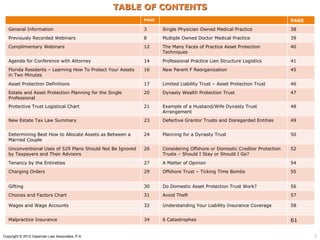
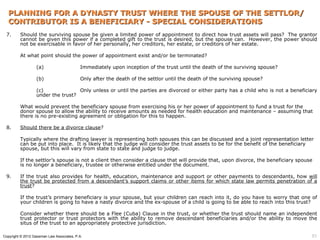
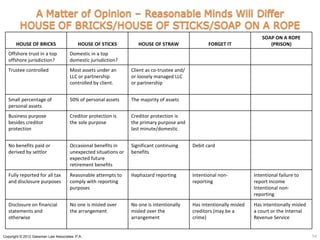
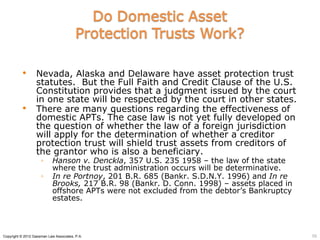
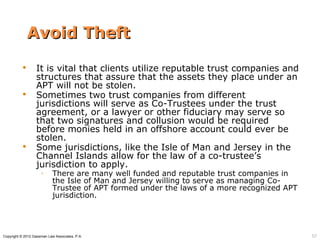
TABLE OF CONTENTS
                                                             PAGE                                                          PAGE
   General Information                                       3      Single Physician Owned Medical Practice                38
   Previously Recorded Webinars                              8      Multiple Owned Doctor Medical Practice                 39
   Complimentary Webinars                                    12     The Many Faces of Practice Asset Protection            40
                                                                    Techniques

   Agenda for Conference with Attorney                       14     Professional Practice Lien Structure Logistics         41
   Florida Residents – Learning How To Protect Your Assets   16     New Parent F Reorganization                            45
   in Two Minutes

   Asset Protection Definitions                              17     Limited Liability Trust – Asset Protection Trust       46
   Estate and Asset Protection Planning for the Single       20     Dynasty Wealth Protection Trust                        47
   Professional
   Protective Trust Logistical Chart                         21     Example of a Husband/Wife Dynasty Trust                48
                                                                    Arrangement
   New Estate Tax Law Summary                                23     Defective Grantor Trusts and Disregarded Entities      49


   Determining Best How to Allocate Assets as Between a      24     Planning for a Dynasty Trust                           50
   Married Couple

   Unconventional Uses of 529 Plans Should Not Be Ignored    26     Considering Offshore or Domestic Creditor Protection   52
   by Taxpayers and Their Advisors                                  Trusts – Should I Stay or Should I Go?
   Tenancy by the Entireties                                 27     A Matter of Opinion                                    54
   Charging Orders                                           29     Offshore Trust – Ticking Time Bombs                    55


   Gifting                                                   30     Do Domestic Asset Protection Trust Work?               56
   Choices and Factors Chart                                 31     Avoid Theft                                            57

   Wages and Wage Accounts                                   32     Understanding Your Liability Insurance Coverage        58


   Malpractice Insurance                                     34     6 Catastrophes                                         61

Copyright © 2012 Gassman Law Associates, P.A.                                                                                     2
$116M is awarded in stroke suit
By TIMES STAFF WRITER
Published September 30, 2006
_______________________________________________________________________

 TAMPA – A jury on Friday awarded a $116-million medical malpractice verdict to the family of a Tampa man who attorneys argued
became a paraplegic after an unlicensed hospital worker misdiagnosed a stroke as sinusitis.

On Aug. 9, 2000, All Navarro, now 50, of Tampa went to University Community Hospital Carrollwood campus with nausea, double
vision, headaches and an unsteady gate. He was sent home with the diagnosis of sinusitis, attorney Steve Yerrid said, and went on
to suffer severe brain swelling. Twenty hours after his initial diagnosis, Navarro was back in the emergency room, getting treated for
a stroke.

Yerrid said the decision was the largest jury award in a malpractice suit in Florida history. Punitive damages are expected to be
considered on Tuesday.

Navarro, a former pro basketball player from the Philippines, came to the United States in the 1990s. His wife Marilyn, 52, and son,
Scottie, 10, are named as claimants in the jury verdict, Yerrid said.

UCH officials could not be reached for comment late Friday.


Copyright © 2012 Gassman Law Associates, P.A.                                                                                          3
Doctors in lawsuit now suing
By Carrie Weimar
                         attorneys
Published March 7, 2007
_____________________________________________________________________
TAMPA – They got hammered with a record-breaking $217-million verdict for misdiagnosing a patient who suffered a stroke.

Now the doctors who were the target of that high-profile lawsuit are hoping to turn the tables. They’re suing their attorneys.

Among the doctors’ chief complaints: The attorneys turned town settlement offers of $1-million and $3-million, a fraction of the final judgment.

“This case should have never gone to trial,” said Dr. Frank Winkles, who is representing Franklin, Favata & Hulls physicians group and Carrollwood Emergency
Physicians.

“It should have settled. Those doctors were just hung out to dry,” Winkles said.

The other doctor involved in the case, Michael Austin, is represented by Tampa attorney Barry Cohen, who said the lawsuit spoke for itself.

“The allegations are pretty clear,” Cohen said.

The lawyers named in the suit, filed March 2 in Hillsborough Circuit Court, did not return telephone calls seeking comment.

The lawyers are Louis J. LaCava and Victor Guzman, who work for a West Palm Beach firm that also has a Tampa branch. Also named is Brian Stokes, who is
with the Unger Law Group, which is based in Orlando.

The disagreement stems from a medical malpractice case decided by a Tampa jury in October.

Allan Navarro, a former pro basketball player in the Philippines, went to the University Community Hospital Carrollwood emergency room August 9, 2000,
complaining of nausea, headache, dizziness and double vision.

He was sent home five hours later with a painkiller prescription and a diagnosis of sinusitis.

No one realized Navarro was having a stroke. He returned to the hospital with more severe symptoms the next morning and underwent surgery hours later to
relieve brain swelling. He ended up in a coma for three months and emerged from it permanently disabled.

Before his illness, Navarro was a machine operator earning just above minimum wage. Now he is confined to bed or must use a wheelchair.

Navarro’s attorney sued. Testimony revealed that an unlicensed physician’s assistant initially examined Navarro, and Austin based his diagnosis on that exam.


Copyright © 2012 Gassman Law Associates, P.A.                                                                                                                   4
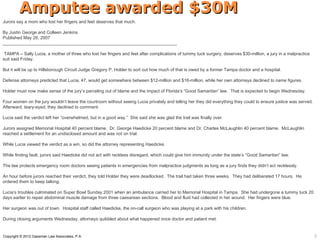
Amputee awarded $30M
Jurors say a mom who lost her fingers and feet deserves that much.

By Justin George and Colleen Jenkins
Published May 26, 2007
_______________________________________________________________________

 TAMPA – Sally Lucia, a mother of three who lost her fingers and feet after complications of tummy tuck surgery, deserves $30-million, a jury in a malpractice
suit said Friday.

But it will be up to Hillsborough Circuit Judge Gregory P. Holder to sort out how much of that is owed by a former Tampa doctor and a hospital.

Defense attorneys predicted that Lucia, 47, would get somewhere between $12-million and $16-million, while her own attorneys declined to name figures.

Holder must now make sense of the jury’s parceling out of blame and the impact of Florida’s “Good Samaritan” law. That is expected to begin Wednesday.

Four women on the jury wouldn’t leave the courtroom without seeing Lucia privately and telling her they did everything they could to ensure justice was served.
Afterward, teary-eyed, they declined to comment.

Lucia said the verdict left her “overwhelmed, but in a good way.” She said she was glad the trail was finally over.

Jurors assigned Memorial Hospital 40 percent blame. Dr. George Haedicke 20 percent blame and Dr. Charles McLaughlin 40 percent blame. McLaughlin
reached a settlement for an undisclosed amount and was not on trial.

While Lucia viewed the verdict as a win, so did the attorney representing Haedicke.

While finding fault, jurors said Haedicke did not act with reckless disregard, which could give him immunity under the state’s “Good Samaritan” law.

The law protects emergency room doctors seeing patients in emergencies from malpractice judgments as long as a jury finds they didn’t act recklessly.

An hour before jurors reached their verdict, they told Holder they were deadlocked. The trail had taken three weeks. They had deliberated 17 hours. He
ordered them to keep talking.

Lucia’s troubles culminated on Super Bowl Sunday 2001 when an ambulance carried her to Memorial Hospital in Tampa. She had undergone a tummy tuck 20
days earlier to repair abdominal muscle damage from three caesarean sections. Blood and fluid had collected in her wound. Her fingers were blue.

Her surgeon was out of town. Hospital staff called Haedicke, the on-call surgeon who was playing at a park with his children.

During closing arguments Wednesday, attorneys quibbled about what happened once doctor and patient met.


Copyright © 2012 Gassman Law Associates, P.A.                                                                                                                     5
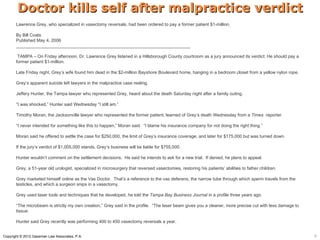
Doctor kills self after malpractice verdict
       Lawrence Grey, who specialized in vasectomy reversals, had been ordered to pay a former patient $1-million.

       By Bill Coats
       Published May 4, 2006
       _______________________________________________________________________

        TAMPA – On Friday afternoon, Dr. Lawrence Grey listened in a Hillsborough County courtroom as a jury announced its verdict: He should pay a
       former patient $1-million.

       Late Friday night, Grey’s wife found him dead in the $2-million Bayshore Boulevard home, hanging in a bedroom closet from a yellow nylon rope.

       Grey’s apparent suicide left lawyers in the malpractice case reeling.

       Jeffery Hunter, the Tampa lawyer who represented Grey, heard about the death Saturday night after a family outing.

       “I was shocked,” Hunter said Wednesday “I still am.”

       Timothy Moran, the Jacksonville lawyer who represented the former patient, learned of Grey’s death Wednesday from a Times reporter.

       “I never intended for something like this to happen,” Moran said. “I blame his insurance company for not doing the right thing.”

       Moran said he offered to settle the case for $250,000, the limit of Grey’s insurance coverage, and later for $175,000 but was turned down.

       If the jury’s verdict of $1,005,000 stands, Grey’s business will be liable for $755,000.

       Hunter wouldn’t comment on the settlement decisions. He said he intends to ask for a new trial. If denied, he plans to appeal.

       Grey, a 51-year old urologist, specialized in microsurgery that reversed vasectomies, restoring his patients’ abilities to father children.

       Grey marketed himself online as the Vas Doctor. That’s a reference to the vas deferens, the narrow tube through which sperm travels from the
       testicles, and which a surgeon snips in a vasectomy.

       Grey used laser tools and techniques that he developed, he told the Tampa Bay Business Journal in a profile three years ago.

       “The microbeam is strictly my own creation,” Grey said in the profile. “The laser beam gives you a cleaner, more precise cut with less damage to
       tissue.

       Hunter said Grey recently was performing 400 to 450 vasectomy reversals a year.


Copyright © 2012 Gassman Law Associates, P.A.                                                                                                             6
“It wasn’t raining when Noah built the ark.”


Copyright © 2012 Gassman Law Associates, P.A.                                            7
When and How To
                 Terminate
          a Questionable Employee
                        Colleen M. Flynn, Esq.     Alan S. Gassman, Esq.
             Johnson, Pope, Ruppel & Burns, LLP.   Gassman, Bates & Associates, P.A.
                                     Jpfirm.com    Gassmanbateslawgroup.com
                            colleenf@jpfirm.com    agassman@gassmanpa.com
                                 (727) 461-1818    (727) 442-1200


Copyright © 2012 Gassman Law Associates, P.A.                                          8
Giving a Deposition?
                        What Doctors Need to
                               Know!
                                                           Presented by:


                                                                              Alan S. Gassman, Esq.
                           Jeffrey Goodis, Esq.
                                                                            agassman@gassmanpa.com
                        jmg@thompsongoodis.com
                                                                           Gassman Law Associates, P.A.
                 Thompson Goodis Thompson Groseclose
                                                                                  Clearwater, FL
                 Richardson Miller, P.A., St. Petersburg, FL

Copyright © 2012 Gassman Law Associates, P.A.                                                             9
Malpractice Litigation Defense
               Strategies for Florida Physicians:
               What Every Doctor Should Know.

                                                           a presentation by:
                                      Jeffrey M. Goodis, Esq. & Alan S. Gassman, Esq.


                                          jmg@thompsongoodis.com          agassman@gassmanpa.com
                                               727-823-0540                     (727) 442-1200

Copyright © 2012 Gassman Law Associates, P.A.                                                      10
11
GASSMAN LAW ASSOCIATES, P.A.
                                     COMPLIMENTARY WEBINARS
                   ESTATE, ESTATE TAX &
                                                                             HEALTH CARE LAW AND PHYSICIAN ISSUES
              CREDITOR PROTECTION PLANNING

                                                                    •Protecting Medical Practice Assets from Creditors – General
•Creditor Protection for the Single Floridian
                                                                    Strategies and Common Mistakes

•For Couple’s Only – All About Tenancy by the Entireties – How To
                                                                    •Creditor Protection for the Single Physician
Use It – How To Lose It

•Cornflakes and Estate Planning Mistakes                            •Special Planning Needs for Doctors Who are Married to Doctors

•How to Advise Clients Under The New Estate Tax Law                 •Malpractice Litigation Defense Strategies for Florida Physicians

•What Has Just Changed With Regard To Undisclosed Foreign           •Unannounced Medicare Audits; What To Do If Investigators
Accounts                                                            Come To Your Office

•Helter Shelter – Planning with Credit Shelter Trusts Under the     •A Medicare Practice Compliance Paperwork Checklist for Florida
New Estate Tax Law                                                  Physicians

•Major Changes in the Florida Power of Attorney Law: What You
                                                                    •Understanding ACO’s in 30 Minutes – A Physicians Guide
Need to Know – With A View From The Bench

•What Mary Poppins Didn’t Know About Umbrellas: Ensure that
                                                                    •Giving A Deposition – What Doctors Need To Know
your Insurances Will Insure You

•The 15 Minute Guide to the New Florida Power of Attorney Act       •New Healthcare Price Transparency Rules

•Riders on the Storm: How to Make Sure Your Insurances Do Not       •How the New Pain Care Clinic Regulations Affect Your Medical
Have Any Catastrophic Exceptions or Gaps                            Practice

                                                                    •How Medical Practices Can Respond to the New Healthcare Law
•Drafting Durable Powers of Attorney for the New Florida Law With
                                                                    and Eminent Changes
Forms

•Common Mistakes in the Filing of Gift Tax Returns and How to       •How to Market Your Medical Practice
Avoid Them, With Sample Form 709 Completed Pages

                         TO CONTACT US FOR INFORMATION ON OUR COMPLIMENTARY WEBINARS
                              PLEASE CALL 727-442-1200 or email agassman@gassmanpa.com
           They are available for viewing and download at: www.gassmanlawassociates.com/webinarlibrary.html                             12
“If you’re not confused, you’re not paying attention.”
                                                             - Tom Peters
                                           “Anything that can go wrong will go wrong.”
                                                            -Murphy’s Law
                                                 “Anyone who acts as his own lawyer
                                                        has a fool for a client.”
                                                            -- F. Lee Bailey
                                                  “Perfectionists don’t always win.”
                                                “Don’t put all your eggs in one basket.”
                           “Don’t handicap your children by making their lives easier.”
                                                         --Robert A. Heinlein


Copyright © 2012 Gassman Law Associates, P.A.                                              13
CONSIDER A PRIVATE WEBINAR – WHAT WOULD YOU COVER WITH YOUR
                     ESTATE AND CORPORATE ADVISORS?

                                     AGENDA FOR CONFERENCE WITH ATTORNEY

5.REVIEW OF FAMILY INFORMATION.

7.REVIEW OF FINANCIAL INFORMATION.

9.IS THERE SUFFICIENT LIFE INSURANCE TO SUPPORT SURVIVORS?

         a) PROCEEDS MULTIPLIED BY WHAT EXPECTED RATE OF RETURN CAN SUPPORT SURVIVORS?
         b) TERM POLICY EXPIRATION DATES AND FOLLOW-UP.

         4. POTENTIAL LOGISTICS FOR PLANNING.

         5. TRUST ARRANGEMENTS FOR SURVIVING SPOUSE.

         6. TRUST ARRANGEMENTS FOR OTHERS.

         7. EXTENDED FAMILY PLANNING.

             a) INHERITANCES EXPECTED.
             b) PARENTS OR OTHERS WHO MAY NEED SUPPORT.
             c) RELATIVES WHO SHOULD NOT INHERIT OR HAVE INPUT OR FIDUCIARY ROLES.
             d) BENEFICIARIES IF NOT DESCENDANTS SURVIVE.

         8. FINANCIAL POWERS OF ATTORNEY.

             a) FROM SPOUSES TO ONE ANOTHER.
             b) FROM ANY FAMILY MEMBERS WHO MAY REQUEST OR NEED ASSISTANCE FROM CLIENTS.


Copyright © 2012 Gassman Law Associates, P.A.                                              14
CONSIDER A PRIVATE WEBINAR – WHAT WOULD YOU COVER WITH YOUR
                     ESTATE AND CORPORATE ADVISORS?

                       AGENDA FOR CONFERENCE WITH ATTORNEY CONTINUED

9. HEALTH CARE POWERS OF ATTORNEY.

                  a) FROM SPOUSES TO ONE ANOTHER.
                  b) FROM ANY FAMILY MEMBERS WHO MAY REQUEST OR NEED ASSISTANCE FROM CLIENTS.

10. BENEFICIARY DESIGNATIONS FOR IRA, ANNUITY, AND PENSION ACCOUNTS.

11. BENEFICIARY DESIGNATIONS AND OWNERSHIP VERIFICATION FOR LIFE INSURANCE.

12. DISCUSS DISABILITY INSURANCE.

13. DISCUSS AUTOMOBILE OWNERSHIP AND UMBRELLA COVERAGE.

14. ADVISOR COMMUNICATIONS.

15. BUSINESS ACTIVITIES AND OWNERSHIP.

16. DISCUSSION OF SPOUSAL BUSINESS/PROFESSIONAL INVOLVEMENT.

17. PROFESSIONAL OR BUSINESS PRACTICE/COMPANY PROJECTION FROM POTENTIAL CREDITORS.

18. ENTITY TAX PLANNING.

19. ENTITY MINUTES.

20. OTHER ITEMS?


Copyright © 2012 Gassman Law Associates, P.A.                                                   15
FLORIDA RESIDENTS- LEARNING HOW TO PROTECT YOUR ASSETS IN TWO MINUTES
         CREDITOR EXEMPT ASSETS                     ASSETS THAT ARE DIFFICULT FOR A               ASSETS EXPOSED TO CREDITORS
                                                          CREDITOR TO OBTAIN

  Homestead                                         Limited partnership and similar entity      Individual money and brokerage accounts.
  -Up to half acre if within city limits.           interests.
  -May be immune from fraudulent transfer
  statute.
  IRA                                               Foreign trusts and companies.               Joint assets where both spouses owe money.
  -Includes ROTH, Rollover, and Voluntary
  IRAs, but possibly not inherited IRAs.
  401(k)                                            Foreign bank accounts.                      One-half of any joint assets not TBE where
  -Maximize these!                                                                              one spouse owes money.

  Permanent Life Insurance                          Note – foreign entities are very rarely     Personal physical assets, including car,
  -Must be owned by insured.                        recommended and must be reported to IRS -   except for $4,000 exemption ($1,000 if
                                                                                                homestead exemption is claimed in
                                                                                                bankruptcy).
  Annuity Contracts                                 Vocabulary:
                                                    EXEMPT ASSET – An asset that a creditor cannot reach by reason of Florida law
  Wages of Head-of-Household
                                                    – protects Florida residents.
  Wage Accounts (for six months only)               CHARGING ORDER PROTECTION – The creditor of a partner in a limited
  Tenancy by the Entireties (joint where only       partnership, limited liability limited partnership, or properly drafted LLC can only
  one spouse is obligated)                          receive distributions as and when they would be paid to the partner.
  - Must be properly and specially titled – joint   FRAUDULENT TRANSFER - Defined as a transfer made for the purpose of
                                                    avoiding a creditor. Florida has a 4 year reach back statute on fraudulent
  with right of survivorship may not qualify.
                                                    transfers. A fraudulent transfer into the homestead may not be set aside unless
  529 College Savings Plans                         the debtor is in bankruptcy. It takes 3 creditors of a debtor who has 12 or more
                                                    creditors to force a bankruptcy.
                                                    Upon filing a Chapter 7 Bankruptcy, an individual debtor may be able to cancel
                                                    all debts owed and keep exempt assets, subject to certain exemptions.
                                                    Annuities and life insurance policies are not always good investments, and can
                                                    be subject to sales charges and administrative fees.
                                                    There is a lot more to know- but this chart may be a good first step.


Copyright © 2012 Gassman Law Associates, P.A.                                                                                                16
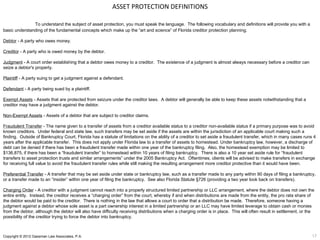
ASSET PROTECTION DEFINITIONS

               To understand the subject of asset protection, you must speak the language. The following vocabulary and definitions will provide you with a
basic understanding of the fundamental concepts which make up the “art and science” of Florida creditor protection planning.

Debtor - A party who owes money.

Creditor - A party who is owed money by the debtor.

Judgment - A court order establishing that a debtor owes money to a creditor. The existence of a judgment is almost always necessary before a creditor can
seize a debtor's property.

Plaintiff - A party suing to get a judgment against a defendant.

Defendant - A party being sued by a plaintiff.

Exempt Assets - Assets that are protected from seizure under the creditor laws. A debtor will generally be able to keep these assets notwithstanding that a
creditor may have a judgment against the debtor.

Non-Exempt Assets - Assets of a debtor that are subject to creditor claims.

Fraudulent Transfer - The name given to a transfer of assets from a creditor available status to a creditor non-available status if a primary purpose was to avoid
known creditors. Under federal and state law, such transfers may be set aside if the assets are within the jurisdiction of an applicable court making such a
finding. Outside of Bankruptcy Court, Florida has a statute of limitations on the ability of a creditor to set aside a fraudulent transfer, which in many cases runs 4
years after the applicable transfer. This does not apply under Florida law to a transfer of assets to homestead. Under bankruptcy law, however, a discharge of
debt can be denied if there has been a fraudulent transfer made within one year of the bankruptcy filing. Also, the homestead exemption may be limited to
$136,875, if there has been a “fraudulent transfer” to homestead within 10 years of filing bankruptcy. There is also a 10 year set aside rule for “fraudulent
transfers to asset protection trusts and similar arrangements” under the 2005 Bankruptcy Act. Oftentimes, clients will be advised to make transfers in exchange
for receiving full value to avoid the fraudulent transfer rules while still making the resulting arrangement more creditor protective than it would have been.

Preferential Transfer - A transfer that may be set aside under state or bankruptcy law, such as a transfer made to any party within 90 days of filing a bankruptcy,
or a transfer made to an “insider” within one year of filing the bankruptcy. See also Florida Statute §726 (providing a two year look back on transfers).

Charging Order - A creditor with a judgment cannot reach into a properly structured limited partnership or LLC arrangement, where the debtor does not own the
entire entity. Instead, the creditor receives a “charging order” from the court, whereby if and when distributions are made from the entity, the pro rata share of
the debtor would be paid to the creditor. There is nothing in the law that allows a court to order that a distribution be made. Therefore, someone having a
judgment against a debtor whose sole asset is a part ownership interest in a limited partnership or an LLC may have limited leverage to obtain cash or monies
from the debtor, although the debtor will also have difficulty receiving distributions when a charging order is in place. This will often result in settlement, or the
possibility of the creditor trying to force the debtor into bankruptcy.


Copyright © 2012 Gassman Law Associates, P.A.                                                                                                                       17
ASSET PROTECTION DEFINITIONS
Firewall Protection - The concept that the shareholder of a corporation or limited partner in a limited partnership will not be liable for liabilities incurred by the
entity. This is why many companies put the more hazardous activities under a separate subsidiary.

Limited Liability Partnerships, Limited Partnerships, Limited Liability Limited Partnerships, Limited Liability Companies, Professional Limited Liability Companies,
and Partnerships of the above Entities - The names given to various legal entities which have different effects as to firewall, tax, and charging order versus asset
seizure protection. Be cautious as to which entity you choose because they do not all offer the same protection. For example, the creditor of a partner in a
Florida limited liability partnership (LLP) can seize the partnership interests, and is not limited to receiving a charging order, but the creditor of a partner in a
Florida limited partnership (LP) or a limited liability limited partnership (LLLP) will be limited to the charging order remedy. It is important not to confuse these
entities, but this commonly occurs, even among well-meaning lawyers.

Staying Out of Bankruptcy - Many debtors will prefer to stay out of bankruptcy, so it is important for someone with an imminent judgment to understand how this
can be achieved. Generally, it takes three creditors to force an individual into bankruptcy, if that individual has at least 12 creditors.

Bankruptcy - A federal process whereby every debtor has the right to file in the bankruptcy court, generally under Chapter 7, Chapter 11, or Chapter 13. Many
lawyers say that this is like having the debtor “swim in a fish bowl” because there must be full disclosure of all documentation and information upon filing. More
information about the specific types of bankruptcy is available in Chapter 9.

Joint and Several Liability - The concept that individuals who participate in a negligent or improper act will be totally liable for all damages imposed to the extent
that the other "co-defendants" do not pay their fair share. There are limitations on joint and several liability pursuant to Florida Statute Section 768.81.

Vicarious Liability - The concept that an employer is generally responsible for liabilities incurred by an employee acting within the scope of the employee's duties.
The Greek term for this phenomenon is “respondeat superior.”

Under this concept, parents may be responsible for the driving activities of their nannies or errand runners, and doctors may be responsible for unforeseen
actions by employees who might aggressively try to help people using prescription scripts, giving medical advice, and/or driving automobiles.

Secured Interest - The concept whereby a creditor can record a mortgage or lien on assets whereby that creditor would be entitled to repossess the assets and
sell them at auction to satisfy a debt owed to the creditor. Real estate is liened by the recording of a proper mortgage, and non-real estate assets may be liened
by recording UCC-1 Financing Statements based upon appropriately drafted security and/or pledge agreements. If a friendly debtor has a secured interest in a
particular asset, then another debtor would have to pay the friendly secured debtor before they would be able to seize the asset secured. This is why doctors
will often give the bank with a mortgage on business real estate a lien against medical practice assets, so that a malpractice claimant would have to pay the
bank off or take other steps before seizing medical practice assets.

Marshaling of Assets - Whereby a party having a lien against assets may be forced to sacrifice their position if there are plenty of other assets that it has access
to, to satisfy the obligation of the debtor. Over-secured creditor issues may also arise.

Asset Protection Trust - A trust arrangement whereby creditors of the grantor may not have access – which is contrary to Florida and basic common law that if
the grantor could receive any benefit whatsoever, then creditors may receive all assets.


Copyright © 2012 Gassman Law Associates, P.A.                                                                                                                            18
ASSET PROTECTION DEFINITIONS
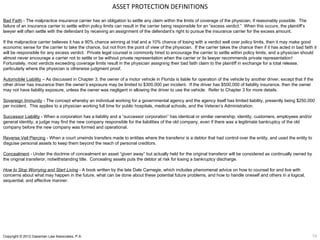
Bad Faith - The malpractice insurance carrier has an obligation to settle any claim within the limits of coverage of the physician, if reasonably possible. The
failure of an insurance carrier to settle within policy limits can result in the carrier being responsible for an “excess verdict.” When this occurs, the plaintiff’s
lawyer will often settle with the defendant by receiving an assignment of the defendant’s right to pursue the insurance carrier for the excess amount.

If the malpractice carrier believes it has a 90% chance winning at trial and a 10% chance of losing with a verdict well over policy limits, then it may make good
economic sense for the carrier to take the chance, but not from the point of view of the physician. If the carrier takes the chance then if it has acted in bad faith it
will be responsible for any excess verdict. Private legal counsel is commonly hired to encourage the carrier to settle within policy limits, and a physician should
almost never encourage a carrier not to settle or be without private representation when the carrier or its lawyer recommends private representation!
Fortunately, most verdicts exceeding coverage limits result in the physician assigning their bad faith claim to the plaintiff in exchange for a total release,
particularly where the physician is otherwise judgment proof.

Automobile Liability – As discussed in Chapter 3, the owner of a motor vehicle in Florida is liable for operation of the vehicle by another driver, except that if the
other driver has insurance then the owner’s exposure may be limited to $300,000 per incident. If the driver has $500,000 of liability insurance, then the owner
may not have liability exposure, unless the owner was negligent in allowing the driver to use the vehicle. Refer to Chapter 3 for more details.

Sovereign Immunity - The concept whereby an individual working for a governmental agency and the agency itself has limited liability, presently being $250,000
per incident. This applies to a physician working full time for public hospitals, medical schools, and the Veteran’s Administration.

Successor Liability - When a corporation has a liability and a “successor corporation” has identical or similar ownership, identity, customers, employees and/or
general identity, a judge may find the new company responsible for the liabilities of the old company, even if there was a legitimate bankruptcy of the old
company before the new company was formed and operational.

Reverse Veil Piercing - When a court unwinds transfers made to entities where the transferor is a debtor that had control over the entity, and used the entity to
disguise personal assets to keep them beyond the reach of personal creditors.

Concealment - Under the doctrine of concealment an asset “given away” but actually held for the original transferor will be considered as continually owned by
the original transferor, notwithstanding title. Concealing assets puts the debtor at risk for losing a bankruptcy discharge.

How to Stop Worrying and Start Living - A book written by the late Dale Carnegie, which includes phenomenal advice on how to counsel for and live with
concerns about what may happen in the future, what can be done about these potential future problems, and how to handle oneself and others in a logical,
sequential, and effective manner.


Copyright © 2012 Gassman Law Associates, P.A.                                                                                                                           19
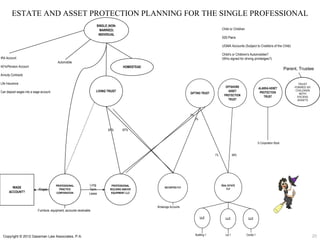
ESTATE AND ASSET PROTECTION PLANNING FOR THE SINGLE PROFESSIONAL
                                                                       SINGLE (NON-
                                                                         MARRIED)                                                                Child or Children
                                                                        INDIVIDUAL
                                                                                                                                                 529 Plans

                                                                                                                                                 UGMA Accounts (Subject to Creditors of the Child)

                                                                                                                                                 Child's or Children's Automobiles?
IRA Account                                                                                                                                      (Who signed for driving priviledges?)
                                          Automobile
401k/Pension Account                                                                    HOMESTEAD
                                                                                                                                                                                                     Parent, Trustee
Annuity Contracts

Life Insurance                                                                                                                                                                                               TRUST
                                                                                                                                                    OFFSHORE                   ALASKA ASSET               FORMED BY
                                                                       LIVING TRUST                                                                   ASSET                                                CHILDREN
Can deposit wages into a wage account                                                                                     GIFTING TRUST                                         PROTECTION                   WITH
                                                                                                                                                   PROTECTION                     TRUST                     EXCESS
                                                                                                                                                      TRUST                                                 ASSETS


                                                                                                                          3%
                                                                                                                               3%


                                                                              97%      97%


                                                                                                                                                                               S Corporation Stock


                                                                                                                                            1%              99%


                                         PROFESSIONAL              Long         PROFESSIONAL                                                     REAL ESTATE
        WAGE                                                                                             SECURITIES FLP
                            Wages          PRACTICE                Term        BUILDING AND/OR                                                       FLP
      ACCOUNT?                           CORPORATION               Lease        EQUIPMENT LLC


                                                                                                    Brokerage Accounts
                           Furniture, equipment, accounts receivable

                                                                                                                                    LLC             LLC               LLC


                                                                                                                               Building 1           Lot 1            Condo 1                                          20
 Copyright © 2012 Gassman Law Associates, P.A.
PROTECTIVE TRUST LOGISTICAL CHART

   During both                          First Dying Spouse’s                                          Surviving Spouse’s
   spouse’s
   lifetimes:                              Revocable Trust                                             Revocable Trust

   Upon first                    $5,120,000*                     Remaining
   death in                      (Adjusted upward for
   2011:                       inflation after 1/1/2011)           Assets


   During                             Family                       QTIP Non-
                                    (By-Pass)                                                  Surviving Spouse’s Revocable Trust
   surviving                                                       GST Trust
                             Generation Skipping Trust            (Marital Deduction         (Will include assets owned jointly on first
   spouse’s                  (Not taxed in surviving spouse’s      Trust that is not                           death)
   remaining                              estate)                generation skipping)
   lifetime:

   Upon
                    Surviving spouse
                    can have the                                                                 $5,120,000*                        Remaining
                    right to redirect                                                           (Adjusted upward after
   second           how assets are
                    distributed on
                                                                                                      1/1/2011)                       Assets
   death:           second death.


                                                                    Children’s                 Generation Skipping                    Children’s
   After                    Generation Skipping                     Trust (or                   Trusts for Children                   Trust (or
   deaths of                 Trusts for Children                     outright                   (Can merge with first dying            outright
   both                                                           distributions)               spouse’s Generation Skipping
                                                                                                   Trusts shown on left)            distributions)
   spouses:
                          Benefits children and                  Benefits children.
                                                                                             Benefits children and                  Benefits children.
                          grandchildren.                         Taxable in their estates.
                                                                                             grandchildren.                         Taxable in their estates.
                          Not estate taxable in their estates.
                                                                                             Not estate taxable in their estates.
*Assumes first spouse dies in 2011 and that the surviving spouse dies in a later year when the estate tax exemption is still $5,120,000.
*The Unified Credit Exemption is $5,120,000 in 2011 and 2012, and is scheduled to go back to $1,000,000 in 2013.
Copyright © 2012 Gassman Law Associates, P.A.                                                                                                                   21
COMING SOON FROM BNA AND ALAN GASSMAN


Highlights include:

 Impact on 2010 Tax Relief Act
 Options for traditional planning structures
 Best practices: Portability of estate tax exemption
   vs. credit shelter planning
 How to integrate asset protection into the
   estate plan
 How to repurpose redundant life insurance trusts,
   and more!

If you would like to purchase a copy of the book
please email agassman@gassmanpa.com


                                                        22
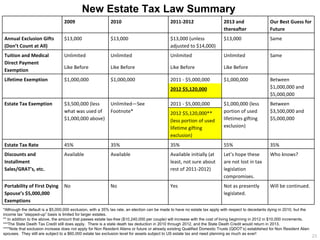
New Estate Tax Law Summary
                                  2009                      2010                             2011-2012                     2013 and                  Our Best Guess for
                                                                                                                           thereafter                Future
Annual Exclusion Gifts            $13,000                   $13,000                          $13,000 (unless               $13,000                   Same
(Don’t Count at All)                                                                         adjusted to $14,000)
Tuition and Medical               Unlimited                 Unlimited                        Unlimited                     Unlimited                 Same
Direct Payment
                                  Like Before               Like Before                      Like Before                   Like Before
Exemption
Lifetime Exemption                $1,000,000                $1,000,000                       2011 - $5,000,000             $1,000,000                Between
                                                                                             2012 $5,120,000                                         $1,000,000 and
                                                                                                                                                     $5,000,000
Estate Tax Exemption              $3,500,000 (less          Unlimited—See                    2011 - $5,000,000             $1,000,000 (less          Between
                                  what was used of          Footnote*                        2012 $5,120,000**             portion of used           $3,500,000 and
                                  $1,000,000 above)                                          (less portion of used         lifetimes gifting         $5,000,000
                                                                                             lifetime gifting              exclusion)
                                                                                             exclusion)
Estate Tax Rate                   45%                       35%                              35%                           55%                       35%
Discounts and                     Available                 Available                        Available initially (at       Let’s hope these          Who knows?
Installment                                                                                  least, not sure about         are not lost in tax
Sales/GRAT’s, etc.                                                                           rest of 2011-2012)            legislation
                                                                                                                           compromises.
Portability of First Dying        No                        No                               Yes                           Not as presently          Will be continued.
Spouse’s $5,000,000                                                                                                        legislated.
Exemptions
*Although the default is a $5,000,000 exclusion, with a 35% tax rate, an election can be made to have no estate tax apply with respect to decedants dying in 2010, but the
income tax “stepped-up” basis is limited for larger estates.
** In addition to the above, the amount that passes estate tax-free ($10,240,000 per couple) will increase with the cost of living beginning in 2012 in $10,000 increments.
***The State Death Tax Credit still does apply. There is a state death tax deduction in 2010 through 2012, and the State Death Credit would return in 2013.
****Note that exclusion increase does not apply for Non Resident Aliens or future or already existing Qualified Domestic Trusts (QDOT’s) established for Non Resident Alien
spouses. They still are subject to a $60,000 estate tax exclusion level for assets subject to US estate tax and need planning as much as ever!
                                                                                                                                                                              23
Determining Best How To Allocate Assets As Between A Married
                                    Couple
                                     Part I
General Rules:
-Typically want each trust funded with at least $3,500,000 worth of assets on death for estate tax planning.                                         Wife could be Trustee if
                                                                                                         Trustee other than
- May be funded from ½ of tenancy by the entireties assets via disclaimer and probate or by life insurance/pension/IRA assets.                       Husband is sole grantor
                       Husband                                                  Wife                     Husband or Wife
                                                                                                                                                         (or vice versa)


Protected life
insurance and         Husband’s                                                    Wife’s                            Gifting Trust                       Lifetime By-
annuity               Revocable                                                  Revocable                           (Irrevocable)                        Pass Trust
contracts               Trust                                                      Trust                                                                (Irrevocable)
“owned by the
insured.”
                                                     TBE
                                                (Tenancy by the
                                                   Entireties)

                                   •     Only exposed to creditors if  •   Safe from creditors of husband       1.   Safe from creditors of
•   Assets held directly by                                                                                                                     1.    Safe from the creditors
                                         both spouses owe the              but exposed to creditors of wife          both spouses.
    revocable trust are subject to                                                                                                                    of the Grantor’s spouse.
                                         creditor or if one spouse         (Maintain large umbrella liability   2.   If divorce occurs,
    husband’s creditor claims.                                                                                                                  2.    If funded by one spouse,
                                         dies and the surviving            insurance coverage to protect             should not be subject
•   Direct ownership of limited                                                                                                                       may benefit other spouse
                                         spouse has a creditor, the        these assets.)                            to rules for division of
    partnership or LLC not in TBE                                      •                                                                              and children during the
                                         spouses divorce, or state         On wife’s death, can be held              property between
    may have charging order                                                                                                                           lifetime of both spouses.
                                         law or the state of residence     under a protective trust,                 spouses.
    protection (meaning that if a                                                                                                               3.    Otherwise can be
                                         changes.                          which will continue to be safe       3.   May be controlled by
    creditor obtains a lien on the                                                                                                                    identical to gifting trust
                                   2.    On death of one spouse,           from creditors of husband and             the “entrepreneurial
    limited partnership or LLC,                                                                                                                       pictured to the left.
                                         surviving spouse may disclaim     subsequent spouses and “future            spouse” by using a
    the husband cannot receive
                                         up to ½ (if no creditor is        new family”                               Family Limited
    monies from the limited
                                         pursuing the deceased                                                       Partnership.
    partnership or LLC without
                                         spouse) to fund By-Pass Trust
    the creditor being paid).
                                         on first death.


SEE NEXT PAGE FOR SECOND TIER PLANNING
A COMMON SOLUTION - to use a limited partnership or similar mechanisms and have no assets directly in the “high risk” spouse’s
trust, half to two-thirds of the assets held as tenants by the entireties, and half to two-thirds of the assets directly in the “low risk”
spouse’s trust.

Copyright © 2012 Gassman Law Associates, P.A.                                                                                                                                      24
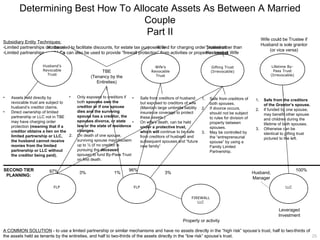
Determining Best How To Allocate Assets As Between A Married
                                   Couple
                                   Part II
                                                                                                                                                         Wife could be Trustee if
Subsidiary Entity Techniques:
                                                                                                                                                         Husband is sole grantor
-Limited partnerships can be used to facilitate discounts, for estate tax purposes, and for charging order Trustee other than
                       Husband                                                   Wife                      protection.
                                                                                                                                                             (or vice versa)
-Limited partnerships and LLCs can also be used to provide “firewall protection” from activities or properties owned. Wife
                                                                                                           Husband or

                     Husband’s                                                          Wife’s                          Gifting Trust                          Lifetime By-
                     Revocable                      TBE                               Revocable                         (Irrevocable)                           Pass Trust
                       Trust                                                            Trust                                                                 (Irrevocable)
                                               (Tenancy by the
                                                  Entireties)


•   Assets held directly by        •    Only exposed to creditors if  •         Safe from creditors of husband     1.   Safe from creditors of
                                        both spouses owe the                                                                                        1.    Safe from the creditors
    revocable trust are subject to                                              but exposed to creditors of wife        both spouses.
                                        creditor or if one spouse                                                                                         of the Grantor’s spouse.
    husband’s creditor claims.                                                  (Maintain large umbrella liability 2.   If divorce occurs,
                                        dies and the surviving                                                                                      2.    If funded by one spouse,
•   Direct ownership of limited                                                 insurance coverage to protect           should not be subject
                                        spouse has a creditor, the                                                                                        may benefit other spouse
    partnership or LLC not in TBE                                               these assets.)                          to rules for division of
                                        spouses divorce, or state                                                                                         and children during the
    may have charging order                                           •         On wife’s death, can be held            property between
                                        law or the state of residence                                                                                     lifetime of both spouses.
    protection (meaning that if a                                               under a protective trust,               spouses.
                                        changes.                                                                                                    3.    Otherwise can be
    creditor obtains a lien on the                                              which will continue to be safe     3.   May be controlled by
                                   2.   On death of one spouse,                                                                                           identical to gifting trust
    limited partnership or LLC,                                                 from creditors of husband and           the “entrepreneurial
                                        surviving spouse may disclaim                                                                                     pictured to the left.
    the husband cannot receive                                                  subsequent spouses and “future          spouse” by using a
    monies from the limited             up to ½ (if no creditor is              new family”                             Family Limited
    partnership or LLC without          pursuing the deceased                                                           Partnership.
    the creditor being paid).           spouse) to fund By-Pass Trust
                                        on first death.

SECOND TIER             97%                                         96%                                                                                                       100%
                                         3%                 1%                                3%                                                   Husband,
 PLANNING:
                                                                                                                                                   Manager

                          FLP                                             FLP                                                                                         LLC


                                                                                                             FIREWALL
                                                                                                                LLC

                                                                                                                                                                  Leveraged
                                                                                                                                                                  Investment
                                                                                                        Property or activity

A COMMON SOLUTION - to use a limited partnership or similar mechanisms and have no assets directly in the “high risk” spouse’s trust, half to two-thirds of
the assets held as tenants by the entireties, and half to two-thirds of the assets directly in the “low risk” spouse’s trust.                               25
Copyright © 2012 Gassman Law Associates, P.A.   26
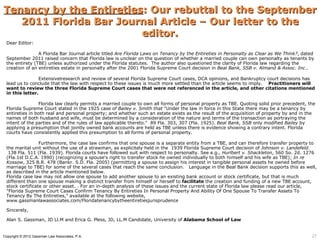
Tenancy by the Entireties: Our rebuttal to the September
   2011 Florida Bar Journal Article – Our letter to the
                         editor.
 Dear Editor:

                A Florida Bar Journal article titled Are Florida Laws on Tenancy by the Entireties in Personalty as Clear as We Think?, dated
 September 2011 raised concern that Florida law is unclear on the question of whether a married couple can own personalty as tenants by
 the entirety (TBE) unless authorized under the Florida statutes. The author also questioned the clarity of Florida law regarding the
 creation of an entireties estate in personalty after the 2001 Florida Supreme Court decision in Beal Bank, SSB v. Almand & Assoc. Inc..

                Extensivelresearch and review of several Florida Supreme Court cases, DCA opinions, and Bankruptcy court decisions has
 lead us to conclude that the law with respect to these issues is much more settled than the article seems to imply. Practitioners will
 want to review the three Florida Supreme Court cases that were not referenced in the article, and other citations mentioned
 in this letter.

                Florida law clearly permits a married couple to own all forms of personal property as TBE. Quoting solid prior precedent, the
 Florida Supreme Court stated in the 1925 case of Bailey v. Smith that "Under the law in force in this State there may be a tenancy by
 entireties in both real and personal property; and whether such an estate exists as the result of the acquisition of property by and in the
 names of both husband and wife, must be determined by a consideration of the nature and terms of the transaction as portraying the
 intent of the parties and of the rules of law applicable thereto." 89 Fla. 303, 307 (Fla. 1925). Beal Bank, SSB only modified Bailey by
 applying a presumption that jointly owned bank accounts are held as TBE unless there is evidence showing a contrary intent. Florida
 courts have consistently applied this presumption to all forms of personal property.

                 Furthermore, the case law confirms that one spouse is a separate entity from a TBE, and can therefore transfer property to
 the marital unit without the use of a strawman, as explicitely held in the 1939 Florida Supreme Court decision of Johnson v. Landefeld.
  138 Fla. 511 (Fla. 1939). Florida courts have followed suit with respect to personalty. See e.g., Hurlbert v. Shackleton, 560 So. 2d. 1276
 (Fla.1st D.C.A. 1990) (recognizing a spouse's right to transfer stock he owned individually to both himself and his wife as TBE); In re
 Kossow, 325 B.R. 478 (Bankr. S.D. Fla. 2005) (permitting a spouse to assign his interest in tangible personal assets he owned before
 marriage to TBE) for some of the several cases that reach the same conclusion. Language in the Beal Bank decision supports this as well,
 as described in the article mentioned below.
 Florida case law may not allow one spouse to add another spouse to an existing bank account or stock certificate, but that is much
 different than one spouse making a distinct transfer from himself or herself to facilitate the creation and funding of a new TBE account,
 stock certificate or other asset. . For an in-depth analysis of these issues and the current state of Florida law please read our article,
 "Florida Supreme Court Cases Confirm Tenancy By Entireties In Personal Property And Ability Of One Spouse To Transfer Assets To
 Tenancy By The Entireties," available at the following website,
 www.gassmanlawassociates.com/Floridatenancybytheentiretiesjurisprudence

 Sincerely,

 Alan S. Gassman, JD Ll.M and Erica G. Pless, JD, LL.M Candidate, University of Alabama School of Law


Copyright © 2012 Gassman Law Associates, P.A.                                                                                               27
TYPE OF PERSONAL                              HOW TBE IS ESTABLISHED                                                    STATUTE AND/OR CASE
        PROPERTY
   Mortgage/Promissory              Any mortgage or assignment made to a married                           F.S. § 689.115 (2011)
   note                             couple is TBE unless there is evidence of a contrary                   Bailey v. Smith, (Fla. 1925)
                                    intent.                                                                In re Golub, (Bankr. M.D. Fla. 1987)
                                                                                                           Vandenberg v. Wells, (Fla. 5th D.C.A. 1998)

   Bank Accounts                    Any deposit or account made in the name of two                         F.S.§ 655.79 (2011)
                                    persons who are husband and wife shall be
                                    considered a TBE unless otherwise specified in
                                    writing.
                                    Presumption exists that accounts owned by a                            Beal Bank, SSB v. Almand & Assoc., Inc., (Fla. 2001)
                                    married couple are TBE if the couple checks the TBE
                                    box on the account agreement or the account
                                    agreement does not offer TBE and the couple                             In re Aranda (Bankr. S.D. Fla. 2011)
                                    checks the box for right of survivorship.

   Motor vehicle and                Certificate of title must include conjunctive "and"                    F.S. § 319.22(2)(a)(2) (2011)
   mobile home                      between spouse names. The use of the disjunctive                       AmSouth v. Hepner, (Fla. 1st DCA 1994)
                                    "or" between spouse names will not create a TBE.                       In re Mastrofino, (Bankr. M.D. Fla 2000)
                                                                                                           In re Daniels, (Bankr. M.D. Fla. 2004)
                                    Certificate of title, not registration is controlling.                 In re Gorny, (Bankr. M.D. 2008)


   Tangible personal                All unities must be present; Executed document                         In re Kossow, (Bankr. S.D. Fla. 2005)
   property                         conveying transfer to both spouses and no contrary                     In re Caliri, (Bankr. M.D. Fla 2006)
                                    intent to own as TBE.
                                    Bill of sale or physical delivery to both spouses and                  Doing v. Riley, (5th Cir., 1949)
                                    no contrary intent to own as TBE.

   Partnership interest             All unities must be present; Executed document conveying               In re Podzamsky, (Bankr. M.D. Fla. 1990)
                                    transfer to both spouses and no contrary intent to own as TBE.
   Stock certificate                All unities must be present; Stock certificate must be issued in the   Hurlbert v. Shackleton, (Fla. 1st D.C.A. 1990)
                                    name of both spouses and no contrary intent to own as TBE.             Sackett v. Shahid, (Fla. 1st D.C.A. 1998)
                                    Words "with right of survivorship" not required.                       Cacciatore v. Fisherman's Wharf, (Fla. 4th D.C.A. 2002)
                                    If TBE is not an option of ownership listed in the subscription or     Cohen v. Mathews, (11th Cir. 2009).
                                    application form, then selection of another form of ownership
                                    such as Joint Tenants with the Right of Survivorship is not an
                                    express disclaimer.


Copyright © 2012 Gassman Law Associates, P.A.                                                                                                                        28
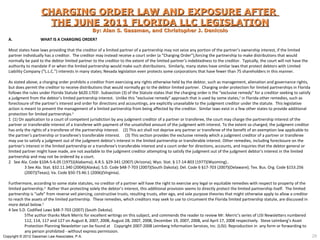
CHARGING ORDER LAW AND EXPOSURE AFTER
                      THE JUNE 2011 FLORIDA LLC LEGISLATION
                                                   By: Alan S. Gassman, and Christopher J. Denicolo
   A.                WHAT IS A CHARGING ORDER?

   Most states have laws providing that the creditor of a limited partner of a partnership may not seize any portion of the partner’s ownership interest, if the limited
   partner individually has a creditor. The creditor may instead receive a court order (a “Charging Order”),forcing the partnership to make distributions that would
   normally be paid to the debtor limited partner to the creditor to the extent of the limited partner’s indebtedness to the creditor. Typically, the court will not have the
   authority to mandate if or when the limited partnership would make such distributions. Similarly, many states have similar laws that protect debtors with Limited
   Liability Company (“L.L.C.”) interests in many states; Nevada legislation even protects some corporations that have fewer than 75 shareholders in this manner.

   As stated above, a charging order prohibits a creditor from exercising any rights otherwise held by the debtor, such as management, alienation and governance rights,
   but does permit the creditor to receive distributions that would normally go to the debtor limited partner. Charging order protection for limited partnerships in Florida
   follows the rules under Florida Statute §620.17031. Subsection (3) of the Statute states that the charging order is the “exclusive remedy” for a creditor seeking to satisfy
   a judgment from the debtor’s limited partnership interest. Unlike this “exclusive remedy” approach that is used by some states,2 in Florida other remedies, such as
   foreclosure of the partner’s interest and order for directions and accountings, are explicitly unavailable to the judgment creditor under the statute. This legislative
   action is meant to prevent the management of a limited partnership from being affected by the creditor. Similar laws exist in a few other states to provide additional
   protection for limited partnerships.3
   1 (1) On application to a court of competent jurisdiction by any judgment creditor of a partner or transferee, the court may charge the partnership interest of the
   partner or transferable interest of a transferee with payment of the unsatisfied amount of the judgment with interest. To the extent so charged, the judgment creditor
   has only the rights of a transferee of the partnership interest. (2) This act shall not deprive any partner or transferee of the benefit of an exemption law applicable to
   the partner's partnership or transferee's transferable interest. (3) This section provides the exclusive remedy which a judgment creditor of a partner or transferee
   may use to satisfy a judgment out of the judgment debtor's interest in the limited partnership or transferable interest. Other remedies, including foreclosure on the
   partner's interest in the limited partnership or a transferee's transferable interest and a court order for directions, accounts, and inquiries that the debtor general or
   limited partner might have made, are not available to the judgment creditor attempting to satisfy the judgment out of the judgment debtor's interest in the limited
   partnership and may not be ordered by a court.
   2 See Ala. Code §10A-5-6.05 (1975)(Alabama); A.R.S. §29-341 (2007) (Arizona); Wyo. Stat. § 17-14-803 (1977)(Wyoming)..
             3 See Ala. Stat. §32.11.340 (2004)(Alaska); S.D. Code §48-7-703 (2007)(South Dakota); Del. Code 6 §17-703 (2007)(Delaware); Tex. Bus. Org. Code §153.256
             (2007)(Texas); Va. Code §50-73.46:1 (2006)(Virginia).

   Furthermore, according to some state statutes, no creditor of a partner will have the right to exercise any legal or equitable remedies with respect to property of the
   limited partnership.4 Rather than protecting solely the debtor’s interest, this additional provision seems to directly protect the limited partnership itself. The limited
   partnership is “safe” from reverse veil piercing, constructive trusts, resulting trusts, alter ego, and sole purpose theories that might otherwise apply to allow a creditor
   to reach the assets of the limited partnership. These remedies, which creditors may seek to use to circumvent the Florida limited partnership statute, are discussed in
   more detail below.5
   4 See S.D. Codified Laws §48-7-703 (2007) (South Dakota).
            5The author thanks Mark Merric for excellent writings on this subject, and commends the reader to review Mr. Merric’s series of LISI Newsletters numbered
            112, 114, 117 and 127 on August 8, 2007, 2008, August 28, 2007, 2008, December 19, 2007, 2008, and April 17, 2008 respectively. Steve Leimberg’s Asset
            Protection Planning Newsletter can be found at Copyright 2007-2008 Leimberg Information Services, Inc. (LISI). Reproduction in any form or forwarding to
            any person prohibited - without express permission.
Copyright © 2012 Gassman Law Associates, P.A.                                                                                                                                     29
10 Year Gifting Period
    Moving More Value Out
  Of Taxable Estates by Using                   $26,000 Annual Exclusion Allowance
 Discounted Limited Partnership                       35% Valuation Discount
     Or LLC Annual Gifting

                         Permitted Annual       Cumulative Value   Gifting Equivalent Amount   Cumulative Value      Value Added By
             Year             Gifting            with 7% Growth      Applying 35% Discount      with 7% Growth    Discount Phenomenon
              1             $26,000.00              $26,000.00              $40,000.00             $40,000.00           $14,000.00
              2             $26,000.00              $53,820.00              $40,000.00             $82,800.00           $28,980.00
              3             $26,000.00              $83,587.40              $40,000.00            $128,596.00           $45,008.60
              4             $26,000.00             $115,438.52              $40,000.00            $177,597.72           $62,159.20
              5             $26,000.00             $149,519.21              $40,000.00            $230,029.56           $80,510.35
              6             $26,000.00             $185,985.56              $40,000.00            $286,131.63          $100,146.07
              7             $26,000.00             $225,004.55              $40,000.00            $346,160.84          $121,156.30
              8             $26,000.00             $266,754.87              $40,000.00            $410,392.10          $143,637.24
              9             $26,000.00             $311,427.71              $40,000.00            $479,119.55          $167,691.84
              10            $26,000.00             $359,227.65              $40,000.00            $552,657.92          $193,430.27
              11               $0.00               $384,373.58                $0.00               $591,343.97          $206,970.39
              12               $0.00               $411,279.73                $0.00               $632,738.05          $221,458.32
              13               $0.00               $440,069.31                $0.00               $677,029.71          $236,960.40
              14               $0.00               $470,874.17                $0.00               $724,421.79          $253,547.63
              15               $0.00               $503,835.36                $0.00               $775,131.32          $271,295.96
              16               $0.00               $539,103.83                $0.00               $829,390.51          $290,286.68
              17               $0.00               $576,841.10                $0.00               $887,447.85          $310,606.75
              18               $0.00               $617,219.98                $0.00               $949,569.20          $332,349.22
              19               $0.00               $660,425.38                $0.00              $1,016,039.04         $355,613.66
              20               $0.00               $706,655.15                $0.00              $1,087,161.77         $380,506.62
              21               $0.00               $756,121.01                $0.00              $1,163,263.10         $407,142.08
              22               $0.00               $809,049.49                $0.00              $1,244,691.52         $435,642.03
              23               $0.00               $865,682.95                $0.00              $1,331,819.92         $466,136.97
              24               $0.00               $926,280.76                $0.00              $1,425,047.32         $498,766.56
              25               $0.00               $991,120.41                $0.00              $1,524,800.63         $533,680.22
              26               $0.00              $1,060,498.84               $0.00              $1,631,536.67         $571,037.84
              27               $0.00              $1,134,733.76               $0.00              $1,745,744.24         $611,010.48
              28               $0.00              $1,214,165.12               $0.00              $1,867,946.34         $653,781.22
              29               $0.00              $1,299,156.68               $0.00              $1,998,702.58         $699,545.90
              30               $0.00              $1,390,097.64               $0.00              $2,138,611.76         $748,514.12


Copyright © 2012 Gassman Law Associates, P.A.                                                                                           30
CHOICES AND FACTORS WITH RESPECT TO ALLOCATION AND PAYMENT OF
             MEDICAL PRACTICE INCOME FOR THE SOLO PRACTITIONER
                                                          PAYEE                           CREDITOR                         TAX/EXPENSE                NOTES AND OBSERVATIONS

                                                       Pension Plans                          Yes                  Costs for staff and to maintain
                                                                                                                     plan – spouse on payroll to
                                                                                                                   justify additional contribution.
Owned by Physician or as
Tenants by the Entireties                         Children on the Payroll       Yes – If goes to Roth IRA in the    Child in lower rate but 15.3%     Can do this for parents and in-
                                                                                       name of the child.            employment taxes apply.                  laws as well!


                                                   Wages paid to Doctor         If Head of Household, Florida        15.3% Wage taxes on first        Up to $245,000 countable for
                                                                                    Statute 222 may apply –        $102,000, and then 2.7% over           pension contribution
                                                                                deposit directly into protected             $102,000.                          purposes.
                                                                                            account.               1.35% deductible at 35% rate,
                                                                                                                       so “after income tax,
                                                                                                                      employment tax rate” is
                                                                                                                             2.2275%.
           S
      CORPORATION
                                                Dividends to owner of entity.    Only if owner is protected –      Not subject to payroll taxes –       Not creditor protected as
        PRACTICE                                                                    such as tenants by the         but could be recharacterized                  wages.
         ENTITY                                                                  entireties or a family limited               by IRS.
                                                                                partnership owning the entity.


                                                    Spouse on payroll.              Yes, if spouse is safe.        Subject to 15.3% employment                       .
                                                                                                                     taxes on first $102,000/2.9%
                                                                                                                   over $102,000. May be worth it
                                                                                                                    for protection and/or pension
                                                                                                                       contribution for spouse.


                                                            Rent                    Yes, if renting entity is      7% sales tax – after tax cost is   May be worth paying full retail
                                                                                 protected. They protect PA                    4.55%                  rent if owner or part owner of
                                                                                 assets if landlord has lien to                                         building or equipment are
                                                                                  enforce rent on long-term                                            children and/or bypass trust
                                                                                              lease.                                                  for spouse to facilitate estate
                                                                                                                                                                tax savings.

                                                  Interest owed to related       If related party is protected.       Deductible as interest –           Why pay a bank 7% with
                                                           parties.                                                 receiving party pays interest     personal guarantees when a
                                                                                                                              income.                 family limited partnership or
                                                                                                                                                       trust for the children might
                                                                                                                                                          loan the money without
                                                                                                                                                      guarantees at 14% and take a
                                                                                                                                                        lien on all practice assets.

Copyright © 2012 Gassman Law Associates, P.A.                                                                                                                                    31
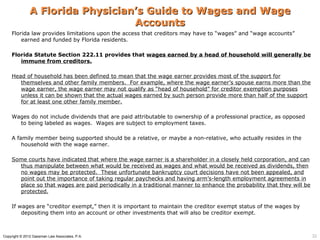
A Florida Physician’s Guide to Wages and Wage
                                  Accounts
    Florida law provides limitations upon the access that creditors may have to “wages” and “wage accounts”
        earned and funded by Florida residents.

    Florida Statute Section 222.11 provides that wages earned by a head of household will generally be
       immune from creditors.

    Head of household has been defined to mean that the wage earner provides most of the support for
       themselves and other family members. For example, where the wage earner’s spouse earns more than the
       wage earner, the wage earner may not qualify as “head of household” for creditor exemption purposes
       unless it can be shown that the actual wages earned by such person provide more than half of the support
       for at least one other family member.

    Wages do not include dividends that are paid attributable to ownership of a professional practice, as opposed
      to being labeled as wages. Wages are subject to employment taxes.

    A family member being supported should be a relative, or maybe a non-relative, who actually resides in the
        household with the wage earner.

    Some courts have indicated that where the wage earner is a shareholder in a closely held corporation, and can
      thus manipulate between what would be received as wages and what would be received as dividends, then
      no wages may be protected. These unfortunate bankruptcy court decisions have not been appealed, and
      point out the importance of taking regular paychecks and having arm’s-length employment agreements in
      place so that wages are paid periodically in a traditional manner to enhance the probability that they will be
      protected.

    If wages are “creditor exempt,” then it is important to maintain the creditor exempt status of the wages by
        depositing them into an account or other investments that will also be creditor exempt.


Copyright © 2012 Gassman Law Associates, P.A.                                                                          32
A Florida Physician’s Guide to Wages and Wage
                                        Accounts
 Other creditor exempt assets that wages may be “converted to” can include paying down the mortgage on a protected home,
 investing the paycheck directly into a properly titled annuity contract or life insurance policy, funding a tenancy by the entireties
 account where the wage earner’s spouse would not be sued by the same creditor as the wage earner, or making deposits into a
 wage account.

 Physicians who have monies or investments that are not creditor exempt might be well advised to spend down the non creditor
 exempt savings, while accumulating wages in a wage or other protected account.

 The Florida statutes do not explicitly impose any ownership, titling, naming or other specific requirement for an account to qualify
 as a wage account. A “wage account” can be owned by the physician earner, or may be held as tenancy by the entireties by the
 physician earner and the physician’s spouse.


 Most, if not all, married physicians whose spouses do not practice with them will be better protected by depositing their wages into
 a tenancy by the entireties account so that the wages may be safeguarded for two reasons: (1) the wage exemption rules as
 described above will apply, and (2) to “invade” a tenancy by the entireties bank account, a creditor must have a judgment against
 both spouses or show that the transfer into the account was Fraudulent transfer. If a wage check is a creditor exempt asset, then
 the deposit of the wage check directly into a protected tenancy by the entireties account should not be considered a Fraudulent
 transfer.

 Many physicians and bankers waste a lot of time opening “wage accounts” where tenancy by the entireties accounts or other
 vehicles are just as, if not more, protective and would qualify as wage accounts anyway.

 The statute simply says that wages are protected for six months in the account so long as they can be traced, and thus are not
 confused with non-wage or older wage deposits that would not be protected.

 It makes sense to have an account funded solely by wages, and to “empty the account” into other exempt investments, at least
 every six months, so that there would never have to be a tracing and proof analysis as to wage money protection.


Copyright © 2012 Gassman Law Associates, P.A.                                                                                            33
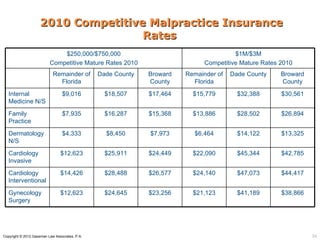
2010 Competitive Malpractice Insurance
                                    Rates
                              $250,000/$750,000                                         $1M/$3M
                          Competitive Mature Rates 2010                       Competitive Mature Rates 2010
                            Remainder of        Dade County   Broward   Remainder of   Dade County     Broward
                              Florida                         County      Florida                      County
   Internal                      $9,016           $18,507     $17,464     $15,779        $32,388       $30,561
   Medicine N/S
   Family                        $7,935           $16,287     $15,368     $13,886        $28,502       $26,894
   Practice
   Dermatology                   $4,333           $8,450      $7,973      $6,464         $14,122       $13,325
   N/S
   Cardiology                   $12,623           $25,911     $24,449     $22,090        $45,344       $42,785
   Invasive
   Cardiology                   $14,426           $28,488     $26,577     $24,140        $47,073       $44,417
   Interventional
   Gynecology                   $12,623           $24,645     $23,256     $21,123        $41,189       $38,866
   Surgery


Copyright © 2012 Gassman Law Associates, P.A.                                                                    34
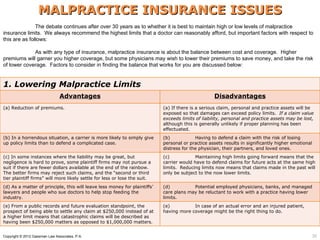
MALPRACTICE INSURANCE ISSUES
               The debate continues after over 30 years as to whether it is best to maintain high or low levels of malpractice
insurance limits. We always recommend the highest limits that a doctor can reasonably afford, but important factors with respect to
this are as follows:

             As with any type of insurance, malpractice insurance is about the balance between cost and coverage. Higher
premiums will garner you higher coverage, but some physicians may wish to lower their premiums to save money, and take the risk
of lower coverage. Factors to consider in finding the balance that works for you are discussed below:


1. Lowering Malpractice Limits
                                Advantages                                                        Disadvantages
(a) Reduction of premiums.                                                 (a) If there is a serious claim, personal and practice assets will be
                                                                           exposed so that damages can exceed policy limits. If a claim value
                                                                           exceeds limits of liability, personal and practice assets may be lost,
                                                                           although this is generally unlikely if proper planning has been
                                                                           effectuated.
(b) In a horrendous situation, a carrier is more likely to simply give     (b)            Having to defend a claim with the risk of losing
up policy limits than to defend a complicated case.                        personal or practice assets results in significantly higher emotional
                                                                           distress for the physician, their partners, and loved ones.
(c) In some instances where the liability may be great, but                (c)           Maintaining high limits going forward means that the
negligence is hard to prove, some plaintiff firms may not pursue a         carrier would have to defend claims for future acts at the same high
suit if there are fewer dollars available at the end of the rainbow.       limits. Reducing limits now means that claims made in the past will
The better firms may reject such claims, and the “second or third          only be subject to the now lower limits.
tier plaintiff firms” will more likely settle for less or lose the suit.
(d) As a matter of principle, this will leave less money for plaintiffs’   (d)          Potential employed physicians, banks, and managed
lawyers and people who sue doctors to help stop feeding the                care plans may be reluctant to work with a practice having lower
industry.                                                                  limits.
(e) From a public records and future evaluation standpoint, the            (e)          In case of an actual error and an injured patient,
prospect of being able to settle any claim at $250,000 instead of at       having more coverage might be the right thing to do.
a higher limit means that catastrophic claims will be described as
having been $250,000 matters as opposed to $1,000,000 matters.                                                                            35


Copyright © 2012 Gassman Law Associates, P.A.                                                                                                      35
MALPRACTICE INSURANCE ISSUES

   2. Out of State or Country Malpractice Carriers: A Dangerous
   Middle Ground:
   (a) Many physicians have chosen small out-of-state or offshore carriers or “self-insurance” programs in lieu of traditional malpractice
   insurance.


   (b) These programs usually cost much less than traditional malpractice insurance, and offer the doctors “more control” over the claims
   process.


   (c) These carriers are not registered with Florida, and upon becoming insolvent the doctor has no protection at all.


   (d) These carriers are much more likely to become insolvent than Florida carriers.

   (e) In some cases, these carriers do not satisfy the definitional requirements of “malpractice insurance”, so the doctor is actually
   “bare”, but may not know to follow the going bare rules. A patient with a judgment against such a doctor may have the ability to
   cause the doctor to lose his or her discharge in bankruptcy and medical license!


Copyright © 2012 Gassman Law Associates, P.A.                                                                                               36
MALPRACTICE INSURANCE ISSUES

   3. Captive Insurance Carriers: Is the Doctor the Real Captive?
   While the income tax law and creditor tax laws may make captive insurance carriers very attractive to many physicians, there are a
   great many “hucksters” in this industry, and clients should consider potential problems that are faced by physicians and practices who
   are provided with malpractice insurance through captive offshore or domestic insurance carriers:

   (a) Will the money invested be lost in bad investments or stolen offshore?
   (b) Will the IRS approve tax deductions for this type of arrangement?

   (c) If the carrier is not registered with the applicable state insurance department, then “going bare” rules may apply, even if a doctor is
   not really “going bare.” In this event the doctor may have to post a letter of credit or deposit under the statute or report to patients
   that the doctor is “bare” even if the doctor actually has coverage from the captive carrier.
   (d) Typically the captive carrier is responsible for a portion of any liability from lawsuits, and then contracts with an “excess carrier”
   such as Lloyds of London to handle excess liability. An example would be that the captive carrier covers the first $75,000 of any claim,
   with any excess liability being handled by the excess carrier. What guarantees does the excess carrier give that the insurance will be
   renewable and that tail excess coverage will be available when a doctor leaves? Many reinsurance contracts provide no assurances
   whatsoever that the contract will even be renewed by the carrier or that there will be the availability of tail coverage.
   (e) Will managed care plans, hospitals and other facilities consider this to be real insurance for staff privilege and payor status rights?
   The author has had clients refused entry into worker’s compensation plans by reason of not having traditional malpractice insurance.
   Captive insurance carrier arrangements may have tax advantages and reinsurance purchase opportunities that are not available under
   normal malpractice insurance company arrangements. Premiums paid may be tax deductible by the physician or physician group, and
   not included in net income by the carrier, because of something called the accrual method of accounting. Upon eventual dissolution of
   the carrier, monies coming out to the physician owners may be taxed as capital gains rates. Nevertheless, physicians and their
   advisors should proceed very cautiously with any offshore captive program in order to help assure that the doctor will have solid
   malpractice insurance benefits, and that investments and the offshore structure are conservative and tax reporting compliant. It is
   often said that there needs to be at least $500,000 or more of annual premiums to justify the expenses and risks associated with these
   types of arrangements. One excellent introductory book on this area is written by attorney and author Jay Adkisson, and is entitled
   Adkisson’s Captive Insurance Companies: An Introduction to Captives, Closely held Insurance Companies, and Risk Retention Groups.


Copyright © 2012 Gassman Law Associates, P.A.                                                                                                    37
SINGLE PHYSICIAN OWNED MEDICAL PRACTICE


Copyright © 2012 Gassman Law Associates, P.A.       38
MULTIPLE OWNED DOCTOR MEDICAL PRACTICE


Copyright © 2012 Gassman Law Associates, P.A.      39
THE MANY FACES OF PRACTICE ASSET PROTECTION TECHNIQUES

Multi-Facial International Conversion   Chart 1          Chart 2                   Chart 3               Chart 4a                     Chart 5                 Charts 6 & 7
Key:                                    P.A. Borrows     Loan to Doctors Secured   Give Bank PA Assets   Funding of Annuity or Life   Offshore Compensation   Giving Bank Lien on
                                        and Pays Bonus   by P.A. Assets            as Collateral on      Insurance Arrangement        Trust                   Practice Assets/
                                                                                   Building Loan                                                              Long Term Lease
Good
                                                                                                                                                              Giving Landlord
                                                                                                                                                              Collateral/UCCs
Not Good
                                                                                                                                                              recorded in favor of
                                                                                                                                                              working physicians
Neutral
                                                                                                                                                              to protect their share
                                                                                                                                                              of accounts receivable
1. Tax Cost?


2. Tax Risk?                            None


3. Expensive to Implement?


4. Feasible?                            Depends              Depends                        Yes                 Yes                           Yes                     Yes


5. Financial Risk to Doctors
   if Loan Not Repaid by
   One of Them.

6. Expensive to Maintain?

7. Will Deter Creditors?
   (Scale of 1 to 10)                     8?                       7-8?                    2-6?                    5?                          7-9?                     2-4?
   (Author's Guestimation)
8. Contempt of Court Risk?                No                       No                        No                   No                           Yes                      No


Copyright © 2012 Gassman Law Associates, P.A.                                                                                                                                          40
CHART #1
                 PROFESSIONAL PRACTICE LIEN STRUCTURE LOGISTICS


                                                Practice Entity borrows money and distribures to Shareholder professionals.


                                                                                                Dr. A
                                                             2. Pays bonus or dividend


                                                                                                              3. Pays taxes to IRS


                                      PROFESSIONAL
                                        PRACTICE
                                                                                                                                     IRS
                                         ENTITY


                   1. Loans money                            2. Pays bonus or dividend
                                                                                                              3. Pays taxes to IRS


                                                                                                Dr. B


               Bank             1. Lien         Accounts Receivable
                                                Furniture & Equipment


Copyright © 2012 Gassman Law Associates, P.A.                                                                                              41
CHART #2
                 PROFESSIONAL PRACTICE LIEN STRUCTURE LOGISTICS

       Shareholders borrow money - Professional Entity provides credit enhancement by collateralizing assets and guaranteeing debt.


                                                                                         Dr. A                3. Buys protected investments


                                                                        2. Loans money
                                        PROFESSIONAL
                                          PRACTICE
                                           ENTITY


       1. Pledges AR, F & E as collateral


                                                                        2. Loans money
                                                                                         Dr. B                3. Buys protected investments


                Bank                            Accounts Receivable
                                                Furniture & Equipment


                                                                                                               IRS


                                                                                                              Gets nothing


Copyright © 2012 Gassman Law Associates, P.A.                                                                                                 42
CHART #3
                 PROFESSIONAL PRACTICE LIEN STRUCTURE LOGISTICS

 Practice Entity assets and guarantee provided under loan to separate Building Entity - Practice and Entity enter into long term lease.


                                                                                                Dr. A and
                                                                                                 Spouse


                                PROFESSIONAL
                                  PRACTICE
                                   ENTITY
                                                                3. Long term lease


 1. Gives lien                                                  4. Gives second lien


                                                                                                     Dr. B and
                                                                                                      Spouse


          Bank                          Accounts Receivable
                                        Furniture & Equipment


                           2. Loans money                                            Building
                                                                                      Entity
                                                                                                                    IRS


                                                                                                                 Gets Nothing


Copyright © 2012 Gassman Law Associates, P.A.                                                                                             43
CHART #4
                 PROFESSIONAL PRACTICE LIEN STRUCTURE LOGISTICS


                                                                                                            Dr. A                      Pays taxes to IRS?


                                                4. Doctor pledges annuity to bank


                                                                                                        Dr. A owns
                                                                3. P.A. buys policy and each           annuity or life
                                     PROFESSIONAL                  doctor agrees to work                  policy
                                       PRACTICE                    and not compete and each
                                        ENTITY                     doctor owns this annuity policy.


                   1. Bank Loans Money                          3. P.A. buys policy and each              Dr. B                        Pays taxes to IRS?
                      to P.A.                                      doctor agrees to work
                                                                   and not compete and each
                                                                   doctor owns this annuity policy.


                                2. Lien
                                                                                                                                            IRS
               Bank                             Accounts Receivable
                                                Furniture & Equipment                                  Dr. B owns
                                                                                                      annuity or life
                                                                                                         policy
                                                                                                                                       May claim annuity funding
                                                4. Doctor pledges annuity to bank                                                      is income to policy owner


   Why not have the doctors personally borrow the money to buy variable annuity or life products that will have an 8% to10% expected rate of return by borrowing money
   from the bank directly to avoid the income tax issues shown inChart #4? The bank, being concerned that the market could plummet, may require additional collateral,
   whichcould be in the form of medical practice assets so that the medical practice becomes a guarantor on each loan andpledges its furniture, equipment, and accounts
   receivable as additional collateral thereon. Thus, this becomes Chart #2, which perhaps works better from a logistical standpoint.


Copyright © 2012 Gassman Law Associates, P.A.                                                                                                                             44
NEW PARENT F REORGANIZATION, SHOWING
                ACCOUNTS RECEIVABLE FACTORING
                         ARRANGEMENT


Copyright © 2012 Gassman Law Associates, P.A.       45
Limited Liability Trust –
                                  Asset Protection Trust
         BETTER THAN AN LLC TO HOLD INVESTMENT PROPERTY IF LIABILITY INSURANCE
                        COVERAGE AND RATES WILL BE BENEFICIAL

SUCH A TRUST MAY ALSO QUALIFY UNDER AN INDIVIDUAL UMBRELLA POLICY, WHEREAS
                              AN LLC MAY NOT
                  Trust Company in proper jurisdiction = Trustee or Co-Trustee


                                                                   -Benefits mother, father and children.
          Mother & Father as                         ASSET
                                                  PROTECTION       -May be disregarded for income tax purposes.
          contributors                                             -No tax filing requirements if a domestic asset
                                                    TRUST
                                                                   protection trust jurisdiction is used.
                                                                   -May need to have subsidiary management trust
                                                                   owned 100% by asset protection trust to hold title, to
                                                                   allow parents to have management powers
                                                                   (preferably one parent who does not have other
                                                Rental Home(s)     exposed assets).


Copyright © 2012 Gassman Law Associates, P.A.                                                                               46
Dynasty Wealth Protection Trust

                                                            1.   Grantor can replace the Trustee at any time and
                                                                 for any reason.
                                                            2.   Protected from creditors of Grantor and family
      Trustee                                                    members.
                                                            3.   Can benefit spouse and descendants as needed
                                                                 for health, education and maintenance.
                                                            4.   Per Private Letter Ruling 200944002 the Grantor
                                                                 may be a discretionary beneficiary of the trust
                           DYNASTY                               and not have it subject to estate tax in his or her
                                                                 estate. But be very careful on this! The Trust
                            WEALTH                               would need to be formed in an asset protection
                          PROTECTION                             jurisdiction and there is no Revenue Procedure on
                                                                 this.
                            TRUST                           5.   Should be grandfathered from future legislative
                                                                 restrictions.
                                                            6.   May loan money to Grantor.
                                                            7.   May own limited partnership or LLC interests that
                                                                 are managed at arm’s-length by the Grantor.
                 Assets gifted to trust and                 8.   May be subject to income tax at its own bracket,
                     growth thereon.                             or the Grantor may be subject to income tax on
                                                                 the income of the trust, allowing it to grow
                                                                 income-tax free unless or until desired otherwise.
      Note: Nevada gets a gold star for having a law              If the Grantor is a beneficiary it must remain a
      that says there cannot be an assumed or an oral            disregarded Grantor Trust.
      agreement between the Grantor and the Trustee
      of a dynasty trust; because of this, the IRS cannot
      say that the grantor retains certain control.


Copyright © 2012 Gassman Law Associates, P.A.                                                                          47
Example of a Husband/Wife
                           Dynasty Trust Arrangement
           HUSBAND                                                    WIFE


                                                                                                       Wife is Trustee


                                                                                                  DYNASTY
         HUSBAND'S                                                  WIFE'S                         TRUST
         REVOCABLE                                                REVOCABLE
           TRUST                                                    TRUST


                                                                                                       Other Assets ?

                                                                                                                  1. Investments controlled by Husband as
                                                                                   99% LP                         GP of Limited Partnership.
                                                1% GP                                                             2. Husband can replace the Trustee of the
                                                                                                                  Dynasty Trust.
                                                                                                                  3. Dynasty Trust can be used for spouse
                                                                                                                  and descendants as needed for health,
                                                                                                                  education and maintenance.
                                                                FAMILY         **Gift to Dynasty Trust may        4. Dynasty Trust can loan money to family
                                                                LIMITED        be based upon 65% of 99%           members.
                                                              PARTNERSHIP      of $5,000,000, after taking        5.Dynasty Trust should be exempt from
                                                                                                                  estate tax, creditor claims, and divorce
                                                                               discounts into account.
                                                                                                                  claims of both spouses and descendants.
                                                                                 $3,217,500
                                                        $5,000,000 in assets
                                                                               Husband has $1,782,500 of his
                                                                               $5,000,000 exemption remaining.


Copyright © 2012 Gassman Law Associates, P.A.                                                                                                                 48
Defective Grantor Trusts & Disregarded Entities
 Illustrated Flowchart Summarizing Private Letter
                 Ruling 200439028


Copyright © 2012 Gassman Law Associates, P.A.   49
PLANNING FOR A DYNASTY TRUST WHERE THE
  SPOUSE OF THE SETTLOR/CONTRIBUTOR IS A
  BENEFICIARY - SPECIAL CONSIDERATIONS
    1.      The settlor’s spouse may be a trustee of the trust. As with all irrevocable trusts, administration should be well documented and
            according to the trust document.

    2.      The settlor’s spouse can have the right to receive amounts as reasonably needed for health, education, maintenance, and
            support. It is best to provide that any such distributions for the spouse will be made only after taking into account the spouse’s
            other assets and resources.

            Otherwise, consider whether the spouse might be considered to be gifting to the trust if he or she had the right to receive
            distributions and did not take them.

            Alternatively, limit distributions to the spouse by requiring an independent fiduciary to approve them.

    3.      Marital Deduction Savings Clause - The settlor’s spouse may be the beneficiary of an outright disposition or General Power of
            Appointment Marital Trust provision to be funded if total contributions to the trust would otherwise cause gift tax responsibility.
            Do not use a QTIP trust for this because of the harsh regulations requiring a marital deduction election to be filed for a lifetime
            QTIP trust gift.

    4.      Typically the trust will be disregarded for income tax purposes, so that the settlor can pay the income tax attributable to the
            trust’s income.

            In case the settlor may want to “toggle off” defective grantor trust status (such as by reserving the right to replace trust assets
            with assets of equal value, and then releasing that right) an adverse party (another substantive beneficiary under the trust) must
            have the right to approve any distributions to the spouse.

            Otherwise the trust will be a defective grantor trust under Internal Revenue Code Section 677, and the settlor will not be able to
            toggle that off (except by getting divorced!).

    5.      The settlor’s spouse may choose to “split the gift” on a gift tax return, which is permitted notwithstanding that the spouse is a
            beneficiary, so long as it is very unlikely that the spouse will need to receive benefits for health, education, maintenance and
            support when taking into account the spouse’s other assets and resources. See Private Letter Ruling 200345038, William H.
            Robertson vs. Commissioner, 26 TC 246 (1956), and BNA Portfolios 822-2nd: Estate, Gift and Generation-Skipping Tax Returns
            and Audits, Section IX.M, and 826-2nd: Life Insurance, Section II.F.

    6.      What if the assets used to fund the trust had recently been owned jointly by the settlor and the spouse, or were owned by the
            spouse and transferred to the settlor, who then transferred them to the trust? Under the Step Transaction Doctrine, the assets
            and the economic risk associated therewith should be owned and held exclusively by the settlor for a reasonable period of time.
            In case the IRS argues that the contribution to the trust was really made by the settlor’s spouse (in which event the settlor’s
            spouse may be subject to federal estate tax under Internal Revenue Code Section 2036(a)(1) - retained life interests), it may be
            important to have trust language which provides that any trust assets considered as transferred to the trust by the spouse
            beneficiary will be considered to be held in a separate subtrust of which the spouse will not be a beneficiary.

Copyright © 2012 Gassman Law Associates, P.A.                                                                                               50
PLANNING FOR A DYNASTY TRUST WHERE THE SPOUSE OF THE SETTLOR/
  CONTRIBUTOR IS A BENEFICIARY - SPECIAL CONSIDERATIONS
 7.      Should the surviving spouse be given a limited power of appointment to direct how trust assets will pass? The grantor
         cannot be given this power if a completed gift to the trust is desired, but the spouse can. However, the power should
         not be exercisable in favor of her personally, her creditors, her estate, or creditors of her estate.

         At what point should the power of appointment exist and/or be terminated?

                  (a)                      Immediately upon inception of the trust until the death of the surviving spouse?

                  (b)                      Only after the death of the settlor until the death of the surviving spouse?

                  (c)              Only unless or until the parties are divorced or either party has a child who is not a beneficiary
                  under the trust?

         What would prevent the beneficiary spouse from exercising his or her power of appointment to fund a trust for the
         donor spouse to allow the ability to receive amounts as needed for health education and maintenance – assuming that
         there is no pre-existing agreement or obligation for this to happen.

 8.      Should there be a divorce clause?

         Typically where the drafting lawyer is representing both spouses this can be discussed and a joint representation letter
         can be put into place. It is likely that the judge will consider the trust assets to be for the benefit of the beneficiary
         spouse, but this will vary from state to state and judge to judge.

         If the settlor’s spouse is not a client then consider a clause that will provide that, upon divorce, the beneficiary spouse
         is no longer a beneficiary, trustee or otherwise entitled under the document.

 9.      If the trust also provides for health, education, maintenance and support or other payments to descendants, how will
         the trust be protected from a descendant’s support claims or other items for which state law permits penetration of a
         trust?

         If the trust’s primary beneficiary is your spouse, but your children can reach into it, do you have to worry that one of
         your children is going to have a nasty divorce and the ex-spouse of a child is going to be able to reach into this trust?

         Consider whether there should be a Flee (Cuba) Clause in the trust, or whether the trust should name an independent
         trust protector or trust protectors with the ability to remove descendant beneficiaries and/or the ability to move the
         situs of the trust to an appropriately protective jurisdiction.

Copyright © 2012 Gassman Law Associates, P.A.                                                                                      51
ISLE OF
                                                                                MAN/JERSEY
           FACTOR                       NEVADA               ALASKA           (Channel Island)              NEVIS                 BELIZE
                                                                                  No statutory
                                                                                 limitation on
                                     See Page 46                              fraudulent transfer
       Asset protection            Strong/2 years –      Strong/4 years –       – unless import
       law – Statute of            BUT full faith and    BUT full faith and    law of jurisdiction                             Strong/1 day
         Limitations                  credit issue          credit issue        of a Co-Trustee         Strong/2 years            statute!

                                                                                                      $1,750 min to open
        Approximate                                                                                   $2,500-$5,000 per     $700 fee to
       minimal cost to              $250 to open         $750 to open         $1,600 to open          year thereafter       register;
       open trust and               $1,500 per year      $3,000 per year      $1,600 - $3,300 per     depending on value    $1,100 - $2,300 per
        annual fees.                thereafter           thereafter           year thereafter         of trust              year thereafter

                                                                                                      Low, if you use a
        Risk of theft.                  Very low.            Very low.        Should be very low.     safe trust company.         Not sure.

     Use of subsidiary
     entities permitted-
     settlor can be
     Manager of entity.                     YES                 YES                   YES                    YES                    YES

                                                                                                      Does the judge like
                                                                                                      Four Seasons Hotels   Has the judge read
                                                                                Does the judge        or Alexander          SEC v. Banner Fund
     Reputation with US              Does the judge     Does the judge like     know European         Hamilton (born        International, or like
     courts.                         gamble?            cruises?                history?              there).               barrier reefs?

    Commonality of use           New concept            Not common            Common in these         Common                Common
    of Swiss or                                                               islands for centuries
    Bermuda
    depositories.


Copyright © 2012 Gassman Law Associates, P.A.                                                                                                    52
ISLE OF MAN/
                                                                            JERSEY
                                                                           (Channel
          FACTOR                       NEVADA                ALASKA         Island)                 NEVIS                BELIZE
    Use of Trust                 New concept           New concept       Since the 1700s      Normal               Normal
    Protectors.

    Quality of service.          High                  High- time zone   British-style/time   Small town-          Mayberry RFD
                                                       difference        zone difference      usually good.

    Allows importation           YES if original       YES               The Statute of       YES                  YES
    with statute of              situs has                               Elizabeth provides
    limitations tolling          substantially                           that fraudulent
    from inception of            similar spendthrift                     transfers should
    trust at where it            laws                                    be void, not
    was imported                                                         subject to any
    from?                                                                limitation period

    Toggling off is              YES                   YES               NOT unless there     NOT unless there     NOT unless there
    possible?                                                            is one or more       is one or more       is one or more
                                                                         U.S. beneficiaries   U.S. beneficiaries   U.S. beneficiaries

    Provides for                 YES                   YES               NO, about 170        NO, about 100        NO, about 150
    contingency fee                                    About 4,000       attorneys in Isle    attorneys            attorneys
    payments? -                  About 10,000          attorneys         of Man, and 150      Most lawyers are     Most lawyers are
    Number of                    attorneys                               in Jersey            conflicted           conflicted
    lawyers                                                              Most lawyers are
                                                                         conflicted

    Rule Against                 365 years             1,000 years       150 years            Does not apply       Abolished
    Perpetuities


Copyright © 2012 Gassman Law Associates, P.A.                                                                                           53
SOAP ON A ROPE
       HOUSE OF BRICKS                    HOUSE OF STICKS           HOUSE OF STRAW                  FORGET IT                  (PRISON)
   Offshore trust in a top            Domestic in a top
   offshore jurisdiction?             domestic jurisdiction?
   Trustee controlled                 Most assets under an       Client as co-trustee and/
                                      LLC or partnership         or loosely managed LLC
                                      controlled by client.      or partnership


   Small percentage of                50% of personal assets     The majority of assets
   personal assets
   Business purpose                   Creditor protection is     Creditor protection is
   besides creditor                   the sole purpose           the primary purpose and
   protection                                                    last minute/domestic


   No benefits paid or                Occasional benefits in     Significant continuing      Debit card
   derived by settlor                 unexpected situations or   benefits
                                      expected future
                                      retirement benefits
   Fully reported for all tax         Reasonable attempts to     Haphazard reporting         Intentional non-           Intentional failure to
   and disclosure purposes            comply with reporting                                  reporting                  report income
                                      purposes                                                                          Intentional non-
                                                                                                                        reporting
   Disclosure on financial            No one is misled over      No one is intentionally     Has intentionally misled   Has intentionally misled
   statements and                     the arrangement            misled over the             creditors (may be a        a court or the Internal
   otherwise                                                     arrangement                 crime)                     Revenue Service


Copyright © 2012 Gassman Law Associates, P.A.                                                                                                      54
OFFSHORE TRUST –
TICKING TIME BOMBS
                Not reporting the trust and trust activities on a Form 3520, upon
                 inception, Form 3520A each year thereafter, TD F 90-22.1 (FBAR) forms
                 annually, and compliance with FATCA (Foreign Account Tax Compliance
                 Act) reporting requirements.
                Not reporting trust income or not reporting income that goes into the
                 trust.
                Being dishonest with any potential creditor, the IRS or any taxing
                 authority with respect to the trust or its underlying operations.
                Not reporting the funding of the trust as a completed gift for gift tax
                 purposes if the grantor has not retained a power with respect to the trust
                 that would cause its funding to be an incomplete gift (such as the
                 testamentary power to appoint trust assets) even if the trust will be
                 subject to estate tax by reason of such power.
                Failure to provide that upon death, any marital deduction devise must
                 override any discretionary power of the trustee or trust protectors to
                 deprive the grantor’s spouse of sole lifetime beneficiary/QTIP trust or
                 outright payment rights.
                Getting the trust assets stolen by the trustee.
                Being dishonest with any court with respect to the trust or its operations.


Copyright © 2012 Gassman Law Associates, P.A.                                                  55
       Nevada, Alaska and Delaware have asset protection trust
                  statutes. But the Full Faith and Credit Clause of the U.S.
                  Constitution provides that a judgment issued by the court
                  in one state will be respected by the court in other states.
                 There are many questions regarding the effectiveness of
                  domestic APTs. The case law is not yet fully developed on
                  the question of whether the law of a foreign jurisdiction
                  will apply for the determination of whether a creditor
                  protection trust will shield trust assets from creditors of
                  the grantor who is also a beneficiary.
                     ◦      Hanson v. Denckla, 357 U.S. 235 1958 – the law of the state
                            where the trust administration occurs will be determinative.
                     ◦      In re Portnoy, 201 B.R. 685 (Bankr. S.D.N.Y. 1996) and In re
                            Brooks, 217 B.R. 98 (Bankr. D. Conn. 1998) – assets placed in
                            offshore APTs were not excluded from the debtor’s Bankruptcy
                            estates.


Copyright © 2012 Gassman Law Associates, P.A.                                               56
Avoid Theft
                 It is vital that clients utilize reputable trust companies and
                  structures that assure that the assets they place under an
                  APT will not be stolen.
                 Sometimes two trust companies from different
                  jurisdictions will serve as Co-Trustees under the trust
                  agreement, or a lawyer or other fiduciary may serve so
                  that two signatures and collusion would be required
                  before monies held in an offshore account could ever be
                  stolen.
                 Some jurisdictions, like the Isle of Man and Jersey in the
                  Channel Islands allow for the law of a co-trustee’s
                  jurisdiction to apply.
                     ◦      There are many well funded and reputable trust companies in
                            the Isle of Man and Jersey willing to serve as managing Co-
                            Trustee of APT formed under the laws of a more recognized APT
                            jurisdiction.


Copyright © 2012 Gassman Law Associates, P.A.                                               57
UNDERSTANDING YOUR
                                                LIABILITY INSURANCE COVERAGE
        The vast majority of carriers will only issue a $250,000 policy on your home, a $250,000 policy on your
        driving, and a $250,000 policy on your vacation home.
        A separate “umbrella carrier” or “carriers” will then issue separate policies for above $250,000, as shown
        in the example below. Sometimes one carrier will write two or more of the below described policies, but
        often there will be 3 or more carriers involved and coordination can be a challenge:
   $5,000,000                         Umbrella Policy #1                  Umbrella Policy #2

                                      Covers claims for home at           May need a separate umbrella for
                                      $300,000 and for cars at            out-of-state vacation home, large
                                      $250,000.                           boats or other items.

                                      Must be “drop-down” umbrella if
                                      home policy is issued by Citizens
                                      or a comparable state agency that
   $251,000                           does not cover liabilities from
                                      pools, pets, or other notable
                                      exceptions.


   $250,000                           Policy #1 –       Policy #2 – Car   Policy #3 –          Policy #4 - Big
                                      Homeowners        Driver and        Vacation Home        Boat at Vacation
                                                        Owner Policy                           Home


   $0

Copyright © 2012 Gassman Law Associates, P.A.                                                                        58
UMBRELLA INSURANCE COVERAGE
       Re:          UMBRELLA LIABILITY INSURANCE COVERAGE

 Dear ________________:

       As part of our planning I wanted to reiterate the importance of having an appropriately coordinated and “gap free” liability and casualty insurance
       program.

       I am enclosing a sample letter that some clients use to help assure that they have coverage for common gaps or mistakes made in structuring
       liability insurance. If you would like assistance in completing this type of letter, please let me know.

       The rest of this letter is about umbrella liability insurance coverage. We believe that it is very important to have appropriate limits of liability on
       automobile and homeowner insurance policies. Typically, the automobile and homeowner policies will be at $500,000 coverage, and then there will
       be excess coverage under what is called a "personal umbrella policy."

       The personal umbrella policy is used in combination with homeowners and auto policies to cover most clients' needs. If it is a true "umbrella" it will
       provide excess limits above and beyond your primary insurance coverage (such as homeowners, automobile or boat policy), and will also provide
       coverage for situations excluded or not addressed by underlying coverages. Each individual insurance company will have its own requirement for
       limits that you must have on your primary policies. You will want to be careful to assure that these policies are coordinated with your umbrella
       coverage.

     Umbrella limits start at $1,000,000 and can go over $10,000,000. Pricing for these policies are based primarily on the number of houses and
     vehicles to be insured, with each additional $1,000,000 of coverage being less expensive than the preceding. In your situation I would probably
     have $___________________ of umbrella liability insurance. Also, I would consider placing much of your brokerage account and
     other assets under a family limited partnership to further insulate you for creditor protection purposes.
 Another coverage that is often underutilized by clients is called "uninsured motorist coverage." If you are in an automobile accident caused by someone
     who does not have enough coverage to pay for your damages, you can pursue your own insurance company to the extent of your "uninsured
     motorist" coverage. We encourage clients to see what it costs to have $500,000 or more in uninsured motorist coverage to help compensate for
     catastrophic accidents that can happen.

       Some carriers, including citizens and carriers who have assumed policies from citizens do not provide liability coverage for pool and pet or animal
       related liabilities. In this event the Umbrella liability coverage may or may not apply. This is something that should be discussed with the
       insurance agency or carrier that provides liability coverage.

       If we can provide you with any further information or with assistance concerning your insurances, please let us know.

                                                  Very truly yours,

                                                  Alan S. Gassman


Copyright © 2012 Gassman Law Associates, P.A.                                                                                                                59
Dear Liability Insurance Agency and/or Carrier:

             I recently met with my estate planning lawyer and wanted to make sure of the following:

              1.       Please confirm that we have Personal Liability Umbrella insurance covering our automobiles, boats, recreational vehicles, and all properties owned. I would like quotes on
   the following coverage limits, $1,000,000, $3,000,000 and $5,000,000, with and without Uninsured Motorist coverage.

            2.        Please confirm that we are covered for animal liability under our primary homeowners insurance and confirm that the Liability Umbrella would also extend to animal liability.
    We have been told that the primary homeowners may exclude animal liability and that some Liability Umbrella policies will not provide coverage when the primary homeowners insurance
   excludes same.

            3.         Please confirm that we are covered for pool related accidents occurring on our property and also confirm that the Personal Liability Umbrella policy will also extend
   coverage to pool related accidents.
            4.         Can you please confirm that we are covered for cars being driven by _____________________.

           5.      Can you please confirm that we are covered for the investment property that we own at ______________________________.                            It is titled under the name of
   ______________________________?

           6.      Can you please confirm that we are covered for our                   ______________________________ boat, which is ______ foot long and is normally stored at
   ______________________________. The horsepower is ______________.

             Are we also covered for trailering the boat with our trailer?

           Also, can you please confirm that we are covered for our waverunner/jet ski which is a _________________ with horsepower of _________________.                            It is stored at
   ________________________.

             7.            You do not handle the coverage for our vacation ______________________________ in ______________________________ or our vacation
   ____________________________ in ______________________________. Is our potential liability relating to the use of these properties covered under our umbrella, or do we have to obtain
   a separate umbrella for these properties?

           Our   ______________________________                and     _____________________________         are   stored    and    used     up    in   our    ______________________________
   ______________________________.

           8.      ______________________________ drives the car owned by ______________________________      both for personal purposes and with respect to the
   ______________________________ business.           We assume our coverage includes business driving both by          ______________________________ and by
   ______________________________ who occasionally drive the car for the business.
           9.      Can you please confirm that we are covered for our motorcycle being driven by ___________.

             10.       Is there anything not mentioned above that comes to mind that we should be aware of?

            Please send our lawyer, Alan S. Gassman, a copy of your response to this letter, which has been generated as a part of our estate planning. Alan's email address is
   AGassman@gassmanpa.com and his street address is 1245 Court Street, Suite 102, Clearwater, Florida 33746. His fax number is (727) 443-5829. Please send us a copy of your response
   as well.

             If you have any further suggestions with respect to our coverages please let us know.

             Thank you very much for your assistance herewith.

                                            Best personal regards,


                                                                                                                                                                                                  60
Copyright © 2012 Gassman Law Associates, P.A.
6 Catastrophes That Can Happen as a Result of the
 New Florida Durable Power of Attorney Act
1.    Signing a springing power of attorney: will have no force or effect after Sept. 30, 2011.
2.    Not enumerating each and every power that the Agent will need to exercise, in that a general authorization
      provides no power or authority – specific enumeration is required for a post September 30, 2011 Power of
      Attorney.
3.    Authorizing the agent to conduct certain actions, without separately signing or initialing each provision, will
      not be sufficient to allow the agent to do any of the following:
         a. Create an inter vivos trust (living trust): the terms of the trust agreement may prevent amendment or
              termination by an agent under a power of attorney.
         b. Amend, revoke, or terminate a trust created by or f/b/o the principal (if the trust instrument allows it)
         c. Make a gift subject to § 709.2202(3), see page 30;
         d. Create or change rights of survivorship
         e. Create or change a beneficiary designation
         f.   Waive the principal’s rights to be a beneficiary of a joint and survivor annuity, including a survivor
              benefit under a retirement plan
         g. Disclaim property or powers of appointment
4.    Executing a power of attorney after Sept. 30, 2011 without having two witnesses and a notary to each
      signature.
     a. Before October 1, 2011, two witnesses would be sufficient if the power of attorney is not a “durable
          power of attorney,” or if the agent will not be transferring real estate or signing other documents that
          require notarization and “equal dignity.”
     b. Note: Healthcare powers of attorney require that the two witnesses not be related to the person giving
          the power.
5.    An agent is not eligible for compensation, unless the agent is an individual who is a Florida resident that has
      never been an agent for more than three principals at the same time; or the agent is: the spouse or an
      heir of the principal, a financial institution that has Florida trust powers, or a Florida licensed attorney or
      C.P.A.
             How many illegal contracts will be entered into as the result of this?
6.    Granting someone a power of attorney that you do not trust 100%.
     a. Ne’er well to do agents may seek to have principals sign new powers of attorney because of recent
          articles and publicity, and will then take advantage of them.                                               61
“It wasn’t raining when Noah built the ark.”


Copyright © 2012 Gassman Law Associates, P.A.                                            62
A Preface by Dr. Pariksith Singh

I was very pleased when Alan asked me to write a preface to his book. We have worked together on my personal planning for over
10 years, and have exchanged ideas and written together on many topics. I have learned much from him, and each time I review the
plan that he established for us I am impressed that it has withstood the test of time and needs very little changes notwithstanding
our business and family growth and maturation over the years. I am pleased that he indicates that he has learned a lot from me as
well.

Before Alan worked on my planning I attended a 3 hour lecture that he was commissioned to give for lawyers and accountants on
business, estate planning and asset protection law for physicians. There were over 400 pages of materials, and he had to move fast
to even introduce all of the topics that needed to be covered. Everyone was taking notes as quickly as they could. Hats off to him for
all of the work that it took to bring these subjects to the level of understanding for physicians and advisors who are not specialized
tax, business and estate planning lawyers. This is a very impressive book.

As with any good book, it is easy to get lost in the trees while trying to understand the forest. While Alan does a very good job
helping to distinguish between forest and tree, I thought that it would be good for the reader to have access to my shorthand guide
that is based on personal experience, and not necessarily everything that can and will happen to each of my colleagues.

Over the course of almost two decades as a physician I have attended a University that most of us attend, sometimes without
realizing, and have taken its courses as diligently as possible. This is the greatest University in the world, also known as the Harvard
School of Hard-Knocks, the John Hopkins of Real-Life or the Ivy League of Hits and Misses.

It is a very painful and rewarding journey. There are hundreds of self-confessed teachers or guides, and many of them will easily
mislead you. I too have been misled, taken advantage of, lied to, and defrauded of my hard-earned money. I too have made a lot of
mistakes. Fortunately, the good things I did outpaced my errors and kept me afloat. Good advisors that I could trust were very
important and helpful, when I listened to them! If only I had called them in more often.

I realize I have been very fortunate. My business could have easily gone down the drain like many others. I could have been
bankrupt just like other physicians that I have been closely involved with. There were times when I did not know where the money for
payroll was going to come from which was due the next day. There was a time when all of our profits made were lost to problems
caused by easily preventable errors.

I realize now that understanding is a blessing that must be earned and then developed and appreciated. You can avoid much of the
rigmarole of attending the more painful courses in the University of Life by learning in advance from others in order to more readily
accomplish life goals, whatever they may be. It is in this vein that I share my understanding with fellow physicians about what 63good
                                                                                                                                a
business plan for a physician should or should not entail, and why the reality is that you have to understand some basic concepts
and put things in order without exception, in order to have a financial and personal base to work from.
I prefer the term Business Planning to Asset Protection since I favor a comprehensive approach to one’s business. While the safety
and security of assets is vitally important, physicians must plan for long-term returns, have growth and personal satisfaction in the
medical practice, take care of family and children and create appropriate trusts, retirement planning, corporations and other tax and
health law compliant structures while fulfilling charitable goals and other primary objectives. Don’t let the hurry to check e-mails, read
the newspaper, and attend cocktail parties distract you from having a firm base to work from. Castles built in the sand don’t last long!

The creation of a plan and system to protect acquired assets and to enhance and grow a business and profession helps in the
development of short term goals and in the avoidance of impulsive or imprudent investments that can cause your hard earned money
to fly out the window. Please focus on your long term disciplined plan to maximize what you achieve for yourself, family and others.
This book can help you do this.

There are some common business errors to avoid right from the beginning, to my mind. These are:

1)            Business planning

a) The structure of your business has to be right, and it is clearly best to make it right from the beginning. I have seen many instances
in which the physician did not place his or her business under a legal entity. A properly created and managed corporate entity which
holds and controls the business is the first fire-wall against litigation.

b) Do not mix entities. Do not mix personal with business. Your practice is not you, even though emotionally it may feel that way. If you
happen to own separate businesses, keep them separate. The business should be owned separately perhaps from any other holdings
like real estate and vehicles.

c) Run the corporate entities in a clean arm’s-length manner as if it were separate from you, which legally it is. Keep proper books,
accounts, operating agreements and corporate records in a safe place, preferably after scanning them in a safe server.

d) Make sure your spouse or significant other knows where all your documents are, how or where to access them in case you are
disabled or deceased, and who the consultants are that need to be contacted in case of your demise.

e) The approach to business has to be right; practicing medicine is a service, a vocation and a profession but it is also a business. Hire
competent and professional help. Avoid using family and friends for office or business work. Create proper policies and procedures for
the business and, once created, adhere to them.


                                                                                                                                  64
f) A systems approach is needed, which would entail looking at the overall picture, the environment, the
community, processes, and personnel. Every practice is different. Know your niche and turn your challenges into
advantages by working hard on them. Learn from your seniors and experts by being humble and accepting that
you do not know everything. Expertise in medicine does not mean expertise in business, law, accounting or
finances. Study and research this subject as if your’s and your family’s life depends on it, which it does.

g) Hiring the best personnel is key to a successful business and the most difficult endeavor. A lot of people need
to be screened to find loyal and capable and efficient help. One must take one’s time to hire competence and lose
no time to fire incompetence.

h) How will you deal with patients and train your staff to deal with them? This is very important. Constant training is
a must. Employee morale and education are vital areas. Create the efficiency of a McDonald’s or a Starbucks with
the service of a Ritz Carlton or Walt Disney. Excellence and quality should be your mantra and should be the
motto of every employee in your practice.

i) Hire the best consultants and professionals in all aspects. Not those who will agree with whatever you ask them
to do. Not those that cost the least, nor those who get a commission out of your investments. Try to only use
reputable and certified professionals who have much experience with physicians, a reputation to protect, and who
will be honest on what they know and what they don’t know, and what they think you need and don’t need. Pay
these professionals by the hour so that their motivation is to provide you with services instead of “professional
products.” Then listen to them even if they disagree with you, and especially if they disagree with you. Do not
expect or force your consultants to always agree with you; a good consultant will always give you the best advice
whether you like it or not. Let your professionals interact and work together as a team so that major issues don’t
fall between the cracks. For example CPAs and lawyers need to be in sync so that tax, business and estate
planning are properly aligned. One good professional can catch another’s error or failure to address an issue if
they work together as a team.

j) Get the best coverage. It is a fallacy that going bare or with minimum coverage will mean less liability or less
lawsuits. Look to get good umbrella coverage. Remember, you are looking at an overall business plan, not
creating a fly-bynight operation. Do not forget tail coverage or prior-acts coverage when you change practices. It is
not as difficult to get, nor expensive, as many people think. Never change patient chart documents once a
malpractice lawsuit is filed; that is a sure way to lose a lawsuit and the ability to have malpractice insurance in the
future. Good record-keeping is mandatory for a good practice. If you see a mistake, never try to cover it up; fix it
the right way.
                                                                                                             65
k) Stay ahead of the future. The new medicine is less forgiving but also very rewarding to those who understand
what is happening. Bring your practice to focus on an intensive compliance program which would include
appropriate coding, documentation, licensure and disclosure. Data and its analysis will drive future health care. Do
not be afraid of pay for performance; rather, create parameters and practice indicators for yourself before the
government asks for them. Utilization review, disease and population management, and well-being/ preventative
health are the new trends in medicine. These are here to stay. If you are adaptable, you will become a better
business and practice. Evaluate yourself constantly.

l) Do not retire too soon; stay on top of things until you are ready. Do not sell your practice out of fear. Make sure
you do appropriate reference checking on potential buyers and involve CPAs and lawyers with experience in this
area before you consider selling.

m) Protect your license, as it is your biggest asset. Do not indulge in risky activities, such as driving under
influence, seeing female patients without appropriate chaperones, billing fraudulently, sexual harassment,
unprofessional behavior, etc. They are just not worth it.

n) Each person is a potential patient or a potential lawsuit; be nice and professional all the time, whether you are
in public or private. Treat everyone with due respect, as they should be.

o) Divorce is a very bad business plan. Think ten times before you jump into divorce. It is not only traumatic
emotionally and mentally but also professionally. Communicate with your spouse and honor/respect/love them and
get independent counseling even if you are sure that you don’t need or could not survive it.


p) Learn to be bold once you have mastered the business. You do not stay at home until all the lights turn green,
do you?

q) Be careful with picking partners. A business partner is equivalent to your spouse. Bad business partners grow
like cancer on the practice. As a rule, do not bring partners into your practice until you involve the specialist
consultants and have a clear Operating Agreement and mechanisms to resolve disputes. Treat your partner with
fairness and respect. Don’t confuse friendship and family with business compatibility. Have zero tolerance for
dishonesty or bad intentions with anyone you deal with.


                                                                                                              66
2)     Estate Planning

a) The time to start is now. Do not wait. A good business plan includes good estate planning.

b) Don’t be cheap; Hire the best advisors that you can afford. In the long run they cost much less than doing this the
      wrong way or having to redo it later, or when it might be too late.

c) Be clear about what you want with your trusts and bequeathing; remember Warren Buffet who was very clear about
       what he wanted to do with his billions. You do not want to take the incentive to work hard from your children, and
       you do not want them to become stupid because they have rich parents. As Buffet said, “I want my children to
       have enough so that they can do anything; but I do not want them to have so much that they do nothing.”

d) First do no harm; do not sign up with life insurance policies or retirement plans or investment brokers without proper
        research and checking with your honest hourly professionals. Life insurances can be great tools for asset
        protection, investment, retirement planning and life-transforming events for the family but one must carefully
        review the agents’ commissions, cash value, guaranteed return, and penalties on early cancellation before signing
        up. Avoid 419 plans for tax savings.

e) Do not be cash poor. Liquidity is important for any good business plan. Keep enough cash or liquidity to cover your
       expenses for at least 6 months. Learn to create a nest egg which should only be invested in conservative
       portfolios. You can be aggressive with play money. Again, discipline is essential.

f) Focus on the core business; do not think that since you are a good doctor, you are a good businessman in every
       possible field, e.g., running restaurants, gyms, health food stores, gas stations, etc.

g) Take advantage of the yearly gift tax and the $10,240,000 per couple 2012 exemption for estate taxes; do not forget
      the exemptions for generation skipping estate tax and review these items with a competent tax and estate
      planning attorney. Your personal lawyer can bring in an expert to help him or her—let them know that you expect
      and appreciate this. Lawyers are not always keen on bringing in help. Make sure your lawyer can and will.

h) Do not give your children a job in your practice at the highest level right at the beginning. Let them work at a friends
       office who will show them ‘tough love’ and will treat your children as you would treat theirs. Let the children learn
       the value of a hard day’s work and enjoy the fruits of their labor. Preferably, let your children have their first job
       somewhere other than your own practice or business.
                                                                                                                     67
3) Growth Strategies: These are part of your overall business plan. Remember, 9 out of 10 businesses fail. Many do so after
enjoying a brief period of success at the very beginning and fail only when the growth is not managed properly. “Unplanned growth
is the philosophy of a cancer cell,” as has been aptly noted by Mirza Yawar Baig, a friend and consultant. Growth without profit has
no meaning. The principles mentioned above should be applied constantly at periodic intervals to assess the state of one’s company
and one should always be ready to kick the tires, so to speak.

4) Ownership: it is key to understand that ownership of certain assets can be risky and should be managed well, e.g., cars, home,
boats, etc. These are best addressed with a tax and estate planning attorney. Briefly, unprofitable or risky entities like cars or boats
or planes should not be owned by an entity that also owns profitable or valuable lines of business, e.g., one’s business or real
estate. Also, one should instill the value of avoiding risky behavior among one’s children. If they get involved in accidents under DUI
or the influence of drugs, that is extremely dangerous to one’s financial viability. A recent example of this scenario is Hulk Hogan,
aka Terry Bolea, a case that involved damages in excess of 10 million, a tragic trauma to a young Marine, enormous stress and bad
publicity. Have plenty of insurance as well.

This is but a brief review of the do’s and don’t’s of a good business plan. All of these recommendations are culled from practical
experience or direct or indirect observation and it is my hope that you will avoid learning these lessons in the University of Hard
Knocks. Rather, you will study the subject or involve the experts so that this most valuable aspect of your life is made as fool-proof
as possible.

Good luck and best wishes to a happy and prosperous productive life. I hope that this preface and the book are a useful foundation

                                                                                                                 Pariksith Singh, M.D.
                                                                                                                   Physician and CEO
                                                                                                              Access Health Care, LLC


                                                                                                                                 68
Author Biography –
                                       Alan S. Gassman, Esq.
             Alan S. Gassman, J.D., LL.M. is an attorney practicing in Clearwater, Florida with the firm of Gassman Law Associates,
P.A. Mr. Gassman’s primary practice focus over the past 25 years has been the representation of physicians, physician practices, and
high net worth individuals, and their business in estate planning, taxation, and business and personal representation.

             In 2009, 2010 and 2011 Mr. Gassman authored and co-authored Estate Tax Planning in 2011 and 2012 published by
BNA Tax & Accounting and the following published articles: “Charging Order Law & Exposure after Florida Legislation”, Leimberg
Information Systems, Inc., June 8, 2011. “Curious Consequences of the Current Estate Tax Regime”, Estate Planning Magazine,
September 2011. “The Role of Credit Shelter Trusts Under the New Estate Tax Law”, Estate Planning Magazine, June 2011. “Creditor
Rights Under Private Annuities and Grantor-Retained Annuity Trusts in Florida”, The Florida Bar Journal, July/August, 2009.
“Unconventional Uses of 529 Plans Should Not Be Ignored By Taxpayers and Their Advisors”, BNA Tax & Accounting, March 11, 2010.
“Don’t Overlook the Benefits - Tax and Otherwise - of Private Operating Foundations” Estates, Gifts and Trusts Journal, 11/12/2009.
“After Olmstead: Will a Multiple-member LLC Continue to Have Charging Order Protection?”, The Florida Bar Journal, December
2010. “Recent Adventures in Florida Tenancy By The Entirety - Important Developments” Leimberg Information Systems, Inc., June
18, 2009. “One Good Reason Not To Do A Roth IRA Conversion”, Leimberg Information Systems, Inc., September 11, 2010.
“Mistakes Doctors Make Managing Their Practices and Investments”, Leimberg Information Systems, Inc., May 20, 2009.

              In 2010 Mr. Gassman presented the following Webinars for professionals; Interesting Interest; Minimum and Maximum
Interest Rates for Intra-Family Transactions and Applications of the OID Rules to Intra-Family Debt Obligations, BNA Tax & Accounting
with Professor Jerry Hesch, August 18, 2009, Individual and Group Medical Practices: Tax, Health Law, and Creditor Protection
Planning, BNA Tax & Accounting, March 2, 2010.

              Mr. Gassman can be contacted at agassman@gassmanpa.com, or by phone at 727-442-1200. The Gassman Law
Associates, P.A. website is www.gassmanlawassociates.com.


Copyright © 2012 Gassman Law Associates, P.A.                                                                                      69

Creditor protection powerpoint.1

  • 1.
    THE PHYSICIAN’S GUIDETO CREDITOR PROTECTION Presented to: Medical Business Leaders Network Thursday, March 8, 2012 ALAN S. GASSMAN, J.D., LL.M. PARIKSITH SINGH, M.D. Alan S. Gassman, Esq. Pariksith Singh, M.D. agassman@gassmanpa.com psingh@accesshealthcarellc.com
  • 2.
    TABLE OF CONTENTS PAGE PAGE General Information 3 Single Physician Owned Medical Practice 38 Previously Recorded Webinars 8 Multiple Owned Doctor Medical Practice 39 Complimentary Webinars 12 The Many Faces of Practice Asset Protection 40 Techniques Agenda for Conference with Attorney 14 Professional Practice Lien Structure Logistics 41 Florida Residents – Learning How To Protect Your Assets 16 New Parent F Reorganization 45 in Two Minutes Asset Protection Definitions 17 Limited Liability Trust – Asset Protection Trust 46 Estate and Asset Protection Planning for the Single 20 Dynasty Wealth Protection Trust 47 Professional Protective Trust Logistical Chart 21 Example of a Husband/Wife Dynasty Trust 48 Arrangement New Estate Tax Law Summary 23 Defective Grantor Trusts and Disregarded Entities 49 Determining Best How to Allocate Assets as Between a 24 Planning for a Dynasty Trust 50 Married Couple Unconventional Uses of 529 Plans Should Not Be Ignored 26 Considering Offshore or Domestic Creditor Protection 52 by Taxpayers and Their Advisors Trusts – Should I Stay or Should I Go? Tenancy by the Entireties 27 A Matter of Opinion 54 Charging Orders 29 Offshore Trust – Ticking Time Bombs 55 Gifting 30 Do Domestic Asset Protection Trust Work? 56 Choices and Factors Chart 31 Avoid Theft 57 Wages and Wage Accounts 32 Understanding Your Liability Insurance Coverage 58 Malpractice Insurance 34 6 Catastrophes 61 Copyright © 2012 Gassman Law Associates, P.A. 2
  • 3.
    $116M is awardedin stroke suit By TIMES STAFF WRITER Published September 30, 2006 _______________________________________________________________________ TAMPA – A jury on Friday awarded a $116-million medical malpractice verdict to the family of a Tampa man who attorneys argued became a paraplegic after an unlicensed hospital worker misdiagnosed a stroke as sinusitis. On Aug. 9, 2000, All Navarro, now 50, of Tampa went to University Community Hospital Carrollwood campus with nausea, double vision, headaches and an unsteady gate. He was sent home with the diagnosis of sinusitis, attorney Steve Yerrid said, and went on to suffer severe brain swelling. Twenty hours after his initial diagnosis, Navarro was back in the emergency room, getting treated for a stroke. Yerrid said the decision was the largest jury award in a malpractice suit in Florida history. Punitive damages are expected to be considered on Tuesday. Navarro, a former pro basketball player from the Philippines, came to the United States in the 1990s. His wife Marilyn, 52, and son, Scottie, 10, are named as claimants in the jury verdict, Yerrid said. UCH officials could not be reached for comment late Friday. Copyright © 2012 Gassman Law Associates, P.A. 3
  • 4.
    Doctors in lawsuitnow suing By Carrie Weimar attorneys Published March 7, 2007 _____________________________________________________________________ TAMPA – They got hammered with a record-breaking $217-million verdict for misdiagnosing a patient who suffered a stroke. Now the doctors who were the target of that high-profile lawsuit are hoping to turn the tables. They’re suing their attorneys. Among the doctors’ chief complaints: The attorneys turned town settlement offers of $1-million and $3-million, a fraction of the final judgment. “This case should have never gone to trial,” said Dr. Frank Winkles, who is representing Franklin, Favata & Hulls physicians group and Carrollwood Emergency Physicians. “It should have settled. Those doctors were just hung out to dry,” Winkles said. The other doctor involved in the case, Michael Austin, is represented by Tampa attorney Barry Cohen, who said the lawsuit spoke for itself. “The allegations are pretty clear,” Cohen said. The lawyers named in the suit, filed March 2 in Hillsborough Circuit Court, did not return telephone calls seeking comment. The lawyers are Louis J. LaCava and Victor Guzman, who work for a West Palm Beach firm that also has a Tampa branch. Also named is Brian Stokes, who is with the Unger Law Group, which is based in Orlando. The disagreement stems from a medical malpractice case decided by a Tampa jury in October. Allan Navarro, a former pro basketball player in the Philippines, went to the University Community Hospital Carrollwood emergency room August 9, 2000, complaining of nausea, headache, dizziness and double vision. He was sent home five hours later with a painkiller prescription and a diagnosis of sinusitis. No one realized Navarro was having a stroke. He returned to the hospital with more severe symptoms the next morning and underwent surgery hours later to relieve brain swelling. He ended up in a coma for three months and emerged from it permanently disabled. Before his illness, Navarro was a machine operator earning just above minimum wage. Now he is confined to bed or must use a wheelchair. Navarro’s attorney sued. Testimony revealed that an unlicensed physician’s assistant initially examined Navarro, and Austin based his diagnosis on that exam. Copyright © 2012 Gassman Law Associates, P.A. 4
  • 5.
    Amputee awarded $30M Jurorssay a mom who lost her fingers and feet deserves that much. By Justin George and Colleen Jenkins Published May 26, 2007 _______________________________________________________________________ TAMPA – Sally Lucia, a mother of three who lost her fingers and feet after complications of tummy tuck surgery, deserves $30-million, a jury in a malpractice suit said Friday. But it will be up to Hillsborough Circuit Judge Gregory P. Holder to sort out how much of that is owed by a former Tampa doctor and a hospital. Defense attorneys predicted that Lucia, 47, would get somewhere between $12-million and $16-million, while her own attorneys declined to name figures. Holder must now make sense of the jury’s parceling out of blame and the impact of Florida’s “Good Samaritan” law. That is expected to begin Wednesday. Four women on the jury wouldn’t leave the courtroom without seeing Lucia privately and telling her they did everything they could to ensure justice was served. Afterward, teary-eyed, they declined to comment. Lucia said the verdict left her “overwhelmed, but in a good way.” She said she was glad the trail was finally over. Jurors assigned Memorial Hospital 40 percent blame. Dr. George Haedicke 20 percent blame and Dr. Charles McLaughlin 40 percent blame. McLaughlin reached a settlement for an undisclosed amount and was not on trial. While Lucia viewed the verdict as a win, so did the attorney representing Haedicke. While finding fault, jurors said Haedicke did not act with reckless disregard, which could give him immunity under the state’s “Good Samaritan” law. The law protects emergency room doctors seeing patients in emergencies from malpractice judgments as long as a jury finds they didn’t act recklessly. An hour before jurors reached their verdict, they told Holder they were deadlocked. The trail had taken three weeks. They had deliberated 17 hours. He ordered them to keep talking. Lucia’s troubles culminated on Super Bowl Sunday 2001 when an ambulance carried her to Memorial Hospital in Tampa. She had undergone a tummy tuck 20 days earlier to repair abdominal muscle damage from three caesarean sections. Blood and fluid had collected in her wound. Her fingers were blue. Her surgeon was out of town. Hospital staff called Haedicke, the on-call surgeon who was playing at a park with his children. During closing arguments Wednesday, attorneys quibbled about what happened once doctor and patient met. Copyright © 2012 Gassman Law Associates, P.A. 5
  • 6.
    Doctor kills selfafter malpractice verdict Lawrence Grey, who specialized in vasectomy reversals, had been ordered to pay a former patient $1-million. By Bill Coats Published May 4, 2006 _______________________________________________________________________ TAMPA – On Friday afternoon, Dr. Lawrence Grey listened in a Hillsborough County courtroom as a jury announced its verdict: He should pay a former patient $1-million. Late Friday night, Grey’s wife found him dead in the $2-million Bayshore Boulevard home, hanging in a bedroom closet from a yellow nylon rope. Grey’s apparent suicide left lawyers in the malpractice case reeling. Jeffery Hunter, the Tampa lawyer who represented Grey, heard about the death Saturday night after a family outing. “I was shocked,” Hunter said Wednesday “I still am.” Timothy Moran, the Jacksonville lawyer who represented the former patient, learned of Grey’s death Wednesday from a Times reporter. “I never intended for something like this to happen,” Moran said. “I blame his insurance company for not doing the right thing.” Moran said he offered to settle the case for $250,000, the limit of Grey’s insurance coverage, and later for $175,000 but was turned down. If the jury’s verdict of $1,005,000 stands, Grey’s business will be liable for $755,000. Hunter wouldn’t comment on the settlement decisions. He said he intends to ask for a new trial. If denied, he plans to appeal. Grey, a 51-year old urologist, specialized in microsurgery that reversed vasectomies, restoring his patients’ abilities to father children. Grey marketed himself online as the Vas Doctor. That’s a reference to the vas deferens, the narrow tube through which sperm travels from the testicles, and which a surgeon snips in a vasectomy. Grey used laser tools and techniques that he developed, he told the Tampa Bay Business Journal in a profile three years ago. “The microbeam is strictly my own creation,” Grey said in the profile. “The laser beam gives you a cleaner, more precise cut with less damage to tissue. Hunter said Grey recently was performing 400 to 450 vasectomy reversals a year. Copyright © 2012 Gassman Law Associates, P.A. 6
  • 7.
    “It wasn’t rainingwhen Noah built the ark.” Copyright © 2012 Gassman Law Associates, P.A. 7
  • 8.
    When and HowTo Terminate a Questionable Employee Colleen M. Flynn, Esq. Alan S. Gassman, Esq. Johnson, Pope, Ruppel & Burns, LLP. Gassman, Bates & Associates, P.A. Jpfirm.com Gassmanbateslawgroup.com colleenf@jpfirm.com agassman@gassmanpa.com (727) 461-1818 (727) 442-1200 Copyright © 2012 Gassman Law Associates, P.A. 8
  • 9.
    Giving a Deposition? What Doctors Need to Know! Presented by: Alan S. Gassman, Esq. Jeffrey Goodis, Esq. agassman@gassmanpa.com jmg@thompsongoodis.com Gassman Law Associates, P.A. Thompson Goodis Thompson Groseclose Clearwater, FL Richardson Miller, P.A., St. Petersburg, FL Copyright © 2012 Gassman Law Associates, P.A. 9
  • 10.
    Malpractice Litigation Defense Strategies for Florida Physicians: What Every Doctor Should Know. a presentation by: Jeffrey M. Goodis, Esq. & Alan S. Gassman, Esq. jmg@thompsongoodis.com agassman@gassmanpa.com 727-823-0540 (727) 442-1200 Copyright © 2012 Gassman Law Associates, P.A. 10
  • 11.
  • 12.
    GASSMAN LAW ASSOCIATES,P.A. COMPLIMENTARY WEBINARS ESTATE, ESTATE TAX & HEALTH CARE LAW AND PHYSICIAN ISSUES CREDITOR PROTECTION PLANNING •Protecting Medical Practice Assets from Creditors – General •Creditor Protection for the Single Floridian Strategies and Common Mistakes •For Couple’s Only – All About Tenancy by the Entireties – How To •Creditor Protection for the Single Physician Use It – How To Lose It •Cornflakes and Estate Planning Mistakes •Special Planning Needs for Doctors Who are Married to Doctors •How to Advise Clients Under The New Estate Tax Law •Malpractice Litigation Defense Strategies for Florida Physicians •What Has Just Changed With Regard To Undisclosed Foreign •Unannounced Medicare Audits; What To Do If Investigators Accounts Come To Your Office •Helter Shelter – Planning with Credit Shelter Trusts Under the •A Medicare Practice Compliance Paperwork Checklist for Florida New Estate Tax Law Physicians •Major Changes in the Florida Power of Attorney Law: What You •Understanding ACO’s in 30 Minutes – A Physicians Guide Need to Know – With A View From The Bench •What Mary Poppins Didn’t Know About Umbrellas: Ensure that •Giving A Deposition – What Doctors Need To Know your Insurances Will Insure You •The 15 Minute Guide to the New Florida Power of Attorney Act •New Healthcare Price Transparency Rules •Riders on the Storm: How to Make Sure Your Insurances Do Not •How the New Pain Care Clinic Regulations Affect Your Medical Have Any Catastrophic Exceptions or Gaps Practice •How Medical Practices Can Respond to the New Healthcare Law •Drafting Durable Powers of Attorney for the New Florida Law With and Eminent Changes Forms •Common Mistakes in the Filing of Gift Tax Returns and How to •How to Market Your Medical Practice Avoid Them, With Sample Form 709 Completed Pages TO CONTACT US FOR INFORMATION ON OUR COMPLIMENTARY WEBINARS PLEASE CALL 727-442-1200 or email agassman@gassmanpa.com They are available for viewing and download at: www.gassmanlawassociates.com/webinarlibrary.html 12
  • 13.
    “If you’re notconfused, you’re not paying attention.” - Tom Peters “Anything that can go wrong will go wrong.” -Murphy’s Law “Anyone who acts as his own lawyer has a fool for a client.” -- F. Lee Bailey “Perfectionists don’t always win.” “Don’t put all your eggs in one basket.” “Don’t handicap your children by making their lives easier.” --Robert A. Heinlein Copyright © 2012 Gassman Law Associates, P.A. 13
  • 14.
    CONSIDER A PRIVATEWEBINAR – WHAT WOULD YOU COVER WITH YOUR ESTATE AND CORPORATE ADVISORS? AGENDA FOR CONFERENCE WITH ATTORNEY 5.REVIEW OF FAMILY INFORMATION. 7.REVIEW OF FINANCIAL INFORMATION. 9.IS THERE SUFFICIENT LIFE INSURANCE TO SUPPORT SURVIVORS? a) PROCEEDS MULTIPLIED BY WHAT EXPECTED RATE OF RETURN CAN SUPPORT SURVIVORS? b) TERM POLICY EXPIRATION DATES AND FOLLOW-UP. 4. POTENTIAL LOGISTICS FOR PLANNING. 5. TRUST ARRANGEMENTS FOR SURVIVING SPOUSE. 6. TRUST ARRANGEMENTS FOR OTHERS. 7. EXTENDED FAMILY PLANNING. a) INHERITANCES EXPECTED. b) PARENTS OR OTHERS WHO MAY NEED SUPPORT. c) RELATIVES WHO SHOULD NOT INHERIT OR HAVE INPUT OR FIDUCIARY ROLES. d) BENEFICIARIES IF NOT DESCENDANTS SURVIVE. 8. FINANCIAL POWERS OF ATTORNEY. a) FROM SPOUSES TO ONE ANOTHER. b) FROM ANY FAMILY MEMBERS WHO MAY REQUEST OR NEED ASSISTANCE FROM CLIENTS. Copyright © 2012 Gassman Law Associates, P.A. 14
  • 15.
    CONSIDER A PRIVATEWEBINAR – WHAT WOULD YOU COVER WITH YOUR ESTATE AND CORPORATE ADVISORS? AGENDA FOR CONFERENCE WITH ATTORNEY CONTINUED 9. HEALTH CARE POWERS OF ATTORNEY. a) FROM SPOUSES TO ONE ANOTHER. b) FROM ANY FAMILY MEMBERS WHO MAY REQUEST OR NEED ASSISTANCE FROM CLIENTS. 10. BENEFICIARY DESIGNATIONS FOR IRA, ANNUITY, AND PENSION ACCOUNTS. 11. BENEFICIARY DESIGNATIONS AND OWNERSHIP VERIFICATION FOR LIFE INSURANCE. 12. DISCUSS DISABILITY INSURANCE. 13. DISCUSS AUTOMOBILE OWNERSHIP AND UMBRELLA COVERAGE. 14. ADVISOR COMMUNICATIONS. 15. BUSINESS ACTIVITIES AND OWNERSHIP. 16. DISCUSSION OF SPOUSAL BUSINESS/PROFESSIONAL INVOLVEMENT. 17. PROFESSIONAL OR BUSINESS PRACTICE/COMPANY PROJECTION FROM POTENTIAL CREDITORS. 18. ENTITY TAX PLANNING. 19. ENTITY MINUTES. 20. OTHER ITEMS? Copyright © 2012 Gassman Law Associates, P.A. 15
  • 16.
    FLORIDA RESIDENTS- LEARNINGHOW TO PROTECT YOUR ASSETS IN TWO MINUTES CREDITOR EXEMPT ASSETS ASSETS THAT ARE DIFFICULT FOR A ASSETS EXPOSED TO CREDITORS CREDITOR TO OBTAIN Homestead Limited partnership and similar entity Individual money and brokerage accounts. -Up to half acre if within city limits. interests. -May be immune from fraudulent transfer statute. IRA Foreign trusts and companies. Joint assets where both spouses owe money. -Includes ROTH, Rollover, and Voluntary IRAs, but possibly not inherited IRAs. 401(k) Foreign bank accounts. One-half of any joint assets not TBE where -Maximize these! one spouse owes money. Permanent Life Insurance Note – foreign entities are very rarely Personal physical assets, including car, -Must be owned by insured. recommended and must be reported to IRS - except for $4,000 exemption ($1,000 if homestead exemption is claimed in bankruptcy). Annuity Contracts Vocabulary: EXEMPT ASSET – An asset that a creditor cannot reach by reason of Florida law Wages of Head-of-Household – protects Florida residents. Wage Accounts (for six months only) CHARGING ORDER PROTECTION – The creditor of a partner in a limited Tenancy by the Entireties (joint where only partnership, limited liability limited partnership, or properly drafted LLC can only one spouse is obligated) receive distributions as and when they would be paid to the partner. - Must be properly and specially titled – joint FRAUDULENT TRANSFER - Defined as a transfer made for the purpose of avoiding a creditor. Florida has a 4 year reach back statute on fraudulent with right of survivorship may not qualify. transfers. A fraudulent transfer into the homestead may not be set aside unless 529 College Savings Plans the debtor is in bankruptcy. It takes 3 creditors of a debtor who has 12 or more creditors to force a bankruptcy. Upon filing a Chapter 7 Bankruptcy, an individual debtor may be able to cancel all debts owed and keep exempt assets, subject to certain exemptions. Annuities and life insurance policies are not always good investments, and can be subject to sales charges and administrative fees. There is a lot more to know- but this chart may be a good first step. Copyright © 2012 Gassman Law Associates, P.A. 16
  • 17.
    ASSET PROTECTION DEFINITIONS To understand the subject of asset protection, you must speak the language. The following vocabulary and definitions will provide you with a basic understanding of the fundamental concepts which make up the “art and science” of Florida creditor protection planning. Debtor - A party who owes money. Creditor - A party who is owed money by the debtor. Judgment - A court order establishing that a debtor owes money to a creditor. The existence of a judgment is almost always necessary before a creditor can seize a debtor's property. Plaintiff - A party suing to get a judgment against a defendant. Defendant - A party being sued by a plaintiff. Exempt Assets - Assets that are protected from seizure under the creditor laws. A debtor will generally be able to keep these assets notwithstanding that a creditor may have a judgment against the debtor. Non-Exempt Assets - Assets of a debtor that are subject to creditor claims. Fraudulent Transfer - The name given to a transfer of assets from a creditor available status to a creditor non-available status if a primary purpose was to avoid known creditors. Under federal and state law, such transfers may be set aside if the assets are within the jurisdiction of an applicable court making such a finding. Outside of Bankruptcy Court, Florida has a statute of limitations on the ability of a creditor to set aside a fraudulent transfer, which in many cases runs 4 years after the applicable transfer. This does not apply under Florida law to a transfer of assets to homestead. Under bankruptcy law, however, a discharge of debt can be denied if there has been a fraudulent transfer made within one year of the bankruptcy filing. Also, the homestead exemption may be limited to $136,875, if there has been a “fraudulent transfer” to homestead within 10 years of filing bankruptcy. There is also a 10 year set aside rule for “fraudulent transfers to asset protection trusts and similar arrangements” under the 2005 Bankruptcy Act. Oftentimes, clients will be advised to make transfers in exchange for receiving full value to avoid the fraudulent transfer rules while still making the resulting arrangement more creditor protective than it would have been. Preferential Transfer - A transfer that may be set aside under state or bankruptcy law, such as a transfer made to any party within 90 days of filing a bankruptcy, or a transfer made to an “insider” within one year of filing the bankruptcy. See also Florida Statute §726 (providing a two year look back on transfers). Charging Order - A creditor with a judgment cannot reach into a properly structured limited partnership or LLC arrangement, where the debtor does not own the entire entity. Instead, the creditor receives a “charging order” from the court, whereby if and when distributions are made from the entity, the pro rata share of the debtor would be paid to the creditor. There is nothing in the law that allows a court to order that a distribution be made. Therefore, someone having a judgment against a debtor whose sole asset is a part ownership interest in a limited partnership or an LLC may have limited leverage to obtain cash or monies from the debtor, although the debtor will also have difficulty receiving distributions when a charging order is in place. This will often result in settlement, or the possibility of the creditor trying to force the debtor into bankruptcy. Copyright © 2012 Gassman Law Associates, P.A. 17
  • 18.
    ASSET PROTECTION DEFINITIONS FirewallProtection - The concept that the shareholder of a corporation or limited partner in a limited partnership will not be liable for liabilities incurred by the entity. This is why many companies put the more hazardous activities under a separate subsidiary. Limited Liability Partnerships, Limited Partnerships, Limited Liability Limited Partnerships, Limited Liability Companies, Professional Limited Liability Companies, and Partnerships of the above Entities - The names given to various legal entities which have different effects as to firewall, tax, and charging order versus asset seizure protection. Be cautious as to which entity you choose because they do not all offer the same protection. For example, the creditor of a partner in a Florida limited liability partnership (LLP) can seize the partnership interests, and is not limited to receiving a charging order, but the creditor of a partner in a Florida limited partnership (LP) or a limited liability limited partnership (LLLP) will be limited to the charging order remedy. It is important not to confuse these entities, but this commonly occurs, even among well-meaning lawyers. Staying Out of Bankruptcy - Many debtors will prefer to stay out of bankruptcy, so it is important for someone with an imminent judgment to understand how this can be achieved. Generally, it takes three creditors to force an individual into bankruptcy, if that individual has at least 12 creditors. Bankruptcy - A federal process whereby every debtor has the right to file in the bankruptcy court, generally under Chapter 7, Chapter 11, or Chapter 13. Many lawyers say that this is like having the debtor “swim in a fish bowl” because there must be full disclosure of all documentation and information upon filing. More information about the specific types of bankruptcy is available in Chapter 9. Joint and Several Liability - The concept that individuals who participate in a negligent or improper act will be totally liable for all damages imposed to the extent that the other "co-defendants" do not pay their fair share. There are limitations on joint and several liability pursuant to Florida Statute Section 768.81. Vicarious Liability - The concept that an employer is generally responsible for liabilities incurred by an employee acting within the scope of the employee's duties. The Greek term for this phenomenon is “respondeat superior.” Under this concept, parents may be responsible for the driving activities of their nannies or errand runners, and doctors may be responsible for unforeseen actions by employees who might aggressively try to help people using prescription scripts, giving medical advice, and/or driving automobiles. Secured Interest - The concept whereby a creditor can record a mortgage or lien on assets whereby that creditor would be entitled to repossess the assets and sell them at auction to satisfy a debt owed to the creditor. Real estate is liened by the recording of a proper mortgage, and non-real estate assets may be liened by recording UCC-1 Financing Statements based upon appropriately drafted security and/or pledge agreements. If a friendly debtor has a secured interest in a particular asset, then another debtor would have to pay the friendly secured debtor before they would be able to seize the asset secured. This is why doctors will often give the bank with a mortgage on business real estate a lien against medical practice assets, so that a malpractice claimant would have to pay the bank off or take other steps before seizing medical practice assets. Marshaling of Assets - Whereby a party having a lien against assets may be forced to sacrifice their position if there are plenty of other assets that it has access to, to satisfy the obligation of the debtor. Over-secured creditor issues may also arise. Asset Protection Trust - A trust arrangement whereby creditors of the grantor may not have access – which is contrary to Florida and basic common law that if the grantor could receive any benefit whatsoever, then creditors may receive all assets. Copyright © 2012 Gassman Law Associates, P.A. 18
  • 19.
    ASSET PROTECTION DEFINITIONS BadFaith - The malpractice insurance carrier has an obligation to settle any claim within the limits of coverage of the physician, if reasonably possible. The failure of an insurance carrier to settle within policy limits can result in the carrier being responsible for an “excess verdict.” When this occurs, the plaintiff’s lawyer will often settle with the defendant by receiving an assignment of the defendant’s right to pursue the insurance carrier for the excess amount. If the malpractice carrier believes it has a 90% chance winning at trial and a 10% chance of losing with a verdict well over policy limits, then it may make good economic sense for the carrier to take the chance, but not from the point of view of the physician. If the carrier takes the chance then if it has acted in bad faith it will be responsible for any excess verdict. Private legal counsel is commonly hired to encourage the carrier to settle within policy limits, and a physician should almost never encourage a carrier not to settle or be without private representation when the carrier or its lawyer recommends private representation! Fortunately, most verdicts exceeding coverage limits result in the physician assigning their bad faith claim to the plaintiff in exchange for a total release, particularly where the physician is otherwise judgment proof. Automobile Liability – As discussed in Chapter 3, the owner of a motor vehicle in Florida is liable for operation of the vehicle by another driver, except that if the other driver has insurance then the owner’s exposure may be limited to $300,000 per incident. If the driver has $500,000 of liability insurance, then the owner may not have liability exposure, unless the owner was negligent in allowing the driver to use the vehicle. Refer to Chapter 3 for more details. Sovereign Immunity - The concept whereby an individual working for a governmental agency and the agency itself has limited liability, presently being $250,000 per incident. This applies to a physician working full time for public hospitals, medical schools, and the Veteran’s Administration. Successor Liability - When a corporation has a liability and a “successor corporation” has identical or similar ownership, identity, customers, employees and/or general identity, a judge may find the new company responsible for the liabilities of the old company, even if there was a legitimate bankruptcy of the old company before the new company was formed and operational. Reverse Veil Piercing - When a court unwinds transfers made to entities where the transferor is a debtor that had control over the entity, and used the entity to disguise personal assets to keep them beyond the reach of personal creditors. Concealment - Under the doctrine of concealment an asset “given away” but actually held for the original transferor will be considered as continually owned by the original transferor, notwithstanding title. Concealing assets puts the debtor at risk for losing a bankruptcy discharge. How to Stop Worrying and Start Living - A book written by the late Dale Carnegie, which includes phenomenal advice on how to counsel for and live with concerns about what may happen in the future, what can be done about these potential future problems, and how to handle oneself and others in a logical, sequential, and effective manner. Copyright © 2012 Gassman Law Associates, P.A. 19
  • 20.
    ESTATE AND ASSETPROTECTION PLANNING FOR THE SINGLE PROFESSIONAL SINGLE (NON- MARRIED) Child or Children INDIVIDUAL 529 Plans UGMA Accounts (Subject to Creditors of the Child) Child's or Children's Automobiles? IRA Account (Who signed for driving priviledges?) Automobile 401k/Pension Account HOMESTEAD Parent, Trustee Annuity Contracts Life Insurance TRUST OFFSHORE ALASKA ASSET FORMED BY LIVING TRUST ASSET CHILDREN Can deposit wages into a wage account GIFTING TRUST PROTECTION WITH PROTECTION TRUST EXCESS TRUST ASSETS 3% 3% 97% 97% S Corporation Stock 1% 99% PROFESSIONAL Long PROFESSIONAL REAL ESTATE WAGE SECURITIES FLP Wages PRACTICE Term BUILDING AND/OR FLP ACCOUNT? CORPORATION Lease EQUIPMENT LLC Brokerage Accounts Furniture, equipment, accounts receivable LLC LLC LLC Building 1 Lot 1 Condo 1 20 Copyright © 2012 Gassman Law Associates, P.A.
  • 21.
    PROTECTIVE TRUST LOGISTICALCHART During both First Dying Spouse’s Surviving Spouse’s spouse’s lifetimes: Revocable Trust Revocable Trust Upon first $5,120,000* Remaining death in (Adjusted upward for 2011: inflation after 1/1/2011) Assets During Family QTIP Non- (By-Pass) Surviving Spouse’s Revocable Trust surviving GST Trust Generation Skipping Trust (Marital Deduction (Will include assets owned jointly on first spouse’s (Not taxed in surviving spouse’s Trust that is not death) remaining estate) generation skipping) lifetime: Upon Surviving spouse can have the $5,120,000* Remaining right to redirect (Adjusted upward after second how assets are distributed on 1/1/2011) Assets death: second death. Children’s Generation Skipping Children’s After Generation Skipping Trust (or Trusts for Children Trust (or deaths of Trusts for Children outright (Can merge with first dying outright both distributions) spouse’s Generation Skipping Trusts shown on left) distributions) spouses: Benefits children and Benefits children. Benefits children and Benefits children. grandchildren. Taxable in their estates. grandchildren. Taxable in their estates. Not estate taxable in their estates. Not estate taxable in their estates. *Assumes first spouse dies in 2011 and that the surviving spouse dies in a later year when the estate tax exemption is still $5,120,000. *The Unified Credit Exemption is $5,120,000 in 2011 and 2012, and is scheduled to go back to $1,000,000 in 2013. Copyright © 2012 Gassman Law Associates, P.A. 21
  • 22.
    COMING SOON FROMBNA AND ALAN GASSMAN Highlights include:  Impact on 2010 Tax Relief Act  Options for traditional planning structures  Best practices: Portability of estate tax exemption vs. credit shelter planning  How to integrate asset protection into the estate plan  How to repurpose redundant life insurance trusts, and more! If you would like to purchase a copy of the book please email agassman@gassmanpa.com 22
  • 23.
    New Estate TaxLaw Summary 2009 2010 2011-2012 2013 and Our Best Guess for thereafter Future Annual Exclusion Gifts $13,000 $13,000 $13,000 (unless $13,000 Same (Don’t Count at All) adjusted to $14,000) Tuition and Medical Unlimited Unlimited Unlimited Unlimited Same Direct Payment Like Before Like Before Like Before Like Before Exemption Lifetime Exemption $1,000,000 $1,000,000 2011 - $5,000,000 $1,000,000 Between 2012 $5,120,000 $1,000,000 and $5,000,000 Estate Tax Exemption $3,500,000 (less Unlimited—See 2011 - $5,000,000 $1,000,000 (less Between what was used of Footnote* 2012 $5,120,000** portion of used $3,500,000 and $1,000,000 above) (less portion of used lifetimes gifting $5,000,000 lifetime gifting exclusion) exclusion) Estate Tax Rate 45% 35% 35% 55% 35% Discounts and Available Available Available initially (at Let’s hope these Who knows? Installment least, not sure about are not lost in tax Sales/GRAT’s, etc. rest of 2011-2012) legislation compromises. Portability of First Dying No No Yes Not as presently Will be continued. Spouse’s $5,000,000 legislated. Exemptions *Although the default is a $5,000,000 exclusion, with a 35% tax rate, an election can be made to have no estate tax apply with respect to decedants dying in 2010, but the income tax “stepped-up” basis is limited for larger estates. ** In addition to the above, the amount that passes estate tax-free ($10,240,000 per couple) will increase with the cost of living beginning in 2012 in $10,000 increments. ***The State Death Tax Credit still does apply. There is a state death tax deduction in 2010 through 2012, and the State Death Credit would return in 2013. ****Note that exclusion increase does not apply for Non Resident Aliens or future or already existing Qualified Domestic Trusts (QDOT’s) established for Non Resident Alien spouses. They still are subject to a $60,000 estate tax exclusion level for assets subject to US estate tax and need planning as much as ever! 23
  • 24.
    Determining Best HowTo Allocate Assets As Between A Married Couple Part I General Rules: -Typically want each trust funded with at least $3,500,000 worth of assets on death for estate tax planning. Wife could be Trustee if Trustee other than - May be funded from ½ of tenancy by the entireties assets via disclaimer and probate or by life insurance/pension/IRA assets. Husband is sole grantor Husband Wife Husband or Wife (or vice versa) Protected life insurance and Husband’s Wife’s Gifting Trust Lifetime By- annuity Revocable Revocable (Irrevocable) Pass Trust contracts Trust Trust (Irrevocable) “owned by the insured.” TBE (Tenancy by the Entireties) • Only exposed to creditors if • Safe from creditors of husband 1. Safe from creditors of • Assets held directly by 1. Safe from the creditors both spouses owe the but exposed to creditors of wife both spouses. revocable trust are subject to of the Grantor’s spouse. creditor or if one spouse (Maintain large umbrella liability 2. If divorce occurs, husband’s creditor claims. 2. If funded by one spouse, dies and the surviving insurance coverage to protect should not be subject • Direct ownership of limited may benefit other spouse spouse has a creditor, the these assets.) to rules for division of partnership or LLC not in TBE • and children during the spouses divorce, or state On wife’s death, can be held property between may have charging order lifetime of both spouses. law or the state of residence under a protective trust, spouses. protection (meaning that if a 3. Otherwise can be changes. which will continue to be safe 3. May be controlled by creditor obtains a lien on the identical to gifting trust 2. On death of one spouse, from creditors of husband and the “entrepreneurial limited partnership or LLC, pictured to the left. surviving spouse may disclaim subsequent spouses and “future spouse” by using a the husband cannot receive up to ½ (if no creditor is new family” Family Limited monies from the limited pursuing the deceased Partnership. partnership or LLC without spouse) to fund By-Pass Trust the creditor being paid). on first death. SEE NEXT PAGE FOR SECOND TIER PLANNING A COMMON SOLUTION - to use a limited partnership or similar mechanisms and have no assets directly in the “high risk” spouse’s trust, half to two-thirds of the assets held as tenants by the entireties, and half to two-thirds of the assets directly in the “low risk” spouse’s trust. Copyright © 2012 Gassman Law Associates, P.A. 24
  • 25.
    Determining Best HowTo Allocate Assets As Between A Married Couple Part II Wife could be Trustee if Subsidiary Entity Techniques: Husband is sole grantor -Limited partnerships can be used to facilitate discounts, for estate tax purposes, and for charging order Trustee other than Husband Wife protection. (or vice versa) -Limited partnerships and LLCs can also be used to provide “firewall protection” from activities or properties owned. Wife Husband or Husband’s Wife’s Gifting Trust Lifetime By- Revocable TBE Revocable (Irrevocable) Pass Trust Trust Trust (Irrevocable) (Tenancy by the Entireties) • Assets held directly by • Only exposed to creditors if • Safe from creditors of husband 1. Safe from creditors of both spouses owe the 1. Safe from the creditors revocable trust are subject to but exposed to creditors of wife both spouses. creditor or if one spouse of the Grantor’s spouse. husband’s creditor claims. (Maintain large umbrella liability 2. If divorce occurs, dies and the surviving 2. If funded by one spouse, • Direct ownership of limited insurance coverage to protect should not be subject spouse has a creditor, the may benefit other spouse partnership or LLC not in TBE these assets.) to rules for division of spouses divorce, or state and children during the may have charging order • On wife’s death, can be held property between law or the state of residence lifetime of both spouses. protection (meaning that if a under a protective trust, spouses. changes. 3. Otherwise can be creditor obtains a lien on the which will continue to be safe 3. May be controlled by 2. On death of one spouse, identical to gifting trust limited partnership or LLC, from creditors of husband and the “entrepreneurial surviving spouse may disclaim pictured to the left. the husband cannot receive subsequent spouses and “future spouse” by using a monies from the limited up to ½ (if no creditor is new family” Family Limited partnership or LLC without pursuing the deceased Partnership. the creditor being paid). spouse) to fund By-Pass Trust on first death. SECOND TIER 97% 96% 100% 3% 1% 3% Husband, PLANNING: Manager FLP FLP LLC FIREWALL LLC Leveraged Investment Property or activity A COMMON SOLUTION - to use a limited partnership or similar mechanisms and have no assets directly in the “high risk” spouse’s trust, half to two-thirds of the assets held as tenants by the entireties, and half to two-thirds of the assets directly in the “low risk” spouse’s trust. 25
  • 26.
    Copyright © 2012Gassman Law Associates, P.A. 26
  • 27.
    Tenancy by theEntireties: Our rebuttal to the September 2011 Florida Bar Journal Article – Our letter to the editor. Dear Editor: A Florida Bar Journal article titled Are Florida Laws on Tenancy by the Entireties in Personalty as Clear as We Think?, dated September 2011 raised concern that Florida law is unclear on the question of whether a married couple can own personalty as tenants by the entirety (TBE) unless authorized under the Florida statutes. The author also questioned the clarity of Florida law regarding the creation of an entireties estate in personalty after the 2001 Florida Supreme Court decision in Beal Bank, SSB v. Almand & Assoc. Inc.. Extensivelresearch and review of several Florida Supreme Court cases, DCA opinions, and Bankruptcy court decisions has lead us to conclude that the law with respect to these issues is much more settled than the article seems to imply. Practitioners will want to review the three Florida Supreme Court cases that were not referenced in the article, and other citations mentioned in this letter. Florida law clearly permits a married couple to own all forms of personal property as TBE. Quoting solid prior precedent, the Florida Supreme Court stated in the 1925 case of Bailey v. Smith that "Under the law in force in this State there may be a tenancy by entireties in both real and personal property; and whether such an estate exists as the result of the acquisition of property by and in the names of both husband and wife, must be determined by a consideration of the nature and terms of the transaction as portraying the intent of the parties and of the rules of law applicable thereto." 89 Fla. 303, 307 (Fla. 1925). Beal Bank, SSB only modified Bailey by applying a presumption that jointly owned bank accounts are held as TBE unless there is evidence showing a contrary intent. Florida courts have consistently applied this presumption to all forms of personal property. Furthermore, the case law confirms that one spouse is a separate entity from a TBE, and can therefore transfer property to the marital unit without the use of a strawman, as explicitely held in the 1939 Florida Supreme Court decision of Johnson v. Landefeld. 138 Fla. 511 (Fla. 1939). Florida courts have followed suit with respect to personalty. See e.g., Hurlbert v. Shackleton, 560 So. 2d. 1276 (Fla.1st D.C.A. 1990) (recognizing a spouse's right to transfer stock he owned individually to both himself and his wife as TBE); In re Kossow, 325 B.R. 478 (Bankr. S.D. Fla. 2005) (permitting a spouse to assign his interest in tangible personal assets he owned before marriage to TBE) for some of the several cases that reach the same conclusion. Language in the Beal Bank decision supports this as well, as described in the article mentioned below. Florida case law may not allow one spouse to add another spouse to an existing bank account or stock certificate, but that is much different than one spouse making a distinct transfer from himself or herself to facilitate the creation and funding of a new TBE account, stock certificate or other asset. . For an in-depth analysis of these issues and the current state of Florida law please read our article, "Florida Supreme Court Cases Confirm Tenancy By Entireties In Personal Property And Ability Of One Spouse To Transfer Assets To Tenancy By The Entireties," available at the following website, www.gassmanlawassociates.com/Floridatenancybytheentiretiesjurisprudence Sincerely, Alan S. Gassman, JD Ll.M and Erica G. Pless, JD, LL.M Candidate, University of Alabama School of Law Copyright © 2012 Gassman Law Associates, P.A. 27
  • 28.
    TYPE OF PERSONAL HOW TBE IS ESTABLISHED STATUTE AND/OR CASE PROPERTY Mortgage/Promissory Any mortgage or assignment made to a married F.S. § 689.115 (2011) note couple is TBE unless there is evidence of a contrary Bailey v. Smith, (Fla. 1925) intent. In re Golub, (Bankr. M.D. Fla. 1987) Vandenberg v. Wells, (Fla. 5th D.C.A. 1998) Bank Accounts Any deposit or account made in the name of two F.S.§ 655.79 (2011) persons who are husband and wife shall be considered a TBE unless otherwise specified in writing. Presumption exists that accounts owned by a Beal Bank, SSB v. Almand & Assoc., Inc., (Fla. 2001) married couple are TBE if the couple checks the TBE box on the account agreement or the account agreement does not offer TBE and the couple In re Aranda (Bankr. S.D. Fla. 2011) checks the box for right of survivorship. Motor vehicle and Certificate of title must include conjunctive "and" F.S. § 319.22(2)(a)(2) (2011) mobile home between spouse names. The use of the disjunctive AmSouth v. Hepner, (Fla. 1st DCA 1994) "or" between spouse names will not create a TBE. In re Mastrofino, (Bankr. M.D. Fla 2000) In re Daniels, (Bankr. M.D. Fla. 2004) Certificate of title, not registration is controlling. In re Gorny, (Bankr. M.D. 2008) Tangible personal All unities must be present; Executed document In re Kossow, (Bankr. S.D. Fla. 2005) property conveying transfer to both spouses and no contrary In re Caliri, (Bankr. M.D. Fla 2006) intent to own as TBE. Bill of sale or physical delivery to both spouses and Doing v. Riley, (5th Cir., 1949) no contrary intent to own as TBE. Partnership interest All unities must be present; Executed document conveying In re Podzamsky, (Bankr. M.D. Fla. 1990) transfer to both spouses and no contrary intent to own as TBE. Stock certificate All unities must be present; Stock certificate must be issued in the Hurlbert v. Shackleton, (Fla. 1st D.C.A. 1990) name of both spouses and no contrary intent to own as TBE. Sackett v. Shahid, (Fla. 1st D.C.A. 1998) Words "with right of survivorship" not required. Cacciatore v. Fisherman's Wharf, (Fla. 4th D.C.A. 2002) If TBE is not an option of ownership listed in the subscription or Cohen v. Mathews, (11th Cir. 2009). application form, then selection of another form of ownership such as Joint Tenants with the Right of Survivorship is not an express disclaimer. Copyright © 2012 Gassman Law Associates, P.A. 28
  • 29.
    CHARGING ORDER LAWAND EXPOSURE AFTER THE JUNE 2011 FLORIDA LLC LEGISLATION By: Alan S. Gassman, and Christopher J. Denicolo A. WHAT IS A CHARGING ORDER? Most states have laws providing that the creditor of a limited partner of a partnership may not seize any portion of the partner’s ownership interest, if the limited partner individually has a creditor. The creditor may instead receive a court order (a “Charging Order”),forcing the partnership to make distributions that would normally be paid to the debtor limited partner to the creditor to the extent of the limited partner’s indebtedness to the creditor. Typically, the court will not have the authority to mandate if or when the limited partnership would make such distributions. Similarly, many states have similar laws that protect debtors with Limited Liability Company (“L.L.C.”) interests in many states; Nevada legislation even protects some corporations that have fewer than 75 shareholders in this manner. As stated above, a charging order prohibits a creditor from exercising any rights otherwise held by the debtor, such as management, alienation and governance rights, but does permit the creditor to receive distributions that would normally go to the debtor limited partner. Charging order protection for limited partnerships in Florida follows the rules under Florida Statute §620.17031. Subsection (3) of the Statute states that the charging order is the “exclusive remedy” for a creditor seeking to satisfy a judgment from the debtor’s limited partnership interest. Unlike this “exclusive remedy” approach that is used by some states,2 in Florida other remedies, such as foreclosure of the partner’s interest and order for directions and accountings, are explicitly unavailable to the judgment creditor under the statute. This legislative action is meant to prevent the management of a limited partnership from being affected by the creditor. Similar laws exist in a few other states to provide additional protection for limited partnerships.3 1 (1) On application to a court of competent jurisdiction by any judgment creditor of a partner or transferee, the court may charge the partnership interest of the partner or transferable interest of a transferee with payment of the unsatisfied amount of the judgment with interest. To the extent so charged, the judgment creditor has only the rights of a transferee of the partnership interest. (2) This act shall not deprive any partner or transferee of the benefit of an exemption law applicable to the partner's partnership or transferee's transferable interest. (3) This section provides the exclusive remedy which a judgment creditor of a partner or transferee may use to satisfy a judgment out of the judgment debtor's interest in the limited partnership or transferable interest. Other remedies, including foreclosure on the partner's interest in the limited partnership or a transferee's transferable interest and a court order for directions, accounts, and inquiries that the debtor general or limited partner might have made, are not available to the judgment creditor attempting to satisfy the judgment out of the judgment debtor's interest in the limited partnership and may not be ordered by a court. 2 See Ala. Code §10A-5-6.05 (1975)(Alabama); A.R.S. §29-341 (2007) (Arizona); Wyo. Stat. § 17-14-803 (1977)(Wyoming).. 3 See Ala. Stat. §32.11.340 (2004)(Alaska); S.D. Code §48-7-703 (2007)(South Dakota); Del. Code 6 §17-703 (2007)(Delaware); Tex. Bus. Org. Code §153.256 (2007)(Texas); Va. Code §50-73.46:1 (2006)(Virginia). Furthermore, according to some state statutes, no creditor of a partner will have the right to exercise any legal or equitable remedies with respect to property of the limited partnership.4 Rather than protecting solely the debtor’s interest, this additional provision seems to directly protect the limited partnership itself. The limited partnership is “safe” from reverse veil piercing, constructive trusts, resulting trusts, alter ego, and sole purpose theories that might otherwise apply to allow a creditor to reach the assets of the limited partnership. These remedies, which creditors may seek to use to circumvent the Florida limited partnership statute, are discussed in more detail below.5 4 See S.D. Codified Laws §48-7-703 (2007) (South Dakota). 5The author thanks Mark Merric for excellent writings on this subject, and commends the reader to review Mr. Merric’s series of LISI Newsletters numbered 112, 114, 117 and 127 on August 8, 2007, 2008, August 28, 2007, 2008, December 19, 2007, 2008, and April 17, 2008 respectively. Steve Leimberg’s Asset Protection Planning Newsletter can be found at Copyright 2007-2008 Leimberg Information Services, Inc. (LISI). Reproduction in any form or forwarding to any person prohibited - without express permission. Copyright © 2012 Gassman Law Associates, P.A. 29
  • 30.
    10 Year GiftingPeriod Moving More Value Out Of Taxable Estates by Using $26,000 Annual Exclusion Allowance Discounted Limited Partnership 35% Valuation Discount Or LLC Annual Gifting Permitted Annual Cumulative Value Gifting Equivalent Amount Cumulative Value Value Added By Year Gifting with 7% Growth Applying 35% Discount with 7% Growth Discount Phenomenon 1 $26,000.00 $26,000.00 $40,000.00 $40,000.00 $14,000.00 2 $26,000.00 $53,820.00 $40,000.00 $82,800.00 $28,980.00 3 $26,000.00 $83,587.40 $40,000.00 $128,596.00 $45,008.60 4 $26,000.00 $115,438.52 $40,000.00 $177,597.72 $62,159.20 5 $26,000.00 $149,519.21 $40,000.00 $230,029.56 $80,510.35 6 $26,000.00 $185,985.56 $40,000.00 $286,131.63 $100,146.07 7 $26,000.00 $225,004.55 $40,000.00 $346,160.84 $121,156.30 8 $26,000.00 $266,754.87 $40,000.00 $410,392.10 $143,637.24 9 $26,000.00 $311,427.71 $40,000.00 $479,119.55 $167,691.84 10 $26,000.00 $359,227.65 $40,000.00 $552,657.92 $193,430.27 11 $0.00 $384,373.58 $0.00 $591,343.97 $206,970.39 12 $0.00 $411,279.73 $0.00 $632,738.05 $221,458.32 13 $0.00 $440,069.31 $0.00 $677,029.71 $236,960.40 14 $0.00 $470,874.17 $0.00 $724,421.79 $253,547.63 15 $0.00 $503,835.36 $0.00 $775,131.32 $271,295.96 16 $0.00 $539,103.83 $0.00 $829,390.51 $290,286.68 17 $0.00 $576,841.10 $0.00 $887,447.85 $310,606.75 18 $0.00 $617,219.98 $0.00 $949,569.20 $332,349.22 19 $0.00 $660,425.38 $0.00 $1,016,039.04 $355,613.66 20 $0.00 $706,655.15 $0.00 $1,087,161.77 $380,506.62 21 $0.00 $756,121.01 $0.00 $1,163,263.10 $407,142.08 22 $0.00 $809,049.49 $0.00 $1,244,691.52 $435,642.03 23 $0.00 $865,682.95 $0.00 $1,331,819.92 $466,136.97 24 $0.00 $926,280.76 $0.00 $1,425,047.32 $498,766.56 25 $0.00 $991,120.41 $0.00 $1,524,800.63 $533,680.22 26 $0.00 $1,060,498.84 $0.00 $1,631,536.67 $571,037.84 27 $0.00 $1,134,733.76 $0.00 $1,745,744.24 $611,010.48 28 $0.00 $1,214,165.12 $0.00 $1,867,946.34 $653,781.22 29 $0.00 $1,299,156.68 $0.00 $1,998,702.58 $699,545.90 30 $0.00 $1,390,097.64 $0.00 $2,138,611.76 $748,514.12 Copyright © 2012 Gassman Law Associates, P.A. 30
  • 31.
    CHOICES AND FACTORSWITH RESPECT TO ALLOCATION AND PAYMENT OF MEDICAL PRACTICE INCOME FOR THE SOLO PRACTITIONER PAYEE CREDITOR TAX/EXPENSE NOTES AND OBSERVATIONS Pension Plans Yes Costs for staff and to maintain plan – spouse on payroll to justify additional contribution. Owned by Physician or as Tenants by the Entireties Children on the Payroll Yes – If goes to Roth IRA in the Child in lower rate but 15.3% Can do this for parents and in- name of the child. employment taxes apply. laws as well! Wages paid to Doctor If Head of Household, Florida 15.3% Wage taxes on first Up to $245,000 countable for Statute 222 may apply – $102,000, and then 2.7% over pension contribution deposit directly into protected $102,000. purposes. account. 1.35% deductible at 35% rate, so “after income tax, employment tax rate” is 2.2275%. S CORPORATION Dividends to owner of entity. Only if owner is protected – Not subject to payroll taxes – Not creditor protected as PRACTICE such as tenants by the but could be recharacterized wages. ENTITY entireties or a family limited by IRS. partnership owning the entity. Spouse on payroll. Yes, if spouse is safe. Subject to 15.3% employment . taxes on first $102,000/2.9% over $102,000. May be worth it for protection and/or pension contribution for spouse. Rent Yes, if renting entity is 7% sales tax – after tax cost is May be worth paying full retail protected. They protect PA 4.55% rent if owner or part owner of assets if landlord has lien to building or equipment are enforce rent on long-term children and/or bypass trust lease. for spouse to facilitate estate tax savings. Interest owed to related If related party is protected. Deductible as interest – Why pay a bank 7% with parties. receiving party pays interest personal guarantees when a income. family limited partnership or trust for the children might loan the money without guarantees at 14% and take a lien on all practice assets. Copyright © 2012 Gassman Law Associates, P.A. 31
  • 32.
    A Florida Physician’sGuide to Wages and Wage Accounts Florida law provides limitations upon the access that creditors may have to “wages” and “wage accounts” earned and funded by Florida residents. Florida Statute Section 222.11 provides that wages earned by a head of household will generally be immune from creditors. Head of household has been defined to mean that the wage earner provides most of the support for themselves and other family members. For example, where the wage earner’s spouse earns more than the wage earner, the wage earner may not qualify as “head of household” for creditor exemption purposes unless it can be shown that the actual wages earned by such person provide more than half of the support for at least one other family member. Wages do not include dividends that are paid attributable to ownership of a professional practice, as opposed to being labeled as wages. Wages are subject to employment taxes. A family member being supported should be a relative, or maybe a non-relative, who actually resides in the household with the wage earner. Some courts have indicated that where the wage earner is a shareholder in a closely held corporation, and can thus manipulate between what would be received as wages and what would be received as dividends, then no wages may be protected. These unfortunate bankruptcy court decisions have not been appealed, and point out the importance of taking regular paychecks and having arm’s-length employment agreements in place so that wages are paid periodically in a traditional manner to enhance the probability that they will be protected. If wages are “creditor exempt,” then it is important to maintain the creditor exempt status of the wages by depositing them into an account or other investments that will also be creditor exempt. Copyright © 2012 Gassman Law Associates, P.A. 32
  • 33.
    A Florida Physician’sGuide to Wages and Wage Accounts Other creditor exempt assets that wages may be “converted to” can include paying down the mortgage on a protected home, investing the paycheck directly into a properly titled annuity contract or life insurance policy, funding a tenancy by the entireties account where the wage earner’s spouse would not be sued by the same creditor as the wage earner, or making deposits into a wage account. Physicians who have monies or investments that are not creditor exempt might be well advised to spend down the non creditor exempt savings, while accumulating wages in a wage or other protected account. The Florida statutes do not explicitly impose any ownership, titling, naming or other specific requirement for an account to qualify as a wage account. A “wage account” can be owned by the physician earner, or may be held as tenancy by the entireties by the physician earner and the physician’s spouse. Most, if not all, married physicians whose spouses do not practice with them will be better protected by depositing their wages into a tenancy by the entireties account so that the wages may be safeguarded for two reasons: (1) the wage exemption rules as described above will apply, and (2) to “invade” a tenancy by the entireties bank account, a creditor must have a judgment against both spouses or show that the transfer into the account was Fraudulent transfer. If a wage check is a creditor exempt asset, then the deposit of the wage check directly into a protected tenancy by the entireties account should not be considered a Fraudulent transfer. Many physicians and bankers waste a lot of time opening “wage accounts” where tenancy by the entireties accounts or other vehicles are just as, if not more, protective and would qualify as wage accounts anyway. The statute simply says that wages are protected for six months in the account so long as they can be traced, and thus are not confused with non-wage or older wage deposits that would not be protected. It makes sense to have an account funded solely by wages, and to “empty the account” into other exempt investments, at least every six months, so that there would never have to be a tracing and proof analysis as to wage money protection. Copyright © 2012 Gassman Law Associates, P.A. 33
  • 34.
    2010 Competitive MalpracticeInsurance Rates $250,000/$750,000 $1M/$3M Competitive Mature Rates 2010 Competitive Mature Rates 2010 Remainder of Dade County Broward Remainder of Dade County Broward Florida County Florida County Internal $9,016 $18,507 $17,464 $15,779 $32,388 $30,561 Medicine N/S Family $7,935 $16,287 $15,368 $13,886 $28,502 $26,894 Practice Dermatology $4,333 $8,450 $7,973 $6,464 $14,122 $13,325 N/S Cardiology $12,623 $25,911 $24,449 $22,090 $45,344 $42,785 Invasive Cardiology $14,426 $28,488 $26,577 $24,140 $47,073 $44,417 Interventional Gynecology $12,623 $24,645 $23,256 $21,123 $41,189 $38,866 Surgery Copyright © 2012 Gassman Law Associates, P.A. 34
  • 35.
    MALPRACTICE INSURANCE ISSUES The debate continues after over 30 years as to whether it is best to maintain high or low levels of malpractice insurance limits. We always recommend the highest limits that a doctor can reasonably afford, but important factors with respect to this are as follows: As with any type of insurance, malpractice insurance is about the balance between cost and coverage. Higher premiums will garner you higher coverage, but some physicians may wish to lower their premiums to save money, and take the risk of lower coverage. Factors to consider in finding the balance that works for you are discussed below: 1. Lowering Malpractice Limits Advantages Disadvantages (a) Reduction of premiums. (a) If there is a serious claim, personal and practice assets will be exposed so that damages can exceed policy limits. If a claim value exceeds limits of liability, personal and practice assets may be lost, although this is generally unlikely if proper planning has been effectuated. (b) In a horrendous situation, a carrier is more likely to simply give (b) Having to defend a claim with the risk of losing up policy limits than to defend a complicated case. personal or practice assets results in significantly higher emotional distress for the physician, their partners, and loved ones. (c) In some instances where the liability may be great, but (c) Maintaining high limits going forward means that the negligence is hard to prove, some plaintiff firms may not pursue a carrier would have to defend claims for future acts at the same high suit if there are fewer dollars available at the end of the rainbow. limits. Reducing limits now means that claims made in the past will The better firms may reject such claims, and the “second or third only be subject to the now lower limits. tier plaintiff firms” will more likely settle for less or lose the suit. (d) As a matter of principle, this will leave less money for plaintiffs’ (d) Potential employed physicians, banks, and managed lawyers and people who sue doctors to help stop feeding the care plans may be reluctant to work with a practice having lower industry. limits. (e) From a public records and future evaluation standpoint, the (e) In case of an actual error and an injured patient, prospect of being able to settle any claim at $250,000 instead of at having more coverage might be the right thing to do. a higher limit means that catastrophic claims will be described as having been $250,000 matters as opposed to $1,000,000 matters. 35 Copyright © 2012 Gassman Law Associates, P.A. 35
  • 36.
    MALPRACTICE INSURANCE ISSUES 2. Out of State or Country Malpractice Carriers: A Dangerous Middle Ground: (a) Many physicians have chosen small out-of-state or offshore carriers or “self-insurance” programs in lieu of traditional malpractice insurance. (b) These programs usually cost much less than traditional malpractice insurance, and offer the doctors “more control” over the claims process. (c) These carriers are not registered with Florida, and upon becoming insolvent the doctor has no protection at all. (d) These carriers are much more likely to become insolvent than Florida carriers. (e) In some cases, these carriers do not satisfy the definitional requirements of “malpractice insurance”, so the doctor is actually “bare”, but may not know to follow the going bare rules. A patient with a judgment against such a doctor may have the ability to cause the doctor to lose his or her discharge in bankruptcy and medical license! Copyright © 2012 Gassman Law Associates, P.A. 36
  • 37.
    MALPRACTICE INSURANCE ISSUES 3. Captive Insurance Carriers: Is the Doctor the Real Captive? While the income tax law and creditor tax laws may make captive insurance carriers very attractive to many physicians, there are a great many “hucksters” in this industry, and clients should consider potential problems that are faced by physicians and practices who are provided with malpractice insurance through captive offshore or domestic insurance carriers: (a) Will the money invested be lost in bad investments or stolen offshore? (b) Will the IRS approve tax deductions for this type of arrangement? (c) If the carrier is not registered with the applicable state insurance department, then “going bare” rules may apply, even if a doctor is not really “going bare.” In this event the doctor may have to post a letter of credit or deposit under the statute or report to patients that the doctor is “bare” even if the doctor actually has coverage from the captive carrier. (d) Typically the captive carrier is responsible for a portion of any liability from lawsuits, and then contracts with an “excess carrier” such as Lloyds of London to handle excess liability. An example would be that the captive carrier covers the first $75,000 of any claim, with any excess liability being handled by the excess carrier. What guarantees does the excess carrier give that the insurance will be renewable and that tail excess coverage will be available when a doctor leaves? Many reinsurance contracts provide no assurances whatsoever that the contract will even be renewed by the carrier or that there will be the availability of tail coverage. (e) Will managed care plans, hospitals and other facilities consider this to be real insurance for staff privilege and payor status rights? The author has had clients refused entry into worker’s compensation plans by reason of not having traditional malpractice insurance. Captive insurance carrier arrangements may have tax advantages and reinsurance purchase opportunities that are not available under normal malpractice insurance company arrangements. Premiums paid may be tax deductible by the physician or physician group, and not included in net income by the carrier, because of something called the accrual method of accounting. Upon eventual dissolution of the carrier, monies coming out to the physician owners may be taxed as capital gains rates. Nevertheless, physicians and their advisors should proceed very cautiously with any offshore captive program in order to help assure that the doctor will have solid malpractice insurance benefits, and that investments and the offshore structure are conservative and tax reporting compliant. It is often said that there needs to be at least $500,000 or more of annual premiums to justify the expenses and risks associated with these types of arrangements. One excellent introductory book on this area is written by attorney and author Jay Adkisson, and is entitled Adkisson’s Captive Insurance Companies: An Introduction to Captives, Closely held Insurance Companies, and Risk Retention Groups. Copyright © 2012 Gassman Law Associates, P.A. 37
  • 38.
    SINGLE PHYSICIAN OWNEDMEDICAL PRACTICE Copyright © 2012 Gassman Law Associates, P.A. 38
  • 39.
    MULTIPLE OWNED DOCTORMEDICAL PRACTICE Copyright © 2012 Gassman Law Associates, P.A. 39
  • 40.
    THE MANY FACESOF PRACTICE ASSET PROTECTION TECHNIQUES Multi-Facial International Conversion Chart 1 Chart 2 Chart 3 Chart 4a Chart 5 Charts 6 & 7 Key: P.A. Borrows Loan to Doctors Secured Give Bank PA Assets Funding of Annuity or Life Offshore Compensation Giving Bank Lien on and Pays Bonus by P.A. Assets as Collateral on Insurance Arrangement Trust Practice Assets/ Building Loan Long Term Lease Good Giving Landlord Collateral/UCCs Not Good recorded in favor of working physicians Neutral to protect their share of accounts receivable 1. Tax Cost? 2. Tax Risk? None 3. Expensive to Implement? 4. Feasible? Depends Depends Yes Yes Yes Yes 5. Financial Risk to Doctors if Loan Not Repaid by One of Them. 6. Expensive to Maintain? 7. Will Deter Creditors? (Scale of 1 to 10) 8? 7-8? 2-6? 5? 7-9? 2-4? (Author's Guestimation) 8. Contempt of Court Risk? No No No No Yes No Copyright © 2012 Gassman Law Associates, P.A. 40
  • 41.
    CHART #1 PROFESSIONAL PRACTICE LIEN STRUCTURE LOGISTICS Practice Entity borrows money and distribures to Shareholder professionals. Dr. A 2. Pays bonus or dividend 3. Pays taxes to IRS PROFESSIONAL PRACTICE IRS ENTITY 1. Loans money 2. Pays bonus or dividend 3. Pays taxes to IRS Dr. B Bank 1. Lien Accounts Receivable Furniture & Equipment Copyright © 2012 Gassman Law Associates, P.A. 41
  • 42.
    CHART #2 PROFESSIONAL PRACTICE LIEN STRUCTURE LOGISTICS Shareholders borrow money - Professional Entity provides credit enhancement by collateralizing assets and guaranteeing debt. Dr. A 3. Buys protected investments 2. Loans money PROFESSIONAL PRACTICE ENTITY 1. Pledges AR, F & E as collateral 2. Loans money Dr. B 3. Buys protected investments Bank Accounts Receivable Furniture & Equipment IRS Gets nothing Copyright © 2012 Gassman Law Associates, P.A. 42
  • 43.
    CHART #3 PROFESSIONAL PRACTICE LIEN STRUCTURE LOGISTICS Practice Entity assets and guarantee provided under loan to separate Building Entity - Practice and Entity enter into long term lease. Dr. A and Spouse PROFESSIONAL PRACTICE ENTITY 3. Long term lease 1. Gives lien 4. Gives second lien Dr. B and Spouse Bank Accounts Receivable Furniture & Equipment 2. Loans money Building Entity IRS Gets Nothing Copyright © 2012 Gassman Law Associates, P.A. 43
  • 44.
    CHART #4 PROFESSIONAL PRACTICE LIEN STRUCTURE LOGISTICS Dr. A Pays taxes to IRS? 4. Doctor pledges annuity to bank Dr. A owns 3. P.A. buys policy and each annuity or life PROFESSIONAL doctor agrees to work policy PRACTICE and not compete and each ENTITY doctor owns this annuity policy. 1. Bank Loans Money 3. P.A. buys policy and each Dr. B Pays taxes to IRS? to P.A. doctor agrees to work and not compete and each doctor owns this annuity policy. 2. Lien IRS Bank Accounts Receivable Furniture & Equipment Dr. B owns annuity or life policy May claim annuity funding 4. Doctor pledges annuity to bank is income to policy owner Why not have the doctors personally borrow the money to buy variable annuity or life products that will have an 8% to10% expected rate of return by borrowing money from the bank directly to avoid the income tax issues shown inChart #4? The bank, being concerned that the market could plummet, may require additional collateral, whichcould be in the form of medical practice assets so that the medical practice becomes a guarantor on each loan andpledges its furniture, equipment, and accounts receivable as additional collateral thereon. Thus, this becomes Chart #2, which perhaps works better from a logistical standpoint. Copyright © 2012 Gassman Law Associates, P.A. 44
  • 45.
    NEW PARENT FREORGANIZATION, SHOWING ACCOUNTS RECEIVABLE FACTORING ARRANGEMENT Copyright © 2012 Gassman Law Associates, P.A. 45
  • 46.
    Limited Liability Trust– Asset Protection Trust BETTER THAN AN LLC TO HOLD INVESTMENT PROPERTY IF LIABILITY INSURANCE COVERAGE AND RATES WILL BE BENEFICIAL SUCH A TRUST MAY ALSO QUALIFY UNDER AN INDIVIDUAL UMBRELLA POLICY, WHEREAS AN LLC MAY NOT Trust Company in proper jurisdiction = Trustee or Co-Trustee -Benefits mother, father and children. Mother & Father as ASSET PROTECTION -May be disregarded for income tax purposes. contributors -No tax filing requirements if a domestic asset TRUST protection trust jurisdiction is used. -May need to have subsidiary management trust owned 100% by asset protection trust to hold title, to allow parents to have management powers (preferably one parent who does not have other Rental Home(s) exposed assets). Copyright © 2012 Gassman Law Associates, P.A. 46
  • 47.
    Dynasty Wealth ProtectionTrust 1. Grantor can replace the Trustee at any time and for any reason. 2. Protected from creditors of Grantor and family Trustee members. 3. Can benefit spouse and descendants as needed for health, education and maintenance. 4. Per Private Letter Ruling 200944002 the Grantor may be a discretionary beneficiary of the trust DYNASTY and not have it subject to estate tax in his or her estate. But be very careful on this! The Trust WEALTH would need to be formed in an asset protection PROTECTION jurisdiction and there is no Revenue Procedure on this. TRUST 5. Should be grandfathered from future legislative restrictions. 6. May loan money to Grantor. 7. May own limited partnership or LLC interests that are managed at arm’s-length by the Grantor. Assets gifted to trust and 8. May be subject to income tax at its own bracket, growth thereon. or the Grantor may be subject to income tax on the income of the trust, allowing it to grow income-tax free unless or until desired otherwise. Note: Nevada gets a gold star for having a law If the Grantor is a beneficiary it must remain a that says there cannot be an assumed or an oral disregarded Grantor Trust. agreement between the Grantor and the Trustee of a dynasty trust; because of this, the IRS cannot say that the grantor retains certain control. Copyright © 2012 Gassman Law Associates, P.A. 47
  • 48.
    Example of aHusband/Wife Dynasty Trust Arrangement HUSBAND WIFE Wife is Trustee DYNASTY HUSBAND'S WIFE'S TRUST REVOCABLE REVOCABLE TRUST TRUST Other Assets ? 1. Investments controlled by Husband as 99% LP GP of Limited Partnership. 1% GP 2. Husband can replace the Trustee of the Dynasty Trust. 3. Dynasty Trust can be used for spouse and descendants as needed for health, education and maintenance. FAMILY **Gift to Dynasty Trust may 4. Dynasty Trust can loan money to family LIMITED be based upon 65% of 99% members. PARTNERSHIP of $5,000,000, after taking 5.Dynasty Trust should be exempt from estate tax, creditor claims, and divorce discounts into account. claims of both spouses and descendants. $3,217,500 $5,000,000 in assets Husband has $1,782,500 of his $5,000,000 exemption remaining. Copyright © 2012 Gassman Law Associates, P.A. 48
  • 49.
    Defective Grantor Trusts& Disregarded Entities Illustrated Flowchart Summarizing Private Letter Ruling 200439028 Copyright © 2012 Gassman Law Associates, P.A. 49
  • 50.
    PLANNING FOR ADYNASTY TRUST WHERE THE SPOUSE OF THE SETTLOR/CONTRIBUTOR IS A BENEFICIARY - SPECIAL CONSIDERATIONS 1. The settlor’s spouse may be a trustee of the trust. As with all irrevocable trusts, administration should be well documented and according to the trust document. 2. The settlor’s spouse can have the right to receive amounts as reasonably needed for health, education, maintenance, and support. It is best to provide that any such distributions for the spouse will be made only after taking into account the spouse’s other assets and resources. Otherwise, consider whether the spouse might be considered to be gifting to the trust if he or she had the right to receive distributions and did not take them. Alternatively, limit distributions to the spouse by requiring an independent fiduciary to approve them. 3. Marital Deduction Savings Clause - The settlor’s spouse may be the beneficiary of an outright disposition or General Power of Appointment Marital Trust provision to be funded if total contributions to the trust would otherwise cause gift tax responsibility. Do not use a QTIP trust for this because of the harsh regulations requiring a marital deduction election to be filed for a lifetime QTIP trust gift. 4. Typically the trust will be disregarded for income tax purposes, so that the settlor can pay the income tax attributable to the trust’s income. In case the settlor may want to “toggle off” defective grantor trust status (such as by reserving the right to replace trust assets with assets of equal value, and then releasing that right) an adverse party (another substantive beneficiary under the trust) must have the right to approve any distributions to the spouse. Otherwise the trust will be a defective grantor trust under Internal Revenue Code Section 677, and the settlor will not be able to toggle that off (except by getting divorced!). 5. The settlor’s spouse may choose to “split the gift” on a gift tax return, which is permitted notwithstanding that the spouse is a beneficiary, so long as it is very unlikely that the spouse will need to receive benefits for health, education, maintenance and support when taking into account the spouse’s other assets and resources. See Private Letter Ruling 200345038, William H. Robertson vs. Commissioner, 26 TC 246 (1956), and BNA Portfolios 822-2nd: Estate, Gift and Generation-Skipping Tax Returns and Audits, Section IX.M, and 826-2nd: Life Insurance, Section II.F. 6. What if the assets used to fund the trust had recently been owned jointly by the settlor and the spouse, or were owned by the spouse and transferred to the settlor, who then transferred them to the trust? Under the Step Transaction Doctrine, the assets and the economic risk associated therewith should be owned and held exclusively by the settlor for a reasonable period of time. In case the IRS argues that the contribution to the trust was really made by the settlor’s spouse (in which event the settlor’s spouse may be subject to federal estate tax under Internal Revenue Code Section 2036(a)(1) - retained life interests), it may be important to have trust language which provides that any trust assets considered as transferred to the trust by the spouse beneficiary will be considered to be held in a separate subtrust of which the spouse will not be a beneficiary. Copyright © 2012 Gassman Law Associates, P.A. 50
  • 51.
    PLANNING FOR ADYNASTY TRUST WHERE THE SPOUSE OF THE SETTLOR/ CONTRIBUTOR IS A BENEFICIARY - SPECIAL CONSIDERATIONS 7. Should the surviving spouse be given a limited power of appointment to direct how trust assets will pass? The grantor cannot be given this power if a completed gift to the trust is desired, but the spouse can. However, the power should not be exercisable in favor of her personally, her creditors, her estate, or creditors of her estate. At what point should the power of appointment exist and/or be terminated? (a) Immediately upon inception of the trust until the death of the surviving spouse? (b) Only after the death of the settlor until the death of the surviving spouse? (c) Only unless or until the parties are divorced or either party has a child who is not a beneficiary under the trust? What would prevent the beneficiary spouse from exercising his or her power of appointment to fund a trust for the donor spouse to allow the ability to receive amounts as needed for health education and maintenance – assuming that there is no pre-existing agreement or obligation for this to happen. 8. Should there be a divorce clause? Typically where the drafting lawyer is representing both spouses this can be discussed and a joint representation letter can be put into place. It is likely that the judge will consider the trust assets to be for the benefit of the beneficiary spouse, but this will vary from state to state and judge to judge. If the settlor’s spouse is not a client then consider a clause that will provide that, upon divorce, the beneficiary spouse is no longer a beneficiary, trustee or otherwise entitled under the document. 9. If the trust also provides for health, education, maintenance and support or other payments to descendants, how will the trust be protected from a descendant’s support claims or other items for which state law permits penetration of a trust? If the trust’s primary beneficiary is your spouse, but your children can reach into it, do you have to worry that one of your children is going to have a nasty divorce and the ex-spouse of a child is going to be able to reach into this trust? Consider whether there should be a Flee (Cuba) Clause in the trust, or whether the trust should name an independent trust protector or trust protectors with the ability to remove descendant beneficiaries and/or the ability to move the situs of the trust to an appropriately protective jurisdiction. Copyright © 2012 Gassman Law Associates, P.A. 51
  • 52.
    ISLE OF MAN/JERSEY FACTOR NEVADA ALASKA (Channel Island) NEVIS BELIZE No statutory limitation on See Page 46 fraudulent transfer Asset protection Strong/2 years – Strong/4 years – – unless import law – Statute of BUT full faith and BUT full faith and law of jurisdiction Strong/1 day Limitations credit issue credit issue of a Co-Trustee Strong/2 years statute! $1,750 min to open Approximate $2,500-$5,000 per $700 fee to minimal cost to $250 to open $750 to open $1,600 to open year thereafter register; open trust and $1,500 per year $3,000 per year $1,600 - $3,300 per depending on value $1,100 - $2,300 per annual fees. thereafter thereafter year thereafter of trust year thereafter Low, if you use a Risk of theft. Very low. Very low. Should be very low. safe trust company. Not sure. Use of subsidiary entities permitted- settlor can be Manager of entity. YES YES YES YES YES Does the judge like Four Seasons Hotels Has the judge read Does the judge or Alexander SEC v. Banner Fund Reputation with US Does the judge Does the judge like know European Hamilton (born International, or like courts. gamble? cruises? history? there). barrier reefs? Commonality of use New concept Not common Common in these Common Common of Swiss or islands for centuries Bermuda depositories. Copyright © 2012 Gassman Law Associates, P.A. 52
  • 53.
    ISLE OF MAN/ JERSEY (Channel FACTOR NEVADA ALASKA Island) NEVIS BELIZE Use of Trust New concept New concept Since the 1700s Normal Normal Protectors. Quality of service. High High- time zone British-style/time Small town- Mayberry RFD difference zone difference usually good. Allows importation YES if original YES The Statute of YES YES with statute of situs has Elizabeth provides limitations tolling substantially that fraudulent from inception of similar spendthrift transfers should trust at where it laws be void, not was imported subject to any from? limitation period Toggling off is YES YES NOT unless there NOT unless there NOT unless there possible? is one or more is one or more is one or more U.S. beneficiaries U.S. beneficiaries U.S. beneficiaries Provides for YES YES NO, about 170 NO, about 100 NO, about 150 contingency fee About 4,000 attorneys in Isle attorneys attorneys payments? - About 10,000 attorneys of Man, and 150 Most lawyers are Most lawyers are Number of attorneys in Jersey conflicted conflicted lawyers Most lawyers are conflicted Rule Against 365 years 1,000 years 150 years Does not apply Abolished Perpetuities Copyright © 2012 Gassman Law Associates, P.A. 53
  • 54.
    SOAP ON AROPE HOUSE OF BRICKS HOUSE OF STICKS HOUSE OF STRAW FORGET IT (PRISON) Offshore trust in a top Domestic in a top offshore jurisdiction? domestic jurisdiction? Trustee controlled Most assets under an Client as co-trustee and/ LLC or partnership or loosely managed LLC controlled by client. or partnership Small percentage of 50% of personal assets The majority of assets personal assets Business purpose Creditor protection is Creditor protection is besides creditor the sole purpose the primary purpose and protection last minute/domestic No benefits paid or Occasional benefits in Significant continuing Debit card derived by settlor unexpected situations or benefits expected future retirement benefits Fully reported for all tax Reasonable attempts to Haphazard reporting Intentional non- Intentional failure to and disclosure purposes comply with reporting reporting report income purposes Intentional non- reporting Disclosure on financial No one is misled over No one is intentionally Has intentionally misled Has intentionally misled statements and the arrangement misled over the creditors (may be a a court or the Internal otherwise arrangement crime) Revenue Service Copyright © 2012 Gassman Law Associates, P.A. 54
  • 55.
    OFFSHORE TRUST – TICKINGTIME BOMBS  Not reporting the trust and trust activities on a Form 3520, upon inception, Form 3520A each year thereafter, TD F 90-22.1 (FBAR) forms annually, and compliance with FATCA (Foreign Account Tax Compliance Act) reporting requirements.  Not reporting trust income or not reporting income that goes into the trust.  Being dishonest with any potential creditor, the IRS or any taxing authority with respect to the trust or its underlying operations.  Not reporting the funding of the trust as a completed gift for gift tax purposes if the grantor has not retained a power with respect to the trust that would cause its funding to be an incomplete gift (such as the testamentary power to appoint trust assets) even if the trust will be subject to estate tax by reason of such power.  Failure to provide that upon death, any marital deduction devise must override any discretionary power of the trustee or trust protectors to deprive the grantor’s spouse of sole lifetime beneficiary/QTIP trust or outright payment rights.  Getting the trust assets stolen by the trustee.  Being dishonest with any court with respect to the trust or its operations. Copyright © 2012 Gassman Law Associates, P.A. 55
  • 56.
    Nevada, Alaska and Delaware have asset protection trust statutes. But the Full Faith and Credit Clause of the U.S. Constitution provides that a judgment issued by the court in one state will be respected by the court in other states.  There are many questions regarding the effectiveness of domestic APTs. The case law is not yet fully developed on the question of whether the law of a foreign jurisdiction will apply for the determination of whether a creditor protection trust will shield trust assets from creditors of the grantor who is also a beneficiary. ◦ Hanson v. Denckla, 357 U.S. 235 1958 – the law of the state where the trust administration occurs will be determinative. ◦ In re Portnoy, 201 B.R. 685 (Bankr. S.D.N.Y. 1996) and In re Brooks, 217 B.R. 98 (Bankr. D. Conn. 1998) – assets placed in offshore APTs were not excluded from the debtor’s Bankruptcy estates. Copyright © 2012 Gassman Law Associates, P.A. 56
  • 57.
    Avoid Theft  It is vital that clients utilize reputable trust companies and structures that assure that the assets they place under an APT will not be stolen.  Sometimes two trust companies from different jurisdictions will serve as Co-Trustees under the trust agreement, or a lawyer or other fiduciary may serve so that two signatures and collusion would be required before monies held in an offshore account could ever be stolen.  Some jurisdictions, like the Isle of Man and Jersey in the Channel Islands allow for the law of a co-trustee’s jurisdiction to apply. ◦ There are many well funded and reputable trust companies in the Isle of Man and Jersey willing to serve as managing Co- Trustee of APT formed under the laws of a more recognized APT jurisdiction. Copyright © 2012 Gassman Law Associates, P.A. 57
  • 58.
    UNDERSTANDING YOUR LIABILITY INSURANCE COVERAGE The vast majority of carriers will only issue a $250,000 policy on your home, a $250,000 policy on your driving, and a $250,000 policy on your vacation home. A separate “umbrella carrier” or “carriers” will then issue separate policies for above $250,000, as shown in the example below. Sometimes one carrier will write two or more of the below described policies, but often there will be 3 or more carriers involved and coordination can be a challenge: $5,000,000 Umbrella Policy #1 Umbrella Policy #2 Covers claims for home at May need a separate umbrella for $300,000 and for cars at out-of-state vacation home, large $250,000. boats or other items. Must be “drop-down” umbrella if home policy is issued by Citizens or a comparable state agency that $251,000 does not cover liabilities from pools, pets, or other notable exceptions. $250,000 Policy #1 – Policy #2 – Car Policy #3 – Policy #4 - Big Homeowners Driver and Vacation Home Boat at Vacation Owner Policy Home $0 Copyright © 2012 Gassman Law Associates, P.A. 58
  • 59.
    UMBRELLA INSURANCE COVERAGE Re: UMBRELLA LIABILITY INSURANCE COVERAGE Dear ________________: As part of our planning I wanted to reiterate the importance of having an appropriately coordinated and “gap free” liability and casualty insurance program. I am enclosing a sample letter that some clients use to help assure that they have coverage for common gaps or mistakes made in structuring liability insurance. If you would like assistance in completing this type of letter, please let me know. The rest of this letter is about umbrella liability insurance coverage. We believe that it is very important to have appropriate limits of liability on automobile and homeowner insurance policies. Typically, the automobile and homeowner policies will be at $500,000 coverage, and then there will be excess coverage under what is called a "personal umbrella policy." The personal umbrella policy is used in combination with homeowners and auto policies to cover most clients' needs. If it is a true "umbrella" it will provide excess limits above and beyond your primary insurance coverage (such as homeowners, automobile or boat policy), and will also provide coverage for situations excluded or not addressed by underlying coverages. Each individual insurance company will have its own requirement for limits that you must have on your primary policies. You will want to be careful to assure that these policies are coordinated with your umbrella coverage. Umbrella limits start at $1,000,000 and can go over $10,000,000. Pricing for these policies are based primarily on the number of houses and vehicles to be insured, with each additional $1,000,000 of coverage being less expensive than the preceding. In your situation I would probably have $___________________ of umbrella liability insurance. Also, I would consider placing much of your brokerage account and other assets under a family limited partnership to further insulate you for creditor protection purposes. Another coverage that is often underutilized by clients is called "uninsured motorist coverage." If you are in an automobile accident caused by someone who does not have enough coverage to pay for your damages, you can pursue your own insurance company to the extent of your "uninsured motorist" coverage. We encourage clients to see what it costs to have $500,000 or more in uninsured motorist coverage to help compensate for catastrophic accidents that can happen. Some carriers, including citizens and carriers who have assumed policies from citizens do not provide liability coverage for pool and pet or animal related liabilities. In this event the Umbrella liability coverage may or may not apply. This is something that should be discussed with the insurance agency or carrier that provides liability coverage. If we can provide you with any further information or with assistance concerning your insurances, please let us know. Very truly yours, Alan S. Gassman Copyright © 2012 Gassman Law Associates, P.A. 59
  • 60.
    Dear Liability InsuranceAgency and/or Carrier: I recently met with my estate planning lawyer and wanted to make sure of the following: 1. Please confirm that we have Personal Liability Umbrella insurance covering our automobiles, boats, recreational vehicles, and all properties owned. I would like quotes on the following coverage limits, $1,000,000, $3,000,000 and $5,000,000, with and without Uninsured Motorist coverage. 2. Please confirm that we are covered for animal liability under our primary homeowners insurance and confirm that the Liability Umbrella would also extend to animal liability. We have been told that the primary homeowners may exclude animal liability and that some Liability Umbrella policies will not provide coverage when the primary homeowners insurance excludes same. 3. Please confirm that we are covered for pool related accidents occurring on our property and also confirm that the Personal Liability Umbrella policy will also extend coverage to pool related accidents. 4. Can you please confirm that we are covered for cars being driven by _____________________. 5. Can you please confirm that we are covered for the investment property that we own at ______________________________. It is titled under the name of ______________________________? 6. Can you please confirm that we are covered for our ______________________________ boat, which is ______ foot long and is normally stored at ______________________________. The horsepower is ______________. Are we also covered for trailering the boat with our trailer? Also, can you please confirm that we are covered for our waverunner/jet ski which is a _________________ with horsepower of _________________. It is stored at ________________________. 7. You do not handle the coverage for our vacation ______________________________ in ______________________________ or our vacation ____________________________ in ______________________________. Is our potential liability relating to the use of these properties covered under our umbrella, or do we have to obtain a separate umbrella for these properties? Our ______________________________ and _____________________________ are stored and used up in our ______________________________ ______________________________. 8. ______________________________ drives the car owned by ______________________________ both for personal purposes and with respect to the ______________________________ business. We assume our coverage includes business driving both by ______________________________ and by ______________________________ who occasionally drive the car for the business. 9. Can you please confirm that we are covered for our motorcycle being driven by ___________. 10. Is there anything not mentioned above that comes to mind that we should be aware of? Please send our lawyer, Alan S. Gassman, a copy of your response to this letter, which has been generated as a part of our estate planning. Alan's email address is AGassman@gassmanpa.com and his street address is 1245 Court Street, Suite 102, Clearwater, Florida 33746. His fax number is (727) 443-5829. Please send us a copy of your response as well. If you have any further suggestions with respect to our coverages please let us know. Thank you very much for your assistance herewith. Best personal regards, 60 Copyright © 2012 Gassman Law Associates, P.A.
  • 61.
    6 Catastrophes ThatCan Happen as a Result of the New Florida Durable Power of Attorney Act 1. Signing a springing power of attorney: will have no force or effect after Sept. 30, 2011. 2. Not enumerating each and every power that the Agent will need to exercise, in that a general authorization provides no power or authority – specific enumeration is required for a post September 30, 2011 Power of Attorney. 3. Authorizing the agent to conduct certain actions, without separately signing or initialing each provision, will not be sufficient to allow the agent to do any of the following: a. Create an inter vivos trust (living trust): the terms of the trust agreement may prevent amendment or termination by an agent under a power of attorney. b. Amend, revoke, or terminate a trust created by or f/b/o the principal (if the trust instrument allows it) c. Make a gift subject to § 709.2202(3), see page 30; d. Create or change rights of survivorship e. Create or change a beneficiary designation f. Waive the principal’s rights to be a beneficiary of a joint and survivor annuity, including a survivor benefit under a retirement plan g. Disclaim property or powers of appointment 4. Executing a power of attorney after Sept. 30, 2011 without having two witnesses and a notary to each signature. a. Before October 1, 2011, two witnesses would be sufficient if the power of attorney is not a “durable power of attorney,” or if the agent will not be transferring real estate or signing other documents that require notarization and “equal dignity.” b. Note: Healthcare powers of attorney require that the two witnesses not be related to the person giving the power. 5. An agent is not eligible for compensation, unless the agent is an individual who is a Florida resident that has never been an agent for more than three principals at the same time; or the agent is: the spouse or an heir of the principal, a financial institution that has Florida trust powers, or a Florida licensed attorney or C.P.A. How many illegal contracts will be entered into as the result of this? 6. Granting someone a power of attorney that you do not trust 100%. a. Ne’er well to do agents may seek to have principals sign new powers of attorney because of recent articles and publicity, and will then take advantage of them. 61
  • 62.
    “It wasn’t rainingwhen Noah built the ark.” Copyright © 2012 Gassman Law Associates, P.A. 62
  • 63.
    A Preface byDr. Pariksith Singh I was very pleased when Alan asked me to write a preface to his book. We have worked together on my personal planning for over 10 years, and have exchanged ideas and written together on many topics. I have learned much from him, and each time I review the plan that he established for us I am impressed that it has withstood the test of time and needs very little changes notwithstanding our business and family growth and maturation over the years. I am pleased that he indicates that he has learned a lot from me as well. Before Alan worked on my planning I attended a 3 hour lecture that he was commissioned to give for lawyers and accountants on business, estate planning and asset protection law for physicians. There were over 400 pages of materials, and he had to move fast to even introduce all of the topics that needed to be covered. Everyone was taking notes as quickly as they could. Hats off to him for all of the work that it took to bring these subjects to the level of understanding for physicians and advisors who are not specialized tax, business and estate planning lawyers. This is a very impressive book. As with any good book, it is easy to get lost in the trees while trying to understand the forest. While Alan does a very good job helping to distinguish between forest and tree, I thought that it would be good for the reader to have access to my shorthand guide that is based on personal experience, and not necessarily everything that can and will happen to each of my colleagues. Over the course of almost two decades as a physician I have attended a University that most of us attend, sometimes without realizing, and have taken its courses as diligently as possible. This is the greatest University in the world, also known as the Harvard School of Hard-Knocks, the John Hopkins of Real-Life or the Ivy League of Hits and Misses. It is a very painful and rewarding journey. There are hundreds of self-confessed teachers or guides, and many of them will easily mislead you. I too have been misled, taken advantage of, lied to, and defrauded of my hard-earned money. I too have made a lot of mistakes. Fortunately, the good things I did outpaced my errors and kept me afloat. Good advisors that I could trust were very important and helpful, when I listened to them! If only I had called them in more often. I realize I have been very fortunate. My business could have easily gone down the drain like many others. I could have been bankrupt just like other physicians that I have been closely involved with. There were times when I did not know where the money for payroll was going to come from which was due the next day. There was a time when all of our profits made were lost to problems caused by easily preventable errors. I realize now that understanding is a blessing that must be earned and then developed and appreciated. You can avoid much of the rigmarole of attending the more painful courses in the University of Life by learning in advance from others in order to more readily accomplish life goals, whatever they may be. It is in this vein that I share my understanding with fellow physicians about what 63good a business plan for a physician should or should not entail, and why the reality is that you have to understand some basic concepts and put things in order without exception, in order to have a financial and personal base to work from.
  • 64.
    I prefer theterm Business Planning to Asset Protection since I favor a comprehensive approach to one’s business. While the safety and security of assets is vitally important, physicians must plan for long-term returns, have growth and personal satisfaction in the medical practice, take care of family and children and create appropriate trusts, retirement planning, corporations and other tax and health law compliant structures while fulfilling charitable goals and other primary objectives. Don’t let the hurry to check e-mails, read the newspaper, and attend cocktail parties distract you from having a firm base to work from. Castles built in the sand don’t last long! The creation of a plan and system to protect acquired assets and to enhance and grow a business and profession helps in the development of short term goals and in the avoidance of impulsive or imprudent investments that can cause your hard earned money to fly out the window. Please focus on your long term disciplined plan to maximize what you achieve for yourself, family and others. This book can help you do this. There are some common business errors to avoid right from the beginning, to my mind. These are: 1) Business planning a) The structure of your business has to be right, and it is clearly best to make it right from the beginning. I have seen many instances in which the physician did not place his or her business under a legal entity. A properly created and managed corporate entity which holds and controls the business is the first fire-wall against litigation. b) Do not mix entities. Do not mix personal with business. Your practice is not you, even though emotionally it may feel that way. If you happen to own separate businesses, keep them separate. The business should be owned separately perhaps from any other holdings like real estate and vehicles. c) Run the corporate entities in a clean arm’s-length manner as if it were separate from you, which legally it is. Keep proper books, accounts, operating agreements and corporate records in a safe place, preferably after scanning them in a safe server. d) Make sure your spouse or significant other knows where all your documents are, how or where to access them in case you are disabled or deceased, and who the consultants are that need to be contacted in case of your demise. e) The approach to business has to be right; practicing medicine is a service, a vocation and a profession but it is also a business. Hire competent and professional help. Avoid using family and friends for office or business work. Create proper policies and procedures for the business and, once created, adhere to them. 64
  • 65.
    f) A systemsapproach is needed, which would entail looking at the overall picture, the environment, the community, processes, and personnel. Every practice is different. Know your niche and turn your challenges into advantages by working hard on them. Learn from your seniors and experts by being humble and accepting that you do not know everything. Expertise in medicine does not mean expertise in business, law, accounting or finances. Study and research this subject as if your’s and your family’s life depends on it, which it does. g) Hiring the best personnel is key to a successful business and the most difficult endeavor. A lot of people need to be screened to find loyal and capable and efficient help. One must take one’s time to hire competence and lose no time to fire incompetence. h) How will you deal with patients and train your staff to deal with them? This is very important. Constant training is a must. Employee morale and education are vital areas. Create the efficiency of a McDonald’s or a Starbucks with the service of a Ritz Carlton or Walt Disney. Excellence and quality should be your mantra and should be the motto of every employee in your practice. i) Hire the best consultants and professionals in all aspects. Not those who will agree with whatever you ask them to do. Not those that cost the least, nor those who get a commission out of your investments. Try to only use reputable and certified professionals who have much experience with physicians, a reputation to protect, and who will be honest on what they know and what they don’t know, and what they think you need and don’t need. Pay these professionals by the hour so that their motivation is to provide you with services instead of “professional products.” Then listen to them even if they disagree with you, and especially if they disagree with you. Do not expect or force your consultants to always agree with you; a good consultant will always give you the best advice whether you like it or not. Let your professionals interact and work together as a team so that major issues don’t fall between the cracks. For example CPAs and lawyers need to be in sync so that tax, business and estate planning are properly aligned. One good professional can catch another’s error or failure to address an issue if they work together as a team. j) Get the best coverage. It is a fallacy that going bare or with minimum coverage will mean less liability or less lawsuits. Look to get good umbrella coverage. Remember, you are looking at an overall business plan, not creating a fly-bynight operation. Do not forget tail coverage or prior-acts coverage when you change practices. It is not as difficult to get, nor expensive, as many people think. Never change patient chart documents once a malpractice lawsuit is filed; that is a sure way to lose a lawsuit and the ability to have malpractice insurance in the future. Good record-keeping is mandatory for a good practice. If you see a mistake, never try to cover it up; fix it the right way. 65
  • 66.
    k) Stay aheadof the future. The new medicine is less forgiving but also very rewarding to those who understand what is happening. Bring your practice to focus on an intensive compliance program which would include appropriate coding, documentation, licensure and disclosure. Data and its analysis will drive future health care. Do not be afraid of pay for performance; rather, create parameters and practice indicators for yourself before the government asks for them. Utilization review, disease and population management, and well-being/ preventative health are the new trends in medicine. These are here to stay. If you are adaptable, you will become a better business and practice. Evaluate yourself constantly. l) Do not retire too soon; stay on top of things until you are ready. Do not sell your practice out of fear. Make sure you do appropriate reference checking on potential buyers and involve CPAs and lawyers with experience in this area before you consider selling. m) Protect your license, as it is your biggest asset. Do not indulge in risky activities, such as driving under influence, seeing female patients without appropriate chaperones, billing fraudulently, sexual harassment, unprofessional behavior, etc. They are just not worth it. n) Each person is a potential patient or a potential lawsuit; be nice and professional all the time, whether you are in public or private. Treat everyone with due respect, as they should be. o) Divorce is a very bad business plan. Think ten times before you jump into divorce. It is not only traumatic emotionally and mentally but also professionally. Communicate with your spouse and honor/respect/love them and get independent counseling even if you are sure that you don’t need or could not survive it. p) Learn to be bold once you have mastered the business. You do not stay at home until all the lights turn green, do you? q) Be careful with picking partners. A business partner is equivalent to your spouse. Bad business partners grow like cancer on the practice. As a rule, do not bring partners into your practice until you involve the specialist consultants and have a clear Operating Agreement and mechanisms to resolve disputes. Treat your partner with fairness and respect. Don’t confuse friendship and family with business compatibility. Have zero tolerance for dishonesty or bad intentions with anyone you deal with. 66
  • 67.
    2) Estate Planning a) The time to start is now. Do not wait. A good business plan includes good estate planning. b) Don’t be cheap; Hire the best advisors that you can afford. In the long run they cost much less than doing this the wrong way or having to redo it later, or when it might be too late. c) Be clear about what you want with your trusts and bequeathing; remember Warren Buffet who was very clear about what he wanted to do with his billions. You do not want to take the incentive to work hard from your children, and you do not want them to become stupid because they have rich parents. As Buffet said, “I want my children to have enough so that they can do anything; but I do not want them to have so much that they do nothing.” d) First do no harm; do not sign up with life insurance policies or retirement plans or investment brokers without proper research and checking with your honest hourly professionals. Life insurances can be great tools for asset protection, investment, retirement planning and life-transforming events for the family but one must carefully review the agents’ commissions, cash value, guaranteed return, and penalties on early cancellation before signing up. Avoid 419 plans for tax savings. e) Do not be cash poor. Liquidity is important for any good business plan. Keep enough cash or liquidity to cover your expenses for at least 6 months. Learn to create a nest egg which should only be invested in conservative portfolios. You can be aggressive with play money. Again, discipline is essential. f) Focus on the core business; do not think that since you are a good doctor, you are a good businessman in every possible field, e.g., running restaurants, gyms, health food stores, gas stations, etc. g) Take advantage of the yearly gift tax and the $10,240,000 per couple 2012 exemption for estate taxes; do not forget the exemptions for generation skipping estate tax and review these items with a competent tax and estate planning attorney. Your personal lawyer can bring in an expert to help him or her—let them know that you expect and appreciate this. Lawyers are not always keen on bringing in help. Make sure your lawyer can and will. h) Do not give your children a job in your practice at the highest level right at the beginning. Let them work at a friends office who will show them ‘tough love’ and will treat your children as you would treat theirs. Let the children learn the value of a hard day’s work and enjoy the fruits of their labor. Preferably, let your children have their first job somewhere other than your own practice or business. 67
  • 68.
    3) Growth Strategies:These are part of your overall business plan. Remember, 9 out of 10 businesses fail. Many do so after enjoying a brief period of success at the very beginning and fail only when the growth is not managed properly. “Unplanned growth is the philosophy of a cancer cell,” as has been aptly noted by Mirza Yawar Baig, a friend and consultant. Growth without profit has no meaning. The principles mentioned above should be applied constantly at periodic intervals to assess the state of one’s company and one should always be ready to kick the tires, so to speak. 4) Ownership: it is key to understand that ownership of certain assets can be risky and should be managed well, e.g., cars, home, boats, etc. These are best addressed with a tax and estate planning attorney. Briefly, unprofitable or risky entities like cars or boats or planes should not be owned by an entity that also owns profitable or valuable lines of business, e.g., one’s business or real estate. Also, one should instill the value of avoiding risky behavior among one’s children. If they get involved in accidents under DUI or the influence of drugs, that is extremely dangerous to one’s financial viability. A recent example of this scenario is Hulk Hogan, aka Terry Bolea, a case that involved damages in excess of 10 million, a tragic trauma to a young Marine, enormous stress and bad publicity. Have plenty of insurance as well. This is but a brief review of the do’s and don’t’s of a good business plan. All of these recommendations are culled from practical experience or direct or indirect observation and it is my hope that you will avoid learning these lessons in the University of Hard Knocks. Rather, you will study the subject or involve the experts so that this most valuable aspect of your life is made as fool-proof as possible. Good luck and best wishes to a happy and prosperous productive life. I hope that this preface and the book are a useful foundation Pariksith Singh, M.D. Physician and CEO Access Health Care, LLC 68
  • 69.
    Author Biography – Alan S. Gassman, Esq. Alan S. Gassman, J.D., LL.M. is an attorney practicing in Clearwater, Florida with the firm of Gassman Law Associates, P.A. Mr. Gassman’s primary practice focus over the past 25 years has been the representation of physicians, physician practices, and high net worth individuals, and their business in estate planning, taxation, and business and personal representation. In 2009, 2010 and 2011 Mr. Gassman authored and co-authored Estate Tax Planning in 2011 and 2012 published by BNA Tax & Accounting and the following published articles: “Charging Order Law & Exposure after Florida Legislation”, Leimberg Information Systems, Inc., June 8, 2011. “Curious Consequences of the Current Estate Tax Regime”, Estate Planning Magazine, September 2011. “The Role of Credit Shelter Trusts Under the New Estate Tax Law”, Estate Planning Magazine, June 2011. “Creditor Rights Under Private Annuities and Grantor-Retained Annuity Trusts in Florida”, The Florida Bar Journal, July/August, 2009. “Unconventional Uses of 529 Plans Should Not Be Ignored By Taxpayers and Their Advisors”, BNA Tax & Accounting, March 11, 2010. “Don’t Overlook the Benefits - Tax and Otherwise - of Private Operating Foundations” Estates, Gifts and Trusts Journal, 11/12/2009. “After Olmstead: Will a Multiple-member LLC Continue to Have Charging Order Protection?”, The Florida Bar Journal, December 2010. “Recent Adventures in Florida Tenancy By The Entirety - Important Developments” Leimberg Information Systems, Inc., June 18, 2009. “One Good Reason Not To Do A Roth IRA Conversion”, Leimberg Information Systems, Inc., September 11, 2010. “Mistakes Doctors Make Managing Their Practices and Investments”, Leimberg Information Systems, Inc., May 20, 2009. In 2010 Mr. Gassman presented the following Webinars for professionals; Interesting Interest; Minimum and Maximum Interest Rates for Intra-Family Transactions and Applications of the OID Rules to Intra-Family Debt Obligations, BNA Tax & Accounting with Professor Jerry Hesch, August 18, 2009, Individual and Group Medical Practices: Tax, Health Law, and Creditor Protection Planning, BNA Tax & Accounting, March 2, 2010. Mr. Gassman can be contacted at agassman@gassmanpa.com, or by phone at 727-442-1200. The Gassman Law Associates, P.A. website is www.gassmanlawassociates.com. Copyright © 2012 Gassman Law Associates, P.A. 69