Creative Mindset: Inspiring
Mentoring Relationships
Erik Auerbach & Sarah Kremer
MENTOR Summit 01/28/16
Agenda
Welcome and introductions
Overview of Creativity impacts Learning and Relationship-building
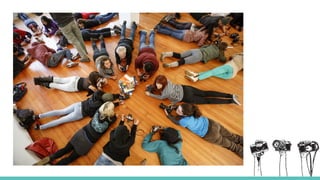
Experiential: Practicing creativity, including book making, Instax camera photos, found imagery
Small and large group discussion to process experiential
Introduction of program research and discussion of implications
Closing and next steps
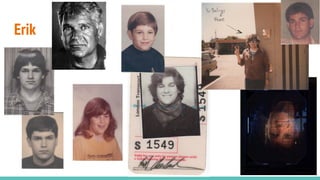
Erik
Sarah
First Exposures
First Exposures is a San Francisco-based, nationally recognized youth mentoring program that strives to make a major long-term
difference in the lives of high-need, underserved San Francisco Bay Area youth by providing a venue for them to enhance their self-
confidence, develop their creativity, and gain a passion for learning. Cited as a model program by the State of California, First
Exposures serves youth ages 11-18 who are referred to the program by a wide range of partner youth and social services
organizations.
Mentors are recruited from the community and have interest and experience with photography; they all go through an extensive
screening and training process before being matched with mentees. Part-time mentors provide support for mentees when matched
mentors are unable to make Saturday class. In 2014, First Exposures started a group summer mentoring program, serving an
additional 30 mentees during an 8-week program each summer.
Since the program’s founding in 1993, there have been approximately 260 mentees in the program, 90 percent of whom have gone on
to pursue a college education, and approximately 400 mentors, including part-time.
First Exposures + Help Portrait
https://vimeo.com/143783008
Learning During Adolescence
“One way to think about puberty is to think of it as a learning spurt for heartfelt goals. It’s a particularly
opportune time to fall in love with learning itself.”
“The feelings of acceptance, rejection, admiration, among others, are all the story of adolescence…Their
wildly swinging neurological systems also mean that adolescents can readjust quickly – making those
years critical for educators to engage students in ‘the right ways,’ when the brain is learning to calibrate
complex social and emotional value systems that use feelings as fast signals… Adolescence is a perfect
storm of opportunities to align these changes in positive ways.”
.Ronald Dahl, UC Berkeley, Professor, Community Health & Human Development
Importance of Emotions in Adolescent Learning
“The adolescent brain is exquisitely sensitive to experience. It is like the recording device is
turned up to a different level of sensitivity.”
“Nothing will ever feel as good to you for the rest of your life as it did when you were a
teenager.”
“When we are not challenging our kids in high school, not only are we hindering their
academic development, but we also aren’t taking advantage of the plastic prefrontal cortex.”
Laurence Steinberg, Temple University, Neuroscientist
Creative Impulse is Inherent & Ancient
“The brain has been hard wired to seek creative or artistic endeavors forever. We
don’t need it to survive, you wouldn’t think, and yet the brain wants it and seeks it.”
“You have to cultivate [creative behaviors] by introducing them to children and
recognizing that the more you do it, the better you are at doing it.”
“When you’re trying so hard to come up with ideas you can’t do it, you can’t force
it… It doesn’t have to be so directed all the time. We’ve taken a lot of the joy out of
things that used to be joyful.”
Charles Limb, John’s Hopkins University, Associate Professor, Otolaryngology-Head and Neck Surgery
How Creativity Impacts Learning
“One of the things they found most valuable in their arts classes was the freedom
not to have to seek right and wrong answers. It was that freedom to explore that
led them to be increasingly engaged and allowed them to forge connections that
allowed them to be more creative.”
“The truly creative changes and the big shifts occur right at the edge of chaos.”
Dr. Robert Bilder, UCLA Semel Institute for Neuroscience and Human Behavior, Psychiatry & Psychology Professor
Emotional Connections Prompt Creativity & Learning
“For many children it may be a mistake to stop learning new things. Even if you’re
a teenager, it might not be too late to start learning Chinese, chess or the cello [or
photography].”
Brandt et al 2013
How Creativity Impacts Relationship Building
“…[I]t is both the sharing of art with others, and the making of art in the presence
of others that most contributes to therapeutic change.”
“…[O]ffering and sharing media, touching others’ art, working together, and
representing an image of a loved one or beloved objects. These interpersonal
exchanges and representations have the potential to activate and mend
attachment wounds, alter attachment states, stabilize affect regulation, and update
autobiographical memories.”
Hass-Cohen & Findlay, 2015
Mentors Bring Creative Connection
“Mentors, too, are often initially interested in sharing their love of communicating with the
world through their own photography or art. They believe that if they can help another young
person discover this, they will have made a difference. What they then discover are both the
challenges and joys that come from consistently being a part of a young person’s life over a
significant period of time: unreturned telephone calls, an unexpected hug of greeting,
forgetting to bring camera and film, the quietness of a voice when sharing deeply personal
beliefs, the loudness of everyone together for a few minutes of chaos, and the pride
expressed by students when they see a photo, their very own photo, for the first time in an
exhibition.”
Kremer, 2007
How Creativity, Relationship Building, & Learning Work Together
“Neuroimaging experiments show us that we use the very same neural systems to feel our
bodies as to feel our relationships, our moral judgments, and our creative inspiration.”
“Survival in the savanna depends on a brain that is wired to make sense of the environment,
and to play out the things it notices through patterns of bodily and mental reactions. This
same brain, the same logic, helps us make sense of and survive in the social world of today.”
“Creativity is representing some kind of relevant problem in a new way and making people
understand it, and feel about it, and have some insight into something that matters.”
Mary Helen Immordino-Yang, USC, Professor, Rossier School of Education
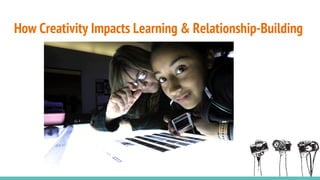
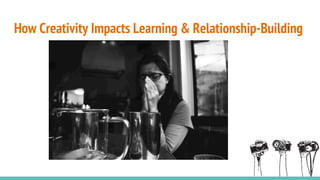
How Creativity Impacts Learning & Relationship-Building
For so many youth in a similar position, this program can make all the
difference in the trajectory of their lives. I can say with total
confidence that my time in First Exposures had a direct impact on
where I am today—a first-generation college student studying
literature at San Francisco State University, preparing for a year
abroad and planning for postgraduate education. All of these were
unimaginable goals as a teenager.
-Tanashati, former mentee
Experiential: Practicing Creative Activities
Book making, Instax camera photos, found imagery (20
minutes)
•  Activity: groups of 8-10 to share the Fuji Instax cameras
•  Partner for photographing yourself
•  Make simple books and add photo, found images
•  Tell us about yourself. Create something showing your
identity now and/or as a young person, what was
important to you, where you are/were in life.
Start	with	the	paper	like	this
Fold	in	half	the	long	way
And	unfold
Fold	in	half	the	other	way
And	unfold
Turn	the	paper	over	and	fold	the	
right	side	to	the	middle
Then	fold	the	le:	side	to	the	middle
And	unfold
From	the	side,	it	looks	like	the	le<er	W
Make	a	cut	from	the	folded	end	
down	the	middle	fold	halfway
And	flap	up	the	sides
Gently	pull	the	side	flaps	down	
toward	each	other
UnCl	all	sides	touch
Choose	one	page	to	be	the	cover	
and	your	book	is	complete
http://communication.firstexposures.org/
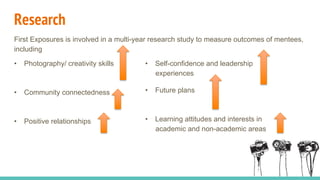
Research
First Exposures is involved in a multi-year research study to measure outcomes of mentees,
including
•  Photography/ creativity skills
•  Community connectedness
•  Positive relationships
•  Self-confidence and leadership
experiences
•  Future plans
•  Learning attitudes and interests in
academic and non-academic areas
Next Steps…
•  National model
•  Photography and mentoring curriculum
•  Stammtisch for related programs
Thank you!
Erik Auerbach, Director, First Exposures, erik@firstexposures.org
Sarah Kremer, Consultant, First Exposures, sarah.kremer@gmail.com

Creative Mindset: Inspiring Mentoring Relationships

  • 1.
    Creative Mindset: Inspiring MentoringRelationships Erik Auerbach & Sarah Kremer MENTOR Summit 01/28/16
  • 3.
    Agenda Welcome and introductions Overviewof Creativity impacts Learning and Relationship-building Experiential: Practicing creativity, including book making, Instax camera photos, found imagery Small and large group discussion to process experiential Introduction of program research and discussion of implications Closing and next steps
  • 4.
  • 5.
  • 6.
    First Exposures First Exposuresis a San Francisco-based, nationally recognized youth mentoring program that strives to make a major long-term difference in the lives of high-need, underserved San Francisco Bay Area youth by providing a venue for them to enhance their self- confidence, develop their creativity, and gain a passion for learning. Cited as a model program by the State of California, First Exposures serves youth ages 11-18 who are referred to the program by a wide range of partner youth and social services organizations. Mentors are recruited from the community and have interest and experience with photography; they all go through an extensive screening and training process before being matched with mentees. Part-time mentors provide support for mentees when matched mentors are unable to make Saturday class. In 2014, First Exposures started a group summer mentoring program, serving an additional 30 mentees during an 8-week program each summer. Since the program’s founding in 1993, there have been approximately 260 mentees in the program, 90 percent of whom have gone on to pursue a college education, and approximately 400 mentors, including part-time.
  • 9.
    First Exposures +Help Portrait https://vimeo.com/143783008
  • 11.
    Learning During Adolescence “Oneway to think about puberty is to think of it as a learning spurt for heartfelt goals. It’s a particularly opportune time to fall in love with learning itself.” “The feelings of acceptance, rejection, admiration, among others, are all the story of adolescence…Their wildly swinging neurological systems also mean that adolescents can readjust quickly – making those years critical for educators to engage students in ‘the right ways,’ when the brain is learning to calibrate complex social and emotional value systems that use feelings as fast signals… Adolescence is a perfect storm of opportunities to align these changes in positive ways.” .Ronald Dahl, UC Berkeley, Professor, Community Health & Human Development
  • 12.
    Importance of Emotionsin Adolescent Learning “The adolescent brain is exquisitely sensitive to experience. It is like the recording device is turned up to a different level of sensitivity.” “Nothing will ever feel as good to you for the rest of your life as it did when you were a teenager.” “When we are not challenging our kids in high school, not only are we hindering their academic development, but we also aren’t taking advantage of the plastic prefrontal cortex.” Laurence Steinberg, Temple University, Neuroscientist
  • 13.
    Creative Impulse isInherent & Ancient “The brain has been hard wired to seek creative or artistic endeavors forever. We don’t need it to survive, you wouldn’t think, and yet the brain wants it and seeks it.” “You have to cultivate [creative behaviors] by introducing them to children and recognizing that the more you do it, the better you are at doing it.” “When you’re trying so hard to come up with ideas you can’t do it, you can’t force it… It doesn’t have to be so directed all the time. We’ve taken a lot of the joy out of things that used to be joyful.” Charles Limb, John’s Hopkins University, Associate Professor, Otolaryngology-Head and Neck Surgery
  • 14.
    How Creativity ImpactsLearning “One of the things they found most valuable in their arts classes was the freedom not to have to seek right and wrong answers. It was that freedom to explore that led them to be increasingly engaged and allowed them to forge connections that allowed them to be more creative.” “The truly creative changes and the big shifts occur right at the edge of chaos.” Dr. Robert Bilder, UCLA Semel Institute for Neuroscience and Human Behavior, Psychiatry & Psychology Professor
  • 15.
    Emotional Connections PromptCreativity & Learning “For many children it may be a mistake to stop learning new things. Even if you’re a teenager, it might not be too late to start learning Chinese, chess or the cello [or photography].” Brandt et al 2013
  • 16.
    How Creativity ImpactsRelationship Building “…[I]t is both the sharing of art with others, and the making of art in the presence of others that most contributes to therapeutic change.” “…[O]ffering and sharing media, touching others’ art, working together, and representing an image of a loved one or beloved objects. These interpersonal exchanges and representations have the potential to activate and mend attachment wounds, alter attachment states, stabilize affect regulation, and update autobiographical memories.” Hass-Cohen & Findlay, 2015
  • 17.
    Mentors Bring CreativeConnection “Mentors, too, are often initially interested in sharing their love of communicating with the world through their own photography or art. They believe that if they can help another young person discover this, they will have made a difference. What they then discover are both the challenges and joys that come from consistently being a part of a young person’s life over a significant period of time: unreturned telephone calls, an unexpected hug of greeting, forgetting to bring camera and film, the quietness of a voice when sharing deeply personal beliefs, the loudness of everyone together for a few minutes of chaos, and the pride expressed by students when they see a photo, their very own photo, for the first time in an exhibition.” Kremer, 2007
  • 18.
    How Creativity, RelationshipBuilding, & Learning Work Together “Neuroimaging experiments show us that we use the very same neural systems to feel our bodies as to feel our relationships, our moral judgments, and our creative inspiration.” “Survival in the savanna depends on a brain that is wired to make sense of the environment, and to play out the things it notices through patterns of bodily and mental reactions. This same brain, the same logic, helps us make sense of and survive in the social world of today.” “Creativity is representing some kind of relevant problem in a new way and making people understand it, and feel about it, and have some insight into something that matters.” Mary Helen Immordino-Yang, USC, Professor, Rossier School of Education
  • 19.
    How Creativity ImpactsLearning & Relationship-Building
  • 20.
    How Creativity ImpactsLearning & Relationship-Building
  • 21.
    How Creativity ImpactsLearning & Relationship-Building
  • 22.
    How Creativity ImpactsLearning & Relationship-Building
  • 23.
    How Creativity ImpactsLearning & Relationship-Building
  • 24.
    How Creativity ImpactsLearning & Relationship-Building
  • 25.
    How Creativity ImpactsLearning & Relationship-Building
  • 26.
    How Creativity ImpactsLearning & Relationship-Building For so many youth in a similar position, this program can make all the difference in the trajectory of their lives. I can say with total confidence that my time in First Exposures had a direct impact on where I am today—a first-generation college student studying literature at San Francisco State University, preparing for a year abroad and planning for postgraduate education. All of these were unimaginable goals as a teenager. -Tanashati, former mentee
  • 27.
    Experiential: Practicing CreativeActivities Book making, Instax camera photos, found imagery (20 minutes) •  Activity: groups of 8-10 to share the Fuji Instax cameras •  Partner for photographing yourself •  Make simple books and add photo, found images •  Tell us about yourself. Create something showing your identity now and/or as a young person, what was important to you, where you are/were in life.
  • 28.
  • 29.
  • 30.
  • 31.
  • 32.
  • 33.
  • 34.
  • 35.
  • 36.
  • 37.
  • 38.
  • 39.
  • 40.
  • 41.
  • 42.
  • 43.
    Research First Exposures isinvolved in a multi-year research study to measure outcomes of mentees, including •  Photography/ creativity skills •  Community connectedness •  Positive relationships •  Self-confidence and leadership experiences •  Future plans •  Learning attitudes and interests in academic and non-academic areas
  • 44.
    Next Steps… •  Nationalmodel •  Photography and mentoring curriculum •  Stammtisch for related programs
  • 46.
    Thank you! Erik Auerbach,Director, First Exposures, erik@firstexposures.org Sarah Kremer, Consultant, First Exposures, sarah.kremer@gmail.com