CREATIVE DESIGN
FOR BUSINESS IMPROVEMENT
HELEN MORGAN – HELPING BUSINESSES PLAY TO THEIR STRENGTHS
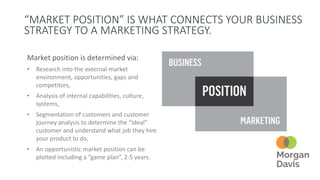
“MARKET POSITION” IS WHAT CONNECTS YOUR BUSINESS
STRATEGY TO A MARKETING STRATEGY.
Market position is determined via:
• Research into the external market
environment, opportunities, gaps and
competitors,
• Analysis of internal capabilities, culture,
systems,
• Segmentation of customers and customer
journey analysis to determine the “Ideal”
customer and understand what job they hire
your product to do,
• An opportunistic market position can be
plotted including a “game plan”, 2-5 years.
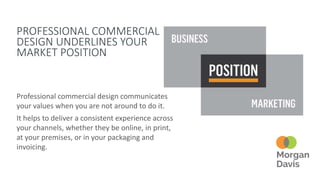
PROFESSIONAL COMMERCIAL
DESIGN UNDERLINES YOUR
MARKET POSITION
Professional commercial design communicates
your values when you are not around to do it.
It helps to deliver a consistent experience across
your channels, whether they be online, in print,
at your premises, or in your packaging and
invoicing.
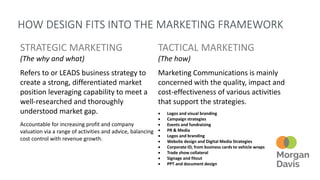
STRATEGIC MARKETING
(The why and what)
TACTICAL MARKETING
(The how)
Refers to or LEADS business strategy to
create a strong, differentiated market
position leveraging capability to meet a
well-researched and thoroughly
understood market gap.
Accountable for increasing profit and company
valuation via a range of activities and advice, balancing
cost control with revenue growth.
Marketing Communications is mainly
concerned with the quality, impact and
cost-effectiveness of various activities
that support the strategies.
 Logos and visual branding
 Campaign strategies
 Events and fundraising
 PR & Media
 Logos and branding
 Website design and Digital Media Strategies
 Corporate ID, from business cards to vehicle wraps
 Trade show collateral
 Signage and fitout
 PPT and document design
HOW DESIGN FITS INTO THE MARKETING FRAMEWORK
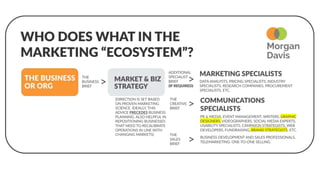
Take a moment to note on the next slide, all the
specialist areas of supply within the marketing
discipline. Before you start, know what it is you are
looking for. Understand that no one person can do
all of it…
Graphic Designers and Brand Strategists are
highlighted in yellow
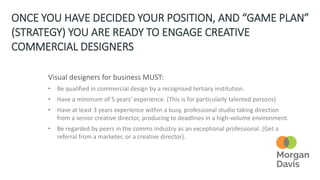
ONCE YOU HAVE DECIDED YOUR POSITION, AND “GAME PLAN”
(STRATEGY) YOU ARE READY TO ENGAGE CREATIVE
COMMERCIAL DESIGNERS
Visual designers for business MUST:
• Be qualified in commercial design by a recognised tertiary institution.
• Have a minimum of 5 years’ experience. (This is for particularly talented persons)
• Have at least 3 years experience within a busy, professional studio taking direction
from a senior creative director, producing to deadlines in a high-volume environment.
• Be regarded by peers in the comms industry as an exceptional professional. (Get a
referral from a marketer, or a creative director).
WHY?
• Because even if you can’t tell the difference, your customers can. People’s reactions
to visual stimuli have been studied extensively. People will react differently to
different stimuli. Collectively they exhibit predictable reactions.
• Because aesthetics, and the use of aesthetics in business communication is a trained,
degree-qualified skill. Not anybody with a computer, a program, and time on their
hands to practice is qualified. The nuances in typography, spacing, use of imagery,
layout etc are complex, and it takes years to learn them, and manipulate them
successfully.
• Because its the difference between “architect-designed” and “jerry-built”.
QUALIFICATIONS AND EXPERIENCE COUNT
If you have a leaking tap or a blocked drain, you call a plumber
who is trained to understand the physics of water flow.
If you are sick you go to a trained medical practitioner.
You use trained accountants, lawyers and builders for specialist
tasks because you know they have studied and their experience
on the job makes them valuable to you.
It is the same with commercial design.
The advent of computer tools has put design capability into anyone’s hands. But that
doesn’t mean they can do the job that a trained professional does.
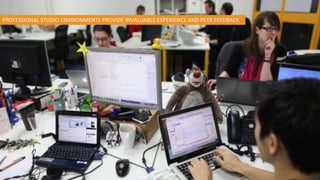
PROFESSIONAL STUDIO ENVIRONMENTS PROVIDE INVALUABLE EXPERIENCE AND PEER FEEDBACK
A “BRAND” IS NOT A ”LOGO”.
• A brand brings your competitive position to life.
• Your brand is your “promise of performance”. It’s a code for what you
stand for, and it includes everything that represents your business,
including phone manner, sales and after sales service, systems.
• Your visual materials support this; putting your best foot forward,
when you can’t be everywhere at once.
• Brand equity has a $ value, and contributes to your business valuation.
• It creates clarity and synergy.
• It is the foundation for consistency across years and regions.
• A logo is the simple, visual shorthand for your whole brand.
“Customers are used to companies of a certain
size and reputation having a certain consistent
image. When something other than that
image is portrayed, it is subliminally
disconcerting.” – FedEx Brand Manual
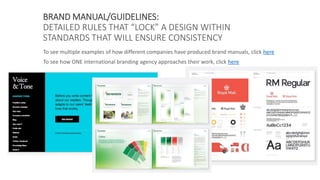
BRAND MANUAL/GUIDELINES:
DETAILED RULES THAT “LOCK” A DESIGN WITHIN
STANDARDS THAT WILL ENSURE CONSISTENCY
To see multiple examples of how different companies have produced brand manuals, click here
To see how ONE international branding agency approaches their work, click here
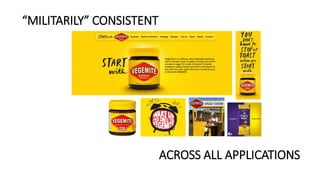
WHAT STRONG BRANDS LOOK LIKE
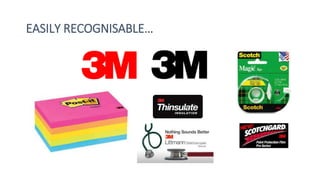
EASILY RECOGNISABLE…
“MILITARILY” CONSISTENT
ACROSS ALL APPLICATIONS
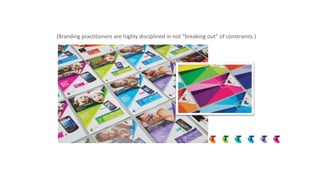
(Branding practitioners are highly disciplined in not “breaking out” of constraints.)
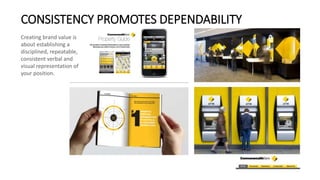
CONSISTENCY PROMOTES DEPENDABILITY
Creating brand value is
about establishing a
disciplined, repeatable,
consistent verbal and
visual representation of
your position.
COMMERCIAL DESIGN IS A PROCESS
Design decisions are made using tried and true processes and proven facts
about how consumers interact with visuals.
Designs are accepted on the basis of selection criteria crafted from your
agreed market position, using rigorous process.
When in doubt, they are focus-group tested.
Arbitrating and negotiating good design is a complex, artful area of
professional endeavour.
“I think this looks good” is not an objective means of making an important
business decision. Creativity has very little to do with it, at this level.
Creativity is simply a prerequisite, and a sub-process of commercial design.
GOOD DESIGN IS MUCH, MUCH CHEAPER
• An experienced professional works faster, and with minimum error. So you
may be paying half as much for a job to take twice as long. (No gain). On
top of that, there is a high risk of error, which can double your costs again.
• Inexperienced designers need lots of guidance, with high levels of risk and
added cost when things go wrong. Using them creates uncertainty around
deadlines, and distracts you and your team from other activities that could
be generating returns for your business.
INDICATIVE
COSTS
(AUSTRALIA)
RANGE OF ACCEPTABLE OPTIONS
1. A studio or agency will cost $150-250 per hour. Sometimes more for
a top 5 agency or studio.
2. An experienced senior freelancer will cost $80-130 per hour.
3. A talented median designer with at least 5 years experience will
charge $60-80 per hour, but they must be supervised by a senior
creative director, at a cost of around $150/hr.
TOTAL COSTS
• Using the options from the previous slide, a B2B rebrand for an SME (mid tier)
including a brand manual can cost anywhere between $8 - $30K.
• The above cost of brand design may not include printing, web development,
sign makers, photographers, videographers and other professional
subcontractors to produce an entire “livery” including branded marcomms
materials. These all need to be quoted separately. (You get this end-to-end
project management when you use a studio or senior designer)
• A small business using option 3 (previous slide) could get a good brand and a
“lite” brand manual designed for $3-5K. A decision to spend less than this will
be because:
– you know your business revenue will never be sufficient to justify a greater
expense,
– You are not operating in a B2C environment. (A discreet business that supplies
behind the scenes services or products to a handful of customers and depends
on word-of-mouth referrals)
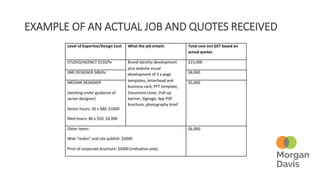
EXAMPLE OF AN ACTUAL JOB AND QUOTES RECEIVED
99 designs
Freelancer.com
Upwork
etc
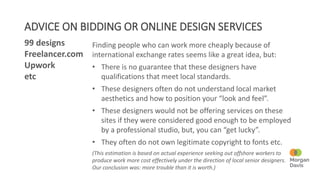
ADVICE ON BIDDING OR ONLINE DESIGN SERVICES
Finding people who can work more cheaply because of
international exchange rates seems like a great idea, but:
• There is no guarantee that these designers have
qualifications that meet local standards.
• These designers often do not understand local market
aesthetics and how to position your “look and feel”.
• These designers would not be offering services on these
sites if they were considered good enough to be employed
by a professional studio, but, you can “get lucky”.
• They often do not own legitimate copyright to fonts etc.
(This estimation is based on actual experience seeking out offshore workers to
produce work more cost effectively under the direction of local senior designers.
Our conclusion was: more trouble than it is worth.)
GOOD BRIEFING SAVES MONEY AND TIME
A good brief for a general graphic design project should include:
• COMPLETE copy, that has already been viewed and approved by the best writer you have
access to, for quality of information, “communication values”, brevity, appeal, etc. It should
be FINAL. It should have already “done the rounds” of authors before it reaches a designer.
• A clear explanation of context and purpose – what is this piece being designed for, what it is
meant to deliver, why and how? What is the “tone” you want to communicate?
• A clear explanation of timing, milestones and deadlines.
• A clear explanation of budget limitations.
• An understanding of whether you need illustrations, diagrams, stock images, sound tracks,
video footage, photography, additional fonts, etc, and COMPLETE information supplied for
each of these items.
• A clear understanding of who will be the “one point of contact” with the designer, and the
approval process on your side. (“Too many cooks” is a cost blowout multiplier).
• All of this supplied at one time, not “trickled in” over the course of a job. This will allow for
the most efficient project planning. Get organised, it will save you lots of $$$.
BRIEFING FOR BRAND DESIGN
A brand strategist will be able to walk you through this, but before you approach them, you
should have a clear idea, based on OBJECTIVE, THIRD PARTY research. If you cannot yet afford,
or haven’t yet invested in market research, then your best knowledge is required to articulate:
• About your business: Who are you, What do you do, Who do you do it for, Why do you do it
and How (with what values, culture and attitude) do you do it?
• A list of competitors that you admire, and those that you would like to position away from,
and a little description for each about why that is the case.
• A list of things you want, ie: Master logos in various file formats, a brand guideline and what
it should contain (some are very comprehensive, some simple; see examples here), a list of
items you would like to see in the concept designs showing how the brand will work (ie,
website, shop front, business card and letterhead, pull up banner, fonts to use with the
brand for documents etc.)
• Any other specifics that you think they should know, like where you see yourself in the
future, why you came to be in business, what is your vision, etc.
BE AWARE OF QUOTED PRICE vs ACTUAL COST
(The hidden extra cost of authoring)
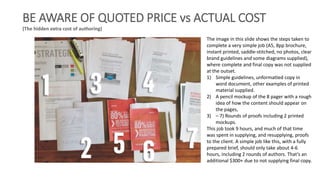
The image in this slide shows the steps taken to
complete a very simple job (A5, 8pp brochure,
instant printed, saddle-stitched, no photos, clear
brand guidelines and some diagrams supplied),
where complete and final copy was not supplied
at the outset.
1) Simple guidelines, unformatted copy in
word document, other examples of printed
material supplied.
2) A pencil mockup of the 8 pager with a rough
idea of how the content should appear on
the pages,
3) – 7) Rounds of proofs including 2 printed
mockups.
This job took 9 hours, and much of that time
was spent in supplying, and resupplying, proofs
to the client. A simple job like this, with a fully
prepared brief, should only take about 4-6
hours, including 2 rounds of authors. That’s an
additional $300+ due to not supplying final copy.
EVEN WHEN BRIEFING IS COMPLETE…
There are many steps in certain types of jobs.
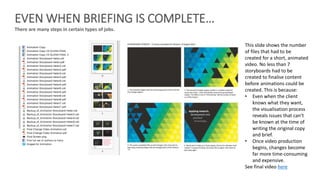
This slide shows the number
of files that had to be
created for a short, animated
video. No less than 7
storyboards had to be
created to finalise content
before animations could be
created. This is because:
• Even when the client
knows what they want,
the visualisation process
reveals issues that can’t
be known at the time of
writing the original copy
and brief.
• Once video production
begins, changes become
far more time-consuming
and expensive.
See final video here
BRIEFING CHECKLIST FOR GENERAL DESIGN WORK
• Images supplied, or a clear specification for images required. (colouring, content, layout, style, what are
they meant to communicate?). Do some need to be photographed, or will stock images suffice?
• All diagrams graphs tables etc with complete and final information.
• Font specifications and brand guidelines supplied.
• A written business brief – use a template that has been proven in studio use. If you don’t have one, ask
the designer to supply one. A creative brief needs to be supplied to a designer from the business brief.
This is something a senior designer can guide you through. A more junior designer may not, which can
cause confusion.
• Copy in a formatted, and unformatted document. (Formatted so that the designer can see where you
want paragraph breaks, bullets etc. UNFORMATTED so that the designer can import without additional
time removing your formatting, which will come at YOUR cost, and will also make the proofing process
longer. More cost.)
• BE PREPARED TO NEGOTIATE. The designer will tell you what will work better.
IN CLOSING…
• The creation of brand and other visual communication materials
is an important part of establishing and maintaining your
market position. Trust it to professionals, set realistic budgets.
• This presentation is a short summary of 30 years’ experience
crossing the advertising industry, design management,
marketing and strategic marketing across thousands of projects.
• morgan-davis.com.au are market strategists, not creative service suppliers. (For context, see
Marketing Ecosystem, slide 6). Whilst we can recommend creative service suppliers as an output
of strategy, this presentation is being offered as helpful information, not as an advertisement for
our services. We hope you found it useful and that it saves confusion and unnecessary expense!

Creative Design for Business

  • 1.
    CREATIVE DESIGN FOR BUSINESSIMPROVEMENT HELEN MORGAN – HELPING BUSINESSES PLAY TO THEIR STRENGTHS
  • 2.
    “MARKET POSITION” ISWHAT CONNECTS YOUR BUSINESS STRATEGY TO A MARKETING STRATEGY. Market position is determined via: • Research into the external market environment, opportunities, gaps and competitors, • Analysis of internal capabilities, culture, systems, • Segmentation of customers and customer journey analysis to determine the “Ideal” customer and understand what job they hire your product to do, • An opportunistic market position can be plotted including a “game plan”, 2-5 years.
  • 3.
    PROFESSIONAL COMMERCIAL DESIGN UNDERLINESYOUR MARKET POSITION Professional commercial design communicates your values when you are not around to do it. It helps to deliver a consistent experience across your channels, whether they be online, in print, at your premises, or in your packaging and invoicing.
  • 4.
    STRATEGIC MARKETING (The whyand what) TACTICAL MARKETING (The how) Refers to or LEADS business strategy to create a strong, differentiated market position leveraging capability to meet a well-researched and thoroughly understood market gap. Accountable for increasing profit and company valuation via a range of activities and advice, balancing cost control with revenue growth. Marketing Communications is mainly concerned with the quality, impact and cost-effectiveness of various activities that support the strategies.  Logos and visual branding  Campaign strategies  Events and fundraising  PR & Media  Logos and branding  Website design and Digital Media Strategies  Corporate ID, from business cards to vehicle wraps  Trade show collateral  Signage and fitout  PPT and document design HOW DESIGN FITS INTO THE MARKETING FRAMEWORK
  • 5.
    Take a momentto note on the next slide, all the specialist areas of supply within the marketing discipline. Before you start, know what it is you are looking for. Understand that no one person can do all of it… Graphic Designers and Brand Strategists are highlighted in yellow
  • 7.
    ONCE YOU HAVEDECIDED YOUR POSITION, AND “GAME PLAN” (STRATEGY) YOU ARE READY TO ENGAGE CREATIVE COMMERCIAL DESIGNERS Visual designers for business MUST: • Be qualified in commercial design by a recognised tertiary institution. • Have a minimum of 5 years’ experience. (This is for particularly talented persons) • Have at least 3 years experience within a busy, professional studio taking direction from a senior creative director, producing to deadlines in a high-volume environment. • Be regarded by peers in the comms industry as an exceptional professional. (Get a referral from a marketer, or a creative director).
  • 8.
    WHY? • Because evenif you can’t tell the difference, your customers can. People’s reactions to visual stimuli have been studied extensively. People will react differently to different stimuli. Collectively they exhibit predictable reactions. • Because aesthetics, and the use of aesthetics in business communication is a trained, degree-qualified skill. Not anybody with a computer, a program, and time on their hands to practice is qualified. The nuances in typography, spacing, use of imagery, layout etc are complex, and it takes years to learn them, and manipulate them successfully. • Because its the difference between “architect-designed” and “jerry-built”.
  • 9.
    QUALIFICATIONS AND EXPERIENCECOUNT If you have a leaking tap or a blocked drain, you call a plumber who is trained to understand the physics of water flow. If you are sick you go to a trained medical practitioner. You use trained accountants, lawyers and builders for specialist tasks because you know they have studied and their experience on the job makes them valuable to you. It is the same with commercial design. The advent of computer tools has put design capability into anyone’s hands. But that doesn’t mean they can do the job that a trained professional does.
  • 10.
    PROFESSIONAL STUDIO ENVIRONMENTSPROVIDE INVALUABLE EXPERIENCE AND PEER FEEDBACK
  • 11.
    A “BRAND” ISNOT A ”LOGO”. • A brand brings your competitive position to life. • Your brand is your “promise of performance”. It’s a code for what you stand for, and it includes everything that represents your business, including phone manner, sales and after sales service, systems. • Your visual materials support this; putting your best foot forward, when you can’t be everywhere at once. • Brand equity has a $ value, and contributes to your business valuation. • It creates clarity and synergy. • It is the foundation for consistency across years and regions. • A logo is the simple, visual shorthand for your whole brand.
  • 12.
    “Customers are usedto companies of a certain size and reputation having a certain consistent image. When something other than that image is portrayed, it is subliminally disconcerting.” – FedEx Brand Manual
  • 13.
    BRAND MANUAL/GUIDELINES: DETAILED RULESTHAT “LOCK” A DESIGN WITHIN STANDARDS THAT WILL ENSURE CONSISTENCY To see multiple examples of how different companies have produced brand manuals, click here To see how ONE international branding agency approaches their work, click here
  • 14.
  • 15.
  • 16.
  • 17.
    (Branding practitioners arehighly disciplined in not “breaking out” of constraints.)
  • 18.
    CONSISTENCY PROMOTES DEPENDABILITY Creatingbrand value is about establishing a disciplined, repeatable, consistent verbal and visual representation of your position.
  • 19.
    COMMERCIAL DESIGN ISA PROCESS Design decisions are made using tried and true processes and proven facts about how consumers interact with visuals. Designs are accepted on the basis of selection criteria crafted from your agreed market position, using rigorous process. When in doubt, they are focus-group tested. Arbitrating and negotiating good design is a complex, artful area of professional endeavour. “I think this looks good” is not an objective means of making an important business decision. Creativity has very little to do with it, at this level. Creativity is simply a prerequisite, and a sub-process of commercial design.
  • 20.
    GOOD DESIGN ISMUCH, MUCH CHEAPER • An experienced professional works faster, and with minimum error. So you may be paying half as much for a job to take twice as long. (No gain). On top of that, there is a high risk of error, which can double your costs again. • Inexperienced designers need lots of guidance, with high levels of risk and added cost when things go wrong. Using them creates uncertainty around deadlines, and distracts you and your team from other activities that could be generating returns for your business.
  • 21.
  • 22.
    RANGE OF ACCEPTABLEOPTIONS 1. A studio or agency will cost $150-250 per hour. Sometimes more for a top 5 agency or studio. 2. An experienced senior freelancer will cost $80-130 per hour. 3. A talented median designer with at least 5 years experience will charge $60-80 per hour, but they must be supervised by a senior creative director, at a cost of around $150/hr.
  • 23.
    TOTAL COSTS • Usingthe options from the previous slide, a B2B rebrand for an SME (mid tier) including a brand manual can cost anywhere between $8 - $30K. • The above cost of brand design may not include printing, web development, sign makers, photographers, videographers and other professional subcontractors to produce an entire “livery” including branded marcomms materials. These all need to be quoted separately. (You get this end-to-end project management when you use a studio or senior designer) • A small business using option 3 (previous slide) could get a good brand and a “lite” brand manual designed for $3-5K. A decision to spend less than this will be because: – you know your business revenue will never be sufficient to justify a greater expense, – You are not operating in a B2C environment. (A discreet business that supplies behind the scenes services or products to a handful of customers and depends on word-of-mouth referrals)
  • 24.
    EXAMPLE OF ANACTUAL JOB AND QUOTES RECEIVED
  • 25.
    99 designs Freelancer.com Upwork etc ADVICE ONBIDDING OR ONLINE DESIGN SERVICES Finding people who can work more cheaply because of international exchange rates seems like a great idea, but: • There is no guarantee that these designers have qualifications that meet local standards. • These designers often do not understand local market aesthetics and how to position your “look and feel”. • These designers would not be offering services on these sites if they were considered good enough to be employed by a professional studio, but, you can “get lucky”. • They often do not own legitimate copyright to fonts etc. (This estimation is based on actual experience seeking out offshore workers to produce work more cost effectively under the direction of local senior designers. Our conclusion was: more trouble than it is worth.)
  • 26.
    GOOD BRIEFING SAVESMONEY AND TIME A good brief for a general graphic design project should include: • COMPLETE copy, that has already been viewed and approved by the best writer you have access to, for quality of information, “communication values”, brevity, appeal, etc. It should be FINAL. It should have already “done the rounds” of authors before it reaches a designer. • A clear explanation of context and purpose – what is this piece being designed for, what it is meant to deliver, why and how? What is the “tone” you want to communicate? • A clear explanation of timing, milestones and deadlines. • A clear explanation of budget limitations. • An understanding of whether you need illustrations, diagrams, stock images, sound tracks, video footage, photography, additional fonts, etc, and COMPLETE information supplied for each of these items. • A clear understanding of who will be the “one point of contact” with the designer, and the approval process on your side. (“Too many cooks” is a cost blowout multiplier). • All of this supplied at one time, not “trickled in” over the course of a job. This will allow for the most efficient project planning. Get organised, it will save you lots of $$$.
  • 27.
    BRIEFING FOR BRANDDESIGN A brand strategist will be able to walk you through this, but before you approach them, you should have a clear idea, based on OBJECTIVE, THIRD PARTY research. If you cannot yet afford, or haven’t yet invested in market research, then your best knowledge is required to articulate: • About your business: Who are you, What do you do, Who do you do it for, Why do you do it and How (with what values, culture and attitude) do you do it? • A list of competitors that you admire, and those that you would like to position away from, and a little description for each about why that is the case. • A list of things you want, ie: Master logos in various file formats, a brand guideline and what it should contain (some are very comprehensive, some simple; see examples here), a list of items you would like to see in the concept designs showing how the brand will work (ie, website, shop front, business card and letterhead, pull up banner, fonts to use with the brand for documents etc.) • Any other specifics that you think they should know, like where you see yourself in the future, why you came to be in business, what is your vision, etc.
  • 28.
    BE AWARE OFQUOTED PRICE vs ACTUAL COST (The hidden extra cost of authoring) The image in this slide shows the steps taken to complete a very simple job (A5, 8pp brochure, instant printed, saddle-stitched, no photos, clear brand guidelines and some diagrams supplied), where complete and final copy was not supplied at the outset. 1) Simple guidelines, unformatted copy in word document, other examples of printed material supplied. 2) A pencil mockup of the 8 pager with a rough idea of how the content should appear on the pages, 3) – 7) Rounds of proofs including 2 printed mockups. This job took 9 hours, and much of that time was spent in supplying, and resupplying, proofs to the client. A simple job like this, with a fully prepared brief, should only take about 4-6 hours, including 2 rounds of authors. That’s an additional $300+ due to not supplying final copy.
  • 29.
    EVEN WHEN BRIEFINGIS COMPLETE… There are many steps in certain types of jobs. This slide shows the number of files that had to be created for a short, animated video. No less than 7 storyboards had to be created to finalise content before animations could be created. This is because: • Even when the client knows what they want, the visualisation process reveals issues that can’t be known at the time of writing the original copy and brief. • Once video production begins, changes become far more time-consuming and expensive. See final video here
  • 30.
    BRIEFING CHECKLIST FORGENERAL DESIGN WORK • Images supplied, or a clear specification for images required. (colouring, content, layout, style, what are they meant to communicate?). Do some need to be photographed, or will stock images suffice? • All diagrams graphs tables etc with complete and final information. • Font specifications and brand guidelines supplied. • A written business brief – use a template that has been proven in studio use. If you don’t have one, ask the designer to supply one. A creative brief needs to be supplied to a designer from the business brief. This is something a senior designer can guide you through. A more junior designer may not, which can cause confusion. • Copy in a formatted, and unformatted document. (Formatted so that the designer can see where you want paragraph breaks, bullets etc. UNFORMATTED so that the designer can import without additional time removing your formatting, which will come at YOUR cost, and will also make the proofing process longer. More cost.) • BE PREPARED TO NEGOTIATE. The designer will tell you what will work better.
  • 31.
    IN CLOSING… • Thecreation of brand and other visual communication materials is an important part of establishing and maintaining your market position. Trust it to professionals, set realistic budgets. • This presentation is a short summary of 30 years’ experience crossing the advertising industry, design management, marketing and strategic marketing across thousands of projects. • morgan-davis.com.au are market strategists, not creative service suppliers. (For context, see Marketing Ecosystem, slide 6). Whilst we can recommend creative service suppliers as an output of strategy, this presentation is being offered as helpful information, not as an advertisement for our services. We hope you found it useful and that it saves confusion and unnecessary expense!

Editor's Notes

  • #14 Brand guideline from somewhere else.
  • #17 PRODUCT BRAND EXAMPLE THAT ISN’T YELLOW. Here is the CBA brand as it really is – polished, slick, pervasive through all collateral, uniforms, signage, fitout. CONSISTENT.