CREATING AN ADVERTISING
UNIT 3: Advertising Design
2
2
1. Set up your main objectives
 What is the purpose of your advertising campaign?
What are your main objectives? Are your goals feasible
or not? You should analyze these questions and answer
them honestly. Setting clear objectives for your
advertisement before starting the creative process is
important. Whether you aim to boost sales, create brand
awareness, drive website traffic, or generate leads,
defining your objectives will guide the entire advertising
process and enable you to measure success. Once you
have established your objectives, you can move on to the
next step and begin your research.
3
2. Research the market, the competition,
and your audience
Of course, based on your industry and your niche, there may
be other important questions to answer here such as:
 To what demographic group am I addressing my messages?
 What is my clients’ social status?
 Are they young and unemployed?
 Are they professionals from a specific niche?
 Are they old or not?
 What’s the level of their education?
 Where do they live?
 What is their relationship with the competition?
4
3. Select your channels
 Based on your demographic research, you will be able to narrow your search
to some specific channels of media distribution suitable for your campaign.
There are various platforms available for displaying ads, including social
media, Google’s Display Network, search engines, and third-party websites.
Google Display Network provides a wide range of websites, videos, and
apps, which helps to reach a diverse online audience, including those who are
not actively searching for your brand.
 Each platform targets different audiences and marketing expectations.
Facebook and Instagram ads provide detailed targeting options, while
Google Ads connects with users who are actively looking for related
information.
 With Creatopy, you gain the power to create a comprehensive set of banners
for your online advertisements, enhancing your capabilities and efficiency.
 Therefore, it will be easy to design them for different channels in less time than
if you would have done it individually.
5
4. Craft a compelling message
 Take all the information you manage to gather up to this step
regarding your products and your targeted audience.
 Think also about the delivery channels you have chosen for your
ads and learn how to write advertisements tailored to each one
of those channels. Once you have determined the delivery
channels, you can start crafting a message that is easy to
understand, connects with your target audience, and effectively
conveys the advantages of your product or service. Address the
needs, desires, or pain points of your intended audience, and
emphasize what makes your offering unique from that of your
competitors. Ensure that your message is consistent across all
channels to reinforce your brand identity.
6
5. Design eye-catching visuals
 Obviously, this is the hardest part of the entire advertisement
creation process. Everything you have done until now has
prepared you for this step. Now, it’s time to put your creativity to
work and actually design your advertisements.
 Take the top three or five ideas from your previous sketches and
use them to create raw advertisements. If you are using
Creatopy as your main advertisement maker, all your projects
will be automatically saved online. You can get back to them to
make modifications, or you can share them with your peers for
valuable input. It will also help you show your rough designs to
people who are in your target audience. Their input and advice
may help you adjust your advertisements in order to meet the
targeted demographic needs and values.
7
6. Set your budget and timeline
 To maximize your return on investment, it’s important
to establish a budget for your advertising and
allocate your resources accordingly. When setting
your budget, you should take into account factors such
as the cost of producing your ads, where they will be
placed, and how long your campaign will run.
Additionally, it’s essential to set a realistic timeline for
each stage of the advertising process to ensure you
stay on track and meet all of your deadlines.
8
7. Track and analyze your results
 Once the designs are ready to be delivered online, you can start
your campaign based on your selected delivery channels.
 At this point, you need to define your budget and select the
criteria for publishing your advertisements on each channel in
particular.
 Each advertising platform (or social media platform that includes
paid advertising) will let you select your own parameters of
delivery, based on demographics, age groups, types of websites,
industries, countries, and regions, etc. Tailoring these parameters
ensures your ads reach the most relevant audience for optimal
engagement and results. This data is also important for your future
campaigns. You will start your future design processes based on
your initial results and try to improve them.
9
8. Test and refine
 Continuously test different elements of your
advertisement, including messaging, visuals, and
CTAs, to identify what resonates best with your
audience. A/B testing enables you to compare
different variations and improve your strategy
based on immediate feedback. Stay agile and
adaptable, making adjustments as necessary to
enhance performance and reach your goals.
10
Creating an actual advertisement
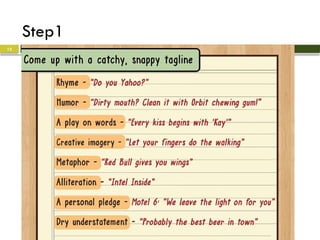
Step1
12
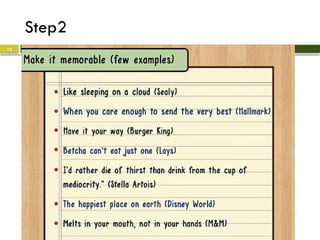
Step2
13
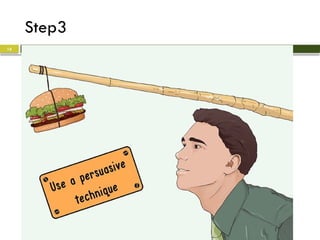
Step3
14
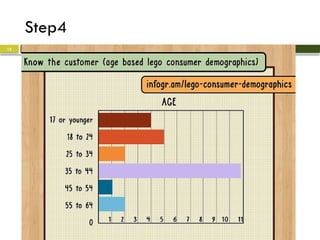
Step4
15
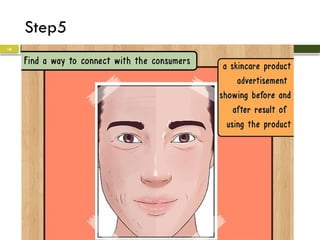
Step5
16
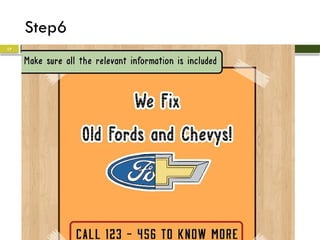
Step6
17
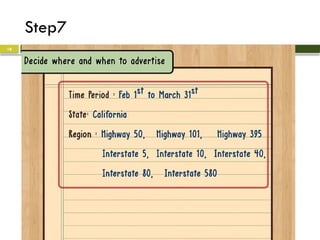
Step7
18
MEANING AND DEFINITION OF
COPYWRITING, COPYWRITING
FOR VARIOUS MEDIA
UNIT 3: Advertising Design
3
“Baat karne se baat banti hai”
“Built For The Road Ahead”
What does come in your mind? Remember, where did you hear
these captions?
The first one is “Airtel,” Second belongs to “Ford”.
Some punchlines are eye-catching and grab attention at the very
first time. Why?
It is because of the fascinating words that are used and arranged
in a creative way. This chapter discusses the techniques of
creative copywriting without creating an issue of copyright.
20
What is Copywriting?
Copywriting is the skill of choosing the right words and technique
of arranging them smartly to promote business, product, service,
idea, or a person. The selection of words and its presentation
largely depends upon the media through which it is planned to
convey.
For example, depending on whether it is a newspaper, magazine,
hoarding, radio, television, or internet, the script will vary
accordingly.
However, whatever is the type of media, the purpose of
copywriting is the same i.e. promotion. Therefore, it should be
persuasive enough to be instantly attention grabbing.
21
Elements of Copywriting
 Heading − Headline gives the first impression and lasts on readers’ mind,
therefore, it should be eye-catching. Heading should tell – what it is all about your
ad in a very few words, ranging from 3 to 30 words.
 Body copy − Write body copy in such a way that it seems as the continuity of the
heading. Provide details of all the features and benefits that you are claiming for.
The language should be promising and trustworthy.
 Slogans − Think of "The ultimate driving machine" (BMW); “Just do it” (Nike);
"Because I'm worth it" (L'Oréal), what comes to your mind? The moment, you hear
the slogans, you link it with the respective brand not only because you have heard
it many times, but rather it works. A well-written and effective slogan is a
trustworthy brand representative. However, your slogan should be small and
crispy giving meaning to your brand.
 Taglines − Taglines are usually used for literary products to reinforce and
strengthen the audience's memory of a literary product. For example, “she went in
search of answers, and discovered a love she never expected,’ Book Name
“Faithful” and Writer - Janet Fox. Thus, tagline tells the gist of the products for
22
Elements of Copywriting (Contd…)
marketing purpose. Like, a slogan, it should be small and eye-catching.
 Jingle Lyrics − More often accompanied with background music, iingle lyric is a
short slogan, tune, or verse written to be easily remembered (especially used in
advertising). For example, Fanta: "Wanna Fanta, Don’t You Wanna?" It should be
small, crisp, and rhythmic (like a song) so that it registers with people at once and
they remember it.
 Scripts (for audio and video ad) −Scripts are the descriptions of an ad that
narrates the dialogues, actions, expression, and movements of characters. Since,
script is a complete guidelines of an ad; therefore, it should be written meaningfully,
orderly, and nicely.
 Others − (White Paper, Press Release, & other written material such as emails,
articles, and blog (for the internet)): These are all promotional write-ups written
purposefully to promote a particular product/service. So, while writing white paper,
press release, articles, blog, or even an email you need to focus or emphasize ONLY
on one product that you want to promote. You need to describe all features and
offers of the respective product in simple and plain language.
23
Copywriting Techniques
 Use Action Words Such as watch, look, ask, get, etc.
−
 Use of Buzzwords Normally, buzzwords are eye-catching
−
such as now, today, etc.
 Use Exciting or Emotive words Such as amazing,
−
wonderful, beautiful, etc.
 Use Alliteration Use meaningful words of similar sound. For
−
example, Don’t be vague, ask for Haig.
 Use Colloquial words Colloquialisms in copywriting is
−
pretty popular and effective. For example, ‘Pick ‘n Choose.’
 Use Punctuation Proper use of punctuations and grammar
−
is an important aspect so that you can pass the right message.
24
Pay Attention while Writing Headlines
 Try to keep headline as small as possible (5 to 10
words are ideal).
 Use meaningful and striking words to make heading
persuasive.
 Try to use brand name in the headline.
 Stick with the typeface in a headline.
25
Pay Attention while Writing Subheading
 Subheading should support the headline.
 It should be appealing so that the reader is
impressed to read the body copy.
 Use minimum, but meaningful and fascinating words in
subheading.
26
Pay Attention while Writing Body Copy
 Try to keep the sentences in present tense.
 Use simple and familiar words.
 Keep the sentences small, and do not lose the link
between the sentences.
 Use singular noun.
 Use active verbs.
 Convey message as if it is a new information to grab
attention.
 Avoid using clichés and superlative words.
27
Protect Yourself From
 Using any vague word or sentence.
 Using many adjectives.
 Copying any others’ sentences (Copyright issue).
 Using unfamiliar words; your target audiences are not
language expert.
 Be honest; do not promise something, which is not there.
 Do not use too many words (avoid wordiness); you have limited
space.
 Your message should not be violating anyone’s right or
feelings; you have to be honest and true.
28
Writing copy for various Media
WRITING THE PRINT COPY
Writing a successful Print Advertisement
 Put a benefit in your headline.
 Make your ads easy to skim
 Use customer testimonials.
 Focus on the customer.
 Use Y words.
 Spend time on the headline.
 Be your own worse critic.
 Put a coupon in your ad.
 Hit a home run with the body copy.
 As you write the ad, try to think of a visua
Elements of Print advertisement
 Headline: Your headline is the first line of copy your reader is
going to see in your print ads.
 Subhead: You won't find a subhead in all print ads. A subhead is
optional but its purpose is to expand on your headline and draw
your reader in even further.
 White Space: Just because you're buying a full-page print ad
doesn't mean you have to fill the entire page with text and images.
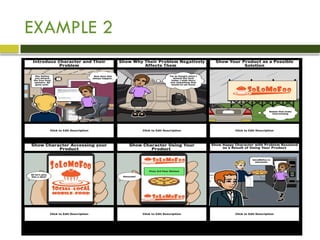
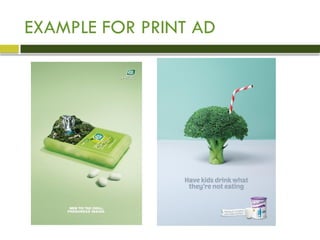
 Images and illustrations: Images can dress up your ad, though, as
long as you choose the right image. Any images you use should go
hand-in-hand with your copy.
 Body Copy: The body of your print ads should be written in a
conversational tone. Don't overwrite your ad. You have a very
limited space to write your copy.
 Signature: Optional slogan and logotype of the sponsor.
 Call to Action: What should the customer do now? If you don't
tell them, they'll just put your ad down and move on to
something else.
 Contact Information: Do not forget your contact information.
Don't just include your website because that is where you want
people to go.
 Mandatory: Required disclosures, terms and conditions. Listed
at the bottom.
The Headline has 3 functions:
1. To capture attention.
 Ex: Axe effect – red lips creating a sensuous appeal are a very
attention seeking ad and the visual acts as the headline.
2. To awaken the interest of the reader in learning more about the
product.
 The ad for Intelligent Investor, which uses the headline “Why being a
regular reader of Intelligent Investor is such a healthy habit”.
3. To select the special readers who might have a specific interest in
what you are selling.
 Tamilnadu Pradesh ad targets media planners, hence the headline –
“Perhaps the first ad written with the belief that a media planner is
human, and not a counting machine”.
CLASSIFICATION OF HEADLINES
 BENEFIT
 NEWS AND INFORMATION
 COMMAND
 QUESTION
 REASON WHY
 HOW-TO
 SELECTIVE HEADLINE
 SOLUTION TO PROBLEM
 FLAG HEADLINE
 TESTIMONIAL HEADLINE & CLAIM
 ADVICE HEADLINE
 GIMMICK HEADLINE
Tips for Body copy
1. A writer must put conviction into their own copy.
2. Never oversell in your body copy
3. Get quickly to the crux of your body copy message.
4. Keep your line of thought on track.
5. Address arguments before they arise.
6. Write for your audience-not yourself.
7. Keep your copy user friendly
8. Present your body copy in a logical sequence that relates to
the rest of the text.
9. Use one of the twelve slogans for constructive persuasion.
SLOGANS
 A slogan is a small attractive phrase used in the ad
to sum up the advertising message in a few words.
 The words must be simple, clear and easy to
remember. It should be so designed that it can be
repeated , perhaps a year or years together.
 Sometimes, they just come along but most often
slogans are the result of hard work of days
together put in by the creative marketing
people/advertising people.
Basis for writing a slogan:
Techniques/factors
1. Slogans can be based on the Quality of the product.
 Example: ‘The best tobacco money can buy’-Rothmans.
2. Slogan can be based on the Life of the company.
 Example: ‘A trusted household name for over fifty years’-Philips.
3. Slogans can be used to build Trust and confidence.
 Example: ‘The name you can trust’- Mafatlal.
4. Slogans to guard against substitutes.
 Example: ‘when it’s Philips, you can be sure’.
5. Slogans emphasizing sales of the product.
 Example: ‘India’s largest selling soft drink concentrates’. Rasna.
6. Slogans emphasizing International reputation of the product.
 Example: ‘The world’s favorite airline’- British Airways.
7. Slogans can place emphasis on Advanced technology of the
company. Example: ‘In tune with tomorrow.’- Bush.
 Example: Dunlop is Dunlop, always ahead’.
8. Slogans emphasizing the use of the product.
 Example: ‘A pocket doctor for aches and pains-Amrutanjan pain balm.
 Example: ‘Real relief, real fast-Moov.
9. Slogans expressing Love and Affection
 Example: ‘A gift for someone you love-Amul chocolates.
10. Slogans expressing Joy and happiness.
 Example: ‘Happy days are here again.-Thumps up
11. Slogans emphasizing the choice of specific class.
 Example: ‘The choice of new generation’- Lehar Pepsi.
Basis for writing a slogan:
Techniques/factors (Contd…)
Seals, Logo Types & Signatures
 A company's logo is the corporate signature which
represents the personality of the company and it's
products.
 A seal is awarded only when a product meets
standards established by a particular instruction or
organization.
 Logotype & signature are special designs of the
advertiser's company name/product name.
Jingles
 These are catchy little tunes, which we pick up and
hum quite unconsciously most of the time.
 A jingle with its repeat phrase has a far higher
recall value than the visuals do.
 It is important to know your target audience.
 Composing, singing and making it work is highly
creative art.
TELEVISION COPYWRITING
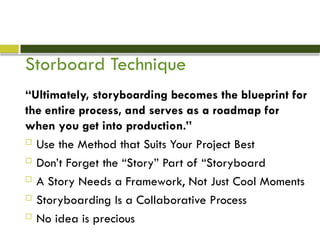
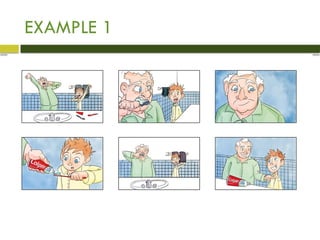
What is a StoryBoard?
 A storyboard is a visual aid primarily used to plan
out or prepare a television commercial, short-film,
or movie.
 Storyboards are useful in organizing sequences and
steps and contain the flow of several processes that
include visual elements, text or dialogue elements,
audio, and actions of characters.
 Creating a storyboard can also help you plan for
special effects, testing complicated ideas on paper
first versus at the actual filming location, and finally
with validating continuity.
Functions of StoryBoard
 Sequential Outline- functions similarly to an
outline of a story.
 Visual Guide- used as a visual reference guide
throughout the filming process.
 Time to Review- serves as your final opportunity
to review your concept and make any changes.
 Not necessarily required- Despite their common
use, storyboards are not always required for a
project.
Storboard Technique
“Ultimately, storyboarding becomes the blueprint for
the entire process, and serves as a roadmap for
when you get into production.”
 Use the Method that Suits Your Project Best
 Don’t Forget the “Story” Part of “Storyboard
 A Story Needs a Framework, Not Just Cool Moments
 Storyboarding Is a Collaborative Process
 No idea is precious
EXAMPLE 1
EXAMPLE 2
EXAMPLE FOR PRINT AD
Balance between words and visuals / Power of
silence
Balance between words and visuals / Power of
silence
What the right ratio is when it comes to balancing text and
visuals, think about how you are going to achieve it.
1. If you don’t need words, don’t use them.
2. Present visual information, visually. Don’t describe things that
you can show.
3. Don’t use unnecessary words or repeating images.
4. Make text visual or turn visuals into text if design feels
lopsided.
5. If you don’t know how much text you need, aim to an equal
surface area for visuals and text to create an “obvious balance.”
GUIDELINES FOR WRITING TELEVISION COPY
1. Use the video.
2. Support the video. Make sure that the copy doesn't
simply hitchhike on the video.
3. If all the copy does is verbally describe what the
audience is watching, an opportunity to either
communicate additional information or strengthen the
video communication has been lost.
4. Coordinate the audio with the video.
5. Sell the product as well as entertain the audience.
6. Be flexible.
7. Use copy judiciously.
8. Reflect the brand personality and image.
9. Build campaigns. When copy for a particular
advertisement is being written, evaluate its potential
as a sustainable idea.
Television Advertising Formats:
 Demonstration.
 Problem and Solution.
 Music and Song.
 Spokesperson.
 Dialogue.
 Vignette.
 Narrative.
OUTDOOR
The Basic Rule of Copy in Outdoor
Advertising
 Brevity (conciseness)
 Why Only Seven
Words?
 What should we omit?
 Do not use more than
one point of contact
 Do not not use
starbursts
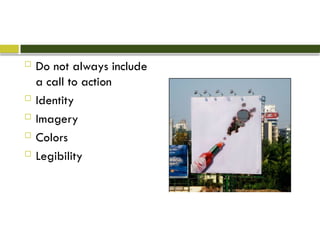
 Do not always include
a call to action
 Identity
 Imagery
 Colors
 Legibility
RADIO
WRITING RADIO SCRIPT
 When you place a radio ad, you are speaking to captive
audience
 On radio, you need to keep your message simple and focused
 Different radio stations require different types of ads
 You have two basic choices when it comes to creating a radio ad
 Repetition is very important in radio
 Entertaining Commercials sell
 Words are your illustrations
 Try them out loud
 Length of words and sentences
Digital: email, web pages
Guidelines for Good Writing are Good
 Users do not read on the Web
 Users do not like long, scrolling pages
 Users Want to Search
 Write copy that is keyword rich
 Waiting is Unpleasant
 Outbound Links Can Increase Credibility
 Offer warranties
 On Internet, a picture or description will replace the
physical product
 Users Want to Get Their Information Quickly
 Credibility is an Important Issue on the Web
 Text Should be Scannable
 Text Should be Concise
 Users like Summaries and the Inverted Pyramid Style
 Graphics and Text Should Complement One Another
 Avoid jump (anchor) links except on long pages such
as FAQs
 Keep your content up to date

Creating an Advertisement in Various Media.pptx

  • 1.
    CREATING AN ADVERTISING UNIT3: Advertising Design 2
  • 2.
  • 3.
    1. Set upyour main objectives  What is the purpose of your advertising campaign? What are your main objectives? Are your goals feasible or not? You should analyze these questions and answer them honestly. Setting clear objectives for your advertisement before starting the creative process is important. Whether you aim to boost sales, create brand awareness, drive website traffic, or generate leads, defining your objectives will guide the entire advertising process and enable you to measure success. Once you have established your objectives, you can move on to the next step and begin your research. 3
  • 4.
    2. Research themarket, the competition, and your audience Of course, based on your industry and your niche, there may be other important questions to answer here such as:  To what demographic group am I addressing my messages?  What is my clients’ social status?  Are they young and unemployed?  Are they professionals from a specific niche?  Are they old or not?  What’s the level of their education?  Where do they live?  What is their relationship with the competition? 4
  • 5.
    3. Select yourchannels  Based on your demographic research, you will be able to narrow your search to some specific channels of media distribution suitable for your campaign. There are various platforms available for displaying ads, including social media, Google’s Display Network, search engines, and third-party websites. Google Display Network provides a wide range of websites, videos, and apps, which helps to reach a diverse online audience, including those who are not actively searching for your brand.  Each platform targets different audiences and marketing expectations. Facebook and Instagram ads provide detailed targeting options, while Google Ads connects with users who are actively looking for related information.  With Creatopy, you gain the power to create a comprehensive set of banners for your online advertisements, enhancing your capabilities and efficiency.  Therefore, it will be easy to design them for different channels in less time than if you would have done it individually. 5
  • 6.
    4. Craft acompelling message  Take all the information you manage to gather up to this step regarding your products and your targeted audience.  Think also about the delivery channels you have chosen for your ads and learn how to write advertisements tailored to each one of those channels. Once you have determined the delivery channels, you can start crafting a message that is easy to understand, connects with your target audience, and effectively conveys the advantages of your product or service. Address the needs, desires, or pain points of your intended audience, and emphasize what makes your offering unique from that of your competitors. Ensure that your message is consistent across all channels to reinforce your brand identity. 6
  • 7.
    5. Design eye-catchingvisuals  Obviously, this is the hardest part of the entire advertisement creation process. Everything you have done until now has prepared you for this step. Now, it’s time to put your creativity to work and actually design your advertisements.  Take the top three or five ideas from your previous sketches and use them to create raw advertisements. If you are using Creatopy as your main advertisement maker, all your projects will be automatically saved online. You can get back to them to make modifications, or you can share them with your peers for valuable input. It will also help you show your rough designs to people who are in your target audience. Their input and advice may help you adjust your advertisements in order to meet the targeted demographic needs and values. 7
  • 8.
    6. Set yourbudget and timeline  To maximize your return on investment, it’s important to establish a budget for your advertising and allocate your resources accordingly. When setting your budget, you should take into account factors such as the cost of producing your ads, where they will be placed, and how long your campaign will run. Additionally, it’s essential to set a realistic timeline for each stage of the advertising process to ensure you stay on track and meet all of your deadlines. 8
  • 9.
    7. Track andanalyze your results  Once the designs are ready to be delivered online, you can start your campaign based on your selected delivery channels.  At this point, you need to define your budget and select the criteria for publishing your advertisements on each channel in particular.  Each advertising platform (or social media platform that includes paid advertising) will let you select your own parameters of delivery, based on demographics, age groups, types of websites, industries, countries, and regions, etc. Tailoring these parameters ensures your ads reach the most relevant audience for optimal engagement and results. This data is also important for your future campaigns. You will start your future design processes based on your initial results and try to improve them. 9
  • 10.
    8. Test andrefine  Continuously test different elements of your advertisement, including messaging, visuals, and CTAs, to identify what resonates best with your audience. A/B testing enables you to compare different variations and improve your strategy based on immediate feedback. Stay agile and adaptable, making adjustments as necessary to enhance performance and reach your goals. 10
  • 11.
    Creating an actualadvertisement
  • 12.
  • 13.
  • 14.
  • 15.
  • 16.
  • 17.
  • 18.
  • 19.
    MEANING AND DEFINITIONOF COPYWRITING, COPYWRITING FOR VARIOUS MEDIA UNIT 3: Advertising Design 3
  • 20.
    “Baat karne sebaat banti hai” “Built For The Road Ahead” What does come in your mind? Remember, where did you hear these captions? The first one is “Airtel,” Second belongs to “Ford”. Some punchlines are eye-catching and grab attention at the very first time. Why? It is because of the fascinating words that are used and arranged in a creative way. This chapter discusses the techniques of creative copywriting without creating an issue of copyright. 20
  • 21.
    What is Copywriting? Copywritingis the skill of choosing the right words and technique of arranging them smartly to promote business, product, service, idea, or a person. The selection of words and its presentation largely depends upon the media through which it is planned to convey. For example, depending on whether it is a newspaper, magazine, hoarding, radio, television, or internet, the script will vary accordingly. However, whatever is the type of media, the purpose of copywriting is the same i.e. promotion. Therefore, it should be persuasive enough to be instantly attention grabbing. 21
  • 22.
    Elements of Copywriting Heading − Headline gives the first impression and lasts on readers’ mind, therefore, it should be eye-catching. Heading should tell – what it is all about your ad in a very few words, ranging from 3 to 30 words.  Body copy − Write body copy in such a way that it seems as the continuity of the heading. Provide details of all the features and benefits that you are claiming for. The language should be promising and trustworthy.  Slogans − Think of "The ultimate driving machine" (BMW); “Just do it” (Nike); "Because I'm worth it" (L'Oréal), what comes to your mind? The moment, you hear the slogans, you link it with the respective brand not only because you have heard it many times, but rather it works. A well-written and effective slogan is a trustworthy brand representative. However, your slogan should be small and crispy giving meaning to your brand.  Taglines − Taglines are usually used for literary products to reinforce and strengthen the audience's memory of a literary product. For example, “she went in search of answers, and discovered a love she never expected,’ Book Name “Faithful” and Writer - Janet Fox. Thus, tagline tells the gist of the products for 22
  • 23.
    Elements of Copywriting(Contd…) marketing purpose. Like, a slogan, it should be small and eye-catching.  Jingle Lyrics − More often accompanied with background music, iingle lyric is a short slogan, tune, or verse written to be easily remembered (especially used in advertising). For example, Fanta: "Wanna Fanta, Don’t You Wanna?" It should be small, crisp, and rhythmic (like a song) so that it registers with people at once and they remember it.  Scripts (for audio and video ad) −Scripts are the descriptions of an ad that narrates the dialogues, actions, expression, and movements of characters. Since, script is a complete guidelines of an ad; therefore, it should be written meaningfully, orderly, and nicely.  Others − (White Paper, Press Release, & other written material such as emails, articles, and blog (for the internet)): These are all promotional write-ups written purposefully to promote a particular product/service. So, while writing white paper, press release, articles, blog, or even an email you need to focus or emphasize ONLY on one product that you want to promote. You need to describe all features and offers of the respective product in simple and plain language. 23
  • 24.
    Copywriting Techniques  UseAction Words Such as watch, look, ask, get, etc. −  Use of Buzzwords Normally, buzzwords are eye-catching − such as now, today, etc.  Use Exciting or Emotive words Such as amazing, − wonderful, beautiful, etc.  Use Alliteration Use meaningful words of similar sound. For − example, Don’t be vague, ask for Haig.  Use Colloquial words Colloquialisms in copywriting is − pretty popular and effective. For example, ‘Pick ‘n Choose.’  Use Punctuation Proper use of punctuations and grammar − is an important aspect so that you can pass the right message. 24
  • 25.
    Pay Attention whileWriting Headlines  Try to keep headline as small as possible (5 to 10 words are ideal).  Use meaningful and striking words to make heading persuasive.  Try to use brand name in the headline.  Stick with the typeface in a headline. 25
  • 26.
    Pay Attention whileWriting Subheading  Subheading should support the headline.  It should be appealing so that the reader is impressed to read the body copy.  Use minimum, but meaningful and fascinating words in subheading. 26
  • 27.
    Pay Attention whileWriting Body Copy  Try to keep the sentences in present tense.  Use simple and familiar words.  Keep the sentences small, and do not lose the link between the sentences.  Use singular noun.  Use active verbs.  Convey message as if it is a new information to grab attention.  Avoid using clichés and superlative words. 27
  • 28.
    Protect Yourself From Using any vague word or sentence.  Using many adjectives.  Copying any others’ sentences (Copyright issue).  Using unfamiliar words; your target audiences are not language expert.  Be honest; do not promise something, which is not there.  Do not use too many words (avoid wordiness); you have limited space.  Your message should not be violating anyone’s right or feelings; you have to be honest and true. 28
  • 29.
    Writing copy forvarious Media
  • 30.
  • 31.
    Writing a successfulPrint Advertisement  Put a benefit in your headline.  Make your ads easy to skim  Use customer testimonials.  Focus on the customer.  Use Y words.  Spend time on the headline.  Be your own worse critic.  Put a coupon in your ad.  Hit a home run with the body copy.  As you write the ad, try to think of a visua
  • 32.
    Elements of Printadvertisement  Headline: Your headline is the first line of copy your reader is going to see in your print ads.  Subhead: You won't find a subhead in all print ads. A subhead is optional but its purpose is to expand on your headline and draw your reader in even further.  White Space: Just because you're buying a full-page print ad doesn't mean you have to fill the entire page with text and images.  Images and illustrations: Images can dress up your ad, though, as long as you choose the right image. Any images you use should go hand-in-hand with your copy.  Body Copy: The body of your print ads should be written in a conversational tone. Don't overwrite your ad. You have a very limited space to write your copy.
  • 33.
     Signature: Optionalslogan and logotype of the sponsor.  Call to Action: What should the customer do now? If you don't tell them, they'll just put your ad down and move on to something else.  Contact Information: Do not forget your contact information. Don't just include your website because that is where you want people to go.  Mandatory: Required disclosures, terms and conditions. Listed at the bottom.
  • 34.
    The Headline has3 functions: 1. To capture attention.  Ex: Axe effect – red lips creating a sensuous appeal are a very attention seeking ad and the visual acts as the headline. 2. To awaken the interest of the reader in learning more about the product.  The ad for Intelligent Investor, which uses the headline “Why being a regular reader of Intelligent Investor is such a healthy habit”. 3. To select the special readers who might have a specific interest in what you are selling.  Tamilnadu Pradesh ad targets media planners, hence the headline – “Perhaps the first ad written with the belief that a media planner is human, and not a counting machine”.
  • 35.
    CLASSIFICATION OF HEADLINES BENEFIT  NEWS AND INFORMATION  COMMAND  QUESTION  REASON WHY  HOW-TO  SELECTIVE HEADLINE  SOLUTION TO PROBLEM  FLAG HEADLINE  TESTIMONIAL HEADLINE & CLAIM  ADVICE HEADLINE  GIMMICK HEADLINE
  • 36.
    Tips for Bodycopy 1. A writer must put conviction into their own copy. 2. Never oversell in your body copy 3. Get quickly to the crux of your body copy message. 4. Keep your line of thought on track. 5. Address arguments before they arise. 6. Write for your audience-not yourself. 7. Keep your copy user friendly 8. Present your body copy in a logical sequence that relates to the rest of the text. 9. Use one of the twelve slogans for constructive persuasion.
  • 37.
    SLOGANS  A sloganis a small attractive phrase used in the ad to sum up the advertising message in a few words.  The words must be simple, clear and easy to remember. It should be so designed that it can be repeated , perhaps a year or years together.  Sometimes, they just come along but most often slogans are the result of hard work of days together put in by the creative marketing people/advertising people.
  • 38.
    Basis for writinga slogan: Techniques/factors 1. Slogans can be based on the Quality of the product.  Example: ‘The best tobacco money can buy’-Rothmans. 2. Slogan can be based on the Life of the company.  Example: ‘A trusted household name for over fifty years’-Philips. 3. Slogans can be used to build Trust and confidence.  Example: ‘The name you can trust’- Mafatlal. 4. Slogans to guard against substitutes.  Example: ‘when it’s Philips, you can be sure’. 5. Slogans emphasizing sales of the product.  Example: ‘India’s largest selling soft drink concentrates’. Rasna. 6. Slogans emphasizing International reputation of the product.  Example: ‘The world’s favorite airline’- British Airways.
  • 39.
    7. Slogans canplace emphasis on Advanced technology of the company. Example: ‘In tune with tomorrow.’- Bush.  Example: Dunlop is Dunlop, always ahead’. 8. Slogans emphasizing the use of the product.  Example: ‘A pocket doctor for aches and pains-Amrutanjan pain balm.  Example: ‘Real relief, real fast-Moov. 9. Slogans expressing Love and Affection  Example: ‘A gift for someone you love-Amul chocolates. 10. Slogans expressing Joy and happiness.  Example: ‘Happy days are here again.-Thumps up 11. Slogans emphasizing the choice of specific class.  Example: ‘The choice of new generation’- Lehar Pepsi. Basis for writing a slogan: Techniques/factors (Contd…)
  • 40.
    Seals, Logo Types& Signatures  A company's logo is the corporate signature which represents the personality of the company and it's products.  A seal is awarded only when a product meets standards established by a particular instruction or organization.  Logotype & signature are special designs of the advertiser's company name/product name.
  • 41.
    Jingles  These arecatchy little tunes, which we pick up and hum quite unconsciously most of the time.  A jingle with its repeat phrase has a far higher recall value than the visuals do.  It is important to know your target audience.  Composing, singing and making it work is highly creative art.
  • 42.
  • 43.
    What is aStoryBoard?  A storyboard is a visual aid primarily used to plan out or prepare a television commercial, short-film, or movie.  Storyboards are useful in organizing sequences and steps and contain the flow of several processes that include visual elements, text or dialogue elements, audio, and actions of characters.  Creating a storyboard can also help you plan for special effects, testing complicated ideas on paper first versus at the actual filming location, and finally with validating continuity.
  • 44.
    Functions of StoryBoard Sequential Outline- functions similarly to an outline of a story.  Visual Guide- used as a visual reference guide throughout the filming process.  Time to Review- serves as your final opportunity to review your concept and make any changes.  Not necessarily required- Despite their common use, storyboards are not always required for a project.
  • 45.
    Storboard Technique “Ultimately, storyboardingbecomes the blueprint for the entire process, and serves as a roadmap for when you get into production.”  Use the Method that Suits Your Project Best  Don’t Forget the “Story” Part of “Storyboard  A Story Needs a Framework, Not Just Cool Moments  Storyboarding Is a Collaborative Process  No idea is precious
  • 46.
  • 47.
  • 48.
  • 49.
    Balance between wordsand visuals / Power of silence
  • 50.
    Balance between wordsand visuals / Power of silence What the right ratio is when it comes to balancing text and visuals, think about how you are going to achieve it. 1. If you don’t need words, don’t use them. 2. Present visual information, visually. Don’t describe things that you can show. 3. Don’t use unnecessary words or repeating images. 4. Make text visual or turn visuals into text if design feels lopsided. 5. If you don’t know how much text you need, aim to an equal surface area for visuals and text to create an “obvious balance.”
  • 51.
    GUIDELINES FOR WRITINGTELEVISION COPY 1. Use the video. 2. Support the video. Make sure that the copy doesn't simply hitchhike on the video. 3. If all the copy does is verbally describe what the audience is watching, an opportunity to either communicate additional information or strengthen the video communication has been lost. 4. Coordinate the audio with the video.
  • 52.
    5. Sell theproduct as well as entertain the audience. 6. Be flexible. 7. Use copy judiciously. 8. Reflect the brand personality and image. 9. Build campaigns. When copy for a particular advertisement is being written, evaluate its potential as a sustainable idea.
  • 53.
    Television Advertising Formats: Demonstration.  Problem and Solution.  Music and Song.  Spokesperson.  Dialogue.  Vignette.  Narrative.
  • 55.
  • 56.
    The Basic Ruleof Copy in Outdoor Advertising  Brevity (conciseness)  Why Only Seven Words?  What should we omit?  Do not use more than one point of contact  Do not not use starbursts
  • 57.
     Do notalways include a call to action  Identity  Imagery  Colors  Legibility
  • 58.
  • 59.
    WRITING RADIO SCRIPT When you place a radio ad, you are speaking to captive audience  On radio, you need to keep your message simple and focused  Different radio stations require different types of ads  You have two basic choices when it comes to creating a radio ad  Repetition is very important in radio  Entertaining Commercials sell  Words are your illustrations  Try them out loud  Length of words and sentences
  • 60.
  • 61.
    Guidelines for GoodWriting are Good  Users do not read on the Web  Users do not like long, scrolling pages  Users Want to Search  Write copy that is keyword rich  Waiting is Unpleasant  Outbound Links Can Increase Credibility  Offer warranties  On Internet, a picture or description will replace the physical product
  • 62.
     Users Wantto Get Their Information Quickly  Credibility is an Important Issue on the Web  Text Should be Scannable  Text Should be Concise  Users like Summaries and the Inverted Pyramid Style  Graphics and Text Should Complement One Another  Avoid jump (anchor) links except on long pages such as FAQs  Keep your content up to date