 Method of engraving in
  which lines or textures are
  bitten, or etched, into a metal
  plate, usually copper, with
  acid.
 Like drawing on the plate in
  the same direct way as with
  pen or pencil on paper.

  The first etchings date from the early 16th century, but the basic principle
  had been used earlier for the decoration of armour.

  Among the pioneers of the medium were Albrecht Altdorfer, Albrecht
  Dürer, and Parmigianino; the greatest of all etchers wasRembrandt. In the
  20th century, etching was especially popular for book illustration.
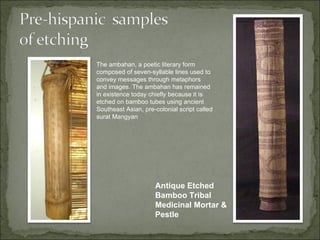
The ambahan, a poetic literary form
composed of seven-syllable lines used to
convey messages through metaphors
and images. The ambahan has remained
in existence today chiefly because it is
etched on bamboo tubes using ancient
Southeast Asian, pre-colonial script called
surat Mangyan


                     Antique Etched
                     Bamboo Tribal
                     Medicinal Mortar &
                     Pestle
Flute etching patterns
employed by Bontok
craftsmen

Bamboo nose flutes
from the C. E. Smith
collection. All of these
are probably of Bontok
manufacture
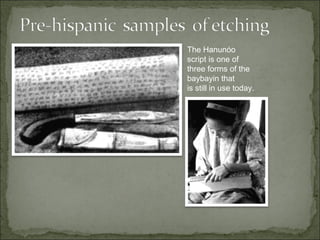
The Hanunóo
script is one of
three forms of the
baybayin that
is still in use today.
Herbert W. Krieger's
The Collection of
Primitive Weapons and
Armor of the Philippine
Islands
in the United States
National Museum
Smithsonian Institution;
United States National
Museum, Bulletin 137
(1926)
1. Fill the desired
shape with light and
bright colored
crayons. Do not use
dark colors.
2. When the space is
completely covered
with bright colors, use
a black or dark purple
crayon to color the
entire space .

You can also use black
acrylic paint as a
second layer.
3. Using any pointed
tip (pencils, bbq
sticks, paper clips),
draw on the black area
of the paper and you
will see the color
underneath.
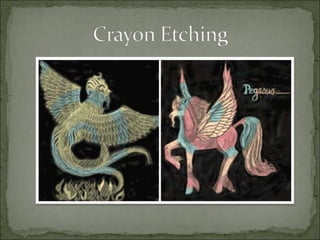
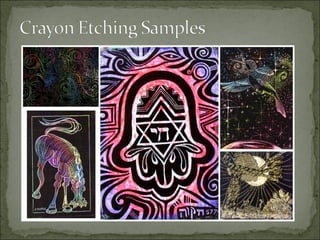
Crayon etching
Crayon etching

Crayon etching

  • 2.
     Method ofengraving in which lines or textures are bitten, or etched, into a metal plate, usually copper, with acid.  Like drawing on the plate in the same direct way as with pen or pencil on paper. The first etchings date from the early 16th century, but the basic principle had been used earlier for the decoration of armour. Among the pioneers of the medium were Albrecht Altdorfer, Albrecht Dürer, and Parmigianino; the greatest of all etchers wasRembrandt. In the 20th century, etching was especially popular for book illustration.
  • 3.
    The ambahan, apoetic literary form composed of seven-syllable lines used to convey messages through metaphors and images. The ambahan has remained in existence today chiefly because it is etched on bamboo tubes using ancient Southeast Asian, pre-colonial script called surat Mangyan Antique Etched Bamboo Tribal Medicinal Mortar & Pestle
  • 4.
    Flute etching patterns employedby Bontok craftsmen Bamboo nose flutes from the C. E. Smith collection. All of these are probably of Bontok manufacture
  • 5.
    The Hanunóo script isone of three forms of the baybayin that is still in use today.
  • 6.
    Herbert W. Krieger's TheCollection of Primitive Weapons and Armor of the Philippine Islands in the United States National Museum Smithsonian Institution; United States National Museum, Bulletin 137 (1926)
  • 7.
    1. Fill thedesired shape with light and bright colored crayons. Do not use dark colors.
  • 8.
    2. When thespace is completely covered with bright colors, use a black or dark purple crayon to color the entire space . You can also use black acrylic paint as a second layer.
  • 9.
    3. Using anypointed tip (pencils, bbq sticks, paper clips), draw on the black area of the paper and you will see the color underneath.