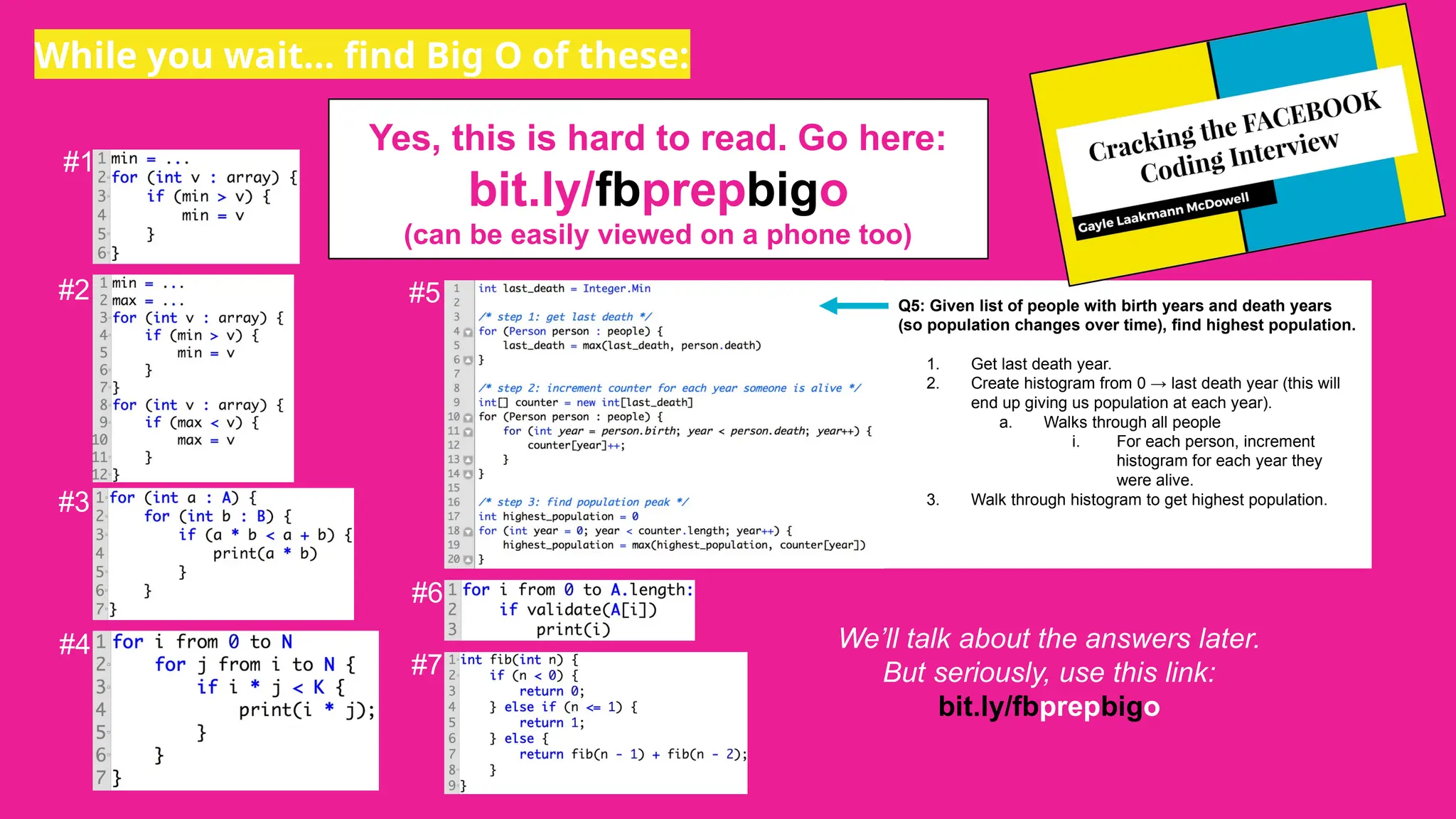
While you wait… find Big O of these:
#1
#2
#3
#4
#5
#6
#7
Q5: Given list of people with birth years and death years
(so population changes over time), find highest population.
1. Get last death year.
2. Create histogram from 0 → last death year (this will
end up giving us population at each year).
a. Walks through all people
i. For each person, increment
histogram for each year they
were alive.
3. Walk through histogram to get highest population.
Yes, this is hard to read. Go here:
bit.ly/fbprepbigo
(can be easily viewed on a phone too)
We’ll talk about the answers later.
But seriously, use this link:
bit.ly/fbprepbigo
Cracking the FACEBOOK
Coding Interview
Gayle Laakmann McDowell
why am I here
gayle@gayle.com
subject: fbprep
facebook wants you
to do your best
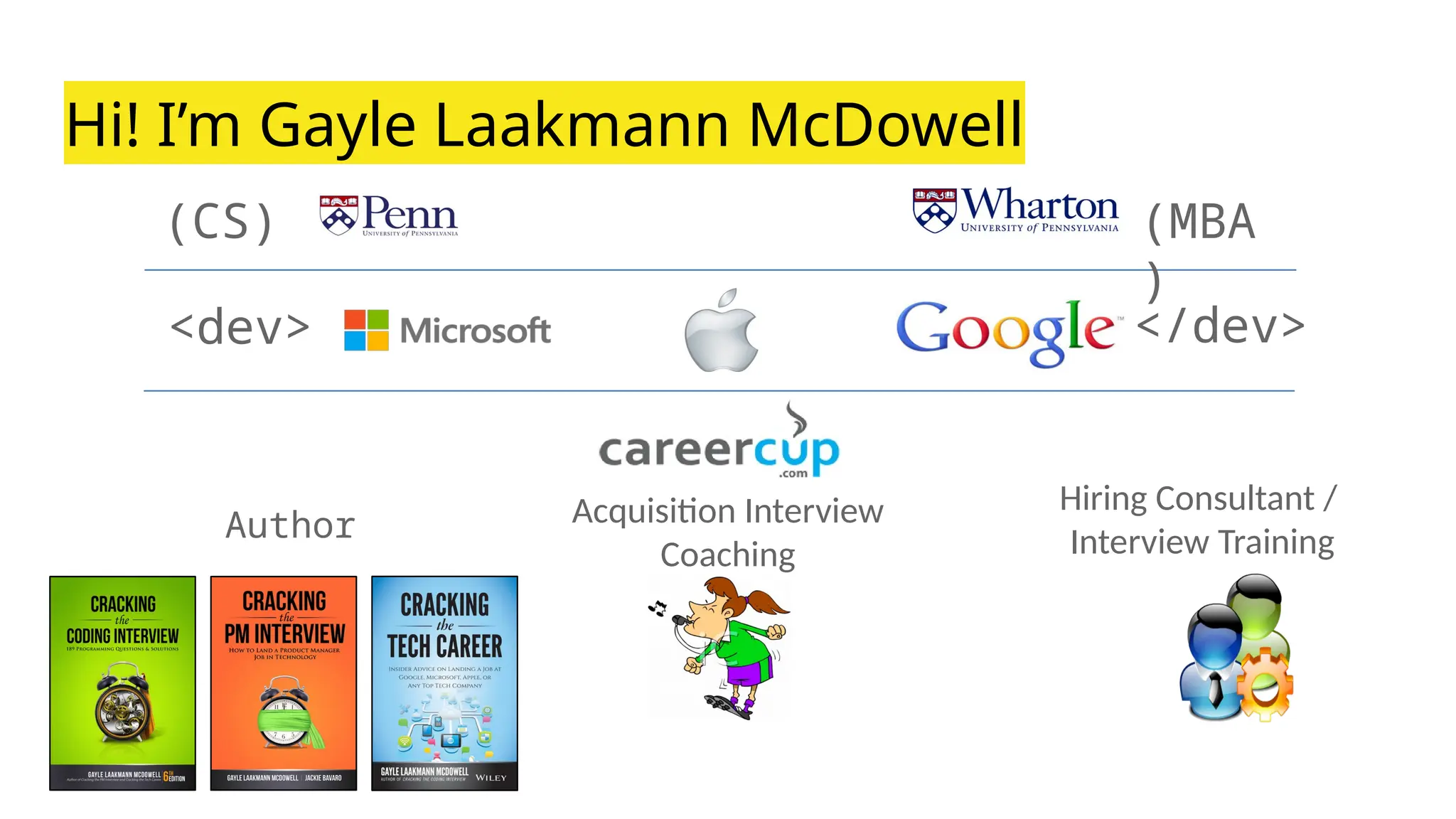
Hi! I’m Gayle Laakmann McDowell
Author Acquisition Interview
Coaching
<dev> </dev>
(CS) (MBA
)
Hiring Consultant /
Interview Training
Yes! Slides are online!
● Gayle.com > Events > Facebook
gayle@gayle.com
subject: fbprep
what to expect
gayle@gayle.com
subject: fbprep
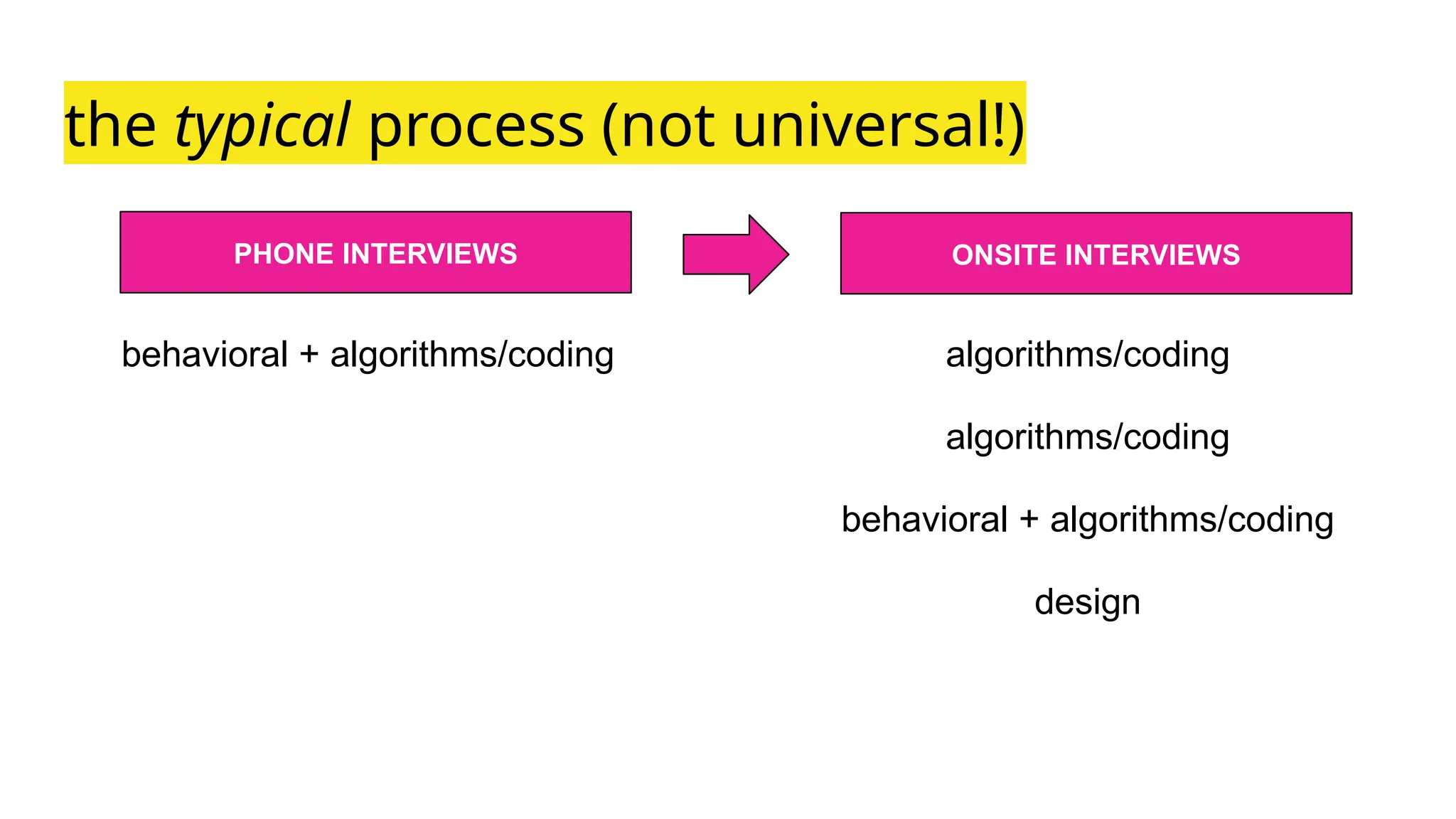
ONSITE INTERVIEWS
PHONE INTERVIEWS
behavioral + algorithms/coding
the typical process (not universal!)
algorithms/coding
algorithms/coding
behavioral + algorithms/coding
design
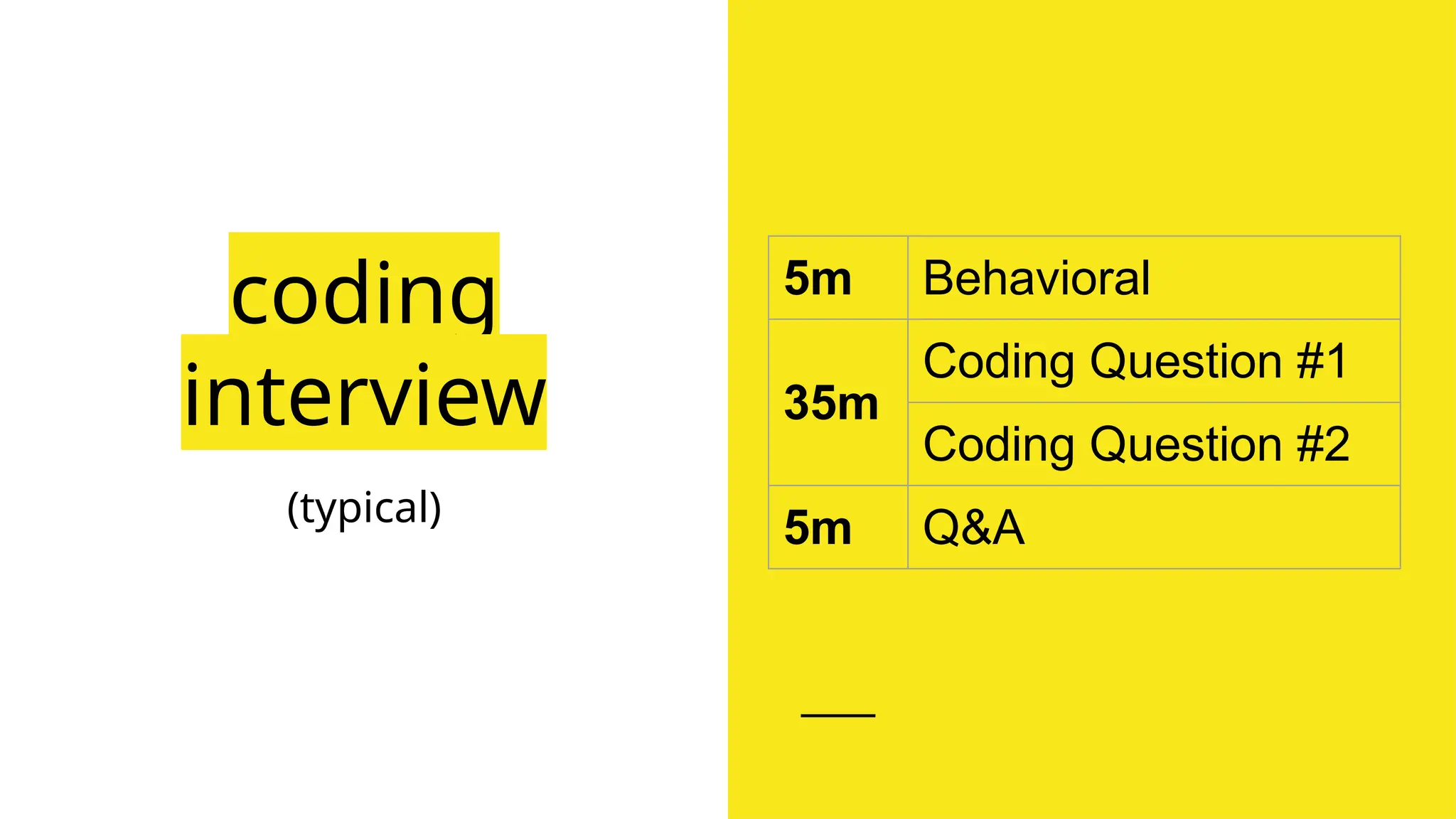
coding
interview
(typical)
5m Behavioral
35m
Coding Question #1
Coding Question #2
5m Q&A
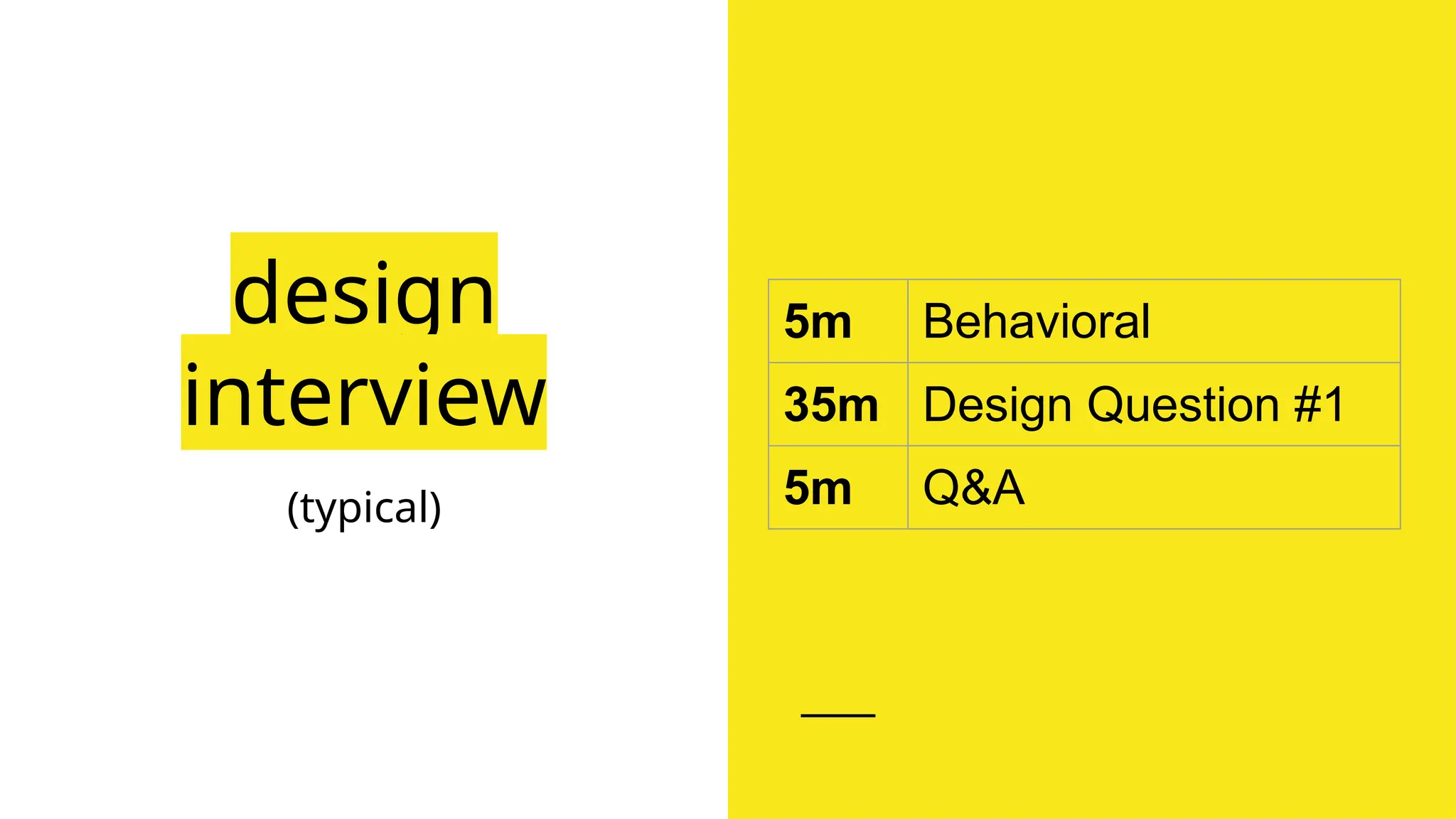
design
interview
(typical)
5m Behavioral
35m Design Question #1
5m Q&A
behavioral questions
gayle@gayle.com
subject: fbprep
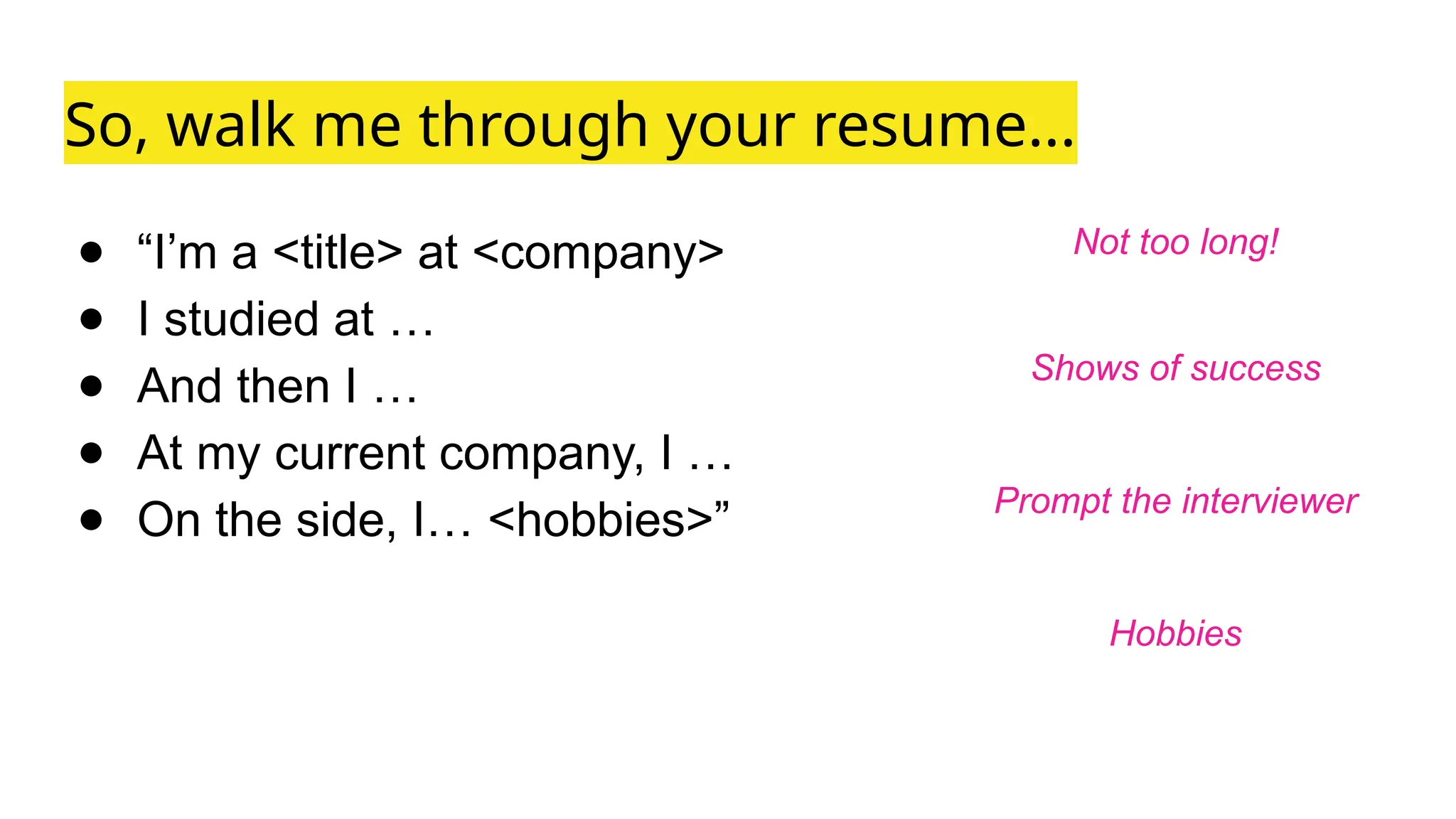
So, walk me through your resume...
● “I’m a <title> at <company>
● I studied at …
● And then I …
● At my current company, I …
● On the side, I… <hobbies>”
Not too long!
Shows of success
Prompt the interviewer
Hobbies
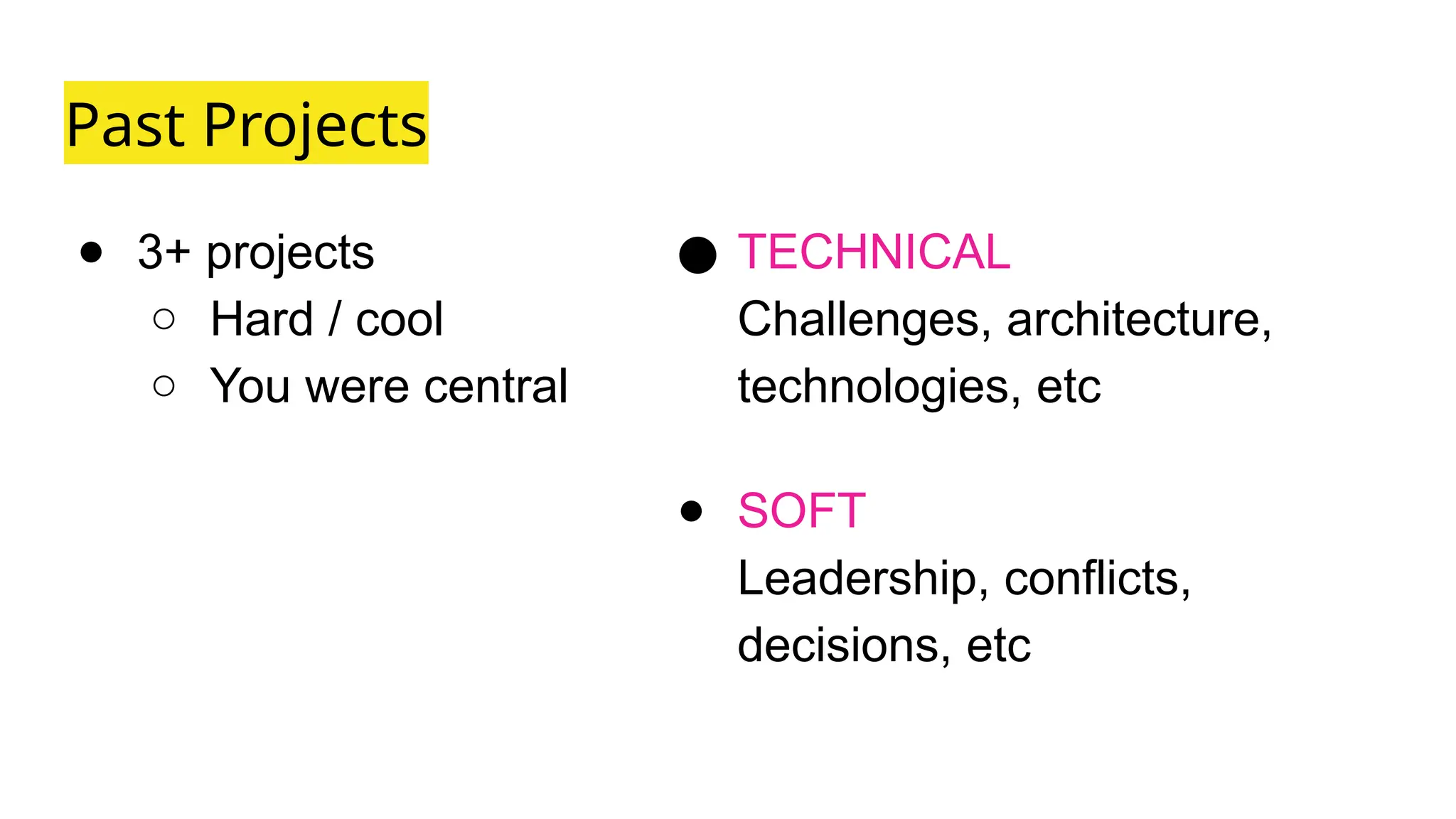
Past Projects
● 3+ projects
○ Hard / cool
○ You were central
● TECHNICAL
Challenges, architecture,
technologies, etc
● SOFT
Leadership, conflicts,
decisions, etc
what did you do?
(not your team)
what are you trying to say?
(the message)
design questions
gayle@gayle.com
subject: fbprep
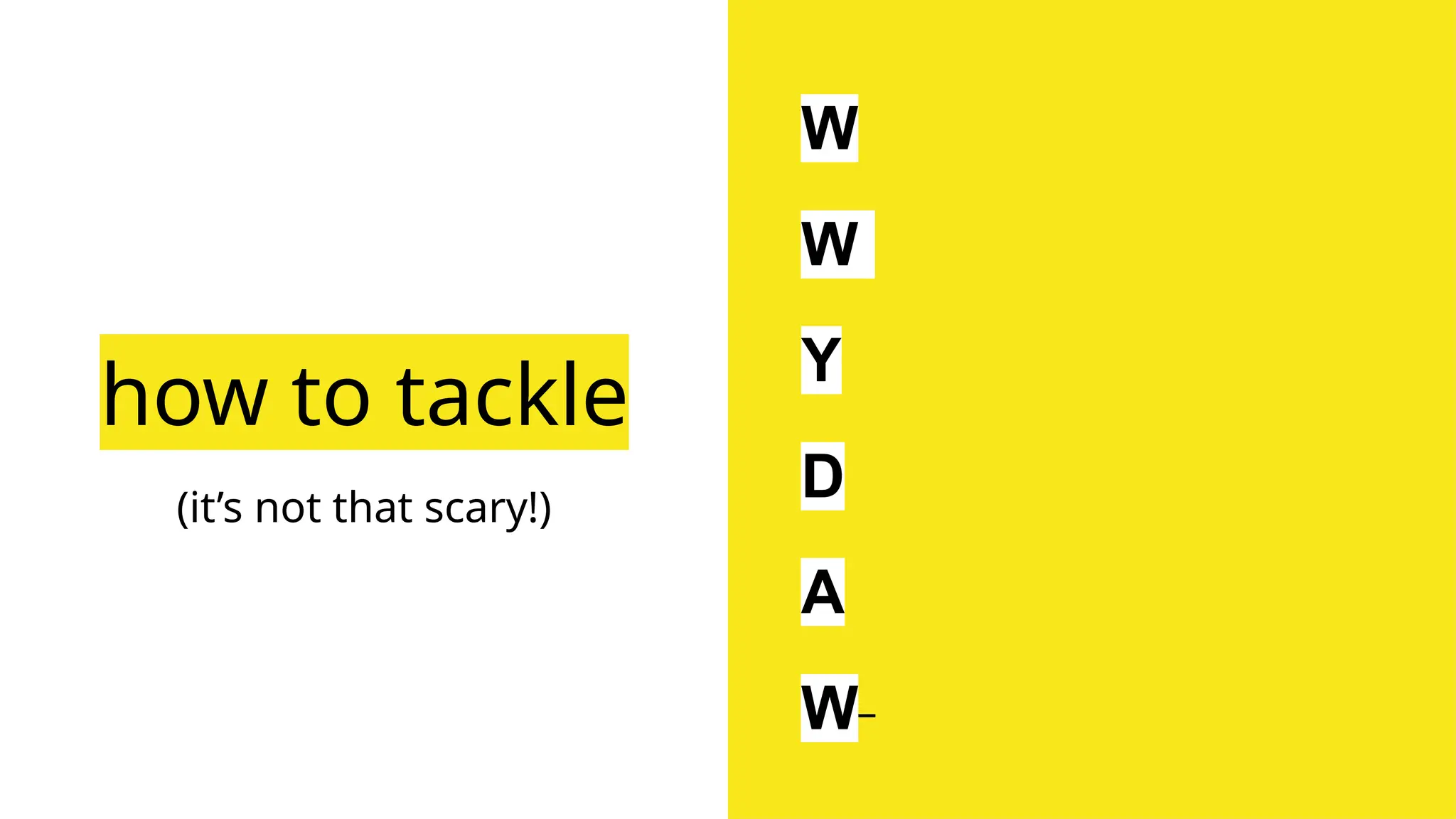
how to tackle
(it’s not that scary!)
W
W
Y
D
A
W
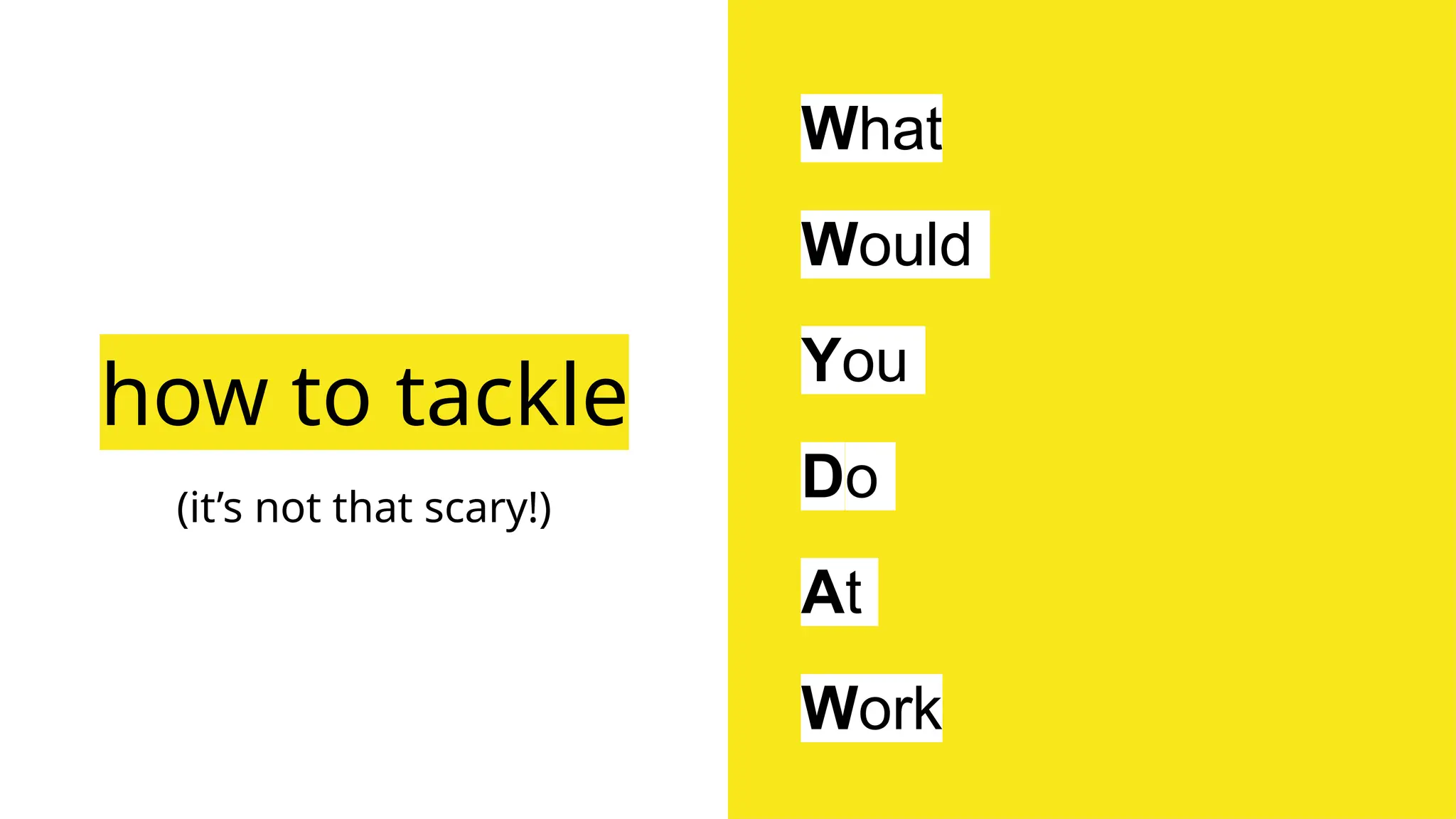
how to tackle
(it’s not that scary!)
What
Would
You
Do
At
Work
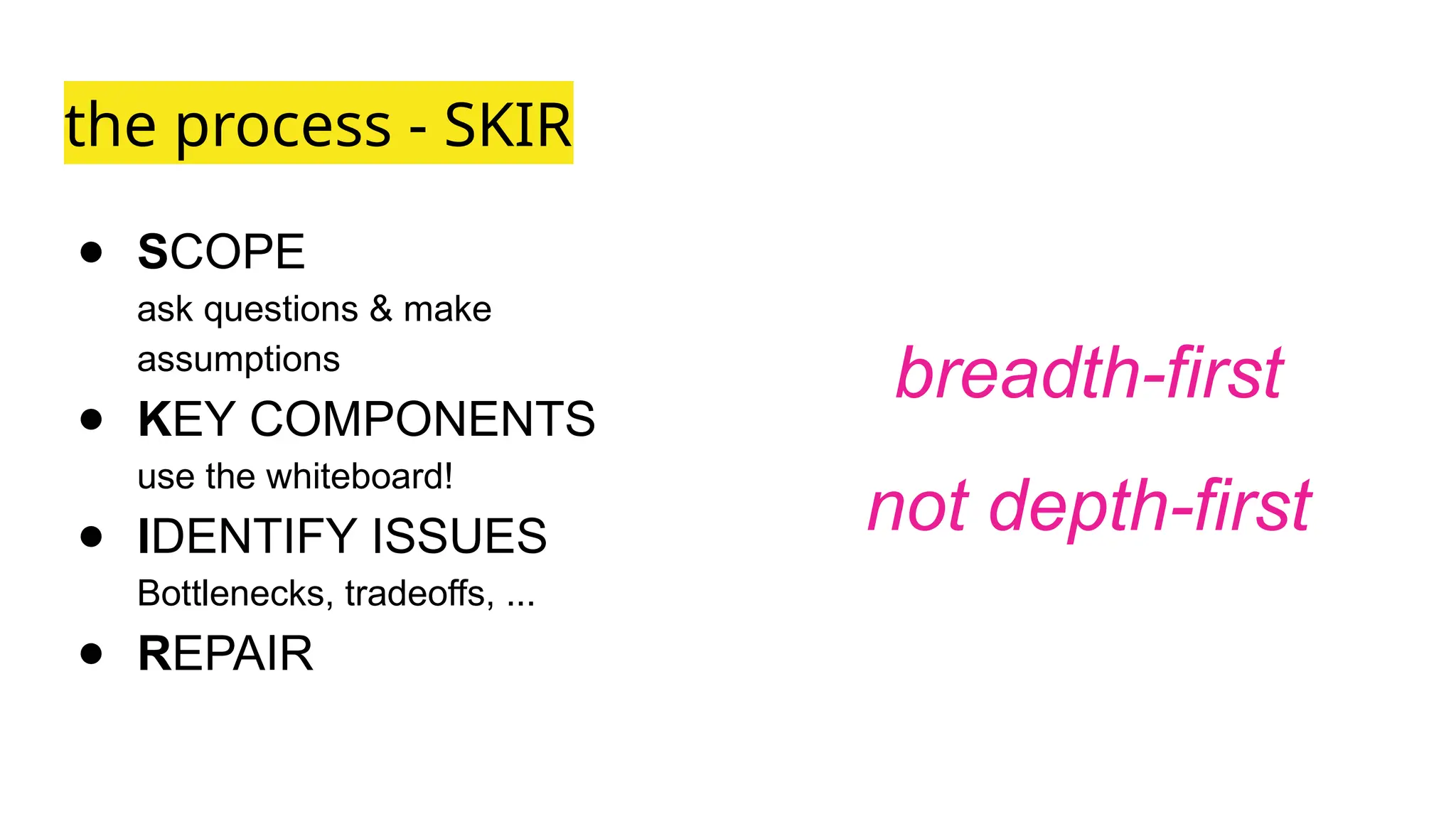
the process - SKIR
● SCOPE
ask questions & make
assumptions
● KEY COMPONENTS
use the whiteboard!
● IDENTIFY ISSUES
Bottlenecks, tradeoffs, ...
● REPAIR
breadth-first
not depth-first
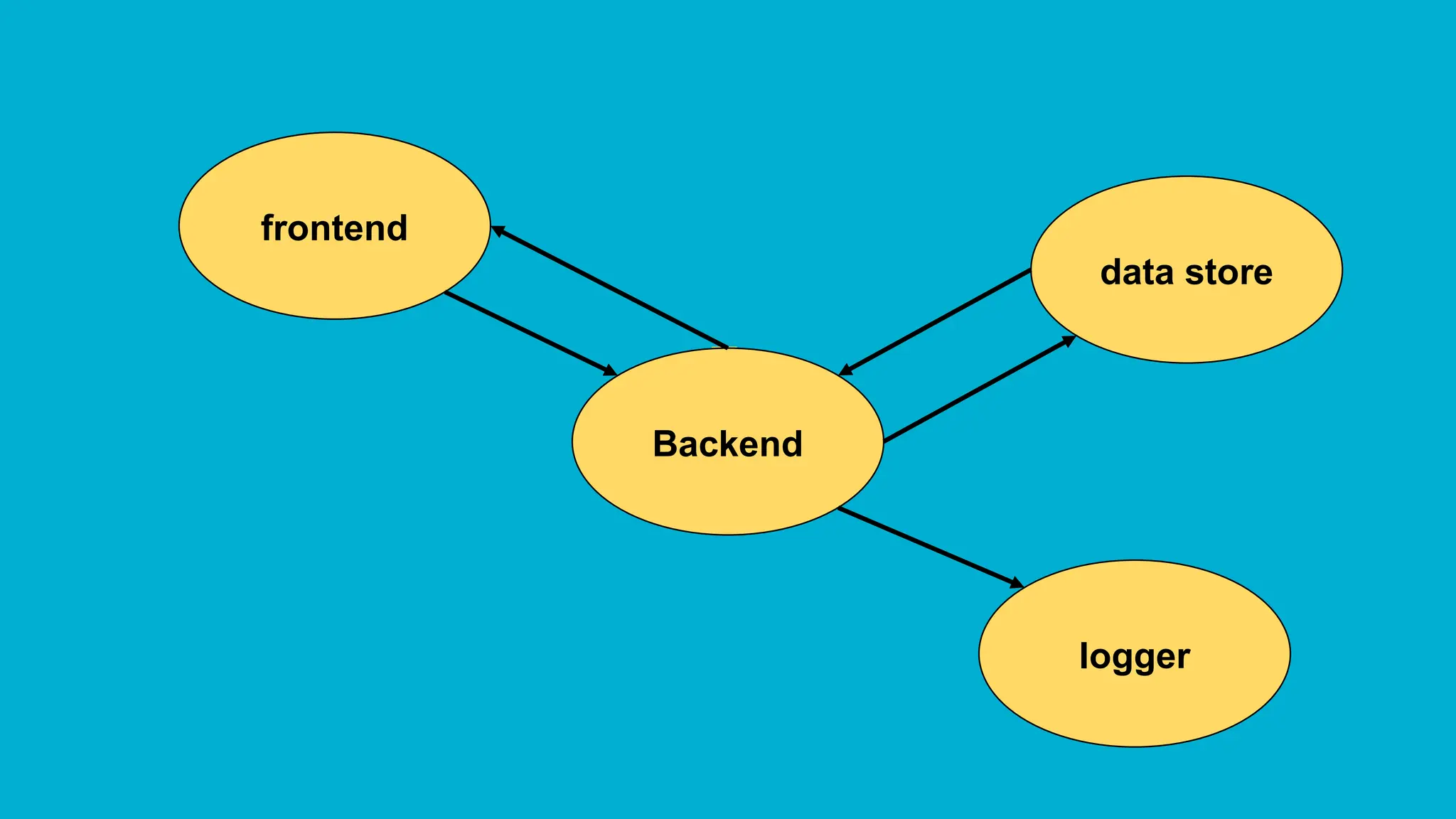
frontend
Backend
data store
logger
a collaborative discussion
(but one that you are driving)
LEADER & TEAMMATE
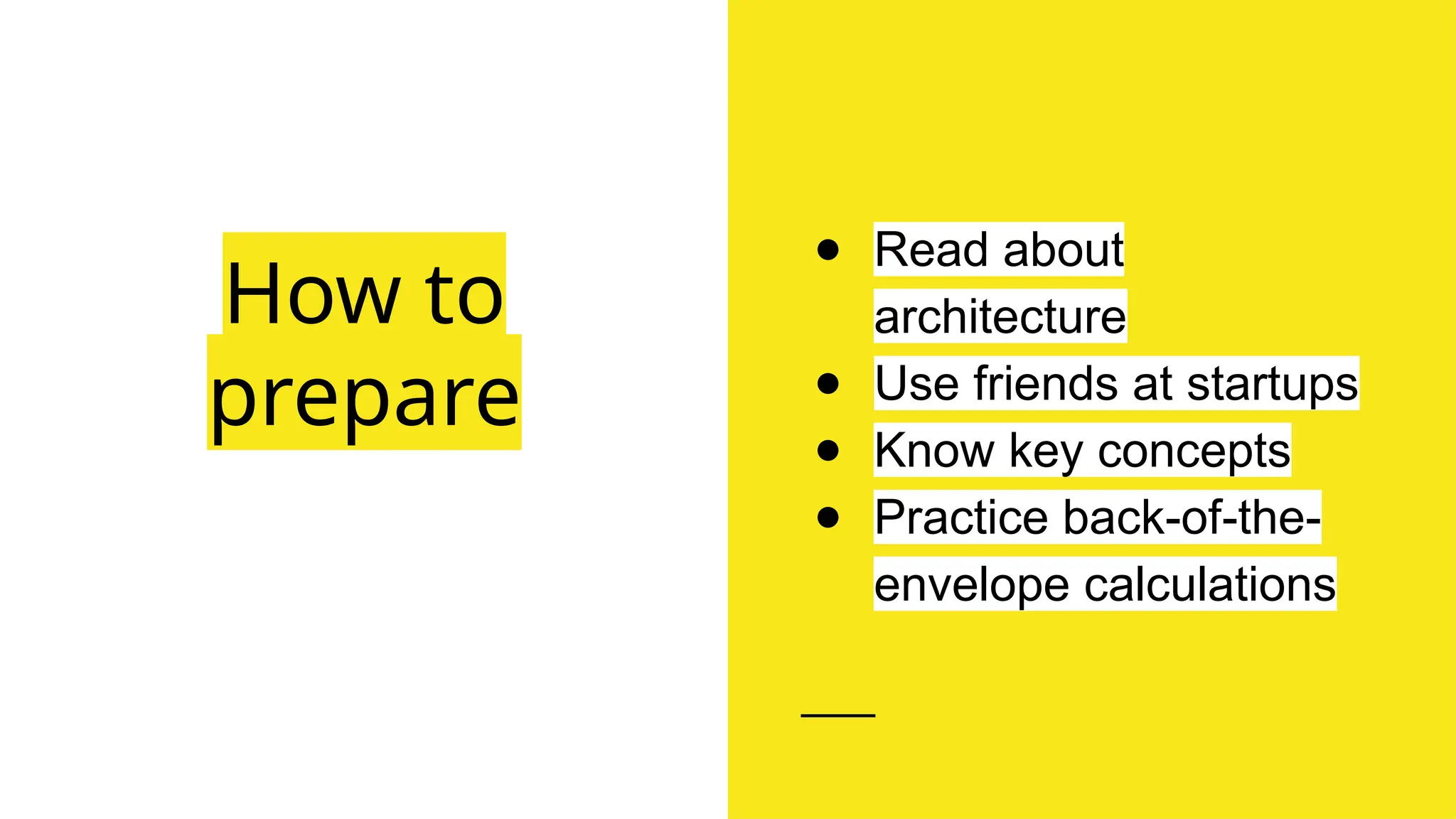
● Read about
architecture
● Use friends at startups
● Know key concepts
● Practice back-of-the-
envelope calculations
How to
prepare
algorithm questions
gayle@gayle.com
subject: fbprep
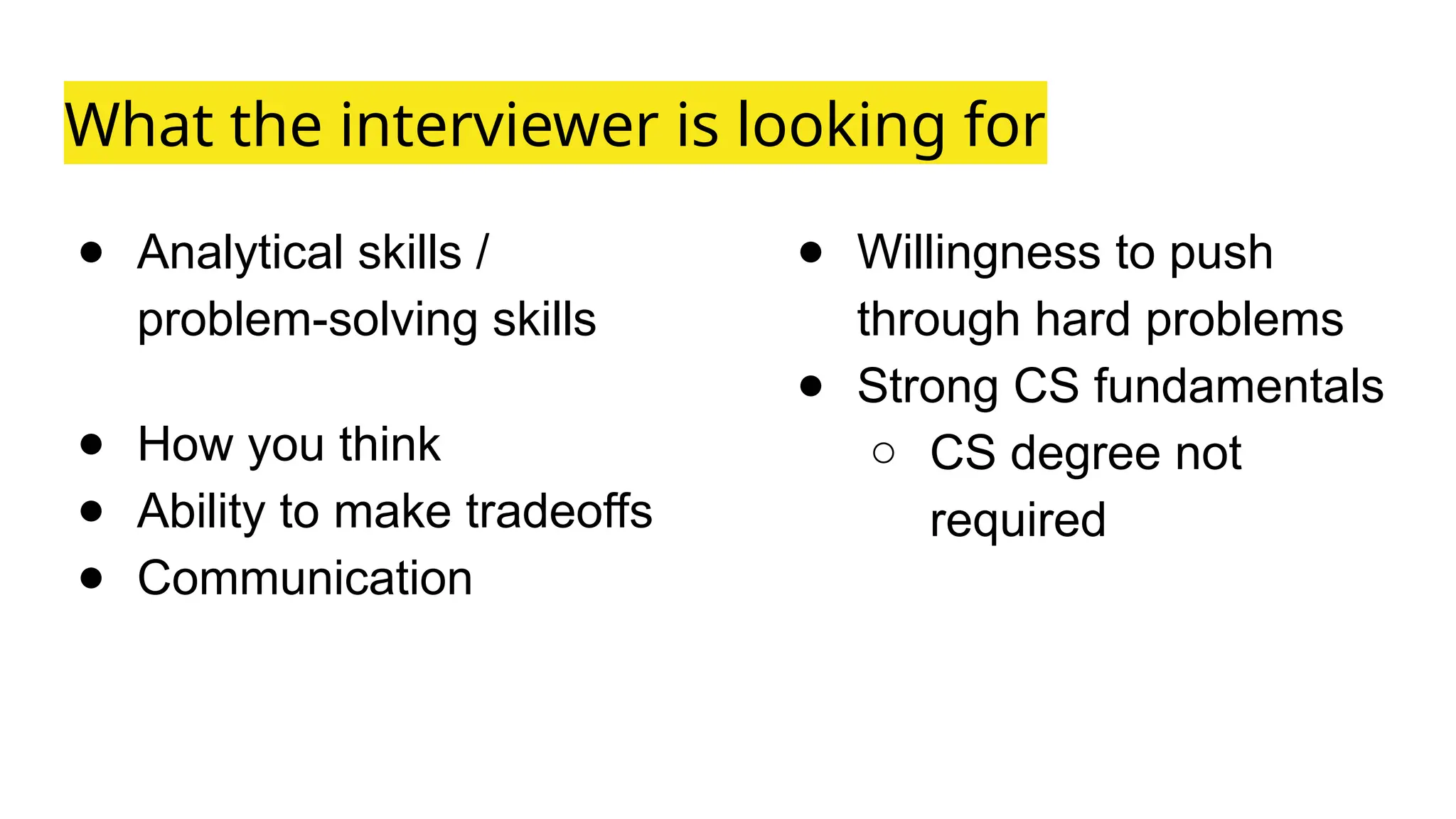
● Analytical skills /
problem-solving skills
● How you think
● Ability to make tradeoffs
● Communication
What the interviewer is looking for
● Willingness to push
through hard problems
● Strong CS fundamentals
○ CS degree not
required
CS degree is not required
(or even that important)
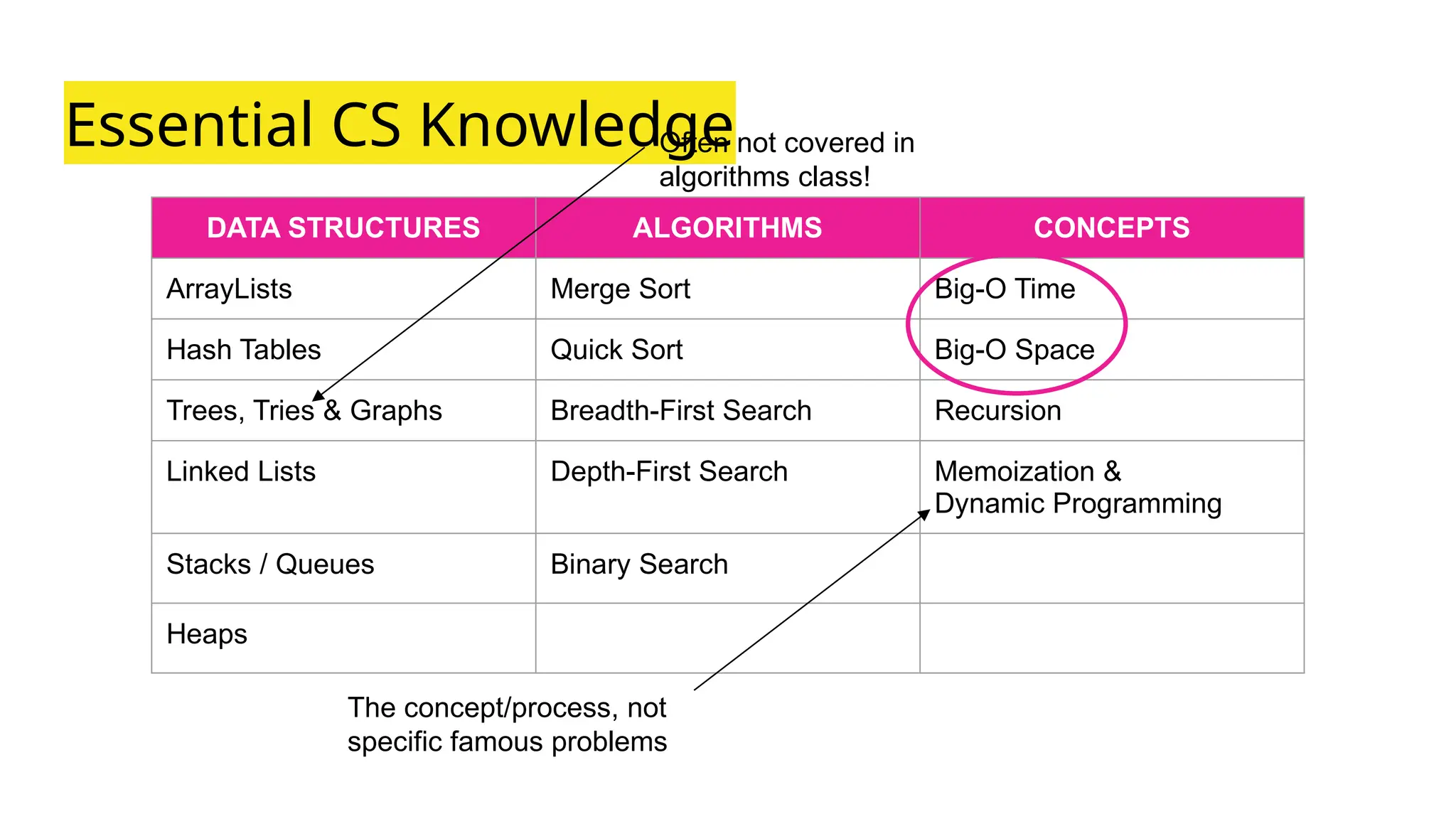
Essential CS Knowledge
DATA STRUCTURES ALGORITHMS CONCEPTS
ArrayLists Merge Sort Big-O Time
Hash Tables Quick Sort Big-O Space
Trees, Tries & Graphs Breadth-First Search Recursion
Linked Lists Depth-First Search Memoization &
Dynamic Programming
Stacks / Queues Binary Search
Heaps
Often not covered in
algorithms class!
The concept/process, not
specific famous problems
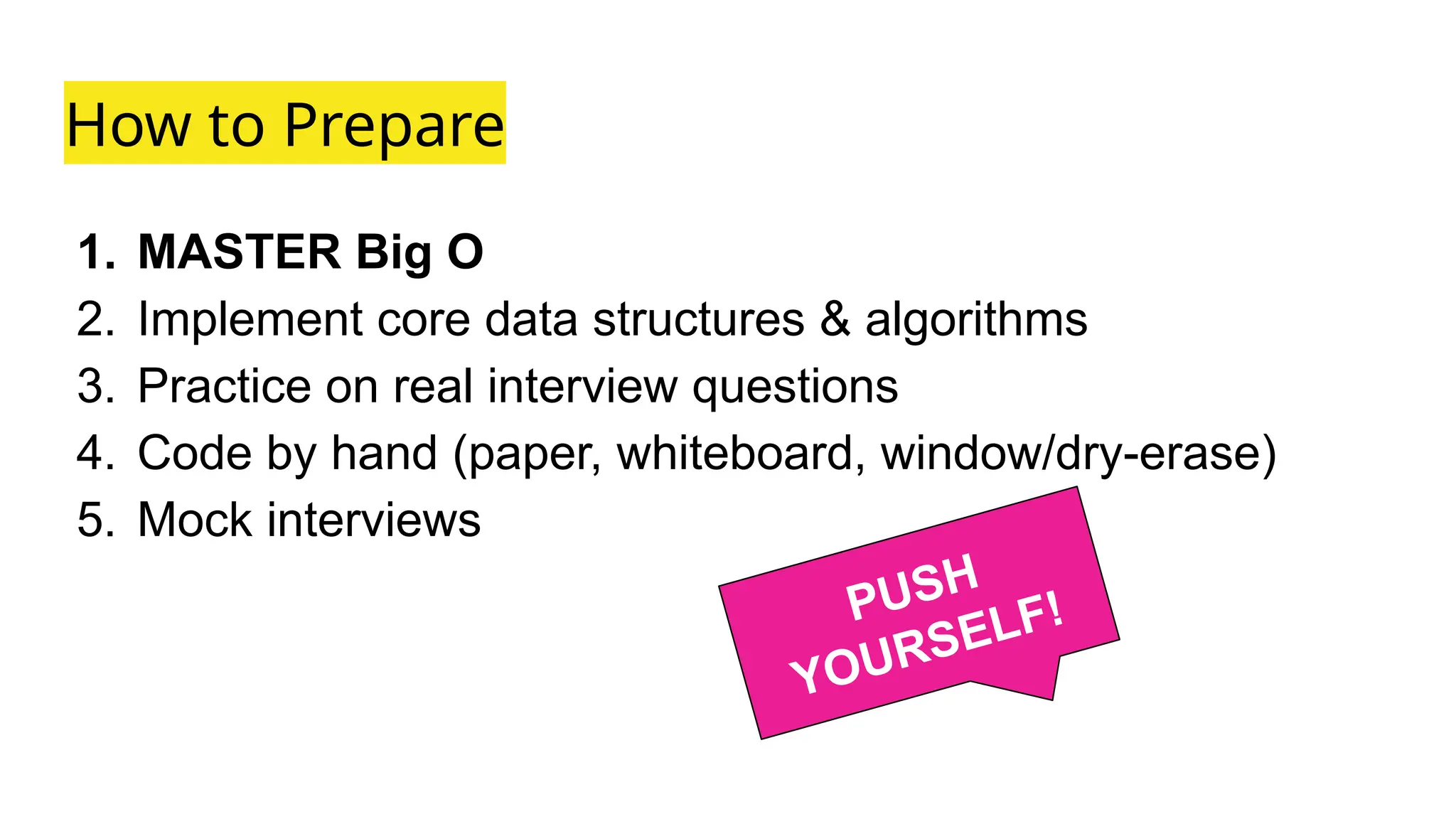
How to Prepare
1. MASTER Big O
2. Implement core data structures & algorithms
3. Practice on real interview questions
4. Code by hand (paper, whiteboard, window/dry-erase)
5. Mock interviews
PUSH
YOURSELF!
big O crash course
gayle@gayle.com
subject: fbprep
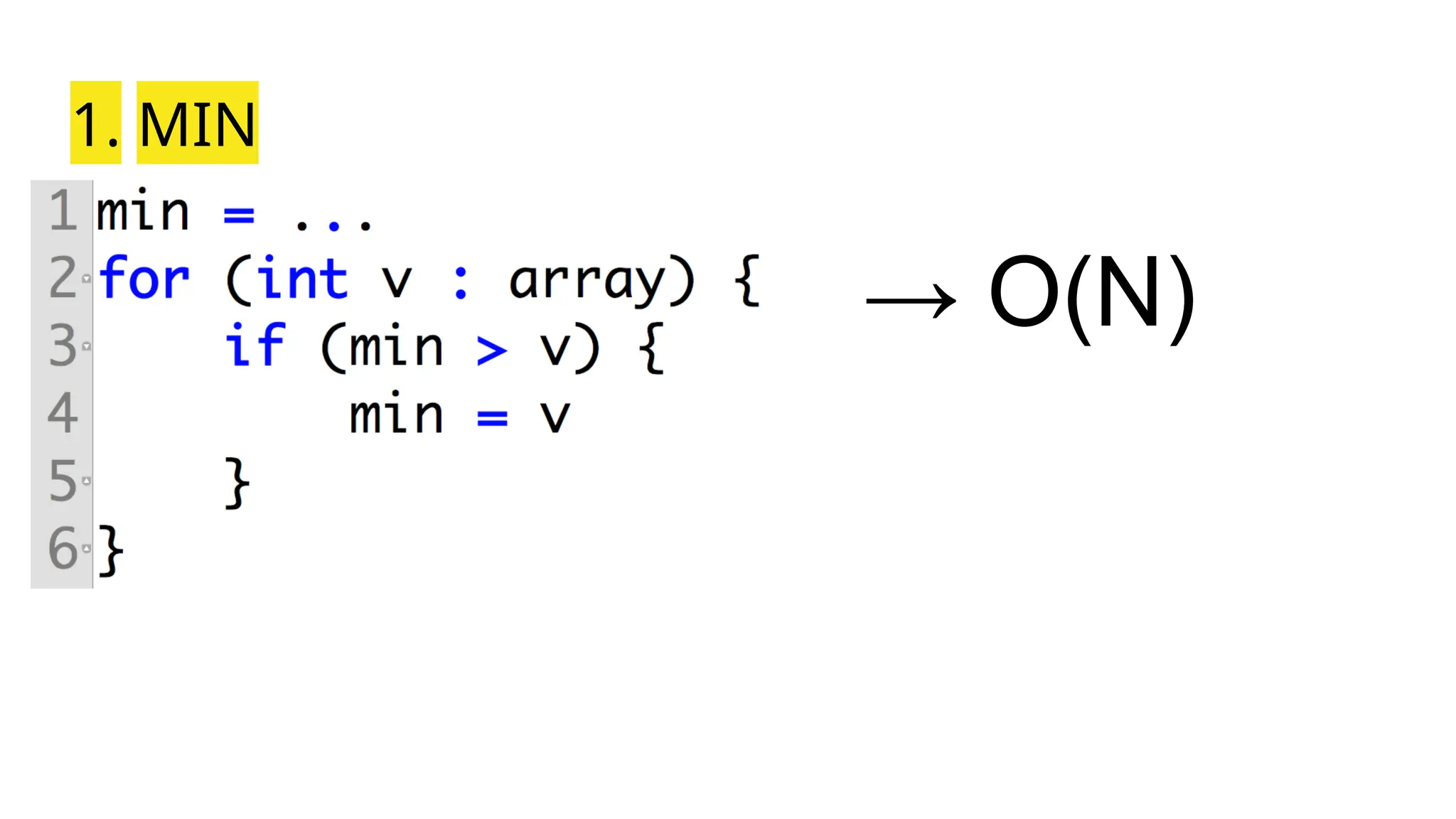
1. MIN
→ O(N)
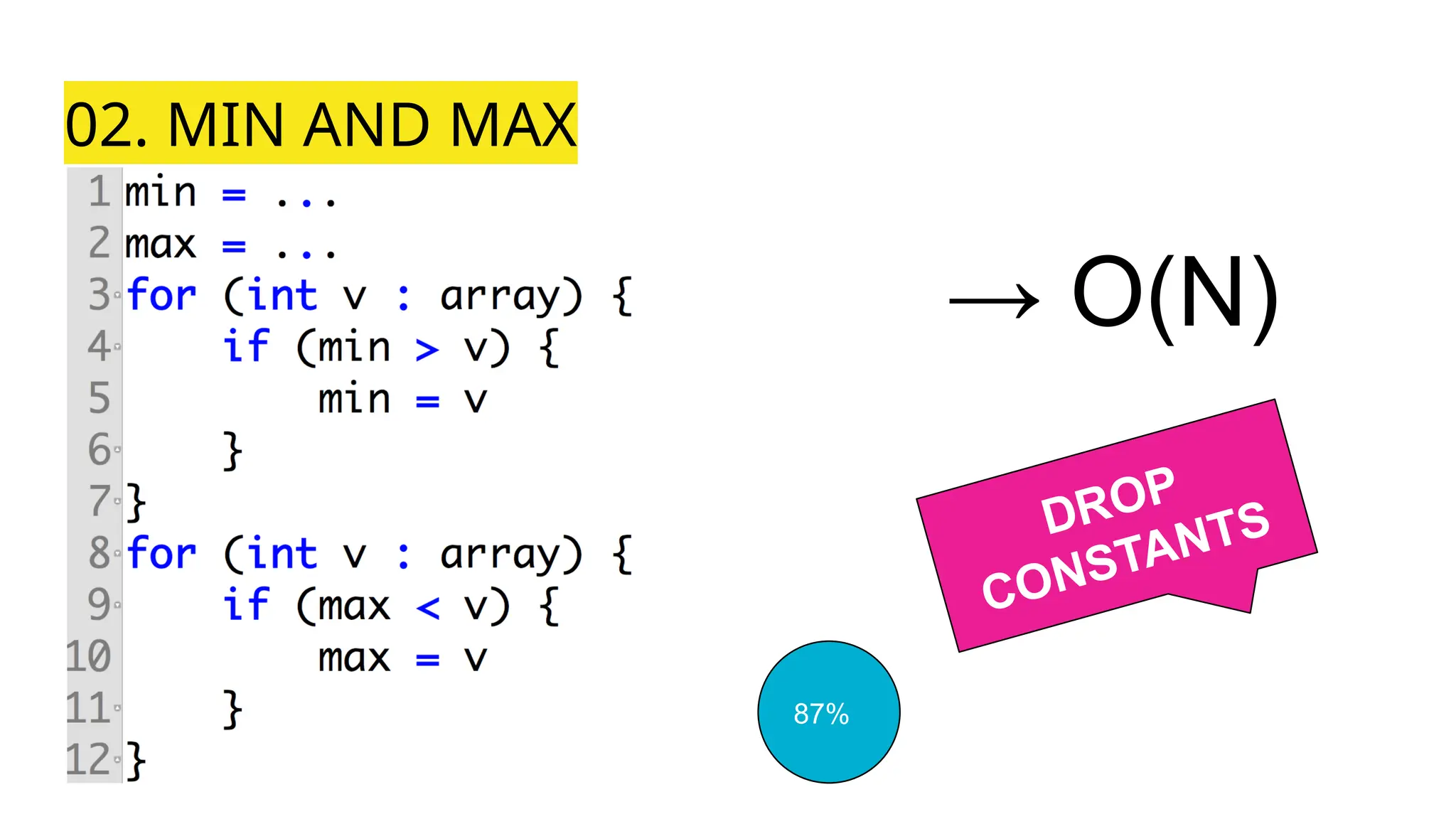
02. MIN AND MAX
→ O(N)
DROP
CONSTANTS
87%
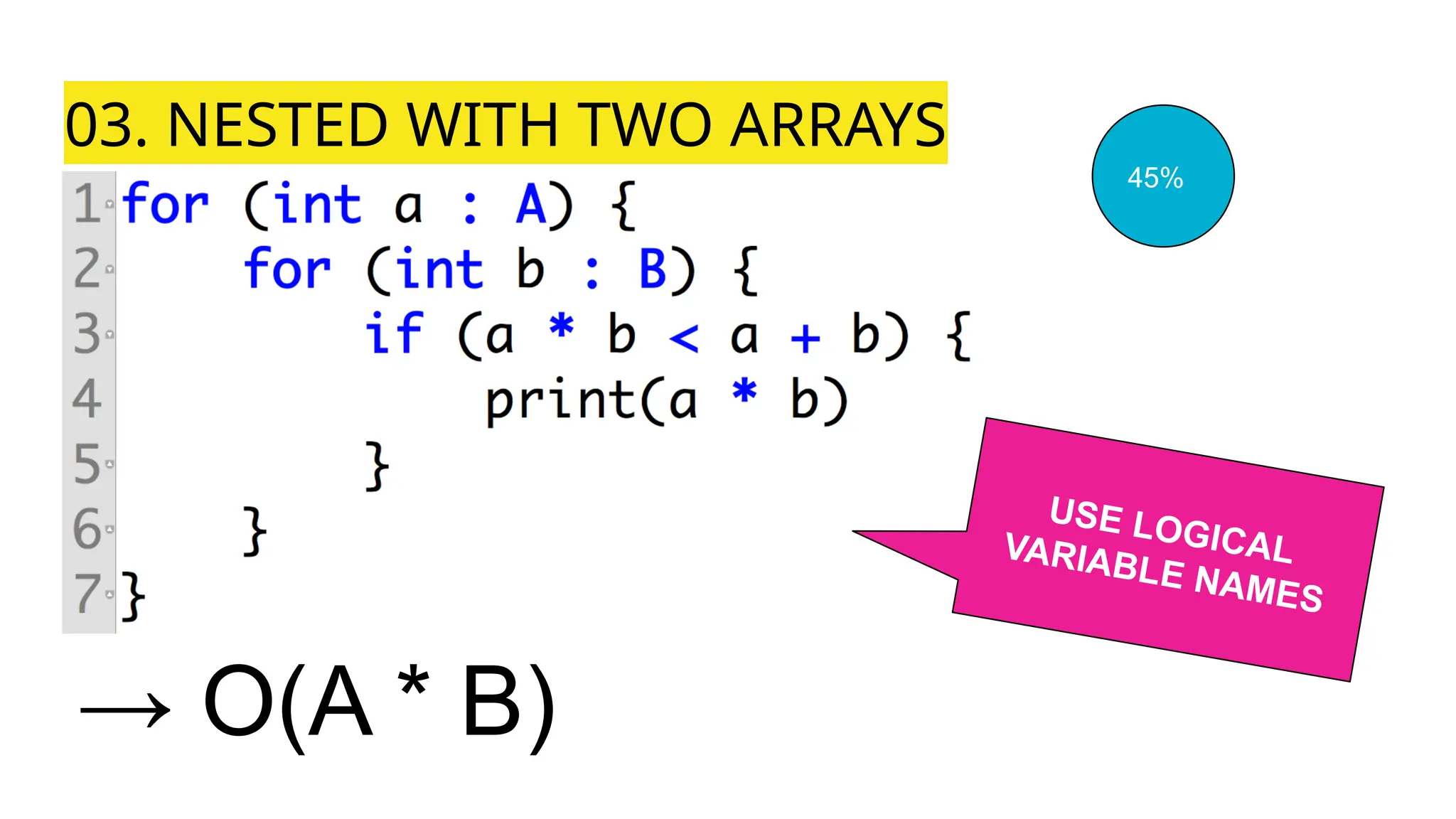
03. NESTED WITH TWO ARRAYS
→ O(A * B)
USE LOGICAL
VARIABLE NAMES
45%
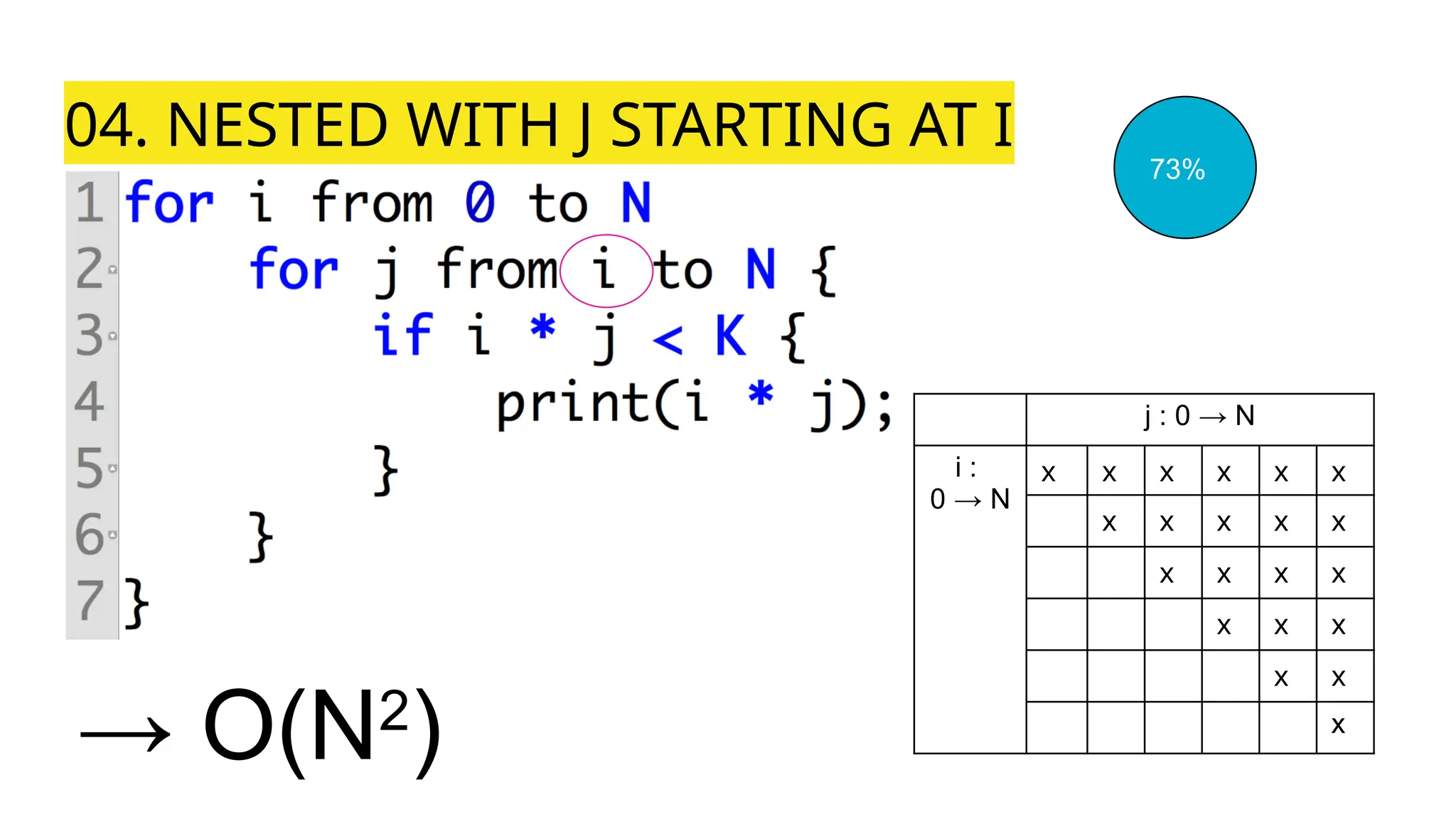
04. NESTED WITH J STARTING AT I
→ O(N2
)
j : 0 → N
i :
0 → N
x x x x x x
x x x x x
x x x x
x x x
x x
x
73%
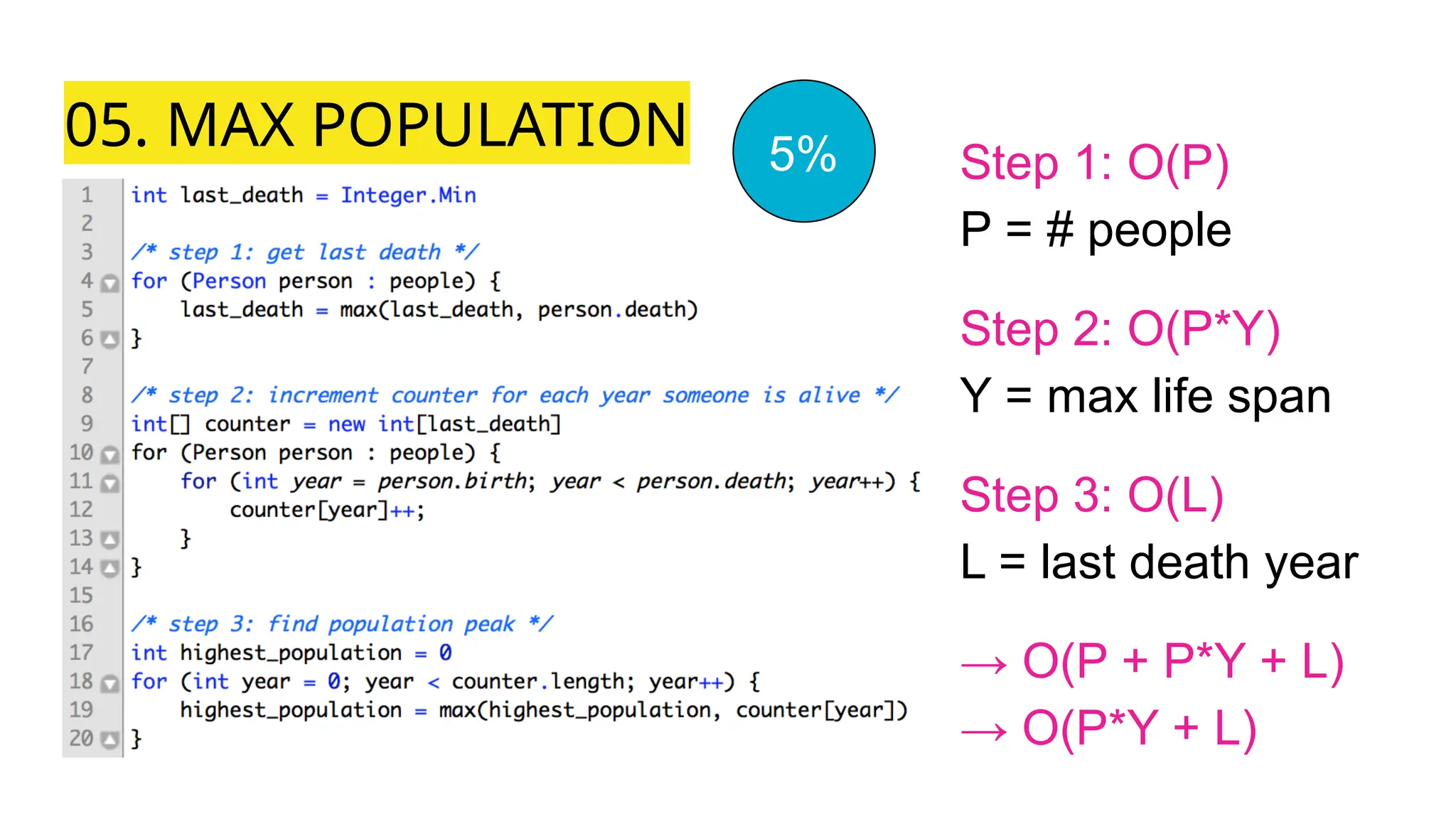
05. MAX POPULATION
Step 1: O(P)
P = # people
Step 2: O(P*Y)
Y = max life span
Step 3: O(L)
L = last death year
→ O(P + P*Y + L)
→ O(P*Y + L)
5%
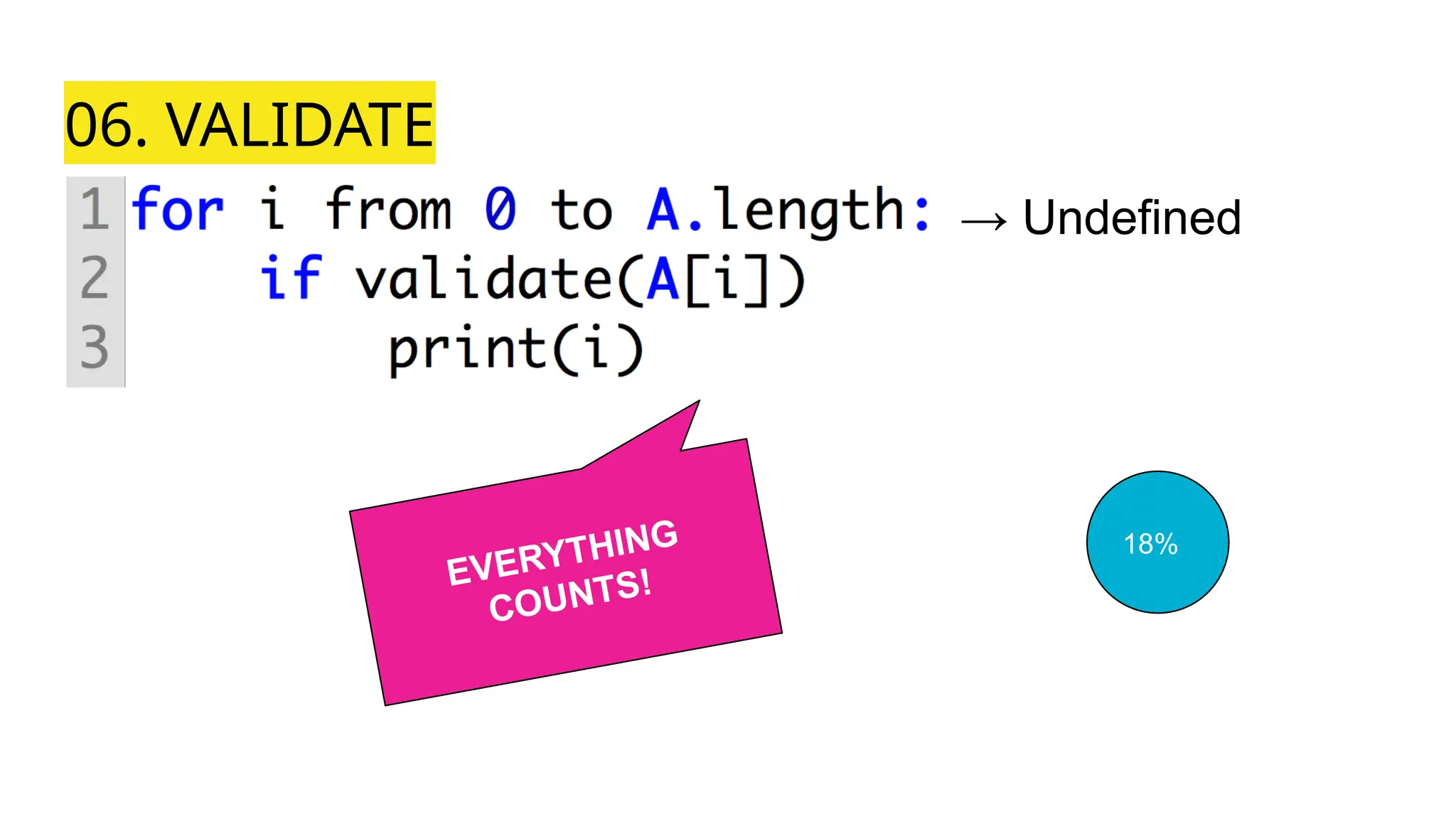
06. VALIDATE
→ Undefined
EVERYTHING
COUNTS!
18%
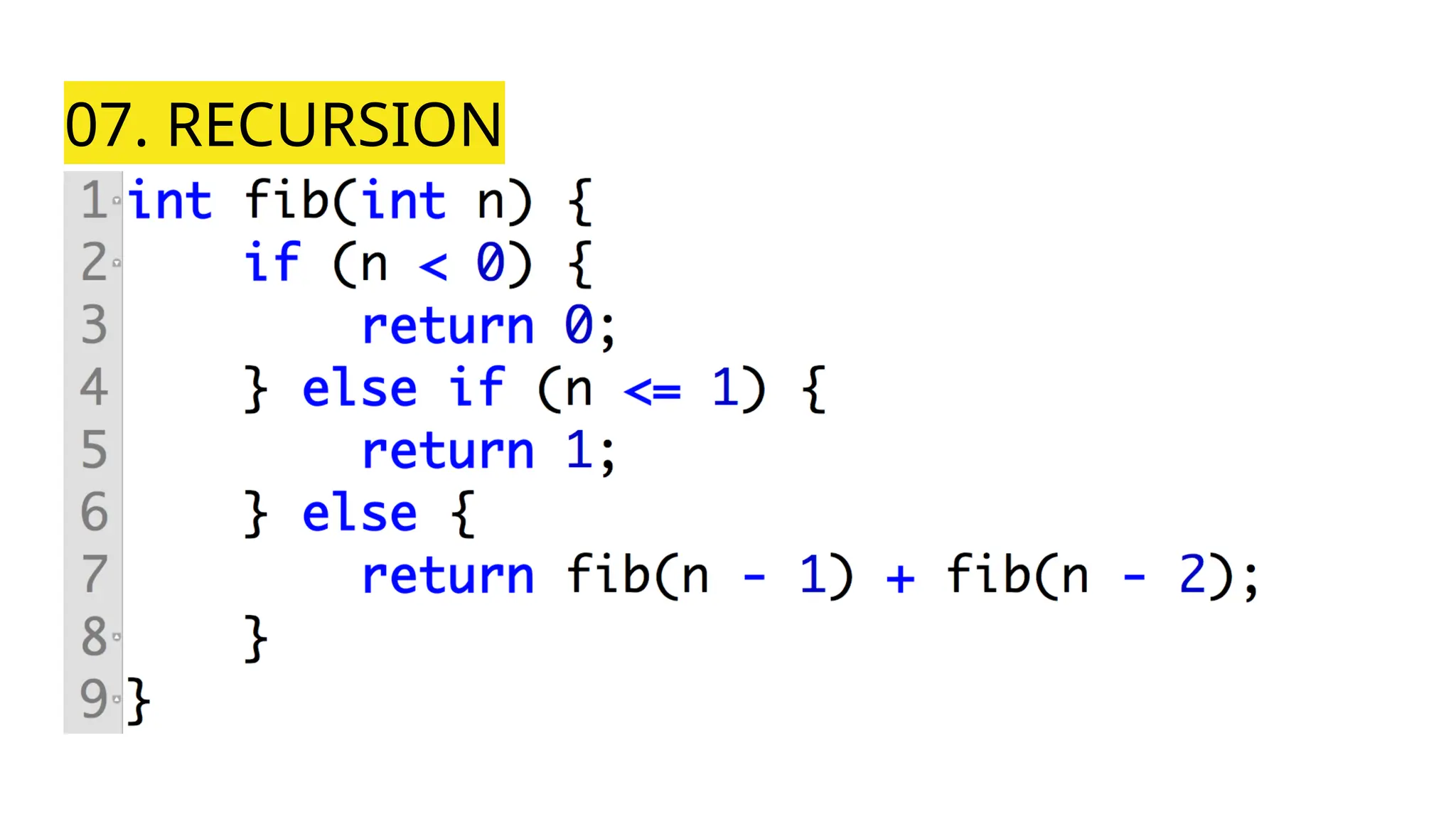
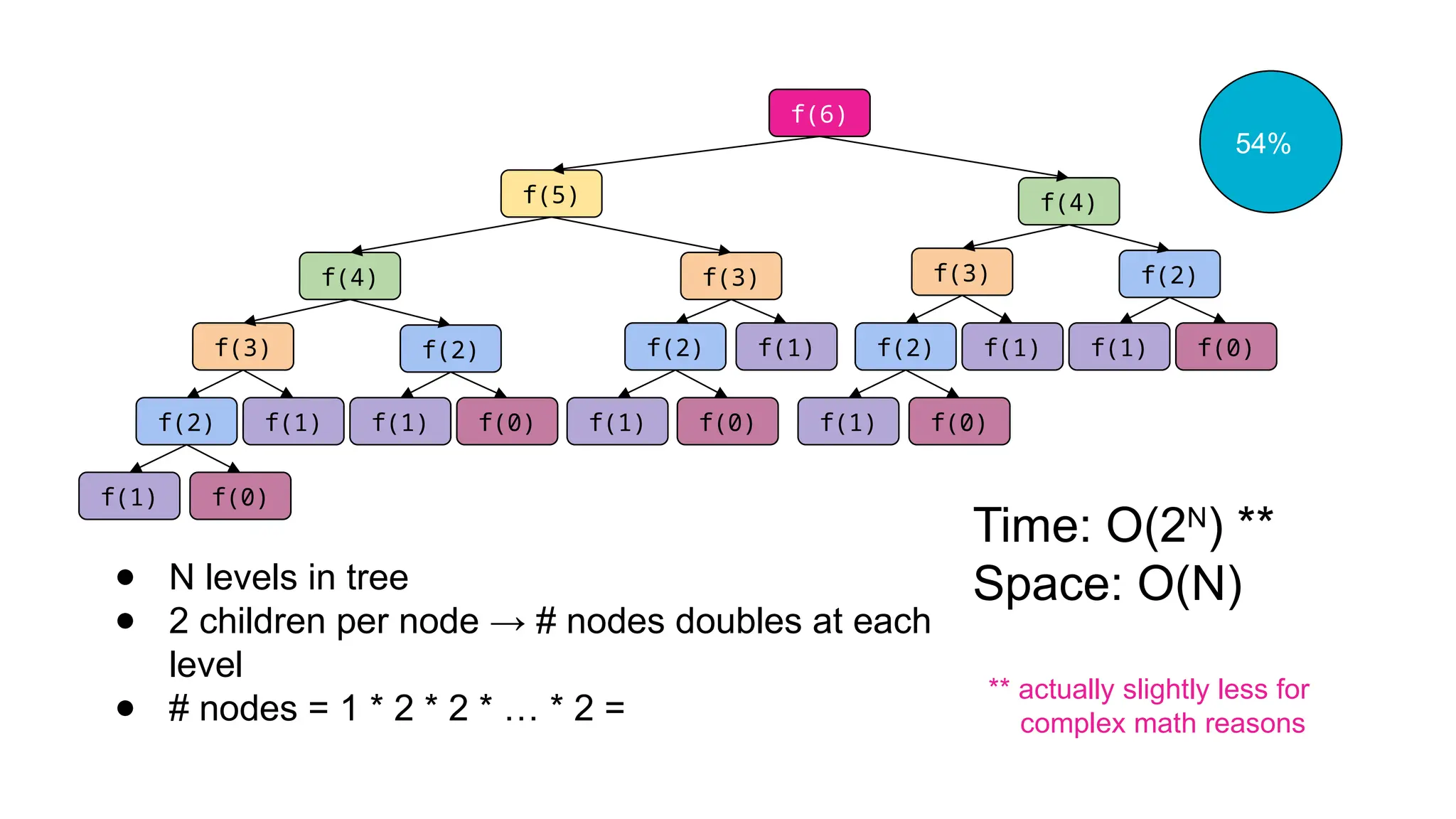
07. RECURSION
f(6)
f(5)
f(3)
f(4)
f(3) f(2)
f(2) f(1)
f(1) f(0)
f(4)
f(1) f(0)
f(2)
f(1) f(0)
f(1)
f(3) f(2)
f(2) f(1)
f(1) f(0)
f(1) f(0)
● N levels in tree
● 2 children per node → # nodes doubles at each
level
● # nodes = 1 * 2 * 2 * … * 2 =
Time: O(2N
) **
Space: O(N)
** actually slightly less for
complex math reasons
54%
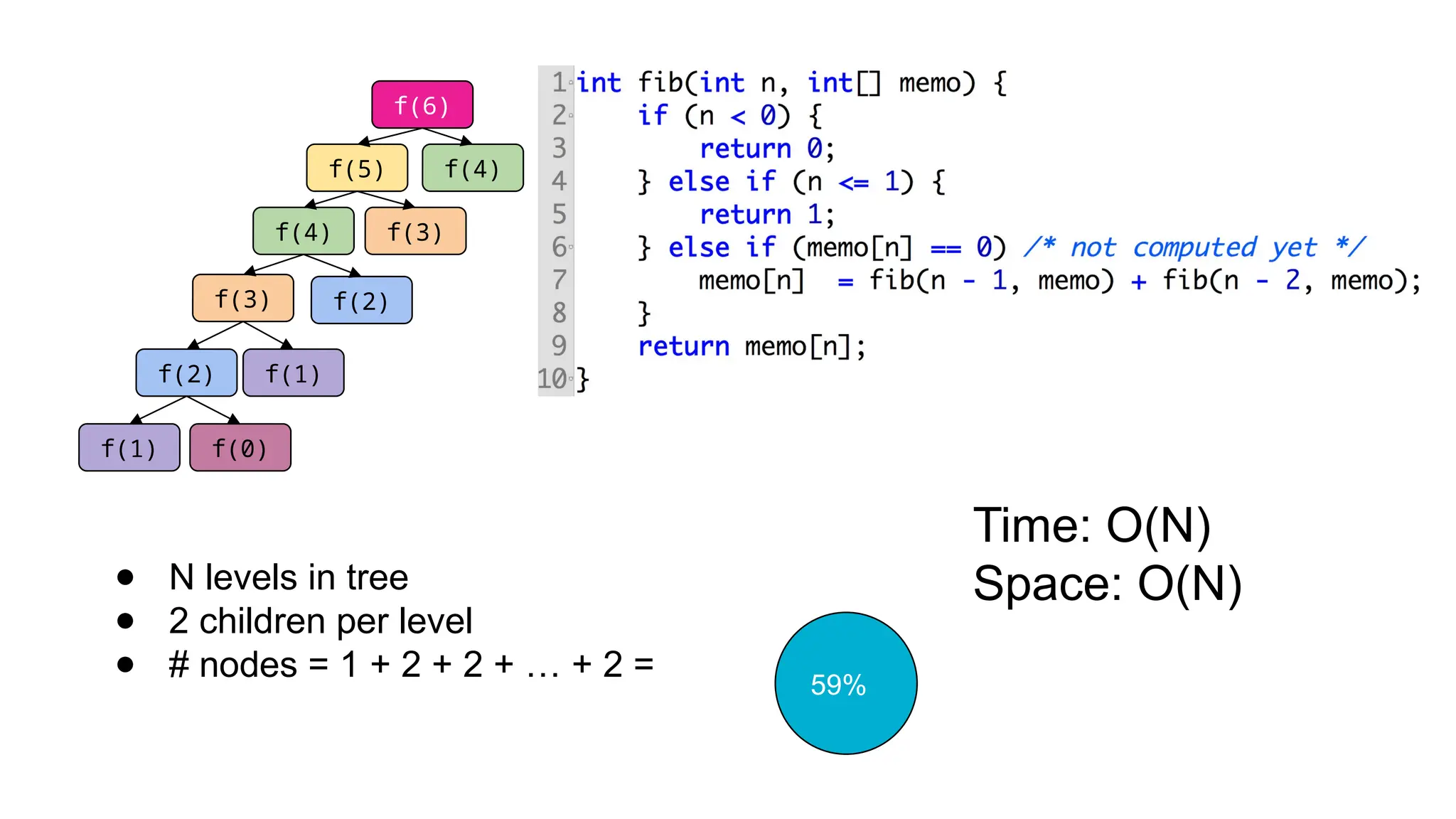
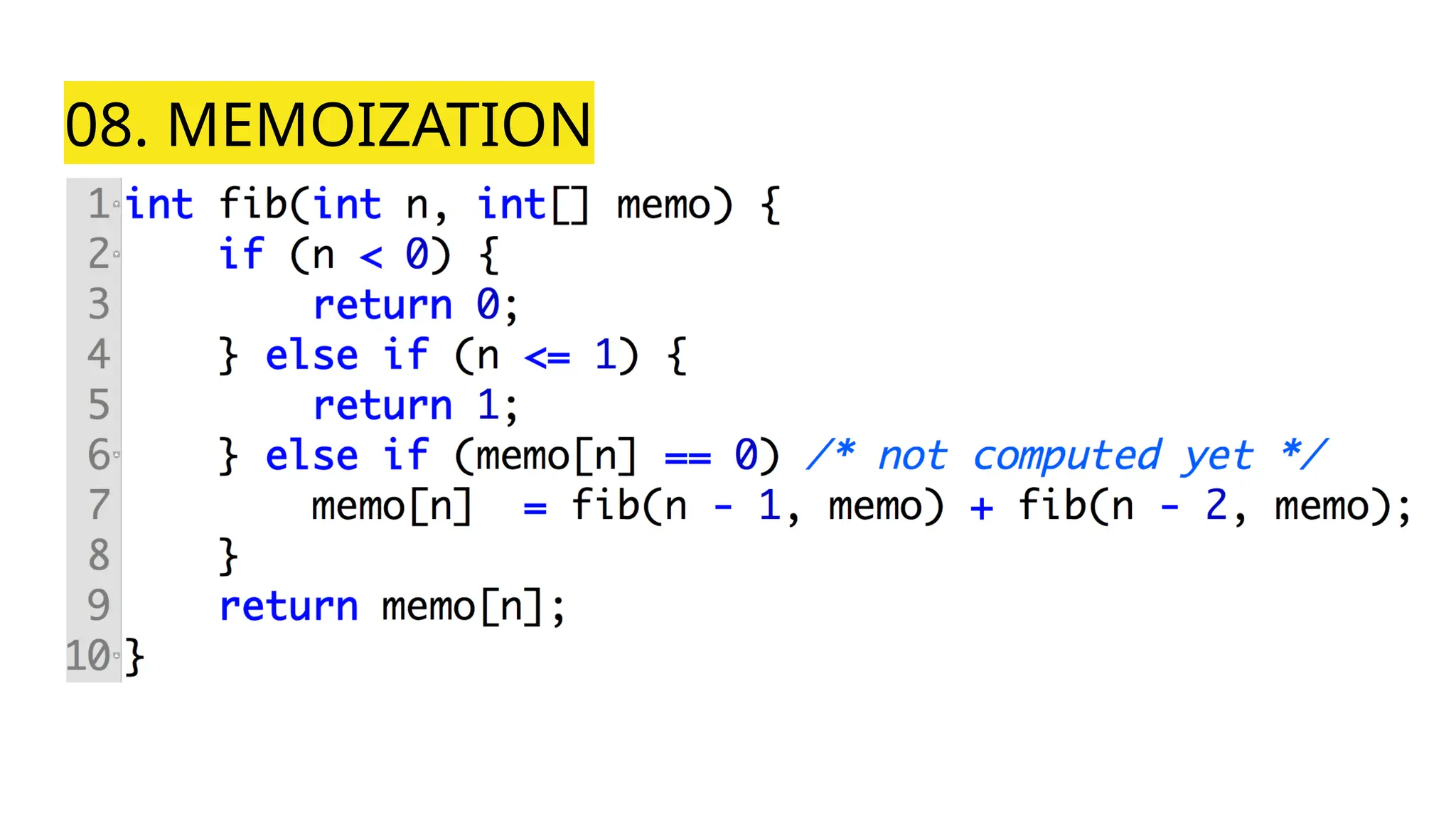
08. MEMOIZATION
f(6)
f(5)
f(3)
f(4)
f(3) f(2)
f(2) f(1)
f(1) f(0)
f(4)
● N levels in tree
● 2 children per level
● # nodes = 1 + 2 + 2 + … + 2 =
Time: O(N)
Space: O(N)
59%
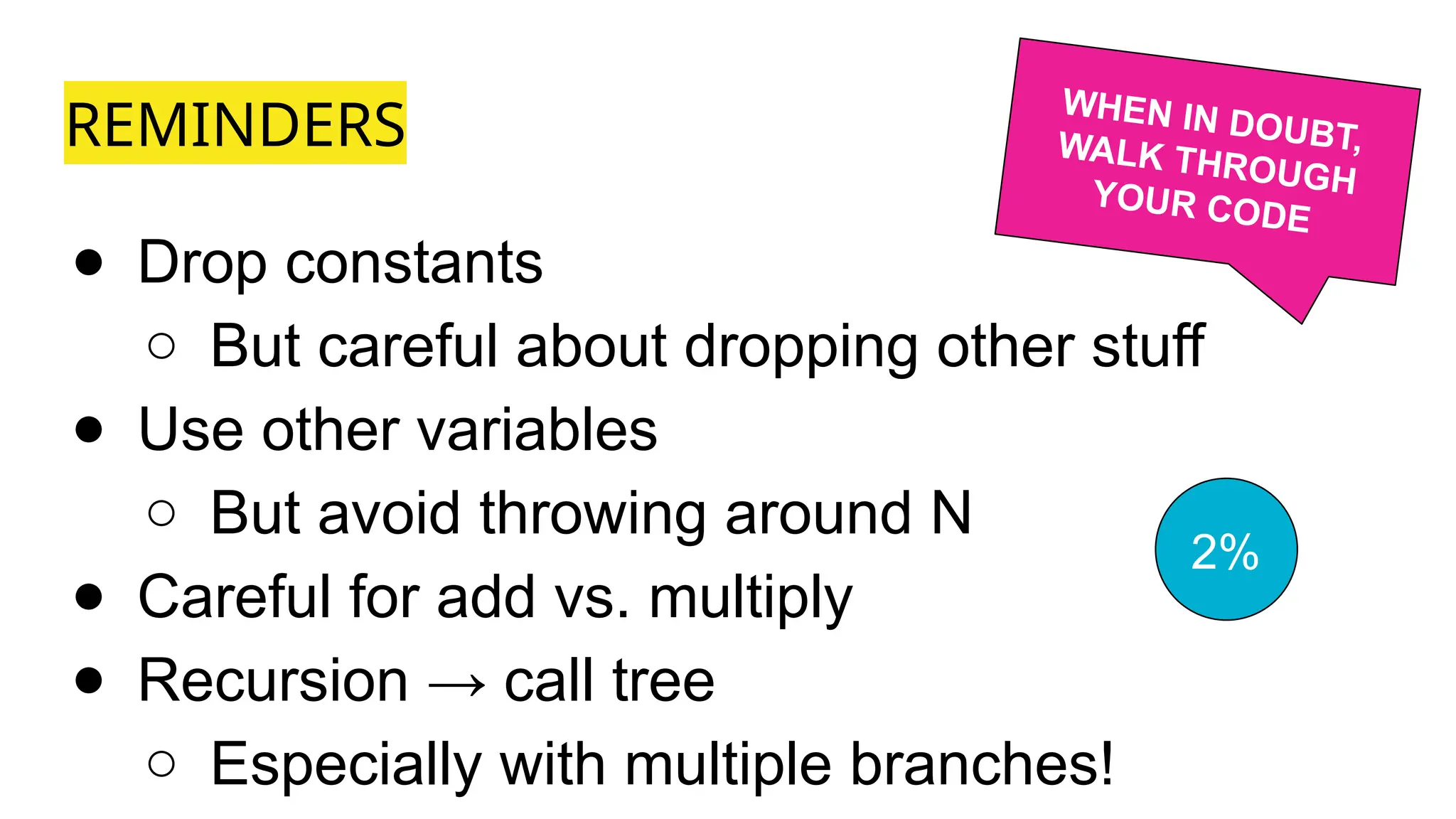
REMINDERS
● Drop constants
○ But careful about dropping other stuff
● Use other variables
○ But avoid throwing around N
● Careful for add vs. multiply
● Recursion → call tree
○ Especially with multiple branches!
WHEN IN DOUBT,
WALK THROUGH
YOUR CODE
2%
Expectations & Evaluation
gayle@gayle.com
subject: fbprep
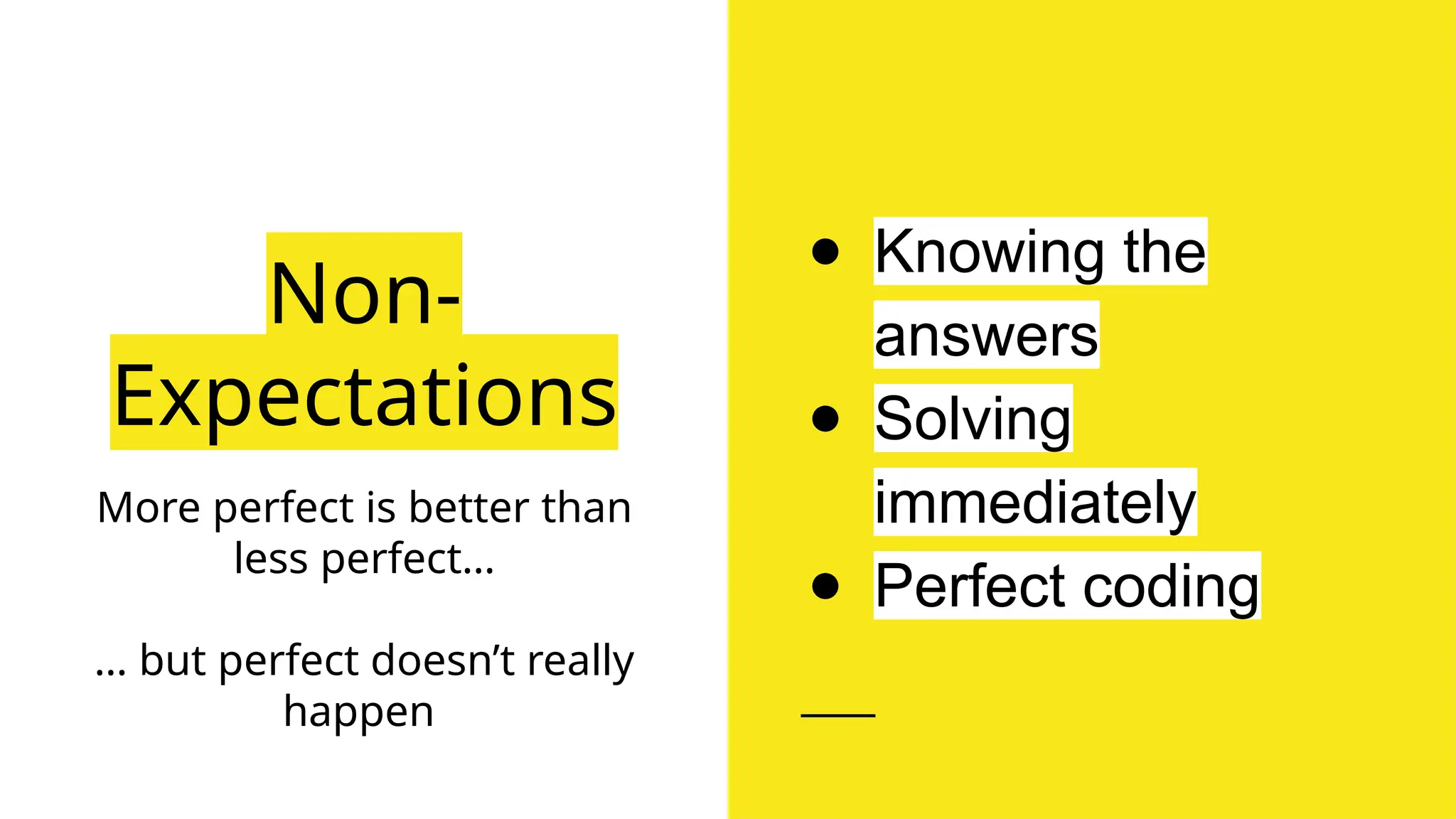
Non-
Expectations
More perfect is better than
less perfect…
… but perfect doesn’t really
happen
● Knowing the
answers
● Solving
immediately
● Perfect coding
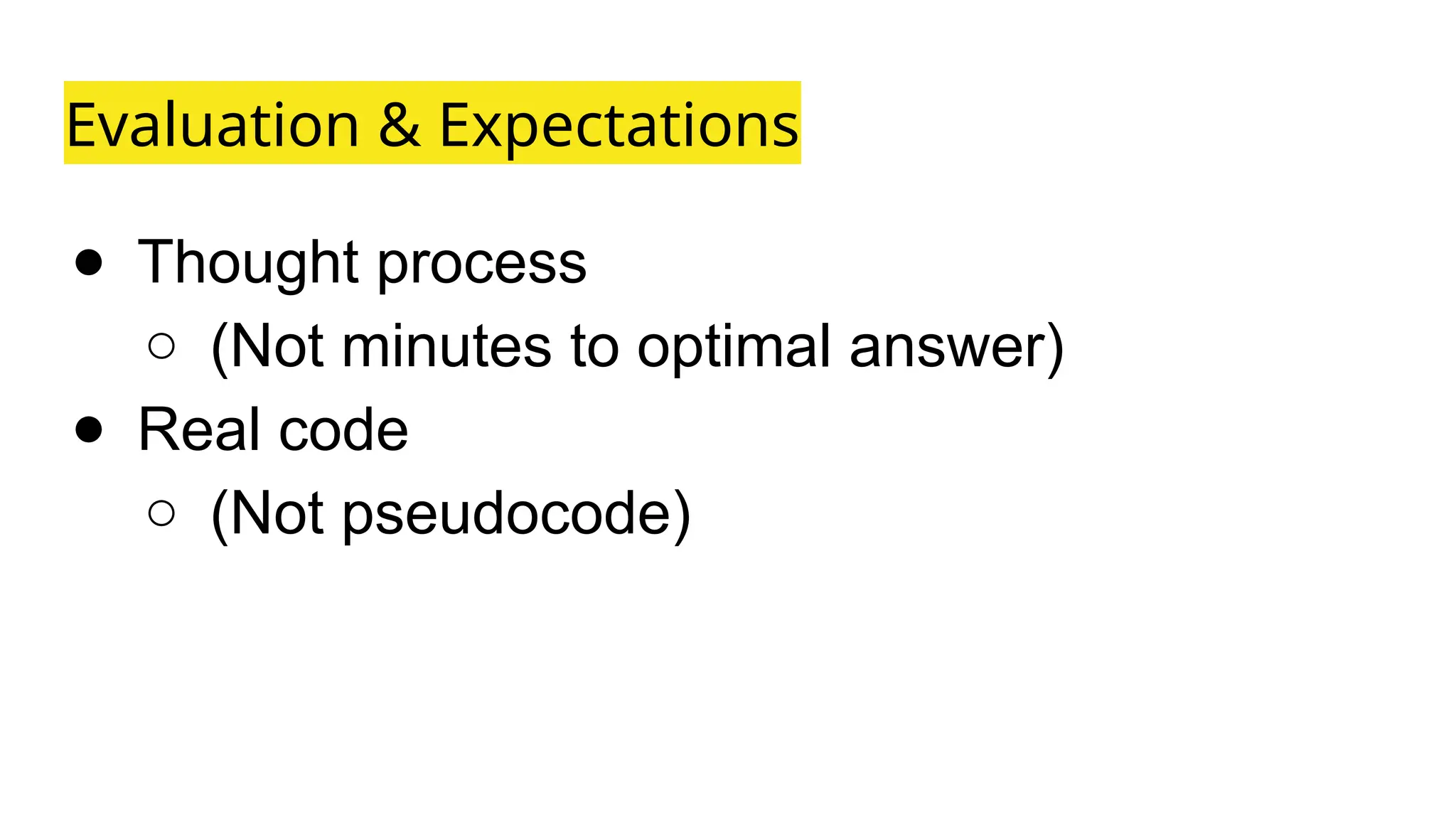
Evaluation & Expectations
● Thought process
○ (Not minutes to optimal answer)
● Real code
○ (Not pseudocode)
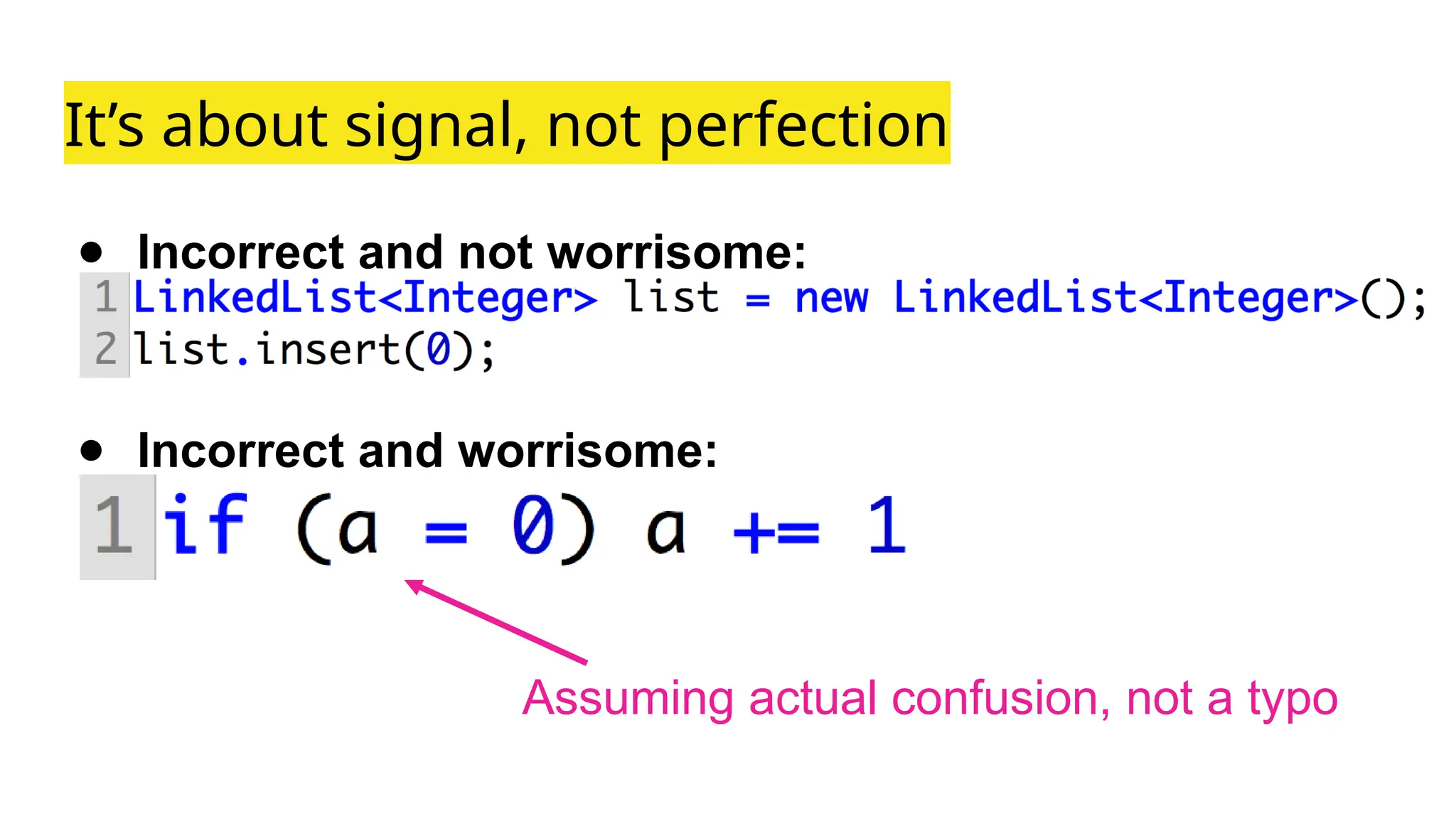
It’s about signal, not perfection
● Incorrect and not worrisome:
● Incorrect and worrisome:
Assuming actual confusion, not a typo
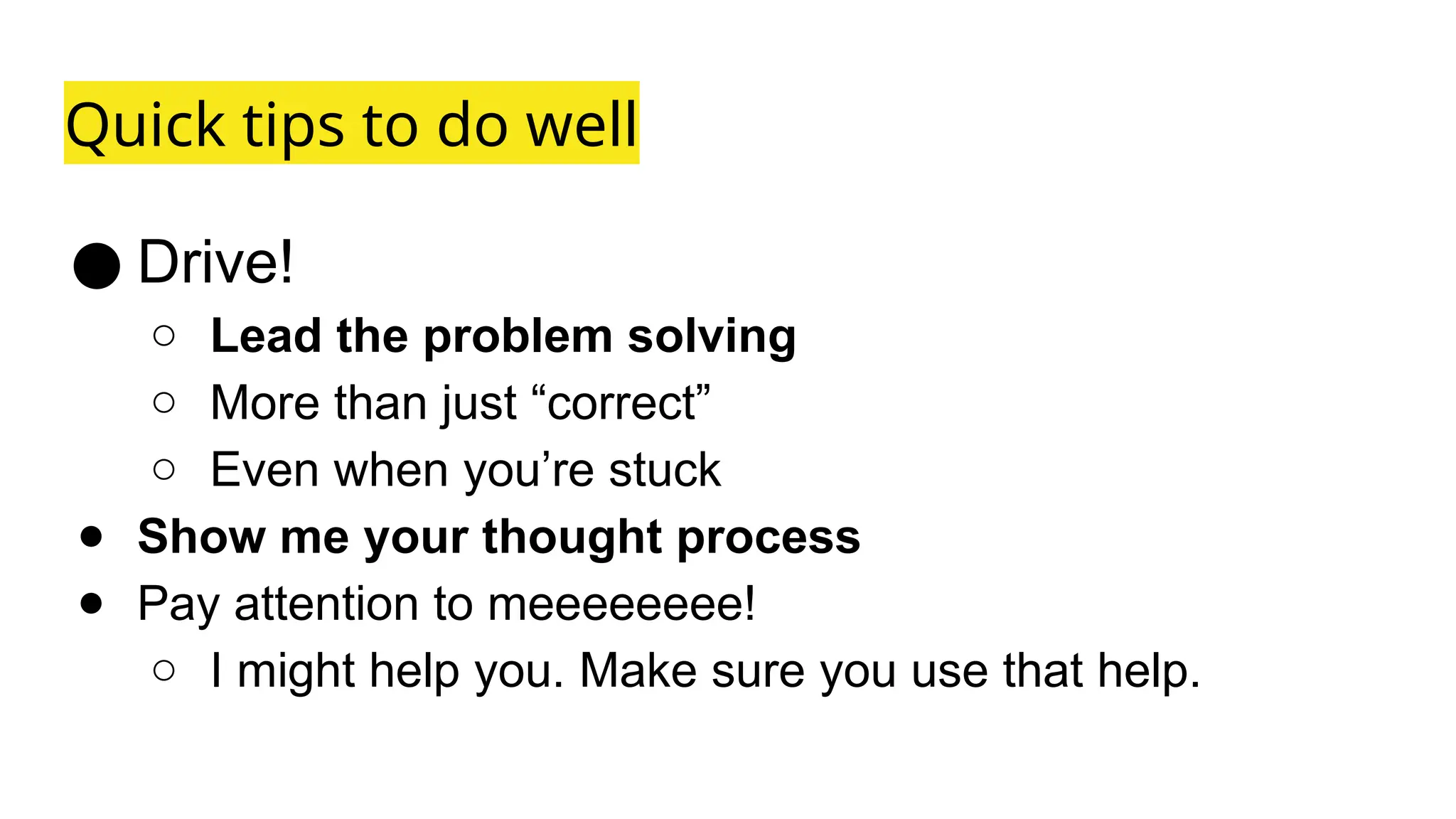
Quick tips to do well
● Drive!
○ Lead the problem solving
○ More than just “correct”
○ Even when you’re stuck
● Show me your thought process
● Pay attention to meeeeeeee!
○ I might help you. Make sure you use that help.
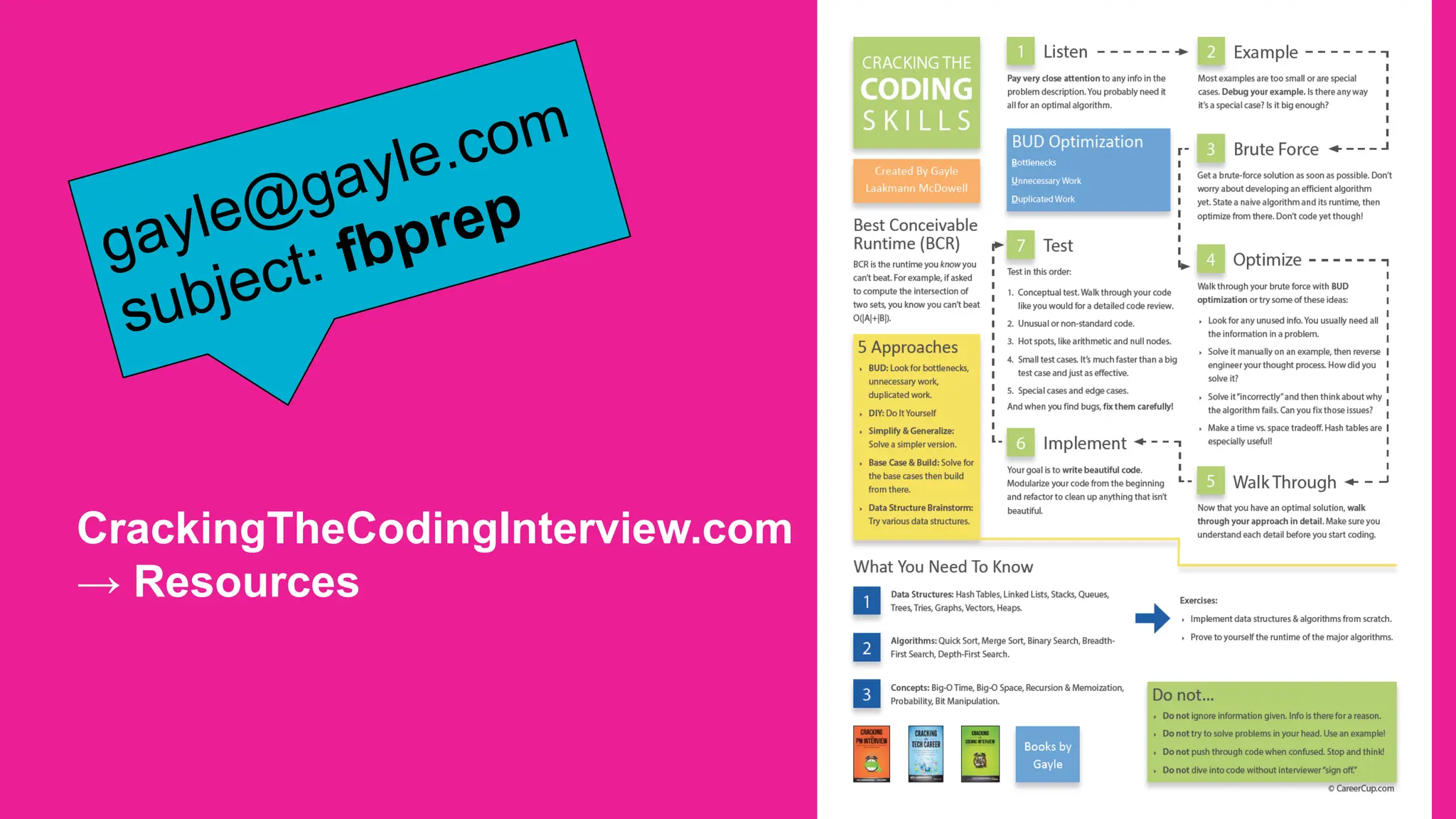
The Seven Steps
gayle@gayle.com
subject: fbprep
gayle@gayle.com
subject: fbprep
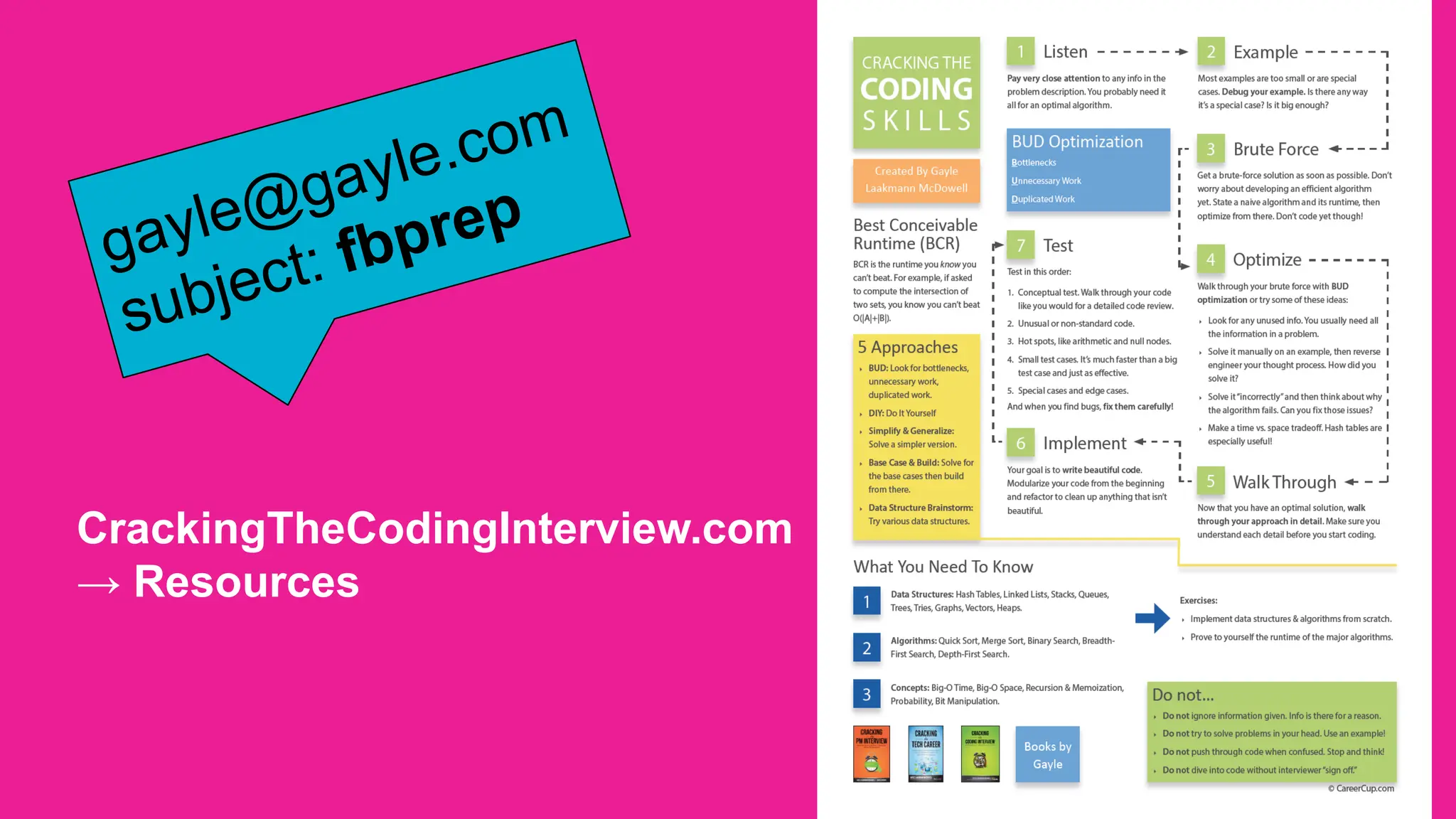
CrackingTheCodingInterview.com
→ Resources
(no, seriously, follow it!)
gayle@gayle.com
subject: fbprep
CrackingTheCodingInterview.com → Resources
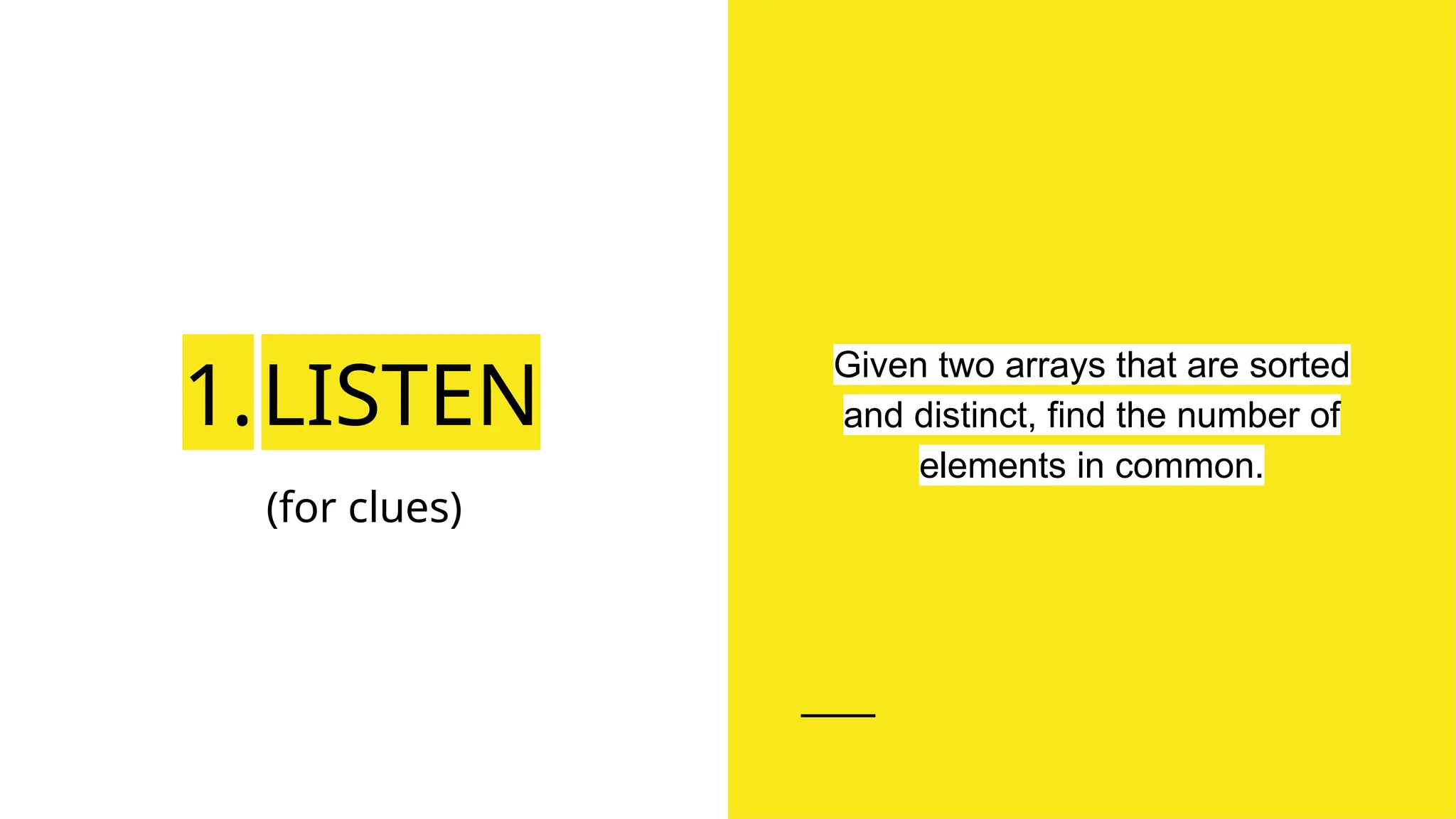
01. LISTEN (FOR CLUES)
1.LISTEN
(for clues)
Given two arrays that are sorted
and distinct, find the number of
elements in common.
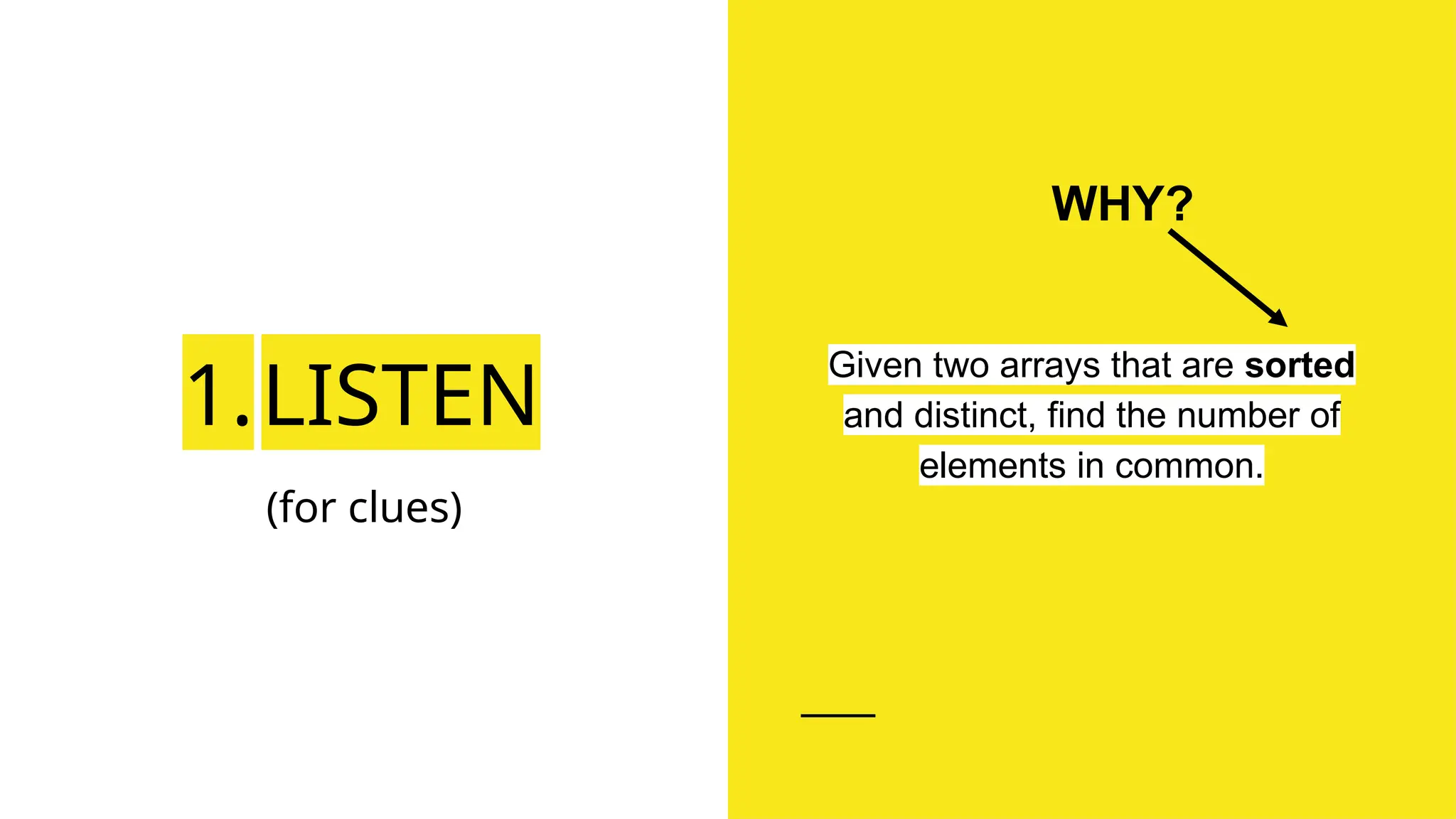
1.LISTEN
(for clues)
Given two arrays that are sorted
and distinct, find the number of
elements in common.
WHY?
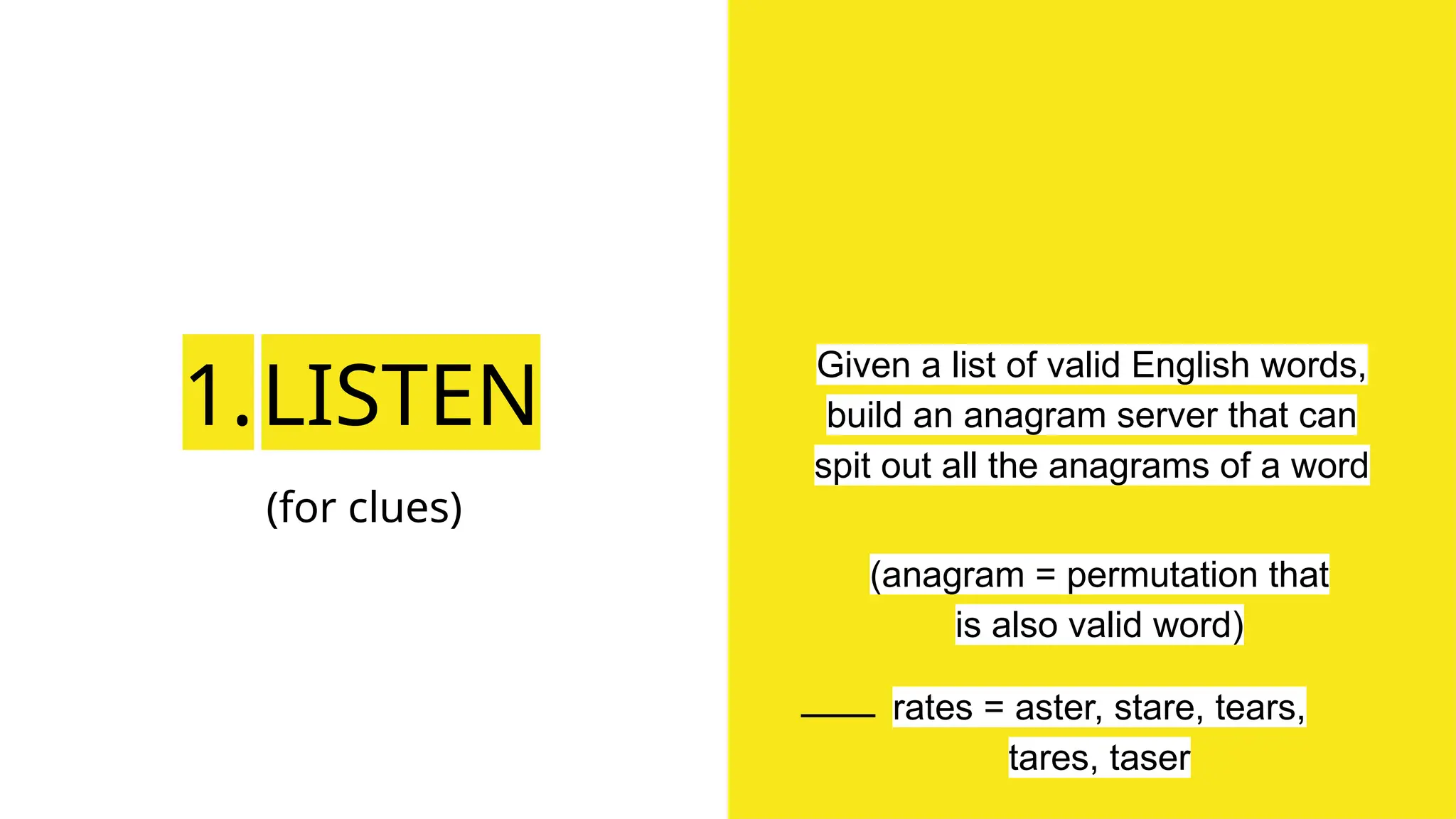
1.LISTEN
(for clues)
Given a list of valid English words,
build an anagram server that can
spit out all the anagrams of a word
(anagram = permutation that
is also valid word)
rates = aster, stare, tears,
tares, taser
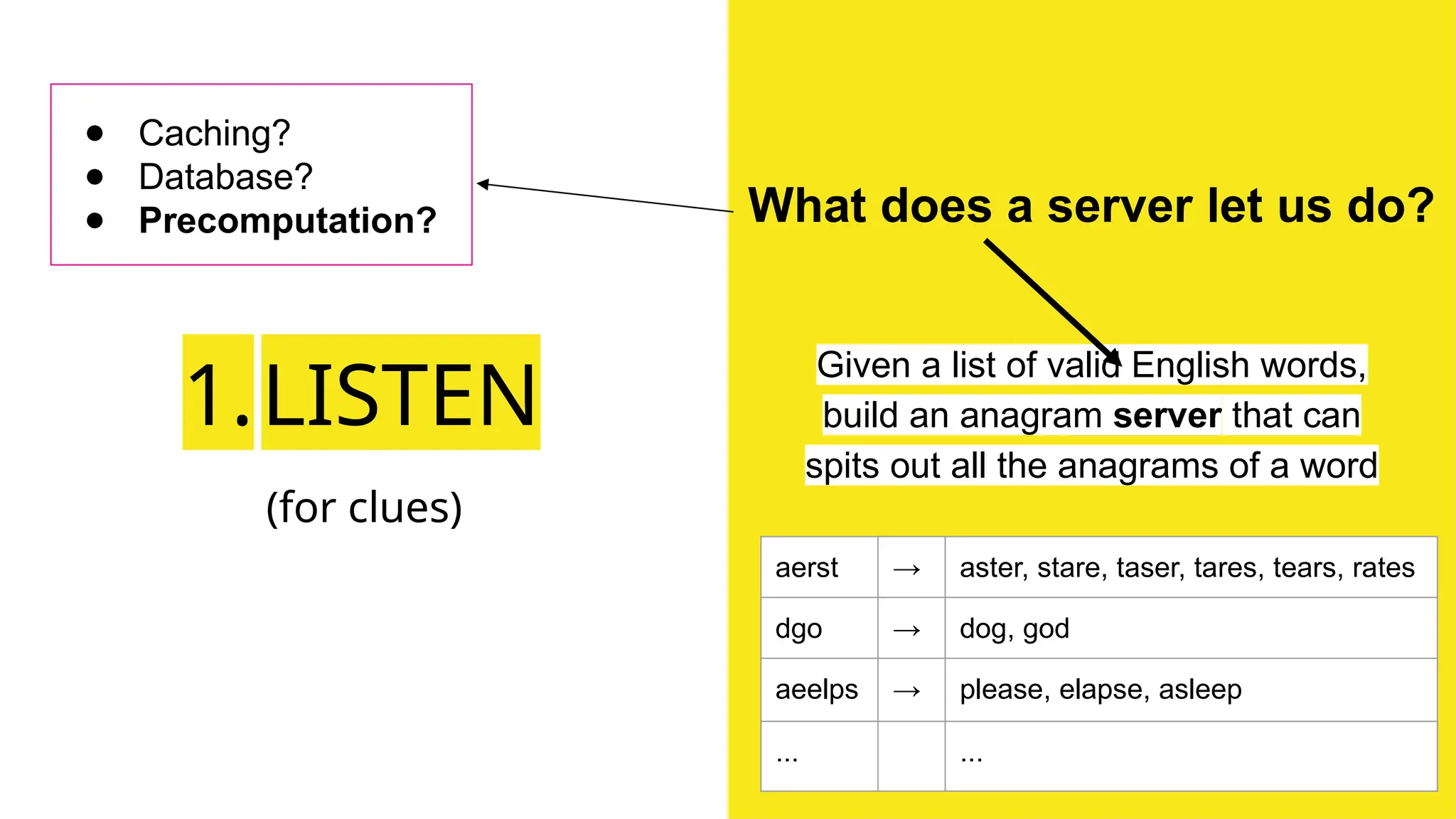
1.LISTEN
(for clues)
Given a list of valid English words,
build an anagram server that can
spits out all the anagrams of a word
What does a server let us do?
aerst → aster, stare, taser, tares, tears, rates
dgo → dog, god
aeelps → please, elapse, asleep
... ...
● Caching?
● Database?
● Precomputation?
02. DRAW AN EXAMPLE
02. EXAMPLE
Given two arrays that are sorted
and distinct, find the number of
elements in common.
02. EXAMPLES // BAD VS. GOOD
A: [1, 12, 15, 19]
B: [2, 12, 13, 20]
A: [1, 12, 15, 19, 20, 21]
B: [2, 15, 17, 19, 21, 25,
27]
too small
special case-y
Makes you
work for it
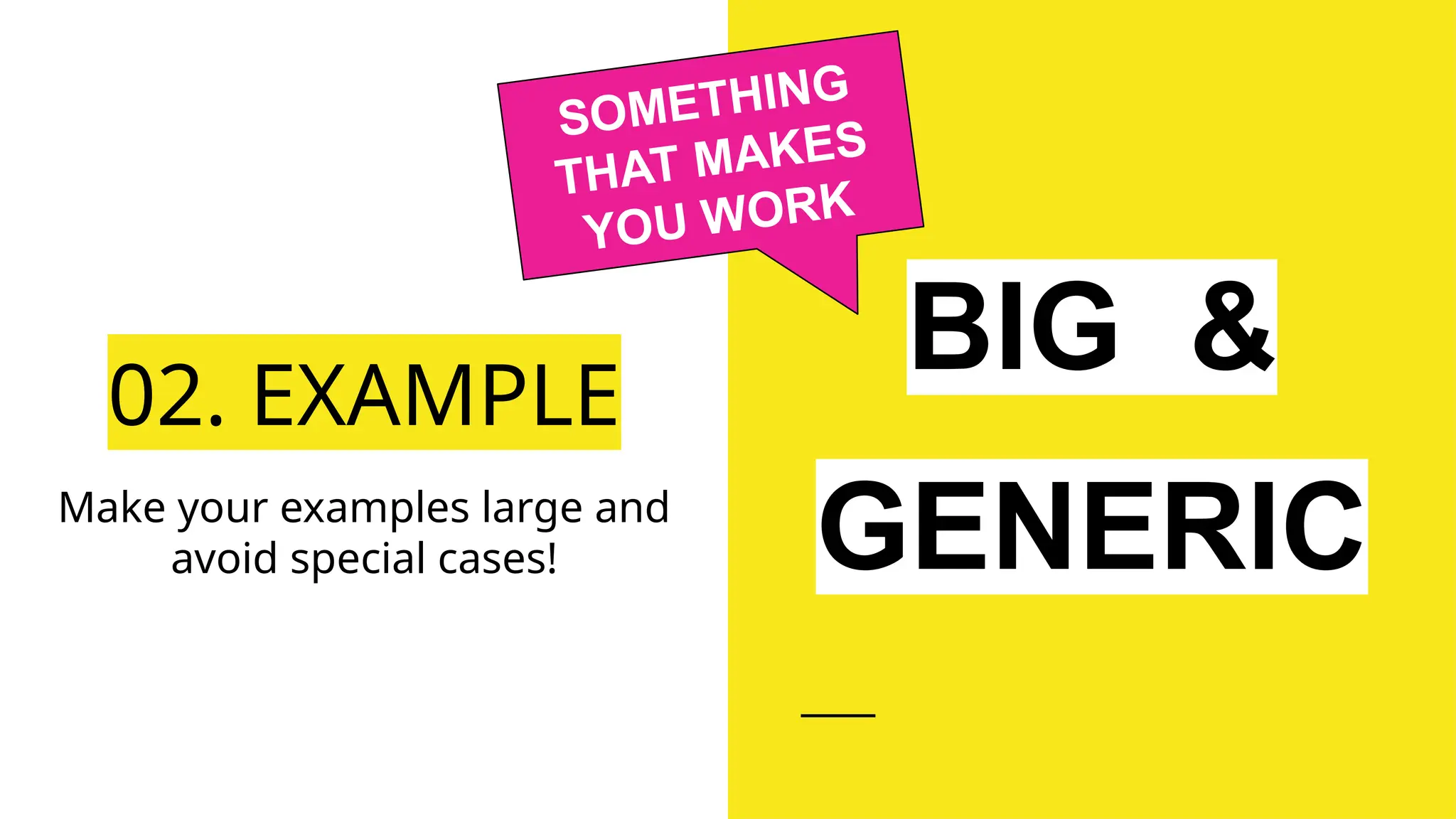
02. EXAMPLE
Make your examples large and
avoid special cases!
BIG &
GENERIC
SOMETHING
THAT MAKES
YOU WORK
03. BRUTE FORCE
03. BRUTE
FORCE
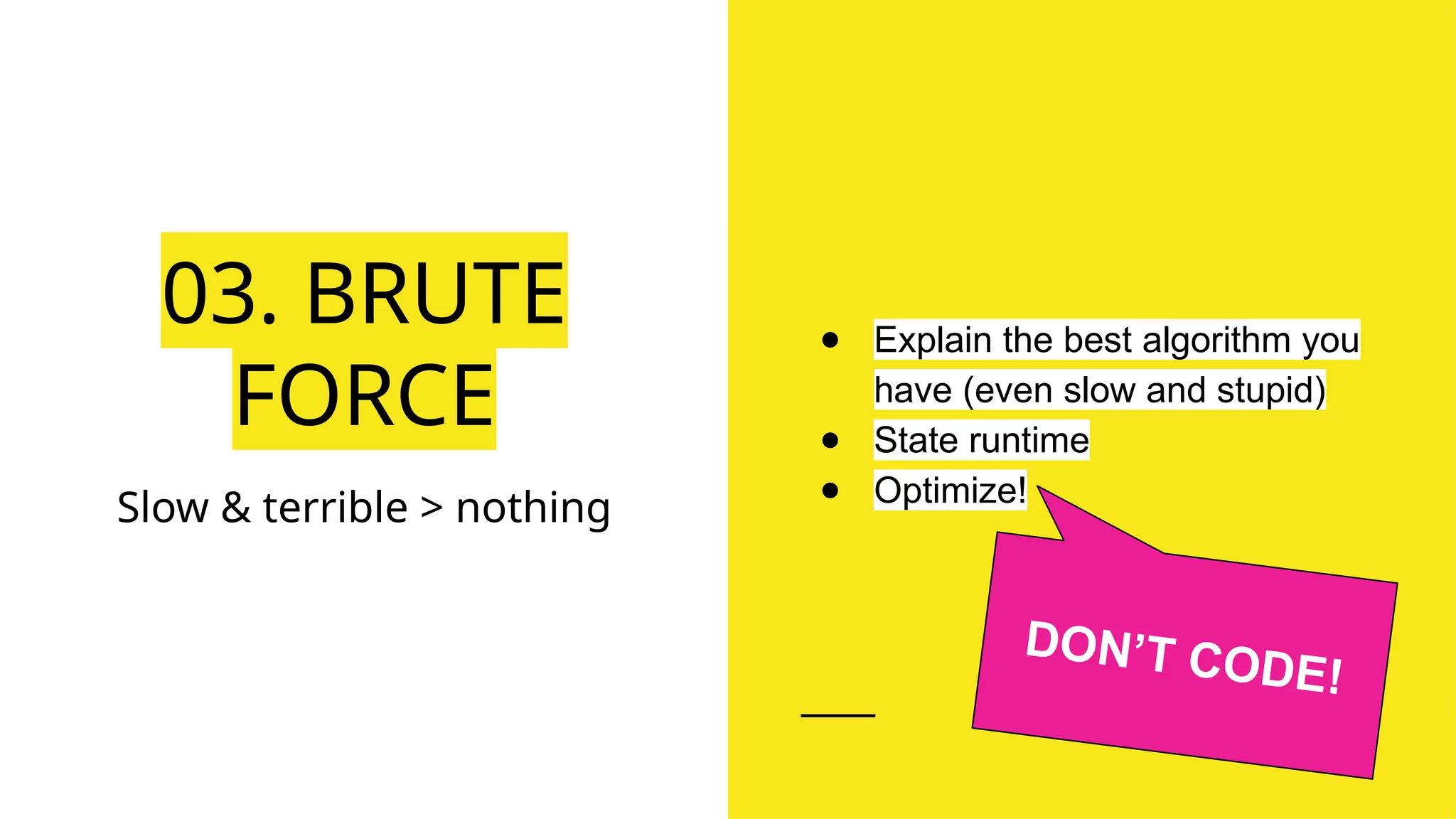
Slow & terrible > nothing
● Explain the best algorithm you
have (even slow and stupid)
● State runtime
● Optimize!
DON’T CODE!
04. OPTIMIZE
04. OPTIMIZE
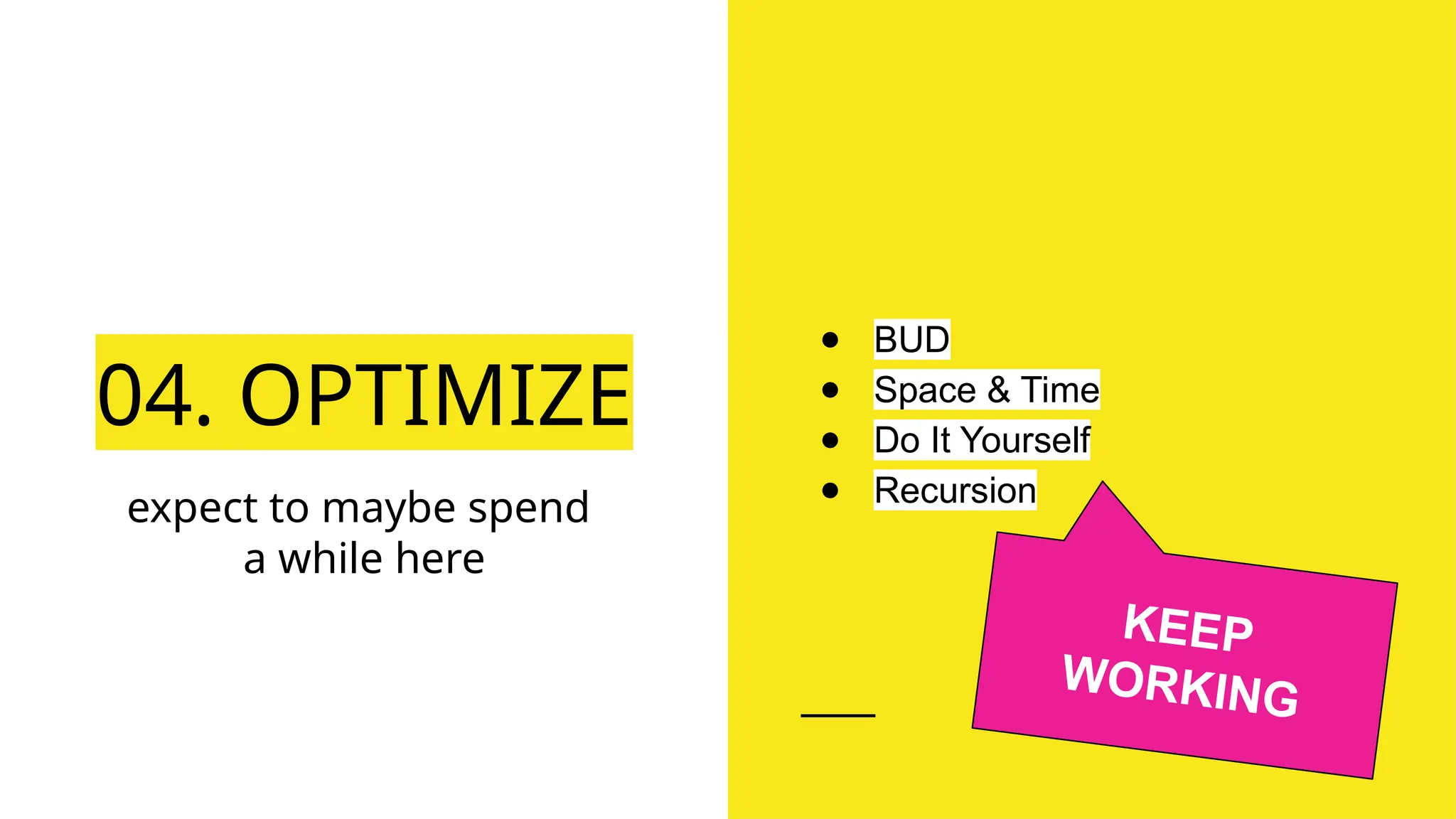
expect to maybe spend
a while here
● BUD
● Space & Time
● Do It Yourself
● Recursion
KEEP
WORKING
4a. BUD
●Bottlenecks
●Unnecessary work
●Duplicated work
4a. (B)UD // BOTTLENECKS
Given two arrays that are
sorted and distinct, find
the number of elements
in common.
[1, 12, 15, 19, 20, 21]
[2, 15, 17, 19, 21, 25,
27]
● Brute Force: O(A*B)
● Binary Search: O(A log B)
● Hash Set: O(A + B)
○ But O(B) space
● Sorted Merge:
○ O(A+B) time
○ O(1) space
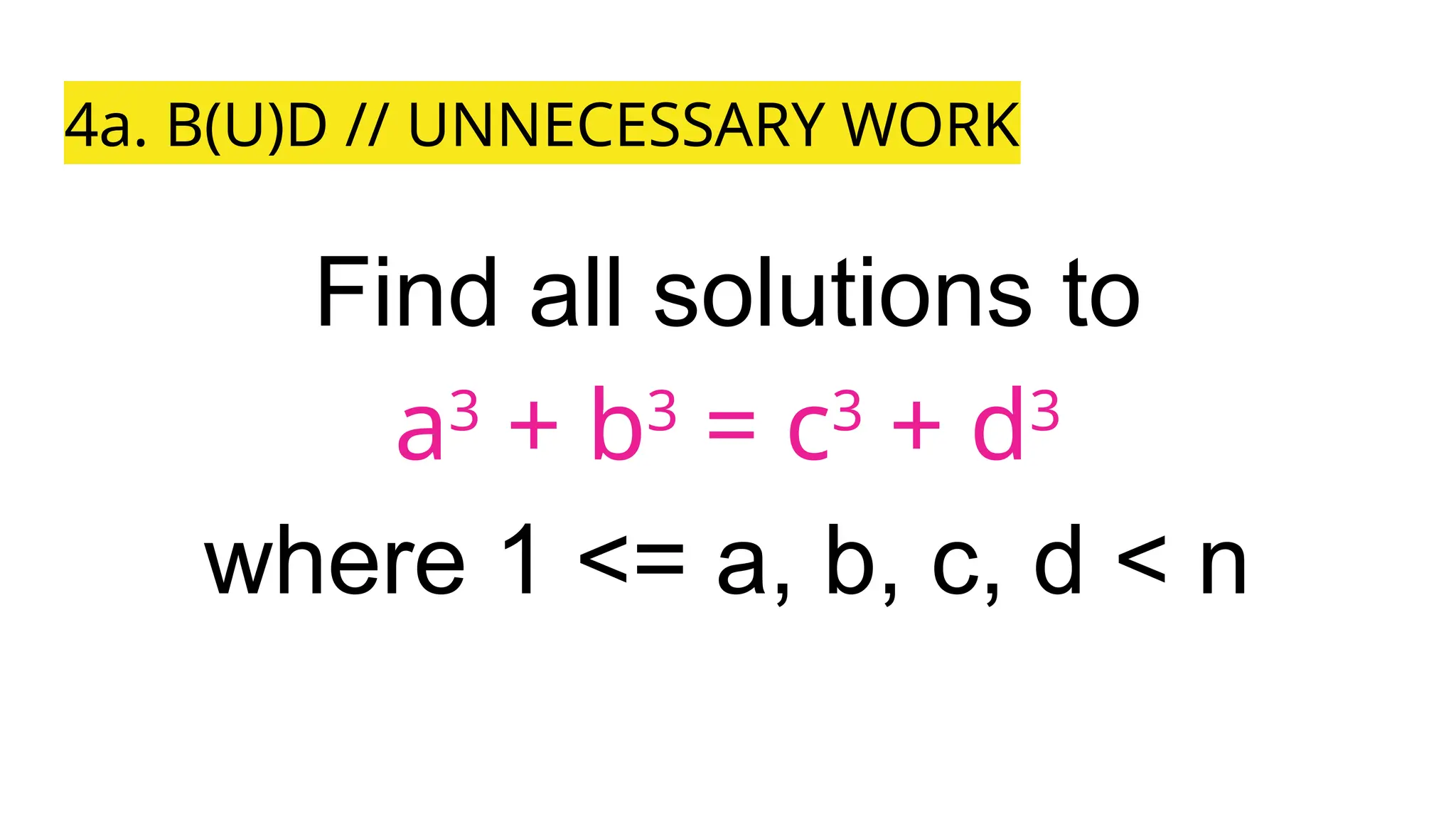
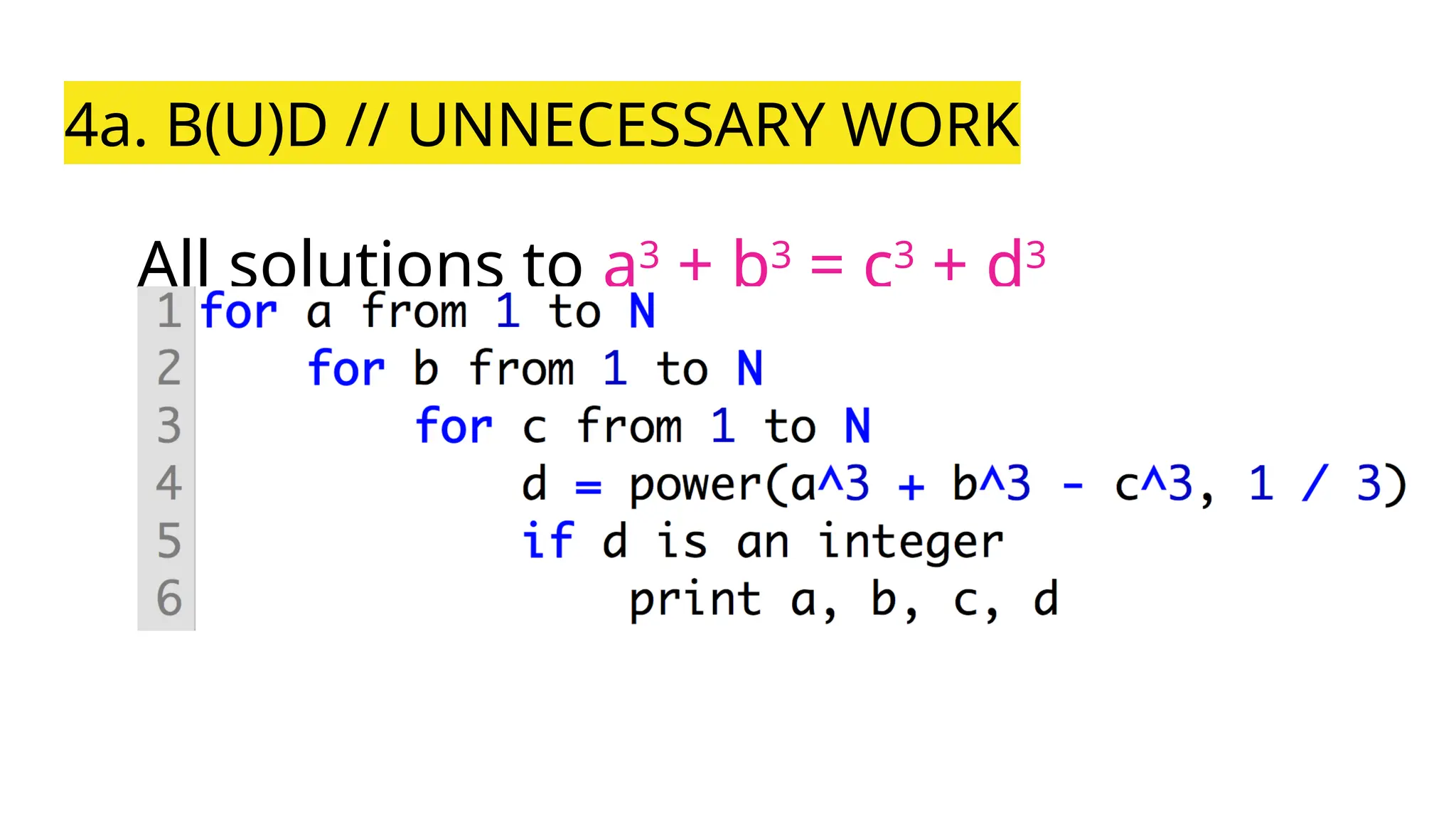
4a. B(U)D // UNNECESSARY WORK
Find all solutions to
a3
+ b3
= c3
+ d3
where 1 <= a, b, c, d < n
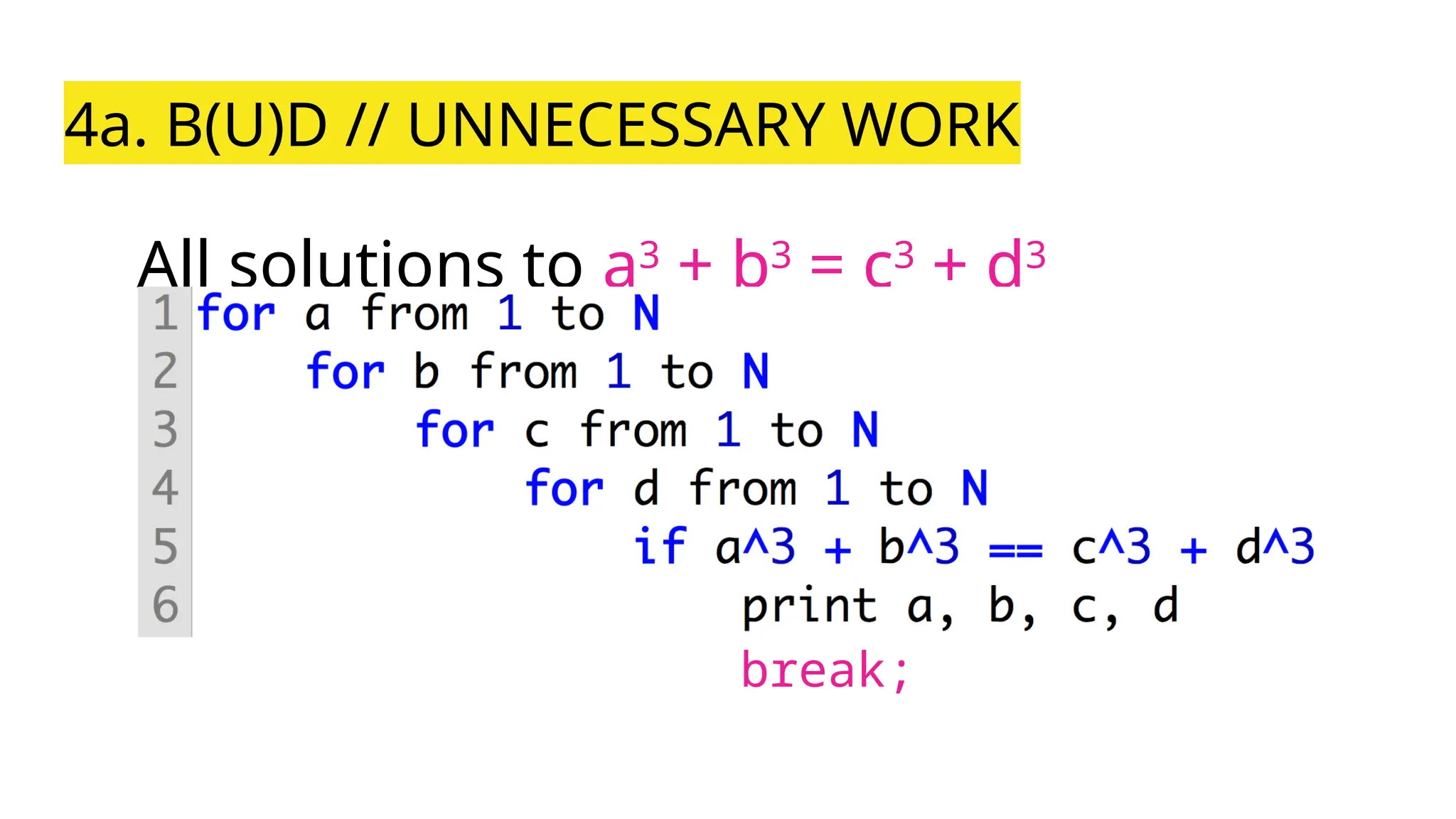
4a. B(U)D // UNNECESSARY WORK
All solutions to a3
+ b3
= c3
+ d3
break;
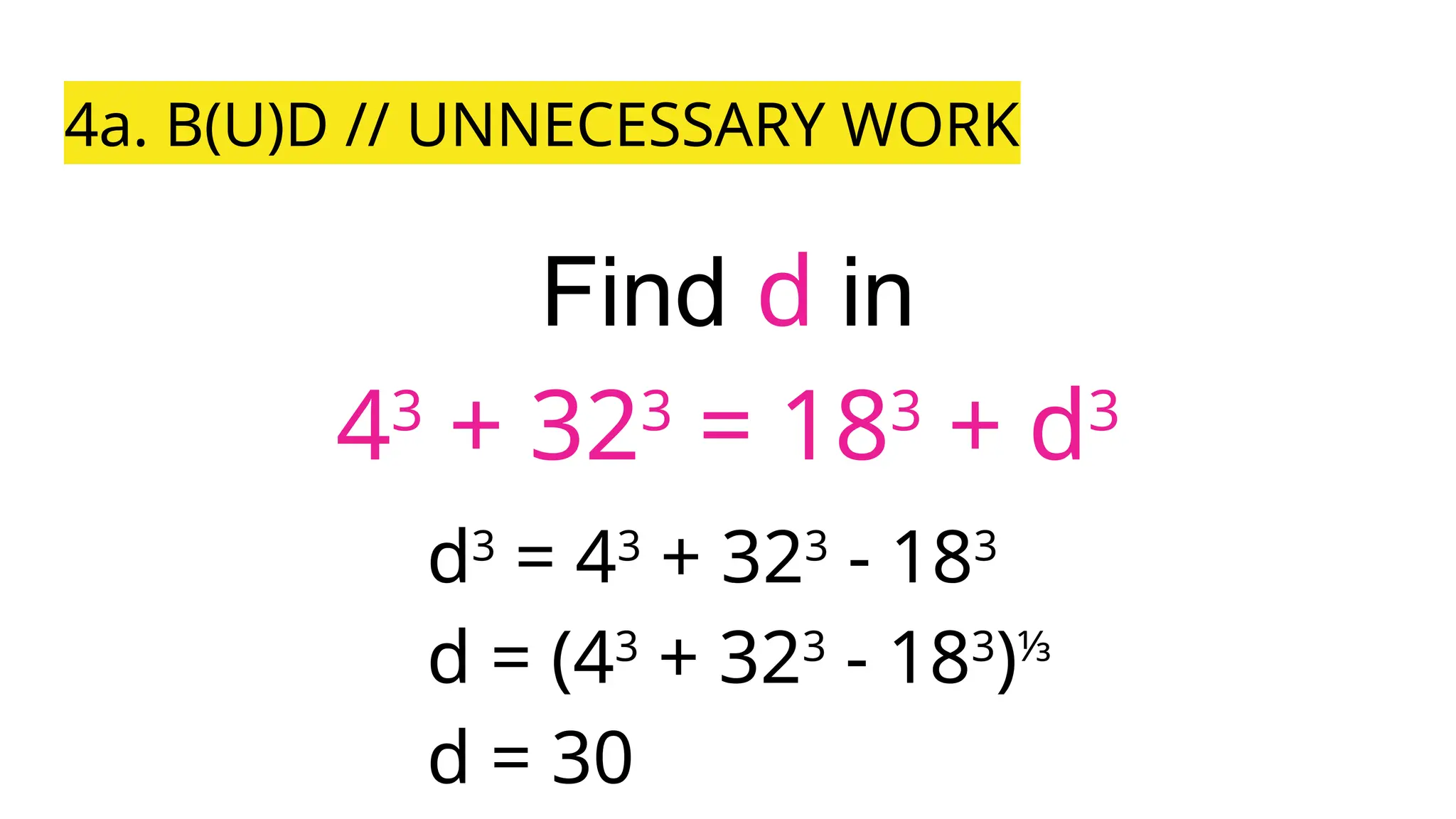
4a. B(U)D // UNNECESSARY WORK
Find d in
43
+ 323
= 183
+ d3
d3
= 43
+ 323
- 183
d = (43
+ 323
- 183
)⅓
d = 30
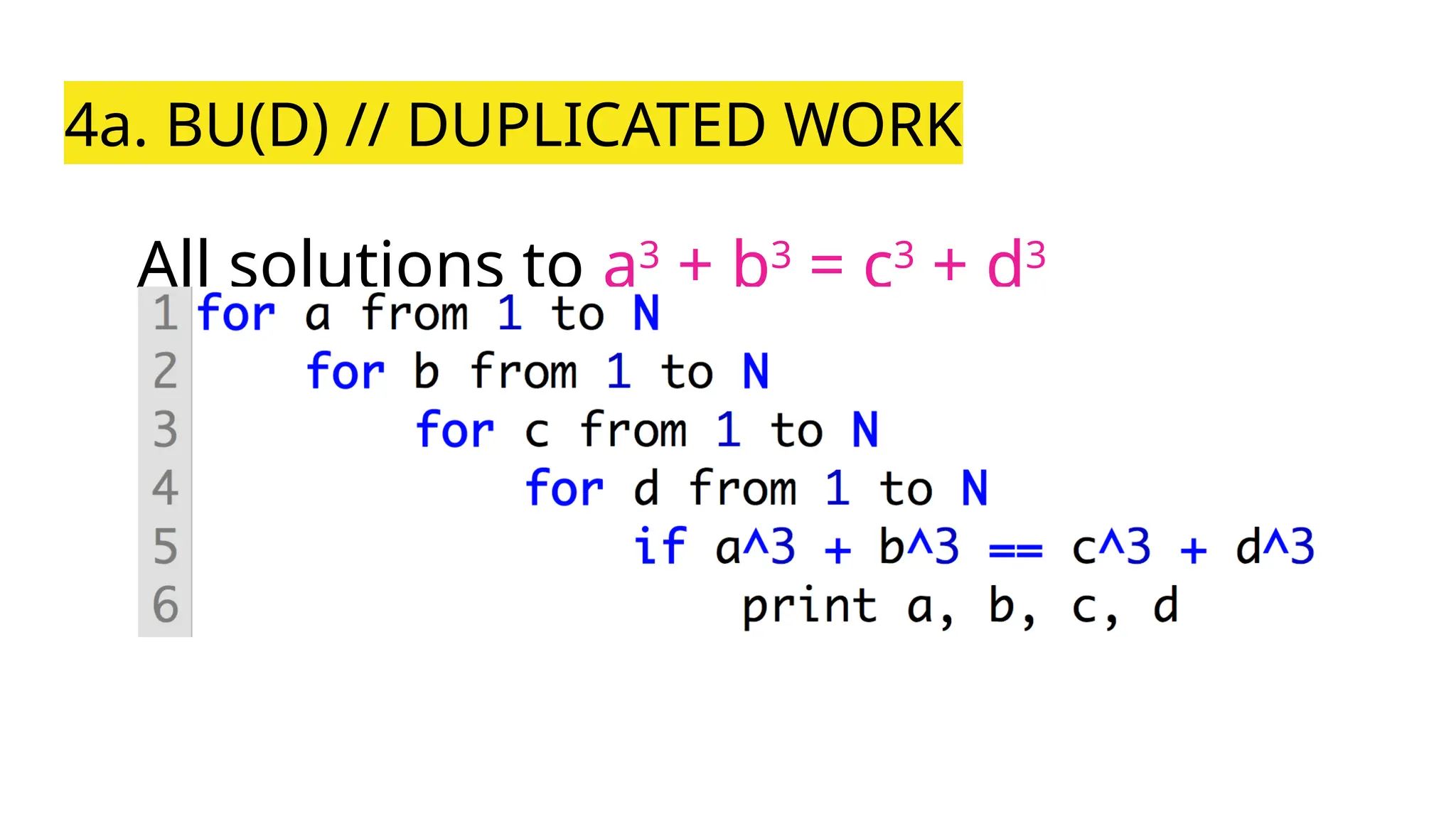
4a. B(U)D // UNNECESSARY WORK
All solutions to a3
+ b3
= c3
+ d3
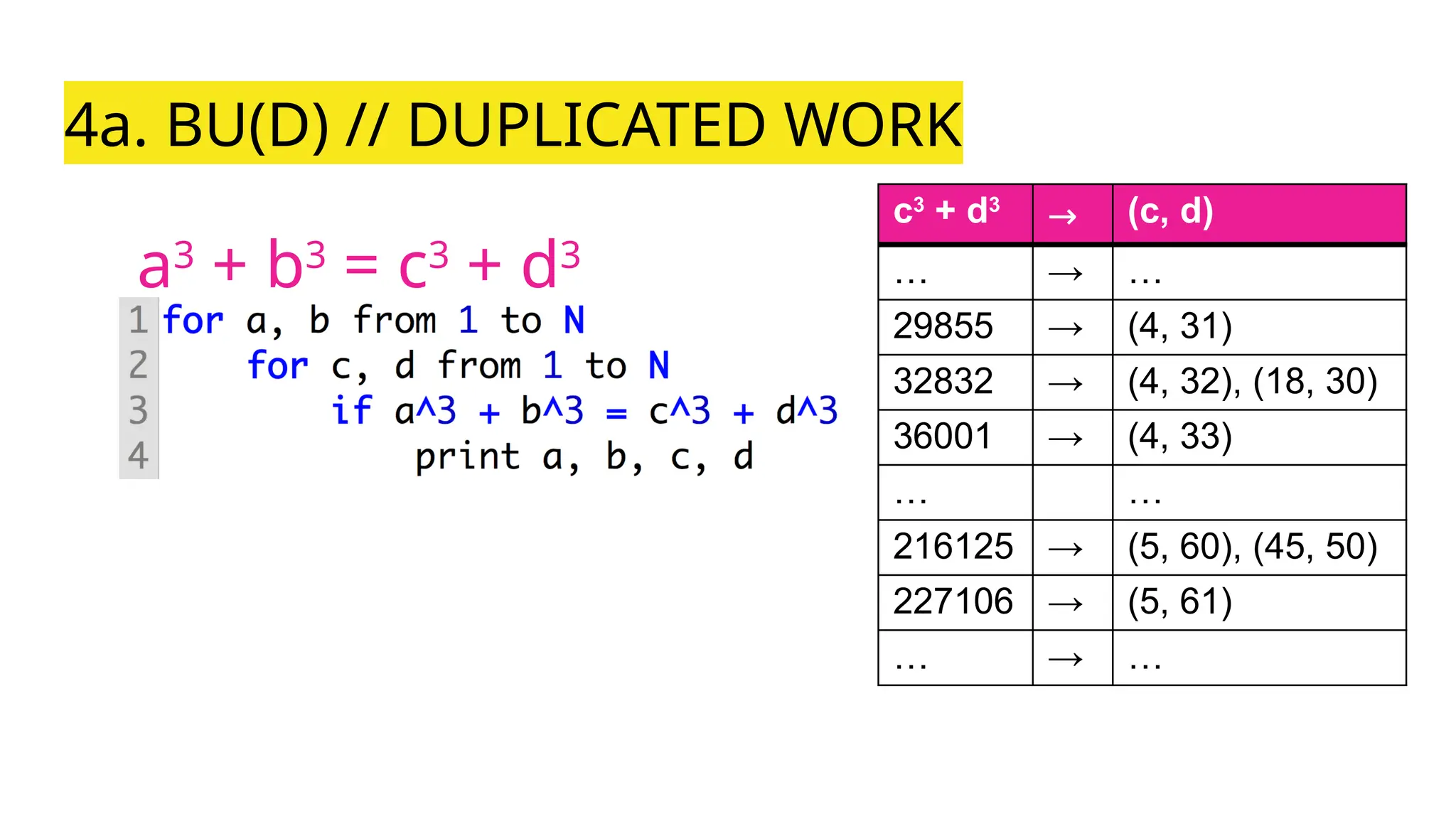
4a. BU(D) // DUPLICATED WORK
All solutions to a3
+ b3
= c3
+ d3
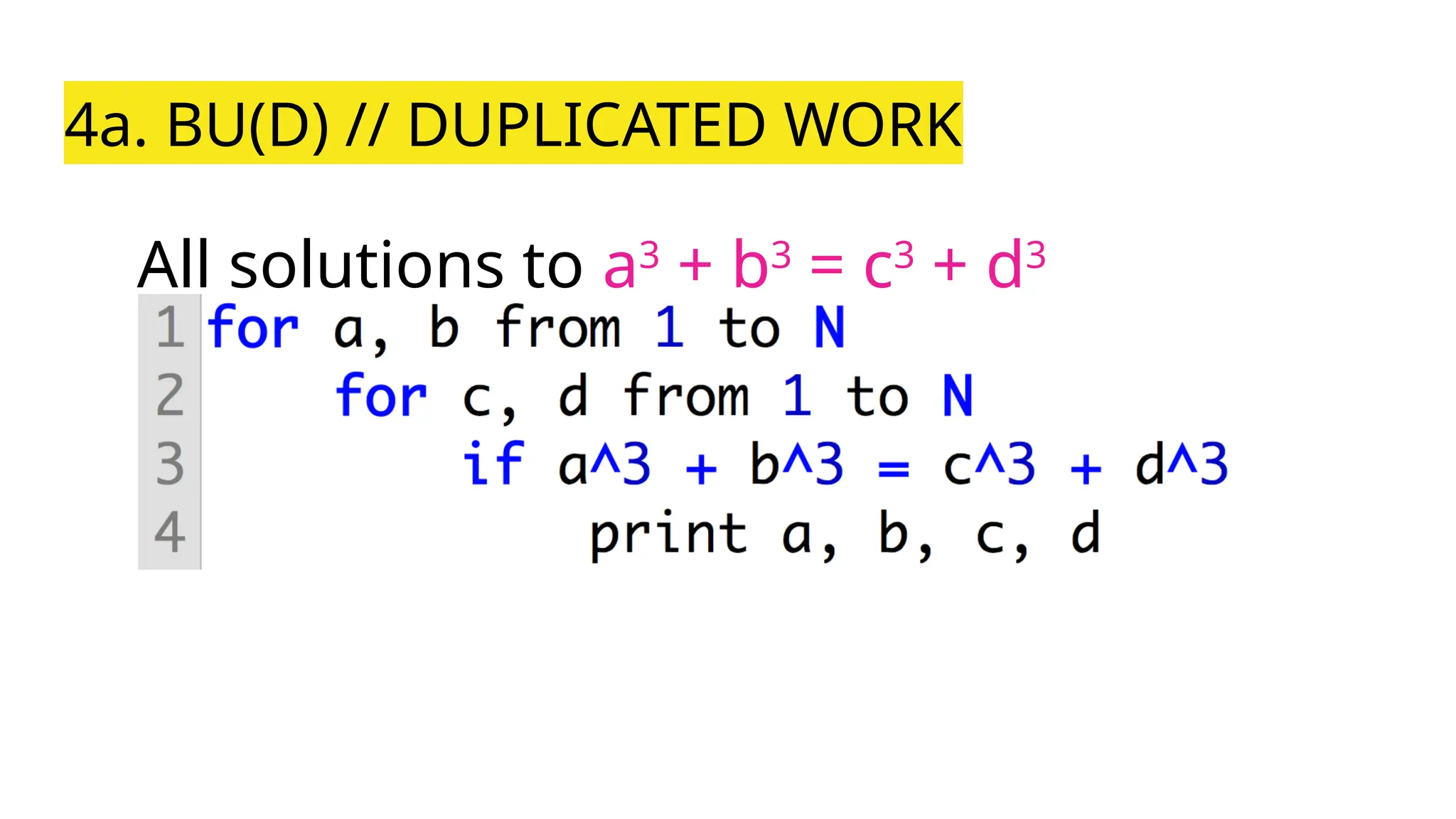
4a. BU(D) // DUPLICATED WORK
All solutions to a3
+ b3
= c3
+ d3
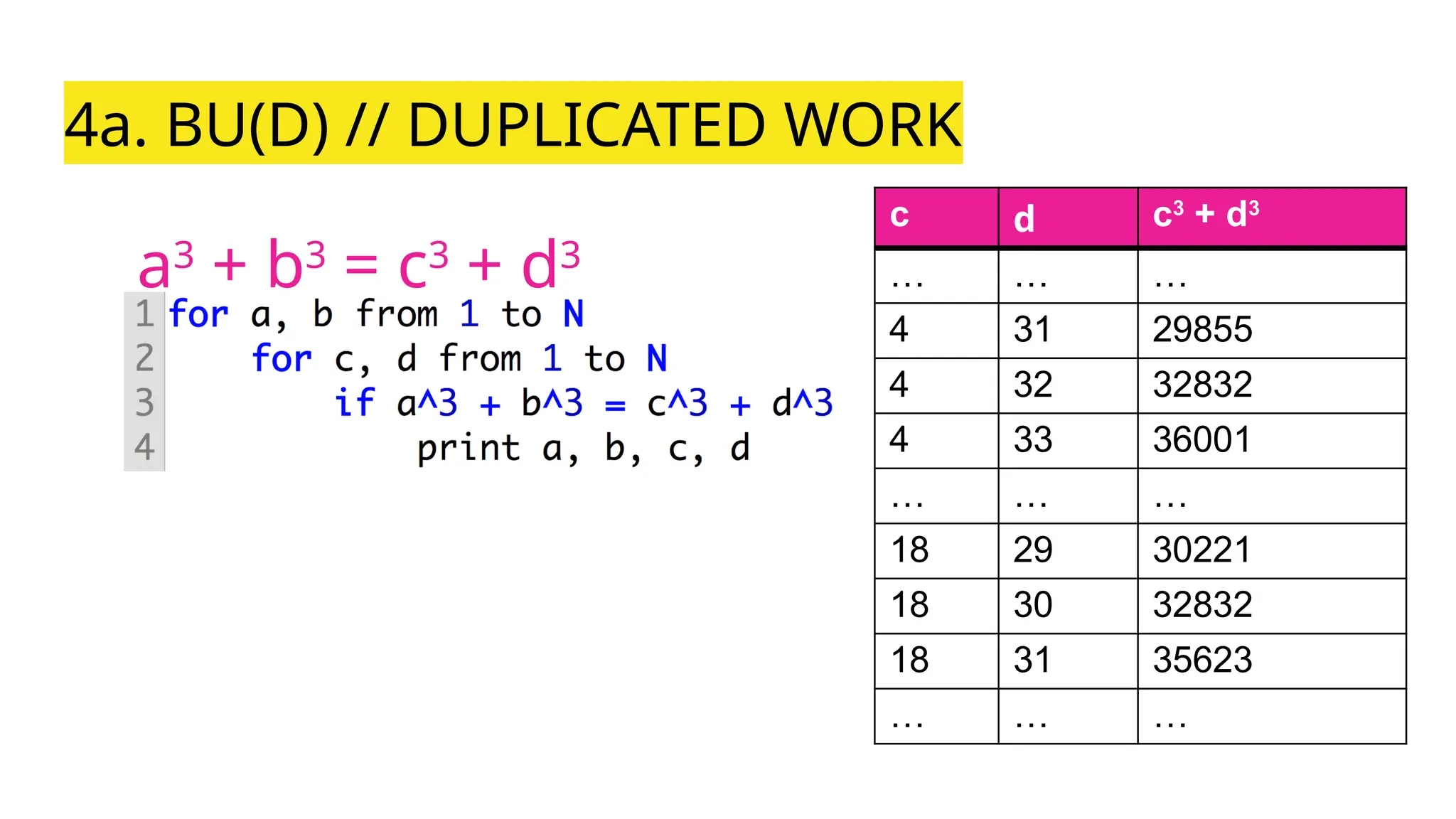
4a. BU(D) // DUPLICATED WORK
a3
+ b3
= c3
+ d3
c d c3
+ d3
… … …
4 31 29855
4 32 32832
4 33 36001
… … …
18 29 30221
18 30 32832
18 31 35623
… … …
4a. BU(D) // DUPLICATED WORK
a3
+ b3
= c3
+ d3
c3
+ d3
→ (c, d)
… → …
29855 → (4, 31)
32832 → (4, 32), (18, 30)
36001 → (4, 33)
… …
216125 → (5, 60), (45, 50)
227106 → (5, 61)
… → …
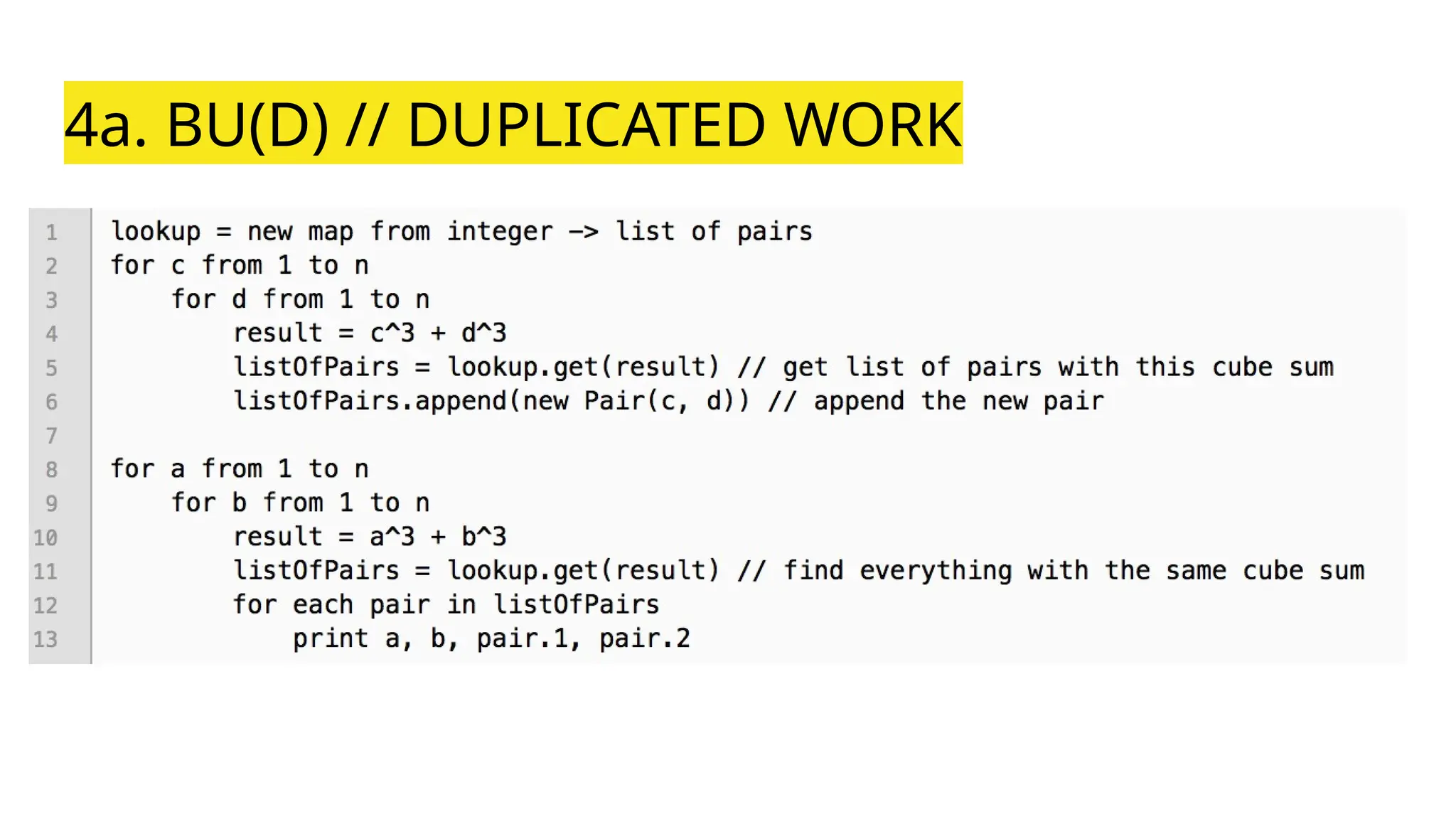
4a. BU(D) // DUPLICATED WORK
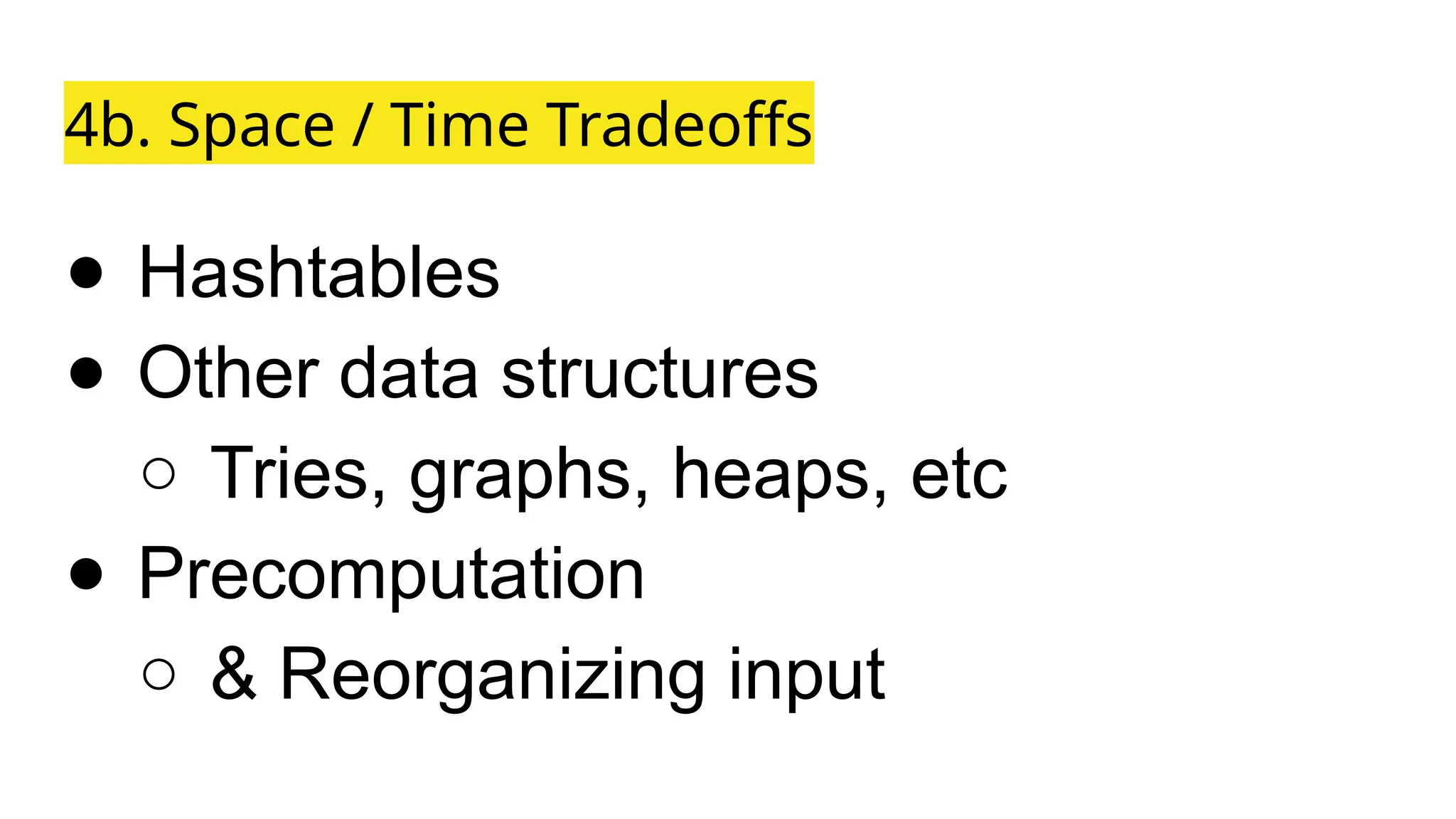
4b. Space / Time Tradeoffs
● Hashtables
● Other data structures
○ Tries, graphs, heaps, etc
● Precomputation
○ & Reorganizing input
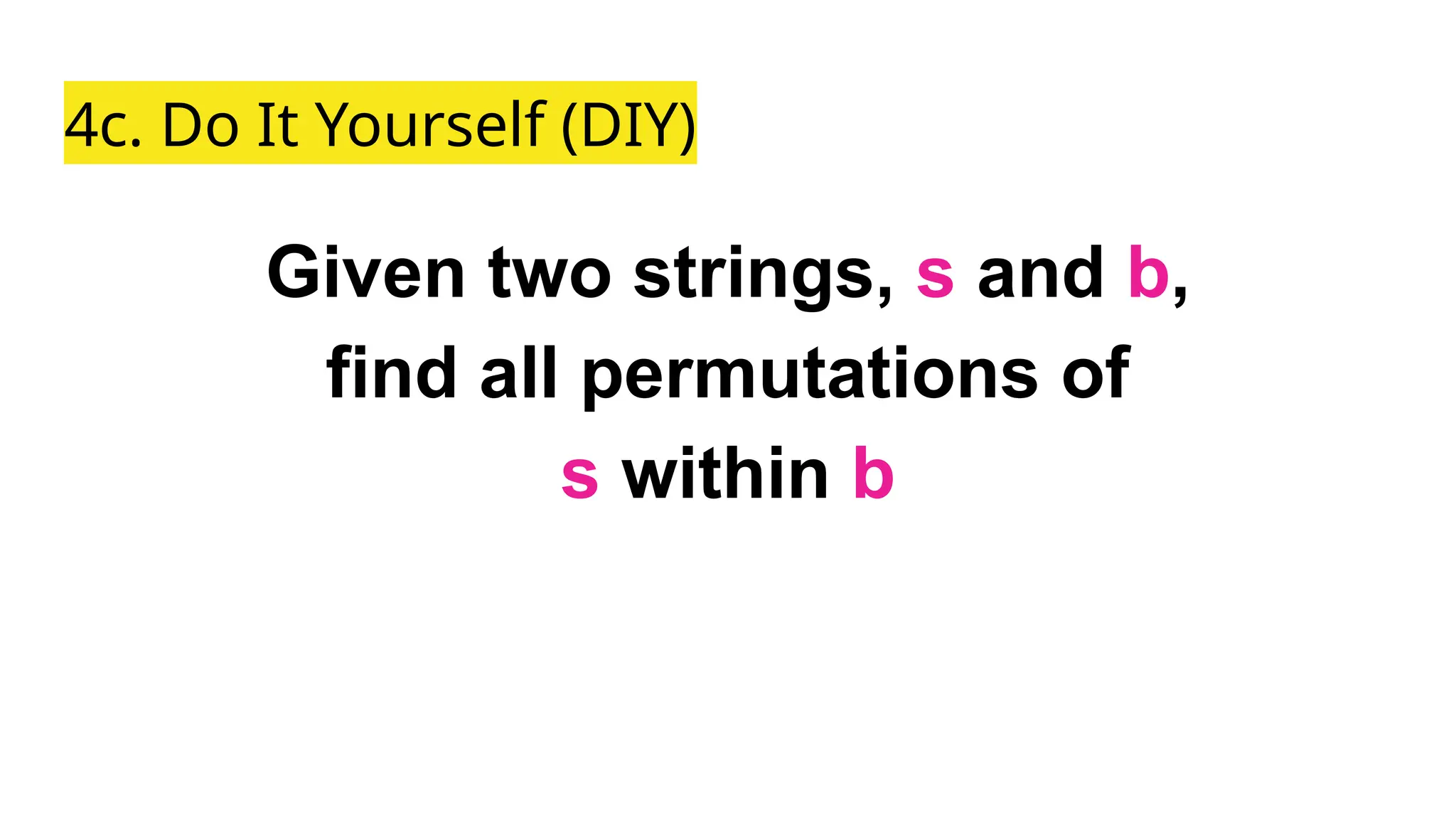
4c. Do It Yourself (DIY)
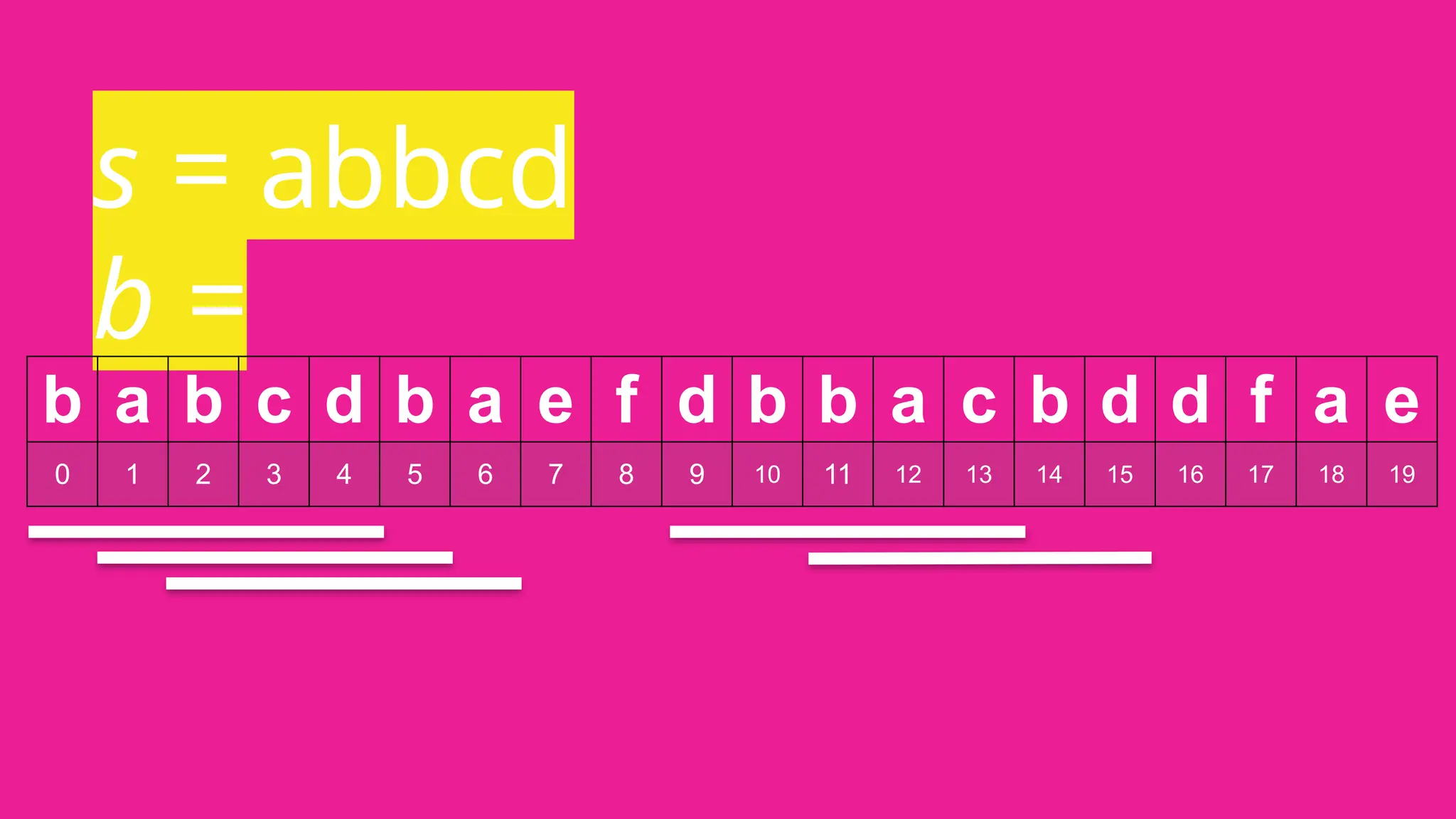
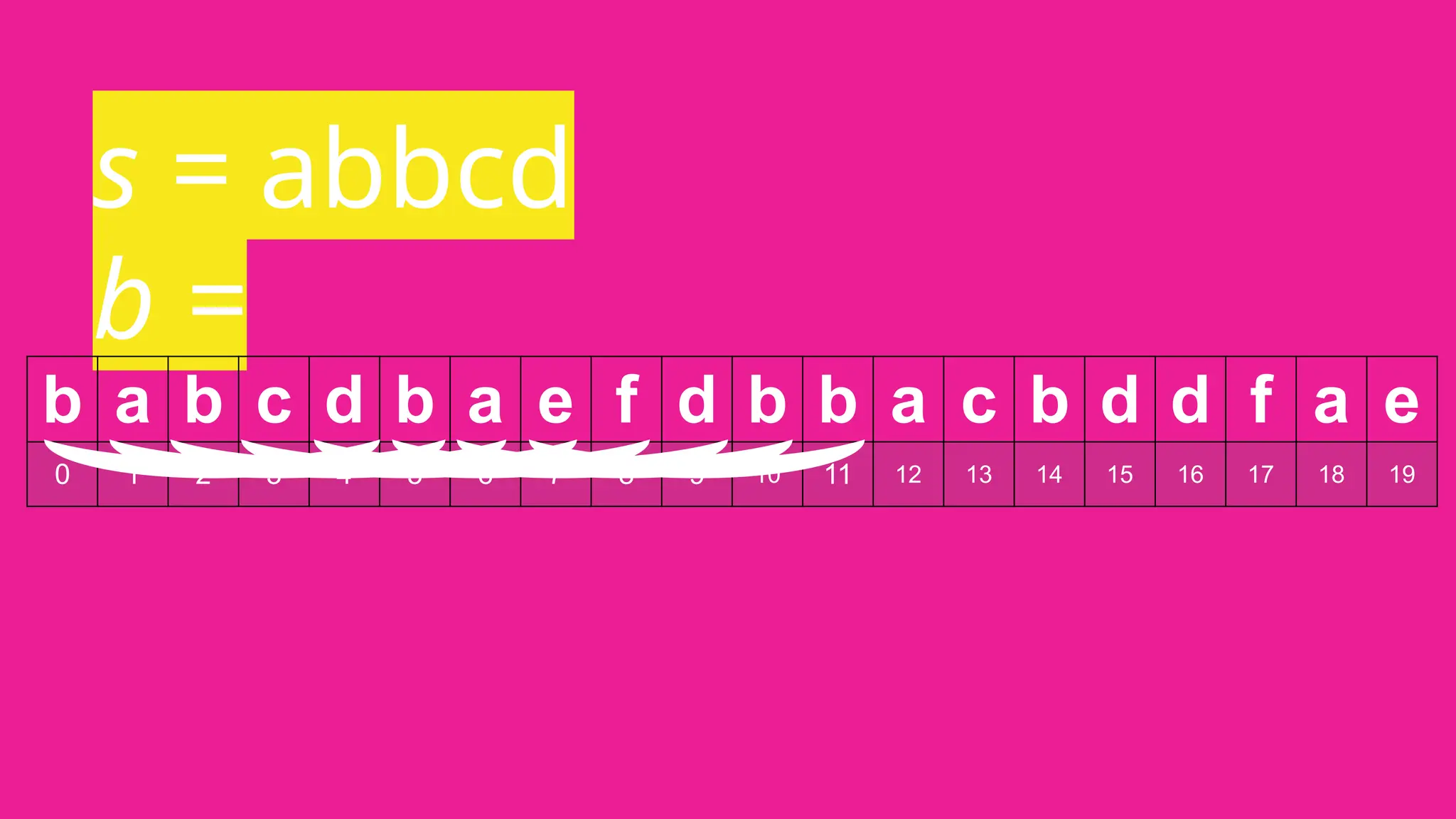
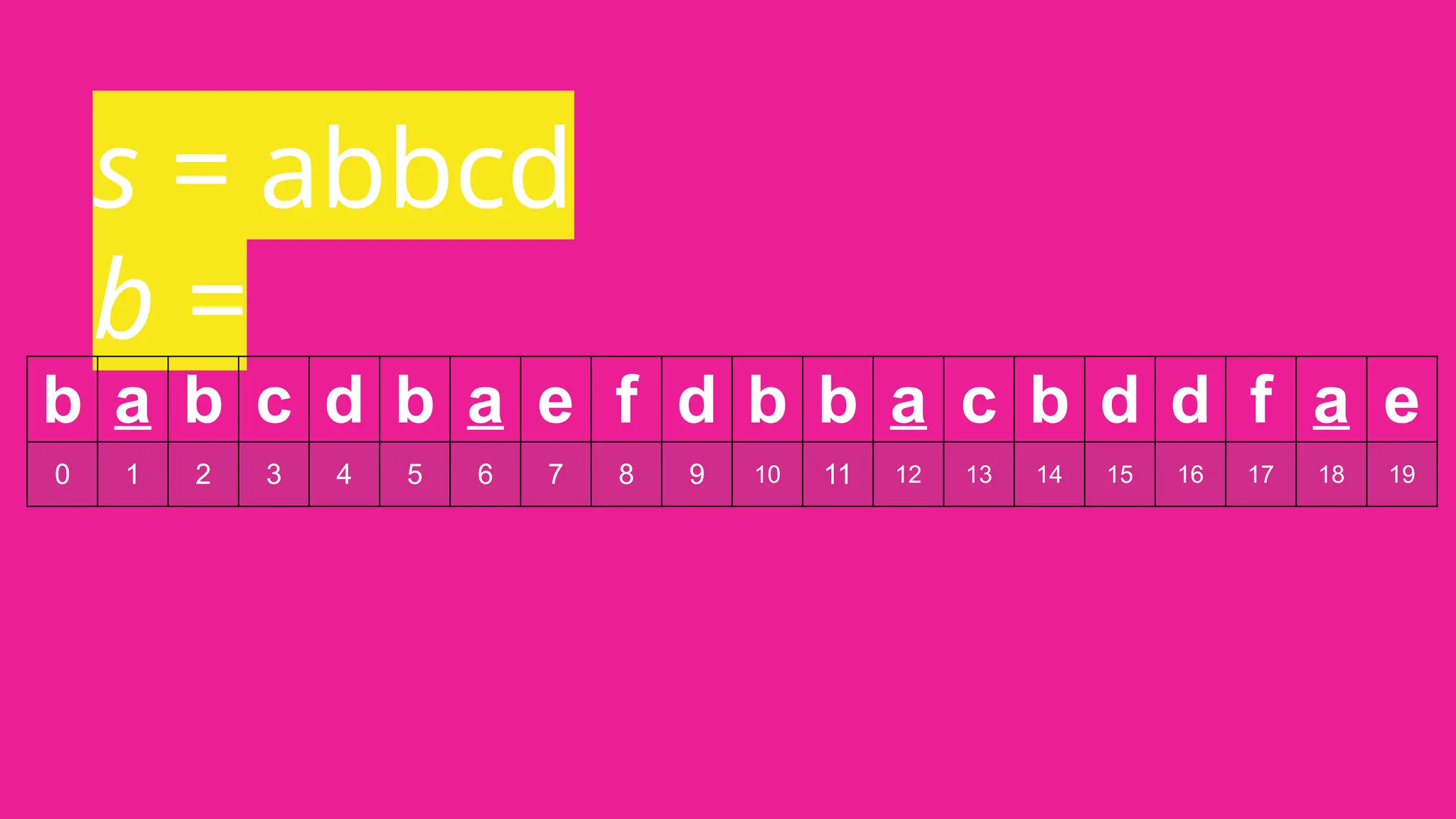
Given two strings, s and b,
find all permutations of
s within b
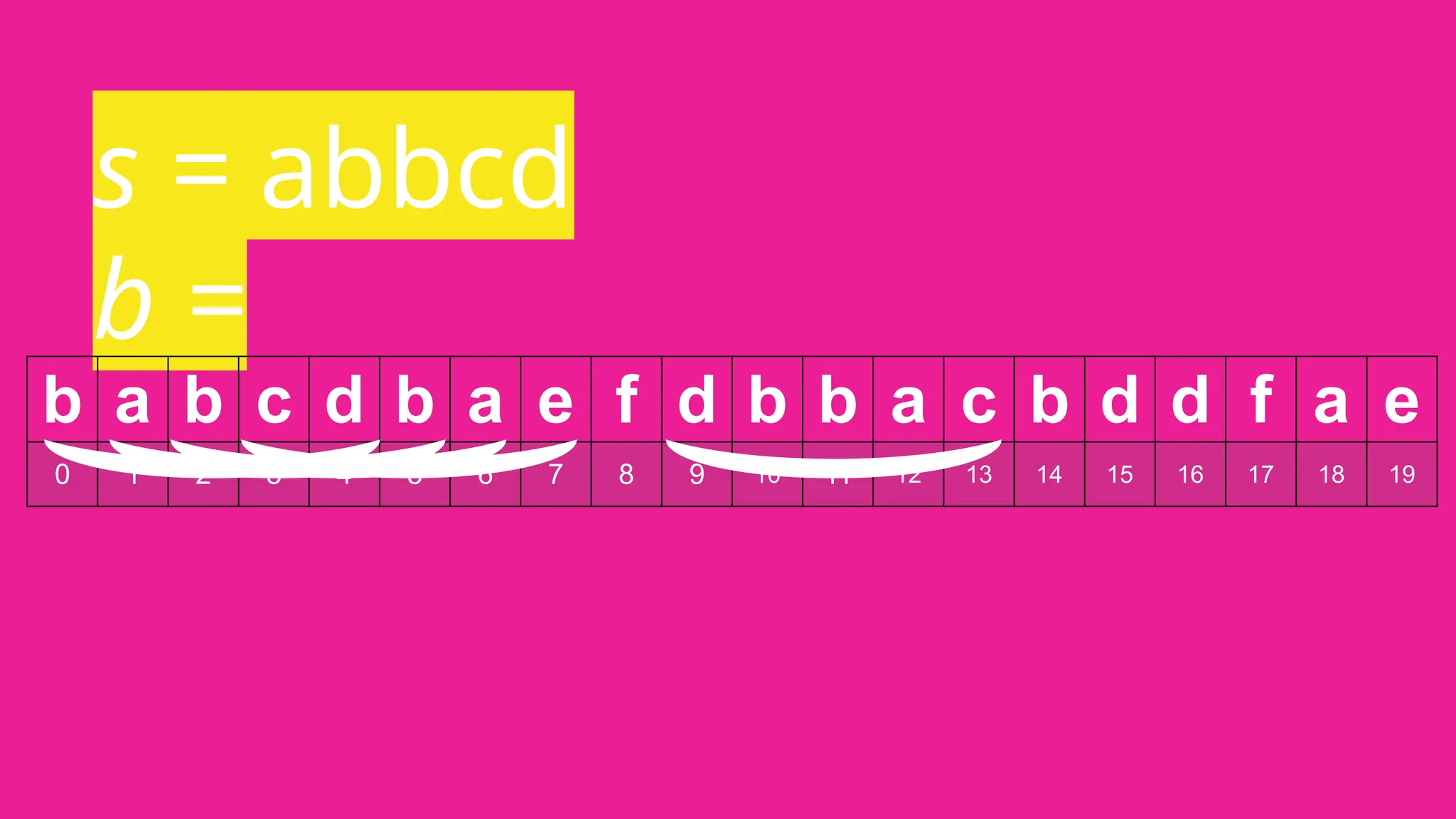
s = abbcd
b =
b a b c d b a e f d b b a c b d d f a e
0 1 2 3 4 5 6 7 8 9 10 11 12 13 14 15 16 17 18 19
s = abbcd
b =
b a b c d b a e f d b b a c b d d f a e
0 1 2 3 4 5 6 7 8 9 10 11 12 13 14 15 16 17 18 19
s = abbcd
b =
b a b c d b a e f d b b a c b d d f a e
0 1 2 3 4 5 6 7 8 9 10 11 12 13 14 15 16 17 18 19
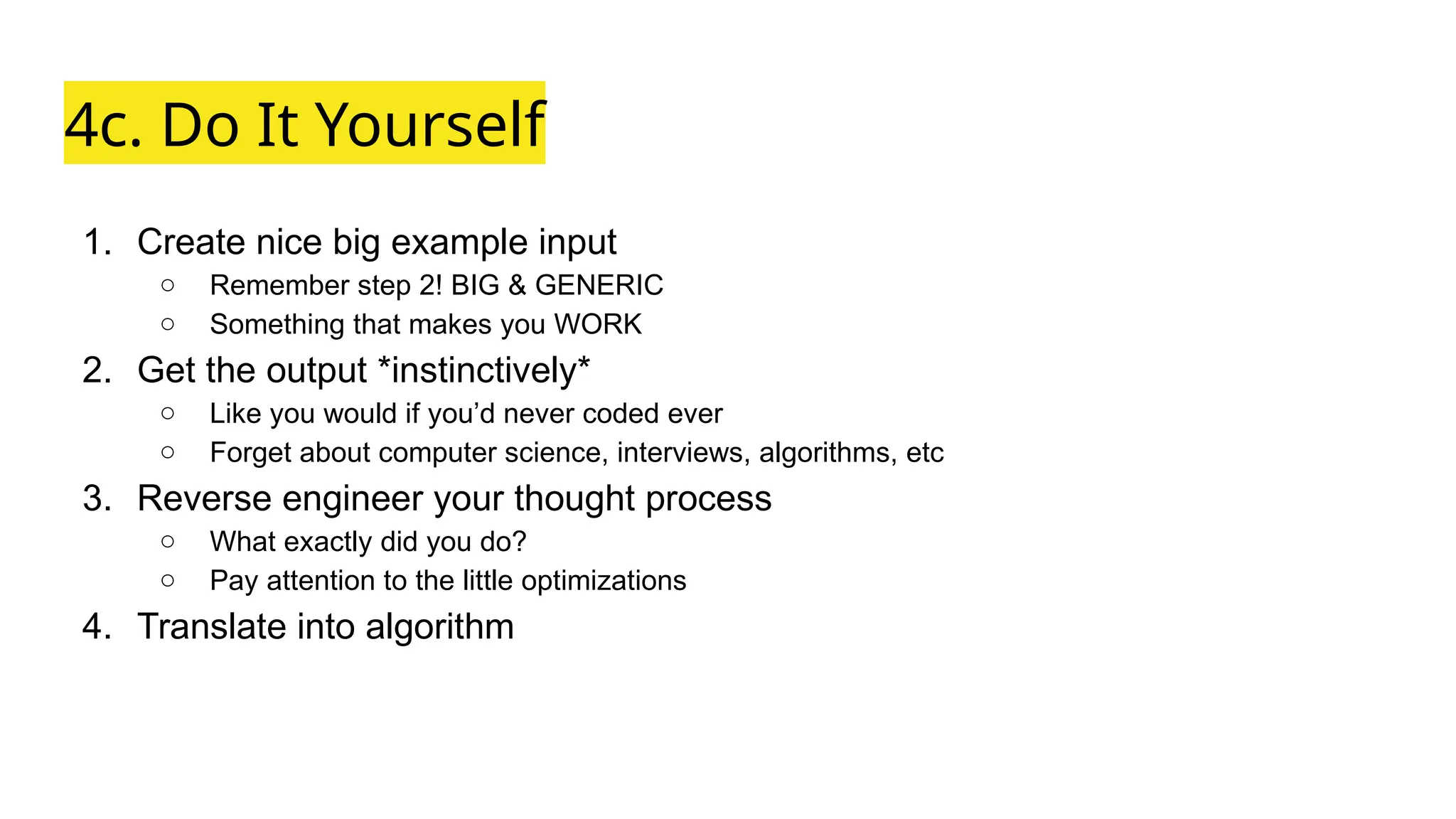
4c. Do It Yourself
1. Create nice big example input
○ Remember step 2! BIG & GENERIC
○ Something that makes you WORK
2. Get the output *instinctively*
○ Like you would if you’d never coded ever
○ Forget about computer science, interviews, algorithms, etc
3. Reverse engineer your thought process
○ What exactly did you do?
○ Pay attention to the little optimizations
4. Translate into algorithm
s = abbcd
b =
b a b c d b a e f d b b a c b d d f a e
0 1 2 3 4 5 6 7 8 9 10 11 12 13 14 15 16 17 18 19
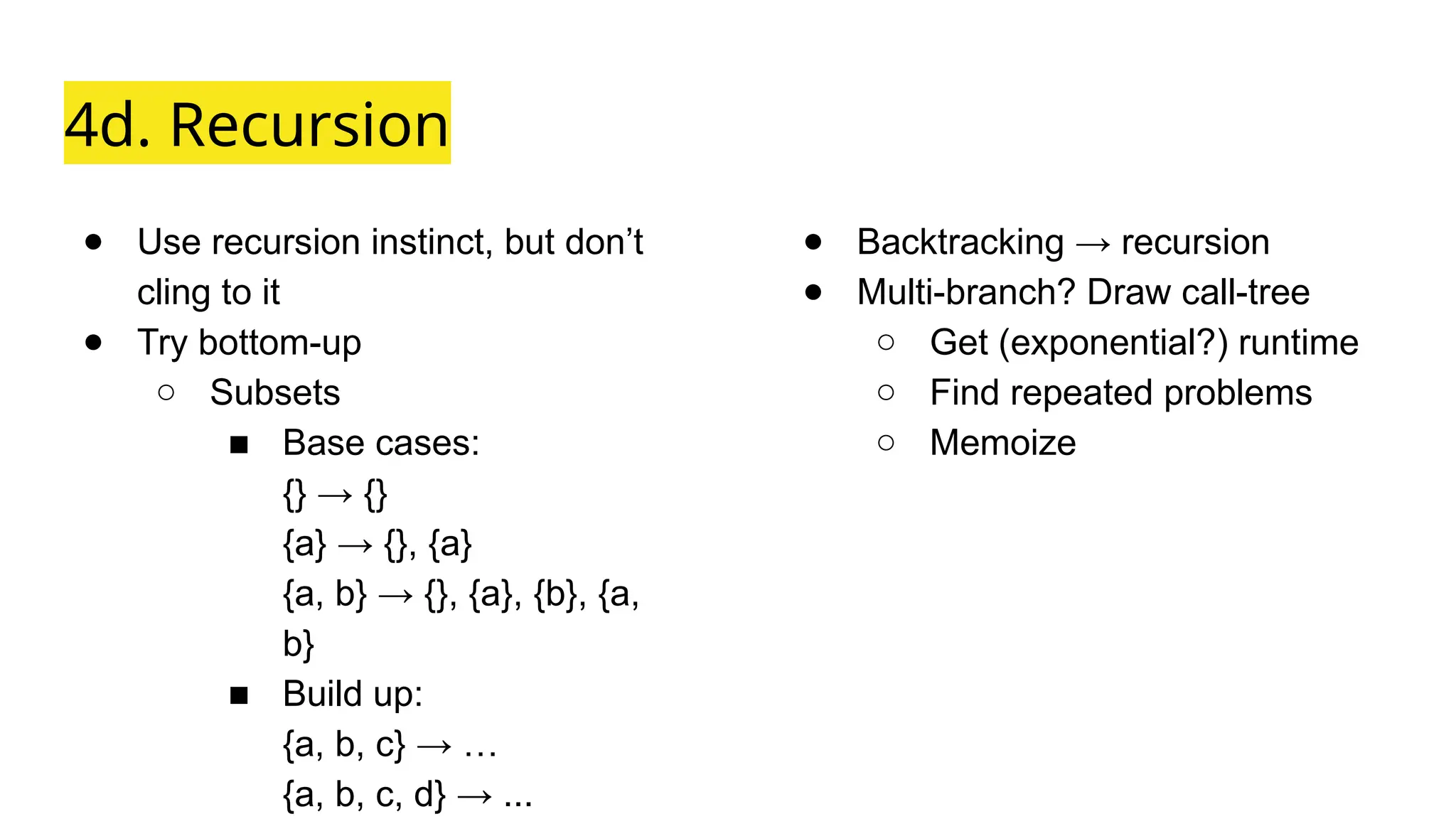
4d. Recursion
● Use recursion instinct, but don’t
cling to it
● Try bottom-up
○ Subsets
■ Base cases:
{} → {}
{a} → {}, {a}
{a, b} → {}, {a}, {b}, {a,
b}
■ Build up:
{a, b, c} → …
{a, b, c, d} → ...
● Backtracking → recursion
● Multi-branch? Draw call-tree
○ Get (exponential?) runtime
○ Find repeated problems
○ Memoize
04. OPTIMIZE
expect to maybe spend
a while here
● BUD
● Space & Time
● Do It Yourself
● Recursion
KEEP
WORKING
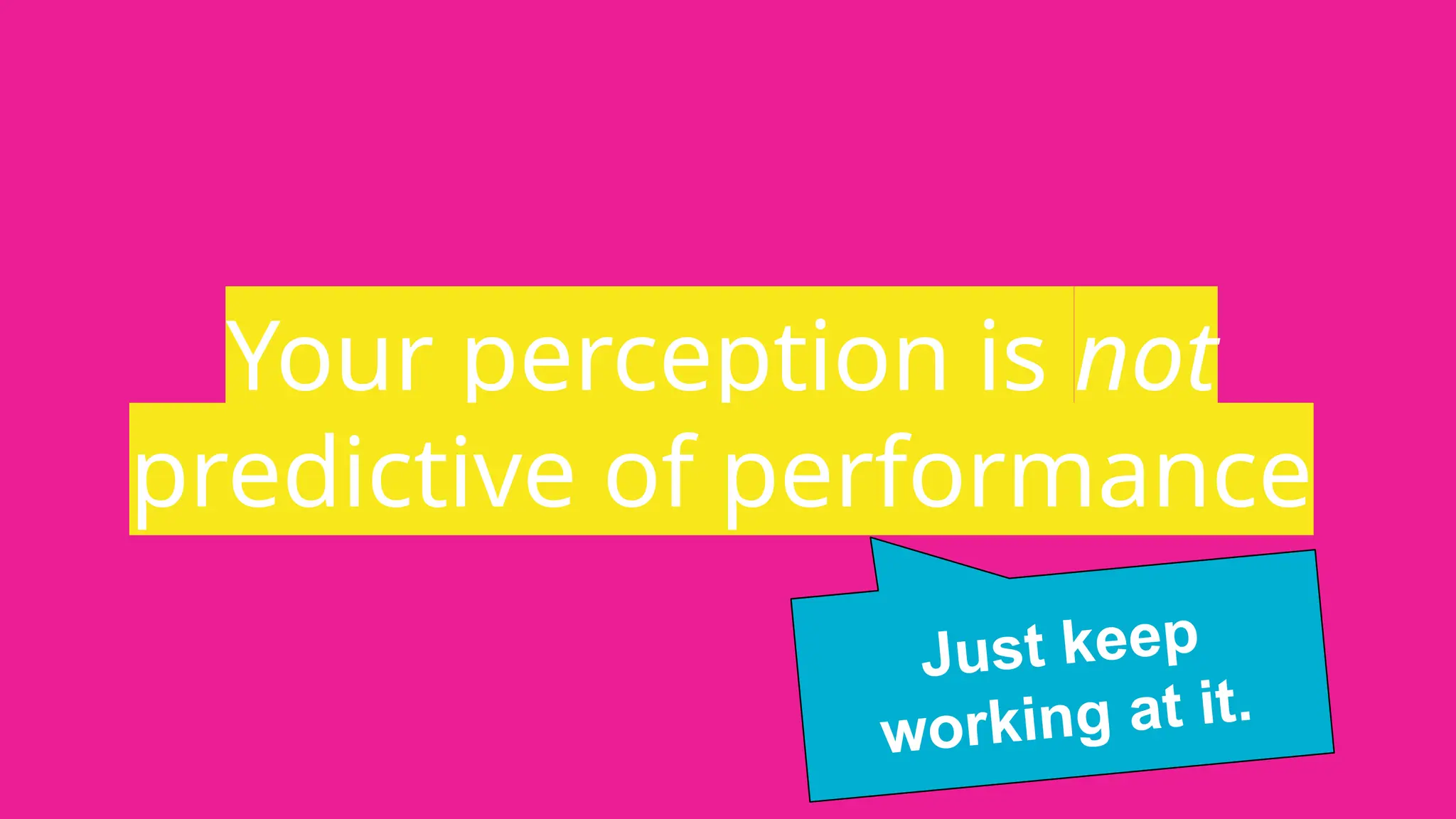
Your perception is not
predictive of performance
05. WALK
THROUGH
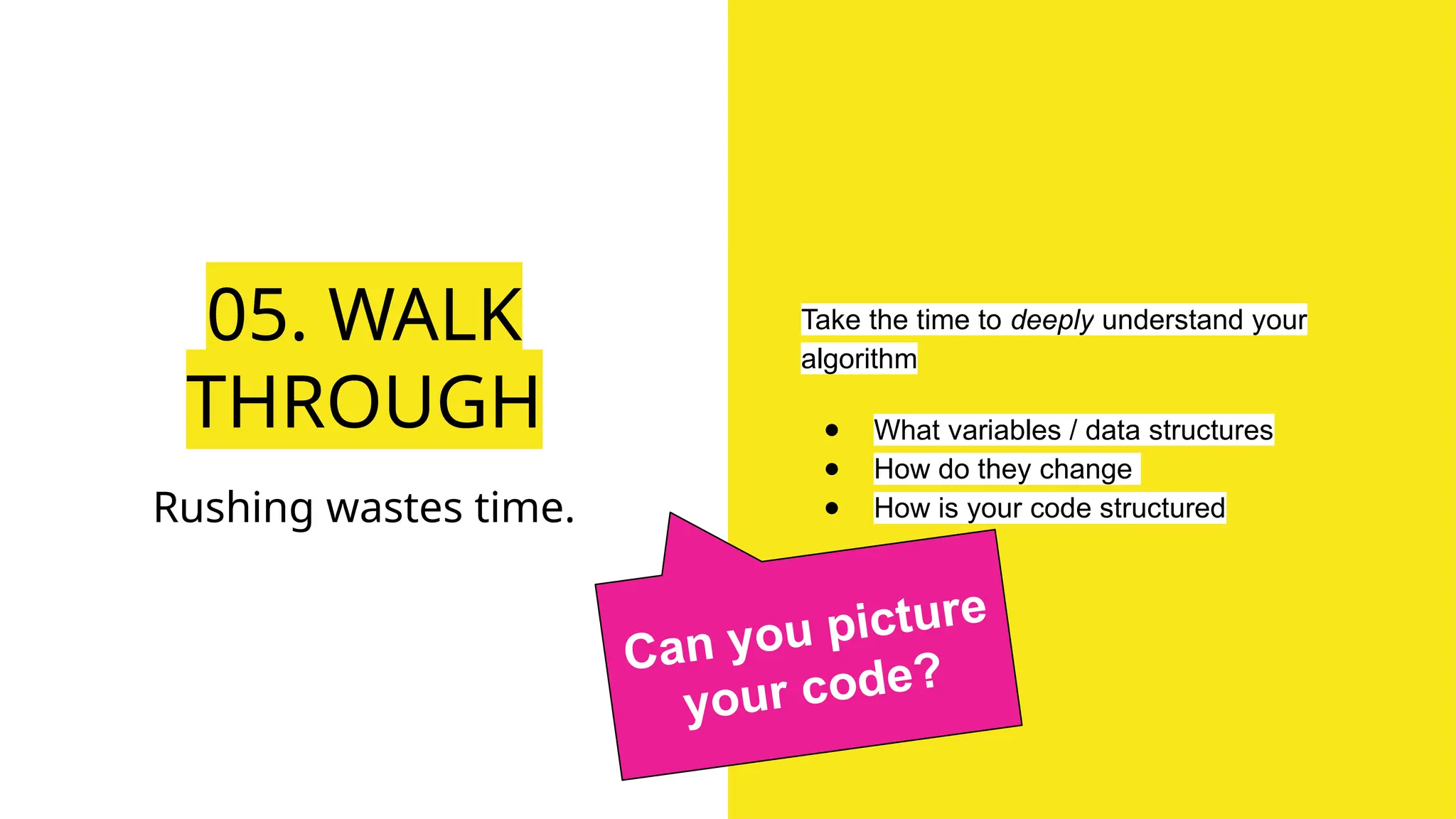
Take the time to deeply understand your
algorithm
● What variables / data structures
● How do they change
● How is your code structured
Rushing wastes time.
Can you picture
your code?
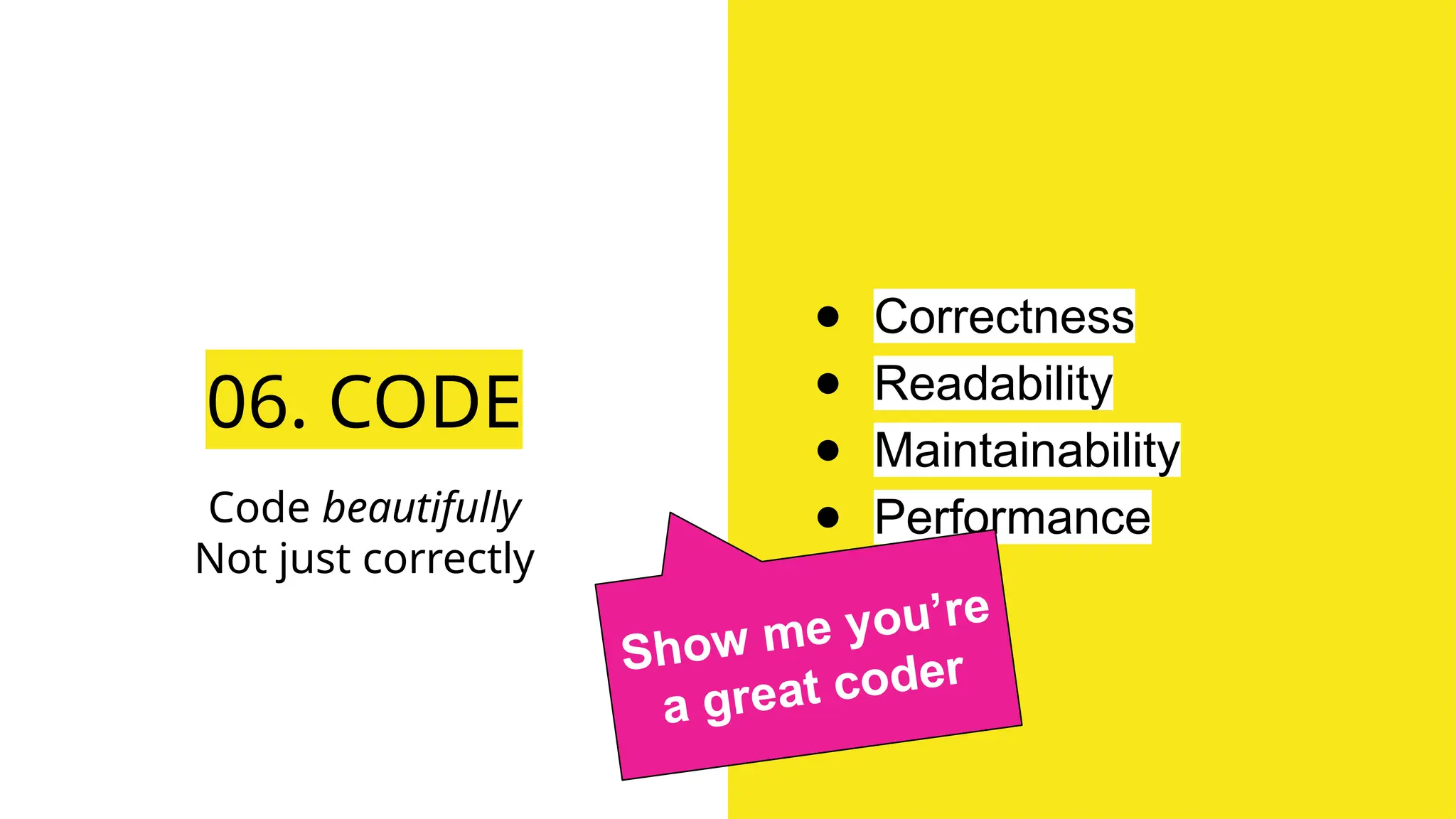
06. CODE
● Correctness
● Readability
● Maintainability
● Performance
Code beautifully
Not just correctly
Show me you’re
a great coder
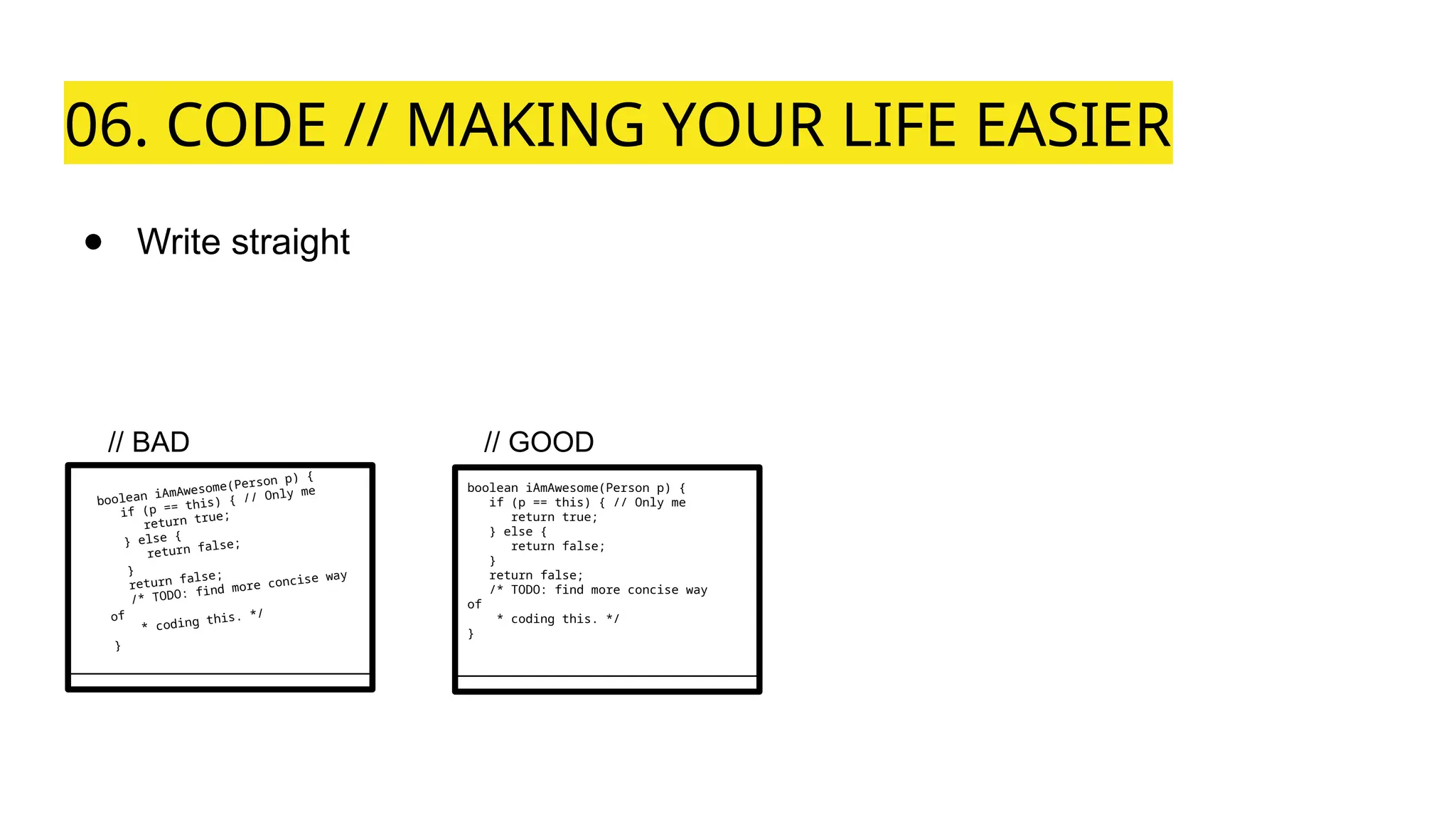
06. CODE // MAKING YOUR LIFE EASIER
● Write straight
boolean iAmAwesome(Person p) {
if (p == this) { // Only me
return true;
} else {
return false;
}
return false;
/* TODO: find more concise way
of
* coding this. */
}
boolean iAmAwesome(Person p) {
if (p == this) { // Only me
return true;
} else {
return false;
}
return false;
/* TODO: find more concise way
of
* coding this. */
}
// BAD // GOOD
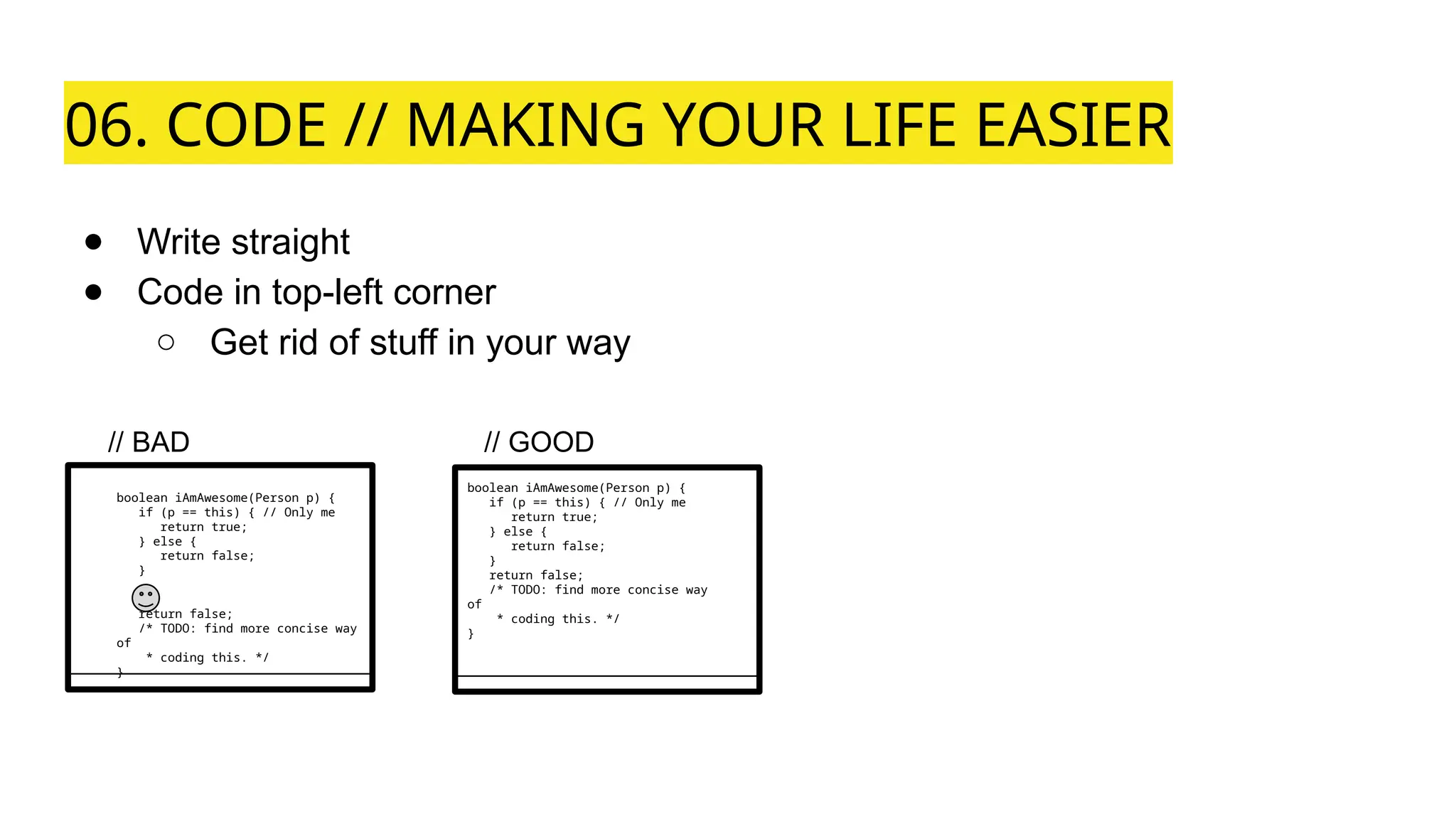
06. CODE // MAKING YOUR LIFE EASIER
● Write straight
● Code in top-left corner
○ Get rid of stuff in your way
boolean iAmAwesome(Person p) {
if (p == this) { // Only me
return true;
} else {
return false;
}
return false;
/* TODO: find more concise way
of
* coding this. */
}
boolean iAmAwesome(Person p) {
if (p == this) { // Only me
return true;
} else {
return false;
}
return false;
/* TODO: find more concise way
of
* coding this. */
}
// BAD // GOOD
06. CODE // MAKING YOUR LIFE EASIER
● Write straight
● Code in top-left corner
○ Get rid of stuff in your way
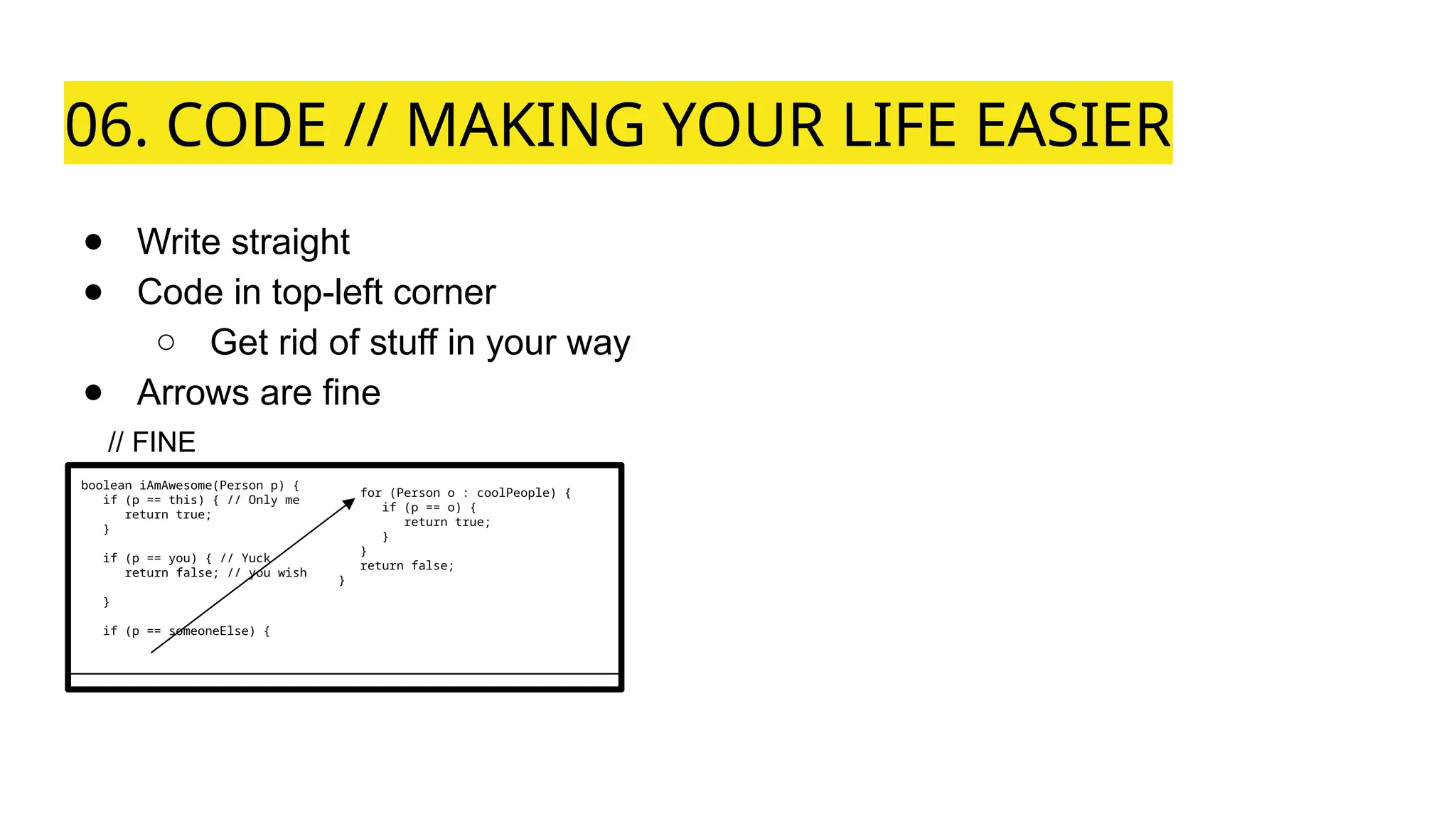
● Arrows are fine
boolean iAmAwesome(Person p) {
if (p == this) { // Only me
return true;
}
if (p == you) { // Yuck
return false; // you wish
}
if (p == someoneElse) {
// FINE
for (Person o : coolPeople) {
if (p == o) {
return true;
}
}
return false;
}
06. CODE // MAKING YOUR LIFE EASIER
● Write straight
● Code in top-left corner
○ Get rid of stuff in your way
● Arrows are fine
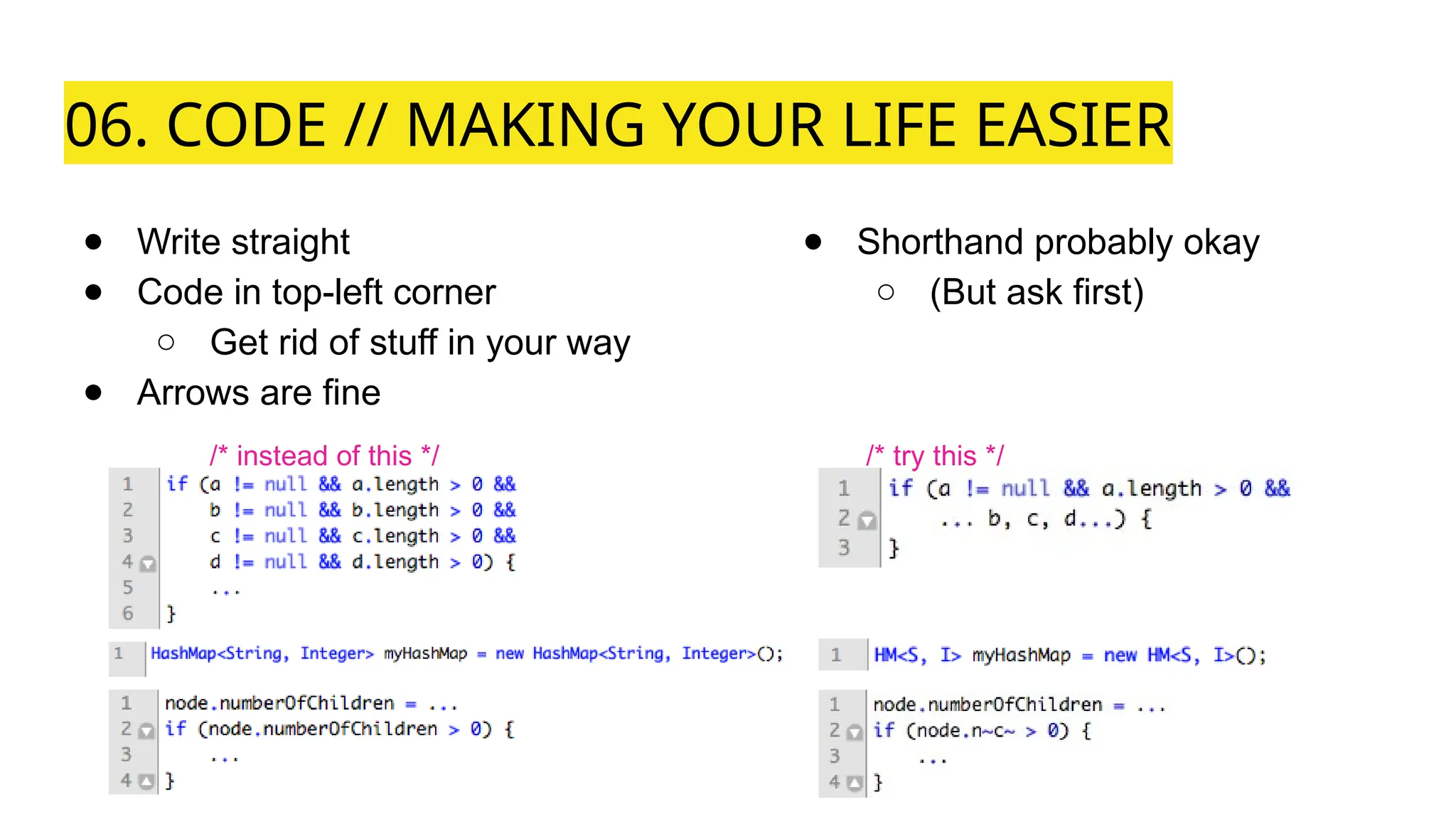
● Shorthand probably okay
○ (But ask first)
/* instead of this */ /* try this */
06. CODE // SHOWING YOU’RE A GOOD CODER
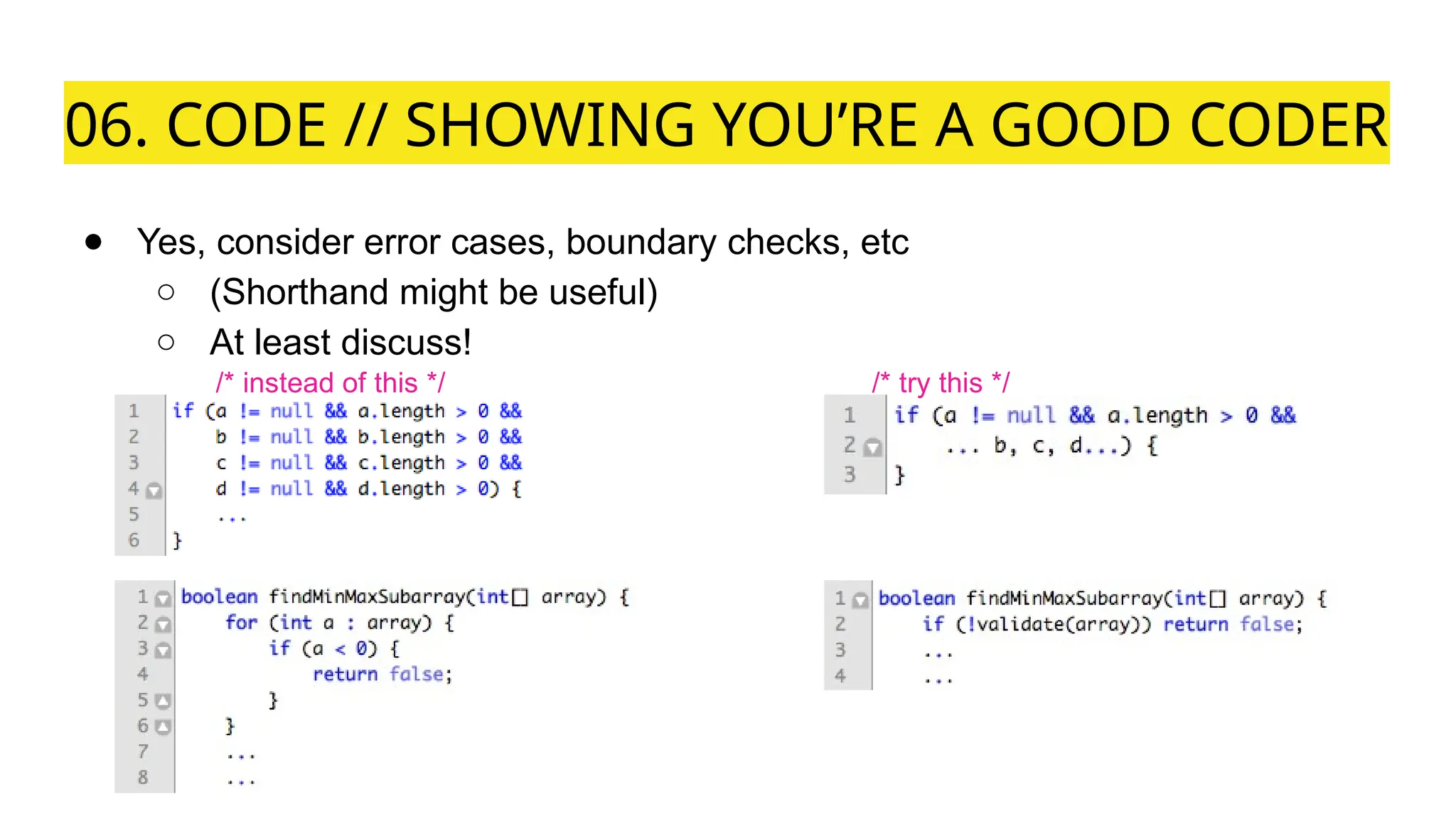
● Yes, consider error cases, boundary checks, etc
○ (Shorthand might be useful)
○ At least discuss!
/* instead of this */ /* try this */
06. CODE // SHOWING YOU’RE A GOOD CODER
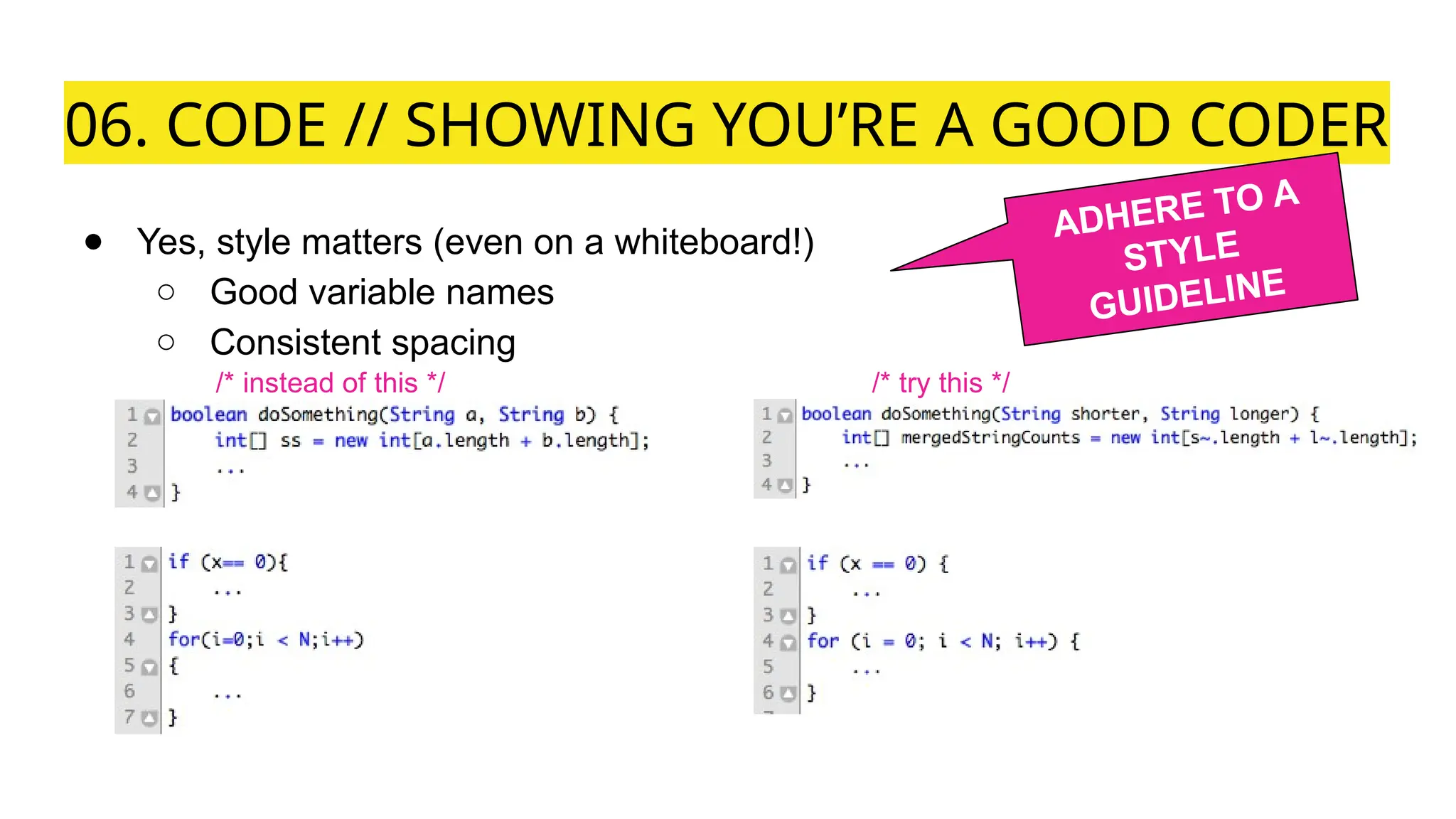
● Yes, style matters (even on a whiteboard!)
○ Good variable names
○ Consistent spacing
/* instead of this */ /* try this */
ADHERE TO A
STYLE
GUIDELINE
06. CODE // SHOWING YOU’RE A GOOD CODER
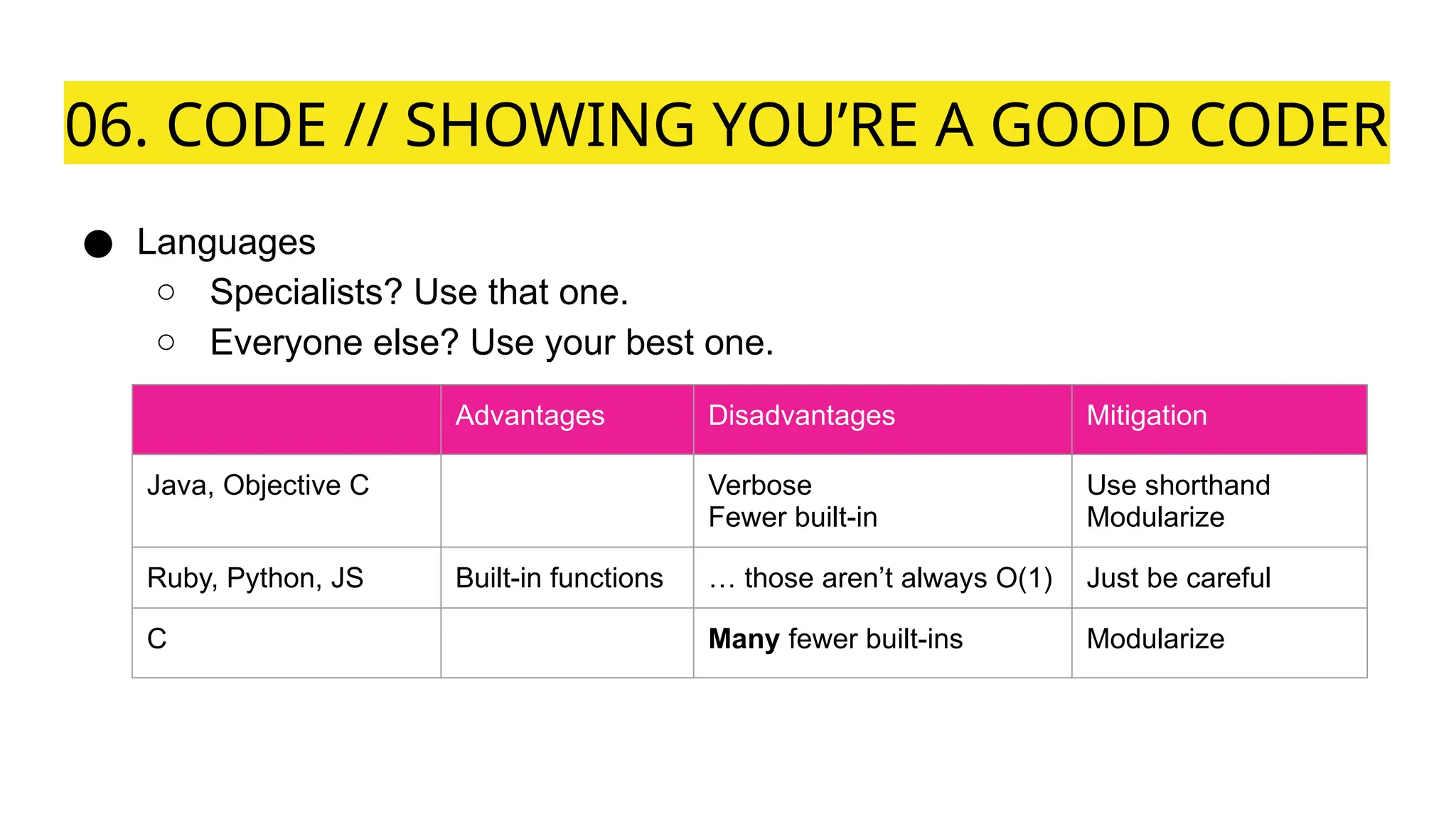
● Languages
○ Specialists? Use that one.
○ Everyone else? Use your best one.
Advantages Disadvantages Mitigation
Java, Objective C Verbose
Fewer built-in
Use shorthand
Modularize
Ruby, Python, JS Built-in functions … those aren’t always O(1) Just be careful
C Many fewer built-ins Modularize
06. CODE // SHOWING YOU’RE A GOOD CODER
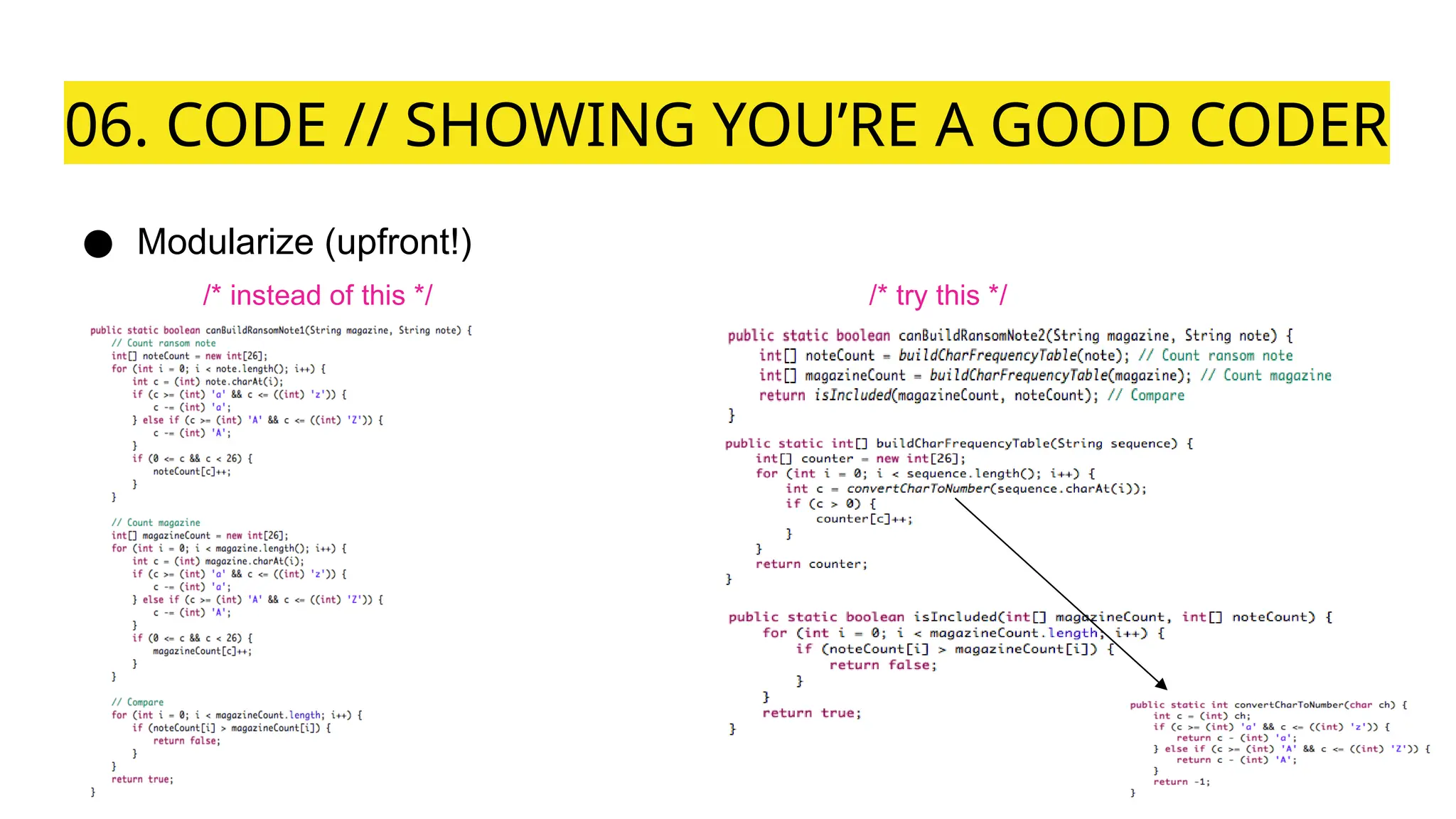
● Modularize (upfront!)
/* instead of this */ /* try this */
06. CODE // SHOWING YOU’RE A GOOD CODER
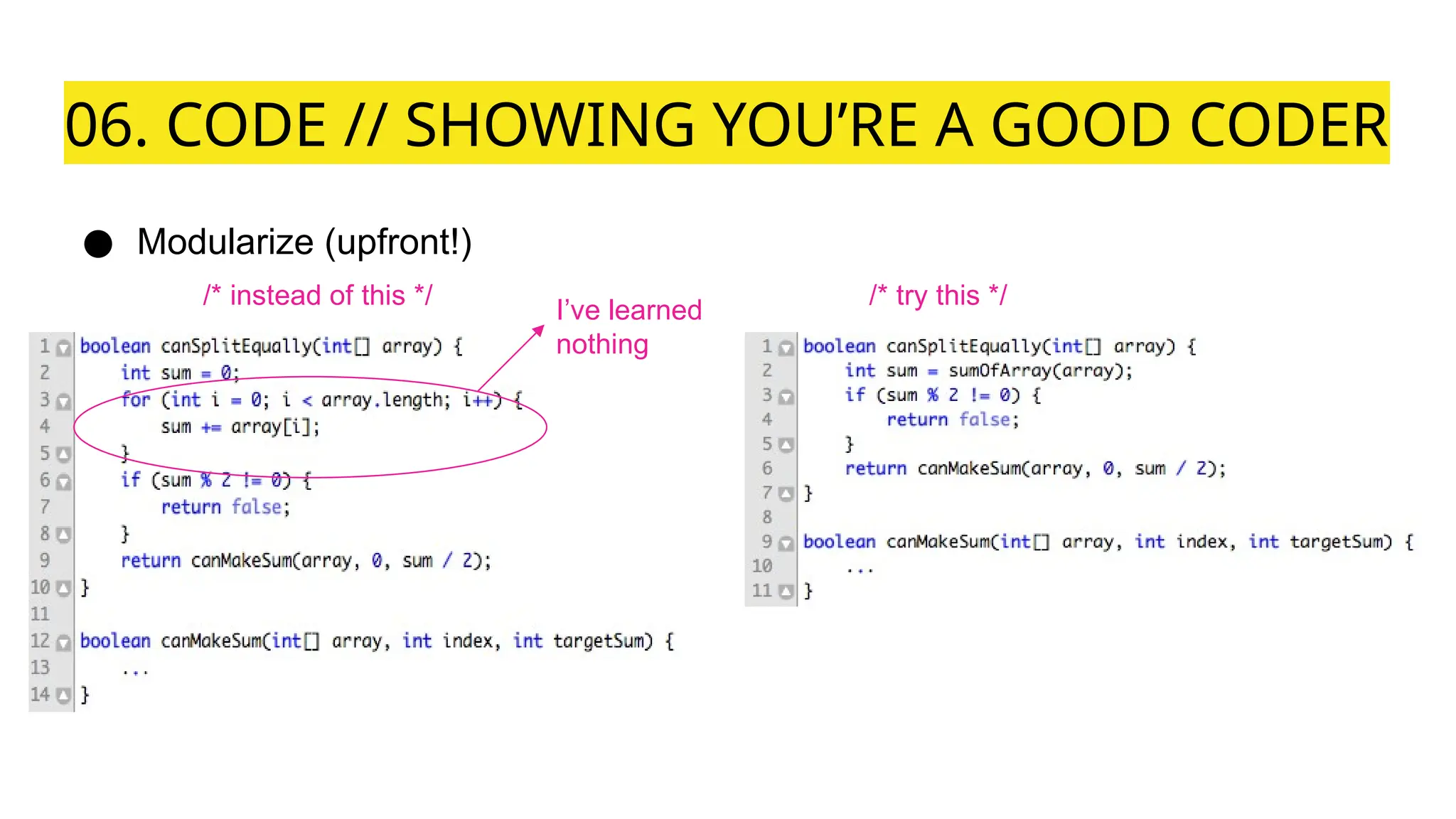
● Modularize (upfront!)
/* instead of this */ /* try this */
I’ve learned
nothing
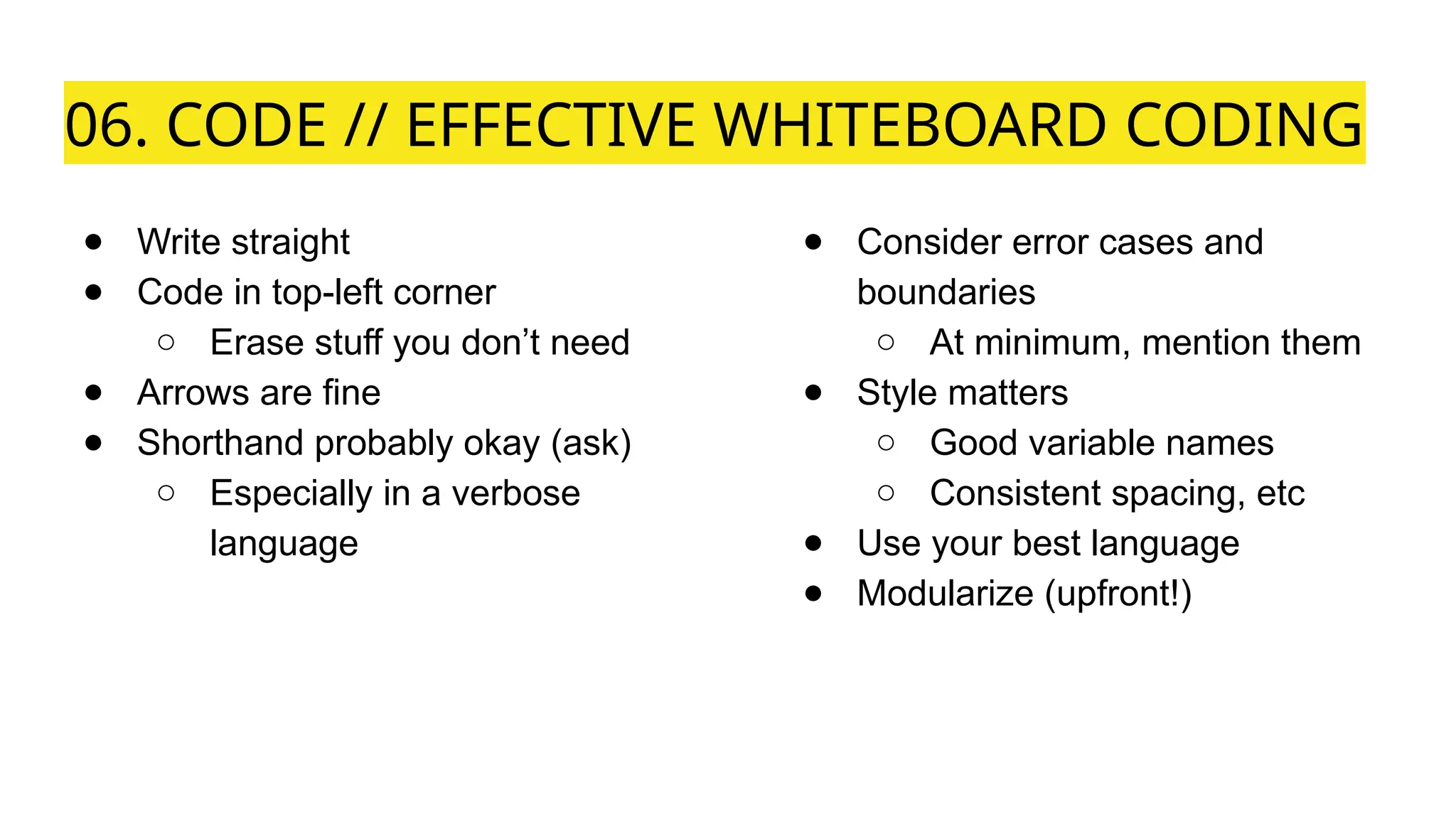
06. CODE // EFFECTIVE WHITEBOARD CODING
● Write straight
● Code in top-left corner
○ Erase stuff you don’t need
● Arrows are fine
● Shorthand probably okay (ask)
○ Especially in a verbose
language
● Consider error cases and
boundaries
○ At minimum, mention them
● Style matters
○ Good variable names
○ Consistent spacing, etc
● Use your best language
● Modularize (upfront!)
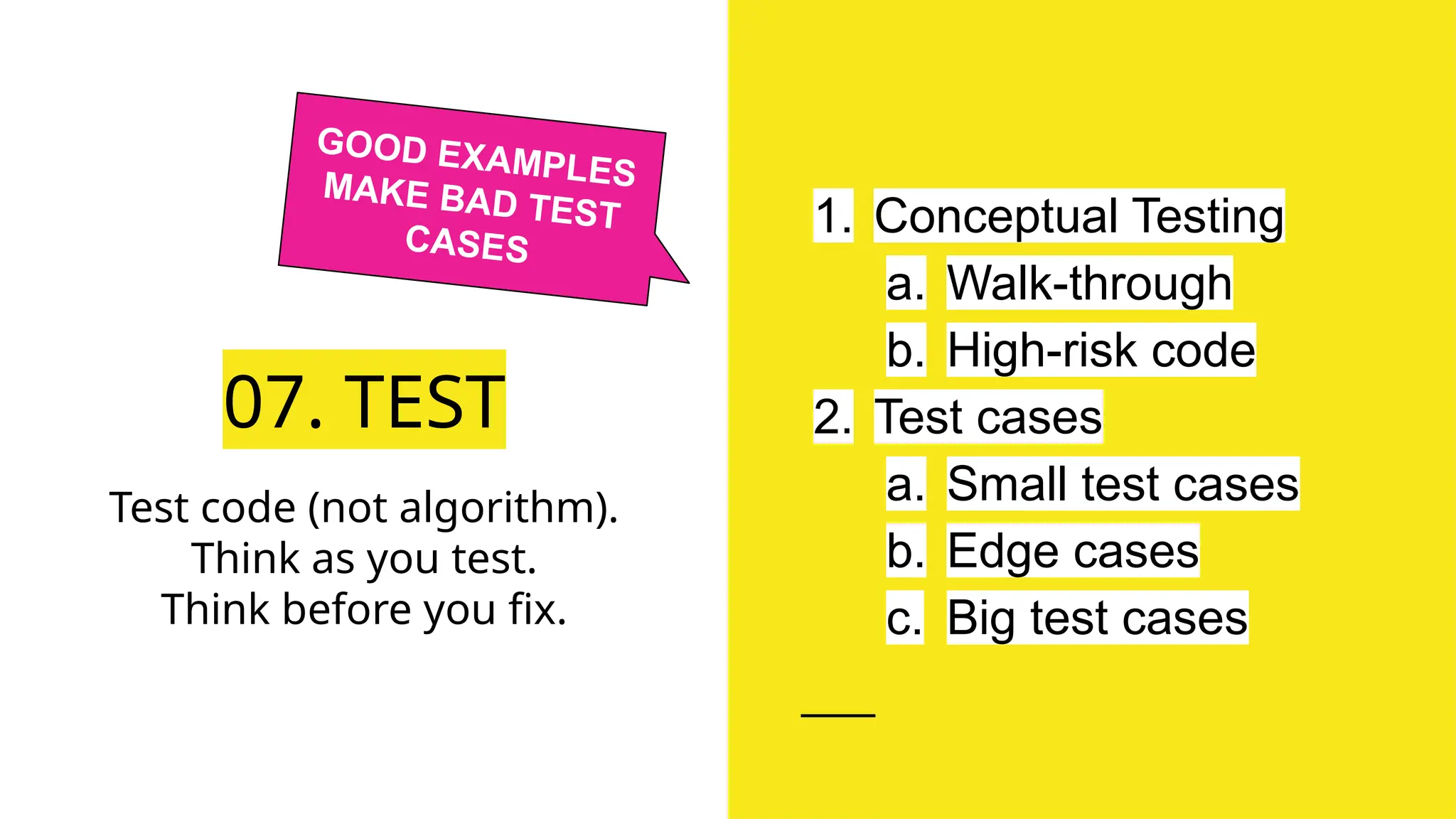
07. TEST
1. Conceptual Testing
a. Walk-through
b. High-risk code
2. Test cases
a. Small test cases
b. Edge cases
c. Big test cases
Test code (not algorithm).
Think as you test.
Think before you fix.
GOOD EXAMPLES
MAKE BAD TEST
CASES
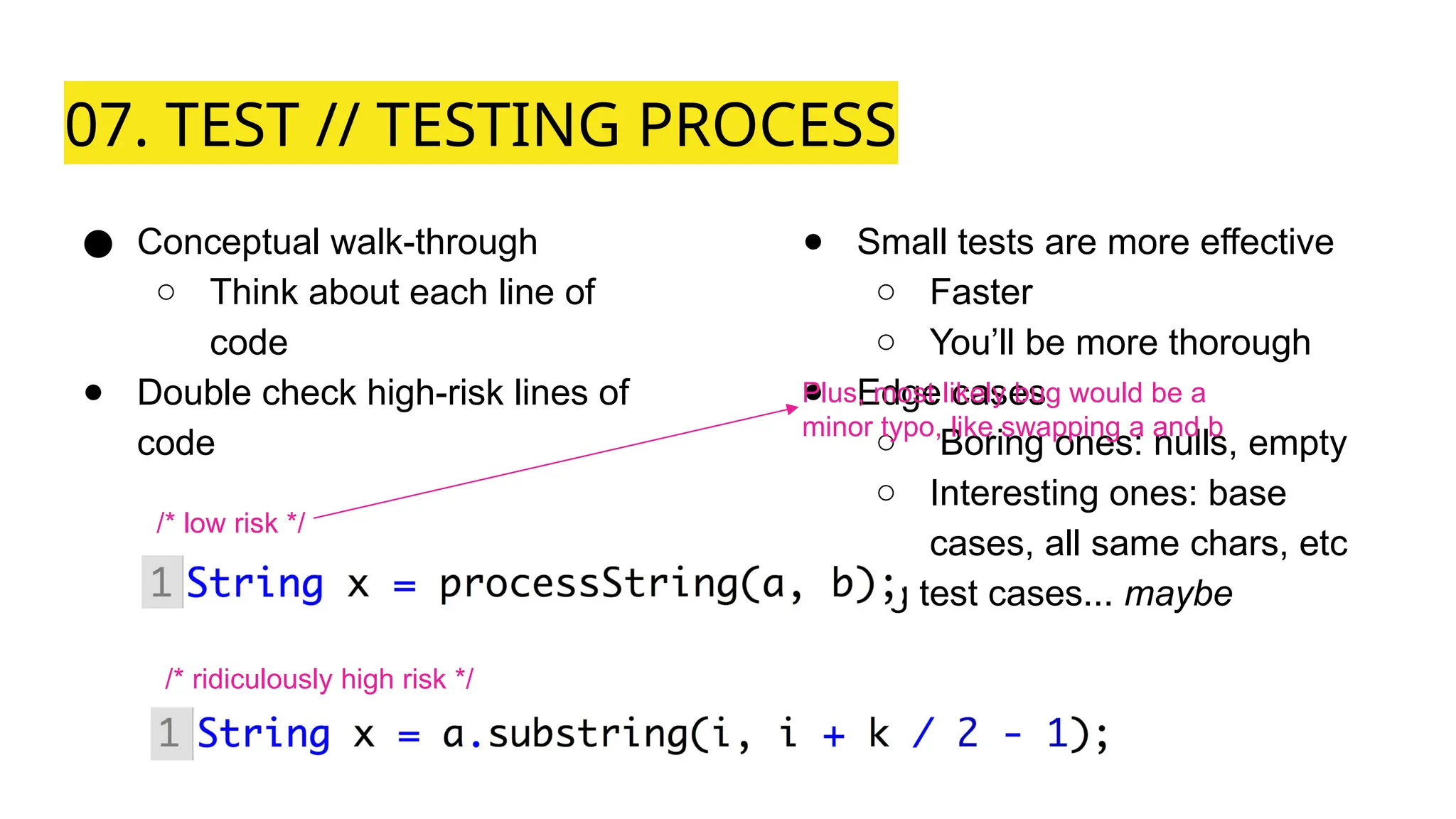
07. TEST // TESTING PROCESS
● Conceptual walk-through
○ Think about each line of
code
● Double check high-risk lines of
code
● Small tests are more effective
○ Faster
○ You’ll be more thorough
● Edge cases
○ Boring ones: nulls, empty
○ Interesting ones: base
cases, all same chars, etc
● Big test cases... maybe
/* low risk */
/* ridiculously high risk */
Plus, most likely bug would be a
minor typo, like swapping a and b
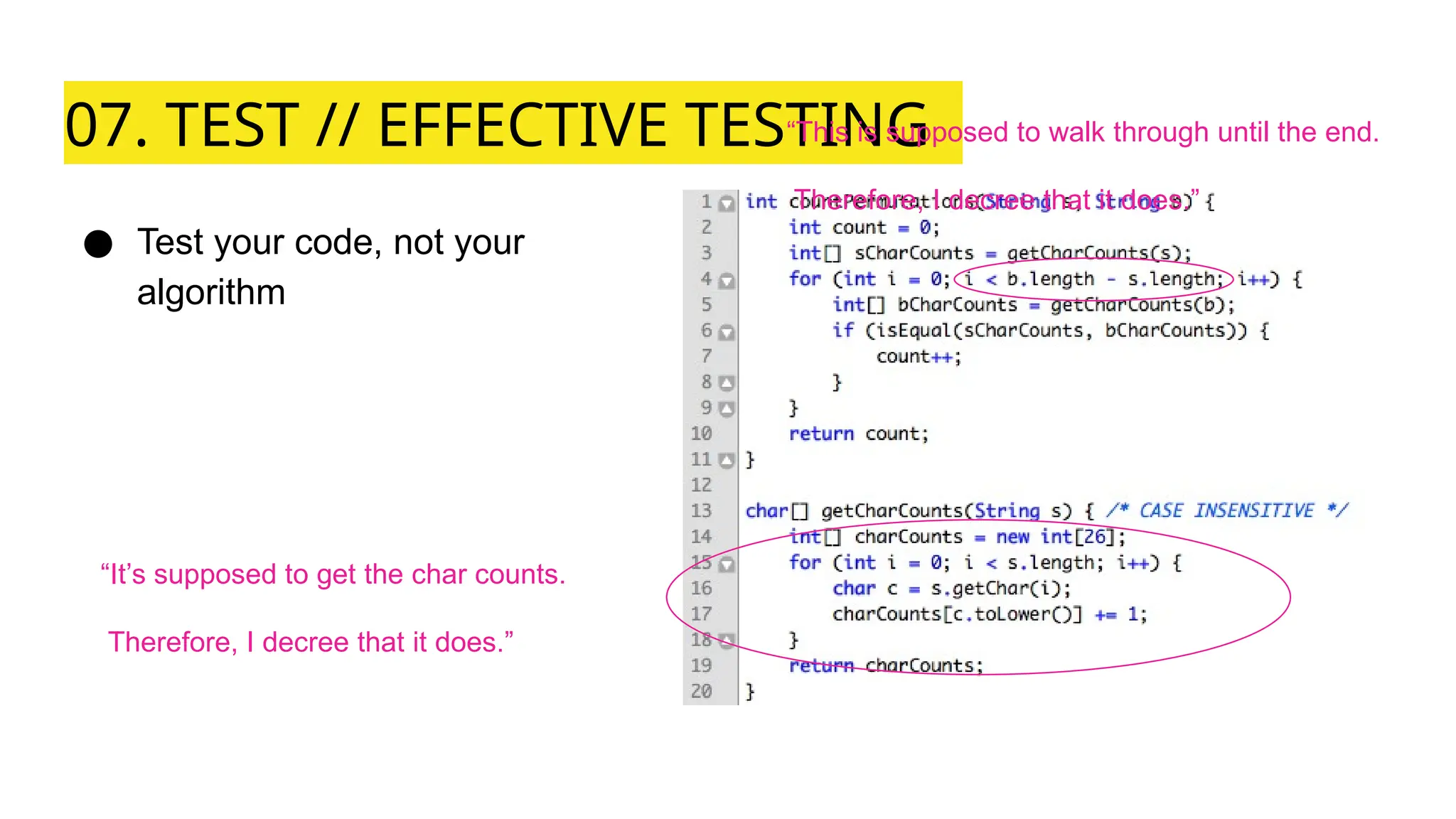
07. TEST // EFFECTIVE TESTING
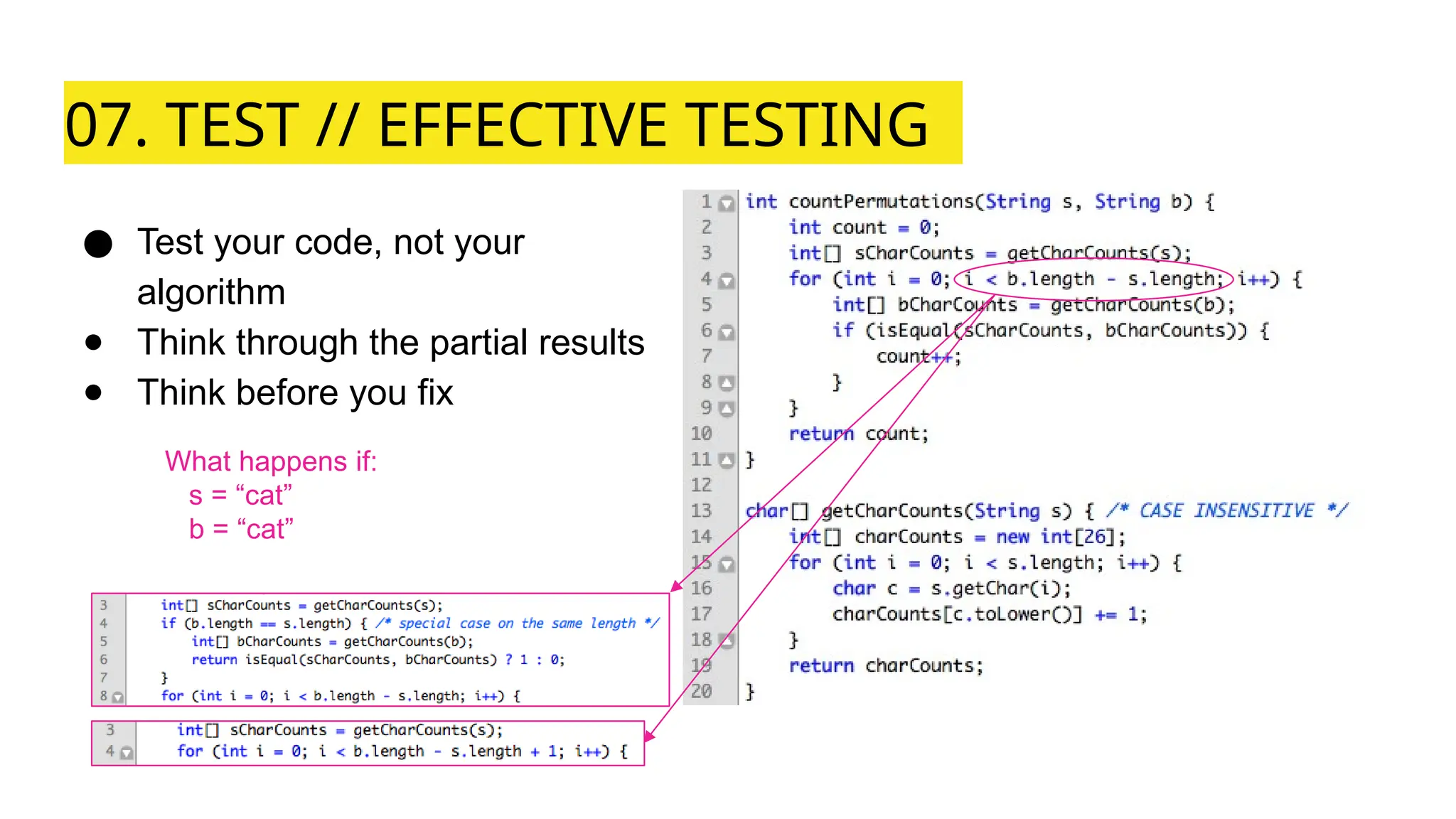
● Test your code, not your
algorithm
“It’s supposed to get the char counts.
Therefore, I decree that it does.”
“This is supposed to walk through until the end.
Therefore, I decree that it does.”
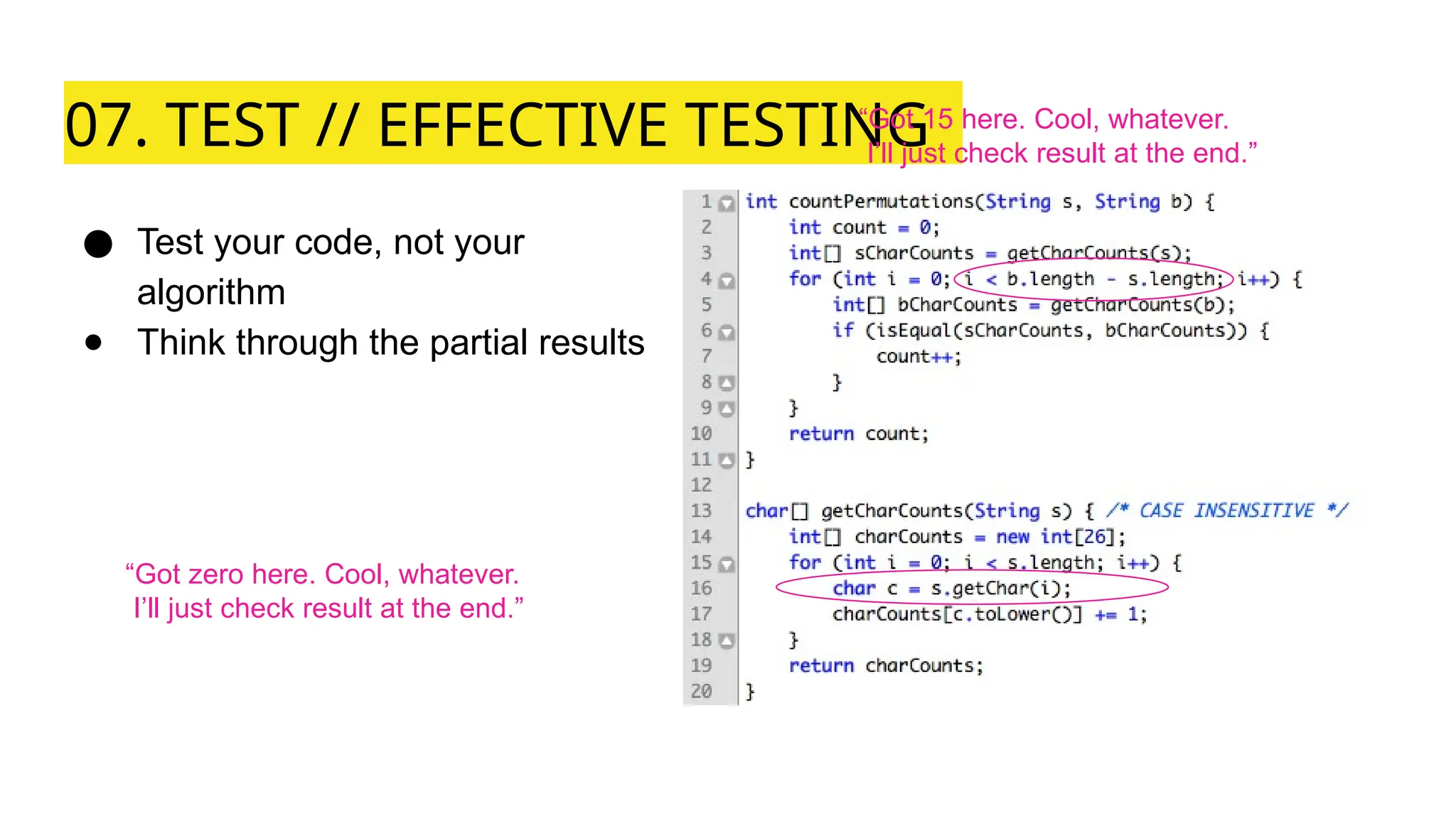
07. TEST // EFFECTIVE TESTING
● Test your code, not your
algorithm
● Think through the partial results
“Got zero here. Cool, whatever.
I’ll just check result at the end.”
“Got 15 here. Cool, whatever.
I’ll just check result at the end.”
07. TEST // EFFECTIVE TESTING
● Test your code, not your
algorithm
● Think through the partial results
● Think before you fix
What happens if:
s = “cat”
b = “cat”
07. TEST // EFFECTIVE TESTING
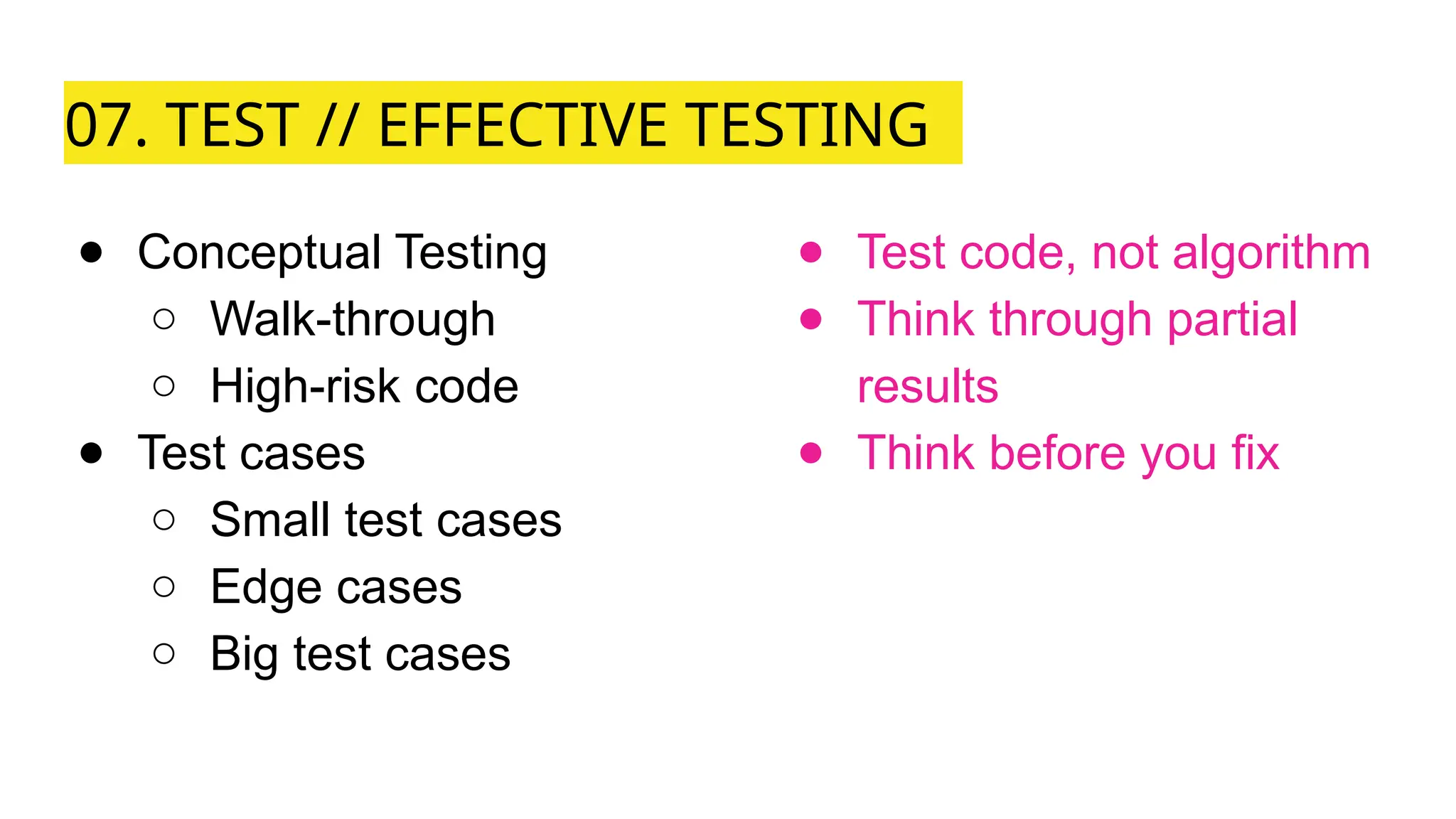
● Conceptual Testing
○ Walk-through
○ High-risk code
● Test cases
○ Small test cases
○ Edge cases
○ Big test cases
● Test code, not algorithm
● Think through partial
results
● Think before you fix
gayle@gayle.com
subject: fbprep
CrackingTheCodingInterview.com
→ Resources
If You Forget Everything
Else
gayle@gayle.com
subject: fbprep
07. TEST // EFFECTIVE TESTING
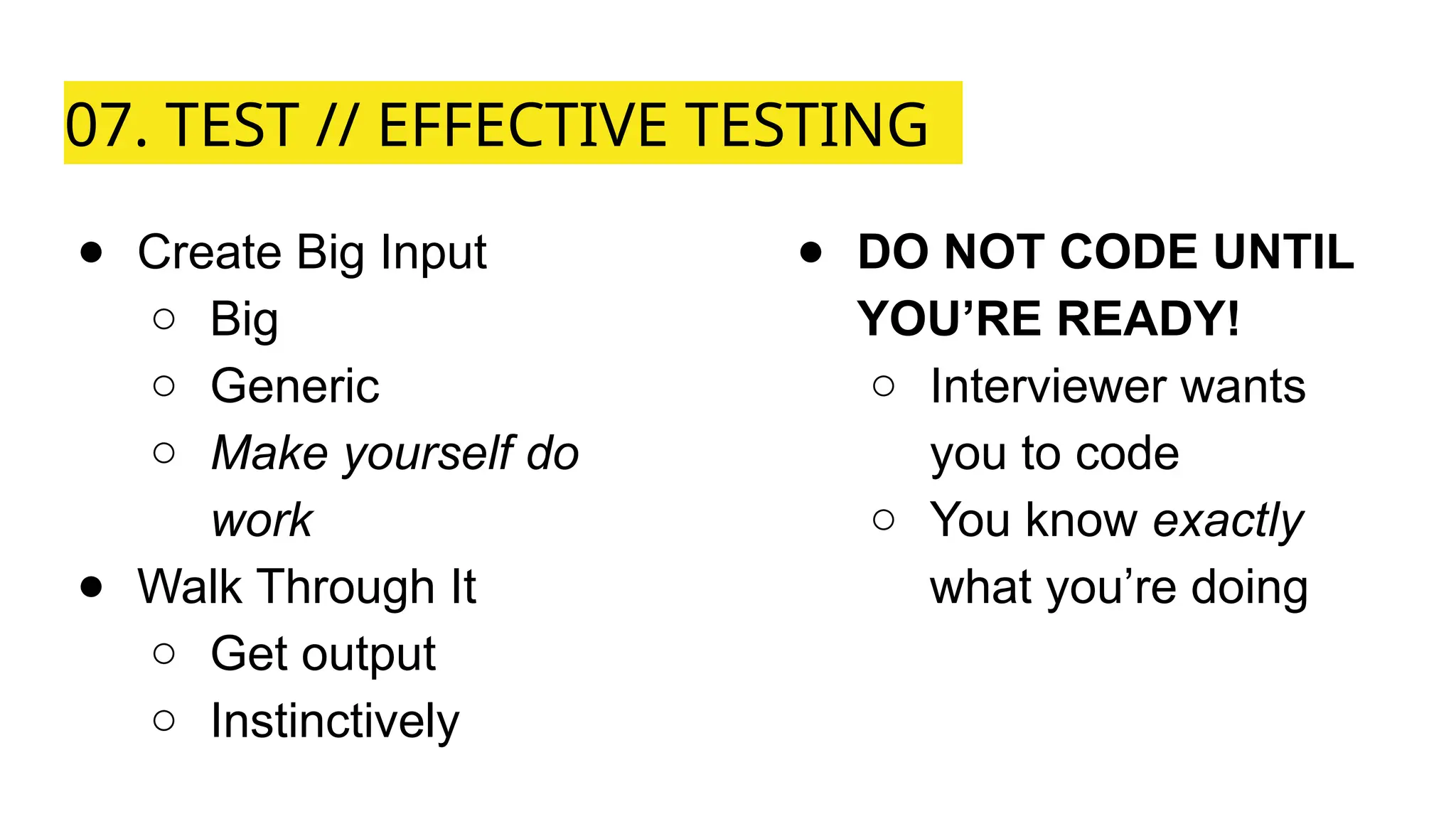
● Create Big Input
○ Big
○ Generic
○ Make yourself do
work
● Walk Through It
○ Get output
○ Instinctively
● DO NOT CODE UNTIL
YOU’RE READY!
○ Interviewer wants
you to code
○ You know exactly
what you’re doing
Questions For Interviewer
gayle@gayle.com
subject: fbprep
Don’t sweat this.
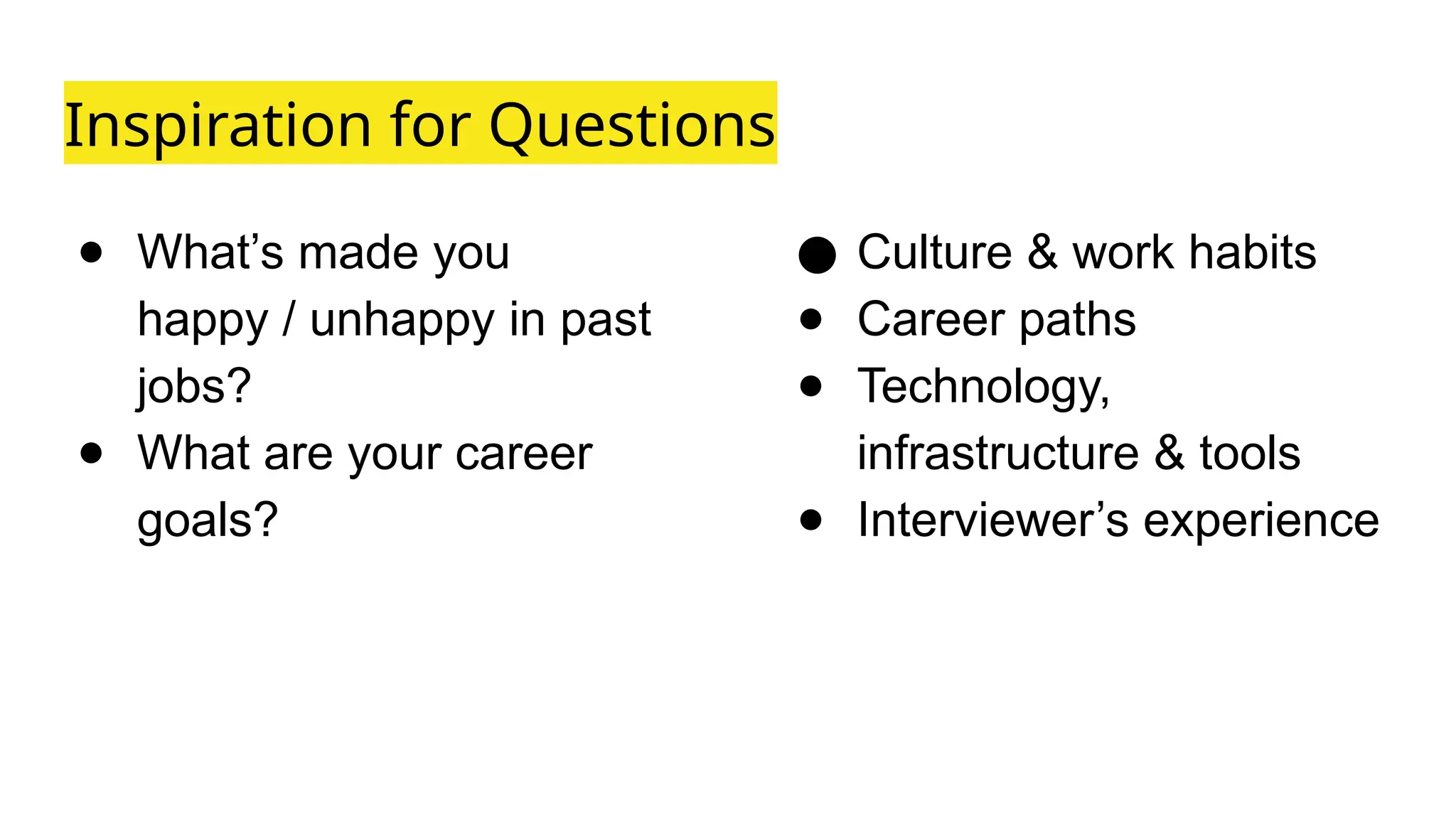
Inspiration for Questions
● What’s made you
happy / unhappy in past
jobs?
● What are your career
goals?
● Culture & work habits
● Career paths
● Technology,
infrastructure & tools
● Interviewer’s experience
Final Thoughts
gayle@gayle.com
subject: fbprep
Great Engineer
&
Great Teammate
Your perception is not
predictive of performance
Just keep
working at it.
Little Things
● Survey?
○ Coming soon
● Ready?
○ Follow up with
recruiter
● Job postings?
facebook.com/careers/teams/engineering
● Slides?
○ Gayle.com → Events
→ Facebook
gayle@gayle.com
subject: fbprep
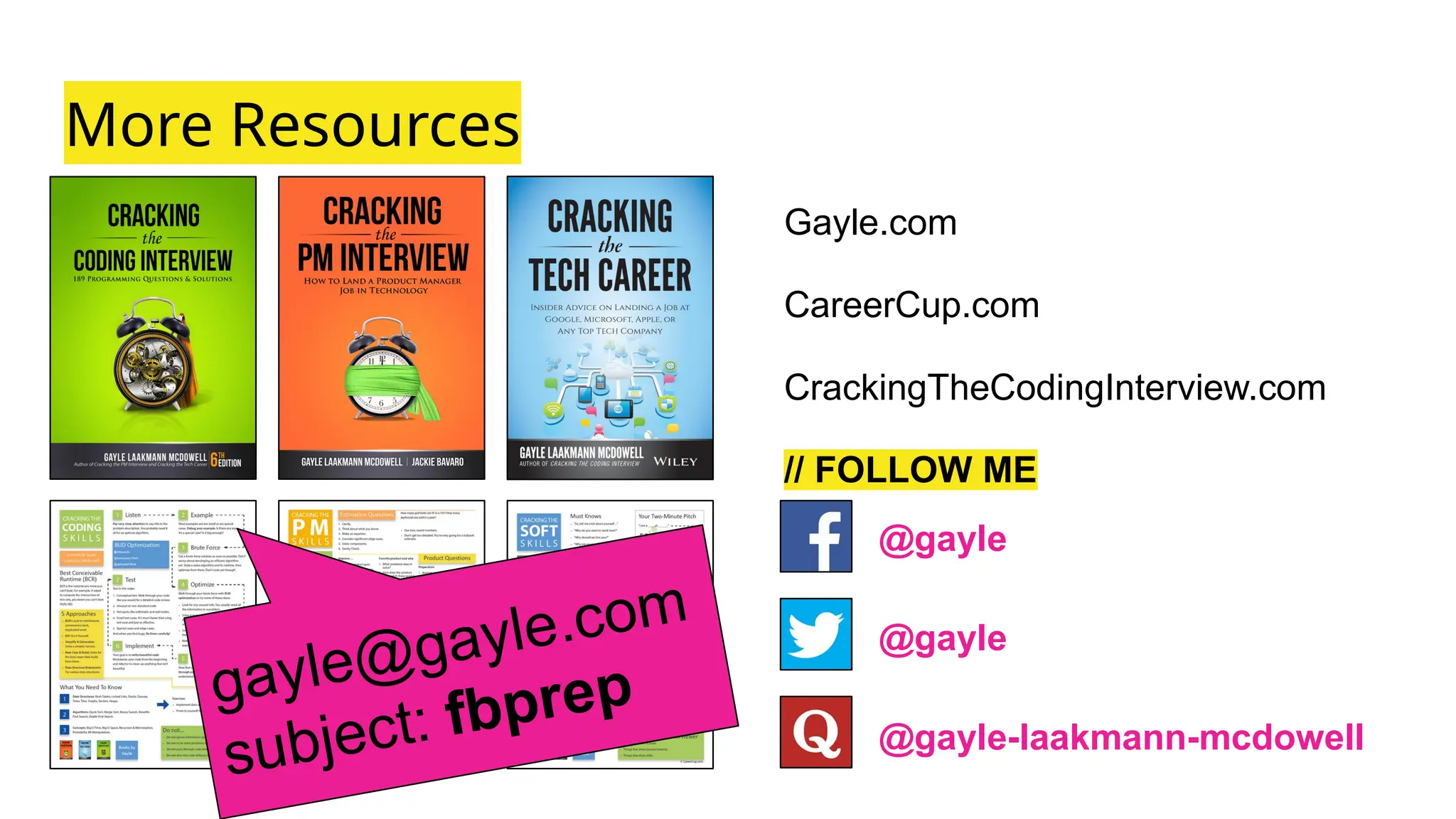
More Resources
Gayle.com
CareerCup.com
CrackingTheCodingInterview.com
// FOLLOW ME
gayle@gayle.com
subject: fbprep
@gayle
@gayle
@gayle-laakmann-mcdowell

Cracking the Facebook Coding Interview.pptx

  • 1.
    While you wait…find Big O of these: #1 #2 #3 #4 #5 #6 #7 Q5: Given list of people with birth years and death years (so population changes over time), find highest population. 1. Get last death year. 2. Create histogram from 0 → last death year (this will end up giving us population at each year). a. Walks through all people i. For each person, increment histogram for each year they were alive. 3. Walk through histogram to get highest population. Yes, this is hard to read. Go here: bit.ly/fbprepbigo (can be easily viewed on a phone too) We’ll talk about the answers later. But seriously, use this link: bit.ly/fbprepbigo
  • 2.
    Cracking the FACEBOOK CodingInterview Gayle Laakmann McDowell
  • 3.
    why am Ihere gayle@gayle.com subject: fbprep
  • 4.
  • 5.
    Hi! I’m GayleLaakmann McDowell Author Acquisition Interview Coaching <dev> </dev> (CS) (MBA ) Hiring Consultant / Interview Training
  • 6.
    Yes! Slides areonline! ● Gayle.com > Events > Facebook gayle@gayle.com subject: fbprep
  • 7.
  • 8.
    ONSITE INTERVIEWS PHONE INTERVIEWS behavioral+ algorithms/coding the typical process (not universal!) algorithms/coding algorithms/coding behavioral + algorithms/coding design
  • 9.
  • 10.
  • 11.
  • 12.
    So, walk methrough your resume... ● “I’m a <title> at <company> ● I studied at … ● And then I … ● At my current company, I … ● On the side, I… <hobbies>” Not too long! Shows of success Prompt the interviewer Hobbies
  • 13.
    Past Projects ● 3+projects ○ Hard / cool ○ You were central ● TECHNICAL Challenges, architecture, technologies, etc ● SOFT Leadership, conflicts, decisions, etc
  • 14.
    what did youdo? (not your team)
  • 15.
    what are youtrying to say? (the message)
  • 16.
  • 17.
    how to tackle (it’snot that scary!) W W Y D A W
  • 18.
    how to tackle (it’snot that scary!) What Would You Do At Work
  • 19.
    the process -SKIR ● SCOPE ask questions & make assumptions ● KEY COMPONENTS use the whiteboard! ● IDENTIFY ISSUES Bottlenecks, tradeoffs, ... ● REPAIR breadth-first not depth-first
  • 21.
  • 22.
    a collaborative discussion (butone that you are driving)
  • 23.
  • 24.
    ● Read about architecture ●Use friends at startups ● Know key concepts ● Practice back-of-the- envelope calculations How to prepare
  • 25.
  • 26.
    ● Analytical skills/ problem-solving skills ● How you think ● Ability to make tradeoffs ● Communication What the interviewer is looking for ● Willingness to push through hard problems ● Strong CS fundamentals ○ CS degree not required
  • 27.
    CS degree isnot required (or even that important)

  • 28.
    Essential CS Knowledge DATASTRUCTURES ALGORITHMS CONCEPTS ArrayLists Merge Sort Big-O Time Hash Tables Quick Sort Big-O Space Trees, Tries & Graphs Breadth-First Search Recursion Linked Lists Depth-First Search Memoization & Dynamic Programming Stacks / Queues Binary Search Heaps Often not covered in algorithms class! The concept/process, not specific famous problems
  • 29.
    How to Prepare 1.MASTER Big O 2. Implement core data structures & algorithms 3. Practice on real interview questions 4. Code by hand (paper, whiteboard, window/dry-erase) 5. Mock interviews PUSH YOURSELF!
  • 30.
    big O crashcourse gayle@gayle.com subject: fbprep
  • 31.
  • 32.
    02. MIN ANDMAX → O(N) DROP CONSTANTS 87%
  • 33.
    03. NESTED WITHTWO ARRAYS → O(A * B) USE LOGICAL VARIABLE NAMES 45%
  • 34.
    04. NESTED WITHJ STARTING AT I → O(N2 ) j : 0 → N i : 0 → N x x x x x x x x x x x x x x x x x x x x x 73%
  • 35.
    05. MAX POPULATION Step1: O(P) P = # people Step 2: O(P*Y) Y = max life span Step 3: O(L) L = last death year → O(P + P*Y + L) → O(P*Y + L) 5%
  • 36.
  • 37.
  • 38.
    f(6) f(5) f(3) f(4) f(3) f(2) f(2) f(1) f(1)f(0) f(4) f(1) f(0) f(2) f(1) f(0) f(1) f(3) f(2) f(2) f(1) f(1) f(0) f(1) f(0) ● N levels in tree ● 2 children per node → # nodes doubles at each level ● # nodes = 1 * 2 * 2 * … * 2 = Time: O(2N ) ** Space: O(N) ** actually slightly less for complex math reasons 54%
  • 39.
  • 40.
    f(6) f(5) f(3) f(4) f(3) f(2) f(2) f(1) f(1)f(0) f(4) ● N levels in tree ● 2 children per level ● # nodes = 1 + 2 + 2 + … + 2 = Time: O(N) Space: O(N) 59%
  • 41.
    REMINDERS ● Drop constants ○But careful about dropping other stuff ● Use other variables ○ But avoid throwing around N ● Careful for add vs. multiply ● Recursion → call tree ○ Especially with multiple branches! WHEN IN DOUBT, WALK THROUGH YOUR CODE 2%
  • 42.
  • 43.
    Non- Expectations More perfect isbetter than less perfect… … but perfect doesn’t really happen ● Knowing the answers ● Solving immediately ● Perfect coding
  • 44.
    Evaluation & Expectations ●Thought process ○ (Not minutes to optimal answer) ● Real code ○ (Not pseudocode)
  • 45.
    It’s about signal,not perfection ● Incorrect and not worrisome: ● Incorrect and worrisome: Assuming actual confusion, not a typo
  • 46.
    Quick tips todo well ● Drive! ○ Lead the problem solving ○ More than just “correct” ○ Even when you’re stuck ● Show me your thought process ● Pay attention to meeeeeeee! ○ I might help you. Make sure you use that help.
  • 47.
  • 48.
  • 49.
    (no, seriously, followit!) gayle@gayle.com subject: fbprep CrackingTheCodingInterview.com → Resources
  • 50.
  • 51.
    1.LISTEN (for clues) Given twoarrays that are sorted and distinct, find the number of elements in common.
  • 52.
    1.LISTEN (for clues) Given twoarrays that are sorted and distinct, find the number of elements in common. WHY?
  • 53.
    1.LISTEN (for clues) Given alist of valid English words, build an anagram server that can spit out all the anagrams of a word (anagram = permutation that is also valid word) rates = aster, stare, tears, tares, taser
  • 54.
    1.LISTEN (for clues) Given alist of valid English words, build an anagram server that can spits out all the anagrams of a word What does a server let us do? aerst → aster, stare, taser, tares, tears, rates dgo → dog, god aeelps → please, elapse, asleep ... ... ● Caching? ● Database? ● Precomputation?
  • 55.
    02. DRAW ANEXAMPLE
  • 56.
    02. EXAMPLE Given twoarrays that are sorted and distinct, find the number of elements in common.
  • 57.
    02. EXAMPLES //BAD VS. GOOD A: [1, 12, 15, 19] B: [2, 12, 13, 20] A: [1, 12, 15, 19, 20, 21] B: [2, 15, 17, 19, 21, 25, 27] too small special case-y Makes you work for it
  • 58.
    02. EXAMPLE Make yourexamples large and avoid special cases! BIG & GENERIC SOMETHING THAT MAKES YOU WORK
  • 59.
  • 60.
    03. BRUTE FORCE Slow &terrible > nothing ● Explain the best algorithm you have (even slow and stupid) ● State runtime ● Optimize! DON’T CODE!
  • 61.
  • 62.
    04. OPTIMIZE expect tomaybe spend a while here ● BUD ● Space & Time ● Do It Yourself ● Recursion KEEP WORKING
  • 63.
  • 64.
    4a. (B)UD //BOTTLENECKS Given two arrays that are sorted and distinct, find the number of elements in common. [1, 12, 15, 19, 20, 21] [2, 15, 17, 19, 21, 25, 27] ● Brute Force: O(A*B) ● Binary Search: O(A log B) ● Hash Set: O(A + B) ○ But O(B) space ● Sorted Merge: ○ O(A+B) time ○ O(1) space
  • 65.
    4a. B(U)D //UNNECESSARY WORK Find all solutions to a3 + b3 = c3 + d3 where 1 <= a, b, c, d < n
  • 66.
    4a. B(U)D //UNNECESSARY WORK All solutions to a3 + b3 = c3 + d3 break;
  • 67.
    4a. B(U)D //UNNECESSARY WORK Find d in 43 + 323 = 183 + d3 d3 = 43 + 323 - 183 d = (43 + 323 - 183 )⅓ d = 30
  • 68.
    4a. B(U)D //UNNECESSARY WORK All solutions to a3 + b3 = c3 + d3
  • 69.
    4a. BU(D) //DUPLICATED WORK All solutions to a3 + b3 = c3 + d3
  • 70.
    4a. BU(D) //DUPLICATED WORK All solutions to a3 + b3 = c3 + d3
  • 71.
    4a. BU(D) //DUPLICATED WORK a3 + b3 = c3 + d3 c d c3 + d3 … … … 4 31 29855 4 32 32832 4 33 36001 … … … 18 29 30221 18 30 32832 18 31 35623 … … …
  • 72.
    4a. BU(D) //DUPLICATED WORK a3 + b3 = c3 + d3 c3 + d3 → (c, d) … → … 29855 → (4, 31) 32832 → (4, 32), (18, 30) 36001 → (4, 33) … … 216125 → (5, 60), (45, 50) 227106 → (5, 61) … → …
  • 73.
    4a. BU(D) //DUPLICATED WORK
  • 74.
    4b. Space /Time Tradeoffs ● Hashtables ● Other data structures ○ Tries, graphs, heaps, etc ● Precomputation ○ & Reorganizing input
  • 75.
    4c. Do ItYourself (DIY) Given two strings, s and b, find all permutations of s within b
  • 76.
    s = abbcd b= b a b c d b a e f d b b a c b d d f a e 0 1 2 3 4 5 6 7 8 9 10 11 12 13 14 15 16 17 18 19
  • 77.
    s = abbcd b= b a b c d b a e f d b b a c b d d f a e 0 1 2 3 4 5 6 7 8 9 10 11 12 13 14 15 16 17 18 19
  • 78.
    s = abbcd b= b a b c d b a e f d b b a c b d d f a e 0 1 2 3 4 5 6 7 8 9 10 11 12 13 14 15 16 17 18 19
  • 79.
    4c. Do ItYourself 1. Create nice big example input ○ Remember step 2! BIG & GENERIC ○ Something that makes you WORK 2. Get the output *instinctively* ○ Like you would if you’d never coded ever ○ Forget about computer science, interviews, algorithms, etc 3. Reverse engineer your thought process ○ What exactly did you do? ○ Pay attention to the little optimizations 4. Translate into algorithm
  • 80.
    s = abbcd b= b a b c d b a e f d b b a c b d d f a e 0 1 2 3 4 5 6 7 8 9 10 11 12 13 14 15 16 17 18 19
  • 81.
    4d. Recursion ● Userecursion instinct, but don’t cling to it ● Try bottom-up ○ Subsets ■ Base cases: {} → {} {a} → {}, {a} {a, b} → {}, {a}, {b}, {a, b} ■ Build up: {a, b, c} → … {a, b, c, d} → ... ● Backtracking → recursion ● Multi-branch? Draw call-tree ○ Get (exponential?) runtime ○ Find repeated problems ○ Memoize
  • 82.
    04. OPTIMIZE expect tomaybe spend a while here ● BUD ● Space & Time ● Do It Yourself ● Recursion KEEP WORKING
  • 83.
    Your perception isnot predictive of performance
  • 84.
    05. WALK THROUGH Take thetime to deeply understand your algorithm ● What variables / data structures ● How do they change ● How is your code structured Rushing wastes time. Can you picture your code?
  • 85.
    06. CODE ● Correctness ●Readability ● Maintainability ● Performance Code beautifully Not just correctly Show me you’re a great coder
  • 86.
    06. CODE //MAKING YOUR LIFE EASIER ● Write straight boolean iAmAwesome(Person p) { if (p == this) { // Only me return true; } else { return false; } return false; /* TODO: find more concise way of * coding this. */ } boolean iAmAwesome(Person p) { if (p == this) { // Only me return true; } else { return false; } return false; /* TODO: find more concise way of * coding this. */ } // BAD // GOOD
  • 87.
    06. CODE //MAKING YOUR LIFE EASIER ● Write straight ● Code in top-left corner ○ Get rid of stuff in your way boolean iAmAwesome(Person p) { if (p == this) { // Only me return true; } else { return false; } return false; /* TODO: find more concise way of * coding this. */ } boolean iAmAwesome(Person p) { if (p == this) { // Only me return true; } else { return false; } return false; /* TODO: find more concise way of * coding this. */ } // BAD // GOOD
  • 88.
    06. CODE //MAKING YOUR LIFE EASIER ● Write straight ● Code in top-left corner ○ Get rid of stuff in your way ● Arrows are fine boolean iAmAwesome(Person p) { if (p == this) { // Only me return true; } if (p == you) { // Yuck return false; // you wish } if (p == someoneElse) { // FINE for (Person o : coolPeople) { if (p == o) { return true; } } return false; }
  • 89.
    06. CODE //MAKING YOUR LIFE EASIER ● Write straight ● Code in top-left corner ○ Get rid of stuff in your way ● Arrows are fine ● Shorthand probably okay ○ (But ask first) /* instead of this */ /* try this */
  • 90.
    06. CODE //SHOWING YOU’RE A GOOD CODER ● Yes, consider error cases, boundary checks, etc ○ (Shorthand might be useful) ○ At least discuss! /* instead of this */ /* try this */
  • 91.
    06. CODE //SHOWING YOU’RE A GOOD CODER ● Yes, style matters (even on a whiteboard!) ○ Good variable names ○ Consistent spacing /* instead of this */ /* try this */ ADHERE TO A STYLE GUIDELINE
  • 92.
    06. CODE //SHOWING YOU’RE A GOOD CODER ● Languages ○ Specialists? Use that one. ○ Everyone else? Use your best one. Advantages Disadvantages Mitigation Java, Objective C Verbose Fewer built-in Use shorthand Modularize Ruby, Python, JS Built-in functions … those aren’t always O(1) Just be careful C Many fewer built-ins Modularize
  • 93.
    06. CODE //SHOWING YOU’RE A GOOD CODER ● Modularize (upfront!) /* instead of this */ /* try this */
  • 94.
    06. CODE //SHOWING YOU’RE A GOOD CODER ● Modularize (upfront!) /* instead of this */ /* try this */ I’ve learned nothing
  • 95.
    06. CODE //EFFECTIVE WHITEBOARD CODING ● Write straight ● Code in top-left corner ○ Erase stuff you don’t need ● Arrows are fine ● Shorthand probably okay (ask) ○ Especially in a verbose language ● Consider error cases and boundaries ○ At minimum, mention them ● Style matters ○ Good variable names ○ Consistent spacing, etc ● Use your best language ● Modularize (upfront!)
  • 96.
    07. TEST 1. ConceptualTesting a. Walk-through b. High-risk code 2. Test cases a. Small test cases b. Edge cases c. Big test cases Test code (not algorithm). Think as you test. Think before you fix. GOOD EXAMPLES MAKE BAD TEST CASES
  • 97.
    07. TEST //TESTING PROCESS ● Conceptual walk-through ○ Think about each line of code ● Double check high-risk lines of code ● Small tests are more effective ○ Faster ○ You’ll be more thorough ● Edge cases ○ Boring ones: nulls, empty ○ Interesting ones: base cases, all same chars, etc ● Big test cases... maybe /* low risk */ /* ridiculously high risk */ Plus, most likely bug would be a minor typo, like swapping a and b
  • 98.
    07. TEST //EFFECTIVE TESTING ● Test your code, not your algorithm “It’s supposed to get the char counts. Therefore, I decree that it does.” “This is supposed to walk through until the end. Therefore, I decree that it does.”
  • 99.
    07. TEST //EFFECTIVE TESTING ● Test your code, not your algorithm ● Think through the partial results “Got zero here. Cool, whatever. I’ll just check result at the end.” “Got 15 here. Cool, whatever. I’ll just check result at the end.”
  • 100.
    07. TEST //EFFECTIVE TESTING ● Test your code, not your algorithm ● Think through the partial results ● Think before you fix What happens if: s = “cat” b = “cat”
  • 101.
    07. TEST //EFFECTIVE TESTING ● Conceptual Testing ○ Walk-through ○ High-risk code ● Test cases ○ Small test cases ○ Edge cases ○ Big test cases ● Test code, not algorithm ● Think through partial results ● Think before you fix
  • 102.
  • 103.
    If You ForgetEverything Else gayle@gayle.com subject: fbprep
  • 104.
    07. TEST //EFFECTIVE TESTING ● Create Big Input ○ Big ○ Generic ○ Make yourself do work ● Walk Through It ○ Get output ○ Instinctively ● DO NOT CODE UNTIL YOU’RE READY! ○ Interviewer wants you to code ○ You know exactly what you’re doing
  • 105.
  • 106.
  • 107.
    Inspiration for Questions ●What’s made you happy / unhappy in past jobs? ● What are your career goals? ● Culture & work habits ● Career paths ● Technology, infrastructure & tools ● Interviewer’s experience
  • 108.
  • 109.
  • 110.
    Your perception isnot predictive of performance Just keep working at it.
  • 111.
    Little Things ● Survey? ○Coming soon ● Ready? ○ Follow up with recruiter ● Job postings? facebook.com/careers/teams/engineering ● Slides? ○ Gayle.com → Events → Facebook gayle@gayle.com subject: fbprep
  • 112.
    More Resources Gayle.com CareerCup.com CrackingTheCodingInterview.com // FOLLOWME gayle@gayle.com subject: fbprep @gayle @gayle @gayle-laakmann-mcdowell