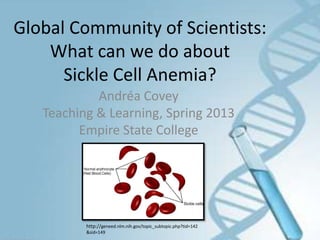
Global Community of Scientists:
    What can we do about
      Sickle Cell Anemia?
            Andréa Covey
   Teaching & Learning, Spring 2013
         Empire State College


          http://geneed.nlm.nih.gov/topic_subtopic.php?tid=142
          &sid=149
Students demonstrate learning in multiple content areas and
       recognize the connections between concepts.


                             Circulatory
                               System


                Ethics &
                                              Homeostasis
              Applications    Sickle
                               Cell
                             Anemia

                     Evolution             Genetics
Key activities
1. “Mystery of the crooked cell”
   activity – narrative kickoff
  – Students must hypothesize the cause
    of a “mystery disease” using a case
    study and four lab stations            https://www.23andme.com/health/Sick
                                           le-Cell-Anemia-Malaria-Resistance/

2. WHO Summit – narrative
   conclusion
  – Students present as “top scientists”
    from around the globe on the state
    of the disease in their
    country, examples of educational
    fliers about the disease, and an
    experiment they designed to test the
    effectiveness of their educational
    campaign
Why it’s engaging
                Real
               world
               issue
                           Science
Work as
                             and
a team
                           Society
              Sickle
               Cell
             Anemia
                           Humans
Acting as
Scientists                 Helping
                           Humans

              Developing
                original
              hypotheses

Covey narrative sca

  • 1.
    Global Community ofScientists: What can we do about Sickle Cell Anemia? Andréa Covey Teaching & Learning, Spring 2013 Empire State College http://geneed.nlm.nih.gov/topic_subtopic.php?tid=142 &sid=149
  • 2.
    Students demonstrate learningin multiple content areas and recognize the connections between concepts. Circulatory System Ethics & Homeostasis Applications Sickle Cell Anemia Evolution Genetics
  • 3.
    Key activities 1. “Mysteryof the crooked cell” activity – narrative kickoff – Students must hypothesize the cause of a “mystery disease” using a case study and four lab stations https://www.23andme.com/health/Sick le-Cell-Anemia-Malaria-Resistance/ 2. WHO Summit – narrative conclusion – Students present as “top scientists” from around the globe on the state of the disease in their country, examples of educational fliers about the disease, and an experiment they designed to test the effectiveness of their educational campaign
  • 4.
    Why it’s engaging Real world issue Science Work as and a team Society Sickle Cell Anemia Humans Acting as Scientists Helping Humans Developing original hypotheses

Editor's Notes

  • #2 The “Global Community of Scientists” theme is one that I could use all year, with different narratives (scientific tasks/goals) used for specific units (or several units). I am thinking about using it with high school students, but it could definitely be modified for middle school students. I think it would be a great way to simulate worldwide scientific collaboration, the scientific process, and the nature of science (all aspects of the Core Curriculum/NGSS). In this narrative, the WHO (World Health Organization) has invited top scientists from around the world to participate in a summit on Sickle Cell Anemia.
  • #3 This narrative would begin during the genetics unit. In many districts’ pacing guides, genetics is taught after human body systems. Since sickle cell anemia is a disease affecting the red blood cells, it would be great to start with a quick review of the circulatory system and its role in maintaining homeostasis. This would be followed by the genetics unit (Mendelian genetics, central dogma, genotype/phenotype), then the beginning of the evolution unit (mutations, allele frequencies, variations, selection, heterozygote advantage). Ethical issues and applications of science to society can be discussed throughout, but will be concentrated during the “WHO summit”. During the course of the narrative, the students will be working in groups to create their country’s scientific position on sickle cell anemia (empowerment and ownership). Countries include: USA, Nigeria, India, Saudi Arabia, and Belize. Students may have cultural/family ties to some of the countries that are most affected by the disease (cultural awareness and engagement).
  • #4 The “Mystery of the crooked cell” activity is commonly used in high schools and colleges, e.g.: http://web.mst.edu/~djwesten/Images/Crooked_Cell.pdf. In the activity, students must describe the mechanism of a disease (sickle cell – but students are not aware of this) using: a case study, slides of normal blood and sickle cell blood, models of capillaries and red blood cells (can be manipulated by students), and an inheritance pattern (pedigree). Assignments for the WHO Summit would have due dates spaced out over several weeks (or months), and time would be allow during class for group work on the project. This would allow for feedback from the teacher on experimental design. The summit (may take a couple class periods) would involve student group presentations, peer review of experimental design, and discussion of ethical issues/application of science to society.
  • #5 In 2012, the WHO and the UN named sickle cell anemia as a global health concern. Using news articles, first hand accounts, etc., the students will see how science impacts society using a real world issue. Role-playing as scientists from around the world will inspire ownership of the students’ ideas to combat the disease and will demonstrate how scientists often work together towards the public good. It will also encourage the use of scientific terminology and content-specific vocab. Activities will require students to think outside the box by developing their own hypotheses to test how effective their educational campaign was. They will develop inquiry skills by determining, as a group, what methods would be most effective to test their hypothesis, and what data they would need to support their hypothesis. The WHO summit will give them a chance to “peer-review” like scientists do. Formal assessments on the key content areas (genetics and evolution) would be spaced throughout the narrative.