INCREASING ENGLISH VOCABULARY USING ‘COVER COPY
COMPARE -DEFINITION ACKNOWLEDGEMENT – SENTENCE
BUILDING (CCC-DA+SB)’ METHOD AMONG PRIMARY LEVEL 2
STUDENTS
by
Heerashini Subramaniam
Problem Statement
Students often use short,
low-level words (level 1
English) in their essays.
Though textbooks has been
providing lots of new
glossaries, students are
reluctant to go through and use
them in their reading or writing
Students barely can
use minimum or
basic vocabulary for
their year 6 level
proficiency.
Students are lacking in
vocabulary and even
struggling to put them into
words during essay writing
• A strong vocabulary is key point in writing. In
fact it goes without a saying that a well
developed vocabulary can be the difference
between a good essay and vice versa.
• Vocabulary can help students to understand
complex concept and apply in their writing.
• Realizing the importance of vocabulary in
enhancing reading and writing proficiency,
researcher has done this experiment to tackle
students’ vocabulary ability in English.
Problem Statement
Literature Review
Participants who were
10-year-old students
with learning
deficiency were able
to write a basic
comprehensive essay.
Jaspers et a. (2012) and
Manfred (2015)
The researchers added
copying and spelling
out loud to the
procedure. Following
the modification, the
student scored perfect
scores on the last
Membrey, McLaughin,
Deby and Antcliff’s
(2021)
A Spanish class by a
15-year-old student
diagnosed with a
learning disability
showed improvement
in post test
Carter, Wong, and
Mayton (2013)
Literature Review ( CCC in
vocabulary )
Elementary students
have improved
spelling of sight
words and
vocabularies
McLaughlin, Derby, & Johnson,
2012; Erion, Davenport, Rodax,
Scholl, & Hardy, (2009)
5th
grade students
learned 10 to 12 target
words each week over
15 weeks. Students’
reading
comprehension skills
increased to 80%
Carlo (2004)
15-year-old students
with learning
deficiency who
learned 15 new words
over the course of one
week in three 25-
minute period
Carte et al. (2013)
Observation/ Evidence
Reflection
Observation
•Students not using vocabulary according to their level
Self Inquiry
•The problem caused by poor understanding and lack of reading and practice in English vocabulary
Reflection
•Students need to improve vocabulary
Target
•Doing repeated practice to increase vocabulary
Intervention
•Cover- Copy- Compare
•Added refinements are Definition Acknowledgement and Sentence Building
INTRODUCTION
Cover-copy-compare
(CCC) is a self-
managed spelling
intervention
With components of
modelling, self-
correction, and
immediate feedback
To teach students to
spell more accurately
than students who are
taught using
traditional spelling
instruction
In this context, two refinements has been added to improve
students vocabulary learning which is definition
acknowledgement (DA) and sentence buiding (BD). It was
done to harness students’ writing skills in English as they
are moving into secondary school English learning soon.
COVER COPY COMPARE+DEFINITION
ACKNOWLEGMENT + SENTENCE BUILDING
Objective
•To increase
students’
vocabulary
using
CCC+DA+SB
Intervention
•During class
•30 minutes
per session
•5 times per
week
Success
indicator
•Increase in
vocabulary
and
definition of
words
•Students
applying /
integrating
new
vocabularies
learned
before in
their essays
PLAN
1) Teacher gives a passage
with all new words 1 week
before.
2) Students need to
underline unknown words
and find the meaning in prior.
3) Teacher gives ccc
worksheet after 1 week.
4)Teacher will pick 13
unknown words from the
passage and write on
whiteboard.
5) Students will be given time
to pick and write 10 words in
first column
6) Teacher erases words from whiteboard
7)Students memorize the spelling, fold the
first column, write the same word on the
second column
7)Students fold and repeat
the activity in response
column
8) Students write two possible
definition they think of
9)Students build sentences
using the word
10) Conducted during English
lesson, 30 minutes per day.
n
5 6 7 8 9
Acceptance
1) Students can memorise
the word
2) Can spell the word
correctly
Challenges
1) Forgets quickly
2)Discussion with friends
3) Definition writing was
hard for them
4) Using Malay to write
definition
Observation During Implementation
Observation/ Evidence
New Words in Essay (Evidence)
Reobservation of
Impact
Students can
spell words
and tell
definition
(eventhough in
Students can
build sentences
using the words
though some
students
struggled.
Students can
apply the new
words in their
weekly essays
Objective
achieved
Re-reflection
Repeated
memorisation
and writing
When
meanings are
repeated
daily,
students can
remember
them well
Practising
new words in
sentence
made them
able to
integrate in
essays
The
intervention
was a
success
Discussion
• Based on the analysis result, it is proven that the CCC+DA+ SB (Cover-Copy-Compare +
Definition Acknowledgement + Sentence Building) method has improved students
vocabulary, sentence building and also definition acknowledgement.
• While a basic CCC method is used in improving vocabulary, additional refinements can be
inserted to improve sentence building and also students writing skills.
• This is coherent to Albert & Walshe (2014) statement where students can make self-
correction in this strategy and it provides feedback for them when they compare a
misspelled word to a model.
Discussion
• Error self correction has shown to be effective across disability levels with different level of
students (Wirtz, 2019). The repeated practice strategy consisted of students copying a word
several times with definition and also building sentences allowed them to instil the word in
their memory for long time.
• The strategy is simple and efficient, provides discrete learning trials for students and can be
customized according to students’ level of understanding and learning speed.
• Students using CCC+ DA+ SB have multiple opportunities to respond to the presented
stimuli and practice immediate error self-correction when checking their answers to given
stimuli.
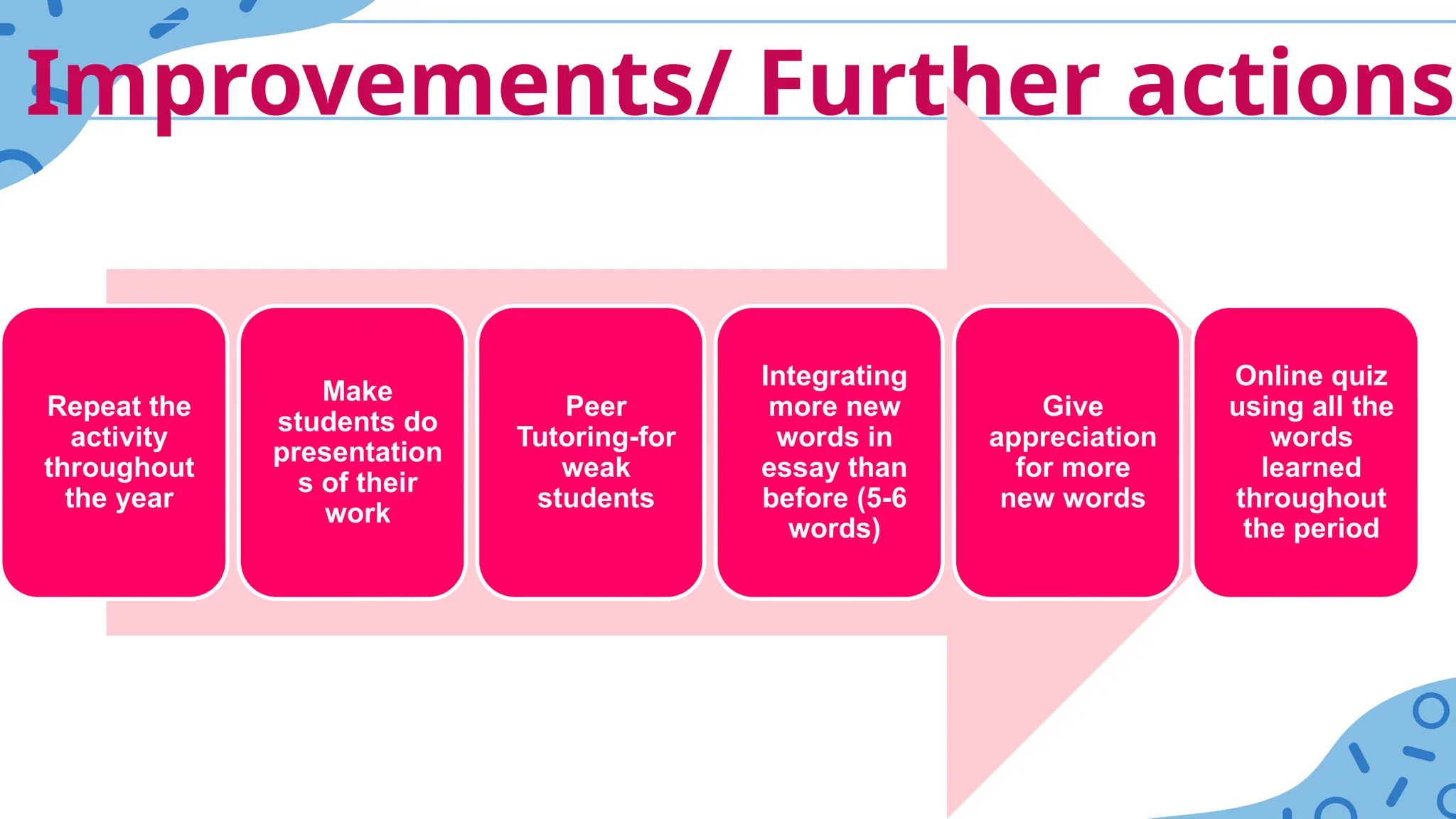
Improvements/ Further actions
Repeat the
activity
throughout
the year
Make
students do
presentation
s of their
work
Peer
Tutoring-for
weak
students
Integrating
more new
words in
essay than
before (5-6
words)
Give
appreciation
for more
new words
Online quiz
using all the
words
learned
throughout
the period
Conclusion
The study was designed to determine the effectiveness of added refinements in
existing cover copy compare method which is definition acknowledgement and
sentence building. The results indicate that the CCC +DA+ SB intervention was
effective in increasing students’ vocabulary and sentence building. Thus, the
added refinements is highly recommended as an effective intervention to
improve multiple language skills among level 2 primary students and can be
modified according to teachers’ preference involving students’ background,
learning ability, classroom settings, topics and stimuli and so on.
REFERENCES
Alber, S. R. & Walshe, S. E. (2014). When to self-correct spelling words: A systematic replication. Journal of Behavioral Education, 13(1), 51-66.
Burks, M. (2004). Effects of classwide peer tutoring on the number of words spelled correctly by students with LD. Intervention in School and Clinic, 39(5), 301-304.
Cates, G. L., Dunne, M., Erkfritz, K. N., Kivisto, A., Lee, N., & Wierzbicki, J. (2016). Differential effects of two spelling procedures on acquisition, maintenance, and adaption to
reading. Journal of Behavioral Education, 16, 71-82.
Cieslar, W., McLaughlin, T. F., & Derby, K. M. (2008). Effects of the copy, cover, and compare procedure on the math and spelling performance of a high school student with
behavioral disorder: A case report. Preventing School Failure, 52(4), 45-51.
Codding, R. S., Shiyko, M., Russo, M., Birch, S., Fanning, E., & Jaspen, D. (2017). Comparing mathematics interventions: Does initial level of fluency predict intervention
effectiveness? Journal of School Psychology, 45, 603-617.
Cooper, J., Heron, T., & Heward, W. (2017). Applied Behavior Analysis (2nd ed.). New Jersey: Pearson Education, Inc.
Darch, C., Kim, S., Johnson, S., & James, H. (2000). The strategic spelling skills of students with learning disabilities: The results of two studies. Journal of Instructional
Psychology, 27(1), 15-27. Graham, S. (2000). Should the natural learning approach replace spelling instruction? Journal of Educational Psychology, 92(2), 235-247.
Graham, S., Harris, K. R., & Chorzempa, B. F. (2002). Contribution of spelling instruction to the spelling, writing, and reading of poor spellers. Journal of Educational
Psychology, 94(4), 669-686.
Grskovic, J. A., & Belfiore, P. J. (1996). Improving the spelling performance of students with disabilities. Journal of Behavioral Education, 6(3), 343-354.
Stone, S., McLaughlin, T. F., & Weber, K. P. (2002). The use and evaluation of copy, cover, and compare with rewards and a flash cards procedure with rewards on division math
facts mastery with a fourth grade girl in a home setting. International Journal of Special Education, 17(2), 82-91.
Topping, K. J. (1995). Cued spelling: A powerful technique for parent and peer tutoring. The Reading Teacher, 48(5), 374-383.
Viel-Ruma, K., Houchins, D., & Fredrick, L. (2007). Error self-correction and spelling: Improving the spelling accuracy of secondary students with disabilities in written
expression. Journal of Behavioral Education, 16, 291-301.
Wanzek, J., Vaughn, S., Wexler, J., Swanson, E. A., Edmonds, M., & Kim, A. (2006). A synthesis ofspelling and reading interventions and their effects on the spelling outcomes of
students with LD. Journal of Learning Disabilities, 39(6), 528-543.
Wirtz, C. L., Gardner, R., Weber, K., & Bullara, D. (1996). Using self-correction to improve the spelling performance of low-achieving third graders. Remedial & Special
Education, 17(1), 48-58.
CREDITS: This presentation template was created by Slidesgo,
and includes icons by Flaticon, and infographics & images by
Freepik
Please keep this slide for attribution
Thank You

COVER COPY COMPARE IS A VOCABULARY INCREASING ACTIVITY

  • 1.
    INCREASING ENGLISH VOCABULARYUSING ‘COVER COPY COMPARE -DEFINITION ACKNOWLEDGEMENT – SENTENCE BUILDING (CCC-DA+SB)’ METHOD AMONG PRIMARY LEVEL 2 STUDENTS by Heerashini Subramaniam
  • 2.
    Problem Statement Students oftenuse short, low-level words (level 1 English) in their essays. Though textbooks has been providing lots of new glossaries, students are reluctant to go through and use them in their reading or writing Students barely can use minimum or basic vocabulary for their year 6 level proficiency. Students are lacking in vocabulary and even struggling to put them into words during essay writing
  • 3.
    • A strongvocabulary is key point in writing. In fact it goes without a saying that a well developed vocabulary can be the difference between a good essay and vice versa. • Vocabulary can help students to understand complex concept and apply in their writing. • Realizing the importance of vocabulary in enhancing reading and writing proficiency, researcher has done this experiment to tackle students’ vocabulary ability in English. Problem Statement
  • 4.
    Literature Review Participants whowere 10-year-old students with learning deficiency were able to write a basic comprehensive essay. Jaspers et a. (2012) and Manfred (2015) The researchers added copying and spelling out loud to the procedure. Following the modification, the student scored perfect scores on the last Membrey, McLaughin, Deby and Antcliff’s (2021) A Spanish class by a 15-year-old student diagnosed with a learning disability showed improvement in post test Carter, Wong, and Mayton (2013)
  • 5.
    Literature Review (CCC in vocabulary ) Elementary students have improved spelling of sight words and vocabularies McLaughlin, Derby, & Johnson, 2012; Erion, Davenport, Rodax, Scholl, & Hardy, (2009) 5th grade students learned 10 to 12 target words each week over 15 weeks. Students’ reading comprehension skills increased to 80% Carlo (2004) 15-year-old students with learning deficiency who learned 15 new words over the course of one week in three 25- minute period Carte et al. (2013)
  • 6.
  • 11.
    Reflection Observation •Students not usingvocabulary according to their level Self Inquiry •The problem caused by poor understanding and lack of reading and practice in English vocabulary Reflection •Students need to improve vocabulary Target •Doing repeated practice to increase vocabulary Intervention •Cover- Copy- Compare •Added refinements are Definition Acknowledgement and Sentence Building
  • 12.
    INTRODUCTION Cover-copy-compare (CCC) is aself- managed spelling intervention With components of modelling, self- correction, and immediate feedback To teach students to spell more accurately than students who are taught using traditional spelling instruction
  • 13.
    In this context,two refinements has been added to improve students vocabulary learning which is definition acknowledgement (DA) and sentence buiding (BD). It was done to harness students’ writing skills in English as they are moving into secondary school English learning soon. COVER COPY COMPARE+DEFINITION ACKNOWLEGMENT + SENTENCE BUILDING
  • 14.
    Objective •To increase students’ vocabulary using CCC+DA+SB Intervention •During class •30minutes per session •5 times per week Success indicator •Increase in vocabulary and definition of words •Students applying / integrating new vocabularies learned before in their essays PLAN
  • 15.
    1) Teacher givesa passage with all new words 1 week before. 2) Students need to underline unknown words and find the meaning in prior. 3) Teacher gives ccc worksheet after 1 week. 4)Teacher will pick 13 unknown words from the passage and write on whiteboard. 5) Students will be given time to pick and write 10 words in first column 6) Teacher erases words from whiteboard 7)Students memorize the spelling, fold the first column, write the same word on the second column 7)Students fold and repeat the activity in response column 8) Students write two possible definition they think of 9)Students build sentences using the word 10) Conducted during English lesson, 30 minutes per day. n 5 6 7 8 9
  • 21.
    Acceptance 1) Students canmemorise the word 2) Can spell the word correctly Challenges 1) Forgets quickly 2)Discussion with friends 3) Definition writing was hard for them 4) Using Malay to write definition Observation During Implementation
  • 22.
  • 23.
  • 28.
    New Words inEssay (Evidence)
  • 29.
    New Words inEssay (Evidence)
  • 34.
    Reobservation of Impact Students can spellwords and tell definition (eventhough in Students can build sentences using the words though some students struggled. Students can apply the new words in their weekly essays Objective achieved
  • 35.
    Re-reflection Repeated memorisation and writing When meanings are repeated daily, studentscan remember them well Practising new words in sentence made them able to integrate in essays The intervention was a success
  • 36.
    Discussion • Based onthe analysis result, it is proven that the CCC+DA+ SB (Cover-Copy-Compare + Definition Acknowledgement + Sentence Building) method has improved students vocabulary, sentence building and also definition acknowledgement. • While a basic CCC method is used in improving vocabulary, additional refinements can be inserted to improve sentence building and also students writing skills. • This is coherent to Albert & Walshe (2014) statement where students can make self- correction in this strategy and it provides feedback for them when they compare a misspelled word to a model.
  • 37.
    Discussion • Error selfcorrection has shown to be effective across disability levels with different level of students (Wirtz, 2019). The repeated practice strategy consisted of students copying a word several times with definition and also building sentences allowed them to instil the word in their memory for long time. • The strategy is simple and efficient, provides discrete learning trials for students and can be customized according to students’ level of understanding and learning speed. • Students using CCC+ DA+ SB have multiple opportunities to respond to the presented stimuli and practice immediate error self-correction when checking their answers to given stimuli.
  • 38.
    Improvements/ Further actions Repeatthe activity throughout the year Make students do presentation s of their work Peer Tutoring-for weak students Integrating more new words in essay than before (5-6 words) Give appreciation for more new words Online quiz using all the words learned throughout the period
  • 39.
    Conclusion The study wasdesigned to determine the effectiveness of added refinements in existing cover copy compare method which is definition acknowledgement and sentence building. The results indicate that the CCC +DA+ SB intervention was effective in increasing students’ vocabulary and sentence building. Thus, the added refinements is highly recommended as an effective intervention to improve multiple language skills among level 2 primary students and can be modified according to teachers’ preference involving students’ background, learning ability, classroom settings, topics and stimuli and so on.
  • 40.
    REFERENCES Alber, S. R.& Walshe, S. E. (2014). When to self-correct spelling words: A systematic replication. Journal of Behavioral Education, 13(1), 51-66. Burks, M. (2004). Effects of classwide peer tutoring on the number of words spelled correctly by students with LD. Intervention in School and Clinic, 39(5), 301-304. Cates, G. L., Dunne, M., Erkfritz, K. N., Kivisto, A., Lee, N., & Wierzbicki, J. (2016). Differential effects of two spelling procedures on acquisition, maintenance, and adaption to reading. Journal of Behavioral Education, 16, 71-82. Cieslar, W., McLaughlin, T. F., & Derby, K. M. (2008). Effects of the copy, cover, and compare procedure on the math and spelling performance of a high school student with behavioral disorder: A case report. Preventing School Failure, 52(4), 45-51. Codding, R. S., Shiyko, M., Russo, M., Birch, S., Fanning, E., & Jaspen, D. (2017). Comparing mathematics interventions: Does initial level of fluency predict intervention effectiveness? Journal of School Psychology, 45, 603-617. Cooper, J., Heron, T., & Heward, W. (2017). Applied Behavior Analysis (2nd ed.). New Jersey: Pearson Education, Inc. Darch, C., Kim, S., Johnson, S., & James, H. (2000). The strategic spelling skills of students with learning disabilities: The results of two studies. Journal of Instructional Psychology, 27(1), 15-27. Graham, S. (2000). Should the natural learning approach replace spelling instruction? Journal of Educational Psychology, 92(2), 235-247. Graham, S., Harris, K. R., & Chorzempa, B. F. (2002). Contribution of spelling instruction to the spelling, writing, and reading of poor spellers. Journal of Educational Psychology, 94(4), 669-686. Grskovic, J. A., & Belfiore, P. J. (1996). Improving the spelling performance of students with disabilities. Journal of Behavioral Education, 6(3), 343-354. Stone, S., McLaughlin, T. F., & Weber, K. P. (2002). The use and evaluation of copy, cover, and compare with rewards and a flash cards procedure with rewards on division math facts mastery with a fourth grade girl in a home setting. International Journal of Special Education, 17(2), 82-91. Topping, K. J. (1995). Cued spelling: A powerful technique for parent and peer tutoring. The Reading Teacher, 48(5), 374-383. Viel-Ruma, K., Houchins, D., & Fredrick, L. (2007). Error self-correction and spelling: Improving the spelling accuracy of secondary students with disabilities in written expression. Journal of Behavioral Education, 16, 291-301. Wanzek, J., Vaughn, S., Wexler, J., Swanson, E. A., Edmonds, M., & Kim, A. (2006). A synthesis ofspelling and reading interventions and their effects on the spelling outcomes of students with LD. Journal of Learning Disabilities, 39(6), 528-543. Wirtz, C. L., Gardner, R., Weber, K., & Bullara, D. (1996). Using self-correction to improve the spelling performance of low-achieving third graders. Remedial & Special Education, 17(1), 48-58.
  • 41.
    CREDITS: This presentationtemplate was created by Slidesgo, and includes icons by Flaticon, and infographics & images by Freepik Please keep this slide for attribution Thank You