https://njctl.org/video/?v=z5vVpzFR-aU
Covalent Bonding
& Lewis Diagrams
2021-02-25
www.njctl.org
Table of Contents:
Covalent Bonding
· Introduction to Covalent Compounds
· Covalent Bonding & Lewis Diagrams
· Polyatomic Ions
· Exceptions to the Octet Rule
· Practice Drawing Lewis Diagrams
Click on a topic to go to that section.
Introduction to Covalent
Compounds
Return to Table
of Contents
Chemical Bonds
There are three basic types of chemical bonds:
With Ionic Bonds, the electrostatic attraction between ions
forms ionic compounds.
With Covalent Bonds, valence electrons are shared
between atoms to form either network solids or molecules.
With Metallic Bonds, the valence electrons of many metal
atoms are shared to form a "sea" of electrons within a
metallic solid.
In this unit, we will be studying covalent bonds.
Chemical Bonds
How ionic or covalent a bond is depends on the difference in
electronegativity between the atoms.
The smaller the difference, the more likely electrons are "shared"
and the bond is considered covalent.
The greater the difference, the more likely electrons have been
transferred and the atoms are ionized, resulting in an ionic bond.
Chemical Bonds
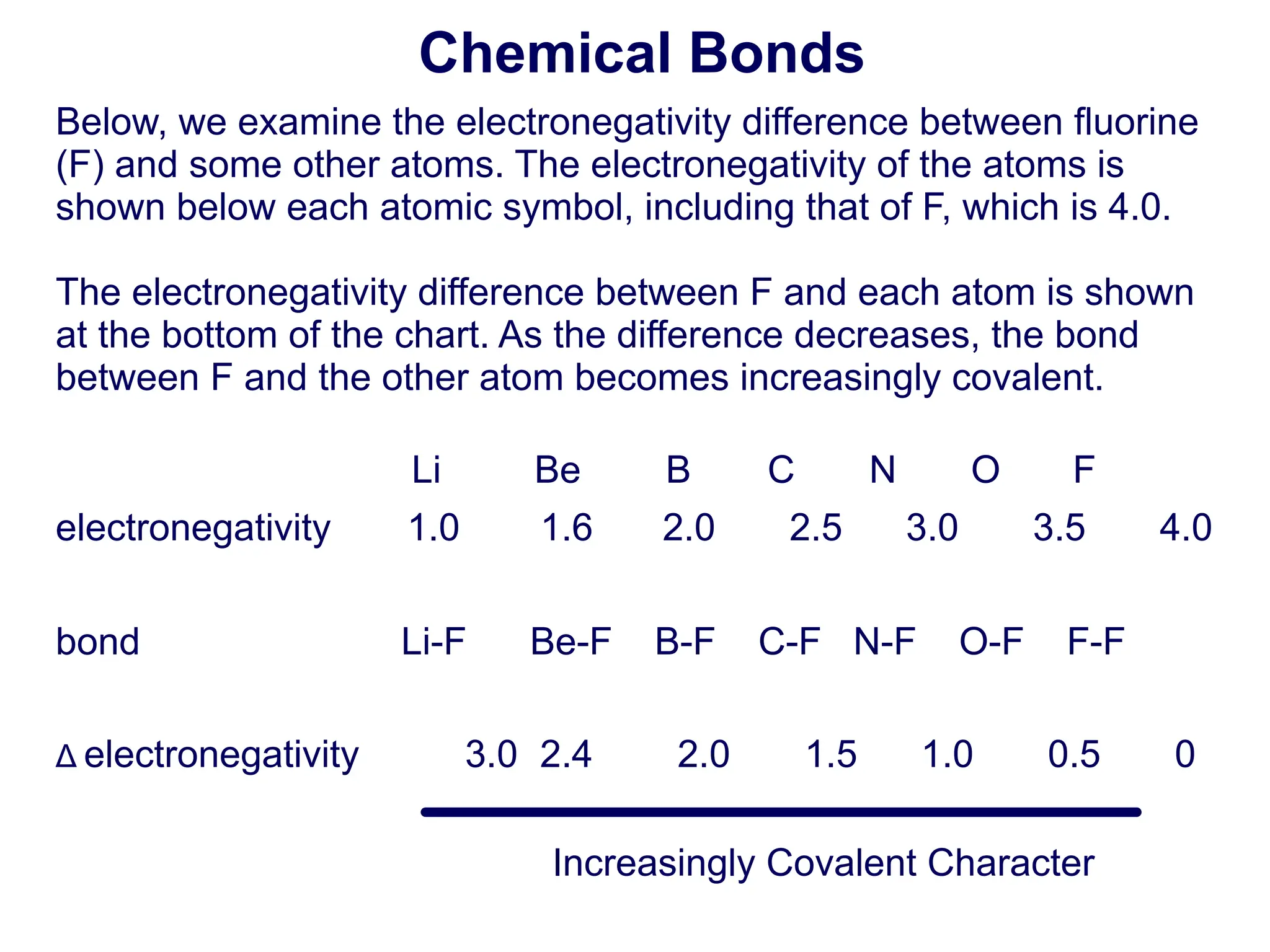
Below, we examine the electronegativity difference between fluorine
(F) and some other atoms. The electronegativity of the atoms is
shown below each atomic symbol, including that of F, which is 4.0.
The electronegativity difference between F and each atom is shown
at the bottom of the chart. As the difference decreases, the bond
between F and the other atom becomes increasingly covalent.
Li Be B C N O F
electronegativity 1.0 1.6 2.0 2.5 3.0 3.5 4.0
bond Li-F Be-F B-F C-F N-F O-F F-F
Δ electronegativity 3.0 2.4 2.0 1.5 1.0 0.5 0
Increasingly Covalent Character
Chemical Bonds
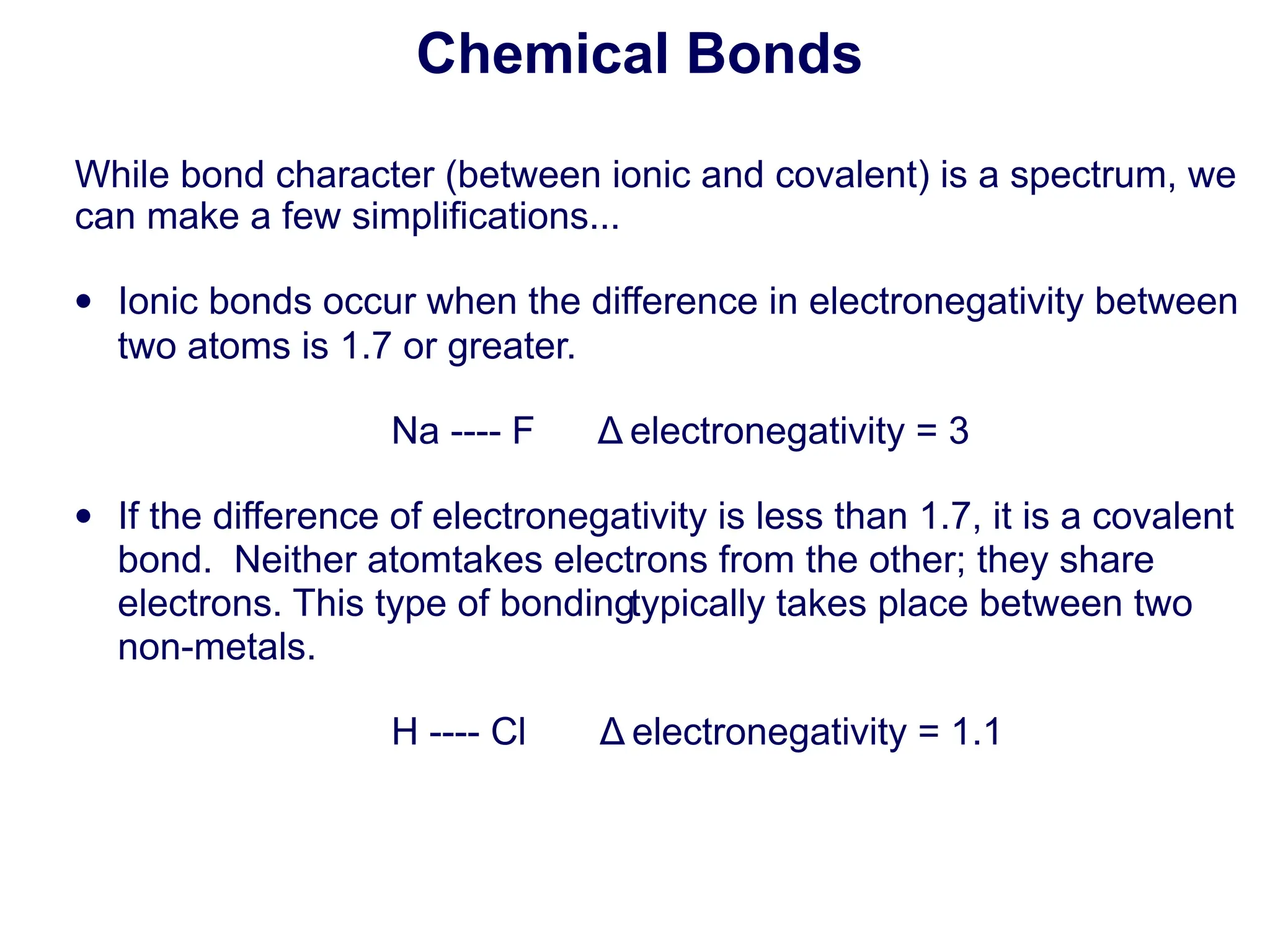
While bond character (between ionic and covalent) is a spectrum, we
can make a few simplifications...
· Ionic bonds occur when the difference in electronegativity between
two atoms is 1.7 or greater.
Na ---- F Δ electronegativity = 3
· If the difference of electronegativity is less than 1.7, it is a covalent
bond. Neither atomtakes electrons from the other; they share
electrons. This type of bondingtypically takes place between two
non-metals.
H ---- Cl Δ electronegativity = 1.1
Types of Covalent Compounds
There are two types of compounds created by the covalent
bonding of atoms:
Covalent networks - larger compounds consisting of repeating
elemental or molecular units all covalently bonded together, such
as diamond (Cn) or quartz [(SiO2)n].
Molecules - smaller compounds of one or more elements bonded
together, such as water (H2O) or oxygen gas (O2).
Graphite (C)
Diamond (C)
Covalent Network Compounds
Like ionic and metallic substances, covalent network solids don't
consist of individual molecules.
They form large compounds composed of a continuous "network" of
covalently bonded atoms, represented by formula units.
Below are two covalent network solids formed from carbon (C).
Properties of Covalent Network Compounds
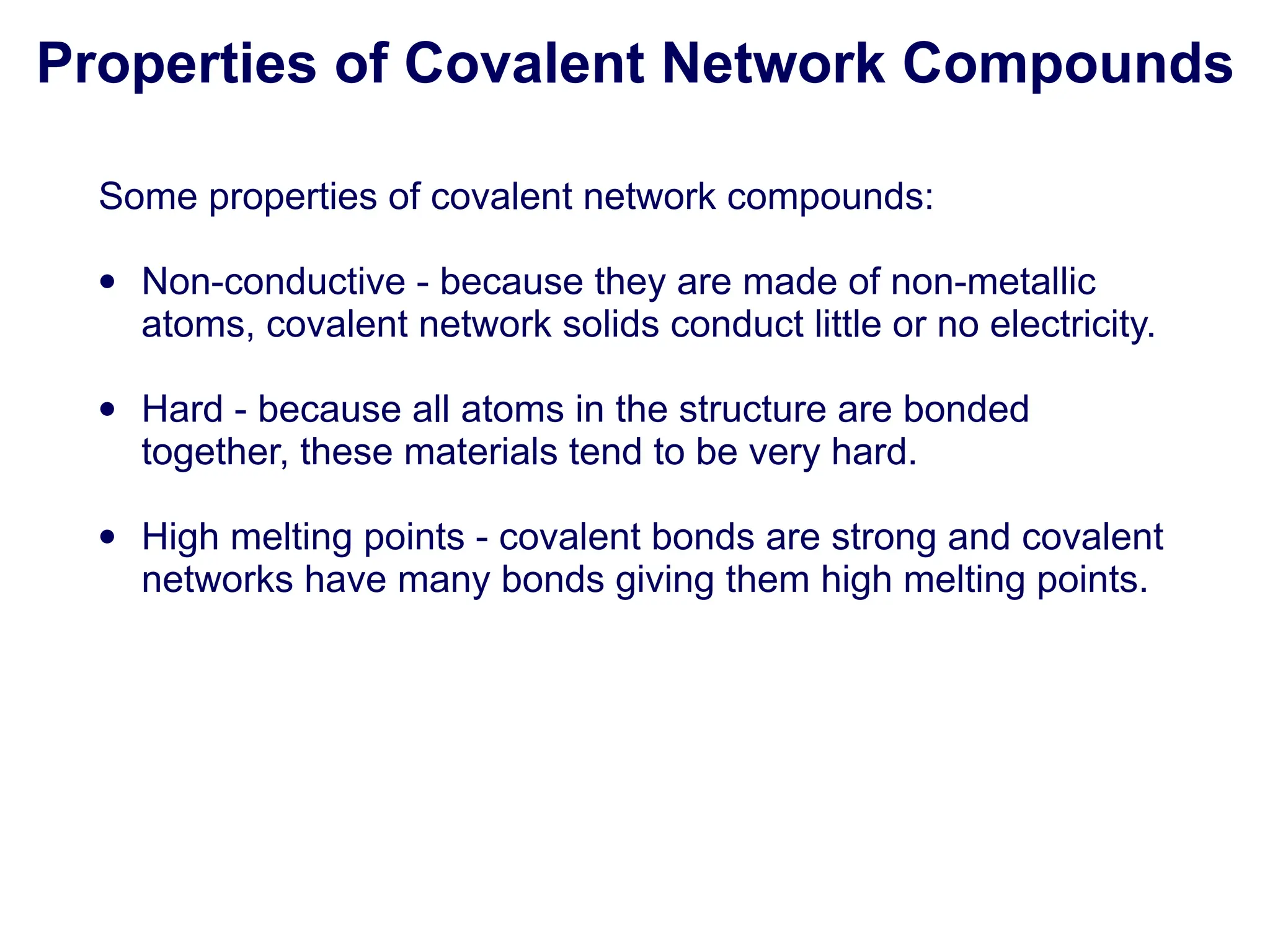
Some properties of covalent network compounds:
· Non-conductive - because they are made of non-metallic
atoms, covalent network solids conduct little or no electricity.
· Hard - because all atoms in the structure are bonded
together, these materials tend to be very hard.
· High melting points - covalent bonds are strong and covalent
networks have many bonds giving them high melting points.
Molecular Compounds
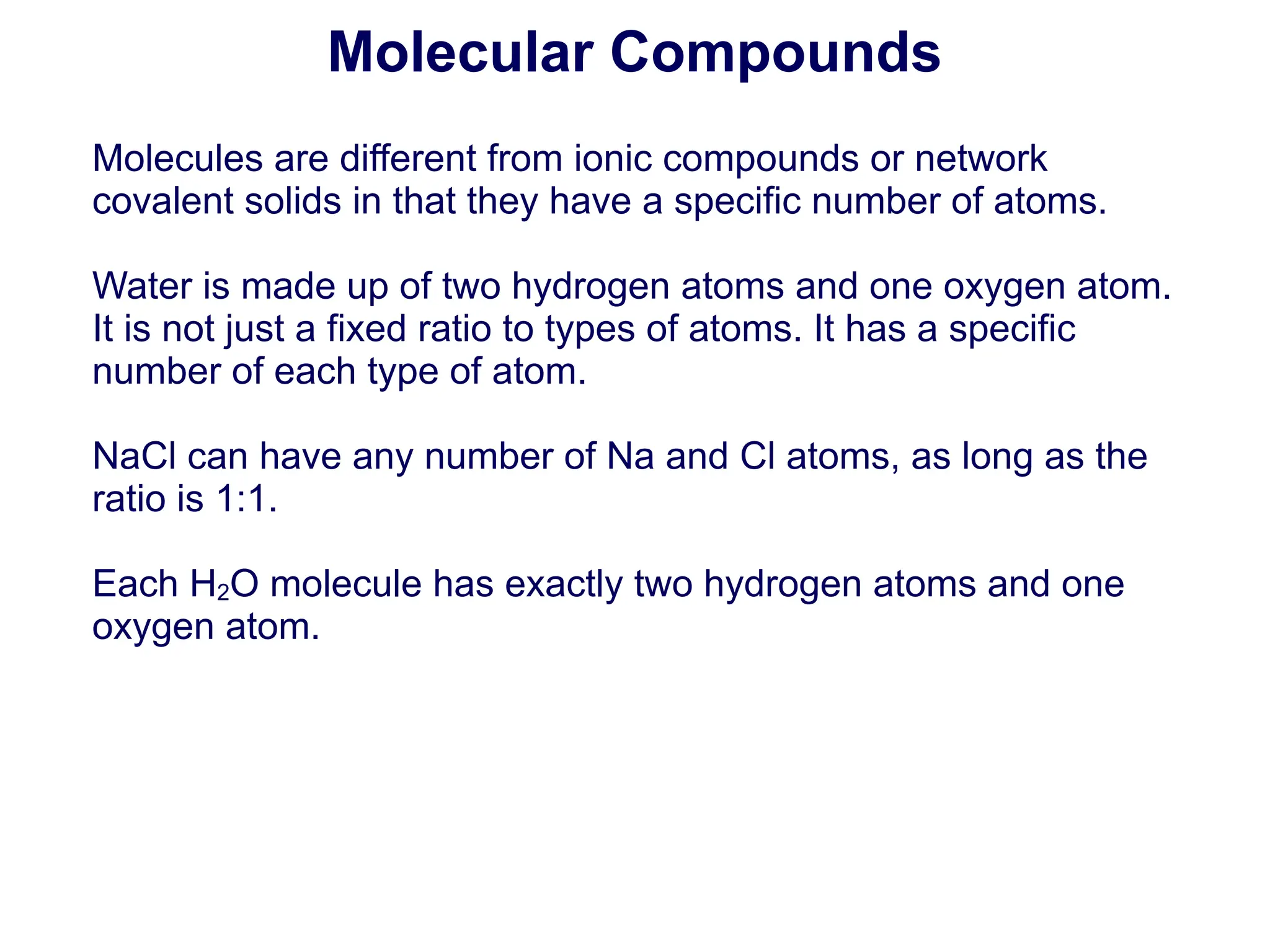
Molecules are different from ionic compounds or network
covalent solids in that they have a specific number of atoms.
Water is made up of two hydrogen atoms and one oxygen atom.
It is not just a fixed ratio to types of atoms. It has a specific
number of each type of atom.
NaCl can have any number of Na and Cl atoms, as long as the
ratio is 1:1.
Each H2O molecule has exactly two hydrogen atoms and one
oxygen atom.
Properties of Molecular Compounds
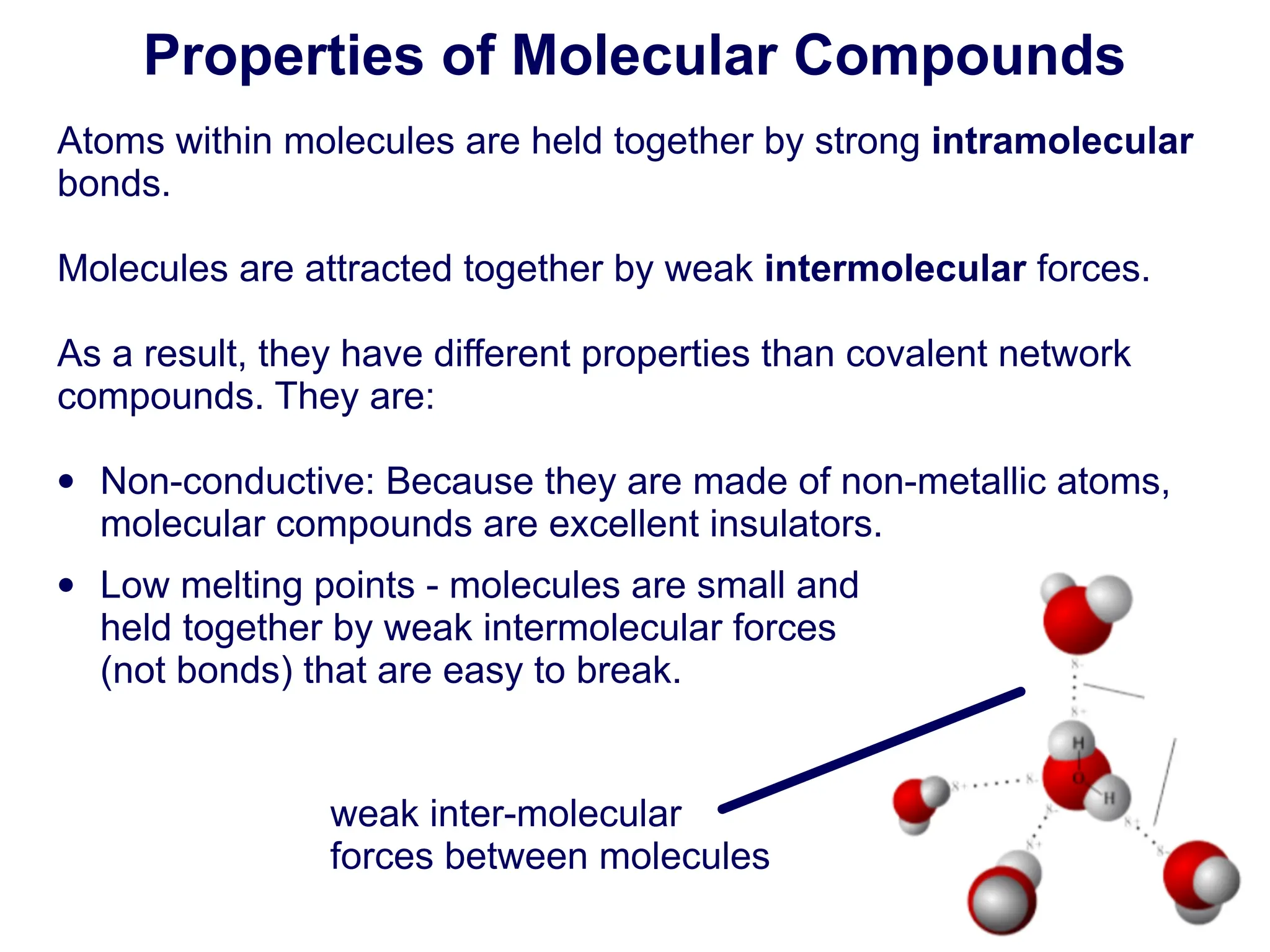
Atoms within molecules are held together by strong intramolecular
bonds.
Molecules are attracted together by weak intermolecular forces.
As a result, they have different properties than covalent network
compounds. They are:
· Non-conductive: Because they are made of non-metallic atoms,
molecular compounds are excellent insulators.
weak inter-molecular
forces between molecules
· Low melting points - molecules are small and
held together by weak intermolecular forces
(not bonds) that are easy to break.
Naming Binary Molecules
Binary molecules consist of two atoms sharing electrons.
All end in "ide."
Unlike ionic compounds, each element has a prefix that indicates
how many of its atoms are present in the covalent compound.
Examples
NO2 nitrogen dioxide
P2 O5 diphosphorous pentoxide
( penta-oxide-->pentoxide)
Look on your reference sheets for the prefixes - an
example is shown to the right.
The atom with the lower electronegativity is
usually written first.
If there is only one of the first atom, "mono" is left off.
For instance,
CO is carbon monoxide, NOTmonocarbon monoxide.
CO2 is carbon dioxide, NOTmonocarbon dioxide.
Naming Binary Molecules
Polyatomic Ions were covered in the last unit - they are two
or more atoms covalently bonded together, but they are not
neutral - they have a charge.
Be careful not to confuse them with the neutral covalent
molecules.
Examples
(NO3)- Nitrate is a polyatomic ion with a charge of -1
NO3 Nitrogen Trioxide is a neutral molecule
Naming Binary Molecules
1 Which pair of atoms will form a covalent bond?
A Li and Ne
B K and Br
C C and O
D Na and Cl
E I need
help
Answer
https://njctl.org/video/?v=UrJnVvbze04
1 Which pair of atoms will form a covalent bond?
A Li and Ne
B K and Br
C C and O
D Na and Cl
E I need
help
[This object is a pull tab]
Answer
C
https://njctl.org/video/?v=UrJnVvbze04
A Li and Cl
B Na and Cl
C K and Fl
D H and O
2 Which pair of atoms will form a covalent bond?
E I need
help
Answer
https://njctl.org/video/?v=TycvVmV8t-E
A Li and Cl
B Na and Cl
C K and Fl
D H and O
2 Which pair of atoms will form a covalent bond?
E I need
help
[This object is a pull tab]
Answer
D
https://njctl.org/video/?v=TycvVmV8t-E
3 The atoms that would form the MOST covalent bond
would be:
A C - H
B O - H
C Cl - H
D F - H
E I need
help
Answer
https://njctl.org/video/?v=PF5JKZE_83E
3 The atoms that would form the MOST covalent bond
would be:
A C - H
B O - H
C Cl - H
D F - H
E I need
help
[This object is a pull tab]
Answer
A
https://njctl.org/video/?v=PF5JKZE_83E
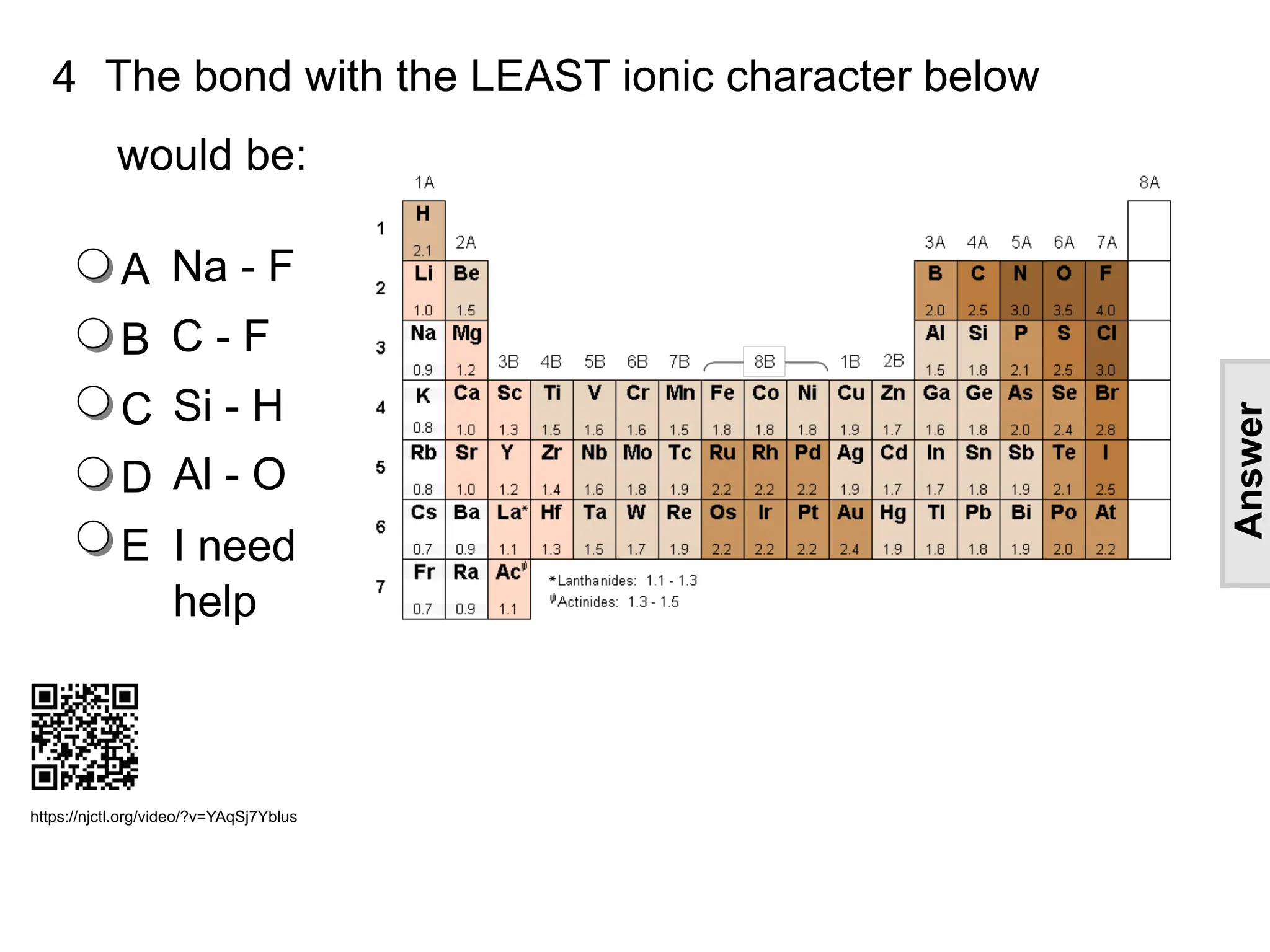
4 The bond with the LEAST ionic character below
would be:
A Na - F
B C - F
C Si - H
D Al - O
E I need
help
Answer
https://njctl.org/video/?v=YAqSj7Yblus
4 The bond with the LEAST ionic character below
would be:
A Na - F
B C - F
C Si - H
D Al - O
E I need
help
[This object is a pull tab]
Answer
C
https://njctl.org/video/?v=YAqSj7Yblus
5 Butter melts on a hot day. What type of compound is it?
A metallic
B ionic
C covalent network
D molecular
E I need help
Answer
https://njctl.org/video/?v=i5ifRTQUvRs
5 Butter melts on a hot day. What type of compound is it?
A metallic
B ionic
C covalent network
D molecular
E I need help
[This object is a pull tab]
Answer
D
https://njctl.org/video/?v=i5ifRTQUvRs
6 You are given a substance that has a high melting point
and does not conduct electricity, even when you put it in
water. What is it?
A a metal
B an ionic compound
C a covalent network
D a molecule
E I need help
Answer
https://njctl.org/video/?v=kf_C9WW5TZ8
6 You are given a substance that has a high melting point
and does not conduct electricity, even when you put it in
water. What is it?
A a metal
B an ionic compound
C a covalent network
D a molecule
E I need help
[This object is a pull tab]
Answer
C
https://njctl.org/video/?v=kf_C9WW5TZ8
7 Chlorine monoxide is
A ClO2
B ClO
C OCl
D O2Cl
E I need help
Answer
https://njctl.org/video/?v=3tP0aqWQR_4
7 Chlorine monoxide is
A ClO2
B ClO
C OCl
D O2Cl
E I need help
[This object is a pull tab]
Answer
B
https://njctl.org/video/?v=3tP0aqWQR_4
8 Dinitrogen tetroxide is
A NO2
B N2O4
C NO3
D N4O2
E I need help
Answer
https://njctl.org/video/?v=Erv00aZl39M
8 Dinitrogen tetroxide is
A NO2
B N2O4
C NO3
D N4O2
E I need help
[This object is a pull tab]
Answer
B
https://njctl.org/video/?v=Erv00aZl39M
9 H2O is
A Hydrogen monoxide
B Dihydrogen monoxide
C Hydrogen oxide
D Hydrogen dioxide
E I need help
Answer
https://njctl.org/video/?v=eV96TRAN10c
9 H2O is
A Hydrogen monoxide
B Dihydrogen monoxide
C Hydrogen oxide
D Hydrogen dioxide
E I need help
[This object is a pull tab]
Answer
B
https://njctl.org/video/?v=eV96TRAN10c
10 SO3 is
A sulfate
B sulfur oxide
C sulfur trioxide
D sulfite
E I need help
Answer
https://njctl.org/video/?v=jYpkka4DIKQ
10 SO3 is
A sulfate
B sulfur oxide
C sulfur trioxide
D sulfite
E I need help
[This object is a pull tab]
Answer
C
https://njctl.org/video/?v=jYpkka4DIKQ
11 P4O10 is
A Phosphorous pentoxide
B Phosphate
C Phosphorous oxide
D Tetraphosphorous decoxide
E I need help
Answer
https://njctl.org/video/?v=AybvvHso2dw
11 P4O10 is
A Phosphorous pentoxide
B Phosphate
C Phosphorous oxide
D Tetraphosphorous decoxide
E I need help
[This object is a pull tab]
Answer
D
https://njctl.org/video/?v=AybvvHso2dw
12 MgO is
A monomagnesium monoxide
B magnesium monoxide
C magnesium oxide
D monomagnesium oxide
E I need help
Answer
https://njctl.org/video/?v=Xd4qk_-g-fc
12 MgO is
A monomagnesium monoxide
B magnesium monoxide
C magnesium oxide
D monomagnesium oxide
E I need help
[This object is a pull tab]
Answer
C
https://njctl.org/video/?v=Xd4qk_-g-fc
https://njctl.org/video/?v=ISCeONytrwg
Covalent Bonding
& Lewis Diagrams
Return to Table
of Contents
Atoms tend towards having a full shell electron configuration. For
most atoms, that means having8 valence electrons.
In covalent bonding, an atom will share electrons in an effort to
obtain eight electrons around it (with a few exceptions as shown
below).
The Octet Rule
Exceptions to the Octet Rule
H needs 2e-
Be needs 4e-
B needs 6e-
1 2 13 14 15 16 17 18
Lewis structures are diagrams that show valence electrons as dots.
They are also known as Lewis dot or electron dot diagrams.
Note that no electrons are paired until after the fourth one (with the
exception of Helium).
Lewis Structures
Single Covalent Bond
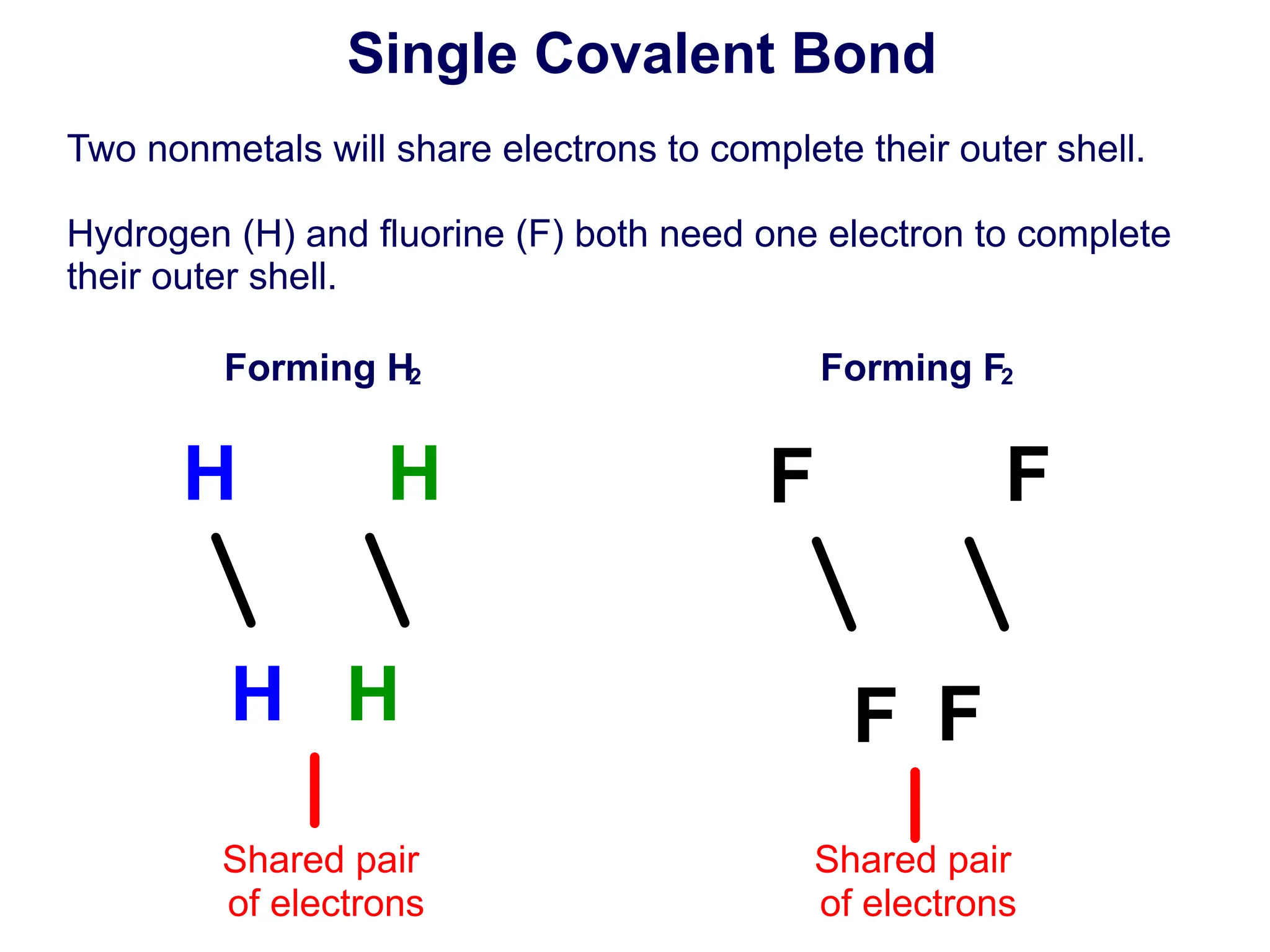
Two nonmetals will share electrons to complete their outer shell.
Hydrogen (H) and fluorine (F) both need one electron to complete
their outer shell.
Shared pair
of electrons
H H
H H
Forming H2
F F
Forming F2
F
F
Shared pair
of electrons
Lewis Dot Structure
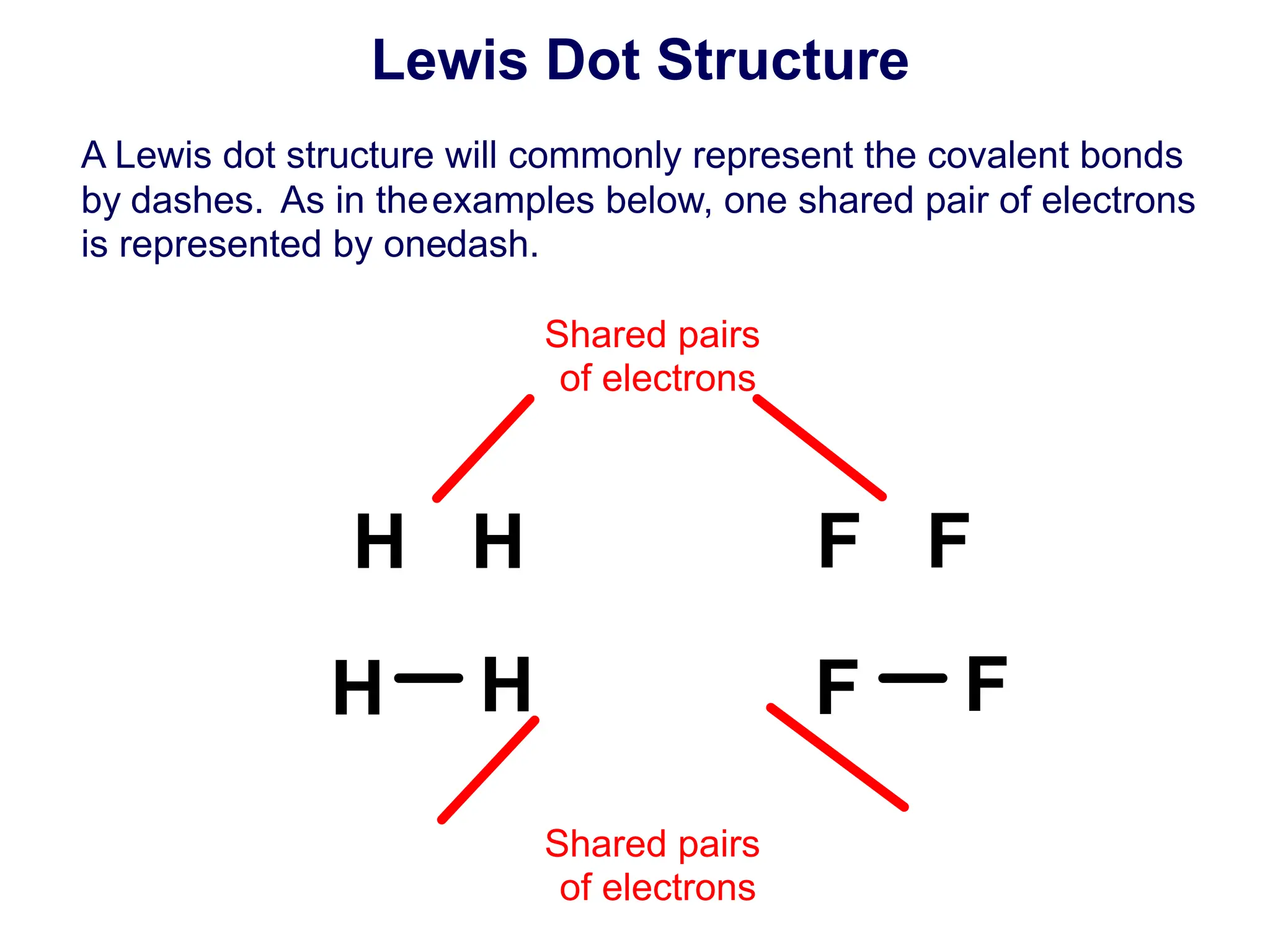
A Lewis dot structure will commonly represent the covalent bonds
by dashes. As in theexamples below, one shared pair of electrons
is represented by onedash.
H
H
Shared pairs
of electrons
H H F F
F
F
Shared pairs
of electrons
A pair of valenceelectrons that is not shared between atoms
is called an unshared pair, also known as alone pair or a
nonbonding pair.
F
F N
H
H
H
Lone pairs
Lone Pairs
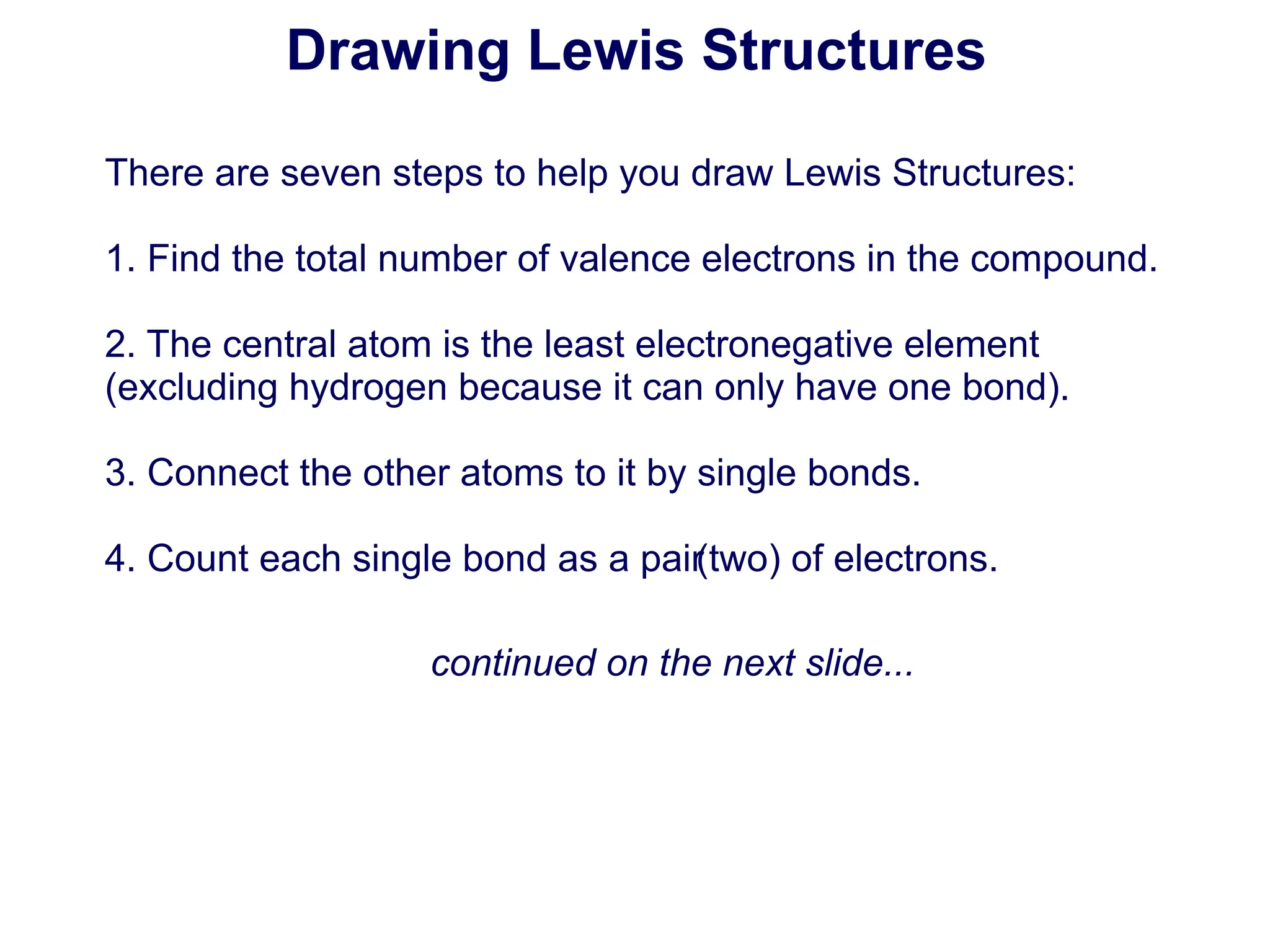
There are seven steps to help you draw Lewis Structures:
1. Find the total number of valence electrons in the compound.
2. The central atom is the least electronegative element
(excluding hydrogen because it can only have one bond).
3. Connect the other atoms to it by single bonds.
4. Count each single bond as a pair
(two) of electrons.
Drawing Lewis Structures
continued on the next slide...
5. Add electrons to the outer atoms to
give each one 8 (a full
shell). Remember the exceptions.
6. Do the same for the central atom.
7. Check: Does each atom have a full outer shell?
Have you used up all the valence
electrons? Have you used too
many electrons?
Drawing Lewis Structures
Let's work a couple of examples....
Drawing Lewis Structures
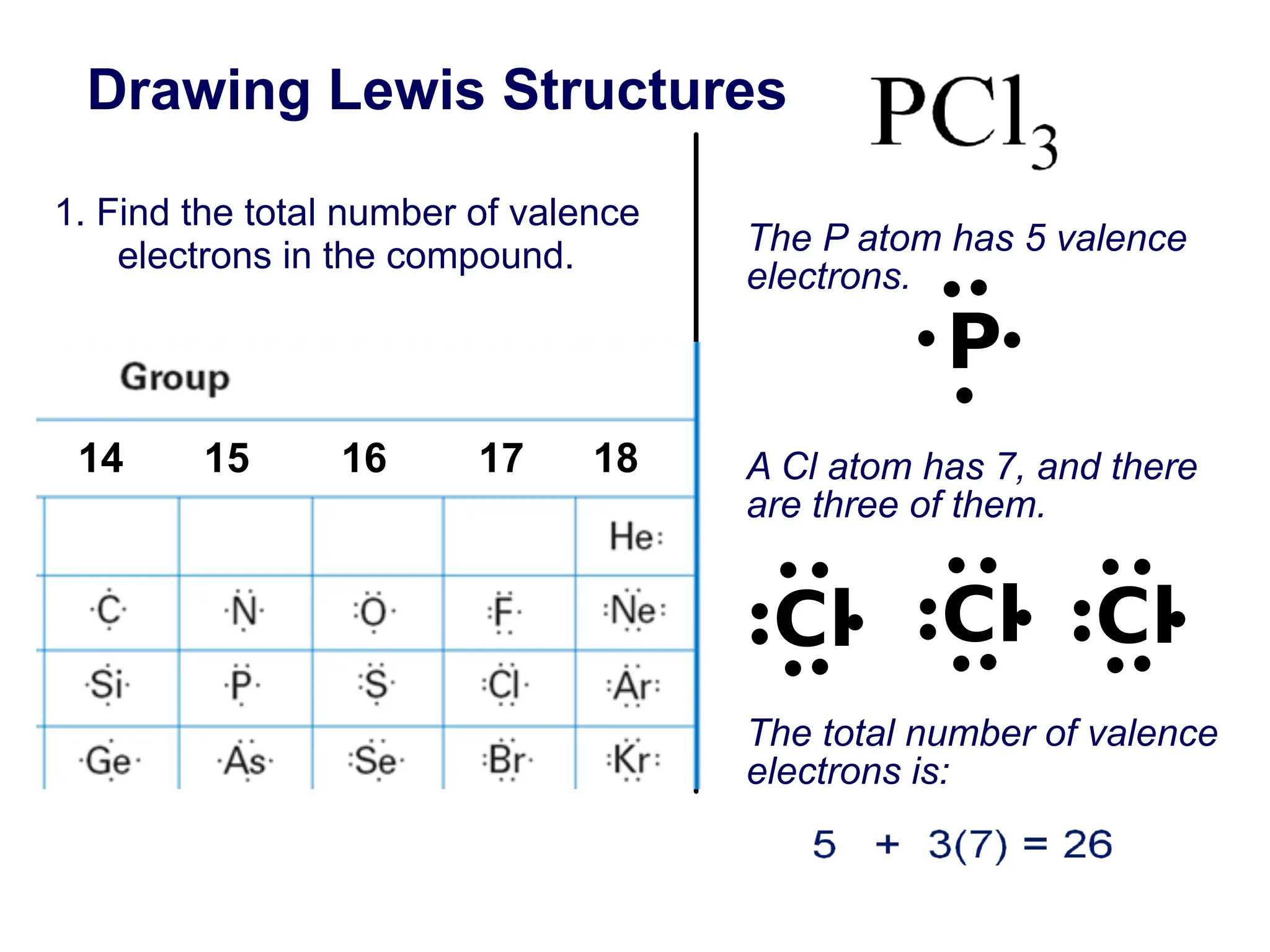
The P atom has 5 valence
electrons.
A Cl atom has 7, and there
are three of them.
The total number of valence
electrons is:
P
Cl Cl
Cl
1. Find the total number of valence
electrons in the compound.
14 15 16 17 18
13 14 15 16 17
18
P has an electronegativity of 2.1 and
has an electronegativity of 3.0
P will be the central atom.
The Cl atoms will surround the P ato
The single bonds are shown as sing
lines.
Cl
P
Cl
Cl
Drawing Lewis Structures
2. The central atom is the least
electronegative element
(excluding hydrogen).
3. Connect the other atoms to it
by single bonds.
4. Count each single bond as a pair
(two) of electrons.
5. Add electrons to the outer atoms to
give each one 8 (a full shell).
Remember the exceptions.
6. Do the same for the central atom.
7. Check: Does each atom have a
full outer shell?
Have you used up all the valence
electrons? Have you used too many
electrons?
Drawing Lewis Structures
The N atom has 5 valence
electrons
and
each of the three H atoms
has 1 so the total number of
valence electrons is,
NH3
5 + 3(1) = 8
1. Find the total number of valence
electrons in the polyatomic ion or
molecule.
Drawing Lewis Structures
2. The central atom is the least
electronegative element
(excluding hydrogen because it
can only have one bond).
3. Connect the other atoms to it
by single bonds.
H can never be the central atom
so N must be the central atom.
The H atoms will surround the N
atom.
The single bonds are shown as
single lines.
H
N H
H
NH3
Drawing Lewis Structures
H
N H
H
Each H already has two
electrons, so that's done. But w
have to add electrons to N to
make 8.
H
N H
H
4. Count each single bond as a
pair (two) electrons. Now add
electrons to the outer atoms to give
each one a full shell (2 in the case
of H).
5. Next, do the same for the central
atom.
6. Check:
Does each atom have a full outer
shell ?
7. Have you used up all the
valence
electrons you started with? Have
you used too many electrons?
13 How many valence electrons does nitrogen have?
A 2
B 3
C 4
D 5
E I need help
Answer
https://njctl.org/video/?v=JfPN6yvE-k4
13 How many valence electrons does nitrogen have?
A 2
B 3
C 4
D 5
E I need help
[This object is a pull tab]
Answer
D
https://njctl.org/video/?v=JfPN6yvE-k4
14 How many electrons are shared by two atoms to
create a single bond?
A 3
B 2
C 4
D 1
E I need help
Answer
https://njctl.org/video/?v=yqbV2YtF6KU
14 How many electrons are shared by two atoms to
create a single bond?
A 3
B 2
C 4
D 1
E I need help
[This object is a pull tab]
Answer
B
https://njctl.org/video/?v=yqbV2YtF6KU
15 How is a covalent bond represented in a Lewis structure?
A a dash
B a dot
C two dots
D both A and C
E I need help
Answer
https://njctl.org/video/?v=qpqRuY3TqqQ
15 How is a covalent bond represented in a Lewis structure?
A a dash
B a dot
C two dots
D both A and C
E I need help
[This object is a pull tab]
Answer
D
https://njctl.org/video/?v=qpqRuY3TqqQ
16 Which element in H2O is the least electronegative?
A H
B O
C the electronegativities are equal
D H2
E I need help
Answer
https://njctl.org/video/?v=R9P6-toPzEE
16 Which element in H2O is the least electronegative?
A H
B O
C the electronegativities are equal
D H2
E I need help
[This object is a pull tab]
Answer
A
https://njctl.org/video/?v=R9P6-toPzEE
17 How many total valence electrons does H2O have?
A 18
B 8
C 24
D more information is needed
E I need help
Answer
https://njctl.org/video/?v=N6ocPuZrAbY
17 How many total valence electrons does H2O have?
A 18
B 8
C 24
D more information is needed
E I need help
[This object is a pull tab]
Answer
B
https://njctl.org/video/?v=N6ocPuZrAbY
https://njctl.org/video/?v=ofw7dNVHm50
Practice Drawing
Lewis Diagrams
Return to Table
of Contents
I
Practice: I2
Elements Bonds & Electrons
Drag and drop the required elements, bonds and
electrons from above into the workspace below or
draw them in your notes.
Check your answer on the next page.
I
Practice: I2
Elements Bonds & Electrons
I I
I
Elements Bonds & Electrons
Cl
Practice: Cl2
Drag and drop the required elements, bonds and electrons from
above into the workspace below or draw them in your notes.
Check your answer on the next page.
I
Practice: Cl2
Elements Bonds & Electrons
Cl Cl
Cl
I
Elements Bonds & Electrons
Cl H C
Practice: CH4
Drag and drop the required elements, bonds and electrons from
above into the workspace below or draw them in your notes.
Check your answer on the next page.
I
Practice: CH4
Elements Bonds & Electrons
C
H
H
H
H
Cl H C
18
The Lewis structure for nitrogen is N
A True
B False
C I need help
Answer
https://njctl.org/video/?v=Oa0FPayHqDs
18
The Lewis structure for nitrogen is N
A True
B False
C I need help
[This object is a pull tab]
Answer
True
https://njctl.org/video/?v=Oa0FPayHqDs
19 Which of the following need fewer than 8 valence
electrons to be stable?
A Boron and Beryllium
B Boron and Helium
C Boron, Beryllium, and Hydrogen
D Boron, Beryllium, Hydrogen and Oxygen
E I need help
Answer
https://njctl.org/video/?v=YE_CKH0rbC4
19 Which of the following need fewer than 8 valence
electrons to be stable?
A Boron and Beryllium
B Boron and Helium
C Boron, Beryllium, and Hydrogen
D Boron, Beryllium, Hydrogen and Oxygen
E I need help
[This object is a pull tab]
Answer
C
https://njctl.org/video/?v=YE_CKH0rbC4
20 Which of the following is the correct Lewis Structure for
H2O?
H O H
H H O
H H
O
H H
O
A
B
C
D
E I need help
Answer
https://njctl.org/video/?v=hZ2Y4durWUk
20 Which of the following is the correct Lewis Structure for
H2O?
H O H
H H O
H H
O
H H
O
A
B
C
D
E I need help
[This object is a pull tab]
Answer
D
https://njctl.org/video/?v=hZ2Y4durWUk
21 Which of the following is the correct Lewis Structure
for PH3?
H P H H
H P H
H
H H
P
H
H P H
A
B
C
D
E I need help
Answer
https://njctl.org/video/?v=oEeXrvlCK1Q
21 Which of the following is the correct Lewis Structure
for PH3?
H P H H
H P H
H
H H
P
H
H P H
A
B
C
D
E I need help
[This object is a pull tab]
Answer
B
https://njctl.org/video/?v=oEeXrvlCK1Q
A
B
C
D
22
H H H H H H C C
C C H
H
H
H
H H
Which of the following is the correct Lewis Structurefor
C2H6?
C C H
H
H H H
H
C C H
H
H H H
H
Answer
https://njctl.org/video/?v=5XD-x96UBmU
A
B
C
D
22
H H H H H H C C
C C H
H
H
H
H H
Which of the following is the correct Lewis Structurefor
C2H6?
C C H
H
H H H
H
C C H
H
H H H
H
[This object is a pull tab]
Answer
B
https://njctl.org/video/?v=5XD-x96UBmU
https://njctl.org/video/?v=gejTVeHyuU4
Double & Triple Bonds
Return to Table
of Contents
If you run out of electrons before the central atom has
an octet……form multiple bonds until it does.
Not Enough Electrons?
Double and Triple Covalent Bonds
Atoms form double or triple covalent bonds if they can attain
a full energy shell by sharing two pairs or three pairs of electrons.
A bond that involves two shared pairs of electrons is a
double covalent bond.
A bond formed by sharing three pairs of electrons is a triple
covalent bond.
Click here to view an
interactive activity on
covalent bonding
Covalent Bond Length
Adding additional bonds between the same elements decreases the
length of the bonds.
Triple bonds are shorter than double bonds, which are shorter than
single bonds.
Covalent Bond Energy
It requires more energy to break double and triple bonds
compared to single bonds.
Triple bonds are the strongest of the three.
Bond Type Bond Energy
C C
C C
C C
348 kJ
614 kJ
839 kJ
Bond Type Bond Energy
N N 163 kJ
418 kJ
941 kJ
N N
N N
Carbon Dioxide, CO 2
1. Determine the # of valence electrons.
1 (4) + 2 (6) = 16 e-
This leaves 12 electrons, 6 pairs
3. Place lone pairs on oxygen atoms to give each 8.
Double Covalent Bonds
O C O
O C O
2. Form Single Bonds
O C O
O C O
O C O
Carbon Dioxide, CO2
4. Check: We had 16 electrons to
work with; how many have we used?
5. Carbon does not have enough
electrons to complete it's shell. We
must form DOUBLE BONDS between
C and O.
Instead of sharing only 1 pair, a
double bond shares 2 pairs. So one
pair is taken away from each atom
and replaced with another bond.
I
Practice: O2
Elements Bonds & Electrons
Cl H C O
Drag and drop the required elements, bonds and electrons from
above into the workspace below or draw them in your notes.
Check your answer on the next page.
I
Practice: O2
Elements Bonds & Electrons
Cl H C O
O O
I
Practice N2
Elements Bonds & Electrons
Cl H C O N
Drag and drop the required elements, bonds and electrons from
above into the workspace below or draw them in your notes.
Check your answer on the next page.
I
Practice N2
Elements Bonds & Electrons
Cl H C O N
N N
I
Practice: CO
Elements Bonds & Electrons
Cl H C O N
Drag and drop the required elements, bonds and electrons from
above into the workspace below or draw them in your notes.
Check your answer on the next page.
I
Practice: CO
Elements Bonds & Electrons
Cl H C O N
C O
Note: the 3rd bond in this structure is know as a coordinate
covalent bond because both electrons are contributed from a single
atom, the oxygen.
Diatomic Elements
Seven elements in the periodic table are always diatomic.
In their elemental state, they are always seen as two atoms
covalently bonded together.
H2 , O2, N2 , Cl2 , Br2 , I2 , F2
H
O
N
Cl
Br
I
F
Which of these
diatomic
elements
contains a
double bond?
Which contain
triple bonds?
Diatomic Elements
Seven elements in the periodic table are always diatomic.
In their elemental state, they are always seen as two atoms
covalently bonded together.
H2 , O2, N2 , Cl2 , Br2 , I2 , F2
H
O
N
Cl
Br
I
F
N2 is triple bonded.
O2 is double bonded.
H2, F2, Cl2, Br2 & I2
have single bonds.
23 How many electrons are shared by two atoms to
create a double bond?
A 4
B 2
C 8
D 6
E I need help
Answer
https://njctl.org/video/?v=iU_EKfF_RLI
23 How many electrons are shared by two atoms to
create a double bond?
A 4
B 2
C 8
D 6
E I need help
[This object is a pull tab]
Answer
A
https://njctl.org/video/?v=iU_EKfF_RLI
24 How many electrons are shared by two atoms
to create a triple bond?
A 4
B 2
C 8
D 6
E I need help
Answer
https://njctl.org/video/?v=qtqfjCwcFoU
24 How many electrons are shared by two atoms
to create a triple bond?
A 4
B 2
C 8
D 6
E I need help
[This object is a pull tab]
Answer
D
https://njctl.org/video/?v=qtqfjCwcFoU
25 As the number of bonds between a pair of atoms
increases, the distance between the atoms:
A increases
B decreases
C remains unchanged
D varies, depending on the atoms
E I need help
Answer
https://njctl.org/video/?v=d07lxBdPT08
25 As the number of bonds between a pair of atoms
increases, the distance between the atoms:
A increases
B decreases
C remains unchanged
D varies, depending on the atoms
E I need help
[This object is a pull tab]
Answer
B
https://njctl.org/video/?v=d07lxBdPT08
26 As the number of bonds between a pair of atoms
increases, the strength of the bond between the
atoms:
A increases
B decreases
C remains unchanged
D varies, depending on the atoms
E I need help
Answer
https://njctl.org/video/?v=EZKmLTRzbwE
26 As the number of bonds between a pair of atoms
increases, the strength of the bond between the
atoms:
A increases
B decreases
C remains unchanged
D varies, depending on the atoms
E I need help
[This object is a pull tab]
Answer
A
https://njctl.org/video/?v=EZKmLTRzbwE
27 As the number of bonds between a pair of atoms
increases, the energy of the bond between the
atoms:
A increases
B decreases
C remains unchanged
D varies, depending on the atoms
E I need help
Answer
https://njctl.org/video/?v=VxU1hKb7TgY
27 As the number of bonds between a pair of atoms
increases, the energy of the bond between the
atoms:
A increases
B decreases
C remains unchanged
D varies, depending on the atoms
E I need help
[This object is a pull tab]
Answer
A
https://njctl.org/video/?v=VxU1hKb7TgY
28 Which of the following molecules has a double bond?
A Br2
B BH3
C I2
D O2
E I need help
Answer
https://njctl.org/video/?v=NVpo2Cx2EBA
28 Which of the following molecules has a double bond?
A Br2
B BH3
C I2
D O2
E I need help
[This object is a pull tab]
Answer
D
https://njctl.org/video/?v=NVpo2Cx2EBA
29 Which of the following elements is not diatomic in its
elemental state?
A Br2
B S2
C I2
D O2
E I need help
Answer
https://njctl.org/video/?v=Nt_UDFMPU8A
29 Which of the following elements is not diatomic in its
elemental state?
A Br2
B S2
C I2
D O2
E I need help
[This object is a pull tab]
Answer
B
https://njctl.org/video/?v=Nt_UDFMPU8A
30 Which of the following molecules has a triple bond?
A NaCl
B NH3
C N2
D SO2
E I need help
Answer
https://njctl.org/video/?v=d4_DDTajh94
30 Which of the following molecules has a triple bond?
A NaCl
B NH3
C N2
D SO2
E I need help
[This object is a pull tab]
Answer
C
https://njctl.org/video/?v=d4_DDTajh94
31 Using Lewis structure drawings, determine which
molecule below would have the shortest bond length
between atoms.
A O2
B F2
C Cl2
D CO
E I need help
Answer
https://njctl.org/video/?v=MvFC44e3y84
31 Using Lewis structure drawings, determine which
molecule below would have the shortest bond length
between atoms.
A O2
B F2
C Cl2
D CO
E I need help
[This object is a pull tab]
Answer
D
https://njctl.org/video/?v=MvFC44e3y84
32 Which of the following shows the correct Lewis structure
for O3?
A
B
C
D Both A & C
O
O O
O
O
O
O O O
E I need help
Answer
https://njctl.org/video/?v=N9CtamcQvB8
32 Which of the following shows the correct Lewis structure
for O3?
A
B
C
D Both A & C
O
O O
O
O
O
O O O
E I need help
[This object is a pull tab]
Answer
D
https://njctl.org/video/?v=N9CtamcQvB8
https://njctl.org/video/?v=kEwqwYlxSkA
Polyatomic Ions
Return to Table
of Contents
Recall that a polyatomic ion is a group of atoms bonded together
that have a charge and acts like a single unit or ion.
This atoms in these ions are covalently bonded.
For example:
Sulfate = (SO4)2-
Nitrate = (NO3)-
Carbonate = (CO3)2-
Polyatomic Ions
Lewis Structures for Ions
If you are drawing the Lewis Structure for an
ION...
A negative ion hasextra electrons; add the charge of the ion to your
valence electron count.
ClO2
- has 1(7) + 2(6)+ 1 = 20 electrons
A positive ion is missing electrons , subtract the charge of the ion to
your valence electron count.
NH4
+ has 1(5) + 4(1)-1 = 8 electrons
Lewis Structures for Ions
Drawing the Lewis structure of ions follows the same steps as
molecules. Except f
or an ion, brackets [ ] are added around the
Lewis structure and the charge is indicated.
N H
H
H
H
+
Ammonium Ion
https://njctl.org/video/?v=PiZjj4hQAVc
I
Practice:H3O+
Elements Bonds & Electrons
Cl H C O N S
For Ions
+ -
Drag and drop the required elements, bonds and electrons from
above into the workspace below or draw them in your notes.
Check your answer on the next page.
I
Practice:H3O+
Elements Bonds & Electrons
Cl H C O N S
For Ions
+ -
+
I
Practice NO3
-
Elements Bonds & Electrons
Cl H C O N S
For Ions
+ -
Drag and drop the required elements, bonds and electrons from
above into the workspace below or draw them in your notes.
Check your answer on the next page.
I
Practice NO3
-
Elements Bonds & Electrons
Cl H C O N S
For Ions
+ -
Any of these are acceptable.
33 How many valence electrons does CO3
2-
have?
A 22
B 18
C 20
D 24
E I need help
Answer
https://njctl.org/video/?v=5CiqerILiuo
33 How many valence electrons does CO3
2-
have?
A 22
B 18
C 20
D 24
E I need help
[This object is a pull tab]
Answer
D
https://njctl.org/video/?v=5CiqerILiuo
34 How many valence electrons does H3O+ have?
A 7
B 8
C 9
D 10
E I need help
Answer
https://njctl.org/video/?v=NScFSR31Pzc
34 How many valence electrons does H3O+ have?
A 7
B 8
C 9
D 10
E I need help
[This object is a pull tab]
Answer
B
https://njctl.org/video/?v=NScFSR31Pzc
35 Which of the following is the correct Lewis structure for
the ammonium ion?
A
B
C
D
N H
H
H
H
+
N H
H
H
H
N H
H H
H
N H
H
H
E I need help
Answer
https://njctl.org/video/?v=PY5PYeUdvzs
35 Which of the following is the correct Lewis structure for
the ammonium ion?
A
B
C
D
N H
H
H
H
+
N H
H
H
H
N H
H H
H
N H
H
H
E I need help
[This object is a pull tab]
Answer
B
https://njctl.org/video/?v=PY5PYeUdvzs
36 Which of the following is the correct Lewis structure for
the cyanide ion?
A
B
C
D
C N
-
C N
-
C N
-
All of these are correct
E I need help
Answer
https://njctl.org/video/?v=KnuuRLS8lk8
36 Which of the following is the correct Lewis structure for
the cyanide ion?
A
B
C
D
C N
-
C N
-
C N
-
All of these are correct
E I need help
[This object is a pull tab]
Answer
A
https://njctl.org/video/?v=KnuuRLS8lk8
https://njctl.org/video/?v=HU9xZf6tarw
Exceptions to the Octet Rule
Return to Table
of Contents
Exceptions to the Octet Rule
There are three types of ions or molecules that do not follow
the octet rule:
#1 Ions or molecules with less than an octet
#2 Ions or molecules with an odd number of electrons
#3 Ions or molecules with more than eight valence electrons
(an expanded octet)
Fewer Than Eight Electrons
As previously mentioned, Hydrogen, Beryllium, and
Boron do not follow the octet rule.
Hydrogen - only requires 2 electrons to complete its
1s orbital.
Beryllium - this metal is shown to form molecular
compounds, rather than ionic compounds
as expected; only needs 4 electrons to be stable.
Boron - only needs 6 electrons to be stable. B
Be
H
Though relatively rare and usually quite unstable and reactive,
there are ions and molecules with an odd number of electrons.
NO is an example:
Odd Number of Electrons
Some molecules form with more than 8
electrons around the central atom. This is
called an expanded octet.
PCl5 , for example, exists when
phosphorus has 10 electrons around it.
Atoms on the third energy level or higher
are allowed to expand their octet to 10 or
12 electrons.
Expanded Octet
I
Practice: SF6
Elements Bonds & Electrons
Cl H C O N S
F For Ions
+ -
Drag and drop the required elements, bonds and electrons from
above into the workspace below or draw them in your notes.
Check your answer on the next page.
https://people.uwplatt.edu/~sundin/images/lewsf6.gif
I
Practice: SF6
Elements Bonds & Electrons
Cl H C O N S
F For Ions
+ -
I
Practice:XeF4
Elements Bonds & Electrons
Cl H C O N S
F Xe For Ions
+ -
Drag and drop the required elements, bonds and electrons from
above into the workspace below or draw them in your notes.
Check your answer on the next page.
I
Practice:XeF4
Elements Bonds & Electrons
Cl H C O N S
F Xe For Ions
+ -
I
Practice:BF3
Elements Bonds & Electrons
Cl H C O N S
F Xe B For Ions
+ -
Drag and drop the required elements, bonds and electrons from
above into the workspace below or draw them in your notes.
Check your answer on the next page.
I
Practice:BF3
Elements Bonds & Electrons
Cl H C O N S
F Xe B For Ions
+ -
37 Which of the following is the correct Lewis structure for
iodine trichloride?
A
B
C
D
I Cl
Cl
Cl
I Cl
Cl
Cl
I Cl
Cl
Cl
I Cl
Cl
Cl
E I need help
Answer
https://njctl.org/video/?v=7emWqIP0KqM
37 Which of the following is the correct Lewis structure for
iodine trichloride?
A
B
C
D
I Cl
Cl
Cl
I Cl
Cl
Cl
I Cl
Cl
Cl
I Cl
Cl
Cl
E I need help
[This object is a pull tab]
Answer
A
https://njctl.org/video/?v=7emWqIP0KqM
38 The correct lewis structure for BeCl 2 is:
Cl - Be - Cl
A True
B False
C I need help
Answer
https://njctl.org/video/?v=IjRZF6Kjke4
38 The correct lewis structure for BeCl 2 is:
Cl - Be - Cl
A True
B False
C I need help
[This object is a pull tab]
Answer
False
https://njctl.org/video/?v=IjRZF6Kjke4
39 Elements in the first two rows of the periodic table
cannot have expanded octets because their atoms do
not have enough space.
A True
B False
C I need help
Answer
https://njctl.org/video/?v=9p7g669Hfaw
39 Elements in the first two rows of the periodic table
cannot have expanded octets because their atoms do
not have enough space.
A True
B False
C I need help
[This object is a pull tab]
Answer
True
https://njctl.org/video/?v=9p7g669Hfaw
40 Which compound below contains an atom that is
surrounded by more than an octet of electrons?
A PF5
B CH4
C NBr3
D OF2
E I need help
Answer
https://njctl.org/video/?v=ctnznW54J-Y
40 Which compound below contains an atom that is
surrounded by more than an octet of electrons?
A PF5
B CH4
C NBr3
D OF2
E I need help
[This object is a pull tab]
Answer
A
https://njctl.org/video/?v=ctnznW54J-Y
Covalent bonding Lewis Diagrams

Covalent bonding Lewis Diagrams

  • 2.
  • 3.
    Table of Contents: CovalentBonding · Introduction to Covalent Compounds · Covalent Bonding & Lewis Diagrams · Polyatomic Ions · Exceptions to the Octet Rule · Practice Drawing Lewis Diagrams Click on a topic to go to that section.
  • 4.
  • 5.
    Chemical Bonds There arethree basic types of chemical bonds: With Ionic Bonds, the electrostatic attraction between ions forms ionic compounds. With Covalent Bonds, valence electrons are shared between atoms to form either network solids or molecules. With Metallic Bonds, the valence electrons of many metal atoms are shared to form a "sea" of electrons within a metallic solid. In this unit, we will be studying covalent bonds.
  • 6.
    Chemical Bonds How ionicor covalent a bond is depends on the difference in electronegativity between the atoms. The smaller the difference, the more likely electrons are "shared" and the bond is considered covalent. The greater the difference, the more likely electrons have been transferred and the atoms are ionized, resulting in an ionic bond.
  • 7.
    Chemical Bonds Below, weexamine the electronegativity difference between fluorine (F) and some other atoms. The electronegativity of the atoms is shown below each atomic symbol, including that of F, which is 4.0. The electronegativity difference between F and each atom is shown at the bottom of the chart. As the difference decreases, the bond between F and the other atom becomes increasingly covalent. Li Be B C N O F electronegativity 1.0 1.6 2.0 2.5 3.0 3.5 4.0 bond Li-F Be-F B-F C-F N-F O-F F-F Δ electronegativity 3.0 2.4 2.0 1.5 1.0 0.5 0 Increasingly Covalent Character
  • 8.
    Chemical Bonds While bondcharacter (between ionic and covalent) is a spectrum, we can make a few simplifications... · Ionic bonds occur when the difference in electronegativity between two atoms is 1.7 or greater. Na ---- F Δ electronegativity = 3 · If the difference of electronegativity is less than 1.7, it is a covalent bond. Neither atomtakes electrons from the other; they share electrons. This type of bondingtypically takes place between two non-metals. H ---- Cl Δ electronegativity = 1.1
  • 9.
    Types of CovalentCompounds There are two types of compounds created by the covalent bonding of atoms: Covalent networks - larger compounds consisting of repeating elemental or molecular units all covalently bonded together, such as diamond (Cn) or quartz [(SiO2)n]. Molecules - smaller compounds of one or more elements bonded together, such as water (H2O) or oxygen gas (O2).
  • 10.
    Graphite (C) Diamond (C) CovalentNetwork Compounds Like ionic and metallic substances, covalent network solids don't consist of individual molecules. They form large compounds composed of a continuous "network" of covalently bonded atoms, represented by formula units. Below are two covalent network solids formed from carbon (C).
  • 11.
    Properties of CovalentNetwork Compounds Some properties of covalent network compounds: · Non-conductive - because they are made of non-metallic atoms, covalent network solids conduct little or no electricity. · Hard - because all atoms in the structure are bonded together, these materials tend to be very hard. · High melting points - covalent bonds are strong and covalent networks have many bonds giving them high melting points.
  • 12.
    Molecular Compounds Molecules aredifferent from ionic compounds or network covalent solids in that they have a specific number of atoms. Water is made up of two hydrogen atoms and one oxygen atom. It is not just a fixed ratio to types of atoms. It has a specific number of each type of atom. NaCl can have any number of Na and Cl atoms, as long as the ratio is 1:1. Each H2O molecule has exactly two hydrogen atoms and one oxygen atom.
  • 13.
    Properties of MolecularCompounds Atoms within molecules are held together by strong intramolecular bonds. Molecules are attracted together by weak intermolecular forces. As a result, they have different properties than covalent network compounds. They are: · Non-conductive: Because they are made of non-metallic atoms, molecular compounds are excellent insulators. weak inter-molecular forces between molecules · Low melting points - molecules are small and held together by weak intermolecular forces (not bonds) that are easy to break.
  • 14.
    Naming Binary Molecules Binarymolecules consist of two atoms sharing electrons. All end in "ide." Unlike ionic compounds, each element has a prefix that indicates how many of its atoms are present in the covalent compound. Examples NO2 nitrogen dioxide P2 O5 diphosphorous pentoxide ( penta-oxide-->pentoxide)
  • 15.
    Look on yourreference sheets for the prefixes - an example is shown to the right. The atom with the lower electronegativity is usually written first. If there is only one of the first atom, "mono" is left off. For instance, CO is carbon monoxide, NOTmonocarbon monoxide. CO2 is carbon dioxide, NOTmonocarbon dioxide. Naming Binary Molecules
  • 16.
    Polyatomic Ions werecovered in the last unit - they are two or more atoms covalently bonded together, but they are not neutral - they have a charge. Be careful not to confuse them with the neutral covalent molecules. Examples (NO3)- Nitrate is a polyatomic ion with a charge of -1 NO3 Nitrogen Trioxide is a neutral molecule Naming Binary Molecules
  • 17.
    1 Which pairof atoms will form a covalent bond? A Li and Ne B K and Br C C and O D Na and Cl E I need help Answer https://njctl.org/video/?v=UrJnVvbze04
  • 18.
    1 Which pairof atoms will form a covalent bond? A Li and Ne B K and Br C C and O D Na and Cl E I need help [This object is a pull tab] Answer C https://njctl.org/video/?v=UrJnVvbze04
  • 19.
    A Li andCl B Na and Cl C K and Fl D H and O 2 Which pair of atoms will form a covalent bond? E I need help Answer https://njctl.org/video/?v=TycvVmV8t-E
  • 20.
    A Li andCl B Na and Cl C K and Fl D H and O 2 Which pair of atoms will form a covalent bond? E I need help [This object is a pull tab] Answer D https://njctl.org/video/?v=TycvVmV8t-E
  • 21.
    3 The atomsthat would form the MOST covalent bond would be: A C - H B O - H C Cl - H D F - H E I need help Answer https://njctl.org/video/?v=PF5JKZE_83E
  • 22.
    3 The atomsthat would form the MOST covalent bond would be: A C - H B O - H C Cl - H D F - H E I need help [This object is a pull tab] Answer A https://njctl.org/video/?v=PF5JKZE_83E
  • 23.
    4 The bondwith the LEAST ionic character below would be: A Na - F B C - F C Si - H D Al - O E I need help Answer https://njctl.org/video/?v=YAqSj7Yblus
  • 24.
    4 The bondwith the LEAST ionic character below would be: A Na - F B C - F C Si - H D Al - O E I need help [This object is a pull tab] Answer C https://njctl.org/video/?v=YAqSj7Yblus
  • 25.
    5 Butter meltson a hot day. What type of compound is it? A metallic B ionic C covalent network D molecular E I need help Answer https://njctl.org/video/?v=i5ifRTQUvRs
  • 26.
    5 Butter meltson a hot day. What type of compound is it? A metallic B ionic C covalent network D molecular E I need help [This object is a pull tab] Answer D https://njctl.org/video/?v=i5ifRTQUvRs
  • 27.
    6 You aregiven a substance that has a high melting point and does not conduct electricity, even when you put it in water. What is it? A a metal B an ionic compound C a covalent network D a molecule E I need help Answer https://njctl.org/video/?v=kf_C9WW5TZ8
  • 28.
    6 You aregiven a substance that has a high melting point and does not conduct electricity, even when you put it in water. What is it? A a metal B an ionic compound C a covalent network D a molecule E I need help [This object is a pull tab] Answer C https://njctl.org/video/?v=kf_C9WW5TZ8
  • 29.
    7 Chlorine monoxideis A ClO2 B ClO C OCl D O2Cl E I need help Answer https://njctl.org/video/?v=3tP0aqWQR_4
  • 30.
    7 Chlorine monoxideis A ClO2 B ClO C OCl D O2Cl E I need help [This object is a pull tab] Answer B https://njctl.org/video/?v=3tP0aqWQR_4
  • 31.
    8 Dinitrogen tetroxideis A NO2 B N2O4 C NO3 D N4O2 E I need help Answer https://njctl.org/video/?v=Erv00aZl39M
  • 32.
    8 Dinitrogen tetroxideis A NO2 B N2O4 C NO3 D N4O2 E I need help [This object is a pull tab] Answer B https://njctl.org/video/?v=Erv00aZl39M
  • 33.
    9 H2O is AHydrogen monoxide B Dihydrogen monoxide C Hydrogen oxide D Hydrogen dioxide E I need help Answer https://njctl.org/video/?v=eV96TRAN10c
  • 34.
    9 H2O is AHydrogen monoxide B Dihydrogen monoxide C Hydrogen oxide D Hydrogen dioxide E I need help [This object is a pull tab] Answer B https://njctl.org/video/?v=eV96TRAN10c
  • 35.
    10 SO3 is Asulfate B sulfur oxide C sulfur trioxide D sulfite E I need help Answer https://njctl.org/video/?v=jYpkka4DIKQ
  • 36.
    10 SO3 is Asulfate B sulfur oxide C sulfur trioxide D sulfite E I need help [This object is a pull tab] Answer C https://njctl.org/video/?v=jYpkka4DIKQ
  • 37.
    11 P4O10 is APhosphorous pentoxide B Phosphate C Phosphorous oxide D Tetraphosphorous decoxide E I need help Answer https://njctl.org/video/?v=AybvvHso2dw
  • 38.
    11 P4O10 is APhosphorous pentoxide B Phosphate C Phosphorous oxide D Tetraphosphorous decoxide E I need help [This object is a pull tab] Answer D https://njctl.org/video/?v=AybvvHso2dw
  • 39.
    12 MgO is Amonomagnesium monoxide B magnesium monoxide C magnesium oxide D monomagnesium oxide E I need help Answer https://njctl.org/video/?v=Xd4qk_-g-fc
  • 40.
    12 MgO is Amonomagnesium monoxide B magnesium monoxide C magnesium oxide D monomagnesium oxide E I need help [This object is a pull tab] Answer C https://njctl.org/video/?v=Xd4qk_-g-fc
  • 41.
  • 42.
    Atoms tend towardshaving a full shell electron configuration. For most atoms, that means having8 valence electrons. In covalent bonding, an atom will share electrons in an effort to obtain eight electrons around it (with a few exceptions as shown below). The Octet Rule Exceptions to the Octet Rule H needs 2e- Be needs 4e- B needs 6e-
  • 43.
    1 2 1314 15 16 17 18 Lewis structures are diagrams that show valence electrons as dots. They are also known as Lewis dot or electron dot diagrams. Note that no electrons are paired until after the fourth one (with the exception of Helium). Lewis Structures
  • 44.
    Single Covalent Bond Twononmetals will share electrons to complete their outer shell. Hydrogen (H) and fluorine (F) both need one electron to complete their outer shell. Shared pair of electrons H H H H Forming H2 F F Forming F2 F F Shared pair of electrons
  • 45.
    Lewis Dot Structure ALewis dot structure will commonly represent the covalent bonds by dashes. As in theexamples below, one shared pair of electrons is represented by onedash. H H Shared pairs of electrons H H F F F F Shared pairs of electrons
  • 46.
    A pair ofvalenceelectrons that is not shared between atoms is called an unshared pair, also known as alone pair or a nonbonding pair. F F N H H H Lone pairs Lone Pairs
  • 47.
    There are sevensteps to help you draw Lewis Structures: 1. Find the total number of valence electrons in the compound. 2. The central atom is the least electronegative element (excluding hydrogen because it can only have one bond). 3. Connect the other atoms to it by single bonds. 4. Count each single bond as a pair (two) of electrons. Drawing Lewis Structures continued on the next slide...
  • 48.
    5. Add electronsto the outer atoms to give each one 8 (a full shell). Remember the exceptions. 6. Do the same for the central atom. 7. Check: Does each atom have a full outer shell? Have you used up all the valence electrons? Have you used too many electrons? Drawing Lewis Structures Let's work a couple of examples....
  • 49.
    Drawing Lewis Structures TheP atom has 5 valence electrons. A Cl atom has 7, and there are three of them. The total number of valence electrons is: P Cl Cl Cl 1. Find the total number of valence electrons in the compound. 14 15 16 17 18
  • 50.
    13 14 1516 17 18 P has an electronegativity of 2.1 and has an electronegativity of 3.0 P will be the central atom. The Cl atoms will surround the P ato The single bonds are shown as sing lines. Cl P Cl Cl Drawing Lewis Structures 2. The central atom is the least electronegative element (excluding hydrogen). 3. Connect the other atoms to it by single bonds.
  • 51.
    4. Count eachsingle bond as a pair (two) of electrons. 5. Add electrons to the outer atoms to give each one 8 (a full shell). Remember the exceptions. 6. Do the same for the central atom. 7. Check: Does each atom have a full outer shell? Have you used up all the valence electrons? Have you used too many electrons? Drawing Lewis Structures
  • 52.
    Drawing Lewis Structures TheN atom has 5 valence electrons and each of the three H atoms has 1 so the total number of valence electrons is, NH3 5 + 3(1) = 8 1. Find the total number of valence electrons in the polyatomic ion or molecule.
  • 53.
    Drawing Lewis Structures 2.The central atom is the least electronegative element (excluding hydrogen because it can only have one bond). 3. Connect the other atoms to it by single bonds. H can never be the central atom so N must be the central atom. The H atoms will surround the N atom. The single bonds are shown as single lines. H N H H NH3
  • 54.
    Drawing Lewis Structures H NH H Each H already has two electrons, so that's done. But w have to add electrons to N to make 8. H N H H 4. Count each single bond as a pair (two) electrons. Now add electrons to the outer atoms to give each one a full shell (2 in the case of H). 5. Next, do the same for the central atom. 6. Check: Does each atom have a full outer shell ? 7. Have you used up all the valence electrons you started with? Have you used too many electrons?
  • 55.
    13 How manyvalence electrons does nitrogen have? A 2 B 3 C 4 D 5 E I need help Answer https://njctl.org/video/?v=JfPN6yvE-k4
  • 56.
    13 How manyvalence electrons does nitrogen have? A 2 B 3 C 4 D 5 E I need help [This object is a pull tab] Answer D https://njctl.org/video/?v=JfPN6yvE-k4
  • 57.
    14 How manyelectrons are shared by two atoms to create a single bond? A 3 B 2 C 4 D 1 E I need help Answer https://njctl.org/video/?v=yqbV2YtF6KU
  • 58.
    14 How manyelectrons are shared by two atoms to create a single bond? A 3 B 2 C 4 D 1 E I need help [This object is a pull tab] Answer B https://njctl.org/video/?v=yqbV2YtF6KU
  • 59.
    15 How isa covalent bond represented in a Lewis structure? A a dash B a dot C two dots D both A and C E I need help Answer https://njctl.org/video/?v=qpqRuY3TqqQ
  • 60.
    15 How isa covalent bond represented in a Lewis structure? A a dash B a dot C two dots D both A and C E I need help [This object is a pull tab] Answer D https://njctl.org/video/?v=qpqRuY3TqqQ
  • 61.
    16 Which elementin H2O is the least electronegative? A H B O C the electronegativities are equal D H2 E I need help Answer https://njctl.org/video/?v=R9P6-toPzEE
  • 62.
    16 Which elementin H2O is the least electronegative? A H B O C the electronegativities are equal D H2 E I need help [This object is a pull tab] Answer A https://njctl.org/video/?v=R9P6-toPzEE
  • 63.
    17 How manytotal valence electrons does H2O have? A 18 B 8 C 24 D more information is needed E I need help Answer https://njctl.org/video/?v=N6ocPuZrAbY
  • 64.
    17 How manytotal valence electrons does H2O have? A 18 B 8 C 24 D more information is needed E I need help [This object is a pull tab] Answer B https://njctl.org/video/?v=N6ocPuZrAbY
  • 65.
  • 66.
    I Practice: I2 Elements Bonds& Electrons Drag and drop the required elements, bonds and electrons from above into the workspace below or draw them in your notes. Check your answer on the next page.
  • 67.
  • 68.
    I Elements Bonds &Electrons Cl Practice: Cl2 Drag and drop the required elements, bonds and electrons from above into the workspace below or draw them in your notes. Check your answer on the next page.
  • 69.
    I Practice: Cl2 Elements Bonds& Electrons Cl Cl Cl
  • 70.
    I Elements Bonds &Electrons Cl H C Practice: CH4 Drag and drop the required elements, bonds and electrons from above into the workspace below or draw them in your notes. Check your answer on the next page.
  • 71.
    I Practice: CH4 Elements Bonds& Electrons C H H H H Cl H C
  • 72.
    18 The Lewis structurefor nitrogen is N A True B False C I need help Answer https://njctl.org/video/?v=Oa0FPayHqDs
  • 73.
    18 The Lewis structurefor nitrogen is N A True B False C I need help [This object is a pull tab] Answer True https://njctl.org/video/?v=Oa0FPayHqDs
  • 74.
    19 Which ofthe following need fewer than 8 valence electrons to be stable? A Boron and Beryllium B Boron and Helium C Boron, Beryllium, and Hydrogen D Boron, Beryllium, Hydrogen and Oxygen E I need help Answer https://njctl.org/video/?v=YE_CKH0rbC4
  • 75.
    19 Which ofthe following need fewer than 8 valence electrons to be stable? A Boron and Beryllium B Boron and Helium C Boron, Beryllium, and Hydrogen D Boron, Beryllium, Hydrogen and Oxygen E I need help [This object is a pull tab] Answer C https://njctl.org/video/?v=YE_CKH0rbC4
  • 76.
    20 Which ofthe following is the correct Lewis Structure for H2O? H O H H H O H H O H H O A B C D E I need help Answer https://njctl.org/video/?v=hZ2Y4durWUk
  • 77.
    20 Which ofthe following is the correct Lewis Structure for H2O? H O H H H O H H O H H O A B C D E I need help [This object is a pull tab] Answer D https://njctl.org/video/?v=hZ2Y4durWUk
  • 78.
    21 Which ofthe following is the correct Lewis Structure for PH3? H P H H H P H H H H P H H P H A B C D E I need help Answer https://njctl.org/video/?v=oEeXrvlCK1Q
  • 79.
    21 Which ofthe following is the correct Lewis Structure for PH3? H P H H H P H H H H P H H P H A B C D E I need help [This object is a pull tab] Answer B https://njctl.org/video/?v=oEeXrvlCK1Q
  • 80.
    A B C D 22 H H HH H H C C C C H H H H H H Which of the following is the correct Lewis Structurefor C2H6? C C H H H H H H C C H H H H H H Answer https://njctl.org/video/?v=5XD-x96UBmU
  • 81.
    A B C D 22 H H HH H H C C C C H H H H H H Which of the following is the correct Lewis Structurefor C2H6? C C H H H H H H C C H H H H H H [This object is a pull tab] Answer B https://njctl.org/video/?v=5XD-x96UBmU
  • 82.
  • 83.
    If you runout of electrons before the central atom has an octet……form multiple bonds until it does. Not Enough Electrons?
  • 84.
    Double and TripleCovalent Bonds Atoms form double or triple covalent bonds if they can attain a full energy shell by sharing two pairs or three pairs of electrons. A bond that involves two shared pairs of electrons is a double covalent bond. A bond formed by sharing three pairs of electrons is a triple covalent bond. Click here to view an interactive activity on covalent bonding
  • 85.
    Covalent Bond Length Addingadditional bonds between the same elements decreases the length of the bonds. Triple bonds are shorter than double bonds, which are shorter than single bonds.
  • 86.
    Covalent Bond Energy Itrequires more energy to break double and triple bonds compared to single bonds. Triple bonds are the strongest of the three. Bond Type Bond Energy C C C C C C 348 kJ 614 kJ 839 kJ Bond Type Bond Energy N N 163 kJ 418 kJ 941 kJ N N N N
  • 87.
    Carbon Dioxide, CO2 1. Determine the # of valence electrons. 1 (4) + 2 (6) = 16 e- This leaves 12 electrons, 6 pairs 3. Place lone pairs on oxygen atoms to give each 8. Double Covalent Bonds O C O O C O 2. Form Single Bonds
  • 88.
    O C O OC O O C O Carbon Dioxide, CO2 4. Check: We had 16 electrons to work with; how many have we used? 5. Carbon does not have enough electrons to complete it's shell. We must form DOUBLE BONDS between C and O. Instead of sharing only 1 pair, a double bond shares 2 pairs. So one pair is taken away from each atom and replaced with another bond.
  • 89.
    I Practice: O2 Elements Bonds& Electrons Cl H C O Drag and drop the required elements, bonds and electrons from above into the workspace below or draw them in your notes. Check your answer on the next page.
  • 90.
    I Practice: O2 Elements Bonds& Electrons Cl H C O O O
  • 91.
    I Practice N2 Elements Bonds& Electrons Cl H C O N Drag and drop the required elements, bonds and electrons from above into the workspace below or draw them in your notes. Check your answer on the next page.
  • 92.
    I Practice N2 Elements Bonds& Electrons Cl H C O N N N
  • 93.
    I Practice: CO Elements Bonds& Electrons Cl H C O N Drag and drop the required elements, bonds and electrons from above into the workspace below or draw them in your notes. Check your answer on the next page.
  • 94.
    I Practice: CO Elements Bonds& Electrons Cl H C O N C O Note: the 3rd bond in this structure is know as a coordinate covalent bond because both electrons are contributed from a single atom, the oxygen.
  • 95.
    Diatomic Elements Seven elementsin the periodic table are always diatomic. In their elemental state, they are always seen as two atoms covalently bonded together. H2 , O2, N2 , Cl2 , Br2 , I2 , F2 H O N Cl Br I F Which of these diatomic elements contains a double bond? Which contain triple bonds?
  • 96.
    Diatomic Elements Seven elementsin the periodic table are always diatomic. In their elemental state, they are always seen as two atoms covalently bonded together. H2 , O2, N2 , Cl2 , Br2 , I2 , F2 H O N Cl Br I F N2 is triple bonded. O2 is double bonded. H2, F2, Cl2, Br2 & I2 have single bonds.
  • 97.
    23 How manyelectrons are shared by two atoms to create a double bond? A 4 B 2 C 8 D 6 E I need help Answer https://njctl.org/video/?v=iU_EKfF_RLI
  • 98.
    23 How manyelectrons are shared by two atoms to create a double bond? A 4 B 2 C 8 D 6 E I need help [This object is a pull tab] Answer A https://njctl.org/video/?v=iU_EKfF_RLI
  • 99.
    24 How manyelectrons are shared by two atoms to create a triple bond? A 4 B 2 C 8 D 6 E I need help Answer https://njctl.org/video/?v=qtqfjCwcFoU
  • 100.
    24 How manyelectrons are shared by two atoms to create a triple bond? A 4 B 2 C 8 D 6 E I need help [This object is a pull tab] Answer D https://njctl.org/video/?v=qtqfjCwcFoU
  • 101.
    25 As thenumber of bonds between a pair of atoms increases, the distance between the atoms: A increases B decreases C remains unchanged D varies, depending on the atoms E I need help Answer https://njctl.org/video/?v=d07lxBdPT08
  • 102.
    25 As thenumber of bonds between a pair of atoms increases, the distance between the atoms: A increases B decreases C remains unchanged D varies, depending on the atoms E I need help [This object is a pull tab] Answer B https://njctl.org/video/?v=d07lxBdPT08
  • 103.
    26 As thenumber of bonds between a pair of atoms increases, the strength of the bond between the atoms: A increases B decreases C remains unchanged D varies, depending on the atoms E I need help Answer https://njctl.org/video/?v=EZKmLTRzbwE
  • 104.
    26 As thenumber of bonds between a pair of atoms increases, the strength of the bond between the atoms: A increases B decreases C remains unchanged D varies, depending on the atoms E I need help [This object is a pull tab] Answer A https://njctl.org/video/?v=EZKmLTRzbwE
  • 105.
    27 As thenumber of bonds between a pair of atoms increases, the energy of the bond between the atoms: A increases B decreases C remains unchanged D varies, depending on the atoms E I need help Answer https://njctl.org/video/?v=VxU1hKb7TgY
  • 106.
    27 As thenumber of bonds between a pair of atoms increases, the energy of the bond between the atoms: A increases B decreases C remains unchanged D varies, depending on the atoms E I need help [This object is a pull tab] Answer A https://njctl.org/video/?v=VxU1hKb7TgY
  • 107.
    28 Which ofthe following molecules has a double bond? A Br2 B BH3 C I2 D O2 E I need help Answer https://njctl.org/video/?v=NVpo2Cx2EBA
  • 108.
    28 Which ofthe following molecules has a double bond? A Br2 B BH3 C I2 D O2 E I need help [This object is a pull tab] Answer D https://njctl.org/video/?v=NVpo2Cx2EBA
  • 109.
    29 Which ofthe following elements is not diatomic in its elemental state? A Br2 B S2 C I2 D O2 E I need help Answer https://njctl.org/video/?v=Nt_UDFMPU8A
  • 110.
    29 Which ofthe following elements is not diatomic in its elemental state? A Br2 B S2 C I2 D O2 E I need help [This object is a pull tab] Answer B https://njctl.org/video/?v=Nt_UDFMPU8A
  • 111.
    30 Which ofthe following molecules has a triple bond? A NaCl B NH3 C N2 D SO2 E I need help Answer https://njctl.org/video/?v=d4_DDTajh94
  • 112.
    30 Which ofthe following molecules has a triple bond? A NaCl B NH3 C N2 D SO2 E I need help [This object is a pull tab] Answer C https://njctl.org/video/?v=d4_DDTajh94
  • 113.
    31 Using Lewisstructure drawings, determine which molecule below would have the shortest bond length between atoms. A O2 B F2 C Cl2 D CO E I need help Answer https://njctl.org/video/?v=MvFC44e3y84
  • 114.
    31 Using Lewisstructure drawings, determine which molecule below would have the shortest bond length between atoms. A O2 B F2 C Cl2 D CO E I need help [This object is a pull tab] Answer D https://njctl.org/video/?v=MvFC44e3y84
  • 115.
    32 Which ofthe following shows the correct Lewis structure for O3? A B C D Both A & C O O O O O O O O O E I need help Answer https://njctl.org/video/?v=N9CtamcQvB8
  • 116.
    32 Which ofthe following shows the correct Lewis structure for O3? A B C D Both A & C O O O O O O O O O E I need help [This object is a pull tab] Answer D https://njctl.org/video/?v=N9CtamcQvB8
  • 117.
  • 118.
    Recall that apolyatomic ion is a group of atoms bonded together that have a charge and acts like a single unit or ion. This atoms in these ions are covalently bonded. For example: Sulfate = (SO4)2- Nitrate = (NO3)- Carbonate = (CO3)2- Polyatomic Ions
  • 119.
    Lewis Structures forIons If you are drawing the Lewis Structure for an ION... A negative ion hasextra electrons; add the charge of the ion to your valence electron count. ClO2 - has 1(7) + 2(6)+ 1 = 20 electrons A positive ion is missing electrons , subtract the charge of the ion to your valence electron count. NH4 + has 1(5) + 4(1)-1 = 8 electrons
  • 120.
    Lewis Structures forIons Drawing the Lewis structure of ions follows the same steps as molecules. Except f or an ion, brackets [ ] are added around the Lewis structure and the charge is indicated. N H H H H + Ammonium Ion https://njctl.org/video/?v=PiZjj4hQAVc
  • 121.
    I Practice:H3O+ Elements Bonds &Electrons Cl H C O N S For Ions + - Drag and drop the required elements, bonds and electrons from above into the workspace below or draw them in your notes. Check your answer on the next page.
  • 122.
    I Practice:H3O+ Elements Bonds &Electrons Cl H C O N S For Ions + - +
  • 123.
    I Practice NO3 - Elements Bonds& Electrons Cl H C O N S For Ions + - Drag and drop the required elements, bonds and electrons from above into the workspace below or draw them in your notes. Check your answer on the next page.
  • 124.
    I Practice NO3 - Elements Bonds& Electrons Cl H C O N S For Ions + - Any of these are acceptable.
  • 125.
    33 How manyvalence electrons does CO3 2- have? A 22 B 18 C 20 D 24 E I need help Answer https://njctl.org/video/?v=5CiqerILiuo
  • 126.
    33 How manyvalence electrons does CO3 2- have? A 22 B 18 C 20 D 24 E I need help [This object is a pull tab] Answer D https://njctl.org/video/?v=5CiqerILiuo
  • 127.
    34 How manyvalence electrons does H3O+ have? A 7 B 8 C 9 D 10 E I need help Answer https://njctl.org/video/?v=NScFSR31Pzc
  • 128.
    34 How manyvalence electrons does H3O+ have? A 7 B 8 C 9 D 10 E I need help [This object is a pull tab] Answer B https://njctl.org/video/?v=NScFSR31Pzc
  • 129.
    35 Which ofthe following is the correct Lewis structure for the ammonium ion? A B C D N H H H H + N H H H H N H H H H N H H H E I need help Answer https://njctl.org/video/?v=PY5PYeUdvzs
  • 130.
    35 Which ofthe following is the correct Lewis structure for the ammonium ion? A B C D N H H H H + N H H H H N H H H H N H H H E I need help [This object is a pull tab] Answer B https://njctl.org/video/?v=PY5PYeUdvzs
  • 131.
    36 Which ofthe following is the correct Lewis structure for the cyanide ion? A B C D C N - C N - C N - All of these are correct E I need help Answer https://njctl.org/video/?v=KnuuRLS8lk8
  • 132.
    36 Which ofthe following is the correct Lewis structure for the cyanide ion? A B C D C N - C N - C N - All of these are correct E I need help [This object is a pull tab] Answer A https://njctl.org/video/?v=KnuuRLS8lk8
  • 133.
    https://njctl.org/video/?v=HU9xZf6tarw Exceptions to theOctet Rule Return to Table of Contents
  • 134.
    Exceptions to theOctet Rule There are three types of ions or molecules that do not follow the octet rule: #1 Ions or molecules with less than an octet #2 Ions or molecules with an odd number of electrons #3 Ions or molecules with more than eight valence electrons (an expanded octet)
  • 135.
    Fewer Than EightElectrons As previously mentioned, Hydrogen, Beryllium, and Boron do not follow the octet rule. Hydrogen - only requires 2 electrons to complete its 1s orbital. Beryllium - this metal is shown to form molecular compounds, rather than ionic compounds as expected; only needs 4 electrons to be stable. Boron - only needs 6 electrons to be stable. B Be H
  • 136.
    Though relatively rareand usually quite unstable and reactive, there are ions and molecules with an odd number of electrons. NO is an example: Odd Number of Electrons
  • 137.
    Some molecules formwith more than 8 electrons around the central atom. This is called an expanded octet. PCl5 , for example, exists when phosphorus has 10 electrons around it. Atoms on the third energy level or higher are allowed to expand their octet to 10 or 12 electrons. Expanded Octet
  • 138.
    I Practice: SF6 Elements Bonds& Electrons Cl H C O N S F For Ions + - Drag and drop the required elements, bonds and electrons from above into the workspace below or draw them in your notes. Check your answer on the next page.
  • 139.
  • 140.
    I Practice:XeF4 Elements Bonds &Electrons Cl H C O N S F Xe For Ions + - Drag and drop the required elements, bonds and electrons from above into the workspace below or draw them in your notes. Check your answer on the next page.
  • 141.
    I Practice:XeF4 Elements Bonds &Electrons Cl H C O N S F Xe For Ions + -
  • 142.
    I Practice:BF3 Elements Bonds &Electrons Cl H C O N S F Xe B For Ions + - Drag and drop the required elements, bonds and electrons from above into the workspace below or draw them in your notes. Check your answer on the next page.
  • 143.
    I Practice:BF3 Elements Bonds &Electrons Cl H C O N S F Xe B For Ions + -
  • 144.
    37 Which ofthe following is the correct Lewis structure for iodine trichloride? A B C D I Cl Cl Cl I Cl Cl Cl I Cl Cl Cl I Cl Cl Cl E I need help Answer https://njctl.org/video/?v=7emWqIP0KqM
  • 145.
    37 Which ofthe following is the correct Lewis structure for iodine trichloride? A B C D I Cl Cl Cl I Cl Cl Cl I Cl Cl Cl I Cl Cl Cl E I need help [This object is a pull tab] Answer A https://njctl.org/video/?v=7emWqIP0KqM
  • 146.
    38 The correctlewis structure for BeCl 2 is: Cl - Be - Cl A True B False C I need help Answer https://njctl.org/video/?v=IjRZF6Kjke4
  • 147.
    38 The correctlewis structure for BeCl 2 is: Cl - Be - Cl A True B False C I need help [This object is a pull tab] Answer False https://njctl.org/video/?v=IjRZF6Kjke4
  • 148.
    39 Elements inthe first two rows of the periodic table cannot have expanded octets because their atoms do not have enough space. A True B False C I need help Answer https://njctl.org/video/?v=9p7g669Hfaw
  • 149.
    39 Elements inthe first two rows of the periodic table cannot have expanded octets because their atoms do not have enough space. A True B False C I need help [This object is a pull tab] Answer True https://njctl.org/video/?v=9p7g669Hfaw
  • 150.
    40 Which compoundbelow contains an atom that is surrounded by more than an octet of electrons? A PF5 B CH4 C NBr3 D OF2 E I need help Answer https://njctl.org/video/?v=ctnznW54J-Y
  • 151.
    40 Which compoundbelow contains an atom that is surrounded by more than an octet of electrons? A PF5 B CH4 C NBr3 D OF2 E I need help [This object is a pull tab] Answer A https://njctl.org/video/?v=ctnznW54J-Y