Course Outline
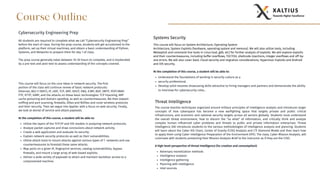
All students are required to complete what we call “Cybersecurity Engineering Prep”
before the start of class. During the prep course, students will get accustomed to the
platform, set up their virtual machines, and obtain a basic understanding of Python,
Systems, and Networks to prepare them for day 1 of class.
The prep course generally takes between 10-20 hours to complete, and is bookended
by a pre-test and post-test to assess understanding of the concepts covered.
This course will focus on the core ideas in network security. The first
portion of the class will continue review of basic network protocols:
Ethernet, 802.11 (WiFi), IP, UDP, TCP, ARP, DHCP, DNS, ICMP, BGP, SMTP, POP/IMAP,
FTP, HTTP, IGMP, and the attacks on these basic technologies: TCP hijacking, ARP
cache poisoning and domain spoofing, as well as countermeasures. We then explain
sniffing and port scanning, firewalls, IDSes and NIDSes and cover wireless protocols
and their security. Then we segue into AppSec with a focus on web security. Finally,
we look at denial of service and attack payloads.
At the completion of this course, a student will be able to:
Utilize the layers of the TCP/IP and OSI models in analyzing network protocols.
Analyze packet captures and draw conclusions about network activity.
Create a web application and evaluate its security.
Explain network security protocols as well as their vulnerabilities.
Utilize attack tools to mount attacks against various types of 7 networks and use
countermeasures to forestall these same attacks.
Map ports on a given IP, fingerprint services, catalog vulnerabilities, bypass
firewalls, and mount a large array of web-based exploits.
Deliver a wide variety of payloads to attain and maintain backdoor access to a
compromised machine.
Cybersecurity Engineering Prep
This course will focus on System Architecture, Operating System
Architecture, System Exploits (hardware, operating system and memory). We will also utilize tools, including
Metasploit and command line tools in Linux (xxd, gdb, etc) for further analysis of exploits. We will explore exploits
and their countermeasures, including buffer overflows, TOCTOU, shellcode injections, integer overflows and off-by-
one errors. We will also cover basic Cloud security and migration considerations, Hypervisor Exploits and Android
and iOS security.
At the completion of this course, a student will be able to:
Understand the foundations of working in security culture as a
security professional.
Develop solid resumes showcasing skills attractive to hiring managers and partners and demonstrate the ability
to interview for cybersecurity roles..
Systems Security
The course teaches techniques organized around military principles of intelligence analysis and introduces larger
concepts of how cyberspace has become a new warfighting space that targets private and public critical
infrastructure, and economic and national security targets across all sectors globally. Students must understand
the overall threat environment, how to discern the “so what” of information, and critically think and analyze
complex human influenced cyber problems and threats to public and private information enterprises. Threat
Intelligence 200 introduces students to the various methodologies of intelligence analysis and planning. Students
will learn about the Cyber Kill Chain, Center of Gravity (COG) Analysis and CTI Diamond Model and then learn how
to apply them using Cyber Intelligence Preparation of the Environment (IPE). The class, Cyber Mission Analysis, will
culminate with students presenting their Mission Analysis Brief to the instructor as if they are the CISO.
A high-level perspective of threat intelligence (its creation and consumption):
Adversary monetization methods
Intelligence analysis
Intelligence gathering
Planning with intelligence
Intel sources
Threat Intelligence
Course Outline
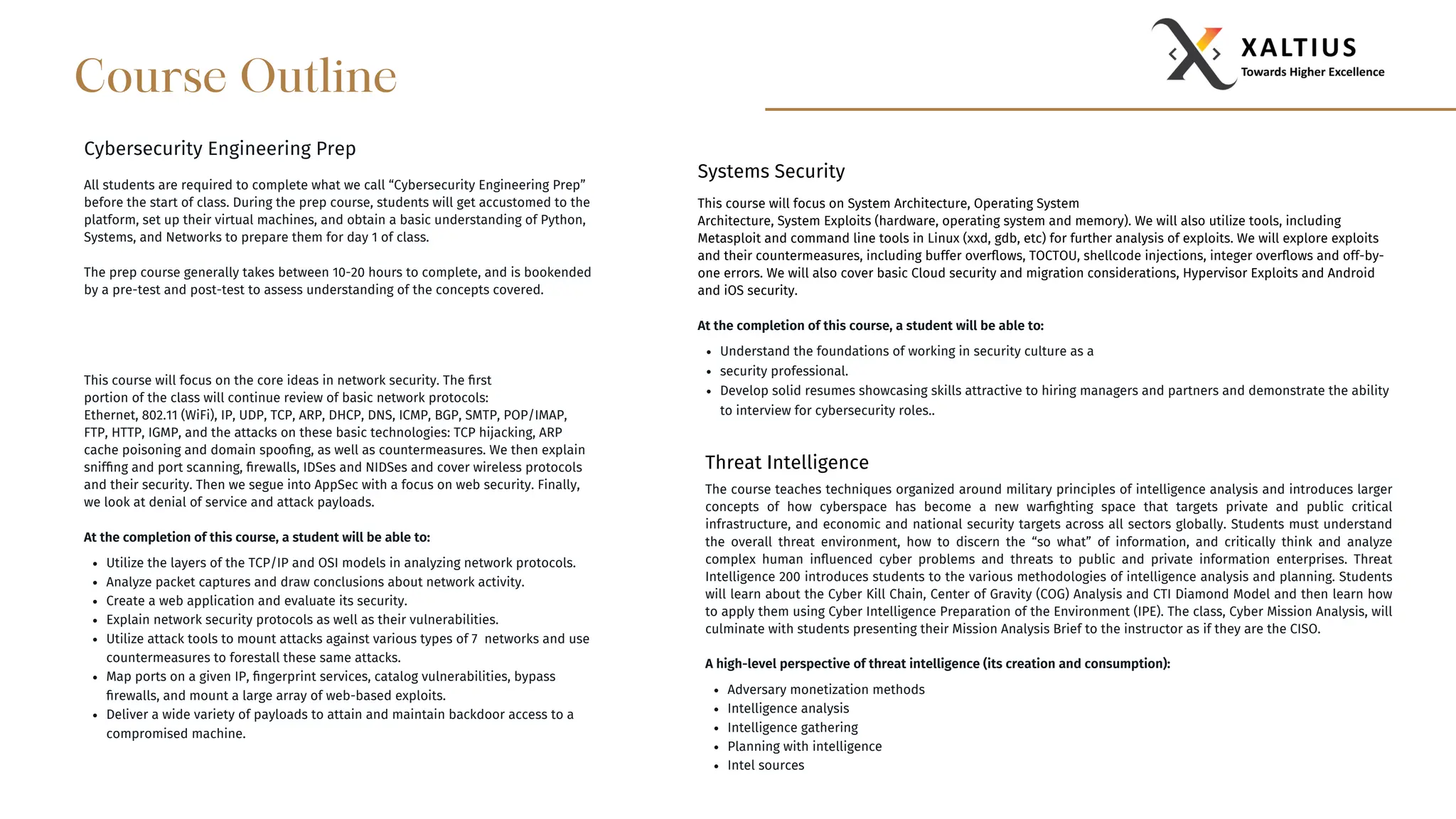
This course will focus on Governance, Risk, and Compliance (GRC). Students will learn how to
engage all functional levels within the enterprise to deliver information system security. These
topics include plans and policies, enterprise roles, security metrics, risk management, standards
and regulations, physical security, and business continuity. Each piece of the puzzle must be in
place for the enterprise to achieve its security goals; adversaries will invariably find and exploit
weak links. By the end of the course, students will be able to implement GRC programs at the
maturity level that many organizations are not at currently and to establish efficient, effective, and
elegant Information Security Programs.
A high-level perspective of threat intelligence (its creation and consumption):
Plans and policies
Risk management
Physical security
Enterprise roles
Standards and
Business continuity
Security metricsregulations
Governance, Risk Management and Compliance
This course will focus on engineering solutions to allow analyzing the logs in various network
devices, including workstations, servers, routers, firewalls and other network security devices.
We will explore the information stored in logs and how to capture this data for analyzing these
logs with a Security Information and Event Manager (SIEM). We will learn the steps involved in
Incident Response and Crisis Management.
At the completion of this course, a student will be able to:
Identify log sources and the configurations necessary to achieve appropriate logging levels.
Describe the different types of data contained in log files.
Configure data sources and SIEMs to allow the analysis of log data, including the automation
of those tasks.
Identify steps in Incident Response and Crisis Management..
Logs and Detection
Python programming is a fundamental skill used by Cybersecurity Engineers. This course provides the
fundamental structure and language for creating Python scripts and automation. The focus will be on
learning basic coding, code analysis and secure coding practices.
Python 100 will cover the differences between interpreted and compiled coding languages. The focus for
the interpreted languages will be the basic code structure for Python, conditionals, loops and algorithm
diagramming tools.
Students will work on analyzing basic code, modify that code to add additional functionality and writing
simple algorithms.
Python 200 will dive deeper into topics such as more advanced algorithms and Object Oriented
Programming. Secure coding techniques and methodologies will also be covered, including standard
frameworks. Python code will be utilized in other courses, such as Networking, Systems and
Cryptography.
At the completion of this course, a student will be able to:
Analyze Python scripts to determine what functionality they provide.
Write simple Python scripts using conditionals, loops, variables and other
data structures.
Import modules to increase the functionality of the Python script.
Use coding frameworks to ensure secure coding techniques are utilized.
Python
Course Outline
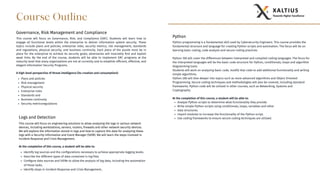
Application Security focuses on the applications and their vulnerabilities running on both workstations
and servers. Penetration testing is using vulnerabilities either in applications or network resources that
allows for exploitation. This can lead to server downtime, service interruptions or in the worst case, root
level access for the malicious actor. This course focuses on methodologies utilized by penetration testers
to analyze and assess risk to systems, networks, applications and other vulnerable areas of concern to a
company. These are the same techniques used by malicious actors to compromise a company. The role of
the penetration tester is critical in finding the vulnerabilities and risks before they can be exploited.
Application Security & Penetration Testing
APP100 will focus on the basic techniques and tools employed by a penetration tester or hacker. The
focus will be on the Penetration Testing Execution
Standard (PTES) framework for determining where a company has exposure, testings the vulnerabilities,
and basic approaches to exploiting the vulnerabilities. Additionally, network mapping will be revisited
and specific techniques for reconnaissance will be discussed.
APP200 will look at specific exploits and how they can be utilized to more
efficiently target and exploit systems and networks. The focus will be on
crafting specific exploits based on the results of the reconnaissance
techniques. Finally, post exploitation activities and reporting will be discussed.
At the completion of this course, a student will be able to:
Describe the usage of Metasploit and other Kali Linux pentesting tools.
Describe the Penetration Testing Execution Standard (PTES).
Utilize attack tools to mount attacks against various types of networks and applications and use
countermeasures to forestall these same attacks
Deliver a wide variety of payloads to attain and maintain backdoor access to a compromised machine
and actions to combat these attacks, as well.
This course in Applied Cryptography teaches students the components of cryptography, provides hands-
on experience on configuring a web server with SSL/TLS, and educates students in interfacing with
Certificate Authorities, issuing certificates, configuring SSH securely, and sending/receiving encrypted
.and signed email
In the 100 module students will be introduced to basic principles of encryption and authentication;
additionally, students will understand and analyze historical approaches to cryptography. Students
will practice symmetric cryptography, namely block ciphers, hash functions, and message
.authentication Codes
The 200 module focuses on asymmetric cryptography (i.e. RSA and
Diffie-Hellman Key Exchange). Combined with symmetric encryption, this makes a powerful
combination for securing communications. Applications of these technologies will be explored by
deploying SSL and SSH solutions. The 300 module covers anonymity and exploits using cryptography.
Students explore weaknesses in WEP and SSL that lead vulnerabilities and discover how to counter
them.
Applied Cryptography
At the completion of this course, a student will be able to:
Explain the fundamental goals of cryptography.
Apply knowledge to use common crypto software.
Analyze vulnerable applications with respect to cryptographic best practices.
Create tools to attack and fix applications in a virtual
lab environment.
By the course’s conclusion, students will have covered all relevant parts of the cryptography
section of the industry-standard
CISSP certification program.
Course Outline
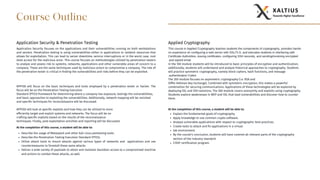
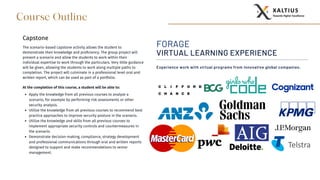
The scenario-based capstone activity allows the student to
demonstrate their knowledge and proficiency. The group project will
present a scenario and allow the students to work within their
individual expertise to work through the particulars. Very little guidance
will be given, allowing the students to work along multiple paths to
completion. The project will culminate in a professional level oral and
written report, which can be used as part of a portfolio.
At the completion of this course, a student will be able to:
Apply the knowledge from all previous courses to analyze a
scenario, for example by performing risk assessments or other
security analysis.
Utilize the knowledge from all previous courses to recommend best
practice approaches to improve security posture in the scenario.
Utilize the knowledge and skills from all previous courses to
implement appropriate security controls and countermeasures in
the scenario.
Demonstrate decision-making, compliance, strategy development
and professional communications through oral and written reports
designed to support and make recommendations to senior
management.
Capstone
VIRTUAL LEARNING EXPERIENCE
FORAGE
Experience work with virtual programs from innovative global companies.
Course overview Cybersecurity and its applications

Course overview Cybersecurity and its applications

  • 1.
    Course Outline All studentsare required to complete what we call “Cybersecurity Engineering Prep” before the start of class. During the prep course, students will get accustomed to the platform, set up their virtual machines, and obtain a basic understanding of Python, Systems, and Networks to prepare them for day 1 of class. The prep course generally takes between 10-20 hours to complete, and is bookended by a pre-test and post-test to assess understanding of the concepts covered. This course will focus on the core ideas in network security. The first portion of the class will continue review of basic network protocols: Ethernet, 802.11 (WiFi), IP, UDP, TCP, ARP, DHCP, DNS, ICMP, BGP, SMTP, POP/IMAP, FTP, HTTP, IGMP, and the attacks on these basic technologies: TCP hijacking, ARP cache poisoning and domain spoofing, as well as countermeasures. We then explain sniffing and port scanning, firewalls, IDSes and NIDSes and cover wireless protocols and their security. Then we segue into AppSec with a focus on web security. Finally, we look at denial of service and attack payloads. At the completion of this course, a student will be able to: Utilize the layers of the TCP/IP and OSI models in analyzing network protocols. Analyze packet captures and draw conclusions about network activity. Create a web application and evaluate its security. Explain network security protocols as well as their vulnerabilities. Utilize attack tools to mount attacks against various types of 7 networks and use countermeasures to forestall these same attacks. Map ports on a given IP, fingerprint services, catalog vulnerabilities, bypass firewalls, and mount a large array of web-based exploits. Deliver a wide variety of payloads to attain and maintain backdoor access to a compromised machine. Cybersecurity Engineering Prep This course will focus on System Architecture, Operating System Architecture, System Exploits (hardware, operating system and memory). We will also utilize tools, including Metasploit and command line tools in Linux (xxd, gdb, etc) for further analysis of exploits. We will explore exploits and their countermeasures, including buffer overflows, TOCTOU, shellcode injections, integer overflows and off-by- one errors. We will also cover basic Cloud security and migration considerations, Hypervisor Exploits and Android and iOS security. At the completion of this course, a student will be able to: Understand the foundations of working in security culture as a security professional. Develop solid resumes showcasing skills attractive to hiring managers and partners and demonstrate the ability to interview for cybersecurity roles.. Systems Security The course teaches techniques organized around military principles of intelligence analysis and introduces larger concepts of how cyberspace has become a new warfighting space that targets private and public critical infrastructure, and economic and national security targets across all sectors globally. Students must understand the overall threat environment, how to discern the “so what” of information, and critically think and analyze complex human influenced cyber problems and threats to public and private information enterprises. Threat Intelligence 200 introduces students to the various methodologies of intelligence analysis and planning. Students will learn about the Cyber Kill Chain, Center of Gravity (COG) Analysis and CTI Diamond Model and then learn how to apply them using Cyber Intelligence Preparation of the Environment (IPE). The class, Cyber Mission Analysis, will culminate with students presenting their Mission Analysis Brief to the instructor as if they are the CISO. A high-level perspective of threat intelligence (its creation and consumption): Adversary monetization methods Intelligence analysis Intelligence gathering Planning with intelligence Intel sources Threat Intelligence
  • 2.
    Course Outline This coursewill focus on Governance, Risk, and Compliance (GRC). Students will learn how to engage all functional levels within the enterprise to deliver information system security. These topics include plans and policies, enterprise roles, security metrics, risk management, standards and regulations, physical security, and business continuity. Each piece of the puzzle must be in place for the enterprise to achieve its security goals; adversaries will invariably find and exploit weak links. By the end of the course, students will be able to implement GRC programs at the maturity level that many organizations are not at currently and to establish efficient, effective, and elegant Information Security Programs. A high-level perspective of threat intelligence (its creation and consumption): Plans and policies Risk management Physical security Enterprise roles Standards and Business continuity Security metricsregulations Governance, Risk Management and Compliance This course will focus on engineering solutions to allow analyzing the logs in various network devices, including workstations, servers, routers, firewalls and other network security devices. We will explore the information stored in logs and how to capture this data for analyzing these logs with a Security Information and Event Manager (SIEM). We will learn the steps involved in Incident Response and Crisis Management. At the completion of this course, a student will be able to: Identify log sources and the configurations necessary to achieve appropriate logging levels. Describe the different types of data contained in log files. Configure data sources and SIEMs to allow the analysis of log data, including the automation of those tasks. Identify steps in Incident Response and Crisis Management.. Logs and Detection Python programming is a fundamental skill used by Cybersecurity Engineers. This course provides the fundamental structure and language for creating Python scripts and automation. The focus will be on learning basic coding, code analysis and secure coding practices. Python 100 will cover the differences between interpreted and compiled coding languages. The focus for the interpreted languages will be the basic code structure for Python, conditionals, loops and algorithm diagramming tools. Students will work on analyzing basic code, modify that code to add additional functionality and writing simple algorithms. Python 200 will dive deeper into topics such as more advanced algorithms and Object Oriented Programming. Secure coding techniques and methodologies will also be covered, including standard frameworks. Python code will be utilized in other courses, such as Networking, Systems and Cryptography. At the completion of this course, a student will be able to: Analyze Python scripts to determine what functionality they provide. Write simple Python scripts using conditionals, loops, variables and other data structures. Import modules to increase the functionality of the Python script. Use coding frameworks to ensure secure coding techniques are utilized. Python
  • 3.
    Course Outline Application Securityfocuses on the applications and their vulnerabilities running on both workstations and servers. Penetration testing is using vulnerabilities either in applications or network resources that allows for exploitation. This can lead to server downtime, service interruptions or in the worst case, root level access for the malicious actor. This course focuses on methodologies utilized by penetration testers to analyze and assess risk to systems, networks, applications and other vulnerable areas of concern to a company. These are the same techniques used by malicious actors to compromise a company. The role of the penetration tester is critical in finding the vulnerabilities and risks before they can be exploited. Application Security & Penetration Testing APP100 will focus on the basic techniques and tools employed by a penetration tester or hacker. The focus will be on the Penetration Testing Execution Standard (PTES) framework for determining where a company has exposure, testings the vulnerabilities, and basic approaches to exploiting the vulnerabilities. Additionally, network mapping will be revisited and specific techniques for reconnaissance will be discussed. APP200 will look at specific exploits and how they can be utilized to more efficiently target and exploit systems and networks. The focus will be on crafting specific exploits based on the results of the reconnaissance techniques. Finally, post exploitation activities and reporting will be discussed. At the completion of this course, a student will be able to: Describe the usage of Metasploit and other Kali Linux pentesting tools. Describe the Penetration Testing Execution Standard (PTES). Utilize attack tools to mount attacks against various types of networks and applications and use countermeasures to forestall these same attacks Deliver a wide variety of payloads to attain and maintain backdoor access to a compromised machine and actions to combat these attacks, as well. This course in Applied Cryptography teaches students the components of cryptography, provides hands- on experience on configuring a web server with SSL/TLS, and educates students in interfacing with Certificate Authorities, issuing certificates, configuring SSH securely, and sending/receiving encrypted .and signed email In the 100 module students will be introduced to basic principles of encryption and authentication; additionally, students will understand and analyze historical approaches to cryptography. Students will practice symmetric cryptography, namely block ciphers, hash functions, and message .authentication Codes The 200 module focuses on asymmetric cryptography (i.e. RSA and Diffie-Hellman Key Exchange). Combined with symmetric encryption, this makes a powerful combination for securing communications. Applications of these technologies will be explored by deploying SSL and SSH solutions. The 300 module covers anonymity and exploits using cryptography. Students explore weaknesses in WEP and SSL that lead vulnerabilities and discover how to counter them. Applied Cryptography At the completion of this course, a student will be able to: Explain the fundamental goals of cryptography. Apply knowledge to use common crypto software. Analyze vulnerable applications with respect to cryptographic best practices. Create tools to attack and fix applications in a virtual lab environment. By the course’s conclusion, students will have covered all relevant parts of the cryptography section of the industry-standard CISSP certification program.
  • 4.
    Course Outline The scenario-basedcapstone activity allows the student to demonstrate their knowledge and proficiency. The group project will present a scenario and allow the students to work within their individual expertise to work through the particulars. Very little guidance will be given, allowing the students to work along multiple paths to completion. The project will culminate in a professional level oral and written report, which can be used as part of a portfolio. At the completion of this course, a student will be able to: Apply the knowledge from all previous courses to analyze a scenario, for example by performing risk assessments or other security analysis. Utilize the knowledge from all previous courses to recommend best practice approaches to improve security posture in the scenario. Utilize the knowledge and skills from all previous courses to implement appropriate security controls and countermeasures in the scenario. Demonstrate decision-making, compliance, strategy development and professional communications through oral and written reports designed to support and make recommendations to senior management. Capstone VIRTUAL LEARNING EXPERIENCE FORAGE Experience work with virtual programs from innovative global companies.