Page 1 of 6
COURSE GUIDE
ILM 22083
MUSLIM FAMILY LAW IN SRI LANKA
LEVEL- 2
SEMESTER- II
2020/2021
Lecturers in charge:
Mrs. MSF. Nisfa
Lecturer (Prob) in Islamic Law & Legislation
&
Mr I. Saujan
Temp. Assist. Lecturer in Islamic Law &
Legislation
Department of Islamic Studies
Faculty of Islamic Studies & Arabic Language
South Eastern University of Sri Lanka (SEUSL)
2023
Page 2 of 6
COURSE INTRODUCTION
❖ COURSE NAME: Muslim Family Law in Sri Lanka
❖ SUBJECT CODE: ILM 22083
❖ STAGE OF THE COURSE: Level -2, Semester-II (2020/2021)
❖ WEIGHTAGE: 03 Credits
❖ HOURS OF STUDY: 45 (Lecture: 30 hours and Tutorial: 15 hours)
❖ AVAILABILITY: Bachelor of Arts (Honours) in Islamic Law & Legislation
DESCRIPTION OF THE COURSE
The Islamic family system is governed by Shari'ah law, which plays a significant role. In
the course of studying Muslim family law in Sri Lanka, laws relating to family matters are
discussed since the family is a central unit in a society. This includes the examination of
national and international standards introduced to eliminate discrimination against
women and children. Furthermore, the institution of marriage and its formalities,
adoption, custody, child care, polygamy, and matrimonial and maintenance rights are
discussed within the scope of personal and general laws enforced in Sri Lanka, as well as
in Muslim majority and minority countries around the world.
INTENDED LEARNING OUTCOMES
At the end of the course students should be able to:
1. Have a comprehensive understanding on legal frame work pertaining to the family
law
2. Analyse the sources of family law in context of pluralistic legal system
3. Understand the differences between Islamic Jurisprudence and western
jurisprudence
4. Apply the legal knowledge of family law to solve the legal disputes arising from
the
institution of family
5. Understand the qualification and eligibility of the Quazi in Islamic shari’sh and
Muslim family law in Sri Lanka
Page 3 of 6
CONTENT OF THE COURSE
1. Introduction
2. Marriage, Maintenance, Divorce, adoption, custody and child caring
3. Polygamy
4. Muslim family law in Muslim countries
5. Muslim family law in Muslim Minorities Countries
6. Muslim Family law in Sri Lanka legal system
7. Changes in Muslim family law, Scope and procedure
8. Assessment of Legislation and judicial division which have modified shari’ah law
9. The mechanism of changes in Muslim Law
10. Critical Evaluation of the Muslim family law
11. The international perspective of the Islamic Family law
12. Contemporary trend in Muslim family law
ASSESSMENT METHOD
Final Written Examination: 70 Marks
1. The final examination will be held at the end of the semester
2. The final examination paper will include eight (08) questions and only five (05)
questions should be answered by the students
3. Each question will carry 20% of the allocated marks for the final paper
4. The written 100marks will be converted to 70 marks
Continuous Assessment: 30 Marks
▪ Assignment
▪ weekly reflective paper
▪ Easy writing
▪ Group or individual presentation
▪ Open book examination
▪ Action learning reporting
Page 4 of 6
GRADING SCALE
75-100 A+ 4.00
70-74 A 4.00
65-69 A- 3.70
60-64 B+ 3.30
55-59 B 3.00
50-54 B- 2.70
45-49 C+ 2.30
40-44 C 2.00
35-39 C- 1.70
30-34 D+ 1.30
25-29 D 1.00
00.24 E 0.0
REQUIRED READING
1. Mansoori, M.T., (2014). Family law in Islam: Theory and Application. Adam
Publishers & Distributors: New Delhi - India.
2. Hassan Ayoup., (n.d). Fiqh of Muslim family law: A Manual Book in Islamic
Jurisprudence. Salma cook Islamic INC. Publishing & Distribution: Cairo. Egypt.
3. Wijeyadasa Rajapakshe., (2020). Family Law. Published by Author: Nugegoda, Sri
Lanka.
4. R+sdp nfhbf;fhu.> (2010). ,yq;ifapd; K];ypk; FLk;gtpay;: nfhs;if>
eilKiw> kw;Wk; ngz;fs; njhlu;ghd mf;fiwf;Fupa tplaq;fs;. K];ypk;
ngz;fs; Muha;r;rp nray; Kd;dzp K];ypk; rl;lq;fspd; fPo; thOk;
ngz;fs; xd;wpak;.
5. Saleem, M. (2011). The Quazi Court System in Sri Lanka and its Impact on Muslim
Women (First). Muslim Women’s Research and Ac t on Forum (MWRAF), 73/19 E
Kirulapone Avenue.
https://www.academia.edu/30277198/The_Quazi_Court_System_in_Sri_Lanka_a
nd_its_Impact_on_Muslim_Women
6. Marriage and Divorce (Muslim), Muslim Marriage and Divorce Act. No 13 (1951).
URL: http://www.commonlii.org/lk/legis/consol_act/mad134294.pdf or
https://www.rgd.gov.lk/web/images/2021/Act/Muslim-Marriage--Divorce-Act-
--E.pdf
7. Marriage (General), Marriage Registration Ordinance No 19 (1907). URL:
http://www.commonlii.org/lk/legis/consol_act/m131146.pdf
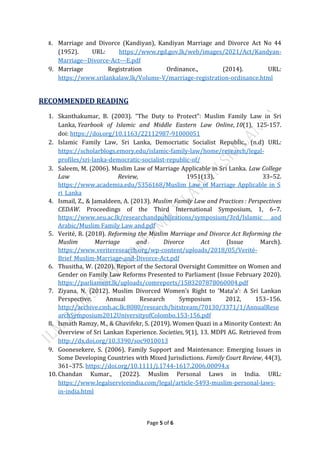
GPA CALCULATION
G.P. A= Sum of [Credit x grade point]
GPA=
Sum of credits of all paper in that Semester
Page 5 of 6
8. Marriage and Divorce (Kandiyan), Kandiyan Marriage and Divorce Act No 44
(1952). URL: https://www.rgd.gov.lk/web/images/2021/Act/Kandyan-
Marriage--Divorce-Act---E.pdf
9. Marriage Registration Ordinance., (2014). URL:
https://www.srilankalaw.lk/Volume-V/marriage-registration-ordinance.html
RECOMMENDED READING
1. Skanthakumar, B. (2003). “The Duty to Protect”: Muslim Family Law in Sri
Lanka, Yearbook of Islamic and Middle Eastern Law Online, 10(1), 125-157.
doi: https://doi.org/10.1163/22112987-91000051
2. Islamic Family Law, Sri Lanka, Democriatic Socialist Republic., (n.d) URL:
https://scholarblogs.emory.edu/islamic-family-law/home/research/legal-
profiles/sri-lanka-democratic-socialist-republic-of/
3. Saleem, M. (2006). Muslim Law of Marriage Applicable in Sri Lanka. Law College
Law Review, 1951(13), 33–52.
https://www.academia.edu/5356168/Muslim_Law_of_Marriage_Applicable_in_S
ri_Lanka
4. Ismail, Z., & Jamaldeen, A. (2013). Muslim Family Law and Practices : Perspectives
CEDAW. Proceedings of the Third International Symposium, 1, 6–7.
https://www.seu.ac.lk/researchandpublications/symposium/3rd/Islamic and
Arabic/Muslim Family Law and.pdf
5. Verité, R. (2018). Reforming the Muslim Marriage and Divorce Act Reforming the
Muslim Marriage and Divorce Act (Issue March).
https://www.veriteresearch.org/wp-content/uploads/2018/05/Verité-
Brief_Muslim-Marriage-and-Divorce-Act.pdf
6. Thusitha, W. (2020). Report of the Sectoral Oversight Committee on Women and
Gender on Family Law Reforms Presented to Parliament (Issue February 2020).
https://parliament.lk/uploads/comreports/1583207878060004.pdf
7. Ziyana, N. (2012). Muslim Divorced Women’s Right to ‘Mata’a’: A Sri Lankan
Perspective. Annual Research Symposium 2012, 153–156.
http://archive.cmb.ac.lk:8080/research/bitstream/70130/3371/1/AnnualRese
archSymposium2012UniversityofColombo.153-156.pdf
8. Ismath Ramzy, M., & Ghavifekr, S. (2019). Women Quazi in a Minority Context: An
Overview of Sri Lankan Experience. Societies, 9(1), 13. MDPI AG. Retrieved from
http://dx.doi.org/10.3390/soc9010013
9. Goonesekere, S. (2006). Family Support and Maintenance: Emerging Issues in
Some Developing Countries with Mixed Jurisdictions. Family Court Review, 44(3),
361–375. https://doi.org/10.1111/j.1744-1617.2006.00094.x
10. Chandan Kumar., (2022). Muslim Personal Laws in India. URL:
https://www.legalserviceindia.com/legal/article-5493-muslim-personal-laws-
in-india.html
Page 6 of 6
11. Subramanian, N. (2008). Legal Change and Gender Inequality: Changes in Muslim
Family Law in India. Law & Social Inquiry, 33(3), 631–672.
http://www.jstor.org/stable/20108777
SCHOLARLY SEARCH ENGINES
1. Google Scholar
2. Google Books
3. Microsoft Academic
4. Worldwide Science
5. Educational Research Information Center
6. ResearchGate
7. Academia.edu
8. E-Repository of SEUSL
E-Mail
1. MRS. MSF. NISFA nisfamsf@seu.ac.lk
2. MR I. SAUJAN savjaniqbal@seu.ac.lk

COURSE GUIDE.pdf

  • 1.
    Page 1 of6 COURSE GUIDE ILM 22083 MUSLIM FAMILY LAW IN SRI LANKA LEVEL- 2 SEMESTER- II 2020/2021 Lecturers in charge: Mrs. MSF. Nisfa Lecturer (Prob) in Islamic Law & Legislation & Mr I. Saujan Temp. Assist. Lecturer in Islamic Law & Legislation Department of Islamic Studies Faculty of Islamic Studies & Arabic Language South Eastern University of Sri Lanka (SEUSL) 2023
  • 2.
    Page 2 of6 COURSE INTRODUCTION ❖ COURSE NAME: Muslim Family Law in Sri Lanka ❖ SUBJECT CODE: ILM 22083 ❖ STAGE OF THE COURSE: Level -2, Semester-II (2020/2021) ❖ WEIGHTAGE: 03 Credits ❖ HOURS OF STUDY: 45 (Lecture: 30 hours and Tutorial: 15 hours) ❖ AVAILABILITY: Bachelor of Arts (Honours) in Islamic Law & Legislation DESCRIPTION OF THE COURSE The Islamic family system is governed by Shari'ah law, which plays a significant role. In the course of studying Muslim family law in Sri Lanka, laws relating to family matters are discussed since the family is a central unit in a society. This includes the examination of national and international standards introduced to eliminate discrimination against women and children. Furthermore, the institution of marriage and its formalities, adoption, custody, child care, polygamy, and matrimonial and maintenance rights are discussed within the scope of personal and general laws enforced in Sri Lanka, as well as in Muslim majority and minority countries around the world. INTENDED LEARNING OUTCOMES At the end of the course students should be able to: 1. Have a comprehensive understanding on legal frame work pertaining to the family law 2. Analyse the sources of family law in context of pluralistic legal system 3. Understand the differences between Islamic Jurisprudence and western jurisprudence 4. Apply the legal knowledge of family law to solve the legal disputes arising from the institution of family 5. Understand the qualification and eligibility of the Quazi in Islamic shari’sh and Muslim family law in Sri Lanka
  • 3.
    Page 3 of6 CONTENT OF THE COURSE 1. Introduction 2. Marriage, Maintenance, Divorce, adoption, custody and child caring 3. Polygamy 4. Muslim family law in Muslim countries 5. Muslim family law in Muslim Minorities Countries 6. Muslim Family law in Sri Lanka legal system 7. Changes in Muslim family law, Scope and procedure 8. Assessment of Legislation and judicial division which have modified shari’ah law 9. The mechanism of changes in Muslim Law 10. Critical Evaluation of the Muslim family law 11. The international perspective of the Islamic Family law 12. Contemporary trend in Muslim family law ASSESSMENT METHOD Final Written Examination: 70 Marks 1. The final examination will be held at the end of the semester 2. The final examination paper will include eight (08) questions and only five (05) questions should be answered by the students 3. Each question will carry 20% of the allocated marks for the final paper 4. The written 100marks will be converted to 70 marks Continuous Assessment: 30 Marks ▪ Assignment ▪ weekly reflective paper ▪ Easy writing ▪ Group or individual presentation ▪ Open book examination ▪ Action learning reporting
  • 4.
    Page 4 of6 GRADING SCALE 75-100 A+ 4.00 70-74 A 4.00 65-69 A- 3.70 60-64 B+ 3.30 55-59 B 3.00 50-54 B- 2.70 45-49 C+ 2.30 40-44 C 2.00 35-39 C- 1.70 30-34 D+ 1.30 25-29 D 1.00 00.24 E 0.0 REQUIRED READING 1. Mansoori, M.T., (2014). Family law in Islam: Theory and Application. Adam Publishers & Distributors: New Delhi - India. 2. Hassan Ayoup., (n.d). Fiqh of Muslim family law: A Manual Book in Islamic Jurisprudence. Salma cook Islamic INC. Publishing & Distribution: Cairo. Egypt. 3. Wijeyadasa Rajapakshe., (2020). Family Law. Published by Author: Nugegoda, Sri Lanka. 4. R+sdp nfhbf;fhu.> (2010). ,yq;ifapd; K];ypk; FLk;gtpay;: nfhs;if> eilKiw> kw;Wk; ngz;fs; njhlu;ghd mf;fiwf;Fupa tplaq;fs;. K];ypk; ngz;fs; Muha;r;rp nray; Kd;dzp K];ypk; rl;lq;fspd; fPo; thOk; ngz;fs; xd;wpak;. 5. Saleem, M. (2011). The Quazi Court System in Sri Lanka and its Impact on Muslim Women (First). Muslim Women’s Research and Ac t on Forum (MWRAF), 73/19 E Kirulapone Avenue. https://www.academia.edu/30277198/The_Quazi_Court_System_in_Sri_Lanka_a nd_its_Impact_on_Muslim_Women 6. Marriage and Divorce (Muslim), Muslim Marriage and Divorce Act. No 13 (1951). URL: http://www.commonlii.org/lk/legis/consol_act/mad134294.pdf or https://www.rgd.gov.lk/web/images/2021/Act/Muslim-Marriage--Divorce-Act- --E.pdf 7. Marriage (General), Marriage Registration Ordinance No 19 (1907). URL: http://www.commonlii.org/lk/legis/consol_act/m131146.pdf GPA CALCULATION G.P. A= Sum of [Credit x grade point] GPA= Sum of credits of all paper in that Semester
  • 5.
    Page 5 of6 8. Marriage and Divorce (Kandiyan), Kandiyan Marriage and Divorce Act No 44 (1952). URL: https://www.rgd.gov.lk/web/images/2021/Act/Kandyan- Marriage--Divorce-Act---E.pdf 9. Marriage Registration Ordinance., (2014). URL: https://www.srilankalaw.lk/Volume-V/marriage-registration-ordinance.html RECOMMENDED READING 1. Skanthakumar, B. (2003). “The Duty to Protect”: Muslim Family Law in Sri Lanka, Yearbook of Islamic and Middle Eastern Law Online, 10(1), 125-157. doi: https://doi.org/10.1163/22112987-91000051 2. Islamic Family Law, Sri Lanka, Democriatic Socialist Republic., (n.d) URL: https://scholarblogs.emory.edu/islamic-family-law/home/research/legal- profiles/sri-lanka-democratic-socialist-republic-of/ 3. Saleem, M. (2006). Muslim Law of Marriage Applicable in Sri Lanka. Law College Law Review, 1951(13), 33–52. https://www.academia.edu/5356168/Muslim_Law_of_Marriage_Applicable_in_S ri_Lanka 4. Ismail, Z., & Jamaldeen, A. (2013). Muslim Family Law and Practices : Perspectives CEDAW. Proceedings of the Third International Symposium, 1, 6–7. https://www.seu.ac.lk/researchandpublications/symposium/3rd/Islamic and Arabic/Muslim Family Law and.pdf 5. Verité, R. (2018). Reforming the Muslim Marriage and Divorce Act Reforming the Muslim Marriage and Divorce Act (Issue March). https://www.veriteresearch.org/wp-content/uploads/2018/05/Verité- Brief_Muslim-Marriage-and-Divorce-Act.pdf 6. Thusitha, W. (2020). Report of the Sectoral Oversight Committee on Women and Gender on Family Law Reforms Presented to Parliament (Issue February 2020). https://parliament.lk/uploads/comreports/1583207878060004.pdf 7. Ziyana, N. (2012). Muslim Divorced Women’s Right to ‘Mata’a’: A Sri Lankan Perspective. Annual Research Symposium 2012, 153–156. http://archive.cmb.ac.lk:8080/research/bitstream/70130/3371/1/AnnualRese archSymposium2012UniversityofColombo.153-156.pdf 8. Ismath Ramzy, M., & Ghavifekr, S. (2019). Women Quazi in a Minority Context: An Overview of Sri Lankan Experience. Societies, 9(1), 13. MDPI AG. Retrieved from http://dx.doi.org/10.3390/soc9010013 9. Goonesekere, S. (2006). Family Support and Maintenance: Emerging Issues in Some Developing Countries with Mixed Jurisdictions. Family Court Review, 44(3), 361–375. https://doi.org/10.1111/j.1744-1617.2006.00094.x 10. Chandan Kumar., (2022). Muslim Personal Laws in India. URL: https://www.legalserviceindia.com/legal/article-5493-muslim-personal-laws- in-india.html
  • 6.
    Page 6 of6 11. Subramanian, N. (2008). Legal Change and Gender Inequality: Changes in Muslim Family Law in India. Law & Social Inquiry, 33(3), 631–672. http://www.jstor.org/stable/20108777 SCHOLARLY SEARCH ENGINES 1. Google Scholar 2. Google Books 3. Microsoft Academic 4. Worldwide Science 5. Educational Research Information Center 6. ResearchGate 7. Academia.edu 8. E-Repository of SEUSL E-Mail 1. MRS. MSF. NISFA nisfamsf@seu.ac.lk 2. MR I. SAUJAN savjaniqbal@seu.ac.lk