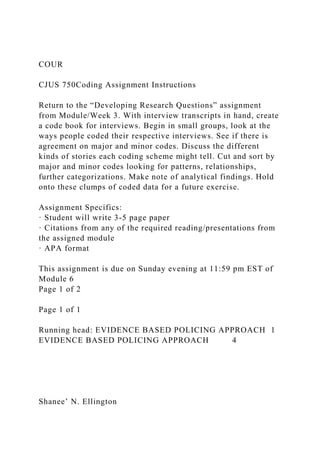
COUR
CJUS 750Coding Assignment Instructions
Return to the “Developing Research Questions” assignment
from Module/Week 3. With interview transcripts in hand, create
a code book for interviews. Begin in small groups, look at the
ways people coded their respective interviews. See if there is
agreement on major and minor codes. Discuss the different
kinds of stories each coding scheme might tell. Cut and sort by
major and minor codes looking for patterns, relationships,
further categorizations. Make note of analytical findings. Hold
onto these clumps of coded data for a future exercise.
Assignment Specifics:
· Student will write 3-5 page paper
· Citations from any of the required reading/presentations from
the assigned module
· APA format
This assignment is due on Sunday evening at 11:59 pm EST of
Module 6
Page 1 of 2
Page 1 of 1
Running head: EVIDENCE BASED POLICING APPROACH 1
EVIDENCE BASED POLICING APPROACH 4
Shanee’ N. Ellington
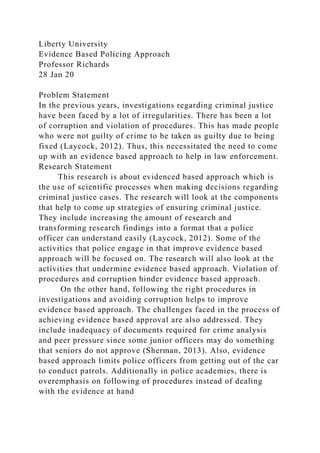
Liberty University
Evidence Based Policing Approach
Professor Richards
28 Jan 20
Problem Statement
In the previous years, investigations regarding criminal justice
have been faced by a lot of irregularities. There has been a lot
of corruption and violation of procedures. This has made people
who were not guilty of crime to be taken as guilty due to being
fixed (Laycock, 2012). Thus, this necessitated the need to come
up with an evidence based approach to help in law enforcement.
Research Statement
This research is about evidenced based approach which is
the use of scientific processes when making decisions regarding
criminal justice cases. The research will look at the components
that help to come up strategies of ensuring criminal justice.
They include increasing the amount of research and
transforming research findings into a format that a police
officer can understand easily (Laycock, 2012). Some of the
activities that police engage in that improve evidence based
approach will be focused on. The research will also look at the
activities that undermine evidence based approach. Violation of
procedures and corruption hinder evidence based approach.
On the other hand, following the right procedures in
investigations and avoiding corruption helps to improve
evidence based approach. The challenges faced in the process of
achieving evidence based approval are also addressed. They
include inadequacy of documents required for crime analysis
and peer pressure since some junior officers may do something
that seniors do not approve (Sherman, 2013). Also, evidence
based approach limits police officers from getting out of the car
to conduct patrols. Additionally in police academies, there is
overemphasis on following of procedures instead of dealing
with the evidence at hand
Research and Interview Questions
Research Questions
1. What are the components that are used to come up with
strategies of carrying out an evidence-based policing approach?
2. What are the changes that are faced in the process of
conducting an evidence-based policing approach?
3. What is the importance of evidence-based policing approach?
4. What are the ways in which challenges facing an evidence-
based policing approach can be addressed?
5. What are police officers supposed to do to ensure that
evidence-based policing approach is successful?
Interview Questions
1. What is your understanding of the evidence-based policing
approach?
2. Name components that can be used to come up with strategies
of ensuring an evidence-based approach is successful?
3. What do you think are activities done by police officers, and
they undermine the evidence-based policing approach?
4. What do you think police officers should do to enhance
evidence-based policing approach?
5 Name challenges that are faced in the process of ensuring
that an evidence-based policing approach is successful.
References
Bueermann, J. (2012). Being smart on crime with evidence-
based policing. NIJ Journal, 269, 12-15.
Laycock, G. (2012). In support of evidence-based approaches: a
response to Lum and Kennedy. Policing: A Journal of Policy
and Practice, 6(4), 324-326.
Lum, C. M., & Koper, C. S. (2017). Evidence-based policing:
Translating research into practice. Oxford, UK: Oxford
University Press.
Sherman, L. W. (2013). The rise of evidence-based policing:
Targeting, testing, and tracking. Crime and justice, 42(1), 377-
451.
Sherman, L. W. (2018). Evidence-based policing: Social
organization of information for social control. In Crime and
social organization (pp. 235-266). Routledge.
Telep, C. W., & Lum, C. (2014). The receptivity of officers to
empirical research and evidence-based policing: an examination
of survey data from three agencies. Police Quarterly, 17(4),
359-385.
Telep, C. W. (2017). Police officer receptivity to research and
evidence-based policing: examining variability within and
across agencies. Crime & delinquency, 63

COUR CJUS 750Coding Assignment InstructionsReturn to the .docx

  • 1.
    COUR CJUS 750Coding AssignmentInstructions Return to the “Developing Research Questions” assignment from Module/Week 3. With interview transcripts in hand, create a code book for interviews. Begin in small groups, look at the ways people coded their respective interviews. See if there is agreement on major and minor codes. Discuss the different kinds of stories each coding scheme might tell. Cut and sort by major and minor codes looking for patterns, relationships, further categorizations. Make note of analytical findings. Hold onto these clumps of coded data for a future exercise. Assignment Specifics: · Student will write 3-5 page paper · Citations from any of the required reading/presentations from the assigned module · APA format This assignment is due on Sunday evening at 11:59 pm EST of Module 6 Page 1 of 2 Page 1 of 1 Running head: EVIDENCE BASED POLICING APPROACH 1 EVIDENCE BASED POLICING APPROACH 4 Shanee’ N. Ellington
  • 2.
    Liberty University Evidence BasedPolicing Approach Professor Richards 28 Jan 20 Problem Statement In the previous years, investigations regarding criminal justice have been faced by a lot of irregularities. There has been a lot of corruption and violation of procedures. This has made people who were not guilty of crime to be taken as guilty due to being fixed (Laycock, 2012). Thus, this necessitated the need to come up with an evidence based approach to help in law enforcement. Research Statement This research is about evidenced based approach which is the use of scientific processes when making decisions regarding criminal justice cases. The research will look at the components that help to come up strategies of ensuring criminal justice. They include increasing the amount of research and transforming research findings into a format that a police officer can understand easily (Laycock, 2012). Some of the activities that police engage in that improve evidence based approach will be focused on. The research will also look at the activities that undermine evidence based approach. Violation of procedures and corruption hinder evidence based approach. On the other hand, following the right procedures in investigations and avoiding corruption helps to improve evidence based approach. The challenges faced in the process of achieving evidence based approval are also addressed. They include inadequacy of documents required for crime analysis and peer pressure since some junior officers may do something that seniors do not approve (Sherman, 2013). Also, evidence based approach limits police officers from getting out of the car to conduct patrols. Additionally in police academies, there is overemphasis on following of procedures instead of dealing with the evidence at hand
  • 3.
    Research and InterviewQuestions Research Questions 1. What are the components that are used to come up with strategies of carrying out an evidence-based policing approach? 2. What are the changes that are faced in the process of conducting an evidence-based policing approach? 3. What is the importance of evidence-based policing approach? 4. What are the ways in which challenges facing an evidence- based policing approach can be addressed? 5. What are police officers supposed to do to ensure that evidence-based policing approach is successful? Interview Questions 1. What is your understanding of the evidence-based policing approach? 2. Name components that can be used to come up with strategies of ensuring an evidence-based approach is successful? 3. What do you think are activities done by police officers, and they undermine the evidence-based policing approach? 4. What do you think police officers should do to enhance evidence-based policing approach? 5 Name challenges that are faced in the process of ensuring that an evidence-based policing approach is successful. References Bueermann, J. (2012). Being smart on crime with evidence- based policing. NIJ Journal, 269, 12-15. Laycock, G. (2012). In support of evidence-based approaches: a response to Lum and Kennedy. Policing: A Journal of Policy and Practice, 6(4), 324-326. Lum, C. M., & Koper, C. S. (2017). Evidence-based policing: Translating research into practice. Oxford, UK: Oxford University Press. Sherman, L. W. (2013). The rise of evidence-based policing: Targeting, testing, and tracking. Crime and justice, 42(1), 377- 451.
  • 4.
    Sherman, L. W.(2018). Evidence-based policing: Social organization of information for social control. In Crime and social organization (pp. 235-266). Routledge. Telep, C. W., & Lum, C. (2014). The receptivity of officers to empirical research and evidence-based policing: an examination of survey data from three agencies. Police Quarterly, 17(4), 359-385. Telep, C. W. (2017). Police officer receptivity to research and evidence-based policing: examining variability within and across agencies. Crime & delinquency, 63