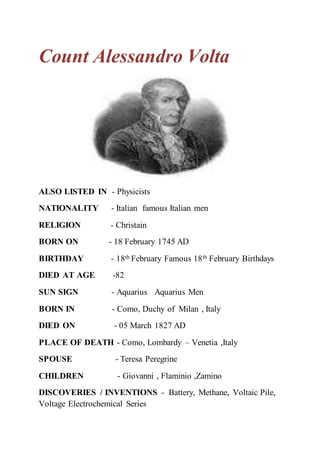
Count Alessandro Volta
ALSO LISTED IN - Physicists
NATIONALITY - Italian famous Italian men
RELIGION - Christain
BORN ON - 18 February 1745 AD
BIRTHDAY - 18th February Famous 18th February Birthdays
DIED AT AGE -82
SUN SIGN - Aquarius Aquarius Men
BORN IN - Como, Duchy of Milan , Italy
DIED ON - 05 March 1827 AD
PLACE OF DEATH - Como, Lombardy – Venetia ,Italy
SPOUSE - Teresa Peregrine
CHILDREN - Giovanni , Flaminio ,Zamino
DISCOVERIES / INVENTIONS - Battery, Methane, Voltaic Pile,
Voltage Electrochemical Series
Alessandro Giuseppe Antonio Anastasio Volta (18 February 1745 –
5 March 1827) was an Italian physicist, chemist, and a pioneer of
electricity and power,[2][3][4] who is credited as the inventor of the
electrical battery and the discoverer of methane. He invented the
Voltaic pile in 1799 and the results of which he reported in 1800 in a
two-part letter to the President of the Royal Society.[5][6] With this
invention Volta proved that electricity could be generated chemically
and debased the prevalent theory that electricity was generated solely
by living beings. Volta's invention sparked a great amount of
scientific excitement and led others to conduct similar experiments
which eventually led to the development of the field of
electrochemistry.[6]
Alessandro Volta also drew admiration from Napoleon Bonaparte for
his invention, and was invited to the Institute of France to
demonstrate his invention to the members of the Institute. Volta
enjoyed a certain amount of closeness with the Emperor throughout
his life and he was conferred numerous honours by him.[1] Alessandro
Volta held the chair of experimental physics at the University of Pavia
for nearly 40 years and was widely idolised by his students.[1]
Despite his professional success Volta tended to be a person inclined
towards domestic life and this was more apparent in his later years. At
this time he tended to live secluded from public life and more for the
sake of his family until his eventual death in 1827 from a series of
illnesses which began in 1823.[1] The SI unit of electric potential is
named in his honour as the volt.
Childhood & Early Life
Volta was born in Como; his parents, Filippo Volta and Maria
Maddalena Inzaghi, belonged to middleclass background.
As a child, he did not display much intelligence and did not start
speaking until he was 4 years old. By the time he turned seven, he not
only reached at par with other children but also overtook them in
astuteness.
He received his early education at the Royal Seminary in Como. His
parents wanted him to take up law or priesthood as a career but he had
already made up his mind to pursue chemistry and physics.
CAREER
 Volta began his career in the field of physics, in 1774 by teaching
the subject, at the Royal School of Como. During the year, he studied
atmospheric electricity and conducted experiments in fields of
electrochemistry, electromagnetism and electrophysiology.
 He pioneered the electrophorus in 1775, a device that produced
static electric charge. This was a device that could be charged with
electricity only by rubbing and this charge could be transferred to
other objects.
 Between 1776 and 1778, Volta worked in the realm of gases and
discovered methane gas in natural environment, which he was able to
isolate by the end of this period.
 In 1800, he invented voltaic pile—the first electric battery. This
battery was actually a pile of alternating discs of copper and zinc,
separated by pieces of cardboard soaked in brine that had the ability
to maintain steady electric current.
 He also developed the ‘Law of Capacitance’ and theorized the ‘law
of bimetallic contact’.
Major Works
One of the major published works of this ingenious scientist was ‘De
vi attractiva ignis electrici’ (1769); it was based on his extensive
research on attractive force present in the electric fire.
Awards & Achievements
 Volta was made a Fellow of the Royal Society of London in 1791,
for his ground breaking work in physics, especially development of
electroscope.
 In 1794, he was awarded the Copley Medal, by the Royal Society
of London, for development of Volta's Law of the electrochemical
series.
 In 1801, he was honored with the title of ‘Count’ by Napoleon
Bonaparte after he demonstrated the functionality of his battery to
him.
Personal Life & Legacy
 He married Teresa Peregrini, the daughter of Count Ludovico
Peregrini, in 1794 and the couple had three sons.
 He passed away on his estate in Camnago, Italy at the age of 82.
His remains were interred there and to honor this genius, the place
was renamed as “Camnago Volta”.
 As a tribute to Count Alessandro Volta, the Volta Prize is awarded
to anyone with scientific achievement in electricity.
 He worked with many great personalities during his lifetime,
including well-known French physicist, Abbe Antoine Nollet and
Italian experimenter, Giovanni Battista.
 Based on his life and observations Bern, Dibner wrote ‘Alessandro
Volta and the Electric Battery’, which was published in 1964.
 Another book called ‘Volta: Science and Culture in the Age of
Enlightenment’ was written by Giuliano Pancaldi and published in
2005.
TRIVIA
 He married Teresa Peregrini, the daughter of Count Ludovico
Peregrini, in 1794 and the couple had three sons.
 He passed away on his estate in Camnago, Italy at the age of 82.
His remains were interred there and to honor this genius, the place
was renamed as “Camnago Volta”.
 As a tribute to Count Alessandro Volta, the Volta Prize is awarded
to anyone with scientific achievement in electricity.
 He worked with many great personalities during his lifetime,
including well-known French physicist, Abbe Antoine Nollet and
Italian experimenter, Giovanni Battista.
 Based on his life and observations Bern, Dibner wrote ‘Alessandro
Volta and the Electric Battery’, which was published in 1964.
 Another book called ‘Volta: Science and Culture in the Age of
Enlightenment’ was written by Giuliano Pancaldi and published in
2005.
Count alesandro volta

Count alesandro volta

  • 1.
    Count Alessandro Volta ALSOLISTED IN - Physicists NATIONALITY - Italian famous Italian men RELIGION - Christain BORN ON - 18 February 1745 AD BIRTHDAY - 18th February Famous 18th February Birthdays DIED AT AGE -82 SUN SIGN - Aquarius Aquarius Men BORN IN - Como, Duchy of Milan , Italy DIED ON - 05 March 1827 AD PLACE OF DEATH - Como, Lombardy – Venetia ,Italy SPOUSE - Teresa Peregrine CHILDREN - Giovanni , Flaminio ,Zamino DISCOVERIES / INVENTIONS - Battery, Methane, Voltaic Pile, Voltage Electrochemical Series
  • 2.
    Alessandro Giuseppe AntonioAnastasio Volta (18 February 1745 – 5 March 1827) was an Italian physicist, chemist, and a pioneer of electricity and power,[2][3][4] who is credited as the inventor of the electrical battery and the discoverer of methane. He invented the Voltaic pile in 1799 and the results of which he reported in 1800 in a two-part letter to the President of the Royal Society.[5][6] With this invention Volta proved that electricity could be generated chemically and debased the prevalent theory that electricity was generated solely by living beings. Volta's invention sparked a great amount of scientific excitement and led others to conduct similar experiments which eventually led to the development of the field of electrochemistry.[6] Alessandro Volta also drew admiration from Napoleon Bonaparte for his invention, and was invited to the Institute of France to demonstrate his invention to the members of the Institute. Volta enjoyed a certain amount of closeness with the Emperor throughout his life and he was conferred numerous honours by him.[1] Alessandro Volta held the chair of experimental physics at the University of Pavia for nearly 40 years and was widely idolised by his students.[1] Despite his professional success Volta tended to be a person inclined towards domestic life and this was more apparent in his later years. At this time he tended to live secluded from public life and more for the sake of his family until his eventual death in 1827 from a series of illnesses which began in 1823.[1] The SI unit of electric potential is named in his honour as the volt. Childhood & Early Life Volta was born in Como; his parents, Filippo Volta and Maria Maddalena Inzaghi, belonged to middleclass background.
  • 3.
    As a child,he did not display much intelligence and did not start speaking until he was 4 years old. By the time he turned seven, he not only reached at par with other children but also overtook them in astuteness. He received his early education at the Royal Seminary in Como. His parents wanted him to take up law or priesthood as a career but he had already made up his mind to pursue chemistry and physics. CAREER  Volta began his career in the field of physics, in 1774 by teaching the subject, at the Royal School of Como. During the year, he studied atmospheric electricity and conducted experiments in fields of electrochemistry, electromagnetism and electrophysiology.  He pioneered the electrophorus in 1775, a device that produced static electric charge. This was a device that could be charged with electricity only by rubbing and this charge could be transferred to other objects.  Between 1776 and 1778, Volta worked in the realm of gases and discovered methane gas in natural environment, which he was able to isolate by the end of this period.  In 1800, he invented voltaic pile—the first electric battery. This battery was actually a pile of alternating discs of copper and zinc, separated by pieces of cardboard soaked in brine that had the ability to maintain steady electric current.  He also developed the ‘Law of Capacitance’ and theorized the ‘law of bimetallic contact’.
  • 4.
    Major Works One ofthe major published works of this ingenious scientist was ‘De vi attractiva ignis electrici’ (1769); it was based on his extensive research on attractive force present in the electric fire. Awards & Achievements  Volta was made a Fellow of the Royal Society of London in 1791, for his ground breaking work in physics, especially development of electroscope.  In 1794, he was awarded the Copley Medal, by the Royal Society of London, for development of Volta's Law of the electrochemical series.  In 1801, he was honored with the title of ‘Count’ by Napoleon Bonaparte after he demonstrated the functionality of his battery to him. Personal Life & Legacy  He married Teresa Peregrini, the daughter of Count Ludovico Peregrini, in 1794 and the couple had three sons.  He passed away on his estate in Camnago, Italy at the age of 82. His remains were interred there and to honor this genius, the place was renamed as “Camnago Volta”.  As a tribute to Count Alessandro Volta, the Volta Prize is awarded to anyone with scientific achievement in electricity.
  • 5.
     He workedwith many great personalities during his lifetime, including well-known French physicist, Abbe Antoine Nollet and Italian experimenter, Giovanni Battista.  Based on his life and observations Bern, Dibner wrote ‘Alessandro Volta and the Electric Battery’, which was published in 1964.  Another book called ‘Volta: Science and Culture in the Age of Enlightenment’ was written by Giuliano Pancaldi and published in 2005. TRIVIA  He married Teresa Peregrini, the daughter of Count Ludovico Peregrini, in 1794 and the couple had three sons.  He passed away on his estate in Camnago, Italy at the age of 82. His remains were interred there and to honor this genius, the place was renamed as “Camnago Volta”.  As a tribute to Count Alessandro Volta, the Volta Prize is awarded to anyone with scientific achievement in electricity.  He worked with many great personalities during his lifetime, including well-known French physicist, Abbe Antoine Nollet and Italian experimenter, Giovanni Battista.  Based on his life and observations Bern, Dibner wrote ‘Alessandro Volta and the Electric Battery’, which was published in 1964.  Another book called ‘Volta: Science and Culture in the Age of Enlightenment’ was written by Giuliano Pancaldi and published in 2005.