Cost Estimation Handbook2nd Edition Ausimm
download
https://ebookbell.com/product/cost-estimation-handbook-2nd-
edition-ausimm-46576132
Explore and download more ebooks at ebookbell.com
2.
Here are somerecommended products that we believe you will be
interested in. You can click the link to download.
Handbook Of Cost Engineering For Space Transportation Systems With
Transcost 72 Statisticalanalytical Model For Cost Estimation And
Economical Optimization Of Launch Vehicles Koelle
https://ebookbell.com/product/handbook-of-cost-engineering-for-space-
transportation-systems-with-transcost-72-statisticalanalytical-model-
for-cost-estimation-and-economical-optimization-of-launch-vehicles-
koelle-10452152
Spons First Stage Estimating Handbook Spons Estimating Costs Guides
3rd Edition 3rd Edition Bryan Spain
https://ebookbell.com/product/spons-first-stage-estimating-handbook-
spons-estimating-costs-guides-3rd-edition-3rd-edition-bryan-
spain-2481692
Cost Estimation Methods And Tools 1st Edition Gregory K Mislick
https://ebookbell.com/product/cost-estimation-methods-and-tools-1st-
edition-gregory-k-mislick-5100370
Cost Estimation For Decommissioning An International Overview Of Cost
Elements Estimation Practices And Reporting Requirements Oecd
https://ebookbell.com/product/cost-estimation-for-decommissioning-an-
international-overview-of-cost-elements-estimation-practices-and-
reporting-requirements-oecd-6772098
3.
Cost Estimation TechniquesFor Web Projects Illustrated Edition Emilia
Mendes
https://ebookbell.com/product/cost-estimation-techniques-for-web-
projects-illustrated-edition-emilia-mendes-1364616
Software Cost Estimation Benchmarking And Risk Assessment The Software
Decisionmakers Guide To Predictable Software Development Adam
Trendowicz
https://ebookbell.com/product/software-cost-estimation-benchmarking-
and-risk-assessment-the-software-decisionmakers-guide-to-predictable-
software-development-adam-trendowicz-57432174
Process Planning And Cost Estimation 2nd Ed R Kesavan C Elanchezhian B
Vijaya Ramnath
https://ebookbell.com/product/process-planning-and-cost-
estimation-2nd-ed-r-kesavan-c-elanchezhian-b-vijaya-ramnath-4125830
Practice Of Cost Estimation For Decommissioning Of Nuclear Facilities
Oecd
https://ebookbell.com/product/practice-of-cost-estimation-for-
decommissioning-of-nuclear-facilities-oecd-6823132
Project Life Cycle Economics Cost Estimation Management And
Effectiveness In Construction Projects Massimo Pica
https://ebookbell.com/product/project-life-cycle-economics-cost-
estimation-management-and-effectiveness-in-construction-projects-
massimo-pica-7023744
6.
Published by:
The AustralasianInstitute of Mining and Metallurgy
Ground Floor, 204 Lygon Street, Carlton Victoria 3053, Australia
The Australasian Institute of Mining and Metallurgy
COST ESTIMATION
HANDBOOK
Second Edition, Monograph 27
PREFACE TO THESECOND EDITION
Following the success of the first edition, published in 1993, there has been continuing demand
within industry and universities for an updated reference for cost estimators working within
the mining and minerals sector. The preface to the first edition, which is republished in this
volume, explains the genesis of this publication following the Sydney Branch MINCOST
conference held in 1990. While the first edition remains a widely-used reference to cost
estimation, readers have called for a new edition that reflects the changing nature of industry
operations, protocols and external influences. When the first edition went out of print in 2006,
a team was assembled to commence work on a revision of this popular monograph.
This second edition is the result of many years of planning, hard work and dedication
from a wide range of busy professionals with high-demand expertise in cost estimation. The
revision project has benefited from the input of various committee members over the past
few years, including Neil Cusworth FAusIMM, Richard Dewhirst FAusIMM(CP), Richard
Flanagan FAusIMM(CP), Roger Jackman MAusIMM, Greg Lane FAusIMM and Peter
McCarthy FAusIMM(CP). Earlier involvement from Rod Grant FAusIMM(CP) and Brian
Wesson FAusIMM was also beneficial to the development of the scope and focus for this new
edition.
This publication is designed to help professionals from varied backgrounds to gain a
stronger understanding of the process of proposing and developing a mining project, selecting
the optimal alternatives, outlining the recommended approach and securing finance to take
the project forward.
This volume would not have been possible without the input from authors from all sectors of
industry who have lent their experience and time to this important project. It is representative
of the dedication of The AusIMM, its members and industry professionals in general, that
even during a boom period such as we have seen over recent years, the professional standards
and commitment to knowledge sharing within industry has not wavered.
As current Chair of the Cost Estimation Handbook project committee, firstly I wish to
acknowledge the work achieved by the previous Chairs of the committee and secondly it has
been my pleasure to see the finalisation of this important project and I hope that members
and industry make the most of this important reference publication.
While the structure of this volume differs somewhat from the 1993 edition, the purpose
remains the same – to equip professionals with the knowledge, methodologies and practical
advice necessary to undertake effective cost estimation within the minerals industry. I believe
that we have achieved this goal, in the face of a much-changed and ever-adapting competitive
industry.
The most significant difference between the 1993 edition and this edition is that in this
volume it is intended to show the user the process of preparing an estimation by providing
them with the tools and methodology to prepare cost estimations with data they source that
is accurate for each particular case. It was agreed that in the current climate of ever-changing
9.
costs, this approachis preferable to providing numerous worked examples that may not be
applicable to the specific circumstances faced by the user.
I hope readers will agree that this second edition provides an invaluable resource to
industry professionals, financiers and students interested in the practice of cost estimation.
I would like to thank the staff at AusIMM Services for their support of the committee and
particularly Donna Edwards and Kristy Burt for their work in coordinating submissions and
production of this revised monograph.
Richard Flanagan FAusIMM(CP)
Chair, Cost Estimation Handbook project committee
10.
PREFACE TO THEFIRST EDITION
From 5 to 7 June,1990 the Sydney Branch of The AusIMM held its annual conference entitled
Mining Industry Capital and Operating Cost Estimation or colloquially, ‘MINCOST 90’.
It was a highly successful conference and reference back to the original conference volume is
recommended for further reading on the subject matter covered in the Handbook. One of the
major outcomes of the conference was that whilst many varied estimating procedures were
being widely used no collective reference existed for the Australian mining industry. The
conference organising committee decided that this perceived deficiency should be rectified
and shortly after MINCOST 90 was put to bed the majority of the conference organising
committee with some additional contributors formed an editorial committee to coordinate
and produce this Handbook which inherited the nickname of the ‘MincostHandbook’. The
project was sponsored by the Sydney Branch of The AusIMM and largely funded out of the
proceeds of MINCOST 90.
The combined experience of the editorial committee in producing such a publication
was practically nil which, in retrospect, may have been fortunate as, if they had known the
enormous workload that the venture entailed, they may well have not commenced with the
project. The contribution of each individual member of the committee will be acknowledged
below but the group as a whole has worked for over three years to bring the publication
to press and through all the ups and downs they have remained cheerful and have given
unselfishly of their time.
The planned organisation of the Handbook was for each editorial committee member to
appoint a chapter coordinator for each chapter and for that coordinator to identify authors
most experienced in ‘authoring’ that particular chapter topic. The first breakdown in this
organisation occurred when most of the editorial committee ended up being coordinators as
well. To compound the problem, many of the coordinators, who are acknowledged experts in
their respective fields anyway, decided to write the complete chapter or significant portions
of it themselves. The line of command was soon lost with editors being both coordinators and
authors. Nevertheless, credit is given to the 57 authors be they editors, coordinators or simply
authors as this book is a testimony to their skills and enthusiasm. We hope that the reader has
some sympathy for joint editors Michael Noakes and Teny Lanz who have attempted to keep
this organisational monster under control.
The objective is to provide readers with simple to follow instructions for calculating capital
and operating costs using graphical or formulation methods. To ensure consistency between
chapters the authors were provided with guidelines to follow, for example in the case of
capital cost estimation it was required that they provide:
• raw data and/or criteria to perform the estimate
• the method of equipment selection type and unit size or unit operation
• the method of costing selected unit items or operations using either graphical methods
and/or formulae, and typical worked examples confinning calculation procedure.
11.
Operating costs wereto be developed in the classical manner with examples showing
where and how the costs were derived.
As the original deadline for copy from authors went by and many others to follow, it
became clear that the authors were completely ignoring the guidelines set and what was
actually being created, in many instances, was a complete guide to the authors’ field of
expertise including data and concepts that had never been published before. In other words,
what was evolving was a ‘textbook’ of mining and metallurgical practices (including the
cost estimation elements) that described the mining industry in Australia as practiced today.
A brief glance through the Handbook shows the reader a surprising depth of technical
and practical information on the techniques that are used in the mining industry and this
book will undoubtedly live up to its “Handbook” title as it will become a reference manual
constantly used by engineers and other professionals in the field. In addition it is most likely
that it will become a teaching tool for tertiary institutions covering the areas of resource
management, surface and underground mining of hard rock and coal, alluvial operations,
minerals processing and metallurgy, infrastructure, administration, marketing and revenue
generating procedures, environmental management considerations, and the fundamental
elements of economic analysis and financial decision making methods.
Throughout the book the contributing authors are acknowledged with the chapters to which
they have contributed and a few details are provided on their background and contributive
expertise. In this preface the individuals of the Editorial Committee arc recognised (in
alphabetical order) for the extensive effort and long hours they have input to the Handbook.
Ray Dudgeon was nominated to be the editor for the beneficiation capital and operating cost
chapters. Helater inherited the alluvial dredging and tailings reclamation chapter (Chapter
5). It was then decided to split the beneficiation capital chapter into three separate chapters
(Chapters 6, 7 and 8) so he ended up with the responsibility for five chapters although he
did receive some help from Bob Seaborn on Chapter 6. He also became a co-author of the
beneficiation operating cost chapter (Chapter 15). Ray obtained his BSc from Melbourne
University in 1954 followed by his MSc and Diploma of Imperial College (DIC) in 1968 from
the Royal School of Mines at London University. Between his Bachelors and Masters degrees
he worked on the beneficiation of base metals and uranium in Canada and in steel, almninium
and mineral sands inAustralia.After graduating with his MSc he joined the Minerals Division
of CSR in Sydney with whom he spent 19 years to 1988 on such projects as the Mount Gunson
Copper Mine and Paringa, Haveluck, Lebong Tandai and Granny Smith gold projects. From
1988 to 1991 he was with Pancontinental Mining Ltd until retiring to become a Consultant
with RaymetConsulting.Ray has served as a Sydney Branch AusiMM Committee Member
and was one of the Organising Committee for MINCOST 90. He is a Member of The AusIMM,
IMM. CIM and AIME (SME).
Chapters 3 and 13 have been Steve Gemell’s responsibility and, as other members of
the Editorial Committee chose to do, he elected to write his own chapter on underground
hard rock mining operating costs. Steve is a professional mining engineer who, since1984,
has been Principal of GemeU Mining Engineers, a multi-disciplinary consultancy based
in Sydney, Perth and the United Kingdom. Since his first employment as an underground
miner in 1971 he has worked in Australia, Africa and South East Asia and currently holds
Mine Managers’ Certificates of Competency for Western Australia, New South Wales and
South Africa. During his career in mining and exploration companies he has held the position
of miner, shift boss, pit supervisor, superintendent, mine manager, non-executive director,
managing director, and chairman of directors. Although his consulting firm undertakes a
wide range of consulting assignments associated with exploration and mining in hard rock,
12.
soft rock. andalluvial environments, Steve’s work is predominantly involved in acquisition
assessment and mine evaluation, strategic (life-of-mine) planning, cost analysis, feasibility
studies and technical audits of metalliferous and industrial minerals operations. In addition
to his consulting role, he lectures in mine management and mining project valuation as a
Visiting Fellow of the University of New South Wales. He is a Member of the American
Institute of Mining, Metallurgical and Petroleum Engineers and a Fellow of the Australasian
Institute of Mining and Metallurgy. He is currently the Vice-Chairman of the Sydney Branch
of The AusIMM having been a Committee Member since 1989 and was on the Organising
Committees of the MINCOST 90, Minopt and World Gold 91 Conferences.
One of the problems with having consultants involved in projects such as this is that
periodically they get sent overseas unexpectedly and just such an event occurred with Paul
Westcott being sent off to Indonesia in the middle of an important phase of the Handbook
preparation. Very fortunately one of his partners in MineConsult Pty Ltd, Rick Hall, was able
to step in and take control of the underground soft rock and coal capital and operating costs
chapters (Chapters 4 and 14). To complicate matters further Paul and Rick undertook to both
coordinate and write the surface mining operating costs chapter (Chapter 12). Rick Hall is a
mining engineer with over 20 years’ experience including the positions of miner, shift boss,
grade control engineer, sales engineer, foreman and consultant. He has worked in Australia,
South Africa, the United Kingdom, Indonesia, Philippines and Thailand in both coal and
metalliferous mines. All aspects of evaluation, specification and design of small and large
operations have been covered. As mentioned he is currently a Director of the Sydney based
consulting firm MineConsult Pty Ltd which is a group of mining related personnel offering
advice to management on strategic planning, audits, equipment selection and performance,
feasibility studies and economic modelling.
During the preparation of the book a major task was the preliminary editing of the rough
drafts provided by the authors, many of whom it was discovered had very individualistic
styles of written English. Since Malcolm Hancock had originally graduated from Trinity
College, Cambridge, it was assumed by the Committee that he might be able to speak the
language and therefore that he should perform this unenviable task which he did with
great patience and tact. He also undertook the collation of the Appendix which is an equally
thankless task. Malcolm is Principal of the geological and mining consulting group Malcolm
Hancock Associates Pty Ltd. As already mentioned he is a graduate of Trinity College,
Cambridge University, a Fellow of The AusIMM, a Fellow of the Geological Society, and a
Member of the IMM, the GSA and MICA. He has over 20years experience in technical and
general management within the mineral resource industry. His technical specialisation is
in mining geology, ore reserve estimation, project evaluation, feasibility studies and mine
development. His early experience was on the Zambian Copperbelt where he worked
initially in exploration and later as Chief Geologist of a large open pit and underground
copper mine. Since 1980 he has worked in Australia. He has been chief geologist, manager -
evaluation and general manager - mining for Pancontinental Mining Limited where he was
responsible for the geological and mining evaluation, feasibility and development work on
such varied projects as Paddington (gold), Thalanga (base metals), Wodgina (tantalum),
Jabiluka (uranium), QMag (magnesia) and Lady Loretta (base metals).
Little did Terry Lanz know when he undertook to convene MINCOST 90 that he was
letting himself in for several years of toil as the joint editor of the Handbook but he has
performed the function with his usual good grace and has managed to keep his co-editor
more or less in line with reality. He has worked as hard as anyone to bring this book to
publication. Terry has also coordinated and co-authored the administration operating costs
13.
chapter (Chapter 17).Terry obtained his BSc (Mining Engineering) degree with honours from
Imperial College, University of London in 1954 and was awarded an Associateship of the
Royal School of Mines (ARSM) in the same year. He is a Fellow of The AusIMM and the
IMM and is a chartered engineer in the UK. He also holds a Mine Managers Certificate of
Competency for Tasmania. His experience was gained as a mining engineer on the Copperbelt
in Zambia, as operations manager and then general manager of the Mount Lyell Mining and
Railway Company in Tasmania, technical director of Consolidated Goldfields of Australia,
principal, Golder Associates, Consulting Mining Engineers, managing director, Samim
Australia and is currently an Independent Consulting Mining Engineer. Terry has long been
an active member of The AusIMM convening several symposia and conferences in addition
to MINCOST 90, a Sydney Branch Committee member for a number of years and Chairman
of the Sydney Branch for three years (1979 - 1981).
Michael Noakes was the Chairman of the Sydney Branch in 1990 when MINCOST 90 was
held and could not really avoid being involved in either the conference or the production
of this Handbook. He has been the joint editor with Terry Lanz and has learned to never
again volunteer for anything but is nonetheless very proud and happy to have worked with
Terry and the Editorial Committee on this project. Michael was responsible for authoring this
preface, Chapter 1 and a small section of Chapter 6 as well as performing a multitude of other
tasks during the preparation of the Handbook. He has been a practising minerals processing
engineer for nearly30 years and is now an Independent Consultant based in Sydney. He
graduated with honours from London University with a BSc in Minerals Technology in 1966
and the Royal School of Mines the same year with his ARSM and is currently completing his
Masters degree in Environmental Studies at the University of New South Wales. Following
graduation he emigrated to Australia to work there and in Papua New Guinea then moved
to the USA for several years before returning to Australia in 1979. As a Consultant he has
also worked in South America, Europe, Africa and South East Asia. For many years his work
experience has involved him in mining project evaluations from grass roots through feasibility
to plant construction and operations. Capital and operating cost estimations have been a
major component of his career experience to date. Michael is a Fellow of The AusIMM and
the IMM, a chartered engineer in the UK and a Member of AIME (SME) and has been active
on a number of Institute committees over the years. One of the longer and more detailed
chapters in the book on infrastructure capital (Chapter 10) was actually one of the first to
be completed which was largely due to Bob Seaborn’s efforts (in addition to the author Eric
Gamer). Not content with having nothing to do at this stage he went on to assist and co-
author Chapter 6, for which Ray Dudgeon was most grateful. Bob’s background and varied
experience in both mining and the heavy engineering industries well suited him in this area.
He has spent over ten years designing and installing crushing and grinding circuits. For the
past ten years he has been involved in developing microcomputer systems for engineering
applications, administration and marketing duties. He has also had responsibility for the
evaluation of grinding mill equipment and specifications on existing installations and new
projects. He obtained a Certificate in Mechanical Engineering in Manchester in 1967 before
emigrating to Australia in 1969. He was on the Organising Committee of MINCOST 90 and
has memberships in The AusIMM, Quarry Institute and Coal Preparation Society.
Perhaps the greatest lesson that the Editorial Committee has learned from the preparation
of this Handbook has been the enormous amount of detailed word processing, formatting
and graphic design required to prepare such a volume to a suitably professional standard.
With the utmost good fortune Daniela Leonte was discovered when she was working on
some of the printed materials for Sydney Branch’s ENVIROMINE Australia Conference in
1992. Daniela emigrated to Australia from Romania in 1991 with a Bachelor of Engineering in
14.
Engineering Geology withhonours from the University of Bucharest, two years’ experience
in base metals exploration for a government exploration enterprise (BANAT) and three years
as a research assistant in mathematical geology at the University of Bucharest. She is currently
enrolled full-time at the University of New South Wales (UNSW) completing her Mastersin
Environmental Science on Waste Management) with her speciality in the geostatistics of
pollution control. Not satisfied with onlystudying for a full-time Masters course, she works
part-time for the Masters of Business and Technology program (MBT) at UNSWon desk top
publishing and graphic design and has formed her own company, The Magic Pen, to perform
the same function which has had the total responsibility for the formatting and graphic
presentation of the Handbook. It is doubtful that this project could have been completed
without Daniela’s incredible devotion to it plus many, many hours of work especially re-
formatting material after it had already been edited sometimes several times over.
The 1993 Chairman of the Sydney Branch is Roy Swan who has had responsibility for
the surface mining capital and operating costs chapters (Chapters 2 and 12). Being one
of the few corporate employees on the Editorial Committee he has been very generous
in providing secretarial assistance through Dorothy Shaw and he has strongly supported
the project through the Sydney Branch and The AusIMM administrative organisations.
Roy obtained his BSc in Mining Engineering from Rand University in South Africa and
commenced his surface mining career at Palabora Copper Mine in South Africa, progressing
to mine superintendent. Rio Tinto then transferred him to Rossing Uranium Mine in
Namibia where he was responsible for pit planning and predevelopment In Australia, as
Esso’s Chief Mining Engineer, he participated in the planning and development of Harbour
Lights Gold Mine and later became mine manager. As Normandy Poseidon’s manager of
mining he was responsible for the Bow River alluvial diamond operation and the Mount
Leyshon Gold Mine. Currently General Manager Operations and Technical Director of
Arimco Mining he is responsible for Gidgee Gold Mine, Mount MCClure Gold Mine and
the Selwyn Gold/Copper Mine. He is author of two technical papers presented at Open Pit
Mining Conferences.
Rick West has been editor, coordinator and section author of the general and pre-
production capital chapter (Chapter 11) which was a difficult chapter to come to grips
with due to its rather vague terms of reference. Nevertheless he has pulled together a very
useful contribution covering the diverse areas of preproduction management and projected
expenditures, project control and coordination and some strategies for project financing
of resource projects which is especially relevant during the period of recession when the
Handbook was being written. Rick is an independent mining consultant who has more than
30 years’ experience in underground, open cut metalliferous and placer mining. Activities
have included production, mineral resource and ore reserve appraisal, mine planning and
production scheduling and project FMC tuning, feasibility studies, project valuations,
technical audits, project construction coordination and progress audits within Australia
and Indonesia and iron ore project technical presentations in Japan. Through his consulting
company Wesral Mintec Pty Limited, he specialises in precious metals, base metals, uranium,
iron ore, mineral sands and non-metallics covering development from ore reserve estimation
through project planning, evaluation and feasibility to project coordination, commissioning
and technical audits both within Australia and overseas. He is a Visiting Lecturer at Brisbane
University and the University of New South Wales. Rick has held positions in The AusIMM
for over 18 years including being a councillor, 1985 Sydney Branch Chairman and convenor
of several symposia and conferences. Currently he is on the Joint Ore Reserves Committee
(JORC).
15.
As discussed earlierPaul Westcott has worked hand in hand with Rick Hall as the editor,
coordinator and author of Chapters 4,12 and 14 while tripping back and forth between
Australia and Indonesia. He is a Sydney-based mining engineer who is currently a Director
of MineConsult Pty Ltd with over 20 years’ experience in open pit mining. He has worked
on a large number of mining projects in Asia and Australia. This experience has covered
both feasibility studies and long- and short-term planning in operating mines including
Blackwater, Saraji and Leigh Creek in Australia and Mae Mohand Kaltim Prima Coal in
Asia. Paul has had exposure to a wide variety of mining systems including draglines, truck
and shovel and conveyors. He has run technical training programs on computerised mine
planning, scheduling, mine design and costing. He now specialises in optimisation of mining
operations, costing, economic modelling and long term and strategic planning.
Des White undertook the responsibility for the extractive processing capital (Chapter 9)
but due to the economic environment and other factors its scope was restricted to
hydrometallurgical/solvent extraction and electrowinning capital. He was also responsible
for one of the more complex chapters on revenue generation, marketing and sales of products
(Chapter 16) which was jointly developed with Peter Lewis who provided considerable
editorial input. The Editorial Committee has struggled with the difficult question of whether
or not to include a chapter on revenue generation, which is a complex topic and the scoping
of such a topic needs to be carefully defined. On the one hand to inadequately cover the topic
may cause estimators to misjudge the potential profitability of a given project. Conversely,
if inadequate reference is made to the revenue side of the equation then the Handbook may
be considered to be deficient in its scope. Des has handled this debate with patience and
understanding which is a credit to his managerial skills.
Des is Principal of the firm White Resources and has been in practice as an earth resources
consultant since 1987. He undertakes assignments in management and in technology for the
mining, extractive and metal manufacturing industries and for government and statutory
corporations. Prior to 1987 he was with MIM Holdings Limited. From 1985 to 1987 he was
seconded to the Federal Governmnent, Department of Defence as a consultant to the Office of
Defence Production. He was general manager and a director, Copper Refineries Pty Ltd from
1979 to 1985. Earlier he was involved in various roles at Mount Isa including metallurgical
works manager following management and project roles in minerals processing and smelting
plantsduringthemajorexpansionstagesofthisperiodincopperandsilver-lead-zincproducts
streams. He is a Fellow of The AusIMM, IEAus and IChernE (UK) and he obtained his BEng
(Metallurgical and Chemical Engineering) degree at the University of Adelaide, 1957.
A large level of effort by many people has gone into the preparation of this book and the end
result, we believe, is a volume that contains the most up-to-date information including costs
available at the time of going to press on mining practices in the Australian mineral resource
industry. It will truly be a ‘Handbook’ that will be used and referred to most frequently by
professionals and students of the industry. We commend The Cost Estimation Handbook for
the Australian Mining Industry to you with pride.
Michael J Noakes
Joint Editor
Chairman Sydney Branch – 1990
16.
Richard Flanagan FAusIMM(CP),Chair
Neil Cusworth FAusIMM
Richard Dewhirst FAusIMM(CP)
Roger Jackman MAusIMM
Greg Lane FAusIMM
Peter L McCarthy FAusIMM(CP)
ACKNOWLEDGEMENTS
Alexandra Blood
Ken Bocking
Jeff Clafin
Ed Clerk
Neil Cusworth
Stephen Finer
Richard Flanagan
Rod Grant
Trevor Jackson
Jeff Jamieson
Greg Lane
Philip Maxwell
Peter L McCarthy
AusIMM Services:
Jenni Stiffe MAusIMM
Kristy Burt
Donna Edwards
Project steering committee
Reviewers
Sandy McDonald
John McIntyre
Eddie McLean
Peter Munro
Marshall Lee
Mani Rajagopalan
Doug Rogers
Rod Sinclair
Mark Steemson
Philip Stewart
David Williams
Boyd Willis
Chapter 1 Usingthe Handbook 1
Chapter 2 Basis of Studies 21
Chapter 3 Revenue Estimation 29
Chapter 4 Capital Cost Estimation 41
Chapter 5 Operating Cost Estimation 57
Chapter 6 Business costs 83
Chapter 7 Surface Mining 91
Chapter 8 Underground Hard Rock Mining 135
Chapter 9 Underground Coal and Soft Rock Mining 165
Chapter 10 Mineral Sands Mining and Processing 193
Chapter 11 Beneficiation – Comminution 213
Chapter 12 Beneficiation – Concentration 263
Chapter 13 Beneficiation – Materials Handling 295
Chapter 14 Leaching and Calcining 329
Chapter 15 Solvent Extraction, Ion Exchange and Carbon-in-Pulp/Carbon-in-Leach 353
Chapter 16 Electrolytic Processes 371
Chapter 17 Infrastructure 399
Chapter 18 Waste Handling and Storage 439
Chapter 19 Rehabilitation and Closure 453
Chapter 20 Commodity Marketing 471
Abbreviations 523
Author Index 527
CONTENTS
19.
Copies of allpublications currently in print may be obtained from:
The AusIMM, Melbourne, Australia / Telephone +61 (3) 9658 6100 / Email: publications@ausimm.com.au
Key: * Out of print
Publications of The Australasian Institute of Mining and Metallurgy
MONOGRAPH SERIES
1. * Detrital Heavy Minerals in Natural Accumulates G Baker 1962
2. * Research in Chemical and Extraction Metallurgy Ed: J T Woodcock,
A E Jenkins and
G M Willis
1967
3. * Broken Hill Mines — 1968 Ed: M Kadmanovich and
J T Woodcock
1968
4. * Economic Geology of New Zealand Ed: G J Williams 1974
5. * Economic Geology of Australia and Papua New Guinea — 1 Metals Ed: C L Knight 1975
6. * Economic Geology of Australia and Papua New Guinea — 2 Coal Ed: D M Traves and D King 1975
7. * Economic Geology of Australia and Papua New Guinea — 3 Petroleum Ed: R B Leslie,
H J Evans and
C L Knight
1976
8. * Economic Geology of Australia and Papua New Guinea — 4 Industrial Minerals and
Rocks
Ed: C L Knight 1976
9. Field Geologists’ Manual
* First Edition Ed: D A Berkman and W Ryall 1976
* Second Edition 1982
* Third Edition Ed: D A Berkman 1989
Fourth Edition Ed: D A Berkman 2001
Fifth Edition Ed: H Rutter 2011
10. * Mining and Metallurgical Practices in Australasia (the Sir Maurice Mawby Memorial
Volume)
Ed: J T Woodcock 1980
11. * Victoria’s Brown Coal — A Huge Fortune in Chancery (the Sir Willis Connolly
Memorial Volume)
Ed: J T Woodcock 1984
12. Australasian Coal Mining Practice
* First Edition Ed: C H Martin 1986
* Second Edition Ed: C H Martin and
A J Hargraves
1993
Third Edition Ed: R J Kininmonth and E Y Baafi 2009
13. * Mineral Deposits of New Zealand Ed: Dr D Kear 1989
14. * Geology of the Mineral Deposits of Australia and Papua New Guinea Ed: F E Hughes 1990
15. * The Rocks Speak H King 1989
16. * Hidden Gold — The Central Norseman Story J D Campbell 1990
17. * Geological Aspects of the Discovery of Some Important Mineral Deposits in
Australia
K R Glasson and
J H Rattigan
1990
18. * Down Under — Mineral Heritage in Australasia Sir Arvi Parbo 1992
19. Australasian Mining and Metallurgy (the Sir Maurice Mawby Memorial Volume) Ed: J T Woodcock and
K Hamilton
1993
20. * Cost Estimation Handbook for the Australian Mining Industry Ed: M Noakes and
T Lanz
1993
21. * History of Coal Mining in Australia (the Con Martin Memorial Volume) Ed: A J Hargraves,
R J Kininmonth,
C H Martin and
S M C Saywell
1993
20.
Copies of allpublications currently in print may be obtained from:
The AusIMM, Melbourne, Australia / Telephone +61 (3) 9658 6100 / Email: publications@ausimm.com.au
Key: * Out of print
22. Geology of Australian and Papua New Guinean Mineral Deposits Ed: D Berkman and
D Mackenzie
1998
23. Mineral Resource and Ore Reserve Estimation — The AusIMM Guide to Good
Practice
Ed: A C Edwards 2001
24. Australian Mineral Economics Ed: P Maxwell and P Guj 2006
25. Geology and Exploration of New Zealand Mineral Deposits Ed: A B Christie and
R L Brathwaite
2006
26. Mine Managers’ Handbook Ed: J Dunlop 2012
27. Cost Estimation Handbook, Second Edition 2012
CHAPTER CONTENTS
Introduction tothe second edition 4
Who should use the handbook? 5
Important changes since the first edition 6
Nature of estimation studies 6
Language and terminology of estimation 10
Factored cost estimates 10
The six-tenths rule 10
Annualised cost per tonne 11
Unit capacity 11
Total installed cost 11
Social, community, closure and other costs 12
Battery limits – caution 13
Cost indices 13
Limits of accuracy 13
Cost estimation and the JORC Code 14
Chapters in a feasibility study 14
Bankability of studies 15
Time value of money 15
Process selection criteria 15
Working capital 16
Revenue generation and marketing 16
Central estimates 16
Operating cost estimates 17
Costs of a study 17
References and further reading 18
CONTRIBUTORS
Richard F Dewhirst FAusIMM(CP), Group Manager, Feasibility Studies (Mining and Metals), Sinclair Knight Merz
23.
Cost Estimation Handbook
4
INTRODUCTIONTO THE SECOND EDITION
While the need to revise this handbook – first published
in 1993 – had become glaringly obvious, its general
format, level of detail and breadth of coverage has
proved to be of enduring value. The original work
focused on the Australian mining industry, but it has
become clear that its market has been much wider than
that over the years, and the authors have tried to keep
that in mind in this update.
Thanks to the efforts of venerable institutions such
as our own Australasian Institute of Mining and
Metallurgy (The AusIMM – The Minerals Institute), the
mining industry has become more professional over
the intervening years. It has also become more cross-
disciplinary in nature. It is hard enough to keep up-to-
date in our own specialist fields, or commodities, let
alone understand what is happening across the wider
industry. Nonetheless, if there is a common language
that everyone speaks, it is that of economics, as this
is at the heart of decision-making at every stage of a
mine’s life from its discovery to closure. Thus, while
this volume will provide some technical basics, this
is not its greatest aim. Rather, its mission is to help
technical specialists from different backgrounds better
appreciate the dimensions across the broad spectrum of
justifying the potential for developing a mining project,
selecting the best alternative from many, detailing the
favoured case and securing finance to take that project
forward.
This author came across the first edition around 1996
when on a consultancy assignment to Angola, and was
greatly impressed with the value it provided for that job
in making some rapid checks on the status of a project.
That same edition has served many professionals now
for some 20 years. While it was in need of updating, its
basic format and intent remain the same – to provide
mining industry professionals including engineers,
technologists, scientists, researchers, academics,
students and other personnel from associated
disciplines with tools to enable them to perform cost
estimations, ranging from the total cost of developing
a complete new mine to investigating the feasibility of
changing a single piece of plant equipment.
Its value has been demonstrated time and time again
in that this author’s copy was regularly ‘borrowed’.
Even as recently as 2011, when a team on a copper
project (who had not seen the handbook before)
referred to the handbook, they found the section on
revenue calculations very enlightening. This author
has also heard from several bankers that they used
it as a reference when doing at least initial checks on
prospective investments.
Then, as now, cost estimation is an everyday
part of a practising mining professional’s life. Our
communication and computing power have grown
exponentially in the intervening period, but the
fundamentals still remain. The ubiquitous nature of the
internet and data access have prompted many changes
in the intervening period. Generally these changes
have been positive, in that out of necessity we are more
cost conscious than before.
Most of us have had to live with the cyclical nature
of the industry, and have ridden the roller-coaster of
boom and bust cycles. This in itself has meant that
there are gaps in the demographics of the mining
workforce as people move away from the industry
during downturns, and new graduates have not been
attracted in the numbers that are required to keep
pace with growth. Inevitably this creates a lag, and
once commodity markets rise again, there are labour
shortages. At the time of writing, many of the most
experienced leaders of the industry who opened up
areas of the Pilbara, or helped develop iconic projects
such as Olympic Dam, have retired or are about to
do so. We all benefitted from those stalwarts of the
industry who had facts and figures at their fingertips.
As they are often no longer down the corridor in the
office, trying to capture a body of knowledge such as
this handbook attempts to do helps practitioners keep
some degree of continuity in the industry.
Thissecondeditionhashadtodealwithmanychanges
in the almost two decades since the first edition was first
mooted. New technologies and processing routes have
been introduced, and the overall scale of operations and
unit size and capacity of equipment have had to increase
to be able to derive economic value in the face of falling
grades and ever more-remote locations. Overall these
changes have brought step-changes in cost structures.
Labour practices and organisation structures have
altered significantly in the intervening years to increase
productivity and create more meaningful careers, and
workforce expectations and management styles have
shifted to match. Our standards have become higher,
Using the Handbook
24.
Cost Estimation Handbook5
CHAPTER 1 – USING THE HANDBOOK
and thankfully the focus of attention on health, safety,
environment and community (HSEC) have made for a
safer, better, healthier and overall more sensitive and
sustainable industry.
The Editorial Committee commends this volume to
you, and trusts that it will be just as valuable a reference
as was its predecessor. We hope too that you will feel
free to comment and provide additional examples and
good practices that can be used in subsequent updates,
to ensure that it retains its relevance as long as possible.
In revising the first edition, some inconsistencies and
perhaps less-than-clear explanations were uncovered.
We hope to have addressed most of these, but if some
have slipped through the cracks, we welcome your
reporting back to enhance the value of this new edition.
WHO SHOULD USE THE HANDBOOK?
It is not the intent of this handbook to turn mining
professionals and study managers into either
professional estimators or legal counsel. However,
these professionals should at least be provided with
some additional knowledge so that they are aware
of the issues that need to be addressed. In this way,
discipline engineers and study managers can seek the
necessary professional assistance where matters are
more complex than they can deal with using their own
experience.
One of the main purposes of the handbook is to help
the study manager and members of the study team ask
the right questions and plan their work so as to provide
information in the correct format, and at the level of
accuracy in calculation and supporting drawings to
allow professional estimators to do their job.
In this sense, as well as the critical nature of the actual
numbers involved, capital and operating cost estimates
are communication documents within the study team.
These estimates demonstrate that the scope of work
has been captured, that suitable methodologies have
been applied and that the underlying assumptions are
realistic and generally accepted.
The chapters in this volume are intended to provide
guidance on how capital and operating cost estimates
are derived and give some pointers on what topics need
to be covered. It is not meant to be all-encompassing,
and every study and project is different depending on
the scope, commodity and stage of the study. As in
the past, this volume will form a basis for continuous
improvement as new lessons are learned and we can
add them to the general body of knowledge.
The first edition presented examples of the needs of
potential users of a cost estimate so that readers would
understand the levels of detail needed when preparing
the cost estimate. The second edition also illustrates
required levels of detail using examples, which might
include the following:
•
• An exploration or geological manager planning
and budgeting an exploration program needs to
understand the likely size of resource that must be
defined to support the project. The manager can
make some rough estimates of the likely costs of
mine, plant and infrastructure – perhaps at different
production rates – that may guide him or her in
decision-making to plan the location and spacing of
drilling.
•
• A lead process engineer planning a test work
program can quickly get a sense of the costs of
new equipment needed to improve recoveries and
determine what levels of improvement will be
required to justify new investment.
•
• Students may gain a better understanding of the
costs of different mining or processing methods
to increase their understanding of the value and
applicability of those alternatives, and lend context
to their studies.
•
• A proposal manager can make some rapid
calculations of a project’s likely capital costs, and
then use ‘rule-of-thumb’ estimates to determine
an appropriate number of hours to carry out
engineering to achieve the necessary level of
accuracy of cost estimates. This could then be
used as a ‘sanity check’ against derived bottom-up
estimates.
•
• A study team can give due recognition to non-
technical costs such as those associated with
addressing community and social issues, and
planning for sustainable operations, including their
ultimate closure.
•
• Even for professional estimators and financial
analysts, the handbook may serve as a good general
review, as they cannot be expected to be familiar
with every mining-related discipline or commodity.
This author has found the handbook particularly
valuable in running quick ‘what-if’ cases – sometimes
known in the trade as ‘optioneering’. This term is a good
description of achieving a balance between looking at a
number of different business cases without necessarily
having to go into too much engineering detail.
This chapter is written by way of an introduction to
the new handbook to provide an overview and context
for the detail provided in the individual chapters that
describe different parts of the mining industry value
chain. The reader’s attention is particularly drawn to
the early Chapters such as Chapter 2 (Basis of Studies),
Chapter 4 (Capital Cost Estimation) and Chapter 5
(Operating Cost Estimation) which go into detail as to
the purpose of different levels of study, and the levels
of definition associated with each class of estimate.
A variety of methodologies, rules of thumb, and best
practices are described which should prove useful to a
range of practitioners.
There is no substitute for detailed industry
knowledge, practical experience and of course good
design and estimating. The mining industry has been
badly affected by economic cycles such that a map of
25.
CHAPTER 1 –USING THE HANDBOOK
Cost Estimation Handbook
6
the age distribution of both operating and engineering
companies shows a gap in the generation aged (in 2012)
in their late 30s to early 50s. The mentoring and learning
that those of mining professionals now past that upper
bracket received in their early careers is harder to come
by, and was often knowledge not formally written
down. This handbook may help bridge both the
knowledge gap and the generations.
IMPORTANT CHANGES SINCE THE FIRST EDITION
Over the past few years, we have seen major changes
and massive growth in our industry. Fifteen years on at
publication of this new edition, a $150 M project of the
late 1990s has now probably grown to at least four or
five times that. Reasons include escalation (especially
in labour rates), more risk aversion, tighter legislation,
higher standards of engineering and environmental
management, increased degrees of instrumentation
and control, more complexity and sophistication
(perhaps to deal with lower grades) and the need to
acknowledge community issues such as social licence
to operate (SLTO) and sustainability. In a matter
as seemingly simple as construction and site camp
accommodation, what was once an acceptable standard
– the ubiquitous ‘donga’, and shared ablution blocks –
has now morphed into a comfortable en suite modular
room with at least some trappings of home. Camps
have to provide high standards in recreational facilities
and catering if they are to attract and retain their
workforce, especially where fly-out, fly-out, (FIFO)
or drive-in, drive-out (DIDO) rosters are in place. All
these changes affect both capital and operating costs of
projects and operations.
Quite rightly, improved safety, environmental
and sustainability considerations have gone into
designs. While these may have imposed additional
upfront capital costs, the benefits associated with
these improvements usually have a net positive
effect on operating costs over the life-of-mine. These
improvements may also simply make it possible
to attract labour, meet regulations and obtain the
necessary SLTO.
Billion-dollar projects are the rule rather than the
exception.Increasingly,suchnumbersreflectthelengths
needed to develop new mines in remote locations, and
to address the challenges of infrastructure – be they
power and water supply, or the logistics of bringing in
supplies or taking out product.
Fortunately, for the most part, commodity prices
have risen to allow projects to absorb such rises.
Spurred by seemingly insatiable demand from China
for iron ore and copper, and the relative scarcity of new
world-class deposits, these conditions have created
a supply–demand imbalance such that investment
continues to flow into the industry. However, mining
has historically enjoyed booms and suffered busts, and
these have to be accounted for in understanding capital
and operating cost structures, and in making realistic
future price forecasts.
Moreover, there has been increasing evidence of great
uncertainty in the world following the Global Financial
Crisis (GFC) of 2008, the Eurozone Crisis of 2011 - 2012
and the Fiscal Cliff (2012-13). Mining is not insulated
from such global impacts, and even so-called super-
cycles reach a natural limit. It is interesting to speculate
what sort of future we are now entering, and whether
the Editor of the Third Edition will read these words
with amusement and say ‘how wrong they were back
then …’
Emerging mining regions such as Mongolia present
great challenges in dealing with the extremes of
temperature. A resurgence of interest in the great gold,
silver and copper wealth of Latin America, and the
greater political stability in countries such as Colombia
and Peru, have opened up mines in remote and high-
altitude locations. The rich, and formerly highly
productive, African mining regions of the Democratic
Republic of Congo (DRC) and West Africa – once
beset with brutal civil wars – are hopefully becoming
sufficiently stable once again to encourage international
companies back. All these factors bring with them new
challenges when it comes to estimating capital and
operating costs.
NATURE OF ESTIMATION STUDIES
Although study management is covered in greater
detail in a subsequent chapter (Chapter 2 – Basis of
Studies), it is important to provide a context here for
the discussion that follows on different study phases,
and the ranges of estimate accuracy that might be
expected in each.
In this regard, studies can be seen as part of the project
development spectrum shown in Figure 1.1. They
occur at the early stages as a part of project evaluation
– where the greatest influence in shaping the project
can be exerted before designs are frozen, and the much
greater financial commitment is made to move into
implementation.
In researching this field, it became apparent that there
is a great deal of inconsistency in the terminology used
and in the inferred purpose, meaning, content, level of
detail and validity of different study and project stages.
Table 1.1 attempts to rationalise the confusion that
has previously arisen in the industry relating to basic
terminology. For consistency, it uses terms that have
been generally adopted in this handbook, and which
have widespread currency.
Table 1.1 is an overview relating to Capital Costs; for
more details, the reader is referred to Table 4.5.
Comments are made in Table 1.1 on typical estimating
methodologies. It also includes the levels of accuracy that
may be expected, and the likely range of contingency
that needs to be applied to such estimates. The reader is
also directed to the notes that appear at the end of this
Chapter under References and further reading.
26.
Cost Estimation Handbook7
CHAPTER 1 – USING THE HANDBOOK
Terminology used in
this handbook
Scoping study –
Phase 1
Prefeasibility study –
Phase 2
Feasibility study –
Phase 3
Front end loading FEL 1 FEL 2 FEL 3
Different titles that may
be used to describe this
level of study
Conceptual Concept Preliminary feasibility Final feasibility
Opportunity
assessment
Order of magnitude
(OOM)
Basic engineering
Identification phase Selection phase Definition phase
Screening Scopinga
‘Bankable’ feasibility
Scoping (see footnote) Definitive feasibility
Capacity factor Equipment factor Forced detail
Preliminary evaluation Intermediate economic
study
Estimate type (AACE) Class 5 Class 4 Class 3
Expected accuracy
range of capital cost
±35% to ±100%
Typically ±50%
±30% to ±35% ±20% to ±25% ±10% to ±15%
Expected estimate
contingency range
30% to 75% 20% to 35% 15% to 25% 10% to 15%
Level of definition (% of
complete engineering
(see Table 4.5)
Minimal, generally
based on other
operations, or in-house
‘database’
1 - 2% Basic general
layouts
10 - 15% Preliminary
take-offs
15 - 25% Detailed
drawings and take-offs
Typical estimating
methodologies (but
refer Table 4.5 for detail
by line item)
Capacity factored
Parametric models,
judgement or analogy
Stochastic estimating
methods, including
cost-capacity curves,
and various factors
Equipment factored
or parametric models.
Some ‘first principles’
estimating related to
early scope definition
Semi-detailed unit costs,
and more deterministic
estimating methods
Preliminary MTOs
(Some) budget pricing
More detailed unit costs
and MTOs
Budget prices and
vendor quotes
Higher degree of
deterministic estimating
methods
Line items, and forced
detail where definition is
lacking
Notes: a. Although the term ‘scoping study’ can sometimes be used synonymously with a study at a level before FEL1, throughout the rest of this
handbook, it is used to indicate a study generally before that of a prefeasibility study (PFS). FEL = front end loading (Independent Project Analysis
Institute (IPAI)). MTO = material take-off.
TABLE 1.1
Generic study classification guide.
FIG 1.1 - Study management spectrum.
27.
CHAPTER 1 –USING THE HANDBOOK
Cost Estimation Handbook
8
So having established that there remain some incon-
sistencies between terminology used in describing
different classes of estimates, and that the subject
area is broad, practitioners need to be cognisant of
these differences and seek to develop some internal
consistency such as shown in Table 1.1. This has been
found to be generally acceptable within the mining
industry with individual variations depending on
company policy and practice. The ranges of accuracy
and contingency quoted in Table 1.1 do vary among
companies, especially when comparing those used by
the major mining houses, and those often adopted by
‘junior miners’, and there are also variations according
to the type of project (greenfield versus brownfield),
complexity, commodity, location, size of project, and
many other factors.
Table 1.1 replaces two tables in the previous edition of
the handbook – Table 1.1 ‘Study’ accuracy (Reynolds,
1990) and Table 1.2 ‘Estimation’ accuracy (Frew,
1990). In the new Edition, Table 1.1 is somewhat
more conservative with regard to not over-stating
the accuracy of estimate that can realistically be
TABLE 1.2
Plant component ratio method (after Mular, 1978).
Notes Capital cost estimate item Multiplying factor (range) Capital cost $ M
Min Max Factor used
a. Total direct cost of major equipment , roads, power line, major buildings, township, airstrip etc. 1000
‘Factored elements’, such as:
b. Piping 7% 25% 15% 150
c. Electrical 12% 25% 15% 150
d. Instrumentation and control 3% 10% 5% 50
e. Spares 1% 5% 2% 20
f. First-fill 1% 3% 1% 10
Infrastructure
g. Architectural and auxiliary buildings; minor infrastructue 7% 15% 9% 90
Total direct cost for the plant 1470
Indirect costs
h. Owners’ costs 5% 15% 7% 103
i. Freight and taxes 3% 10% 4% 59
j. EPCM 5% 30% 18% 265
k. Construction camp, temporary facilities, catering, etc 4% 10% 6% 88
Total indirect cost for the plant 515
l. Contingency (on direct and indirect) 15% 40% 30% 595
Total installed capital cost for the plant 2580
a. As derived by methodologies described in this handbook.
b. Only for ‘small’ pipes and piperacks; larger pipes will normally be separately estimated under direct equipment costs.
c. Electrical cabling; racking; connections; small motors, large and variable voltage variable frequency (VVVF) motors generally part of equipment.
d. Instrumentation and control for minor aspects, not major capital expenditure (Capex) such as a supervisory control and data acquisition (SCADA)
system.
e. Dependent on project and strategic decisions on spares holding.
f. Often calculated. Includes reagents and mill balls. Sometimes part of working capital.
g. Minor buildings only; major buildings are normally separately estimated.
h. May be very small for junior company, and significant cost for major players.
i. Country and location dependent.
j. Dependent on form of contract, complexity of project and location.
k. Appropriate to the location and size of workforce.
l. Usually derived on individual line items of direct cost depending on degree of definition. Variable depending upon study phase.
28.
Cost Estimation Handbook9
CHAPTER 1 – USING THE HANDBOOK
achieved. For example, an accuracy range of ±10 per
cent to ±15 per cent is now quoted, rather than a ±5 per
cent level of accuracy previously referred to at final
feasibility study level. Currently, it is highly unlikely
that suppliers would provide price quotations to such
a level for all but the most standard of equipment, and
for a very limited period of validity.
Similarly, it would be unusual to see 30 per cent of
the engineering completed at prefeasibility study as
was previously stated. The trend today is much more
to ensure that the focus on this phase of study – which
in some quarters has the appropriate title of ‘selection
phase’ – is that of making a selection of the best option
among several possibilities, and then conducting
sufficient engineering on that ‘go-forward business
case’ to mitigate risks and focus on a realistic execution
strategy and schedule so as to be reasonably sure of
having taken account of all relevant costs. Doing too
much engineering can be as bad as not doing enough
because it wastes time and money, which in turn
erodes project net present value (NPV) by expending
unnecessary time and effort on detailing options which
will be discarded.
However, as Frew (1990) indicated, ‘The accuracy of
any estimate will be directly proportional to the quality
and quantity of data available and to the time and effort
put into its preparation’. Thus, the more meaningful
work put into the estimate, the more that estimate can
be relied on as being a sound reflection of the likely
outcome of project costs. There is no real substitute for
achieving a level of project definition through study
and engineering detail in order to obtain a certain
accuracy of estimate.
This concept is illustrated in Figure 1.2, where the
coloured bands generically demonstrate the range of
variation in estimate accuracy between studies falling
into the same class, and similarly the way in which as the
degree of project definition increases so do the accuracy
levels of the estimate. In reality, there may be overlaps
between these bands, but they are a good guide to typical
estimate accuracies. The degree of project definition for
different levels of study can be seen by reference to the
ranges shown in Tables 1.1 and 4.5.
Only at total project definition (ie when the job is done)
can the estimate be considered to be ‘fully accurate’
with zero variation range. Looking at this in terms of
the time needed to conduct such different study levels,
both the elapsed time and number of hours that go into
different levels increase with moving down the study
spectrum so as to achieve the required level of project
definition. Project progress generally follows the shape
of an S-curve, and it is to be expected that the hours
expended on any given study as it progresses through
different phases increase to reflect the additional effort
all round that goes into achieving improved accuracy
levels. More is said about this later in the section
headed ‘Costs of a Study’ in this Chapter.
It goes without saying that independent of any
considerations regarding accuracy, one is looking also
to reduce and/or mitigate risks as the project progresses
through study phases.
Furthermore, one of the worst things that can happen
during the course of a study – certainly in the eyes of
the owner and financier – is that there are significant
increases in costs between phases. Although as
described in Chapter 2 each study phase has somewhat
different objectives, nonetheless, we are looking at
basically the same project. So, if what might have
looked like a potentially positive business case during
the Prefeasibility study (what should it be, when we have
selected the best case?) becomes marginal at Feasibility
stage (what will it be when we consider all the relevant
factors?), and an uneconomic white elephant when the
project is built and finally commissioned – when we
come to extract the value, and find it has disappeared –
Houston, we have a problem!
FIG 1.2 - Degree of engineering definition related to the level of accuracy of an estimate.
29.
CHAPTER 1 –USING THE HANDBOOK
Cost Estimation Handbook
10
This can be as a result of many causes, including
unrealistically optimistic capital and operating cost
estimates at the early stages; by missing out cost
elements; underestimating execution realities; not
having done enough drilling or test work; applying
unproven technology, or having done no or insufficient
pilot scale continuous process testing; building in
unrealistic price, recovery, or grade projections; or for
a whole host of other reasons that sadly happen all too
often. These are the elements that have to be examined
during the study itself. It is no good having carefully
calculated the costs of a process stage with great
precision if that part of the flow sheet is unsuited to the
range of material characteristics it is being asked to treat.
It is thus important that all assumptions, exceptions,
battery limits, and ultimately project scopes are kept
constant, or are meticulously recorded when they do
change for whatever reason. Otherwise, the goalposts
inevitably keep moving!
LANGUAGE AND TERMINOLOGY OF ESTIMATION
Any volume such as this communicates across different
disciplines. As the first edition did for several years, it
is valuable in breaking down barriers and allowing
mining industry professionals to talk a similar language
– that of economics.
Such it is with estimating. We may feel that we have
rather a lot of unknowns to deal with, and hopefully
this volume may help demystify the subject somewhat,
courtesy of the many learned and experienced minds
that have contributed to bringing this together.
The level of accuracy required for a cost estimate is a
topic on which there is much debate. The first task in the
preparation of a cost estimate is the determination of
what level of accuracy is required. What this handbook
does is guide the reader through the steps necessary
to prepare an estimate to a given or selected level of
accuracy. It outlines the method of developing the cost
estimate, shows how the equipment design criteria
are chosen and the equipment sized, and provides
guidelines for the costing of the selected plant using
prices current at the time of publication.
There is no substitute for the skills and experience
of professional estimators, particularly when it comes
to compiling the necessarily more accurate estimates
that underpin definitive feasibility studies and beyond.
However, correctly used, this volume can get the ball
rolling to help bridge the gap between those who
provide quantities and take-offs to estimators and the
process of cost estimating itself.
Having a realistic project execution plan (PEP) that
adequately captures costs associated with specific
circumstances of access, altitude, climate and SLTO are
crucial if costs are to reflect what has to be constructed
and operated.
Specific definitions, such as those for contingency,
allowances, growth, escalation and other terms that
often cause confusion if not controversy are explained
further in the detailed chapters that follow.
FACTORED COST ESTIMATES
‘Factored cost estimates’ in which we extrapolate
or interpolate one (unknown) project from another
(known) project according to scale, throughput or other
dimension, are perhaps the most basic way of getting
an estimate, and are thus a good starting point. A few
examples of such methodologies are presented here.
They should be viewed as rules-of-thumb, first-pass
or sanity checks, and as such mining professionals have
to know when not to use them as much as when to do
so. It is fair to say that in all these methodologies, the
two projects or installations being considered must be
similar; if not, the ‘special adjustments’ one to the other
will overwhelm the comparison.
The six-tenths rule
For the moment assume that an initial (±35 per cent)
estimate is being prepared for a scoping study of a
prospective mining operation. Estimators may initially
determine the magnitude of the project cost using what
is commonly referred to as the six-tenths rule described
by Mular (1978):
Known Cost of Plant with Capacity 2
Unknown Cost (Plant Capacity 1)
Capacity 2
Capacity 1 0.6
= c m
This simple rule states that the capital cost is estimated
by substituting the capacity of the operation being
studied into this formula together with the capacity
and the known capital cost of a similar operation but
different throughput. The emphasis is on similarity, so
as not to stretch the friendship too far.
As a realistic working example, this author recently
worked on a copper project. Approximate capital
costs were needed for a pyrite-burning sulfuric acid
plant that generate acid for a large-scale heap-leach
operation where the costs of importing acid would
be prohibitive. The logistics of delivering what might
be up to 4000 t/d to a remote location at 2500 m above
sea level (asl) along poor roads would pose severe
logistical and environmental challenges to say the
least. From another study done two years earlier for
that same company, this author had a capital cost for a
much larger (8800 t/d) installation.
Applying the six-tenths rule, conceptual – or perhaps
even order-of-magnitude – we derived cost estimates
for plants of different sizes to a level of accuracy that
allowed decisions to be made about the economics of
building a captive acid plant. The accuracy achieved
also allowed different configurations and capacities
to be compared. In turn, the economics of having
sufficient acid available to increase leach recoveries
could be modelled.
30.
Cost Estimation Handbook11
CHAPTER 1 – USING THE HANDBOOK
Annualised cost per tonne
Another rule-of-thumb method used –the annualised
cost-per-tonne rule – uses the capital cost of a known
operation calculated on a per-tonne basis as below:
Annualised cost per tonne = total capital cost
capacity in tonnes/annum
Thisfactoristhendirectlyappliedtothenewoperation
under consideration. For example, if a 20 Mt/a iron ore
processing operation has a capital cost of $800 M, the
annualised capital cost is $40/t. A new mine in the same
area with approximately the same configuration, but
producing 25 Mt/a, might be expected to cost $1000 M,
using the above formula. Using the six-tenths rule, the
estimated cost would be $915 M. Given the level of
accuracy that both methodologies produce, these are
within the same range.
As with the six-tenths rule, this estimation method
cannot be extended indefinitely, but if the input data
are carefully selected, and the operations are broadly
similar, the rule can produce indicative estimates
that are within the required accuracy levels. Where it
breaks down is when significant step-changes in unit
process capacity occur, such as the need for a new
primary crusher or mill line. Also, it will diverge from
the results obtained through using the six-tenths rule
when getting too far from the base production capacity,
as this is a linear relationship, while the six-tenths rule
uses an exponential factor.
These differences are apparent in Figure 1.3, which
uses the different methodologies based on using
exponential factors (0.6 and 0.7) or linear annualised
cost to derive capital cost estimates from a known base.
No one method is right, but inherently more or less
conservative estimates may be generated as a result of
the straight mathematics of the process.
To take this one step further, there is evidence that
where there are effectively no economies of scale, other
than perhaps in design, such as a second identical
mill or flotation line, the factor should be 1.0. For an
extension or expansion to a module, where common
infrastructure and/or services are shared, factors
around 0.6 to 0.7 are acceptable. For expanding a power
line where there is already a large investment in the
civils, first principles judgement is best applied.
Unit capacity
Capital cost estimates for unit operations are calculated
once the unit operation is sized – usually for capacity
on a tonnage or contained-metal basis. In the chapters
in this handbook, the authors have tried to present
methods of costing this operation as a mathematical
formula, graphical representation or table.
Cost factors are also used as a means of estimation
based on some suitable parameter of the unit operation
and are expressed (usually) in straight-line logarithmic
functions between set limits (eg Mular, 1978):
Cost = aXb
where:
X selected parameter (eg motor power, equipment
dimension, etc)
a capital cost constant
b scaling constant
Constants a and b are derived from historical raw
equipment data collected by the estimator over time.
Some tables of the constants have been published for
countries such as Canada, South Africa and the USA
(Mular and Parkinson, 1972; Ruhmer, 1987; Clement
et al, 1977). However, it is necessary to take particular
care in extending this too far back: there have been step-
changes that have recently changed the rules because
of fundamental changes in market supply and demand
factors.
Total installed cost
In many of the examples shown in this handbook,
the capital cost estimates derived are the direct costs
FIG 1.3 - Comparison between factored estimating methods.
31.
CHAPTER 1 –USING THE HANDBOOK
Cost Estimation Handbook
12
related to particular pieces of equipment, or unit
processes. However, what is normally of interest is the
total installed cost (TIC), which reflects the fact that
there are still significant costs necessary for project
completion – collectively referred to as Indirect Costs.
These are the costs to design, ship to site, pay taxes and
duties, install and commission the plant, train people,
house and transport the construction workforce, and
a whole host of necessary costs required to provide
a working project. At study phases, there is still
uncertainty associated with cost estimation that has to
be allowed for, and this is dealt with by contingency
and allowances. Subsequent chapters cover these in
more detail.
In the first edition, the authors used an example
based on the Mular (1978) methodology of the factored
estimate method (sometimes referred to as the ‘plant
component cost ratio method’), demonstrating how
the procedure operates. Although the methodology is
correct, the way that example was presented is perhaps
not as clear as it could have been, and it has been
updated (Table 1.2). However, there are many different
corporate standards, and it is important to ensure that
the presentation, but more importantly, the calculation
method, are both in the correct format. No doubt many
people will hold a view on the multiplying factors
proposed, based on their own experiences. The authors
stress that this is intended only as a guide. Suitable
health warnings apply, and all figures are rounded!
The example is intended to be at a Scoping study level.
Factors for the installation of piping, electrics and
instrumentation are shown applied to the direct
capital cost of equipment to derive those costs.
Generally, factors are shown as ranges, and a typical
small piping and piperack percentage might be 15 per
cent. This would be quite normal at early estimate
stages, where individual small pipes and the detail of
electric distribution and instrumentation would not be
calculated from first principles, but would be ‘factors’
of total equipment cost.
Spares and first fill also need to be calculated. Spares
are usually derived as a percentage of equipment cost,
while first fill would be a calculation based on, say, mill
ball, reagent tank and diesel storage capacity.
The example went on to also use factors for process
and auxiliary buildings, plant services and site work.
Again, factors were used. Today, given the often
significant infrastructure costs, and the specifics of site
civil works, it is more likely that separate costs for these
would need to be calculated. Therefore, in the example,
these are only intended to represent small buildings.
Finally, percentages have to be applied to the summed
cost above to derive engineering, procurement and
construction management (EPCM1
) costs. At higher
1. ‘Term generally used to describe the engineer who independently contracts
to offer such services (including study management services) on behalf of
the owner.
levels of study, these would be derived from first
principles based on proposed manning and salary and
fee levels. To all of these, a contingency figure must
then be applied to reflect the level of uncertainty in
such estimating. The example in the first edition used
blanket values for these indirect cost factors. Today, it
is more likely that individual EPCM and contingency
factors would apply to different parts of the equipment
cost derivation according to the work breakdown
structure (WBS) to reflect different levels of accuracy in
their derivation. This is especially true of contingency,
which varies by commodity within the estimate.
Usingthisestimationtechnique,factorsforinstallation
and for EPCM and contingency mainly come from the
estimator’s experience or by comparison with other
similar operations for which cost breakdown data
are available. However, the selected factors are very
dependent on the particular project, and great care has
to be taken in applying them; this should be done in
consultation with a specialist estimator.
An important point is estimating the size of indirect
and contingency costs as a percentage of project cost.
In the example above, at $1110 M they represent an
additional ‘multiplier’ of almost 76 per cent on direct
costs ($1470 M). Clearly as the direct costs increase,
this multiplying effect from indirect costs has a large
bearing on the total project cost. While this is usually
a very controversial area of debate between client and
its engineering provider (especially in relation to the
percentage of EPCM charges), the reality borne out by
many hundreds of projects is that these are ‘real’ costs
that are genuinely incurred in project development.
These real costs are ignored at our peril.
As former US Defence Secretary Donald Rumsfeldt
noted:
There are known knowns; there are things we know
we know.
We also know there are known unknowns; that is to
say we know there are some things we do not know.
But there are also unknown unknowns – the ones we
don’t know we don’t know.
As previously noted, the importance of tying any
estimating methodology to a realistic project execution
approach needs to be reinforced. Without this,
installation and indirect costs are likely to be grossly
understated, or in the extreme, invalid.
Social, community, closure and other costs
Mining projects are increasingly social, environmental
and techno–economic in nature. Fundamentally, they
need to be sustainable, balancing all these aspects with
good governance. To proceed to a working operation,
the correct legal documents have to be obtained –
generally after submitting lengthy and expensive
baseline and other studies. Most licensing processes
involve community debate and consultation at national,
32.
Cost Estimation Handbook13
CHAPTER 1 – USING THE HANDBOOK
regional and local levels. Costs for these activities have
to be allowed for initially, and often in terms of ongoing
currency of such documents.
In many areas, land purchase will be required to
site plant, infrastructure, rights of way, waste dumps,
heap-leaching pads and other facilities that may require
extensive tracts of land. Communities may have to be
relocated, involving purchase of existing landholding
and areas to where people will be displaced. Water
rights may have to be purchased, and/or alternative
sources for affected communities provided. Heritage
and special archaeological or environmentally
sensitive sites have to be catered for by a combination
of exclusion zones, avoiding the sites altogether, and
possibly even relocating them. All these aspects carry
cost and schedule implications.
As well as all the legal documents, mines need to
have an SLTO if they are to operate in harmony with
affected communities. While this may be a combination
of written and unwritten contracts, it has to be earned
and maintained on the basis of good performance
and community trust. This means allowing costs for
appropriate initiatives.
All mining projects have a finite life related to the
reserve tonnage, and at the end of its economic life, a
mine will close. At the time of the original volume, the
debate around closure costs was usually restricted to
matters such as whether to allow for five or ten per cent
of the cost of equipment and steelwork to be recouped
at salvage value. Nowadays, debate is most definitely
around allowing sufficient capital – albeit at some time
in the future – to cover rehabilitation costs, deal with
acid generating streams (potentially indefinitely) and
cover issues such as the payment of redundancy and
social costs to workforce and affected communities.
Generally, such costs are derived from first principles
taking into account the physical steps needed to address
the specific project issues on cessation of operations.
Battery limits – caution
A cost estimate for an integrated mining and milling
operation cannot be made until battery limits and
baseline assumptions have been defined. Baseline
information including the geological environment,
mineral resources, topography, climate, availability of
water supply, electric supply, site access, availability
of suitable labour and many other data are rarely
available in the right format at commencement of
the study estimate. Thus assumptions must be made
and explicitly stated and documented. Too often
estimates and studies overlook the statement of
baseline assumptions and the consequent accuracy
of the study is overstated. It is recommended that
the first step in any estimate is the statement of the
baseline assumptions, which has the secondary benefit
of scoping the battery limits of the study. Any changes
can then be logically and methodically documented
such that these variations flow through to all estimates
that are based on these assumptions.
COST INDICES
Cost estimation methods are generally based on
accumulations of historical cost data available to or
collected by the estimator. Cost data presented in the
first edition of the handbook published in 1993 is still
relevant if cost indices are used to update information.
However, the implied simplicity of doing this must
be treated with some caution because of the changes
in costs in our industry over the past two decades. At
their most simple, costs can be updated using the ratio:
Cost now = (cost then) × (cost index now)
(cost index then)
There are several sources of cost indices available,
usually provided by government agencies such as the
Australian Bureau of Statistics (ABS). Some of these
indices are specific to the mining industry such as the
Price Index of Materials Used in Coal Mining, Australia
(ADS Catalogue No 6415.0).
It is important to deal with specific indices rather than
a measure of more general inflation such as Consumer
Price Index (CPI). That means that the focus should be
on commodities such as structural steel, platework,
concrete, earthworks, copper (because it is a significant
component of electric installations), industry labour
rates and energy prices.
LIMITS OF ACCURACY
In the introductory comments of the first edition, the
authors suggested that ‘An estimate produced using the
handbook properly generates a preliminary estimate
for a prefeasibility study level of accuracy (±25 - 30 per
cent)’. On reflection, and as a function of the many
changes that this introductory chapter has alluded
to, this would only be true in the case of very simple
projects in relatively benign environments. It might
be argued that in its true sense where a prefeasibility
study (PFS) is there to ‘select a single go-forward case
from among several alternatives’, this handbook will
be valuable in helping generate costs related to those
various options to allow for selection. However, it is
not recommended that it be used in isolation as the sole
decision-making mechanism without a good deal more
design and engineering work being done. There is no
escaping the shape of Figure 1.2, which shows that a
certain amount of engineering is needed to achieve a
required level of estimate accuracy.
The approaches cited in the chapters on operating
costs produce individual unit operations’ estimates
to a reasonable degree of accuracy. However, as with
all such methodologies, care must be taken to avoid
a tendency to become ‘precisely wrong’. It may be
possible to calculate wage rates down to the nearest
dollar, but if the organisational structure proposed
is unworkable, overall costs can be highly incorrect.
33.
CHAPTER 1 –USING THE HANDBOOK
Cost Estimation Handbook
14
In this regard, there is no substitute for experience and
bouncing ideas off experienced colleagues. It is also
important to state baseline assumptions so that when
the main driver (such as the number of positions in the
organisation) changes, costs can be updated.
COST ESTIMATION AND THE JORC CODE
An important need is to have a somewhat standardised
and at least consistent system of cost estimation when
applying the ‘modifying factors’ across disciplines in
the Joint Ore Reserves Committee (JORC) Code. JORC
relates to the reporting of ore reserves. This process is
shown in Figure 1.4 – the common language of such
modifying factors is that of cost.
The JORC Code is one of the most important concepts
in ensuring that The AusIMM and other member
bodies exercise control and consistency across the
industry, and protect investors. The way in which
dear old Pierpoint’s2
Blue Sky Mining company might
want to see cost minimised and revenue maximised,
irrespective of reality or viability of a mining property,
might be regulated by this handbook.
CHAPTERS IN A FEASIBILITY STUDY
While study chapters may go by different names from
those used in this handbook, the intent is the same –
to generate a number of self-standing but consistent
chapters that taken together underpin and describe the
feasibility of the project to proceed, and in particular,
the relevant costs and schedule. These chapters are often
split across owners, engineers and other specialists so
a consistent language and methodology is crucial in
developing the study. Chapters might include:
1. Summary and Recommendations
2. Development Approach and Business Case(s)
2. ‘Pierpoint’ was the pseudonym of a 1990s columnist whose Friday back page
of the Financial Review often made reference to the darker side of the minerals
industry. Blue Sky Mining was a euphemism for the more cavalier members of
the industry for whom a JORC Code and a consistent approach to estimating
would have been anathema. Pierpoint (possibly a different persona than
before) now writes for The Australian.
3. Risk
4. Health, Safety and Security
5. Environment
6. Geology and Mineral Resource
7. Mining and Ore Reserves
8. Mineral Processing
9. Waste and Water Management
10. Infrastructure and Services
11. Human Resources, Industrial and Employee
Relations
12. Technology and Information Systems
13. Project Execution
14. Operations
15. ExternalandCommunityRelations(incStakeholder
Management and SLTO)
16. Capital Costs
17. Operating Costs
18. Marketing
19. Ownership and Legal Aspects (including tax,
royalties, permits, approvals, government regula-
tions)
20. Commercial
21. Financial Analysis
22. Funding
23. Status of Studies
24. Work Plan – Future (including Operational
Readiness Engineering (ORE))
25. Bibliography and References
26. Appendices
Depending upon the project, other specific headings
may be used such as:
• country and regional settings (including Sovereign
Risk)
• energy and climate strategy.
Chapter headings, and the weightings and level of
detail given to each within the study report, change
according to what is important in each project. Many
large mines are giant civil construction jobs to develop
access and ship product out. Sometimes the process
FIG 1.4 - Modifying factors converting mineral resources into ore reserves (source: JORC Code).
34.
Cost Estimation Handbook15
CHAPTER 1 – USING THE HANDBOOK
plant may be of lesser importance in terms of capital,
but the selection of the correct process route(s) still
makes or breaks project economics.
BANKABILITY OF STUDIES
The FEL 3, or definitive feasibility study, often used
to be referred to as a bankable feasibility study. This
conferred a degree of certainty that may not always
have existed, and led to endless debate as to what
constituted ‘bankability’. It was encouraging that the
finance and banking fraternity used the first edition of
handbook for many years, and in the absence of any
improved offering from their own community, the
handbook became the prime reference for the level of
detail that went into a study at different levels.
The general consensus nowadays is that engineers
and project sponsors should avoid using the term
‘Bankable’, as its meaning varies depending on
when and by whom it is used. If referring only to
the technical completeness and level of detail in the
engineer’s report, this is usually not broad enough to
satisfy a bank’s requirements, and the project sponsor
would need to analyse overall project viability and
profitability, including the market analysis. A bank
may be sufficiently satisfied to lend 60 per cent of future
development costs, whereas the sponsors are seeking
80 per cent. Despite the accuracy of the engineering, the
sponsors have not got what they wanted.
So, whilst it is fair to say that:
A bankable document outlines the technical risks
inherent in a mining project, delineates methods of
eliminating those risks, and quantifies the potential
economic returns that can be attained at various
commodity prices.
… the bank itself will ultimately define what is
required in a document that it will utilise to justify
financing a mining project, so that realistically, one
could say that there is no such thing as a bankable
document (Guarana, 1997).
Bankability is concerned with:
… the capacity of an owner to obtain debt or funds
to construct a project with none, or limited, recourse
of the fund providers to assets other than the project
or resource.
Cusworth (2012) notes that:
A Feasibility study is bankable only when debt
providers lend investment funds, not because a
study has achieved a claimed quality
And goes on to discuss a number of conditions which
should be met for meeting ‘bankable quality’, including
the study itself being:
•
• generally optimised
•
• unlikely to vary
•
• able to stand- alone
•
• capable of being tracked to validated and
fundamental bases of calculation
•
• able to be used as a control base line
•
• able to be audited, reviewed, and signed-off by the
lender’s independent engineers
•
• capable of having risks assessed and allocated
•
• capableofformingaprojectestablishmentdocument
under Loan Agreements entered into.
It is the character of the investment, the sponsor
and the lender who decides whether the project can
be ‘banked’ or not, and in that sense, no engineer can
contract to deliver a Bankable Study. Nonetheless,
every major Engineer and Consultant has to be able
to produce a study to a Bankable Quality (using criteria
such as those above) if the investor is to reasonably be
able to seek debt funding.
TIME VALUE OF MONEY
This is a concept by which the discount rate to be
applied (essentially the risk-adjusted cost of project
finance) means that the NPV or net present cost (NPC)
of future cash flows is discounted to a smaller portion
of its calculated value when brought back to present-
day terms. For a project discount rate of eight per cent,
a cost or revenue in Year 5 is approximately two-thirds
of its stated value when brought back to present-day
terms, while at a rate of 15 per cent that discounted
value is only 50 per cent of its present value.
1
1
NPVr
r
y
+
= ` j
where:
r cost of capital (the discount rate)
y year in question
It is noteworthy that while briefly mentioning the
time-value of money, this discussion has studiously
avoided getting into any debate on the treatment of
taxation (including tax breaks) and matters relating to
foreign exchange, hedging and other complex financial
topics, which require specialist treatment and advice.
Financial modelling within studies is again a
specialised subject, worthy of its own volumes.
However sophisticated the tools and complex the
analytical methodology, at its heart it is absolutely
necessary to understand the drivers of cost and
revenue. The authors hope this handbook will play its
part in helping set up such models correctly.
PROCESS SELECTION CRITERIA
Before commencing with the cost estimate it is
necessary to size or determine the capacity of the
overall (or unit) operation by developing a conceptual
flow sheet and calculating the mass or materials
balance. For a treatment plant, this is usually referred
to as the metallurgical balance. All the known data
such as throughput tonnage, ore grades, concentrate
grades, metallurgical recoveries and many other
design criteria are incorporated into the balance.
35.
CHAPTER 1 –USING THE HANDBOOK
Cost Estimation Handbook
16
The consequent process flows of solids, water, slurry,
fuels and air and heat and energy balances are
calculated. This exercise calls for a high level of skill
and experience in balance preparation, normally by
a process engineer. If there are errors in the balance,
equipment will be wrongly sized and the entire cost
estimate is of questionable value.
Both the capital and operating cost chapters describe
methods for choosing the process parameters and
procedures for sizing and then calculating the cost of
the chosen operation or piece of equipment. Usually a
worked example is provided to lead the reader through
the procedure. In this sense, the following are the key
parameters to be derived:
•
• process design criteria
•
• material and heat balances
•
• equipment list
•
• electric load list
•
• material take-offs (MTO)
•
• process flow diagram (PFD)
•
• piping and instrumentation diagram (P&ID)
•
• electrical single line diagrams (SLD).
WORKING CAPITAL
The first edition drew the readers’ attention to the
need to adequately account for working capital in
economic modelling. As before, examples are provided
to highlight:
•
• cycle time for operations such as heap-leaching,
where a ‘lock up’ of 300 days of leached copper is
not uncommon
•
• days inventory in stockpiles and elsewhere
•
• major and minor spares and maintenance
requirements (labour and consumables such as mill
and crusher liners)
•
• negative effect of contaminants in concentrate
which, at extremes, can create significant penalties
or even rejection of a shipment
•
• ramp-up full capacity
•
• reagents, commodities (such as mill balls) and raw
materials (diesel and oil)
•
• shipping time of concentrate, and obtaining credit
for the values.
These are important factors in economic modelling,
where the time value of money is crucial.
REVENUE GENERATION AND MARKETING
The editors of the first edition referred to the debate
about whether they should include a chapter on
revenue generation given the complexity of the subject.
Past users of the handbook will be eternally grateful
that they did, as this has for many been a very useful
reference for understanding that for a variety of
commodity dependent reasons, what you see in the
straight calculated percentage or grade in a concentrate
is not always what you get as revenue.
The intent of this handbook is to provide a guide to
those who evaluate projects. While its focus is to help
those who need to estimate costs, these are rarely
done in isolation without also generating revenue
projections for the operation being studied. To this
end, quantum and the timing of project cash flows are
important. As is seen in the worked examples, smelter
charges and the realisation costs associated with
the marketing and delivery of product are very real
costs and can be significant on a cost-per-tonne basis.
Large-scale copper heap-leach projects are relatively
common, and the project has to account for the long
lead time – perhaps up to a year – before that copper
can be recovered. Charges and timing such as these are
sometimes overlooked or underestimated.
Market realisation costs are often handled in different
ways in cash flow projections, depending on the
structure or corporate philosophy of the company.
Normally a mine is locked into a contractual agreement
with a customer such as a custom smelter, refiner or
end-user. However, a vertically integrated company
with its own smelter may unduly weight the smelter
charges against either the mine or smelter to suit its
own circumstances. The estimator needs to understand
how these contractual agreements operate.
In Chapter 17 – Infrastructure Capital, the realisation
costs cover the sum of all transport insurance,
superintendence, assaying and marketing costs.
However, marketing costs associated with identifying
a market for the mine product vary enormously
depending on the skill of the company in identifying
and analysing market trends, and other considerations.
In this context, the financing of a new mining project
(Chapter 12 – Beneficiation – Concentration) is often
dependent on the product.
Finally,itshouldbenotedthattheeffectofnotmeeting
product specifications, or introducing deleterious
product impurities such as arsenic, may have a drastic
negative effect in terms of incurring penalty charges –
or may even lead to the rejection of a shipment – while
credit for gold and silver can be a project saviour. Also,
all calculations must correctly relate to dry tonnes
where this is relevant. Shipping water around the globe
costs money, and usually doesn’t add any value!
CENTRAL ESTIMATES
For the most part, this handbook has dealt with the
development of central estimates – neither over-
conservative nor overly lean estimates. However, it is
perhaps useful to comment on the value of referring
to a range of values, rather than single point estimates,
and being explicit as to areas where estimates may be
of lesser of greater accuracy. Using relatively common
deterministic and probabilistic software such as @RISK
allows cost distributions rather than point estimates to
be used, and then for a large number of simulations to
be run to determine how robust the project justification
is likely to be.
36.
Cost Estimation Handbook17
CHAPTER 1 – USING THE HANDBOOK
The importance of weighting one or more areas of
the estimate more heavily than others in determining
the validity of the overall estimate may also be a way
in which good judgement is just as important as the
mechanics of estimating.
OPERATING COST ESTIMATES
Most of the discussion so far has been concerned
with the estimation of fixed or variable with capacity
capital costs. Chapter 5 goes into great detail into the
methodologies relevant to the estimating of Operating
Costs, and then in each of the operating cost chapters
(Chapter 8 – Underground Hard Rock Mining to
Chapter 18 – Waste Storage and Handling) the authors
have provided typical fixed, variable and semi-variable
operating costs that are likely in any mineral resource
project, and have given examples of the levels of costs
that might be expected.
The derivation of operating costs is an area fraught
with complexity, and usually requires knowledge of
the specifics and complexities of the operation such
as location, wage rates, operating norms and specific
organisational structures. There is no substitute for
this understanding – getting operating cost estimates
wrong can have a major impact on the profitability
of an operation. Nonetheless, the examples given in
this handbook provide guidelines that allow at least
an initial pass of such costs to be developed from first
principles. The examples give useful checklists for the
many items and areas that need to be covered.
COSTS OF A STUDY
A common question is, ‘What would a study cost and
how long would it take?’ The answer is, of course ‘it
depends’, and depend it does on a huge number of
considerations.
Firstly we have to define just what costs do we mean?
Are these the costs of engaging an engineering (EPCM)
study manager alone, or does it mean the ‘full’ study
costs, including:
•
• access to site
•
• community programs such as providing services, or
resettlement
•
• contingency
•
• drilling and exploration
•
• test work (laboratory and pilot plant)
•
• field investigations (including geotechnical, hydro-
logy, and hydrogeology)
•
• early definition or purchase of long lead time (LLT)
items
•
• environmental permits and approvals
•
• government agreements
•
• management fees and royalties
•
• owners’ team (plus ‘corporate’)
•
• site camp
•
• SLTO
•
• withholding tax.
As these can be so highly variable, this author’s
answer is to exclude these from the metrics expressed
below as percentages of the Capital Cost of a Project,
and to separately calculate them dependent upon
knowledge of what is required to carry out such work
to the required standard.
With this exclusion, we can focus on the likely total
cost of the study as a percentage of TIC, and the range
of values to be expected is shown in Table 1.3. This is
taken from Cusworth (2008).
In practice, the likely total cost of carrying out a study
very much depends on factors such as the following
‘C’s’:
•
• Client – most major miners have processes that are
very rigorous, with comprehensive study standards
that have to be followed. Junior minors are much
more flexible, especially at early stages of study.
Larger companies have extensive peer review and
gating processes for approvals, which all add to
cost. Joint ventures need even higher proportions
because almost everything is duplicated in the
review and approvals processes.
•
• Commodity – to a certain extent this is due to
the proportion of complex engineering (process,
material handling) and ‘bulk’ earthworks and civil
engineering infrastructure. Iron ore projects are
typically in the latter category.
•
• Country – the location of the project, the owner(s),
and where the engineering is to be done.
TABLE 1.3
Expected range of study costs.
Cost of carrying out a study expressed as a percentage of the total capital cost of the project (TIC)
Complexity and/or size of the project
Study Stage Low Moderate High
Scoping 0.1 - 0.2 0.2 - 0.5 0.5 - 1
Prefeasibility 0.2 - 0.5 0.5 - 0.75 0.75 - 1.5
Feasibility 1 - 2 1.5 - 2.5 2.5 - 3.5
Total % of capital over study stages 1.3 - 2.7 2.2 - 3.75 3.75 - 6
37.
CHAPTER 1 –USING THE HANDBOOK
Cost Estimation Handbook
18
•
• Characteristic – is the project brownfield or
greenfield, and what is the status of infrastructure?
•
• Conditions – the status of market supply and
demand conditions, as this greatly affects the cost
and availability of services.
•
• Company – or owner, and the size and skills of the
owners’ team.
•
• Complexity – the inherent technical complexity of
the project – mining and process – especially if it is
new or unproven technology. Remember too that a
significant proportion of costs for management and
project controls are schedule-related, so the longer
time frame studies rack up more costs simply down
to their longevity.
Often, there is an unrealistic expectation that studies
can be done faster and cheaper than turns out to be the
case, and that phases can be concertinaed or skipped out
to get to market quicker. The reality is that this is rarely
the case, and the industry is littered with examples of
project failures that could have been avoided with more
and/or better study. As Chapter 2 notes, ‘studies form
the fundamental basis for the progressive decision to
invest in developing potential projects’. It is hoped that
this handbook will help in making better informed
decisions, and ultimately reducing the incidence of
those failures.
REFERENCES AND FURTHER READING
The general references previously used in the first
edition still remain valid, despite their vintage in some
cases. These include the following:
Clement, G K Jr, Miller, R L, Avery, L and Seibert, P A, 1977.
Capital and Operating Cost Estimating System Handbook
for Mining and Beneficiation of Metallic and Non-Metallic
Minerals Except Fossil Fuels in the United States and Canada
(USBM, STRAAM Engineers Inc: Irvine, CA).
Frew, R S, 1990. Estimating the cost of a feasibility study for a
mining project, in Proceedings Mining Industry Capital and
Operating Cost Estimation Conference – Mincost 90, pp 25-
28 (The Australasian Institute of Mining and Metallurgy:
Melbourne).
Mular, A L, 1978. The estimation of preliminary capital costs,
in Mineral Processing Plant Design (Society of Mining
Engineers of the AIME Inc: New York).
Mular, A L and Parkinson, E A, 1972. Mineral Processing
Equipment Costs and Preliminary Capital Cost Estimations,
special volume 13 (Canadian Institute of Mining and
Metallurgy: Montreal).
Reynolds, E, 1990. What does it mean? in Proceedings Mining
Industry Capital and Operating Cost Estimation Conference –
Mincost 90, pp 3-8 (The Australasian Institute of Mining
and Metallurgy: Melbourne).
Ruhmer, W T, 1987. Handbook on the Estimation of Metallurgical
Process Costs, special publication no 9 (Council for Mineral
Technology: Randburg).
In addition, we refer the reader to the various
proceedings associated with the Project Evaluation
Conference Proceedings published by The AusIMM in
2007, 2009, 2012 and onwards. Various papers in these
volumes are valuable sources of reference, such as:
Mackenzie, W and Cusworth, N, 2007. The use and abuse
of feasibility studies, in Proceedings Project Evaluation
Conference, pp 65-76 (The Australasian Institute of Mining
and Metallurgy: Melbourne).
Since the first edition, it is fair to say that the body of
knowledge and an increased interest in the subject
matter relating to cost estimation has caused the
sources of reference and written publications in the
field to expand exponentially. No attempt is made here
to catalogue all the available sources, but the reader
may find the following to be of value:
AACE International Recommended Practice No 18R-97,
2000. Cost estimate classification system as applied
in engineering, procurement and construction for the
process industries (AACE Inc, 2000).
De la Vergne, J, 2003. Hard Rock Miners Handbook Rules-of-
Thumb, third edition (McIntosh Engineering: Tempe AZ).
Evans, D, 2008. Analysing the risk of bankable feasibility
studies in today’s mining supercycle, Engineering and
Mining Journal, September.
Guarana, B J, 1997, Technical flaws in bankable documents,
paper presented to Assaying and Reporting Standards
Conference, Singapore (Behre Dolbear: New York).
International Project Studies, International Mining, December
2007, pp 41-46 and January 2008, p 66.
JORC, 2004. Australasian Code for Reporting of Exploration
Results, Mineral Resources and Ore Reserves (The JORC
Code) [online]. Available from: <http://www.jorc.org>
(The Joint Ore Reserves Committee of The Australasian
Institute of Mining and Metallurgy, Australian Institute of
Geoscientists and Minerals Council of Australia).
Specifically, bodies such as Independent Project
Analysis (IPA) maintain huge project databases to
allow the analysis of factors relating to the success
or otherwise of projects in meeting estimated capital
costs and schedules. They provide courses and
education, and consult to many companies to establish
benchmarking and best practice, including measures
and metrics (www.ipainstitute.com) There generate
many publications, including:
Merrow, E, 2011. Industrial mega projects: Concepts,
strategies, and practices for success (IPA : USA).
O’Brien, J, 2009. Performance of capital projects in Australian
processing industries, presented to IPA Asia-Pacific
Conference, June.
In relation to useful source documents in the areas
of community, social, sustainability and closure, a
number of Australian Government publications by
the Department of Industry, Tourism and Resources
(DITR) or the Department of Resources, Energy and
Tourism (DRET) have been published including:
Department of Energy, Resources and Tourism (DRET),
2011. A guide to leading practice sustainable development
in mining, July.
38.
Cost Estimation Handbook19
CHAPTER 1 – USING THE HANDBOOK
Department of Energy, Resources and Tourism (DRET),
2011. Social responsibility in the mining and metals sector
in developing countries, July.
Department of Industry, Tourism and Resources (DITR),
2006. Mine closure and completion, October.
A further useful reference for closure costs is:
Community Engagement and Development, DITR (October
2006).
Kaiser, C F, Murphy, D P and Dewhirst, R F, 2006. Plant
design for closure, in Proceedings MetPlant 2006, pp 160-
174 (The Australasian Institute of Mining and Metallurgy:
Melbourne).
Finally, all major mining companies have standards
for use in their feasibility studies relating to the level of
detail that needs to go into their capital and operating
cost estimates. In addition, independent advisors such
as Enthalpy produce procedures and standards that are
well worth referring to, such as:
Cusworth, N, 2007. Minimum Standards and Basis of Cost
Estimates, Quality and Definitions of Phases (Enthalpy:
Brisbane).
Cusworth, N. 2008. Minimum Standard – Cost Estimating –
Studies – PCS_CES_1111 (Enthalpy: Brisbane).
Cusworth, N, 2012. Definition of the Quality of a Bankable
Feasibility Study – Proforma 4275A (Enthalpy: Brisbane).
Finally, some further notes on some inconsistencies in
estimating practices, and sources of reference that were
uncovered during the course of this research.
There was found to be many variations in the
naming and categorisation of studies. For example, the
Association for the Advancement of Cost Engineering
(AACE International) in its cost estimate classification
system of 1998 (Recommended Practice No 18R-97) uses
five estimate classes. This specific addendum relates
to process industries, which cover manufacturing
and production of chemicals and petrochemicals,
and hydrocarbon processing. However, it notes that
it may apply to ‘portions of other industries … such
as … metallurgical’, and that it ‘does not specifically
address estimates for the exploration, production, or
transportation of mining … although it may apply
to some of the intermediate processing steps in these
systems’.
In the AACE Classification, Class 5 refers to what
it calls an order-of-magnitude estimate, but is quite
broad in its remit, and crosses the boundaries of both
conceptual and order of magnitude (what the AusIMM
has called Scoping) studies. Class 4 similarly spans
prefeasibility and feasibility stages, and Class 3 crosses
feasibility and ‘detailed engineering’, which is more
in the province of project execution. Finally, Classes 2
and 1 cover control and check estimates, respectively,
taking the estimate into the higher levels of project
definition between 30 - 70 per cent and 50 - 100 per cent
in these two levels.
The above reference comments on other classification
practices, including:
•
• AACE Pre-1972
•
• American Society of Professional Estimators (ASPE)
•
• ANSI Standard Z94.0
•
• Association of Cost Engineers (UK) (ACostE)
•
• Norwegian Project Management Association (NFP).
The topic of ‘Bankability’ generated a good deal of
controversy as it has always done, and I am grateful
to private communications with Peter McCarthy (taken
from ‘Course Notes on Feasibility Study Types’) on
this subject, and with the definition provided by the
inimitable Neil Cusworth (2012).
CHAPTER CONTENTS
Scoping study24
Prefeasibility study 24
Feasibility study 25
Bankable quality feasibility study 25
Definitive estimates 26
Basis 26
Objectives 26
Approach 26
CONTRIBUTORS
Neil Cusworth FAusIMM, Executive Director, Enthalpy
41.
Cost Estimation Handbook
24
Studiesform the fundamental basis for the progressive
decision to invest in developing potential projects.
Although the capital, operating and business cost
estimates form a major part of the economic evaluation
to justify the next phase of exploration, investigation
and development, the estimates are not the sole purpose
for producing a study.
The objectives of each phase of a study differ and are
driven by the process objectives shown in Figure 2.1.
As has been noted in Chapter 1 (Table 1.1, a generic
study classification guide), various names are used for
the different study phases. Therefore, for clarity, the
names used in subsequent discussion are shown in
Figure 2.1.
Scoping studies are required in the exploration and
development stages to justify continued investment.
As shown by Figure 2.1, a scoping study is usually
followed by one or more prefeasibility studies that
reflect the increasing level of technical and economic
knowledge gained during earlier stages. These
studies then culminate in a final feasibility study that
demonstrates the technical and economic feasibility of
the project with sufficient certainty to allow a decision
to develop the mine.
The objectives of the cost estimates differ for each
study shown on Figure 2.1, as described below.
SCOPING STUDY
The scoping study report should establish:
•
• the potential of the new or expanded business
opportunity
•
• the likelihood that the investment will meet the
company’s sustainability criteria
•
• the likelihood that the potential project will meet
the company’s strategic development policy
•
• general features of the opportunity
•
• the range of potential cases to be studied in the next
phase
•
• key business drivers for the opportunity
•
• potential fatal flaws that may prevent the successful
execution and operation of the project
•
• major risks in executing and operating the project
•
• the order of magnitude of the costs of the oppor-
tunity (both capital and operating)
•
• technical issues requiring further investigation
•
• cost of, and time for, further development work
needed to complete a prefeasibility study
•
• the work plan covering the resources, personnel
and services required to undertake further work on
the opportunity.
PREFEASIBILITY STUDY
The primary reasons for carrying out prefeasibility
studies are that they:
•
• Form a basis for making substantial commitments to
a major exploration program following a successful
preliminary program. For example, where reserves
cannot be proven by surface drilling or where large
metallurgical samples are required, a shaft or decline
may be developed at an early state of the project.
For a world-class project, the cost of a prefeasibility
study alone can exceed $100 M.
Basis of Studies
FIG 2.1 - Progress of studies.
42.
Cost Estimation Handbook25
CHAPTER 2 – BASIS OF STUDIES
•
• Develop various alternatives and options of project
size,configuration,technology,layoutandlocations.
This allows the most viable and best risk-to-reward
profile to be selected as the recommended business
case going forward to the feasibility study phase.
•
• Attract a buyer or a joint venture partner to the
project, or to form the basis for a major underwriting
to raise the required risk capital. A prefeasibility
study may also be prepared in full or in part by
potential purchasers as part of their due diligence.
•
• Justify proceeding to a final feasibility study.
The prefeasibility study report should establish,
describe and where relevant, recommend:
•
• likely technical and economic viability of the various
opportunities that have been studied
•
• whether the alternatives considered and the
recommended case will meet the company’s
sustainability criteria
•
• whether the recommended case will meet the
company’s strategic development policy
•
• a ranking of the options available and the option to
be studied in the feasibility study
•
• the preferred optimum mining, process, location,
size, layout and project configuration case for the
feasibility study
•
• the optimum capacity case to form the basis for the
feasibility study
•
• the features of the recommended project business
case
•
• the costs and time to develop the project following
completion of the feasibility study
•
• whether there are fatal flaws in the project
configuration
•
• the risk profile of the recommended project
configuration related to the key business drivers
•
• a work plan for the feasibility study including
the requirements for further geological, mining,
metallurgical, environmental and marketing work
•
• the resources, services, costs and time required to
complete the feasibility study work (as part of the
work plan).
FEASIBILITY STUDY
The final feasibility study should be based on the
most viable and best reward-for-risk alternative for
the project as determined by the prefeasibility study.
The feasibility study aims to remove all significant
uncertainties and present relevant information with
backup material in a concise and accessible way. The
final feasibility study has three objectives:
1. demonstrate within a reasonable confidence that
the project can be constructed and operated in a
technically sound and economically viable manner
2. provide a basis for project delivery including the
detailed design and construction
3. enable raising finance for the project from banks,
equity funds or other sources.
The feasibility study should:
•
• demonstrate the technical and economic viability
of the business opportunity based on the proposed
project as presented in the feasibility study
•
• report whether the recommended business case
will meet the company’s sustainability criteria and
strategic development policy
•
• develop only one configuration and investment case
and make a clear recommendation for the project
execution phase
•
• define the scope, quality, cost and time of the
proposed project
•
• demonstrate whether the project scope has been
fully optimised to ensure the most efficient and
productive use of the capital invested, Mineral
Resource and human resources applied to the project
•
• quantitatively assess the risk profile of the proposed
project
•
• ensurenoresidualorfutureissuescouldsignificantly
affect the assessment set out in the feasibility study
•
• plan the project execution phase of the proposed
project and establish a management plan for the
operations phase
•
• provide baselines for the management, control,
monitoring and reporting of the proposed execution
of the project
•
• define the basis of equity and/or debt provisions for
the project, where appropriate
•
• deliver a feasibility study report in accordance with
these standards
•
• define the project commitment process between the
end of the feasibility study and project approval
•
• provide the work plan, resources, costs and
schedule for any early works to be undertaken prior
to project approval.
BANKABLE QUALITY FEASIBILITY STUDY
A feasibility study of bankable quality should have the
following features:
•
• control baseline – can be used as a control baseline
for management of the project
•
• general optimisation – achieved a final stage where
technical and commercial elements have generally
been optimised
•
• independent engineer sign-off – can be audited,
reviewed and signed off by the lender’s independent
engineers
•
• loan basis – capable of forming a project
establishment document under loan agreements
entered into by debt providers
•
• risk allocation – sufficient to allow the project equity
and debt providers to assess and allocate the risk of
implementing and operating the project
43.
CHAPTER 2 –BASIS OF STUDIES
Cost Estimation Handbook
26
•
• stand-alone status – able to fully describe the project
in regards to resource, progress technology, scope,
quality, costs and time
•
• trackable basis – all aspects of the study report can
be tracked back to validated and fundamental bases
of calculation
•
• low likelihood of variation – not likely to be varied
materially after the project has been committed.
The owners, consultants or engineer preparing a
feasibility study can make it of ‘bankable’ quality, but
whether debt providers will lend investment funds
depends on the quality of the investment case and
ultimately on the quality of the orebody. No amount
of effort in creating a report will substitute for a quality
orebody and a thorough study.
DEFINITIVE ESTIMATES
A further stage of the cost estimating process, which
is not shown on Figure 2.1, is the optional definitive
estimate. This is completed after project approval
and during a project’s execution phase. The basis of
definitive estimates and the related definitive schedules
are described below.
Basis
Owners and implementation contractors traditionally
use definitive estimates and the related definitive
schedules as a project management control device
during the implementation phase of the project. On the
other hand, corporate and financial management have
different views as to the use and needs for definitive
estimate.
This section presents not only the process and
procedures typically followed during the preparation
of definitive estimates and schedules, but also the
issues from a management perspective. The quality
and the basis of definitive estimates are presented in
more detail in Chapter 4 – Capital Cost Estimation.
Objectives
The objectives of preparing a definitive estimate are to:
•
• revalidate (or not) the cost estimate and schedules
used for the project investment decisions
•
• ensure management and stakeholders are fully
informed with the best advice on the forecast project
outcomes
•
• allow management to direct the project to adjust the
scope, approach, quality and timing of the project
to bring the forecast outcomes (ie the definitive
estimate and schedule) back to the original
investment decision baselines
•
• allow management to cancel the project at a point
when the costs of cancellation are still less than the
costs of completion
•
• allow management to release or reduce reserve,
supplementary or corporate contingency funds,
originally set aside at the investment decision
•
• provide a more accurate set of cost and schedule
baselines to manage the future work
•
• allow the project to reset the control budget and
control schedule to the definitive estimate, if
approved by the owners’ corporate management
•
• provide the owners’ corporate management with
auditable advice so they can make authoritative
public and private statements to shareholders,
stakeholders and lenders that the project is on (or
off) budget and schedule
•
• provide the owners’ corporate management with
sufficiently secure, validated information so they
can commit to (take or pay) supply agreements and
to product sales agreements
•
• provide the owners’ corporate management
information to reset the cash flow requirements of
the project and its start-up phase
•
• allow the owners’ corporate management sufficient
informationtorenegotiateanylendingarrangements,
account for revisions to cost, supplementary or
reserve funds, cash flows and schedule, if necessary.
Approach
The recommended approach to creating any definitive
estimate is as follows:
•
• A definitive estimate should be an integrated
estimate of the capital; operating costs; and the
time to complete construction, commissioning and
ramp-up of the project.
•
• A definitive estimate must present a developed and
documented scope of work (the project) intended
to be delivered. In particular, the scope of work
description should be able to track any discrete
item or system through its quality and performance
definition by the procurement method, and hence
to the capital cost and construction schedule
items. As a result, a definitive estimate (for costs
and schedule) should be prepared at a detailed
individual work item level. The estimate should be
presented at equipment or work package level and
be able to be summarised to subarea, system or area
levels as needed.
•
• Any project scope changes, adopted after the point
of approval of the investment decision, should be
documented in the definitive estimate report.
•
• The quality and performance parameters of the
project should be presented along with a description
of any changes approved or adopted since the date
of the investment decision.
•
• The documents used to derive the definitive
estimate and schedule must be fully referenced in
the definitive estimate report and must note the
document source and revision code basis.
•
• A copy of each document used at the revision status
statedmustbeseparatelyavailableandheldsecurely
and separately from other project documents.
44.
Cost Estimation Handbook27
CHAPTER 2 – BASIS OF STUDIES
•
• A definitive estimate and schedule must be
capable of being independently audited by non-
project personnel without the need for explanation
or clarification provided by the personnel who
prepared the definitive estimate.
•
• For each work item in the cost estimates and
schedules, there must be a trackable path to the
source data used in the estimate and the schedule.
•
• The basis of estimate and schedule should be
presented with a commentary on any differences
between them and the basis of estimate used for
the estimates approved at the investment decision
point.
•
• The definitive estimate and schedule should report
on and reconcile any differences to the investment
decision estimates and provide commentary on the
differences.
•
• In particular, the transfers of costs from capital
to operation costs or vice versa must be clearly
described.
•
• Definitive estimates and schedules are required to
be as accurate as possible and reflect the most likely
outcomes. Typically, a probability factor of P50
applied to Monte Carlo simulation results is used
to determine the final contingency. A higher level
of uncertainty, for example P80, assumes a reserve
80 per cent of the simulated risk.
•
• The use of design or growth allowances within
definitive estimates should not be needed, and
hence should be excluded unless areas of design
have not yet commenced. Similarly, ill-defined,
generalised or large provisional or prime cost (PC)
sums must not be used if a definitive estimate is to
be considered valid.
•
• The definitive estimate of capital cost should contain
appropriate and well-developed contingency
provisions; again this is only appropriate for a P50
outcome.
•
• The definitive estimate must present an accuracy
analysis of capital and operating costs and of the
schedule. The targeted accuracy should be ±5 to
ten per cent.
•
• The definitive estimate and schedule should involve
project-based personnel, but should be led and
completed by specialist experts assigned to the task
short-term.
•
• The project manager should approve the definitive
capital cost estimate and schedule. The operations
manager should approve the definitive operating
cost estimate and the commissioning and ramp-up
schedule.
•
• The project director should approve the definitive
estimate and schedule for use.
SPONSOR PROFILE
Enthalpy worksglobally with the owners of complex capital
intensive projects to protect and add value to their investment.
We assist owners to plan, control, review and manage their
studies and projects for quality, on time, on budget delivery. We
do this through our three integrated service offerings:
1. project management services and support for owners’
teams
2. independent reviews of studies, investment proposals and
project execution performance
3. management consulting to support informed analytical
decision-making.
Our services are backed by Enthalpy’s rigorous proprietary
Capital Investment and Project Controls Systems.
Enthalpy strongly supports the achievement of the AusIMM
Cost Estimation Handbook Project Committee and this valuable
sharing of knowledge with our industry. We would like to thank
Enthalpy’s Neil Cusworth, FAusIMM, for his contribution to both
the 1993 publication and the writing and/or reviewing of the
following chapters in 2012:
•
• Basis of Studies (Chapter 2)
•
• Capital Cost Estimation (Chapter 4)
•
• Operating Cost Estimation (Chapter 5)
•
• Business Cost Estimation (Chapter 6)
Enthalpy was formed in 1988. We have offices in Australia and
Chile, and representation in Canada. We have worked globally
on projects in most mining commodities, oil and gas, power and
resource infrastructure.
If you’d like to learn more about Enthalpy please visit our web site
at www.enthalpy.com.au.
47.
CHAPTER CONTENTS
Mineral production,markets and prices 32
Net revenue calculations 35
Realisation costs 36
Transport costs 36
Insurance costs 37
Superintendence costs 37
Assaying costs 37
Marketing costs 37
Assaying and sampling 37
Concentrate sales – general considerations 38
Feed mix 38
Integration with concentrate producers 38
Payment terms 38
Reliability of supply 38
Smelter contracts 38
References 40
CONTRIBUTORS
First edition text by: P J Lewis
Revised and updated text by:
Philip Maxwell FAusIMM, Emeritus Professor in Mineral Economics, Western Australian School of Mines, Curtin
University
48.
Cost Estimation Handbook
32
Accurateand realistic estimation of a mine’s revenue
stream is a key component in assessing its profitability.
This forms part of the project evaluation for any new
or expansion project. It is also necessary to appreciate
the nature of the relevant mineral markets and the
associated marketing processes. Operating successfully
requires appreciation of important concepts at the
interface between the science of mineral processing and
the business of mineral economics. Important elements
on the mineral processing side include issues of process
plant recovery and product quality, while product prices,
commercial sales terms and the transport costs of getting
product to the market (into the hands of the buyer)
reflect the key economic issues. The authors have built
on the foundations of chapter 16 of the first edition of
this handbook (Lewis et al, 1993) to develop this chapter
on revenue estimation.
In building the foundation for its revenue and
marketing focus, this chapter begins with a discussion
on the level and growth of mineral production (and
consumption) over the past 50 years. It discusses
mineral prices, the value of production and the nature
of mineral markets. This sets the stage, in later chapters
of this handbook, for specialist authors to review
revenue estimation of selected minerals produced in
Australia.
MINERAL PRODUCTION, MARKETS AND PRICES
Among more than 100 minerals analysed by major
organisations such as the United States Geological
Survey (USGS), about 50 are metals, 50 are non-
metallic minerals and about six (including oil, natural
gas and coal) are energy minerals. As many mineral
economists like to remind us, the world has produced
more of each of these minerals in the past century than
in all previously recorded economic history. Indeed,
since 1960, the production of new mined (and refined)
minerals has increased on average by several hundred
per cent. Table 3.1 and Figure 3.1 highlight this point.
Bauxite production in 2009 was more than seven times
its level in 1960. Magnesium, nickel, iron ore (though
at reduced grades) and titanium mineral production
all exceeded four times their 1960 amounts. Copper,
phosphate rock, zinc and antimony were each being
mined at more than three times their levels of 50 years
earlier. Expanded production of gold, tungsten, tin,
lead and manganese was less dramatic. The lower
expansion rate of lead production reflects movement
away from its use in applications in paint and as an
additive to petroleum products, while tin’s similar low
expansion was due to substitution because of cartel
activity1
.
The entries on the right hand side of Figure 3.1
reflect comparatively shorter periods. The numbers
next to alumina through hard coal represent the year
against which present-day production is compared.
The increases in use of lithium and tantalum seem
comparable to those of nickel and iron ore over the
longer period.
It is also instructive to reflect on the nature of mineral
markets. Mineral supply is complicated because
minerals have to be discovered. Also, they are non-
renewable, although some can be recycled. Some are
produced as joint products and some as individual
products. Where there is joint production a mineral
may be a main product, co-product or by-product2
.
Mineral demand is made more complex because it is
derivedfromthedemandforfinalgoods.Upswingsand
downswings in the business cycle bring exaggerated
movements in mineral use.
There are wide variations in the size of mineral
markets. The total size of mineral-based gross domestic
product (GDP) in the world in 2009 was more than
US$3 trillion (around five per cent of world GDP). The
1. A useful reference is Hillman (2010).
2. A main product is so important to the economic viability of a mine that its price
alone determines the mine’s output. A by-product is so unimportant that its
price has no influence on mine output. Minerals are co-products when each of
their prices affects the output of a mine.
Revenue Estimation
FIG 3.1 - Newly mined minerals in 2009 as a proportion of
production in 1960.
49.
Cost Estimation Handbook33
CHAPTER 3 – REVENUE ESTIMATION
energy minerals are the most valuable in monetary
terms, with oil dominant3
, followed by coal, natural
gas and uranium. The most valuable metals in terms
of world production are iron, copper, aluminium, gold
and nickel, followed by zinc, lead, tin and the platinum
group minerals. Annual world production of iron ore
and copper has recently each exceeded US$100 billion.
Larger mineral sectors, especially those where there
are many producing mines, tend to be more competitive
and this keeps prices lower. By contrast, greater market
power (monopoly power) typically restricts output,
drives up mineral prices and increases profits. High
mineral prices stimulate greater exploration and this
eventually brings new mineral production.Adoption of
new technology on both the demand and supply sides
of mineral markets also places downward pressure on
prices.
One test of the functioning of mineral markets over
time is the behaviour of real mineral prices (ie prices
3. Oil has accounted for as much as 75 per cent of the value of world mineral
production in times of high oil prices.
adjusted for the effects of inflation) over an extended
period. Rising real prices reflect growing scarcity,
while falling real prices indicate greater abundance.
Although mineral prices are volatile, Barnett and
Morse (1963) and Sullivan, Sznopek and Wagner (1998)
argued that real prices of most major minerals (in terms
of real US$) followed a downward trend between 1850
and the late 1990s. Since 2000, real mineral prices have
generally risen, certainly in terms of US dollars.
When examining trends in real (deflated) metals and
mineral prices, care is needed when choosing a deflator.
The Consumer Price Index (CPI) is not as good as a
wholesale price index.
Additionally, metal prices were not always terminal
market prices (London Metal Exchange (LME) or
equivalent). Nickel, gold, aluminium, zinc, uranium
and tin prices have had periods of manipulation (like
tin by the International Tin Council), of being fixed
(like gold at US$35.00/troy oz from 1934 to 1971) or of
being sold at a producer price (aluminium, nickel and
zinc to some extent).
TABLE 3.1
New mine production of selected minerals and metals 1960 to 2009a
.
Mineral Production in 1960 Production in 2009 2009 production
1960 production
Alumina (Mt) (1968) 17.2 81.6 4.74
Bauxite (Mt) 27.6 201 7.28
Antimony (kt) 53.3 187 3.51
Coal (hard) (Mt) (1980) 3795 6969 1.84
Copper (Mt) 3.94 15.8 4.01
Gold (t) 1190 2350 1.97
Iron ore (Mt) 522 2300 4.41
Lead (Mt) 2.39 3.90 1.63
Lithium (t) (1984) 7300 23 000 3.15
Magnesium (kt) 93 570 6.13
Manganese (Mt) 6.12 9.60 1.57
Nickel (kt) 320 1430 4.47
Phosphate rock (Mt) 41.8 158 3.78
Silver (kt) 7.3 21.4 2.93
Tantalum (t) (1969) 388 1160 2.99
Tin (Mt) 183 307 1.68
Titanium (Mt) 2.1 9.6 4.58
Tungsten (kt) 31.2 58 1.86
Uranium oxide (kt) (1970 - 2007) 18.9 43.03 2.28
Zinc (Mt) 3.09 11.1 3.59
a. Commencement dates for some minerals later than 1960 are noted by a number at the end of the entry in the first column (eg Lithium (t) (1984)).
Sources: USGS (various years), Raw Materials Group (2010) database. See also World Bureau of Metal Statistics (various years).
50.
CHAPTER 3 –REVENUE ESTIMATION
Cost Estimation Handbook
34
It is also misleading to consider trends in real prices
in A$ because of the exchange rate effect. The A$
(previously £A) has ranged from around parity 50 years
ago down to US$0.50 and back to parity, with real A$
metal prices moving accordingly. The A$ price is, of
course, important to local producers.
When exchange rates vary widely between currencies,
as they have between the US and Australian dollars
since the Australian dollar was floated on 12 December
1983, these trends are not necessarily so apparent. This
seems to be the situation when the real price of minerals
is plotted in terms of Australian dollars. Table 3.2 shows
estimates of real Australian prices (using 2008 as the
base year), using the Australian CPI as a deflator4
. They
compare mineral prices in 1960, 2000 and 2009. The
real prices of major minerals such as iron ore, bauxite,
copper, lead and zinc (and coal) did fall in terms of real
Australian dollars between 1960 and 2000. This trend
was reversed for iron ore, coal and copper after 2000,
although the downward movement continued for
bauxite, lead and zinc. The real price of gold increased
over the entire period, although this was a reflection in
part of a controlled low price for gold in 1960.
4. Following the findings of the Boskin Commission in the United States, there
has been a lively recent debate about the most suitable way to deflate prices.
For two discussions of that debate see Svedberg and Tilton (2006) and
Cuddington (2010).
The dramatic emergence of the Chinese economy
after 2000, as well as the stronger economic growth
and development performance of India, have been the
key to the rise in real mineral prices in the past decade.
World mineral supply struggled to keep pace as China
in particular made major expenditures on construction
and other infrastructure. With one-fifth of the world’s
population experiencing such a profound economic
development experience, authors such as Heap (2005)
stimulated a healthy debate about a ‘supercycle’.
Associated with this, Heap (2005) saw ‘trend rises in
real commodity prices, reversing the trend decline’
of the preceding three decades. There had also been
supercycles associated with the emergence of the US
economy at the end of the 19th century, and with post-
World War II reconstruction in Europe and Japan. Even
the GFC and its aftermath since 2008 have apparently
failed to dampen the phase of stronger mineral prices
and growing output.
It is important to complete this introductory
discussion with a few comments on the status of
mineral markets. Some are very large and others
quite small. Where there are significant numbers of
producers or available substitutes for specific minerals,
or both, markets tend to be more competitive. Where
major mineral deposits are located in specific nations
and owned by a few companies, markets are usually
TABLE 3.2
Estimated 2008 real prices ($A) of selected minerals in Australia for 1960, 2000 and 2009.
Mineral 1960 real price 2000 real price P2000
/P1960
2009 price P2008
/P1960
Bauxite 93.72 54.45 0.58 30.87 0.33
Antimony 7357 3394 0.46 5590 0.76
Copper 7890 4275 0.54 5591 0.71
Gold (oz) 373 658 1.76 1047 2.81
Iron ore 89 38.6 0.43 80 0.90
Lead 2804 2265 0.81 1677 0.60
Lithium 17 380 10 536 0.61 6416 0.37
Manganese 1013 1372 1.35 1412 1.39
Nickel 17 380 20 379 1.17 16 474 0.95
Phosphate rock 72.72 60.11 0.83 55.13 0.76
Silver (oz) 9.7 11.8 1.22 14.74 1.52
Tantalum (kg) 177 239 1.35 127 0.72
Tin 23 884 19 234 0.81 14 973 0.63
Tungsten 33 160 19 500 0.59 31 500 0.95
Uranium oxide (lb) 74.8 10.71 0.14 61.75 0.83
Zinc 16 470 2734 0.17 1895 0.12
Source: USGS (various years).
Note: The global financial crisis of 2008-09 saw substantial fluctuation in prices, with prices generally settling higher than before due to sustained
Chinese demand.
51.
Cost Estimation Handbook35
CHAPTER 3 – REVENUE ESTIMATION
less competitive; that is, producers have more market
power to influence prices. Some indicative estimates
of the value of sales (in US$) of key minerals in 2009
appear in Table 3.3.
The market shares (concentration ratios) of leading
producers also appear in Table 3.3. When minerals
are traded in terminal markets such as the LME, the
New York Mercantile Exchange, the Shanghai Metals
Market and the London Bullion Market, it indicates
that their markets are more competitive. In industries
such as lithium, tantalum and diamonds, accurate
information about prices is often difficult to obtain
because producers sell on the condition that contract
prices remain confidential.
From the 17 minerals listed in Table 3.3, only in three
cases (coal, lead and silver) did the market share of
the ten largest producers fall under 40 per cent. In five
other cases (gold, zinc, iron ore, phosphate rock and
manganese), it stood between 40 and 50 per cent.
The ten largest nickel producers accounted for 69 per
cent of the market, and five of the smaller minerals
by value (tungsten, magnesium, antimony, lithium
and tantalum) all had ten or fewer producers. Each
member of this final group has markets where there is
considerable market power.
This discussion illustrates that mineral markets vary
in size, structure and degree of competition within
them. When evaluating a project, a project analyst must
appreciate the nature of the mineral market relating to
that project.
NET REVENUE CALCULATIONS
The net revenue received by a typical mine is the
payment made by the buyer less the realisation costs,
which include freight, insurance, marketing and other
selling costs. Following Vogel and Grey (1990), a
common way of expressing this is:
AMV = NSR – RLZ
where:
AMV is at-mine value, the actual value of the product
after all deductions are made
NSR is net smelter return, which is the payment
received by the mine after the smelter, refiner
or buyer has deducted all their charges
RLZ is total realisation costs
In some cases the mined material is not smelted and
is simply used as a direct input to the production of
another material or energy source (eg iron ore used
in steelmaking, or coal used for electricity production
or steelmaking). In other cases, mining company
managers sell their ore directly to a concentrator,
smelter or refinery5
.
The calculation in Tables 3.4 and 3.5, based on an
example by McIsaac (2010), illustrates the nature of the
calculations that project analysts make in estimating
revenue flows6
. This example refers to a small- to
mid-sized sized copper mining company that sells its
concentrate to a smelter owned by another company.
The smelter produces copper and gold metal from the
concentrates delivered to it.
A mine’s profitability depends on the values of
metal grades (and impurities), process plant recovery,
average mineral prices, commercial sales terms
and transport costs. There were around 40 mines in
Australia in 2009 that produced copper. In about half
of these mines, it was either the main product or a
co-product and analysts would have undertaken a
revenue calculation similar to this in their feasibility
assessments.
5. For example, several Kambalda nickel mines sell their ore to the BHP Billiton
concentrator in Kambalda. BHP Billiton then either processes the concentrate
at its nearby Kalgoorlie nickel smelter and its Kwinana nickel refinery, or sells
the concentrate to nickel refineries outside of Australia.
6. Another useful reference which outlines the calculation of a mine’s net smelter
returns in a systematic way is Wellmer, Dalheimer and Wagner (2008).
TABLE 3.3
Value and nature of markets for selected minerals in 2009.
Mineral Value
of sales
(US$ bill)
% Market
share of
ten largest
producing
companies
Market
power
Traded
in
terminal
markets
Coal (hard) 484 24 Low No
Iron ore 184 45 Medium No
Copper 88 56 Low Yes
Aluminium 81 56 Medium Yes
Gold 77 43 Low Yes
Nickel 24 69 Medium Yes
Zinc 21 44 Low Yes
Silver 9.8 38 Low Yes
Phosphate rock 8.7 50 Low No
Lead 6.5 32 Low Yes
Tin 4.6 N/A Low Yes
Tungsten 2.7 ≈100 High No
Magnesium 1.5 ≈100 High No
Manganese 1.3 50 Medium No
Antimony 1.0 ≈100 High No
Lithium 0.2 100a
High No
Tantalum 0.2 100a
High No
a. Fewer than ten producing mines.
N/A = not applicable.
Sources: USGS (various years), Raw Materials Group (2010) database.
52.
CHAPTER 3 –REVENUE ESTIMATION
Cost Estimation Handbook
36
As Lewis et al (1993) noted:
… the payment (NSR) received from a buyer varies
considerablyintermsofthegrossvalueofthevaluable
constituent and often can be surprisingly low. For
example, the NSR for base metal concentrates can
vary from 95 per cent to as little as 40 per cent of the
gross value of metal contained in the concentrates,
depending on the metal involved and the grade of
the concentrate.
In the example below, the NSR is $1149/$1294 or
88.8 per cent of the gross value of metal.
After realisation costs are taken into account,
the percentages for AMV can be considerably less,
particularly for mines in remote locations. We now
discuss realisation costs and general matters related to
smelter terms and the sale of products. This is followed
by short sections, arranged alphabetically, on how to
calculate the net smelter returns for various mineral
products listed in Tables 3.1, 3.2 and 3.3.
REALISATION COSTS
Total realisation costs are the sum of all transport,
insurance, superintendence, assaying and marketing
costs.
Transport costs
Transport costs include all freight costs associated with
the delivery of the product to the buyer, whether by
road, rail, sea or air. They are commonly the main part
of total realisation costs. Over the past two centuries
bulk transport costs have fallen dramatically. As a
result, it has become possible to trade minerals such
as coal and iron ore, with low value-to-weight ratios,
very profitably. This contrasts with the situation at the
time of the Australian gold rushes in 19th century when
higher transport costs made only precious metals such
as gold, silver and base metals such as copper attractive
to export7
.
Because transport costs from the mine gate to the
final destination may be a large part of the total costs of
bulky, less-processed mineral products, it is important
to clarify whether the buyer or seller is liable for these
costs. The International Chamber of Commerce (ICC)
(www.iccaustralia.com.au) specifies a set of standard
international sales terms (so-called ‘Incoterms’), which
companies use widely in conducting international
trade transactions. There are currently 11 Incoterms.
Three of these – ex-works (EXW), free on board (FOB)
and cost insurance freight (CIF) – are widely used by
mining companies8
.
7. For an excellent historical discussion of bulk shipping costs see Lundgren
(1996).
8. Definitions of the other eight terms are readily available from the ICC web site,
and there are a number of useful diagrams freely available on the Internet that
illustrate the meaning of all of these terms.
TABLE 3.4
Metallurgical balance of copper and gold in copper concentrate
sold to a hypothetical refinery.
Tonnes Copper
(%) (t)
Gold (g/t)
(ounces)
Mill feed
Amount 275 000
Grades 2.20% 2.55
Contained metal 6050 22 546
Copper concentrate
Tonnes of concentrate 24 488
Mill recovery 85% 73%
Tonnes of ore per tonne
of concentrate
11.23
Grades 21% 20.90
Metal contained 5143 16 459
TABLE 3.5
Estimation of value of metals in copper concentrate sold to smelter.
Copper Gold
Tonnes of concentrate 24 488 t
Metal in concentrate 5143 t 16 459 oz
Metal per tonne of concentrate 0.21 t 0.67 oz
463 lb 20.90 g
Metal deduction 0.011 t 2.5 g
Payable metals 0.199 t 18.40 g
439 lb 0.592 oz
Long-run metal price (say) 6500 $/t 1300 $/oz
Value of metal 1294 $/t conc 769 $/t conc
Deductions and charges
Treatment charge (TC) 100 $/t conc
Penalties (As, Sb, Bi, Hg) 0 $/t conc
Price participation 0 $/t conc
Refining charges (RC) 45 $/t conc 20 $/oz
12 $/t conc
Subtotal deductions 145 $/t conc
Transport 50 $/t conc
Insurance 10 $/t conc
Loading and representation 10 $/t conc
Total realisation costs 70 $/t conc
Value after deductions and refining 1149 $t/conc 757 $t/conc
Tonnes of ore per tonne conc 11.23 11.23
Value per tonne of ore 102.27 $/t ore 67.45 $/t ore
Grade of ore 2.32% 2.55 g/t
NSR factor 44.08 $/% 26.45 $/g
53.
Cost Estimation Handbook37
CHAPTER 3 – REVENUE ESTIMATION
EXW prices specify that all costs for transport and
insurance beyond the seller’s gate must be met by the
buyer.
FOB requires the seller to deliver goods on board
a vessel designated by the buyer. For example, the
delivery of a shipment of 300 000 tonnes of iron
ore might be designated as ‘FOB Port Hedland’. A
company such as Fortescue Metals will have fulfilled
its obligations when the iron ore, railed from its Pilbara
mines in Western Australia, is loaded on the buyer’s
nominated carrier.
CIF signifies that a seller has delivered the goods
when they pass the ship’s rail in the port of shipment.
The buyer is then responsible for the transport of the
goods, although the seller has to pay the freight and
marine insurances at minimum levels.
Base metal concentrates are often sold on a CIF basis.
The mine is responsible for all costs up to the berthing
of the ocean-going vessel at the quay of the buyer’s port.
The buyer is responsible for all subsequent costs. One
example of such a contract is for Western Areas NL to
truck nickel concentrate from its mines at Forrestania in
Western Australia (WA) to the port of Esperance, WA.
It is then shipped to Xingang Port in China, where the
Jinchuan Group takes delivery (see Western Areas NL,
2010, pp 2 and 4).
Transport costs may include:
•
• documentation costs
•
• loading, unloading and transference costs
•
• port and harbour dues
•
• road, rail, air or sea freight costs
•
• special container costs
•
• storage costs at the rail head or the mine’s port
•
• superintendence costs associated with rail and ship
loading.
Transport costs are specific to each mine and its
market. Although they have fallen historically in real
terms, these costs may vary considerably because
of the worldwide balance of supply and demand
for freight space. This reflects the inelastic nature of
shipping supply and the variability in demand for bulk
commodities. It is often advisable to engage consultants
who specialise in the estimation of total transport costs.
Insurance costs
Insurance costs are based on the estimated NSR that
will be received for each shipment. For base metal
concentrates, all-risks insurance typically costs 0.06 per
cent to 0.12 per cent of the insured value, depending
on the amount insured and the age of the vessel. The
insured value is customarily 110 per cent of NSR.
Superintendence costs
Superintendence costs are associated with witnessing,
weighing and sampling the product either on discharge
of the vessel or on delivery at the buyer’s works on
the mine’s behalf. Superintendence is optional, but
it helps ensure that these procedures, on which final
payment is made, are performed accurately. A number
of companies provide specialist superintendence
services around the world. The cost-per-tonne of
product is usually small, typically US$0.50 per tonne
of concentrate.
Assaying costs
Assaying costs are associated with the contractual
analysis of the sampled product, and are normally
minor. Typical sampling and assaying procedures are
discussed in the next section.
Marketing costs
Marketing costs are associated with identifying,
securing and retaining the best customers for the full
product output. For some mine products, which are
sold into complex and competitive markets, marketing
costs can be substantial and the mining company may
set up its own marketing team. Marketing costs also
include the arrangement of optimal transport and all
associated documentation, particularly for sea freight.
For other minerals like gold, marketing costs may be
minimal.
Specialist international marketing and trading
companies provide complete marketing services as
agents on behalf of the mining company. The use of
these companies depends on the mining company’s
assessment of the market locations, the marketing
situation and its own marketing capabilities. The fee or
commission for use of a marketing agent is negotiated.
The fee will depend on factors such as the nature of
the market, technical complexity, volume and value of
the product and the term of the agency. As a guideline,
however, an agent’s marketing fee is in the range of
1.0 to 2.0 per cent of the NSR.
ASSAYING AND SAMPLING
The sale of all mineral products and the subsequent
calculation of NSR is based on the weighing, sampling
and assaying of each shipment either on discharge of
the vessel or as it is received at the buyer’s works. The
procedures used to determine the final assays on which
NSR calculations are based vary with the mineral
product. However, the standard procedure for base
metal concentrates is as outlined below.
The smelter contract normally specifies the tonnage
increments (or lots) into which each shipment will
be subdivided for weighing, sampling, moisture
determination and assaying. The sample from each lot
is carefully divided, normally into four. One subsample
is analysed by the buyer and another by the seller or
their respective nominated representatives.
Once the analyses are available they are exchanged
simultaneously. If any of the analyses do not agree
54.
CHAPTER 3 –REVENUE ESTIMATION
Cost Estimation Handbook
38
within predetermined limits (called ‘splitting limits’)
a third subsample is sent to an umpire for analysis.
Usually, several umpires are used in rotation, the
list being agreed between buyer and seller. Once the
umpire’s analysis becomes available, the final settlement
assay is determined, usually by averaging the results
of the umpire’s assay and whichever of the buyer’s or
seller’s assays is closest to that of the umpire’s.
CONCENTRATE SALES – GENERAL
CONSIDERATIONS
It is tempting to believe that the market will be prepared
to accept whichever concentrate grade optimises plant
recovery. After all, smelters may have the appropriate
technology to process such a grade and other mines may
be selling a similar or even a less-acceptable grade. This
is unfortunately not always the case. To understand the
factors that make a concentrate attractive to a buyer
and, therefore, command a higher purchase price, it is
useful to look at the following factors from the smelter’s
viewpoint.
Feed mix
Custom smelters seek the blend of concentrate feed
stocks that optimises their plant efficiency, profitability
and the environmental constraints under which they
operate. The shipping and delivery program must be
planned to ensure that a consistent feedstock can be
blended from the range of contracted supplies. Each
shipment, therefore, determines the desirability of
subsequent purchases. A particularly dirty concentrate
shipment will subsequently require a large volume
of very clean concentrates to dilute the undesirable
elements in the dirty concentrate. Therefore, further
purchases of dirty concentrates are precluded until the
first quantity is consumed.
Integration with concentrate producers
Where mines and a smelter are owned in part or full
by the same organisation, preference is usually given
to concentrates from the mines associated with the
smelter. The quality and quantity of the concentrate
produced by the integrated mines will thus affect
what concentrates are acceptable for the balance of
the smelter feed. Partly integrated or non-integrated
smelters that rely on concentrate purchases from the
international market are referred to as custom smelters.
Payment terms
Other than the clauses dealing with treatment charges
and other deductions, clauses that affect the NSR and
cash flow are those that define the payment terms.
These are the quotational period, valuation (price
basis), currency conversion and payment or settle-
ment clauses. Payment terms are negotiable, varying
according to market conditions. A typical cash flow is
shown in Table 3.6.
Reliability of supply
Historically the supply of and demand for concentrates
have been volatile. Smelters need to be sure that they
have a consistent supply of concentrates that maximises
their output at minimum cost. Consequently, smelters
prefer customers whose supply is less likely to be
interrupted by natural (eg weather), socio-political (eg
strikes, wars) or economic (eg closure due to high costs
and poor prices) factors. Usually smelters reduce the
supply risk by buying from a range of suppliers. In
addition, smelters enter into long-term contracts with
reliable suppliers to further stabilise the quantity and
quality of concentrates that are delivered in any year.
Concentrates supplied under long-term contracts may
be supplemented with one-off or ‘spot’ purchases at
any time.
Smelter contracts
Table 3.7 shows the most common clauses that are
included in smelter contracts. Although those listed
apply specifically to the sale of base metal concentrates,
TABLE 3.6
Typical cash flow for smelter payments.
Event Date
Ship loads and departs. Bill-of-loading date (B/L) date. 20 March
Arrives main port of smelter. 4 April
Provisional payment (90 per cent of provisional
value is paid on arrival at the smelter, based on
prices in week prior to B/L date).
6 April
Quotational period two months after month of
arrival (QP2 MAMA) at smelter.
June
Final payment (final value based on the average
price over the QP, less provisional payment).
15 July
TABLE 3.7
Smelter contract clauses.
Section or clause Information given
Preface Names and addresses of contracting parties. Agreement that both parties will abide by terms
and conditions of contract.
Definitions Appropriate conversion rates. Precisely defines any parameters used repeatedly in contract.
Duration and period Specific dates between which contract will apply. Usually defines whether contract applies to
mine’s production or shipments.
75
certainly be frustratedby the hostility of the natives. At
last Stanley offered to incorporate the Equatorial
Provinces with the Congo Free State, provided an
unbroken union could be secured to the west coast. The
fate which attended the rescue expedition was
sufficiently eloquent to spare a reply to either
proposition. So Stanley took his way back through the
gloomy forest and left Emin making preparations for his
departure.
57.
Chapter X
The Mutiny
Hardlyhad Emin departed for Lado, to take the troops
there to the lake, when a certain Soliman Aga, a Nubian
and former slave and a man of low condition, openly
threw off the mask and summoned soldiers and officials
to meet him. At this meeting he urged resistance, at the
same time making the meanest accusations against the
Christians. He sent messengers to Faliko, Msua,
Wadelai, and urged them to unite in order to avert the
calamity which the Pasha was about to visit upon the
province. All were certain that they were to be taken to
the south to be sold into slavery. The discontented
natives replied secretly and quickly to the
insurrectionary call and from the frequent comings and
goings of messengers and their unusual intercourse with
clerks and officials, Casati, who remained in the south,
quickly came to a conclusion. Aga issued his commands
absolutely and despotically. Woe to him who ventured to
question them! Reason and justice, reflection and
freedom had no influence. The soldiers shuddered at his
unjust and cruel treatment. The Danagla trembled for
their very existence. The stations were silent and
abandoned. The powerful figure of the despot
confronted them at the gates, often in furious anger
and sometimes in a condition of excessive drunkenness,
which made him still more terrible. In the nighttime
58.
76
77
furious beating ofthe great drums, shrill tones of fifes
and discharges of musketry explained the business upon
which the leader and his friends were engaged.
When Emin issued his order to move the war material in
the magazine at Dufile, southward, the soldiers
unanimously resisted. Mistrust seized them. They saw
they were no longer free of will, but would be driven by
force and that they and their families would be exposed
to the mercy of the natives and outside enemies. On the
thirteenth of August (1888) the troops at Lahore were
mustered upon the plaza of the village. Jephson,
accompanied by Emin and various officers, read the
letter of Stanley which the governor himself had
translated into Arabic and invited the soldiers to express
their intentions. An unusual murmur and a scarcely
repressed disquiet were manifest, but no one among
them ventured to say a word. Then suddenly a soldier
stepped out from the ranks with his gun upon his arm.
He advanced and, turning to the governor, said they
were ready to withdraw and had fixed the corn harvest
for the time. Jephson asked for a written promise which
he could send to Stanley. Then the soldier became
presumptuous and replied that this was not the way for
the government’s soldiers to be treated. This order was
deceitful, for the Khedive had commanded, not
expressed, his wish. He had ordered the rescue of all,
not their submission to autocratic power.
Indignant at the soldier’s audacity, Emin stepped up to
him, seized him by the neck, and ordered him to be
disarmed and imprisoned. The soldiers to a man broke
ranks and gathered together in threatening groups,
pointing their guns at the governor, who had drawn his
sabre to compel obedience. Quick action by the officers
alone prevented an outbreak. The troops withdrew to
59.
78
keep guard atthe arsenal, but refused their regular
night service at the governor’s residence. On the
nineteenth of August, Emin and Jephson entered the
station at Dufile by the northern gate. The way into the
village was forsaken. Not a single person met them and
it was as silent everywhere as the grave. As they
reached their house their entrance was prevented by a
picket of soldiers on guard. The governor was taken
prisoner, but Jephson in his capacity of guest was not
included in their hostile designs. A new government was
set up in Wadelai which was to secure justice for all!
Dreadful news followed. In October, three steamers for
Khartoum appeared before Redjaf. The armed Mahdists,
who came in them, attacked and captured the station
after a brief resistance. Three clerks and three officers,
who heroically defended the entrance to the fort, were
slain. A horrible massacre of men, women, and children
ensued. No one was spared. Other assaults by the
Mahdists followed and all were successful. The
mutineers were panic-stricken, for they knew not how
to withstand the advancing enemy. Casati availed
himself of the situation by persuading the men who had
usurped the government that it was necessary to
remove the governor from the vicinity of the enemy’s
operations.
On the morning of the seventeenth of November Emin
was sent under military escort and with the salute of
cannon to the steamer which was to take him to
Wadelai. There was a little creature on board who had
suffered terrible anxiety for many long weeks. It was
Ferida, Emin’s poor little child. She was so young that
she could hardly comprehend her father’s situation. She
only knew that something dreadful might happen.
Captain Casati had so successfully used his influence
60.
79
80
that she waskept at his house during Emin’s
imprisonment. Her father had often been away on
journeys, but here it was very different. There was
something terrible in the air. Almost every day she
besought Casati to take her to her father and when her
wish was not granted, she would ask a hundred times if
any harm had happened to him. Now the terrible time
seemed to her like a long, wretched dream. With
sparkling eyes she clung to her “good little father” and
was so delighted that she sang and danced about the
deck.
When the steamer arrived at Wadelai, the people
crowded to the shore and expressed their joy in loud
and enthusiastic shouts. It was like the triumph of a
conqueror. The magistrates in white clothes
overwhelmed him with expressions of devotion and
hand kissing. Honored by the troops, greeted with the
thunder of artillery, and overcome with surprise at the
cordiality of his welcome, Emin made his way to his
residence where he received the congratulations of the
officers. They were a faint-hearted, fickle people,
however, and if the rebel government had been
introduced in the morning, they would have welcomed it
with the same enthusiasm.
61.
Chapter XI
The Tragedyat Jambuja
While Emin was thus daily exposed to the danger of
death, either at the hands of the Mahdists or his own
people, the relief expedition was also near destruction
more than once. It seems almost incredible that Stanley
should have taken the same route through the dreadful
forest in which he had wandered for six months, at the
cost of losing half his people. When he left half of his
force with six hundred carriers in Jambuja, on the banks
of the Aruwimi, under command of Major Bartelot, it
was with the expectation that Tippoo Tib, the famous
Arab merchant, would speedily furnish transportation
and enable them to reach the Albert Nyanza. But
Stanley had been out of the forest for months and not
one of Major Bartelot’s men had appeared. A year had
passed since he left them and now he asked himself the
question, “Why do they not come? Have they suffered
some calamity, perhaps sickness, revolt of the people,
or destruction by the natives? Perhaps they have all
perished, and these two hundred and seventy-nine men
and the supplies of every kind promised to Emin are all
gone.” These questions tormented the leader and no
satisfactory answer came to quiet him. After leaving the
sick and incapacitated in Fort Bado, under the care of
Dr. Parke, he plunged again into that dark, gloomy
62.
81
82
forest, that cruelwilderness, from which his people had
but just escaped.
At last, on the seventeenth of August (1888) the
expedition, after finding several canoes on the river,
came to a great bend of the Aruwimi at Benalja and
observed upon the opposite bank a village with a strong
enclosure. White costumes were visible, and looking
through the field glass Stanley saw a red flag, upon
which was a white crescent and star, the Egyptian
symbols. Stanley sprang to his feet shouting, “The
major, boys! Row faster!” Loud cries and hurrahs
followed and the canoes shot swiftly ahead. When
within hearing distance he called to some men upon the
shore: “What people are you?”
“We are Stanley’s people.”
They rowed ashore and Stanley sprang out and
addressed a European officer:
“Well, Bonney, how are you? Where is the major?”
“The major is dead, sir.”
“Dead! Good God! How did he die? Of fever?”
“No, sir, he was shot.”
“By whom?”
“By the Manjema, the bearers whom Tippoo Tib sent
us.”
“How are our people?”
“More than half of them are dead.”
63.
83
Stanley was speechless.He mechanically gave orders
for the landing of his men and then followed Bonney to
the camp in order to learn the complete details of the
tragedy. Human beings worn with sickness, mere
skeletons, crawled past and gave him welcome with
their hollow voices—welcome to a churchyard!
One hundred graves in Jambuja, thirty-three men left in
camp to perish, ten bodies on the way, forty persons in
Banalja who had a feeble hold upon life, twenty
deserters and sixty left in a moderate condition. How
did such a loss happen? Bonney explained. Stanley had
left the major in Jambuja fourteen months ago with
instructions to await the arrival of those six hundred
carriers which Tippoo Tib had promised should
accompany them to the Albert Nyanza. Eight times the
major made the journey to Stanley Falls to remind
Tippoo Tib of his promise. The greedy Arab took
advantage of the necessities of the expedition to raise
the price of his service and a year elapsed—a year of
frightful, murderous desolation in that unhealthy camp
at Jambuja. At last some of the bearers came, but they
were of the Manjema tribe, a savage cannibal people,
not inclined to obey the orders of whites. They finally
left Jambuja, that yawning grave, and reached Banalja,
where Bartelot was killed. Bonney’s diary describes the
event.
“On the nineteenth of July (1888) a Manjema woman
began beating the drum and singing. That is their daily
practice. The major sent a boy to her and ordered her
to stop, whereupon loud, angry voices were heard as
well as two shots which were fired in defiance. The
major sprang from his bed and taking his revolver said,
‘I will kill the first one I find shooting.’ I implored him
not to mind their daily practice, but to stay where he
64.
84
85
was, as itwould soon be over. He went, revolver in
hand, where the Soudanese were. They told him they
could not find the men who fired the shots. The major
then went to the woman who was drumming and
singing and ordered her to stop. At that instant Sanga,
husband of the woman, fired a shot through an
aperture in an adjoining hut, the ball piercing him
directly below the region of the heart, coming out
through his back and penetrating a part of the veranda
below, while he fell to the earth dead.”
The camp was at once in the greatest excitement. It
looked as if all, soldiers and carriers, Zanzibarites,
Soudanese, and Manjema might start at once in every
direction taking with them the luggage and arms. It
required all Lieutenant Bonney’s energy to stop the
plundering and force them back to duty, and it was only
accomplished by the adoption of harsh measures. The
major’s body was buried and his murderer was
sentenced to be shot. Then came Stanley and now it
was hoped everything would go well.
Stanley was a man of extraordinary energy, who never
indulged in outbursts of emotions, but he was wellnigh
discouraged when he heard this mournful story and
realized the troubles of the expedition which he had
hoped to find in excellent condition. But he looked
forward with confidence and fortunately his own strong
men were loud in praise of the beautiful region on the
Nyanza, where there was plenty of meat and bread and
beer and where the poor starved people at Banalja
would soon recover their strength.
65.
86
Chapter XII
Again inthe Dark Forest
After a short rest, the third march through the gloomy
forest began. There were dangers in plenty and the
whole caravan came near starving. Notwithstanding all
Stanley’s efforts, it was not possible to save his men
from their folly. Everyone was instructed, as soon as a
banana grove was reached, to provide himself with food
enough for several days, but these great thoughtless
boys would throw away their food when it became
burdensome, and thus many began to suffer for lack of
sustenance, which might have been avoided by a little
care.
On the eighth of December, while pitching camp,
Stanley noticed a boy staggering with weakness. When
asked what was the trouble he said that he was hungry.
He had thrown away five days’ rations hoping to find
more food that day. Upon further inquiry he found that
at least one hundred and fifty had followed his example
and had had nothing to eat that day. The next morning
Stanley sent all his effective men, two hundred in
number, back to the last banana grove, expecting that
they would return in two days loaded with supplies of
the fruit. The small supply of meal was soon consumed
and Stanley opened his European provision chest. Each
one of the one hundred and thirty men was given a
66.
87
morsel of butterand condensed milk which was mixed
with water in a kind of thin soup. At last they searched
in the forest for berries and mushrooms.
From day to day their anxiety increased and they moved
about more slowly and feebly. Nothing was heard or
seen of the expedition which had been sent out. Five
days had passed already. Perhaps they were lost in the
forest or had succumbed to hunger before they reached
the banana trees. If so, all in the camp were doomed.
In this unknown corner of the forest every trace of them
would disappear. The graves would remain hidden
forever, while the Pasha himself would spend month
after month wondering what had become of the relief
expedition.
At last, on the sixth day, Stanley decided to set out with
a small number of his people in search of food, leaving
Bonney to care for the sick and exhausted. He left a
scant stock of provisions for them, but there was no
other way to save them. Sixty-five men and women and
twelve boys went with him. They marched until evening
and then threw themselves upon the ground to rest. No
fire was kindled as they had nothing to cook. Few of
them slept. Frau Sorge (“mistress anxiety”) occupied the
camp and filled their minds with visions of suffering,
despair, and death.
When the darkness began to disappear and light fell
upon the outstretched groups, Stanley, mustering up
courage, shouted: “Up, lads, up! To the bananas! Up! If
God so wills, we will have bananas to-day.”
In a few minutes the camping place was deserted and
the weary ones were once more on their way, some
limping because of their hurts, some hobbling because
67.
88
of sores, andothers stumbling because of weakness. At
last Stanley heard a murmuring sound and suddenly
saw a great abundance of green fruit. In a trice all
weakness and every trace of despair disappeared.
English and Africans, Christians and heathen, each in his
own language, shouted “God be praised.” Fire was
quickly kindled, the green fruit was cooked, and an
enjoyable meal gave them strength for their return. In
an hour they were on their way back to the camp of
hunger, which they reached at half past two in the
afternoon. They were given a welcome such as only the
dying can give when their rescue is sure. Then all,
young and old, forgot the troubles of the past in the joy
of the present and agreed to be more careful in future—
until the next time.
68.
Chapter XIII
Fresh Troubles
Atlast Fort Bodo was reached and there fortunately
Stanley found all well and hoped that troubles were at
an end. In the eight months of his absence he expected
that Emin Pasha would certainly be ready to take his
departure, and that the united company could enter
upon its journey to the coast without delay. He
impatiently waited daily news from the Pasha, for he
must certainly be in camp by the lake with his people in
the neighborhood of the storehouse which he had
engaged to erect. At last a messenger came from Kavalli
and Stanley learned what we have already learned. The
news occasioned him bitter disappointment and a
feeling of dread. The letter read:
Dufile, 6. 11. 88
Dear Sir,—I have been held a prisoner here since
August. We knew as soon as the Mahdists arrived
and captured the station of Redjaf that we should
be attacked one day or another, and there seemed
to be little hope that we should escape. Jephson,
who has been of great assistance to me in all my
difficulties, will inform you what has been done
here and will also give you valuable advice in case
you decide to come here as the people wish.
69.
89
Should you come,you will greatly oblige me if you
will take measures for the safety of my little girl, for
I am very anxious about her. Should you, on the
other hand, decide not to come, then I can only
wish you a safe and happy return home. I beg you
to convey to your officers and men my hearty
thanks and my most cordial gratitude to all those in
England by whose generosity the expedition was
sent out.
Believe me, dear sir,
Your most devoted,
Dr. Emin
Thus Emin was in the power of his barbarous inferiors,
who, if they felt so disposed, could end his life any
moment. But the province was in danger of being
overrun by the swarms of Mahdists, and in that case
there would be no alternative for man, woman, or child,
but death or slavery. The efforts of the relief expedition
had been wasted for a year, a very hell of torment had
been endured, and hundreds of lives had been
sacrificed, only at last to hasten the doom of Emin, for
there is no doubt that the arrival of Stanley with his
tattered, hungry people kindled the torch of revolt. The
people of the Equatorial Provinces would not leave their
country and exchange its comfort for poverty and
wretchedness, and deaf to every protest of reason
imprisoned their governor, who they believed would
take them to strange countries, sell them as slaves, and
forsake them. Fortunately Jephson reached the camp
and Stanley learned from his own mouth what had
transpired. He described the dissensions and
insubordination of the Soudanese officers which made it
70.
90
91
impossible to organizeany defence against the enemy
approaching from the north.
Stanley was indignant at the condition of affairs. “As
they will not go they can stay and perish. But how can
we save the Pasha?”
“The Pasha would come to us if there were nothing to
hinder,” said Jephson, “but he will not be rescued alone.
These people have deceived him, imprisoned him, and
treated him shamefully, and yet he will not be induced
to forsake them when it means their certain
destruction.”
“That is bad,” said Stanley. “We shall have to carry him
off by force.”
The situation was a doubtful one. Stanley could not wait
any longer at his camp on the shore of the lake, for he
was in a country destitute of supplies and he was
constantly exposed to danger from the hostile people in
his vicinity. At last he succeeded in getting Emin with
some of his most faithful officers to come to the camp
and after endless discussions, deliberations, and
protests, the tenth of April, 1889, was fixed upon for the
march to the coast. Those of the Soudanese who would
not join them within two months must take the
consequences. Emin gave up with a sad heart. Over and
over he declared he could not leave his people. The
indifferent manner with which Stanley imposed his will
grieved the man whom the negroes rightly designated
as “father and mother of their country.” At last he had to
yield. Of all his people only six hundred were in camp at
the right time and saved from the dreadful cruelty of the
Mahdi.
71.
92
Chapter XIV
The Marchto Zanzibar
On the tenth of April, 1889, the horn gave the signal to
prepare for departure. Stanley kept his word. The
caravan was arranged in marching order and at seven
o’clock moved away, while behind them a dense black
cloud of smoke and crackling flames from the burning
camp said farewell to them.
Their course took them over a range of grassy, treeless
hills, whose monotony was dispelled by valleys with
groups of palms. Farmers and shepherds occupied the
region and millet, sweet potatoes, and bananas were
cultivated. The march was very regular when one
considers that the most of the people were
unaccustomed to efforts of this kind and that there was
a considerable number of children and women and old
broken-down men. Stanley rode at the head of the
expedition followed by the Zanzibarites and Manjema
bearers. Emin led his own people and hardened
veterans brought up the rear, who urged on the
laggards and relentlessly drove them along. Ferida rode
continually by the side of her tender father. He now
began to rejoice for her sake that they were going to a
safe and peaceful country, where his little daughter
could be educated and properly brought up.
72.
93
94
Emin thought witha sad heart of those left behind and
there was much to trouble him on the journey, for his
servants and soldiers were so thoroughly convinced that
they would be abandoned at Wadelai that when they
pitched their camp that night at Niamgabe, sixty-nine of
them eluded the vigilance of the sentinels and escaped.
So sure were they that they would be attacked by the
natives on the road that the most stringent measures
were adopted to prevent further desertions.
Unfortunately Stanley was taken seriously ill at this
time, and they had to remain at Niamgabe nearly a
month, until by the efforts of Emin and Dr. Parke, he
recovered. It became difficult, therefore, to procure
provisions at that place and still more difficult to
maintain order in the great expedition.
Early on the eighth of May they moved forward again
and Emin found much consolation in turning his
attention to scientific matters. He discovered new and
unknown species of plants and insects which he
investigated and added to his collections and soon made
the greatest discovery of all. For the first time he had an
opportunity to make a close observation of a great
mountain phenomenon, which had been seen from a
distance by Casati and by Stanley on the first
expedition, but which was now thoroughly investigated
for the first time. This was the snow mountain
Ruwenzori (Cloud King), as the natives called it,
according to Stanley, separating the Albert Nyanza from
the Albert Edward Lake. Its mighty glaciers and copious
rainstorms fed the Semliki, a great tributary of the Nile,
thus solving the question of the sources of this tributary
which had so long been obscure. The spectacle of this
snow mountain below the equator in a world of heat
and sunshine is a magnificent one. Deep, dark valleys
lie along its base. Beautiful trees, shrubs, and ferns
73.
bedeck its slopes,with timber below and the flowers of
the Alpine world, while its lofty summit and glaciers
belong to the region of eternal snow. In company with
Lieutenant Stairs and forty men Emin undertook the
ascent of the mountain, but did not get far because of
deep intersecting valleys and the lack of food and
proper clothing for the higher region.
At the south end of Victoria Lake they turned southward
and there took an easterly direction. On the
seventeenth of October the French missionaries, Fathers
Girault and Schynse, joined them. On the tenth of
November the bearers shouted: “To-day we shall come
to Mpapua,” and about noon from an eminence they
beheld a station with a German flag waving. Lieutenant
Rochus Schmidt welcomed them to German territory
and accompanied them with his soldiers to the coast.
They soon exchanged the sight of the parched and
thorny wilderness for a land fragrant with lilies and clad
in spring greenery. The Makata plain, with its green
grass and its numerous groups of villages, was ample
compensation for the four months of wretchedness and
hardship they had endured.
74.
95
96
THE SNOW MOUNTAIN
Shortlyafter this messengers from Major Wissmann,
governor of German East Africa at Bagamojo, met them
with ample supplies. As the travellers were pursuing
their way by moonlight on the third of December they
heard the report of a cannon. It was the evening gun at
Zanzibar. The Zanzibarites gave a joyous shout, for it
told them that their long journey across the continent
was at an end. The Egyptians and their attendants also
joined in the shout, for they now knew that in the next
twenty-four hours they would see the ocean over which
they would go safely and comfortably to Egypt, their
future home.
75.
97
Chapter XV
Emin’s Misfortune
MajorWissmann went to the river Kingani to welcome
the travellers, taking saddled horses with him which
Emin and Stanley mounted. Accompanied by the major
and Lieutenant Schmidt, they entered Bagamojo. The
streets were decorated with palm branches and
crowded with the dusky population extending good
wishes to the approaching travellers. As they came near
the major’s headquarters at their left they beheld the
expanse of the Indian Ocean, a great, clear, blue,
watery plain.
“Look, Pasha,” said Stanley, “we are at home.”
“Yes, thank God!” he replied. At the same instant the
batteries fired a salute, announcing to the war vessels
lying at anchor that the governor of the Equatorial
Provinces had arrived in Bagamojo.
They dismounted at the door of the German officers’
mess and were escorted to a veranda, decorated with
palm branches and flags. Several round tables stood
there and an elegant breakfast was served to which
they did ample justice. The Pasha had never been in a
happier mood than he was that afternoon when,
surrounded by his friends and countrymen, he answered
a thousand questions about the life he had led during
76.
Welcome to ourwebsite – the perfect destination for book lovers and
knowledge seekers. We believe that every book holds a new world,
offering opportunities for learning, discovery, and personal growth.
That’s why we are dedicated to bringing you a diverse collection of
books, ranging from classic literature and specialized publications to
self-development guides and children's books.
More than just a book-buying platform, we strive to be a bridge
connecting you with timeless cultural and intellectual values. With an
elegant, user-friendly interface and a smart search system, you can
quickly find the books that best suit your interests. Additionally,
our special promotions and home delivery services help you save time
and fully enjoy the joy of reading.
Join us on a journey of knowledge exploration, passion nurturing, and
personal growth every day!
ebookbell.com







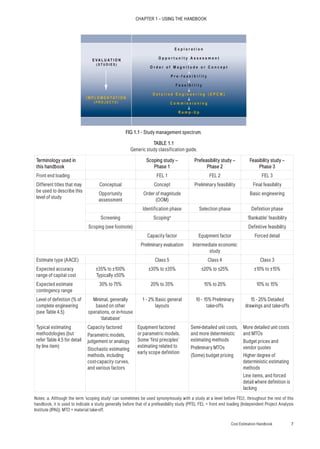
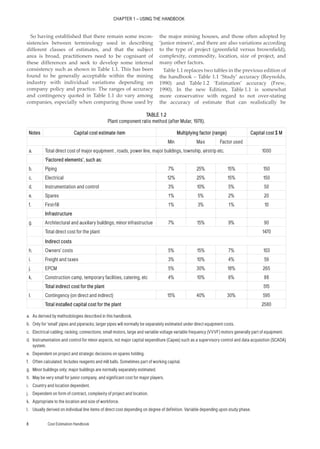
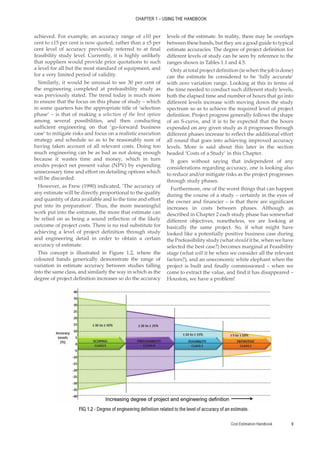
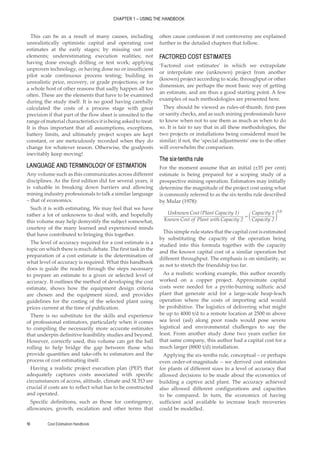
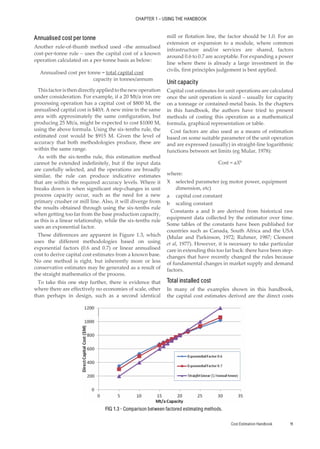
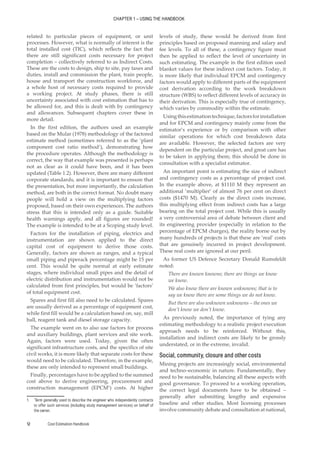
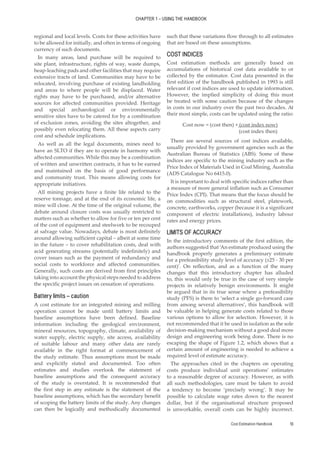
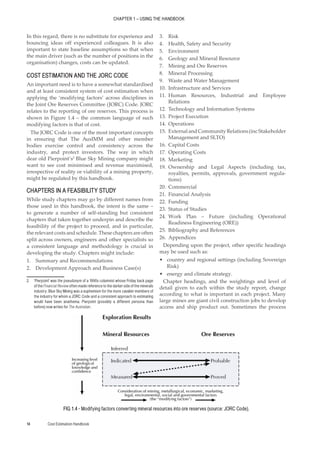
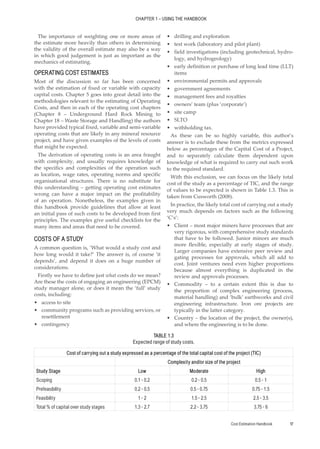
![CHAPTER 1 – USING THE HANDBOOK
Cost Estimation Handbook
18
•
• Characteristic – is the project brownfield or
greenfield, and what is the status of infrastructure?
•
• Conditions – the status of market supply and
demand conditions, as this greatly affects the cost
and availability of services.
•
• Company – or owner, and the size and skills of the
owners’ team.
•
• Complexity – the inherent technical complexity of
the project – mining and process – especially if it is
new or unproven technology. Remember too that a
significant proportion of costs for management and
project controls are schedule-related, so the longer
time frame studies rack up more costs simply down
to their longevity.
Often, there is an unrealistic expectation that studies
can be done faster and cheaper than turns out to be the
case, and that phases can be concertinaed or skipped out
to get to market quicker. The reality is that this is rarely
the case, and the industry is littered with examples of
project failures that could have been avoided with more
and/or better study. As Chapter 2 notes, ‘studies form
the fundamental basis for the progressive decision to
invest in developing potential projects’. It is hoped that
this handbook will help in making better informed
decisions, and ultimately reducing the incidence of
those failures.
REFERENCES AND FURTHER READING
The general references previously used in the first
edition still remain valid, despite their vintage in some
cases. These include the following:
Clement, G K Jr, Miller, R L, Avery, L and Seibert, P A, 1977.
Capital and Operating Cost Estimating System Handbook
for Mining and Beneficiation of Metallic and Non-Metallic
Minerals Except Fossil Fuels in the United States and Canada
(USBM, STRAAM Engineers Inc: Irvine, CA).
Frew, R S, 1990. Estimating the cost of a feasibility study for a
mining project, in Proceedings Mining Industry Capital and
Operating Cost Estimation Conference – Mincost 90, pp 25-
28 (The Australasian Institute of Mining and Metallurgy:
Melbourne).
Mular, A L, 1978. The estimation of preliminary capital costs,
in Mineral Processing Plant Design (Society of Mining
Engineers of the AIME Inc: New York).
Mular, A L and Parkinson, E A, 1972. Mineral Processing
Equipment Costs and Preliminary Capital Cost Estimations,
special volume 13 (Canadian Institute of Mining and
Metallurgy: Montreal).
Reynolds, E, 1990. What does it mean? in Proceedings Mining
Industry Capital and Operating Cost Estimation Conference –
Mincost 90, pp 3-8 (The Australasian Institute of Mining
and Metallurgy: Melbourne).
Ruhmer, W T, 1987. Handbook on the Estimation of Metallurgical
Process Costs, special publication no 9 (Council for Mineral
Technology: Randburg).
In addition, we refer the reader to the various
proceedings associated with the Project Evaluation
Conference Proceedings published by The AusIMM in
2007, 2009, 2012 and onwards. Various papers in these
volumes are valuable sources of reference, such as:
Mackenzie, W and Cusworth, N, 2007. The use and abuse
of feasibility studies, in Proceedings Project Evaluation
Conference, pp 65-76 (The Australasian Institute of Mining
and Metallurgy: Melbourne).
Since the first edition, it is fair to say that the body of
knowledge and an increased interest in the subject
matter relating to cost estimation has caused the
sources of reference and written publications in the
field to expand exponentially. No attempt is made here
to catalogue all the available sources, but the reader
may find the following to be of value:
AACE International Recommended Practice No 18R-97,
2000. Cost estimate classification system as applied
in engineering, procurement and construction for the
process industries (AACE Inc, 2000).
De la Vergne, J, 2003. Hard Rock Miners Handbook Rules-of-
Thumb, third edition (McIntosh Engineering: Tempe AZ).
Evans, D, 2008. Analysing the risk of bankable feasibility
studies in today’s mining supercycle, Engineering and
Mining Journal, September.
Guarana, B J, 1997, Technical flaws in bankable documents,
paper presented to Assaying and Reporting Standards
Conference, Singapore (Behre Dolbear: New York).
International Project Studies, International Mining, December
2007, pp 41-46 and January 2008, p 66.
JORC, 2004. Australasian Code for Reporting of Exploration
Results, Mineral Resources and Ore Reserves (The JORC
Code) [online]. Available from: <http://www.jorc.org>
(The Joint Ore Reserves Committee of The Australasian
Institute of Mining and Metallurgy, Australian Institute of
Geoscientists and Minerals Council of Australia).
Specifically, bodies such as Independent Project
Analysis (IPA) maintain huge project databases to
allow the analysis of factors relating to the success
or otherwise of projects in meeting estimated capital
costs and schedules. They provide courses and
education, and consult to many companies to establish
benchmarking and best practice, including measures
and metrics (www.ipainstitute.com) There generate
many publications, including:
Merrow, E, 2011. Industrial mega projects: Concepts,
strategies, and practices for success (IPA : USA).
O’Brien, J, 2009. Performance of capital projects in Australian
processing industries, presented to IPA Asia-Pacific
Conference, June.
In relation to useful source documents in the areas
of community, social, sustainability and closure, a
number of Australian Government publications by
the Department of Industry, Tourism and Resources
(DITR) or the Department of Resources, Energy and
Tourism (DRET) have been published including:
Department of Energy, Resources and Tourism (DRET),
2011. A guide to leading practice sustainable development
in mining, July.](https://image.slidesharecdn.com/23288066-250520090529-67cbba51/85/Cost-Estimation-Handbook-2nd-Edition-Ausimm-37-320.jpg)