The I/O ModelTEAM AGROUP 1 FUAD LABARAN, ANGELA OBRINGER N’KAKOU
Input-Output Described• The output of an industry will appear as the input of other industries• This helps us to track the flow of money from one entity to the next
Input-Output Precisely DefinedIO models describe both the transactions between the region and the rest of the world among activities within the region.  These models produce a multiplier index that measures the total effect or impact of an increase in demand on employment or income.They can be used for predicting and forecasting the impacts of potential future performance of a regional economy & changes in inter-industry transactions.
Practical UsesDescriptive – can reveal knowledge about an area’s economy that would be impossible to get otherwise.Forecasting – estimate total impact of certain events or policy changes.Assessment – evaluate and assess specific goals, scenarios, etc.IO is used to identify the best approach!
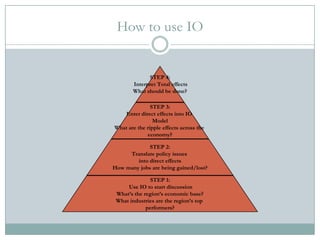
How to use IO
Conclusion IO helps to evaluate, predict & assess goals and policies in an inter-connected system of sectors / industries in an economyThank You!
External Environment AnalysisTEAM A - GROUP 3ALEX FRANCISQUINI, SUDEEP ADHIKARY, TATIANA LEVYKINA,JAMES BARLOW, DINAR PAYO
External Environmental AnalysisDEFINITION: Process of scanning and evaluating an organization’s external environmental sectors in order to determine positive and negative trends that could impact organizational performance.How managers determine the opportunities and threats facing their organizations.
Assess current situation and external environment.
Formulate new strategies or change current ones in response to opportunities or threats.Opportunities: refer to favourable conditions in the environment that could produce rewards for an organization. Threats: factors in an external environment that poses danger to an organization’s well-being(prevent firms from reaching their objectives). Examining opportunities: Discover untapped markets.Discover new products or technologies.Identify potential avenues for diversification.Examining threats:Identify unfavourable market shifts or changes in technology.Create a defensive posture aimed at preserving your competitive position.Opportunities & Threats
Organizations interact and respond to their environment.Take inputs and process to outputs.Outputs are distributed, (external environment).Changes may affect a whole organization. Due to interaction with the environment, can be divided into two different perspectives:Environment as a source of information.
Environment as a source of resources.Organizations as open systems
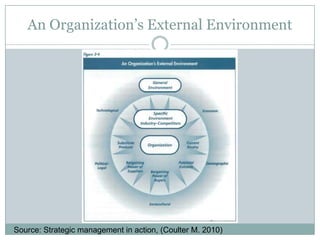
Environmental uncertaintyEnvironment as information is based on the idea of environmental uncertainty, (amount of change and complexity in organization’s environment).Environment as a source of resources based on idea that the more hostile environment becomes the more difficult is to obtain and control resources.External analysis of an organization can be classified as: Specific - customers, competitors, suppliers and other competitive variables, (analysed using Porter’s five forces).General - economic, demographic, sociocultural, political-legal and technological.
Environmental uncertaintyBusinesses operate in an external environment in which as well as competition from rivals, businesses have to take account of legal, political, social and economic influences.A SLEPT (Social, Legal, Economic, Political, Technological) analysis is often carried out by business planners which enables them to develop more informed strategies (i.e. long term plans).
Environmental uncertaintySocial factorsRelate to change is society and social structures. Changes in the structure of the population, and in consumer lifestyles and behaviour affect buying patterns.Legal factorsRelate to changes in laws and regulations. Businesses must be careful to keep within the law and to anticipate ways in which changes in laws will affect the way they must behave.Economic factorsRelate to changes in the wider economy. A growing economy provides greater opportunities for businesses to make profits, so businesses welcome rising living standards. Political factorsRelate to ways in which changes in government and government policy can influence business. Technological factorsProvide opportunities for businesses to adopt new breakthroughs, innovations, and inventions to cut costs and develop new products.
Benefits and Challenges of Doing External Analysis
Look at specific data: statistics, trends, forecasts etc.Assess if changes are good / bad for your company.Focus groups.External information system provided for managers.Competitor intelligence.Study each external sector carefully.Doing an external analysis
An Organization’s External EnvironmentSource: Strategic management in action, (Coulter M. 2010)
ReferencesStrategic management in action, (Coulter M. 2010)Michael PorterTEAM AGROUP 1 FUAD LABARAN, ANGELA OBRINGER N’KAKOU
BackgroundProfessor  Michael Porter was born in Ann Arbor, Michigan in 1947.Princeton- played intercollegiate golf and was New England champion.Named to the 1968 NCAA Golf All-American Team.EducationB.S.E. with high honors in aerospace and mechanical engineering in 1969.
M.B.A. with high distinction in 1971 from the Harvard Business School, where he was a George F. Baker Scholar.
Ph.D. in Business Economics from Harvard University in 1973.He plays golf at his leisure time.Leading authority on Competitive strategy, the competitiveness and economic development of nations, states, and regions,
Application of competitive principles to social problems such as health care, the environment, and corporate responsibility.He is the Bishop William Lawrence University Professor, based at Harvard Business School.In 2001, HBS and Harvard University jointly created the institute for strategy and competitiveness dedicated to furthering Professor Porter’s work.Author of 18 books and over 125 articles.
TeachingsIdeas are the foundation for courses on strategy and competitivenessAt HBS,  Microeconomics of Competitiveness is a graduate course. Taught in partnership with more than 80 other universities HBS program for newly appointed CEOs of the world’s largest and more complex corporations.Twice a year Professor Porter speaks widely on strategy, competitiveness, health care delivery, related subjects to business, government, non-profit, and philanthropic leaders.
ResearchProfessor Porter’s core field is competitive strategy, which remains a major focus of his research. His book, Competitive Strategy: Techniques for Analyzing Industries and Competitors, is in its 63rd printing and has been translated into 19 languages. His second major strategy book, Competitive Advantage: Creating and Sustaining Superior Performance, was published in 1985 and is in its 38th printing. His book On Competition (2008) contains his most influential articles on strategy and competition
Health care deliveryDevoted  attention to competition in the health care system.With a focus on improving health care delivery.
His work with Professor Elizabeth Teisberg, including the book Redefining Health Care: Creating Value-Based Competition on Results (Harvard Business School Press, 2006), is influencing thinking and practice not only in the United States but numerous other countries.Advisory roles Served as a strategy advisor to top management in numerous leading U.S. and international companies.Amongst  them are Caterpillar, DuPont, Procter & Gamble, Royal Dutch Shell, Scotts Miracle-Gro, SYSCO, and Taiwan Semiconductor Manufacturing Company etc.HonoursProfessor Porter has been widely recognized for his work. Some of these honors (in chronological order) include Harvard's David A. Wells Prize in Economics (1973) for his research in industrial organization.
 He received the Graham and Dodd Award of the Financial Analysts Federation in 1980.
His book Competitive Advantage won the George R. Terry Book Award of the Academy of Management in 1985 as the outstanding contribution to management thought.Referenceshttp://drfd.hbs.edu/fit/public/facultyInfo.do?facInfo=bio&facEmId=mporter&loc=extn
Five Forces modelTeam A Group 5Melisa Celebi, Pavel Kobychev, Hanna Merisalo, Mikko Vesikukka
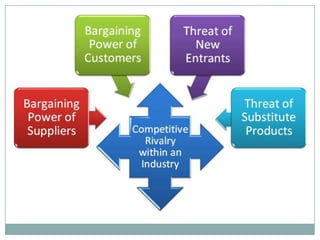
OverviewArticle in Harvard Business Review “How Competitive Forces Shape Strategy”(1979)Book “Competitive Strategy: Techniques for Analyzing Industries and Competitors” (1980)Response to SWOT analysis which is “unrigorous and ad-hoc”External microeconomic environment analysis. supply and demandcomplementary products and substitutesthe relationship between volume of production and cost of productionmarket structures like monopoly, oligopoly or perfect competition. Measures intensity of competition and attractivenessObjective is to reduce the power of competitive forces to increase profitability
ROIC and industry attractiveness

Corporate strategy team a

  • 1.
    The I/O ModelTEAMAGROUP 1 FUAD LABARAN, ANGELA OBRINGER N’KAKOU
  • 2.
    Input-Output Described• Theoutput of an industry will appear as the input of other industries• This helps us to track the flow of money from one entity to the next
  • 3.
    Input-Output Precisely DefinedIOmodels describe both the transactions between the region and the rest of the world among activities within the region. These models produce a multiplier index that measures the total effect or impact of an increase in demand on employment or income.They can be used for predicting and forecasting the impacts of potential future performance of a regional economy & changes in inter-industry transactions.
  • 4.
    Practical UsesDescriptive –can reveal knowledge about an area’s economy that would be impossible to get otherwise.Forecasting – estimate total impact of certain events or policy changes.Assessment – evaluate and assess specific goals, scenarios, etc.IO is used to identify the best approach!
  • 5.
  • 6.
    Conclusion IO helpsto evaluate, predict & assess goals and policies in an inter-connected system of sectors / industries in an economyThank You!
  • 7.
    External Environment AnalysisTEAMA - GROUP 3ALEX FRANCISQUINI, SUDEEP ADHIKARY, TATIANA LEVYKINA,JAMES BARLOW, DINAR PAYO
  • 8.
    External Environmental AnalysisDEFINITION:Process of scanning and evaluating an organization’s external environmental sectors in order to determine positive and negative trends that could impact organizational performance.How managers determine the opportunities and threats facing their organizations.
  • 9.
    Assess current situationand external environment.
  • 10.
    Formulate new strategiesor change current ones in response to opportunities or threats.Opportunities: refer to favourable conditions in the environment that could produce rewards for an organization. Threats: factors in an external environment that poses danger to an organization’s well-being(prevent firms from reaching their objectives). Examining opportunities: Discover untapped markets.Discover new products or technologies.Identify potential avenues for diversification.Examining threats:Identify unfavourable market shifts or changes in technology.Create a defensive posture aimed at preserving your competitive position.Opportunities & Threats
  • 11.
    Organizations interact andrespond to their environment.Take inputs and process to outputs.Outputs are distributed, (external environment).Changes may affect a whole organization. Due to interaction with the environment, can be divided into two different perspectives:Environment as a source of information.
  • 12.
    Environment as asource of resources.Organizations as open systems
  • 13.
    Environmental uncertaintyEnvironment asinformation is based on the idea of environmental uncertainty, (amount of change and complexity in organization’s environment).Environment as a source of resources based on idea that the more hostile environment becomes the more difficult is to obtain and control resources.External analysis of an organization can be classified as: Specific - customers, competitors, suppliers and other competitive variables, (analysed using Porter’s five forces).General - economic, demographic, sociocultural, political-legal and technological.
  • 14.
    Environmental uncertaintyBusinesses operatein an external environment in which as well as competition from rivals, businesses have to take account of legal, political, social and economic influences.A SLEPT (Social, Legal, Economic, Political, Technological) analysis is often carried out by business planners which enables them to develop more informed strategies (i.e. long term plans).
  • 15.
    Environmental uncertaintySocial factorsRelateto change is society and social structures. Changes in the structure of the population, and in consumer lifestyles and behaviour affect buying patterns.Legal factorsRelate to changes in laws and regulations. Businesses must be careful to keep within the law and to anticipate ways in which changes in laws will affect the way they must behave.Economic factorsRelate to changes in the wider economy. A growing economy provides greater opportunities for businesses to make profits, so businesses welcome rising living standards. Political factorsRelate to ways in which changes in government and government policy can influence business. Technological factorsProvide opportunities for businesses to adopt new breakthroughs, innovations, and inventions to cut costs and develop new products.
  • 16.
    Benefits and Challengesof Doing External Analysis
  • 17.
    Look at specificdata: statistics, trends, forecasts etc.Assess if changes are good / bad for your company.Focus groups.External information system provided for managers.Competitor intelligence.Study each external sector carefully.Doing an external analysis
  • 18.
    An Organization’s ExternalEnvironmentSource: Strategic management in action, (Coulter M. 2010)
  • 19.
    ReferencesStrategic management inaction, (Coulter M. 2010)Michael PorterTEAM AGROUP 1 FUAD LABARAN, ANGELA OBRINGER N’KAKOU
  • 20.
    BackgroundProfessor MichaelPorter was born in Ann Arbor, Michigan in 1947.Princeton- played intercollegiate golf and was New England champion.Named to the 1968 NCAA Golf All-American Team.EducationB.S.E. with high honors in aerospace and mechanical engineering in 1969.
  • 21.
    M.B.A. with highdistinction in 1971 from the Harvard Business School, where he was a George F. Baker Scholar.
  • 22.
    Ph.D. in BusinessEconomics from Harvard University in 1973.He plays golf at his leisure time.Leading authority on Competitive strategy, the competitiveness and economic development of nations, states, and regions,
  • 23.
    Application of competitiveprinciples to social problems such as health care, the environment, and corporate responsibility.He is the Bishop William Lawrence University Professor, based at Harvard Business School.In 2001, HBS and Harvard University jointly created the institute for strategy and competitiveness dedicated to furthering Professor Porter’s work.Author of 18 books and over 125 articles.
  • 24.
    TeachingsIdeas are thefoundation for courses on strategy and competitivenessAt HBS,  Microeconomics of Competitiveness is a graduate course. Taught in partnership with more than 80 other universities HBS program for newly appointed CEOs of the world’s largest and more complex corporations.Twice a year Professor Porter speaks widely on strategy, competitiveness, health care delivery, related subjects to business, government, non-profit, and philanthropic leaders.
  • 25.
    ResearchProfessor Porter’s corefield is competitive strategy, which remains a major focus of his research. His book, Competitive Strategy: Techniques for Analyzing Industries and Competitors, is in its 63rd printing and has been translated into 19 languages. His second major strategy book, Competitive Advantage: Creating and Sustaining Superior Performance, was published in 1985 and is in its 38th printing. His book On Competition (2008) contains his most influential articles on strategy and competition
  • 26.
    Health care deliveryDevoted attention to competition in the health care system.With a focus on improving health care delivery.
  • 27.
    His work withProfessor Elizabeth Teisberg, including the book Redefining Health Care: Creating Value-Based Competition on Results (Harvard Business School Press, 2006), is influencing thinking and practice not only in the United States but numerous other countries.Advisory roles Served as a strategy advisor to top management in numerous leading U.S. and international companies.Amongst them are Caterpillar, DuPont, Procter & Gamble, Royal Dutch Shell, Scotts Miracle-Gro, SYSCO, and Taiwan Semiconductor Manufacturing Company etc.HonoursProfessor Porter has been widely recognized for his work. Some of these honors (in chronological order) include Harvard's David A. Wells Prize in Economics (1973) for his research in industrial organization.
  • 28.
    He receivedthe Graham and Dodd Award of the Financial Analysts Federation in 1980.
  • 29.
    His book Competitive Advantage wonthe George R. Terry Book Award of the Academy of Management in 1985 as the outstanding contribution to management thought.Referenceshttp://drfd.hbs.edu/fit/public/facultyInfo.do?facInfo=bio&facEmId=mporter&loc=extn
  • 30.
    Five Forces modelTeamA Group 5Melisa Celebi, Pavel Kobychev, Hanna Merisalo, Mikko Vesikukka
  • 31.
    OverviewArticle in HarvardBusiness Review “How Competitive Forces Shape Strategy”(1979)Book “Competitive Strategy: Techniques for Analyzing Industries and Competitors” (1980)Response to SWOT analysis which is “unrigorous and ad-hoc”External microeconomic environment analysis. supply and demandcomplementary products and substitutesthe relationship between volume of production and cost of productionmarket structures like monopoly, oligopoly or perfect competition. Measures intensity of competition and attractivenessObjective is to reduce the power of competitive forces to increase profitability
  • 33.
    ROIC and industryattractiveness