Corporate Restructuring
Copyright © 2009 Vikas Publishing House Pvt. Ltd. All rights reserved.
Definition
Corporate restructuring can be defined as any change in the
business capacity or portfolio that is carried out by an
inorganic route
or
Any change in the capital structure of a company that is
not a part of its ordinary course of business
or
Any change in the ownership of or control over the
management of the company or a combination of any two or
all of the above
Corporate Restructuring
I. (a) Any change in the business capacity or portfolio carried
out by inorganic route
 Tata Motors launched Sumo and later, Indica- leading to an expansion of its
business portfolio. However, these products were launched from Tata
Motor’s own manufacturing capacity in through an organic route. Hence, it
would not qualify as ‘corporate restructuring’
 Tata Motors’ acquisition of Jaguar Land Rover from Ford, through Jaguar
Land Rover Limited is ‘corporate restructuring’
 Grasim’s acquisition of Larsen & Toubro’s (L&T) cement division through
UltraTech Cement Limited is an example of ‘corporate restructuring’
(b) Change in the business portfolio could also be in the
nature of reduction of business handled by a company
 In the case of Grasim and L&T, the demerger of L&T’s cement business into
UltraTech Cement Limited was reduction of its business portfolio and thus,
amounted to ‘corporate restructuring’ of L&T.
Corporate Restructuring
II. Any change in the capital structure of a company that is not in
the ordinary course of its business
 Capital structure refers to debt equity ratio, i.e. the proportion of debt and
equity in the total capital of a company.
 This capital structure is never static and changes almost daily.
 Within a targeted or planned range if the debt/equity ratio fluctuates, such
changes in the capital structure do not amount to ‘capital restructuring’.
 Borrowing of a significant amount of term loan or an issue of five year non-
convertible debenture do not qualify to be called ‘corporate restructuring’ .
 An initial public issue, or a follow-on public issue or buy-back of equity
shares would permanently alter the capital structure of a company, and
thus, would amount to ‘corporate restructuring’.
Corporate Restructuring
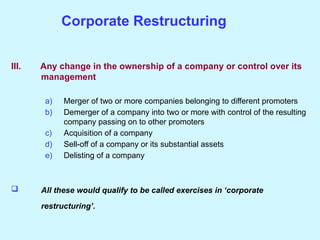
III. Any change in the ownership of a company or control over its
management
a) Merger of two or more companies belonging to different promoters
b) Demerger of a company into two or more with control of the resulting
company passing on to other promoters
c) Acquisition of a company
d) Sell-off of a company or its substantial assets
e) Delisting of a company
 All these would qualify to be called exercises in ‘corporate
restructuring’.
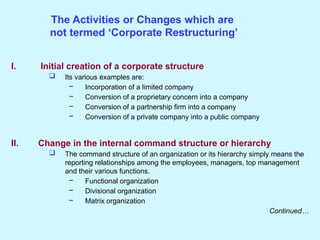
The Activities or Changes which are
not termed ‘Corporate Restructuring’
I. Initial creation of a corporate structure
 Its various examples are:
– Incorporation of a limited company
– Conversion of a proprietary concern into a company
– Conversion of a partnership firm into a company
– Conversion of a private company into a public company
II. Change in the internal command structure or hierarchy
 The command structure of an organization or its hierarchy simply means the
reporting relationships among the employees, managers, top management
and their various functions.
– Functional organization
– Divisional organization
– Matrix organization
Continued…
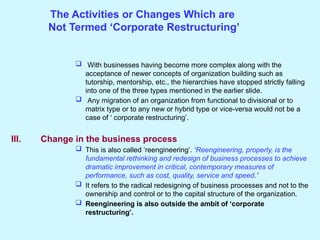
The Activities or Changes Which are
Not Termed ‘Corporate Restructuring’
 With businesses having become more complex along with the
acceptance of newer concepts of organization building such as
tutorship, mentorship, etc., the hierarchies have stopped strictly falling
into one of the three types mentioned in the earlier slide.
 Any migration of an organization from functional to divisional or to
matrix type or to any new or hybrid type or vice-versa would not be a
case of ‘ corporate restructuring’.
III. Change in the business process
 This is also called ‘reengineering’. ‘Reengineering, properly, is the
fundamental rethinking and redesign of business processes to achieve
dramatic improvement in critical, contemporary measures of
performance, such as cost, quality, service and speed.’
 It refers to the radical redesigning of business processes and not to the
ownership and control or to the capital structure of the organization.
 Reengineering is also outside the ambit of ‘corporate
restructuring’.
IV. Downsizing
It is another form of organizational change in which the business
organization substantially cuts down on its manpower, recurring cost
and/or capital expenditure, either as an objective itself or as a result
of reengineering.
Downsizing is also outside the purview of ‘corporate
restructuring’.
V. Other activities
Activities such as outsourcing, enterprise resource planning, total
quality management, franchising alliances, networking alliances and
licensing do not classify as corporate restructuring activities.
The Activities or Changes which are
not termed ‘Corporate Restructuring’
Rationales
• To increase the competitive strength both
domestically and globally.
• For debt equity restructuring to reduce
high interest obligations.
• To cope up with the funds constraints or
utilization of excess funds.
• To enter new markets and grow.
• To achieve operational efficiencies.
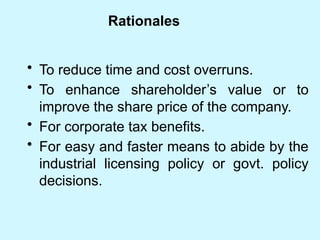
Rationales
• To reduce time and cost overruns.
• To enhance shareholder’s value or to
improve the share price of the company.
• For corporate tax benefits.
• For easy and faster means to abide by the
industrial licensing policy or govt. policy
decisions.
Major Forms of Corporate Restructuring(IMPORTANT)
 Merger
 Consolidation
 Acquisition
 Divestiture
 Demerger (spin off/split up/split off)
 Carve Out
 Joint Venture
 Reduction of Capital
 Buy-back of Securities
 Delisting of Securities/Company
Various Forms of Restructuring
Expansion: Mergers, Acquisitions, Takeovers, Tender
offer, Joint Venture
Contraction: Sell offs, Spin offs, Split offs, Split ups,
Divestitures, Equity Carve outs
Corporate Control: Takeover Defenses, Share
Repurchases, Exchange Offers, Proxy Contests
Changes in Ownership: Leveraged Buy out, Going
Private

Corporate Restructuring for finance.pptx

  • 1.
    Corporate Restructuring Copyright ©2009 Vikas Publishing House Pvt. Ltd. All rights reserved.
  • 2.
    Definition Corporate restructuring canbe defined as any change in the business capacity or portfolio that is carried out by an inorganic route or Any change in the capital structure of a company that is not a part of its ordinary course of business or Any change in the ownership of or control over the management of the company or a combination of any two or all of the above Corporate Restructuring
  • 3.
    I. (a) Anychange in the business capacity or portfolio carried out by inorganic route  Tata Motors launched Sumo and later, Indica- leading to an expansion of its business portfolio. However, these products were launched from Tata Motor’s own manufacturing capacity in through an organic route. Hence, it would not qualify as ‘corporate restructuring’  Tata Motors’ acquisition of Jaguar Land Rover from Ford, through Jaguar Land Rover Limited is ‘corporate restructuring’  Grasim’s acquisition of Larsen & Toubro’s (L&T) cement division through UltraTech Cement Limited is an example of ‘corporate restructuring’ (b) Change in the business portfolio could also be in the nature of reduction of business handled by a company  In the case of Grasim and L&T, the demerger of L&T’s cement business into UltraTech Cement Limited was reduction of its business portfolio and thus, amounted to ‘corporate restructuring’ of L&T. Corporate Restructuring
  • 4.
    II. Any changein the capital structure of a company that is not in the ordinary course of its business  Capital structure refers to debt equity ratio, i.e. the proportion of debt and equity in the total capital of a company.  This capital structure is never static and changes almost daily.  Within a targeted or planned range if the debt/equity ratio fluctuates, such changes in the capital structure do not amount to ‘capital restructuring’.  Borrowing of a significant amount of term loan or an issue of five year non- convertible debenture do not qualify to be called ‘corporate restructuring’ .  An initial public issue, or a follow-on public issue or buy-back of equity shares would permanently alter the capital structure of a company, and thus, would amount to ‘corporate restructuring’. Corporate Restructuring
  • 5.
    Corporate Restructuring III. Anychange in the ownership of a company or control over its management a) Merger of two or more companies belonging to different promoters b) Demerger of a company into two or more with control of the resulting company passing on to other promoters c) Acquisition of a company d) Sell-off of a company or its substantial assets e) Delisting of a company  All these would qualify to be called exercises in ‘corporate restructuring’.
  • 6.
    The Activities orChanges which are not termed ‘Corporate Restructuring’ I. Initial creation of a corporate structure  Its various examples are: – Incorporation of a limited company – Conversion of a proprietary concern into a company – Conversion of a partnership firm into a company – Conversion of a private company into a public company II. Change in the internal command structure or hierarchy  The command structure of an organization or its hierarchy simply means the reporting relationships among the employees, managers, top management and their various functions. – Functional organization – Divisional organization – Matrix organization Continued…
  • 7.
    The Activities orChanges Which are Not Termed ‘Corporate Restructuring’  With businesses having become more complex along with the acceptance of newer concepts of organization building such as tutorship, mentorship, etc., the hierarchies have stopped strictly falling into one of the three types mentioned in the earlier slide.  Any migration of an organization from functional to divisional or to matrix type or to any new or hybrid type or vice-versa would not be a case of ‘ corporate restructuring’. III. Change in the business process  This is also called ‘reengineering’. ‘Reengineering, properly, is the fundamental rethinking and redesign of business processes to achieve dramatic improvement in critical, contemporary measures of performance, such as cost, quality, service and speed.’  It refers to the radical redesigning of business processes and not to the ownership and control or to the capital structure of the organization.  Reengineering is also outside the ambit of ‘corporate restructuring’.
  • 8.
    IV. Downsizing It isanother form of organizational change in which the business organization substantially cuts down on its manpower, recurring cost and/or capital expenditure, either as an objective itself or as a result of reengineering. Downsizing is also outside the purview of ‘corporate restructuring’. V. Other activities Activities such as outsourcing, enterprise resource planning, total quality management, franchising alliances, networking alliances and licensing do not classify as corporate restructuring activities. The Activities or Changes which are not termed ‘Corporate Restructuring’
  • 9.
    Rationales • To increasethe competitive strength both domestically and globally. • For debt equity restructuring to reduce high interest obligations. • To cope up with the funds constraints or utilization of excess funds. • To enter new markets and grow. • To achieve operational efficiencies.
  • 10.
    Rationales • To reducetime and cost overruns. • To enhance shareholder’s value or to improve the share price of the company. • For corporate tax benefits. • For easy and faster means to abide by the industrial licensing policy or govt. policy decisions.
  • 11.
    Major Forms ofCorporate Restructuring(IMPORTANT)  Merger  Consolidation  Acquisition  Divestiture  Demerger (spin off/split up/split off)  Carve Out  Joint Venture  Reduction of Capital  Buy-back of Securities  Delisting of Securities/Company
  • 12.
    Various Forms ofRestructuring Expansion: Mergers, Acquisitions, Takeovers, Tender offer, Joint Venture Contraction: Sell offs, Spin offs, Split offs, Split ups, Divestitures, Equity Carve outs Corporate Control: Takeover Defenses, Share Repurchases, Exchange Offers, Proxy Contests Changes in Ownership: Leveraged Buy out, Going Private