Corporate Restructuring and control
Chapter-1
Created and Presented:
Ms. Ginni Syal
Asst. Professor, TIMT
Corporate Restructuring
• Restructuring is a means whereby the organisational
structure is changed so that the organisation
accomplishes its objectives.
• ‘Corporate Restructuring’ is a term of wider importance
and covers in its ambit restructuring or reorganizing or
financial restructuring of any organisation done in order
to operate more effectively and efficiently.
Meaning of Corporate Restructuring
• Any corporate activity or action that results in
enhancing productivity, enhancing revenues,
reducing costs or enhancing shareholder’s
wealth is the flavour of the management
Need of Corporate Restructuring:
• The various needs for undertaking a Corporate Restructuring exercise are as
follows:
• (i) to focus on core strengths, operational synergy and efficient allocation of
managerial capabilities and infrastructure.
• (ii) consolidation and economies of scale by expansion and diversion to
exploit extended domestic and global markets.
• (iii) revival and rehabilitation of a sick unit by adjusting losses of the sick unit
with profits of a healthy company.
• (iv) acquiring constant supply of raw materials and access to scientific
research and technological developments.
Need of Corporate Restructuring:
• (v) capital restructuring by appropriate mix of loan
and equity funds to reduce the cost of servicing
and improve return on capital employed.
• (vi) Improve corporate performance to bring it at
par with competitors by adopting the radical
changes brought out by information technology.
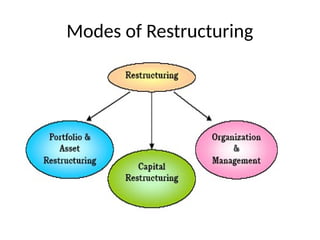
Modes of Restructuring
Organizational Restructuring
• This type of restructuring can be performed
in the following manner:
• Reducing the head count
• Closing uneconomical units
• Inducing programs to reduce costs
• Disposing off the assets which are not being
used
• Reorganizing the business process
Case of Organizational Restructuring at xerox
(Xerox makes every day work better)
• About Xerox:
• Xerox Holdings Corporation is an American corporation that sells print and digital document
products and services in more than 160 countries. Xerox is headquartered in Norwalk,
Connecticut, though its largest population of employees is based around Rochester, New York,
the area in which the company was founded.
• Stock price: XRX (NYSE) US$18.11 +0.32 (+1.80%)
17 Aug, 4:02 pm GMT-4 -
• Founder: Joseph C. Wilson
• Founded: 18 April 1906, Rochester, New York, United States
• CEO: John Visentin (14 May 2018–)
• Headquarters: Norwalk, Connecticut, United States
• Revenue: 1,026.5 crores USD (2017)
'Delighting You Always'
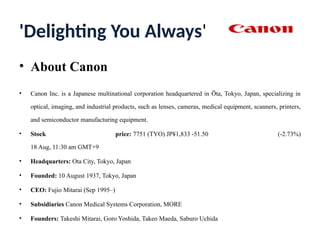
• About Canon
• Canon Inc. is a Japanese multinational corporation headquartered in Ōta, Tokyo, Japan, specializing in
optical, imaging, and industrial products, such as lenses, cameras, medical equipment, scanners, printers,
and semiconductor manufacturing equipment.
• Stock price: 7751 (TYO) JP¥1,833 -51.50 (-2.73%)
18 Aug, 11:30 am GMT+9
• Headquarters: Ota City, Tokyo, Japan
• Founded: 10 August 1937, Tokyo, Japan
• CEO: Fujio Mitarai (Sep 1995–)
• Subsidiaries Canon Medical Systems Corporation, MORE
• Founders: Takeshi Mitarai, Goro Yoshida, Takeo Maeda, Saburo Uchida
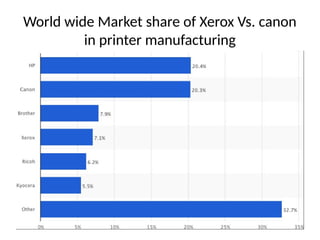
World wide Market share of Xerox Vs. canon
in printer manufacturing
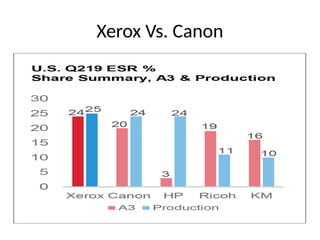
Xerox Vs. Canon
Highlights of Case
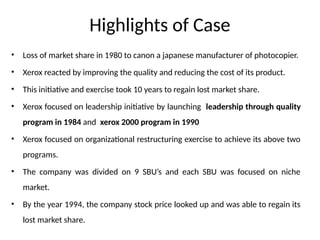
• Loss of market share in 1980 to canon a japanese manufacturer of photocopier.
• Xerox reacted by improving the quality and reducing the cost of its product.
• This initiative and exercise took 10 years to regain lost market share.
• Xerox focused on leadership initiative by launching leadership through quality
program in 1984 and xerox 2000 program in 1990
• Xerox focused on organizational restructuring exercise to achieve its above two
programs.
• The company was divided on 9 SBU’s and each SBU was focused on niche
market.
• By the year 1994, the company stock price looked up and was able to regain its
lost market share.
Financial Restructuring/Capital Restructuring
• This leads to changes in the existing capital
structure in many ways like:
• Buying back of shares
• Issuing different types of shares like non-
voting or preference shares
• Issuing different types of debts to meet the
needs of fixed and working capital
• Infusing foreign debts and equities
Case of Management Buy-out
"Screw it, let's ride."
• Harley-Davidson is a major US motorcycle manufacturer that sells its bikes
worldwide through a network of more than 1,400 dealers.
• The company offers heavyweight cruiser and touring models, sportbikes, and dual
models that can be used on- and off-road.
• Its six families of motorcycles include Touring, Trike, Softail, H-D Street, Sportster, and its
Customer Vehicle Operations (CVO) models.
• Harley-Davidson also sells attitude with its brand-name products, which include a line of
riding gear and apparel (MotorClothes).
• Harley-Davidson Financial Services (HDFS) offers financing to dealers and consumers in
the US and Canada. The US generates almost 70% of Harley's revenue.
Case Highlights
• Harley Davidson was the market leader in heavy weight motorcycles in United states.
• Soon Honda, a japanese manufacturer entered unto light weight motorcycle.
• Harley Davidson lost its market share from 80% in 1969 to 20% in 1980.
• The owner decided to sell off the Harley Davidson Division.
• The Management Team of the company had strong belief in its Brand value and decided to buy out.
• The LBO deal was arranged by the management with the help of citi bank with 80% debt financing in
its capital structure.
• The Management of H.D. focused on revamping the brand in terms of quality, viability and pricing.
• With the High management involvement, HD was successful in regaining its lost market share in 1983.
• Harley Davidson was able to increase its market share to 33 % in 1986 and to 59% in 1989 and
Honda’s market share declined from 33% to 15% during that period
Portfolio & Asset Restructuring
• This type of restructuring include:
• Merging two or more companies or entities.
• Purchasing assets of another firm.
• Acquisition of a part of an entity which leads
to the change in ownership
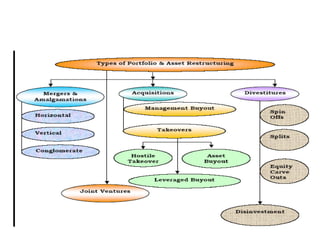
Types of Portfolio Restructuring
• Mergers and Acquisitions
• Alliances and Joint Ventures
• Divestment and Divestiture
Types of Mergers
• Mergers occurs when firms consolidate to
form new entity or the dominant player
absorbs the target player. In India the word
Merger is not defined under any Act rather
Amalgamation is defined in lieu of merger.
Technically Merger can be defined by two
methods:
• Merger (Amalgamation) through consolidation
• Merger (Amalgamation) through absorption
Types of Mergers
• Merger can also be classified in to following
types:
• 1) Horizontal Merger
• 2) Vertical Merger
• 3) Conglomerate Merger
Types of Mergers
• Horizontal Merger: involves two firms that operate in same business line and compete with
each other in the same industry. Example: HP and COMPAQ, Vodafone and Hutch
• Electrolux acquired voltas’ white goods division for INR 160 crore. Voltas had a manufacturing
capacity of 50000 refrigerators and 200000 washing machines per annum along with two
brands namely Voltas and Allwyn.
 Horizontal mergers realize economies of scale.
 Large horizontal mergers are generally Anti competitive.
 Horizontal merger enhances capacity and scale of output by reducing the cost of inputs and
reduced cost of advertising and promotion over complete set of products and brand together.
Types of Mergers
• Vertical Mergers: Vertical merger happens when
two companies in different stages of production
or distribution or value chain combine. It make
merged firm cost efficient by streamlining its
distribution and production costs.
• Types of Vertical Merger:
• Backward Merger
• Forward Merger
Types of Mergers
• Conglomerate Merger: Merger happens
between organizations that have no common
business link and are completely unrelated.
Pure diversified mergers diversify the risk of
business portfolio of the parent firm.
• For example: Reliance Industries, Aditya Birla
Group, NEVO and Kelso’s acquisition of Nortek.
Types of Acquisition
• Acquisition in India is also known as takeover
and it is maximum times hostile in nature.
• Acquisitions can also be Horizontal, Vertical
and conglomerate and they can also be of
other types like:
• Management Buy out
• Leverage Buy out
• Asset Buy out
Types of divestment/ divestiture
• Equity Carve Out
• Spin off/ Demergers
• Corporate splits
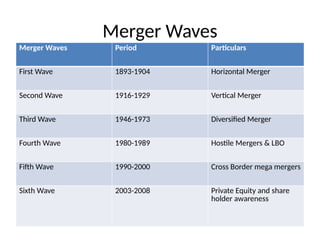
Merger Waves
Merger Waves Period Particulars
First Wave 1893-1904 Horizontal Merger
Second Wave 1916-1929 Vertical Merger
Third Wave 1946-1973 Diversified Merger
Fourth Wave 1980-1989 Hostile Mergers & LBO
Fifth Wave 1990-2000 Cross Border mega mergers
Sixth Wave 2003-2008 Private Equity and share
holder awareness
Merger Motives
• To eliminate competition and creating monopoly.
• To gain Market access, that is geographical
expansion
• To benefit from efficiency gains in the form of
synergy.
• To satisfy self ego of the managers, that is hubris
hypothesis.
• To diversify across industries.
• To gain access to R&D and technology, Know- how.
Mergers & Acquisitions: National & Global
Scenarios
• The state of the deal: M&A trends 2020 (Source:
Deloitte)
• Divestitures remain popular for corporate: 75% of corporate respondents expect to pursue divestitures in
2020, the second highest level in the past four years. Change in strategy, financing needs, and divesting in
technology that no longer fits with the emerging business model were cited as the most important reasons
for divesting a business among corporate respondents.
• Data protection and related regulations, along with shareholder activism, are among emerging M&A
trends driving strategy and activity. We’re also seeing active board involvement as directors lean in to
monitor whether deals are meeting expectations.
• Dealmakers expect to increasingly focus on domestic transactions in reaction to persistent concerns about
political and trade instability.
Mergers & Acquisitions: National & Global
Scenarios
• Despite general optimism for M&A in the
year ahead, challenges remain as dealmakers
faced diminishing ROI on transactions in
recent years. Of all dealmakers, 46% say that
less than half of their transactions over the
last two years have generated the expected
value or return on investment.
M&A strategy with a value creation
mindset-PWC Report 2020
• Companies will need to repair, rethink and reconfigure their businesses. The
initial focus has been on recovery of lost revenue, responding to operational
disruption and protecting the safety of employees and customers.
• In the rethink phase, senior leaders are considering strategic capital
allocation and reviewing what constitutes their core business. We anticipate
businesses will engage in M&A with a value creation focus as they
reconfigure their operations and look forward to the long term.
M&A strategy with a value creation mindset-
PWC Report 2020
• Successful dealmakers understand the importance of
staying true to their long-term strategic intent. PwC’s
“Creating Value Beyond the Deal” series shows 86%
of buyers surveyed who said their latest acquisition
created significant value went on to state that it was
part of a broader portfolio strategy rather than
opportunistic.
For more trends details Visit:
1. https://
www2.deloitte.com/content/dam/Deloitte/us/
Documents/mergers-acqisitions/us-m-a-trends-
2020-report.pdf
2. https://
www.jpmorgan.com/solutions/cib/investment-b
anking/2020-global-ma-outlook
3. https://www.hlb.global/transactions-outlook-

CRcccccccccccccccccccccccccccccccccccccccc

  • 1.
    Corporate Restructuring andcontrol Chapter-1 Created and Presented: Ms. Ginni Syal Asst. Professor, TIMT
  • 2.
    Corporate Restructuring • Restructuringis a means whereby the organisational structure is changed so that the organisation accomplishes its objectives. • ‘Corporate Restructuring’ is a term of wider importance and covers in its ambit restructuring or reorganizing or financial restructuring of any organisation done in order to operate more effectively and efficiently.
  • 3.
    Meaning of CorporateRestructuring • Any corporate activity or action that results in enhancing productivity, enhancing revenues, reducing costs or enhancing shareholder’s wealth is the flavour of the management
  • 4.
    Need of CorporateRestructuring: • The various needs for undertaking a Corporate Restructuring exercise are as follows: • (i) to focus on core strengths, operational synergy and efficient allocation of managerial capabilities and infrastructure. • (ii) consolidation and economies of scale by expansion and diversion to exploit extended domestic and global markets. • (iii) revival and rehabilitation of a sick unit by adjusting losses of the sick unit with profits of a healthy company. • (iv) acquiring constant supply of raw materials and access to scientific research and technological developments.
  • 5.
    Need of CorporateRestructuring: • (v) capital restructuring by appropriate mix of loan and equity funds to reduce the cost of servicing and improve return on capital employed. • (vi) Improve corporate performance to bring it at par with competitors by adopting the radical changes brought out by information technology.
  • 6.
  • 7.
    Organizational Restructuring • Thistype of restructuring can be performed in the following manner: • Reducing the head count • Closing uneconomical units • Inducing programs to reduce costs • Disposing off the assets which are not being used • Reorganizing the business process
  • 8.
    Case of OrganizationalRestructuring at xerox (Xerox makes every day work better) • About Xerox: • Xerox Holdings Corporation is an American corporation that sells print and digital document products and services in more than 160 countries. Xerox is headquartered in Norwalk, Connecticut, though its largest population of employees is based around Rochester, New York, the area in which the company was founded. • Stock price: XRX (NYSE) US$18.11 +0.32 (+1.80%) 17 Aug, 4:02 pm GMT-4 - • Founder: Joseph C. Wilson • Founded: 18 April 1906, Rochester, New York, United States • CEO: John Visentin (14 May 2018–) • Headquarters: Norwalk, Connecticut, United States • Revenue: 1,026.5 crores USD (2017)
  • 9.
    'Delighting You Always' •About Canon • Canon Inc. is a Japanese multinational corporation headquartered in Ōta, Tokyo, Japan, specializing in optical, imaging, and industrial products, such as lenses, cameras, medical equipment, scanners, printers, and semiconductor manufacturing equipment. • Stock price: 7751 (TYO) JP¥1,833 -51.50 (-2.73%) 18 Aug, 11:30 am GMT+9 • Headquarters: Ota City, Tokyo, Japan • Founded: 10 August 1937, Tokyo, Japan • CEO: Fujio Mitarai (Sep 1995–) • Subsidiaries Canon Medical Systems Corporation, MORE • Founders: Takeshi Mitarai, Goro Yoshida, Takeo Maeda, Saburo Uchida
  • 10.
    World wide Marketshare of Xerox Vs. canon in printer manufacturing
  • 11.
  • 12.
    Highlights of Case •Loss of market share in 1980 to canon a japanese manufacturer of photocopier. • Xerox reacted by improving the quality and reducing the cost of its product. • This initiative and exercise took 10 years to regain lost market share. • Xerox focused on leadership initiative by launching leadership through quality program in 1984 and xerox 2000 program in 1990 • Xerox focused on organizational restructuring exercise to achieve its above two programs. • The company was divided on 9 SBU’s and each SBU was focused on niche market. • By the year 1994, the company stock price looked up and was able to regain its lost market share.
  • 13.
    Financial Restructuring/Capital Restructuring •This leads to changes in the existing capital structure in many ways like: • Buying back of shares • Issuing different types of shares like non- voting or preference shares • Issuing different types of debts to meet the needs of fixed and working capital • Infusing foreign debts and equities
  • 14.
  • 15.
    "Screw it, let'sride." • Harley-Davidson is a major US motorcycle manufacturer that sells its bikes worldwide through a network of more than 1,400 dealers. • The company offers heavyweight cruiser and touring models, sportbikes, and dual models that can be used on- and off-road. • Its six families of motorcycles include Touring, Trike, Softail, H-D Street, Sportster, and its Customer Vehicle Operations (CVO) models. • Harley-Davidson also sells attitude with its brand-name products, which include a line of riding gear and apparel (MotorClothes). • Harley-Davidson Financial Services (HDFS) offers financing to dealers and consumers in the US and Canada. The US generates almost 70% of Harley's revenue.
  • 16.
    Case Highlights • HarleyDavidson was the market leader in heavy weight motorcycles in United states. • Soon Honda, a japanese manufacturer entered unto light weight motorcycle. • Harley Davidson lost its market share from 80% in 1969 to 20% in 1980. • The owner decided to sell off the Harley Davidson Division. • The Management Team of the company had strong belief in its Brand value and decided to buy out. • The LBO deal was arranged by the management with the help of citi bank with 80% debt financing in its capital structure. • The Management of H.D. focused on revamping the brand in terms of quality, viability and pricing. • With the High management involvement, HD was successful in regaining its lost market share in 1983. • Harley Davidson was able to increase its market share to 33 % in 1986 and to 59% in 1989 and Honda’s market share declined from 33% to 15% during that period
  • 17.
    Portfolio & AssetRestructuring • This type of restructuring include: • Merging two or more companies or entities. • Purchasing assets of another firm. • Acquisition of a part of an entity which leads to the change in ownership
  • 19.
    Types of PortfolioRestructuring • Mergers and Acquisitions • Alliances and Joint Ventures • Divestment and Divestiture
  • 20.
    Types of Mergers •Mergers occurs when firms consolidate to form new entity or the dominant player absorbs the target player. In India the word Merger is not defined under any Act rather Amalgamation is defined in lieu of merger. Technically Merger can be defined by two methods: • Merger (Amalgamation) through consolidation • Merger (Amalgamation) through absorption
  • 21.
    Types of Mergers •Merger can also be classified in to following types: • 1) Horizontal Merger • 2) Vertical Merger • 3) Conglomerate Merger
  • 22.
    Types of Mergers •Horizontal Merger: involves two firms that operate in same business line and compete with each other in the same industry. Example: HP and COMPAQ, Vodafone and Hutch • Electrolux acquired voltas’ white goods division for INR 160 crore. Voltas had a manufacturing capacity of 50000 refrigerators and 200000 washing machines per annum along with two brands namely Voltas and Allwyn.  Horizontal mergers realize economies of scale.  Large horizontal mergers are generally Anti competitive.  Horizontal merger enhances capacity and scale of output by reducing the cost of inputs and reduced cost of advertising and promotion over complete set of products and brand together.
  • 23.
    Types of Mergers •Vertical Mergers: Vertical merger happens when two companies in different stages of production or distribution or value chain combine. It make merged firm cost efficient by streamlining its distribution and production costs. • Types of Vertical Merger: • Backward Merger • Forward Merger
  • 24.
    Types of Mergers •Conglomerate Merger: Merger happens between organizations that have no common business link and are completely unrelated. Pure diversified mergers diversify the risk of business portfolio of the parent firm. • For example: Reliance Industries, Aditya Birla Group, NEVO and Kelso’s acquisition of Nortek.
  • 25.
    Types of Acquisition •Acquisition in India is also known as takeover and it is maximum times hostile in nature. • Acquisitions can also be Horizontal, Vertical and conglomerate and they can also be of other types like: • Management Buy out • Leverage Buy out • Asset Buy out
  • 26.
    Types of divestment/divestiture • Equity Carve Out • Spin off/ Demergers • Corporate splits
  • 27.
    Merger Waves Merger WavesPeriod Particulars First Wave 1893-1904 Horizontal Merger Second Wave 1916-1929 Vertical Merger Third Wave 1946-1973 Diversified Merger Fourth Wave 1980-1989 Hostile Mergers & LBO Fifth Wave 1990-2000 Cross Border mega mergers Sixth Wave 2003-2008 Private Equity and share holder awareness
  • 28.
    Merger Motives • Toeliminate competition and creating monopoly. • To gain Market access, that is geographical expansion • To benefit from efficiency gains in the form of synergy. • To satisfy self ego of the managers, that is hubris hypothesis. • To diversify across industries. • To gain access to R&D and technology, Know- how.
  • 29.
    Mergers & Acquisitions:National & Global Scenarios • The state of the deal: M&A trends 2020 (Source: Deloitte) • Divestitures remain popular for corporate: 75% of corporate respondents expect to pursue divestitures in 2020, the second highest level in the past four years. Change in strategy, financing needs, and divesting in technology that no longer fits with the emerging business model were cited as the most important reasons for divesting a business among corporate respondents. • Data protection and related regulations, along with shareholder activism, are among emerging M&A trends driving strategy and activity. We’re also seeing active board involvement as directors lean in to monitor whether deals are meeting expectations. • Dealmakers expect to increasingly focus on domestic transactions in reaction to persistent concerns about political and trade instability.
  • 30.
    Mergers & Acquisitions:National & Global Scenarios • Despite general optimism for M&A in the year ahead, challenges remain as dealmakers faced diminishing ROI on transactions in recent years. Of all dealmakers, 46% say that less than half of their transactions over the last two years have generated the expected value or return on investment.
  • 31.
    M&A strategy witha value creation mindset-PWC Report 2020 • Companies will need to repair, rethink and reconfigure their businesses. The initial focus has been on recovery of lost revenue, responding to operational disruption and protecting the safety of employees and customers. • In the rethink phase, senior leaders are considering strategic capital allocation and reviewing what constitutes their core business. We anticipate businesses will engage in M&A with a value creation focus as they reconfigure their operations and look forward to the long term.
  • 32.
    M&A strategy witha value creation mindset- PWC Report 2020 • Successful dealmakers understand the importance of staying true to their long-term strategic intent. PwC’s “Creating Value Beyond the Deal” series shows 86% of buyers surveyed who said their latest acquisition created significant value went on to state that it was part of a broader portfolio strategy rather than opportunistic.
  • 33.
    For more trendsdetails Visit: 1. https:// www2.deloitte.com/content/dam/Deloitte/us/ Documents/mergers-acqisitions/us-m-a-trends- 2020-report.pdf 2. https:// www.jpmorgan.com/solutions/cib/investment-b anking/2020-global-ma-outlook 3. https://www.hlb.global/transactions-outlook-