
INTRODUCTION TO
CORPORATE FINANCE
CHARAK
RAY
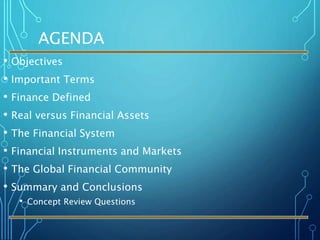
AGENDA
• Objectives
• Important Terms
• Finance Defined
• Real versus Financial Assets
• The Financial System
• Financial Instruments and Markets
• The Global Financial Community
• Summary and Conclusions
• Concept Review Questions
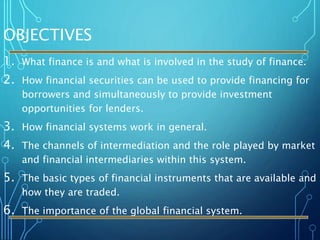
OBJECTIVES
1. What finance is and what is involved in the study of finance.
2. How financial securities can be used to provide financing for
borrowers and simultaneously to provide investment
opportunities for lenders.
3. How financial systems work in general.
4. The channels of intermediation and the role played by market
and financial intermediaries within this system.
5. The basic types of financial instruments that are available and
how they are traded.
6. The importance of the global financial system.
KEY TERMS• Bourse de Montréal
• brokers
• Canadian Trading and Quotation System Inc. (CNQ)
• capital market securities
• common share
• corporate finance
• Crown corporations
• dealer or over-the-counter (OTC) markets
• debt instruments
• equity instruments
• exchanges or auction markets
• finance
• financial assets
• financial intermediaries
• fourth market
• intermediation
• investments
KEY TERMS• market capitalization
• market intermediary
• marketable financial assets
• money market securities
• New York Stock Exchange (NYSE)
• non-marketable financial assets
• Ontario Securities Commission
• preferred shares
• primary markets
• real assets
• secondary markets
• third market
• Toronto Stock Exchange (TSX)
• TSX Group Inc.
• TSX Markets
• TSX Venture Exchange
• Winnipeg Commodity Exchange
WHAT IS FINANCE?
• Finance is the study of how and under what
terms savings (money) are allocated between
lenders and borrowers.
• Finance is distinct from economics in that it
addresses not only how resources are allocated but
also under what terms and through what channels
• Financial contracts or securities occur
whenever funds are transferred from issuer to
buyer.
THE STUDY OF FINANCE
• The study of finance requires a basic understanding
of:
• Securities
• Corporate law
• Financial institutions and markets
REAL VERSUS FINANCIAL ASSETS
• Real assets are tangible things owned by persons
and businesses
• Residential structures and property
• Major appliances and automobiles
• Office towers, factories, mines
• Machinery and equipment
• Financial assets are what one individual has lent to
another
• Consumer credit
• Loans
• Mortgages
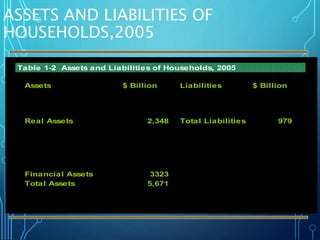
ASSETS AND LIABILITIES OF
HOUSEHOLDS,2005
Assets $ Billion Liabilities $ Billion
Houses 1,086 Consumer credit 260
Consumer Durables 435 Loans 131
Land 827 Mortgages 588
Real Assets 2,348 Total Liabilities 979
Deposits 683
Debt 114
Pensions and insurance 1,200
Shares 1,254
Foreign and other 72
Financial Assets 3323
Total Assets 5,671
Source: Statistics Canada. National Balance Sheet Accounts, Quarterly Estimates, Fourth
Quarter 2005. Ottawa: M inister of Industry, 2006 (Catalogue No. 13-214-XIE).
Table 1-2 Assets and Liabilities of Households, 2005
THE FINANCIAL SYSTEM
• The household is the primary provider of funds to
businesses and government.
• Households must accumulate financial resources throughout their
working life times to have enough savings (pension) to live on in
their retirement years
• Financial intermediaries transform the nature of the
securities they issue and invest in
• Banks, trust companies, credit unions, insurance firms, mutual
funds
• Market intermediaries simply help make markets work
• Investment dealers
• Brokers
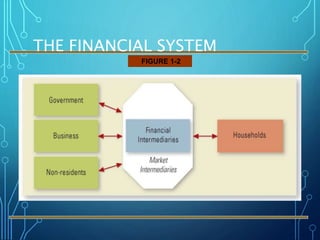
THE FINANCIAL SYSTEM
FIGURE 1-2
THE FINANCIAL SYSTEM
CHANNELS OF INTERMEDIATION
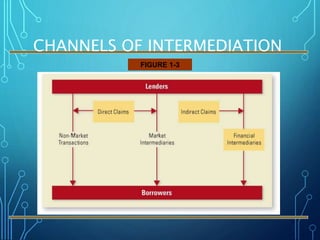
• Funds can be channeled from saver to borrower in
three ways:
• Direct intermediation (direct transfer from saver to
borrower – a non-market transaction)
• Direct intermediation (a market-based transaction usually
through a market intermediary such as a broker)
• Indirect claims through a financial intermediary (where the
financial intermediary such as a bank offers deposit-taking
services and ultimately lends those deposits out as
mortgages or loans)
CHANNELS OF INTERMEDIATION
FIGURE 1-3
THE FINANCIAL SYSTEM
FINANCIAL INTERMEDIARIES
• Banks and other deposit-taking institutions
• Insurance companies
• Pension Funds
• Mutual Funds
FINANCIAL INTERMEDIARIES
CANADIAN CHARTERED BANKS
• Banks take deposits from numerous depositors from across Canada
• The deposits are ‘pooled’ in the Bank
• The bank takes these pooled funds and lends them out to households
and businesses in the form of mortgages and loans
• The bank transforms the original nature of the savers (depositors)
money:
• Deposits are usually small in amount…face little or no risk, and
depositors expect to withdraw the amount at any time
• Loans and mortgages on the other hand usually have the following
characteristics:
• Large sums
• Borrowed for long periods of time
• Borrowed for risky purposes.
• Banks can perform this transformation function because they become
experts at risk assessment, financial contracting (pricing the risk) and
monitoring the activities of borrowers.
FINANCIAL INTERMEDIARIES
CANADIAN CHARTERED BANKS
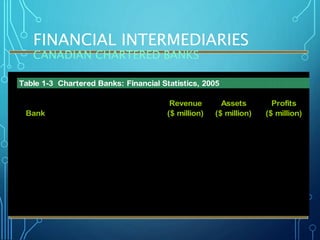
Bank
Revenue
($ million)
Assets
($ million)
Profits
($ million)
Royal Bank of Canada 29,403 4,69,521 3,387
Canadian Imperial Bank of Commerce
(CIBC) 18,677 2,80,370 -32
Bank of Nova Scotia 18,332 3,14,025 3,209
TD Canada Trust 18,665 3,65,210 2,229
Bank of Montreal 15,138 2,97,532 2,400
National Bank 5,320 1,07,598 855
Source: BMO InvestorLine website: www.bmoinvestorline.com, October 31, 2006.
Table 1-3 Chartered Banks: Financial Statistics, 2005
FINANCIAL INTERMEDIARIES
INSURANCE COMPANIES
• Insurers sell policies and collect premiums from customers
based on the pricing of those policies given the probability
of a claim and the size the policy and administrative fees.
• They invest the premiums so that the accumulated value in
the future will grow to meet the anticipated claims of the
policyholders.
• In this way, unsupportable risks (such as the death of wage
earner or the burning down of a business) are shared
among a large number of policyholders through the
insurance company.
• Insurance allows households, business and government to
engage in risky activities without having to bear the entire
risk of loss themselves.
FINANCIAL INTERMEDIARIES
INSURANCE COMPANIES
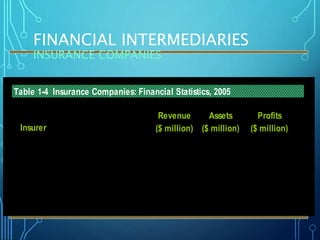
Insurer
Revenue
($ million)
Assets
($ million)
Profits
($ million)
Manulife Financial 32,187 322,171 3,294
Sun Life Financial 21,871 171,850 1,867
Great-West Lifeco 23,883 102,161 1,775
ING Canada 4,446 9,926 782
Source: Data from BMO InvestorLine website: www.bmoinvestorline.com,October 31,2006.
Table 1-4 Insurance Companies: Financial Statistics, 2005
FINANCIAL INTERMEDIARIES
PENSION PLAN ASSETS
• Individuals and employers make payments over the
entire working life of a person with those funds
invested to grow over time.
• Ultimately, the accumulated value in the pension can
be used by the person in retirement.
• Pension plans accumulate considerable sums of
money, and their managers invest those funds with
long-term investment time horizons in diversified
portfolios of investments. These investments are a
major source of capital, fuelling investment in
research and development, capital equipment,
resource exploration and ultimately contributing in a
substantial way to growth in the economy.
FINANCIAL INTERMEDIARIES
PENSION PLAN ASSETS
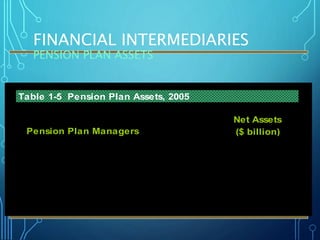
Pension Plan Managers
Net Assets
($ billion)
Caisse de depot et placement du Quebec 216.1
Canada Pension Plan (CPP) 98.0
Ontario Teachers (Teachers) 96.1
Ontario Municipal Employees (OMERS) 41.6
* The Caisse manages the investments of several pension plans.
Table 1-5 Pension Plan Assets, 2005
FINANCIAL INTERMEDIARIES
CANADIAN MUTUAL FUND ASSETS
• Mutual funds give small investors access to
diversified, professionally-managed portfolios of
securities.
• Small investors often do not have the funds
necessary to invest directly into market-traded
stocks and bonds.
• This is called denomination intermediation because
the mutual fund makes investments available in
smaller, more affordable amounts of money.
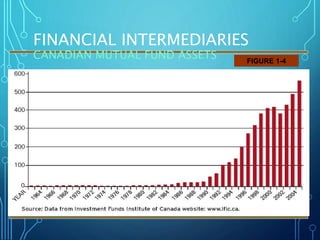
• Canadian indirect investment in the markets
through managed products such as mutual funds
and segregated funds has grown exponentially.
(see Figure 1-4 on the next slide)
FINANCIAL INTERMEDIARIES
CANADIAN MUTUAL FUND ASSETS FIGURE 1-4
THE FINANCIAL SYSTEM
THE MAJOR BORROWERS
• Public Debt
• Governments
• Federal
• Provincial
• Municipal
• Crown Corporations
• Private Debt
• Households
• Non-financial Corporations
THE FINANCIAL SYSTEM
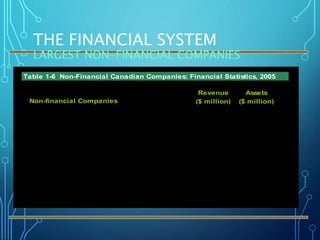
LARGEST NON-FINANCIAL COMPANIES
Non-financial Companies
Revenue
($ million)
Assets
($ million)
General Motors of Canada Ltd. 34,991 n/a
Loblaw Companies Ltd. 27,812 13,761
Magna International Inc. 22,873 12,321
Imperial Oil Ltd. 26,936 15,582
Alcan Inc.* 20,408 26,638
BCE Inc. 19,150 40,630
Bombardier Inc.* 14,882 17,483
Petro-Canada 17,673 20,655
Onex Corp. 17,626 14,845
EnCana Corp.* 14,322 34,148
Source: Data from "The Top 1000 in 2005." Globe and M ail Report on Business website:
www.theglobeandmail.com.
Table 1-6 Non-Financial Canadian Companies: Financial Statistics, 2005
*Company reports in U.S. dollars.
FINANCIAL INSTRUMENTS
• There are two major categories of financial
securities:
1. Debt Instruments
– Commercial paper
– Bankers’ acceptances
– Treasury bills
– Mortgage loans
– Bonds
– Debentures
2. Equity Instruments
– Common stock
– Preferred stock
FINANCIAL INSTRUMENTS
NON-MARKETABLE
• Characteristics of non-marketable securities
• Cannot be traded between or among
investors
• May be redeemable (a reverse transaction
between the borrower and the lender)
• Examples:
• Savings accounts
• Term Deposits
• Guaranteed Investment Certificates
• Canada Savings Bonds
FINANCIAL INSTRUMENTS
MARKETABLE
• Characteristics of Marketable securities
• Can be traded between or among investors after their
original issue in public markets and before they mature or
expire
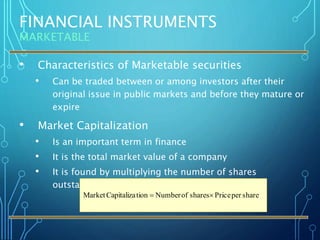
• Market Capitalization
• Is an important term in finance
• It is the total market value of a company
• It is found by multiplying the number of shares
outstanding by the market price per share.
shareperPricesharesofNumbertionCapitalizaMarket 
FINANCIAL INSTRUMENTS
MARKETABLE
Markets can be categorized by the time to maturity:
• Money Market Securities (for short-term debt securities that
are pure discount notes)
• Bankers’ acceptances
• Commercial Paper
• Treasury Bills
• Capital Market Securities (for long-term debt or equity
securities with maturities greater than 1 year)
• Bonds
• Debentures
• Common Stock
• Preferred Stock
FINANCIAL MARKETS
• Primary Market
• Markets that involve the issue of new securities by
the borrower in return for cash from investors
(Capital formation occurs)
• Secondary Market
• Markets that involve buyers and sellers of existing
securities. Funds flow from buyer to seller. Seller
becomes the new owner of the security. (No capital
formation occurs)
FINANCIAL MARKETS
TYPES OF SECONDARY MARKETS
• Exchanges or Auction Markets
• Secondary markets that involve a bidding process that takes
place in specific location
• For example TSX, NYSE
• Dealer or Over-the-counter (OTC) Markets
• Secondary markets that do not have a physical location and
consist of a network of dealers who trade directly with one
another.
• For example the bond market
FINANCIAL MARKETS
OTHER MARKETS
• Third Market
• Trading of securities that are listed on organized exchanges
in the Over-the-counter market
• Fourth Market
• Trading of securities directly between investors (usually
between two large institutions) without the involvement of
brokers or dealers.
• Operates through the use of privately owned automated
systems such as Instinet
THE GLOBAL FINANCIAL
COMMUNITY
• Represents an important source of funds for
borrowers
• Provides investors with important alternatives as
they seek to build wealth through diversified
portfolios
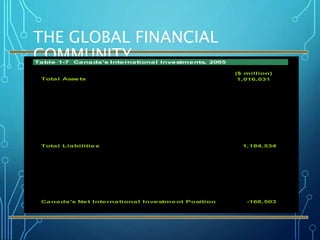
THE GLOBAL FINANCIAL
COMMUNITY
Total Assets
($ million)
1,016,031
Canadian direct investments abroad 465,058
Canadian portfolio investments 284,604
Portfolio foreign bonds 82,374
Portfolio foreign stocks 189,175
Other portfolio investments 13,055
Other Canadian investments 266,369
Loans 48,325
Allowances
Deposits 120,694
Official international reserves 38,030
Other assets 59,319
Total Liabilities 1,184,534
Foreign direct investments in Canada 415,561
Foreign portfolio investments 508,398
Portfolio Canadian bonds 380,017
Portfolio Canadian stocks 107,598
Portfolio Canadian money market instruments 20,783
Other foreign investments 260,575
Loans 36,107
Deposits 201,639
Other liabilities 22,829
Canada's Net International Investment Position -168,503
So urce: Statistics Canada.
Table 1-7 Canada's International Investments, 2005
SUMMARY
• In this chapter you have learned about:
• Financial systems in general, and the Canadian financial
system in particular
• Major participants in the Canadian financial system,
including the different types of financial securities and
financial markets
INTERNET LINKS
• BMO InvestorLine: www.bmoinvestorline.com
• Investment Funds Institute of Canada: www.ific.ca
• Globe and Mail Report on Business: www.theglobeandmail.com
• Toronto Stock Exchange (TSX): http://www.tsx.com/
• Canadian Trading and Quotation System Inc.:
http://www.cnq.ca/
• Ontario Securities Commission:
http://www.osc.gov.on.ca/index.jsp
• Winnipeg Commodity Exchange: http://www.wce.ca/
• New York Stock Exchange (NYSE) Euronext:
http://www.nyse.com/
THANK YOU…

CORPORATE FINANCE

  • 1.
  • 2.
    AGENDA • Objectives • ImportantTerms • Finance Defined • Real versus Financial Assets • The Financial System • Financial Instruments and Markets • The Global Financial Community • Summary and Conclusions • Concept Review Questions
  • 3.
    OBJECTIVES 1. What financeis and what is involved in the study of finance. 2. How financial securities can be used to provide financing for borrowers and simultaneously to provide investment opportunities for lenders. 3. How financial systems work in general. 4. The channels of intermediation and the role played by market and financial intermediaries within this system. 5. The basic types of financial instruments that are available and how they are traded. 6. The importance of the global financial system.
  • 4.
    KEY TERMS• Boursede Montréal • brokers • Canadian Trading and Quotation System Inc. (CNQ) • capital market securities • common share • corporate finance • Crown corporations • dealer or over-the-counter (OTC) markets • debt instruments • equity instruments • exchanges or auction markets • finance • financial assets • financial intermediaries • fourth market • intermediation • investments
  • 5.
    KEY TERMS• marketcapitalization • market intermediary • marketable financial assets • money market securities • New York Stock Exchange (NYSE) • non-marketable financial assets • Ontario Securities Commission • preferred shares • primary markets • real assets • secondary markets • third market • Toronto Stock Exchange (TSX) • TSX Group Inc. • TSX Markets • TSX Venture Exchange • Winnipeg Commodity Exchange
  • 6.
    WHAT IS FINANCE? •Finance is the study of how and under what terms savings (money) are allocated between lenders and borrowers. • Finance is distinct from economics in that it addresses not only how resources are allocated but also under what terms and through what channels • Financial contracts or securities occur whenever funds are transferred from issuer to buyer.
  • 7.
    THE STUDY OFFINANCE • The study of finance requires a basic understanding of: • Securities • Corporate law • Financial institutions and markets
  • 8.
    REAL VERSUS FINANCIALASSETS • Real assets are tangible things owned by persons and businesses • Residential structures and property • Major appliances and automobiles • Office towers, factories, mines • Machinery and equipment • Financial assets are what one individual has lent to another • Consumer credit • Loans • Mortgages
  • 9.
    ASSETS AND LIABILITIESOF HOUSEHOLDS,2005 Assets $ Billion Liabilities $ Billion Houses 1,086 Consumer credit 260 Consumer Durables 435 Loans 131 Land 827 Mortgages 588 Real Assets 2,348 Total Liabilities 979 Deposits 683 Debt 114 Pensions and insurance 1,200 Shares 1,254 Foreign and other 72 Financial Assets 3323 Total Assets 5,671 Source: Statistics Canada. National Balance Sheet Accounts, Quarterly Estimates, Fourth Quarter 2005. Ottawa: M inister of Industry, 2006 (Catalogue No. 13-214-XIE). Table 1-2 Assets and Liabilities of Households, 2005
  • 10.
    THE FINANCIAL SYSTEM •The household is the primary provider of funds to businesses and government. • Households must accumulate financial resources throughout their working life times to have enough savings (pension) to live on in their retirement years • Financial intermediaries transform the nature of the securities they issue and invest in • Banks, trust companies, credit unions, insurance firms, mutual funds • Market intermediaries simply help make markets work • Investment dealers • Brokers
  • 11.
  • 12.
    THE FINANCIAL SYSTEM CHANNELSOF INTERMEDIATION • Funds can be channeled from saver to borrower in three ways: • Direct intermediation (direct transfer from saver to borrower – a non-market transaction) • Direct intermediation (a market-based transaction usually through a market intermediary such as a broker) • Indirect claims through a financial intermediary (where the financial intermediary such as a bank offers deposit-taking services and ultimately lends those deposits out as mortgages or loans)
  • 13.
  • 14.
    THE FINANCIAL SYSTEM FINANCIALINTERMEDIARIES • Banks and other deposit-taking institutions • Insurance companies • Pension Funds • Mutual Funds
  • 15.
    FINANCIAL INTERMEDIARIES CANADIAN CHARTEREDBANKS • Banks take deposits from numerous depositors from across Canada • The deposits are ‘pooled’ in the Bank • The bank takes these pooled funds and lends them out to households and businesses in the form of mortgages and loans • The bank transforms the original nature of the savers (depositors) money: • Deposits are usually small in amount…face little or no risk, and depositors expect to withdraw the amount at any time • Loans and mortgages on the other hand usually have the following characteristics: • Large sums • Borrowed for long periods of time • Borrowed for risky purposes. • Banks can perform this transformation function because they become experts at risk assessment, financial contracting (pricing the risk) and monitoring the activities of borrowers.
  • 16.
    FINANCIAL INTERMEDIARIES CANADIAN CHARTEREDBANKS Bank Revenue ($ million) Assets ($ million) Profits ($ million) Royal Bank of Canada 29,403 4,69,521 3,387 Canadian Imperial Bank of Commerce (CIBC) 18,677 2,80,370 -32 Bank of Nova Scotia 18,332 3,14,025 3,209 TD Canada Trust 18,665 3,65,210 2,229 Bank of Montreal 15,138 2,97,532 2,400 National Bank 5,320 1,07,598 855 Source: BMO InvestorLine website: www.bmoinvestorline.com, October 31, 2006. Table 1-3 Chartered Banks: Financial Statistics, 2005
  • 17.
    FINANCIAL INTERMEDIARIES INSURANCE COMPANIES •Insurers sell policies and collect premiums from customers based on the pricing of those policies given the probability of a claim and the size the policy and administrative fees. • They invest the premiums so that the accumulated value in the future will grow to meet the anticipated claims of the policyholders. • In this way, unsupportable risks (such as the death of wage earner or the burning down of a business) are shared among a large number of policyholders through the insurance company. • Insurance allows households, business and government to engage in risky activities without having to bear the entire risk of loss themselves.
  • 18.
    FINANCIAL INTERMEDIARIES INSURANCE COMPANIES Insurer Revenue ($million) Assets ($ million) Profits ($ million) Manulife Financial 32,187 322,171 3,294 Sun Life Financial 21,871 171,850 1,867 Great-West Lifeco 23,883 102,161 1,775 ING Canada 4,446 9,926 782 Source: Data from BMO InvestorLine website: www.bmoinvestorline.com,October 31,2006. Table 1-4 Insurance Companies: Financial Statistics, 2005
  • 19.
    FINANCIAL INTERMEDIARIES PENSION PLANASSETS • Individuals and employers make payments over the entire working life of a person with those funds invested to grow over time. • Ultimately, the accumulated value in the pension can be used by the person in retirement. • Pension plans accumulate considerable sums of money, and their managers invest those funds with long-term investment time horizons in diversified portfolios of investments. These investments are a major source of capital, fuelling investment in research and development, capital equipment, resource exploration and ultimately contributing in a substantial way to growth in the economy.
  • 20.
    FINANCIAL INTERMEDIARIES PENSION PLANASSETS Pension Plan Managers Net Assets ($ billion) Caisse de depot et placement du Quebec 216.1 Canada Pension Plan (CPP) 98.0 Ontario Teachers (Teachers) 96.1 Ontario Municipal Employees (OMERS) 41.6 * The Caisse manages the investments of several pension plans. Table 1-5 Pension Plan Assets, 2005
  • 21.
    FINANCIAL INTERMEDIARIES CANADIAN MUTUALFUND ASSETS • Mutual funds give small investors access to diversified, professionally-managed portfolios of securities. • Small investors often do not have the funds necessary to invest directly into market-traded stocks and bonds. • This is called denomination intermediation because the mutual fund makes investments available in smaller, more affordable amounts of money. • Canadian indirect investment in the markets through managed products such as mutual funds and segregated funds has grown exponentially. (see Figure 1-4 on the next slide)
  • 22.
  • 23.
    THE FINANCIAL SYSTEM THEMAJOR BORROWERS • Public Debt • Governments • Federal • Provincial • Municipal • Crown Corporations • Private Debt • Households • Non-financial Corporations
  • 24.
    THE FINANCIAL SYSTEM LARGESTNON-FINANCIAL COMPANIES Non-financial Companies Revenue ($ million) Assets ($ million) General Motors of Canada Ltd. 34,991 n/a Loblaw Companies Ltd. 27,812 13,761 Magna International Inc. 22,873 12,321 Imperial Oil Ltd. 26,936 15,582 Alcan Inc.* 20,408 26,638 BCE Inc. 19,150 40,630 Bombardier Inc.* 14,882 17,483 Petro-Canada 17,673 20,655 Onex Corp. 17,626 14,845 EnCana Corp.* 14,322 34,148 Source: Data from "The Top 1000 in 2005." Globe and M ail Report on Business website: www.theglobeandmail.com. Table 1-6 Non-Financial Canadian Companies: Financial Statistics, 2005 *Company reports in U.S. dollars.
  • 25.
    FINANCIAL INSTRUMENTS • Thereare two major categories of financial securities: 1. Debt Instruments – Commercial paper – Bankers’ acceptances – Treasury bills – Mortgage loans – Bonds – Debentures 2. Equity Instruments – Common stock – Preferred stock
  • 26.
    FINANCIAL INSTRUMENTS NON-MARKETABLE • Characteristicsof non-marketable securities • Cannot be traded between or among investors • May be redeemable (a reverse transaction between the borrower and the lender) • Examples: • Savings accounts • Term Deposits • Guaranteed Investment Certificates • Canada Savings Bonds
  • 27.
    FINANCIAL INSTRUMENTS MARKETABLE • Characteristicsof Marketable securities • Can be traded between or among investors after their original issue in public markets and before they mature or expire • Market Capitalization • Is an important term in finance • It is the total market value of a company • It is found by multiplying the number of shares outstanding by the market price per share. shareperPricesharesofNumbertionCapitalizaMarket 
  • 28.
    FINANCIAL INSTRUMENTS MARKETABLE Markets canbe categorized by the time to maturity: • Money Market Securities (for short-term debt securities that are pure discount notes) • Bankers’ acceptances • Commercial Paper • Treasury Bills • Capital Market Securities (for long-term debt or equity securities with maturities greater than 1 year) • Bonds • Debentures • Common Stock • Preferred Stock
  • 29.
    FINANCIAL MARKETS • PrimaryMarket • Markets that involve the issue of new securities by the borrower in return for cash from investors (Capital formation occurs) • Secondary Market • Markets that involve buyers and sellers of existing securities. Funds flow from buyer to seller. Seller becomes the new owner of the security. (No capital formation occurs)
  • 30.
    FINANCIAL MARKETS TYPES OFSECONDARY MARKETS • Exchanges or Auction Markets • Secondary markets that involve a bidding process that takes place in specific location • For example TSX, NYSE • Dealer or Over-the-counter (OTC) Markets • Secondary markets that do not have a physical location and consist of a network of dealers who trade directly with one another. • For example the bond market
  • 31.
    FINANCIAL MARKETS OTHER MARKETS •Third Market • Trading of securities that are listed on organized exchanges in the Over-the-counter market • Fourth Market • Trading of securities directly between investors (usually between two large institutions) without the involvement of brokers or dealers. • Operates through the use of privately owned automated systems such as Instinet
  • 32.
    THE GLOBAL FINANCIAL COMMUNITY •Represents an important source of funds for borrowers • Provides investors with important alternatives as they seek to build wealth through diversified portfolios
  • 33.
    THE GLOBAL FINANCIAL COMMUNITY TotalAssets ($ million) 1,016,031 Canadian direct investments abroad 465,058 Canadian portfolio investments 284,604 Portfolio foreign bonds 82,374 Portfolio foreign stocks 189,175 Other portfolio investments 13,055 Other Canadian investments 266,369 Loans 48,325 Allowances Deposits 120,694 Official international reserves 38,030 Other assets 59,319 Total Liabilities 1,184,534 Foreign direct investments in Canada 415,561 Foreign portfolio investments 508,398 Portfolio Canadian bonds 380,017 Portfolio Canadian stocks 107,598 Portfolio Canadian money market instruments 20,783 Other foreign investments 260,575 Loans 36,107 Deposits 201,639 Other liabilities 22,829 Canada's Net International Investment Position -168,503 So urce: Statistics Canada. Table 1-7 Canada's International Investments, 2005
  • 34.
    SUMMARY • In thischapter you have learned about: • Financial systems in general, and the Canadian financial system in particular • Major participants in the Canadian financial system, including the different types of financial securities and financial markets
  • 35.
    INTERNET LINKS • BMOInvestorLine: www.bmoinvestorline.com • Investment Funds Institute of Canada: www.ific.ca • Globe and Mail Report on Business: www.theglobeandmail.com • Toronto Stock Exchange (TSX): http://www.tsx.com/ • Canadian Trading and Quotation System Inc.: http://www.cnq.ca/ • Ontario Securities Commission: http://www.osc.gov.on.ca/index.jsp • Winnipeg Commodity Exchange: http://www.wce.ca/ • New York Stock Exchange (NYSE) Euronext: http://www.nyse.com/
  • 36.