Coral Reefs andCoral
Bleaching
A Comprehensive Overview
Important for GS 3
2.
Introduction to CoralReefs
- Coral reefs are underwater ecosystems formed
by calcium carbonate skeletons.
- Types: Fringing, Barrier, Atolls, and Patch Reefs.
- Found primarily in tropical and subtropical
regions.
3.
Importance of CoralReefs
- Host 25% of marine biodiversity.
- Support fisheries and tourism industries.
- Protect coastlines from erosion.
- Contribute to carbon sequestration.
- Potential source for pharmaceuticals.
4.
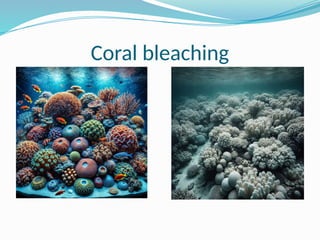
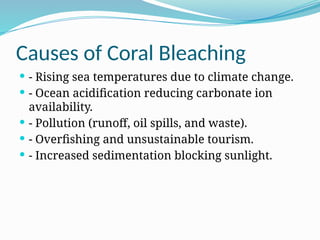
What is CoralBleaching?
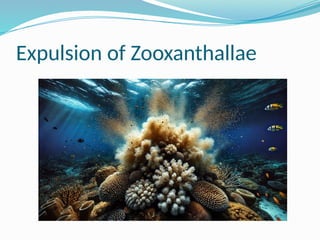
- Occurs when coral polyps expel symbiotic algae
(zooxanthellae).
- Leads to loss of color and energy sources for
corals.
- Causes include rising sea temperatures,
pollution, and ocean acidification.
Causes of CoralBleaching
- Rising sea temperatures due to climate change.
- Ocean acidification reducing carbonate ion
availability.
- Pollution (runoff, oil spills, and waste).
- Overfishing and unsustainable tourism.
- Increased sedimentation blocking sunlight.
8.
Impacts of CoralBleaching
- Loss of marine biodiversity.
- Collapse of fisheries, threatening food security.
- Economic losses from reduced tourism.
- Increased vulnerability to coastal erosion and
storms.
9.
Mitigation and Solutions
- Global efforts: Reduce greenhouse gas
emissions (e.g., Paris Agreement).
- Local actions: Manage fishing, reduce pollution,
and promote reef-safe tourism.
- Restoration techniques: Coral gardening and
transplantation.
10.
Global initiatives forprotection of coral
reefs:-
Sustainable ocean initiative
UN Environment global coral reef partnership
International coral reef initiative
Reef resilience network
Global coral reef monitoring network
Ocean biogeographic information system
Global ocean acidification observing network (GOA-
ON)
Ramsar convention
Coral triangle initiative
11.
Australia’s Great BarrierReef
Australia's Great Barrier Reef is the world's
largest reef system stretching across 2,300 km.
It hosts 400 different types of coral, gives shelter
to 1,500 species of fish and 4,000 types of mollusc.
The reef is located in the Coral Sea (North-East
Coast), off the coast of Queensland, Australia.
It was selected as a World Heritage Site in 1981.
The reefs are predominant on the eastern coasts
due to warmer weather conditions.
12.
Practice questions
Q)Consider the following statements about the Coral Reefs
1. They are formed by coral polyps, held together by calcium carbonate
2. They can be found only in tropical and subtropical water bodies
3. They are highly adaptable organisms that can withstand harsh conditions of the marine
ecosystem.
4. Gulf of Mannar has the richest coral diversity in India
How many of the above statements are correct?
(a) Only one
(c) Only three
(b) Only two
(d) All four
13.
Answer: (b) Onlytwo
Explanation:
Statement 1: Correct
Coral reefs are formed by coral polyps, which secrete calcium carbonate to build
their skeletons. These skeletons form the structure of coral reefs.
Statement 2: Incorrect
While most coral reefs are found in tropical and subtropical waters, deep-sea corals
exist in colder and deeper waters and do not rely on sunlight or zooxanthellae for
survival. Hence, coral reefs are not restricted to tropical and subtropical regions.
Statement 3: Incorrect
Coral reefs are sensitive organisms and thrive under specific conditions, such as
clear, warm, and nutrient-poor waters. They are highly vulnerable to stressors like
temperature changes, pollution, and ocean acidification. Therefore, they are not
considered "highly adaptable."
Statement 4: Correct
The Gulf of Mannar, located along the Tamil Nadu coast, is renowned for its coral
diversity and is one of India's richest marine biodiversity hotspots.
Thus, only Statements 1 and 4 are correct.



![Coral reefs[1]](https://cdn.slidesharecdn.com/ss_thumbnails/coralreefs1-140710120225-phpapp02-thumbnail.jpg?width=640&height=640&fit=bounds)


