Introducing Coordination
Compounds
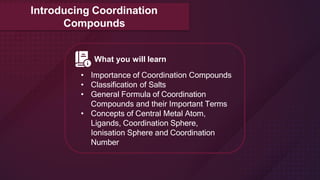
What youwill learn
• Importance of Coordination Compounds
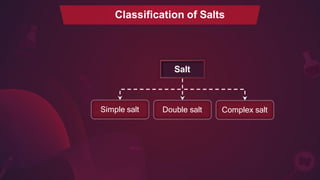
• Classification of Salts
• General Formula of Coordination
Compounds and their Important Terms
• Concepts of Central Metal Atom,
Ligands, Coordination Sphere,
Ionisation Sphere and Coordination
Number
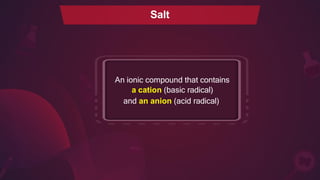
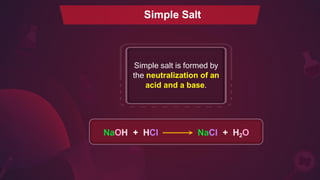
Simple salt isformed by
the neutralization of an
acid and a base.
Simple Salt
NaOH + HCl NaCl + H2O
7.
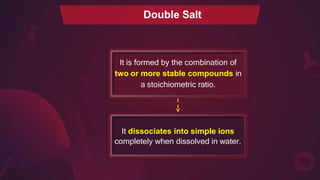
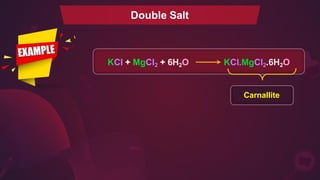
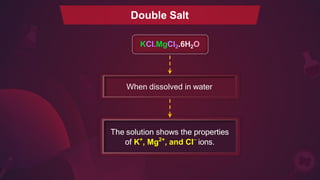
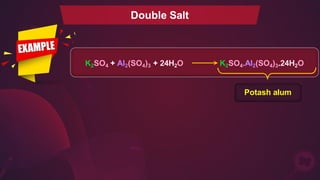
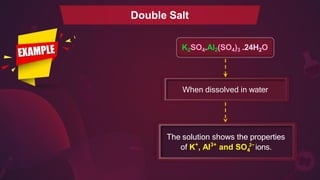
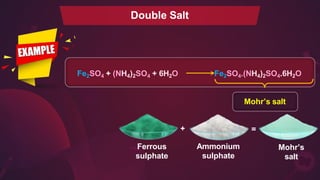
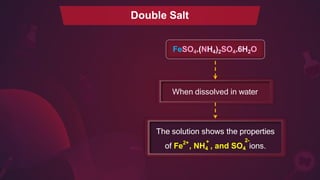
Double Salt
It dissociatesinto simple ions
completely when dissolved in water.
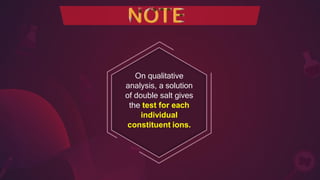
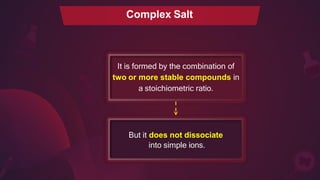
It is formed by the combination of
two or more stable compounds in
a stoichiometric ratio.
Coordination Compounds
The additioncompounds that retain
their identity (i.e., does not lose
their identity) in solutions are known
as coordination compounds.
25.
When KCN solutionis added
to Fe(CN)2 solution.
The species K4[Fe(CN)6] is
formed and when dissolved in
water no longer gives test fo
_r
Fe2+
and CN-.
Coordination Compounds
26.
The metal atomsare bound to a
number of anions, cations, or neutral
molecules by sharing of electrons.
Coordination Compounds
27.
Let’s See theGeneral
Formula of Coordination
Compounds and their
Important Terms!
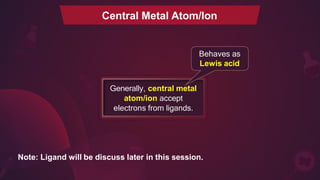
Central Metal Atom/Ion
Behavesas
Lewis acid
Generally, central metal
atom/ion accept
electrons from ligands.
Note: Ligand will be discuss later in this session.
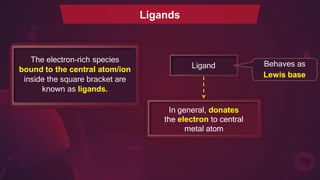
The electron-rich species
boundto the central atom/ion
inside the square bracket are
known as ligands.
Ligands
Ligand
In general, donates
the electron to central
metal atom
Behaves as
Lewis base
Coordination Sphere
The centralatom/ion and the
ligands attached to it are
enclosed in a square
bracket.
In K4[Fe(CN)6], the
coordination sphere is
[Fe(CN)6] .
4_
44.
Ionization Sphere
The moleculeor ionic species
present outside the
coordination sphere constitute
the ionization sphere.
In K4[Fe(CN)6], the
ionisation sphere is K+
.
How to calculatethe
oxidation number of central
atom/ion in any complex?
50.
The charge thata metal
would carry if all the ligands
are removed along with
the electron pairs that are
shared with the central atom
Oxidation Number of Central Metal Atom
51.
x + 4(-1)-3
x -1
=
x = +1
Oxidation Number of Central Metal Atom
Oxidation
no. of Cu
3_
[Cu(CN)4]
52.
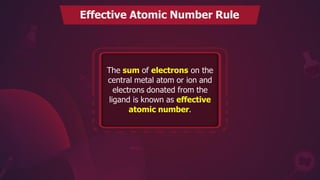
Effective Atomic NumberRule
The sum of electrons on the
central metal atom or ion and
electrons donated from the
ligand is known as effective
atomic number.
53.
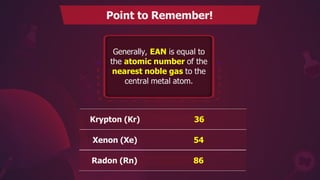
Point to Remember!
Generally,EAN is equal to
the atomic number of the
nearest noble gas to the
central metal atom.
Radon (Rn) 86
Krypton (Kr) 36
Xenon (Xe) 54
54.
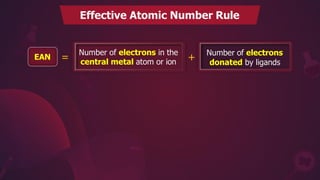
Effective Atomic NumberRule
EAN =
Number of electrons in the
central metal atom or ion +
Number of electrons
donated by ligands
55.
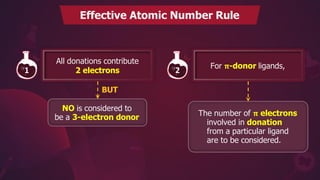
Effective Atomic NumberRule
All donations contribute
2 electrons
1
NO is considered to
be a 3-electron donor
BUT
For 𝛑-donor ligands,
2
The number of 𝛑 electrons
involved in donation
from a particular ligand
are to be considered.
56.
[Cr(CO)6] Electrons inCr
atom = Atomic
number of Cr
24
Number of
electrons
donated by 6 CO
2 X 6 = 12
36
Obeys EAN
rule
O.S of Cr = 0
Effective Atomic Number Rule
57.
Limitation of EANRule
The EAN rule fails in
many cases and works
best for metals in low
oxidation states.

![Complex Salt
When dissolved in water
K4[Fe(CN)6]
The solution does not show t_
he
properties of Fe2+ and CN](https://image.slidesharecdn.com/l1done-250408090227-6cfcf1fd/85/coordination-geometry-class-12-very-brilliant-presentation-17-320.jpg)
![Complex Salt
K4[Fe(CN)6]
Exists as a
distinct entity
Complex ions are
shown by square
brackets.](https://image.slidesharecdn.com/l1done-250408090227-6cfcf1fd/85/coordination-geometry-class-12-very-brilliant-presentation-18-320.jpg)
![K4[Fe(CN)6]
Does not dissociate
2+
into Fe & CN ions
to give identification
test
_
Complex Salt
K
+
Gives the
identification
test of K+
4 _
[Fe(CN)6]](https://image.slidesharecdn.com/l1done-250408090227-6cfcf1fd/85/coordination-geometry-class-12-very-brilliant-presentation-19-320.jpg)
![Complex Salt
CuSO4 + 4NH3 + H2O [Cu(NH3)4]SO4.H2O
Tetraamminecopper(II)
sulphate monohydrate](https://image.slidesharecdn.com/l1done-250408090227-6cfcf1fd/85/coordination-geometry-class-12-very-brilliant-presentation-20-320.jpg)
![Complex Salt
When dissolved in water
The solution shows the properties
of SO4
2- but does not show of NH3
[Cu(NH3)4]SO4.H2O](https://image.slidesharecdn.com/l1done-250408090227-6cfcf1fd/85/coordination-geometry-class-12-very-brilliant-presentation-21-320.jpg)
![Exists as a
distinct entity
Complex Salt
[Cu(NH3)4]SO4.H2O
_
Gives test for SO4
2](https://image.slidesharecdn.com/l1done-250408090227-6cfcf1fd/85/coordination-geometry-class-12-very-brilliant-presentation-22-320.jpg)
![When KCN solution is added
to Fe(CN)2 solution.
The species K4[Fe(CN)6] is
formed and when dissolved in
water no longer gives test fo
_r
Fe2+
and CN-.
Coordination Compounds](https://image.slidesharecdn.com/l1done-250408090227-6cfcf1fd/85/coordination-geometry-class-12-very-brilliant-presentation-25-320.jpg)
![General
formula
a+ a−
[ M ( L )n ] X
Coordination Compounds](https://image.slidesharecdn.com/l1done-250408090227-6cfcf1fd/85/coordination-geometry-class-12-very-brilliant-presentation-28-320.jpg)
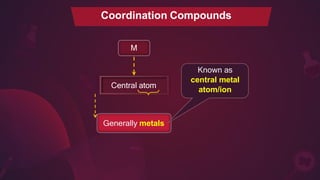
![Central Metal Atom/Ion
[C
Co
o(NH3)6]Cl3
Central metal
atom/ion](https://image.slidesharecdn.com/l1done-250408090227-6cfcf1fd/85/coordination-geometry-class-12-very-brilliant-presentation-31-320.jpg)
![General formula
Coordination Compounds
a+ a−
[ M (L)n ] X](https://image.slidesharecdn.com/l1done-250408090227-6cfcf1fd/85/coordination-geometry-class-12-very-brilliant-presentation-32-320.jpg)
![Ligands
[C
Co
o
((
N
NH
H3
3)6]Cl3
Ligand](https://image.slidesharecdn.com/l1done-250408090227-6cfcf1fd/85/coordination-geometry-class-12-very-brilliant-presentation-34-320.jpg)
![General
formula
a+ a−
[ M ( L )n ] X
Coordifi6tiofi Compoufids
Coordination
sphere](https://image.slidesharecdn.com/l1done-250408090227-6cfcf1fd/85/coordination-geometry-class-12-very-brilliant-presentation-35-320.jpg)
![Coordifi6tiofi Compoufids
General
formula
a+ a−
[ M ( L )n ] X
Charge on
coordination
entity](https://image.slidesharecdn.com/l1done-250408090227-6cfcf1fd/85/coordination-geometry-class-12-very-brilliant-presentation-36-320.jpg)
![Charge on Coordination Entity
3
3+
+
[Co(NH3)6] 3Cl−
Charge on
coordination
entity](https://image.slidesharecdn.com/l1done-250408090227-6cfcf1fd/85/coordination-geometry-class-12-very-brilliant-presentation-37-320.jpg)
![Coordination Compounds
General
formula
a+ a−
[ M ( L )n ] X
Counter ion](https://image.slidesharecdn.com/l1done-250408090227-6cfcf1fd/85/coordination-geometry-class-12-very-brilliant-presentation-38-320.jpg)
![Counter Ion
3
3 6
6
[C
Co
o(NH ) ]3
3
+
+
3Cll−
Counter ion](https://image.slidesharecdn.com/l1done-250408090227-6cfcf1fd/85/coordination-geometry-class-12-very-brilliant-presentation-39-320.jpg)
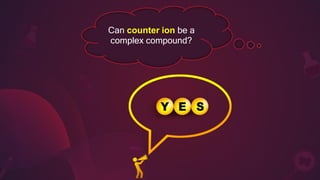
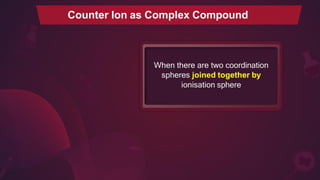
![[Ag(NH3)2][Ag(CN)2]
[Cr(NH3)6][Co(CN)6]
Counter Ion as Complex Compound](https://image.slidesharecdn.com/l1done-250408090227-6cfcf1fd/85/coordination-geometry-class-12-very-brilliant-presentation-42-320.jpg)
![Coordination Sphere
The central atom/ion and the
ligands attached to it are
enclosed in a square
bracket.
In K4[Fe(CN)6], the
coordination sphere is
[Fe(CN)6] .
4_](https://image.slidesharecdn.com/l1done-250408090227-6cfcf1fd/85/coordination-geometry-class-12-very-brilliant-presentation-43-320.jpg)
![Ionization Sphere
The molecule or ionic species
present outside the
coordination sphere constitute
the ionization sphere.
In K4[Fe(CN)6], the
ionisation sphere is K+
.](https://image.slidesharecdn.com/l1done-250408090227-6cfcf1fd/85/coordination-geometry-class-12-very-brilliant-presentation-44-320.jpg)
![Coordination Number
General
formula a+ a−
[ M ( L )n ] X
Coordination
number](https://image.slidesharecdn.com/l1done-250408090227-6cfcf1fd/85/coordination-geometry-class-12-very-brilliant-presentation-45-320.jpg)
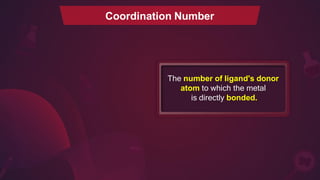
![3
3 6
6
[
[C
Co
o(NH ) ]3
3+
3Cl−
Coordination
number
Coordifi6tiofi Number](https://image.slidesharecdn.com/l1done-250408090227-6cfcf1fd/85/coordination-geometry-class-12-very-brilliant-presentation-47-320.jpg)
![Coordination Number
Coordination number of Pt = 6
Coordination number of Ni = 4
2+
[Ni(NH3)4]
2
_
[Pt(Cl)6]](https://image.slidesharecdn.com/l1done-250408090227-6cfcf1fd/85/coordination-geometry-class-12-very-brilliant-presentation-48-320.jpg)
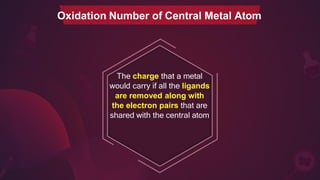
![x + 4(-1) -3
x -1
=
x = +1
Oxidation Number of Central Metal Atom
Oxidation
no. of Cu
3_
[Cu(CN)4]](https://image.slidesharecdn.com/l1done-250408090227-6cfcf1fd/85/coordination-geometry-class-12-very-brilliant-presentation-51-320.jpg)
![[Cr(CO)6] Electrons in Cr
atom = Atomic
number of Cr
24
Number of
electrons
donated by 6 CO
2 X 6 = 12
36
Obeys EAN
rule
O.S of Cr = 0
Effective Atomic Number Rule](https://image.slidesharecdn.com/l1done-250408090227-6cfcf1fd/85/coordination-geometry-class-12-very-brilliant-presentation-56-320.jpg)



![Chapter 9 [PDF].pdf](https://cdn.slidesharecdn.com/ss_thumbnails/chapter9pdf-240108172138-eb0664bd-thumbnail.jpg?width=640&height=640&fit=bounds)


![谷歌留痕技术 [ 𝙩𝙤𝙥 𝟮𝟯𝟯. 𝙘 𝙤𝙢 ]](https://cdn.slidesharecdn.com/ss_thumbnails/top233-260130174328-3833018c-thumbnail.jpg?width=640&height=640&fit=bounds)


