CONVENTIONS 
OF GENRE. 
COUNTRY.
HISTORY 
Country music is one of the oldest music genres to date. It 
originated in the Southern parts of the US in the 1920s and 
slowly made its way to all the parts of the world. It is most 
popular in the States and because of this it usually wins 
Grammys over other music genres we would usually 
consider ‘mainstream’. The defining characteristic of country 
music is mostly the acoustic guitar, along with the vocals to 
accompany it. Although this convention has been twisted 
through the years as country music has modernized and 
mixed with other genres in order to appeal to a wider range 
of audiences.
CONVENTIONS OF MUSIC 
VIDEO GENRE. (COUNTRY) 
• Tend to have some narrative aspect. 
• Usually set in rural locations. 
• Mise-en-scene tends to be very traditional. 
• Artist features in the video. 
Pop is now incorporated within the country genre so the usual 
raw conventions sometimes vary and differ to suit the artist’s and 
audience’s needs. This means the new conventions can include: 
• More urban locations. 
• Can incorporate more of a performance narrative. 
• Faster editing. 
• Different uses of cinematography
CONVENTIONS OF 
FORM. 
The conventions of a music video that the audience most commonly recognize 
are: 
• Costume – a range of costumes throughout the music video gives it more 
of an interesting look. 
• Performance – live, lip-synced or dance, usually depends on the genre. 
• Narrative – can be a story or purely abstract. 
• Artist feature – the artist will be seen throughout the video usually, 
promoting the artist image through the video. 
• Music/song – the artist’s song would be played throughout the music video 
to promote the song. 
Other things such as a range of cinematography and a range of images are 
also conventions that we would use in music videos. 
• Rhythmic editing – editing that goes the beat of the song will usually be 
used throughout the video. 
• A range of cinematography – wide shots, pans, 360 degree shots, high and 
low angles, etc. 
• A range of editing techniques – fades, overlaps, dissolves, slow motion or 
reverse edits may be used instead of just the standard cut.
PERFORMANCE. 
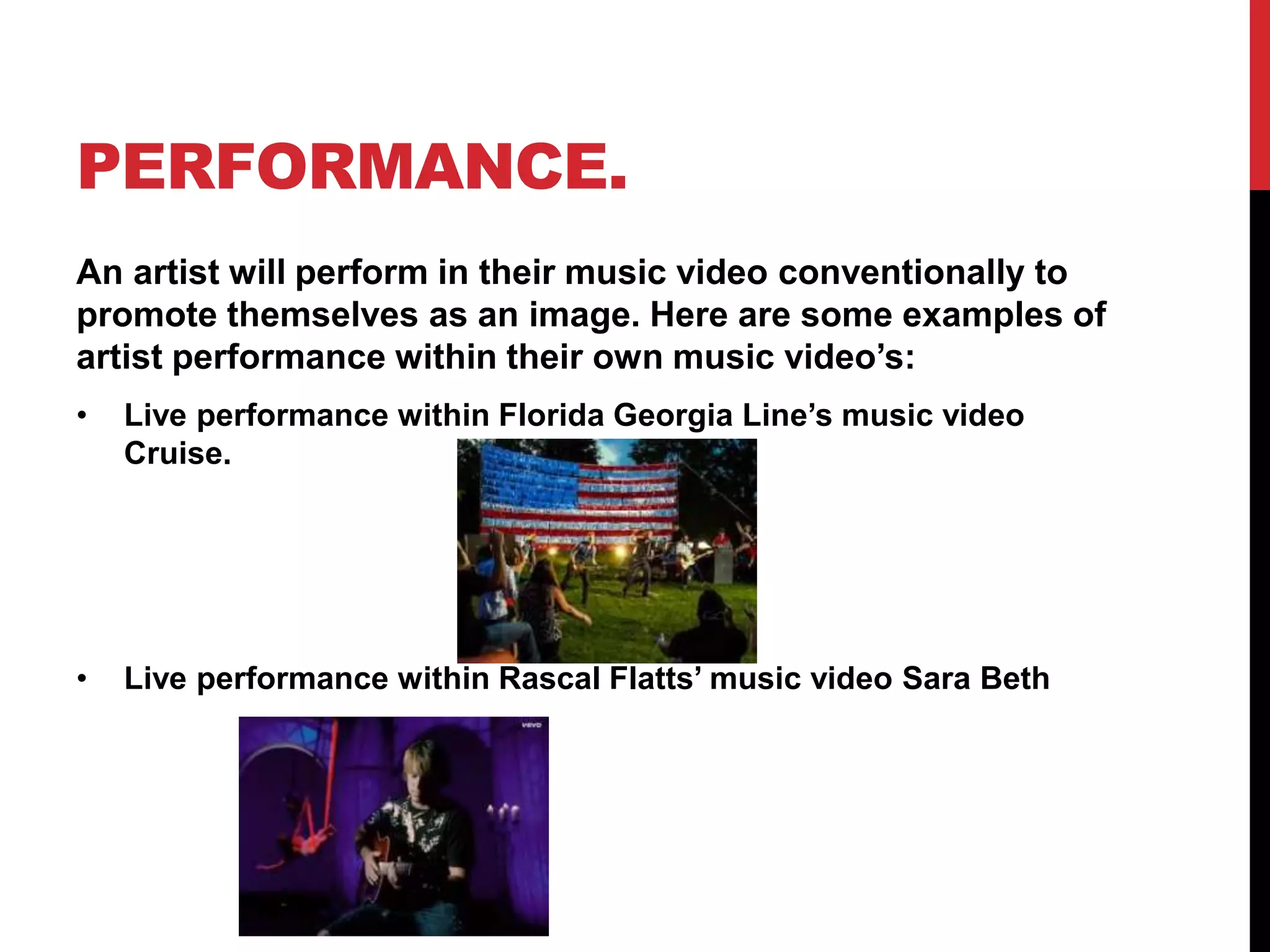
An artist will perform in their music video conventionally to 
promote themselves as an image. Here are some examples of 
artist performance within their own music video’s: 
• Live performance within Florida Georgia Line’s music video 
Cruise. 
• Live performance within Rascal Flatts’ music video Sara Beth
ARTIST FEATURE. 
Typically artists will feature in their own videos. The purpose 
of this is so that the artist can create themselves a certain 
marketing image and be able to sell themselves as a brand. 
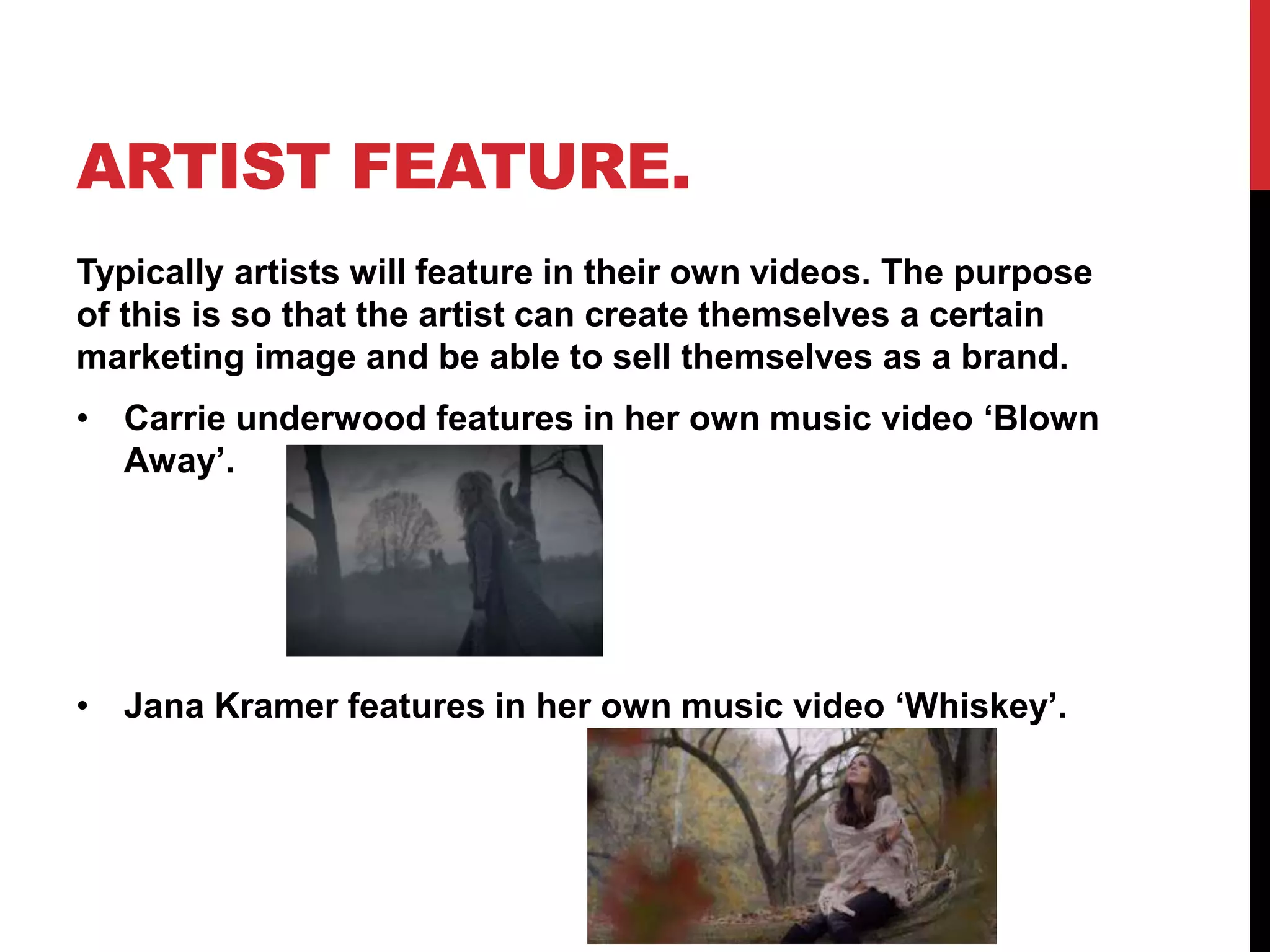
• Carrie underwood features in her own music video ‘Blown 
Away’. 
• Jana Kramer features in her own music video ‘Whiskey’.

Conventions of form and genre NATALIE WYKE MEDIA

  • 1.
  • 2.
    HISTORY Country musicis one of the oldest music genres to date. It originated in the Southern parts of the US in the 1920s and slowly made its way to all the parts of the world. It is most popular in the States and because of this it usually wins Grammys over other music genres we would usually consider ‘mainstream’. The defining characteristic of country music is mostly the acoustic guitar, along with the vocals to accompany it. Although this convention has been twisted through the years as country music has modernized and mixed with other genres in order to appeal to a wider range of audiences.
  • 3.
    CONVENTIONS OF MUSIC VIDEO GENRE. (COUNTRY) • Tend to have some narrative aspect. • Usually set in rural locations. • Mise-en-scene tends to be very traditional. • Artist features in the video. Pop is now incorporated within the country genre so the usual raw conventions sometimes vary and differ to suit the artist’s and audience’s needs. This means the new conventions can include: • More urban locations. • Can incorporate more of a performance narrative. • Faster editing. • Different uses of cinematography
  • 4.
    CONVENTIONS OF FORM. The conventions of a music video that the audience most commonly recognize are: • Costume – a range of costumes throughout the music video gives it more of an interesting look. • Performance – live, lip-synced or dance, usually depends on the genre. • Narrative – can be a story or purely abstract. • Artist feature – the artist will be seen throughout the video usually, promoting the artist image through the video. • Music/song – the artist’s song would be played throughout the music video to promote the song. Other things such as a range of cinematography and a range of images are also conventions that we would use in music videos. • Rhythmic editing – editing that goes the beat of the song will usually be used throughout the video. • A range of cinematography – wide shots, pans, 360 degree shots, high and low angles, etc. • A range of editing techniques – fades, overlaps, dissolves, slow motion or reverse edits may be used instead of just the standard cut.
  • 5.
    PERFORMANCE. An artistwill perform in their music video conventionally to promote themselves as an image. Here are some examples of artist performance within their own music video’s: • Live performance within Florida Georgia Line’s music video Cruise. • Live performance within Rascal Flatts’ music video Sara Beth
  • 6.
    ARTIST FEATURE. Typicallyartists will feature in their own videos. The purpose of this is so that the artist can create themselves a certain marketing image and be able to sell themselves as a brand. • Carrie underwood features in her own music video ‘Blown Away’. • Jana Kramer features in her own music video ‘Whiskey’.