SEPARATION OF RESPONSIBILITY
The Benefits
• Prequalify contractors from any device / any time.
• Integrate with existing HR, payroll software and other programs.
• Quickly demonstrate due diligence for contractor safety.
• 15 minutes to complete.
• 10 minutes to approve.
• Automatically send Inductions to contractors.
• Centralised recording and instant reporting of contractor data and
status (approved or rejected).
• Legally compliant (developed by a lawyer and OHS professional).
• Automatic email reminders to contractors to update insurances.
• Uses every day language.
• Legally binding Terms and Conditions.
• So easy to use and implement - anyone can administer it!
• One annual fee no matter how many contractors/ sites.
• Easily collect and store safe work method statements.
• Additional Services :
a. Set up site registers for visitors on multiple sites + run reports
b. Verify compliance using a FREE mobile APP
ContractorSAFE EFFICIENTLY MANAGES CONTRACTOR SAFETY
WITH A MINIMUM OF FUSS AND EXPENSE.
The Benefits
• Contractor's are workers for the purposes of OHS
• Duties to ensure their safety are owed to them
• OHS Act section 21
3 (a) a reference to an employee includes a reference to an independent contractor
engaged by an employer and any employees of the independent contractor; and
3 (b) in relation to matters over which the employer has control or would have control if
not for any agreement purporting to limit or remove that control.
• WHS Act section 8
Meaning of a worker – independent contractor /sub contractor.
Section 19
a. Engaged by
b. workers whose activities in carrying out work are influenced or directed by the person
The Law
• Duties to contractors are clearly owed but what are they and how do
we meet them?
• Limited by:
a. Reasonable practicability
b. Matters over which the employer has control
c. Duty of care
Duties to Contractors?
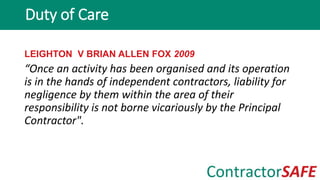
LEIGHTON V BRIAN ALLEN FOX 2009
“Once an activity has been organised and its operation
is in the hands of independent contractors, liability for
negligence by them within the area of their
responsibility is not borne vicariously by the Principal
Contractor".
Duty of Care
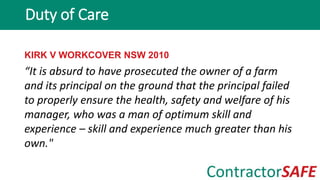
KIRK V WORKCOVER NSW 2010
“It is absurd to have prosecuted the owner of a farm
and its principal on the ground that the principal failed
to properly ensure the health, safety and welfare of his
manager, who was a man of optimum skill and
experience – skill and experience much greater than his
own."
Duty of Care
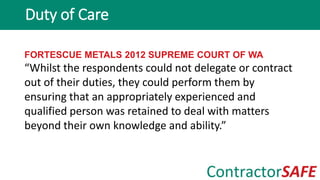
FORTESCUE METALS 2012 SUPREME COURT OF WA
“Whilst the respondents could not delegate or contract
out of their duties, they could perform them by
ensuring that an appropriately experienced and
qualified person was retained to deal with matters
beyond their own knowledge and ability.”
Duty of Care
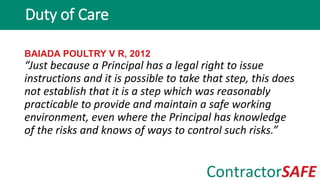
BAIADA POULTRY V R, 2012
“Just because a Principal has a legal right to issue
instructions and it is possible to take that step, this does
not establish that it is a step which was reasonably
practicable to provide and maintain a safe working
environment, even where the Principal has knowledge
of the risks and knows of ways to control such risks.”
Duty of Care
WACO KWIKFORM 2014 – TAKING CONTROL
• Waco contracted Bradley Tracey to erect scaffolding.
• Its was a requirement in the contract that BT prepare SWMS.
• Waco retained general supervisory duty.
• No continuing duty on Waco duty to prescribe and enforce a safe
system of work for dismantling the scaffolding.
• There was an incident so Waco prepared and issued a SWMS and
required BT workers to comply with it.
• A worker fell and suffered serious injuries after Waco issued the SWMS.
• Waco found liable for incident as it has assumed control of the system of
work.
Duty of Care
EPHE ENTERPRISES
• Improvement notice withdrawn as Employer did have the requisite
control over matters required under the notice.
• Confirmation of maintenance.
• Daily pre start checks.
• Confirmation of defect reports and actions.
• Require evidence of roadworthiness.
• 1800 subcontractors.
I am not satisfied that the applicant has control over the way in which
the Operators perform their duties, and specifically over maintenance
of the Operator’s vehicles.
Duty of Care
MCGLASHAN V QBE INSURANCE, 2014 - DUTY OF CARE
• McGlashan roofing contractor engaged by Lidoran to repair roof.
• It should have been a two man job but McGlashan did it on his own.
• Ladder fell over McGlashan injured.
• Claimed Lidoran owed him a duty of care to provide him another worker
to assist him.
• Lidoran was entitled to leave it to the judgment of Mr McGlashan as to
whether a particular job could be undertaken safely by him.
• Confirms that where a head contractor engages a subcontractor to
perform work, and the subcontractor is subsequently in control of the
system of work used, the head contractor will not owe the subcontractor
a duty of care in respect of the method of work.
Duty of Care
Moral duty not to hurt people
Reputational risk
Commercial risk
It’s not just a legal question
• Will taking control of your contractors safety arrangements improve
safety?
• Will requiring/ checking documents improve safety?
• Giving responsibility and trust improves safety.
• Reward local control.
• Empower.
But I can’t let go of control?
• Engage contractors with a good reputation.
• Ask the right questions.
a. Confirm licensing competence (see next slide)
b. Confirm supervision
c. Confirm risk management
d. confirm management of subcontractors
• Clearly establish the scope of work and responsibilities of each party
for safety.
So what should we do?
• Understand obligations retained as a principle contactors:
a. Site safety
b. Safety coordination
c. Manage safety risks from own operations
• Demonstrate due diligence when engaging contractors.
• Require development and implementation of SWMS in respect of
high risk construction work.
• Do not approve, amend or supply safety instructions in respect of
the contactors work.
So what should we do?
• No strict legal requirement to do it but
• Ask questions if you think there is a problem?
• Suggest alternatives.
• Discuss your concerns.
• Do you have the knowledge?
• Are you creating other problems?
SHOW RESPECT AND USE THE EXPERTISE OF YOUR CONTRACTOR
Monitoring?
• Collection of safety documentation is not necessarily an effective way
to demonstrate management of safety.
• Work as imagined vs work as real.
• It is questionable that the production of safety documentation
improves contractor management of safety.
• SWMS are only required for high risk construction work.
• Most SWMS are generic and not updated for the job.
• Licenses are out of date as soon as they are provided.
• Reviewing, approving and amending contractor safety arrangements
is risky.
What evidence of systems should we collect?
• Refer for assistance
• Be realistic about what you require (documented systems)
• Keep it simple
• Keep focussed
• Terminate contracts
• Do not rehire
• Conduct random audits if you have the knowledge to do so
Managing contractors with poor safety
Sue Bottrell
0431 975 286
info@contractorsafe.com.au
Assistance

Contractor Safe: Separation of Responsibility

  • 1.
  • 2.
    The Benefits • Prequalifycontractors from any device / any time. • Integrate with existing HR, payroll software and other programs. • Quickly demonstrate due diligence for contractor safety. • 15 minutes to complete. • 10 minutes to approve. • Automatically send Inductions to contractors. • Centralised recording and instant reporting of contractor data and status (approved or rejected). • Legally compliant (developed by a lawyer and OHS professional). • Automatic email reminders to contractors to update insurances.
  • 3.
    • Uses everyday language. • Legally binding Terms and Conditions. • So easy to use and implement - anyone can administer it! • One annual fee no matter how many contractors/ sites. • Easily collect and store safe work method statements. • Additional Services : a. Set up site registers for visitors on multiple sites + run reports b. Verify compliance using a FREE mobile APP ContractorSAFE EFFICIENTLY MANAGES CONTRACTOR SAFETY WITH A MINIMUM OF FUSS AND EXPENSE. The Benefits
  • 4.
    • Contractor's areworkers for the purposes of OHS • Duties to ensure their safety are owed to them • OHS Act section 21 3 (a) a reference to an employee includes a reference to an independent contractor engaged by an employer and any employees of the independent contractor; and 3 (b) in relation to matters over which the employer has control or would have control if not for any agreement purporting to limit or remove that control. • WHS Act section 8 Meaning of a worker – independent contractor /sub contractor. Section 19 a. Engaged by b. workers whose activities in carrying out work are influenced or directed by the person The Law
  • 5.
    • Duties tocontractors are clearly owed but what are they and how do we meet them? • Limited by: a. Reasonable practicability b. Matters over which the employer has control c. Duty of care Duties to Contractors?
  • 6.
    LEIGHTON V BRIANALLEN FOX 2009 “Once an activity has been organised and its operation is in the hands of independent contractors, liability for negligence by them within the area of their responsibility is not borne vicariously by the Principal Contractor". Duty of Care
  • 7.
    KIRK V WORKCOVERNSW 2010 “It is absurd to have prosecuted the owner of a farm and its principal on the ground that the principal failed to properly ensure the health, safety and welfare of his manager, who was a man of optimum skill and experience – skill and experience much greater than his own." Duty of Care
  • 8.
    FORTESCUE METALS 2012SUPREME COURT OF WA “Whilst the respondents could not delegate or contract out of their duties, they could perform them by ensuring that an appropriately experienced and qualified person was retained to deal with matters beyond their own knowledge and ability.” Duty of Care
  • 9.
    BAIADA POULTRY VR, 2012 “Just because a Principal has a legal right to issue instructions and it is possible to take that step, this does not establish that it is a step which was reasonably practicable to provide and maintain a safe working environment, even where the Principal has knowledge of the risks and knows of ways to control such risks.” Duty of Care
  • 10.
    WACO KWIKFORM 2014– TAKING CONTROL • Waco contracted Bradley Tracey to erect scaffolding. • Its was a requirement in the contract that BT prepare SWMS. • Waco retained general supervisory duty. • No continuing duty on Waco duty to prescribe and enforce a safe system of work for dismantling the scaffolding. • There was an incident so Waco prepared and issued a SWMS and required BT workers to comply with it. • A worker fell and suffered serious injuries after Waco issued the SWMS. • Waco found liable for incident as it has assumed control of the system of work. Duty of Care
  • 11.
    EPHE ENTERPRISES • Improvementnotice withdrawn as Employer did have the requisite control over matters required under the notice. • Confirmation of maintenance. • Daily pre start checks. • Confirmation of defect reports and actions. • Require evidence of roadworthiness. • 1800 subcontractors. I am not satisfied that the applicant has control over the way in which the Operators perform their duties, and specifically over maintenance of the Operator’s vehicles. Duty of Care
  • 12.
    MCGLASHAN V QBEINSURANCE, 2014 - DUTY OF CARE • McGlashan roofing contractor engaged by Lidoran to repair roof. • It should have been a two man job but McGlashan did it on his own. • Ladder fell over McGlashan injured. • Claimed Lidoran owed him a duty of care to provide him another worker to assist him. • Lidoran was entitled to leave it to the judgment of Mr McGlashan as to whether a particular job could be undertaken safely by him. • Confirms that where a head contractor engages a subcontractor to perform work, and the subcontractor is subsequently in control of the system of work used, the head contractor will not owe the subcontractor a duty of care in respect of the method of work. Duty of Care
  • 13.
    Moral duty notto hurt people Reputational risk Commercial risk It’s not just a legal question
  • 14.
    • Will takingcontrol of your contractors safety arrangements improve safety? • Will requiring/ checking documents improve safety? • Giving responsibility and trust improves safety. • Reward local control. • Empower. But I can’t let go of control?
  • 15.
    • Engage contractorswith a good reputation. • Ask the right questions. a. Confirm licensing competence (see next slide) b. Confirm supervision c. Confirm risk management d. confirm management of subcontractors • Clearly establish the scope of work and responsibilities of each party for safety. So what should we do?
  • 16.
    • Understand obligationsretained as a principle contactors: a. Site safety b. Safety coordination c. Manage safety risks from own operations • Demonstrate due diligence when engaging contractors. • Require development and implementation of SWMS in respect of high risk construction work. • Do not approve, amend or supply safety instructions in respect of the contactors work. So what should we do?
  • 17.
    • No strictlegal requirement to do it but • Ask questions if you think there is a problem? • Suggest alternatives. • Discuss your concerns. • Do you have the knowledge? • Are you creating other problems? SHOW RESPECT AND USE THE EXPERTISE OF YOUR CONTRACTOR Monitoring?
  • 18.
    • Collection ofsafety documentation is not necessarily an effective way to demonstrate management of safety. • Work as imagined vs work as real. • It is questionable that the production of safety documentation improves contractor management of safety. • SWMS are only required for high risk construction work. • Most SWMS are generic and not updated for the job. • Licenses are out of date as soon as they are provided. • Reviewing, approving and amending contractor safety arrangements is risky. What evidence of systems should we collect?
  • 19.
    • Refer forassistance • Be realistic about what you require (documented systems) • Keep it simple • Keep focussed • Terminate contracts • Do not rehire • Conduct random audits if you have the knowledge to do so Managing contractors with poor safety
  • 20.
    Sue Bottrell 0431 975286 info@contractorsafe.com.au Assistance