• Came intoforce on 1st
September, 1872.
• Applies to whole of India except for the state of
Jammu & Kashmir [by virtue of Jammu & Kashmir
Reorganization Act, 2019 (w.e.f. 31st
October, 2019)].
• Lays down laws relating to contracts, determines the
legal circumstances in which agreement shall be
legally binding on a person, and provides for the
remedies available in case of breach.
INDIAN CONTRACT ACT, 1872
3.
DEFINITIONS
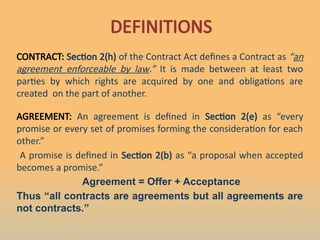
CONTRACT: Section 2(h)of the Contract Act defines a Contract as “an
agreement enforceable by law.” It is made between at least two
parties by which rights are acquired by one and obligations are
created on the part of another.
AGREEMENT: An agreement is defined in Section 2(e) as “every
promise or every set of promises forming the consideration for each
other.”
A promise is defined in Section 2(b) as “a proposal when accepted
becomes a promise.”
Agreement = Offer + Acceptance
Thus “all contracts are agreements but all agreements are
not contracts.”
4.
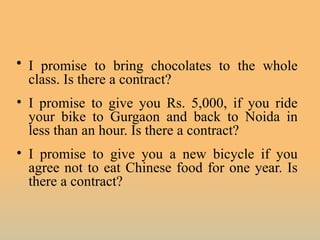
• I promiseto bring chocolates to the whole
class. Is there a contract?
• I promise to give you Rs. 5,000, if you ride
your bike to Gurgaon and back to Noida in
less than an hour. Is there a contract?
• I promise to give you a new bicycle if you
agree not to eat Chinese food for one year. Is
there a contract?
5.
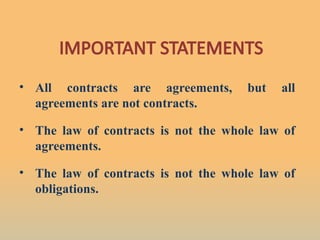
IMPORTANT STATEMENTS
• Allcontracts are agreements, but all
agreements are not contracts.
• The law of contracts is not the whole law of
agreements.
• The law of contracts is not the whole law of
obligations.
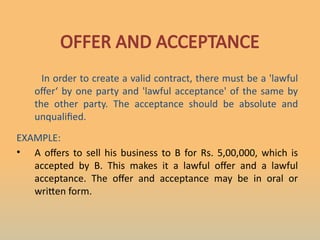
OFFER AND ACCEPTANCE
Inorder to create a valid contract, there must be a 'lawful
offer‘ by one party and 'lawful acceptance' of the same by
the other party. The acceptance should be absolute and
unqualified.
EXAMPLE:
• A offers to sell his business to B for Rs. 5,00,000, which is
accepted by B. This makes it a lawful offer and a lawful
acceptance. The offer and acceptance may be in oral or
written form.
8.
LAWFUL CONSIDERATION
Consideration means‘something in return’. It may be in the
form of money, service, goods. Agreements made without
consideration are unenforceable. And the consideration must
be real and lawful.
The consideration may be an act (doing something), or
forbearance (not doing something), or a promise to do or not
to do something.
EXAMPLE:
1. Brittney agrees to sell narcotics to B for 80,000. This
agreement is not valid as the consideration is unlawful.
9.
INTENTION TO CREATELEGAL RELATIONS
There must be an intention among the parties that the agreement
should be attached by legal consequences and create legal obligations.
Agreements of a social or domestic nature do not contemplate legal
relations, and as such they do not give rise to a contract.
Domestic/ social agreements presume no intention to create legal
relations, while for business/ commercial agreements the presumption
is that the parties intend to create legal relations.
EXAMPLE:
• A agreed to have dinner at B’s house, but refused later.
• M promises his wife N to buy her a saree, if she sings a song. N sings
a song, but M did not buy a saree for her.
10.
CAPACITY OF PARTIES
•The parties to an agreement must be competent to contract. If either of
the parties does not have the capacity to contract, the contract is not valid.
• The following persons are incompetent to contract:
a) Minors
b) Persons of unsound mind
c) Persons disqualified by law to which they are subject.
• If any of the parties to the agreement suffers from minority, lunacy, idiocy,
drunkenness etc., the agreement is not enforceable by law, except in some
special cases.
11.
FREE CONSENT
'Consent' meansthe parties must have agreed upon the
same thing in the same sense. According to Section 14,
Consent is said to be free when it is not caused by:
(1) Coercion
(2) Undue influence
(3) Fraud
(4) Misrepresentation
(5) Mistake
12.
EXAMPLE:
• A threatensto Kill B if B does not lend Rs. 10,000 C. B
agrees to lend the amount to C. This agreement is
made under Coercion.
• A sells his factory to B, by misrepresenting the fact
that the annual output is 50,000 units, while the
actual output was just 20,000 units annually.
13.
NOT DECLARED TOBE VOID
Agreements mentioned in Section 24 to 30 of the Act
have been expressly declared to be void for example
agreements in restraint of trade, marriage, legal
proceedings; uncertain agreements; wagering
agreements; and impossible agreements.
14.
LAWFUL OBJECT
The objectfor which the agreement has been entered
into must not be fraudulent or illegal or immoral or
opposed to public policy or must not imply injury to a
person, or property of another (Sec. 23).
EXAMPLE:
• A knowingly lets his house to B, to carry out an illegal
business of drug dealing. A cannot recover rent
through court of law
15.
LEGAL FORMALITIES
An oralcontract is a perfectly valid contract,
expect in those cases where writing,
registration etc. is required by some statute.
In India writing is required in cases of sale,
mortgage, lease and gift of immovable
property, negotiable instruments etc .
16.
CERTAINTY
According to Section29, "Agreement the
meaning of which is not Certain or capable of
being made certain are void.“
EXAMPLE:
• A agrees to sell B “a hundred tons of oil.” There
is nothing however to show what kind of oil was
intended. The agreement is void for uncertainty.
17.
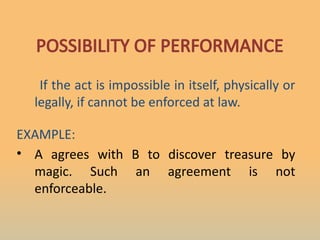
POSSIBILITY OF PERFORMANCE
Ifthe act is impossible in itself, physically or
legally, if cannot be enforced at law.
EXAMPLE:
• A agrees with B to discover treasure by
magic. Such an agreement is not
enforceable.
TYPES OF CONTRACTS
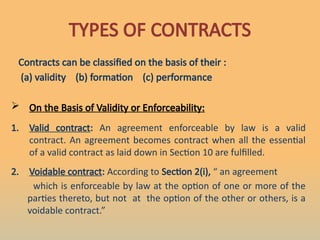
Contractscan be classified on the basis of their :
(a) validity (b) formation (c) performance
On the Basis of Validity or Enforceability:
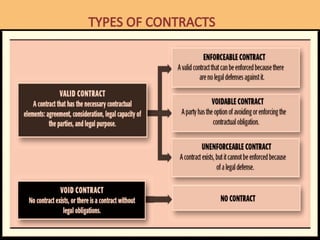
1. Valid contract: An agreement enforceable by law is a valid
contract. An agreement becomes contract when all the essential
of a valid contract as laid down in Section 10 are fulfilled.
2. Voidable contract: According to Section 2(i), “ an agreement
which is enforceable by law at the option of one or more of the
parties thereto, but not at the option of the other or others, is a
voidable contract.”
20.
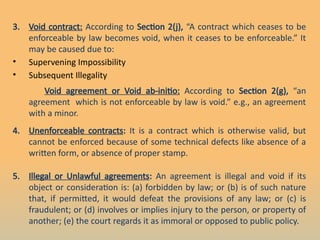
3. Void contract:According to Section 2(j), “A contract which ceases to be
enforceable by law becomes void, when it ceases to be enforceable.” It
may be caused due to:
• Supervening Impossibility
• Subsequent Illegality
Void agreement or Void ab-initio: According to Section 2(g), “an
agreement which is not enforceable by law is void.” e.g., an agreement
with a minor.
4. Unenforceable contracts: It is a contract which is otherwise valid, but
cannot be enforced because of some technical defects like absence of a
written form, or absence of proper stamp.
5. Illegal or Unlawful agreements: An agreement is illegal and void if its
object or consideration is: (a) forbidden by law; or (b) is of such nature
that, if permitted, it would defeat the provisions of any law; or (c) is
fraudulent; or (d) involves or implies injury to the person, or property of
another; (e) the court regards it as immoral or opposed to public policy.
21.
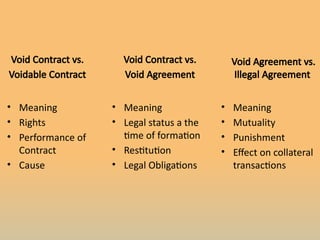
Void Contract vs.
VoidableContract
• Meaning
• Rights
• Performance of
Contract
• Cause
Void Agreement vs.
Illegal Agreement
• Meaning
• Mutuality
• Punishment
• Effect on collateral
transactions
• Meaning
• Legal status a the
time of formation
• Restitution
• Legal Obligations
Void Contract vs.
Void Agreement
22.
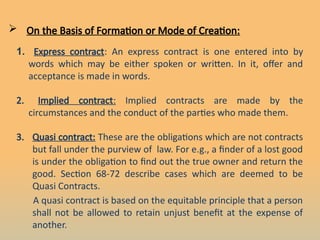
On theBasis of Formation or Mode of Creation:
1. Express contract: An express contract is one entered into by
words which may be either spoken or written. In it, offer and
acceptance is made in words.
2. Implied contract: Implied contracts are made by the
circumstances and the conduct of the parties who made them.
3. Quasi contract: These are the obligations which are not contracts
but fall under the purview of law. For e.g., a finder of a lost good
is under the obligation to find out the true owner and return the
good. Section 68-72 describe cases which are deemed to be
Quasi Contracts.
A quasi contract is based on the equitable principle that a person
shall not be allowed to retain unjust benefit at the expense of
another.
23.
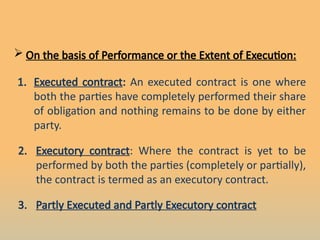
On thebasis of Performance or the Extent of Execution:
1. Executed contract: An executed contract is one where
both the parties have completely performed their share
of obligation and nothing remains to be done by either
party.
2. Executory contract: Where the contract is yet to be
performed by both the parties (completely or partially),
the contract is termed as an executory contract.
3. Partly Executed and Partly Executory contract
24.
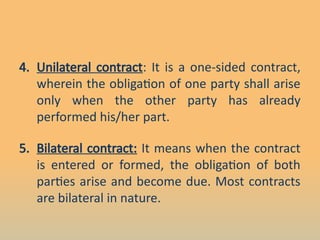
4. Unilateral contract:It is a one-sided contract,
wherein the obligation of one party shall arise
only when the other party has already
performed his/her part.
5. Bilateral contract: It means when the contract
is entered or formed, the obligation of both
parties arise and become due. Most contracts
are bilateral in nature.


![• Came into force on 1st
September, 1872.
• Applies to whole of India except for the state of
Jammu & Kashmir [by virtue of Jammu & Kashmir
Reorganization Act, 2019 (w.e.f. 31st
October, 2019)].
• Lays down laws relating to contracts, determines the
legal circumstances in which agreement shall be
legally binding on a person, and provides for the
remedies available in case of breach.
INDIAN CONTRACT ACT, 1872](https://image.slidesharecdn.com/1indiancontractact-250410150226-7eb9dc81/85/1_Indian_Contract_Act-ppt-about-indian-contract-act-2-320.jpg)