Contested Modelling
                          Dr Mike Yearworth1, Dr Sarah Cornell2

      [1] Reader  in Engineering Systems, Faculty of Engineering
                                         University of Bristol, UK
[2] Coordinator – Planetary Boundaries Collaboratory, Stockholm

                Resilience Centre, Stockholm University, Sweden

                                                   17th July 2012
!   Starting points

•  Over-mathematisation of models and reliance on
   simulation has led to a loss of narrative and
   representations  essentially black-box approaches
•  Ownership and control of models is in conflict with
   processes that might make them debatable with
   publics
•  Need for specialised techniques also limits debate to
   between experts and narrow falsifiability as a
   validation technique
•  Focus on nomothetic approaches – universal models
                                      17th July 2012     2
!   Method

•  Can we get better at sustainability interventions
   given our starting point in expert modelling?
   •  RQ: Do we (the authors) understand the relationship
      between expert modelling and its publics?
   •  SRQ: Do we understand each other?
   •  Data sources – project experience (Sympact,
      HalSTAR, CONVERGE, IHOPE)
   •  Theoretical lens – ontology, praxis and reflexivity


                                        17th July 2012      3
!   Ontologies
•  Geels§ identifies seven ontologies in analysing
   social-technical transitions towards sustainability
      •  Rational choice, evolutionary theory, structuralism,
         functionalism, interpretivism, conflict and power
         structure, relationism
•  cf Burrel & Morgan (Sociological Paradigms and
    Organisational Analysis: Elements of the Sociology of
    Corporate Life)
•  Questions: Is there an underpinning project
   ontology? Is there diversity? Made explicit?
§Geels,F. W. (2010) Ontologies, socio-technical transitions (to sustainability), and the multi-level
perspective. Research Policy, 39(4), pp. 495-510.


                                                                          17th July 2012               4
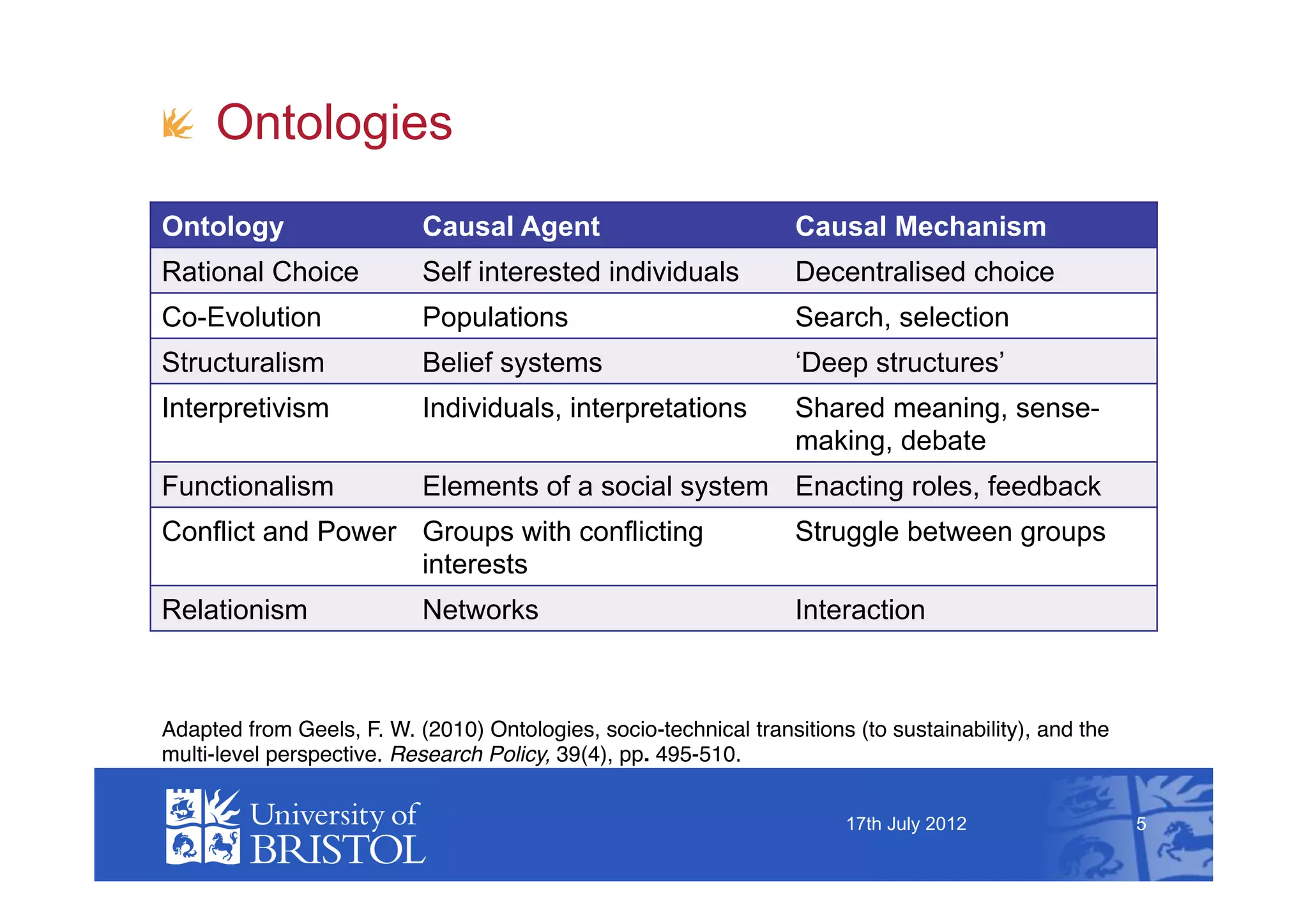
!   Ontologies
Ontology                   Causal Agent                            Causal Mechanism
Rational Choice            Self interested individuals             Decentralised choice
Co-Evolution               Populations                             Search, selection
Structuralism              Belief systems                          ‘Deep structures’
Interpretivism             Individuals, interpretations            Shared meaning, sense-
                                                                   making, debate
Functionalism              Elements of a social system Enacting roles, feedback
Conflict and Power Groups with conflicting                         Struggle between groups
                   interests
Relationism                Networks                                Interaction


Adapted from Geels, F. W. (2010) Ontologies, socio-technical transitions (to sustainability), and the
multi-level perspective. Research Policy, 39(4), pp. 495-510.


                                                                        17th July 2012                  5
!   Praxis & Purpose of Modelling

•  Way in which theoretical knowledge of the expert
   modeller(s) is enacted through intervention
•  Modelling purpose is bound to the question of
   enactment of intervention
•  Questions: Is there a stated purpose to
   modelling? Best mode of expressing the
   models? Prediction (action outside scope) or
   guide to action? If action, then is action research
   explicit?


                                     17th July 2012   6
!   Reflexivity

•  Translating ideas of reflexivity into context of
   environmental governance
•  Sensitivity to inputs from diverse perspectives
•  Recognising alternative ways of seeing issues of
   concerns
•  Questions: How does modelling support
   reflexivity? Support stakeholder engagement?
   Longer term engagement?


                                   17th July 2012   7
!   Projects

•  Sympact
     •  Generate predictions/scenarios around GHG emissions in
        the digital media industry to inform strategy. LCA and SD
        models.
     •  Functionalism
     •  Future intent to support wider engagement
•  HalSTAR
     •  Grounded, holistic approach to assessing sustainability
        options of civil engineering projects
     •  Functionalism, initially, moving towards interpretivism
     •  Latter leads to better reflection on original modelling task


                                                 17th July 2012        8
!   Projects

•  CONVERGE
     •  Global sustainability, conceptualising equity within the Earth’s
        natural biophysical limits
     •  Functionalism and structuralism with some interpretivist, conflict/
        power structures
     •  Models intended to guide action, explicit action research
     •  Long term relationships with communities. And not…
•  IHOPE
     •  Linking social and environmental sciences to understand
        human-environment interactions over multiple timescales
     •  Functionalism, but some debate
     •  Recognises need to link to wide social and environmental
        sciences communities to improve current Earth systems models

                                                   17th July 2012         9
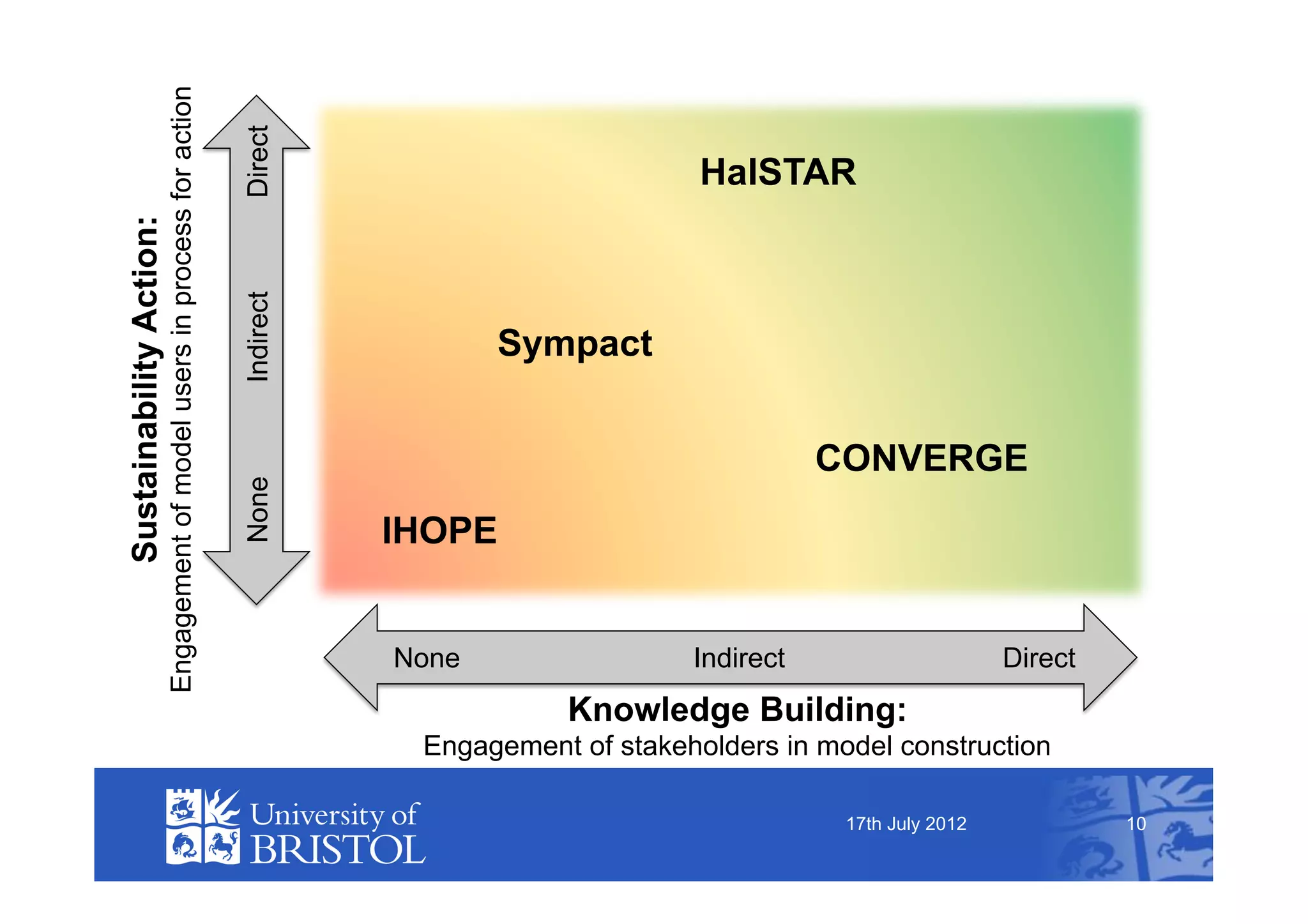
Engagement of model users in process for action

                                                                           Direct
                                                                                                            HalSTAR
Sustainability Action:


                                                                           Indirect


                                                                                             Sympact


                                                                                                                      CONVERGE
                                                                           None


                                                                                      IHOPE


                                                                                      None                 Indirect                     Direct
                                                                                                  Knowledge Building:
                                                                                       Engagement of stakeholders in model construction

                                                                                                                       17th July 2012            10
!   Validation – after Barlas§
•  White box vs. black box modelling
    •  black box  quality of the predictions: do they match observational
       data? [data-driven, correlational , possible abductive fallacies]
    •  white box  structure of the model: does the model explain how
       observed behaviour is obtained? [theory-like, causal descriptive ]

•  How do we validate explanations (structural validity)
   i.e. get right behaviour for the right reason ?
    •  Functionalist worldview  objective representation of real world
        model is either correct or incorrect. Possibly true of other
       ontologies
    •  Praxis view  one possible representation  continuum of
       usefulness
 §Barlas,
        Y. (1996) Formal aspects of model validity and validation in system dynamics. !
 System Dynamics Review, 12(3), pp. 183-210.

                                                              17th July 2012              11
!   Towards wider stakeholder engagement?

  this is not about open data, or open access to
 publications (both are necessary but not
 sufficient), and not really open source either…
•  Possible approaches
  •  Argumentation (Toulmin, De Liddo, 2010)
  •  Participatory Action Learning (Perkons and Brown,
     2010)
  •  Issue Based Information Systems (IBIS) (Buckingham
     Shum, 2006, Conklin, 2003)
  •  Social Learning (Senge, 2005)

                                      17th July 2012   12
!   Discussion Points
•  If ultimately praxis is about behaviour change then what is
   more important: accuracy or method of coupling with change
   processes?
•  Difficult for non-scientific public to make distinctions between
   ignorance, uncertainty and contingent findings expressed as
   testable hypotheses
•  Predominately functionalist worldview of expert modellers is
   mismatched to intervention generally – who has the view of
   the “real” world?
•  Ironically, in the area of sustainability this disconnect is
   ultimately untenable (obviously?)
•  Paradoxically, over-attention to being scientific closes
   avenues for scientifically informed but systemic solutions

                                             17th July 2012     13
Questions?


           mike.yearworth@bristol.ac.uk
sarah.cornell@stockholmresilience.su.se


                          17th July 2012   14

Contested Modelling

  • 1.
    Contested Modelling Dr Mike Yearworth1, Dr Sarah Cornell2 [1] Reader in Engineering Systems, Faculty of Engineering University of Bristol, UK [2] Coordinator – Planetary Boundaries Collaboratory, Stockholm Resilience Centre, Stockholm University, Sweden 17th July 2012
  • 2.
    !   Startingpoints •  Over-mathematisation of models and reliance on simulation has led to a loss of narrative and representations  essentially black-box approaches •  Ownership and control of models is in conflict with processes that might make them debatable with publics •  Need for specialised techniques also limits debate to between experts and narrow falsifiability as a validation technique •  Focus on nomothetic approaches – universal models 17th July 2012 2
  • 3.
    !   Method • Can we get better at sustainability interventions given our starting point in expert modelling? •  RQ: Do we (the authors) understand the relationship between expert modelling and its publics? •  SRQ: Do we understand each other? •  Data sources – project experience (Sympact, HalSTAR, CONVERGE, IHOPE) •  Theoretical lens – ontology, praxis and reflexivity 17th July 2012 3
  • 4.
    !   Ontologies • Geels§ identifies seven ontologies in analysing social-technical transitions towards sustainability •  Rational choice, evolutionary theory, structuralism, functionalism, interpretivism, conflict and power structure, relationism •  cf Burrel & Morgan (Sociological Paradigms and Organisational Analysis: Elements of the Sociology of Corporate Life) •  Questions: Is there an underpinning project ontology? Is there diversity? Made explicit? §Geels,F. W. (2010) Ontologies, socio-technical transitions (to sustainability), and the multi-level perspective. Research Policy, 39(4), pp. 495-510. 17th July 2012 4
  • 5.
    !   Ontologies Ontology Causal Agent Causal Mechanism Rational Choice Self interested individuals Decentralised choice Co-Evolution Populations Search, selection Structuralism Belief systems ‘Deep structures’ Interpretivism Individuals, interpretations Shared meaning, sense- making, debate Functionalism Elements of a social system Enacting roles, feedback Conflict and Power Groups with conflicting Struggle between groups interests Relationism Networks Interaction Adapted from Geels, F. W. (2010) Ontologies, socio-technical transitions (to sustainability), and the multi-level perspective. Research Policy, 39(4), pp. 495-510. 17th July 2012 5
  • 6.
    !   Praxis& Purpose of Modelling •  Way in which theoretical knowledge of the expert modeller(s) is enacted through intervention •  Modelling purpose is bound to the question of enactment of intervention •  Questions: Is there a stated purpose to modelling? Best mode of expressing the models? Prediction (action outside scope) or guide to action? If action, then is action research explicit? 17th July 2012 6
  • 7.
    !   Reflexivity • Translating ideas of reflexivity into context of environmental governance •  Sensitivity to inputs from diverse perspectives •  Recognising alternative ways of seeing issues of concerns •  Questions: How does modelling support reflexivity? Support stakeholder engagement? Longer term engagement? 17th July 2012 7
  • 8.
    !   Projects • Sympact •  Generate predictions/scenarios around GHG emissions in the digital media industry to inform strategy. LCA and SD models. •  Functionalism •  Future intent to support wider engagement •  HalSTAR •  Grounded, holistic approach to assessing sustainability options of civil engineering projects •  Functionalism, initially, moving towards interpretivism •  Latter leads to better reflection on original modelling task 17th July 2012 8
  • 9.
    !   Projects • CONVERGE •  Global sustainability, conceptualising equity within the Earth’s natural biophysical limits •  Functionalism and structuralism with some interpretivist, conflict/ power structures •  Models intended to guide action, explicit action research •  Long term relationships with communities. And not… •  IHOPE •  Linking social and environmental sciences to understand human-environment interactions over multiple timescales •  Functionalism, but some debate •  Recognises need to link to wide social and environmental sciences communities to improve current Earth systems models 17th July 2012 9
  • 10.
    Engagement of modelusers in process for action Direct HalSTAR Sustainability Action: Indirect Sympact CONVERGE None IHOPE None Indirect Direct Knowledge Building: Engagement of stakeholders in model construction 17th July 2012 10
  • 11.
    !   Validation– after Barlas§ •  White box vs. black box modelling •  black box  quality of the predictions: do they match observational data? [data-driven, correlational , possible abductive fallacies] •  white box  structure of the model: does the model explain how observed behaviour is obtained? [theory-like, causal descriptive ] •  How do we validate explanations (structural validity) i.e. get right behaviour for the right reason ? •  Functionalist worldview  objective representation of real world  model is either correct or incorrect. Possibly true of other ontologies •  Praxis view  one possible representation  continuum of usefulness §Barlas, Y. (1996) Formal aspects of model validity and validation in system dynamics. ! System Dynamics Review, 12(3), pp. 183-210. 17th July 2012 11
  • 12.
    !   Towardswider stakeholder engagement?   this is not about open data, or open access to publications (both are necessary but not sufficient), and not really open source either… •  Possible approaches •  Argumentation (Toulmin, De Liddo, 2010) •  Participatory Action Learning (Perkons and Brown, 2010) •  Issue Based Information Systems (IBIS) (Buckingham Shum, 2006, Conklin, 2003) •  Social Learning (Senge, 2005) 17th July 2012 12
  • 13.
    !   DiscussionPoints •  If ultimately praxis is about behaviour change then what is more important: accuracy or method of coupling with change processes? •  Difficult for non-scientific public to make distinctions between ignorance, uncertainty and contingent findings expressed as testable hypotheses •  Predominately functionalist worldview of expert modellers is mismatched to intervention generally – who has the view of the “real” world? •  Ironically, in the area of sustainability this disconnect is ultimately untenable (obviously?) •  Paradoxically, over-attention to being scientific closes avenues for scientifically informed but systemic solutions 17th July 2012 13
  • 14.
    Questions? mike.yearworth@bristol.ac.uk sarah.cornell@stockholmresilience.su.se 17th July 2012 14