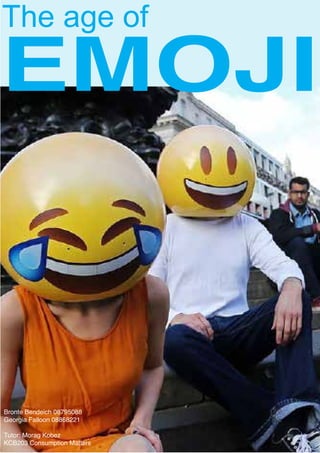
EMOJI
The age of
Bronte Bendeich 08795088
Georgia Falloon 08868221
Tutor: Morag Kobez
KCB203 Consumption Matters
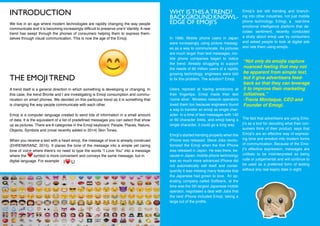
INTRODUCTION
We live in an age where modern technologies are rapidly changing the way people
communicate and it is becoming increasingly difficult to preserve one’s’ identity. A new
trend has swept through the phones of consumers helping them to express them-
selves through visual communication. This is now the age of the Emoji.
W http://geek.scot/wp-content/uploads/2015/06/emoji.pngWWW
THE EMOJI TREND
A trend itself is a general direction in which something is developing or changing. In
this case, the trend Bronte and I are investigating is Emoji consumption and commu-
nication on smart phones. We decided on this particular trend as it is something that
is changing the way people communicate with each other.
Emoji is a computer language created to send lots of information in a small amount
of data. It is the equivalent of a list of predefined messages you can select that show
up as pictures. There are 6 categories in the Emoji keyboard; People, Places, Nature,
Objects, Symbols and (most recently added in 2014) Skin Tones.
When you receive a text with a heart emoji, the message of love is already construed
(EHRENKRANZ, 2015). It places the tone of the message into a simple yet caring
tone of voice where there’s no need to type the words “I Love You” into a message
where the symbol is more convenient and conveys the same message, but in
digital language. For example:
WHY IS THIS A TREND?
BACKGROUNDKNOWL-
EDGE OF EMOJI’S
In 1999, Mobile phone users in Japan
were increasingly using picture messag-
es as a way to communicate. As pictures
are much larger than text messages, mo-
bile phone companies began to notice
the trend. Already struggling to support
the needs of 80 million users of a rapidly
growing technology, engineers were told
to fix this problem. The solution? Emoji.
Users rejoiced at having emoticons at
their fingertips. Emoji made their text
‘come alive’. Wireless network operators
loved them too because engineers found
a way to transfer an emoji as single char-
acter. In a time of text messages with 140
or 60 character limits, and emoji being a
single character, it could go a long way.
Emoji’s started trending properly when the
iPhone was released. Steve Jobs revolu-
tionized the Emoji when the first iPhone
was released in Japan. He was there, be-
cause in Japan, mobile phone technology
was so much more advanced iPhone did
not automatically sell itself and conse-
quently it was missing many features that
the Japanese had grown to love. An op-
erating company called Softbank, at the
time was the 5th largest Japanese mobile
operator, negotiated a deal with Jobs that
the next iPhone included Emoji, taking a
large cut of the profits.
Emoji’s are still trending and branch-
ing into other industries, not just mobile
phone technology. Emogi, a real-time
emotional intelligence platform that de-
codes sentiment, recently conducted
a study about emoji use by consumers
and asked people to look at digital ads
and rate them using emojis.
The fact that advertisers are using Emo-
ji’s as a tool for decoding what their con-
sumers think of their product, says that
Emoji’s are an effective way of express-
ing tone and emotion into modern forms
of communication. Because of the Emo-
ji’s effective expression, messages are
unlikely to be misinterpreted as being
rude or judgemental and will continue to
be used as a preferred form of texting
without any real expiry date in sight.
“Not only do emojis capture
nuanced feeling that may not
be apparent from simple text,
but it give advertisers feed-
back so that they can leverage
it to improve their marketing
initiatives.”
-Travis Montaque, CEO and
Founder of Emogi.
FINDINGS
As the evolution of modern society and the over-
whelming force of new technologies in our lives,
consumers are becoming regulated by the need
to consume the same products. Emoji’s allow
consumers to buy into the products, but to keep
their individualism and social identity. In order to
have a deeper understanding of consumer us-
age of Emoji’s, primary research was conducted.
By interviewing male and females aged 17-30
who consider themselves high Emoji’s consum-
ers.
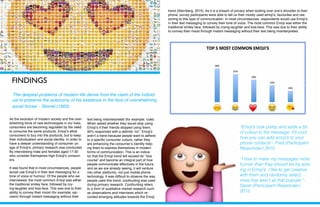
It was found that in most circumstances, people
would use Emoji’s in their text messaging for a
tone of voice or humour. Of the people who we
interviewed, the most common Emoji was either
the traditional smiley face, followed by cry-
ing-laughter and kiss-face. This was due to their
ability to convey their mood (for example; sar-
casm) through instant messaging without their
‘The deepest problems of modern life derive from the claim of the individ-
ual to preserve the autonomy of his existence in the face of overwhelming
social forces’ - Simnel (1903)
text being misinterpreted (for example; rude).
When asked whether they would stop using
Emoji’s if their friends stopped using them,
90% responded with a definite “no”. Emoji’s
aren’t a trend because people want to adhere
to a specific consumer culture, rather they
are enhancing the consumer’s identity help-
ing them to express themselves in modern
forms of communication. This is an indica-
tor that the Emoji trend will exceed its’ “due
course” and become an integral part of how
people communicate effectively in the future,
and as we are already seeing, it will venture
into other platforms, not just mobile phone
technology. It was difficult to observe the way
people used this trend, coolhunting was used
during primary research. Coolhunting refers
to a form of qualitative market research such
as observations and interviews which re-
corded emerging attitudes towards the Emoji
trend (Sternberg, 2015). As it is a breach of privacy when looking over one’s shoulder to their
phone, survey participants were able to tell us their mostly used emoji’s, favourites and rea-
soning to this type of communication. In most circumstances, respondents would use Emoji’s
in their text messaging to convey their tone of voice. The most common Emoji was either the
traditional smiley face, followed by crying-laughter and kiss-face. This was due to their ability
to convey their mood through instant messaging without their text being misinterpreted.
“Emoji’s look pretty and adds a bit
of colour to the message. It’s cool
how you can add emoji’s to your
phone contacts”- Fred (Participant
Responder) 2015.
“I love to make my messages more
funnier than they should be by add-
ing in Emoji’s. I like to get creative
with them and randomly select
ones that aren’t all that popular.”-
Sarah (Participant Responder)
2015.
W
“The basic Marxist theory of all com-
modity fetishism is that attributing
influential power to a commercial
product blinds you to the material
economic relations surrounding it” -
Kalb, 2015.
It is creating artificial values for products which
do not reflect labour (Sternberg, 2015). Thus
you easily take for granted, for instance, an
Emoji keyboard is already situated on a stan-
dard smartphone device. It’s valued as a com-
plimentary add-on to the existing smart phone
product, but what consumers don’t realize are
the economic relations included into the orig-
inal purchase price of the device. Emoji’s are
described as emotional coping mechanisms,
however they will eventually nullify by commer-
cializing our feelings, the bottom line being the
instrumentalization and commodification of emo-
tion.When someone purchases a smartphone
they not only get a simple phone, they get add-
ed experience. In this instance, they get the
additional emoji keyboard which allows them to
express emotion to whomever they are texting.
From the evolution of smartphones, people no
longer communicate face-to-face without gen-
uine emotion. Emoji’s have replaced that emo-
tional aspect of conversation. this is an example
of Commodity fetishism.
COMMODITY FETISHISM
CONCLUSION
This is the age of EMOJI. From researching the trend and con-
ducting primary research it was found that Emoji is becoming not
only a trend but part of consumer culture and forming consumer
identities. Emoji’s are re-inventing the way we communicate by
allowing expression and tone into a message. It is becoming an
increasingly imperative part of our social language. Emoji’s are
not only part of a computer language it is now becoming part of
global marketing initiatives in a world where we have many differ-
ent languages and forms of communication. Emoji’s have simpli-
fied the way different cultures interact online.
As the evolution of modern society and the overwhelming force of
new technologies in our lives, consumers are becoming regulated
by the need to consume the same products. Emoji’s allow con-
sumers to buy into the products, but to keep their individualism
and social identity. It can therefore be suggested that Emoji cul-
ture has a definite niche within consumer culture.
REFERENCES
EHRENKRANZ, M (2015). Ideas for Innovation: “Communicating “I Love You” in the
Emoji Era”.
Available at: http://www.psfk.com/2015/07/communication-trends-emoji-era-snap-
chat-swiftkey-giphy.html [Accessed 7 October 2015].
Emojichat 2015. Where Did Emoji Come From?. [ONLINE] Available at: http://www.
iemoji.com/articles/where-did-emoji-come-from. [Accessed 1st October 2015].
Adweek. 2015. Infographic: Emojis Are Becoming a Preferred Communication Tool
Across Demographics Adweek. [ONLINE] Available at: http://www.adweek.com/
news/advertising-branding/infographic-emojis-are-becoming-preferred-communica-
tion-tool-across-demographics-167355. [Accessed 1st October 2015].
Bocock, R, 1993. Consumption Chapter 1: The Emergence of Modern Consumer-
ism. 1st ed. London: Routledge. [Accessed 27th October 2015]
Kalb, J (2015). The Brooklyn Rail: BIG TALK, SMALL TALK- Why people who read
should care about Emoji’s.
http://www.brooklynrail.org/2015/09/art/big-talk-small-talk-why-people-who-read-
should-care-about-emojis [Accessed 27th October 2015]
Sternberg, J (2015). “KCB203 Consumption Matters: Consumer Cultures and Iden-
tity: Week 2 lecture notes”
https://blackboard.qut.edu.au/webapps/blackboard/content/listContent.jsp?course_
id=_119749_1&content_id=_5940841_1 [Accessed 27th October 2015]

CONSUMPTION TREND REPORT

  • 1.
    EMOJI The age of BronteBendeich 08795088 Georgia Falloon 08868221 Tutor: Morag Kobez KCB203 Consumption Matters
  • 2.
    INTRODUCTION We live inan age where modern technologies are rapidly changing the way people communicate and it is becoming increasingly difficult to preserve one’s’ identity. A new trend has swept through the phones of consumers helping them to express them- selves through visual communication. This is now the age of the Emoji. W http://geek.scot/wp-content/uploads/2015/06/emoji.pngWWW THE EMOJI TREND A trend itself is a general direction in which something is developing or changing. In this case, the trend Bronte and I are investigating is Emoji consumption and commu- nication on smart phones. We decided on this particular trend as it is something that is changing the way people communicate with each other. Emoji is a computer language created to send lots of information in a small amount of data. It is the equivalent of a list of predefined messages you can select that show up as pictures. There are 6 categories in the Emoji keyboard; People, Places, Nature, Objects, Symbols and (most recently added in 2014) Skin Tones. When you receive a text with a heart emoji, the message of love is already construed (EHRENKRANZ, 2015). It places the tone of the message into a simple yet caring tone of voice where there’s no need to type the words “I Love You” into a message where the symbol is more convenient and conveys the same message, but in digital language. For example: WHY IS THIS A TREND? BACKGROUNDKNOWL- EDGE OF EMOJI’S In 1999, Mobile phone users in Japan were increasingly using picture messag- es as a way to communicate. As pictures are much larger than text messages, mo- bile phone companies began to notice the trend. Already struggling to support the needs of 80 million users of a rapidly growing technology, engineers were told to fix this problem. The solution? Emoji. Users rejoiced at having emoticons at their fingertips. Emoji made their text ‘come alive’. Wireless network operators loved them too because engineers found a way to transfer an emoji as single char- acter. In a time of text messages with 140 or 60 character limits, and emoji being a single character, it could go a long way. Emoji’s started trending properly when the iPhone was released. Steve Jobs revolu- tionized the Emoji when the first iPhone was released in Japan. He was there, be- cause in Japan, mobile phone technology was so much more advanced iPhone did not automatically sell itself and conse- quently it was missing many features that the Japanese had grown to love. An op- erating company called Softbank, at the time was the 5th largest Japanese mobile operator, negotiated a deal with Jobs that the next iPhone included Emoji, taking a large cut of the profits. Emoji’s are still trending and branch- ing into other industries, not just mobile phone technology. Emogi, a real-time emotional intelligence platform that de- codes sentiment, recently conducted a study about emoji use by consumers and asked people to look at digital ads and rate them using emojis. The fact that advertisers are using Emo- ji’s as a tool for decoding what their con- sumers think of their product, says that Emoji’s are an effective way of express- ing tone and emotion into modern forms of communication. Because of the Emo- ji’s effective expression, messages are unlikely to be misinterpreted as being rude or judgemental and will continue to be used as a preferred form of texting without any real expiry date in sight. “Not only do emojis capture nuanced feeling that may not be apparent from simple text, but it give advertisers feed- back so that they can leverage it to improve their marketing initiatives.” -Travis Montaque, CEO and Founder of Emogi.
  • 3.
    FINDINGS As the evolutionof modern society and the over- whelming force of new technologies in our lives, consumers are becoming regulated by the need to consume the same products. Emoji’s allow consumers to buy into the products, but to keep their individualism and social identity. In order to have a deeper understanding of consumer us- age of Emoji’s, primary research was conducted. By interviewing male and females aged 17-30 who consider themselves high Emoji’s consum- ers. It was found that in most circumstances, people would use Emoji’s in their text messaging for a tone of voice or humour. Of the people who we interviewed, the most common Emoji was either the traditional smiley face, followed by cry- ing-laughter and kiss-face. This was due to their ability to convey their mood (for example; sar- casm) through instant messaging without their ‘The deepest problems of modern life derive from the claim of the individ- ual to preserve the autonomy of his existence in the face of overwhelming social forces’ - Simnel (1903) text being misinterpreted (for example; rude). When asked whether they would stop using Emoji’s if their friends stopped using them, 90% responded with a definite “no”. Emoji’s aren’t a trend because people want to adhere to a specific consumer culture, rather they are enhancing the consumer’s identity help- ing them to express themselves in modern forms of communication. This is an indica- tor that the Emoji trend will exceed its’ “due course” and become an integral part of how people communicate effectively in the future, and as we are already seeing, it will venture into other platforms, not just mobile phone technology. It was difficult to observe the way people used this trend, coolhunting was used during primary research. Coolhunting refers to a form of qualitative market research such as observations and interviews which re- corded emerging attitudes towards the Emoji trend (Sternberg, 2015). As it is a breach of privacy when looking over one’s shoulder to their phone, survey participants were able to tell us their mostly used emoji’s, favourites and rea- soning to this type of communication. In most circumstances, respondents would use Emoji’s in their text messaging to convey their tone of voice. The most common Emoji was either the traditional smiley face, followed by crying-laughter and kiss-face. This was due to their ability to convey their mood through instant messaging without their text being misinterpreted. “Emoji’s look pretty and adds a bit of colour to the message. It’s cool how you can add emoji’s to your phone contacts”- Fred (Participant Responder) 2015. “I love to make my messages more funnier than they should be by add- ing in Emoji’s. I like to get creative with them and randomly select ones that aren’t all that popular.”- Sarah (Participant Responder) 2015.
  • 4.
    W “The basic Marxisttheory of all com- modity fetishism is that attributing influential power to a commercial product blinds you to the material economic relations surrounding it” - Kalb, 2015. It is creating artificial values for products which do not reflect labour (Sternberg, 2015). Thus you easily take for granted, for instance, an Emoji keyboard is already situated on a stan- dard smartphone device. It’s valued as a com- plimentary add-on to the existing smart phone product, but what consumers don’t realize are the economic relations included into the orig- inal purchase price of the device. Emoji’s are described as emotional coping mechanisms, however they will eventually nullify by commer- cializing our feelings, the bottom line being the instrumentalization and commodification of emo- tion.When someone purchases a smartphone they not only get a simple phone, they get add- ed experience. In this instance, they get the additional emoji keyboard which allows them to express emotion to whomever they are texting. From the evolution of smartphones, people no longer communicate face-to-face without gen- uine emotion. Emoji’s have replaced that emo- tional aspect of conversation. this is an example of Commodity fetishism. COMMODITY FETISHISM CONCLUSION This is the age of EMOJI. From researching the trend and con- ducting primary research it was found that Emoji is becoming not only a trend but part of consumer culture and forming consumer identities. Emoji’s are re-inventing the way we communicate by allowing expression and tone into a message. It is becoming an increasingly imperative part of our social language. Emoji’s are not only part of a computer language it is now becoming part of global marketing initiatives in a world where we have many differ- ent languages and forms of communication. Emoji’s have simpli- fied the way different cultures interact online. As the evolution of modern society and the overwhelming force of new technologies in our lives, consumers are becoming regulated by the need to consume the same products. Emoji’s allow con- sumers to buy into the products, but to keep their individualism and social identity. It can therefore be suggested that Emoji cul- ture has a definite niche within consumer culture.
  • 5.
    REFERENCES EHRENKRANZ, M (2015).Ideas for Innovation: “Communicating “I Love You” in the Emoji Era”. Available at: http://www.psfk.com/2015/07/communication-trends-emoji-era-snap- chat-swiftkey-giphy.html [Accessed 7 October 2015]. Emojichat 2015. Where Did Emoji Come From?. [ONLINE] Available at: http://www. iemoji.com/articles/where-did-emoji-come-from. [Accessed 1st October 2015]. Adweek. 2015. Infographic: Emojis Are Becoming a Preferred Communication Tool Across Demographics Adweek. [ONLINE] Available at: http://www.adweek.com/ news/advertising-branding/infographic-emojis-are-becoming-preferred-communica- tion-tool-across-demographics-167355. [Accessed 1st October 2015]. Bocock, R, 1993. Consumption Chapter 1: The Emergence of Modern Consumer- ism. 1st ed. London: Routledge. [Accessed 27th October 2015] Kalb, J (2015). The Brooklyn Rail: BIG TALK, SMALL TALK- Why people who read should care about Emoji’s. http://www.brooklynrail.org/2015/09/art/big-talk-small-talk-why-people-who-read- should-care-about-emojis [Accessed 27th October 2015] Sternberg, J (2015). “KCB203 Consumption Matters: Consumer Cultures and Iden- tity: Week 2 lecture notes” https://blackboard.qut.edu.au/webapps/blackboard/content/listContent.jsp?course_ id=_119749_1&content_id=_5940841_1 [Accessed 27th October 2015]