Consumer Behavior
Who buy goods and services
to satisfy wants
Who Is Consumer
To get maximum
satisfaction from spending
his income on various goods
Main Aim
Has Limited Income Over Unlimited
Wants
And Wants Maximum
Satisfaction
Problem Of Consumer
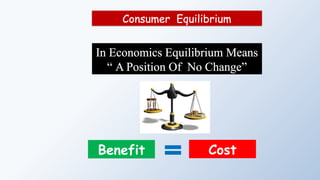
Consumer Equilibrium
In Economics Equilibrium Means
“ A Position Of No Change”
Benefit Cost
What Is Consumer Equilibrium?
Situation under
which he spends his
given income on
purchase of a
commodity in such a
way that gives him
maximum utility and
he feels no wish to
change
his consumption
level Paisa Vasool
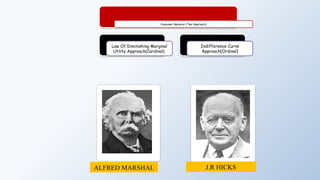
Consumer Behavior (Two Approach)
Law Of Diminishing Marginal
Utility Approach(Cardinal)
Indifference Curve
Approach(Ordinal)
J.R HICKS
ALFRED MARSHAL
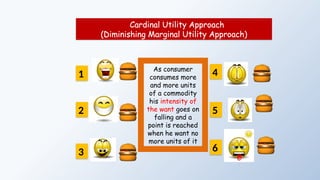
Cardinal Utility Approach
(Diminishing Marginal Utility Approach)
As consumer
consumes more
and more units
of a commodity
his intensity of
the want goes on
falling and a
point is reached
when he want no
more units of it
1
2
3 6
5
4
Law Of Diminishing Marginal Utility
•When a consumer consumes more and more units of commodity
Marginal Utility with each successive units diminishes
•Fundamental psychological law which operates universally
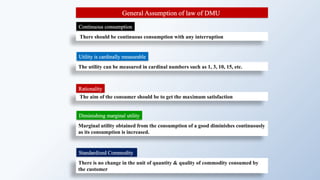
General Assumption of law of DMU
The aim of the consumer should be to get the maximum satisfaction
The utility can be measured in cardinal numbers such as 1, 3, 10, 15, etc.
There is no change in the unit of quantity & quality of commodity consumed by
the customer
Marginal utility obtained from the consumption of a good diminishes continuously
as its consumption is increased.
There should be continuous consumption with any interruption
Rationality
Utility is cardinally measurable
Standardized Commodity
Continuous consumption
Diminishing marginal utility
Consumer Consume The
Commodity Because It Give
Them Happiness Or
Satisfaction
Why Consumer Consume Commodity.?
Utility refers to the want satisfying power of a
commodity.
Utility Concept
An imaginary unit used to measure utility.
Utils
Cloth has a utility for us
because we can wear it.
Pen has a utility who can
write with it.
It changes from time to time person to person and place to place
Characteristics Of Utility
. It cannot be measure but for the sake of the convenience we assume it can
be measures in terms of utils.
Utility Is Relative Term
Utility Is Subjective Term
. Higher utility does not means greater usefulness. Cigarettes may give
utility to a smoker but are not useful otherwise
Utility is not essentially useful
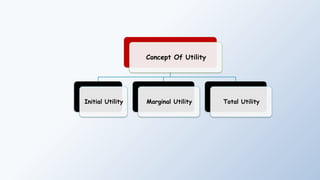
Concept Of Utility
Initial Utility Marginal Utility Total Utility
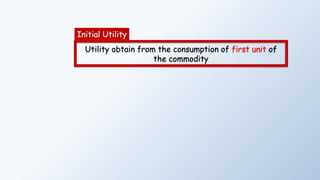
Initial Utility
Utility obtain from the consumption of first unit of
the commodity
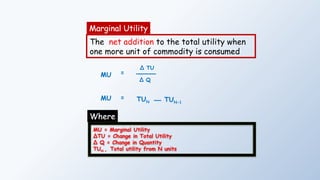
Marginal Utility
The net addition to the total utility when
one more unit of commodity is consumed
MU
∆ TU
∆ Q
MU = Marginal Utility
∆TU = Change in Total Utility
∆ Q = Change in Quantity
TUN = Total utility from N units
=
Where
MU = TUN TUN-1
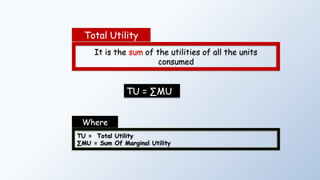
Total Utility
It is the sum of the utilities of all the units
consumed
TU = ∑MU
TU = Total Utility
∑MU = Sum Of Marginal Utility
Where
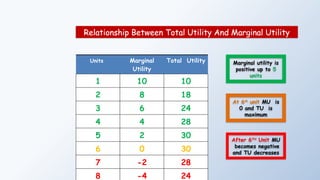
Units Marginal
Utility
Total Utility
1 10 10
2 8 18
3 6 24
4 4 28
5 2 30
6 0 30
7 -2 28
8 -4 24
Marginal utility is
positive up to 5
units
At 6th
unit MU is
0 and TU is
maximum
After 6TH
Unit MU
becomes negative
and TU decreases
Relationship Between Total Utility And Marginal Utility
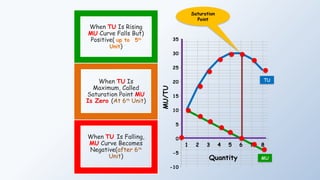
1 2 3 4 5 6 7 8
-10
-5
0
5
10
15
20
25
30
35
When TU Is Falling,
MU Curve Becomes
Negative(after 6th
Unit)
When TU Is
Maximum, Called
Saturation Point MU
Is Zero (At 6th
Unit)
When TU Is Rising
MU Curve Falls But)
Positive( up to 5th
Unit)
Saturation
Point
TU
MU
MU/TU
Quantity
What happens to marginal utility when total utility is maximum.?
What happens to total utility when marginal utility is positive.?
What happens to total utility when marginal utility is negative.?
Marginal utility is zero
Solution
Problem
Total utility start falling
Solution
Problem
Total utility is rising
Solution
Problem
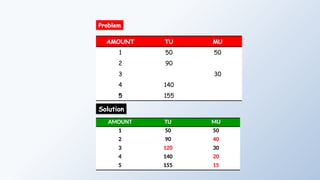
AMOUNT TU MU
1 50 50
2 90
3 30
4 140
5 155
AMOUNT TU MU
1 50 50
2 90 40
3 120 30
4 140 20
5 155 15
Solution
Problem
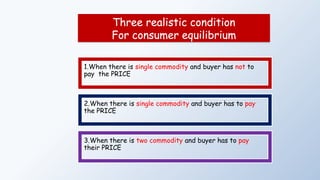
Three realistic condition
For consumer equilibrium
1.When there is single commodity and buyer has not to
pay the PRICE
2.When there is single commodity and buyer has to pay
the PRICE
3.When there is two commodity and buyer has to pay
their PRICE
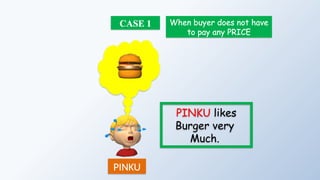
PINKU
PINKU likes
Burger very
Much.
CASE 1 When buyer does not have
to pay any PRICE
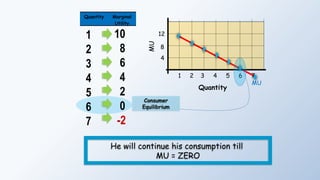
Now how Much burger
PINKU should Eat so
that
He can get maximum
Satisfaction
Assume
Burger Is Free
Of Cost
1 2 3 4 5 6 7
4
8
12
MU
MU
Quantity
Consumer
Equilibrium
1
2
3
4
5
6
7
10
8
6
4
2
0
-2
He will continue his consumption till
MU = ZERO
Quantity Marginal
Utility
Now lets us see
What will happen if PINKU
has to pay some price
Consumer Equilibrium (One Commodity Case)
CASE 2
Naturally PINKU will
Buy the good only
If the benefit in the form
Of utility is equal to the
price
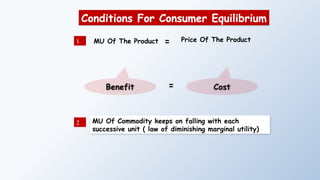
Conditions For Consumer Equilibrium
MU Of The Product =
1
2 MU Of Commodity keeps on falling with each
successive unit ( law of diminishing marginal utility)
Price Of The Product
Benefit Cost
=
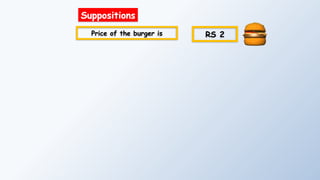
Suppositions
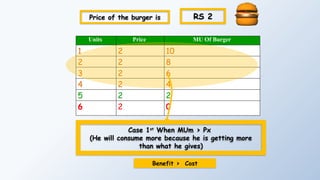
Price of the burger is RS 2
Units Price MU Of Burger
1 2 10
2 2 8
3 2 6
4 2 4
5 2 2
6 2 0
Case 1st
When MUm > Px
(He will consume more because he is getting more
than what he gives)
Benefit > Cost
Price of the burger is RS 2
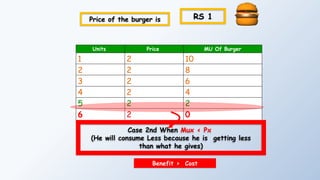
Units Price MU Of Burger
1 2 10
2 2 8
3 2 6
4 2 4
5 2 2
6 2 0
Case 2nd When Mux < Px
(He will consume Less because he is getting less
than what he gives)
Benefit > Cost
Price of the burger is RS 1
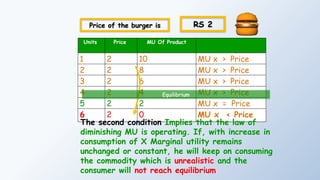
Units Price MU Of Product
1 2 10 MU x > Price
2 2 8 MU x > Price
3 2 6 MU x > Price
4 2 4 MU x > Price
5 2 2 MU x = Price
6 2 0 MU x < Price
Price of the burger is RS 2
Equilibrium
The second condition Implies that the law of
diminishing MU is operating. If, with increase in
consumption of X Marginal utility remains
unchanged or constant, he will keep on consuming
the commodity which is unrealistic and the
consumer will not reach equilibrium
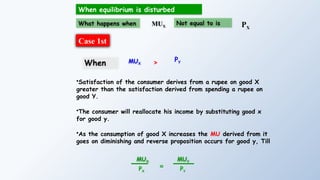
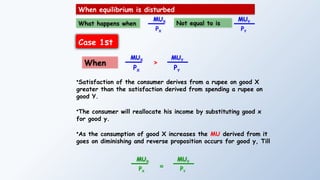
What happens when MUX PX
When equilibrium is disturbed
Not equal to is
Case 1st
MUX
PY
>
When
•Satisfaction of the consumer derives from a rupee on good X
greater than the satisfaction derived from spending a rupee on
good Y.
•The consumer will reallocate his income by substituting good x
for good y.
•As the consumption of good X increases the MU derived from it
goes on diminishing and reverse proposition occurs for good y, Till
MUX
PX
=
MUY
PY
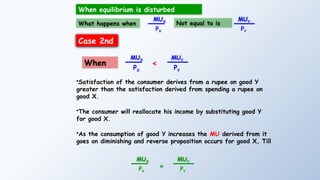
What happens when
MUX
PX
MUY
PY
When equilibrium is disturbed
Not equal to is
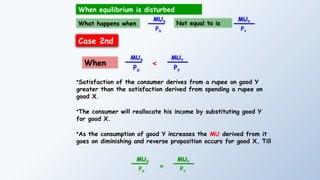
Case 2nd
MUX
PX
MUY
PY
<
When
•Satisfaction of the consumer derives from a rupee on good Y
greater than the satisfaction derived from spending a rupee on
good X.
•The consumer will reallocate his income by substituting good Y
for good X.
•As the consumption of good Y increases the MU derived from it
goes on diminishing and reverse proposition occurs for good X, Till
MUX
PX
=
MUY
PY
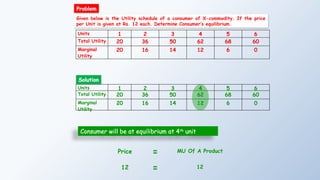
Units 1 2 3 4 5 6
Total Utility 20 36 50 62 68 60
Marginal
Utility
20 16 14 12 6 0
Given below is the Utility schedule of a consumer of X-commodity. If the price
per Unit is given at Rs. 12 each. Determine Consumer’s equilibrium.
Solution
Problem
Units 1 2 3 4 5 6
Total Utility 20 36 50 62 68 60
Marginal
Utility
20 16 14 12 6 0
Consumer will be at equilibrium at 4th
unit
Price MU Of A Product
=
12 12
=
Units of Good 1 2 3 4 5 6
Total Utility 20 36 48 58 66 72
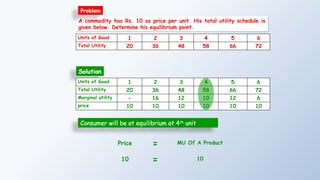
A commodity has Rs. 10 as price per unit. His total utility schedule is
given below. Determine his equilibrium point.
Solution
Problem
Units of Good 1 2 3 4 5 6
Total Utility 20 36 48 58 66 72
Marginal utility - 16 12 10 12 6
price 10 10 10 10 10 10
Consumer will be at equilibrium at 4th
unit
Price MU Of A Product
=
10 10
=
Law Of Equi - Marginal Utility
(Two Commodity Case)
Now lets us see
What will happen if PINKU has to
pay the price and there are two
commodities
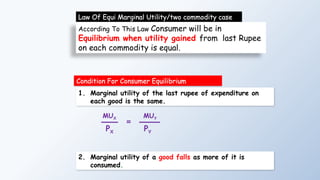
According To This Law Consumer will be in
Equilibrium when utility gained from last Rupee
on each commodity is equal.
Law Of Equi Marginal Utility/two commodity case
Condition For Consumer Equilibrium
MUX
PX
=
MUY
PY
1. Marginal utility of the last rupee of expenditure on
each good is the same.
2. Marginal utility of a good falls as more of it is
consumed.
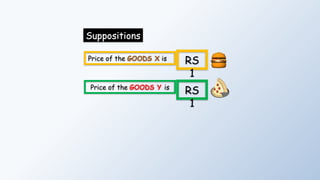
Suppositions
Price of the GOODS X is RS
1
Price of the GOODS Y is
RS
1
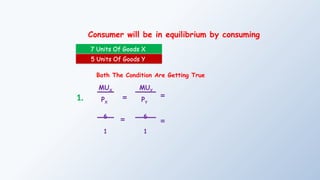
Consumer will be in equilibrium by consuming
7 Units Of Goods X
5 Units Of Goods Y
Both The Condition Are Getting True
MUX
PX
=
MUY
PY
1. =
6
= =
6
1 1
2nd
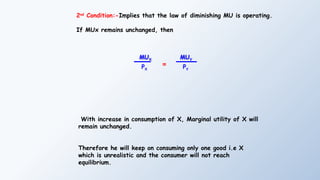
Condition:-Implies that the law of diminishing MU is operating.
If MUx remains unchanged, then
With increase in consumption of X, Marginal utility of X will
remain unchanged.
Therefore he will keep on consuming only one good i.e X
which is unrealistic and the consumer will not reach
equilibrium.
MUX
PX
=
MUY
PY
What happens when
MUX
PX
MUY
PY
When equilibrium is disturbed
Not equal to is
Case 1st
MUX
PX
MUY
PY
>
When
•Satisfaction of the consumer derives from a rupee on good X
greater than the satisfaction derived from spending a rupee on
good Y.
•The consumer will reallocate his income by substituting good x
for good y.
•As the consumption of good X increases the MU derived from it
goes on diminishing and reverse proposition occurs for good y, Till
MUX
PX
=
MUY
PY
What happens when
MUX
PX
MUY
PY
When equilibrium is disturbed
Not equal to is
Case 2nd
MUX
PX
MUY
PY
<
When
•Satisfaction of the consumer derives from a rupee on good Y
greater than the satisfaction derived from spending a rupee on
good X.
•The consumer will reallocate his income by substituting good Y
for good X.
•As the consumption of good Y increases the MU derived from it
goes on diminishing and reverse proposition occurs for good X, Till
MUX
PX
=
MUY
PY
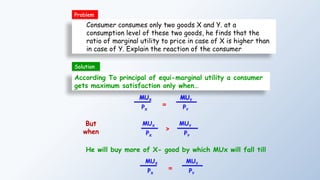
Consumer consumes only two goods X and Y. at a
consumption level of these two goods, he finds that the
ratio of marginal utility to price in case of X is higher than
in case of Y. Explain the reaction of the consumer
According To principal of equi-marginal utility a consumer
gets maximum satisfaction only when…
MUX
PX
=
MUY
PY
MUX
PX
>
MUY
PY
But
when
He will buy more of X- good by which MUx will fall till
Problem
MUX
PX
=
MUY
PY
Solution
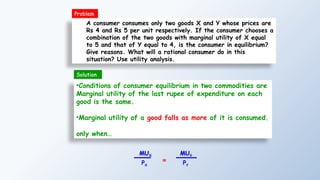
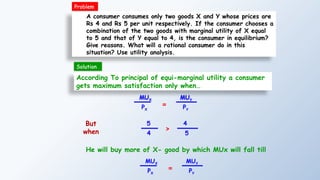
A consumer consumes only two goods X and Y whose prices are
Rs 4 and Rs 5 per unit respectively. If the consumer chooses a
combination of the two goods with marginal utility of X equal
to 5 and that of Y equal to 4, is the consumer in equilibrium?
Give reasons. What will a rational consumer do in this
situation? Use utility analysis.
•Conditions of consumer equilibrium in two commodities are
Marginal utility of the last rupee of expenditure on each
good is the same.
•Marginal utility of a good falls as more of it is consumed.
only when…
MUX
PX
=
MUY
PY
Problem
Solution
A consumer consumes only two goods X and Y whose prices are
Rs 4 and Rs 5 per unit respectively. If the consumer chooses a
combination of the two goods with marginal utility of X equal
to 5 and that of Y equal to 4, is the consumer in equilibrium?
Give reasons. What will a rational consumer do in this
situation? Use utility analysis.
According To principal of equi-marginal utility a consumer
gets maximum satisfaction only when…
MUX
PX
=
MUY
PY
5
4
>
4
5
But
when
He will buy more of X- good by which MUx will fall till
Problem
MUX
PX
=
MUY
PY
Solution
Test your knowledge
1. Who is consumer
2. What is meant by utility, properties of utility, util.
3. Define marginal utility
4. Define total utility
5. What is the relationship between TU and MU explain with diagram
and table.
6. State the law of diminishing marginal utility
7. A consumer consume only one good. Explain equilibrium with the help
of utility approach
8. A consumer consume only two goods. Explain equilibrium with the help
of utility approach
9. Price of the chocolate is Rs 10. Monu who has already eaten 5
chocolate. His marginal utility from eating 5 chocolate is 50.
Suppose marginal utility on one rupee is 5 utils. Should he eat more
or stop. Explain
Indifference Curve Approach
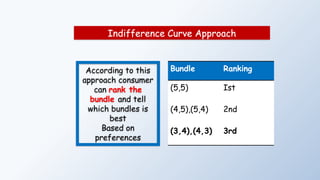
According to this
approach consumer
can rank the
bundle and tell
which bundles is
best
Based on
preferences
Bundle Ranking
(5,5) Ist
(4,5),(5,4) 2nd
(3,4),(4,3) 3rd
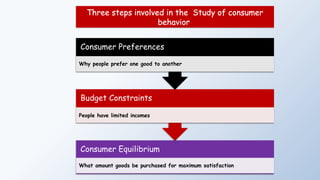
Three steps involved in the Study of consumer
behavior
Consumer Equilibrium
What amount goods be purchased for maximum satisfaction
Budget Constraints
People have limited incomes
Consumer Preferences
Why people prefer one good to another
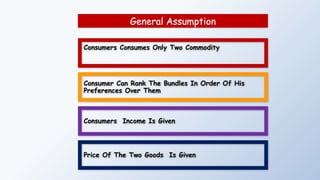
General Assumption
Consumers Consumes Only Two Commodity
Consumer Can Rank The Bundles In Order Of His
Preferences Over Them
Consumers Income Is Given
Price Of The Two Goods Is Given
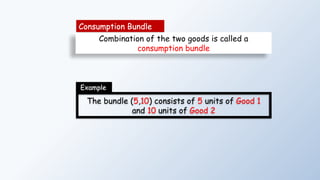
Combination of the two goods is called a
consumption bundle
Example
Consumption Bundle
The bundle (5,10) consists of 5 units of Good 1
and 10 units of Good 2
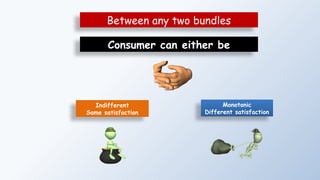
Between any two bundles
Consumer can either be
Indifferent
Same satisfaction
Monotonic
Different satisfaction
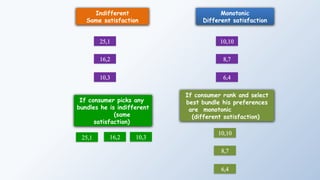
Indifferent
Same satisfaction
Monotonic
Different satisfaction
25,1
16,2
10,3
10,10
8,7
6,4
If consumer picks any
bundles he is indifferent
(same
satisfaction)
If consumer rank and select
best bundle his preferences
are monotonic
(different satisfaction)
10,10
8,7
6,4
25,1 16,2 10,3
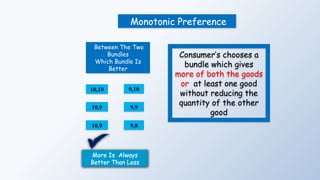
Monotonic Preference
Consumer’s chooses a
bundle which gives
more of both the goods
or at least one good
without reducing the
quantity of the other
good
More Is Always
Better Than Less
Between The Two
Bundles
Which Bundle Is
Better
10,10 9,10
10,9 9,9
10,9 9,8
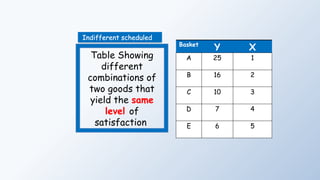
Indifferent scheduled
Table Showing
different
combinations of
two goods that
yield the same
level of
satisfaction
Basket
Y X
A 25 1
B 16 2
C 10 3
D 7 4
E 6 5
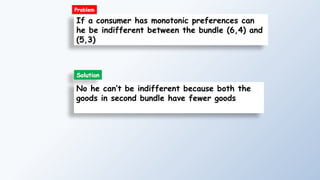
If a consumer has monotonic preferences can
he be indifferent between the bundle (6,4) and
(5,3)
No he can’t be indifferent because both the
goods in second bundle have fewer goods
Solution
Problem
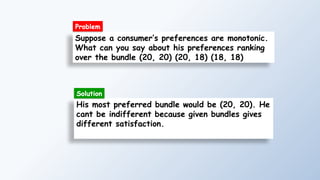
Suppose a consumer’s preferences are monotonic.
What can you say about his preferences ranking
over the bundle (20, 20) (20, 18) (18, 18)
His most preferred bundle would be (20, 20). He
cant be indifferent because given bundles gives
different satisfaction.
Solution
Problem
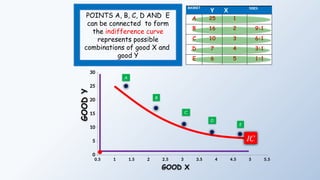
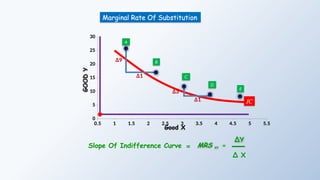
Indifference Curve
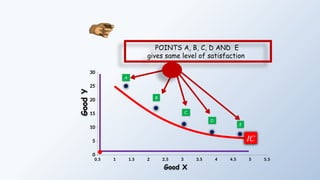
Graphical representation showing different
combinations of two goods that yield the same
level of satisfaction
BASKET
Y X MRS
A 25 1
B 16 2 9:1
C 10 3 6:1
D 7 4 3:1
E 6 5 1:1
0.5 1 1.5 2 2.5 3 3.5 4 4.5 5 5.5
0
5
10
15
20
25
30
A
B
C
D
POINTS A, B, C, D AND E
can be connected to form
the indifference curve
represents possible
combinations of good X and
good Y
GOOD X
E
GOOD
Y
IC
0.5 1 1.5 2 2.5 3 3.5 4 4.5 5 5.5
0
5
10
15
20
25
30
A
B
C
D
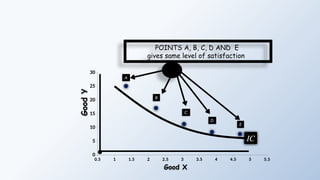
POINTS A, B, C, D AND E
gives same level of satisfaction
Good X
E
Good
Y
IC
GOOD
Y
GOOD X
O
IC1
IC2
IC3
Y
X
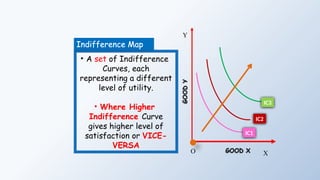
• A set of Indifference
Curves, each
representing a different
level of utility.
• Where Higher
Indifference Curve
gives higher level of
satisfaction or VICE-
VERSA
Indifference Map
GOOD
Y
GOOD X
IC1
Y
E
IC2
IC3
0 X
G
H
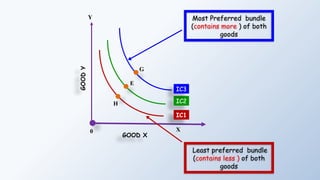
Most Preferred bundle
(contains more ) of both
goods
Least preferred bundle
(contains less ) of both
goods
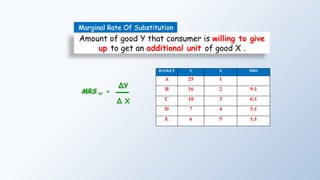
Amount of good Y that consumer is willing to give
up to get an additional unit of good X .
Marginal Rate Of Substitution
∆Y
∆ X
=
MRS XY
BASKET Y X MRS
A 25 1
B 16 2 9:1
C 10 3 6:1
D 7 4 3:1
E 6 5 1:1
0.5 1 1.5 2 2.5 3 3.5 4 4.5 5 5.5
0
5
10
15
20
25
30
A
B
C
D
Good X
E
GOOD
Y
IC
Marginal Rate Of Substitution
∆9
∆1
∆3
∆1
∆Y
∆ X
=
MRS XY
Slope Of Indifference Curve =
0.5 1 1.5 2 2.5 3 3.5 4 4.5 5 5.5
0
5
10
15
20
25
30
A
B
C
D
Good X
E
Good
Y
IC
Diminishing
MRS
MRS = 9
MRS = 3
∆9
∆1
∆3
∆1
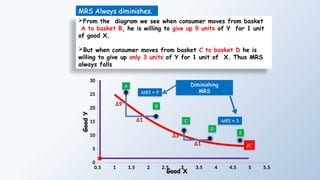
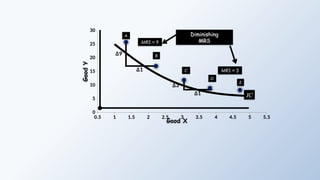
MRS Always diminishes.
From the diagram we see when consumer moves from basket
A to basket B, he is willing to give up 9 units of Y for 1 unit
of good X.
But when consumer moves from basket C to basket D he is
willing to give up only 3 units of Y for 1 unit of X. Thus MRS
always falls
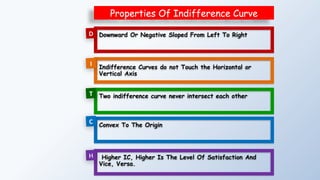
Properties Of Indifference Curve
Downward Or Negative Sloped From Left To Right
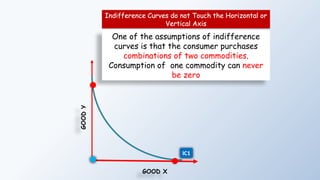
Indifference Curves do not Touch the Horizontal or
Vertical Axis
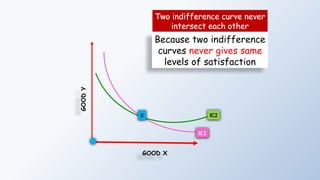
Two indifference curve never intersect each other
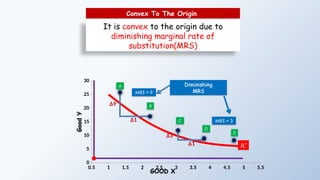
Convex To The Origin
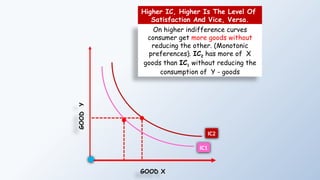
Higher IC, Higher Is The Level Of Satisfaction And
Vice, Versa.
D
I
T
C
H
GOOD
Y
GOOD X
IC1
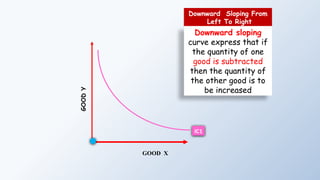
Downward Sloping From
Left To Right
Downward sloping
curve express that if
the quantity of one
good is subtracted
then the quantity of
the other good is to
be increased
GOOD
Y
GOOD X
IC1
Indifference Curves do not Touch the Horizontal or
Vertical Axis
One of the assumptions of indifference
curves is that the consumer purchases
combinations of two commodities.
Consumption of one commodity can never
be zero
GOOD
Y
GOOD X
IC1
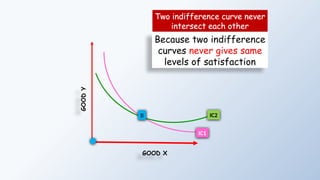
Two indifference curve never
intersect each other
IC2
Because two indifference
curves never gives same
levels of satisfaction
B
Convex To The Origin
It is convex to the origin due to
diminishing marginal rate of
substitution(MRS)
0.5 1 1.5 2 2.5 3 3.5 4 4.5 5 5.5
0
5
10
15
20
25
30
A
B
C
D
GOOD X
E
Good
Y
IC
Diminishing
MRS
MRS = 9
MRS = 3
∆9
∆1
∆3
∆1
GOOD
Y
GOOD X
IC1
IC2
Higher IC, Higher Is The Level Of
Satisfaction And Vice, Versa.
On higher indifference curves
consumer get more goods without
reducing the other. (Monotonic
preferences). IC2 has more of X
goods than IC1 without reducing the
consumption of Y - goods
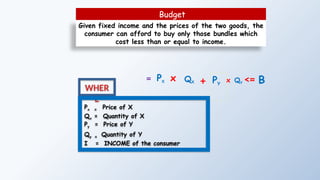
Budget
Given fixed income and the prices of the two goods, the
consumer can afford to buy only those bundles which
cost less than or equal to income.
WHER
E
Px = Price of X
Qx = Quantity of X
Py = Price of Y
Qy = Quantity of Y
I = INCOME of the consumer
PX QX PY
QY <= B
x x
+
=
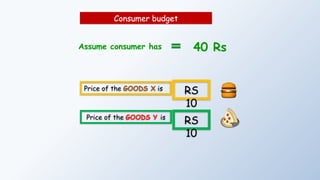
Consumer budget
Assume consumer has 40 Rs
Price of the GOODS X is RS
10
Price of the GOODS Y is
RS
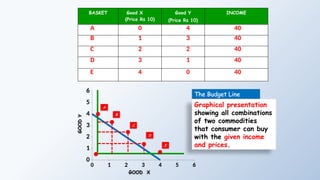
10
0 1 2 3 4 5 6
0
1
2
3
4
5
6
BASKET Good X
(Price Rs 10)
Good Y
(Price Rs 10)
INCOME
GOOD
Y
GOOD X
A
B
D
C
E
A 0 4 40
B 1 3 40
C 2 2 40
D 3 1 40
E 4 0 40
The Budget Line
Graphical presentation
showing all combinations
of two commodities
that consumer can buy
with the given income
and prices.
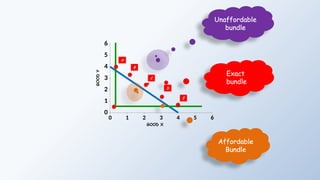
0 1 2 3 4 5 6
0
1
2
3
4
5
6
GOOD
Y
GOOD X
A
B
D
C
E
Affordable
Bundle
Unaffordable
bundle
Exact
bundle
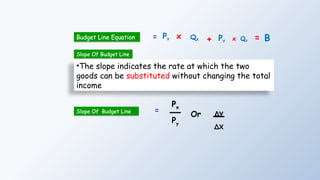
Budget Line Equation
Slope Of Budget Line
•The slope indicates the rate at which the two
goods can be substituted without changing the total
income
Slope Of Budget Line
PX QX PY QY = B
x x
+
=
=
Px
Py
Or ∆Y
∆X
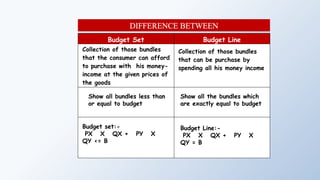
Budget Set Budget Line
DIFFERENCE BETWEEN
Collection of those bundles
that the consumer can afford
to purchase with his money-
income at the given prices of
the goods
Collection of those bundles
that can be purchase by
spending all his money income
Budget set:-
PX X QX + PY X
QY <= B
Show all bundles less than
or equal to budget
Show all the bundles which
are exactly equal to budget
Budget Line:-
PX X QX + PY X
QY = B
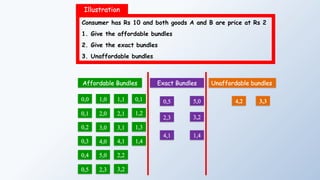
Illustration
Consumer has Rs 10 and both goods A and B are price at Rs 2
1. Give the affordable bundles
2. Give the exact bundles
3. Unaffordable bundles
Affordable Bundles Exact Bundles Unaffordable bundles
0,0 1,0 1,1
0,1 2,0 2,1
0,2 3,0 3,1
0,3 4,0 4,1
0,4 5,0 2,2
0,5
0,1
1,2
1,3
1,4
0,5 5,0
2,3 3,2
2,3 3,2
4,1 1,4
4,2 3,3
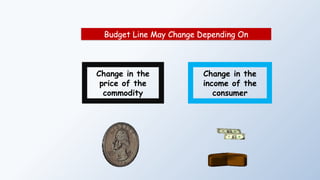
Budget Line May Change Depending On
Change in the
price of the
commodity
Change in the
income of the
consumer
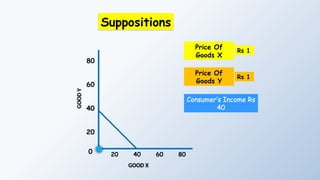
Suppositions
Price Of
Goods X
Rs 1
Price Of
Goods Y
Rs 1
Consumer’s Income Rs
40
40 60 80
20
20
40
60
80
0
GOOD
Y
GOOD X
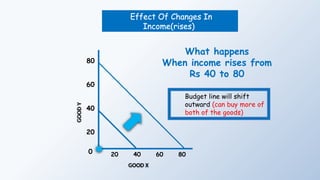
Effect Of Changes In
Income(rises)
What happens
When income rises from
Rs 40 to 80
Budget line will shift
outward (can buy more of
both of the goods)
40 60 80
20
20
40
60
80
0
GOOD
Y
GOOD X
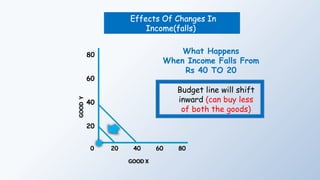
Effects Of Changes In
Income(falls)
What Happens
When Income Falls From
Rs 40 TO 20
Budget line will shift
inward (can buy less
of both the goods)
40 60 80
20
20
40
60
80
0
GOOD
Y
GOOD X
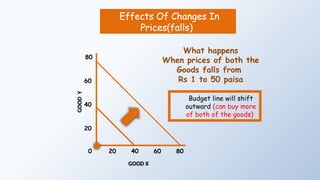
Effects Of Changes In
Prices(falls)
40 60 80
20
20
40
60
80
0
What happens
When prices of both the
Goods falls from
Rs 1 to 50 paisa
GOOD
Y
GOOD X
Budget line will shift
outward (can buy more
of both of the goods)
Effects Of Changes In
Prices(falls)
40 60 80
20
20
40
60
80
0
What Happens
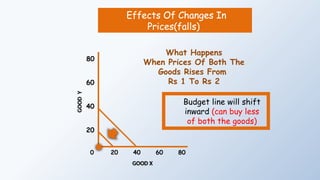
When Prices Of Both The
Goods Rises From
Rs 1 To Rs 2
GOOD
Y
GOOD X
Budget line will shift
inward (can buy less
of both the goods)
40 60 80
20
20
40
60
80
0
GOOD
Y
GOOD X
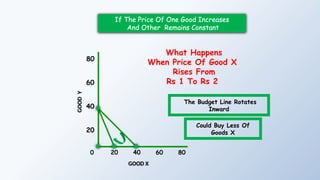
If The Price Of One Good Increases
And Other Remains Constant
The Budget Line Rotates
Inward
Could Buy Less Of
Goods X
What Happens
When Price Of Good X
Rises From
Rs 1 To Rs 2
40 60 80
20
20
40
60
80
0
GOOD
Y
Good X
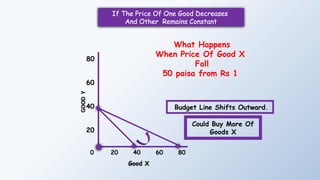
Budget Line Shifts Outward.
If The Price Of One Good Decreases
And Other Remains Constant
Could Buy More Of
Goods X
What Happens
When Price Of Good X
Fall
50 paisa from Rs 1
If income increases/decrease and the
price of both the goods remains constant.
If prices of both the goods increases or
decreases in the same proportion.
Slope of budget line does not change if
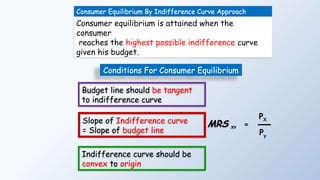
Consumer Equilibrium By Indifference Curve Approach
Consumer equilibrium is attained when the
consumer
reaches the highest possible indifference curve
given his budget.
Conditions For Consumer Equilibrium
Budget line should be tangent
to indifference curve
Slope of Indifference curve
= Slope of budget line
PX
Py
=
MRS XY
Indifference curve should be
convex to origin
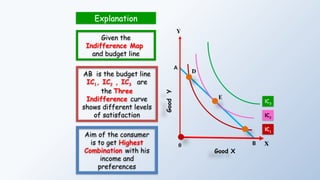
Good
Y
Good X
A
B
IC1
Y
E
IC2
D
IC3
0 X
Given the
Indifference Map
and budget line
AB is the budget line
IC1, IC2 , IC3 are
the Three
Indifference curve
shows different levels
of satisfaction
Aim of the consumer
is to get Highest
Combination with his
income and
preferences
Explanation
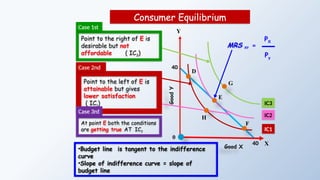
Good
Y
Good X
40
40
IC1
Y
E
IC2
D
IC3
Consumer Equilibrium
0
X
Point to the right of E is
desirable but not
affordable ( IC3)
Point to the left of E is
attainable but gives
lower satisfaction
( IC1)
At point E both the conditions
are getting true AT IC2
G
H
•Budget line is tangent to the indifference
curve
•Slope of indifference curve = slope of
budget line
F
Case 1st
Case 2nd
Case 3rd
PX
Py
=
MRS XY
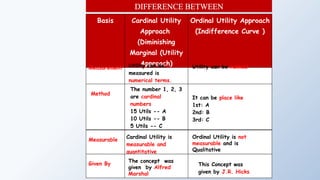
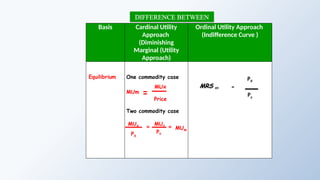
Basis Cardinal Utility
Approach
(Diminishing
Marginal (Utility
Approach)
Ordinal Utility Approach
(Indifference Curve )
DIFFERENCE BETWEEN
Measurement Utility can be
measured is
numerical terms.
Utility can be ranked
Method
The number 1, 2, 3
are cardinal
numbers
15 Utils -- A
10 Utils -- B
5 Utils -- C
It can be place like
1st: A
2nd: B
3rd: C
Measurable
Cardinal Utility is
measurable and
quantitative
Given By This Concept was
given by J.R. Hicks
The concept was
given by Alfred
Marshal
Ordinal Utility is not
measurable and is
Qualitative
Basis Cardinal Utility
Approach
(Diminishing
Marginal (Utility
Approach)
Ordinal Utility Approach
(Indifference Curve )
DIFFERENCE BETWEEN
Equilibrium One commodity case PX
Py
=
MRS XY
MUX
PX
=
MUY
PY
MUM
=
Two commodity case
MUm
MUx
Price
=
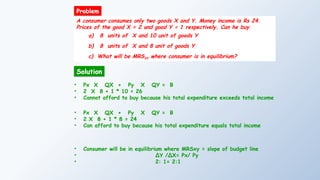
A consumer consumes only two goods X and Y. Money income is Rs 24.
Prices of the good X = 2 and good Y = 1 respectively. Can he buy
a) 8 units of X and 10 unit of goods Y
b) 8 units of X and 8 unit of goods Y
c) What will be MRSXY where consumer is in equilibrium?
Solution
Problem
• Px X QX + Py X QY = B
• 2 X 8 + 1 * 10 = 26
• Cannot afford to buy because his total expenditure exceeds total income
• Px X QX + Py X QY = B
• 2 X 8 + 1 * 8 = 24
• Can afford to buy because his total expenditure equals total income
• Consumer will be in equilibrium where MRSxy = slope of budget line
• ∆Y /∆X= Px/ Py
• 2: 1= 2:1
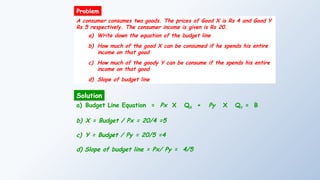
A consumer consumes two goods. The prices of Good X is Rs 4 and Good Y
Rs 5 respectively. The consumer income is given is Rs 20.
a) Write down the equation of the budget line
b) How much of the good X can be consumed if he spends his entire
income on that good
c) How much of the goody Y can be consume if the spends his entire
income on that good
d) Slope of budget line
Solution
Problem
a) Budget Line Equation = Px X QX + Py X QY = B
b) X = Budget / Px = 20/4 =5
c) Y = Budget / Py = 20/5 =4
d) Slope of budget line = Px/ Py = 4/5
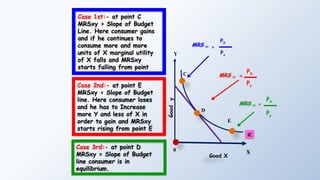
Good
y
Good X
Y
D
IC
C
0 X
PX
Py
>
MRS XY
PX
Py
=
MRS XY
PX
Py
<
MRS XY
E
Case 1st:- at point C
MRSxy > Slope of Budget
Line. Here consumer gains
and if he continues to
consume more and more
units of X marginal utility
of X falls and MRSxy
starts falling from point
Case 2nd:- at point E
MRSxy < Slope of Budget
line. Here consumer loses
and he has to Increase
more Y and less of X in
order to gain and MRSxy
starts rising from point E
Case 3rd:- at point D
MRSxy = Slope of Budget
line consumer is in
equilibrium.
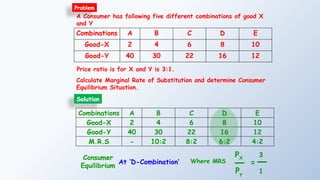
A Consumer has following five different combinations of good X
and Y
Combinations A B C D E
Good-X 2 4 6 8 10
Good-Y 40 30 22 16 12
Price ratio is for X and Y is 3:1.
Calculate Marginal Rate of Substitution and determine Consumer
Equilibrium Situation.
Combinations A B C D E
Good-X 2 4 6 8 10
Good-Y 40 30 22 16 12
M.R.S - 10:2 8:2 6:2 4:2
Solution
Problem
PX
Py
3
1
=
Consumer
Equilibrium
At ‘D-Combination’ Where MRS
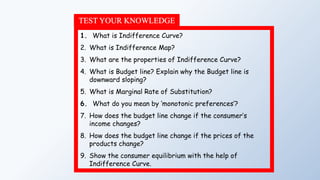
TEST YOUR KNOWLEDGE
1. What is Indifference Curve?
2. What is Indifference Map?
3. What are the properties of Indifference Curve?
4. What is Budget line? Explain why the Budget line is
downward sloping?
5. What is Marginal Rate of Substitution?
6. What do you mean by ‘monotonic preferences’?
7. How does the budget line change if the consumer’s
income changes?
8. How does the budget line change if the prices of the
products change?
9. Show the consumer equilibrium with the help of
Indifference Curve.
0.5 1 1.5 2 2.5 3 3.5 4 4.5 5 5.5
0
5
10
15
20
25
30
A
B
C
D
Good X
E
Good
Y
IC
Diminishing
MRS
MRS = 9
MRS = 3
∆9
∆1
∆3
∆1
GOOD
Y
GOOD X
IC1
Two indifference curve never
intersect each other
IC2
Because two indifference
curves never gives same
levels of satisfaction
B
0.5 1 1.5 2 2.5 3 3.5 4 4.5 5 5.5
0
5
10
15
20
25
30
A
B
C
D
POINTS A, B, C, D AND E
gives same level of satisfaction
Good X
E
Good
Y
IC
Good
y
Good X
Y
D
IC
C
0 X
PX
Py
>
MRS XY
PX
Py
=
MRS XY
PX
Py
<
MRS XY
E

Class 11Mic eco Ch 2.CONSUMER -BEHAVIOUR ppt.pptx

  • 1.
  • 2.
    Who buy goodsand services to satisfy wants Who Is Consumer To get maximum satisfaction from spending his income on various goods Main Aim
  • 3.
    Has Limited IncomeOver Unlimited Wants And Wants Maximum Satisfaction Problem Of Consumer
  • 4.
    Consumer Equilibrium In EconomicsEquilibrium Means “ A Position Of No Change” Benefit Cost
  • 5.
    What Is ConsumerEquilibrium? Situation under which he spends his given income on purchase of a commodity in such a way that gives him maximum utility and he feels no wish to change his consumption level Paisa Vasool
  • 6.
    Consumer Behavior (TwoApproach) Law Of Diminishing Marginal Utility Approach(Cardinal) Indifference Curve Approach(Ordinal) J.R HICKS ALFRED MARSHAL
  • 7.
    Cardinal Utility Approach (DiminishingMarginal Utility Approach) As consumer consumes more and more units of a commodity his intensity of the want goes on falling and a point is reached when he want no more units of it 1 2 3 6 5 4
  • 8.
    Law Of DiminishingMarginal Utility •When a consumer consumes more and more units of commodity Marginal Utility with each successive units diminishes •Fundamental psychological law which operates universally
  • 9.
    General Assumption oflaw of DMU The aim of the consumer should be to get the maximum satisfaction The utility can be measured in cardinal numbers such as 1, 3, 10, 15, etc. There is no change in the unit of quantity & quality of commodity consumed by the customer Marginal utility obtained from the consumption of a good diminishes continuously as its consumption is increased. There should be continuous consumption with any interruption Rationality Utility is cardinally measurable Standardized Commodity Continuous consumption Diminishing marginal utility
  • 10.
    Consumer Consume The CommodityBecause It Give Them Happiness Or Satisfaction Why Consumer Consume Commodity.?
  • 11.
    Utility refers tothe want satisfying power of a commodity. Utility Concept An imaginary unit used to measure utility. Utils Cloth has a utility for us because we can wear it. Pen has a utility who can write with it.
  • 12.
    It changes fromtime to time person to person and place to place Characteristics Of Utility . It cannot be measure but for the sake of the convenience we assume it can be measures in terms of utils. Utility Is Relative Term Utility Is Subjective Term . Higher utility does not means greater usefulness. Cigarettes may give utility to a smoker but are not useful otherwise Utility is not essentially useful
  • 13.
    Concept Of Utility InitialUtility Marginal Utility Total Utility
  • 14.
    Initial Utility Utility obtainfrom the consumption of first unit of the commodity
  • 15.
    Marginal Utility The netaddition to the total utility when one more unit of commodity is consumed MU ∆ TU ∆ Q MU = Marginal Utility ∆TU = Change in Total Utility ∆ Q = Change in Quantity TUN = Total utility from N units = Where MU = TUN TUN-1
  • 16.
    Total Utility It isthe sum of the utilities of all the units consumed TU = ∑MU TU = Total Utility ∑MU = Sum Of Marginal Utility Where
  • 17.
    Units Marginal Utility Total Utility 110 10 2 8 18 3 6 24 4 4 28 5 2 30 6 0 30 7 -2 28 8 -4 24 Marginal utility is positive up to 5 units At 6th unit MU is 0 and TU is maximum After 6TH Unit MU becomes negative and TU decreases Relationship Between Total Utility And Marginal Utility
  • 18.
    1 2 34 5 6 7 8 -10 -5 0 5 10 15 20 25 30 35 When TU Is Falling, MU Curve Becomes Negative(after 6th Unit) When TU Is Maximum, Called Saturation Point MU Is Zero (At 6th Unit) When TU Is Rising MU Curve Falls But) Positive( up to 5th Unit) Saturation Point TU MU MU/TU Quantity
  • 19.
    What happens tomarginal utility when total utility is maximum.? What happens to total utility when marginal utility is positive.? What happens to total utility when marginal utility is negative.? Marginal utility is zero Solution Problem Total utility start falling Solution Problem Total utility is rising Solution Problem
  • 20.
    AMOUNT TU MU 150 50 2 90 3 30 4 140 5 155 AMOUNT TU MU 1 50 50 2 90 40 3 120 30 4 140 20 5 155 15 Solution Problem
  • 21.
    Three realistic condition Forconsumer equilibrium 1.When there is single commodity and buyer has not to pay the PRICE 2.When there is single commodity and buyer has to pay the PRICE 3.When there is two commodity and buyer has to pay their PRICE
  • 22.
    PINKU PINKU likes Burger very Much. CASE1 When buyer does not have to pay any PRICE
  • 23.
    Now how Muchburger PINKU should Eat so that He can get maximum Satisfaction Assume Burger Is Free Of Cost
  • 24.
    1 2 34 5 6 7 4 8 12 MU MU Quantity Consumer Equilibrium 1 2 3 4 5 6 7 10 8 6 4 2 0 -2 He will continue his consumption till MU = ZERO Quantity Marginal Utility
  • 25.
    Now lets ussee What will happen if PINKU has to pay some price Consumer Equilibrium (One Commodity Case) CASE 2
  • 26.
    Naturally PINKU will Buythe good only If the benefit in the form Of utility is equal to the price
  • 27.
    Conditions For ConsumerEquilibrium MU Of The Product = 1 2 MU Of Commodity keeps on falling with each successive unit ( law of diminishing marginal utility) Price Of The Product Benefit Cost =
  • 28.
  • 29.
    Units Price MUOf Burger 1 2 10 2 2 8 3 2 6 4 2 4 5 2 2 6 2 0 Case 1st When MUm > Px (He will consume more because he is getting more than what he gives) Benefit > Cost Price of the burger is RS 2
  • 30.
    Units Price MUOf Burger 1 2 10 2 2 8 3 2 6 4 2 4 5 2 2 6 2 0 Case 2nd When Mux < Px (He will consume Less because he is getting less than what he gives) Benefit > Cost Price of the burger is RS 1
  • 31.
    Units Price MUOf Product 1 2 10 MU x > Price 2 2 8 MU x > Price 3 2 6 MU x > Price 4 2 4 MU x > Price 5 2 2 MU x = Price 6 2 0 MU x < Price Price of the burger is RS 2 Equilibrium The second condition Implies that the law of diminishing MU is operating. If, with increase in consumption of X Marginal utility remains unchanged or constant, he will keep on consuming the commodity which is unrealistic and the consumer will not reach equilibrium
  • 32.
    What happens whenMUX PX When equilibrium is disturbed Not equal to is Case 1st MUX PY > When •Satisfaction of the consumer derives from a rupee on good X greater than the satisfaction derived from spending a rupee on good Y. •The consumer will reallocate his income by substituting good x for good y. •As the consumption of good X increases the MU derived from it goes on diminishing and reverse proposition occurs for good y, Till MUX PX = MUY PY
  • 33.
    What happens when MUX PX MUY PY Whenequilibrium is disturbed Not equal to is Case 2nd MUX PX MUY PY < When •Satisfaction of the consumer derives from a rupee on good Y greater than the satisfaction derived from spending a rupee on good X. •The consumer will reallocate his income by substituting good Y for good X. •As the consumption of good Y increases the MU derived from it goes on diminishing and reverse proposition occurs for good X, Till MUX PX = MUY PY
  • 34.
    Units 1 23 4 5 6 Total Utility 20 36 50 62 68 60 Marginal Utility 20 16 14 12 6 0 Given below is the Utility schedule of a consumer of X-commodity. If the price per Unit is given at Rs. 12 each. Determine Consumer’s equilibrium. Solution Problem Units 1 2 3 4 5 6 Total Utility 20 36 50 62 68 60 Marginal Utility 20 16 14 12 6 0 Consumer will be at equilibrium at 4th unit Price MU Of A Product = 12 12 =
  • 35.
    Units of Good1 2 3 4 5 6 Total Utility 20 36 48 58 66 72 A commodity has Rs. 10 as price per unit. His total utility schedule is given below. Determine his equilibrium point. Solution Problem Units of Good 1 2 3 4 5 6 Total Utility 20 36 48 58 66 72 Marginal utility - 16 12 10 12 6 price 10 10 10 10 10 10 Consumer will be at equilibrium at 4th unit Price MU Of A Product = 10 10 =
  • 36.
    Law Of Equi- Marginal Utility (Two Commodity Case) Now lets us see What will happen if PINKU has to pay the price and there are two commodities
  • 37.
    According To ThisLaw Consumer will be in Equilibrium when utility gained from last Rupee on each commodity is equal. Law Of Equi Marginal Utility/two commodity case Condition For Consumer Equilibrium MUX PX = MUY PY 1. Marginal utility of the last rupee of expenditure on each good is the same. 2. Marginal utility of a good falls as more of it is consumed.
  • 38.
    Suppositions Price of theGOODS X is RS 1 Price of the GOODS Y is RS 1
  • 39.
    Consumer will bein equilibrium by consuming 7 Units Of Goods X 5 Units Of Goods Y Both The Condition Are Getting True MUX PX = MUY PY 1. = 6 = = 6 1 1
  • 40.
    2nd Condition:-Implies that thelaw of diminishing MU is operating. If MUx remains unchanged, then With increase in consumption of X, Marginal utility of X will remain unchanged. Therefore he will keep on consuming only one good i.e X which is unrealistic and the consumer will not reach equilibrium. MUX PX = MUY PY
  • 41.
    What happens when MUX PX MUY PY Whenequilibrium is disturbed Not equal to is Case 1st MUX PX MUY PY > When •Satisfaction of the consumer derives from a rupee on good X greater than the satisfaction derived from spending a rupee on good Y. •The consumer will reallocate his income by substituting good x for good y. •As the consumption of good X increases the MU derived from it goes on diminishing and reverse proposition occurs for good y, Till MUX PX = MUY PY
  • 42.
    What happens when MUX PX MUY PY Whenequilibrium is disturbed Not equal to is Case 2nd MUX PX MUY PY < When •Satisfaction of the consumer derives from a rupee on good Y greater than the satisfaction derived from spending a rupee on good X. •The consumer will reallocate his income by substituting good Y for good X. •As the consumption of good Y increases the MU derived from it goes on diminishing and reverse proposition occurs for good X, Till MUX PX = MUY PY
  • 43.
    Consumer consumes onlytwo goods X and Y. at a consumption level of these two goods, he finds that the ratio of marginal utility to price in case of X is higher than in case of Y. Explain the reaction of the consumer According To principal of equi-marginal utility a consumer gets maximum satisfaction only when… MUX PX = MUY PY MUX PX > MUY PY But when He will buy more of X- good by which MUx will fall till Problem MUX PX = MUY PY Solution
  • 44.
    A consumer consumesonly two goods X and Y whose prices are Rs 4 and Rs 5 per unit respectively. If the consumer chooses a combination of the two goods with marginal utility of X equal to 5 and that of Y equal to 4, is the consumer in equilibrium? Give reasons. What will a rational consumer do in this situation? Use utility analysis. •Conditions of consumer equilibrium in two commodities are Marginal utility of the last rupee of expenditure on each good is the same. •Marginal utility of a good falls as more of it is consumed. only when… MUX PX = MUY PY Problem Solution
  • 45.
    A consumer consumesonly two goods X and Y whose prices are Rs 4 and Rs 5 per unit respectively. If the consumer chooses a combination of the two goods with marginal utility of X equal to 5 and that of Y equal to 4, is the consumer in equilibrium? Give reasons. What will a rational consumer do in this situation? Use utility analysis. According To principal of equi-marginal utility a consumer gets maximum satisfaction only when… MUX PX = MUY PY 5 4 > 4 5 But when He will buy more of X- good by which MUx will fall till Problem MUX PX = MUY PY Solution
  • 46.
    Test your knowledge 1.Who is consumer 2. What is meant by utility, properties of utility, util. 3. Define marginal utility 4. Define total utility 5. What is the relationship between TU and MU explain with diagram and table. 6. State the law of diminishing marginal utility 7. A consumer consume only one good. Explain equilibrium with the help of utility approach 8. A consumer consume only two goods. Explain equilibrium with the help of utility approach 9. Price of the chocolate is Rs 10. Monu who has already eaten 5 chocolate. His marginal utility from eating 5 chocolate is 50. Suppose marginal utility on one rupee is 5 utils. Should he eat more or stop. Explain
  • 47.
    Indifference Curve Approach Accordingto this approach consumer can rank the bundle and tell which bundles is best Based on preferences Bundle Ranking (5,5) Ist (4,5),(5,4) 2nd (3,4),(4,3) 3rd
  • 48.
    Three steps involvedin the Study of consumer behavior Consumer Equilibrium What amount goods be purchased for maximum satisfaction Budget Constraints People have limited incomes Consumer Preferences Why people prefer one good to another
  • 49.
    General Assumption Consumers ConsumesOnly Two Commodity Consumer Can Rank The Bundles In Order Of His Preferences Over Them Consumers Income Is Given Price Of The Two Goods Is Given
  • 50.
    Combination of thetwo goods is called a consumption bundle Example Consumption Bundle The bundle (5,10) consists of 5 units of Good 1 and 10 units of Good 2
  • 51.
    Between any twobundles Consumer can either be Indifferent Same satisfaction Monotonic Different satisfaction
  • 52.
    Indifferent Same satisfaction Monotonic Different satisfaction 25,1 16,2 10,3 10,10 8,7 6,4 Ifconsumer picks any bundles he is indifferent (same satisfaction) If consumer rank and select best bundle his preferences are monotonic (different satisfaction) 10,10 8,7 6,4 25,1 16,2 10,3
  • 53.
    Monotonic Preference Consumer’s choosesa bundle which gives more of both the goods or at least one good without reducing the quantity of the other good More Is Always Better Than Less Between The Two Bundles Which Bundle Is Better 10,10 9,10 10,9 9,9 10,9 9,8
  • 54.
    Indifferent scheduled Table Showing different combinationsof two goods that yield the same level of satisfaction Basket Y X A 25 1 B 16 2 C 10 3 D 7 4 E 6 5
  • 55.
    If a consumerhas monotonic preferences can he be indifferent between the bundle (6,4) and (5,3) No he can’t be indifferent because both the goods in second bundle have fewer goods Solution Problem
  • 56.
    Suppose a consumer’spreferences are monotonic. What can you say about his preferences ranking over the bundle (20, 20) (20, 18) (18, 18) His most preferred bundle would be (20, 20). He cant be indifferent because given bundles gives different satisfaction. Solution Problem
  • 57.
    Indifference Curve Graphical representationshowing different combinations of two goods that yield the same level of satisfaction
  • 58.
    BASKET Y X MRS A25 1 B 16 2 9:1 C 10 3 6:1 D 7 4 3:1 E 6 5 1:1 0.5 1 1.5 2 2.5 3 3.5 4 4.5 5 5.5 0 5 10 15 20 25 30 A B C D POINTS A, B, C, D AND E can be connected to form the indifference curve represents possible combinations of good X and good Y GOOD X E GOOD Y IC
  • 59.
    0.5 1 1.52 2.5 3 3.5 4 4.5 5 5.5 0 5 10 15 20 25 30 A B C D POINTS A, B, C, D AND E gives same level of satisfaction Good X E Good Y IC
  • 60.
    GOOD Y GOOD X O IC1 IC2 IC3 Y X • Aset of Indifference Curves, each representing a different level of utility. • Where Higher Indifference Curve gives higher level of satisfaction or VICE- VERSA Indifference Map
  • 61.
    GOOD Y GOOD X IC1 Y E IC2 IC3 0 X G H MostPreferred bundle (contains more ) of both goods Least preferred bundle (contains less ) of both goods
  • 62.
    Amount of goodY that consumer is willing to give up to get an additional unit of good X . Marginal Rate Of Substitution ∆Y ∆ X = MRS XY BASKET Y X MRS A 25 1 B 16 2 9:1 C 10 3 6:1 D 7 4 3:1 E 6 5 1:1
  • 63.
    0.5 1 1.52 2.5 3 3.5 4 4.5 5 5.5 0 5 10 15 20 25 30 A B C D Good X E GOOD Y IC Marginal Rate Of Substitution ∆9 ∆1 ∆3 ∆1 ∆Y ∆ X = MRS XY Slope Of Indifference Curve =
  • 64.
    0.5 1 1.52 2.5 3 3.5 4 4.5 5 5.5 0 5 10 15 20 25 30 A B C D Good X E Good Y IC Diminishing MRS MRS = 9 MRS = 3 ∆9 ∆1 ∆3 ∆1 MRS Always diminishes. From the diagram we see when consumer moves from basket A to basket B, he is willing to give up 9 units of Y for 1 unit of good X. But when consumer moves from basket C to basket D he is willing to give up only 3 units of Y for 1 unit of X. Thus MRS always falls
  • 65.
    Properties Of IndifferenceCurve Downward Or Negative Sloped From Left To Right Indifference Curves do not Touch the Horizontal or Vertical Axis Two indifference curve never intersect each other Convex To The Origin Higher IC, Higher Is The Level Of Satisfaction And Vice, Versa. D I T C H
  • 66.
    GOOD Y GOOD X IC1 Downward SlopingFrom Left To Right Downward sloping curve express that if the quantity of one good is subtracted then the quantity of the other good is to be increased
  • 67.
    GOOD Y GOOD X IC1 Indifference Curvesdo not Touch the Horizontal or Vertical Axis One of the assumptions of indifference curves is that the consumer purchases combinations of two commodities. Consumption of one commodity can never be zero
  • 68.
    GOOD Y GOOD X IC1 Two indifferencecurve never intersect each other IC2 Because two indifference curves never gives same levels of satisfaction B
  • 69.
    Convex To TheOrigin It is convex to the origin due to diminishing marginal rate of substitution(MRS) 0.5 1 1.5 2 2.5 3 3.5 4 4.5 5 5.5 0 5 10 15 20 25 30 A B C D GOOD X E Good Y IC Diminishing MRS MRS = 9 MRS = 3 ∆9 ∆1 ∆3 ∆1
  • 70.
    GOOD Y GOOD X IC1 IC2 Higher IC,Higher Is The Level Of Satisfaction And Vice, Versa. On higher indifference curves consumer get more goods without reducing the other. (Monotonic preferences). IC2 has more of X goods than IC1 without reducing the consumption of Y - goods
  • 71.
    Budget Given fixed incomeand the prices of the two goods, the consumer can afford to buy only those bundles which cost less than or equal to income. WHER E Px = Price of X Qx = Quantity of X Py = Price of Y Qy = Quantity of Y I = INCOME of the consumer PX QX PY QY <= B x x + =
  • 72.
    Consumer budget Assume consumerhas 40 Rs Price of the GOODS X is RS 10 Price of the GOODS Y is RS 10
  • 73.
    0 1 23 4 5 6 0 1 2 3 4 5 6 BASKET Good X (Price Rs 10) Good Y (Price Rs 10) INCOME GOOD Y GOOD X A B D C E A 0 4 40 B 1 3 40 C 2 2 40 D 3 1 40 E 4 0 40 The Budget Line Graphical presentation showing all combinations of two commodities that consumer can buy with the given income and prices.

  • 74.
    0 1 23 4 5 6 0 1 2 3 4 5 6 GOOD Y GOOD X A B D C E Affordable Bundle Unaffordable bundle Exact bundle
  • 75.
    Budget Line Equation SlopeOf Budget Line •The slope indicates the rate at which the two goods can be substituted without changing the total income Slope Of Budget Line PX QX PY QY = B x x + = = Px Py Or ∆Y ∆X
  • 76.
    Budget Set BudgetLine DIFFERENCE BETWEEN Collection of those bundles that the consumer can afford to purchase with his money- income at the given prices of the goods Collection of those bundles that can be purchase by spending all his money income Budget set:- PX X QX + PY X QY <= B Show all bundles less than or equal to budget Show all the bundles which are exactly equal to budget Budget Line:- PX X QX + PY X QY = B
  • 77.
    Illustration Consumer has Rs10 and both goods A and B are price at Rs 2 1. Give the affordable bundles 2. Give the exact bundles 3. Unaffordable bundles Affordable Bundles Exact Bundles Unaffordable bundles 0,0 1,0 1,1 0,1 2,0 2,1 0,2 3,0 3,1 0,3 4,0 4,1 0,4 5,0 2,2 0,5 0,1 1,2 1,3 1,4 0,5 5,0 2,3 3,2 2,3 3,2 4,1 1,4 4,2 3,3
  • 78.
    Budget Line MayChange Depending On Change in the price of the commodity Change in the income of the consumer
  • 79.
    Suppositions Price Of Goods X Rs1 Price Of Goods Y Rs 1 Consumer’s Income Rs 40 40 60 80 20 20 40 60 80 0 GOOD Y GOOD X
  • 80.
    Effect Of ChangesIn Income(rises) What happens When income rises from Rs 40 to 80 Budget line will shift outward (can buy more of both of the goods) 40 60 80 20 20 40 60 80 0 GOOD Y GOOD X
  • 81.
    Effects Of ChangesIn Income(falls) What Happens When Income Falls From Rs 40 TO 20 Budget line will shift inward (can buy less of both the goods) 40 60 80 20 20 40 60 80 0 GOOD Y GOOD X
  • 82.
    Effects Of ChangesIn Prices(falls) 40 60 80 20 20 40 60 80 0 What happens When prices of both the Goods falls from Rs 1 to 50 paisa GOOD Y GOOD X Budget line will shift outward (can buy more of both of the goods)
  • 83.
    Effects Of ChangesIn Prices(falls) 40 60 80 20 20 40 60 80 0 What Happens When Prices Of Both The Goods Rises From Rs 1 To Rs 2 GOOD Y GOOD X Budget line will shift inward (can buy less of both the goods)
  • 84.
    40 60 80 20 20 40 60 80 0 GOOD Y GOODX If The Price Of One Good Increases And Other Remains Constant The Budget Line Rotates Inward Could Buy Less Of Goods X What Happens When Price Of Good X Rises From Rs 1 To Rs 2
  • 85.
    40 60 80 20 20 40 60 80 0 GOOD Y GoodX Budget Line Shifts Outward. If The Price Of One Good Decreases And Other Remains Constant Could Buy More Of Goods X What Happens When Price Of Good X Fall 50 paisa from Rs 1
  • 86.
    If income increases/decreaseand the price of both the goods remains constant. If prices of both the goods increases or decreases in the same proportion. Slope of budget line does not change if
  • 87.
    Consumer Equilibrium ByIndifference Curve Approach Consumer equilibrium is attained when the consumer reaches the highest possible indifference curve given his budget. Conditions For Consumer Equilibrium Budget line should be tangent to indifference curve Slope of Indifference curve = Slope of budget line PX Py = MRS XY Indifference curve should be convex to origin
  • 88.
    Good Y Good X A B IC1 Y E IC2 D IC3 0 X Giventhe Indifference Map and budget line AB is the budget line IC1, IC2 , IC3 are the Three Indifference curve shows different levels of satisfaction Aim of the consumer is to get Highest Combination with his income and preferences Explanation
  • 89.
    Good Y Good X 40 40 IC1 Y E IC2 D IC3 Consumer Equilibrium 0 X Pointto the right of E is desirable but not affordable ( IC3) Point to the left of E is attainable but gives lower satisfaction ( IC1) At point E both the conditions are getting true AT IC2 G H •Budget line is tangent to the indifference curve •Slope of indifference curve = slope of budget line F Case 1st Case 2nd Case 3rd PX Py = MRS XY
  • 90.
    Basis Cardinal Utility Approach (Diminishing Marginal(Utility Approach) Ordinal Utility Approach (Indifference Curve ) DIFFERENCE BETWEEN Measurement Utility can be measured is numerical terms. Utility can be ranked Method The number 1, 2, 3 are cardinal numbers 15 Utils -- A 10 Utils -- B 5 Utils -- C It can be place like 1st: A 2nd: B 3rd: C Measurable Cardinal Utility is measurable and quantitative Given By This Concept was given by J.R. Hicks The concept was given by Alfred Marshal Ordinal Utility is not measurable and is Qualitative
  • 91.
    Basis Cardinal Utility Approach (Diminishing Marginal(Utility Approach) Ordinal Utility Approach (Indifference Curve ) DIFFERENCE BETWEEN Equilibrium One commodity case PX Py = MRS XY MUX PX = MUY PY MUM = Two commodity case MUm MUx Price =
  • 92.
    A consumer consumesonly two goods X and Y. Money income is Rs 24. Prices of the good X = 2 and good Y = 1 respectively. Can he buy a) 8 units of X and 10 unit of goods Y b) 8 units of X and 8 unit of goods Y c) What will be MRSXY where consumer is in equilibrium? Solution Problem • Px X QX + Py X QY = B • 2 X 8 + 1 * 10 = 26 • Cannot afford to buy because his total expenditure exceeds total income • Px X QX + Py X QY = B • 2 X 8 + 1 * 8 = 24 • Can afford to buy because his total expenditure equals total income • Consumer will be in equilibrium where MRSxy = slope of budget line • ∆Y /∆X= Px/ Py • 2: 1= 2:1
  • 93.
    A consumer consumestwo goods. The prices of Good X is Rs 4 and Good Y Rs 5 respectively. The consumer income is given is Rs 20. a) Write down the equation of the budget line b) How much of the good X can be consumed if he spends his entire income on that good c) How much of the goody Y can be consume if the spends his entire income on that good d) Slope of budget line Solution Problem a) Budget Line Equation = Px X QX + Py X QY = B b) X = Budget / Px = 20/4 =5 c) Y = Budget / Py = 20/5 =4 d) Slope of budget line = Px/ Py = 4/5
  • 94.
    Good y Good X Y D IC C 0 X PX Py > MRSXY PX Py = MRS XY PX Py < MRS XY E Case 1st:- at point C MRSxy > Slope of Budget Line. Here consumer gains and if he continues to consume more and more units of X marginal utility of X falls and MRSxy starts falling from point Case 2nd:- at point E MRSxy < Slope of Budget line. Here consumer loses and he has to Increase more Y and less of X in order to gain and MRSxy starts rising from point E Case 3rd:- at point D MRSxy = Slope of Budget line consumer is in equilibrium.
  • 95.
    A Consumer hasfollowing five different combinations of good X and Y Combinations A B C D E Good-X 2 4 6 8 10 Good-Y 40 30 22 16 12 Price ratio is for X and Y is 3:1. Calculate Marginal Rate of Substitution and determine Consumer Equilibrium Situation. Combinations A B C D E Good-X 2 4 6 8 10 Good-Y 40 30 22 16 12 M.R.S - 10:2 8:2 6:2 4:2 Solution Problem PX Py 3 1 = Consumer Equilibrium At ‘D-Combination’ Where MRS
  • 96.
    TEST YOUR KNOWLEDGE 1.What is Indifference Curve? 2. What is Indifference Map? 3. What are the properties of Indifference Curve? 4. What is Budget line? Explain why the Budget line is downward sloping? 5. What is Marginal Rate of Substitution? 6. What do you mean by ‘monotonic preferences’? 7. How does the budget line change if the consumer’s income changes? 8. How does the budget line change if the prices of the products change? 9. Show the consumer equilibrium with the help of Indifference Curve.
  • 97.
    0.5 1 1.52 2.5 3 3.5 4 4.5 5 5.5 0 5 10 15 20 25 30 A B C D Good X E Good Y IC Diminishing MRS MRS = 9 MRS = 3 ∆9 ∆1 ∆3 ∆1
  • 98.
    GOOD Y GOOD X IC1 Two indifferencecurve never intersect each other IC2 Because two indifference curves never gives same levels of satisfaction B
  • 99.
    0.5 1 1.52 2.5 3 3.5 4 4.5 5 5.5 0 5 10 15 20 25 30 A B C D POINTS A, B, C, D AND E gives same level of satisfaction Good X E Good Y IC
  • 100.
    Good y Good X Y D IC C 0 X PX Py > MRSXY PX Py = MRS XY PX Py < MRS XY E