Consumer’s Behaviour
Discussion points
 Introduction
 Utility and its features
 Types of Utility
 Concepts of utility
 Relationship between Utility
 Law Of Diminishing marginal Utility
 Law of Equi – Marginal Utility
Utility
 The power of a commodity to satisfy human wants
 Concept of Utility
 Total Utility
 Marginal utility
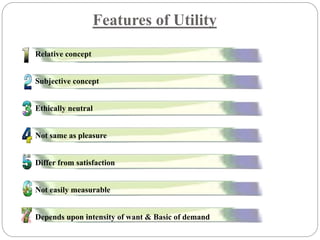
Features of Utility
Relative concept
Subjective concept
Ethically neutral
Not same as pleasure
Differ from satisfaction
Not easily measurable
Depends upon intensity of want & Basic of demand
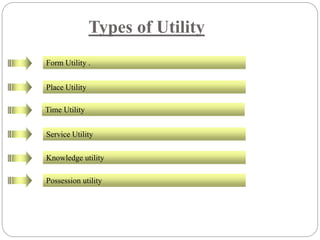
Types of Utility
Form Utility .
Place Utility
Time Utility
Service Utility
Knowledge utility
Possession utility
Law of diminishing marginal utility
 Introduction
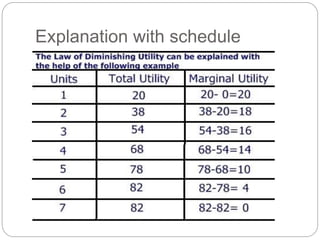
 Statement
 Explanation with scheduled
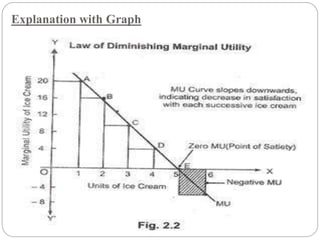
 Explanation with diagramed
 Assumption
 Exception
 Conclusion
Introduction
 The law explains economic behavior of a rational
consumer.
 It is a common experience that the more we have
of a commodity, less we desire to have more of it.
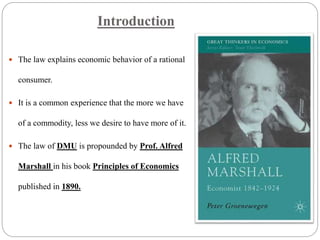
 The law of DMU is propounded by Prof. Alfred
Marshall in his book Principles of Economics
published in 1890.
Statement of the law
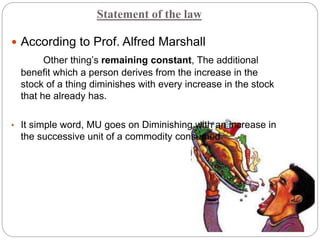
 According to Prof. Alfred Marshall
Other thing’s remaining constant, The additional
benefit which a person derives from the increase in the
stock of a thing diminishes with every increase in the stock
that he already has.
• It simple word, MU goes on Diminishing with an increase in
the successive unit of a commodity consumed
Explanation with schedule
Explanation with Graph
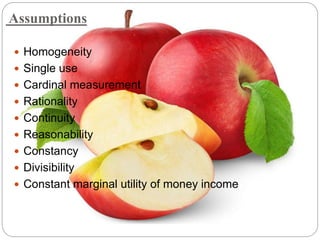
Assumptions
 Homogeneity
 Single use
 Cardinal measurement
 Rationality
 Continuity
 Reasonability
 Constancy
 Divisibility
 Constant marginal utility of money income
Exception
 Hobbies
 Misers
 Drunkards
 Music
 Power
 Reading
 Money

Consumer behaviour

  • 1.
  • 3.
    Discussion points  Introduction Utility and its features  Types of Utility  Concepts of utility  Relationship between Utility  Law Of Diminishing marginal Utility  Law of Equi – Marginal Utility
  • 6.
    Utility  The powerof a commodity to satisfy human wants  Concept of Utility  Total Utility  Marginal utility
  • 7.
    Features of Utility Relativeconcept Subjective concept Ethically neutral Not same as pleasure Differ from satisfaction Not easily measurable Depends upon intensity of want & Basic of demand
  • 8.
    Types of Utility FormUtility . Place Utility Time Utility Service Utility Knowledge utility Possession utility
  • 9.
    Law of diminishingmarginal utility  Introduction  Statement  Explanation with scheduled  Explanation with diagramed  Assumption  Exception  Conclusion
  • 10.
    Introduction  The lawexplains economic behavior of a rational consumer.  It is a common experience that the more we have of a commodity, less we desire to have more of it.  The law of DMU is propounded by Prof. Alfred Marshall in his book Principles of Economics published in 1890.
  • 11.
    Statement of thelaw  According to Prof. Alfred Marshall Other thing’s remaining constant, The additional benefit which a person derives from the increase in the stock of a thing diminishes with every increase in the stock that he already has. • It simple word, MU goes on Diminishing with an increase in the successive unit of a commodity consumed
  • 12.
  • 13.
  • 14.
    Assumptions  Homogeneity  Singleuse  Cardinal measurement  Rationality  Continuity  Reasonability  Constancy  Divisibility  Constant marginal utility of money income
  • 15.
    Exception  Hobbies  Misers Drunkards  Music  Power  Reading  Money