





Bolivia
Constitution
Article 4
The State respects and guarantees freedom of religion and
spiritual beliefs, according to their view of the world. The
State is independent of religion.
Article 14 (Part of it)
I. Every human being, without distinction, has legal status and capacity
under the law and enjoys the rights recognized in this Constitution.
II. The State prohibits and punishes all forms of discrimination based on
sex, color, age, sexual orientation, gender identity, origin, culture,
nationality, citizenship, language, religious belief, ideology, political
affiliation or philosophy, civil status, economic or social condition, type
of occupation, level of education, disability, pregnancy, and any other
discrimination that attempts to or results in the annulment of or harm
to the equal recognition, enjoyment or exercise of the rights of all
people.
Article 15 (Part of it)
III. The State shall adopt the necessary measures to prevent,
eliminate and punish sexual and generational violence, as well
as any action or omission intended to be degrading to the
human condition, to cause death, pain, and physical, sexual or
psychological suffering, whether in public or private spheres.
IV. No person shall be submitted to a forced disappearance for
any reason or under any circumstance.
V. No person shall be submitted to servitude or slavery. The
trade and trafficking of persons is prohibited.
Article 16
I. Every person has the right to water and food.
II. The State has the obligation to guarantee food security,
by means of healthy, adequate and sufficient food for the
entire population.
Article 18
I. Every person has the right to health.
II. The State guarantees the inclusion and access to health for
all persons, without any exclusion or discrimination.
III. There shall be a single health system, which shall be
universal, free, equitable, intra-cultural, intercultural, and
participatory, with quality, kindness and social control. The
system is based on the principles of solidarity, efficiency and
co-responsibility, and it is developed by public policies at all
levels of the government.
Article 41
I. The State shall guarantee the access of the population to
medicines.
II. The State shall prioritize generic medicines through the
promotion of their domestic production and, if need be, shall
decide to import them.
III. The right to access medicine shall not be restricted by
intellectual property rights and commercial rights, and it
contemplates quality standards and first generation medicines.
Article 43
The law shall regulate the donations and transplants of cells,
tissue or organs, based on principles of humanity, solidarity,
opportunity, providing them free of charge, and efficiency.
Article 46 (Part of it)
I. Every person has the following rights:
1. To dignified work, with industrial and occupational health
and safety, without discrimination, and with a fair, equitable
and satisfactory remuneration or salary that assures a dignified
existence for the worker and his or her family.
2. To a stable source of work under equitable and satisfactory
conditions.
Article 62
The State recognizes and protects the family as the
fundamental nucleus of society, and guarantees the social
and economic conditions necessary for its full development.
Every member has equal rights, obligations and
opportunities.
Article 75
The users and consumers enjoy the following rights:
1. To the supply of food, pharmaceuticals, and products in
general, in harmless and quality condition, in sufficient and
adequate quantity, and with efficient service and timely
supply.
2. To reliable information about the characteristics and
contents of the products they consume and of the services they
use.
Article 76
I. The State guarantees access to a comprehensive system of
public transportation in diverse modalities. The law shall
determine that the system of transportation be efficient and
effective, and that it generates benefits to the users and to
the providers.
II. No customs controls, squads or control points of any kind
may exist in Bolivian territory, except those that have been
created by law.
Article 84
The State and society have the duty to eradicate illiteracy
through programs compatible with the cultural and linguistic
reality of the population.
Article 85
The State shall promote and guarantee the continuing
education of children and adolescents with disabilities, or of
those with extraordinary talents in learning, under the same
structure, principles and values of the educational system,
and shall establish a special organization and development
curriculum.
Article 104
Everyone has the right to sports, physical culture and
recreation. The State guarantees access to sports without
distinction as to gender, language, religion, political
orientation, territorial location, social, cultural membership
or any other characteristic.
Article 107 (Part of it)
III. The public means of communication shall not form, either
directly or indirectly, monopolies or oligopolies.
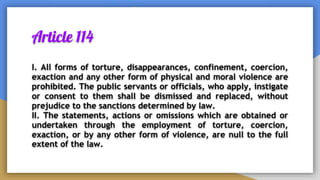
Article 114
I. All forms of torture, disappearances, confinement, coercion,
exaction and any other form of physical and moral violence are
prohibited. The public servants or officials, who apply, instigate
or consent to them shall be dismissed and replaced, without
prejudice to the sanctions determined by law.
II. The statements, actions or omissions which are obtained or
undertaken through the employment of torture, coercion,
exaction, or by any other form of violence, are null to the full
extent of the law.
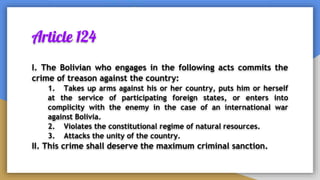
Article 124
I. The Bolivian who engages in the following acts commits the
crime of treason against the country:
1. Takes up arms against his or her country, puts him or herself
at the service of participating foreign states, or enters into
complicity with the enemy in the case of an international war
against Bolivia.
2. Violates the constitutional regime of natural resources.
3. Attacks the unity of the country.
II. This crime shall deserve the maximum criminal sanction.
Article 176
To be designated a Minister, a person must meet the following
requisites: satisfy the general requirements for entering public
service, be twenty five years of age on the day of his or her
nomination, not be a member of the Pluri-National Legislative
Assembly, nor a director, shareholder or owner of financial
entities or enterprises that have a contractual relationship or
conflicts of interest with the State; not be the spouse or natural
parent or related in the second degree to the acting President
or Vice President of the State.
Article 238
Persons who fall within the following grounds are ineligibility
to hold elective public office:
1. Those that were or are directors of enterprises or
corporations that have contracts or agreements with the State
and who have not resigned at least three months before the
day of the election.
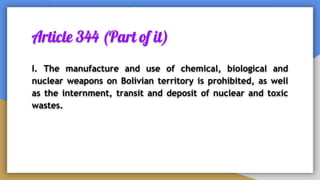
Article 344 (Part of it)
I. The manufacture and use of chemical, biological and
nuclear weapons on Bolivian territory is prohibited, as well
as the internment, transit and deposit of nuclear and toxic
wastes.
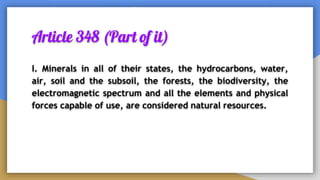
Article 348 (Part of it)
I. Minerals in all of their states, the hydrocarbons, water,
air, soil and the subsoil, the forests, the biodiversity, the
electromagnetic spectrum and all the elements and physical
forces capable of use, are considered natural resources.
Article 349 (Part of it)
I. The natural resources are the property and direct domain,
indivisible and without limitation, of the Bolivian people,
and their administration corresponds to the State on behalf
of the collective interest.
III. Agriculture, livestock, as well as the activities of hunting
and fishing that do not involve protected animal species.
Article 358
The rights to the use and exploitation of natural resources
shall be subject to the Constitution and the law. These rights
shall be subject to periodic review for compliance with the
technical, economic and environmental regulations. The
violation of the law shall lead to the reversion or
nullification of the rights of use and exploitation.
Article 373
I. Water constitutes a fundamental right for life, within the framework
of the sovereignty of the people. The State shall promote the use and
access to water on the basis of principles of solidarity,
complementariness, reciprocity, equity, diversity and sustainability.
II. Water resources in all their states, surface and subterraneous,
constitute finite, vulnerable, strategic resources, and serve a social,
cultural and environmental function. These resource cannot be the
object of private appropriation and they, as well as water services,
shall not be given as concessions and are subject to a system of
licensing, registration and authorization pursuant to the law.
Article 374
I. The State shall protect and guarantee the priority use of water for
life. It is the duty of the State to manage, regulate, protect and plan
the adequate and sustainable use of water resources, with social
participation, guaranteeing access to water for all the habitants. The
law shall establish the conditions and limitations of all the uses.
II. The State shall recognize, respect and protect the uses and customs
of the community, of its local authorities and the rural native
indigenous organizations over the right, management and
administration of sustainable water.
Article 374
III. The fossil, glacial, wetland, subterraneous, mineral,
medicinal and other waters are priorities for the State,
which must guarantee its conservation, protection,
preservation, restoration, sustainable use and complete
management; they are inalienable, not attachable and
cannot be limited.
Article 375
I. It is the duty of the State to develop plans for the use, conservation,
management and sustainable exploitation of the river basins.
II. The State shall regulate the management and sustainable
administration of the water resources and the basins for irrigation, food
security and basic services, respecting the uses and customs of the
communities.
III. It is the duty of the State to carry out the studies for the
identification of fossil waters and their consequent protection,
management and sustainable administration.
Article 376
Water resources of the rivers, lakes and lagoons that form the water
basins are considered strategic resources for the development and
sovereignty of Bolivia because of their potential, for the variety of
natural resources that they contain, and because they are a
fundamental part of the ecosystems. The State shall avoid actions in
the sources and intermediary zones of rivers that may cause damages
to the ecosystems or diminish the flow volume, shall preserve the
natural state, and shall watch over the development and welfare of the
population.
Article 380
I. The renewable natural resources shall be exploited in a
sustainable way, respecting the characteristics and natural
value of each ecosystem.
II. In order to guarantee ecological equilibrium, the land must
be used in accordance with its capacity for greater use within
the framework of the process of the organization of use and
occupation of lands, taking into account their biophysical,
socioeconomic, cultural characteristics, and institutional
policies.
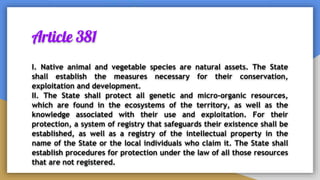
Article 381
I. Native animal and vegetable species are natural assets. The State
shall establish the measures necessary for their conservation,
exploitation and development.
II. The State shall protect all genetic and micro-organic resources,
which are found in the ecosystems of the territory, as well as the
knowledge associated with their use and exploitation. For their
protection, a system of registry that safeguards their existence shall be
established, as well as a registry of the intellectual property in the
name of the State or the local individuals who claim it. The State shall
establish procedures for protection under the law of all those resources
that are not registered.
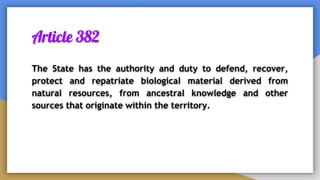
Article 382
The State has the authority and duty to defend, recover,
protect and repatriate biological material derived from
natural resources, from ancestral knowledge and other
sources that originate within the territory.
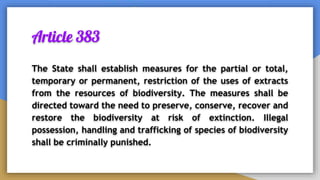
Article 383
The State shall establish measures for the partial or total,
temporary or permanent, restriction of the uses of extracts
from the resources of biodiversity. The measures shall be
directed toward the need to preserve, conserve, recover and
restore the biodiversity at risk of extinction. Illegal
possession, handling and trafficking of species of biodiversity
shall be criminally punished.
Dunilefra
www.dunilefra.com

Constitution of Bolivia

  • 1.
  • 2.
    Article 4 The Staterespects and guarantees freedom of religion and spiritual beliefs, according to their view of the world. The State is independent of religion.
  • 3.
    Article 14 (Partof it) I. Every human being, without distinction, has legal status and capacity under the law and enjoys the rights recognized in this Constitution. II. The State prohibits and punishes all forms of discrimination based on sex, color, age, sexual orientation, gender identity, origin, culture, nationality, citizenship, language, religious belief, ideology, political affiliation or philosophy, civil status, economic or social condition, type of occupation, level of education, disability, pregnancy, and any other discrimination that attempts to or results in the annulment of or harm to the equal recognition, enjoyment or exercise of the rights of all people.
  • 4.
    Article 15 (Partof it) III. The State shall adopt the necessary measures to prevent, eliminate and punish sexual and generational violence, as well as any action or omission intended to be degrading to the human condition, to cause death, pain, and physical, sexual or psychological suffering, whether in public or private spheres. IV. No person shall be submitted to a forced disappearance for any reason or under any circumstance. V. No person shall be submitted to servitude or slavery. The trade and trafficking of persons is prohibited.
  • 5.
    Article 16 I. Everyperson has the right to water and food. II. The State has the obligation to guarantee food security, by means of healthy, adequate and sufficient food for the entire population.
  • 6.
    Article 18 I. Everyperson has the right to health. II. The State guarantees the inclusion and access to health for all persons, without any exclusion or discrimination. III. There shall be a single health system, which shall be universal, free, equitable, intra-cultural, intercultural, and participatory, with quality, kindness and social control. The system is based on the principles of solidarity, efficiency and co-responsibility, and it is developed by public policies at all levels of the government.
  • 7.
    Article 41 I. TheState shall guarantee the access of the population to medicines. II. The State shall prioritize generic medicines through the promotion of their domestic production and, if need be, shall decide to import them. III. The right to access medicine shall not be restricted by intellectual property rights and commercial rights, and it contemplates quality standards and first generation medicines.
  • 8.
    Article 43 The lawshall regulate the donations and transplants of cells, tissue or organs, based on principles of humanity, solidarity, opportunity, providing them free of charge, and efficiency.
  • 9.
    Article 46 (Partof it) I. Every person has the following rights: 1. To dignified work, with industrial and occupational health and safety, without discrimination, and with a fair, equitable and satisfactory remuneration or salary that assures a dignified existence for the worker and his or her family. 2. To a stable source of work under equitable and satisfactory conditions.
  • 10.
    Article 62 The Staterecognizes and protects the family as the fundamental nucleus of society, and guarantees the social and economic conditions necessary for its full development. Every member has equal rights, obligations and opportunities.
  • 11.
    Article 75 The usersand consumers enjoy the following rights: 1. To the supply of food, pharmaceuticals, and products in general, in harmless and quality condition, in sufficient and adequate quantity, and with efficient service and timely supply. 2. To reliable information about the characteristics and contents of the products they consume and of the services they use.
  • 12.
    Article 76 I. TheState guarantees access to a comprehensive system of public transportation in diverse modalities. The law shall determine that the system of transportation be efficient and effective, and that it generates benefits to the users and to the providers. II. No customs controls, squads or control points of any kind may exist in Bolivian territory, except those that have been created by law.
  • 13.
    Article 84 The Stateand society have the duty to eradicate illiteracy through programs compatible with the cultural and linguistic reality of the population.
  • 14.
    Article 85 The Stateshall promote and guarantee the continuing education of children and adolescents with disabilities, or of those with extraordinary talents in learning, under the same structure, principles and values of the educational system, and shall establish a special organization and development curriculum.
  • 15.
    Article 104 Everyone hasthe right to sports, physical culture and recreation. The State guarantees access to sports without distinction as to gender, language, religion, political orientation, territorial location, social, cultural membership or any other characteristic.
  • 16.
    Article 107 (Partof it) III. The public means of communication shall not form, either directly or indirectly, monopolies or oligopolies.
  • 17.
    Article 114 I. Allforms of torture, disappearances, confinement, coercion, exaction and any other form of physical and moral violence are prohibited. The public servants or officials, who apply, instigate or consent to them shall be dismissed and replaced, without prejudice to the sanctions determined by law. II. The statements, actions or omissions which are obtained or undertaken through the employment of torture, coercion, exaction, or by any other form of violence, are null to the full extent of the law.
  • 18.
    Article 124 I. TheBolivian who engages in the following acts commits the crime of treason against the country: 1. Takes up arms against his or her country, puts him or herself at the service of participating foreign states, or enters into complicity with the enemy in the case of an international war against Bolivia. 2. Violates the constitutional regime of natural resources. 3. Attacks the unity of the country. II. This crime shall deserve the maximum criminal sanction.
  • 19.
    Article 176 To bedesignated a Minister, a person must meet the following requisites: satisfy the general requirements for entering public service, be twenty five years of age on the day of his or her nomination, not be a member of the Pluri-National Legislative Assembly, nor a director, shareholder or owner of financial entities or enterprises that have a contractual relationship or conflicts of interest with the State; not be the spouse or natural parent or related in the second degree to the acting President or Vice President of the State.
  • 20.
    Article 238 Persons whofall within the following grounds are ineligibility to hold elective public office: 1. Those that were or are directors of enterprises or corporations that have contracts or agreements with the State and who have not resigned at least three months before the day of the election.
  • 21.
    Article 344 (Partof it) I. The manufacture and use of chemical, biological and nuclear weapons on Bolivian territory is prohibited, as well as the internment, transit and deposit of nuclear and toxic wastes.
  • 22.
    Article 348 (Partof it) I. Minerals in all of their states, the hydrocarbons, water, air, soil and the subsoil, the forests, the biodiversity, the electromagnetic spectrum and all the elements and physical forces capable of use, are considered natural resources.
  • 23.
    Article 349 (Partof it) I. The natural resources are the property and direct domain, indivisible and without limitation, of the Bolivian people, and their administration corresponds to the State on behalf of the collective interest. III. Agriculture, livestock, as well as the activities of hunting and fishing that do not involve protected animal species.
  • 24.
    Article 358 The rightsto the use and exploitation of natural resources shall be subject to the Constitution and the law. These rights shall be subject to periodic review for compliance with the technical, economic and environmental regulations. The violation of the law shall lead to the reversion or nullification of the rights of use and exploitation.
  • 25.
    Article 373 I. Waterconstitutes a fundamental right for life, within the framework of the sovereignty of the people. The State shall promote the use and access to water on the basis of principles of solidarity, complementariness, reciprocity, equity, diversity and sustainability. II. Water resources in all their states, surface and subterraneous, constitute finite, vulnerable, strategic resources, and serve a social, cultural and environmental function. These resource cannot be the object of private appropriation and they, as well as water services, shall not be given as concessions and are subject to a system of licensing, registration and authorization pursuant to the law.
  • 26.
    Article 374 I. TheState shall protect and guarantee the priority use of water for life. It is the duty of the State to manage, regulate, protect and plan the adequate and sustainable use of water resources, with social participation, guaranteeing access to water for all the habitants. The law shall establish the conditions and limitations of all the uses. II. The State shall recognize, respect and protect the uses and customs of the community, of its local authorities and the rural native indigenous organizations over the right, management and administration of sustainable water.
  • 27.
    Article 374 III. Thefossil, glacial, wetland, subterraneous, mineral, medicinal and other waters are priorities for the State, which must guarantee its conservation, protection, preservation, restoration, sustainable use and complete management; they are inalienable, not attachable and cannot be limited.
  • 28.
    Article 375 I. Itis the duty of the State to develop plans for the use, conservation, management and sustainable exploitation of the river basins. II. The State shall regulate the management and sustainable administration of the water resources and the basins for irrigation, food security and basic services, respecting the uses and customs of the communities. III. It is the duty of the State to carry out the studies for the identification of fossil waters and their consequent protection, management and sustainable administration.
  • 29.
    Article 376 Water resourcesof the rivers, lakes and lagoons that form the water basins are considered strategic resources for the development and sovereignty of Bolivia because of their potential, for the variety of natural resources that they contain, and because they are a fundamental part of the ecosystems. The State shall avoid actions in the sources and intermediary zones of rivers that may cause damages to the ecosystems or diminish the flow volume, shall preserve the natural state, and shall watch over the development and welfare of the population.
  • 30.
    Article 380 I. Therenewable natural resources shall be exploited in a sustainable way, respecting the characteristics and natural value of each ecosystem. II. In order to guarantee ecological equilibrium, the land must be used in accordance with its capacity for greater use within the framework of the process of the organization of use and occupation of lands, taking into account their biophysical, socioeconomic, cultural characteristics, and institutional policies.
  • 31.
    Article 381 I. Nativeanimal and vegetable species are natural assets. The State shall establish the measures necessary for their conservation, exploitation and development. II. The State shall protect all genetic and micro-organic resources, which are found in the ecosystems of the territory, as well as the knowledge associated with their use and exploitation. For their protection, a system of registry that safeguards their existence shall be established, as well as a registry of the intellectual property in the name of the State or the local individuals who claim it. The State shall establish procedures for protection under the law of all those resources that are not registered.
  • 32.
    Article 382 The Statehas the authority and duty to defend, recover, protect and repatriate biological material derived from natural resources, from ancestral knowledge and other sources that originate within the territory.
  • 33.
    Article 383 The Stateshall establish measures for the partial or total, temporary or permanent, restriction of the uses of extracts from the resources of biodiversity. The measures shall be directed toward the need to preserve, conserve, recover and restore the biodiversity at risk of extinction. Illegal possession, handling and trafficking of species of biodiversity shall be criminally punished.
  • 34.