Download to read offline
![Experiment
Cargo 2000 Data Set
• 3,942 process instances
• 56,082 process steps
• Challenging: Parallel branches include
same types of process steps
Environment / Tooling
• Adaptation of LSTM-Realization of RNN [Tax et al. @ CAiSE 2017]
• Cloud environment for training: 15 physical machines, dockerized
• Ca. 3 hours training / model
Accuracy Metric: MCC
• Robust against class imbalances
• More challenging to score high on
5](https://image.slidesharecdn.com/01-seaaabpm-180830135302/75/Considering-Non-sequential-Control-Flows-for-Process-Prediction-with-Recurrent-Neural-Networks-5-2048.jpg)
![-0,05
0,05
0,15
0,25
0,35
0,45
0,55
0,65
0% 10% 20% 30% 40% 50% 60% 70% 80% 90%
Results
SEAA 2018, Prague 6
Incremental Prediction Direct Prediction
-0,05
0,05
0,15
0,25
0,35
0,45
0,55
0,65
0% 10% 20% 30% 40% 50% 60% 70% 80% 90%
MCC
No path Path Slice No path Path Slice
Accuracy [MCC]
Checkpoint
MLP
Direct Prediction 6.3% (avg) better than Incremental
But: Flip after 50% mark!
0,24750
-36%
RNN 36% better than “traditional” Neural Network
Impact of parallel encoding very small: 1.4% (avg)](https://image.slidesharecdn.com/01-seaaabpm-180830135302/75/Considering-Non-sequential-Control-Flows-for-Process-Prediction-with-Recurrent-Neural-Networks-6-2048.jpg)
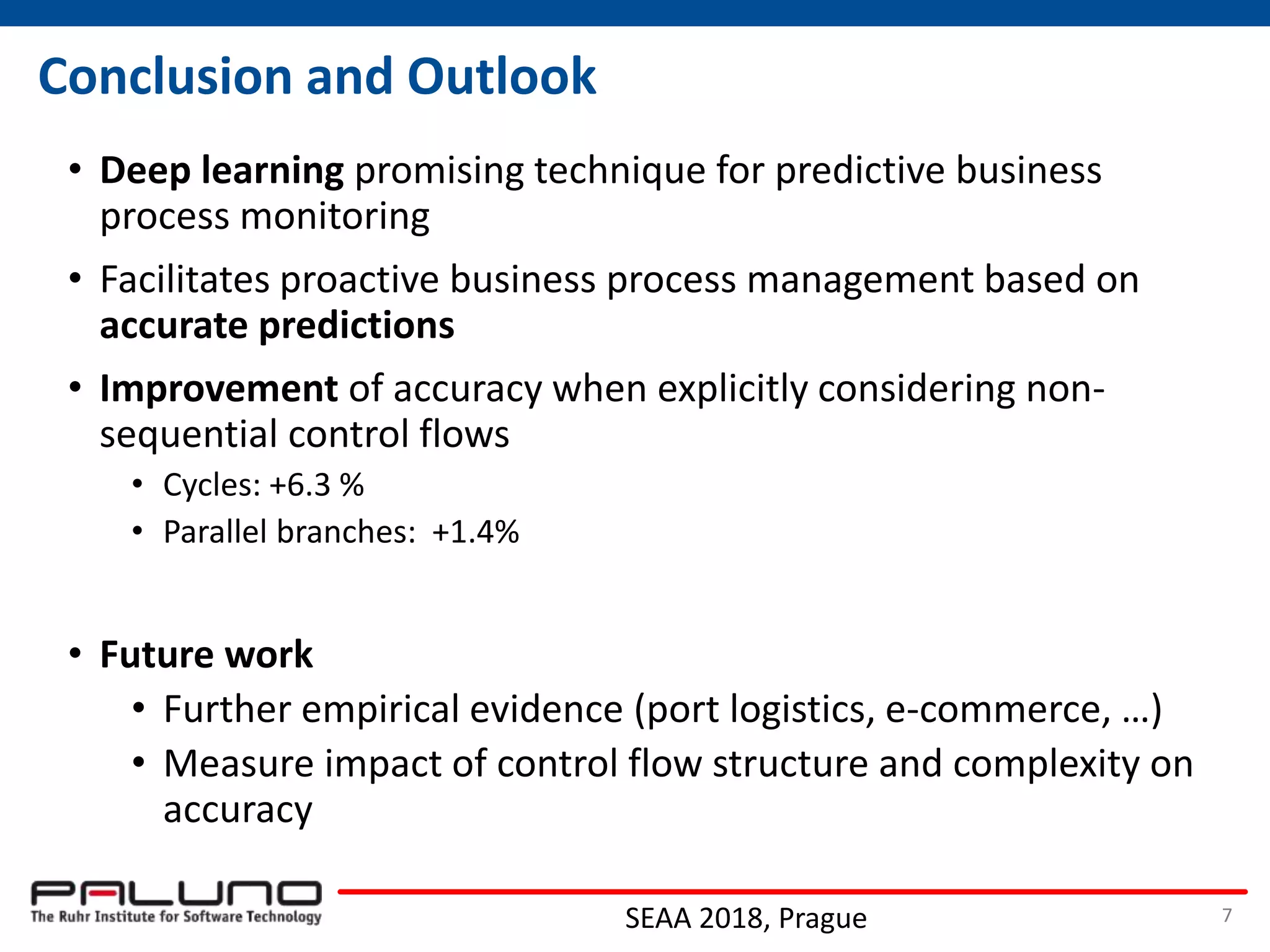

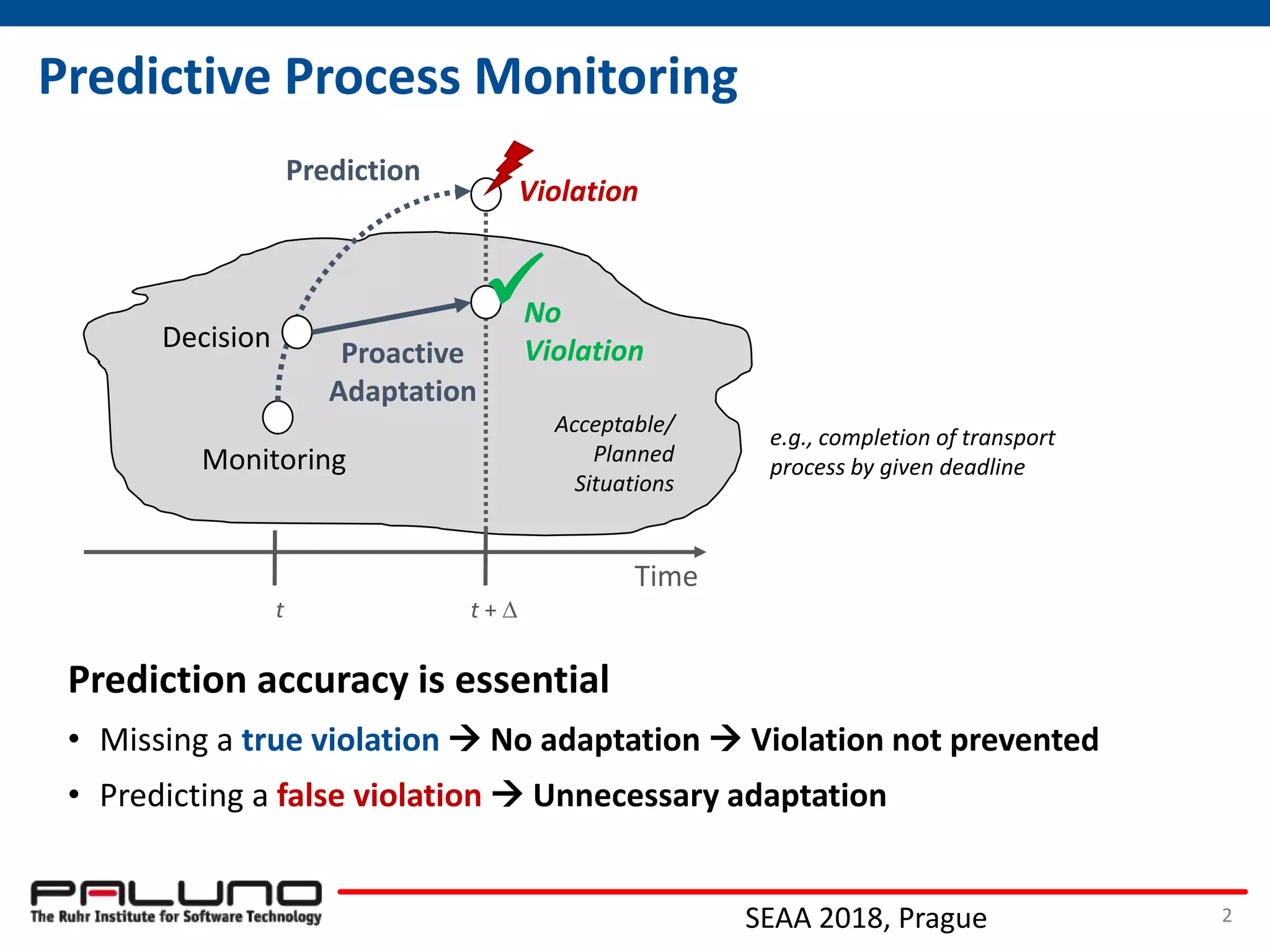
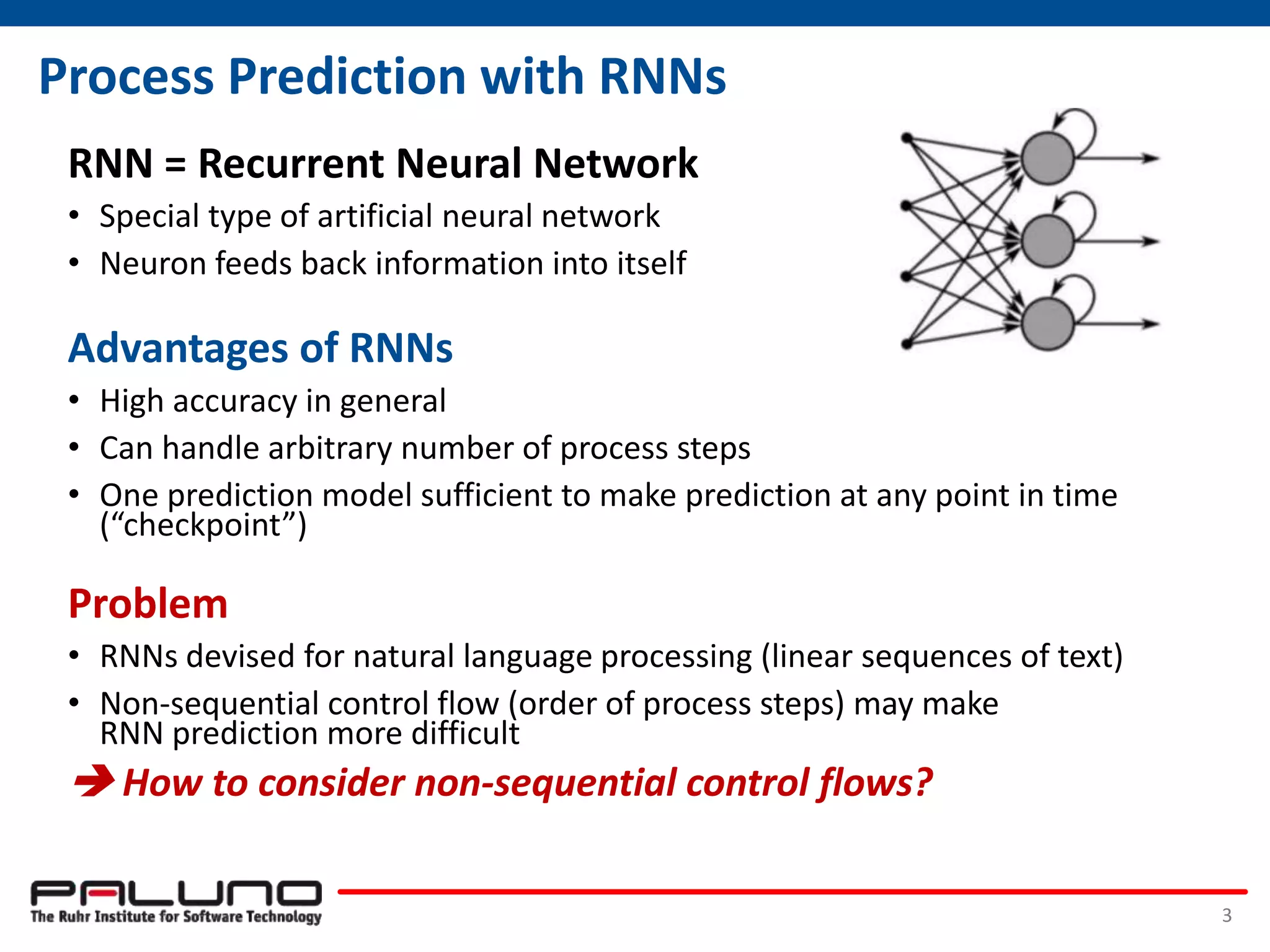
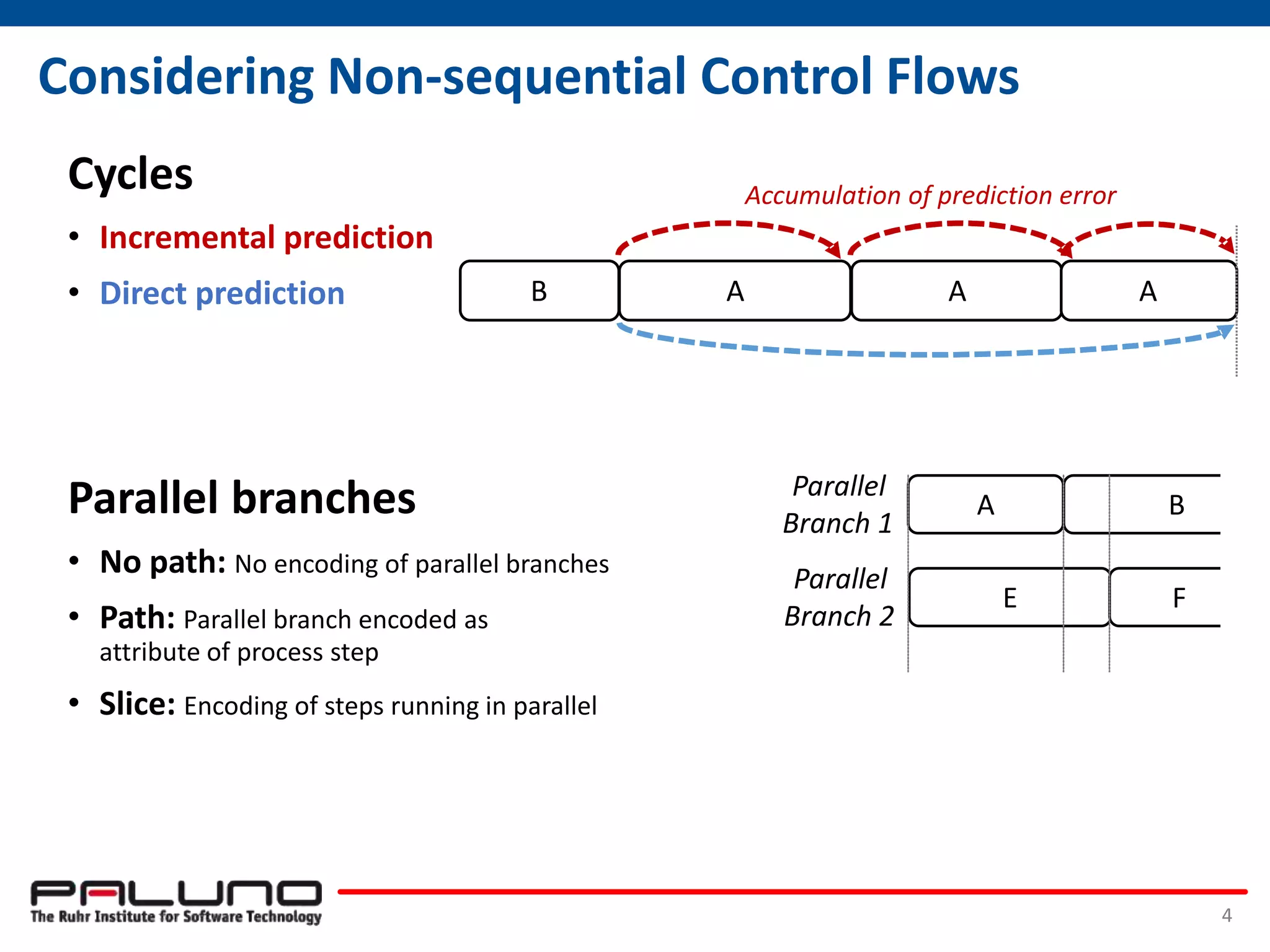
The document discusses using recurrent neural networks (RNNs) for process prediction in scenarios with non-sequential control flows, highlighting that accurate predictions are critical for proactive adaptation in process monitoring. It details experimental findings from a cargo dataset, indicating RNNs outperform traditional neural networks in predictive accuracy while also outlining specific enhancements from considering cycles and parallel branches. Future work aims to explore the impact of control flow structure on accuracy in various domains like port logistics and e-commerce.


![[DSC Europe 25] Ivan Peric - Intelligence Swarm Logic and Techno-Functional M...](https://cdn.slidesharecdn.com/ss_thumbnails/7my7c97fsduiccadgavw-2-251212103249-5a03f7c6-thumbnail.jpg?width=640&height=640&fit=bounds)
![[DSC Europe 25] Uros Pesic - The Reality of AI in Marketing.pdf](https://cdn.slidesharecdn.com/ss_thumbnails/rtkodnmtycovsllvzsyn-9-251215095918-b0c6bfe3-thumbnail.jpg?width=640&height=640&fit=bounds)


![[DSC Europe 25] Dunja Adzic Jovanovic - AI and Cybersecurity: Defending Data ...](https://cdn.slidesharecdn.com/ss_thumbnails/o1zylpbhrtwnixxq2xj8-7-251211083048-185086f6-thumbnail.jpg?width=640&height=640&fit=bounds)
![[DSC Europe 25] Milan Sekuloski - Data, Defence, and Development: Cybersecuri...](https://cdn.slidesharecdn.com/ss_thumbnails/dfrkwwx4qly6atqpbl4z-4-251209104645-c3d4b0ca-thumbnail.jpg?width=640&height=640&fit=bounds)
![[DSC Europe 25] Vladimir Jelic - The AI-Driven Security Shift From Reactive D...](https://cdn.slidesharecdn.com/ss_thumbnails/6g5gj25mtjwayniqem1t-6-251209104645-7a5a5fc6-thumbnail.jpg?width=640&height=640&fit=bounds)

![[DSC Europe 25] Bassam Maharmeh - Artificial Intelligence: Opportunities and ...](https://cdn.slidesharecdn.com/ss_thumbnails/thhfmr2fqpawzj7hsjpg-5-251211083048-2c23204f-thumbnail.jpg?width=640&height=640&fit=bounds)


![[DSC Europe 25] Debmalya Biswas - Agentification: the art of transforming man...](https://cdn.slidesharecdn.com/ss_thumbnails/r5azlggvtqiaiiusrqdr-4-251212103249-5a12c89b-thumbnail.jpg?width=640&height=640&fit=bounds)
![[DSC Europe 25] Hans Kleinsman - The Compliance Gearbox: How Tax Tech Mediate...](https://cdn.slidesharecdn.com/ss_thumbnails/dxdytie1toel0hr90bjs-2-251212103250-174fdbe7-thumbnail.jpg?width=640&height=640&fit=bounds)
![[DSC Europe 25] Jon Dajci - Bridging TradFi and DeFi: Building the Future of ...](https://cdn.slidesharecdn.com/ss_thumbnails/fqmhfvlbqhkihjvqvhmu-7-251211083849-6af7e325-thumbnail.jpg?width=640&height=640&fit=bounds)

![[DSC Europe 25] Branko Dzakula - From Defense to Attack: How AI Redefines Cyb...](https://cdn.slidesharecdn.com/ss_thumbnails/80bdzdxpr3ky2g0qvyk9-8-251211083048-ce5fc1ee-thumbnail.jpg?width=640&height=640&fit=bounds)
