Consciousness Evolving JamesH Fetzer Editor
download
https://ebookbell.com/product/consciousness-evolving-james-h-
fetzer-editor-1752254
Explore and download more ebooks at ebookbell.com
2.
Here are somerecommended products that we believe you will be
interested in. You can click the link to download.
Living Systems Evolving Consciousness And The Emerging Person A
Selection Of Papers From The Life Work Of Louis Sander Psychoanalytic
Inquiry Book Series Kindle Louis W Sander
https://ebookbell.com/product/living-systems-evolving-consciousness-
and-the-emerging-person-a-selection-of-papers-from-the-life-work-of-
louis-sander-psychoanalytic-inquiry-book-series-kindle-louis-w-
sander-1995584
Illumination Of The Shadow Ancestral Wisdom From The Past For The
Future Anthea Durand
https://ebookbell.com/product/illumination-of-the-shadow-ancestral-
wisdom-from-the-past-for-the-future-anthea-durand-48678860
Consciousness And Quantum Mechanics 1st Edition Shan Gao Editor
https://ebookbell.com/product/consciousness-and-quantum-mechanics-1st-
edition-shan-gao-editor-46091486
Consciousness In Transition Metaphysical Notes Joel Goldsmith
https://ebookbell.com/product/consciousness-in-transition-
metaphysical-notes-joel-goldsmith-47992050
3.
Consciousness 1st EditionRocco J Gennaro
https://ebookbell.com/product/consciousness-1st-edition-rocco-j-
gennaro-48318788
Consciousness Is All The Magnificent Truth Of What You Are Peter
Francis Dziuban
https://ebookbell.com/product/consciousness-is-all-the-magnificent-
truth-of-what-you-are-peter-francis-dziuban-48326492
Consciousness A Very Short Introduction Susan Blackmore
https://ebookbell.com/product/consciousness-a-very-short-introduction-
susan-blackmore-48508516
Consciousness As Complex Event Towards A New Physicalism Craig
Delancey
https://ebookbell.com/product/consciousness-as-complex-event-towards-
a-new-physicalism-craig-delancey-48675860
Consciousness The New Currency A New Paradigm For Manifesting
Conscious Abundance 1st Edition Brandon Bays
https://ebookbell.com/product/consciousness-the-new-currency-a-new-
paradigm-for-manifesting-conscious-abundance-1st-edition-brandon-
bays-49136186
Advances in ConsciousnessResearch
Advances in Consciousness Research provides a forum for scholars from
different scientific disciplines and fields of knowledge who study consciousness
in its multifaceted aspects. Thus the Series will include (but not be limited to)
the various areas of cognitive science, including cognitive psychology, linguis-
tics, brain science and philosophy. The orientation of the Series is toward
developing new interdisciplinary and integrative approaches for the investiga-
tion, description and theory of consciousness, as well as the practical conse-
quences of this research for the individual and society.
Series A: Theory and Method. Contributions to the development of theory and
method in the study of consciousness.
Editor
Maxim I. Stamenov
Bulgarian Academy of Sciences
Editorial Board
David Chalmers, University of Arizona
Gordon G. Globus, University of California at Irvine
Ray Jackendoff, Brandeis University
Christof Koch, California Institute of Technology
Stephen Kosslyn, Harvard University
Earl Mac Cormac, Duke University
George Mandler, University of California at San Diego
John R. Searle, University of California at Berkeley
Petra Stoerig, Universität Düsseldorf
Francisco Varela, C.R.E.A., Ecole Polytechnique, Paris
Volume 34
Consciousness Evolving
Edited by James H. Fetzer
Contents
Contributors ix
Introduction xiii
Prologue1
Turing indistinguishability and the blind watchmaker 3
Stevan Harnad
Part I: Natural consciousness 19
Consciousness, adaptation and epiphenomenalism 21
Tom Polger and Owen Flanagan
The function of consciousness 43
David Cole
Sensations and grain processes 63
George Graham and Terry Horgan
Part II: Special adaptations 87
Evolution, consciousness, and the language of thought 89
James W. Garson
Why did evolution engineer consciousness? 111
Selmer Bringsjord, Ron Noel and David Ferrucci
Nothing without mind 139
Stephen Clark
Part III: ArtiWcial consciousness 161
The emergence of grounded representations: The power and limits 163
of sensory- motor coordination
Stefano NolW and Oraxio Miglino
Ago Ergo Sum 181
Dario Floreano
13.
Contents
viii
Evolving robot consciousness:The easy problems and the rest 205
Inman Harvey
Epilogue 221
The future with cloning: On the possibility of serial immortality 223
Neil Tennant
Subject index 239
Name index 247
14.
Contributors
Selmer Bringsjord, Professorof Philosophy, Psychology and Cognitive Science and of
Computer Science at Rensselaer Polytechnic Institute, also serves as Director of its Minds
Machines Laboratory. Author of What robots can can’t be (Kluwer 1992) and of ArtiWcal
intelligence and literary creativity (Earlbaum 1999), his new Superminds: a defense of non-
computable cogntion, is forthcoming from Kluwer.
Stephen R. L. Clark is Professor of Philosophy at the University of Liverpool. A former
fellow of All Souls and lecturer at Glasgow University, he has delivered GiVord, Stanton,
Wilde, Scott Holland, and Read-Tuckwell lectures in philosophy of religion. His most
recent books include God, religion, and reality (1998), The political animal: biology, ethics,
and politics (1999), and Biology and christian ethics (2000).
David Cole is Head of the Departament of Philosophy at the University of Minnesota,
Duluth. His publications include articles on natural meaning and intentionality, language
and thought, and computers, consciousness, inverted spectra and qualia. The senior editor
of Philosophy, mind, and cognitive inquiry (Kluwer 1990), he has recently co-authored a
book on the evolution of technology.
James H. Fetzer, McKnight University Professor at the University of Minnesota, Duluth, is
the author or editor of 22 books, including AI: Its scope and limits (1990), Philosophy and
cognitive science (1991; 2nd edition, 1996), and The philosophy of evolution (forthcoming),
and the author of more than 100 articles in the philosophy of science and on the theoretical
foundations of computer science, artiWcial intelligence, and cognitive science. He is the
founding editor of the journal, Minds and machines.
Owen Flanagan, James B. Duke Professor of Philosophy at Duke University, has written or
edited seven books, including The science of the mind (1984; 2nd edition, 1991), Conscious-
ness reconsidered (1992), and The nature of consciousness, edited with Ned Block and Guven
Guzeldere (1998). His most recent book, Dreaming souls: sleep, dreams, and the evolution of
the conscious mind, was published by Oxford University Press in the fall of 1999.
Dario Floreano is Senior Researcher at the Swiss Federal Institute of Technology in
Lausanne (EPFL). He works in the Welds of Evolutionary Robotics, Neural Networks, and
Autonomous Agents. He has published two authored and co-authored books and two
edited books on these subjects. He organized ECAL99 (The 5th European Conference on
ArtiWcial Life) and co-organized SAB2000 (The 6th International Conference on the Simu-
lation of Adaptive Behavior).
James W. Garson, Professor and Chair of the Department of Philosophy at the University of
Houston, received his Ph.D. from the University of Pittsburgh and has held visiting ap-
pointments in Computer Science (University of Illinois at Chicago) and Psychology (Rice
University). The author of articles in logic, semantics, formal linguistics, computerized
15.
Contributors
x
education, and cognitivescience, his recent concern has been to explore connectionist and
dynamical models of cognition, with special emphasis on their implications for the nature
of mental representations.
George Graham is Professor of Philosophy and Psychology at the University of Alabama at
Birmingham. He is the author, co-author, or co-editor of six books, including When self-
consciousness breaks (MIT Press 2000). His current research focuses on the philosophy of
psychopathology and also, in collaboration with Terence Horgan, on the phenomenology
of intentionality.
Stevan Harnad, Professor of Cognitive Science at Southampton University, is the founding
editor of the journal Behavioral and brain sciences, psycoloquy, an electronic journal spon-
sored by the American Psychological Association, and the Cogprints electronic preprint
archive in the cognitive sciences, and author or contributor to over 100 publications, includ-
ing Categorical perception (Cambridge 1987), The selection of behavior (Cambridge 1988),
and Icon, category, symbol (forthcoming).
Inman Harvey has been researching in the Evolutionary and Adaptive Systems Group at the
University of Sussex for the past 11 years while pursuing a doctorate in the development of
artiWcial evolution for design problems, including a series of studies in evolutionary robot-
ics, where the “brain” and other aspects of the “body” of a robot are designed through
methods akin to Darwinian evolution, which raises philosophical as well as scientiWc issues.
Terence Horgan is Professor of Philosophy and William Dunavant University Professor at
the University of Memphis. He has published numerous articles (many collaborative) in
metaphysics, philosophy of mind, philosophy of psychology, philosophy of language,
metaethics, and epistemology. He is co-editor (with John Tienson) of Connectionism and
the philosophy of mind (Kluwer 1991) and co-author (with John Tienson) of Connectionism
and the philosophy of psychology (MIT 1996).
Orazio Miglino is an experimental psychologist who teaches Theories and Systems of
ArtiWcial Intelligence at the University of Naples II, Italy. His research interests are in the
Welds of Cognitive and Educational Psychology, in which he undertakes the construction
and the validation of artiWcial models artiWcial models (computer simulations and real
mobile robots) of real life phenomena (based upon artiWcial life and connecntionist ap-
proaches).
Ron Noel, Assistant Professor of Psychology and Assistant Director of the Minds Ma-
chines Laboratory at Rensselaer Polytechnic Institute, specializes in cognitive engineering
and the study of cognitive, biological, and machine design systems. He has received many
awards for his work, ranging from a national design award for artwork to an award by the
United States Army for the creation of original electronic hardware.
Stefano Nolfi is currently coordinator of the Division of Neural Systems and ArtiWcial Life
of the Institute of Psychology, National Research Council, Rome. His research interests
focus on neurocomputational studies of adaptive behavior in natural organisms and artiW-
cial agents, especially situated and embodied in interaction with their environments in
order to understand how living organisms change, phylogenetically and ontogenetically, as
they adapt to their surroundings.
16.
Contributors xi
Thomas Polger(Ph.D. 2000, Duke University), currently assistant professor at the Univer-
sity of Cincinnati, is a former William Bernard Peach Instructor in the Department of
Philosophy at Duke University. He has contributed to Where biology meets psychology (MIT
Press 1999) and Dennett’s philosophy: a comprehensive assessment (MIT Press 2000).
Neil Tennant, Professor of Philosophy and Adjunct Professor in Cognitive Science at The
Ohio State University, received his Ph.D. from Cambridge University in 1975. He is the
author or coauthor of Natural logic (Edinburgh 1978), Philosophy, evolution and human
nature with F. von Schilcher (Routledge and Kegan Paul 1984), Anti-realism and logic
(Oxford 1987), Autologic (Edinburgh 1992), and The taming of the true (Oxford 1997).
18.
Introduction
An adequate understandingof the evolution of consciousness presupposes an
adequate understanding of evolution, on the one hand, and of consciousness,
on the other. The former, alas, appears to be more readily achieved than the
latter. There are many accounts of evolution that have earned wide-spread
acceptance, at least in general, while the nature of consciousness remains a
matter of considerable dispute. Some envision consciousness as awareness,
some as awareness with articulation (or the ability to describe that of which
one is aware), others as self-awareness or else as self-awareness with articula-
tion. A central problem appears to be the character of subjective experience
itself with respect to its phenomenal properties (or qualia).
Evolution understood as a biological process should be characterized in
terms of three principles, namely: that more members are born live into each
species than survive to reproduce; that crucial properties of oVspring are
inherited from their parents; and that several forms of competition between
the members of a species contribute to determining which of them succeeds in
reproducing. The mechanisms that produce genetic variation, moreover, in-
clude genetic mutation, sexual reproduction, genetic drift, and genetic engi-
neering, while those that determine which members tend to survive and
reproduce include natural selection, sexual selection, artiWcial selection, and
group selection, which is a process that some theoreticians deny.
Since genetic engineering and artiWcial selection involve deliberate inter-
vention by humans to aVect the course of evolution, they may be diVerentiated
from those that ordinarily do not, which may be broadly envisioned as mecha-
nisms constituting “natural selection” in the broad sense as opposed to compe-
tition between conspeciWcs as “natural selection” in the narrow sense more
commonly associate with Darwin. But modes of communication, such as
language, and other aspects of culture, such as tools, clothing, shelter, and types
of transportation, for example, also exert an inXuence on the course of evolu-
tion. And species can ultimately be distinguished based upon their varying
degrees of cognitive versatility, which contribute to their behavioral plasticity.
As a function of changes in gene pools across time, therefore, biological
evolution may be understood, Wrst, as a set of causal mechanisms (speciWcally,
those identiWed above or an alternative set); second, as a set of historical
19.
xiv Introduction
explanations (inwhich those mechanisms are applied to speciWc historical
conditions); and, third, as a branching tree structure that reXects the evolution
of species (as a manifestation of the cumulative eVect of those mechanisms
operating across time). But it should come as no suprise if an adequate under-
standing of biological evolution should entail an adequate understanding of
cultural evolution, where an adequate theory of gene-culture co-evolution pre-
supposes an account of mentality and its connections to consciousness. Evolu-
tion and consciousness are explored in the chapters that appear in this volume.
Prologue
As Stevan Harnad contends in the Prologue, the theory of evolution appears to
be hard pressed to explain the adaptive value and causal contribution of
consciousness in human and non-human animals. One problem is that —
unless we embrace dualism and treat it as some sort of independent and non-
physical force — consciousness may or may not have an independent adaptive
function of its own, over and above those behavioral and physiological func-
tions it might supervene upon, because evolution is completely blind to the
behavioral diVerences between conscious organisms and their functionally
equivalent non-conscious counterparts, who are referred to as “zombies”. And
this is the case because natural selection itself operates at the level of behavior.
As Harnad expresses it, “the Blind Watchmaker” (natural selection), a
functionalistifevertherewereone,isnomoreamindreaderthanweare.Hence,
ifwedesignatebehavioralsimilarityas“Turingindistinguishability”inthespirit
of Turing’s test (TT), then it follows that Turing-Indistinguishability equals
Darwinian-Indistinguishability. Even though organisms that are Turing-Indis-
tinguishable would also be indistinguishable regarding their behavioral re-
sponses and therefore possess all and only the same adaptive capabilities, it
(somewhat surprisingly) does not follow that human behavior is therefore
adequately explainable on the basis of zombie physical determinism alone.
We are conscious and, more importantly, our consciousness somehow
“piggy-backs” on a vast complex of unobservable internal activity — call it
“cognition” — that appears to be responsible for generating most of our
behavioral responses. Apart from those brought about by irrational or non-
rational forces, such as instinctual sexual desires, where distal Darwinian fac-
tors continue to exert proximal inXuence, it is roughly as sensible to seek
Darwinian rather than cognitive explanations for most of our current behavior
20.
xv
Introduction
as it isto seek cosmological rather than engineering explanations of an auto’s
performance. Evolutionary theory can explain what has shaped our cognitive
capacity, but cognitive theory must explain response behavior when it is
aVected by cognition.
Part I: Natural consciousness
As Tom Polger and Owen Flanagan observe, consciousness and evolution are
rather complex phenomena. It is sometimes thought that, if adaptation expla-
nations for some varieties of consciousness, say, conscious visual perception,
can be secured, then we may be reassured that at least those kinds of conscious-
ness are not merely “epiphenomena” as phenomena that accompany other
processes yet are causally inert. But what if other varieties of consciousness,
such as dreams, for example, are not adaptations? Polgier and Flanagan sort
out the various and subtle connections among evolution, adaptation, and
epiphenomenalism in an attempt to demonstrate that the consequences of
epiphenomenalism for understanding consciousness are not so dire as some
have supposed.
David Cole contends that consciousness is not a single phenomenon and
cannot be adequately understood as having a unique function. He distinguishes
various aspects or species of consciousness (including what he calls “creature
consciousness”, “metaconsiousness”, “propositional thought”, and “qualia”),
while suggesting that each has its own distinctive function. He focuses upon
qualia, which he envisions as “the hard problem”, where the main obstacles are
coping with inverted spectrum alternatives and with missing qualia (or zom-
bie) possibilities. He oVers a “two-factor” theory of qualia, according to which
there is a way things are for us accounted for by metaconsciousness, while the
speciWc qualitative content of how things are for us is explained by the func-
tional role of imagistic representations in complex connectionist systems.
Terry Horgan and George Graham deWne an interdisciplinary research
program for consciousness. First, they identify the “causal grain” of phenom-
enal states as neurophysical and functional-representational levels, where sci-
entiWc progress is expected. Second, they discuss three key philosophical
puzzles about phenomenal consciousness, which concern its ontological sta-
tus, its causal role, and its explainability. Third, they argue that, from the
perspective of our current epistemic existential situation, even if the causal
grain of phenomenal consciousness were to become fully understood within
21.
xvi Introduction
cognitive science,various theoretical options about how to understand qualia
that are presently “live-options” in philosophical discussion would continue to
be live-options.
Part II: Special adaptations
As James W. Garson observes, the hypothesis of the existence of an innate,
species-speciWc mental language (or “language of thought”) seems to be an
attractive thesis to account for the propositional nature of higher-order con-
sciousness. But this prospect raises questions about the compatibility of an
innate mental language relative to the presumption that it should be the
product of an evolutionary process. This chapter examines research in genetic
programming in order to ascertain whether or not the language of thought
hypothesis is compatible with evolution. Indeed, two diVerent problems arise
here. The Wrst concerns the evolution of the causal mechanisms that embed
systems of symbols in such a causal role. Research on genetic programming
does not support their evolvability. The second concerns the acquisition of
symbol systems during the life of the organism. Here the evidence seems more
favorable.
Selmer Bringsjord and Ron Noel remark that you (the reader) and I (the
editor), the two of them, Plato, Darwin, and our neighbors have not only been
conscious, but at some point have decided to continue to live in order to
continue to be conscious (of that rich chocolate ice cream, that lover’s tender
touch, that joyful feeling of “Eureka!” when that theorem is Wnally proved). For
us, consciousness is, somewhat barbarically, “a big deal”. But is it for evolution?
Apparently. After all, we evolved. But why did evolution bother to give us
consciousness? The authors reWne this question, and then proceed to give what
theyregardastheonlytrulysatisfactoryanswer,whichappealstowhattheytake
to be an intimate connection between consciousness and creativity.
Stephen Clark suggests the diYculty with “dualistic theories” is that once
“matter” has been divided from “mind”, it becomes impossible to conceive of
anything but an extrinsic, brute relationship between the two, about which we
could only learn from experience. Unfortunately, no such link between mind
and matter could itself be the object of experience. It follows from this, from
the absurdity of epiphenomenalist and of materialist accounts of thinking —
and the contentlessness of merely mathematical descriptions of things — that
we ought to abandon the hypothesis of a material world distinct from experi-
22.
xvii
Introduction
enced reality, sincesuch a world could not be experienced and oVers no
explanation of our actual experience. The unexpected conclusion is that a
coherent account of the world must show how the phenomenal world has
evolved.
Part III: ArtiWcial consciousness
Stefano NolW and Oraxio Miglino explore the power and limits of sensory-
motor coordination, which they consider to be one of the lowest, if not the
lowest, levels of consciousness. Acknowledging that the word “consciousness”
tends to be used with various diVerent meanings, they attempt to investigate
the conditions under which internal representations might be expected to
emerge, especially in relation to the internal dynamics of organisms in popula-
tions of conspeciWcs that must interact with changeable external environ-
ments. They contrast the approach they favor with one known as “behavior
based robotics”, where interactions with the environment tend to be reactive
and internal representations/internal dynamics have more limited roles.
Dario Floreano explores the hypothesis that some of today’s robots might
possess a form of consciousness whose substrate is a mere algorithm. First,
consciousness is deWned within an evolutinary framework as awareness of
one’s own state in relation to the external environment. Then the basic prereq-
uisites for conscious activity, thus understood, are discussed, namely: embodi-
ment, autonomy, and suitable adaptative mechanism. ArtiWcial evolution,
rather than evolutionary optimization, is presented as a viable methodology to
create conscious robots, whose behavior they exemplify. And he contends that
what might be thought to be problematical with the concept of “robot con-
sciousness” is not the notion of a robot, but the concept of consciousness.
Inman Harvey contends that the design of autonomous robots has an
intimate relationship with the study of autonomous animals and humans,
where robots aVord convenient “puppet shows” that illustrating current myths
about cognition. Whether we like it or not, any approach to the design of
autonomous robots is invariably underpinned by some philosophical position
of the designer. While philosophical positions are typically subjected to ratio-
nal criticism, in building situated robots, philosophical positions Wrst aVect
design decisions and are later tested in the real world by “doing philosophy of
mind with a screwdriver’’. He distinguishes various kinds of “problems of
consciousness” and suggests that easy types of consciousness can be possessed
23.
xviiiIntroduction
by robots andvalidated by objective tests, while the hard kind, which concerns
qualia or subjectivity, reXects a confusion that can be dissolved in the fashion
of Wittgenstein.
Epilogue
Neil Tennant, Wnally, explores the future of cloning as an extreme form of
artiWcial selection. He speculates how human sexuality might be subjected to
an evolutionary re-conWguration by access to the technology of cloning.
Present psychological diVerences between the sexes, after all, have arisen from
the pressure of natural selection (including sexual selection) in the past, oper-
ating on a system of sexual reproduction with diVering parental investments.
Genetically variable dispositions toward sexual behavior, therefore, might be
dramatically changed were cloning to become available as an alternative to
sexual reproduction. He considers implications of such a prospect for the “war
between the sexes” and how sibling rivalry might be aVected, concluding with a
stimulating and enjoyable discussion of the possibilities for serial immortality.
TheveryideathatImightbe“myowngrandpa”,asthecountryand western
song has it, is now as fascinating as it is amusing, but encounters serious
diYculties,someofwhichareonlybeginningtobeappreciated.Humancloning
seems inevitable, but of course these clones are only genetically identical (with
respect to their genetically-relative traits, the development of which can be
aVectedinthe interuterineenvironment),andnotwithrespecttotheirenviron-
mentally-relative acquisitions of speciWc attributes (which may include the
formation of basic emotional and mental traits as a function of experience), as
the Wlm, “The Boys from Brazil”, illustrates with respect to (hopefully, imagi-
nary) attempts to replicate additional instantiations of Adolf Hitler.
Twin studies suggest that many traits are ones toward which humans
speciWcally are strongly predisposed without being disposed, where a rough
“rule of thumb” has it that approximately 60% of many traits are inherited
while 40% of those same traits are acquired. But the very propect of cloning
confronts unexpected problems relative to the “copying errors” that occur
during the process of cloning itself, where, because of the inXuence of
polygeneic and pleiotropic eVects, extremely minute diVerences in genes and
proteins can bring about substantial and unexpected diVerences in pheno-
types. The result is that even creating genetic replicas of original organisms
appears to be vastly more subtle and complex than has heretofore been as-
Introduction
24.
xix
Introduction
sumed, where ourgreatest hopes and most dire fears may be contrained by
limitations of that process.
Theories of consciousness are not complete theories of mind, of course, as
some of the contributors to this volume have observed. The focus on con-
sciousness may even appear distracting to a degree, since what we need is a
theory about the nature of the mind that brings consciousness along with it as
an essential but natural phenomenon. If we are evolutionary successors of E.
coli bacteria, for example, whose receptor proteins combine with chemotactic
substances to affect locomotion (with twelve specific attractants and eight
specific repellants), however, then consciousness and mentality may indeed be
inextricably intertwined. Other readers are therefore likely to Wnd, as I have
found, that the essays gathered together here aVord stimulating perspectives
on a central problem about the human species and its place in nature, one
upon which — thanks to these authors and to others of similar inclination —
we are making and continue to make important progress.
J. H. F.
Turing indistinguishability and
theblind watchmaker
Stevan Harnad
Southampton University
Consciousness cannot be an adaptation
Here’s an argument to try out on those of your adaptationist friends who think
that there is an evolutionary story to be told about the “survival value” of
consciousness: Tell me whatever you think the adaptive advantage of doing
something consciously is, including the internal, causal mechanism that gener-
ates the capacity to do it, and then explain to me how that advantage would be
lost in doing exactly the same thing unconsciously, with exactly the same causal
mechanism.
Here are some examples: It is adaptive to feel pain when your leg is injured,
because then you spare the leg and avoid the cause of the injury in future. (This
account must be coupled, of course, with a causal account of the internal
mechanism for detecting tissue damage and for learning to avoid similar
circumstances in the future.) How would the advantage be lost if the tissue
damage were detected unconsciously, the sparing of the leg were triggered and
maintained unconsciously, and the circumstances to avoid were learned and
avoided unconsciously? In other words: identical internal mechanisms of de-
tection, learning, avoidance, but no consciousness?
Another example: It is adaptive to pay conscious selective attention to the
most important of the many stimuli impinging on an organism at any one
time. (This must be paired with a causal account of the mechanism for attend-
ing selectively to input and for detecting and weighting salient information.)
How would that adaptive advantage be lost if the input selection and salience-
detection were all taking place unconsciously? What is the advantage of con-
scious fear over unconscious vigilance, danger-detection and avoidance? Of
conscious recall and retrieval from memory over mere recall and retrieval?
Conscious inference over unconscious inference? Conscious discrimination
over unconscious? Conscious communication? Conscious discourse? Con-
29.
4 Stevan Harnad
sciouscognition? And all these comparisons are to be made, remember, in the
context of an internal mechanism that is generating it all: the behavior, learn-
ing, memory, and the consciousness accompanying it.
The point that I hope is being brought out by these examples is this: An
adaptive explanation must be based on diVerential consequences for an
organism’s success in surviving and reproducing. This can even include suc-
cess in the stock market, so the problem is not with the abstractness or
abstruseness of the adaptive function in question, it is with the need for
diVerential consequences (Catania Harnad 1988). Adaptive consequences are
functional consequences. A diVerence that makes no functional diVerence is
not an adaptive diVerence. The Blind Watchmaker (Dawkins 1986) is no more
a mind-reader than any of the rest of us are. He can be guided by an organism’s
capacity to detect and avoid tissue injury, but not by its capacity or incapacity
to feel pain while so doing. The same is true for conscious attention vs.
unconscious selectivity, conscious fear vs. unconscious danger avoidance, con-
scious vs. unconscious memory, inference, discrimination, communication,
discourse, cognition.
So for every story purporting to explain the adaptive advantage of doing
something consciously, look at the alleged adaptive advantage itself more
closely and it will turn out to be a functional advantage (consisting, in the case
of cognition, of a performance capacity and the causal mechanism that gener-
ates it); and that exact same functional advantage will turn out to remain intact
if you simply subtract the consciousness from it (Harnad 1982, 1991, 2001).
Indeed, although the comparison may seem paradoxical (since we all know
that we are in fact conscious), those who have tried to claim an evolutionary
advantage for consciousness are not unlike those uncritical computer scientists
who are ready to impute minds even to the current generation of toy computa-
tional models and robots (Harnad 1989): There is an interesting similarity
between claiming that a thermostat has (rudimentary) consciousness and
claiming that an organism’s (real) consciousness has an adaptive function. In
both cases, it is a mentalistic interpretation that is misleading us: In the case of
the organism that really is conscious, the interpretation of the organism’s state
as conscious happens to be correct. But the imputation of functionality (over
and above the adaptive function of its unconscious causal mechanism) is as
gratuitous as the interpretation of the thermostat as having a consciousness at
all, and for roughly the same reason: The conscious interpretation is not
needed to explain the function.
30.
5
Turing indistinguishability andthe blind watchmaker
Why do we have the conviction that consciousness must have survival
value? Well, in part it must be because evolutionary theory is not in the habit of
viewing as prominent and ubiquitous a biological trait as consciousness as just
a causal dangler like an appendix, a “spandrel” (Gould 1994), or worse. A
partial reply here might be that there are reasons for believing that the mind
could be rather special among biological traits (it is surely not a coincidence
that centuries of philosophy have been devoted to the mind/body problem, not
the “blue-eye/brown-eye” problem, or even the “phenotype/genotype” prob-
lem). But I suspect that the real reason we are so adaptationistic about con-
sciousness has to do with our experience with and intuitions about free will
(Dennett 1984). We are convinced that if/when we do something consciously,
it’s because we choose to do it, not because we are unconsciously impelled to
do it by our neurophysiology (Libet 1985). So it’s natural to want to establish
an adaptive value for that trait (free will) too.
Yet it seems clear that there is no room for an independent free will in a
causal, functional explanation unless we are prepared to be dualists, positing
mental forces on a par with physical ones, and thereby, I think, putting all of
physics and its conservation laws at risk (Alcock 1987). I don’t think the mental
lives of medium-sized objects making up the relatively minuscule biomass of
one small planet in the universe warrant such a radical challenge to physics; so
let us assume that our feeling of free will is caused by our brains, and that our
brains are the real causes of what we do, and not our free wills.
This much explains why not many people are telling adaptive stories
directly about free will: Because it leads to embarrassing problems with causal-
ity and physics. Yet I think our feeling of free will is still behind the motivation
to Wnd an adaptive story for consciousness, and I think the latter is wrong-
headed for about the same reason: If it is clear why it is not a good idea to say
that there is a selective advantage for an organism that can will its actions (as
opposed to having its brain cause them for it), it should be almost as clear why
it is not good to say that there is a selective advantage for an organism that
really sees blue as opposed to merely detecting and responding to blue. We
really see blue alright, but there’s no point trying to squeeze an adaptive
advantage out of that, since we have no idea how we manage to see, detect, or
respond to blue. And once we do understand the causal substrate of that, then
that causal substrate and the functional capacities it confers on our bodies will
be the basis of any adaptive advantages, not the consciousness of blue.
31.
6 Stevan Harnad
Reverseengineering and Turing indistinguishability
How are we to arrive at a scientiWc understanding of that causal substrate?
First, I think we have to acknowledge that, as Dennett (1994, 1995) has
suggested, the behavioral and cognitive sciences and large parts of biology are
not basic sciences in the sense of physics and chemistry, but branches of
“reverse engineering.” Basic sciences study and explain the fundamental laws
of nature. Forward engineering then applies those laws to designing and build-
ing useful things such as bridges, furnaces, and airplanes, with stipulated
functional capacities. Reverse engineering, by contrast, inherits systems that
have already been designed and built by the Blind Watchmaker with certain
adaptive functional capacities, and its task is to study and explain the causal
substrate of those capacities.
Clearly, what reverse engineering needs Wrst is a methodology for Wnding
that causal substrate: a set of empirical constraints that will reliably converge
on them. The logician Alan Turing (1964) has provided the basis for such a
methodology, although, as you will see, his original proposal needs consider-
able modiWcation because it turns out to be just one level of a (“Turing-”)
hierarchy of empirical constraints (Harnad 1994a, 2000).
According to Turing’s Test, a machine has a mind if its performance
capacity (i.e., what it can do) is indistinguishable from that of a person with a
mind. In the original version of the Turing Test (T2), the machine was re-
moved from sight so no bias would be introduced by its appearance (the
indistinguishability had to be in performance, not in appearance). Then (al-
though this is not how Turing put it), the machine had to be able to correspond
(by exchanging letters) with real people for a lifetime in such a way that it could
not be distinguished from a real pen-pal. There are accordingly two dimen-
sions to the Turing Test: The candidate (1) must have all the performance
capacities of a real person and (2) its performance must be indistinguishable
from that of a real person to (any) real person (for a lifetime — I add this to
emphasize that short-term tricks were never the issue: the goal was to really
generate the total capacity; Harnad 1992b).
T2 has been the subject of much discussion, most of it not pertinent here
(Harnad 1989). What is pertinent is that the out-of-sight constraint, which was
intended only to rule out irrelevant biases based on appearance, also inadvert-
ently ruled out a lot of human performance: It ruled out all of our robotic
capacity Harnad 1995b), our capacity to discriminate, manipulate, and catego-
32.
7
Turing indistinguishability andthe blind watchmaker
rize those very objects, properties, events and states of aVairs that the symbols
in our pen-pal correspondence are about (Harnad 1987, 1992a, Harnad et al.
1995). So although the symbolic level of performance to which T2 is restricted
is a very important one (and although there are even reasons to think that T2
could not be successfully passed without drawing indirectly upon robotic
capacity), it is clear that human performance capacity amounts to a lot more
than what can be tested directly by T2. Let us call a test that calls for Turing-
Indistinguishable symbolic and robotic capacity the Total Turing Test, or T3. A
T3 robot would have to be able to live among us and interact with the people
and objects in the world Turing-Indistinguishably from the way we do.
At this point people always ask: Well, how indistinguishably? What about
the question of appearance? Would it have to be able to shave? A little common
sense is needed here, keeping in clear sight the fact that this is not about tricks
or arbitrary stipulations (Harnad 1994a, 1995a). The point of Turing Testing is
to generate functional capacities. What one aims for is generic capacities. Just
as a plane has to be able to Xy, but doesn’t have to look like or Xy exactly like
any particular DC-11 — it just has to have Xying capacity Turing-indistin-
guishable from that of planes in general — so a T3 robot would only have to
have our generic robotic capacities (to discriminate, manipulate, categorize,
etc.), not their Wne-tuning as they may occur in any particular individual.
But T3 is not the top of the Turing hierarchy either, for there is more that
one could ask if one wanted to capture Turing-Indistinguishably every reverse
engineering fact about us, for there are also the internal facts about the func-
tions of our brains. A T4 candidate would be Turing indistinguishable from us
not only in its symbolic and robotic capacities but also in its neuromolecular
properties. And T4, need I point out, is as much as a scientist can ask, for the
empirical story ends there.
So let’s go for T4, you are no doubt straining to say. Why bother with T3 or
T2 at all? Well, there are good reasons for aiming for something less than T4, if
possible. For one thing, (1) we already know, in broad strokes, what our T3
capacity is. The T3 data are already in, so to speak, so there we can already get to
work on the reverse engineering. Comparatively little is known so far about the
brain’s properties (apart from its T3 capacity, of course). Furthermore, it is not
obvious that we should wait till all the brain data are in, or even that it would
help to have them all, because (2) it is not at all clear which of the brain’s
properties are relevant to its T3 capacities. And interesting though they are in
their own right, it is striking that (3) so far, T4 neuroscientiWc data have not yet
33.
8 Stevan Harnad
beenhelpful in providing functional clues about how to reverse-engineer T3
capacity. Turing also had a valid insight, I think, in implicitly reminding us that
we are not mind-readers with one another either, and that (4) our intuitive
judgments about other people’s minds are based largely on Turing Indistin-
guishable performance (i.e., T2 and T3), not on anything we know or think we
know about brain function.1
There is one further reason why T3 rather than T4 might be the right level
of the Turing hierarchy for mind-modelling; it follows from our earlier discus-
sion of the absence of selective advantages of consciousness: The Blind-Watch-
maker is likewise not a mind-reader, and is hence also guided only by T3.
Indeed, T4 exists in the service of T3. T4 is one way of generating T3; but if
there were other ways, evolution would be blind to the diVerences between
them, for they would be functionally — hence adaptively — indistinguishable
(Harnad 2000).
Undetermination of theories by data
Are there other ways to pass T3, apart from T4? To answer that we Wrst have to
consider the general problem of “scientiWc underdetermination.” In basic
science, theories are underdetermined by data. Several rival theories in physics
may account equally well for the same data. As long as the data that a particular
theory accounts for are subtotal (just “toy” fragments of the whole empirical
story — what I call “t1” in the T-hierarchy), the theory can be further cali-
brated by “scaling it up” to account for more and more data, tightening its
empirical degrees of freedom while trimming excesses with Occam’s razor.
Only the Wttest theories will scale all the way up to T5, the “Grand UniWed
Theory of Everything,” successfully accounting for all data, past, present and
future; but it is not clear that there will be only one survivor at that level. All the
“surviving” rival theories, being T5-indistinguishable, which is to say, com-
pletely indistinguishable empirically, will remain eternally underdetermined.
The diVerences among them make no empirical diVerence; we will have no
way of knowing which, if any, is the “right” theory of the way the world really
is. Let us call this ordinary scientiWc underdetermination. It’s an unresolvable
level of uncertainty that even physicists have to live with, but it does not really
cost them much, since it pertains to diVerences that do not make any palpable
diVerence to anyone.
34.
9
Turing indistinguishability andthe blind watchmaker
ThereislikewiseunderdeterminationintheengineeringrangeoftheTuring
hierarchy (T2 - T4). T2 is the level of symbolic, computational function, and
here there are several forms of underdetermination: One corresponds to the
various forms of computational equivalence, including Input/Output equiva-
lence (also called Turing Equivalence) and Strong Equivalence (equivalence in
everycomputationalstep)(Pylyshyn1984).Theotheristhehardware-indepen-
dence of computation itself: the fact that the same computer program can be
physicallyimplementedincountlessradicallydiVerent ways.Thisextremeform
ofunderdeterminationisbothanadvantageandadisadvantage.Withitgoesthe
fullpowerofformalcomputationandtheChurch-TuringThesis(Church1936,
Turing 1937) according to which everything can be simulated computationally.
But it has some liabilities too, such as the symbol grounding problem (Harnad
1990, 1994b), because the meanings of symbols are not intrinsic to a symbol
system; they are parasitic on the mind of an external interpreter. Hence, on pain
of inWnite regress, symbols and symbol manipulation cannot be a complete
model for what is going on in the mind of the interpreter.
There is underdetermination at the T3 level too. Just as there is more than
one way to transduce light (e.g., Limulus’s ommatidia, the mammalian retina’s
rods and cones, and the photosensitive cell at your local bank; Fernald 1997)
and more than one way to implement an airplane, so there may be more than
one way to design a T3 robot. So there may well be T3-indistinguishable yet
T4-distinguishable robots. The question is, will they all have a mind, or will
only T4 robots have one? Note that the latter question concerns a form of
underdetermination that is much more radical than any I have mentioned so
far. For unlike T5 underdetermination in physics, or even T2 ungroundedness,
T3 underdetermination in mind-modelling involves a second kind of diVer-
ence, over and above ordinary empirical underdetermination, and that diVer-
ence does make a palpable diVerence, but one that is palpable to only one
individual, namely, the T3 candidate itself (Descartes’ “Cogito”). This extra
order of underdetermination is the (Cartesian) mark of the mind/body prob-
lem and it too is unresolvable; so I propose that we pass over it in silence,
noting only that, scientiWcally speaking, apart from this extra order of uncer-
tainty, the T3-indistinguishable candidates for the mind are on a par with T5-
indistinguishable candidates for the Grand UniWed Theory of Everything, in
that in both cases there is no way we can be any the wiser about whether or not
they capture reality, given that each of them can account for all the data
(Harnad 2000).2
35.
10 Stevan Harnad
t1toy fragment of human total capacity
T2 Total Indistinguishability in symbolic (pen pal) performance capacity
T3 Total Indistinguishability in robotic (including symbolic) performance capacity
T4 Total Indistinguishability in neural (including robotic) function
T5 Total Physical Indistinguishability
Figure 1
Is T4 a way? In a sense it is, because it is certainly a tighter empirical approxi-
mation to ourselves than T3. But the extra order of underdetermination pecu-
liar to the mind/body problem (the fact that, if you will, empiricism is no mind
reader either!) applies to T4 as well. Only the T4 candidate itself can know
whether or not it has a mind; and only the T3 candidates themselves can know
whether or not we would have been wrong to deny them a mind for failing
T4, having passed T3.
The T-hierarchy is a hierarchy of empirical constraints (Figure 1). Each
successive level tightens the degrees of freedom on the kinds of candidates that
can pass successfully. The lowest, “toy” level, t1, is as underconstrained as can
be because it captures only subtotal fragments of our total performance capac-
ity. There are countless ways to generate chess-playing skills, arithmetic skills,
etc.; the level of underdetermination for arbitrary fragments of our Total
capacity is far greater than that of ordinary scientiWc underdetermination. T2 is
still underconstrained, despite the formal power of computation and the ex-
pressive and intuitive power of linguistic communication, because of the
symbol grounding problem (Harnad 1990) and also because T2 too leaves out
the rest of our performance capacities. T4 is, as I suggested, overconstrained,
because not all aspects of brain function are necessarily relevant to T3 capacity,
and it is T3 capacity that was selected by evolution. So it is T3, I would suggest,
that is the right level in the T-hierarchy for mind-modelling.
I could be wrong about this, of course, and let me describe how: First, the
question of “appearance” that we set aside earlier has an evolutionary side too.
Much more basic than the selection of the mechanisms underlying perfor-
mance capacity is the selection of morphological traits, both external ones that
we can see and respond to (such as plumage or facial expression) and internal
ones (such as the macromorphology and the micromorphology [the physiol-
ogy and the biochemistry] of our organs, including our brain). The Blind
Watchmaker may be blind to T3-indistinguishable diVerences underlying our
performance capacity, but he is not blind to morphological diVerences, if they
36.
11
Turing indistinguishability andthe blind watchmaker
make an adaptive diVerence. And then of course there is the question of
“shape” in the evolutionary process itself: the shape of molecules, including the
mechanism of heredity, and the causal role that that plays. And we must also
consider the status of certain special and rather problematic “robotic” capaci-
ties, such as the capacity to reproduce. Morphological factors are certainly
involved there, as they are involved in other basic robotic functions, such as
eating and defecation; there might well prove to be an essential interdepen-
dency between cognitive and vegetative functions (Harnad 1993a).
But let us not forget the monumental constraints already exerted by T3
alone: A causal mechanism must be designed that can generate our full perfor-
mance capacity. To suppose that this is not constraint enough is to suppose
that there could be mindless T3 Zombies (Harnad 1995c), and that only the
morphological constraints mentioned above could screen them out. But, as
has been noted several times earlier, this would be a remarkable coincidence,
because, even with “appearance” supplementing T3, indeed, even with the the
full force of T4, evolution is still not a mind-reader. It seems more plausible to
me that T3 itself is the Wlter that excludes Zombies: that mindless mechanisms
are not among the empirical possibilities, when it comes to T3-scale capacity.
In any case, even if I’m wrong, T3 seems to be a more realistic goal to aim
for initially, because the constraints of T3 — the requirement that our model
generate our full robotic performance capacity — are positive ones: Your
model must be able to do all of this (T3). The “constraints” of T4, in contrast,
are, so far, only negative ones: They amount to a handicap: “However you may
manage to get the T3 job done, it must be done in this brainlike way, rather
than any old way.” Yet at the same time, as I have suggested, no positive clue
has yet come from T4 (neurobiological) research that has actually helped
generate a t1 fragment of T3 capacity that one could not have generated in
countless other ways already, without any T4 handicaps. So the optimal strategy
for now seems to be a division of labor: Let mind-modelers do T3 modelling
and let brain-modelers do T4.
Obviously, if T4 work unearths something that helps generate T3, then T3
researchers can help themselves to it; and of course if T4 research actually
attains T4 Wrst, then there is no need to continue with T3 at all, because T4
subsumes T3. But if T3 research should succeed in scaling up to a T3-passer
Wrst, we could then Wne-tune it, if we liked, so it conforms more and more
closely to T4 (just as we could calibrate it to include more of the Wne-tuning of
behavior mentioned earlier).
37.
12 Stevan Harnad
Orwe could just stop right there, forget about the Wne-tuning, and accord
civil rights to the successful T3-passer. I, for one, would be prepared to do so,
since, not being a mind-reader myself, I would really not feel that I had a more
compelling basis for doubting that it feels pain than I do in the case of my
natural fellow creatures. Never mind. The purpose of this excursion into the
Turing hierarchy was to look for methodological and empirical constraints on
the reverse engineering of the mind, and we have certainly found them; but
whether your preference is for T3 or for T4, what the empirical agenda yields,
once it is completed, is a causal mechanism: one that is capable of generating all
of our T3 capacities (in a particular way, if you prefer T4). And as I have
stressed repeatedly, neither T3 nor T4 can select directly for consciousness per
se, for there is no Turing-distinguishable reason that anything that can be done
consciously cannot be done unconsciously just as well, particularly since what
does the causal work cannot be the consciousness itself but only the mecha-
nism we have laboriously reverse-engineered till it scaled up to T3.
So, since, for all the T3 or the Blind-Watchmaker can determine, the
candidate might as well be a Zombie, does it follow that those who have been
stressing the biological determinism of behavior (Dawkins 1989; Barkow et al.
1992) are closer to the truth than those who stress cognition, consciousness
and choice?
Are we driven by our Darwinian unconscious?
Let’s consider speciWc examples. The following kind of suggestion has been
made (e.g., by Shields Shields 1983 and Thornhill Thornhill 1982; more
recently by Baker 1996, in a curious juxtaposition of pornography and bio-
psychodynamic hermeneutics that, had the writing been better, would be
reminiscent of Freud; and most recently by Miller 2001): For reasons revealed
by game-theoretic and inclusive-Wtness assumptions and calculations, there
are circumstances in which it is to every man’s biological advantage to rape.
Our brains accordingly perform this calculation (unconsciously, of course) in
given circumstances, and when its outcome reveals that it is optimal to do so,
we rape. Fortunately, our brains are also sensitive to certain cues that inhibit
the tendency to rape because of the probability of punishment and its adverse
consequences for Wtness.
This is also a result of an unconscious calculation. So we are rather like
38.
13
Turing indistinguishability andthe blind watchmaker
Zombies being impelled to or inhibited from raping according to the push and
pull of these unconscious reckonings. If we see a potential victim defenceless
and unprotected, and there is no indication that we will ever be caught or
anyone will ever know, we feel inclined to rape. If we instead see the potential
victim Xanked by a pair of burly brothers in front of a police station, we feel
inclined to abstain. If the penalties for rape are severe and sure, we abstain; if
not, we rape.
Similarly, there is an unconscious inclusive Wtness calculator that assesses
the advantages of mating with one’s sibling of the opposite sex (van den Berghe
1983). Ordinarily these advantages are vastly outweighed by the disadvantages
arising from the maladaptive eVects of inbreeding. However, under certain
circumstances, the advantages of mating with a sibling outweigh the disadvan-
tages of inbreeding, for example, when great wealth and status are involved,
and the only alternative would be to marry down (as in the case of the
Pharaohs). To put it dramatically, according to the function of this uncon-
scious biological calculator, as we approach the pinnacle of wealth and status,
my sister ought to be looking better and better to me.
These explanations and these hypothetical mechanisms would make sense,
I suggest, if we really were Zombies, pushed and pulled directly by uncon-
scious, dedicated “proximal mechanisms” of this kind. But what I think one
would Wnd in a T3-scale candidate, even a T3 Zombie, would not be such
unconscious, dedicated proximal mechanisms, but other, much more sophis-
ticated, powerful and general cognitive mechanisms, most of them likewise
unconscious, and likewise evolved, but having more to do with general social
and communicative skills and multipurpose problem-solving and planning
skills than with any of the speciWcs of the circumstances described. These
evolved and then learned T3 capacities would have next to nothing to do with
dedicated Wtness calculations of the kind described above (with the exception,
perhaps, of basic sexual interest in the opposite sex itself, and its inhibition
toward those with whom one has had long and early contact, i.e., close kin).
The place to search for Darwinian factors is in the origin of our T3 capacity
itself, not in its actual deployment in a given individual lifetime. And that
search will not yield mechanisms such as rape-inhibition-cue-detectors or
status-dependent-incest-cue-detectors, but general mechanisms of social
learning and communication, language, and reasoning. The unconscious sub-
strate of our actual behavior in speciWc circumstances will be explained, not by
simplistic local Darwinian considerations (t1 “toy” adaptationism, shall we call
39.
14 Stevan Harnad
it?),but by the T3 causal mechanism eventually revealed by the reverse engi-
neering of the mind. The determination of our behavior will be just as uncon-
scious as biological determinism imagines it will be, but the actual constraints
and proximal mechanisms will not be those dictated directly by Darwin but
those dictated by Turing, his cognitive engineer (Cangelosi Harnad 2002).3
What, then, is the role of the mind in all this unconscious, causally deter-
mined business? Or, to put it another way, why aren’t we just Zombies?
Concerns like these are symptomatic of the mind/body problem, and that, it
seems to me, is going to beset us till the end of time — or at least till the end of
conscious time. What is the mind/body problem? It’s a problem we all have
with squaring the mental with the physical, with seeing how a mental state,
such as feeling melancholy, can be the same as a physical state, such as certain
activities in brain monoamine systems (Harnad 1993b).
The old-style “solution” to the mind/body problem was simply to state
that the physical state and the mental state were the same thing. And we can
certainly accept that (indeed, it’s surely somehow true), but what we can’t do is
understand how it’s true, and that’s the real mind/body problem. Moreover,
the sense in which we do not understand how it’s true that, say, feeling blue is
really being low in certain monoamines, is, I suggest, very diVerent from the
kinds of puzzlement we’ve had with other counterintuitive scientiWc truths.
For, as Nagel (1974, 1986) has pointed out (quite correctly, I think), the
understanding of all other counterintuitive scientiWc truths except those per-
taining to the mind/body problem has always required us to translate one set of
appearances into a second set of appearances that, on Wrst blush, diVered from
the Wrst, but that, upon reXection, we could come to see as the same thing after
all: Examples include coming to see water as H2O, heat as mean kinetic energy,
life as certain biomolecular properties, and so on.
The reason this substitution of one set of appearances for another was no
problem (given suYcient evidence and a causal explanation) was that, al-
though appearances changed, appearance itself was preserved in all previous
cases of intuition-revision. We could come to see one kind of thing as another
kind of thing, but we were still seeing (or picturing) it as something. But when
we come to the mind/body problem, it is appearance itself that we are inquir-
ing about: What are appearances? — for mental states, if you think about it, are
appearances: they are what it feels like to perceive things. So when the answer is
that appearances are really just, say, monoaminergic states, then that appear-
ance-to-appearance revision mechanism (or “reduction” mechanism, if you
40.
15
Turing indistinguishability andthe blind watchmaker
prefer) that has stood us in such good stead time and time again in scientiWc
explanation fails us completely. For what precedent is there for substituting for
a previous appearance (feeling), not a new (though counterintuitive) appear-
ance (feeling), but no appearance at all (just physics)?
This, at least, is how Nagel evokes the lasting legacy of the mind/body
problem. It’s clearly more than just the problem of ordinary underdetermina-
tion, but it too is something we’re going to have to live with. For whether your
preference is for T3 or T4, it will always take a blind leap of faith to believe
that the candidate has a mind. Turing Indistinguishability is the best we can
ever do. Perhaps it’s some consolation that the Blind Watchmaker could do
no better.
Notes
1. The work of some authors on “theory of mind” in animals (Premack WoodruV 1978)
and children (Gopnik 1993) and of some adult theorists of the mind when they adopt the
“intentional stance” (i.e., when they interpret others as having beliefs and desires; Dennett
1983) can be interpreted as posing a problem for the claim that consciousness cannot have
had an adaptive advantage of its own. “Theory of mind” used in this nonstandard way (it is
not what philosophers mean by the phrase) corresponds in many respects to Turing-
Testing: Even though we are not mind-readers, we can tell pretty well what (if anything) is
going on in the minds of others (adults, children, animals): We can tell when others are
happy, sad, angry, hungry, menacing, trying to help us, trying to deceive us, etc. To be able
to do this deWnitely has adaptive advantages. So would this not give the Blind Watchmaker
an indirect way of favouring those who have mental states? Is it not adaptive to be able to
infer the mental states in others?
The problem is that the adaptive value of mind-reading (Turing Testing) depends
entirely on how (1) the appearance and behaviour of others, (2) the eVects of our own
appearance and behaviour on others, and (3) what it feels like to be in various mental states,
covary and cue us about things that matter to our (or our genes’) survival and reproduction.
We need to know when someone else threatens us with harm, or when our oVspring need
our help. We recognise the cues and can also equate them with our own feelings when we
emit such cues. The detection of internal state correlates of external cues like this is
undeniably adaptive. But what is the adaptive value of actually feeling something in detect-
ing and using these correlates? Nothing needs to be felt to distinguish real aVection from
feigned aVection, in oneself or in others. And real and feigned aVection need not be based
on a diVerence in feelings, or on any feelings at all.
Dennett is the one who has argued most persuasively for the necessity and the utility of
adopting the intentional stance, both in order to live adaptively among one’s fellow crea-
tures and in order to reverse-engineer them in the laboratory. But let us not forget that
41.
16 Stevan Harnad
Dennett’sWrst insight about this was based on how a chess-playing computer programme
can only be understood if one assumes that it has beliefs and desires. Let us not entertain
here the absurd possibility that a computer running a chess-playing programme really has
beliefs and desires. It is not disputed that interpreting it as if it had beliefs and desires is
useful. But then all that gives us is an adaptive rationale for the evolution of organisms that
can act as if they had minds and as if they could read one another’s minds; all that requires is
a causal exchange of signals and cues. It provides no rationale for actually feeling while all
that unconscious processing is going on.
2. We could decide to accept the theory that has the fewest parameters, but it is not clear
that God used Occam’s Razor in designing the universe. The Blind Watchmaker certainly
seems to have been proXigate in designing the biosphere, rarely designing the “optimal”
system; which means that evolution leaves a lot of nonfunctional loose ends. It is not clear
that one must duplicate every last one of them in reverse-engineering the mind.
3. Language, after all, has evolved to make the explicit symbolic mode (T2) dominate the
implicit sensorimotor one (T3) in our species (Cangelosi Harnad 2002).
References
Alcock, J. E. 1987. “Parapsychology: Science of the anomalous or search for the soul?”
Behavioral and Brain Sciences.10: 553–643.
Baker, R. 1996. Sperm Wars: InWdelity, sexual conXict and other bedroom battles. London:
Fourth Estate, 1996.
Barkow, J., Cosmides, L. and Tooby, J. 1992. (eds.) The Adapted Mind: Evolutionary psychol-
ogy and the generation of culture. NY: Oxford University Press.
Cangelosi, A. Harnad, S. 2002. “The adaptive advantage of symbolic theft over sen-
sorimotor toil.” Evolution of Communication (in press).
Catania, A.C. Harnad, S. (eds.). 1988. The Selection of Behavior: The Operant Behaviorism
of BF Skinner: Comments and Consequences. New York: Cambridge University Press.
Church A. 1936. “An unsolvable problem of elementary theory.” American Journal of
Mathematics. 58: 345–63.
Dawkins, Richard. 1989. The selWsh gene. Oxford; New York: Oxford University Press
Dawkins, Richard 1986. The blind watchmaker. NY: Norton.
Dennett, D.C. 1983. “Intentional systems in cognitive ethology: The “Panglossian para-
digm” defended.” Behavioral Brain Sciences 6: 343–390.
Dennett, D.C. 1984. Elbow room: the varieties of free will worth wanting. Cambridge, Mass.:
MIT Press
Dennett, D.C. 1994. “Cogntitive Science as Reverse Engineering: Several Meanings of ‘Top
Down’ and ‘Bottom Up’.” In: Prawitz, D., Westerstahl, D. (Eds.) International
Congress of Logic, Methodology and Philosophy of Science. (9th: 1991) Dordrecht: Kluwer.
Dennett, D.C. 1995. Darwin’s dangerous idea: Evolution and the meanings of life. London;
New York: Allen Lane.
42.
17
Turing indistinguishability andthe blind watchmaker
Fernald, R.D 1997. “The evolution of eyes”. Brain Behavior and Evolution 50: 253–259
Gopnik, A. 1993. “How we know our minds: The illusion of Wrst-person knowledge of
intentionality”. Behavioral Brain Sciences 16: 29–113.
Gould, S.J. 1994. “The spandrels of San Marco and the panglossian paradigm: A critique of
the adaptationist programme”. In: Sober, E. (Ed.). Conceptual issues in evolutionary
biology,.Second edition. Cambridge MA: MIT Press Massachusetts, Pp. 73–90. [Re-
printed from Proceedings of the Royal Society B, London 205: 581. 1979.]
Harnad, S. 1982. “Consciousness: An afterthought”. Cognition and Brain Theory. 5: 29–47.
Harnad, S. 1987. (ed.) Categorical Perception: The Groundwork of Cognition. New York:
Cambridge University Press.
Harnad, S. 1989. “Minds, Machines and Searle”. Journal of Theoretical and Experimental
ArtiWcial Intelligence 1: 5–25.
Harnad, S. 1990. “The Symbol Grounding Problem”. Physica D 42: 335–346.
Harnad, S. 1991. “Other bodies, Other minds: A machine incarnation of an old philosophi-
cal problem”. Minds and Machines 1: 43–54.
Harnad, S. 1992a. Connecting Object to Symbol in Modeling Cognition. In: A. Clarke and
R. Lutz (Eds.) Connectionism in Context. Springer Verlag.
Harnad, S. 1992b. “The Turing Test Is Not A Trick: Turing Indistinguishability Is A
ScientiWc Criterion”. SIGART Bulletin 3(4). (October. 9–10).
Harnad, S. 1993a. “ArtiWcial Life: Synthetic Versus Virtual”. ArtiWcial Life III. Proceedings,
Santa Fe Institute Studies in the Sciences of Complexity. Volume XVI.
Harnad S. 1993b. Discussion (passim). In: Bock, G.R. Marsh, J. (Eds.) Experimental and
Theoretical Studies of Consciousness. CIBA Foundation Symposium 174. Chichester:
Wiley
Harnad, S. 1994a. “Levels of Functional Equivalence in Reverse Bioengineering: The Dar-
winian Turing Test for ArtiWcial Life”. ArtiWcial Life 1(3): 293–301.
Harnad, S. 1994b. “Computation Is Just Interpretable Symbol Manipulation: Cognition
Isn’t”. Special Issue on “What Is Computation” Minds and Machines 4:379–390
Harnad, S. 1995a. “Does the Mind Piggy-Back on Robotic and Symbolic Capacity?” In: H.
Morowitz (ed.) The Mind, the Brain, and Complex Adaptive Systems. Santa Fe Institute
Studies in the Sciences of Complexity. Volume XXII. P. 204–220.
Harnad, S. 1995b. Grounding Symbolic Capacity in Robotic Capacity. In: Steels, L. and R.
Brooks (eds.) The ArtiWcial Life Route to ArtiWcial Intelligence: Building Embodied Situ-
ated Agents. New Haven: Lawrence Erlbaum. Pp. 277–286.
Harnad, S. 1995c. “Why and How We Are Not Zombies”. Journal of Consciousness Studies 1:
164–167.
Harnad, S. 1996. The Origin of Words: A Psychophysical Hypothesis In Velichkovsky B
Rumbaugh, D. (Eds.) Communicating Meaning: Evolution and Development of Lan-
guage. NJ: Erlbaum: pp 27–44.
Harnad, S. 2000. “Minds, Machines and Turing”. Journal of Logic, Language and Information
9(4):425–445.
Harnad, S. 2001. “No easy way out”. The Sciences 41(2):36–42.
Harnad, S. Hanson, S.J. Lubin, J. 1995. Learned Categorical Perception in Neural Nets:
Implications for Symbol Grounding. In: V. Honavar L. Uhr (eds.) Symbol Processors
43.
18 Stevan Harnad
andConnectionist Network Models in ArtiWcial Intelligence and Cognitive Modelling:
Steps Toward Principled Integration. Academic Press. pp. 191–206.
Libet, B. 1985. “Unconscious cerebral initiative and the role of conscious will in voluntary
action”. Behavioral and Brain Sciences 8: 529–566.
Miller, G. 2000. The Mating Mind. Doubeday.
Nagel, T. 1974. “What is it like to be a bat?” Philosophical Review 83: 435–451.
Nagel, T. 1986. The view from nowhere. New York: Oxford University Press.
Premack, D. WoodruV, G. 1978. “Does the chimpanzee have a theory of mind?” Behav-
ioral Brain Sciences 1: 515–526.
Pylyshyn, Z.W. 1984. Computation and cognition. Cambridge MA: MIT/Bradford
Shields, W.M. Shields, LM. 1983. “Forcible rape: An evolutionary perspective”. Ethology
Sociobiology 4: 115–136.
Steklis, H.D. Harnad, S. 1976. “From hand to mouth: Some critical stages in the evolution
of language”. In: Harnad, S., Steklis, H.D. Lancaster, J. B. (eds.) Origins and Evolution
of Language and Speech. Annals of the New York Academy of Sciences 280: 445–455.
Thornhill, R Thornhill, Nancy W. 1992. “The evolutionary psychology of men’s coercive
sexuality”. Behavioral and Brain Sciences 15: 363–421.
Turing, A.M. 1937. “On computable numbers”. Proceedings of the London Mathematical
Society 2 42: 230–65
Turing, A.M. 1964. Computing machinery and intelligence. In: Minds and machines. A.
Anderson (ed.), Engelwood CliVs NJ: Prentice Hall.
Van den Berghe, PL. 1983. “Human inbreeding avoidance: Culture in nature”. Behavioral
and Brain Sciences 6: 91–123.
Consciousness, adaptation and
epiphenomenalism
ThomasPolger and Owen Flanagan
University of Cincinnati/Duke University
1. Consciousness and adaptation
The question of the adaptive advantage of consciousness has been introduced
into the debate among philosophers of mind as support for one or another
view of the nature and causal eYcacy of consciousness. If we can explain how
and why we came to be conscious, then that will shed light on what sort of
thing, or process, or property consciousness is. If consciousness has been
selected for because it is Wtness enhancing then we may rest assured that it is
causally eYcacious, and the epiphenomenalist suspicion becomes less worri-
some (Flanagan 1992). And the odds seem good that some kinds of conscious-
ness are adaptations.
For example, surely acute pain states are adaptive. You place your hand in
a Wre. The Wre is hot. Your hand hurts. The pain causes you to remove your
hand from the Wre. Pain has certain eVects relative to human bodies that Wgure
in explanations of our overall capacity to avoid serious injury. Prima facie, pain
in humans is an adaptation for, among other things, causing us to remove our
hands from Wre and other sources of injury. Generalizing from cases like pain,
the standard view is that consciousness evolved because it conferred its bearers
an adaptive advantage.
However it is no easy task to show that consciousness is an adaptation in
the strict sense, that is, that it was originally selected for because it increased the
Wtness of its bearers (Fox Keller and Lloyd 1992). One reason is that conscious-
ness is at once phenomenologically homogeneous and heterogeneous.
Consideredatthecoarsestgrain,consciousstatessharethepropertyofbeing
experienced: all and only conscious mental states seem a certain way. Indeed
only conscious mental states seem any way at all; without consciousness there is
no subjective, phenomenological point of view.1 This phenomenological unity
of experience distinguishes conscious states from non-conscious states. Exam-
47.
22 Thomas Polgerand Owen Flanagan
ined more closely, however, conscious mental states vary widely. Experiences of
red diVer from experiences of green, experiences of colour diVer from auditory
and olfactory experiences, and so forth. This heterogeneity or variety of con-
scious mental states has caused some philosophers to wonder whether there is
any single phenomenon, consciousness, after all (Churchland 1983).
We recognize consciousness under its phenomenal descriptions; conscious
states share the Nagel-property: there is something that it is like to have a
conscious state (Nagel 1974). But we do not know how to describe it in non-
phenomenological terms. Is phenomenal consciousness a single trait, or a host
of related traits? That is, are conscious mental states realized in one way in the
brain, or in many ways?
1.1 Consciousness: Unity and variety
There is the consciousness in the sensory modalities; there are emotions,
moods, dreams, and conscious propositional attitude states; there are various
kinds of neuroses and psychoses. All of these are kinds of conscious states. This
is not a Wnal description or taxonomy of consciousness. But one must start by
picking out the phenomena to be explained and these are ways we point at the
phenomena.
If we knew how consciousness was realized in the brain we could give a
neural speciWcation. There is important work going on to investigate whether
there is some such neural property and what it might be that the states we call
‘conscious’ have in common.
One possibility is that all conscious mental states are realized by a single
neural property, say 40Hz oscillations (Crick and Koch 1990), or recurrency or
reentry (Churchland 1995; Edelman 1989). Supposing this were so, then it
might be the case that consciousness arose when human brains settled on a
certain oscillation frequency or on a certain functional architecture. Settling on
the brain states that give rise to consciousness might have been an adaptation
or it might have been an evolutionary accident. Even if consciousness was an
adaptation, it would not follow that all manifestations of consciousness, para-
noia or dreams, for example, were themselves things Mother Nature aimed to
be experienced because they were Wtness enhancing.
The abilities to walk and run are likely adaptations. Being able to walk and
run enable us to be able to waltz, and tango, and tap dance, and pole vault. But
Mother Nature did not give a hoot about these bonuses. The ability to tango is
not an adaptation. Suppose that, considered from both the phenomenological
48.
23
Consciousness, adaptation andepiphenomenalism
and neuroscientiWc points of view, consciousness is a general trait with a
common underlying neural feature or set of features that was selected for; it
would not follow that all the varieties of consciousness, all the manifestations
of consciousness, are adaptations.2
Anotherpossibilityisthattheunderpinningsofconsciousnessareasvarious
as the phenomenology. Perhaps, considered neurophysiologically, conscious-
ness is a disuniWed phenomenon — an array of processes that are similar only in
that they happen to be states that have phenomenal properties. It might then be
the case that each conscious process, each kind of consciousness, independently
came to be. Some kinds might be adaptations, others neutral free-riders; still
others might be exaptations, traits that were not initially selected for but that
were later co-opted for their adaptive advantage. There might then be no one
answer to the question of the adaptive advantage of consciousness. But it might
also be that despite the variety in their instantiation, conscious states were all
independently selected for the same reasons; that is, that the having of phenom-
enal properties, however realized, always confers the same sort of advantage to
its bearers. The question of the adaptive advantage of consciousness might then
be like the question of the adaptive advantage of camouXage: no sensible person
thinks there is a single trait, camouXage, that some creatures have. The ability to
camouXageone’sbodycanbeachievedbyanyofmanyheterogeneousphysiolo-
gies. Nevertheless, it seems that sensible things can be said about the adaptive
advantage of camouXage in general.
The phenomena of consciousness may be realized by a single neurophysi-
ological process that manifests itself it many ways; or the variegated phenom-
enology of consciousness may be realized in similarly diverse physiology.
Whether the physiological realizations of consciousness turn out to be more or
less heterogeneous than their phenomenological manifestations will surely be
relevant to questions about the adaptive advantage of consciousness. But the
relation between these questions runs in both directions: Evolution makes
traits; it may be that we cannot determine the answers to questions about the
homogeneity or heterogeneity of consciousness prior to answering questions
about its evolutionary history. That is, whether phenomenologically distin-
guishable states will count as one biological trait or many can depend on
whether they are the result of one selection process or many.
Such complications do not spell doom for the project of providing ideally
complete adaptation explanations of consciousness. But they caution against
the glib assumption that the explanatory project is easy. One should not
assume that all varieties of consciousness will be found to have etiological
49.
24 Thomas Polgerand Owen Flanagan
functions, and one cannot assume from the fact that a kind of consciousness is
currently adaptive that it was selected for.
1.2 Evolution by natural selection
The following fable is a possible account of the evolution of consciousness: In a
Wnite population of interbreeding organisms, random mutation caused a por-
tion of the population to have some sort of conscious states (i.e., for those
states, there is something that it is like for the organism to be in that state.) In
each case, the new phenotypic trait (speaking generally, consciousness) was
heritable. Sadly, a nearby volcano erupted. By chance, the eruption killed all
and only the non-conscious organisms. The conscious organisms, however,
survived and reproduced successfully, passing on the trait — consciousness.
Consciousness evolved.
Evolution occurred because there was phenotypic variation, heritability,
and diVerential reproduction. This is an evolutionary explanation. Does it
show that consciousness evolved because it was an adaptation? No. Although
evolution of consciousness occurred in this case, it was not evolution by natural
selection but rather by random drift. Only by chance did the conscious organ-
isms out-reproduce their non-conscious counterparts; it was not because they
were conscious that they survived. Evolution by natural selection — adapta-
tion — requires a further element: there must be a cause other than chance for
the diVerential reproduction that leads to evolution (Brandon 1990: 6–9).
There must be something about a trait that accounts for the relative advantage
of its bearer in a selective environment.
In order to give an adaptationist explanation of consciousness, we need to
specifywhattheadaptiveadvantageofthefeatureinquestionwasforaparticular
typeoforganisminaparticularselectiveenvironment.Weneedtoknowthatthe
trait has an etiological function. Etiological notions of function are the most
common way of thinking about functions among philosophers of biology these
days.Theideabehindthefamilyofviewsisthatthefunctionsofathingarethose
eVects for which it was selected.3 The details of the etiological notion are
disputed, but it is helpful to see what one way of formulating it looks like:
It is the/a proper function of an item (X) of an organism (O) to do that which
items of X’s type did to contribute to the inclusive Wtness of O’s ancestors, and
which caused the genotype, of which X is the phenotypic expression, to be selected
by natural selection. (Neander 1991: 174)
50.
25
Consciousness, adaptation andepiphenomenalism
Etiological functions are those that Wgure in explanations according to the
theory of evolution by natural selection.4 The etiological function of a trait is an
eVect that gave it an adaptive advantage. To claim that a trait has an etiological
function is to claim that it is an adaptation (Amundson and Lauder 1994).
1.3 Dreams and other spandrels of the brain
There are many features of organisms that are not adaptations; human chins,
for example (Gould and Lewontin 1978). Consciousness is a trait like any
other; although it might be disappointing, it would hardly be surprising if some
varieties of consciousness have no evolutionary function. Gould and Vrba call
those traits of an organism that that are not themselves adaptations but are
byproducts of other traits that have been selected for ‘spandrels’ or, if they later
come to be selected for, ‘exaptations’ (Gould and Vrba 1982). Such traits lack
etiological function.
Dreams are a plausible candidate for a type of consciousness that lacks an
etiological function. Dreams are simply the byproducts of brains doing the
things that brains do during sleep (Flanagan 1992, 1995, 1996, 2000). Some
brain activity that occurs during sleep is an adaptation. The phenomenal
mentation that occurs, although it is an eVect of those processes, is an evolu-
tionary byproduct of those brain activities for which sleep was selected. Dream-
ing qua experience makes no diVerence to the inclusive genetic Wtness of
organisms that dream. The neurochemical processes going on in their brains
while they are asleep, including those that cause dreams,do make a diVerence to
inclusive genetic Wtness; it is just that dreams make no diVerence.
In broad strokes the hypothesis goes like this. Sleeping has an elegant
neurophysiological proWle, exempliWed by reliable changes in brain waves and
in the release ratio of aminergic versus cholinergic neurochemicals. There is
good evidence that what the brain is doing during diVerent stages of sleep is
implicated in cell repair, hormone adjustment, learning, and memory con-
solidation.
Dreaming during NREM sleep is rationally perseverative and relatively
non-bizarre. A person might think that she did not sleep because she could not
stop worrying about the exam tomorrow. In fact, she did sleep. NREM sleep is
like being awake in many respects and it is easily confused with being awake.
NREM mentation is what gets left over from a normal brain gone to sleep. If
one were awake one would Wrst worry about the exam and then study. Since
the brain does not turn oV one continues to worry, but, being asleep one
51.
26 Thomas Polgerand Owen Flanagan
doesn’t get up. The perseverative dream rut doesn’t aVect the brain’s ability to
get one into a hypometabolic state in which cell repair and hormone adjust-
ment can take place.
If one sleeps eight hours, then during two of those hours, one’s eyes are
bolting around under the eyelids. This is REM sleep. Neurochemically the
NREM to REM shift marks (roughly) the shift from labor devoted to cell
reparation to labor devoted to memory consolidation and storage. The mecha-
nismsrequiredtoturnoVcertainneuronsandtoturnonotherscausewavesthat
incidentally activate areas throughout the brain, especially in the visual areas.
Some of these activations are experienced as “thoughts” and “sensations.”
Suppose the conscious brain is independently prone to try to make sense of
thoughts it has. If so, there is no surprise that it tries — and in part succeeds —
to supply a coherent story line to the noise it generates while the system as a
whole is doing what it is does during sleep.
If being an adaptation is having an etiological function, then we may call
the denial that consciousness is an adaptation etiological epiphenomenalism.
Dreams, according to the story above, are etiological epiphenomena. Dreams
are the spandrels of sleep.
Etiological epiphenomenalism is an empirical claim. It claims that the
presence of a certain type of consciousness has no adaptation explanation —
there is no eVect for which that type of consciousness was selected. One can be
an etiological epiphenomenalist about speciWc types of consciousness, e.g.,
dreams, or one might be an etiological epiphenomenalist about consciousness
generally. To say that dreams are etiological epiphenomena is to say that there
is no eVect of dreams for which they have been selected. Etiological epiphe-
nomenalism about dreams does not draw into question the existence of
dreams, or the causal role of dreams in, say, the project of self-knowledge. It
just says that, as a matter of historical fact, having dreams is not a trait that
was selected for by natural selection. Culture may come to select for dream
interpretation. But it is unlikely that sleep activity itself, say, dopamine
reuptake, is enhanced by dreaming things that can be interpreted as having
certain signiWcance rather than other, or by a population becoming virtuoso
dream interpreters.5
Defending the etiological epiphenomenalism of dreams does not commit
one to any particular conclusion about other varieties of consciousness — least
of all those that may be surreptitiously activated during dreaming. One advan-
tage of adopting an approach that treats consciousness as an array of states that
share the Nagel-property is that it allows space for the discovery that some sorts
52.
27
Consciousness, adaptation andepiphenomenalism
are epiphenomenal, e.g., dreams, while other sorts may have etiological func-
tions, e.g., visual perception.
2. Explaining the evolution of consciousness
Although it seems likely that some varieties of consciousness are adaptations,
specifying what the adaptive advantage of a kind of consciousness might be is
diYcult. But it is child’s play compared to Wnding the sort of evidence that
would indicate that any such “how possibly” story reXects how some variety of
consciousness actually gave an organism an adaptive advantage in a selective
environment. This problem, the problem of establishing that a “how possibly”
explanation is a “how actually” explanation, requires empirical data.6 By speci-
fying the adaptive advantage of a variety of consciousness, we give an ecological
account of its relative adaptedness. But even if we can discover the adaptive
advantage of some variety of consciousness, that is only one piece of an
adaptationist explanation.
2.1 Ideal adaptation explanation
Robert Brandon (1990) formulates Wve elements for an ideally complete adap-
tation explanation:
1. evidence that selection has occurred,
2. an ecological explanation of relative adaptedness,
3. evidence that the traits in question are heritable,
4. information about population structure,
5. phylogenetic information about trait polarity.
These Wve elements Wgure in explanations in terms of evolution by natural
selection.7
The second element of ideal adaptation explanation, the ecological expla-
nation, is the one that most cognitive scientists and philosophers of mind focus
on when discussing the evolution of some feature of mind — consciousness in
the present case. Ecological explanations of relative adaptedness tell why some
trait increased the Wtness of its bearer in a particular selective environment.
Such explanations describe the etiological function of that trait. But giving a
plausible story that satisWes the demand for an ecological explanation of rela-
tive adaptedness is not by itself suYcient for giving an adaptation explanation.
There are four other conditions that need to be satisWed.
53.
28 Thomas Polgerand Owen Flanagan
Regarding the Wrst element, if one is going to give a story about why
consciousness was favored by natural selection, one needs some evidence that
selection for consciousness has occurred. This is diVerent from the demand for
some evidence that the evolution of consciousness occurred. In the volcanic
random drift story discussed above we have the evolution of consciousness but
without selection for consciousness. Evolution by natural selection requires
that the cross-generation change was due to some advantage conferred by the
trait that was selected for.
Some sorts of evidence that would Wt the bill would be fossil evidence,
especially if such evidence involved fossils from competing groups of, say,
hominids. It is sometimes thought that Homo erectus and Homo sapiens roamed
the earth together. And it is widely thought that Homo sapiens were favored
because they were more intelligent than these other hominids, allowing, for
example, development of linguistic capacities. What might be the evidence that
such selection occurred? Intelligence, it has been argued, is linked to encepha-
lization, and language to speciWc cortical regions of larger hominid brains
(Byrne 1995; Wills 1993; Nahmias 1997). According to this line of thought, the
fossil evidence provides support for the idea that selection occurred because it
shows increased ratio of brain size to body size in Homo sapiens compared to
other hominids, as well as space for, e.g., Broca’s and Wernicke’s areas in the
larger skull space of Homo sapiens.8
Similar diYculties arise for Wnding evidence of heritability, the third re-
quirement for an ideally complete adaptation explanation. Since conscious-
ness is Wxed in our population, that is, we are all conscious whereas we are not
all six feet tall, we can’t observe selection for consciousness in the way we can
for height. But there are variations in consciousness between persons which
might give us the information we seek. Colour blindness may be a case where
there is a heritable variation in the qualitative structure of conscious visual
experience. Other congenital sensory deWcits (blindness, deafness) also suggest
the heritability of consciousness bearing traits.
The fourth element requires information about population structure. In-
formation about the frequencies of diVerent traits in the population is needed
in order to determine whether selection is at work, rather than, e.g. random
drift. In addition, some evolutionary models, for example, group selection
models, refer directly to the frequency of a trait in a given population. The idea
behind those models is that some traits are group traits, and are sensitive to
population density.
The Wfth element of an ideal adaptation explanation requires information
54.
29
Consciousness, adaptation andepiphenomenalism
abouttraitpolarity;thatis,whatevolvedfromwhat.Weneedevidencethatnon-
conscious creatures evolved into conscious creatures, not vice versa (Brandon
1990: 165–174).
It should be quite clear that few if any ideal adaptation explanations can be
given for any trait, much less for consciousness. The point of having an ideal
model is not to satisfy it (though that would be nice) but to have a principled
standard against which proposed explanations may be evaluated. Brandon’s
criteria for an ideal adaptation explanation is such a gauge.
Understanding and taking seriously what it would require to give an
adaptationist account of consciousness makes it very clear why it’s so hard.
Such explanations are diYcult to give for any trait. The task of giving an
adaptation explanation for consciousness inherits those diYculties intrinsic to
adaptationist explanation, and complicates them with all the philosophical and
scientiWc problems attendant to consciousness. Nevertheless, if we are going to
take consciousness seriously as a natural biological phenomenon then our
explanations (adaptationist, mechanical, and otherwise) of consciousness will
have to be measured by the same criteria applied to other biological phenom-
ena (Polger and Flanagan 1999).
2.2 Necessity and natural selection
There is a confusion that arises in discussions of consciousness and necessity
that we want to get clear about. Suppose there is some organism that performs
function f by going into physical state p. Suppose further that p is a conscious
state. That is, whatever the relationship between conscious states and physical
states turns out to be (identity, supervenience, etc.), p has that relationship to
conscious state c. Now, we can ask several sorts of questions about p. One kind
of question is: Is it logically, metaphysically, or nomically necessary that any
system in state p is thereby in conscious state c? Another question is: Is it
logically, metaphysically, or nomically necessary that f be accomplished con-
sciously? These are metaphysical questions. A third question is: Is it logically,
metaphysically, or nomically necessary that evolution produce p? This is a
historical question. Whatever one thinks the answer to the Wrst two metaphysi-
cal questions is, the answer to questions of the third sort is: no.
It is a consequence of taking seriously the idea that consciousness is a
natural phenomenon that we must treat it like any other naturally occurring
trait of a living organism. The presumption is that those traits that are currently
adaptive were formed by adaptation; the burden of proof is on the objector to
E quando lacollocò con le sue mani nella cassa mortuaria, che don
Vito aveva fatta fare a sue spese, foderata di raso bianco
internamente e di velluto azzurro, fuori — povera creatura! Era
leggera come una piuma! — e quando la casa parve vuota,
schiacciata sotto il silenzio della desolazione, ed egli si trovò
finalmente solo con la moglie vestita a lutto, dopo tre giorni di visitu,
in cui erano accorsi amici, conoscenti per prender parte al loro
dolore — entravano, senza dire una parola, rimanevano seduti, si
rizzavano, muti, per far posto ai sopravvenienti — dopo tre giorni di
doloroso stupore, durante i quali aveva tentato di consolarsi
ripensando le parole della figlia: — Verrò a darti in sogno, quel che
tu desideri. Sì, sì, papà! — la moglie e il fratello lo videro andare in
cucina con una bracciata di libri e di scartafacci, accendere il fuoco e
buttare sui carboni divampanti i fogli dei diversi libri dei Sogni,
strappati, sparpagliati perchè bruciassero meglio, i fogli del Rutilio e
gli scartafacci del frate cappuccino che non erano stati buoni a fargli
vincere neppure un terno!
Don Vito, maravigliato e contento, vedendo salire per aria, portati via
dall'impeto della fiamma i neri residui del fogli che s'ingolfavano nel
camino e sembravano tanti uccellacci di malaugurio messi in fuga, gli
disse: — Hai fatto bene! Dovevi pensarci prima.... Meglio tardi che
mai! — Don Pietro avrebbe voluto rispondergli: — Non ne ho più
bisogno.... Verrà Matilde! — Ma si mordeva le labbra per non
parlare.
E attese.
Un mese, tre mesi, un anno! Attanagliato dall'angosciosa agonia di
quella speranza, di quella promessa che la morta si era dimenticata
di mantenere — nonostante le preghiere, nonostante le messe
fàttele dire in suffragio! — egli declinava rapidamente, quantunque il
fratello don Vito fosse venuto a coabitare da lui, col caritatevole
pretesto di fargli l'amministratore del poco che gli era rimasto.
Don Vito, qualche volta, si lasciava scappare un lieve ironico accenno
al passato; e allora don Pietro scoteva amaramente il capo e
rispondeva:
57.
— Se fossevenuta!... Ma non è venuta!
— Chi? La quaderna?
E un giorno, convinto che ormai fosse inutile tenere il segreto, al
rimpianto del fratello che, alla risposta: — Se fosse venuta! —
tornava a domandare: — Chi? La quaderna? — egli scoppiò in
lacrime ed esclamò:
— Perchè lusingarmi? Perchè promettere?
Don Vito, nell'udire il racconto, pensava con spavento: — Mio fratello
impazzisce!
58.
L'IDEALE
Alberto Coscia nonpoteva soffrire questo suo volgarissimo cognome.
— Scegli un pseudonimo — gli diceva Rocchi, il pittore di anitre e di
oche. — A furia di ripeterlo...
— Perchè? Come? Non rappresento nulla in niente. Mangio, dormo,
passeggio, faccio qualche partita al bigliardo... Chi vuoi che prenda
sul serio il mio pseudonimo?
— Dovrebbero prenderlo sul serio? Sei buffo, sai? lo, vedi? non ho
adottato un cognome di battaglia. Ho battagliato con le mie anitre,
con le mie oche. Le conduco, stavo per dire, a pascolo in tutte le
Esposizioni, e ormai sono più conosciuto sotto il titolo di pittore di
anitre e di oche, o soltanto di oche — quasi la gente abbia in uggia
le povere anitre! — conosciuto più assai che non col mio nome di
Filiberto Rocchi. Credi tu, forse, che questo ridicolo Filiberto mi abbia
mai fatto piacere? L'ho annullato così.
— Quando penso che mia moglie dovrebbe essere chiamata: la
signora Coscia... mi sento correre i brividi per tutta la persona.
La invincibile fissazione era questa: — Sua moglie sarebbe chiamata:
la signora Coscia!
— Ah! Ah! — sbuffava a volte in camera — Certi sconci cognomi
andrebbero proibiti per legge!
E dire che Alberto Coscia non era solamente un buon giovane, una
gentilissima persona, ma pure un giovane colto, a cui l'agiatezza
ereditata dal babbo e, più, da uno zio, permettevano di menare
quella ch'egli qualificava vita di niente, per significare non occupata
59.
in una professione,in un negozio, in un'impresa industriale
qualunque!
— Mangio, dormo, passeggio!...
Oh! Esagerava, per modestia, e anche per delusione di non sapere in
che modo raggiungere un certo suo mistico ideale. Proprio: mistico!
Quel cognome — Coscia! — per ciò gli pareva la disastrosa influenza,
il motto cabalistico di iettatura che incombeva su la sua vita.
— Tant'è vero — concludeva il pittore di anitre e di oche — che uno,
quando non ha nessun guaio addosso, va a cercarselo col lumicino, e
dei peggiori che avrebbero potuto capitargli!
Veramente Alberto Coscia il guaio non se lo era cercato col lumicino;
gli era stato apportato dal testamento dello zio, pel quale egli
godeva di un largo patrimonio, da usufruttuario, in vista del futuro
piccolo Nicola Coscia che sarebbe stato il vero erede, se Alberto si
fosse deciso di prender moglie e di metterlo al mondo, e così
perpetuare la stirpe dei Coscia, che, in caso diverso, si sarebbe
estinta con lui.
— Gran disastro! — egli esclamava ironicamente.
Ed era ingiusto verso le due generazioni dei suoi che, a furia di
onesta attività, di economie, avevano messo insieme una sostanza
da permettere a lui, ultimo dei Coscia, di menare una vita senza
preoccupazioni di sorta alcuna, e di fare quel che voleva, cioè,
niente!
Era rimasto solo, libero, a diciotto anni mentre cominciava il suo
corso di filosofia e lettere all'Università. Lo aveva scelto tanto per
dire: ho una laurea anch'io. Laurea che, infine, non gli imponeva
nessun esercizio professionale, come quelle di avvocato, di medico,
di farmacista.
Permetteva, tutt'al più, di concorrere a una cattedra di Ginnasio, di
Liceo e, tardi, anche di Università.
Le tre, le cinquemila lire all'anno, che essa avrebbe potuto fruttargli,
le aveva già, senza grattacapi, dalle rendite del suo patrimonio; e, se
60.
gli fosse piaciuto,non gli sarebbe stato difficile di duplicarle, di
triplicarle con oculate speculazioni. Ma, a quale scopo?
La Natura gli aveva dato un'anima gentile, la filosofia — sembra
strano — gliel'aveva ridotta fantastica. Giacchè, ottenuta la laurea,
egli aveva continuato ad occuparsi di filosofia, volendo foggiarsi una
vita razionale, elevata, conforme alle grandi leggi dello Spirito — con
l'esse maiuscola, come lo canzonava il terribile Filiberto Rocchi che
gli voleva bene disinteressatamente. E intanto, egli, che avrebbe
potuto cavarsi cento piccoli capricci, e godere la giovinezza meglio di
qualunque altro, viveva quasi da eremita, ridottosi al terzo piano
della vasta casa dov'era nato, per non aver disturbi dagli inquilini, sui
quali poi non voleva far pesare l'incubo della sua presenza di
padrone di casa.
— Vita razionale, elevata, conforme alle grandi leggi dello Spirito!
— Quale? — gli domandava Filiberto Rocchi suo amico d'infanzia,
che andava spesso a trovarlo, o a scovarlo, come soleva dir lui, in
quel silenzioso terzo piano elegante e severo, quale si conveniva a
filosofo giovane, ma proprietario, cosa che ai filosofi accadeva di
rado.
— Quale? — ripeteva Alberto Coscia — Quasi io lo sapessi! Studio,
cerco: qualcosa di assolutamente diverso dalla stupida vita attuale.
— La chiami stupida perchè l'hai appena assaggiata, da studente.
Poi, quel can barbone del tuo professore di filosofia ti ha guastato la
testa; e si può dire che ti sei chiuso in quest'eremo.... Ah! Te lo
invidio! Me ne farei uno studio principesco, e forse non dipingerei più
anitre ed oche, ma animali più nobili, se ce ne sono... Ti sei chiuso in
quest'eremo a ringrullirti dietro l'Ideale! L'Ideale, caro mio, è la
realtà che si tocca e si mangia e si beve; è la piena sodisfazione dei
sensi tutti, con le grandi impressioni dello spettacolo della Natura,
della musica, delle altre arti, comprese le mie anitre e le mie oche,
che tu avresti dovuto comprare per avere qui, nel tuo studio, una
sensazione di colore passata a traverso il cervello di un tuo amico.
L'Ideale è la donna amata e posseduta, in qualunque maniera... Non
61.
scandalizzarti perchè iltuo Spirito non ha mai detto se si deve amare
così e così o cosà e cosà...
— L'ha detto.
— Per bocca di chi? Di quel can barbone del tuo professore di
filosofia? E a lui perchè non gli hai detto che non prender moglie e
far funzionare da moglie quella povera contadina della sua serva,
non è precisamente l'Ideale?
— Chi lo sa? L'Ideale è così infinito, che ognuno può appropriarsene
una parte e adattarlo ai bisogni del suo organismo, del suo intelletto.
— E allora? Tagliatene una gran fetta per te, e vivi la vita vera, la
vita vivente; scusa se mi esprimo male. Mi ispiri pietà. Ti voglio tanto
bene, che non so che farei per vederti commettere un magnifico
sproposito, di quelli che permettono di assaporare l'esistenza e
lasciano indolcita la bocca per un gran pezzo.
*
*
*
Ah, se Alberto avesse avuto il coraggio dì rivelare al suo amico quel
che teneva chiuso, sprofondato, da quasi cinque anni, in fondo al
cuore! Ma Alberto era un gran timido, e nessuno se n'era mai
accorto; il Rocchi meno di tutti, forse perchè lui, di carattere vivace,
non poteva affatto capire che si potesse essere timidi fino a
quell'eccesso.
Aveva notato, è vero, da qualche tempo in qua che la corsa di
Alberto a l'inseguimento dell'Ideale non era più, come prima, una
specie di sport, con lunghe intermittenze di riposo e di ristoro; ma
continua, celere e, in certi giorni, quasi affannosa. E questo gli
sembrava buon segno, da un lato. Dall'altro però gli faceva
sospettare che Alberto gli nascondesse qualcosa, un segreto
doloroso, del quale avrebbe voluto sbarazzarsi, e non ne trovava la
via.
62.
Di tratto intratto, con quella sua sarcastica imperturbabilità, il Rocchi
lo interrogava:
— Quanti chilometri abbiamo filato in questi giorni verso l'Ideale?
Parecchi, credo: mi sembri un po' stanco.
Rocchi fu stupito, una mattina, di sentirsi rispondere:
— Non ne posso più! O sono un imbecille, o sono un pazzo, o sono
in via di diventare qualcosa di peggio dell'uno e dell'altro!
— Cominci ad accorgertene ora?
— Meglio tardi che mai!
— Me ne rallegro sinceramente con te. E... si può sapere di che si
tratta?
— Si tratta... che l'intelligenza è il peggior dono che ci sia stato fatto
dalla Natura, da Dio, da non sappiamo chi.
— Il can barbone del tuo professore di filosofia dovrebbe saperlo.
Lo chiamava così per la straordinaria somiglianza della testa di lui
con quella di un cane di questa razza.
— Ma, più precisamente, di che si tratta, se è lecito domandarlo? —
insistè Rocchi.
— Sono nel bivio, o di rinunciare alla vistosa eredità di mio zio e
ridurmi quasi povero, o prender in moglie, per forza, la prima
femmina che càpita, ed essere infelice per tutta la vita.
— Senti: prender in moglie la prima femmina che càpita non è poi,
come tu immagini, un'idea cattiva. Con le donne non si sa mai!
Indovinala grillo! Ma che c'entra qui l'eredità di tuo zio?
— Tu non sai! Fra cinque mesi io compio trent'anni. E il testamento
di mio zio dice che se al trentesimo anno non avrò ancora preso
moglie, il suo patrimonio va interamente devoluto alla
Congregazione di carità....
— E tu, per far dispetto a cotesto tuo zio nell'inferno dove si trova —
giacchè uno che commette l'infamia di un tal testamento dev'essere
63.
con certezza all'inferno!— tu, per fargli dispetto, prendila subito, la
prima femmina che ti càpita tra' piedi. Forse avrai la fortuna di
sposare la migliore delle mogli possibili. Il caso spesso... Vincere un
terno al lotto è meno difficile di trovare una buona moglie. Non dire
che sono pessimista. Ho l'esempio di mio padre. Mio padre era un
gran originale...
— Lascia stare le storielle!
— No, questa è opportuna, ed ha il rarissimo pregio di esser vera.
Mio padre era rimasto scapolo fino a quarantacinque anni. Bellissimo
— non badare a me, non gli somiglio punto, — aveva avuto una
giovinezza avventurosa, in tutti i sensi.... Una notte — raccontava
spesso — misi senno tutt'a un tratto (non sapeva spiegarselo
nemmen lui) e prima che spuntasse l'alba avevo già deliberato:
— Sposerò la donna che passerà davanti alla mia porta allo spuntar
del sole. Attesi. Passò una donnina che andava a messa. Non era
giovane, non era bella, era anche gobbetta. Ma non esitai. E fu la
mia fortuna. — Mia madre infatti è stata una santa. Con questo non
intendo di affermare che il caso sia sempre così benigno.
— Ma io amo, da cinque anni, una creatura divina!
— Sposala dunque: che aspetti?
— Lei non sa niente!
— Faglielo sapere; ci vuole tanto poco! Se occorre un messaggero...
Non ho mai fatto questo mestiere; ma per te son pronto a tutto.
*
*
*
L'aveva vista a una fiera di beneficenza. Bionda, alta, snella, con
certi occhi sognanti... indimenticabili; voce soavissima, musicale...
indimenticabile; e una lieve andatura di tutta la persona quasi
sfiorasse il terreno coi piedi... indimenticabile! Infatti non aveva
dimenticato nulla di quanto potè osservare quella sera, l'unica volta
64.
che aveva avutol'occasione di starle vicino, confuso tra la folla,
pauroso di farsi scorgere, bevendosela tutta con gli occhi, e
sentendosi ristorare l'anima e il cuore proprio come un assetato che
riesca ad accostar le labbra a una limpida e fresca fonte.
Un altro, dopo otto giorni di attivissimo fantasticamento, avrebbe
preso disperatamente la risoluzione di avvicinare, a ogni costo,
quella signorina, di farle sapere l'opera di sconvolgimento prodotta
dalla sola vista di lei in un povero cuore. La risposta non avrebbe
potuto essere dubbia se la signorina era libera di scegliere; ma egli si
sentiva così indegno della felicità di possedere quel tesoro da
rassegnarsi anticipatamente a un possibile rifiuto.
Voleva almeno non meritarlo. E fece questo calcolo:
— La Divina — non la chiamava altrimenti — ha poco più di sedici
anni: io ne ho ventiquattro. In due tre anni, potrò fare lo sforzo di
rendermi non del tutto indegno di lei, spiritualmente, non fosse
altro; giacchè non abbiamo nessun potere di modificare il corpo e le
sembianze ricevuti nascendo. C'è l'azzurro del cielo nei suoi occhi;
c'è la più paradisiaca melodia nella sua voce; m'ispirerò ad essi per
arrivare a penetrare, ad intendere il cuore e l'anima della Divina e
conformare ogni mio sentimento, ogni mio pensiero, ogni mio atto
alla benefica ispirazione che mi verrà da lei.
E per ciò si era quasi segregato dalla società, tutto intento a
quell'opera di purificazione che lo esaltava ogni giorno più, come più
credeva che essa servisse ad accostarlo a lei.
C'erano ore e spesso giornate, nelle quali il suo misticismo filosofico
gli faceva immaginare che certi influssi, certe correnti sprigionate
dalla sua volontà dovessero arrivare fino a lei, farle vagamente
sentire che qualcuno, da lontano, le stava attorno, in una specie di
adorazione continua; e, forse, farle anche indovinare chi fosse;
perchè, certamente, ella avea dovuto notare gli sguardi dello
sconosciuto che, tra la folla, la sera della Fiera di beneficenza non
aveva cessato un sol momento di fissarla con avida ammirazione.
65.
Poi, tutt'a untratto, il bel sogno del suo Ideale gli crollava davanti
alla maligna insinuazione parsagli suggerita da qualche spirito
irrisore:
— E la tua Divina dovrà venir chiamata: signora Coscia?... Signora
Coscia!
Una mazzata sul capo gli avrebbe fatto minore impressione.
Corse dal suo avvocato:
— Vorrei mutar cognome.
— Occorre un decreto reale, ma c'è un ostacolo.
— ...?
— Il testamento di suo zio. Appena lei diventasse mettiamo il signor
Alberto Manzoni — scegliamo un cognome illustre — la
Congregazione di carità vorrebbe sùbito mettersi in possesso del
patrimonio che non servirebbe più a continuare la stirpe dei Coscia.
Non ci ha pensato?
Fece e rifece parecchi calcoli.
— Che mai poteva rimanergli, se avesse rinunziato alla maledetta
eredità dello zio?
Poco, assai poco! Suo padre era stato uno sciupone sbadato. Fin la
casa era inclusa in quella eredità!
Lui, come lui, avrebbe fatto il sacrifizio a occhi chiusi: ma avrebbe
poi potuto pretendere dalla Divina: — Vieni a condividere la mia
povertà, se ti sembra che il mio amore valga qualcosa? — Lei e i
parenti gli avrebbero riso in faccia!
*
*
*
Fu appunto in una di quelle terribili giornate di angoscia che gli
scappò detto al Rocchi:
66.
— Non neposso più! O sono un imbecille o sono un pazzo!
Il Rocchi, che gli voleva veramente bene, allora si credette in dovere
d'insistere. E quando potè strappargli, a poco a poco, una mezza
confessione, lo prese per le mani, e guardandolo negli occhi, gli
disse:
— Ma è possibile che tu sia fanciullo fino a questo punto? E la
filosofia a che giova dunque? Non capisco perchè Coscia ti debba
sembrare cognome indecente. E tutti i Bocca, i Bracci, i Nasi, i Denti,
i Gamba, i Panza, dei quali è popolato lo Stato civile? Hai dimenticato
quel nostro collega di Università che si chiamava... No, no! Con quel
cognome, quantunque un po' modificato, una signora avrebbe
dovuto arrossire di sentirsi nominata... Eppure... Via! via! Io credo
che la tua Divina, se non è una sciocca, se è ancora libera... — Sì?
tanto meglio! — dovrà dichiararsi felice di poter chiamarsi Coscia;
siine certo, fanciullo mio!
Alberto sentiva lo sbalordimento dì chi vien destato improvvisamente
nel meglio del sonno e di un sogno. La semplice ipotesi espressa dal
Rocchi, che la Divina potesse adattarsi a quel cognome, gli
annebbiava nella mente la bionda figura snella, dagli occhi sognanti!
Rocchi poi fu più feroce riguardo alla rinunzia della eredità.
— Caro mio, l'amore, l'Ideale, ne convengo, sono bellissime cose,
ma ti lasciano morire di fame, se non hai altro con cui rimediare.
L'amore, disgraziatamente, non è eterno; l'Ideale si trasforma,
tramonta, e non somiglia al sole che rispunta la mattina dopo. Se la
filosofia non insegna questo, che... filosofia è? Il can barbone del tuo
professore, quello ah! la sa lunga. Filosofo su la cattedra, nei libri —
ne ha scritti? Non lo so; — ma nella vita è uomo pratico. Impara
dunque da lui. Credi a me; non c'è donna al mondo che valga
trecentomila lire, quando esse sono tutto quel che un galantuomo
possiede. E poi, l'Ideale te lo sei goduto cinque anni; dovresti già
esserne sazio; sei ingordo, intendi? Come sono contento di aver
potuto finalmente penetrare il mistero! Ma sai che sei stato davvero
a tocca e non tocca con la pazzia? Ora, lesto, richiesta,
67.
fidanzamento, nozze... confulminea rapidità! Figùrati se quelli della
Congregazione non stanno con tanto d'occhi aperti, contano i giorni,
le ore, i minuti! Mi ero profferto, ma riconosco che non sono l'uomo
più adatto per un messaggio matrimoniale. Il tuo avvocato è persona
savia, garbata; quel che ci vuole. E non aver quest'aria sbalordita! O
scendo giù, nella via, prendo per la mano la prima signorina che
passa, e te la conduco qui: Ecco tua moglie!
*
*
*
— E se accetta... di chiamarsi...? E se non accetta?
Tre giorni di terribili ansietà.
Anche l'avvocato gli aveva detto ridendo:
— Andiamo! Un uomo come lei si preoccupa di queste sciocchezze?
Ma per lui era tuttavia cosa suprema che l'Ideale, la Divina rigettasse
sdegnosamente di essere profanata da quel vilissimo cognome.
E non volle, non seppe attendere; gli parve che, in ogni caso, gli era
già venuta meno ogni ragione di vivere.
La palla del suo revolver fu però più intelligente di lui; non lo
ammazzò.
Quando, dopo due mesi di alternativa tra vita e morte, egli entrò in
convalescenza, Rocchi, che lo aveva assistito notte e giorno da
infermiere affettuosissimo, fu felice di sentirlo esclamare:
— Com'è bella la vita anche... quando è cattiva!
Alberto Coscia si alzò da letto già guarito dalla ferita al fianco, e dalla
malattia dell'Ideale. Il tentativo del suicidio aveva impedito
all'avvocato di eseguire l'incarico avuto; e proprio in quei giorni la
bionda creatura dagli occhi sognanti si lasciava rapire da un galante
chauffeur.
Alberto non ne fu scosso. Disse soltanto:
68.
— Infine, nonè gran male l'aver sognato tanti anni!
Il giorno delle sue nozze con una buona e modesta signorina
propostagli dall'avvocato, Rocchi fece all'amico il regalo di un
simbolico quadro: L'Ideale: Dalla cresta d'un caminetto che si
scorgeva appena, in basso, salivano larghe ondate di denso fumo
che dileguavano disperdendosi in fondo, lontano, su la vasta
campagna illuminata dal sole.
69.
UN SOGNO
— Edove lo mettiamo quel caro Natale Mirone che si farebbe in
quattro per un amico?
— Lo ha messo a posto il becchino.
— Morto?
— Quattro giorni fa.
— E non me ne avete detto niente!
— Non era una bella notizia che avrebbe potuto farti piacere.
— Oh, povero Natale! Lo avrei accompagnato volentieri ai
Camposanto.
— Gran consolazione pel morto!
— Non scherziamo su certe cose. Era una brava persona,
quantunque...
— Già, quantunque....
— Ma la colpa non è stata sua. Si può essere il primo galantuomo
del mondo e aver la sventura....
— Sua moglie appunto suol dire: Si può essere la più buona donna
del mondo e aver la sventura....
— Di che si lagna?
— Va' a domandarglielo. Io non sono curioso. Il mio metodo è di
attenermi alle apparenze. Che ne sappiamo di quel che c'è sotto?
— Le apparenze ingannano.
70.
— Ed iomi lascio ingannare.... Buono questo capretto al forno!
— Mi è passato l'appetito.... Gli volevo bene al povero Natale.
Ricordo....
— Eh, via! Sei in un momento di estrema tenerezza!
— Voi non potete capire. Si arriva dopo lunga assenza; ci si fa
anticipatamente una festa di rivedere questo, di abbracciare quello;
tutta la nostra vita, a una cert'epoca, consiste nelle memorie della
giovinezza, nelle testimonianze viventi, i compagni di allora; ed ecco,
uno è morto, l'altro è andato in America, il terzo... insomma, spariti
tutti! Questa di Natale non me l'aspettavo!
— Hai trovato noi.
— Voialtri siete della seconda generazione.
— Ma come ti è venuto in testa di ricordarlo?
— Finiamo di cenare. Non voglio contristarvi il piacere di quest'ora di
dolce intimità che avete voluto procurarmi. Si può bere.... alla salute
di un morto?
— Alla salute eterna! — direbbe il parroco.
— Beviamo alla sua cara memoria.
— Beviamo!
Così i quattro amici finirono di festeggiare quella sera il ritorno di
don Ciccio Lanuzza al paese nativo d'onde mancava da più di dieci
anni.
La cena avveniva nell'«Albergo Nuovo» di cui uno degli amici era
azionista. Nuovo sì, ma piccolo: otto stanze in tutto, compresa la
sala da pranzo. E quella sera don Ciccio Lanuzza era l'unico
passeggero.
Preso il caffè, accesi i sigari, dopo alcuni momenti di silenzio, egli
tornò a parlare del morto.
— Povero Natale! Che malattia lo ha ucciso?
71.
— Mah!...
— Sidicono tante cose....
— Se ne dovrebbe, forse, mescolare la Giustizia.
— La Giustizia? Perchè?... Che mi fate sospettare!
— Non sei solo a sospettarlo.
— La moglie?
— O il ganzo.
— O tutt'e due!
— Come? Dopo tant'anni? Che noia gli dava?
— Appunto, forse, perchè accettava tranquillamente il fatto
compiuto.
— E' un'infamia! E nessuno li denunzia?
— Non ci sono interessati a farlo. Si è trovato un testamento di
parecchi anni fa, col quale egli istituiva sua erede universale la
moglie.
— E così, ora, don Neli Tasca sposerà la vedova e si godrà....
— Don Neli Tasca è furbo: non sposerà. Con quella donna, non si sa
mai....
— E dire che è stato un matrimonio di amore! I parenti di lei non
volevano. — Chi sposi? Uno che ancora non ha nè arte ne parte? —
Allora Natale Mirone era studente di terz'anno in legge. Vista
l'ostinatezza di lei, i parenti, all'ultimo, acconsentirono. La cerimonia
religiosa fu quasi lugubre. A sera avanzata, non eravamo una diecina
nell'ampia chiesa di cui poche candele accese sull'altare di una
cappella rischiaravano l'oscurità. La sposa vestita dimessamente, con
l'abito di tutti i giorni, accompagnata soltanto da una zia e dalla
madre di lui, tutte e tre con quegli scialli neri che io non ho potuto
mai tollerare e che mi mettono di malumore anche oggi quando li
rivedo. Scortammo la sposa fino all'uscio di casa sua. Il matrimonio
civile fu celebrato un anno dopo, con qualche sfoggio. I parenti di lei
72.
ormai si eranorabboniti: e gli sposi che, dalla sera della cerimonia
religiosa, si erano sempre visti lei dal balcone, lui dalla via, come due
innamorati, andarono ad abitare una casetta di quattro stanze,
arredate semplicemente, quella con la facciata verde pisello, non
ancora sbiadita, perchè una volta le cose si facevano con coscienza,
quella dirimpetto alla chiesuola di Santa Lucia; l'ho riveduta questa
mattina, arrivando.
— Don Natale Mirone da cinque anni non abitava più là. Aveva
comperata la palazzina dei Nolfo, col giardinetto dietro.... E' morto
proprio nel giardinetto.
— E non era un vigliacco, posso assicurarvelo. Quella sua incredibile
tolleranza è rimasta un gran mistero per me. Una sola volta, da
principio, gli ho veduto, momentaneamente, perdere la padronanza
di se stesso e con uno che metteva paura ai più arrischiati. Lo avete
forse conosciuto: Mastro Nitto, il ferraio, quello che faceva chiavi
false pei ladri, e «temperini» di due spanne per gli assassini. Un
colosso, con certe braccia, e certi pugni.... Basta! Passavano davanti
alla sua bottega. Egli era seduto al sole, senza berretto, con la zucca
pelata che stralucciacava. Mi par di vederlo. E Natale, sbadatamente,
gli disse: — E che, Mastro Nitto? Ve le cuocete al sole? — E Mastro
Nitto, passandosi la lingua su le labbra, rispose: — Voscenza, le sue,
e fa bene, se le custodisce col cappellone di paglia. — Non so chi mi
diè, quel giorno, la forza di trattenerlo. Un luccicore di belva apparve
e sparve nei suoi occhi. Un lampo! Un istante! Poi egli prese il mio
braccio e disse: — Grazie!... Ha ragione!... — Ebbi la ingenuità di
dirgli: Tu dunque sai? — Abbassò il capo e lo rilevò immediatamente:
— Da un pezzo!... Come ignorare? — Fece un'alzata di spalle e non
disse altro. Peccato! Un gentiluomo come lui! Un cuor d'oro come lui!
Chi non ha sperimentato la sua bontà?
— Bontà fino a un certo punto! Si lasciava sfruttare, senza mai
accorgersi che abusavano di lui.
— Altro, se se n'accorgeva!
— Dicono però che in casa, a quattr'occhi, con la moglie era terribile.
73.
— In chemodo? Fandonie! Avrebbe potuto prenderla per le spalle e
buttarla in mezzo di una strada. Peggio: farla arrestare in flagrante,
lei e il suo complice, specialmente dopo che lei si era assestata con
don Neli Tasca, e facevano il comodo loro come se il marito non
esistesse. Per questo non capisco perchè se lo siano tolto davanti.
— La ragione c'è. Si temeva che facesse un altro testamento.
— Non doveva prendere il permesso da lei.
— Si dice anzi che il testamento esista, non si sa in quali mani o
presso quale notaio.
— Intanto la moglie ha messo fuori quello di anni fa. Non ci sono
parenti dalla parte di Don Natale, per far ricerche e tentar di
scoprire...
— E il Pretore? I carabinieri? Nessuno ha pensato di aprire gli occhi
alle Autorità.
— Chi vuoi che s'impicci con don Neli Tasca?
— Ma com'è avvenuto il fatto?
— Semplicemente. Don Natale faceva la sua solita partita a tresetti
nello studio del notaio Radice. Non era allegro; si sentiva indisposto.
Io mi trovavo là per caso e stavo a guardare i giocatori. Tutt'a un
tratto don Natale si rizzò da sedere, pallido, barcollante. Disse: —
Scusate: vado a casa. — Lo accompagnò il giovane del notaio. Egli
tornò dopo un quarto d'ora, atterrito, balbettando a stento: — E'
morto! E' morto! — Poi, riavutosi un po', raccontò che il povero don
Natale era andato a sedersi su una panca, sotto un albero di arancio
dei giardinetto, perchè non si sentiva in forze di far le scale. Accorse
la signora. Insisteva domandando: — Che vi sentite? Spericolone!
Che vi sentite? — Quasi lo maltrattava. — Su, venite a prendere una
tazza di caffè! Spericolone! — E se non c'era il giovane del notaio, il
povero don Natale cascava per terra.
— Ora pochi credono al colpo apoplettico, al male cardiaco. Si è
osservato che la vedova ha avuto troppa fretta di farlo seppellire;
mah!...
74.
— Come... mah?!Bisogna avere il coraggio di avvertire la Giustizia,
per scrupolo di coscienza.
— Per buscarsi probabilmente una querela di calunnia?
Don Ciccio Lanuzza quella sera andò a letto commosso e indignato, e
stentò a prender sonno. Ma quando si svegliò, tardi, la mattina, non
sapeva persuadersi di aver sognato.
*
*
*
Il sogno era stato questo.
Gli era parso di vedersi davanti al letto l'amico, entrato senza far
rumore, quantunque l'uscio della camera fosse rimasto chiuso col
paletto interno.
— Tu? E mi hanno detto che sei morto!
Si era rizzato a sedere sul letto, tendendogli le mani.
— Non si muore; sono più vivo di prima.
La voce era esile e le parole parevano tremolare, quasi ondulare
dietro la gola prima di uscire dalle labbra smorte che si movevano
appena.
— Son venuto per ringraziarti di quel che hai detto ieri sera di me. E'
vero: mi hanno avvelenato!...
— Dunque sei morto!
— Non si muore, ti ripeto. Si sparisce, perchè gli occhi nostri non
riescono a vedere.
— Che posso fare per te? Denunziarli?
— E' inutile.
— Dovranno godersi il tuo patrimonio gli assassini? Hai lavorato
tanto! E' una infamia!
75.
— Non selo godranno. Vedi? Questo è il mio ultimo testamento.
L'amico a cui era affidato è morto due giorni dopo di me. Sono
andato a riprenderlo dalla cassetta dove stava riposto. Vuoi leggerlo?
Il foglio di carta, spiegato, si agitava nell'aria quasi la mano che lo
porgeva stentasse a sostenerlo.
— Non importa!
Lanuzza cominciava ad avere paura di trovarsi faccia a faccia col
fantasma del suo amico.
— Andrò a rimetterlo dov'era. Lo ritroveranno.
— Ma... spiegami, come mai tanta tolleranza da parte tua?
— Dovevo scontare. Quel che ho sofferto nessuno lo saprà mai.
— Scontare che?
— Non puoi capirlo.
— E ora, che vuoi da me?
— Dovrai dire al Pretore: C'è un testamento in casa degli eredi di
don Tino Lo Faro, in fondo alla terza cassetta a sinistra della sua
scrivania. Andate a cercarlo. Grazie... Addio! Addio!
Don Ciccio Lanuzza, destatosi di soprassalto, si trovò a sedere sul
letto, con le gambe penzoloni dalla sponda, con brividi per tutta la
persona, e un gran sgomento nel cuore.
Dalle fessure dell'imposta già penetrava nella camera la luce del
sole. Saltò giù dal letto e principiò a vestirsi.
— Sogno?... Realtà?...
Egli era un po' scettico, un po' libero pensatore, quantunque intorno
a certe cose pensasse assai poco. Ma il ricordo di quel che aveva
visto e udito in sogno era così vivo e così netto che, udito e veduto
da sveglio, non avrebbe potuto essere più netto e più vivo.
Ordinariamente, nel sogno c'è sempre qualcosa di indeciso, di
confuso, di scucito. Invece egli rivedeva l'amico un po' pallido, un po'
76.
dimagrito; aveva nell'orecchiol'accento alquanto fievole ma chiaro,
con cui quello aveva parlato, e gli pareva di sentirsi ripetere le
precise indicazioni: — Nella terza cassetta a sinistra.
Ma, aperta la finestra, lavatosi, terminato di vestirsi, l'impressione
del sogno si attenuava, lo faceva sorridere. Ieri sera avevano parlato
tanto del povero Natale Mirone, del sospetto di avvelenamento, della
probabile esistenza di un ultimo testamento; e, nella nottata,
l'immaginazione aveva lavorato, aveva lavorato.... Via! Quando si
muore è per sempre! E gli parve fin ridicolaggine il parlarne agli
amici che vennero a trovarlo all'albergo quantunque provasse
nell'animo l'incitamento continuo di dire:
— Sentite che sciocchezza ho sognato!
La notte appresso, però, riecco l'amico Natale. La sua persona
emanava una sottile fosforescenza che la faceva distinguere
benissimo nel buio fitto della camera.
— Mi fai soffrire! Perchè non sei andato dal Pretore?
— Scusa, mi è parso...
— Come siete vanitosi e ignoranti voi vivi! Andrai? Giurami che
andrai! Dammi la mano.
— Te lo giuro!
La sensazione del ghiaccio di quella mano lo fece destare tutt'a un
tratto.
— Ma dunque non era sogno? Possibile?
E la mattina dopo andò dal Pretore, giovanotto quasi imberbe che
faceva le sue prime prove giudiziarie, da incaricato.
Si era fatto presentare da uno dei suoi amici, il quale aveva voluto,
prima, esser rassicurato che non si trattava di denunziare il sospetto
di avvelenamento.
— No; si tratta di un sogno.
— E vuoi raccontarlo al Pretore?
77.
Il giovane magistratosospese l'istruttoria di un processo di furto e
ricevè con aria di grande curiosità la visita del Lanuzza che già
conosceva di nome.
Don Ciccio cominciò a parlare un po' imbarazzato.
— Non vorrei che il signor Pretore credesse a uno scherzo di cattivo
genere. Ho esitato, anzi non ho voluto, ma poi... Nei casi come
questo è pericoloso credere e non credere. Pericoloso veramente no.
Infine, tentando, non si nuoce a nessuno.
— Parli pure, tagli corto i preamboli.
Durante il racconto di don Ciccio, il Pretore aveva fatto uno sforzo
per mantenersi serio. All'ultimo, disse ridendo:
— E lei presta fede ai suoi due sogni?
— Per dire la verità.... Ma ho letto, non so dove, di sogni veridici che
si sono verificati punto per punto....
— E' forse spiritista?
— Oh, no! — protestò don Ciccio. — Se lei però volesse provare....
Sarebbe bella che si trovasse davvero il testamento in casa dei Lo
Faro! Non si può sospettare di un trucco. Io manco da dieci anni da
questo paese. Fino a due giorni fa ignoravo la morte del mio amico.
E poi... due notti di sèguito: — Nella tale cassetta! — Facciamo come
san Tommaso, che credette dopo ch'ebbe toccato....
— Mette in gran curiosità anche me.
Andarono di sera, Pretore, Cancelliere e i due amici, zitti zitti, con
grand'allarme della famiglia Lo Faro.
— Scusino; si tratta semplicemente di ritrovare una carta affidata
all'amicizia e all'onestà del loro rimpianto capo di famiglia. Terza
cassetta, a sinistra: numero e posto precisi.
Silenzio profondo; tutti ansiosissimi attorno alla scrivania.
Al Pretore, che poco prima faceva il bello spirito, tremava la mano
nell'infilare la chiave nella toppa.
78.
La cassetta erapiena zeppa di carte: lettere, ricevute, note di
fornitori. All'ultimo, proprio addossata al fondo, ecco una busta
gialla, con cinque suggelli e la soprascritta: Testamento olografo del
signor Natale Mirone, consegnato all'amico don Tino Lo Faro.
Tutti si sentirono correre un gran brivido per le ossa.
Il Pretore strappò la busta, e aperse il foglio, Don Ciccio Lanuzza
impallidì riconoscendolo per quello veduto in sogno.
— Un pezzo di carta, inutile! — esclamò il Pretore. — Manca la firma.
Dice: — Io qui sottoscritto, sano di corpo e di mente... — Di mente
no, perchè ha dimenticato l'essenziale.
— E' la sua scrittura! Ma se non c'è la firma....
La delusione fu grande. Don Ciccio, dopo questa gran prova, attese
inutilmente, tante nottate, che l'amico Natale venisse a dargli
qualche schiarimento.
E ogni volta che raccontava il suo veridico sogno, soleva aggiungere:
— Anche i morti sbagliano! Sbagliano tutti! E dire che se non
mancava la firma, a quest'ora la vedova e il suo ganzo non
riderebbero alle spalle dell'assassinato! La giustizia di questo mondo
va così; e — soggiungeva a bassa voce — anche quella dell'altro, a
quel che pare!
79.
ARME RITORTA
Non lopoteva soffrire... indovinate perchè? Per la estrema gentilezza
delle sue maniere. A ogni suo atto, a ogni sua parola, a ogni suo
gesto bisognava dirgli: Grazie! Grazie! Sorridergli, stringergli la
mano... Ed era, per Rocco Biagi, un'oppressione, un soffocamento!
Non già che egli fosse duro di cuore, incapace di apprezzare un
favore, una cortesia; lo irritava l'eccesso. E Bortolo Giani — bisogna
riconoscerlo — eccedeva.
Rocco glielo diceva a modo suo, con tono di voce tra serio e
scherzoso:
— Tu dovresti apprendere a fare qualche piccola sgarberia, per
intermezzo, per dar più valore e sapore alla squisitezza dei tuoi
modi. Una grossa sgarberia non guasterebbe. Anzi! Anzi!
— Ma io....
— Sta' zitto! Tu somigli a certe paste.... troppo dolci. Il guaio è che
mentre nessuno può forzarci a mangiarne più di una, invece, con te
non si sa come rifiutare....
— Ma io....
— Sta' zitto! Prova. Vedresti che mirabile effetto! Un'impertinenza,
una sgarberia di Bortolo Giani! Impagabili!
— Intanto, scusa....
— Ci siamo!
— L'altro giorno tu dicevi...
80.
— Dio mio!Con te non si può neppur fiatare!...
— Chiami fiatare lo esprimere un desiderio, così, senza
nessun'intenzione di incomodare qualcuno?
— Mi metti paura!... Che cosa ho detto l'altro giorno?
— Che avresti pagato un occhio....
— E' un modo di dire.
— Lo so. Ed io, per caso, ho trovato, senza che tu sia costretto.... a
pagarlo un occhio. Ecco qua!
Ogni volta così. Rocco Biagi si sentiva annichilito davanti a tanta
cortesia.
Gli altri compagni di ufficio ne abusavano: — Giani, scusa.... questo!
Giani, scusa, quello! — Giani era diventato il servitore di tutti, ma lo
faceva così volentieri, ma sembrava così deliziato di poter rendere un
servigio, che quasi sarebbe parso villania risparmiarlo. Ne abusavano
e ne ridevano tra loro. Qualcuno aveva tentato anche di sfruttarlo;
ma su questo punto dei quattrini, Bortolo Giani trovava sempre
modo di scusarsi, specialmente se la somma richiesta superava le
dieci lire. E la scusa era sua moglie.
— Quella benedetta donna!... Mi fa i conti addosso! Non posso
disporre di venti lire a modo mio!
— Ribèllati! Infine sono sangue tuo!
— Ribèllati! Ci vuol poco a dirlo. E la pace domestica?... Quella
benedetta donna!
E ripetendo queste ultime parole pareva masticasse tossico.
Tutti ne convenivano: Giani aveva una bella moglie; quasi non se la
meritava.... Ma quella benedetta donna doveva esser tutt'altro che
benedetta nella intimità della casa.
Giani, sospettavano, n'era forse geloso. Sospettavano di gelosia
anche lei. Probabilmente, quella che Giani chiamava la pace
domestica era proprio il contrario. Li spiavano, tutte le domeniche,
81.
quando i dueconiugi facevano la passeggiata pel Corso, per via
Nazionale, o stavano seduti a un tavolino davanti a un caffè,
sorbendo una bibita, prendendo un gelato, scambiando poche
parole, quasi non avessero niente da comunicarsi.
I colleghi passavano, salutavano e non osavano di accostarsi con
qualche pretesto, tanto l'aspetto serio, rigido della signora sembrava
poco incoraggiante. E neppur Giani faceva un gesto, nè diceva una
parola di cortesia. Marito e moglie mostravano evidentemente di non
voler essere disturbati nel godimento di quella intimità al cospetto di
tutti.
Perciò, una domenica, i colleghi furono molto maravigliati
d'incontrare per via Nazionale Rocco Biagi che dava il braccio alla
signora Giani, e di vederli poi seduti a un tavolino, sul marciapiede;
la signora e Rocco intenti a prendere uno schiumone identico, di
pistacchio, e Giani che sorseggiava deliziosamente un gran bicchiere
di birra, uno scioppe, egli diceva.
Che cosa era avvenuto?
Soltanto questo. Giani aveva fatto a Rocco Biagi una gentilezza
tale... che lo aveva proprio messo fuori della grazia di Dio. Strano
tipo quel Biagi! Un altro avrebbe dimostrato all'amico tutta la sua
immensa gratitudine; non si trova a ogni piè sospinto chi, zitto zitto,
senza di esserne richiesto, va a pagare alla Banca una nostra
cambiale sul punto di essere protestata.
Biagi si era lasciato cogliere alla sprovveduta. Non si trattava di
somma enorme; ma accade anche a un banchiere di non avere
qualche volta in cassa poche centinaia di lire. Se non che il banchiere
sa dove andare a trovarle, e lui, Biagi, aveva fatto quattro inutili
tentativi per cavarsi d'impaccio. Da due giorni, era di tristissimo
umore. Giani gli si aggirava attorno, senza avere il coraggio di
domandargli.
— Che hai? Ti senti male?
Attendeva una confidenza.
82.
Biagi, che paventaval'assalto di una cortesia, restava muto,
imbronciato, al tavolino, masticando la punta del sigaro che gli si era
spento fra le labbra.
Giani gli vide cavar di tasca una busta gialla con intestazione
stampata, e poi estrarre dalla busta un fogliolino stampato
anch'esso; un avviso di pagamento bancario; non c'era da
ingannarsi... Ah! Per questo il povero Biagi era impensierito,
agitato.... Ma come dirgli:
— Ho capito: tu hai un effetto da pagare e non hai con che pagarlo!
Se non si trattasse di somma rilevante!...
Era un mescolarsi degli affari altrui.... E Biagi non transigeva su
questo punto; la sua estrema delicatezza faceva cascar le braccia a
chiunque. Povero Biagi!
Un usciere entrò a chiamarlo. Quel Capo-sezione arrivava in mal
punto.
— Accidenti!
Biagi era scattato dalla seggiola a bracciuoli con tale impeto di stizza
da sembrare che corresse a strozzare chi lo aveva disturbato.
Così Giani potè indiscretamente osservare l'avviso di pagamento del
Banco di Napoli lasciato da Biagi sul tavolino, impossessarsene,
chiedere sùbito il permesso di un'ora per un affare urgente, e
tornare in ufficio con la cambiale ritirata; si trattava di
trecentocinquanta lire!
E fece un po' di commedia.
Trovò Biagi che metteva sossopra le carte del tavolino,
rabbiosamente.
— Scusa, che cerchi?
— Un fogliolino. L'ho avuto tra le mani poco fa....
— Permetti? Ti aiuto a cercare.
— No, grazie! Non occorre.
83.
Intanto continuava afrugare febbrilmente.
Giani, prese in mano una pratica, finse di sfogliarla e poi disse:
— Questo, forse?...
Come vide la sua cambiale già pagata, Biagi diè uno sbalzo:
— Ma, Giani!... Ma Giani! Questo è troppo!
— Ti sei offeso? Ho creduto....
— Grazie!... Ma è troppo!... Avevo tempo fino alle tre di domani.
Grazie!... Oh! Con te non c'è verso!... Ora sono tuo debitore....
Ecco!... La Banca non è una persona.... Grazie, sì, grazie, ti dico!...
Intanto, capisci.... è troppo!... Tieni tu la cambiale, finchè.... No! No!
Giani! E' troppo!
E tentò d'impedirgli che la facesse in minutissimi pezzi!
Un altro sarebbe saltato al collo del generoso salvatore; ma Biagi si
sentiva così sopraffatto da quella non richiesta gentilezza, così
mortificato — diceva tra sè — da quella gratitudine imposta, da
quella schiavitù morale che, anche dopo il pagamento, sarebbe
durata ancora, da non accorgersi che, nonostante le belle parole e i:
— Grazie! Grazie! — si comportava, per lo meno, da ineducato verso
il buon Giani, rimasto là, confuso, un po' stupìto di quel contegno
inatteso.
— Scusa, Biagi, se mi son permesso....
— Chiedi anche scusa? Ma, Giani!... Giani!...
E parve gli tenesse il broncio durante i tre o quattro giorni che gli
occorsero per trovare da uno strozzino le trecentocinquanta lire da
restituirgli, lieto che per esse, in sei mesi, dovesse renderne
cinquecentotrenta.
La cosa aveva irritato tanto più Biagi quanto più insolito era l'atto di
Giani, sempre pronto, prontissimo a rendere ai colleghi e agli amici
piccoli o grandi servigi di qualunque sorta, all'infuori di servigi che
riguardassero danaro. Arrivava, con alcuni, fino al prestito di dieci
84.
lire, ma seil debitore fingeva di scordarsene, Giani era là per
rammentarglielo, protestando.
— Con quella benedetta donna! Mi fa i conti addosso!
Come mai ora non aveva esitato di metter fuori trecentocinquanta
lire, spontaneamente? Forse perchè lui, Biagi, non gli aveva mai
detto: Prestami due soldi, neppur per ischerzo? Voleva, dunque,
obbligarselo a ogni costo?
Più ci pensava e più Biagi diventava furibondo contro il povero Giani,
dimenticando che quel giorno di scadenza egli era stato il suo
salvatore. In certi momenti si accorgeva di aver torto e si proponeva
di mostrarsi meno scortese, meno burbero con lui; ma a un nuovo
atto di gentilezza — e Giani era inesauribile, era incorreggibile! — la
soperchieria del pagamento della cambiale gli tornava alla gola,
come cosa indigesta, quantunque già fossero trascorsi parecchi
mesi.
E spesso, a ogni nuova piccola cortesia, Biagi si sorprendeva a
fantasticare brutalmente un potentissimo mezzo di sbarazzarsi di
Giani, d'inimicarselo, se pure quell'uomo era capace di diventare
nemico!
Aveva trovato! Almeno, gli era parso di aver trovato, giacchè su Giani
si poteva contare fino a un certo punto.
E quella domenica che i colleghi lo avevano incontrato per via
Nazionale con a braccetto la signora Giani e il marito dall'altro lato, e
li avevano poi visti tutti e tre seduti a un tavolino davanti un Caffè,
Biagi aveva iniziato il suo terribile progetto, soffocando nella
coscienza ogni tentativo di anticipato rimorso, anzi rallegrandosi
internamente di vedere che il suo progetto trovava meno ostacoli di
quelli ch'egli non avesse immaginati.
Biagi era un bell'uomo, si poteva quasi dire un bel giovane, a
trentadue anni. Giani, che aveva due anni meno di lui, ne mostrava
più di quaranta.
Nel presentarlo alla moglie, Giani aveva soggiunto:
85.
Welcome to ourwebsite – the perfect destination for book lovers and
knowledge seekers. We believe that every book holds a new world,
offering opportunities for learning, discovery, and personal growth.
That’s why we are dedicated to bringing you a diverse collection of
books, ranging from classic literature and specialized publications to
self-development guides and children's books.
More than just a book-buying platform, we strive to be a bridge
connecting you with timeless cultural and intellectual values. With an
elegant, user-friendly interface and a smart search system, you can
quickly find the books that best suit your interests. Additionally,
our special promotions and home delivery services help you save time
and fully enjoy the joy of reading.
Join us on a journey of knowledge exploration, passion nurturing, and
personal growth every day!
ebookbell.com







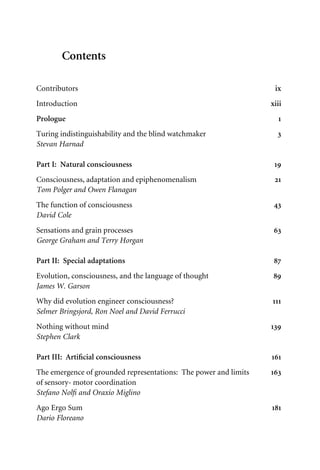
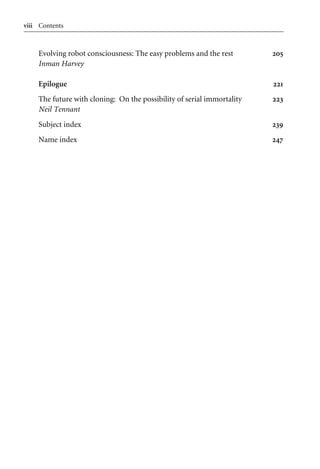

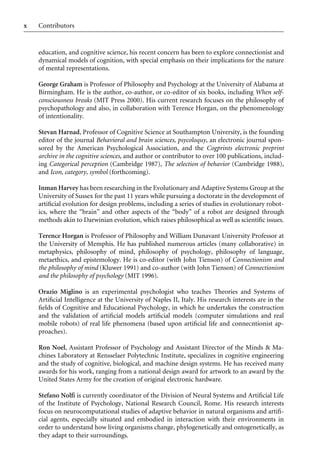




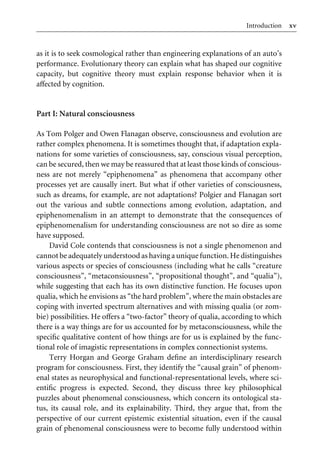








![10 Stevan Harnad
t1 toy fragment of human total capacity
T2 Total Indistinguishability in symbolic (pen pal) performance capacity
T3 Total Indistinguishability in robotic (including symbolic) performance capacity
T4 Total Indistinguishability in neural (including robotic) function
T5 Total Physical Indistinguishability
Figure 1
Is T4 a way? In a sense it is, because it is certainly a tighter empirical approxi-
mation to ourselves than T3. But the extra order of underdetermination pecu-
liar to the mind/body problem (the fact that, if you will, empiricism is no mind
reader either!) applies to T4 as well. Only the T4 candidate itself can know
whether or not it has a mind; and only the T3 candidates themselves can know
whether or not we would have been wrong to deny them a mind for failing
T4, having passed T3.
The T-hierarchy is a hierarchy of empirical constraints (Figure 1). Each
successive level tightens the degrees of freedom on the kinds of candidates that
can pass successfully. The lowest, “toy” level, t1, is as underconstrained as can
be because it captures only subtotal fragments of our total performance capac-
ity. There are countless ways to generate chess-playing skills, arithmetic skills,
etc.; the level of underdetermination for arbitrary fragments of our Total
capacity is far greater than that of ordinary scientiWc underdetermination. T2 is
still underconstrained, despite the formal power of computation and the ex-
pressive and intuitive power of linguistic communication, because of the
symbol grounding problem (Harnad 1990) and also because T2 too leaves out
the rest of our performance capacities. T4 is, as I suggested, overconstrained,
because not all aspects of brain function are necessarily relevant to T3 capacity,
and it is T3 capacity that was selected by evolution. So it is T3, I would suggest,
that is the right level in the T-hierarchy for mind-modelling.
I could be wrong about this, of course, and let me describe how: First, the
question of “appearance” that we set aside earlier has an evolutionary side too.
Much more basic than the selection of the mechanisms underlying perfor-
mance capacity is the selection of morphological traits, both external ones that
we can see and respond to (such as plumage or facial expression) and internal
ones (such as the macromorphology and the micromorphology [the physiol-
ogy and the biochemistry] of our organs, including our brain). The Blind
Watchmaker may be blind to T3-indistinguishable diVerences underlying our
performance capacity, but he is not blind to morphological diVerences, if they](https://image.slidesharecdn.com/876127-250609082501-dc65ede4/85/Consciousness-Evolving-James-H-Fetzer-Editor-35-320.jpg)

![17
Turing indistinguishability and the blind watchmaker
Fernald, R.D 1997. “The evolution of eyes”. Brain Behavior and Evolution 50: 253–259
Gopnik, A. 1993. “How we know our minds: The illusion of Wrst-person knowledge of
intentionality”. Behavioral Brain Sciences 16: 29–113.
Gould, S.J. 1994. “The spandrels of San Marco and the panglossian paradigm: A critique of
the adaptationist programme”. In: Sober, E. (Ed.). Conceptual issues in evolutionary
biology,.Second edition. Cambridge MA: MIT Press Massachusetts, Pp. 73–90. [Re-
printed from Proceedings of the Royal Society B, London 205: 581. 1979.]
Harnad, S. 1982. “Consciousness: An afterthought”. Cognition and Brain Theory. 5: 29–47.
Harnad, S. 1987. (ed.) Categorical Perception: The Groundwork of Cognition. New York:
Cambridge University Press.
Harnad, S. 1989. “Minds, Machines and Searle”. Journal of Theoretical and Experimental
ArtiWcial Intelligence 1: 5–25.
Harnad, S. 1990. “The Symbol Grounding Problem”. Physica D 42: 335–346.
Harnad, S. 1991. “Other bodies, Other minds: A machine incarnation of an old philosophi-
cal problem”. Minds and Machines 1: 43–54.
Harnad, S. 1992a. Connecting Object to Symbol in Modeling Cognition. In: A. Clarke and
R. Lutz (Eds.) Connectionism in Context. Springer Verlag.
Harnad, S. 1992b. “The Turing Test Is Not A Trick: Turing Indistinguishability Is A
ScientiWc Criterion”. SIGART Bulletin 3(4). (October. 9–10).
Harnad, S. 1993a. “ArtiWcial Life: Synthetic Versus Virtual”. ArtiWcial Life III. Proceedings,
Santa Fe Institute Studies in the Sciences of Complexity. Volume XVI.
Harnad S. 1993b. Discussion (passim). In: Bock, G.R. Marsh, J. (Eds.) Experimental and
Theoretical Studies of Consciousness. CIBA Foundation Symposium 174. Chichester:
Wiley
Harnad, S. 1994a. “Levels of Functional Equivalence in Reverse Bioengineering: The Dar-
winian Turing Test for ArtiWcial Life”. ArtiWcial Life 1(3): 293–301.
Harnad, S. 1994b. “Computation Is Just Interpretable Symbol Manipulation: Cognition
Isn’t”. Special Issue on “What Is Computation” Minds and Machines 4:379–390
Harnad, S. 1995a. “Does the Mind Piggy-Back on Robotic and Symbolic Capacity?” In: H.
Morowitz (ed.) The Mind, the Brain, and Complex Adaptive Systems. Santa Fe Institute
Studies in the Sciences of Complexity. Volume XXII. P. 204–220.
Harnad, S. 1995b. Grounding Symbolic Capacity in Robotic Capacity. In: Steels, L. and R.
Brooks (eds.) The ArtiWcial Life Route to ArtiWcial Intelligence: Building Embodied Situ-
ated Agents. New Haven: Lawrence Erlbaum. Pp. 277–286.
Harnad, S. 1995c. “Why and How We Are Not Zombies”. Journal of Consciousness Studies 1:
164–167.
Harnad, S. 1996. The Origin of Words: A Psychophysical Hypothesis In Velichkovsky B
Rumbaugh, D. (Eds.) Communicating Meaning: Evolution and Development of Lan-
guage. NJ: Erlbaum: pp 27–44.
Harnad, S. 2000. “Minds, Machines and Turing”. Journal of Logic, Language and Information
9(4):425–445.
Harnad, S. 2001. “No easy way out”. The Sciences 41(2):36–42.
Harnad, S. Hanson, S.J. Lubin, J. 1995. Learned Categorical Perception in Neural Nets:
Implications for Symbol Grounding. In: V. Honavar L. Uhr (eds.) Symbol Processors](https://image.slidesharecdn.com/876127-250609082501-dc65ede4/85/Consciousness-Evolving-James-H-Fetzer-Editor-42-320.jpg)