Summer 2014 33
Out and about
indoor reflective and theory-based sessions that focused on
both individual and group development.
The Outward Bound Trust has a solid track record in
running adventure courses in the wild outdoors; indeed its
history dates back to 1941 when the pioneering founder,
renowned educationalist Kurt Hahn, set out to help merchant
seamen develop essential survival skills like resilience,
teamwork and leadership. Since then, The Trust has helped
over a million young people from all backgrounds by placing
them in challenging, adventurous situations, stretching them
to achieve their potential.
Eton College is no stranger to innovative thinking. It offers
a wide range of extra-curricular activities, as well as the
opportunity for its students to get involved in community
projects such as helping at local schools, so the concept
of ‘service’ has been built in to its ethos for many years.
Equally, Eton is not the first public school to think about
incorporating out-of-classroom learning into its curriculum.
Leading schools worldwide, such as Wesley College in
Australia, The Mountain School in Vermont and St Alban’s
College in Pretoria offer a range of experiences from running
an organic farm to living in the bush without adults.
But Eton wanted to push their own boundaries further and
envisaged a customised course that would produce outstanding
preparation for students’ next stage. Before embarking on this
initiative, Eton College engaged in extensive internal and
external research. It consulted with masters and students,
educational specialists and potential partners and became au
fait with the latest in education theory in order to determine
precisely what would benefit Eton students.
What are the key skills and qualities needed for success
in the 21st century? The answer has proved a slippery one
amongst educationalists in recent years. In the past, academic
achievement was regarded as a given and so fundamental
that its predominance has rarely been questioned. But there
is a growing feeling, embraced by many leading schools
worldwide, that for young people to really shine as they
go into the world, they must be able to offer a far more
comprehensive set of skills than those defined by exam
results.
They must show themselves as mature, resilient people who
can adopt a positive and flexible approach to whatever their
new context throws at them. In other words, they must learn
to think and act creatively.
Eton College recently formed a partnership with Windsor
Boys’ School to pilot a unique scheme, Eton+plus, aimed
at developing just these qualities and its success has been
remarkable. In the summer of 2013, 25 boys from Eton and 25
from Windsor Boys’, accompanied by masters and teachers,
attended a two-week bespoke course with The Outward
Bound Trust.
The students undertook the programme during an important
period of transition between Years 11 and 12, as they
prepared to take on an increasing level of responsibility
and independence in their education. The course took place
immediately following their GCSEs, at the start of the
summer holidays and prior to beginning sixth form. It was
delivered at The Trust’s Loch Eil centre in the Scottish
Highlands, and combined ‘skills days’ such as rock climbing
and abseiling, overnight expeditions and a ‘service’ day with
Real skills for real life
Eton+plus at The Outward Bound Trust -
a unique and enriching experience
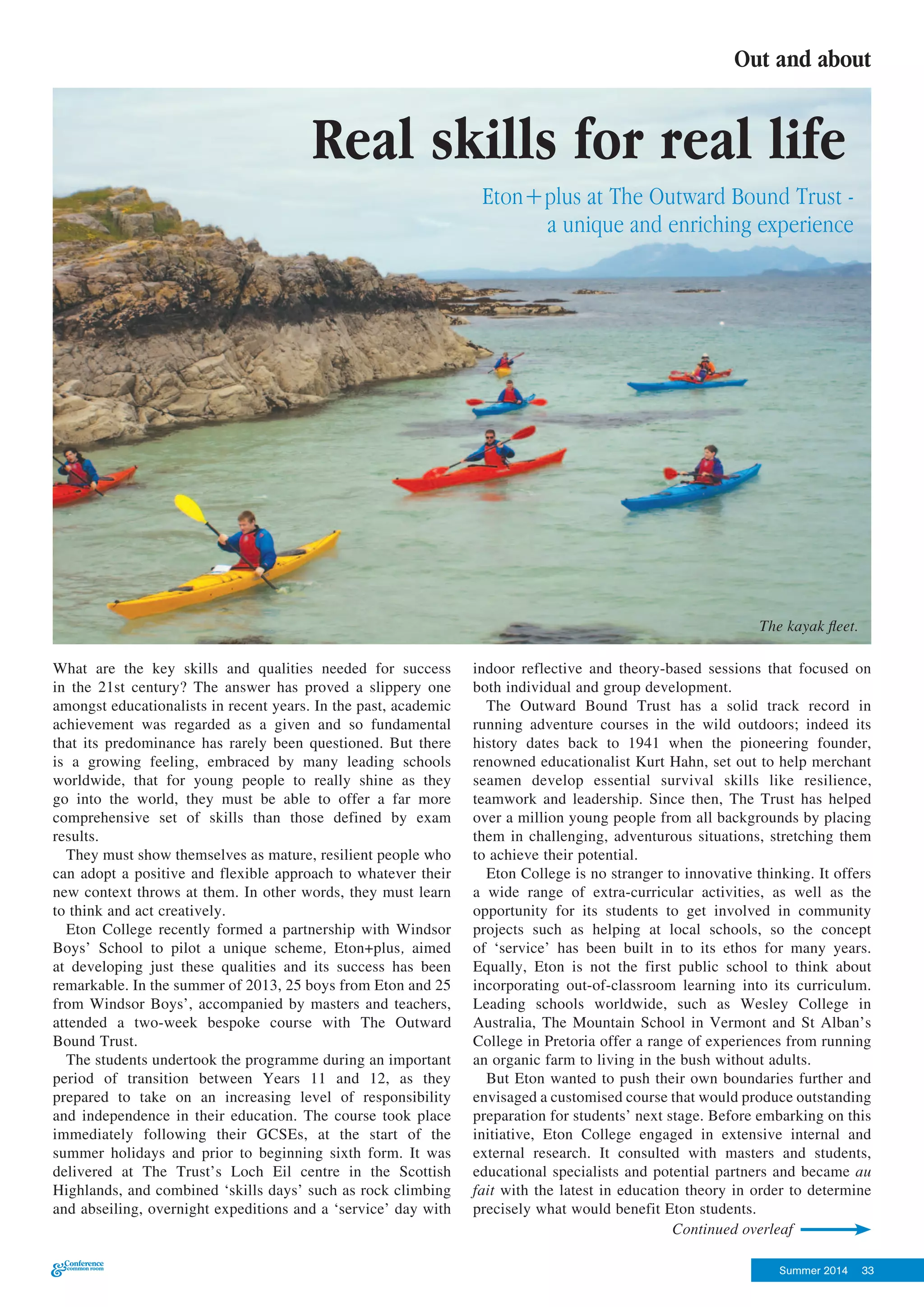
The kayak fleet.
Continued overleaf
34 Summer 2014
Out and about
The research resulted in broad agreement about which key
elements were already being taught at Eton and what needed
to be enhanced for effective successful living in the 21st
century. While Eton’s students were well prepared to thrive
in a competitive environment and were seen to strive for
excellence, it was agreed that the focus of any new innovation
should be on developing perseverance outside the boys’
comfort zone, as well as working collaboratively with others.
Eton’s rationale was confirmed by research from leading
socialacademics,businessleadersandeducationalpractitioners
that indicated a core set of skills and characteristics regarded
as necessary for 21st century success. These include the three
vital skills of creative leadership, resilience and respect.
American educationalist Howard Gardner identified the
‘creative mind’ as key to 21st century success, while the
ability to problem-solve in a creative way was ranked the
most important quality in an IBM 2010 survey of 1500 CEOs.
Crucially, Sir Ken Robinson, international education advisor,
believes that creativity is as important as literacy. Applying
creativity involves showing initiative, motivating others,
decision making and risking failure.
Resilience incorporates such qualities as perseverance
in adversity, taking responsibility and developing a
competitive spirit. The Nobel Prize winner James Heckman
has demonstrated that resilience ultimately counts for more
than just IQ in careers, while the Young Foundation study
identified ‘strength of character/perseverance’ as the single
biggest driver of academic success.
The third characteristic, respect, is more difficult to pin down
but broadly refers to the importance of interdependency. As
Howard Gardner comments on the importance of ‘respectful’
and ‘ethical’ minds in the 21st century: ‘Clearly we can no
longer build a wall that isolates groups from one another
indefinitely.’
Armed with solid background research and the commitment
to innovate, Eton joined forces with local state school
Windsor Boys’ and The Outward Bound Trust to design a
bespoke course that would challenge the boys and provide a
truly distinctive experience.
Tony Little, the Head Master of Eton, has commented:
“Adventurous training programmes of one kind or another are
familiar to many of our boys. What is different in Eton+plus
is boys working collaboratively in an unfamiliar environment
with people they do not know, and then reflecting individually
and collectively on what they have learnt. Together, these
boys have an opportunity to learn more about each other – and
about themselves.”
A core design principle of the programme was introducing
the students to an unfamiliar setting in which they were taken
outside their physical, mental and emotional comfort zone,
to work collaboratively with other students who were new to
them. The goal was to expose them to a significant level of
challenge that would enable them to face adversity and learn
from failure, and to develop the skills needed to cope, recover
and thrive despite setbacks.
Several objectives were agreed upon. These included
improving students’ skills in setting and achieving personal
goals, developing their resilience in overcoming setbacks,
improving confidence and developing self-awareness. In
addition, the programme was designed to teach students
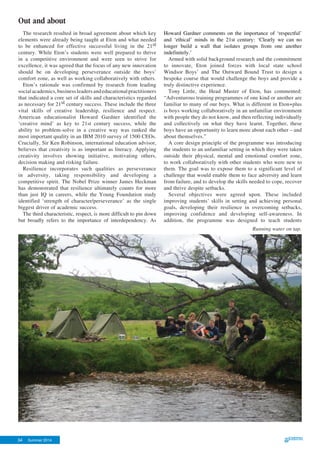
Running water on tap.
Summer 2014 35
Out and about
to make good decisions and take responsibility for their
consequences, and to help them experience and understand
leadership and develop a range of skills around improving
communication, planning and problem solving.
In striving towards these objectives, it was intended that
students would also recognise more keenly the importance
of considering and appreciating others, becoming more
environmentally aware and developing their experience of
service. Overall, the programme was designed to develop
skills that cannot be gained in a classroom setting.
The pilot group set off for their fortnight in Scotland, full
of trepidation, excitement and curiosity. On site, students
were split into five groups of ten, with five boys from each
school making up each group. Each student received three
1:1 sessions with their instructor, and also took part in
group reflective sessions, involving journaling and coaching
techniques, which helped to facilitate their learning and
promote their self-awareness. Briggy Kiddle, an independent
performance coach, attended the course as a key member of
staff and made a significant contribution towards the theory-
based and reflective sessions.
The students experienced different types and levels of
learning on the course. Practical learning included outdoor
overnight activities that became increasingly difficult
throughout the fortnight. This type of learning was the most
challenging on an individual and group level. Secondly the
group engaged in a number of social tasks on the course,
associated with the deliberate mixing of students from Eton
College and The Windsor Boys’ School.
This provided a significant additional dimension to the
programme, and facilitated extensive learning opportunities
for all students. They were required to get to know new
people in an unfamiliar environment, and to work together in
their groups, often under pressure, to achieve shared goals.
Indeed, the social mixing and strong relationship between the
two schools were recognised as pivotal to the success of the
programme and achievement of the outcomes.
How effective was the programme in terms of the goals set?
The Trust and Eton designed their own research to evaluate
the programme and included both quantitative and qualitative
methods, such as questionnaires and group interviews. All
key stakeholders were involved and the evaluation looked at
short term behaviour changes. Longer term changes are to be
monitored as the programme progresses.
The evaluation indicated a shared view that the pilot is an
impressive programme that provided students with a unique
and enriching opportunity to develop valuable life skills.
Students, teachers and parents all attested to the programme’s
effectiveness in developing and accelerating the students’
maturity, both in how they interact with others and in how
they manage themselves, especially in the most challenging
of circumstances. The experience enabled students to test and
hone skills that cannot be developed in a classroom, and has
thus provided a valuable addition to the education provided by
both participating schools.
There was also clear evidence from all stakeholders involved
in the evaluation that the programme enabled students to
develop self-awareness, the ability to persevere, the ability to
work effectively with others, and an improved understanding
of leadership. These results are supported by quantitative
data collected through a pre- and post-course survey, which
demonstrated increases to the students’ perseverance of effort,
self-efficacy, and aspects of their social competence.
For example, 98% of students agreed at the end of the
course that they had developed their ability to persevere when
outside their comfort zone; 96% of students agreed that they
became more aware of how their behaviour affects those
around them; and 94% of students agreed that they developed
their ability to work collaboratively with others.
The programme constituted a rich and varied set of
experiences that contributed towards the students’ learning
throughout the course, as one Eton College student commented:
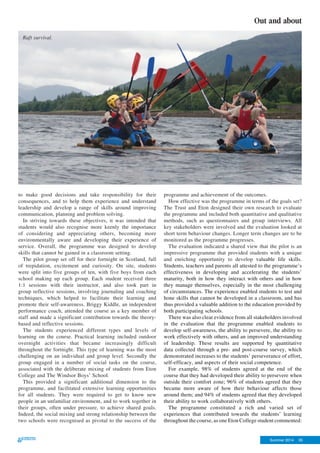
Raft survival.
36 Summer 2014
Out and about
“I don’t think the course’s value can really be put down to
one specific thing – it is the many different experiences and
environments that, together, combine to form a very enriching
experience.”
Parents were also confident that their sons showed a number
of significant changes following the course. 88% of parents
agreed that their son had shown or begun to show increased
confidence; 81% of parents agreed that their son had shown
or begun to show increased awareness of other people’s
feelings; and 81% of parents agreed that their son had shown
or begun to show increased willingness to take responsibility
for himself and his actions.
The observation made most frequently by parents following
the course was an increased level of maturity in their son, which
is reflected in the following comment provided by one Eton
College parent: “He has courage, ambition and deep spiritual
understanding but what Eton+plus has given him are some
invaluable tools and methodologies to build an inner framework
that has the potential to be a castle not a house of cards.”
Whilst the evaluation focused on understanding the
outcomes of the programme, many of the strengths of the
pilot emerged through the interviews with teachers and
students. The wilderness location and length of the course,
the use of learning models, the emphasis on skills days and
overnight expeditions, and the social mix created through
the involvement of a partner school were all considered to be
integral to the success of the programme.
Jonnie Noakes and Mark Fielker, the course developers at
Eton, comment: “It was clear from the feedback we received
that the boys found the course enjoyable but stretching. They
discovered that the coping strategies they habitually use in
their home and school environments no longer worked when
they were under pressure, with new people, in an unfamiliar
environment. They had to develop better strategies, based on
a deeper, more accurate understanding of themselves and of
others; and this new awareness greatly enhanced their ability
to contribute towards the success of the group.”
Importantly, the feedback suggests that the programme was
effective in meeting the needs of the majority of students,
whether as a transformative experience or one that has
facilitated the further development of existing tendencies
and capabilities. As the course created a level playing field
amongst students, those with less confidence prior to the
course have benefited from the opportunity to rise to the
challenge and excel in ways that are new to them.
One teacher from The Windsor Boys’ School described
how he observed this change within his particular group: “A
few individuals have really found their resilience tested and
they’ve really embraced the course and excelled. That’s just in
one group, ten individuals, but those three or four, especially
after the evaluations, some boys have said that ‘before I
couldn’t do that, I wouldn’t have had the confidence in myself
to do that’... And they are small guys, yet these small guys
have outshone the much bigger, dominant leaders, they’ve
outshone them.”
With any innovative programme, short-term outcomes are
easier to measure than longer-term effects. Nevertheless, there
was a strong sense from all stakeholders involved that the
course will continue to benefit the participating students in a
number of different ways.
Students reported feeling stronger, more resourceful and
more self-aware, and having a clear belief that they will
be able to cope when challenges arise in the future. As one
Eton student put it: “The course will equip you with the
skills needed to maximise your potential both at school and
beyond. You will learn through experiences in an exciting
environment with a great mix of people. The experience will
be immensely rewarding – hard work but good fun.”
What of the future for the Eton+plus initiative? According
to Noakes and Fielker, the intention is to roll the programme
out to more boys from both schools. “The skills that the course
teaches the boys – resourcefulness, resilience, reciprocity,
self-confidence, self-reliance and respect for themselves and
others – are central to their education as fully rounded people
who will have the confidence to take their place and make
their contribution in the world. We would like to see as many
boys as possible take the course, and we are now looking at
how we can make this happen.”
Natalie Harling is Head of Education
at the Outward Bound Trust.
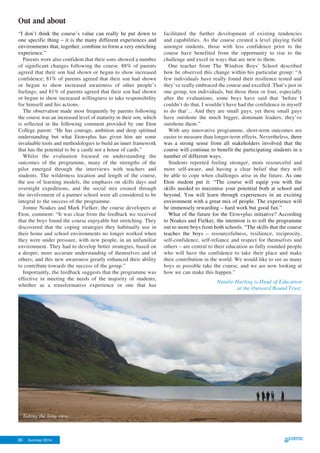
Taking the long view.

Conference & Common Room_p33-36_Summer2014

  • 1.
    Summer 2014 33 Outand about indoor reflective and theory-based sessions that focused on both individual and group development. The Outward Bound Trust has a solid track record in running adventure courses in the wild outdoors; indeed its history dates back to 1941 when the pioneering founder, renowned educationalist Kurt Hahn, set out to help merchant seamen develop essential survival skills like resilience, teamwork and leadership. Since then, The Trust has helped over a million young people from all backgrounds by placing them in challenging, adventurous situations, stretching them to achieve their potential. Eton College is no stranger to innovative thinking. It offers a wide range of extra-curricular activities, as well as the opportunity for its students to get involved in community projects such as helping at local schools, so the concept of ‘service’ has been built in to its ethos for many years. Equally, Eton is not the first public school to think about incorporating out-of-classroom learning into its curriculum. Leading schools worldwide, such as Wesley College in Australia, The Mountain School in Vermont and St Alban’s College in Pretoria offer a range of experiences from running an organic farm to living in the bush without adults. But Eton wanted to push their own boundaries further and envisaged a customised course that would produce outstanding preparation for students’ next stage. Before embarking on this initiative, Eton College engaged in extensive internal and external research. It consulted with masters and students, educational specialists and potential partners and became au fait with the latest in education theory in order to determine precisely what would benefit Eton students. What are the key skills and qualities needed for success in the 21st century? The answer has proved a slippery one amongst educationalists in recent years. In the past, academic achievement was regarded as a given and so fundamental that its predominance has rarely been questioned. But there is a growing feeling, embraced by many leading schools worldwide, that for young people to really shine as they go into the world, they must be able to offer a far more comprehensive set of skills than those defined by exam results. They must show themselves as mature, resilient people who can adopt a positive and flexible approach to whatever their new context throws at them. In other words, they must learn to think and act creatively. Eton College recently formed a partnership with Windsor Boys’ School to pilot a unique scheme, Eton+plus, aimed at developing just these qualities and its success has been remarkable. In the summer of 2013, 25 boys from Eton and 25 from Windsor Boys’, accompanied by masters and teachers, attended a two-week bespoke course with The Outward Bound Trust. The students undertook the programme during an important period of transition between Years 11 and 12, as they prepared to take on an increasing level of responsibility and independence in their education. The course took place immediately following their GCSEs, at the start of the summer holidays and prior to beginning sixth form. It was delivered at The Trust’s Loch Eil centre in the Scottish Highlands, and combined ‘skills days’ such as rock climbing and abseiling, overnight expeditions and a ‘service’ day with Real skills for real life Eton+plus at The Outward Bound Trust - a unique and enriching experience The kayak fleet. Continued overleaf
  • 2.
    34 Summer 2014 Outand about The research resulted in broad agreement about which key elements were already being taught at Eton and what needed to be enhanced for effective successful living in the 21st century. While Eton’s students were well prepared to thrive in a competitive environment and were seen to strive for excellence, it was agreed that the focus of any new innovation should be on developing perseverance outside the boys’ comfort zone, as well as working collaboratively with others. Eton’s rationale was confirmed by research from leading socialacademics,businessleadersandeducationalpractitioners that indicated a core set of skills and characteristics regarded as necessary for 21st century success. These include the three vital skills of creative leadership, resilience and respect. American educationalist Howard Gardner identified the ‘creative mind’ as key to 21st century success, while the ability to problem-solve in a creative way was ranked the most important quality in an IBM 2010 survey of 1500 CEOs. Crucially, Sir Ken Robinson, international education advisor, believes that creativity is as important as literacy. Applying creativity involves showing initiative, motivating others, decision making and risking failure. Resilience incorporates such qualities as perseverance in adversity, taking responsibility and developing a competitive spirit. The Nobel Prize winner James Heckman has demonstrated that resilience ultimately counts for more than just IQ in careers, while the Young Foundation study identified ‘strength of character/perseverance’ as the single biggest driver of academic success. The third characteristic, respect, is more difficult to pin down but broadly refers to the importance of interdependency. As Howard Gardner comments on the importance of ‘respectful’ and ‘ethical’ minds in the 21st century: ‘Clearly we can no longer build a wall that isolates groups from one another indefinitely.’ Armed with solid background research and the commitment to innovate, Eton joined forces with local state school Windsor Boys’ and The Outward Bound Trust to design a bespoke course that would challenge the boys and provide a truly distinctive experience. Tony Little, the Head Master of Eton, has commented: “Adventurous training programmes of one kind or another are familiar to many of our boys. What is different in Eton+plus is boys working collaboratively in an unfamiliar environment with people they do not know, and then reflecting individually and collectively on what they have learnt. Together, these boys have an opportunity to learn more about each other – and about themselves.” A core design principle of the programme was introducing the students to an unfamiliar setting in which they were taken outside their physical, mental and emotional comfort zone, to work collaboratively with other students who were new to them. The goal was to expose them to a significant level of challenge that would enable them to face adversity and learn from failure, and to develop the skills needed to cope, recover and thrive despite setbacks. Several objectives were agreed upon. These included improving students’ skills in setting and achieving personal goals, developing their resilience in overcoming setbacks, improving confidence and developing self-awareness. In addition, the programme was designed to teach students Running water on tap.
  • 3.
    Summer 2014 35 Outand about to make good decisions and take responsibility for their consequences, and to help them experience and understand leadership and develop a range of skills around improving communication, planning and problem solving. In striving towards these objectives, it was intended that students would also recognise more keenly the importance of considering and appreciating others, becoming more environmentally aware and developing their experience of service. Overall, the programme was designed to develop skills that cannot be gained in a classroom setting. The pilot group set off for their fortnight in Scotland, full of trepidation, excitement and curiosity. On site, students were split into five groups of ten, with five boys from each school making up each group. Each student received three 1:1 sessions with their instructor, and also took part in group reflective sessions, involving journaling and coaching techniques, which helped to facilitate their learning and promote their self-awareness. Briggy Kiddle, an independent performance coach, attended the course as a key member of staff and made a significant contribution towards the theory- based and reflective sessions. The students experienced different types and levels of learning on the course. Practical learning included outdoor overnight activities that became increasingly difficult throughout the fortnight. This type of learning was the most challenging on an individual and group level. Secondly the group engaged in a number of social tasks on the course, associated with the deliberate mixing of students from Eton College and The Windsor Boys’ School. This provided a significant additional dimension to the programme, and facilitated extensive learning opportunities for all students. They were required to get to know new people in an unfamiliar environment, and to work together in their groups, often under pressure, to achieve shared goals. Indeed, the social mixing and strong relationship between the two schools were recognised as pivotal to the success of the programme and achievement of the outcomes. How effective was the programme in terms of the goals set? The Trust and Eton designed their own research to evaluate the programme and included both quantitative and qualitative methods, such as questionnaires and group interviews. All key stakeholders were involved and the evaluation looked at short term behaviour changes. Longer term changes are to be monitored as the programme progresses. The evaluation indicated a shared view that the pilot is an impressive programme that provided students with a unique and enriching opportunity to develop valuable life skills. Students, teachers and parents all attested to the programme’s effectiveness in developing and accelerating the students’ maturity, both in how they interact with others and in how they manage themselves, especially in the most challenging of circumstances. The experience enabled students to test and hone skills that cannot be developed in a classroom, and has thus provided a valuable addition to the education provided by both participating schools. There was also clear evidence from all stakeholders involved in the evaluation that the programme enabled students to develop self-awareness, the ability to persevere, the ability to work effectively with others, and an improved understanding of leadership. These results are supported by quantitative data collected through a pre- and post-course survey, which demonstrated increases to the students’ perseverance of effort, self-efficacy, and aspects of their social competence. For example, 98% of students agreed at the end of the course that they had developed their ability to persevere when outside their comfort zone; 96% of students agreed that they became more aware of how their behaviour affects those around them; and 94% of students agreed that they developed their ability to work collaboratively with others. The programme constituted a rich and varied set of experiences that contributed towards the students’ learning throughout the course, as one Eton College student commented: Raft survival.
  • 4.
    36 Summer 2014 Outand about “I don’t think the course’s value can really be put down to one specific thing – it is the many different experiences and environments that, together, combine to form a very enriching experience.” Parents were also confident that their sons showed a number of significant changes following the course. 88% of parents agreed that their son had shown or begun to show increased confidence; 81% of parents agreed that their son had shown or begun to show increased awareness of other people’s feelings; and 81% of parents agreed that their son had shown or begun to show increased willingness to take responsibility for himself and his actions. The observation made most frequently by parents following the course was an increased level of maturity in their son, which is reflected in the following comment provided by one Eton College parent: “He has courage, ambition and deep spiritual understanding but what Eton+plus has given him are some invaluable tools and methodologies to build an inner framework that has the potential to be a castle not a house of cards.” Whilst the evaluation focused on understanding the outcomes of the programme, many of the strengths of the pilot emerged through the interviews with teachers and students. The wilderness location and length of the course, the use of learning models, the emphasis on skills days and overnight expeditions, and the social mix created through the involvement of a partner school were all considered to be integral to the success of the programme. Jonnie Noakes and Mark Fielker, the course developers at Eton, comment: “It was clear from the feedback we received that the boys found the course enjoyable but stretching. They discovered that the coping strategies they habitually use in their home and school environments no longer worked when they were under pressure, with new people, in an unfamiliar environment. They had to develop better strategies, based on a deeper, more accurate understanding of themselves and of others; and this new awareness greatly enhanced their ability to contribute towards the success of the group.” Importantly, the feedback suggests that the programme was effective in meeting the needs of the majority of students, whether as a transformative experience or one that has facilitated the further development of existing tendencies and capabilities. As the course created a level playing field amongst students, those with less confidence prior to the course have benefited from the opportunity to rise to the challenge and excel in ways that are new to them. One teacher from The Windsor Boys’ School described how he observed this change within his particular group: “A few individuals have really found their resilience tested and they’ve really embraced the course and excelled. That’s just in one group, ten individuals, but those three or four, especially after the evaluations, some boys have said that ‘before I couldn’t do that, I wouldn’t have had the confidence in myself to do that’... And they are small guys, yet these small guys have outshone the much bigger, dominant leaders, they’ve outshone them.” With any innovative programme, short-term outcomes are easier to measure than longer-term effects. Nevertheless, there was a strong sense from all stakeholders involved that the course will continue to benefit the participating students in a number of different ways. Students reported feeling stronger, more resourceful and more self-aware, and having a clear belief that they will be able to cope when challenges arise in the future. As one Eton student put it: “The course will equip you with the skills needed to maximise your potential both at school and beyond. You will learn through experiences in an exciting environment with a great mix of people. The experience will be immensely rewarding – hard work but good fun.” What of the future for the Eton+plus initiative? According to Noakes and Fielker, the intention is to roll the programme out to more boys from both schools. “The skills that the course teaches the boys – resourcefulness, resilience, reciprocity, self-confidence, self-reliance and respect for themselves and others – are central to their education as fully rounded people who will have the confidence to take their place and make their contribution in the world. We would like to see as many boys as possible take the course, and we are now looking at how we can make this happen.” Natalie Harling is Head of Education at the Outward Bound Trust. Taking the long view.