Module- 6
Writing For Employment
Fehmina Khalique
Assistant Professor
School Of Business
Galgotias University
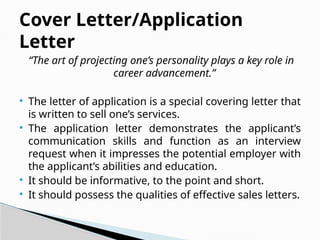
“The art of projecting one’s personality plays a key role in
career advancement.”
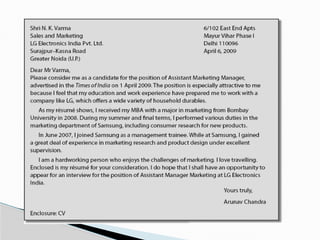
 The letter of application is a special covering letter that
is written to sell one’s services.
 The application letter demonstrates the applicant’s
communication skills and function as an interview
request when it impresses the potential employer with
the applicant’s abilities and education.
 It should be informative, to the point and short.
 It should possess the qualities of effective sales letters.
Cover Letter/Application
Letter
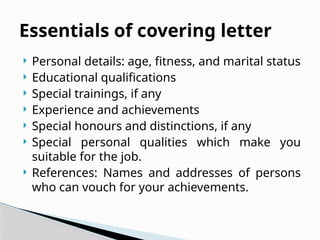
 Personal details: age, fitness, and marital status
 Educational qualifications
 Special trainings, if any
 Experience and achievements
 Special honours and distinctions, if any
 Special personal qualities which make you
suitable for the job.
 References: Names and addresses of persons
who can vouch for your achievements.
Essentials of covering letter
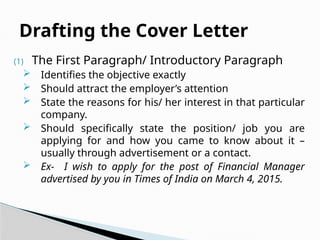
(1) The First Paragraph/ Introductory Paragraph
 Identifies the objective exactly
 Should attract the employer’s attention
 State the reasons for his/ her interest in that particular
company.
 Should specifically state the position/ job you are
applying for and how you came to know about it –
usually through advertisement or a contact.
 Ex- I wish to apply for the post of Financial Manager
advertised by you in Times of India on March 4, 2015.
Drafting the Cover Letter
(2) The Second Paragraph
 Gives evidence of the applicant’s ability and
qualifications.
 Emphasize those aspects of your qualities which the post
requires.
 Highlight important courses/ projects that enhances
your suitability for the position.
 Describe any extracurricular activities that show
leadership qualities.
 State your previous experience by giving full names of
the organizations you worked for, your designation and
your nature of duties.
Drafting the Cover Letter
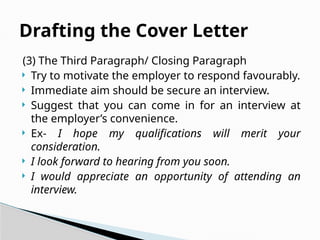
(3) The Third Paragraph/ Closing Paragraph
 Try to motivate the employer to respond favourably.
 Immediate aim should be secure an interview.
 Suggest that you can come in for an interview at
the employer’s convenience.
 Ex- I hope my qualifications will merit your
consideration.
 I look forward to hearing from you soon.
 I would appreciate an opportunity of attending an
interview.
Drafting the Cover Letter
 Coherence
 Concreteness
 Simplicity
 Emphasis
 Originality
 Spotless
 Error free
 Well formatted on a standard white sheet.
 Addressed to a specific person
 Sign the letter before mailing
Tips for writing application letter
1. Address of the applicant and the date
 Written at top of the letter.
 Leave two space between the address and the date
2. Employer’s name and address
 Two space below the level of date and aligned with
left margin
3. Salutation
 Dear Sir/Sirs
4. Body
 Three paragraphs
Elements of Structure
5. Complimentary Close
 Yours truly
 Yours faithfully
 Yours respectfully
6. Signature
 It should be distinct and the name of the applicant
should be typed below it.
7. Enclosures
 Documents enclosed should be specified.
 If the list is long, prepare a list of enclosures and write:
‘Encl. See list attached.’
Elements of Structure
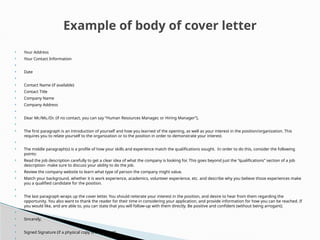
 Your Address
 Your Contact Information

 Date

 Contact Name (if available)
 Contact Title
 Company Name
 Company Address

 Dear Mr./Ms./Dr. (if no contact, you can say “Human Resources Manager, or Hiring Manager”),

 The first paragraph is an introduction of yourself and how you learned of the opening, as well as your interest in the position/organization. This
requires you to relate yourself to the organization or to the position in order to demonstrate your interest.

 The middle paragraph(s) is a profile of how your skills and experience match the qualifications sought. In order to do this, consider the following
points:
 Read the job description carefully to get a clear idea of what the company is looking for. This goes beyond just the “qualifications” section of a job
description- make sure to discuss your ability to do the job.
 Review the company website to learn what type of person the company might value.
 Match your background, whether it is work experience, academics, volunteer experience, etc. and describe why you believe those experiences make
you a qualified candidate for the position.

 The last paragraph wraps up the cover letter. You should reiterate your interest in the position, and desire to hear from them regarding the
opportunity. You also want to thank the reader for their time in considering your application, and provide information for how you can be reached. If
you would like, and are able to, you can state that you will follow-up with them directly. Be positive and confident (without being arrogant).

 Sincerely,

 Signed Signature (if a physical copy is being sent)

Example of body of cover letter
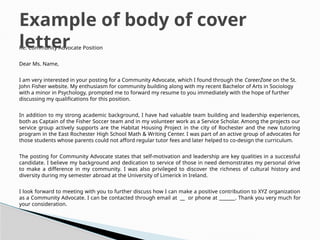
Re: Community Advocate Position
Dear Ms. Name,
I am very interested in your posting for a Community Advocate, which I found through the CareerZone on the St.
John Fisher website. My enthusiasm for community building along with my recent Bachelor of Arts in Sociology
with a minor in Psychology, prompted me to forward my resume to you immediately with the hope of further
discussing my qualifications for this position.
In addition to my strong academic background, I have had valuable team building and leadership experiences,
both as Captain of the Fisher Soccer team and in my volunteer work as a Service Scholar. Among the projects our
service group actively supports are the Habitat Housing Project in the city of Rochester and the new tutoring
program in the East Rochester High School Math & Writing Center. I was part of an active group of advocates for
those students whose parents could not afford regular tutor fees and later helped to co-design the curriculum.
The posting for Community Advocate states that self-motivation and leadership are key qualities in a successful
candidate. I believe my background and dedication to service of those in need demonstrates my personal drive
to make a difference in my community. I was also privileged to discover the richness of cultural history and
diversity during my semester abroad at the University of Limerick in Ireland.
I look forward to meeting with you to further discuss how I can make a positive contribution to XYZ organization
as a Community Advocate. I can be contacted through email at or phone at __ . Thank you very much for
your consideration.
Example of body of cover
letter
Resume/CV Writing
Planning Resume, organizing contents of
resume, sending follow-up messages
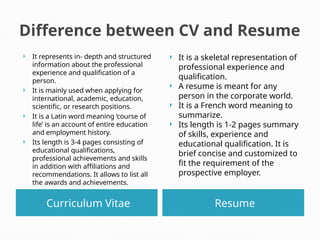
Difference between CV and Resume
Curriculum Vitae Resume
 It represents in- depth and structured
information about the professional
experience and qualification of a
person.
 It is mainly used when applying for
international, academic, education,
scientific, or research positions.
 It is a Latin word meaning ‘course of
life’ is an account of entire education
and employment history.
 Its length is 3-4 pages consisting of
educational qualifications,
professional achievements and skills
in addition with affiliations and
recommendations. It allows to list all
the awards and achievements.
 It is a skeletal representation of
professional experience and
qualification.
 A resume is meant for any
person in the corporate world.
 It is a French word meaning to
summarize.
 Its length is 1-2 pages summary
of skills, experience and
educational qualification. It is
brief concise and customized to
fit the requirement of the
prospective employer.
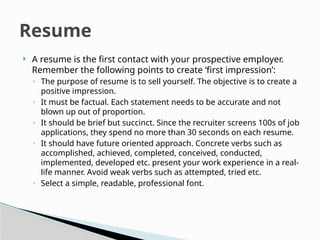
 A resume is the first contact with your prospective employer.
Remember the following points to create ‘first impression’:
◦ The purpose of resume is to sell yourself. The objective is to create a
positive impression.
◦ It must be factual. Each statement needs to be accurate and not
blown up out of proportion.
◦ It should be brief but succinct. Since the recruiter screens 100s of job
applications, they spend no more than 30 seconds on each resume.
◦ It should have future oriented approach. Concrete verbs such as
accomplished, achieved, completed, conceived, conducted,
implemented, developed etc. present your work experience in a real-
life manner. Avoid weak verbs such as attempted, tried etc.
◦ Select a simple, readable, professional font.
Resume
 Personal Data: Name with complete address, including mobile
number and email address.
 Job Objective: This is a short statement about your career interest
and area of expertise, tailored to fit the requirements of the
prospective employer.
◦ Example: “Position in personal sales in a medium sized manufacturing
firm”
◦ “A public relation position requiring well developed communication,
administrative and computer skills”
 Work Experience: give the date of starting and finishing the job you
had. Add the name and the address of the earlier company or
employer.
 Educational Qualifications: A list of degrees with names of
universities/institutions and courses. Include dates with
grades/percentage to give a clear idea to the recruiter.
Contents of a Resume
 Skills/Competencies:
◦ Social skills refer to ability to communicate well with people, working
in teams, being able to adapt in any kind of culture or environment.
◦ Organizational Skills deal with the ability to coordinate, organize and
lead groups of people in order to complete the task.
◦ Technical skills are those related to use of specific equipments,
computer software etc.
 Career summary: Each job should have a short description of
the skills used and achievements within the role.
◦ Example: You must not write "I was responsible for a large sales territory” instead you
must say “Managed six sales territories, increased sales 13 percent during the first year”
 References: Mention the name, address, telephone number of
2-3 experts who can comment on how suitable you are for the
position
Contents of a Resume(Cont.)
 Traditional Resume: A traditional resume
focuses on presenting the candidate’s
experience on an employer to employer
basis(employment history, job titles, company
names and dates of employment) with the post
being listed in reverse chronological order,
starting with the most recent. It also contains
detail of education and qualifications. It is
appropriate if one has a steady career growth,
since it reveals gaps in your career path easily.
Types of Resume
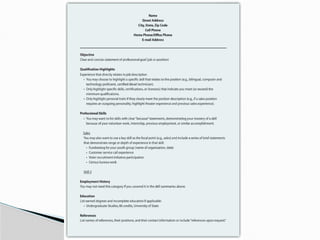
 Functional Resume: A functional Resume
places the emphasis on your skills and expertise
rather than the chronology of your employment.
It begins with a personal profile, which
highlights the achievements, skills and personal
qualities. This type of resume is preferable when
there are gaps that one does not want to
highlight or if one is entering the job market
with no work history, but have other relevant
work experience or one is seeking position
unrelated to your previous employment.
Types of Resume(Cont.)
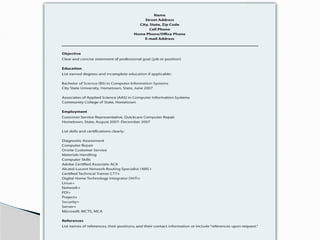
 Scannable Resume: It is also called Text Resume is an
electronic resume that is stored in a computer
database to help organisations go for initial screening
process. The contents of this type of resume are the
same as other types. Advantages of these resumes are:
◦ You can simply mail or fax a copy of your standard resume that
can be stored in a database.
◦ You can submit an online resume form
◦ Provides bias free screening
◦ It can be available to large number of recruiters
◦ It helps in saving time and effort since the process get
computerized.
Types of Resume(Cont.)
 Indicate a specific job objective or a summary of
your qualifications.
 Highlight your accomplishments.
 Emphasize education/training/experience related to
your job objective.
 Give details of professional activities that are
supportive of your career objective.
 Proofread your CV and, ideally, also have someone
else check it for typing errors.
 Ensure that all contact information is current and
correct.
General “Do’s” for writing a good CV
 Do not use first person or second person pronouns in the
résumé.
 Do not use an uncommon format.
 Do not mention the expected salary.
 Do not leave any unexplained gaps in your experience.
 Do not give reasons for leaving earlier jobs.
 Do not use coloured paper.
 Do not send a handwritten résumé.
 Do not mention personal details such as the number of
children, marital status, or other details that are not
relevant to the job.
 Do not be too brief or too lengthy.
General “Don’ts” for writing a good
CV
THANK YOU

WritingforEmployment in Business Communication.pptx

  • 1.
    Module- 6 Writing ForEmployment Fehmina Khalique Assistant Professor School Of Business Galgotias University
  • 2.
    “The art ofprojecting one’s personality plays a key role in career advancement.”  The letter of application is a special covering letter that is written to sell one’s services.  The application letter demonstrates the applicant’s communication skills and function as an interview request when it impresses the potential employer with the applicant’s abilities and education.  It should be informative, to the point and short.  It should possess the qualities of effective sales letters. Cover Letter/Application Letter
  • 3.
     Personal details:age, fitness, and marital status  Educational qualifications  Special trainings, if any  Experience and achievements  Special honours and distinctions, if any  Special personal qualities which make you suitable for the job.  References: Names and addresses of persons who can vouch for your achievements. Essentials of covering letter
  • 4.
    (1) The FirstParagraph/ Introductory Paragraph  Identifies the objective exactly  Should attract the employer’s attention  State the reasons for his/ her interest in that particular company.  Should specifically state the position/ job you are applying for and how you came to know about it – usually through advertisement or a contact.  Ex- I wish to apply for the post of Financial Manager advertised by you in Times of India on March 4, 2015. Drafting the Cover Letter
  • 5.
    (2) The SecondParagraph  Gives evidence of the applicant’s ability and qualifications.  Emphasize those aspects of your qualities which the post requires.  Highlight important courses/ projects that enhances your suitability for the position.  Describe any extracurricular activities that show leadership qualities.  State your previous experience by giving full names of the organizations you worked for, your designation and your nature of duties. Drafting the Cover Letter
  • 6.
    (3) The ThirdParagraph/ Closing Paragraph  Try to motivate the employer to respond favourably.  Immediate aim should be secure an interview.  Suggest that you can come in for an interview at the employer’s convenience.  Ex- I hope my qualifications will merit your consideration.  I look forward to hearing from you soon.  I would appreciate an opportunity of attending an interview. Drafting the Cover Letter
  • 7.
     Coherence  Concreteness Simplicity  Emphasis  Originality  Spotless  Error free  Well formatted on a standard white sheet.  Addressed to a specific person  Sign the letter before mailing Tips for writing application letter
  • 8.
    1. Address ofthe applicant and the date  Written at top of the letter.  Leave two space between the address and the date 2. Employer’s name and address  Two space below the level of date and aligned with left margin 3. Salutation  Dear Sir/Sirs 4. Body  Three paragraphs Elements of Structure
  • 9.
    5. Complimentary Close Yours truly  Yours faithfully  Yours respectfully 6. Signature  It should be distinct and the name of the applicant should be typed below it. 7. Enclosures  Documents enclosed should be specified.  If the list is long, prepare a list of enclosures and write: ‘Encl. See list attached.’ Elements of Structure
  • 10.
     Your Address Your Contact Information   Date   Contact Name (if available)  Contact Title  Company Name  Company Address   Dear Mr./Ms./Dr. (if no contact, you can say “Human Resources Manager, or Hiring Manager”),   The first paragraph is an introduction of yourself and how you learned of the opening, as well as your interest in the position/organization. This requires you to relate yourself to the organization or to the position in order to demonstrate your interest.   The middle paragraph(s) is a profile of how your skills and experience match the qualifications sought. In order to do this, consider the following points:  Read the job description carefully to get a clear idea of what the company is looking for. This goes beyond just the “qualifications” section of a job description- make sure to discuss your ability to do the job.  Review the company website to learn what type of person the company might value.  Match your background, whether it is work experience, academics, volunteer experience, etc. and describe why you believe those experiences make you a qualified candidate for the position.   The last paragraph wraps up the cover letter. You should reiterate your interest in the position, and desire to hear from them regarding the opportunity. You also want to thank the reader for their time in considering your application, and provide information for how you can be reached. If you would like, and are able to, you can state that you will follow-up with them directly. Be positive and confident (without being arrogant).   Sincerely,   Signed Signature (if a physical copy is being sent)  Example of body of cover letter
  • 11.
    Re: Community AdvocatePosition Dear Ms. Name, I am very interested in your posting for a Community Advocate, which I found through the CareerZone on the St. John Fisher website. My enthusiasm for community building along with my recent Bachelor of Arts in Sociology with a minor in Psychology, prompted me to forward my resume to you immediately with the hope of further discussing my qualifications for this position. In addition to my strong academic background, I have had valuable team building and leadership experiences, both as Captain of the Fisher Soccer team and in my volunteer work as a Service Scholar. Among the projects our service group actively supports are the Habitat Housing Project in the city of Rochester and the new tutoring program in the East Rochester High School Math & Writing Center. I was part of an active group of advocates for those students whose parents could not afford regular tutor fees and later helped to co-design the curriculum. The posting for Community Advocate states that self-motivation and leadership are key qualities in a successful candidate. I believe my background and dedication to service of those in need demonstrates my personal drive to make a difference in my community. I was also privileged to discover the richness of cultural history and diversity during my semester abroad at the University of Limerick in Ireland. I look forward to meeting with you to further discuss how I can make a positive contribution to XYZ organization as a Community Advocate. I can be contacted through email at or phone at __ . Thank you very much for your consideration. Example of body of cover letter
  • 13.
    Resume/CV Writing Planning Resume,organizing contents of resume, sending follow-up messages
  • 14.
    Difference between CVand Resume Curriculum Vitae Resume  It represents in- depth and structured information about the professional experience and qualification of a person.  It is mainly used when applying for international, academic, education, scientific, or research positions.  It is a Latin word meaning ‘course of life’ is an account of entire education and employment history.  Its length is 3-4 pages consisting of educational qualifications, professional achievements and skills in addition with affiliations and recommendations. It allows to list all the awards and achievements.  It is a skeletal representation of professional experience and qualification.  A resume is meant for any person in the corporate world.  It is a French word meaning to summarize.  Its length is 1-2 pages summary of skills, experience and educational qualification. It is brief concise and customized to fit the requirement of the prospective employer.
  • 15.
     A resumeis the first contact with your prospective employer. Remember the following points to create ‘first impression’: ◦ The purpose of resume is to sell yourself. The objective is to create a positive impression. ◦ It must be factual. Each statement needs to be accurate and not blown up out of proportion. ◦ It should be brief but succinct. Since the recruiter screens 100s of job applications, they spend no more than 30 seconds on each resume. ◦ It should have future oriented approach. Concrete verbs such as accomplished, achieved, completed, conceived, conducted, implemented, developed etc. present your work experience in a real- life manner. Avoid weak verbs such as attempted, tried etc. ◦ Select a simple, readable, professional font. Resume
  • 16.
     Personal Data:Name with complete address, including mobile number and email address.  Job Objective: This is a short statement about your career interest and area of expertise, tailored to fit the requirements of the prospective employer. ◦ Example: “Position in personal sales in a medium sized manufacturing firm” ◦ “A public relation position requiring well developed communication, administrative and computer skills”  Work Experience: give the date of starting and finishing the job you had. Add the name and the address of the earlier company or employer.  Educational Qualifications: A list of degrees with names of universities/institutions and courses. Include dates with grades/percentage to give a clear idea to the recruiter. Contents of a Resume
  • 17.
     Skills/Competencies: ◦ Socialskills refer to ability to communicate well with people, working in teams, being able to adapt in any kind of culture or environment. ◦ Organizational Skills deal with the ability to coordinate, organize and lead groups of people in order to complete the task. ◦ Technical skills are those related to use of specific equipments, computer software etc.  Career summary: Each job should have a short description of the skills used and achievements within the role. ◦ Example: You must not write "I was responsible for a large sales territory” instead you must say “Managed six sales territories, increased sales 13 percent during the first year”  References: Mention the name, address, telephone number of 2-3 experts who can comment on how suitable you are for the position Contents of a Resume(Cont.)
  • 18.
     Traditional Resume:A traditional resume focuses on presenting the candidate’s experience on an employer to employer basis(employment history, job titles, company names and dates of employment) with the post being listed in reverse chronological order, starting with the most recent. It also contains detail of education and qualifications. It is appropriate if one has a steady career growth, since it reveals gaps in your career path easily. Types of Resume
  • 20.
     Functional Resume:A functional Resume places the emphasis on your skills and expertise rather than the chronology of your employment. It begins with a personal profile, which highlights the achievements, skills and personal qualities. This type of resume is preferable when there are gaps that one does not want to highlight or if one is entering the job market with no work history, but have other relevant work experience or one is seeking position unrelated to your previous employment. Types of Resume(Cont.)
  • 22.
     Scannable Resume:It is also called Text Resume is an electronic resume that is stored in a computer database to help organisations go for initial screening process. The contents of this type of resume are the same as other types. Advantages of these resumes are: ◦ You can simply mail or fax a copy of your standard resume that can be stored in a database. ◦ You can submit an online resume form ◦ Provides bias free screening ◦ It can be available to large number of recruiters ◦ It helps in saving time and effort since the process get computerized. Types of Resume(Cont.)
  • 24.
     Indicate aspecific job objective or a summary of your qualifications.  Highlight your accomplishments.  Emphasize education/training/experience related to your job objective.  Give details of professional activities that are supportive of your career objective.  Proofread your CV and, ideally, also have someone else check it for typing errors.  Ensure that all contact information is current and correct. General “Do’s” for writing a good CV
  • 25.
     Do notuse first person or second person pronouns in the résumé.  Do not use an uncommon format.  Do not mention the expected salary.  Do not leave any unexplained gaps in your experience.  Do not give reasons for leaving earlier jobs.  Do not use coloured paper.  Do not send a handwritten résumé.  Do not mention personal details such as the number of children, marital status, or other details that are not relevant to the job.  Do not be too brief or too lengthy. General “Don’ts” for writing a good CV
  • 27.