1
Receive up to $600 Toward a Healthier You
Strategic Plan for the BENEFIT Campaign
By Susan L. Blanchard, MBA, ABC, CAAP
For the Alberta Cancer Board (AHS) and IABC
This case study outlines strategic communications to launch a multimedia
marketing communications campaign. My goal was to enroll thousands of
Albertans in a major cancer study. Thanks to the strength of the plan and
campaign in this case study, I reached my objectives for the campaign. Even
more, I presented the campaign to IABC to pass IABC’s rigorous examination and
accreditation process.
This plan has been edited to remove the confidential names of persons responsible for various tactics.
2
The communication objectives of Alberta Cancer Board campaign are to:
1. Stimulate awareness of the Benefit Research Study among 250,000 target-audience
members (Albertans), thereby enticing them to become study participants.
2. Enroll at least 6,500 members of the target audience in the Research Study (knowing
that not everyone who enrolls in the study will remain in it).
3. Educate and remind them about the $600 incentive to entice 2,500 participants to
stay in the study.
My Role
I was recruited as a strategic planning manager. My job was to:
• Create province-wide public awareness of a major cancer study.
• Enroll a total of 6,500 males and females in the study with the expectation that
some will drop out.
• Write a comprehensive strategic plan for an integrated campaign to enroll Albertans
living in three health regions.
• Use project management to manage timelines.
• Coach a team of co-workers to launch the campaign.
• Hire a market research firm and oversee qualitative market research to test
advertising messages and determine the likelihood of enrollment.
• Manage an advertising agency’s work to create campaign messages and
advertisements.
• Write a social-media strategy (see page 6).
• Plan and launch a website and online content (Website plan is excluded).
• Plan, write and organize paid media advertising (traditional channels), earned
media, a podcast and a direct-email campaign.
• Write radio, internet, print and other communication collateral to create awareness
of the research study across Alberta.
• Develop a media-relations plan.
• Encourage pharmaceutical personnel to deliver interactive posters to physicians.
• Create an information hot-line and call center.
2
The communication objectives of Alberta Cancer Board campaign are to:
1. Stimulate awareness of the Benefit Research Study among 250,000 target-audience
members (Albertans), thereby enticing them to become study participants.
2. Enroll at least 6,500 members of the target audience in the Research Study (knowing
that not everyone who enrolls in the study will remain in it).
3. Educate and remind them about the $600 incentive to entice 2,500 participants to
stay in the study.
My Role
I was recruited as a strategic planning manager. My job was to:
• Create province-wide public awareness of a major cancer study.
• Enroll a total of 6,500 males and females in the study with the expectation that
some will drop out.
• Write a comprehensive strategic plan for an integrated campaign to enroll Albertans
living in three health regions.
• Use project management to manage timelines.
• Coach a team of co-workers to launch the campaign.
• Hire a market research firm and oversee qualitative market research to test
advertising messages and determine the likelihood of enrollment.
• Manage an advertising agency’s work to create campaign messages and
advertisements.
• Write a social-media strategy (see page 6).
• Plan and launch a website and online content (Website plan is excluded).
• Plan, write and organize paid media advertising (traditional channels), earned
media, a podcast and a direct-email campaign.
• Write radio, internet, print and other communication collateral to create awareness
of the research study across Alberta.
• Develop a media-relations plan.
• Encourage pharmaceutical personnel to deliver interactive posters to physicians.
• Create an information hot-line and call center.
2
The communication objectives of Alberta Cancer Board campaign are to:
1. Stimulate awareness of the Benefit Research Study among 250,000 target-audience
members (Albertans), thereby enticing them to become study participants.
2. Enroll at least 6,500 members of the target audience in the Research Study (knowing
that not everyone who enrolls in the study will remain in it).
3. Educate and remind them about the $600 incentive to entice 2,500 participants to
stay in the study.
My Role
I was recruited as a strategic planning manager. My job was to:
• Create province-wide public awareness of a major cancer study.
• Enroll a total of 6,500 males and females in the study with the expectation that
some will drop out.
• Write a comprehensive strategic plan for an integrated campaign to enroll Albertans
living in three health regions.
• Use project management to manage timelines.
• Coach a team of co-workers to launch the campaign.
• Hire a market research firm and oversee qualitative market research to test
advertising messages and determine the likelihood of enrollment.
• Manage an advertising agency’s work to create campaign messages and
advertisements.
• Write a social-media strategy (see page 6).
• Plan and launch a website and online content (Website plan is excluded).
• Plan, write and organize paid media advertising (traditional channels), earned
media, a podcast and a direct-email campaign.
• Write radio, internet, print and other communication collateral to create awareness
of the research study across Alberta.
• Develop a media-relations plan.
• Encourage pharmaceutical personnel to deliver interactive posters to physicians.
• Create an information hot-line and call center.
2
The communication objectives of Alberta Cancer Board campaign are to:
1. Stimulate awareness of the Benefit Research Study among 250,000 target-audience
members (Albertans), thereby enticing them to become study participants.
2. Enroll at least 6,500 members of the target audience in the Research Study (knowing
that not everyone who enrolls in the study will remain in it).
3. Educate and remind them about the $600 incentive to entice 2,500 participants to
stay in the study.
My Role
I was recruited as a strategic planning manager. My job was to:
• Create province-wide public awareness of a major cancer study.
• Enroll a total of 6,500 males and females in the study with the expectation that
some will drop out.
• Write a comprehensive strategic plan for an integrated campaign to enroll Albertans
living in three health regions.
• Use project management to manage timelines.
• Coach a team of co-workers to launch the campaign.
• Hire a market research firm and oversee qualitative market research to test
advertising messages and determine the likelihood of enrollment.
• Manage an advertising agency’s work to create campaign messages and
advertisements.
• Write a social-media strategy (see page 6).
• Plan and launch a website and online content (Website plan is excluded).
• Plan, write and organize paid media advertising (traditional channels), earned
media, a podcast and a direct-email campaign.
• Write radio, internet, print and other communication collateral to create awareness
of the research study across Alberta.
• Develop a media-relations plan.
• Encourage pharmaceutical personnel to deliver interactive posters to physicians.
• Create an information hot-line and call center.
6
The targets agreed to mention the study to their clients or disseminate collateral to create
awareness of the study.
Typically, members of the primary target audience learned about the campaign through
social media, publicity, advertising, the Internet, their physician, e-mail, publications and
so forth. Then they called the Alberta Cancer Board’s BENEFIT hotline or website to
enroll. If they were eligible to participate in the study, the Board sent them a kit or
webinar that welcomed them to participate in the study. The kit explained the steps to
getting healthy and reducing their cancer rate by as much as 50 percent by giving up
smoking, etc.
Strategic Objectives
After Albertans saw or heard about the research study, if motivated to act, they called the
call-center hotline, visited the website to enroll or sent messages by means of email and
social media. Every communications medium delivered the key messages. If an Albertan
met the criteria to participate in the cancer research study, a team disseminated the
welcome-to-the-study kit. To ensure the kit would enroll potential participants effectively,
a market research firm tested it in focus groups.
Communication objectives for the campaign:
1. Stimulate awareness and word-of-mouth news of the Alberta Cancer Board’s
Benefit Research Study among 250,000 Albertans in three health regions to entice
them to participate in the study.
2. Enroll at least 6,500 members of the target audience in the Research Study
(knowing that not everyone who enrolls will participate).
3. Educate and remind participants about the $600 incentive to entice 2,500 of them
to stay in the study.
7
The Objectives I set for the project are to:
1. Determine within a year if the cancer prevention campaign and $600 cash would
be effective in enticing 6,500 Albertans in the Calgary, Chinook and Peace River
health regions to enroll in the cancer study.
2. Learn before the campaign, through up-front research, if the communication
collateral would provide all the information Albertans need to join the cancer study.
(Collateral and channels included: a welcome-to-the-study kit, social media
podcast, webinar, call-center hotline, website, email campaign, radio and print
advertising, along with referrals from physicians, dieticians and other clinicians.
Media relations would ensue before the collateral was deployed, and fulltime
communicators were trained to tackle media relations and other communications.
3. Within a year, prompt 100 physicians, dieticians and other clinicians to refer
patients or clients to enroll in the Board’s maintain-a-healthy-weight study
(BENEFIT).
Social media Objectives
Reach internal audiences first. After audiences from AHS enrolled, reach external
audiences. Tactics are not listed. The SM campaign was outsourced.
Objectives for the province-wide campaign within a year:
1. Communicate the benefits of entering the BENEFIT campaign, highlighting the
$600 fee paid to Albertans who completed the study.
2. Maintain the number 1 position in terms of share of voice against competitors in
the health and fitness market.
3. Maintain at least 85 percent sentiment about the cancer research study
throughout the campaign.
8
4. Grow the Alberta Cancer Board’s owned social channels by 1% for Facebook and
10% for Twitter, and increase YouTube video views by 5,000 and subscribers by
25.
5. Generate 10,000 social-media impressions (earned, owned and paid),
demonstrating engagements from target audiences.
6. Convert Albertans in the three health regions to 25% of the BENEFIT program
participants.
Strategy: To create brand affinity and an emotional connection to the cancer study,
communicate the benefits of preventing cancer and “earning $600 toward a healthier
you”—the value proposition. By reaching Albertans in three health regions across a
multitude of channels, both online and offline, the BENEFIT research study and the
Alberta Cancer Board must stand as the voice of reason. During the research, we're going
to give “you” all the information available to help you fight cancer, and we'll guide you,
but you ultimately make the choice.
Tactics
Develop a content marketing schedule and stay proactive in presenting our message
rather than reactive to comments, criticisms or questions. Create a story around how
Albertans benefit. Pitch the lengthier story to publications and then bring the story to the
size of a sentence or two, a key message.
Choose channels that present the best return on investment in terms of time money,
resources and information. Deploy the most profitable channels first—the ones that
produce the most amount of visitors, revenue or actions leading to revenue:
First, use blogs, email, search campaigns and video. These channels gave us the highest
level of control and influence. We own these communication channels and have a direct
influence on what goes out. Our messages and links are shared and republished.
9
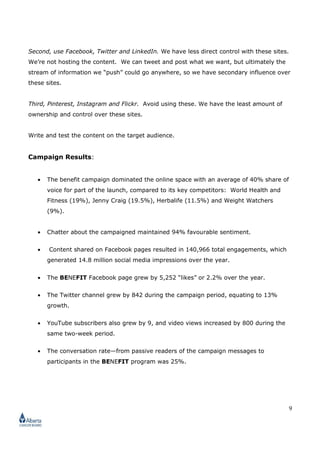
Second, use Facebook, Twitter and LinkedIn. We have less direct control with these sites.
We’re not hosting the content. We can tweet and post what we want, but ultimately the
stream of information we “push” could go anywhere, so we have secondary influence over
these sites.
Third, Pinterest, Instagram and Flickr. Avoid using these. We have the least amount of
ownership and control over these sites.
Write and test the content on the target audience.
Campaign Results:
• The benefit campaign dominated the online space with an average of 40% share of
voice for part of the launch, compared to its key competitors: World Health and
Fitness (19%), Jenny Craig (19.5%), Herbalife (11.5%) and Weight Watchers
(9%).
• Chatter about the campaigned maintained 94% favourable sentiment.
• Content shared on Facebook pages resulted in 140,966 total engagements, which
generated 14.8 million social media impressions over the year.
• The BENEFIT Facebook page grew by 5,252 “likes” or 2.2% over the year.
• The Twitter channel grew by 842 during the campaign period, equating to 13%
growth.
• YouTube subscribers also grew by 9, and video views increased by 800 during the
same two-week period.
• The conversation rate—from passive readers of the campaign messages to
participants in the BENEFIT program was 25%.
10
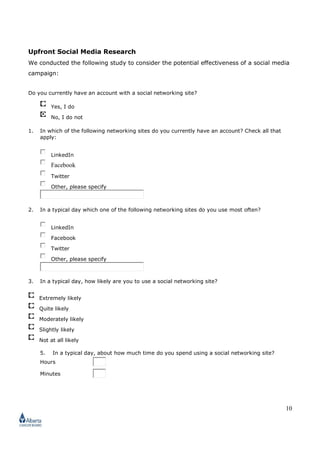
Upfront Social Media Research
We conducted the following study to consider the potential effectiveness of a social media
campaign:
Do you currently have an account with a social networking site?
Yes, I do
No, I do not
1. In which of the following networking sites do you currently have an account? Check all that
apply:
LinkedIn
Facebook
Twitter
Other, please specify
2. In a typical day which one of the following networking sites do you use most often?
LinkedIn
Facebook
Twitter
Other, please specify
3. In a typical day, how likely are you to use a social networking site?
Extremely likely
Quite likely
Moderately likely
Slightly likely
Not at all likely
5. In a typical day, about how much time do you spend using a social networking site?
Hours
Minutes
11
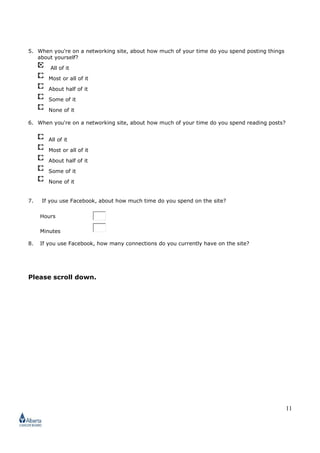
5. When you're on a networking site, about how much of your time do you spend posting things
about yourself?
All of it
Most or all of it
About half of it
Some of it
None of it
6. When you're on a networking site, about how much of your time do you spend reading posts?
All of it
Most or all of it
About half of it
Some of it
None of it
7. If you use Facebook, about how much time do you spend on the site?
Hours
Minutes
8. If you use Facebook, how many connections do you currently have on the site?
Please scroll down.
12
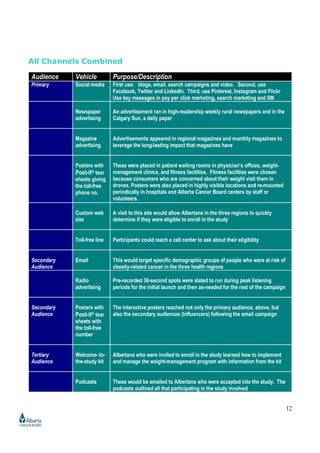
All Channels Combined
Audience Vehicle Purpose/Description
Primary Social media First use: blogs, email, search campaigns and video. Second, use
Facebook, Twitter and LinkedIn. Third, use Pinterest, Instagram and Flickr
Use key messages in pay per click marketing, search marketing and SM
Newspaper
advertising
An advertisement ran in high-readership weekly rural newspapers and in the
Calgary Sun, a daily paper
Magazine
advertising
Advertisements appeared in regional magazines and monthly magazines to
leverage the long-lasting impact that magazines have
Posters with
Post-it® tear
sheets giving
the toll-free
phone no.
These were placed in patient waiting rooms in physician’s offices, weight-
management clinics, and fitness facilities. Fitness facilities were chosen
because consumers who are concerned about their weight visit them in
droves. Posters were also placed in highly visible locations and re-mounted
periodically in hospitals and Alberta Cancer Board centers by staff or
volunteers.
Custom web
site
A visit to this site would allow Albertans in the three regions to quickly
determine if they were eligible to enroll in the study
Toll-free line Participants could reach a call center to ask about their eligibility
Secondary
Audience
Email This would target specific demographic groups of people who were at risk of
obesity-related cancer in the three health regions
Radio
advertising
Pre-recorded 30-second spots were slated to run during peak listening
periods for the initial launch and then as-needed for the rest of the campaign
Secondary
Audience
Posters with
Post-it® tear
sheets with
the toll-free
number
The interactive posters reached not only the primary audience, above, but
also the secondary audiences (Influencers) following the email campaign
Tertiary
Audience
Welcome- to-
the-study kit
Albertans who were invited to enroll in the study learned how to implement
and manage the weight-management program with information from the kit
Podcasts These would be emailed to Albertans who were accepted into the study. The
podcasts outlined all that participating in the study involved
13
Timeline and Tactics
Start Date Tactic Audience(s) Purpose
January Identify the target audiences for
both the study and the
campaign.
Write the strategic plan, news
stories, and key messages
(1) Albertans within a
specific age and body-
mass index who live in
six health regions of
Alberta. (2) Health-care
providers, hospitals,
cancer centers, weight-
management, and
fitness centers
Compare the Alberta audience
against the required participants for
the study. Ensure the study and
campaign will be effective in
reaching the right targets
Create social-media campaign Albertans where
obesity-linked cancer is
highest in Alberta
To reach the audience in three health
regions
Hire an agency to design the
collateral
To flesh out an identity for the
collateral
Write the radio commercials Primary To ensure the audience hears the
message through another medium
Ensure the cancer board is
aware of the BENEFIT messages
Pitch the ad mockups to
internal audiences
before external
To determine the effectiveness of the
messages from a health-care
audience’s point of view
Develop a program to reach
physicians
Physicians and their
staff
Used to reach Albertans who may
have health concerns related to
being overweight
February Find pharmaceutical companies
to take posters to clinics and to
encourage physicians to
recommend the program
Physicians who can
recommend the study to
their patients
To stimulate the medical audience to
endorse and refer the program. To
get their staff to mount the posters.
List the audiences to receive the
poster. Call them to determine
whether they would agree to
refer clients and hang posters
Hospitals, cancer
centers, weight-
management and fitness
counselors
To recruit study participants and
encourage word-of-mouth publicity
of the program in highly visible areas
March Contract a market research firm
to re-test the collateral
For primary and
secondary audiences
To conduct advertising effectiveness
studies and indepth interviews.
April Write copy for the welcome kit Target Albertans
eligible to participate
in study
Test the copy. Next, send the
welcome kit to Albertans who call
the toll-free hot line wanting to enroll
May Help recruit participants for the
focus group study and
interviews
(1) Alberta residents in
specific regions and (2)
physicians
Prepare for the first round of testing
with the Albertans. Conduct indepth
interviews with physicians
June Monitor focus group testing Primary audience Assess feedback
July Write articles on healthy eating
for the website
For Albertans Educate them about the power of
dieting the healthy way
August Refine messages in posters and
advertisements as needed
For Prevention Ensure buy-in
September Revise the welcome kit to make
it easier to understand
Prepare kit to reach the objectives
set for it
October Retest the collateral To support the welcome kit
November Write podcast and internet copy
14
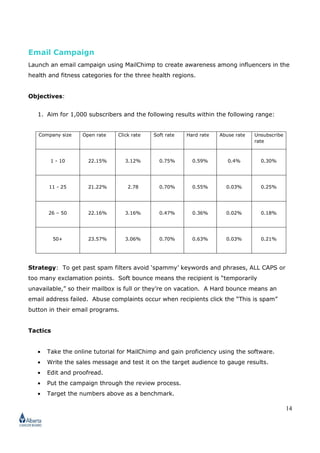
Email Campaign
Launch an email campaign using MailChimp to create awareness among influencers in the
health and fitness categories for the three health regions.
Objectives:
1. Aim for 1,000 subscribers and the following results within the following range:
Company size Open rate Click rate Soft rate Hard rate Abuse rate Unsubscribe
rate
1 - 10 22.15% 3.12% 0.75% 0.59% 0.4% 0.30%
11 - 25 21.22% 2.78 0.70% 0.55% 0.03% 0.25%
26 – 50 22.16% 3.16% 0.47% 0.36% 0.02% 0.18%
50+ 23.57% 3.06% 0.70% 0.63% 0.03% 0.21%
Strategy: To get past spam filters avoid ‘spammy’ keywords and phrases, ALL CAPS or
too many exclamation points. Soft bounce means the recipient is “temporarily
unavailable,” so their mailbox is full or they’re on vacation. A Hard bounce means an
email address failed. Abuse complaints occur when recipients click the “This is spam”
button in their email programs.
Tactics
• Take the online tutorial for MailChimp and gain proficiency using the software.
• Write the sales message and test it on the target audience to gauge results.
• Edit and proofread.
• Put the campaign through the review process.
• Target the numbers above as a benchmark.
15
Media Relations
Track outputs, out-takes and outcomes through a subscription to MarketWire, a CP wire
service that tells us where our stories are.
Outputs: Key messages in pitch letter and
from posts and tweets communicated in the
news
For example, how often the key messages
come up in news stories and social media.
Out-takes: Audience takeaways (changing
perceptions)
For example, the campaign resulted in a
28 percent increase in public awareness.
What key messages did the audience get?
Outcomes: Quantifiable changes because
of increased messaging, more traffic
For example, the campaign generated
a 65 percent increase in positive
mentions, which correlated to an increase
in support.
Objectives online and off-line:
1. Proactively meet every health journalist covering the three health regions, where
they are—searching stories online.
2. Generate 1,000 media impressions through infographics, Vine Video, YouTube and
other sites.
3. Generate 500 media impressions by executives connecting with campaign
journalists online.
4. Secure 75 stories in mainstream and trade outlets.
5. Continue to track coverage through Canadian Press (Market Wire).
Online Strategy: Create links to our news stories through infographics, Vine Video,
YouTube and other sites. Ask executives to make public statements on LinkedIn and use
other social strategies to communicate news. Deploy pitch letters to media first.
16
Strategy continued:
When CEOs engage media, journalists typically pay attention. News reporters like it when
executives respond to their posts. Thanks to Vine video, infographics and YouTube, we
can communicate with news reporters faster than if our story were released in a news
pitch to key journalists. Plus, we’re writing the story and have control over the content.
Next, develop a news blog to attract journalists and bloggers to our content. Showcase
our expertise, testimonials and other key messages.
Tactics
• Update our media list and research journalists covering the health beats.
• Develop three stories on the research program and one on the campaign to insert
in a pitch letter.
• Connect with media online.
• Teach CEOs to “post” on the top three social-media sites.
• Assign Tweet decks, infographics and Vine Video Posts to the social-media and
design team, asking them to design the graphics.
• Write lengthier stories for mainstream magazines such as Apple, Barley Country,
and rural newspapers.
• Track the following:
17
o Total mentions, mentions by geographic area, sentiment, executive mentions,
top articles, influencers, publications and speaking opportunities or coverage.
Results: Stories appeared in all the channels targeted even though publicity is not
guaranteed through media relations.
Media Relations Training and Issues Management
Objective:
1. Increase the number of spokespersons and experts we train for news interviews
from two to five individuals. Train them to answer as many questions as possible
when a reporter calls and to address any issues associated with the campaign.
Strategy: Think through issues associated with the campaign and how they should be
addressed in interviews. Train enough spokespersons to be available to answer interview
questions from reporters in traditional channels and in social media. Show them how to
deal with reporters in scrums, telephone interviews and news conferences.
Tactics
Find eloquent spokespersons and subject matter experts from every business area of the
company. Host media training sessions followed by actual news interviews in which
reporters fire interview questions to them.
Train each spokesperson to:
• Study all the issues associated with the campaign in our risk matrix. Comment on
how we are mitigating risks.
• Ensure they can speak from talking points, deliver facts and pre-planned messages.
• Understand the do’s and don’ts, including how to handle aggressive interviews and
how to bridge and transition to key messages.
• Handle on-camera and phone interview scenarios through practice sessions in front
of a camera with experienced news professionals.
• Know the difference between ‘hard’ and ‘soft’ news. Know the various story angles.
• Tell the truth and speak inside your area of expertise or bring in an expert
• Do not predict the future.
18
• Avoid blaming others for problems, disasters and wrong-doing.
• Keep responses to media succinct to make a point quickly.
• Answer who, what, when, where, why and how, and stay composed and relaxed.
• Come across clear, well-spoken and physically poised on camera.
• Understand that nothing is off-the-record.
Advertising
Goals Website/
Hot-line
Email
advt. and
social media
Radio
advt.
News-
paper
advt.
Sales-
calls
Welcome
kit
Posters Pod-
casts
To generate enrollment
● ● ● ● ● ●
To increase advertising
effectiveness
● ● ● ●
To track impressions, hits,
reach, frequency, phone
calls
● ● ● ●
To gain exposure in
physicians’ offices, weight-
management centers, and
fitness facilities
● ● ● ●
To speed acceptance of the
program
● ● ● ●
To provide a selling tool for
the pharmaceutical sales
agents
● ●
To create excitement about
losing weight and earning
$600
● ● ● ● ● ● ● ●
To reach large amounts of
the target in each health
region
● ● ●
To efficiently reach narrowly
defined segments in their
20s, 30s, 40s, and 50s if
enrolment is lacking in
particular age groups
● ● ●
Effectiveness of response
can be easily measured
● ● ● ● ●
To increase enrollment
when it drops
● ● ● ● ● ● ●
19
Advertising Objectives
Advertising Effectiveness Research
Hire ResearchWorks to probe focus-group participants about the creative elements of the
advertising. Test for high marks on visual appeal, headline impact, copywriting clarity,
information value, credibility and persuasiveness. Studies show that eighty percent of the
readers who read the headline of an advertisement will skip the body copy.
Research Results
The first advertisements were dark blue and difficult to read. Without a second thought,
Albertans in focus groups vetoed them. During a second round of testing on orange
executions, Albertans suggested only minor improvements.
The advertising agency applied the same headlines, body copy and call-to-action to the
stand-up poster, welcome-to-the-study kit and other collateral to publicize the campaign.
The agency’s most senior staff and I agreed to use one spectacular advertisement that
would stand out from the clutter of advertisements crowding newspaper pages. They said
they could create several ads to rotate and maintain awareness. We wrote radio ads and
announcements for on-air DJs. DJ chat about the campaign needed to air before the
advertising campaign ensued.
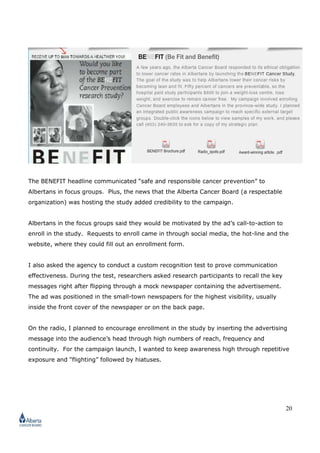
The best ad showed a woman lifting a bowl of fruit and vegetables. Her head rose above
the advertisement. The intent of the slice-of-life or lifestyle execution would be to
communicate moments of good health, physical activity, and eating right.
20
The BENEFIT headline communicated “safe and responsible cancer prevention” to
Albertans in focus groups. Plus, the news that the Alberta Cancer Board (a respectable
organization) was hosting the study added credibility to the campaign.
Albertans in the focus groups said they would be motivated by the ad’s call-to-action to
enroll in the study. Requests to enroll came in through social media, the hot-line and the
website, where they could fill out an enrollment form.
I also asked the agency to conduct a custom recognition test to prove communication
effectiveness. During the test, researchers asked research participants to recall the key
messages right after flipping through a mock newspaper containing the advertisement.
The ad was positioned in the small-town newspapers for the highest visibility, usually
inside the front cover of the newspaper or on the back page.
On the radio, I planned to encourage enrollment in the study by inserting the advertising
message into the audience’s head through high numbers of reach, frequency and
continuity. For the campaign launch, I wanted to keep awareness high through repetitive
exposure and “flighting” followed by hiatuses.
21
Key Messages
The key messages for Albertans in the three health regions were:
1. BENEFIT through the Alberta Cancer Board’s new research study: Earn
$600 and cut your cancer risks by 50 percent.
2. BENEFIT: Earn $600 and cut your cancer risk by 50 percent in a new research
study by the Alberta Cancer Board.
The message for physicians who would recommend the program to their patients is: Fifty-
percent of cancers are preventable. Lower your cancer risk in a study by the Alberta
Cancer Board.
The message for Albertans who were invited to enroll in the study was: Earn $600 to cut
your cancer risk by 50 percent. Lower your cancer risk with the Alberta Cancer Board.
Advertising Objectives
1. Entice 6,500 Albertans (who are eligible to enroll in the research) to enroll. (Induce
trial)
2. Educate and remind them about the $600 incentive to entice 2,500 participants to
stay in the study. (Continuity)
Strategy
1. Avoid affluent markets since wealthier Albertans have the time and money for
fitness. The $600 would not be enough of an incentive to entice them to
participate.
2. Try to enroll less financially successful people who need a lifestyle or “health”
change
3. Target adults who have the most to gain in health and cash by enrolling in the
study.
22
Advertise in rural papers only after determining whether we can write an article for them
or pitch a news story to the reporters.
Physician Communications
Objective
1. Deliver interactive posters to 539 physicians within the first three months of the
campaign to generate 1,500 media impressions.
Strategy: I enticed pharmaceutical sales representatives, who sell medication, to deliver
an interactive table-top poster to physicians’ offices. Their staff placed the inter-active
card-board poster in the lobby of the office or hung it in patient examining rooms.
Albertans could pull post-it notes from the poster. They contained our contact details and
reminded the target audience to call the Cancer Board’s call center or visit its website.
The stand-up posters were not “hidden” in an envelope, so physicians and receptionist
could read about the study right away and ask questions.
The sales approach involved reaching 539 physicians through the sales reps. When the
sales representatives from the pharmaceutical had time, they would also talk to
receptionists briefly about the study and give them a letter from the Cancer Board for the
doctor. Doctors were encouraged to invite their patients to enroll in the study if they
qualified for it.
Eight employees at Alberta Health Services agreed to hang posters in each hospital, and
20 employees at the Alberta Cancer Board agreed to mount the posters in the patient
waiting rooms of all Alberta Cancer Board centers. We contacted these influencers and
the pharmaceutical reps through the email campaign.
Results: Feedback from volunteers who collected the posters after the campaign said
that 428 posters were mounted and removed. Judging from the number of post-it notes
torn from the poster pads, the estimated number of impressions was around 1,700.
23
Overall Campaign Measurement
The results for each individual communication channel are given above. This part of the
study gauges message recall for the entire campaign. Although I was not part of the
campaign evaluation process, I gathered these statistics from the communicators who
launched the campaign.
Objective 1
My first objective for the campaign: Stimulate interest and awareness of the Benefit
Research Study among 250,000 target-audience members (Albertans), thereby enticing
them to become study participants.
The results were as follows:
• Feedback from the Alberta Cancer Board communicators who launched my strategic
plan indicated that huge numbers Albertans had enrolled in one year rather than
two. This saved thousands of dollars on media buys.
• Focus-group research early in the program indicated that the advertisements and
messages would encourage Albertans to enroll in the study.
• My basic media buys indicated that Albertans in the targeted health regions would
learn about the Alberta Cancer Board’s study, and that 6,500 Albertans would
enroll. The number who enrolled was 6,632. Of that amount, the goal was to keep
2,500 in the study. The Cancer Board anticipated a large drop-out rate.
• Alberta Cancer Board communicators who launched my campaign plan reported
that word-of-mouth news spread quickly across the regions, especially in the towns
where word-of-mouth communications is more prevalent. The communicators
learned that 35 percent of the calls to the call center came from the rural health
regions.
• During the second year of the campaign, the Alberta Cancer Board’s Prevention
department planned to reach Albertans in additional health regions.
24
ResearchWorks measured message recall levels. Albertans who participated in the study
were asked whether they could remember hearing, seeing or reading any of the following
key messages about the study. As shown in the right-hand column of the table below,
awareness levels were high:
Message Recall for the Launch
Question asked: “Can you recall hearing or seeing any of the following
communication messages in the following channel… “
Message Percentage who recalled message
Earn $600 to reduce your cancer risk by
50 percent. BENEFIT with the Alberta
Cancer Board.
68% Calgary Health Region
74% Chinook Health Region
72% Peace Country Health Region
BENEFIT, thanks to the Alberta Cancer
Board: Earn $600 and cut your cancer
risk by 50 percent.
64% Calgary Health Region
68% Chinook Health Region
78% Peace Country Health Region
Fifty-percent of cancers are
preventable. Lower your cancer risk by
50 percent in the Alberta Cancer
Board’s BENEFIT study.
58% Calgary Health Region
72% Chinook Health Region
68% Peace Country Health Region
Earn $600 and cut your cancer risks by
50 percent. BENEFIT through the
Alberta Cancer Board’s new research
study:
56% Calgary Health Region
69% Chinook Health Region
72% Peace Country Health Region
25
Objective 2
The second objective is: Enroll at least 6,500 members of the target audience in the
research study (knowing that not everyone who enrolls in the study will remain in it).
This objective brought these results:
• When leaders reviewed the Welcome-to-the-study Kit, they added extra messages
and content. But by inviting them to focus groups to hear feedback on the kit, they
learned that the kit and the BENEFIT program needed to be simpler. The kit was
modified, and in the second round of focus-group testing, Albertans said that
channels ranging from radio commercials and table-top posters to print
advertisements and podcasts were greatly improved. What’s more, each
communication vehicle communicated ways to get Albertans to enroll in the study.
• I had anticipated that a significant number of people would drop out of the study.
Preventing avoidable cancers is inherently difficult. For example, participants were
asked to stop smoking, use sunscreen and change other ingrained behaviors to
prevent cancer. Even though drop-outs were inevitable, I compensated for them
by enrolling more than the required number of participants.
Objective 3
The objective is: Educate and remind target audiences about the $600 incentive to entice
2,500 participants to remain in the study.
The objective was reached.
• Feedback from the sales representatives indicated that doctors told their patients
to enroll in the study. In addition, roughly 68 percent of receptionists agreed to
display the stand-up posters in the patient waiting areas of their clinic.
26
• Weight-management centers and fitness clubs encouraged their clients to enroll in
the study.
• Early in the program, indepth interviews with physicians indicated they were eager
to participate.
What would I do differently? With the budget available, I would hire an agency to
evaluate the campaign—to assess the results of each medium. I was hired to plan the
campaign only; her contract at the Alberta Cancer Board was temporary.
I would also recommend that special event consultants be hired to coordinate all the
logistics on launch day. The communicators who launched the campaign were stretched
to the limit even with volunteer help.
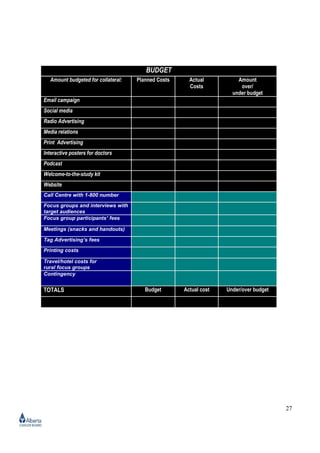
Budget
The campaign called for several hundred thousand dollars to cover the cost of hiring
Research Works and Tag Advertising, plus the cost collateral listed below.
The figures shown in the budget below have been removed in the interest of privacy.
Please scroll down.
27
BUDGET
Amount budgeted for collateral: Planned Costs Actual
Costs
Amount
over/
under budget
Email campaign
Social media
Radio Advertising
Media relations
Print Advertising
Interactive posters for doctors
Podcast
Welcome-to-the-study kit
Website
Call Centre with 1-800 number
Focus groups and interviews with
target audiences
Focus group participants’ fees
Meetings (snacks and handouts)
Tag Advertising’s fees
Printing costs
Travel/hotel costs for
rural focus groups
Contingency
TOTALS Budget Actual cost Under/over budget

Condensed IMC plan

  • 1.
    1 Receive up to$600 Toward a Healthier You Strategic Plan for the BENEFIT Campaign By Susan L. Blanchard, MBA, ABC, CAAP For the Alberta Cancer Board (AHS) and IABC This case study outlines strategic communications to launch a multimedia marketing communications campaign. My goal was to enroll thousands of Albertans in a major cancer study. Thanks to the strength of the plan and campaign in this case study, I reached my objectives for the campaign. Even more, I presented the campaign to IABC to pass IABC’s rigorous examination and accreditation process. This plan has been edited to remove the confidential names of persons responsible for various tactics.
  • 2.
    2 The communication objectivesof Alberta Cancer Board campaign are to: 1. Stimulate awareness of the Benefit Research Study among 250,000 target-audience members (Albertans), thereby enticing them to become study participants. 2. Enroll at least 6,500 members of the target audience in the Research Study (knowing that not everyone who enrolls in the study will remain in it). 3. Educate and remind them about the $600 incentive to entice 2,500 participants to stay in the study. My Role I was recruited as a strategic planning manager. My job was to: • Create province-wide public awareness of a major cancer study. • Enroll a total of 6,500 males and females in the study with the expectation that some will drop out. • Write a comprehensive strategic plan for an integrated campaign to enroll Albertans living in three health regions. • Use project management to manage timelines. • Coach a team of co-workers to launch the campaign. • Hire a market research firm and oversee qualitative market research to test advertising messages and determine the likelihood of enrollment. • Manage an advertising agency’s work to create campaign messages and advertisements. • Write a social-media strategy (see page 6). • Plan and launch a website and online content (Website plan is excluded). • Plan, write and organize paid media advertising (traditional channels), earned media, a podcast and a direct-email campaign. • Write radio, internet, print and other communication collateral to create awareness of the research study across Alberta. • Develop a media-relations plan. • Encourage pharmaceutical personnel to deliver interactive posters to physicians. • Create an information hot-line and call center.
  • 3.
    2 The communication objectivesof Alberta Cancer Board campaign are to: 1. Stimulate awareness of the Benefit Research Study among 250,000 target-audience members (Albertans), thereby enticing them to become study participants. 2. Enroll at least 6,500 members of the target audience in the Research Study (knowing that not everyone who enrolls in the study will remain in it). 3. Educate and remind them about the $600 incentive to entice 2,500 participants to stay in the study. My Role I was recruited as a strategic planning manager. My job was to: • Create province-wide public awareness of a major cancer study. • Enroll a total of 6,500 males and females in the study with the expectation that some will drop out. • Write a comprehensive strategic plan for an integrated campaign to enroll Albertans living in three health regions. • Use project management to manage timelines. • Coach a team of co-workers to launch the campaign. • Hire a market research firm and oversee qualitative market research to test advertising messages and determine the likelihood of enrollment. • Manage an advertising agency’s work to create campaign messages and advertisements. • Write a social-media strategy (see page 6). • Plan and launch a website and online content (Website plan is excluded). • Plan, write and organize paid media advertising (traditional channels), earned media, a podcast and a direct-email campaign. • Write radio, internet, print and other communication collateral to create awareness of the research study across Alberta. • Develop a media-relations plan. • Encourage pharmaceutical personnel to deliver interactive posters to physicians. • Create an information hot-line and call center.
  • 4.
    2 The communication objectivesof Alberta Cancer Board campaign are to: 1. Stimulate awareness of the Benefit Research Study among 250,000 target-audience members (Albertans), thereby enticing them to become study participants. 2. Enroll at least 6,500 members of the target audience in the Research Study (knowing that not everyone who enrolls in the study will remain in it). 3. Educate and remind them about the $600 incentive to entice 2,500 participants to stay in the study. My Role I was recruited as a strategic planning manager. My job was to: • Create province-wide public awareness of a major cancer study. • Enroll a total of 6,500 males and females in the study with the expectation that some will drop out. • Write a comprehensive strategic plan for an integrated campaign to enroll Albertans living in three health regions. • Use project management to manage timelines. • Coach a team of co-workers to launch the campaign. • Hire a market research firm and oversee qualitative market research to test advertising messages and determine the likelihood of enrollment. • Manage an advertising agency’s work to create campaign messages and advertisements. • Write a social-media strategy (see page 6). • Plan and launch a website and online content (Website plan is excluded). • Plan, write and organize paid media advertising (traditional channels), earned media, a podcast and a direct-email campaign. • Write radio, internet, print and other communication collateral to create awareness of the research study across Alberta. • Develop a media-relations plan. • Encourage pharmaceutical personnel to deliver interactive posters to physicians. • Create an information hot-line and call center.
  • 5.
    2 The communication objectivesof Alberta Cancer Board campaign are to: 1. Stimulate awareness of the Benefit Research Study among 250,000 target-audience members (Albertans), thereby enticing them to become study participants. 2. Enroll at least 6,500 members of the target audience in the Research Study (knowing that not everyone who enrolls in the study will remain in it). 3. Educate and remind them about the $600 incentive to entice 2,500 participants to stay in the study. My Role I was recruited as a strategic planning manager. My job was to: • Create province-wide public awareness of a major cancer study. • Enroll a total of 6,500 males and females in the study with the expectation that some will drop out. • Write a comprehensive strategic plan for an integrated campaign to enroll Albertans living in three health regions. • Use project management to manage timelines. • Coach a team of co-workers to launch the campaign. • Hire a market research firm and oversee qualitative market research to test advertising messages and determine the likelihood of enrollment. • Manage an advertising agency’s work to create campaign messages and advertisements. • Write a social-media strategy (see page 6). • Plan and launch a website and online content (Website plan is excluded). • Plan, write and organize paid media advertising (traditional channels), earned media, a podcast and a direct-email campaign. • Write radio, internet, print and other communication collateral to create awareness of the research study across Alberta. • Develop a media-relations plan. • Encourage pharmaceutical personnel to deliver interactive posters to physicians. • Create an information hot-line and call center.
  • 6.
    6 The targets agreedto mention the study to their clients or disseminate collateral to create awareness of the study. Typically, members of the primary target audience learned about the campaign through social media, publicity, advertising, the Internet, their physician, e-mail, publications and so forth. Then they called the Alberta Cancer Board’s BENEFIT hotline or website to enroll. If they were eligible to participate in the study, the Board sent them a kit or webinar that welcomed them to participate in the study. The kit explained the steps to getting healthy and reducing their cancer rate by as much as 50 percent by giving up smoking, etc. Strategic Objectives After Albertans saw or heard about the research study, if motivated to act, they called the call-center hotline, visited the website to enroll or sent messages by means of email and social media. Every communications medium delivered the key messages. If an Albertan met the criteria to participate in the cancer research study, a team disseminated the welcome-to-the-study kit. To ensure the kit would enroll potential participants effectively, a market research firm tested it in focus groups. Communication objectives for the campaign: 1. Stimulate awareness and word-of-mouth news of the Alberta Cancer Board’s Benefit Research Study among 250,000 Albertans in three health regions to entice them to participate in the study. 2. Enroll at least 6,500 members of the target audience in the Research Study (knowing that not everyone who enrolls will participate). 3. Educate and remind participants about the $600 incentive to entice 2,500 of them to stay in the study.
  • 7.
    7 The Objectives Iset for the project are to: 1. Determine within a year if the cancer prevention campaign and $600 cash would be effective in enticing 6,500 Albertans in the Calgary, Chinook and Peace River health regions to enroll in the cancer study. 2. Learn before the campaign, through up-front research, if the communication collateral would provide all the information Albertans need to join the cancer study. (Collateral and channels included: a welcome-to-the-study kit, social media podcast, webinar, call-center hotline, website, email campaign, radio and print advertising, along with referrals from physicians, dieticians and other clinicians. Media relations would ensue before the collateral was deployed, and fulltime communicators were trained to tackle media relations and other communications. 3. Within a year, prompt 100 physicians, dieticians and other clinicians to refer patients or clients to enroll in the Board’s maintain-a-healthy-weight study (BENEFIT). Social media Objectives Reach internal audiences first. After audiences from AHS enrolled, reach external audiences. Tactics are not listed. The SM campaign was outsourced. Objectives for the province-wide campaign within a year: 1. Communicate the benefits of entering the BENEFIT campaign, highlighting the $600 fee paid to Albertans who completed the study. 2. Maintain the number 1 position in terms of share of voice against competitors in the health and fitness market. 3. Maintain at least 85 percent sentiment about the cancer research study throughout the campaign.
  • 8.
    8 4. Grow theAlberta Cancer Board’s owned social channels by 1% for Facebook and 10% for Twitter, and increase YouTube video views by 5,000 and subscribers by 25. 5. Generate 10,000 social-media impressions (earned, owned and paid), demonstrating engagements from target audiences. 6. Convert Albertans in the three health regions to 25% of the BENEFIT program participants. Strategy: To create brand affinity and an emotional connection to the cancer study, communicate the benefits of preventing cancer and “earning $600 toward a healthier you”—the value proposition. By reaching Albertans in three health regions across a multitude of channels, both online and offline, the BENEFIT research study and the Alberta Cancer Board must stand as the voice of reason. During the research, we're going to give “you” all the information available to help you fight cancer, and we'll guide you, but you ultimately make the choice. Tactics Develop a content marketing schedule and stay proactive in presenting our message rather than reactive to comments, criticisms or questions. Create a story around how Albertans benefit. Pitch the lengthier story to publications and then bring the story to the size of a sentence or two, a key message. Choose channels that present the best return on investment in terms of time money, resources and information. Deploy the most profitable channels first—the ones that produce the most amount of visitors, revenue or actions leading to revenue: First, use blogs, email, search campaigns and video. These channels gave us the highest level of control and influence. We own these communication channels and have a direct influence on what goes out. Our messages and links are shared and republished.
  • 9.
    9 Second, use Facebook,Twitter and LinkedIn. We have less direct control with these sites. We’re not hosting the content. We can tweet and post what we want, but ultimately the stream of information we “push” could go anywhere, so we have secondary influence over these sites. Third, Pinterest, Instagram and Flickr. Avoid using these. We have the least amount of ownership and control over these sites. Write and test the content on the target audience. Campaign Results: • The benefit campaign dominated the online space with an average of 40% share of voice for part of the launch, compared to its key competitors: World Health and Fitness (19%), Jenny Craig (19.5%), Herbalife (11.5%) and Weight Watchers (9%). • Chatter about the campaigned maintained 94% favourable sentiment. • Content shared on Facebook pages resulted in 140,966 total engagements, which generated 14.8 million social media impressions over the year. • The BENEFIT Facebook page grew by 5,252 “likes” or 2.2% over the year. • The Twitter channel grew by 842 during the campaign period, equating to 13% growth. • YouTube subscribers also grew by 9, and video views increased by 800 during the same two-week period. • The conversation rate—from passive readers of the campaign messages to participants in the BENEFIT program was 25%.
  • 10.
    10 Upfront Social MediaResearch We conducted the following study to consider the potential effectiveness of a social media campaign: Do you currently have an account with a social networking site? Yes, I do No, I do not 1. In which of the following networking sites do you currently have an account? Check all that apply: LinkedIn Facebook Twitter Other, please specify 2. In a typical day which one of the following networking sites do you use most often? LinkedIn Facebook Twitter Other, please specify 3. In a typical day, how likely are you to use a social networking site? Extremely likely Quite likely Moderately likely Slightly likely Not at all likely 5. In a typical day, about how much time do you spend using a social networking site? Hours Minutes
  • 11.
    11 5. When you'reon a networking site, about how much of your time do you spend posting things about yourself? All of it Most or all of it About half of it Some of it None of it 6. When you're on a networking site, about how much of your time do you spend reading posts? All of it Most or all of it About half of it Some of it None of it 7. If you use Facebook, about how much time do you spend on the site? Hours Minutes 8. If you use Facebook, how many connections do you currently have on the site? Please scroll down.
  • 12.
    12 All Channels Combined AudienceVehicle Purpose/Description Primary Social media First use: blogs, email, search campaigns and video. Second, use Facebook, Twitter and LinkedIn. Third, use Pinterest, Instagram and Flickr Use key messages in pay per click marketing, search marketing and SM Newspaper advertising An advertisement ran in high-readership weekly rural newspapers and in the Calgary Sun, a daily paper Magazine advertising Advertisements appeared in regional magazines and monthly magazines to leverage the long-lasting impact that magazines have Posters with Post-it® tear sheets giving the toll-free phone no. These were placed in patient waiting rooms in physician’s offices, weight- management clinics, and fitness facilities. Fitness facilities were chosen because consumers who are concerned about their weight visit them in droves. Posters were also placed in highly visible locations and re-mounted periodically in hospitals and Alberta Cancer Board centers by staff or volunteers. Custom web site A visit to this site would allow Albertans in the three regions to quickly determine if they were eligible to enroll in the study Toll-free line Participants could reach a call center to ask about their eligibility Secondary Audience Email This would target specific demographic groups of people who were at risk of obesity-related cancer in the three health regions Radio advertising Pre-recorded 30-second spots were slated to run during peak listening periods for the initial launch and then as-needed for the rest of the campaign Secondary Audience Posters with Post-it® tear sheets with the toll-free number The interactive posters reached not only the primary audience, above, but also the secondary audiences (Influencers) following the email campaign Tertiary Audience Welcome- to- the-study kit Albertans who were invited to enroll in the study learned how to implement and manage the weight-management program with information from the kit Podcasts These would be emailed to Albertans who were accepted into the study. The podcasts outlined all that participating in the study involved
  • 13.
    13 Timeline and Tactics StartDate Tactic Audience(s) Purpose January Identify the target audiences for both the study and the campaign. Write the strategic plan, news stories, and key messages (1) Albertans within a specific age and body- mass index who live in six health regions of Alberta. (2) Health-care providers, hospitals, cancer centers, weight- management, and fitness centers Compare the Alberta audience against the required participants for the study. Ensure the study and campaign will be effective in reaching the right targets Create social-media campaign Albertans where obesity-linked cancer is highest in Alberta To reach the audience in three health regions Hire an agency to design the collateral To flesh out an identity for the collateral Write the radio commercials Primary To ensure the audience hears the message through another medium Ensure the cancer board is aware of the BENEFIT messages Pitch the ad mockups to internal audiences before external To determine the effectiveness of the messages from a health-care audience’s point of view Develop a program to reach physicians Physicians and their staff Used to reach Albertans who may have health concerns related to being overweight February Find pharmaceutical companies to take posters to clinics and to encourage physicians to recommend the program Physicians who can recommend the study to their patients To stimulate the medical audience to endorse and refer the program. To get their staff to mount the posters. List the audiences to receive the poster. Call them to determine whether they would agree to refer clients and hang posters Hospitals, cancer centers, weight- management and fitness counselors To recruit study participants and encourage word-of-mouth publicity of the program in highly visible areas March Contract a market research firm to re-test the collateral For primary and secondary audiences To conduct advertising effectiveness studies and indepth interviews. April Write copy for the welcome kit Target Albertans eligible to participate in study Test the copy. Next, send the welcome kit to Albertans who call the toll-free hot line wanting to enroll May Help recruit participants for the focus group study and interviews (1) Alberta residents in specific regions and (2) physicians Prepare for the first round of testing with the Albertans. Conduct indepth interviews with physicians June Monitor focus group testing Primary audience Assess feedback July Write articles on healthy eating for the website For Albertans Educate them about the power of dieting the healthy way August Refine messages in posters and advertisements as needed For Prevention Ensure buy-in September Revise the welcome kit to make it easier to understand Prepare kit to reach the objectives set for it October Retest the collateral To support the welcome kit November Write podcast and internet copy
  • 14.
    14 Email Campaign Launch anemail campaign using MailChimp to create awareness among influencers in the health and fitness categories for the three health regions. Objectives: 1. Aim for 1,000 subscribers and the following results within the following range: Company size Open rate Click rate Soft rate Hard rate Abuse rate Unsubscribe rate 1 - 10 22.15% 3.12% 0.75% 0.59% 0.4% 0.30% 11 - 25 21.22% 2.78 0.70% 0.55% 0.03% 0.25% 26 – 50 22.16% 3.16% 0.47% 0.36% 0.02% 0.18% 50+ 23.57% 3.06% 0.70% 0.63% 0.03% 0.21% Strategy: To get past spam filters avoid ‘spammy’ keywords and phrases, ALL CAPS or too many exclamation points. Soft bounce means the recipient is “temporarily unavailable,” so their mailbox is full or they’re on vacation. A Hard bounce means an email address failed. Abuse complaints occur when recipients click the “This is spam” button in their email programs. Tactics • Take the online tutorial for MailChimp and gain proficiency using the software. • Write the sales message and test it on the target audience to gauge results. • Edit and proofread. • Put the campaign through the review process. • Target the numbers above as a benchmark.
  • 15.
    15 Media Relations Track outputs,out-takes and outcomes through a subscription to MarketWire, a CP wire service that tells us where our stories are. Outputs: Key messages in pitch letter and from posts and tweets communicated in the news For example, how often the key messages come up in news stories and social media. Out-takes: Audience takeaways (changing perceptions) For example, the campaign resulted in a 28 percent increase in public awareness. What key messages did the audience get? Outcomes: Quantifiable changes because of increased messaging, more traffic For example, the campaign generated a 65 percent increase in positive mentions, which correlated to an increase in support. Objectives online and off-line: 1. Proactively meet every health journalist covering the three health regions, where they are—searching stories online. 2. Generate 1,000 media impressions through infographics, Vine Video, YouTube and other sites. 3. Generate 500 media impressions by executives connecting with campaign journalists online. 4. Secure 75 stories in mainstream and trade outlets. 5. Continue to track coverage through Canadian Press (Market Wire). Online Strategy: Create links to our news stories through infographics, Vine Video, YouTube and other sites. Ask executives to make public statements on LinkedIn and use other social strategies to communicate news. Deploy pitch letters to media first.
  • 16.
    16 Strategy continued: When CEOsengage media, journalists typically pay attention. News reporters like it when executives respond to their posts. Thanks to Vine video, infographics and YouTube, we can communicate with news reporters faster than if our story were released in a news pitch to key journalists. Plus, we’re writing the story and have control over the content. Next, develop a news blog to attract journalists and bloggers to our content. Showcase our expertise, testimonials and other key messages. Tactics • Update our media list and research journalists covering the health beats. • Develop three stories on the research program and one on the campaign to insert in a pitch letter. • Connect with media online. • Teach CEOs to “post” on the top three social-media sites. • Assign Tweet decks, infographics and Vine Video Posts to the social-media and design team, asking them to design the graphics. • Write lengthier stories for mainstream magazines such as Apple, Barley Country, and rural newspapers. • Track the following:
  • 17.
    17 o Total mentions,mentions by geographic area, sentiment, executive mentions, top articles, influencers, publications and speaking opportunities or coverage. Results: Stories appeared in all the channels targeted even though publicity is not guaranteed through media relations. Media Relations Training and Issues Management Objective: 1. Increase the number of spokespersons and experts we train for news interviews from two to five individuals. Train them to answer as many questions as possible when a reporter calls and to address any issues associated with the campaign. Strategy: Think through issues associated with the campaign and how they should be addressed in interviews. Train enough spokespersons to be available to answer interview questions from reporters in traditional channels and in social media. Show them how to deal with reporters in scrums, telephone interviews and news conferences. Tactics Find eloquent spokespersons and subject matter experts from every business area of the company. Host media training sessions followed by actual news interviews in which reporters fire interview questions to them. Train each spokesperson to: • Study all the issues associated with the campaign in our risk matrix. Comment on how we are mitigating risks. • Ensure they can speak from talking points, deliver facts and pre-planned messages. • Understand the do’s and don’ts, including how to handle aggressive interviews and how to bridge and transition to key messages. • Handle on-camera and phone interview scenarios through practice sessions in front of a camera with experienced news professionals. • Know the difference between ‘hard’ and ‘soft’ news. Know the various story angles. • Tell the truth and speak inside your area of expertise or bring in an expert • Do not predict the future.
  • 18.
    18 • Avoid blamingothers for problems, disasters and wrong-doing. • Keep responses to media succinct to make a point quickly. • Answer who, what, when, where, why and how, and stay composed and relaxed. • Come across clear, well-spoken and physically poised on camera. • Understand that nothing is off-the-record. Advertising Goals Website/ Hot-line Email advt. and social media Radio advt. News- paper advt. Sales- calls Welcome kit Posters Pod- casts To generate enrollment ● ● ● ● ● ● To increase advertising effectiveness ● ● ● ● To track impressions, hits, reach, frequency, phone calls ● ● ● ● To gain exposure in physicians’ offices, weight- management centers, and fitness facilities ● ● ● ● To speed acceptance of the program ● ● ● ● To provide a selling tool for the pharmaceutical sales agents ● ● To create excitement about losing weight and earning $600 ● ● ● ● ● ● ● ● To reach large amounts of the target in each health region ● ● ● To efficiently reach narrowly defined segments in their 20s, 30s, 40s, and 50s if enrolment is lacking in particular age groups ● ● ● Effectiveness of response can be easily measured ● ● ● ● ● To increase enrollment when it drops ● ● ● ● ● ● ●
  • 19.
    19 Advertising Objectives Advertising EffectivenessResearch Hire ResearchWorks to probe focus-group participants about the creative elements of the advertising. Test for high marks on visual appeal, headline impact, copywriting clarity, information value, credibility and persuasiveness. Studies show that eighty percent of the readers who read the headline of an advertisement will skip the body copy. Research Results The first advertisements were dark blue and difficult to read. Without a second thought, Albertans in focus groups vetoed them. During a second round of testing on orange executions, Albertans suggested only minor improvements. The advertising agency applied the same headlines, body copy and call-to-action to the stand-up poster, welcome-to-the-study kit and other collateral to publicize the campaign. The agency’s most senior staff and I agreed to use one spectacular advertisement that would stand out from the clutter of advertisements crowding newspaper pages. They said they could create several ads to rotate and maintain awareness. We wrote radio ads and announcements for on-air DJs. DJ chat about the campaign needed to air before the advertising campaign ensued. The best ad showed a woman lifting a bowl of fruit and vegetables. Her head rose above the advertisement. The intent of the slice-of-life or lifestyle execution would be to communicate moments of good health, physical activity, and eating right.
  • 20.
    20 The BENEFIT headlinecommunicated “safe and responsible cancer prevention” to Albertans in focus groups. Plus, the news that the Alberta Cancer Board (a respectable organization) was hosting the study added credibility to the campaign. Albertans in the focus groups said they would be motivated by the ad’s call-to-action to enroll in the study. Requests to enroll came in through social media, the hot-line and the website, where they could fill out an enrollment form. I also asked the agency to conduct a custom recognition test to prove communication effectiveness. During the test, researchers asked research participants to recall the key messages right after flipping through a mock newspaper containing the advertisement. The ad was positioned in the small-town newspapers for the highest visibility, usually inside the front cover of the newspaper or on the back page. On the radio, I planned to encourage enrollment in the study by inserting the advertising message into the audience’s head through high numbers of reach, frequency and continuity. For the campaign launch, I wanted to keep awareness high through repetitive exposure and “flighting” followed by hiatuses.
  • 21.
    21 Key Messages The keymessages for Albertans in the three health regions were: 1. BENEFIT through the Alberta Cancer Board’s new research study: Earn $600 and cut your cancer risks by 50 percent. 2. BENEFIT: Earn $600 and cut your cancer risk by 50 percent in a new research study by the Alberta Cancer Board. The message for physicians who would recommend the program to their patients is: Fifty- percent of cancers are preventable. Lower your cancer risk in a study by the Alberta Cancer Board. The message for Albertans who were invited to enroll in the study was: Earn $600 to cut your cancer risk by 50 percent. Lower your cancer risk with the Alberta Cancer Board. Advertising Objectives 1. Entice 6,500 Albertans (who are eligible to enroll in the research) to enroll. (Induce trial) 2. Educate and remind them about the $600 incentive to entice 2,500 participants to stay in the study. (Continuity) Strategy 1. Avoid affluent markets since wealthier Albertans have the time and money for fitness. The $600 would not be enough of an incentive to entice them to participate. 2. Try to enroll less financially successful people who need a lifestyle or “health” change 3. Target adults who have the most to gain in health and cash by enrolling in the study.
  • 22.
    22 Advertise in ruralpapers only after determining whether we can write an article for them or pitch a news story to the reporters. Physician Communications Objective 1. Deliver interactive posters to 539 physicians within the first three months of the campaign to generate 1,500 media impressions. Strategy: I enticed pharmaceutical sales representatives, who sell medication, to deliver an interactive table-top poster to physicians’ offices. Their staff placed the inter-active card-board poster in the lobby of the office or hung it in patient examining rooms. Albertans could pull post-it notes from the poster. They contained our contact details and reminded the target audience to call the Cancer Board’s call center or visit its website. The stand-up posters were not “hidden” in an envelope, so physicians and receptionist could read about the study right away and ask questions. The sales approach involved reaching 539 physicians through the sales reps. When the sales representatives from the pharmaceutical had time, they would also talk to receptionists briefly about the study and give them a letter from the Cancer Board for the doctor. Doctors were encouraged to invite their patients to enroll in the study if they qualified for it. Eight employees at Alberta Health Services agreed to hang posters in each hospital, and 20 employees at the Alberta Cancer Board agreed to mount the posters in the patient waiting rooms of all Alberta Cancer Board centers. We contacted these influencers and the pharmaceutical reps through the email campaign. Results: Feedback from volunteers who collected the posters after the campaign said that 428 posters were mounted and removed. Judging from the number of post-it notes torn from the poster pads, the estimated number of impressions was around 1,700.
  • 23.
    23 Overall Campaign Measurement Theresults for each individual communication channel are given above. This part of the study gauges message recall for the entire campaign. Although I was not part of the campaign evaluation process, I gathered these statistics from the communicators who launched the campaign. Objective 1 My first objective for the campaign: Stimulate interest and awareness of the Benefit Research Study among 250,000 target-audience members (Albertans), thereby enticing them to become study participants. The results were as follows: • Feedback from the Alberta Cancer Board communicators who launched my strategic plan indicated that huge numbers Albertans had enrolled in one year rather than two. This saved thousands of dollars on media buys. • Focus-group research early in the program indicated that the advertisements and messages would encourage Albertans to enroll in the study. • My basic media buys indicated that Albertans in the targeted health regions would learn about the Alberta Cancer Board’s study, and that 6,500 Albertans would enroll. The number who enrolled was 6,632. Of that amount, the goal was to keep 2,500 in the study. The Cancer Board anticipated a large drop-out rate. • Alberta Cancer Board communicators who launched my campaign plan reported that word-of-mouth news spread quickly across the regions, especially in the towns where word-of-mouth communications is more prevalent. The communicators learned that 35 percent of the calls to the call center came from the rural health regions. • During the second year of the campaign, the Alberta Cancer Board’s Prevention department planned to reach Albertans in additional health regions.
  • 24.
    24 ResearchWorks measured messagerecall levels. Albertans who participated in the study were asked whether they could remember hearing, seeing or reading any of the following key messages about the study. As shown in the right-hand column of the table below, awareness levels were high: Message Recall for the Launch Question asked: “Can you recall hearing or seeing any of the following communication messages in the following channel… “ Message Percentage who recalled message Earn $600 to reduce your cancer risk by 50 percent. BENEFIT with the Alberta Cancer Board. 68% Calgary Health Region 74% Chinook Health Region 72% Peace Country Health Region BENEFIT, thanks to the Alberta Cancer Board: Earn $600 and cut your cancer risk by 50 percent. 64% Calgary Health Region 68% Chinook Health Region 78% Peace Country Health Region Fifty-percent of cancers are preventable. Lower your cancer risk by 50 percent in the Alberta Cancer Board’s BENEFIT study. 58% Calgary Health Region 72% Chinook Health Region 68% Peace Country Health Region Earn $600 and cut your cancer risks by 50 percent. BENEFIT through the Alberta Cancer Board’s new research study: 56% Calgary Health Region 69% Chinook Health Region 72% Peace Country Health Region
  • 25.
    25 Objective 2 The secondobjective is: Enroll at least 6,500 members of the target audience in the research study (knowing that not everyone who enrolls in the study will remain in it). This objective brought these results: • When leaders reviewed the Welcome-to-the-study Kit, they added extra messages and content. But by inviting them to focus groups to hear feedback on the kit, they learned that the kit and the BENEFIT program needed to be simpler. The kit was modified, and in the second round of focus-group testing, Albertans said that channels ranging from radio commercials and table-top posters to print advertisements and podcasts were greatly improved. What’s more, each communication vehicle communicated ways to get Albertans to enroll in the study. • I had anticipated that a significant number of people would drop out of the study. Preventing avoidable cancers is inherently difficult. For example, participants were asked to stop smoking, use sunscreen and change other ingrained behaviors to prevent cancer. Even though drop-outs were inevitable, I compensated for them by enrolling more than the required number of participants. Objective 3 The objective is: Educate and remind target audiences about the $600 incentive to entice 2,500 participants to remain in the study. The objective was reached. • Feedback from the sales representatives indicated that doctors told their patients to enroll in the study. In addition, roughly 68 percent of receptionists agreed to display the stand-up posters in the patient waiting areas of their clinic.
  • 26.
    26 • Weight-management centersand fitness clubs encouraged their clients to enroll in the study. • Early in the program, indepth interviews with physicians indicated they were eager to participate. What would I do differently? With the budget available, I would hire an agency to evaluate the campaign—to assess the results of each medium. I was hired to plan the campaign only; her contract at the Alberta Cancer Board was temporary. I would also recommend that special event consultants be hired to coordinate all the logistics on launch day. The communicators who launched the campaign were stretched to the limit even with volunteer help. Budget The campaign called for several hundred thousand dollars to cover the cost of hiring Research Works and Tag Advertising, plus the cost collateral listed below. The figures shown in the budget below have been removed in the interest of privacy. Please scroll down.
  • 27.
    27 BUDGET Amount budgeted forcollateral: Planned Costs Actual Costs Amount over/ under budget Email campaign Social media Radio Advertising Media relations Print Advertising Interactive posters for doctors Podcast Welcome-to-the-study kit Website Call Centre with 1-800 number Focus groups and interviews with target audiences Focus group participants’ fees Meetings (snacks and handouts) Tag Advertising’s fees Printing costs Travel/hotel costs for rural focus groups Contingency TOTALS Budget Actual cost Under/over budget