Unit 1
Computer Application and Management Information System; NMBA 018 1
 Input Devices
◦ Keyboard,
◦ Pointing Devices,
◦ Voice Speech Devices,
◦ Scanner,
◦ MICR,
◦ OMR,
◦ Bar Code Reader,
◦ Digital Camera
Computer Application and
Management Information System;
NMBA 018 2
 An electromechanical device/peripheral used
• to provide data and
• control signals to an information processing
system such as a computer or information
appliance.
 Examples: keyboards, mouse, scanners,
digital cameras and joysticks, etc.
Computer Application and
Management Information System;
NMBA 018 3
Computer Application and
Management Information System;
NMBA 018 4
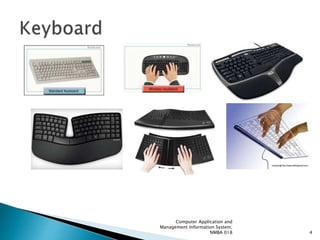
 Most popular for direct entry of data and
instructions
 Standard QWERTY keyboard is used
 Enhanced keyboard has 101keys
 Special keys - PageUp, PageDown, PrintScreen
etc.
 Looks like electronic typewriter keyboard with
additional keys
 linked to the CPU and it is also linked to
 the computer screen so that the data entered
into the memory
 can be seen by the user as he types in the data
Computer Application and
Management Information System;
NMBA 018 5
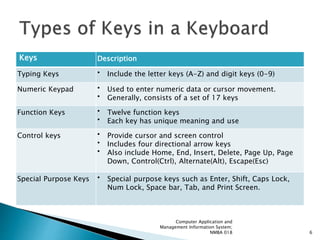
Keys Description
Typing Keys • Include the letter keys (A-Z) and digit keys (0-9)
Numeric Keypad • Used to enter numeric data or cursor movement.
• Generally, consists of a set of 17 keys
Function Keys • Twelve function keys
• Each key has unique meaning and use
Control keys • Provide cursor and screen control
• Includes four directional arrow keys
• Also include Home, End, Insert, Delete, Page Up, Page
Down, Control(Ctrl), Alternate(Alt), Escape(Esc)
Special Purpose Keys • Special purpose keys such as Enter, Shift, Caps Lock,
Num Lock, Space bar, Tab, and Print Screen.
Computer Application and
Management Information System;
NMBA 018 6
 Used to communicate with the computer by
pointing to locations on the screen
 Does not need keying of characters
 Provides a cursor on screen to perform move,
click, or drag operations
 Examples – Mouse, Joystick, Trackball, Touch
screen
Computer Application and
Management Information System;
NMBA 018 7
Computer Application and
Management Information System;
NMBA 018 8
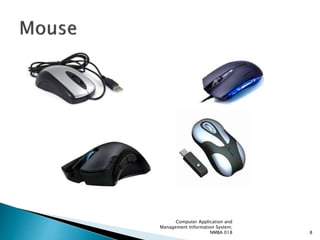
 Small hand-held pointing device
 palm size box containing 3 buttons and a ball
underneath, which senses the movement of
the mouse and sends the corresponding
signals to CPU on pressing the buttons
 used to move cursor on the screen, issue
commands and select an option from group
of choices.
 allows to create graphic elements on the
screen
Computer Application and
Management Information System;
NMBA 018 9
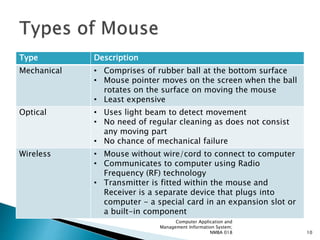
Type Description
Mechanical • Comprises of rubber ball at the bottom surface
• Mouse pointer moves on the screen when the ball
rotates on the surface on moving the mouse
• Least expensive
Optical • Uses light beam to detect movement
• No need of regular cleaning as does not consist
any moving part
• No chance of mechanical failure
Wireless • Mouse without wire/cord to connect to computer
• Communicates to computer using Radio
Frequency (RF) technology
• Transmitter is fitted within the mouse and
Receiver is a separate device that plugs into
computer - a special card in an expansion slot or
a built-in component
Computer Application and
Management Information System;
NMBA 018 10
Computer Application and
Management Information System;
NMBA 018 11
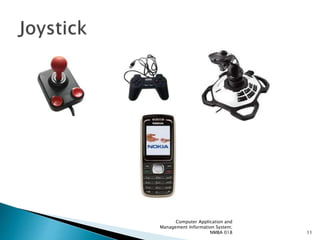
 Pointing device that moves in all directions
and controls movement of cursor
 Consists a stick attached to a plastic base
with flexible rubber sheath
 Provides three types of controls:
◦ Digital: limited movement – up, down, left and right
◦ Glide & Direct: movements in all directions
including 360degrees
◦ Direct control also responds as per the distance &
speed of the movement
Computer Application and
Management Information System;
NMBA 018 12
 Computer Games,
 Applications like Flight simulators and
training simulators
 CAD/CAM systems
 To control industrial robots
 In mobile phones
Computer Application and
Management Information System;
NMBA 018 13
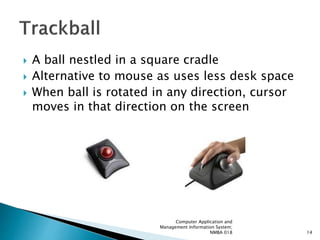
 A ball nestled in a square cradle
 Alternative to mouse as uses less desk space
 When ball is rotated in any direction, cursor
moves in that direction on the screen
Computer Application and
Management Information System;
NMBA 018 14
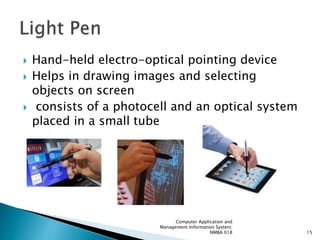
 Hand-held electro-optical pointing device
 Helps in drawing images and selecting
objects on screen
 consists of a photocell and an optical system
placed in a small tube
Computer Application and
Management Information System;
NMBA 018 15
 Special kind of display screen device
 Allows direct selection or activation of the
computer functions on touching the screen
 Registers the input when finger or other
object is placed on the screen
 Advantages
◦ minimum effort
◦ No additional peripherals required
 Disadvantages
◦ Expensive
◦ Not suitable for inputs of large amount of data
Computer Application and
Management Information System;
NMBA 018 16
 converts voice into electrical pulses and then into
digital signals for onward transmission to a
computer for processing.
 Voice recognition systems are very useful in
offices for word processing
 manager can directly dictate letters and notes to
word processor through a speech recognition
system
 can accept oral commands and execute them
 not popular due to storage of limited
vocabularies and variations in way of
pronouncing words by different persons
Computer Application and
Management Information System;
NMBA 018 17
 Converts text or image to an electronic
representation viewed on the screen
 Scans input data using light beam and
transforms it into ASCII code and image
 Bundled with software to communicate to
computer and save as graphic files
 Stores images in both greyscale and colour
mode
Computer Application and
Management Information System;
NMBA 018 18
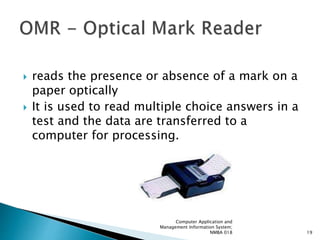
 reads the presence or absence of a mark on a
paper optically
 It is used to read multiple choice answers in a
test and the data are transferred to a
computer for processing.
Computer Application and
Management Information System;
NMBA 018 19
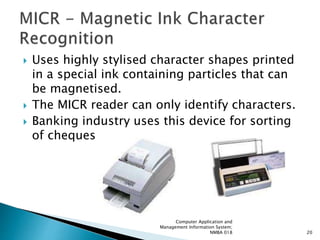
 Uses highly stylised character shapes printed
in a special ink containing particles that can
be magnetised.
 The MICR reader can only identify characters.
 Banking industry uses this device for sorting
of cheques
Computer Application and
Management Information System;
NMBA 018 20
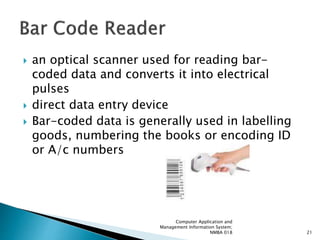
 an optical scanner used for reading bar-
coded data and converts it into electrical
pulses
 direct data entry device
 Bar-coded data is generally used in labelling
goods, numbering the books or encoding ID
or A/c numbers
Computer Application and
Management Information System;
NMBA 018 21
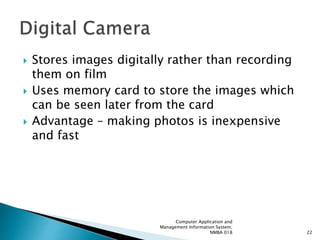
 Stores images digitally rather than recording
them on film
 Uses memory card to store the images which
can be seen later from the card
 Advantage – making photos is inexpensive
and fast
Computer Application and
Management Information System;
NMBA 018 22
Computer Application and
Management Information System;
NMBA 018 23
1. What are different types of scanners?
Compare the advantages and
disadvantages.
2. Write short note on:
a) OMR
b) MICR
c) Bar Code Reader
d) Digital Camera
e) OCR
f) Microphone

Conceptual framework input devices

  • 1.
    Unit 1 Computer Applicationand Management Information System; NMBA 018 1
  • 2.
     Input Devices ◦Keyboard, ◦ Pointing Devices, ◦ Voice Speech Devices, ◦ Scanner, ◦ MICR, ◦ OMR, ◦ Bar Code Reader, ◦ Digital Camera Computer Application and Management Information System; NMBA 018 2
  • 3.
     An electromechanicaldevice/peripheral used • to provide data and • control signals to an information processing system such as a computer or information appliance.  Examples: keyboards, mouse, scanners, digital cameras and joysticks, etc. Computer Application and Management Information System; NMBA 018 3
  • 4.
    Computer Application and ManagementInformation System; NMBA 018 4
  • 5.
     Most popularfor direct entry of data and instructions  Standard QWERTY keyboard is used  Enhanced keyboard has 101keys  Special keys - PageUp, PageDown, PrintScreen etc.  Looks like electronic typewriter keyboard with additional keys  linked to the CPU and it is also linked to  the computer screen so that the data entered into the memory  can be seen by the user as he types in the data Computer Application and Management Information System; NMBA 018 5
  • 6.
    Keys Description Typing Keys• Include the letter keys (A-Z) and digit keys (0-9) Numeric Keypad • Used to enter numeric data or cursor movement. • Generally, consists of a set of 17 keys Function Keys • Twelve function keys • Each key has unique meaning and use Control keys • Provide cursor and screen control • Includes four directional arrow keys • Also include Home, End, Insert, Delete, Page Up, Page Down, Control(Ctrl), Alternate(Alt), Escape(Esc) Special Purpose Keys • Special purpose keys such as Enter, Shift, Caps Lock, Num Lock, Space bar, Tab, and Print Screen. Computer Application and Management Information System; NMBA 018 6
  • 7.
     Used tocommunicate with the computer by pointing to locations on the screen  Does not need keying of characters  Provides a cursor on screen to perform move, click, or drag operations  Examples – Mouse, Joystick, Trackball, Touch screen Computer Application and Management Information System; NMBA 018 7
  • 8.
    Computer Application and ManagementInformation System; NMBA 018 8
  • 9.
     Small hand-heldpointing device  palm size box containing 3 buttons and a ball underneath, which senses the movement of the mouse and sends the corresponding signals to CPU on pressing the buttons  used to move cursor on the screen, issue commands and select an option from group of choices.  allows to create graphic elements on the screen Computer Application and Management Information System; NMBA 018 9
  • 10.
    Type Description Mechanical •Comprises of rubber ball at the bottom surface • Mouse pointer moves on the screen when the ball rotates on the surface on moving the mouse • Least expensive Optical • Uses light beam to detect movement • No need of regular cleaning as does not consist any moving part • No chance of mechanical failure Wireless • Mouse without wire/cord to connect to computer • Communicates to computer using Radio Frequency (RF) technology • Transmitter is fitted within the mouse and Receiver is a separate device that plugs into computer - a special card in an expansion slot or a built-in component Computer Application and Management Information System; NMBA 018 10
  • 11.
    Computer Application and ManagementInformation System; NMBA 018 11
  • 12.
     Pointing devicethat moves in all directions and controls movement of cursor  Consists a stick attached to a plastic base with flexible rubber sheath  Provides three types of controls: ◦ Digital: limited movement – up, down, left and right ◦ Glide & Direct: movements in all directions including 360degrees ◦ Direct control also responds as per the distance & speed of the movement Computer Application and Management Information System; NMBA 018 12
  • 13.
     Computer Games, Applications like Flight simulators and training simulators  CAD/CAM systems  To control industrial robots  In mobile phones Computer Application and Management Information System; NMBA 018 13
  • 14.
     A ballnestled in a square cradle  Alternative to mouse as uses less desk space  When ball is rotated in any direction, cursor moves in that direction on the screen Computer Application and Management Information System; NMBA 018 14
  • 15.
     Hand-held electro-opticalpointing device  Helps in drawing images and selecting objects on screen  consists of a photocell and an optical system placed in a small tube Computer Application and Management Information System; NMBA 018 15
  • 16.
     Special kindof display screen device  Allows direct selection or activation of the computer functions on touching the screen  Registers the input when finger or other object is placed on the screen  Advantages ◦ minimum effort ◦ No additional peripherals required  Disadvantages ◦ Expensive ◦ Not suitable for inputs of large amount of data Computer Application and Management Information System; NMBA 018 16
  • 17.
     converts voiceinto electrical pulses and then into digital signals for onward transmission to a computer for processing.  Voice recognition systems are very useful in offices for word processing  manager can directly dictate letters and notes to word processor through a speech recognition system  can accept oral commands and execute them  not popular due to storage of limited vocabularies and variations in way of pronouncing words by different persons Computer Application and Management Information System; NMBA 018 17
  • 18.
     Converts textor image to an electronic representation viewed on the screen  Scans input data using light beam and transforms it into ASCII code and image  Bundled with software to communicate to computer and save as graphic files  Stores images in both greyscale and colour mode Computer Application and Management Information System; NMBA 018 18
  • 19.
     reads thepresence or absence of a mark on a paper optically  It is used to read multiple choice answers in a test and the data are transferred to a computer for processing. Computer Application and Management Information System; NMBA 018 19
  • 20.
     Uses highlystylised character shapes printed in a special ink containing particles that can be magnetised.  The MICR reader can only identify characters.  Banking industry uses this device for sorting of cheques Computer Application and Management Information System; NMBA 018 20
  • 21.
     an opticalscanner used for reading bar- coded data and converts it into electrical pulses  direct data entry device  Bar-coded data is generally used in labelling goods, numbering the books or encoding ID or A/c numbers Computer Application and Management Information System; NMBA 018 21
  • 22.
     Stores imagesdigitally rather than recording them on film  Uses memory card to store the images which can be seen later from the card  Advantage – making photos is inexpensive and fast Computer Application and Management Information System; NMBA 018 22
  • 23.
    Computer Application and ManagementInformation System; NMBA 018 23 1. What are different types of scanners? Compare the advantages and disadvantages. 2. Write short note on: a) OMR b) MICR c) Bar Code Reader d) Digital Camera e) OCR f) Microphone

Editor's Notes

  • #20 Light is directed on to the paper and the reflected light is analysed for the detection of a mark. If a mark is there on the surface of the paper, that area sends back lesser light are to the OMR.
  • #21 This ink induces a current in a reading circuit, which is proportional to the area of ink being scanned. The patterns of the varying currents can be compared with and selected as bit patterns of the selected number e.g., the number on a cheque). The MICR codes read from the cheques are transmitted to an online computer for sorting and processing automatically.
  • #22  no need for an operator to key in sales transaction data