Conceptual Framework
• Aconceptual framework, in the field we are
concerned with, is a statement of generally
accepted theoretical principles which form the
frame of reference for financial reporting.
• These theoretical principles provide the basis for the
development of new accounting standards and the
evaluation of those already in existence. The
financial reporting process is concerned with
providing information that is useful in the business
and economic decision-making process
3.
Conceptual Framework
• Thereforea conceptual framework will form
the theoretical basis for determining which
events should be accounted for, how they
should be measured and how they should be
communicated to the user. Although it is
theoretical in nature, a conceptual framework
for financial reporting has highly practical
final aims.
4.
Conceptual Framework
• Thedanger of not having a conceptual
framework is demonstrated in the way some
countries' standards have developed over recent
years; standards tend to be produced in a
haphazard and fire-fighting approach. Where an
agreed framework exists, the standard-setting
body act as an architect or designer, rather than
a fire-fighter, building accounting rules on the
foundation of sound, agreed basic principles.
5.
Conceptual Framework
• Thelack of a conceptual framework also
means that fundamental principles are tackled
more than once in different standards, thereby
producing contradictions and inconsistencies
in basic concepts, such as those of prudence
and matching. This leads to ambiguity and it
affects the true and fair concept of financial
reporting.
6.
Conceptual Framework
• Aconceptual framework can also bolster
standard setters against political pressure from
various 'lobby groups' and interested parties.
Such pressure would only prevail if it was
acceptable under the conceptual framework.
7.
Generally Accepted AccountingPractice
(GAAP)
• GAAP signifies all the rules, from whatever
source, which govern accounting.
• In individual countries this is seen primarily as
a combination of:
• National company law
• National accounting standards
• Local stock exchange requirements
8.
Generally Accepted AccountingPrinciple
(GAAP)
• .
Although those sources are the basis
for the GAAP of individual countries,
the concept also includes the
effects of non-mandatory sources such
as:
• International accounting standards
• Statutory requirements in other
countries
9.
The IASB's Framework
•The Framework provides the conceptual
framework for the development of IFRSs/IASs.
• In July 1989 the IASB (then IASC) produced a
document, Framework for the preparation
and presentation of financial statements
('Framework').
10.
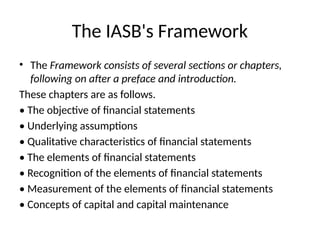
The IASB's Framework
•The Framework consists of several sections or chapters,
following on after a preface and introduction.
These chapters are as follows.
• The objective of financial statements
• Underlying assumptions
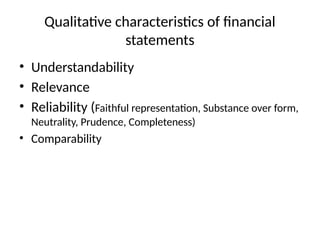
• Qualitative characteristics of financial statements
• The elements of financial statements
• Recognition of the elements of financial statements
• Measurement of the elements of financial statements
• Concepts of capital and capital maintenance
11.
IASB’s standard settingprocess
1. Setting the agenda: The IASB identifies a
subject (mainly by reference to the needs of
the investors). The IASB can also add topics
to its work plan if necessary between agenda
consultations. This can include topics
following post-implementation reviews of
Standards; the IFRS Interpretations
Committee may also request the IASB review
an issue.
12.
IASB’s standard settingprocess
2. Planning the project: After considering the
nature of the issues and the level of interest
among constituents, the IASB may establish a
working group at this stage.
13.
IASB’s standard settingprocess
3. Developing and publishing the discussion
paper
4. Developing and publishing the exposure
draft:for public comment, which is a draft
version of the intended standard. To gather
additional evidence, members of the IASB and
IFRS Foundation technical staff consult with a
range of stakeholders from all over the world.
IASB’s standard settingprocess
• 6. After the standard is issued, the staff and the
IASB members hold regular meetings with
interested parties, to help understand
unanticipated issues related to the practical
implementation and potential impact of its
proposals. If issues arise, the IFRS Interpretations
Committee may decide to create an IFRIC
Interpretation of the Accounting Standard or
recommend a narrow-scope amendment
16.
Recognition and Measurement
•Recognition. The process of incorporating in the
statement of financial position or statement of
comprehensive income an item that meets the
definition of an element and satisfies the following
criteria for recognition:
• (a) it is probable that any future economic benefit
associated with the item will flow to or from the
entity; and
• (b) the item has a cost or value that can be measured
with reliability.
17.
Measurement.
• The processof determining the monetary
amounts at which the elements of the
financial statements are to be recognized and
carried in the statement of financial position
and statement of comprehensive income.
18.
Measurement of theelements of financial
statements
• A number of different measurement bases are
used in financial statements. They include
• Historical cost
• Current cost
• Realizable (settlement) value
• Present value of future cash flows
19.
Measurement of theelements of financial
statements
• Historical cost. Assets are recorded at the amount
of cash or cash equivalents paid or the fair value
of the consideration given to acquire them at the
time of their acquisition. Liabilities are recorded
at the amount of proceeds received in exchange
for the obligation, or in some circumstances (for
example, income taxes), at the amounts of cash or
cash equivalents expected to be paid to satisfy
the liability in the normal course of business.
20.
Measurement of theelements of financial
statements
• Current cost. Assets are carried at the amount
of cash or cash equivalents that would have to
be paid if the same or an equivalent asset was
acquired currently.
• Liabilities are carried at the undiscounted
amount of cash or cash equivalents that would
be required to settle the obligation currently.
21.
Measurement of theelements of financial
statements
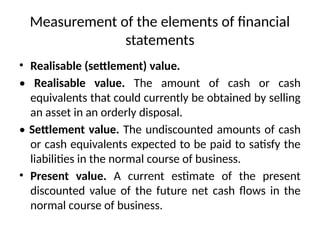
• Realisable (settlement) value.
• Realisable value. The amount of cash or cash
equivalents that could currently be obtained by selling
an asset in an orderly disposal.
• Settlement value. The undiscounted amounts of cash
or cash equivalents expected to be paid to satisfy the
liabilities in the normal course of business.
• Present value. A current estimate of the present
discounted value of the future net cash flows in the
normal course of business.
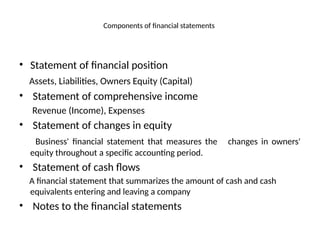
Components of financialstatements
• Statement of financial position
Assets, Liabilities, Owners Equity (Capital)
• Statement of comprehensive income
Revenue (Income), Expenses
• Statement of changes in equity
Business' financial statement that measures the changes in owners'
equity throughout a specific accounting period.
• Statement of cash flows
A financial statement that summarizes the amount of cash and cash
equivalents entering and leaving a company
• Notes to the financial statements
24.
Capital Maintenance
• Capitalmaintenance is when a company's
capital at the beginning of an accounting
period is the same as the capital at the end of
an accounting period. This shows that the
company maintained its assets and capital for
the period and there is a full recovery of all
costs.
25.
Capital Maintenance
• Tocalculate the profit of a company, the
capital of a company must be restored to its
initial level and an additional monetary
amount or net assets recorded at the end of a
period. It is the excess amount that is
calculated as the company's profit.
26.
Financial Capital Maintenance
•Financial capital maintenance deals with the actual funds
that a company has. When the funds are adequately
maintained in such a way that the amount recorded at the
end of an accounting period is more than the amount
recorded at the beginning of the period, profit is
recorded.
• The International Financial Reporting Standards (IFRS)
when calculating profit earned through financial capital
maintenance excludes contributions and distributions. The
Financial capital maintenance measures profit using net
assets, excess net assets translate to profit.
27.
Physical Capital Maintenance
•The ability and effectiveness of a business to
maintain cash flows, including managing
assets that generate revenue for the business
are known as physical capital maintenance.
Unlike financial capital maintenance, physical
capital maintenance is not concerned with the
actual funds or money of a firm, rather, it pays
attention to how well the business maintains
its income-generating assets.
28.
Physical Capital Maintenance
•Physical capital maintenance also excludes
contributions and distributions when
determining the profit earned by a firm at the
end of an accounting period.
Editor's Notes
#26 All the inflows such as the sale of stock to shareholders, the addition of capital from owners, and payment of dividends to shareholders payment of bonus to shareholders are excluded.
#27 any amount adjusted towards any amount paid to owners during the year or any amount raised by the owner excluded