IN THE NAME OF
ALLAH THE MERCIFUL
AND THE BENEFICENT
CONCEPT OF
PHYSICAL
PROTECTION AND ITS
PRINCIPALS
Socrates once said and I quote
People don’t know
what they don’t know
I know one thing I know nothing
Before proceeding any further let us
understand what is PHYSICAL PROTECTION
It is the protection of personnel, hardware,
software, networks and data from physical
actions and events that could cause serious
loss or damage to an enterprise, agency or
institution. This includes protection from fire,
flood, natural disasters, burglary, theft,
vandalism and terrorism.
Why is security important in life?
Individual safety and security is important
because both safety and security affect an
individual's well-being. Threats to safety and
security come in many forms, ranging from
deliberate violence to accidental injury.
Violence and injury, at their most extreme,
threaten life itself.
What are the primary threats to physical security?
The primary threats to physical security include
the following: inadvertent acts, potential acts of
human error or failure, potential deviations in
quality of service by service providers, power
irregularities; deliberate acts of espionage or
trespass, acts of information extortion, acts of
sabotage etc
Objectives
• Identify PPS design strategies
• List basic PPS functions
• Describe process, components, and performance
measures of each PPS function
• Draw timelines for adversary and PPS response
• Explain principle of timely detection
• Characterize effective PPS design concepts
Basic Functions of PPS
Detection
• Intrusion
sensing
• Alarm
communication
• Alarm
assessment
• Entry control
Delay
• Passive Barriers
• Dispensable
Barriers
Response
• Guards
• Response
Force
Principle of Timely Detection
To interrupt the adversary before he
completes his theft or sabotage task, the
PPS response time must be less than the
adversary task time remaining after
detection
Detection Process
Sensor
Activated
Alarm
Initiated
Alarm
Reported
Alarm
Assessed
GuardsTechnologies
Performance measures:
 Probability of sensor alarm (PS)
 Communication and Assessment Time (TC)
 Probability of Assessment (PA)
 Nuisance Alarm Rate (NAR)
 Assessed detection PD = F (PS, TC, PA , NAR)
Protection in Depth
Interior Sensor ApplicationsExterior Sensor Applications
Motion (Audio)
Proximity
(Point)
Boundary Penetration
(Wall, window, door)
Motion (Audio)
Boundary Penetration (Fence)
Line Detection (Buried, beam break)
Delay Process
Delay provides
obstacles to
Increase the
adversary
task time
Passive Barriers
Dispensable Barriers
 Performance measures
 Time to penetrate or bypass obstacles
 Time to travel across areas
Access delay
Role of Delay
• System detection and response time must be less
than adversary task time after first alarm
• To increase system success probability
• Detect intrusion earlier
• Reduce assessment time
• Reduce response time
• Increase adversary task time
Adversary Task Time
Detect
CT
First
Alarm
T0
Alarm
Assessed
AT
Respond
Adversary
Interrupted
TI
PPS Time Required
Delay
Attack
Begins
Elements of Delay
Effective Delay Systems
Passive Barriers Dispensable BarriersGuards
Flexible
Continuous
Operational
Cost
Sensitive to
Numbers
Subject to
Compromise
Guards
In Place:
Fail Secure
Commercially
Available
Weak Against
Explosives
Operational:
Aesthetic
Limits
Barriers
Compact:
Rapidly
Deployed
Maximize Delay
at Target
‘Somewhat’
Threat
Independent
Spurious
Activation:
Safety
Concerns
Dispensable
Barriers
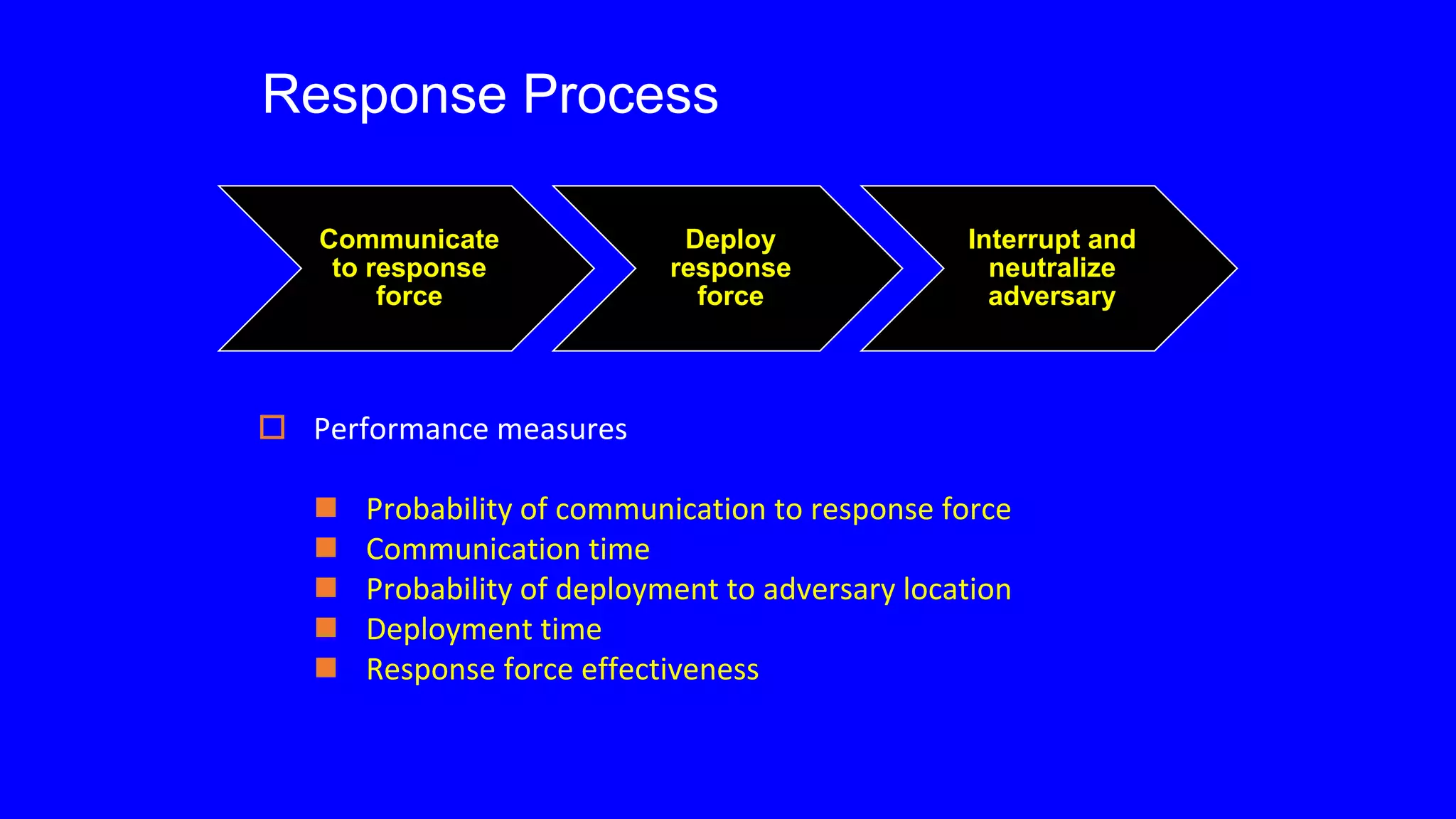
Response Process
Communicate
to response
force
Deploy
response
force
Interrupt and
neutralize
adversary
 Performance measures
 Probability of communication to response force
 Communication time
 Probability of deployment to adversary location
 Deployment time
 Response force effectiveness
Response
• Guards perform routine duties whereas response force is
responsible for defeating adversaries
• Protection planning should address: “What am I
protecting, and where and from whom am I protecting
it?”
• Response planning addresses how to respond
(responder number, positioning, armament, tactics, etc.)
• Higher communication security levels demand higher
complexity and cost
• Response force equipment must be adequate to address
adversary capabilities
• Training and testing of responders is essential for
effective response
• Interaction with outside agencies should be carefully
planned and documented
Two Competing Timelines
• Adversary Timeline
• Cross areas
• Penetrate or bypass barriers
• Remove or sabotage target
• PPS Timeline
• Detection process
• Delay process
• Response process
• Overlay of two timelines illustrates PPS effectiveness
Effective PPS Design Practices
•Defence in depth
•Protection-in-depth
•Balanced protection
•Reliability
Defence in Depth
The concept of physical protection
requires a designed mixture of hardware
(security devices), procedures (including
the organization of guards and the
performance of their duties) and facility
design (including layout).”
Protection-in-Depth
• Adversary must defeat or avoid a number of
protective devices in sequence
• Protection-in-depth should
• Increase adversary’s uncertainty about the
system
• Require more extensive preparations and
equipment by adversary prior to attacking the
system
• Create additional steps where the adversary
may fail or abort his mission
Balanced Protection
• Many unique physical paths to target
• System only as effective as weakest path
• Provide adequate protection against all threats
along all adversary paths
Reliability
• Redundant equipment
• Multiple complementary sensors
• Central Alarm System (CAS) and
Secondary Alarm Stations (SAS)
• Multiple response force locations
• Contingency plans
• Spare parts supply
• Compensatory measures
• External assistance
Summary
• Fundamental design strategies
• Deter adversary – impossible to measure
• Defeat adversary – PPS requirement
• Basic PPS functions
• Detection, Delay, Response
• Performances measures
• Probability of Detection
• Delay Time
• Response Time
• Interruption
• Neutralization
Summary
• Principle of timely detection
• To interrupt the adversary before he completes his theft or sabotage
task, the PPS response time must be less than the adversary task time
remaining after detection
• Effective design practices
• Balanced protection
• Protection-in-depth
• Reliability

Concept of physical protection and its principals

  • 1.
    IN THE NAMEOF ALLAH THE MERCIFUL AND THE BENEFICENT
  • 2.
  • 3.
    Socrates once saidand I quote People don’t know what they don’t know I know one thing I know nothing
  • 4.
    Before proceeding anyfurther let us understand what is PHYSICAL PROTECTION It is the protection of personnel, hardware, software, networks and data from physical actions and events that could cause serious loss or damage to an enterprise, agency or institution. This includes protection from fire, flood, natural disasters, burglary, theft, vandalism and terrorism.
  • 5.
    Why is securityimportant in life? Individual safety and security is important because both safety and security affect an individual's well-being. Threats to safety and security come in many forms, ranging from deliberate violence to accidental injury. Violence and injury, at their most extreme, threaten life itself.
  • 6.
    What are theprimary threats to physical security? The primary threats to physical security include the following: inadvertent acts, potential acts of human error or failure, potential deviations in quality of service by service providers, power irregularities; deliberate acts of espionage or trespass, acts of information extortion, acts of sabotage etc
  • 7.
    Objectives • Identify PPSdesign strategies • List basic PPS functions • Describe process, components, and performance measures of each PPS function • Draw timelines for adversary and PPS response • Explain principle of timely detection • Characterize effective PPS design concepts
  • 8.
    Basic Functions ofPPS Detection • Intrusion sensing • Alarm communication • Alarm assessment • Entry control Delay • Passive Barriers • Dispensable Barriers Response • Guards • Response Force
  • 9.
    Principle of TimelyDetection To interrupt the adversary before he completes his theft or sabotage task, the PPS response time must be less than the adversary task time remaining after detection
  • 10.
    Detection Process Sensor Activated Alarm Initiated Alarm Reported Alarm Assessed GuardsTechnologies Performance measures: Probability of sensor alarm (PS)  Communication and Assessment Time (TC)  Probability of Assessment (PA)  Nuisance Alarm Rate (NAR)  Assessed detection PD = F (PS, TC, PA , NAR)
  • 11.
    Protection in Depth InteriorSensor ApplicationsExterior Sensor Applications Motion (Audio) Proximity (Point) Boundary Penetration (Wall, window, door) Motion (Audio) Boundary Penetration (Fence) Line Detection (Buried, beam break)
  • 12.
    Delay Process Delay provides obstaclesto Increase the adversary task time Passive Barriers Dispensable Barriers  Performance measures  Time to penetrate or bypass obstacles  Time to travel across areas Access delay
  • 13.
    Role of Delay •System detection and response time must be less than adversary task time after first alarm • To increase system success probability • Detect intrusion earlier • Reduce assessment time • Reduce response time • Increase adversary task time Adversary Task Time Detect CT First Alarm T0 Alarm Assessed AT Respond Adversary Interrupted TI PPS Time Required Delay Attack Begins
  • 14.
    Elements of Delay EffectiveDelay Systems Passive Barriers Dispensable BarriersGuards Flexible Continuous Operational Cost Sensitive to Numbers Subject to Compromise Guards In Place: Fail Secure Commercially Available Weak Against Explosives Operational: Aesthetic Limits Barriers Compact: Rapidly Deployed Maximize Delay at Target ‘Somewhat’ Threat Independent Spurious Activation: Safety Concerns Dispensable Barriers
  • 15.
    Response Process Communicate to response force Deploy response force Interruptand neutralize adversary  Performance measures  Probability of communication to response force  Communication time  Probability of deployment to adversary location  Deployment time  Response force effectiveness
  • 16.
    Response • Guards performroutine duties whereas response force is responsible for defeating adversaries • Protection planning should address: “What am I protecting, and where and from whom am I protecting it?” • Response planning addresses how to respond (responder number, positioning, armament, tactics, etc.) • Higher communication security levels demand higher complexity and cost • Response force equipment must be adequate to address adversary capabilities • Training and testing of responders is essential for effective response • Interaction with outside agencies should be carefully planned and documented
  • 17.
    Two Competing Timelines •Adversary Timeline • Cross areas • Penetrate or bypass barriers • Remove or sabotage target • PPS Timeline • Detection process • Delay process • Response process • Overlay of two timelines illustrates PPS effectiveness
  • 18.
    Effective PPS DesignPractices •Defence in depth •Protection-in-depth •Balanced protection •Reliability
  • 19.
    Defence in Depth Theconcept of physical protection requires a designed mixture of hardware (security devices), procedures (including the organization of guards and the performance of their duties) and facility design (including layout).”
  • 20.
    Protection-in-Depth • Adversary mustdefeat or avoid a number of protective devices in sequence • Protection-in-depth should • Increase adversary’s uncertainty about the system • Require more extensive preparations and equipment by adversary prior to attacking the system • Create additional steps where the adversary may fail or abort his mission
  • 21.
    Balanced Protection • Manyunique physical paths to target • System only as effective as weakest path • Provide adequate protection against all threats along all adversary paths
  • 22.
    Reliability • Redundant equipment •Multiple complementary sensors • Central Alarm System (CAS) and Secondary Alarm Stations (SAS) • Multiple response force locations • Contingency plans • Spare parts supply • Compensatory measures • External assistance
  • 23.
    Summary • Fundamental designstrategies • Deter adversary – impossible to measure • Defeat adversary – PPS requirement • Basic PPS functions • Detection, Delay, Response • Performances measures • Probability of Detection • Delay Time • Response Time • Interruption • Neutralization
  • 24.
    Summary • Principle oftimely detection • To interrupt the adversary before he completes his theft or sabotage task, the PPS response time must be less than the adversary task time remaining after detection • Effective design practices • Balanced protection • Protection-in-depth • Reliability

Editor's Notes

  • #12 RTC on Physical Protection of Nuclear Materials and Facilities, Beijing 2010
  • #14 RTC on Physical Protection of Nuclear Materials and FAcilities, Beijing 2010
  • #15 RTC on Physical Protection of Nuclear Materials and FAcilities, Beijing 2010
  • #17 RTC on Physical Protection of Nuclear Materials and Facilities, Beijing 2010