COMUNITAT VALENCIANA
VALENCIA
CLIMATE
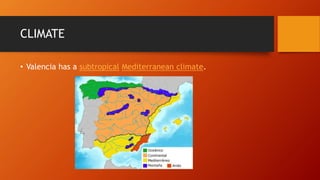
• Valencia has a subtropical Mediterranean climate.
ECONOMY
• Valencia enjoyed strong economic.
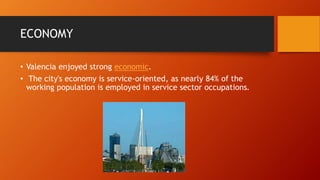
• The city's economy is service-oriented, as nearly 84% of the
working population is employed in service sector occupations.
PORT
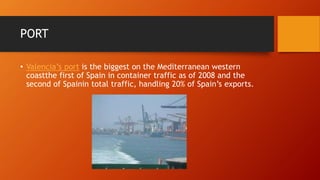
• Valencia’s port is the biggest on the Mediterranean western
coastthe first of Spain in container traffic as of 2008 and the
second of Spainin total traffic, handling 20% of Spain’s exports.
TRANSPORT
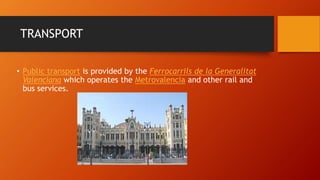
• Public transport is provided by the Ferrocarrils de la Generalitat
Valenciana which operates the Metrovalencia and other rail and
bus services.
TOURISM
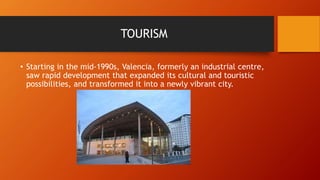
• Starting in the mid-1990s, Valencia, formerly an industrial centre,
saw rapid development that expanded its cultural and touristic
possibilities, and transformed it into a newly vibrant city.
CULTURE
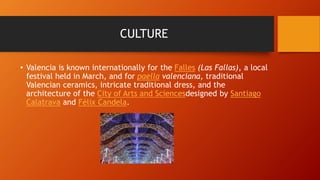
• Valencia is known internationally for the Falles (Las Fallas), a local
festival held in March, and for paella valenciana, traditional
Valencian ceramics, intricate traditional dress, and the
architecture of the City of Arts and Sciencesdesigned by Santiago
Calatrava and Félix Candela.
LANGUAGES
• The two official languages spoken in the city are Valencian (a
variety of Catalan) and Spanish. Due to political and demographic
pressures in the past, the predominant language is Spanish, but
Valencian (as Catalan language is referred to by local authorities)
is taught and spoken in most of the surrounding metropolitan
area and province of Valencia
FOOTBALL
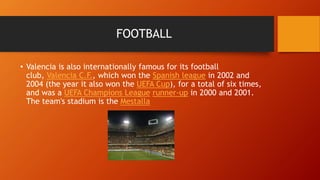
• Valencia is also internationally famous for its football
club, Valencia C.F., which won the Spanish league in 2002 and
2004 (the year it also won the UEFA Cup), for a total of six times,
and was a UEFA Champions League runner-up in 2000 and 2001.
The team's stadium is the Mestalla
AMERICAN FOOTBALL
• Valencia is the only city in Spain with two American football teams
in LNFA Serie A, the national first division: Valencia
Firebats and Valencia Giants. The Firebats have been national
champions three times and have represented Valencia and Spain in
the European playoffs since 2005. Both teams share the Jardín del
Turia stadium.

Comunitat valenciana

  • 1.
  • 2.
    CLIMATE • Valencia hasa subtropical Mediterranean climate.
  • 3.
    ECONOMY • Valencia enjoyedstrong economic. • The city's economy is service-oriented, as nearly 84% of the working population is employed in service sector occupations.
  • 4.
    PORT • Valencia’s portis the biggest on the Mediterranean western coastthe first of Spain in container traffic as of 2008 and the second of Spainin total traffic, handling 20% of Spain’s exports.
  • 5.
    TRANSPORT • Public transportis provided by the Ferrocarrils de la Generalitat Valenciana which operates the Metrovalencia and other rail and bus services.
  • 6.
    TOURISM • Starting inthe mid-1990s, Valencia, formerly an industrial centre, saw rapid development that expanded its cultural and touristic possibilities, and transformed it into a newly vibrant city.
  • 7.
    CULTURE • Valencia isknown internationally for the Falles (Las Fallas), a local festival held in March, and for paella valenciana, traditional Valencian ceramics, intricate traditional dress, and the architecture of the City of Arts and Sciencesdesigned by Santiago Calatrava and Félix Candela.
  • 8.
    LANGUAGES • The twoofficial languages spoken in the city are Valencian (a variety of Catalan) and Spanish. Due to political and demographic pressures in the past, the predominant language is Spanish, but Valencian (as Catalan language is referred to by local authorities) is taught and spoken in most of the surrounding metropolitan area and province of Valencia
  • 9.
    FOOTBALL • Valencia isalso internationally famous for its football club, Valencia C.F., which won the Spanish league in 2002 and 2004 (the year it also won the UEFA Cup), for a total of six times, and was a UEFA Champions League runner-up in 2000 and 2001. The team's stadium is the Mestalla
  • 10.
    AMERICAN FOOTBALL • Valenciais the only city in Spain with two American football teams in LNFA Serie A, the national first division: Valencia Firebats and Valencia Giants. The Firebats have been national champions three times and have represented Valencia and Spain in the European playoffs since 2005. Both teams share the Jardín del Turia stadium.