What is systemsecurity?
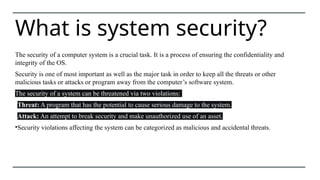
The security of a computer system is a crucial task. It is a process of ensuring the confidentiality and
integrity of the OS.
Security is one of most important as well as the major task in order to keep all the threats or other
malicious tasks or attacks or program away from the computer’s software system.
The security of a system can be threatened via two violations:
•Threat: A program that has the potential to cause serious damage to the system.
•Attack: An attempt to break security and make unauthorized use of an asset.
•Security violations affecting the system can be categorized as malicious and accidental threats.
3.
Conti..
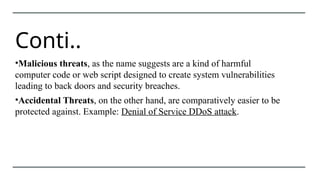
•Malicious threats, asthe name suggests are a kind of harmful
computer code or web script designed to create system vulnerabilities
leading to back doors and security breaches.
•Accidental Threats, on the other hand, are comparatively easier to be
protected against. Example: Denial of Service DDoS attack.
7.
Browser memory protectionis a crucial aspect of computer system security,
focusing on safeguarding the memory space used by web browsers. This protection is
essential to prevent unauthorized access and exploitation of memory-related
vulnerabilities, such as buffer overflows, use-after-free bugs, and other memory
corruption issues that attackers can exploit to execute arbitrary code or compromise
the security of a system.
Key Aspects of Browser Memory Protection
1.Sandboxing: Modern browsers use sandboxing techniques to isolate different
processes, like rendering web pages or executing JavaScript. By running these
processes in separate, restricted environments, the browser limits the damage that can
occur if one of these processes is compromised.
2.Address Space Layout Randomization (ASLR): ASLR is a security technique that
randomizes the memory addresses used by system and application processes. This
makes it more difficult for attackers to predict where their malicious code will be loaded
in memory, thus preventing certain types of exploits.
8.
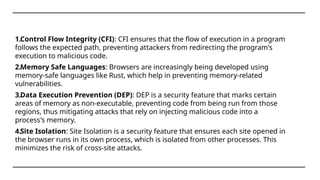
1.Control Flow Integrity(CFI): CFI ensures that the flow of execution in a program
follows the expected path, preventing attackers from redirecting the program's
execution to malicious code.
2.Memory Safe Languages: Browsers are increasingly being developed using
memory-safe languages like Rust, which help in preventing memory-related
vulnerabilities.
3.Data Execution Prevention (DEP): DEP is a security feature that marks certain
areas of memory as non-executable, preventing code from being run from those
regions, thus mitigating attacks that rely on injecting malicious code into a
process's memory.
4.Site Isolation: Site Isolation is a security feature that ensures each site opened in
the browser runs in its own process, which is isolated from other processes. This
minimizes the risk of cross-site attacks.
9.
Importance of BrowserMemory Protection
With the increasing complexity of web applications and the rise in
targeted cyberattacks, browser memory protection is more critical than
ever. Memory vulnerabilities in browsers can lead to severe
consequences, including data breaches, unauthorized access to
sensitive information, and the installation of malware.
By implementing robust memory protection mechanisms, browsers can
offer a more secure environment for users, ensuring that their data and
activities online remain safe from malicious actors.