Two Strategies …
Strategy One:
– You have a map, which
gives you a complete
picture of where you
are, and possible
routes, distances to get
to destination X
Strategy Two:
– You don’t have a map,
all you know is the road
signs telling you the
distance from here, i.e.,
where you are, to next
adjacent town
– Also suppose you ask
around, from the people
from the neighbor town,
you know (according to
them) how far it is from
here to the destination
4.
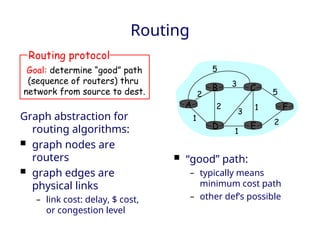
Routing
Graph abstraction for
routingalgorithms:
graph nodes are
routers
graph edges are
physical links
– link cost: delay, $ cost,
or congestion level
Goal: determine “good” path
(sequence of routers) thru
network from source to dest.
Routing protocol
A
E
D
C
B
F
2
2
1
3
1
1
2
5
3
5
“good” path:
– typically means
minimum cost path
– other def’s possible
5.
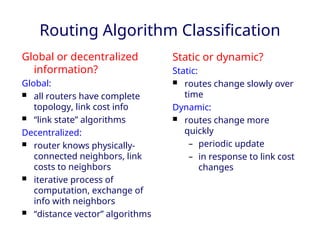
Routing Algorithm Classification
Globalor decentralized
information?
Global:
all routers have complete
topology, link cost info
“link state” algorithms
Decentralized:
router knows physically-
connected neighbors, link
costs to neighbors
iterative process of
computation, exchange of
info with neighbors
“distance vector” algorithms
Static or dynamic?
Static:
routes change slowly over
time
Dynamic:
routes change more
quickly
– periodic update
– in response to link cost
changes
6.
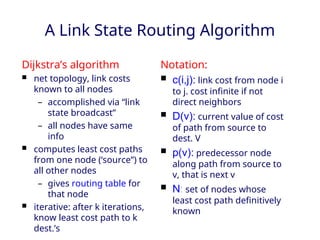
A Link StateRouting Algorithm
Dijkstra’s algorithm
net topology, link costs
known to all nodes
– accomplished via “link
state broadcast”
– all nodes have same
info
computes least cost paths
from one node (‘source”) to
all other nodes
– gives routing table for
that node
iterative: after k iterations,
know least cost path to k
dest.’s
Notation:
c(i,j): link cost from node i
to j. cost infinite if not
direct neighbors
D(v): current value of cost
of path from source to
dest. V
p(v): predecessor node
along path from source to
v, that is next v
N: set of nodes whose
least cost path definitively
known
7.
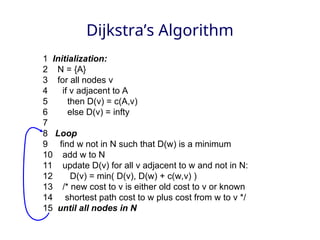
Dijkstra’s Algorithm
1 Initialization:
2N = {A}
3 for all nodes v
4 if v adjacent to A
5 then D(v) = c(A,v)
6 else D(v) = infty
7
8 Loop
9 find w not in N such that D(w) is a minimum
10 add w to N
11 update D(v) for all v adjacent to w and not in N:
12 D(v) = min( D(v), D(w) + c(w,v) )
13 /* new cost to v is either old cost to v or known
14 shortest path cost to w plus cost from w to v */
15 until all nodes in N
8.
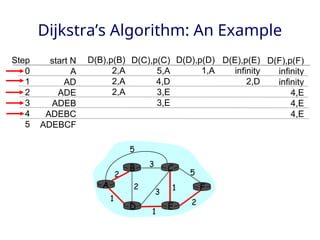
Dijkstra’s Algorithm: AnExample
Step
0
1
2
3
4
5
start N
A
AD
ADE
ADEB
ADEBC
ADEBCF
D(B),p(B)
2,A
2,A
2,A
D(C),p(C)
5,A
4,D
3,E
3,E
D(D),p(D)
1,A
D(E),p(E)
infinity
2,D
D(F),p(F)
infinity
infinity
4,E
4,E
4,E
A
E
D
C
B
F
2
2
1
3
1
1
2
5
3
5
9.
Dijkstra’s Algorithm: Discussion
Algorithmcomplexity: n nodes
each iteration: need to check all nodes, w, not in N
n*(n+1)/2 comparisons: O(n**2)
more efficient implementations possible: O(nlogn)
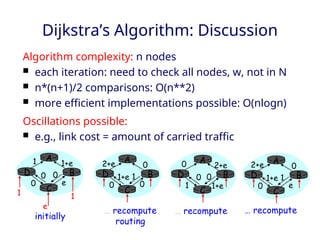
Oscillations possible:
e.g., link cost = amount of carried traffic
A
D
C
B
1 1+e
e
0
e
1 1
0 0
A
D
C
B
2+e 0
0
0
1+e 1
A
D
C
B
0 2+e
1+e
1
0 0
A
D
C
B
2+e 0
e
0
1+e 1
initially
… recompute
routing
… recompute … recompute
10.
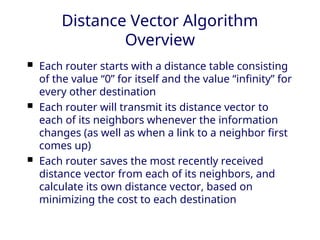
Distance Vector Algorithm
Overview
Each router starts with a distance table consisting
of the value “0” for itself and the value “infinity” for
every other destination
Each router will transmit its distance vector to
each of its neighbors whenever the information
changes (as well as when a link to a neighbor first
comes up)
Each router saves the most recently received
distance vector from each of its neighbors, and
calculate its own distance vector, based on
minimizing the cost to each destination
11.
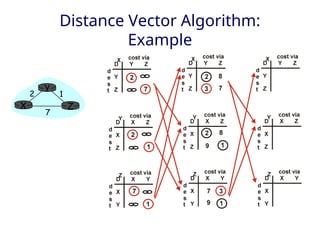
Distance Vector Algorithm
iterative:
continues until no
nodes exchange info.
self-terminating: no
“signal” to stop
asynchronous:
nodes need not
exchange info/iterate
in lock step!
distributed:
each node
communicates only
with directly-attached
neighbors
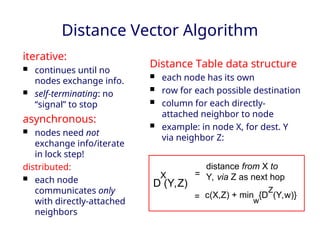
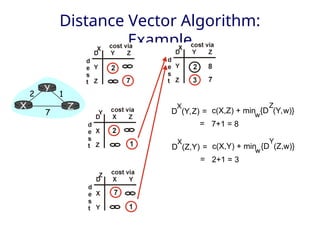
Distance Table data structure
each node has its own
row for each possible destination
column for each directly-
attached neighbor to node
example: in node X, for dest. Y
via neighbor Z:
D (Y,Z)
X
distance from X to
Y, via Z as next hop
c(X,Z) + min {D (Y,w)}
Z
w
=
=
12.
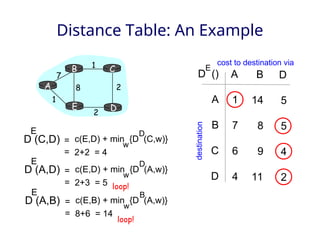
Distance Table: AnExample
A
E D
C
B
7
8
1
2
1
2
D ()
A
B
C
D
A
1
7
6
4
B
14
8
9
11
D
5
5
4
2
E
cost to destination via
destin
ation
D (C,D)
E
c(E,D) + min {D (C,w)}
D
w
=
= 2+2 = 4
D (A,D)
E
c(E,D) + min {D (A,w)}
D
w
=
= 2+3 = 5
D (A,B)
E
c(E,B) + min {D (A,w)}
B
w
=
= 8+6 = 14
loop!
loop!
13.
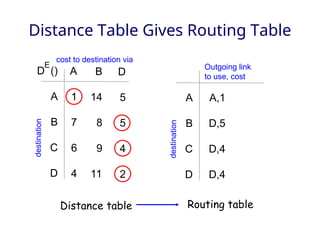
Distance Table GivesRouting Table
D ()
A
B
C
D
A
1
7
6
4
B
14
8
9
11
D
5
5
4
2
E
cost to destination via
destin
ation
A
B
C
D
A,1
D,5
D,4
D,4
Outgoing link
to use, cost
destin
ation
Distance table Routing table
14.
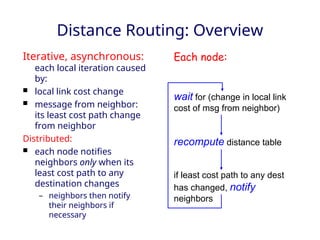
Distance Routing: Overview
Iterative,asynchronous:
each local iteration caused
by:
local link cost change
message from neighbor:
its least cost path change
from neighbor
Distributed:
each node notifies
neighbors only when its
least cost path to any
destination changes
– neighbors then notify
their neighbors if
necessary
wait for (change in local link
cost of msg from neighbor)
recompute distance table
if least cost path to any dest
has changed, notify
neighbors
Each node:
15.
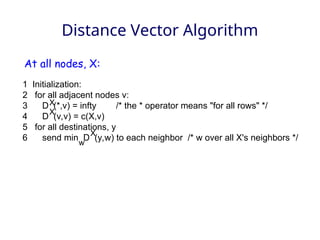
Distance Vector Algorithm
1Initialization:
2 for all adjacent nodes v:
3 D (*,v) = infty /* the * operator means "for all rows" */
4 D (v,v) = c(X,v)
5 for all destinations, y
6 send min D (y,w) to each neighbor /* w over all X's neighbors */
X
X
X
w
At all nodes, X:
16.
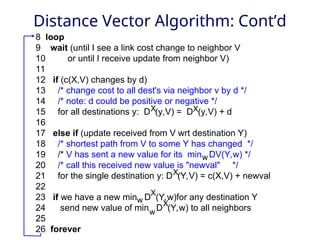
Distance Vector Algorithm:Cont’d
8 loop
9 wait (until I see a link cost change to neighbor V
10 or until I receive update from neighbor V)
11
12 if (c(X,V) changes by d)
13 /* change cost to all dest's via neighbor v by d */
14 /* note: d could be positive or negative */
15 for all destinations y: D (y,V) = D (y,V) + d
16
17 else if (update received from V wrt destination Y)
18 /* shortest path from V to some Y has changed */
19 /* V has sent a new value for its min DV(Y,w) */
20 /* call this received new value is "newval" */
21 for the single destination y: D (Y,V) = c(X,V) + newval
22
23 if we have a new min D (Y,w)for any destination Y
24 send new value of min D (Y,w) to all neighbors
25
26 forever
w
X
X
X
X
X
w
w
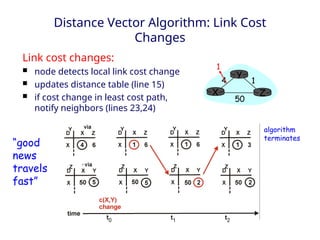
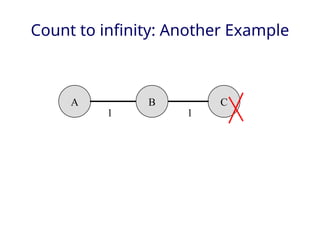
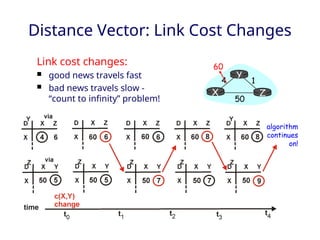
Distance Vector: LinkCost Changes
Link cost changes:
good news travels fast
bad news travels slow -
“count to infinity” problem!
X Z
1
4
50
Y
60
algorithm
continues
on!
22.
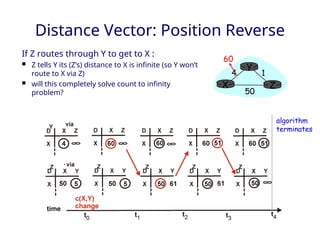
Distance Vector: PositionReverse
If Z routes through Y to get to X :
Z tells Y its (Z’s) distance to X is infinite (so Y won’t
route to X via Z)
will this completely solve count to infinity
problem?
X Z
1
4
50
Y
60
algorithm
terminates
23.
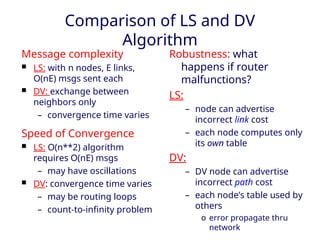
Comparison of LSand DV
Algorithm
Message complexity
LS: with n nodes, E links,
O(nE) msgs sent each
DV: exchange between
neighbors only
– convergence time varies
Speed of Convergence
LS: O(n**2) algorithm
requires O(nE) msgs
– may have oscillations
DV: convergence time varies
– may be routing loops
– count-to-infinity problem
Robustness: what
happens if router
malfunctions?
LS:
– node can advertise
incorrect link cost
– each node computes only
its own table
DV:
– DV node can advertise
incorrect path cost
– each node’s table used by
others
o error propagate thru
network
24.
Summary
LS andDV are representative
There are other type of routing algorithms,
especially in circuit switching world, e.g.,
hot potato algorithm
Most of the internet routing protocols
(think OSPF, BGP etc.) are based on these
fundamental algorithms we introduced just
now